K48 vs. K63 Polyubiquitin Chains: Decoding the Ubiquitin Code for Protein Fate and Signaling
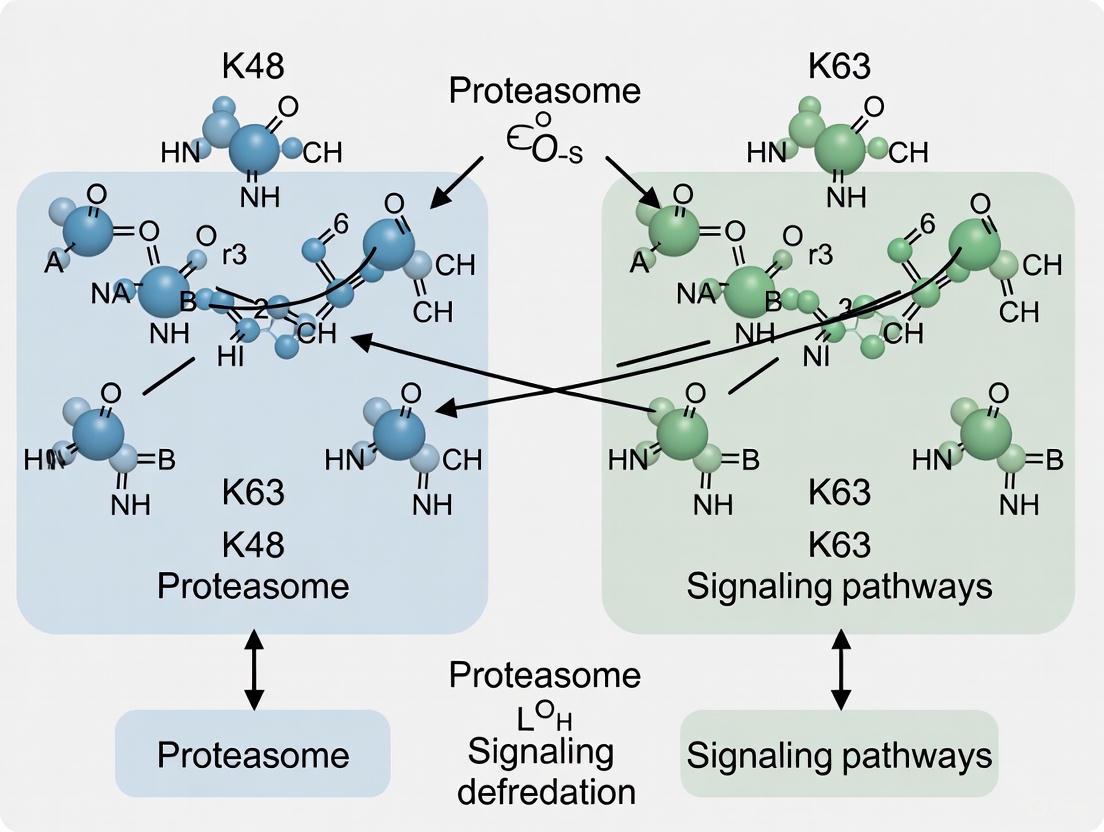
This article provides a comprehensive comparison of K48- and K63-linked polyubiquitin chains, the two most abundant and functionally distinct ubiquitin codes.
K48 vs. K63 Polyubiquitin Chains: Decoding the Ubiquitin Code for Protein Fate and Signaling
Abstract
This article provides a comprehensive comparison of K48- and K63-linked polyubiquitin chains, the two most abundant and functionally distinct ubiquitin codes. Tailored for researchers and drug development professionals, it delves into the foundational biology governing their unique roles in proteasomal degradation versus non-proteolytic signaling. The content further explores advanced methodologies for chain-specific analysis, addresses common experimental challenges, and validates functional distinctions through comparative case studies in inflammation, cancer, and neurodegeneration. By synthesizing current research and emerging concepts like branched chains, this review serves as a strategic guide for exploiting ubiquitin chain specificity in therapeutic development, including the growing field of targeted protein degradation.
The Ubiquitin Code: Unraveling the Distinct Biological Roles of K48 and K63 Linkages
The ubiquitin-proteasome system (UPS) represents a fundamental regulatory mechanism in eukaryotic cells, controlling the precise degradation of proteins to maintain cellular homeostasis. Central to this system is the covalent attachment of ubiquitin to target proteins, a process that generates a complex array of signals known as the "ubiquitin code." Among the diverse ubiquitin chain linkages, the canonical function of lysine 48-linked polyubiquitin (K48-Ub) chains as the principal signal for proteasomal degradation has been extensively documented. This canonical role stands in contrast to the predominantly non-degradative functions of other linkages, particularly lysine 63-linked polyubiquitin (K63-Ub) chains, which are primarily associated with signaling pathways, DNA repair, and protein trafficking [1] [2].
The foundational understanding of K48-Ub chains emerged from seminal work in the 1980s, which revealed K48-linked polyubiquitin as the specific chain topology directing proteins to the proteasome for degradation [1]. This established a paradigm in which different ubiquitin linkages encode distinct cellular functions, with K48 specialization for degradation and K63 specialization for signaling. However, recent research has uncovered greater complexity, demonstrating that branched ubiquitin chains containing both K48 and K63 linkages can serve as potent degradation signals, suggesting sophisticated interplay between these linkage types [3] [4]. This guide systematically compares the degradation-related functions of K48 and K63 ubiquitin chains, providing experimental data and methodologies essential for researchers investigating targeted protein degradation.
Quantitative Comparison of K48 and K63 Degradation Efficiency
Intracellular Degradation Kinetics
The development of UbiREAD (Ubiquitinated Reporter Evaluation After Intracellular Delivery) technology has enabled precise quantification of intracellular degradation kinetics for substrates modified with defined ubiquitin chains. This approach allows direct comparison of degradation rates by conjugating bespoke ubiquitin chains to a GFP reporter substrate and delivering them into human cells via electroporation [5] [6].
Table 1: Intracellular Degradation Kinetics of Ubiquitin Chain Types
| Ubiquitin Chain Type | Chain Length | Degradation Half-Life | Cellular Process | Key Experimental System |
|---|---|---|---|---|
| K48-linked Ubiquitin | Ub4 | ~1 minute | Proteasomal Degradation | UbiREAD in RPE-1 cells [5] |
| K48-linked Ubiquitin | Ub3 | Efficient degradation | Proteasomal Degradation | UbiREAD [5] |
| K48-linked Ubiquitin | Ub2 | Less efficient degradation | Proteasomal Degradation | UbiREAD [5] |
| K63-linked Ubiquitin | Multiple lengths | Rapid deubiquitination | Signal Transduction | UbiREAD [5] |
| K48/K63-branched Ubiquitin | Branched Ub3/Ub4 | Dependent on substrate-anchored chain | Proteasomal Degradation | UbiREAD, MS analyses [5] [4] |
Functional Specialization of Ubiquitin Linkages
The distinct functional roles of K48 and K63 ubiquitin linkages are reflected in their interaction networks and structural features.
Table 2: Functional Specialization of K48 and K63 Ubiquitin Linkages
| Characteristic | K48-linked Ubiquitin | K63-linked Ubiquitin |
|---|---|---|
| Primary Cellular Function | Proteasomal degradation [1] [2] | Signal transduction, DNA repair, protein trafficking [1] [2] |
| Structural Configuration | Closed conformation with I44 patch interactions [4] | Open, extended conformation [4] |
| Proteasomal Association | Preferentially associates with proteasomes [3] | Limited direct proteasomal association |
| Minimal Degradation Signal | K48-Ub3 [5] | Not typically a standalone degradation signal |
| Branched Chain Contribution | Component of K48/K63-branched degradation signals [3] [4] | Can serve as "seed" for branched degradation chains [3] |
Experimental Approaches for Studying Ubiquitin-Dependent Degradation
UbiREAD Technology for Degradation Kinetics
The UbiREAD methodology enables systematic interrogation of how K48, K63, and K48/K63-branched ubiquitin chains impact intracellular degradation of model substrates [5] [6].
Experimental Protocol:
- Ubiquitinated Substrate Synthesis: Prepare ubiquitin chains of defined length and composition using distal ubiquitin moieties with lysine-to-arginine mutations to prevent further elongation (e.g., K48R for K48 chains)
- Substrate Conjugation: Conjugate purified ubiquitin chains to a mono-ubiquitinated GFP model degradation substrate
- Intracellular Delivery: Introduce ubiquitinated GFP constructs into mammalian cells (RPE-1, THP-1, U2OS, A549, HeLa, or 293T) via electroporation
- Degradation Monitoring: Quantify degradation kinetics using flow cytometry and in-gel fluorescence to distinguish input and deubiquitinated species
- Inhibitor Validation: Confirm proteasome dependence using MG132 (proteasome inhibitor) and TAK243 (E1 inhibitor) [5]
Key Findings:
- K48-Ub4-GFP degradation occurs with a half-life of approximately 1 minute
- K48-Ub3 represents the minimal efficient intracellular degradation signal
- K63-ubiquitinated substrates undergo rapid deubiquitination rather than degradation
- In K48/K63-branched chains, the identity of the substrate-anchored chain determines degradation behavior [5]
Figure 1: UbiREAD Experimental Workflow for Analyzing Ubiquitin-Dependent Degradation
Ubiquitin Interactor Screens for Binding Specificity
Pulldown assays with immobilized ubiquitin chains enable identification of linkage-specific ubiquitin-binding proteins, revealing how the ubiquitin code is interpreted by cellular machinery [7] [4].
Experimental Protocol:
- Ubiquitin Chain Synthesis: Enzymatically synthesize homotypic K48-Ub2, K48-Ub3, K63-Ub2, K63-Ub3, and K48/K63-branched Ub3 using linkage-specific E2 enzymes (CDC34 for K48, Ubc13/Uev1a for K63)
- Immobilization: Add serine/glycine linker with cysteine residue to proximal ubiquitin and attach biotin molecule via cysteine-maleimide reaction
- Affinity Purification: Immobilize biotinylated ubiquitin chains on streptavidin resin and incubate with cell lysates
- DUB Inhibition: Treat lysates with deubiquitinase inhibitors (chloroacetamide or N-ethylmaleimide) to preserve ubiquitin chains during assay
- Interactor Identification: Identify bound proteins using liquid chromatography-mass spectrometry (LC-MS/MS)
- Validation: Confirm binding specificity using surface plasmon resonance (SPR) [7]
Key Findings:
- Identification of K48/K63 branch-specific ubiquitin interactors including PARP10, UBR4, and HIP1
- Discovery of interactors with preference for Ub3 over Ub2 chains (CCDC50, FAF1, DDI2)
- Demonstration that deubiquitinase inhibitor choice significantly affects ubiquitin binding profiles [7]
TUBE-Based Assays for Linkage-Specific Ubiquitination
Tandem Ubiquitin Binding Entities (TUBEs) provide a high-throughput approach for investigating linkage-specific ubiquitination of endogenous proteins [2].
Experimental Protocol:
- Cell Stimulation: Treat THP-1 cells with stimuli to induce specific ubiquitination (e.g., L18-MDP for K63 ubiquitination of RIPK2, PROTACs for K48 ubiquitination)
- Cell Lysis: Lyse cells in buffer optimized to preserve polyubiquitination
- Affinity Capture: Incubate lysates with chain-specific TUBEs (K48-TUBE, K63-TUBE, or pan-TUBE) immobilized in 96-well plates
- Target Detection: Detect captured ubiquitinated proteins using target-specific antibodies
- Quantification: Quantify linkage-specific ubiquitination signals [2]
Key Findings:
- K63-TUBEs specifically capture L18-MDP-induced RIPK2 ubiquitination
- K48-TUBEs specifically capture PROTAC-induced RIPK2 ubiquitination
- Pan-selective TUBEs capture both K48 and K63 ubiquitination events [2]
Branched Ubiquitin Chains in Degradation Signaling
K48/K63-Branched Chains as Potent Degradation Signals
Recent research has revealed that branched ubiquitin chains containing both K48 and K63 linkages constitute a sizable fraction of ubiquitin polymers in human cells and function as efficient proteasomal degradation signals [4].
Experimental Evidence:
- Quantitative analysis demonstrates that K48/K63-branched linkages preferentially associate with proteasomes in cells [3]
- ITCH-dependent K63 ubiquitination of TXNIP serves as a "seed" for subsequent assembly of K48/K63-branched chains by recruiting ubiquitin-interacting ligases like UBR5, leading to efficient degradation [3]
- K48/K63-branched chains account for approximately 20% of all K63 linkages in cells [7]
- Multiple valosin-containing protein (VCP/p97)-associated proteins bind to or debranch K48/K63-linked ubiquitin, suggesting specialized handling of branched chains [4]
Figure 2: K63 as Seed for Branched Degradation Signal Pathway
Debranching Enzymes and Branched Chain Regulation
The identification of debranching enzymes specific for K48/K63-branched ubiquitin chains reveals sophisticated regulatory mechanisms for controlling branched ubiquitin signals.
Key Findings:
- ATXN3 and MINDY family deubiquitinases function as debranching enzymes for K48/K63-branched chains [4]
- Engineered K48/K63 branch-specific nanobodies enable detection of branched chains in cellular contexts
- K48-K63-branched ubiquitin accumulation increases following VCP/p97 inhibition and after DNA damage [4]
- Branched ubiquitin chains are not simply the sum of their parts but exhibit functional hierarchy based on substrate-anchored chain identity [5]
Research Reagent Solutions for Ubiquitin Studies
Table 3: Essential Research Reagents for Studying Ubiquitin-Dependent Degradation
| Reagent/Tool | Specific Function | Application Examples | Key Features |
|---|---|---|---|
| Chain-Specific TUBEs | High-affinity capture of linkage-specific polyubiquitin chains [2] | Differentiation of K48 vs. K63 ubiquitination in PROTAC treatments or signaling studies | Nanomolar affinity; linkage specificity (K48, K63, pan) |
| UbiCRest Assay | Linkage composition confirmation via selective disassembly with linkage-specific DUBs [7] | Validation of synthesized ubiquitin chain linkage specificity | Uses DUBs like OTUB1 (K48-specific) and AMSH (K63-specific) |
| Defined Ubiquitin Chains | Bespoke ubiquitin chains of specific length and linkage for in vitro assays [7] [5] | UbiREAD degradation assays; pulldown experiments | Native isopeptide bonds; defined architecture |
| Branch-Specific Nanobodies | Selective detection of K48/K63-branched ubiquitin chains [4] | Cellular detection of branched ubiquitin accumulation | Picomolar affinity; crystal structures available |
| DUB Inhibitors | Prevention of chain disassembly during assays [7] | Pulldown assays with cell lysates | Chloroacetamide (CAA) and N-ethylmaleimide (NEM) compared |
| Linkage-Specific E2 Enzymes | Enzymatic synthesis of defined linkage ubiquitin chains [7] | In vitro ubiquitin chain assembly | CDC34 (K48-specific), Ubc13/Uev1a (K63-specific) |
The canonical function of K48-linked polyubiquitin chains as the principal signal for proteasomal degradation remains a foundational principle in ubiquitin biology. However, contemporary research has revealed substantial complexity in the ubiquitin code, demonstrating that K48 linkages function within a sophisticated network that includes chain length requirements, branched architectures, and dynamic regulation by debranching enzymes. The quantitative data presented in this guide establishes K48-Ub3 as the minimal efficient degradation signal, operating with remarkably fast kinetics in cellular environments. The emerging role of K48/K63-branched chains as potent degradation signals further expands our understanding of how ubiquitin linkage combinations create specialized functions. For researchers and drug development professionals, the experimental approaches and reagent solutions detailed here provide essential methodologies for investigating targeted protein degradation mechanisms, with significant implications for developing therapeutic strategies that exploit the ubiquitin-proteasome system.
Ubiquitination is a crucial post-translational modification that governs virtually every cellular process in eukaryotes. The covalent attachment of ubiquitin to target proteins can signal for diverse outcomes, largely determined by the topology of the polyubiquitin chain formed. Among the eight possible ubiquitin linkage types, lysine 48 (K48) and lysine 63 (K63) represent the most abundant and functionally distinct polyubiquitin chains. While K48-linked ubiquitination is the canonical signal for proteasomal degradation, K63-linked ubiquitination has emerged as a key regulator of non-proteolytic signaling pathways. This comparison guide examines the distinct functions of K48 and K63 polyubiquitin chains, with a focused analysis of K63's roles in inflammation, DNA repair, and endocytosis, providing researchers with experimental data and methodologies for studying these pathways.
Table 1: Fundamental Characteristics of K48 and K63 Polyubiquitin Chains
| Feature | K48-Linked Chains | K63-Linked Chains |
|---|---|---|
| Primary Function | Proteasomal degradation | Non-proteolytic signaling |
| Structural Architecture | Compact conformation [8] | Relaxed, extended conformation [8] |
| Chain Length Requirement | ≥ 3 ubiquitins for efficient degradation [5] | ≥ 4 ubiquitins for DNA binding [8] |
| Proteasome Association | Highly enriched [9] | Minimal association [9] |
| Cellular Abundance | ~60% of total linkages [7] | ~20% of total linkages [7] |
| Response to Proteasome Inhibition | Accumulates significantly [9] | Largely unchanged [9] [10] |
Structural and Functional Distinctions Between K48 and K63 Chains
The functional divergence between K48 and K63 ubiquitin chains originates from their distinct structural properties. K48-linked chains adopt a compact helical structure that facilitates recognition by the proteasome. In contrast, K63-linked chains exhibit a relaxed and labile conformation [8] that mirrors DNA double strands, enabling non-proteolytic functions. This structural difference fundamentally dictates their cellular recognition and downstream consequences.
Recent research using the UbiREAD technology has quantitatively demonstrated these functional differences. K48-Ub4-GFP substrates undergo rapid intracellular degradation with a half-life of approximately 1 minute, whereas K63-ubiquitinated substrates are rapidly deubiquitinated rather than degraded [5]. This kinetic competition between degradation and deubiquitination is encoded in the ubiquitin chain linkage type, with K48 chains of three or more ubiquitins triggering efficient proteasomal recognition.
The functional distinction extends to branched ubiquitin chains containing both linkages. K48/K63 branched linkages preferentially associate with proteasomes in cells, while unbranched K63 linkages are largely excluded [9]. This indicates that the cellular interpretation of the ubiquitin code can be altered by combinations of ubiquitin linkages, adding complexity to the simple K48-degradation/K63-signaling paradigm.
Diagram 1: Structural and functional divergence between K48 and K63 ubiquitin chains.
K63-Linked Ubiquitination in Inflammatory Signaling
K63-linked ubiquitination serves as a critical control point in immune and inflammatory signaling pathways, particularly in NF-κB and MAPK activation. This linkage type facilitates the formation of molecular scaffolds that bring together signaling components to amplify inflammatory responses.
NF-κB Pathway Activation
In the NF-κB pathway, K63 ubiquitination creates platforms for the recruitment and activation of the IKK complex. Quantitative studies using chain-specific TUBEs (Tandem Ubiquitin Binding Entities) have demonstrated that inflammatory stimuli like muramyldipeptide (L18-MDP) induce K63-linked ubiquitination of RIPK2, a key regulator of inflammatory signaling [11]. This K63 ubiquitination serves as a signaling scaffold to recruit TAK1/TAB1/TAB2/IKK kinase complexes, leading to NF-κB activation and proinflammatory cytokine production.
The E3 ligase XIAP binds RIPK2 via its BIR2 domain and builds K63-linked ubiquitin chains on multiple lysine residues of RIPK2 [11]. This modification can be specifically inhibited by RIPK2 inhibitors such as Ponatinib, which completely abrogates L18-MDP-induced RIPK2 ubiquitination, providing a potential therapeutic strategy for inflammatory diseases.
SARS-CoV-2 Immune Evasion
Recent research has revealed that K63 ubiquitination plays a role in antiviral immunity, including SARS-CoV-2 infection. Many pathogens, including SARS-CoV-2, target K63 ubiquitination to inhibit immune responses [12]. Ubc13 catalyzes K63-linked ubiquitin chains on STING (stimulator of interferon genes), while UbcH5c catalyzes monoubiquitination, both having important roles in antiviral immunity.
Table 2: K63 Ubiquitination in Inflammatory Signaling Pathways
| Signaling Component | K63 Function | Regulating Enzymes | Experimental Evidence |
|---|---|---|---|
| RIPK2 | Scaffold for TAK1/IKK complex recruitment | XIAP, cIAP1/2, TRAF2 | K63-TUBE enrichment after L18-MDP stimulation [11] |
| NEMO | IKK complex assembly | Multiple E3 ligases | Essential for NF-κB activation [11] |
| STING | Antiviral signaling | Ubc13 | Role in SARS-CoV-2 immune response [12] |
| T Cell Receptor | T cell activation | SHARPIN, CBL-B | Balance between Treg and effector T cells [12] |
K63-Linked Ubiquitination in DNA Repair
K63-linked ubiquitination plays a critical role in maintaining genomic stability through its involvement in DNA damage repair, particularly in the response to double-strand breaks.
Direct DNA Binding Mechanism
Groundbreaking research has revealed a non-canonical function for K63-linked polyubiquitin chains in directly binding to DNA. Unlike other linkage types, K63-linked chains interact with DNA through a DNA-interacting patch (DIP) composed of adjacent residues Thr9, Lys11, and Glu34 [8]. This interaction is chain length-dependent, requiring four or more ubiquitin molecules for stable binding, and shows preference for single-stranded DNA and linear DNA with free ends.
This direct DNA binding enhances the recruitment of repair factors to damage sites through their interaction with the Ile44 patch in ubiquitin, facilitating efficient DNA repair. Experimental or cancer patient-derived mutations within the DIP impair DNA binding capacity and attenuate K63-linked polyubiquitin chain accumulation at DNA damage sites, resulting in defective DNA repair and increased cellular sensitivity to DNA-damaging agents [8].
Double-Strand Break Repair
In response to DNA double-strand breaks, the E3 ubiquitin ligases RNF8 and RNF168 promote K63-linked polyubiquitination of histones, leading to recruitment of various repair factors such as Rap80 to sites of DNA damage to direct homologous recombination [8]. The accumulation of K63-linked chains at DSB sites is critical for efficient DNA damage repair, with loss of this modification leading to repair deficiencies.
Diagram 2: K63-linked ubiquitination in DNA double-strand break repair.
Methodologies for Studying K63-Linked Ubiquitination
Chain-Specific TUBE Technology
Tandem Ubiquitin Binding Entities (TUBEs) are powerful tools for studying linkage-specific ubiquitination. These specialized affinity matrices with nanomolar affinities for polyubiquitin chains enable precise capture of chain-specific polyubiquitination events on native proteins with high sensitivity [11]. The methodology involves:
- Coating 96-well plates with chain-selective TUBEs (K48-specific, K63-specific, or pan-selective)
- Incubating with cell lysates under conditions that preserve ubiquitination
- Washing to remove non-specifically bound proteins
- Detecting captured ubiquitinated proteins using target-specific antibodies
This approach has been successfully used to differentiate context-dependent ubiquitination, such as L18-MDP-induced K63 ubiquitination of RIPK2 versus PROTAC-induced K48 ubiquitination [11].
UbiREAD for Degradation Kinetics
Ubiquitinated Reporter Evaluation After Intracellular Delivery (UbiREAD) is a technology that monitors cellular degradation and deubiquitination at high temporal resolution after defined ubiquitinated proteins are delivered into human cells [5]. The protocol includes:
- Synthesis of ubiquitinated GFP reporters with defined chain types
- Electroporation for efficient cytoplasmic delivery
- Flow cytometry and in-gel fluorescence to monitor degradation kinetics
- Pharmacological inhibition to validate mechanisms
Using UbiREAD, researchers have demonstrated that K48-Ub4-GFP is degraded with a half-life of ~1 minute, while K63-ubiquitinated substrates are rapidly deubiquitinated rather than degraded [5].
DNA Binding Assays
To study the novel DNA binding function of K63-linked ubiquitin chains, researchers have employed:
- In vitro pull-down assays with synthetic ubiquitin chains and DNA oligonucleotides
- Length dependency studies using defined chain lengths
- Mutation analysis of the DNA-interacting patch (T9, K11, E34)
- Salt sensitivity experiments to characterize binding under physiological conditions
These assays have demonstrated that K63-linked chains specifically bind DNA, while K48-linked, K11-linked, linear, and poly-SUMO chains show minimal binding [8].
The Scientist's Toolkit: Essential Research Reagents
Table 3: Key Research Reagents for Studying K63 Ubiquitination
| Reagent/Tool | Function/Application | Example Use |
|---|---|---|
| Chain-Specific TUBEs | Enrichment of linkage-specific ubiquitinated proteins | Differentiating K48 vs K63 ubiquitination of RIPK2 [11] |
| UbiREAD System | Monitoring intracellular degradation kinetics | Comparing half-lives of K48 vs K63 ubiquitinated substrates [5] |
| Linkage-Specific DUBs | Chain linkage verification (OTUB1 for K48, AMSH for K63) | UbiCRest assay for chain confirmation [7] |
| TRAF6 Overexpression | Inducing K63-linked chain formation in cells | Enhancing DNA-ubiquitin chain interactions [8] |
| DNA-Damaging Agents | Inducing DNA repair responses | Studying K63 accumulation at damage sites (etoposide, doxorubicin) [8] |
| Proteasome Inhibitors | Differentiating degradative vs non-degradative functions | MG132 stabilizes K48 chains but not K63 chains [9] |
K63-linked ubiquitination represents a versatile signaling mechanism distinct from the proteolysis-oriented K48-linked ubiquitination. Through its roles in inflammatory signaling, DNA repair, and other non-proteolytic processes, K63 ubiquitination expands the functional complexity of the ubiquitin code. The development of sophisticated tools like chain-specific TUBEs and UbiREAD has enabled researchers to precisely dissect these functions, opening new avenues for therapeutic intervention in cancer, inflammatory diseases, and neurodegenerative disorders. As our understanding of branched and mixed ubiquitin chains grows, so too will our appreciation of the nuanced regulation afforded by the combinatorial ubiquitin code.
Ubiquitination is a critical post-translational modification that regulates virtually every cellular process, from protein degradation to signal transduction and DNA repair. The versatility of ubiquitin signaling stems from the ability of this 76-amino acid protein to form diverse polyubiquitin chains through eight distinct linkage types, connecting ubiquitin molecules via lysine residues K6, K11, K27, K29, K33, K48, K63, or the N-terminal methionine (M1). Among these, K48- and K63-linked chains represent the most abundant and well-characterized ubiquitin linkages, each encoding distinct cellular functions through specific structural architectures. The structural basis for how reader proteins specifically recognize and decode these different chain topologies represents a fundamental question in ubiquitin biology with significant implications for understanding disease mechanisms and developing targeted therapies. This guide provides a comprehensive comparison of K48 versus K63 polyubiquitin chain recognition, integrating recent structural insights with experimental approaches for studying linkage-specific interactions.
Functional Dichotomy of K48 and K63 Polyubiquitin Chains
The biological functions of K48- and K63-linked polyubiquitin chains diverge significantly, with each linkage type directing specific cellular outcomes through engagement with distinct reader proteins and effector complexes.
Table 1: Functional Comparison of K48- vs. K63-Linked Polyubiquitin Chains
| Feature | K48-Linked Chains | K63-Linked Chains |
|---|---|---|
| Primary Function | Canonical signal for proteasomal degradation [13] [14] | Non-proteolytic signaling in inflammation, endocytosis, DNA repair, and translation [15] [16] |
| Cellular Pathways | Oxidative stress response, cell cycle regulation, protein quality control [13] [17] | NF-κB signaling, NLRP3 inflammasome activation, PI3K/Akt signaling, endosomal trafficking [2] [15] |
| Temporal Dynamics | Sustained accumulation during stress response [13] | Rapid, transient pulse in response to specific stimuli (e.g., peroxides) [16] |
| Disease Associations | Impaired protein clearance in neurodegenerative diseases [13] | Cancer development, metastasis, and inflammatory disorders [15] |
| Chain Length Significance | ≥Ub4 conventionally required for proteasomal recognition [7] | Variable length requirements depending on specific signaling context [7] |
The K48-linked ubiquitin chain serves as the primary degradation signal, targeting modified proteins to the 26S proteasome for destruction. This pathway is essential for maintaining cellular proteostasis, with K48 linkage accumulation observed during oxidative stress to facilitate the removal of damaged proteins [13]. In contrast, K63-linked chains function predominantly in non-proteolytic signaling, serving as scaffolds to assemble protein complexes in inflammatory signaling (e.g., RIPK2 ubiquitination in NOD2 pathway) [2], kinase activation (e.g., Akt ubiquitination in PI3K signaling) [15], and DNA damage response. Recent research has revealed that K63 ubiquitination accumulates as a rapid, transient pulse specifically in response to peroxides, unlike the more sustained K48 response, indicating specialized regulatory mechanisms for this linkage type [16].
Structural Mechanisms of Linkage-Specific Recognition
The specificity of ubiquitin chain recognition arises from precise structural interfaces between reader proteins and distinctive conformational states adopted by different chain topologies.
Conformational Landscape of Ubiquitin Chains
K48- and K63-linked diubiquitin (diUb) exhibit fundamentally different conformational properties that enable selective recognition by specific reader proteins:
K48-diUb conformational dynamics: Single-molecule FRET studies reveal that K48-linked chains fluctuate among multiple conformational states - compact (∼48%), semi-open (∼39%), and open (∼13%) - with the compact state selectively recognized by proteasomal receptor Rpn13 [18]. The compact state buries key hydrophobic residues (L8, I44, V70) at the dimer interface, creating a unique recognition surface.
K63-diUb structural features: K63-linked chains adopt more open, extended conformations that expose both I44 and I36 hydrophobic patches, enabling interactions with proteins containing ubiquitin-binding domains (UBDs) like NZF domains in TAB2/3 [19]. The greater flexibility and accessibility of interaction surfaces in K63 chains facilitate their signaling functions.
Theoretical binding landscapes: Computational studies suggest that covalent linkage topology breaks binding symmetry and selects functional landscapes from the underlying binding landscape of free ubiquitin monomers, with hydrophobic interactions dominating in K48 chains and electrostatic interactions playing a more significant role in K63 recognition [20].
Molecular Interfaces in Linkage-Selective Recognition
Structural biology approaches have revealed precise molecular mechanisms governing linkage-specific ubiquitin chain recognition:
Rpn13-K48 chain recognition: The N-terminal domain of proteasomal receptor Rpn13 (Rpn13NTD) employs a bivalent binding mechanism, simultaneously interacting with both proximal and distal ubiquitin subunits in K48-linked chains. The proximal Ub binds similarly to monomeric Ub, while the distal Ub engages a largely electrostatic surface on Rpn13NTD [18]. This dual interaction provides linkage selectivity and enhances binding affinity for K48 chains.
TAB2-NZF dual specificity: The NZF domain of TAB2, a component of the TAK1 complex in inflammatory signaling, exhibits dual specificity for both K63- and K6-linked ubiquitin chains. Structural analyses reveal similar binding mechanisms for both linkage types, with flexibility in the C-terminal region of the distal ubiquitin contributing to this dual recognition capability [19].
Met4 UIML domain specificity: The Ubiquitin Interacting Motif-Like (UIML) domain of transcription factor Met4 demonstrates strict K48-specific binding, with no detectable interaction with monoubiquitin or other polyubiquitin chain configurations. This domain exhibits nanomolar affinity (Kd = 100 nM) for K48 tetraubiquitin, enabling selective recognition of degradation signals [14].
Table 2: Structural Bases for Linkage-Selective Ubiquitin Chain Recognition
| Reader Protein/Domain | Preferred Linkage | Structural Mechanism | Biological Function |
|---|---|---|---|
| Rpn13NTD | K48 | Bivalent binding to both proximal and distal Ub subunits [18] | Proteasomal substrate recognition [18] |
| TAB2-NZF | K63 (and K6) | Simultaneous interaction with distal and proximal Ub moieties [19] | TAK1 complex activation in NF-κB signaling [19] |
| Met4 UIML | K48 | Strict K48-specific binding with nanomolar affinity [14] | Transcriptional regulation in response to degradation signals [14] |
| RAP80 UIM | K63 | UIM domain binding to K63 chains on histone H2A [17] | DNA damage response and recruitment of BRCA1 [17] |
Experimental Approaches for Studying Linkage-Specific Interactions
Chain-Specific Affinity Tools and Pull-Down Assays
Advanced biochemical tools have been developed to investigate linkage-specific ubiquitin interactions, with chain-selective Tandem Ubiquitin Binding Entities (TUBEs) representing a particularly powerful approach:
TUBE-based capture technology: Chain-specific TUBEs with nanomolar affinities for particular polyubiquitin chains enable selective enrichment of endogenous proteins modified with specific ubiquitin linkages. K63-TUBEs selectively capture RIPK2 ubiquitination induced by inflammatory stimulus L18-MDP, while K48-TUBEs specifically enrich PROTAC-induced RIPK2 ubiquitination, demonstrating precise linkage discrimination in cellular contexts [2].
Ubiquitin interactor screens: Systematic screens using immobilized native ubiquitin chains of defined linkage and length have identified interactors with preferences for specific chain architectures. Recent studies revealed the first K48/K63-branched chain-specific interactors, including PARP10, UBR4, and HIP1, and demonstrated chain length preferences (Ub3 over Ub2) for proteins like CCDC50, FAF1, and DDI2 [7].
Considerations for DUB inhibition: Pull-down experiments require deubiquitinase (DUB) inhibition to preserve chain integrity, with common inhibitors (N-ethylmaleimide/NEM and chloroacetamide/CAA) exhibiting different off-target effects that can influence experimental outcomes. Studies show inhibitor-dependent variations in identified interactors, highlighting the importance of inhibitor selection in experimental design [7].
Structural and Biophysical Methodologies
Multiple biophysical approaches provide complementary insights into the structural basis of ubiquitin chain recognition:
Single-molecule FRET (smFRET): This technique enables real-time observation of conformational dynamics in ubiquitin chains under near-physiological conditions. smFRET revealed the multi-state conformational equilibrium of K48-diUb and identified the compact state as the species selectively recognized by Rpn13 [18].
Solution NMR spectroscopy: NMR provides atomic-resolution information on protein dynamics and weak interactions in solution. Combined with smFRET, NMR determined the complex structure between Rpn13NTD and K48-diUb, confirming simultaneous engagement of both ubiquitin subunits [18].
X-ray crystallography: Crystallographic analyses have defined atomic structures of ubiquitin-binding domains in complex with specific linkage types, such as the TAB2-NZF domain with K63-diUb, revealing precise interaction interfaces [19].
Diagram 1: Experimental workflow for linkage-specific ubiquitin interactor capture, highlighting specialized bait variants for probing different aspects of ubiquitin chain recognition.
Research Reagent Solutions for Ubiquitin Studies
Table 3: Essential Research Reagents for Studying Ubiquitin Chain-Protein Interactions
| Reagent/Tool | Specific Function | Application Examples |
|---|---|---|
| Chain-specific TUBEs | Selective enrichment of proteins modified with specific ubiquitin linkages (K48, K63, or pan-specific) [2] | Investigation of endogenous RIPK2 ubiquitination in inflammatory signaling [2] |
| Linkage-specific DUBs | Selective cleavage of specific ubiquitin linkages to verify chain composition (e.g., OTUB1 for K48, AMSH for K63) [7] | UbiCRest assay for confirmation of chain linkage composition [7] |
| DUB Inhibitors (CAA, NEM) | Prevention of chain disassembly during experiments by inhibiting deubiquitinating enzymes [7] | Stabilization of ubiquitin chains in pull-down assays [7] |
| DiUb/TriUb Probes | Defined linkage and length ubiquitin chains for structural and binding studies [7] [18] | smFRET studies of K48-diUb conformational states [18] |
| Linkage-specific Antibodies | Immunodetection of specific ubiquitin linkage types in cellular contexts [13] | Monitoring K48 and K63 accumulation during oxidative stress [13] [16] |
| PROTACs/Molecular Glues | Inducers of targeted protein ubiquitination and degradation via specific E3 ligases [2] | Study of K48-linked ubiquitination in targeted protein degradation [2] |
The structural basis for ubiquitin chain recognition represents a sophisticated decoding system where chain topology dictates specific reader protein interactions through precise structural interfaces and conformational dynamics. The comparative analysis of K48 and K63 linkages reveals how identical ubiquitin building blocks generate functionally distinct signals through variation in chain architecture. K48 chains predominantly adopt compact conformations recognized by proteasomal receptors like Rpn13, while K63 chains utilize more open conformations for signaling complex assembly. Advanced tools including chain-specific TUBEs, defined ubiquitin probes, and sophisticated biophysical methods continue to expand our understanding of the ubiquitin code. Future research directions include elucidating the functions of less-characterized ubiquitin linkages, understanding the recognition of mixed and branched chains, and developing therapeutic strategies targeting linkage-specific reader interactions in cancer, inflammatory disorders, and neurodegenerative diseases. The continuing dissection of ubiquitin chain recognition mechanisms promises not only fundamental biological insights but also novel therapeutic approaches for manipulating ubiquitin signaling in human disease.
Ubiquitination is a crucial post-translational modification that controls virtually every cellular process in eukaryotes, with functional outcomes dictated by the architecture of polyubiquitin chains. Among the various chain linkage types, lysine 48-linked (K48) and lysine 63-linked (K63) polyubiquitin represent the two most abundant and extensively studied ubiquitin signals in the cell [21] [7] [22]. These linkages constitute fundamental components of the "ubiquitin code," with K48 primarily targeting substrates for proteasomal degradation and K63 regulating non-proteolytic functions including signal transduction, DNA repair, and endocytosis [23] [22]. Understanding the precise prevalence and functional hierarchy of these linkages provides critical insights for drug development targeting ubiquitin pathway components in cancer, neurodegenerative diseases, and inflammatory disorders. This guide objectively compares the cellular abundance, functional specializations, and experimental methodologies for quantifying K48 and K63 ubiquitin chains, synthesizing current quantitative data to inform research and therapeutic targeting strategies.
Table 1: Core Functional Specializations of K48 and K63 Ubiquitin Linkages
| Attribute | K48-Linked Ubiquitin | K63-Linked Ubiquitin |
|---|---|---|
| Primary Function | Proteasomal degradation signal [21] [22] | Non-degradative signaling [23] [22] |
| Key Pathways | Protein turnover, cell cycle regulation, quality control [24] [25] | NF-κB signaling, endocytosis, DNA repair, autophagy [21] [23] [22] |
| Proteasome Recruitment | Directs substrates to 26S proteasome [24] | Typically does not target for degradation [26] |
| Chain Length Requirement | ≥4 ubiquitins for efficient degradation [21] [26] | Variable; often shorter chains sufficient [21] |
| Branched Chain Context | Forms functional hybrids with K63 and K11 [21] [24] | Branched with K48 enhances signaling complexity [21] [26] |
Quantitative Prevalence in the Cellular Ubiquitome
Comprehensive quantification of ubiquitin chain prevalence reveals K48 as the dominant linkage type, with K63 representing the second most abundant form. Systematic analyses indicate K48-linked chains constitute the most abundant linkage type in human cells, followed by K63 linkages [21] [7]. Specifically, K48 linkages represent the predominant proteasomal degradation signal, while K63 chains account for a substantial portion of non-degradative ubiquitin signals. Notably, branched ubiquitin chains containing both K48 and K63 linkages constitute approximately 20% of all K63 linkages in cellular contexts, representing a significant hybrid population with specialized functions [21] [7]. This branched architecture creates recognition surfaces for specialized receptors that simultaneously engage both linkage types, potentially enabling crosstalk between degradative and non-degradative ubiquitin signaling pathways.
The relative abundance of these linkages is not static but responds dynamically to cellular conditions. Environmental stressors, DNA damage, metabolic changes, and pathogen infections can trigger rapid remodeling of the ubiquitin landscape through the coordinated actions of E3 ligases and deubiquitinases (DUBs) [25] [23]. For instance, inflammatory signaling through NF-κB pathways rapidly increases K63 ubiquitination events, while proteotoxic stress and cell cycle transitions elevate K48 chain production [24] [23]. Technological advances in mass spectrometry-based ubiquitinomics now enable researchers to track these dynamic changes with unprecedented precision, revealing context-specific fluctuations in the K48:K63 ratio across different physiological and disease states [27].
Table 2: Quantitative Abundance and Characteristics of Major Ubiquitin Linkages
| Linkage Type | Relative Cellular Abundance | Branched Chain Prevalence | Key Functional Associations |
|---|---|---|---|
| K48 | Highest abundance [21] [7] | 20% of K63 linkages form K48/K63 branched chains [21] | Proteasomal degradation [21] [22] |
| K63 | Second most abundant [21] [7] | Component of K48/K63 branched chains [21] | NF-κB signaling, endocytosis, DNA repair [23] [22] |
| K11 | Lower than K48/K63 [24] [22] | Forms K11/K48 branched degradation signals [24] | Cell cycle regulation, proteasomal degradation [24] [22] |
| M1 (Linear) | Context-dependent [23] | Can form heterotypic chains [23] | NF-κB signaling, inflammation [23] |
Methodologies for Ubiquitin Chain Quantification
Mass Spectrometry-Based Ubiquitinomics
Advanced mass spectrometry (MS) approaches form the cornerstone of modern ubiquitin chain quantification. The dominant methodology employs anti-diGly antibody enrichment following tryptic digestion, which specifically captures the characteristic glycine-glycine remnant left on ubiquitinated lysine residues after trypsinization [27]. This approach has been scaled through tandem mass tagging (TMT) methods like UbiFast, which enables multiplexed comparison of up to 11 conditions simultaneously with reduced sample requirements [27]. Recent innovations including Data-Independent Acquisition (DIA) MS have dramatically expanded coverage, with studies now identifying >90,000 ubiquitination sites in single experiments [27]. For specialized applications requiring distinct ubiquitin chain architectures, the UbiCRest assay utilizes linkage-specific deubiquitinases (DUBs) to characterize chain composition by monitoring cleavage patterns through immunoblotting [21] [7]. This method is particularly valuable for verifying the composition of synthetically generated ubiquitin chains used as standards in quantitative experiments.
Diagram 1: Ubiquitinomics MS Workflow
Functional Interaction and Degradation Assays
Beyond direct quantification of ubiquitin chains, functional proteomics approaches provide complementary insights into linkage-specific biology. Ubiquitin interactor pulldowns utilize immobilized ubiquitin chains of defined linkage and length as bait to enrich for linkage-specific binding proteins from cell lysates [21] [7]. This approach has identified specialized interactors including HIP1 and PARP10 that show preferential binding to K48/K63-branched ubiquitin chains over homotypic chains [21] [7]. For degradation monitoring, the UbiREAD (Ubiquitinated Reporter Evaluation After Intracellular Delivery) platform introduces bespoke ubiquitinated substrates into cells and tracks their fate with high temporal resolution [26]. This technology has revealed fundamental differences in degradation kinetics, with K48-tetraubiquitin triggering substrate degradation within minutes, while K63-ubiquitinated substrates undergo rapid deubiquitination rather than degradation [26]. For branched chains, UbiREAD demonstrates that the substrate-anchored chain identity dictates degradation behavior, establishing that branched chains are not simply the sum of their parts [26].
Structural Recognition Mechanisms
The functional specialization of K48 and K63 linkages originates from distinct structural recognition by ubiquitin-binding domains (UBDs) within effector proteins. The 26S proteasome contains multiple ubiquitin receptors that preferentially engage K48-linked chains, with recent cryo-EM structures revealing sophisticated recognition mechanisms for branched chains. For K11/K48-branched ubiquitin chains, the proteasome employs a multivalent recognition mechanism involving a novel K11-linked ubiquitin binding site at the groove formed by RPN2 and RPN10, in addition to the canonical K48-linkage binding site formed by RPN10 and RPT4/5 [24]. This cooperative engagement creates a "priority signal" that enhances degradation efficiency for substrates marked with K11/K48-branched chains [24].
In contrast, K63-linked chains are preferentially recognized by proteins involved in signaling complexes. For example, in the NF-κB pathway, K63 chains and linear M1 chains create protein interaction platforms that recruit and activate the IKK complex through its NEMO subunit [23]. The MyD88-IRAK-TRAF6 signaling axis in innate immunity depends on K63 ubiquitination to initiate downstream kinase activation without triggering degradation of the signaling components [23]. Structural analyses reveal that UBDs have evolved linkage-specific binding preferences, with some domains like the UBA domain of RAD23 exhibiting strong preference for K48 chains, while others like the UIM domains of EPN2 selectively bind K63 linkages [21] [7].
Diagram 2: Ubiquitin Linkage Recognition Systems
Research Reagent Solutions
The following table summarizes essential reagents and methodologies for investigating K48 and K63 ubiquitin linkages, compiled from current experimental approaches.
Table 3: Essential Research Reagents and Methodologies for K48/K63 Research
| Reagent/Method | Specific Application | Key Utility |
|---|---|---|
| Linkage-Specific Ub Antibodies | Immunoblotting, immunofluorescence | Detection of endogenous K48 vs K63 chains [21] [24] |
| K-GG Antibody (CST) | Ubiquitin remnant enrichment for MS | Proteome-wide ubiquitination site mapping [27] |
| Di-Ub/Tri-Ub Probes | In vitro binding assays, crystallography | Structural studies of linkage-specific UBD interactions [21] [7] |
| UbiCRest Assay | Linkage composition analysis | DUB-based fingerprinting of chain linkage types [21] [7] |
| TMT Multiplexing | Quantitative ubiquitinomics | Comparison of multiple conditions (e.g., time courses) [27] |
| UbiREAD Platform | Degradation kinetics | Monitoring fate of specific ubiquitinated substrates [26] |
| Branch-Specific Binders (HIP1, PARP10) | Detection of branched chains | Specific recognition of K48/K63-branched ubiquitin [21] |
Discussion and Research Implications
The quantitative dominance of K48 and K63 linkages positions them as central players in the ubiquitin system, with significant implications for both basic research and therapeutic development. The consistent finding that K48 constitutes the most abundant linkage underscores the central importance of controlled protein degradation in cellular homeostasis, while the substantial representation of K63 linkages highlights the critical role of ubiquitin in non-proteolytic signaling [21] [7] [22]. The significant prevalence of K48/K63-branched hybrids (approximately 20% of K63 linkages) reveals an additional layer of complexity, suggesting cells extensively utilize mixed topology chains for specialized regulatory functions that may simultaneously engage degradative and non-degradative pathways [21].
From a therapeutic perspective, the linkage-specific enzymes governing K48 and K63 chain assembly and disassembly represent promising drug targets. Specific E2 enzymes and E3 ligases show strong linkage preferences – for example, the CDC34 and Ubc13/Uev1a E2 complexes specifically generate K48 and K63 linkages respectively [21] [7]. Similarly, deubiquitinases like OTUB1 and AMSH exhibit pronounced linkage selectivity for K48 and K63 chains [21] [7]. Small molecules targeting these enzymes could potentially rebalance the ubiquitin landscape in disease states, such as reducing K48-mediated degradation of tumor suppressors or modulating K63-dependent inflammatory signaling. The developing recognition of branched chain biology further suggests therapeutic opportunities for compounds that specifically target the readers, writers, and erasers of these hybrid ubiquitin signals.
Future research directions should focus on expanding quantitative mapping of ubiquitin chain dynamics across different cell types, disease states, and subcellular compartments. The development of additional branch-specific reagents will be particularly valuable for deciphering the functional significance of hybrid chains. Finally, integrating ubiquitin linkage data with other omics datasets will provide a more comprehensive understanding of how the ubiquitin code controls cellular physiology in health and disease.
Abstract While the roles of K48-linked ubiquitin chains in proteasomal degradation and K63-linked chains in non-proteolytic signaling are well-established pillars of ubiquitin biology, the functions of atypical polyubiquitin chains are rapidly emerging as critical components of cellular regulation. This guide provides a systematic comparison of the structures, synthesis, and functions of K6-, K11-, K27-, K29-, and K33-linked ubiquitin chains, contextualizing them within the broader framework of ubiquitin signaling. We summarize key experimental data in comparative tables, detail essential methodologies for linkage determination, and visualize complex signaling pathways and experimental workflows to equip researchers with the tools needed to decode the expanding landscape of atypical ubiquitin chains.
1. Introduction: Beyond K48 and K63
The ubiquitin code represents a complex post-translational language wherein different polyubiquitin chain topologies encode distinct functional outcomes [21] [28]. For decades, research has focused predominantly on the canonical K48 linkage, which targets substrates for proteasomal degradation, and the K63 linkage, which regulates processes like DNA repair, NF-κB signaling, and protein trafficking [29]. However, advances in biochemical tools and mass spectrometry have unveiled the significance of the "atypical" ubiquitin chains—K6, K11, K27, K29, and K33—which collectively constitute a sophisticated regulatory layer controlling vital cellular pathways from cell division to innate immunity [30] [31] [28]. Far from being minor variants, these chains are now recognized as specialized signals with unique structural properties and recognition codes. This guide objectively compares the functions, regulatory enzymes, and experimental approaches for studying these atypical chains, framing them within the foundational K48/K63 paradigm to provide a comprehensive resource for researchers and drug discovery professionals.
2. Comparative Functions and Regulatory Machinery
Atypical ubiquitin chains are specialized in their functions, influencing processes from innate immunity to cell cycle progression. The table below provides a systematic comparison of their roles, along with the specific E3 ligases and deubiquitinases (DUBs) that govern their dynamics.
Table 1: Functional Roles and Regulatory Enzymes of Atypical Ubiquitin Chains
| Ubiquitin Linkage | Known Functions & Biological Roles | Regulatory E3 Ligases (Examples) | Regulatory DUBs (Examples) |
|---|---|---|---|
| K11 | - Regulates degradation of innate immune factors (e.g., STING) [30].- Associated with cell cycle regulation and proteasome-mediated degradation [30]. | RNF26, USP19 (as E3 for Beclin-1) [30] | USP19 [30] |
| K27 | - Potentiates NF-κB and IRF3 activation in antiviral innate immunity [30].- Can also signal for autophagy-mediated degradation of immune signaling proteins (e.g., MAVS) [30]. | TRIM23, TRIM26, TRIM40, RNF185, AMFR [30] | USP13, USP21, USP19 [30] |
| K29 | - Induces production of IFNβ and IL-6 [30].- Can form branched chains with K48 linkages [28]. | SKP1-Cullin-Fbx21 complex, UBE3C [30] [32] | Information Missing |
| K33 | - Prevents TBK1 degradation and induces IRF3 activation [30].- Suppresses ISG transcription [30]. | RNF2, AREL1 [30] [32] | USP38 [30] |
| K6 | - Less defined roles in innate immunity; reported in DNA damage repair and mitophagy [28]. | Information Missing | Information Missing |
3. Atypical Ubiquitin Chains in Antiviral Innate Immune Signaling
The antiviral innate immune response provides a compelling context for understanding the specialized functions of atypical chains. Recent findings underscore that these chains are potent regulators of intracellular signaling pathways triggered by viral infection [30]. The pathway diagram below illustrates how atypical ubiquitin chains precisely control the activation of key transcription factors NF-κB and IRF3/7, which induce the production of proinflammatory cytokines and type I interferons, respectively.
Diagram 1: Atypical ubiquitin chains in antiviral signaling. Green arrows (K27, K11, K33) denote activating roles; red arrows (K27/K29) denote inhibitory roles via targeted degradation.
4. Experimental Protocol for Determining Ubiquitin Chain Linkage
A definitive method for establishing the linkage type of a ubiquitin chain involves in vitro ubiquitination assays using a panel of ubiquitin mutants. The protocol below, adapted from a key resource, details this critical experimental workflow [33].
Table 2: Key Reagents for Linkage Determination Assays
| Reagent | Function / Purpose in the Assay |
|---|---|
| E1 Activating Enzyme | Activates ubiquitin in an ATP-dependent manner, forming the foundational step for the cascade. |
| E2 Conjugating Enzyme | Accepts ubiquitin from E1 and collaborates with the E3 ligase to determine linkage specificity. |
| E3 Ubiquitin Ligase | Catalyzes the transfer of ubiquitin from the E2 to the substrate, ultimately defining substrate specificity and often influencing chain topology. |
| Wild-type Ubiquitin | The positive control for the conjugation reaction, should form polyubiquitin chains. |
| Ubiquitin K-to-R Mutants | Each mutant (K6R, K11R, etc.) lacks a single lysine residue. If chain formation is blocked with a specific mutant, it indicates that lysine is required for linkage. |
| Ubiquitin 'K-Only' Mutants | Each mutant contains only one lysine (e.g., K6-only). Chain formation only occurs with the mutant that matches the E2/E3's linkage specificity, providing verification. |
| MgATP Solution | Provides the essential energy source for the E1-mediated activation step. |
Step-by-Step Workflow:
- Reaction Setup: Set up two parallel sets of nine 25 µL reactions each. The first set uses wild-type ubiquitin and the seven "K-to-R" mutants. The second set uses wild-type ubiquitin and the seven "K-Only" mutants. Each reaction contains E1, E2, E3, substrate, and ATP in an appropriate buffer [33].
- Incubation: Incubate all reactions at 37°C for 30-60 minutes to allow the ubiquitination cascade to proceed.
- Reaction Termination: Terminate the reactions by adding SDS-PAGE sample buffer (for direct analysis by Western blot) or EDTA/DTT (if the products are needed for downstream enzymatic applications) [33].
- Analysis by Western Blot: Analyze the reaction products by SDS-PAGE followed by Western blotting using an anti-ubiquitin antibody.
The logic for data interpretation is visualized in the following workflow:
Diagram 2: Experimental workflow for linkage determination. The use of ubiquitin mutants allows for the identification and verification of a specific ubiquitin chain linkage.
5. The Emergence of Branched Ubiquitin Chains
A paradigm-shifting discovery in the ubiquitin field is the existence and functional significance of branched ubiquitin chains, where a single ubiquitin monomer is modified on two different lysine residues, creating a forked structure [28]. These chains dramatically increase the complexity of the ubiquitin code and can transmit unique biological information.
Table 3: Examples of Branched Ubiquitin Chains and Their Synthesis
| Branched Chain Type | Reported Functions | Proposed Synthetic Machinery (E3 Enzymes) |
|---|---|---|
| K48/K63 | Can enhance NF-κB signaling or trigger proteasomal degradation, potentially depending on cellular context [21] [28]. | TRAF6 & HUWE1 collaboration; ITCH & UBR5 collaboration [28]. |
| K11/K48 | Assembled by the APC/C during mitosis, potentially enhancing substrate degradation efficiency [28]. | APC/C with E2 enzymes UBE2C and UBE2S [28]. |
| K29/K48 | Targets substrates for degradation in the yeast Ubiquitin Fusion Degradation (UFD) pathway [28]. | Ufd4 & Ufd2 collaboration in yeast [28]. |
Branched chains can be synthesized through the collaboration of two different E3 ligases, each specializing in a distinct linkage type. The sequential model of branched K48/K63 chain formation is illustrated below.
Diagram 3: Model for branched chain synthesis. Two E3 ligases collaborate to first build a homotypic chain and then initiate a branch with a different linkage.
6. The Scientist's Toolkit: Essential Research Reagents
Progress in deciphering atypical and branched ubiquitin chains relies on specialized research tools. The following table details key reagents that form the foundation for experimental work in this field.
Table 4: Essential Research Reagents for Studying Atypical Ubiquitin Chains
| Reagent / Tool | Primary Function |
|---|---|
| Linkage-Specific Antibodies | Immunodetection of specific ubiquitin chain topologies in Western blot, immunofluorescence, and immunoprecipitation experiments. |
| Ubiquitin Mutants (K-to-R, K-Only) | Essential for in vitro linkage determination assays (as detailed in Section 4) and for probing chain function in cellular studies [33]. |
| Recombinant E1, E2, and E3 Enzymes | Reconstitute specific ubiquitination pathways in vitro to dissect the biochemical activity and linkage specificity of enzymes of interest. |
| Activity-Based DUB Probes | Profile the activity and specificity of deubiquitinases that may target atypical ubiquitin chains. |
| Tandem Ubiquitin Binding Entities (TUBEs) | Affinity reagents used to enrich polyubiquitinated proteins from cell lysates while protecting them from DUB-mediated cleavage. |
| DiUbiquitin & Polyubiquitin Chains | Defined linkage chains are used as standards in mass spectrometry, for in vitro binding assays, and to study DUB specificity. |
7. Conclusion
The landscape of ubiquitin signaling is far more complex and interconnected than the classical K48/K63 dichotomy suggests. The atypical K6, K11, K27, K29, and K33 chains, along with the emerging class of branched polymers, constitute a sophisticated regulatory network that controls pivotal cellular processes with high specificity. Their prominent roles in pathways such as innate immunity position them as attractive targets for therapeutic intervention. Future research, powered by the advanced tools and methodologies summarized in this guide, will continue to decode these complex signals, deepening our understanding of cell biology and opening new avenues for drug development.
From Bench to Drug Discovery: Tools and Techniques for Analyzing Chain-Specific Ubiquitination
The ubiquitin-proteasome system (UPS) represents a crucial regulatory mechanism in eukaryotic cells, controlling protein stability, function, and localization through the post-translational modification of target proteins with polyubiquitin chains. The biological outcome of ubiquitination is primarily determined by the topology of the polyubiquitin chain attached to the substrate protein. Among the eight distinct ubiquitin linkage types, lysine 48 (K48)-linked chains are predominantly associated with targeting proteins for proteasomal degradation, whereas lysine 63 (K63)-linked chains primarily regulate non-proteolytic processes including signal transduction, protein trafficking, and inflammatory signaling pathways [2] [11]. The ability to specifically capture and analyze these distinct chain types is therefore fundamental to advancing our understanding of cellular regulation and for developing targeted therapeutic strategies.
Traditional methods for studying ubiquitination, including ubiquitin antibodies and mass spectrometry approaches, face significant limitations in specificity, throughput, and the ability to preserve native ubiquitin chain architecture [34]. The emergence of Tandem Ubiquitin Binding Entities (TUBEs) has revolutionized this field by providing high-affinity tools specifically designed to capture polyubiquitinated proteins while protecting them from deubiquitinating enzymes (DUBs) and proteasomal degradation [34] [35]. This technology enables researchers to dissect the complex ubiquitin code with unprecedented specificity and sensitivity, particularly in the context of distinguishing between K48 and K63 polyubiquitin functions.
TUBE Technology: Mechanism and Advantages
Fundamental Principles of TUBEs
Tandem Ubiquitin Binding Entities are engineered protein domains composed of multiple ubiquitin-associated (UBA) domains arranged in tandem, which confer nanomolar affinity for polyubiquitin chains (Kd 1-10 nM) [34]. This structural configuration significantly enhances binding avidity compared to single UBA domains, enabling efficient capture of polyubiquitinated proteins even at low endogenous expression levels. TUBEs exist in two primary forms: pan-selective TUBEs that bind all polyubiquitin linkage types with high affinity, and chain-selective TUBEs that exhibit specificity for particular linkages such as K48, K63, or M1 (linear) chains [34] [35].
A critical advantage of TUBE technology is their ability to protect ubiquitin chains from deubiquitination and proteasomal degradation, even in the absence of the DUB and proteasome inhibitors normally required in ubiquitination studies [34]. This protective function preserves the native ubiquitin chain architecture during experimental procedures, providing a more accurate representation of cellular ubiquitination states than alternative methods.
Comparative Advantages Over Traditional Methods
Table 1: Comparison of Ubiquitin Capture Methodologies
| Method | Specificity | Sensitivity | Throughput Potential | Ability to Preserve Native Architecture | Key Limitations |
|---|---|---|---|---|---|
| TUBEs | High (especially chain-selective TUBEs) | Nanomolar affinity | High (adaptable to HTS formats) | Excellent (protects from DUBs/proteasomes) | Commercial cost |
| Ubiquitin Antibodies | Variable, often non-selective | Moderate | Low to moderate | Poor (requires inhibitors) | Artifacts, non-specific binding |
| Mass Spectrometry | High (with enrichment) | Variable | Low | Moderate (requires sample processing) | Labor-intensive, sophisticated instrumentation |
| Mutant Ubiquitin Expression | Linkage-specific | High | Low to moderate | Questionable (non-physiological) | May not reflect wild-type ubiquitin biology |
When compared to antibody-based approaches, TUBEs offer superior specificity and avoid the notorious non-selectivity associated with many commercial ubiquitin antibodies [34]. Unlike mass spectrometry-based methods, TUBE-based approaches are more readily adaptable to high-throughput screening (HTS) formats, making them particularly valuable for drug discovery applications [2] [36]. Furthermore, TUBEs circumvent the potential artifacts associated with exogenously expressed mutant ubiquitins, which may not accurately represent modifications involving wild-type ubiquitin [2].
Experimental Applications and Protocols
Chain-Specific Capture of Endogenous Protein Ubiquitination
The utility of chain-specific TUBEs for deciphering ubiquitin-dependent signaling pathways has been demonstrated in the context of inflammatory signaling mediated by Receptor-Interacting Serine/Threonine-Protein Kinase 2 (RIPK2). In response to inflammatory stimuli such as L18-MDP (a muramyldipeptide), RIPK2 undergoes K63-linked ubiquitination, which serves as a signaling scaffold for NF-κB activation [2] [11]. Conversely, RIPK2-directed PROTACs (Proteolysis Targeting Chimeras) induce K48-linked ubiquitination of the same protein, targeting it for proteasomal degradation [2].
Table 2: Chain-Specific TUBE Capture of RIPK2 Ubiquitination
| Experimental Condition | K48-TUBE Capture | K63-TUBE Capture | Pan-TUBE Capture | Biological Outcome |
|---|---|---|---|---|
| L18-MDP stimulation | Minimal signal | Strong signal | Strong signal | NF-κB signaling activation |
| RIPK2 PROTAC treatment | Strong signal | Minimal signal | Strong signal | Proteasomal degradation |
| Ponatinib pre-treatment + L18-MDP | Not detected | Not detected | Not detected | Abrogated signaling |
This experimental paradigm illustrates how chain-selective TUBEs can differentiate context-dependent linkage-specific ubiquitination of an endogenous protein, providing critical insights into the molecular mechanisms governing inflammatory signaling and targeted protein degradation [2].
Detailed Protocol for Chain-Specific TUBE Assay
The following protocol outlines the key steps for performing chain-specific TUBE capture assays, adapted from methodologies successfully applied to RIPK2 ubiquitination studies [2] [11]:
Cell Treatment and Lysis:
- Culture THP-1 monocytic cells under standard conditions.
- Treat cells with either inflammatory stimuli (e.g., 200-500 ng/ml L18-MDP for 30-60 minutes) or degradation-inducing compounds (e.g., RIPK2 PROTAC).
- Lyse cells using a specialized lysis buffer optimized to preserve polyubiquitination (typically containing 50 mM Tris-HCl pH 7.5, 150 mM NaCl, 1% NP-40, 1 mM EDTA, supplemented with fresh 10 mM N-ethylmaleimide to inhibit DUBs).
TUBE-Mediated Capture:
- Coat 96-well plates or magnetic beads with chain-specific TUBEs (K48-TUBEs, K63-TUBEs, or pan-TUBEs as controls).
- Incubate clarified cell lysates (50-100 μg total protein) with TUBE-coated surfaces for 2-4 hours at 4°C with gentle agitation.
- Wash extensively with lysis buffer to remove non-specifically bound proteins.
Detection and Analysis:
- Elute bound proteins with SDS-PAGE sample buffer or directly detect captured proteins while bound to TUBE-coated plates.
- Analyze ubiquitinated proteins by immunoblotting with target protein-specific antibodies (e.g., anti-RIPK2).
- For quantitative assessments, combine with luminescence-based detection systems for enhanced throughput and sensitivity [36].
This protocol can be adapted for high-throughput screening formats, making it particularly valuable for profiling compound libraries in drug discovery applications focused on ubiquitin pathway modulation [2] [36].
Signaling Pathways in K48 vs K63 Ubiquitination
The differential roles of K48 and K63 ubiquitin linkages are exemplified in their distinct signaling pathways, as illustrated below for inflammatory signaling and targeted protein degradation.
The K63 ubiquitination pathway initiates inflammatory signaling cascades through receptor activation and downstream kinase complex formation, ultimately leading to NF-κB activation and pro-inflammatory cytokine production [2] [11]. In contrast, the K48 ubiquitination pathway mediates targeted protein degradation through the proteasome, a mechanism exploited by PROTAC technology for therapeutic purposes [2].
Advanced Concepts: Branched Ubiquitin Chains
Beyond homotypic chains, recent research has revealed the existence and functional significance of branched ubiquitin chains, which incorporate multiple linkage types within a single ubiquitin polymer. Notably, K48/K63-branched chains have been identified as important regulatory elements in NF-κB signaling [21] [28] [37]. These branched chains are synthesized through the collaborative actions of distinct E3 ligases; for example, TRAF6 first builds K63-linked chains, which are subsequently modified by HUWE1 to add K48 branches [37].
The functional significance of K48/K63-branched chains includes both signal amplification and protection from deubiquitination. Specifically, the K48 branch can shield adjacent K63 linkages from cleavage by the deubiquitinating enzyme CYLD, thereby prolonging the inflammatory signal [37]. This discovery illustrates the sophisticated complexity of the ubiquitin code and suggests that branched chains represent a distinct regulatory layer beyond simple homotypic chains.
Current evidence suggests that branched ubiquitin chains may be preferentially recognized by specific effector proteins. Recent ubiquitin interactor screens have identified potential K48/K63 branch-specific binders, including histone ADP-ribosyltransferase PARP10/ARTD10, E3 ligase UBR4, and huntingtin-interacting protein HIP1 [21]. The emerging complexity of branched ubiquitin chains underscores the need for sophisticated capture tools like TUBEs that can preserve these delicate architectural features during experimental analysis.
The Scientist's Toolkit: Key Research Reagents
Table 3: Essential Research Reagents for TUBE-Based Ubiquitin Studies
| Reagent/Tool | Specific Function | Key Features | Example Applications |
|---|---|---|---|
| Pan-Selective TUBEs | Broad capture of all polyubiquitin linkages | High affinity (Kd ~1-10 nM), protects from DUBs/proteasomes | Initial ubiquitination detection, total ubiquitin load assessment |
| K48-Selective TUBEs | Specific capture of K48-linked chains | Preferentially binds degradative ubiquitin signals | PROTAC validation, degradation pathway analysis |
| K63-Selective TUBEs | Specific capture of K63-linked chains | Preferentially binds signaling ubiquitin signals | Inflammatory signaling studies, DNA repair pathway analysis |
| M1-Selective TUBEs | Specific capture of linear ubiquitin chains | Binds M1-linked chains important in NF-κB signaling | Linear ubiquitin assembly complex (LUBAC) studies |
| TAMRA-Labeled TUBEs | Fluorescent detection of ubiquitin chains | Single fluorophore on fusion tag不影响ubiquitin binding | Imaging applications, ubiquitin localization studies |
| TUBE-Conjugated Magnetic Beads | Pulldown of ubiquitinated proteins | Magnetic separation for high-throughput processing | Proteomics sample preparation, target protein enrichment |
| DUB Inhibitors (NEM, CAA) | Preservation of ubiquitin chains | Prevent chain disassembly during processing; choice affects results | Required in traditional methods, less critical with TUBEs |
This toolkit enables researchers to design comprehensive experiments to decipher the ubiquitin code, from initial detection to functional characterization of specific chain types. The commercial availability of these reagents from specialized companies like LifeSensors has significantly increased their accessibility to the research community [34].
Tandem Ubiquitin Binding Entities represent a transformative technology in the field of ubiquitin research, providing unprecedented capabilities for the capture and analysis of linkage-specific polyubiquitin chains. The rigorous comparison presented in this guide demonstrates that TUBE technology outperforms traditional methods in specificity, sensitivity, and preservation of native ubiquitin architecture. The continued refinement of chain-specific TUBEs, coupled with their adaptation to high-throughput screening formats, positions this technology as an indispensable tool for advancing both basic research into the ubiquitin-proteasome system and drug discovery efforts focused on targeted protein degradation and modulation of ubiquitin-dependent signaling pathways.
Ubiquitination represents one of the most versatile post-translational modifications, with linkage-specific polyubiquitin chains encoding distinct cellular functions. Among these, K48- and K63-linked chains constitute the most abundant ubiquitin signals, directing proteasomal degradation and non-degradative signaling respectively. Advances in mass spectrometry (MS)-based proteomics have revolutionized our ability to decipher this ubiquitin code, enabling systematic characterization of endogenous ubiquitin linkages without genetic manipulation. This review comprehensively compares contemporary methodologies for identifying and quantifying K48 versus K63 polyubiquitin chains, highlighting enrichment strategies, quantitative approaches, and functional readouts. We provide detailed experimental protocols and synthesize performance data across platforms, offering researchers a framework for selecting appropriate techniques based on their specific research questions in ubiquitin signaling and drug development.
The ubiquitin system regulates nearly every cellular process in eukaryotes, from protein degradation to DNA repair and signal transduction [38]. This functional diversity stems from the structural complexity of ubiquitin modifications, which can form various chain architectures through different linkage types. K48-linked polyubiquitin chains predominantly target substrates for proteasomal degradation, while K63-linked chains primarily regulate non-proteolytic processes including kinase activation, protein trafficking, and DNA repair pathways [21] [37]. More recently, branched ubiquitin chains containing both K48 and K63 linkages have emerged as specialized signals with unique functional properties [28].
Deciphering this "ubiquitin code" requires precise tools for identifying linkage types, quantifying their abundance, and mapping their substrate proteins. Mass spectrometry has become the cornerstone technology for these analyses, with continuous methodological refinements enhancing sensitivity, specificity, and throughput. This review systematically compares the current mass spectrometry approaches for studying endogenous ubiquitin linkages, with particular emphasis on differentiating K48 and K63 chain functions in physiological and pathological contexts.
Methodological Approaches for Ubiquitin Linkage Analysis
Enrichment Strategies for Endogenous Ubiquitinated Proteins
Studying endogenous ubiquitination presents significant challenges due to low stoichiometry, chain heterogeneity, and the lability of isopeptide linkages. Successful analysis typically requires enrichment of ubiquitinated proteins prior to MS analysis, with several established methods available.
Ubiquitin-Binding Domain (UBD)-Based Enrichment: Tandem ubiquitin-binding entities (TUBEs) exhibit high affinity for polyubiquitin chains and protect them from deubiquitinase (DUB) activity during extraction. This approach preserves the endogenous ubiquitome without requiring genetic manipulation, making it suitable for clinical samples and animal tissues [39]. Commercial kits (e.g., LifeSensors UM420) leverage this technology for ubiquitome profiling [40].
Antibody-Based Enrichment: Linkage-specific antibodies enable direct isolation of particular chain types. Pan-ubiquitin antibodies (e.g., P4D1, FK1/FK2) enrich ubiquitinated proteins regardless of linkage type, while linkage-specific antibodies target particular architectures (e.g., K48- or K63-specific antibodies) [39]. This approach is particularly valuable for hypothesis-driven studies focusing on specific linkage types.
Considerations for Endogenous Studies: Unlike tagged ubiquitin expression systems, which may introduce artifacts, these methods maintain physiological relevance but often require optimization of lysis conditions and DUB inhibitors to preserve chain integrity [21] [7]. The choice between broad ubiquitome analysis and linkage-specific investigation dictates the optimal enrichment strategy.
Mass Spectrometry Platforms and Quantitative Methods
Modern ubiquitin research employs both discovery-based and targeted MS approaches, each with distinct strengths for linkage analysis.
Shotgun Proteomics: This discovery approach involves enzymatic digestion of enriched ubiquitinated proteins, liquid chromatography separation of peptides, and automated tandem mass spectrometry analysis. It enables untargeted identification of ubiquitination sites and linkage types through detection of signature diglycine (Gly-Gly) remnants on modified lysines [38] [39].
Targeted Quantification Methods: For precise quantification, targeted MS methods such as parallel reaction monitoring (PRM) and multiple reaction monitoring (MRM) offer superior sensitivity and reproducibility. These approaches typically use stable isotope-labeled internal standards for absolute quantification of specific ubiquitin linkages [37].
Stable Isotope Labeling: Metabolic labeling (e.g., SILAC) or chemical tagging (e.g., TMT, iTRAQ) enables multiplexed comparative analyses across multiple conditions. These approaches are particularly powerful for time-course experiments or drug treatment studies where relative quantification of linkage dynamics is required [38].
Table 1: Comparison of Mass Spectrometry Approaches for Ubiquitin Linkage Analysis
| Method | Principle | Applications | Advantages | Limitations |
|---|---|---|---|---|
| Shotgun Proteomics | LC-MS/MS analysis of digested ubiquitinated proteins | Ubiquitome mapping, discovery of novel ubiquitination sites | Untargeted, comprehensive coverage | Lower sensitivity for low-abundance modifications |
| Targeted MS (PRM/MRM) | Monitoring specific precursor-fragment transitions | Precise quantification of known ubiquitin linkages | High sensitivity and reproducibility | Requires prior knowledge of targets |
| Stable Isotope Labeling | Incorporation of heavy isotopes for quantification | Comparative studies across conditions | Multiplexing capability, reduced technical variance | Cost and complexity of sample processing |
| AQUA/PRM | Absolute quantification using synthetic heavy peptides | Absolute quantification of specific linkages | Highest quantification accuracy | Requires synthetic standards for each linkage |
The following diagram illustrates a generalized workflow for endogenous ubiquitin linkage analysis, integrating enrichment, processing, and MS detection steps:
Quantitative Comparison of K48 and K63 Ubiquitin Linkages
Understanding the functional distinctions between K48 and K63 linkages requires precise quantification of their abundance, dynamics, and protein interactions. Recent methodological advances have yielded increasingly detailed quantitative data.
Linkage Abundance and Structural Properties
K48-linked chains are the most abundant ubiquitin linkage type in cells, with K63-linked chains representing the second most prevalent form. Branched K48/K63 chains constitute approximately 20% of all K63 linkages, indicating their significant presence in the endogenous ubiquitome [21] [7]. Structural studies reveal that these linkages form distinct three-dimensional architectures that are recognized by specific ubiquitin-binding proteins, explaining their functional specialization.
Table 2: Functional Properties of K48 and K63 Ubiquitin Linkages
| Property | K48-Linked Chains | K63-Linked Chains | K48/K63 Branched Chains |
|---|---|---|---|
| Primary Function | Proteasomal degradation | Non-degradative signaling | Context-dependent functions |
| Cellular Abundance | Most abundant | Second most abundant | ~20% of K63 linkages |
| Proteasome Requirement | K48-Ub3 minimal signal | Not required for degradation | Substrate-anchored chain determines fate |
| Degradation Half-Life | 1-2.2 minutes (Ub4-GFP) | Rapid deubiquitination | Hierarchy based on substrate chain |
| Key Regulatory Roles | Protein turnover, ERAD | NF-κB signaling, DNA repair, autophagy | NF-κB amplification, proteasomal targeting |
Kinetic Analyses of Degradation and Deubiquitination
Novel approaches like UbiREAD (ubiquitinated reporter evaluation after intracellular delivery) have enabled precise measurement of degradation kinetics for different ubiquitin linkages. This technology involves synthesizing defined ubiquitin chains conjugated to a GFP reporter and introducing them into cells via electroporation, allowing direct monitoring of degradation and deubiquitination [5].
UbiREAD experiments demonstrate that K48-Ub4-GFP undergoes rapid degradation with half-lives of 1-2.2 minutes across various mammalian cell lines. In contrast, K63-ubiquitinated substrates are rapidly deubiquitinated rather than degraded, highlighting the fundamental functional difference between these linkages. For K48-linked chains, the minimal intracellular degradation signal is K48-Ub3, with efficiency increasing with chain length [5].
Branched K48/K63 chains exhibit complex degradation behaviors not simply predicted by their composition. Rather than behaving as the sum of their parts, these branched chains follow a hierarchy where the substrate-anchored chain determines the fate - K48-anchored branched chains are efficiently degraded, while K63-anchored counterparts undergo deubiquitination [5].
Specialized Protocols for Linkage-Specific Analysis
Ubiquitin Interactor Pull-Down Assay
Determining the proteins that specifically recognize different ubiquitin linkages is crucial for understanding their distinct functions. The following protocol adapts methodology from recent studies [21] [7]:
Ubiquitin Chain Preparation: Synthesize defined ubiquitin chains (mono-Ub, K48-Ub2, K48-Ub3, K63-Ub2, K63-Ub3, K48/K63 branched Ub3) using linkage-specific E2 enzymes (e.g., CDC34 for K48, Ubc13/Uev1a for K63).
Immobilization: Add a serine/glycine linker with C-terminal cysteine to the proximal ubiquitin. Conjugate with biotin via cysteine-maleimide chemistry and immobilize on streptavidin resin.
Pull-Down Conditions: Incubate immobilized chains with cell lysate (1-2 mg total protein) in the presence of deubiquitinase inhibitors (chloroacetamide or N-ethylmaleimide) for 1-2 hours at 4°C.
Washing and Elution: Wash resins extensively with lysis buffer containing 150-300 mM NaCl. Elute bound proteins with SDS-PAGE loading buffer or specific elution buffers.
MS Analysis: Digest eluted proteins with trypsin and analyze by LC-MS/MS. Identify linkage-specific interactors through statistical comparison of enrichment across different chain types.
This approach has identified novel branch-specific interactors including PARP10, UBR4, and HIP1, demonstrating the utility of carefully controlled pull-down conditions for deciphering linkage-specific ubiquitin interactions [7].
Subcellular Ubiquitin Proteomics During Stress Responses
Oxidative stress triggers redistribution of ubiquitin signaling to non-cytosolic compartments. The following protocol enables mapping of subcellular ubiquitin dynamics [41]:
Stress Induction and Fractionation: Treat cells with 0.5 mM sodium arsenite for 45 minutes to induce oxidative stress. Fractionate cells into cytosolic and non-cytosolic compartments using differential centrifugation and detergent-based extraction.
Enrichment and Digestion: Enrich ubiquitinated proteins from each fraction using TUBEs or linkage-specific antibodies. Digest proteins with trypsin after reduction and alkylation.
Peptide Fractionation: Fractionate peptides using strong cation exchange or high-pH reverse-phase chromatography to reduce complexity.
LC-MS/MS Analysis: Analyze fractions by liquid chromatography coupled to tandem mass spectrometry using data-independent acquisition (DIA) for comprehensive quantification.
Data Analysis: Identify ubiquitination sites through detection of Gly-Gly remnant motifs (Δ mass = 114.0429 Da) on lysine residues. Quantify changes in linkage abundance between compartments and conditions.
This approach has revealed that K63-linked chains accumulate primarily in non-cytosolic compartments during oxidative stress and identified VCP/p97 as a key regulator of this localized ubiquitin signaling [41].
Research Reagent Solutions for Ubiquitin MS
Table 3: Essential Research Reagents for Ubiquitin Linkage Analysis
| Reagent/Category | Specific Examples | Function/Application | Considerations |
|---|---|---|---|
| Enrichment Tools | TUBEs (K48-, K63-specific), Linkage-specific antibodies | Isolation of ubiquitinated proteins or specific chain types | TUBEs offer broad affinity, antibodies provide linkage specificity |
| DUB Inhibitors | Chloroacetamide (CAA), N-ethylmaleimide (NEM) | Preserve ubiquitin chains during extraction | NEM more potent but greater off-target effects; CAA more specific |
| Quantification Standards | AQUA peptides, Stable isotope-labeled ubiquitin | Absolute quantification of linkage abundance | Require synthesis of defined ubiquitin linkage peptides |
| MS Platforms | Q-Exactive series, Orbitrap Fusion, timsTOF | High-sensitivity detection of ubiquitin signatures | Selection depends on required resolution, speed, and quantification needs |
| Ubiquitin Variants | K48-only (K63R), K63-only (K48R), DiUb standards | Method development and standardization | Enable specific assay optimization for linkage types |
Mass spectrometry-based approaches have dramatically advanced our understanding of endogenous ubiquitin linkages, particularly the functional distinctions between K48 and K63 chains. The methodologies reviewed here—from enrichment strategies to quantitative platforms—provide researchers with powerful tools to decipher the ubiquitin code in physiological and pathological contexts. As these technologies continue evolving, particularly in sensitivity and throughput, they will undoubtedly yield new insights into ubiquitin signaling mechanisms and expand the therapeutic landscape for targeting ubiquitin system components in human disease.
Ubiquitination is a crucial post-translational modification that controls diverse cellular functions, from protein degradation to signal transduction. The versatility of ubiquitin signaling stems from the ability of this small protein to form polymers (polyubiquitin chains) through its internal lysine residues. Among the various chain types, lysine 48 (K48)-linked polyubiquitin primarily targets proteins for proteasomal degradation, while lysine 63 (K63)-linked polyubiquitin regulates non-proteolytic processes including NF-κB signaling, DNA repair, and protein trafficking [21] [2] [39]. To dissect the specific functions of these distinct ubiquitin linkages, researchers have developed sophisticated genetic strategies, primarily ubiquitin replacement and ubiquitin mutant (K-to-R) profiling. This guide provides a comprehensive comparison of these methodologies, offering experimental insights for researchers investigating the ubiquitin code.
Ubiquitin Replacement Strategy
The ubiquitin replacement strategy involves genetically replacing endogenous ubiquitin with mutant forms in a human cell line. A pioneering approach utilized a tetracycline-inducible RNAi system to knock down all four endogenous ubiquitin genes while simultaneously expressing RNAi-resistant wild-type or mutant ubiquitin genes [42]. This method enabled the first genetic demonstration that K63 of ubiquitin is essential for IKK activation by IL-1β but surprisingly not by TNFα, revealing pathway-specific requirements for K63-linked polyubiquitination [42].
Key Experimental Protocol:
- Design shRNA sequences targeting all endogenous ubiquitin genes (UBC, UBA52, UBB, RPS27A)
- Generate stable cell lines with tetracycline-inducible shRNA expression
- Create rescue constructs expressing RNAi-resistant wild-type or K63R ubiquitin
- Induce knockdown and replacement with tetracycline for 3-4 days
- Validate replacement efficiency via RT-PCR and immunoblotting
- Assess functional consequences through pathway-specific assays [42]
Ubiquitin K-to-R Mutant Profiling
K-to-R mutant profiling involves substituting lysine (K) residues with arginine (R) to prevent ubiquitin chain formation at specific positions while preserving similar biochemical properties. Commercially available K-to-R mutants include Ubiquitin-K48R, Ubiquitin-K63R, and double mutants such as Ubiquitin-K48R/K63R [43]. These tools have been instrumental in determining linkage-specific functions; for example, early studies using yeast K63R ubiquitin mutants revealed this linkage's role in DNA repair, while K48R mutants were crucial for establishing this linkage's essential role in protein degradation and cell cycle progression [2].
Table 1: Common Ubiquitin K-to-R Mutants and Their Applications
| Mutant Type | Primary Research Application | Key Insights Generated |
|---|---|---|
| K48R | Proteasomal degradation studies | Established K48 as primary degradation signal |
| K63R | NF-κB signaling, DNA repair, trafficking | Revealed non-proteolytic functions of ubiquitination |
| K48R/K63R | Branched chain analysis | Investigating crosstalk between linkage types |
| K11R | ERAD, cell cycle regulation | Implicated in mitotic regulation and ER-associated degradation |
| K29R | Proteasomal degradation (alternative) | Less characterized degradation signal |
Experimental Approaches and Workflows
Ubiquitin Interactor Screening
Recent advances in ubiquitin interactor screening have revealed unprecedented complexity in ubiquitin recognition. A 2024 study developed a comprehensive screening platform using native enzymatically synthesized ubiquitin chains of varying lengths and architectures to probe linkage-specific, chain length-specific, and branch-specific ubiquitin interactors [21] [7].
Experimental Workflow:
- Synthesize mono-Ub, homotypic K48 and K63 Ub2 and Ub3, and K48/K63 branched Ub3
- Immobilize chains on streptavidin resin via biotin conjugation
- Incubate with cell lysate (human or yeast) treated with deubiquitinase inhibitors (CAA or NEM)
- Identify enriched interacting proteins by liquid chromatography-mass spectrometry (LC-MS)
- Validate specific interactions through complementary techniques like surface plasmon resonance [21]
This approach identified the first K48/K63-linked branch-specific ubiquitin interactors, including PARP10/ARTD10, UBR4, and HIP1, and revealed chain length preferences for interactors such as DDI2, CCDC50, and FAF1 [21] [7].
Diagram 1: Ubiquitin interactor screening workflow for identifying linkage-specific binders.
Tandem Ubiquitin Binding Entities (TUBEs) for Linkage-Specific Analysis
TUBEs are engineered tandem ubiquitin-binding entities with nanomolar affinity for specific polyubiquitin chains, enabling researchers to differentiate between K48- and K63-linked ubiquitination in high-throughput formats [2] [44]. These tools have been particularly valuable for studying PROTAC (Proteolysis Targeting Chimeras)-mediated ubiquitination and inflammatory signaling pathways.
Key Application Protocol:
- Coat 96-well plates with linkage-specific TUBEs (K48-, K63-, or pan-selective)
- Incubate with cell lysates under different treatment conditions
- Capture endogenous ubiquitinated proteins (e.g., RIPK2 under L18-MDP stimulation)
- Detect captured proteins via immunoblotting or compatible detection systems
- Quantify linkage-specific ubiquitination signals [2]
This approach has demonstrated that L18-MDP stimulation induces K63 ubiquitination of RIPK2, while RIPK2 PROTAC treatment induces K48 ubiquitination, highlighting the utility of TUBEs for discriminating context-dependent ubiquitination events [2].
Key Research Findings and Data Comparison
Functional Specialization of K48 vs K63 Linkages
Research employing these genetic strategies has yielded fundamental insights into the functional specialization of ubiquitin linkages:
Table 2: Functional Specialization of K48 vs K63 Ubiquitin Linkages
| Characteristic | K48-linked Polyubiquitin | K63-linked Polyubiquitin |
|---|---|---|
| Primary Function | Proteasomal degradation [2] [39] | Signal transduction, trafficking, DNA repair [2] |
| Proteasome Requirement | Directly targets to 26S proteasome | Generally not involved in proteasomal targeting |
| Chain Length Specificity | ≥Ub4 for efficient proteasomal recognition [21] | Variable length requirements depending on function |
| Key Signaling Pathways | Most cellular proteins via UPS | NF-κB, autophagy, inflammatory responses [2] |
| Branched Chain Partners | K63, K11, K29 [28] | K48, K11, M1 [28] |
| Disease Associations | Cancer, neurodegenerative disorders [39] | Inflammation, immune disorders [2] |
Advanced Concepts: Branched Ubiquitin Chains
Both strategies have revealed the complexity of branched ubiquitin chains, which contain two different linkage types within the same polymer. K48/K63-branched ubiquitin chains make up approximately 20% of all K63 linkages in cells and have been reported to both enhance NF-κB signaling and trigger proteasomal degradation under different contexts [21] [28]. The synthesis of branched chains often involves collaboration between E3 ligases with distinct linkage specificities; for example, TRAF6 and HUWE1 collaborate to synthesize K48/K63-branched chains during NF-κB signaling [28].
Diagram 2: Synthesis and functional outcomes of K48/K63-branched ubiquitin chains.
The Scientist's Toolkit: Essential Research Reagents
Table 3: Essential Research Reagents for Ubiquitin Studies
| Reagent/Tool | Primary Function | Key Applications |
|---|---|---|
| K48-specific TUBEs | Selective enrichment of K48-linked ubiquitinated proteins | Detection of degradative ubiquitination signals [2] [44] |
| K63-specific TUBEs | Selective enrichment of K63-linked ubiquitinated proteins | Analysis of non-degradative ubiquitination in signaling [2] [44] |
| Ubiquitin K-to-R Mutants | Prevention of specific chain linkage formation | Determining linkage-specific functions [2] [43] |
| Linkage-specific DUBs | Selective cleavage of specific ubiquitin linkages | UbiCRest assay for linkage validation [21] |
| Deubiquitinase Inhibitors | Preservation of ubiquitin chains during analysis | CAA and NEM for stabilizing ubiquitin chains in pulldowns [21] |
| Tandem Ubiquitin Binding Entities | High-affinity ubiquitin chain capture | Protection of ubiquitinated proteins from deubiquitination [44] [39] |
Ubiquitin replacement and K-to-R mutant profiling represent complementary approaches for deciphering the ubiquitin code. The replacement strategy offers physiological relevance by enabling system-wide studies in living cells, while K-to-R mutants provide precise linkage-specific perturbation for mechanistic studies. Recent advances have highlighted the importance of considering additional dimensions of ubiquitin signaling, including chain length specificity and branched chain architectures, which further expand the complexity of the ubiquitin code [21] [28].
Future research directions will likely focus on developing more sophisticated conditional replacement systems, expanding the toolkit to include other atypical ubiquitin linkages, and integrating these methodologies with emerging technologies in proteomics and genomics. Such advances will continue to illuminate the intricate roles of K48, K63, and other ubiquitin linkages in health and disease, providing new opportunities for therapeutic intervention in cancer, neurodegenerative disorders, and inflammatory conditions.
Ubiquitination is a vital post-translational modification that regulates nearly every cellular process, from protein degradation to signal transduction. The diversity of ubiquitin signals, known as the "ubiquitin code," arises from the ability of ubiquitin to form chains of different lengths and linkage types via its seven lysine residues (K6, K11, K27, K29, K33, K48, K63) or N-terminal methionine (M1). Among these, K48-linked chains primarily target proteins for proteasomal degradation, while K63-linked chains predominantly regulate non-proteolytic functions including DNA repair, kinase activation, and inflammatory signaling [7] [45]. Deubiquitinases (DUBs) counterbalance ubiquitination by cleaving ubiquitin from modified substrates, with approximately 100 DUBs in the human genome finely regulating cellular ubiquitination states. Understanding DUB specificity toward K48 versus K63 linkages is crucial for deciphering ubiquitin-dependent signaling pathways and developing targeted therapeutics [46] [47].
Key Assay Methodologies for Linkage-Specific DUB Activity
Researchers employ multiple biochemical approaches to characterize DUB specificity and activity toward different ubiquitin chain types. The table below summarizes the primary assay formats used in the field.
Table 1: Core Methodologies for Assessing Linkage-Specific DUB Activity
| Assay Type | Key Readout | Applications | Throughput Potential |
|---|---|---|---|
| Ubiquitin Chain Cleavage | Mono-ubiquitin band intensity via SDS-PAGE/western blot | Linkage specificity profiling, enzyme kinetics | Medium |
| Activity-Based Probes (ABPs) | Covalent DUB-probe complex formation | Active enzyme detection, substrate profiling | High |
| Fluorogenic Assays | Fluorescence intensity upon ubiquitin cleavage | Kinetic measurements, inhibitor screening | High |
| TUBE-Based Capture | Enrichment of specific endogenous ubiquitinated proteins | Cellular ubiquitination dynamics, drug discovery | High |
Ubiquitin Chain Cleavage Assay
The ubiquitin chain cleavage assay represents a fundamental approach for visualizing DUB activity and linkage specificity. In this method, purified recombinant DUBs or immunoprecipitated DUBs are incubated with defined ubiquitin chains of specific linkages (e.g., K48- or K63-linked di-, tetra-, or hexa-ubiquitin). DUB activity is quantified by monitoring the appearance of mono-ubiquitin bands using SDS-PAGE with Coomassie blue staining, silver staining, or western blotting with ubiquitin antibodies [46].
This method directly visualizes cleavage products and provides qualitative and quantitative data on linkage preference. For example, MINDY-1 shows strong specificity for K48-linked ubiquitin chains, while USP35 primarily cleaves K11- and K63-linked chains with only weak activity toward K48 linkages [46]. The recent discovery that USP53 and USP54 are highly specific for K63-linked chains was confirmed using tetraubiquitin panels, where both enzymes cleaved K63-linked chains with remarkable specificity while showing minimal activity toward other linkage types [47].
Activity-Based Probes (ABPs)
Activity-based profiling utilizes engineered ubiquitin molecules containing C-terminal electrophilic traps (e.g., propargylamide warheads) that form irreversible covalent bonds with the catalytic cysteine of active DUBs. These mechanism-based probes enable direct labeling, detection, and enrichment of active DUBs from complex mixtures including cell lysates [46] [47].
ABPs were instrumental in revising the annotation of USP53 and USP54 from catalytically inactive pseudoenzymes to active K63-specific DUBs. Both enzymes showed specific reactivity with HA-ubiquitin-PA probes, with activity dependent on predicted catalytic cysteines [47]. This method allows rapid assessment of DUB activity and can be adapted for high-throughput screening of DUB inhibitors.
TUBE-Based Capture Assays
Tandem Ubiquitin Binding Entities (TUBEs) are engineered multimeric ubiquitin-binding domains with nanomolar affinities for polyubiquitin chains. Chain-selective TUBEs enable specific capture and detection of endogenous proteins modified with particular ubiquitin linkages, facilitating analysis of cellular ubiquitination dynamics without requiring genetic manipulation of the ubiquitin system [2].
This approach has been successfully applied to differentiate context-dependent ubiquitination of RIPK2, where inflammatory agent L18-MDP stimulated K63 ubiquitination was captured by K63-TUBEs, while a RIPK2 PROTAC induced K48 ubiquitination was specifically detected using K48-TUBEs [2]. This technology provides a crucial bridge between in vitro DUB characterization and cellular ubiquitination events.
Linkage Specificity of Deubiquitinase Families
DUB families exhibit distinct patterns of linkage recognition, from highly specific to broadly active. The table below summarizes the linkage preferences of key DUB families and representative members.
Table 2: Linkage Specificity Across DUB Families
| DUB Family | Representative Members | Linkage Preference | Cellular Functions |
|---|---|---|---|
| MINDY | MINDY-1 | K48-specific | Protein degradation regulation |
| OTU | TRABID | K29/K33-specific | Atypical chain regulation |
| JAMM/MPN+ | AMSH | K63-specific | Endosomal sorting, DNA repair |
| ZUFSP | ZUFSP | K63-specific | DNA damage response |
| USP | Majority (USP4, USP15) | Broad specificity | Diverse cellular processes |
| USP | USP11 | K48-preference (via UBL2) | Cancer, neurodegeneration |
| USP | USP53, USP54 | K63-specific | Tricellular junction regulation |
The structural basis for linkage specificity varies across DUB families. For most USPs, linkage discrimination is poor, though notable exceptions exist. USP11 exhibits K48 preference mediated by its non-catalytic UBL2 domain, a function not observed in its paralogs USP4 and USP15 which display broad activity across chain types [48] [49]. In contrast, USP53 and USP54 represent unusual USPs with remarkable K63 specificity, containing cryptic S2 ubiquitin-binding sites within their catalytic domains that underlie efficient recognition and cleavage of K63-linked chains [47] [50].
The following diagram illustrates the structural mechanisms by which different DUB classes recognize specific ubiquitin linkages:
Experimental Protocols for Key Assays
Ubiquitin Chain Cleavage Assay Protocol
Materials Required:
- Purified recombinant DUB (catalytic domain or full-length)
- Defined linkage-specific ubiquitin chains (commercially available or enzymatically synthesized)
- Reaction buffer: 50 mM Tris-HCl (pH 7.5), 50 mM NaCl, 1 mM DTT
- SDS-PAGE equipment and immunoblotting system
Procedure:
- Prepare reaction mixtures containing 1-5 µg of ubiquitin chains in reaction buffer
- Initiate reactions by adding DUB to final concentration of 0.1-1 µM
- Incubate at 37°C for timepoints ranging from 5 minutes to 2 hours
- Terminate reactions by adding SDS-PAGE loading buffer with 2-mercaptoethanol
- Resolve proteins by SDS-PAGE (12-15% gels)
- Visualize cleavage products by western blotting with anti-ubiquitin antibodies or Coomassie staining
- Quantify mono-ubiquitin band intensity using imaging software (e.g., ImageJ)
Technical Considerations: Include appropriate controls without DUB and with catalytically inactive DUB mutants. For linkage specificity assessment, parallel reactions with K48-, K63-, and other linkage types should be performed. Chain length preference can be determined by comparing cleavage efficiency toward di-, tetra-, and longer ubiquitin chains [46] [47].
Cellular Ubiquitination Monitoring Using TUBEs
Materials Required:
- Chain-specific TUBEs (K48- or K63-selective)
- Cell lines of interest (e.g., THP-1 for inflammatory signaling studies)
- Stimuli or inhibitors (e.g., L18-MDP for K63 signaling, PROTACs for K48 signaling)
- Lysis buffer with DUB inhibitors (N-ethylmaleimide or chloroacetamide)
- High-binding 96-well plates for assay setup
Procedure:
- Coat 96-well plates with chain-specific TUBEs (1-5 µg/well) overnight at 4°C
- Treat cells with experimental conditions (e.g., 200 ng/ml L18-MDP for 30 min for K63 ubiquitination)
- Lyse cells in buffer containing DUB inhibitors to preserve ubiquitination states
- Clarify lysates by centrifugation and add to TUBE-coated plates
- Incubate 2-4 hours at 4°C with gentle shaking
- Wash plates extensively with TBST buffer
- Detect captured ubiquitinated proteins with target-specific antibodies
- Quantify signals using colorimetric or chemiluminescent detection
Applications: This protocol enables monitoring endogenous ubiquitination dynamics in response to cellular stimuli and is particularly valuable for evaluating PROTAC efficiency and inflammatory signaling activation [2].
The Scientist's Toolkit: Essential Research Reagents
Table 3: Key Reagents for DUB Specificity Research
| Reagent Category | Specific Examples | Function & Application |
|---|---|---|
| Linkage-Defined Ubiquitin Chains | K48-Ub2-Ub4, K63-Ub2-Ub4, K48/K63-branched Ub3/Ub4 | Substrates for in vitro cleavage assays, pulldown experiments |
| Activity-Based Probes | Ubiquitin-PA, HA-Ubiquitin-PA | Active site labeling, DUB profiling, inhibitor screening |
| DUB Inhibitors | N-ethylmaleimide (NEM), Chloroacetamide (CAA) | Preservation of cellular ubiquitination states during lysis |
| Chain-Selective TUBEs | K48-TUBE, K63-TUBE, Pan-TUBE | Capture and detection of endogenous linkage-specific ubiquitination |
| Linkage-Specific DUBs | OTUB1 (K48-specific), AMSH (K63-specific) | Linkage verification in UbiCRest assay, control enzymes |
| Branched Chain Tools | K48-K63 branch-specific nanobodies, Debranching enzymes (ATXN3, MINDY) | Detection and manipulation of branched ubiquitin chains |
Emerging Frontiers and Technical Considerations
Branched Ubiquitin Chains
Beyond homotypic chains, branched ubiquitin architectures incorporating multiple linkage types present additional complexity in DUB specificity. K48-K63-branched chains constitute a significant portion of cellular ubiquitin polymers and function in VCP/p97-related processes and DNA damage responses [4]. Specialized debranching enzymes including ATXN3 and MINDY selectively cleave within branched chains, while engineered nanobodies with picomolar affinity for K48-K63-branched Ub enable specific detection of these structures in cells [4].
Technical Considerations for Accurate Assessment
DUB Inhibitor Selection: The choice of DUB inhibitors in pulldown assays significantly impacts results. Cysteine alkylators like N-ethylmaleimide (NEM) and chloroacetamide (CAA) are commonly used, but exhibit different off-target effects. NEM has frequent side reactions with N-termini and lysine side chains, which can perturb ubiquitin-binding surfaces as demonstrated by impaired NEMO binding to K63 chains [7].
Chain Length Considerations: Many DUBs exhibit preferences for specific chain lengths beyond linkage specificity. For instance, MINDY-1 prefers longer ubiquitin chains, while UCHL3 favors shorter chains [7]. These preferences should be considered when designing experiments and interpreting results.
The expanding toolkit for assessing DUB activity on K48 and K63-linked ubiquitin chains enables increasingly precise dissection of the ubiquitin code. Integration of classic biochemical approaches with emerging technologies—including chain-specific TUBEs, activity-based profiling, and branched chain detection systems—provides a multifaceted platform for interrogating DUB function. As the field advances, these methodologies will continue to drive discovery of DUB biological functions and facilitate development of targeted therapeutics for cancer, neurodegenerative diseases, and inflammatory disorders where ubiquitin signaling is disrupted.
Targeted protein degradation (TPD) has emerged as a revolutionary therapeutic strategy that harnesses the body's natural protein disposal systems to eliminate disease-causing proteins. Central to this approach is the ubiquitin-proteasome system (UPS), which uses the small protein ubiquitin to mark specific proteins for degradation [51]. The versatility of ubiquitin signaling stems from its ability to form diverse chain architectures through different lysine residue linkages, creating a complex "ubiquitin code" that determines cellular outcomes [7]. Among the eight possible linkage types, K48-linked polyubiquitin chains have been extensively characterized as the primary signal for proteasomal degradation, while K63-linked chains predominantly regulate non-proteolytic processes including signal transduction, protein trafficking, and lysosomal degradation [51] [11]. This fundamental distinction forms the biological basis for developing TPD strategies that specifically exploit K48 ubiquitination.
The two most prominent K48-based TPD modalities are PROteolysis TArgeting Chimeras (PROTACs) and molecular glue degraders. These innovative therapeutics reprogram E3 ubiquitin ligases to ubiquitinate non-native substrates, thereby directing them to the proteasome for destruction [51] [52]. This review comprehensively compares how PROTACs and molecular glues leverage K48 ubiquitination for therapeutic applications, examining their mechanisms, experimental characterization, and clinical translation alongside emerging insights into ubiquitin chain complexity.
K48 vs. K63 Ubiquitination: Functional Dichotomy and Therapeutic Implications
Distinct Cellular Roles of Major Ubiquitin Linkages
The functional specialization of ubiquitin linkages creates complementary degradation pathways in cells. K48-linked ubiquitination serves as the primary proteasomal degradation signal, accounting for approximately 80% of all ubiquitin chains in mammalian cells and directly targeting modified proteins to the 26S proteasome [7] [11]. In contrast, K63-linked ubiquitination functions as a key regulator of lysosomal degradation, DNA damage repair, inflammatory signaling, and endocytosis [51] [11]. This functional divergence arises from structural differences: K48-linked chains typically form compact conformations recognized by proteasomal receptors, while K63-linked chains adopt more open, extended structures that interact with signaling complexes [53].
Table 1: Comparative Analysis of K48 and K63-Linked Ubiquitination
| Parameter | K48-Linked Ubiquitination | K63-Linked Ubiquitination |
|---|---|---|
| Primary Function | Proteasomal degradation signal [51] [11] | Lysosomal degradation, signaling, trafficking [51] [11] |
| Structural Features | Compact conformation [53] | Open, extended structure [53] |
| Chain Length Requirement | ≥4 ubiquitins for efficient proteasomal recognition [7] [6] | Variable, often shorter chains sufficient for signaling |
| Associated Pathways | Ubiquitin-proteasome system [51] | Endosomal sorting, NF-κB signaling, autophagy [51] [11] |
| Therapeutic Exploitation | PROTACs, molecular glues [51] [52] | Emerging lysosome-targeting technologies [51] |
| Key Recognition Proteins | Proteasomal subunits, Ubiquilin family [7] | ESCRT components, TAB2/3, SEQUESTOSOME-1 [7] |
Complexity Beyond Homotypic Chains: Branched Ubiquitin Signals
Recent research has revealed that the ubiquitin code extends beyond simple homotypic chains to include heterotypic and branched ubiquitin chains that incorporate multiple linkage types. Notably, K48/K63-branched ubiquitin chains represent a significant proportion of cellular ubiquitin signals, comprising up to 20% of all K63 linkages [7]. These complex architectures introduce an additional layer of regulation to protein degradation, as evidenced by studies showing that the substrate-anchored chain identity dictates the fate of proteins modified with K48/K63-branched chains [6]. When K48 is the initiating linkage, the branched chain predominantly triggers proteasomal degradation, whereas K63-initiated branched chains often redirect proteins toward alternative fates, establishing a functional hierarchy within branched ubiquitin signals [6].
PROTACs and Molecular Glues: Mechanisms of K48 Ubiquitination
PROTACs: Bridging Targets to E3 Ligases
PROTACs are heterobifunctional molecules consisting of three modular components: a warhead that binds the protein of interest (POI), a ligand that recruits an E3 ubiquitin ligase, and a chemical linker connecting these two moieties [51] [54]. This design enables PROTACs to simultaneously engage both the target protein and an E3 ligase, forming a productive ternary complex that positions the POI for ubiquitination [55]. The proximity induced by PROTAC binding facilitates the transfer of ubiquitin from an E2 conjugating enzyme to lysine residues on the POI surface, typically forming K48-linked chains that mark the protein for proteasomal degradation [55] [56].
A key structural insight into this process comes from cryo-EM studies of the VHL Cullin 2 RING E3 ligase complex with the PROTAC MZ1, which revealed how degraders position target proteins like Brd4BD2 relative to the E2-ubiquitin conjugate to optimize lysine residues for ubiquitination [55]. These structures demonstrate the formation of a specific "ubiquitination zone" on the target protein surface where lysine residues (e.g., Brd4's Lys456, Lys368, and Lys445) are optimally positioned for nucleophilic attack on the E2~Ub thioester bond [55].
Figure 1: PROTAC Mechanism for Inducing K48-Linked Ubiquitination. PROTAC molecules simultaneously bind target proteins and E3 ubiquitin ligases, enabling ubiquitin transfer and formation of K48-linked chains that recruit the 26S proteasome.
Molecular Glues: Inducing Neosubstrate Interactions
Molecular glue degraders represent a more compact approach to TPD, consisting of single, small molecules that induce or stabilize interactions between E3 ligases and target proteins [51] [52]. Unlike the bifunctional design of PROTACs, molecular glues typically bind to a "pocket" on the E3 ligase surface, creating a new interaction interface that recognizes specific protein substrates [51]. Well-characterized examples include immunomodulatory drugs (IMiDs) like thalidomide, lenalidomide, and pomalidomide, which bind to the CRL4CRBN E3 ligase and redirect its activity toward novel substrates including transcription factors IKZF1 and IKZF3 [51] [54].
The molecular glue mechanism offers several pharmacological advantages, including lower molecular weight, improved cellular permeability, and enhanced oral bioavailability compared to PROTACs [51]. However, rational design of molecular glues remains challenging due to the difficulty in predicting and engineering these induced protein-protein interactions [51]. Despite this limitation, the clinical success of IMiDs has stimulated extensive efforts to discover and characterize novel molecular glue degraders for therapeutic applications.
Table 2: Comparative Features of PROTACs vs. Molecular Glue Degraders
| Characteristic | PROTACs | Molecular Glue Degraders |
|---|---|---|
| Molecular Structure | Heterobifunctional with linker [51] | Monovalent [51] |
| Size | Larger (typically >700 Da) [51] | Smaller (typically <500 Da) [51] |
| Mechanism | Simultaneous binding to E3 and POI [51] | Induced surface complementarity [51] |
| Design Approach | Rational design from known binders [55] | Largely serendipitous discovery [51] |
| E3 Ligases | VHL, CRBN, IAP, MDM2 [57] [11] | Primarily CRBN [51], expanding to DCAF15, DCAF16 [55] |
| Clinical Stage | Multiple in Phase I-III trials [57] | Approved drugs (thalidomide analogs) [51] |
Experimental Approaches for Monitoring K48 Ubiquitination
TUBE-Based Ubiquitination Assays
A critical technological advancement for studying TPD mechanisms is the development of Tandem Ubiquitin Binding Entities (TUBEs), which enable sensitive detection of endogenous protein ubiquitination. TUBEs are engineered protein domains with nanomolar affinities for polyubiquitin chains that can be rendered linkage-specific through sequence optimization [11] [56]. The experimental workflow involves:
Cell Treatment and Lysis: Cells expressing the target protein are treated with PROTACs or molecular glues, followed by lysis in buffers containing deubiquitinase (DUB) inhibitors (e.g., N-ethylmaleimide or chloroacetamide) to preserve ubiquitin chains [7] [11].
Affinity Capture: Lysates are incubated with K48-specific TUBEs immobilized on magnetic beads or plate surfaces, which selectively enrich K48-ubiquitinated proteins while excluding other linkage types [11] [56].
Detection and Quantification: Captured proteins are detected by immunoblotting with target-specific antibodies, or alternatively, through sandwich immunoassays for higher throughput applications [11] [56].
This approach has been successfully applied to characterize the ubiquitination of diverse targets including BRD3, Aurora A Kinase, and KRAS, demonstrating excellent correlation between TUBE-measured ubiquitination levels and degradation efficiency [56]. Notably, K48-TUBEs specifically captured PROTAC-induced ubiquitination of RIPK2, while K63-TUBEs selectively detected inflammatory stimulus-induced ubiquitination of the same protein, highlighting the linkage specificity of this methodology [11].
The UbiREAD Platform for Degradation Kinetics
To systematically compare the degradation capacity of different ubiquitin chain types, researchers developed UbiREAD (Ubiquitinated Reporter Evaluation After Intracellular Delivery). This innovative technology involves:
In Vitro Ubiquitination: Purified substrate proteins are ubiquitinated in vitro with defined chain architectures (K48, K63, or branched chains) using specific E2 enzymes [6].
Intracellular Delivery: The ubiquitinated reporters are introduced into human cells via electroporation, preserving the predefined ubiquitin topology [6].
Real-Time Monitoring: Substrate degradation and deubiquitination are tracked at high temporal resolution using sensitive reporters, enabling precise measurement of degradation kinetics [6].
UbiREAD studies have revealed fundamental insights into the ubiquitin code, demonstrating that K48-Ub3 represents the minimal proteasomal targeting signal and that branched chains exhibit functional hierarchies rather than simply combining the properties of their constituent linkages [6].
Figure 2: UbiREAD Workflow for Analyzing Defined Ubiquitin Chain Degradation. This platform enables systematic comparison of degradation kinetics for substrates modified with specific ubiquitin chain architectures.
Research Reagent Solutions for K48-Ubiquitination Studies
Table 3: Essential Research Tools for Studying K48-Based Targeted Degradation
| Reagent/Category | Specific Examples | Applications and Functions |
|---|---|---|
| Linkage-Specific TUBEs | K48-TUBE, K63-TUBE, Pan-TUBE [11] [56] | Affinity enrichment of linkage-specific ubiquitinated proteins from cell lysates |
| DUB Inhibitors | N-ethylmaleimide (NEM), Chloroacetamide (CAA) [7] | Preserve ubiquitin chains during cell lysis by inhibiting deubiquitinases |
| E3 Ligase Ligands | VHL ligands, CRBN ligands (thalidomide derivatives) [57] [55] | PROTAC components for recruiting specific E3 ubiquitin ligases |
| Ubiquitin Variants | K48-only ubiquitin, K63-only ubiquitin [6] | Define chain linkage requirements in reconstituted systems |
| Proteasome Inhibitors | Bortezomib, Carfilzomib [53] | Confirm proteasome-dependent degradation pathways |
| Chain Synthesis Systems | Specific E2 enzymes (CDC34 for K48, Ubc13/Uev1a for K63) [7] [6] | Generate defined ubiquitin chains for biochemical studies |
Clinical Translation and Therapeutic Applications
PROTACs and Molecular Glues in Clinical Development
The therapeutic potential of K48-based TPD strategies is evidenced by the robust pipeline of agents in clinical trials. As of 2025, there are over 20 PROTAC candidates in various stages of clinical development, targeting diverse disease-associated proteins [57]. Notable examples include:
- ARV-110 and ARV-766: Targeting the androgen receptor (AR) for metastatic castration-resistant prostate cancer, with ARV-766 advancing to Phase II trials [57].
- ARV-471 (Vepdegestrant): Directed against the estrogen receptor (ER) for ER-positive/HER2-negative breast cancer, now in Phase III trials [57].
- KT-333: A STAT3-targeting PROTAC for liquid and solid tumors [57].
- NX-2127: A dual-acting agent that degrades both BTK and transcription factors IKZF1/IKZF3 for B-cell malignancies [57].
Molecular glue degraders have already achieved clinical validation through the immunomodulatory drugs (IMiDs), including thalidomide, lenalidomide, and pomalidomide, which are FDA-approved for multiple myeloma and other hematological malignancies [51] [52]. Newer molecular glue candidates in development include CC-220 (iberdomide) and CC-90009 (eragidomide) for multiple myeloma and acute myeloid leukemia, respectively [53].
Advantages Over Conventional Therapeutics
PROTACs and molecular glues offer several distinct advantages compared to traditional small-molecule inhibitors:
Event-Driven Pharmacology: Unlike occupancy-driven inhibitors that require continuous target engagement, degraders act catalytically, enabling sustained effects from transient interactions [51] [57].
Expanded Target Space: These modalities can target proteins without deep active sites or functional pockets, potentially addressing approximately 85% of the proteome currently considered "undruggable" [54].
Overcoming Resistance: By eliminating target proteins entirely, degraders can circumvent resistance mechanisms arising from point mutations, overexpression, or alternative pathway activation [51].
Enhanced Selectivity: The requirement for productive ternary complex formation can impart unexpected selectivity, as demonstrated by PROTACs that discriminate between highly similar protein family members [55].
The strategic exploitation of K48 ubiquitination through PROTACs and molecular glues represents a paradigm shift in therapeutic development, moving beyond target inhibition to complete target elimination. The continued elucidation of ubiquitin chain biology—including the roles of chain length, branching, and context-dependent interpretation—will further refine these approaches and enable next-generation degraders with enhanced precision and efficacy [7] [6].
Key future directions include expanding the repertoire of hijackable E3 ligases beyond the currently dominant CRBN and VHL ligases, developing technologies for tissue-specific degradation, and understanding how cellular parameters such as subcellular localization and ubiquitin machinery expression influence degrader efficacy [57]. As these advances mature, K48-based targeted degradation promises to deliver transformative therapies for conditions ranging from oncology to neurodegenerative disease, fully leveraging the intricate biology of the ubiquitin code for therapeutic benefit.
Navigating Complexity: Challenges and Solutions in Ubiquitin Chain Research
Overcoming Antibody Specificity and Cross-Reactivity Issues
The study of ubiquitin signaling, particularly the distinct functions of K48- and K63-linked polyubiquitin chains, relies heavily on the ability to accurately detect and differentiate these modifications. K48-linked chains primarily target proteins for proteasomal degradation, whereas K63-linked chains regulate non-proteolytic processes including signal transduction, DNA repair, and protein trafficking [29] [11]. However, the high structural similarity between different ubiquitin chain types presents significant challenges for antibody-based detection methods, often leading to cross-reactivity and misinterpretation of experimental results. This guide objectively compares traditional antibody approaches with emerging alternative technologies, providing researchers with a comprehensive framework for selecting appropriate detection methods based on experimental requirements.
The Fundamental Challenge: Structural Similarity and Epitope Recognition
The root of antibody cross-reactivity lies in the structural conservation of ubiquitin molecules within different chain types. Each ubiquitin monomer maintains an identical protein fold regardless of the specific lysine residue used for chain linkage. Traditional antibodies targeting linear epitopes may fail to distinguish between chain types because their binding surfaces often consist of regions conserved across all ubiquitin molecules.
Structural basis for cross-reactivity: The conformational flexibility of ubiquitin chains means that linkage-specific epitopes are often discontinuous and dependent on the unique three-dimensional orientation adopted by specific chain types [58]. For instance, linear ubiquitin chains (linked through the N-terminal methionine) form a unique extended structure that differs significantly from the compact conformations of K48-linked chains [58]. However, antibodies raised against short peptide fragments may not recognize these conformational epitopes, leading to either poor specificity or failure to recognize the target chain type altogether.
Comparison of Detection Methodologies
Table 1: Performance Comparison of Ubiquitin Detection Technologies
| Technology | Principle | K48 Specificity | K63 Specificity | Applications | Key Limitations |
|---|---|---|---|---|---|
| Linkage-Specific Antibodies | Immunoglobulin binding to conformational epitopes | Variable; commercial lots differ significantly [58] | Variable; cross-reactivity with other linkages common [58] | WB, IF, IP [58] | Epitope occlusion, limited validation, lot-to-lot variability |
| Tandem Ubiquitin Binding Entities (TUBEs) | Engineered ubiquitin-binding domains with tandem repeats | High when optimally engineered [11] | High when optimally engineered [11] | Pull-down assays, HTS, proteomics [11] | Requires careful optimization of binding conditions |
| Ubiquitin Interactor Pulldown with MS | Affinity enrichment with mass spectrometry identification | Excellent linkage discrimination [21] [7] | Excellent linkage discrimination [21] [7] | Comprehensive interactome mapping [21] [7] | Requires specialized instrumentation, computationally intensive |
| Engineered Ubiquitin Variants (UbVs) | Phage-display selected high-affinity binders [59] | Can be engineered for specific linkages [59] | Can be engineered for specific linkages [59] | Inhibiting DUBs/E3s, intracellular modulation [59] | Delivery into cells can be challenging |
Experimental Protocols for Specific Ubiquitin Detection
Protocol 1: TUBE-Based Pull-Down for Linkage-Specific Ubiquitination
This protocol enables specific capture of K48- or K63-linked ubiquitinated proteins from cell lysates [11].
Reagents Required:
- Chain-specific TUBE magnetic beads (K48-TUBE, K63-TUBE, or Pan-TUBE)
- Lysis buffer (e.g., RIPA buffer with 1% NP-40 alternative)
- Protease and deubiquitinase inhibitors (e.g., 10 μM PR-619 or 5 mM N-ethylmaleimide)
- Wash buffer (50 mM Tris-HCl, pH 7.5, 150 mM NaCl, 0.1% Triton X-100)
- Elution buffer (1X SDS sample buffer with 100 mM DTT)
Procedure:
- Prepare cell lysates in ice-cold lysis buffer supplemented with fresh DUB inhibitors to preserve ubiquitin chains.
- Incubate 500 μg of lysate protein with 25 μL of chain-specific TUBE magnetic beads for 2 hours at 4°C with gentle rotation.
- Wash beads three times with wash buffer (5 minutes each wash).
- Elute bound proteins by boiling in 40 μL elution buffer for 10 minutes at 95°C.
- Analyze eluates by Western blotting with target protein antibodies.
Validation: Confirm linkage specificity using cells stimulated with specific agents (e.g., L18-MDP for K63 ubiquitination of RIPK2 or PROTAC treatment for K48 ubiquitination) [11].
Protocol 2: Ubiquitin Replacement Strategy for Functional Validation
This genetic approach definitively establishes the requirement of specific ubiquitin linkages for degradation pathways [29].
Reagents Required:
- Inducible shRNA system for endogenous ubiquitin knockdown
- Expression vectors for ubiquitin mutants (K48R, K63R)
- Selection antibiotics (puromycin, blasticidin)
- Proteasome inhibitors (e.g., MG132 at 10 μM)
- Lysosome inhibitors (e.g., bafilomycin A1 at 100 nM)
Procedure:
- Establish stable cell line with tetracycline-inducible shRNA targeting all endogenous ubiquitin genes.
- Co-transfect with expression vectors encoding wild-type or mutant ubiquitin (K48R or K63R).
- Induce shRNA expression with doxycycline (1 μg/mL) for 72 hours to deplete endogenous ubiquitin.
- Treat cells with pathway-specific stimuli (e.g., LXR ligand GW3965 for IDOL-mediated degradation).
- Assess target protein degradation by Western blotting under different ubiquitin mutant conditions.
Key Finding: Both K48 and K63 linkages can signal lysosomal degradation of LDLR, contrary to traditional models [29].
Research Reagent Solutions
Table 2: Essential Research Tools for Ubiquitin Specificity Studies
| Reagent Category | Specific Examples | Function/Application | Key Considerations |
|---|---|---|---|
| Deubiquitinase Inhibitors | N-ethylmaleimide (NEM), Chloroacetamide (CAA) [21] [7] | Preserve ubiquitin chains during lysis | NEM more potent but less specific; CAA more cysteine-specific [21] [7] |
| Activity-Based Probes | Ubiquitin-VS, Fubi-VS [60] | Identify active deubiquitinases | Can distinguish cross-reactive DUBs (USP16, USP36) from specific DUBs [60] |
| Engineered Antibodies | Linear ubiquitin-specific antibody [58] | Detect unique chain conformations | Recognizes extended conformation of linear chains [58] |
| Reference Substrates | RIPK2 (K63), IDOL/LDLR (K48/K63) [29] [11] | Positive controls for method validation | RIPK2 ubiquitination inducible by L18-MDP [11] |
| Ubiquitin Chain Standards | Homotypic K48-Ub3, K63-Ub3, Branched K48/K63-Ub3 [21] [7] [6] | Method calibration and specificity testing | Commercially available or enzymatically synthesized [21] [7] |
Technological Approaches to Overcome Specificity Challenges
Tandem Ubiquitin Binding Entities (TUBEs)
TUBEs represent a significant advancement over traditional antibodies by employing engineered tandem repeats of ubiquitin-associated domains (UBA) with enhanced affinity and linkage specificity [11]. The modular nature of TUBEs allows for fine-tuning of specificity through domain selection and arrangement.
Experimental evidence: In studies of RIPK2 ubiquitination, K63-TUBEs specifically captured L18-MDP-induced ubiquitination, while K48-TUBEs selectively captured PROTAC-induced ubiquitination [11]. Pan-TUBEs captured both ubiquitination types, demonstrating the utility of having multiple TUBE variants for comprehensive analysis.
Ubiquitin Variants (UbVs) for Targeted Inhibition
UbVs represent a novel class of recognition reagents developed through phage display screening of comprehensive ubiquitin mutant libraries [59]. These engineered variants achieve exceptional specificity by targeting allosteric sites and regulatory surfaces beyond the active sites of ubiquitin-processing enzymes.
Case study: UbVs targeting USP2, USP8, and USP21 demonstrated nanomolar affinity (IC50 values of 25 nM, 4.8 nM, and 2.4 nM, respectively) with minimal cross-reactivity [59]. Structural analysis revealed that UbVs achieve specificity through diverse binding modes - some maintaining wild-type ubiquitin orientation while others employed completely novel binding geometries [59].
Advanced Mass Spectrometry Approaches
Modern proteomic approaches now enable comprehensive mapping of ubiquitin chain architecture without antibody-based enrichment. The ubiquitin interactor pulldown approach combines native enzymatically synthesized ubiquitin chains with high-resolution mass spectrometry to identify linkage-specific interactors [21] [7].
Key innovation: This approach has identified the first K48/K63 branched chain-specific interactors, including PARP10, UBR4, and HIP1, which were validated by surface plasmon resonance [21] [7]. The method systematically compares chain length preferences (Ub2 vs. Ub3) and branched vs. homotypic chain interactions.
Decision Framework for Method Selection
The optimal approach for ubiquitin detection depends on the specific research question and experimental context. For routine detection of specific ubiquitin linkages in cellular pathways, TUBE-based methods offer the best combination of specificity, accessibility, and throughput. For structural studies or intracellular modulation, UbVs provide unparalleled specificity. For discovery-level studies of novel ubiquitin-dependent processes, mass spectrometry-based approaches offer the most comprehensive analysis.
Researchers should employ a multi-modal validation strategy, particularly when investigating novel ubiquitination events. Correlation between TUBE-based enrichment, ubiquitin replacement studies, and mass spectrometry data provides the most compelling evidence for specific ubiquitin linkage involvement in biological processes.
Method Selection Workflow for Ubiquitin Detection
The field of ubiquitin research has moved beyond reliance on traditional antibodies alone for linkage-specific detection. While antibodies remain useful for certain applications, technologies including TUBEs, UbVs, and advanced mass spectrometry methods provide superior specificity and reliability for distinguishing between K48 and K63 ubiquitin linkages. The optimal approach combines multiple orthogonal methods with appropriate controls and validation strategies to ensure accurate interpretation of ubiquitin-dependent processes. As research continues to reveal the complexity of ubiquitin chain biology—including branched chains and heterogeneous modifications—the development of increasingly sophisticated detection methodologies will remain essential for advancing our understanding of this crucial regulatory system.
Preserving Labile Ubiquitination Events During Cell Lysis and Processing
The ubiquitin-proteasome system (UPS) represents one of the most sophisticated post-translational regulatory mechanisms in eukaryotic cells, with K48-linked polyubiquitination predominantly targeting proteins for proteasomal degradation, while K63-linked polyubiquitination primarily regulates non-proteolytic functions including signal transduction, protein trafficking, and DNA repair [2] [13] [15]. The fundamental challenge in studying these processes lies in the labile nature of ubiquitination events, particularly during cell lysis and sample processing when endogenous deubiquitinating enzymes (DUBs) remain active and can rapidly erase the very modifications researchers seek to capture [7]. The preservation of linkage-specific ubiquitination signatures is not merely a technical concern but a prerequisite for accurate biological interpretation, especially in the context of distinguishing K48 versus K63 polyubiquitin functions in research. This guide objectively compares current methodologies for maintaining ubiquitin chain integrity, with particular focus on experimental approaches that have demonstrated efficacy in peer-reviewed studies.
The Scientific Basis: Why Ubiquitination Events Are Labile
Ubiquitination is inherently reversible through the action of DUBs, which are highly active cysteine proteases that cleave ubiquitin from modified substrates [16] [7]. During cell lysis, the compartmentalization that naturally separates DUBs from their substrates in intact cells is disrupted, creating an environment where artificial deubiquitination can occur within minutes. This problem is particularly acute for studying dynamic processes such as inflammatory signaling where K63-linked ubiquitination of RIPK2 occurs rapidly in response to L18-MDP stimulation [2], or oxidative stress responses where both K48 and K63 linkages accumulate with distinct kinetics [13] [16].
The structural diversity of polyubiquitin chains further complicates preservation strategies. While K48-linked chains typically adopt compact conformations that target proteins for proteasomal degradation, K63-linked chains assume extended structures involved in non-proteolytic signaling [61] [62]. These structural differences may influence their susceptibility to different DUB families, necessitating preservation strategies that address multiple enzyme classes simultaneously.
Comparative Analysis of Preservation Methodologies
Lysis Buffer Composition and DUB Inhibition Strategies
The cornerstone of preserving ubiquitination events lies in the formulation of lysis buffers that simultaneously inactivate DUBs while maintaining protein complexes in their native state. Research indicates that no single approach suits all experimental scenarios, and selection must be guided by specific research objectives.
Table 1: Comparison of DUB Inhibitors for Ubiquitination Preservation
| Inhibitor | Mechanism of Action | Effectiveness | Potential Limitations | Best Applications |
|---|---|---|---|---|
| N-Ethylmaleimide (NEM) | Irreversible cysteine alkylator | Broad-spectrum DUB inhibition | May alter ubiquitin-binding surfaces; potential off-target effects [7] | General preservation when mass spectrometry not required |
| Chloroacetamide (CAA) | Cysteine-specific alkylator | Effective DUB inhibition with fewer side reactions | Slower reaction kinetics than NEM [7] | Proteomic studies requiring mass spectrometry analysis |
| PYR-41 | E1 ubiquitin-activating enzyme inhibitor | Prevents de novo ubiquitination during lysis | Does not protect existing chains from DUBs [13] | Complementary to DUB inhibitors |
| MG-132 | Proteasome inhibitor | Prevents degradation of ubiquitinated proteins | Does not directly prevent deubiquitination [13] | Studying K48-linked ubiquitination and degradation |
Beyond DUB inhibition, optimized lysis buffers for ubiquitination studies typically include:
- 20-50 mM NEM or CAA added fresh immediately before lysis [7]
- Protease inhibitor cocktails (excluding EDTA for certain applications)
- 1% SDS or other denaturants for complete DUB inactivation in fully denaturing conditions
- Lower SDS concentrations (0.1-0.5%) for native complex preservation while maintaining partial DUB inhibition [13]
Specialized Affinity Tools for Linkage-Specific Ubiquitination Analysis
The development of linkage-specific ubiquitin binding entities has revolutionized our ability to study endogenous ubiquitination events without requiring genetic manipulation of the ubiquitin system.
Table 2: Affinity Reagents for Linkage-Specific Ubiquitination Capture
| Affinity Tool | Specificity | Mechanism | Applications | Experimental Evidence |
|---|---|---|---|---|
| Tandem Ubiquitin Binding Entities (TUBEs) | Pan-ubiquitin or linkage-specific (K48, K63) | High-affinity ubiquitin-binding domains with nanomolar affinity [2] | Capture of endogenous ubiquitinated proteins; HTS assays | Differential capture of L18-MDP-induced K63 vs. PROTAC-induced K48 RIPK2 ubiquitination [2] |
| Linkage-specific Antibodies | K48, K63, and other linkages | Immunorecognition of linkage-specific epitopes | Immunoblotting, immunofluorescence | Detection of K48 and K63 accumulation during oxidative stress [13] [16] |
| Ubiquitin Interaction Motif (UIM) Reagents | Broad ubiquitin recognition | Natural UIM domains with moderate affinity | General ubiquitination enrichment | Recognition of K63-linked chains at DNA damage sites [17] |
Figure 1: Experimental Workflow for Preserving Labile Ubiquitination During Cell Lysis. The diagram illustrates the critical points where optimized lysis conditions prevent artificial deubiquitination.
Experimental Protocols and Validation Data
Protocol for Preserving Endogenous RIPK2 Ubiquitination in THP-1 Cells
Recent research on inflammatory signaling provides a validated protocol for capturing stimulus-induced ubiquitination events [2]:
Methodology:
- Cell Culture and Stimulation: Human monocytic THP-1 cells cultured and treated with 200-500 ng/mL L18-MDP (muramyldipeptide) for 30-60 minutes to induce K63-linked ubiquitination of RIPK2.
- Inhibition Protocol: Pre-treatment with Ponatinib (100 nM, 30 minutes) for pharmacological validation.
- Lysis Conditions: Cells lysed in optimized buffer containing:
- 50 mM Tris-HCl (pH 7.5)
- 150 mM NaCl
- 1% NP-40
- Freshly added 25 mM NEM
- Complete protease inhibitor cocktail
- 5 mM EDTA
- Ubiquitination Capture: Incubation with K63-TUBE or Pan-TUBE coated plates (2 hours, 4°C).
- Detection: Immunoblotting with anti-RIPK2 antibody.
Quantitative Results:
- L18-MDP stimulation induced detectable RIPK2 ubiquitination within 30 minutes
- Signal intensity was higher at 30 vs. 60 minutes, demonstrating transient ubiquitination
- K63-TUBEs specifically captured L18-MDP-induced ubiquitination but not PROTAC-induced ubiquitination
- RIPK2 inhibitor Ponatinib significantly reduced L18-MDP-induced ubiquitination
Protocol for Oxidative Stress-Induced Ubiquitination in Yeast Systems
Studies in Saccharomyces cerevisiae provide complementary data for preserving ubiquitination during oxidative stress [13] [16]:
Methodology:
- Stress Induction: Treatment with 0.6 mM H₂O₂ for 45 minutes to induce both K48 and K63 ubiquitination.
- Lysis Conditions: Cells lysed in buffer containing:
- 50 mM HEPES (pH 7.5)
- 150 mM NaCl
- 1% Triton X-100
- 20 mM Chloroacetamide (CAA)
- Proteasome inhibitor (MG-132, 10 μM)
- Inhibition Validation: Confirmed complete proteasome inhibition lasting >8 hours.
- Linkage-Specific Analysis: Immunoblotting with linkage-specific antibodies or mass spectrometry with signature peptides.
Key Findings:
- K63 ubiquitination demonstrated rapid pulse (rising and falling within 90 minutes)
- K48 ubiquitination showed sustained accumulation over 4+ hours
- Only peroxide treatments induced K63 ubiquitination, while multiple stresses induced K48 ubiquitination
- Rad6-Bre1 ubiquitin conjugase-ligase pair specifically regulated K63 response
Advanced Technology: UbiREAD for Controlled Ubiquitination Studies
The recently developed UbiREAD (Ubiquitinated Reporter Evaluation After Intracellular Delivery) technology represents a breakthrough in precisely quantifying degradation kinetics of defined ubiquitin chains [6]:
Methodology:
- Substrate Preparation: In vitro ubiquitination of model substrates with defined chains (K48-Ub3, K63-Ub3, K48/K63-branched Ub3).
- Intracellular Delivery: Electroporation of pre-ubiquitinated proteins into human cells.
- Kinetic Monitoring: High-temporal resolution tracking of degradation and deubiquitination.
Critical Findings:
- K48-Ub3 chains triggered degradation within minutes (half-life ~1 minute for GFP model substrate)
- K63-ubiquitinated substrates underwent rapid deubiquitination rather than degradation
- In branched chains, the substrate-anchored chain identity determined degradation fate
- Branched chains demonstrated functional hierarchy rather than additive properties
The Scientist's Toolkit: Essential Research Reagents
Table 3: Key Research Reagents for Ubiquitination Preservation Studies
| Reagent/Category | Specific Examples | Function | Considerations |
|---|---|---|---|
| DUB Inhibitors | NEM, Chloroacetamide, PR-619 | Prevent artificial deubiquitination during processing | NEM may interfere with mass spectrometry; CAA preferred for proteomics |
| Linkage-Specific Affinity Reagents | K48-TUBEs, K63-TUBEs, Pan-TUBEs [2] | Selective enrichment of specific ubiquitin linkages | Enable study of endogenous proteins without ubiquitin overexpression |
| Proteasome Inhibitors | MG-132, Bortezomib, Carfilzomib | Prevent degradation of ubiquitinated proteins | Essential for studying K48-linked ubiquitination |
| E1 Inhibitors | PYR-41, TAK-243 | Prevent de novo ubiquitination during lysis | Complementary to DUB inhibitors |
| Linkage-Specific Antibodies | K48-linkage specific, K63-linkage specific | Detection without enrichment | Quality varies significantly between vendors |
| Mass Spectrometry Tools | DiGly antibody, linkage-specific signature peptides | System-wide ubiquitination analysis | Require specialized instrumentation and expertise |
| Branched Chain Tools | Enzymatically synthesized K48/K63-branched Ub3 [7] | Study of complex ubiquitin architectures | Reveal non-additive properties of branched chains |
The preservation of labile ubiquitination events during cell lysis and processing requires a multifaceted approach that addresses both the biochemical lability of ubiquitin conjugates and the functional diversity of ubiquitin signaling. Based on current evidence, researchers should implement the following core principles:
First, buffer composition must be tailored to specific research goals. For general preservation of endogenous ubiquitination states, lysis buffers containing 20-25 mM NEM provide broad DUB inhibition, while CAA (20 mM) represents a superior choice for downstream mass spectrometry applications. Second, validation experiments should include time-course analyses to account for the dynamic nature of ubiquitination events, as demonstrated by the transient K63 ubiquitination of RIPK2 and the biphasic accumulation of K48 ubiquitin during oxidative stress. Third, the combination of pharmacological inhibitors with genetic approaches provides the most robust validation of specificity, as exemplified by the use of Ponatinib to inhibit RIPK2 kinase activity and thereby suppress its ubiquitination.
The emerging recognition that branched ubiquitin chains exhibit non-additive properties and that chain length critically determines functional outcomes (with K48-Ub3 representing a minimal degradation signal) underscores the importance of preservation methods that maintain these subtle architectural features. As the field progresses toward increasingly sophisticated analyses of the ubiquitin code, the preservation methodologies outlined in this guide will serve as foundational tools for distinguishing the specific functions of K48 versus K63 polyubiquitination in health and disease.
Interpreting Mixed and Branched Ubiquitin Chains in Cellular Contexts
Ubiquitination is a critical post-translational modification that regulates virtually every cellular process, from protein degradation to signal transduction. While the distinct functions of homotypic K48-linked (canonical degradation signal) and K63-linked (non-degradative signaling) chains have been extensively characterized, recent research has revealed a more complex landscape. Mixed and branched ubiquitin chains, which incorporate multiple linkage types within a single polymeric structure, represent a sophisticated layer of regulation in the ubiquitin code. These heterogeneous architectures can significantly alter how ubiquitin signals are interpreted by the cellular machinery, enabling precise control over protein fate and function in ways that homotypic chains cannot achieve. This guide provides a comparative analysis of the experimental approaches and key findings that are advancing our understanding of these complex ubiquitin signals in cellular contexts.
Table 1: Fundamental Characteristics of Major Ubiquitin Chain Types
| Chain Type | Primary Function | Key Structural Features | Cellular Processes |
|---|---|---|---|
| K48-linked | Proteasomal degradation [2] [63] | Compact structure [63] | Protein turnover, cell cycle progression [2] |
| K63-linked | Non-proteolytic signaling [2] [63] | Extended, flexible conformation [63] | NF-κB signaling, DNA repair, protein trafficking [2] [63] |
| K48/K63 Branched | Signal regulation & amplification [64] [7] | Heterotypic branching at K48 and K63 sites [64] | NF-κB activation, potential proteasomal targeting [64] [6] |
Functional Roles of Homotypic versus Mixed/Branched Ubiquitin Chains
Established Functions of Homotypic Chains
The functional specialization of homotypic ubiquitin chains is well-established. K48-linked polyubiquitination serves as the primary signal for proteasomal degradation, with chains of four or more ubiquitins (Ub4) being particularly efficient in targeting substrates to the proteasome [2] [63] [6]. In contrast, K63-linked chains function predominantly in non-degradative pathways, including inflammatory signaling, DNA damage response, endocytosis, and kinase activation [2] [63]. These distinct outcomes are facilitated by specific ubiquitin-binding proteins that recognize the unique structural topologies presented by each chain type.
Emerging Functions of Mixed and Branched Chains
Mixed and branched ubiquitin chains introduce a higher level of complexity to the ubiquitin code. A seminal study on K48-K63 branched chains revealed their critical role in regulating NF-κB signaling [64]. In response to interleukin-1β, the E3 ligase HUWE1 generates K48 branches on K63 chains assembled by TRAF6. This unique branched architecture creates a dual-function signal: it maintains recognition by the TAB2 adaptor protein (which typically binds K63 chains) while simultaneously protecting the K63 linkages from deubiquitination by CYLD [64]. This mechanism enables signal amplification without immediate negative regulation.
Recent systematic studies using the UbiREAD (Ubiquitinated Reporter Evaluation After Intracellular Delivery) platform have provided unprecedented insights into how branched chains are processed in cells. This technology revealed that in K48/K63-branched chains, the substrate-anchored chain identity determines the degradation and deubiquitination behavior, establishing that branched chains are not simply the sum of their parts but exhibit a functional hierarchy [6]. Surprisingly, when K63 chains are anchored to the substrate with K48 branches, the substrate is rapidly deubiquitinated rather than degraded. The inverse architecture—K48-anchored chains with K63 branches—still facilitates degradation, though potentially with altered kinetics [6].
Figure 1: K48-K63 Branched Ubiquitin Chain Generation and NF-κB Signaling Amplification. Created based on findings from [64].
Methodological Approaches for Studying Complex Ubiquitin Chains
Chain Synthesis and Interactor Screening
Investigating mixed and branched ubiquitin chains requires specialized methodological approaches. A comprehensive ubiquitin interactor screen examined chains of varying lengths and architectures, including homotypic K48 and K63 chains, as well as heterotypic K48/K63 branched chains [7]. This approach utilized enzymatically synthesized Ub chains with native isopeptide bonds, which were then immobilized on resin and used as bait to enrich ubiquitin interactors from cell lysates. Identified interactors were analyzed by liquid chromatography-mass spectrometry (LC-MS) to determine chain-type enrichment patterns [7].
This sophisticated screening methodology revealed several key insights:
- Chain length specificity: Some ubiquitin-binding proteins exhibit preference for Ub3 over Ub2 chains, including the autophagy receptor CCDC50 and p97 adaptor FAF1 [7].
- Branch-specific binders: The screen identified what may be the first K48/K63 branch-specific ubiquitin interactors, including histone ADP-ribosyltransferase PARP10 and E3 ligase UBR4 [7].
- Methodological considerations: The choice of deubiquitinase inhibitors (e.g., chloroacetamide vs. N-ethylmaleimide) significantly affects ubiquitin-binding interactions, highlighting the importance of experimental conditions [7].
Table 2: Key Research Reagents and Methodological Tools
| Tool/Reagent | Composition/Type | Primary Research Application | Key Features & Considerations |
|---|---|---|---|
| TUBEs (Tandem Ubiquitin Binding Entities) [2] [11] | Recombinant ubiquitin-binding domains | Capture and detection of endogenous ubiquitinated proteins | Linkage-specific variants (K48-, K63-TUBE); preserve labile ubiquitination; enable high-throughput screening |
| Defined Ubiquitin Chains [7] [6] | Enzymatically or chemically synthesized chains | Controlled biochemical and cellular studies | Homotypic K48, K63; heterotypic branched chains; native isopeptide bonds |
| UbiREAD Platform [6] | Technology for intracellular delivery of ubiquitinated reporters | Monitor degradation and deubiquitination kinetics | Bypasses endogenous synthesis; direct comparison of defined chain architectures; high temporal resolution |
| DUB Inhibitors [7] | CAA (chloroacetamide), NEM (N-ethylmaleimide) | Preserve ubiquitination during lysis and pulldown | Differential effects on ubiquitin-binding proteins; CAA more cysteine-specific |
Monitoring Cellular Fate and Degradation Kinetics
The UbiREAD platform represents a technological advancement for systematically comparing how different ubiquitin chain architectures direct protein fate in cells [6]. This approach involves:
- Design and synthesis of a model substrate (e.g., GFP) modified with defined ubiquitin chains (K48, K63, or K48/K63-branched)
- Electroporation-based delivery of these pre-ubiquitinated reporters into human cells
- High-temporal resolution monitoring of both degradation and deubiquitination kinetics
Using this system, researchers made the surprising discovery that K48-Ub3 serves as a minimal efficient proteasomal targeting signal in cells, triggering degradation within minutes [6]. Furthermore, the platform confirmed that K63-ubiquitinated substrates are rapidly deubiquitinated rather than degraded, and revealed that in branched chains, the identity of the chain directly attached to the substrate dictates the functional outcome—establishing a clear hierarchy in how branched ubiquitin signals are interpreted [6].
Figure 2: UbiREAD Workflow for Analyzing Ubiquitin Chain-Directed Protein Fate. Adapted from methodology described in [6].
Case Studies in Cellular Signaling and Disease Relevance
RIPK2 Ubiquitination in Inflammatory Signaling
The application of chain-specific TUBEs to study the inflammatory signaling regulator RIPK2 provides a compelling case study in contextual ubiquitination. Research demonstrates that inflammatory stimuli and degradation-inducing compounds elicit different ubiquitination patterns on the same protein [2] [11]. Specifically:
- L18-MDP stimulation (an inflammatory agent) induces K63-linked ubiquitination of endogenous RIPK2, which can be captured using K63-TUBEs or pan-selective TUBEs, but not with K48-TUBEs [2] [11].
- RIPK2 PROTAC treatment induces K48-linked ubiquitination of RIPK2, which is captured by K48-TUBEs and pan-selective TUBEs, but not by K63-TUBEs [2] [11].
- The kinase inhibitor Ponatinib completely abrogates L18-MDP-induced RIPK2 polyubiquitination, demonstrating how signaling and ubiquitination are coupled in this pathway [2] [11].
This case study highlights how chain-selective TUBEs can differentiate context-dependent linkage-specific ubiquitination of endogenous proteins, providing a powerful tool for validating the mechanism of action of therapeutic compounds.
Structural Insights into Linkage Specificity
Recent structural studies have begun to reveal how linkage specificity is achieved at the molecular level. Cryo-EM analysis of the HECT ligase Tom1 (a yeast ortholog of HUWE1) identified a "structural ubiquitin" that contributes to the fidelity of K48 polyubiquitin chain assembly [65]. This non-canonical ubiquitin-binding site in the solenoid shape of Tom1 coordinates a ubiquitin molecule that is not part of the growing chain but instead plays a structural role in ensuring proper chain topology [65]. Such structural insights are crucial for understanding how E3 ligases generate specific chain architectures, including potentially mixed or branched chains, and how mutations might disrupt these processes in disease.
The study of mixed and branched ubiquitin chains represents a frontier in understanding the complexity of post-translational regulatory mechanisms. As the field progresses, several key principles have emerged:
First, branched ubiquitin chains are not simply the sum of their homotypic components but exhibit emergent properties that can alter how they are recognized by the cellular machinery [64] [6]. Second, methodological innovations such as UbiREAD and chain-specific TUBEs are enabling more precise dissection of these complex signals in cellular contexts [2] [6]. Finally, the expanding toolkit for studying ubiquitin chains—including defined chain synthesis, branch-specific binders, and advanced detection platforms—is providing researchers with unprecedented ability to decode the functional consequences of specific ubiquitin architectures.
As these technologies continue to evolve and become more widely adopted, our understanding of how mixed and branched ubiquitin chains contribute to normal physiology and disease pathogenesis will undoubtedly expand, potentially revealing new therapeutic opportunities for targeting the ubiquitin system in cancer, inflammatory disorders, and neurodegenerative diseases.
The classical view of the ubiquitin code holds that K48-linked polyubiquitin chains primarily target substrates for proteasomal degradation, while K63-linked chains regulate non-proteolytic processes such as signaling and trafficking. However, emerging evidence reveals significant functional redundancy between these linkage types, wherein one linkage can compensate for the absence of the other in specific biological contexts. This guide synthesizes current research to objectively compare the compensatory functions of K48 and K63 linkages, providing experimental data and methodologies that highlight the complexity of ubiquitin signaling in cellular regulation.
Functional Comparison of K48 and K63 Ubiquitin Linkages
Table 1: Classical Functions and Compensatory Roles of K48 and K63 Linkages
| Feature | K48-Linked Chains | K63-Linked Chains | Compensatory Evidence |
|---|---|---|---|
| Primary Known Function | Targets substrates to 26S proteasome for degradation [66] | Regulates non-proteolytic processes (e.g., endocytosis, DNA repair, signaling) [29] [66] | Both can signal lysosomal degradation of membrane proteins like LDLR [29] |
| Chain Architecture | Homotypic chains predominant [21] | Homotypic chains predominant [21] | Branched heterotypic K48/K63 chains identified with unique functions [21] [28] |
| Cellular Abundance | ~52% of polyUb chains in HEK293 cells [29] | ~38% of polyUb chains in HEK293 cells [29] | Depletion of one linkage does not necessarily disrupt all dependent pathways [29] |
| Key E2 Enzymes | UBE2D family, CDC34 [29] [21] | UBE2N/V1 (Ubc13/Uev1a) heterodimer [29] [21] | UBE2Ds can catalyze both K48 and K63 linkages for IDOL [29] |
| Deubiquitinase (DUB) Specificity | Broadly targeted by many DUBs; MINDY family shows K48-preference [21] | Specific DUBs identified (e.g., ZUFSP, JAMM family, USP53/54) [47] | USP53 and USP54 identified as K63-linkage-directed DUBs [47] |
Table 2: Experimental Evidence for Functional Compensation
| Experimental System | Key Finding | Experimental Approach | Reference |
|---|---|---|---|
| LDL Receptor Degradation | Both K48 and K63 linkages can independently signal lysosomal degradation | Inducible RNAi to deplete endogenous Ub, replacement with K48R or K63R mutants [29] | [29] |
| MHC II Regulation | Endogenous MHC II modified with branched K11/K63 chains | Ub linkage proteomics (Ub "clipping") on immunoprecipitated proteins from primary cells [67] | [67] |
| Immune Signaling (TRIM25) | TRIM25 uses K48 for glycolysis control (PFKP degradation) and K63 for immune activation (RIG-I) | Ubiquitination assays, co-immunoprecipitation, metabolic profiling [68] | [68] |
| Branched Chain Interactome | Identification of proteins specifically binding K48/K63-branched chains (e.g., PARP10, UBR4, HIP1) | Ubiquitin interactor pulldown with MS using defined Ub chains (Ub2, Ub3, BrUb3) [21] [7] | [21] [7] |
Detailed Experimental Protocols for Studying Linkage Redundancy
Ubiquitin Replacement and Functional Complementation Assay
This protocol is adapted from the critical study on LDLR degradation that provided direct evidence for functional redundancy [29].
Objective: To determine whether a specific ubiquitin linkage is indispensable for a degradation pathway by replacing endogenous ubiquitin with linkage-deficient mutants.
Key Reagents:
- Inducible shRNA System: Targeting all four endogenous ubiquitin genes to deplete cellular ubiquitin pools.
- Rescue Constructs: Wild-type, K48R-only, and K63R-only ubiquitin expression vectors. The K48R mutant cannot form K48-linked chains, while K63R cannot form K63-linked chains.
Methodology:
- Cell Line Engineering: Generate stable cell lines (e.g., HEK293T, U2OS) with a tetracycline-inducible shRNA system targeting the 3' untranslated regions (UTRs) of all endogenous ubiquitin genes.
- Depletion and Rescue: Induce shRNA expression with doxycycline to knock down endogenous ubiquitin while simultaneously transfecting with mutant ubiquitin constructs lacking the shRNA target sequence.
- Pathway Stimulation: Activate the pathway of interest (e.g., treat with GW3965 LXR ligand to induce IDOL expression and trigger LDLR degradation).
- Degradation Assessment:
- Monitor substrate (e.g., LDLR) and ligase (e.g., IDOL) protein levels over time via immunoblotting.
- Use lysosomal (e.g., bafilomycin) or proteasomal (e.g., MG132) inhibitors to confirm degradation route.
- Linkage Analysis: Immunoprecipitate the substrate and analyze associated ubiquitin chains using linkage-specific tools.
Interpretation: If substrate degradation proceeds efficiently when only K48R or only K63R ubiquitin is present, it indicates functional redundancy, as either linkage can support the process.
Branch-Specific Ubiquitin Interactome Profiling
This protocol is based on a 2024 study that systematically mapped proteins binding to different ubiquitin chain architectures [21] [7].
Objective: To identify proteins that specifically recognize homotypic K48, homotypic K63, or branched K48/K63 ubiquitin chains.
Key Reagents:
- Defined Ubiquitin Baits: Enzymatically synthesized mono-Ub, homotypic K48-Ub2, K48-Ub3, K63-Ub2, K63-Ub3, and K48/K63-branched Ub3 (BrUb3).
- Immobilization: Biotinylated ubiquitin chains immobilized on streptavidin resin.
- DUB Inhibitors: Chloroacetamide (CAA) or N-ethylmaleimide (NEM) to prevent chain disassembly during assay.
Methodology:
- Bait Preparation: Synthesize and purify defined ubiquitin chains using linkage-specific E2 enzymes (e.g., CDC34 for K48, Ubc13/Uev1a for K63). Confirm chain composition and linkage specificity via UbiCRest assay with DUBs like OTUB1 (K48-specific) and AMSH (K63-specific).
- Pulldown Experiment: Incubate immobilized ubiquitin baits with HeLa cell lysate pre-treated with CAA or NEM.
- Wash and Elution: Wash resin thoroughly to remove nonspecific binders. Elute bound proteins.
- Mass Spectrometry (MS) Identification: Digest eluted proteins with trypsin and analyze by liquid chromatography-tandem MS (LC-MS/MS).
- Data Analysis: Use statistical analysis (e.g., Significance Analysis of INTeractome (SAINT)) to identify proteins significantly enriched on specific chain types compared to others.
Interpretation: Proteins uniquely enriched on BrUb3, like PARP10 and HIP1, are candidate "decoders" for branched chains, potentially mediating unique functional outcomes of heterotypic ubiquitination.
Signaling Pathways and Logical Workflows
USP53/54 K63-Linked Deubiquitination Pathway
Diagram 1: K63-specific deubiquitination by USP53/54. This pathway illustrates the mechanism of the newly identified K63-specific deubiquitinases USP53 and USP54. USP53 performs "en bloc" deubiquitination, removing the entire chain from the substrate, whereas USP54 cleaves within the chain, potentially modulating signal strength [47].
Experimental Workflow for Ubiquitin Replacement Assay
Diagram 2: Workflow for assessing linkage redundancy. This logical workflow outlines the key steps for performing the ubiquitin replacement assay, a cornerstone experimental approach for directly testing whether K48 or K63 linkages are absolutely required for a specific degradation pathway [29].
The Scientist's Toolkit: Key Research Reagents
Table 3: Essential Reagents for Studying K48/K63 Redundancy
| Reagent / Tool | Primary Function | Application in Redundancy Research |
|---|---|---|
| Linkage-Specific TUBEs (Tandem Ubiquitin Binding Entities) | High-affinity enrichment of polyubiquitinated proteins with linkage preference (K48 or K63) [44] | Isolate proteins modified with specific chain types from cell lysates for downstream analysis without significant cross-reactivity. |
| DUB Inhibitors (CAA, NEM) | Irreversibly alkylate cysteine residues, inhibiting cysteine protease DUBs [21] | Preserve endogenous ubiquitin chains and immobilized bait chains during pulldown experiments by preventing deubiquitination. |
| Linkage-Deficient Ubiquitin Mutants (K48R, K63R) | Mutant ubiquitin that cannot form chains via the specified lysine [29] | Express in ubiquitin-replacement studies to test the necessity of a specific linkage for a cellular process. |
| Defined Ubiquitin Chains (Ub2, Ub3, BrUb3) | Synthesized homotypic or branched ubiquitin chains of defined length and linkage [21] [7] | Use as baits in interactome screens or in vitro assays to study binding preferences and functional outcomes of specific chain architectures. |
| K63-Specific DUBs (USP53, USP54) | Enzymes that selectively cleave K63-linked ubiquitin chains [47] | Use as tools to manipulate K63 ubiquitination in cells or validate the presence of K63 linkages on a substrate of interest. |
The paradigm of ubiquitin signaling is evolving from a simple, linkage-specific code to a more complex network where functional redundancy and crosstalk between K48 and K63 linkages are integral to cellular regulation. Key mechanisms underlying this redundancy include E2 enzymes like UBE2D with dual linkage specificity, the formation of branched K48/K63 chains that create unique interaction surfaces, and the existence of degradation pathways where either linkage can serve as a sufficient signal. Understanding these compensatory mechanisms is crucial for drug development, particularly in designing therapies that target the ubiquitin system, as functional redundancy may confer resistance to highly specific inhibitors. Future research should focus on delineating the full spectrum of contexts in which this redundancy operates and its implications for cellular robustness and disease.
Best Practices for High-Throughput Screening of Ubiquitination Modulators
Protein ubiquitination is a fundamental post-translational modification that regulates diverse cellular processes, with linkage-specific polyubiquitin chains dictating distinct biological outcomes. Among the various ubiquitin linkages, K48- and K63-linked chains represent the most abundant and functionally characterized forms, accounting for approximately 52% and 38% of all ubiquitination events in HEK293 cells, respectively [29]. While K48-linked ubiquitination primarily targets substrates for proteasomal degradation, K63-linked chains play crucial roles in non-proteolytic functions including signal transduction, endocytic trafficking, DNA repair, and inflammatory pathways [29] [44]. This functional divergence makes the specific modulation of these ubiquitin linkages an attractive therapeutic strategy, particularly in oncology, neurodegenerative disorders, and inflammation [69].
The development of high-throughput screening (HTS) methodologies capable of distinguishing between these ubiquitin linkages is therefore paramount for both basic research and drug discovery. This guide objectively compares the performance of current HTS platforms for identifying ubiquitination modulators, with a specific focus on K48 versus K63 polyubiquitin functions, providing researchers with experimental data and protocols to inform their screening strategy selection.
Key Ubiquitination Screening Platforms: A Comparative Analysis
Performance Comparison of Major HTS Platforms
Table 1: Comparison of High-Throughput Screening Platforms for Ubiquitination Modulators
| Screening Platform | Throughput Capacity | Key Applications | K48/K63 Specificity | Z'-Factor / Quality Metrics | Primary Advantages | Key Limitations |
|---|---|---|---|---|---|---|
| URT-Dual-Luciferase [70] | High (96-/384-well) | E3 ligase modulators (e.g., SMURF1) | Indirect via substrate degradation | Z' = 0.69 (with normalization) | Excellent normalization, compensates for well-to-well variation | Indirect ubiquitination measurement |
| UbiReal (FP-Based) [71] | High (real-time kinetics) | E1, E2, E3, DUB activities | Requires linkage-specific Ub mutants | Not explicitly reported | Real-time kinetics, comprehensive cascade monitoring | Requires purified enzyme components |
| TUBE-Based Assays [2] | Medium-High (96-well) | Endogenous target ubiquitination | High (chain-specific TUBEs available) | Not explicitly reported | Captures endogenous ubiquitination, linkage-specific | Requires optimization of capture conditions |
| Virtual Screening [69] | Computational (ultra-high) | E1, E2, E3, DUB inhibitors | Molecular docking to specific targets | Validation required | Cost-effective, rapid initial screening | Requires experimental validation |
Quantitative Data for Platform Selection
Table 2: Quantitative Performance Metrics of Featured Screening Methods
| Screening Platform | Reagent Consumption | Assay Timeframe | Cost Considerations | Key Validation Data | Suitable for Primary Screening |
|---|---|---|---|---|---|
| URT-Dual-Luciferase [70] | Low (cell-based) | 24-48 hours (including transfection) | Moderate (requires luciferase reagents) | MG-132 control shows pathway specificity | Yes (excellent Z-factor) |
| UbiReal (FP-Based) [71] | Low (purified components) | 1-2 hours (real-time) | Moderate (fluorescent Ub required) | E1 inhibitor PYR-41 IC50 recapitulation | Yes (kinetic data rich) |
| TUBE-Based Assays [2] | Medium (cell lysates) | 6-8 hours (including capture) | Moderate-high (TUBE reagents) | L18-MDP vs. PROTAC linkage specification | Yes (for targeted applications) |
| Virtual Screening [69] | Computational only | Hours to days (hardware dependent) | Low (after infrastructure) | Experimental follow-up required | Yes (for hit prioritization) |
Experimental Protocols for Key Screening Methodologies
URT-Dual-Luciferase Assay for E3 Ligase Modulators
The Ubiquitin-Reference Technique (URT) integrated with a Dual-Luciferase system provides a robust cell-based screening platform for identifying E3 ligase modulators, as demonstrated for SMURF1 [70].
Workflow Diagram: URT-Dual-Luciferase Screening
Detailed Protocol:
- Plasmid Construction: Generate the pRUF(RL-UbR48-FL)-RHOB fusion construct consisting of:
- N-terminal 3xFLAG-Renilla Luciferase (RL) reference protein
- Ubiquitin K48R mutant (UbR48) to prevent degradation signal formation
- 3xFLAG-Firefly Luciferase (FL) fused to substrate (e.g., RHOB) [70]
Cell Preparation and Transfection:
- Culture HEK293T cells in appropriate growth medium
- Co-transfect with pRUF-RHOB (0.5-1.0 μg) and SMURF1 WT or catalytic mutant (C699A) as control using standard transfection reagents
- Include controls: empty vector (basal), SMURF1-C699A (catalytically dead), MG-132 (proteasome inhibitor) [70]
Compound Screening:
- Seed transfected cells in 96- or 384-well plates (10,000-20,000 cells/well for 96-well format)
- Treat with compound libraries (typically 1-10 μM final concentration) or DMSO control
- Incubate for 16-24 hours under standard cell culture conditions [70]
Luciferase Measurement:
- Equilibrate plates to room temperature for 30 minutes
- Add Dual-Glo Luciferase Reagent (Promega) and measure Firefly luminescence
- Add Dual-Glo Stop & Glo Reagent and measure Renilla luminescence
- Use Varioskan Flash instrument (Thermo Scientific) or compatible plate reader [70]
Data Analysis:
- Calculate FL/RL ratio for each well
- Normalize to DMSO controls (set as 100% activity)
- Apply Z-factor calculation: Z = 1 - (3σs+3σc)/|μs-μc|, where σs and σc are standard deviations of samples and controls, μs and μc are means of samples and controls [70] [72]
- Identify hits based on statistically significant changes in FL/RL ratio
UbiReal Fluorescence Polarization Assay
The UbiReal platform monitors ubiquitination in real-time using fluorescence polarization (FP) to track all stages of the ubiquitination cascade [71].
Workflow Diagram: UbiReal FP-Based Screening
Detailed Protocol:
- Reagent Preparation:
- Purify E1, E2, E3 enzymes using standard protein expression systems
- Obtain fluorescently-labeled ubiquitin (F-Ub from Boston Biochem or TAMRA-Ub labeled at N-terminus)
- Prepare assay buffer: 50 mM Tris-HCl (pH 7.5), 50 mM NaCl, 5 mM MgCl₂, 0.1 mg/mL BSA, 2 mM ATP [71]
Assay Assembly:
- In low-volume 384-well plates, add 20 μL reaction mixture containing:
- 50 nM E1 enzyme
- 100 nM-1 μM E2 enzyme
- 500 nM-5 μM fluorescent ubiquitin
- ATP regeneration system (2 mM ATP, 10 mM creatine phosphate, 10 U/mL creatine kinase)
- Include controls: no enzyme (background), no ATP (negative control) [71]
- In low-volume 384-well plates, add 20 μL reaction mixture containing:
Real-Time Measurement:
- Pre-read plates to establish baseline FP values (excitation: 485 nm, emission: 535 nm for fluorescein)
- Initiate reactions by adding E2 or E3 enzymes
- Read FP values every 30-60 seconds for 1-2 hours at 30°C
- For DUB assays, add DUB enzyme after ubiquitination plateau and continue monitoring [71]
Data Analysis:
- Plot FP values versus time to generate kinetic curves
- Calculate initial rates from linear portions of curves
- For inhibitor screening, determine IC₅₀ values using non-linear regression of concentration-response data
- Validate with known inhibitors (e.g., PYR-41 for E1 inhibition) [71]
Chain-Specific TUBE Assay for Endogenous Target Ubiquitination
Tandem Ubiquitin Binding Entities (TUBEs) with nanomolar affinities for specific polyubiquitin chains enable the capture and analysis of endogenous protein ubiquitination with linkage specificity [2] [44].
Workflow Diagram: TUBE-Based Capture Assay
Detailed Protocol:
- Cell Treatment and Lysis:
- Culture THP-1 or relevant cell line (1-2 × 10⁶ cells/mL)
- Pre-treat with compounds of interest (e.g., Ponatinib for RIPK2 inhibition) for 30 minutes
- Stimulate with appropriate agonists (e.g., L18-MDP at 200-500 ng/mL for RIPK2 ubiquitination) for 30-60 minutes [2]
- Lyse cells in TUBE-compatible lysis buffer (50 mM Tris-HCl pH 7.5, 150 mM NaCl, 1% NP-40, 1 mM EDTA) supplemented with:
Ubiquitin Capture:
Detection and Analysis:
- For pull-downs: Wash beads 3× with lysis buffer, elute with 2× Laemmli buffer at 95°C for 5 minutes
- For far-Western: Transfer proteins to PVDF, probe with biotin-TUBEs, detect with streptavidin-HRP
- Analyze by immunoblotting with target-specific antibodies (e.g., anti-RIPK2)
- Quantify band intensity to determine stimulus- or inhibitor-dependent ubiquitination changes [2]
The Scientist's Toolkit: Essential Research Reagents
Table 3: Key Research Reagent Solutions for Ubiquitination Screening
| Reagent Category | Specific Examples | Key Function | Application Notes |
|---|---|---|---|
| Linkage-Specific TUBEs | Anti-K48 TUBE (Agarose, Biotin, Flag) [44]; Anti-K63 TUBE (Biotin, Flag, Fluorescein) [2] [44] | High-affinity capture of specific polyUb chains | Nanomolar affinity; protects from DUB degradation; critical for endogenous protein studies |
| Ubiquitin Mutants | K48R, K63R, K48-only, K63-only ubiquitin [29] [71] | Linkage specificity control | Essential for determining chain type requirements in reconstituted systems |
| DUB Inhibitors | Chloroacetamide (CAA), N-ethylmaleimide (NEM) [2] [7] | Preserve ubiquitination states | CAA more cysteine-specific; NEM may have off-target effects; use at 5-10 mM |
| Fluorescent Ubiquitins | Fluorescein-Ub (F-Ub), TAMRA-Ub [71] | FP-based assay detection | F-Ub labeled at all primary amines; TAMRA-Ub specifically at N-terminus for minimal perturbation |
| Protasome Inhibitors | MG-132, Bortezomib [70] | Block degradation of ubiquitinated substrates | Confirm proteasomal pathway involvement; use at 1-10 μM |
| Engineired Cell Lines | Ubiquitin replacement cells [29] | Study specific ubiquitin mutants in native context | Enable depletion of endogenous Ub while maintaining viability with mutant Ub |
K48 vs K63 Ubiquitination Pathways: Functional Implications for Screening
Understanding the distinct biological roles of K48 and K63 ubiquitination is essential for appropriate screening strategy selection and data interpretation.
Pathway Diagram: K48 vs K63 Ubiquitination Functions
Functional Divergence and Screening Implications:
- K48-Linked Ubiquitination: Primarily serves as the canonical signal for proteasomal degradation [29]. Screening for K48-specific modulators therefore typically involves monitoring protein stability, half-life, and proteasomal association. The URT-Dual-Luciferase system is particularly well-suited for these applications, as it directly reports on degradation kinetics [70].
K63-Linked Ubiquitination: Functions in non-proteolytic signaling pathways, including NF-κB activation, MAPK signaling, and endocytic trafficking [29] [2]. Screening for K63 modulators requires assays capable of capturing these signaling functions, such as TUBE-based approaches that monitor endogenous K63 ubiquitination events on specific targets like RIPK2 in inflammatory signaling [2].
Branched Ubiquitin Chains: Recent research has identified the significance of K48/K63-branched ubiquitin chains, which constitute approximately 20% of all K63 linkages and may serve specialized functions in both degradation and signaling pathways [7]. This complexity necessitates screening approaches capable of discriminating between homotypic and branched chains, an area where chain-specific TUBEs show particular promise.
The optimal HTS platform for ubiquitination modulators depends on the specific research question, available resources, and desired throughput. Cell-based systems like URT-Dual-Luciferase offer excellent normalization and are ideal for complete pathway screening, particularly for E3 ligases with established substrates [70]. Biochemical approaches like UbiReal provide unparalleled mechanistic insight into specific enzymatic steps and are valuable for inhibitor characterization [71]. TUBE-based platforms excel in studying endogenous ubiquitination events with native chain architecture and are essential for confirming physiological relevance of screening hits [2] [44].
For comprehensive screening campaigns, a tiered approach combining virtual pre-screening [69] with experimental validation using complementary platforms (e.g., URT-Dual-Luciferase for primary screening followed by TUBE-based confirmation) provides both breadth and mechanistic depth. Regardless of the platform selected, appropriate controls, quality metrics (e.g., Z-factor > 0.5), and linkage-specific validation are essential for generating physiologically relevant data that advances our understanding of the complex ubiquitin code.
Case Studies and Functional Validation: K48 and K63 in Health and Disease
The ubiquitin system represents a complex post-translational regulatory code that governs nearly every aspect of cellular physiology, with K48 and K63 polyubiquitin linkages constituting two dominant and functionally distinct signaling languages. While K48-linked ubiquitination predominantly serves as the canonical signal for proteasomal degradation, K63-linked chains primarily function as non-proteolytic signaling scaffolds in pathways regulating inflammation, DNA repair, and endocytosis [22] [29]. This functional dichotomy forms the essential thesis for understanding how ubiquitin linkage specificity dictates divergent cellular outcomes. Within inflammatory signaling cascades, the receptor-interacting protein kinase 2 (RIPK2) emerges as a critical nexus where K63 ubiquitination translates microbial detection into NF-κB-mediated immune responses. As a central downstream adaptor for nucleotide-binding oligomerization domain-containing proteins 1 and 2 (NOD1/2), RIPK2 undergoes stimulus-induced K63 ubiquitination that serves as a mandatory switch for activating pro-inflammatory gene programs [73] [74]. This review systematically compares the mechanistic basis and functional consequences of K63 ubiquitination on RIPK2, providing experimental frameworks for studying this pivotal inflammatory signaling event within the broader context of ubiquitin code biology.
Structural and Functional Domains of RIPK2
RIPK2 (also known as RICK, CARDIAK, or RIP2) is a 540-amino acid serine/threonine/tyrosine dual-specificity kinase belonging to the receptor-interacting protein (RIP) kinase family [74]. Its modular architecture features three principal domains that coordinate its signaling functions:
- Kinase Domain (KD; aa22-287): Contains the catalytic core with critical residues K47/D146 required for ATP binding and phosphotransferase activity.
- Intermediate Domain (IM): A flexible region of unclear function that may influence overall protein activity.
- Caspase Activation and Recruitment Domain (CARD; aa437-520): Mediates homotypic interactions with CARD domains of NOD1/2 receptors and facilitates RIPK2 oligomerization [74].
Table 1: Key Functional Domains and Regulatory Sites of RIPK2
| Domain/Region | Amino Acid Residues | Primary Function | Critical Regulatory Sites |
|---|---|---|---|
| Kinase Domain | 22-287 | Catalytic activity | K47, D146 (kinase activity); K209 (K63 ubiquitination); S176 (phosphorylation) |
| Intermediate Domain | 288-436 | Unknown regulatory function | Unknown |
| CARD Domain | 437-520 | Protein-protein interaction with NOD1/2 | Y474 (phosphorylation for RIPosome formation); K503 (K48 ubiquitination for degradation) |
The CARD-CARD interaction between RIPK2 and NOD1/2 receptors represents the initiating event in pathway activation. Structural studies reveal that NOD2's CARD interacts with acidic residues (D461, E472, D473, E475, D492) on RIPK2, while NOD1 binding involves basic RIPK2 residues (R444, R483, R488) [74]. Following bacterial infection, these interactions facilitate the formation of higher-order signaling complexes called "RIPosomes" - helical assemblies of approximately 12 RIPK2-CARD monomers that function as signaling platforms [74].
Mechanism of K63 Ubiquitination in RIPK2-Mediated NF-κB Activation
The Ubiquitination Event
Upon NOD1/2 stimulation by specific bacterial motifs (iE-DAP for Nod1, MDP for Nod2), RIPK2 undergoes Lysine 63-linked polyubiquitination at residue K209 within its kinase domain [73]. This specific modification is catalyzed by the E3 ubiquitin ligase ITCH, which has been identified as a critical mediator balancing K63-linked ubiquitination of RIPK2 and K48-linked ubiquitination of other substrates [75]. This ubiquitination event occurs independently of RIPK2's kinase activity and does not alter its interaction with NEMO (IKKγ), a regulatory component of the IκB kinase complex [73].
The functional requirement for K209 ubiquitination has been demonstrated through mutational analysis, where RIPK2 K209R mutants fail to activate IKK and downstream signaling pathways, establishing the essential nature of this modification [73]. Induced oligomerization of RIPK2 alone is sufficient to trigger its K63 ubiquitination, mimicking the signaling activation that occurs upon NOD protein stimulation [73].
Downstream Signaling Cascade
K63 ubiquitination of RIPK2 serves as a critical recruitment platform that bridges upstream microbial detection with downstream NF-κB activation through a precisely orchestrated series of molecular interactions:
- TAK1 Complex Recruitment: The K63-linked ubiquitin chains on RIPK2 create a binding surface that recruits the TAK1 (TGF-β-activated kinase 1) complex (TAK1/TAB2/TAB3) [73].
- IKK Complex Activation: The recruited TAK1 complex subsequently phosphorylates and activates the IKK complex (IKKα/IKKβ/NEMO) [73].
- IκBα Phosphorylation and Degradation: Activated IKK phosphorylates IκBα, targeting it for K48-linked ubiquitination and proteasomal degradation [73].
- NF-κB Nuclear Translocation: Released from IκB inhibition, NF-κB dimers translocate to the nucleus and induce transcription of pro-inflammatory genes including cytokines and chemokines [73].
Table 2: Functional Consequences of RIPK2 K63 Ubiquitination
| Experimental Observation | Functional Significance | Experimental Support |
|---|---|---|
| Ubiquitination at K209 | Essential for NF-κB activation | K209R mutation abolishes IKK activation and chemokine secretion [73] |
| K63-linkage specificity | Determines signaling outcome versus degradation | K63R ubiquitin mutant prevents signaling; K48R mutant does not [73] |
| TAK1 recruitment | Links RIPK2 to IKK activation | TAK1 binding to ubiquitinated RIPK2; TAK1 deficiency blocks signaling [73] |
| Independence from kinase activity | Ubiquitination functions as scaffold | Kinase-dead RIPK2 (K47A) still undergoes ubiquitination [73] |
| ITCH E3 ligase involvement | Provides mechanism for ubiquitination | ITCH catalyzes K63-linked ubiquitination of RIPK2 [75] |
The following diagram illustrates this sequential signaling pathway from bacterial ligand recognition to NF-κB activation:
Comparative Analysis: K48 vs. K63 Ubiquitin Linkages
The ubiquitin code encompasses diverse chain architectures that determine functional outcomes for modified proteins. K48 and K63 linkages represent the most abundant ubiquitin modifications, yet they direct strikingly different cellular processes through distinct structural and mechanistic properties.
Table 3: Functional Comparison of K48 vs. K63 Ubiquitin Linkages
| Characteristic | K48-Linked Ubiquitination | K63-Linked Ubiquitination |
|---|---|---|
| Primary Function | Proteasomal degradation signal [22] [29] | Non-proteolytic signaling scaffold [22] [29] |
| Structural Features | Compact chains with closed conformation [21] | Extended chains with open conformation [21] |
| Abundance in Cells | ~52% of polyubiquitin chains [29] | ~38% of polyubiquitin chains [29] |
| Key Enzymes | UBE2C, UBE2D E2s; APC/C, MDM2 E3s [76] | UBE2N/UBE2V1 E2s; ITCH, cIAPs E3s [75] [76] |
| Cellular Processes | Protein turnover, cell cycle regulation, quality control [22] [76] | NF-κB signaling, DNA repair, endocytosis, inflammation [73] [22] [29] |
| RIPK2 Regulation | K503 ubiquitination targets RIPK2 for degradation [74] | K209 ubiquitination enables signal transduction [73] |
| Deubiquitinases (DUBs) | OTUB1, USP14, UCH37 [21] | AMSH, OTUD1, CYLD [21] [22] |
Beyond these canonical functions, emerging evidence reveals unexpected complexity in ubiquitin signaling. For instance, branched ubiquitin chains containing both K48 and K63 linkages have been identified, comprising approximately 20% of all K63 linkages in some contexts [21]. These heterotypic chains may integrate degradation and signaling functions, potentially enabling more sophisticated regulatory control. Furthermore, the traditional functional boundaries between linkage types are increasingly blurred, as evidenced by findings that K63 linkages can signal proteasomal degradation of specific substrates like Oct4, while K48 linkages can occasionally mediate non-proteolytic functions [76].
The functional distinction between these linkages is exemplified in RIPK2 regulation, where different ubiquitin modifications at specific lysine residues determine opposing functional outcomes: K63 ubiquitination at K209 promotes inflammatory signaling, while K48 ubiquitination at K503 targets RIPK2 for proteasomal degradation, potentially serving as a negative feedback mechanism [74].
Experimental Approaches for Studying RIPK2 K63 Ubiquitination
Key Methodologies
Investigating RIPK2 ubiquitination requires complementary experimental approaches that can detect, quantify, and functionally characterize this post-translational modification:
Immunoprecipitation and Western Blotting: The foundational method for detecting RIPK2 ubiquitination involves immunoprecipitation of RIPK2 under denaturing conditions followed by immunoblotting with ubiquitin-specific antibodies. Linkage specificity is determined using ubiquitin mutants (K48R, K63R) and linkage-specific antibodies [73].
Ubiquitin Pulldown Coupled with Mass Spectrometry: Advanced proteomic approaches enable system-wide identification of ubiquitin chain interactors. This methodology uses immobilized Ub chains of defined linkages (K48, K63, branched) as bait to enrich specific Ub-binding proteins from cell lysates, with subsequent identification by liquid chromatography-mass spectrometry (LC-MS) [21].
Functional Assays for NF-κB Activation: Downstream signaling consequences are measured through IκBα phosphorylation/degradation assays, NF-κB luciferase reporter assays, and quantification of cytokine/chemokine secretion (e.g., CCL2) by ELISA [73].
Genetic Manipulation Approaches: CRISPR-Cas9-mediated generation of RIPK2 point mutations (K209R) and RNA interference against upstream regulators (NOD1/2, ITCH) establish genetic requirements for the ubiquitination-dependent signaling cascade [73] [75].
The Scientist's Toolkit: Essential Research Reagents
Table 4: Key Research Reagents for Studying RIPK2 Ubiquitination
| Reagent Category | Specific Examples | Experimental Function | Key Applications |
|---|---|---|---|
| Cell Models | Mouse embryonic fibroblasts (MEFs), HEK293T cells, HCT116 colorectal cancer cells | Provide cellular context for signaling studies | RIPK2-deficient MEFs for rescue experiments; HCT116 for cancer relevance [73] [75] |
| Stimulatory Ligands | KF1B (NOD1 agonist), MDP (NOD2 agonist) | Specific pathway activation | Induce NOD-RIPK2 signaling and downstream ubiquitination [73] |
| Ubiquitin Constructs | HA-Ub, HA-Ub K48R, HA-Ub K63R, (HA-Ub)₆ concatemers | Ubiquitination detection and linkage specification | Determine linkage type in ubiquitination assays [73] [29] |
| RIPK2 Mutants | K209R (ubiquitination-deficient), K47A/D146N (kinase-dead) | Structure-function analysis | Dissect functional requirements of ubiquitination vs. kinase activity [73] [74] |
| Chemical Inhibitors | GSK583 (RIPK2 kinase inhibitor), Nec-1 (RIPK1 inhibitor) | Pathway modulation | Probe kinase-dependent and independent functions [77] [75] |
| Antibodies | Anti-RIPK2, anti-phospho-IκBα, anti-K63-linkage specific, anti-K48-linkage specific | Detection and quantification | Immunoprecipitation, Western blotting, immunofluorescence [73] [21] |
The experimental workflow below outlines a comprehensive approach for investigating RIPK2 K63 ubiquitination and its functional consequences:
Pathophysiological Implications and Therapeutic Targeting
Dysregulated RIPK2 ubiquitination contributes to various pathological conditions, particularly inflammatory diseases and cancer. In colorectal cancer (CRC), elevated RIPK2 expression correlates with poor prognosis and enhanced metastatic potential [75]. scRNA-seq and spatial transcriptomics have identified tumor cell subpopulations with high RIPK2 expression that exhibit enhanced invasive capacity, closely linked to bacterial invasion pathways [75]. Mechanistically, RIPK2 activation in CRC stabilizes the oncoprotein YAP by competing for the E3 ligase ITCH, which normally promotes K48-linked ubiquitination and degradation of YAP [75].
The therapeutic potential of targeting RIPK2 signaling is underscored by several findings:
- RIPK2 Pharmacological Inhibition: The RIPK2 inhibitor GSK583 disrupts YAP stability and suppresses CRC metastasis in experimental models [75].
- Bacterial Influence on Pathogenesis: Muramyl dipeptide (MDP) levels are significantly elevated in CRC tissues compared to normal adjacent tissues, suggesting chronic activation of the NOD2-RIPK2 pathway in the tumor microenvironment [75].
- Inflammatory Disease Implications: Given its central role in NOD-mediated inflammation, targeting RIPK2 ubiquitination may benefit conditions like inflammatory bowel disease where bacterial sensing pathways are dysregulated.
The competitive ubiquitination mechanism involving ITCH represents a promising therapeutic node, as modulating this equilibrium could potentially restore physiological signaling while suppressing oncogenic outcomes. The following diagram illustrates this competitive ubiquitination mechanism:
K63-linked ubiquitination of RIPK2 represents a paradigm for linkage-specific ubiquitin signaling in inflammatory pathways. This modification serves as an essential molecular switch that transforms microbial detection into NF-κB-mediated gene transcription through recruitment of the TAK1 kinase complex. The functional dichotomy between K63 ubiquitination of RIPK2 at K209 (signaling) versus K48 ubiquitination at K503 (degradation) exemplifies how distinct ubiquitin linkages encode opposing cellular instructions for the same protein substrate. From a translational perspective, the competitive relationship between RIPK2 and YAP for ITCH-mediated ubiquitination reveals a targetable mechanism in inflammatory cancer progression. As research continues to elucidate the complexity of the ubiquitin code, including the functions of heterotypic and branched chains, our understanding of RIPK2 regulation will undoubtedly expand, potentially revealing new therapeutic opportunities for modulating inflammatory signaling in disease contexts.
The ubiquitin-proteasome system (UPS) represents a crucial regulatory mechanism for maintaining cellular protein homeostasis, with polyubiquitin chain linkage specificity serving as a fundamental code that determines protein fate [51]. Among the eight distinct ubiquitin linkage types, lysine 48 (K48)-linked polyubiquitin chains are predominantly recognized as the principal signal for proteasomal degradation, while lysine 63 (K63)-linked chains primarily regulate non-proteolytic functions including signal transduction, protein trafficking, and inflammatory pathways [11] [51]. This linkage specificity forms the biochemical foundation for emerging therapeutic modalities like Proteolysis Targeting Chimeras (PROTACs), which deliberately hijack E3 ubiquitin ligases to mark specific disease-relevant proteins for destruction [51] [57]. PROTACs are heterobifunctional molecules containing separate moieties for target protein binding and E3 ligase recruitment, connected by a chemical linker that facilitates the formation of a productive ternary complex [51] [78]. The remarkable efficacy of PROTAC technology stems from their ability to catalyze K48-linked ubiquitination of previously "undruggable" targets, thereby expanding the therapeutic landscape for numerous diseases [51] [57]. Understanding the precise mechanisms governing linkage-specific ubiquitination is thus paramount for optimizing targeted protein degradation strategies and developing novel therapeutics.
K48 vs. K63 Polyubiquitination: Distinct Structures and Functions
The structural and functional dichotomy between K48- and K63-linked polyubiquitin chains represents a critical paradigm in ubiquitin biology. K48-linked chains typically adopt compact, closed conformations that are efficiently recognized by proteasomal receptors, while K63-linked chains form more open, extended structures that facilitate non-proteolytic signaling functions [53]. These structural differences enable specialized interactions with ubiquitin-binding domains present in various cellular machinery.
Table 1: Fundamental Characteristics of K48 and K63 Ubiquitin Linkages
| Characteristic | K48-Linked Ubiquitination | K63-Linked Ubiquitination |
|---|---|---|
| Primary Function | Proteasomal degradation signal | Signaling, trafficking, DNA repair, inflammation |
| Structural Configuration | Compact, closed conformation | Open, extended conformation |
| Chain Architecture | Often branched chains | Typically linear, extended chains |
| Cellular Processes | Cell cycle control, apoptosis, protein quality control | Endosomal sorting, NF-κB activation, autophagy |
| Therapeutic Targeting | PROTACs, molecular glues | Anti-inflammatory strategies, lysosomal targeting |
| Dominant Abundance | ~52% of polyubiquitin chains | ~38% of polyubiquitin chains [29] |
Beyond these classical functions, recent research has revealed unexpected complexity in the ubiquitin code. While K48 linkages remain the predominant degradation signal, certain contexts demonstrate functional flexibility. For instance, IDOL-mediated degradation of the LDL receptor can be signaled by either K48 or K63 linkages, challenging strict functional segregation [29]. Additionally, the emerging significance of heterotypic branched chains (e.g., K48/K63 combinations) suggests a more nuanced regulatory landscape where chain architecture influences protein fate beyond simple linkage identity [21] [6].
The following diagram illustrates the distinct cellular fates of proteins modified with K48 versus K63-linked polyubiquitin chains:
PROTAC Mechanism: Harnessing K48-Linked Ubiquitination for Targeted Degradation
PROTACs (Proteolysis Targeting Chimeras) constitute a revolutionary therapeutic platform that deliberately exploits the cellular ubiquitination machinery to achieve targeted protein degradation [51] [78]. These heterobifunctional molecules consist of three essential elements: a target protein-binding ligand, an E3 ubiquitin ligase-recruiting moiety, and a chemical linker that connects these two domains [51] [57]. The molecular mechanism of PROTACs represents a sophisticated hijacking of native protein quality control systems, initiating with the simultaneous engagement of both target protein and E3 ligase to form a productive ternary complex [57].
This induced proximity enables the transfer of activated ubiquitin from the E2 conjugating enzyme to lysine residues on the target protein, typically generating K48-linked polyubiquitin chains that serve as an unequivocal degradation signal [11] [6]. Contemporary research demonstrates that K48-linked chains comprising three or more ubiquitin moieties (Ub3) constitute the minimal efficient degradation signal, with longer chains potentially enhancing proteasomal recognition [6]. Following successful ubiquitination, the polyubiquitinated target protein is recruited to the 26S proteasome through interactions with ubiquitin receptors such as Rpn10 and Rpn13, leading to substrate unfolding, translocation into the proteolytic core, and subsequent degradation into small peptides [51] [78]. Remarkably, PROTAC molecules are not consumed in this process but instead function catalytically, dissociating from the degradation machinery to initiate subsequent rounds of ubiquitination and degradation [51]. This catalytic mechanism enables potent efficacy at sub-stoichiometric concentrations, representing a significant advantage over conventional occupancy-driven inhibitors.
The following diagram illustrates the sequential mechanism of PROTAC-induced targeted protein degradation:
Experimental Approaches: Assessing Linkage-Specific Ubiquitination
Tandem Ubiquitin Binding Entities (TUBEs) for Linkage-Specific Detection
The accurate detection and quantification of linkage-specific ubiquitination events present significant technical challenges that have been addressed through developing specialized reagents like Tandem Ubiquitin Binding Entities (TUBEs). These engineered proteins comprise multiple ubiquitin-associated (UBA) domains arranged in tandem, conferring nanomolar affinity for polyubiquitin chains while offering remarkable linkage specificity [11] [44]. K48- and K63-specific TUBEs demonstrate minimal cross-reactivity with non-cognate linkage types, enabling precise differentiation of ubiquitin signals in physiological contexts [44]. A key application of this technology involves investigating the ubiquitination status of endogenous proteins in response to different stimuli, as demonstrated in studies of Receptor-Interacting Serine/Threonine-Protein Kinase 2 (RIPK2) [11]. In these experiments, inflammatory stimulation with L18-MDP induced K63-specific RIPK2 ubiquitination detectable with K63-TUBEs, whereas PROTAC treatment prompted K48-linked ubiquitination captured specifically by K48-TUBEs [11]. This methodology provides a powerful approach for validating the linkage specificity of PROTAC-mediated ubiquitination in physiologically relevant systems.
Table 2: Experimental Approaches for Studying Linkage-Specific Ubiquitination
| Methodology | Key Features | Applications in PROTAC Research | Technical Considerations |
|---|---|---|---|
| Linkage-Specific TUBEs | Nanomolar affinity, protects ubiquitination from DUBs, linkage-specific variants available | Pull-down assays, western blotting, immunofluorescence to detect PROTAC-induced ubiquitination | Requires validation with linkage-specific controls; commercial K48 and K63 TUBEs available |
| UbiREAD Technology | Monitors degradation kinetics of defined ubiquitinated substrates delivered into cells | Direct comparison of degradation efficiency between different ubiquitin chain types | Technically challenging; requires substrate engineering and intracellular delivery |
| Ubiquitin Replacement | siRNA knockdown of endogenous ubiquitin with expression of ubiquitin mutants | Testing requirement of specific lysine residues for degradation pathways | Limited to tractable cell lines; may activate stress responses |
| Mass Spectrometry-Based Interactome | Identifies proteins binding to specific ubiquitin chain architectures | Discovering novel readers of K48/K63 chains that might influence PROTAC efficiency | Requires specialized expertise in ubiquitin biochemistry and proteomics |
UbiREAD Technology for Degradation Kinetics Analysis
The recently developed UbiREAD (Ubiquitinated Reporter Evaluation After Intracellular Delivery) technology enables systematic comparison of degradation kinetics for substrates modified with defined ubiquitin architectures [6]. This innovative approach involves generating model substrates (e.g., GFP) conjugated to specific ubiquitin chain types—including homotypic K48, homotypic K63, or branched K48/K63 chains—and introducing these predefined substrates into human cells via electroporation [6]. Subsequent monitoring of substrate degradation at high temporal resolution provides unprecedented insights into the degradation code of ubiquitin chains. UbiREAD analyses have demonstrated that K48-Ub3 chains trigger rapid degradation with half-lives of approximately one minute, while K63-ubiquitinated substrates primarily undergo deubiquitination rather than degradation [6]. Furthermore, this technology has revealed that in branched K48/K63 chains, the substrate-anchored chain identity dictates degradation behavior, establishing a functional hierarchy within branched ubiquitin chains [6].
Research Reagent Solutions: Essential Tools for PROTAC Development
The advancing field of targeted protein degradation requires specialized research reagents designed to address the unique challenges of studying ubiquitin signaling and PROTAC mechanisms. The following toolkit represents essential materials for investigators in this domain.
Table 3: Essential Research Reagents for Studying PROTAC-Mediated Ubiquitination
| Reagent Category | Specific Examples | Research Applications | Key Features |
|---|---|---|---|
| Linkage-Specific TUBEs | Anti-K48 TUBE (Biotin, Flag, Agarose-conjugated), Anti-K63 TUBE (Biotin, Flag, Fluorescein) [44] | Pull-down assays, western blotting, immunofluorescence detection of linkage-specific ubiquitination | High affinity (nM Kd), linkage-specific, protection from DUBs and proteasomal degradation |
| Ubiquitin Chain Tools | Native enzymatically synthesized ubiquitin chains (K48-Ub2, K48-Ub3, K63-Ub2, K63-Ub3, K48/K63-branched Ub3) [21] [6] | Ubiquitin interactor screens, in vitro ubiquitination assays, structural studies | Defined linkage and length, native isopeptide bonds, suitable for biochemical assays |
| DUB Inhibitors | Chloroacetamide (CAA), N-Ethylmaleimide (NEM) [21] | Preservation of ubiquitination states in cell lysates, pulldown experiments | Cysteine protease inhibition; CAA offers greater specificity while NEM provides more potent inhibition |
| E3 Ligase Ligands | VHL ligands, CRBN ligands (e.g., pomalidomide), MDM2 ligands, cIAP ligands [51] [78] | PROTAC design and optimization, ternary complex formation assays | Well-characterized binding to specific E3 ligases, suitable for linker conjugation |
| Proteasome Inhibitors | Bortezomib, Carfilzomib, MG132 [78] [53] | Validation of proteasome-dependent degradation, stabilization of ubiquitinated proteins | Confirmation of UPS involvement in protein degradation |
The strategic exploitation of K48-linked ubiquitination through PROTAC technology represents a paradigm shift in therapeutic development, moving beyond simple target inhibition to complete target elimination. The continued refinement of experimental approaches for monitoring linkage-specific ubiquitination—including TUBE-based assays, UbiREAD technology, and advanced mass spectrometry methods—provides increasingly sophisticated tools for deciphering the complex ubiquitin code [11] [21] [6]. As the field progresses, key challenges remain in understanding how cellular context, including the expression and subcellular localization of E3 ligases and deubiquitinases, influences PROTAC efficacy [57]. Furthermore, emerging evidence of functional plasticity in ubiquitin linkages, including contexts where K63 chains can support degradation and the significance of branched ubiquitin chains, suggests that the ubiquitin code is more complex than initially appreciated [29] [6]. The ongoing clinical advancement of multiple PROTAC candidates, including ARV-110 and ARV-471, underscores the therapeutic potential of harnessing K48-linked ubiquitination for targeted protein degradation [57]. Future research directions will likely focus on expanding the repertoire of E3 ligases utilized in PROTAC design, developing technologies for tissue-specific targeting, and exploring combination therapies that modulate both proteasomal and lysosomal degradation pathways [51] [53] [79].
The post-translational modification of proteins by ubiquitin is a critical mechanism for controlling cellular signaling and protein degradation. For many years, a paradigm persisted in which the specific linkage type within polyubiquitin chains dictated distinct cellular fates: K48-linked chains primarily targeted substrates for proteasomal degradation, while K63-linked chains served as signals for non-proteolytic processes, including endocytosis, lysosomal sorting, and kinase activation [29] [80]. This review focuses on the compelling evidence that challenges this simplified dichotomy, examining the specific case of the Low-Density Lipoprotein Receptor (LDLR), which can be targeted for lysosomal degradation by both K48 and K63-linked ubiquitin chains.
The E3 ubiquitin ligase IDOL (Inducible Degrader of the LDL Receptor) is a key mediator of LDLR degradation, acting as a bridge between cellular cholesterol levels and receptor abundance [81]. Under conditions of elevated intracellular cholesterol, the liver X receptor (LXR) induces IDOL expression. IDOL then ubiquitinates the LDLR, marking it for internalization and subsequent degradation in the lysosome, thereby reducing cellular cholesterol uptake [29] [81]. Interestingly, IDOL also promotes its own turnover via autocatalytic ubiquitination and proteasomal degradation [29]. The nature of the ubiquitin linkages employed in these distinct degradation pathways—lysosomal for LDLR and proteasomal for IDOL—was initially unclear and is the central focus of this analysis.
Key Experimental Findings: Challenging the Ubiquitin Linkage Paradigm
Direct Evidence from Ubiquitin Replacement Studies
A pivotal 2013 study by Zhang et al. provided definitive evidence overturning the conventional wisdom regarding ubiquitin linkage-specific functions [29] [82]. The researchers employed an innovative inducible RNAi strategy to deplete endogenous ubiquitin in mammalian cells while simultaneously expressing mutant ubiquitins lacking specific lysine residues.
The core findings from this investigation are summarized in the table below.
Table 1: Key Experimental Findings on Ubiquitin Linkage Requirements for IDOL-Mediated Degradation
| Target Protein | Degradation Pathway | Requirement for K48 Linkage | Requirement for K63 Linkage | Conclusion |
|---|---|---|---|---|
| LDL Receptor (LDLR) | Lysosomal | Not exclusively required [29] | Not exclusively required [29] | Either K48 or K63 linkages can signal lysosomal degradation of LDLR [29] [82] |
| IDOL (E3 Ligase) | Proteasomal | Not exclusively required [29] | Not exclusively required [29] | Either K48 or K63 linkages can signal proteasomal autodegradation of IDOL [29] |
This research demonstrated that IDOL catalyzes the transfer of ubiquitin chains to itself and to the LDLR that are not exclusively composed of K48 or K63 linkages. The experimental data showed that depleting endogenous ubiquitin and replacing it with mutant ubiquitin lacking K48 (K48R) or K63 (K63R) did not prevent the degradation of either IDOL or the LDLR [29]. This indicates a surprising flexibility in the ubiquitin code, where both major linkage types can signal for both major degradation pathways in this specific biological context.
Underlying Mechanism: The Role of E2 Enzymes
The mechanistic basis for this linkage flexibility lies in the E2 ubiquitin-conjugating enzymes employed by IDOL. The study found that while both the UBE2D family (which can catalyze both K48 and K63 linkages) and the UBE2N/V1 heterodimer (which specifically catalyzes K63 linkages) could ubiquitinate the LDLR in a cell-free system, the UBE2Ds appeared to be the major E2 enzymes utilized by IDOL in cells [29] [82]. The inherent flexibility of UBE2D enzymes to form different chain types provides a biochemical explanation for how a single E3 ligase can generate diverse ubiquitin signals.
Table 2: E2 Ubiquitin-Conjugating Enzymes in IDOL-Mediated Ubiquitination
| E2 Enzyme | Linkage Specificity | Role in IDOL-Mediated LDLR Ubiquitination | Implication |
|---|---|---|---|
| UBE2D Family | Can catalyze both K48 and K63 linkages [29] | Major E2 enzymes employed by IDOL in a cellular context [29] [82] | Explains the observed linkage flexibility; a single E2/E3 pair can produce mixed or alternative chains. |
| UBE2N/V1 | Specifically catalyzes K63 linkages [29] | Can catalyze LDLR ubiquitination in a cell-free system, but less critical in cells [29] | Suggests redundancy or context-dependent usage of E2 enzymes. |
The following diagram illustrates the IDOL-mediated pathway for LDLR degradation, integrating the key findings on ubiquitin linkage flexibility.
Detailed Experimental Protocol
The groundbreaking nature of the findings by Zhang et al. relies heavily on the sophisticated methodology used to overcome the challenge of studying essential genes like ubiquitin in mammalian cells.
Core Methodology: Inducible Ubiquitin Replacement
The key innovation was the use of a tetracycline-inducible RNA interference (RNAi) system to replace endogenous ubiquitin with defined mutants [29]. This protocol can be broken down into the following critical steps:
- Engineered Cell Lines: Utilization of engineered U2OS or HEK293T cell lines where the expression of short hairpin RNAs (shRNAs) targeting all four endogenous ubiquitin genes can be induced with tetracycline.
- Simultaneous Mutant Ubiquitin Expression: These cell lines were co-transfected with plasmids encoding wild-type or mutant ubiquitin (e.g., K48R or K63R) under constitutive promoters.
- Induction of Replacement: Adding tetracycline to the culture induces the shRNA, knocking down endogenous ubiquitin. Cell viability is maintained by the concurrent expression of the transfected mutant ubiquitin.
- Functional Assays: Following successful ubiquitin replacement, the functional consequences for IDOL and LDLR degradation were assessed using:
- Cycloheximide Chase Assays: To measure protein half-life by inhibiting new protein synthesis and monitoring remaining protein over time via immunoblotting.
- Immunoblotting: Using specific antibodies against LDLR, IDOL, and ubiquitin to detect protein levels and ubiquitination states.
- In Vitro Ubiquitination: Reconstitution of the IDOL ubiquitination reaction using purified E1, E2 (UBE2D or UBE2N/V1), IDOL, and LDLR cytoplasmic tail to directly assess the linkages formed by different E2 enzymes [29].
The logic and workflow of this central experiment are depicted below.
The Scientist's Toolkit: Key Research Reagents
The following table compiles essential reagents and tools used in the featured study and related research, providing a resource for scientists aiming to investigate similar questions.
Table 3: Essential Research Reagents for Studying Ubiquitin Linkages in Trafficking
| Reagent / Tool | Function / Description | Application in LDLR Research |
|---|---|---|
| Inducible shRNA System | Allows controlled knockdown of essential genes (e.g., ubiquitin) while maintaining cell viability [29]. | Enabled the replacement of endogenous ubiquitin with K48R or K63R mutants to test linkage requirement [29]. |
| Mutant Ubiquitin (K-to-R) | Ubiquitin where a specific lysine is mutated to arginine, preventing chain formation through that residue [29]. | K48R and K63R mutants were critical for determining that neither single linkage is essential for LDLR degradation [29] [82]. |
| TUBE (Tandem Ubiquitin Binding Entity) | An artificial protein with high-affinity, multivalent Ub-binding domains, used to purify or protect ubiquitinated proteins [83]. | Can be used to enrich for ubiquitinated LDLR or to protect ubiquitin chains from proteolytic cleavage in assays like Ub-ProT [83]. |
| UBE2D (E2 Enzyme) | A family of E2 conjugating enzymes capable of forming K48, K63, and other ubiquitin linkages [29]. | Identified as the primary E2 working with IDOL to ubiquitinate LDLR in cells, explaining linkage flexibility [29]. |
| IDOL Homodimerization Inhibitors | Cyclic peptides (e.g., cyclo-CFFLYT derivatives) that disrupt the essential homodimerization of IDOL's RING domain [81]. | Chemical tools to probe IDOL function; their application increases LDLR levels in hepatic cells, validating IDOL as a drug target [81]. |
Discussion and Therapeutic Implications
The discovery that the LDLR is targeted for lysosomal degradation via both K48 and K63 linkages has significant implications for both basic science and drug development. It demonstrates that the canonical ubiquitin code is more flexible and context-dependent than previously thought. A single E3 ligase, IDOL, can utilize a flexible E2 partnership to generate alternative ubiquitin signals that converge on the same functional outcome—receptor degradation. This redundancy may ensure robust regulation of cholesterol uptake under varying metabolic conditions.
From a therapeutic perspective, IDOL has been identified as a viable pharmacological target for managing hypercholesterolemia, alongside the established target PCSK9 [81]. The homodimerization of IDOL's RING domain is essential for its activity, and disrupting this protein-protein interaction presents a promising strategy. Research has successfully identified cyclic peptide inhibitors (e.g., RINGPep1) that disrupt IDOL homodimerization [81]. Treatment of hepatic cells with these inhibitors leads to a dose-dependent increase in LDLR levels, confirming the potential of this approach [81]. This provides a proof-of-concept that inhibiting IDOL, and thereby modulating the ubiquitin-dependent degradation of LDLR, could offer a new avenue for developing cholesterol-lowering agents.
Protein fate and function within neurons are extensively regulated by post-translational modifications, with ubiquitination standing as a critical mechanism. The ubiquitin code—comprising diverse polyubiquitin chain linkages—dictates fundamental cellular processes, where K48-linked chains primarily target substrates for proteasomal degradation and K63-linked chains predominantly regulate non-proteolytic functions including signal transduction, DNA repair, and endocytosis [11] [84]. The precise editing of this code is performed by deubiquitinating enzymes (DUBs), with Ubiquitin-Specific Protease 27 X-linked (USP27X) emerging as a key regulator. Recent human genetic studies have linked hemizygous variants in the USP27X gene to X-linked Intellectual Disability disorder 105 (XLID105), a neurodevelopmental disorder (ND/ID) characterized by intellectual disability, speech delay, and autistic features [85] [86]. This guide compares the mechanistic role of USP27X, with a focus on its interaction with K63 polyubiquitin chains, against the broader functional landscape of K48 and K63 ubiquitin signaling. We synthesize clinical genetic findings with biochemical data to provide a comparative analysis of how disrupted K63-chain cleavage contributes to disease pathogenesis.
USP27X: From Genetic Association to Functional Mechanism
Clinical Presentation of USP27X-Associated Disorder (XLID105)
The phenotypic spectrum of XLID105 has been delineated through the study of genetically diagnosed individuals. The core clinical features, as identified in a cohort of 10 affected males, are summarized in the table below [85].
Table 1: Core Clinical Features of XLID105 from a 10-Male Cohort [85]
| Clinical Feature | Prevalence in Cohort |
|---|---|
| Intellectual Disability and/or Speech Delay | 10/10 (100%) |
| Attention Deficit and Hyperactivity Disorder (ADHD) | 7/10 (70%) |
| Autism Spectrum Disorder | 6/10 (60%) |
| Motor Delay | 6/10 (60%) |
| Behavioral or Social-Emotional Problems | 5/10 (50%) |
| Anxiety | 3/10 (30%) |
| Microcephaly | 2/10 (20%) |
| Epilepsy or Febrile Seizures | 2/10 (20%) |
Other notable dysmorphic features included elongated face, protruding ears, and a pointed chin. The variability in expressivity suggests that different pathogenic variants may disrupt USP27X function via distinct mechanisms [85] [86].
Biochemical Function and Substrate Engagement
USP27X is a cysteine protease DUB that cleaves ubiquitin from substrate proteins. A key insight into its mechanism is its recruitment to phosphorylated substrates. For instance, upon phosphorylation of the pro-apoptotic protein Bim by ERK, USP27X is recruited to bind and stabilize Bim by removing its ubiquitin chains, thereby promoting apoptosis [87]. This interaction is dependent on Bim phosphorylation but independent of USP27X's catalytic activity, indicating that substrate binding and deubiquitination are distinct steps [87].
USP27X also stabilizes other oncogenic substrates like Chromobox 2 (CBX2), requiring its catalytic USP domain for interaction [88]. This demonstrates that USP27X engages with multiple substrates through tailored mechanisms, positioning it as a critical node in cellular signaling networks relevant to cell survival and neural development.
Comparative Analysis of K48 vs. K63 Ubiquitin Chain Function
The functional dichotomy between K48 and K63-linked ubiquitin chains is a cornerstone of the ubiquitin code. The following table provides a structured comparison of their distinct roles and properties, contextualizing the specific activity of USP27X.
Table 2: Comparative Functions of K48 vs. K63 Polyubiquitin Chains
| Attribute | K48-Linked Ubiquitin Chains | K63-Linked Ubiquitin Chains |
|---|---|---|
| Primary Function | Proteasomal degradation [84] [5] | Non-proteolytic signaling (e.g., inflammation, DNA repair, endocytosis) [11] [84] |
| Minimal Degradation Signal | K48-Ub3 (3 ubiquitins) is the minimal efficient intracellular signal [5] | Not typically a degradation signal; rapidly deubiquitinated in cells [5] |
| Associated DUB Specificity | Many DUBs (e.g., USP14, UCH37) show broad specificity or preference for K48 chains [5] | Highly specific DUBs exist (e.g., CYLD, USP53/USP54, ZUFSP) [89] |
| USP27X Activity | Not its primary linkage; USP27X shows specificity for K63 linkages [90] | Primary catalytic activity; cleaves K63-linked di-ubiquitin [90] |
| Role in Neurodegeneration | Accumulation implies impaired proteasome function [84] | Proposed to divert proteins from overloaded proteasomes to inclusions [84] |
| Branched Chain Role | K48-K63 branched chains can protect K63 chains from deubiquitination (e.g., by CYLD), amplifying NF-κB signaling [37] | The K63-primed branch serves as a scaffold, with the K48 branch acting as a protective cap [37] |
Recent research has uncovered that some DUBs exhibit remarkable linkage specificity. For instance, USP53 and USP54, previously thought inactive, are now identified as highly specific K63-linkage DUBs, with disease-causing mutations in USP53 ablating its activity and leading to pediatric cholestasis [89]. This underscores the critical biological importance of precise K63-chain editing, a paradigm that extends to USP27X in neurodevelopment.
Experimental Analysis of USP27X Catalytic Function
In Vitro DUB Activity Assay Protocol
A key methodology for directly assessing the catalytic activity of USP27X and the impact of disease-associated variants is an in vitro deubiquitination assay. The following protocol is adapted from a detailed JoVE video article [90].
- Protein Purification: Express and purify recombinant GST-tagged USP27X (wild-type and variants) from E. coli using glutathione agarose resin affinity chromatography.
- Reaction Setup: For each time point, prepare 10 µL of purified USP27X in DUB activation buffer. A time-zero sample should be taken immediately by adding SDS-PAGE loading buffer before adding the ubiquitin substrate.
- Initiate Reaction: Add 375 ng of K63-linked di-ubiquitin chains to each reaction tube.
- Incubation: Incubate the reaction tubes at 30°C. At specific time points (e.g., 0, 15, 30, 60 minutes), stop the reaction by removing an aliquot and adding SDS-PAGE loading buffer.
- Analysis: Resolve the samples by SDS-PAGE (e.g., using a 4-12% gradient gel). Visualize the results by western blotting or protein staining to monitor the cleavage of di-ubiquitin into mono-ubiquitin.
Key Experimental Findings on Pathogenic Variants
Application of the above protocol has yielded direct evidence for the loss-of-function mechanism in XLID105. Experimental data demonstrates that while wild-type USP27X cleaves K63-linked di-ubiquitin chains into mono-ubiquitin within one hour, disease-associated variants (F313V, Y381H, and S404N) completely abrogate this catalytic activity, showing no cleavage after the same incubation period [90]. This provides a direct biochemical correlate for the neurodevelopmental phenotype, confirming that disrupted K63-chain cleavage is a central pathogenic mechanism.
The Scientist's Toolkit: Key Research Reagents
The following table lists essential reagents and tools used in the featured experiments and for researching this field.
Table 3: Essential Research Reagents for Studying USP27X and Ubiquitin Signaling
| Research Reagent | Function and Application in Research |
|---|---|
| K63-linked di-ubiquitin | Defined substrate for in vitro DUB activity assays to test USP27X specificity and function [90]. |
| Chain-Selective TUBEs (Tandem Ubiquitin Binding Entities) | Affinity matrices with nanomolar affinity for specific polyubiquitin chains (e.g., K48 or K63); used to enrich and study linkage-specific ubiquitination of endogenous proteins in cells [11]. |
| Ubiquitin Activity-Based Probes (e.g., Ub-PA) | Chemical tools that covalently bind active DUBs; used for profiling DUB activity in cell lysates and identifying active enzymes like USP54/USP53 [89]. |
| Recombinant GST-USP27X | Purified wild-type and mutant protein for biochemical characterization, structural studies, and in vitro activity assays [90]. |
| MG132 (Proteasome Inhibitor) | Used to distinguish between proteasomal and non-proteasomal ubiquitin pathways; stabilizes K48-ubiquitinated proteins [5]. |
| L18-MDP (Muramyldipeptide) | Inflammatory agent used to stimulate K63-linked ubiquitination of endogenous RIPK2 in immune cells, serving as a model pathway for studying K63 signaling [11]. |
Integrated Signaling Pathway and Experimental Workflow
The diagram below integrates the molecular signaling context of USP27X with the key experimental workflow used to investigate its function in both health and disease.
The comparative analysis of K48 and K63 polyubiquitin chain functions provides the essential context for understanding the pathogenic mechanisms in USP27X-associated neurodevelopmental disorders. The experimental evidence firmly establishes that USP27X is a K63-linkage-directed deubiquitinase and that loss of this specific catalytic activity due to inherited variants is a direct cause of XLID105. The convergence of human genetics, clinical phenotyping, and targeted biochemical assays provides a powerful framework for linking the disruption of a specific ubiquitin code pathway to a complex neurodevelopmental phenotype. Future research will focus on identifying the full repertoire of neuronal USP27X substrates whose dysregulated K63 ubiquitination drives pathology, offering potential targets for therapeutic intervention.
Ubiquitination is a crucial post-translational modification where a 76-amino acid protein, ubiquitin, is covalently attached to substrate proteins. Ubiquitin itself contains seven lysine residues (K6, K11, K27, K29, K33, K48, and K63) that can form polyubiquitin chains, each encoding distinct cellular signals [91] [44]. The two most abundant and well-characterized chain types are K48-linked and K63-linked polyubiquitin, which regulate fundamentally different cellular processes. K48-linked ubiquitination primarily targets proteins for proteasomal degradation, functioning as a central mechanism for controlling protein turnover [91] [21] [44]. In contrast, K63-linked ubiquitination serves as a non-proteolytic signal regulating diverse processes including kinase activation, protein trafficking, DNA damage repair, and immune and inflammatory signaling [91] [15]. This functional divergence makes the specific enzymes controlling K63-linked ubiquitination—including E2 conjugating enzymes, E3 ligases, and deubiquitinating enzymes (DUBs)—attractive therapeutic targets for cancer and other diseases [92] [15].
Table 1: Core Functional Differences Between K48 and K63 Ubiquitin Linkages
| Feature | K48-Linked Ubiquitination | K63-Linked Ubiquitination |
|---|---|---|
| Primary Function | Proteasomal degradation [91] [44] | Non-proteolytic signaling [91] |
| Cellular Processes | Protein turnover, homeostasis [92] | Kinase activation, endocytosis, DNA repair, inflammation [91] [16] [15] |
| Chain Architecture | Homotypic chains [21] | Homotypic and heterotypic/branched chains [21] |
| Therapeutic Targeting | Proteasome inhibitors (e.g., Bortezomib) [92] | E2/E3 inhibitors, DUB inhibitors (under development) [92] [93] |
Key Enzymes in K63-Linked Ubiquitination and Deubiquitination
K63-Specific E2/E3 Enzymes and Regulatory Mechanisms
The formation of K63-linked ubiquitin chains is catalyzed by specific E2 ubiquitin-conjugating enzymes and E3 ubiquitin ligases that determine chain topology and substrate specificity.
- E2 Enzymes: The ubiquitin-conjugating enzyme 13 (Ubc13) forms a complex with its cofactor UEV1A to specifically catalyze K63-linked polyubiquitin chain formation [91]. This E2 complex works with specific RING-type E3 ligases to build K63 chains.
- RING-Type E3 Ligases: RING-type E3s facilitate direct ubiquitin transfer from E2~Ub to substrate. Structural studies reveal they activate E2~Ub conjugates through an allosteric mechanism, biasing dynamic E2~Ub ensembles toward closed conformations with enhanced reactivity [94]. Key K63-specific E3s include:
Table 2: Key E3 Ligases in K63-Linked Ubiquitination and Their Roles
| E3 Ligase | Type | Biological Function | Role in Disease |
|---|---|---|---|
| TRAF6 [91] | RING | NF-κB activation, Akt signaling, innate immunity [91] [15] | Tumorigenesis, cancer development [15] |
| RNF216 (TRIAD3) [95] | RBR | Synaptic plasticity, innate immunity signaling [95] | Gordon-Holmes syndrome, neurodegeneration [95] |
| RNF8 [15] | RING | DNA damage response, β-catenin regulation [15] | Cancer progression [15] |
| Pellino-1 [15] | RING | Stabilization of Snail and Slug [15] | Lung cancer [15] |
K63-Specific Deubiquitinating Enzymes (DUBs)
Deubiquitinating enzymes counterbalance ubiquitination by removing ubiquitin chains, providing dynamic regulation of signaling. Approximately 100 DUBs exist in the human genome, categorized into seven families: USP, UCH, OTU, MJD, JAMM/MPN, ZUP1, and MINDY [92] [93]. Several DUBs exhibit specificity for K63-linked chains:
- CYLD: An OTU family DUB that preferentially cleaves K63 linkages and linear ubiquitin chains, negatively regulating NF-κB signaling [91]. CYLD can suppress tumorigenesis by deubiquitinating key signaling molecules [15].
- OTUD5 and TRABID: OTU family DUBs with preference for K63 linkages [91].
- JAMM/MPN Metalloproteases: These zinc-dependent DUBs share specificity for K63-linked polyubiquitin chains [91].
Experimental Approaches for Studying K63-Specific Ubiquitination
Linkage-Specific Ubiquitin Interactor Screening
Advanced proteomic approaches enable comprehensive mapping of K63-specific ubiquitin interactions. A 2024 study employed ubiquitin interactor pulldown coupled with mass spectrometry to elucidate K48- and K63-linked interactomes, including novel heterotypic branch- and chain length-specific binders [21].
Experimental Protocol: Ubiquitin Interactor Pulldown Screen [21]
- Ubiquitin Chain Synthesis: Enzymatically synthesize native homotypic K48 and K63 Ub2 and Ub3 chains, and K48/K63 branched Ub3 using linkage-specific E2 enzymes.
- Immobilization: Attach Ub chains to streptavidin resin via a serine/glycine linker with cysteine-biotin conjugation.
- Pulldown Conditions: Incubate immobilized Ub chains with cell lysate treated with deubiquitinase inhibitors (CAA or NEM) to prevent chain disassembly.
- Interactor Identification: Elute bound proteins and identify by liquid chromatography-mass spectrometry (LC-MS).
- Data Analysis: Statistical comparison of enrichment patterns to identify linkage-specific ubiquitin-binding proteins.
This approach revealed interactors with preferences for Ub3 over Ub2 chains (e.g., CCDC50, FAF1, DDI2) and K48/K63 branch-specific interactors (e.g., PARP10, UBR4, HIP1) [21].
Assessing K63 Ubiquitination in Oxidative Stress Response
Studies in yeast have elucidated a specific K63 ubiquitination response to oxidative stress, revealing regulated accumulation of K63 chains distinct from other ubiquitin linkages.
Experimental Protocol: Monitoring K63 Ubiquitination Dynamics [16]
- Strain Generation: Use wild-type yeast strain expressing single ubiquitin gene (SUB280) to monitor linkage dynamics.
- Stress Treatment: Expose cells to 0.6 mM H₂O₂ (concentration that induces K63 accumulation without compromising viability).
- Time-Course Analysis: Monitor K48 and K63 ubiquitination at multiple time points (0-240 minutes) during stress and recovery.
- Linkage Verification: Use targeted mass spectrometry to quantify relative abundances of K48 and K63 linkages via signature peptides from tryptic digest.
- Enzyme Identification: Screen deletion mutants of E2 enzymes and E3 ligases to identify Rad6-Bre1 as specifically required for K63 response.
This methodology demonstrated that K63 ubiquitination increases more rapidly and strongly than K48 in response to H₂O₂, and identified >100 new K63 polyubiquitinated targets enriched in ribosomal proteins [16].
Research Reagent Solutions for K63 Ubiquitination Studies
Table 3: Essential Research Tools for K63 Ubiquitination Studies
| Reagent/Tool | Function/Application | Specificity |
|---|---|---|
| K63 TUBEs (Tandem Ubiquitin Binding Entities) [44] | Protection, detection, and isolation of K63-polyubiquitinated proteins; prevents deubiquitination and degradation | Highly specific for K63 chains over K11 and K48 [44] |
| K48 TUBEs [44] | Control for specific detection of K48-polyubiquitinated proteins | Specific for K48 chains over K63 and linear chains [44] |
| Ubc13/Uev1A E2 Enzyme Complex [91] | In vitro synthesis of K63-linked ubiquitin chains | Specific for K63 chain formation [91] |
| Linkage-Specific DUBs (e.g., CYLD, AMSH) [91] [21] | Validation of chain linkage in UbiCRest assay | Selective cleavage of K63 linkages [21] |
| DUB Inhibitors (CAA, NEM) [21] | Stabilization of ubiquitin chains during pulldown experiments | Cysteine protease DUB inhibition (affects multiple DUBs) [21] |
Therapeutic Targeting Strategies and Challenges
Current Development of DUB Inhibitors
Targeting deubiquitinating enzymes has emerged as a promising therapeutic strategy, with several DUB inhibitors in preclinical and clinical development:
- USP1 Inhibitors: Target DNA damage repair pathways; show promise in reversing cisplatin resistance in non-small cell lung cancer [92].
- USP7 Inhibitors: In development for cancer therapy; early compounds showed limited selectivity but newer generations are improving specificity [92] [93].
- USP14 Inhibitors: Demonstrate potential for cancer therapy by modulating protein degradation [92].
- Platform Approaches: Recent advances include activity-based protein profiling (ABPP) coupled with quantitative mass spectrometry to screen DUB-focused covalent libraries against endogenous, full-length DUBs [93]. This approach has identified selective hits against 23 endogenous DUBs spanning four subfamilies.
Challenges in Targeting K63-Specific Enzymes
Developing specific inhibitors for K63-linked ubiquitination pathways faces several challenges:
- Structural Homology: High homology among DUB active sites makes achieving selectivity difficult [92].
- Complex Enzyme Mechanisms: RING E3 ligases function through allosteric activation of E2~Ub conjugates rather than direct catalytic activity, complicating inhibitor design [94] [96].
- Branched Chain Complexity: K48/K63 branched ubiquitin chains comprise ~20% of all K63 linkages but their functions are poorly understood, creating uncertainty in therapeutic targeting [21].
Visualizing K63 Ubiquitination Pathways and Experimental Workflows
K63 Ubiquitination Signaling in Cancer Pathways
Experimental Workflow for K63-Specific Ubiquitin Interactor Screening
The therapeutic targeting of K63-specific E2/E3 enzymes and DUBs represents a promising frontier in drug development, particularly for cancer therapy. The distinct non-degradative functions of K63-linked ubiquitination in critical signaling pathways—including PI3K/Akt, Wnt/β-catenin, and NF-κB—position these enzymes as valuable targets for precision medicine. While challenges remain in achieving specificity and understanding complex ubiquitin chain architectures, recent advances in screening technologies, structural biology, and chemical probe development are accelerating progress. The continued elucidation of K63-specific ubiquitination mechanisms and their roles in disease will undoubtedly yield new therapeutic opportunities in the coming years.
Conclusion
The functional dichotomy between K48 and K63 polyubiquitin chains, while a foundational principle, is part of a far more complex ubiquitin code. As research advances, it is clear that the system exhibits plasticity, with examples of both linkages contributing to proteasomal and lysosomal degradation. The future of ubiquitin research and therapeutics lies in moving beyond a binary view to decipher the intricate language of mixed and branched chains. For drug developers, this expanded understanding opens avenues for highly specific interventions—by designing PROTACs that recruit specific E3 ligases to impose a K48-degradation signal on a target, or by inhibiting K63-specific signaling nodes in inflammatory diseases and cancer. The continued development of sophisticated tools to manipulate and read the ubiquitin code will be paramount in translating this fundamental biology into the next generation of precision medicines.
References
- 1. Breaking the K48-Chain: Linking Ubiquitin Beyond Protein ... [https://pmc.ncbi.nlm.nih.gov/articles/PMC11730971/]
- 2. Unraveling chain specific ubiquitination in cells using tandem ... [https://pmc.ncbi.nlm.nih.gov/articles/PMC12217038/]
- 3. K63 ubiquitylation triggers proteasomal degradation by ... [https://pubmed.ncbi.nlm.nih.gov/29378950/]
- 4. VCP/p97-associated proteins are binders and debranching ... [https://www.nature.com/articles/s41594-024-01354-y]
- 5. UbiREAD deciphers proteasomal degradation code of ... [https://pmc.ncbi.nlm.nih.gov/articles/PMC7617769/]
- 6. UbiREAD deciphers proteasomal degradation code of ... [https://www.sciencedirect.com/science/article/pii/S1097276525001522]
- 7. K48- and K63-linked ubiquitin chain interactome reveals ... [https://www.life-science-alliance.org/content/7/8/e202402740]
- 8. K63-linked polyubiquitin chains bind to DNA to facilitate ... [https://pmc.ncbi.nlm.nih.gov/articles/PMC6434707/]
- 9. K63 ubiquitylation triggers proteasomal degradation by ... [https://pmc.ncbi.nlm.nih.gov/articles/PMC5816176/]
- 10. K63-linked ubiquitination and neurodegeneration [https://www.sciencedirect.com/science/article/abs/pii/S0969996110002536]
- 11. Unraveling chain specific ubiquitination in cells using ... [https://www.nature.com/articles/s41598-025-07242-9]
- 12. Review K63 ubiquitination in immune signaling [https://www.sciencedirect.com/science/article/abs/pii/S1471490621002635]
- 13. Polyubiquitin Chains Linked by Lysine Residue 48 (K48 ... [https://pmc.ncbi.nlm.nih.gov/articles/PMC6798811/]
- 14. The Ubiquitin Interacting Motif-Like Domain of Met4 ... - PubMed [https://pubmed.ncbi.nlm.nih.gov/34763062/]
- 15. Role of K63-linked ubiquitination in cancer [https://www.nature.com/articles/s41420-022-01204-0]
- 16. K63 polyubiquitination is a new modulator of the oxidative ... [https://pmc.ncbi.nlm.nih.gov/articles/PMC4318705/]
- 17. K48-linked ubiquitination and protein degradation regulate ... [https://www.nature.com/articles/cr201258]
- 18. Structural basis for the recognition of K48-linked Ub chain ... [https://www.nature.com/articles/s41421-019-0089-7]
- 19. Structural basis for specific recognition of K6-linked ... [https://pmc.ncbi.nlm.nih.gov/articles/PMC8391078/]
- 20. PolyUbiquitin Chain Linkage Topology Selects the Functions ... [https://journals.plos.org/ploscompbiol/article?id=10.1371/journal.pcbi.1003691]
- 21. K48- and K63-linked ubiquitin chain interactome reveals ... [https://pmc.ncbi.nlm.nih.gov/articles/PMC11109483/]
- 22. Beyond K and 48 : non-canonical protein K 63 ubiquitination [https://cmbl.biomedcentral.com/articles/10.1186/s11658-020-00245-6]
- 23. The Role of Protein Ubiquitination in the Onset and ... [https://pmc.ncbi.nlm.nih.gov/articles/PMC12248740/]
- 24. Structural basis of K11/K48-branched ubiquitin chain ... [https://www.nature.com/articles/s41467-025-64719-x]
- 25. An adaptive stress response that confers cellular resilience ... [https://www.nature.com/articles/s41467-023-43262-7]
- 26. UbiREAD deciphers proteasomal degradation code of homotypic and... [https://pubmed.ncbi.nlm.nih.gov/40132582/]
- 27. Ubiquitomics: An Overview and Future [https://www.mdpi.com/2218-273X/10/10/1453]
- 28. Emerging functions of branched ubiquitin chains [https://www.nature.com/articles/s41421-020-00237-y]
- 29. Both K63 and K48 ubiquitin linkages signal lysosomal ... [https://pmc.ncbi.nlm.nih.gov/articles/PMC3653405/]
- 30. The Role of Atypical Ubiquitin Chains in the Regulation ... [https://pmc.ncbi.nlm.nih.gov/articles/PMC6987411/]
- 31. Polyubiquitin chains : functions , structures, and mechanisms [https://pubmed.ncbi.nlm.nih.gov/18438605/]
- 32. Assembly and Specific Recognition of K29- and K33- ... [https://www.sciencedirect.com/science/article/pii/S109727651500091X]
- 33. Protocol for Determining Ubiquitin Linkage: R&D Systems Chain [https://www.rndsystems.com/cn/resources/protocols/determine-ubiquitin-chain-linkage]
- 34. Tandem Ubiquitin Binding Entities (TUBEs) [https://lifesensors.com/our-technologies/tandem-ubiquitin-binding-entities-tubes/]
- 35. Tandem Ubiquitin Binding Entities (TUBEs) as Tools to ... [https://pubmed.ncbi.nlm.nih.gov/34432245/]
- 36. A Novel Luminescence-Based High-Throughput Approach ... [https://www.sciencedirect.com/science/article/pii/S2472555222065571]
- 37. The K48-K63 Branched Ubiquitin Chain Regulates NF-κB ... [https://www.sciencedirect.com/science/article/pii/S1097276516305639]
- 38. Weighing in on Ubiquitin: The Expanding Role of Mass ... [https://pmc.ncbi.nlm.nih.gov/articles/PMC1224607/]
- 39. Current methodologies in protein ubiquitination characterization [https://cellandbioscience.biomedcentral.com/articles/10.1186/s13578-022-00870-y]
- 40. UM420: Ubiquitin Mass Spectrometry Kit [https://lifesensors.com/product/um420-ubiquitin-mass-spectrometry-kit/]
- 41. Localized K63 Ubiquitin Signaling Is Regulated by VCP/ ... [https://www.sciencedirect.com/science/article/pii/S1535947625000180]
- 42. A Ubiquitin Replacement Strategy in Human Cells Reveals ... [https://pmc.ncbi.nlm.nih.gov/articles/PMC2779160/]
- 43. Ubiquitin K to R mutants [https://lifesensors.com/product-category/ubiquitin-chains-and-derivatives/ubiquitin-k-to-r-mutants/]
- 44. Differentiate between K48- and K63-specific Ubiquitination [https://www.tebubio.com/en_fr_eur/content/post/how-to-differentiate-between-k48-and-k63-specific-ubiquitination]
- 45. The role of K63‐linked polyubiquitination in cardiac hypertrophy [https://pmc.ncbi.nlm.nih.gov/articles/PMC6156430/]
- 46. Assay Systems for Profiling Deubiquitinating Activity - PMC [https://pmc.ncbi.nlm.nih.gov/articles/PMC7460613/]
- 47. Discovery and mechanism of K63-linkage-directed ... [https://www.nature.com/articles/s41589-024-01777-0]
- 48. Non-catalytic UBL2 domain directs deubiquitinase USP11 ... [https://pubmed.ncbi.nlm.nih.gov/41207628/]
- 49. Non-catalytic UBL2 domain directs deubiquitinase USP11 ... [https://www.sciencedirect.com/science/article/pii/S0021925825027760]
- 50. Discovery and mechanism of K63-linkage-directed ... [https://pubmed.ncbi.nlm.nih.gov/39587316/]
- 51. Targeted protein degradation: mechanisms, strategies and ... [https://www.nature.com/articles/s41392-022-00966-4]
- 52. Molecular glue-mediated targeted protein degradation [https://www.sciencedirect.com/science/article/pii/S2589004224019370]
- 53. Aspirin as a PROTAC and Molecular Glue Antagonist [https://www.marinbio.com/aspirin-as-a-protac-and-molecular-glue-antagonist-a-hypothetical-consideration-based-on-recent-findings/]
- 54. Molecular glue-mediated targeted protein degradation [https://pmc.ncbi.nlm.nih.gov/articles/PMC11409024/]
- 55. Mechanism of degrader-targeted protein ubiquitinability - PMC [https://pmc.ncbi.nlm.nih.gov/articles/PMC11468923/]
- 56. Accelerating PROTAC drug discovery: Establishing a ... [https://www.sciencedirect.com/science/article/pii/S0006291X22011792]
- 57. Cellular parameters shaping pathways of targeted protein ... [https://pmc.ncbi.nlm.nih.gov/articles/PMC12048530/]
- 58. Engineering and Structural Characterization of a Linear ... [https://www.sciencedirect.com/science/article/pii/S0022283611013829]
- 59. Specific targeting of the deubiquitinase and E3 ligase families ... [https://pmc.ncbi.nlm.nih.gov/articles/PMC5434665/]
- 60. Molecular basis for ubiquitin/Fubi cross-reactivity in USP16 ... [https://www.nature.com/articles/s41589-023-01388-1]
- 61. Polyubiquitin chains: functions, structures, and mechanisms [https://pmc.ncbi.nlm.nih.gov/articles/PMC2700825/]
- 62. Genetic analysis reveals functions of atypical polyubiquitin ... [https://elifesciences.org/articles/42955]
- 63. Polyubiquitin - an overview [https://www.sciencedirect.com/topics/medicine-and-dentistry/polyubiquitin]
- 64. The K48-K63 Branched Ubiquitin Chain Regulates NF-κB ... [https://pubmed.ncbi.nlm.nih.gov/27746020/]
- 65. Structural ubiquitin contributes to K48 linkage specificity of ... [https://www.sciencedirect.com/science/article/pii/S2211124725004590]
- 66. E3 ubiquitin ligases: styles, structures and functions - PMC [https://pmc.ncbi.nlm.nih.gov/articles/PMC8607428/]
- 67. Major histocompatibility class II in murine antigen ... [https://www.nature.com/articles/s41598-025-25817-4]
- 68. TRIM25 potentiates innate immune response to ... [https://www.sciencedirect.com/science/article/abs/pii/S037811352500269X]
- 69. Ubiquitination Regulators Discovered by Virtual Screening ... [https://www.frontiersin.org/journals/cell-and-developmental-biology/articles/10.3389/fcell.2021.665646/full]
- 70. A cell-based high-throughput screening method ... [https://pmc.ncbi.nlm.nih.gov/articles/PMC6393603/]
- 71. A High-Throughput Assay for Monitoring Ubiquitination in ... [https://www.frontiersin.org/journals/chemistry/articles/10.3389/fchem.2019.00816/full]
- 72. Statistical practice in high-throughput screening data analysis [https://www.nature.com/articles/nbt1186]
- 73. A critical role of RICK/RIP2 polyubiquitination in Nod ... [https://pmc.ncbi.nlm.nih.gov/articles/PMC2234345/]
- 74. Current advances on RIPK2 and its inhibitors in ... [https://www.frontiersin.org/journals/molecular-neuroscience/articles/10.3389/fnmol.2025.1492807/full]
- 75. RIPK2 promotes colorectal cancer metastasis by protecting ... [https://www.nature.com/articles/s41419-025-07599-9]
- 76. Progress in Anticancer Drug Development Targeting ... [https://www.mdpi.com/1422-0067/23/23/15104]
- 77. K63-linked ubiquitination regulates RIPK1 kinase activity to ... [https://www.nature.com/articles/s41467-019-12033-8]
- 78. Degradation of proteins by PROTACs and other strategies [https://pmc.ncbi.nlm.nih.gov/articles/PMC7016280/]
- 79. Advancing targeted protein degradation for metabolic ... [https://www.sciencedirect.com/science/article/pii/S1043661822005734]
- 80. The Role of Lysine 63-Linked Ubiquitylation in Health and ... [https://www.intechopen.com/chapters/65165]
- 81. Inhibition of low-density lipoprotein receptor degradation with ... [https://pubs.rsc.org/en/content/articlehtml/2018/sc/c8sc01186a]
- 82. Both K63 and K48 ubiquitin linkages signal lysosomal ... [https://pubmed.ncbi.nlm.nih.gov/23419260/]
- 83. Ub-ProT reveals global length and composition of protein ... [https://www.nature.com/articles/s41467-018-02869-x]
- 84. K63-linked ubiquitination and neurodegeneration [https://pubmed.ncbi.nlm.nih.gov/20696248/]
- 85. USP27X variants underlying X-linked intellectual disability ... [https://pmc.ncbi.nlm.nih.gov/articles/PMC10770416/]
- 86. USP27X variants underlying X-linked intellectual disability ... [https://www.life-science-alliance.org/content/7/3/e202302258]
- 87. The deubiquitinase Usp27x stabilizes the BH3‐only protein ... [https://pmc.ncbi.nlm.nih.gov/articles/PMC5341510/]
- 88. Phosphorylation of USP27X by GSK3β maintains the ... [https://www.nature.com/articles/s41419-023-06304-y]
- 89. Discovery and mechanism of K63-linkage-directed ... [https://pmc.ncbi.nlm.nih.gov/articles/PMC12037411/]
- 90. Measuring Enzymatic Activity of Neurodevelopmental ... [https://app.jove.com/v/67367/measuring-enzymatic-activity-neurodevelopmental-disorder-associated]
- 91. K63-Linked Ubiquitination in Kinase Activation and Cancer [https://pmc.ncbi.nlm.nih.gov/articles/PMC3355940/]
- 92. Recent advances in small molecule inhibitors of ... [https://www.sciencedirect.com/science/article/abs/pii/S0223523425000893]
- 93. Accelerating inhibitor discovery for deubiquitinating enzymes [https://www.nature.com/articles/s41467-023-36246-0]
- 94. Structure of an E3:E2~Ub complex reveals an allosteric ... [https://pmc.ncbi.nlm.nih.gov/articles/PMC3462262/]
- 95. Structural basis of K63-ubiquitin chain formation by the ... [https://www.sciencedirect.com/science/article/pii/S1097276521010674]
- 96. RING-type E3 ligases: Master manipulators of E2 ubiquitin ... [https://www.sciencedirect.com/science/article/pii/S0167488913002164]