Strategies for Reducing Background Noise in Ubiquitylomics: A Guide to Cleaner Datasets and Sharper Biological Insights
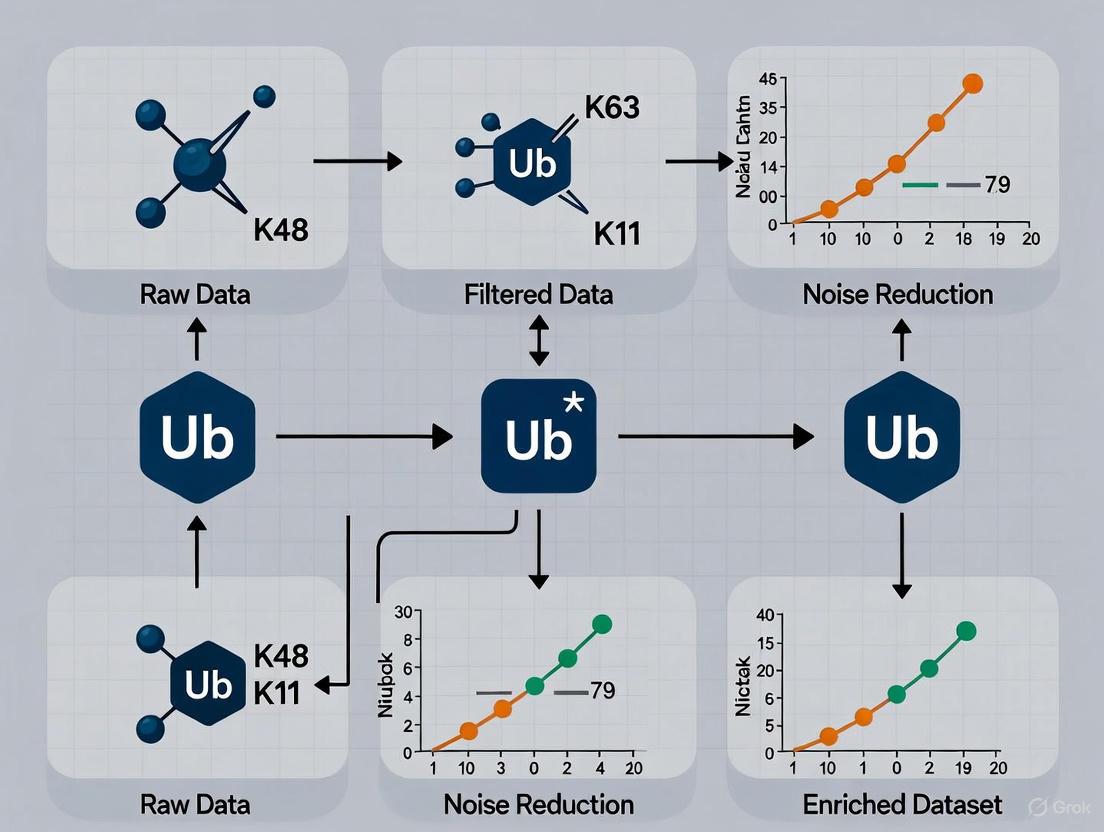
This article provides a comprehensive guide for researchers and drug development professionals seeking to minimize background noise in ubiquitylomics datasets.
Strategies for Reducing Background Noise in Ubiquitylomics: A Guide to Cleaner Datasets and Sharper Biological Insights
Abstract
This article provides a comprehensive guide for researchers and drug development professionals seeking to minimize background noise in ubiquitylomics datasets. Covering foundational concepts to advanced applications, we explore the primary sources of contamination—from non-specific antibody binding and co-purified contaminants to biases introduced by tagged ubiquitin systems. The content details cutting-edge methodological solutions, including optimized sample preparation with SDC-based lysis, advanced mass spectrometry techniques like Data-Independent Acquisition (DIA-MS), and innovative computational tools. We also present systematic validation frameworks and comparative analyses of enrichment strategies to empower scientists in generating higher-quality, more reliable ubiquitination data for both basic research and therapeutic target discovery.
Understanding the Ubiquitin Code and Major Sources of Background Noise
Ubiquitination Fundamentals: Decoding a Complex Post-Translational Modification
What is the ubiquitome? The ubiquitome refers to the comprehensive set of proteins modified by ubiquitin and the specific architectures of the ubiquitin chains present under defined biological conditions [1]. Mapping the ubiquitome is essential for understanding how this complex post-translational modification regulates virtually all aspects of cellular function.
How does the ubiquitination cascade work? Ubiquitination is a three-step enzymatic cascade that conjugates ubiquitin to substrate proteins. The process involves sequential action of ubiquitin-activating (E1), conjugating (E2), and ligating (E3) enzymes [2] [3]. This system generates an extraordinary diversity of ubiquitin signals through different modification types:
- Monoubiquitination: A single ubiquitin attached to a substrate lysine, often involved in signaling for endocytosis, histone regulation, and DNA repair [2] [4].
- Polyubiquitination: Chains of ubiquitin molecules connected through specific lysine residues, with different linkage types determining functional outcomes [3].
- Atypical Linkages: Recent research has identified non-lysine ubiquitination occurring on cysteine, serine, and threonine residues, expanding the complexity of the ubiquitin code [5] [1].
Table 1: Major Ubiquitin Chain Linkages and Their Primary Functions
| Linkage Type | Primary Functions | Cellular Processes |
|---|---|---|
| K48 | Proteasomal degradation [2] [6] | Protein turnover, homeostasis |
| K63 | DNA repair, signal transduction, endocytosis [2] [5] | NF-κB signaling, inflammation, trafficking |
| K11 | Proteasomal degradation [6] | Cell cycle regulation, ERAD |
| K29 | Proteasomal degradation [6] | Protein quality control |
| M1 (Linear) | Inflammatory signaling [5] [7] | NF-κB activation, immunity |
Diagram 1: Ubiquitination Enzymatic Cascade
Methodological Approaches in Ubiquitylomics
What techniques are used to study the ubiquitome? Mass spectrometry-based proteomics has revolutionized ubiquitome research through several specialized approaches:
- K-ε-GG Antibody Enrichment: The most widely used method employs antibodies specific for the di-glycine (K-ε-GG) remnant left on trypsinized peptides after ubiquitination, enabling identification of thousands of ubiquitination sites [1].
- TUBE Technology: Tandem Ubiquitin Binding Entities (TUBEs) utilize recombinant ubiquitin-binding domains to capture ubiquitinated proteins from biological samples before trypsinization, preserving the native ubiquitin chain architecture [5].
- UbiSite Method: This approach uses an antibody recognizing a 13-amino acid ubiquitin remnant generated by LysC digestion, offering an alternative to K-ε-GG enrichment with different specificity profiles [1].
- Advanced MS Acquisition: Data-Independent Acquisition (DIA) mass spectrometry has recently pushed ubiquitome coverage to unprecedented depths, with studies identifying >100,000 ubiquitination sites [1].
How do researchers quantify ubiquitination changes? Multiple quantitative proteomics strategies are employed in ubiquitylomics:
- SILAC (Stable Isotope Labeling with Amino Acids in Cell Culture): Allows comparison of 2-3 conditions by metabolic labeling [1].
- TMT (Tandem Mass Tagging): Enables multiplexing of up to 11 samples, ideal for time-course studies [1].
- Label-Free Quantitation: Useful for samples that cannot be metabolically labeled, such as clinical tissues [6] [1].
Table 2: Comparison of Ubiquitylomics Enrichment and Quantitation Methods
| Method | Principle | Sensitivity | Key Applications |
|---|---|---|---|
| K-ε-GG Immunoaffinity | Antibody enrichment of tryptic peptides with diglycine remnant | ~4,000-10,000 sites per experiment [1] | Global ubiquitin site profiling, multiple conditions |
| TUBE Pulldown | Recombinant ubiquitin-binding entities capture native ubiquitinated proteins | Varies with sample amount | Studying ubiquitin chain architecture, native complexes |
| UbiSite | Antibody against LysC-generated ubiquitin remnant | ~30,000 sites per experiment [1] | Deep ubiquitome coverage, complementary to K-ε-GG |
| SILAC Quantitation | Metabolic labeling with stable isotopes | 2-3 conditions | Dynamic ubiquitination changes, stimulus-response studies |
| TMT Multiplexing | Isobaric chemical tags for peptide labeling | Up to 11 conditions | Time courses, multiple treatment conditions |
Diagram 2: Ubiquitylomics Experimental Workflow
Troubleshooting Guide: Reducing Background Noise in Ubiquitylomics Datasets
FAQ 1: How can I minimize non-specific binding in ubiquitin pulldown experiments?
Problem: High background signal from off-target proteins binding to beads or antibody controls [8].
Solutions:
- Include Proper Controls: Always perform bead-only and isotype control experiments to identify non-specific interactions [8].
- Preclearing Step: Pre-incubate lysates with beads alone for 30-60 minutes at 4°C before the immunoprecipitation to remove proteins that bind non-specifically to the beads or resin [8].
- Optimize Lysis Conditions: Use milder lysis buffers (e.g., Cell Lysis Buffer #9803) instead of strong denaturing buffers like RIPA, which can disrupt native protein complexes while still ensuring efficient extraction [8].
- Validate Antibody Specificity: Confirm that primary antibodies are specific for your target ubiquitin linkage, as commercial antibodies vary considerably in their specificity for different chain types [5].
FAQ 2: Why is my ubiquitination signal low or undetectable despite confirmed substrate expression?
Problem: Low signal for ubiquitinated proteins despite adequate expression of the target protein [8] [5].
Solutions:
- Inhibit DUB Activity: Include deubiquitinase inhibitors (EDTA/EGTA for metalloproteinases; N-ethylmaleimide, PR-619, or 2-chloroacetamide for cysteine proteinases) in all lysis and purification buffers at recommended concentrations [5].
- Consider Proteasome Inhibition: For degradation-prone substrates, treat cells with proteasome inhibitors (MG-132, bortezomib) for short periods (2-6 hours) before lysis to stabilize ubiquitinated proteins, though be aware of potential compensatory pathway activation [5].
- Optimize Protein Extraction: Ensure complete nuclear rupture and membrane protein solubilization through systematic sonication optimization, which is particularly important for nuclear and membrane-associated proteins [8].
- Epitope Masking: If using conformation-specific antibodies, the binding epitope might be obscured; test antibodies targeting different ubiquitin domains or consider alternative enrichment strategies [8].
FAQ 3: How can I reduce interference from immunoglobulin chains in western blot detection?
Problem: Heavy (~50 kDa) and light (~25 kDa) chains from immunoprecipitation antibodies obscuring target proteins of similar molecular weight [8].
Solutions:
- Species Switching: Use antibodies from different host species for IP (e.g., rabbit) and western blot (e.g., mouse) detection, with highly species-specific secondary antibodies to prevent cross-reactivity [8].
- Biotinylated Antibodies: Use biotinylated primary antibodies for western blot followed by streptavidin-HRP detection, which avoids recognition of denatured IP antibody chains [8].
- Light-Chain Specific Secondaries: If your target doesn't migrate near 25 kDa, use light chain-specific secondary antibodies that primarily detect the native primary antibody rather than denatured IP antibody fragments [8].
- Alternative Detection Reagents: Use Protein A-HRP conjugates or conformation-specific secondary antibodies that preferentially bind native IgG, though these may cross-react with denatured IgG at high concentrations [8].
FAQ 4: What are the major sources of background noise in mass spectrometry-based ubiquitylomics?
Problem: High background in mass spectrometry datasets reduces sensitivity for detecting genuine ubiquitination sites [1].
Solutions:
- Address Antibody Bias: Recognize that K-ε-GG antibodies exhibit sequence context bias; consider complementary methods like UbiSite for more comprehensive coverage [1].
- Control for Related PTMs: The K-ε-GG epitope is also generated by NEDD8 and ISG15 modifications; use specific enrichment strategies or computational filtering to distinguish ubiquitination from these related modifications [1].
- Match Proteome Data: Always acquire matching proteome data to distinguish true changes in ubiquitination stoichiometry from changes in substrate abundance [1].
- Optimize Sample Amount: Use sufficient starting material (0.5-50 mg depending on method) to ensure detection of low-stoichiometry ubiquitination events while minimizing non-specific background [1].
The Scientist's Toolkit: Essential Reagents for Ubiquitylomics Research
Table 3: Key Research Reagents for Ubiquitylomics Experiments
| Reagent Category | Specific Examples | Function & Importance |
|---|---|---|
| DUB Inhibitors | PR-619, N-Ethylmaleimide, 2-Chloroacetamide | Prevent deubiquitination during sample processing, preserving native ubiquitination states [5] |
| Proteasome Inhibitors | MG-132, Bortezomib | Stabilize degradation-targeted ubiquitinated proteins by blocking proteasomal degradation [5] |
| Phosphatase Inhibitors | Sodium orthovanadate, β-glycerophosphate | Maintain phosphorylation status, important for studying crosstalk between ubiquitination and phosphorylation [8] |
| Ubiquitin Enrichment Reagents | K-ε-GG antibody, TUBEs, UbiSite antibody | Selective capture of ubiquitinated proteins or peptides for downstream analysis [5] [1] |
| Linkage-Specific Reagents | K48-linkage specific Ab, K63-linkage specific Ab, OtUBD, MultiDsk | Detection and enrichment of specific ubiquitin chain architectures [5] |
| Lysis Buffers | Non-denaturing cell lysis buffers, RIPA (for specific applications) | Extract proteins while preserving ubiquitination status and protein complexes [8] |
Advanced Considerations for High-Quality Ubiquitylomics Data
Understanding the Dynamic Nature of Ubiquitination Ubiquitination is exceptionally dynamic, with the median half-life of global ubiquitination sites estimated at approximately 12 minutes—significantly shorter than most cellular proteins [5]. This rapid turnover creates inherent challenges for capturing the native ubiquitome and necessitates strict adherence to rapid processing protocols with effective DUB inhibition.
Multi-PTM Integration Increasing evidence demonstrates extensive crosstalk between ubiquitination and other post-translational modifications. Sequential pulldown workflows now enable analysis of multiple "PTMomes" (e.g., ubiquitome, phosphoproteome, acetylome) from the same sample, revealing how different modifications cooperate to regulate cellular processes [1]. This integrated approach is particularly valuable for distinguishing regulatory versus degradative ubiquitin signals.
Experimental Design Recommendations For robust ubiquitylomics studies aiming to minimize background noise:
- Include biological replicates with sufficient power to detect meaningful changes
- Always match ubiquitome data with proteome quantification to normalize for protein abundance changes
- Use appropriate controls (bead-only, isotype control, DUB inhibitor validation)
- Select enrichment methods based on specific research questions (site mapping vs. chain topology analysis)
- Process samples quickly at low temperatures with fresh DUB inhibitors
- Validate key findings with orthogonal methods when possible
By implementing these comprehensive strategies and troubleshooting approaches, researchers can significantly reduce background noise in ubiquitylomics datasets and generate higher-quality data for understanding the complex roles of ubiquitination in health and disease.
Frequently Asked Questions (FAQs)
Q1: What are the most common sources of non-specific binding in ubiquitylomics? The most prevalent sources of non-specific binding that contribute to background noise are endogenous biotinylated proteins and histidine-rich proteins. These endogenous cellular components are co-enriched during standard purification protocols, creating artefactual bands or peaks that can be misinterpreted as genuine ubiquitin signals [9] [10].
Q2: How can I confirm that a signal in my western blot is from my target ubiquitinated protein and not an artefact? Incorporate a methodological control where you replace the primary antibody directed against your target with a non-specific, irrelevant antibody in a parallel protocol. The persistence of a signal in this control lane indicates an antibody-independent artefact, such as interference from endogenous biotinylated proteins [9].
Q3: Why do I detect high background when using Ni-NTA resins to purify His-tagged ubiquitin? Histidine-rich native proteins within the cell lysate can bind non-specifically to the Ni-NTA resin. This is a common pitfall of Ub tagging-based approaches using His-tags. This co-purification significantly increases background noise and reduces the specificity for your target ubiquitinated proteins [10].
Q4: What simple step can I take during sample preparation to preserve the ubiquitination landscape? Always include deubiquitylase (DUB) inhibitors in your lysis buffer. Common reagents include EDTA or EGTA to inhibit metallo-proteinases, and compounds like 2-chloroacetamide, Iodoacetamide, N-ethylmaleimide, or PR-619 to inhibit cysteine proteinases. This prevents the rapid removal of ubiquitin modifications by endogenous DUBs after cell lysis, which is crucial due to the typically low stoichiometry and high turnover of protein ubiquitination [5].
Troubleshooting Guide: Identifying and Resolving Contaminant Issues
Table 1: Common Contaminants and Mitigation Strategies
| Contaminant Type | Experimental Technique Most Affected | Manifestation of Interference | Recommended Solution |
|---|---|---|---|
| Endogenous Biotinylated Proteins [9] | Western Blot (using biotin-avidin detection) | Spurious bands, particularly in samples from transgenic animals or specific disease models. | Use an irrelevant antibody control; switch to a non-biotin-based detection system. |
| His-Rich Proteins [10] | Affinity Purification (Ni-NTA for His-tagged Ub) | High background, co-purification of non-target proteins in MS data. | Use alternative tags (e.g., Strep-tag); optimize wash buffer stringency (e.g., imidazole concentration). |
| Shed Protein A [9] | Immunoprecipitation / Immunoaffinity Purification | Artefactual bands in western blots of immunoaffinity eluates. | Use Protein G as an alternative; include control with non-specific immunoglobulin for capture. |
| Abundant Cellular Proteins | Mass Spectrometry-based Ubiquitylomics | Masking of low-abundance ubiquitinated peptides. | Perform extensive peptide fractionation; use high-resolution instrumentation like timsTOF Pro [11]. |
Table 2: Experimental Controls for Validating Ubiquitylomics Data
| Control Type | Purpose | Experimental Implementation |
|---|---|---|
| Irrelevant Antibody Control [9] | Identify antibody-independent artefacts (e.g., from endogenous biotin). | Run parallel protocol where the specific primary antibody is replaced with a non-specific antibody. |
| Sample Control (e.g., Non-transgenic) [9] | Confirm that observed effects are due to the experimental condition and not inherent to the sample. | Include wild-type, non-treated, or healthy control samples in every analysis. |
| Tag-Only Control | Determine non-specific binding to affinity resins. | Express the affinity tag (e.g., His, Strep) without fusion to ubiquitin in control cells. |
| DUB Inhibitor Omission Control [5] | Confirm the effectiveness of ubiquitin preservation. | Compare a sample lysed without DUB inhibitors to one with inhibitors to assess ubiquitin loss. |
Key Experimental Protocols
Protocol: Enrichment of Ubiquitinated Proteins for Mass Spectrometry
This protocol outlines a standard workflow for enriching ubiquitinated peptides from cell lysates prior to LC-MS/MS analysis, incorporating steps to minimize background [11].
- Cell Lysis and Protein Extraction: Sonicate cells on ice in lysis buffer (e.g., 8 M urea) supplemented with a protease inhibitor cocktail and DUB inhibitors (50 μM PR-619) to preserve ubiquitination. Centrifuge to remove debris and determine protein concentration [5] [11].
- Protein Digestion: Reduce disulfide bonds with DTT and alkylate with IAA. Digest proteins overnight with trypsin at a 1:50 (w/w) ratio [11].
- Enrichment of Lysine-ε-Gly-Gly (K-ε-GG) Peptides: Dissolve the resulting tryptic peptides in NTEN buffer (100 mM NaCl, 50 mM Tris-HCl, 1 mM EDTA, 0.5% NP-40, pH 8.0). Incubate the peptide solution with pre-washed anti-K-ε-GG motif beads at 4°C overnight with gentle shaking. This antibody specifically recognizes the di-glycine remnant left on ubiquitinated lysines after tryptic digestion [11].
- Washing and Elution: Wash the beads extensively with NTEN buffer followed by ddH₂O to remove non-specifically bound peptides. Elute the bound ubiquitinated peptides from the beads using 0.1% trifluoroacetic acid [11].
- LC-MS/MS Analysis: Desalt the eluates using C18 ZipTips and analyze by Liquid Chromatography-Tandem Mass Spectrometry (LC-MS/MS). The peptides are typically separated on a C18 reversed-phase column with an acetonitrile gradient and analyzed using a high-resolution mass spectrometer (e.g., timsTOF Pro) [11].
Protocol: Validating Ubiquitination via Immunoblotting with Controlled Detection
This protocol includes controls to distinguish specific ubiquitin signals from artefacts caused by endogenous biotinylated proteins [9].
- Immunoprecipitation: Incubate your cell lysate (e.g., 50-100 μg protein) with a capture antibody specific to your protein of interest (e.g., monoclonal antibody 6E10) and Protein G-coated magnetic beads overnight at 4°C [9].
- Washing and Elution: Wash the beads with an appropriate immunoprecipitation buffer to remove unbound proteins. Elute the immunoprecipitated proteins [9].
- Western Blotting: Separate the eluted proteins by SDS-PAGE and transfer to a membrane.
- Controlled Detection:
- Primary Antibody: Probe the membrane with a primary antibody against your target or ubiquitin.
- Critical Control: On a parallel blot (or a different lane of the same gel), probe with an irrelevant primary antibody as a control for non-specific binding [9].
- Secondary Detection: If using a biotin-streptavidin detection system, any bands that appear in the control lane indicate interference from endogenous biotinylated proteins and should not be considered valid signals [9].
Visualization of Workflows and Contaminant Pathways
Ubiquitylomics Workflow with Common Contaminants
Contaminant Interference in Affinity Purification
The Scientist's Toolkit: Key Research Reagents
Table 3: Essential Reagents for Clean Ubiquitylomics
| Reagent / Material | Function in Ubiquitylomics | Key Consideration |
|---|---|---|
| DUB Inhibitors (e.g., PR-619, N-ethylmaleimide) [5] | Preserves the native ubiquitinome by inhibiting deubiquitylating enzymes post-lysis. | Essential for all native preparations; not always included in standard protease inhibitor cocktails. |
| Anti-K-ε-GG Motif Antibody Beads [11] | Immunoaffinity enrichment of tryptic peptides derived from ubiquitinated proteins. | The gold-standard for antibody-based ubiquitylomics; directly targets the ubiquitin signature. |
| Linkage-Specific Ub Antibodies (e.g., K48, K63) [10] | Detects or enriches for polyubiquitin chains with specific linkages via western blot or IP. | Not all linkage types have high-quality commercial antibodies available. |
| Tandem Ubiquitin-Binding Entities (TUBEs) [5] [10] | Reagents with high affinity for ubiquitin chains, used to enrich ubiquitinated proteins from lysates. | Can protect ubiquitin chains from DUBs and the proteasome during purification. |
| Strep-Tactin Resin [10] | Affinity purification of Strep-tag II-fused proteins. An alternative to His-tag/Ni-NTA. | Lower background compared to Ni-NTA as it is less susceptible to binding histidine-rich proteins. |
| Strep-Tag II [12] | A short affinity tag used for purifying recombinant proteins. | Used in generating pure, site-specifically ubiquitylated H1.2 conjugates for interaction studies [12]. |
| Protein G Beads [9] | An alternative to Protein A for immunoprecipitation, especially for certain antibody subtypes. | Can help avoid artefacts caused by "shed" Protein A from sepharose beads [9]. |
Core Concepts: Why Tagged Ubiquitin Systems Can Introduce Artifacts
Tagged ubiquitin (Ub) systems, such as those utilizing His, HA, or Strep tags, are widely used to study protein ubiquitination. However, these systems have inherent limitations that can introduce artifacts and skew experimental results, thereby increasing background noise in ubiquitylomics datasets. Understanding these pitfalls is crucial for accurate data interpretation.
Fundamental Limitations and Associated Artifacts:
- Altered Ubiquitin Structure and Function: The attachment of an affinity tag to ubiquitin can potentially alter its structure. This modification may interfere with the ability of the tagged Ub to properly mimic endogenous ubiquitin, leading to artifacts in ubiquitination signaling [10].
- Non-Specific Co-Purification: A significant source of background noise is the co-purification of non-ubiquitinated proteins. When using His-tagged Ub, histidine-rich proteins can bind non-specifically to the Ni-NTA purification resin. Similarly, when using Strep-tagged Ub, endogenously biotinylated proteins can bind to the Strep-Tactin resin. This non-specific binding impairs the identification sensitivity of genuine ubiquitination events [10].
- Method-Dependent Avidity (Bridging Artifacts): In surface-based biophysical techniques like Surface Plasmon Resonance (SPR) or Biolayer Interferometry (BLI), the use of immobilized, tagged ubiquitin-binding proteins can lead to "bridging" artifacts. This occurs when a single polyubiquitin chain in solution simultaneously binds to two or more immobilized ligand molecules on the sensor surface. This method-dependent avidity is an experimental artifact that can cause a dramatic overestimation of binding affinity and lead to incorrect conclusions about linkage specificity [13].
- Infeasibility in Patient Tissues: A major practical limitation is the inability to express tagged Ub in animal or patient tissues. This restricts the application of tagging-based approaches to cultured cell lines and limits the study of ubiquitination under physiological conditions or in clinical samples [10].
Troubleshooting FAQs
Q1: My ubiquitylomics dataset has high background noise. How can I determine if co-purification is the issue? A: High background is often caused by non-specific binding during the affinity purification step. To mitigate this:
- Use Control Cell Lines: Perform parallel purifications from control cell lines that do not express the tagged ubiquitin. Any proteins identified in both the test and control samples are likely non-specific binders.
- Optimize Wash Stringency: Increase the stringency of wash buffers by including low concentrations of imidazole (for His-tags) or competitive agents like biotin (for Strep-tags) to elute weakly bound proteins without disrupting the specific tagged-ubiquitin interaction.
- Consider Alternative Enrichment Methods: Switch to antibody-based enrichment using antibodies that recognize endogenous ubiquitin (e.g., P4D1, FK1/FK2) or utilize ubiquitin-binding domain (UBD)-based tools like the Ubiquitin-Trap. This avoids the resin-specific co-purification issues associated with tags [10] [14].
Q2: My binding data suggests very high affinity for a polyubiquitin chain. How can I check for bridging artifacts? A: Bridging artifacts are a common confounder in surface-based assays. You can diagnose and mitigate them by:
- Varying Ligand Density: Conduct the same binding experiment at different surface loading densities of your tagged ubiquitin-binding protein. A strong dependence of the apparent affinity on ligand density—where affinity decreases as the surface becomes less saturated—is a hallmark of a bridging artifact [13].
- Use Solution-Based Validation: Employ a solution-based technique like Isothermal Titration Calorimetry (ITC) to validate key findings. Since ITC does not require immobilization, it is not subject to bridging artifacts and can provide a more accurate measurement of affinity [13].
- Refer to Published Models: Use the simple fitting model described in [13] to diagnose the severity of bridging in your data and determine if the results can be salvaged or must be re-evaluated.
Q3: I am working with patient tissue samples. How can I profile ubiquitination without tagged systems? A: For patient tissues, where genetic manipulation is not possible, your best options are:
- Antibody-Based Enrichment: Use pan-ubiquitin antibodies (e.g., P4D1) to enrich for ubiquitinated proteins from tissue lysates. This approach works directly on endogenous ubiquitination [10].
- Leverage Linkage-Specific Antibodies: If studying a specific chain type, use linkage-specific antibodies (e.g., for K48, K63, M1) for enrichment. This allows for the direct profiling of endogenous ubiquitin chain architecture in clinical samples [10].
Experimental Protocols for Mitigation
Protocol 1: Minimizing Bridging Artifacts in BLI Assays
This protocol is adapted from methodologies used to study ubiquitin-binding proteins like NEMO, cIAP1, and A20 [13].
1. Key Materials:
- Instrument: BLI instrument (e.g., ForteBio Octet Red384).
- Biosensors: Streptavidin (SA) biosensors.
- Proteins: Singly biotinylated ubiquitin-binding protein (ligand) and purified polyubiquitin chains (analyte).
- Assay Buffer: Example: 25 mM Tris pH 8.0, 300 mM NaCl, 0.5 mM TCEP, 0.1 mg/mL BSA, 0.02% Tween-20.
2. Step-by-Step Guide: 1. Hydrate biosensors in assay buffer for at least 5 minutes. 2. Establish a baseline by incubating sensors in fresh assay buffer for 60-120 seconds. 3. Load the ligand: Immerse the sensors in a solution of the biotinylated protein. Crucially, use a range of loading densities (e.g., from 0.5 to 5.0 nm response) to assess density-dependent effects. 4. Wash the sensors in assay buffer for 60-300 seconds to establish a stable baseline. 5. Association: Introduce the analyte (polyubiquitin chain) at various concentrations for 600-1200 seconds to measure binding. 6. Dissociation: Transfer the sensors to a buffer-only well for 600-1200 seconds to monitor dissociation. 7. Data Analysis: Align your data to the last 10 seconds of the baseline. Plot the response versus analyte concentration. If the calculated binding affinity weakens as the ligand loading density decreases, it indicates a significant bridging artifact. The data obtained at the lowest feasible loading density provides the most accurate estimate of the intrinsic affinity.
Protocol 2: Enriching Endogenous Ubiquitinated Proteins with Ubiquitin-Trap
This protocol provides an alternative to tagged systems by using a nanobody-based approach to pull down ubiquitinated proteins [14].
1. Key Materials:
- Ubiquitin-Trap: Agarose or magnetic agarose beads coupled to an anti-ubiquitin VHH nanobody.
- Cell Lysis Buffer: A compatible lysis buffer (often provided in kits).
- Proteasome Inhibitor: MG-132 to preserve ubiquitination.
- Wash and Elution Buffers.
2. Step-by-Step Guide: 1. Preserve Ubiquitination: Treat cells with 5-25 µM MG-132 for 1-2 hours before harvesting to inhibit proteasomal degradation and stabilize ubiquitin conjugates. 2. Prepare Lysate: Lyse cells in the provided buffer. Clarify the lysate by centrifugation. 3. Incubate with Beads: Incubate the clarified lysate with the Ubiquitin-Trap beads. 4. Wash: Wash the beads thoroughly with wash buffer to remove non-specifically bound proteins. 5. Elute: Elute the bound ubiquitinated proteins using the provided elution buffer or directly by boiling in SDS-PAGE sample buffer. 6. Analysis: Analyze the eluate by western blot (resulting in a characteristic smear) or by mass spectrometry (IP-MS) for proteomic studies.
Signaling Pathways & Experimental Workflows
Logical Workflow for Diagnosing Artifacts in Ubiquitin Studies
The following diagram outlines a systematic approach to identify and address common artifacts in ubiquitination studies.
The Scientist's Toolkit: Key Research Reagents
This table summarizes essential reagents for studying ubiquitination while minimizing artifacts.
Table 1: Research Reagent Solutions for Ubiquitylomics
| Reagent / Tool | Primary Function | Key Advantage / Caveat |
|---|---|---|
| His-/Strep-tagged Ubiquitin [10] | Affinity-based purification of ubiquitinated proteins. | Caveat: Potential for altered Ub structure and non-specific co-purification of host proteins. |
| Pan-Ubiquitin Antibodies (e.g., P4D1, FK2) [10] | Immuno-enrichment of endogenous ubiquitinated proteins. | Enables study of native ubiquitination in any biological sample, including patient tissues. |
| Linkage-Specific Ub Antibodies [10] | Enrichment and detection of specific polyUb chain types (e.g., K48, K63). | Allows for precise mapping of chain architecture; quality and specificity between vendors can vary. |
| Ubiquitin-Trap (Nanobody) [14] | High-affinity pulldown of mono- and polyubiquitinated proteins. | Advantage: Low-background IPs; stable under harsh wash conditions; not linkage-specific. |
| Biotinylated UBDs (for BLI/SPR) [13] | Surface immobilization for binding kinetics studies. | Caveat: Requires controlled, low-density loading to avoid bridging artifacts with polyUb chains. |
| Proteasome Inhibitors (e.g., MG-132) [14] | Stabilizes ubiquitinated proteins in cells by blocking degradation. | Essential for increasing the yield of ubiquitinated proteins prior to enrichment. |
The table below consolidates key quantitative information on ubiquitin linkages and methodological parameters from the literature.
Table 2: Quantitative Data on Ubiquitin Linkages and Experimental Parameters
| Category | Parameter | Details | Source |
|---|---|---|---|
| Ubiquitin Linkages | Types | M1, K6, K11, K27, K29, K33, K48, K63 | [13] [10] |
| BLI Experimental Parameters | Ligand Loading | Vary density to test for bridging; low densities are critical. | [13] |
| Assay Time (Association) | 600 - 1200 seconds | [13] | |
| Assay Time (Dissociation) | 600 - 1200 seconds | [13] | |
| Stabilization Treatment | MG-132 Concentration | 5 - 25 µM | [14] |
| Incubation Time | 1 - 2 hours before harvesting | [14] |
Frequently Asked Questions (FAQs)
What is antibody cross-reactivity and why is it a problem in ubiquitylomics? Cross-reactivity occurs when an antibody directed against one specific antigen also binds to different antigens that share similar structural regions, or epitopes [15]. In ubiquitylomics, this can lead to false-positive identification of ubiquitination sites, high background noise, and compromised data specificity, ultimately misrepresenting the true ubiquitome [16] [5].
How does the amino acid context around a ubiquitination site cause antibody bias? Antibodies used to enrich ubiquitinated peptides, such as those targeting the diGlycine (K-GG) remnant, can exhibit bias based on the specific amino acid sequence surrounding the modification site [1]. This means that peptides with certain amino acid contexts are enriched more efficiently than others, leading to an incomplete and skewed representation of the ubiquitome in your dataset [1].
What is the difference between cross-adsorbed and highly cross-adsorbed secondary antibodies? Both are purified to remove antibodies that bind to off-target species. Cross-adsorbed antibodies are purified against a limited number of species, while highly cross-adsorbed antibodies undergo a more extensive purification process against a wider range of species immunoglobulins, resulting in even greater specificity and lower background in complex experiments [17].
Can I predict if my antibody will cross-react with a protein from a different species? Yes, you can perform a quick check by assessing the percentage homology of the antibody's immunogen sequence to the protein sequence from the other species. This is typically done using pair-wise sequence alignment tools like NCBI-BLAST [15]. A homology of over 75% almost guarantees cross-reactivity, while anything over 60% has a strong likelihood and should be verified experimentally [15].
Troubleshooting Guides
High Background/Non-Specific Signal in Ubiquitylomics Enrichment
| Potential Cause | Recommended Solution | Underlying Principle |
|---|---|---|
| Endogenous Antibodies | Use secondary antibodies that have been cross-adsorbed against the species of your sample [18]. | Prevents the secondary antibody from binding to immunoglobulins naturally present in the tissue [17]. |
| Multiplexing Cross-Reactivity | In multi-labeling, use highly cross-adsorbed secondary antibodies raised against the host species of each primary antibody [17] [18]. | Ensures each secondary antibody only binds its intended primary antibody and not others in the experiment [18]. |
| Insufficient Blocking | Optimize blocking conditions by increasing the concentration of the blocking agent, extending the blocking time, or trying a different blocking buffer (e.g., normal serum from the secondary antibody host) [19]. | Saturates non-specific binding sites on the sample to prevent unwanted antibody adhesion [19]. |
| Antibody Concentration Too High | Perform a dilution series for both primary and secondary antibodies to find the optimal concentration [19]. | Reduces the chance of low-affinity, off-target binding that occurs at high antibody concentrations [20]. |
| Transient Ubiquitylation | Include Deubiquitylase (DUB) inhibitors (e.g., EDTA/EGTA, PR-619) in your lysis buffer [5]. | Preserves the native ubiquitylation state by preventing DUBs from removing ubiquitin during sample preparation [5]. |
Bias in Ubiquitin Remnant Enrichment
| Potential Cause | Recommended Solution | Underlying Principle |
|---|---|---|
| K-GG Antibody Sequence Bias | Consider alternative enrichment methods, such as the UbiSite antibody (which recognizes a longer LysC fragment) or ubiquitin-binding domains (TUBEs) [1]. | These methods rely on different recognition principles, thereby bypassing the sequence preference of K-GG antibodies [1]. |
| Low Stoichiometry of Modification | Use proteasome inhibitors (e.g., MG-132) in cell culture prior to lysis to enrich for degraded proteins* [5]. | Increases the abundance of ubiquitylated proteins targeted for degradation, making them easier to detect [5]. |
| Misassignment of Ubiquitination Sites | Be aware that the K-GG antibody also enriches for peptides modified by other ubiquitin-like proteins (e.g., NEDD8, ISG15) [1]. | Follow-up validation experiments are required to confirm that a detected K-GG site is specifically due to ubiquitin [1]. |
Note: Proteasome inhibitors can have off-target effects and are less suitable for *in vivo studies [5].
Experimental Protocols
Protocol 1: Checking Antibody Cross-Reactivity Potential via NCBI-BLAST
Purpose: To bioinformatically assess the likelihood of an antibody cross-reacting with a protein from a different species.
Materials:
- Antibody immunogen sequence (from manufacturer's datasheet)
- Computer with internet access
Method:
- Locate Immunogen Sequence: Find the exact amino acid sequence used to generate the antibody in the product manual or on the manufacturer's website [15].
- Access NCBI-BLAST: Navigate to the NCBI BLAST website and select "Protein BLAST" (blastp).
- Input Sequence and Parameters:
- Paste the immunogen sequence into the "Query Sequence" box.
- In the "Organism" field, enter the scientific name of the species you wish to check (e.g., "Ovis aries" for sheep).
- Keep other parameters as default.
- Run and Analyze: Click "BLAST." Review the results for the percentage identity and alignment to your protein of interest in the target species. A homology >60% suggests a strong likelihood of cross-reactivity [15].
Protocol 2: Reducing Cross-Reactivity in Multiplexed Immunofluorescence
Purpose: To simultaneously detect multiple antigens in the same sample without secondary antibody cross-reactivity.
Materials:
- Primary antibodies from different host species (e.g., mouse, rabbit, rat)
- Highly cross-adsorbed secondary antibodies, each raised in the same host (e.g., donkey) and adsorbed against the other relevant species
- Appropriate blocking buffer
Method:
- Primary Antibody Incubation: Incubate the sample with a mixture of your validated primary antibodies (e.g., Goat anti-A, Rabbit anti-B, Rat anti-C) [18].
- Wash: Wash thoroughly to remove unbound primary antibodies.
- Secondary Antibody Incubation: Incubate with a mixture of fluorescently conjugated secondary antibodies. For example:
- Donkey Anti-Goat IgG (cross-adsorbed against Rabbit, Rat, etc.)
- Donkey Anti-Rabbit IgG (cross-adsorbed against Goat, Rat, etc.)
- Donkey Anti-Rat IgG (cross-adsorbed against Goat, Rabbit, etc.) [18].
- Wash and Image: Wash thoroughly to remove unbound secondary antibodies and proceed with imaging.
Critical Considerations:
- Sequential Incubation: If cross-reactivity persists, incubate with primary and secondary antibody pairs sequentially instead of as a cocktail [18].
- Validation: Always run controls with single primary antibodies to confirm the specificity of each secondary antibody [18].
Multiplexed Staining Workflow: A sequential protocol for applying primary and secondary antibodies in multiplexed experiments to minimize cross-reactivity [18].
The Scientist's Toolkit: Key Research Reagents
| Reagent / Tool | Function in Mitigating Cross-Reactivity & Bias | Key Consideration |
|---|---|---|
| Highly Cross-Adsorbed Secondary Antibodies | Polyclonal antibodies additionally purified to remove antibodies that bind to immunoglobulins of off-target species. Crucial for multiplexing and working with samples containing endogenous Igs [17] [18]. | Increased specificity may come with a slight cost to sensitivity, as the pool of available antibodies is reduced [17]. |
| DUB Inhibitors (e.g., PR-619) | Added to lysis buffers to inhibit Deubiquitylases (DUBs), preserving the native and often transient ubiquitin modifications and preventing artificial changes to the ubiquitome during preparation [5]. | Essential for maintaining the integrity of ubiquitylation states before enrichment. Standard protease inhibitor cocktails may not effectively inhibit DUBs [5]. |
| K-GG Remnant Motif Antibody | The most common antibody for enriching ubiquitinated peptides after tryptic digestion for mass spectrometry analysis by recognizing the diGlycine (K-ε-GG) remnant on lysines [1]. | Known to have bias for certain amino acid contexts and also enriches for NEDD8 and ISG15 modifications, which can confound results [1]. |
| TUBEs (Tandem Ubiquitin Binding Entities) | Recombinant proteins with multiple ubiquitin-binding domains that capture a broad range of ubiquitin chain linkages and topologies, used as an alternative to antibodies for enrichment [5] [1]. | Can be used to purify polyubiquitinated proteins prior to digestion and K-GG enrichment, helping to study specific chain types [1]. |
| UbiSite Antibody | An antibody that recognizes a longer, 13-amino acid ubiquitin remnant created by LysC digestion, offering an alternative enrichment strategy with potentially different biases compared to K-GG antibodies [1]. | Helps overcome the sequence bias associated with traditional K-GG antibodies, providing complementary coverage of the ubiquitome [1]. |
The Impact of Low Stoichiometry and Dynamic, Reversible Modification
Frequently Asked Questions (FAQs)
FAQ 1: Why is background noise a particular problem in ubiquitylomics datasets? Background noise in ubiquitylomics primarily arises from the intrinsic properties of protein ubiquitylation. The modification is often present at very low stoichiometry, meaning only a tiny fraction of a given protein is ubiquitylated at any time [21] [5]. Furthermore, ubiquitylation is a highly dynamic and reversible process; deubiquitylases (DUBs) can rapidly remove ubiquitin, and ubiquitylated proteins targeted for degradation have extremely short half-lives (a median of ~12 minutes) [5]. This combination of low abundance and transient nature makes the true signal difficult to capture against a high background of unmodified proteins.
FAQ 2: What is the single most critical step in my sample preparation to reduce background and preserve ubiquitylation signals? The most critical step is the inclusion of a broad-spectrum Deubiquitylase (DUB) inhibitor in your lysis buffer [5]. When cells or tissues are homogenized, DUBs are released and become promiscuously active, rapidly stripping ubiquitin chains from proteins and contributing significantly to background noise. Standard protease inhibitor cocktails do not effectively inhibit DUBs.
FAQ 3: How can I determine if an observed ubiquitylation change is functionally relevant, given the typically low stoichiometry? While high-stoichiometry sites are more likely to have a direct functional impact, low-stoichiometry sites should not be automatically dismissed [21]. The key is to prioritize sites for validation where you observe a significant, reproducible change in abundance across conditions. Even a small change in stoichiometry at a critical regulatory site can have a substantial functional consequence, such as altering enzyme activity or protein-protein interactions [21] [22]. Functional relevance must ultimately be confirmed through downstream biochemical or cellular assays.
FAQ 4: Are proteasome inhibitors recommended for all ubiquitylomics experiments to boost signal? The use of proteasome inhibitors (e.g., MG-132, Bortezomib) is a double-edged sword. While they can prevent the degradation of poly-ubiquitylated proteins and thereby increase their detection, they are less suitable for in vivo studies due to their toxicity [5]. Furthermore, proteasome inhibition can have significant off-target effects, such as inducing compensatory autophagy and potentially decreasing non-degradative ubiquitylation signals, which may confound your results [5]. Their use should be carefully considered based on the specific experimental goals.
Troubleshooting Guides
Issue 1: High Background of Non-Specific Peptides in MS Data
Problem: Mass spectrometry data is dominated by unmodified peptides, making it difficult to detect and quantify low-abundance ubiquitylated peptides.
Solutions:
- Optimize Peptide Enrichment: Ensure you are using effective and specific enrichment strategies. The use of tandem ubiquitin-binding entities (TUBEs) is highly recommended. TUBEs have a high affinity for ubiquitin chains and can protect them from DUB activity during lysis and purification [5].
- Validate Antibody Specificity: If using antibody-based enrichment (e.g., for diGly remnant peptides), verify the specificity of your antibodies to ensure they are not pulling down non-ubiquitylated peptides.
- Use Chemical Blocking: Employ chemical acetylation or other blocking steps to cap free lysines on unmodified peptides after cell lysis, which can reduce background and improve the relative enrichment of ubiquitylated peptides [22].
Issue 2: Inconsistent Ubiquitylation Patterns Between Biological Replicates
Problem: The ubiquitylation profile varies widely from one experiment to the next, making results unreliable.
Solutions:
- Standardize Lysis Protocol: Ensure complete and rapid inhibition of DUBs at the moment of lysis. Always use a freshly prepared, cooled lysis buffer containing a cocktail of DUB inhibitors (e.g., PR-619 for cysteine proteases and EDTA/EGTA for metalloproteases) [5].
- Control for Protein Degradation: Handle samples on ice or at 4°C at all possible times to slow down enzymatic activity. Avoid repeated freeze-thaw cycles of lysates.
- Normalize Protein Load: Accurately quantify total protein concentration before enrichment and load equal amounts for each sample to ensure consistent comparisons.
Issue 3: Low Signal for Ubiquitylated Proteins
Problem: Even after enrichment, the signal for ubiquitylated peptides is weak.
Solutions:
- Scale Up Input Material: Due to low stoichiometry, a larger amount of starting protein (e.g., 10-20 mg) may be required for enrichment to obtain a sufficient amount of ubiquitylated peptides for MS detection [5] [22].
- Optimize MS Data Acquisition: Utilize data-independent acquisition (DIA) methods on your mass spectrometer, which can provide more consistent detection and quantification of low-abundance peptides compared to data-dependent acquisition (DDA) [21].
- Check Inhibitor Efficacy: Verify that your DUB and protease inhibitors are active and have not expired. Consider testing different inhibitor combinations or concentrations.
The following table summarizes the primary sources of background noise and their respective solutions as discussed in the FAQs and troubleshooting guides.
Table 1: Common Sources of Background Noise in Ubiquitylomics and Proposed Solutions
| Source of Noise | Impact on Data | Recommended Solution |
|---|---|---|
| Deubiquitylase (DUB) Activity [5] | Loss of ubiquitin signal during sample prep; increased background from degraded chains. | Include DUB inhibitors (e.g., PR-619, EDTA/EGTA) in lysis buffer. |
| Low Stoichiometry of Modification [21] [5] | True ubiquitylation signal is masked by high abundance of unmodified peptides. | Use high-affinity enrichment (TUBEs) and scale up input protein material. |
| Transient Nature / Rapid Turnover [5] | Very short window to capture the modification before degradation. | Rapid sample processing; consider limited, short-term proteasome inhibition in vitro. |
| Non-Specific Binding in Enrichment | High background of non-ubiquitylated peptides in MS data. | Use TUBEs or validate antibody specificity; employ chemical blocking of lysines [22]. |
Experimental Protocol: Sample Preparation for Low-Noise Ubiquitylomics
This protocol is designed to minimize background noise by preserving ubiquitylation states from the moment of cell lysis.
Key Reagent Solutions:
- DUB Inhibitor Cocktail: Prepare a stock solution of PR-619 (e.g., 50 mM in DMSO) and 500 mM EDTA/EGTA in water.
- Denaturing Lysis Buffer: 8 M Urea, 100 mM Ammonium Bicarbonate (pH 8.0), 5 mM DTT, supplemented with 10 µM PR-619 and 5 mM EDTA/EGTA immediately before use [5] [22].
Step-by-Step Methodology:
- Rapid Lysis: Aspirate culture media from cells and immediately add ice-cold denaturing lysis buffer directly to the cell culture dish or tissue. Use approximately 10 volumes of buffer per volume of cell pellet [22].
- Immediate Inhibition: Ensure the DUB inhibitor cocktail is already mixed into the lysis buffer before contact with cells. This ensures instantaneous inhibition of DUBs upon lysis.
- Homogenization: Sonicate or vortex the lysate thoroughly to ensure complete disruption and dissolution. Keep samples on ice.
- Protein Quantification: Determine protein concentration using a compatible assay (e.g., Bradford assay after appropriate dilution) [22].
- Alkylation and Digestion: Proceed with standard proteomics workflow steps, including alkylation with iodoacetamide and digestion with trypsin. Note: trypsin will not cleave at acetylated lysines, which is a key feature of the stoichiometry method described in the research [22].
- Peptide Enrichment: Use your method of choice (e.g., TUBE-based pull-down or diGly antibody immunoprecipitation) to enrich for ubiquitylated peptides prior to LC-MS/MS analysis.
Workflow and Pathway Visualizations
Ubiquitylomics Sample Prep Workflow
Low Stoichiometry Data Interpretation
Research Reagent Solutions
Table 2: Essential Reagents for Ubiquitylomics Experiments
| Reagent | Function / Role in Reducing Background | Key Consideration |
|---|---|---|
| DUB Inhibitors (e.g., PR-619) [5] | Irreversibly inhibits cysteine proteases, including many DUBs, preventing deubiquitylation during sample prep. | Use in lysis buffer at recommended concentrations (e.g., 10-50 µM). |
| EDTA / EGTA [5] | Chelates metal ions, inhibiting metalloproteinase DUBs. | Often used in combination with cysteine protease inhibitors. |
| Tandem Ubiquitin-Binding Entities (TUBEs) [5] | High-affinity reagents for enriching polyubiquitylated proteins; protect ubiquitin chains from DUBs. | More effective than single ubiquitin-binding domains; available with linkage-specificity. |
| Proteasome Inhibitors (e.g., MG-132) [5] | Blocks proteasomal degradation, potentially increasing yield of poly-ubiquitylated proteins. | Use with caution due to off-target effects and cellular stress responses. |
| Stable Isotope-Labeled Reagents [22] | Allows for precise, relative quantification of modified vs. unmodified peptides in stoichiometry calculations. | Enables direct measurement of modification stoichiometry without antibody enrichment. |
Advanced Techniques for High-Fidelity Ubiquitin Enrichment and Analysis
In ubiquitylomics research, the goal is to achieve a comprehensive and accurate profile of protein ubiquitylation. A major source of background noise and irreproducibility in these datasets stems from inefficient or variable protein extraction. The choice of lysis buffer is the first critical step in the workflow, as it must effectively solubilize proteins while rapidly inactivating endogenous enzymes, particularly deubiquitinases (DUBs), which can rapidly erase the very ubiquitylation signals you aim to measure. This guide directly compares Sodium Deoxycholate (SDC) and Urea-based lysis buffers, providing evidence-based troubleshooting to help you minimize background and enhance the reliability of your ubiquitylation data.
Technical Troubleshooting Guide: Lysis Buffer FAQs
FAQ 1: Which lysis buffer provides superior protein and ubiquitin remnant yield for ubiquitylomics?
Direct comparisons demonstrate that SDC-based lysis buffers outperform traditional urea buffers in several key metrics for ubiquitylomics applications.
citation:4
Table 1: Quantitative Comparison of SDC vs. Urea Lysis Buffers
| Performance Metric | SDC-Based Buffer | Urea-Based Buffer | Experimental Context |
|---|---|---|---|
| Identified K-GG Peptides | 26,756 (avg) | 19,403 (avg) | HCT116 cells, MG-132 treatment [23] |
| % Increase in K-GG Peptides | +38% | Baseline | Same as above [23] |
| Reproducibility (CV < 20%) | Higher number of precisely quantified peptides | Lower number of precisely quantified peptides | Same as above [23] |
| Recommended Additives | Chloroacetamide (CAA) for rapid DUB inhibition | Iodoacetamide (may cause artifacts) | To preserve ubiquitin signals [23] |
FAQ 2: How does the lysis buffer help reduce background noise from deubiquitylating enzymes (DUBs)?
DUBs remain active during sample preparation and can cleave ubiquitin from substrates, creating significant background noise and variability. The speed and efficacy of DUB inhibition are crucial.
- SDC Buffer Advantage: An optimized SDC protocol is supplemented with chloroacetamide (CAA) and involves immediate boiling after lysis. CAA rapidly alkylates and inactivates cysteine-dependent DUBs. This rapid denaturation and inhibition preserve the native ubiquitylation state more effectively [23].
- Urea Buffer Caution: While urea is denaturing, the process is slower. Furthermore, the commonly used DUB inhibitor iodoacetamide can cause di-carbamidomethylation of lysine residues. This artifact mimics the mass shift of a K-ɛ-GG remnant peptide, directly contributing to chemical background noise in your mass spectrometry data. CAA does not produce this artifact [23].
FAQ 3: We have always used urea for proteomics. Is SDC compatible with downstream ubiquitin remnant enrichment and MS analysis?
Yes, absolutely. SDC is highly compatible with downstream ubiquitylomics workflows. SDC is effectively removed during the protein digestion and peptide cleanup steps (e.g., by acidification and centrifugation), leaving no interference for the subsequent anti-K-ɛ-GG immunoaffinity enrichment or LC-MS/MS analysis. Its excellent performance in proteomics is well-established and now directly validated for ubiquitinome profiling [23].
Experimental Protocols: Key Methodologies for Ubiquitylomics
Detailed SDC-Based Lysis Protocol for Ubiquitylomics
This protocol is optimized to maximize ubiquitin remnant recovery and minimize DUB activity.
citation:4
1. Reagent Preparation:
- SDC Lysis Buffer: 5% Sodium Deoxycholate (w/v), 50 mM Tris-HCl (pH 8.5). Supplement with 40-50 mM Chloroacetamide (CAA) immediately before use. CAA is your critical DUB inhibitor.
- Ensure access to a heating block or water bath set to 95–100°C.
2. Lysis Procedure:
- Add ice-cold SDC lysis buffer directly to cell pellets or tissue samples (e.g., 1 mL buffer per 20 mg cell pellet).
- Vortex immediately and thoroughly to homogenize the sample.
- Transfer the sample to a heat block pre-heated to 95°C and incubate for 5-10 minutes. This step is crucial for instantaneous protein denaturation and DUB inactivation.
- Allow the sample to cool to room temperature.
- Sonicate the sample to reduce viscosity and shear DNA (e.g., 3-5 cycles of 15 seconds on, 45 seconds off, at high power).
- Clarify the lysate by centrifugation at 16,000 × g for 10 minutes at room temperature.
- Transfer the supernatant (containing the solubilized proteins) to a new tube. The protein concentration can now be quantified before proceeding to digestion and K-ɛ-GG enrichment.
Standard Urea-Based Lysis Protocol
This traditional method is provided for comparison, noting its specific drawbacks.
citation:4
1. Reagent Preparation:
- Urea Lysis Buffer: 8 M Urea, 50 mM Tris-HCl (pH 8.0). Often supplemented with iodoacetamide for alkylation.
- Note on Iodoacetamide (IAA): As highlighted in the troubleshooting section, IAA can form di-carbamidomethylation artifacts on lysine, which mimic K-ɛ-GG peptides and increase background noise [23].
2. Lysis Procedure:
- Suspend the cell or tissue sample in urea lysis buffer on ice.
- Sonicate on ice to ensure complete lysis and DNA shearing.
- Incubate with gentle shaking for 30 minutes at room temperature to alkylate proteins with IAA.
- Clarify the lysate by centrifugation at 20,000 × g for 15 minutes at room temperature.
- Proceed with protein quantification and digestion.
The Scientist's Toolkit: Essential Reagents for Ubiquitylomics
Table 2: Key Research Reagent Solutions
| Reagent | Function in Ubiquitylomics | Key Consideration |
|---|---|---|
| Sodium Deoxycholate (SDC) | Ionic detergent for efficient protein solubilization and denaturation. | Compatible with MS; removed by acid precipitation. [23] |
| Chloroacetamide (CAA) | Cysteine protease/DUB inhibitor. Rapidly alkylates active sites. | Preferred over IAA to avoid di-carbamidomethylation artifacts on lysine. [23] |
| Anti-K-ɛ-GG Antibody | Immunoaffinity enrichment of tryptic peptides derived from ubiquitylated proteins. | Essential for deep-scale ubiquitinome profiling from complex lysates. [24] [5] |
| Tandem Mass Tag (TMT) | Isobaric chemical label for multiplexed quantitative proteomics. | Enables comparison of up to 18 conditions, reducing missing values. [24] |
| DUB Inhibitor Cocktails | Chemical inhibitors (e.g., PR-619) to broadly suppress DUB activity. | Critical addition to lysis buffer to preserve endogenous ubiquitin conjugates. [5] |
| Proteasome Inhibitors (MG-132, Bortezomib) | Block degradation of proteasome-targeted proteins. | Can be used to stabilize K48-linked ubiquitylation; may activate compensatory pathways. [5] |
Visualizing the Ubiquitin Signaling Context
Understanding the biological process you are studying helps in designing optimal lysis protocols. The diagram below illustrates the core ubiquitin signaling pathway, highlighting where DUBs act and why their rapid inhibition is so critical.
Core Methodologies for Reducing Background in Ubiquitylomics
Reducing background noise is a critical challenge in ubiquitylomics. The table below summarizes the core principles and advantages of two primary enrichment strategies used to achieve high-specificity data.
| Method | Enrichment Level | Core Principle | Key Advantage for Specificity |
|---|---|---|---|
| K-ε-GG Antibody [25] [5] | Peptide (Site-specific) | Immunoaffinity enrichment of tryptic peptides containing the di-glycine remnant (K-ε-GG) left after ubiquitination [25]. | Directly targets the defining chemical signature of ubiquitination, enabling precise, site-specific quantification. |
| UbiSite Antibody [26] | Peptide (Site-specific) | Immunoaffinity enrichment using antibodies developed against a different, proprietary ubiquitin remnant motif [26]. | Provides an alternative high-specificity motif antibody, contributing to orthogonal validation and expanded coverage. |
| UBD-Based (e.g., TUBEs, ThUBD) [5] [26] | Protein-level | Use of Ubiquitin-Binding Domains (UBDs) to capture the intact ubiquitin protein or specific ubiquitin chain linkages [5]. | Preserves ubiquitin chain topology information, which is lost with K-ε-GG antibodies; ideal for studying chain-type-specific biology. |
Optimized Experimental Protocols
Refined K-ε-GG Immunoaffinity Enrichment Workflow
This protocol details key refinements that significantly improve specificity and yield, enabling the identification of ~20,000 ubiquitination sites from a single experiment [25].
Cell Lysis and Digestion
- Lyse cells in a denaturing buffer (e.g., 8 M Urea, 50 mM Tris-HCl, pH 7.5) supplemented with deubiquitinase (DUB) inhibitors (e.g., 2-chloroacetamide, iodoacetamide, PR-619) to prevent the removal of ubiquitin signals during processing [25] [5].
- Reduce proteins with dithiothreitol (DTT) and alkylate with iodoacetamide.
- Dilute the urea concentration to 2 M and digest with trypsin overnight at a 1:50 enzyme-to-substrate ratio [25].
- Desalt the resulting peptides using a C18 solid-phase extraction cartridge.
Offline Basic Reversed-Phase Fractionation
- To reduce sample complexity and background, fractionate the desalted peptide sample using a high-pH reversed-phase LC column [25].
- Use a non-contiguous pooling strategy (e.g., pooling fractions 1, 9, 17, etc., into a single fraction) to create 8 simplified fractions for subsequent enrichment. This enhances depth of coverage [25].
Antibody Cross-Linking
- Purpose: Prevents co-elution of antibody peptides during enrichment, which is a major source of background noise in mass spectrometry [25].
- Protocol: Wash anti-K-ε-GG antibody beads with 100 mM sodium borate (pH 9.0). Resuspend beads in 20 mM dimethyl pimelimidate (DMP) and incubate for 30 minutes at room temperature. Block the reaction with 200 mM ethanolamine (pH 8.0) [25].
K-ε-GG Peptide Enrichment
- Resuspend each fraction in ice-cold Immunoaffinity Purification (IAP) buffer.
- Incubate the peptides with cross-linked antibody beads (e.g., 31 μg of antibody per fraction) for 1 hour at 4°C [25].
- Wash beads stringently with ice-cold PBS.
- Elute bound K-ε-GG peptides with 0.15% trifluoroacetic acid (TFA).
- Desalt the eluted peptides using C18 StageTips prior to LC-MS/MS analysis [25].
Denatured-Refolded Ubiquitinated Sample Preparation (DRUSP)
The DRUSP method overcomes limitations of protein-level enrichment under native conditions, such as insufficient protein extraction and DUB activity, which contribute to background and variability [26].
- Fully Denatured Lysis: Extract proteins using a strong denaturing buffer to inactivate DUBs and proteases instantly, and to efficiently solubilize all ubiquitinated proteins, including insoluble aggregates [26].
- On-Filter Refolding: Use filter devices to remove denaturants and refold the proteins. This step is crucial for restoring the native spatial structure of ubiquitin and ubiquitin chains, which is necessary for their recognition by Ubiquitin-Binding Domains (UBDs) like ThUBD [26].
- Enrichment with Artificial UBDs: Capture the refolded ubiquitinated proteins using high-affinity UBDs (e.g., TUBEs, ThUBD) that bind various ubiquitin chain linkages without bias. This method has been shown to improve the ubiquitin signal enrichment by approximately 10-fold compared to methods using native lysis [26].
Troubleshooting Guide & FAQs
Frequently Asked Questions
Q1: Despite using K-ε-GG antibodies, my dataset has a high background of non-modified peptides. What are the primary causes? The most common causes are insufficient washing and non-cross-linked antibodies. Using cross-linked antibodies is essential to prevent the leaching of antibody-derived peptides, which dominate the MS signal and obscure ubiquitinated peptides [25]. Ensure stringent washing with ice-cold PBS and confirm the cross-linking protocol has been performed correctly.
Q2: I am identifying very few ubiquitination sites. Which steps in the protocol should I optimize? Low ubiquitination site identification can be traced to several factors:
- Incomplete DUB Inhibition: Ensure DUB inhibitors (e.g., PR-619, iodoacetamide) are fresh and added to the lysis buffer [5].
- Insufficient Fractionation: Without pre-fractionation, the dynamic range of the sample can overwhelm the enrichment. Implement basic reversed-phase fractionation to reduce complexity [25].
- Inadequate Antibody Input: Titrate the amount of antibody relative to your peptide input. For example, using as little as 31 μg of antibody with fractionated material has been shown to be effective [25].
Q3: How can I preserve information about ubiquitin chain topology, which is lost with K-ε-GG antibodies? K-ε-GG antibodies specifically recognize the diglycine remnant and do not distinguish the underlying ubiquitin chain linkage. To study chain topology (e.g., K48 vs. K63), you must use protein-level enrichment with linkage-specific Ubiquitin Binding Domains (UBDs) like TUBEs or chain-specific antibodies [5] [26]. The DRUSP method can be coupled with these UBDs for effective enrichment [26].
Quantitative Data from Protocol Optimizations
The following table summarizes key quantitative improvements achieved by refining the K-ε-GG enrichment workflow, demonstrating the direct impact of these changes on data quality and depth [25].
| Optimization Parameter | Original or Common Practice | Refined Workflow | Impact on Ubiquitylomics Data |
|---|---|---|---|
| Protein Input | Up to 35 mg for large-scale studies [25] | 5 mg per SILAC channel [25] | Enables routine analysis with moderate input material. |
| Peptide Pre-Fractionation | Single shot or minimal fractions | Non-contiguous pooling into 8 fractions [25] | Dramatically increases depth of coverage and reduces background. |
| Antibody Cross-linking | Not routinely used | Standard use of cross-linked antibodies [25] | Significantly reduces MS background from antibody peptides. |
| Total Sites Identified | Several hundred to a few thousand [25] | ~20,000 in a single SILAC experiment [25] | 10-fold improvement, enabling more comprehensive profiling. |
Essential Research Reagent Solutions
A selection of key reagents for high-specificity ubiquitylomics is provided in the table below.
| Research Reagent | Function / Specificity | Key Application |
|---|---|---|
| Anti-K-ε-GG Antibody [25] | Immunoaffinity enrichment of ubiquitinated tryptic peptides. | Global, site-specific mapping of the ubiquitinome. |
| TUBEs (Tandem Ubiquitin Binding Entities) [5] | High-affinity protein-level capture of polyubiquitin chains; protects from DUBs. | Enrichment of ubiquitinated substrates while preserving chain integrity. |
| ThUBD (Tandem hybrid UBD) [26] | Artificial UBD that recognizes eight ubiquitin chain types without bias. | Unbiased protein-level ubiquitinome profiling, especially with DRUSP. |
| DUB Inhibitors (e.g., PR-619) [25] [5] | Broad-spectrum inhibition of deubiquitinating enzymes. | Preserves ubiquitin signals during cell lysis and sample preparation. |
| Proteasome Inhibitors (e.g., MG-132) [25] | Inhibits the 26S proteasome. | Stabilizes proteins targeted for degradation, increasing the yield of certain ubiquitinated species. |
Workflow Visualization
K-ε-GG Enrichment and DRUSP Workflow
Ubiquitin Signaling and Inhibition Pathway
FAQs: Troubleshooting Common DIA Implementation Issues
Q: Our DIA experiment is yielding low peptide identification rates. What are the primary culprits and solutions?
A: Low peptide yields often stem from upstream sample handling or suboptimal acquisition settings.
- Sample Preparation: Incomplete protein extraction or digestion, particularly from challenging samples like FFPE tissues or fibrous materials, directly reduces peptide availability. Chemical contaminants (salts, detergents) can suppress ionization [27].
- Spectral Library Mismatch: Using a generic public spectral library for a specialized sample (e.g., applying a human liver library to mouse brain tissue) drastically reduces identifications. A project-specific or hybrid library is recommended for complex tissues [27].
- Acquisition Misconfiguration: Overly wide DIA isolation windows (e.g., >25 m/z) lead to chimeric spectra where fragment ions from multiple precursors are mixed, complicating deconvolution. The cycle time might also be too long, resulting in too few data points across chromatographic peaks [27].
Q: How can we improve quantitative accuracy and reduce background noise, especially in ubiquitylomics studies?
A: Enhanced quantitative precision requires optimization at both wet and dry lab stages.
- Chromatographic Separation: Short LC gradients (<30 minutes) cause peptide co-elution, increasing background interference. Use gradients of ≥45 minutes for complex samples to improve separation [27].
- Dynamic Acquisition Methods: Implement dynamic DIA, which adjusts MS/MS isolation windows in real-time based on peptide elution. This focuses instrument time on relevant mass ranges, improving the lower limit of quantification and signal-to-noise [28].
- Ubiquitylomics-Specific Handling: The transient nature and low stoichiometry of ubiquitylation demand specific protocols. Always include deubiquitylase (DUB) inhibitors (e.g., EDTA/EGTA, N-ethylmaleimide) in lysis buffers to preserve modifications. Consider short-term proteasome inhibitor treatment (e.g., MG-132) to capture degradation-prone targets, though be mindful of compensatory cellular effects [5].
Q: Our differential expression results from DIA data are inconsistent or biologically implausible. Where should we look?
A: This often points to issues in data processing and software configuration.
- Software Selection: Using a tool designed for library-based analysis on a library-free dataset, or vice-versa, can lead to incomplete identifications and inflated false discovery rates (FDR). Match the software to your experimental design [27].
- Parameter Misconfiguration: Incorrect FDR thresholds, poor decoy calibration, or faulty retention time alignment settings can cause peak misassignment and false positives. Do not rely solely on default parameters [27].
- Orthogonal Validation: Employ multiple DIA analysis tools (e.g., DIA-NN, Spectronaut) to cross-validate findings, as each software has unique biases and sensitivities [29].
Troubleshooting Guide: Common Pitfalls and Fixes
The table below summarizes frequent failure points in DIA workflows and how to resolve them.
Table 1: Common DIA Pitfalls and Corrective Actions
| Pitfall Type | Typical Symptoms | Recommended Corrective Actions |
|---|---|---|
| Sample Preparation | Low total ion current, high missed cleavages, retention time drift [27]. | Implement a 3-tier QC: protein concentration check (BCA assay), peptide yield assessment, and an LC-MS scout run to preview sample quality [27]. |
| Acquisition Parameters | Chimeric spectra, poor quantification precision, low points per peak [27]. | Use adaptive window schemes; keep average isolation windows <25 m/z; calibrate cycle time for 8-10 points per LC peak; use indexed retention time (iRT) standards [27]. |
| Spectral Library | Low protein coverage, high FDR, poor alignment with sample type [27]. | Use project-specific libraries for complex tissues. For common cell lines, a public library (e.g., SWATHAtlas) may suffice. Ensure library LC gradients match DIA runs [27] [30]. |
| Data Analysis | Inconsistent replicates, misleading volcano plots, high CV% [27]. | Select software matching the library strategy (e.g., DIA-NN for library-free). Use channel-specific FDR filtering in multiplexed experiments and avoid over-reliance on fold-change alone [31] [27]. |
| Ubiquitylomics-Specific | Low capture of ubiquitylated peptides, high background from non-modified peptides [5]. | Use linkage-specific Ubiquitin Binding Entities (TUBEs) for enrichment. Include DUB inhibitors in all lysis buffers. Optimize for hydrophobic transmembrane proteins if they are targets [5]. |
Essential Experimental Protocols
Protocol 1: Optimized Single-Shot DIA for Deep Proteome Coverage
This protocol, adapted from deep-coverage studies, identifies and quantifies over 7,000 proteins from human cell lines and mouse tissues with high reproducibility [32].
Sample Preparation:
- Lysis: Resuspend cell pellets in 8 M urea and 0.1 M ammonium bicarbonate. Use benzonase to digest nucleic acids.
- Reduction and Alkylation: Reduce proteins with 5 mM TCEP for 1 hour at 37°C. Alkylate with 25 mM iodoacetamide for 20 minutes at 21°C in the dark.
- Digestion: Dilute lysates to 2 M urea. Digest with trypsin (1:100 enzyme-to-protein ratio) at 37°C for 15 hours.
- Desalting: Desalt peptides using C18 MacroSpin columns. Dry peptides and resuspend in 1% acetonitrile and 0.1% formic acid.
- iRT Standardization: Spike in an indexed Retention Time (iRT) kit according to the manufacturer's instructions for retention time calibration [32].
Liquid Chromatography:
- Column: Pack a 30 cm column with 3 µm ReproSil-Pur C18 beads.
- Gradient: Use a 90-minute gradient from 0% to 40% mobile phase B (0.1% formic acid in 80% acetonitrile), followed by a ramp to 75% B and a hold [28].
Mass Spectrometry Acquisition (Orbitrap-based):
- MS1 Resolution: Use high resolution (e.g., 120,000) for improved dynamic range [32].
- DIA Windows: Acquire fragment ion spectra (MS2) with 8 m/z isolation windows covering a 400-1000 m/z range.
- Scan Speed: Set MS2 resolution to 15,000-30,000, ensuring a cycle time of ≤3 seconds to obtain sufficient points per chromatographic peak [32] [27].
Protocol 2: DIA with Real-Time Window Adjustment for Improved Sensitivity
This dynamic DIA method improves the lower limit of quantification by focusing MS/MS acquisition on the most relevant mass ranges throughout the LC run [28].
- Reference Run: First, acquire a standard DIA run of the sample type to create a chromatogram library and a reference alignment run.
- Method Setup: The dynamic method consists of:
- A full MS1 spectrum (e.g., 400-1000 m/z).
- A set of fast, low-resolution "alignment" DIA spectra in the linear ion trap.
- A set of high-resolution DIA spectra covering a variable m/z range of ~300 m/z with 8 m/z windows.
- Real-Time Alignment: During acquisition, the software cross-correlates the alignment spectra with the reference run to determine the retention time shift.
- Dynamic Adjustment: Based on the calculated shift, the instrument dynamically adjusts the center and bounds of the high-resolution DIA windows to focus on the mass range containing the most eluting peptides at that specific chromatographic time [28].
Workflow Visualization
Diagram 1: Comprehensive DIA proteomics workflow.
The Scientist's Toolkit: Research Reagent Solutions
Table 2: Essential Reagents for Robust DIA and Ubiquitylomics Workflows
| Reagent / Material | Function / Application | Key Considerations |
|---|---|---|
| Deubiquitylase (DUB) Inhibitors (e.g., N-ethylmaleimide, PR-619) [5] | Preserves the ubiquitin code by preventing enzymatic removal of ubiquitin modifications during sample preparation. | Essential for ubiquitylomics. Include in lysis buffers, especially with non-denaturing conditions. Use a cocktail for broad-spectrum inhibition [5]. |
| Indexed Retention Time (iRT) Kit [32] | Enables consistent retention time calibration across different instruments and LC runs, critical for peptide identification. | Spike into all samples according to manufacturer's instructions. Allows for cross-lab reproducibility [32] [27]. |
| Tandem Ubiquitin Binding Entities (TUBEs) [5] | Affinity enrichment of ubiquitylated peptides/proteins using engineered high-affinity ubiquitin-binding domains. | Crucial for detecting low-stoichiometry ubiquitylation events. Different TUBEs may have preferences for specific ubiquitin chain linkages [5]. |
| SP3 Beads (e.g., MagResyn Hydroxyl) [28] | Single-pot solid-phase enhanced sample preparation for efficient protein clean-up and digestion, compatible with automation. | Effective for low-input samples and robust against common contaminants. Bead-to-protein ratio is critical [28]. |
| Proteasome Inhibitors (e.g., MG-132, Bortezomib) [5] | Blocks proteasomal degradation, potentially increasing the yield of polyubiquitylated proteins targeted for degradation. | Use with caution due to cellular stress responses and potential effects on non-degradative ubiquitylation. More suitable for in vitro than in vivo studies [5]. |
Technical Support Center: Troubleshooting & FAQs
Q1: What are the primary sources of high background in APEX2-based ubiquitome profiling, and how can they be mitigated? A: High background primarily stems from non-specific biotinylation and streptavidin binding. Mitigation strategies are summarized below.
| Source of Background | Troubleshooting Action | Expected Outcome |
|---|---|---|
| Endogenous Biotinylated Proteins | Use a high-stringency lysis/wash buffer (e.g., with 1-2% SDS). | Reduction of non-ubiquitin related mitochondrial and carboxylase signals. |
| Non-specific Streptavidin Binding | Include a quenching step (e.g., 1mM DTT, 1mM Ascorbic Acid) immediately after H2O2 addition. | Inactivation of APEX2 to minimize diffuse biotinylation. |
| Incomplete Lysis & Washes | Use sequential washes: RIPA, followed by high-salt (1M KCl), and high-Urea (2M) buffers. | Decreased non-specific protein carryover to MS. |
| Non-specific Biotin-phenol Binding | Include a no-H2O2 control for every experiment. | Identifies proteins that bind biotin-phenol independent of APEX2 activity. |
Q2: My streptavidin blot shows a strong smear, but my mass spectrometry identification of ubiquitinated proteins is low. What could be wrong? A: This indicates successful biotinylation but inefficient enrichment of ubiquitinated peptides. The issue likely lies in the digest and ubiquitin remnant peptide enrichment step.
- Cause: Inefficient tryptic digestion or suboptimal conditions for the K-ε-GG (diGly) antibody immunoaffinity purification.
- Solution:
- Denaturation: After streptavidin pull-down, denature beads with 8M Urea.
- Alkylation: Use Iodoacetamide (IAA) to alkylate cysteine residues.
- Digestion: Use a high-quality, MS-grade Trypsin/Lys-C mix with an extended digestion time (e.g., overnight at 37°C).
- diGly Enrichment: Use a validated anti-K-ε-GG antibody kit. Ensure the pH of the peptide solution is correct for antibody binding (pH ~7.4).
Q3: How do I optimize the concentration and time of H2O2 stimulation for my specific cell system? A: H2O2 concentration and time are critical. Excessive amounts cause cellular toxicity and non-specific labeling. A titration experiment is essential.
| H2O2 Concentration | Incubation Time | Pros | Cons |
|---|---|---|---|
| 0.5 mM | 30 sec - 1 min | Minimal cellular stress. | Potential for incomplete labeling. |
| 1 mM | 1 min | Standard starting point; good efficiency. | May induce mild oxidative stress. |
| 5 mM | 1 min | Very strong labeling signal. | High cellular toxicity and non-specific background. |
Protocol: Perform a time-course (30 sec, 1 min, 2 min) with 1 mM H2O2. Analyze by streptavidin-HRP Western blot. Choose the shortest time that gives a robust, compartment-specific signal.
Q4: The expression level of my APEX2 fusion protein is low. How can I improve this? A:
- Vector: Use a vector with a strong, constitutive promoter (e.g., CMV or EF1α).
- Transfection: Optimize transfection reagent:DNA ratio. Consider using viral transduction (lentivirus) for more stable and uniform expression.
- Cell Line: Generate a stable, inducible cell line (e.g., Tet-On) to control expression timing and reduce cytotoxicity from constitutive expression.
Experimental Protocol: APEX2 Proximity Labeling for Spatially-Resolved Ubiquitome Profiling
Objective: To isolate and identify ubiquitinated proteins from a specific subcellular compartment.
Step 1: Cell Culture and APEX2 Expression.
- Culture cells expressing your protein of interest fused to APEX2.
- Critical: Include controls: untransfected cells and cells without H2O2 stimulation.
Step 2: Biotin-phenol Loading and Proximity Labeling.
- Pre-incubate cells with 500 µM Biotin-phenol in culture media for 30 minutes.
- Initiate labeling by adding 1 mM H2O2 for exactly 1 minute.
- Quickly quench the reaction by removing H2O2 media and washing with Quencher Solution (1x PBS containing 10 mM Sodium Ascorbate, 5 mM Trolox, and 10 mM NaN₃).
Step 3: Cell Lysis and Streptavidin Enrichment.
- Lyse cells on ice with RIPA Lysis Buffer (150 mM NaCl, 1% NP-40, 0.5% Sodium Deoxycholate, 0.1% SDS, 50 mM Tris pH 8.0) supplemented with protease inhibitors (e.g., 10 µM MG132) and deubiquitinase inhibitors (e.g., 5 mM N-Ethylmaleimide).
- Clarify lysate by centrifugation at 16,000 x g for 15 min.
- Incubate supernatant with pre-washed Streptavidin Magnetic Beads for 2 hours at 4°C with rotation.
Step 4: High-Stringency Washes.
- Wash beads sequentially with:
- RIPA Lysis Buffer
- 1 M KCl in 50 mM Tris, pH 7.5
- 0.1 M Na2CO3
- 2 M Urea in 10 mM Tris, pH 8.0
- 1x PBS
Step 5: On-Bead Digestion and diGly Peptide Enrichment.
- Denature beads with 8 M Urea/50 mM Tris, pH 8.0.
- Reduce with 5 mM DTT (30 min, RT) and alkylate with 10 mM IAA (20 min, RT in dark).
- Digest with 1 µg Trypsin/Lys-C mix overnight at 37°C.
- Acidify with TFA and desalt peptides using C18 StageTips.
- Enrich for K-ε-GG remnant peptides using a commercial anti-diGly antibody kit per manufacturer's instructions.
- Analyze enriched peptides by LC-MS/MS.
Visualizations
Diagram 1: APEX2 Ubiquitome Workflow
Diagram 2: APEX2 Biotinylation Mechanism
The Scientist's Toolkit: Research Reagent Solutions
| Reagent | Function & Rationale |
|---|---|
| APEX2 cDNA | Engineered ascorbate peroxidase; catalyzes biotin-phenol oxidation for proximity labeling. |
| Biotin-phenol | APEX2 substrate. The phenol group is radicalized, enabling covalent tagging of proximal proteins with biotin. |
| Streptavidin Magnetic Beads | High-affinity capture of biotinylated proteins for purification and mass spec analysis. |
| Anti-K-ε-GG Antibody | Immunoaffinity enrichment of tryptic peptides containing the diGly remnant left after ubiquitination. |
| Sodium Ascorbate / Trolox | Quenchers that scavenge free radicals to stop APEX2 labeling and reduce background. |
| Deubiquitinase (DUB) Inhibitors (e.g., NEM, PR-619) | Preserve ubiquitin signals on proteins during cell lysis by inhibiting endogenous DUBs. |
| Proteasome Inhibitor (e.g., MG132) | Prevents degradation of poly-ubiquitinated proteins, increasing yield for profiling. |
Frequently Asked Questions (FAQs)
1. What is a spectral library and how does it improve peptide identification? A spectral library is a curated collection of previously identified tandem MS (MS/MS) spectra that serves as a reference for identifying peptides in new experimental data. Unlike sequence database searching which predicts fragment ions theoretically, spectral library searching matches an unknown spectrum to a library of experimental spectra, using global similarity measures that incorporate peak intensities and the presence of minor ions. This approach is orders-of-magnitude faster and can be more sensitive because it uses empirically observed fragmentation patterns, which are reproducible fingerprints of each peptide [33].
2. Why should I consider spectral libraries for ubiquitinomics research? Spectral library searching is particularly beneficial in ubiquitinomics, a field focused on identifying ubiquitinated peptides. The standard tryptic diglycine (diGly) remnant approach is estimated to miss approximately 40% of ubiquitylation sites—the "dark ubiquitylome" [34]. Spectral libraries can help identify peptides with characteristic fragmentation signatures of the ubiquitin scar, including those from alternative proteases like LysC, which produce longer peptides and different diagnostic ions that are not well-predicted by theoretical models [34].
3. How can I build a high-quality spectral library for my specific research? Building a custom spectral library involves several key steps [35]:
- Step 1 - Sample Preparation: Digest proteins into peptides. For deep coverage, use fractionated samples from the biological system of interest.
- Step 2 - LC-MS/MS Analysis: Analyze the peptides using Data-Dependent Acquisition (DDA) to generate a large set of MS/MS spectra.
- Step 3 - Library Generation: Process the DDA data with a database search algorithm (e.g., PEAKS DB) to confidently identify peptides. These identified spectra are then compiled and curated into a spectral library, aggregating metadata like precursor mass, fragment ion patterns, and indexed retention time (iRT) [35]. Software tools like SpectraST can automate this construction from search results [36] [33].
4. What is the difference between using a public library and a custom-built library? Public libraries, such as those from NIST, offer broad coverage for model organisms and common instrument types but may lack specificity for your unique experimental conditions or biological system [33]. A custom-built library, generated from your own data, is a concise summary of your observed proteome. It precisely matches your sample preparation, LC gradient, and mass spectrometer, maximizing the relevance and identification power for your specific experiments, including specialized studies like ubiquitinomics [33].
5. How does Data-Independent Acquisition (DIA) work with spectral libraries? DIA-MS simultaneously fragments all peptides within sequential precursor mass windows, producing highly complex spectra containing fragment ions from multiple peptides. To deconvolute these spectra, a spectral library provides a refined search space. The software (e.g., DIA-NN or PEAKS) uses the library's known fragment ion patterns, retention times, and ion mobility data to reliably extract and quantify peptide signals from the complex DIA data. This approach has been shown to more than triple the number of ubiquitinated peptides identified compared to standard DDA, while significantly improving quantitative precision [37].
6. What are the best practices for reducing background noise in ubiquitinomics data?
- Optimized Lysis Protocol: Use a sodium deoxycholate (SDC)-based lysis buffer supplemented with chloroacetamide (CAA) instead of urea. This method rapidly inactivates deubiquitinases, improves ubiquitin site coverage by 38%, and increases reproducibility without causing carbamidomethylation artifacts that mimic diGly modifications [37].
- Advanced Data Acquisition: Switch from DDA to DIA-MS. DIA eliminates the semi-stochastic sampling of DDA, resulting in fewer missing values across replicate samples and a lower median coefficient of variation (CV) for quantified peptides [37].
- Improved Enrichment: Ensure high enrichment specificity for ubiquitinated peptides. The SDC-based protocol has been shown to achieve better enrichment specificity compared to some alternative methods, reducing co-enrichment of non-target peptides [37].
Troubleshooting Guides
Low Number of Peptide Identifications in Library Search
| Potential Cause | Recommended Solution |
|---|---|
| Insufficient Library Coverage | Build a deeper custom library using fractionated samples. For ubiquitinomics, ensure the library includes spectra from diGly-enriched samples and, if possible, peptides generated with alternative proteases like LysC [34] [35]. |
| Poor Spectral Library Quality | During library construction, apply stringent quality controls. Use multiple search engines and decoy-based false discovery rate (FDR) estimation to validate peptide-spectrum matches before inclusion in the library [33]. |
| Suboptimal Search Parameters | Ensure the search parameters (e.g., mass tolerance, protease specificity) for the library search match the conditions used to generate the experimental data and the library itself. |
High Background Noise in Ubiquitylomics Datasets
| Potential Cause | Recommended Solution |
|---|---|
| Inefficient Peptide Enrichment | Optimize the immunoaffinity purification step for K-GG peptides. Use a high-quality antibody and validate the protocol with controls. The modified SDC-based lysis protocol can improve enrichment specificity [37]. |
| Carryover of Chemical Reagents | Perform thorough sample clean-up using detergent removal resins and peptide desalting spin columns after enrichment. Acidify samples to pH <3 before desalting to ensure peptides bind to reversed-phase resins [38]. |
| Non-specific Antibody Binding | For diGly enrichment, be aware that antibodies may have variable affinity depending on the peptide sequence, which can introduce bias and background. Consider using spectral libraries to help distinguish true ubiquitin scars from isobaric chemical artifacts [34]. |
Table: Troubleshooting common issues in spectral library generation and ubiquitinomics.
Experimental Protocols & Workflows
Protocol 1: Building a Deep Spectral Library from DDA Data
This protocol is adapted from established methodologies for constructing spectral libraries for deep proteomic analysis [33] [35].
Key Reagent Solutions:
- Protease: Sequencing-grade trypsin or LysC.
- Lysis Buffer: SDC-based buffer for ubiquitinomics; otherwise, standard urea or RIPA buffer.
- Spectral Library Building Software: SpectraST, PEAKS DB, or Bibliospec.
Procedure:
- Prepare a Fractionated Sample: Digest a complex protein mixture (e.g., cell lysate) with your chosen protease. Fractionate the resulting peptides using high-pH reversed-phase chromatography to maximize proteome coverage.
- Acquire DDA MS Data: Analyze each fraction using a standard DDA method on your LC-MS/MS system.
- Identify Peptides with Database Search: Process all DDA files collectively using a sequence database search engine (e.g., MSFragger, MaxQuant) against the appropriate protein sequence database. Use strict FDR control (typically ≤1%).
- Compile and Curate the Library: Input the confidently identified peptide-spectrum matches (PSMs) into a spectral library building tool (e.g., SpectraST). The software will:
- Consolidate multiple spectra for the same peptide into a single, high-quality consensus spectrum.
- Calculate and store normalized retention times (iRT).
- Export the final library in the required format for subsequent searches.
Spectral Library Construction Workflow
Protocol 2: DIA-MS Ubiquitinome Profiling with a Spectral Library
This protocol leverages DIA-MS and an optimized lysis method for deep, low-noise ubiquitinome profiling [34] [37].
Key Reagent Solutions:
- Lysis Buffer: SDC buffer supplemented with Chloroacetamide (CAA) for immediate protease inactivation.
- Enrichment Antibody: Anti-K-GG antibody for tryptic digests; UbiSite antibody for LysC digests.
- DIA Search Software: DIA-NN (with library-free or library-based mode), Spectronaut, or PEAKS.
Procedure:
- SDC-Based Protein Extraction and Digestion: Lyse cells or tissues in the SDC/CAA buffer, boil immediately, and then digest with trypsin.
- Enrich Ubiquitinated Peptides: Perform immunoaffinity purification of diGly (K-GG) remnant peptides using the specific antibody.
- Acquire DIA MS Data: Analyze the enriched peptides using an optimized DIA method on your LC-MS/MS system.
- Library-Based DIA Data Analysis: Process the DIA data using a search engine like DIA-NN.
- Option A (Library-Free): Use the software's "library-free" mode, which generates an in-silico predicted spectral library from a protein sequence database.
- Option B (Library-Based): Search against a deep, experimentally-derived spectral library (e.g., one you built using Protocol 1).
- False Discovery Rate Estimation: The software uses a decoy spectra search to estimate the FDR and ensure identification confidence.
DIA Ubiquitinome Profiling Workflow
Performance Data and Comparisons
The following tables summarize quantitative data from key studies, highlighting the performance gains achievable with optimized spectral library and DIA methods.
Table 1: Comparison of Lysis Protocols for Ubiquitinomics (Data from [37])
| Lysis Buffer | Average K-GG Peptides Identified (DDA) | Relative Improvement | Key Advantage |
|---|---|---|---|
| SDC + CAA | 26,756 | +38% | Rapid deubiquitinase inactivation, fewer artifacts |
| Conventional Urea | 19,403 | Baseline | Standard method |
Table 2: Comparison of MS Acquisition Methods for Ubiquitinomics (Data from [37])
| Acquisition Method | Average K-GG Peptides Identified | Median CV | Key Advantage |
|---|---|---|---|
| DIA with DIA-NN | 68,429 | ~10% | High coverage, excellent reproducibility, minimal missing values |
| Label-Free DDA | 21,434 | Higher than DIA | Established, widely used method |
The Scientist's Toolkit: Essential Research Reagents
Table 3: Key Reagents for Spectral Library Generation and Ubiquitinomics
| Reagent / Tool | Function | Example / Note |
|---|---|---|
| Sodium Deoxycholate (SDC) | A detergent for efficient protein extraction and digestion. | Superior to urea for ubiquitinomics, improves yield and reproducibility [37]. |
| Chloroacetamide (CAA) | Cysteine alkylating agent. | Preferred over iodoacetamide in SDC buffers to avoid di-carbamidomethylation artifacts that mimic diGly [37]. |
| Anti-K-GG Antibody | Immunoaffinity enrichment of tryptic ubiquitinated peptides. | Critical for reducing background; affinity can vary by peptide sequence [34]. |
| Anti-UbiSite Antibody | Immunoaffinity enrichment of LysC-derived ubiquitinated peptides. | Targets a longer C-terminal ubiquitin scar, providing an alternative for the "dark ubiquitylome" [34]. |
| Spectral Library Software | Constructs libraries and searches MS data. | SpectraST [36], PEAKS [35], DIA-NN [37]. DIA-NN's library-free mode is highly effective for ubiquitinomics. |
| Peptide Desalting Spin Columns | Clean-up of samples after enrichment. | Removes salts, detergents, and excess reagents that contribute to background noise [38]. |
Practical Workflow Optimization and Contaminant Mitigation Strategies
FAQs: Antibody Titration for Optimal Signal-to-Noise
Why is antibody titration necessary, especially for complex samples like those in ubiquitylomics? Using an arbitrary antibody concentration can lead to increased non-specific staining and background noise, which is particularly problematic in ubiquitylomics where detecting true signal amidst noise is critical. Titration determines the optimal antibody concentration that provides the best signal-to-noise ratio (SNR), ensuring data accuracy while conserving precious samples and reagents [39].
How do I know if my titration was successful? A successful titration identifies the antibody dilution that yields the highest staining index (SI) or signal-to-noise ratio. This optimal concentration will provide a clear distinction between the positive and negative cell populations, maximizing detection sensitivity and minimizing background in your datasets [39] [40].
What are the most common causes of high background staining after titration? High background is frequently caused by:
- Excessive antibody concentration: The primary antibody concentration may be too high, leading to non-specific binding [41].
- Insufficient blocking: The blocking step may be inadequate or used for too short a time [41].
- Sample issues: A high proportion of dead cells in the sample can contribute to non-specific staining [39].
My titration results are inconsistent between experiments. What should I check? Inconsistencies often arise from:
- Protocol deviations: Changes in staining method, incubation time, or temperature [39].
- Antibody handling: Excessive freezing and thawing of antibody stocks or improper storage can degrade the reagent [41].
- Cell sample preparation: Variations in cell density, viability, or fixation between experiments [39] [40].
Troubleshooting Guide: Common Antibody Titration Issues
The following table outlines specific problems, their probable causes, and solutions to help optimize your titration protocol.
| Problem | Possible Cause | Solution |
|---|---|---|
| Weak or No Staining | Epitope masked by fixation; Insufficient antibody concentration [41]. | Optimize antigen retrieval method; Increase antibody concentration or incubate longer at 4°C [41]. |
| High Background Staining | Antibody concentration too high; Insufficient blocking [41]. | Titrate antibody to find optimal concentration; Increase blocking incubation time or change blocking reagent [41]. |
| High Background from Dead Cells | Dead cells in sample cause non-specific binding [39]. | Perform dead/live staining first to exclude dead cells from analysis [39]. |
| Inconsistent Results Between Runs | Antibody degradation; Variations in cell density or staining conditions [39] [40]. | Avoid repeated freeze-thaw cycles; Use consistent cell counts and strictly adhere to protocol timing and temperatures [39] [40]. |
Experimental Protocol: Antibody Titration via Serial Dilution
This detailed methodology helps determine the optimal working concentration for a flow cytometry antibody.
1. Preparation
- Briefly centrifuge the antibody vial (e.g., 12,000 g for 1 minute) to pellet any aggregates [39].
- Pre-block the cells (approximately 1x10⁶ cells per tube) with an Fc receptor blocking reagent at room temperature for 10 minutes [39].
2. Serial Dilution Create a series of 6-8 antibody dilutions. The example below starts with an initial 10 µg/mL dilution [39]:
- Tube 1: 10 µL antibody + 90 µL dilution buffer.
- Tube 2: Take 50 µL from Tube 1 + 50 µL dilution buffer.
- Tube 3: Take 50 µL from Tube 2 + 50 µL dilution buffer.
- Continue this pattern for Tubes 4-6.
- Tube 7: Add only 50 µL dilution buffer as a blank (negative) control [39].
3. Staining and Analysis
- Add 50 µL of pre-blocked cells to each tube of diluted antibody [39].
- Mix well and incubate at 4°C in the dark for 30 minutes [39].
- Add 2 mL of cell staining buffer, mix gently, and centrifuge at 300 g for 5 minutes [39].
- Discard the supernatant, resuspend the cell pellet in 200 µL PBS, and analyze on the flow cytometer. Acquire at least 500 events in the positive cell population [39].
4. Data Analysis and Optimal Concentration Calculation Once data is acquired, use one of these two methods to find the optimal antibody concentration.
A. Signal-to-Noise Ratio (SNR)
SNR = MFI (Positive Population) / MFI (Negative Population)The optimal concentration is the one that yields the highest SNR [39].B. Staining Index (SI)
SI = (MFI (Positive Population) - MFI (Negative Population)) / (2 × Standard Deviation of Negative Population)The optimal concentration is the one with the highest SI value [39] [40].
The results of these calculations can be visualized to easily identify the peak.
Quantitative Data Analysis for Titration
The following table summarizes the key metrics for evaluating your titration experiment. Use the calculated values to identify the optimal antibody concentration.
| Antibody Conc. (µg/mL) | MFI (Positive) | MFI (Negative) | Standard Dev. (Negative) | SNR | Staining Index (SI) |
|---|---|---|---|---|---|
| 10.0 | 8950 | 520 | 45 | 17.2 | 93.7 |
| 5.0 | 8200 | 210 | 22 | 39.0 | 181.6 |
| 2.5 | 7450 | 155 | 18 | 48.1 | 202.9 |
| 1.25 | 6550 | 105 | 15 | 62.4 | 214.7 |
| 0.63 | 5100 | 95 | 14 | 53.7 | 178.8 |
| 0.31 | 3200 | 90 | 13 | 35.6 | 119.7 |
Note: MFI = Median Fluorescence Intensity; SNR = Signal-to-Noise Ratio. In this example, 1.25 µg/mL is the optimal concentration as it has the highest SI and SNR. [39] [40]
Research Reagent Solutions for Antibody Titration
A successful titration experiment relies on high-quality, specific reagents.
| Reagent / Material | Function |
|---|---|
| Flow Cytometry Antibody | The primary reagent whose optimal concentration is being determined. Must be specific for the target epitope and validated for flow cytometry [39] [40]. |
| Fc Receptor Blocking Reagent | Used to block non-specific binding of antibodies to Fc receptors on cells, thereby reducing background noise [39]. |
| Cell Staining Buffer | A buffered solution used for washing and resuspending cells. It helps maintain cell viability and remove unbound antibody [39]. |
| Viability Stain | A dye (e.g., live/dead stain) to distinguish and exclude dead cells from the analysis, which is a major source of non-specific binding and background [39]. |
| Isotype Control | An antibody with irrelevant specificity but of the same isotype as the primary antibody. It helps set the baseline for non-specific staining and define the negative population [41]. |
Advanced Workflow: Combinatorial Titration for Multiplexed Panels
For multi-parameter flow cytometry, a combinatorial titration approach can save significant time and reagents without compromising data quality [40]. The following diagram illustrates the logical workflow.
Introduction
This technical support center is designed to assist researchers in optimizing the use of proteasome inhibitors like MG132 for ubiquitylomics studies. Effective use is critical for enhancing the detection of ubiquitinated proteins while minimizing the analytical challenge of K48-linked polyubiquitin peptide overload, a primary source of background noise in mass spectrometry datasets.
Troubleshooting Guide
Q1: My western blot shows a strong accumulation of high-molecular-weight ubiquitin smears, but my subsequent ubiquitylomics dataset is dominated by K48-peptides, obscuring other linkages. What is happening and how can I fix it?
A: This is a classic symptom of K48-peptide overload. The proteasome primarily degrades proteins tagged with K48-linked chains. Inhibiting it with MG132 causes a massive accumulation of these specific chains. Upon digestion for MS, these generate an overwhelming number of K48-linked signature peptides, masking rarer linkages (e.g., K63, K11).
Solutions:
- Titrate Inhibitor Concentration and Time: Use the lowest effective concentration and shortest duration of MG132 treatment to achieve your desired stabilization. A time-course experiment is essential.
- Combine with Deubiquitinase (DUB) Inhibitors: Add broad-spectrum DUB inhibitors (e.g., PR-619) to your lysis buffer. This prevents the disassembly of non-K48 chains during sample preparation, preserving their signal.
- Fractionation Prior to MS: Implement strong cation exchange (SCX) or high-pH reverse-phase chromatography to fractionate your peptides before LC-MS/MS. This reduces sample complexity in each MS run.
- Optimized Lysis Buffer: Use a denaturing lysis buffer (e.g., containing SDS) and rapidly boil samples to instantly inactivate endogenous DUBs.
Q2: I am not observing a significant stabilization of my protein of interest or an increase in ubiquitin signal after MG132 treatment. What could be wrong?
A: This indicates a potential failure of proteasome inhibition.
Solutions:
- Verify Inhibitor Activity: Test your MG132 stock solution on a well-established proteasome substrate (e.g., NF-κB inhibitor IκBα) in a control cell line as a positive control.
- Check Solvent and Storage: MG132 should be dissolved in DMSO and stored in single-use aliquots at -20°C or -80°C. Avoid freeze-thaw cycles. Ensure the final DMSO concentration in culture media does not exceed 0.1-0.5%.
- Confirm Treatment Duration: Proteasome inhibition is rapid, but accumulation of ubiquitinated proteins takes time. Perform a time-course experiment (e.g., 2, 4, 6, 8 hours).
- Consider Alternative Pathways: Your protein of interest might be degraded primarily by lysosomal (autophagy) or other protease-dependent pathways. Test lysosomal inhibitors (e.g., Chloroquine, Bafilomycin A1) in combination or alone.
Q3: My cell viability drops drastically after MG132 treatment, complicating my analysis. How can I mitigate cytotoxicity?
A: Proteasome inhibition induces rapid apoptosis and ER stress. The window between effective inhibition and cell death is narrow.
Solutions:
- Shorten Treatment Time: Reduce the treatment duration to the minimum required for detectable accumulation (often 4-6 hours).
- Reduce Concentration: Titrate down from the standard 10-20 µM range. Some cell types are sensitive to 5 µM or even lower.
- Use a Reversible Inhibitor: Consider using a reversible proteasome inhibitor like Bortezomib for shorter, more controlled pulses of inhibition.
Frequently Asked Questions (FAQs)
Q: What is the recommended stock and working concentration for MG132? A: A common stock concentration is 10-50 mM in DMSO. The typical working concentration range is 5-20 µM in cell culture media. Optimal concentration must be determined empirically for each cell line.
Q: For how long should I treat cells with MG132? A: Standard treatments range from 4 to 8 hours. Longer treatments (>12 hours) significantly increase cytotoxicity and the risk of non-specific effects and K48-peptide overload.
Q: Should I include a proteasome inhibitor in my lysis buffer for ubiquitylomics? A: It is not typically necessary for the lysis buffer itself, as a potent denaturant (like SDS) is more effective at instantly inactivating proteasomes and DUBs. The critical step is the pre-lysis treatment of the cells.
Q: How does MG132 treatment lead to background noise in ubiquitylomics? A: By blocking the degradation of K48-ubiquitinated proteins, MG132 causes a massive cellular pool of these chains to build up. Upon tryptic digestion, these chains generate a surplus of K48-linked diGly peptides. During MS analysis, these abundant peptides can suppress the ionization and detection of less abundant ubiquitin linkages and modified proteins, creating a high background.
Experimental Workflow for Clean Ubiquitylomics
This protocol outlines a strategy to maximize ubiquitin signal while managing K48-background.
Title: Ubiquitylomics Sample Prep Workflow
Detailed Protocol:
- Cell Treatment: Treat cells with an optimized concentration of MG132 (e.g., 10 µM) for 4-6 hours. Include a DUB inhibitor like PR-619 (e.g., 10-50 µM) for the final 1-2 hours of treatment.
- Rapid Lysis: Aspirate media and immediately lyse cells in a pre-heated, strongly denaturing lysis buffer (e.g., 1% SDS, 50 mM Tris-HCl pH 7.5, 150 mM NaCl) supplemented with 10 mM N-Ethylmaleimide (NEM) to alkylate cysteine residues. Vortex and boil for 10 minutes.
- Protein Clean-up and Digestion: Dilute the SDS concentration to <0.1% and perform protein precipitation or filter-aided sample preparation (FASP). Subject proteins to reduction (DTT), alkylation (Iodoacetamide), and tryptic digestion.
- DiGly Peptide Enrichment: Use immobilized anti-K-ε-GG antibodies to immunoaffinity purify ubiquitin-derived peptides containing the diGly remnant.
- Peptide Fractionation: Fractionate the enriched peptides using SCX or high-pH reverse-phase chromatography to reduce complexity.
- LC-MS/MS Analysis: Analyze fractions by low-pH nanoLC-MS/MS.
Mechanism of K48 Overload
Title: Proteasome Inhibition & K48 Overload
Table 1: Impact of MG132 Treatment Duration on Ubiquitylomics Output
| Treatment Duration | Total Ubiquitin Signal (Western Blot) | K48-Peptides in MS (%) | Unique Non-K48 Ubiquitin Sites Identified | Cell Viability (%) |
|---|---|---|---|---|
| 0 hours (Control) | Baseline | 5-10% | ~500 | >95% |
| 4 hours | High | 40-60% | ~1,200 | 85% |
| 8 hours | Very High | 70-85% | ~900 | 60% |
| 12 hours | Saturated | >90% | ~400 | 30% |
Table 2: Comparison of Common Proteasome Inhibitors
| Inhibitor | Type | Typical Working Concentration | Solubility | Reversibility | Primary Use Case in Research |
|---|---|---|---|---|---|
| MG132 | Peptide Aldehyde | 5-20 µM | DMSO | Reversible | General purpose, cost-effective |
| Bortezomib | Boronic Acid | 10-100 nM | DMSO | Reversible | Clinical (myeloma), highly potent |
| Carfilzomib | Epoxyketone | 5-50 nM | DMSO | Irreversible | Clinical, for resistant cells |
| Lactacystin | β-Lactone | 5-20 µM | DMSO | Irreversible | Specific, less toxic than MG132 |
The Scientist's Toolkit
Table 3: Essential Research Reagents for Ubiquitylomics with Proteasome Inhibitors
| Reagent | Function & Explanation |
|---|---|
| MG132 (Z-Leu-Leu-Leu-al) | A cell-permeable, reversible proteasome inhibitor that binds the chymotrypsin-like site. Used to rapidly accumulate ubiquitinated proteins. |
| PR-619 | A broad-spectrum, cell-permeable Deubiquitinase (DUB) inhibitor. Prevents the cleavage of ubiquitin chains during cell treatment and lysis, preserving non-K48 linkages. |
| Anti-K-ε-GG Antibody | Immunoaffinity resin for enriching tryptic peptides containing the diGly lysine remnant, which is the signature of ubiquitination. Essential for ubiquitylomics. |
| N-Ethylmaleimide (NEM) | A cysteine-alkylating agent that inhibits cysteine proteases, including many DUBs. Added to lysis buffers to prevent post-lysis deubiquitination. |
| SDS Lysis Buffer | A strongly denaturing buffer that instantly inactivates proteases and DUBs, preserving the in vivo ubiquitination state at the moment of lysis. |
| Bortezomib (Velcade) | A highly specific and potent, reversible proteasome inhibitor. Used for more controlled inhibition and in cell types where MG132 is too toxic. |
Why is Chloroacetamide (CAA) recommended over Iodoacetamide (IAA) for ubiquitinomics sample preparation?
In ubiquitinomics, the primary goal is to confidently identify and quantify peptides containing the diglycine (K-ε-GG) remnant, a signature of ubiquitination. The mass shift associated with this remnant is 114.0429 Da. Certain alkylating agents, most notably iodoacetamide (IAA), can create a chemical artifact that has an nearly identical mass, leading to false-positive identifications and increased background noise in your dataset [23].
IAA can cause di-carbamidomethylation of lysine residues. The mass shift for this non-specific alkylation artifact is 114.0429 Da, which is indistinguishable from the K-ε-GG remnant mass shift based on mass alone [23]. This artifact can therefore be mistakenly identified by search engines as a ubiquitination site, severely compromising data integrity.
Chloroacetamide (CAA) is recommended because it does not induce this unspecific di-carbamidomethylation of lysine residues, even when incubated at high temperatures [23]. By using CAA, you selectively alkylate cysteine thiol groups without modifying lysine amines, thereby eliminating this major source of artifactual signals and ensuring that your K-ε-GG identifications are genuine.
Table: Comparison of Alkylating Agents for Ubiquitinomics
| Alkylating Agent | Chemical Artifact | Artifact Mass Shift (Da) | Compatibility with Ubiquitinomics | Key Advantage |
|---|---|---|---|---|
| Iodoacetamide (IAA) | Di-carbamidomethylation of Lysine | 114.0429 | Poor | Artifact mass mimics K-ε-GG remnant, causing false positives |
| Chloroacetamide (CAA) | None Reported | N/A | Excellent | Prevents artifactual di-carbamidomethylation, reducing background |
What is the experimental protocol for using CAA in ubiquitinomics workflows?
The following optimized protocol, derived from a high-performance ubiquitinome profiling study, details the use of CAA in a sodium deoxycholate (SDC)-based lysis buffer. This combination has been shown to increase ubiquitin site coverage and reproducibility [23].
Materials & Reagents
- Lysis Buffer: 1% Sodium Deoxycholate (SDC), 100 mM Tris-HCl, pH 8.5
- Alkylating Agent: 40 mM Chloroacetamide (CAA) in water (freshly prepared)
- Reducing Agent: 10 mM Tris(2-carboxyethyl)phosphine (TCEP) or Dithiothreitol (DTT)
- Protease & Deubiquitinase (DUB) Inhibitors: Include EDTA/EGTA and cysteine protease inhibitors (e.g., PR-619, N-ethylmaleimide) to preserve ubiquitination states [5]
Step-by-Step Procedure
- Cell Lysis: Lyse cells or tissue in the SDC-based lysis buffer. Supplement the buffer with 40 mM CAA immediately before use [23].
- Rapid Denaturation: Immediately after lysis, boil the samples at 95°C for 5-10 minutes [23]. The combination of immediate boiling, high CAA concentration, and SDC rapidly inactivates deubiquitinases (DUBs), preserving the native ubiquitinome.
- Reduction: Cool the lysate. Add a reducing agent (e.g., TCEP or DTT to 10 mM) and incubate at 45-56°C for 30-45 minutes to break disulfide bonds.
- Alkylation: The alkylation step is already complete due to the presence of CAA during lysis and boiling. No further alkylation incubation is required [23].
- Digestion & Enrichment: Proceed with tryptic digestion. The SDC buffer is compatible with digestion and is precipitated by acidification before desalting or immunoaffinity purification. Enrich K-ε-GG peptides using anti-K-ε-GG antibodies prior to LC-MS/MS analysis [23].
The workflow below visualizes this optimized protocol and the critical step where CAA prevents the formation of artifacts.
While CAA is superior for ubiquitinomics, its performance in general proteomics applications has been systematically evaluated. A comprehensive study comparing reduction and alkylation reagents provides quantitative data on their performance [42].
Table: Performance Comparison of Alkylating Agents in General Proteomics
| Performance Metric | Iodoacetamide (IAA) | Chloroacetamide (CAA) | Context & Notes |
|---|---|---|---|
| Peptide Spectral Matches (PSMs) | Variable | Lower than IAA in some tests | In in-gel digests, CAA yielded fewer PSMs than IAA [42]. |
| Methionine Alkylation | Significant Problem (≥9-fold decrease) | Minimal Problem | Iodine-containing reagents (IAA) cause neutral loss from alkylated methionine, drastically reducing PSM identification [42]. |
| Off-target Alkylation | Observed on multiple amino acids | Lower off-target activity | CAA demonstrates higher specificity for cysteine thiols [42]. |
| Recommended Use Case | Standard Proteomics (with caution for Met-rich proteins) | Specialized: Ubiquitinomics, Phosphoproteomics, Met-rich protein studies | CAA is the specialist's choice for specific PTM studies to avoid artifacts and side-reactions. |
The Scientist's Toolkit: Key Research Reagent Solutions
| Research Reagent | Function in Ubiquitinomics | Technical Notes |
|---|---|---|
| Chloroacetamide (CAA) | Cysteine alkylating agent | Prevents di-carbamidomethylation artifact; use at 40 mM in lysis buffer [23]. |
| Sodium Deoxycholate (SDC) | Ionic detergent for cell lysis | Improves protein solubilization and ubiquitin site coverage; compatible with MS after acid precipitation [23]. |
| Anti-K-ε-GG Antibody | Immunoaffinity enrichment of ubiquitin remnants | Enriches for tryptic peptides with diglycine remnant; critical for deep ubiquitinome coverage [23] [43]. |
| Tandem Mass Tag (TMT) | Isobaric labeling for multiplexing | Enables simultaneous quantification of ubiquitination across multiple samples (e.g., 10-plex) [44]. |
| DUB Inhibitors (e.g., PR-619, NEM) | Preserve ubiquitin signatures | Essential in lysis buffer to prevent deubiquitination by promiscuous enzymes after cell disruption [5]. |
| Data-Independent Acquisition (DIA-MS) | MS data acquisition mode | Boosts identification numbers, robustness, and quantification precision compared to traditional DDA [23]. |
Handling Non-Lysine Ubiquitination and Ubiquitin-Like Protein (UBL) Cross-Reactivity
Troubleshooting Guide: Frequently Asked Questions
FAQ 1: My ubiquitylomics datasets have high background noise. How can I better preserve non-lysine ubiquitination signals during sample preparation?
Non-lysine ubiquitination linkages (on serine, threonine, and cysteine) form labile thioester or oxyester bonds that are easily disrupted during standard sample preparation, leading to signal loss and increased background noise [45] [46]. To address this:
- Incorrate comprehensive deubiquitinase (DUB) inhibitors: Add metalloprotease inhibitors (EDTA/EGTA) and cysteine protease inhibitors (2-chloroacetamide, Iodoacetamide, N-ethylmaleimide, or PR-619) directly to your lysis buffer to prevent DUB-mediated cleavage of ubiquitin conjugates [5].
- Use denaturing lysis conditions promptly: Process samples quickly under denaturing conditions after adding inhibitors to inactivate endogenous DUBs released during cell disruption [5].
- Avoid proteasome inhibitors for non-degradative studies: Proteasome inhibitors like MG-132 and bortezomib can increase compensatory degradation pathways and reduce non-degradative ubiquitylation signals, including some non-lysine modifications [5].
FAQ 2: How can I distinguish true UBL cross-reactivity from experimental artifact in my DUB profiling experiments?
Cross-reactivity between ubiquitin and ubiquitin-like proteins (UBLs) in deubiquitinases can reflect biological function rather than artifact [47]. To validate genuine cross-reactivity:
- Employ orthogonal activity-based probes: Use both ubiquitin-VS and UBL-VS probes (e.g., Fubi-VS) in parallel profiling experiments. Genuine cross-reactive enzymes will show activity against both probes in a catalytic cysteine-dependent manner [47] [48].
- Verify with endogenous substrates: Confirm findings using known endogenous substrates. For example, USP16 and USP36 both process Fubi-S30 fusion proteins in addition to ubiquitin substrates, establishing their dual specificity biologically [47].
- Use warheads with different reactivities: Compare results with probes featuring vinyl sulfone (VS) versus less reactive propargylamine (PA) warheads to exclude non-specific labeling [47].
FAQ 3: What specific controls should I include when studying non-lysine ubiquitination to confirm my findings?
- Catalytic cysteine mutants: Always include catalytic cysteine-to-alanine mutants of suspected E2 or E3 enzymes when testing for non-lysine ubiquitination activity to confirm enzyme-dependent signal [47].
- Linkage-specific controls: Include known lysine ubiquitination substrates as positive controls and compare their behavior to suspected non-lysine ubiquitination events [45] [10].
- Mass spectrometry verification: Use MS-based methods to directly identify the chemical linkage type, as non-lysine ubiquitination generates distinct mass shifts compared to lysine modification [10].
FAQ 4: My ubiquitin linkage-specific antibodies aren't detecting expected signals. Could non-lysine ubiquitination be interfering?
Yes, most commercial linkage-specific antibodies are developed for and characterized against lysine-linked ubiquitin chains, and may not recognize non-lysine ubiquitination [5] [10]. Instead:
- Use Ubiquitin Binding Entity (UBE)-based approaches: Tandem ubiquitin binding entities (TUBEs) with broad specificity can capture diverse ubiquitin linkages including some non-lysine forms [5] [10].
- Implement MS-based proteomics: Anti-K-ɛ-GG antibody enrichment combined with mass spectrometry remains the gold standard for comprehensive ubiquitination mapping [10] [49].
- Validate with mutagenesis: Use serine, threonine, or cysteine to alanine mutations at suspected modification sites to confirm non-lysine ubiquitination signals [45].
Experimental Protocols for Specific Scenarios
Protocol 1: Enriching Non-Lysine Ubiquitinated Proteins from Tissue Samples
This protocol adapts the MONTE workflow for serial multi-omic analysis from sample-limited tissues [49]:
Table 1: Reagents for Tissue Ubiquitylome Analysis
| Reagent | Function | Critical Parameters |
|---|---|---|
| Native Lysis Buffer (1% IGEPAL) | Maintains protein conformations and solubilizes membrane proteins | Must contain fresh DUB inhibitors |
| HLA Immunopurification Antibodies | Enriches HLA-peptide complexes | Pan anti-HLA-DR/DP/DQ mixture recommended |
| SDS Denaturation Buffer | Denatures proteins after HLA IP | Enables compatibility with downstream ubiquitylomics |
| S-Trap Micro Columns | Digestion and cleanup | Superior recovery for low-input samples |
| TMTpro 16-plex Reagents | Multiplexed quantitative proteomics | Enables analysis of multiple samples |
| Anti-K-ɛ-GG Antibody | Enriches ubiquitinated peptides | Must validate for non-lysine ubiquitination |
Step-by-Step Procedure:
- Tissue Lysis: Homogenize 50-100 mg wet weight tissue in native lysis buffer (1% IGEPAL CA-630, 50mM Tris pH 8.0) containing complete DUB inhibitors [49].
- HLA Immunodepletion: Perform sequential HLA-II followed by HLA-I immunopurification to remove interfering immunopeptidomes [49].
- Protein Denaturation and Digestion: Add SDS to 1.5% final concentration and process lysate through S-Trap columns for tryptic digestion [49].
- Ubiquitin Peptide Enrichment: Use UbiFast workflow with anti-K-ɛ-GG antibody enrichment and on-antibody TMT labeling [49].
- Multi-omic Fractionation: Collect flow-through after ubiquitin enrichment for proteome, phosphoproteome, and acetylome analyses.
- LC-MS/MS Analysis: Utilize FAIMS separation with 3 compensation voltages (-40V, -60V, -80V) and 100-120min gradients for deep coverage [49].
Protocol 2: Profiling DUB Cross-Reactivity with UBL Proteins
This protocol identifies deubiquitinases with cross-reactivity toward ubiquitin-like proteins using activity-based profiling [47] [48]:
Table 2: Key Research Reagents for DUB/UBL Profiling
| Reagent | Specific Function | Application Notes |
|---|---|---|
| HA-Fubi(^{C57A})-VS Probe | Covalently traps Fubi-recognizing enzymes | C57A mutation prevents multimerization |
| HA-Ubiquitin-VS Probe | Controls for ubiquitin reactivity | Use same warhead for comparable reactivity |
| Catalytic Cysteine Mutants | Controls for specific labeling | Cysteine-to-alanine mutants essential |
| Iodoacetamide (IAA) Pretreatment | Negative control for specificity | Blocks cysteine-dependent labeling |
| Streptavidin Beads | Enrichment of probe-bound proteins | For chemoproteomic identification |
Step-by-Step Procedure:
- Probe Preparation: Generate HA-tagged UBL-VS probes through intein fusion expression and C-terminal functionalization with vinyl sulfone warhead [47].
- Lysate Pretreatment: Divide cell lysates into two aliquots - one pretreated with iodoacetamide to block all cysteine-dependent activity, and one untreated control [47].
- Probe Incubation: Incubate lysates with HA-Fubi-VS or HA-Ubiquitin-VS probes (1-5µM) for 1 hour at 37°C [47].
- Target Enrichment and Validation: Immunoprecipitate probe-bound proteins using anti-HA resin; validate specific labeling by western blotting for candidate DUBs [47].
- Functional Validation: Test identified DUBs against native substrates (e.g., Fubi-S30 fusion protein) in siRNA depletion experiments to confirm physiological relevance [47].
Data Interpretation Guidelines
Understanding Non-Lysine Ubiquitination Mechanisms
Non-lysine ubiquitination occurs through distinct biochemical mechanisms compared to canonical lysine ubiquitination. The chemical bonds formed determine both their stability and functional roles:
Diagram: Biochemical Relationships in Ubiquitination Mechanisms
Contextual Factors Influencing Lysine Selection
For canonical lysine ubiquitination, multiple contextual factors determine which specific lysines are modified:
Diagram: Molecular Determinants of Lysine Selection Specificity
Research indicates that specific sequence motifs surrounding acceptor lysines significantly influence ubiquitination efficiency. Analysis of ubiquitination sites has identified 208 motifs with high regularity, including distinctive patterns in zinc finger proteins (e.g., xxHxxxxxxEKxxxCxxCxxx) and serine/threonine kinases, where the spatial organization relative to functional domains determines potential impact on protein function [50].
Advanced Technical Solutions
Specialized Workflows for Comprehensive Ubiquitin Analysis
The MONTE (Multi-Omic Native Tissue Enrichment) workflow enables serial analysis of multiple 'omes from limited samples, addressing key challenges in ubiquitination research [49]:
Diagram: MONTE Serial Multi-Omic Workflow
Strategic Reagent Selection Table
Table 3: Research Reagent Solutions for Ubiquitination Studies
| Reagent Category | Specific Examples | Key Applications | Advantages/Limitations |
|---|---|---|---|
| Activity-Based Probes | HA-Ub-VS, HA-Fubi(^{C57A})-VS, DiUb linkage probes [47] [48] | DUB profiling, UBL cross-reactivity studies | Broad coverage but potential warhead reactivity artifacts |
| Enrichment Tools | TUBEs (Tandem Ubiquitin Binding Entities), OtUBD [5] [10] | Capturing diverse ubiquitin linkages | Preserves labile non-lysine ubiquitination; less linkage-specific |
| Linkage-Specific Antibodies | K48-linkage specific, K63-linkage specific [10] | Detecting specific chain topologies | Well-characterized but may miss non-lysine linkages |
| Tagged Ubiquitin Systems | His(_6)-Ub, Strep-Ub, StUbEx system [10] | Substrate identification | Easy implementation but may not mimic endogenous ubiquitin |
| Mass Spec Standards | TMTpro 16-plex, iTRAQ [49] | Quantitative ubiquitylomics | Multiplexing capability but requires specialized instrumentation |
This technical support resource provides foundational methodologies for addressing key challenges in non-lysine ubiquitination and UBL cross-reactivity research. Implement these troubleshooting guides, experimental protocols, and data interpretation frameworks to reduce background noise and enhance detection specificity in your ubiquitylomics datasets.
FAQ: Optimized Experimental Workflow for Ubiquitinomics
Q: What is the complete optimized workflow for deep ubiquitinome profiling to minimize background and maximize K-GG peptide identifications?
The most effective protocol for deep in vivo ubiquitinome profiling couples an optimized sample preparation method with data-independent acquisition mass spectrometry (DIA-MS) and neural network-based data processing with DIA-NN [37]. This integrated workflow significantly improves robustness, quantification precision, and identification depth compared to traditional methods.
Detailed Methodology:
- Improved Lysis Protocol: Use a sodium deoxycholate (SDC)-based lysis buffer, supplemented with chloroacetamide (CAA) for immediate and effective alkylation to rapidly inactivate cysteine ubiquitin proteases. This protocol has been shown to yield ~38% more K-GG peptides than conventional urea-based buffers and improves reproducibility [37].
- Peptide Enrichment: After tryptic digestion, perform immunoaffinity purification to enrich for diglycine-modified (K-GG) remnant peptides.
- Mass Spectrometry Analysis: Acquire data using DIA-MS instead of Data-Dependent Acquisition (DDA). Employ a medium-length (e.g., 75 min) nanoLC gradient and use optimized MS methods for DIA [37].
- Data Processing with DIA-NN: Process the raw DIA data using the DIA-NN software suite. Utilize its deep neural networks and specialized scoring module for modified peptides to distinguish real K-GG signals from noise and correct for interferences [37] [51].
This workflow has been demonstrated to enable the identification of over 70,000 ubiquitinated peptides in single MS runs, a more than three-fold increase over DDA, while maintaining high quantitative precision (median CV of ~10%) [37].
FAQ: Troubleshooting High Background and Low K-GG Peptide Identification Rates
Q: My ubiquitinomics experiment is yielding high background noise and a low number of confidently identified K-GG peptides. What are the primary configuration points I should check in DIA-NN?
High background and low identification rates often stem from suboptimal software configuration. The following table summarizes the key parameters and their recommended settings for confident K-GG peptide identification in ubiquitinomics.
Table 1: Key DIA-NN Configuration Settings for Ubiquitinomics
| Parameter Category | Incorrect Setting/Issue | Recommended Setting for Ubiquitinomics |
|---|---|---|
| Modifications | Incorrect fixed/variable modification setup [52] [53] | Fixed: Carbamidomethyl (C). Variable: Oxidation (M), GlyGly (K) (for K-GG remnant) [37]. |
| Spectral Library | Generating the library and processing data in a single step with "FASTA digest" active, triggering a warning [53] | A two-step process: 1) Generate a predicted library from your FASTA file. 2) Process raw data using this pre-generated library without activating "FASTA digest" [53]. |
| Mass Accuracy | Leaving mass accuracy parameters at default (0) for all runs [54] | Set based on instrument: e.g., 15.0 ppm for timsTOF; 10.0 ppm (MS2) and 4.0 ppm (MS1) for Orbitrap Astral [54]. |
| Protein Input | Using low protein input during sample preparation [37] | Use sufficient input (e.g., 2 mg) for deep coverage; identification numbers drop significantly with inputs of 500 µg or less [37]. |
Logical Workflow for Troubleshooting: The following diagram outlines the logical steps for diagnosing and resolving common issues in a DIA-NN ubiquitinomics analysis.
FAQ: Critical Research Reagents for Optimized Ubiquitinomics
Q: Which reagents and materials are essential for implementing the optimized ubiquitinomics protocol to reduce background?
The following reagents are critical for success, as they directly impact the efficiency of protein extraction, specificity of K-GG peptide enrichment, and the quality of the final MS data.
Table 2: Essential Research Reagents for Low-Noise Ubiquitinomics
| Reagent/Material | Function in the Protocol | Key Consideration for Reducing Background |
|---|---|---|
| Sodium Deoxycholate (SDC) | Powerful detergent for efficient protein extraction and solubilization [37]. | SDC-based lysis, combined with immediate boiling and alkylation, significantly increases ubiquitin site coverage and reproducibility compared to urea [37]. |
| Chloroacetamide (CAA) | Alkylating agent used to cap cysteine residues and inhibit deubiquitinases (DUBs) [37]. | Prefer over iodoacetamide to avoid di-carbamidomethylation of lysines, which can mimic K-GG peptides and increase background. Rapidly inactivates DUBs to preserve the ubiquitinome [37]. |
| K-GG Motif Antibody | Immunoaffinity resin for the specific enrichment of diglycine remnant peptides after tryptic digestion [37]. | High-specificity antibodies are crucial for enriching true ubiquitin-derived peptides and minimizing co-enrichment of non-specific peptides that contribute to background noise. |
| Proteasome Inhibitor (e.g., MG-132) | Prevents degradation of ubiquitinated proteins by the proteasome [37]. | Conserves and boosts the ubiquitin signal by preventing the degradation of polyubiquitinated proteins, thereby increasing the pool of detectable K-GG peptides [37]. |
| DIA-NN Software | Neural network-based computational tool for processing DIA-MS data [37] [51]. | Its deep neural networks and interference correction algorithms are essential for distinguishing true K-GG signals from background noise and co-fragmenting ions, enabling confident identifications [37] [51]. |
FAQ: DIA-NN's Neural Network Advantage
Q: How does the neural network in DIA-NN specifically enhance the confidence of K-GG peptide identification compared to traditional algorithms?
DIA-NN employs an ensemble of deep neural networks (DNNs) to significantly improve the statistical confidence of peptide identifications. The traditional approach relies on a single discriminant score. In contrast, DIA-NN's DNNs analyze a comprehensive set of 73 different peak scores that describe the characteristics of each putative elution peak (e.g., co-elution of fragment ions, mass accuracy, spectral similarity) [51].
The neural network is trained to distinguish between target and decoy precursors using this rich set of input features. For each precursor, the DNN outputs a quantity reflecting the likelihood that its elution peak originated from a true target peptide. This sophisticated, multi-parameter analysis allows DIA-NN to more effectively separate true signals from noise, leading to a higher number of confident identifications at strict false discovery rate (FDR) thresholds, which is critical for reliable ubiquitinome profiling [37] [51].
Visualization of the DIA-NN Identification Pipeline: The following diagram illustrates the core workflow of DIA-NN, highlighting the role of the deep neural network in confident peptide identification.
Systematic Validation and Comparative Analysis of Ubiquitylomics Data
A guide to validating ubiquitinated proteins and reducing background in ubiquitylomics data.
This technical support center provides troubleshooting guides and FAQs for researchers using virtual Western blot principles to confirm protein ubiquitination. The methodologies below are designed to help you minimize false positives and reduce background noise in ubiquitylomics datasets.
Core Concept: Molecular Weight Shift as a Validation Tool
What is the fundamental principle behind using molecular weight (MW) shifts to confirm ubiquitination? Ubiquitination involves the covalent attachment of ubiquitin (a 8.6 kDa protein) to a substrate protein [55]. Mono-ubiquitination causes an approximate 8-10 kDa increase in apparent molecular weight, while poly-ubiquitination causes a more dramatic, often laddered, shift upward on a blot [56] [55]. In "virtual Western blots," this experimental MW, derived from gel electrophoresis and mass spectrometry, is compared against the theoretical MW of the unmodified protein. A convincing increase confirms ubiquitination status [56].
How can MW shifts help reduce background noise in ubiquitylomics datasets? Large-scale ubiquitylomics studies using affinity purification and mass spectrometry co-purify many unmodified protein contaminants [56]. Applying a molecular weight filter—accepting only proteins whose experimental MW significantly exceeds their theoretical MW—can eliminate a substantial number of these false positives. One systematic analysis found that only about 30% of candidate ubiquitin-conjugates identified under denaturing conditions survived this stringent filtering, thereby "de-noising" the dataset [56].
Troubleshooting FAQs
Q1: The observed molecular weight shift is less than the expected ~8 kDa per ubiquitin. What could be the cause?
Possible Causes and Solutions:
| Cause | Explanation | Solution / Verification Step |
|---|---|---|
| Protein Degradation | Partial proteolysis of the substrate protein or the ubiquitin chain itself can result in lower-than-expected MW bands [57] [58]. | Use fresh protease inhibitor cocktails during sample preparation. Handle samples on ice [58] [59]. |
| Signal Peptide Cleavage | Many proteins have cleavable signal peptides. The theoretical MW is often calculated from the full precursor, while the mature, ubiquitinated protein is smaller [55]. | Check protein databases like UniProt for signal peptide annotations. The shift should be calculated from the MW of the mature protein [55]. |
| Other Processing Events | Proteins like caspases or matrix metalloproteinases are synthesized as inactive pro-enzymes and cleaved into active forms, altering their baseline MW [55]. | Consult literature for known protein processing. Use antibodies specific to precursor and active forms to verify cleavage [58]. |
Q2: My virtual Western blot analysis shows a high background of non-ubiquitinated proteins. How can I improve stringency?
Possible Causes and Solutions:
| Cause | Explanation | Solution / Verification Step |
|---|---|---|
| Insufficient Affinity Purification Stringency | Endogenous proteins (e.g., His-rich proteins in Ni-NTA purifications) co-purify even under denaturing conditions, creating false positives [56]. | Use two-step affinity purification schemes (e.g., Tandem Ubiquitin Binding Entities) and include extensive wash steps with denaturants like 8 M urea [56]. |
| Incorrect MW Threshold | The filtering criteria for a significant MW shift may not be stringent enough, allowing unmodified proteins to pass. | Implement statistical thresholds that incorporate the mass of ubiquitin and experimental variation. One approach uses Gaussian curve fitting of spectral count distributions from geLC-MS/MS to compute experimental MW [56]. |
| Carryover of Highly Abundant Proteins | Very abundant cellular proteins are common contaminants in affinity enrichments. | Compare your candidate list with databases of common contaminants and perform a control purification from cells not expressing tagged ubiquitin. |
Q3: I have confirmed a MW shift, but how can I definitively prove it is due to ubiquitination and not another modification?
Strategic Approach: A multi-faceted validation strategy is most convincing. The flowchart below outlines a decision process for confirming ubiquitination.
Detailed Protocols for Key Validation Experiments:
1. Direct MS/MS Identification of Ubiquitination Sites
- Principle: Trypsin digestion of ubiquitinated proteins leaves a di-glycine (GG) remnant (mass shift of 114.0429 Da) on modified lysine residues, generating a unique signature in MS/MS spectra [56].
- Methodology:
- Digest your purified protein sample with trypsin.
- Analyze peptides by LC-MS/MS.
- Search MS/MS data using algorithms (e.g., SEQUEST) with a dynamic modification for ubiquitinated Lys (+114.0429 Da).
- Manually verify spectra where the GG-site is assigned to a peptide with multiple lysines to ensure correct site localization [56].
2. Immunoblot Validation with Ubiquitin-specific Antibodies
- Principle: A standard Western blot with an antibody against ubiquitin can confirm the presence of ubiquitin on your target protein and show the characteristic laddering of polyubiquitination [56].
- Methodology:
- Separate your protein sample by SDS-PAGE.
- Transfer to a PVDF or nitrocellulose membrane.
- Block the membrane to minimize background (e.g., with BSA in TBS for phosphoproteins) [57].
- Probe with a primary antibody specific for ubiquitin.
- Use a compatible HRP-conjugated secondary antibody. Do not use sodium azide in buffers as it inhibits HRP [57] [58].
- Detect with a chemiluminescent substrate. Reduce exposure time or substrate concentration if the background is too high [57].
Q4: The target protein is detected at its theoretical MW, but ubiquitination is still suspected. What steps can be taken?
Possible Causes and Solutions:
| Cause | Explanation | Solution / Verification Step |
|---|---|---|
| Low Abundance Ubiquitination | The ubiquitinated forms may be transient, rapidly degraded, or represent a small fraction of the total protein pool, making them undetectable. | Inhibit the proteasome (e.g., with MG132) to stabilize polyubiquitinated proteins destined for degradation. Enrich for ubiquitinated proteins more aggressively [56]. |
| Deubiquitination During Prep | Highly active deubiquitinating enzymes (DUBs) in the cell lysate can remove ubiquitin chains before analysis. | Include DUB inhibitors (e.g., N-ethylmaleimide or specific small-molecule inhibitors) in your lysis and purification buffers [56]. |
| Inefficient Transfer | Large ubiquitinated protein aggregates may not transfer efficiently from the gel to the membrane. | For high MW antigens, add 0.01–0.05% SDS to the transfer buffer to help pull proteins out of the gel. Consider using a 0.45 µm pore size membrane for better retention of larger proteins [57] [59]. |
The Scientist's Toolkit: Key Research Reagent Solutions
| Item | Function / Application in Ubiquitination Studies |
|---|---|
| PNGase F | An enzyme that removes N-linked glycans. Used to rule out glycosylation as the cause of an observed MW shift [55]. |
| Proteasome Inhibitor (e.g., MG132) | Stabilizes polyubiquitinated proteins that are targeted for degradation, allowing for their accumulation and detection [56]. |
| Urea (8 M Solution) | A denaturant used in lysis and wash buffers during affinity purification to disrupt non-covalent interactions and reduce co-purification of contaminants [56]. |
| DUB Inhibitors | Small molecules or alkylating agents that inhibit deubiquitinating enzymes, preventing the loss of ubiquitin signals during sample processing [56]. |
| Ni²⁺-NTA Agarose | Affinity resin for purifying polyhistidine-tagged (e.g., 6xHis) ubiquitin conjugates from cell lysates [56]. |
| Anti-Ubiquitin Antibodies | For immunoblot validation of ubiquitination. Critical to select antibodies validated for Western blot application [57] [56]. |
| Protease Inhibitor Cocktail | A essential mixture of inhibitors added to lysis buffers to prevent protein degradation by cellular proteases, preserving the integrity of ubiquitin chains and substrates [58] [59]. |
| Tris(2-carboxyethyl)phosphine (TCEP) | A stable reducing agent for SDS-PAGE. The final concentration should be kept below 50 mM to prevent interference with electrophoresis [57]. |
Core Principle: The K-ε-GG Remnant
What is the K-ε-GG remnant and why is it central to modern ubiquitination site mapping?
When a ubiquitinated protein is digested with the protease trypsin, a specific signature is left on the modified lysine residue. Trypsin cleaves the ubiquitin molecule, leaving a di-glycine ("GG") remnant derived from its C-terminus. This remnant is still covalently attached via an isopeptide bond to the epsilon-amino group of the substrate lysine, creating a "K-ε-GG" moiety. [60] [61] This modification results in a characteristic mass shift of 114.04292 Da on the modified lysine, which is detectable by mass spectrometry (MS). [61] [62] The development of highly specific antibodies that recognize this K-ε-GG remnant has revolutionized the field, enabling efficient immunoaffinity enrichment of these peptides from complex biological samples prior to LC-MS/MS analysis. [25] [60]
Optimized Experimental Workflow for High-Sensitivity Mapping
A refined and optimized workflow is critical for maximizing identifications and reducing background. The following protocol, adapted from large-scale studies, enables the identification of thousands to tens of thousands of ubiquitination sites from a single sample. [25]
Workflow Diagram: K-ε-GG Remnant Enrichment for Ubiquitylomics
Step-by-Step Protocol:
Cell Culture and Lysis with DUB Inhibition:
- Culture and treat cells (e.g., Jurkat, HeLa) as required. Treatment with proteasome inhibitors like MG-132 (5-50 μM for 4 hours) can stabilize ubiquitinated substrates. [25] [63]
- Lyse cells in a denaturing buffer (e.g., 8 M Urea, 50 mM Tris-HCl, pH 7.5) supplemented with Deubiquitinase (DUB) inhibitors. This is a critical step to prevent the loss of the K-ε-GG remnant by endogenous DUBs released during lysis. Common inhibitors include 1-5 mM EDTA/EGTA (for metalloproteases) and 50 μM PR-619 or 1 mM Chloroacetamide (for cysteine proteases). [25] [5]
Protein Preparation and Digestion:
Peptide Pre-Fractionation (To Reduce Complexity):
- Desalt the resulting peptides using a C18 solid-phase extraction cartridge. [25]
- Fractionate the peptide mixture using basic pH reverse-phase chromatography. This step dramatically reduces sample complexity and increases overall depth. A non-contiguous pooling strategy (combining fractions 1, 9, 17, etc.) is highly effective for reducing background while maintaining high resolution. [25]
Immunoaffinity Enrichment of K-ε-GG Peptides:
- Resuspend dried peptide fractions in Ice-Cold Immunoprecipitation (IAP) Buffer (e.g., 50 mM MOPS, pH 7.2, 10 mM Sodium Phosphate, 50 mM NaCl). [25]
- Incubate the peptides with anti-K-ε-GG antibody-conjugated beads for 1 hour at 4°C. For cross-linked antibodies (see troubleshooting FAQ 1), 31 μg of antibody per 5 mg of total peptide input is a validated starting point. [25]
- Wash beads extensively with cold PBS to remove non-specifically bound peptides.
- Elute K-ε-GG peptides with 0.15% Trifluoroacetic Acid (TFA) and desalt using C18 StageTips prior to MS analysis. [25]
LC-MS/MS Analysis and Data Interpretation:
- Analyze enriched peptides on a high-resolution LC-MS/MS system.
- Database search algorithms (e.g., MaxQuant, Proteome Discoverer) are configured to identify the +114.04292 Da modification on lysine residues and to account for the remnant after tryptic cleavage. [62]
Key Reagent Solutions for K-ε-GG Research
Table 1: Essential Reagents for K-ε-GG Remnant Enrichment Experiments
| Reagent / Kit | Function / Application | Key Features |
|---|---|---|
| Anti-K-ε-GG Antibody (e.g., Cell Signaling Technology PTMScan Kit, Thermo Fisher Scientific PA5-120707) | Immunoaffinity enrichment of peptides containing the ubiquitin remnant. | High specificity for the K-ε-GG motif; essential for reducing background and enriching low-abundance ubiquitinated peptides. [25] [64] [63] |
| DUB Inhibitors (e.g., PR-619, Chloroacetamide, EDTA/EGTA) | Preserve ubiquitination signatures during sample preparation. | Prevent the cleavage of the K-ε-GG remnant by deubiquitinating enzymes, a major source of variable recovery and high background. [25] [5] |
| Proteasome Inhibitors (e.g., MG-132, Bortezomib) | Stabilize polyubiquitinated proteins targeted for degradation. | Increases the yield of K48-linked ubiquitination events by blocking proteasomal turnover, but requires careful optimization due to potential cellular stress responses. [25] [5] [62] |
| Stable Isotope Labeling (SILAC) | Quantitative ubiquitylomics to compare site occupancy across conditions. | Allows for precise relative quantification of changes in ubiquitination levels in response to cellular perturbations. [25] [65] |
Troubleshooting Guide: Critical Parameters for Clean Data
FAQ 1: How can I reduce non-specific binding and high background in my enrichments?
Solution: Implement antibody cross-linking. Non-specific binding of peptides to the antibody resin is a major contributor to background. Covalently cross-linking the anti-K-ε-GG antibody to the beads prevents the co-elution of antibodies during the acidic elution step, which can dominate the MS signal.
- Protocol: Wash antibody beads with 100 mM sodium borate (pH 9.0). Resuspend in 20 mM Dimethyl Pimelimidate (DMP) in borate buffer and incubate for 30 minutes at room temperature. Quench the reaction with 200 mM ethanolamine (pH 8.0). This procedure significantly reduces background peptides. [25]
FAQ 2: My ubiquitylome coverage is low despite high protein input. How can I improve it?
Solution: Optimize the antibody-to-peptide input ratio and implement high-pH pre-fractionation.
- Titration: A systematic study showed that using 62 μg of antibody per 5 mg of total peptide input can identify >10,000 unique ubiquitination sites, while 31 μg identifies ~8,000 sites. The optimal ratio should be determined empirically. [25]
- Fractionation: Pre-fractionating the peptide digest into 8-10 fractions using basic pH reverse-phase HPLC before enrichment drastically reduces sample complexity, leading to a 2- to 3-fold increase in the number of unique ubiquitination sites identified. [25]
Solution: The main sources of background and their mitigation strategies are summarized in the table below.
Table 2: Common Sources of Background Noise and Mitigation Strategies
| Source of Noise | Impact on Data | Mitigation Strategy |
|---|---|---|
| Incomplete DUB Inhibition | Loss of K-ε-GG signal, variable recovery. | Include a cocktail of DUB inhibitors (PR-619, Chloroacetamide, EDTA) directly in the lysis buffer. [25] [5] |
| Non-Specific Peptide Binding | High background of unmodified peptides in the final sample. | Use cross-linked antibodies (see FAQ 1) and optimize wash stringency (e.g., with PBS or IAP buffer). [25] |
| Carryover of Abundant Proteins | Masking of low-abundance ubiquitinated peptides. | Perform basic pH reverse-phase fractionation before immunoaffinity enrichment to distribute the proteome complexity. [25] |
| Inadequate Antibody Ratio | Saturation of binding sites or inefficient enrichment. | Titrate antibody amount against a fixed peptide input (e.g., 31-250 μg antibody per 5 mg peptide). [25] |
Data Quantification and Normalization Strategies
Accurate quantification is key to interpreting ubiquitylomics data. Stable Isotope Labeling by Amino Acids in Cell Culture (SILAC) is a gold-standard method.
- Protocol: Grow cells in light (Arg0, Lys0), medium (Arg6, Lys4), or heavy (Arg10, Lys8) SILAC media for at least six cell doublings. Combine the SILAC-labeled cell pellets before lysis and digestion. This ensures that any variability in sample processing after pooling affects all samples equally, resulting in highly accurate relative quantification of ubiquitination site changes across conditions. [25] For label-free quantification, consistent sample preparation and normalization to total protein abundance are critical.
Frequently Asked Questions (FAQs)
Q1: I am starting a new project to profile ubiquitinated proteins from patient tissue samples. Which enrichment method should I choose to minimize background noise?
A1: For patient tissue samples where genetic manipulation is not feasible, TUBEs (Tandem Ubiquitin Binding Entities) or antibody-based methods are recommended.
- TUBEs are particularly advantageous because they preserve the native ubiquitination state and protect ubiquitinated proteins from deubiquitinating enzymes (DUBs) and proteasomal degradation during lysis, thereby reducing background caused by protein degradation fragments [66] [5].
- Linkage-specific antibodies can be used if your research question focuses on a specific ubiquitin chain type (e.g., K48 or K63) [10]. However, note that not all linkage types have commercially available, well-validated antibodies [5].
Q2: My tag-based purification for ubiquitinated proteins shows high background. What could be the cause and how can I troubleshoot it?
A2: High background in tag-based purifications is a common challenge. Here are the main causes and solutions:
- Cause: Co-purification of endogenous proteins. For example, Ni-NTA resins used for His-tag purification can bind histidine-rich proteins, and Strep-Tactin can bind endogenously biotinylated proteins [10].
- Troubleshooting:
- Increase washing stringency: Include low concentrations of imidazole (e.g., 10-20 mM) in wash buffers for His-tag purifications to disrupt weak, non-specific interactions.
- Use a more specific tag: The Strep-II tag is known to provide excellent purification with good yields and moderate cost, often resulting in higher purity than His-tags from complex extracts [10] [67].
- Perform the purification under denaturing conditions: This disrupts non-covalent interactions and can significantly reduce co-purification of non-target proteins [66].
Q3: The diGly antibody enrichment seems to miss certain ubiquitination events. Why might this be happening?
A3: The diGly antibody (which recognizes the diglycine remnant left on lysines after tryptic digestion of ubiquitinated proteins) has known limitations that can lead to a biased dataset:
- Variable Affinity: The antibody has varying affinity for different peptide sequences surrounding the diGly-modified lysine, which means some ubiquitination sites are enriched more efficiently than others [66].
- Inability to Distinguish PTMs: The diGly signature is identical to that generated by other ubiquitin-like modifiers, such as NEDD8 and ISG15. Therefore, your "ubiquitylome" dataset will be contaminated with sites modified by these proteins unless specific knock-down strategies are employed [66].
- Solution: There is no simple fix. Acknowledge this limitation in your data interpretation. For critical validation, consider using an orthogonal method, such as TUBE-based enrichment of intact proteins followed by mutation of the putative ubiquitination site.
Q4: How can I best preserve the ubiquitinated proteome during cell lysis to get an accurate picture and reduce degradation-related noise?
A4: Preserving the ubiquitinated proteome requires inhibiting the enzymes that remove ubiquitin. A key step is to include deubiquitinase (DUB) inhibitors in your lysis buffer [5].
- Standard practice: It is not yet standard to include DUB inhibitors in most lysis buffers, but it is critical for ubiquitylomics.
- Recommended inhibitors: Use a cocktail that includes:
- EDTA/EGTA to inhibit metalloproteinase-type DUBs.
- Cysteine protease inhibitors such as N-ethylmaleimide (NEM), Iodoacetamide, or PR-619 to inhibit the majority of DUBs [5].
- Additional step: To specifically capture proteins destined for proteasomal degradation, you can treat cells with proteasome inhibitors like MG-132 before lysis. Be aware that this can have pleiotropic effects on cell physiology and should be used with caution [5].
Technical Comparison of Enrichment Strategies
The table below provides a head-to-head quantitative and technical comparison of the three primary enrichment strategies.
Table 1: Technical Comparison of Ubiquitin Enrichment Methods
| Feature | TUBEs (Tandem Ubiquitin Binding Entities) | Antibody-Based | Tag-Based Purification |
|---|---|---|---|
| Principle | Affinity purification using engineered high-affinity ubiquitin-binding domains [66] | Immunoaffinity using antibodies against ubiquitin or the diGly remnant [10] | Affinity purification of epitope-tagged ubiquitin (e.g., His, HA, Strep) expressed in cells [10] |
| Typical Yield | High (e.g., 1125 ubiquitinated proteins identified from mammalian cells) [66] | Moderate to High (Varies by antibody; e.g., 753 sites identified with Strep-tag) [10] | Moderate (e.g., 277-753 ubiquitination sites identified) [10] |
| Key Advantage | Protects ubiquitin chains from DUBs; near-unbiased affinity for different chain types; works on native samples [66] [5] | Applicable to native tissues and clinical samples; linkage-specific antibodies available [10] | Relatively low-cost; easy to implement in cell culture models [10] |
| Key Disadvantage | Requires recombinant protein production | High cost of antibodies; potential for off-target binding; diGly antibody cannot distinguish from NEDD8/ISG15 [10] [66] | Not applicable to native tissues; tagged ubiquitin may not perfectly mimic endogenous ubiquitin [10] |
| Best Suited For | Most robust and comprehensive profiling from native samples like tissues; studying unstable ubiquitination events [66] | Targeted studies of specific ubiquitin chain linkages; clinical samples [10] | High-throughput screening in engineered cell lines [10] |
Experimental Protocols for Key Methodologies
Protocol 1: Tandem Ubiquitin Binding Entity (TUBE) Purification
This protocol is adapted from methods used to purify ubiquitinated proteins from mammalian cells under native conditions using artificial tandem hybrid UBDs (ThUBDs) for high affinity and reduced linkage bias [66].
Key Reagents:
- ThUBD (e.g., ThUDA20 or ThUDQ2) conjugated to NHS-activated Sepharose beads [66].
- Lysis Buffer: 50 mM Na₂HPO₄, pH 8.0, 500 mM NaCl, 0.01% SDS, 5% glycerol, supplemented with DUB inhibitors (e.g., 5-10 mM NEM or iodoacetamide) and protease inhibitors [66] [5].
- Wash Buffer A: Same as lysis buffer.
- Wash Buffer B: 50 mM NH₄HCO₃, 5 mM iodoacetamide (for alkylation).
- Elution Buffer: 1X SDS-PAGE loading buffer.
Procedure:
- Cell Lysis: Harvest and lyse cells (e.g., MHCC97-H) in Lysis Buffer. Clarify the lysate by centrifugation at 70,000 x g for 30 minutes at 4°C [66].
- Affinity Capture: Incubate the clarified cell lysate with ThUBD-conjugated beads for 30 minutes at 4°C with gentle agitation [66].
- Washing:
- Wash the beads thoroughly with Wash Buffer A.
- Perform a second wash with Wash Buffer B to alkylate any free cysteines.
- Perform a final wash with 50 mM NH₄HCO₃ to remove the iodoacetamide [66].
- Elution: Elute the bound ubiquitinated proteins by boiling the beads in Elution Buffer for 10 minutes [66].
- Downstream Processing: The eluate can now be processed for MS analysis, including protein digestion and peptide cleanup.
Protocol 2: Tag-Based Purification for Ubiquitylomics
This protocol describes the purification of ubiquitinated proteins from cells expressing affinity-tagged ubiquitin (e.g., His- or Strep-tag) under denaturing conditions to maximize yield and reduce non-specific interactions [10] [66].
Key Reagents:
- Cell line stably expressing 6xHis-tagged or Strep-tagged ubiquitin.
- Denaturing Lysis Buffer: 6 M Guanidine-HCl, 0.1 M Na₂HPO₄/NaH₂PO₄, 10 mM Tris-HCl, pH 8.0, 5-10 mM imidazole, 10 mM β-mercaptoethanol.
- Purification Resin: Ni-NTA agarose (for His-tag) or Strep-Tactin sepharose (for Strep-tag).
- Wash Buffer 1: Same as Denaturing Lysis Buffer, pH 8.0.
- Wash Buffer 2: Same as Denaturing Lysis Buffer, but pH 6.3.
- Elution Buffer: Denaturing Lysis Buffer containing 200-250 mM imidazole (for His-tag) or 50 mM Biotin (for Strep-tag).
Procedure:
- Cell Lysis: Lyse cells directly in Denaturing Lysis Buffer and incubate for 10-15 minutes with vigorous shaking. Sonicate to reduce viscosity [10].
- Clarification: Centrifuge the lysate at >10,000 x g for 15 minutes to remove insoluble debris.
- Affinity Capture: Incubate the clarified supernatant with the appropriate pre-equilibrated resin for 1-2 hours at room temperature with end-over-end mixing.
- Washing:
- Transfer the resin to a column and let the buffer flow through.
- Wash sequentially with 10-15 column volumes of Wash Buffer 1 (pH 8.0) and then Wash Buffer 2 (pH 6.3).
- Elution: Elute the bound ubiquitinated proteins with Elution Buffer. Collect multiple fractions.
- Protein Precipitation: Precipitate proteins using TCA/acetone or methanol/chloroform to remove denaturants and salts before proceeding to digestion for MS.
Workflow and Pathway Visualizations
Diagram 1: Method Selection Workflow for Ubiquitylomics
The Scientist's Toolkit: Essential Research Reagents
Table 2: Key Reagents for Ubiquitylomics Enrichment
| Reagent Category | Specific Examples | Function & Rationale |
|---|---|---|
| Affinity Tags | 6xHis, Strep-tag II, HA, FLAG [10] [68] | Genetically encoded tags fused to ubiquitin for affinity-based isolation of ubiquitinated conjugates from cell lysates. |
| Enrichment Matrices | Ni-NTA Agarose, Strep-Tactin Sepharose, Anti-FLAG M2 Agarose, Anti-HA Agarose [10] [68] | Solid-phase resins that specifically bind to affinity tags for purifying the tagged ubiquitinated proteins. |
| TUBE Reagents | ThUBDs (ThUDA20, ThUDQ2), MultiDsk, TUBEs [66] [5] | Recombinant proteins containing multiple high-affinity ubiquitin-binding domains for unbiased capture and protection of ubiquitinated proteins. |
| Antibodies | Pan-ubiquitin (e.g., P4D1, FK2), Linkage-specific (e.g., K48, K63), DiGly Remnant Antibody [10] [69] | Used to immuno-precipitate ubiquitinated proteins (pan/linkage-specific) or to immuno-enrich for tryptic peptides containing the diGly modification signature. |
| Critical Inhibitors | N-Ethylmaleimide (NEM), PR-619, Iodoacetamide, EDTA/EGTA [5] | Deubiquitinase (DUB) inhibitors that are essential to preserve the native ubiquitination state by preventing ubiquitin removal during sample preparation. |
In ubiquitylomics research, a primary challenge is accurately distinguishing true ubiquitination signaling events from changes resulting from fluctuations in the underlying protein abundance. This distinction is critical for reducing background noise and correctly interpreting biological mechanisms, such as protein degradation, signaling, and trafficking. Failure to account for total protein abundance can lead to false positives and misdirected scientific conclusions. This guide provides targeted troubleshooting advice and methodologies to address this core issue.
Core Concepts & FAQs
FAQ: What is the fundamental difference between a change in ubiquitination and a change in protein abundance?
A change in protein abundance refers to an increase or decrease in the total cellular concentration of a protein. A change in ubiquitination refers to the modification of a specific protein with ubiquitin molecules, which can occur independently of its overall abundance. A genuine ubiquitination signal is one where the level of ubiquitination on a protein changes without a proportional change in the protein's total concentration.
FAQ: Why is it crucial to normalize ubiquitin enrichment data to total protein levels?
Without normalization, an observed increase in ubiquitin peptide enrichment following an experimental treatment could be misinterpreted as enhanced ubiquitination. However, this increase might simply be a consequence of a general increase in the abundance of the target protein itself. Normalizing ubiquitin signal to the total level of the protein corrects for this, revealing whether the specific rate of ubiquitination has truly changed [70].
Troubleshooting Guide: Overcoming Key Challenges
Problem 1: Inability to Distinguish Ubiquitination from Abundance Changes
Symptoms: Strong correlations between ubiquitin enrichment and protein abundance measurements in your dataset; inability to identify site-specific ubiquitination events.
Solutions:
- Implement Parallel Proteome Quantification: Always run a parallel, non-enrichment proteomics experiment on the same samples used for ubiquitylomics. This provides the total protein abundance data necessary for normalization [70].
- Conjugate-Specific Enrichment: Use enrichment tools, such as antibodies specific for di-glycine remnants (a signature of trypsin-digested ubiquitinated peptides), to ensure you are specifically isolating ubiquitinated peptides and not merely measuring total protein [71].
- Integrated Data Analysis: Calculate a normalized ubiquitination index (e.g., ubiquitin peptide intensity / total protein intensity) for each protein. Statistically significant changes in this index indicate genuine ubiquitination changes.
Problem 2: High Background Noise in Ubiquitylomics Data
Symptoms: Low signal-to-noise ratio, high levels of non-specific binding, and identification of many non-ubiquitinated peptides in the enrichment fraction.
Solutions:
- Optimize Wash Stringency: Increase the salt concentration or add mild detergents to wash buffers to reduce non-specific interactions during the enrichment protocol.
- Verify Antibody Specificity: Use high-quality, validated antibodies for ubiquitin or di-glycine remnant enrichment to minimize off-target binding.
- Control for Contamination: Be aware of common contaminants like keratins and polymers. Wear gloves and use laminar flow hoods during sample preparation to prevent keratin contamination. Avoid surfactant-based cell lysis methods that can introduce polymers like polyethylene glycol (PEG), which severely interfere with MS detection [72].
Problem 3: Poor Reproducibility in Proteomics Measurements
Symptoms: Large batch-to-batch variability in protein and ubiquitin peptide quantification, making it difficult to reliably detect changes.
Solutions:
- Standardize Sample Preparation: Use consistent lysis, digestion, and purification protocols across all samples. Inefficient digestion can reduce peptide coverage; optimize the enzyme-to-protein ratio (e.g., 1:50 to 1:100) and maintain a digestion temperature of 37°C [73].
- Implement Quality Control (QC) Samples: Use a standard QC sample (e.g., a pooled sample from all conditions) to monitor instrument performance and data quality across acquisition batches [73].
- Prevent Sample Degradation: Add protease inhibitors to your lysis buffer and handle samples at low temperatures (on ice) to maintain protein integrity. Rapidly freeze finished samples in liquid nitrogen and store them at -80°C [73].
Experimental Protocols
Protocol 1: Parallel Proteome and Ubiquitylome Profiling
This protocol describes a standardized workflow for generating paired datasets for total proteome and ubiquitinated proteome from the same biological sample.
Workflow Diagram:
Step-by-Step Method:
- Sample Lysis: Lyse cells or tissue using a recommended buffer such as RIPA buffer. Ensure efficient lysis by combining with mechanical methods like sonication or homogenization. Crucially, avoid surfactant-based lysis methods if possible, as residual detergents like Tween or Triton X-100 can cause severe ion suppression in MS [72].
- Protein Quantification: Determine protein concentration using an appropriate assay. The BCA assay is preferred for detergent-containing samples, while the Bradford assay is suitable for detergent-free samples. Always use a standard curve for accuracy [73].
- Sample Splitting: Divide the lysate into two equal aliquots based on protein amount.
- Proteome Sample (Path A): Denature, reduce, alkylate, and digest the first aliquot with trypsin using standard bottom-up proteomics protocols [74].
- Ubiquitylome Sample (Path B): Subject the second aliquot to the same digestion steps. Following digestion, use di-glycine remnant-specific antibodies immobilized on beads to immunoprecipitate the ubiquitinated peptides [71].
- LC-MS/MS Analysis: Desalt and analyze both the total proteome digest and the enriched ubiquitylome digest using reverse-phase liquid chromatography coupled to a tandem mass spectrometer (LC-MS/MS).
- Data Integration: Process the raw data using proteomics software (e.g., FragPipe, MaxQuant [74]). Match the identified ubiquitinated peptides from the enriched sample with the quantified protein levels from the total proteome sample to perform normalization.
Protocol 2: In-Vitro Ubiquitination Conjugation Assay
This in-vitro assay is used to validate ubiquitination events independently of cellular protein abundance changes.
Workflow Diagram:
Step-by-Step Method:
- Reconstitute Components: Combine purified recombinant proteins in a reaction buffer: E1 activating enzyme, E2 conjugating enzyme, E3 ligase (if known), the target protein substrate, ubiquitin, and an ATP-regenerating system [71].
- Incubation: Incubate the reaction mix at 30°C for 1-2 hours to allow the ubiquitination cascade to proceed.
- Termination and Analysis: Stop the reaction by adding SDS-PAGE loading buffer. Analyze the products by Western blotting, probing for the target protein to observe a characteristic upward shift in molecular weight due to ubiquitin conjugation. For higher resolution, the reaction can be digested and analyzed by MS to identify specific ubiquitination sites.
Data Presentation & Analysis
Table 1: Quantitative Data Interpretation Scenarios
This table outlines how to interpret different combinations of data from ubiquitylome and total proteome measurements.
| Ubiquitin Signal Change | Total Protein Abundance Change | Normalized Ubiquitination Index | Biological Interpretation |
|---|---|---|---|
| Increase | No Change | Increase | Genuine Increased Ubiquitination: The target protein is being ubiquitinated at a higher rate, potentially marking it for degradation or altering its function. |
| Decrease | No Change | Decrease | Genuine Decreased Ubiquitination: The target is being ubiquitinated less, which may lead to its stabilization or reduced activity. |
| Increase | Proportional Increase | No Change | Apparent Ubiquitination Change: The increase is driven solely by more protein being present. There is no change in the specific ubiquitination rate. |
| Decrease | Proportional Decrease | No Change | Apparent Ubiquitination Change: The decrease is driven by less protein being present. The specific ubiquitination rate is unchanged. |
| No Change | Increase | Decrease | Relative Decreased Ubiquitination: While the absolute ubiquitination level is stable, the rate of ubiquitination per protein molecule has decreased. |
| No Change | Decrease | Increase | Relative Increased Ubiquitination: The absolute ubiquitination level is stable, but the rate of ubiquitination per protein molecule has increased. |
The Scientist's Toolkit
Table 2: Essential Research Reagents and Materials
This table lists key reagents used in the protocols featured in this guide.
| Item | Function in Ubiquitylomics |
|---|---|
| Di-glycine Remnant Specific Antibodies | Essential for the immunoprecipitation and enrichment of ubiquitinated peptides from a complex peptide mixture following tryptic digestion [71]. |
| Trypsin | Protease used in "bottom-up" proteomics to digest proteins into peptides for MS analysis. The enzyme-to-substrate ratio (e.g., 1:50) must be optimized for efficient digestion [74] [73]. |
| RIPA Lysis Buffer | A widely used buffer for effective cell lysis and protein extraction. Helps solubilize membrane proteins while inhibiting proteases and phosphatases [73]. |
| Ubiquitin Activation Kit (E1, E2, E3, Ubiquitin) | A set of purified recombinant enzymes and substrate for conducting in-vitro ubiquitination conjugation assays to validate specific ubiquitination events independently of cellular context [71]. |
| Protease Inhibitor Cocktail | Added to lysis buffers to prevent protein degradation by endogenous proteases during sample preparation, thereby preserving the integrity of the ubiquitination state and total proteome [73]. |
| High-Purity Water (LC-MS Grade) | Used for preparing mobile phases and sample solutions to prevent the introduction of contaminants that can suppress ionization or create background noise in the mass spectrometer [72]. |
Frequently Asked Questions
FAQ: Why is reducing background noise critical in ubiquitylomics datasets? Background noise in ubiquitylomics can obscure genuine ubiquitination events, as ubiquitylated proteins are typically of low abundance and high turnover. High background leads to poor signal-to-noise ratios, making it difficult to distinguish true K-GG peptides from non-specific bindings or spectral contaminants, ultimately compromising the accuracy of site identification and quantification [75] [5].
FAQ: What are the primary sources of background noise in K-GG peptide enrichment experiments? The main sources include:
- Incomplete Proteolysis: Inefficient tryptic digestion can leave proteins or ubiquitin chains partially digested, generating longer, non-specific peptides that co-enrich [75].
- Non-specific Antibody Binding: The immunoaffinity antibodies may bind to peptides with sequences or structures vaguely resembling the K-GG motif [75].
- Carryover of Non-ubiquitylated Peptides: Inadequate washing steps during enrichment can leave behind abundant unmodified peptides [76].
- Sample Contamination: The action of deubiquitinases (DUBs) after cell lysis can artificially generate free diglycine remnants that may non-specifically associate with other peptides [5].
FAQ: How do synthetic K-GG peptides function as internal standards for quantitative accuracy? Synthetic K-GG peptides, chemically identical to endogenous tryptic K-GG peptides but isotope-labeled, are spiked into the sample before LC-MS/MS analysis. They allow for:
- Absolute Quantification: By creating a standard curve, they enable precise measurement of endogenous K-GG peptide concentrations [76].
- Monitoring Enrichment Efficiency: Their recovery rate after the enrichment process directly measures the technique's efficiency and helps identify steps where losses occur [76].
- Correcting for Technical Variability: They account for run-to-run instrument variability and ionization differences during mass spectrometry [76].
FAQ: What is the role of Cross-Validation (CV) analysis in this context, and why is it preferred? Cross-validation is a statistical technique used to evaluate how the results of a quantitative analysis will generalize to an independent dataset. It is preferred because it helps flag problems like overfitting—where a model performs well on the data it was trained on but poorly on new data [77] [78]. In assessing quantitative accuracy, CV provides a realistic, out-of-sample estimate of the precision and robustness of the calibration models built using synthetic K-GG peptides [79] [77].
Troubleshooting Guides
Issue: High Intra-Group Variance in Synthetic Peptide Quantification
Problem: High CV values for synthetic peptide measurements within the same experimental group, indicating poor precision. Solution:
- Verify Peptide Integrity: Check the synthetic peptides for degradation using a quality control run on the mass spectrometer.
- Standardize Sample Preparation: Ensure all samples are processed in parallel using the same reagent batches. Use mechanical homogenization for consistent tissue lysis [5].
- Optimize LC Gradient: A shallow LC gradient can improve peptide separation and reduce ion suppression, leading to more consistent signals.
- Instrument Calibration: Perform a full mass calibration and clean the ion source to ensure instrument stability.
Issue: Low Recovery of Spiked Synthetic K-GG Peptides
Problem: After immunoaffinity enrichment, the measured amount of spiked synthetic peptides is low, indicating poor enrichment efficiency. Solution:
- Antibody Validation: Confirm the antibody's affinity for the specific synthetic K-GG peptides via a dot blot or direct ELISA.
- Optimize Enrichment Conditions: Adjust the antibody-to-lysate ratio and incubation time. Ensure the use of a non-denaturing lysis buffer if the antibody recognizes the native K-GG structure [5].
- Stringent Washes: Increase the number and stringency of wash steps after antibody binding to reduce non-specific carryover, but balance this to avoid eluting weakly bound true positives.
Issue: High Background Noise After Immunoaffinity Enrichment
Problem: MS spectra are crowded with non-K-GG peptides, making it difficult to identify true ubiquitination sites. Solution:
- Implement DUB Inhibitors: During cell lysis and sample preparation, include a cocktail of DUB inhibitors (e.g., 2-chloracetamide, PR-619, EDTA/EGTA) to prevent the cleavage of ubiquitin chains and the generation of free GG remnants that contribute to background [5].
- Pre-fractionation: Fractionate the peptide mixture by strong cation exchange (SCX) or high-pH reverse-phase chromatography before K-GG enrichment to reduce sample complexity [75].
- Control Beads: Use control IgG beads or beads without antibody to identify and subtract non-specific binders during data analysis.
Experimental Protocols & Data Presentation
Protocol 1: Generating a Standard Curve with Synthetic K-GG Peptides
Purpose: To create a calibration model for absolute quantification of endogenous K-GG peptides. Materials:
- Synthetic, heavy isotope-labeled K-GG peptides
- LC-MS/MS system with a nano-flow HPLC and high-resolution mass spectrometer
- Standard solvent (e.g., 0.1% formic acid)
Methodology:
- Preparation: Serially dilute the synthetic peptides in standard solvent to cover a concentration range of at least three orders of magnitude (e.g., 0.1 fmol/μL to 100 fmol/μL).
- Spiking: Spike a constant amount of a complex protein digest (e.g., from a non-ubiquitylated sample) into each dilution point to mimic the biological matrix.
- LC-MS/MS Analysis: Run each standard point in technical triplicate on the LC-MS/MS.
- Data Analysis: Integrate the chromatographic peak areas for each synthetic peptide. Plot the known concentration against the measured peak area to generate the standard curve.
Protocol 2: Cross-Validation Analysis for Precision Assessment
Purpose: To gauge the precision and generalizability of the quantitative model built from synthetic standards. Materials:
- The dataset of measured peak areas and known concentrations from Protocol 1.
- Statistical software (e.g., Python with scikit-learn, R).
Methodology:
- Model Fitting: Fit a linear regression model (e.g.,
y = a + bx) to the entire standard curve data. - Leave-One-Out Cross-Validation (LOOCV):
- For each data point
iin your dataset ofNpoints:- Train the linear model on all
N-1points, excluding pointi. - Use the trained model to predict the concentration of the left-out point
i.
- Train the linear model on all
- This yields a predicted value for every point in the dataset, where each point was predicted by a model it was not trained on [77].
- For each data point
- Calculation: Compute the CV for the LOOCV predictions as a percentage:
CV (%) = (Standard Deviation of [Predicted Values] / Mean of [Predicted Values]) * 100
- Interpretation: A lower CV% indicates higher precision and a more robust model.
Table 1: Example Cross-Validation Results for a Synthetic K-GG Peptide Standard Curve
| Synthetic Peptide Sequence | Linear Range (fmol) | R² of Standard Curve | LOOCV CV (%) | Interpretation |
|---|---|---|---|---|
| AKKGGTISR | 0.5 - 200 | 0.998 | 5.2% | Excellent precision and linearity |
| LFDKGGGPIK | 1.0 - 150 | 0.991 | 8.7% | Good precision, suitable for quantification |
| EISLKGGGADTGR | 5.0 - 500 | 0.982 | 15.3% | Moderate precision; use with caution for absolute quantitation |
Table 2: Key Research Reagent Solutions for K-GG Peptide Enrichment
| Reagent / Material | Function / Explanation | Key Consideration |
|---|---|---|
| Anti-K-GG Antibody | Immunoaffinity enrichment of tryptic peptides with the ubiquitin-derived diglycine remnant on lysine [75] [76]. | Polyclonal often offers higher affinity; monoclonal offers better batch-to-batch consistency. |
| DUB Inhibitors | Preserves the native ubiquitylation state during lysis by inhibiting deubiquitinases, reducing background from free GG [5]. | Use a broad-spectrum cocktail (e.g., targeting cysteine and metalloproteinases). |
| TUBEs (Tandem Ubiquitin Binding Entities) | Protein-level enrichment of ubiquitylated proteins; can be used prior to digestion to reduce sample complexity [5]. | Different TUBEs have linkage-specific preferences (e.g., for K48 or K63 chains). |
| Synthetic K-GG Peptides | Serve as internal standards for absolute quantification and for monitoring enrichment efficiency and LC-MS/MS performance [76]. | Should be stable isotope-labeled (e.g., 13C, 15N) and of high purity (>95%). |
| Trypsin / Arg-C Protease | Cleaves proteins C-terminal to arginine (trypsin) or arginine/lysine (Arg-C), generating the K-GG signature peptide [75]. | Trypsin is most common; Arg-C can be used if trypsin digestion is inefficient. |
Workflow and Pathway Visualizations
Workflow for Precision Assessment in Ubiquitylomics
CV Analysis for Quantification Precision
Conclusion
Reducing background noise in ubiquitylomics is not a single-step fix but requires an integrated strategy spanning sample preparation, advanced instrumentation, and robust data analysis. The adoption of optimized lysis protocols like SDC, combined with the superior quantitative accuracy of DIA-MS and specialized data processing tools, has dramatically increased the sensitivity and reliability of ubiquitination datasets. Moving forward, the field will benefit from continued refinement of linkage-specific tools, the development of more specific antibodies and binders, and the deeper integration of ubiquitinomics with other 'omics' datasets. By systematically implementing these strategies, researchers can decode the ubiquitin code with greater confidence, accelerating the discovery of novel regulatory mechanisms and therapeutic targets in human disease.
References
- 1. Ubiquitomics: An Overview and Future - PMC [https://pmc.ncbi.nlm.nih.gov/articles/PMC7603029/]
- 2. Biochemistry, Ubiquitination - StatPearls - NCBI Bookshelf - NIH [https://www.ncbi.nlm.nih.gov/books/NBK556052/]
- 3. Ubiquitin [https://en.wikipedia.org/wiki/Ubiquitin]
- 4. Ubiquitination - an overview [https://www.sciencedirect.com/topics/biochemistry-genetics-and-molecular-biology/ubiquitination]
- 5. Ubiquitylomics: An Emerging Approach for Profiling Protein ... [https://pmc.ncbi.nlm.nih.gov/articles/PMC11634490/]
- 6. Proteomes and Ubiquitylomes Analysis Reveals the ... - PMC [https://pmc.ncbi.nlm.nih.gov/articles/PMC5210702/]
- 7. The ubiquitin system: from cell signalling to disease ... [https://www.nature.com/articles/s41418-020-00703-w]
- 8. Immunoprecipitation Troubleshooting Guide [https://www.cellsignal.com/learn-and-support/troubleshooting/ip-troubleshooting-guide?srsltid=AfmBOoqX-5SSdoHJU7pP79tkEBCmDmKgvY95UtIg8CrqxvmjTbVHHK96]
- 9. A Cautionary Tale: Endogenous and... Biotinylated Proteins [https://biologicalproceduresonline.biomedcentral.com/articles/10.1186/s12575-019-0095-z]
- 10. Current methodologies in protein ubiquitination ... [https://pmc.ncbi.nlm.nih.gov/articles/PMC9373315/]
- 11. Ubiquitylomeic Responses to Streptococcus agalactiae in BMEC | JIR [https://www.dovepress.com/the-analysis-of-the-ubiquitylomic-responses-to-streptococcus-agalactia-peer-reviewed-fulltext-article-JIR]
- 12. Site-specific ubiquitylation acts as a regulator of linker ... [https://www.nature.com/articles/s41467-021-23636-5]
- 13. Diagnosing and mitigating method-based avidity artifacts that... [https://pmc.ncbi.nlm.nih.gov/articles/PMC9680732/]
- 14. How to Better Study Ubiquitination [https://www.ptglab.com/news/blog/how-to-better-study-ubiquitination/?srsltid=AfmBOorhqhNdoVGTJ9W6-0LmoM6-W6dd80uybVW6BcAezC37HFm3om6n]
- 15. How do I know if the antibody will cross-react? [https://www.ptglab.com/news/blog/how-do-i-know-if-the-antibody-will-cross-react/?srsltid=AfmBOoqI7cFzCOuEu8RBOstcBQBwKPkHy06AtM48ZFPN-4C-20hHqEpT]
- 16. Antibody Cross-Reactivity Analysis [https://www.pepperprint.com/applications/antibody-validation/antibody-cross-reactivity-analysis]
- 17. Secondary Antibody Cross-Adsorption and Cross Reactivity [https://www.thermofisher.com/us/en/home/life-science/antibodies/antibodies-learning-center/antibodies-resource-library/antibody-methods/secondary-antibody-cross-adsorption-cross-reactivity.html]
- 18. Cross-adsorbed secondary antibodies and cross-reactivity [https://www.jacksonimmuno.com/secondary-antibody-resource/technical-tips/cross-adsorbed-and-cross-reactivity/]
- 19. ICC/IF Troubleshooting [https://www.antibodies.com/applications/immunofluorescence/immunofluorescence-troubleshooting]
- 20. Specificity and Cross-Reactivity - NCBI - NIH [https://www.ncbi.nlm.nih.gov/books/NBK2396/]
- 21. Analysis and Interpretation of Protein Post-Translational ... [https://www.sciencedirect.com/science/article/abs/pii/S0968000419301367]
- 22. Stoichiometry of Site-specific Lysine Acetylation in an Entire ... [https://pmc.ncbi.nlm.nih.gov/articles/PMC4118097/]
- 23. Time-resolved in vivo ubiquitinome profiling by DIA-MS ... [https://pmc.ncbi.nlm.nih.gov/articles/PMC8438043/]
- 24. Rapid and deep-scale ubiquitylation profiling for biology ... [https://www.nature.com/articles/s41467-019-14175-1]
- 25. Refined Preparation and Use of Anti-diglycine Remnant (K-ε-GG) Antibody Enables Routine Quantification of 10,000s of Ubiquitination Sites in Single Proteomics Experiments - PMC [https://pmc.ncbi.nlm.nih.gov/articles/PMC3591673/]
- 26. Super Enhanced Purification of Denatured-Refolded ... [https://pmc.ncbi.nlm.nih.gov/articles/PMC11584597/]
- 27. Avoiding Failure in DIA Proteomics: Common... - Creative Proteomics [https://www.creative-proteomics.com/ngpro/resource-dia-proteomics-failure-pitfalls-fixes.html]
- 28. Dynamic Data Independent Acquisition Mass Spectrometry ... [https://pmc.ncbi.nlm.nih.gov/articles/PMC10517878/]
- 29. Data-Independent Acquisition: A Milestone and Prospect in ... [https://www.sciencedirect.com/science/article/pii/S1535947624000902]
- 30. Data-independent acquisition mass spectrometry ( DIA - MS ) for... [https://pubs.rsc.org/en/content/articlehtml/2021/mo/d0mo00072h]
- 31. A robust multiplex-DIA workflow profiles protein turnover ... [https://www.nature.com/articles/s41467-025-60319-x]
- 32. Optimization of Experimental Parameters in Data ... [https://pmc.ncbi.nlm.nih.gov/articles/PMC5724188/]
- 33. Building and Searching Tandem Mass Spectral for Libraries ... Peptide [https://pmc.ncbi.nlm.nih.gov/articles/PMC3237092/]
- 34. Mass Spectral Feature Analysis of Ubiquitylated Peptides ... [https://pmc.ncbi.nlm.nih.gov/articles/PMC11623170/]
- 35. Search - Bioinformatics Solutions Inc Spectral Library [https://www.bioinfor.com/spectral-library-search/]
- 36. Building consensus spectral for libraries in... peptide identification [https://www.nature.com/articles/nmeth.1254?error=cookies_not_supported&code=8253f688-c576-4541-910a-5747e72b3a43]
- 37. Time-resolved in vivo ubiquitinome profiling by DIA-MS ... [https://www.nature.com/articles/s41467-021-25454-1]
- 38. Mass Spectrometry Sample Clean-Up Support ... [https://www.thermofisher.com/uk/en/home/technical-resources/technical-reference-library/mass-spectrometry-support-center/mass-spectrometry-reagents-support/ms-sample-clean-up-support/ms-sample-clean-up-support-troubleshooting.html]
- 39. How to Perform Antibody Titration? [https://www.elabscience.com/resources/flow-cytometry-experiment-guidelines-and-q-a/1856?srsltid=AfmBOooXUAuMeV_c6-utPKxNLOmiJ7wkqOm4_EmM-bC95i4xdTb8-2Vd]
- 40. Flow Cytometry Antibody Titration Protocol [https://www.fn-test.com/news/product-news/flow-cytometry-antibody-titration-protocol/]
- 41. IHC Troubleshooting Guide | Common Issues & Fixes [https://www.bosterbio.com/protocol-and-troubleshooting/ihc-troubleshooting?srsltid=AfmBOorhl9Nox6GeHLzzzF7lWbbyL_vHF_01aJh-VWkUEDcaNs9weR6S]
- 42. Systematic Evaluation of Protein Reduction and Alkylation ... [https://pmc.ncbi.nlm.nih.gov/articles/PMC5500753/]
- 43. Automating UbiFast for High-throughput and Multiplexed ... [https://www.sciencedirect.com/science/article/pii/S1535947621001262]
- 44. Highly Multiplexed Quantitative Mass Spectrometry Analysis of ... [https://pmc.ncbi.nlm.nih.gov/articles/PMC5241079/]
- 45. Cellular functions and molecular mechanisms of non-lysine ... [https://pmc.ncbi.nlm.nih.gov/articles/PMC6769291/]
- 46. Non-lysine ubiquitylation: Doing things differently [https://www.frontiersin.org/journals/molecular-biosciences/articles/10.3389/fmolb.2022.1008175/full]
- 47. Molecular basis for ubiquitin/Fubi cross-reactivity in USP16 ... [https://www.nature.com/articles/s41589-023-01388-1]
- 48. Strategies to Target Specific Components of the Ubiquitin ... [https://www.frontiersin.org/journals/chemistry/articles/10.3389/fchem.2019.00914/full]
- 49. Workflow enabling deepscale immunopeptidome ... [https://www.nature.com/articles/s41467-023-37547-0]
- 50. Uncovering the profile of ubiquitination motif in catalytic ... [https://www.sciencedirect.com/science/article/pii/S2950248924000105]
- 51. DIA-NN: Neural networks and interference correction ... [https://pmc.ncbi.nlm.nih.gov/articles/PMC6949130/]
- 52. - DIA Analysis NN : Modifications & Parameters Troubleshooting [https://qurotai.org/blog/dia-nn-analysis-troubleshooting-modifications]
- 53. - DIA : NN & Configuration Troubleshooting Guide [https://qandahub.org/blog/dia-nn-troubleshooting-and-configuration]
- 54. GitHub - vdemichev/DiaNN: DIA - NN - a universal automated software... [https://github.com/vdemichev/DiaNN]
- 55. Western Blot Troubleshooting: Why Does The Observed ... [https://www.ptglab.com/support/western-blot-protocol/western-blot-troubleshooting-why-does-the-observed-protein-molecular-weight-mw-differ-from-the-calculated-one/?srsltid=AfmBOoqgZyPFeFWiXW5OYTY95e9NIzKxV4cJOwWz_Hrz9w96O0KJ7fqF]
- 56. Systematic approach for validating the ubiquitinated proteome [https://pmc.ncbi.nlm.nih.gov/articles/PMC2673951/]
- 57. Western Blot Troubleshooting [https://www.thermofisher.com/us/en/home/life-science/protein-biology/protein-biology-learning-center/protein-gel-electrophoresis-information/western-blot-troubleshooting.html]
- 58. Common Troubleshooting Tips for Western Blot Results [https://www.bosterbio.com/blog/post/common-troubleshooting-tips-for-western-blot-results-part-1?srsltid=AfmBOooO5nTvqFLe2qW-09PJFoWltoIexNKWIJ_TeTJpK8asawwe_D3E]
- 59. Troubleshooting and Optimizing a Western Blot [https://blog.addgene.org/troubleshooting-and-optimizing-a-western-blot]
- 60. Characterizing Ubiquitination Sites by Peptide-based ... [https://www.sciencedirect.com/science/article/pii/S1535947620334502]
- 61. Dissecting the ubiquitin pathway by mass spectrometry [https://www.sciencedirect.com/science/article/abs/pii/S1570963906003098]
- 62. Protein Ubiquitination: Assays, Sites & Proteomics Methods [https://www.creative-proteomics.com/resource/protein-ubiquitination-detection-assays-site-identification-proteomics.htm]
- 63. Ubiquitin Remnant Motif (K-Epsilon-GG) Polyclonal Antibody [https://www.thermofisher.com/antibody/product/Ubiquitin-Remnant-Motif-K-Epsilon-GG-Antibody-Polyclonal/PA5-120707]
- 64. PTMScan ® HS K-epsilon-GG Remnant Magnetic ... [https://www.cellsignal.com/products/proteomic-analysis-products/hs-k-epsilon-gg-remnant-magnetic-immunoaffinity-beads/34608?srsltid=AfmBOoovNVhHDneiMxZ6QQ75l5PaiZljqZlC-l5RRakzTbMVj6jpeL1T]
- 65. Quantitative Ubiquitylomics Analysis Service [https://www.creative-proteomics.com/ptms-proteomics/quantitative-ubiquitylomics-analysis-service.htm]
- 66. Enhanced Purification of Ubiquitinated Proteins by ... [https://pmc.ncbi.nlm.nih.gov/articles/PMC4824862/]
- 67. Comparison of affinity tags for protein purification - PubMed [https://pubmed.ncbi.nlm.nih.gov/15802226/]
- 68. Tandem Affinity Purification and Mass Spectrometry (TAP ... [https://pmc.ncbi.nlm.nih.gov/articles/PMC6579647/]
- 69. Proteomic Identification of Protein Ubiquitination Events - PMC [https://pmc.ncbi.nlm.nih.gov/articles/PMC3937853/]
- 70. An integrated transcriptomic and proteomic map of the ... [https://www.nature.com/articles/s41467-025-63119-5]
- 71. Protocols & Troubleshooting Guides [https://www.rndsystems.com/resources/protocols-troubleshooting-guides]
- 72. Pitfalls in Proteomics: Avoiding Problems That Can Occur ... [https://www.chromatographyonline.com/view/pitfalls-in-proteomics-avoiding-problems-that-can-occur-before-data-acquisition-begins]
- 73. Proteomics Analysis: 12 Key Mistakes to Avoid for Accurate ... [https://www.mtoz-biolabs.com/proteomics-analysis-12-key-mistakes-to-avoid-for-accurate-results.html]
- 74. State-of-the-Art and Future Directions in Structural Proteomics [https://pmc.ncbi.nlm.nih.gov/articles/PMC12546877/]
- 75. Characterizing Ubiquitination Sites by Peptide-based ... [https://pmc.ncbi.nlm.nih.gov/articles/PMC3518114/]
- 76. Peptide Level Immunoaffinity Enrichment Enhances ... [https://www.sciencedirect.com/science/article/pii/S1535947620342663]
- 77. Cross-validation (statistics) [https://en.wikipedia.org/wiki/Cross-validation_(statistics)]
- 78. 3.1. Cross-validation: evaluating estimator performance [https://scikit-learn.org/stable/modules/cross_validation.html]
- 79. The use of cross validation in the analysis of designed ... [https://arxiv.org/abs/2506.14593]