Advancing K27 Ubiquitination Site Identification: Mass Spectrometry Strategies for Challenging Linkage Analysis
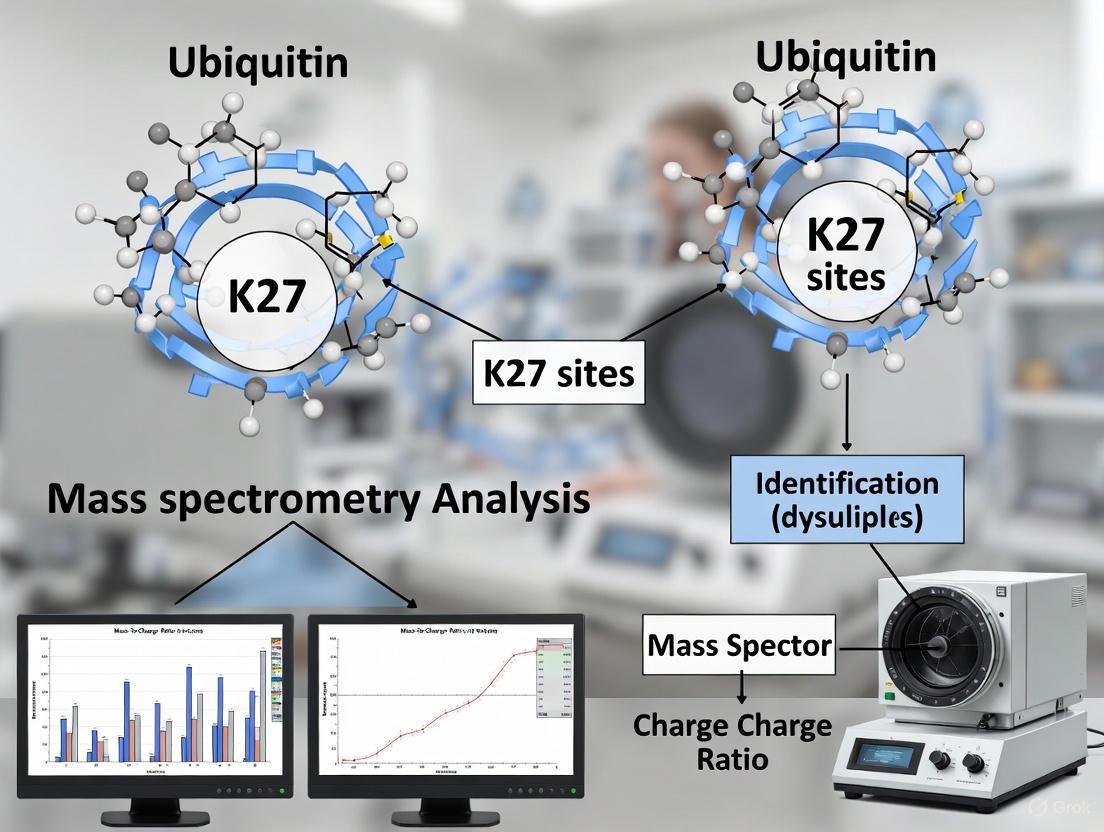
K27-linked ubiquitination is a critical but poorly understood post-translational modification with essential roles in cell proliferation, nuclear processes, and disease pathways.
Advancing K27 Ubiquitination Site Identification: Mass Spectrometry Strategies for Challenging Linkage Analysis
Abstract
K27-linked ubiquitination is a critical but poorly understood post-translational modification with essential roles in cell proliferation, nuclear processes, and disease pathways. However, its unique structural properties, low cellular abundance, and resistance to deubiquitinating enzymes present significant challenges for mass spectrometry-based detection and characterization. This article provides a comprehensive framework for researchers and drug development professionals seeking to improve K27 site identification, covering foundational biology, advanced proteomic methodologies, practical troubleshooting for low-abundance signals, and robust validation techniques. By integrating cutting-edge mass spectrometry approaches with functional insights, we outline a path toward unlocking the biological and therapeutic potential of this elusive ubiquitin linkage.
The K27 Ubiquitin Landscape: Understanding a Rare but Critical Regulatory Modification
Unique Structural and Functional Properties of K27-Linked Chains
Frequently Asked Questions (FAQs)
Q1: What makes K27-linked ubiquitin chains resistant to deubiquitinases (DUBs)? K27-linked di-ubiquitin (K27-Ub2) exhibits unique structural dynamics that confer resistance to deubiquitination. Unlike other linkages, K27-Ub2 is not cleaved by most deubiquitinases, including linkage-non-specific enzymes like USP2, USP5, and Ubp6 [1]. This resistance is attributed to its distinct conformational ensemble, which may sterically hinder DUB access to the isopeptide bond [1].
Q2: How do the structural features of K27-linked chains influence their receptor binding? Despite the lack of extensive non-covalent inter-domain contacts, the conformational ensemble of K27-Ub2 allows for unexpected cross-reactivity. Structural data revealed that K27-Ub2 can be specifically recognized by the K48-selective receptor UBA2 domain from the proteasomal shuttle protein hHR23a, highlighting its structural versatility [1] [2].
Q3: What are the primary cellular functions associated with K27-linked ubiquitination? K27-linked chains are implicated in non-proteolytic signaling pathways. They are found on mitochondrial trafficking protein Miro1, where they slow down its degradation by the proteasome and act as a marker of mitochondrial damage. They are also involved in the regulation of innate immunity [1].
Troubleshooting Guides
Issue: Low Identification Rates of K27-Linked Ubiquitination in Mass Spectrometry
Potential Causes and Solutions:
Cause 1: Lack of Linkage-Specific Enrichment
- Solution: Use K27-linkage specific antibodies to immunoprecipitate proteins or peptides modified with K27-linked chains. This reduces sample complexity and enriches for the low-abundance modification before MS analysis [3].
Cause 2: Suboptimal Fragmentation for Localization
Cause 3: Inefficient Ubiquitinated Peptide Enrichment
- Solution: Utilize tandem-repeated Ub-binding entities (TUBEs). These reagents have higher affinity for ubiquitin chains compared to single domains and can more effectively pull down ubiquitinated substrates from complex lysates [3].
Key Experimental Data on Ubiquitin Linkages
Table 1: Biochemical Properties of Different Ubiquitin Linkages
| Ubiquitin Linkage | Cleaved by Non-Specific DUBs (e.g., USP5) | Representative Cellular Function | Interdomain Contacts |
|---|---|---|---|
| K27 | Resistant [1] | Mitochondrial damage marker; Innate immunity [1] | Weak or transient [1] |
| K48 | Yes [1] | Targets substrates for proteasomal degradation [3] | Strong [1] |
| K63 | Yes [1] | DNA repair; NF-κB activation [3] | Weak or transient [1] |
| K11 | Yes [1] | Cell cycle regulation; ERAD [1] | Weak or transient [1] |
Table 2: NMR-Derived Structural Features of Di-ubiquitin (Ub2) Chains
| Ubiquitin Linkage | Chemical Shift Perturbations (CSPs) in Distal Ub | Chemical Shift Perturbations (CSPs) in Proximal Ub | Inferred Structural Dynamics |
|---|---|---|---|
| K27 | Smallest of all Ub2s studied [1] | Largest and most widespread among all Ub2s [1] | Unique conformational ensemble; no stable inter-domain contacts [1] |
| K48 | Significant, involving hydrophobic patch (L8, I44, V70) [1] | Not specified in text | Compact structure with defined inter-domain interactions [1] |
| K6 | Significant [1] | Not specified in text | Defined inter-domain interactions [1] |
Detailed Experimental Protocols
Protocol 1: Assessing DUB Resistance of K27-Linked Chains
This protocol is based on the methodology used to characterize K27-Ub2 uniqueness [1].
- Chain Preparation: Assemble fully natural K27-linked di-ubiquitin (K27-Ub2) using a non-enzymatic chemical synthesis strategy with mutually orthogonal removable amine-protecting groups (Alloc and Boc) [1].
- DUB Incubation: Incubate the purified K27-Ub2 with a panel of deubiquitinases. This panel should include:
- Linkage-specific DUBs (e.g., Cezanne for K11, OTUB1 for K48).
- Linkage-non-specific DUBs (e.g., USP2, USP5/IsoT, Ubp6).
- Reaction Analysis: Analyze the reaction products via SDS-PAGE or immunoblotting using anti-ubiquitin antibodies.
- Expected Outcome: K27-Ub2 will show significant resistance to cleavage by non-specific DUBs (USP2, USP5, Ubp6) compared to other linkage types [1].
Protocol 2: Structural Analysis of K27-Linked Chains by NMR
This protocol outlines the solution-phase structural determination of K27-Ub2 [1] [2].
- Sample Preparation: Prepare a uniformly ¹⁵N-enriched sample of K27-Ub2. For asymmetric analysis, prepare separate samples where only the distal or only the proximal Ub unit is isotopically labeled [1].
- NMR Data Collection: Collect ¹H-¹⁵N heteronuclear single quantum coherence (HSQC) NMR spectra.
- Chemical Shift Perturbation (CSP) Analysis: Calculate CSPs for both the distal and proximal Ub units by comparing the chemical shifts to those of mono-ubiquitin. The formula used is: Δδ = √((ΔδH)² + (αΔδN)²), where α is a scaling factor (typically 0.2) [1].
- Ensemble Modeling: Use experimental NMR restraints, such as Residual Dipolar Couplings (RDCs), in conjunction with computational in silico modeling to generate a representative ensemble of structures that reflect the dynamic nature of the chain in solution [1] [2].
Research Reagent Solutions
Table 3: Essential Reagents for K27-Linked Ubiquitin Research
| Reagent / Tool | Function / Application | Example Use Case |
|---|---|---|
| Non-enzymatic Ub2 Assemblies | Provides pure, native-isopeptide linked di-ubiquitin for biochemical and structural studies [1]. | In vitro analysis of DUB specificity and chain topology [1]. |
| Linkage-Specific Antibodies | Immunoprecipitation and detection of K27-ubiquitinated proteins or chains [3]. | Enrichment of endogenous K27-modified substrates for proteomic analysis [3]. |
| Tandem-repeated UBDs (TUBEs) | High-affinity enrichment of polyubiquitinated proteins from cell lysates, protecting chains from DUBs [3]. | Isolation of endogenous ubiquitinated proteins for downstream Western blot or MS analysis [3]. |
| Stable Tagged Ub Exchange (StUbEx) System | A cellular system where endogenous Ub is replaced with His- or Strep-tagged Ub for proteomic profiling [3]. | Global identification of ubiquitination sites and substrates in living cells [3]. |
Signaling Pathway and Experimental Workflow Diagrams
Diagram 1: K27-Linked Ubiquitination Signaling Pathway. This diagram outlines the enzymatic cascade for K27-chain formation and the functional outcomes, highlighting the key resistance to most deubiquitinases.
Diagram 2: Mass Spectrometry Workflow for K27 Site Identification. This workflow details the process from sample preparation to site identification, emphasizing critical enrichment steps to overcome the low stoichiometry of ubiquitination.
Frequently Asked Questions (FAQs) and Troubleshooting
FAQ 1: Why is the identification of specific lysine acetylation sites, like K27, so challenging in mass spectrometry analysis? The primary challenge is the very low stoichiometry of most acetylation sites. The median acetylation stoichiometry in human cells is only about 0.02% [5]. This means that for any given lysine residue on a protein, only a tiny fraction is acetylated at any time, making the acetylated peptides difficult to detect against a large background of their unmodified counterparts. Furthermore, acetylation sites can exist as a heterogeneous mixture of isobaric peptides, where the same modification is located at different positions, complicating their localization and quantification [6].
FAQ 2: What methods can improve the accuracy of acetylation stoichiometry measurements? Robust quantification requires methods that control for accuracy, such as Partial Chemical Acetylation (PCA) combined with serial dilution SILAC (SD-SILAC) [5]. This approach involves chemically acetylating a sample and creating a dilution series to ensure the measured SILAC ratios for native acetylated peptides follow the expected pattern, filtering out inaccurate quantifications. This method has been validated against absolute quantification using AQUA peptides and recombinant acetylated proteins, showing significant correlation [5].
FAQ 3: Our lab has limited sample material. Can we still perform acetylome profiling? Yes, optimized protocols exist for relatively small amounts of input material. A detailed protocol for mouse liver tissue or isolated mitochondria integrates protein isolation, proteolytic digestion, and immunoaffinity enrichment, and is effective with 1–5 mg of protein lysate as starting material [7]. This method utilizes comprehensive data-independent acquisition (DIA) mass spectrometry for accurate and reproducible label-free quantification [7].
FAQ 4: How does Trichostatin A (TSA) treatment affect the histone acetylome, and what should we consider in experimental design? TSA is a potent histone deacetylase (HDAC) inhibitor that promotes hyperacetylation, driving cells toward differentiation [6]. In mouse embryonic stem cells, TSA treatment leads to morphological changes and significant regulation of stemness (e.g., Oct4 decrease) and differentiation markers (e.g., Pdx1 increase) [6]. When using TSA, it is crucial to pair it with a proper control (e.g., DMSO-treated cells) and to employ MS methods capable of dealing with the resulting PTM heterogeneity, such as limited proteolysis to generate peptides of suitable length for analysis [6].
Troubleshooting Guides
Issue 1: Low Coverage of Acetylated Peptides Potential Cause: The detection of acetylated peptides is heavily biased toward abundant proteins, and most exist at copy numbers below the standard detection limit of the mass spectrometer [5]. Solutions:
- Antibody-based Enrichment: Always use immunoaffinity enrichment with anti-acetyl-lysine antibodies prior to MS analysis to significantly deepen acetylome coverage [7].
- Increase Input Material: If possible, use higher amounts of input protein (e.g., up to 20 mg) for the enrichment step to increase the yield of acetylated peptides [7].
- Optimize Digestion: For histone analysis, a limited proteolysis approach with stringent trypsin digestion conditions (e.g., 50 ng trypsin for 2 hours) can improve sequence coverage of modified regions by generating optimally sized peptides [6].
Issue 2: Inaccurate Stoichiometry Quantification Potential Cause: Comparing native acetylated peptides to a single, high concentration of chemically acetylated peptides (e.g., 1%) can result in a majority of false quantification due to high error rates [5]. Solutions:
- Implement SD-SILAC: Use a serial dilution of the chemically acetylated reference sample to ensure accurate quantification. Accuracy is highest when the reference peptide concentration is most similar to the native one [5].
- Cross-Validation: Validate stoichiometry measurements using independent methods, such as spike-in experiments with known quantities of recombinant acetylated proteins [5].
Issue 3: Difficulty in Localizing the Acetylation Site on a Peptide Potential Cause: Peptides may harbor multiple potential acetylation sites, creating isobaric species that are difficult to distinguish via MS/MS fragmentation [6]. Solutions:
- LC-MS/MS Analysis: Rely on a combination of peptide retention times and high-quality fragmentation spectra to pinpoint the exact modification site [6].
- Manual Validation: For critical sites, manually inspect the MS/MS spectra to confirm the assigned localization of the acetyl group [6].
Quantitative Data on Acetylation
Table 1: Acetylation Stoichiometry and Distribution in HeLa Cells Data derived from a study measuring stoichiometry at 6,829 sites on 2,535 proteins [5].
| Metric | Value | Biological Context / Notes |
|---|---|---|
| Median Stoichiometry | 0.02% | Reflects that most acetylation occurs at very low levels. |
| High Stoichiometry (>1%) | Minority of sites | Enriched on nuclear proteins involved in gene transcription and on acetyltransferases. |
| Majority of Cellular Acetyl-Lysine Residues | Located on histones | Histones harbor the bulk of acetylated lysines in the cell by copy number. |
| Catalyst of High Stoiciometry Acetylation | CBP and p300 | These acetyltransferases are responsible for ~65% of high-stoichiometry acetylation events. |
Table 2: Effects of TSA on Histone Modifications in Embryonic Stem Cells Data from an analysis of H3 and H4 histone modifications in TSA-treated mouse ES14 cells [6].
| Histone & Modification | Effect of TSA Treatment | Functional Consequence |
|---|---|---|
| H4 Acetylation (K5, K8, K12, K16) | Increased acetylation state | Contributes to chromatin relaxation and activation of differentiation genes. |
| H3 Acetylation (K14, K18, K23) | Increased acetylation state | Associated with transcriptional activation and cell differentiation. |
| Gene Expression: Oct4 | Significant decrease | Loss of stemness marker. |
| Gene Expression: Pdx1 | Significant increase | Activation of differentiation marker. |
Experimental Protocols
Protocol 1: Immunoaffinity Enrichment of Acetylated Peptides for MS Analysis
This protocol is adapted for relatively low amounts of starting material (1-5 mg protein lysate) [7].
Key Reagents:
- Lysis Buffer: 8 M Urea in 100 mM TEAB, pH 8.5, supplemented with protease and deacetylase inhibitors (e.g., 5 μM Trichostatin A, 5 mM Nicotinamide).
- Anti-Acetyl-Lysine Antibody Beads (e.g., PTMScan Acetyl-Lysine Motif Kit).
- IAP Buffer: 50 mM MOPS, 10 mM Na₃PO₄, 50 mM NaCl, pH 7.2.
Methodology:
- Tissue Lysis and Protein Digestion:
- Homogenize ~50 mg of frozen tissue in ice-cold lysis buffer using a TissueLyser.
- Sonicate the lysate and centrifuge to obtain a clear supernatant.
- Determine protein concentration using a BCA assay.
- Reduce disulfide bonds with DTT (4.5 mM, 30 min, 37°C) and alkylate free thiols with IAA (10 mM, room temperature, in the dark).
- Dilute the urea concentration and digest proteins with sequencing-grade trypsin.
Peptide Desalting:
- Desalt the resulting tryptic peptides using an Oasis HLB or similar reverse-phase cartridge.
Immunoaffinity Enrichment:
- Incubate the desalted peptides with anti-acetyl-lysine antibody beads in IAP buffer.
- Use wide-bore tips for all handling steps to avoid damaging the beads.
- Wash the beads extensively with IAP buffer, followed by water to remove non-specifically bound peptides.
Elution and Clean-up:
- Elute the enriched acetylated peptides from the beads using a solution of 0.2% formic acid.
- Perform a small-scale desalting step using C18 StageTips prior to LC-MS/MS analysis.
Protocol 2: Limited Proteolysis for Histone PTM Analysis
This protocol is designed to overcome challenges in analyzing highly modified histones by generating peptides of suitable length [6].
Key Reagents:
- Standard chicken core histones or isolated histones from cells.
- Sequencing-grade modified trypsin.
- Ammonium bicarbonate buffer (50 mM, pH ~8).
Methodology:
- Isolate Histones: Separate histones (e.g., H3 and H4) by SDS-PAGE and excise the bands from the gel.
- In-Gel Digestion Optimization:
- Perform in-gel digestion with varying amounts of trypsin (e.g., 10, 50, 100 ng) in 50 mM ammonium bicarbonate for a short, fixed time (e.g., 2 hours).
- Identify the optimal enzyme-to-substrate ratio that provides the highest sequence coverage for the modified N-terminal regions. A ratio yielding 50 ng of trypsin per gel band was found optimal for standard histones [6].
- Peptide Analysis:
- Analyze the resulting peptides by MALDI-MS and LC-MS/MS.
- Use the retention times and fragmentation spectra from LC-MS/MS to identify and localize PTMs like acetylation and methylation on the identified peptides.
Research Reagent Solutions
Table 3: Essential Reagents for Acetylome Analysis
| Reagent / Material | Function | Example / Note |
|---|---|---|
| Anti-Acetyl-Lysine Antibody Beads | Immunoaffinity enrichment of acetylated peptides from complex digests. | PTMScan Acetyl-Lysine Motif Kit [7]. Critical for detecting low-stoichiometry sites. |
| Deacetylase Inhibitors | Preserve the native acetylome during sample preparation by inhibiting endogenous deacetylases. | Trichostatin A (TSA) and Nicotinamide [7]. Essential for accurate representation. |
| Trypsin (Sequencing Grade) | Proteolytic enzyme for digesting proteins into peptides for MS analysis. | Use limited proteolysis conditions for histone analysis [6]. |
| SILAC (Stable Isotope Labeling with Amino Acids in Cell Culture) Reagents | Enable accurate quantification of acetylation stoichiometry and dynamics. | Used in SD-SILAC for stoichiometry measurements [5]. |
| Trichostatin A (TSA) | HDAC inhibitor; used to experimentally manipulate the acetylome (e.g., induce hyperacetylation). | Drives embryonic stem cell differentiation [6]. |
| Recombinant Acetylated Proteins | Serve as spike-in standards for validation of stoichiometry measurements and method calibration. | e.g., site-specifically acetylated MDH2 K239ac [5]. |
Experimental Workflow and Pathway Diagrams
Ubiquitination is a crucial post-translational modification that regulates diverse cellular processes, from protein degradation to signal transduction. Among the various ubiquitin chain linkages, lysine 27 (K27)-linked polyubiquitin chains present a particularly difficult identification challenge for researchers. This modification is characterized by its very low stoichiometry and analytical inaccessibility in complex samples, often making it undetectable without specialized enrichment strategies and sensitive mass spectrometry (MS) techniques. The K27 linkage is not only less abundant than canonical linkages like K48 and K63, but also suffers from obscured identification during standard protein digestion protocols due to analytically inaccessible regions and the presence of other isobaric modifications. As mass spectrometry has emerged as the primary method for characterizing ubiquitylation sites, overcoming these technical hurdles is essential for advancing our understanding of K27-specific biological functions in cellular regulation and disease mechanisms.
Technical Hurdles in K27 Identification
Low Abundance and Stoichiometry
The core challenge in K27 ubiquitination research stems from its inherently low abundance relative to other ubiquitin linkages. In typical proteomic analyses, K27-modified peptides are present in such minimal quantities that they are often masked by non-modified peptides and other more abundant protein species. This low stoichiometry means that even in samples where K27 ubiquitination is biologically significant, the actual number of modified molecules per cell can be extremely limited, pushing against the detection limits of conventional mass spectrometry approaches.
Analytical Inaccessibility
The process of preparing samples for mass spectrometry analysis introduces specific obstacles for K27 identification. During standard protein digestion with trypsin, ubiquitination sites can become analytically inaccessible for several reasons. The characteristic di-glycine (di-Gly) remnant that remains after tryptic digestion—a signature of ubiquitination that adds 114.043 Da to modified lysine residues—may be obscured in regions where arginine residues are less frequent, creating longer peptides that are suboptimal for MS analysis [8] [9]. Additionally, the presence of multiple basic residues near the modification site can lead to incomplete digestion or produce peptides with unfavorable ionization properties.
Competition with Other PTMs
K27 residues on both ubiquitin and substrate proteins are potential sites for cross-talk with other post-translational modifications. The same lysine residue targeted for ubiquitination may also undergo modifications such as acetylation, methylation, or succinylation, creating a complex regulatory landscape where these modifications compete mutually exclusively [9]. This cross-talk not adds complexity to the biological interpretation but also presents analytical challenges, as the mass differences between some of these modifications are minimal and require high-mass-accuracy instruments for discrimination.
Polyubiquitin Chain Complexity
The structural diversity of polyubiquitin chains presents another layer of complexity. K27-linked ubiquitin chains can exist in various lengths and topologies, often mixed with other linkage types within the same protein substrate. This heterogeneity makes it difficult to isolate pure populations of K27-modified proteins or peptides for analysis. Furthermore, the fragmentation patterns of these complex polyubiquitinated peptides can be challenging to interpret, particularly when using collision-induced dissociation methods that may not preserve the labile isopeptide bonds.
Optimized Enrichment Strategies
Effective enrichment of ubiquitinated proteins and peptides is a critical first step in overcoming the low abundance of K27 linkages. The table below compares the primary enrichment methods used in ubiquitination studies:
Table: Comparison of Ubiquitin Enrichment Strategies
| Method | Principle | Advantages | Limitations for K27 |
|---|---|---|---|
| Immunoaffinity Purification | Antibodies against ubiquitin or di-glycine remnant | High specificity; compatible with various sample types | Variable antibody specificity for K27 linkages; potential epitope masking |
| TUBE-based Enrichment | Tandem Ubiquitin-Binding Entities with high affinity | Preserves ubiquitin chains; captures diverse linkage types | May underrepresent K27 if binding affinity differs from major linkages |
| His-Tag Purification | Affinity purification of His-tagged ubiquitin | Effective under denaturing conditions; reduces non-specific binding | Requires genetic manipulation; not applicable to clinical samples |
| Ubiquitin-Binding Domains | Specific UBDs (e.g., UIM, UBA domains) | Potential linkage specificity; native conditions | Limited availability of K27-specific binding domains |
Antibody-Based Enrichment
Immunoaffinity purification using antibodies against the di-glycine remnant has become the most widely used approach for ubiquitin peptide enrichment. This method leverages antibodies specifically developed to recognize the K-ε-GG motif that remains on trypsinized peptides after ubiquitination. For K27-specific studies, the choice of antibody is critical, as some commercial antibodies may exhibit variable affinity for different linkage types. Researchers should validate antibody performance for K27 enrichment specifically, using synthetic reference peptides if available. The protocol typically involves digesting proteins to peptides first, followed by immunoprecipitation with anti-K-ε-GG antibodies, which often yields better results for low-abundance modifications like K27 than protein-level enrichment [9].
Affinity-Based Purification
For systems where genetic manipulation is possible, expressing tagged ubiquitin (e.g., His-tagged, HA-tagged, or FLAG-tagged) enables highly specific enrichment under denaturing conditions that eliminate non-specific interactions. The His-tag purification method has been successfully applied in large-scale analyses of ubiquitin conjugates, with one study identifying over 1,075 proteins in yeast strains expressing only His-tagged ubiquitin [8]. This approach is particularly valuable for preserving the integrity of K27 linkages during extraction, as the denaturing conditions prevent deubiquitinase activity that might preferentially remove less stable ubiquitin modifications.
Mass Spectrometry Methodologies
Instrumentation and Fragmentation Methods
The choice of mass spectrometry instrumentation and fragmentation techniques significantly impacts the ability to identify and characterize K27 ubiquitination sites. High-resolution mass analyzers such as Orbitrap and FT-ICR systems are essential for accurately distinguishing the minimal mass differences between modifications and confidently localizing ubiquitination sites. For fragmentation, electron-transfer dissociation (ETD) often provides advantages over collision-induced dissociation (CID) for ubiquitinated peptides, as it better preserves the labile isopeptide bond while generating sequence ions that allow precise modification site localization [4].
Quantitative Proteomics Approaches
Understanding the dynamics of K27 ubiquitination requires quantitative methods that can track changes under different physiological conditions or experimental perturbations. Stable Isotope Labeling by Amino Acids in Cell Culture (SILAC) and Tandem Mass Tag (TMT) labeling enable multiplexed comparisons of ubiquitination levels across multiple samples [10]. These quantitative approaches are particularly valuable for determining whether K27 ubiquitination is regulated independently of other linkage types in response to cellular stimuli, providing insights into its specific biological functions.
Table: Mass Spectrometry Methods for K27 Ubiquitination Analysis
| Method | Application | Benefits for K27 Studies | Technical Requirements |
|---|---|---|---|
| High-Resolution MS | Accurate mass measurement | Distinguishes isobaric modifications; confident site localization | Orbitrap or FT-ICR instrumentation; mass accuracy < 5 ppm |
| ETD/ECD Fragmentation | Peptide sequencing | Preserves labile modifications; improves site localization | Specialized fragmentation capability; optimized parameters |
| SILAC/TMT Quantification | Dynamic change measurement | Multiplexed comparison; reveals K27-specific regulation | Metabolic or chemical labeling; quantitative bioinformatics |
| Targeted MS/MS (PRM) | Validation and verification | High sensitivity for low-abundance sites; improved reproducibility | Method development for specific peptides; reference standards |
Experimental Workflow for K27 Identification
The following diagram illustrates the comprehensive workflow for identifying K27 ubiquitination sites, integrating optimal enrichment strategies and mass spectrometry analysis:
Sample Preparation and Digestion
The initial sample preparation steps are crucial for preserving K27 ubiquitination. Rapid protein extraction under denaturing conditions (e.g., 8M urea or 2% SDS) is essential to prevent deubiquitination and preserve the native ubiquitination state. For tissue samples, immediate freezing in liquid nitrogen and homogenization in the presence of protease inhibitors and deubiquitinase inhibitors (e.g., N-ethylmaleimide) helps maintain the integrity of K27 linkages. Protein digestion should be optimized for completeness, as incomplete digestion can lead to missed K27 sites. Trypsin is typically the protease of choice, as it generates the characteristic di-glycine remnant signature, but alternative proteases like Lys-C or Glu-C may be employed to increase sequence coverage around modified sites.
Liquid Chromatography and Mass Spectrometry Analysis
Following enrichment, peptide separation by reverse-phase liquid chromatography using nano-flow systems provides optimal sensitivity for detecting low-abundance K27-modified peptides. Gradual acetonitrile gradients (90-120 minutes) enhance separation and reduce ion suppression effects. For mass spectrometry analysis, data-dependent acquisition methods should be optimized to prioritize the selection of potentially ubiquitinated peptides, which can be facilitated by including the di-glycine modification (114.04293 Da) as a variable modification in real-time decision algorithms. For the most challenging K27 identifications, targeted methods such as parallel reaction monitoring (PRM) can be developed based on preliminary discovery data to specifically monitor known K27-modified peptides with higher sensitivity and reproducibility.
Research Reagent Solutions
The table below outlines essential reagents and materials for K27 ubiquitination studies:
Table: Essential Research Reagents for K27 Ubiquitination Studies
| Reagent Type | Specific Examples | Application in K27 Research |
|---|---|---|
| Ubiquitin Antibodies | Anti-diGly (K-ε-GG) antibody; linkage-specific antibodies | Enrichment and detection of ubiquitinated peptides; verification of K27 linkages |
| Affinity Tags | His-tagged ubiquitin; HA-tagged ubiquitin; FLAG-tagged ubiquitin | Purification of ubiquitinated proteins from engineered systems |
| Enzymes | Recombinant E1, E2, E3 enzymes; deubiquitinase inhibitors | In vitro ubiquitination assays; preservation of native ubiquitination |
| MS Standards | Heavy labeled ubiquitin; synthetic K27-modified reference peptides | Quantification; method development and optimization |
| Chromatography | C18 reverse-phase columns; strong cation exchange materials | Peptide separation prior to MS analysis |
Frequently Asked Questions (FAQs)
Q1: Why are K27 ubiquitination sites particularly difficult to identify compared to K48 or K63 linkages?
K27 linkages present multiple technical challenges: They typically occur at lower stoichiometry than K48 or K63 linkages, making them harder to detect against the background of unmodified peptides. Additionally, there may be technical biases in standard enrichment protocols that favor more common linkage types, and the structural features around K27 modification sites might make them more susceptible to loss during sample preparation or less amenable to efficient ionization in mass spectrometry.
Q2: What is the most effective enrichment strategy for specifically studying K27 ubiquitination?
Currently, peptide-level immunoprecipitation using anti-di-glycine remnant antibodies provides the most effective enrichment for K27 studies, particularly when combined with strategies to reduce sample complexity, such as strong cation exchange (SCX) or hydrophilic interaction liquid chromatography (HILIC) fractionation [4]. For research focused specifically on K27 linkages, exploring emerging reagents like linkage-specific ubiquitin-binding domains or antibodies may offer improved specificity.
Q3: How can we distinguish K27 ubiquitination from other lysine modifications like acetylation or methylation?
High-mass-accuracy instruments are essential for distinguishing between isobaric modifications like trimethylation (+42.047 Da) and acetylation (+42.011 Da), which differ by only 0.036 Da [4]. Additionally, leveraging diagnostic fragment ions and retention time information can help discriminate between modification types. For definitive identification, comparison with synthetic reference peptides containing known modifications provides the most reliable approach.
Q4: What mass spectrometry fragmentation method works best for K27-modified peptides?
Electron-transfer dissociation (ETD) often outperforms collision-induced dissociation (CID) for ubiquitinated peptides because it better preserves the labile isopeptide bond while generating sequence ions that allow precise modification site localization [4]. However, the optimal approach may involve complementary fragmentation methods, using both ETD and higher-energy collisional dissociation (HCD) to maximize sequence coverage and confidence in site localization.
Q5: How can we validate that an identified ubiquitination site is specifically K27-linked?
Validation requires a multi-faceted approach: First, confirm the presence of the di-glycine signature and precise site localization through high-resolution MS/MS. Second, use linkage-specific reagents such as K27-linkage antibodies or binding domains for orthogonal verification. Third, employ mutagenesis studies where the candidate lysine residue is replaced with arginine to demonstrate loss of modification. Finally, in vitro reconstitution with defined ubiquitin enzymes can provide definitive evidence of K27 linkage formation.
Q6: What are the best practices for quantifying changes in K27 ubiquitination under different experimental conditions?
Isobaric labeling approaches like TMT provide excellent options for multiplexed quantification across multiple conditions. However, researchers should be aware of potential ratio compression effects and implement measures to mitigate this, such as increasing chromatographic separation or using MS3-level quantification when available. For targeted quantification, parallel reaction monitoring (PRM) offers high sensitivity and reproducibility for monitoring specific K27 sites of interest, though it requires prior knowledge of the modified peptide sequences.
Biological Significance in Disease and Therapeutic Targeting
FAQs: Core Concepts of K27 Acetylation
What is the primary biological function of H3K27 acetylation (H3K27ac)? H3K27ac is a quintessential activation mark found on histone H3 proteins. It is highly enriched on active enhancers and promoters, where it creates a relaxed, transcriptionally permissive chromatin state that facilitates gene expression [11] [12] [13]. Unlike repressive marks, H3K27ac neutralizes the positive charge of lysine residues, loosening DNA-histone interactions and recruiting transcription complexes via "reader" proteins like BRD4 [12] [13].
Is H3K27ac a cause or a consequence of active transcription? Recent evidence strongly indicates that H3K27ac is not a mere consequence of transcription. Global acetylation landscapes, including H3K27ac, remain virtually unaltered after acute transcription inhibition using multiple distinct drugs. Furthermore, acetyltransferases like CBP/p300 remain active and continue to acetylate histones even in the absence of ongoing transcription [11].
Which enzymes are primarily responsible for regulating H3K27ac? The major writers for H3K27ac are the lysine acetyltransferases (KATs) CBP and p300 (KAT3A/KAT3B), which catalyze the addition of the acetyl group from acetyl-CoA [5] [14]. The primary erasers are histone deacetylases (HDACs). The mark is recognized by reader proteins containing bromodomains, such as BRD4, which then recruit additional machinery to activate transcription [12] [13].
Troubleshooting Guide: Mass Spectrometry Analysis of K27ac
Low Signal or Coverage for K27ac Peptides
| Potential Cause | Recommended Solution | Underlying Principle |
|---|---|---|
| Low Stoichiometry | Implement antibody-based enrichment (immunoprecipitation) prior to LC-MS/MS. | Most cellular acetylation occurs at very low stoichiometry (median 0.02%), making enrichment essential for detection [5]. |
| Signal Suppression | Use a middle-down MS approach with GluC or AspN proteolysis. | Generates larger peptides (3-4 kDa), preserving combinatorial PTM patterns and improving chromatographic separation [15]. |
| Inadequate Fragmentation | Employ 193 nm Ultraviolet Photodissociation (UVPD) or Electron-Transfer Dissociation (ETD). | These methods retain labile PTMs like acetylation during fragmentation and generate extensive sequence ions for confident localization [15]. |
Inaccurate Quantification of K27ac
| Potential Cause | Recommended Solution | Underlying Principle |
|---|---|---|
| Quantification Error | Use a serial dilution SILAC (SD-SILAC) strategy with partial chemical acetylation for internal standardization. | This method controls for quantification accuracy by comparing native acetylation to a calibrated internal standard, reducing false measurements [5]. |
| Protein Abundance Bias | Correct acetylated peptide intensity using accurate protein abundance data (e.g., iBAQ). | Detection of acetylated peptides is biased toward abundant proteins; correction provides a better estimate of relative stoichiometry [5]. |
| False Positive Localization | Utilize bioinformatics tools like Histone Coder and IsoScale for data curation. | These tools filter assignments, requiring fragment ions that unambiguously localize modifications, thus removing false positives [15]. |
Key Experimental Protocols
Protocol: Accurate Stoichiometry Measurement via SD-SILAC and Partial Chemical Acetylation
This protocol allows for the precise measurement of acetylation stoichiometry across thousands of sites [5].
- Cell Culture & Lysis: Grow two populations of cells in SILAC-heavy and SILAC-light media. Harvest and combine cell pellets in equal amounts. Lyse cells to extract proteins.
- Partial Chemical Acetylation: Treat the mixed protein lysate with acetic anhydride to chemically acetylate a subset of all available lysine residues. Estimate the degree of chemical acetylation by measuring the median reduction of unmodified tryptic peptides.
- Peptide Serial Dilution: Proteolyze the chemically acetylated lysate with trypsin. Perform a serial dilution of these peptides to create internal standards with varying levels of chemical acetylation (e.g., ~1%, ~0.1%, ~0.01%).
- Enrichment and Analysis: Enrich for acetylated peptides from both the native (unmodified) sample and the serial dilution standards using pan-anti-acetyl-lysine antibodies. Analyze all samples by LC-MS/MS.
- Data Analysis & Validation: Quantify the SILAC ratios between native acetylated peptides and the chemically acetylated standard peptides. Use the dilution series to control for quantification accuracy. Validate measurements using AQUA peptides or recombinant acetylated protein spike-ins.
Protocol: Middle-Down MS with UVPD for Mapping Combinatorial PTMs
This protocol is optimized for characterizing heavily modified histone peptides, preserving the combinatorial patterns of PTMs [15].
- Histone Isolation and Derivatization: Isolate core histones from cells or tissues. To generate long peptides covering the modified N-terminal tails, use a protease like GluC (cleaves C-terminal to glutamate) or AspN.
- Propionylation: Derivatize the generated peptides with propionic anhydride. This blocks unmodified and monomethylated lysines, increasing peptide hydrophobicity for better chromatography and preventing tryptic cleavage at lysine.
- Chromatographic Separation: Separate the derivatized peptides using Weak Cation Exchange-Hydrophilic Interaction Liquid Chromatography (WCX-HILIC). This resin separates peptides based on their number of modifications.
- Mass Spectrometry with UVPD: Couple the WCX-HILIC column online to the mass spectrometer. For MS/MS analysis, use 193 nm UVPD, which provides extensive fragmentation and retains labile modifications.
- Data Interpretation: Use specialized software (e.g., Histone Coder, IsoScale) to interpret the complex spectra, confidently localize multiple PTMs, and quantify the different proteoforms.
Signaling Pathways and Biological Workflows
H3K27ac in Gene Activation and Disease
K27ac Stoichiometry Measurement Workflow
H3K27ac Stoichiometry and Copy Number
| Metric | Value / Finding | Experimental Context |
|---|---|---|
| Median Global Acetylation Stoichiometry | 0.02% | HeLa cells [5] |
| High Stoichiometry Acetylation (>1%) | Found on nuclear proteins, gene transcription machinery, and acetyltransferases | HeLa cells [5] |
| Major Contributors to Cellular Acetyl-Lysine Pool | Histones harbor the majority of acetylated lysine residues | Human cells [5] |
| Catalysts of High Stoichiometry Acetylation | CBP and p300 catalyze ~65% of high stoichiometry acetylation | HeLa cells [5] |
H3K27ac in Disease Pathogenesis
| Disease Model | Key Finding on H3K27ac | Therapeutic Insight |
|---|---|---|
| Gastric Cancer (Drug Tolerance) | Enrichment in ALDH1A3 promoter in 5-FU-tolerant persister cells [12] | BET inhibitors (OTX015, I-BET-762) suppress DTP-related ALDH1A3 and tumor growth [12]. |
| Glioblastoma (GBM) | p300 promotes vascular gene expression in GSCs via H3K27ac [14]. | p300/CBP inhibition (e.g., C646, HATi II) reverses transdifferentiation and induces apoptosis [14]. |
| Heroin Use Disorder | Hyperacetylation of H3K27 in striatum linked to glutamatergic gene dysregulation [13]. | Bromodomain inhibitor JQ1 reduces heroin self-administration and drug-seeking in rats [13]. |
The Scientist's Toolkit: Research Reagent Solutions
| Reagent / Tool | Function in K27ac Research | Key Detail |
|---|---|---|
| Pan-anti-acetyl-lysine Antibody | Immuno-enrichment of acetylated peptides for MS. | Essential for detecting low-stoichiometry sites; potential sequence bias exists [5] [11]. |
| CBP/p300 Inhibitor (A-485) | Pharmacological inhibition of major H3K27ac writers. | Rapidly reduces H3K27ac; used to establish causal links to gene expression [11]. |
| BET Bromodomain Inhibitor (JQ1) | Blocks recognition of acetylated lysines by BRD4. | Disrupts downstream signaling of H3K27ac; shows efficacy in disease models [12] [13]. |
| Recombinant Acetylated Proteins | Spike-in standards for quantitative MS. | Provides internal control for accurate stoichiometry measurement [5] [16]. |
| SILAC (Stable Isotope Labeling) | Metabolic labeling for accurate quantification in MS. | Enables precise comparison of acetylation levels across conditions [5] [11]. |
Advanced Proteomic Workflows for K27 Ubiquitination Analysis
The mass spectrometry (MS)-based identification of post-translational modifications (PTMs), particularly the dynamic and heterogeneous lysine 27 (K27) modifications, presents significant analytical challenges. The choice of proteomic strategy—bottom-up, middle-down, or top-down—profoundly impacts the depth, accuracy, and biological relevance of the results obtained. Each method offers distinct trade-offs between proteome coverage, proteoform resolution, and technical feasibility. For K27 site research, where understanding the combinatorial complexity of modifications is paramount, selecting the appropriate MS approach is critical. This technical support guide examines these three foundational methodologies, providing troubleshooting and experimental protocols tailored to improve the identification and characterization of K27 sites in complex biological samples.
Core Principles and Workflows
The following table summarizes the fundamental characteristics of the three primary MS-based proteomics approaches.
Table 1: Core Characteristics of Bottom-Up, Middle-Down, and Top-Down Proteomics
| Feature | Bottom-Up (Shotgun) | Middle-Down | Top-Down |
|---|---|---|---|
| Analytical Unit | Short peptides (typically 7-20 aa) from proteolytic digestion [17] [18] | Longer peptides (typically >20 aa) from restricted proteolysis [18] | Intact proteins and proteoforms [19] [20] |
| Typical Enzyme | Trypsin (high specificity) [21] | OmpT, Sap9, IdeS (generate longer peptides) [18] | Not applicable (no digestion) |
| Key Strength | High-throughput, robust, sensitive, ideal for complex mixtures [17] [22] | Enhanced sequence coverage and detection of co-occurring PTMs compared to BU [18] | Unambiguous characterization of intact proteoforms and combinatorial PTMs [23] [19] |
| Primary Limitation | "Peptide-to-protein inference" problem; loss of labile PTMs; limited sequence coverage [17] [19] [21] | Less established protocols and data analysis tools [18] | Challenging for complex mixtures and high-mass proteins; requires advanced instrumentation [19] [20] |
Visualizing the Core Workflows
The fundamental difference between the approaches lies in the stage at which proteins are fragmented for MS analysis, as illustrated below.
Figure 1: Conceptual workflow comparison of the three main proteomic approaches, highlighting the key distinction of when protein fragmentation occurs.
Detailed Methodologies and Experimental Protocols
Bottom-Up Proteomics: The High-Throughput Workhorse
Detailed Protocol for Bottom-Up Analysis:
- Protein Extraction and Denaturation: Lyse cells or tissue in a denaturing buffer (e.g., 8 M urea or 5% SDS) containing protease and phosphatase inhibitors. Use surfactants like SDS to solubilize membrane proteins effectively [21].
- Digestion: Dilute the sample and digest with trypsin (typically at a 1:50 enzyme-to-protein ratio) overnight at 37°C. Trypsin is preferred for its high specificity and generation of peptides with basic C-termini, ideal for CID/HCD fragmentation [22] [21].
- Peptide Clean-up: Desalt the resulting peptide mixture using C18 solid-phase extraction cartridges or StageTips to remove salts and surfactants that interfere with MS analysis [21].
- LC-MS/MS Analysis:
- Separation: Use reversed-phase nano-LC (e.g., C18 column) with a gradient of increasing organic solvent (acetonitrile) to separate peptides online with the MS [17] [22].
- Mass Spectrometry: Employ a data-dependent acquisition (DDA) workflow on a high-resolution accurate-mass (HRAM) instrument like an Orbitrap mass spectrometer. Select the most intense precursor ions for fragmentation using techniques like HCD or CID [22].
- Data Analysis: Search the resulting MS/MS spectra against a protein sequence database using software such as Proteome Discoverer with search engines (SEQUEST HT, Mascot). For PTMs like K27, include variable modifications (e.g., ubiquitination, acetylation) in the search parameters [22].
Top-Down Proteomics: The Proteoform-Resolved Approach
Detailed Protocol for Top-Down Analysis:
- MS-Compatible Protein Extraction: Extract proteins using methods that avoid non-volatile salts and detergents. Recent advancements include using photocleavable surfactants (e.g., Azo), which provide efficient solubilization comparable to SDS but can be rapidly degraded by UV light prior to MS analysis, making them ideal for top-down [19].
- Intact Protein Separation and Fractionation: Reduce sample complexity by separating intact proteins using liquid-based fractionation (e.g., GELFrEE) or reverse-phase HPLC at the protein level. This is critical for resolving individual proteoforms [19] [20].
- LC-MS/MS Analysis of Intact Proteins:
- Separation: Use specialized wide-pore LC columns (e.g., Thermo Scientific ProSwift RP-4H) designed for intact protein separation at nano- or capillary flow rates [23].
- Mass Spectrometry and Fragmentation:
- Analyze intact protein masses with high resolution (HRAM) to distinguish different proteoforms [23].
- Isolate specific protein ions in the mass spectrometer.
- Fragment the intact protein ions using electron-driven techniques like Electron-Transfer Dissociation (ETD) or UV Photodissociation (UVPD). These techniques are crucial for top-down as they preserve labile PTMs (a key concern for K27 studies) and provide extensive sequence coverage [23] [19].
- Data Analysis: Process the complex MS/MS spectra using top-down specific software (e.g., Thermo Scientific ProSightPD). These platforms compare the intact mass and the fragment ion masses against proteome databases to identify the protein and its precise PTM localization [23].
Middle-Down Proteomics: The Balanced Compromise
Detailed Protocol for Middle-Down Analysis:
- Generation of Large Peptides: Subject the protein sample to limited or specific proteolysis using enzymes that produce longer peptides (typically >50 amino acids). Examples include:
- Separation and Clean-up: Desalt and potentially fractionate the mixture of long peptides, which can be more challenging than handling short tryptic peptides due to their higher charge states and lower solubility.
- LC-MS/MS Analysis: Similar to bottom-up, long peptides are separated by reversed-phase LC and analyzed by MS. ETD is often the preferred fragmentation method as it is more effective for the higher charge states typical of long peptides and better preserves PTMs [18].
- Data Analysis: Database search strategies similar to bottom-up can be used but may require adaptation to accommodate non-tryptic termini and longer peptide sequences.
The Scientist's Toolkit: Essential Research Reagents and Materials
Table 2: Key Reagent Solutions for Proteomics Workflows
| Item | Function/Application | Considerations for K27 Research |
|---|---|---|
| Trypsin (Sequencing Grade) | Standard protease for bottom-up; cleaves C-terminal to Arg/Lys [22] [21]. | May generate short peptides that miss K27 site connectivity. Ideal for initial site mapping. |
| IdeS Protease | Specific protease for middle-down; cleaves IgG for antibody analysis [18]. | Useful for characterizing K27 modifications on therapeutic antibodies or in immunoprecipitation samples. |
| Photocleavable Surfactant (Azo) | MS-compatible protein solubilization for top-down/middle-down; removed by UV light [19]. | Enables analysis of hydrophobic proteins with K27 modifications without interference. |
| HRAM Mass Spectrometer (e.g., Orbitrap) | High-resolution accurate-mass measurement for all approaches [23] [22]. | Essential for distinguishing closely spaced proteoforms and precise PTM identification. |
| ETD / UVPD Reagents | Electron-transfer dissociation / UV photodissociation for fragmenting intact proteins or long peptides [23] [19]. | Preserves labile K27 modifications (e.g., ubiquitination) during fragmentation. Critical for top-down. |
| Anti-K27 Modification Antibodies | Enrichment of modified proteins/peptides prior to MS analysis (e.g., for PTM mapping). | Enables targeted study of low-abundance K27 events; specificity and batch variability are key concerns [19]. |
Troubleshooting Guides and FAQs
FAQ 1: For a discovery-phase project aiming to identify as many K27 sites as possible from a complex cell lysate, which approach should I start with?
Answer: Begin with a Bottom-Up Proteomics workflow.
- Rationale: Its high sensitivity and throughput make it the most efficient method for cataloguing a large number of PTM sites from complex samples [22] [21]. You can use anti-K27 antibodies (e.g., for ubiquitin remnants) to enrich modified peptides prior to LC-MS/MS, greatly deepening the coverage.
- Limitation to Consider: Be aware that you may lose information about which combinations of modifications exist on the same protein molecule (proteoform).
FAQ 2: My bottom-up data suggests multiple PTMs on a protein of interest. How can I confirm if they exist on the same molecule or on different molecules?
Answer: Switch to a Top-Down Proteomics approach.
- Rationale: This is the primary strength of top-down MS. By analyzing the intact protein, you can directly measure the mass of different proteoforms and fragment them to localize all modifications on a single molecule. This unambiguously solves the "protein inference problem" inherent to bottom-up [19] [20].
- Technical Requirement: This typically requires a purified or enriched protein target to reduce complexity, and an MS system capable of ETD or UVPD fragmentation [23].
FAQ 3: I am studying histones, which have multiple, closely spaced K27 modifications (e.g., acetylation, methylation). Which method is best?
Answer: A Middle-Down Proteomics strategy is particularly powerful for this use case.
- Rationale: Using specific proteases that generate long peptides (e.g., 50-100 aa) encompassing multiple modified sites, you can determine the combinatorial PTM code (e.g., the co-occurrence of K27me3 and other marks) with much higher certainty than bottom-up and with less technical challenge than full top-down [18].
- Key Enabler: Enzymes like Sap9 have been used successfully to generate such long histone peptides for middle-down analysis.
FAQ 4: During top-down analysis, I get poor fragmentation coverage of my intact protein. What are the primary factors to optimize?
Answer: Poor fragmentation is a common challenge. Focus on these areas:
- Fragmentation Technique: Ensure you are using ETD, EThcD, or UVPD. These methods are far superior to collision-based (CID/HCD) methods for fragmenting intact proteins and preserving PTMs [23] [19].
- Protein Charge State: For ETD, which relies on electron transfer, selecting a high charge state precursor ion is critical for efficient fragmentation and sequence coverage [23].
- Instrument Settings: Optimize activation times and energies for the chosen fragmentation method. Methods for "enhanced dissociation" with high-capacity ETD are available on modern instruments and can significantly improve results [23].
FAQ 5: How can I improve the identification of low-abundance K27-modified proteoforms in a top-down experiment?
Answer: Implement a targeted enrichment step prior to MS analysis.
- Strategy 1: Antibody-Based Enrichment. Use a proteoform-specific antibody if available, though antibodies often lack proteoform-specificity [19].
- Strategy 2: Affinity Purification with Magnetic Nanoparticles. Recent advancements involve functionalizing magnetic nanoparticles with peptide affinity ligands. This approach can offer high specificity and reproducibility for enriching target proteins (e.g., cardiac troponin I) and their modified proteoforms from complex mixtures like serum, outperforming conventional antibodies in some cases [19]. This could be adapted for specific K27-modified targets.
Enrichment Strategies for Low-Abundance K27 Modifications
The improved identification of lysine 27 (K27) modifications on histones and other proteins is a significant challenge in mass spectrometry-based proteomics. These modifications, including methylation and acetylation, are often low in abundance and stoichiometry, necessitating specialized enrichment strategies to overcome the limitations of direct LC-MS/MS analysis. This technical support center provides a consolidated resource of proven methodologies and troubleshooting guides to assist researchers in refining their enrichment protocols. The following sections, framed within the broader thesis of improving mass spectrometry identification of K27 sites, offer detailed experimental protocols, comparative data on enrichment techniques, and solutions to common experimental hurdles.
Core Enrichment Methodologies
Several core methodologies have been established for the enrichment of methylated and acetylated peptides. The choice of strategy depends on the specific K27 modification of interest, the required specificity, and the available instrumentation.
Methyl-Lysine Enrichment using 3xMBT Domains
This protocol uses the triple malignant brain tumor (3xMBT) domains of the L3MBTL1 protein, which have pan-specific affinity for mono- and di-methylated lysine with minimal sequence specificity, to enrich for methylated peptides from cell lysates [24].
Detailed Experimental Protocol [24]:
- Principle: Recombinant 3xMBT domain, fused to glutathione S-transferase (GST), is immobilized on glutathione-sepharose beads. This construct serves as an affinity reagent to bind methylated proteins/peptides from complex lysates.
- Duration: Approximately 7 days for cell culture (including SILAC labeling) and 4-5 days for enrichment and LC-MS/MS analysis.
- Key Steps:
- Cell Culture and Lysis: Grow cells in SILAC media (e.g., light, medium, and heavy labels) for at least 5-6 cell doublings for complete labeling. Harvest cells and lyse them in an appropriate buffer (e.g., 50 mM Tris-HCl, pH 8.0, 150 mM NaCl, 0.5% NP-40, and protease inhibitors).
- Pre-Clearing: Clarify the lysate by centrifugation. Pre-clear the supernatant by incubating with GST-bound beads to remove proteins that bind nonspecifically to GST or the beads.
- Affinity Pull-Down: Incubate the pre-cleared lysate with beads bound to either the active 3xMBT domain or the binding-null mutant (3xMBTD355N) as a negative control. Perform this pull-down for 2-3 hours at 4°C with gentle agitation.
- Washing: Wash the beads extensively with lysis buffer to remove non-specifically bound proteins.
- Elution and Digestion: Elute bound proteins using SDS-PAGE loading buffer. Separate proteins by SDS-PAGE and perform in-gel tryptic digestion. Alternatively, on-bead digestion can be performed.
- LC-MS/MS Analysis: Analyze the resulting peptides using a nanoflow LC system coupled to a high-resolution mass spectrometer (e.g., Orbitrap class instrument). A 2-4 hour gradient is recommended for deep proteome coverage.
Troubleshooting Guide:
- Problem: High background of non-specifically bound proteins.
- Solution: Ensure the use of the 3xMBTD355N mutant as a negative control in a SILAC-based quantitative experiment. Only proteins with a high ratio (e.g., >2-3 fold) in the 3xMBT sample over the mutant control are considered bona fide methyl-lysine enriched.
- Problem: Low yield of methylated peptides.
- Solution: Increase the scale of the pull-down. Consider subcellular fractionation (e.g., preparing a nuclear extract) to enrich for methylated proteins of interest before the pull-down. Optimize wash stringency (e.g., by increasing salt concentration to 300-500 mM NaCl).
- Problem: Inability to distinguish between mono- and di-methylation.
- Solution: The 3xMBT domain binds both me1 and me2. Follow-up validation using methyl-state specific antibodies or targeted MS/MS is required to determine the exact modification state.
Antibody-Based Immunoprecipitation of Methylated Peptides
This approach utilizes antibodies specific for methyl-lysine or methyl-arginine to immunoprecipitate (IP) modified peptides from a digested protein sample.
Detailed Experimental Protocol [4]:
- Principle: Methyl-specific antibodies are incubated with a complex peptide mixture generated from tryptic digestion. The antibody-enriched peptides are then isolated, washed, and analyzed by LC-MS/MS.
- Key Steps:
- Protein Digestion: Prepare a total protein lysate and digest it to completion with trypsin.
- Peptide Pre-Fractionation (Optional but Recommended): To reduce sample complexity and increase depth of coverage, pre-fractionate the digested peptides using Strong Cation Exchange (SCX), Hydrophilic Interaction Liquid Chromatography (HILIC), or Isoelectric Focusing (IEF) [4].
- Immunoprecipitation: Incubate the fractionated or total peptide mixture with methyl-lysine or methyl-arginine specific antibodies (e.g., conjugated to beads) overnight at 4°C.
- Washing and Elution: Wash the beads extensively with IP buffer to remove non-specifically bound peptides. Elute the bound methylated peptides using a low-pH elution buffer (e.g., 0.1-0.2% TFA).
- LC-MS/MS Analysis: Desalt the eluted peptides using C18 stage tips and analyze by LC-MS/MS.
Troubleshooting Guide:
- Problem: Low number of identified methylation sites.
- Solution: Pre-fractionation is critical. HILIC has been shown to identify 3–5 times more methylation sites compared to SCX or IEF alone [4]. Combine multiple pre-fractionation methods for maximum coverage.
- Problem: Antibody cross-reactivity or bias.
- Solution: Be aware that commercial methyl-specific antibodies can have sequence preference. Results should be validated using an orthogonal method, such as the 3xMBT pull-down or genetic manipulation of methyltransferases.
Chemical Derivatization for Histone Analysis
This protocol is specifically designed for the analysis of highly modified histones, which are rich in lysine and arginine residues, to improve tryptic digestion and peptide analysis.
Detailed Experimental Protocol [25]:
- Principle: Free amine groups (N-termini and unmodified/mono-methylated lysine) are derivatized with propionic anhydride. This blocks tryptic cleavage at lysine residues, creating longer, more manageable peptides that are cleaved only at arginine residues.
- Duration: Approximately 15-19 hours.
- Key Steps:
- Histone Purification: Acid-extract histones from cells or tissues and purify individual histone variants (e.g., H3) via RP-HPLC.
- Primary Propionylation: Reconstitute the histone sample and treat with propionic anhydride to block all free amines. This step neutralizes charge and prevents trypsin from cleaving at lysine residues.
- Trypsin Digestion: Digest the derivatized histones with trypsin. Under these conditions, cleavage occurs only C-terminal to arginine residues.
- Secondary Propionylation: Perform a second propionylation reaction to block the new N-termini generated by trypsin cleavage. This makes the peptides more hydrophobic and improves their chromatographic behavior.
- Stable Isotope Labeling (Optional): For quantification, the carboxylic acid groups on peptides from two different samples can be labeled with "light" (D0-) or "heavy" (D4-) methanol via an esterification reaction.
- LC-MS/MS Analysis: Mix the samples and analyze using a high-resolution mass spectrometer. The mass difference of 0.036 Da between trimethylation and acetylation requires high mass accuracy for confident discrimination.
Troubleshooting Guide:
- Problem: Incomplete derivatization.
- Solution: Ensure the reaction is performed at a basic pH (checked with pH strips) and that fresh propionic anhydride is used. A second round of derivatization may be necessary.
- Problem: Difficulty distinguishing acetylation from trimethylation.
- Solution: A high-resolution, high mass accuracy mass spectrometer (e.g., LTQ-Orbitrap, LTQ-FT) is mandatory to differentiate the 0.0364 Da mass difference [25].
Comparative Data and Workflow Visualization
The table below provides a structured comparison of the primary enrichment strategies discussed.
Table 1: Comparison of Enrichment Strategies for K27 Modifications
| Strategy | Target Modifications | Principle | Key Advantage | Key Limitation |
|---|---|---|---|---|
| 3xMBT Pull-Down [24] | Lysine mono-/di-methylation | Affinity enrichment using a methyl-lysine binding domain | Pan-specific for me1/me2; not sequence-dependent | Does not enrich for trimethylated lysine |
| Antibody IP [4] | Lysine or arginine methylation (state-specific) | Immunoprecipitation with modification-specific antibodies | High specificity for targeted modification state | Potential for sequence bias; variable antibody quality |
| Chemical Derivatization [25] | All, but designed for complex histone patterns | Chemical blocking of lysines to guide protease digestion | Ideal for highly modified proteins like histones | Specialized protocol; primarily for histones |
The following diagram illustrates the decision-making workflow for selecting an appropriate enrichment strategy based on experimental goals.
The Scientist's Toolkit: Research Reagent Solutions
Table 2: Essential Research Reagents for K27 Modification Enrichment
| Reagent / Tool | Function / Application | Key Notes |
|---|---|---|
| 3xMBT (GST-tagged) [24] | Pan-specific enrichment of mono- and di-methylated lysine proteins/peptides. | Must use binding-null mutant (e.g., 3xMBTD355N) as a negative control. |
| Methyl-Specific Antibodies [4] | Immunoprecipitation of methyl-lysine or methyl-arginine peptides. | Check for specificity (me1/me2/me3) and potential sequence bias. |
| Propionic Anhydride [25] | Chemical derivatization to block lysine residues for controlled tryptic digestion of histones. | Critical for analyzing complex histone modification patterns. |
| Stable Isotope Labeling (SILAC) [24] | Quantitative comparison of methylation levels between different biological conditions. | Allows accurate quantification and distinguishes specific binding from background. |
| Trypsin (Sequencing Grade) [25] | Proteolytic digestion of proteins into peptides for LC-MS/MS analysis. | Use after propionylation for specific Arg-C-like digestion. |
| High-Resolution Mass Spectrometer [25] | Accurate mass measurement for identifying and localizing PTMs. | Essential for distinguishing acetylation (+42.01 Da) from trimethylation (+42.05 Da). |
Frequently Asked Questions (FAQs)
Q1: My mass spectrometry analysis after 3xMBT enrichment shows many non-histone proteins. Is this expected? A: Yes. While histones are highly methylated, the 3xMBT domain is pan-specific and has been used to identify numerous methylated non-histone proteins involved in various cellular processes, including transcription, RNA processing, and signal transduction [24] [4]. Your results may reveal novel methylation substrates.
Q2: How can I confidently distinguish between K27 acetylation and trimethylation in my MS data? A: This requires a high-resolution mass spectrometer (e.g., Orbitrap, FT-ICR) due to the small mass difference (0.0364 Da) [4] [25]. On such instruments, the accurate mass measurement can separate the two. Additionally, MS/MS fragmentation patterns can provide diagnostic ions, though this can be challenging. The chemical derivatization protocol also helps by converting lysine to a propionyl derivative, changing the mass of the modified peptide [25].
Q3: Why should I use pre-fractionation methods like HILIC before antibody-based IP? A: Sample complexity is a major limitation in PTM analysis. Pre-fractionation reduces the complexity of the peptide mixture presented to the antibody, minimizing competition for binding sites and increasing the likelihood of identifying low-abundance methylated peptides. Studies have shown that HILIC can identify 3–5 times more methylation sites compared to other methods like SCX [4].
Q4: What is the purpose of the secondary propionylation step in the histone derivatization protocol? A: The primary propionylation blocks lysines before digestion. After trypsin cleaves at arginine residues, it generates new N-termini on the resulting peptides. The secondary propionylation blocks these new N-termini. This serves to make all peptides uniformly hydrophobic, improving their chromatographic separation and MS ionization efficiency [25].
Mass spectrometry (MS)-based quantitative proteomics is a powerful tool for gaining insights into the function and dynamics of biological systems. However, a fundamental challenge is that peptides with different sequences exhibit different ionization efficiencies, meaning their intensities in a mass spectrum are not directly correlated with their abundances. To overcome this, various label-free and stable isotope label-based quantitation methods have been developed. These methods enable the unbiased identification of thousands of proteins that are differentially expressed in healthy versus diseased cells, and are crucial for research such as improving the mass spectrometry identification of K27 ubiquitination sites [26].
This technical support center guide outlines the core methodologies, provides detailed experimental protocols, and addresses frequent troubleshooting issues to support researchers in the field.
Quantitative MS strategies are broadly divided into two categories: relative quantification, which compares protein abundance between two or more samples, and absolute quantification, which measures the exact amount or concentration of a specific protein [26] [27]. The following table summarizes the key characteristics of the most common techniques.
Table 1: Core Quantitative Mass Spectrometry Methods
| Method Type | Specific Technique | Principle | Quantification Accuracy | Proteome Coverage | Multiplexing Capability |
|---|---|---|---|---|---|
| Stable Isotope Labeling | SILAC (Stable Isotope Labeling by Amino acids in Cell culture) | Metabolic incorporation of "heavy" amino acids into proteins during cell culture [27]. | High | Medium | Limited (typically 2-3 plex) |
| TMT (Tandem Mass Tags) / iTRAQ | Chemical labeling of peptides with isobaric tags that release reporter ions upon fragmentation [28]. | High (with MS3) | High | High (6-18 plex) | |
| AQUA (Absolute QUAntitation) | Use of stable isotope-labeled synthetic peptides as internal standards [29]. | Very High (for target) | Low (targeted) | Dependent on design | |
| Label-Free | LFQ (Label-Free Quantitation) | Comparison of peptide signal intensities between runs [28]. | Medium | High | Virtually unlimited |
| iBAQ (Intensity-Based Absolute Quantitation) | Normalization of protein intensity by the number of theoretically observable peptides [28]. | Medium | High | Virtually unlimited | |
| Spectral Counting | Use of the number of identified MS/MS spectra for a protein as a quantitative metric [27]. | Lower | High | Virtually unlimited |
Detailed Experimental Protocols
SILAC for Relative Quantification
Objective: To compare protein expression between two cell populations (e.g., control vs. treatment) [27].
Workflow Diagram:
Procedure:
- Cell Culture: Grow two otherwise identical cell populations in specialized SILAC media. One medium contains a "light" form of an essential amino acid (e.g., Lys0, Arg0), while the other contains a "heavy" isotope-labeled form (e.g., Lys8, Arg10) [27].
- Sample Mixing: After several cell doublings (typically 5-7), harvest the cells and combine equal protein amounts from the "light" and "heavy" populations. This step minimizes experimental variation as samples are processed together from this point onward [27].
- Protein Preparation: Digest the mixed protein sample into peptides using a protease like trypsin.
- LC-MS/MS Analysis: Analyze the peptide mixture using Liquid Chromatography tandem Mass Spectrometry.
- Data Analysis: For each identified peptide, the mass spectrometer will detect a pair of peaks corresponding to the "light" and "heavy" versions. The relative abundance of the protein in the two original populations is determined by calculating the ratio of the intensities of these two peaks [27] [28].
Absolute Quantification with AQUA Peptides
Objective: To determine the absolute molar amount of a specific protein or a post-translationally modified protein (e.g., a K27-linked ubiquitinated protein) in a sample [29].
Workflow Diagram:
Procedure:
- AQUA Peptide Design: Synthesize a stable isotope-labeled peptide that is identical to a proteolytic peptide (the "surrogate peptide") from your target protein. This peptide should contain the modification of interest if quantifying a PTM (e.g., a K27-linked diGly remnant peptide). The AQUA peptide is chemically identical but has a higher mass [27] [29].
- Sample Spiking: Add a known amount of the AQUA peptide to the complex protein sample (e.g., cell lysate) before or after digestion.
- Digestion: Digest the protein sample into peptides.
- LC-MS/MS Analysis (MRM): Analyze the sample using a targeted MS method like Multiple Reaction Monitoring (MRM). The instrument specifically monitors the signals for both the endogenous peptide and the spiked-in AQUA peptide [27].
- Data Analysis: The absolute amount of the endogenous peptide is calculated based on the known amount of the AQUA peptide and the measured ratio of the endogenous-to-AQUA peptide signal intensities [27].
Troubleshooting Guides & FAQs
Frequently Asked Questions
Q1: What is the key difference between relative and absolute quantification? A1: Relative quantification compares protein levels between samples, telling you if a protein is, for example, 2-fold more abundant in a treated sample versus a control. Absolute quantification provides a precise concentration or copy number of a protein, such as 50 nanomolar or 100,000 copies per cell [27].
Q2: When should I use label-free versus labeled methods? A2: The choice depends on your experimental design and resources.
- Use labeled methods (e.g., SILAC, TMT) when:
- You need high accuracy and precision.
- Your samples are limited in number and can be multiplexed.
- You want to minimize processing variation (samples are mixed early).
- Use label-free methods (e.g., LFQ) when:
Q3: How can I quantify post-translational modifications, like K27 ubiquitination? A3: The most robust method is AQUA with synthetic PTM peptides. Synthesize a heavy isotope-labeled peptide that is identical to the K27-linked diGly-modified peptide generated after trypsin digestion. Spike this into your sample as an internal standard for highly accurate, targeted quantification [29]. For discovery-phase relative quantification, antibody-based enrichment of ubiquitinated peptides (diGly remnant peptides) followed by TMT or LFQ analysis is commonly used.
Q4: Our quantitative results are inconsistent between replicates. What could be the cause? A4: Inconsistent results often stem from:
- Sample Preparation Variability: Inaccurate protein assays or pipetting errors. Use standardized protocols and check protein concentrations carefully.
- LC-MS Performance Drift: Changing retention times or ion suppression. Use quality control samples and instrument calibration.
- Insufficient Replication: Biological and technical replicates are essential for statistical power.
- Data Processing Errors: Ensure consistent software parameters and normalization methods [28] [30].
Troubleshooting Common MS Problems
Table 2: Troubleshooting Guide for Quantitative MS Experiments
| Problem | Possible Causes | Solutions |
|---|---|---|
| Empty or Very Low Signal Chromatograms | - Electrospray instability [30]- Clogged capillary or nozzle- Incorrect MS method setup | - Check spray condition; optimize gas flow and voltage [30]- Inspect and clean or replace clogged components- Verify method parameters and selected mass range |
| High Background in Blank Runs | - Sample carryover from previous runs- Contamination from reagents or solvents | - Incorporate extensive wash steps between samples [30]- Use high-purity solvents and clean labware |
| Inaccurate Mass Measurements | - Calibration drift of the mass analyzer [30]- Signal saturation | - Recalibrate the instrument using standard calibration solutions [30]- Dilute sample or reduce injection time |
| Poor Quantitative Accuracy (High Variance) | - Incomplete labeling (SILAC/TMT)- Uneven sample loading- Ion suppression | - Ensure >97% incorporation for SILAC [27]- Re-check protein quantification assay- Improve chromatographic separation |
The Scientist's Toolkit: Research Reagent Solutions
Table 3: Essential Reagents for Quantitative Proteomics
| Reagent / Material | Function | Example Application |
|---|---|---|
| SILAC Media Kits | Provides essential amino acids with stable isotopes (e.g., C13, N15) for metabolic labeling of cells. | Relative quantification of protein dynamics in cell culture [27]. |
| Isobaric Tag Kits (TMT/iTRAQ) | Chemically labels peptide amines, allowing multiplexing of samples. | Comparing protein expression across up to 18 samples simultaneously [28]. |
| Stable Isotope-Labeled AQUA Peptides | Provides an internal standard with identical chemical properties but different mass to the target analyte. | Absolute quantification of specific proteins or post-translationally modified peptides [27] [29]. |
| Specific Proteases (Trypsin) | Enzymatically digests proteins into peptides for LC-MS/MS analysis. | Standard sample preparation for bottom-up proteomics [27]. |
| Phosphatase & Protease Inhibitors | Preserves the native state of the proteome and its modifications during lysis. | Maintaining integrity of PTMs like phosphorylation and ubiquitination in cell lysates. |
| Anti-diGly Remnant Antibodies | Immunoaffinity enrichment of peptides containing the diGly lysine remnant. | Isolating ubiquitinated peptides for PTM analysis, including K27 linkages [29]. |
Computational Prediction Tools and Bioinformatic Integration
Frequently Asked Questions (FAQs)
FAQ 1: What are the primary challenges in experimentally identifying K27-linked ubiquitination sites, and how can computational tools help?
The main challenges in experimentally identifying K27-linked ubiquitination sites include their low stoichiometry under normal physiological conditions, the difficulty in enriching these specific modifications from complex protein samples, and the complexity of distinguishing K27 linkages from other ubiquitin chain types using mass spectrometry (MS) [31]. Furthermore, ubiquitinated peptides are often present in low abundance and can be masked by non-modified peptides in MS analysis [10].
Computational prediction tools serve as a powerful complementary approach by leveraging existing experimental data to predict potential K27 ubiquitination sites in silico. These tools analyze protein sequences to recognize motifs and structural features associated with ubiquitination, allowing researchers to shortlist high-probability candidates for targeted experimental validation. This helps prioritize labor-intensive wet-lab experiments, saving time and resources [32] [31] [10].
FAQ 2: Which computational predictors are available for ubiquitination sites, and what are their key features?
Several computational tools have been developed to predict general protein ubiquitination sites. The table below summarizes some key predictors and their features.
| Predictor Name | Key Features / Methodology | Specificity |
|---|---|---|
| UbPred [10] | Machine learning-based algorithm; analyzes sequence motifs and structural features. | General ubiquitination |
| Ubisite [10] | Recognizes specific sequence motifs known to be associated with ubiquitination. | General ubiquitination |
| CPLM 4.0 [32] | Database with over 284,000 experimentally identified lysine modification sites; includes 15 modification types. | General lysine modifications (including ubiquitination) |
FAQ 3: My mass spectrometry data shows no or very low peaks for suspected ubiquitinated peptides. What could be the cause?
The absence of peaks can be attributed to issues with the MS instrument itself or problems with the sample reaching the detector [33].
- Instrument Issues: First, check the detector to ensure it is functioning correctly and that gases are flowing properly. A loss of sensitivity can also be caused by gas leaks in the system, which should be checked with a leak detector [33].
- Sample Preparation Issues: Ensure your auto-sampler and syringe are working correctly. Verify that your sample is properly prepared. Check the column for cracks, as this can prevent the material from reaching the detector [33].
- Low Abundance: The stoichiometry of protein ubiquitination is inherently low [31]. Without effective enrichment of ubiquitinated peptides prior to MS analysis, their signal can be completely masked by more abundant non-modified peptides [10].
FAQ 4: How can I improve the identification of low-abundance K27 ubiquitinated peptides in my proteomics workflow?
Improving identification requires a multi-faceted approach focusing on specific enrichment and optimized MS parameters.
- Specific Enrichment: Use linkage-specific antibodies. Antibodies that specifically recognize K27-linked polyUb chains are available and can be used to immunoprecipitate proteins with this specific modification from biological samples, thereby greatly enhancing their relative abundance for MS analysis [31].
- Optimized Database Search: Ensure you are using correct and optimal parameters for your MS database search. This includes settings for precursor and fragment mass tolerance, enzyme selection, and species. Using suboptimal parameters can lead to a significant loss of identifications. Tools like Param-Medic can help infer optimal search parameters [34].
- Instrument Calibration: Your mass spectrometry instrument may require calibration. Recalibrate using standard calibration solutions to ensure mass accuracy [35].
- Sample Fractionation: To reduce sample complexity, fractionate your samples using kits like a high pH reversed-phase peptide fractionation kit prior to LC-MS/MS analysis [35].
FAQ 5: What is the general workflow for integrating computational predictions with experimental mass spectrometry for K27 site identification?
The following diagram illustrates the integrated cyclical workflow of computational prediction and experimental validation for identifying K27 ubiquitination sites.
Troubleshooting Guides
Troubleshooting Low-Confidence MS/MS Spectra for Ubiquitinated Peptides
Problem: MS/MS spectra are acquired but yield low-confidence or no identifications for ubiquitinated peptides during database search.
| Symptom | Possible Cause | Recommended Solution |
|---|---|---|
| High false discovery rate (FDR) or few PSMs. | Suboptimal database search parameters (e.g., mass tolerance, enzyme). | Use tools like Param-Medic [34] to infer optimal precursor and fragment mass error parameters from your data. |
| Poor fragmentation spectra. | Inefficient instrument calibration or settings. | Recalibrate the mass spectrometer using a commercial calibration solution [35]. |
| Spectra dominated by non-ubiquitinated peptides. | Inefficient enrichment of ubiquitinated peptides. | Optimize the enrichment protocol using linkage-specific antibodies [31] or ubiquitin-binding domains (UBDs). |
| Inability to localize the modification site. | Complex fragmentation patterns, particularly for polyUb chains. | Use advanced MS techniques like high-resolution tandem MS and software with advanced localization algorithms [10]. |
Troubleshooting Computational Prediction and Analysis
Problem: Computational predictions do not match experimental results or have poor accuracy.
| Symptom | Possible Cause | Recommended Solution |
|---|---|---|
| High false positive predictions from tools. | Predictor trained on general ubiquitination, not K27-specific motifs. | Use predictors that incorporate structural features. Cross-reference with databases like CPLM [32] for known contextual data. |
| Putative K27 sites are not experimentally verified. | The site may be structurally inaccessible, or modified only under specific conditions. | Integrate protein structure and contextual biological data (e.g., co-expressed E3 ligases) to prioritize plausible sites [10]. |
| Difficulty interpreting model decisions. | "Black-box" nature of complex machine learning models. | Utilize interpretable machine learning frameworks like AIPred (from acetylation research) that leverage SHAP analysis to reveal key features driving predictions [36]. |
Research Reagent Solutions
The table below lists key reagents and materials essential for experiments aimed at identifying K27 ubiquitination sites.
| Reagent / Material | Function in K27 Research | Example Product / Note |
|---|---|---|
| K27-linkage Specific Antibody | Immunoprecipitation (IP) and enrichment of proteins modified with K27-linked Ub chains [31]. | Available from several commercial vendors; critical for specific enrichment. |
| Recombinant E1, E2, E3 Enzymes | Conducting in vitro ubiquitination assays to confirm E3 ligase specificity for K27 chain formation [10]. | Required to reconstitute the ubiquitination cascade. |
| Tandem Ubiquitin Binding Entities (TUBEs) | General enrichment of ubiquitinated proteins from cell lysates, protecting them from deubiquitinases [31]. | Tandem-repeated UBDs offer higher affinity than single domains. |
| Pierce HeLa Protein Digest Standard | Testing and optimizing sample preparation and LC-MS system performance before running valuable samples [35]. | Pierce HeLa Protein Digest Standard (Cat. No. 88328) |
| Peptide Retention Time Calibration Mixture | Diagnosing and troubleshooting liquid chromatography (LC) system and gradient performance [35]. | Pierce Peptide Retention Time Calibration Mixture (Cat. No. 88321) |
| SILAC or TMT Kits | Quantitative proteomics to compare ubiquitination levels at specific sites across different conditions (e.g., disease vs. control) [10]. | For dynamic profiling of ubiquitination changes. |
| LC-MS Grade Solvents | Ensuring optimal LC separation and preventing ion suppression in the mass spectrometer. | A foundational requirement for all MS workflows. |
Experimental Protocols
Protocol 1: Enrichment of K27-linked Ubiquitinated Proteins Using Linkage-Specific Antibodies
Purpose: To selectively isolate proteins modified with K27-linked ubiquitin chains from complex cell lysates for downstream MS analysis [31].
Methodology:
- Cell Lysis: Lyse cells or homogenize tissue samples using a non-denaturing lysis buffer (e.g., RIPA buffer) supplemented with protease inhibitors and deubiquitinase (DUB) inhibitors (e.g., N-ethylmaleimide) to preserve ubiquitination states.
- Antibody Coupling: Covalently couple the K27-linkage specific monoclonal antibody to protein A/G agarose beads using a crosslinker according to the manufacturer's instructions. This prevents antibody co-elution with the target proteins.
- Immunoaffinity Chromatography:
- Incubate the clarified cell lysate with the antibody-coupled beads for 2-4 hours at 4°C with gentle rotation.
- Wash the beads extensively with wash buffer to remove non-specifically bound proteins.
- Elution: Elute the bound K27-ubiquitinated proteins using a low-pH elution buffer (e.g., 0.1 M glycine, pH 2.5-3.0) and immediately neutralize the pH with Tris buffer.
- Proteolytic Digestion: Denature the eluted proteins, reduce disulfide bonds, and alkylate cysteine residues. Digest the proteins into peptides using sequencing-grade trypsin overnight at 37°C.
- Desalting: Desalt the resulting peptides using a C18 solid-phase extraction tip or column before LC-MS/MS analysis.
Protocol 2: In Vitro Ubiquitination Assay for E3 Ligase Characterization
Purpose: To reconstitute ubiquitination in a controlled system and test whether a specific E3 ligase can build K27-linked chains on a substrate protein [10].
Methodology:
- Reaction Setup: In a reaction tube, combine the following components in ubiquitination assay buffer (e.g., 50 mM Tris-HCl, pH 7.5, 5 mM MgCl2, 2 mM ATP):
- Recombinant E1 activating enzyme (50 nM)
- Recombinant E2 conjugating enzyme (200 nM)
- Recombinant E3 ligase (500 nM)
- Recombinant substrate protein (2 µM)
- Wild-type ubiquitin or mutant ubiquitin (e.g., K27-only mutant, 20 µM)
- Incubation: Incubate the reaction mixture for 60 minutes at 30°C.
- Reaction Termination: Stop the reaction by adding SDS-PAGE loading buffer and boiling the samples for 5-10 minutes.
- Analysis:
- Analyze the products by SDS-PAGE followed by Western blotting.
- Probe the membrane with an antibody against your substrate protein to observe an upward gel shift, or with a K27-linkage specific ubiquitin antibody to confirm chain linkage type [31].
Overcoming Technical Barriers in K27 Ubiquitin Chain Detection
Optimizing Enrichment Protocols for K27-Specific Capture
Ubiquitination is a critical post-translational modification that regulates diverse cellular functions, with specific ubiquitin chain linkages dictating distinct biological outcomes. Among these, K27-linked polyubiquitin chains have been implicated in DNA replication, cell proliferation, and immune signaling pathways [37]. Unlike the well-characterized K48-linked chains (targeting proteins for degradation) and K63-linked chains (involved in signaling), K27 research has been hampered by technical challenges in its specific enrichment and detection.
The core difficulty lies in the transient nature of ubiquitination, the low abundance of ubiquitinated proteins in cellular lysates, and the limited specificity of many enrichment tools [37]. Furthermore, ubiquitin chains can be intermixed with other modifications and form complex branched architectures, complicating their analysis. This guide provides detailed troubleshooting and FAQs to overcome these hurdles, with a focus on improving the mass spectrometry-based identification of K27-modified peptides.
Key Challenges & Troubleshooting Guide
This section addresses the most common experimental problems encountered during K27-specific capture.
Table 1: Troubleshooting Common Issues in K27-Specific Enrichment
| Problem | Potential Causes | Recommended Solutions |
|---|---|---|
| Low Yield/Enrichment | Inefficient capture of K27 chains; competition from other linkages; low abundance of target. | Pre-treat cells with a proteasome inhibitor (e.g., 5-25 µM MG-132 for 1-2 hours) to stabilize ubiquitinated proteins [37]. |
| Lack of Specificity | Enrichment tool binds multiple ubiquitin chain types non-specifically. | Use chain-specific TUBEs (Tandem Ubiquitin Binding Entities) with nanomolar affinity for K27 chains instead of pan-specific ubiquitin binders [38]. |
| Signal Suppression in MS | High background from non-modified peptides; hydrophilic glycopeptides ionize less efficiently. | Implement a robust enrichment step prior to MS to separate ubiquitinated peptides and improve sensitivity [39]. |
| Smear on Western Blot | The enrichment captures ubiquitin monomers, polymers, and ubiquitinated proteins of varying lengths. | This is a normal characteristic of a successful pulldown. Use linkage-specific antibodies for Western Blot to confirm the presence of K27 chains [37]. |
Experimental Protocols for K27-Specific Workflows
Protocol: Capturing Linkage-Specific Ubiquitination Using TUBEs
This protocol is adapted from studies investigating K63 and K48 ubiquitination, which can be directly applied to K27-specific research [38].
- Coat Plate: Coat a 96-well plate with chain-specific K27-TUBEs.
- Cell Stimulation & Lysis:
- Treat cells (e.g., THP-1) with the relevant stimulus (e.g., L18-MDP for inflammatory signaling).
- Lyse cells using a buffer optimized to preserve polyubiquitination (e.g., containing 1% NP-40, 50 mM Tris-HCl pH 7.5, 150 mM NaCl, 1 mM EDTA, and 10% glycerol, supplemented with protease and deubiquitinase inhibitors).
- Incubation: Incubate the cell lysate (e.g., 50 µg) in the TUBE-coated plate to allow for the capture of K27-ubiquitinated proteins.
- Washing: Wash the plate thoroughly to remove non-specifically bound proteins.
- Detection/Analysis: Detect the captured ubiquitinated proteins via immunoblotting or process them for downstream mass spectrometry analysis.
Protocol: General Ubiquitin Enrichment with Ubiquitin-Trap
For studies where overall ubiquitination is of interest, or as a preliminary step, the Ubiquitin-Trap is a robust tool [37].
- Sample Preparation: Treat cells with a proteasome inhibitor (e.g., MG-132) for 1-2 hours before harvesting to preserve ubiquitination.
- Lysis: Lyse cells in the provided lysis buffer.
- Pulldown: Incubate the clarified lysate with Ubiquitin-Trap Agarose or Magnetic Agarose.
- Note: The Ubiquitin-Trap is not linkage-specific and will bind monomeric ubiquitin, ubiquitin polymers, and ubiquitinated proteins [37].
- Washing: Wash the beads stringently under conditions that preserve ubiquitin binding (e.g., with high-salt buffers) to reduce background.
- Elution: Elute the bound fraction for analysis. For MS, an on-bead digestion protocol is recommended.
Frequently Asked Questions (FAQs)
Q1: Can the Ubiquitin-Trap differentiate between K27 and other ubiquitin linkages? A1: No. The standard Ubiquitin-Trap is not linkage-specific and will bind multiple chain types. Differentiation requires subsequent analysis with a K27-linkage-specific antibody during Western Blotting [37].
Q2: Why do I see a smear instead of a clean band after enrichment and Western blotting? A2: A smear is expected and indicates a successful enrichment. It represents the heterogeneous population of captured proteins, all modified with ubiquitin chains of varying lengths [37].
Q3: My mass spectrometry results after enrichment are still poor. What can I optimize? A3: The inherent heterogeneity of ubiquitination dilutes the signal. Ensure you are using a sufficient amount of starting material and have performed a thorough enrichment. For glycoproteomics, which shares similar challenges with hydrophilic peptides, Hydrophilic Interaction Chromatography (HILIC) has been shown to improve sensitivity by separating modified peptides from their non-modified counterparts [39].
Q4: How can I validate that my K27-specific TUBEs are working? A4: Use controlled cellular models. For example, treat cells with a specific stimulus known to induce K27 ubiquitination of a target protein (e.g., L18-MDP induces K63 ubiquitination of RIPK2, analogous to how a K27 stimulus would work). Capture with your K27-TUBEs and demonstrate that the signal is not captured by other linkage-specific TUBEs (e.g., K48-TUBEs) [38].
Research Reagent Solutions
Table 2: Essential Reagents for K27 Ubiquitin Research
| Reagent/Tool | Function/Description | Key Consideration |
|---|---|---|
| Chain-specific K27-TUBEs | High-affinity binding entities for selective capture of K27-linked polyubiquitin chains. | Essential for differentiating K27 signals from other linkages like K48 or K63 in HTS assays [38]. |
| Ubiquitin-Trap (Agarose/Magnetic) | Nanobody-based reagent for general pulldown of ubiquitin and ubiquitinated proteins. | Not linkage-specific. Ideal for initial enrichment but requires secondary methods for K27 confirmation [37]. |
| Proteasome Inhibitors (e.g., MG-132) | Stabilizes ubiquitinated proteins by blocking their degradation by the proteasome. | Critical pre-treatment step to increase the yield of ubiquitinated proteins in lysates. Optimize concentration (5-25 µM) and time (1-2 hours) for your cell type [37]. |
| K27-linkage Specific Antibodies | Immunodetection of K27-linked chains after enrichment (e.g., in Western Blot). | Necessary for validating the presence of K27 chains when using non-specific enrichment tools like the Ubiquitin-Trap [37]. |
| DUB Inhibitors | Prevents the cleavage of ubiquitin chains by deubiquitinases during sample preparation. | Should be added to cell lysis buffers to maintain the integrity of ubiquitin modifications. |
The following diagram illustrates the core principle of how chain-specific tools like TUBEs differentiate between ubiquitin linkages, a concept crucial for K27 research.
Navigating K27's Unique Resistance to Enzymatic Cleavage
FAQs: Understanding the K27 Challenge
What makes the K27 linkage in ubiquitin chains particularly resistant to enzymatic cleavage? The K27 (lysine 27) linkage in ubiquitin chains exhibits unique structural constraints that limit enzyme accessibility. Unlike more common linkages like K48 or K63, the K27 isopeptide bond is shielded within the ubiquitin fold, creating steric hindrance that prevents standard deubiquitinases (DUBs) from efficiently binding and cleaving the chain. This resistance is not absolute but requires specialized enzymatic and chemical approaches for analysis.
Why does K27 resistance pose a significant problem for mass spectrometry identification? The resistance of K27 linkages to conventional enzymatic cleavage creates substantial challenges for mass spectrometry sample preparation:
- Incomplete Digestion: Standard DUBs fail to efficiently cleave K27 linkages, resulting in poorly digested samples.
- Complex Spectra: Undigested or partially digested chains produce highly complex mass spectra that are difficult to interpret.
- Low Abundance Signals: K27-linked ubiquitin often represents a minor fraction of the total ubiquitin pool, and its signals can be obscured by more abundant chain types in standard preparations.
What are the primary methodological approaches to overcome K27 cleavage resistance? Researchers employ three primary strategies to address K27 resistance:
- Specialized DUBs: Use K27-linkage specific deubiquitinases that have evolved to recognize and cleave this unique structure.
- Chemical Cleavage: Implement chemical methods that bypass enzymatic limitations entirely.
- Hybrid Approaches: Combine limited enzymatic digestion with chemical treatment for comprehensive analysis.
How can I validate that my identified sites are genuinely K27-linked rather than other linkage types? Validation requires a multi-pronged approach:
- Use linkage-specific antibodies in western blotting alongside mass spectrometry results.
- Employ DUBs with known linkage specificity as negative controls.
- Implement knockdown/knockout of known K27-specific E3 ligases to demonstrate signal reduction.
- Utilize AQUA (Absolute Quantification) peptides with heavy isotopes as internal standards for confirmation.
Troubleshooting Guide: K27 Analysis
Problem: Inconsistent K27 Digestion Efficiency
Symptoms: Variable recovery of K27-linked peptides between replicates; high coefficient of variation in quantification.
Solutions:
- Pre-normalize DUB Activity: Titrate enzyme concentration using K27-linked ubiquitin standards before sample processing.
- Standardize Denaturation: Ensure complete and consistent protein denaturation before DUB addition to eliminate structural variability.
- Include Positive Controls: Spike samples with known quantities of synthetic K27-linked ubiquitin chains to monitor digestion efficiency in each run.
- Optimize Incubation Parameters: Extend digestion time to 16-24 hours and test temperature range of 30-37°C for optimal activity.
Problem: Low Signal Intensity for K27 Peptides
Symptoms: K27-modified peptides show weak peak intensity despite high protein loading; poor signal-to-noise ratio.
Solutions:
- Implement Enhanced Enrichment: Use tandem ubiquitin enrichment (e.g., anti-ubiquitin antibodies followed by K27-linkage specific affinity matrices).
- Increase Sample Loading: Scale up starting material 2-5× compared to conventional ubiquitin analyses, given K27's typically low stoichiometry.
- Optimize MS Instrumentation: Extend MS2 injection times specifically for K27 signature ions; implement parallel reaction monitoring for known K27 peptides.
- Chemical Acetylation: Use partial chemical acetylation with serial dilution SILAC (SD-SILAC) to improve detection limits for low-abundance modifications.
Problem: Co-isolation of Multiple Ubiquitin Linkage Types
Symptoms: MS spectra contain mixed linkage signatures; difficulty distinguishing K27-specific fragments from other isopeptide linkages.
Solutions:
- Fractionation Prior to Enrichment: Implement strong cation exchange or high-pH reverse phase chromatography before ubiquitin enrichment.
- Gas-Phase Separation: Adjust MS methods to include longer ion mobility separation to resolve linkage-specific fragments.
- Targeted MS2: Develop inclusion lists for K27-specific precursor ions to prioritize their fragmentation.
- Linkage-Specific Diagnostic Ions: Focus on K27-unique fragment patterns (e.g., GG signature ions with linkage-specific neutral losses).
Experimental Protocols for K27 Analysis
Protocol 1: Tandem Ubiquitin Enrichment for K27 Enhancement
Principle: Sequential enrichment using pan-ubiquitin capture followed by linkage-specific isolation to enhance K27 recovery.
Procedure:
- Lysate Preparation:
- Lyse cells in RIPA buffer with 2% SDS, immediately denature at 95°C for 10 minutes
- Dilute SDS concentration to 0.1% with no-SDS lysis buffer
- Clarify by centrifugation at 20,000 × g for 15 minutes
Primary Enrichment (Pan-Ubiquitin):
- Incubate lysate with anti-ubiquitin agarose beads (2 μL beads per 1 mg protein)
- Rotate at 4°C for 4 hours
- Wash 3× with cold PBS + 0.1% Triton X-100
- Elute with 2× Laemmli buffer at 95°C for 10 minutes
Secondary Enrichment (K27-Specific):
- Dilute eluate 10-fold in PBS
- Add K27-linkage specific antibody (1:100 dilution)
- Incubate overnight at 4°C with rotation
- Capture with protein A/G beads (1 hour, 4°C)
- Wash stringently with high-salt buffer (500 mM NaCl, 3×)
- Elute with 0.1 M glycine, pH 2.5, and neutralize with Tris-HCl, pH 8.5
Digestion and Cleanup:
- Concentrate using speed vacuum
- Digest with sequencing-grade trypsin (1:25 enzyme:substrate)
- Desalt with C18 stage tips before MS analysis
Protocol 2: Chemical Cleavage-Based K27 Ubiquitome Analysis
Principle: Bypass enzymatic limitations using chemical cleavage at the ubiquitin C-terminus.
Procedure:
- Ubiquitin Enrichment:
- Perform standard anti-ubiquitin immunoprecipitation as in Protocol 1, steps 1-2
- Elute with 8 M urea, 50 mM Tris, pH 8.0
Chemical Cleavage:
- Add cyanogen bromide (100× molar excess over estimated ubiquitin) in 70% formic acid
- Incubate in darkness for 24 hours at room temperature
- Lyophilize to remove formic acid and CNBr
Peptide Recovery:
- Reconstitute in 50 mM ammonium bicarbonate, pH 8.0
- Reduce with 5 mM TCEP (10 minutes, 95°C)
- Alkylate with 10 mM iodoacetamide (30 minutes, darkness, room temperature)
- Quench with 5 mM DTT
MS Sample Preparation:
- Digest remaining protein with Glu-C (1:50) overnight at 25°C to generate signature peptides
- Acidify with 1% trifluoroacetic acid
- Desalt with C18 stage tips
Protocol 3: Validation Using AQUA Peptides and Stoichiometry Measurements
Principle: Use absolute quantification with heavy isotope-labeled standards to validate K27 identification and measure stoichiometry.
Procedure:
- AQUA Peptide Design:
- Synthesize heavy isotope-labeled K27-linked ubiquitin peptides containing [13C6, 15N2] lysine or [13C6, 15N4] arginine
- Include both unmodified and GG-modified versions for stoichiometry calculations
Sample Processing with Spike-In:
- Spike known quantities (typically 0.1-10 pmol) of AQUA peptides into digested samples before cleanup
- Process samples through standard LC-MS/MS workflows
Quantification and Stoichiometry Calculation:
- Extract ion chromatograms for light (endogenous) and heavy (AQUA) peptide forms
- Calculate endogenous peptide abundance using standard curves generated from AQUA peptides
- Determine acetylation stoichiometry using the formula:
- Validate measurements by comparing with partial chemical acetylation approaches [5]
Table 1: Comparison of Cleavage Efficiency for Different Ubiquitin Linkages
| Linkage Type | Trypsin Efficiency (%) | K27-Specific DUB Efficiency (%) | Chemical Cleavage Efficiency (%) | Recommended Approach |
|---|---|---|---|---|
| K27 | 15-25 | 70-85 | 80-90 | K27-specific DUB + Chemical |
| K48 | 85-95 | <5 | 75-85 | Trypsin |
| K63 | 80-90 | <5 | 70-80 | Trypsin |
| K11 | 45-60 | 10-20 | 75-85 | Chemical cleavage |
| K29 | 20-35 | 30-45 | 80-90 | Chemical cleavage |
Table 2: Mass Spectrometry Parameters for Optimal K27 Detection
| Parameter | Standard Ubiquitin Analysis | Optimized K27 Analysis | Improvement Factor |
|---|---|---|---|
| MS1 Resolution | 60,000 | 120,000 | 1.8× |
| MS2 Injection Time | 50 ms | 200 ms | 2.5× |
| AGC Target | 1e6 | 3e6 | 3× |
| Isolation Window | 1.4 m/z | 0.8 m/z | 1.75× |
| Minimum Signal Threshold | 5,000 | 1,000 | 5× |
Signaling Pathways and Experimental Workflows
K27 Ubiquitin Analysis Workflow
K27 Analysis Troubleshooting Guide
Research Reagent Solutions
Table 3: Essential Reagents for K27 Ubiquitin Research
| Reagent | Supplier Examples | Function | Key Considerations |
|---|---|---|---|
| K27-linkage Specific DUBs | R&D Systems, Cayman Chemical | Selective cleavage of K27 linkages | Verify specificity using linkage arrays; test lot-to-lot variability |
| K27-linkage Specific Antibodies | Cell Signaling, Abcam | Immunoaffinity enrichment | Validate for IP applications; check cross-reactivity with other linkages |
| AQUA Peptides (K27-specific) | Sigma, JPT Peptides | Absolute quantification | Include both modified and unmodified forms for stoichiometry |
| Ubiquitin Binding Domains (TUBEs) | LifeSensors, Millipore | Pan-ubiquitin enrichment | Preserve labile modifications during extraction |
| CNBr (Cyanogen Bromide) | Thermo Fisher, Sigma | Chemical cleavage of ubiquitin | Handle in fume hood; requires formic acid environment |
| Heavy Isotope-labeled Lysine/Arginine | Cambridge Isotopes | Metabolic labeling for quantification | Ensure >98% isotope incorporation for accurate quantification |
| K27-linked Ubiquitin Standards | UbiQ Bio, Boston Biochem | Method development and calibration | Use as positive controls for digestion and enrichment efficiency |
Instrument Parameter Optimization for Enhanced K27 Signal Detection
FAQs: K27 Detection in Mass Spectrometry
Q1: What are the primary methodological challenges in detecting H3 K27 modifications via mass spectrometry?
The primary challenges revolve around the low abundance of target cfDNA in biological fluids, especially for central nervous system (CNS) tumors, and the need for exceptionally high analytical sensitivity to detect mutations with very low allele burden. The penetration of tumor cfDNA into the blood circulation is hampered by the blood-brain barrier, making cerebrospinal fluid (CSF) a more promising but complex source due to low concentrations of amplifiable cfDNA [40].
Q2: Which analytical techniques are most suitable for the elemental analysis of low-abundance targets like H3 K27M?
Digital PCR (dPCR) is one of the most sensitive methods for detecting somatic mutations like H3 K27M in cfDNA due to its ability to detect mutations with extremely low allele burden [40]. Furthermore, mass spectrometry (MS)-based workflows, particularly liquid chromatography-tandem mass spectrometry (LC-MS/MS), are capable of tracking all possible histone post-translational modifications (hPTMs) in an untargeted approach. These methods are superior to traditional antibody-based techniques for large-scale analysis [41].
Q3: How can sample collection and preparation be optimized for H3 K27M analysis in CSF?
Optimization should follow a stepwise protocol including a preamplification step of the H3 target region and careful adjustment of dPCR conditions. The choice of CSF collection procedure is critical; ventricular access for collection appears preferential, as lumbar CSF samples may yield ambiguous results. Samples should be clarified by centrifugation, stored at -80°C, and thawed immediately before cfDNA isolation using specialized kits [40].
Q4: What is the role of cross-linking mass spectrometry (XL-MS) in structural proteomics, and can it be applied to histone complexes?
Cross-linking mass spectrometry (XL-MS) is a transformative technology for interactomics and structural proteomics. It provides unique insights into the architecture of protein complexes by covalently linking proximal amino acid residues. The development of novel, MS-cleavable cross-linkers like TSTO enables the mapping of multimeric interactions within protein complexes, which can reveal structural details inaccessible to other techniques. This is highly relevant for characterizing heterogeneous histone complexes [42].
Troubleshooting Guides
Guide 1: Low Signal-to-Noise Ratio in K27 Detection
Problem: Inconsistent or weak signal for the target H3 K27 variant. Solution:
- Verify Sample Quality: Ensure cfDNA is isolated using a specialized kit (e.g., QIAmp Circulating Nucleic Acid Kit) and quantify amplifiable fragments, not just total DNA. The profile of cfDNA (e.g., fragment concentrations of 37bp, 150bp, 300bp) should be analyzed to assess quality [40].
- Optimize Preamplification: Implement a preamplification step for the H3 target region before the main dPCR or MS analysis to enhance the signal from low-quantity starting material [40].
- Check Instrument Tuning: Regularly perform mass spectrometer tuning and maintenance. Ensure the use of high-quality gases, maintain system integrity to prevent leaks, and perform checks to manage background noise [43].
Guide 2: Inconsistent Results Between Technical Replicates or Platforms
Problem: Results vary between replicate runs or when using different dPCR platforms. Solution:
- Standardize Protocol: Use a cross-platform dPCR protocol that has been validated on multiple systems, such as the QX200 Droplet Digital PCR system (Bio-Rad) and the QIAcuity Digital PCR System (Qiagen). High agreement in quantitative data between platforms has been demonstrated [40].
- Validate with Controls: Use a representative group of tumor tissue samples with known H3 K27M status as positive and negative controls during every run to rule out false positives or negatives [40].
- Control Fragment Length: Be aware that the concentration of amplifiable cfDNA can vary significantly based on fragment length (e.g., 37 bp vs 300 bp fragments). Consistent quantification methods are critical [40].
Experimental Protocols & Data
Detailed Methodology for H3 K27M Detection in CSF
This protocol is adapted from a study that successfully detected H3 K27M in cerebrospinal fluid [40].
1. Sample Collection and Pre-processing:
- Collect CSF samples (1.0–13.3 ml) via ventricular access, intraoperatively, or by lumbar puncture. Note that ventricular access is preferential.
- Clarify samples immediately by centrifugation at 1,100 g for 10 minutes.
- Aliquot the supernatant (1 ml) and store at -80°C.
- Important: Thaw aliquots only once, immediately before cfDNA isolation.
2. cfDNA Isolation:
- Isolate cell-free DNA using the QIAmp Circulating Nucleic Acid Kit (or equivalent).
- Elute the cfDNA in the provided buffer.
3. DNA Quantification and Quality Control:
- Quantify the concentration of amplifiable DNA fragments using an assay such as the DNA Fragmentation Quantification Assay.
- Analyze the cfDNA profile using a kit like the Cell-free DNA ScreenTape Assay Reagent Kit to assess fragment size distribution.
4. Preamplification (Optional but Recommended):
- Perform a preamplification PCR step targeting the H3 region to enrich the target sequence before digital PCR. This is crucial for low-concentration samples.
5. Digital PCR Setup:
- Prepare the dPCR reaction mix according to the manufacturer's instructions for your platform (e.g., Bio-Rad QX200 or Qiagen QIAcuity).
- The optimized protocol should allow detection of the mutant allele from DNA quantities as low as 9 picograms.
- Load the samples into the dPCR system and run the reaction.
6. Data Analysis:
- Analyze the raw data using the platform's software to determine the presence/absence and the concentration of the H3 K27M mutant allele.
Quantitative Data from H3 K27M Detection Study
The table below summarizes key performance and sample data from a clinical study on H3 K27M detection, providing a benchmark for expected outcomes [40].
Table 1: Analytical and Clinical Sample Data for H3 K27M Detection
| Patient # | Integrated Diagnosis | H3 K27M in Tumor Tissue | H3 K27M in CSF | CSF Collection Procedure | 37 bp Fragment Concentration (copies/µl) | 150 bp Fragment Concentration (copies/µl) |
|---|---|---|---|---|---|---|
| 1 | Infant-type hemispheric glioma | Negative | Negative | VAD | 16,793 | 15,170 |
| 2 | Atypical teratoid/rhabdoid tumor | Negative | Negative | VAD | 2,972 | 1,486 |
| 9 | Diffuse midline glioma, H3 K27-altered | Positive | Positive | LP | 16 | 10 |
| 10 | Diffuse midline glioma, H3 K27-altered | Positive | Questionable | LP | 1 | 3 |
| 11 | Diffuse midline glioma, H3 K27-altered | Positive | Positive | IO | 66 | 108 |
Abbreviations: VAD (Ventricular Access Device), LP (Lumbar Puncture), IO (Intraoperative).
Workflow and Pathway Diagrams
Workflow for H3 K27M Detection in CSF Samples
Troubleshooting Logic for Low K27 Signal
The Scientist's Toolkit
Table 2: Essential Research Reagents and Materials for K27 Analysis
| Item | Function/Brief Explanation |
|---|---|
| QIAmp Circulating Nucleic Acid Kit | For isolation of cell-free DNA from cerebrospinal fluid (CSF) or other body fluids [40]. |
| Digital PCR Systems (e.g., Bio-Rad QX200, Qiagen QIAcuity) | Platforms for highly sensitive detection and absolute quantification of the H3 K27M mutant allele in low-abundance cfDNA [40]. |
| DNA Fragmentation Quantification Assay | Used to measure the concentration of amplifiable cfDNA fragments, which is more informative than total DNA concentration [40]. |
| Cell-free DNA ScreenTape Assay | Provides a quality control profile of the isolated cfDNA, analyzing fragment size distribution [40]. |
| MS-Cleavable Cross-linkers (e.g., TSTO) | Novel reagents for Cross-Linking Mass Spectrometry (XL-MS) that enable mapping of multimeric protein interactions, useful for structural studies of histone complexes [42]. |
| H3 K27M-specific Assays | Validated primer/probe sets for the precise detection of the H3 K27M mutation via dPCR. The protocol requires careful optimization for sensitivity [40]. |
Establishing Confidence: Validation and Comparative Analysis of K27 Identifications
Orthogonal Validation Methods for K27 Site Verification
Frequently Asked Questions
What is the primary challenge in validating K27-linked ubiquitination? K27-linked ubiquitin chains exhibit unique resistance to many deubiquitinases (DUBs), making standard enzymatic validation methods unreliable [1]. This necessitates alternative, orthogonal approaches for confirmation.
My mass spectrometry data suggests a K27 modification, but antibody validation is inconclusive. What should I do? This is a common issue due to potential antibody cross-reactivity or epitope masking. The recommended path is to employ a combination of mutagenesis and DUB resistance profiling. Site-directed mutagenesis (K-to-R) can confirm the site, while the unique DUB resistance of K27 chains provides strong supporting evidence [1].
What are the best practices for enriching K27-modified proteins for proteomic analysis? While pan-selective Tandem Ubiquitin Binding Entities (TUBEs) can effectively enrich polyubiquitylated proteins, the field is actively developing linkage-selective reagents. For confirmed K27-specific enrichment, pairing pan-TUBEs with orthogonal validation via mutagenesis and mass spectrometry is currently the most robust strategy [44].
How can I distinguish between K27 ubiquitination and K27 acetylation on a protein of interest? The experimental workflows for these two modifications are distinct. Acetylation status is typically investigated using acetyl-mimetic and acetyl-null mutants (K-to-Q and K-to-R, respectively) in functional assays and detected via specific anti-acetyllysine antibodies in enrichment protocols [45]. In contrast, ubiquitination is confirmed by enrichment for polyubiquitin chains and the detection of Gly-Gly remnant peptides after tryptic digest in mass spectrometry.
Troubleshooting Guides
Problem: Inconsistent Identification of K27 Ubiquitination Sites by Mass Spectrometry
Potential Causes and Solutions:
Cause: Low Abundance and Inefficient Enrichment K27-linked ubiquitination may be substoichiometric and difficult to capture.
- Solution: Use high-affinity enrichment tools, such as TUBEs (Tandem Ubiquitin Binding Entities), which have a 1-10 nM affinity for polyubiquitin chains, to improve yield prior to LC-MS/MS analysis [44].
Cause: Misinterpretation of Mass Spectrometry Data The K27 linkage might be confused with other lysine modifications or isobaric peptides.
- Solution: Employ advanced spectral validation and orthogonal techniques. The unique structural dynamics of K27-Ub2, characterized by strong chemical shift perturbations in the proximal ubiquitin unit and a lack of stable interdomain contacts, can serve as a distinguishing feature that may be inferred from interaction data [1].
Problem: Validation of K27 Acetylation Functional Impact
Potential Causes and Solutions:
- Cause: Ambiguous Phenotype from Acetyl-Mimetic Mutants
The K-to-Q mutation does not perfectly mimic the acetylated lysine and can sometimes produce misleading results.
- Solution: Conduct complementary experiments with deacetylase inhibitors (e.g., targeting Hda1 in yeast) or deacetylase knockouts (e.g.,
hda1Δ). The observation that Hsp82 K27 acetylation status is epistatic withhda1Δfor DNA damage sensitivity provides a strong functional validation model [45].
- Solution: Conduct complementary experiments with deacetylase inhibitors (e.g., targeting Hda1 in yeast) or deacetylase knockouts (e.g.,
Orthogonal Validation Methodologies
The table below summarizes key techniques for the orthogonal validation of K27 modifications.
| Method | Principle | Key Experimental Steps | Interpretation and Quantitative Data |
|---|---|---|---|
| Site-Directed Mutagenesis | Replaces the target lysine (K) with an amino acid that cannot be modified (e.g., arginine, R). | - Clone gene of interest into an expression vector.- Perform PCR-based mutagenesis to create K-to-R mutant.- Express wild-type and mutant protein in relevant cell line.- Analyze modification loss via immunoblotting or MS. | Loss of modification signal in the K27R mutant confirms the specific site. Quantitative data can be derived from the percent reduction in signal intensity in blot-based assays or spectral counts in MS. |
| Linkage-Specific DUB Profiling | Exploits the unique resistance of K27-Ub2 to most deubiquitinases. | - Incubate enriched ubiquitinated proteins or synthetic Ub2 chains with a panel of DUBs (e.g., USP2, USP5, OTUB1, AMSH).- Analyze cleavage products via immunoblot or MS. | K27-linked chains will show significantly reduced or no cleavage compared to K48 or K63-linked chains. Data is reported as percent cleavage efficiency over time [1]. |
| Enrichment with Affinity Reagents | Uses high-affinity binders to isolate specific ubiquitinated proteins or chains. | - Generate cell lysates under denaturing conditions.- Incubate with pan-selective or linkage-selective TUBEs.- Wash beads thoroughly.- Elute and analyze bound proteins by MS or immunoblotting. | Successful enrichment is confirmed by the identification of K-ε-GG peptides via MS. The number of unique peptides and spectral counts provide semi-quantitative data on ubiquitylation levels [44]. |
| Functional Assay (for Acetylation) | Uses acetyl-mimetic/null mutants to test functionality in a biological process. | - Generate K-to-Q (mimics acetylated) and K-to-R (deacetylated) mutants.- Test mutants in phenotype-specific assays (e.g., growth on MMS for DNA damage sensitivity). | Increased sensitivity (e.g., to 0.03% MMS) in both K27Q and K27R Hsp82 mutants, which is epistatic with hda1Δ, confirms the importance of acetylation-deacetylation dynamics at this site for function [45]. |
The Scientist's Toolkit: Research Reagent Solutions
| Reagent / Tool | Function in K27 Research |
|---|---|
| Tandem Ubiquitin Binding Entities (TUBEs) | High-affinity reagents for enriching low-abundance polyubiquitylated proteins from cell lysates, overcoming a major hurdle in proteomic analysis [44]. |
| Linkage-Specific Deubiquitinases (DUBs) | Enzymes like USP2 and USP5 are used as analytical tools to profile ubiquitin chain topology based on their cleavage specificity and the noted resistance of K27 linkages [1]. |
| Acetyl-Mimetic Mutants (K-to-Q) | A genetic tool to simulate a constitutively acetylated state at a specific lysine residue, allowing researchers to probe the functional consequences of acetylation [45]. |
Deacetylase Knockouts/Mutants (e.g., hda1Δ) |
A genetic model to create a cellular environment of hyperacetylation, helping to establish a functional link between a specific deacetylase and its target modification [45]. |
| Non-enzymatic Ubiquitin Assembly | A chemical biology approach using orthogonal amine-protecting groups (Alloc, Boc) to synthesize native isopeptide-linked K27-Ub2 chains for biochemical and structural studies [1]. |
Experimental Workflow for K27 Ubiquitination Verification
The following diagram outlines a core protocol for verifying a K27 ubiquitination site, starting from a candidate identified in a mass spectrometry screen.
Functional Validation of K27 Acetylation Dynamics
This diagram illustrates a key experimental approach for validating the functional role of K27 acetylation dynamics, as demonstrated in Hsp82-Rad51 DNA repair research.
Comparative Analysis Across Different Ubiquitin Linkage Types
FAQ: Understanding Ubiquitin Linkage Types
Q1: What are the primary functions of different ubiquitin linkage types? Different ubiquitin linkages form distinct signals that regulate diverse cellular processes. The table below summarizes the key functions of the major linkage types.
Table 1: Primary Functions of Major Ubiquitin Linkage Types [46] [47] [48]
| Linkage Type | Abundance in Cells | Primary Known Functions |
|---|---|---|
| K48 | High (often >50%) | Canonical signal for proteasomal degradation of substrates [46] [48]. |
| K63 | High | Non-proteolytic roles in DNA damage repair, innate immune signaling, and endocytosis [46] [47]. |
| K11 | Moderate | Regulates cell cycle progression and ER-associated degradation (ERAD); can target substrates for degradation [46] [49]. |
| K27 | Low (<1%) | Involved in DNA damage repair, innate immunity, and p97-dependent processing of nuclear proteins; essential for cell proliferation [46] [47]. |
| K29 | Low | Implicated in proteasomal degradation and innate immune response [46] [49]. |
| K33 | Low | Regulates intracellular trafficking and kinase signaling [46]. |
| K6 | Low | Participates in DNA damage response [46]. |
| M1 (Linear) | Low | Critical activator of NF-κB signaling in inflammatory and immune responses [46] [48]. |
Q2: Why is K27-linked ubiquitylation particularly challenging to study? K27-linked ubiquitin chains present unique challenges due to their:
- Low Cellular Abundance: They constitute less than 1% of total ubiquitin conjugates, making them difficult to detect against a background of more abundant chains like K48 and K63 [47] [48].
- Structural Constraints: The K27 residue is the least solvent-exposed lysine in ubiquitin, making it poorly accessible for enzymatic modification and deubiquitination [47].
- Lack of High-Affinity Reagents: The development of specific antibodies and binders for K27 linkages has been slower than for other chain types, complicating their detection and isolation [47].
Q3: What are branched ubiquitin chains, and why are they important? Branched (or forked) ubiquitin chains contain at least one ubiquitin monomer that is simultaneously modified on two different acceptor sites (e.g., K48/K63). This architecture dramatically increases the complexity of the ubiquitin code [49] [48]. Branched chains can combine the functions of their constituent linkages. For example, a K48/K63-branched chain can convert a non-degradative K63-linked signal into a degradative one by the subsequent addition of K48 linkages [49].
Troubleshooting Guide for Mass Spectrometry Identification of K27 Linkages
Problem: Inability to Detect Low-Abundance K27 Linkages
- Potential Cause 1: Sample is dominated by more abundant proteins and ubiquitin linkages, masking the K27 signal.
Solution: Implement a robust enrichment strategy for ubiquitinated proteins or peptides before MS analysis.
- Protocol: Enrichment of Ubiquitinated Proteins using His-Tagged Ubiquitin [8] [47]
- Cell Line Generation: Create a stable cell line where endogenous ubiquitin genes can be knocked down and replaced with a doxycycline-inducible His-tagged ubiquitin (or His-Biotin tandem tag) construct [47].
- Cell Lysis and Denaturation: Lyse cells under denaturing conditions (e.g., 6 M Guanidine-HCl) to disrupt non-covalent interactions and preserve the ubiquitination state. Tip: Use protease inhibitors, but ensure they are EDTA-free and removed before trypsin digestion [50].
- Enrichment: Pass the denatured lysate over a Nickel-Nitrilotriacetic Acid (Ni-NTA) resin. The resin will bind the His-tagged ubiquitin and any proteins conjugated to it.
- Washing: Wash the resin thoroughly with denaturing buffer to remove non-specifically bound proteins.
- Elution: Elute the enriched ubiquitinated proteins using imidazole or by lowering the pH.
- Protocol: Enrichment of Ubiquitinated Proteins using His-Tagged Ubiquitin [8] [47]
Potential Cause 2: Keratin contamination or polymers from plastics and detergents interfere with MS detection.
- Solution: Meticulous attention to sample handling and preparation.
- Best Practices [50] [51]:
- Wear gloves and a lab coat, preferably made of synthetic fiber (not wool).
- Perform sample preparation in a laminar flow hood to minimize dust and keratin.
- Use HPLC-grade water and solvents dedicated to MS work.
- Avoid detergents like Tween, Triton X-100, or PEG-based surfactants in lysis buffers. If used, they must be completely removed prior to MS.
- Use low-adsorption, polymer-free tubes and tips.
- Best Practices [50] [51]:
Problem: Unable to Confidently Map K27 Ubiquitination Sites
- Potential Cause: The signature "di-glycine" remnant on modified lysines is not being efficiently detected or assigned.
- Solution: Optimize the MS/MS workflow for ubiquitin site identification.
- Protocol: Mapping Ubiquitination Sites by Tandem Mass Spectrometry (MS/MS) [8] [9]
- Digest Enriched Proteins: Digest the enriched ubiquitinated protein sample with trypsin.
- Peptide-Level Enrichment (Optional but Recommended): Further enrich for ubiquitinated peptides using antibodies specific for the di-glycine (diGly) lysine remnant. This significantly improves sensitivity [9].
- LC-MS/MS Analysis: Separate the peptides using liquid chromatography and analyze them with a high-resolution tandem mass spectrometer.
- Data Analysis: Search the resulting MS/MS spectra against a protein database using software (e.g., MaxQuant, PEAKS) that is configured to look for the 114.043 Da mass shift on lysine residues, which is the hallmark of the diGly modification [8] [9].
- Protocol: Mapping Ubiquitination Sites by Tandem Mass Spectrometry (MS/MS) [8] [9]
Key Signaling Pathways and Experimental Workflows
Diagram 1: K27 Linkage in p97-Mediated Processing
The Scientist's Toolkit: Research Reagent Solutions
Table 2: Essential Reagents for Studying K27 Ubiquitin Linkages
| Reagent / Material | Function / Application | Key Considerations |
|---|---|---|
| Ubiquitin Replacement Cell Lines [47] | Enables conditional abrogation of specific ubiquitin linkages (e.g., K27R mutation) to study functional consequences without overexpression artifacts. | Requires a two-step process to generate stable, inducible cell lines. |
| Linkage-Specific Binders (e.g., UCHL3) [47] | Used to selectively isolate or block the function of specific linkage types (e.g., K27) in pull-down or functional assays. | High-affinity antibodies for K27 are still limited; engineered domains or specific DUBs are used as alternatives. |
| Tandem Ubiquitin Binding Entities (TUBEs) [48] | Affinity reagents used to purify polyubiquitinated proteins from cell lysates, protecting them from deubiquitinases (DUBs). | Helps stabilize low-abundance ubiquitin conjugates like K27 chains. |
| DiGly-Lysine Remnant Antibodies [9] | Immuno-enrichment of ubiquitinated peptides from complex digests for highly sensitive site identification by MS. | Crucial for large-scale mapping of ubiquitination sites, including K27. |
| Deubiquitinase (DUB) Inhibitors | Added to lysis buffers to prevent the cleavage of ubiquitin chains by endogenous DUBs during sample preparation. | Essential for preserving labile ubiquitin signals like K27 linkages. |
Integrating Genetic and Biochemical Validation Approaches
Technical Support Center
Frequently Asked Questions (FAQs)
Q1: Why is the integration of genetic and biochemical validation particularly important for K27 site research?
The K27 site on histones, particularly H3.3, is a critical epigenetic marker involved in active transcription and is implicated in diseases like cancer [52]. Mass spectrometry (MS)-based proteomics can directly quantify changes in protein abundance and specific post-translational modifications (PTMs) resulting from genetic variants [53]. For instance, in the case of the oncogenic mutation H3.3K27M, Nuc-MS analyses showed that nucleosomes containing this mutation exhibited a >15-fold enrichment of H3K79me2 and a 33.7% increase in H4K16ac compared to wild-type, linking the genetic mutation directly to a specific biochemical profile of active chromatin [52]. This integrated approach moves beyond inference to direct measurement, confirming variant pathogenicity and revealing downstream biochemical consequences.
Q2: What are the best practices for sample preparation to ensure reproducible identification of K27 modifications?
Robust sample preparation is foundational. Key considerations include:
- Preservation of Native State: For studying co-occurring modifications within a single nucleosome, methods like Nuc-MS that avoid denaturation and digestion are essential to preserve the native "nucleosome code" [52].
- Enrichment Strategies: Immunoprecipitation using epitope tags (e.g., FLAG-HA) or modification-specific antibodies is highly effective for isolating proteins or nucleosomes of interest. For example, this method has been used to successfully isolate H3.3-containing nucleosomes for subsequent Nuc-MS analysis [52].
- General Rigor: Adhere to strict protocols for sample collection, processing, and randomization. Proper sample blinding and rigorous quality control are critical to minimize bias and ensure the reproducibility of results [54].
Q3: How can mass spectrometry data help resolve variants of uncertain significance (VUS) in genes modifying K27?
MS-based proteomics serves as a powerful orthogonal validation tool. When a VUS is identified in a gene encoding a K27-modifying enzyme or a histone variant, proteomic analysis can:
- Quantify the abundance of the candidate protein to check for instability.
- Assess the abundance of its protein complex partners or interactors.
- Directly measure the global levels of the K27 modification itself and other related PTMs. A study on biallelic NUP214 variants demonstrated this utility. Quantitative MS confirmed the reduced level of both the NUP214 protein and its physical interactor, NUP88. This biochemical evidence supported the reclassification of a VUS to "likely pathogenic" [53].
Troubleshooting Guides
Table 1: Common Experimental Issues and Solutions
| Problem | Potential Cause | Solution |
|---|---|---|
| Low Sensitivity or Signal | Gas leaks in the LC-MS system, contaminating the sample and damaging the instrument [33]. | Perform a systematic leak check. Inspect gas filters, shutoff valves, EPC connections, weldments, and column connectors. Retighten or replace faulty components [33]. |
| No Peaks in Chromatogram | Issue with sample delivery to the detector or detector itself [33]. | Verify auto-sampler and syringe function. Check sample preparation. Inspect the column for cracks. Ensure the detector flame is lit and gases are flowing correctly [33]. |
| Poor Reproducibility of Results | Inconsistent sample preparation or technical variation between runs [54] [55]. | Implement standardized, detailed sample preparation protocols. Use proper sample blinding and randomization during processing and data acquisition. Include quality control samples in each batch [54]. |
| Difficulty Interpreting Complex Mass Spectra | High background noise, isobaric compounds, or complex fragmentation patterns [55]. | Utilize advanced computational and bioinformatics tools with sophisticated algorithms and databases to process high-throughput data and distinguish signals from noise [55]. |
Experimental Data & Protocols
Quantitative Data from K27 Research
Table 2: Summary of Quantitative Proteomic Findings in K27 Studies
| Experimental Context | Key Measured Change | Quantitative Finding | Analytical Method |
|---|---|---|---|
| H3.3K27M Oncogenic Nucleosomes [52] | H4K16ac Abundance | 33.7% ± 1.4% increase (p = 1.01x10⁻⁴) | Nuc-MS |
| H3.3K27M Oncogenic Nucleosomes [52] | Co-occurrence with H3K79me2 | >15-fold enrichment | Nuc-MS |
| H3.3 with H2A.Z Co-occupancy [52] | H2A.Z variant in H3.3 nucleosomes | 6-fold enrichment over bulk chromatin (p = 2.7x10⁻⁷) | Nuc-MS with Immunoprecipitation |
| Plasma Methylmalonic Acid Assay Development [56] | Assay Validation | Diagnostic assay developed and validated for clinical use | LC-MS/MS |
| Synthetic Nucleosome Mix (1:1 H3K36me1:H3K36me2) [52] | Assay Accuracy | Measured ratio: 49.2% ± 2.5% (H3K36me1) and 50.8% ± 3.3% (H3K36me2) | Nuc-MS |
Detailed Methodologies
Protocol 1: Establishing a New Clinical LC-MS/MS Assay for Biochemical Genetics This protocol, as outlined by the CDC, provides a framework for validating assays relevant to metabolic disorders, which can be adapted for K27 research [56].
- Develop a Validation Plan: Define the test's intended use, performance specifications (precision, accuracy, sensitivity, specificity), and acceptance criteria.
- Execute Assay Validation:
- Precision: Determine repeatability (within-run) and intermediate precision (between-run, between-day, between-operator) using control materials.
- Accuracy: Use method comparisons with reference methods, analysis of certified reference materials, or spike-and-recovery experiments.
- Analytical Sensitivity (LoD): Establish the lowest amount of analyte that can be reliably detected.
- Analytical Specificity: Ensure no interference from common compounds or cross-reactivity with similar molecules.
- Reportable Range: Verify the range of analyte concentrations that can be reliably quantified.
- Compile a Validation Report: Document all procedures, raw data, results, and conclusions, demonstrating that the assay meets all pre-defined performance specifications [56].
Protocol 2: Nuc-MS for Direct Analysis of Histone Modifications in Nucleosomes This protocol is designed to directly analyze histone variants and their PTMs, including K27 status, within intact nucleosomes [52].
- Nucleosome Preparation: Isolate mononucleosomes from cells (e.g., HEK 293T, HeLa) via micrococcal nuclease (MNase) digestion. For specific studies, perform immunoprecipitation (e.g., using anti-FLAG beads for epitope-tagged H3.3).
- Native Electrospray Ionization (ESI): Introduce the intact nucleosomes into the mass spectrometer without denaturation or digestion, using native MS conditions to preserve non-covalent interactions.
- MS1 Intact Mass Measurement: Measure the mass of the intact nucleosome particles.
- Tandem MS (MS2): Isolate the charge state of the intact nucleosome and use high-energy collisional dissociation (HCD) to eject the intact histone proteins from the nucleosome complex.
- Histone Proteoform Analysis: Measure the intact masses of the ejected histones (H2A, H2B, H3, H4) with isotopic resolution. The resulting spectrum provides a quantitative landscape of histone proteoforms.
- MS3 for Verification (Optional): Isolate individual histone proteoforms for further fragmentation and sequence verification if needed [52].
Signaling Pathways and Workflows
K27 Research Validation Pathway
Nuc-MS Workflow for K27
The Scientist's Toolkit: Research Reagent Solutions
Table 3: Essential Research Reagents and Materials
| Item | Function/Explanation | Example Application |
|---|---|---|
| Tandem Ubiquitin Binding Entities (TUBEs) [44] | Reagents that bind polyubiquitin chains with high affinity (1-10 nM), enabling enrichment of ubiquitylated proteins for MS analysis. | Identification of ubiquitination sites and chain linkage types on proteins, which can be relevant for the turnover of K27-modifying enzymes. |
| Linkage-Specific TUBEs (e.g., K48, K63) [44] | TUBEs engineered to selectively bind specific polyubiquitin chain linkages, helping to determine the fate of the modified protein (e.g., degradation vs. signaling). | Differentiating between K48-linked (proteasomal degradation) and K63-linked (signaling) ubiquitination on substrates. |
| Epitope Tags (FLAG, HA) [52] | Short peptide sequences fused to a protein of interest, allowing for highly specific immunoprecipitation using commercial antibodies. | Isolation of specific histone variants (e.g., H3.3-FLAG-HA) or mutated proteins from complex cellular lysates for downstream Nuc-MS or LC-MS/MS analysis. |
| HDAC Inhibitors [45] | Small molecule inhibitors of histone deacetylases. Used to manipulate the acetylation status of proteins, including histones and chaperones like Hsp90. | Studying the effect of hyperacetylation on Hsp90 chaperone function and its impact on the stability of DNA repair proteins like Rad51. |
Benchmarking Performance Against Established Ubiquitination Detection Methods
Within the broader thesis on improving mass spectrometry identification of K27 ubiquitination sites, benchmarking against established methods is not merely a procedural step but a critical research activity. Protein ubiquitination, the covalent attachment of a small regulatory protein to lysine residues, is a pivotal post-translational modification regulating diverse cellular functions from protein degradation to DNA repair and cell signaling [57] [3]. The versatility of ubiquitination stems from its ability to form different chain linkages through ubiquitin's internal lysine residues. Among these, K27-linked ubiquitin chains represent a particularly challenging and less-characterized subtype implicated in DNA replication, cell proliferation, and immune responses [58] [3]. Accurately detecting and quantifying K27 ubiquitination is technically demanding due to low stoichiometry, transient nature, and the current limitations of linkage-specific reagents [3]. This technical support guide provides detailed troubleshooting and benchmarking protocols to enhance the rigor and reproducibility of K27 ubiquitination research, specifically framed for scientists aiming to improve mass spectrometry-based identification.
Established Ubiquitination Detection Methods: A Comparative Benchmark
Selecting an appropriate detection method requires understanding the strengths, limitations, and specific applications of each technique. The table below provides a quantitative benchmark of established ubiquitination detection methods, highlighting their applicability to K27 chain analysis.
Table 1: Performance Benchmarking of Ubiquitination Detection Methods
| Method | Principle | Throughput | Sensitivity | K27 Linkage Specificity | Key Applications in K27 Research |
|---|---|---|---|---|---|
| Western Blot (WB) [59] | Immunodetection with anti-ubiquitin antibodies. | Low (1-10 targets) | Moderate (nanogram range) | Low (requires K27-specific antibody) | Initial validation of polyubiquitination; requires linkage-specific antibodies for K27. |
| Immunoprecipitation (IP) / Co-IP [3] [59] | Enrichment of ubiquitinated proteins or specific protein complexes using antibodies. | Low to Moderate | High with enrichment | Moderate (if using K27-specific antibody) | Enriching K27-ubiquitinated proteins or complexes for downstream MS analysis. |
| Mass Spectrometry (MS) Proteomics [60] [3] [10] | Identification of ubiquitinated peptides based on a characteristic 114.043 Da mass shift (di-glycine remnant). | High (1000s of sites) | High (femtomole to attomole) | High (can distinguish linkages via signature peptides) | Global profiling and site-specific mapping of K27 ubiquitination. |
| Ubiquitin-Trap (UBD-based) [58] [3] | Enrichment using high-affinity ubiquitin-binding domains (UBDs) like tandem-repeated UBDs (TUBEs). | Moderate | High with enrichment | Low (pan-ubiquitin enrichment) | Gentle enrichment of labile K27 conjugates; protects from deubiquitinases. |
| In Vitro Ubiquitination Assay [10] [61] | Reconstitution of ubiquitination cascade with recombinant E1, E2, E3 enzymes. | Low | Varies with detection | Definitive (controlled system) | Validating E3 ligases for K27 linkage and testing specific substrate ubiquitination. |
| Yeast Two-Hybrid (Y2H) [59] | Screening for protein-protein interactions in yeast. | High | Moderate | None | Discovering novel interactions between E3 ligases or Ub-binding proteins and potential K27 substrates. |
Troubleshooting Guides & FAQs for K27 Ubiquitination Detection
FAQ: Overcoming Key Experimental Hurdles
Q1: My Western blot for K27 ubiquitination shows a high background or non-specific bands. How can I improve specificity?
- A: This is a common challenge. First, verify the specificity of your K27-linkage specific antibody by using isogenic cell lines expressing wild-type ubiquitin versus ubiquitin mutants where all lysines except K27 are mutated [3]. Second, optimize antibody dilution and increase the number and stringency of washes. Include a control where you pre-incubate the antibody with its cognate K27-linked ubiquitin peptide antigen to block signal. Third, use a cell line or tissue known to have a high level of K27 ubiquitination as a positive control [58].
Q2: During MS sample preparation, how can I maximize the recovery of low-abundance K27-ubiquitinated peptides?
- A: K27-linked ubiquitinated peptides are often of low stoichiometry. Implement a robust enrichment strategy prior to MS analysis:
- Use Tandem Ubiquitin Binding Entities (TUBEs): These exhibit higher affinity for ubiquitin and protect ubiquitinated proteins from deubiquitinating enzymes (DUBs) during lysis, preserving K27 chains [3].
- Employ Linkage-Specific Antibodies: Immunoprecipitate with K27-linkage specific antibodies to directly enrich for K27-modified peptides, thereby reducing sample complexity [3].
- Treat with Proteasome Inhibitors: Incubate cells with MG-132 (e.g., 5-25 µM for 1-2 hours) prior to harvesting to stabilize ubiquitinated proteins. Avoid overexposure to prevent cytotoxicity [58].
- Combine Enrichment Methods: A sequential enrichment with TUBEs (protein level) followed by K27-antibody (peptide level) can significantly reduce background and enhance K27 peptide identification.
Q3: My in vitro ubiquitination assay shows no signal for the K27 linkage. What could be wrong?
- A: K27 chain formation is E2/E3 specific.
- Validate Enzyme Components: Ensure your E2 and E3 (e.g., HOIL-1 has been implicated in non-canonical ubiquitination) are known or suspected to form K27 linkages [61]. Use positive control substrates if available.
- Check Reaction Conditions: Confirm that ATP and magnesium are present at sufficient concentrations, as the E1 activation step is ATP-dependent [10].
- Include Proper Controls: Always run a complete reaction mixture without the substrate (to check for E3 auto-ubiquitination) and without the E3 ligase (to confirm E3-dependent activity) [10].
Q4: How can I definitively prove that a protein is modified by K27-linked ubiquitin chains, and not just other linkages?
- A: A multi-pronged approach is required for definitive proof:
- MS/MS Confirmation: Use high-resolution tandem MS to identify the signature peptide of K27-linked ubiquitin chains. This is the gold standard for mapping linkage sites [60] [3].
- Linkage-Specific Reagents: Use K27-linkage specific antibodies in Western blot or IP experiments, alongside antibodies for other linkages (e.g., K48, K63) to demonstrate specificity [3].
- Mutagenesis: Mutate the specific lysine residue on your substrate protein to arginine (K-to-R). If ubiquitination is abolished, it confirms the site. Conversely, using a ubiquitin mutant where only K27 is available for chain formation (all other lysines mutated to arginine) in your cellular or in vitro assays can provide direct evidence [3] [61].
Workflow for Benchmarking New K27 Detection Methods
The following diagram visualizes the logical workflow for systematically benchmarking a new detection method against established protocols, with a focus on K27 linkage.
The Scientist's Toolkit: Essential Reagents for K27 Research
Success in ubiquitination research hinges on the use of specific, high-quality reagents. The table below catalogs key tools for studying K27 ubiquitination.
Table 2: Research Reagent Solutions for K27 Ubiquitination Studies
| Reagent / Tool | Function / Principle | Key Considerations for K27 Research |
|---|---|---|
| K27-Linkage Specific Antibodies [3] | Immunodetection and enrichment of K27-linked ubiquitin chains in WB, IP, and IF. | Critical for specificity. Must be validated using ubiquitin mutant cells (e.g., K27-only Ub). High background is a common issue that requires optimization. |
| TUBEs (Tandem Ubiquitin Binding Entities) [3] | High-affinity pan-ubiquitin enrichment; protects ubiquitinated proteins from DUBs. | Ideal for initial, non-specific enrichment of all ubiquitinated forms before linkage-specific analysis. Preserves labile K27 conjugates. |
| Recombinant E1, E2, E3 Enzymes [10] [61] | Reconstituting the ubiquitination cascade for in vitro assays. | Essential for validating E3 ligases capable of forming K27 chains (e.g., HOIL-1). Allows for controlled study of enzyme kinetics and substrate specificity. |
| Ubiquitin Mutants (K-O/R only) [3] [61] | Ubiquitin plasmids where only a single lysine (e.g., K27) is functional for chain formation. | Definitive tool to prove the existence of a specific ubiquitin linkage in cells when expressed. |
| Proteasome Inhibitors (e.g., MG-132) [58] | Blocks degradation of ubiquitinated proteins, increasing their intracellular abundance. | Enhances detection signal for K27-ubiquitinated proteins, especially those targeted for proteasomal degradation. |
| Stable Isotope Labeling (SILAC) [60] | MS-based quantitative proteomics using stable isotope-labeled amino acids. | Enables precise, relative quantification of K27 ubiquitination dynamics under different conditions (e.g., DNA damage). |
| Ubiquitin-Trap (Nanobody-based) [58] | Immunoprecipitation of ubiquitin and ubiquitinated proteins using a high-affinity VHH nanobody. | A robust, ready-to-use tool for clean, low-background pulldown of ubiquitinated proteins for downstream MS analysis. |
Conclusion
Improving mass spectrometry identification of K27 ubiquitination sites requires a multidisciplinary approach that bridges advanced instrumentation, specialized enrichment strategies, and deep biological insight. The unique structural properties and essential cellular functions of K27 linkages demand methodological innovations beyond standard ubiquitin analysis protocols. Future directions should focus on developing K27-specific affinity reagents, refining middle-down proteomic approaches to preserve chain architecture information, and creating comprehensive spectral libraries for this linkage type. Success in this area will significantly advance our understanding of nuclear protein regulation, cell cycle control, and disease mechanisms, potentially unlocking new therapeutic opportunities for cancer and other conditions linked to K27 ubiquitination dysregulation. As mass spectrometry technologies continue to evolve, the research community stands to reveal the full functional significance of this enigmatic ubiquitin code component.
References
- 1. Linkage via K27 bestows ubiquitin chains with unique ... [https://pmc.ncbi.nlm.nih.gov/articles/PMC4787624/]
- 2. 5UJN: Representative 2-conformer ensembles of K27- ... [https://www.rcsb.org/structure/5ujn]
- 3. Current methodologies in protein ubiquitination characterization [https://cellandbioscience.biomedcentral.com/articles/10.1186/s13578-022-00870-y]
- 4. Comprehending Dynamic Protein Methylation with Mass ... [https://pmc.ncbi.nlm.nih.gov/articles/PMC4055027/]
- 5. Analysis of human acetylation stoichiometry defines ... [https://www.nature.com/articles/s41467-019-09024-0]
- 6. Lysines Acetylome and Methylome Profiling of H3 and H4 ... [https://www.mdpi.com/1422-0067/22/4/2063]
- 7. High-Resolution Mass Spectrometry to Identify and ... [https://pmc.ncbi.nlm.nih.gov/articles/PMC6825508/]
- 8. Dissecting the ubiquitin pathway by mass spectrometry - PMC [https://pmc.ncbi.nlm.nih.gov/articles/PMC1828906/]
- 9. Advances in characterizing ubiquitylation sites by mass ... [https://www.sciencedirect.com/science/article/abs/pii/S1367593112001603]
- 10. Protein Ubiquitination: Assays, Sites & Proteomics Methods [https://www.creative-proteomics.com/resource/protein-ubiquitination-detection-assays-site-identification-proteomics.htm]
- 11. Acetylation of histones and non-histone proteins is not a ... [https://www.nature.com/articles/s41467-024-49370-2]
- 12. Pharmacologic Targeting of Histone H3K27 Acetylation ... [https://pubmed.ncbi.nlm.nih.gov/38669046/]
- 13. Striatal H3K27 acetylation linked to glutamatergic gene ... [https://pmc.ncbi.nlm.nih.gov/articles/PMC5346335/]
- 14. Epigenetic regulation of histone modifications in glioblastoma [https://biomarkerres.biomedcentral.com/articles/10.1186/s40364-025-00788-w]
- 15. Extensive Characterization of Heavily Modified Histone ... [https://pmc.ncbi.nlm.nih.gov/articles/PMC6383154/]
- 16. Functional consequences of lysine acetylation of ... [https://pmc.ncbi.nlm.nih.gov/articles/PMC12103067/]
- 17. Bottom-up proteomics [https://en.wikipedia.org/wiki/Bottom-up_proteomics]
- 18. Middle-down approach: a choice to sequence and ... [https://pmc.ncbi.nlm.nih.gov/articles/PMC9059502/]
- 19. Top-down Proteomics: Challenges, Innovations, and ... [https://pmc.ncbi.nlm.nih.gov/articles/PMC7864889/]
- 20. Top-down proteomics [https://en.wikipedia.org/wiki/Top-down_proteomics]
- 21. A Critical Review of Bottom-Up Proteomics [https://pmc.ncbi.nlm.nih.gov/articles/PMC7564415/]
- 22. Bottom-Up Proteomics | Thermo Fisher Scientific - US [https://www.thermofisher.com/us/en/home/industrial/mass-spectrometry/proteomics-mass-spectrometry/proteomics-mass-spectrometry-workflows/bottom-up-proteomics.html]
- 23. Top-down Proteomics | Thermo Fisher Scientific - US [https://www.thermofisher.com/us/en/home/industrial/mass-spectrometry/proteomics-mass-spectrometry/protein-structure-analysis-mass-spectrometry/top-down-proteomics.html]
- 24. Proteome-wide enrichment of proteins modified by lysine ... [https://pmc.ncbi.nlm.nih.gov/articles/PMC4651005/]
- 25. Chemical derivatization of histones for facilitated analysis ... [https://pmc.ncbi.nlm.nih.gov/articles/PMC4627699/]
- 26. Relative and Absolute Quantitation in Mass Spectrometry- ... [https://pubmed.ncbi.nlm.nih.gov/29894226/]
- 27. Mass Spectrometry-Based Approaches Toward Absolute ... [https://pmc.ncbi.nlm.nih.gov/articles/PMC2682933/]
- 28. MS-based Relative Quantitation [https://www.rockefeller.edu/proteomics/proteomics/ms-based-quantitation/]
- 29. Strategies in relative and absolute quantitative mass ... [https://pubmed.ncbi.nlm.nih.gov/28282288/]
- 30. Mass Spectrometer (MS) troubleshooting guide [https://alliancebioversityciat.org/publications-data/mass-spectrometer-ms-troubleshooting-guide]
- 31. Current methodologies in protein ubiquitination ... [https://pmc.ncbi.nlm.nih.gov/articles/PMC9373315/]
- 32. Current computational tools for protein lysine acylation site ... [https://pmc.ncbi.nlm.nih.gov/articles/PMC11421846/]
- 33. A Guide To Troubleshooting Mass Spectrometry [https://gentechscientific.com/a-guide-to-troubleshooting-mass-spectrometry/]
- 34. Bioinformatics Methods for Mass Spectrometry-Based ... [https://pmc.ncbi.nlm.nih.gov/articles/PMC7216093/]
- 35. Mass Spectrometry Standards and Calibrants Support ... [https://www.thermofisher.com/us/en/home/technical-resources/technical-reference-library/mass-spectrometry-support-center/mass-spectrometry-reagents-support/ms-standards-calibrants-support/ms-standards-calibrants-support-troubleshooting.html]
- 36. AIPred: comprehensive prediction and analysis of non-histone ... [https://bmcbiol.biomedcentral.com/articles/10.1186/s12915-025-02418-1]
- 37. How to Better Study Ubiquitination [https://www.ptglab.com/news/blog/how-to-better-study-ubiquitination/?srsltid=AfmBOora6_nU3EOeLzmi67OxjdpJEUxBJTOTaiHL-mlmfVh3GFKiqCl4]
- 38. Unraveling chain specific ubiquitination in cells using tandem ... [https://pmc.ncbi.nlm.nih.gov/articles/PMC12217038/]
- 39. A Pragmatic Guide to Enrichment Strategies for Mass ... [https://pmc.ncbi.nlm.nih.gov/articles/PMC8724846/]
- 40. Methodological Challenges of Digital PCR Detection of the ... [https://pmc.ncbi.nlm.nih.gov/articles/PMC9039021/]
- 41. Comprehensive histone epigenetics: A mass spectrometry ... [https://www.sciencedirect.com/science/article/pii/S2215016120302752]
- 42. Trioxane-based MS-cleavable cross-linking mass ... [https://www.nature.com/articles/s41467-025-60642-3]
- 43. Mass Spectrometer Optimization Agilent Webinar ... [https://www.scribd.com/document/866416995/mass-spectrometer-optimization-agilent-webinar-janyary232020]
- 44. Mass Spectrometry Proteomics [https://lifesensors.com/mass-spectrometry-proteomics/]
- 45. Identification of a chaperone-code responsible for Rad51 ... [https://pmc.ncbi.nlm.nih.gov/articles/PMC11154708/]
- 46. E3 ubiquitin ligases: styles, structures and functions - PMC [https://pmc.ncbi.nlm.nih.gov/articles/PMC8607428/]
- 47. K27‐linked ubiquitylation promotes p97 substrate processing ... [https://pmc.ncbi.nlm.nih.gov/articles/PMC9058539/]
- 48. Ubiquitin modifications | Cell Research [https://www.nature.com/articles/cr201639]
- 49. Emerging functions of branched ubiquitin chains [https://www.nature.com/articles/s41421-020-00237-y]
- 50. Tips and tricks for successful Mass spec experiments [https://www.ptglab.com/news/blog/tips-and-tricks-for-successful-mass-spec-experiments/?srsltid=AfmBOopritH0GjSahTirjfsHyxhOXrzNrJ1DBgek8wnomVOU6Rk9JInt]
- 51. Pitfalls in Proteomics: Avoiding Problems That Can Occur ... [https://www.chromatographyonline.com/view/pitfalls-in-proteomics-avoiding-problems-that-can-occur-before-data-acquisition-begins]
- 52. Decoding the Protein Composition of Whole Nucleosomes ... [https://pmc.ncbi.nlm.nih.gov/articles/PMC7954958/]
- 53. Review: Utility of mass spectrometry in rare disease research ... [https://pmc.ncbi.nlm.nih.gov/articles/PMC11958806/]
- 54. Tutorial: best practices and considerations for mass ... [https://www.nature.com/articles/s41596-021-00566-6]
- 55. Biomarker Discovery using Mass Spectrometry [https://lifesciences.danaher.com/us/en/products/mass-spectrometers/topics/biomarker-discovery-using-mass-spectrometry.html]
- 56. Establishment and Validation of a New Test Using LC-MS ... [https://www.cdc.gov/lab-training/php/courses/lc-ms-biochemical-genetics-laboratory.html]
- 57. Identification, Analysis and Prediction of Protein Ubiquitination ... [https://pmc.ncbi.nlm.nih.gov/articles/PMC3006176/]
- 58. How to Better Study Ubiquitination [https://www.ptglab.com/news/blog/how-to-better-study-ubiquitination/?srsltid=AfmBOooIaVR2bU4Bjk88tqi2Blp40RvBdENmYPcNLzXFDiOjj6fuav9y]
- 59. How Is Ubiquitinated Protein Generally Detected [https://www.mtoz-biolabs.com/how-is-ubiquitinated-protein-generally-detected.html]
- 60. Analysis of Ubiquitinated Proteome by Quantitative Mass ... [https://pmc.ncbi.nlm.nih.gov/articles/PMC3467951/]
- 61. The RBR E3 ubiquitin ligase HOIL-1 can ... [https://www.life-science-alliance.org/content/8/6/e202503243]