Beyond K48: How Branched K11/K48 Ubiquitin Chains Outperform Homotypic Chains as Priority Proteasomal Degradation Signals
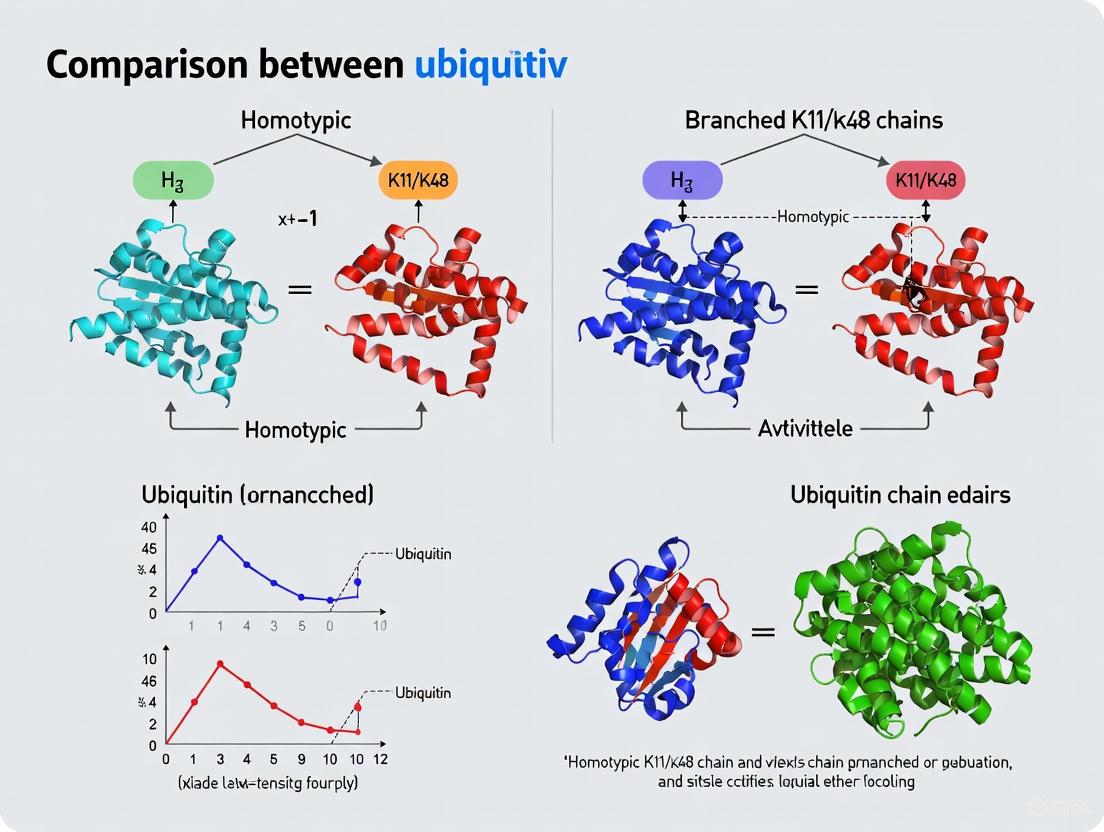
This article provides a comprehensive comparison of homotypic and branched K11/K48 ubiquitin chains, exploring their distinct structural identities, functional consequences, and mechanisms of proteasomal recognition.
Beyond K48: How Branched K11/K48 Ubiquitin Chains Outperform Homotypic Chains as Priority Proteasomal Degradation Signals
Abstract
This article provides a comprehensive comparison of homotypic and branched K11/K48 ubiquitin chains, exploring their distinct structural identities, functional consequences, and mechanisms of proteasomal recognition. We delve into the foundational science, revealing why homotypic K11 chains are weak proteasomal signals while branched K11/K48 chains act as potent degradative tags. For the research scientist, we cover advanced methodologies for chain characterization and synthesis. The article further troubleshoots common experimental challenges and validates the enhanced degradation efficiency of branched chains through comparative biochemical and structural analyses, offering implications for targeting the ubiquitin-proteasome system in drug development.
Decoding the Ubiquitin Code: Structural and Functional Dichotomy of K11 Linkages
Within the intricate language of the ubiquitin code, the structural format of a polyubiquitin chain is a critical determinant of a substrate's fate. Homotypic chains, linked through a single lysine residue, and heterotypic branched chains, containing multiple linkage types, can convey distinct biological instructions. This is particularly evident for chains involving lysine 11 (K11) of ubiquitin. Once grouped with other "atypical" linkages, K11's role has been refined with the understanding that its function is profoundly different when arranged in homotypic chains versus when it is combined with K48 linkages in a branched topology. This guide provides a direct comparison between homotypic K11 and branched K11/K48 ubiquitin chains, synthesizing key structural, functional, and experimental data to clarify their unique roles in proteasomal degradation.
The following table summarizes the core differences between homotypic K11 and branched K11/K48 ubiquitin chains, providing an at-a-glance overview of their distinct characteristics.
Table 1: Core Characteristics of K11-Containing Ubiquitin Chains
| Feature | Homotypic K11-Linked Chains | Branched K11/K48-Linked Chains |
|---|---|---|
| Proteasome Binding | Weak or non-significant binding [1] | Strong, multivalent binding [2] [3] |
| Degradation Signal | Inefficient for proteasomal degradation [1] | Potent, priority degradation signal [4] [5] |
| Proteasomal Receptors | Not significantly bound by Rpn1, Rpn10, or Rpn13 [1] | Recognized by Rpn1 with high affinity; involves Rpn2 and Rpn10 in a novel binding site [2] [4] |
| Chain Architecture | Linear series of ubiquitins linked via K11 | A single proximal ubiquitin modified by both a K11- and a K48-linked chain [4] [5] |
| Structural Topology | Adopts a compact conformation that prevents proteasomal association [1] [6] | Unique hydrophobic interface between distal K11- and K48-linked ubiquitins [4] |
| Primary Physiological Roles | Implicated in non-degradative processes (e.g., signaling, endocytosis) [1] | Timely degradation of cell-cycle regulators (e.g., cyclin B1) and clearance of aggregation-prone proteins [1] [5] |
Structural & Functional Mechanisms
The divergent fates of substrates modified with these two chain types are a direct consequence of their differing three-dimensional structures and how these structures are recognized by the proteasome machinery.
Structural Basis for Proteasomal Recognition
Recent cryo-EM structures have elucidated the precise mechanism by which the human 26S proteasome recognizes K11/K48-branched chains. The proteasome employs a multivalent substrate recognition mechanism that simultaneously engages both linkage types [2] [3]:
- Novel K11-Binding Site: The K11-linked branch of the ubiquitin chain is engaged by a previously unknown binding groove formed by the proteasomal subunits RPN2 and RPN10 [2].
- Canonical K48-Binding Site: The K48-linked branch is bound at the canonical site formed by RPN10 and the RPT4/5 coiled-coil region [2].
- RPN2 as a Key Receptor: RPN2 also recognizes an alternating K11-K48 linkage through a conserved motif, further stabilizing the interaction [2].
This cooperative, multi-point attachment explains the high-affinity binding and "fast-tracking" of branched chain substrates to degradation. In contrast, homotypic K11 chains adopt a compact conformation that is not productively engaged by these proteasomal receptors, leading to their dismissal [1] [6].
The following diagram illustrates this multivalent recognition system.
Quantitative Binding and Degradation Data
Experimental data from reconstituted systems quantitatively supports the model of differential recognition. The following table compiles key quantitative findings from competitive binding and degradation assays.
Table 2: Experimental Binding and Degradation Data
| Experimental Readout | Homotypic K11-Linked Chains | Branched K11/K48-Linked Chains | Experimental Context |
|---|---|---|---|
| Proteasome Binding | No significant binding observed [1] | Strong binding, comparable to K48 chains [1] | Affinity pull-down with purified 26S proteasomes [1] |
| Competition with K48 Chains | No competition at 300 nM [1] | 60% reduction in K48-chain binding at 300 nM [1] | Competition assay with K48-polyUb-E6AP and free tetraUb chains [1] |
| Affinity for Proteasomal Receptor Rpn1 | Low affinity | Significantly enhanced binding affinity [4] | Binding assays with isolated Rpn1 subunit [4] |
| Degradation of Cyclin B1 | Inefficient | Stimulates robust proteasomal degradation [1] | In vitro degradation assays [1] |
| DUB Processing | Disassembled by proteasomal DUBs [1] | Preferentially processed by UCHL5 [2] | Deubiquitination assays [1] [2] |
Experimental Approaches and Methodologies
Studying the distinct functions of homotypic and branched ubiquitin chains requires carefully controlled experiments. Below is a detailed workflow for a key experiment that directly compares their binding to the proteasome.
Key Experimental Protocol: Proteasome Binding Assay
This protocol is adapted from studies that quantitatively measured the binding of different ubiquitin chain types to isolated mammalian 26S proteasomes [1].
1. Chain Production and Immobilization
- Homotypic K11 Chains: Generate using the autoubiquitinating E2 enzyme Ube2SΔ (C-terminal truncation leaving a single lysine, K197). Treat with the deubiquitinase AMSH to cleave any spurious K63 linkages that may form. Confirm linkage purity (e.g., ~92% K11) via mass spectrometry and AQUA quantification [1].
- Branched K11/K48 Chains: Produce using specific E3 ligase complexes like the Anaphase-Promoting Complex/Cyclosome (APC/C) with Ube2S, or other engineered systems [1] [5].
- Control K48 Chains: Generate using the HECT E3 ligase E6AP.
- Immobilize all chain types on a solid-support resin (e.g., affinity resin) via the substrate protein or a tag.
2. Binding Reaction
- Incubate purified mammalian 26S proteasomes with the washed, resin-bound ubiquitin conjugates at 4°C to minimize concurrent degradation.
- Include controls with resin alone to account for non-specific binding.
3. Analysis of Bound Proteasomes
- Method A: Proteasome Activity Measurement: Wash the resin thoroughly. Measure the amount of bound proteasome by adding the fluorogenic proteasome substrate LLVY-AMC and incubating at 37°C. Quantify the release of fluorescent AMC over time as a direct correlate of proteasome amount [1].
- Method B: Immunoblotting: After washing, elute bound proteins and immunoblot for proteasome subunits (e.g., 20S α subunits) to visualize and quantify bound proteasomes [1].
The workflow for this binding assay is summarized in the following diagram.
The Scientist's Toolkit: Key Research Reagents
To conduct research in this area, specific reagents are essential for generating, detecting, and analyzing these specialized ubiquitin chains.
Table 3: Essential Research Reagents for Studying K11 and K11/K48 Ubiquitin Chains
| Reagent Category | Specific Example | Function and Application |
|---|---|---|
| E2 Enzymes | Ube2S | K11-specific E2 enzyme; essential for generating homotypic K11 and branched K11/K48 chains with APC/C [1] [5] |
| E3 Ligases | APC/C (with Ube2S) | Major E3 ligase complex for generating endogenous branched K11/K48 chains on cell-cycle substrates like cyclin B1 [1] [5] |
| Ubiquitin Mutants | Ub(K11-only), Ub(K48-only), Ub(K0) | Used to restrict chain formation to specific linkages or to prevent chain elongation, crucial for producing defined chain types in vitro [1] |
| Linkage-Specific Antibodies | K11/K48-bispecific antibody | Engineered tool for detecting endogenous K11/K48-branched chains in cells; enabled discovery of their physiological substrates [5] |
| Deubiquitinases (DUBs) | AMSH (K63-specific), UCHL5 (K11/K48-preferential) | AMSH is used to purify homotypic K11 chains by cleaving contaminating K63 linkages. UCHL5 processes branched chains on the proteasome [1] [2] |
| Proteasome Subunits | Recombinant Rpn1, Rpn10, Rpn13 | Used in isolation to map specific binding interactions and affinities for different chain types [4] |
The comparison between homotypic K11 and branched K11/K48 ubiquitin chains reveals a sophisticated layer of regulation within the ubiquitin system. It is clear that branching is a functional enhancement mechanism, transforming a weak or non-degradative signal (homotypic K11) into a potent, high-priority degradation signal. The key discriminator lies in the proteasome's ability to perform multivalent engagement of the branched topology through a cooperative mechanism involving RPN2 and RPN10. This structural insight explains how cells use branched ubiquitin chains to ensure the rapid and efficient turnover of critical regulatory proteins during processes like cell division and protein quality control, with direct implications for understanding diseases like cancer and neurodegeneration [2] [5].
In the ubiquitin-proteasome system, the topology of polyubiquitin chains is a critical determinant of substrate fate. For years, the proteasomal degradation code was thought to be relatively simple, with lysine-48 (K48)-linked homotypic chains serving as the primary degradation signal. However, recent research has revealed a more complex reality, in which chain architecture—whether homotypic or branched—dramatically influences proteasome affinity and degradation efficiency. This review examines the specific case of lysine-11 (K11)-linked ubiquitin chains, comparing the weak proteasome binding of homotypic K11 chains with the enhanced degradation signal of K11/K48-branched ubiquitin chains. Understanding this distinction provides crucial insights for drug development targeting the ubiquitin-proteasome system in cancer and neurodegenerative diseases.
Functional Disparity: Homotypic versus Branched K11 Chains
The Proteasome's Discriminatory Capacity
Seminal research demonstrated that the proteasome distinguishes between homotypic and heterotypic K11-linked chains. A 2015 study explicitly showed that pure homotypic K11-linked chains do not bind strongly to the mammalian proteasome. In striking contrast, heterotypic chains containing both K11 and K48 linkages not only bind effectively to the proteasome but also stimulate degradation of cell-cycle regulators like cyclin B1 [7]. This functional disparity indicates that homotypic K11 linkages adopt conformations that prevent productive proteasome association, while the incorporation of K48 linkages creates a superior degradation signal.
Quantitative Assessment of Proteasomal Degradation
Recent technological advances have enabled more precise quantification of how different ubiquitin chain types facilitate degradation. The UbiREAD (Ubiquitinated Reporter Evaluation After Intracellular Delivery) technology, developed in 2025, systematically compares intracellular degradation of substrates modified with defined ubiquitin chains. This research confirmed that K48 chains with three or more ubiquitins trigger rapid degradation within minutes. Significantly, the study revealed that in branched chains, the substrate-anchored chain identity determines degradation behavior, establishing that "branched chains are not the sum of their parts" but rather exhibit a functional hierarchy [8].
Table 1: Functional Comparison of K11-Containing Ubiquitin Chains
| Chain Type | Proteasome Binding | Degradation Efficiency | Key Experimental Evidence |
|---|---|---|---|
| Homotypic K11 | Weak | Low/inconsistent | Limited proteasome association in binding assays [7] |
| K11/K48-Branched | Strong | High | Accelerated degradation of cell cycle regulators [2] [7] |
| K48 (≥3 ubiquitins) | Strong | High | UbiREAD shows degradation within minutes [8] |
Structural Insights into Recognition Mechanisms
Cryo-EM Revelations of Branched Chain Recognition
Recent cryo-EM structures of human 26S proteasome in complex with K11/K48-branched ubiquitin chains have illuminated the structural basis for preferential branched chain recognition. These structures reveal a multivalent substrate recognition mechanism involving a previously unknown K11-linked Ub binding site at the groove formed by RPN2 and RPN10, in addition to the canonical K48-linkage binding site formed by RPN10 and RPT4/5 coiled-coil [2].
Furthermore, RPN2 recognizes an alternating K11-K48-linkage through a conserved motif similar to the K48-specific T1 binding site of RPN1. These structural insights explain the molecular mechanism underlying the priority recognition of K11/K48-branched ubiquitin as a superior signal in ubiquitin-mediated proteasomal degradation [2]. The structural data suggests that the proteasome has evolved specialized pockets and interfaces that cooperatively engage with the specific architecture of branched chains.
Unique Interdomain Interface of Branched K11/K48 Chains
The structural uniqueness of branched K11/K48 chains extends to their solution conformation. Research published in Structure revealed that branched K11/K48-triUb possesses a unique hydrophobic interface between distal ubiquitins that is not observed in homotypic chains. This distinct structural feature, corroborated by small-angle neutron scattering and site-directed mutagenesis, contributes to the enhanced binding affinity for proteasomal subunit Rpn1 [9].
Table 2: Structural Features Enabling Enhanced Proteasome Binding of K11/K48-Branched Chains
| Structural Feature | Description | Functional Consequence |
|---|---|---|
| Multivalent Binding Sites | Simultaneous engagement of RPN2-RPN10 groove (K11) and RPN10-RPT4/5 (K48) | Increased binding avidity through multiple contact points [2] |
| Unique Interdomain Interface | Novel hydrophobic interface between distal ubiquitins | Enhanced affinity for proteasomal subunit Rpn1 [9] |
| Alternating Linkage Recognition | RPN2 recognition of alternating K11-K48 linkages through conserved motif | Priority recognition as degradation signal [2] |
Diagram 1: Comparative Signaling Fate of Homotypic versus Branched K11 Chains
Experimental Approaches and Methodologies
Key Experimental Protocols
The foundational research comparing homotypic and branched K11 chain recognition employed several sophisticated methodological approaches:
Proteasome Binding Assays: These in vitro experiments involved incubating purified mammalian 26S proteasome with defined homotypic K11-linked chains or K11/K48-branched chains. Binding affinity was quantified through techniques like surface plasmon resonance or co-sedimentation assays, clearly demonstrating the weak association of homotypic K11 chains compared to their branched counterparts [7].
Degradation Functional Assays: Researchers reconstituted degradation systems with proteasomes and ubiquitinated substrates, including the cell-cycle regulator cyclin B1. By monitoring substrate disappearance over time, they established that heterotypic K11/K48 chains stimulate proteasomal degradation, while homotypic K11 chains fail to do so effectively [7].
Structural Biology Approaches: Cryo-EM studies of human 26S proteasome in complex with K11/K48-branched ubiquitin chains required sophisticated sample preparation, including:
- Reconstitution of functional complexes with polyubiquitinated substrates (Sic1PY)
- Use of engineered Rsp5 E3 ligase (Rsp5-HECTGML) to generate specific chain types
- Incorporation of catalytically inactive UCHL5(C88A) to stabilize branched chains
- Extensive classification and focused refinements to resolve Ub-proteasome interfaces [2]
The Scientist's Toolkit: Essential Research Reagents
Table 3: Key Research Reagents for Studying K11 Ubiquitin Chain Biology
| Reagent/Tool | Function/Application | Experimental Utility |
|---|---|---|
| Linkage-Specific Ubiquitin Antibodies | Detect specific ubiquitin linkage types | Verification of chain composition in substrates [2] |
| Engineered E3 Ligases (e.g., Rsp5-HECTGML) | Generate specific ubiquitin chain linkages | Production of defined homotypic or branched chains [2] |
| Ubiquitin Mutants (K63R, K-only) | Restrict linkage formation to specific lysines | Control for off-target linkage formation [2] |
| UbiREAD Technology | Monitor degradation and deubiquitination kinetics | Systematic comparison of intracellular degradation capacity [8] |
| Tandem Ubiquitin-Binding Entities (TUBEs) | Pan-ubiquitin chain binding and enrichment | Isolation and assessment of ubiquitinated proteins [10] |
Implications for Therapeutic Development
The distinction between homotypic and branched ubiquitin chain function has significant implications for drug development. The finding that K11/K48-branched chains serve as priority degradation signals suggests potential strategies for improving proteolysis-targeting chimeras (PROTACs) and other targeted protein degradation technologies. Specifically, engineering E3 ligases that generate branched rather than homotypic chains could enhance degradation efficiency of therapeutic targets [10].
Furthermore, the structural insights into how proteasomal subunits recognize branched chains identify potential allosteric sites for therapeutic intervention. Modulating the activity of specific E3 ligases like TRIP12 and UBR5, which cooperate to assemble K29/K48-branched chains, represents another promising avenue for manipulating cellular protein degradation [10].
The experimental evidence unequivocally demonstrates that homotypic K11 chains represent an inferior proteasomal degradation signal due to their inherently weak proteasome binding affinity. This limitation is overcome when K11 linkages combine with K48 linkages to form branched structures that engage multiple proteasomal receptors simultaneously. The structural basis for this discrimination lies in specialized binding sites within the 19S regulatory particle that cooperatively recognize the unique architecture of branched chains. These findings not only advance our fundamental understanding of the ubiquitin code but also open new possibilities for therapeutic intervention in diseases characterized by protein homeostasis dysregulation.
Ubiquitylation is a fundamental post-translational modification that regulates nearly all aspects of eukaryotic cell biology. While initially characterized as a homogenous signal for proteasomal degradation, the ubiquitin code is now recognized for its remarkable complexity. Among the most sophisticated signals are branched ubiquitin chains, complex molecular architectures where two or more ubiquitin moieties attach to distinct lysine residues on a single ubiquitin molecule within a polyubiquitin chain [11] [12]. These bifurcated structures significantly expand the signaling capacity of the ubiquitin system, constituting a substantial fraction (10–20%) of cellular polyubiquitin [2]. This review provides a focused comparison between homotypic K48-linked chains and the prominent K11/K48-branched ubiquitin chains, examining their distinct structural topologies, interdomain interfaces, and functional consequences in cellular regulation and targeted protein degradation.
Structural and Functional Comparison: K48 Homotypic vs. K11/K48 Branched Chains
The fundamental distinction between these ubiquitin architectures lies in their topology. Homotypic K48 chains are linear polymers where each ubiquitin is connected solely through lysine 48, forming a canonical compact structure recognized as the principal degradation signal [11]. In contrast, K11/K48-branched chains are heterotypic structures containing at least one ubiquitin moiety simultaneously modified at both K11 and K48 positions, creating a bifurcation point that gives rise to chain branches [11] [2]. This altered topology creates a unique interdomain interface with significant functional implications.
Table 1: Quantitative Comparison of K48 Homotypic and K11/K48 Branched Ubiquitin Chains
| Property | K48-Linked Homotypic Chain | K11/K48-Branched Chain |
|---|---|---|
| Chain Architecture | Linear, uniform linkage | Branched, heterogeneous linkage |
| Proteasome Binding Affinity | Canonical high affinity via RPN10/RPT5 site [2] | Enhanced, multivalent affinity via RPN10/RPT5 + RPN2/RPN10 groove [2] |
| Degradation Efficiency | Standard degradation signal | Priority degradation signal; accelerated turnover [2] [8] |
| Cellular Function | General proteasomal degradation | Cell cycle progression, proteotoxic stress response [2] |
| Proteasomal Recognition | Single binding site engagement | Multivalent engagement with novel binding site on RPN2 [2] |
| DUB Sensitivity | Standard processing by proteasomal DUBs | Preferentially processed by UCHL5 [2] [12] |
Table 2: Key Enzymes in the Synthesis and Disassembly of K11/K48-Branched Chains
| Enzyme | Class | Role in K11/K48 Pathway | Function |
|---|---|---|---|
| APC/C+UBE2S | RING E3 + E2 | Assembly | Primary pathway for mitotic substrate branching [12] |
| UBR5 | HECT E3 | Assembly | Cooperates with K11-specific E2/E3 on pathological Huntingtin [12] |
| cIAP1 | RING E3 | Assembly | Forms K11/K48 chains with UBE2D & UBE2N/UBE2V [12] |
| UCH37 (UCHL5) | Deubiquitinase | Disassembly | Preferentially cleaves K11/K48 branches; activated by RPN13 [2] [12] |
Experimental Insights: Structural Mechanisms and Functional Hierarchy
Structural Basis for Enhanced Proteasomal Recognition
Recent cryo-EM structures of the human 26S proteasome bound to K11/K48-branched ubiquitin chains have revealed the molecular mechanism underlying their "priority signal" status. The structures show a tripartite binding interface where the branched chain engages the proteasome multivalently [2]. While the K48-linked branch binds the canonical receptor site formed by RPN10 and RPT4/5, the K11-linked branch engages a hitherto unknown ubiquitin binding site at a groove formed by RPN2 and RPN10 [2]. Additionally, RPN2 recognizes an alternating K11-K48 linkage through a conserved motif, further stabilizing the interaction. This multivalent engagement explains the accelerated degradation of substrates modified with K11/K48-branched chains compared to their homotypic counterparts.
Functional Hierarchy in Branched Chain Recognition
The UbiREAD technology, which monitors cellular degradation of bespoke ubiquitinated substrates, revealed that branched chains are not simply the sum of their parts but exhibit a functional hierarchy. In K48/K63-branched chains, the identity of the substrate-anchored chain primarily determines the degradation outcome [8]. This suggests a "chain identity dominance" where one linkage type within the branched architecture dictates the functional fate, challenging the previous assumption of purely additive signaling properties.
Essential Methodologies for Branched Chain Research
Experimental Workflow for Structural and Functional Analysis
The following diagram outlines a integrated experimental workflow for studying branched ubiquitin chain structure and function, synthesizing key methodologies from recent research:
The Scientist's Toolkit: Essential Research Reagents
Table 3: Key Research Reagents for Branched Ubiquitin Chain Studies
| Reagent / Method | Function / Application | Key Features |
|---|---|---|
| Enzymatic Assembly (E2/E3) | Recombinant production of defined branched chains | Uses ubiquitin mutants (Ub1-72, UbK48R,K63R) with specific E2/E3 pairs [11] |
| Chemical Synthesis | Generation of chains with precise modifications | Incorporates non-native linkages, tags, and warheads via solid-phase peptide synthesis [11] |
| Genetic Code Expansion | Site-specific incorporation of noncanonical amino acids | Enables click chemistry for non-hydrolysable chains; amber stop codon suppression [11] |
| UbiREAD Technology | Monitor intracellular degradation & deubiquitination | Electroporation of predefined ubiquitinated reporters into cells [8] |
| Ub-AQUA/LC-MS/MS | Absolute quantification of linkage composition | Mass spectrometry-based identification and quantification of chain linkages [2] |
| Linkage-Specific DUBs | Branch linkage verification and editing | UCHL5 for K11/K48 preference; other DUBs for linkage specificity [2] [12] |
The structural and functional evidence unequivocally demonstrates that K11/K48-branched ubiquitin chains possess a distinct advantage over homotypic K48 chains as priority signals for proteasomal degradation. This advantage stems from their altered topology, which creates a unique interdomain interface enabling multivalent engagement with proteasomal receptors. The emergent concept of a functional hierarchy within branched chains, where one linkage can dominate the outcome, adds further sophistication to the ubiquitin code [8]. These insights are not merely academic; they inform the development of next-generation therapeutic strategies. The expanding repertoire of UPS-based technologies—including PROTACs, molecular glue degraders, and DUBTACs—increasingly relies on manipulating ubiquitin signaling [13]. Understanding the precise mechanisms of branched chain recognition and function will enable more sophisticated design of degradation-based therapeutics, potentially allowing engineers to exploit nature's most potent degradation signals for targeted protein manipulation.
The ubiquitin-proteasome system (UPS) is a master regulator of cellular protein homeostasis, controlling the stability, activity, and localization of a vast array of proteins. Central to this system is the ability of ubiquitin to form diverse polymeric chains that encode distinct functional outcomes. For decades, homotypic K48-linked ubiquitin chains have been recognized as the canonical signal for proteasomal degradation. However, recent research has unveiled that branched K11/K48-linked ubiquitin chains represent a specialized and highly efficient degradation signal that operates in critical physiological contexts where timing and speed are paramount [2] [14].
These heterotypic chains are not merely variants of their homotypic counterparts but constitute a unique topological structure that confers specialized biochemical properties and recognition patterns. This review provides a comprehensive comparison between homotypic and branched K11/K48 ubiquitin chains, examining their distinct structural features, physiological functions, and molecular recognition mechanisms. Understanding these differences provides crucial insights into the sophisticated regulation of cell cycle progression and protein quality control, with significant implications for therapeutic development in cancer and neurodegenerative diseases [15] [16].
Structural and Functional Distinctions
Architectural Differences and Their Functional Consequences
The fundamental distinction between homotypic and branched ubiquitin chains lies in their three-dimensional architecture, which directly dictates their functional capabilities and biological roles.
Table 1: Structural and Functional Comparison of Ubiquitin Chain Types
| Feature | Homotypic K48 Chains | Homotypic K11 Chains | Branched K11/K48 Chains |
|---|---|---|---|
| Chain Topology | Linear, uniform linkages | Linear, uniform linkages | Branched, forked structure |
| Proteasome Binding Affinity | Strong binding | Weak, non-productive binding | Enhanced, preferential binding |
| Primary Physiological Role | General protein turnover | Non-degradative functions (controversial) | Rapid degradation during mitosis & proteotoxic stress |
| Key Proteasomal Receptors | RPN10, RPN13 [1] | Minimal engagement [1] | RPN1, RPN2, RPN10 [2] [4] |
| Degradation Efficiency | Standard kinetics | Inefficient [1] | Accelerated degradation [14] |
| Cellular Context | Constitutive degradation | Limited understanding | Cell cycle transitions, protein quality control [14] |
Branched K11/K48 chains form a unique "forked" structure where at least one ubiquitin monomer is simultaneously modified at both K11 and K48 residues, creating a tri-ubiquitin structure with a previously unobserved hydrophobic interface between the distal ubiquitins [4]. This distinctive architecture enables enhanced recognition by specific proteasomal receptors, particularly Rpn1 (RPN1 in humans), explaining their function as priority degradation signals [4]. In contrast, homotypic K11 chains adopt a compact, closed conformation that prevents strong association with the proteasome, despite their chemical similarity to K48 linkages [1].
Key Physiological Contexts for Branched K11/K48 Chains
Branched K11/K48 ubiquitin chains serve as critical regulatory signals in two principal physiological domains where precise temporal control of protein degradation is essential:
Cell Cycle Regulation: During mitosis, branched K11/K48 chains are synthesized by the anaphase-promoting complex/cyclosome (APC/C) to ensure the timely degradation of key cell cycle regulators including cyclins, securin, and other mitotic controllers. This rapid degradation system facilitates irreversible mitotic exit and proper chromosome segregation [14] [15]. The APC/C collaborates sequentially with two different E2 enzymes (UBE2C and UBE2S) to build these branched structures on substrates, creating a potent degradation signal that exceeds the efficiency of homotypic K48 chains [16] [12].
Protein Quality Control: Under conditions of proteotoxic stress, branched K11/K48 chains target misfolded proteins and pathological aggregates for clearance. Notably, these chains facilitate the degradation of aggregation-prone proteins such as mutant Huntingtin variants implicated in Huntington's disease, serving as a protective mechanism against proteostasis dysfunction [14]. This quality control function extends to misfolded nascent polypeptides that require rapid removal before they can accumulate and disrupt cellular function [14].
Figure 1: Physiological Pathways Utilizing K11/K48-Branched Ubiquitin Chains. Branched chains serve as critical degradation signals in two key cellular contexts: protein quality control during proteotoxic stress and regulation of mitotic progression.
Experimental Evidence: Quantitative Comparisons
Proteasomal Recognition and Binding Affinities
Direct biochemical comparisons reveal significant quantitative differences in how the proteasome recognizes different ubiquitin chain types.
Table 2: Experimental Binding Data for Ubiquitin Chain Types
| Experiment Type | Homotypic K48 Chains | Homotypic K11 Chains | Branched K11/K48 Chains | Reference |
|---|---|---|---|---|
| Proteasome Binding (Competition Assay) | 60% reduction in polyUb-E6AP binding at 300 nM [1] | No significant competition at 300 nM [1] | Not tested in competition | [1] |
| Binding to Rpn1 | Strong binding | Weak binding | Significantly enhanced binding compared to both homotypic chains [4] | [4] |
| Binding to S5a (RPN10) | Strong binding [17] | Weaker binding than K48 [17] | Similar affinity to K48 chains, no enhancement [17] | [17] |
| In Vitro Degradation (Cyclin B1) | Efficient degradation | Minimal degradation | Enhanced degradation compared to K48 chains [1] | [1] |
These quantitative assessments demonstrate that the enhanced degradation capability of branched K11/K48 chains stems from their superior engagement with specific proteasomal receptors, particularly Rpn1, rather than from general increases in affinity across all receptors [4] [17]. This specificity highlights the sophisticated molecular discrimination capacity of the proteasome.
Structural Insights from Cryo-EM Studies
Recent cryo-EM structures of human 26S proteasome in complex with K11/K48-branched ubiquitin chains have revealed the molecular basis for their preferential recognition [2]. These structures show that branched chains form a multivalent interaction network with the proteasome, engaging:
- A previously unknown K11-linked Ub binding site at a groove formed by RPN2 and RPN10
- The canonical K48-linkage binding site formed by RPN10 and RPT4/5 coiled-coil
- An alternating K11-K48-linkage recognition site on RPN2 that resembles the K48-specific T1 site of RPN1 [2]
This tripartite binding interface enables branched chains to simultaneously engage multiple proteasomal receptors, creating a stable anchoring system that surpasses the binding capacity of homotypic chains. The structural data provide a direct explanation for the biochemical observations of enhanced affinity and degradation efficiency.
Methodologies for Studying Branched Ubiquitin Chains
Experimental Protocols for Binding and Degradation Assays
Protocol 1: Proteasome Binding Competition Assay
This method quantitatively measures the binding specificity of different ubiquitin chain types to the 26S proteasome [1]:
- Immobilize polyubiquitinated substrates on solid support resin (e.g., polyUb-E6AP formed by autoubiquitination of HECT E3 ligase E6AP).
- Incubate purified mammalian 26S proteasomes with resin-bound ubiquitin conjugates at 4°C for 2 hours to allow binding equilibrium.
- Wash extensively to remove unbound proteasomes.
- Quantify bound proteasomes by measuring LLVY-AMC cleavage activity at 37°C or by immunoblotting for 20S α subunits.
- For competition assays, pre-incubate proteasomes with free unanchored ubiquitin chains of defined linkage (K11-Ub4 vs. K48-Ub4) at varying concentrations (0-300 nM) before adding to resin-bound conjugates.
- Calculate percentage inhibition of proteasome binding to resin-bound conjugates in the presence of competing free chains.
This assay demonstrated that K48-Ub4 chains effectively compete for proteasome binding (60% reduction at 300 nM), while K11-Ub4 chains show no significant competition, revealing the inability of homotypic K11 chains to strongly engage proteasomal receptors [1].
Protocol 2: Rpn1 Binding Affinity Measurement
This approach specifically quantifies interaction strengths with proteasomal subunit Rpn1, identified as the key receptor for branched chains [4]:
- Express and purify recombinant Rpn1 fragment (residues 391-642) containing known ubiquitin-binding sites.
- Prepare linkage-defined ubiquitin chains using chemical synthesis or enzymatic assembly with specific E2 enzymes:
- K48-linked di-ubiquitin (Ub–48Ub) using CDC34
- K11-linked di-ubiquitin (Ub–11Ub) using UBE2S
- Branched K11/K48-linked tri-ubiquitin ([Ub]2–11,48Ub) using sequential enzymatic reactions
- Use surface plasmon resonance (SPR) or isothermal titration calorimetry (ITC) to measure binding constants.
- For SPR: Immobilize Rpn1 on sensor chip, inject ubiquitin chains at increasing concentrations, and monitor binding kinetics.
- For ITC: Titrate ubiquitin chains into Rpn1 solution and measure heat changes to determine Kd values.
These experiments demonstrated significantly stronger binding of branched K11/K48-linked tri-ubiquitin to Rpn1 compared to either homotypic K48 or K11 di-ubiquitin, pinpointing the mechanistic basis for enhanced proteasomal recognition [4].
Figure 2: Experimental Workflow for Comparing Ubiquitin Chain Function. The integrated methodology combines binding assays with functional degradation measurements to build a comprehensive model of proteasomal recognition.
The Scientist's Toolkit: Essential Research Reagents
Table 3: Key Reagents for Studying K11/K48-Branched Ubiquitin Chains
| Reagent / Tool | Function / Application | Key Features / Considerations |
|---|---|---|
| UBE2S E2 Enzyme | Specific synthesis of K11 linkages | Cooperates with APC/C to extend K11 branches on K48-initiated chains [16] |
| UBE2C E2 Enzyme | Initiation of ubiquitination with mixed linkages | Priming enzyme for APC/C substrates before UBE2S extension [16] |
| APC/C E3 Ligase | Physiological synthesis of branched K11/K48 chains | Multi-subunit RING E3 that coordinates UBE2C and UBE2S for branched chain assembly [15] |
| K11-Only Ub Mutant (UbK11) | Specific generation of homotypic K11 chains | All lysines except K11 mutated to arginine; essential for controlled chain assembly [1] |
| Linkage-Specific Antibodies | Detection of specific ubiquitin linkages in cells | Anti-K11/K48 bispecific antibody enables identification of endogenous branched chains [14] |
| Rpn1 391-642 fragment | Measurement of ubiquitin chain binding | Contains minimal ubiquitin-binding sites for affinity studies [4] |
| UCHL5 (C88A mutant) | Trapping branched chains on proteasome | Catalytically inactive DUB that preserves branched chains by preventing disassembly [2] |
| Lbpro* Protease | Ubiquitin chain linkage mapping | Specific cleavage pattern reveals chain branching and linkage composition [2] |
The comparison between homotypic and branched K11/K48 ubiquitin chains reveals a sophisticated layer of regulation within the ubiquitin-proteasome system. Branched K11/K48 chains do not merely represent an alternative degradation signal but constitute a priority targeting mechanism reserved for physiological contexts where rapid, precise protein turnover is critical. Their enhanced affinity for specific proteasomal receptors, particularly RPN1 and RPN2, and their unique structural features enable them to function as specialized signals for cell cycle control and protein quality control [2] [14] [4].
These findings fundamentally expand our understanding of the "ubiquitin code" by demonstrating that chain branching can qualitatively alter signaling outcomes rather than merely quantitatively enhancing existing signals. From a therapeutic perspective, the molecular machinery responsible for assembling, recognizing, and disassembling branched K11/K48 chains represents a promising target for interventions in cancer and neurodegenerative diseases where these pathways are disrupted [14] [15]. Future research will likely focus on developing small molecules that can modulate the formation or recognition of these specialized chains, potentially offering new approaches to restore proteostatic balance in disease states.
Tools of the Trade: Synthesizing and Characterizing Complex Ubiquitin Chain Architectures
Ubiquitination is a crucial post-translational modification that governs nearly all aspects of eukaryotic cell biology through a sophisticated coding system [18]. While homotypic ubiquitin chains, linked uniformly through the same acceptor site, have well-established functions—such as K48-linked chains targeting proteins for proteasomal degradation—recent research has revealed that branched ubiquitin chains constitute 10-20% of cellular ubiquitin polymers and represent a more complex layer of regulation [16] [19]. Among these, K11/K48-branched chains have emerged as particularly important signals that facilitate the timely degradation of key regulatory proteins during cell cycle progression and proteotoxic stress [2]. The synthesis of these complex branched structures requires precise collaboration between specific E2 ubiquitin-conjugating enzymes and E3 ubiquitin ligases, which together determine the topology and biological function of the resulting ubiquitin signal [20] [12]. This guide systematically compares the molecular machinery responsible for assembling K11/K48-branched chains against homotypic chain synthesis mechanisms, providing experimental approaches for researchers investigating targeted protein degradation and ubiquitin signaling pathways.
Comparative Analysis of E2/E3 Systems in Chain Synthesis
Molecular Machinery for Branched vs. Homotypic Chain Assembly
The synthesis of all ubiquitin signals requires the sequential action of E1 activating, E2 conjugating, and E3 ligase enzymes [18]. However, the mechanisms diverge significantly between homotypic and branched chain assembly:
Homotypic Chain Synthesis: Typically involves a single E2-E3 pair working processively to extend a chain through identical linkages. For example, many RING E3s cooperate with specific E2s (e.g., UBE2R1 with SCF complexes for K48-linked chains) that determine linkage specificity through their catalytic cores and ubiquitin-fold domains [18] [21].
Branched K11/K48 Chain Synthesis: Requires coordinated action of multiple enzymatic components, often involving two distinct E2 enzymes working with either a single multi-subunit E3 or collaborating E3s [2] [16]. The anaphase-promoting complex/cyclosome (APC/C) exemplifies this mechanism, sequentially recruiting UBE2C (Ubch10) for chain initiation and UBE2S for specialized K11-linked branch formation on pre-existing K48 linkages [16] [20].
The table below summarizes key E2/E3 systems involved in K11/K48-branched chain synthesis and their characteristics:
Table 1: E2/E3 Systems in K11/K48-Branched Ubiquitin Chain Synthesis
| E2/E3 System | Linkage Type | Assembly Mechanism | Biological Context | Key References |
|---|---|---|---|---|
| APC/C + UBE2C + UBE2S | K11/K48 | Sequential E2 recruitment: UBE2C primes with mixed chains, UBE2S extends K11 branches | Mitotic progression; substrate degradation | [16] [20] [12] |
| UBR5 + K11-specific E2/E3 | K11/K48 | Collaborative E3 action: recognizes existing chains and adds K48 linkages | Protein quality control; degradation of misfolded proteins | [16] [12] |
| cIAP1 + UBE2D + UBE2N/UBE2V | K11/K48/K63 | Sequential E2 recruitment with multiple linkage specificity | NF-κB signaling; proteasomal degradation (chemically induced) | [12] |
| WWP1 + UBE2L3 | K11/K48/K63 | Single HECT E3 with innate branching capability; sequential chain elongation phases | Proteasome-independent and proteasome-dependent pathways | [22] |
Functional Consequences of Chain Topology
The structural complexity of K11/K48-branched chains translates into distinct functional properties compared to their homotypic counterparts:
Enhanced Degradation Efficiency: K11/K48-branched chains function as priority degradation signals, facilitating faster substrate turnover compared to homotypic K48 chains during mitotic progression and proteotoxic stress [2]. This accelerated degradation is mediated through multivalent recognition by the proteasome [2].
Proteasomal Recognition Mechanisms: Structural studies reveal that K11/K48-branched chains engage the 26S proteasome through a tripartite binding interface involving RPN2 and RPN10, unlike the canonical K48-chain recognition site alone [2]. This expanded interaction surface explains the preferential degradation of substrates modified with branched chains.
Regulation of Signaling Pathways: The conversion of non-degradative ubiquitin signals to degradative signals through branching provides a temporal regulatory mechanism in processes such as NF-κB signaling and apoptosis [16] [20].
Experimental Approaches for Studying Branched Ubiquitination
Methodologies for Detection and Characterization
Studying branched ubiquitin chains presents technical challenges due to their structural complexity. The following table compares key experimental methods:
Table 2: Experimental Methods for Branched Ubiquitin Chain Analysis
| Method | Principle | Applications | Advantages | Limitations | |
|---|---|---|---|---|---|
| UbiCRest | Linkage-specific DUBs digest particular ubiquitin linkages; remnants analyzed by Western blot | Identification of heterotypic chain composition; branching detection | Accessible; no specialized equipment needed; works with purified chains or immunoprecipitated substrates | Cannot distinguish branched from mixed chains; some DUBs have overlapping specificities | [19] |
| UbiChEM-MS | Limited trypsinolysis followed by mass spectrometry to identify branched points via Ub1-74 fragments with different GG modifications | Proteome-wide discovery of branched ubiquitination sites; identification of branch point linkages | Direct detection of branching; quantitative potential; high specificity | Requires specialized MS equipment and expertise; complex data analysis | [19] |
| Linkage-Specific Antibodies | K11/K48 bispecific antibodies capture heterotypic chains | Enrichment and detection of specific branched chain types from cell lysates | High sensitivity; applicable to endogenous proteins | Cannot distinguish architectural nuances; potential cross-reactivity | [2] [19] |
| UbiREAD | Intracellular delivery of bespoke ubiquitinated reporters to monitor degradation and deubiquitination kinetics | Quantitative comparison of degradation efficiency between different chain types | Direct measurement of intracellular degradation kinetics; controlled chain composition | Requires protein engineering and electroporation expertise | [23] |
Detailed Experimental Protocols
UbiCRest Assay for Branching Detection
The UbiCRest method provides an accessible approach for initial characterization of branched ubiquitin chains:
Substrate Preparation: Generate ubiquitinated substrates of interest through in vitro ubiquitination reactions or immunoprecipitation from cell lysates.
DUB Panel Setup: Prepare reactions with commercial DUBs including:
- OTUB1 (K48-specific)
- Cezanne (K11-specific)
- OTUD1 or AMSH (K63-specific)
- OTULIN (M1-specific)
- USP21 or vOTU (non-specific controls) [19]
Digestion Conditions: Incubate substrate with individual DUBs (10-50 nM) in appropriate buffers for 1-2 hours at 37°C.
Analysis: Resolve reactions by SDS-PAGE and detect by Western blotting with ubiquitin-specific antibodies. Compare digestion patterns across different DUB treatments to infer chain architecture.
Interpretation: Branched chains typically show partial resistance to linkage-specific DUBs compared to homotypic chains, resulting in distinctive digestion patterns [19] [20].
In Vitro Reconstitution of Branched Chain Synthesis
To investigate specific E2/E3 collaboration mechanisms:
Component Purification: Express and purify recombinant E1, E2s, E3s, ubiquitin, and substrate proteins.
Ubiquitination Reaction Setup: Assemble reactions containing:
- 50 nM E1
- 1-5 μM E2
- 0.1-1 μM E3
- 50-100 μM ubiquitin
- 5-10 μM substrate
- ATP-regenerating system
- Appropriate reaction buffer
Time-Course Analysis: Aliquot reactions at various time points (0-120 minutes) and quench with SDS sample buffer.
Product Characterization: Analyze by Western blotting and UbiCRest to determine chain linkage and topology.
Mechanistic Studies: Systematically omit or inhibit specific components (e.g., using dominant-negative E2 mutants) to establish their roles in branching initiation and elongation [16] [22] [20].
The Scientist's Toolkit: Essential Research Reagents
Table 3: Key Reagents for Studying Branched Ubiquitin Chains
| Reagent Category | Specific Examples | Function/Application | Commercial Sources/References | |
|---|---|---|---|---|
| Linkage-Specific DUBs | OTUB1 (K48), Cezanne (K11), OTUD1 (K63) | UbiCRest analysis; chain linkage determination | Multiple commercial suppliers; recombinant expression | [19] |
| Branched Chain Antibodies | K11/K48-bispecific antibodies | Enrichment and detection of specific branched chains | Research publications; limited commercial availability | [2] [19] |
| Engineered E2s/E3s | APC/C, UBE2S, UBE2C, WWP1, UBR5 | In vitro reconstitution of branching reactions; mechanistic studies | Recombinant expression systems | [16] [22] [12] |
| Ubiquitin Mutants | Single-lysine ubiquitins, K-to-R mutants, R54A mutant, Flag-TEV insertion mutants | Controlled chain assembly; branching detection through MS | Boston Biochem; UbiQ; recombinant expression | [19] [23] |
| Proteasome Components | Recombinant 26S proteasome, RPN2/RPN10 subunits | Binding and degradation assays; structural studies | Commercial sources; recombinant expression | [2] |
Structural and Visualization Tools
E2/E3 Collaboration in Branched Chain Synthesis
Diagram 1: E2/E3 Collaboration Mechanism in Branched K11/K48 Chain Synthesis. E3 complexes sequentially recruit distinct E2 enzymes (E2A for priming, E2B for branching) to transform homotypic chains into branched structures with enhanced proteasome recognition.
Experimental Workflow for Branched Chain Analysis
Diagram 2: Integrated Workflow for Branched Ubiquitin Chain Analysis. A multi-technique approach combining biochemical (UbiCRest), analytical (MS), functional, and structural methods provides comprehensive characterization of branched chains.
The collaborative synthesis of K11/K48-branched ubiquitin chains by specific E2/E3 partnerships represents a sophisticated regulatory mechanism that expands the functional repertoire of the ubiquitin code. Understanding these mechanisms provides crucial insights for drug development, particularly in targeting protein degradation pathways for therapeutic benefit. The experimental approaches outlined in this guide provide researchers with robust methodologies to investigate these complex ubiquitin signals, with implications for cancer therapy, neurodegenerative diseases, and targeted protein degradation platforms. As research in this field advances, the ability to precisely manipulate E2/E3 collaborations for branched chain formation may enable new strategies for controlling protein stability in therapeutic contexts.
Bispecific Antibodies as Coincidence Detectors for Endogenous K11/K48 Chain Identification
Ubiquitin chains are specialized post-translational modifications that control virtually every eukaryotic cellular process, from cell division and protein quality control to DNA damage response and signal transduction [24] [25]. For decades, research focused primarily on homotypic ubiquitin chains, where all ubiquitin subunits are connected through the same linkage type, such as the well-characterized K48-linked chains that target proteins for proteasomal degradation and K63-linked chains that facilitate complex assembly [24] [5]. However, recent advances have revealed that heterotypic ubiquitin chains—particularly branched chains containing multiple linkage types within the same polymer—comprise a substantial portion (10-20%) of cellular ubiquitin conjugates and encode specialized biological functions [26] [25] [27].
Among these complex ubiquitin signals, K11/K48-branched chains have emerged as critical regulators of essential cellular pathways, including mitotic progression and protein quality control [24] [5]. These chains facilitate the rapid proteasomal degradation of key substrates such as mitotic regulators, misfolded nascent polypeptides, and pathological Huntingtin variants associated with neurodegenerative diseases [24] [5] [27]. Despite their physiological importance, the study of endogenous K11/K48-branched chains remained challenging due to the lack of specific detection tools. Traditional methods like mass spectrometry and linkage-specific antibodies for homotypic chains proved insufficient for detecting the complex architecture of branched polymers in their native cellular context [24]. This limitation prompted the development of innovative bispecific antibodies that function as molecular coincidence detectors, specifically recognizing chains containing both K11 and K48 linkages [24] [5].
Tool Development: Engineering Bispecific Antibodies for Endogenous K11/K48 Chain Detection
Antibody Design and Validation Strategy
The development of K11/K48-bispecific antibodies required innovative protein engineering approaches to achieve the necessary specificity for detecting endogenous branched ubiquitin chains. Researchers employed knobs-into-holes heterodimerization technology to create a bispecific antibody in which one arm recognizes the K11-ubiquitin linkage while the other binds the K48-linkage [24]. This design enables the antibody to function as a true coincidence detector, only binding efficiently when both linkages are present in close proximity, as occurs in branched ubiquitin molecules.
As critical controls, the team engineered K11/gD and K48/gD antibodies that pair a ubiquitin-directed antibody arm with one that recognizes an unrelated viral protein [24]. These controls were essential for distinguishing true branched chain recognition from nonspecific binding to homotypic chains. The antibodies were purified to homogeneity and rigorously characterized using multiple biochemical approaches, including SDS-PAGE, analytical size-exclusion chromatography, multi-angle light scattering, and mass spectrometry to confirm their structural integrity and composition [24].
Specificity Validation Through Multiple Biochemical Assays
The K11/K48-bispecific antibody underwent extensive validation to establish its specificity for branched ubiquitin chains. Surface plasmon resonance (SPR) analysis demonstrated that the bispecific antibody exhibited approximately 500-1,000-fold higher affinity for K11/K48-branched ubiquitin trimers compared to the control K11/gD and K48/gD antibodies when tested at high immobilization densities (700 RUs) [24]. This enhanced binding affinity stems from the avidity effect generated by simultaneous engagement of both K11 and K48 linkages.
Western blot analyses further confirmed the exceptional specificity of the bispecific antibody. Unlike conventional monospecific antibodies that recognize ubiquitin dimers and trimers containing their cognate linkage, the K11/K48-bispecific antibody efficiently detected K11/K48-branched trimers but failed to recognize monomeric ubiquitin or homotypic K11- or K48-linked di-ubiquitin species [24]. The antibody also displayed remarkable selectivity for K11/K48-branched chains over other branched ubiquitin variants, including K11/K63-, K48/K63-, and M1/K63-branched counterparts [24].
Table 1: Specificity Profile of K11/K48-Bispecific Antibody Across Detection Platforms
| Assay Type | Target Analyte | Result | Key Finding |
|---|---|---|---|
| Surface Plasmon Resonance | K11/K48-branched trimer (high density) | ~500-1,000x higher affinity vs controls | Avidity effect from coincidence detection |
| Western Blot | K11- or K48-linked di-ubiquitin | No detection | Specificity for branched architecture |
| Western Blot | K11/K63-branched chains | No detection | Selective for K11/K48 linkage combination |
| Immunoprecipitation | Radiolabeled K11/K48-branched chains | Strong preference | Utility for enrichment of endogenous chains |
Additional experiments using an engineered ligation system demonstrated that the K11/K48-bispecific antibody recognized high molecular weight K11/K48-linked polymers with strong preference over homotypic K11- or K48-linked chains [24]. Quantitative immunoprecipitation assays with radiolabeled substrates modified with high molecular weight K11/K48-branched chains further validated the superior binding affinity of the bispecific antibody under conditions mimicking native cellular environments [24].
Comparative Analysis: Bispecific Antibodies Versus Alternative Methodologies
Performance Comparison with Existing Ubiquitin Chain Detection Methods
The development of K11/K48-bispecific antibodies addressed significant limitations in the methodological toolkit available for studying branched ubiquitin chains. Traditional approaches each presented distinct disadvantages that the bispecific antibody strategy effectively overcome.
Table 2: Methodological Comparison for Branched Ubiquitin Chain Detection
| Method | Key Advantages | Major Limitations | Suitable for Endogenous Detection |
|---|---|---|---|
| Bispecific Antibodies | High specificity, applicable to multiple techniques, works with endogenous chains | Requires sophisticated engineering, limited to specific linkage combinations | Yes |
| Mass Spectrometry | Comprehensive linkage identification, no prior tools needed | Technically challenging, low throughput, may miss low-abundance chains | Yes, but with sensitivity limitations |
| Ubiquitin Mutants | Can test specific linkage functions | Overexpression artifacts, disrupts native ubiquitin pool | No |
| In Vitro Reconstitution | Precise biochemical characterization | May not reflect cellular context, requires purified components | No |
| Deubiquitinase Treatment | Can infer chain composition | Indirect evidence only, cannot characterize complex chains | No |
Mass spectrometry-based approaches, while powerful for comprehensive linkage identification, require sophisticated instrumentation and expertise, and may lack the sensitivity to detect low-abundance endogenous branched chains [24] [25]. Expression of ubiquitin mutants in cells can test the functions of specific linkages but inevitably disrupts the native ubiquitin pool and may cause artifactual results due to overexpression [26]. In vitro reconstitution with purified components allows precise biochemical characterization but may not accurately reflect the complex cellular environment where branched chains naturally function [24].
Expanding the Toolbox: Nanobodies for Other Branched Ubiquitin Chains
The success of K11/K48-bispecific antibodies has inspired the development of similar detection tools for other branched ubiquitin chain types. Recent research has described the engineering of a K48-K63 branch-specific nanobody with picomolar affinity [26]. This nanobody enabled the detection of increased K48-K63 ubiquitin branching following valosin-containing protein (VCP)/p97 inhibition and after DNA damage, suggesting functions for this branched chain type in VCP/p97-related processes [26].
Crystal structures of the nanobody in complex with branched ubiquitin chains revealed the molecular basis of its specificity, demonstrating how binding interfaces are optimized to recognize the unique structural features of K48-K63-branched ubiquitin [26]. These developments highlight how the coincidence detection principle established with K11/K48-bispecific antibodies can be extended to other biologically relevant branched chain types, expanding our ability to decipher the complex ubiquitin code in physiological and pathological contexts.
Experimental Workflows: Key Methodologies for Branched Ubiquitin Chain Research
Detailed Protocol for Bispecific Antibody Validation
The rigorous validation of K11/K48-bispecific antibodies involved multiple experimental approaches that can serve as a template for evaluating similar reagents:
Surface Plasmon Resonance Analysis:
- Immobilize branched ubiquitin trimers at two different densities (150 RUs and 700 RUs) on sensor chips
- Inject serial dilutions of bispecific and control antibodies across the sensor surfaces
- Measure binding responses and calculate affinity constants
- Compare binding affinities between bispecific and control antibodies at different densities to confirm coincidence detection mechanism [24]
Western Blot Specificity Assessment:
- Prepare purified samples of monomeric ubiquitin, homotypic di-ubiquitin species (K11, K48, K63), and branched ubiquitin trimers (K11/K48, K11/K63, K48/K63)
- Separate proteins by SDS-PAGE and transfer to membranes
- Probe with K11/K48-bispecific antibody and appropriate controls
- Develop blots and assess specificity by comparing signal intensities across different chain types [24]
Immunoprecipitation Efficiency Quantification:
- Radiolabel substrates modified with high molecular weight K11/K48-branched chains
- Incubate with controlled amounts of bispecific and control antibodies
- Precipitate immune complexes and measure associated radioactivity
- Calculate relative enrichment efficiency compared to control antibodies [24]
Identification of Endogenous Substrates and Physiological Functions
The application of validated K11/K48-bispecific antibodies to biological systems followed systematic experimental workflows:
Identification of Endogenous Substrates:
- Prepare cell lysates from appropriate biological systems (e.g., mitotic cells, stressed cells)
- Perform immunoprecipitation with K11/K48-bispecific antibodies
- Analyze captured proteins by mass spectrometry for identification
- Validate candidate substrates through orthogonal approaches (e.g., siRNA, CRISPR) [24] [5]
Functional Characterization in Specific Pathways:
- Localize K11/K48-branched chains in cells under different conditions using immunofluorescence
- Perturb candidate E3 ligases or effector proteins genetically or chemically
- Monitor changes in K11/K48-branched chain formation and substrate degradation
- Assess functional consequences on pathway outputs (e.g., cell cycle progression, protein aggregation) [24] [5]
Using these approaches, researchers identified mitotic regulators, misfolded nascent polypeptides, and pathological Huntingtin variants as endogenous substrates of K11/K48-branched chains [24] [5]. They further demonstrated that these chains promote rapid proteasomal clearance of aggregation-prone proteins, establishing their essential role in protein quality control pathways [24] [5].
Functional Insights: Biological Significance of K11/K48-Branched Chains Revealed by Bispecific Antibodies
Roles in Cell Cycle Regulation and Protein Quality Control
The application of K11/K48-bispecific antibodies has uncovered essential physiological functions for these branched ubiquitin chains. During cell division, K11/K48-branched chains modify key mitotic regulators to ensure their timely degradation, facilitating proper progression through mitosis [24] [5]. The anaphase-promoting complex/cyclosome (APC/C), a multisubunit E3 ligase, collaborates with two different E2 enzymes (UBE2C and UBE2S) to synthesize these branched chains on substrates during mitosis [25]. This collaboration involves UBE2C first attaching short chains containing mixed linkages, followed by UBE2S adding multiple K11 linkages to create the branched K11/K48 polymers [25].
In protein quality control pathways, K11/K48-branched chains mark misfolded nascent polypeptides and pathological Huntingtin variants for rapid proteasomal degradation [24] [5]. This function prevents the accumulation of aggregation-prone proteins that characterizes numerous neurodegenerative diseases. Notably, enzymes and effectors responsible for synthesizing and recognizing K11/K48-linked chains are encoded by essential genes and are frequently mutated across neurodegenerative conditions, underscoring the physiological importance of these modifications [24].
Recent cryo-EM studies have elucidated the structural basis for the preferential recognition of K11/K48-branched chains by the proteasome, revealing a multivalent binding mechanism involving RPN2 and RPN10 in the 19S regulatory particle [27]. This specialized recognition mechanism explains how K11/K48-branched chains function as priority signals for proteasomal degradation, facilitating the rapid clearance of critical substrates during cell division and proteotoxic stress [27].
Connections to Human Disease and Therapeutic Implications
Research enabled by K11/K48-bispecific antibodies has revealed important connections between branched ubiquitin chains and human diseases. Mutations in genes encoding enzymes and effectors involved in K11/K48-branched chain synthesis and recognition are associated with neurodegenerative disorders, highlighting the critical importance of proper regulation of these modifications for neuronal health [24] [5]. The accumulation of misfolded proteins is a hallmark of many neurodegenerative conditions, and the role of K11/K48-branched chains in ensuring efficient clearance of aggregation-prone proteins suggests potential therapeutic opportunities.
Furthermore, the finding that K11/K48-branched chains are recognized more efficiently by the proteasome than homotypic K48-linked chains [27] has implications for therapeutic strategies aimed at modulating protein degradation, such as proteolysis-targeting chimeras (PROTACs). Indeed, recent evidence indicates that branched ubiquitin chains are formed during chemical-induced degradation of neosubstrates using PROTAC approaches [26], suggesting that enhancing branched chain formation might improve the efficiency of targeted protein degradation therapeutics.
Essential Research Toolkit: Key Reagents for Branched Ubiquitin Chain Studies
Table 3: Essential Research Reagents for Branched Ubiquitin Chain Studies
| Reagent Category | Specific Examples | Key Functions | Experimental Applications |
|---|---|---|---|
| Detection Reagents | K11/K48-bispecific antibodies | Coincidence detection of endogenous branched chains | Western blot, immunoprecipitation, immunofluorescence |
| Detection Reagents | K48-K63 branch-specific nanobodies | Specific recognition of K48-K63 branched architecture | Cellular imaging, pull-down assays [26] |
| Enzyme Tools | Linkage-specific deubiquitinases (DUBs) | Cleavage of specific linkage types to confirm chain composition | Chain validation, editing branched chains [26] |
| Enzyme Tools | E3 ligase complexes (APC/C, UBR5) | Synthesis of branched chains with defined linkage | In vitro reconstitution, mechanistic studies [24] [25] |
| Reference Materials | Defined branched ubiquitin chains | Positive controls for assay validation | Specificity testing, quantitative comparisons |
| Biological Systems | Cell lines with perturbed ubiquitin system | Functional characterization of branched chains | Pathway analysis, substrate identification [24] |
The research toolkit for branched ubiquitin chain studies continues to expand with new technologies and methodologies. The development of additional branch-specific binders, such as the recently described nanobody for K48-K63-branched chains [26], provides researchers with an growing arsenal of tools for deciphering the complex functions of different branched ubiquitin signals. Similarly, the identification of deubiquitinases with debranching activity, such as ATXN3 and MINDY for K48-K63-branched chains [26], offers complementary approaches for manipulating and studying these modifications in cellular contexts.
The development of bispecific antibodies as coincidence detectors for endogenous K11/K48-branched ubiquitin chains represents a significant methodological advancement in the ubiquitin field. By enabling the specific detection of these complex ubiquitin signals in their native cellular environment, these tools have revealed essential roles for K11/K48-branched chains in critical physiological processes, including cell cycle regulation and protein quality control. The experimental approaches established for these antibodies—including comprehensive validation across multiple biochemical platforms and application to diverse biological questions—provide a template for the development of similar tools targeting other branched ubiquitin chain types.
As research in this area progresses, the continued refinement of detection methodologies and the development of additional specialized reagents will undoubtedly uncover further complexity in the ubiquitin code and its functions in health and disease. The integration of these tools with emerging technologies in microscopy, proteomics, and structural biology will provide unprecedented insights into the spatial, temporal, and functional dynamics of branched ubiquitin chains in cellular signaling networks.
Mass Spectrometry-Based Strategies for Linkage and Architecture Determination
Ubiquitination is a fundamental post-translational modification that regulates nearly every cellular process in eukaryotes, with its functional diversity arising from the ability of ubiquitin to form polymers of various linkages and architectures [28] [29]. While the canonical K48-linked homotypic chains predominantly target substrates for proteasomal degradation, and K63-linked chains function in non-proteolytic signaling, mixed-linkage branched chains have emerged as critical regulators with distinct functional properties [2] [9]. Among these, K11/K48-branched ubiquitin chains have garnered significant interest for their role in accelerating proteasomal degradation during cell cycle progression and proteotoxic stress [2]. The complexity of ubiquitin chain topologies presents substantial analytical challenges, particularly for branched species where multiple modifications on a single ubiquitin moiety preclude standard proteomic approaches [28]. This guide objectively compares mass spectrometry-based strategies for determining ubiquitin chain linkage and architecture, with a specific focus on differentiating homotypic versus branched K11/K48 chains, to equip researchers with methodologies for elucidating the ubiquitin code in physiological and disease contexts.
Methodological Comparison: Mass Spectrometry Approaches for Ubiquitin Chain Analysis
Technical Principles and Workflows
Table 1: Comparison of Mass Spectrometry Methods for Ubiquitin Chain Analysis
| Method | Key Principle | Branched Chain Detection | Linkage Specificity | Quantitative Capability | Throughput |
|---|---|---|---|---|---|
| UbiChEM-MS | Minimal trypsinolysis under nondenaturing conditions preserves branch points; middle-down MS analysis [28] | Excellent (detects 2xGG-Ub1–74 modifications) | Moderate (depends on UBD selectivity) | Relative quantification possible (~1-4% branched chains detected) [28] | Medium |
| Ubiquitin Absolute Quantification (Ub-AQUA) | Targeted MS with synthetic heavy isotope-labeled peptides representing linkage types [2] | Limited (requires prior enrichment) | High (specific peptides for each linkage) | Absolute quantification of linkage abundance [2] | High |
| Selected Reaction Monitoring (SRM) | Targeted detection of predetermined peptides representing ubiquitin linkages [30] | Limited | High (comprehensive linkage coverage) | Excellent (linear dynamic range, LOD characterized) [30] | High |
| UbiREAD | Delivery of bespoke ubiquitinated reporters into cells; monitoring degradation kinetics [8] | Functional assessment of branched chains | Defined by experimental design | Precise degradation half-life measurement (e.g., ~1 min for K48-Ub3) [8] | Low |
Experimental Protocols for Key Methodologies
Sample Preparation:
- Enrichment: Incubate cell lysate (e.g., 45 mg from HEK cells) with ubiquitin-binding domains (TUBEs or NZF1 domains) immobilized on resin overnight at 4°C
- Washing: Pellet resin (800g, 2 min) and wash with binding buffer (50 mM Tris, 150 mM NaCl, 10% glycerol, 0.05% IGEPAL CA-630)
- Minimal Trypsinolysis: Digest on-resin at room temperature for 16 hours using empirically determined lysate:trypsin ratios
- Termination: Acidify to pH 2 with acetic acid to deactivate trypsin
Mass Spectrometry Analysis:
- Instrumentation: High-resolution mass spectrometer (e.g., Orbitrap Fusion Tribrid)
- Settings: Resolving power set at 60,000; direct infusion or LC-MS/MS capability
- Data Processing: Use specialized software (e.g., MASH Suite) with S/N threshold of 3 and fit factor of 70%
- Quantification: Calculate relative abundance of Ub1–74 species across m/z range 700-1300
Assay Development:
- Peptide Design: Chemically synthesize heavy isotope-labeled reference peptides representing all possible tryptic ubiquitin peptides and inter-ubiquitin linkage peptides
- Transition Optimization: For each peptide, select the five most intense fragment ions using SRM-driven MS/MS scans
- Collision Energy Optimization: Maximize signal intensity for each transition
- Validation: Determine limit of detection (LOD) and linear dynamic range (LDR) for each assay
Sample Analysis:
- Digestion: Standard tryptic digestion of ubiquitinated protein samples
- Separation: Reverse-phase chromatography prior to SRM analysis
- Detection: Monitor optimized transitions for specific ubiquitin linkages
- Quantification: Use heavy isotope-labeled peptides as internal standards for precise quantification
Comparative Analysis: Functional Differences Between Homotypic and Branched K11/K48 Chains
Structural and Biophysical Properties
Table 2: Functional Properties of Homotypic vs. K11/K48-Branched Ubiquitin Chains
| Property | K48-Homotypic Chains | K11-Homotypic Chains | K11/K48-Branched Chains |
|---|---|---|---|
| Proteasomal Targeting | Canonical degradation signal [31] | Degradation signal [31] | Enhanced degradation ("priority signal") [2] |
| Proteasome Binding Affinity | Moderate | Moderate | Significantly enhanced affinity for Rpn1 [9] |
| Structural Features | Defined conformation | Extended conformations | Unique hydrophobic interface between distal ubiquitins [9] |
| Cellular Abundance | High (~20% of chains) [31] | Moderate | Low (1-4% of total chains) but regulated [28] |
| Response to Proteasome Inhibition | Accumulates | Accumulates | Increases (~4x with TUBE enrichment) [28] |
Functional Hierarchy and Degradation Efficiency
Recent studies using the UbiREAD technology have revealed that branched ubiquitin chains are not simply the sum of their parts but exhibit a functional hierarchy where the substrate-anchored chain identity determines degradation behavior [8]. Quantitative comparisons demonstrate that:
- K48-linked chains with three or more ubiquitins trigger rapid degradation with a half-life of approximately 1 minute for a GFP model substrate [8]
- K63-ubiquitinated substrates are rapidly deubiquitinated rather than degraded [8]
- In K48/K63-branched chains, the identity of the chain attached directly to the substrate dictates the fate, establishing a clear functional hierarchy within branched ubiquitin chains [8]
Structural studies of K11/K48-branched chains bound to the human 26S proteasome have revealed a multivalent recognition mechanism involving a previously unknown K11-linked ubiquitin binding site at the groove formed by RPN2 and RPN10, in addition to the canonical K48-linkage binding site [2]. This structural arrangement explains the molecular mechanism underlying the recognition of K11/K48-branched ubiquitin as a priority signal in ubiquitin-mediated proteasomal degradation.
Figure 1: Ubiquitin Chain Classification and MS Detection Approaches. This diagram illustrates the major types of ubiquitin chains and the mass spectrometry methods used for their analysis, highlighting the distinction between homotypic and branched architectures.
Signaling Pathways and Biological Significance
Metabolic Regulation and Cell Cycle Control
Studies in yeast have demonstrated that a chain topology change from K48 to K11 linkages on the transcription factor Met4 relieves competition between the K48 chain and the basal transcription complex for binding to the Met4 tandem ubiquitin-binding domain [32]. This mechanism enables activation of methionine biosynthesis genes when needed, illustrating how ubiquitin chain architecture can directly regulate transcriptional programs without proteasomal degradation.
Quantitative proteomics comparing wild-type yeast and a K11R ubiquitin mutant (which cannot form K11-linked chains) revealed profound downregulation of methionine biosynthesis enzymes in the mutant strain, establishing a critical role for K11-linked ubiquitin chains in metabolic regulation [32]. This system represents a compelling example of how ubiquitin chain topology changes can transform signaling outcomes from repression to activation.
Proteasomal Recognition and Degradation Enhancement
Structural biology approaches have illuminated the molecular basis for enhanced proteasomal recognition of K11/K48-branched chains. Cryo-EM structures of human 26S proteasome in complex with K11/K48-branched ubiquitin chains reveal:
- A multivalent substrate recognition mechanism involving a previously unknown K11-linked ubiquitin binding site at the groove formed by RPN2 and RPN10 [2]
- Recognition of an alternating K11-K48-linkage through a conserved motif in RPN2 similar to the K48-specific T1 binding site of RPN1 [2]
- Enhanced binding affinity of branched K11/K48-tri-ubiquitin for proteasomal subunit Rpn1 compared to homotypic chains [9]
These structural insights explain the molecular mechanism underlying the recognition of K11/K48-branched ubiquitin as a priority signal in ubiquitin-mediated proteasomal degradation, particularly during cell cycle progression and proteotoxic stress where rapid substrate turnover is essential [2].
Figure 2: K11/K48-Branched Ubiquitin Chain Signaling Pathway. This diagram illustrates the formation, proteasomal recognition, and functional outcomes of K11/K48-branched chains, along with corresponding MS detection strategies.
Essential Research Reagents and Tools
Table 3: Key Research Reagents for Ubiquitin Chain Analysis
| Reagent/Tool | Function | Application Examples | Considerations |
|---|---|---|---|
| Tandem Ubiquitin Binding Entities (TUBEs) | Enrich ubiquitin chains from complex mixtures; protect from DUBs [28] | Isolation of endogenous chains from cell lysates for middle-down MS | Nonselective; captures various linkage types |
| Linkage-Selective UBDs (e.g., NZF1) | Enrich specific ubiquitin linkage types [28] | K29-selective enrichment using TRABID NZF1 domain | Limited to specific linkages; availability varies |
| Heavy Isotope-Labeled Reference Peptides | Internal standards for absolute quantification [30] | SRM assays for linkage quantification; Ub-AQUA | Require chemical synthesis; cost considerations |
| Linkage-Specific Antibodies | Immunodetection of specific ubiquitin linkages [30] | Western blot validation; immunofluorescence | Limited to K48/K63; structural epitopes may be denatured |
| Ubiquitin Mutants (e.g., K11R) | Prevent specific linkage formation [32] [31] | Functional studies of specific linkage requirements | Possible compensatory mechanisms |
| Recombinant Ubiqutin Chains | Defined standards for method development [9] [8] | Structural studies; proteasome binding assays | Challenging synthesis for branched chains |
Mass spectrometry-based strategies have revolutionized our ability to decipher the complex ubiquitin code, enabling researchers to distinguish not only between different linkage types but also between homotypic and branched chain architectures. The comparative analysis presented in this guide demonstrates that K11/K48-branched ubiquitin chains exhibit unique structural properties and functional capabilities distinct from their homotypic counterparts, including enhanced proteasomal binding and accelerated degradation of modified substrates. The continuous development of innovative mass spectrometry approaches—from targeted SRM assays to functional UbiREAD technology—provides researchers with an expanding toolkit to investigate the physiological and pathological roles of specific ubiquitin chain architectures. As these methodologies become more accessible and widely adopted, they will undoubtedly uncover new dimensions of ubiquitin signaling in health and disease, potentially revealing novel therapeutic targets for conditions ranging from cancer to neurodegenerative disorders.
Structural biology provides the foundational insights necessary for rational drug design by elucidating the three-dimensional architectures of biological macromolecules. Understanding these structures, particularly ligand binding sites, is crucial for developing therapeutics that can precisely modulate protein function [33]. The field is dominated by three principal experimental techniques: X-ray crystallography, nuclear magnetic resonance (NMR) spectroscopy, and cryo-electron microscopy (cryo-EM) [34] [35] [36]. Each method offers distinct advantages and limitations for determining molecular structures and mapping binding sites.
The research on K11/K48-branched ubiquitin chains and their recognition by the human 26S proteasome exemplifies how these techniques illuminate complex biological mechanisms [2]. This context provides a relevant framework for comparing how each structural biology method contributes to mapping critical binding interfaces. This guide objectively compares the performance of cryo-EM, NMR, and crystallography in binding site analysis, supported by experimental data and detailed protocols.
Comparative Analysis of Structural Techniques
The table below summarizes the core performance characteristics of X-ray crystallography, NMR, and cryo-EM for mapping binding sites.
Table 1: Performance Comparison of Structural Biology Techniques in Mapping Binding Sites
| Feature | X-ray Crystallography | NMR Spectroscopy | Cryo-EM |
|---|---|---|---|
| Typical Resolution | Atomic (~1-2 Å) [35] | Atomic (~1-3 Å) for small proteins [36] | Near-atomic to atomic (1.5-3.5 Å) [37] |
| Optimal Sample Size | No strict upper limit [35] | Small to medium proteins (≤ 50 kDa) [36] | Large complexes (>100 kDa) [37] [36] |
| Sample State | Crystalline solid | Solution [35] [36] | Vitrified solution (Vitreous ice) [36] |
| Key Strength in Binding Site Mapping | High-throughput; atomic-level detail of protein-ligand interactions [35] | Studies dynamics & weak interactions in solution; no crystallization needed [35] [36] | Visualizes large, flexible complexes in multiple states without crystallization [37] [36] |
| Primary Limitation | Requires high-quality crystals; difficult for membrane proteins [37] [35] | Limited by molecular size and complexity [37] | Requires specialized equipment and expertise; computationally intensive [36] |
| Throughput | High (especially for ligand screening) [35] | Low to medium | Medium and increasing [35] |
Table 2: Quantitative PDB Deposition Statistics (as of September 2024) [34]
| Technique | Structures in PDB (2023) | Percentage of Annual Releases | Cumulative Dominance |
|---|---|---|---|
| X-ray Crystallography | 9,601 | 66% | ~84% of all deposited structures [35] |
| Cryo-EM | 4,579 | 31.7% | Sharply increasing post-2015 [34] |
| NMR | 272 | 1.9% | Consistently <10% annually [34] |
Experimental Protocols for Technique Application
X-ray Crystallography Protocol
This protocol is commonly used for fragment-based screening to identify binding sites for small molecules [35].
- Sample Preparation: Purify the target protein to homogeneity. A typical starting point is 5 mg of protein at a concentration of ~10 mg/mL in a non-phosphate buffer (e.g., HEPES or Tris) to avoid salt crystallization [35].
- Crystallization: Induce crystal growth by mixing the protein solution with precipitant solutions in a screening trial. Techniques like vapor diffusion are standard. Optimization is often required to improve crystal size and quality [34] [35].
- Ligand Soaking: For pre-formed protein crystals, introduce the ligand of interest by soaking the crystal in a solution containing the molecule, allowing it to diffuse into the crystal lattice and bind [35].
- Data Collection: Flash-cool the crystal in liquid nitrogen. At a synchrotron beamline, expose the crystal to an X-ray beam and collect the resulting diffraction pattern, typically comprising thousands of images [35].
- Data Processing (The "Phase Problem"):
- Indexing and Integration: Process diffraction images to determine the intensity of each spot [35].
- Phasing: Solve the "phase problem," often by Molecular Replacement using a known homologous structure. Alternative methods include experimental phasing with selenomethionine (Se-Met) incorporation or heavy-atom soaking (SAD/MAD) [35].
- Model Building and Refinement: Build an atomic model into the electron density map and iteratively refine it against the diffraction data, validating the fit and geometry [35].
Solution NMR Spectroscopy Protocol
This protocol is ideal for studying the binding of small molecules or peptides to proteins in a native-like solution environment and characterizing binding dynamics [35].
- Sample Preparation: For proteins >5 kDa, uniform isotopic labeling with ¹⁵N and ¹³C is required, typically achieved by recombinant expression in E. coli. The protein must be stable for days at concentrations ≥200 µM in a volume of 250-500 µL, using preferred buffers like phosphate or HEPES at near-neutral pH and low salt [35].
- Data Collection: Conduct a series of multi-dimensional NMR experiments on a high-field spectrometer (≥600 MHz) to assign atomic resonances and measure structural constraints like nuclear Overhauser effects (NOEs), J-couplings, and residual dipolar couplings (RDCs) [35].
- Binding Site Analysis:
- Chemical Shift Perturbation (CSP): Titrate the unlabeled ligand into the ¹⁵N-labeled protein. Monitor changes in the chemical shift of backbone amide resonances in 2D ¹H-¹⁵N HSQC spectra. Residues with significant CSPs indicate the binding site [35].
- Structure Calculation: Use experimental constraints in a computational structure calculation algorithm (e.g., CYANA, XPLOR-NIH) to generate an ensemble of structures that satisfy the data [35].
Single-Particle Cryo-EM Protocol
This protocol, as applied in studies like the human 26S proteasome with K11/K48-branched ubiquitin chains, is powerful for capturing structures of large, heterogeneous complexes [2].
- Complex Reconstitution and Purification: Prepare a stable complex of the target macromolecule (e.g., the 26S proteasome) with its binding partner (e.g., a ubiquitinated substrate). The complex may include auxiliary proteins (e.g., RPN13:UCHL5 complex) and should be biochemically validated using techniques like native gel electrophoresis [2].
- Vitrification: Apply a small volume (~3-4 µL) of the purified sample to a cryo-EM grid. Blot away excess liquid and rapidly plunge-freeze the grid into a cryogen (typically liquid ethane) to embed the particles in a thin layer of vitreous (non-crystalline) ice, preserving their native state [36].
- Data Collection: Use a transmission electron microscope equipped with a direct electron detector [37]. Collect thousands of "movies" (dose-fractionated image stacks) of the sample at a defined defocus, using a low electron dose to minimize radiation damage [37].
- Image Processing and 3D Reconstruction:
- Pre-processing: Perform motion correction and dose-weighting on the movie frames to generate a single, sharp micrograph [37].
- Particle Picking: Automatically select hundreds of thousands to millions of individual particle images from the micrographs.
- Heterogeneous Refinement: Iteratively classify particles in 2D and 3D to separate different conformational states, compositional heterogeneity, or poor-quality particles. This step was crucial for resolving the multiple states (EA, EB, ED) of the proteasome bound to the branched ubiquitin chain [2].
- High-Resolution Refinement and Model Building: Refine the selected homogeneous particle set to generate a high-resolution 3D electron density map. Build and refine an atomic model into the map using computational tools, often aided by previous high-resolution structures of individual components [2].
Workflow Visualization
The following diagram illustrates the general workflows for the three core structural biology techniques, highlighting the key steps from sample to model.
Case Study: Mapping the K11/K48-Branched Ubiquitin Chain Binding Sites on the 26S Proteasome
Recent research on the recognition of K11/K48-branched ubiquitin chains by the human 26S proteasome showcases the power of cryo-EM in mapping complex, multivalent binding sites [2].
- Experimental Application: Researchers reconstituted a functional complex of the human 26S proteasome with a polyubiquitinated substrate (Sic1PY-Ubn) and the auxiliary proteins RPN13 and UCHL5(C88A). Mass spectrometry (Ub-AQUA) confirmed the poly-Ub chains contained nearly equal amounts of K11 and K48 linkages [2].
- Cryo-EM Analysis: Single-particle cryo-EM and extensive 3D classification resolved four distinct conformational states of the proteasome complexed with a tetra-ubiquitin chain containing a K11/K48-branch point [2].
- Binding Site Insights: The structures revealed a multivalent substrate recognition mechanism:
- A previously unknown binding site for the K11-linked Ub branch was identified in a groove formed by subunits RPN2 and RPN10.
- The canonical K48-linkage binding site, formed by RPN10 and RPT4/5, was also engaged.
- RPN2 was found to recognize an alternating K11-K48-linkage, utilizing a conserved motif, thereby acting as a crucial Ub receptor for branched chains [2].
This study structurally explained the molecular mechanism underlying the priority degradation signal conferred by K11/K48-branched ubiquitin chains, a feat difficult to achieve with other structural techniques due to the size and flexibility of the 26S proteasome.
Essential Research Reagent Solutions
The table below lists key reagents and materials essential for successful structural biology experiments.
Table 3: Essential Research Reagents for Structural Biology Studies
| Reagent / Material | Function / Application | Technique |
|---|---|---|
| Crystallization Screens | Commercial kits of chemical cocktails to empirically identify initial protein crystallization conditions. | X-ray Crystallography [35] |
| Isotope-Labeled Nutrients (e.g., ¹⁵NH₄Cl, ¹³C-Glucose) | Used in microbial growth media to produce uniformly ¹⁵N/¹³C-labeled recombinant proteins for NMR resonance assignment. | NMR Spectroscopy [35] |
| Cryo-EM Grids (e.g., Gold or Copper Grids with Holey Carbon Film) | Physical support for the vitrified sample, allowing electron transmission and high-resolution data collection. | Cryo-EM [36] |
| Detergents / Lipidic Cubic Phase (LCP) Matrices | Membrane mimetics essential for solubilizing, stabilizing, and crystallizing membrane proteins like GPCRs. | X-ray Crystallography [35] |
| Direct Electron Detectors | Key hardware that dramatically improves signal-to-noise ratio, enabling the "resolution revolution" in cryo-EM. | Cryo-EM [37] |
Navigating Experimental Challenges in Ubiquitin Chain Research and Analysis
Overcoming Obstacles in Generating Pure Homotypic and Branched Chain Preparations
In ubiquitin research, the biological interpretation of experimental results is entirely dependent on the structural purity and defined topology of the ubiquitin chain preparations used. Studies consistently demonstrate that homotypic and branched ubiquitin chains, particularly those involving K11 and K48 linkages, trigger fundamentally different cellular outcomes despite sharing component linkages [1]. For example, homotypic K11 chains show minimal proteasome binding, whereas K11/K48-branched chains serve as potent proteasomal degradation signals, explaining their specialized role in cell cycle regulation and proteostasis [2] [1]. This comparison guide examines the key performance differences between these chain types, details experimental protocols for their production, and identifies essential reagents to overcome critical preparation challenges.
Performance Comparison: Homotypic vs. Branched K11/K48 Chains
Table 1: Functional Comparison of K11 and K11/K48 Ubiquitin Chains
| Performance Metric | Homotypic K11 Chains | K11/K48-Branched Chains | Experimental Support |
|---|---|---|---|
| Proteasome Binding Affinity | Weak or non-significant binding [1] | Strong, multivalent binding [2] [1] | In vitro binding assays with purified 26S proteasome [1] |
| Degradation Signal Efficiency | Inefficient degradation signal [1] | Potent, priority degradation signal [2] | Cyclin B1 degradation assays [1] |
| Cellular Half-Life | Longer half-life (degradation-resistant) [1] | Short half-life (rapid turnover) [2] [23] | UbiREAD kinetic degradation profiling in human cells [23] |
| Molecular Recognition | Rejected by proteasomal Ub receptors [1] | Recognized by RPN2, RPN10, and RPN13 [2] | Cryo-EM structures of proteasome-branched chain complexes [2] |
| Structural Topology | Homotypic, single linkage type [25] | Heterotypic, branched with defined architecture [25] [12] | Mass spectrometry and UbiCRest analysis [2] [38] |
Table 2: Synthesis and Preparation Challenges
| Challenge Area | Homotypic K11 Chains | K11/K48-Branched Chains | Recommended Solutions |
|---|---|---|---|
| Enzymatic Synthesis | Requires linkage-specific E2 (e.g., Ube2S) [1] | Often requires E2/E3 collaboration or sequential enzymatic steps [25] [12] | Use engineered E3 ligases (e.g., Rsp5-HECTGML) or E2 pairs [2] [12] |
| Linkage Purity | Contamination with K63 linkages common with Ube2SΔ [1] | Risk of forming homotypic byproducts or incorrect branching patterns [2] | Employ linkage-specific DUBs (e.g., AMSH) during synthesis; use Ub K-to-R mutants [2] [1] |
| Validation & QC | Immunoblotting with linkage-specific antibodies [2] | Requires multiple validation methods (MS, UbiCRest, immunoblotting) [2] [38] | Implement Ub-AQUA mass spectrometry and UbiCRest deubiquitinase panels [2] [38] |
| Chain Length Control | Difficulty producing defined lengths beyond tetra-Ub [1] | Increased complexity in controlling branch point location and length of each branch [39] | Use distal Ub mutants (e.g., K48R) to prevent further elongation [23] |
Experimental Protocols for Generation and Validation
Protocol 1: Generating Homotypic K11-Linked Ubiquitin Chains
This protocol, adapted from Grice et al. (2015), generates homotypic K11-linked chains using the E2 enzyme Ube2S [1].
- Expression and Purification: Express and purify the C-terminally truncated Ube2S (Ube2SΔ, residues 1-197) in E. coli. This construct contains a single lysine (K197) for ubiquitination.
- Autoubiquitination Reaction:
- Assemble a reaction containing: 50 mM Tris-HCl (pH 7.5), 5 mM MgCl₂, 2 mM ATP, 0.2 µM E1 enzyme (UBE1), 5 µM Ube2SΔ, and 50 µM ubiquitin.
- Incubate at 37°C for 2-4 hours.
- Linkage Purification:
- To eliminate common K63-linked contaminants, add the K63-specific deubiquitinase (DUB) AMSH (1 µM) to the reaction and incubate for an additional 30-60 minutes.
- Alternatively, use a ubiquitin mutant where all lysines except K11 are mutated to arginine (Ub K11-only).
- Purification: Stop the reaction with 5 mM DTT and purify the K11-polyUb-conjugated Ube2SΔ using size-exclusion chromatography (SEC) or affinity purification.
- Validation:
- Confirm linkage purity by mass spectrometry (MS) and absolute quantification (AQUA) of ubiquitin linkages.
- Verify chain length by SDS-PAGE and immunoblotting with K11-linkage specific antibodies.
Protocol 2: Synthesizing K11/K48-Branched Ubiquitin Chains
This protocol summarizes methods from recent structural and biochemical studies for generating defined K11/K48-branched chains [2] [12].
- Substrate Design: Use a substrate protein (e.g., Sic1PY) with a single lysine residue (K40) as the ubiquitination anchor [2].
- Enzymatic Assembly:
- Option A (Sequential E2 Action): Initiate ubiquitination with an E2/E3 pair that primes the substrate with a short chain. Subsequently, add the K11-specific E2 UBE2S to extend and form the branched architecture [12]. This mimics the natural action of the APC/C.
- Option B (Engineered E3): Use an engineered E3 ligase (e.g., Rsp5-HECTGML) that is designed to generate K48-linkages, but often produces branched chains when combined with cellular extracts [2]. To ensure purity, use a Ub K63R mutant to prevent K63-chain formation.
- Complex Stabilization: To capture branched chains for structural studies, pre-form a complex with the proteasome and add an excess of catalytically inactive UCHL5(C88A) bound to RPN13. This inhibits disassembly of the branched chain by endogenous DUBs [2].
- Purification and Enrichment: Fractionate the reaction products by size-exclusion chromatography (SEC) to enrich for medium-length chains (n=4-8 ubiquitins) [2].
- Validation:
- UbiCRest Analysis: Treat the chains with linkage-specific DUBs (e.g., OTUB1 for K48, AMSH for K63) in separate reactions and analyze the cleavage products by SDS-PAGE to confirm the presence of both K11 and K48 linkages [38].
- Mass Spectrometry: Use intact MS and Ub-AQUA to quantitatively determine the types and proportions of linkages present, providing definitive evidence of branching [2].
Diagram: Experimental Workflow for Generating Pure Ubiquitin Chains. This workflow outlines the parallel paths for synthesizing and rigorously validating homotypic and branched ubiquitin chains, highlighting critical steps to ensure linkage purity and correct topology.
The Scientist's Toolkit: Essential Research Reagents
Successfully navigating the challenges of ubiquitin chain preparation requires a carefully selected set of reagents and tools.
Table 3: Key Research Reagent Solutions
| Reagent / Tool | Specific Example | Function & Application | Reference |
|---|---|---|---|
| Linkage-Specific E2 Enzymes | UBE2S (K11-specific), CDC34 (K48-specific), Ubc13/Uev1a (K63-specific) | Catalyze the formation of specific ubiquitin linkages during chain synthesis. | [1] [38] [12] |
| Engineered E3 Ligases | Rsp5-HECTGML (engineered for K48) | Generate defined linkage types on substrate proteins; can produce branched chains in complex reactions. | [2] |
| Linkage-Specific DUBs | OTUB1 (K48-specific), AMSH (K63-specific) | Validate linkage composition (UbiCRest) or remove linkage contaminants during synthesis. | [1] [38] |
| Ubiquitin Mutants | Ub K11-only (all lysines except K11 mutated to Arg), Ub K63R | Restrict chain formation to a specific linkage, improving synthesis purity and simplifying interpretation. | [2] [23] [1] |
| Linkage-Specific Antibodies | Commercial K11-linkage, K48-linkage antibodies | Detect and validate the presence of specific ubiquitin linkages via immunoblotting. | [2] |
| Deubiquitinase Inhibitors | Chloroacetamide (CAA), N-Ethylmaleimide (NEM) | Prevent disassembly of synthesized ubiquitin chains by endogenous DUBs during pull-down assays. | [38] |
| Mass Spectrometry Platforms | Ub-AQUA (Absolute Quantification) | Precisely quantify the abundance of different ubiquitin linkages in a sample, confirming branching. | [2] [1] |
The rigorous generation of pure homotypic and branched ubiquitin chains is a fundamental prerequisite for accurate biochemical and cellular research. The distinct functional outputs of K11 and K11/K48-branched chains underscore that topology defines function. By employing the detailed protocols, performance data, and essential toolkit outlined in this guide, researchers can overcome the significant obstacles in chain preparation. This enables the production of defined ubiquitin signals that are critical for elucidating the complex language of the ubiquitin code and for developing targeted therapeutic strategies, such as proteolysis-targeting chimeras (PROTACs), that often rely on branched ubiquitination for efficacy [39] [12].
Diagram: Differential Proteasomal Recognition of K11 Chain Types. Homotypic K11 chains are poorly recognized by the proteasome, while K11/K48-branched chains engage multiple receptors (RPN2, RPN10, RPN13) simultaneously, leading to efficient substrate degradation.
Ubiquitination is an essential post-translational modification that controls a wide variety of processes in eukaryotes, including protein degradation, cell signaling, DNA repair, and immune responses [16]. The versatility of ubiquitin signaling stems from the ability of ubiquitin molecules to form diverse polymer chains of different topologies, which are specialized for different cellular functions [16]. Ubiquitin chains can be classified into three main categories based on their linkage patterns: homotypic chains (uniformly linked through the same acceptor site), mixed-linkage chains (containing more than one type of linkage but with each ubiquitin modified on only one site), and branched chains (comprised of one or more ubiquitin subunits simultaneously modified on at least two different acceptor sites) [16]. While homotypic chains like K48-linked (proteasomal degradation) and K63-linked (signaling pathways) are well-characterized, branched ubiquitin chains have only recently emerged as critical regulators of cell signaling and protein degradation pathways [16]. This review focuses specifically on the technical challenges in differentiating branched from mixed-linkage chains, with particular emphasis on K11/K48-branched ubiquitin chains that serve as priority signals for proteasomal degradation [4] [2] [5].
Structural Fundamentals: Architecture and Nomenclature
Defining Branched Versus Mixed-Linkage Chains
The fundamental structural distinction between branched and mixed-linkage chains lies in their architecture at the ubiquitin subunit level. In mixed-linkage chains, each proximal ubiquitin is modified with only one distal ubiquitin, creating essentially linear chains with varying linkage types along their length [16]. In contrast, branched chains contain at least one ubiquitin molecule that is simultaneously modified on two or more different acceptor sites, creating a forked structure [16]. This architectural difference has profound implications for the chain's physical properties and biological functions, as the branched topology can create unique interfaces for receptor binding not found in linear or mixed chains [4].
Standardized Nomenclature for Complex Ubiquitin Chains
To facilitate clear communication in this complex field, a standardized nomenclature has been developed. Following established notation [40], branched K11/K48-linked tri-ubiquitin is written as [Ub]₂-11,48Ub, where the proximal ubiquitin (Ub) is modified simultaneously at K11 and K48 by distal ubiquitins. For comparison, an unbranched mixed-linkage chain would be denoted as Ub-11Ub-48Ub (K11-linked distal ubiquitin connected to a K48-linked proximal ubiquitin) or Ub-48Ub-11Ub (reverse order) [40]. This precise notation is essential for accurately describing experimental constructs and comparing results across studies.
Table 1: Key Structural Properties of K11/K48 Ubiquitin Chain Types
| Property | Homotypic K48 | Homotypic K11 | Mixed-Linkage K11/K48 | Branched K11/K48 |
|---|---|---|---|---|
| Architecture | Linear, uniform linkages | Linear, uniform linkages | Linear, alternating linkages | Forked, simultaneous linkages |
| Notation Example | Ub-48Ub-48Ub | Ub-11Ub-11Ub | Ub-11Ub-48Ub | [Ub]₂-11,48Ub |
| Structural Compactness | Compact conformation | More open conformation | Variable | Unique compact interface between distal Ubs |
| Proteasomal Affinity | Moderate degradation signal | Weak degradation signal | Moderate | Enhanced recognition |
Technical Pitfalls in Chain Differentiation
Analytical Challenges in Detection and Characterization
Differentiating branched from mixed-linkage ubiquitin chains presents substantial technical challenges that can lead to misinterpretation of experimental results. Traditional biochemical and proteomic approaches often fail to distinguish between these topological isomers due to several inherent limitations:
Linkage-specific Antibody Cross-reactivity: Many commercially available linkage-specific antibodies cannot distinguish between homotypic, mixed, and branched chains, as they primarily recognize the specific isopeptide bond without contextual architectural information [5]. For instance, an anti-K48 antibody will detect K48 linkages regardless of whether they are incorporated in homotypic, mixed, or branched chains.
Mass Spectrometry Limitations: Conventional mass spectrometry approaches can identify linkage types present in a sample but often cannot determine whether these linkages occur in the same chain (mixed) or branch from the same ubiquitin molecule (branched) [41]. While quantitative mass spectrometry can suggest the presence of branched chains by detecting doubly ubiquitinated peptides, this requires specialized sample preparation and data analysis [2].
Electrophoretic Mobility Ambiguity: Branched ubiquitin chains often exhibit abnormal electrophoretic mobility on SDS-PAGE gels compared to their linear counterparts with the same number of ubiquitins, which can lead to misestimation of chain length and complexity if not properly calibrated [5].
Biochemical Assembly and Reconstitution Artifacts
In vitro reconstitution of defined ubiquitin chains is a powerful approach for functional studies, but it introduces several potential pitfalls:
Enzyme Specificity Issues: Many E3 ligases previously thought to produce specific homotypic chains have been subsequently shown to generate branched or mixed chains under certain conditions [16]. For example, the APC/C collaborates with UBE2C and UBE2S to form branched K11/K48 chains on substrates during mitosis, rather than pure K11 chains as initially presumed [16].
Competitive Assembly Pathways: The order of enzymatic actions can dramatically affect the resulting chain topology. The APC/C assembles branched K11/K48 chains by first building K48 linkages followed by K11 additions, whereas UBR5 creates the same branched linkages in the reverse order [16]. Without careful experimental control, this can lead to heterogeneous chain populations.
Validation Requirements: Claims about chain topology require validation by multiple orthogonal methods. For instance, the initial characterization of K11/K48-branched chains required a combination of bispecific antibodies, linkage-specific deubiquitinases, and structural analysis to conclusively demonstrate the branched architecture [5].
Solutions and Methodological Advances
Bispecific Antibodies for Endogenous Detection
A significant breakthrough in branched chain detection came with the development of bispecific antibodies that specifically recognize the unique topological arrangement of K11/K48-branched chains [5]. Unlike conventional linkage-specific antibodies, these reagents recognize the architecture where K11 and K63 linkages branch from the same ubiquitin molecule, enabling detection of endogenous branched chains without overexpression artifacts. This approach revealed that endogenous K11/K48-branched chains modify mitotic regulators, misfolded nascent proteins, and pathological Huntingtin variants, establishing their physiological relevance in cell-cycle control and protein quality control [5].
The experimental workflow for using bispecific antibodies typically involves:
- Immunoprecipitation under non-denaturing conditions to preserve chain architecture
- Detection with both bispecific and conventional linkage-specific antibodies
- Validation with linkage-specific deubiquitinases (DUBs) to confirm linkage composition
- Mass spectrometric analysis to identify modified substrates
Structural Biology Approaches
Structural techniques have been instrumental in revealing the unique properties of branched ubiquitin chains and providing mechanisms for their specialized functions:
NMR Spectroscopy: Solution NMR studies of branched K11/K48-linked tri-ubiquitin ([Ub]₂-11,48Ub) revealed a previously unobserved hydrophobic interface between the distal ubiquitins that is not present in linear mixed-linkage chains or homotypic chains [4]. This unique interface involves residues L8, I44, H68, and V70 of the hydrophobic patch and contributes to the enhanced proteasomal recognition of branched chains.
X-ray Crystallography: Crystallographic analysis complemented NMR findings by providing atomic-resolution details of the branched chain architecture and confirming the novel interdomain contacts [4].
Cryo-EM Structures: Recent cryo-EM structures of the human 26S proteasome in complex with K11/K48-branched ubiquitin chains revealed a multivalent recognition mechanism involving a previously unknown K11-linked ubiquitin binding site at a groove formed by RPN2 and RPN10, in addition to the canonical K48-linkage binding site [2]. This structural work explains the molecular mechanism underlying priority recognition of K11/K48-branched chains by the proteasome.
Figure 1: Experimental Approaches for Ubiquitin Chain Characterization. Multiple complementary methods are required to fully characterize ubiquitin chain architecture, linkage composition, and topology.
Tandem Ubiquitin Binding Entities (TUBEs) and Proteomic Approaches
TUBEs (Tandem Ubiquitin Binding Entities) are engineered affinity reagents with multiple ubiquitin-binding domains that exhibit high affinity for polyubiquitin chains while protecting them from deubiquitinase activity [41]. Recent advances have developed chain-selective TUBEs that can differentiate between K48 and K63 linkages in a high-throughput format. When applied to study RIPK2 ubiquitination, K63-selective TUBEs specifically captured L18-MDP-induced ubiquitination, while K48-selective TUBEs captured PROTAC-induced ubiquitination, demonstrating the ability to differentiate context-dependent linkage formation [41].
The experimental protocol for TUBE-based analysis typically includes:
- Coating of plates with chain-selective TUBEs
- Incubation with cell lysates under conditions that preserve endogenous ubiquitination
- Capture and detection of target proteins with specific antibodies
- Quantification of linkage-specific ubiquitination signals
Table 2: Methodological Comparison for Ubiquitin Chain Differentiation
| Method | Key Advantage | Primary Limitation | Branched Chain Detection | Throughput |
|---|---|---|---|---|
| Bispecific Antibodies | Detects endogenous branched chains directly | Limited to specific branched linkages (e.g., K11/K48) | Excellent for recognized architectures | Medium |
| Chain-selective TUBEs | Protects chains from DUBs; high affinity | May not distinguish branched from mixed chains | Indirect via linkage combination | High |
| NMR Spectroscopy | Reveals atomic-level structural features | Requires large amounts of pure sample | Excellent for defined chains | Low |
| Cryo-EM | Visualizes complexes with cellular machinery | Technically challenging; resource-intensive | Excellent in functional context | Low |
| Linkage-specific DUBs | Cleaves specific linkages confirming identity | Does not directly report on topology | Indirect via cleavage patterns | Medium |
Functional Consequences: Case Study of K11/K48-Branched Chains
Enhanced Proteasomal Recognition and Degradation
The functional significance of branched ubiquitin chains is particularly evident in the case of K11/K48-branched chains, which act as priority degradation signals under specific cellular conditions. Several lines of evidence support this conclusion:
Proteasomal Binding Studies: Biochemical assays demonstrated significantly stronger binding affinity of branched K11/K48-linked tri-ubiquitin for the proteasomal subunit Rpn1 compared to related di-ubiquitins or homotypic chains [4]. This enhanced binding provides a mechanistic basis for the more efficient degradation of substrates modified with branched chains.
Cellular Studies: During mitosis and proteotoxic stress, K11/K48-branched chains promote the rapid degradation of cell cycle regulators and misfolded proteins, preventing the accumulation of aggregation-prone species that could disrupt cellular function [5]. This function is particularly important for maintaining proteostasis and preventing protein aggregation diseases.
Structural Basis: Cryo-EM structures revealed that K11/K48-branched chains engage in multivalent interactions with the proteasome, simultaneously contacting Rpn1 at the T1 site, Rpn10, and a novel binding site on Rpn2 that recognizes alternating K11-K48 linkages [2]. This tripartite engagement explains the enhanced proteasomal affinity and degradation efficiency.
Experimental Protocols for Functional Validation
To establish the functional superiority of K11/K48-branched chains over homotypic chains in degradation efficiency, key experiments include:
In Vitro Degradation Assays:
- Prepare ubiquitinated substrates with defined chain architectures (homotypic K48, homotypic K11, and branched K11/K48)
- Incubate with purified 26S proteasome in degradation buffer
- Monitor substrate disappearance over time by immunoblotting
- Quantify degradation rates and compare between chain types
Binding Affinity Measurements:
- Immobilize proteasomal subunits (Rpn1, Rpn10, Rpn13) or whole regulatory particles
- Measure binding kinetics and affinity using surface plasmon resonance (SPR) or isothermal titration calorimetry (ITC)
- Compare dissociation constants (Kd) for different chain architectures
Cellular Turnover Studies:
- Express substrates with defined ubiquitin chain architectures in cells
- Monitor protein half-life using pulse-chase analysis or cycloheximide chase
- Compare degradation rates between different chain types
Figure 2: Enhanced Proteasomal Recognition of K11/K48-Branched Chains. Branched chains engage in multivalent interactions with multiple proteasomal receptors (RPN1, RPN10, RPN2), leading to stronger binding and priority degradation compared to homotypic chains.
The Scientist's Toolkit: Essential Research Reagents
Table 3: Key Research Reagents for Studying Branched Ubiquitin Chains
| Reagent/Category | Specific Examples | Function/Application | Considerations |
|---|---|---|---|
| Bispecific Antibodies | K11/K48-branched chain antibody [5] | Detection of endogenous branched chains | Limited to specific branched linkages |
| Chain-selective TUBEs | K48-TUBE, K63-TUBE, Pan-TUBE [41] | Affinity capture of linkage-specific chains | Preserves ubiquitination from DUBs |
| Linkage-specific DUBs | Ataxin-3, Cezanne, OTUD1 [40] | Validation of linkage composition and topology | Specificity must be verified |
| Defined Ubiquitin Chains | [Ub]₂-11,48Ub, Ub-48Ub-63Ub [40] | Structural and biochemical standards | Require chemical or enzymatic synthesis |
| Proteasomal Receptors | Recombinant Rpn1, Rpn10, Rpn13 [2] | Binding and affinity studies | May lack regulatory context |
| E3 Ligase Pairs | TRAF6/HUWE1, ITCH/UBR5, Ufd4/Ufd2 [16] | In vitro reconstitution of branched chains | Order of action affects topology |
The differentiation of branched from mixed-linkage ubiquitin chains remains technically challenging but methodologically rich. The combined application of bispecific antibodies, advanced structural techniques, and functional proteomic approaches has revealed the unique properties and biological significance of branched ubiquitin chains, particularly K11/K48-branched chains as priority signals for proteasomal degradation. Future methodological developments will likely focus on expanding the repertoire of detectable branched linkages, improving the throughput of topological analysis, and enabling real-time monitoring of branched chain dynamics in living cells. As these techniques mature, our understanding of the complex ubiquitin code will continue to deepen, potentially revealing new therapeutic opportunities for manipulating ubiquitin signaling in disease contexts.
Accurately Measuring Proteasomal Affinity and Degradation Kinetics
Within the ubiquitin-proteasome system (UPS), the molecular architecture of polyubiquitin chains serves as a critical code that dictates the fate of substrate proteins. For decades, K48-linked homotypic chains have been recognized as the canonical signal for proteasomal degradation [42]. However, advanced biochemical and structural studies now reveal that branched ubiquitin chains, particularly those with K11/K48 linkages, function as a specialized and potent degradation signal that can accelerate protein turnover under specific physiological conditions such as cell cycle progression and proteotoxic stress [2] [7] [27]. This comparison guide examines the experimental approaches for quantifying how the proteasome distinguishes between these different ubiquitin topologies, providing researchers with methodologies to accurately measure proteasomal affinity and degradation kinetics.
The emerging paradigm suggests that branched K11/K48 chains operate as a "priority signal" that enhances substrate recognition and processing by the 26S proteasome [2] [3]. This discovery fundamentally challenges the simpler model where homotypic chains suffice for degradation, prompting the need for sophisticated experimental frameworks to compare these divergent ubiquitin signals systematically. Understanding these mechanisms has profound implications for drug discovery, especially in the expanding field of targeted protein degradation (TPD) where technologies like PROTACs (PROteolysis TArgeting Chimeras) harness the UPS for therapeutic purposes [42] [43].
Molecular Recognition Mechanisms: Structural Basis for Differential Affinity
Recent structural biology breakthroughs, particularly cryo-electron microscopy (cryo-EM), have illuminated how the human 26S proteasome discriminates between homotypic and branched ubiquitin chains. The proteasome employs a sophisticated multivalent substrate recognition mechanism that engages branched chains through multiple contact points simultaneously [2] [27].
Proteasomal Receptors for Branched Ubiquitin Chains
- RPN2 as a Cryptic Ubiquitin Receptor: Structural analyses have identified RPN2 as a previously unrecognized ubiquitin receptor that specifically recognizes K48-linkages extending from a K11-linked ubiquitin moiety. This interaction occurs through a conserved motif similar to the K48-specific T1 binding site of RPN1 [2] [27].
- RPN10 Dual Binding Sites: RPN10 contributes to branched chain recognition through two distinct interfaces: it forms a groove with RPN2 that engages K11-linked ubiquitin branches, while simultaneously participating in the canonical K48-linkage binding site formed with RPT4/5 coiled-coil domains [2].
- Enhanced Ternary Complex Stability: The coordinated interaction of branched K11/K48 chains with multiple proteasomal receptors creates a stable tripartite binding interface that explains the preferential recognition of these chains over their homotypic counterparts [2].
Table 1: Proteasomal Ubiquitin Receptors and Their Chain Specificities
| Receptor | Ubiquitin Chain Preference | Binding Site Characteristics | Functional Role |
|---|---|---|---|
| RPN1 | K48-linked (homotypic) [2] | T1 site in PC domain [2] | Canonical ubiquitin chain recognition |
| RPN10 | K11/K48-branched [2] | Multivalent: RPN2 groove + RPT4/5 coil [2] | Dual engagement of branched chains |
| RPN13 | K48-linkage (deubiquitination context) [2] | PRU domain tethered to RPN2 [2] | Substrate recognition & DUB recruitment |
| RPN2 | K11/K48-branched [2] | Cryptic site recognizing alternating linkages [2] | Priority recognition of branched topology |
Structural Visualization of Recognition Mechanisms
The following diagram illustrates the multivalent binding mechanism through which the human 26S proteasome recognizes K11/K48-branched ubiquitin chains, based on recent cryo-EM structures:
Diagram 1: Multivalent recognition of a K11/K48-branched ubiquitin chain by the 26S proteasome. The branched chain engages multiple proteasomal receptors (RPN2, RPN10, RPN13) simultaneously, creating a stable tripartite complex that enhances binding affinity and degradation efficiency.
Experimental Approaches for Measuring Proteasomal Affinity
Quantifying the interaction between ubiquitin chains and the proteasome requires integrated biochemical and biophysical approaches. The following methodologies represent state-of-the-art techniques for accurately measuring these interactions.
Functional Complex Reconstitution and Binding Assays
Reconstituted Proteasome-Substrate Complexes provide a controlled system for analyzing ubiquitin chain recognition. The protocol involves:
- Substrate Design: Utilize engineered substrates with defined ubiquitination sites, such as the N-terminal fragment of Sic1 (Sic1PY) containing a single lysine residue (K40) for precise ubiquitin attachment [2].
- Ligase Engineering: Employ engineered E3 ligases like Rsp5-HECT(GML) that generate specific ubiquitin chain linkages, with K63R ubiquitin mutants to eliminate unwanted linkage types [2].
- Complex Stabilization: Add excess preformed RPN13:UCHL5 complex with catalytically inactive UCHL5(C88A) to minimize disassembly of proteasome-bound ubiquitin chains while preserving binding interactions [2].
- Affinity Quantification: Employ surface plasmon resonance (SPR) or isothermal titration calorimetry (ITC) to determine binding constants for different ubiquitin chain types to purified 26S proteasome or individual receptor components.
Table 2: Key Research Reagents for Proteasomal Affinity Studies
| Reagent Category | Specific Examples | Experimental Function | Considerations |
|---|---|---|---|
| Engineered Substrates | Sic1PY (K40 ubiquitination site) [2] | Defined ubiquitin acceptor with minimal complexity | Single lysine prevents heterogeneous ubiquitination |
| Ubiquitin Variants | K63R ubiquitin mutant [2] | Eliminates competing K63-linkage formation | Essential for linkage specificity control |
| E3 Ligase Tools | Rsp5-HECT(GML) engineered ligase [2] | Generates specific ubiquitin chain linkages | Requires validation with linkage-specific antibodies |
| DUB Inhibitors | UCHL5(C88A) catalytic mutant [2] | Stabilizes ubiquitin chain-proteasome complexes | Preserves binding without chain disassembly |
| Linkage-Specific Tools | Lbpro* ubiquitin clipping [2], Ub-AQUA MS [2] | Precise mapping of ubiquitin chain architecture | Mass spectrometry provides quantitative linkage data |
Quantitative Linkage Analysis and Structural Validation
Ubiquitin Chain Typing and Structural Biology approaches are essential for correlating binding affinity with chain architecture:
- Ubiquitin Clipping Assay: Apply engineered viral proteases like Lbpro* that cleave ubiquitin chains at specific positions to reveal branching patterns. This technique identified that approximately 12.6% of chains were doubly ubiquitinated and 3.6% triply ubiquitinated, indicating branched topology [2].
- Ub-AQUA Mass Spectrometry: Implement absolute quantification mass spectrometry to precisely determine the relative abundance of different ubiquitin linkage types in prepared chains. This method demonstrated nearly equal amounts of K11- and K48-linked ubiquitin in the branched chains used for structural studies [2].
- Cryo-EM Structural Analysis: Determine high-resolution structures of the 26S proteasome in complex with branched ubiquitin chains through single-particle cryo-EM. This approach directly visualizes the multivalent binding interfaces and reveals the molecular basis for enhanced affinity [2] [27].
Comparative Kinetic Analysis of Degradation Efficiency
Beyond binding affinity, understanding the functional outcome of ubiquitin chain recognition requires precise measurement of degradation kinetics. The following experimental approaches enable quantitative comparison of degradation efficiency between different ubiquitin chain types.
Real-Time Degradation Monitoring
Fluorescence-Based Degradation Assays provide kinetic parameters for substrate turnover:
- Dual Fluorescence Labeling: Introduce separate fluorophores for the substrate (e.g., Alexa647) and ubiquitin (e.g., fluorescein) to simultaneously monitor substrate proteolysis and deubiquitination events [2].
- Continuous Kinetic Readouts: Utilize luminescence-based assays that generate real-time degradation data, enabling calculation of degradation rates (Vmax), half-lives (t1/2), and DC50 values (concentration for 50% degradation) [44].
- Hook Effect Analysis: Systematically vary PROTAC or substrate concentrations to identify the characteristic "hook effect" where degradation efficiency decreases at high concentrations due to binary complex formation [43] [44].
Functional Comparison of Chain Topologies
Side-by-Side Degradation Profiling directly tests the functional capacity of different ubiquitin chains:
- Homotypic vs. Heterotypic Chain Comparison: Early studies demonstrated that heterotypic K11/K48 chains stimulate proteasomal degradation of cell-cycle regulators like cyclin B1, while pure homotypic K11 chains show weak proteasome binding and poor degradation capability [7].
- Shuttling Factor Recruitment: Assess the binding preferences of proteasomal shuttling factors, which typically show stronger binding to K48 chains compared to K11 linkages, suggesting distinct recognition mechanisms for different chain types [7].
- DUB Sensitivity Profiling: Characterize the processing of different chain types by proteasome-associated deubiquitinases. UCHL5 specifically recognizes and removes K11/K48-branched chains, while USP14 shows preference for K63-linkages [2].
The experimental workflow below outlines the key steps for a comprehensive comparison of proteasomal degradation kinetics between homotypic and branched ubiquitin chains:
Diagram 2: Experimental workflow for comparative analysis of proteasomal degradation kinetics. The parallel processing of homotypic (blue) and branched (red) ubiquitin chains enables direct comparison of their binding affinity and degradation efficiency.
Implications for Targeted Protein Degradation Technologies
The enhanced proteasomal affinity for K11/K48-branched ubiquitin chains has significant implications for the rapidly advancing field of targeted protein degradation (TPD), particularly for PROTAC development.
Leveraging Natural Recognition Mechanisms
Informed Degrader Design can exploit the natural preference for branched ubiquitin topologies:
- Ternary Complex Optimization: Design PROTACs that induce ternary complex conformations mimicking the structural features of branched ubiquitin chain recognition, potentially enhancing degradation efficiency [43] [44].
- E3 Ligase Selection: Consider E3 ligases known to generate K11/K48-branched chains (such as certain CUL2-based ligases) when designing degraders for challenging targets [2] [7].
- Lysine Positioning Analysis: Map surface lysine residues on target proteins that might facilitate branched ubiquitination, as the presence of proximal lysines can significantly impact degradation efficiency [45].
Advanced Degradation Technologies
Next-Generation TPD Platforms build upon these fundamental insights:
- Nano-PROTAC Systems: Integrate PROTAC compounds with nanostructures to improve solubility, cellular penetration, and target specificity while potentially enhancing the formation of productive ubiquitin chain architectures [46] [43].
- Site-Specific E3 Recruitment: Utilize unnatural amino acid incorporation and bioorthogonal chemistry to systematically map optimal E3 ligase recruitment positions on protein surfaces, revealing that recruitment location significantly impacts degradation efficiency [45].
- Activatable PROTACs: Develop degraders with spatiotemporal control through photoactivatable or conditionally activated linkers that respond to specific cellular environments [43].
The comprehensive comparison of proteasomal affinity and degradation kinetics between homotypic and branched ubiquitin chains reveals a sophisticated recognition system that prioritizes K11/K48-branched topologies through multivalent binding interactions. The experimental methodologies outlined here—from functional complex reconstitution to real-time degradation monitoring and high-resolution structural analysis—provide researchers with a toolkit to accurately quantify these interactions. As the field of targeted protein degradation continues to evolve, leveraging these natural recognition mechanisms will be crucial for designing next-generation degraders with enhanced efficiency and specificity. The convergence of fundamental ubiquitin biology with innovative degradation technologies promises to expand the therapeutic potential of manipulating the ubiquitin-proteasome system for disease treatment.
Optimizing Systems to Study Endogenous Functions Without Genetic Manipulation
This guide provides a comparative analysis of key methodological approaches for studying the endogenous functions of homotypic and branched K11/K48 ubiquitin chains. We objectively evaluate technologies based on experimental data, focusing on their capabilities in quantifying degradation kinetics, resolving structural recognition mechanisms, and detecting endogenous chain populations without genetic manipulation. The comparison reveals that bispecific antibodies enable direct interrogation of endogenous systems, while reconstitution approaches offer unparalleled mechanistic insights, together providing a comprehensive toolkit for pharmaceutical development targeting the ubiquitin-proteasome system.
Table 1: Technology Platform Comparison for Ubiquitin Chain Research
| Technology Platform | Primary Application | Key Measurable Output | Temporal Resolution | Key Advantage |
|---|---|---|---|---|
| UbiREAD [47] | Quantification of degradation & deubiquitination kinetics | Degradation rate constants, half-lives | Minutes (High) | Measures bespoke ubiquitinated proteins in cells without transfection |
| Cryo-EM Structural Analysis [2] [48] | Mapping ubiquitin chain binding sites on proteasome | Resolution of binding interfaces (Å) | N/A (Static snapshot) | Reveals atomic-level interactions for rational drug design |
| Bispecific Antibodies [5] | Detection & validation of endogenous substrates | Presence of specific chain types on endogenous proteins | N/A (Endpoint) | Enables study of native biological processes without manipulation |
Comparative Performance Analysis of Key Methodologies
Quantitative Analysis of Degradation Kinetics
The UbiREAD (ubiquitinated reporter evaluation after intracellular delivery) platform represents a technological advance for directly comparing the degradation efficiency of different ubiquitin chain types. By delivering bespoke ubiquitinated proteins into human cells via electroporation, researchers can monitor fate decisions at high temporal resolution, avoiding the heterogeneity of intracellular ubiquitination [47].
Table 2: Degradation Kinetics of Ubiquitin Chain Types via UbiREAD
| Ubiquitin Chain Architecture | Degradation Outcome | Deubiquitination Outcome | Functional Implication |
|---|---|---|---|
| K48-linked (≥3 ubiquitins) | Rapid degradation (within minutes) [47] | Limited | Primary canonical degradation signal |
| K63-linked | Minimal degradation [47] | Rapid deubiquitination [47] | Non-proteolytic signaling fate |
| K11/K48-branched | Enhanced degradation (priority signal) [2] [4] [5] | Regulated by specialized DUBs (e.g., UCHL5) [2] | Critical for cell cycle & protein quality control |
UbiREAD data demonstrates that K48-linked chains with three or more ubiquitins function as the canonical degradation signal, triggering substrate elimination within minutes. In stark contrast, K63-ubiquitinated substrates are rapidly deubiquitinated rather than degraded, confirming their primary role in non-proteolytic pathways. Most significantly, K11/K48-branched chains establish a "priority signal" that enhances proteasomal targeting, explaining their physiological importance in processes requiring rapid substrate elimination [47].
Structural Recognition Mechanisms
Recent cryo-electron microscopy (cryo-EM) structures of the human 26S proteasome in complex with K11/K48-branched ubiquitin chains provide atomic-level explanations for their enhanced degradation. The structural data reveals a multivalent recognition mechanism where branched chains engage multiple proteasomal receptors simultaneously [2].
Unlike homotypic K48 chains, which bind primarily to receptors RPN10 and RPT4/5, K11/K48-branched chains engage a tripartite binding interface involving [2] [48]:
- Canonical K48-site: RPN10 and RPT4/5 coiled-coil region
- K11-specific site: Novel groove formed by RPN2 and RPN10
- Alternating linkage site: RPN2 recognition of K11-K48 linkages
This multi-point attachment creates a tighter, more specific interaction that explains the priority degradation status of branched chains. The spiral wrapping of ubiquitin chains around proteasomal components brings key binding sites into closer proximity, facilitating efficient engagement [48].
Diagram: Differential Proteasomal Recognition of Ubiquitin Chain Architectures
Endogenous Detection and Validation
Bispecific antibody technology enables the direct detection and study of endogenous K11/K48-branched ubiquitin chains without genetic manipulation. This approach has identified mitotic regulators, misfolded nascent polypeptides, and pathological Huntingtin variants as natural substrates of these branched chains [5].
The development of linkage-specific antibodies validated that K11/K48-branched chains are not merely in vitro artifacts but represent endogenous signals with critical physiological functions in [5]:
- Cell cycle control: Timely degradation of mitotic regulators
- Protein quality control: Clearance of misfolded and aggregation-prone proteins
- Disease pathology: Mutations in K11/K48-specific enzymes found in neurodegenerative diseases
This methodology provides the crucial link between in vitro reconstitution studies and native biological function, confirming that branched chains act as important carriers of biological information in unperturbed cellular systems.
Detailed Experimental Protocols
Protocol 1: UbiREAD for Degradation Kinetics
Principle: Monitor degradation and deubiquitination after delivering bespoke ubiquitinated proteins into cells [47].
Workflow:
- Substrate Preparation: Generate ubiquitinated model substrates with defined chain architectures (K48, K63, K11/K48-branched) using engineered ubiquitination systems.
- Intracellular Delivery: Introduce ubiquitinated reporters into human cells via electroporation, ensuring controlled delivery without triggering stress responses.
- High-Resolution Time Sampling: Collect samples at minute-level intervals post-delivery (e.g., 0, 5, 10, 15, 30, 60 minutes).
- Quantitative Analysis: Process samples for Western blotting or fluorescence-based detection to simultaneously track substrate disappearance (degradation) and ubiquitin chain removal (deubiquitination).
- Data Modeling: Calculate degradation rate constants and half-lives from the temporal decay curves of substrate signals.
Diagram: UbiREAD Workflow for Measuring Degradation Kinetics
Protocol 2: Structural Analysis of Proteasome-Branched Chain Complexes
Principle: Visualize proteasome-ubiquitin chain interactions using single-particle cryo-EM [2].
Workflow:
- Complex Reconstitution:
- Express and purify human 26S proteasome complexes.
- Prepare ubiquitinated substrate (e.g., Sic1PY with single lysine K40) using engineered Rsp5 E3 ligase (Rsp5-HECT^GML^) to generate K48-linkages with K63R Ub variant.
- Add excess RPN13:UCHL5(C88A) complex to minimize disassembly by endogenous deubiquitinases.
Sample Vitrification: Apply purified complex to cryo-EM grids, blot excess liquid, and rapidly freeze in liquid ethane.
Data Collection & Processing:
- Acquire thousands of micrographs using cryo-EM.
- Perform extensive 2D and 3D classification to isolate homogeneous complexes with bound ubiquitin chains.
- Execute focused refinements on regions of interest to improve resolution of ubiquitin chain densities.
Model Building & Analysis: Build atomic models into cryo-EM density maps, focusing on interfaces between branched ubiquitin chains and proteasomal subunits (RPN1, RPN2, RPN10, RPT4/5).
Protocol 3: Endogenous Detection with Bispecific Antibodies
Principle: Utilize engineered antibodies that specifically recognize the unique epitopes created by K11/K48-branched ubiquitin chains [5].
Workflow:
- Cell Lysis & Preparation: Lyse cells under native conditions using mild detergents to preserve endogenous ubiquitin modifications. Include proteasome and deubiquitinase inhibitors to prevent signal loss.
Immunoprecipitation: Incubate lysates with K11/K48-bispecific antibodies coupled to solid support matrices. Include controls with competing free ubiquitin chains to confirm specificity.
Substrate Identification:
- Analyze immunoprecipitated proteins by Western blotting with specific antibodies against candidate substrates (e.g., mitotic regulators, Huntingtin).
- For discovery workflows, process samples for mass spectrometry-based proteomics to identify novel endogenous substrates.
Functional Validation: Correlate K11/K48-branched ubiquitination status with substrate half-life using pulse-chase analysis or cycloheximide chase assays in relevant physiological contexts (e.g., cell cycle progression, proteotoxic stress).
The Scientist's Toolkit: Key Research Reagent Solutions
Table 3: Essential Reagents for Studying Branched Ubiquitin Chains
| Research Reagent | Function & Application | Key Feature |
|---|---|---|
| K11/K48-Bispecific Antibodies [5] | Detection and immunoprecipitation of endogenous branched chains | Enables study of native biological processes without genetic manipulation |
| Engineered E3 Ligases (e.g., Rsp5-HECT^GML^) [2] | In vitro synthesis of defined linkage ubiquitin chains | Generates homogenous ubiquitinated substrates for structural studies |
| UBE2S/UBE2C E2 Enzymes [49] | Synthesis of K11/K48-branched chains with APC/C | Recapitulates physiological chain assembly pathway |
| Linkage-Specific DUBs (e.g., UCHL5) [2] | Probing branched chain identity and function | UCHL5 shows preference for K11/K48-branched chain processing |
| Defined Ubiquitin Chain Standards [4] | Analytical controls and competition experiments | Validated structures (e.g., branched tri-ubiquitin) for assay calibration |
| RPN1 Proteasomal Subunit Fragments [4] [50] | Binding assays to measure chain recognition | Isolated receptor for mechanistic studies of proteasomal recognition |
The complementary application of UbiREAD, structural biology, and bispecific antibody technologies provides a powerful framework for studying ubiquitin chain functions without genetic manipulation. The quantitative data demonstrates that K11/K48-branched chains function as priority degradation signals through their unique structural architecture and multivalent proteasomal interactions. These methodological approaches offer pharmaceutical researchers robust platforms for targeting the ubiquitin-proteasome system in diseases such as cancer and neurodegeneration, where precise modulation of protein degradation is therapeutically valuable.
Direct Comparison: Validating the Superior Degradation Signal of Branched K11/K48 Chains
The ubiquitin-proteasome system (UPS) is the primary pathway for controlled intracellular protein degradation. While K48-linked homotypic polyubiquitin chains are the canonical degradation signal, emerging research highlights the significance of chain topology in regulating proteasomal affinity and degradation efficiency. This guide provides a systematic comparison of how the 26S proteasome distinguishes between different ubiquitin chain architectures, with a focused analysis of homotypic K11-linked chains versus heterotypic K11/K48-branched chains. We synthesize recent structural insights and biochemical evidence to explain why branched K11/K48 chains function as a priority degradation signal, enabling fast-tracked protein turnover during critical cellular processes like cell cycle progression and proteotoxic stress.
The ubiquitin code extends far beyond simple monoubiquitination, encompassing tremendous diversity in chain architecture. Ubiquitin contains seven lysine residues (K6, K11, K27, K29, K33, K48, K63) and an N-terminal methionine, each capable of forming distinct isopeptide linkages to create polymeric chains. These chains can be homotypic (containing a single linkage type) or heterotypic (containing mixed linkages, including branched structures where a single ubiquitin molecule connects to two different ubiquitins via distinct lysines).
The 26S proteasome recognizes ubiquitinated substrates through intrinsic ubiquitin receptors within its 19S regulatory particle, primarily RPN10 and RPN13, with additional contributions from RPN1 and shuttling factors like Rad23 and Dsk2 [51]. Different chain topologies create distinct molecular surfaces that are differentially recognized by these receptors, ultimately determining binding affinity and degradation efficiency.
Quantitative Comparison of Proteasomal Binding Affinities
Binding Affinity Measurements
Table 1: Comparative Proteasomal Binding Affinities of Ubiquitin Chain Topologies
| Chain Topology | Binding Affinity to 26S Proteasome | Degradation Efficiency | Key Experimental Evidence |
|---|---|---|---|
| K48-linked homotypic chains | Strong binding | Efficient degradation | Canonical signal; high-affinity binding to RPN10/RPN13 [51] |
| K11-linked homotypic chains | No significant binding | Does not signal efficient degradation | Cannot compete with K48 chains for proteasome binding [1] |
| K11/K48-branched heterotypic chains | Enhanced binding compared to K48 chains | Accelerated degradation ("fast-tracking") | Preferentially recognized via multivalent interactions [2] [5] |
| K63-linked homotypic chains | Moderate in vitro binding | Generally non-degradative functions | Binding blocked in cells by K63-specific ubiquitin-binding proteins [51] |
Table 2: Quantitative Biochemical Data from Competitive Binding Assays
| Chain Type | Concentration | Inhibition of K48-chain Binding | Approximate Kd |
|---|---|---|---|
| K48-Ub4 | 300 nM | ~60% reduction | ~70 nM [1] |
| K11-Ub4 | 300 nM | No significant competition | No substantial binding [1] |
| K11/K48-branched chains | N/A | Enhanced binding over K48 chains | Not quantitatively determined |
Structural Basis for Differential Recognition
Recent cryo-EM structures of human 26S proteasome in complex with K11/K48-branched ubiquitin chains reveal a multivalent recognition mechanism that explains the enhanced affinity for branched chains [2] [3]. The structures show:
- Canonical K48-site engagement: The K48-linked branch binds to the site formed by RPN10 and the RPT4/5 coiled-coil region.
- Novel K11-specific site: The K11-linked branch engages a previously unknown binding groove formed by RPN2 and RPN10.
- RPN2 recognition of alternating linkages: RPN2 recognizes the K11-K48 linkage pattern through a conserved motif similar to the K48-specific T1 site of RPN1.
This tripartite binding interface creates avidity effects that stabilize the proteasome-branched ubiquitin chain interaction, explaining the molecular basis for preferential recognition.
Experimental Approaches for Studying Ubiquitin Chain- Proteasome Interactions
Key Methodologies
In Vitro Binding Assays
Proteasomal binding affinity for different ubiquitin chain topologies is typically quantified using:
- Affinity pull-down assays: Ubiquitin chains of defined topology are immobilized on resin and incubated with purified 26S proteasomes. Bound proteasomes are quantified by measuring proteolytic activity (cleavage of LLVY-AMC) or immunoblotting for proteasomal subunits [1].
- Competitive binding experiments: Unanchored ubiquitin chains of defined topology and length are used as competitors against polyubiquitinated model substrates. This approach revealed that K11-Ub₄ cannot compete with K48-linked chains for proteasomal binding, even at 300 nM concentrations [1].
Structural Biology Approaches
- Cryo-electron microscopy: Enables visualization of proteasome-ubiquitin chain complexes at near-atomic resolution. Recent cryo-EM structures revealed the molecular details of K11/K48-branched chain recognition through multivalent binding sites [2].
- Hydrogen-deuterium exchange mass spectrometry: Identifies protein interaction surfaces by measuring solvent accessibility. This technique helped identify a cryptic K48 ubiquitin chain binding site on the deubiquitinase UCH37 [52].
Linkage-Specific Ubiquitin Analytics
- Absolute quantification mass spectrometry: Uses heavy isotope-labeled internal standard peptides to quantitatively measure different ubiquitin linkage types in biological samples [53].
- Ubiquitin clipping: Employing viral Lbᵖʳᵒ* protease to dissect ubiquitin chain architecture, enabling identification of branched chains [2].
- Linkage-specific antibodies: Engineered bispecific antibodies that specifically recognize K11/K48-branched ubiquitin chains enable detection of endogenous conjugates [5].
Experimental Workflow Visualization
Diagram Title: Experimental Workflow for Studying Ubiquitin-Proteasome Interactions
The Scientist's Toolkit: Key Research Reagents
Table 3: Essential Reagents for Studying Ubiquitin Chain-Proteasome Interactions
| Reagent / Tool | Function / Application | Key Features / Specificity |
|---|---|---|
| Ube2S E2 enzyme | Generates K11-linked ubiquitin chains | K11-specific E2; can be engineered to minimize off-target linkages [1] |
| E6AP HECT E3 ligase | Produces K48-linked ubiquitin chains | Well-characterized for generating homotypic K48 chains [1] |
| Rsp5-HECTGML engineered ligase | Creates branched ubiquitin chains | Engineered variant that generates K11/K48-branched chains [2] |
| K11/K48-bispecific antibodies | Detection of endogenous branched chains | Enables identification of physiological substrates in cells [5] |
| Linkage-specific DUBs | Ubiquitin chain linkage analysis | AMSH (K63-specific); UCH37 (K48-branched specific) [1] [52] |
| Ubiquitin mutants | Controlling chain topology | e.g., K63R Ub prevents K63 linkages; K11-only Ub for homotypic chains [2] [1] |
| UCH37/UCHL5 inhibitors | Probing debranching activity | Specifically blocks K48-branch removal from branched chains [52] |
Biological Significance and Pathophysiological Relevance
The preferential recognition of K11/K48-branched ubiquitin chains by the proteasome is not merely a biochemical curiosity but has significant biological implications:
- Cell cycle regulation: K11/K48-branched chains facilitate rapid degradation of mitotic regulators like cyclin B1 during cell division, ensuring timely mitotic exit [5].
- Protein quality control: Misfolded nascent polypeptides and aggregation-prone proteins like pathological Huntingtin variants are modified with K11/K48-branched chains for efficient clearance [5].
- Neurodegenerative disease connections: Mutations in K11/K48-specific enzymes are found in various neurodegenerative diseases, highlighting the pathophysiological importance of this degradation pathway [5].
The proteasome employs distinct recognition strategies for different ubiquitin chain topologies. Homotypic K11-linked chains adopt conformations that prevent strong association with proteasomal ubiquitin receptors, explaining their poor binding and inefficient degradation signaling. In contrast, K11/K48-branched chains are recognized through a sophisticated multivalent mechanism that engages both canonical and novel ubiquitin-binding sites on the proteasome, creating enhanced avidity that explains their function as a priority degradation signal.
This side-by-side analysis clarifies why simply having K11 linkages does not guarantee proteasomal targeting—the context of those linkages within the broader chain architecture is determinative. The specialized recognition of branched chains enables cells to fast-track critical regulatory proteins for degradation under specific physiological conditions, adding a layer of sophistication to the ubiquitin-proteasome system that continues to be elucidated through structural and biochemical studies.
The ubiquitin-proteasome system (UPS) is the primary mechanism for maintaining protein homeostasis in eukaryotic cells. Proteins destined for degradation are tagged with covalently linked polymeric ubiquitin (Ub) chains, which are subsequently recognized by the 26S proteasome. The specificity of this recognition process is fundamental to regulated protein turnover. For decades, the canonical K48-linked homotypic polyubiquitin chain has been recognized as the principal signal for proteasome-targeted proteolysis. However, emerging research has revealed that branched ubiquitin chains, particularly those containing K11/K48 linkages, serve as potent priority degradation signals that fast-track protein turnover during critical processes such as cell cycle progression and proteotoxic stress [27] [2]. The enhanced degradation efficiency of substrates tagged with K11/K48-branched ubiquitin chains stems from a specialized multivalent recognition mechanism involving proteasomal ubiquitin receptors Rpn1, Rpn2, and Rpn10 [27]. This guide provides a comprehensive comparison of the structural basis for recognizing homotypic versus K11/K48-branched ubiquitin chains, detailing the experimental approaches and key findings that illuminate how the proteasome decodes these complex ubiquitin signals.
Structural Mechanisms of Ubiquitin Chain Recognition
Multivalent Binding of K11/K48-Branched Ubiquitin Chains
Recent cryo-EM studies of the human 26S proteasome in complex with K11/K48-branched ubiquitin chains have revealed an intricate multivalent substrate recognition mechanism that explains the priority degradation signal conferred by this chain architecture [27] [2]. The structural data demonstrate that branched chains simultaneously engage multiple ubiquitin receptors on the proteasome's 19S regulatory particle, creating a high-avidity interaction that surpasses what can be achieved by homotypic chains.
The structures revealed three key binding interfaces [27] [2]:
- A hitherto unknown K11-linked Ub binding site at the groove formed by RPN2 and RPN10
- The canonical K48-linkage binding site formed by RPN10 and RPT4/5 coiled-coil
- RPN2 recognition of an alternating K11-K48-linkage through a conserved motif similar to the K48-specific T1 binding site of RPN1
This tripartite binding interface enables the proteasome to engage the branched ubiquitin chain at multiple points simultaneously, creating a stable complex that facilitates efficient substrate processing.
Comparative Analysis of Recognition Mechanisms
Table 1: Comparison of Ubiquitin Chain Recognition Mechanisms by Proteasomal Receptors
| Recognition Feature | K48-Linked Homotypic Chains | K11/K48-Branched Chains | Structural Basis |
|---|---|---|---|
| Primary Receptors | RPN10, RPN13, RPN1 [54] [55] | RPN2, RPN10, RPN1 [27] [2] | Branched chains recruit RPN2 as a novel ubiquitin receptor |
| Binding Sites | Canonical K48-site (RPN10/RPT4/5); RPN1 T1 site [55] | Tripartite interface: RPN2/RPN10 groove, canonical K48-site, RPN2 alternating linkage site [27] | Multivalent engagement through three distinct interfaces |
| Binding Mode | Monovalent or bivalent engagement of single receptors [54] [55] | Simultaneous multivalent engagement of multiple receptors [27] [2] | Cooperative binding enhances avidity |
| Structural Conformation | Dynamic equilibrium between open, semi-open, and closed states [54] | Defined orientation optimizing receptor engagement [27] | Pre-existing compact state selectively enriched |
| Functional Outcome | Standard degradation kinetics [27] | Priority processing and fast-tracking to degradation [27] [2] | Enhanced degradation efficiency |
Experimental Approaches and Methodologies
Cryo-EM Structure Determination of Proteasome-Branched Ubiquitin Complexes
The seminal research elucidating the recognition of K11/K48-branched ubiquitin chains employed sophisticated cryoelectron microscopy (cryo-EM) approaches to capture the proteasome-substrate complex [27] [2]. The experimental workflow involved:
Complex Reconstitution:
- Human 26S proteasome was incubated with a polyubiquitinated substrate (Sic1PY-Ubn) containing K11/K48-branched ubiquitin chains
- The auxiliary proteins RPN13 and UCHL5 (with catalytic cysteine mutated to alanine, C88A) were added to the complex
- The use of catalytically inactive UCHL5 prevented disassembly of the branched ubiquitin chains while maintaining binding capability
Sample Preparation and Imaging:
- The complex was stabilized and vitrified for cryo-EM analysis
- Data collection yielded multiple structural classes resembling substrate-free (apo) EA state, ubiquitin chain-bound EA, EB, and substrate-engaged ED states of human proteasome
- Extensive classification and focused refinements enabled resolution of the ubiquitin-binding interfaces
Structural Analysis:
- Cryo-EM densities revealed the binding positions of the K11/K48-branched ubiquitin chain on the 19S regulatory particle
- Molecular modeling showed specific interactions between ubiquitin subunits and proteasomal receptors RPN2 and RPN10
- The structural insights explained the molecular mechanism underlying preferential recognition of K11/K48-branched ubiquitin chains
Figure 1: Experimental Workflow for Structural Determination of Proteasome-Branched Ubiquitin Complexes
Biochemical and Biophysical Validation Techniques
Complementary approaches provided validation for the structural findings:
Ubiquitin Chain Characterization:
- Lbpro* Ub clipping and intact mass spectrometry analysis confirmed the presence of branched ubiquitin chains (12.6% doubly ubiquitinated, 3.6% triply ubiquitinated Ub) [27]
- MS-based ubiquitin absolute quantification (Ub-AQUA) demonstrated nearly equal amounts of K11- and K48-linked Ub with minor K33-linked population [27] [2]
Binding Studies:
- Single-molecule FRET (smFRET) revealed that K48-linked diubiquitin fluctuates among distinct conformational states, with a pre-existing compact state selectively enriched by Rpn13 [54]
- Solution NMR spectroscopy determined the complex structure between Rpn13NTD and K48-diUb, showing simultaneous interactions with proximal and distal Ub subunits [54]
Key Research Reagents and Experimental Tools
Table 2: Essential Research Reagents for Studying Ubiquitin-Proteasome Recognition
| Reagent / Tool | Specifications / Variants | Experimental Function | Key Findings Enabled |
|---|---|---|---|
| Engineered E3 Ligases | Rsp5-HECTGML (generates K48-linked chains) [27] | Synthesis of specific ubiquitin chain types | Controlled production of defined chain architectures |
| Ubiquitin Mutants | K63R Ub variant (prevents K63 linkage formation) [27] [2] | Linkage specificity control | Elimination of unwanted linkage types during chain synthesis |
| Proteasome Complex | Human 26S proteasome with RPN13:UCHL5(C88A) [27] | Structural and binding studies | Capture of stalled degradation complexes for structural analysis |
| DUB Inhibitors | Chloroacetamide (CAA), N-ethylmaleimide (NEM) [38] | Prevention of chain disassembly | Preservation of ubiquitin chains during pull-down assays |
| Fluorescence Tags | Alexa647 (substrate), fluorescein (Ub) dual labeling [27] | Simultaneous detection | Distinction between substrate proteolysis and deubiquitination |
| Linkage-Specific DUBs | OTUB1 (K48-specific), AMSH (K63-specific) [38] | Ubiquitin chain linkage validation | Confirmation of chain linkage composition via UbiCRest assay |
| Branched Ubiquitin Chains | K11/K48-branched Ub3 (basic branchpoint unit) [38] | Specificity studies | Investigation of branch-selective recognition mechanisms |
Functional Implications for Proteasomal Degradation
The multivalent binding of K11/K48-branched ubiquitin chains has significant functional implications for proteasomal degradation efficiency and specificity. The structural data explain the enhanced degradation kinetics observed for substrates tagged with branched ubiquitin chains compared to those modified with homotypic K48-linked chains [27] [2]. The simultaneous engagement of multiple proteasomal receptors through distinct binding interfaces increases the avidity of the interaction, potentially facilitating more efficient substrate commitment to degradation.
Furthermore, the discovery of RPN2 as a crucial receptor for branched ubiquitin chains reveals previously unappreciated complexity in proteasomal recognition mechanisms [27]. RPN2, a paralog of RPN1, contains a conserved motif similar to the K48-specific T1 binding site of RPN1, enabling it to recognize alternating K11-K48 linkages [27] [2]. This finding expands the repertoire of known proteasomal ubiquitin receptors and suggests potential redundancy and specialization in ubiquitin signal decoding.
The branched chain recognition mechanism also has implications for cellular regulation during specific physiological contexts. The preferential degradation of substrates tagged with K11/K48-branched chains during cell cycle progression and proteotoxic stress suggests that cells utilize this mechanism to prioritize the turnover of critical regulators under conditions requiring rapid proteostasis adjustment [27] [3].
Figure 2: Functional Pathway of Branched Ubiquitin Chain Recognition and Degradation
The structural basis for recognition of ubiquitin chains by proteasomal receptors Rpn1, Rpn2, and Rpn10 demonstrates a sophisticated mechanism for decoding the complexity of the ubiquitin code. While homotypic K48-linked chains engage the proteasome through conventional receptor interactions, K11/K48-branched chains exploit multivalent binding to achieve enhanced degradation efficiency. The recently elucidated cryo-EM structures provide unprecedented insights into how RPN2 serves as a crucial ubiquitin receptor for branched chains, engaging K11-linkages through a novel binding groove while simultaneously coordinating with RPN10 to create a tripartite recognition interface.
These findings have significant implications for understanding how the proteasome prioritizes substrates under different physiological conditions and may inform therapeutic strategies targeting the ubiquitin-proteasome system in disease contexts. The experimental approaches detailed herein—particularly the cryo-EM methodologies for capturing proteasome-substrate complexes and the biochemical tools for generating defined ubiquitin chain architectures—provide valuable blueprints for future investigations into the intricate mechanisms of ubiquitin signal decoding.
The ubiquitin-proteasome system (UPS) is a pivotal mechanism for maintaining cellular protein homeostasis (proteostasis) by targeting damaged or regulatory proteins for degradation [56]. Complexity within this system arises from the ability of ubiquitin to form diverse chain architectures through different lysine linkages. Among these, K48-linked homotypic chains are the canonical signal for proteasomal degradation. Recent research has illuminated the critical, enhanced role of K11/K48-branched ubiquitin chains in the rapid clearance of specific protein classes, notably aggregation-prone proteins and key mitotic regulators [2] [1]. This guide objectively compares the performance of homotypic versus branched K11/K48 chains based on current structural, biochemical, and cellular data.
Comparative Analysis of Chain-Type Performance
The following tables summarize key quantitative and functional differences between homotypic and K11/K48-branched ubiquitin chains, drawing from direct experimental evidence.
Table 1: Functional and Binding Properties of Ubiquitin Chain Types
| Property | K48-linked Homotypic Chains | K11-linked Homotypic Chains | K11/K48-branched Heterotypic Chains |
|---|---|---|---|
| Proteasome Binding Affinity | Strong binding [1] | No significant binding [1] | Enhanced, multivalent binding [2] |
| Degradation Signal Efficiency | Canonical, efficient signal [1] | Not an efficient signal [1] | Priority signal, fast-tracking degradation [2] |
| Role in Cell Cycle | Involved in turnover | Minimal direct role | Timely degradation of mitotic regulators [2] |
| Role in Proteotoxic Stress | General clearance | Not strongly implicated | Clearance of misfolded proteins & pathological Huntingtin [2] |
| Structural Recognition | Canonical binding site (RPN10 & RPT4/5) [2] | N/A | Multivalent binding via RPN2, RPN10, and RPT4/5 [2] |
Table 2: Experimental Degradation Kinetics of Ubiquitin Chain Topologies Data derived from UbiREAD technology, which monitors degradation of a model substrate (e.g., GFP) after intracellular delivery [8].
| Chain Topology | Degradation Outcome | Notes on Kinetics and Hierarchy |
|---|---|---|
| K48-Ub3 | Rapid degradation | A minimal, efficient proteasomal targeting signal. |
| K63-linked Chains | Rapid deubiquitination | Not degraded; quickly removed by deubiquitinases. |
| K48/K63-branched | Degradation or Deubiquitination | Substrate-anchored chain identity dictates fate. The chain attached directly to the substrate protein determines whether the entire molecule is degraded or deubiquitinated. |
| K11/K48-branched | Enhanced Degradation | Promotes efficient degradation of aggregation-prone proteins and mitotic regulators [2]. |
Experimental Protocols for Key Studies
Structural Analysis of K11/K48-Branched Chain Recognition by the Proteasome
Objective: To determine the cryo-EM structures of the human 26S proteasome in complex with a K11/K48-branched ubiquitin chain and elucidate the molecular mechanism of recognition [2].
Methodology:
- Complex Reconstitution: A functional human 26S proteasome complex was reconstituted with:
- Substrate: A Sic1-derived peptide (Sic1PY) with a single lysine (K40) for ubiquitination.
- Ligase: An engineered Rsp5 E3 ligase (Rsp5-HECTGML) to generate ubiquitin chains.
- DUB Complex: A pre-formed RPN13:UCHL5(C88A) complex. The catalytically inactive UCHL5 mutant helps capture branched chains without disassembling them.
- Ubiquitination & Purification: Sic1PY was ubiquitinated using the engineered ligase and a K63R ubiquitin mutant to preclude K63-linkage formation. The crude product was fractionated by size-exclusion chromatography (SEC) to enrich for medium-length chains (Ub~4~-Ub~8~).
- Chain Characterization: The branched nature of the enriched chains was confirmed using:
- Lbpro* Ub clipping and intact mass spectrometry to identify doubly and triply ubiquitinated species.
- MS-based Ub absolute quantification (Ub-AQUA) to quantify the specific linkages, revealing nearly equal parts K11 and K48 linkages.
- Cryo-EM: The reconstituted complex was vitrified, and data were collected using a cryo-electron microscope. Extensive classification and focused refinements yielded high-resolution structures.
Functional Binding Assay for Ubiquitin Chain- Proteasome Interaction
Objective: To quantitatively compare the binding of different ubiquitin chain topologies to the isolated 26S proteasome [1].
Methodology:
- Chain Generation:
- K11-linked chains: Generated via autoubiquitination of the truncated E2 enzyme Ube2SΔ (Ube2SΔ), with purity confirmed by mass spectrometry and AQUA.
- K48-linked chains: Generated via autoubiquitination of the E3 ligase E6AP.
- Affinity Binding Assay: The purified K11- or K48-polyUb conjugates were immobilized on resin to create affinity columns.
- Proteasome Incubation: Purified mammalian 26S proteasomes were incubated with the resin-bound conjugates at 4°C.
- Quantification: The amount of proteasome bound to the resin was quantified by measuring the proteasome's chymotrypsin-like activity (cleavage of LLVY-AMC substrate) and/or by immunoblotting for 20S core particle subunits.
Cellular Degradation and Deubiquitination Monitoring with UbiREAD
Objective: To systematically compare the intracellular degradation and deubiquitination kinetics of a model substrate modified with defined ubiquitin chains [8].
Methodology:
- Substrate Preparation: A model substrate (e.g., GFP) is modified in vitro with a specific, defined ubiquitin chain topology (e.g., K48-Ub3, K63-Ub~n~, or K48/K63-branched chains).
- Intracellular Delivery: The pre-ubiquitinated proteins are delivered directly into the cytoplasm of human cells using electroporation. This bypasses the cell's endogenous ubiquitination machinery.
- High-Temporal Resolution Monitoring: Cell samples are collected at short intervals after delivery. The fate of the substrate is monitored using techniques like immunoblotting to track both the disappearance of the substrate (degradation) and the removal of its ubiquitin chains (deubiquitination).
Signaling Pathways and Logical Relationships
K11/K48 Ubiquitin Chain Recognition by the Proteasome
The following diagram illustrates the multivalent recognition mechanism of K11/K48-branched ubiquitin chains by the human 26S proteasome, as revealed by cryo-EM structures [2].
Functional Hierarchy in Branched Ubiquitin Chain Fate
This diagram outlines the logical relationship determining the fate of proteins modified with homotypic and branched ubiquitin chains inside cells, based on UbiREAD findings [8].
The Scientist's Toolkit: Research Reagent Solutions
Table 3: Essential Reagents and Materials for Studying Branched Ubiquitin Chains
| Reagent / Material | Function / Application | Example Use Case |
|---|---|---|
| Engineered E3 Ligases (e.g., Rsp5-HECTGML) | Generates specific ubiquitin chain linkages in vitro. | Producing K48-linked or K11/K48-branched chains on substrate proteins for binding or degradation assays [2]. |
| Linkage-Specific Ubiquitin Binding Entities (TUBEs) | High-affinity reagents to capture and detect specific polyubiquitin chains from cell lysates. | Differentiating K48- vs. K63-ubiquitination of endogenous RIPK2 in response to PROTACs or inflammatory signals in HTS formats [41]. |
| Catalytically Inactive DUBs (e.g., UCHL5-C88A) | Captures and stabilizes specific ubiquitin chain types on the proteasome without disassembling them. | Trapping K11/K48-branched ubiquitin chains on the 26S proteasome for structural studies by cryo-EM [2]. |
| Ubiquitin Mutants (e.g., K63R, K11-only) | Prevents formation of unwanted ubiquitin linkages, ensuring chain reaction specificity. | Generating homotypic K11-linked chains without contamination from other linkage types [2] [1]. |
| Chain-Length Defined Ubiquitin (e.g., K11-Ub4) | Provides a uniform, defined ubiquitin polymer for quantitative binding and competition assays. | Measuring precise binding affinity to proteasomal receptors and competing with other chain types [1]. |
| UbiREAD Technology | Delivers pre-ubiquitinated substrates into cells to monitor degradation/deubiquitination kinetics with high temporal resolution. | Directly comparing the degradation efficiency of different ubiquitin chain topologies on an identical protein substrate in a cellular environment [8]. |
Comparative Interaction Profiles with Shuttling Factors and Deubiquitinases (DUBs)
The ubiquitin code, which regulates critical cellular processes from protein degradation to signal transduction, is defined not only by the type of ubiquitin chain but also by its architecture. While homotypic chains linked through a single lysine residue (e.g., K48 or K11) have been extensively studied, recent research has illuminated the unique biological functions of branched ubiquitin chains, particularly those with K11/K48 linkages. These branched chains are not simply the sum of their homotypic parts; they exhibit distinct interaction profiles with the cellular machinery that governs protein fate. This guide provides a objective comparison of how homotypic K48, homotypic K11, and branched K11/K48 ubiquitin chains interact with key components of the ubiquitin-proteasome system: proteasomal shuttling factors and deubiquitinating enzymes (DUBs). The insights presented here, drawn from recent structural and biochemical studies, are essential for researchers investigating targeted protein degradation and developing novel therapeutic strategies.
Comparative Analysis of Interaction Profiles
The table below summarizes the key quantitative differences in how homotypic and branched ubiquitin chains interact with shuttling factors and deubiquitinases.
Table 1: Comparative Interaction Profiles of Ubiquitin Chain Types
| Interaction Partner | K48-linked Homotypic Chain | K11-linked Homotypic Chain | K11/K48-branched Chain |
|---|---|---|---|
| Proteasomal Shuttling Factor hHR23A | Moderate binding affinity [4] | Weak binding affinity [4] | Binding affinity comparable to K48-diUb; no significant enhancement over K48 chains [4] |
| Proteasomal Subunit Rpn1 | Binds with moderate affinity [4] | Does not bind strongly to the proteasome [7] | Significantly enhanced binding affinity; high-priority degradation signal [4] |
| Proteasomal DUB UCHL5 (UCH37) | Substrate for deubiquitination [57] [12] | Not a preferred substrate [12] | Preferentially recognized and processed; substrate for debranching activity [2] [12] |
| Degradation Efficiency | Canonical degradation signal [58] [4] | Does not strongly stimulate proteasomal degradation [7] | Enhanced degradation; fast-tracks substrates during cell cycle and stress [2] |
Detailed Experimental Evidence and Protocols
Proteasomal Recognition and Degradation
Experimental Protocol: Binding Affinity Measurement via NMR and Mutagenesis To elucidate why branched K11/K48 chains are superior degradation signals, researchers combined structural and biochemical approaches [4]. Branched K11/K48-linked tri-ubiquitin ([Ub]₂–₁₁,₄₈Ub) was assembled using enzymatic synthesis with specific isotopic labeling ( [4]). Solution NMR spectroscopy was then used to detect chemical shift perturbations (CSPs) upon complex formation. This revealed a unique hydrophobic interface between the two distal ubiquitin moieties that is not present in homotypic chains. This interface involves the canonical hydrophobic patch residues (L8, I44, H68, V70). Site-directed mutagenesis of these residues, followed by binding assays with proteasomal subunit Rpn1, confirmed that this novel interface is critical for the enhanced affinity of branched chains for the proteasome [4].
Key Findings:
- Branched K11/K48 chains exhibit significantly stronger binding to the proteasomal subunit Rpn1 compared to K48-linked homotypic chains [4].
- Cryo-EM structures of the human 26S proteasome in complex with a K11/K48-branched chain reveal a multivalent recognition mechanism [2]. The branched chain engages a novel K11-linkage binding site formed by RPN2 and RPN10, simultaneously occupying the canonical K48-linkage binding site [2].
- In cellular degradation assays, a substrate modified with a branched K11/K48 chain is degraded more efficiently than one modified with a homotypic K11 chain, which does not bind strongly to the proteasome [7].
Diagram: Multivalent Proteasome Recognition of K11/K48-Branched Ubiquitin
The branched K11/K48 ubiquitin chain engages the proteasome multivalently. The K48-linked branch binds to Rpn1, while the K11-linked branch binds to a novel site formed by RPN2 and RPN10, leading to high-affinity, priority recognition [2] [4].
Interactions with Deubiquitinating Enzymes (DUBs)
Experimental Protocol: DUB Activity and Specificity Assays DUB specificity for branched chains is often assessed using in vitro deubiquitination assays. Purified branched K11/K48-linked tri-ubiquitin and its homotypic counterparts (K48-Ub₂ and K11-Ub₂) are incubated with the DUB of interest (e.g., UCHL5) [4] [12]. Reactions are quenched at specific time points and analyzed by SDS-PAGE or mass spectrometry to quantify the cleavage products. To test activity in a more physiological context, the DUB can be complexed with its regulatory proteins. For instance, UCHL5's activity is activated by binding to RPN13 of the proteasome; therefore, assays are performed with the pre-formed RPN13:UCHL5 complex to reveal its full specificity profile [2].
Key Findings:
- The proteasome-associated DUB UCHL5 (UCH37) preferentially recognizes and cleaves K11/K48-branched ubiquitin chains [2] [12]. This debranching activity is activated upon UCHL5's binding to the proteasomal subunit RPN13 [2].
- This selective debranching is a key regulatory step that processes the chain prior to substrate degradation, adding another layer of specificity to how branched chains are interpreted by the proteasome [12].
- In contrast, other DUBs like USP14 may exhibit different linkage preferences (e.g., for K63-linkages), underscoring that DUB specificity is a major factor in deciphering the ubiquitin code [2] [57].
Interactions with Shuttling Factors
Experimental Protocol: Shuttling Factor Binding Studies The interaction between ubiquitin chains and shuttling factors (e.g., hHR23A) is typically quantified using binding assays such as isothermal titration calorimetry (ITC) or surface plasmon resonance (SPR) [4]. In these experiments, purified ubiquitin chains (the analyte) are titrated into a cell containing the purified shuttling factor (the ligand). The data generated allows for the calculation of precise binding affinity (Kd) and stoichiometry (n).
Key Findings:
- Contrary to what might be expected for a potent degradation signal, branched K11/K48-linked tri-ubiquitin showed negligible difference in binding affinity for the proteasomal shuttling factor hHR23A compared to related homotypic di-ubiquitins [4].
- This indicates that the enhanced degradation signal of branched K11/K48 chains is not primarily mediated through ubiquitin shuttling factors but is instead a result of direct, high-affinity recognition by the proteasome itself via Rpn1 and the RPN2/RPN10 site [2] [4].
Diagram: Functional Hierarchy in Branched Ubiquitin Chain Recognition
A functional hierarchy exists in the recognition of K11/K48-branched ubiquitin chains. The primary interaction leading to fast-tracked degradation is direct, multivalent binding to the proteasome, complemented by selective processing by the DUB UCHL5. Enhancement of shuttling factor binding does not contribute significantly to this process [2] [4].
The Scientist's Toolkit: Essential Research Reagents
The following table catalogues key reagents and methodologies used in the featured studies to investigate ubiquitin chain interactions.
Table 2: Key Research Reagent Solutions for Ubiquitin Chain Studies
| Reagent / Method | Function in Research | Example Application in Featured Studies |
|---|---|---|
| Linkage-Specific Ubiquitin Antibodies | Immunoblotting to detect and confirm specific ubiquitin chain linkages. | Used to verify the presence of K11 and K48 linkages in reconstituted substrates [2]. |
| K63R Ubiquitin Mutant | Prevents formation of K63-linked chains, ensuring specificity in enzymatic ubiquitination reactions. | Employed during polyubiquitinated substrate (Sic1PY-Ub~n~) production to exclude K63-linkage formation [2]. |
| Engineered E3 Ligases (e.g., Rsp5-HECT~GML~) | Generate specific ubiquitin chain linkages (e.g., K48) in vitro, which may also produce branched chains. | Used to ubiquitinate the model substrate Sic1PY for structural studies with the proteasome [2]. |
| UbiREAD Technology | Systematically compares intracellular degradation and deubiquitination of substrates with defined ubiquitin modifications. | Revealed that branched chain identity dictates degradation/deubiquitination behavior, showing they are not a sum of their parts [8]. |
| Cryo-Electron Microscopy (Cryo-EM) | Determines high-resolution structures of large complexes, such as the 26S proteasome bound to ubiquitinated substrates. | Solved structures of human 26S proteasome in complex with K11/K48-branched ubiquitin chain, revealing multivalent binding sites [2]. |
| NMR with Isotopic Labeling | Reveals structural dynamics and intermolecular interfaces in solution. | Identified a unique hydrophobic interface between distal Ubs in branched K11/K48-Ub~3~ that is critical for Rpn1 binding [4]. |
| DUB Activity Assays | Quantifies the cleavage activity and linkage specificity of deubiquitinating enzymes. | Demonstrated that UCHL5 preferentially recognizes and cleaves K11/K48-branched chains over homotypic chains [2] [12]. |
Conclusion
The evidence unequivocally establishes branched K11/K48 ubiquitin chains as a top-tier degradation signal, functionally distinct and mechanistically superior to homotypic K11 chains. Their unique structure enables high-affinity, multivalent engagement with proteasomal receptors like Rpn1 and Rpn2, facilitating rapid substrate clearance critical for cell cycle progression and proteostasis. Future research must focus on mapping the complete network of enzymes synthesizing and editing these chains and elucidating their roles in human pathologies, particularly neurodegeneration and cancer. For drug development, targeting the biosynthesis or recognition of branched K11/K48 chains presents a promising, albeit challenging, avenue for therapeutic intervention in diseases of protein aggregation and uncontrolled proliferation.
References
- 1. The Proteasome Distinguishes between Heterotypic and ... [https://pmc.ncbi.nlm.nih.gov/articles/PMC4533228/]
- 2. Structural basis of K11/K48-branched ubiquitin chain ... [https://www.nature.com/articles/s41467-025-64719-x]
- 3. Structural basis of K11/K48-branched ubiquitin chain ... [https://pubmed.ncbi.nlm.nih.gov/41093839/]
- 4. Branching via K11 and K48 Bestows Ubiquitin Chains with ... [https://pmc.ncbi.nlm.nih.gov/articles/PMC6996796/]
- 5. Assembly and Function of Heterotypic Ubiquitin Chains in ... [https://www.sciencedirect.com/science/article/pii/S0092867417311340]
- 6. The Roles of Ubiquitin-Binding Protein Shuttles in the ... [https://pmc.ncbi.nlm.nih.gov/articles/PMC6357184/]
- 7. The Proteasome Distinguishes between Heterotypic and ... [https://www.sciencedirect.com/science/article/pii/S2211124715006877]
- 8. UbiREAD deciphers proteasomal degradation code of ... [https://www.sciencedirect.com/science/article/pii/S1097276525001522]
- 9. Branching via K11 and K48 Bestows Ubiquitin Chains with ... [https://www.sciencedirect.com/science/article/pii/S0969212619303491]
- 10. Combinatorial ubiquitin code degrades deubiquitylation- ... [https://www.nature.com/articles/s41467-025-57873-9]
- 11. Emerging tools and methods to study cell signalling ... [https://pmc.ncbi.nlm.nih.gov/articles/PMC12224918/]
- 12. Assembly and disassembly of branched ubiquitin chains [https://pmc.ncbi.nlm.nih.gov/articles/PMC10267395/]
- 13. Applications of protein ubiquitylation and deubiquitylation in ... [https://pmc.ncbi.nlm.nih.gov/articles/PMC11087986/]
- 14. Assembly and Function of Heterotypic Ubiquitin Chains in Cell ... [https://pubmed.ncbi.nlm.nih.gov/29033132/]
- 15. Ubiquitin signaling in cell cycle control and tumorigenesis [https://www.nature.com/articles/s41418-020-00648-0]
- 16. Emerging functions of branched ubiquitin chains [https://www.nature.com/articles/s41421-020-00237-y]
- 17. Biochemical properties of K11,48-branched ubiquitin chains [https://www.sciencedirect.com/science/article/abs/pii/S1001841718301268]
- 18. Structural insights into the catalysis and regulation of E3 ... [https://pmc.ncbi.nlm.nih.gov/articles/PMC6211636/]
- 19. Branched Ubiquitination: Detection Methods, Biological ... [https://pmc.ncbi.nlm.nih.gov/articles/PMC7664869/]
- 20. Assembly and disassembly of branched ubiquitin chains [https://www.frontiersin.org/journals/molecular-biosciences/articles/10.3389/fmolb.2023.1197272/full]
- 21. Tuning ubiquitin transfer by RING E3 ubiquitin ligases ... [https://www.life-science-alliance.org/content/8/10/e202503394]
- 22. Mechanism of ubiquitin chain synthesis employed by a ... [https://www.sciencedirect.com/science/article/pii/S0021925820395855]
- 23. UbiREAD deciphers proteasomal degradation code of ... [https://pmc.ncbi.nlm.nih.gov/articles/PMC7617769/]
- 24. Assembly and Function of Heterotypic Ubiquitin Chains in ... [https://pmc.ncbi.nlm.nih.gov/articles/PMC5669814/]
- 25. Emerging functions of branched ubiquitin chains - PMC [https://pmc.ncbi.nlm.nih.gov/articles/PMC7835216/]
- 26. VCP/p97-associated proteins are binders and debranching ... [https://www.nature.com/articles/s41594-024-01354-y]
- 27. Structural basis of K11/K48-branched ubiquitin chain ... [https://pmc.ncbi.nlm.nih.gov/articles/PMC12528685/]
- 28. Ubiquitin Chain Enrichment Middle-Down Mass ... [https://pmc.ncbi.nlm.nih.gov/articles/PMC5541364/]
- 29. Weighing in on Ubiquitin: The Expanding Role of Mass ... [https://pmc.ncbi.nlm.nih.gov/articles/PMC1224607/]
- 30. Characterizing the connectivity of poly-ubiquitin chains by ... [https://pmc.ncbi.nlm.nih.gov/articles/PMC3057100/]
- 31. Article Quantitative Proteomics Reveals the Function of ... [https://www.sciencedirect.com/science/article/pii/S0092867409000890]
- 32. Proteomics links ubiquitin chain topology change to ... [https://pmc.ncbi.nlm.nih.gov/articles/PMC7751889/]
- 33. Advancements in small molecule drug design: A structural ... [https://pmc.ncbi.nlm.nih.gov/articles/PMC10543554/]
- 34. Comparison of X-ray Crystallography, NMR and EM [https://www.creative-biostructure.com/comparison-of-crystallography-nmr-and-em_6.htm?srsltid=AfmBOorJm5pZkwy8cWX0kGJo8YDZN6o5K-0-e_Ualc1BB4ILBEf8lXmc]
- 35. Comparison Of Structural Techniques: X-ray, NMR, Cryo-EM [https://peakproteins.com/a-comparison-of-the-structural-techniques-used-at-sygnature-discovery-x-ray-crystallography-nmr-and-cryo-em/]
- 36. Comparing Analytical Techniques for Structural Biology [https://www.nanoimagingservices.com/about/blog/unraveling-the-mysteries-of-the-molecular-world-structural-biology-techniques]
- 37. High-resolution protein modeling through Cryo-EM and AI [https://pmc.ncbi.nlm.nih.gov/articles/PMC12590954/]
- 38. K48- and K63-linked ubiquitin chain interactome reveals ... [https://www.life-science-alliance.org/content/7/8/e202402740]
- 39. Review Assembly and function of branched ubiquitin chains [https://www.sciencedirect.com/science/article/abs/pii/S0968000422000883]
- 40. Mixed-linkage ubiquitin chains send mixed messages - PMC [https://pmc.ncbi.nlm.nih.gov/articles/PMC3654000/]
- 41. Unraveling chain specific ubiquitination in cells using tandem ... [https://pmc.ncbi.nlm.nih.gov/articles/PMC12217038/]
- 42. Targeted protein degradation: mechanisms, strategies and ... [https://www.nature.com/articles/s41392-022-00966-4]
- 43. PROTAC 2.0: Expanding the frontiers of targeted protein ... [https://www.sciencedirect.com/science/article/abs/pii/S1359644625000893]
- 44. Methods to accelerate PROTAC drug discovery - PMC [https://pmc.ncbi.nlm.nih.gov/articles/PMC12312393/]
- 45. Investigating protein degradability through site-specific ... [https://pubs.rsc.org/en/content/articlehtml/2025/cb/d4cb00273c]
- 46. Targeted protein degradation technologies: Emerging ... [https://www.sciopen.com/article/10.26599/NR.2025.94907983]
- 47. UbiREAD deciphers proteasomal degradation code of homotypic and... [https://pubmed.ncbi.nlm.nih.gov/40132582/]
- 48. How cells decide on the life or death of a protein [https://www.imp.ac.at/news/article/how-cells-decide-on-the-life-or-death-of-a-protein]
- 49. Beyond K and K63: non-canonical protein ubiquitination 48 [https://cmbl.biomedcentral.com/articles/10.1186/s11658-020-00245-6]
- 50. Branching via K11 and K48 Bestows Ubiquitin Chains with ... [https://www.nist.gov/publications/branching-k11-and-k48-bestows-ubiquitin-chains-unique-interdomain-interface-and]
- 51. The recognition of ubiquitinated proteins by the proteasome [https://link.springer.com/article/10.1007/s00018-016-2255-5]
- 52. A cryptic K48 ubiquitin chain binding site on UCH37 is ... [https://elifesciences.org/articles/76100]
- 53. Quantitative Proteomics Reveals the Function of ... [https://pmc.ncbi.nlm.nih.gov/articles/PMC2668214/]
- 54. Structural basis for the recognition of K48-linked Ub chain ... [https://www.nature.com/articles/s41421-019-0089-7]
- 55. A novel recognition site for polyubiquitin and ubiquitin-like ... [https://www.sciencedirect.com/science/article/pii/S0021925821008541]
- 56. The role of protein clearance mechanisms in organismal ... [https://www.nature.com/articles/ncomms6659]
- 57. Regulation and Cellular Roles of Ubiquitin-specific ... [https://pmc.ncbi.nlm.nih.gov/articles/PMC2734102/]
- 58. Deubiquitylases in developmental ubiquitin signaling and ... [https://www.nature.com/articles/s41418-020-00697-5]