Capturing the Elusive: Advanced Strategies for Detecting Transient and Reversible Ubiquitination
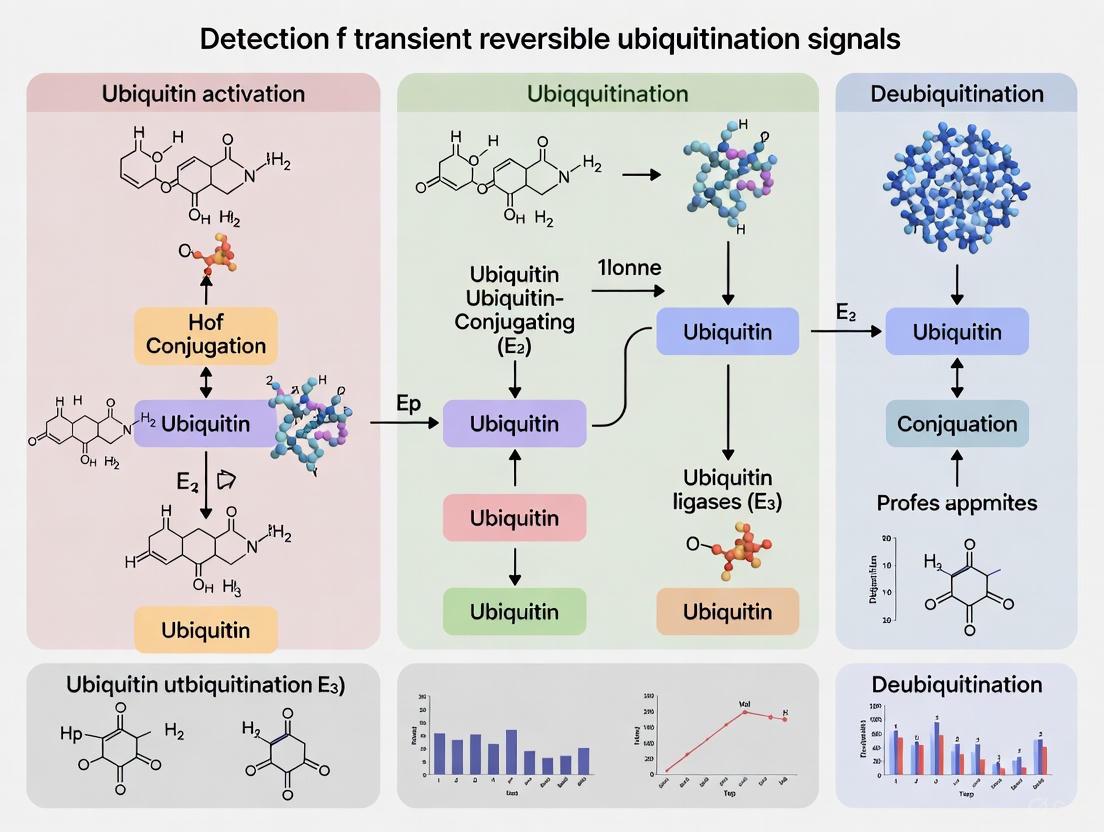
The dynamic and reversible nature of protein ubiquitination, particularly transient signals, presents a significant challenge for researchers and drug developers.
Capturing the Elusive: Advanced Strategies for Detecting Transient and Reversible Ubiquitination
Abstract
The dynamic and reversible nature of protein ubiquitination, particularly transient signals, presents a significant challenge for researchers and drug developers. This article provides a comprehensive guide to the latest methodologies for detecting these elusive modifications. We explore the fundamental biology of the ubiquitin system, detail cutting-edge techniques from bimolecular fluorescence complementation to mass spectrometry-based proteomics, and offer practical troubleshooting advice. A dedicated section on validation strategies ensures data reliability, empowering scientists to accurately map the ubiquitin code and advance therapeutic discovery in cancer, neurodegenerative disorders, and beyond.
Decoding the Ubiquitin Signal: Why Transient and Reversible Modifications Are So Challenging to Capture
Core Mechanisms of the Ubiquitin Cascade
The ubiquitin-proteasome system (UPS) is the primary pathway for targeted protein degradation in eukaryotic cells, acting as a crucial post-translational regulatory mechanism. This hierarchical enzymatic cascade coordinates vital cellular processes including cell cycle progression, DNA damage repair, and immune signaling [1] [2]. Dysregulation of this system is implicated in numerous diseases, making it a prime target for therapeutic intervention [3] [2].
The Enzymatic Cascade: E1, E2, and E3
The ubiquitination process involves three key enzymatic steps that culminate in the covalent attachment of ubiquitin to target proteins.
- E1 Ubiquitin-Activating Enzymes: The process initiates with a single E1 enzyme that activates ubiquitin in an ATP-dependent manner. The E1 enzyme's catalytic cysteine residue forms a high-energy thioester bond with the C-terminal glycine of ubiquitin [1] [3] [2].
- E2 Ubiquitin-Conjugating Enzymes: The activated ubiquitin is then transferred to the catalytic cysteine of one of approximately 30-35 E2 conjugating enzymes, forming an E2~Ub thioester intermediate [1] [3] [2].
- E3 Ubiquitin Ligases: Finally, one of over 600 E3 ligases facilitates the transfer of ubiquitin from the E2~Ub complex to a lysine residue on the specific target protein, forming an isopeptide bond [1] [3]. E3 ligases provide substrate specificity to the cascade and fall into two main mechanistic classes:
- RING/U-box E3s: Function as scaffolds that simultaneously bind the E2~Ub complex and the substrate, facilitating direct ubiquitin transfer without a covalent E3-intermediate [1] [2].
- HECT/RBR E3s: Form a transient thioester intermediate with ubiquitin via an active-site cysteine before transferring it to the substrate [1] [3].
Table 1: Core Enzymes of the Ubiquitin Cascade
| Enzyme Class | Number in Humans | Key Function | Mechanism of Action |
|---|---|---|---|
| E1 (Activating) | 2 [2] [4] | Ubiquitin activation | ATP-dependent; forms E1~Ub thioester |
| E2 (Conjugating) | ~30-35 [3] [2] | Ubiquitin carriage | Forms E2~Ub thioester |
| E3 (Ligating) | >600 [1] [3] | Substrate recognition | Direct (RING) or intermediate (HECT) transfer |
Deubiquitinating Enzymes (DUBs)
Ubiquitination is a reversible modification. Deubiquitinating enzymes (DUBs) constitute a family of approximately 100 proteases that hydrolyze the isopeptide bond between ubiquitin and the substrate protein [5] [2]. DUBs perform several critical functions:
- Processing of ubiquitin precursors to generate mature ubiquitin [3].
- Editing or removing ubiquitin chains from substrates to reverse signaling or rescue inappropriately targeted proteins [3].
- Recycling ubiquitin by disassembling chains at the proteasome before substrate degradation [3]. DUBs are categorized into seven families, with the Ubiquitin-Specific Protease (USP) family being the largest and most studied [5].
Diagram 1: The Ubiquitin-Proteasome System Cascade. This diagram illustrates the sequential action of E1, E2, and E3 enzymes in ubiquitinating a target protein, and the opposing actions of DUBs and the proteasome.
The Ubiquitin Code and Signaling Outcomes
The functional consequences of ubiquitination are determined by the topology of the ubiquitin modification, often referred to as the "ubiquitin code."
Ubiquitin Chain Linkages and Functions
Ubiquitin contains seven lysine residues (K6, K11, K27, K29, K33, K48, K63) and an N-terminal methionine (M1) that can serve as linkage points for polyubiquitin chain formation. Each linkage type creates a distinct molecular signature that is recognized by specific effector proteins, leading to diverse cellular outcomes [1] [6].
Table 2: Ubiquitin Linkage Types and Their Primary Functions
| Linkage Type | Primary Functions | Key Readers/Effectors |
|---|---|---|
| K48 | Targets substrates for proteasomal degradation [1] [3] | Proteasome |
| K63 | Innate immune signaling, DNA damage repair, endocytosis [1] [6] | Proteins with UBDs |
| K11 | Cell cycle regulation, proteasomal degradation [1] [3] | Proteasome |
| K27 | Mitochondrial autophagy, innate immune response [1] [3] | Autophagy receptors |
| M1 (Linear) | NF-κB inflammatory signaling [1] [3] | NEMO/IKK complex |
| K6 | DNA damage repair, antiviral responses [1] [6] | DNA repair proteins |
| K29 | Autophagy, Wnt signaling, neurodegenerative disorders [3] [6] | Autophagy receptors |
| K33 | T-cell receptor signaling, intracellular trafficking [1] [3] | Signaling proteins |
Technical Challenges in Detecting Transient Ubiquitination Signals
Research focusing on the reversible nature of ubiquitination, particularly transient signals, faces several significant technical hurdles.
Common Experimental Obstacles and Solutions
Table 3: Troubleshooting Guide for Ubiquitination Experiments
| Problem | Root Cause | Solution | Supporting Protocol |
|---|---|---|---|
| Weak or no ubiquitination signal | Low abundance of ubiquitinated species; transient nature of modification | Treat cells with proteasome inhibitors (e.g., 5-25 µM MG-132 for 1-2 hours) prior to harvesting [6] | Cell lysis in denaturing buffers; co-expression of E2/E3 enzymes |
| High background and non-specific bands | Non-specific ubiquitin antibody binding; artifact detection | Use high-affinity isolation tools (e.g., Ubiquitin-Trap) and stringent wash conditions [6] | Optimize antibody concentrations; include negative controls |
| Inability to capture transient E3-Substrate interactions | Weak, transient protein-protein interactions | Employ proximity labeling techniques (e.g., TurboID) to capture fleeting interactions [7] | TurboID fusion proteins with streptavidin pull-down and MS analysis |
| Difficulty distinguishing specific chain linkages | Lack of linkage-specific detection reagents | Follow Ubiquitin-Trap IP with western blot using linkage-specific antibodies [6] | Sequential immunoprecipitation and immunoblotting |
| Rapid deubiquitination during analysis | Active DUBs in cell lysates | Use DUB inhibitors (e.g., PR-619, N-ethylmaleimide) in lysis buffers [3] | Rapid sample processing; lysis at higher temperatures |
Methodologies for Studying Transient Ubiquitination
Protocol 1: Proximity Labeling for Capturing Transient E3-Substrate Interactions
This protocol is adapted from studies of NLR immune receptor complexes, which successfully captured transient ubiquitination events [7].
- Construct Design: Fuse your protein of interest (e.g., E3 ligase or substrate) with TurboID biotin ligase and an epitope tag (e.g., FLAG).
- Transient Expression: Express the TurboID-fusion protein in an appropriate cell line (e.g., HEK293T for mammalian systems, Nicotiana benthamiana for plant systems) alongside its binding partner.
- Biotinylation Reaction: Treat cells with biotin (e.g., 50-500 µM) for the desired labeling time (typically 15-60 minutes) to allow proximal protein biotinylation.
- Cell Lysis: Harvest and lyse cells in RIPA buffer supplemented with protease and DUB inhibitors.
- Streptavidin Pull-Down: Incubate lysates with streptavidin-conjugated beads to capture biotinylated proteins.
- LC-MS/MS Analysis: Identify interacting proteins using liquid chromatography-tandem mass spectrometry. Compare against appropriate controls (e.g., GFP-TurboID) to filter background.
- Validation: Confirm specific interactions through co-immunoprecipitation and functional assays.
Protocol 2: Ubiquitin-Trap Immunoprecipitation for Enriching Ubiquitinated Species
This protocol utilizes commercial Ubiquitin-Trap technology to overcome challenges of low ubiquitinated protein abundance [6].
- Sample Preparation: Treat cells with 5-25 µM MG-132 proteasome inhibitor for 1-2 hours before harvesting to preserve ubiquitination signals.
- Cell Lysis: Lyse cells in recommended lysis buffer (e.g., 50 mM Tris-HCl pH 7.5, 150 mM NaCl, 1% NP-40, 0.5% sodium deoxycholate) supplemented with fresh protease and DUB inhibitors.
- Clearing: Centrifuge lysates at 15,000 × g for 15 minutes at 4°C to remove insoluble material.
- Immunoprecipitation: Incubate cleared lysate with Ubiquitin-Trap Agarose or Magnetic Agarose beads for 1-2 hours at 4°C with gentle rotation.
- Washing: Wash beads 3-5 times with appropriate wash buffer under stringent conditions (e.g., high salt, detergents) to reduce non-specific binding.
- Elution: Elute bound proteins with 2X Laemmli buffer containing DTT for western blot analysis, or use recommended elution buffers for functional studies.
- Downstream Analysis: Analyze by western blotting with linkage-specific ubiquitin antibodies, or process for mass spectrometry to identify ubiquitination sites.
Diagram 2: Experimental Workflows for Studying Transient Ubiquitination. Two complementary approaches for capturing and analyzing transient ubiquitination events: proximity labeling and affinity enrichment.
Research Reagent Solutions
Table 4: Key Reagents for Ubiquitination Research
| Reagent / Tool | Function / Application | Example Product / Identifier |
|---|---|---|
| Proteasome Inhibitors | Stabilize ubiquitinated proteins by blocking degradation | MG-132, Bortezomib [6] |
| Ubiquitin-Trap | High-affinity enrichment of ubiquitin and ubiquitinated proteins | ChromoTek Ubiquitin-Trap Agarose/Magnetic Beads [6] |
| Linkage-Specific Antibodies | Differentiate between ubiquitin chain types in western blot | K48-linkage specific, K63-linkage specific antibodies [6] |
| DUB Inhibitors | Preserve ubiquitination signals during sample processing | PR-619, N-ethylmaleimide [3] |
| E1/E2/E3 Inhibitors | Probe specific enzyme functions in the cascade | MLN4924 (NEDD8-E1), Pyr-41 (E1), Nutlin (MDM2 E3) [3] [2] |
| Activity-Based Probes | Monitor DUB activity and specificity | Ubiquitin-based electrophilic probes [5] |
| Recombinant Enzymes | In vitro reconstitution of ubiquitination cascade | E1, E2, and E3 enzyme sets [4] |
FAQs: Addressing Common Research Challenges
Q1: Why do I see a smeared appearance instead of discrete bands when detecting ubiquitinated proteins by western blot?
A: The smeared appearance is expected and actually indicates successful detection of ubiquitinated species. This pattern occurs because your protein of interest exists in multiple states with different numbers of ubiquitin molecules attached (mono- vs. polyubiquitination) and at different lysine residues. Additionally, polyubiquitin chains themselves have varying lengths. This heterogeneity in molecular weight creates the characteristic smear on western blots, which is a positive indicator of ubiquitination [6].
Q2: How can I determine which specific lysine residue on my substrate protein is being ubiquitinated?
A: Identifying specific ubiquitination sites requires mass spectrometry-based approaches. After enriching your ubiquitinated substrate using immunoprecipitation or Ubiquitin-Trap, subject the sample to tryptic digestion and LC-MS/MS analysis. Ubiquitination leaves a characteristic di-glycine remnant on modified lysines after trypsin digestion, with a mass shift of +114.0429 Da, which can be detected by modern high-resolution mass spectrometers. Be sure to include proteasome inhibitors during cell harvesting to preserve ubiquitination signals.
Q3: My E3 ligase and substrate interact well in co-IP experiments, but I cannot detect ubiquitination. What might be wrong?
A: Several factors could explain this discrepancy:
- The interaction may be functional but too transient to detect stable ubiquitination products. Consider using DUB inhibitors in your lysis buffer and shortening your experimental timeline.
- Your E3 might require specific post-translational modifications or co-factors for activity that are absent in your experimental system.
- The ubiquitination might be occurring on non-lysine residues (e.g., cysteine, serine, threonine), which are not detected by conventional antibodies.
- Try reconstituting the reaction in vitro with purified E1, E2, E3, substrate, ATP, and ubiquitin to eliminate cellular complexities [4].
Q4: How specific are DUB inhibitors, and how do I choose the right one for my experiment?
A: Most commonly used DUB inhibitors have limited specificity. Broad-spectrum inhibitors like PR-619 will inhibit multiple DUB families, which is useful for preserving global ubiquitination signals but not for determining which specific DUB is responsible. For mechanistic studies, consider genetic approaches (siRNA, CRISPR) targeting specific DUBs, or use more selective inhibitors being developed against specific DUBs like USP7, USP14, or UCHL1. Always include appropriate controls to account for off-target effects [5] [2].
Q5: What controls are essential for ubiquitination experiments?
A: Rigorous controls are critical for interpreting ubiquitination data:
- Catalytically dead E3 mutants (e.g., cysteine mutants for HECT E3s).
- Substrate mutants with lysine residues changed to arginine.
- E2 enzyme controls to rule out E2-autoubiquitination.
- Proteasome inhibitor-treated vs. untreated samples to demonstrate stabilization of ubiquitinated species.
- DUB treatment of samples to show disappearance of ubiquitination signals.
- Linkage-specific controls when investigating specific chain types [3] [6].
Ubiquitination is a versatile post-translational modification that extends far beyond its well-characterized role in targeting proteins for proteasomal degradation. The covalent attachment of ubiquitin to substrate proteins generates a complex array of molecular signals that regulate diverse cellular processes, including DNA repair, endocytosis, histone modification, immune responses, and transcriptional activation [8] [9]. This functional diversity arises from the ability of ubiquitin to form different types of conjugates: single ubiquitin molecules (monoubiquitination), multiple single ubiquitins on different lysines (multi-monoubiquitination), or polyubiquitin chains connected through different lysine residues within ubiquitin itself [8] [10].
The "ubiquitin code" consists of various chain structures that dictate specific functional outcomes. While K48-linked polyubiquitin chains represent the classical signal for proteasomal degradation, monoubiquitination and atypical polyubiquitin chains (linked through K6, K11, K27, K29, K33, or K63) mediate non-proteolytic functions [8] [9]. These atypical linkages create distinct conformations of ubiquitin chains that are recognized by specific ubiquitin-binding domains (UBDs), ultimately leading to diverse downstream signaling events [8]. This article explores the experimental challenges in detecting these transient ubiquitination signals and provides troubleshooting guidance for researchers studying non-degradative ubiquitination.
Understanding Non-Degradative Ubiquitination Signals
Monoubiquitination and Its Cellular Functions
Monoubiquitination involves the attachment of a single ubiquitin molecule to a substrate protein and regulates numerous non-proteolytic cellular processes. Key functions include:
- DNA Repair and Damage Response: Monoubiquitination of PCNA and histones plays a critical role in coordinating DNA damage response pathways [8] [9].
- Membrane Trafficking and Endocytosis: Monoubiquitination serves as a signal for internalization of cell surface receptors and their sorting into multivesicular bodies [8] [11].
- Transcriptional Regulation: Histone H2B monoubiquitination at Lys120 by the RNF20/40 complex regulates HOX gene expression by facilitating histone H3 methylation at lysines 4 and 79 [12].
- Viral Budding: Monoubiquitination of viral proteins facilitates budding processes [8].
Atypical Ubiquitin Chain Linkages
Atypical ubiquitin chains include all variations of multimeric ubiquitin structures except classical Lys48-linked chains. These can be classified as:
- Homotypic chains: Formed by conjugation using the same lysine residue in sequential ubiquitin molecules
- Mixed-linkage chains: Assembled through several distinct lysines in ubiquitin monomers
- Heterologous chains: Integration of other ubiquitin-like modifiers (SUMO, NEDD8) into ubiquitin chains [8]
Table 1: Functions of Atypical Ubiquitin Chain Linkages
| Linkage Type | Chain Length | Primary Functional Roles |
|---|---|---|
| K63 | Polymeric | Immune responses, inflammation, lymphocyte activation, protein-protein interactions [10] [9] |
| K6 | Polymeric | Antiviral responses, autophagy, mitophagy, DNA repair [9] |
| K11 | Polymeric | Cell cycle progression, proteasome-mediated degradation [9] [13] |
| K27 | Polymeric | DNA replication, cell proliferation [9] |
| K29 | Polymeric | Neurodegenerative disorders, Wnt signaling, autophagy [9] |
| M1 (Linear) | Polymeric | Cell death and immune signaling [9] |
The complexity of ubiquitination is further enhanced by the formation of branched chains, where a single ubiquitin molecule serves as an attachment point for multiple ubiquitin chains using different lysine residues [10]. Additionally, ubiquitin itself can undergo post-translational modifications such as phosphorylation and acetylation, creating an even more diverse signaling system [10].
Technical Challenges in Detection and Analysis
Studying monoubiquitination and atypical chain linkages presents unique methodological challenges that researchers must overcome:
- Transient Nature: Ubiquitination is a highly dynamic and reversible process, with deubiquitinating enzymes (DUBs) rapidly removing ubiquitin modifications. This makes capturing these events difficult, especially for non-degradative signals that may not accumulate to high levels [10] [9].
- Low Stoichiometry: Only a small fraction of a target protein may be ubiquitinated at any given time, making detection challenging against the background of non-modified protein [10].
- Structural Complexity: The diversity of ubiquitin chain architectures (homotypic, mixed-linkage, branched) requires methods that can distinguish between different linkage types [8] [10].
- Antibody Specificity: Many commercially available ubiquitin antibodies show poor specificity, with cross-reactivity to other proteins or preference for specific chain types [9].
Table 2: Common Experimental Challenges and Solutions
| Challenge | Impact on Research | Potential Solutions |
|---|---|---|
| Transient signal duration | Difficult to capture physiological ubiquitination events | Use proteasome inhibitors (MG-132); work with DUB inhibitors [9] |
| Low abundance of modified proteins | Low signal-to-noise ratio in detection methods | Implement enrichment strategies (TUBEs, immunoprecipitation) [10] [9] |
| Rapid deubiquitination during lysis | Loss of signal during sample preparation | Include DUB inhibitors in lysis buffers; use rapid lysis methods [9] |
| Linkage type discrimination | Inability to determine specific chain architecture | Use linkage-specific antibodies; MS-based proteomics; TUBEs with linkage preference [10] |
Frequently Asked Questions (FAQs) and Troubleshooting Guides
FAQ 1: Why do I detect smeared ubiquitin signals in my western blots instead of discrete bands?
Answer: Smearing in ubiquitin western blots is actually expected and often indicates successful detection of ubiquitinated proteins. This pattern occurs because:
- Proteins can be modified with ubiquitin chains of varying lengths
- Multiple lysine residues on a single substrate can be ubiquitinated
- Mixed linkage chains may form, creating heterogeneous molecular weights [9]
Troubleshooting Steps:
- Verify specificity: Confirm your antibody recognizes all ubiquitin linkages, not just specific types.
- Include controls: Use cells treated with proteasome inhibitors (e.g., MG-132) as positive controls, which should enhance smearing due to accumulated ubiquitinated proteins.
- Check protein loading: Ensure you haven't overloaded your gel, which can cause non-specific smearing.
- Validate with ubiquitin mutants: Express ubiquitin mutants (K0 or specific lysine mutants) to confirm signal specificity [9].
FAQ 2: How can I preserve transient ubiquitination signals during sample preparation?
Answer: Transient ubiquitination is easily lost due to deubiquitinating enzyme activity during cell lysis. To preserve these signals:
Optimal Protocol:
- Pre-treatment: Incubate cells with 5-25 μM MG-132 for 1-2 hours before harvesting to inhibit proteasomal degradation and stabilize ubiquitin conjugates [9].
- Lysis Buffer Composition: Supplement lysis buffers with DUB inhibitors such as N-ethylmaleimide (NEM) or iodoacetamide to prevent deubiquitination during sample preparation.
- Rapid Processing: Perform cell lysis quickly and maintain samples on ice throughout the process.
- Immediate Analysis: Process samples immediately or store at -80°C with minimal freeze-thaw cycles.
FAQ 3: What methods are available for detecting specific atypical ubiquitin linkages?
Answer: Several approaches can distinguish between different ubiquitin linkage types:
Method Comparison:
- Linkage-Specific Antibodies: Commercial antibodies are available for specific linkages (K48, K63, K11, M1, etc.). Always validate specificity with known positive and negative controls [10].
- Tandem Ubiquitin Binding Entities (TUBEs): These engineered reagents with tandem ubiquitin-binding domains can enrich for ubiquitinated proteins with preference for certain linkage types [10].
- Mass Spectrometry-Based Proteomics: Advanced MS methods can identify specific linkage types by detecting signature peptides after tryptic digestion [10].
- Ubiquitin Mutants: Expression of ubiquitin mutants where only one lysine is available for chain formation (all other lysines mutated to arginine) can help identify linkage-specific functions [13].
Advanced Methodologies for Detection
Single-Molecule Ubiquitin Mediated Fluorescence Complementation (SM-UbFC)
SM-UbFC enables direct visualization and quantification of protein ubiquitination dynamics in live cells with high spatial and temporal resolution [14].
Experimental Workflow:
- Construct Design: Fuse the target protein to one fragment of split-Venus fluorescent protein (e.g., GN) and ubiquitin to the complementary fragment (GC).
- Transfection: Introduce constructs into cultured cells (e.g., hippocampal neurons at 14 DIV).
- Image Acquisition: Perform time-lapse imaging after bleaching initial fluorescence. De novo ubiquitination events appear as sparse flashes of light corresponding to newly reconstituted Venus molecules.
- Data Analysis: Track individual molecules from appearance (maturation) to disappearance (bleaching). Plot centroid coordinates to generate "Event Maps" showing spatial distribution of ubiquitination events [14].
Diagram 1: SM-UbFC Workflow for Live-Cell Ubiquitination Detection
Troubleshooting SM-UbFC:
- Low fluorescence signal: Optimize expression levels of both constructs; verify proper folding of Venus fragments.
- High background fluorescence: Implement more rigorous photobleaching before imaging; optimize laser power and exposure time.
- Non-specific signals: Include controls with ubiquitination-deficient substrates (lysine mutants) [14].
Bimolecular Fluorescence Complementation (BiFC) for Ubiquitination Detection
The BiFC approach has been adapted for efficient detection of protein ubiquitination in yeast systems, with the pUbDetec16 vector providing a simplified workflow [15].
Protocol for Yeast Systems:
- Vector Construction: Clone your gene of interest (without stop codon) into the pUbDetec16 vector containing GN-UBI3 and MCS-GC fragments.
- Transformation: Introduce the recombinant plasmid into Δura3 auxotrophic S. cerevisiae strain (e.g., CEN.PK2-1D).
- Fluorescence Detection: Detect fluorescence using fluorospectrophotometry or fluorescence microscopy after inducing ubiquitination conditions.
- Validation: Always include positive (wild-type Gap1p) and negative (non-ubiquitinatable Gap1pK9R,K16R,K76R) controls [15].
Advantages of This System:
- Significantly reduces manipulation time from 30 to 10 days compared to conventional methods
- Enables large-scale screening of ubiquitination events
- Allows detection of transient ubiquitination in living cells [15]
Biochemical Enrichment Strategies
Ubiquitin-Trap Technology:
- Principle: Uses anti-ubiquitin nanobodies (VHH) coupled to agarose or magnetic beads to immunoprecipitate monomeric ubiquitin, ubiquitin chains, and ubiquitinated proteins [9].
- Applications: Works with various cell extracts (mammalian, insect, plant, yeast); ideal for proteomic studies.
- Advantages: High affinity; stable under harsh washing conditions; low background binding.
Ubiquitin Tagging Approaches:
- His-Tagged Ubiquitin: Express 6× His-tagged ubiquitin in cells; purify ubiquitinated proteins using Ni-NTA affinity chromatography [10].
- Strep-Tagged Ubiquitin: Alternative tagging system with Strep-tag II and Strep-Tactin affinity purification [10].
- Limitations: Tagged ubiquitin may not completely mimic endogenous ubiquitin; potential for artifacts.
Research Reagent Solutions
Table 3: Essential Reagents for Ubiquitination Studies
| Reagent Type | Specific Examples | Function/Application | Considerations |
|---|---|---|---|
| E3 Ligase Inhibitors | PJA2 inhibitors (e.g., RING domain mutants) [13] | Study specific ubiquitination pathways | Validate specificity with multiple targets |
| DUB Inhibitors | PR-619, N-Ethylmaleimide (NEM) | Stabilize ubiquitin conjugates during lysis | Can have off-target effects on other cysteine proteases |
| Linkage-Specific Antibodies | K48-specific, K63-specific, M1-linear specific [10] | Detect specific chain architectures | Thoroughly validate for cross-reactivity |
| Ubiquitin Traps | ChromoTek Ubiquitin-Trap (Agarose/Magnetic) [9] | Enrich ubiquitinated proteins from complex mixtures | Not linkage-specific; requires confirmation |
| Ubiquitin Expression Plasmids | Wild-type, K0 (all lysines mutated), single-lysine mutants [13] | Study linkage-specific functions | May not fully recapitulate endogenous ubiquitination |
| Proteasome Inhibitors | MG-132, Bortezomib, Lactacystin | Stabilize ubiquitinated proteins | Can induce cellular stress responses with prolonged use |
Case Studies: Experimental Approaches in Context
Case Study 1: PJA2-Mediated Ubiquitination of HIV-1 Tat Protein
Background: The HIV-1 Tat protein undergoes non-degradative ubiquitination that regulates viral transcription elongation.
Key Findings:
- PJA2, a RING-H2 E3 ligase, polyubiquitinates Tat through atypical chain linkages
- This ubiquitination is non-degradative and enhances Tat's transcriptional activity
- Multiple lysine residues in Tat can function as ubiquitin acceptor sites, demonstrating remarkable plasticity
- Ubiquitin chains conjugated to Tat by PJA2 can be assembled through variable ubiquitin lysine linkages [13]
Experimental Approach:
- In Vivo Ubiquitination Assays: Co-express Tat with wild-type or mutant PJA2 (C634A, C671A RING domain mutant) in HeLa cells.
- Functional Validation: Use siRNA knockdown of PJA2 to demonstrate reduced Tat ubiquitination and impaired HIV transcription elongation.
- In Vitro Reconstitution: Purified components (E1, E2, E3, ubiquitin) confirm direct Tat ubiquitination by PJA2.
- Linkage Analysis: Examine chain specificity using ubiquitin lysine mutants [13].
Case Study 2: Histone H2B Monoubiquitination in Transcriptional Regulation
Background: Monoubiquitination of histone H2B plays a critical role in transcriptional activation through cross-talk with histone methylation.
Key Findings:
- The 600 kDa RNF20/40 complex serves as the E3 ligase for H2B-Lys120 monoubiquitination
- UbcH6 is the cognate E2 conjugating enzyme, physically interacting with RNF20/40 and the hPAF complex
- Formation of a trimeric complex with hPAF stimulates H2B monoubiquitination activity in vitro
- RNF20 overexpression elevates H2B monoubiquitination, increases H3 lysine 4 and 79 methylation, and stimulates HOX gene expression [12]
Diagram 2: H2B Monoubiquitination in Transcriptional Activation
Concluding Perspectives
The study of monoubiquitination and atypical ubiquitin chain linkages continues to reveal the remarkable complexity of ubiquitin signaling beyond protein degradation. As methodologies for detecting these transient modifications improve, particularly through live-cell imaging techniques like SM-UbFC and refined biochemical tools such as linkage-specific antibodies and TUBEs, our understanding of their physiological roles expands accordingly. Future research directions should focus on developing more specific tools to manipulate individual ubiquitination events, creating more sensitive detection methods for low-abundance ubiquitination events, and establishing standardized protocols for capturing transient ubiquitin signals across different experimental systems. The continued elucidation of these non-degradative ubiquitination pathways promises not only to advance our fundamental understanding of cellular regulation but also to identify novel therapeutic targets for diseases characterized by dysregulated ubiquitin signaling.
Frequently Asked Questions (FAQs)
Q1: Why is it so difficult to detect ubiquitination for certain proteins, especially in standard western blots? The primary challenge is the transient and reversible nature of ubiquitination. This dynamic process is counterbalanced by deubiquitinating enzymes (DUBs) that rapidly remove ubiquitin, resulting in low steady-state levels of ubiquitinated species [3] [16]. Furthermore, the ubiquitinated forms of a protein are often present in low abundance and can be obscured by the stronger signal from the non-modified protein in western blots. The use of proteasome inhibitors (e.g., MG132) can help by blocking the degradation of ubiquitinated proteins, allowing for their accumulation and thus facilitating detection.
Q2: What is "linkage bias," and how does it affect my ubiquitination detection results? Linkage bias occurs when detection tools, such as certain ubiquitin-binding domains (UBDs) or antibodies, have a preferential affinity for specific types of ubiquitin chains (e.g., K48 or K63 chains) over others [17]. This can lead to a skewed or incomplete picture, as your readout may only reflect a subset of the biologically relevant ubiquitination events occurring in your sample. For example, Tandem Ubiquitin Binding Entities (TUBEs) can exhibit this bias, whereas newer tools like the Tandem Hybrid Ubiquitin Binding Domain (ThUBD) are engineered for unbiased capture of all ubiquitin chain types [17] [18].
Q3: My ubiquitination signal is very weak. How can I enhance it for more reliable detection?
- Inhibit the Proteasome: Use inhibitors like MG132 or Bortezomib to prevent the degradation of polyubiquitinated proteins, leading to their accumulation [3].
- Inhibit Deubiquitinases (DUBs): Utilize broad-spectrum DUB inhibitors to slow the reversal of ubiquitination. Note that specific DUBs act on specific chain types.
- Increase Protein Input: Use higher amounts of starting protein lysate to increase the absolute amount of the low-abundance ubiquitinated target.
- Employ High-Affinity Capture Reagents: Replace traditional antibodies with high-affinity, linkage-independent UBDs like ThUBD, which can improve capture efficiency by up to 16-fold compared to older methods like TUBEs [17] [18].
Q4: How can I detect rapid, stimulus-induced ubiquitination events in live cells? For studying the dynamics of ubiquitination in live cells, especially in response to stimuli like receptor activation, Single-Molecule Ubiquitin Mediated Fluorescence Complementation (SM-UbFC) is a powerful technique [14]. SM-UbFC enables the direct visualization and quantification of de novo ubiquitination events with high spatiotemporal resolution, allowing researchers to observe changes in ubiquitination rates that are impossible to detect with endpoint biochemical assays.
Q5: What advanced methods are available for high-throughput screening of ubiquitination, particularly in drug discovery? ThUBD-coated 96-well plates represent a state-of-the-art platform for high-throughput detection [17] [18]. This method allows for the unbiased and high-affinity capture of ubiquitinated proteins from complex proteomes, making it ideal for screening applications, such as monitoring the effects of Proteolysis-Targeting Chimeras (PROTACs) or other ubiquitin-system-targeting drugs.
Troubleshooting Guide
Problem: Inconsistent or No Detection of Target Protein Ubiquitination
| Symptom | Possible Cause | Solution |
|---|---|---|
| No smear or higher molecular weight bands on western blot. | Rapid deubiquitination by DUBs during lysis. | Add DUB inhibitors directly to the lysis buffer and perform lysis on ice. |
| Low affinity or linkage bias of the detection antibody/UBD. | Switch to a high-affinity, linkage-unbiased capture agent like ThUBD [17]. | |
| High background noise in immunoprecipitation. | Non-specific antibody binding. | Optimize wash buffer stringency (e.g., increase salt concentration, use mild denaturants). |
| Signal is lost after protein purification. | Ubiquitinated species are unstable. | Perform all steps at 4°C and include DUB and proteasome inhibitors throughout the process. |
Problem: Capturing Transient Ubiquitination Dynamics
| Symptom | Possible Cause | Solution |
|---|---|---|
| Cannot detect stimulus-induced ubiquitination. | The ubiquitination event is too fast and transient for endpoint assays. | Implement live-cell imaging techniques like SM-UbFC to capture real-time dynamics [14]. |
| The steady-state level of ubiquitination does not change. | Measure the rate of ubiquitination, not just the accumulation. Use pulse-chase or kinetic assays. |
Quantitative Data Comparison of Key Detection Methods
The table below summarizes the performance characteristics of various ubiquitination detection methods, highlighting solutions to the transiency problem.
Table 1: Comparison of Ubiquitination Detection Techniques
| Method | Key Principle | Sensitivity/Dynamic Range | Temporal Resolution | Best for Detecting |
|---|---|---|---|---|
| Western Blot | Immunodetection of ubiquitin or tagged substrate. | Low to Moderate; limited by antibody quality. | Endpoint | Stable, accumulated ubiquitination. |
| TUBE-based Assays | Affinity capture using tandem ubiquitin-binding entities. | Moderate; can be hampered by linkage bias. | Endpoint | Enrichment of polyubiquitinated proteins from lysate. |
| ThUBD-coated Plates [17] [18] | High-affinity, unbiased capture in a plate format. | High; 16-fold wider linear range than TUBE. | Endpoint / High-throughput | Global or target-specific ubiquitination in complex samples; drug screening. |
| SM-UbFC [14] | Single-molecule fluorescence complementation in live cells. | Single-molecule sensitivity. | Real-time (150 ms resolution) | Rapid, transient ubiquitination events in specific subcellular locations. |
| Mass Spectrometry | Identification of ubiquitination sites via digested peptides. | High for site mapping, but requires large input. | Endpoint | Comprehensive mapping of ubiquitination sites under specific conditions. |
Experimental Protocols
Protocol 1: High-Throughput Ubiquitination Detection Using ThUBD-Coated Plates
This protocol is adapted from the ThUBD-coated plate technology for sensitive and unbiased capture of ubiquitinated proteins [17] [18].
Key Reagents:
- ThUBD-coated 96-well plates (e.g., Corning 3603 type)
- Lysis Buffer (e.g., RIPA) supplemented with DUB and proteasome inhibitors
- Detection antibody (e.g., anti-ubiquitin or target-specific antibody)
- HRP-conjugated ThUBD for signal detection
Procedure:
- Sample Preparation: Lyse cells or tissues in a suitable buffer containing DUB and proteasome inhibitors to stabilize ubiquitinated proteins.
- Plate Blocking: Block the ThUBD-coated plate with a suitable blocking agent (e.g., BSA or casein) for 1 hour at room temperature to minimize non-specific binding.
- Sample Incubation: Add the protein lysate to the wells and incubate for 2 hours at room temperature with gentle shaking. The high-affinity ThUBD will capture ubiquitinated proteins.
- Washing: Wash the plate 3-5 times with a optimized wash buffer to remove unbound proteins and reduce background.
- Detection: Incubate with a primary antibody against your target protein or a ubiquitin-specific antibody. Alternatively, for direct detection of global ubiquitination, use an HRP-conjugated ThUBD.
- Quantification: Develop the signal using a compatible chemiluminescent or fluorescent substrate and read on a plate reader.
Protocol 2: Visualizing Transient Ubiquitination in Live Neurons via SM-UbFC
This protocol outlines the use of SM-UbFC to visualize de novo ubiquitination, as demonstrated for synaptic proteins like PSD-95 and FMRP [14].
Key Reagents:
- Plasmids: Substrate protein (e.g., PSD-95) fused to the N-terminal fragment of Venus (VN) and Ubiquitin fused to the C-terminal fragment of Venus (VC).
- Cultured cells (e.g., hippocampal neurons).
- Imaging setup: TIRF or confocal microscope with a sensitive EMCCD or sCMOS camera.
Procedure:
- Transfection: Co-transfect cells with the substrate-VN and Ub-VC constructs.
- Fluorescence Bleaching: Before imaging, expose the cells to intense laser light to bleach the pre-existing, steady-state Venus fluorescence.
- Time-Lapse Imaging: Acquire time-lapse images with high temporal resolution (e.g., 150 ms intervals). New flashes of Venus fluorescence correspond to de novo ubiquitination events, as the covalent binding of ubiquitin to the substrate brings VN and VC together to reconstitute the fluorescent Venus protein.
- Data Analysis: Use particle-tracking software to detect, track, and quantify the appearance, location, and disappearance (photobleaching) of single-molecule fluorescence events. Generate an "Event Map" to visualize the spatiotemporal pattern of ubiquitination.
Signaling Pathways & Experimental Workflows
The following diagram illustrates the core challenge of the transiency problem and the points of intervention for advanced detection methods.
The Scientist's Toolkit: Research Reagent Solutions
Table 2: Essential Reagents for Overcoming Ubiquitination Detection Challenges
| Reagent / Tool | Function | Key Feature / Consideration |
|---|---|---|
| ThUBD (Tandem Hybrid UBD) [17] [18] | High-affinity capture of ubiquitinated proteins from lysates. | Linkage-unbiased; 16x wider linear range than TUBEs; available in coated-plate format for high-throughput. |
| SM-UbFC Plasmids [14] | Live-cell, single-molecule imaging of ubiquitination. | Requires split-Venus constructs for your protein of interest and ubiquitin. |
| DUB Inhibitors (e.g., PR-619, Broad-spectrum) | Stabilizes ubiquitin conjugates by inhibiting deubiquitinating enzymes. | Add to lysis and incubation buffers to prevent loss of signal. |
| Proteasome Inhibitors (e.g., MG132, Bortezomib) | Blocks degradation of polyubiquitinated proteins, leading to their accumulation. | Essential for detecting K48-linked chains targeted for proteasomal degradation. |
| Linkage-Specific Ub Antibodies | Detects specific ubiquitin chain topologies (e.g., K48, K63). | Useful for determining chain type, but provides a biased view if used alone. |
| TUBE (Tandem Ubiquitin Binding Entity) | Affinity purification of polyubiquitinated proteins. | An older technology that can exhibit linkage bias compared to ThUBD. |
Ubiquitination is a dynamic post-translational modification that regulates virtually all cellular processes by modulating protein function, localization, interactions, and turnover. While canonical ubiquitination involves conjugating ubiquitin to lysine residues via an isopeptide bond, emerging research has established the expansion of the ubiquitin code through non-canonical ubiquitination on non-lysine residues, including serine, threonine, and cysteine [19] [20].
This non-canonical ubiquitination comprises the formation of chemical bonds distinct from the traditional isopeptide bond: thioester-based linkages between ubiquitin and cysteine residues, and oxyester bonds where ubiquitin is conjugated to serine or threonine residues [19] [20]. These modifications significantly broaden the regulatory scope of the ubiquitin system and present unique challenges for detection and study due to their often transient nature and sensitivity to standard experimental conditions.
The first observations of lysine-independent ubiquitination date back to 2005, with viral E3 ligases MIR1 and MIR2 identified as modifiers of cysteine residues, while mK3 was shown to ubiquitinate serine or threonine residues [20]. Since these initial discoveries, research has revealed numerous enzymes and substrates involved in these unconventional modifications, though they remain less characterized than their canonical counterparts.
Frequently Asked Questions (FAQs)
Q1: What defines non-canonical ubiquitination and how does it differ chemically from canonical ubiquitination?
Non-canonical ubiquitination encompasses the formation of chemical bonds distinct from the isopeptide bond that typically links ubiquitin to a lysine residue of the substrate. These include:
- Thioester-based linkages between ubiquitin and cysteine residues
- Oxyester bonds where ubiquitin is conjugated to serine or threonine residues [19] [20]
Unlike the stable isopeptide bond of canonical ubiquitination, thioester and oxyester bonds are more labile and sensitive to changes in pH, temperature, and reducing conditions, making them more challenging to detect and study experimentally [19].
Q2: Which key enzymes mediate non-canonical ubiquitination on serine, threonine, and cysteine residues?
Research has identified several key enzymes involved in non-canonical ubiquitination:
UBE2J2: A membrane-anchored E2 enzyme that cooperates with E3 ligases to modify serine and threonine residues [21] [20]. This enzyme serves as a priming E2 that mediates attachment of the first ubiquitin onto the substrate and exhibits sensitivity to membrane lipid composition [21].
Viral E3 ligases: MIR1 and MIR2 were the first identified modifiers of cysteine residues, while mK3 was shown to ubiquitinate serine or threonine residues within the cytosolic tail of MHC I [20].
SidE effector proteins: From Legionella pneumophila, these enzymes catalyze phosphoribosyl-linked serine ubiquitination through a completely distinct mechanism that doesn't rely on the typical E1-E2-E3 cascade [19].
Q3: Why are non-canonical ubiquitination events challenging to detect and study?
Non-canonical ubiquitination events present several methodological challenges:
Lability of bonds: Thioester and oxyester linkages are more labile than isopeptide bonds and can be disrupted by standard experimental conditions, including reducing agents, acidic pH, and elevated temperatures [19].
Limitations of proteomics: Generic methods for identifying ubiquitin substrates using mass spectrometry-based proteomics often overlook non-canonical ubiquitinated substrates, as standard protocols are optimized for detecting lysine modifications [19] [20].
Lack of specific tools: There is a need for specialized tools and reagents specifically designed to capture and detect these non-canonical modifications, including enrichment strategies that preserve the labile bonds [19].
Low abundance: Many non-canonical ubiquitination events may be transient or low-abundance, requiring highly sensitive detection methods [19].
Q4: What are the functional consequences of non-canonical ubiquitination?
Non-canonical ubiquitination expands the regulatory scope of the ubiquitin system with diverse functional consequences:
Immune regulation: Non-canonical ubiquitination of MHC I molecules by viral ligases affects antigen presentation and immune evasion [20].
Membrane protein regulation: UBE2J2-mediated non-canonical ubiquitination plays roles in ER-associated degradation (ERAD) of membrane proteins [21].
Pathogen hijacking: Legionella pneumophila utilizes phosphoribosyl-linked serine ubiquitination to remodel host cell processes and promote infectivity [19].
Signaling regulation: The lability of non-canonical linkages may allow for more dynamic, reversible signaling compared to canonical ubiquitination [19].
Q5: Are there known deubiquitinating enzymes that reverse non-canonical ubiquitination?
The reversal of non-canonical ubiquitination involves specialized enzymes:
Conventional DUBs: Some standard deubiquitinating enzymes may process non-canonical linkages, though their efficiency and specificity can vary [19].
Pathogen-encoded erasers: Legionella pneumophila encodes specific PR-ubiquitin erasers (DupA and DupB) that deconjugate the unusual phosphoribosyl-linked serine ubiquitination, as conventional DUBs cannot process this modification [19].
The susceptibility of thioester and oxyester bonds to chemical hydrolysis may also provide a non-enzymatic reversal mechanism under certain cellular conditions [19].
Troubleshooting Experimental Challenges
Problem: Detection of Labile Non-Canonical Linkages
Challenge: Thioester and oxyester bonds in non-canonical ubiquitination are highly labile and can be disrupted during standard protein extraction and analysis procedures [19].
Solutions:
- Minimize exposure to reducing agents: Avoid DTT or β-mercaptoethanol in extraction buffers, or use low concentrations (≤1 mM) when essential
- Control pH carefully: Maintain neutral to slightly alkaline pH (7.5-8.5) to minimize hydrolysis
- Work rapidly at low temperatures: Process samples quickly and keep them at 4°C throughout extraction and purification
- Use specialized lysis conditions: Incorporate 1% SDS in lysis buffer to rapidly denature proteins and preserve modifications, followed by appropriate dilution for downstream applications
Problem: Specific Detection Amidst Canonical Ubiquitination
Challenge: Non-canonical ubiquitination events are often rare compared to canonical ubiquitination, making specific detection difficult.
Solutions:
- Utilize lysine-less mutants: Express substrates with all lysine residues mutated to arginine to eliminate canonical ubiquitination background
- Employ enrichment strategies: Use ubiquitin-binding domains under non-reducing conditions specifically enriched for labile linkages
- Develop chemical probes: Implement activity-based probes that can distinguish thioester/oxyester bonds from isopeptide bonds
- Leverage enzymatic specificity: Co-express identified E2/E3 pairs known to mediate non-canonical ubiquitination (e.g., UBE2J2 with compatible E3s)
Problem: Validation of Modification Sites
Challenge: Mapping exact modification sites on serine, threonine, and cysteine residues requires specialized mass spectrometry approaches.
Solutions:
- Optimize MS fragmentation parameters: Use electron-transfer/higher-energy collision dissociation (EThcD) which better preserves labile modifications
- Implement cross-linking strategies: Stabilize thioester/oxyester bonds through chemical cross-linking before MS analysis
- Use ubiquitin mutants: Express ubiquitin with tagged variants (e.g., His-FLAG-tagged) that facilitate purification under gentle conditions
- Confirm with multiple methods: Validate MS findings with orthogonal approaches such as mutagenesis of candidate residues and functional assays
Methodologies for Detection and Analysis
Proteomic Mapping Approaches
Standard DiGly Immunoprecipitation Limitations: Traditional proteomic methods using anti-K-ε-GG antibodies to detect ubiquitination after tryptic digestion are ineffective for non-canonical ubiquitination since they specifically capture the diglycine remnant on lysine residues [19]. This approach completely misses ubiquitination events on serine, threonine, and cysteine residues.
Alternative Strategies:
- Ubiquitin remnant profiling: Use antibodies that recognize different ubiquitin-derived motifs beyond diGly
- Middle-down proteomics: Analyze larger peptide fragments that may retain labile modifications
- Cross-linking mass spectrometry: Stabilize thioester/oxyester linkages before analysis
- Immunoaffinity purification: Use ubiquitin-specific antibodies under non-denaturing conditions
Table: Comparison of Proteomic Methods for Non-Canonical Ubiquitination
| Method | Principle | Advantages | Limitations | Suitability for Non-Canonical |
|---|---|---|---|---|
| Anti-K-ε-GG IP | Enrichment of tryptic peptides with diglycine remnant on lysine | Well-established, high sensitivity | Specific to lysine ubiquitination | Not suitable |
| Ubiquitin Antibody IP | Immunoprecipitation with ubiquitin-specific antibodies | Can capture all ubiquitinated forms | Requires careful optimization of conditions | Moderate (with non-reducing conditions) |
| TUBE-based Enrichment | Tandem Ubiquitin-Binding Entities for affinity purification | Preserves labile linkages, captures polyubiquitin chains | May miss monoubiquitination | High |
| Cross-linking MS | Chemical stabilization of labile bonds before analysis | Preserves transient modifications | Introduces complexity in sample preparation | High (with optimized cross-linkers) |
Biochemical and Cell Biological Methods
In Vitro Reconstitution Approaches: Recent advances in studying non-canonical ubiquitination include reconstituted systems with purified components, which allow precise control over experimental conditions. For example, studies on UBE2J2 have utilized:
- Liposome reconstitution: Incorporating membrane-anchored E2 enzymes like UBE2J2 into liposomes of defined lipid composition to study membrane context effects [21]
- Defined lipid environments: Manipulating membrane lipid packing to investigate how membrane properties regulate E2 activity and substrate modification [21]
- Purified enzyme cascades: Combining purified E1, E2 (UBE2J2), and E3 enzymes with substrates to directly monitor non-canonical ubiquitination without competing canonical activities
Functional Assays:
- Degradation assays: Monitor protein turnover of putative non-canonically ubiquitinated substrates
- Interaction studies: Use techniques like TurboID proximity labeling to identify enzymes and regulators involved in non-canonical ubiquitination pathways [7]
- Substrate trapping: Employ catalytic mutants of E2 or E3 enzymes to stabilize intermediate complexes for analysis
Research Reagent Solutions
Table: Essential Reagents for Studying Non-Canonical Ubiquitination
| Reagent/Category | Specific Examples | Function/Application | Key Considerations |
|---|---|---|---|
| E2 Enzymes | UBE2J2, UBE2J1 | Mediate non-canonical ubiquitination on serine/threonine residues | UBE2J2 sensitive to membrane lipid packing [21] |
| E3 Ligases | Viral ligases (MIR1, MIR2, mK3), RNF145, MARCHF6 | Provide substrate specificity for non-canonical ubiquitination | Cooperate with specific E2s; some sense lipid environment [21] [20] |
| Specialized Ubiquitin Mutants | K-less ubiquitin (all lysines mutated) | Study monoubiquitination without chain formation | Eliminates background from polyubiquitin chains |
| Activity-Based Probes | Ubiquitin-based cross-linking probes | Capture transient E2~ubiquitin thioester intermediates | Require specialized design for non-canonical linkages |
| Enrichment Tools | TUBE (Tandem Ubiquitin Binding Entities) | Affinity purification of ubiquitinated proteins under gentle conditions | Preserve labile bonds with non-denaturing conditions |
| Detection Reagents | Ubiquitin-specific antibodies, linkage-specific antibodies | Detect ubiquitination in various assays | Limited availability of antibodies specific to non-canonical forms |
| Cell Line Models | Lysine-less substrate mutants, E2/E3 knockout or overexpression lines | Provide cellular context for studying specific modifications | Enable focus on non-canonical pathways by eliminating canonical background |
Regulatory Mechanisms and Biological Significance
Lipid-Dependent Regulation of Non-Canonical Ubiquitination
Recent research has revealed that the activity of key enzymes in non-canonical ubiquitination can be regulated by membrane properties:
UBE2J2 as a lipid packing sensor: UBE2J2 activity is directly modulated by membrane lipid packing, with tighter lipid packing promoting its active conformation and interaction with E1, while loose packing (characteristic of ER membranes) impedes ubiquitin loading [21].
Cooperation with lipid-sensing E3s: UBE2J2 directs ubiquitin transfer by E3 ligases like RNF145, which itself senses cholesterol levels, creating a multi-layered regulatory system that integrates lipid saturation and cholesterol signals [21].
Membrane composition effects: The ER membrane composition directly tunes the ERAD ubiquitination cascade, with UBE2J2 serving as a key relay point for lipid signals [21].
Pathogen-Mediated Non-Canonical Ubiquitination
Pathogens have evolved sophisticated mechanisms to hijack host ubiquitination systems, including unique forms of non-canonical ubiquitination:
Phosphoribosyl-linked serine ubiquitination: Legionella pneumophila SidE effector proteins catalyze PR-linked serine ubiquitination through a single enzyme that combines ADP-ribosyl transferase and phosphodiesterase activities, completely bypassing the conventional E1-E2-E3 cascade [19].
Pathogen-encoded regulation: Legionella regulates PR-ubiquitination through encoded erasers (DupA, DupB) and regulators (SidJ) that control the extent of host protein modification [19].
Distinct chemistry: PR-ubiquitination conjugates ubiquitin not through its C-terminal Gly76 but via Arg42 to substrate hydroxyl groups through a phosphoribosyl linker, representing a fundamentally different chemistry from eukaryotic ubiquitination [19].
Emerging Technologies and Future Directions
Chemical Biology Tools
The field requires development of specialized tools to advance our understanding of non-canonical ubiquitination:
- Stable linkage mimics: Designing isosteric replacements for thioester and oxyester bonds that resist hydrolysis while maintaining functionality
- Activity-based probes: Developing probes that specifically target enzymes capable of non-canonical ubiquitination
- Linkage-specific antibodies: Generating antibodies that recognize ubiquitin conjugated to serine, threonine, or cysteine residues
- Biosensors: Creating fluorescent reporters that detect non-canonical ubiquitination events in live cells
Advanced Proteomic Strategies
Future methodological advances should focus on:
- Improved enrichment techniques: Developing new affinity reagents that specifically capture non-canonically ubiquitinated proteins
- Advanced fragmentation techniques: Optimizing mass spectrometry methods that preserve and detect labile modifications
- Quantitative dynamics: Implementing pulsed labeling strategies to capture the transient nature of these modifications
- Single-cell approaches: Adapting detection methods for single-cell proteomics to understand cell-to-cell variation
Integration with Physiological Context
Bridging the gap between in vitro studies and comprehensive understanding of functional consequences in vivo remains a crucial challenge. Future research should focus on:
- Developing physiological relevance assays: Creating models that maintain native membrane environments and cellular context
- Temporal resolution: Capturing the dynamics of transient non-canonical ubiquitination events in living cells
- Disease relevance: Connecting specific non-canonical ubiquitination events to pathological conditions and therapeutic opportunities
- Systems-level integration: Understanding how non-canonical ubiquitination integrates with other signaling pathways and regulatory mechanisms
As research methodologies continue to advance, our understanding of the prevalence, regulation, and functional significance of non-canonical ubiquitination on serine, threonine, and cysteine residues will undoubtedly expand, revealing new layers of complexity in the ubiquitin system and opening new avenues for therapeutic intervention in related diseases.
A Researcher's Toolkit: From Classic Techniques to Cutting-Edge Methods for Ubiquitination Detection
Ubiquitination is a crucial, reversible post-translational modification that regulates diverse cellular functions, from protein degradation to DNA repair and cell signaling [3]. However, studying this process is challenging due to the transient nature of ubiquitination, the low abundance of ubiquitinated proteins, and the rapid activity of deubiquitinating enzymes (DUBs) that reverse the modification [3] [22]. Within this research context, Tandem Ubiquitin-Binding Entities (TUBEs) and tagged ubiquitin systems have emerged as powerful affinity purification tools. They enable researchers to capture, stabilize, and analyze these elusive ubiquitination events, thereby advancing our understanding of the "ubiquitin code" in health and disease [23] [24] [25].
Technical Guide: TUBEs and Tagged Ubiquitin
Understanding the Core Technologies
Tandem Ubiquitin-Binding Entities (TUBEs) are engineered protein reagents composed of multiple ubiquitin-associated (UBA) domains arranged in tandem [23] [25]. This configuration confers high-affinity binding (in the nanomolar range) to polyubiquitin chains, overcoming the weak affinity of single domains [23]. A key advantage of TUBEs is their ability to protect polyubiquitinated proteins from deubiquitination and proteasomal degradation, even in the absence of standard enzyme inhibitors [23].
- Types of TUBEs: Researchers can select from pan-selective TUBEs, which bind to all types of polyubiquitin chains, and chain-selective TUBEs, which have a strong preference for specific linkages, such as K48 (associated with proteasomal degradation) or K63 (involved in DNA repair and signaling) [23] [24].
- Key Formats: TUBEs are available in various formats, including those conjugated to agarose beads for pull-down assays, and fluorescently labeled versions (e.g., TAMRA-TUBE) for imaging applications [23] [24].
Tagged Ubiquitin involves the genetic engineering of ubiquitin to include an affinity tag, such as a hexahistidine (6xHis) tag [26]. When expressed in cells, this tagged ubiquitin is incorporated into ubiquitin chains on substrate proteins. Under fully denaturing conditions (e.g., using 8 M urea), which disrupt all non-covalent interactions and inactivate DUBs, the tagged ubiquitin allows for the selective purification of the entire ubiquitinated proteome (ubiquitylome) [26] [27]. Tandem affinity tags, like the Histidine-Biotin (HB) tag, further enhance purification specificity under these denaturing conditions, which is crucial for preserving sensitive modifications like ubiquitination [27].
Research Reagent Solutions
The table below summarizes key reagents used in ubiquitination studies.
Table 1: Key Reagents for Ubiquitination Research
| Reagent Name | Type | Primary Function | Key Features |
|---|---|---|---|
| Pan-Selective TUBEs (e.g., TUBE1, TUBE2) | Engineered Binding Protein | Isolate the entire ubiquitome; study total protein ubiquitination [23] [24]. | Binds all ubiquitin chain linkages (K48, K63, etc.); protects from DUBs [23]. |
| Chain-Selective TUBEs (e.g., K48-HF TUBE, K63 TUBE) | Engineered Binding Protein | Study specific ubiquitin-dependent processes [23] [24]. | High specificity (e.g., 1,000-10,000-fold preference for K63 chains) [24]. |
| His-Tagged Ubiquitin | Tagged Protein | Purify ubiquitinated proteins under denaturing conditions [26]. | Compatible with Ni-NTA resin; used in tandem affinity purification [26] [27]. |
| Ubiquitin-Trap (Nanobody) | Recombinant Antibody | Immunoprecipitate mono- and polyubiquitinated proteins [22]. | Ready-to-use agarose/magnetic beads; stable under harsh wash conditions [22]. |
| TAMRA-TUBE | Fluorescent TUBE | Visualize ubiquitinated proteins via microscopy [23]. | Fluorophore attached to the tag does not interfere with ubiquitin binding [23]. |
Experimental Workflows
The following diagrams illustrate common experimental setups using TUBEs and tagged ubiquitin.
Diagram 1: TUBE-Based Affinity Purification Workflow. This diagram outlines the primary steps for isolating ubiquitinated proteins from cell lysates using TUBEs immobilized on beads, followed by detection or identification.
Diagram 2: Tandem Affinity Purification with Tagged Ubiquitin. This workflow shows the two-step purification process using a tagged ubiquitin system, such as the HB-tag, under fully denaturing conditions to maximize purity and preserve ubiquitination.
Troubleshooting Guides and FAQs
Common Experimental Issues and Solutions
Table 2: Troubleshooting Guide for Ubiquitination Affinity Purification
| Problem | Possible Cause | Suggested Solution |
|---|---|---|
| Low yield of ubiquitinated proteins | Protein degradation by proteases or DUBs during purification. | Perform all steps at 4°C and include protease/DUB inhibitors. Use TUBEs for their inherent protective effect [23] [28]. |
| High non-specific background | Purification conditions not stringent enough. | Increase wash stringency with higher salt (e.g., 250-500 mM NaCl) or add mild detergents (e.g., 0.1% NP-40) [28]. |
| Ubiquitin smears on Western Blot | This is often expected due to heterogeneous molecular weights of ubiquitinated proteins [22]. | This is typically a sign of a successful experiment. Ensure the use of a good ubiquitin antibody for detection [22]. |
| Failure to bind to affinity resin | His-tag not accessible; resin damaged. | For His-tagged proteins, use denaturing elution if the tag is hidden. Check if Ni-NTA resin has frozen or been stripped, and recharge if necessary [28]. |
| Inability to differentiate ubiquitin linkages | Using a pan-selective reagent. | Use chain-selective TUBEs (e.g., K48- or K63-specific) or follow up with linkage-specific antibodies in Western Blot analysis [23] [22]. |
Frequently Asked Questions (FAQs)
Q1: How do I choose between TUBEs and tagged ubiquitin for my experiment? Your choice depends on the research question. TUBEs are ideal for studying endogenous ubiquitination without genetic manipulation and are excellent for protecting ubiquitin signals from degradation. Tagged ubiquitin is powerful for profiling the global ubiquitylome under denaturing conditions, which minimizes DUB activity and co-purifying contaminants [23] [26] [27].
Q2: Why do I see a smear instead of a discrete band when I probe for ubiquitin? A smear is a typical and expected result. It represents a heterogeneous mixture of the target protein with varying numbers of ubiquitin molecules attached, creating a ladder of different molecular weights. This is generally indicative of successful detection of polyubiquitinated proteins [22].
Q3: How can I increase the amount of ubiquitinated protein in my sample? Pre-treat cells with proteasome inhibitors like MG-132 (e.g., 5-25 µM for 1-2 hours) prior to harvesting. This prevents the degradation of polyubiquitinated proteins, leading to their accumulation. Be cautious of cytotoxicity with prolonged exposure [22].
Q4: Can TUBEs be used in high-throughput drug discovery? Yes. The unique properties of TUBEs are being leveraged to develop high-throughput assays (e.g., TUBE-AlphaLISA, TUBE-DELFIA) to screen for molecules that modulate ubiquitination, such as PROTACs and molecular glues, accelerating the drug discovery process [23] [24] [25].
Mastering the use of TUBEs and tagged ubiquitin provides researchers with a powerful strategy to decipher the complex language of ubiquitin signaling. By selecting the appropriate tool and carefully optimizing the protocol, scientists can overcome the historical challenges of studying this transient modification. As these technologies continue to evolve, particularly with the development of new tools like Phospho-TUBEs, they promise to unlock deeper insights into cellular physiology and pave the way for novel therapeutic interventions in cancer, neurodegenerative diseases, and beyond [23] [24].
BiFC & Split-Reporter Systems: Core Principles and Applications
BiFC is a technique used to visualize protein-protein interactions (PPIs) directly in living cells. The assay is based on the reconstitution of a fluorescent protein from two non-fluorescent fragments when they are brought together by an interaction between proteins they are fused to [29]. This allows researchers to observe the subcellular location of protein complexes within their normal cellular environment [29].
For researchers studying transient reversible ubiquitination signals, BiFC and its derivative, Ubiquitination-induced Fluorescence Complementation (UiFC), offer a powerful method to visualize these dynamic processes in real-time [30]. The core principle involves fusing your proteins of interest (e.g., an E3 ubiquitin ligase and a putative substrate) to complementary fragments of a fluorescent protein. If an interaction occurs, the fluorescent protein reassembles, producing a detectable signal that reveals the interaction's location and occurrence [31].
Frequently Asked Questions (FAQs) & Troubleshooting
Construct Design and Controls
Q1: What are the critical negative controls for a BiFC experiment to avoid false positives? False positives can arise from the spontaneous self-assembly of fluorescent protein (FP) fragments. Essential controls include [32] [31]:
- Interaction-deficient mutants: The ideal control is a mutated version of one or both of your proteins of interest where the protein-interaction interface has been compromised. This is the most physiologically relevant control [31].
- Competition analysis: Co-express the untagged, wild-type version of one of your proteins of interest. This should compete with the BiFC fusion proteins for binding and reduce the BiFC signal in a dose-dependent manner [31].
- Avoid inappropriate controls: Do not use the FP fragments alone (unfused) or a single FP fragment fused to one protein as these do not account for the expression level, stability, and localization of your fusion constructs [32].
Q2: How do I decide where to fuse the FP fragments to my protein? The goal is to avoid blocking the interaction interfaces or important functional domains.
- Test multiple orientations: If structural information is not available, empirically test fusions at both the N- and C-termini of each protein [31].
- Check for localization signals: Ensure that N-terminal fusions do not block N-terminal localization signals (e.g., for plastids or mitochondria) and that C-terminal fusions do not block C-terminal signals (e.g., for nuclear localization or the endoplasmic reticulum) [32].
- Use flexible linkers: Incorporate flexible linker sequences (e.g.,
RSIATorRPACKIPNDLKQKVMNH) between your protein and the FP fragment to provide structural flexibility and facilitate FP reconstitution after interaction [32] [31].
Signal and Detection Issues
Q3: I have high background fluorescence. What could be the cause and how can I reduce it? High background is a common challenge, often caused by overexpression or specific split sites.
- Avoid overexpression: Express your fusion proteins at the lowest level detectable to prevent random collisions from forcing FP fragment association. Use weak promoters or stable cell lines and compare expression to endogenous levels via western blot [32] [31].
- Choose a low-background split site: The split site in the FP affects background. For YFP, splitting after residue 154 or 210 generates less unwanted background fluorescence compared to splitting after 172 [32].
- Verify localization: Confirm that your fusion proteins localize correctly compared to their endogenous counterparts; mislocalization can cause non-specific fluorescence [31].
Q4: My BiFC signal is weak or absent, even though I suspect an interaction. How can I improve the signal?
- Check fusion protein integrity: Verify by western blot that your full-length fusion proteins are being expressed.
- Try a brighter FP variant: Newer FPs like mVenus or mNeonGreen are brighter and mature more efficiently than older variants like EYFP [33].
- Test different split sites: As with reducing background, trying an alternative split site (e.g., splitting YFP after residue 172) can sometimes yield a stronger signal, though it may come with higher background [32].
- Confirm complex formation is possible: The irreversible nature of BiFC can capture weak or transient interactions [32]. If the interaction is highly dynamic, consider that the assay may still be working but the signal could take time to accumulate.
Studying Dynamic Processes
Q5: Can BiFC be used to study transient interactions like ubiquitination? Yes, but with a major caveat. The reassembly of most split FPs is effectively irreversible, which allows it to capture and visualize weak or transient interactions that other methods might miss [32]. However, this irreversibility means that the BiFC complex cannot dissociate, making it unsuitable for studying the real-time dynamics, kinetics, or dissociation of a complex [31]. For processes like reversible ubiquitination, this means you can see that an interaction occurred, but not how it changes over short time scales in response to stimuli.
Q6: Are there modified systems to study dynamics like reversible ubiquitination? Yes, new systems are being developed to overcome the irreversibility limitation:
- Reversible BiFC Systems: A reversible system based on the engineered infrared fluorescent protein IFP1.4 has been reported, allowing analysis of spatiotemporal dynamics. However, it currently has limitations in brightness and requires exogenous biliverdin in some systems [32].
- splitFAST: This system uses a small tag and a fluorogen and displays rapid and reversible complementation, making it suitable for tracking interaction dynamics [33].
Research Reagent Solutions
The table below summarizes key reagents for designing your BiFC experiments.
| Reagent Type | Key Examples | Function & Application |
|---|---|---|
| Fluorescent Proteins (FPs) | sfGFP, mNeonGreen2/3, Venus, mVenus, mScarlet, sfCherry2/3, iRFP [33] | The core reporter split into non-fluorescent fragments. Choose based on color, brightness, and maturation efficiency. |
| Split-FP Fragments | FP(1-10) & FP(11); VN155 & VC155 [33] | The two complementary halves of the FP. The 1-10/11 split is common. Specific fragments like VN155 are optimized for better signal [33]. |
| Specialized Systems | splitFAST, TagBiFC (split HaloTag), Near-infrared BiFC (iSplit, iRFP systems) [33] [34] | splitFAST offers reversibility. TagBiFC allows labeling with bright dyes for single-molecule tracking. Near-infrared systems reduce autofluorescence for deep-tissue imaging [33]. |
| Linker Sequences | RSIAT, RPACKIPNDLKQKVMNH, flexible GS linkers [32] [31] | Short amino acid sequences placed between your protein and the FP fragment to provide flexibility and enable proper reconstitution. |
| Validated Control Plasmids | Plasmids for interaction-deficient mutants or untagged proteins [32] [31] | Essential reagents for performing competition assays and validating the specificity of the observed interaction. |
Experimental Protocols
Core Protocol: Validating a PPI with BiFC
This protocol outlines the key steps for a standard BiFC experiment to test for an interaction between two proteins of interest (Protein A and Protein B).
Construct Design:
- Fuse Protein A to the N-terminal fragment of your chosen FP (e.g., VN155).
- Fuse Protein B to the C-terminal fragment of your chosen FP (e.g., VC155).
- Critical: In parallel, generate the negative control constructs (e.g., Protein A-VN155 + Mutant Protein B-VC155) [31].
Cellular Expression:
- Co-transfect your BiFC plasmid pairs (test and control) into your target cells. Use transfection methods that avoid massive overexpression [31].
- Optional: Use vectors that co-express a reference FP (e.g., CFP) from the same plasmid to help normalize for transfection efficiency and identify transfected cells [32].
Image Acquisition (After 24-48 hours):
- Use a standard fluorescence microscope. Close the fluorescence shutter when not acquiring images to minimize phototoxicity [35].
- Set acquisition parameters gently. Start with low excitation light intensity and increase exposure time until you obtain a signal clearly above background. Use the microscope's histogram tool to ensure your signal is not saturated [35].
Analysis and Validation:
- Compare the fluorescence signal from your test sample to the negative control. A specific signal is one that is significantly higher than the control.
- The signal's location indicates the subcellular compartment where the interaction occurs.
- Validate the interaction using an independent method (e.g., co-immunoprecipitation) [32].
Advanced Application: Drug Screening with BiFC
BiFC can be used for high-throughput screening of small-molecule inhibitors that disrupt a specific PPI, such as those involved in ubiquitination pathways (e.g., between HIV-1 integrase and its cellular cofactor LEDGF/p75) [34].
Procedure:
- Establish a robust BiFC system for your target PPI in a multi-well plate format.
- Treat cells with individual compounds from a library.
- After an appropriate incubation time, image the fluorescence in each well using a high-throughput microscope or plate reader.
- Quantify the average fluorescence intensity per well.
- Identify "hits" as compounds that significantly reduce the BiFC signal without causing cytotoxicity, indicating they successfully disrupted the PPI [34]. This allows for drug evaluation under physiological conditions in live cells.
Quantitative Data for Experimental Planning
The table below compares different split fluorescent proteins to help you select the best one for your experimental needs.
| Fluorescent Protein | Color / Emission | Key Characteristics | Best For |
|---|---|---|---|
| sfGFP [33] | Green | Super-folder; robust reassembly; most-requested. | General use, high-efficiency labeling. |
| mNeonGreen2 [33] | Green | Very bright; improved for endogenous labeling. | Experiments requiring high signal-to-noise. |
| Venus/mVenus [33] | Yellow | Classic BiFC FP; optimized fragments (e.g., VN155(I152L)) available. | Standard BiFC assays; comparison with existing literature. |
| mScarlet [33] | Red | Split-wrmScarlet variant; bright red fluorescence. | Multicolor experiments; spectral separation from green FPs. |
| sfCherry2 [33] | Red | Super-folding red FP; photo-activatable variant available. | Red wavelength applications; tracking studies. |
| iRFP [34] | Near-Infrared (713 nm) | Bacterial phytochrome-based; low autofluorescence; requires biliverdin. | Deep-tissue imaging in live animals; reduced scattering. |
| splitFAST [33] | Green-Yellow / Orange-Red | Rapid and reversible complementation; requires fluorogen. | Studying dynamics of transient interactions. |
| TagBiFC (HaloTag) [33] | Variable (exogenous dye) | Allows exogenous labeling with bright dyes. | Single-molecule tracking of protein complexes. |
Ubiquitylation is a dynamic, reversible post-translational modification that regulates numerous cellular processes, from protein degradation to signal transduction. For researchers investigating transient reversible ubiquitination signals, the labile nature of these modifications presents significant technical challenges. These signals are often low-abundance, rapidly turned over, and exist within complex cellular environments, making them difficult to capture and quantify systematically. This technical support center provides comprehensive guidance for overcoming these challenges through advanced mass spectrometry-based strategies, enabling robust system-wide ubiquitylome analysis for basic research and drug development applications.
Troubleshooting Guides: Solving Common Ubiquitylome Analysis Challenges
Low Abundance of Ubiquitylated Peptides After Enrichment
Problem Identification: After performing di-glycine remnant immunoprecipitation, the yield of ubiquitylated peptides is insufficient for reliable quantification, particularly when studying endogenous ubiquitination levels without proteasome inhibition.
Possible Explanations and Solutions:
- Insufficient Starting Material: For comprehensive ubiquitylome coverage, ensure adequate protein input. While recent advanced methods can utilize 1mg of peptide input, larger amounts (e.g., 5-40mg) may be required for certain applications, especially when analyzing tissue samples [36].
- Antibody Efficiency: Validate the specificity and binding capacity of your di-glycine remnant antibody. The ratio of antibody to peptide input is critical - too much starting material can lead to saturation, while too little may reduce detection sensitivity [36].
- Sample Preparation Issues: Implement cryogenic lysis methods to better preserve protein complexes and ubiquitination states during cell disruption. Ensure lysis buffer compatibility with downstream MS analysis, avoiding harsh detergents that interfere with ionization [37].
- Proteasome Activity: Consider controlled proteasome inhibition (e.g., with bortezomib) to increase the abundance of ubiquitylated proteins, particularly when studying K48-linked ubiquitination. However, note that this alters cellular physiology and may not be appropriate for all research questions [36].
High Technical Variation in Quantitative Measurements
Problem Identification: Significant variability between technical replicates compromises the reliability of fold-change measurements for ubiquitylation sites.
Possible Explanations and Solutions:
- Enrichment Reproducibility: Implement rigorous standardization of di-glycine remnant immunoprecipitation conditions. The coefficient of variation for technical replicates should ideally be <10% [36].
- Labeling Efficiency: When using isobaric tags (TMT), ensure complete labeling reactions and validate efficiency through QC steps. Note that isobaric tags increase the gas phase charge of ubiquitylated peptides more drastically than non-ubiquitylated peptides, affecting MS detection [36].
- Chromatographic Consistency: Maintain consistent LC conditions between runs. High-pH reversed-phase fractionation before nLC-MS/MS analysis can improve depth of coverage while reducing complexity [36].
- MS Acquisition Parameters: Optimize instrument methods to prioritize ubiquitylated peptides. Excluding +2 precursors from selection during MS analysis can effectively ignore approximately 40% of all non-ubiquitylated peptides, substantially increasing the amount of instrument time dedicated to ubiquitylated peptides [36].
Difficulty Capturing Transient Ubiquitination Events
Problem Identification: The experimental workflow fails to capture transient ubiquitination signals that are rapidly reversed by deubiquitylating enzymes (DUBs).
Possible Explanations and Solutions:
- Lysis Conditions: Optimize lysis buffer stringency to preserve weak interactions. Low salt concentrations and mild detergents may allow preservation of weak interactions, while more stringent conditions enrich for strongly bound interacting partners [37].
- DUB Inhibition: Include broad-spectrum DUB inhibitors in lysis buffers to prevent deubiquitylation during sample preparation.
- Crosslinking Strategies: Implement chemical crosslinking approaches to stabilize transient protein-ubiquitin interactions before lysis. Application of cross-linking approaches is valuable for studying transient interactions [37].
- Rapid Processing: Minimize time between cell harvest and protein denaturation to reduce DUB activity. Cryogenic grinding of snap-frozen tissues can help achieve this [37].
Frequently Asked Questions (FAQs)
Q1: What is the minimum amount of starting material required for system-wide ubiquitylome analysis?
Answer: The required starting material depends on the specific methodology. For label-free approaches, traditional methods often require large amounts (5-40mg/sample) [36]. However, recent advances using isobaric tagging coupled with di-glycine enrichment have successfully profiled ubiquitylomes from just 1mg of peptide input per sample [36]. For tissue samples, approximately 7mg peptide input from biological replicates has proven sufficient for quantitative analysis [36].
Q2: How can I improve the coverage of ubiquitination sites in my samples?
Answer: Several strategies can enhance coverage:
- Implement multidimensional separation using high-pH reversed-phase fractionation before nLC-MS/MS analysis
- Optimize antibody-to-peptide ratios during immunoprecipitation to avoid saturation
- Use synchronous precursor selection MS3 (SPS-MS3) methods on tribrid mass spectrometers to improve quantification accuracy
- Consider including proteasome inhibition to increase ubiquitylated peptide abundance for method optimization [36]
Q3: What quantitative thresholds are biologically meaningful for ubiquitylome studies?
Answer: Based on methodological validation studies, using the described approaches, fold changes as low as 20% can be detected with statistical significance (p < 0.05) and a statistical power >0.9 when the coefficient of variation is approximately 8% [36]. For phosphorylation sites, a change of approximately 25% is considered reliable in related proteomic workflows [38].
Q4: How can I distinguish between different ubiquitin chain linkage types?
Answer: While di-glycine remnant enrichment captures all ubiquitination sites regardless of linkage type, the modified lysine residues on ubiquitin itself can be quantified to distinguish chain types. For example, K6 linkage shows different regulation than K48 linkage under proteasome inhibition [36]. Specialized antibodies or ubiquitin mutants may be required for specific linkage-type enrichment.
Q5: What controls should I include in my ubiquitylome experiment?
Answer: Essential controls include:
- Biological replicates (minimum n=3-5) to assess biological variation
- Technical replicates of the enrichment step to evaluate procedural consistency
- Positive controls using samples treated with proteasome inhibitors to verify enrichment efficiency
- Negative controls without antibody during IP to identify non-specific binders
- Background subtraction using control IPs to distinguish specific interactions [37]
Quantitative Data Standards for Ubiquitylome Analysis
Table 1: Performance Metrics for Ubiquitylome Analysis Methods
| Parameter | Label-Free Approach | Isobaric Tagging (TMT) | SILAC Approach |
|---|---|---|---|
| Typical Starting Material | 5-40mg/sample [36] | 1-10mg/sample [36] | Compatible with cell lines [39] |
| Identification Depth | Varies widely with input | 5,000-9,000 ubiquitylation sites across 10 samples [36] | Dependent on labeling efficiency |
| Technical Variation (CV) | Typically higher | 6.88-8.13% for technical replicates [36] | Similar to label-free |
| Multiplexing Capacity | Limited | Up to 10-18 samples simultaneously [36] [38] | 2-3 samples simultaneously |
| Compatibility with Tissues | Yes, with high input | Yes, demonstrated with liver/brain [36] | Limited to metabolically active cells |
Table 2: Ubiquitylome Analysis Outcomes Across Sample Types
| Sample Type | Total Ubiquitylation Sites Identified | Quantification Reproducibility | Special Considerations |
|---|---|---|---|
| Cell Lines (HTC116) | 8,801 sites from 1mg input [36] | Median CV: 6.88-8.13% [36] | Proteasome inhibition increases yield |
| Mouse Liver Tissue | 8,030 localized sites from 7mg input [36] | Biological replicate CV: 8.49% [36] | Higher biological variability |
| Mouse Brain Tissue | 8,030 localized sites from 7mg input [36] | Biological replicate CV: 8.08% [36] | Tissue heterogeneity effects |
| PARKIN/PINK1 Mitophagy Model | Largest collection of pathway-dependent targets [36] | Sufficient for pathway analysis | Signal-dependent ubiquitylation |
Experimental Workflows and Methodologies
Standard Workflow for Ubiquitylome Analysis
PARKIN/PINK1 Mitophagy Signaling Pathway
Research Reagent Solutions
Table 3: Essential Reagents for Ubiquitylome Analysis
| Reagent/Category | Specific Examples | Function & Application | Technical Considerations |
|---|---|---|---|
| di-Glycine Antibodies | K-ε-GG motif antibodies | Immunoaffinity enrichment of ubiquitylated peptides after trypsin digestion | Antibody-to-peptide ratio critical; quality affects specificity [36] |
| Isobaric Tags | TMT 10-18plex, iTRAQ | Multiplexed quantification of samples | Tags di-glycine remnant amine; increases peptide charge [36] [38] |
| Proteasome Inhibitors | Bortezomib, MG132 | Increase ubiquitinated protein abundance | K48-linked chains increase 4-fold with treatment [36] |
| DUB Inhibitors | PR-619, Broad-spectrum cocktails | Preserve labile ubiquitination during processing | Essential for capturing transient signals [37] |
| Affinity Resins | Anti-IgG magnetic beads, Agarose/sepharose | Antibody immobilization for IP | Magnetic beads offer easier handling; surface area affects capacity [37] |
| Lysis Buffers | Cryogenic lysis buffers with mild detergents | Cell disruption preserving complexes | Stringency affects interaction stability [37] |
| MS Instrumentation | Orbitrap Fusion Tribrid, Exploris 480 | High-resolution identification & quantification | SPS-MS3 methods improve quantitative accuracy [36] [38] |
The study of transient and reversible ubiquitination signals presents a significant challenge in molecular biology. These dynamic modifications control myriad cellular processes, from protein degradation to immune signaling, but their fleeting nature makes them difficult to detect and manipulate with conventional tools [40] [15]. Protein engineering approaches, particularly phage display and directed evolution, have emerged as powerful techniques for generating specific ubiquitin variants (UbVs) that can probe, map, and manipulate these elusive ubiquitination events [40] [41]. This technical support center provides detailed methodologies and troubleshooting guidance for researchers employing these advanced tools in drug discovery and basic research.
Core Technique: Phage Display for Ubiquitin Variant Generation
Protocol: Isoluing UbV Modulators for E3 Ligases
This protocol details the process of using phage display to develop UbVs that can bind and modulate the activity of E3 ligases, which control the specificity and efficiency of ubiquitination [41].
Reagent Preparation
- PBS: 50 mL of 10x PBS solution with 450 mL ultrapure H₂O
- PB Buffer: PBS supplemented with 1% BSA
- PBT Buffer: PBS with 1% BSA and 0.05% Tween 20
- 2YT Broth: 16 g tryptone, 10 g yeast extract, 5 g NaCl in 1 L ultrapure H₂O
- 20% PEG/2.5 M NaCl: 50 g PEG-8000 and 36.5 g NaCl in 250 mL ultrapure H₂O
- Antibiotics: 100 mg/mL carbenicillin, 50 mg/mL kanamycin, 10 mg/mL tetracycline
Phage Display Panning Process
- Library Selection: Utilize a combinatorial library of over 10 billion UbVs with "soft randomized" mutations at positions across the Ub surface to avoid deleterious conformational changes while promoting novel interactions [41].
- Target Immobilization: Coat immunotubes or plates with your purified target protein of interest (e.g., an E3 ligase domain).
- Phage Binding: Incubate the UbV phage library with the immobilized target for 1-2 hours to allow binding.
- Washing: Remove non-specifically bound phage with repeated washes using PBT buffer. Increase wash stringency and number over successive panning rounds.
- Elution: Specifically bound phage particles are eluted using a low-pH solution (e.g., 0.1 M HCl) or a trypsin solution.
- Amplification: Eluted phage is used to infect E. coli culture (e.g., SS320 cells) and amplified overnight in 2YT media with appropriate antibiotics (e.g., carbenicillin and kanamycin).
- Precipitation: Amplified phage is precipitated using PEG/NaCl solution and resuspended in PBS for the next panning round.
- Repetition: Typically, 3-5 rounds of panning are performed to sufficiently enrich for high-affinity binders [41].
Analysis: After the final round, individual clones are picked for sequencing and further characterization to identify unique UbV sequences.
Workflow Visualization: Phage Display for UbV Selection
The diagram below outlines the key stages in the phage display cycle for selecting high-affinity Ubiquitin Variants (UbVs).
Characterizing and Applying Selected Ubiquitin Variants
After isolating UbVs through phage display, they must be rigorously characterized and applied to validate their function.
- Affinity and Specificity Measurement: Use surface plasmon resonance (SPR) or isothermal titration calorimetry (ITC) to quantify binding affinity (K_D) of purified UbVs towards their target. Test against related proteins to confirm specificity.
- Functional Validation in Cellular Contexts:
- Intracellular Delivery: UbVs can be delivered into cells via bead loading, transfection of expression plasmids, or using cell-penetrating peptides [42].
- Phenotypic Analysis: Assess the functional consequence of UbV expression, such as changes in substrate degradation, localization, or pathway activation (e.g., NF-κB signaling).
- Co-immunoprecipitation: Verify that UbVs interact with their intended target protein within the complex cellular environment.
- Examples of Engineered UbV Functions:
Troubleshooting Guide: Phage Display and Ubiquitin Tools
This guide addresses common problems encountered when working with phage display for ubiquitin tools.
Table 1: Troubleshooting Common Issues in Ubiquitin Tool Engineering
| Problem | Possible Cause | Solution |
|---|---|---|
| Low phage yield after amplification | Low transformation efficiency, inadequate amplification conditions | Optimize electroporation parameters; increase culture time or volume; check antibiotic activity [43] [41]. |
| High background binding in panning | Inadequate washing, non-specific binding to immobilization surface | Increase number and stringency of washes (e.g., more Tween-20); use different blocking agents (e.g., BSA, milk); pre-clear library against bare surface [41]. |
| No enrichment over panning rounds | Target protein improperly folded/immobilized, selection pressure too high | Verify target activity and folding; reduce wash stringency in early rounds; try alternative immobilization strategies (e.g., tag capture) [41]. |
| UbV expression causes cellular toxicity | UbV interferes with essential cellular pathway | Use inducible promoter for transient expression; try different delivery methods (e.g., bead loading) [42]. |
| Poor detection of ubiquitination | Transient nature of signal, low abundance of modified protein | Treat cells with proteasome inhibitors (e.g., MG-132) before harvesting to stabilize ubiquitinated species [44]. Use sensitive BiFC assays in living cells [15]. |
The Scientist's Toolkit: Key Research Reagent Solutions
The table below lists essential reagents and tools for engineering and studying ubiquitin signaling, as sourced from commercial providers and research protocols.
Table 2: Essential Research Reagents for Ubiquitin Signaling Studies
| Reagent / Tool | Function & Utility | Example Use Case |
|---|---|---|
| Activity-Based Ubiquitin Probes [42] | Covalently bind active deubiquitinases (DUBs) to label, identify, or inhibit them. | Profiling active DUBs in cell lysates; screening for DUB inhibitors. |
| Linkage-Specific Ubiquitin Antibodies [44] | Detect specific polyubiquitin chain linkages (e.g., K48, K63) via Western blot. | Determining if a protein is tagged for degradation (K48) or signaling (K63). |
| Ubiquitin-Trap (VHH-based) [44] | Immunoprecipitate monomeric Ub, Ub chains, and ubiquitinated proteins from cell extracts. | Enriching low-abundance ubiquitinated substrates for proteomic analysis (IP-MS). |
| Phagemid UbV Library [41] | A diverse library (>10¹⁰ clones) of UbVs displayed on M13 phage pIII coat protein. | Panning against E3 ligases or DUBs to discover new modulators. |
| Site-specifically Ubiquitinated Peptides [42] | Synthetic peptides with Ub conjugated to a specific lysine residue. | Studying the biochemistry of ubiquitin recognition by UBDs or as enzyme substrates. |
| Proteasome Inhibitors (e.g., MG-132) [44] | Block the 26S proteasome, preventing the degradation of ubiquitinated proteins. | Stabilizing ubiquitinated proteins in cells to facilitate detection. |
Frequently Asked Questions (FAQs)
Q1: My selected UbVs bind the purified target protein but fail to function in cells. What could be wrong? This is a common issue. The intracellular environment presents complexities not found in vitro. The UbV might be inaccessible to the target due to subcellular localization, it could be degraded, or the target protein might require co-factors or specific post-translational modifications only present in the cell for correct interaction. Consider using a tandem ubiquitin-binding entity (TUBE) or a different intracellular delivery method to enhance stability and efficacy [42] [44].
Q2: How can I quickly assess if my protein of interest is ubiquitinated without a mass spectrometry setup? A simplified bimolecular fluorescence complementation (BiFC) assay, such as the pUbDetec16 system in yeast, can be highly effective. This system uses split-EGFP fragments fused to your protein and ubiquitin. If your protein is ubiquitinated, the EGFP fragments reassociate and produce a detectable fluorescence signal within 10 days, significantly faster than traditional methods [15].
Q3: Can phage display be used to develop tools for deubiquitinating enzymes (DUBs) as well as E3 ligases? Yes, absolutely. The principle is the same. A phage-displayed UbV library can be panned against a purified DUB. The resulting UbVs can act as high-affinity substrates, competitive inhibitors, or allosteric modulators. This approach has been successfully used to generate highly specific inhibitory UbVs for human and viral DUBs [42] [41].
Q4: Why does my western blot for ubiquitin show a characteristic smear, and how can I improve the signal? The smear is expected because ubiquitinated proteins comprise a heterogeneous mixture of proteins with varying numbers and chain lengths of ubiquitin attached. To enhance the signal, treat your cells with a proteasome inhibitor like MG-132 (5-25 µM for 1-2 hours) before lysis. This prevents the degradation of polyubiquitinated proteins, leading to their accumulation and stronger detection. Be cautious of cytotoxicity with prolonged exposure [44].
Q5: What are the key advantages of using engineered UbVs over traditional small-molecule inhibitors for ubiquitin system targets? UbVs offer unparalleled specificity due to their ability to target unique protein-protein interaction interfaces within the ubiquitin system. They can be designed not just to inhibit but also to activate or alter the function of their targets, providing a wider range of therapeutic and research applications. Furthermore, they can distinguish between closely related family members (e.g., specific E3 ligases) in a way that is often challenging for small molecules [40] [41].
Overcoming Common Pitfalls: A Guide to Optimizing Your Ubiquitination Assays
Core Concepts: The Ubiquitin System and Inhibitor Mechanisms
What is the fundamental role of the ubiquitin-proteasome system (UPS) in cellular signaling? The ubiquitin-proteasome system (UPS) is a crucial regulatory mechanism for maintaining cellular homeostasis. It involves the covalent attachment of a small protein called ubiquitin to lysine residues on target substrate proteins [3]. This process, known as ubiquitination, is orchestrated by a sequential enzymatic cascade:
- E1 (Ubiquitin-activating enzyme): Activates ubiquitin in an ATP-dependent manner [3].
- E2 (Ubiquitin-conjugating enzyme): Accepts the activated ubiquitin from E1 [3].
- E3 (Ubiquitin ligase): Recognizes specific substrates and facilitates or catalyzes the transfer of ubiquitin from E2 to the target protein, determining substrate specificity [3] [45].
The reverse reaction, deubiquitination, is carried out by deubiquitinating enzymes (DUBs), which remove ubiquitin from substrates, making ubiquitination a dynamic and reversible post-translational modification [46] [3]. The functional consequence of ubiquitination depends on the type of ubiquitin chain formed. For instance, K48-linked polyubiquitin chains primarily target substrates for degradation by the 26S proteasome, while K63-linked and M1-linked (linear) chains are largely involved in non-proteolytic roles, such as regulating signal transduction, protein-protein interactions, and intracellular trafficking [47] [3].
How do proteasome and DUB inhibitors help in detecting transient ubiquitination? In the study of ubiquitination, particularly transient and reversible signals, researchers use pharmacological tools to "freeze" the ubiquitination state of proteins, making these fleeting events detectable.
- Proteasome Inhibitors (e.g., MG-132): By blocking the proteasome's ability to degrade ubiquitinated proteins, they cause an accumulation of polyubiquitinated substrates, including those destined for degradation. This makes it easier to detect otherwise short-lived ubiquitination events [48] [49] [50].
- DUB Inhibitors (e.g., PR-619): By inhibiting the enzymes that remove ubiquitin, they prevent the deconstruction of ubiquitin chains, thereby stabilizing ubiquitin signals on their substrates and allowing for their analysis [50].
Together, these inhibitors act as powerful tools to preserve the ubiquitin "signal" for experimental detection and analysis.
Troubleshooting Guides & FAQs
Inhibitor Application & Experimental Setup
Q: What is the recommended concentration and solvent for preparing MG-132 stock solutions? MG-132 is typically dissolved in DMSO at a high concentration (e.g., 25 mg/ml) for a stock solution. For in vivo studies in mice, it has been used at a final concentration of 0.1 mg/kg body weight [48]. For cell culture work, common working concentrations range from 10 to 100 µM. Always include a vehicle control (DMSO alone) to rule out solvent effects.
Q: When should I add MG-132 to my cell culture to observe the best effect on ubiquitin accumulation? The timing can be critical. One study suggested that MG-132 was more efficient at alleviating disease phenotypes when administered during early stages of the condition (e.g., early cachexia) compared to advanced stages [48]. For general ubiquitin accumulation experiments, a pre-treatment of 4 to 6 hours before harvesting cells is a common starting point.
Q: I am studying a non-degradative ubiquitin signal (like K63-linked chains). Will MG-132 still be useful? Yes, but with a caveat. While MG-132 primarily blocks the proteasome, its inhibition can have indirect effects on cellular signaling pathways. For instance, it inhibits NF-κB activation (IC50 ~3 µM) and activates stress kinases like JNK1 [49]. These secondary effects can alter the broader ubiquitin landscape. Therefore, for non-degradative signals, using MG-132 in conjunction with other methods (e.g., DUB inhibitors) and proper controls is advised [50].
Data Interpretation & Analysis
Q: After treating cells with MG-132, my western blot shows a massive accumulation of high-molecular-weight ubiquitinated proteins. Is this expected? Yes, this is a classic and expected result of effective proteasome inhibition. The smear of high-molecular-weight signal on an anti-ubiquitin western blot confirms that ubiquitin-conjugated proteins are not being degraded and are accumulating in the cell [48] [49]. This validates that your inhibitor is working.
Q: Despite using MG-132, I cannot detect ubiquitination of my protein of interest. What could be wrong? Consider these potential issues:
- Low Stoichiometry: The ubiquitination of your target might occur at a very low level, making it difficult to detect against the background of total cellular ubiquitination [50].
- Specific E3 Ligase/Chain Type: Your protein might be modified with a non-K48 chain (e.g., K63) that is not strongly stabilized by proteasome inhibition alone. Combining MG-132 with a DUB inhibitor like PR-619 may help [50].
- Alternative Degradation Pathway: The protein might be degraded primarily through a non-proteasomal pathway (e.g., lysosomal).
- Antibody Specificity: Ensure you are using a validated antibody for your protein, and consider using antibodies that specifically recognize the K-ε-GG remnant on tryptic peptides for mass spectrometry-based detection [50].
Q: My mass spectrometry data after K-ε-GG enrichment shows thousands of modified sites. How do I prioritize them? Prioritization should be based on both statistical significance and magnitude of change. In perturbational studies (e.g., with MG-132 or PR-619), look for sites that show a significant increase in abundance upon treatment [50]. However, note that not all sites that increase are necessarily direct proteasome substrates; some may be part of non-degradative signaling complexes that are indirectly stabilized [50].
Detailed Experimental Protocols
Protocol 1: Assessing Global Ubiquitination Changes Using MG-132 and Western Blotting
This protocol provides a straightforward method to confirm inhibitor efficacy and observe global changes in protein ubiquitination.
Key Reagents & Materials
- MG-132 stock solution (e.g., 50 mM in DMSO)
- Cell culture system of choice
- Lysis buffer (e.g., RIPA buffer) supplemented with protease inhibitors and a DUB inhibitor (e.g., N-ethylmaleimide) to preserve ubiquitin chains during extraction
- Antibodies: Anti-ubiquitin antibody, anti-K48-linkage specific ubiquitin antibody, and a loading control (e.g., anti-β-actin)
- SDS-PAGE and Western blotting equipment
Methodology
- Cell Treatment: Split cells into at least two groups. Treat the experimental group with MG-132 (e.g., 20 µM) for 4-6 hours. The control group should receive an equal volume of DMSO vehicle.
- Cell Lysis: Harvest cells and lyse them in pre-chilled lysis buffer. Keep samples on ice to minimize protein degradation and deubiquitination.
- Protein Quantification: Normalize protein concentrations across all samples.
- Western Blotting:
- Separate proteins by SDS-PAGE (a gradient gel of 4-20% is ideal for resolving a wide size range).
- Transfer to a PVDF membrane.
- Probe the membrane with an anti-ubiquitin antibody. A characteristic smear of high-molecular-weight signal in the MG-132 treated lane indicates accumulation of ubiquitinated proteins.
- Reprobe with linkage-specific antibodies (e.g., anti-K48) to investigate chain type.
- Confirm equal loading with a housekeeping protein antibody.
Protocol 2: Quantitative Profiling of Ubiquitination Sites via Mass Spectrometry and K-ε-GG Enrichment
This advanced protocol allows for the system-wide identification and quantification of specific ubiquitination sites, ideal for thesis-level research.
Key Reagents & Materials
- MG-132 and/or PR-619 (a broad-spectrum DUB inhibitor)
- SILAC (Stable Isotope Labeling by Amino acids in Cell culture) kits or label-free quantification setup
- Lysis and digestion buffers
- Specific anti-K-ε-GG antibody beads for immunoaffinity enrichment
- High-performance LC-MS/MS system
Methodology
- Cell Treatment and Lysis:
- For SILAC experiments, grow cells in light, medium, and heavy isotope-containing media.
- Treat cells with DMSO (control), MG-132, and/or PR-619 as required by your experimental design.
- Lyse cells using a harsh denaturing buffer (e.g., high SDS concentration) to instantly inactivate all enzymes.
- Protein Digestion:
- Reduce, alkylate, and digest the lysed proteins with trypsin. Trypsin cleaves after arginine and lysine, but the modified lysine (K-ε-GG) is resistant, leaving a diagnostic di-glycine remnant on the peptide.
- K-ε-GG Peptide Enrichment:
- Use anti-K-ε-GG antibody-conjugated beads to specifically enrich for peptides containing the ubiquitination signature. This step is critical for reducing sample complexity.
- LC-MS/MS Analysis and Data Processing:
- Analyze the enriched peptides by liquid chromatography coupled to tandem mass spectrometry.
- Use database search software (e.g., MaxQuant) to identify peptides and assign ubiquitination sites based on the presence of the K-ε-GG modification.
- Quantify the changes in ubiquitination site abundance between your experimental conditions (e.g., MG-132 vs. DMSO).
Signaling Pathways & Experimental Workflows
The Ubiquitin Proteasome System and Inhibitor Action
This diagram illustrates the core pathway of protein ubiquitination, degradation, and the points where key inhibitors act.
Experimental Workflow for Ubiquitin Site Profiling
This flowchart outlines the key steps in a mass spectrometry-based experiment to profile ubiquitination sites following inhibitor treatment.
The Scientist's Toolkit: Essential Research Reagents
Table 1: Key Reagents for Studying Ubiquitination Using Inhibitors
| Reagent/Method | Function/Description | Key Application in Research |
|---|---|---|
| MG-132 | A potent, reversible, cell-permeable proteasome inhibitor (Ki = 4 nM). Peptide aldehyde that inhibits the chymotrypsin-like activity of the proteasome. | Accumulates polyubiquitinated proteins; used to study proteasomal degradation and stabilize ubiquitin signals for detection [48] [49]. |
| PR-619 | A broad-spectrum, cell-permeable DUB inhibitor. | Stabilizes various ubiquitin chain linkages by preventing their cleavage; often used in combination with proteasome inhibitors to maximize ubiquitin signal preservation [50]. |
| Anti-K-ε-GG Antibody | Antibody specifically recognizing the diglycine remnant left on lysine after tryptic digestion of ubiquitinated proteins. | Critical for enriching ubiquitinated peptides from complex protein digests for identification and quantification by mass spectrometry [50]. |
| Linkage-Specific Ubiquitin Antibodies | Antibodies that recognize a specific ubiquitin-ubiquitin linkage type (e.g., K48, K63, M1). | Used in Western blotting or immunofluorescence to determine the type of ubiquitin chain present on a substrate or in a cellular pool [3] [47]. |
| SILAC (Stable Isotope Labeling by Amino acids in Cell culture) | A quantitative mass spectrometry method that uses isotopic labeling of proteins in vivo. | Allows for precise comparison of ubiquitination site abundance across multiple experimental conditions (e.g., control vs. inhibitor-treated) [50]. |
Technical Support Center
Troubleshooting FAQs
Q1: My affinity purification yields show high levels of non-specific protein contamination. What are the primary strategies to increase specificity?
- Increase wash stringency: Incorporate mild detergents like 0.1% NP-40, Triton X-100, or Tween-20 during binding and wash steps to disrupt weak, non-specific interactions [28]. For His-tag purifications, increase salt concentration (e.g., up to 500 mM NaCl) and include low-concentration imidazole (10-20 mM) in wash buffers to compete with weakly bound proteins [28].
- Optimize buffer conditions: Perform all purification steps at 4°C and include protease inhibitors to prevent degradation that can increase background [28]. For ubiquitination studies, consider using deubiquitinase (DUB) inhibitors to preserve labile ubiquitin signals.
- Employ tandem affinity purification (TAP): Use two distinct affinity tags for sequential purification steps. This dramatically enhances purity by removing contaminants that bind non-specifically to a single tag or resin [51].
Q2: How can I prevent the co-elution of non-specifically bound proteins during immobilized metal affinity chromatography (IMAC)?
- Perform a second purification round: Dialyze the initial eluate against binding buffer containing 10-20 mM imidazole and subject it to a second round of IMAC. This significantly reduces non-specific binding [28].
- Use denaturing conditions: If the His-tag is inaccessible due to protein folding, use denaturing elution conditions. Include up to 0.2% Sarkosyl in 6 M guanidine lysis buffer to improve solubility and tag accessibility [28].
- Add reducing agents: Include beta-mercaptoethanol (up to 20 mM) to reduce disulfide bonds that may cause aberrant binding of endogenous proteins [28].
Q3: I suspect my protein complex is dissociating during lysis or purification. How can I stabilize interactions?
- Gentle cell lysis: Use freeze-thaw cycles for cell lysis. Avoid trypsinizing or scraping adherent cells, and do not vortex lysates [28].
- Avoid harsh detergents: Perform cell lysis in the absence of NP-40, as some protein complexes are unstable in its presence [28].
- Work quickly and keep cold: Perform all purification steps at 4°C using chilled buffers to maintain complex integrity [28].
Q4: When studying transient ubiquitination, how can I stabilize these labile signals during purification?
- Utilize proximity labeling: For weak or transient interactions, such as those in ubiquitination cycles, TurboID-based proximity labeling outperforms traditional affinity precipitation. This method identifies interactors through biotinylation rather than stable physical association [7].
- Incorporate specific enzyme inhibitors: Use proteasome inhibitors (e.g., MG132) to prevent degradation of ubiquitinated proteins, and deubiquitinase (DUB) inhibitors to preserve ubiquitin chains [7] [52].
Quantitative Data on Common Purification Challenges
Table 1: Common Issues and Solutions in Affinity Purification
| Problem | Possible Cause | Recommended Solution | Key Parameters |
|---|---|---|---|
| High non-specific background [28] | Low stringency washes | Add detergent; increase salt/imidazole | 0.1% Triton X-100; 250-500 mM NaCl; 10-20 mM imidazole |
| Protein complex dissociation [28] | Harsh lysis or detergent | Use freeze-thaw lysis; omit NP-40 | Lysis in absence of NP-40; all steps at 4°C |
| His-tagged protein does not bind [28] | Tag inaccessibility | Use denaturing conditions | 6 M guanidine HCl; 0.2% Sarkosyl |
| Low yield after elution [28] | Protein degradation | Add protease inhibitors; work at 4°C | Use chilled buffers; protease inhibitor cocktail |
| Detection of transient ubiquitination [7] | Labile enzyme-substrate interactions | Use proximity labeling (e.g., TurboID) | Biotin treatment; streptavidin enrichment |
Table 2: Comparison of Affinity Purification Methods
| Method | Typical Tags | Key Advantage | Challenge | Suitability for Ubiquitin Studies |
|---|---|---|---|---|
| Single-Step Affinity [28] | His-tag, FLAG, GST | Rapid, simple protocol | High non-specific binding | Low - difficult to preserve transient signals |
| Tandem Affinity (TAP) [51] | Protein A/CBP, SBP/FLAG | High specificity and purity | Larger tag size (~36-60 aa) | High - can capture dynamic complexes |
| Proximity Labeling (TurboID) [7] | TurboID | Captures weak/transient interactions | Requires biotin treatment and control | Excellent - identifies components of ubiquitination cycles |
Experimental Protocols
Protocol 1: Tandem Affinity Purification (TAP) for Protein Complex Isolation
This protocol is ideal for isolating stable protein complexes, such as those involving E3 ligases or deubiquitinating enzymes, with high purity [51].
- Design and Construction: Genetically fuse the protein of interest with a TAP tag (e.g., Protein A followed by a calmodulin-binding peptide) at its N- or C-terminus.
- Expression and Cell Lysis: Express the TAP-tagged protein in an appropriate cell line (e.g., yeast, mammalian). Harvest cells and lyse using gentle methods like freeze-thaw cycles in lysis buffer without harsh detergents [28].
- First Affinity Purification: Incubate the cell lysate with IgG beads. The Protein A tag binds to IgG. Wash extensively with buffer containing 0.1% detergent to remove non-specifically bound proteins.
- First Elution: Release the protein complex from the IgG beads using TEV protease, which cleaves a specific site between the two tags.
- Second Affinity Purification: Incubate the eluate with calmodulin-coated beads in the presence of calcium. The CBP tag binds to calmodulin. Wash again.
- Final Elution: Elute the purified protein complex with a buffer containing EGTA, which chelates calcium and disrupts the CBP-calmodulin interaction.
- Analysis: Analyze the final eluate by mass spectrometry to identify components of the isolated complex [51].
Protocol 2: Proximity Labeling with TurboID to Capture Transient Interactions
This method is superior for studying dynamic processes like the ubiquitination-deubiquitination cycle, as it captures weak or transient interactions [7].
- Construct Generation: Fuse the bait protein (e.g., an E3 ligase like RARE or a substrate NLR immune receptor) with TurboID [7].
- Expression and Biotinylation: Express the fusion protein in your cellular system. To label proximal proteins, add biotin to the culture medium. TurboID will biotinylate proteins within a ~10 nm radius.
- Cell Lysis and Streptavidin Enrichment: Lyse cells and incubate the lysate with streptavidin-conjugated beads to capture biotinylated proteins.
- Washing and Elution: Wash the beads stringently to reduce background. Elute the bound proteins for downstream analysis.
- Identification by Mass Spectrometry: Use liquid chromatography-tandem mass spectrometry (LC-MS/MS) to identify the proteins that were in close proximity to the bait, revealing potential interactors in the ubiquitination pathway [7].
Essential Research Reagent Solutions
Table 3: Key Reagents for Affinity Purification and Ubiquitination Studies
| Reagent / Tool | Function / Application | Example Use |
|---|---|---|
| TurboID [7] | Proximity-dependent biotinylation | Identifying transient interactors in ubiquitin cycles. |
| TAP Tag [51] | Sequential purification tag | Isolating stable protein complexes like E3 ligase complexes. |
| Strep-Tactin Resin [53] | Affinity resin for Strep-tag II | Purifying recombinant proteins under gentle conditions. |
| Ni-NTA Resin [28] | Affinity resin for His-tagged proteins | Immobilized metal affinity chromatography (IMAC). |
| Protease Inhibitor Cocktail [28] | Inhibits proteolytic degradation | Maintaining protein integrity during lysis and purification. |
| Pierce Gentle Ag/Ab Elution Buffer [28] | Gentle, near-neutral pH elution | Preserving protein complexes' native structure and function. |
| TCEP (Tris(2-carboxyethyl)phosphine) [28] | Reduces disulfide bonds | Preventing peptide oxidation for efficient resin binding. |
| UBP12/UBP13 [7] | Deubiquitinating Enzymes (DUBs) | Study of deubiquitination and reversal of ubiquitin signals. |
Workflow and Pathway Diagrams
FAQs: Core Challenges in Ubiquitin Detection
Q1: What are the primary causes of cross-reactivity in ubiquitin antibodies? Cross-reactivity occurs primarily because ubiquitin-like proteins share a similar 3D structure with ubiquitin. For example, the viral ovarian tumor domain can cleave both ubiquitin and ISG15 due to shared hydrophobic binding surfaces [54]. Similarly, human deubiquitinases USP16 and USP36 show dual activity for ubiquitin and the ubiquitin-like protein Fubi, complicating specific detection [55]. Antibodies may also recognize short, conserved linear epitopes present in multiple proteins.
Q2: Why is it so difficult to generate antibodies against specific ubiquitin chain linkages? The difficulty arises because different polyubiquitin chains are chemically identical at the level of the isopeptide bond and the ubiquitin monomer itself. The unique "epitope" for a linkage-specific antibody is a specific three-dimensional surface created when one ubiquitin molecule is attached to a particular lysine residue on another. This conformational epitope is challenging to faithfully reproduce as an immunogen [56] [57].
Q3: How can I validate that my antibody is specific for a particular ubiquitin linkage? Validation requires a multi-pronged approach:
- Use defined ubiquitin standards: Test the antibody against a panel of purified homotypic ubiquitin chains (K48, K63, etc.) in a western blot or ELISA format. Specific antibody should only recognize its intended linkage [58].
- Employ enzymatic controls: Treat samples with linkage-specific deubiquitinases. A true K48-specific signal, for instance, should be abolished by a K48-linkage-specific DUB [54] [55].
- Utilize mass spectrometry: Correlate immunocaptured materials with MS-based identification of ubiquitinated peptides and linkage types [59].
Q4: What technical issues affect detection of transient ubiquitination? Transient ubiquitination is short-lived due to the action of potent deubiquitinases in cell lysates. This leads to signal loss during sample preparation. To address this, always include fresh DUB inhibitors (e.g., N-Ethylmaleimide) in your lysis buffer and perform rapid, cooled sample processing to preserve the native ubiquitination state [58] [59].
Troubleshooting Guides
Guide: Mitigating Cross-Reactivity in Immunoblotting
| Symptom | Possible Cause | Solution |
|---|---|---|
| Multiple non-specific bands | Antibody cross-reactivity with non-ubiquitinated proteins | Optimize antibody dilution; use blocking agent like 5% BSA in TBST; pre-clear lysate. |
| Smearing across lanes | Sample degradation or DUB activity during lysis | Add fresh protease and DUB inhibitors; keep samples on ice; shorten preparation time. |
| Signal in negative control | Non-specific antibody binding or insufficient blocking | Include a knockout cell line control; change blocking agent; use high-stringency washes. |
Guide: Optimizing Immunoprecipitation for Transient Signals
| Step | Challenge | Best Practice Solution |
|---|---|---|
| Sample Prep | DUBs erase signal during lysis. | Use fully denaturing lysis buffers (e.g., containing SDS) and immediate boiling to inactivate DUBs [59]. |
| Antibody Binding | Non-specific co-precipitation of interacting proteins. | Perform cross-linking to covalently link antibody to beads to reduce antibody leaching and heavy/light chain contamination in MS. |
| Washing | Loss of weak or transient interactors. | Use a graded stringency wash protocol; start with mild buffers to preserve true interactions [7]. |
| Elution & Analysis | Low yield of ubiquitinated material. | Use low-pH elution buffer or direct boiling in SDS-PAGE sample buffer for maximum recovery [58]. |
Experimental Protocols for Validation
Protocol: ELISA-Based Quantification of Protein Ubiquitylation
This protocol allows for quantitative measurement of ubiquitination on a specific protein of interest.
Key Materials:
- NeutrAvidin-Coated 96-Well Plate: For immobilizing biotin-tagged protein.
- Biotin-Tagged Protein of Interest: Expressed in cells with an HBH or AviTag.
- Linkage-Specific Anti-Ubiquitin Antibodies: e.g., Anti-Lys48 (Apu2) or Anti-Lys63 (Apu3).
- DUB Inhibitors: N-Ethylmaleimide (NEM).
- Lysis Buffer: RIPA buffer supplemented with fresh protease and DUB inhibitors.
Method:
- Lysate Preparation: Lyse cells expressing your biotin-tagged protein in lysis buffer containing 10 μM MG-132 (proteasome inhibitor) for 3 hours and 5mM NEM. Centrifuge to clear debris [58].
- Immobilization: Add cell lysate to the NeutrAvidin-coated plate. Incubate for 2 hours at 4°C to capture the biotin-tagged protein.
- Denaturation: Wash the plate and add a denaturing buffer (e.g., containing 2M urea). This step is critical to dissociate proteins non-specifically bound to your target, ensuring you only detect covalent ubiquitination [58].
- Detection: Incubate with a primary linkage-specific anti-ubiquitin antibody, followed by an HRP-conjugated secondary antibody. Develop with TMB substrate and measure absorbance at 450nm.
- Quantification: Compare signals to a standard curve to quantify the extent of ubiquitination.
Strategy: Generating Site-Specific Ubiquitin Antibodies
This advanced strategy from recent literature addresses the core challenge of specificity.
Key Reagent Solutions: Table: Essential Reagents for Site-Specific Ubiquitin Antibody Development
| Reagent | Function | Rationale |
|---|---|---|
| Synthetic Ub-Peptide Conjugates | Antigen for immunization. | Uses a full-length ubiquitin molecule attached to a target peptide via a non-hydrolyzable triazole isostere, mimicking the native isopeptide bond while resisting DUB cleavage [56]. |
| Native Iso-peptide Linked Conjugates | Antigen for screening hybridomas. | Used to screen for antibodies that recognize the native ubiquitin-substrate linkage [56]. |
| Denaturing Purification | Isolate ubiquitinated conjugates. | Using His-tagged ubiquitin and nickel chromatography under denaturing conditions minimizes co-purification of non-specific proteins [59]. |
Workflow:
- Antigen Design: Chemically synthesize a full-length ubiquitin molecule linked to a short peptide from your target protein (e.g., histone H2B) via a stable amide triazole isostere [56].
- Immunization & Hybridoma Generation: Immunize mice with the synthetic conjugate using standard protocols.
- Screening: Screen resulting hybridomas using the native iso-peptide linked conjugate to identify clones that recognize the true epitope.
- Validation: Validate positive clones using techniques like immunoblotting against cells where the target ubiquitination site has been mutated [56].
The Scientist's Toolkit: Key Research Reagents
Table: Essential Tools for Studying the Ubiquitin Code
| Tool / Reagent | Specific Example | Application in Research |
|---|---|---|
| Linkage-Specific DUBs | vOTU (cleaves K48, K63); CCHFV OTU | Used as enzymatic tools to confirm linkage specificity of antibodies or to selectively remove certain chain types [54]. |
| Activity-Based Probes | Ubiquitin-Vinyl Sulfone (Ub-VS); Fubi-VS | Chemoproteomic tools to profile active deubiquitinases in cell lysates and identify enzymes with cross-reactive potential [55]. |
| Tagged Ubiquitin | His-Ub; HA-Ub; FLAG-Ub | Enables affinity purification of ubiquitinated proteins under native or denaturing conditions for proteomic analysis [59]. |
| Non-hydrolyzable Ub Conjugates | Ub-AMC; ISG15-AMC | Fluorescent substrates for quantitative kinetic analysis of DUB activity and specificity in real-time [54]. |
Visualizing Workflows and Relationships
Site-Specific Ubiquitin Antibody Development
Experimental Optimization for Transient Signals
In the study of transient reversible ubiquitination signals, confidently distinguishing true ubiquitination substrates from non-specifically co-purified proteins is a critical challenge. Contaminants can arise from various sources, including inadequate lysis conditions, inefficient washing, antibody cross-reactivity, or the inherent stickiness of protein complexes. This guide provides targeted troubleshooting and methodologies to enhance the specificity and reliability of your ubiquitination interaction data.
Troubleshooting Guide: Common Scenarios and Solutions
| Problem | Potential Cause | Recommended Solution | Validation Method to Employ |
|---|---|---|---|
| High background; multiple non-specific bands | Incomplete cell lysis leading to protein aggregation [60] | Implement stringent denaturing conditions (e.g., DRUSP method) [60] | Combine with genetic (KO) validation [61] |
| Loss of weak/transient interactions | Use of harsh detergents or long procedure times [62] | Use crosslinkers to stabilize transient complexes [62] | Proximity labeling (e.g., TurboID) [7] |
| Ubiquitin signal degradation during processing | Activity of Deubiquitinases (DUBs) and proteasomes in lysate [63] | Use TUBEs or ThUBDs in lysis buffer; include DUB inhibitors (PR-619, Phenanthroline) [63] | Compare signal intensity with/without inhibitors |
| Antibody heavy/light chains obscuring target | Co-migration of antibody chains with protein of interest [64] | Use cross-linked or directly coupled antibody resins [64] | Reprobe membrane for ubiquitin after standard WB [63] |
| Inconsistent results between experiments | Antibody batch variation or differing assay conditions [61] | Use recombinant antibodies; standardize all assay conditions [61] | Include a standardized positive control lysate in every blot [61] |
Frequently Asked Questions (FAQs)
Q1: My Western blot shows a band at the expected size, but also several higher molecular weight smears. Are these specific ubiquitinated forms of my protein or just background?
A1: While non-specific binding is possible, the presence of higher molecular weight bands is a classic signature of polyubiquitination. To confirm:
- Reprobe the Membrane: Strip and reprobe the same blot with a high-affinity anti-ubiquitin antibody (e.g., P4D1) [63]. If the same laddering pattern appears, it strongly indicates ubiquitination.
- Use TUBE/ThUBD Technology: Repeat the pulldown using Tandem Ubiquitin Binding Entities (TUBEs) or tandem hybrid UBDs (ThUBDs). These reagents protect ubiquitin chains from deubiquitinating enzymes (DUBs) and have high affinity for polyubiquitin, enhancing the signal and reducing background [63] [60]. The DRUSP (Denatured-Refolded Ubiquitinated Sample Preparation) method, when combined with ThUBD, can significantly strengthen the ubiquitin signal and improve reproducibility [60].
- Employ an Orthogonal Method: Validate your finding using a complementary method, such as mass spectrometry analysis of the pulled-down complexes to identify ubiquitin remnant motifs (diGly) [63].
Q2: How can I be sure my antibody is specifically pulling down my target protein and its true interactors, and not just binding to other proteins non-specifically?
A2: Antibody validation is paramount. A combination of strategies is required:
- Genetic Controls: The gold standard is to use a knockout (KO) cell line or tissue for your target protein. When you perform your pulldown or co-IP with the KO lysate, the band for your target and all true interactors should be absent [61]. Any remaining bands are likely non-specific.
- Independent-Epitope Strategy: Use an antibody targeting a different epitope on the same protein for validation. If both antibodies co-precipitate the same set of putative interactors, confidence increases [61].
- Crosslinking Controls: When using co-IP, crosslink your antibody to the resin. This prevents antibody heavy and light chains from leaching into your eluate and obscuring proteins of a similar molecular weight, which is a common source of misinterpretation [64].
Q3: I am studying a very transient ubiquitination event. How can I capture these fleeting interactions before they are lost?
A3: Transient interactions require specialized tools to "freeze" them in place.
- Proximity Labeling (PL): Fuse your target protein to a promiscuous biotin ligase (e.g., TurboID). Upon brief addition of biotin, the enzyme labels proximal proteins. You can then streptavidin-pull down these biotinylated proteins, which include very weak and transient interactors that would be lost in standard co-IPs [7]. This method was successfully used to identify the E3 ligase RARE interacting with the RRS1/RPS4 immune receptor complex [7].
- Chemical Crosslinking: Add cell-permeable, homobifunctional crosslinkers (e.g., DSS) to live cells before lysis. This covalently links interacting proteins, stabilizing the complex through the purification process [62].
Q4: What are the best practices for optimizing washing stringency in my pull-down assays to reduce contaminants without losing genuine interactions?
A4: Finding the right balance is key. Start with a standard buffer (e.g., Tris-buffered saline with 0.1% Tween-20, TBST) [63] and systematically adjust:
- Salt Concentration: Gradually increase the NaCl concentration (e.g., from 150 mM to 300 mM, 500 mM) in your wash buffer. This disrupts weak, non-specific ionic interactions.
- Detergent Type and Concentration: If background remains high, switch to a more stringent detergent like 0.1-0.2% SDS or 1% sodium deoxycholate. Caution: High concentrations of ionic detergents can disrupt some genuine protein complexes.
- Include Competitive Substrates: For affinity-based purifications (e.g., GST or His pull-downs), including a low concentration of imidazole (for His-tags) or glutathione (for GST-tags) in the wash buffer can compete off proteins that non-specifically bind to the resin itself.
Essential Experimental Protocols
Co-immunoprecipitation (co-IP) with Cross-linked Antibodies
This protocol minimizes antibody contamination in your final eluate [64].
Materials:
- Protein A or G Agarose
- DSS (Disuccinimidyl suberate) crosslinker
- Appropriate Antibody
- Lysis Buffer (e.g., 50 mM Tris-HCl, pH 7.5, 150 mM NaCl, 1% IGEPAL, plus protease and DUB inhibitors) [63]
- Elution Buffer (e.g., 0.1 M Glycine, pH 2.8)
Method:
- Bind Antibody: Incubate 100-200 µg of antibody with 400 µL of Protein G agarose (50% slurry) for 1 hour at room temperature.
- Wash: Wash the resin 2-3 times with PBS to remove unbound antibody.
- Cross-link: Resuspend the resin in 400 µL PBS. Add DSS (final concentration ~2.5 mM) and incubate for 1 hour at room temperature.
- Quench and Wash: Wash the resin sequentially with Tris-buffered saline (TBS, pH 7.2), 0.1 M glycine (pH 2.8) to remove uncoupled antibody, and finally with TBS again. The resin is now ready for use.
- Immunoprecipitation: Incubate the cross-linked antibody resin with your pre-cleared cell lysate for 2-4 hours at 4°C.
- Wash and Elute: Wash the resin 3-4 times with your chosen wash buffer. Elute the bound proteins with low-pH glycine buffer or directly with Laemmli buffer for SDS-PAGE [64].
TUBE Assay for Ubiquitinated Protein Enrichment
This protocol uses TUBEs to protect and purify polyubiquitinated proteins from plant tissue (adaptable for cell culture) [63].
Materials:
- TUBE-conjugated agarose resin (e.g., TUBE1, UM401)
- Lysis Buffer: 50 mM Tris-HCl, pH 7.5, 150 mM NaCl, 2% IGEPAL, 10% Glycerol, 1 mM EDTA. Add fresh: 5 mM DTT, 1 mM PMSF, 1x protease inhibitor cocktail, 50 µM PR-619 (DUB inhibitor), 5 mM 1-10-Phenanthroline (DUB inhibitor) [63].
- TBST Wash Buffer
Method:
- Prepare Lysate: Grind snap-frozen tissue under liquid nitrogen and homogenize in ice-cold lysis buffer.
- Clarify: Centrifuge the lysate at >10,000 × g for 10 minutes at 4°C to remove debris.
- Incubate with TUBE Resin: Incubate the supernatant with TUBE-conjugated agarose resin for 2-4 hours at 4°C on a rotator.
- Wash: Pellet the resin and wash 3-4 times with TBST or your chosen stringent wash buffer.
- Elute and Analyze: Elute bound proteins by boiling in Laemmli buffer and analyze by SDS-PAGE and Western blotting [63].
Research Reagent Solutions
| Reagent | Function | Key Considerations |
|---|---|---|
| TUBEs / ThUBDs | Affinity purification of polyubiquitinated proteins; protects from DUBs and proteasomal degradation [63] [60]. | ThUBD shows higher affinity and less linkage bias than older TUBE technologies [17]. |
| DUB Inhibitors (e.g., PR-619) | Broad-spectrum DUB inhibitor; preserves ubiquitin signals in lysates [63]. | Use fresh in lysis buffer. Can be combined with other inhibitors like Phenanthroline. |
| Crosslinking Antibody Kits | Chemically crosslinks antibody to resin, eliminating heavy/light chain contamination in eluates [64]. | Ideal for co-IP followed by mass spectrometry or when target migrates near 25 or 50 kDa. |
| TurboID System | Proximity labeling tool for capturing weak/transient interactions in live cells [7]. | Requires generating a stable fusion cell line; biotin treatment time must be optimized. |
| High-Affinity Anti-Ubiquitin Antibodies | Critical for Western blot validation of ubiquitination (e.g., clone P4D1) [63]. | Validate for WB application; some antibodies may have linkage specificity. |
Workflow Visualization
The following diagrams outline the logical steps for experimental setup and validation of ubiquitinated substrates.
Diagram 1: Ubiquitin Substrate Validation Workflow
Diagram 2: Contaminant Identification Strategy
Ensuring Rigor: Best Practices for Validating and Confirming Ubiquitination Events
Technical Support Center: Key Questions & Answers
Q1: In my research on transient reversible ubiquitination, traditional western blotting shows smears and multiple bands that are difficult to interpret. How can GeLC-MS/MS as a "Virtual Western Blot" provide more definitive validation?
A: GeLC-MS/MS, or the "MS Western" method, provides high-confidence validation by combining molecular weight separation with mass spectrometry's unique identification power. Unlike traditional western blotting where a smear could indicate ubiquitination, non-specific binding, protein degradation, or other post-translational modifications [65], GeLC-MS/MS directly identifies the proteins present in each gel region through peptide sequencing [66]. For reversible ubiquitination studies, this means you can not only confirm the presence of your target protein in shifted bands but also precisely characterize the ubiquitin modification sites and linkage types by detecting specific peptide sequences [67]. This eliminates the ambiguity of antibody-based detection and provides definitive evidence for molecular weight shifts caused by ubiquitination versus other modifications.
Q2: What are the most critical steps for preserving transient ubiquitination signals during sample preparation for Virtual Western Blot analysis?
A: Preserving transient ubiquitination requires careful sample handling:
- Add proteasome inhibitors: Treat cells with MG-132 (typically 5-25 µM for 1-2 hours before harvesting) to prevent degradation of ubiquitinated proteins and accumulate ubiquitination signals [67].
- Use comprehensive protease inhibitors: Include leupeptin (1.0 µg/mL), PMSF, or commercial protease inhibitor cocktails in your lysis buffer to minimize protein degradation [65].
- Maintain denaturing conditions: Use SDS-containing lysis buffers like RIPA to maintain protein denaturation and preserve ubiquitination states [68].
- Avoid repeated freeze-thaw cycles: Process samples freshly when possible, and aliquot samples before adding denaturing buffers to prevent degradation [69].
Q3: How does the quantitative accuracy of Virtual Western Blotting compare to traditional western blotting for studying ubiquitination dynamics?
A: Virtual Western Blotting significantly outperforms traditional western blotting in quantitative accuracy. While traditional western blot quantification relies on a single signal (band intensity) with unknown specificity [70], the MS Western method provides absolute quantification by using isotopically labeled QconCAT protein chimeras as internal standards [66]. This approach achieves a linear dynamic range and sensitivity superior to antibody-based detection, enabling precise measurement of ubiquitination stoichiometry and dynamics. The method can accurately determine molar abundance of dozens of user-selected proteins at the subfemtomole level in complex lysates [66], making it ideal for quantifying the often-small fractions of transiently ubiquitinated proteins.
Q4: What specific controls should I include when using GeLC-MS/MS to validate ubiquitination-induced molecular weight shifts?
A: Implement these essential controls:
- Genetic controls: Use knockout cell lines or tissues for your target protein to confirm detection specificity [61].
- Ubiquitination enrichment controls: Include pulldown experiments with ubiquitin traps (such as ChromoTek Ubiquitin-Trap) alongside your GeLC-MS/MS analysis to enrich for ubiquitinated proteins and confirm your findings through an orthogonal method [67].
- Reference protein controls: In MS Western, all proteotypic peptides are quantified relative to a single reference protein, providing internal standardization across experiments [66].
- Time-course treatments: Include samples treated with proteasome inhibitors (MG-132) and deubiquitinase inhibitors to stabilize ubiquitination signals and confirm the reversible nature of the modification [67].
Experimental Protocols & Workflows
Protocol 1: GeLC-MS/MS Workflow for Detecting Ubiquitination-Mediated Molecular Weight Shifts
Sample Preparation:
- Lyse cells in SDS-containing buffer (e.g., RIPA) with fresh protease inhibitors (1-10 µM MG-132, 1.0 µg/mL leupeptin, PMSF) [68] [67] [65].
- Quantify protein using BCA assay (compatible with SDS) and adjust concentrations [68].
- Denature samples with SDS loading buffer containing 20-100 mM DTT at 95°C for 5-10 minutes [69] [68].
Gel Electrophoresis and Processing:
- Load 20-100 µg total protein per lane on 4-20% Tris-Glycine gradient gels for optimal resolution of 10-200 kDa proteins [71].
- Run electrophoresis at 100-200V until proper separation is achieved [68].
- Fix and stain gel with Coomassie or compatible stain; excise entire lane as sequential gel slices.
- Destain, reduce with DTT, alkylate with iodoacetamide, and digest with trypsin overnight at 37°C [66].
Mass Spectrometry Analysis:
- Extract peptides from gel slices and analyze by LC-MS/MS using data-dependent acquisition.
- Search data against appropriate database including variable modifications for ubiquitination (Gly-Gly remnant on lysine, ± 114.0429 Da).
- Identify proteins present in each molecular weight region to confirm shifts and detect ubiquitination sites.
Protocol 2: Ubiquitin Enrichment Combined with Virtual Western Blot Validation
Ubiquitin Affinity Purification:
- Prepare cell lysates as above and incubate with Ubiquitin-Trap agarose or magnetic beads (10-100 µL bead slurry per 500 µg lysate) for 2 hours at 4°C [67].
- Wash beads stringently with lysis buffer containing 0.1-0.5% Tween-20.
- Elute ubiquitinated proteins with 2× SDS sample buffer at 95°C for 5 minutes.
Virtual Western Blot Analysis:
- Separate input lysate, flow-through, and eluate fractions by SDS-PAGE.
- Process gel slices for GeLC-MS/MS as in Protocol 1.
- Compare protein identification across fractions to confirm specific enrichment of ubiquitinated targets.
Visualization of Workflows and Pathways
Traditional vs. Virtual Western Blot Workflow
Reversible Ubiquitination Pathway in Protein Homeostasis
Research Reagent Solutions for Ubiquitination Studies
Table 1: Essential Reagents for Virtual Western Blot and Ubiquitination Studies
| Reagent Category | Specific Examples | Function & Application | Key Considerations |
|---|---|---|---|
| Proteasome Inhibitors | MG-132 (5-25 µM) [67] | Stabilizes transient ubiquitination by blocking proteasomal degradation | Optimize concentration and treatment time (1-2 hours) to avoid cytotoxicity |
| Ubiquitin Enrichment Tools | Ubiquitin-Trap Agarose/Magnetic Beads [67] | Immunoprecipitates ubiquitin and ubiquitinated proteins from complex lysates | Not linkage-specific; can bind various ubiquitin chain types |
| Protease Inhibitors | Leupeptin (1.0 µg/mL), PMSF, Protease Inhibitor Cocktails [65] | Prevents protein degradation during sample preparation | Include in all lysis and storage buffers; use fresh samples |
| Lysis Buffers | RIPA Buffer, SDS-containing buffers [68] | Efficient extraction of membrane-bound and ubiquitinated proteins | Harsher buffers needed for nuclear and membrane proteins |
| Mass Spectrometry Standards | Isotopically labeled QconCAT protein chimeras [66] | Enables absolute quantification in MS Western | Provides internal standardization without antibody dependency |
| Ubiquitin Antibodies | Ubiquitin Recombinant Antibodies [67] | Detection of ubiquitin in western blotting | Many ubiquitin antibodies are non-specific; choose recombinant for specificity |
| Reducing Agents | DTT (20-100 mM) or β-mercaptoethanol [69] [68] | Complete reduction of disulfide bonds for proper denaturation | DTT is stronger and less odorous than β-mercaptoethanol |
Table 2: Gel Electrophoresis Systems for Molecular Weight Shift Analysis
| Gel Type | Optimal Protein Size Range | Benefits for Ubiquitination Studies | Running Conditions |
|---|---|---|---|
| Tris-Glycine Gradient | 10-200 kDa [71] | Broad separation range for shifted species | 100V, 1-2 hours [68] |
| Tris-Acetate | >200 kDa [71] | Ideal for large ubiquitinated complexes | 150V, 1-3 hours [68] |
| Tris-Tricine | 2.5-40 kDa [68] | Superior resolution of small proteins and fragments | 30-100V, 1-2 hours [68] |
| Bis-Tris | 6-400 kDa [68] | Neutral pH reduces protein alteration | 180-200V, 30 minutes [68] |
FAQ: Troubleshooting Virtual Western Blot Experiments
Q: My GeLC-MS/MS analysis shows poor protein identification in high molecular weight regions. What could be causing this? A: This often indicates incomplete transfer or digestion. For high molecular weight proteins (>200 kDa), use Tris-Acetate gels with 5-10% methanol transfer buffer and extend transfer time to 3-4 hours [65]. Also, extend in-gel digestion time (overnight with fresh trypsin) and include gel permeabilization steps with acetonitrile washes.
Q: How can I distinguish K48-linked ubiquitination (targeting degradation) from other ubiquitin linkages using Virtual Western Blot? A: While GeLC-MS/MS identifies ubiquitination through the diGly remnant on lysines, linkage specificity requires additional approaches: (1) Use linkage-specific ubiquitin antibodies in parallel western blots [67], (2) Analyze specific peptide patterns that indicate linkage types, or (3) Combine with ubiquitin chain restriction analysis using linkage-specific deubiquitinases.
Q: What protein load should I use for detecting transient ubiquitination events? A: For low-abundance ubiquitinated species, increase protein load to 50-100 µg per lane for whole cell extracts [65]. However, first determine the linear detection range for your target using BCA or Bradford assays [68] to avoid overloading, which can cause multiple bands and high background [65].
Q: The Virtual Western Blot detects my protein of interest at multiple molecular weights. How do I confirm which bands represent ubiquitination? A: Use orthogonal validation: (1) Compare samples ± proteasome inhibitor MG-132 - ubiquitinated bands should intensify with treatment [67], (2) Perform ubiquitin pulldown followed by GeLC-MS/MS on eluates, (3) Check for the presence of ubiquitin signature peptides in each band region, and (4) Use genetic approaches like knockout cells to confirm specificity.
The direct identification of the diGlycine (K-ε-GG) remnant by tandem mass spectrometry (MS) is a cornerstone technique for profiling the ubiquitinome. When a ubiquitinated protein is digested with the protease trypsin, a signature dipeptide remnant—derived from the C-terminus of ubiquitin—remains covalently attached to the modified lysine residue of the substrate peptide. This characteristic diGlycine tag introduces a mass shift of +114.04 Da on the modified lysine, serving as a mass tag for unambiguous site identification [72]. This tryptic signature enables researchers to distinguish ubiquitination from other post-translational modifications (PTMs) and map the precise sites of modification on a proteome-wide scale, a method foundational to understanding the role of transient, reversible ubiquitination signals in cellular regulation [73] [74].
Technical FAQs: Overcoming Challenges in DiGlycine Remnant Detection
What are the most effective methods for enriching diGlycine-modified peptides prior to MS analysis?
Effective enrichment is critical due to the low stoichiometry of ubiquitination. The most widely used and effective method is immunoaffinity purification using antibodies specifically raised against the K-ε-GG remnant motif [74] [75]. This approach allows for the selective isolation of diGlycine-containing peptides from complex tryptic digests. As an alternative, affinity pulldown using ubiquitin-binding domains, such as those in commercially available Ubiquitin-Trap kits, can isolate ubiquitinated proteins or peptides prior to digestion [76]. These enrichment strategies are essential for reducing sample complexity and enabling the detection of lower-abundance ubiquitination events.
Why might my diGlycine enrichment yield low peptide identification numbers, and how can I improve this?
Low identification rates can stem from several factors in the sample preparation workflow. The table below outlines common issues and evidence-based solutions.
Table: Troubleshooting Low DiGlycine Peptide Yields
| Issue | Recommended Solution | Rationale |
|---|---|---|
| Insufficient Protein Input | Use 1-2 mg of protein lysate for enrichment [74] [75]. | Ensures sufficient starting material for low-stoichiometry modifications. |
| Suboptimal Lysis Buffer | Replace urea lysis buffer with a Sodium Deoxycholate (SDC)-based protocol [75]. | SDC lysis, with immediate boiling and alkylation by chloroacetamide (CAA), improves peptide yields and inactivates deubiquitinases (DUBs) more effectively. |
| Proteasome Activity | Treat cells with a proteasome inhibitor (e.g., 10 µM MG-132 for 4-6 hours) prior to lysis [74] [75]. | Prevents the rapid degradation of polyubiquitinated proteins, thereby preserving and amplifying the ubiquitin signal. |
| Antibody Capacity | Titrate the anti-K-ε-GG antibody against your peptide input; 1/8 of a commercial vial (31.25 µg) per 1 mg of peptide is a good starting point [74]. | Prevents antibody over-saturation and ensures efficient capture of target peptides. |
How can I address high background noise and interference in my LC-MS/MS runs for diGlycine peptides?
High background is often related to contamination or sample carryover. To mitigate this:
- Maintain Impeccable Cleanliness: Use high-purity solvents and avoid plastic containers and Parafilm, which can introduce polymers [77].
- Implement System Suitability Tests (SST): Routinely inject neat standards to check the LC-MS/MS system's status. An elevated baseline in the SST often indicates contaminated mobile phases or a dirty ion source [77].
- Employ Basic Reversed-Phase Pre-fractionation: For deep ubiquitinome coverage, fractionating peptides prior to diGly enrichment reduces complexity. A critical step is to separate the highly abundant K48-linked ubiquitin chain-derived diGly peptide from other pools to prevent it from dominating the LC-MS run and suppressing the detection of co-eluting peptides [74].
What MS acquisition method is superior for ubiquitinome studies, and why?
Data-Independent Acquisition (DIA) has recently emerged as a superior method compared to traditional Data-Dependent Acquisition (DDA) for ubiquitinomics. The quantitative advantages of DIA are summarized in the table below.
Table: Comparison of DDA and DIA for Ubiquitinome Analysis
| Parameter | Data-Dependent Acquisition (DDA) | Data-Independent Acquisition (DIA) |
|---|---|---|
| Identification Depth | ~20,000-24,000 diGly peptides (single-shot) [74] | ~35,000-68,000 diGly peptides (single-shot) [74] [75] |
| Quantitative Reproducibility | ~15% of peptides with CV <20% [74] | ~45% of peptides with CV <20% [74] |
| Data Completeness | High rate of missing values across sample series [75] | Low rate of missing values, enabling robust time-course studies [74] [75] |
| Key Reason | Stochastic precursor ion selection | Parallel fragmentation of all ions in pre-defined m/z windows |
DIA's key advantage is its comprehensive and reproducible data acquisition, which is particularly valuable for capturing the dynamics of transient ubiquitination signals [74] [75]. Specialized software like DIA-NN, which includes scoring modules optimized for modified peptides, further enhances the depth and accuracy of DIA ubiquitinome analysis [75].
Troubleshooting LC-MS/MS Instrumentation for DiGlycine Workflows
Successful detection of the diGlycine remnant relies on a well-functioning LC-MS/MS system. The following guide addresses common instrumental problems.
Diagram: LC-MS/MS Instrument Troubleshooting Guide. SST helps isolate problems to either sample preparation or the instrumental system [77].
Step-by-Step Diagnostic and Corrective Actions
- Run a System Suitability Test (SST): Inject a neat standard of known concentration. If the SST fails, the problem is with the LC-MS/MS system or reagents. If the SST passes, the issue likely lies in the sample preparation steps for your diGlycine-enriched samples [77] [78].
- For LC Problems (Pressure, Retention Time, Peak Shape):
- Symptom: Retention time shifts, peak broadening, or over-pressure.
- Action: Compare current pressure traces to archived ones. Check every tubing connection from the pump to the MS source for leaks (look for buffer deposits or discolored fittings). Over-pressure often precedes a leak. Consider replacing the LC column if peak shape degrades irreversibly [77].
- For MS Problems (Low Signal, High Noise, Inaccurate Mass):
- Symptom: Low signal in the SST or during a post-column infusion.
- Action: First, rule out simple fixes like verifying detector voltage and mass calibration. If signal remains low, the ion source likely requires cleaning. Have spare, clean MS interface parts on hand to minimize instrument downtime during cleaning [77] [79].
- For Sample Preparation Problems:
- Symptom: SST is normal, but experimental samples show low signal or no peaks.
- Action: Re-inject a previously successful, stable sample to confirm instrument performance. Verify that the autosampler vial cap was pierced and that liquid remains in the vial. Conduct a step-by-step review with the analyst to check for errors in enrichment, digestion, or desalting steps [77].
Advanced Methodologies: Optimized Protocols for Deep Ubiquitinome Profiling
Optimized Sample Preparation Protocol for Ubiquitinomics
This protocol, derived from recent literature, is designed to maximize depth and reproducibility [75].
Cell Lysis and Protein Extraction:
- Use a lysis buffer containing 1% Sodium Deoxycholate (SDC) in 100 mM Tris-HCl, pH 8.5.
- Supplement the buffer with 40 mM Chloroacetamide (CAA) and 10 mM Tris(2-carboxyethyl)phosphine (TCEP).
- Immediately boil the samples after adding lysis buffer to rapidly inactivate deubiquitinases (DUBs).
- Rationale: SDC provides efficient protein extraction, and CAA rapidly alkylates cysteine residues without causing di-carbamidomethylation artifacts on lysines, which can mimic the diGly mass shift [75].
Protein Digestion:
- Digest 1-2 mg of protein lysate with Lys-C and trypsin.
- Acidify the digest to precipitate SDC, which is then removed by centrifugation.
diGlycine Peptide Enrichment:
- Resuspend the resulting peptide pellet and enrich for diGlycine-modified peptides using an anti-K-ε-GG antibody (e.g., 31.25 µg antibody per 1 mg of peptide input) [74].
Mass Spectrometric Analysis:
- Analyze using a DIA method optimized for diGlycine peptides. An optimized method typically uses ~46 variable windows and a fragment scan resolution of 30,000 to balance depth and cycle time [74].
The Scientist's Toolkit: Essential Reagents for DiGlycine Remnant Analysis
Table: Key Research Reagent Solutions for Ubiquitinome Analysis
| Reagent / Tool | Function | Example / Note |
|---|---|---|
| anti-K-ε-GG Antibody | Immunoaffinity enrichment of diGlycine-modified peptides from tryptic digests. | Core of the PTMScan Ubiquitin Remnant Motif Kit; critical for specificity [74]. |
| Ubiquitin-Trap (Nanobody) | Affinity purification of ubiquitin and ubiquitinated proteins from cell lysates prior to digestion. | Uses a VHH nanobody; not linkage-specific [76]. |
| Proteasome Inhibitors | Stabilizes the ubiquitinome by preventing degradation of ubiquitinated proteins. | MG-132; use at 5-25 µM for 1-6 hours before harvesting [76] [74]. |
| Sodium Deoxycholate (SDC) | Powerful detergent for efficient protein extraction and digestion. | Superior to urea for ubiquitinomics, yielding more diGly peptides [75]. |
| Chloroacetamide (CAA) | Cysteine alkylating agent that avoids lysine artifacts. | Preferred over iodoacetamide to prevent di-carbamidomethylation mimicking diGly [75]. |
| Spectral Library | Curated dataset for identifying and quantifying peptides in DIA-MS. | Libraries containing >90,000 diGly peptides enable deep coverage [74]. |
| DIA Analysis Software | Processes complex DIA data for identification and quantification. | DIA-NN has modules optimized for modified peptides like K-ε-GG [75]. |
The direct identification of the diGlycine remnant by MS has moved from a qualitative identification tool to a powerful quantitative technology capable of systems-wide, dynamic profiling. The integration of robust enrichment, optimized SDC-based sample preparation, and the quantitative power of DIA-MS allows researchers to capture the ubiquitinome with unprecedented depth and precision. These technical advances are crucial for probing the transient and reversible nature of ubiquitination signaling, ultimately enabling high-resolution dissection of cellular pathways, drug mechanisms of action, and the intricate PTM crosstalk that governs biology [73] [74] [75].
This technical support center guide is designed for researchers working in the challenging field of detecting transient and reversible protein ubiquitination signals. The dynamic nature of the ubiquitin-proteasome system, where ubiquitination is rapidly countered by deubiquitinating enzymes (DUBs), creates significant experimental hurdles [80] [81]. This resource provides targeted troubleshooting advice and detailed protocols to help you overcome these challenges and generate robust, reproducible data for your research.
Methodological Platforms: A Comparative Analysis
The table below summarizes the key characteristics, strengths, and limitations of major methodological platforms used in ubiquitination research.
| Method Platform | Key Principle | Primary Application | Key Strengths | Major Limitations / Challenges |
|---|---|---|---|---|
| Affinity Purification + MS (Traditional) [82] | Enrichment of ubiquitinated proteins (e.g., via tagged ubiquitin) followed by gel separation and LC-MS/MS. | Large-scale identification of ubiquitinated proteins (ubiquitinome). | - Can be performed under denaturing conditions to reduce contaminants.- Provides molecular weight validation via "virtual Western blot" [82]. | - High false discovery rate without validation; ~70% of candidates may be contaminants [82].- Low throughput and time-consuming. |
| TurboID Proximity Labeling [7] | In vivo biotinylation of proteins in close proximity to a bait protein (e.g., an NLR immune receptor). | Identification of transient or weak protein-protein interactions in live cells. | - Captures weak/transient interactions better than affinity purification [7].- High spatial and temporal resolution. | - Requires genetic engineering and controls.- Potential for background labeling.- Biotinylation may impair protein function. |
| OtUBD Affinity Purification [83] | Enrichment using a high-affinity ubiquitin-binding domain (Kd ~5 nM) derived from a bacterial deubiquitylase. | Broad enrichment of ubiquitinated proteins, including monoubiquitination and non-canonical linkages. | - High affinity and efficiency for both mono- and polyubiquitinated proteins [83].- Effective under various stringency conditions. | - Not linkage-specific.- Requires optimization of binding and wash conditions. |
| DiGly Antibody Enrichment [83] [81] | Immunoaffinity enrichment of tryptic peptides containing a di-glycine (GG) remnant on modified lysines. | System-wide mapping of specific ubiquitination sites. | - Direct, site-specific identification.- Highly multiplexed capability. | - Misses non-lysine ubiquitination sites [83].- Requires deep peptide coverage for comprehensive mapping [82]. |
| TUBEs (Tandem Ubiquitin Binding Entities) [83] [81] | Recombinant proteins with multiple ubiquitin-binding domains for high-avidity capture. | Enrichment and protection of polyubiquitinated proteins from DUBs and proteasomal degradation. | - Protects polyubiquitin chains from DUBs [83].- Some TUBEs are linkage-specific. | - Low binding affinity for monoubiquitinated proteins [83].- May not detect all ubiquitination types equally. |
Troubleshooting Guides and FAQs
Frequently Asked Questions
Q1: My Western blots for ubiquitin show a high background smear. How can I improve the signal-to-noise ratio?
A: A ubiquitous smear is common but can be minimized. First, ensure you are using a high-quality, specific ubiquitin antibody, as many are non-specific [81]. Pre-enriching your target proteins is crucial. Use tools like the ChromoTek Ubiquitin-Trap or OtUBD for efficient pulldown of ubiquitinated species, which significantly reduces background in subsequent Western blot analysis [83] [81]. Furthermore, treat your cells with a proteasome inhibitor (e.g., 5-25 µM MG-132 for 1-2 hours) prior to harvesting to preserve ubiquitination signals by preventing the degradation of polyubiquitinated proteins [81].
Q2: I am studying a monoubiquitinated protein. Which enrichment method should I choose?
A: For monoubiquitination studies, OtUBD is an excellent choice. Unlike TUBEs, which have low affinity for monoubiquitinated proteins, OtUBD binds monomeric ubiquitin with very high affinity (Kd ~5 nM) and has been proven effective in preserving and enriching monoubiquitylated substrates like histone H2B [83]. Anti-diGly antibodies are not suitable here, as they require tryptic digestion and are used for site identification, not protein-level enrichment [83].
Q3: My mass spectrometry data after ubiquitin enrichment contains many likely false-positive hits. How can I validate my ubiquitinated proteins?
A: Validation is a critical step. A powerful and underutilized strategy is to reconstruct a "virtual Western blot" [82]. Using data from geLC-MS/MS, calculate the experimental molecular weight of your candidate proteins. A convincing increase in molecular weight (e.g., ≥8 kDa for a single modification) compared to the theoretical weight strongly supports true ubiquitination. One study showed that applying this stringent filtering increased confidence significantly, though it validated only ~30% of initial candidates [82]. For a wet-lab confirmation, perform a traditional Western blot on your immunoprecipitated sample to check for the characteristic laddering pattern or upward smearing.
Experimental Protocol: Validating Ubiquitination Using OtUBD Pull-Down and Virtual Western Blot Analysis
This protocol combines a robust enrichment method with a computational validation step to confidently identify ubiquitinated proteins.
Part 1: OtUBD Affinity Purification of Ubiquitinated Proteins [83]
- Cell Lysis and Preparation: Lyse cells in a suitable lysis buffer. To preserve the ubiquitinated proteome, include deubiquitinase (DUB) inhibitors like N-ethylmaleimide (NEM) in your lysis buffer. For enhanced signal, pre-treat cells with a proteasome inhibitor (e.g., MG-132) for 1-2 hours before lysis [81].
- Preparation of Affinity Resin: Equilibrate amylose resin. Incubate the resin with purified MBP-tagged OtUBD (or MBP-3xOtUBD for higher capacity) for 1 hour at 4°C. Use an MBP-only resin as a critical negative control.
- Binding: Incubate the clarified cell lysate with the OtUBD-bound resin for 2 hours at 4°C with gentle rotation.
- Washing: Wash the resin extensively with lysis buffer to remove non-specifically bound proteins. The MBP-OtUBD fusion is stable, allowing for stringent washing conditions [83].
- Elution: Elute the bound ubiquitinated proteins using a buffer containing maltose (competitive elution for MBP) or by direct denaturation in SDS-PAGE sample buffer.
Part 2: Validation via Virtual Western Blot Analysis [82]
- GeLC-MS/MS Analysis: Resolve the eluted proteins on a 6-12% gradient SDS-PAGE gel. Cut the entire gel lane into multiple bands (e.g., 40-50 pieces). Perform in-gel trypsin digestion on each band and analyze the resulting peptides by LC-MS/MS.
- Data Processing and Protein Identification: Use database search algorithms (e.g., SEQUEST) to identify proteins from the MS/MS data. Group proteins that share peptides and represent them with the top hit.
- Molecular Weight Calculation:
- Calculate the theoretical molecular weight of the identified protein.
- Determine the experimental molecular weight based on the gel band(s) from which the protein was identified. This can be computed from the distribution of spectral counts across the gel bands using a Gaussian curve fitting approach [82].
- Validation Filtering: Accept a protein as a genuine ubiquitin conjugate if its experimental molecular weight shows a convincing increase (factoring in the mass of ubiquitin and experimental variation) compared to its theoretical weight. This step is essential to filter out co-purifying contaminants [82].
Research Reagent Solutions
The table below lists key reagents essential for experiments in this field.
| Research Reagent | Function / Description | Key Application in Ubiquitination Research |
|---|---|---|
| ChromoTek Ubiquitin-Trap [81] | Agarose or magnetic beads coupled with an anti-Ubiquitin nanobody (VHH). | Immunoprecipitation of mono/poly-ubiquitin and ubiquitinated proteins from various cell extracts with low background. |
| OtUBD / MBP-OtUBD [83] | A high-affinity ubiquitin-binding domain (Kd ~5 nM) fused to Maltose-Binding Protein. | Versatile and efficient pull-down of a broad range of ubiquitinated proteins, including monoubiquitinated species. |
| Proteasome Inhibitor (MG-132) [81] | A cell-permeable peptide aldehyde that inhibits the proteasome. | Stabilizes polyubiquitinated proteins by preventing their degradation, thereby increasing their steady-state levels for detection. |
| DUB Inhibitor (NEM) [83] | A cysteine modifier that inhibits most deubiquitinating enzymes. | Preserves ubiquitination signals in cell lysates by preventing the cleavage of ubiquitin chains by endogenous DUBs. |
| Linkage-Specific Ub Antibodies [81] | Antibodies that recognize specific ubiquitin chain linkages (e.g., K48, K63). | Used in Western blotting to determine the type of polyubiquitin chain present on a substrate after non-specific enrichment. |
| TurboID System [7] | An engineered biotin ligase that can be fused to a protein of interest. | Identifying proteins in close and transient proximity to a bait protein, useful for mapping E3 ligases or DUBs. |
Experimental Workflow and Pathway Visualization
Ubiquitination Experimental Workflow
The following diagram outlines a generalized workflow for the detection and validation of ubiquitinated proteins, integrating key steps from the protocols discussed above.
Simplified Ubiquitin Cascade & Regulation
This diagram illustrates the core enzymatic cascade responsible for writing, editing, and reading the ubiquitin signal, which is central to understanding the dynamics of this modification.
Welcome to the Technical Support Center for Ubiquitination Research. This resource is designed to help researchers, scientists, and drug development professionals navigate the complexities of detecting transient and reversible ubiquitination signals. The following FAQs, troubleshooting guides, and experimental protocols are framed within the context of a broader thesis on this challenging research area.
FAQs: Fundamental Concepts
FAQ 1: What makes the detection of transient ubiquitination signals so challenging? Transient ubiquitination is difficult to detect due to its dynamic and reversible nature. The process is rapidly catalyzed by E1, E2, and E3 enzymes and is just as quickly reversed by deubiquitinases (DUBs) [84]. Furthermore, the stoichiometry of protein ubiquitination is typically very low under normal physiological conditions, and ubiquitin chains can be heterogeneous in length and linkage type, making them hard to capture and analyze [84].
FAQ 2: What are the primary outcomes of different ubiquitin chain linkages? The biological consequence of ubiquitination depends heavily on the lysine residue within ubiquitin that is used to form the chain. The table below summarizes the functions of well-characterized linkages [85].
Table: Common Ubiquitin Linkages and Their Functions
| Linkage Site | Chain Type | Primary Downstream Signaling Event |
|---|---|---|
| K48 | Polymeric | Targeted protein degradation by the proteasome [84] [85] |
| K63 | Polymeric | Immune responses, inflammation, kinase activation, autophagy [84] [85] |
| M1 (Methionine 1) | Polymeric | Cell death and immune signaling (e.g., NF-κB pathway) [84] [85] |
| Monoubiquitination | Monomer | Endocytosis, histone modification, DNA damage responses [85] |
FAQ 3: What is the core enzymatic cascade responsible for ubiquitination? Ubiquitination involves a three-step enzymatic cascade:
- Activation: A ubiquitin-activating enzyme (E1) activates ubiquitin in an ATP-dependent process [85].
- Conjugation: The ubiquitin is transferred to a ubiquitin-conjugating enzyme (E2) [85].
- Ligation: A ubiquitin ligase (E3) facilitates the transfer of ubiquitin from the E2 to a lysine residue on the target protein substrate [85].
Troubleshooting Guides & Experimental Protocols
Challenge 1: Low Abundance of Ubiquitinated Substrates
Problem: Failure to detect a putative ubiquitinated substrate, likely due to its low stoichiometry and interference from abundant, non-ubiquitinated proteins.
Solution A: Enrichment using Ubiquitin-Tagging Approaches This method involves expressing affinity-tagged ubiquitin (e.g., 6x-His or Strep-tag) in your cellular system to purify ubiquitinated conjugates [84].
Protocol:
- Construct Expression: Generate a cell line stably expressing 6x-His-tagged ubiquitin.
- Lysate Preparation: Lyse cells under denaturing conditions (e.g., 8 M urea) to preserve ubiquitination and inactivate DUBs [82].
- Affinity Purification: Incubate the lysate with Ni-NTA agarose resin. Wash extensively with denaturing buffer to remove non-specifically bound proteins.
- Elution: Elute the enriched ubiquitinated proteins with low-pH buffer or imidazole.
- Analysis: Proceed to Western blot or mass spectrometry (MS) analysis.
*Troubleshooting Table:
| Problem | Possible Cause | Solution |
|---|---|---|
| High background in Western blot/MS. | Co-purification of endogenous His-rich proteins (for His-tag) or non-specific binding. | Use a two-step tandem affinity purification (e.g., His/Strep tag) [82]. Increase stringency of wash buffers. |
| Tagged ubiquitin causes cellular artifacts. | Tag may alter Ub structure/function. | Use an inducible expression system to minimize long-term expression effects. Validate key findings with an antibody-based approach [84]. |
| Low ubiquitination signal. | Active DUBs or proteasomal degradation during lysis. | Use stronger denaturing lysis conditions. Treat cells with a proteasome inhibitor (e.g., MG-132 at 5-25 µM for 1-2 hours before harvesting) to stabilize ubiquitinated species [85]. |
Solution B: Enrichment using Ubiquitin-Binding Domain (UBD)-Based Approaches This method uses high-affinity nanobodies or proteins to pull down endogenous ubiquitinated proteins without genetic manipulation.
Protocol (Using Commercial Ubiquitin-Trap):
- Sample Preparation: Prepare a cell lysate from your tissue or cells of interest. Proteasome inhibitor treatment is recommended.
- Incubation: Incubate the lysate with Ubiquitin-Trap Agarose or Magnetic Beads.
- Wash and Elute: Wash the beads thoroughly with lysis and wash buffers. Elute the bound ubiquitinated proteins.
- Analysis: Analyze by Western blot or MS [85].
FAQ: Can the Ubiquitin-Trap differentiate between linkage types?
- Answer: No. The Ubiquitin-Trap is not linkage-specific and will bind mono-ubiquitin, polymers, and ubiquitinated proteins of all linkages. Differentiation requires subsequent analysis with linkage-specific antibodies during Western blot [85].
Challenge 2: Validating a Protein as a True Ubiquitination Substrate
Problem: After enrichment, you have a candidate protein, but you need to confirm it is genuinely ubiquitinated and not a contaminant.
Solution A: Validation by Molecular Weight Shift (Virtual Western Blot) Ubiquitination, especially polyubiquitination, causes a significant increase in a protein's apparent molecular weight. This principle can be used for validation even when using MS-based proteomics [82].
Protocol:
- GeLC-MS/MS: Resolve your enriched protein sample by 1D SDS-PAGE. Cut the entire lane into multiple gel bands, digest with trypsin, and analyze by LC-MS/MS.
- Data Analysis: For each protein identified, calculate its "experimental molecular weight" based on the gel band(s) in which its peptides were detected. Compare this to its "theoretical molecular weight" from its amino acid sequence.
- Validation Criteria: A true ubiquitinated conjugate will show an experimental molecular weight significantly higher (e.g., >8 kDa for monoubiquitination) than its theoretical weight. This "virtual Western blot" approach helps distinguish true targets from co-purifying contaminants [82].
*Troubleshooting Table:
| Problem | Possible Cause | Solution |
|---|---|---|
| Candidate protein appears at its theoretical MW. | The protein is likely a contaminant, not ubiquitinated. | Disregard as a false positive. The protein may be highly abundant or have intrinsic affinity to the resin [82]. |
| No MW shift is observed. | The ubiquitination may be transient or low-level. | Repeat enrichment with proteasome inhibitor pre-treatment. Consider alternative validation methods like ubiquitination site mapping. |
Solution B: Validation by Ubiquitination Site Mapping The definitive confirmation of ubiquitination is the MS/MS-based identification of a signature di-glycine (GG) remnant on modified lysine residues.
- Protocol:
- Trypsin Digestion: Digest your enriched sample with trypsin. Trypsin cleaves after arginine and lysine, but a modified lysine with a GG remnant is resistant, leaving a signature.
- LC-MS/MS Analysis: Analyze the peptides. The database search must include a variable modification of +114.0429 Da on lysine to account for the GG remnant [82].
- Manual Verification: All putative GG-modified peptides should be manually verified from the MS/MS spectra to confirm the site assignment.
Challenge 3: Investigating E3 Ligase-Substrate Relationships
Problem: You have identified a ubiquitinated substrate but need to find its regulating E3 ligase, or vice versa.
Solution: Using Bioinformatics and Functional Screening Computational tools can predict E3-substrate interactions (ESI), which can then be tested experimentally [86].
- Protocol:
- Bioinformatic Prediction: Use an online platform like UbiBrowser to input your protein of interest (as either a putative E3 or substrate) and retrieve a list of predicted interaction partners. The platform integrates evidence from homology, domain pairs, and network motifs [86].
- Experimental Validation: Select top candidate E3 ligases from the prediction for functional validation.
- Co-immunoprecipitation to test for physical interaction.
- In vitro ubiquitination assay with purified E1, E2, candidate E3, and substrate.
- In cells, knockdown or knockout the candidate E3 and monitor the ubiquitination level and stability of your substrate.
The Scientist's Toolkit: Research Reagent Solutions
Table: Essential Reagents for Ubiquitination Studies
| Research Reagent | Function | Example & Notes |
|---|---|---|
| Tagged Ubiquitin | Enables affinity-based purification of ubiquitinated conjugates from cell lysates. | 6x-His-Ub, HA-Ub, Strep-Ub. His-tag is cost-effective; Strep-tag offers high specificity [84]. |
| Linkage-Specific Antibodies | Detects or enriches for polyubiquitin chains with a specific linkage (e.g., K48, K63). | Essential for determining the functional consequence of ubiquitination (e.g., degradation vs. signaling) [84]. |
| Ubiquitin Traps | Pulldown endogenous ubiquitin and ubiquitinated proteins without genetic tagging. | ChromoTek Ubiquitin-Trap (uses a anti-Ubiquitin nanobody). Ideal for clinical samples or animal tissues [85]. |
| Proteasome Inhibitors | Stabilizes ubiquitinated proteins by blocking their degradation, enhancing detection. | MG-132, Lactacystin. Use during cell harvesting (e.g., 5-25 µM MG-132 for 1-2 hours) [85]. |
| Deubiquitinase (DUB) Inhibitors | Preserves ubiquitination signals by preventing deubiquitination during lysis and purification. | Broad-spectrum DUB inhibitors like PR-619. Add to lysis and purification buffers. |
| Computational Tools | Predicts potential E3 ligase-substrate interactions to guide experimental work. | UbiBrowser integrates multiple data types to generate an E3-substrate network [86]. |
Conclusion
The field of ubiquitin research is moving beyond simple detection toward a nuanced understanding of dynamic signaling. Success now hinges on an integrated strategy that combines robust enrichment techniques, live-cell imaging, and rigorous validation, particularly through mass spectrometry. The ongoing development of protein-based tools like high-affinity Ubiquitin-Traps and engineered ubiquitin variants is crucial for overcoming historical challenges of antibody cross-reactivity. As these methods mature, the future points toward single-cell analysis and the direct visualization of ubiquitination dynamics in vivo. For drug development, mastering these techniques is paramount for accurately targeting the ubiquitin system, offering profound implications for creating next-generation therapies for cancer, neurodegenerative diseases, and immune disorders. The ultimate goal is to move from simply observing ubiquitination to predictably manipulating this complex code for therapeutic benefit.
References
- 1. E3 ubiquitin ligases: styles, structures and functions - PMC [https://pmc.ncbi.nlm.nih.gov/articles/PMC8607428/]
- 2. Targeting the ubiquitin-proteasome system [https://www.drugtargetreview.com/article/34078/targeting-the-ubiquitin-proteasome-system/]
- 3. Ubiquitination detection techniques - PMC - PubMed Central [https://pmc.ncbi.nlm.nih.gov/articles/PMC10625345/]
- 4. Specificity of the E1-E2-E3 Enzymatic Cascade for ... [https://pmc.ncbi.nlm.nih.gov/articles/PMC4652587/]
- 5. Structure and function of the highly homologous ... [https://www.sciencedirect.com/science/article/abs/pii/S0006295223002150]
- 6. How to Better Study Ubiquitination [https://www.ptglab.com/news/blog/how-to-better-study-ubiquitination/?srsltid=AfmBOoq8XmReaycdcLnnMBIFF_L5scs_GbFTAcTKA9cGRWu_rIYsjYN1]
- 7. Reversible ubiquitination conferred by domain shuffling ... [https://www.nature.com/articles/s41467-025-57231-9]
- 8. Atypical ubiquitin chains: new molecular signals. 'Protein ... [https://pmc.ncbi.nlm.nih.gov/articles/PMC2427391/]
- 9. How to Better Study Ubiquitination [https://www.ptglab.com/news/blog/how-to-better-study-ubiquitination/?srsltid=AfmBOoppxBnRoPCRE7zJmVQnUbBcgkKE-7CKheH5AhRqMyodU2asptnm]
- 10. Current methodologies in protein ubiquitination characterization [https://cellandbioscience.biomedcentral.com/articles/10.1186/s13578-022-00870-y]
- 11. A Mechanism for Protein Monoubiquitination Dependent ... [https://pmc.ncbi.nlm.nih.gov/articles/PMC3675560/]
- 12. Monoubiquitination of Human Histone H2B: The Factors ... [https://www.sciencedirect.com/science/article/pii/S1097276505016461]
- 13. PJA2 ubiquitinates the HIV-1 Tat protein with atypical chain ... [https://www.nature.com/articles/srep45394]
- 14. Development of single-molecule ubiquitination mediated ... [https://pmc.ncbi.nlm.nih.gov/articles/PMC9795412/]
- 15. A simple procedure for protein ubiquitination detection in ... [https://www.sciencedirect.com/science/article/abs/pii/S0167701213001358]
- 16. An inventory of crosstalk between ubiquitination and other ... [https://pmc.ncbi.nlm.nih.gov/articles/PMC10165199/]
- 17. A High-Throughput Method for Specific, Rapid, Precise and ... [https://www.sciencedirect.com/science/article/abs/pii/S0039914025015681]
- 18. A high-throughput method for specific, rapid, precise and ... [https://pubmed.ncbi.nlm.nih.gov/41197384/]
- 19. Deciphering non-canonical ubiquitin signaling: biology and ... [https://pmc.ncbi.nlm.nih.gov/articles/PMC10897730/]
- 20. Deciphering non-canonical ubiquitin signaling: biology and ... [https://www.frontiersin.org/journals/molecular-biosciences/articles/10.3389/fmolb.2023.1332872/full]
- 21. UBE2J2 sensitizes the ERAD ubiquitination cascade to ... [https://pmc.ncbi.nlm.nih.gov/articles/PMC12511567/]
- 22. How to Better Study Ubiquitination [https://www.ptglab.com/news/blog/how-to-better-study-ubiquitination/?srsltid=AfmBOopS8fVX6h29kaQzuTDnFTOOwcrZJKDWVlqZ_6wwdTZWh6LAhc3b]
- 23. Tandem Ubiquitin Binding Entities (TUBEs) [https://lifesensors.com/our-technologies/tandem-ubiquitin-binding-entities-tubes/]
- 24. Unveiling the Power of TUBEs: Revolutionizing Ubiquitin ... [https://lifesensors.com/unveiling-the-power-of-tubes-revolutionizing-ubiquitin-research/]
- 25. Tandem Ubiquitin Binding Entities (TUBEs) as Tools to ... [https://pubmed.ncbi.nlm.nih.gov/34432245/]
- 26. Isolation of ubiquitinated substrates by tandem affinity ... [https://pmc.ncbi.nlm.nih.gov/articles/PMC6499077/]
- 27. A Tandem Affinity Tag for Two-step Purification under Fully ... [https://www.sciencedirect.com/science/article/pii/S1535947620303571]
- 28. Protein Purification Support—Troubleshooting [https://www.thermofisher.com/us/en/home/technical-resources/technical-reference-library/protein-purification-isolation-support-center/protein-purification-support/protein-purification-support-troubleshooting.html]
- 29. BIMOLECULAR FLUORESCENCE COMPLEMENTATION ... [https://pmc.ncbi.nlm.nih.gov/articles/PMC2829326/]
- 30. Visualizing ubiquitination in mammalian cells - PMC [https://pmc.ncbi.nlm.nih.gov/articles/PMC6362358/]
- 31. Don't FRET: Bimolecular Fluorescence Complementation ... [https://blog.addgene.org/bimolecular-fluorescence-complementation]
- 32. Lighting the Way to Protein-Protein Interactions [https://pmc.ncbi.nlm.nih.gov/articles/PMC4904677/]
- 33. Split Fluorescent Proteins for Studying ... [https://blog.addgene.org/split-fluorescent-proteins-for-studying-protein-protein-interactions]
- 34. Novel near-infrared BiFC systems from a bacterial ... [https://www.sciencedirect.com/science/article/abs/pii/S0142961215000551]
- 35. Microscope Camera Best Practices for Fluorescence Imaging [https://evidentscientific.com/en/insights/microscope-camera-best-practices-for-fluorescence-imaging]
- 36. Highly Multiplexed Quantitative Mass Spectrometry Analysis of ... [https://pmc.ncbi.nlm.nih.gov/articles/PMC5241079/]
- 37. A mass spectrometry view of stable and transient protein ... [https://pmc.ncbi.nlm.nih.gov/articles/PMC5978421/]
- 38. Frequently Asked Questions [https://www.proteomics.com/resources/faqs]
- 39. Proteomics and Metabolomics FAQs [https://medschool.duke.edu/research/research-support/core-facilities-service-centers/find-service-center/proteomics-and-5]
- 40. Protein Engineering in the Ubiquitin System - PubMed Central [https://pmc.ncbi.nlm.nih.gov/articles/PMC7047443/]
- 41. Using Phage Display to Develop Ubiquitin Variant ... [https://www.jove.com/t/62950/using-phage-display-to-develop-ubiquitin-variant-modulators-for-e3]
- 42. ubiquitin research tools - UbiQ [https://ubiqbio.com/]
- 43. Phage Display Library Construction: Comprehensive Guide [https://www.creative-biolabs.com/phage-display-library-construction-comprehensive-guide.html]
- 44. How to Better Study Ubiquitination [https://www.ptglab.com/news/blog/how-to-better-study-ubiquitination/?srsltid=AfmBOoqgU8a4OjHK0_zNJhuGx2Lep3D4l8OGmF5eo7xTBZAyP2czrsyG]
- 45. Ubiquitination - an overview | ScienceDirect Topics [https://www.sciencedirect.com/topics/neuroscience/ubiquitination]
- 46. Deubiquitinating enzymes (DUBs): Regulation, homeostasis ... [https://pmc.ncbi.nlm.nih.gov/articles/PMC8424594/]
- 47. Ubiquitin signaling in immune responses | Cell Research [https://www.nature.com/articles/cr201640]
- 48. MG132-mediated inhibition of the ubiquitin–proteasome ... [https://pmc.ncbi.nlm.nih.gov/articles/PMC7087863/]
- 49. MG132 [https://en.wikipedia.org/wiki/MG132]
- 50. Methods for Quantification of in vivo Changes in Protein ... [https://www.sciencedirect.com/science/article/pii/S1535947620304576]
- 51. Tandem Affinity : Principles... - Creative Proteomics Purification [https://www.creative-proteomics.com/resource/tandem-affinity-purification-principles-techniques-applications.htm]
- 52. Unraveling the Complexity of Ubiquitin Signaling - PMC [https://pmc.ncbi.nlm.nih.gov/articles/PMC4805399/]
- 53. Plastic- binding peptides as anchors for protein scaffolds on synthetic... [https://pubs.rsc.org/en/content/articlehtml/2025/ra/d5ra06185g]
- 54. Molecular basis for ubiquitin and ISG15 cross-reactivity in viral ovarian tumor domains - PMC [https://pmc.ncbi.nlm.nih.gov/articles/PMC3038727/]
- 55. Molecular basis for ubiquitin/Fubi cross-reactivity in USP16 and USP36 | Nature Chemical Biology [https://www.nature.com/articles/s41589-023-01388-1]
- 56. Strategy for Development of Site-Specific Ubiquitin Antibodies [https://pmc.ncbi.nlm.nih.gov/articles/PMC7047734/]
- 57. Review Ubiquitin—A structural perspective [https://www.sciencedirect.com/science/article/abs/pii/S1097276524010104]
- 58. ELISA Based Protein Ubiquitylation Measurement - PMC [https://pmc.ncbi.nlm.nih.gov/articles/PMC7853987/]
- 59. Dissecting the ubiquitin pathway by mass spectrometry - PMC [https://pmc.ncbi.nlm.nih.gov/articles/PMC1828906/]
- 60. Super Enhanced Purification of Denatured-Refolded ... [https://www.sciencedirect.com/science/article/pii/S1535947624001427]
- 61. Antibody validation for Western blot: By the user, for the user [https://pmc.ncbi.nlm.nih.gov/articles/PMC6983856/]
- 62. Overview of Protein–Protein Interaction Analysis [https://www.thermofisher.com/us/en/home/life-science/protein-biology/protein-biology-learning-center/protein-biology-resource-library/pierce-protein-methods/overview-protein-protein-interaction-analysis.html]
- 63. Purification and Detection of Ubiquitinated Plant Proteins ... [https://pmc.ncbi.nlm.nih.gov/articles/PMC9908296/]
- 64. Use of Immunomatrix Methods to Improve Protein-Protein ... [https://pmc.ncbi.nlm.nih.gov/articles/PMC521725/]
- 65. | Cell Signaling Technology Western Blotting Troubleshooting Guide [https://www.cellsignal.com/learn-and-support/troubleshooting/western-blot-troubleshooting-guide]
- 66. MS Western, a Method of Multiplexed Absolute Protein ... [https://www.sciencedirect.com/science/article/pii/S1535947620322775]
- 67. How to Better Study Ubiquitination [https://www.ptglab.com/news/blog/how-to-better-study-ubiquitination/?srsltid=AfmBOorGrV2Qb-NcXMELEvDkgGjcJDOzX1nmzIzdikxsIh74WbG8LnOy]
- 68. Technical Design of a Western Blot [https://blog.addgene.org/technical-design-of-a-western-blot]
- 69. rndsystems.com/resources/technical/ troubleshooting - guide - western ... [https://www.rndsystems.com/resources/technical/troubleshooting-guide-western-blot]
- 70. Western Blots versus Selected Reaction Monitoring Assays [https://pmc.ncbi.nlm.nih.gov/articles/PMC3769317/]
- 71. Western Blot Experimental Design Tips [https://www.cellsignal.com/applications/western-blot-immunoblot/wb-experimental-design-tips?srsltid=AfmBOoq8RIpML-EiGWBi8akjTKat0WzEwNgLdObDIFNQRDRUGt-Aqcgl]
- 72. Using Glycinylation, a Chemical Derivatization Technique, for ... [https://pmc.ncbi.nlm.nih.gov/articles/PMC3713787/]
- 73. Quantifying Ubiquitin Signaling - PMC - PubMed Central [https://pmc.ncbi.nlm.nih.gov/articles/PMC4441763/]
- 74. Data-independent acquisition method for ubiquitinome ... [https://www.nature.com/articles/s41467-020-20509-1]
- 75. Time-resolved in vivo ubiquitinome profiling by DIA-MS ... [https://www.nature.com/articles/s41467-021-25454-1]
- 76. How to Better Study Ubiquitination [https://www.ptglab.com/news/blog/how-to-better-study-ubiquitination/?srsltid=AfmBOorxKcd4X99viXr8OC64ISwbSGenVs21EouHuWBGXrWaQxXlonZi]
- 77. Troubleshooting Liquid Chromatography-Tandem Mass ... [https://myadlm.org/cln/articles/2015/august/troubleshooting-liquid-chromatography-tandem-mass-spectrometry-in-the-clinical-laboratory]
- 78. Mass Spectrometry Standards and Calibrants Support ... [https://www.thermofisher.com/us/en/home/technical-resources/technical-reference-library/mass-spectrometry-support-center/mass-spectrometry-reagents-support/ms-standards-calibrants-support/ms-standards-calibrants-support-troubleshooting.html]
- 79. Mass Spectrometer (MS) troubleshooting guide [https://alliancebioversityciat.org/publications-data/mass-spectrometer-ms-troubleshooting-guide]
- 80. The good, the bad, and the modified: CYLD's post- ... [https://www.frontiersin.org/journals/cell-death/articles/10.3389/fceld.2025.1583221/full]
- 81. How to Better Study Ubiquitination [https://www.ptglab.com/news/blog/how-to-better-study-ubiquitination/?srsltid=AfmBOor4mZwLYKFnnQCu3O3daPJMnhPD2yljq-_jcxjW_ip_7XT8WNK3]
- 82. Systematic approach for validating the ubiquitinated proteome [https://pmc.ncbi.nlm.nih.gov/articles/PMC2673951/]
- 83. A versatile new tool derived from a bacterial deubiquitylase to ... [https://pmc.ncbi.nlm.nih.gov/articles/PMC9278747/]
- 84. Current methodologies in protein ubiquitination ... [https://pmc.ncbi.nlm.nih.gov/articles/PMC9373315/]
- 85. How to Better Study Ubiquitination [https://www.ptglab.com/news/blog/how-to-better-study-ubiquitination/?srsltid=AfmBOop6aUiwfCSzrDyiikAGdXLek8yGJWjP0wTzdNDPl1xH1GN64OPi]
- 86. An integrated bioinformatics platform for investigating the ... [https://www.nature.com/articles/s41467-017-00299-9]