Decoding Atypical Ubiquitin Chains: K6, K11, K27, K29, K33 Functions in Cellular Regulation and Disease
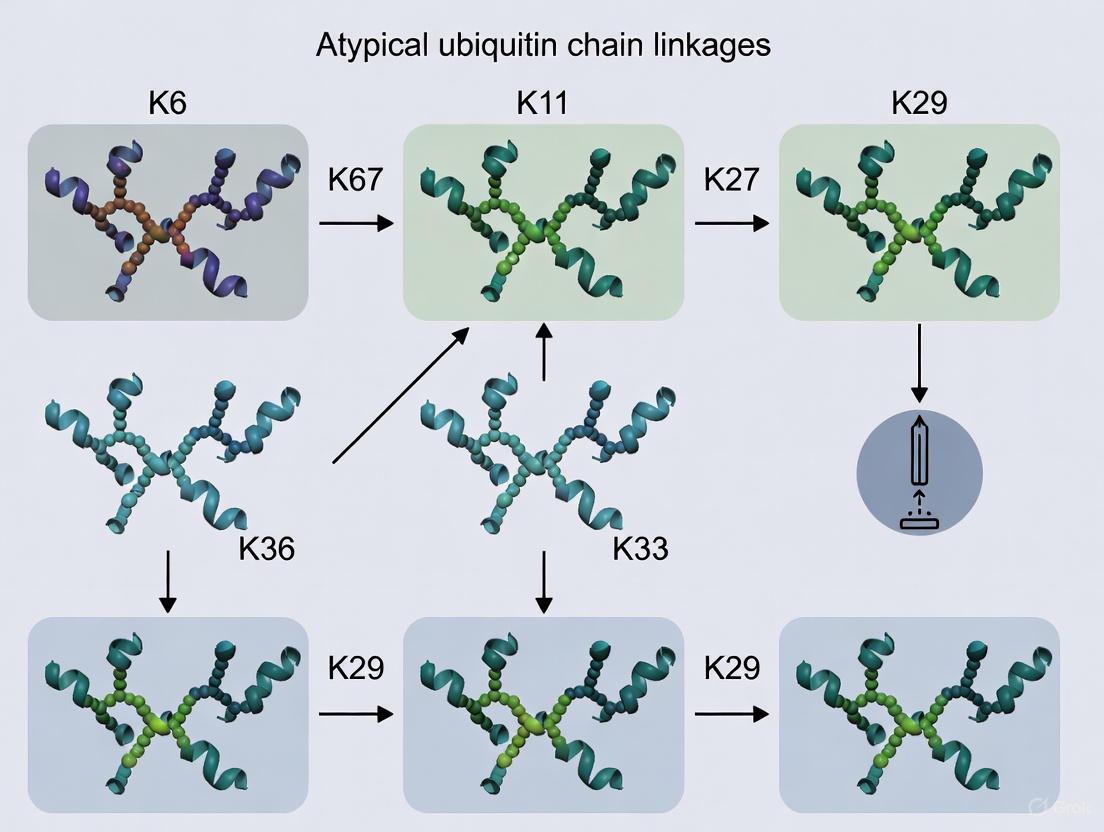
This article provides a comprehensive exploration of atypical ubiquitin chain linkages (K6, K11, K27, K29, K33), targeting researchers, scientists, and drug development professionals.
Decoding Atypical Ubiquitin Chains: K6, K11, K27, K29, K33 Functions in Cellular Regulation and Disease
Abstract
This article provides a comprehensive exploration of atypical ubiquitin chain linkages (K6, K11, K27, K29, K33), targeting researchers, scientists, and drug development professionals. It covers foundational knowledge on their discovery and biological roles, methodological advances for studying and applying these chains in research, troubleshooting common experimental challenges, and validation through comparative analysis with canonical chains. The scope integrates insights from recent studies to highlight implications for understanding disease mechanisms and developing targeted therapies.
Exploring the Biology of Atypical Ubiquitin Chains: K6, K11, K27, K29, and K33
Ubiquitination is a crucial post-translational modification that regulates virtually every cellular process in eukaryotic cells, ranging from protein degradation and DNA repair to immune signaling and cell cycle progression [1] [2]. This remarkable versatility stems from the ability of ubiquitin—a 76-amino acid protein—to form diverse polymeric chains through eight distinct linkage types [3] [4]. While the functions of K48-linked (proteasomal degradation) and K63-linked (DNA repair, signaling) chains are well-established, the so-called "atypical" ubiquitin chains (K6, K11, K27, K29, K33, and linear/Met1) have remained less characterized until recently [5] [6]. This technical guide provides a comprehensive overview of ubiquitin chain linkage diversity, with particular emphasis on the emerging roles and unique properties of atypical chains, experimental methodologies for linkage determination, and the enzymatic machinery governing chain assembly and disassembly.
Ubiquitin contains seven lysine residues (K6, K11, K27, K29, K33, K48, K63) and an N-terminal methionine (M1) that can be utilized for polyubiquitin chain formation [4]. The specific linkage type directs the modified protein to different cellular fates and signaling outcomes [3]. All eight linkage types have been detected in vivo and differentially affect numerous cellular processes, signaling pathways, and disease states [3].
Table 1: Ubiquitin Chain Linkage Types and Their Known Functions
| Linkage Type | Known Major Functions | Cellular Processes |
|---|---|---|
| K48 | Target proteins for proteasomal degradation [7] | Protein turnover, cell cycle regulation |
| K63 | Non-degradative roles in intracellular trafficking, kinase signaling, DNA damage response [6] [1] | DNA repair, endocytosis, inflammation |
| K6 | DNA damage response, mitophagy, mitochondrial regulation [6] | Mitochondrial quality control, DNA repair |
| K11 | Cell cycle regulation, endoplasmic reticulum-associated degradation (ERAD) [4] | Mitotic regulation, protein quality control |
| K27 | Mitochondrial trafficking, innate immunity regulation, resists deubiquitination [4] [5] | Innate immune signaling, mitochondrial dynamics |
| K29 | Wnt/β-catenin signaling, mRNA stability regulation [4] | Growth and development, mRNA decay |
| K33 | Regulation of T-cell receptor signaling, actin stabilization [4] | Immune response, cytoskeletal organization |
| Linear/M1 | Immune signaling, NF-κB activation, inflammation regulation [5] [8] | Innate immunity, cell death decisions |
The structural properties of each chain type create distinct molecular surfaces that are specifically recognized by downstream effector proteins containing ubiquitin-binding domains (UBDs), enabling the translation of the ubiquitin code into specific physiological responses [4] [2].
Atypical Ubiquitin Chains: Emerging Roles and Functions
K6-Linked Chains
K6-linked ubiquitination has been linked to DNA repair processes, particularly in the context of the BRCA1-BARD1 ubiquitin ligase complex and its associated substrates [4]. Recent studies have also implicated K6 chains in mitochondrial quality control, where they are assembled by the RBR E3 ubiquitin ligase Parkin to promote mitophagy [6]. Additionally, the HECT E3 ligase HUWE1 has been identified as a major source of cellular K6 chains, modifying mitofusin-2 (Mfn2) with K6-linked polyubiquitin to regulate mitochondrial dynamics [6].
K11-Linked Chains
K11-linked chains play important roles in cell cycle regulation and ERAD [4]. During mitosis, K11 linkages interact with the Npl4 adaptor protein in Drosophila development and are essential for proper cell division [4]. The anaphase-promoting complex/cyclosome (APC/C), a key regulator of cell cycle progression, predominantly assembles K11-linked chains to target cyclins and other cell cycle regulators for degradation [1].
K27-Linked Chains
K27-linked ubiquitin chains exhibit unique biochemical properties that distinguish them from all other ubiquitin linkages [4]. Notably, K27-Ub2 is not cleaved by most deubiquitinases (DUBs), including linkage-non-specific enzymes such as USP2, USP5, and Ubp6 [4]. This resistance to deubiquitination allows K27 chains to act as competitive inhibitors of DUB activity toward other linkages [4]. Functionally, K27 linkages are observed on mitochondrial trafficking protein Miro1, where they slow down its degradation by the proteasome and serve as markers of mitochondrial damage [4]. K27 chains also play significant roles in regulating antiviral innate immune responses [5].
K29 and K33-Linked Chains
K29-linked chains participate in growth and development-associated pathways, including Wnt/β-catenin signaling, and are implicated in regulation of mRNA stability via recognition by the adaptor protein UBXD8 [4]. K33-linked polyubiquitination regulates T-cell receptor-ζ function by governing its phosphorylation and protein binding profiles, and contributes to the stabilization of actin for post-Golgi transport [4].
Linear/M1-Linked Chains
Linear ubiquitin chains are exclusively generated by the linear ubiquitin chain assembly complex (LUBAC), which consists of HOIP, HOIL-1L, and SHARPIN subunits [9] [8]. Unlike other ubiquitin linkages, linear chains are formed through a peptide bond between the amino-terminal methionine of one ubiquitin and the carboxy-terminal glycine of the next ubiquitin molecule [8]. LUBAC-generated linear chains play essential roles in immune signaling pathways, particularly in TNF receptor 1 (TNFR1) signaling, where they facilitate NF-κB activation and regulate cell death decisions [8]. Recent research has revealed that LUBAC can generate heterotypic ubiquitin chains containing linear linkages with oxyester-linked branches, depending on HOIL-1L catalytic activity [9].
Table 2: Atypical Ubiquitin Chains in Disease Processes
| Chain Type | Associated Diseases | Key Regulatory Proteins |
|---|---|---|
| K6 | Cancer, Parkinson's disease [6] | Parkin, HUWE1, RNF144A/B |
| K11 | Cancer, developmental disorders [4] | APC/C, Cezanne (OTUD7B) |
| K27 | Cancer, autoimmune disorders, viral infection [4] [5] | TRIM23, LMP7, UBE2J1 |
| K29 | Neurodegenerative diseases, cancer [4] | HUWE1, UBE3A, EDD1 |
| K33 | Autoimmune disease, cancer [4] | TRIM21, TRAF6 |
| Linear/M1 | Autoimmunity, immunodeficiency, cancer [9] [8] | LUBAC (HOIP, HOIL-1L, SHARPIN) |
Experimental Approaches for Studying Ubiquitin Chain Linkage
Determining Ubiquitin Chain Linkage Using Mutant Approaches
A powerful method for determining ubiquitin chain linkage involves performing in vitro ubiquitin conjugation reactions utilizing ubiquitin lysine mutants [3]. This approach requires two sets of nine reactions: one utilizing seven Ubiquitin Lysine to Arginine (K to R) Mutants and another utilizing seven Ubiquitin K Only Mutants [3].
The experimental workflow consists of the following steps:
- Set up conjugation reactions: Prepare reactions containing E1 enzyme, E2 enzyme, E3 ligase, 10X E3 Ligase Reaction Buffer, MgATP Solution, substrate, and different ubiquitin variants (wild-type, K-to-R mutants, or K-only mutants) [3].
- Incubation: Incubate reactions at 37°C for 30-60 minutes [3].
- Termination: Terminate reactions using SDS-PAGE sample buffer (for direct analysis) or EDTA/DTT (if using products for downstream applications) [3].
- Analysis: Analyze ubiquitin conjugation reactions by Western blot using an anti-ubiquitin antibody [3].
The Ubiquitin K to R Mutants are used to identify the lysine(s) being utilized for ubiquitin chain linkage. The conjugation reaction containing the Ubiquitin K to R Mutant lacking the lysine required for chain linkage will not be able to form chains, resulting in only mono-ubiquitination observed by Western blot [3]. For example, if ubiquitin chains are linked via K63, then all conjugation reactions except the one containing the Ubiquitin K63R Mutant should yield ubiquitin chains [3].
The Ubiquitin K Only Mutants (containing only one lysine with the remaining six mutated to arginine) are then used to verify ubiquitin chain linkage. Using K63-linked chains as an example, only the conjugation reactions containing wild-type ubiquitin and the Ubiquitin K63 Only Mutant will yield ubiquitin chains [3].
Linkage-Specific Reagents
The development of linkage-specific affinity reagents has significantly advanced the study of atypical ubiquitin chains. Affimers are 12-kDa non-antibody scaffolds based on the cystatin fold that can be engineered for high-affinity, linkage-specific ubiquitin chain recognition [6]. For example, K6-specific affimers recognize K6-diUb with high linkage specificity and have been successfully used in western blotting, confocal fluorescence microscopy, and pull-down applications [6]. Crystal structures of affimers bound to their cognate diUb reveal that they achieve linkage specificity through dimerization that provides two binding sites for ubiquitin I44 patches with a defined distance and relative orientation [6].
Additionally, specialized reagent kits are commercially available for studying atypical ubiquitin chains. For instance, the Panel Customized Ubiquitin Chain Kit (SI200) from LifeSensors provides a convenient collection of all eight possible di-ubiquitin molecules (including K6, K11, K27, K29, K33, K48, K63, and linear linkages) for determining the linkage-specific activity of individual deubiquitylating enzymes (DUBs) [10].
Table 3: Key Research Reagent Solutions for Ubiquitin Chain Analysis
| Reagent Type | Specific Example | Function/Application | Key Features |
|---|---|---|---|
| Ubiquitin Mutants | Ubiquitin K-to-R Mutants; Ubiquitin K-Only Mutants [3] | Determine ubiquitin chain linkage in conjugation assays | Identify and verify specific lysine linkages |
| Linkage-Specific Affimers | K6-specific affimer; K33/K11-specific affimer [6] | Detect specific chain types in blotting, microscopy, pull-downs | High-affinity, linkage-specific recognition |
| Di-Ubiquitin Kits | Panel Customized Ubiquitin Chain Kit (SI200) [10] | Study linkage-specific DUB activity; substrate specificity | Complete panel of all 8 linkage types |
| E2 Enzymes | Specific E2 conjugating enzymes [1] | Determine linkage specificity in chain assembly | Often dictate chain linkage type in RING E3 systems |
| DUBs | Linkage-specific deubiquitinases (e.g., Cezanne for K11) [4] | Probe chain linkage specificity; validate chain identity | Cleave specific ubiquitin linkage types |
Enzymatic Machinery of Ubiquitin Chain Assembly and Disassembly
The Ubiquitination Cascade
Protein ubiquitination is catalyzed by a sequential enzymatic cascade involving E1 (ubiquitin-activating), E2 (ubiquitin-conjugating), and E3 (ubiquitin-ligating) enzymes [1] [7]. The human genome encodes approximately 40 E2s and over 600 E3s, enabling tremendous specificity in substrate recognition and modification [1]. E3 ubiquitin ligases fall into three mechanistic classes: RING (really interesting new gene)/U-box, HECT (homologous to E6AP C-terminus), and RBR (RING-between-RING) ligases [1]. RING/U-box ligases catalyze the direct transfer of ubiquitin from a thioester-linked E2-ubiquitin conjugate to a substrate, while HECT and RBR ligases proceed through a two-step mechanism involving an E3-ubiquitin thioester intermediate [1].
The choice of E2 enzyme often determines the type of ubiquitin chain assembled, particularly in RING E3 systems [1]. However, there are notable exceptions to this rule, such as LUBAC, where the E3 complex determines the linkage type (linear) [8]. Some E2-E3 pairs specialize in chain initiation (monoubiquitination or the first ubiquitin in a chain), while others act as chain elongators [1].
Deubiquitinating Enzymes (DUBs)
Deubiquitinating enzymes (DUBs) antagonize E3 activity by cleaving isopeptide bonds between ubiquitin moieties or between ubiquitin and target proteins [4] [1]. The approximately 100 human DUBs are categorized into seven families: ubiquitin C-terminal hydrolases (UCHs), ubiquitin-specific proteases (USPs), Machado-Josephins (MJDs), ovarian tumor proteases (OTUs), JAB1/MPN domain-associated metalloisopeptidases (JAMM/MPN+), MINDY, and ZUFSP [1]. Some DUBs exhibit remarkable linkage specificity; for example, Cezanne preferentially cleaves K11-linked chains, OTUB1 selectively cleaves K48-linked chains, and AMSH specifically cleaves K63-linked chains [4]. Strikingly, K27-linked ubiquitin chains resist cleavage by most DUBs, including linkage-non-specific enzymes such as USP2, USP5, and Ubp6 [4].
The diversity of ubiquitin chain linkages represents a sophisticated post-translational regulatory code that expands the functional repertoire of ubiquitin far beyond its initial characterization as a degradation signal. The atypical ubiquitin chains (K6, K11, K27, K29, K33, and linear) play particularly important roles in specialized cellular processes, including immune signaling, mitochondrial regulation, and cell cycle control. Continued development of innovative research tools—including linkage-specific affimers, ubiquitin mutants, and specialized detection kits—is progressively unveiling the unique functions and regulatory mechanisms of these atypical ubiquitin modifications. As our understanding of the ubiquitin code deepens, particularly regarding the less-studied atypical linkages, new opportunities will emerge for therapeutic intervention in cancer, neurodegenerative diseases, immune disorders, and infectious diseases through targeted manipulation of specific ubiquitin signaling pathways.
Historical Discovery and Characterization of Atypical Linkages
Protein ubiquitination, the covalent attachment of the 76-amino acid protein ubiquitin to substrate proteins, represents one of the most versatile post-translational modifications in eukaryotic cells. For decades, research primarily focused on two ubiquitin chain linkage types: K48-linked chains, widely recognized as the principal signal for proteasomal degradation, and K63-linked chains, known for their roles in DNA repair, signaling, and endocytosis [11] [12]. However, the ubiquitin code is far more complex. Ubiquitin contains seven lysine residues (K6, K11, K27, K29, K33, K48, K63), all of which can form polyubiquitin chains, in addition to the N-terminal methionine (M1) that can form linear chains [4] [12].
The historical perception of ubiquitin signaling was dominated by K48 and K63 linkages, while the other five "atypical" linkages (K6, K11, K27, K29, K33) remained largely unexplored until recent technological advances enabled their specific study. These atypical linkages, though less abundant, have emerged as critical regulators of diverse cellular processes, including cell cycle progression, DNA damage repair, mitophagy, and innate immune signaling [11] [4] [13]. This whitepaper traces the historical discovery and characterization of these atypical ubiquitin linkages, providing researchers with a comprehensive technical guide to their functions, study methodologies, and relevance to therapeutic development.
Historical Context and the Expansion of the Ubiquitin Code
The discovery of the broader ubiquitin code unfolded progressively through key technological and conceptual advances. The initial paradigm, established in the 1980s, identified K48-linked ubiquitin chains as the canonical signal for proteasomal degradation. The subsequent discovery of K63-linked chains in the 1990s revealed that ubiquitination could function beyond protein degradation [12]. This pivotal finding challenged the existing dogma and suggested that ubiquitin could form structurally and functionally distinct polymers.
The systematic exploration of the entire ubiquitin code gained momentum in the early 21st century with several key developments. The advent of advanced mass spectrometry techniques enabled researchers to quantitatively profile all ubiquitin linkage types in cells, revealing that atypical linkages, while less abundant, are consistently present and dynamically regulated [11] [12]. Furthermore, the development of linkage-specific antibodies for certain atypical chains and innovative chemical biology approaches for generating defined ubiquitin chains of every possible linkage provided the essential tools to probe their structures and functions [4] [12].
Table: Historical Timeline of Key Discoveries in Atypical Ubiquitin Linkages
| Time Period | Key Discovery/Advance | Impact on the Field |
|---|---|---|
| Pre-2000 | Establishment of K48 (degradation) and K63 (signaling) as functional ubiquitin linkages | Created a foundational but incomplete paradigm of ubiquitin signaling |
| Early 2000s | Development of mass spectrometry methods to identify endogenous atypical linkages | Provided evidence that all seven lysine-based linkages exist in cells |
| ~2010 | Development of enzymatic and chemical methods to synthesize homogeneous atypical chains | Enabled in vitro biochemical and structural studies of pure linkage types |
| 2010-2015 | Identification of specific E2/E3 enzymes and DUBs for some atypical linkages | Established that the synthesis and recognition of atypical chains are specific and regulated |
| 2015-Present | Functional dissection in cellular models (e.g., DNA repair, immunity, cell cycle) | Revealed critical non-redundant physiological roles for atypical linkages |
Characterization of Individual Atypical Linkages
K6-Linked Ubiquitination
K6-linked ubiquitination was initially characterized in the context of DNA damage response (DDR) and mitophagy. Pioneering studies identified the BRCA1-BARD1 complex, a major DDR ubiquitin ligase, as capable of assembling K6-linked auto-ubiquitination chains [11]. Subsequent work demonstrated the formation of K6-linked chains during replication stress and the repair of double-strand breaks [11].
A major functional role for K6 linkages emerged from research on Parkin-mediated mitophagy. Upon mitochondrial damage, the activated Parkin ligase decorates proteins on the outer mitochondrial membrane with various ubiquitin chains, including K6, K11, K48, and K63 linkages [11]. Among these, K6 and K63 chains are particularly important in designating damaged mitochondria for autophagic clearance. This process is finely tuned by deubiquitinases (DUBs) such as USP30, which antagonizes Parkin by preferentially cleaving K6-linked chains, positioning USP30 as a potential therapeutic target for neurodegenerative disorders like Parkinson's disease [11].
More recent findings also implicate K6-linked ubiquitination in innate immune signaling. During viral infection, the transcription factor IRF3 is modified with K6-linked chains, enhancing its DNA-binding affinity and promoting the transcription of type I interferons. This activity is negatively regulated by the DUB OTUD1 [11].
K11-Linked Ubiquitination
K11-linked chains are best known for their role in regulating the cell cycle and facilitating proteasomal degradation. The principal E3 ligase responsible for K11 linkage formation in mitosis is the Anaphase-Promoting Complex/Cyclosome (APC/C) [11]. In cooperation with the E2 enzymes UBE2C/UbcH10 and UBE2S, the APC/C builds K11-linked chains, often as mixed or branched chains with K48 linkages, on substrates such as cyclins, targeting them for degradation to ensure orderly cell cycle progression [11]. Cells depleted of these E2 enzymes display impaired APC/C activity and stabilized mitotic substrates, underscoring the critical nature of K11 ubiquitination in cell division [11].
While K11 and K48 homotypic chains can initiate degradation independently, their combination into branched chains significantly enhances substrate recognition and processing by the proteasome, illustrating the complexity of the ubiquitin code [11]. Beyond the cell cycle, K11 linkages also play roles in ER-associated degradation (ERAD) and the innate immune response, where the E3 ligase RNF26 uses K11 chains to stabilize STING and potentiate type I interferon production [14].
K27-Linked Ubiquitination
K27-linked chains are among the least characterized but have recently been linked to critical cellular processes. A defining biochemical characteristic of K27-linked diubiquitin (K27-Ub2) is its resistance to hydrolysis by a broad range of deubiquitinases (DUBs), including the linkage-nonspecific USP2, USP5, and Ubp6 [4]. This uniqueness suggested a specialized structural and functional role.
Functionally, K27 linkages have been implicated in the DNA damage response and innate immune signaling [4]. Furthermore, a landmark 2022 study demonstrated that K27-linked ubiquitylation is essential for human cell proliferation [13]. Using a sophisticated ubiquitin replacement strategy, researchers showed that selectively abrogating K27-linked ubiquitylation causes severe proliferation defects and deregulates nuclear ubiquitylation dynamics. K27 chains were found to be predominantly nuclear and function epistatically with the p97/VCP ATPase in processing ubiquitylated nuclear proteins, identifying a critical functional niche for this atypical linkage [13].
K29 and K33-Linked Ubiquitination
The functions of K29 and K33 linkages are less established but point toward non-proteolytic regulatory roles.
- K29-linked chains have been associated with proteasomal degradation in some contexts, akin to K48 and K11 linkages [15]. They also participate in the Wnt/β-catenin signaling pathway, which is crucial for growth and development, and in regulating mRNA stability through the adaptor protein UBXD8 [4].
- K33-linked chains are known to regulate kinase activity and signal transduction. For instance, they control the activity of the T-cell receptor-ζ by modulating its phosphorylation and protein-binding profiles [4]. Furthermore, K33-linked polyubiquitination contributes to the stabilization of actin, thereby facilitating post-Golgi transport [4]. In innate immunity, the DUB USP38 removes K33 chains from TBK1, preventing its degradation and promoting IRF3 activation [14].
Table: Functional Roles and Associated Enzymes of Atypical Ubiquitin Linkages
| Linkage | Key Physiological Functions | Representative E3 Ligases | Representative DUBs |
|---|---|---|---|
| K6 | DNA Damage Response, Mitophagy, Innate Immunity | Parkin, BRCA1-BARD1, HUWE1 | USP30, USP8, OTUD1 |
| K11 | Cell Cycle Regulation, ERAD, Innate Immunity | APC/C (with E2s UBE2C, UBE2S) | Cezanne |
| K27 | Cell Proliferation, p97-substrate processing, Innate Immunity, DNA Repair | Not well characterized; several TRIM proteins implicated (e.g., TRIM23) | Resistant to most DUBs; specific DUBs not fully defined |
| K29 | Wnt Signaling, mRNA Stability, Proteasomal Degradation (context-dependent) | KIAA10, UBR4/UBR5 | — |
| K33 | Kinase Regulation, TCR Signaling, Trafficking | — | USP38 |
Structural and Biophysical Characterization
Structural studies have been instrumental in understanding how the different ubiquitin linkages dictate unique functional outcomes. A seminal finding was that each linkage type confers a unique conformational landscape to the polyubiquitin chain, which is specifically recognized by ubiquitin-binding domains (UBDs) in downstream effector proteins [16] [4].
Research using NMR spectroscopy and small-angle neutron scattering on diubiquitin of all linkage types revealed that K27-Ub2 is a unique case. It exhibits minimal non-covalent interdomain contacts but shows the largest chemical shift perturbations in the proximal ubiquitin unit among all chains, suggesting a distinct structural dynamic [4]. Computational modeling of the binding landscapes of different diubiquitins proposed that the topological constraint of the covalent linkage breaks the binding symmetry and selects for specific local interactions to achieve functional specificity [16]. The energy landscape further varies between linkages; for instance, hydrophobic interactions dominate in K6-, K11-, K33-, and K48-diUb, while electrostatic interactions are more important for K27, K29, K63, and linear linkages [16].
These structural insights explain functional observations. The compact conformations of K11-linked chains, for example, make them preferential substrates for the DUB Cezanne [17]. Conversely, the unique, constrained conformation of K27-linked chains makes them poor substrates for most DUBs and allows for specific recognition, such as the unanticipated binding by the UBA2 domain of the proteasomal shuttle protein hHR23a, a domain previously thought to be K48-specific [4].
Diagram: The unique structural and dynamic features of K27-linked ubiquitin chains underpin their distinct functional consequences, including DUB resistance and essential roles in cell proliferation. CSPs: Chemical Shift Perturbations; DUBs: Deubiquitinases.
Methodologies for Studying Atypical Linkages
Key Experimental Workflows
The study of atypical ubiquitin linkages has been propelled by specialized methodologies that overcome the challenges of their low abundance and lack of specificity in native enzymatic pathways.
1. Non-Enzymatic Diubiquitin Synthesis: A breakthrough method for biochemical and structural studies involves the chemical synthesis of fully natural diubiquitin chains with native isopeptide linkages. This strategy uses mutually orthogonal, removable amine-protecting groups (Alloc and Boc) to allow for the selective formation of any desired lysine linkage without the need for linkage-specific E2/E3 pairs [4]. This workflow was critical for producing homogeneous K27-, K29-, and K33-linked chains for the first structural and DUB-activity studies.
2. Conditional Ubiquitin Replacement in Cells: To define the cellular function of a specific linkage, a powerful genetic strategy has been developed. This two-step process involves:
- Creating a parent cell line (e.g., U2OS/shUb) with doxycycline (DOX)-inducible shRNAs targeting all four endogenous ubiquitin genes.
- Engineering these cells to inducibly express a ubiquitin mutant where a single lysine is mutated to arginine (e.g., K27R), which prevents chain formation via that residue.
Upon DOX treatment, endogenous Ub is depleted and replaced by the mutant Ub, allowing researchers to observe the phenotypic consequences of ablating a single linkage type without overexpression artifacts. This method was used to demonstrate the essential role of K27 linkages in cell proliferation [13].
Diagram: Conditional ubiquitin replacement workflow for studying the function of specific ubiquitin linkages in human cells.
The Scientist's Toolkit: Essential Research Reagents
Table: Key Reagents and Tools for Atypical Ubiquitin Linkage Research
| Reagent/Tool | Function/Description | Key Application |
|---|---|---|
| Linkage-Defective Ub Mutant (Ub K->R) | A ubiquitin gene with a specific lysine (K) mutated to arginine (R). Prevents chain formation via that lysine. | Used in ubiquitin replacement strategies to abrogate a specific linkage type in cells and study the resulting phenotype [13]. |
| Chemically Synthesized DiUb/TriUb | Homogeneous ubiquitin chains of defined linkage, synthesized via non-enzymatic chemical biology approaches. | Essential for in vitro biochemical studies, structural determination (NMR, X-ray), and profiling DUB specificity [4]. |
| Linkage-Specific DUBs (e.g., Cezanne) | Deubiquitinases with a known preference for cleaving a specific atypical linkage (e.g., Cezanne for K11). | Used as reagents to detect, validate, and manipulate specific chain types in complex mixtures and cell lysates [4]. |
| Linkage-Specific Binders (e.g., UCHL3) | Proteins or engineered domains with high affinity for a specific linkage topology (e.g., UCHL3 for K27). | Can be used to pull down endogenous chains for identification or to competitively inhibit linkage-specific signaling in cells [13]. |
| Tandem Ubiquitin-Binding Entities (TUBEs) | Engineered arrays of ubiquitin-associated (UBA) domains that bind polyUb chains with high affinity, protecting them from DUBs. | Used to enrich and purify endogenous polyubiquitinated proteins from cell extracts for downstream analysis. |
The historical journey from a binary view of ubiquitin signaling to the appreciation of a complex and multifaceted ubiquitin code represents a major paradigm shift in cell biology. The characterization of atypical ubiquitin linkages (K6, K11, K27, K29, K33) has revealed them to be independent post-translational modifications with non-redundant and essential functions in cell proliferation, stress response, organelle quality control, and immunity [11] [13] [14].
Future research will focus on addressing several remaining challenges. There is a pressing need to identify the full complement of E2 and E3 enzymes responsible for assembling each atypical chain type, as well as the DUBs that reverse these modifications. Furthermore, understanding the prevalence and function of heterotypic and branched chains that incorporate atypical linkages will be crucial to fully decipher the ubiquitin code [18] [12]. The development of high-affinity linkage-specific antibodies for all atypical chains remains a key technical goal, which would greatly facilitate the monitoring of these modifications in physiological and disease contexts.
From a therapeutic perspective, components of the atypical ubiquitin system present novel drug targets. For instance, USP30 inhibitors are being explored for Parkinson's disease to enhance the clearance of damaged mitochondria, while p97 inhibitors are in preclinical development for cancer, a pathway intimately linked with K27-linked ubiquitination [11] [13]. As our knowledge of the physiological roles of atypical linkages deepens, so too will the opportunities for innovative therapeutic interventions targeting this complex and vital regulatory system.
Cellular Functions and Biological Roles of K6, K11, K27, K29, and K33 Chains
Ubiquitination represents one of the most pivotal post-translational modifications in eukaryotic cells, with the topology of polyubiquitin chains directly determining functional outcomes. While K48- and K63-linked chains have been extensively characterized, the so-called "atypical" ubiquitin linkages—K6, K11, K27, K29, and K33—have emerged as critical regulators of diverse cellular processes. This technical review synthesizes current understanding of these atypical chains, detailing their roles in mitochondrial quality control, cell cycle regulation, immune signaling, DNA damage response, and transcriptional regulation. We provide comprehensive experimental methodologies for studying these linkages, visualize key signaling pathways, and catalog essential research tools. The expanding knowledge of atypical ubiquitin chains opens new avenues for therapeutic intervention in cancer, neurodegenerative disorders, and immune diseases, presenting novel targets for drug development professionals.
Protein ubiquitination involves the covalent attachment of the 76-amino acid protein ubiquitin to substrate proteins via a three-enzyme cascade comprising ubiquitin-activating (E1), conjugating (E2), and ligase (E3) enzymes [11]. Ubiquitin itself contains seven lysine residues (K6, K11, K27, K29, K33, K48, K63) and an N-terminal methionine (M1) that can serve as linkage points for polyubiquitin chain formation, creating a complex "ubiquitin code" that determines specific cellular outcomes [11] [19]. The atypical ubiquitin chains (K6, K11, K27, K29, and K33) are less abundant than their K48 and K63 counterparts but have been shown to mediate crucial non-degradative functions alongside proteasomal targeting [11] [6].
The unique structural and dynamical properties of each linkage type enable specific recognition by ubiquitin-binding domains (UBDs), which decode the ubiquitin signal into appropriate cellular responses [4]. For instance, K27-linked ubiquitin chains exhibit exceptional resistance to deubiquitinases (DUBs), while K11-linked chains often form mixed chains with K48 linkages to enhance proteasomal degradation [11] [4]. Understanding the distinct functions and recognition patterns of these atypical chains provides critical insights into their roles in cellular homeostasis and disease pathogenesis.
Comprehensive Functional Analysis of Atypical Ubiquitin Linkages
K6-Linked Ubiquitin Chains
K6-linked ubiquitination has been primarily implicated in mitochondrial quality control and the DNA damage response [11] [6]. In mitophagy, the E3 ligase Parkin decorates damaged outer mitochondrial membrane proteins with K6, K11, K48, and K63-linked chains upon mitochondrial depolarization, with K6 and K63 linkages particularly promoting autophagic processing [11]. This process is antagonized by the deubiquitinase USP30, which shows preferential activity toward K6-linked chains and serves as a key regulatory checkpoint [11] [6]. Beyond mitochondrial homeostasis, K6-linked chains play significant roles in genome maintenance, with the BRCA1-BARD1 complex exhibiting K6-linked auto-ubiquitination and HUWE1 generating substantial K6-linked species upon inhibition of VCP/p97 [11] [6]. Recent findings also identify K6-linked ubiquitination of transcription factor IRF3 as a critical enhancer of antiviral innate immunity, promoting IRF3 binding to type I interferon promoters [11].
Table 1: Key Proteins Regulating K6-Linked Ubiquitination
| Protein | Function | Biological Context | References |
|---|---|---|---|
| Parkin | E3 Ligase | Mitophagy, Mitochondrial Quality Control | [11] |
| HUWE1 | E3 Ligase | DNA Damage Response, Mfn2 Regulation | [11] [6] |
| USP30 | Deubiquitinase | Mitochondrial Outer Membrane, Antagonizes Parkin | [11] |
| USP8 | Deubiquitinase | Removes K6 chains from Parkin | [11] |
| UBE4A | E3/E4 Ligase | Viperin Degradation, Antiviral Response | [11] |
| OTUD1 | Deubiquitinase | Deubiquitinates IRF3, Limits Innate Immunity | [11] |
K11-Linked Ubiquitin Chains
K11-linked ubiquitin chains are principally associated with cell cycle regulation and proteasomal degradation, often functioning in concert with K48-linked chains [11]. The anaphase-promoting complex/cyclosome (APC/C), a multi-subunit E3 RING ligase, coordinates mitosis and meiosis by attaching K11/K48 mixed chains to substrates destined for proteasomal turnover [11]. The E2 enzyme UBE2S specifically generates K11-linked branch-offs in cooperation with APC/C, and cells depleted of both UbcH10 and UBE2S exhibit impaired APC/C activity and stabilization of APC/C substrates [11]. Beyond cell cycle control, K11 linkages regulate innate immune signaling through RNF26-mediated ubiquitination of STING, which inhibits STING degradation and potentiates type I interferon production [20]. Additionally, K11- and K48-linked chains on Beclin-1 promote its proteasomal degradation, thereby limiting autophagy and enhancing type I IFN response, a process reversed by the DUB USP19 [20].
K27-Linked Ubiquitin Chains
K27-linked ubiquitin chains display unique biochemical properties, including resistance to most deubiquitinases, which contributes to their specialized functions in immune regulation and organelle maintenance [4]. The E3 ligase TRIM23 conjugates K27-linked chains to NEMO (NF-κB essential modulator), facilitating activation of NF-κB and IRF3 upon RIG-I-like receptor (RLR) signaling [20]. These K27-linked chains on NEMO serve as platforms for recruiting regulatory proteins such as Rhbdd3, which subsequently recruits A20 to remove K63-linked chains and prevent excessive NF-κB activation [20]. K27 linkages also appear on mitochondrial trafficking protein Miro1, slowing its proteasomal degradation and serving as a marker of mitochondrial damage [4]. Structural analyses reveal that K27-linked di-ubiquitin (K27-Ub2) exhibits no noncovalent interdomain contacts and displays the largest chemical shift perturbations among atypical linkages, potentially explaining its unique recognition properties [4].
Table 2: Functional Roles of K27, K29, and K33-linked Ubiquitin Chains
| Linkage Type | Cellular Functions | Regulatory Proteins | Key Substrates |
|---|---|---|---|
| K27 | Innate Immune Signaling, Mitochondrial Quality Control | TRIM23 (E3), Rhbdd3, A20 | NEMO, Miro1 |
| K29 | Proteasomal Degradation, Growth Factor Signaling | UBR5 (E3), UBXD8 (Adapter) | DELLA Proteins, mRNA Stability Factors |
| K33 | Kinase Regulation, Intracellular Trafficking | Unknown E3s | T-cell Receptor-ζ, Actin |
K29 and K33-Linked Ubiquitin Chains
K29-linked ubiquitin chains participate in growth and development-associated pathways, including Wnt/β-catenin signaling, and contribute to proteasomal degradation in specific contexts [4]. In plants, K29-linked chains target DELLA proteins, growth repressors involved in gibberellic acid response, for proteasomal degradation [19]. K29 linkages also regulate mRNA stability through recognition by the adaptor protein UBXD8 [4]. K33-linked chains primarily function in kinase regulation and intracellular trafficking, modulating T-cell receptor-ζ function by governing its phosphorylation and protein binding profiles [4]. Additionally, K33 polyubiquitination contributes to stabilization of actin for post-Golgi transport, highlighting its role in cytoskeletal organization and vesicular trafficking [4]. While less characterized than other atypical linkages, emerging evidence suggests both K29 and K33 chains play roles in regulating innate immune responses, though the specific mechanisms remain under investigation [20].
Experimental Methodologies for Studying Atypical Ubiquitin Chains
Linkage-Specific Affimer Reagents
The development of linkage-specific affinity reagents has been instrumental in advancing the study of atypical ubiquitin chains. Affimers are 12-kDa non-antibody scaffolds based on the cystatin fold, in which randomization of surface loops enables generation of large libraries (10^10) for selection of high-affinity binders [6]. For K6-linked chain detection, affimers are characterized using isothermal titration calorimetry (ITC) and surface plasmon resonance (SPR) to confirm linkage specificity and binding affinity. Crystal structures of affimer-diUb complexes reveal that specificity is achieved through affimer dimerization, creating two binding sites for Ub I44 patches with defined distance and orientation [6]. Site-specifically biotinylated K6 affimers enable western blotting, confocal fluorescence microscopy, and pull-down applications, with demonstrated utility in identifying HUWE1 as a major E3 ligase for K6 chains and confirming mitofusin-2 (Mfn2) as a K6-linked ubiquitination substrate [6].
Non-enzymatic Di-ubiquitin Synthesis
Chemical, non-enzymatic assembly methods utilizing mutually orthogonal removable amine-protecting groups (Alloc and Boc) allow production of fully natural di-ubiquitins (Ub2s) with native isopeptide linkages for all atypical chain types [4]. This approach involves:
- Selective protection of specific lysine residues using orthogonal protecting groups
- Sequential peptide coupling to build defined ubiquitin chains
- Global deprotection to generate native isopeptide linkages
- Purification using HPLC and confirmation by mass spectrometry
The resulting linkage-defined di-ubiquitins enable biochemical and structural studies, including deubiquitinase specificity profiling and NMR analysis to characterize chain conformation and dynamics [4].
Structural Characterization Techniques
Nuclear Magnetic Resonance (NMR) Spectroscopy provides atom-specific information on Ub2 conformational dynamics. Experiments involve collecting 1H-15N NMR spectra separately for each Ub unit (uniformly 15N-enriched) in K6, K11, K27, K29, K33, and K48-Ub2 [4]. Chemical shift perturbations (CSPs) between distal or proximal Ub and monoUb quantify interdomain interactions and linkage-specific structural features.
Small-Angle Neutron Scattering (SANS) with in silico ensemble modeling determines solution-state structures and population distributions of different conformational states, particularly valuable for flexible chains like K27-Ub2 [4].
X-ray Crystallography of affimer-diUb complexes reveals molecular mechanisms of linkage specificity, showing how engineered protein scaffolds mimic naturally occurring linkage-specific UBDs [6].
Research Reagent Solutions
Table 3: Essential Research Reagents for Studying Atypical Ubiquitin Chains
| Reagent/Tool | Specificity | Applications | Key Features |
|---|---|---|---|
| K6-Linkage-Specific Affimer | K6-diUb | Western Blotting, Confocal Microscopy, Pull-downs | High affinity (ITC confirmed), Crystal structure available |
| K33/K11-Linkage-Specific Affimer | K33- and K11-diUb | Western Blotting, Immunofluorescence | Cross-reactivity with K11, Dimerization-dependent recognition |
| Non-enzymatic Di-ubiquitin Synthesis | All linkages | Biochemical Assays, Structural Studies | Native isopeptide linkages, No mutations required |
| Linkage-Selective DUBs | Various | Cleavage Specificity Profiling | Cezanne (K11), OTUB1 (K48), AMSH (K63) |
| USP30 Inhibitors | K6-preferential | Mitophagy Modulation | Potential therapeutic for neurodegenerative disorders |
Signaling Pathway Visualizations
The expanding landscape of atypical ubiquitin chain research continues to reveal sophisticated regulatory mechanisms governing cellular homeostasis. The K6, K11, K27, K29, and K33 linkages constitute essential components of the ubiquitin code, mediating functions ranging from organelle quality control to immune response coordination. Technical advances in linkage-specific reagents, chemical biology approaches, and structural methodologies have dramatically accelerated our understanding of these previously enigmatic modifications.
Future research directions include comprehensive identification of linkage-specific E3 ligases and deubiquitinases, structural characterization of atypical chain interactions with ubiquitin-binding domains, and exploration of heterotypic ubiquitin chains containing multiple linkage types. The therapeutic potential of targeting atypical ubiquitin signaling is substantial, with opportunities for developing DUB inhibitors for neurodegenerative diseases (e.g., USP30 inhibitors for Parkinson's disease), immune modulators targeting K27 and K11 linkages, and cancer therapies exploiting the roles of K6 and K11 chains in DNA damage response and cell cycle regulation. As our toolkit for studying these linkages expands, so too will our ability to manipulate these pathways for therapeutic benefit across a spectrum of human diseases.
Key E3 Ligases and Deubiquitinases Involved in Atypical Chain Formation
Ubiquitination, a crucial post-translational modification, extends far beyond the canonical K48- and K63-linked polyubiquitin chains. Atypical ubiquitin chains—linked via K6, K11, K27, K29, K33, and Met1—represent a complex regulatory layer controlling diverse cellular processes. This whitepaper provides a comprehensive technical guide to the key E3 ubiquitin ligases and deubiquitinases (DUBs) governing the formation and removal of these atypical linkages. Within the context of broadening research on atypical ubiquitin chain functions, we detail the mechanistic roles of specific E3s and DUBs, elaborate experimental methodologies for their study, and visualize critical signaling pathways. The emerging understanding of these enzymes offers significant potential for therapeutic intervention in cancer, inflammatory diseases, and metabolic disorders.
The ubiquitin code represents a sophisticated post-translational regulatory system where diverse ubiquitin chain topologies encode distinct functional outcomes. While K48-linked chains primarily target substrates for proteasomal degradation and K63-linked chains regulate signaling transduction, atypical ubiquitin chains (K6, K11, K27, K29, K33, and Met1) constitute a less-explored realm with unique biological functions [12]. These chains coexist in cells, with their abundance dynamically changing in response to specific stimuli and in disease states [12]. The structural conformations of each linkage type create unique surfaces that are specifically recognized by ubiquitin-binding domains (UBDs) and hydrolyzed by deubiquitinases (DUBs) [12]. This specificity enables atypical chains to function as independent post-translational modifications regulating vital processes including cell cycle progression, innate immunity, DNA repair, and protein trafficking [21] [20].
The enzymatic assembly of atypical chains requires coordinated action between E2 ubiquitin-conjugating enzymes and E3 ubiquitin ligases, with certain E2-E3 pairs specifically tuned to generate distinct linkage types [12] [22]. Similarly, DUBs negatively regulate these modifications by hydrolyzing ubiquitin chains, with many exhibiting remarkable linkage selectivity [12]. This review systematically examines the key E3 ligases and DUBs involved in atypical chain formation and removal, providing experimental frameworks for their study and highlighting their pathophysiological significance.
E3 Ligases in Atypical Chain Formation
E3 ubiquitin ligases confer substrate specificity to the ubiquitination system and play crucial roles in determining chain linkage type. The human genome encodes approximately 600 E3 ligases, which can be classified into four major families based on their structural features and catalytic mechanisms: RING-finger, HECT, RBR, and U-box types [21] [23]. Different E3 ligase families employ distinct catalytic mechanisms for ubiquitin transfer, with RING and U-box types typically facilitating direct transfer from E2 to substrate, while HECT and RBR types form a catalytic intermediate with ubiquitin before substrate modification [21] [2].
Table 1: Key E3 Ubiquitin Ligases in Atypical Chain Formation
| E3 Ligase | E3 Type | Atypical Linkage | Biological Function | Substrate Examples |
|---|---|---|---|---|
| Parkin | RBR | K6, K27 | Mitophagy, mitochondrial quality control [24] [12] | Mitochondrial outer membrane proteins [12] |
| RNF185 | RING | K27 | Antiviral innate immune response [21] [20] | cGAS [21] |
| AMFR | RING | K27 | Antiviral innate immune response [21] | STING [21] |
| TRIM23 | RING | K27 | Adipocyte differentiation, antiviral signaling [20] [25] | NEMO, PPARγ [20] [25] |
| RNF26 | RING | K11 | Regulation of innate immune response [20] | STING [20] |
| LUBAC | RBR | M1 (linear) | NF-κB activation, immune signaling [21] [20] | NEMO [21] [20] |
| HOIL-1 | RBR | M1 (linear) | NF-κB activation [21] | NEMO [21] |
| HOIP | RBR | M1 (linear) | NF-κB activation [21] | NEMO [21] |
| APC/C | RING | K11 | Cell cycle regulation [24] [12] | Cell cycle regulators [12] |
K27-Linked Chain Assembly
K27-linked ubiquitination has emerged as a critical regulator of innate immune signaling. The E3 ligase TRIM23 catalyzes K27-linked polyubiquitination of NEMO (NF-κB essential modulator), which is essential for RIG-I/MDA5-mediated antiviral innate immune responses [20]. This modification creates a platform for the recruitment of additional signaling components. Similarly, RNF185 mediates K27-linked ubiquitination of cGAS, while AMFR targets STING with the same linkage, both contributing to antiviral response potentiation [21]. Beyond immune regulation, TRIM23 also stabilizes PPARγ via atypical ubiquitin conjugation during adipocyte differentiation, though the exact linkage for this function requires further characterization [25].
K11-Linked Chain Assembly
K11-linked chains play important roles in cell cycle regulation and immune response. The anaphase-promoting complex/cyclosome (APC/C), a multi-subunit RING-type E3 ligase, coordinates mitosis by catalyzing K11-linked ubiquitination of cell cycle regulators, marking them for proteasomal degradation [12]. In innate immunity, RNF26 mediates K11-linked ubiquitination of STING, which paradoxically stabilizes the protein and potentiates type I interferon production, demonstrating that K11 linkages can serve both degradative and non-degradative functions depending on cellular context [20].
K6, K29, and K33-Linked Chain Assembly
While less characterized, other atypical linkages are gaining recognition for their biological significance. Parkin, an RBR-type E3 ligase associated with Parkinson's disease, mediates K6-linked ubiquitination of mitochondrial outer membrane proteins during mitophagy [12]. K29-linked chains have been implicated in proteasomal degradation, innate immune response, and regulation of AMPK-related protein kinases [21]. K33-linkages are involved in intracellular trafficking and regulation of innate immune response through effects on cGAS-STING and RLR-induced type I interferon signaling [21].
Linear (M1-Linked) Chain Assembly
The linear ubiquitin chain assembly complex (LUBAC), consisting of HOIP, HOIL-1, and Sharpin, uniquely catalyzes Met1-linked linear ubiquitination [21] [20]. LUBAC-mediated linear ubiquitination of NEMO activates the IKK complex, leading to NF-κB signaling activation [21] [20]. Additionally, LUBAC can associate with MAVS and TRAF3, disrupting the MAVS-TRAF3 complex and consequently inhibiting type I interferon signaling while promoting NF-κB activation [21]. This demonstrates how a single E3 complex can differentially regulate interconnected signaling pathways through specific ubiquitin chain types.
Deubiquitinases Regulating Atypical Chains
Deubiquitinases (DUBs) provide the counterbalance to E3 ligase activity by hydrolyzing ubiquitin chains, thereby refining ubiquitin signals and maintaining ubiquitin homeostasis. The human genome encodes approximately 100 DUBs, classified into six families: ubiquitin-specific proteases (USPs), ovarian tumor proteases (OTUs), ubiquitin C-terminal hydrolases (UCHs), Josephin family, MINDYs, and JAMMs [24] [26]. Many DUBs display remarkable linkage selectivity, making them crucial for deciphering the functions of atypical ubiquitin chains [24] [12].
Table 2: Key Deubiquitinases Regulating Atypical Chains
| Deubiquitinase | DUB Family | Linkage Specificity | Biological Function | Experimental Application |
|---|---|---|---|---|
| OTUD1 | OTU | K63 | DNA damage response [24] | Used in enDUB constructs for linkage-specific hydrolysis [24] |
| OTUD4 | OTU | K48 | Proteasomal degradation regulation [24] | Used in enDUB constructs for linkage-specific hydrolysis [24] |
| Cezanne | OTU | K11 | Cell cycle regulation, NF-κB signaling [24] [12] | Used in enDUB constructs for linkage-specific hydrolysis [24] |
| TRABID | OTU | K29/K33 | Intracellular trafficking, Wnt signaling [24] | Used in enDUB constructs for linkage-specific hydrolysis [24] |
| USP21 | USP | Non-specific | Various cellular processes [24] | Used in enDUB constructs as non-specific control [24] |
| A20 | OTU | K63, K48, M1 | Negative regulator of NF-κB signaling [20] [26] | Limits excessive inflammatory response [20] |
| USP19 | USP | K11 | Regulation of autophagy and innate immunity [20] | Removes K11 chains from Beclin-1 [20] |
The OTU (ovarian tumor protease) family of DUBs demonstrates particularly impressive linkage selectivity, with different members specializing in hydrolysis of specific atypical chains [24]. Cezanne preferentially hydrolyzes K11-linked chains and has been implicated in cell cycle regulation and NF-κB signaling [24] [12]. TRABID exhibits specificity for K29- and K33-linked chains and plays roles in intracellular trafficking and Wnt signaling regulation [24]. This inherent specificity of OTU family DUBs has been successfully exploited in the development of engineered deubiquitinases (enDUBs) for deciphering ubiquitin chain functions [24].
Beyond the OTU family, USP19 removes K11-linked chains from Beclin-1, preventing its proteasomal degradation and thereby promoting autophagy while limiting RIG-I-like receptor signaling by disrupting the RIG-I-MAVS interaction [20]. A20, though capable of cleaving multiple linkage types including K63, K48, and linear chains, serves as a critical negative regulator of NF-κB signaling, demonstrating how some DUBs employ broader specificity to coordinate complex signaling outcomes [20] [26].
Experimental Methodologies for Studying Atypical Chains
Linkage-Specific Engineered Deubiquitinases (enDUBs)
Recent methodological advances have enabled more precise dissection of atypical ubiquitin chain functions. The development of linkage-selective engineered deubiquitinases (enDUBs) represents a breakthrough approach for studying specific ubiquitin linkages on individual proteins in live cells [24]. The experimental workflow involves:
- Selection of DUB catalytic domains with known linkage preferences (e.g., OTUD1 for K63, OTUD4 for K48, Cezanne for K11, TRABID for K29/K33) [24]
- Fusion to GFP-targeted nanobodies to create substrate-specific deubiquitinases
- Transfection into target cells expressing the protein of interest (e.g., YFP-KCNQ1 ion channels)
- Assessment of functional outcomes including protein expression, surface density, ionic currents, and subcellular localization
- Mass spectrometry analysis to quantify changes in ubiquitination patterns
This approach revealed that K11, K29/K33, and K63 chains mediate intracellular retention of KCNQ1 channels through distinct mechanisms: K11 promotes ER retention/degradation and enhances endocytosis while reducing recycling; K29/K33 promotes ER retention/degradation; and K63 enhances endocytosis and reduces recycling [24]. Surprisingly, enDUB targeting K48 linkages unexpectedly decreased KCNQ1 surface density, suggesting a previously unappreciated role for K48 chains in forward trafficking [24].
Proteomic Approaches for Ubiquitination Characterization
Mass spectrometry-based proteomics has revolutionized the large-scale identification of ubiquitination sites and linkage types. Key methodological considerations include:
Enrichment strategies: Ubiquitinated proteins are typically enriched prior to MS analysis using:
- Ubiquitin tagging-based approaches: Expression of epitope-tagged ubiquitin (e.g., His, HA, Flag, Strep) enables affinity purification of ubiquitinated proteins [27]
- Antibody-based approaches: Anti-ubiquitin antibodies (e.g., P4D1, FK1/FK2) or linkage-specific antibodies enrich endogenously ubiquitinated proteins without genetic manipulation [27]
- UBD-based approaches: Tandem ubiquitin-binding entities (TUBEs) with higher affinity for ubiquitin chains enable purification under native conditions and protect against deubiquitination [27]
Identification of ubiquitination sites: After tryptic digestion, ubiquitinated peptides are identified through the characteristic 114.04 Da mass shift on modified lysine residues [27]
Linkage type determination: Linkage-specific antibodies or Ubiquitin Chain Restriction (UbiCRest) assays using panels of linkage-selective DUBs can determine chain topology [27]
These approaches have revealed that atypical linkages constitute a significant portion of the cellular ubiquitin landscape, with abundance changing dynamically in response to cellular stimuli and in disease states such as Alzheimer's disease and Huntington's disease [12].
Visualization of Atypical Ubiquitin Signaling Pathways
Atypical Ubiquitin Chains in Antiviral Innate Immunity
The following diagram illustrates how atypical ubiquitin chains regulate the antiviral innate immune response through the RIG-I/MAVS and cGAS-STING pathways:
Diagram Title: Atypical Ubiquitin Regulation of Antiviral Innate Immunity
This visualization illustrates how multiple E3 ligases install atypical ubiquitin chains on key signaling components to modulate the antiviral response. K27-linked ubiquitination by TRIM23 on NEMO, and by RNF185 and AMFR on cGAS and STING respectively, promotes pathway activation and antiviral signaling [21] [20]. Simultaneously, K11-linked ubiquitination by RNF26 on STING stabilizes the protein and enhances signaling [20]. The LUBAC complex introduces linear ubiquitin chains onto NEMO to activate NF-κB signaling while simultaneously disrupting the MAVS-TRAF3 complex to inhibit excessive type I interferon production [21] [20].
Experimental Workflow for enDUB Applications
The following diagram outlines the experimental workflow for using engineered deubiquitinases (enDUBs) to study atypical ubiquitin chain functions:
Diagram Title: Experimental Workflow for enDUB Applications
This workflow demonstrates how linkage-selective DUB catalytic domains are fused to substrate-targeting nanobodies to create specific enDUB tools [24]. After expression in target cells, these enDUBs enable researchers to hydrolyze specific ubiquitin chain types from the protein of interest and subsequently assess the functional consequences through multiple complementary approaches [24]. Mass spectrometry analysis confirms the linkage-specific deubiquitination and helps establish direct correlations between particular chain types and specific functional outcomes [24].
The Scientist's Toolkit: Key Research Reagents
Table 3: Essential Research Reagents for Studying Atypical Ubiquitin Chains
| Reagent Category | Specific Examples | Function/Application | Key Features |
|---|---|---|---|
| Linkage-Selective DUBs | OTUD1 (K63), OTUD4 (K48), Cezanne (K11), TRABID (K29/K33) [24] | Catalytic domains for enDUB construction; UbiCRest assays | Defined linkage specificity; modular application |
| Engineered DUBs (enDUBs) | GFP-nanobody fused to selective DUB domains [24] | Substrate-specific ubiquitin chain editing in live cells | Target specific proteins without global ubiquitin disruption |
| Linkage-Specific Antibodies | K11-, K27-, K29-, K33-, K48-, K63-, M1-linkage specific antibodies [27] | Immunoblotting, immunofluorescence, immunoprecipitation of specific chain types | Enable detection and enrichment of specific ubiquitin linkages |
| Ubiquitin Mutants | K-to-R ubiquitin mutants (e.g., K6R, K11R, K27R, etc.) [24] | Global disruption of specific chain types in cells | Identify processes dependent on specific linkage types |
| Affinity Tags | His, HA, Flag, Strep-tagged ubiquitin [27] | Affinity purification of ubiquitinated proteins | Enable proteomic identification of ubiquitination sites |
| TUBEs | Tandem Ubiquitin Binding Entities [27] | High-affinity enrichment of ubiquitinated proteins; protection from DUBs | Native purification; preserve labile ubiquitination |
| Proteasome Inhibitors | MG132, Bortezomib [26] | Block proteasomal degradation of ubiquitinated proteins | Stabilize K48-linked ubiquitinated substrates |
| Lysosome Inhibitors | Bafilomycin A1 [26] | Block lysosomal degradation | Differentiate between proteasomal and lysosomal degradation |
| Mass Spectrometry | LC-MS/MS with 114.04 Da mass shift detection [27] | Identification of ubiquitination sites and linkage types | High-throughput ubiquitinome analysis |
This toolkit enables researchers to manipulate, detect, and characterize atypical ubiquitin chains using complementary approaches. The development of linkage-selective engineered DUBs represents a particularly significant advance, as it enables precise editing of specific ubiquitin chain types on individual proteins in live cells without globally disrupting ubiquitin signaling [24]. When combined with linkage-specific antibodies for detection and mass spectrometry for comprehensive analysis, these tools provide a powerful platform for deciphering the complex functions of atypical ubiquitin chains.
The expanding landscape of atypical ubiquitin chains and their regulatory enzymes represents a frontier in understanding post-translational control of cellular processes. The specific E3 ligases and DUBs detailed in this review illustrate the sophisticated enzymatic machinery that installs, interprets, and removes these modifications to fine-tune signaling outcomes. From the immune regulatory functions of K27-linked chains installed by TRIM23, RNF185, and AMFR to the cell cycle control mediated by APC/C-catalyzed K11 linkages, these atypical modifications constitute a vital regulatory layer integrating cellular information.
The experimental methodologies outlined, particularly the development of linkage-selective engineered DUBs, provide powerful approaches for moving beyond correlation to establish causal relationships between specific chain types and functional consequences. As these tools become more widely adopted and refined, they will undoubtedly accelerate our deciphering of the complex ubiquitin code. Furthermore, the growing appreciation of the roles atypical ubiquitin chains play in disease pathogenesis, from cancer to metabolic disorders, highlights their potential as therapeutic targets. Continued technical innovations in detecting, manipulating, and understanding these modifications will undoubtedly yield new insights into cellular regulation and opportunities for therapeutic intervention across a broad spectrum of diseases.
Structural Insights and Molecular Mechanisms of Atypical Ubiquitin Signaling
Ubiquitination is a crucial post-translational modification that regulates virtually every cellular process in eukaryotes, from protein degradation to immune signaling. This versatility stems from the ability of ubiquitin to form diverse polymeric chains through its seven lysine residues (K6, K11, K27, K29, K33, K48, K63) or its N-terminal methionine (M1). While the functions of K48- and K63-linked chains have been extensively characterized, the so-called "atypical" ubiquitin chains (K6, K11, K27, K29, K33) have remained less explored until recently. These atypical chains represent a sophisticated molecular code that expands the functional repertoire of ubiquitin signaling, enabling precise control over specific cellular pathways including immune response, cell cycle regulation, and DNA repair [12] [28].
The term "atypical" historically distinguished these linkages from the "canonical" K48 and K63 chains, though this nomenclature reflects our limited understanding rather than their biological scarcity. All linkage types coexist in cells with varying abundances that can change in response to specific stimuli and become altered in disease states [12]. Recent advances in chemical biology tools, linkage-specific antibodies, and mass spectrometry techniques have accelerated our understanding of these unconventional ubiquitin signals, revealing their essential roles in cellular regulation and their potential as therapeutic targets [5] [27].
Structural Diversity of Atypical Ubiquitin Chains
Unique Conformational Properties
Each atypical ubiquitin chain linkage adopts a unique three-dimensional conformation that dictates its specific interactions with ubiquitin-binding domains (UBDs) and deubiquitinases (DUBs). The structural diversity arises from the distinct geometric orientations between ubiquitin monomers connected through different lysine residues. Computational and experimental studies have revealed that these structural differences are not random but are encoded within the folding architecture of the ubiquitin monomer itself [29].
Theoretical modeling and molecular dynamics simulations indicate that most compact structures of covalently connected dimeric ubiquitin chains (diUbs) pre-exist on the binding landscape of free ubiquitin monomers. This suggests that the ubiquitin fold has evolutionarily encoded all functional states into its binding landscape, with different chain topologies simply selecting for these pre-existing conformations [29]. The driving forces behind these distinct conformations vary by linkage type: hydrophobic interactions dominate the functional landscapes of K6-, K11-, K33-, and K48-linked diUbs, while electrostatic interactions play a more important role in K27, K29, K63 and linear linkages [29].
Comparative Structural Characteristics
Table 1: Structural and Functional Characteristics of Atypical Ubiquitin Chains
| Linkage Type | Structural Features | Dominant Interactions | Known Cellular Functions |
|---|---|---|---|
| K6 | Compact conformations | Hydrophobic | DNA damage response, mitophagy |
| K11 | Mixed open/compact states | Hydrophobic | Cell cycle regulation, ER-associated degradation |
| K27 | Extended conformation | Electrostatic | Immune signaling, inflammatory pathways |
| K29 | Partially compact | Electrostatic | Kinase regulation, Wnt signaling |
| K33 | Compact interface | Hydrophobic | Endosomal trafficking, kinase regulation |
The structural plasticity of atypical chains enables them to adopt multiple conformational states, which can be interconverted through thermal fluctuations or interactions with binding partners. For example, K11-linked chains can populate both open and compact states, allowing them to interact with different receptors in the proteasome [12]. This conformational heterogeneity stands in contrast to the relatively rigid structures of K48-linked chains and contributes to the functional diversity of atypical ubiquitin signals.
Molecular Mechanisms and Biological Functions
Antiviral Innate Immune Signaling
Recent research has highlighted the crucial role of atypical ubiquitin chains in regulating intracellular antiviral innate immune signaling pathways. K27-linked ubiquitination has emerged as a key regulator of the RIG-I/MAVS signaling axis, which detects viral RNA and initiates interferon production. Specifically, K27-linked polyubiquitin chains are attached to mitochondrial antiviral signaling protein (MAVS), creating a platform for the recruitment and activation of downstream signaling components including TBK1 and IKKε [5].
The NF-κB pathway is another critical immune signaling cascade regulated by atypical ubiquitination. K29-linked ubiquitin chains have been shown to negatively regulate NF-κB activation by targeting key signaling components for proteasomal degradation, while K33-linked chains modulate the amplitude and duration of NF-κB signaling by interfering with the interaction between signaling molecules [5] [28]. This precise control prevents excessive inflammatory responses and maintains immune homeostasis. The following diagram illustrates the role of atypical ubiquitin chains in antiviral signaling pathways:
Cell Cycle Regulation and Protein Homeostasis
K11-linked ubiquitin chains have emerged as critical regulators of cell cycle progression, particularly during mitosis. The anaphase-promoting complex/cyclosome (APC/C), a multi-subunit E3 ubiquitin ligase, preferentially assembles K11-linked chains on cell cycle regulators such as cyclins and securin, targeting them for proteasomal degradation [12]. This degradation is essential for the metaphase-to-anaphase transition and exit from mitosis. The importance of K11 linkages in cell cycle control highlights that different ubiquitin chain types should be considered as functionally independent post-translational modifications rather than redundant signals [12].
Beyond cell cycle regulation, K11-linked chains also participate in endoplasmic reticulum-associated degradation (ERAD), where misfolded proteins are retrotranslocated from the ER lumen to the cytoplasm and degraded by the proteasome. The E3 ligase HRD1 assembles K11-linked chains on ERAD substrates, facilitating their recognition by the proteasome [12]. This function demonstrates how atypical chains can serve as proficient degradation signals similar to K48-linked chains but within specific biological contexts.
Kinase Regulation and Signal Transduction
Atypical ubiquitin chains, particularly K33-linked chains, play important roles in regulating kinase activity and signal transduction pathways. K33-linked polyubiquitination has been shown to control the activity of several protein kinases, including the T cell receptor-regulated kinase Zap70 and the receptor tyrosine kinase EphA2 [28]. Rather than targeting these kinases for degradation, K33-linked chains appear to modulate their enzymatic activity or subcellular localization, adding another layer to the complex regulation of kinase signaling networks.
The Wnt/β-catenin signaling pathway, which controls cell proliferation and differentiation, is also regulated by atypical ubiquitination. K29-linked ubiquitin chains assembled by the E3 ligase HUWE1 promote the degradation of negative regulators of Wnt signaling, thereby enhancing pathway activity [28]. This mechanism fine-tunes Wnt signaling output and ensures appropriate cellular responses to extracellular cues.
Experimental Approaches for Studying Atypical Ubiquitination
Methodological Framework
Investigating the structure and function of atypical ubiquitin chains presents unique challenges due to their lower abundance compared to canonical chains and the lack of tools to specifically detect and manipulate them. Recent technological advances have begun to overcome these limitations, enabling more precise characterization of atypical ubiquitin signals [5] [27]. The following workflow outlines a comprehensive experimental approach for studying atypical ubiquitin chains:
Chemical and Enzymatic Generation of Defined Ubiquitin Chains
In vitro enzymatic synthesis of atypical ubiquitin chains utilizes specific E2 enzymes and E3 ligases that determine linkage specificity. For example, the E2 enzyme UBE2S preferentially assembles K11-linked chains, while the E3 ligase HOIP generates M1-linked linear chains [30]. Enzymatic synthesis typically involves incubating ubiquitin with the appropriate E1 activating enzyme, E2 conjugating enzyme, E3 ligase (in some cases), and ATP in a suitable reaction buffer. The resulting chains can be purified using size exclusion chromatography or ion exchange chromatography [30].
Chemical protein synthesis offers an alternative approach that provides absolute control over ubiquitin chain architecture. Native chemical ligation (NCL) enables the generation of ubiquitin chains with defined linkages through the chemoselective reaction between a C-terminal thioester of one ubiquitin and an N-terminal cysteine of another [30]. This method allows incorporation of unnatural amino acids, isotopic labels for NMR studies, and fluorescent probes for biochemical assays. The disulfide-directed ubiquitination strategy represents another chemical approach that generates non-hydrolyzable ubiquitin conjugates for structural and biochemical studies [30].
Detection and Enrichment Strategies
Linkage-specific antibodies have been developed for several atypical ubiquitin chains, enabling their detection by immunoblotting and immunohistochemistry. These antibodies work by recognizing the unique structural features around the linkage site between ubiquitin monomers. For example, K11-linkage specific antibodies have been instrumental in revealing the cell cycle-dependent accumulation of K11-linked chains [12] [27]. However, generating high-quality linkage-specific antibodies remains challenging due to the structural similarity between different chain types.
Tandem-repeated ubiquitin-binding entities (TUBEs) provide an alternative approach for enriching ubiquitinated proteins without linkage bias. TUBEs are engineered proteins containing multiple ubiquitin-associated domains (UBAs) connected by flexible linkers, which significantly increase affinity for ubiquitin chains compared to single UBAs [27]. While most TUBEs recognize all chain types with similar affinity, engineering UBA domains with specific mutations can create TUBEs with linkage preference.
Mass spectrometry-based methods have become powerful tools for comprehensive analysis of the ubiquitinome. DiGly antibody enrichment coupled with liquid chromatography-tandem mass spectrometry (LC-MS/MS) allows system-wide identification of ubiquitination sites by detecting the characteristic diglycine remnant left on tryptic peptides after ubiquitin modification [27]. Middle-down and top-down proteomics approaches can provide additional information about chain linkage and architecture by analyzing larger ubiquitin-containing peptides or intact ubiquitin chains.
Structural Characterization Techniques
Nuclear magnetic resonance (NMR) spectroscopy has been particularly valuable for studying the conformational dynamics of atypical ubiquitin chains in solution. Paramagnetic relaxation enhancement (PRE) experiments have revealed that ubiquitin chains sample multiple conformational states, with the relative populations of these states depending on the linkage type [29]. NMR chemical shift perturbations can also identify interaction surfaces between ubiquitin chains and their binding partners.
X-ray crystallography provides high-resolution structural information for atypical ubiquitin chains, though obtaining crystals of flexible chains remains challenging. Several structures of atypical diubiquitin complexes have been solved, including K6-linked, K11-linked, and K33-linked chains [29]. These structures reveal how different linkages impose distinct constraints on the relative orientation of ubiquitin monomers.
Small-angle X-ray scattering (SAXS) offers solution-based structural information that complements crystallographic data. SAXS is particularly useful for studying flexible systems like ubiquitin chains because it provides information about the overall shape and dimensions of molecules in solution without requiring crystallization [29]. Combined with computational modeling, SAXS data can generate structural ensembles that represent the conformational heterogeneity of ubiquitin chains.
Research Reagent Solutions
Table 2: Essential Research Tools for Studying Atypical Ubiquitin Chains
| Reagent Category | Specific Examples | Key Applications | Technical Considerations |
|---|---|---|---|
| Linkage-specific Antibodies | K11-linkage specific (Mab) | Immunoblotting, immunofluorescence | Variable specificity between vendors |
| Chemical Biology Probes | Ub-AMC, Ub-vinyl sulfone | DUB activity assays, mechanism studies | Different reactivity profiles |
| Recombinant E2 Enzymes | UBE2S (K11-specific), UBE2K (K48-specific) | In vitro ubiquitination assays | May require specific E3s for activity |
| TUBE Reagents | K48-TUBE, K63-TUBE, Pan-TUBE | Ubiquitin chain enrichment, proteomics | Tandem UBA domains with enhanced affinity |
| Activity-Based Probes | HA-Ub-VS, HA-Ub-Br2 | DUB profiling, identification | Covalently modifies active site cysteines |
| DUB Inhibitors | PR-619 (pan-DUB inhibitor) | Functional studies of deubiquitination | Varying selectivity profiles |
| Semisynthetic Ubiquitin | K6-, K11-, K27-diUb | Structural studies, in vitro assays | Defined linkage, native isopeptide bond |
The study of atypical ubiquitin chains has progressed from being a biological curiosity to a mainstream research area with profound implications for understanding cellular regulation and disease mechanisms. Structural insights have revealed how identical ubiquitin monomers can form chains with distinct conformations and functions based solely on their linkage topology. Molecular mechanisms are increasingly being elucidated, showing how atypical chains regulate critical processes from immune signaling to cell division.
Future research directions will likely focus on developing more sensitive tools for detecting and manipulating atypical ubiquitin chains in living cells, understanding the complex crosstalk between different chain types, and elucidating the role of branched ubiquitin chains that contain multiple linkage types. The therapeutic potential of targeting atypical ubiquitin signaling is substantial, particularly in cancer and inflammatory diseases where these pathways are often dysregulated. As our toolbox for studying atypical ubiquitination continues to expand, so too will our appreciation of the sophistication and versatility of the ubiquitin code.
Advanced Techniques for Studying and Leveraging Atypical Ubiquitin Linkages
Mass Spectrometry-Based Approaches for Ubiquitin Chain Typing and Quantification
Ubiquitination is a pivotal post-translational modification that regulates a vast array of cellular processes, including protein degradation, cell signaling, and DNA repair. Its functional diversity stems from the structural complexity of ubiquitin conjugates. A single ubiquitin protein can be attached to a substrate (monoubiquitination), or a chain of ubiquitin molecules can form polymers (polyubiquitination) through isopeptide bonds. Atypical ubiquitin chains—those linked via Lys6 (K6), Lys11 (K11), Lys27 (K27), Lys29 (K29), or Lys33 (K33)—are increasingly recognized as independent post-translational modifications with distinct biological roles, moving beyond the well-characterized canonical roles of K48-linked chains in proteasomal degradation and K63-linked chains in signaling [31] [32]. For instance, K11-linked chains have been implicated in cell cycle regulation, while the functions of K27 and K29 linkages are emerging in areas such as immune signaling and proteostasis [31] [27]. The versatility of ubiquitination is further amplified by the formation of heterotypic and branched chains, which incorporate multiple linkage types within a single polymer [27].
Characterizing this complexity presents significant technical challenges. The low stoichiometry of ubiquitination under physiological conditions, the transient nature of the modification, and the sheer diversity of potential chain architectures necessitate highly sensitive and specific analytical methods [27]. Mass spectrometry (MS) has become the cornerstone technology for overcoming these hurdles, providing the ability to map ubiquitination sites, identify linkage types, and quantify changes in chain topology across different biological conditions [27] [33]. This guide details the current MS-based methodologies for the typing and quantification of atypical ubiquitin chains, providing a technical resource for researchers in the field.
Key Methodological Frameworks for Ubiquitin Analysis
Leveraging the Ubiquitin Digestion Signature
A foundational MS-based approach for ubiquitin research capitalizes on a specific tryptic digestion signature. Ubiquitin contains an arginine residue at position 74. During standard proteomic sample preparation, trypsin cleaves the C-terminus of ubiquitin, leaving a di-glycine (-GG) remnant with a mass shift of 114.04 Da covalently attached to the ε-amino group of the modified lysine residue on the substrate protein [27] [33]. This signature is equally relevant for the lysine residues on ubiquitin itself when it is part of a chain.
For chain topology analysis, this results in a set of characteristic peptides. When a ubiquitin chain is linked via a specific lysine (e.g., K6, K11, K27, etc.), that particular lysine is protected from tryptic cleavage and retains the -GG modification. The identification of these specific linkage-defining peptides allows for the precise determination of the chain architecture present in a sample [33]. For example, detecting a peptide from ubiquitin with a -GG modification on K11 provides evidence for the presence of K11-linked ubiquitin chains.
Targeted Mass Spectrometry for Ubiquitin Chain Typing
While discovery proteomics can identify these peptides, targeted mass spectrometry approaches, particularly Parallel Reaction Monitoring (PRM), offer superior sensitivity, reproducibility, and quantitative accuracy for routine analysis of ubiquitin chain topology [33]. PRM is a high-resolution targeted method where the mass spectrometer is programmed to selectively isolate precursor ions corresponding to the specific linkage-defining peptides. Following isolation, a full, high-resolution product ion scan is recorded. This provides a rich fragmentation spectrum for confident peptide identification and enables highly accurate quantification based on the extracted ion chromatograms of the fragment ions.
A critical consideration for any ubiquitin chain analysis is sample preparation. Upon cell lysis, potent deubiquitinating enzymes (DUBs) remain active and can rapidly degrade ubiquitin chains, leading to inaccurate results. To preserve the native ubiquitin landscape, lysis must be performed using specialized ubiquitin-stabilization buffers. These buffers are highly denaturing and contain alkylating agents like N-ethylmaleimide (NEM) to irreversibly inhibit DUBs by modifying their active-site cysteine residues. Keeping samples cold throughout the process is also vital [33].
Table: Key Characteristics of Atypical Ubiquitin Chain-Defining Peptides for Targeted MS
| Ubiquitin Linkage Type | Characteristic Peptide Sequence | Key Challenges in Analysis |
|---|---|---|
| K6-linked | K6(-GG)-specific peptide | General lower abundance [31] |
| K11-linked | K11(-GG)-specific peptide | Well-characterized for cell cycle [31] |
| K27-linked | K27(-GG)-specific peptide | Poor ionization efficiency [33] |
| K29-linked | K29(-GG)-specific peptide | General lower abundance [31] |
| K33-linked | K33(-GG)-specific peptide | Poor chromatographic elution profile [33] |
| M1-linked (Linear) | M1(-GG)-specific peptide | Specific role in NF-κB signaling [31] |
Enrichment Strategies for Ubiquitinated Proteins
To overcome the low abundance of ubiquitinated species, effective enrichment strategies are essential prior to MS analysis. The main approaches are:
- Ubiquitin Tagging-Based Approaches: This involves engineering cells to express ubiquitin with an affinity tag, such as His or Strep. Ubiquitinated substrates are then covalently labeled and can be purified using corresponding resins (e.g., Ni-NTA for His tags) [27]. While cost-effective and easy to implement, this method requires genetic manipulation and may not perfectly mimic endogenous ubiquitination.
- Antibody-Based Enrichment: This strategy uses antibodies to enrich ubiquitinated proteins directly from native samples. Pan-specific anti-ubiquitin antibodies (e.g., P4D1, FK1/FK2) can enrich all ubiquitinated species. More powerfully, linkage-specific antibodies (e.g., for K48, K63, K11) have been developed, allowing for the selective isolation of chains with a particular topology, which is invaluable for studying atypical linkages [27].
- Ubiquitin-Binding Domain (UBD)-Based Approaches: Proteins containing UBDs can be utilized as affinity reagents. Tandem-repeated Ub-binding entities (TUBEs) have been engineered to exhibit high-affinity, nano-molar binding to ubiquitin chains. TUBEs can protect chains from DUBs during lysis and can be designed with linkage specificity [27].
The following workflow diagram illustrates the integration of these key methodological components for the analysis of atypical ubiquitin chains.
Quantitative Analysis of Ubiquitin Chain Topology
The core quantitative workflow for profiling ubiquitin chain topology involves the targeted measurement of the linkage-defining peptides. In a typical PRM experiment, heavy isotope-labeled synthetic peptides corresponding to each of the characteristic peptides (for K6, K11, K27, K29, K33, K48, K63, M1) are spiked into the digested sample as internal standards [33]. These heavy standards are chemically identical to their endogenous counterparts but have a distinct mass, allowing for precise relative quantification.
The process involves several key steps: First, the heavy peptide standards are prepared and added to the tryptic digest of the enriched ubiquitin sample. The mass spectrometer is then configured with a scheduled PRM method, where each precursor ion (from both endogenous and heavy peptides) is targeted within a specific retention time window. This maximizes the number of data points across each chromatographic peak, improving quantitative accuracy. After data acquisition, the peak areas for the fragment ions of the endogenous light peptides and the heavy standard peptides are extracted. The ratio of these areas provides a robust, relative measure of the abundance of each ubiquitin linkage type in the original sample [33].
This approach allows researchers to monitor dynamic changes in the global ubiquitin chain landscape in response to stimuli or in disease models. For example, treating cells with the proteasome inhibitor MG-132 leads to a marked accumulation of K48- and K11-linked chains, as these linkages are directly involved in targeting proteins for degradation [33]. This quantitative data can be clearly summarized in a comparative table.
Table: Example Quantitative Changes in Ubiquitin Chain Topology Following Proteasome Inhibition
| Ubiquitin Linkage Type | Relative Abundance (Control) | Relative Abundance (MG-132 Treated) | Biological Implication |
|---|---|---|---|
| K6-linked | Baseline | Slight Increase | Potential secondary stress response |
| K11-linked | Baseline | Strong Increase | Role in proteasomal degradation [31] [33] |
| K27-linked | Baseline | No Significant Change | Function distinct from degradation |
| K29-linked | Baseline | Slight Increase | Less characterized role in degradation |
| K33-linked | Baseline | No Significant Change | Function distinct from degradation |
| K48-linked | Baseline | Strong Increase | Primary signal for proteasomal degradation [33] |
| K63-linked | Baseline | No Significant Change | Involved in signaling, not degradation |
| M1-linked | Baseline | No Significant Change | Involved in NF-κB signaling |
The Scientist's Toolkit: Essential Reagents and Tools
Successful ubiquitin chain typing requires a suite of specialized reagents and tools. The following table details the key components of the "scientist's toolkit" for this field.
Table: Essential Research Reagent Solutions for Ubiquitin Chain Analysis
| Reagent / Tool | Function / Description | Key Considerations |
|---|---|---|
| Linkage-Specific Antibodies | Immunoenrichment of ubiquitin chains with a specific linkage (e.g., K11, K48). | Critical for isolating low-abundance atypical chains; validation of specificity is essential [27]. |
| TUBEs (Tandem Ubiquitin Binding Entities) | High-affinity reagents for general ubiquitin enrichment; can protect chains from DUBs. | Can be engineered for linkage specificity; avoids genetic manipulation required for tagged ubiquitin [27]. |
| Heavy Isotope-Labeled Ubiquitin Peptides | Internal standards for precise PRM-based quantification of linkage types. | Essential for accurate quantification; must be pure and accurately quantified [33]. |
| Ubiquitin-Stabilization Buffer | Lysis buffer containing alkylating agents (e.g., NEM) and denaturants to inhibit DUBs. | Fundamental for preserving the native ubiquitin chain landscape upon cell lysis [33]. |
| Tagged Ubiquitin Plasmids (His, Strep, HA) | For expression of affinity-tagged ubiquitin in cells to facilitate purification of ubiquitinated substrates. | Enables pulldown of ubiquitinated proteins; may not perfectly mimic endogenous ubiquitin dynamics [27]. |
Visualizing and Interpreting Mass Spectrometry Data
Advanced data visualization is critical for quality control and interpretation of MS data. Modern tools help in assessing chromatographic performance, peak integration, and interference for the targeted peptides. Software platforms like BatMass and the algorithm described for seaMass are designed to provide fast, interactive visualization of large LC-MS datasets [34] [35]. They enable efficient inspection of entire runs for ionization or chromatographic issues, verification of MS/MS precursors, and checking for interferences in quantified peaks—all of which are vital for validating data on atypical ubiquitin chains, which may be of low intensity [35].
The following diagram outlines the logical sequence for data acquisition, processing, and validation in a ubiquitin chain typing experiment.
Mass spectrometry-based proteomics, particularly through targeted approaches like PRM, provides a powerful and versatile platform for the typing and quantification of atypical ubiquitin chains. The field has moved beyond mere identification and is now focused on precisely measuring the dynamics of these complex post-translational modifications. As the toolkit continues to evolve—with improvements in linkage-specific antibodies, affinity reagents, and data analysis software—our ability to crack the molecular code of atypical ubiquitination will be greatly enhanced. This progress is fundamental to uncovering the detailed roles of K6, K11, K27, K29, and K33 linkages in cellular regulation and disease pathogenesis, ultimately paving the way for novel therapeutic strategies.
Ubiquitination is a crucial post-translational modification that regulates diverse cellular functions, including protein degradation, signal transduction, and the antiviral innate immune response [5] [27]. The versatility of ubiquitin signaling stems from its ability to form different types of polymers, or chains, wherein ubiquitin monomers are linked through one of seven lysine residues (K6, K11, K27, K29, K33, K48, K63) or the N-terminal methionine (M1) [36]. While the roles of K48-linked chains in targeting substrates for proteasomal degradation and K63-linked chains in cellular signaling are well-established, the biological functions of the remaining "atypical" ubiquitin chains (K6, K11, K27, K29, K33) remain less explored [5] [36].
Understanding the specific functions of these atypical linkages represents a frontier in ubiquitin research, with implications for understanding fundamental biology and developing novel therapeutics for cancer, neurodegenerative diseases, and other pathologies [27]. Progress in this field, however, is hampered by significant technical challenges. The low stoichiometry of ubiquitination under physiological conditions, the complex architecture of ubiquitin chains, and the lack of high-quality tools for specific detection and manipulation have limited our understanding of these modifications [27]. This whitepaper provides an in-depth technical guide to the core genetic and proteomic tools—CRISPR, siRNA, and advanced affinity purification methods—that are enabling researchers to systematically dissect the functions of atypical ubiquitin chains.
Core Gene Silencing and Editing Technologies
A primary strategy for elucidating protein function involves selectively reducing or eliminating gene expression. CRISPR, RNAi, and TALENs offer complementary approaches for this purpose, each with distinct mechanisms and outcomes.
Technology Comparison: CRISPR, RNAi, and TALEN
The table below provides a quantitative comparison of the three primary gene silencing technologies.
Table 1: Comparison of Key Gene Silencing and Editing Technologies
| Feature | CRISPR | RNAi | TALEN |
|---|---|---|---|
| Molecular Target | Genomic DNA | mRNA transcript | Genomic DNA |
| Outcome | Gene knockout (permanent) | Gene knockdown (transient) | Gene knockout (permanent) |
| Key Components | Cas9 enzyme + guide RNA (gRNA) [37] | siRNA or shRNA [38] | TAL effector DNA-binding domain + FokI nuclease domain [38] |
| Mechanism | Creates double-strand breaks in DNA; indels from NHEJ repair cause frameshifts [37] [38] | mRNA degradation or translational inhibition via RISC complex [38] | Requires two TALENs to dimerize and create double-strand breaks; repaired by error-prone NHEJ [38] |
| Ease of Design | Moderate (requires PAM sequence near target) [38] | Easiest (requires only mRNA sequence) [38] | Most difficult (sensitive to CpG methylation, requires pair design) [38] |
| Typical Efficiency | High | Variable | Moderate to High |
| Primary Applications | Complete gene knockout, gene editing, large-scale screens [37] [39] | Transient gene knockdown, functional screening | Gene knockout, especially in settings requiring high specificity |
CRISPR-Cas9: Mechanism and Workflow for Functional Genomics
The engineered CRISPR system consists of two components: a guide RNA (gRNA) and a CRISPR-associated endonuclease (Cas9). The ~20-nucleotide spacer sequence at the 5' end of the gRNA directs Cas9 to a specific genomic locus through complementary base pairing. A critical requirement for cleavage is the presence of a Protospacer Adjacent Motif (PAM), which for the commonly used Streptococcus pyogenes Cas9 (SpCas9) is 5'-NGG-3' located immediately 3' to the target sequence [37].
Upon binding, the Cas9 enzyme induces a double-strand break (DSB) approximately 3-4 nucleotides upstream of the PAM site [37]. The cell repairs this break primarily through the error-prone non-homologous end joining (NHEJ) pathway, which often results in small insertions or deletions (indels). When these indels occur within the coding sequence of a gene and cause a frameshift mutation, they lead to a premature stop codon and a complete gene knockout [38].
The following diagram illustrates the workflow for a typical CRISPR-Cas9 gene knockout experiment.
Diagram 1: CRISPR Gene Knockout Workflow
For studies of atypical ubiquitin chains, CRISPR is indispensable for generating stable cell lines where genes encoding specific E3 ligases, deubiquitinases (DUBs), or ubiquitin-binding proteins are knocked out. This allows researchers to investigate the role of a single enzyme in establishing or editing a specific ubiquitin linkage. Furthermore, novel CRISPR screening tools like Perturb-multiome are being developed. This method uses CRISPR to knock out the function of individual transcription factors across many cells at once, followed by single-cell analyses to measure effects on gene expression and chromatin accessibility, providing a powerful systems-level view of regulatory networks [39].
siRNA for Gene Knockdown
In contrast to CRISPR, RNA interference (RNAi) achieves gene knockdown by targeting the mRNA transcript rather than the genomic DNA. Short interfering RNAs (siRNAs) or short hairpin RNAs (shRNAs) of about 21 nucleotides are designed to be complementary to the target mRNA. Once introduced into the cell, the siRNA is loaded into the RNA-induced silencing complex (RISC). Upon binding, if complementarity is perfect, the RISC complex cleaves and degrades the target mRNA, thereby reducing protein expression levels [38].
A key advantage of siRNA is the simplicity of its experimental setup. siRNA treatment can cause significant gene repression within 24 hours, making it ideal for rapid assessment of gene function [38]. In the context of ubiquitin research, siRNA is particularly useful for studying essential genes where a complete knockout would be cell-lethal, or for validating hits from larger CRISPR screens in a more rapid and transient manner.
Advanced Proteomic Tools for Ubiquitin Characterization
Proteomic techniques are critical for moving from genetic manipulation to direct observation and quantification of ubiquitination events. Mass spectrometry (MS)-based methods, coupled with sophisticated enrichment strategies, form the backbone of this analysis.
Enrichment Strategies for Ubiquitinated Proteins
Due to the low stoichiometry of ubiquitination, enriching modified proteins from complex cell lysates is a crucial first step. The table below summarizes the primary methods used.
Table 2: Comparison of Ubiquitinated Protein Enrichment Methods
| Method | Principle | Advantages | Disadvantages | Best Suited For |
|---|---|---|---|---|
| Ub Tagging (e.g., His, Strep) | Expression of affinity-tagged Ub in cells; enrichment via tag-specific resin [27] | Easy, low-cost, friendly for high-throughput screening [27] | Potential artifacts from tagged Ub; infeasible in patient tissues; non-specific binding [27] | Initial, large-scale substrate screening in cell culture |
| Ub Antibody-Based | Use of anti-Ub antibodies (e.g., P4D1, FK2) to enrich endogenous ubiquitinated proteins [27] | Works on endogenous proteins and clinical samples; linkage-specific antibodies available [27] | High cost; potential for non-specific binding [27] | Profiling ubiquitination under physiological conditions and in tissues |
| UBD-Based (e.g., TUBEs) | Use of Tandem-repeated Ub-Binding Entities with high affinity for Ub chains [27] | Protects Ub chains from deubiquitinases (DUBs); captures endogenous complexes [27] | Varying affinity for different linkage types | Stabilizing and studying labile ubiquitination events |
CRISPR-Based Genomic Tagging for Interactome Studies
A powerful application of CRISPR in proteomics is the precise insertion of epitope tags into endogenous genes. This approach combines the genetic specificity of CRISPR with the biochemical power of affinity purification. The workflow involves designing a gRNA to target the N-terminus (or C-terminus) of the gene of interest, along with a single-stranded oligodeoxynucleotide (ssODN) donor template containing the epitope tag (e.g., 3xFLAG) flanked by homology arms [40].
After co-transfection, cells are sorted to select for successful integration, and single-cell clones are screened by PCR and Western blot to confirm in-frame tagging and expression of the tagged protein [40]. This method ensures the tagged protein is expressed at endogenous levels under its native regulatory elements, avoiding the mis-localization and stoichiometric imbalances common with overexpression systems.
This CRISPR-tagged cell line can then be used for affinity purification mass spectrometry (AP-MS) to define the protein's "interactome"—its binding partners—under different conditions. For example, to study the dynamic interactome of an enzyme involved in synthesizing or binding atypical ubiquitin chains, immunoprecipitation with an anti-FLAG resin can be performed from cells under basal and stimulated states. Subsequent quantitative MS (e.g., using SILAC) identifies proteins whose binding increases or decreases, revealing how signaling pathways regulate complex assembly [40].
The following diagram illustrates the logical relationship between the genetic tools (CRISPR/siRNA) and the proteomic tools for studying atypical ubiquitination.
Diagram 2: Integrating Genetic and Proteomic Tools
A Practical Research Guide: From Concept to Experiment
This section translates the described technologies into a actionable experimental framework for studying atypical ubiquitin chains.
Research Reagent Solutions for Ubiquitin Studies
A successful project requires a suite of well-characterized reagents. The following table catalogs essential tools.
Table 3: Key Research Reagents for Atypical Ubiquitin Research
| Reagent Category | Specific Examples | Function & Application |
|---|---|---|
| CRISPR Components | SpCas9, saCas9, HiFi-SpCas9, gRNA expression vectors (e.g., pX458) [37] [41] | Gene knockout; high-fidelity mutants reduce off-target effects [37] |
| Ubiquitin Plasmids | His-/Strep-/HA-tagged Ubiquitin (Wild-type, K-to-R mutants) [27] | Overexpression and enrichment of ubiquitinated substrates |
| Linkage-Specific Antibodies | K11-, K27-, K48-, K63-linkage specific antibodies [27] | Detecting and enriching for specific Ub chain types via immunoblot/IP |
| Affinity Resins | Ni-NTA (His-tag), Strep-Tactin (Strep-tag), Anti-FLAG M2 Agarose [40] [27] | Purifying tagged proteins and their interacting complexes |
| Mass Spectrometry Standards | SILAC (Stable Isotope Labeling with Amino acids in Cell culture) kits [40] | Enabling quantitative comparison of protein abundance across samples |
Detailed Experimental Protocol: CRISPR Tagging and AP-MS
This protocol outlines the steps for endogenous tagging and interactome analysis of a protein suspected to bind atypical ubiquitin chains.
gRNA Design and Cloning:
- Identify the PAM site (NGG for SpCas9) nearest to the start codon of your target gene (e.g., PRKAA2/AMPKα2) [40].
- The 20-nucleotide sequence directly upstream of the PAM is the gRNA target sequence.
- Clone annealed oligos encoding this gRNA into a Cas9 vector (e.g., pX458, which also expresses GFP for sorting) using the BbsI restriction site [40].
ssODN Donor Template Design:
- Design a single-stranded DNA donor (~200 nt) containing your epitope tag (e.g., 3xFLAG) flanked by homology arms (60-90 nt each) that are identical to the genomic sequence surrounding the cut site.
- The tag should be inserted in-frame with the target gene, and the PAM sequence or seed region should be mutated to prevent re-cleavage [40].
Transfection and Single-Cell Sorting:
- Transfect cells (e.g., 293T) with the gRNA/Cas9 vector and the ssODN donor template using an appropriate method (e.g., nucleofection).
- 24-48 hours post-transfection, use Fluorescence-Assisted Cell Sorting (FACS) to isolate single GFP-positive cells into 96-well plates [40].
Screening and Validation of Clones:
- After clones expand (10-14 days), screen genomic DNA by PCR using one primer within the inserted tag and another outside the homology arm.
- Confirm positive clones by Western blot using an antibody against the epitope tag to check for expression of the full-length, tagged protein at the expected molecular weight [40].
Affinity Purification and Mass Spectrometry:
- Grow validated tagged cells and control wild-type cells under the desired conditions (e.g., basal and stimulated).
- Lyse cells and perform immunoprecipitation using anti-FLAG M2 agarose resin.
- After washing, elute bound proteins and digest them with trypsin.
- Analyze the resulting peptides by quantitative MS (e.g., MudPIT or high-pH reverse-phase fractionation coupled to tandem MS).
- Process the raw MS data with search engines and bioinformatic tools to identify proteins specifically enriched in the tagged sample compared to the wild-type control [40].
The systematic dissection of atypical ubiquitin chain function is a complex but rapidly advancing field, driven by the sophisticated integration of genetic and proteomic technologies. CRISPR-Cas9 provides a powerful and scalable method for generating precise cellular models to probe the function of ubiquitin system enzymes, while RNAi offers a rapid means for initial validation and studies of essential genes. The resolution of proteomic analyses has been dramatically enhanced by CRISPR-mediated genomic tagging, which allows for the isolation of endogenous protein complexes without the artifacts of overexpression, and by the continuous improvement of enrichment strategies and linkage-specific reagents.
The convergence of these tools is paving the way for a comprehensive functional map of the ubiquitin code. Future directions will involve even more complex multiplexed screens, the development of more specific reagents for atypical linkages, and the application of these integrated platforms to disease models, ultimately translating fundamental knowledge into novel therapeutic strategies for cancer, neurodegenerative disorders, and beyond.
The ubiquitin-proteasome system (UPS) represents one of the most sophisticated post-translational regulatory mechanisms in eukaryotic cells, controlling virtually all cellular processes through targeted protein degradation and signaling. While the roles of canonical ubiquitin linkages (K48 and K63) have been extensively characterized, the so-called "atypical" ubiquitin chains—linked through K6, K11, K27, K29, and K33—have emerged as crucial regulators in their own right [42]. These atypical chains constitute a complex ubiquitin code that extends the functional repertoire of ubiquitination far beyond protein degradation, influencing diverse processes including cell cycle regulation, immune signaling, DNA repair, and metabolic homeostasis [20] [43].
The therapeutic potential of targeting atypical ubiquitin chains stems from their involvement in disease-relevant pathways and their relative specificity compared to broader UPS inhibition. As our understanding of the structural and functional diversity of these chains grows, so does the opportunity to develop targeted therapies that modulate specific ubiquitin-dependent processes with greater precision and reduced off-target effects [43]. This technical guide provides a comprehensive overview of the current landscape in targeting atypical ubiquitin chains for therapeutic purposes, with specific emphasis on methodological approaches, key targets, and emerging clinical opportunities.
Biological Functions and Disease Relevance of Atypical Ubiquitin Chains
Functional Diversity of Atypical Ubiquitin Linkages
Atypical ubiquitin chains execute distinct cellular functions based on their linkage topology, which dictates their three-dimensional structure and determines their interactions with ubiquitin-binding domains (UBDs) [42]. The following table summarizes the key biological functions and disease associations of each atypical ubiquitin chain type:
Table 1: Functions and Disease Associations of Atypical Ubiquitin Chains
| Linkage Type | Key Biological Functions | Associated Diseases | Representative E3 Ligases |
|---|---|---|---|
| K6-linked | DNA damage repair, mitophagy, mitochondrial quality control | Breast cancer (BRCA1-BARD1), Parkinson's disease | Parkin, BRCA1-BARD1, HUWE1 |
| K11-linked | Cell cycle regulation (mitosis), ER-associated degradation, innate immune regulation | Cancer, inflammatory disorders | APC/C, RNF26 |
| K27-linked | Mitophagy, innate immune signaling, inflammatory pathways | Inflammatory diseases, autoimmune disorders | TRIM23, HOIP (LUBAC) |
| K29-linked | mRNA stability, post-Golgi trafficking, Wnt signaling | Neurodegenerative diseases, cancer | HUWE1, UBR5 |
| K33-linked | T-cell receptor signaling, kinase regulation, trafficking | Autoimmune diseases, inflammatory conditions | TRIM21, CBL |
K11-linked chains are among the most abundant atypical linkages, accounting for approximately one-third of all ubiquitin linkages in yeast according to systematic genetic interaction studies [44]. These chains play critical roles in cell cycle regulation through the anaphase-promoting complex/cyclosome (APC/C), where they contribute to substrate turnover during mitotic progression [44] [43]. Recent research has revealed that K11 linkages are important for vertebrate APC function, and surprisingly, this function is conserved in yeast, suggesting an evolutionarily ancient role in cell cycle regulation [44].
K27-linked chains have emerged as important regulators of innate immune signaling. TRIM23-mediated K27-linked ubiquitination of NEMO (NF-κB essential modulator) creates platforms for the assembly of signaling complexes that regulate both NF-κB and IRF3 activation upon RIG-I-like receptor (RLR) signaling [20]. This positions K27 linkages as crucial modulators of antiviral immune responses with potential therapeutic implications for viral infections and inflammatory diseases.
Atypical Ubiquitin Chains in Human Disease
Dysregulation of atypical ubiquitin chain signaling contributes to numerous pathological conditions, most prominently in cancer. Tumor cells frequently exploit atypical ubiquitination to drive proliferation, evade growth suppression, and resist cell death [43]. For example, RNF26-mediated K11-linked ubiquitination of STING inhibits STING degradation, thereby potentiating type I interferon production and proinflammatory cytokine signaling—a pathway that may be therapeutically targeted to enhance antitumor immunity [20].
In neurodegenerative diseases, atypical ubiquitin chains accumulate in pathological inclusions. K48-linked polyubiquitination of tau proteins is abnormally accumulated in Alzheimer's disease, suggesting potential involvement of ubiquitin chain dysregulation in disease pathogenesis [27]. Additionally, Parkin-mediated K6-linked ubiquitination contributes to mitochondrial quality control through mitophagy, with defects in this process linked to Parkinson's disease [42].
The NEDD4L ubiquitin ligase provides a compelling example of how atypical ubiquitination regulates cell death pathways with therapeutic potential. Recent research demonstrates that NEDD4L ubiquitinates the pore-forming proteins GSDMD and GSDME to control their stability and prevent excessive cell death [45]. Knockout of Nedd4l in mice results in lung and kidney damage with perinatal lethality, accompanied by elevated GSDMD and GSDME levels, suggesting that pharmacological enhancement of NEDD4L activity might protect against tissue injury in sterile inflammatory conditions [45].
Research Methodologies for Studying Atypical Ubiquitin Chains
Experimental Workflows for Ubiquitin Characterization
The comprehensive analysis of protein ubiquitination requires sophisticated methodological approaches due to the complexity of ubiquitin conjugates, which range from single ubiquitin monomers to polymers with different lengths and linkage types [27]. The following diagram illustrates a generalized workflow for the characterization of atypical ubiquitin chains:
Diagram 1: Workflow for characterizing atypical ubiquitin chains, covering sample preparation to functional validation.
Key Methodological Approaches
Enrichment Strategies for Ubiquitinated Proteins
The low stoichiometry of protein ubiquitination under normal physiological conditions necessitates effective enrichment strategies to enable comprehensive analysis [27]. Three primary approaches have been developed:
Ubiquitin Tagging-Based Approaches: These methods involve expressing ubiquitin containing affinity tags (e.g., His, Strep, HA) in living cells, allowing purification of ubiquitinated substrates using commercially available resins [27]. The Strep-tag II system offers particular advantages due to its small size and high affinity for Strep-Tactin, enabling efficient purification under denaturing conditions that preserve labile ubiquitin modifications [27]. A key limitation of tagging approaches is that they require genetic manipulation, making them unsuitable for clinical samples or animal tissues.
Ubiquitin Antibody-Based Approaches: Antibodies that recognize all ubiquitin linkages (e.g., P4D1, FK1/FK2) or linkage-specific antibodies (e.g., K11-, K27-, K48-specific) enable enrichment of endogenously ubiquitinated proteins without genetic modification [27]. This approach has been successfully applied to characterize protein ubiquitination in animal tissues and clinical samples. For example, linkage-specific antibodies against K48-linked chains revealed abnormal accumulation of K48-polyubiquitinated tau in Alzheimer's disease [27].
Ubiquitin-Binding Domain (UBD)-Based Approaches: Proteins containing UBDs (including some E3 ubiquitin ligases, deubiquitinases, and ubiquitin receptors) can be utilized to bind and enrich endogenously ubiquitinated proteins [27]. Tandem-repeated ubiquitin-binding entities (TUBEs) exhibit significantly higher affinity (low nanomolar range) compared to single UBDs and protect ubiquitin chains from deubiquitination during purification [27].
Mass Spectrometry-Based Proteomics
Advanced mass spectrometry techniques enable identification of ubiquitination sites and linkage types through detection of characteristic mass shifts on modified lysine residues [27]. The diGly remnant (GG; 114.04292 Da) left after tryptic digestion serves as a signature for ubiquitination sites, allowing global ubiquitination profiling [27]. Quantitative mass spectrometry approaches can further reveal dynamic changes in ubiquitination in response to cellular stimuli or in disease states.
Table 2: Key Research Reagents for Studying Atypical Ubiquitin Chains
| Reagent Category | Specific Examples | Key Features & Applications | Considerations |
|---|---|---|---|
| Linkage-Specific Antibodies | K11-linkage specific (Matsumoto et al.), K48-linkage specific (Nakayama et al.) | Enable immunoblotting, immunofluorescence, and enrichment of specific chain types; applicable to clinical samples | Potential cross-reactivity; validation required for each application |
| Tagged Ubiquitin Constructs | 6×His-tagged Ub, Strep-tagged Ub, HA-Ub | Facilitate affinity purification of ubiquitinated proteins; compatible with high-throughput screening | May not perfectly mimic endogenous ubiquitin; requires genetic manipulation |
| Activity-Based Probes | Ubiquitin vinyl sulfones, ubiquitin acrylamides | Identify active deubiquitinases; profile DUB specificity toward atypical linkages | Chemical synthesis complexity; cell permeability challenges |
| TUBEs (Tandem Ubiquitin Binding Entities) | K48-TUBE, K63-TUBE, pan-selective TUBE | High-affinity ubiquitin chain enrichment; protection from deubiquitination during extraction | Production of recombinant proteins required; linkage specificity varies |
| DUB Inhibitors | PR-619 (pan-DUB inhibitor), linkage-specific inhibitors | Functional validation of ubiquitin-dependent processes; therapeutic potential | Often lack complete specificity; off-target effects possible |
Genetic Interaction Mapping
Systematic genetic interaction analysis has proven powerful for uncovering pathways regulated by specific ubiquitin linkage types. In one comprehensive approach, researchers combined a gene deletion library with a panel of lysine-to-arginine ubiquitin mutants to identify genetic interactions [44]. This ubiquitin linkage synthetic genetic array (SGA) revealed that K11R mutants had strong genetic interactions with threonine biosynthetic genes and components of the anaphase-promoting complex, leading to the discovery of novel physiological functions for K11 linkages in amino acid import and cell cycle progression [44].
Therapeutic Targeting of Atypical Ubiquitin Chains
Strategic Approaches to Targeting the Ubiquitin System
Therapeutic targeting of atypical ubiquitin chains can be approached at multiple levels within the ubiquitin-proteasome system, each with distinct advantages and challenges:
E1 Enzyme Inhibition: The upstream location of E1 enzymes makes them attractive targets for broad UPS inhibition. MLN7243 (also known as TAK-243) is a small molecule inhibitor of UBA1 that has shown preclinical efficacy in cancer models [43]. However, the central role of E1 enzymes in all ubiquitin signaling creates significant toxicity concerns, limiting the therapeutic window of such approaches.
E2 Enzyme Modulation: E2 enzymes determine the specific ubiquitin chain linkage type generated during ubiquitination, making them attractive for more selective intervention [42]. CC0651 represents an example of an E2 inhibitor that targets the E2 enzyme CDC34, exhibiting anti-proliferative effects in cancer cells [43]. The development of E2-targeted therapeutics remains challenging due to the conserved nature of the E2 catalytic domain and the potential for off-target effects.
E3 Ligase Targeting: The remarkable substrate specificity of E3 ligases makes them particularly attractive therapeutic targets. E3-targeted approaches can be further subdivided into several strategies:
RING E3 Modulation: RING E3s catalyze ubiquitin transfer by positioning E2∼Ub in proximity to substrates. Recent structural studies have identified a critical "linchpin" residue in the RING domain that stabilizes the interface with E2∼Ub [46]. Altering this linchpin residue modulates E2∼Ub conformation and ubiquitination efficiency, suggesting a potential strategy for selective E3 inhibition [46].
HECT E3 Regulation: HECT E3s form an obligate thioester intermediate with ubiquitin before transfer to substrates. The HECT domain inhibitor heclin demonstrates proof-of-concept for this approach, though clinical development has been challenging [43].
CRL Activation: The NEDD8-activating enzyme (NAE) inhibitor MLN4924 (pevonedistat) prevents activation of cullin-RING ligases (CRLs), a major class of E3s. MLN4924 has advanced to clinical trials for hematological malignancies [43].
Deubiquitinase (DUB) Inhibition: DUBs negatively regulate ubiquitination by hydrolyzing ubiquitin chains. Although many DUBs are promiscuous, certain DUBs such as members of the ovarian tumor (OTU) family have evolved distinct mechanisms to achieve linkage selectivity [42]. Selective DUB inhibition represents an emerging therapeutic strategy, with compounds G5 and F6 showing potential in preclinical cancer models [43].
Disease-Specific Therapeutic Applications
Cancer Therapeutics
The majority of current UPS-targeted therapies focus on cancer treatment, with several agents already in clinical use or advanced development:
Table 3: Targeted Therapies in Development Relevant to Atypical Ubiquitin Chains
| Therapeutic Agent | Molecular Target | Development Stage | Relevant Ubiquitin Linkages | Primary Indications |
|---|---|---|---|---|
| Bortezomib | Proteasome (chymotrypsin-like activity) | FDA-approved | All linkage types (primarily K48) | Multiple myeloma, mantle cell lymphoma |
| Carfilzomib | Proteasome (irreversible inhibition) | FDA-approved | All linkage types (primarily K48) | Relapsed multiple myeloma |
| MLN4924 (Pevonedistat) | NEDD8-activating enzyme (NAE) | Phase III trials | K11, K48 (via CRL inhibition) | Acute myeloid leukemia, myelodysplastic syndromes |
| MLN7243 (TAK-243) | UBA1 (E1 enzyme) | Phase I trials | All linkage types | Advanced solid tumors |
| Nutlin-3 | MDM2 (p53 E3 ligase) | Preclinical/Phase I | K48 (p53 degradation) | Cancers with wild-type p53 |
| Compounds G5/F6 | Undetermined DUBs | Preclinical | K6, K11, K29 (based on specificity) | Experimental cancer models |
The proteasome inhibitors bortezomib and carfilzomib represent the most successful clinical application of UPS targeting to date, demonstrating particular efficacy in multiple myeloma [43]. These agents cause broad accumulation of polyubiquitinated proteins, with predominant effects on K48-linked chains but secondary impacts on atypical linkages as well.
Emerging strategies seek to target more specific components of the ubiquitin system. For example, RNF26-mediated K11-linked ubiquitination of STING represents a promising target for cancer immunotherapy [20]. Enhancement of this ubiquitination event could potentiate STING-dependent type I interferon responses, boosting antitumor immunity. Conversely, inhibition of K11-linked Beclin-1 ubiquitination might enhance autophagy and suppress excessive inflammatory responses in certain contexts [20].
Anti-Inflammatory and Immunomodulatory Applications
Atypical ubiquitin chains play crucial roles in regulating innate immune signaling, offering opportunities for therapeutic intervention in inflammatory and autoimmune diseases. Linear (M1-linked) ubiquitin chains assembled by the linear ubiquitin chain assembly complex (LUBAC) are particularly important for NF-κB activation [20]. LUBAC deficiency or mutation causes autoinflammation and immunodeficiency in humans, suggesting that fine-tuning rather than complete inhibition of LUBAC activity may be therapeutically beneficial.
K27-linked chains have emerged as important immune regulators with dual functions. TRIM23-mediated K27-linked auto-ubiquitination activates TBK1 to promote interferon responses, while K27-linked ubiquitination of NEMO creates platforms for the recruitment of both activating and inhibitory factors [20]. These opposing functions highlight the complexity of targeting atypical ubiquitination and the need for context-specific therapeutic approaches.
The NEDD4L-GSDMD/GSDME axis represents another promising target for inflammatory conditions. As demonstrated in recent research, NEDD4L ubiquitinates both GSDMD and GSDME to control their stability and prevent excessive pyroptotic and apoptotic cell death [45]. Enhancement of NEDD4L activity could potentially protect against tissue injury in sterile inflammatory conditions such as ischemia-reperfusion injury or toxic kidney damage.
Technical Protocols for Key Experiments
Protocol 1: Enrichment and Identification of Atypically Ubiquitinated Proteins
This protocol describes a comprehensive approach for profiling atypical ubiquitin chains using affinity purification and mass spectrometry:
Cell Lysis and Denaturation: Harvest cells and lyse in denaturing buffer (e.g., 6 M guanidine-HCl, 100 mM Na2HPO4/NaH2PO4, 10 mM Tris-HCl, pH 8.0) to preserve labile ubiquitin modifications and inhibit deubiquitinases. Include 5-10 mM N-ethylmaleimide (NEM) to further inhibit DUB activity [27].
Enrichment of Ubiquitinated Proteins:
- For tagged ubiquitin systems: Incubate lysates with appropriate affinity resin (Ni-NTA for His-tagged ubiquitin, Strep-Tactin for Strep-tagged ubiquitin) for 2-4 hours at 4°C with rotation [27].
- For endogenous ubiquitin: Use linkage-specific antibodies (e.g., K11-, K27-specific) or TUBEs coupled to agarose beads for immunoprecipitation [27].
Stringent Washing: Wash beads sequentially with:
- Buffer 1: Lysis buffer
- Buffer 2: Lysis buffer diluted 1:4 with water
- Buffer 3: 50 mM NH4HCO3, pH 8.0 Each wash should be performed with 10 bed volumes for 5 minutes with rotation [27].
On-Bead Digestion: Resuspend beads in 50 mM NH4HCO3 and add trypsin (1:50 enzyme-to-protein ratio). Digest overnight at 37°C with shaking [27].
Mass Spectrometry Analysis:
- Desalt peptides using C18 StageTips
- Analyze by LC-MS/MS on a high-resolution instrument
- Search data against appropriate database with variable modification of GlyGly (+114.04292 Da) on lysine [27]
Data Interpretation: Identify ubiquitination sites and quantify changes across conditions using computational tools such as MaxQuant. For linkage type determination, use spectral analysis to identify signature peptides containing the isopeptide linkage between ubiquitin molecules [27].
Protocol 2: Functional Validation of Atypical Ubiquitin Chain Function
This protocol outlines approaches for validating the functional significance of specific atypical ubiquitin chains:
Linkage-Specific Mutagenesis:
- Generate ubiquitin mutants in which specific lysine residues are replaced with arginine (e.g., K11R, K27R) to prevent chain formation through that residue [44].
- Create "all-KR" mutants in which all lysines except one are mutated to study linkage-specific functions [44].
- Express mutants in cells using viral transduction or stable transfection, replacing endogenous ubiquitin where possible [44].
Genetic Interaction Screening:
- Cross ubiquitin mutant strains with a library of gene deletion mutants (e.g., yeast knockout collection) [44].
- Use synthetic genetic array (SGA) methodology to systematically generate double mutants [44].
- Quantify growth phenotypes to identify genetic interactions that reveal functional relationships between specific ubiquitin linkages and cellular pathways [44].
Biochemical Assessment of Chain Type Function:
- Isulate ubiquitinated proteins of interest using appropriate affinity methods
- Treat with linkage-specific deubiquitinases (e.g., Cezanne for K11-linkages) to confirm chain type
- Assess functional consequences through complementary assays (e.g., protein half-life, interaction partners, subcellular localization) [42]
Cell-Based Functional Assays:
- For immune signaling: Measure NF-κB or IRF activation using reporter assays or phospho-specific antibodies after stimulation with relevant agonists (e.g., TNF-α, poly(I:C)) [20].
- For cell cycle regulation: Analyze cell cycle profiles by flow cytometry and mitotic progression by live-cell imaging [44].
- For cell death pathways: Quantify pyroptosis and apoptosis using specific markers (e.g., LDH release for pyroptosis, caspase-3 activation for apoptosis) [45].
The therapeutic targeting of atypical ubiquitin chains represents a promising frontier in drug discovery, offering the potential for precise modulation of specific cellular pathways with reduced off-target effects compared to broader UPS inhibition. As our understanding of the structural and functional diversity of these chains continues to expand, so too will opportunities for therapeutic intervention in cancer, inflammatory diseases, neurodegenerative disorders, and infectious diseases.
Future progress in this field will depend on several key developments: (1) the creation of more specific research tools, particularly highly selective small-molecule inhibitors and activators of specific E3 ligases and DUBs; (2) advanced structural biology approaches to elucidate the molecular mechanisms of chain assembly and recognition; and (3) improved model systems that better recapitulate the complexity of ubiquitin signaling in human disease. The continued integration of chemical biology, proteomics, and genetics will undoubtedly yield new insights into the biological functions of atypical ubiquitin chains and unlock their full potential as therapeutic targets.
The diagram below illustrates the strategic landscape for therapeutic targeting of atypical ubiquitin chains, highlighting key intervention points and their relationships:
Diagram 2: Strategic landscape for therapeutic targeting of atypical ubiquitin chains, showing key intervention points from E1 enzymes to the proteasome.
Case Studies in Cancer, Neurodegeneration, and Immune Disorders
This technical guide provides an in-depth analysis of the roles played by atypical ubiquitin chain linkages (K6, K11, K27, K29, K33) in cancer, neurodegenerative diseases, and immune disorders. Once considered rare and poorly understood, these chain types are now recognized as critical regulators of diverse cellular processes, with distinct functions emerging in various pathological contexts. We summarize current quantitative data on their abundance and functions, detail experimental protocols for their investigation, and visualize key signaling pathways. The content is framed within a broader thesis that understanding the specific functions of these atypical linkages is essential for developing targeted therapeutic strategies for complex diseases, moving beyond the well-characterized K48 and K63 linkages to explore a more intricate layer of ubiquitin-mediated regulation.
Ubiquitination is a versatile post-translational modification that regulates virtually every cellular process, including protein degradation, signal transduction, DNA repair, and immune response [47]. The versatility of ubiquitination stems from the ability of ubiquitin to form diverse polymer chains through eight different linkage types: seven via lysine residues (K6, K11, K27, K29, K33, K48, K63) and one via the N-terminal methionine (M1, linear) [10] [3]. While K48- and K63-linked chains have been extensively characterized for their roles in proteasomal degradation and signaling, respectively, the so-called "atypical" chains (K6, K11, K27, K29, K33) have only recently begun to receive significant research attention [42].
These atypical linkages are now understood to be independent post-translational modifications with unique biological functions, rather than mere redundant variations of the canonical chains [42]. They coexist in cells, with abundances that change in response to specific stimuli and can be altered in disease states [42]. This whitepaper examines the functions of these atypical ubiquitin chains through specific case studies in cancer, neurodegeneration, and immune disorders, providing researchers with methodological frameworks for their study and discussing emerging therapeutic implications.
Biological Functions and Disease Case Studies
Table 1: Functions and Disease Associations of Atypical Ubiquitin Chains
| Linkage Type | Known Biological Functions | Associated E3 Ligases | Associated DUBs | Disease Associations |
|---|---|---|---|---|
| K6 | DNA damage response, mitophagy, mitochondrial quality control | Parkin, BRCA1-BARD1 | Unknown | Parkinson's disease, Cancer (via DNA repair defects) |
| K11 | Cell cycle regulation, ER-associated degradation, mitotic progression, innate immune regulation | APC/C, RNF26 | Cezanne, USP19 | Cancer (cell cycle dysregulation), Immune disorders |
| K27 | Innate immune signaling, NF-κB pathway regulation, protein trafficking | TRIM23, HOIP (LUBAC) | A20, USP19 | Inflammatory diseases, Autoimmune disorders |
| K29 | Proteasomal degradation, mRNA stability regulation, post-Golgi trafficking | HUWE1, UBE3C | Unknown | Neurodegenerative diseases, Cognitive disorders |
| K33 | Protein trafficking, kinase regulation, endosomal sorting | Unknown | Unknown | Metabolic disorders, Immune signaling dysregulation |
Case Studies in Immune Disorders
K27-Linked Chains in Antiviral Innate Immunity The innate immune response to viral infection represents a well-characterized system for understanding atypical ubiquitin chain function. K27-linked chains have been identified as crucial regulators of intracellular antiviral signaling pathways [20]. TRIM23, an E3 ligase, conjugates K27-linked chains to NEMO (NF-κB Essential Modulator), which is required for the induction of NF-κB and IRF3 upon activation of RIG-I-like receptor (RLR) signaling [20]. This modification creates a platform for the assembly of signaling complexes that activate transcription factors responsible for producing type I interferons and proinflammatory cytokines.
The K27-linked ubiquitination on NEMO subsequently serves as an interaction platform for other regulatory factors. For instance, Rhbdd3 binds to K27-linked chains on NEMO, leading to recruitment of the deubiquitinase A20, which then removes K63-linked chains from NEMO to prevent excessive NF-κB activation [20]. This sophisticated regulatory mechanism demonstrates how atypical chains can fine-tune immune responses through precise temporal control of signaling complex assembly and disassembly.
K11-Linked Chains in Inflammatory Regulation K11-linked chains play dual roles in regulating inflammatory responses. RNF26-mediated K11-linked ubiquitination of STING (Stimulator of Interferon Genes) inhibits STING degradation, thereby potentiating the production of type I interferons and proinflammatory cytokines [20]. Conversely, K11-linked chains on Beclin-1 have been associated with proteasome-mediated degradation, and removal of these chains by USP19 stabilizes Beclin-1, which then inhibits the interaction between RIG-I and MAVS, limiting type I interferon production upon viral infection [20]. This illustrates how the same linkage type can exert opposing effects on immune signaling depending on the specific substrate and cellular context.
Table 2: Atypical Ubiquitin Chains in Innate Immune Regulation
| Linkage Type | Immune Pathway | Molecular Function | Biological Outcome |
|---|---|---|---|
| K11 | STING degradation | Inhibits STING degradation via RNF26 | Potentiates type I IFN and cytokine production |
| K11 | Beclin-1 regulation | Targets Beclin-1 for proteasomal degradation | Limits RIG-I/MAVS interaction and type I IFN production |
| K27 | RLR signaling | TRIM23-mediated NEMO ubiquitination | Activates NF-κB and IRF3 transcription factors |
| K27 | NF-κB regulation | Rhbdd3 binding to K27-NEMO recruits A20 DUB | Prevents excessive NF-κB activation |
| Linear/M1 | NF-κB signaling | LUBAC-mediated linear chain assembly | Potentiates NF-κB signaling while inhibiting type I IFN |
Case Studies in Cancer
K11-Linked Chains in Cell Cycle Regulation K11-linked ubiquitin chains have emerged as critical regulators of cell cycle progression, with important implications for cancer biology. In vertebrate cells, the Anaphase-Promoting Complex/Cyclosome (APC/C) utilizes K11-linked chains to target key mitotic regulators for degradation, including cyclin B1 [44] [42]. This function appears to be conserved across species, though with interesting variations: in humans, K48 linkages form a base chain from which homogeneous K11-linked chains are extended, whereas in yeast, K11 forms the critical base chain from which homogeneous K48 chains are extended [44].
Genetic studies in Saccharomyces cerevisiae have revealed that K11R ubiquitin mutants exhibit strong genetic interactions with APC subunits, confirming the importance of K11 linkages in cell cycle regulation [44]. This pathway is particularly relevant to cancer therapeutics, as dysregulation of mitotic progression is a hallmark of many malignancies. Small molecules targeting the enzymes that assemble or recognize K11-linked chains may offer new approaches for cancer treatment.
K6-Linked Chains in DNA Damage Response K6-linked polyubiquitin chains function in the DNA damage response through the BRCA1-BARD1 E3 ligase complex in a proteolysis-independent manner [44]. This pathway represents an important tumor suppressor mechanism, as proper DNA damage response is crucial for maintaining genomic stability. Defects in K6-linked ubiquitination may contribute to the genomic instability observed in many cancers, particularly those with BRCA1 pathway deficiencies.
Case Studies in Neurodegeneration
Ubiquitin System Dysregulation in Neuropathology The ubiquitin-proteasome system (UPS) is critically important in neuronal health and function, with dysregulation leading to various neurodegenerative conditions [47]. In Alzheimer's disease, K48-linked polyubiquitination of tau proteins is abnormally accumulated, suggesting impaired clearance of pathological protein aggregates [27]. While much research has focused on canonical chains, emerging evidence indicates significant involvement of atypical linkages in neurodegenerative processes.
Mutations in UPS components directly cause pathological accumulation of proteins in several neurological disorders. For example, autosomal recessive Parkinsonism results from mutations in parkin (an E3 ubiquitin ligase), while various spinocerebellar ataxias are caused by UPS dysfunction [47]. Cognitive disorders such as Angelman syndrome, Rett syndrome, and autism also involve defects in ubiquit pathway components, highlighting the broad importance of this system in neurological health [47].
Linear (M1) Ubiquitination in Memory Formation Recent research has revealed that proteasome-independent polyubiquitination plays important roles in neurological function. Linear (M1) polyubiquitination has been identified as critical for memory consolidation in both sexes, though with sex-specific functional roles [48]. Knockdown of Rnf31, an essential component of the linear polyubiquitin E3 complex LUBAC, in the amygdala impaired contextual fear memory consolidation in both male and female mice [48]. Interestingly, the protein targets of linear ubiquitination following learning were completely non-overlapping between sexes, suggesting distinct mechanistic pathways for memory formation in males and females [48].
Experimental Methodologies
Determining Ubiquitin Chain Linkage
Ubiquitin Mutant-Based Linkage Determination A robust protocol for determining ubiquitin chain linkage utilizes ubiquitin mutants in in vitro conjugation reactions [3]. This method employs two sets of ubiquitin variants: lysine-to-arginine (K-to-R) mutants and "K-only" mutants (containing only one lysine with the remaining six mutated to arginine).
Table 3: Experimental Components for Ubiquitin Linkage Determination
| Reagent | Stock Concentration | Working Concentration | Function in Assay |
|---|---|---|---|
| E1 Enzyme | 5 µM | 100 nM | Activates ubiquitin for transfer |
| E2 Enzyme | 25 µM | 1 µM | Conjugates with ubiquitin and interacts with E3 |
| E3 Ligase | 10 µM | 1 µM | Recognizes substrate and catalyzes ubiquitin transfer |
| Wild-type Ubiquitin | 1.17 mM (10 mg/mL) | ~100 µM | Positive control for chain formation |
| Ubiquitin K-to-R Mutants | 1.17 mM (10 mg/mL) | ~100 µM | Identify lysines required for chain formation |
| Ubiquitin K-Only Mutants | 1.17 mM (10 mg/mL) | ~100 µM | Verify specific lysines sufficient for chain formation |
| MgATP Solution | 100 mM | 10 mM | Energy source for E1-mediated ubiquitin activation |
| 10X E3 Ligase Reaction Buffer | 10X (500 mM HEPES, pH 8.0, 500 mM NaCl, 10 mM TCEP) | 1X | Maintains optimal pH and ionic conditions |
The experimental workflow involves setting up two parallel sets of reactions:
- K-to-R Mutant Series: Eight reactions containing wild-type ubiquitin or individual K-to-R mutants (K6R, K11R, K27R, K29R, K33R, K48R, K63R)
- K-Only Mutant Series: Eight reactions containing wild-type ubiquitin or individual K-only mutants (K6-only, K11-only, K27-only, K29-only, K33-only, K48-only, K63-only)
For 25 µL reactions, combine components in the following order:
- dH₂O to 25 µL total volume
- 2.5 µL 10X E3 Ligase Reaction Buffer
- 1 µL ubiquitin or ubiquitin mutant
- 2.5 µL MgATP Solution
- Substrate (5-10 µM final concentration)
- 0.5 µL E1 Enzyme (100 nM final)
- 1 µL E2 Enzyme (1 µM final)
- E3 Ligase (1 µM final)
Incubate at 37°C for 30-60 minutes, then terminate with SDS-PAGE sample buffer or EDTA/DTT for downstream applications. Analyze by western blot using anti-ubiquitin antibodies. Interpretation follows these principles:
- In K-to-R series, the reaction that fails to form chains indicates the essential lysine for linkage
- In K-only series, only the reaction with the specific lysine sufficient for linkage will form chains
Figure 1: Experimental Workflow for Ubiquitin Chain Linkage Determination Using Ubiquitin Mutants
Advanced Methodologies for Atypical Chain Analysis
Tandem Ubiquitin Binding Entities (TUBEs) TUBEs are engineered tandem-repeated ubiquitin-binding entities that exhibit significantly higher affinity (nanomolar range) for polyubiquitin chains compared to single UBDs [49] [27]. These specialized affinity matrices facilitate precise capture of chain-specific polyubiquitination events on native proteins with high sensitivity. Chain-selective TUBEs can differentiate context-dependent linkage-specific ubiquitination, as demonstrated in studies of RIPK2 ubiquitination where K63-TUBEs captured L18-MDP-induced ubiquitination while K48-TUBEs captured PROTAC-induced ubiquitination [49].
19F NMR Spectroscopy for Multiplex Chain Detection 19F Nuclear Magnetic Resonance (NMR) spectroscopy provides a powerful approach for simultaneously detecting different ubiquitin chain types in heterogeneous mixtures [50]. This method exploits the environmental sensitivity of the 19F nucleus and conformational diversity among different ubiquitin linkages. By incorporating a fluorine label at position Q40C modified with 3-bromo-1,1,1-trifluoroacetone, researchers can resolve signals for mono-ubiquitin and various di-ubiquitin oligomers (K6, K48, K63) in the same sample, enabling real-time monitoring of ubiquitin chain formation and hydrolysis by deubiquitinases [50].
Mass Spectrometry-Based Approaches Advanced mass spectrometry methods enable system-wide profiling of ubiquitination sites and linkage types. Two primary enrichment strategies facilitate this analysis:
- Ubiquitin Tagging-Based Approaches: Expression of affinity-tagged ubiquitin (e.g., His-, Strep-, or HA-tagged) allows purification of ubiquitinated proteins from cell lysates [27]. After tryptic digestion, ubiquitination sites are identified through detection of a 114.04 Da mass shift on modified lysine residues.
- Antibody-Based Enrichment: Endogenous ubiquitinated proteins can be captured using pan-specific anti-ubiquitin antibodies (e.g., P4D1, FK1/FK2) or linkage-specific antibodies [27]. This approach is particularly valuable for clinical samples where genetic manipulation is infeasible.
The Scientist's Toolkit
Table 4: Essential Research Reagents for Atypical Ubiquitin Chain Research
| Reagent Type | Specific Examples | Research Application | Commercial Sources |
|---|---|---|---|
| Linkage-Specific Antibodies | K11-, K27-, K29-, K33-linkage specific antibodies | Immunoblotting, immunohistochemistry, immunoprecipitation | Various suppliers |
| Ubiquitin Mutants | K-to-R mutants, K-Only mutants, Linear ubiquitin mutants | In vitro linkage determination, cellular function studies | R&D Systems, Boston Biochem |
| Defined Ubiquitin Chains | Di-ubiquitin kits (K6, K11, K27, K29, K33, K48, K63, Linear) | DUB specificity assays, structural studies, in vitro reconstitution | LifeSensors (e.g., SI200 Panel) |
| TUBEs (Tandem Ubiquitin Binding Entities) | Pan-TUBEs, K48-TUBEs, K63-TUBEs | Enrichment of endogenous ubiquitinated proteins, linkage-specific pull-down assays | LifeSensors |
| Activity-Based Probes | Ubiquitin-based covalent DUB probes, E1/E2/E3 inhibitors | Enzyme activity profiling, inhibitor screening, mechanistic studies | Various suppliers |
| Specialized Cell Lines | StUbEx (Stable Tagged Ubiquitin Exchange) system, Ub knockout lines | Proteomic studies of ubiquitination, substrate identification | Generated in-house or commercial |
Signaling Pathways and Molecular Mechanisms
Figure 2: Atypical Ubiquitin Chains in Antiviral Innate Immune Signaling Pathways
The diagram illustrates how atypical ubiquitin chains regulate key nodes in antiviral signaling. K27-linked chains (via TRIM23) and linear chains (via LUBAC) activate NEMO/IKK complex formation, leading to NF-κB activation and pro-inflammatory cytokine production. Simultaneously, K11-linked chains can negatively regulate the response by targeting transcription factors like IRF3 for degradation, demonstrating the sophisticated balance achieved through different linkage types.
Discussion and Future Perspectives
The study of atypical ubiquitin chains has moved from obscurity to mainstream recognition, with accumulating evidence establishing their essential roles in health and disease. Several key themes emerge from current research:
Technical Advances Driving Discovery Progress in understanding atypical ubiquitin chains has been tightly coupled with methodological innovations. The development of linkage-specific antibodies, TUBEs, defined ubiquitin chains, and advanced mass spectrometry workflows has enabled researchers to move beyond correlation to mechanistic studies [49] [10] [27]. The ongoing refinement of these tools, particularly for the less-studied K29 and K33 linkages, will be essential for comprehensive understanding of the ubiquitin code.
Therapeutic Implications The enzymes that write, erase, and read atypical ubiquitin chains represent promising therapeutic targets. PROTACs (Proteolysis Targeting Chimeras) already exploit the ubiquitin system for targeted protein degradation, primarily using K48 linkages [49]. As the specific functions of atypical chains become clearer, opportunities will emerge to develop more precise interventions that modulate specific pathways without global disruption of ubiquitin signaling.
Complexity and Context Specificity A recurring theme in atypical chain research is context specificity—the same linkage type can produce different outcomes depending on the cellular environment, substrate, and presence of interacting proteins. This complexity presents challenges for research but also opportunities for highly specific therapeutic interventions. Future work should focus on understanding how atypical chains function in specific tissue and disease contexts, particularly through the study of patient-derived samples.
Atypical ubiquitin chains represent a rich layer of regulation in cellular signaling with profound implications for human disease. Through case studies in immune disorders, cancer, and neurodegeneration, we have illustrated how K6, K11, K27, K29, and K33 linkages mediate specific biological functions distinct from canonical K48 and K63 chains. The experimental methodologies outlined here provide researchers with robust tools to investigate these modifications, while the emerging toolkit of reagents continues to expand research possibilities. As our understanding of these pathways deepens, so too will opportunities for therapeutic intervention in some of the most challenging human diseases.
High-Throughput Screening and Biomarker Development Using Atypical Chains
The study of ubiquitination has traditionally focused on canonical K48 and K63-linked polyubiquitin chains, which are well-characterized for their roles in protein degradation and cellular signaling. However, emerging research reveals the critical functions of atypical ubiquitin chains—those linked through K6, K11, K27, K29, and K33 residues—in specialized biological processes, particularly the regulation of antiviral innate immune responses [5]. These atypical chains represent a new frontier in ubiquitin research, yet their investigation has been hampered by technical challenges, including a historical lack of specialized tools for chain-specific detection and manipulation [5].
This technical guide addresses these challenges by presenting integrated methodologies that combine advanced high-throughput screening (HTS) platforms with precision biomarker development strategies specifically tailored for atypical ubiquitin chain research. The convergence of these approaches enables researchers to systematically decipher the complex signaling networks regulated by atypical ubiquitination and translate these discoveries into clinically relevant biomarkers for drug development. By providing detailed experimental frameworks and technical specifications, this guide aims to equip researchers with the necessary tools to advance this rapidly evolving field and uncover novel therapeutic opportunities hidden within the ubiquitin code.
Atypical Ubiquitin Chains in Cellular Signaling
Biological Functions and Significance
Atypical ubiquitin chains execute specialized regulatory functions that often diverge from their canonical counterparts. Unlike K48 chains that primarily target substrates for proteasomal degradation, atypical chains frequently modulate non-degradative signaling pathways through mechanisms that remain incompletely characterized [5]. The K27-linked chains, for instance, have been implicated in the regulation of intracellular antiviral innate immune signaling pathways, including modulation of NFκB activity and interferon response elements [5]. These chains function as sophisticated molecular switches that can determine signal amplitude, duration, and specificity in response to cellular stimuli.
The functional diversity of atypical chains stems from their unique structural properties and recognition by distinct sets of ubiquitin-binding proteins. K11-linked chains have been associated with cell cycle regulation and immune signaling, while K29 and K33-linked chains appear to participate in protein-protein interactions and subcellular localization processes. This functional specialization positions atypical chains as critical regulatory nodes in cellular networks, with particular importance in stress response pathways, immune regulation, and cellular homeostasis. Their study offers unprecedented opportunities for understanding disease mechanisms and developing targeted therapeutic interventions.
Technical Challenges in Research
Investigating atypical ubiquitin chains presents unique methodological challenges that have historically limited progress in this field. The primary obstacle has been the lack of chain-specific tools capable of distinguishing between the different linkage types in complex biological samples [5]. Traditional antibodies often exhibit cross-reactivity between similar chain types, while mass spectrometry approaches require specialized expertise and may lack sensitivity for low-abundance modifications. Furthermore, the transient nature of ubiquitination events and the potential for mixed chain formations compound these analytical difficulties.
Additional challenges include the dynamic regulation of atypical chains during cellular responses and their frequently low stoichiometry compared to canonical chains. These factors necessitate highly sensitive detection methods and careful experimental design to capture biologically relevant changes. Recent advances in tool development are beginning to address these limitations, with new linkage-specific antibodies, activity-based probes, and engineered ubiquitin-binding domains providing researchers with unprecedented capability to detect and manipulate specific atypical chain types in their native contexts [5].
High-Throughput Screening Platforms
Liquid Chromatography–Tandem Mass Spectrometry (LC-MS/MS)
Liquid Chromatography–Tandem Mass Spectrometry has emerged as a cornerstone technology for high-throughput analysis of ubiquitination events, particularly when configured for multiple reaction monitoring (MRM) or parallel reaction monitoring (PRM) modes [51]. These targeted mass spectrometry approaches enable precise quantification of selected proteins and their modifications across hundreds of samples simultaneously. For atypical ubiquitin chain research, LC-MS/MS platforms offer the unique advantage of directly detecting linkage-specific signatures through characteristic peptide fragments, providing unambiguous chain-type identification that antibody-based methods may lack.
The implementation of LC-MS/MS for atypical chain screening requires careful method optimization to address several technical considerations. Sample preparation must include ubiquitin enrichment steps, such as ubiquitin-binding domain pulldowns or diGly remnant immunoprecipitation, to enhance detection sensitivity. Liquid chromatography conditions must be optimized to resolve isomeric ubiquitin peptides that may differ only in their linkage positions. Mass spectrometry parameters should be tuned to maximize detection of ubiquitin-derived signature peptides while minimizing interference from co-eluting species. When properly configured, LC-MS/MS platforms can achieve attomole-level sensitivity for ubiquitin chain quantification, making them ideal for profiling atypical chain dynamics in response to genetic or pharmacological perturbations [51].
Table 1: Mass Spectrometry Techniques for Atypical Chain Analysis
| Technique | Primary Application | Throughput | Key Advantage |
|---|---|---|---|
| LC-MS/MS (MRM) | Targeted ubiquitin peptide quantification | High | Excellent reproducibility & linear dynamic range |
| Parallel Reaction Monitoring (PRM) | High-resolution targeted quantification | Medium-High | High specificity with full scan data collection |
| Data-Independent Acquisition (DIA) | Untargeted ubiquitinome profiling | Medium | Comprehensive coverage of ubiquitin modifications |
| SureQuant | Absolute quantification with internal standards | Medium | Improved quantification accuracy via heavy isotopes |
PCR Chip Technology
Microfluidic PCR chips represent a revolutionary advancement for high-throughput nucleic acid-based biomarker detection, offering exceptional sensitivity, specificity, and throughput levels [52]. These chips miniaturize traditional PCR processes into nanoliter-volume reaction chambers, enabling rapid amplification and quantification of nucleic acid biomarkers with significantly reduced reagent consumption and processing time. For atypical ubiquitin chain research, PCR chips facilitate the transcriptional profiling of ubiquitin-related genes and the detection of rare mutations in ubiquitin pathway components that might be missed by conventional methods.
PCR chips are particularly valuable for expression profiling of ubiquitin-related enzymes (E1, E2s, E3s, and deubiquitinases) in response to cellular perturbations. Digital PCR chips provide absolute quantification of transcript levels without requiring standard curves, making them ideal for detecting subtle expression changes in regulatory enzymes that control atypical chain formation. Multiplex PCR chips enable simultaneous analysis of multiple ubiquitin pathway components, providing comprehensive insights into coordinated regulatory mechanisms. The integration of real-time PCR capabilities further allows dynamic monitoring of transcriptional responses during time-course experiments, revealing temporal relationships in ubiquitin pathway regulation [52].
Automated Sample Preparation
Robust high-throughput screening for atypical ubiquitin chains requires automated sample preparation to ensure consistency, reproducibility, and scalability. Liquid handling robotics enable standardized processing of hundreds of samples simultaneously, significantly reducing inter-assay variability while increasing throughput [51]. Automated systems can precisely execute complex protocols for ubiquitin enrichment, protein digestion, and peptide purification—steps that are critical for subsequent LC-MS/MS analysis. This automation is particularly important for maintaining sample integrity during lengthy processing workflows and minimizing technical artifacts that could obscure biological signals.
Cartridge-based solid-phase extraction (SPE) systems provide another key automation technology for biomarker panel workflows [51]. These systems streamline sample cleanup and concentration steps, removing interfering substances that can cause ion suppression in mass spectrometry analyses. For atypical ubiquitin chain studies, automated SPE methods can be optimized to specifically enrich for ubiquitinated peptides while excluding unmodified peptides that would otherwise dominate the mass spectrometry signal. The implementation of such automated sample preparation technologies has proven essential for achieving the reproducibility required in regulated laboratory settings and for enabling the large-scale studies needed to establish statistical significance in atypical ubiquitin chain research.
Biomarker Development Strategies
Biomarker Panel Design
The development of biomarker panels for atypical ubiquitin chain research requires a strategic approach that balances comprehensiveness with practical feasibility. Unlike single-analyte assays, multiplexed biomarker panels combine multiple validated biomarkers into a single assay, offering greater diagnostic specificity and sensitivity for monitoring ubiquitin pathway activity [51]. Effective panel design begins with careful biomarker selection based on clinical relevance, biological plausibility, and technical detectability in the intended matrix. For atypical chains, this might include linkage-specific antibodies, ubiquitin pathway enzymes, or downstream signaling effectors that report on chain-specific functions.
Collaborative input from clinicians, researchers, and statisticians is essential for ensuring meaningful panel composition and appropriate validation strategies [51]. The panel complexity must be balanced to provide comprehensive biological insight while maintaining analytical robustness and reproducibility. For atypical chain applications, panels might be designed around specific biological themes, such as antiviral response signaling, DNA damage repair, or protein quality control pathways where particular atypical chains have established roles. Well-constructed panels simplify downstream analytical tasks and improve the reliability of both qualitative and quantitative outputs, ultimately accelerating the translation of basic ubiquitin research into clinically applicable biomarkers.
Table 2: Biomarker Panel Analytical Techniques
| Technique | Application Type | Workflow Stage | Relevance to Atypical Chains |
|---|---|---|---|
| Automated Sample Preparation | Sample cleanup and consistency | Sample prep | Standardizes ubiquitin enrichment prior to analysis |
| Centrifugal Filtration | Protein concentration/desalting | Sample prep | Removes interferents, concentrates low-abundance ubiquitinated proteins |
| LC-MS/MS, MRM, PRM | Protein/metabolite quantification | Quantification | Gold standard for linkage-specific ubiquitin quantification |
| Bead-based Multiplex Assays | Multiplexed protein detection | Quantification | Enables parallel measurement of multiple ubiquitin pathway components |
| qPCR | Nucleic acid quantification | Quantification | Profiles expression of ubiquitin enzymes and target genes |
Validation Parameters and Quality Control
Rigorous validation is essential for establishing reliable biomarker assays for atypical ubiquitin chain research. Analytical validation must document and demonstrate performance across multiple dimensions, beginning with sensitivity parameters such as the limit of detection (LOD) and limit of quantification (LOQ) [51]. These parameters determine the lowest concentration levels of atypical chains that can be reliably detected and quantified, which is particularly important for low-abundance modifications. Equally critical are assessments of calibration curve linearity to validate that signal response remains consistent across a relevant dynamic range, ensuring accurate quantification over the biologically relevant concentration spectrum.
Precision measurements, including both intra- and inter-assay variability, must be thoroughly characterized to establish assay reproducibility [51]. Intra-assay precision assesses repeatability within a single run, while inter-assay precision evaluates consistency across multiple days, operators, or instrument batches. For atypical chain assays, which may exhibit inherent biological variability, stringent precision standards are necessary to distinguish technical noise from meaningful biological signals. Additionally, regulatory alignment with guidelines from the FDA or Clinical and Laboratory Standards Institute (CLSI) is imperative for methods intended for clinical or regulated environments [51]. Comprehensive validation builds trust in assay results and ensures compliance with regulatory frameworks critical to clinical implementation.
Data Visualization and Analysis
Advanced data visualization approaches are essential for interpreting the complex datasets generated in atypical ubiquitin chain research. The 1Click1View (1C1V) methodology provides a framework for interactive analytic software tools that facilitate the linking of image data with numeric data [53]. This approach enables researchers to rapidly examine data projections, apply filters, and identify interesting patterns, clusters, or outliers in high-dimensional datasets. For atypical chain studies, such interactive visualization allows scientists to directly explore relationships between chain modifications and cellular phenotypes, generating hypotheses that might be overlooked by fully automated analyses.
Effective visualization must also address the challenge of systematic errors that can compromise data quality in high-throughput screens [53]. Common sources of error in plate-based assays include edge effects, pipetting inconsistencies, and temporal drift—artifacts that can produce false positives or negatives if undetected. Interactive quality control tools with links to original images enable researchers to identify such patterns and trace them back to their technical origins. Implementation of these visualization strategies in workflow systems like KNIME provides flexibility for data preprocessing and post-processing without requiring programming expertise, making advanced analysis accessible to ubiquitin researchers [53].
Integrated Experimental Protocols
Protocol 1: LC-MS/MS-Based Identification and Quantification of Atypical Ubiquitin Chains
This protocol describes a comprehensive workflow for profiling atypical ubiquitin chains using liquid chromatography-tandem mass spectrometry. The procedure encompasses sample preparation, ubiquitin enrichment, mass spectrometric analysis, and data interpretation specifically optimized for detecting K6, K11, K27, K29, and K33 linkages.
Materials and Reagents:
- Lysis buffer: 6 M guanidine-HCl, 100 mM Na₂HPO₄/NaH₂PO₄, 10 mM Tris-Cl, pH 8.0
- Ubiquitin enrichment: Linkage-specific ubiquitin-binding domains or diGly remnant antibodies
- Digestion buffer: 2 M urea, 50 mM Tris-Cl, pH 7.5
- Trypsin/Lys-C mix for protein digestion
- StageTips for sample cleanup (C18 material)
- LC-MS/MS system with nanoflow chromatography and high-resolution mass spectrometer
Procedure:
- Cell Lysis and Protein Extraction: Lyse cells in guanidine-based buffer supplemented with 10 mM N-ethylmaleimide to preserve ubiquitination status. Maintain samples at 95°C for 5 minutes to inactivate deubiquitinases.
- Ubiquitin Enrichment: Perform ubiquitin enrichment using linkage-specific binding domains immobilized on agarose beads. Incubate clarified lysates with beads for 2 hours at 4°C with gentle rotation.
- On-Bead Digestion: Wash beads extensively with digestion buffer, then digest proteins with Trypsin/Lys-C mix (1:50 enzyme-to-protein ratio) overnight at 37°C.
- Peptide Cleanup: Acidify digested peptides and desalt using C18 StageTips according to manufacturer's instructions.
- LC-MS/MS Analysis: Separate peptides using a 60-minute gradient on a nanoflow UPLC system coupled to a high-resolution mass spectrometer operating in data-dependent acquisition mode.
- Data Analysis: Search data against human database including ubiquitin sequences, specifying lysine-glycine-glycine (K-ε-GG) as variable modification. Use linkage-specific signature peptides for atypical chain quantification.
Technical Notes:
- Include linkage-specific internal standards for absolute quantification when available
- Optimize collision energy for ubiquitin-derived peptides to improve fragmentation spectra
- Use symmetric fragmentation (HCD) to preserve modification information
- Validate identifications using synthetic ubiquitin peptides with defined linkages
Protocol 2: High-Content Screening for Atypical Chain Function in Antiviral Signaling
This protocol outlines a high-content screening approach to evaluate the role of atypical ubiquitin chains in antiviral innate immune responses using RNA interference and automated microscopy.
Materials and Reagents:
- siRNA library targeting ubiquitin pathway components
- Reverse transfection reagent suitable for high-throughput applications
- Cell lines with interferon-stimulated response element (ISRE) reporters
- Fixation solution: 4% formaldehyde in PBS
- Permeabilization buffer: 0.1% Triton X-100 in PBS
- Immunofluorescence reagents: Linkage-specific ubiquitin antibodies, fluorescent secondary antibodies, DAPI
- High-content imaging system with automated analysis capabilities
Procedure:
- Reverse Transfection: Plate siRNA-library in 384-well imaging plates using reverse transfection protocol. Include non-targeting siRNA controls and positive controls targeting known antiviral pathway components.
- Pathway Stimulation: At 72 hours post-transfection, stimulate cells with synthetic double-stranded RNA (poly I:C) or Sendai virus to activate antiviral signaling pathways.
- Cell Fixation and Staining: Fix cells at appropriate timepoints post-stimulation, permeabilize, and stain with linkage-specific ubiquitin antibodies and appropriate fluorescent secondaries. Include DAPI for nuclear counterstaining.
- Automated Imaging: Acquire images on high-content imaging system using 20× or 40× objectives. Capture multiple fields per well to ensure adequate cell numbers for statistical analysis.
- Image Analysis: Quantify ubiquitin chain formation, nuclear translocation of transcription factors, and reporter gene expression using automated image analysis algorithms.
- Hit Identification: Normalize data to controls and identify siRNAs that significantly modulate atypical chain formation or antiviral signaling activity.
Technical Notes:
- Include Z'-factor calculations to validate screen quality
- Use multiparametric analysis to capture complex phenotypes
- Implement counter-screens to eliminate false positives from off-target effects
- Validate hits using orthogonal methods such as immunoblotting or RT-qPCR
The Scientist's Toolkit: Essential Research Reagents and Materials
Table 3: Research Reagent Solutions for Atypical Ubiquitin Chain Studies
| Reagent/Material | Function | Application Notes |
|---|---|---|
| Linkage-Specific Ubiquitin Antibodies | Detection and quantification of specific atypical chains | Validate specificity using knockout controls; optimize for specific applications (WB, IF, IP) |
| Activity-Based Probes | Profiling deubiquitinase activities | Use in competitive assays to identify DUBs that cleave specific atypical chains |
| Stable Isotope-Labeled Internal Standards | Absolute quantification in mass spectrometry | Incorporate heavy lysine residues for optimal quantification of ubiquitin-derived peptides |
| Ubiquitin-Binding Domains | Enrichment of specific chain types | Tandem domains often provide improved specificity for particular linkages |
| siRNA/shRNA Libraries | High-throughput functional screening | Focused libraries targeting ubiquitin pathway components enable systematic functional studies |
| Recombinant E2/E3 Enzymes | In vitro ubiquitination assays | Reconstitute specific chain formation for biochemical characterization |
| NEDD8 Inhibitor (MLN4924) | Control for ubiquitination-specific effects | Distinguish ubiquitin-dependent phenomena from related modifications |
Emerging Technologies and Future Directions
The field of atypical ubiquitin chain research is rapidly evolving, driven by technological innovations that enable increasingly sophisticated analyses. Artificial intelligence-assisted design algorithms are now being deployed to mine multi-omics data to optimize biomarker selection and reduce redundancy in ubiquitin pathway analyses [51]. These approaches can identify non-obvious relationships between different atypical chain types and disease states, suggesting new diagnostic and therapeutic applications. Similarly, machine learning methods are improving the interpretation of complex mass spectrometry data, enhancing the confidence of linkage assignment and enabling the discovery of previously uncharacterized ubiquitination events.
Point-of-care readiness represents another frontier, with integration of microfluidics and portable mass spectrometry bringing atypical chain analysis closer to clinical applications [51]. Miniaturized systems that combine ubiquitin enrichment, processing, and analysis in automated platforms could eventually enable rapid profiling of ubiquitin chain status in clinical samples. Looking further ahead, personalized panels incorporating multi-omic biomarkers tailored to patient-specific risk profiles and therapy responses hold promise for precision medicine applications [51]. As these technologies mature, they will undoubtedly uncover new biological functions for atypical ubiquitin chains and accelerate their translation into clinically useful biomarkers for diagnostic and therapeutic applications.
Overcoming Challenges in Atypical Ubiquitin Research: Optimization Strategies
Common Pitfalls in Detection and Interpretation of Atypical Ubiquitin Linkages
Ubiquitination is a crucial post-translational modification that regulates nearly every cellular process. While the roles of K48- and K63-linked polyubiquitin chains in protein degradation and signaling are well-established, the so-called "atypical" ubiquitin chains (linked via K6, K11, K27, K29, K33, and M1) have emerged as important independent post-translational modifications with distinct functional consequences [12]. The study of these atypical linkages is fraught with technical challenges that can lead to misinterpretation of experimental results. This technical guide outlines the common pitfalls in detecting and interpreting these non-canonical ubiquitin chains and provides validated methodologies to overcome these challenges within the broader context of elucidating their diverse cellular functions, particularly in innate immune signaling [5] [20] [14].
The fundamental challenge stems from the fact that all ubiquitin linkages coexist in cells, and their abundance changes in response to specific stimuli [12]. Furthermore, the enzymatic machinery governing atypical chain assembly often generates heterotypic chains (mixed or branched) rather than pure homotypic chains, creating immense complexity that standard biochemical approaches are ill-equipped to resolve [9] [54]. This guide provides a comprehensive framework for navigating these complexities through rigorous experimental design and appropriate technical approaches.
Major Technical Challenges and Pitfalls
Pitfall 1: Inadequate Specificity of Detection Reagents
A primary obstacle in the field is the lack of highly specific tools to distinguish between different atypical ubiquitin linkages. Many commercially available reagents exhibit significant cross-reactivity, leading to false positive identification of specific chain types.
Specific Challenges:
- Antibody cross-reactivity: Many linkage-specific antibodies demonstrate off-target binding to similar chain types or to monoubiquitin [12].
- UBD specificity limitations: Ubiquitin-binding domains used as detection tools often show preference rather than absolute specificity for particular linkages [20] [12].
- Interference from abundant chains: K48- and K63-linked chains constitute the majority of cellular ubiquitin chains, potentially masking signals from less abundant atypical linkages [12].
Solutions:
- Validation with linkage-null mutants: Always confirm antibody specificity using ubiquitin mutants where the specific lysine residue is mutated to arginine [12].
- Combination approaches: Use multiple detection methods (e.g., antibodies with distinct UBDs) to confirm findings [12].
- Competition assays: Perform competitive inhibition with recombinant chains of defined linkage to validate signal specificity [55].
Pitfall 2: Failure to Account for Heterotypic and Branched Chains
A critical oversight in many studies is the assumption that ubiquitin chains are exclusively homotypic, when in fact heterotypic chains (containing multiple linkage types) are common and may constitute a significant portion of cellular ubiquitin modifications [9] [54].
Specific Challenges:
- Mixed linkage chains: Chains containing two different linkage types (e.g., K27/K29, K29/48) create ambiguous signals that resist simple classification [54].
- Branched ubiquitin chains: More complex structures with multiple branches further complicate detection and interpretation [56].
- E2/E3 promiscuity: Some E2 enzymes and E3 ligases can synthesize multiple chain types, increasing the likelihood of heterotypic chain formation [54] [12].
Solutions:
- Tandem ubiquitin binding entity (TUBE) analysis: Use TUBEs with different linkage preferences to pull down and characterize complex chain architectures [56].
- Middle-down mass spectrometry: Implement specialized MS techniques that preserve information about chain branching [56] [12].
- Sequential DUB digestion: Use deubiquitinases with defined linkage specificities in sequential digestion experiments to deconvolute mixed chain signals [56].
Pitfall 3: Overlooking Chain Topology and Structural Dynamics
Each atypical ubiquitin linkage type adopts a unique three-dimensional conformation that directly influences its function, yet many experimental approaches fail to account for these structural differences [12].
Specific Challenges:
- Conformational flexibility: Some chains (e.g., K11-linked) adopt compact conformations while others (e.g., M1-linked) form more extended structures, affecting accessibility to detection reagents [12].
- Isoelectric point variations: Different linkage types result in distinct pI values that can affect electrophoretic mobility and mass spectrometric analysis [55].
- Steric hindrance: The compact nature of some atypical chains may shield linkage sites from detection reagents [12].
Solutions:
- NMR spectroscopy: Provides detailed information about chain conformation and dynamics in solution [56].
- Native gel electrophoresis: Helps preserve non-covalent interactions that maintain chain topology [55].
- Cross-linking mass spectrometry: Stabilizes transient interactions for structural analysis [9].
Pitfall 4: Insufficient Attention to Cellular Context and Dynamics
Atypical ubiquitin chains are often regulated in a spatially and temporally specific manner, yet many studies employ bulk detection methods that obscure these important nuances [57].
Specific Challenges:
- Subcellular localization: Signals may be compartment-specific and diluted in whole-cell extracts [57].
- Transient nature: Many ubiquitination events are brief and reversible, making them difficult to capture [57].
- Stoichiometry considerations: The relative abundance of different chain types varies significantly between cell types and conditions [12].
Solutions:
- Subcellular fractionation: Isolate specific cellular compartments before ubiquitin analysis [57].
- Proximity labeling: Use techniques like BioID to map ubiquitination events in specific cellular locales [57].
- Time-course experiments: Capture the dynamics of chain formation and disassembly [5] [20].
Quantitative Landscape of Atypical Ubiquitin Chains
Table 1: Relative Abundance and Key Characteristics of Atypical Ubiquitin Linkages
| Linkage Type | Relative Abundance | Chain Conformation | Primary Functional Roles | Key Detecting Reagents |
|---|---|---|---|---|
| M1/Linear | Low | Extended | NF-κB signaling, immune regulation [5] [20] | LUBAC complex, NZF domain of HOIP [57] [9] |
| K6 | Very Low | Compact | DNA damage response, mitophagy [56] | NleL, Specific DUBs [56] |
| K11 | Moderate | Compact | Cell cycle regulation, ERAD [20] [12] | RNF26, Cezanne [20] [14] |
| K27 | Low | Partially Open | Immune signaling, inflammation [5] [20] | TRIM23, TRIM27 [5] [14] |
| K29 | Low | Compact | Degradation, Wnt signaling [12] | UBE3C, HUWE1 [12] |
| K33 | Very Low | Extended | Kinase regulation, trafficking [14] | RNF2, USP38 [14] |
Table 2: Common E3 Ligases and DUBs for Atypical Ubiquitin Linkages
| Linkage Type | E3 Ligases | Deubiquitinases (DUBs) | Cellular Stimuli/Context |
|---|---|---|---|
| M1/Linear | LUBAC (HOIP, HOIL-1L, SHARPIN) [57] [9] | OTULIN, CYLD [57] | TNFα signaling, pathogen infection [5] [20] |
| K6 | NleL, BRCA1 [56] | USP8, USP9X [56] | DNA damage, bacterial infection [56] |
| K11 | RNF26, CUL1-βTrCP [20] [14] | Cezanne, USP15 [12] | Cell cycle progression, ER stress [20] |
| K27 | TRIM23, TRIM40, AMFR [5] [14] | USP13, USP21, USP19 [14] | Antiviral response, mitophagy [5] [14] |
| K29 | UBE3C, HUWE1 [12] | USP5, USP13 [12] | Wnt signaling, protein aggregation [12] |
| K33 | RNF2 [14] | USP38 [14] | T-cell activation, kinase regulation [14] |
Essential Research Reagents and Tools
Table 3: Research Reagent Solutions for Studying Atypical Ubiquitin Linkages
| Reagent Category | Specific Examples | Function/Application | Key Considerations |
|---|---|---|---|
| Linkage-Specific Antibodies | Anti-K11, Anti-K27, Anti-K29, Anti-K33 [12] | Immunoblotting, immunofluorescence | Validate with linkage-deficient cells; check for cross-reactivity [12] |
| Recombinant Ubiquitin Chains | K6-diUb, K11-diUb, K27-diUb [55] | Standard curves, in vitro assays, competition experiments | Ensure linkage fidelity via mass spectrometry [55] |
| Activity-Based Probes | Ubiquitin vinyl sulfones, HA-Ub-VS [55] | DUB specificity profiling, enzyme activity assays | Confirm membrane permeability for cellular studies [55] |
| E2/E3 Expression Constructs | HOIP/HOIL-1L/SHARPIN, TRIM23, RNF26 [5] [14] [9] | Overexpression studies, in vitro ubiquitination | Monitor potential heterotypic chain formation [9] |
| DUB Inhibitors | OTULIN inhibitors, Cezanne inhibitors [57] [12] | Pathway modulation, stabilization of ubiquitin signals | Assess selectivity across DUB families [12] |
| Ubiquitin Mutants | K-only, R-only, single K-to-R [12] | Specificity controls, pathway dissection | Consider compensatory effects in multiple mutants [12] |
Experimental Workflows and Methodologies
Recommended Workflow for Comprehensive Atypical Linkage Analysis
Diagram 1: Comprehensive workflow for atypical linkage analysis
Native Chemical Ligation for Diubiquitin Synthesis
The limited availability of defined atypical ubiquitin chains has significantly hampered research progress. Native chemical ligation (NCL) provides a solution to this problem by enabling the synthesis of all atypical diubiquitin chains (K6, K11, K27, K29, K33) without requiring specific E2 enzymes [55].
Protocol Details:
- Ubiquitin thioester preparation: Generate ubiquitin(1-75)-αthioester using recombinant expression or total chemical synthesis [55].
- C-terminal ubiquitin segment synthesis: Chemically synthesize ubiquitin(76-GlyGly)-X segments where X represents the appropriate lysine residue for linkage formation [55].
- Ligation reaction: Combine ubiquitin thioester and ubiquitin segment in ligation buffer (6 M guanidinium chloride, 100 mM sodium phosphate, 20 mM TCEP, 100 mM MPAA, pH 7.5) at 37°C for 12-16 hours [55].
- Desulfurization: Treat with 200 mM TCEP and 20 mM VA-044 in 6 M guanidinium chloride, 100 mM sodium phosphate, pH 6.0 at 37°C for 2-4 hours to convert cysteine to alanine [55].
- Purification: Purify the resulting diubiquitin chains by reverse-phase HPLC and characterize by mass spectrometry [55].
Critical Considerations:
- Folding efficiency: Monitor proper folding using circular dichroism or NMR [55].
- Linkage verification: Confirm linkage specificity using linkage-specific DUBs [56].
- Storage conditions: Store lyophilized chains at -80°C to prevent hydrolysis or structural alterations [55].
Tandem Ubiquitin Binding Entity (TUBE) Pull-Down and DUB Profiling
This methodology enables both enrichment of ubiquitinated proteins and characterization of chain linkage types through differential DUB sensitivity [56].
Protocol Details:
- Sample preparation: Lyse cells in TUBE buffer (50 mM Tris-HCl, pH 7.5, 150 mM NaCl, 1 mM EDTA, 1% NP-40) supplemented with 10 mM N-ethylmaleimide (NEM) and complete protease inhibitors [56].
- TUBE incubation: Incubate cleared lysates with appropriate TUBEs (2-4 µg per mg total protein) for 2 hours at 4°C with rotation [56].
- Bead capture: Add agarose beads and incubate for an additional hour, then wash extensively with lysis buffer [56].
- Elution: Elute ubiquitinated proteins with SDS sample buffer or competitive elution with free ubiquitin [56].
- DUB profiling: Divide eluates into aliquots and treat with linkage-specific DUBs (e.g., OTULIN for M1, Cezanne for K11) [56] [12].
- Analysis: Resolve by SDS-PAGE and analyze by immunoblotting with linkage-specific antibodies [56].
Critical Considerations:
- DUB specificity validation: Always include control reactions with recombinant chains of defined linkage to verify DUB specificity [56].
- Simultaneous vs sequential digestion: For heterotypic chains, sequential digestion with different DUBs may be necessary [56].
- Quantification: Use densitometry to quantify the proportion of chains sensitive to each DUB treatment [56].
Specialized Techniques for Specific Challenges
Structural Analysis of Atypical Ubiquitin Chains
Understanding the unique architectures of atypical ubiquitin chains is essential for interpreting their functional consequences and developing specific detection methods.
X-ray Crystallography Protocol:
- Chain preparation: Generate milligram quantities of homogeneous chains using NCL or enzymatic methods with specific E2/E3 pairs [55] [56].
- Crystallization screening: Employ sparse matrix screening with commercial crystallization kits using sitting-drop vapor diffusion [56].
- Optimization: Systematically optimize hit conditions using additive screens and temperature variation [56].
- Data collection and structure determination: Collect diffraction data at synchrotron sources and solve structures by molecular replacement using ubiquitin monomer as search model [56].
NMR Spectroscopy Protocol:
- Isotope labeling: Produce 15N- and/or 13C-labeled ubiquitin chains in E. coli for NMR studies [56].
- Data collection: Acquire 2D 1H-15N HSQC spectra and 3D experiments for backbone assignment [56].
- Structural analysis: Analyze chemical shift perturbations and NOE patterns to determine chain conformation and dynamics [56].
Mass Spectrometric Analysis of Ubiquitin Linkages
Modern proteomics approaches provide powerful tools for identifying and quantifying atypical ubiquitin linkages, but require careful method selection and data interpretation.
Signature Peptide Analysis by LC-MS/MS:
- Trypsin digestion: Digest ubiquitin-enriched samples with trypsin, which cleaves after lysine and arginine residues but leaves GlyGly-modified lysines intact [12].
- LC-MS/MS analysis: Analyze peptides using high-resolution mass spectrometry with stepped collision energies [12].
- Signature peptide identification: Identify linkage type through diagnostic diGly-modified peptides with the sequence TITLEVEPSDTIENVK(GlyGly)AK for ubiquitin, where the modified AK represents the linkage site [12].
- Quantification: Use stable isotope labeling or label-free quantification to compare linkage abundance across conditions [12].
Middle-Down MS for Branched Chains:
- Limited proteolysis: Use Glu-C or other proteases that generate larger ubiquitin fragments preserving branch points [56].
- ETD fragmentation: Employ electron-transfer dissociation which preserves labile post-translational modifications better than collision-induced dissociation [56].
- Specialized software: Use algorithms designed to interpret complex fragmentation patterns of branched peptides [56].
The field of atypical ubiquitin chain research demands sophisticated methodological approaches that account for the complexity and dynamics of these modifications. By understanding the common pitfalls outlined in this guide and implementing the recommended solutions and protocols, researchers can advance our understanding of these fascinating modifications beyond correlation to establish true mechanistic insights. The continued development of more specific reagents, particularly for heterotypic chain analysis, will be essential for unraveling the full complexity of the ubiquitin code.
Optimizing Antibody Specificity and Assay Conditions for K6, K11, K27, K29, K33
Ubiquitination is a critical post-translational modification where a 76-amino acid protein, ubiquitin, is covalently attached to substrate proteins. Beyond the well-characterized K48 and K63 linkages, atypical ubiquitin chains—including K6, K11, K27, K29, and K33—represent a complex signaling system that regulates diverse cellular processes without primarily targeting substrates for proteasomal degradation. These atypical linkages are gaining recognition for their roles in DNA repair pathways, innate immune response regulation, and cellular signaling networks [4] [5] [19]. However, researching these chains presents unique challenges due to their lower cellular abundance, transient nature, and the historical lack of specific research tools.
The functional diversity of atypical ubiquitin chains is encoded in their distinct structural properties and linkage-specific interactions with downstream effector proteins. Unlike the relatively uniform conformations of some canonical chains, atypical ubiquitin chains exhibit unique dynamic properties and conformational ensembles that dictate their specific biological functions. For instance, K27-linked ubiquitin chains demonstrate exceptional resistance to deubiquitinating enzymes (DUBs), while K11-linked chains are associated with both proteasomal degradation and non-proteolytic signaling events [4] [20]. This technical guide provides a comprehensive framework for optimizing antibody specificity and assay conditions to advance the study of these biologically significant but technically challenging modifications.
The Scientist's Toolkit: Key Research Reagents
Advancing research on atypical ubiquitin chains requires a suite of specialized reagents designed to overcome the challenges of linkage specificity and detection sensitivity. The table below summarizes essential research tools for investigating atypical ubiquitin chain biology:
Table 1: Essential Research Reagents for Atypical Ubiquitin Chain Research
| Reagent Type | Specific Examples | Key Features & Applications | Research Applications |
|---|---|---|---|
| Linkage-Specific Antibodies | Anti-K27 [EPR17034] (Rabbit monoclonal) [58] | Specific for K27-linked polyubiquitin; validated for WB, IHC-P, ICC/IF, Flow Cytometry | Detects endogenous K27-linked chains in human, mouse, and rat tissues and cell lines |
| Anti-K63 (Mouse monoclonal) [59] | Specific for K63-linked polyubiquitin; does not recognize K6, K11, K27, K29, K33, K48 | Identification of non-degradative ubiquitination in DNA repair and signaling | |
| Defined Ubiquitin Chains | Panel Ubiquitin Chain Kit (K6, K11, K27, K29, K33, K48, K63, linear) [10] | Recombinant di-ubiquitins of defined linkages produced in E. coli | DUB linkage specificity profiling; substrate controls for antibody validation |
| K27-linked di-ubiquitin [10] | Specifically contains K27 isopeptide linkage | Positive control for K27-specific assays; substrate for DUB characterization | |
| Specialized Service Providers | Ubiquitination-Specific Antibody Production Service [60] | Custom antibody development targeting specific ubiquitinated epitopes | Generation of novel antibodies for unique research needs |
These reagents form the foundation for rigorous investigation of atypical ubiquitin chains. Linkage-specific monoclonal antibodies, such as the anti-K27 antibody [EPR17034], provide the specificity needed to distinguish between structurally similar chains, while defined ubiquitin chains serve as essential controls for validating antibody specificity and enzymatic assays [58] [10]. For novel research questions where commercial reagents are unavailable, custom antibody production services offer a pathway to develop specialized tools targeting unique ubiquitination states or specific ubiquitinated proteins [60].
Experimental Protocols for Specificity Validation
Linkage Specificity Validation for Antibodies
Purpose: To confirm that an antibody specifically recognizes its target ubiquitin linkage without cross-reacting with other linkage types.
Materials:
- Linkage-specific antibody (e.g., Anti-K27 [EPR17034]) [58]
- Panel of recombinant di-ubiquitin chains (K6, K11, K27, K29, K33, K48, K63, linear) [10]
- Western blotting system (nitrocellulose/PVDF membrane, electrophoresis apparatus)
- Blocking buffer: 5% BSA in TBST [58]
- HRP-conjugated secondary antibody
- Chemiluminescence detection reagents
Methodology:
- Dilute each recombinant di-ubiquitin chain to a working concentration (e.g., 0.02 µg) [58].
- Separate chains by SDS-PAGE and transfer to membrane.
- Block membrane with 5% BSA/TBST for 1 hour at room temperature.
- Incubate with primary antibody diluted in blocking buffer (e.g., 1:5000 for Anti-K27 [EPR17034]) [58].
- Wash membrane thoroughly with TBST (3 × 10 minutes).
- Incubate with HRP-conjugated secondary antibody (1:1000 dilution) in blocking buffer for 1 hour [58].
- Wash membrane with TBST (3 × 10 minutes).
- Develop with chemiluminescence substrate and image.
Interpretation: A validated linkage-specific antibody should produce a strong signal only for its target linkage and show minimal to no detection of other linkages. For example, the Anti-K27 antibody [EPR17034] detects K27-linked di-ubiquitin but not K6, K11, K29, K33, K48, or K63-linked chains [58].
Deubiquitinase (DUB) Specificity Profiling
Purpose: To determine the linkage preference and activity of deubiquitinating enzymes against atypical ubiquitin chains.
Materials:
- Panel of recombinant di-ubiquitin chains (K6, K11, K27, K29, K33, K48, K63, linear) [10]
- Purified DUB enzyme (e.g., Cezanne, OTUB1, AMSH, USP2, USP5, Ubp6) [4]
- Appropriate reaction buffers
- SDS-PAGE equipment or ubiquitin cleavage detection system
Methodology:
- Prepare reaction mixtures containing each di-ubiquitin substrate (e.g., 0.02 µg) and the DUB enzyme in appropriate buffer [4].
- Incubate at 37°C for timed intervals (e.g., 0, 15, 30, 60 minutes).
- Stop reactions with SDS-PAGE loading buffer.
- Analyze cleavage products by Western blotting using pan-ubiquitin or linkage-specific antibodies.
- Quantify the percentage of cleaved substrate over time.
Interpretation: DUBs exhibit varying specificity toward atypical chains. K27-linked Ub2 is notably resistant to cleavage by most DUBs, including linkage-nonspecific enzymes like USP2, USP5, and Ubp6 [4]. This inherent resistance provides a functional signature for K27-linked chains and should be considered when designing DUB activity assays.
Immunofluorescence Detection of Atypical Ubiquitin Chains
Purpose: To visualize subcellular localization of atypical ubiquitin chains in fixed cells.
Materials:
- Cultured cells grown on coverslips
- Fixative: 4% paraformaldehyde (PFA) in PBS [58]
- Permeabilization solution: 0.1% Triton X-100 in PBS [58]
- Blocking solution: 5% BSA in PBS
- Primary antibody (e.g., Anti-K27 [EPR17034] at 1:1000 dilution) [58]
- Fluorescently-labeled secondary antibody (e.g., Alexa Fluor 488 at 1:1000) [58]
- DAPI nuclear stain
- Mounting medium
Methodology:
- Culture cells on sterile coverslips until 60-80% confluent.
- Fix cells with 4% PFA for 15 minutes at room temperature.
- Permeabilize with 0.1% Triton X-100 for 10 minutes.
- Block with 5% BSA for 1 hour.
- Incubate with primary antibody diluted in blocking solution overnight at 4°C.
- Wash with PBS (3 × 5 minutes).
- Incubate with fluorescent secondary antibody for 1 hour at room temperature in the dark.
- Wash with PBS (3 × 5 minutes).
- Counterstain nuclei with DAPI for 5 minutes.
- Wash with PBS and mount coverslips onto slides.
- Image using a fluorescence microscope with appropriate filter sets.
Interpretation: Linkage-specific staining patterns can reveal subcellular localization of atypical ubiquitin chains. For example, K27-linked ubiquitin shows nuclear staining in human transitional cell carcinoma and mouse spleen lymphocytes [58].
Quantitative Data on Atypical Ubiquitin Chain Properties
The functional properties of atypical ubiquitin chains are dictated by their biochemical characteristics and interactions with cellular machinery. The following table summarizes key quantitative data essential for experimental design:
Table 2: Biochemical Properties of Atypical Ubiquitin Chains
| Linkage Type | DUB Resistance Profile | Structural Features | Cellular Functions |
|---|---|---|---|
| K6 | Cleaved by multiple DUBs [4] | Weak noncovalent interdomain contacts [4] | DNA repair processes [4] |
| K11 | Cleaved by linkage-specific Cezanne [4] | Transient interdomain contacts [4] | Cell cycle regulation, ERAD [4] |
| K27 | Resistant to most DUBs (USP2, USP5, Ubp6) [4] | No noncovalent interdomain contacts; largest CSPs in proximal Ub [4] | Innate immune signaling, mitochondrial quality control [4] [5] |
| K29 | Resists cleavage by USP2 and Ubp6 [4] | Weak transient interdomain contacts [4] | Wnt/β-catenin signaling, mRNA stability [4] |
| K33 | Cleaved by multiple DUBs [4] | Weak transient interdomain contacts [4] | T-cell receptor signaling, actin stabilization [4] |
These biochemical properties have direct implications for assay development. The exceptional DUB resistance of K27-linked chains makes them particularly suitable for experiments in complex cellular environments where endogenous DUB activity might compromise signal detection [4]. Conversely, studying more labile chains like K6 and K33 may require the use of DUB inhibitors in lysis buffers to preserve signals.
Functional Roles and Signaling Pathways
Atypical ubiquitin chains regulate critical cellular processes through specific signaling pathways. Understanding these functional contexts is essential for designing biologically relevant experiments.
Figure 1: Atypical Ubiquitin Chains in Antiviral Innate Immune Signaling. K27 and K11-linked chains play key roles in activating NF-κB and TBK1 signaling, while linear chains have both activating and inhibitory functions.
The diagram illustrates how atypical ubiquitin chains create a sophisticated regulatory network in antiviral innate immune signaling. K27-linked ubiquitination by TRIM23 on NEMO activates NF-κB signaling, while TRIM23 auto-ubiquitination with K27-linked chains activates TBK1, demonstrating how a single E3 ligase can regulate multiple pathway components through the same linkage type [20]. Meanwhile, K11-linked chains formed by RNF26 stabilize STING and prevent its degradation, thereby potentiating the type I interferon response [20]. These chain-specific functions highlight why linkage-specific reagents are essential for dissecting the complexities of immune signaling pathways.
Troubleshooting and Technical Considerations
Optimizing Antibody Specificity
Cross-reactivity presents a significant challenge in ubiquitin research. To address this:
- Validate specificity comprehensively: Test each new antibody batch against a full panel of recombinant ubiquitin linkages (K6, K11, K27, K29, K33, K48, K63, linear) [58] [10].
- Optimize blocking conditions: Use 5% BSA rather than non-fat dry milk for Western blotting to reduce non-specific binding [58].
- Titrate antibody concentrations: For Anti-K27 [EPR17034], effective dilutions range from 1:5,000 to 1:50,000 depending on application and detection system [58].
- Include appropriate controls: Always run negative controls without primary antibody and isotype controls to identify non-specific binding.
Preserving Ubiquitin Signals in Cell-Based Assays
Atypical ubiquitin chains, particularly K27-linked chains, exhibit varying susceptibility to DUBs [4]. To preserve these modifications during experimental procedures:
- Use DUB inhibitors: Include DUB inhibitors such as PR-619, N-ethylmaleimide (NEM), or iodoacetamide in cell lysis buffers.
- Work quickly at low temperatures: Perform cell lysis and initial processing on ice to minimize enzymatic activity.
- Avoid excessive freeze-thaw cycles: Aliquot lysates and store at -80°C to maintain ubiquitin chain integrity [10].
Selecting Detection Methods
Different research questions require specialized detection approaches:
- Western blotting: Ideal for initial characterization and quantification of ubiquitin chains; provides information about molecular weights and relative abundance.
- Immunofluorescence/Immunohistochemistry: Reveals subcellular localization; for K27-linked chains, nuclear staining has been observed in multiple cell types [58].
- Flow cytometry: Enables analysis of ubiquitination in heterogeneous cell populations.
- Immunoprecipitation: Allows isolation of ubiquitinated proteins for downstream mass spectrometry analysis to identify novel substrates.
The expanding field of atypical ubiquitin chain research demands rigorous methodological approaches and specialized reagents. Success in this area requires: (1) comprehensive validation of reagent specificity using full linkage panels; (2) implementation of controlled assay conditions that preserve labile ubiquitin modifications; and (3) interpretation of findings within the established biological contexts of these unique signaling molecules. As research continues to elucidate the diverse functions of K6, K11, K27, K29, and K33 linkages, the optimized protocols and troubleshooting guidelines presented here will enable researchers to overcome technical challenges and contribute meaningfully to this rapidly advancing field. The ongoing development of increasingly specific research tools, including linkage-specific antibodies and defined ubiquitin chain standards, continues to enhance our capacity to decipher the complex biological functions of these atypical ubiquitin chains.
Best Practices for Reducing Cross-Reactivity and Background Noise
Research into the functions of atypical ubiquitin chains (K6, K11, K27, K29, K33) presents unique experimental challenges due to high structural similarity among different linkage types. Cross-reactivity—the binding of an antibody or detection reagent to an off-target ubiquitin linkage—can compromise data integrity and lead to erroneous conclusions. This phenomenon is particularly problematic in ubiquitin research because the different chain types share identical amino acid sequences except for the specific lysine residue involved in linkage formation. Even antibodies characterized as "linkage-specific" can demonstrate unexpected cross-reactivity; for instance, a K33-linkage affimer reagent was found to also recognize K11-linked chains due to structural similarities [6]. Furthermore, the structural and dynamical properties of these chains can be unusual; K27-linked diubiquitin (K27-Ub2), for example, exhibits remarkable resistance to deubiquitinases (DUBs), setting it apart from all other linkage types [4]. This technical guide provides comprehensive strategies to mitigate cross-reactivity and background noise, ensuring reliable data generation in the study of atypical ubiquitin signaling.
Structural and Sequence-Based Factors
The primary drivers of cross-reactivity in atypical ubiquitin research stem from the inherent structural properties of the ubiquitin molecule itself:
- High Sequence Homology: Atypical ubiquitin chains share identical protein sequences, differing only in the specific lysine residue used for chain formation. This creates an inherent challenge for achieving linkage specificity, as antibodies may recognize common structural elements rather than linkage-defining features [61].
- Three-Dimensional Structural Motifs: Similar 3D structural arrangements can occur even between different linkage types, potentially leading to antibody recognition of unintended targets. For instance, structural studies have revealed that some recognition reagents bind diubiquitin by dimerizing to engage two ubiquitin subunits simultaneously, with specificity determined by the precise spatial orientation of the ubiquitin units [6].
- Dynamic Conformational Ensembles: Polyubiquitin chains exist as dynamic conformational ensembles rather than static structures. The unique structural properties of K27-Ub2, which exhibits the largest spectral perturbations among all diubiquitins in NMR studies, illustrate how chain dynamics can influence recognition and potentially contribute to atypical binding behaviors [4].
Reagent-Related Factors
The choice and validation of detection reagents significantly impact cross-reactivity:
- Antibody Type: Monoclonal antibodies (mAbs) generally demonstrate higher specificity than polyclonal antibodies (pAbs) because they recognize a single epitope, whereas pAbs contain mixtures of antibodies that recognize multiple epitopes on the antigen [61] [62].
- Affimer Technology: Novel affinity reagents like Affimers show promise for specific recognition of atypical linkages but can still exhibit cross-reactivity. The crystal structure of a K33-affimer bound to diubiquitin revealed its unexpected cross-reactivity with K11-linked chains, highlighting the importance of thorough structural characterization [6].
- Validation Gaps: Many commercially available reagents lack comprehensive validation against all ubiquitin linkage types, creating potential for undetected cross-reactivity. This is particularly problematic for less-studied atypical linkages like K27 and K29, where specific detection tools have historically been limited [20].
Table 1: Common Causes of Cross-Reactivity in Atypical Ubiquitin Research
| Category | Specific Factor | Impact on Cross-Reactivity |
|---|---|---|
| Structural Factors | High sequence identity between linkages | Antibodies may recognize common epitopes rather than linkage-specific features |
| Similar 3D structural motifs | Reagents may bind multiple chain types with comparable affinity | |
| Dynamic chain conformations | Binding may be influenced by chain flexibility and sampling of multiple states | |
| Reagent Factors | Polyclonal antibody preparations | Contain multiple antibody species with potential for off-target recognition |
| Incomplete validation panels | Reagents not tested against all linkage types may have undetected cross-reactivities | |
| Improper storage or handling | Degraded reagents may exhibit altered specificity profiles |
Computational and Bioinformatic Approaches
Predictive Sequence Analysis
Proactive computational screening can help predict and prevent cross-reactivity before initiating experimental work:
- BLASTp Analysis: Before selecting detection reagents, perform protein BLAST (BLASTp) analysis using the immunogen sequence from the antibody datasheet. This identifies proteins with significant sequence similarity that might be recognized by the antibody. Proteins showing ≥85% sequence identity with the immunogen present a high risk for cross-reactivity [61].
- Homology Modeling: Use computational tools to model the three-dimensional structure of the target ubiquitin linkage and compare it to other linkages. This can reveal potential structural similarities that might lead to cross-reactivity, especially for linkages like K27 that exhibit unique conformational properties [4].
- Epitope Mapping: If the antibody recognition epitope is known, computational epitope mapping against all ubiquitin linkage types can predict potential off-target binding. This is particularly valuable when working with monoclonal antibodies that target specific structural features [61].
Structural Bioinformatics
For researchers using custom-designed detection reagents, structural bioinformatics provides powerful approaches to enhance specificity:
- Molecular Dynamics Simulations: Study the dynamic behavior of different ubiquitin linkages to identify periods when linkage-specific structural features are most prominent. K27-linked chains, for instance, exhibit distinct dynamic properties that might be exploited for specific recognition [4].
- Binding Pocket Analysis: For small-molecule inhibitors or engineered binding domains, computational analysis of binding pocket complementarity across different linkage types can predict specificity before synthesis and testing [6].
Diagram 1: Computational Cross-reactivity Risk Assessment Workflow
Experimental Design Strategies
Antibody Selection and Validation
Choosing appropriate detection reagents is the most critical step in minimizing cross-reactivity:
- Prefer Monoclonal Antibodies: For applications requiring high specificity (e.g., immunohistochemistry, selective immunoprecipitation), monoclonal antibodies are generally preferable due to their single-epitope recognition. Polyclonal antibodies may be appropriate when detecting multiple ubiquitin linkages simultaneously or when studying poorly characterized linkages, but they require more extensive validation [61] [62].
- Select Well-Validated Reagents: Choose antibodies that have been rigorously validated against all relevant ubiquitin linkage types, not just the most common ones (K48, K63). For atypical linkages like K27, seek reagents whose specificity has been confirmed through multiple orthogonal methods [20].
- Verify Linkage Specificity: Before committing to a specific antibody, verify its linkage specificity using purified ubiquitin chains of defined linkage. Many commercial suppliers now offer comprehensive diubiquitin panels suitable for this purpose [4] [6].
Table 2: Antibody Selection Guide for Atypical Ubiquitin Research
| Antibody Type | Advantages | Disadvantages | Recommended Applications |
|---|---|---|---|
| Monoclonal | Single epitope specificity; Lower cross-reactivity risk | May be too specific for some applications; Higher cost | Immunohistochemistry; Selective immunoprecipitation; Quantitative assays |
| Polyclonal | Higher sensitivity; Recognition of multiple epitopes | Higher cross-reactivity potential; Batch-to-batch variation | Detection of unknown linkages; Initial screening assays; Enhancement of weak signals |
| Engineered Affimers | Tunable specificity; Well-defined binding properties | Limited commercial availability; Require specialized validation | Specific detection of K6, K33 linkages; Advanced microscopy; Pull-down experiments |
| Linkage-Specific DUBs | Natural specificity; Catalytic amplification | Require specialized assay conditions; Limited tool availability | Analytical cleavage assays; Validation of chain linkage |
Assay Optimization Techniques
Proper assay design and optimization can significantly reduce both cross-reactivity and background noise:
- Blocking Optimization: Use appropriate blocking agents (5% BSA or non-fat dry milk) to reduce non-specific binding. For challenging applications, consider specialized blocking buffers containing recombinant ubiquitin or synthetic ubiquitin peptides to saturate non-specific binding sites [61] [62].
- Antibody Titration: Systematically titrate both primary and secondary antibodies to determine the minimum concentration that provides sufficient signal-to-noise ratio. Using antibodies at excessive concentrations is a common cause of increased background and cross-reactivity [61].
- Buffer Composition Optimization: Adjust critical buffer parameters including pH, salt concentration, and detergent content to favor specific binding. Incorporating mild denaturants or competitive inhibitors can sometimes improve specificity by disrupting weak, non-specific interactions [61] [4].
- Cross-Adsorbed Secondaries: Use secondary antibodies that have been cross-adsorbed against species-specific immunoglobulins to minimize cross-species reactivity, particularly in multiplexed experiments [61].
Specific Methodologies for Atypical Ubiquitin Research
Linkage-Specific Immunoblotting
Western blotting remains a fundamental technique for analyzing ubiquitin chains, but requires specific modifications for atypical linkages:
- Gel Electrophoresis Conditions: Use high-percentage Tris-glycine or Tris-acetate gels to improve separation of different ubiquitin chain types. Consider two-dimensional gel electrophoresis for complex samples containing multiple chain types [6].
- Transfer Optimization: Ensure efficient transfer of higher molecular weight polyubiquitinated proteins, which can be challenging to transfer to membranes. Verify transfer efficiency using reversible staining methods [61].
- Blocking and Antibody Incubation: Extend blocking times to 2 hours at room temperature or overnight at 4°C for difficult antibodies. Include negative controls with excess free ubiquitin or competing peptides to validate specificity [61] [6].
- Validation with Defined Standards: Always include purified diubiquitin standards of known linkage (K6, K11, K27, K29, K33, K48, K63) on each blot to verify linkage specificity and detect potential cross-reactivities [4] [6].
Immunoprecipitation and Pull-Down Assays
Enrichment-based methods require special considerations for maintaining linkage specificity:
- Bead Selection: Choose beads with low non-specific binding characteristics (e.g., magnetic beads with specialized coatings) rather than traditional agarose beads for particularly challenging applications [6].
- Wash Stringency: Implement graduated wash stringency, starting with mild conditions and progressively increasing salt concentrations or adding mild detergents to remove non-specifically bound proteins while retaining specific interactions [6].
- Competitive Elution: Use competitive elution with peptides corresponding to the antibody epitope rather than denaturing conditions when possible, as this provides additional specificity validation [6].
- Cross-Linking: For particularly recalcitrant cross-reactivity, consider cross-linking antibodies to beads to prevent antibody leaching and subsequent non-specific binding in the eluate [6].
Deubiquitinase-Based Specificity Validation
The unique resistance of K27-linked chains to most deubiquitinases provides a unique validation tool:
- DUB Treatment Controls: Include parallel samples treated with broad-specificity DUBs (USP2, USP5) or the proteasome-associated DUB Ubp6, which cannot disassemble K27-Ub2. Persistence of signal after DUB treatment can help validate putative K27-linked chains [4].
- Linkage-Selective DUBs: Use linkage-selective DUBs as analytical tools. For example, treat samples with OTUB1 (K48-specific), Cezanne (K11-specific), or AMSH (K63-specific) to eliminate specific chain types and simplify interpretation of complex ubiquitination patterns [4].
- Time-Course DUB Treatment: Perform time-course experiments with DUBs to distinguish between primary targets and cross-reactive signals, which may show different cleavage kinetics [4].
Diagram 2: DUB-Based Specificity Validation Workflow
Successful research into atypical ubiquitin chain functions requires specialized reagents and tools. The following table summarizes key resources for studying K6, K11, K27, K29, and K33 linkages:
Table 3: Research Reagent Solutions for Atypical Ubiquitin Research
| Reagent Type | Specific Examples | Function and Application | Considerations and Limitations |
|---|---|---|---|
| Linkage-Specific Affimers | K6-affimer, K33-affimer [6] | High-affinity recognition of K6- and K33-linked chains for western blotting, microscopy, and pull-downs | K33-affimer shows cross-reactivity with K11 linkages; requires structural characterization |
| Defined Ubiquitin Chains | K27-Ub2, K29-Ub2, K33-Ub2 [4] | Critical positive controls for method validation; tools for biochemical studies | K27-Ub2 resistant to most DUBs, making it unique among linkages; available through specialty suppliers |
| Linkage-Selective DUBs | Cezanne (K11-specific), OTUB1 (K48-specific) [4] | Analytical tools for linkage validation; controls for specificity testing | Limited availability for some atypical linkages; requires activity validation |
| E3 Ligase Tools | RNF144A/B (K6, K11, K48 chains), HUWE1 (K6 chains) [6] | Enzymes for generating specific chain types in vitro; tools for pathway manipulation | Often produce mixed linkage outputs; require thorough characterization of products |
| Mass Spectrometry Standards | Heavy-labeled ubiquitin with defined linkages | Internal standards for quantitative mass spectrometry; method development | Expensive; requires specialized expertise for implementation and data interpretation |
Troubleshooting and Quality Control
Systematic Specificity Validation
Implement a comprehensive validation strategy to ensure results reflect specific recognition:
- Positive and Negative Controls: Include well-characterized positive controls (purified chains of known linkage) and negative controls (unrelated linkages) in every experiment. For K27 research, include chains with demonstrated resistance to DUB cleavage as an additional validation [4].
- Orthogonal Validation: Confirm key findings using at least two independent methods. For example, corroborate western blot results with immunoprecipitation followed by mass spectrometry or linkage-specific DUB treatments [4] [6].
- Competition Experiments: Perform competition experiments with excess free ubiquitin or linkage-specific peptides to demonstrate binding specificity. A reduction in signal with specific competitors validates specific recognition [61] [6].
- Genetic Validation: Where possible, use genetic approaches (knockdown, knockout, or overexpression of specific E3 ligases) to validate detection specificity. For example, HUWE1 knockdown significantly reduces cellular K6 chains, providing validation for K6-specific reagents [6].
Addressing Persistent Background Noise
When background noise persists despite standard optimization:
- Alternative Blocking Strategies: Supplement standard blocking agents with additives such as heparin (for charged interactions), EDTA (for metal-dependent interactions), or species-specific sera (for immunoassays) [61].
- Modified Detection Methods: Switch from chemiluminescent to fluorescent detection for western blots, as this can sometimes reduce non-specific signal. For pull-downs, use tandem purification tags to increase specificity [6].
- Pre-clearing Strategies: Implement pre-clearing steps with control beads (without antibody) or isotype control antibodies to remove proteins that bind non-specifically to beads or antibody frameworks [6].
- Signal Amplification Optimization: Reduce amplification times or dilutions to decrease both specific and non-specific signals, potentially improving signal-to-noise ratios [61].
Research into the functions of atypical ubiquitin chains (K6, K11, K27, K29, K33) requires meticulous attention to experimental design and validation to overcome challenges posed by cross-reactivity and background noise. Success in this specialized field depends on selecting appropriate reagents, implementing robust validation strategies, maintaining rigorous quality control, and understanding the unique biochemical properties of each linkage type. By adopting the comprehensive approaches outlined in this guide—from computational prediction to experimental optimization and orthogonal validation—researchers can generate reliable, reproducible data that advances our understanding of these complex signaling molecules. The continuing development of increasingly specific tools, such as engineered affimers and defined ubiquitin chain standards, promises to further enhance our ability to decipher the functions of atypical ubiquitin chains in health and disease.
Troubleshooting Sample Preparation and Protocol Standardization
In the specialized field of atypical ubiquitin chain research, where investigations focus on the non-K48 and non-K63 linkages (K6, K11, K27, K29, K33), sample preparation quality directly determines experimental success. These atypical chains often exist at low stoichiometry compared to their canonical counterparts and regulate diverse cellular functions from immune signaling to protein degradation [44] [20] [27]. The complexity of ubiquitin conjugates—ranging from single ubiquitin monomers to polymers with different lengths and linkage types—creates significant analytical challenges that can only be overcome with standardized, reproducible sample preparation methods [27]. This technical guide provides a structured framework for troubleshooting and standardizing sample preparation protocols specifically within the context of atypical ubiquitin chain research, enabling more reliable characterization of these biologically significant post-translational modifications.
The Critical Impact of Sample Preparation on Atypical Ubiquitin Research
Sample preparation constitutes the foundational step in the analytical workflow for ubiquitin research, yet it remains a significant source of variability that directly impacts data quality and reproducibility. The fundamental objective is to create a sample that accurately represents the biological state without introducing artifacts that could compromise subsequent analysis [63] [64]. For atypical ubiquitin chains, which are notably less abundant and more difficult to preserve than canonical K48 and K63 linkages, this process is particularly crucial [44] [27].
Errors introduced during sample preparation propagate through all subsequent analytical steps, potentially leading to misinterpretation of ubiquitination states, chain architecture, or linkage-specific functions. In nanomaterial analysis, studies have demonstrated that inconsistent sample preparation procedures represent a critical source of variability in characterization [64]. Similarly, in flow cytometry, a poorly prepared sample can generate noisy, inconsistent data that remains uninterpretable even on the most advanced instruments [63]. These principles apply equally to ubiquitin research, where the low stoichiometry of protein ubiquitination under normal physiological conditions already presents significant identification challenges [27].
Table 1: Common Sample Preparation Challenges in Atypical Ubiquitin Research
| Challenge Category | Specific Issues | Impact on Atypical Ubiquitin Data |
|---|---|---|
| Sample Integrity | Variable cell lysis conditions, protease inhibition, temperature fluctuations | Altered ubiquitination states, chain cleavage, disrupted heterotypic chain architecture |
| Enrichment Specificity | Non-specific binding, inadequate linkage-specific antibodies, improper UBD utilization | Failure to isolate atypical chains, false positives, mischaracterization of chain composition |
| Preparation Consistency | Manual protocol variations, reagent lot differences, timing inconsistencies | Poor reproducibility between experiments, inability to compare results across studies |
| Analytical Interference | Contaminants, detergent residues, improper buffer composition | MS signal suppression, antibody cross-reactivity, obscured low-abundance signals |
Essential Methodologies for Ubiquitinated Protein Analysis
The characterization of atypical ubiquitin chains requires specialized methodologies designed to address their unique properties, including low abundance, structural diversity, and the technical difficulty in distinguishing between linkage types. Several well-established approaches enable researchers to profile ubiquitinated proteins, each with distinct advantages and limitations that must be considered in experimental design.
Ubiquitin Tagging-Based Enrichment Approaches
Ubiquitin tagging methodologies involve the genetic engineering of ubiquitin with affinity tags to facilitate purification of ubiquitinated substrates. Common tags include His, Flag, HA, and Strep, which allow enrichment using corresponding affinity resins such as Ni-NTA for His tags or Strep-Tactin for Strep tags [27].
The experimental workflow begins with expressing tagged ubiquitin in living cells, where it incorporates into the endogenous ubiquitination machinery and labels substrates. Following cell lysis under denaturing conditions to preserve ubiquitination states and prevent deubiquitinase activity, ubiquitinated proteins are purified using affinity chromatography. After enrichment, proteins are digested and analyzed by mass spectrometry, with ubiquitination sites identified through the characteristic 114.04 Da mass shift on modified lysine residues [27].
While this approach enabled the identification of 110 ubiquitination sites on 72 proteins in seminal work in Saccharomyces cerevisiae [27], and 753 lysine ubiquitylation sites on 471 proteins in human cells [27], it presents notable limitations for atypical ubiquitin research. Tagged ubiquitin may not perfectly mimic endogenous ubiquitin structure and function, potentially introducing artifacts. Additionally, histidine-rich or endogenously biotinylated proteins can co-purify, reducing identification sensitivity for genuine ubiquitination sites [27].
Antibody and Ubiquitin-Binding Domain Based Approaches
For studying endogenous ubiquitination without genetic manipulation, antibody-based enrichment offers a valuable alternative. Pan-specific ubiquitin antibodies such as P4D1 and FK1/FK2 recognize all ubiquitin linkages and enable broad capture of ubiquitinated proteins [27]. More importantly for atypical chain research, linkage-specific antibodies have been developed that selectively target M1-, K11-, K27-, K48-, and K63-linked chains, allowing isolation of specific chain types [27].
Ubiquitin-binding domain (UBD)-based approaches represent another strategy, utilizing proteins or protein domains that naturally recognize ubiquitin moieties. While single UBDs typically exhibit low affinity, engineered tandem-repeated Ub-binding entities (TUBEs) demonstrate significantly higher affinity (in the low nanomolar range) and effectively protect ubiquitin chains from deubiquitinase activity during processing [27].
These endogenous enrichment approaches are particularly valuable for clinical samples and animal tissues where genetic manipulation is infeasible. However, they face challenges including high antibody costs, potential non-specific binding, and the limited availability of high-quality reagents specifically validated for atypical chain types [27].
Diagram 1: Experimental workflow for ubiquitinated protein analysis. This diagram outlines the key decision points in a typical ubiquitin proteomics experiment, highlighting the three main enrichment strategies commonly employed in atypical ubiquitin chain research.
Troubleshooting Common Sample Preparation Challenges
Effective troubleshooting requires systematic investigation of potential failure points throughout the sample preparation workflow. The following section addresses the most prevalent challenges encountered in atypical ubiquitin research and provides evidence-based solutions.
Optimization of Cell Lysis and Ubiquitin Preservation
The initial cell lysis step is critical for preserving labile atypical ubiquitin chains. Inadequate lysis conditions can activate deubiquitinases (DUBs) or proteases that rapidly degrade ubiquitin signatures, particularly affecting less stable atypical chains like K6 and K27 linkages.
Common Symptoms: Disappearance of specific ubiquitin linkages between lysis and analysis; inconsistent ubiquitination patterns across replicates; poor recovery of ubiquitinated proteins.
Solutions: Implement rapid lysis using denaturing buffers containing high concentrations of urea (6-8M) or SDS (1-2%) to immediately inactivate DUBs and proteases [27]. Include complete protease inhibitor cocktails supplemented with specific DUB inhibitors such as N-ethylmaleimide (NEM) or iodoacetamide. Control lysis temperature strictly (maintain at 4°C throughout the process) and minimize processing time between lysis and sufficient denaturation. For experiments requiring non-denaturing conditions for functional assays, consider incorporating TUBEs (tandem-repeated Ub-binding entities) in the lysis buffer, which protect ubiquitin chains from deubiquitination while maintaining protein function and interactions [27].
Addressing Enrichment Specificity and Efficiency Issues
The low abundance of atypical ubiquitin chains makes them particularly vulnerable to issues of enrichment specificity, where more abundant proteins or ubiquitin linkages dominate the analysis.
Common Symptoms: High background in immunoblots; low signal-to-noise ratios in mass spectrometry; failure to detect specific atypical linkages; inconsistent results between technical replicates.
Solutions: For antibody-based enrichment, conduct thorough antibody validation using well-characterized positive and negative controls, including ubiquitin chains of known linkage composition [27]. Perform careful antibody titration to determine the optimal concentration that maximizes signal-to-noise ratio—excess antibody increases non-specific binding while insufficient antibody reduces recovery of target chains [63]. Incorporate blocking steps using FcR blocking reagents or non-specific IgG when working with cellular samples containing Fc receptors [63]. For tandem ubiquitin-binding entities (TUBEs), optimize binding conditions including salt concentration, pH, and incubation time to maximize specificity for atypical chains. Include appropriate controls such as isotype controls for antibody-based methods and untagged matrices for affinity-based purifications to distinguish specific from non-specific binding [63] [27].
Managing Background Interference and Autofluorescence
In assays involving fluorescent detection, such as flow cytometry or fluorescent western blotting, background interference can obscure the signal from low-abundance atypical ubiquitin chains.
Common Symptoms: High baseline fluorescence; poor separation between positive and negative populations; inconsistent gating between experiments; difficulty detecting weak signals.
Solutions: Implement viability dyes (propidium iodide, 7-AAD, etc.) to identify and exclude dead cells, which exhibit increased non-specific antibody binding and autofluorescence [63]. Titrate all antibodies to determine optimal concentrations that maximize specific binding while minimizing non-specific background [63]. Include unstained controls to assess autofluorescence levels and fluorescence-minus-one (FMO) controls in multicolor experiments to determine accurate gating boundaries and compensate for spectral overlap [63]. Use validated blocking reagents specific to your cell type and assay system, and consider including enzymatic degradation steps for autofluorescence sources when appropriate [63].
Table 2: Troubleshooting Guide for Atypical Ubiquitin Sample Preparation
| Problem | Potential Causes | Solutions | Preventive Measures |
|---|---|---|---|
| Low yield of atypical chains | DUB activity during lysis, inefficient enrichment, antibody specificity issues | Use denaturing lysis buffers with DUB inhibitors, validate enrichment reagents, optimize binding conditions | Pre-validate antibodies with known controls, standardize lysis protocols, use fresh inhibitors |
| High background signal | Non-specific antibody binding, cell debris, dead cells, autofluorescence | Implement viability dyes, titrate antibodies, include blocking steps, filter suspensions | Standardize cell counting, establish antibody titration protocols, include appropriate controls |
| Poor reproducibility | Manual protocol variations, reagent lot differences, timing inconsistencies | Automate where possible, aliquot reagents, standardize timing | Develop detailed SOPs, implement quality control checkpoints, maintain reagent records |
| Incomplete cell lysis | Inadequate lysis conditions, insufficient disruption | Optimize lysis buffer composition, increase mechanical disruption | Validate lysis efficiency for each cell type, standardize cell disruption methods |
Standardization and Automation Strategies
Standardization of sample preparation protocols is essential for generating reproducible, reliable data in atypical ubiquitin research, particularly when comparing results across different experiments or laboratories.
Developing Standard Operating Procedures (SOPs)
Comprehensive Standard Operating Procedures should document every aspect of the sample preparation process with sufficient detail to enable exact replication. Effective SOPs for atypical ubiquitin research should include: precise reagent formulations with lot number documentation, detailed step-by-step protocols with timing and temperature specifications, equipment specifications including model numbers and settings, and quality control checkpoints with acceptance criteria [63] [64].
For ubiquitin-specific protocols, particular attention should be paid to: specific inhibitor cocktails and their concentrations, exact antibody clones and their validation data, incubation times and temperatures for enrichment steps, and storage conditions for intermediates and final samples. These SOPs should be living documents that are regularly updated based on troubleshooting experiences and validated improvements [63].
Implementing Automation and Quality Control
Automation of sample preparation represents a powerful strategy for reducing variability, particularly for steps requiring precise timing or repetitive pipetting. Automated liquid handling systems can improve reproducibility in critical steps such as reagent additions, sample aliquoting, and incubation timing [64].
A robust quality control system should include: standardized control samples with known ubiquitination patterns, regular performance assessments of critical reagents, documentation of all quality control results, and clear criteria for accepting or rejecting experimental runs [63] [64]. For atypical ubiquitin research, quality control should specifically verify the performance of linkage-specific reagents through regular testing with well-characterized positive and negative controls.
The Scientist's Toolkit: Essential Research Reagents
Successful characterization of atypical ubiquitin chains relies on a comprehensive set of well-validated research tools and reagents specifically selected for their relevance to ubiquitin research.
Table 3: Essential Research Reagents for Atypical Ubiquitin Chain Analysis
| Reagent Category | Specific Examples | Functions and Applications |
|---|---|---|
| Affinity Tags | His-tag, Strep-tag, HA-tag, Flag-tag | Genetic fusion to ubiquitin enables purification of ubiquitinated proteins; allows screening of ubiquitinated substrates in living cells [27] |
| Enrichment Antibodies | P4D1 (pan-ubiquitin), FK1/FK2 (polyUb), linkage-specific antibodies | Immunoaffinity purification of ubiquitinated proteins; isolation of specific chain linkages; Western blot detection [27] |
| Ubiquitin-Binding Domains | TUBEs (tandem ubiquitin binding entities), UIM, UBA, NZF domains | High-affinity capture of endogenous ubiquitinated proteins; protection of ubiquitin chains from DUBs during processing [27] |
| Enzyme Inhibitors | N-ethylmaleimide (NEM), iodoacetamide, PR-619, protease inhibitor cocktails | Inhibition of deubiquitinases and proteases during sample preparation; preservation of ubiquitination states [27] |
| Mass Spectrometry Standards | Heavy isotope-labeled ubiquitin, TMT/Isobaric tags, synthetic ubiquitin peptides | Quantification of ubiquitination changes; normalization between samples; absolute quantification of specific sites [27] |
Atypical Ubiquitin Chains in Antiviral Immune Signaling
The critical importance of proper sample preparation and standardization becomes particularly evident when studying the nuanced roles of atypical ubiquitin chains in complex biological processes such as the antiviral innate immune response. Research has revealed that atypical chains function as sophisticated regulators in these pathways, with sample quality directly impacting the ability to discern their specific contributions.
Diagram 2: Atypical ubiquitin chains in antiviral signaling. This diagram illustrates how different atypical ubiquitin linkages regulate distinct steps in the innate immune response to viral infection, based on current research findings [20].
K11-linked chains regulate the stability of key immune signaling factors. RNF26-mediated K11-linked ubiquitination of STING inhibits its degradation, thereby potentiating the production of type I interferons and proinflammatory cytokines [20]. Conversely, K11-linked chains on Beclin-1 promote its proteasomal degradation, which indirectly enhances type I IFN responses by maintaining RIG-I-MAVS interactions [20]. These opposing effects underscore the nuanced regulatory functions of K11 linkages and highlight the importance of precise sample preparation to preserve these transient modifications.
K27-linked chains serve as both activators and terminators of immune signaling. TRIM23 conjugates K27-linked chains to NEMO, creating platforms that facilitate downstream signaling and ultimately induce NF-κB and IRF3 activation [20]. Simultaneously, K27-linked chains recruit negative regulators like Rhbdd3 and A20, which remove K63-linked chains from NEMO to prevent excessive NF-κB activation [20]. This dual functionality exemplifies the complexity of atypical ubiquitin signaling and the technical challenge of capturing these dynamic interactions.
Linear (M1-linked) ubiquitin chains potently enhance NF-κB signaling while suppressing type I interferon production. The linear ubiquitin chain assembly complex (LUBAC) modifies NEMO with linear chains, strengthening IKK complex activation and NF-κB signaling [20]. Simultaneously, LUBAC-mediated linear ubiquitination of MAVS disrupts the MAVS signalosome, thereby inhibiting IRF3 activation and type I interferon responses [20]. This opposing regulation illustrates how the same ubiquitin linkage type can differentially impact interconnected signaling branches.
The expanding landscape of atypical ubiquitin research demands increasingly sophisticated sample preparation methodologies that prioritize reproducibility, specificity, and standardization. As new biological functions continue to emerge for K6, K11, K27, K29, and K33 linkages across diverse cellular processes—from cell cycle regulation to immune response modulation—the principles outlined in this technical guide provide a framework for generating reliable, interpretable data. By implementing systematic troubleshooting approaches, developing comprehensive standardization protocols, and maintaining critical attention to the unique vulnerabilities of atypical ubiquitin chains, researchers can overcome the technical barriers that have historically limited progress in this field. The resulting improvements in data quality and reproducibility will accelerate our understanding of these complex post-translational regulators and their potential as therapeutic targets in human disease.
Data Analysis Tips for Differentiating Atypical from Canonical Ubiquitin Chains
The ubiquitin code, a crucial post-translational modification system, extends far beyond the well-characterized K48 and K63 linkages to include atypical chains (K6, K11, K27, K29, K33) with distinct functions in cellular regulation. Differentiating these chains presents significant analytical challenges due to their structural diversity, low cellular abundance, and unique biochemical properties. This technical guide provides researchers with comprehensive methodologies for identifying and characterizing atypical ubiquitin chains, emphasizing practical solutions for linkage-specific detection, structural analysis, and functional validation. By integrating advanced mass spectrometry techniques, linkage-specific reagents, and specialized biochemical assays, scientists can effectively decode the complex biological signals carried by these atypical ubiquitin polymers, accelerating research in targeted therapeutic development.
Ubiquitin chains are classified based on their linkage topology through one of seven lysine residues or the N-terminal methionine. While K48-linked chains primarily target substrates for proteasomal degradation and K63-linked chains regulate DNA repair and signaling pathways, the so-called "atypical" linkages (K6, K11, K27, K29, K33) perform specialized regulatory functions that are only beginning to be understood [20] [11]. These atypical chains are now recognized as critical players in diverse cellular processes including innate immune signaling, mitochondrial quality control, cell cycle regulation, and transcriptional activation [20] [65] [11].
The analytical challenges in studying atypical ubiquitin chains stem from several inherent properties. First, these linkages typically exist at lower cellular abundance compared to their canonical counterparts, necessitating highly sensitive detection methods. Second, the structural diversity among atypical chains requires techniques that can distinguish subtle differences in chain architecture. Third, the formation of branched ubiquitin chains containing multiple linkage types further complicates their analysis [65]. Finally, the functional pleiotropy of atypical chains means that identical linkages can produce different outcomes depending on cellular context, requiring sophisticated functional assays to decipher their biological roles.
Table 1: Functional Roles of Atypical Ubiquitin Chains in Cellular Processes
| Linkage Type | Key Cellular Functions | Representative E3 Ligases | Representative DUBs |
|---|---|---|---|
| K6-linked | Mitophagy, DNA damage response, antiviral immunity | Parkin, HUWE1, BRCA1-BARD1 | USP8, USP30, OTUD1 |
| K11-linked | Cell cycle regulation, ER-associated degradation | APC/C, UBE2S | Cezanne, USP2, USP5 |
| K27-linked | Innate immune signaling, NF-κB pathway regulation | TRIM23, HOIP | A20, USP2, USP5 |
| K29-linked | Wnt signaling, protein complex regulation | UBE3C, Ufd4 | USP2, USP5 |
| K33-linked | Kinase regulation, endosomal trafficking | - | - |
Methodological Approaches for Chain Differentiation
Linkage-Specific Antibodies and Affinity Reagents
The development of linkage-specific antibodies represents one of the most accessible approaches for initial chain differentiation. These reagents enable specific immunoprecipitation of particular chain types and can be used in various applications including Western blotting, immunofluorescence, and ELISA-based assays. When utilizing linkage-specific antibodies, researchers should implement rigorous validation procedures including: (1) testing cross-reactivity against all other linkage types, (2) verifying specificity using linkage-null ubiquitin mutants, and (3) confirming signal loss after treatment with linkage-specific deubiquitinases.
Recent advances in non-antibody affinity reagents include the engineering of ubiquitin-binding domains (UBDs) with linkage preferences. For example, the NEMO UBAN domain shows strong binding preference for linear chains but can also bind longer K63-linked chains, while the TAB2 NZF domain specifically recognizes K63-linked chains [20]. These tools can be deployed as recombinant fusion proteins to pull down specific chain types from complex lysates or implemented in biosensors for monitoring chain dynamics in live cells.
Mass Spectrometry-Based Approaches
Modern mass spectrometry has become the gold standard for comprehensive ubiquitin chain analysis, offering the unique ability to identify mixed and branched chains that cannot be distinguished by antibody-based methods. Key methodological considerations include:
Sample Preparation:
- Use of di-glycine remnant immunoprecipitation to enrich for ubiquitinated peptides
- Implementation of substrate-level enrichment to study chain topology on specific proteins
- Application of cross-linking strategies to preserve labile branched chain architectures
Data Acquisition and Analysis:
- Utilization of fragmentation techniques (HCD, EThcD) that preserve ubiquitin remnant ions
- Development of customized search algorithms capable of identifying branched peptides
- Implementation of absolute quantification methods to determine relative chain abundance
Table 2: Mass Spectrometry Signatures for Ubiquitin Linkage Identification
| Linkage Type | Characteristic Peptide Fragments | Recommended Fragmentation Method | Diagnostic Ions |
|---|---|---|---|
| K6-linked | K6-GG-modified ubiquitin peptides | HCD | y-ion series with 6GG modification |
| K11-linked | T9-T12 fragments with GG modification | EThcD | T11-T12 with 114.0429 Da mass shift |
| K27-linked | L73-R74 cleavage products | HCD | L73-R74-MS/MS signature |
| K29-linked | I13-A46 cross-linked peptides | EThcD | A46-G47 diagnostic ions |
| K33-linked | E64-R72 ubiquitin domain fragments | HCD | R72-MS/MS with GG modification |
Deubiquitinase (DUB) Profiling
The unique susceptibility of atypical ubiquitin chains to specific deubiquitinases provides a functional method for chain differentiation. As demonstrated in systematic DUB profiling studies, K27-linked diubiquitin exhibits remarkable resistance to cleavage by most deubiquitinases, including linkage-nonspecific DUBs like USP2, USP5, and Ubp6 [4]. This property distinguishes it from all other linkage types and can be exploited as a diagnostic feature.
A standardized DUB profiling protocol should include:
- Recombinant DUB panel: Include linkage-specific DUBs (Cezanne for K11, OTUB1 for K48, AMSH for K63) and linkage-nonspecific DUBs (USP2, USP5, Ubp6)
- Controlled reaction conditions: Standardize buffer composition, enzyme concentration, and incubation time
- Quantitative readout: Use gel-based analysis or mass spectrometry to measure cleavage efficiency
- Appropriate controls: Include known chain types as positive controls and no-enzyme reactions as negative controls
The characteristic DUB resistance profile of K27-linked chains not only serves as an identification tool but also suggests potential biological implications regarding the stability and signaling duration of this linkage type in cellular environments [4].
Experimental Protocols for Key Differentiation Techniques
DUB Profiling Assay for Linkage Identification
Principle: This protocol uses the differential sensitivity of ubiquitin linkages to specific deubiquitinases as a method for chain typing, particularly useful for identifying K27-linked chains based on their unique resistance profile [4].
Materials:
- Purified ubiquitin chains (sample and known linkage controls)
- Recombinant DUBs (Cezanne, OTUB1, AMSH, USP2, USP5, Ubp6)
- Reaction buffer: 50 mM Tris-HCl (pH 7.5), 150 mM NaCl, 1 mM DTT
- SDS-PAGE equipment or LC-MS system for analysis
Procedure:
- Dilute ubiquitin chains to 0.5 mg/mL in reaction buffer
- Set up individual reactions with each DUB (10-50 nM final concentration)
- Incubate at 37°C for 30-60 minutes
- Terminate reactions by adding SDS-PAGE loading buffer or MS-compatible acid
- Analyze cleavage products by Western blotting using pan-ubiquitin antibodies or by mass spectrometry
- Compare cleavage patterns to known linkage controls
Interpretation: K27-linked chains will show minimal cleavage with USP2, USP5, and Ubp6, unlike other atypical linkages. K29-linked chains also exhibit partial resistance to some DUBs but to a lesser extent than K27 linkages [4].
Tandem Ubiquitin Binding Entity (TUBE) Pull-Down with Linkage-Specific Analysis
Principle: This method combines general ubiquitin enrichment using TUBEs with subsequent linkage-specific analysis, allowing comprehensive characterization of ubiquitin chains from complex biological samples.
Materials:
- TUBE agarose beads
- Cell lysis buffer with proteasome and DUB inhibitors (50 mM Tris-HCl pH 7.5, 150 mM NaCl, 1% NP-40, 10 mM N-ethylmaleimide, 5 μM PR-619)
- Wash buffer: same as lysis buffer without NP-40
- Elution buffer: 100 mM glycine (pH 2.5) or 1× SDS-PAGE loading buffer
- Linkage-specific antibodies or mass spectrometry equipment
Procedure:
- Prepare cell lysates with comprehensive protease and DUB inhibition
- Incubate lysate with TUBE beads for 2 hours at 4°C with rotation
- Wash beads 3-4 times with wash buffer
- Elute bound ubiquitin conjugates with low-pH buffer or direct denaturation
- Analyze eluates by:
- Western blotting with linkage-specific antibodies
- Trypsin digestion and mass spectrometry analysis
- In vitro deubiquitination with linkage-specific DUBs
Data Analysis: For mass spectrometry-based analysis, focus on identifying both the substrate proteins and the ubiquitin chain linkages present. Quantify relative linkage abundance using spectral counting or targeted approaches like parallel reaction monitoring.
Data Interpretation and Validation Strategies
Distinguishing Chain Topology Using Biochemical and Structural Data
Proper interpretation of ubiquitin chain data requires understanding the structural and biochemical properties that differentiate atypical chains. Nuclear Magnetic Resonance (NMR) studies reveal that K27-Ub2 exhibits distinct conformational dynamics, with the proximal ubiquitin unit showing significant chemical shift perturbations while the distal unit displays minimal changes [4]. This unique structural signature differs markedly from other linkage types and may contribute to its resistance to deubiquitinases.
For K11-linked chains, their association with proteasomal degradation when formed as branched K11/K48 chains by the APC/C complex requires validation through proteasome inhibition experiments [11]. Similarly, K6-linked chains function in mitophagy and DNA damage response, which can be confirmed through colocalization studies and pathway-specific inhibition [11].
When analyzing atypical chain functions, consider these validation approaches:
- Genetic manipulation: Knockdown or knockout of specific E3 ligases or DUBs
- Pathway inhibition: Use of specific inhibitors for related cellular pathways
- Cellular localization: Imaging studies to confirm subcellular distribution
- Functional rescue: Complementation with linkage-specific ubiquitin mutants
Identifying and Validating Branched Ubiquitin Chains
Branched ubiquitin chains represent a particular challenge in data interpretation, as they contain multiple linkage types within a single polymer. Recent work has identified several biologically relevant branched chains, including K11/K48, K29/K48, and K48/K63 linkages [65]. These branched chains often exhibit enhanced biological activity compared to their homotypic counterparts; for example, branched K11/K48 chains show more efficient proteasomal targeting than pure K48 chains [65].
Strategies for branched chain validation include:
- Sequential DUB digestion: Use linkage-specific DUBs in ordered treatments
- Multi-dimensional MS analysis: Combine different fragmentation techniques
- Affinity purification with multiple UBDs: Use tandem UBDs with different specificities
- Cross-linking mass spectrometry: Stabilize branched structures for analysis
Diagram 1: Branched Ubiquitin Chain Analysis Workflow
The Scientist's Toolkit: Essential Research Reagents
Table 3: Key Research Reagents for Atypical Ubiquitin Chain Studies
| Reagent Category | Specific Examples | Applications | Key Features |
|---|---|---|---|
| Linkage-Specific Antibodies | Anti-K11, Anti-K27, Anti-K29 | Western blotting, Immunofluorescence, Immunoprecipitation | Validate linkage specificity with ubiquitin mutants |
| Recombinant DUBs | Cezanne (K11-specific), OTUB1 (K48-specific), AMSH (K63-specific) | Linkage profiling, Chain validation | Use as diagnostic tools for linkage identification |
| Ubiquitin Mutants | K6R, K11R, K27R, K29R, K33R (single and combined mutants) | Specificity controls, Functional studies | Confirm antibody and reagent specificity |
| Activity-Based Probes | HA-Ub-VS, HA-Ub-Br2 | DUB activity profiling, Enzyme discovery | Identify DUBs with activity against atypical chains |
| E3 Ligase Expression Constructs | TRIM23 (K27), APC/C (K11), Parkin (K6) | In vitro ubiquitination, Cellular studies | Generate specific linkage types for experiments |
| TUBEs (Tandem Ubiquitin Binding Entities) | Agarose/bead conjugates | Ubiquitin enrichment, Proteomics sample prep | Preserve labile ubiquitin chains during purification |
| DUB Inhibitors | PR-619 (broad spectrum), IU1 (USP14-specific) | Sample preparation, Pathway inhibition | Prevent chain degradation during experiments |
The differentiation of atypical ubiquitin chains from canonical linkages requires a multifaceted approach combining biochemical, proteomic, and functional methodologies. As research in this field advances, the development of increasingly sophisticated tools—particularly improved linkage-specific antibodies, more comprehensive mass spectrometry workflows, and enhanced bioinformatic pipelines—will continue to accelerate our understanding of these complex post-translational modifications. By implementing the rigorous analytical frameworks outlined in this guide, researchers can confidently decipher the ubiquitin code's atypical signals, potentially unlocking new therapeutic opportunities targeting ubiquitin pathways in disease states ranging from cancer to neurodegenerative disorders.
Validating and Comparing Atypical Ubiquitin Functions in Disease Contexts
Ubiquitination represents a crucial post-translational modification that regulates virtually all cellular processes in eukaryotic cells. While the functions of canonical ubiquitin chains (K48 and K63) have been extensively characterized, atypical chains linked via K6, K11, K27, K29, K33, and M1 residues have emerged as specialized regulators of diverse signaling pathways. This technical review provides a comprehensive analysis of the structural, functional, and mechanistic differences between atypical and canonical ubiquitin chains, with emphasis on their distinct roles in cellular signaling networks. We synthesize current understanding of how chain architecture dictates specific biological outcomes through specialized recognition by ubiquitin-binding domains and deubiquitinases. The review also presents standardized experimental methodologies for studying these complex ubiquitin signals and visualizes key signaling pathways through computational diagrams. For researchers and drug development professionals, this work establishes a foundational framework for understanding the expanding complexity of the ubiquitin code and its implications for therapeutic intervention.
The ubiquitin system constitutes one of the most sophisticated post-translational regulatory mechanisms in eukaryotic cells, governing protein stability, activity, localization, and interactions [66]. Ubiquitin's remarkable functional versatility stems from its ability to form diverse polymeric chains through eight distinct linkage types: seven via internal lysine residues (K6, K11, K27, K29, K33, K48, K63) and one via the N-terminal methionine (M1) [11] [31]. The conjugation process involves a sequential enzymatic cascade comprising E1 activating enzymes, E2 conjugating enzymes, and E3 ligases, which together determine the specificity and linkage type of ubiquitin modification [57] [66]. Reversibility is introduced through deubiquitinating enzymes (DUBs) that hydrolyze ubiquitin linkages, creating a dynamic, tunable system [57].
For decades, research focused predominantly on K48-linked chains as the principal signal for proteasomal degradation and K63-linked chains as regulators of non-proteolytic processes including DNA repair, endocytosis, and kinase activation [11] [31]. However, advancing methodological capabilities have revealed the substantial roles played by the remaining "atypical" linkages (K6, K11, K27, K29, K33, and M1) in specialized cellular functions [67] [31]. These atypical chains are now recognized as independent post-translational modifications with unique structural properties and biological functions, rather than mere variations of the canonical signals [31].
This review systematically compares the features of atypical and canonical ubiquitin chains, with particular emphasis on their specialized roles in cellular signaling pathways. We integrate recent structural insights, functional characterization, and methodological advances to provide researchers with a comprehensive technical resource for navigating the complexity of the ubiquitin code.
Structural and Functional Classification of Ubiquitin Chains
Chain Architecture and Topology
Ubiquitin chains exhibit remarkable structural diversity based on their linkage types and overall architecture. The major architectural classes include:
- Homotypic chains: Uniform chains where all ubiquitin monomers are linked through the same residue [68]. Examples include pure K48 chains for proteasomal degradation and pure K63 chains for signaling.
- Heterotypic chains: Chains containing more than one linkage type, further classified as:
- Mixed chains: Contain different linkage types, but each ubiquitin monomer is modified at only one site [68].
- Branched chains: Contain at least one ubiquitin subunit simultaneously modified at two or more different acceptor sites [68]. For example, K11/K48-branched chains enhance substrate recognition by the proteasome.
The structural conformation of each linkage type is distinctive, adopting either "open" or "closed" configurations that determine their interaction with ubiquitin-binding domains (UBDs) [57]. K48-linked chains typically form compact, closed structures ideal for proteasomal recognition, while K63-linked and M1-linked chains adopt more open, extended conformations suitable for signaling scaffolds [57]. Atypical chains display diverse structural properties; for instance, K11-linked chains adopt compact conformations similar to K48-linked chains, whereas K27-linked chains display unique structural features [31].
Table 1: Structural Properties and Abundance of Ubiquitin Chain Linkages
| Linkage Type | Structural Conformation | Relative Abundance | Chain Architecture |
|---|---|---|---|
| K48 | Compact, closed | High (canonical) | Homotypic, branched |
| K63 | Open, extended | High (canonical) | Homotypic |
| K6 | Not well characterized | Low | Homotypic, branched |
| K11 | Compact | Medium | Homotypic, branched (with K48) |
| K27 | Not well characterized | Low | Homotypic, mixed |
| K29 | Not well characterized | Low | Homotypic, branched |
| K33 | Not well characterized | Low | Homotypic |
| M1 | Linear, extended | Low | Homotypic |
Functional Specialization of Chain Types
Each ubiquitin linkage type has evolved specialized cellular functions, though significant crosstalk and redundancy exist within the system:
- K48-linked chains: Primarily target substrates for degradation by the 26S proteasome, serving as the principal "molecular kiss of death" [11] [66]. They represent the most abundant ubiquitin chain type in cells.
- K63-linked chains: Regulate non-proteolytic processes including inflammatory signaling, endocytosis, protein trafficking, and DNA repair through their role as molecular scaffolds [11].
- Atypical chains: Govern specialized cellular processes, often in coordination with canonical chains. For example, K11-linked chains work with K48-linked chains to control cell cycle progression, while K27-linked and K33-linked chains regulate immune signaling pathways [5] [69] [11].
The functional specificity of different chain types is determined by selective recognition by UBDs present in effector proteins. These domains exhibit remarkable specificity for particular linkage types; for instance, some UBDs specifically recognize K63 linkages while others prefer M1-linear linkages [57]. This selective recognition translates distinct ubiquitin signals into appropriate cellular responses.
Detailed Analysis of Atypical Ubiquitin Chain Functions
K6-Linked Chains: Mitochondrial Quality Control and Genome Stability
K6-linked ubiquitination has emerged as a critical regulator of mitochondrial quality control and DNA damage response pathways. In mitophagy, the selective autophagy of damaged mitochondria, depolarization triggers PINK1 kinase activation and Parkin E3 ligase recruitment to the outer mitochondrial membrane [11]. Parkin subsequently decorates numerous mitochondrial proteins with K6, K11, K48, and K63-linked chains, with K6 and K63 linkages being particularly important for mitophagy initiation [11]. This process is tightly regulated by deubiquitinases USP8 and USP30, which preferentially remove K6-linked chains from Parkin and mitochondrial substrates respectively, thereby opposing mitophagy [11].
In DNA damage response, K6-linked chains participate in double-strand break repair and replication stress management [11]. The BRCA1-BARD1 complex undergoes K6-linked auto-ubiquitination, and HUWE1 E3 ligase generates substantial K6-linked species when valosin-containing protein (VCP/p97) is inhibited [11]. Recent research has also revealed a non-degradative role for K6-linked ubiquitination in antiviral innate immunity, where IRF3 transcription factor modification by K6-linked chains enhances its DNA-binding capacity and promotes type I interferon gene transcription [11].
K11-Linked Chains: Cell Cycle Regulation and Proteasomal Degradation
K11-linked chains serve as critical regulators of cell division, primarily through the action of the anaphase-promoting complex/cyclosome (APC/C) E3 ligase [69]. During mitosis, APC/C collaborates with UBE2C/UbcH10 and UBE2S E2 enzymes to build branched K11/K48 chains on substrates such as cyclins and securin, targeting them for proteasomal degradation [69] [11]. The cooperative activity of these E2s creates a specialized catalytic architecture: UBE2C initiates chain formation with mixed linkages, while UBE2S extends these chains with K11-linked branches [69].
Notably, while both K11 and K48 homotypic chains can independently signal degradation, their combination in branched architectures significantly enhances proteasomal recognition and degradation efficiency [11]. Beyond cell cycle regulation, K11 linkages participate in endoplasmic reticulum-associated degradation (ERAD) and regulation of the NF-κB signaling pathway [69] [31].
K27-Linked Chains: Immune Signaling and Kinase Activation
K27-linked chains have gained recognition as important regulators of antiviral innate immune response [5]. These chains modulate intracellular antiviral signaling pathways, including NF-κB activation and interferon response elements [5]. While the specific E3 ligases generating K27 linkages in immune signaling are still being characterized, recent findings indicate their importance in proper immune response coordination.
Additionally, K27-linked ubiquitination plays a role in kinase activation pathways. In T-cell receptor signaling, K27-linked chains contribute to the activation of ZAP-70 kinase, facilitating T-cell activation and proliferation [31]. The functional diversity of K27 linkages continues to expand as improved research tools enable more detailed investigation.
K29-Linked and K33-Linked Chains: Specialized Regulatory Functions
K29-linked chains have been implicated in multiple cellular processes, including the ubiquitin fusion degradation (UFD) pathway where yeast Ufd4 and Ufd2 collaborate to synthesize branched K29/K48 chains on substrates [68]. In mammalian cells, K29-linked ubiquitination of ITCH E3 ligase regulates its activity in the Planar Cell Polarity pathway [31], while K29 linkages on Lys63-linked chains can terminate their signaling function [31].
K33-linked chains remain the least characterized among atypical linkages, though emerging evidence suggests roles in regulating intracellular trafficking of nutrient transporters and kinase activity [31]. For instance, K33-linked chains on the GLUT1 glucose transporter modulate its internalization from the plasma membrane [31].
M1-Linked Linear Chains: NF-κB Signaling and Cell Death Regulation
M1-linked linear ubiquitin chains are uniquely assembled through peptide bonds between the C-terminal glycine of one ubiquitin and the N-terminal methionine of another [57]. This distinctive linkage is exclusively generated by the linear ubiquitin chain assembly complex (LUBAC), comprising HOIP, HOIL-1, and SHARPIN subunits [57]. HOIP contains a dedicated linear ubiquitin chain determining domain (LDD) that positions the acceptor ubiquitin's N-terminus for linkage formation [57].
LUBAC-generated linear chains play critical roles in NF-κB signaling by modifying components of the TNF receptor signaling complex (TNFR-RSC) [57]. NEMO/IKKγ, a component of the IκB kinase complex, contains a dedicated ubiquitin-binding domain that specifically recognizes M1-linked chains, leading to kinase activation and subsequent NF-κB translocation [57]. Linear ubiquitination also regulates cell death pathways, including apoptosis and necroptosis, by modulating caspase activity and RIP kinase signaling [57].
Table 2: Functional Roles of Atypical Ubiquitin Chains in Cellular Signaling Pathways
| Linkage Type | Key E3 Ligases | Cellular Functions | Associated Pathways |
|---|---|---|---|
| K6 | Parkin, HUWE1, BRCA1-BARD1 | Mitophagy, DNA damage response, antiviral immunity | Mitochondrial quality control, genome stability, innate immunity |
| K11 | APC/C, UBR5 | Cell cycle progression, ERAD | Mitosis, meiosis, protein quality control |
| K27 | TRIM23, LMPTP | Antiviral response, NF-κB regulation, T-cell activation | Innate immunity, inflammatory signaling |
| K29 | UFD4/UFD2 (yeast), ITCH | Ubiquitin fusion degradation, kinase regulation | Protein degradation, planar cell polarity |
| K33 | Unknown | Trafficking regulation, kinase modulation | Nutrient transport, intracellular signaling |
| M1 (Linear) | LUBAC (HOIP/HOIL-1/SHARPIN) | NF-κB activation, cell death regulation, immune signaling | TNF signaling, inflammation, apoptosis |
Signaling Pathways Visualized
NF-κB Signaling Pathway Involving Multiple Ubiquitin Linkages
The NF-κB signaling pathway demonstrates sophisticated coordination between different ubiquitin linkage types. Tumor Necrosis Factor (TNF) binding to its receptor initiates recruitment of TRADD, TRAF2, and RIP1 kinases. TRAF2 catalyzes K63-linked ubiquitination of RIP1, which is subsequently recognized by LUBAC through ubiquitin-binding domains in its HOIP and HOIL-1 subunits [57]. LUBAC then assembles M1-linear chains on components of the signaling complex, which are specifically recognized by NEMO/IKKγ, leading to IKK complex activation [57]. Simultaneously, K48-linked chains target inhibitory proteins (IκBs) for proteasomal degradation, enabling NF-κB nuclear translocation and transcription of target genes [57] [11].
Cell Cycle Regulation via K11/K48-Branched Ubiquitin Chains
Cell cycle progression is critically regulated by the anaphase-promoting complex/cyclosome (APC/C), a multi-subunit E3 ligase that targets key cell cycle regulators for degradation [69] [11]. APC/C collaborates sequentially with two E2 enzymes: UBE2C initiates ubiquitination by building short chains with mixed K48 and K63 linkages, and UBE2S then extends these chains with K11-linked branches [69] [11]. The resulting branched K11/K48 chains demonstrate enhanced efficiency in proteasomal recognition and substrate degradation compared to homotypic chains [11]. This collaborative mechanism ensures precise temporal control of substrate degradation, allowing orderly progression through mitosis [69].
Experimental Methodologies for Ubiquitin Chain Characterization
Enrichment Strategies for Ubiquitinated Proteins
Comprehensive characterization of ubiquitin signaling requires specialized methodologies to overcome challenges related to low stoichiometry, substrate multiplicity, and chain complexity [27]. Several enrichment strategies have been developed:
Ubiquitin Tagging-Based Approaches: These methods involve expression of epitope-tagged ubiquitin (e.g., His, FLAG, Strep, HA) in cells, enabling affinity purification of ubiquitinated proteins under denaturing conditions [27]. The tandem ubiquitin binding entity (TUBE) system utilizes multiple ubiquitin-binding domains in tandem to achieve high-affinity capture of polyubiquitinated proteins while protecting them from deubiquitinases [27].
Antibody-Based Enrichment: Linkage-specific antibodies have been developed for K11, K27, K48, K63, and M1 linkages, allowing selective isolation of particular chain types [27]. These antibodies enable enrichment of endogenous ubiquitinated proteins without genetic manipulation, making them suitable for clinical samples [27].
Di-Glycine Remnant Profiling: Mass spectrometry-based identification of tryptic peptides containing di-glycine remnants on modified lysines (resulting from tryptic cleavage of ubiquitin) allows proteome-wide mapping of ubiquitination sites [27] [66]. This approach can be combined with SILAC labeling for quantitative analysis of ubiquitination dynamics.
Table 3: Experimental Methods for Ubiquitin Chain Analysis
| Method Category | Specific Technique | Application | Limitations |
|---|---|---|---|
| Affinity Enrichment | His-tag purification, TUBE domains | Isolation of ubiquitinated proteins | Requires genetic manipulation (tags), non-specific binding |
| Immunoaffinity | Linkage-specific antibodies | Selective isolation of specific chain types | High cost, variable specificity between lots |
| Mass Spectrometry | Di-glycine remnant profiling, Ubiquitin chain cleavage | Identification of modification sites, linkage type determination | Low stoichiometry, signal suppression |
| Chemical Biology | Ubiquitin activity-based probes, DUB substrates | Activity profiling of DUBs, E1/E2/E3 enzymes | Requires specialized reagents |
| Genetic Tools | Ubiquitin mutants, DUB knockout cells | Functional studies of specific linkages | Compensation mechanisms |
Linkage Type Determination and Structural Analysis
Determining the specific linkage types within ubiquitin chains presents significant technical challenges due to the presence of mixed and branched chains in cellular environments. Several specialized approaches have been developed:
- Linkage-Specific Antibodies: Antibodies recognizing specific ubiquitin linkages (K6, K11, K27, K29, K33, K48, K63, M1) enable detection and relative quantification of chain types through immunoblotting and immunofluorescence [27].
- Tandem Mass Spectrometry: Advanced MS methods, including ubiquitin chain restriction analysis, allow detailed characterization of chain connectivity. This involves expressing tagged ubiquitin with mutations at specific lysine residues to restrict chain formation to particular linkages [27].
- Branched Chain Analysis: Specialized methodologies have been developed to detect and quantify branched ubiquitin chains, including sequential digestion with linkage-specific DUBs and multidimensional MS analysis [68].
Functional Validation Approaches
Establishing the functional consequences of specific ubiquitination events requires integrated experimental approaches:
- Mutagenesis Strategies: Systematic lysine-to-arginine mutations in substrates identify ubiquitination sites, while ubiquitin mutants (e.g., K6R, K11R, K48R) determine linkage requirements [27].
- DUB Specificity Profiling: Characterization of deubiquitinase specificity using linkage-specific ubiquitin substrates reveals natural regulators of different chain types [31].
- Chemical Inhibition: Development of specific E1, E2, E3, and DUB inhibitors enables acute perturbation of ubiquitination pathways, overcoming limitations of genetic approaches [11].
The Scientist's Toolkit: Essential Research Reagents
Table 4: Essential Research Reagents for Ubiquitin Chain Analysis
| Reagent Category | Specific Examples | Key Applications | Commercial Sources |
|---|---|---|---|
| Linkage-Specific Antibodies | K11-linkage specific, K48-linkage specific, K63-linkage specific, M1-linear specific (LUB9) | Immunoblotting, immunofluorescence, immunoprecipitation | Cell Signaling Technology, MilliporeSigma, Enzo Life Sciences |
| Ubiquitin Expression Plasmids | Wild-type ubiquitin, lysine-less ubiquitin (K0), single-lysine ubiquitin mutants, N-terminal tags (His, FLAG, HA) | In vitro ubiquitination assays, transfection studies, proteomic analysis | Addgene, commercial vendors |
| Activity-Based Probes | Ubiquitin-vinyl sulfone, Ubiquitin-propargylamine, Linkage-specific DUB substrates | DUB activity profiling, enzyme characterization | Boston Biochem, R&D Systems |
| Recombinant E1/E2/E3 Enzymes | UBE1 (E1), UBE2L3 (E2), TRAF6 (E3), HOIP (LUBAC component) | In vitro ubiquitination assays, mechanism studies | Boston Biochem, Enzo Life Sciences |
| DUB Inhibitors | PR-619 (pan-DUB inhibitor), VLX1570 (proteasomal DUB inhibitor), linkage-specific inhibitors | Functional studies of deubiquitination | MilliporeSigma, Cayman Chemical |
| Affinity Resins | Ni-NTA agarose (His-tag), Strep-Tactin (Strep-tag), Anti-FLAG M2 agarose | Purification of ubiquitinated proteins | Qiagen, IBA Lifesciences, MilliporeSigma |
| Mass Spec Standards | Heavy-labeled ubiquitin, Di-glycine remnant standard peptides | Quantitative ubiquitin proteomics | Sigma-Aldrich, Cambridge Isotopes |
The expanding landscape of atypical ubiquitin chains reveals an increasingly complex regulatory system that extends far beyond the traditional canonical functions of protein degradation. Atypical chains (K6, K11, K27, K29, K33, and M1) have established themselves as specialized signals with distinct structural properties and biological functions, working in concert with canonical chains to regulate critical cellular processes including immune signaling, cell cycle progression, DNA damage response, and mitochondrial quality control.
Key challenges remain in fully deciphering the ubiquitin code, particularly regarding the extensive crosstalk between different linkage types, the functions of heterotypic and branched chains, and the dynamics of ubiquitin signaling in physiological and pathological contexts. Future research directions should focus on developing more sophisticated tools for monitoring ubiquitin chain dynamics in live cells, achieving structural characterization of mixed and branched chains, and elucidating the spatial and temporal regulation of ubiquitination events within cellular compartments.
For drug development professionals, the expanding understanding of atypical ubiquitin chains presents new therapeutic opportunities. Targeting specific E3 ligases or DUBs that regulate atypical chain formation offers potential for modulating disease-relevant pathways with greater precision than broader proteasome inhibition. As research continues to unravel the complexities of the ubiquitin code, the therapeutic potential of manipulating specific ubiquitin signals will undoubtedly expand, opening new avenues for intervention in cancer, neurodegenerative diseases, and immune disorders.
Functional Validation through Knockdown, Overexpression, and Mutagenesis Studies
The post-translational modification of proteins with atypical ubiquitin chains—specifically those linked through K6, K11, K27, K29, and K33 residues—represents a frontier in understanding sophisticated regulatory mechanisms in cell biology. Unlike their well-characterized K48 and K63 counterparts, these atypical linkages mediate specialized functions in antiviral innate immune response, cellular homeostasis, and disease pathogenesis through both proteolytic and non-proteolytic signaling [5]. The study of these chains has been hampered by technical challenges, including the limited availability of chain-specific tools and the complexity of discerning their distinct roles in polyubiquitin mixtures [5]. This technical guide provides comprehensive experimental frameworks for functional validation of atypical ubiquitin chain functions, emphasizing genetic and molecular approaches essential for elucidating their roles in cellular processes and disease contexts.
The functional characterization of atypical ubiquitin chains demands a multifaceted approach that integrates knockdown strategies to assess loss-of-function phenotypes, overexpression systems to examine gain-of-function effects, and precision mutagenesis to delineate chain-specific functions. Within the broader thesis context of atypical ubiquitin chain functions, this guide addresses the critical methodological gap by providing standardized yet adaptable protocols that account for the unique biochemical properties and cellular dynamics of K6, K11, K27, K29, and K33 linkages. These approaches enable researchers to move beyond correlation to causation in defining the physiological and pathological roles of these enigmatic modifications.
Methodological Foundations for Atypical Ubiquitin Research
Experimental Workflow for Functional Validation
The diagram below outlines a comprehensive experimental workflow integrating knockdown, overexpression, and mutagenesis approaches to functionally validate the roles of atypical ubiquitin chains in specific biological processes.
Research Reagent Solutions for Atypical Ubiquitin Studies
Table 1: Essential Research Reagents for Atypical Ubiquitin Chain Functional Studies
| Reagent Category | Specific Examples | Research Application | Key Considerations |
|---|---|---|---|
| Expression Plasmids | Ubiquitin mutants (K-to-R, G76A, I44A, ΔGG) [70] | Overexpression studies to assess chain-specific functions | Verify conjugation competence; assess effects on free vs. conjugated pools |
| Viral Delivery Systems | AAV2-shRNA constructs [71], Lentiviral overexpression systems | Efficient gene delivery for knockdown/overexpression in vitro and in vivo | Optimize titer and multiplicity of infection; include proper controls |
| Cell Line Models | PC12 Tet-on HD model [71], HeLa [70], Gastric cancer lines [72] | Disease-relevant contexts for functional validation | Select models with endogenous expression of target proteins |
| Detection Reagents | Linkage-specific antibodies, Ubiquitin remnant motifs (proteomics) | Detection and quantification of atypical chain formation | Validate specificity; use multiple antibodies when possible |
| Chemical Inhibitors | Proteasome inhibitors, DUB inhibitors, UPS modulators | Disrupt ubiquitin homeostasis to assess functional consequences | Titrate concentrations to avoid pleiotropic effects |
Knockdown Approaches for Deubiquitinating Enzyme Functional Analysis
shRNA-Mediated Knockdown in Huntington's Disease Models
The implementation of targeted knockdown approaches provides critical insights into the physiological functions of deubiquitinating enzymes (DUBs) that regulate atypical ubiquitin chains. A recent investigation of ubiquitin-specific peptidase 11 (USP11) in Huntington's disease (HD) models exemplifies a robust methodological framework for loss-of-function studies [71]. In this paradigm, researchers employed adeno-associated viruses (AAV2) containing USP11-specific shRNA (sequence: 5′-GGTGGAAGTGTACCCACTAGA-3′) delivered via bilateral stereotactic injection into the striatum of 12-week-old R6/1 transgenic mice, achieving significant reduction of USP11 expression and consequent amelioration of HD pathology [71].
The experimental workflow for in vivo knockdown validation involves multiple critical steps: (1) Vector construction using pAAV2-CMV-U6 Track vector co-transfected with pHelper and pRC2-mi342 plasmids into AAV-293 cells; (2) Surgical delivery using coordinates relative to bregma (AP +0.8, ML +1.8, DV 2.9 mm; AP +0.3, ML +2, DV 3 mm); (3) Phenotypic assessment 4 weeks post-injection through open field tests and Y-maze analyses to quantify motor and cognitive improvements; and (4) Molecular validation via Western blotting and immunohistochemistry confirming reduced mutant huntingtin accumulation and restored mitochondrial function [71]. This approach demonstrates how targeted DUB knockdown can elucidate functional roles for atypical ubiquitination in neurodegenerative contexts.
Quantitative Assessment of Knockdown Efficacy and Phenotypic Outcomes
Table 2: Phenotypic Outcomes of USP11 Knockdown in Huntington's Disease Models
| Parameter Assessed | Experimental Method | Key Findings | Biological Significance |
|---|---|---|---|
| Motor Function | Open field test | Improved locomotor activity in R6/1 mice | Restoration of neuronal function |
| Cognitive Performance | Y-maze test | Enhanced spatial memory performance | Protection against HD-associated cognitive decline |
| Striatal Integrity | Histological analysis | Attenuated striatal atrophy | Neuroprotective effect of USP11 knockdown |
| mHtt Accumulation | Western blot, immunofluorescence | Reduced mutant huntingtin protein levels | Enhanced clearance of pathogenic proteins |
| Mitochondrial Function | OXPHOS analysis, ROS detection | Restored mitochondrial respiration | Rescue of bioenergetic deficits |
| Pathway Activation | Phospho-specific immunoblotting | Activated AKT signaling via PTEN regulation | Identification of USP11-PTEN-AKT regulatory axis |
The functional outcomes observed following USP11 knockdown illustrate the critical importance of this DUB in regulating neuronal survival pathways through modulation of the PTEN-AKT signaling axis [71]. Proteomic analyses following USP11 knockdown revealed significant alterations in PTEN stability, establishing a mechanistic link between ubiquitin-dependent regulation and neuroprotective signaling pathways. This knockdown approach provides a template for investigating other DUBs and E3 ligases implicated in atypical ubiquitin chain biology.
Overexpression Strategies for Ubiquitin System Components
Ubiquitin Overexpression and Homeostatic Regulation
Controlled overexpression of ubiquitin system components represents a complementary approach to elucidate the functions of atypical ubiquitin chains. A seminal study investigating ubiquitin homeostasis demonstrated that overexpression of wild-type ubiquitin in HeLa cells triggered a compensatory downregulation of endogenous polyubiquitin genes UBC and UBB, revealing an exquisite feedback mechanism that maintains ubiquitin pool stability [70]. This experimental paradigm involved transfection of Myc-tagged ubiquitin constructs, with quantitative analysis showing a dose-dependent reduction in UBC mRNA levels that correlated directly with increased cellular ubiquitin content [70].
The technical execution of ubiquitin overexpression studies requires careful consideration of several factors: (1) Expression system selection - utilizing C-terminal fusion tags that mimic endogenous ubiquitin processing; (2) Dose-response relationships - transfecting varying amounts of plasmid DNA (50-400 ng) to establish threshold effects; (3) Temporal dynamics - harvesting cells at 48 hours post-transfection to capture primary regulatory responses; and (4) Comprehensive analysis - examining all four ubiquitin-coding genes (UBC, UBB, UBA52, RPS27A) to determine specificity of feedback regulation [70]. This approach demonstrated that UBC gene downregulation occurred even at modest (2.4-fold) increases in ubiquitin levels, suggesting physiological relevance of this homeostatic mechanism.
Functional Dissection Through Ubiquitin Mutant Overexpression
The overexpression of strategically designed ubiquitin mutants enables functional dissection of atypical chain-specific signaling. Researchers have developed a panel of ubiquitin variants including UbK48R, UbK63R, UbG76A, UbΔGG, and UbI44A to probe distinct aspects of ubiquitin conjugation and recognition [70]. Expression of these mutants revealed that a conjugation-competent ubiquitin is required for UBC gene downregulation, with the UbI44A mutant (defective in hydrophobic patch interactions) failing to suppress UBC expression despite adequate overexpression [70].
The experimental workflow for ubiquitin mutant studies includes: (1) Mutant design targeting specific functional domains; (2) Validation of expression and conjugation through Western blot analysis of free versus conjugated pools; (3) Assessment of pathway interference through monitoring established substrates like HSF2; and (4) Functional readouts including qPCR of ubiquitin genes and proteomic analyses [70]. This mutagenesis approach provides critical insights into the structural determinants of ubiquitin signaling and enables researchers to ascribe specific functions to distinct ubiquitin chain linkages and conformations.
Mutagenesis Approaches for Linkage-Specific Functional Analysis
Engineering Linkage-Defective Ubiquitin Systems
Site-directed mutagenesis of ubiquitin lysine residues represents the most direct approach for investigating the functions of specific chain linkages. By systematically replacing lysine residues with arginine (K-to-R mutations), researchers can prevent the formation of specific ubiquitin chain types while preserving the overall structure and function of the ubiquitin molecule. Studies employing this approach have demonstrated that K48- and K63-linked chains are dispensable for ubiquitin-mediated UBC gene regulation, as evidenced by the preserved feedback regulation in cells expressing UbK48R and UbK63R mutants [70]. This finding indirectly implicates atypical ubiquitin linkages in homeostatic regulation of ubiquitin gene expression.
The methodological considerations for linkage-specific mutagenesis studies include: (1) Comprehensive mutant coverage - generating single, double, and multiple K-to-R mutants to address potential redundancy; (2) Validation of chain formation defects - using linkage-specific antibodies and mass spectrometry to confirm the absence of targeted chain types; (3) Assessment of compensatory mechanisms - monitoring potential upregulation of alternative chain types; and (4) Phenotypic characterization - evaluating cellular responses to proteotoxic stress, DNA damage, and other perturbations in mutant-expressing cells. These approaches are particularly valuable for elucidating the functions of K6, K11, K27, K29, and K33 linkages that remain poorly characterized compared to their canonical counterparts.
Signaling Pathways Regulated by Atypical Ubiquitin Chains
The diagram below illustrates key signaling pathways regulated by atypical ubiquitin chains, highlighting the experimental approaches used to characterize their functions in different disease contexts.
E2 Enzyme Mutagenesis and Functional Characterization in Cancer Models
The functional analysis of ubiquitin-conjugating enzymes (E2s) provides additional insights into atypical ubiquitin chain biology. Studies of UbcH10 (UBE2C) in gastric cancer models demonstrate how integrative mutagenesis approaches can elucidate the pathological functions of specific ubiquitination components [72]. In this context, researchers employed both loss-of-function (siRNA-mediated knockdown) and gain-of-function (plasmid overexpression) approaches to establish UbcH10's role in promoting gastric cancer proliferation and chemotherapy resistance [72].
The experimental framework for E2 enzyme characterization includes: (1) Expression profiling across multiple cell lines to identify models with naturally high and low expression; (2) Genetic manipulation using siRNA sequences (e.g., 5′-CCUGCAAGAAACCUACUCAdTdT-3′ for UbcH10) and overexpression constructs; (3) Functional assays including MTT proliferation assays, Annexin V apoptosis detection, and cell cycle analysis; and (4) Signaling pathway analysis through phospho-specific immunoblotting for ERK, Akt, and p38 pathways [72]. This comprehensive approach demonstrated that UbcH10 overexpression enhanced phosphorylation of key signaling mediators, establishing a mechanistic link between atypical ubiquitination and oncogenic signaling cascades.
Integrated Data Analysis and Interpretation Framework
Quantitative Profiling of Experimental Outcomes
Table 3: Comparative Analysis of Functional Validation Approaches for Atypical Ubiquitin Research
| Methodology | Key Experimental Parameters | Technical Advantages | Common Applications |
|---|---|---|---|
| Knockdown (shRNA/siRNA) | siRNA concentration (50 nM), transfection reagent (Lipofectamine 2000), duration (48-72 hr) [71] [72] | High specificity, titratable effects, suitable for high-throughput screening | Target validation, pathway mapping, phenotypic characterization |
| Viral-Mediated Knockdown | AAV titer (1.53×10⁹ GC), injection coordinates, post-injection period (4 weeks) [71] | Stable, long-term suppression, suitable for in vivo studies | Animal models, therapeutic target validation, chronic models |
| Ubiquitin Overexpression | Plasmid amount (50-400 ng), tag configuration (C-terminal Myc), analysis timepoint (48 hr) [70] | Controlled dose-response, acute manipulation, mechanistic insight | Homeostasis studies, signaling pathway analysis, functional compensation |
| Ubiquitin Mutagenesis | K-to-R substitutions, C-terminal modifications (ΔGG, G76A), hydrophobic patch mutants (I44A) [70] | Linkage-specific functional assignment, structure-function analysis | Chain-type specific functions, ubiquitin code deciphering |
| E2/E3 Manipulation | Expression vectors, specific inhibitors, proteomic analysis [72] | Enzyme-specific effects, identification of direct substrates | Drug target identification, enzymatic mechanism studies |
Interpretation Guidelines for Atypical Ubiquitin Chain Studies
The functional interpretation of knockdown, overexpression, and mutagenesis studies in atypical ubiquitin research requires careful consideration of several unique aspects of ubiquitin biology. First, researchers must account for the dynamic equilibrium between free and conjugated ubiquitin pools, as experimental manipulations may trigger compensatory redistribution between these compartments [70]. Second, the functional redundancy between different chain types necessitates comprehensive analysis of multiple linkage forms, as inhibition of one chain type may upregulate alternative modifications. Third, the bidirectional regulation exhibited by many ubiquitin system components—as exemplified by the dual roles of UBL modifications in both promoting and restricting HIV replication—highlights the context-dependent nature of ubiquitin signaling [73].
Robust experimental design in this field should incorporate: (1) Multiple complementary approaches to address potential off-target effects; (2) Dose-response relationships to establish physiological relevance; (3) Temporal analysis to distinguish primary from secondary effects; and (4) Integrated omics approaches to capture system-wide responses. Additionally, researchers should consider the development and application of linkage-specific tools including antibodies, activity probes, and mass spectrometry methods to directly monitor the atypical chain types under investigation [5]. As the field advances, these functional validation approaches will continue to illuminate the complex roles of K6, K11, K27, K29, and K33 linkages in health and disease, ultimately enabling their therapeutic targeting in pathological conditions.
Ubiquitination is a key post-translational modification where ubiquitin molecules form chains through linkages to specific lysine residues (K6, K11, K27, K29, K33) or the N-terminal methionine. While K48- and K63-linked chains are well-characterized, atypical ubiquitin chains (e.g., K6, K11, K27, K29, K33) have emerged as critical regulators of DNA damage repair, autophagy, and inflammation. These chains exhibit distinct structural topologies and functions, enabling them to modulate cellular pathways through proteasomal degradation, signal transduction, and protein-protein interactions. This whitepaper synthesizes current research on atypical ubiquitin chains, providing a technical guide for researchers and drug development professionals.
Atypical Ubiquitin Chains in DNA Damage Repair
DNA damage response (DDR) pathways rely on ubiquitin-dependent recruitment of repair factors. Atypical ubiquitin chains contribute to DDR by facilitating histone modifications, coordinating repair complex assembly, and regulating repair pathway choice (e.g., homologous recombination [HR] vs. non-homologous end joining [NHEJ]).
Key Mechanisms and Linkage-Specific Roles
K6-linked chains:
K11-linked chains:
K27-linked chains:
K29/K33-linked chains:
Table 1: Atypical Ubiquitin Linkages in DNA Damage Repair
| Linkage | E3 Ligase(s) | Substrates/Targets | Functional Outcome |
|---|---|---|---|
| K6 | BRCA1-BARD1, Parkin | H2A, H2B, ABRAXAS | Recruits repair factors; regulates mitophagy [44] [74] |
| K11 | APC/C, RNF26 | Cyclin B, STING, Beclin-1 | Controls cell cycle progression; modulates STING degradation [44] [20] |
| K27 | RNF168, TRIM27 | H2A, NEMO, Rhbdd3 | Promotes 53BP1 focus formation; suppresses NF-κB hyperactivation [20] [74] |
| K29 | UBR5, HECTD1 | Histones, DNA polymerases | Regulates error-free DNA repair [44] |
| K33 | RNF2, TRAF proteins | RIP1, TBK1 | Fine-tunes kinase-driven DDR signaling [20] |
Experimental Workflow for Studying Ubiquitin in DDR
Protocol 1: Mapping Ubiquitin Linkages in Chromatin
- Induce DSBs: Treat cells with ionizing radiation (IR; 5–10 Gy) or neocarzinostatin (100 nM).
- Chromatin Immunoprecipitation (ChIP): Crosslink proteins-DNA (1% formaldehyde), shear chromatin, immunoprecipitate using linkage-specific ubiquitin antibodies (e.g., K27-ub).
- Mass Spectrometry (MS): Digest purified proteins with trypsin, analyze peptides via LC-MS/MS to identify linkage-enriched histones.
- Functional Validation: Transfert cells with ubiquitin mutants (K-to-R) and assess RAD51/53BP1 focus formation by immunofluorescence [74].
Atypical Ubiquitin Chains in Autophagy
Autophagy, a lysosomal degradation pathway, is regulated by ubiquitin-mediated marking of cargoes (e.g., damaged organelles, protein aggregates). Atypical chains function as signals for selective autophagy and crosstalk with proteasomal degradation.
Linkage-Specific Regulation of Autophagy
K6-linked chains:
K11-linked chains:
K27/K29-linked chains:
Table 2: Atypical Ubiquitin Linkages in Autophagy
| Linkage | E3 Ligase(s) | Autophagy Cargo/Regulator | Functional Outcome |
|---|---|---|---|
| K6 | Parkin, BRCA1 | Mitochondrial proteins, p62 | Initiates mitophagy; recruits adaptors [44] [75] |
| K11 | RNF26, APC/C | STING, Beclin-1 | Stabilizes STING; suppresses Beclin-1-mediated autophagy [20] |
| K27 | TRIM23, LUBAC | NEMO, RIP1 | Activates TBK1; promotes autophagosome biogenesis [20] |
| K29 | HECW1, ITCH | HuR, p97 | Regulates mRNA decay; modulates ER-phagy [44] |
| K33 | RNF2, TRAF proteins | Coronin-7, Eps15 | Controls Golgi-to-lysosome trafficking [44] |
Experimental Workflow for Autophagy-Ubiquitin Studies
Protocol 2: Assessing Ubiquitin in Selective Autophagy
- Cargo Induction: Treat cells with carbonyl cyanide m-chlorophenyl hydrazone (CCCP; 10 μM) to induce mitophagy.
- Co-Immunoprecipitation (Co-IP): Lyse cells in RIPA buffer, immunoprecipitate ubiquitinated proteins with linkage-specific antibodies (e.g., K11-ub).
- Confocal Imaging: Transfert GFP-LC3 and mCherry-ubiquitin (KX mutants), quantify co-localization with lysotracker.
- Immunoblotting: Probe for autophagy markers (LC3-II, p62) and ubiquitin linkages under nutrient-starved conditions [75] [76].
Atypical Ubiquitin Chains in Inflammation
Inflammatory signaling (e.g., NF-κB, IRF3) is tightly controlled by ubiquitin chains that modulate innate immune receptors, kinases, and transcription factors. Atypical linkages fine-tune pro- and anti-inflammatory responses.
Linkage-Specific Roles in Immune Signaling
K11-linked chains:
K27-linked chains:
K29/K33-linked chains:
Table 3: Atypical Ubiquitin Linkages in Inflammation
| Linkage | E3 Ligase(s) | Immune Signaling Component | Functional Outcome |
|---|---|---|---|
| K11 | RNF26, UBE2S | STING, Beclin-1 | Enhances IFN production; limits inflammation [20] |
| K27 | TRIM23, LUBAC | NEMO, MAVS, RIP1 | Activates NF-κB/IRF3; disrupts MAVS signalosome [20] |
| K29 | RNF125, TRIM40 | RIG-I, RIP1 | Attenuates NF-κB via proteasomal degradation [20] |
| K33 | TRAF2, RIP1 | TAB2, Eps15 | Inhibits TAK1 activation; modulates endocytosis [44] [20] |
| M1-linear | LUBAC | NEMO, RIP1 | Activates NF-κB; recruits A20 for termination [20] |
Experimental Workflow for Inflammation Studies
Protocol 3: Probing Ubiquitin in Innate Immunity
- Pathogen Stimulation: Infect cells with VSV (MOI 5) or treat with poly(I:C) (1 μg/mL) to activate RIG-I/MDA5.
- Affinity Purification: Use linkage-specific TUBEs (tandem ubiquitin-binding entities) to enrich atypical chains.
- Luciferase Reporter Assay: Co-transfect IFN-β-luciferase plasmid with ubiquitin mutants (KX-R), measure luminescence.
- Cytokine Profiling: Quantify TNF-α/IFN-β via ELISA in USP-knockdown cells [20].
Research Reagent Solutions
Table 4: Essential Reagents for Studying Atypical Ubiquitin Chains
| Reagent | Function/Application | Example Vendor/Catalog |
|---|---|---|
| Linkage-specific ubiquitin antibodies | Detect endogenous atypical chains in WB/IP | Cell Signaling Tech (e.g., K11-ub #5838) |
| TUBE (tandem ubiquitin-binding entities) | Affinity purification of polyubiquitinated proteins | LifeSensors (UM401, UM402) |
| Ubiquitin mutant plasmids (K-to-R) | Dissect linkage-specific functions in transfection | Addgene (e.g., #17612, #22901) |
| Deubiquitinase (DUB) inhibitors | Block ubiquitin chain hydrolysis in cell assays | MilliporeSigma (PR-619, P2201) |
| Mass spectrometry-grade trypsin | Identify ubiquitination sites via LC-MS/MS | Thermo Fisher (90057) |
| HaloTag-ubiquitin probes | Visualize ubiquitin dynamics in live cells | Promega (G1711, G9711) |
Atypical ubiquitin chains (K6, K11, K27, K29, K33) are indispensable regulators of DNA damage repair, autophagy, and inflammation. Their diversity enables precise control over cellular decisions—e.g., K27 chains promote NF-κB signaling in inflammation, while K11 chains balance STING degradation in autophagy. Experimental approaches combining linkage-specific reagents, MS-based proteomics, and genetic mutants are critical for deciphering these pathways. For drug development, targeting atypical chain-specific E3 ligases or DUBs offers opportunities to modulate immune responses, genomic stability, and autophagic flux in diseases like cancer and neurodegeneration. Future work should focus on mapping chain topography in vivo and developing selective chemical probes for therapeutic intervention.
Cross-Talk with Other Post-Translational Modifications
Ubiquitination is a critical post-translational modification (PTM) that regulates virtually every fundamental cellular process in eukaryotes, from protein degradation to immune response and DNA repair. The complexity of ubiquitin signaling is vastly expanded through the formation of polyubiquitin chains, which can be linked via any of the seven lysine residues (K6, K11, K27, K29, K33, K48, K63) or the N-terminal methionine (M1) of ubiquitin [77] [78]. While K48- and K63-linked chains are the most well-characterized, functioning primarily in proteasomal degradation and cell signaling respectively, the so-called "atypical" chains (K6, K11, K27, K29, K33) represent a frontier in ubiquitin research with emerging roles in diverse cellular pathways [5] [4]. The functional versatility of the ubiquitin code is further enhanced through intricate crosstalk mechanisms with other PTMs, creating a sophisticated regulatory network that maintains cellular homeostasis. Understanding these interactions is particularly crucial for elucidating the roles of atypical ubiquitin chains, whose functions are less defined but increasingly implicated in disease pathologies including cancer, neurodegenerative disorders, and immune dysregulation [5] [79]. This review comprehensively examines the molecular mechanisms, functional consequences, and experimental methodologies for studying cross-talk between atypical ubiquitination and other PTMs, providing researchers with both theoretical frameworks and practical tools for advancing this rapidly evolving field.
Molecular Mechanisms of Ubiquitin-PTM Cross-Talk
Ubiquitin and SUMOylation: Collaborative Signaling in DNA Damage and Beyond
The crosstalk between ubiquitination and SUMOylation represents one of the most extensively characterized PTM interactions, particularly in the context of DNA damage response (DDR). The small ubiquitin-related modifier (SUMO) family includes SUMO-1, SUMO-2, and SUMO-3, which are conjugated to substrates through a dedicated enzymatic cascade analogous to the ubiquitination pathway [78]. Recent research has revealed that all three SUMO isoforms become highly enriched at sites of DNA damage in human cells, with the SUMO E2 ligase Ubc9 and PIAS family of SUMO E3 ligases rapidly mobilizing to DNA damage foci [80]. This SUMOylation acts as a priming event for subsequent ubiquitination through a coordinated mechanism.
The molecular interplay between these PTMs occurs through several distinct mechanisms. First, SUMOylation can create docking platforms for ubiquitin E3 ligases containing SUMO-interacting motifs (SIMs). For instance, in the DSB response, SUMOylation of repair proteins facilitates recruitment of RNF4, a ubiquitin E3 ligase that recognizes SUMOylated substrates via its SIM domains and subsequently catalyzes their ubiquitination [80] [78]. This RNF4-mediated ubiquitination then promotes the recruitment of downstream repair factors such as BRCA1 and 53BP1 through their ubiquitin-binding domains (UBDs) [80]. Second, hybrid SUMO-ubiquitin chains have been identified through proteomic studies, where ubiquitin is conjugated to various lysine residues in SUMO-1-3, creating complex branched structures that potentially encode unique signaling information [78]. These hybrid chains predominantly form under specific cellular stressors, suggesting they may function in stress response pathways [78]. The functional significance of this crosstalk is particularly evident in DDR, where coordinated SUMOylation and ubiquitination events regulate the ordered recruitment of repair proteins to damaged chromatin, ultimately determining repair pathway choice between non-homologous end joining (NHEJ) and homologous recombination (HR) [80].
Ubiquitin and Phosphorylation: Reciprocal Regulation in Signaling Cascades
The interplay between ubiquitination and phosphorylation constitutes a fundamental regulatory mechanism in signal transduction, with each modification capable of directly influencing the other. In the DSB response, phosphorylation acts as an initiating signal that triggers subsequent ubiquitination events. The earliest phosphorylation event involves the serine-139 residue of the histone variant H2A.X, creating γ-H2A.X that serves as a binding site for MDC1 through its tandem BRCT domains [80]. MDC1 itself then becomes phosphorylated at its N-terminus by ATM/ATR kinases, creating a docking site for the ubiquitin E3 ligase RNF8 via interaction with its FHA domain [80]. This hierarchical relationship demonstrates how phosphorylation creates specific binding interfaces that recruit ubiquitination machinery.
Conversely, ubiquitination can directly regulate kinase activity and substrate accessibility. For example, K63-linked ubiquitination of protein kinases in the NF-κB pathway regulates their activation and assembly into signaling complexes [27]. Additionally, atypical ubiquitin chains have been implicated in regulating the phosphorylation status of substrate proteins. The reciprocal regulation between these PTMs creates precise temporal control over signaling events, with phosphorylation often preceding and directing ubiquitination, while ubiquitination can either enhance or terminate phosphorylation-mediated signaling [79]. This sophisticated interplay ensures appropriate magnitude and duration of cellular responses to external stimuli and internal cues.
Ubiquitin and Acetylation/Methylation: Chromatin-Centric Coordination
On chromatin, ubiquitination engages in complex crosstalk with acetylation and methylation to regulate DNA-templated processes. Histone ubiquitination, particularly of H2A and H2B, interacts functionally with methyl and acetyl marks to create combinatorial PTM patterns that determine chromatin structure and accessibility [80]. A key mechanism involves sequential modification where one PTM enables the installation or recognition of another. For instance, RNF168-mediated ubiquitination of H2A/H2A.X at lysines 13 and 15 is critical for recruitment of 53BP1 and BRCA1, two key effectors of the DSB response [80]. The 53BP1 protein employs a dual recognition mechanism, using tandem Tudor domains to specifically recognize H4K20me2 while simultaneously binding ubiquitinated H2A via adjacent ubiquitin-dependent recruitment (UDR) regions [80]. This combinatorial readout of multiple PTMs ensures precise spatiotemporal localization of DNA repair factors.
Similarly, acetylation-ubiquitination crosstalk regulates various cellular processes. Acetylation can compete with ubiquitination for the same lysine residues, potentially blocking ubiquitination and stabilizing substrates. Alternatively, acetylation can create recognition motifs for ubiquitin E3 ligases, facilitating substrate ubiquitination. The Tip60 chromodomain, which recognizes trimethylated H3K9, exemplifies how methyl-lysine readers integrate ubiquitin signaling with other chromatin modifications [80]. These interconnected modification networks enable cells to coordinate DNA repair with transcription, replication, and chromatin remodeling activities occurring in the same nuclear compartment.
Ubiquitin and ADP-Ribosylation: Emerging Partners in DNA Repair
ADP-ribosylation has emerged as a key regulator of ubiquitination dynamics in the DNA damage response. This modification involves the transfer of ADP-ribose units from NAD+ to target proteins by poly(ADP-ribose) polymerases (PARPs), creating branched polymers that function as recruitment signals for DNA repair factors [80]. Interestingly, certain BRCT and FHA domains, traditionally known as phosphopeptide interaction modules, have demonstrated the ability to interact with ADP-ribose, suggesting an adaptation for recognizing multiple PTMs [80]. This structural flexibility enables integration of phosphorylation and ADP-ribosylation signals with ubiquitination pathways.
The crosstalk between ubiquitination and ADP-ribosylation appears to be particularly important for regulating recruitment and activity of DNA repair complexes at damage sites. While the molecular details of this interaction are still being elucidated, current evidence suggests that PARP activation and subsequent ADP-ribosylation may precede and facilitate the recruitment of ubiquitin E3 ligases to DNA lesions [80]. This hierarchical organization ensures proper sequencing of repair events, with PARPs acting as early responders that flag damaged regions for subsequent processing by ubiquitination-dependent pathways.
Table 1: Crosstalk Mechanisms Between Atypical Ubiquitin Chains and Other PTMs
| PTM Partner | Crosstalk Mechanism | Biological Context | Key Atypical Chains Involved |
|---|---|---|---|
| SUMOylation | SIM-containing E3 ligases ubiquitinate SUMOylated substrates; Hybrid chain formation | DNA damage response; Stress signaling | K6, K11, K27 [5] [78] [4] |
| Phosphorylation | Phosphodegrons direct E3 ligase binding; Kinase activation via ubiquitination | Signal transduction; Cell cycle regulation | K11, K29, K33 [80] [79] |
| Methylation | Combinatorial readout by Tudor/UBD domains; Sequential substrate modification | Chromatin regulation; Transcriptional control | K27, K33 [80] [4] |
| Acetylation | Lysine competition; Acetylation-dependent ubiquitin ligase recruitment | Metabolic regulation; Apoptosis | K6, K11, K29 [79] |
| ADP-Ribosylation | BRCT/FHA domain recognition of ADP-ribose; PARP-directed ubiquitin ligase recruitment | DNA damage repair; Genome stability | K6, K27 [80] |
Functional Consequences of Cross-Talk in Cellular Processes
DNA Damage Response: Orchestrating Repair Pathway Choice
The DSB response provides a paradigm for how PTM crosstalk, particularly involving atypical ubiquitin chains, coordinates complex cellular processes. Following DSB formation, a well-ordered signaling cascade unfolds, initiated by the Mre11-Rad50-NBS1 (MRN) complex that recognizes breaks and activates ATM kinase [80]. This triggers H2A.X phosphorylation (γ-H2A.X), which recruits MDC1 via its BRCT domains. Subsequent phosphorylation of MDC1 by ATM creates a docking site for RNF8, which catalyzes K63-linked ubiquitination events that in turn recruit RNF168 [80]. RNF168 then mediates monoubiquitination of H2A/H2A.X at lysines 13 and 15, creating a platform that recruits repair factors like 53BP1 and BRCA1 through combined recognition of ubiquitin and histone methylation marks [80].
Within this framework, atypical ubiquitin chains play specialized roles. K27-linked chains exhibit unique biochemical properties that may contribute to sustained signaling at damage sites. Unlike other ubiquitin linkages, K27-Ub2 resists cleavage by most deubiquitinases (DUBs), including linkage-nonspecific enzymes like USP2, USP5, and Ubp6 [4]. This resistance to disassembly suggests K27 chains may function as relatively stable signaling platforms that persist at DNA lesions. Structural analyses reveal that K27-Ub2 exhibits no noncovalent interdomain contacts in its distal Ub unit but shows significant chemical shift perturbations in the proximal Ub, distinguishing it from other linkage types [4]. Additionally, K27-Ub2 can be specifically recognized by the UBA2 domain of the proteasomal shuttle protein hHR23a, despite not primarily targeting substrates for degradation, suggesting alternative regulatory functions [4]. K6-linked chains have been implicated in the BRCA1-BARD1 ubiquitin ligase complex associated with DNA repair processes, while K33-linked polyubiquitination regulates T-cell receptor-ζ function by controlling its phosphorylation and protein binding profiles [4].
Immune Signaling: Fine-Tuning Antiviral Defense Mechanisms
Atypical ubiquitin chains play crucial but underappreciated roles in regulating the antiviral innate immune response. While K48- and K63-linked chains are well-established in immune signaling, recent findings underscore the importance of atypical chains in this context [5]. K27-linked ubiquitination participates in regulating intracellular antiviral innate immune signaling pathways, including NF-κB activation and interferon response [5]. For instance, linear ubiquitination (M1-linked) of NEMO negatively regulates the interferon antiviral response by disrupting the MAVS-TRAF3 complex [5]. The TRIM23 E3 ligase catalyzes K27-linked ubiquitination of NEMO, critically activating the antiviral response [5].
The functional versatility of atypical chains in immunity is further exemplified by K29- and K33-linked ubiquitination, which are also implicated in regulating innate immunity pathways [4]. These chains may function as negative regulators that fine-tune immune responses to prevent excessive inflammation or autoimmunity. The development of new tools to study these linkages in their biological context is increasing our understanding of their immune functions [5]. For example, during viral infection, K11-linked ubiquitination of STING facilitates its proteasomal degradation, representing a negative feedback mechanism [77]. This functional diversity highlights how different atypical chains can either activate or suppress immune signaling depending on context, substrate, and chain architecture.
Protein Degradation: Expanding the Proteolytic Code
While K48-linked chains represent the canonical proteasomal degradation signal, atypical ubiquitin chains significantly expand the ubiquitin code's role in proteostasis. K11-linked chains have emerged as important regulators of proteasomal degradation, particularly for cell cycle regulators targeted by the anaphase-promoting complex/cyclosome (APC/C) E3 ligase [77] [81]. The hybrid chain hypothesis proposes that multiple chain topologies on several lysine residues may be required for efficient proteasomal targeting due to the physical distance and conformation of proteasomal ubiquitin receptors and cargo adaptors [77]. This challenges the traditional view that K48-linked tetramers represent the optimal proteasomal degron.
In the autophagy-lysosome system, atypical chains also contribute to substrate selection. K63-linked chains typically serve as the primary autophagic degrons, recognized by receptors like p62/SQSTM1 and NBR1 that contain both UBDs and LC3-interacting regions (LIRs) [77]. However, K6-linked chains have also been implicated in autophagic degradation, suggesting functional redundancy or context-specific utilization of different chain types [77]. The crosstalk between ubiquitination and other PTMs further influences degradation decisions, as additional modifications can modulate chain recognition by autophagy receptors. For instance, phosphorylation of ubiquitin or autophagy adaptors can enhance or suppress their interactions, adding another layer of regulation to protein degradation pathways [77] [79].
Table 2: Functional Roles of Atypical Ubiquitin Chains in Cellular Processes
| Chain Type | Cellular Process | Specific Function | Regulating PTMs |
|---|---|---|---|
| K6-linked | DNA repair; Mitophagy | BRCA1-BARD1 complex; Autophagic degradation | SUMOylation; Phosphorylation [77] [4] |
| K11-linked | Cell cycle; ERAD; Immunity | APC/C substrates; STING regulation | Phosphorylation; Acetylation [77] [81] [4] |
| K27-linked | Immunity; Mitochondrial quality control | NEMO activation; Miro1 regulation | SUMOylation; Phosphorylation [5] [4] |
| K29-linked | Development; mRNA stability | Wnt signaling; UBXD8 recognition | Methylation; Acetylation [4] |
| K33-linked | Signaling; Trafficking | TCR-ζ regulation; Actin stabilization | Phosphorylation [4] |
Research Tools and Methodologies
Analytical Approaches for Deciphering the Ubiquitin Code
Advancing our understanding of atypical ubiquitin chains and their cross-talk with other PTMs requires sophisticated methodological approaches. Traditional biochemical methods like immunoblotting with linkage-specific antibodies remain valuable for initial detection and validation of ubiquitination events [27]. Commercially available antibodies specifically recognize M1-, K11-, K27-, K48-, and K63-linked chains, enabling targeted investigation of these linkages [27]. However, these approaches are limited by antibody availability, specificity, and relatively low throughput.
Mass spectrometry (MS)-based proteomics has revolutionized the ubiquitin field by enabling global profiling of ubiquitination sites and chain architectures. Several enrichment strategies have been developed to overcome the low stoichiometry of ubiquitination under physiological conditions. Ubiquitin tagging-based approaches involve expressing affinity-tagged ubiquitin (e.g., His, Strep, or FLAG tags) in cells, allowing purification of ubiquitinated proteins using appropriate resins [27]. While this method is accessible and cost-effective, it has limitations including potential artifacts from tagged ubiquitin expression and incompatibility with clinical samples [27]. Alternatively, antibody-based enrichment using pan-ubiquitin antibodies (e.g., P4D1, FK1/FK2) or linkage-specific antibodies enables isolation of endogenously ubiquitinated proteins from tissues and patient samples without genetic manipulation [27]. A third approach utilizes ubiquitin-binding domains (UBDs) engineered for high affinity, such as tandem-repeated ubiquitin-binding entities (TUBEs), which protect ubiquitinated proteins from deubiquitinases during purification and can enrich for specific chain linkages based on UBD specificity [27].
Recent technological innovations have further enhanced our ability to characterize atypical ubiquitin chains. Quantitative proteomics using isobaric tags (TMT, iTRAQ) enables comparative analysis of ubiquitination dynamics under different conditions. Middle-down and top-down MS approaches allow characterization of mixed and branched chains by preserving the intact ubiquitin chain architecture during analysis [27]. Additionally, chemical biology tools including ubiquitin activity-based probes and diubiquitin analogues facilitate functional studies of DUB specificity and ubiquitin chain recognition [78] [27]. These methodologies collectively provide researchers with an expanding toolbox for deciphering the complex ubiquitin code and its interplay with other PTMs.
Experimental Reagents and Functional Assays
Specific research reagents have been developed to facilitate the study of atypical ubiquitin chains and their functions. LifeSensors offers a customized ubiquitin chain detection kit containing all eight possible di-ubiquitin molecules (K6, K11, K27, K29, K33, K48, K63, and linear), which is particularly valuable for determining the linkage specificity of deubiquitinases (DUBs) [10]. This kit enables researchers to screen DUB activity against different linkage types simultaneously, identifying both preferred substrates and potential inhibitory linkages [10]. For functional studies, reconstituted ubiquitination assays using purified E1, E2, and E3 enzymes allow investigation of specific ubiquitin chain assembly mechanisms, while deubiquitination assays with purified DUBs and linkage-defined diUb substrates reveal enzymatic specificity and kinetics [4].
Structural biology approaches have provided critical insights into the unique properties of atypical ubiquitin chains. Solution NMR spectroscopy has revealed that K27-Ub2 exhibits distinctive structural features, with the largest chemical shift perturbations observed in the proximal Ub unit among all Ub2s [4]. Small-angle neutron scattering (SANS) combined with computational modeling has further characterized the conformational ensembles of atypical chains, linking their structural dynamics to functional properties [4]. These biophysical techniques help explain why K27-linked chains resist cleavage by most DUBs and how they achieve specific recognition by certain UBD-containing proteins despite their atypical architecture.
Table 3: Essential Research Reagents for Studying Atypical Ubiquitin Chains
| Reagent/Tool | Specific Application | Key Features | Utility in Cross-Talk Studies |
|---|---|---|---|
| Linkage-specific DiUb Kit [10] | DUB specificity profiling; Binding assays | Contains all 8 linkage types; Native isopeptide bonds | Testing PTM effects on DUB activity; Reader domain specificity |
| Linkage-specific Antibodies [27] | Immunoblotting; Immunofluorescence; Immunoprecipitation | Recognizes specific chain linkages (K11, K27, K48, K63, M1) | Monitoring chain dynamics after other PTM modulation |
| TUBEs (Tandem Ubiquitin Binding Entities) [27] | Ubiquitinated protein enrichment; DUB inhibition | High-affinity Ub binding; Protects from DUBs | Co-enrichment of ubiquitinated and other PTM-modified proteins |
| Activity-Based Probes [78] | DUB activity profiling; Enzyme mechanism studies | Covalent DUB labeling; Linkage-specific probes | Assessing how other PTMs affect DUB activity toward atypical chains |
| NMR Spectroscopy [4] | Structural dynamics; Molecular interactions | Atom-specific information; Solution state | Mapping PTM-induced conformational changes in atypical chains |
Visualization of Key Concepts
DNA Damage Signaling Cascade Involving PTM Cross-Talk
The following diagram illustrates the coordinated sequence of post-translational modifications in the DNA double-strand break repair pathway, highlighting integration points between atypical ubiquitin chains and other modifications:
Experimental Workflow for Ubiquitin-PTM Cross-Talk Analysis
This workflow outlines a comprehensive approach for investigating cross-talk between atypical ubiquitin chains and other post-translational modifications:
The intricate cross-talk between atypical ubiquitin chains and other post-translational modifications represents a sophisticated regulatory language that coordinates cellular functions with remarkable precision. The emerging picture reveals that atypical ubiquitin chains are not merely redundant or minor variants of their canonical counterparts but serve specialized roles in cellular regulation, often functioning in close cooperation with other PTMs. The resistance of K27-linked chains to deubiquitination, the role of K11-linked chains in cell cycle regulation, and the involvement of K33-linked chains in signaling pathways exemplify the functional diversity within the atypical ubiquitin family [81] [4]. These chains expand the ubiquitin code's informational capacity, enabling precise control over complex cellular processes.
Future research directions will need to address several challenging frontiers. First, the temporal regulation of PTM cross-talk remains poorly understood—how is the sequence of modifications controlled, and what determines whether one modification precedes or follows another? Second, the structural basis for recognition of hybrid PTM signals requires further elucidation, particularly how reader proteins integrate multiple modification signals to generate appropriate downstream responses. Third, technological innovations are needed to better detect and quantify atypical ubiquitin chains in physiological contexts, especially rare linkages and heterotypic chains [27]. The development of more sensitive linkage-specific antibodies, improved mass spectrometry methods, and novel chemical biology tools will be essential for these advances.
From a therapeutic perspective, understanding ubiquitin-PTM cross-talk offers exciting opportunities for drug development. The unique properties of K27-linked chains, including their resistance to DUBs, suggest potential strategies for modulating ubiquitin signaling [4]. As our knowledge of atypical ubiquitin chains and their cross-talk with other PTMs continues to expand, we anticipate new insights into disease mechanisms and novel therapeutic approaches targeting the ubiquitin-proteasome system and its interconnected modification networks.
Implications for Biomarker Validation and Clinical Translation
The ubiquitin system, a crucial post-translational modification pathway, has long been recognized for its roles in protein degradation and signaling through canonical Lys48 and Lys63-linked polyubiquitin chains. However, the so-called "atypical" ubiquitin chain linkages—K6, K11, K27, K29, and K33—represent an emerging frontier with significant implications for biomarker discovery and validation [42]. These less-abundant chain types constitute a complex "ubiquitin code" that regulates diverse cellular processes, from cell cycle progression to immune responses, often in a proteasome-independent manner [82] [20]. The unique structural and functional properties of these atypical linkages, combined with their dysregulation in pathological states, position them as promising candidates for a new class of biomarkers with potential for clinical translation in oncology, neurodegenerative disorders, and infectious diseases.
Recent advances in linkage-specific detection technologies have begun to reveal the abundance and dynamics of these atypical chains in cellular homeostasis and disease pathogenesis. For instance, K11-linked chains account for approximately one-third of all ubiquitin linkages in yeast, comparable in abundance to K48 linkages [44], while K6-linked chains show marked increases following DNA damage and during mitophagy [6]. The development of sophisticated tools to study these modifications has opened new avenues for understanding their biological functions and harnessing this knowledge for diagnostic and therapeutic applications. This whitepaper examines the current methodologies, challenges, and future directions for validating atypical ubiquitin chains as clinically relevant biomarkers.
Biological Significance of Atypical Ubiquitin Chains
Structural and Functional Diversity
Atypical ubiquitin chains are defined by their unique linkage topologies, which confer distinct structural properties and cellular functions. Unlike the well-characterized K48-linked chains that target substrates for proteasomal degradation and K63-linked chains involved in signaling pathways, atypical linkages mediate a diverse array of non-degradative functions [42]. The structural conformation of each chain type dictates its specific interactions with ubiquitin-binding domains (UBDs), creating a sophisticated recognition system that determines cellular outcomes.
Table 1: Characteristics and Functions of Atypical Ubiquitin Chain Linkages
| Linkage Type | Relative Abundance | Major Cellular Functions | Associated E3 Ligases | Implicated Disease Pathways |
|---|---|---|---|---|
| K6 | Low (~1-2% total chains) | DNA damage response, mitophagy, mitochondrial quality control | HUWE1, RNF144A/B, Parkin, BRCA1-BARD1 | Cancer, neurodegenerative diseases [6] |
| K11 | High (~30% in yeast) | Cell cycle regulation (mitosis), ER-associated degradation, innate immune regulation | APC/C, RNF26 | Cancer metastasis, chemoresistance [44] [82] |
| K27 | Low | Mitophagy, innate immune signaling, inflammatory responses | TRIM23, HOIP (LUBAC) | Cancer, autoimmune disorders [20] |
| K29 | Low | Proteasomal degradation (non-canonical), kinase suppression, developmental signaling | UBE3C | Cancer, developmental disorders [83] |
| K33 | Low | Post-Golgi trafficking, kinase regulation, T-cell differentiation | AREL1 | Cancer, immune disorders [83] |
Pathophysiological Relevance in Human Disease
The dysregulation of atypical ubiquitination is increasingly implicated in the pathogenesis of major human diseases, particularly cancer. In epithelial-mesenchymal transition (EMT), a fundamental process driving cancer metastasis and chemoresistance, atypical ubiquitin chains dynamically regulate key EMT transcription factors (EMT-TFs) and associated signaling pathways [82]. For example, the stability of Snail, a critical EMT-TF, is controlled through competitive ubiquitination and deubiquitination events involving E3 ligases like MARCH2 and deubiquitinases such as USP5 [82]. Similarly, K11-linked chains have been shown to regulate the anaphase-promoting complex (APC) in both yeast and human systems, suggesting a conserved role in cell cycle control that is frequently disrupted in cancer [44].
Beyond oncology, atypical ubiquitin chains play crucial roles in immune regulation and host-pathogen interactions. K11-, K27-, and K33-linked chains have been identified as important regulators of the antiviral innate immune response, modulating the activity of key signaling factors including RIG-I, MAVS, and TBK1 [20]. Pathogens have evolved mechanisms to exploit these pathways, as demonstrated by the K11-linked polyubiquitination of the Legionella pneumophila effector protein AnkB by the host E3 ligase Trim21 [81]. These disease-relevant functions highlight the potential of atypical ubiquitin chains as biomarkers for diagnosis, prognosis, and therapeutic monitoring across a spectrum of human pathologies.
Methodological Framework for Biomarker Discovery
Enrichment and Detection Strategies
The low stoichiometry of protein ubiquitination and the structural diversity of atypical chains present significant technical challenges for biomarker discovery. Current methodologies employ three principal strategies for enriching and detecting ubiquitinated substrates, each with distinct advantages and limitations for clinical translation.
Ubiquitin Tagging-Based Approaches: These methods involve expressing affinity-tagged ubiquitin (e.g., His, Strep, or FLAG tags) in cells to label ubiquitinated substrates covalently. The tagged ubiquitin is incorporated into cellular ubiquitination pathways, allowing subsequent purification of modified proteins under denaturing conditions. Following enrichment, ubiquitination sites are identified by mass spectrometry through detection of the characteristic 114.04 Da mass shift on modified lysine residues [27]. While this approach enables relatively easy screening of ubiquitinated substrates, limitations include potential artifacts from overexpressed tagged ubiquitin, co-purification of endogenous biotinylated or histidine-rich proteins, and infeasibility for use in human tissue samples without genetic manipulation.
Antibody-Based Enrichment: This strategy utilizes linkage-specific antibodies to enrich endogenously ubiquitinated proteins or specific chain types without requiring genetic modification. Antibodies such as P4D1 and FK1/FK2 recognize all ubiquitin linkages, while linkage-specific antibodies are available for M1-, K11-, K27-, K48-, and K63-linked chains [27]. This approach is particularly valuable for clinical applications as it can be applied directly to patient-derived tissue samples. However, challenges include the high cost of high-quality antibodies, potential non-specific binding, and limited availability of well-validated antibodies for certain atypical linkages (e.g., K29, K33).
Ubiquitin-Binding Domain (UBD)-Based Approaches: UBDs from various ubiquitin receptors, E3 ligases, and deubiquitinases can be engineered as tandem-repeated ubiquitin-binding entities (TUBEs) with significantly higher affinity (low nanomolar range) than single UBDs [27]. TUBEs protect ubiquitinated proteins from deubiquitination and proteasomal degradation during purification, maintaining the native ubiquitination state. Recent developments include linkage-specific affimer reagents based on non-antibody protein scaffolds that recognize K6- and K33-linked chains with high specificity [6]. These synthetic binding proteins offer advantages in consistency and specificity compared to traditional antibodies.
Analytical and Validation Techniques
Mass spectrometry (MS) represents the core analytical technology for ubiquitin biomarker validation, with several specialized approaches enabling comprehensive characterization of the ubiquitin code.
Absolute Quantification (AQUA) Mass Spectrometry: This targeted MS approach uses synthetic, isotope-labeled internal standard peptides corresponding to specific ubiquitin linkage types to achieve absolute quantification of chain abundance [83]. In a typical workflow, tryptic digests of enriched ubiquitinated proteins are spiked with known quantities of these standard peptides. By comparing the mass spectrometric signals of endogenous peptides with their corresponding standards, researchers can precisely determine the abundance of each linkage type in biological samples. This method was instrumental in establishing that the HECT E3 ligase AREL1 assembles chains with 36% K33, 36% K11, and 20% K48 linkages [83].
Linkage-Specific Affimer Reagents: Recent advances in protein engineering have produced linkage-specific "affimer" reagents based on non-antibody protein scaffolds. These 12-kDa affinity reagents, derived from the cystatin fold, can be selected from large libraries (10^10 variants) to bind specific ubiquitin linkages with high specificity [6]. Structural studies of K6-specific affimers bound to diubiquitin reveal that they achieve specificity through dimerization to create two binding sites for ubiquitin I44 patches with defined distance and orientation [6]. These reagents have been successfully applied in western blotting, confocal microscopy, and pull-down assays, enabling the identification of HUWE1 as a major E3 ligase for K6-linked chains in cells.
Genetic Interaction Mapping: Synthetic genetic array (SGA) analysis in model organisms like S. cerevisiae provides a powerful systems-level approach to identify pathways regulated by specific ubiquitin linkages [44]. This method involves systematically crossing strains expressing ubiquitin lysine-to-arginine mutants with a comprehensive gene deletion library, then quantifying growth phenotypes of the resulting double mutants. Application of this approach to K11R ubiquitin mutants revealed strong genetic interactions with threonine biosynthetic genes and the anaphase-promoting complex, uncovering previously unknown roles for K11 linkages in amino acid import and cell cycle regulation [44].
Research Reagent Solutions for Atypical Ubiquitin Studies
Table 2: Essential Research Tools for Atypical Ubiquitin Chain Biomarker Development
| Reagent Category | Specific Examples | Key Features & Applications | Performance Characteristics |
|---|---|---|---|
| Linkage-Specific Antibodies | K11-linkage specific (Matsumoto et al.), K48-linkage specific (Nakayama et al.) | Western blot, immunohistochemistry, immunoprecipitation; validated for specific chain recognition | K11 antibody: Specific for K11 linkages without cross-reactivity [44] |
| Recombinant Ubiquitin Chains | K6-, K11-, K29-, K33-linked diUb and polyUb | Generated using specific E2/E3 combinations (e.g., UBE3C for K29; AREL1 for K33); used as standards, in vitro assays | K33 chains from AREL1: 36% K33, 36% K11, 20% K48 linkage composition [83] |
| Affimer Proteins | K6-specific affimer, K33/K11-specific affimer | Non-antibody binding scaffolds; applications: western blot, microscopy, pull-downs; crystal structures available | K6 affimer: Binds K6-diUb with high specificity (ITC), weak cross-reactivity with other chains [6] |
| Activity-Based Probes | Ubiquitin-based chemical probes | DUB activity profiling, mechanism studies; can incorporate specific linkages | Not specified in search results but included as essential emerging tool |
| Cell Line Models | HUWE1−/−, HUWE1 knockdown cells | Functional validation of E3 ligase roles; identify physiological substrates | HUWE1−/− cells: Significantly reduced cellular K6 chain levels [6] |
Experimental Workflow for Biomarker Validation
A robust, multi-stage workflow is essential for transitioning from initial discovery of atypical ubiquitin chain involvement in disease pathways to clinically actionable biomarkers.
Stage 1: Target Identification and Analytical Validation: The initial phase involves comprehensive profiling of ubiquitin linkage alterations in disease states using the enrichment and detection methodologies described in Section 3.1. This stage should employ multiple complementary techniques (e.g., affimer-based enrichment combined with linkage-specific antibodies) to confirm findings. Absolute quantification of linkage abundance using AQUA-MS provides rigorous analytical validation, establishing the precise magnitude and consistency of ubiquitin chain dysregulation [83] [27]. For example, discovery of K6 linkage accumulation in Parkinson's disease models would require confirmation through both affimer pull-downs and immunohistochemistry with validated antibodies.
Stage 2: Functional Validation and Mechanistic Studies: Following identification of candidate atypical ubiquitin biomarkers, functional studies establish their pathological relevance. Genetic manipulation (CRISPR/Cas9, RNAi) of specific E3 ligases or deubiquitinases determines their necessity for the observed ubiquitination changes [6]. For instance, demonstration that HUWE1 knockdown abrogates K6-linked ubiquitination of mitofusin-2 establishes a specific enzyme-substrate relationship relevant to mitochondrial dysfunction [6]. Cell-based assays and animal models further elucidate whether the ubiquitination changes are causative or correlative in disease pathogenesis.
Stage 3: Assay Development and Clinical Validation: The final stage focuses on developing clinically applicable assays for the validated biomarker. This involves optimizing detection protocols for human tissue samples (e.g., formalin-fixed paraffin-embedded specimens), establishing standardized operating procedures, and determining cutoff values for clinical decision-making [27] [84]. For atypical ubiquitin chains, this may require adapting linkage-specific affimers or antibodies for immunohistochemistry or developing targeted MS assays for clinical mass spectrometry platforms. Rigorous validation in independent, well-characterized patient cohorts with appropriate control groups is essential before clinical implementation.
Challenges and Future Perspectives
The clinical translation of atypical ubiquitin chains as biomarkers faces several significant challenges that must be addressed to realize their full potential. Technical limitations in detecting and quantifying specific linkage types, particularly in heterogeneous clinical samples, remain a major obstacle. While tools such as linkage-specific antibodies and affimers have advanced considerably, their sensitivity and specificity in formalin-fixed paraffin-embedded tissue sections—the standard for clinical histopathology—require further optimization [6] [27]. Additionally, the dynamic nature of ubiquitination and the low stoichiometry of modified proteins complicate accurate quantification, necessitating development of more robust enrichment and detection methodologies.
The complexity of the ubiquitin code itself presents interpretive challenges. Atypical ubiquitin chains frequently form heterotypic or branched structures with mixed linkages, creating combinatorial complexity that exceeds the capacity of current analytical approaches [27]. Furthermore, the functional outcomes of ubiquitination depend not only on chain linkage but also on chain length, substrate identity, and cellular context. Disentangling these variables to establish clear correlations with disease states requires sophisticated computational models and multivariate analysis techniques currently in early development.
Despite these challenges, emerging technologies offer promising avenues for advancing atypical ubiquitin biomarkers toward clinical application. Improvements in mass spectrometry sensitivity and throughput, coupled with novel chemical biology approaches for labeling and capturing ubiquitinated proteins, are progressively lowering the detection limits for atypical linkages [27]. The integration of ubiquitin profiling with other omics technologies (genomics, transcriptomics, proteomics) provides opportunities for developing multi-parameter biomarker panels with enhanced predictive value. Additionally, the growing understanding of specific E3 ligases and deubiquitinases that regulate atypical ubiquitin chains opens possibilities for pharmacological manipulation and therapeutic monitoring.
As these technical and conceptual advances mature, atypical ubiquitin chains are poised to become valuable biomarkers for patient stratification, therapeutic monitoring, and clinical decision-making across a spectrum of human diseases. Their position as key regulators of fundamental cellular processes, combined with their specific dysregulation in pathological states, offers a compelling rationale for continued investment in translating these molecular signatures from bench to bedside.
Conclusion
The study of atypical ubiquitin chains (K6, K11, K27, K29, K33) reveals their critical roles in fine-tuning cellular processes and disease pathogenesis, as highlighted through foundational insights, methodological advances, troubleshooting solutions, and comparative validations. Future research should focus on elucidating chain-specific mechanisms in vivo, developing selective modulators for therapeutic intervention, and integrating multi-omics data to harness these linkages for precision medicine in oncology and neurodegenerative diseases.
References
- 1. Frontiers | Enzymatic Logic of Ubiquitin Assembly Chain [https://www.frontiersin.org/journals/physiology/articles/10.3389/fphys.2019.00835/full]
- 2. ligases and beyond | BMC Biology | Full Text Ubiquitin [https://bmcbiol.biomedcentral.com/articles/10.1186/1741-7007-10-22]
- 3. rndsystems.com/resources/protocols/determine- ubiquitin - chain - linkage [https://www.rndsystems.com/resources/protocols/determine-ubiquitin-chain-linkage]
- 4. Linkage via K27 bestows ubiquitin chains with unique properties among polyubiquitins - PMC [https://pmc.ncbi.nlm.nih.gov/articles/PMC4787624/]
- 5. The Role of Atypical Ubiquitin Chains in the Regulation of the Antiviral Innate Immune Response - PubMed [https://pubmed.ncbi.nlm.nih.gov/32039206/]
- 6. Ubiquitin Linkage-Specific Affimers Reveal Insights into K6-Linked Ubiquitin Signaling - PMC [https://pmc.ncbi.nlm.nih.gov/articles/PMC5640506/]
- 7. The role of ubiquitination and deubiquitination in tumor invasion and metastasis [https://www.ijbs.com/v18p2292.htm]
- 8. Generation and physiological roles of linear ubiquitin chains [https://bmcbiol.biomedcentral.com/articles/10.1186/1741-7007-10-23]
- 9. The linear ubiquitin assembly complex (LUBAC) generates... chain [https://elifesciences.org/articles/60660]
- 10. SI200: Panel Customized Ubiquitin Chain Kit (K6, K11, K27, K29, K33, K48, K63 and linear) [https://lifesensors.com/product/si200-panel-customized-ubiquitin-chain-kit-k6-k11-k27-k29-k33-k48-k63-and-linear/]
- 11. Beyond K48 and K63: non-canonical protein ubiquitination | Cellular & Molecular Biology Letters | Full Text [https://cmbl.biomedcentral.com/articles/10.1186/s11658-020-00245-6]
- 12. Atypical ubiquitylation — the unexplored world of polyubiquitin beyond Lys48 and Lys63 linkages | Nature Reviews Molecular Cell Biology [https://www.nature.com/articles/nrm3394]
- 13. K27‐linked ubiquitylation promotes p97 substrate processing and is essential for cell proliferation - PMC [https://www.ncbi.nlm.nih.gov/pmc/articles/PMC9058539/]
- 14. The Role of Atypical Ubiquitin Chains in the Regulation of the Antiviral Innate Immune Response - PMC [https://www.ncbi.nlm.nih.gov/pmc/articles/PMC6987411/]
- 15. Post-Translational Modification of Cellular Proteins by Ubiquitin and Ubiquitin-Like Molecules: Role in Cellular Senescence and Ageing - Madame Curie Bioscience Database - NCBI Bookshelf [https://www.ncbi.nlm.nih.gov/books/NBK28487/]
- 16. PolyUbiquitin chain topology selects the linkage from the... functions [https://pubmed.ncbi.nlm.nih.gov/24992446/]
- 17. - Proteopedia, life in 3D Ubiquitin chains [https://proteopedia.org/wiki/index.php/Ubiquitin_chains]
- 18. Ubiquitin chain diversity at a glance - PubMed [https://pubmed.ncbi.nlm.nih.gov/26906419/?dopt=Abstract]
- 19. Ubiquitin chain topology in plant cell signaling: a new facet to an evergreen story - PMC [https://pmc.ncbi.nlm.nih.gov/articles/PMC3978257/]
- 20. Frontiers | The Role of Atypical Ubiquitin Chains in the Regulation of the Antiviral Innate Immune Response [https://www.frontiersin.org/journals/cell-and-developmental-biology/articles/10.3389/fcell.2019.00392/full]
- 21. : styles, structures and E - PMC 3 ubiquitin ligases functions [https://pmc.ncbi.nlm.nih.gov/articles/PMC8607428/]
- 22. Atypical ubiquitin chains: new molecular signals. ‘Protein Modifications: Beyond the Usual Suspects' Review Series - PMC [https://www.ncbi.nlm.nih.gov/pmc/articles/PMC2427391/]
- 23. Ubiquitin ligase - Wikipedia [https://en.wikipedia.org/wiki/Ubiquitin_ligase]
- 24. Decoding polyubiquitin regulation of KV7. 1 functional expression with... [https://pmc.ncbi.nlm.nih.gov/articles/PMC11429900/]
- 25. The E TRIM23 regulates adipocyte differentiation via... 3 ubiquitin ligase [https://elifesciences.org/articles/05615]
- 26. E3 ubiquitin ligases and deubiquitinases as modulators of TRAIL-mediated extrinsic apoptotic signaling pathway - PMC [https://www.ncbi.nlm.nih.gov/pmc/articles/PMC6443324/]
- 27. Current methodologies in protein ubiquitination characterization: from... [https://cellandbioscience.biomedcentral.com/articles/10.1186/s13578-022-00870-y]
- 28. Atypical ubiquitin chains: new molecular signals. 'Protein Modifications: Beyond the Usual Suspects' review series - PubMed [https://pubmed.ncbi.nlm.nih.gov/18516089/?dopt=Abstract]
- 29. PolyUbiquitin Chain Topology Selects the Linkage from the... Functions [https://journals.plos.org/ploscompbiol/article?id=10.1371/journal.pcbi.1003691]
- 30. Chemical methods for protein site-specific ubiquitination - RSC... [https://pubs.rsc.org/en/content/articlehtml/2021/cb/d0cb00215a]
- 31. ubiquitylation — the unexplored world of polyubiquitin beyond... Atypical [https://www.nature.com/articles/nrm3394?error=cookies_not_supported&code=b0e22cb1-8c83-47ad-9885-233e061d2e3e]
- 32. ubiquitylation - the unexplored world of polyubiquitin beyond... Atypical [https://pubmed.ncbi.nlm.nih.gov/22820888/]
- 33. Analysis by Parallel Reaction Monitoring Video... | JoVE Ubiquitin Chain [https://www.jove.com/es/t/60702/ubiquitin-chain-analysis-parallel-reaction-monitoring-video-video]
- 34. BatMass [https://batmass.org/]
- 35. Streaming visualisation of quantitative mass spectrometry data based on a novel raw signal decomposition method - PMC [https://pmc.ncbi.nlm.nih.gov/articles/PMC4405052/]
- 36. ubiquitylation — the unexplored world of polyubiquitin beyond... Atypical [https://www.nature.com/articles/nrm3394?error=cookies_not_supported&code=6e271e81-ce85-4534-90ad-737a5deba7c3]
- 37. Addgene: CRISPR Guide [https://www.addgene.org/guides/crispr/]
- 38. Cas9 - Gene Silencing CRISPR : Methods vs. TALEN vs. RNAi CRISPR [https://info.abmgood.com/crispr-cas9-talens-rnai-gene-silencing]
- 39. Novel genomic screening tool enables precision... | ScienceDaily [https://www.sciencedaily.com/releases/2025/04/250404134257.htm]
- 40. Comparison of CRISPR Genomic Tagging For Affinity-Purification and Endogenous Immunoprecipitation coupled with Quantitative MS to Identify the Dynamic AMPKα2 Interactome - PMC [https://www.ncbi.nlm.nih.gov/pmc/articles/PMC7512655/]
- 41. Systematic in vitro profiling of off-target affinity , cleavage and... [https://pubmed.ncbi.nlm.nih.gov/32315032/]
- 42. ubiquitylation — the unexplored world of polyubiquitin beyond... Atypical [https://www.nature.com/articles/nrm3394?error=cookies_not_supported&code=a27e2938-dfc6-45d4-b82f-ac658c75f45f]
- 43. The role of ubiquitination in tumorigenesis and targeted drug ... [https://www.nature.com/articles/s41392-020-0107-0?error=cookies_not_supported&code=b35e133b-3e67-41c3-83ae-decede3db322]
- 44. Genetic analysis reveals functions of atypical polyubiquitin chains ... [https://pmc.ncbi.nlm.nih.gov/articles/PMC6305200/]
- 45. NEDD4L-mediated Gasdermin D and E ubiquitination regulates cell death and tissue injury | Cell Death & Differentiation [https://www.nature.com/articles/s41418-025-01598-1]
- 46. Tuning ubiquitin transfer by RING E3 ubiquitin ligases through the linchpin residue | Life Science Alliance [https://www.life-science-alliance.org/content/8/10/e202503394]
- 47. The ubiquitin proteasome system in neuropathology - PMC [https://pmc.ncbi.nlm.nih.gov/articles/PMC2716447/]
- 48. Polyubiquitin - an overview | ScienceDirect Topics [https://www.sciencedirect.com/topics/neuroscience/polyubiquitin]
- 49. Unraveling chain specific ubiquitination in cells using tandem ubiquitin binding entities | Scientific Reports [https://www.nature.com/articles/s41598-025-07242-9]
- 50. Simultaneous Detection of Distinct Ubiquitin Chain Topologies by 19F NMR - PMC [https://pmc.ncbi.nlm.nih.gov/articles/PMC4201340/]
- 51. Panel Biomarker for Development - High Diagnostic... Throughput [https://www.sepscience.com/biomarker-panel-development-for-high-throughput-diagnostic-applications-12050]
- 52. Polymerase Chain Reaction Chips for Biomarker Discovery and... [https://pmc.ncbi.nlm.nih.gov/articles/PMC11944077/]
- 53. 1Click1View: Interactive Visualization Methodology for RNAi... [https://pmc.ncbi.nlm.nih.gov/articles/PMC3591157/]
- 54. Atypical ubiquitin chains: new molecular signals. ‘Protein Modifications: Beyond the Usual Suspects' Review Series - PMC [https://pmc.ncbi.nlm.nih.gov/articles/PMC2427391/]
- 55. Synthesis of Atypical Diubiquitin Chains | SpringerLink [https://link.springer.com/protocol/10.1007/978-1-61779-474-2_42]
- 56. Assembly, analysis and architecture of atypical ubiquitin chains - PubMed [https://pubmed.ncbi.nlm.nih.gov/23563141/]
- 57. Frontiers | Linear Ubiquitin Chains: Cellular Functions and Strategies for Detection and Quantification [https://www.frontiersin.org/journals/chemistry/articles/10.3389/fchem.2019.00915/full]
- 58. Anti-Ubiquitin (linkage-specific K ) 27 [EPR17034]... | Abcam antibody [https://www.abcam.com/en-us/products/primary-antibodies/ubiquitin-linkage-specific-k27-antibody-epr17034-ab181537]
- 59. Analysis of nondegradative protein ubiquitylation with a monoclonal... [https://pubmed.ncbi.nlm.nih.gov/19091944/]
- 60. Ubiquitination-Specific Antibody Production Service - Creative Biolabs [https://www.creative-biolabs.com/ubiquitination-specific-antibody-production-service.html]
- 61. - Cross In Antibody Testing: What It Is & How... | AAA Biotech Reactivity [https://www.aaabiotech.com/blogs/mitigating-cross-reactivity-in-antibody-testing]
- 62. - Cross of Antibody: Beneficial or Harmful? - Cusabio reactivity [https://www.cusabio.com/c-21045.html]
- 63. Tips for Accurate Flow Cytometry Results Sample Preparation [https://www.labx.com/resources/sample-preparation-tips-for-accurate-flow-cytometry-results/5521]
- 64. Automation and Standardization —A Coupled Approach towards... [https://pmc.ncbi.nlm.nih.gov/articles/PMC8838799/]
- 65. Emerging functions of branched ubiquitin | Cell Discovery chains [https://www.nature.com/articles/s41421-020-00237-y?error=cookies_not_supported&code=277468e7-2ef1-44ea-9dc0-4c6617bf90b8]
- 66. Ubiquitin - Wikipedia [https://en.wikipedia.org/wiki/Ubiquitin]
- 67. Emerging Roles and Research Tools of Atypical Ubiquitination [https://pubmed.ncbi.nlm.nih.gov/31930661/]
- 68. Emerging functions of branched ubiquitin chains | Cell Discovery [https://www.nature.com/articles/s41421-020-00237-y]
- 69. K11-linked ubiquitin as novel regulators of cell division chains [https://pubmed.ncbi.nlm.nih.gov/21978762/]
- 70. A negative feedback mechanism links UBC gene expression to ubiquitin levels by affecting RNA splicing rather than transcription | Scientific Reports [https://www.nature.com/articles/s41598-019-54973-7]
- 71. specific peptidase 11 Ubiquitin slows... knockdown [https://molmed.biomedcentral.com/articles/10.1186/s10020-024-01061-w]
- 72. -conjugating enzyme UbcH10 promotes gastric cancer growth... Ubiquitin [https://www.spandidos-publications.com/or/36/2/779]
- 73. Frontiers | The emerging roles of ubiquitin-like modifications in regulating HIV replication and host defense [https://www.frontiersin.org/journals/cellular-and-infection-microbiology/articles/10.3389/fcimb.2025.1593445/full]
- 74. Histone post-translational modification and the DNA damage response - PMC [https://www.ncbi.nlm.nih.gov/pmc/articles/PMC10310986/]
- 75. The Cross Talk among Autophagy , Ubiquitination , and DNA ... Repair [https://www.intechopen.com/chapters/57410]
- 76. Roles in the Modulation of Autophagy - PMC DNA Repair Pathways [https://pmc.ncbi.nlm.nih.gov/articles/PMC5713320/]
- 77. Crosstalk and Interplay between the Ubiquitin-Proteasome System and Autophagy - PMC [https://pmc.ncbi.nlm.nih.gov/articles/PMC5547213/]
- 78. Frontiers | Hybrid Chains: A Collaboration of Ubiquitin and Ubiquitin-Like Modifiers Introducing Cross-Functionality to the Ubiquitin Code [https://www.frontiersin.org/journals/chemistry/articles/10.3389/fchem.2019.00931/full]
- 79. An inventory of crosstalk between ubiquitination and other post-translational modifications in orchestrating cellular processes - ScienceDirect [https://www.sciencedirect.com/science/article/pii/S258900422300353X]
- 80. Crosstalk between ubiquitin and other post-translational modifications on chromatin during DSB repair - PMC [https://www.ncbi.nlm.nih.gov/pmc/articles/PMC4074573/]
- 81. Lysine11-Linked Polyubiquitination of the AnkB F-Box Effector of Legionella pneumophila - PMC [https://pmc.ncbi.nlm.nih.gov/articles/PMC4694019/]
- 82. Role of Ubiquitin-regulated EMT in Cancer Metastasis and Chemoresistance [https://www.ijbs.com/v21p6081.htm]
- 83. Assembly and Specific Recognition of K29- and K33-Linked Polyubiquitin - PMC [https://pmc.ncbi.nlm.nih.gov/articles/PMC4386031/]
- 84. Cancer biomarker discovery and validation - Goossens... [https://tcr.amegroups.org/article/view/4536/html]