Decoding the Ubiquitin Code: A Comprehensive Guide to AQUA Mass Spectrometry for Linkage-Specific Quantification
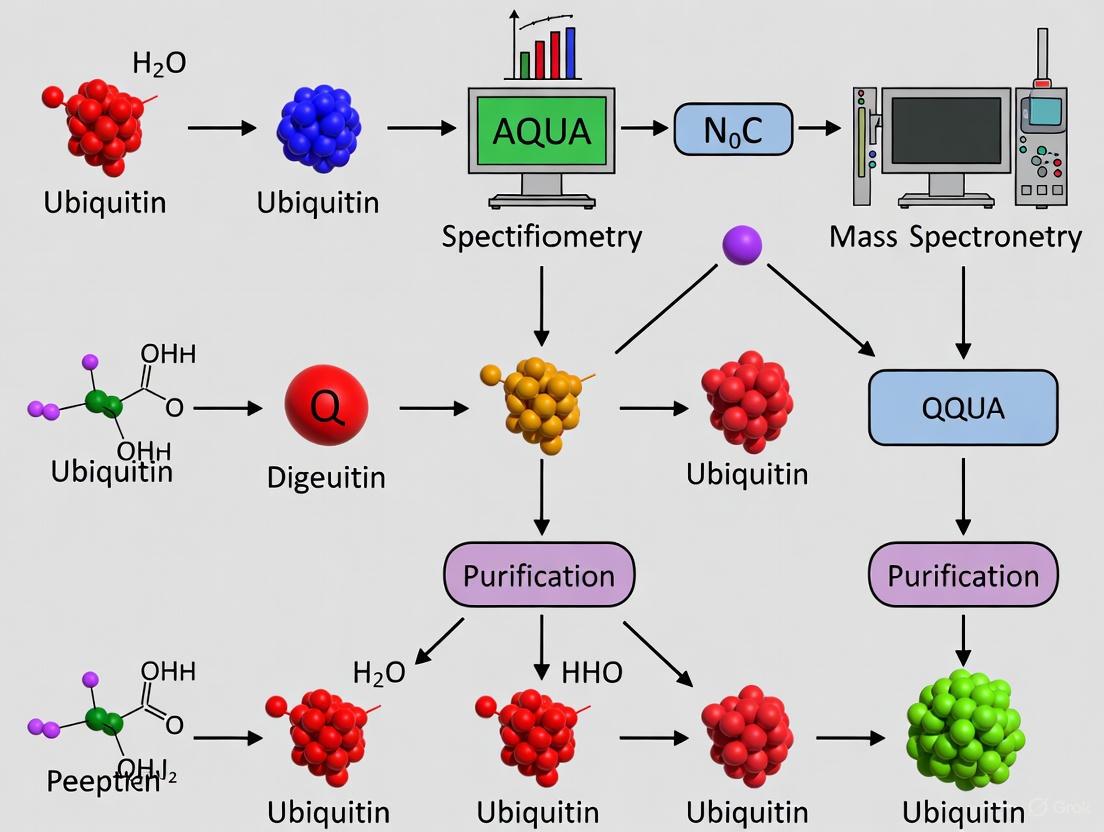
This article provides a comprehensive overview of Ubiquitin Absolute Quantification (AQUA) mass spectrometry, a gold-standard proteomic method for the precise analysis of ubiquitin signaling.
Decoding the Ubiquitin Code: A Comprehensive Guide to AQUA Mass Spectrometry for Linkage-Specific Quantification
Abstract
This article provides a comprehensive overview of Ubiquitin Absolute Quantification (AQUA) mass spectrometry, a gold-standard proteomic method for the precise analysis of ubiquitin signaling. Tailored for researchers, scientists, and drug development professionals, we explore the foundational principles of the complex ubiquitin code and its biological significance. The content details the step-by-step AQUA methodology, from internal standard selection to LC-MS/MS analysis using Parallel Reaction Monitoring (PRM), and its application in characterizing in vitro reactions and cellular pathways. We address common troubleshooting and optimization challenges and present a critical comparative analysis of AQUA against antibody-based and other enrichment methods. This guide serves as an essential resource for leveraging AQUA to uncover the roles of ubiquitin linkages in disease mechanisms and therapeutic development.
The Ubiquitin Code: Understanding the Biological Need for Linkage-Specific Quantification
Once considered primarily a marker for proteasomal degradation, ubiquitin is now recognized as a versatile cellular signal regulating diverse biological processes including protein trafficking, DNA repair, kinase activation, and inflammation. This regulatory complexity stems from the ability of ubiquitin to form polymers of different lengths and linkage topologies through its seven lysine residues and N-terminus, creating a sophisticated "ubiquitin code" that is interpreted by specialized cellular machinery. This Application Note details how Absolute Quantification (AQUA) mass spectrometry methodologies enable precise decoding of this complex ubiquitin signaling landscape, providing researchers with powerful tools to quantify ubiquitin linkage dynamics in physiological and disease contexts.
Protein ubiquitination represents a crucial post-translational modification (PTM) that extends far beyond its initial characterization in proteasome-mediated degradation. This 76-amino acid protein modifier is covalently attached to substrate proteins through a sequential enzymatic cascade involving E1 activating, E2 conjugating, and E3 ligase enzymes [1] [2]. The resulting modifications range from single ubiquitin molecules (monoubiquitination) to complex polyubiquitin chains connected through different lysine residues (K6, K11, K27, K29, K33, K48, K63) or the N-terminal methionine (M1) [3]. The specific cellular outcomes of ubiquitination depend critically on which linkage type is employed and the architecture of the resulting ubiquitin chain.
The versatility of ubiquitin signaling is further enhanced by additional modification layers including phosphorylation and acetylation of ubiquitin itself, creating an exceptionally complex "ubiquitin code" [3]. Different ubiquitin chain architectures are recognized by specific ubiquitin-binding domains (UBDs) present in numerous cellular proteins, enabling the translation of ubiquitin modifications into distinct functional outcomes such as altered subcellular localization, activity modulation, or participation in signaling complexes [1] [2]. This Application Note outlines experimental strategies centered on AQUA mass spectrometry to quantitatively decipher this complex ubiquitin code in biological systems.
Ubiquitin Linkage Types and Their Functional Diversity
The eight possible ubiquitin linkage types confer distinct functional consequences to modified substrates, with K48-linked chains remaining the best characterized for targeting proteins to the 26S proteasome for degradation [3]. However, other linkage types mediate predominantly non-degradative functions: K63-linked chains regulate protein-protein interactions in kinase activation and autophagy pathways, while M1-linked linear chains play critical roles in NF-κB signaling and inflammation [2] [3]. The less abundant "atypical" chains (K6, K11, K27, K29, K33) continue to have their cellular functions elucidated, with emerging roles in endoplasmic reticulum-associated degradation (ERAD), cell cycle regulation, and DNA damage responses [2].
Table 1: Ubiquitin Linkage Types and Their Primary Cellular Functions
| Linkage Type | Relative Abundance | Major Cellular Functions |
|---|---|---|
| K48-linked | High (~50% of chains) | Proteasomal degradation [3] |
| K63-linked | High | NF-κB activation, DNA repair, endocytosis [2] |
| K11-linked | Moderate | ER-associated degradation, cell cycle regulation [2] |
| M1-linked (Linear) | Low | NF-κB signaling, inflammation [3] |
| K6, K27, K29, K33-linked | Low | Mitochondrial quality control, DNA damage response, transcription [2] |
Quantitative studies reveal that ubiquitin linkage types exist in dramatically different abundances within cells, with K48-linked chains often constituting more than 50% of all polyubiquitin chains [3]. This distribution can shift significantly under different physiological conditions or in disease states, creating a pressing need for methodologies that can accurately quantify these changes.
AQUA Mass Spectrometry for Absolute Quantification of Ubiquitin Signaling
Fundamental Principles of the AQUA Methodology
The Absolute Quantification (AQUA) strategy, first introduced by Gerber et al., enables precise measurement of proteins and their post-translational modifications using synthetic, isotope-labeled internal standard peptides [4] [5]. For ubiquitination studies, AQUA peptides are designed to mimic tryptic peptides derived from ubiquitin itself, incorporating the characteristic diglycine (Gly-Gly) remnant that remains attached to modified lysine residues after trypsin digestion [4]. These synthetic peptides contain stable heavy isotopes (13C, 15N) that create a predictable mass shift (typically 4-10 Da) while maintaining identical chemical properties to their endogenous counterparts [4] [5].
The critical innovation of AQUA for ubiquitin research lies in its ability to absolutely quantify specific ubiquitin linkage types by targeting signature peptides unique to each chain topology. When spiked into complex protein digests in known quantities, these AQUA peptides enable precise quantification by comparing the mass spectrometry signal intensity of the endogenous "light" peptide to the synthetic "heavy" standard [4]. This approach has been successfully applied to quantify changes in ubiquitin chain architecture in response to proteasome inhibition, deubiquitinase inhibition, and in various disease models [6].
Experimental Workflow for Ubiquitin Linkage Quantification
The complete AQUA workflow for quantifying ubiquitin linkages encompasses peptide design, validation, sample preparation, and mass spectrometric analysis, as outlined below:
Critical Phase 1: AQUA Peptide Selection and Design
The success of AQUA quantification depends critically on appropriate peptide selection. Ideal AQUA peptides should meet several stringent criteria [4]:
- Sequence Uniqueness: The peptide sequence must be unique to the target ubiquitin linkage type within the entire proteome to avoid signal interference
- Optimal Length: Peptides should be less than 15 amino acids to ensure efficient synthesis and MS detection
- Amino Acid Composition: Avoidance of methionine and cysteine residues prevents unwanted oxidation and modification
- Protease Susceptibility: Exclusion of sequences with known protease miscleavage sites or deamidation-prone motifs
Table 2: Commonly Used Heavy Amino Acids for AQUA Peptide Synthesis
| Amino Acid | Stable Isotope Form | Mass Shift | Application Considerations |
|---|---|---|---|
| L-Leucine | 13C6,15N | +7 Da | Excellent chromatographic behavior |
| L-Lysine | 13C6,15N2 | +8 Da | Ideal for tryptic peptides (C-terminal) |
| L-Arginine | 13C6,15N4 | +10 Da | Ideal for tryptic peptides (C-terminal) |
| L-Phenylalanine | 13C9,15N | +10 Da | Hydrophobic, good for retention |
| L-Valine | 13C5,15N | +6 Da | Minimal retention impact |
| L-Proline | 13C5,15N | +6 Da | Can influence secondary structure |
For ubiquitin linkage quantification, peptides encompassing the linkage site (e.g., residues surrounding K48 or K63) are designed to include the Gly-Gly modification on the target lysine, chemically synthesized with heavy isotopes, and rigorously quantified by amino acid analysis [5]. Each batch must be validated for correct chromatographic behavior and fragmentation pattern before experimental use.
Critical Phase 2: Sample Preparation and LC-MS/MS Analysis
For accurate quantification, AQUA peptides are spiked into complex protein lysates at the earliest possible stage - preferably before protease digestion - to control for variations in digestion efficiency [4]. Samples are then digested with trypsin, which cleaves ubiquitin-modified proteins to leave the characteristic di-glycine modification on the formerly modified lysine residue [1].
Liquid chromatography coupled to tandem mass spectrometry (LC-MS/MS) operating in Multiple Reaction Monitoring (MRM) mode provides the analytical foundation for AQUA quantification [4]. This targeted approach specifically monitors predetermined precursor-to-fragment ion transitions for both endogenous and AQUA peptides, offering exceptional sensitivity and specificity for low-abundance ubiquitin linkages. Quantification is achieved by comparing the peak areas of light (endogenous) and heavy (AQUA) peptides, with the known concentration of the AQUA standard enabling absolute quantification of the endogenous species [4] [5].
Research Reagent Solutions for Ubiquitin Studies
Table 3: Essential Research Reagents for Ubiquitin Signaling Studies
| Reagent/Category | Specific Examples | Primary Function | Application Notes |
|---|---|---|---|
| Affinity Tags | His-tag, Strep-tag, HA-tag | Purification of ubiquitinated proteins | His-tag purification under denaturing conditions reduces non-specific binding [1] |
| Tagged Ubiquitin | (His)6-Ub, (His)8-biotin-Ub | Enrichment of ubiquitinated substrates | Tandem tags improve specificity; may not mimic endogenous Ub perfectly [2] |
| Ubiquitin Antibodies | P4D1, FK1, FK2 | Enrich endogenous ubiquitinated proteins | Linkage-specific antibodies (K48, K63) enable chain-type studies [2] |
| AQUA Peptides | Custom synthetic peptides | Absolute quantification of ubiquitin linkages | Incorporate 13C/15N-labeled amino acids; require rigorous QC [4] [5] |
| Activity Modulators | MG-132 (proteasome), PR-619 (DUB) | Pathway perturbation studies | Induce specific changes to ubiquitin landscape [6] |
| Ub-Binding Domains | Tandem UBDs, linkage-specific readers | Enrichment of specific chain types | Higher affinity than single UBDs; linkage selectivity varies [2] |
Experimental Protocol: Quantifying Ubiquitin Linkage Changes in Response to Proteasome Inhibition
Sample Preparation and AQUA Peptide Spike-in
Materials: Cell culture of interest, MG-132 proteasome inhibitor, Lysis buffer (6M Guanidine HCl, 100mM Na2HPO4/NaH2PO4, 10mM Tris-HCl, pH 8.0), AQUA peptide mixture (pre-quantified)
Procedure:
- Treat cells with 10μM MG-132 or DMSO control for 6 hours
- Harvest cells and lyse in denaturing lysis buffer (5mg protein per condition recommended)
- Reduce with 5mM DTT (30min, 25°C) and alkylate with 15mM iodoacetamide (30min, 25°C in dark)
- Add pre-quantified AQUA peptide mixture to lysate (recommended starting point: 100fmol per peptide)
- Digest with sequencing-grade trypsin (1:50 w/w) for 16h at 37°C
- Acidify with 1% formic acid and desalt using C18 solid-phase extraction columns
LC-MS/MS Analysis and Data Quantification
Materials: Nanoflow LC system coupled to triple quadrupole or high-resolution mass spectrometer, C18 analytical column, Solvent A (0.1% formic acid in water), Solvent B (0.1% formic acid in acetonitrile)
Procedure:
- Resuspend desalted peptides in 0.1% formic acid
- Separate using reversed-phase nanoLC with 90min gradient (2-35% Solvent B)
- Operate mass spectrometer in MRM mode monitoring predetermined transitions for both light and heavy AQUA peptides
- For each peptide, quantify peak areas in light and heavy channels
- Calculate absolute amounts using the formula: Endogenous peptide (fmol) = (Arealight/Areaheavy) × fmolheavypeptide_added
- Normalize values to total protein input or housekeeping peptides
Data Interpretation and Technical Considerations
The AQUA approach provides femtomole-level sensitivity for quantifying ubiquitin linkages but presents specific technical challenges. The requirement for stringent peptide selection criteria can limit the range of measurable ubiquitin linkages, particularly for sequences that are suboptimal for MS detection [4]. Potential solubility variations in lyophilized AQUA peptides necessitate careful quality control and standardization [4]. Additionally, the method captures a snapshot of ubiquitination at a specific timepoint rather than dynamics, and the sample processing may disrupt subcellular compartmentalization of ubiquitin signaling.
When interpreting results, researchers should consider that ubiquitination site stoichiometry is typically low, meaning only a small fraction of any target protein may be modified at a given time [6]. This makes normalization strategies critical for accurate biological interpretation. The AQUA methodology excels at quantifying specific ubiquitin chain types but provides limited information about the overall architecture of polyubiquitin chains on specific substrates, which may require complementary approaches for complete characterization.
The expanding understanding of ubiquitin as a versatile cellular signal necessitates sophisticated quantitative approaches to decipher its complex functions. AQUA mass spectrometry provides researchers with a powerful methodology to absolutely quantify changes in ubiquitin linkage types under different physiological conditions, offering critical insights into disease mechanisms and potential therapeutic interventions. The experimental strategies outlined in this Application Note establish a robust framework for implementing these approaches to advance our understanding of the ubiquitin code and its roles in health and disease.
The post-translational modification of proteins with ubiquitin is a fundamental regulatory mechanism that controls nearly all aspects of eukaryotic cell biology, including protein stability, activity, localization, and interaction properties [7] [8] [9]. The versatility of ubiquitin as a cellular signal stems from its capacity to form diverse architectures—monomeric modifications, homotypic chains, and complex heterotypic structures—that can be recognized by distinct effector proteins to elicit different functional outcomes [8] [10]. While the functions of homotypic chains are generally well-established, research over the past decade has revealed that branched ubiquitin chains represent a sophisticated layer of regulation that expands the coding potential of the ubiquitin system [7] [8].
This Application Note explores the structural and functional complexity of ubiquitin chain architectures, with particular emphasis on branched ubiquitin chains and their analysis using Absolute Quantification (AQUA) mass spectrometry. We provide detailed methodologies for the identification and quantification of ubiquitin chain linkages and discuss the implications of these complex ubiquitin signals for basic research and drug discovery.
Ubiquitin Chain Architectures: Structural Diversity and Functional Consequences
Ubiquitin chains are classified into three major categories based on their linkage patterns and overall topology, each conferring distinct biological information to modified substrates [8] [10].
Homotypic Chains
Homotypic ubiquitin chains are composed of ubiquitin monomers linked uniformly through the same acceptor site. The biological functions of many homotypic chains are well-characterized [8]. For example, K48-linked chains primarily target proteins for degradation by the 26S proteasome, while K63-linked chains and M1-linked linear chains regulate non-proteolytic processes such as NF-κB signaling, DNA repair, and autophagy [8] [10].
Heterotypic Chains
Heterotypic ubiquitin chains contain more than one type of linkage and can be further subdivided into two classes [7] [8]:
- Mixed chains: Composed of ubiquitin subunits modified on only a single acceptor site but containing different linkage types in tandem
- Branched chains: Contain at least one ubiquitin monomer that is simultaneously modified on two or more different acceptor sites, resulting in a "forked" structure [7]
Table 1: Major Types of Branched Ubiquitin Chains and Their Functions
| Linkage Type | Forming Enzymes | Biological Function | References |
|---|---|---|---|
| K11/K48 | APC/C + UBE2C/UBE2S, UBR5 | Regulates mitosis, proteasomal degradation of cell cycle proteins | [7] [8] [11] |
| K29/K48 | UBE3C, Ufd4 + Ufd2, CRL2VHL + TRIP12 | Proteasomal degradation of UFD substrates, PROTAC-induced degradation | [7] [8] |
| K48/K63 | ITCH + UBR5, TRAF6 + HUWE1, cIAP1 | Enhances NF-κB signaling, proteasomal degradation of K63-modified substrates | [7] [8] [11] |
| K6/K48 | Parkin, NleL, IpaH9.8 | Unknown (in vitro formation) | [7] |
Branched Ubiquitin Chains: Assembly Mechanisms and Biological Significance
Branched ubiquitin chains markedly increase the complexity of ubiquitin signaling, with the potential for nearly limitless structural variations based on combinations of acceptor sites and branch point locations [8]. The assembly of branched chains occurs through several distinct mechanisms involving specialized enzymes:
Collaboration between E3 ligase pairs represents a common mechanism for branched chain formation. For instance, in the ubiquitin fusion degradation (UFD) pathway in yeast, the HECT E3 Ufd4 first attaches K29-linked chains to substrates, which are then recognized by the U-box E3 Ufd2 that adds K48 linkages to create branched K29/K48 chains [7] [8]. Similarly, during NF-κB signaling, TRAF6 synthesizes K63-linked chains that are subsequently recognized by HUWE1, which attaches K48 linkages through its UIM and UBA domains to form branched K48/K63 chains [8].
Single E3s with multiple E2s can also generate branched chains. The Anaphase-Promoting Complex/Cyclosome (APC/C), a multisubunit RING E3, collaborates sequentially with UBE2C (which builds short chains with mixed linkages) and UBE2S (which specifically adds K11 linkages) to form branched K11/K48 chains on mitotic substrates [7] [8].
Emerging evidence indicates that branched chains often function as potent degradation signals. Branched K48/K63 chains on TXNIP, formed by the sequential actions of ITCH and UBR5, ensure the timely proteasomal degradation of this pro-apoptotic regulator [7] [8]. Similarly, branched K11/K48 chains assembled by the APC/C enhance the degradation of cell cycle regulators such as cyclin B and NEK2A during mitosis [7] [11].
Analytical Approaches: Quantifying Ubiquitin Chain Architecture
Mass spectrometry-based proteomics has become an essential platform for the systematic characterization of ubiquitin signaling, enabling researchers to identify ubiquitinated substrates, map modification sites, and determine ubiquitin chain linkage types and architecture [10] [9].
Ub-AQUA/PRM Methodology for Linkage Quantification
The Ubiquitin-Absolute Quantification/Parallel Reaction Monitoring (Ub-AQUA/PRM) method provides direct and highly sensitive measurement of the stoichiometry of all eight ubiquitin-ubiquitin linkage types simultaneously [11]. This targeted proteomics approach utilizes isotopically labeled signature peptides (AQUA peptides) as internal standards for absolute quantification [11].
Table 2: Key Research Reagent Solutions for Ubiquitin Chain Analysis
| Reagent/Tool | Type | Function/Application | References |
|---|---|---|---|
| AQUA Peptides | Isotopically labeled peptides | Internal standards for absolute quantification of ubiquitin linkages by MS | [11] |
| Linkage-specific Antibodies | Biological reagents | Enrichment and detection of specific ubiquitin chain types (e.g., K48, K63) | [10] |
| Tandem Ubiquitin Binding Entities (TUBEs) | Engineered proteins | High-affinity enrichment of ubiquitinated proteins under denaturing conditions | [10] |
| Epitope-tagged Ubiquitin (His, Strep) | Molecular tools | Affinity purification of ubiquitinated proteins from cellular systems | [10] |
| Ub-POD System | Proximity labeling | Identification of E3 ligase substrates via ubiquitin-specific biotinylation | [12] |
The critical steps in Ub-AQUA/PRM analysis include [11]:
- Sample Preparation: Isolation of ubiquitinated proteins from biological samples under denaturing conditions to preserve native ubiquitin chain architecture and prevent deubiquitination during processing.
- Trypsin Digestion: Generation of signature peptides specific to each ubiquitin chain linkage type. Trypsin cleaves after arginine residues, and each ubiquitin linkage produces a unique diGly remnant peptide that serves as a signature for that specific linkage.
- AQUA Peptide Addition: Spiking of known quantities of synthetic, isotopically heavy labeled signature peptides corresponding to each ubiquitin linkage type into the digested protein sample.
- LC-PRM/MS Analysis: Parallel reaction monitoring on a quadrupole-equipped Orbitrap instrument, which measures fragment ions (MS2) by high-resolution mass analysis, enabling high sensitivity and accurate quantification over a wide dynamic range.
The advantage of PRM is its high sensitivity and accuracy in quantifying predefined target peptides within complex mixtures, making it particularly suitable for the analysis of low-abundance ubiquitin linkages [11].
Specialized Methods for Branched Chain Analysis
Quantification of branched ubiquitin chains presents unique technical challenges due to their structural complexity. The Ub-AQUA/PRM method has been adapted to detect specific branched chains, such as K48/K63 branched ubiquitin chains, by targeting signature peptides unique to these structures [11]. This approach revealed that branched K48/K63 chains function as enhanced degradation signals compared to their homotypic K48-linked counterparts [11].
Another innovative method, Ubiquitin Chain Protection from Trypsinization (Ub-ProT), enables measurement of ubiquitin chain length on specific substrates [11]. This technique utilizes a "chain protector" protein (such as the K48-linkage specific receptor Rpn10) that binds to ubiquitin chains and protects them from complete digestion by trypsin, allowing the determination of chain length based on the pattern of protected fragments [11].
Detailed Experimental Protocol: Ub-AQUA/PRM for Ubiquitin Linkage Quantification
This protocol describes the steps for comprehensive quantification of ubiquitin chain linkages and branched ubiquitin chains using the Ub-AQUA/PRM methodology [11].
Sample Preparation and Protein Extraction
- Cell Lysis: Lyse cells or tissues in a denaturing buffer (e.g., 6 M guanidine hydrochloride, 100 mM NaH₂PO₄, 10 mM Tris-HCl, pH 8.0) containing 5-10 mM N-ethylmaleimide (NEM) to inhibit deubiquitinating enzymes (DUBs) and 1× protease inhibitor cocktail.
- Protein Quantification: Determine protein concentration using a compatible assay (e.g., BCA assay).
- Reduction and Alkylation: Add dithiothreitol (DTT) to a final concentration of 5 mM and incubate at 56°C for 30 minutes to reduce disulfide bonds. Then add iodoacetamide to a final concentration of 15 mM and incubate in the dark at room temperature for 30 minutes to alkylate cysteine residues.
Enrichment of Ubiquitinated Proteins (Optional but Recommended)
- Affinity Purification: For samples expressing epitope-tagged ubiquitin (e.g., His-tagged ubiquitin), incubate cleared lysates with appropriate affinity resin (e.g., Ni-NTA agarose for His-tagged ubiquitin) for 2-3 hours at room temperature with gentle rotation.
- Washing: Wash the resin sequentially with:
- Buffer A: 6 M guanidine hydrochloride, 100 mM NaH₂PO₄, 10 mM Tris-HCl, pH 8.0
- Buffer B: 8 M urea, 100 mM NaH₂PO₄, 10 mM Tris-HCl, pH 8.0
- Buffer C: 8 M urea, 100 mM NaH₂PO₄, 10 mM Tris-HCl, pH 6.3
- Elution: Elute ubiquitinated proteins with elution buffer (200 mM imidazole, 0.1 M Tris-HCl, pH 6.3, 5 mM DTT) or by boiling in SDS-PAGE sample buffer.
Trypsin Digestion and AQUA Peptide Addition
- Protein Precipitation: Precipitate proteins using methanol/chloroform if necessary to remove interfering substances.
- Trypsin Digestion: Resuspend protein pellets in 50 mM ammonium bicarbonate, pH 8.0. Add trypsin at a 1:50 (w/w) enzyme-to-protein ratio and incubate at 37°C for 15-18 hours.
- AQUA Peptide Spike-in: Add a known amount (typically 25 fmol per injection) of each heavy isotope-labeled AQUA peptide to the digested samples.
- Peptide Cleanup: Desalt peptides using C18 solid-phase extraction cartridges.
LC-PRM/MS Analysis and Data Processing
- Liquid Chromatography: Separate peptides using a nano-flow LC system with a C18 reversed-phase column (75 μm inner diameter × 15 cm length) with a 30-60 minute linear gradient of 5-35% acetonitrile in 0.1% formic acid.
- Mass Spectrometry Analysis: Acquire PRM data on a Q Exactive series mass spectrometer or similar instrument with the following settings:
- Resolution: 35,000 at m/z 200
- AGC target: 3e6
- Maximum injection time: 100 ms
- Isolation window: 1.6-2.0 m/z
- Data Analysis: Process raw data using software such as Skyline or MaxQuant. Quantify ubiquitin linkages by calculating the ratio of light (endogenous) to heavy (AQUA standard) peptide signals for each linkage-specific signature peptide.
Diagram 1: Ub-AQUA/PRM Workflow for Ubiquitin Linkage Quantification. This diagram illustrates the key steps in the mass spectrometry-based method for absolute quantification of ubiquitin chain linkages.
Visualization of Ubiquitin Chain Architectures
The structural diversity of ubiquitin chains can be visualized through their classification based on linkage patterns and topology, which correlates with their distinct biological functions [7] [8].
Diagram 2: Classification of Ubiquitin Chain Architectures. This diagram illustrates the relationship between different ubiquitin chain types and their biological functions.
The structural complexity of ubiquitin chains, particularly branched ubiquitin chains, represents an sophisticated regulatory layer in cellular signaling that expands the functional repertoire of the ubiquitin system. The development of advanced mass spectrometry-based methods such as Ub-AQUA/PRM has been instrumental in deciphering this complexity, enabling researchers to quantitatively profile ubiquitin chain linkages and architectures with unprecedented sensitivity and accuracy [11] [10].
Future directions in this field will likely focus on improving methods for the systematic identification and functional characterization of branched chains in physiological and pathological contexts. The integration of Ub-AQUA/PRM with other emerging technologies, such as the Ub-POD proximity-dependent labeling system for identifying E3 ligase substrates [12], will provide a more comprehensive understanding of the ubiquitin code and its role in health and disease. Furthermore, applying these methodologies to drug discovery efforts, particularly in the context of targeted protein degradation (e.g., PROTACs), may reveal how small molecules manipulate the ubiquitin system to induce selective protein degradation [7].
As our knowledge of ubiquitin chain complexity continues to expand, so too will our appreciation of its fundamental importance in cellular regulation and its potential as a therapeutic target across a wide spectrum of human diseases.
Ubiquitination is a crucial post-translational modification where a 76-amino acid polypeptide, ubiquitin, is covalently attached to substrate proteins, thereby dictating their fate and function within the cell [13] [9]. The versatility of ubiquitin signaling arises from its ability to form diverse polyubiquitin chains through different linkage types, primarily via one of its seven lysine residues (K6, K11, K27, K29, K33, K48, K63) or its N-terminal methionine (M1) [13]. Among these, K48-linked chains represent the canonical signal for proteasomal degradation, while K63-linked chains predominantly mediate non-degradative roles in signaling pathways related to DNA repair, inflammation, and endocytosis [14] [11]. The specific biochemical outcomes—whether degradation or signaling—are therefore intrinsically encoded in the ubiquitin chain linkage type, length, and topology.
Deciphering this "ubiquitin code" requires sophisticated tools capable of precisely quantifying linkage types within complex biological samples. The Ubiquitin-Absolute Quantification (Ub-AQUA) mass spectrometry methodology, particularly when coupled with Parallel Reaction Monitoring (PRM), has emerged as a powerful proteomic strategy for the direct, sensitive, and simultaneous measurement of all ubiquitin linkage types [11]. This application note details how AQUA mass spectrometry underpins research into linkage-dependent functions, providing structured data, detailed protocols, and key resources for scientists investigating the distinct biological pathways governed by K48 and K63 ubiquitin linkages.
Quantitative Landscape of Ubiquitin Linkage Functions
The functional divergence between K48 and K63 linkages is quantifiable in terms of degradation kinetics, deubiquitination rates, and minimal chain length requirements for proteasomal targeting. The following tables consolidate key quantitative findings from recent research.
Table 1: Comparative Intracellular Degradation Kinetics of Ubiquitin Chain Types
| Ubiquitin Chain Type | Degradation Half-Life | Deubiquitination Rate | Minimal Degradation Signal | Key Functional Association |
|---|---|---|---|---|
| K48-linked (Ubn, n≥3) | ~1-2.2 minutes [14] | Slower than K63 [14] | K48-Ub3 [14] | Proteasomal Degradation [14] |
| K63-linked | Not efficiently degraded [14] | Rapid deubiquitination [14] | Not applicable | Non-degradative Signaling [14] [11] |
| K48/K63-branched | Substrate-anchored chain dictates fate [14] | Substrate-anchored chain dictates fate [14] | Not fully established | Potential for regulated turnover [14] |
| K11/K48-branched | Priority degradation signal [15] | Processed by UCHL5 [15] | Not fully established | Cell Cycle, Proteostasis [15] |
Table 2: Ub-AQUA/PRM Quantification of Linkage Stoichiometry
| Linkage Type | Signature Peptide (after Trypsin Digestion) | Mass Shift (Da) | Quantification Method | Key Application |
|---|---|---|---|---|
| K48-GG | TLSDYNIQK(ε-GG)ESTLHLVLR | 114.04 [11] | Isotope-labeled AQUA peptides as internal standards [11] | All linkage types, including branched chains [11] |
| K63-GG | TLSDYNIQK(ε-GG)ESTLHLVLR | 114.04 [11] | Isotope-labeled AQUA peptides as internal standards [11] | All linkage types, including branched chains [11] |
| All 8 linkages | Linkage-specific peptides with GG remnant | 114.04 [13] [11] | LC-MS/MS with PRM [11] | Systemic ubiquitin profiling [11] |
Detailed Experimental Protocols
Protocol 1: Ub-AQUA/PRM for Linkage Quantification
This protocol enables absolute quantification of ubiquitin chain linkages from cell or tissue lysates [11].
Sample Preparation:
- Lysis: Homogenize tissues or lyse cells in a denaturing buffer (e.g., 6 M Guanidine-HCl, 100 mM NaH₂PO₄/Na₂HPO₄, 10 mM Tris-HCl, pH 8.0) to preserve ubiquitination states and inactivate deubiquitinating enzymes (DUBs).
- Reduction and Alkylation: Reduce disulfide bonds with 5 mM dithiothreitol (DTT) at 56°C for 30 minutes, followed by alkylation with 15 mM iodoacetamide (IAA) at room temperature in the dark for 30 minutes.
- Digestion: Dilute the lysate to reduce denaturant concentration. Digest proteins with sequencing-grade trypsin (20-50 ng/μL) at 37°C for 15 hours.
Enrichment of Ubiquitinated Peptides:
- Use anti-K-ε-GG antibody-conjugated beads to immunoprecipitate ubiquitinated peptides from the tryptic digest. The antibody specifically recognizes the di-glycine (GG) remnant left on modified lysines after trypsin digestion [13] [11].
- Wash beads extensively to remove non-specifically bound peptides.
- Elute ubiquitinated peptides using a low-pH elution buffer.
Spiking of AQUA Peptides and LC-MS/MS Analysis:
- Add a known amount (e.g., 25 fmol per injection) of stable isotope-labeled AQUA peptides (synthetic versions of the linkage-specific signature peptides with heavy [13]C/[15]N labels) to the enriched peptide mixture as internal standards [11].
- Desalt the peptides using C18 stage tips.
- Analyze the peptides via liquid chromatography-tandem mass spectrometry (LC-MS/MS) on a Q Exactive series Orbitrap instrument or equivalent, operating in PRM mode. The PRM method is highly sensitive and accurate, as it quantitatively measures fragment ions (MS2) using a high-resolution Orbitrap analyzer [11].
Data Analysis:
- Process the raw MS data using quantification software (e.g., Skyline, MaxQuant).
- The absolute amount of each endogenous ubiquitin linkage is calculated by comparing the peak area of the endogenous light peptide to the peak area of the corresponding spiked heavy AQUA peptide of known concentration [11].
Protocol 2: Functional Degradation Assay via UbiREAD
The UbiREAD (Ubiquitinated Reporter Evaluation After Intracellular Delivery) system assesses the degradation capacity of bespoke ubiquitin chains inside living cells [14].
Preparation of Ubiquitinated GFP Reporters:
- Synthesize ubiquitin chains of defined linkage (K48, K63, branched) and length in vitro using recombinant enzymes.
- Conjugate the purified chains to a mono-ubiquitinated GFP model substrate to generate Ubn-GFP fusions. Chain length can be fixed by using a distal ubiquitin mutant (e.g., K48R for K48 chains) that prevents further elongation [14].
Intracellular Delivery:
- Use electroporation for rapid (millisecond-scale) and efficient cytoplasmic delivery of the purified Ubn-GFP proteins into human cells (e.g., RPE-1, HeLa, 293T). Validate delivery efficiency and lack of extracellular protein via flow cytometry and microscopy [14].
Degradation Kinetics Measurement:
- At high temporal resolution (e.g., 20 seconds to 20 minutes post-delivery), harvest cells and fix or lyse them.
- Quantification: Use two complementary methods:
- Flow Cytometry: Measure the loss of GFP fluorescence over time, which indicates substrate degradation [14].
- In-gel Fluorescence (SDS-PAGE): Monitor the disappearance of the full-length Ubn-GFP band and the potential appearance of a deubiquitinated GFP band, providing insight into the competition between degradation and deubiquitination [14].
Validation with Inhibitors:
- Confirm proteasome dependence by treating cells with MG132 prior to and during the assay. Other inhibitors, such as TAK243 (E1 inhibitor) or CB5083 (p97 inhibitor), can be used to dissect specific pathway dependencies [14].
The Scientist's Toolkit: Key Research Reagent Solutions
Table 3: Essential Reagents for Ubiquitin Linkage and Function Research
| Reagent / Tool | Function / Application | Example Use Case |
|---|---|---|
| K-ε-GG Antibody | Immuno-enrichment of ubiquitinated peptides from tryptic digests for MS analysis [13] [11]. | Ub-AQUA/PRM sample preparation for global ubiquitinome profiling. |
| AQUA Peptides | Synthetic, isotope-labeled internal standards for absolute quantification of specific ubiquitin linkages [11]. | Spiking into samples for precise MS-based measurement of K48 and K63 linkage abundance. |
| Linkage-Specific Ubiquitin Mutants | Ubiquitin variants (e.g., K48R, K63R) to control chain elongation or define chain topology in reconstitution assays [14]. | Synthesis of homotypic Ubn-GFP reporters of defined length for UbiREAD assays. |
| UbiREAD Assay Components | Bespoke Ubn-GFP substrates and electroporation protocol for monitoring intracellular degradation kinetics [14]. | Directly comparing the degradation efficiency of K48 vs. K63 ubiquitin chains in living cells. |
| Proteasome Inhibitors (e.g., MG132) | Selective inhibition of the 26S proteasome to validate proteasome-dependent degradation pathways [14]. | Confirming that loss of K48-Ub4-GFP signal in UbiREAD is due to proteasomal activity. |
| Recombinant E1, E2, E3 Enzymes | In vitro reconstitution of specific ubiquitination reactions to generate defined ubiquitin chains [14]. | Producing pure K48- or K63-linked ubiquitin chains for biochemical or cellular assays. |
Signaling Pathway and Experimental Workflow Visualizations
Ubiquitin Linkage Fate Decision Pathway
AQUA/MS Ubiquitin Linkage Quantification Workflow
UbiREAD Functional Assay Workflow
Ubiquitination is a versatile and critical post-translational modification that regulates diverse cellular functions, including protein stability, activity, and localization [2]. The complexity of ubiquitin signaling extends far beyond simple protein tagging; it encompasses various forms ranging from single ubiquitin monomers to complex polymers with different lengths and linkage types [2]. This intricate system involves a cascade of enzymes including E1 activating enzymes, E2 conjugating enzymes, and over 1000 E3 ligases encoded by the human genome, all working in concert with deubiquitinases (DUBs) to maintain cellular homeostasis [2].
The "ubiquitin code" represents a sophisticated language that cells utilize to coordinate fundamental processes. Unfortunately, traditional methodological approaches have proven insufficient for comprehensively deciphering this complex code. Their limitations stem from an inability to capture the full architectural richness of ubiquitin chains, including their precise linkage types, chain lengths, and branched structures [11] [2]. As we transition into an era of precision medicine, particularly in areas like radio-sensitization in cancer therapy, understanding the spatiotemporal control exerted by the ubiquitin system becomes paramount for developing targeted interventions [16].
Limitations of Traditional Methodologies
Traditional biochemical approaches have provided foundational knowledge of ubiquitination but face significant limitations in decoding the ubiquitin code's complexity. Conventional methods primarily rely on immunoblotting with anti-ubiquitin antibodies to detect putative substrate ubiquitination, followed by lysine mutation analysis to validate modification sites [2]. While this approach has identified specific ubiquitination events—such as the K585 site on Merkel cell polyomavirus large tumor antigen [2]—it remains inherently low-throughput and time-consuming.
The core limitations of these traditional methods can be summarized in three critical areas:
- Low Stoichiometry and Detection Sensitivity: The stoichiometry of protein ubiquitination is typically very low under normal physiological conditions, making identification of ubiquitinated substrates challenging without significant enrichment [2].
- Architectural Complexity: Ubiquitin can modify substrates at one or several lysine residues simultaneously, and ubiquitin itself can serve as a substrate, creating chains that vary in length, linkage, and overall architecture [2]. Traditional methods struggle to characterize this heterogeneity.
- Linkage and Length Blindness: Conventional immunoblotting cannot distinguish between the eight possible ubiquitin linkage types or precisely determine chain length, missing critical functional information encoded in these structural features [11] [2].
Table 1: Key Limitations of Traditional Ubiquitin Analysis Methods
| Analytical Challenge | Traditional Approach | Specific Limitations |
|---|---|---|
| Ubiquitin Linkage Identification | Linkage-specific antibodies (available for K11, K48, K63, M1) | Limited to known linkages; cannot discover new linkages; antibody cross-reactivity issues |
| Chain Length Determination | Gel mobility analysis | Endogenous substrates often have multiple ubiquitylation sites with heterogeneous chain lengths; gel mobility cannot distinguish this complexity |
| Branched Chain Detection | Not available | No conventional methods to identify or quantify heterogeneous chains comprising more than one linkage type |
| Spatiotemporal Dynamics | Static snapshots via immunoblotting | Cannot capture dynamic changes in ubiquitination in response to cellular stimuli or during disease progression |
| Multiplexed Analysis | Single-protein focus | Low-throughput nature prevents system-wide understanding of ubiquitin network interactions |
Advanced Mass Spectrometry Approaches
Ub-AQUA/PRM for Linkage Quantification
Mass spectrometry-based approaches have revolutionized the study of ubiquitination by enabling precise, multiplexed analysis of ubiquitin chain architecture. The Ubiquitin-Absolute Quantification/Parallel Reaction Monitoring (Ub-AQUA/PRM) method represents a significant advancement for direct and highly sensitive measurement of the stoichiometry of all eight ubiquitin-ubiquitin linkage types simultaneously [11].
This targeted proteomics method utilizes a quadrupole-equipped Orbitrap instrument to measure fragment ions (MS2) with high resolution and accuracy [11]. The critical innovation lies in using isotopically labeled signature peptides (AQUA peptides) for the eight linkage types as internal standards for absolute quantification [11]. When samples are trypsin-digested, they generate signature peptides specific to particular linkage types, which can then be quantified against the known standards.
The Ub-AQUA/PRM approach offers several distinct advantages over traditional methods. It provides absolute quantification of all linkage types in a single experiment, enables direct comparison of linkage stoichiometry across samples, and achieves a wide dynamic range of quantification from complex biological samples [11]. Furthermore, this method has been adapted to quantify complex topological structures like K48/K63 branched ubiquitin chains, which regulate processes such as NF-κB signaling by stabilizing K63 linkages and facilitating proteasomal degradation of K63 linkage-modified substrates [11].
Ub-ProT for Chain Length Analysis
Despite the fundamental importance of ubiquitin chain length in signaling, techniques to determine chain lengths in biological samples have been limited. To address this gap, the Ubiquitin chain Protection from Trypsinization (Ub-ProT) method was developed to measure ubiquitin chain length of both in vitro and in vivo ubiquitin conjugates [11].
The Ub-ProT method utilizes a "chain protector" and limited trypsin digestion to analyze ubiquitin chain architecture. This approach overcomes the challenge posed by endogenous substrates that often have multiple ubiquitylation sites with heterogeneous chain lengths, making simple gel mobility analysis unreliable [11]. The method recognizes that at least four moieties of K48-linked ubiquitin chains are required for efficient targeting to the proteasome, highlighting the functional importance of chain length determination [11].
Table 2: Advanced Mass Spectrometry Methods for Ubiquitin Code Decoding
| Method | Primary Application | Key Features | Identified Targets/Functions |
|---|---|---|---|
| Ub-AQUA/PRM | Absolute quantification of all 8 ubiquitin linkage types | Uses isotopically labeled signature peptides as internal standards; high sensitivity and accuracy | K48-K63 branched chains enhance NF-κB signaling; K11/K48 branched chains regulate mitosis |
| Ub-ProT | Measurement of ubiquitin chain length | Uses chain protector and limited trypsin digestion; determines chain architecture | K48-linked chains require ≥4 ubiquitins for proteasomal targeting; length dynamically regulated by Cdc48/p97 |
| Tagged Ub Enrichment (His/Strep) | Proteome-wide ubiquitination site mapping | Affinity purification of ubiquitinated proteins; identification of modification sites | 753 lysine ubiquitylation sites on 471 proteins (U2OS/HEK293T cells) |
| Linkage-Specific Antibody Enrichment | Enrichment of specific ubiquitin linkages | Antibodies for M1, K11, K27, K48, K63 linkages; applicable to tissues | K48-linked polyubiquitination of tau abnormally accumulated in Alzheimer's disease |
Experimental Protocols
Ub-AQUA/PRM Protocol for Ubiquitin Linkage Quantification
Sample Preparation
- Express affinity-tagged ubiquitin (His- or Strep-tagged) in cells of interest or use endogenous ubiquitin sources [2].
- Lyse cells under denaturing conditions (e.g., 6 M guanidine hydrochloride) to preserve ubiquitination states and prevent deubiquitination.
- Enrich ubiquitinated proteins using appropriate affinity resins (Ni-NTA for His tag, Strep-Tactin for Strep-tag) [2].
- Digest enriched proteins with trypsin to generate signature peptides specific to ubiquitin linkage types.
Mass Spectrometry Analysis
- Spike in isotopically labeled AQUA peptides for all eight ubiquitin linkage types as internal standards [11].
- Set up parallel reaction monitoring (PRM) method on a Q Exactive or similar quadrupole-equipped Orbitrap instrument.
- Configure mass spectrometer with the following parameters:
- Resolution: 70,000 at 200 m/z
- AGC target: 3e6
- Maximum injection time: 120 ms
- Isolation window: 1.6 m/z
- Acquire fragment ion spectra (MS2) for each signature peptide using high-resolution Orbitrap detection.
Data Analysis
- Extract fragment ion chromatograms for each signature peptide and corresponding heavy labeled standard.
- Calculate the ratio of light to heavy peptides for absolute quantification of each linkage type.
- Normalize values across samples based on internal standard peak areas.
- Determine linkage stoichiometry by comparing the abundance of each linkage type relative to total ubiquitin.
Ub-ProT Protocol for Ubiquitin Chain Length Analysis
Chain Protection and Digestion
- Isubiquitinate substrates of interest using appropriate E1, E2, and E3 enzyme combinations.
- Incubate ubiquitylated substrates with a "chain protector" protein that binds to ubiquitin chains and protects them from complete proteolysis.
- Perform limited trypsin digestion to cleave unprotected regions while preserving the core ubiquitin chain structure.
- Stop digestion at optimized time points to maintain chain length information.
Length Determination
- Analyze digested samples by SDS-PAGE and mass spectrometry.
- Measure the molecular weights of protected fragments to infer original chain length.
- Compare digestion patterns between protected and unprotected samples to validate chain length.
- For complex samples, combine with linkage-specific information to fully characterize chain architecture.
The Scientist's Toolkit: Research Reagent Solutions
Table 3: Essential Research Reagents for Ubiquitin Code Analysis
| Reagent/Category | Specific Examples | Function and Application |
|---|---|---|
| Affinity Tags | 6× His-tag, Strep-tag | Enable purification of ubiquitinated proteins from complex cell lysates; essential for enrichment prior to MS analysis [2] |
| Linkage-Specific Antibodies | K48-linkage specific, K63-linkage specific, M1-linear chain specific | Immunoenrichment of specific ubiquitin chain types; validation of MS results; immunohistochemistry [11] [2] |
| Ubiquitin-Binding Domains (UBDs) | Tandem ubiquitin-binding entities (TUBEs) | High-affinity enrichment of endogenous ubiquitinated proteins without genetic manipulation; preserve labile ubiquitination [2] |
| Activity-Based Probes | DUB probes, E1/E2/E3 inhibitors | Dissect specific enzyme functions in ubiquitination pathways; validate targets through pharmacological inhibition |
| AQUA Peptides | Isotopically labeled ubiquitin signature peptides | Internal standards for absolute quantification of ubiquitin linkages via mass spectrometry [11] |
| Recombinant Enzymes | E1 activating enzymes, E2 conjugating enzymes, E3 ligases | In vitro ubiquitination assays; reconstitution of specific ubiquitination pathways; enzyme specificity studies |
| DUB Inhibitors | PR-619, P22077, G5 | Stabilize ubiquitination events by preventing deubiquitination; enhance detection of labile modifications |
The limitations of traditional methodologies in decoding the full ubiquitin code have become increasingly apparent as we recognize the sophisticated complexity of ubiquitin signaling. While conventional immunoblotting and mutation analyses provided important foundational knowledge, they cannot capture the dynamic, multidimensional nature of ubiquitin chain architecture that governs critical cellular decisions [2].
Advanced mass spectrometry approaches, particularly Ub-AQUA/PRM and Ub-ProT, represent paradigm-shifting methodologies that enable researchers to move beyond simple ubiquitination detection to comprehensive code deciphering [11]. These techniques provide unprecedented insights into the stoichiometry of ubiquitin linkages, the complexity of branched chains, and the functional significance of chain length heterogeneity. The integration of these advanced analytical capabilities with chemical biology tools and computational methodologies is cracking the molecular mechanisms of ubiquitination in numerous pathologies [2].
As we look toward the future, the continued refinement of these methodologies will be essential for translating our understanding of ubiquitin networks into therapeutic advances, particularly in precision medicine approaches such as radio-sensitization in cancer therapy [16]. The analytical challenge is substantial, but with the appropriate toolkit now available, researchers are positioned to fully decode the ubiquitin code and harness its therapeutic potential.
Absolute QUAntification (AQUA) is a targeted proteomics strategy that enables the precise measurement of protein abundance and post-translational modification (PTM) levels in complex biological mixtures [17]. This methodology relies on the use of synthetic, stable isotope-labeled peptides as internal standards that are chemically identical to their native counterparts formed by proteolysis but distinguishable by mass spectrometry due to a defined mass shift [18]. The AQUA approach provides a powerful framework for absolute quantification in biological systems, moving beyond relative comparisons to deliver exact concentration measurements of proteins and their modified forms, which is particularly valuable for understanding sophisticated signaling systems such as the ubiquitin code [19] [11].
For ubiquitin research, AQUA has been specifically adapted into the Ub-AQUA/PRM (parallel reaction monitoring) method, which allows for the direct and highly sensitive measurement of the stoichiometry of all eight ubiquitin-ubiquitin linkage types simultaneously [11]. This capability is critical because the type, length, and architecture of ubiquitin chains (the "ubiquitin code") direct substrate proteins to different biological fates, such as proteasomal degradation or altered activity and localization [9] [11].
Foundational Workflow of AQUA
The AQUA workflow integrates biochemical preparation with advanced mass spectrometric analysis to achieve absolute quantification. Figure 1 below illustrates the core steps of this process.
Figure 1. Core workflow of an AQUA experiment for absolute quantification of proteins and post-translational modifications.
Peptide Selection and Design
The success of an AQUA experiment critically depends on the appropriate selection of peptide sequences for synthesis as internal standards [19] [4]. The selected peptide must uniquely represent the protein of interest and ideally be previously detected in shotgun proteomics experiments to ensure favorable chromatographic behavior and fragmentation [19]. For PTM quantification, the peptide must encompass the modification site. Table 1 outlines the major selection criteria and considerations for AQUA peptide design.
Table 1. AQUA Peptide Selection Criteria and Design Considerations
| Criterion | Recommendation | Rationale |
|---|---|---|
| Sequence Uniqueness | Must be unique to the target protein within the proteome. | Prevents cross-quantification from homologous proteins [19]. |
| Peptide Length | Preferably less than 15 amino acids [4]. | Optimizes synthesis and MS detection efficiency. |
| Amino Acids to Avoid | Avoid methionine (prone to oxidation) and cysteine [4]. Also avoid ragged ends [19]. | Ensures quantitative accuracy by preventing multiple species. |
| Isotope Labeling | Incorporate heavy amino acids (e.g., (^{13})C, (^{15})N) at C-terminal Arg/Lys or internal sites [19]. | Creates mass shift without altering chemical properties [17]. |
| PTM Incorporation | Synthesize peptides with stable, chemically authentic modifications (e.g., phosphorylation, ubiquitination) [17] [18]. | Enables precise quantification of modified protein species. |
Experimental Protocol for Ubiquitin Linkage Quantification (Ub-AQUA/PRM)
The following protocol details the application of AQUA for quantifying ubiquitin chain linkages, a method termed Ub-AQUA/PRM [11].
Sample Preparation and AQUA Peptide Addition
- Isolate Ubiquitinated Proteins: Enrich ubiquitinated conjugates from cell or tissue lysates via immunoprecipitation using an epitope-tagged ubiquitin system (e.g., His- or HA-tagged ubiquitin) or ubiquitin-binding entities [9] [11].
- Denature and Digest Proteins: Subject the isolated proteins to proteolytic digestion with trypsin. Trypsin cleaves ubiquitin chains, generating a signature peptide for each linkage type, which includes the branched di-glycine (Gly-Gly) remnant attached to the modified lysine residue [11].
- Spike in AQUA Peptides: Add a known, pre-determined amount of a mixture of heavy isotope-labeled Ub-AQUA peptides, each corresponding to one of the eight ubiquitin linkage types (Lys-6, Lys-11, Lys-27, Lys-29, Lys-33, Lys-48, Lys-63, and Met-1) [11]. The addition can be done post-digestion.
Mass Spectrometric Analysis via PRM
- Chromatographic Separation: Use nano-flow liquid chromatography (nanoLC) to separate the peptide mixture prior to mass spectrometry analysis [20] [11].
- Parallel Reaction Monitoring (PRM): Analyze the peptides using a high-resolution tandem mass spectrometer (e.g., Q Exactive series) operated in PRM mode [11].
- The instrument's quadrupole isolates the precursor ions of both the light (endogenous) and heavy (AQUA) signature peptides.
- The isolated ions are fragmented, and all fragment ions (MS2) are measured with high mass accuracy in the Orbitrap analyzer.
- PRM provides high sensitivity and specificity because the unique fragmentation pattern of each signature peptide serves as a quantitative readout.
Data Analysis and Quantification
- Extract Ion Chromatograms: For each endogenous light peptide and its corresponding heavy AQUA standard, extract the chromatographic peaks for the precursor and key fragment ions.
- Calculate Heavy/Light Ratio: Determine the peak area ratio of the endogenous peptide to the AQUA peptide.
- Compute Absolute Amount: Since the absolute amount of the spiked-in AQUA peptide is known, the absolute quantity of the endogenous ubiquitin linkage peptide can be calculated using the formula [4]:
Amount_{Light} = (Area_{Light} / Area_{Heavy}) × Amount_{Heavy}
The Scientist's Toolkit: Essential Reagents and Materials
Successful implementation of AQUA requires specific reagents and tools. The table below lists key research solutions for setting up an Ub-AQUA experiment.
Table 2. Essential Research Reagent Solutions for Ub-AQUA Experiments
| Item | Function/Description | Example Use in Protocol |
|---|---|---|
| Stable Isotope-Labeled AQUA Peptides | Synthetic peptides with incorporated heavy amino acids (e.g., (^{13})C, (^{15)N); the core internal standard [19] [4]. | Spiked into digested samples as internal standards for absolute quantification of ubiquitin linkages. |
| Epitope-Tagged Ubiquitin (e.g., His-, HA-Ub) | Enables affinity-based purification of ubiquitinated proteins from complex cell lysates [9]. | Used for transfection into cells to pull down the cellular ubiquitinome prior to Ub-AQUA analysis. |
| Linkage-Specific Ubiquitin AQUA Peptide Mix | A predefined mixture of heavy peptides, each representing a specific ubiquitin chain linkage type (K48, K63, M1, etc.) [11]. | Allows simultaneous quantification of all eight ubiquitin linkages in a single PRM run. |
| Anti-Ubiquitin Remnant Motif (Gly-Gly) Antibody | Antibody that specifically recognizes the di-glycine lysine remnant left on trypsinized ubiquitinated peptides [11]. | Can be used as an alternative or complementary enrichment strategy to isolate ubiquitinated peptides prior to MS. |
| High-Resolution LC-MS/MS System | Mass spectrometer capable of PRM, such as a quadrupole-Orbitrap instrument (e.g., Q Exactive) [11]. | Performs the targeted quantification of endogenous and AQUA peptides with high sensitivity and mass accuracy. |
Quantitative Data and Stoichiometry Analysis
AQUA's power lies in its ability to deliver absolute quantitative data, which can be used to determine the stoichiometry of proteins within complexes or the relative abundance of different PTMs. Figure 2 illustrates how AQUA data informs on the stoichiometry of a signaling complex, a key application in ubiquitin research.
Figure 2. Workflow for determining protein stoichiometry in a multiprotein complex using the AQUA strategy [20].
Table 3 provides a hypothetical dataset demonstrating how Ub-AQUA can be applied to quantify changes in ubiquitin chain topology in a cell signaling context.
Table 3. Example Ub-AQUA Data: Quantification of Ubiquitin Linkages in NF-κB Signaling
| Ubiquitin Linkage Type | Signature Peptide Sequence | Amount in Unstimulated Cells (fmol/μg) | Amount in TNFα-Stimulated Cells (fmol/μg) | Fold Change |
|---|---|---|---|---|
| Lys-48 (K48) | TLSDYNIQK*ESTLHLVLR | 150.5 ± 12.1 | 145.2 ± 10.8 | 1.0 |
| Lys-63 (K63) | TLSDYNIQK*ESTLHLVLR | 85.3 ± 6.5 | 420.7 ± 25.3 | 4.9 |
| Lys-11 (K11) | TTITLEVEPSDTIENVK*AK | 45.2 ± 4.1 | 92.1 ± 7.9 | 2.0 |
| Met-1 (M1/Linear) | TLTGK*TTITLEVEPSDTIENVK | 30.1 ± 3.0 | 105.5 ± 9.1 | 3.5 |
| K48/K63 Branched | (Special branched peptide) | 5.5 ± 0.8 | 25.3 ± 2.5 | 4.6 |
Note: The asterisk () denotes the modified lysine residue with the Gly-Gly remnant. This example data illustrates how Ub-AQUA/PRM can reveal specific upregulation of K63, M1, and K11 linkages and branched chains upon pathway activation, as reported in studies of NF-κB signaling [11].*
Implementing AQUA MS: A Step-by-Step Protocol from Sample to Data
Protein ubiquitination is a crucial post-translational modification that regulates diverse cellular processes, with functional outcomes largely dictated by the topology of polyubiquitin chains. These chains can be formed via eight distinct linkage types (Met1, K6, K11, K27, K29, K33, K48, and K63), each potentially encoding unique biological signals [21] [22]. Unlike antibody-based methods that typically target only a few linkage types, the Absolute Quantification (AQUA) mass spectrometry platform enables simultaneous quantification of all eight ubiquitin linkage types with high specificity and accuracy [11] [22]. This application note details the core workflow from synthetic peptide preparation to final LC-MS/MS analysis, providing researchers with a standardized protocol for implementing this powerful technology in ubiquitin research and drug development.
AQUA Peptide Design and Preparation
Peptide Selection Criteria
The foundation of a successful AQUA experiment lies in the careful design and synthesis of stable isotope-labeled internal standard peptides. For ubiquitin linkage quantification, these peptides correspond to the tryptic signature peptides that uniquely identify each ubiquitin-ubiquitin linkage type [11] [19].
Critical Design Considerations:
- Unique Signature Peptides: Each AQUA peptide must uniquely represent one specific ubiquitin linkage type (e.g., K48-, K63-linked) without sequence ambiguity [19].
- Proteolytic Efficiency: Peptides should be designed with optimal protease cleavage sites, typically tryptic sites, considering that adjacent proline residues or phosphorylated amino acids may inhibit complete cleavage [19].
- Amino Acid Composition: Methionine-containing peptides should be avoided when possible due to potential oxidation during sample preparation, which creates multiple species and complicates quantification [19].
- Ionization Efficiency: Preferably select peptides that demonstrate good ionization based on prior experimental data available through repositories like PeptideAtlas or PRIDE [19].
- Chromatographic Behavior: Peptides should exhibit predictable retention times for optimal scheduling in LC-MS/MS methods [19].
Peptide Synthesis and Validation
AQUA peptides are synthesized with incorporated stable isotopes (¹³C, ¹⁵N) that create a defined mass shift (typically 6-8 Da) from their endogenous counterparts while maintaining identical chemical properties [19].
Synthesis and Quality Control Steps:
- Isotope Incorporation: Heavy isotopes are typically incorporated at a C-terminal arginine/lysine or an internal leucine, valine, or phenylalanine residue [19].
- Purification and Quantification: Synthetic peptides undergo rigorous purification followed by precise quantification using amino acid analysis or total nitrogen detection [19].
- Analytical Validation: Each AQUA peptide is analyzed by LC-MS/MS to verify chromatographic behavior and fragmentation patterns before experimental use [19].
Table 1: Essential Research Reagent Solutions for AQUA Ubiquitin Analysis
| Reagent Category | Specific Examples | Function in Workflow |
|---|---|---|
| Synthetic AQUA Peptides | Isotopically-labeled ubiquitin linkage signature peptides (e.g., K48-, K63-specific) | Internal standards for absolute quantification of specific ubiquitin linkages [11] [19] |
| Lysis Buffer Components | Sodium deoxycholate (SDC), Chloroacetamide (CAA), Urea | Protein extraction while preserving ubiquitin modifications and inhibiting deubiquitinases [23] |
| Enrichment Reagents | Anti-diglycine (K-ε-GG) remnant antibodies | Immunoaffinity purification of ubiquitinated peptides from complex protein digests [2] [23] |
| Chromatography Materials | C18 reversed-phase capillary columns, Solvent systems (water/acetonitrile with formic acid) | Nanoflow liquid chromatography separation of peptides prior to mass spectrometry [24] [23] |
Sample Preparation and Peptide Enrichment
optimized Lysis and Protein Extraction
Proper sample preparation is critical for maintaining the native ubiquitination state while minimizing artifacts. Recent advancements have demonstrated the superiority of sodium deoxycholate (SDC)-based lysis protocols over traditional urea methods [23].
Enhanced SDC Lysis Protocol:
- Lysis Buffer Composition: 5% SDC in 50 mM Tris-HCl (pH 8.5) supplemented with 40 mM chloroacetamide (CAA) [23].
- Rapid Denaturation: Immediate sample boiling after lysis to inactivate enzymes [23].
- Alkylation Advantage: CAA rapidly alkylates cysteine residues without causing di-carbamidomethylation of lysines, which can mimic ubiquitin remnant masses when iodoacetamide is used [23].
- Performance Metrics: SDC lysis yields approximately 38% more K-ε-GG peptides compared to urea buffer while maintaining high enrichment specificity [23].
Digestion and K-ε-GG Peptide Enrichment
Following protein extraction and digestion, ubiquitinated peptides are enriched using immunoaffinity purification with anti-K-ε-GG remnant antibodies [2] [23].
Standardized Enrichment Workflow:
- Proteolytic Digestion: Trypsin digestion cleaves both the substrate protein and ubiquitin, leaving a characteristic diglycine (GG) remnant (114.0429 Da mass shift) on modified lysine residues [2] [21].
- Immunoaffinity Purification: Incubate digested peptides with anti-K-ε-GG antibody-conjugated beads under optimized buffer conditions [23].
- Stringent Washing: Remove non-specifically bound peptides with multiple wash steps to reduce background interference [24].
- Elution and Preparation: Elute enriched K-ε-GG peptides in mild acid conditions followed by desalting and concentration for LC-MS/MS analysis [23].
LC-MS/MS Analysis with Parallel Reaction Monitoring
Liquid Chromatography Separation
Prior to mass spectrometric analysis, enriched peptides undergo nanoflow liquid chromatography separation to reduce sample complexity and enhance detection sensitivity [24] [23].
Typical Chromatographic Conditions:
- Column: Self-packed fused silica C18 capillary column (75 μm internal diameter) [24]
- Flow Rate: ~300 nL/min [24]
- Gradient: 75-180 min linear acetonitrile gradient in 0.1% formic acid [23]
- Sample Loading: Direct loading of enriched peptides onto the analytical column [24]
Mass Spectrometric Detection via PRM
The AQUA methodology employs Parallel Reaction Monitoring (PRM) on quadrupole-equipped Orbitrap instruments for highly sensitive and accurate quantification of ubiquitin linkages [11].
PRM Method Parameters:
- Instrumentation: Q Exactive or Orbitrap Fusion series mass spectrometers [11] [23]
- Scan Modes: High-resolution full MS scans (MS1) followed by targeted MS2 (PRM) for AQUA and endogenous peptides [11]
- Resolution Settings: 70,000 for MS2 scans to ensure accurate quantification [11]
- Inclusion List: Pre-defined list of AQUA and corresponding endogenous peptide m/z values [11] [19]
Quantification Principle: The known concentration of spiked AQUA peptides serves as internal standards for absolute quantification of endogenous ubiquitin linkages. The ratio of endogenous to AQUA peptide signal intensities directly correlates to the absolute amount of each ubiquitin linkage type present in the original sample [11] [19].
Data Analysis and Quantification
Spectral Processing and Peak Integration
Raw mass spectrometric data undergoes processing to extract quantitative information for both endogenous and AQUA peptide pairs [11] [23].
Key Analysis Steps:
- Chromatographic Peak Alignment: Ensure proper alignment of endogenous and AQUA peptide peaks despite potential minor retention time shifts [19].
- Peak Area Integration: Extract peak areas for specific fragment ions from PRM scans for both endogenous and AQUA peptides [11].
- Ratio Calculation: Compute the area ratio between endogenous and corresponding AQUA peptides for each linkage type [19].
Absolute Quantification Calculations
The absolute amount of each ubiquitin linkage is calculated based on the known concentration of spiked AQUA peptides and the measured peak area ratios [19].
Quantification Formula: [ \text{Endogenous Peptide Amount} = \frac{\text{Endogenous Peak Area}}{\text{AQUA Peak Area}} \times \text{AQUA Peptide Amount Spiked} ]
Table 2: Quantitative Performance Characteristics of AQUA Ubiquitin Analysis
| Performance Metric | Typical Range | Methodology Notes |
|---|---|---|
| Detection Sensitivity | Femtomolar level | High sensitivity enables detection of low-abundance ubiquitin linkages [25] |
| Quantification Accuracy | High (with internal standard normalization) | AQUA peptides correct for sample preparation and ionization variability [25] [19] |
| Linkage Coverage | All 8 ubiquitin linkage types | Simultaneous quantification of M1, K6, K11, K27, K29, K33, K48, and K63 linkages [11] [22] |
| Reproducibility | ~10% median CV | Excellent precision across technical and biological replicates [23] |
| Dynamic Range | >4 orders of magnitude | Suitable for quantifying both abundant and rare ubiquitin linkages [23] |
Applications in Ubiquitin Research and Drug Discovery
The AQUA platform for ubiquitin linkage quantification has enabled significant advances in understanding ubiquitin signaling pathways and developing targeted therapeutics.
Key Research Applications:
- Mechanistic Studies of E3 Ligases and DUBs: Precisely characterize the linkage specificity of ubiquitin-regulating enzymes [11].
- Branched Ubiquitin Chain Analysis: Quantify complex ubiquitin topologies like K48/K63 branched chains that regulate NF-κB signaling [11].
- Drug Discovery and Validation: Monitor ubiquitin chain remodeling in response to DUB or ubiquitin ligase inhibitors [23].
- Disease Mechanism Elucidation: Investigate ubiquitin signaling dysregulation in cancer, neurodegenerative disorders, and inflammatory diseases [2] [23].
Technical Considerations and Limitations
While the AQUA approach provides exceptional specificity and accuracy for ubiquitin linkage quantification, researchers should consider several practical aspects when implementing this methodology.
Methodological Constraints:
- Cost Considerations: Synthetic AQUA peptides represent a significant expense, particularly for large-scale studies targeting multiple linkages [25].
- Instrumentation Requirements: The method requires access to high-resolution mass spectrometers capable of PRM acquisition [25] [19].
- Expertise Demands: Implementation requires substantial technical expertise in both sample preparation and mass spectrometric operation [25].
- Throughput Limitations: While absolute quantification is highly accurate, the number of targets per run is limited by instrument duty cycle compared to discovery proteomics [19].
The AQUA mass spectrometry workflow described herein provides researchers with a robust, standardized method for absolute quantification of ubiquitin linkage types in complex biological samples. From careful peptide design to optimized sample preparation and targeted LC-MS/MS analysis, this comprehensive protocol enables precise measurement of ubiquitin chain architecture with exceptional specificity and quantitative accuracy. As ubiquitin signaling continues to emerge as a critical regulatory pathway in human disease, this methodology offers drug development professionals and academic researchers a powerful tool for elucidating ubiquitin-dependent mechanisms and validating novel therapeutic approaches.
The Absolute Quantification (AQUA) strategy represents a cornerstone technique in targeted mass spectrometry (MS) for the precise measurement of proteins and their post-translational modifications (PTMs), with particularly profound applications in the complex field of ubiquitin signaling [4] [26]. First established by Gerber et al. in 2003, this method utilizes synthetic, isotope-labeled internal standard peptides (ILISPs) to enable absolute quantification directly from complex biological samples like cell lysates [4] [27]. The power of this approach lies in its ability to definitively quantify not just protein expression levels but also the stoichiometry of PTMs, a critical capability for deciphering the ubiquitin code [4].
In ubiquitin research, the AQUA strategy, specifically termed Ub-AQUA, has become an indispensable tool for dissecting the architecture of polyubiquitin chains [11]. Ubiquitination is a versatile modification wherein a substrate protein can be modified by a single ubiquitin monomer, multiple monomers, or polyubiquitin chains. The complexity arises from the fact that polyubiquitin chains can be formed through any of the seven lysine residues (K6, K11, K27, K29, K33, K48, K63) or the N-terminal methionine (M1) of ubiquitin, with each linkage type potentially conferring a distinct functional outcome to the modified substrate [28] [10]. For instance, K48-linked chains primarily target substrates for proteasomal degradation, while K63-linked chains are involved in non-proteolytic processes like signal transduction and DNA repair [28] [9]. The Ub-AQUA methodology allows researchers to move beyond simple identification and perform direct, highly sensitive measurement of the stoichiometry of all eight ubiquitin linkage types simultaneously, providing a quantitative map of the ubiquitin landscape in vitro, in cells, and in tissues [11] [29].
Foundational Principles of AQUA Peptide Design
The core principle of the AQUA strategy is the use of an internal standard that is chemically identical to the target native peptide but distinguishable by mass spectrometry. This is achieved by synthesizing a peptide standard that incorporates stable heavy isotopes ( [4]).
The Core AQUA Principle: Isotope Dilution
The AQUA workflow involves adding a known quantity of a synthetic, isotope-labeled "heavy" peptide to a protein digest. This heavy peptide has the same amino acid sequence as the native "light" peptide generated from proteolytic digestion (e.g., with trypsin) of the target protein. Because of its identical sequence, the AQUA peptide co-elutes with the native peptide during liquid chromatography and exhibits the same ionization efficiency and fragmentation pattern. The key difference is a controlled mass shift due to the incorporation of stable isotopes ( [4] [27]). During LC-MS/MS analysis, the mass spectrometer can differentiate between the light and heavy forms, allowing for direct comparison of their signal intensities. Since the amount of the spiked-in AQUA peptide is known, the absolute quantity of the native peptide can be calculated with high precision using the ratio of the two measured signals ( [4]).
Ubiquitin-Specific Application: Signature Peptides
Applying the AQUA principle to ubiquitin requires careful selection of signature peptides that uniquely report on specific ubiquitin chain linkages. Trypsin digestion of ubiquitin and polyubiquitin chains produces characteristic peptide fragments. For linkage quantification, the most critical peptides are the branched signature peptides that contain the isopeptide bond between the C-terminal glycine (G76) of one ubiquitin and the side chain of a specific lysine (e.g., K48) on the adjacent ubiquitin. These tryptic peptides, which include a remnant of the linked ubiquitin (a di-glycine, "GG," motif), serve as direct quantitative proxies for each chain type ( [28] [11]). Furthermore, peptides from other regions of ubiquitin, such as the N-terminus (e.g., MQIFVK), can be used to quantify total ubiquitin levels, providing an internal control and allowing for normalization across samples ( [28]).
Table 1: Key Signature Peptides for Ubiquitin Linkage Quantification
| Target | Representative Signature Peptide | Role in Quantification |
|---|---|---|
| K48-linkage | Peptide containing K48 with GG-remnant | Quantifies K48-linked polyubiquitin chains [28] |
| K63-linkage | Peptide containing K63 with GG-remnant | Quantifies K63-linked polyubiquitin chains [28] |
| Total Ubiquitin | TLS* or MQIFVK* | Quantifies total ubiquitin from multiple loci [28] |
| K11-linkage | Peptide containing K11 with GG-remnant | Quantifies K11-linked polyubiquitin chains [11] |
| M1-linkage | Peptide specific for linear linkage | Quantifies M1-linked linear ubiquitin chains [11] |
Design Criteria and Selection of AQUA Peptides
The accuracy and success of an AQUA experiment are critically dependent on the judicious selection of the internal standard peptides. Adherence to a set of well-established design principles is paramount for generating reliable quantitative data ( [4]).
Sequence Selection and Uniqueness
The selected peptide sequence must be unique to the target protein within the entire proteome to avoid cross-talk and erroneous quantification from homologous proteins. For ubiquitin itself, which is highly conserved and derived from multiple genes, this means ensuring the peptide is specific to the ubiquitin sequence and does not appear in other ubiquitin-like modifiers (UBLs) ( [4] [10]). The peptide should ideally be between 7 and 15 amino acids in length. This range ensures the peptide is long enough for specificity but short enough for efficient synthesis and MS detection ( [4]).
Avoiding Problematic Residues and Modifications
The peptide sequence should be scrutinized to avoid residues and motifs that can lead to analytical complications:
- Methionine and Cysteine: These residues are prone to unwanted oxidation and modification, which can alter peptide chemistry and behavior during MS analysis. Their inclusion should be minimized or avoided ( [4]).
- Biochemical Instability: Sequences containing Asp-Pro bonds, which are acid-labile, or N-terminal glutamine, which can cyclize to form pyroglutamate, should be avoided. These can lead to peptide degradation or heterogeneity ( [4]).
- Missed Cleavage Sites: The peptide should be designed to represent a complete tryptic fragment. Sequences that are likely to result in incomplete trypsin digestion (e.g., due to adjacent acidic residues) should be avoided to ensure consistent and quantitative peptide generation ( [28]).
Diagram 1: AQUA peptide design and preparation workflow.
Synthesis, Quantification, and Handling of AQUA Peptides
The practical implementation of the AQUA strategy demands rigorous processes for the generation and management of the internal standard peptides to ensure data integrity.
Synthesis and Isotope Labeling
AQUA peptides are typically produced via solid-phase peptide synthesis [27]. The stable heavy isotopes (e.g., 13C, 15N) are incorporated during synthesis using labeled amino acids. Common choices for labeled residues include L-Leucine (13C6, 15N, +7 Da mass shift), L-Valine (13C5, 15N, +6 Da), and L-Arginine (13C6, 15N4, +10 Da) or L-Lysine (13C6, 15N2, +8 Da), the latter being particularly relevant for the C-terminal or branch-site peptides of ubiquitin [28] [4]. The synthesized peptide must then be rigorously purified, typically by reversed-phase high-performance liquid chromatography (RP-HPLC), to achieve high purity and remove any incomplete synthesis products or impurities [27].
Stock Solution Quantification
Perhaps the most critical step for achieving true absolute quantification is the accurate determination of the concentration of the AQUA peptide stock solution. Purity assessment by HPLC-UV is not sufficient. The gold-standard method is quantitative amino acid analysis (AAA), which involves hydrolyzing an aliquot of the peptide and quantifying the constituent amino acids. This step is non-negotiable, as errors in the stock concentration will propagate directly into the final quantitative results [27].
Storage and Stability
Concentrated stock solutions of AQUA peptides should be stored at -80°C in single-use aliquots to avoid repeated freeze-thaw cycles, which can degrade the peptide and lead to unstable experimental results [28] [4]. Working stock solutions are often prepared in a compatible solvent like 30% acetonitrile with 0.1% formic acid [28].
Table 2: Commonly Used Heavy Isotope-Labeled Amino Acids for AQUA Peptides
| Amino Acid | Stable Isotope | Mass Shift | Notes |
|---|---|---|---|
| L-Leucine | 13C6, 15N | +7 Da | Common, hydrophobic [4] |
| L-Valine | 13C5, 15N | +6 Da | Common, hydrophobic [4] |
| L-Lysine | 13C6, 15N2 | +8 Da | Critical for ubiquitin GG-remnant peptides [4] |
| L-Arginine | 13C6, 15N4 | +10 Da | Common C-terminal for tryptic peptides [4] |
| L-Phenylalanine | 13C9, 15N | +10 Da | Aromatic [4] |
Experimental Protocol: Ub-AQUA for Linkage Quantification
The following section provides a detailed methodology for applying Ub-AQUA to quantify ubiquitin chain linkages in a biological sample, such as immunoprecipitated ubiquitinated proteins or in vitro ubiquitination reactions.
Sample Preparation and Trypsin Digestion
- Sample Isolation: Resolve your ubiquitinated protein sample of interest by SDS-PAGE on a 4-12% Bis-Tris gel [28].
- Gel Staining and Excision: Stain the gel with a compatible stain like SimplyBlue Coomassie. Excise the gel band(s) containing the ubiquitinated proteins and dice them into 1 mm³ pieces [28].
- Destaining and Dehydration: Destain the gel pieces by washing with a solution of 50 mM ammonium bicarbonate (AMBIC), pH 8.0, and 50% acetonitrile (ACN). Subsequently, dehydrate the gel pieces completely with 100% ACN [28].
- Trypsin Digestion: Prepare a digestion solution of sequencing-grade trypsin (e.g., 20 ng/μL) in 50 mM AMBIC, 5% ACN, pH 8.0. Add sufficient solution to cover the dehydrated gel pieces and incubate at 37°C for 15 hours (overnight) to achieve complete digestion [28] [11].
- Peptide Extraction: Following digestion, extract the peptides from the gel by sequential addition of solutions like 50% ACN/0.1% formic acid and 100% ACN. Combine the extracts and concentrate the peptides by vacuum centrifugation [28].
Spiking AQUA Peptides and LC-MS/MS Analysis
- Reconstitute and Spike: Reconstitute the dried peptide sample in a suitable LC-MS loading solvent. Add a known amount of the pre-mixed AQUA peptide mixture to the sample. The amount added should be within the dynamic range of the target peptides. For example, a mixture where each peptide is at 1000-2000 fmol/μL can be used [28] [11].
- LC-MS/MS with PRM: Analyze the spiked sample using a nano-flow liquid chromatography system coupled online to a high-resolution tandem mass spectrometer, such as a Q Exactive series or Orbitrap Fusion instrument.
- Chromatography: Use a reversed-phase C18 column with a gradient of increasing acetonitrile in water, both with 0.1% formic acid [11].
- Mass Spectrometry: Employ a Parallel Reaction Monitoring (PRM) method. The instrument is programmed to isolate the precursor ions (both light and heavy) of all target signature peptides. These isolated ions are then fragmented, and all fragment ions (MS2) are measured at high resolution and mass accuracy in the Orbitrap. PRM is favored for its high sensitivity, specificity, and wide dynamic range [11] [29].
Diagram 2: Ub-AQUA experimental workflow for linkage quantification.
Data Analysis and Quantification
- Chromatographic Interrogation: Examine the extracted ion chromatograms (XICs) for both the light and heavy versions of each signature peptide. Confirm that they co-elute precisely, which validates the correct identification of the native peptide [27].
- Peak Integration: Integrate the peak areas for the native (light) and AQUA (heavy) peptides from the XICs of the most abundant fragment ions.
- Absolute Quantification: Calculate the absolute amount of the native peptide using the following formula, where the known amount of the AQUA peptide is the reference:
Amount_native = (Area_native / Area_AQUA) × Amount_AQUAThis calculation yields the absolute quantity (e.g., in fmol) of each ubiquitin linkage signature peptide present in the original sample [11] [4].
The Scientist's Toolkit: Essential Research Reagents
Table 3: Key Research Reagent Solutions for Ub-AQUA
| Reagent / Tool | Function | Example & Notes |
|---|---|---|
| Isotope-Labeled AQUA Peptides | Internal standards for absolute quantification | Custom synthesized peptides with 13C/15N; vendors include Cell Signaling Technology [27]. |
| Linkage-Specific Ub Antibodies | Enrich polyubiquitinated proteins with specific linkages prior to AQUA. | α-K48, α-K63; used for immunoprecipitation to simplify samples [28] [10]. |
| TUBEs (Tandem Ub-Binding Entities) | Enrich endogenous ubiquitinated proteins without genetic tags. | High-affinity tools to isolate ubiquitinated conjugates from cells and tissues [10]. |
| Recombinant Ubiquitins | Controls for method development and in vitro assays. | Wild-type and mutant Ub (e.g., K48R, K63R) from suppliers like Boston Biochem [28]. |
| High-Resolution Mass Spectrometer | Targeted quantification via PRM. | Q Exactive, Orbitrap Fusion platforms provide required sensitivity and accuracy [11] [29]. |
The meticulous design and synthesis of AQUA peptides are foundational to unlocking the power of absolute quantification in ubiquitin research. By adhering to the principles outlined in this document—selecting unique and stable signature peptides, employing rigorous synthesis and quantification methods, and implementing a robust spiking and LC-PRM/MS protocol—researchers can generate highly accurate and reproducible quantitative data. This capability is crucial for moving from simply identifying the presence of ubiquitin chains to understanding their dynamic regulation, stoichiometry, and functional impact in health, aging, and disease [30] [29]. The Ub-AQUA methodology, therefore, stands as an essential and powerful component in the continuing effort to decode the complex language of ubiquitin signaling.
Within the framework of research focused on Absolute Quantification (AQUA) mass spectrometry for ubiquitin linkage quantification, the critical initial step lies in sample preparation. The versatility of ubiquitin signaling arises from its ability to form complex conjugates, including homotypic chains, heterotypic mixed-linkage chains, and branched chains [10]. Among these, K11/K48-branched ubiquitin chains have been identified as a priority signal for proteasomal degradation [15]. The precise characterization of these branched peptides, particularly for AQUA-MS, is entirely dependent on a robust and reproducible sample preparation and digestion protocol that preserves the native state of these modifications while enabling high-throughput analysis. This document details optimized methodologies for preparing samples to enrich for ubiquitin branch peptides, ensuring comprehensive and quantitative analysis within the ubiquitin-proteasome system.
The Critical Role of Ubiquitin Branching
Protein ubiquitination is a post-translational modification where a small, 76-amino acid protein, ubiquitin, is covalently attached to substrate proteins. This modification can take several forms, from a single ubiquitin (monoubiquitination) to complex polymers (polyubiquitination) where ubiquitin molecules are linked through one of seven lysine residues (K6, K11, K27, K29, K33, K48, K63) or the N-terminal methionine (M1) [9] [10]. The specific linkage type within a polyubiquitin chain determines the downstream signaling outcome, such as targeting a substrate for proteasomal degradation (e.g., K48-linked chains) or regulating non-proteolytic processes like kinase activation (e.g., K63-linked chains) [10].
Branched ubiquitin chains, which contain more than one type of isopeptide bond linkage with branching points within the same chain, account for a significant portion (10–20%) of cellular ubiquitin polymers [15]. A key example is the K11/K48-branched ubiquitin chain, which functions as a potent signal for the fast-tracking of substrate degradation during cell cycle progression and proteotoxic stress [15]. Recent cryo-EM structures have revealed that the human 26S proteasome recognizes this specific branched topology through a multivalent mechanism involving multiple ubiquitin receptors, explaining its priority status in degradation pathways [15]. This highlights the biological importance of accurately quantifying these structures. Furthermore, aging and dietary interventions have been shown to significantly alter the ubiquitin landscape in the mouse brain, with these changes being largely independent of underlying protein abundance, underscoring the need for precise PTM quantification methods like AQUA-MS [30].
Sample Processing and Digestion Workflow
Achieving reproducible and quantitative proteomic data requires a well-established and controlled sample preparation protocol. The following section outlines a detailed workflow for tissue samples, from protein extraction to peptide cleanup, optimized for subsequent ubiquitin branch peptide enrichment.
Protein Extraction and Quantification
- Starting Material: Begin with cryopulverized tissue samples stored at -80 °C. For example, patient-derived xenograft (PDX) tumor tissues have been successfully used in such protocols [31].
- Lysis Buffer: Add a urea-based lysis buffer (e.g., 8 M urea, 75 mM NaCl, 50 mM Tris, pH 8.0) supplemented with protease and phosphatase inhibitors to the tissue. A recommended ratio is 400 μL of lysis buffer per 100 mg of tissue [31].
- Clarification: Perform tissue lysis through repeated vortexing, followed by centrifugation at 20,000g for 10 minutes at 4 °C to clarify the lysates [31].
- Protein Quantification: Determine protein concentration using the bicinchoninic acid (BCA) assay. Automated liquid handling systems can be employed at this stage to increase throughput and consistency, achieving coefficients of variation (CV) below 5.5% [31].
Protein Digestion
The digestion process is critical for generating peptides suitable for MS analysis. The following in-solution digestion protocol can be automated for enhanced reproducibility [31].
- Aliquot and Reduce: Aliquot protein (e.g., 1 mg per well in a 96-well plate) and reduce cysteine residues using 5 mM dithiothreitol (DTT).
- Alkylate: Alkylate the reduced cysteine residues with 10 mM iodoacetamide (IAA).
- Dilution and Digestion: Dilute the urea concentration 1:3 with 50 mM Tris-HCl (pH 8.0). Then, perform a two-step enzymatic digestion:
- Digest with Lys-C at a 1 mAU:50 μg enzyme-to-substrate ratio.
- Follow with digestion using sequencing-grade modified trypsin at a 1:50 enzyme-to-substrate ratio.
- Acidification and Desalting: Acidify the digested peptides with 50% formic acid (FA) to approximately pH 2.0. Desalt the resulting peptides on a C18 Solid Phase Extraction (SPE) plate (e.g., a 100 mg Sep-Pak C18 SPE plate) [31]. This step removes salts and other impurities that can interfere with subsequent MS analysis.
This optimized protocol has been demonstrated to achieve high digestion efficiency, with missed cleavage rates between 6 and 7.5%, and samples from the same biological subtype showing extremely high correlation (≥0.98) in downstream MS analysis [31].
Workflow Visualization
The following diagram illustrates the complete protein digestion workflow:
Enrichment of Ubiquitinated Peptides
Due to the low stoichiometry of ubiquitination and the high complexity of protein digests, enrichment of ubiquitinated peptides is a mandatory step for their comprehensive analysis. Several strategies exist, each with distinct advantages.
Enrichment Methodologies
- Antibody-Based Enrichment: This method uses antibodies that recognize the di-glycine (K-ε-GG) remnant motif left on lysine residues after tryptic digestion of ubiquitinated proteins [30]. While this approach efficiently enriches for endogenous ubiquitinated peptides without genetic manipulation, the antibodies can be costly. Linkage-specific antibodies (e.g., for K48 or K63 chains) are also available for more targeted studies [10].
- Ubiquitin-Binding Domain (UBD)-Based Enrichment: Tandem-repeated Ub-binding entities (TUBEs) are engineered proteins with multiple UBDs that exhibit high affinity for ubiquitin chains. TUBEs can be used to purify ubiquitinated proteins from cell lysates and have the added benefit of protecting ubiquitin chains from deubiquitinase (DUB) activity [10].
- Immobilized Metal Affinity Chromatography (IMAC): IMAC, often using magnetic Fe-NTA beads, is highly effective for enriching phosphopeptides but can also be applied in ubiquitination studies, particularly when combined with other techniques [31].
Table 1: Comparison of Ubiquitinated Peptide Enrichment Strategies
| Method | Principle | Advantages | Disadvantages | Typical Yield |
|---|---|---|---|---|
| Antibody-based (K-ε-GG) | Immunoaffinity against di-glycine remnant | High specificity; works on endogenous proteins; applicable to tissue/clinical samples [30] [10] | High cost of antibodies; potential non-specific binding | >14,000 ubiquitinated peptides from PDX samples [31] |
| TUBEs | High-affinity binding from tandem UBDs | Protects chains from DUBs; no genetic tag needed | Requires optimization of binding/elution conditions | Information missing |
| Epitope-Tagged Ubiquitin | Expression of His- or Strep-tagged Ub in cells [10] | Easy, low-cost enrichment; good for cell culture studies | Not suitable for animal/human tissues; may create artifacts | ~1,000 ubiquitinated proteins from yeast [9] |
Mass Spectrometric Analysis and AQUA Quantification
After enrichment, ubiquitinated peptides are analyzed using liquid chromatography-tandem mass spectrometry (LC-MS/MS). Data-Independent Acquisition (DIA) modes, such as dia-PASEF, are increasingly used for large-scale quantitative studies because they provide comprehensive and reproducible data sets [31] [30].
For absolute quantification of specific ubiquitin linkages, the AQUA strategy is employed. This involves spiking known quantities of synthetic, stable isotope-labeled peptides (AQUA peptides) that correspond to specific ubiquitin branch peptides into the sample prior to LC-MS/MS analysis [15]. The MS signal of the endogenous peptide is then compared to the signal of the heavy labeled AQUA peptide, allowing for its absolute quantification. This method was used, for instance, to demonstrate that a polyubiquitinated substrate contained almost equal amounts of K11- and K48-linked ubiquitin [15].
Table 2: Quantitative Performance of Optimized Workflow in Model Systems
| Sample Type | Analysis Type | Key Quantitative Result | Correlation/Reproducibility |
|---|---|---|---|
| PDX Breast Cancer Tumors [31] | Global Proteomics (DIA-MS) | High correlation between biological replicates | Spearman correlation ≥ 0.98 |
| PDX Breast Cancer Tumors [31] | Ubiquitinome | >14,000 ubiquitinated peptides identified | Information missing |
| Aged Mouse Brain [30] | Ubiquitinome (DIA-MS) | 29% of altered ubiquitylation sites were independent of protein abundance changes | Clear separation by PCA |
| Reconstituted Proteasome Complex [15] | Ub-AQUA / Intact MS | Identification of 12.6% doubly-, 3.6% triply-ubiquitinated Ub (evidence of branching) | Information missing |
The Scientist's Toolkit: Essential Research Reagents
A successful experiment relies on high-quality, specific reagents. The following table lists key materials used in the workflows described in this document.
Table 3: Essential Research Reagents for Ubiquitin Branch Peptide Analysis
| Reagent / Material | Function / Application | Example Product / Note |
|---|---|---|
| Urea Lysis Buffer | Protein denaturation and extraction from tissues or cells. | Supplement with protease/phosphatase inhibitors [31]. |
| Sequencing-Grade Trypsin | Proteolytic enzyme for digesting proteins into peptides for MS analysis. | Promega Trypsin used at 1:50 enzyme-to-substrate ratio [31]. |
| Lys-C | Protease that cleaves at lysine residues; often used in combination with trypsin for efficient digestion. | Wako Chemicals Lys-C used at 1 mAU:50 μg ratio [31]. |
| C18 SPE Plate | Desalting and cleaning up digested peptide samples prior to LC-MS/MS. | 100 mg Sep-Pak C18 plate [31]. |
| K-ε-GG Antibody Beads | Immunoaffinity enrichment of ubiquitinated peptides from complex digests. | PTMScan HS Ubiquitin/SUMO Remnant Motif Kit [31]. |
| IMAC Magnetic Beads | Enrichment of phosphorylated peptides, often used in parallel PTM studies. | Magnetic Fe-NTA Beads [31]. |
| Stable Isotope-Labeled AQUA Peptides | Internal standards for absolute quantification of specific ubiquitin linkages. | Synthetic peptides with heavy labels (e.g., 13C, 15N) [15]. |
| Linkage-Specific Ub Antibodies | Western blot validation of specific ubiquitin chain types (e.g., K48, K63). | Used to confirm linkage type in vitro and in vivo [15] [10]. |
The accurate quantification of ubiquitin branch peptides using AQUA mass spectrometry is predicated on optimized and reproducible sample preparation. This involves meticulous protein extraction, efficient and consistent enzymatic digestion, and highly specific enrichment of ubiquitinated peptides. As research continues to unravel the complex biological roles of branched ubiquitin chains in processes from cell cycle regulation to brain aging, the application of robust protocols like those detailed here will be paramount. The integration of automated platforms, such as the AUTO-SP system, further enhances the reliability and throughput of these sample preparation workflows, enabling large-scale, quantitative studies of the ubiquitin code with high precision.
Parallel Reaction Monitoring (PRM) is a targeted mass spectrometry technique that combines the selectivity of traditional methods with the power of high-resolution, accurate-mass (HRAM) analyzers. As a cornerstone of quantitative proteomics and metabolomics, PRM enables precise quantification of predefined analytes—such as ubiquitin linkages—with exceptional sensitivity and specificity, making it indispensable for biomarker validation and mechanistic studies [32]. In the specific context of Ubiquitin-Absolute Quantification (Ub-AQUA) research, PRM emerges as a critical tool for deciphering the ubiquitin code, allowing for the direct and highly sensitive measurement of the stoichiometry of all eight ubiquitin-ubiquitin linkage types simultaneously [33] [11].
PRM Fundamentals and Advantages
How PRM Works
PRM is performed on high-resolution mass spectrometers like Orbitrap or Q-TOF instruments. The method involves several key steps [32]:
- Precursor Isolation: The quadrupole isolates target precursor ions (e.g., ubiquitin-derived peptides) based on a predefined inclusion list.
- Fragmentation: The isolated precursors are fragmented using techniques like higher-energy collisional dissociation (HCD).
- Parallel Detection: All resulting product ions are detected in parallel, generating a full high-resolution MS/MS spectrum.
This process provides a complete fragment ion profile for each target, which is subsequently analyzed using software like Skyline for peak integration and quantification [32].
PRM vs. SRM/MRM: A Comparative Advantage
PRM offers distinct advantages over the traditional gold standard, Selected Reaction Monitoring (SRM) or Multiple Reaction Monitoring (MRM). The table below summarizes the key differences that make PRM particularly suited for complex analyses like ubiquitin linkage quantification.
Table: Instrumentation and Method Comparison between PRM and SRM/MRM [32]
| Feature | PRM (Parallel Reaction Monitoring) | SRM/MRM |
|---|---|---|
| Instrument | Orbitrap, Q-TOF (HRAM) | Triple quadrupole |
| Mass Resolution | High (≥30,000 FWHM) | Low (unit resolution) |
| Data Acquisition | Full MS/MS spectra per precursor | Single transition (precursor > fragment) |
| Transition Selection | All fragment ions | Predefined fragment ions only |
| Method Development | Simple, minimal optimization | Complex, requires extensive tuning |
| Retrospective Analysis | Yes | No |
The capability for retrospective data mining is a powerful feature of PRM; the stored complete fragment ion data can be re-analyzed to quantify new targets without re-running samples, which is invaluable for long-term projects [32].
Ubiquitin Linkage Quantification via Ub-AQUA/PRM
The Ub-AQUA/PRM Workflow
The Ub-AQUA/PRM method is designed for the absolute quantification of ubiquitin chain topology. It leverages signature peptides generated by tryptic digestion of ubiquitin chains, which are characterized by a di-glycine (-GG) remnant attached to the modified lysine residue [11] [34]. The workflow can be summarized as follows:
Diagram Title: Ub-AQUA/PRM Workflow for Ubiquitin Linkage Analysis
Detailed Experimental Protocol
Protocol: Global Ubiquitin Chain Topology Assessment by PRM [11] [34]
I. Sample Preparation and Ubiquitin Chain Stabilization
- Critical Step: Ubiquitin chains are labile and rapidly degraded by deubiquitinating enzymes (DUBs) upon cell lysis. All steps must be performed quickly and on ice.
- Ubiquitin Stabilization Buffer: Prepare fresh 8 M urea in 50 mM NH₄HCO₃, pH 8.0, containing 10 mM N-ethylmaleimide (NEM). NEM alkylates active-site cysteines in DUBs, irreversibly inhibiting them.
- Cell Lysis: Resuspend the biological sample (e.g., cell pellet) in the ubiquitin stabilization buffer at ~0.5 µg/µL protein concentration. Lyse cells using sonication (e.g., three 10-second pulses on ice).
- Clarification: Centrifuge the lysate at 18,000 x g for 10 minutes at 4°C. Transfer the supernatant to a new tube.
II. Trypsin Digestion and AQUA Peptide Addition
- Digestion: Digest the protein lysate with trypsin. The C-terminal arginine (R74) of ubiquitin is a trypsin cleavage site, generating peptides with a -GG modification (114 Da) on the lysine residue involved in the ubiquitin chain linkage.
- Internal Standards: Spike a known amount of heavy isotope-labeled AQUA peptides (synthetic peptides with ¹³C/¹⁵N-labeled lysine or arginine) into the digested sample. These peptides correspond to the signature -GG-modified peptides for all eight linkage types and serve as internal standards for absolute quantification.
III. PRM Mass Spectrometry Setup
- Instrument: Use a high-resolution instrument like a Q-Exactive series Orbitrap.
- Inclusion List: Create a target list containing the precursor m/z, charge state, and expected retention time for each light (endogenous) and heavy (AQUA) signature peptide.
- Acquisition Parameters: Typical settings include:
- Resolution: 35,000-70,000 (at m/z 200)
- Isolation Window: 1.2-2.0 m/z
- Collision Energy: Standard HCD energy (e.g., 27-30 eV)
- Retention Time Scheduling: Use a 3-5 minute window to increase the number of data points per peptide.
IV. Data Analysis
- Software: Process raw data using software like Skyline.
- Peak Integration: Extract the chromatographic peaks for both the light (endogenous) and heavy (AQUA) fragment ions of each signature peptide.
- Quantification: Calculate the absolute amount of each ubiquitin linkage by comparing the integrated peak area of the endogenous peptide to the peak area of its corresponding heavy AQUA peptide of known concentration.
Implementation and Practical Considerations
The Scientist's Toolkit: Essential Research Reagents
Successful implementation of Ub-AQUA/PRM relies on key reagents and materials. The following table details these essential components.
Table: Essential Research Reagent Solutions for Ub-AQUA/PRM
| Reagent / Material | Function and Importance |
|---|---|
| Ubiquitin Stabilization Buffer (8M Urea, 10mM NEM) | Preserves the native ubiquitin chain topology by denaturing proteins and inhibiting deubiquitinating enzymes (DUBs) during cell lysis [34]. |
| Heavy Isotope-Labeled AQUA Peptides | Synthetic signature peptides with ¹³C/¹⁵N-labeled C-terminal residues; serve as internal standards for absolute quantification of each ubiquitin linkage type [11] [34]. |
| High-Resolution Mass Spectrometer (e.g., Orbitrap) | Enables parallel detection of all fragment ions with high mass accuracy and resolution, which is fundamental to PRM's specificity and sensitivity [32] [11]. |
| Signature Peptide Inclusion List | A curated list of precursor m/z, charge states, and retention times for targeted analysis; dictates which ubiquitin linkage peptides the instrument will monitor [32]. |
| Data Analysis Software (e.g., Skyline) | Open-source software for targeted mass spectrometry data analysis; used to extract and quantify fragment ion chromatograms from PRM data [32] [34]. |
Technical Advantages and Validation Data
The PRM method offers significant performance benefits for ubiquitin research, as demonstrated in published studies:
- High Sensitivity: PRM allows for the quantification of ubiquitin chains at the 100 attomole level even in complex biological samples like cell extracts [35].
- Revealing Biological Mechanisms: Application of Ub-AQUA/PRM to the model substrate Ub-P-βgal revealed that it is modified with ubiquitin chains consisting of 21% K29- and 78% K48-linked chains in wild-type yeast cells. This analysis further demonstrated that the E3 ligase Ufd4 is responsible for assembling the K29-linked chains, a finding that was obscured with less sensitive methods [35].
- Advancements in Throughput: Wideband PRM (WBPRM) A recent evolution of the method, Wideband PRM, uses a wider isolation window to simultaneously fragment both endogenous and stable isotope-labeled (SIL) peptides. This innovation reduces ion suppression effects between the two forms, leading to increased sensitivity, precision, and reproducibility, thereby supporting higher-throughput targeted analyses [36].
Application in Ubiquitin Signaling Research
The Ub-AQUA/PRM methodology is a powerful tool for dissecting the complexity of the ubiquitin code. Its primary applications in ubiquitin research include:
- Comprehensive Linkage Stoichiometry: Simultaneously quantifying all eight homogeneous ubiquitin linkage types (K6, K11, K27, K29, K33, K48, K63, M1) from a single biological sample [33] [11].
- Analysis of Branched Ubiquitin Chains: Quantifying complex chain topologies, such as K48/K63 branched chains, which have been shown to regulate NF-κB signaling by stabilizing K63 linkages [11].
- Elucidating Enzyme Specificity: Determining the linkage-specific activities of E3 ubiquitin ligases and deubiquitinases (DUBs) by comparing ubiquitin chain profiles in different genetic backgrounds or upon enzymatic treatment in vitro [11].
- Monitoring Dynamic Changes: Tracking global changes in the ubiquitin chain landscape in response to cellular stimuli, such as proteasome inhibition or pathway activation, providing functional insights into ubiquitin signaling [34].
Diagram Title: Biological Fates of Select Ubiquitin Linkages
Protein ubiquitination is a critical post-translational modification that regulates nearly every cellular process, including proteostasis, DNA repair, and immunity [37]. The ubiquitin code—comprising different chain linkages, lengths, and topologies—serves as a complex signaling system that is frequently dysregulated in diseases such as cancer and neurodegeneration [38]. In drug discovery, quantifying ubiquitination is particularly valuable for developing targeted protein degradation strategies, including proteolysis-targeting chimeras (PROTACs) and molecular glues, which represent promising approaches for targeting previously "undruggable" proteins [38] [39]. Mass spectrometry-based proteomics, especially Absolute Quantification of Ubiquitin (Ub-AQUA) coupled with parallel reaction monitoring (PRM), has emerged as a powerful platform for decoding this complexity by enabling precise, sensitive measurement of ubiquitin chain linkages and dynamics in disease models and therapeutic contexts [11].
Key Methodologies for Ubiquitin Quantification
Ub-AQUA/PRM for Linkage and Branch Quantification
The Ub-AQUA/PRM methodology provides direct, highly sensitive measurement of the stoichiometry of all eight ubiquitin-ubiquitin linkage types simultaneously, including complex branched chains [11]. This targeted proteomics approach uses isotopically labeled signature peptides (AQUA peptides) as internal standards for absolute quantification, enabling precise cross-sample comparisons of ubiquitin chain architecture.
Table 1: Ubiquitin Linkages and Their Primary Functions
| Linkage Type | Primary Functions | Therapeutic Relevance |
|---|---|---|
| K48-linked | Proteasomal degradation | Target for degraders, indicator of protein turnover |
| K63-linked | DNA repair, signaling | Inflammation, immunity |
| K11/K48-branched | Mitosis, proteotoxic stress | Priority signal for proteasomal degradation [15] |
| K11-linked | Cell cycle regulation | Cancer therapy |
| M1-linked | NF-κB signaling | Inflammation |
The experimental workflow involves:
- Sample Preparation: Cells or tissues are lysed under denaturing conditions with deubiquitinase (DUB) inhibitors (e.g., 20mM N-ethylmaleimide) to preserve ubiquitin chains [39].
- Trypsin Digestion: Proteins are digested with trypsin, which cleaves ubiquitin and generates signature peptides specific to each linkage type.
- AQUA Peptide Addition: Known quantities of synthetic, heavy isotopically labeled internal standard peptides are added to the samples.
- LC-PRM/MS Analysis: Peptides are separated by liquid chromatography and analyzed by parallel reaction monitoring on a quadrupole-equipped Orbitrap instrument, providing high-resolution fragment ion analysis for accurate quantification [11].
This method has been successfully adapted to quantify branched ubiquitin chains, such as K48/K63-branched chains, which play important roles in regulating NF-κB signaling and proteasomal degradation [11].
TUBE-MS for Polyubiquitome Profiling
Tandem Ubiquitin Binding Entities (TUBEs) coupled with mass spectrometry (TUBE-MS) enables enrichment and proteome-wide monitoring of compound-induced changes in protein polyubiquitination [39]. This approach is particularly valuable for detecting both degradative and non-degradative ubiquitination events in drug discovery contexts.
The key steps include:
- Semi-denaturing Lysis: Cells are lysed in buffer containing 4M urea and DUB inhibitors to preserve ubiquitin chains while disrupting non-covalent interactions.
- TUBE Enrichment: Biotinylated TUBEs immobilized on magnetic streptavidin beads are used to enrich polyubiquitinated proteins from complex lysates.
- Acidic Elution: Ubiquitinated proteins are selectively eluted under acidic conditions while the TUBE-biotin interaction remains intact.
- LC-MS/MS Analysis: Eluted proteins are digested and analyzed by liquid chromatography-tandem mass spectrometry for identification and quantification [39].
This workflow has been validated using known degraders such as the PROTAC MZ1, demonstrating robust detection of polyubiquitinated targets like BRD2 [39].
Ion Mobility Mass Spectrometry for Diubiquitin Isomers
Ion mobility-mass spectrometry (IM-MS) separates ions based on size and shape, enabling distinction between different diubiquitin isomers in complex mixtures [40]. When coupled with multiple linear regression analysis, this approach allows quantitative analysis of the relative abundance of ubiquitin dimer isomers without the need for proteolytic digestion.
Applications in Therapeutic Development
Monitoring Targeted Protein Degradation
PROTACs and molecular glues represent transformative approaches in drug discovery that harness the ubiquitin-proteasome system to eliminate disease-causing proteins. Quantifying ubiquitination is essential for characterizing these compounds, as evidenced by studies showing that PROTACs like MZ1 induce specific ubiquitination of target proteins such as BRD2, which can be captured by TUBE-MS enrichment [39]. The Ub-AQUA/PRM method further enables researchers to determine the specific ubiquitin chain linkages induced by degraders, with K48-linked chains typically associated with proteasomal degradation.
Biomarker Discovery in Cancer
Ubiquitination signatures serve as valuable biomarkers for cancer diagnosis, prognosis, and treatment response. In acute myeloid leukemia (AML), mass spectrometry has identified protein biomarkers such as Annexin A3 and Lamin B1, which are associated with poor overall survival and disease recurrence, respectively [41]. Metabolomic profiling has also revealed 2-hydroxyglutarate (2-HG) as a pharmacodynamic marker for IDH1/2-targeted therapies [41].
In clear cell renal cell carcinoma (ccRCC), ubiquitination-related gene signatures have been developed that effectively stratify patients into high-risk and low-risk groups with distinct survival outcomes and immunotherapy responses [42]. A six-gene URGs signature (PDK4, PLAUR, UCN, RNASE2, KISS1, and MXD3) demonstrated significant predictive power for patient prognosis and treatment response [42].
Evaluating DUB Inhibitors
Deubiquitinase inhibitors represent another class of therapeutics that modulate ubiquitin signaling. TUBE-MS has been applied to characterize the effects of DUB inhibitors, revealing that USP7 inhibition induces non-degradative ubiquitination of the E3 ligase UBE3A [39]. This application demonstrates the method's ability to detect ubiquitination events that may be missed by whole proteome analyses, which primarily identify changes in protein abundance rather than modification status.
The Scientist's Toolkit: Essential Research Reagents
Table 2: Key Research Reagents for Ubiquitin Quantification
| Reagent/Tool | Function | Application Examples |
|---|---|---|
| TUBEs (Tandem Ubiquitin Binding Entities) | High-affinity enrichment of polyubiquitinated proteins | TUBE-MS for profiling compound-induced ubiquitination [39] |
| Ub-AQUA Peptides | Isotopically labeled internal standards for absolute quantification | PRM-based quantification of ubiquitin linkages and branched chains [11] |
| DUB Inhibitors (e.g., NEM) | Prevent deubiquitination during sample processing | Preservation of ubiquitin chains in lysis buffers [39] |
| Linkage-specific Antibodies | Immunoblot detection of specific ubiquitin linkages | Validation of ubiquitin chain types [11] |
| Recombinant Ubiquitin Chains | Standards for method development and calibration | IM-MS analysis of diubiquitin isomers [40] |
Commercial kits such as the LifeSensors Ubiquitin Mass Spectrometry Kit (UM420) integrate TUBE technology with mass spectrometry workflows, providing researchers with standardized reagents for ubiquitin enrichment and analysis [43]. These kits include mammalian cell lysis buffer with protease inhibitors, UPS inhibitor cocktail, magnetic TUBE reagent, and solutions for decomplexing, washing, elution, and digestion.
Workflow Visualization
Ubiquitin Quantification Workflow for Drug Discovery
Branched Ubiquitin Chain Recognition by Proteasome
Quantitative analysis of ubiquitination through AQUA mass spectrometry and related methodologies provides critical insights for drug discovery, enabling researchers to monitor target engagement, understand mechanism of action, and identify biomarkers of therapeutic response. As these approaches continue to evolve, they will undoubtedly accelerate the development of novel therapies that modulate the ubiquitin-proteasome system, particularly in challenging disease areas where traditional drug discovery approaches have shown limited success.
Optimizing AQUA Assays: Overcoming Technical Hurdles for Robust Results
Within targeted proteomics and ubiquitin research, the Absolute Quantification (AQUA) methodology represents a gold standard for precisely measuring the abundance of specific proteins and post-translational modifications, such as the complex landscape of ubiquitin linkages [28]. The foundation of any successful AQUA-mass spectrometry (MS) experiment is the availability of high-quality, chemically-defined heavy isotope-labeled peptide standards. The process of selecting, designing, and handling these peptide standards is fraught with challenges, primarily stemming from inherent peptide sequence properties that govern solubility and stability. Difficult peptides can lead to failed syntheses, inaccurate quantification, and significant experimental delays. This Application Note provides a structured framework for navigating these challenges, offering practical strategies for peptide selection, solubility enhancement, and analytical handling to ensure robust and reproducible AQUA-MS results in ubiquitin linkage quantification.
Understanding Peptide Solubility and Stability Challenges
The behavior of a peptide in solution is dictated by its physicochemical properties, which are directly determined by its amino acid sequence. Recognizing the factors that contribute to poor solubility and stability is the first step in proactively managing them.
Key Factors Affecting Peptide Behavior
- Amino Acid Composition: Peptides with a high proportion of hydrophobic amino acids (e.g., Leucine, Valine, Phenylalanine, Isoleucine, Tryptophan) often exhibit limited solubility in aqueous solutions. Conversely, a higher content of charged residues (e.g., Lysine, Arginine, Glutamic Acid, Aspartic Acid) generally improves solubility [44].
- Peptide Length: Longer peptide chains possess an increased potential for hydrophobic interactions and self-association, promoting aggregation and reducing solubility [44].
- Net Charge and Isoelectric Point (pI): Solubility is typically minimized at a solution pH near the peptide's pI, where the net charge is zero. Operating at a pH distant from the pI (e.g., in acidic or basic buffers) maximizes net charge and enhances solubility [44] [45].
- Secondary Structure Tendency: Peptides with a high propensity to form ordered secondary structures, particularly β-sheets, are prone to aggregation and poor solubility. Disordered or random coil structures are typically associated with improved solubility [44].
The intrinsic hydrophilicity/hydrophobicity of amino acid side chains, as quantified by HPLC-derived coefficients, serves as a powerful predictor of peptide behavior (Table 1) [45].
Table 1: Intrinsic Hydrophilicity/Hydrophobicity Coefficients of Amino Acid Side-Chains
| Amino Acid | ΔRetention Time at pH 2.0 (min) | ΔRetention Time at pH 7.0 (min) |
|---|---|---|
| Tryptophan (W) | 32.4 | 33.0 |
| Phenylalanine (F) | 29.1 | 30.1 |
| Leucine (L) | 23.3 | 24.6 |
| Isoleucine (I) | 21.4 | 22.8 |
| Valine (V) | 13.4 | 15.0 |
| Aspartic Acid (D) | 1.6 | 0.8 |
| Lysine (K) | 2.8 | 2.0 |
| Arginine (R) | 0.6 | 4.1 |
| Serine (S) | 0.0 | 1.2 |
| Glycine (G) | 0.0 | 0.0 |
| Asparagine (N) | -0.6 | 1.0 |
Data derived from RP-HPLC analysis of model peptides. Positive values indicate hydrophobic character, while negative values indicate hydrophilic character. Charged residues are in bold and show significant variation with pH [45].
Strategies for Enhanced Peptide Design and Synthesis
When faced with a problematic sequence, researchers can employ several strategic approaches to improve the feasibility of peptide acquisition and handling.
Molecular Engineering and Sequence Optimization
- Amino Acid Substitution: Replace problematic hydrophobic residues with more hydrophilic or structurally similar alternatives (e.g., Norleucine for Leucine) to improve solubility without drastically altering peptide properties [44] [45].
- Incorporation of D-Amino Acids: Strategic replacement of L-amino acids with their D-enantiomers can enhance stability against proteolytic degradation, which may indirectly improve solubility by preventing aggregation-prone degradation products [44].
- Sequence Truncation: If scientifically justified, consider whether a shorter peptide sequence containing the core epitope or modification site could suffice for the assay, as shorter peptides are generally more soluble [44].
Strategic Use of Solubilizing Tags
For peptides that remain intractable despite sequence optimization, the use of temporary solubilizing tags is a highly effective strategy. These tags are covalently attached during synthesis and purification but are removed prior to or during the final application.
Table 2: Research Reagent Solutions for Peptide Synthesis and Handling
| Reagent / Tool | Function / Description | Application in AQUA-MS |
|---|---|---|
| Poly-Lysine/Arginine Tag | A short, cationic peptide (e.g., (Lys)6) added to the sequence. Increases net charge and water solubility. | Facilitates purification and handling of hydrophobic peptide segments; can be cleaved post-synthesis [46]. |
| Disulfide-based Linker (e.g., Ades) | A linker (e.g., 2-amino-1,1-dimethylethyl-1-sulfanyl) enabling traceless attachment of solubilizing tags to an N-terminal Cys. | Allows for tag cleavage under standard NCL or reducing conditions (e.g., with TCEP/MPAA), yielding the native sequence [46]. |
| Fmoc-SPPS Pre-loaded Resins | Insoluble polymer supports (e.g., Wang resin) pre-loaded with the C-terminal amino acid. | Foundation of automated peptide synthesis; ensures high coupling efficiency and purity for AQUA standard production [47]. |
| Peptide Analyzing Tool | Bioinformatics tool (e.g., from GenScript) to predict synthesis feasibility. | Evaluates peptide sequences prior to synthesis, predicting potential solubility and aggregation issues [48]. |
| Boc-Cys(Npys)-OH | A protected cysteine derivative for directed disulfide bond formation on solid support. | Enables automated, site-specific incorporation of the Ades linker for solubilizing tag attachment [46]. |
The workflow for employing a disulfide-linked solubilizing tag is highly amenable to automation and can be integrated into standard Fmoc-SPPS protocols, as visualized below.
Diagram 1: Workflow for solubilizing tag introduction and removal. The temporary tag enables purification of an otherwise insoluble peptide, with subsequent cleavage yielding the desired native sequence for AQUA-MS. [46]
Experimental Protocols for Handling AQUA Peptides
Protocol 1: Initial Solubilization and Stock Solution Preparation
This protocol outlines a systematic approach to dissolving lyophilized peptide standards, a critical first step that, if done incorrectly, can irreversibly aggregate the peptide.
- Determine Peptide Properties: Calculate the peptide's theoretical pI using bioinformatics software. Note the content of acidic/basic residues from the sequence.
- Select Solubilization Solvent:
- First Choice for Basic/Neutral Peptides: Use 10-30% (v/v) acetic acid or aqueous TFA (0.1%).
- First Choice for Acidic Peptides: Use volatile basic buffers like 0.1% ammonium bicarbonate or dilute ammonium hydroxide. CAUTION: Avoid non-volatile salts if the peptide will be lyophilized for MS.
- Alternative for Stubborn Peptides: Use a minimal volume of organic co-solvent like DMSO (typically 5-10%). Note that high DMSO concentrations can interfere with downstream LC-MS.
- Solubilization Procedure:
- Add the calculated volume of solvent to the peptide vial. Avoid vigorous vortexing, which can introduce foam and promote oxidation.
- Gently sonicate in a water bath sonicator for 5-15 minutes.
- If insoluble material remains, slowly add more solvent or adjust pH incrementally.
- Do not heat peptides above 37°C to avoid decomposition.
- Preparation of Stock Solutions: Dilute the concentrated stock to the desired working concentration in a compatible MS solvent (e.g., 0.1% formic acid). Aliquot and store at -80°C to avoid freeze-thaw cycles.
Protocol 2: Analytical HPLC for Peptide Purity and Stability Assessment
Regular analysis of peptide standards is essential to confirm integrity and detect degradation or aggregation before use in a quantitative AQUA experiment [45].
Table 3: Standard RP-HPLC Conditions for Peptide Analysis
| Parameter | Condition 1 (Standard) | Condition 2 (High pH) |
|---|---|---|
| Column | C18, 150 x 4.6 mm, 5 µm | C18, 150 x 4.6 mm, 5 µm |
| Mobile Phase A | 0.1% Trifluoroacetic acid (TFA) in H₂O | 10 mM Ammonium Bicarbonate, pH ~8.0 |
| Mobile Phase B | 0.1% TFA in Acetonitrile | Acetonitrile |
| Gradient | 5% B to 95% B over 30-60 min | 5% B to 95% B over 30-60 min |
| Flow Rate | 1.0 mL/min | 1.0 mL/min |
| Detection | UV at 214 nm & 280 nm | UV at 214 nm & 280 nm |
| Sample Load | 10-100 µg | 10-100 µg |
Procedure:
- Equilibrate the column with starting buffer (5% B) for at least 10 column volumes.
- Inject the peptide sample (recommended 10-50 µg for analysis).
- Run the gradient method, monitoring the UV trace.
- Data Interpretation: A single, sharp peak typically indicates a pure, monomeric peptide. Broad peaks, peak splitting, or multiple peaks can suggest aggregation, degradation, or the presence of isomers. Compare chromatograms over time to assess stability.
Protocol 3: Incorporation of AQUA Peptides into the Ub-AQUA-PRM Workflow
This protocol integrates the synthesized and quality-controlled heavy peptide standards into the targeted MS workflow for ubiquitin chain quantification, based on the refined Ub-AQUA-PRM method [29].
- Sample Preparation:
- Lyse cells or tissue of interest in a denaturing buffer (e.g., containing SDS) to inactivate deubiquitinases.
- Trypsin Digestion:
- Add a known quantity of the synthetic heavy isotope-labeled AQUA peptides (e.g., for K48, K63, K11, K33 linkages and total Ub).
- Reduce and alkylate cysteine residues.
- Digest the protein mixture with trypsin. Trypsin cleaves C-terminal to arginine and lysine, and the di-glycine (GG) remnant from ubiquitin stays on the modified lysine, serving as a signature for ubiquitination sites [28].
- Liquid Chromatography-Tandem Mass Spectrometry (LC-MS/MS):
- Inject the digested peptide mixture onto a nano-flow LC system coupled to a high-resolution tandem mass spectrometer (e.g., Q-Orbitrap).
- Use a Parallel Reaction Monitoring (PRM) method targeting the specific precursor ions of both the light (endogenous) and heavy (AQUA standard) forms of the ubiquitin-derived peptides.
- Data Analysis and Quantification:
- Extract the chromatographic peaks for the targeted fragment ions of both light and heavy peptides.
- The ratio of the area under the curve (AUC) for the light peptide to the AUC for the heavy peptide provides absolute quantification of the endogenous ubiquitin form.
Diagram 2: Ub-AQUA-PRM workflow for absolute quantification. Known amounts of synthetic heavy peptides are spiked into the biological sample at the start of processing, enabling precise quantification of endogenous ubiquitin chains. [28] [29]
The path to generating reliable quantitative data in ubiquitin research via AQUA-MS is critically dependent on the successful production and handling of peptide standards. By understanding the physicochemical principles that dictate peptide behavior, employing strategic design and solubilization techniques, and implementing rigorous quality control protocols, researchers can systematically overcome the challenges posed by stringent sequence requirements. The methodologies outlined herein—from bioinformatic analysis and temporary tagging to optimized chromatographic and MS protocols—provide a comprehensive toolkit for ensuring that peptide-related obstacles do not compromise the integrity of vital ubiquitin quantification experiments.
Maximizing Sensitivity and Dynamic Range in PRM Method Development
Parallel Reaction Monitoring (PRM) is a targeted mass spectrometry (MS) technique renowned for its high specificity and quantitative accuracy in proteomic analyses. Unlike discovery-mode proteomics, PRM focuses on the precise measurement of specific precursor ions and their corresponding fragment ions, enabling reliable quantification of target proteins across numerous samples [49]. This technique is particularly powerful for validating candidate biomarkers, as it allows for the multiplexed quantification of tens to hundreds of proteins in a single acquisition, significantly improving throughput and reducing instrument time for large clinical cohorts [49] [50]. In the specific context of ubiquitin research, PRM has been successfully adapted into the Ub-AQUA/PRM (Ubiquitin-Absolute Quantification/Parallel Reaction Monitoring) method, which provides direct and highly sensitive measurement of the stoichiometry of all eight ubiquitin-ubiquitin linkage types simultaneously [11]. The exceptional sensitivity and accuracy of PRM, often achieved using quadrupole-equipped Orbitrap instruments, make it an indispensable tool for dissecting the complex ubiquitin code [11] [50].
Critical Phases of PRM Assay Development
Developing a robust PRM assay is a multi-step process that requires careful optimization at each stage to maximize sensitivity and dynamic range. The workflow progresses from initial method generation to rigorous validation before application to biological samples.
Method Generation and Peptide Selection
The first phase involves selecting the optimal peptides and generating the initial PRM method.
- Prototypic Peptide Selection: The assay is built around prototypic peptides that uniquely represent the candidate proteins of interest. For a ubiquitin linkage assay, these would be the signature peptides specific to each linkage type (K6, K11, K27, K29, K33, K48, K63, M1) [11].
- In Silico Method Building: Tools like Skyline are used with predictive algorithms (e.g., Prosit) to generate a spectral library, predict precursors, and assign indexed retention times (iRTs) for the target peptides [49]. This creates an unscheduled PRM method.
- Inclusion of Internal Standards: The use of stable isotope-labeled (SIL) peptides is crucial. These synthetic peptides, identical to the target peptides but with a heavy isotope, are spiked into samples and serve as internal standards for absolute quantification (as in Ub-AQUA) and to control for technical variability [11] [49].
Instrument Optimization and Scheduling
The initial method must then be optimized on the specific mass spectrometer to ensure peak performance.
- Parameter Optimization: Software tools like PRM Conductor (Skyline-based) are used to automatically optimize instrument parameters. This is done using replicate injections of the SIL peptides and retention time calibration mixtures (e.g., PRTC) spiked into a representative background matrix [49].
- Method Scheduling: To maximize sensitivity in complex samples, the optimized PRM method is transitioned from an unscheduled to a scheduled (or targeted) method. This involves defining a specific retention time window during which the MS will look for and fragment each target precursor. This focuses the instrument's duty cycle, increasing the number of data points across each chromatographic peak and thus improving quantitative accuracy [49] [51].
Analytical Validation
Before deploying the assay on valuable biological samples, its analytical performance must be validated.
- Linearity and Dynamic Range: An absolute requirement is to establish the linear range of the assay. This is typically done by running a dilution series of the SIL peptides (e.g., an 11-point curve) spiked into a constant background of digested plasma or cell lysate [49]. This defines the lower and upper limits of quantification (LLOQ/ULOQ).
- Reproducibility: The precision of the assay is assessed by calculating the coefficient of variation (CV) for the peak areas of the target peptides across multiple technical replicates. In well-optimized PRM assays, median CV values of ≤10% are achievable [49].
- Throughput Balancing: A key consideration is balancing quantitative quality with sample throughput. Evaluating the assay at different speeds (e.g., 100, 144, 180, 300 samples per day) is necessary. While higher throughput is desirable, it can compromise data quality if the number of data points per peak falls below the minimum required for accurate quantification (typically 7 points) [49].
Table 1: Key Performance Metrics for PRM Throughput Optimization
| Throughput (Samples/Day) | Median Points Per Peak | Median Peak Area | Median CV (%) | Suitability |
|---|---|---|---|---|
| 100 | High | High | ≤10 | High quality, lower throughput |
| 180 | Acceptable | Good | ≤10 | Optimal balance |
| 300 | Insufficient (<7) | Lower | ≤10 | Unsuitable for accurate quantification |
Advanced Strategies for Enhanced Sensitivity
Achieving maximum sensitivity is paramount for detecting low-abundance targets like specific ubiquitin linkages or cytokines.
- Utilizing Hybrid Linear Ion Trap (LIT) Instruments: Recent advancements in hybrid quadrupole-LIT (Q-LIT) instruments, such as the Stellar mass spectrometer, offer a compelling alternative to high-resolution platforms. These instruments provide improved acquisition rates (up to 200 kDa/sec), greater ion storage capacity, and higher sensitivity, which is particularly beneficial for low-input samples (≤10 ng of total protein) [49] [51]. Their speed makes them ideal for developing rapid, high-sensitivity PRM assays.
- Wider Isolation Windows: On Q-LIT instruments, using slightly wider isolation windows (e.g., 2 m/z) can capture multiple isotopes of the precursor ion simultaneously, thereby increasing the signal and sensitivity of the measurement [51].
- Matched-Matrix Calibration Curves: For absolute quantification, generating calibration curves with SIL peptides spiked into a "matched matrix" (e.g., digested plasma or a null background cell lysate) is essential. This accounts for potential ion suppression effects from the sample matrix and ensures accurate quantification, especially at the low end of the dynamic range [51].
Experimental Protocol: Ub-AQUA/PRM for Ubiquitin Linkage Quantification
This protocol details the application of PRM for the absolute quantification of ubiquitin chain linkages, a technique critical for deciphering the ubiquitin code [11].
Sample Preparation and Digestion
- Lysate Preparation: Lyse cells or homogenize tissue in a denaturing buffer (e.g., containing SDS) to inactivate deubiquitinases (DUBs) and preserve the native ubiquitination state.
- Protein Digestion: Digest the protein lysate with trypsin. A key point is that trypsin digestion of ubiquitin chains generates signature peptides specific to each ubiquitin-ubiquitin linkage type [11].
- Spike-in Internal Standards: Add a known quantity of a synthetic, isotopically labeled AQUA peptide mix to the digested sample. This mix contains heavy-labeled versions of the signature peptides for all eight ubiquitin linkage types [11].
Peptide Clean-up and Fractionation (Optional)
- Desalting: Desalt the peptide mixture using a C18 solid-phase extraction cartridge to remove salts and buffers.
- Fractionation: For highly complex samples, consider fractionating the peptides by high-pH reversed-phase chromatography or strong cation exchange (SCX) to reduce complexity and increase the coverage of the ubiquitinome [9].
Liquid Chromatography-Mass Spectrometry (LC-MS) Analysis
- Chromatographic Separation: Separate the peptides using a nano-flow or capillary-flow reversed-phase LC system with a steep gradient optimized for the target peptides.
- PRM Acquisition: Acquire data on a high-resolution mass spectrometer (e.g., Q-Orbitrap) or a high-speed nominal mass instrument (e.g., Q-LIT). The method should be a scheduled PRM method targeting the precursor ions of both the endogenous and heavy AQUA signature peptides. The instrument is programmed to isolate and fragment these precursors within their specific retention time windows, recording all fragment ions in parallel [11].
Data Processing and Quantification
- Data Analysis: Process the raw data using software like Skyline. The software extracts the chromatographic peaks for the fragment ions of each targeted signature peptide (both light, endogenous and heavy, synthetic).
- Absolute Quantification: For each linkage type, the absolute amount in the original sample is determined by comparing the peak area of the endogenous (light) peptide to the peak area of the known quantity of the spiked-in heavy (AQUA) peptide [11].
The Scientist's Toolkit: Research Reagent Solutions
Table 2: Essential Reagents and Materials for PRM Assay Development
| Item | Function/Description | Key Consideration |
|---|---|---|
| Stable Isotope-Labeled (SIL) Peptides | Synthetic AQUA peptides used as internal standards for absolute quantification [11]. | Crucial for controlling for variability in digestion efficiency and instrument performance. |
| Spectral Library Prediction Software (e.g., Prosit) | In-silico tool to predict optimal peptides, fragment ions, and retention times for method building [49]. | Reduces reliance on physical spectral libraries and accelerates assay development. |
| PRM Method Optimization Tool (e.g., PRM Conductor) | Skyline-based tool that automates the selection and dynamic scheduling of precursors [49]. | Simplifies and standardizes the transition from a discovery library to a robust PRM assay. |
| High-Speed Mass Spectrometer (e.g., Q-LIT, Q-Orbitrap) | Instrument platform capable of fast, sensitive, and parallel acquisition of fragment ion spectra [49] [51]. | Q-LIT offers high sensitivity for low-input samples; Q-Orbitrap provides high resolution and mass accuracy. |
| Lys-C/Trypsin Protease | Enzyme mixture for efficient and complete protein digestion into peptides [49]. | Reproducible digestion is foundational for accurate quantification. |
Workflow and Pathway Visualizations
PRM Assay Development and Validation Workflow
PRM Assay Development and Validation Workflow
Ub-AQUA/PRM Quantification Logic
Ub-AQUA/PRM Quantification Logic
The post-translational modification of proteins by ubiquitin is a critical regulator of nearly every cellular process in eukaryotes [9]. A major feature of ubiquitylation is that ubiquitin itself can be modified by additional ubiquitin molecules, forming polymers known as ubiquitin chains. These chains can be connected through amide bonds at any of its seven lysine residues (K6, K11, K27, K29, K33, K48, K63) or the N-terminal methionine (M1), resulting in eight distinct linkage types [11]. The specific linkage type, combined with chain length and architecture, constitutes a complex "ubiquitin code" that determines the functional outcome for the modified substrate, ranging from proteasomal degradation to the regulation of signaling pathways and protein interactions [9] [11].
Initial research focused on homogeneous ubiquitin chains, where all linkages are identical. However, recent advances have revealed that ubiquitin chains can be heterogeneous, comprising more than one linkage type. These complex topologies include branched chains, where one ubiquitin moiety is modified with two different linkages, and mixed chains, where ubiquitin is modified with different linkages in tandem [11]. For example, K48/K63 branched chains have been shown to enhance NF-κB signaling by stabilizing K63 linkages and also regulate the proteasomal degradation of proteins modified with K63 linkages [11]. Other branched combinations, such as K11/K48 and K29/K48, play specific roles in mitosis and the quality control of misfolded proteins [11].
Quantifying these complex chain architectures presents a significant analytical challenge. Traditional antibody-based methods lack the specificity to distinguish between linkage types in close proximity and are unable to simultaneously quantify all possible ubiquitin linkages. This application note details strategies based on Absolute Quantification (AQUA) mass spectrometry to directly and sensitively measure the stoichiometry of mixed and branched ubiquitin chains, providing researchers with robust protocols to decipher the full complexity of the ubiquitin code.
The AQUA/PRM Mass Spectrometry Strategy
The Ub-AQUA/PRM (Ubiquitin-Absolute Quantification/Parallel Reaction Monitoring) strategy is a targeted mass spectrometry approach designed for the direct and highly sensitive measurement of all eight ubiquitin-ubiquitin linkage types simultaneously [11]. This method is particularly powerful for dissecting complex ubiquitin signals involving mixed and branched chains.
Fundamental Principles
The core principle of the Ub-AQUA method involves the use of synthetic, isotopically labeled "AQUA peptides" that correspond to the signature tryptic peptides diagnostic for each ubiquitin linkage type. When trypsin digests polyubiquitin chains, it cleaves the protein after every arginine and lysine residue. However, when a lysine residue within ubiquitin is involved in an isopeptide bond with the C-terminal glycine of another ubiquitin, that specific lysine is no longer susceptible to tryptic cleavage. This generates a unique peptide fragment containing a remnant of the linked ubiquitin, which serves as a signature for that specific linkage type [11].
In the AQUA/PRM workflow, these heavy isotope-labeled AQUA peptides are spiked into the experimental sample as internal standards after trypsin digestion. The sample is then analyzed using liquid chromatography-tandem mass spectrometry (LC-MS/MS) configured for Parallel Reaction Monitoring (PRM). PRM is a targeted proteomics method that uses high-resolution, accurate-mass Orbitrap analyzers to quantitatively measure fragment ions (MS2) with high sensitivity and accuracy over a wide dynamic range [11]. The use of AQUA peptides allows for absolute quantification by providing a known, fixed reference point for each linkage-specific peptide.
Workflow Diagram
The following diagram illustrates the end-to-end Ub-AQUA/PRM workflow for quantifying ubiquitin chain linkages, from sample preparation to data analysis:
Ub-AQUA/PRM Workflow
Quantification of Branched Ubiquitin Chains
The Ub-AQUA/PRM method can be extended to quantify branched ubiquitin chains, which represent a higher level of complexity in ubiquitin signaling.
Signature Peptides for Branched Chains
Branched ubiquitin chains contain two distinct linkage types within a single ubiquitin polymer. To quantify these structures, unique signature peptides that are specific to the branched topology must be identified and measured. For a K48/K63 branched chain, for example, this involves quantifying a signature peptide where the K63-linked branch point is protected from trypsinization due to the K48 linkage, and vice versa [11].
The AQUA/PRM strategy is adapted for this purpose by designing and synthesizing AQUA peptides that correspond to these branched signature peptides. These branched AQUA peptides are then spiked into the digested sample alongside the standard linear linkage AQUA peptides, allowing for the simultaneous quantification of both linear and branched ubiquitin chains from the same sample.
Experimental Protocol: Ub-AQUA/PRM for Linkages and Branched Chains
Materials & Reagents:
- Purified ubiquitin chains or ubiquitylated proteins of interest
- Sequencing-grade modified trypsin
- Isotopically labeled AQUA peptides for all eight linear ubiquitin linkages
- Isotopically labeled AQUA peptides for target branched chains (e.g., K48/K63)
- LC-MS/MS system (e.g., Q Exactive series Orbitrap mass spectrometer)
- C18 reverse-phase LC columns
Procedure:
- Sample Preparation: Denature and reduce the protein sample. Alkylate cysteine residues.
- Trypsin Digestion: Digest the sample with trypsin (e.g., 20 ng/μL) at 37°C for 15 hours.
- AQUA Peptide Addition: Spike a known amount (e.g., 25 fmol per injection) of the pooled AQUA peptides (for both linear and branched signatures) into the digested peptide mixture.
- LC-MS/MS Analysis with PRM:
- Chromatography: Separate peptides using a reverse-phase C18 column with a gradient of increasing organic solvent (e.g., acetonitrile).
- Mass Spectrometry: Configure the mass spectrometer for PRM. Settings will vary by instrument, but typically include:
- Resolution: 70,000 (at 200 m/z)
- AGC target: 2e5
- Maximum injection time: 120 ms
- Isolation window: 1.6-2.0 m/z
- Target the specific precursor m/z values for the natural and heavy forms of all linkage and branched signature peptides.
- Data Analysis: Use software (e.g., Skyline, Xcalibur) to extract the chromatographic peaks for the fragment ions of both the endogenous and AQUA peptides. Calculate the ratio of the endogenous peptide area to the AQUA peptide area to determine the absolute quantity of each linkage and branched chain type.
Measuring Ubiquitin Chain Length
Beyond linkage type and branching, the length of a ubiquitin chain is a critical determinant of its function. For instance, at least four ubiquitin moieties in a K48-linked chain are required for efficient recognition and degradation by the proteasome [11]. A method known as Ub-ProT (Ubiquitin chain Protection from Trypsinization) has been developed to measure the chain length of ubiquitylated substrates from both in vitro and in vivo sources.
Ub-ProT Methodology
The Ub-ProT method takes advantage of the fact that a ubiquitin chain's susceptibility to complete tryptic digestion is dependent on its interaction with a protective ubiquitin-binding protein. The core steps are as follows [11]:
- Form a Stable Complex: Incubate the ubiquitylated substrate with a tandem ubiquitin-binding entity (TUBE) or another high-affinity ubiquitin-binding protein. This protein binds to and "protects" a segment of the ubiquitin chain.
- Limited Trypsin Digestion: Subject the complex to a controlled, limited digestion with trypsin. The protected region of the ubiquitin chain is resistant to cleavage, while exposed regions are digested.
- Analysis by Immunoblotting: Analyze the resulting fragments by SDS-PAGE and immunoblotting using an anti-ubiquitin antibody. The size of the protected fragment, which appears as a discrete band, corresponds to the length of the protected ubiquitin chain, thereby providing an estimate of the overall chain length.
Workflow Diagram
The Ub-ProT method for determining ubiquitin chain length is visualized below:
Ub-ProT Chain Length Analysis
Key Research Reagent Solutions
The following table details essential reagents and materials required for the successful implementation of the quantification strategies described in this note.
Table 1: Key Research Reagents for Ubiquitin Chain Quantification
| Item | Function/Description | Application |
|---|---|---|
| Isotopically Labeled AQUA Peptides | Synthetic peptides with heavy isotopes (e.g., 13C, 15N) corresponding to the tryptic signature peptides of all 8 ubiquitin linkages. Serve as internal standards for absolute quantification. | Ub-AQUA/PRM for linkage quantification [11] |
| Branched AQUA Peptides | Synthetic, isotopically labeled peptides representing the unique signature peptides formed at branch points (e.g., K48/K63). | Quantification of branched ubiquitin chains [11] |
| Tandem Ubiquitin-Binding Entities (TUBEs) | Engineered proteins with high-affinity, multivalent ubiquitin-binding domains used to purify or protect ubiquitin chains from digestion. | Ub-ProT chain length measurement; enrichment of ubiquitylated proteins [11] |
| Linkage-Specific Ubiquitin-Binding Proteins | Proteins (e.g., specific UIM, UBA, or NZF domain-containing proteins) that selectively bind to particular ubiquitin linkage types. | Subtractive proteomics; validation of linkage types [9] |
| Epitope-Tagged Ubiquitin (e.g., His-, HA-, FLAG-Ub) | Ubiquitin with an N-terminal tag for affinity-based purification of cellular ubiquitin conjugates. Critical for large-scale ubiquitin proteomics. | Isolation of ubiquitinated proteins from cell or tissue lysates [9] |
Data Presentation and Analysis
The quantitative output from Ub-AQUA/PRM experiments provides a comprehensive profile of the ubiquitin chain landscape in a sample. Presenting this data clearly is essential for interpretation.
Table 2: Representative Ub-AQUA/PRM Data from a Treated Cell Lysate
| Ubiquitin Linkage Type | Absolute Quantity (fmol/μg total protein) | Coefficient of Variation (CV%) | Significance vs. Control (p-value) |
|---|---|---|---|
| K48 | 1250.5 | 4.2 | < 0.001 |
| K63 | 850.2 | 5.1 | < 0.01 |
| K11 | 320.7 | 7.3 | > 0.05 |
| M1 | 155.8 | 8.9 | < 0.05 |
| K29 | 95.3 | 10.5 | > 0.05 |
| K33 | 42.1 | 12.1 | > 0.05 |
| K6 | 38.6 | 11.8 | > 0.05 |
| K27 | 25.9 | 15.2 | > 0.05 |
| K48/K63 Branched | 88.4 | 9.7 | < 0.01 |
Applications in Drug Discovery and Development
The ability to precisely quantify mixed and branched ubiquitin chains has profound implications for drug discovery, particularly in the development of targeted protein degraders such as PROTACs (Proteolysis Targeting Chimeras) and molecular glues.
- Mechanism of Action Studies: Ub-AQUA/PRM can be used to verify that a candidate drug induces the intended ubiquitin topology on its target protein. For example, confirming the specific enrichment of K48-linked chains on a target protein provides strong evidence of a degradation-inducing mechanism.
- Biosignature Identification: Profiling the global ubiquitin chain landscape in diseased versus healthy cells can reveal specific linkage or branched chain dysregulations. These signatures can serve as biomarkers for patient stratification or pharmacodynamic markers to demonstrate target engagement in clinical trials.
- Characterizing DUB Inhibitors: Deubiquitinating enzymes (DUBs) often show linkage specificity. The AQUA/PRM platform is ideal for screening DUB inhibitors and determining their selectivity by measuring the accumulation of the DUB's cognate ubiquitin linkage type in treated cells.
The complexity of the ubiquitin code extends beyond simple homogeneous chains to include mixed and branched architectures, each with distinct biological functions. The mass spectrometry-based strategies outlined here—Ub-AQUA/PRM for linkage and branch quantification and Ub-ProT for chain length analysis—provide researchers and drug developers with a powerful toolkit to dissect this complexity. The application of these precise quantitative methods will continue to illuminate new mechanisms in ubiquitin signaling and accelerate the development of novel therapeutics that target the ubiquitin-proteasome system.
Ubiquitination is a crucial post-translational modification that regulates nearly every cellular process, including protein degradation, DNA repair, and signal transduction [28]. When target proteins undergo polyubiquitination, they can be modified with chains of ubiquitin molecules connected through different linkage types. The biological fate of the ubiquitinated protein is largely determined by the architecture of these polyubiquitin chains, particularly the specific lysine residue used to form the chain [28] [11]. There are eight basic types of polyubiquitin chains: Met1- (linear), K6-, K11-, K27-, K29-, K33-, K48-, and K63-linked, each defined by the attachment position between one ubiquitin molecule and the C-terminus of the next [22]. For instance, K48-linked chains primarily target substrates for proteasomal degradation, while K63-linked chains mediate roles in endocytic trafficking, signal transduction, and DNA repair [28].
Understanding the "ubiquitin code" requires precise methods to decipher the types and quantities of ubiquitin linkages present on substrates. Early methods relied on antibody-based approaches, which were complicated by differences in antibody affinity toward different ubiquitin forms [28]. The Absolute Quantitation of Ubiquitin (AQUA) methodology, developed to address these limitations, has emerged as the gold standard for characterizing polyubiquitination because it can determine both the type and relative abundance of all polyubiquitin chain linkage types in protein samples [22]. This application note provides detailed protocols and data analysis strategies for implementing AQUA mass spectrometry to calculate stoichiometry and relative abundance of ubiquitin linkages in biological samples.
Principles of AQUA Mass Spectrometry
The Ub-AQUA method employs isotopically labeled internal standard peptides (AQUA peptides) corresponding to signature peptides generated from each ubiquitin linkage type after trypsin digestion [28] [11]. These synthetic peptides are chemically identical to their endogenous counterparts but are heavier due to incorporated stable isotopes (13C/15N), allowing them to be distinguished by mass spectrometry. When added to experimental samples in known quantities, these standards enable absolute quantification of the endogenous peptides [28].
During sample processing, trypsin digestion of ubiquitin chains generates signature peptides specific to particular linkage types. The sample peptides are mixed with the isotopically labeled AQUA peptides and analyzed by liquid chromatography-tandem mass spectrometry (LC-MS/MS). By comparing the mass spectrometric signals from the endogenous peptides and their corresponding heavy internal standards, researchers can generate quantitative values for each type of polyubiquitin chain linkage present in the sample [22]. The Parallel Reaction Monitoring (PRM) technique, implemented on quadrupole-equipped Orbitrap instruments like the Q Exactive, has become the preferred method for Ub-AQUA analysis due to its high sensitivity, accuracy, and wide dynamic range when analyzing complex biological samples [11].
Figure 1: Ubiquitin Signaling Pathway. This diagram illustrates the enzymatic cascade of ubiquitination and the diverse biological fates determined by different ubiquitin chain linkages.
Experimental Protocol for Ub-AQUA/PRM Analysis
Sample Preparation and Trypsin Digestion
Proper sample preparation is critical for successful Ub-AQUA analysis. Begin by resolving your ubiquitination reaction products, purified ubiquitin chains, or cell lysates by SDS-PAGE on 4-12% NuPAGE Bis-Tris gels. Following electrophoresis, stain the gels with SimplyBlue Coomassie and excise the bands of interest. Dice the excised gel bands into 1-mm³ pieces and destain them using 50 mM ammonium bicarbonate (AMBIC) in 50% acetonitrile (ACN) at pH 8.0 with gentle agitation for 20 minutes. Remove the destaining solution and dehydrate the gel pieces with 100% ACN for 15 minutes, repeating this dehydration step once to ensure complete gel dehydration [28].
Prepare trypsin digestion solution by diluting modified sequencing grade trypsin to 20 ng/μL in ice-cold digestion buffer. Add sufficient trypsin solution to cover the dehydrated gel pieces and allow digestion to proceed at 37°C for 15 hours [28]. Following digestion, extract peptides from the gel pieces using appropriate extraction buffers. The extracted peptides should be dried down and reconstituted in a suitable solvent for mass spectrometry analysis.
AQUA Peptide Mixtures and Spiking
Prepare a working stock solution of the isotopically labeled AQUA peptides at a concentration of 40 pmol/μL in 30% ACN with 0.1% formic acid. From this stock, create an experimental mixture containing all 20 peptides (covering all ubiquitin linkage types and internal reference peptides) at a concentration of 2000 fmol/μL in 30% ACN with 0.1% formic acid. Aliquot this experimental mixture into single-use portions and store at -80°C to avoid multiple freeze-thaw cycles [28].
For each sample, add a predetermined amount of the AQUA peptide mixture to the digested peptides. The appropriate amount to add should be determined empirically based on the abundance of ubiquitinated proteins in your sample, but typically ranges from 25-500 fmol per injection [28] [11]. After adding the AQUA peptides, concentrate the sample and dilute with 20 μL of 0.1% trifluoroacetic acid (TFA) containing 0.05% H₂O₂, then incubate at 4°C overnight to oxidize methionine residues and prevent variability in methionine oxidation states [11].
LC-MS/MS Analysis with Parallel Reaction Monitoring
Analyze the peptide mixtures using a nanoflow liquid chromatography system coupled to a high-resolution mass spectrometer capable of PRM analysis, such as a Q Exactive series instrument. Perform chromatographic separation using a reversed-phase C18 column with a gradient of increasing organic solvent (typically acetonitrile) in the presence of 0.1% formic acid to maximize peptide separation and ionization [11].
Configure the mass spectrometer to perform PRM analysis targeting both the light (endogenous) and heavy (AQUA) forms of all ubiquitin signature peptides. Use the following typical parameters for PRM on a Q Exactive instrument: resolution of 35,000-70,000 at m/z 200, AGC target of 2e5, maximum injection time of 120 ms, and isolation window of 1.2-2.0 m/z [11]. Include collision energies optimized for each peptide transition. Schedule the PRM transitions based on the expected retention times of each peptide to maximize the number of data points acquired across each chromatographic peak.
Data Analysis and Interpretation
Quantitative Calculations and Stoichiometry Determination
After mass spectrometry data acquisition, process the raw data using software such as Skyline or MaxQuant to extract chromatographic peak areas for both light (endogenous) and heavy (AQUA) peptide forms. For each ubiquitin linkage type, calculate the absolute amount using the following formula:
Amount(endogenous) = [Area(endogenous) / Area(AQUA)] × Amount(AQUA spiked)
where Area(endogenous) and Area(AQUA) represent the chromatographic peak areas for the light and heavy forms of each signature peptide, and Amount(AQUA spiked) is the known quantity of the synthetic AQUA peptide added to the sample [28] [11].
To determine the relative abundance of each linkage type, first calculate the absolute amount of each linkage as described above, then express each as a percentage of the total ubiquitin chain content:
Relative Abundance(linkage X) = [Amount(linkage X) / Σ(Amount(all linkages))] × 100%
This normalized percentage representation allows for comparison of linkage distributions across different samples and experimental conditions. For stoichiometry calculations determining the number of ubiquitin molecules per substrate, divide the total quantified ubiquitin by the amount of substrate protein quantified using a substrate-specific AQUA peptide.
Advanced Analysis: Branched Chains and Chain Length
Recent methodological advances have extended AQUA approaches to characterize more complex ubiquitin architectures. For branched ubiquitin chains, which contain two different linkage types on the same ubiquitin molecule, specialized AQUA peptides can quantify specific branched chain types. For example, the K48-K63 branched chain can be quantified using a specific signature peptide that encompasses both modification sites [11].
To measure ubiquitin chain length, the Ub-ProT (Ubiquitin Chain Protection from Trypsinization) method can be employed. This approach uses a "chain protector" molecule that binds to the free C-terminus of ubiquitin chains, followed by limited trypsin digestion. The pattern of protected fragments reveals information about chain length, which can be quantified by mass spectrometry [11]. This is particularly valuable as ubiquitin chain length serves as an important determinant of the ubiquitin code, with at least four ubiquitin moieties in K48-linked chains required for efficient proteasomal targeting [11].
Table 1: Ubiquitin-AQUA Signature Peptides for Linkage Quantification
| Linkage Type | Signature Peptide Sequence | Typical Retention Time (min) | Quantitative Transition (m/z) |
|---|---|---|---|
| K6 | TLTGKTTITLEVESSDTIDNVK | 25.4 | 554.5/712.3 |
| K11 | TLTGKESTLHLVLR | 22.1 | 526.5/782.4 |
| K27 | TLTGKSESSDTIDNVK | 19.8 | 512.4/785.3 |
| K29 | TLTGKIQDKEGIPPDQ | 24.5 | 598.6/812.4 |
| K33 | TLTGKESSTLR | 18.9 | 458.4/645.3 |
| K48 | TLTGKQLEDGR | 20.3 | 440.5/630.2 |
| K63 | TLTGKTITL*EVESSDTIDNVK | 26.1 | 598.5/812.4 |
| M1 | TLTGKMQIFVKTLTGKTIT | 28.7 | 712.6/845.4 |
| Internal Reference | TITLEVEPSDTIENVK | 23.5 | 554.5/712.3 |
Note: T denotes isotopically labeled threonine; K* denotes isotopically labeled lysine; M* denotes isotopically labeled methionine. Signature peptides are based on tryptic digestion patterns of ubiquitin chains [28] [11].*
The Scientist's Toolkit: Essential Research Reagents
Table 2: Essential Research Reagents for Ub-AQUA Experiments
| Reagent / Material | Function / Application | Key Considerations |
|---|---|---|
| Isotopically Labeled AQUA Peptides | Internal standards for absolute quantification | Must include complete set covering all 8 linkage types; verify purity >95% |
| Modified Sequencing Grade Trypsin | Protein digestion to generate signature peptides | Use consistent enzyme-to-protein ratio; avoid over-digestion |
| Ubiquitin Linkage-Specific Antibodies | Independent validation of key results (K11, K48, K63) | Useful for Western blot confirmation; be aware of affinity differences |
| Recombinant E1, E2, E3 Enzymes | In vitro ubiquitination assays | Verify activity before use; specific combinations generate specific linkages |
| Polyubiquitin Chains | Positive controls and standard curves | Use defined linkage types (K48, K63, K11, etc.) as reference materials |
| Deubiquitinating Enzymes (DUBs) | Specificity controls and chain editing | Linkage-specific DUBs verify chain identity |
| High Recovery LC Vials | Sample storage and injection | Minimize peptide adsorption to surfaces |
| C18 Reverse-Phase LC Columns | Peptide separation before MS analysis | Maintain consistent performance across analyses |
Workflow Visualization
Figure 2: Ub-AQUA Experimental Workflow. This diagram outlines the key steps in the Ub-AQUA workflow, from sample preparation to quantitative results.
Applications in Drug Discovery and Development
The Ub-AQUA methodology has significant applications in pharmaceutical research and quality control. In drug discovery, understanding ubiquitin linkage patterns helps identify mechanisms of targeted protein degradation, a rapidly growing therapeutic area. PROTACs (Proteolysis Targeting Chimeras) and other molecular degraders function by inducing specific ubiquitination patterns on target proteins, and Ub-AQUA can characterize their linkage specificity and efficiency [52].
In biopharmaceutical manufacturing, mass spectrometry techniques including AQUA are increasingly implemented for monitoring host cell proteins (HCPs) as impurities in biologic drug products. Regulatory agencies are supporting mass spectrometry as a reliable tool for quality control in drug manufacturing due to its specificity and ability to detect low-level impurities throughout production [52]. The integration of artificial intelligence supports more reliable analysis by improving how spectral data are interpreted and reducing false results [52].
For clinical applications, Ub-AQUA can help identify disease-specific ubiquitination signatures. In neurodegenerative disorders characterized by protein aggregation, such as Huntington's and Alzheimer's diseases, specific alterations in ubiquitin linkage patterns have been observed [53] [28]. Quantitative ubiquitin linkage profiling may serve as a valuable biomarker for disease progression and treatment response.
Table 3: Troubleshooting Common Issues in Ub-AQUA Experiments
| Problem | Potential Causes | Solutions |
|---|---|---|
| Low signal for all peptides | Inefficient digestion; peptide loss; instrument issues | Include digestion efficiency controls; use carrier proteins; check MS calibration |
| High variation between replicates | Inconsistent sample processing; uneven AQUA peptide addition | Standardize all pipetting steps; premix AQUA peptides; increase replicates |
| Missing specific linkages | Poor chromatography; interference; low abundance | Optimize LC gradient; improve sample cleanup; increase sample amount |
| Discrepancy with antibody results | Antibody cross-reactivity; different epitope accessibility | Use multiple validation methods; confirm antibody specificity |
| Abnormal ratio patterns | Incomplete digestion; peptide degradation; oxidation | Check digestion time/temperature; fresh inhibitors; control oxidation |
Ub-AQUA mass spectrometry provides researchers with a powerful methodology for quantitatively characterizing the complex landscape of ubiquitin signaling. The ability to absolutely quantify all eight ubiquitin linkage types simultaneously offers unprecedented insight into the ubiquitin code and its functional consequences in cellular regulation. As mass spectrometry technology continues to advance with improvements in sensitivity, speed, and data analysis capabilities, Ub-AQUA approaches will become increasingly accessible and valuable for both basic research and therapeutic development. The detailed protocols and data analysis strategies outlined in this application note provide a foundation for implementing this powerful methodology to advance understanding of ubiquitin biology and its applications in biomedicine.
Best Practices for Validation and Ensuring Reproducibility in Quantitative Data
In the field of proteomics, quantitative mass spectrometry has revolutionized our ability to decipher complex post-translational modifications, with ubiquitin signaling representing a particularly challenging yet crucial system. The AQUA (Absolute QUantitation) mass spectrometry approach provides a powerful framework for quantifying ubiquitin linkage types, enabling researchers to move beyond relative measurements to stoichiometric and mechanistic insights [28] [54]. This application note details established best practices for validating and ensuring reproducibility in quantitative data derived from AQUA-MS workflows, specifically applied to ubiquitin linkage quantification. By implementing these protocols, researchers can generate robust, reliable data that supports drug discovery efforts and fundamental scientific discoveries.
Experimental Protocols
Sample Preparation for Ubiquitin Linkage Analysis
Principle: Proper sample preparation is critical for accurate ubiquitin quantification, requiring specialized digestion and enrichment techniques to preserve linkage information while reducing complexity [10] [1].
Detailed Protocol:
- Protein Extraction and Denaturation: Lyse cells in urea-based denaturing buffer (6M urea, 2M thiourea, 50mM Tris-HCl, pH 8.0) supplemented with protease inhibitors and 10mM N-ethylmaleimide to deactivate deubiquitinases [10].
- Ubiquitinated Protein Enrichment: Utilize tandem ubiquitin-binding entities (TUBEs) or immunoaffinity purification with anti-ubiquitin antibodies (e.g., P4D1, FK1/FK2) to isolate ubiquitinated proteins. For specific linkage types, employ linkage-specific antibodies (K48, K63, K11) [28] [10].
- Trypsin Digestion: Digest enriched ubiquitinated proteins with sequencing-grade modified trypsin (20ng/μl) at 37°C for 16 hours. Trypsin cleaves after arginine and lysine residues, generating characteristic di-glycine (-GG) remnants on modified lysines (mass shift of 114.043 Da) while leaving the ubiquitin-ubiquitin linkage sites intact [28] [1].
- Peptide Desalting: Desalt digested peptides using C18 solid-phase extraction columns, then lyophilize and reconstitute in 0.1% formic acid for MS analysis [28].
AQUA Mass Spectrometry Quantification
Principle: The AQUA method utilizes synthetic, isotopically labeled internal standard peptides corresponding to tryptic ubiquitin peptides with specific linkage signatures, enabling precise absolute quantification [28] [54].
Detailed Protocol:
- Internal Standard Preparation: Prepare a working mixture of isotopically labeled ("heavy") internal standard peptides (Table 1) at 1000-2000 fmol/μl in 15-30% acetonitrile with 0.1% formic acid. Aliquot and store at -80°C to avoid freeze-thaw cycles [28].
- Sample Spiking: Add a known amount of the internal standard mixture to the experimental peptide sample prior to LC-MS analysis. The heavy peptides co-elute with their endogenous counterparts but are distinguished by mass shift [28] [54].
- Mass Spectrometry Analysis:
- LC Separation: Use reverse-phase nanoflow chromatography with a 60-120 minute gradient from 2% to 35% acetonitrile in 0.1% formic acid.
- MS Detection: Employ either:
- Selected Reaction Monitoring (SRM) on a triple quadrupole instrument
- Parallel Reaction Monitoring (PRM) on a high-resolution instrument (e.g., Q-Exactive or Orbitrap Fusion) [28] [35]
- High-Resolution MS: Alternatively, use narrow window extracted ion chromatograms on an LTQ-Orbitrap for enhanced specificity [28].
- Data Acquisition Parameters: For PRM, use resolution ≥35,000, AGC target of 2e5, and maximum injection time of 120ms. Isolate target peptides with a 1-2 m/z window [35].
Data Validation and Quality Control
Principle: Rigorous validation ensures that quantitative measurements accurately reflect biological reality rather than methodological artifacts [54].
Detailed Protocol:
- Linearity and Dynamic Range: Establish standard curves by spiking heavy peptides into a complex background matrix at concentrations spanning 3-4 orders of magnitude. Acceptable curves should have R² > 0.98 [28].
- Limit of Detection/Quantification: Determine LOD/LOQ by serial dilution of heavy peptides, defining LOD as signal-to-noise > 3:1 and LOQ as signal-to-noise > 10:1 with CV < 20% [35].
- Precision and Accuracy: Analyze replicates (n ≥ 3) across multiple days with different preparations. Accept CV < 15-20% for intra-day and inter-day precision [28].
- Specificity Verification: Confirm peptide identities by matching retention times (heavy vs. light within 0.5 minutes) and MS/MS fragmentation patterns [28] [54].
Quantitative Data Presentation
Table 1: Isotopically Labeled Internal Standard Peptides for Ubiquitin AQUA-MS
| Peptide Target | Sequence | Linkage Monitored | Function in Quantification |
|---|---|---|---|
| K48-linked | (Heavy)TLSDYNIQK*ESTLHLVLR | K48 | Quantifies K48-linked polyUb chains |
| K63-linked | (Heavy)TLSDYNIQK*ESTLHLVLR | K63 | Quantifies K63-linked polyUb chains |
| K11-linked | (Heavy)TITLEVEPSDTIENVK*AKIQDK | K11 | Quantifies K11-linked polyUb chains |
| K29-linked | (Heavy)TIQLVEPSDTIENVK*K'TITLE | K29 | Quantifies K29-linked polyUb chains [35] |
| K33-linked | (Heavy)ESTLHLVLRL*RGG | K33 | Quantifies K33-linked polyUb chains |
| M1-linked | (Heavy)MQIFVK*TLTGKTITLE | M1 (linear) | Quantifies linear polyUb chains |
| L-I-Q-L | (Heavy)IQDK*EGIPPDQQR | Internal reference | Monitors total ubiquitin levels |
| T-L-S | (Heavy)TLS*TTIQLVEPSDTIENVK | Internal reference | Monitors total ubiquitin levels [28] |
Table 2: Method Comparison for Ubiquitin Chain Quantification
| Method | Sensitivity | Linkages Covered | Throughput | Best Applications |
|---|---|---|---|---|
| SRM on QTRAP | ~500 attomole | All lysine linkages | High | Targeted quantification of abundant linkages |
| PRM on Q-Exactive | ~100 attomole [35] | All lysine linkages | Medium-high | Targeted quantification of low-abundance chains |
| High-res EIC on Orbitrap | ~1 femtomole | All lysine linkages | Medium | Discovery and targeted work |
| TMT with MS3 | ~10 femtomole | All lysine linkages | High-plex (10+ samples) | Relative quantification across many conditions [54] |
Visualization of Experimental Workflows
Ubiquitin Signaling and AQUA-MS Quantification Pathway
AQUA-MS Experimental Workflow
The Scientist's Toolkit: Research Reagent Solutions
Table 3: Essential Research Reagents for Ubiquitin AQUA-MS
| Reagent Category | Specific Examples | Function & Application | Key Considerations |
|---|---|---|---|
| Internal Standard Peptides | Isotopically labeled K48-, K63-, K11-specific peptides [28] | Absolute quantification of specific ubiquitin linkages | Ensure proper storage at -80°C in single-use aliquots; verify concentration by amino acid analysis |
| Enrichment Tools | Tandem Ubiquitin Binding Entities (TUBEs), Anti-ubiquitin antibodies (P4D1, FK1/FK2), Linkage-specific antibodies (K48, K63, K11) [10] | Isolation of ubiquitinated proteins from complex mixtures | Linkage-specific antibodies enable isolation of particular chain types; TUBEs protect chains from DUBs |
| Enzymes & Substrates | E1 activating enzymes, E2 conjugating enzymes (UbcH5A, UBE2S), E3 ligases, Defined ubiquitin chains (K48, K63, K11-linked) [28] | In vitro ubiquitination assays and method validation | Use defined chain types as positive controls; Boston Biochem is commercial source |
| Mass Spectrometry Platforms | QTRAP (SRM), Q-Exactive (PRM), Orbitrap Fusion (TMT-MS3) [28] [54] [35] | Quantitative analysis of ubiquitin peptides | PRM offers high sensitivity (~100 attomole) for low-abundance chains; MS3 reduces ratio compression in multiplexing |
| Software & Databases | MaxQuant, Skyline, Proteome Discoverer | Data processing, quantification, and statistical analysis | Skyline is particularly suited for SRM/PRM data; implement proper FDR control for site localization |
Reproducibility Framework
Experimental Design for Reproducibility
- Biological vs. Technical Replicates: Include minimum n=3 biological replicates (independent experiments) with n=2 technical replicates (MS injections) each to account for both biological variation and technical precision [54].
- Randomization: Randomize sample processing order and MS injection sequences to avoid batch effects.
- Blinding: When feasible, implement blinding during sample processing and data analysis phases to reduce unconscious bias.
Data Management and Documentation
- Metadata Standards: Document complete experimental details including cell type/passage number, lysis buffer composition, antibody lots, enrichment conditions, instrument parameters, and data processing settings.
- Raw Data Archiving: Store raw mass spectrometry files in open-access repositories (e.g., ProteomeXchange) with complete metadata.
- Version Control: Maintain version control for all data processing scripts and software tools used.
Cross-Validation Strategies
- Orthogonal Validation: Confirm key findings using orthogonal methods such as immunoblotting with linkage-specific antibodies [28] [10] or functional assays.
- Spike-in Controls: Include internal quality control samples in each batch, such as defined ubiquitin chain mixtures at known ratios.
- Inter-laboratory Reproducibility: When possible, validate critical findings across different laboratory settings with independent reagents and instruments.
Implementing these best practices for validation and reproducibility in ubiquitin AQUA-MS studies ensures generation of quantitatively accurate, biologically relevant data that can reliably inform drug development decisions and mechanistic models. The integration of robust experimental protocols, comprehensive quality control measures, and transparent data management creates a foundation for reproducible science in the complex landscape of ubiquitin signaling. As mass spectrometry technologies continue to advance, maintaining these rigorous standards will be essential for translating quantitative proteomic measurements into meaningful biological insights and therapeutic applications.
AQUA MS in the Analytical Toolkit: A Critical Comparison with Alternative Methods
| Reagent Category | Specific Example | Key Function in Ubiquitin Analysis |
|---|---|---|
| Internal Standard Peptides | Isotopically labeled AQUA peptides (e.g., for K11, K48, K63 linkages) [28] | Enable absolute quantification of specific ubiquitin chain linkages by mass spectrometry. |
| Linkage-Specific Enzymes | K48-specific E2–E3 fusion protein (gp78RING-Ube2g2) [55] | Used in ubi-tagging to create defined, linkage-specific ubiquitin conjugates. |
| Ubiquitin-Binding Domains | Tandem Hybrid Ubiquitin Binding Domain (ThUBD) [56] | Unbiased enrichment of polyubiquitinated proteins from complex samples for downstream analysis. |
| Linkage-Specific Antibodies | Antibodies for K48, K63, K11 linkages (e.g., α48, α63, α11) [28] | Immunoprecipitation and immunoblotting of ubiquitin chains with defined linkages. |
| Mass Spectrometry Standards | Synthetic ubiquitin chains (e.g., K48-linked di-Ub to hepta-Ub) [28] | Act as reference standards for method development and validation. |
{# AQUA vs. Antibody-Based Methods: Quantifying All Linkages Without Specific Reagents}
The ubiquitin code, a complex system of post-translational modifications, regulates nearly every cellular process in eukaryotes. A central challenge in decoding this system has been the precise quantification of the eight different ubiquitin chain linkage types, which dictate diverse functional outcomes for modified substrates [2]. While antibody-based methods have been widely used, the innovative Ubiquitin-Absolute Quantification (Ub-AQUA) mass spectrometry platform has emerged as a powerful solution for comprehensive, reagent-independent linkage analysis [11] [28] [29]. This application note details the protocols and advantages of Ub-AQUA, contrasting it with traditional immunological approaches and providing a definitive workflow for researchers in ubiquitin signaling and drug discovery.
Protein ubiquitination involves the covalent attachment of the 76-amino acid protein ubiquitin to substrate proteins. The versatility of this signal arises from the ability of ubiquitin itself to form polymers (polyubiquitin chains) through one of its seven lysine residues (K6, K11, K27, K29, K33, K48, K63) or its N-terminal methionine (M1) [2] [11]. The specific linkage type within these chains constitutes a "ubiquitin code" that determines the biological fate of the substrate, such as proteasomal degradation (canonically via K48-linked chains) or activation of kinase signaling (often via K63-linked chains) [2] [15].
For years, linkage-specific antibodies have been the primary tool for deciphering this code. However, their utility is constrained by several factors:
- Linkage Bias: Most available antibodies target only a few linkage types (K48, K63, K11, M1), leaving atypical linkages (K6, K27, K29, K33) difficult to study [2] [11].
- Affinity and Specificity Variations: The affinity of antibodies can vary significantly, and cross-reactivity can lead to inaccurate results [56] [28].
- Inability to Detect Branched Chains: They are generally unsuitable for identifying complex chain architectures, such as the biologically critical K11/K48-branched chains [57] [15].
The Ub-AQUA/parallel reaction monitoring (PRM) method overcomes these limitations by providing a comprehensive, quantitative profile of all eight ubiquitin linkages simultaneously from a single sample, without the need for a suite of specific antibodies [11] [29].
Comparative Analysis: AQUA-MS vs. Antibody-Based Methods
The table below summarizes the critical differences between the Ub-AQUA and antibody-based approaches, highlighting the unique advantages of the mass spectrometry-based method for global linkage profiling.
| Feature | Ub-AQUA/PRM Mass Spectrometry | Antibody-Based Methods |
|---|---|---|
| Linkage Coverage | Comprehensive. Simultaneously quantifies all 8 ubiquitin linkages [11] [29]. | Limited. Typically targets only K48, K63, K11, and M1; other linkages lack reliable antibodies [2]. |
| Specificity & Cross-Reactivity | High. Based on precise mass-to-charge ratio and fragmentation patterns of signature peptides [11]. | Variable. Subject to cross-reactivity and batch-to-batch variability of antibody production [56]. |
| Quantification | Absolute. Provides molar quantities of each linkage using heavy isotope-labeled internal standards [28] [29]. | Semi-Quantitative. Relies on signal intensity without an internal standard for absolute molar quantification. |
| Sample Throughput | High, especially with optimized, short LC-MS/MS runs (e.g., 10 minutes) [29]. | Moderate, requiring multiple blots or IPs for different linkages. |
| Detection of Complex Topologies | Yes. Capable of identifying and quantifying branched ubiquitin chains (e.g., K11/K48) [11] [15]. | No. Generally cannot resolve mixed or branched chains. |
| Primary Requirement | Access to a high-resolution mass spectrometer and synthetic AQUA peptides. | A collection of high-affinity, linkage-specific antibodies. |
Ub-AQUA/PRM Protocol for Global Ubiquitin Linkage Quantification
This protocol outlines the steps for the absolute quantification of ubiquitin chain linkages in a biological sample using the Ub-AQUA/PRM method, adapted from established methodologies [11] [28] [29].
Principle
Trypsin digestion of polyubiquitin chains generates a characteristic "signature peptide" for each linkage type. For example, a K48-linked chain, when digested, produces a peptide where the C-terminal glycine-glycine (GG) remnant of one ubiquitin is attached via an isopeptide bond to the side chain of K48 of the following ubiquitin. The Ub-AQUA method uses synthetic, isotopically labeled versions of these signature peptides as internal standards. By spiking them into a digested sample and analyzing the mixture via liquid chromatography-tandem mass spectrometry (LC-MS/MS), the absolute abundance of each linkage in the original sample can be determined by comparing the peak areas of the native (light) and labeled (heavy) peptides [28].
Materials and Reagents
- AQUA Peptide Mixture: A pre-configured mixture of isotopically labeled (heavy) signature peptides for all eight ubiquitin linkages (K6, K11, K27, K29, K33, K48, K63, M1). Peptides are typically labeled with (^{13}C) and (^{15}N) on a C-terminal arginine or lysine [28].
- Mass Spectrometer: A high-resolution mass spectrometer capable of parallel reaction monitoring (PRM), such as a Q-Exactive series instrument.
- LC System: Nano-flow or capillary-flow liquid chromatography system.
- Trypsin, sequencing grade.
- Standard laboratory equipment for sample preparation (SDS-PAGE, gel staining, destaining).
Step-by-Step Procedure
Sample Preparation and Digestion:
- Isolate ubiquitinated proteins or polyubiquitin chains from your system of interest (e.g., via immunoprecipitation with a pan-ubiquitin antibody or TUBE-based enrichment).
- Separate the proteins by SDS-PAGE and visualize with a compatible stain (e.g., Coomassie).
- Excise the entire lane or bands of interest and destain.
- In-gel digest the proteins with trypsin (e.g., 20 ng/µl) overnight at 37°C [28].
- Extract peptides from the gel and dry down completely.
Spiking of AQUA Peptides and LC-MS/MS Analysis:
- Reconstitute the dried peptide sample in a defined volume of LC-MS loading buffer.
- Add a known amount of the heavy AQUA peptide mixture to the sample. The amount should be within the linear dynamic range of the MS detection and approximate the expected levels of the endogenous peptides [28].
- Analyze the spiked sample by LC-PRM/MS. The LC separation should be optimized to resolve the signature peptides. The PRM method should be set to target the specific precursor mass and fragment ions for both the light (endogenous) and heavy (AQUA standard) forms of each signature peptide.
Data Analysis and Quantification:
- Process the raw MS data using software (e.g., Skyline, MaxQuant) to extract the chromatographic peak areas for the fragment ions of each light and heavy peptide pair.
- For each linkage, calculate the ratio of the light (sample) to heavy (standard) peak area.
- The absolute quantity of the endogenous peptide is determined based on the known quantity of the spiked heavy standard:
Quantity (sample) = (Area Light / Area Heavy) × Quantity (Heavy Standard).
Diagram Title: Ub-AQUA/PRM Method Workflow
Application Example: Revealing Tissue-Specific Ubiquitin Codes
The power of the Ub-AQUA/PRM method is demonstrated by its application to characterize the ubiquitin chain-linkage landscape in primary cells and tissues. In one study, an optimized Ub-AQUA-PRM assay was used to screen different mouse tissues in a high-throughput manner (10-minute LC-MS/MS runs). This analysis revealed that while K48, K63, and K11 linkages were predominant, there was a significant and specific enrichment of the atypical K33-linked ubiquitin chains in contractile tissues like heart and muscle [29]. This finding, which would be difficult to obtain with antibody-based methods due to a lack of reliable K33-specific reagents, opens new avenues for investigating the role of this poorly understood linkage in muscle biology and disease.
For researchers requiring a complete and unbiased picture of the cellular ubiquitin landscape, the Ub-AQUA/PRM mass spectrometry method is the definitive tool. It transcends the limitations of antibody-based approaches by enabling the simultaneous, absolute quantification of all ubiquitin linkage types—including atypical and branched chains—without the need for multiple, specific detection reagents. As the field moves toward understanding the complexity of the ubiquitin code in physiological and pathological contexts, Ub-AQUA provides the precision and comprehensiveness necessary to drive the next wave of discoveries in basic research and drug development.
Protein ubiquitination is a critical post-translational modification (PTM) that regulates diverse cellular functions, including protein degradation, DNA repair, and signal transduction [2] [9]. This modification involves the covalent attachment of ubiquitin, a small 76-amino acid protein, to substrate proteins via a three-enzyme cascade [2]. The versatility of ubiquitin signaling arises from its ability to form various chain architectures through different linkage types, creating a complex "ubiquitin code" that dictates functional outcomes [58]. To decipher this code, researchers require sophisticated methodologies that can accurately identify ubiquitination sites, quantify modification levels, and characterize chain linkage types.
Mass spectrometry has emerged as a powerful technology for the detection and characterization of protein ubiquitination, overcoming limitations of traditional biochemical approaches [21]. However, the low stoichiometry of ubiquitination and the complexity of ubiquitin chain architectures present significant analytical challenges [2]. This application note details an integrated workflow that combines Tandem Ubiquitin Binding Entities (TUBEs) for enrichment of ubiquitinated proteins, diGly antibody-based enrichment for site identification, and Absolute Quantification (AQUA) using parallel reaction monitoring (PRM) for precise quantification of ubiquitin chain linkages. When used complementarily, these methods provide a comprehensive solution for profiling the ubiquitinome with high specificity and quantitative accuracy.
Theoretical Background and Technical Principles
The Ubiquitin Landscape and Analytical Challenges
Ubiquitination can target substrate proteins as monoubiquitination, multiple monoubiquitination at different lysine residues, or polyubiquitination with chains of varying lengths and linkage types [2]. Ubiquitin itself contains seven lysine residues (K6, K11, K27, K29, K33, K48, K63) and an N-terminal methionine (M1) that can serve as linkage sites for chain formation, leading to tremendous diversity in ubiquitin signaling [2] [21]. This structural complexity is further enhanced by the existence of mixed or branched chains and modifications to ubiquitin itself, such as phosphorylation and acetylation [21].
The analytical challenges in studying ubiquitination are substantial. First, the stoichiometry of modification is typically very low under normal physiological conditions, necessitating effective enrichment strategies [2]. Second, ubiquitin can modify substrates at multiple lysine residues simultaneously, complicating site localization [2]. Third, the dynamic nature of ubiquitination, with constant addition by E1-E2-E3 enzyme cascades and removal by deubiquitinases (DUBs), requires methods that can capture rapid changes in modification states [58].
Principle of TUBE-Based Enrichment
Tandem Ubiquitin Binding Entities (TUBEs) are engineered proteins containing multiple ubiquitin-binding domains (UBDs) in tandem, which confer high affinity for ubiquitinated proteins through avidity effects [2]. Single UBDs typically exhibit low affinity for ubiquitin, limiting their utility in purification protocols [2] [58]. By combining multiple UBDs, TUBEs achieve significantly enhanced binding capacity for polyubiquitin chains of various linkage types while protecting ubiquitinated substrates from deubiquitination and proteasomal degradation during cell lysis and processing [2].
The major advantages of TUBEs include:
- Linkage-promiscuous binding: Ability to enrich ubiquitinated proteins regardless of chain linkage type
- Protection from deubiquitination: Preservation of ubiquitin signals during sample preparation
- Compatibility with native conditions: Enrichment under non-denaturing conditions for functional studies
- Applicability to tissue samples: Effective enrichment from complex biological specimens, including animal tissues and clinical samples [2]
Principle of DiGly Antibody Enrichment
The diGly (K-ε-GG) remnant motif strategy leverages the characteristic diglycine signature that remains attached to modified lysine residues after tryptic digestion of ubiquitinated proteins [21] [30]. Trypsin cleaves after arginine and lysine residues, but when a lysine is modified by ubiquitin, cleavage occurs after the two C-terminal glycine residues of ubiquitin, leaving a Gly-Gly remnant (approximately 114.04 Da mass shift) on the modified lysine [21].
Highly specific antibodies have been developed that recognize this diGly remnant, enabling immunoaffinity enrichment of ubiquitinated peptides from complex peptide mixtures [30]. This approach offers several key benefits:
- Site-specific identification: Precise mapping of ubiquitination sites to specific lysine residues
- High specificity: Minimal cross-reactivity with non-ubiquitinated peptides
- Compatibility with quantitative MS: Enablement of stable isotope labeling and label-free quantification methods
- Broad applicability: Effective across various biological systems without genetic manipulation [21] [30]
It is important to note that the diGly antibody also enriches for other ubiquitin-like modifications, such as NEDDylation and ISGylation, though more than 95% of K-ε-GG-modified sites originate from ubiquitination [30].
Principle of AQUA-PRM Quantification
Absolute Quantification (AQUA) using parallel reaction monitoring (PRM) employs synthetic, isotopically labeled peptides as internal standards for precise quantification of specific ubiquitin chain linkages [29]. The AQUA approach involves:
- Selection of proteotypic peptides unique to each ubiquitin linkage type
- Synthesis of heavy isotope-labeled versions (typically with 13C and 15N) of these peptides
- Spiking known quantities of these heavy standards into experimental samples
- Simultaneous monitoring of light (endogenous) and heavy (standard) peptide signals by LC-MS/MS
- Calculation of endogenous amounts based on heavy-to-light signal ratios [29]
The PRM methodology on modern mass spectrometers provides high specificity and sensitivity by monitoring all fragment ions of target peptides, allowing definitive identification and accurate quantification even in complex samples [29]. When applied to ubiquitin chain linkage analysis, unique signature peptides representing each linkage type (K6, K11, K27, K29, K33, K48, K63, M1) are monitored, enabling comprehensive profiling of the ubiquitin chain landscape [29].
Integrated Workflow and Experimental Design
The complementary integration of TUBE enrichment, diGly immunocapture, and AQUA-PRM quantification creates a powerful pipeline for comprehensive ubiquitinome analysis. The workflow proceeds through three major stages: sample preparation and enrichment, mass spectrometric analysis, and data processing/interpretation.
Figure 1: Integrated workflow for ubiquitin analysis combining TUBE enrichment, diGly immunocapture, and AQUA-PRM quantification.
Experimental Planning Considerations
Biological System Selection: The choice of biological system significantly influences method selection. For cell culture models, genetic manipulation with tagged ubiquitin is feasible, while for animal tissues or clinical samples, TUBEs and diGly antibodies that recognize endogenous ubiquitin are essential [2] [30].
Sample Requirements: Successful ubiquitinome analysis typically requires 1-5 mg of total protein input for enrichment steps. The low stoichiometry of ubiquitination necessitates sufficient starting material to detect modified species above the detection limit of mass spectrometry [21].
Replication and Controls: Appropriate experimental replication is crucial for statistical robustness. Recommended controls include:
- Negative controls: Samples without enrichment antibodies or TUBEs
- Specificity controls: Competition with free ubiquitin or diGly peptides
- Process controls: Assessment of deubiquitination during sample preparation
- Biological controls: Comparison across conditions (e.g., treated vs. untreated, wild-type vs. mutant) [29] [30]
Quantification Strategy: The AQUA-PRM approach requires careful selection of signature peptides that uniquely represent each ubiquitin linkage type. These peptides must be proteotypic (unique to the target), efficiently ionized, and produce characteristic fragment ions for reliable detection and quantification [29].
Research Reagent Solutions
Successful implementation of the integrated ubiquitin quantification workflow requires carefully selected reagents and materials. The table below summarizes essential research tools and their applications in ubiquitin research.
Table 1: Key Research Reagent Solutions for Ubiquitin Analysis
| Reagent Category | Specific Examples | Application and Function | Considerations |
|---|---|---|---|
| Affinity Enrichment Tools | TUBEs (linkage-promiscuous or linkage-specific) | Enrichment of ubiquitinated proteins from complex lysates; protection from deubiquitination | High affinity through avidity effects; applicable to native conditions and tissues [2] |
| Linkage-specific affimers (K6, K33/K11) | Selective enrichment of specific ubiquitin chain types; western blotting, microscopy, pull-downs | Crystal structures reveal mechanisms of specificity; some cross-reactivity possible [59] | |
| Immunoaffinity Reagents | diGly remnant antibodies (K-ε-GG) | Enrichment of ubiquitinated peptides after tryptic digestion; site identification | >95% specificity for ubiquitin-derived modifications; also captures NEDDylation, ISGylation [21] [30] |
| Linkage-specific ubiquitin antibodies (M1, K11, K27, K48, K63) | Detection and enrichment of specific ubiquitin chain linkages; immunoblotting, immunofluorescence | Commercial availability for five linkage types; K6 and K33 tools less common [2] [59] | |
| Mass Spectrometry Standards | AQUA synthetic peptides (heavy isotope-labeled) | Absolute quantification of ubiquitin chain linkages by PRM | Signature peptides for each linkage type; spiked-in prior to LC-MS/MS analysis [29] |
| Enzymatic Tools | Active ubiquitin ligases (e.g., HUWE1, RNF144A/B) | In vitro ubiquitination assays; validation of ligase activity and linkage specificity | HUWE1 identified as major K6-chain assembler; RNF144A/B produce K6, K11, K48 chains [59] |
| Deubiquitinases (DUBs) | Control experiments; validation of ubiquitin-dependent signals | Specific DUBs can discriminate chain linkage types [2] [58] |
Detailed Methodologies
Protocol 1: TUBE-Based Enrichment of Ubiquitinated Proteins
Principle: Tandem Ubiquitin Binding Entities (TUBEs) with high affinity for polyubiquitin chains are used to isolate ubiquitinated proteins from cell or tissue lysates under native conditions, preserving protein complexes and protecting against deubiquitination [2].
Materials:
- TUBE agarose conjugates (commercially available)
- Lysis buffer: 50 mM Tris-HCl (pH 7.5), 150 mM NaCl, 1% NP-40, 10% glycerol, 1 mM EDTA, supplemented with fresh protease inhibitors (including 10 mM N-ethylmaleimide to inhibit DUBs)
- Wash buffer: 50 mM Tris-HCl (pH 7.5), 300 mM NaCl, 0.5% NP-40, 10% glycerol
- Elution buffer: 100 mM Tris-HCl (pH 6.8), 4% SDS, 20% glycerol, 200 mM DTT
Procedure:
- Prepare cell lysate: Harvest cells or tissue and lyse in ice-cold lysis buffer (1-2 mL per 10^7 cells or 100 mg tissue). Gently rotate for 30 minutes at 4°C.
- Clarify lysate: Centrifuge at 16,000 × g for 15 minutes at 4°C. Transfer supernatant to a new tube and determine protein concentration.
- Equilibrate TUBE resin: Wash TUBE agarose conjugates with lysis buffer (3 × bed volume).
- Incubate lysate with TUBEs: Add 1-2 mg of total protein to 50 μL of settled TUBE agarose. Rotate for 2-4 hours at 4°C.
- Wash beads: Centrifuge at 1,000 × g for 2 minutes, discard supernatant. Wash beads with 10 bed volumes of wash buffer (repeat 3 times).
- Elute ubiquitinated proteins: Add 2 bed volumes of elution buffer. Heat at 95°C for 10 minutes with occasional vortexing.
- Recover eluate: Centrifuge at 2,000 × g for 2 minutes and carefully transfer supernatant to a new tube.
- Process for downstream applications: The eluted proteins can be used for western blot analysis, tryptic digestion for mass spectrometry, or other applications.
Technical Notes:
- Maintain samples at 4°C throughout the procedure to minimize deubiquitination
- Include negative controls without TUBEs to assess non-specific binding
- For proteomic applications, process eluted proteins immediately or store at -80°C
- Optimization of wash stringency (salt concentration, detergent) may be needed for specific applications
Protocol 2: DiGly Remnant Peptide Enrichment
Principle: After tryptic digestion of protein samples, antibodies specific to the K-ε-GG remnant motif are used to immunoaffinity purify ubiquitinated peptides for LC-MS/MS analysis, enabling site-specific identification of ubiquitination events [21] [30].
Materials:
- diGly remnant antibody-conjugated beads (commercially available)
- Lysis buffer: 8 M urea in 50 mM Tris-HCl (pH 8.0)
- Reduction buffer: 10 mM DTT in 50 mM Tris-HCl (pH 8.0)
- Alkylation buffer: 50 mM iodoacetamide in 50 mM Tris-HCl (pH 8.0)
- Digestion buffer: 2 M urea in 50 mM Tris-HCl (pH 8.0)
- Immunoaffinity purification (IAP) buffer: 50 mM MOPS (pH 7.2), 10 mM Na2HPO4, 50 mM NaCl
Procedure:
- Denature and digest proteins: Dilute protein samples to 2 mg/mL in lysis buffer. Reduce with 10 mM DTT (30 minutes, 25°C), alkylate with 50 mM iodoacetamide (30 minutes, 25°C in dark), and quench with additional DTT. Dilute to 2 M urea with 50 mM Tris-HCl (pH 8.0). Add trypsin (1:50 w/w) and digest overnight at 25°C.
- Acidify and desalt: Acidify peptides to pH < 3 with trifluoroacetic acid (TFA). Desalt using C18 solid-phase extraction cartridges according to manufacturer's instructions.
- Lyophilize and reconstitute: Lyophilize desalted peptides and reconstitute in IAP buffer.
- Enrich diGly-containing peptides: Add 10-20 μg of peptides to diGly antibody-conjugated beads (typically 10-20 μL settled beads). Rotate for 2 hours at 4°C.
- Wash beads: Pellet beads by centrifugation (1,000 × g, 2 minutes). Wash sequentially with:
- 3 × 1 mL IAP buffer
- 3 × 1 mL HPLC-grade water
- Elute peptides: Add 2 bed volumes of 0.1% TFA. Incubate for 10 minutes with occasional vortexing. Transfer eluate to a new tube. Repeat elution and combine.
- Desalt for MS: Desalt eluted peptides using C18 StageTips or similar micro-scale purification methods.
- Analyze by LC-MS/MS: Reconstitute in 0.1% formic acid for LC-MS/MS analysis.
Technical Notes:
- Process samples quickly to minimize degradation and deamidation
- Include negative control without antibody to assess background binding
- For quantitative studies, spike in AQUA peptides after digestion but before enrichment
- Typical yields: 1-5% of total peptides correspond to diGly-modified species
Protocol 3: AQUA-PRM Quantification of Ubiquitin Linkages
Principle: Synthetic, heavy isotope-labeled peptides representing unique sequences for each ubiquitin linkage type are spiked into samples as internal standards for absolute quantification using parallel reaction monitoring on a high-resolution mass spectrometer [29].
Materials:
- AQUA peptide mixture: Heavy isotope-labeled ubiquitin linkage-specific peptides (custom synthesized)
- Liquid chromatography system: Nanoflow HPLC capable of binary gradients
- Mass spectrometer: High-resolution instrument with PRM capability (Q-Exactive, Orbitrap Fusion series, or similar)
- Mobile phase A: 0.1% formic acid in water
- Mobile phase B: 0.1% formic acid in acetonitrile
Procedure:
- Prepare AQUA peptide standards: Resynthesize AQUA peptides according to manufacturer's instructions. Prepare stock solutions and determine exact concentration by amino acid analysis.
- Spike AQUA peptides into samples: Add known amounts of AQUA peptides to samples after digestion but before LC-MS analysis. Typical spike levels: 10-500 fmol per peptide, depending on expected endogenous levels.
- LC-MS/MS method development:
- Develop scheduled PRM method targeting both light (endogenous) and heavy (AQUA) forms of each peptide
- Set retention time windows based on preliminary runs
- Optimize collision energies for each peptide
- Include all theoretically observable fragment ions for monitoring
- Chromatographic separation:
- Column: 75 μm × 25 cm C18 reversed-phase column (2 μm particles)
- Gradient: 2-30% mobile phase B over 60 minutes
- Flow rate: 300 nL/min
- Column temperature: 50°C
- PRM acquisition:
- Resolution: 35,000 (at m/z 200)
- AGC target: 2 × 10^5
- Maximum injection time: 120 ms
- Isolation window: 1.2-2.0 m/z
- Normalized collision energy: Optimized for each peptide (typically 25-35)
- Data processing:
- Extract ion chromatograms for all fragment ions of both light and heavy peptides
- Integrate peak areas for each fragment ion
- Calculate heavy-to-light ratios for each peptide
- Determine absolute amounts based on known quantities of heavy standards
Technical Notes:
- Validate AQUA peptide specificity by verifying no interference from other peptides
- Optimize spike-in levels to match endogenous amounts as closely as possible
- Include quality control samples to monitor instrument performance
- Use stable, heavy isotope labels (13C, 15N) to minimize chromatographic isotope effects
Table 2: Signature Peptides for Ubiquitin Linkage Quantification by AQUA-PRM
| Linkage Type | Signature Peptide Sequence | Theoretical m/z (light) | Theoretical m/z (heavy) | Optimal CE |
|---|---|---|---|---|
| K6 | TLTGK*TITLEVEPSDTIENVK | 772.399+ | 777.412+ | 28 |
| K11 | TLTGK*TITLEVEPSDTIENVK | 772.399+ | 777.412+ | 28 |
| K27 | TITLEVEPSDTIENVK*AK | 606.326+ | 611.339+ | 25 |
| K29 | IQDK*EGIPPDQQR | 485.256+ | 490.269+ | 22 |
| K33 | LIFAGK*QLEDGR | 466.762+ | 471.775+ | 25 |
| K48 | TITLEVEPSDTIENVK*AK | 606.326+ | 611.339+ | 25 |
| K63 | LRLRGGK | 429.287+ | 434.300+ | 20 |
| M1 (linear) | M*QIFVK | 391.217+ | 396.230+ | 20 |
K indicates the modified lysine with diglycine remnant; M* indicates the N-terminal methionine with attached ubiquitin; Heavy peptides typically incorporate 13C6,15N2 on C-terminal lysine or 13C6,15N4 on C-terminal arginine*
Data Analysis and Interpretation
Processing Mass Spectrometry Data
Peptide Identification: Process MS/MS data using search engines (MaxQuant, Proteome Discoverer, or similar) against appropriate protein databases. Search parameters should include:
- Variable modifications: GlyGly (K, 114.0429 Da), oxidation (M), acetyl (protein N-term)
- Fixed modifications: carbamidomethyl (C)
- Mass tolerance: 10 ppm for precursor ions, 0.02 Da for fragment ions
- Enzyme specificity: trypsin with up to 2 missed cleavages
AQUA-PRM Quantification: For AQUA-PRM data, use Skyline or similar software for targeted data analysis. Key steps include:
- Import experimental data and AQUA peptide sequences
- Extract ion chromatograms for all fragment ions
- Confirm co-elution of light and heavy peptide forms
- Verify fragment ion intensity ratios match theoretical patterns
- Integrate peak areas for quantification
- Calculate absolute amounts using heavy standard curves
Statistical Analysis: Implement appropriate statistical methods for quantitative data:
- Normalization to total protein or spike-in standards
- Technical replication (minimum n=3 for MS measurements)
- Biological replication (minimum n=3 for independent experiments)
- Multiple testing correction for site-specific analyses (Benjamini-Hochberg FDR < 0.05)
Data Interpretation Guidelines
Ubiquitin Linkage Composition: Calculate the relative abundance of each ubiquitin chain type as a percentage of total ubiquitin. As demonstrated in murine tissues, polyubiquitin chain types typically contribute a small proportion to the total pool of ubiquitin, with tissue-specific variations observed [29].
Site-Specific Ubiquitination: Distinguish between regulatory ubiquitination events and degradation signals based on:
- Site occupancy: Relative abundance of modified vs. unmodified peptides
- Biological context: Functional annotations of modified proteins
- Conservation: Evolutionary conservation of modified lysine residues
- Previous reports: Literature evidence for functional significance
Biological Validation: Correlate ubiquitination changes with functional outcomes:
- Protein stability measurements (cycloheximide chase, SILAC pulse-chase)
- Activity assays specific to modified proteins
- Cellular localization studies (immunofluorescence, fractionation)
- Genetic manipulation (site-directed mutagenesis, knockdown/overexpression)
Applications and Case Studies
Tissue-Specific Ubiquitin Chain Landscapes
The integrated TUBE-diGly-AQUA approach has revealed striking tissue-specific differences in ubiquitin chain linkage composition. In murine tissues, polyubiquitin chain types contribute only a small proportion to the total ubiquitin pool, with notable enrichment of atypical K33-linked chains in contractile tissues like heart and muscle [29]. This tissue-specific signature suggests specialized roles for less-studied ubiquitin chain types in particular physiological contexts.
Aging and the Brain Ubiquitinome
Application of diGly enrichment coupled with quantitative MS to the aging mouse brain demonstrated that ubiquitination is the most prominently affected PTM during aging, with 29% of quantified ubiquitylation sites altered independently of protein abundance changes [30]. This age-dependent ubiquitylation signature showed distinct patterns in different cellular compartments, with increased ubiquitination in mitochondrial and myelin sheath proteins but decreased modification in synaptic proteins. Furthermore, dietary intervention was found to modify the brain ubiquitylome, rescuing some age-related ubiquitination changes [30].
DNA Damage Response Signaling
Ubiquitin signaling plays critical roles in the DNA damage response (DDR), coordinating the recruitment and activity of repair factors. The combination of TUBE-based enrichment with linkage-specific tools has helped identify E3 ligases responsible for specific DDR-related ubiquitination events and the chain linkage types involved in signaling complexes [58]. For example, RNF144A and RNF144B were identified as E3 ligases that assemble K6-, K11-, and K48-linked polyubiquitin chains in vitro, while HUWE1 was established as a major E3 ligase for K6-linked chains with relevance to mitophagy [59].
Troubleshooting and Optimization
Table 3: Troubleshooting Guide for Common Issues in Ubiquitin Analysis
| Problem | Potential Causes | Solutions |
|---|---|---|
| Low yield of ubiquitinated proteins/peptides | Insufficient starting material; inefficient enrichment; sample degradation | Increase input amount; optimize antibody/bead ratio; include protease and DUB inhibitors; verify enrichment efficiency with positive controls |
| High background in MS data | Non-specific binding; incomplete washing; antibody cross-reactivity | Increase wash stringency; include negative controls without primary reagent; pre-clear lysate with control beads; optimize binding conditions |
| Inconsistent AQUA quantification | Improper peptide handling; instrument variability; poor chromatography | Freshly prepare AQUA stocks; use internal quality controls; optimize LC conditions; schedule PRM acquisition windows |
| Incomplete coverage of linkage types | Suboptimal signature peptides; interference; low abundance | Design alternative signature peptides; improve enrichment specificity; implement additional fractionation; increase sample amount |
| Discrepancies between TUBE and diGly results | Different aspects of ubiquitination being measured; methodological biases | Recognize that TUBE captures protein-level information while diGly provides site-specific data; use orthogonal validation methods |
The integration of TUBE-based protein enrichment, diGly remnant peptide immunocapture, and AQUA-PRM quantification represents a powerful complementary approach for comprehensive analysis of the ubiquitinome. Each method contributes unique strengths: TUBEs preserve labile ubiquitin signals and enable functional studies under native conditions; diGly antibodies provide precise site-specific identification; and AQUA-PRM delivers absolute quantification of ubiquitin chain linkages with high accuracy and reproducibility.
This multi-faceted methodology has already yielded significant insights into the complexity of ubiquitin signaling in diverse biological contexts, from tissue-specific chain linkage landscapes to age-related alterations in the brain ubiquitinome. As these techniques continue to evolve and be applied to new research questions, they will undoubtedly expand our understanding of the ubiquitin code and its roles in health and disease.
Researchers implementing these approaches should carefully consider their specific biological questions when selecting and optimizing methods, as each technique offers different advantages and limitations. The complementary nature of these tools provides a robust framework for deciphering the complex language of ubiquitin signaling across diverse experimental systems.
Within the broader research on AQUA mass spectrometry for ubiquitin linkage quantification, benchmarking the performance of analytical platforms is a critical prerequisite for generating reliable, reproducible data. The ubiquitin (Ub) system regulates central cellular processes, and its complexity—arising from diverse ubiquitin chain linkages and architectures—demands quantification methods of the highest stringency [10]. Accurate characterization of ubiquitin signaling is essential for understanding its role in pathologies such as cancer and neurodegenerative diseases [60] [10].
Liquid chromatography coupled to tandem mass spectrometry (LC-MS/MS) has emerged as an unrivalled platform for the identification, characterization, and quantification of proteins and their post-translational modifications, including ubiquitination [61] [62]. This application note details standardized protocols and performance benchmarks for the application of Absolute Quantification (AQUA) methodology in ubiquitin linkage analysis, providing a framework for researchers to evaluate sensitivity, specificity, and reproducibility across mass spectrometry platforms.
Key Methodologies for Ubiquitin Linkage Quantification
The AQUA Method Principle
The Absolute Quantification (AQUA) strategy is a cornerstone of targeted proteomics for precise measurement of protein and post-translational modification abundance. This method utilizes synthetic, stable isotope-labeled internal standard peptides (ILISPs) that are chemically identical to native peptides produced by proteolytic digestion (e.g., with trypsin) but distinguished by a mass shift due to incorporated heavy isotopes (e.g., 13C, 15N) [4].
In practice, a known quantity of the AQUA peptide is spiked into a complex protein digest. The native and heavy peptides co-elute chromatographically and exhibit identical ionization efficiency, but are differentiated by the mass spectrometer. The ratio of the native-to-heavy peptide signal intensities enables absolute quantification of the target protein or modification [4]. For ubiquitin research, AQUA peptides are designed to target not only the C-terminal -GG signature remnant on trypsinized substrate lysines but also unique sequences within ubiquitin itself that allow quantification of total ubiquitin and specific linkage types (e.g., K48, K63, K11) [28].
Comparative Mass Spectrometry Acquisition Modes
Targeted vs. Discovery Proteomics: While AQUA typically uses targeted mass spectrometry modes like Selected Reaction Monitoring (SRM) or Multiple Reaction Monitoring (MRM) on triple quadrupole instruments, understanding complementary discovery modes is crucial for platform selection.
- Data-Dependent Acquisition (DDA): In DDA, the instrument performs a survey scan (MS1) and then selects the most abundant precursor ions for fragmentation (MS2). This method is powerful for discovery but suffers from stochastic sampling and poor reproducibility of identified ions across runs [62].
- Data-Independent Acquisition (DIA): Also known as SWATH-MS, DIA fragments all ions within sequential, wide mass-to-charge windows. This generates comprehensive, permanent digital proteome maps with exceptional reproducibility, as it eliminates the stochastic precursor selection of DDA [62]. DIA can be leveraged for ubiquitin studies by creating spectral libraries containing ubiquitin-derived peptides.
- Selected Reaction Monitoring (SRM): This targeted method, often used with AQUA, specifically monitors predefined precursor ion and fragment ion pairs (transitions) on a triple quadrupole mass spectrometer. It offers high sensitivity, specificity, and reproducibility for quantifying predefined targets, making it ideal for biomarker validation [61].
Experimental Protocols
AQUA Peptide Selection and Synthesis
The selection of appropriate proteotypic peptides is the most critical step in developing a robust AQUA assay.
- Peptide Selection Criteria:
- Uniqueness: The peptide sequence must be unique to the target protein (ubiquitin) within the proteome to avoid cross-talk.
- Length: Optimally 7–15 amino acids in length [4].
- Amino Acid Composition: Avoid peptides containing chemically unstable residues (e.g., methionine, cysteine) or sequences prone to modifications (e.g., N-terminal glutamine deamidation, aspartic acid-proline bond cleavage) [4].
- Proteotypic: The peptide should be consistently observed upon tryptic digestion with good ionization efficiency.
- Synthesis: Isotopically labeled internal standard peptides (ILISPs) are synthesized via solid-phase peptide synthesis. A single amino acid residue (e.g., Lysine or Arginine) is typically enriched with 13C and 15N, resulting in a mass shift of +6 to +10 Da [4]. Peptides must be purified (typically by HPLC) and their concentration determined accurately by amino acid analysis.
Sample Preparation for Ubiquitin Analysis
Materials:
- Lysis Buffer (e.g., 25 mM Tris, 0.15 M NaCl, pH 8.0, supplemented with protease and deubiquitinase inhibitors) [28].
- Pre-cast SDS-PAGE gels (e.g., 4–12% NuPAGE Bis-Tris gels) [28].
- Sequencing-grade modified trypsin.
- AQUA Peptide Mixture: A working stock of all relevant heavy labeled peptides at a defined concentration (e.g., 1000-2000 fmol/μL) in 15-30% acetonitrile with 0.1% formic acid [28].
Protocol:
- Protein Extraction and Separation: Lyse cells or tissues in an appropriate, inhibitor-supplemented buffer. Resolve the protein extract by SDS-PAGE.
- In-Gel Digestion: Excise the gel region of interest and destain. Dehydrate the gel pieces with acetonitrile. Add trypsin solution (e.g., 20 ng/μL) and incubate overnight at 37°C to digest proteins into peptides [28].
- Peptide Extraction: Extract peptides from the gel pieces using a solution of acetonitrile and formic acid. Combine the extracts and dry down in a vacuum concentrator.
- AQUA Peptide Spiking: Reconstitute the dried peptide sample in a known volume of LC-MS loading solvent. Spike in a known, precise amount of the AQUA peptide mixture. It is generally recommended to incorporate ILISPs into the cell lysate prior to protease digestion to best mimic the native protein's state and correct for losses during sample processing [4].
LC-MS/MS Analysis and Data Processing
- Liquid Chromatography: Separate the peptide mixture using a reverse-phase nano-LC column with a gradient of increasing organic solvent (acetonitrile).
- Mass Spectrometry Analysis:
- For SRM/MRM on a Triple Quadrupole: Define the precursor ion (m/z of the target peptide) and at least two specific fragment ions for each AQUA and native peptide pair. The instrument will monitor these transitions throughout the LC run.
- For High-Resolution MS (e.g., Orbitrap): AQUA peptides can also be quantified using narrow mass tolerance extracted ion chromatograms on high-resolution instruments like the LTQ-Orbitrap [28].
- Quantification: Integrate the chromatographic peaks for the native and heavy peptide signals. The absolute amount of the native peptide is calculated using the formula:
Amount_native = (Area_native / Area_heavy) × Amount_heavyWhereAmount_heavyis the known quantity of the spiked AQUA standard [4].
Performance Benchmarking
Quantitative Comparison of MS Platforms and Methods
The choice of mass spectrometry platform and acquisition method involves trade-offs between specificity, reproducibility, throughput, and cost. The table below summarizes key performance metrics for methods relevant to ubiquitin quantification.
Table 1: Benchmarking Performance of Quantitative Proteomics Methods
| Method / Platform | Quantification Type | Key Performance Metric | Reproducibility (Missing Values) | Best Application in Ubiquitin Research |
|---|---|---|---|---|
| AQUA-SRM/MRM (Triple Quadrupole) | Absolute | High specificity and sensitivity; Ideal for low-abundance targets [61] | High (CV <5%) [4] | Validated, absolute quantification of specific ubiquitin linkages and total ubiquitin [28] |
| AQUA-High Res (Orbitrap) | Absolute | High mass accuracy and resolution [28] | High | Confirmation of linkage identity; Complex sample analysis |
| DIA/SWATH-MS (QTOF/Orbitrap) | Relative (can be absolute with standards) | High reproducibility and comprehensive coverage [62] | Very High (~1.6% missing values) [62] | Untargeted discovery of ubiquitination sites and global ubiquitin linkage profiling |
| DDA (Orbitrap) | Relative | Broad protein identification | Lower (~51% missing values) [62] | Initial, untargeted discovery of ubiquitinated proteins |
Sensitivity and Specificity Parameters
Sensitivity in mass spectrometry is often defined by the limit of detection (LOD, S/N=3:1) and limit of quantification (LOQ, S/N=10:1) [63]. For ubiquitin linkage analysis, specificity is paramount and is achieved through multiple layers:
- Chromatographic Separation: Resolves isobaric peptides that might otherwise co-fragment.
- High-Resolution Mass Analysis: Distinguishes peptides with minute mass differences.
- Targeted Fragmentation (SRM/MRM): The use of a specific precursor ion and a unique fragment ion provides a dual filter for specificity. Monitoring multiple fragment ions per peptide further confirms identity [61].
- Linkage-Specific Tools: The use of linkage-specific ubiquitin antibodies or Ub-binding domains (UBDs) for enrichment prior to MS analysis dramatically enhances the specificity for detecting particular chain types (e.g., K48, K63) [28] [10].
Table 2: Key Reagent Solutions for Ubiquitin Linkage Quantification
| Research Reagent | Function / Application | Example |
|---|---|---|
| Isotopically Labeled AQUA Peptides | Internal standards for absolute quantification of total ubiquitin and specific linkages (K48, K63, K11, etc.) [28] [4] | Synthetic peptides with 13C/15N-labeled Arg or Lys |
| Linkage-Specific Ub Antibodies | Immuno-enrichment of ubiquitinated proteins or specific polyUb chains to improve detection specificity and sensitivity [28] [10] | α-K48, α-K63, α-K11 antibodies |
| Tandem Ub-Binding Entities (TUBEs) | High-affinity enrichment of endogenous ubiquitinated proteins without genetic manipulation, protecting chains from DUBs [10] | Recombinant proteins with multiple UBDs |
| Recombinant Ubiquitin Mutants | Used in biochemical assays to study the function of specific lysine residues in chain formation [28] | UbK48R, UbK63R, UbK0 (all lysines mutated) |
| Stable Isotope Labeling Reagents (SILAC, TMT) | Enable multiplexed, relative quantification of ubiquitination changes across multiple conditions [60] | TMT 10-plex, SILAC amino acids (13C6-Lys, 13C6-Arg) |
Visualizing the AQUA Workflow and Ubiquitin Signaling
The following diagrams illustrate the core AQUA methodology and the integrated nature of ubiquitin signaling, which the AQUA strategy is designed to decode.
Diagram 1: AQUA MS Workflow. The process from sample preparation to absolute quantification, highlighting the critical spiking of synthetic heavy peptides.
Diagram 2: Ubiquitin Signaling Cascade. Ubiquitination is enacted by an E1-E2-E3 enzyme cascade and is frequently integrated with phosphorylation. The resulting polyubiquitin chains signal for diverse cellular outcomes, which AQUA MS quantifies.
The rigorous benchmarking of sensitivity, specificity, and reproducibility is fundamental for advancing ubiquitin linkage quantification research. The AQUA methodology, particularly when coupled with SRM/MRM on triple quadrupole platforms or high-resolution accurate mass on Orbitrap platforms, provides the gold standard for absolute, specific, and reproducible quantification of predefined ubiquitin linkages [28] [4].
The emergence of highly reproducible DIA-MS methods offers a powerful complementary approach for broader discovery and profiling, generating permanent digital proteome maps that can be re-interrogated [62]. The integration of these targeted and discovery-oriented platforms, guided by the performance metrics outlined herein, provides a comprehensive strategy for elucidating the complex mechanisms of ubiquitin-driven signaling. By adopting these standardized protocols and performance benchmarks, researchers and drug development professionals can ensure the generation of high-quality, comparable data, ultimately accelerating our understanding of ubiquitin biology and its therapeutic applications.
Ubiquitination is a crucial post-translational modification that regulates diverse cellular functions, including protein degradation, signal transduction, and DNA repair, by covalently attaching ubiquitin (Ub) to substrate proteins [2]. The complexity of ubiquitin signaling arises from the ability of ubiquitin itself to form polymer chains through any of its seven lysine residues (K6, K11, K27, K29, K33, K48, K63) or its N-terminal methionine (M1) [2]. These different chain linkage types constitute a "ubiquitin code" that determines the functional outcome for modified substrates. For instance, K48-linked chains primarily target proteins for proteasomal degradation, while K63-linked chains often regulate non-proteolytic signaling pathways such as NF-κB activation and autophagy [2] [28]. Given this complexity, precise methods for detecting specific ubiquitin chain types are essential for advancing our understanding of ubiquitin signaling in health and disease.
Despite their widespread use, linkage-specific antibodies face challenges including potential cross-reactivity and limited validation. This case study details how Ubiquitin Absolute Quantification (Ub-AQUA) mass spectrometry serves as an orthogonal validation method to confirm antibody specificity, ensuring accurate interpretation of ubiquitin signaling biology [28].
Technical Background: Ub-AQUA Mass Spectrometry
Fundamental Principles of the Ub-AQUA Methodology
Ub-AQUA is a targeted mass spectrometry method designed for the absolute quantification of ubiquitin chain linkages. This approach uses synthetic, isotopically labeled internal standard peptides corresponding to tryptic ubiquitin signature peptides that are unique to each linkage type [28] [11]. Following trypsin digestion of ubiquitinated proteins, these AQUA peptides are spiked into the sample in known quantities, allowing precise measurement of the endogenous ubiquitin peptides based on the ratio of heavy to light peptide signals detected by the mass spectrometer [11].
A key strength of this methodology is its ability to simultaneously quantify all eight ubiquitin linkage types (K6, K11, K27, K29, K33, K48, K63, and M1) in a single assay, providing a comprehensive linkage profile [11]. The method has been adapted for use with Parallel Reaction Monitoring (PRM) on quadrupole-equipped Orbitrap instruments, which enhances sensitivity and accuracy by collecting high-resolution fragment ion spectra for both the target and standard peptides [29] [11].
Experimental Workflow for Ubiquitin Analysis
The following diagram illustrates the integrated workflow for using Ub-AQUA MS to validate linkage-specific antibodies:
Research Reagent Solutions
The following table details essential reagents and materials required for implementing the Ub-AQUA method and antibody validation studies:
| Reagent Category | Specific Examples | Function & Application |
|---|---|---|
| Linkage-Specific Antibodies | α-K48, α-K63, α-K11, α-M1 [28] | Immunopurification of ubiquitinated proteins with specific chain linkages for downstream MS analysis. |
| Isotopically Labeled AQUA Peptides | K11-, K48-, K63-, M1-specific peptides with 13C/15N labels [28] [11] | Internal standards for absolute quantification of ubiquitin linkage types by mass spectrometry. |
| Ubiquitin-Related Enzymes | E1 activating, E2 conjugating (UbcH5A, UbE2S), E3 ligase enzymes [28] | In vitro ubiquitination assays to generate defined ubiquitin chains for antibody specificity testing. |
| Defined Ubiquitin Chains | K48-linked Ub2–7, K63-linked Ub2–7, K11-linked polymers [28] | Positive controls for determining antibody linkage specificity and MS method development. |
| Mass Spectrometry Platforms | QTRAP, LTQ-Orbitrap, Q Exactive series [28] [29] [11] | High-sensitivity detection and quantification of ubiquitin signature peptides and AQUA standards. |
Experimental Protocol: Antibody Validation with Ub-AQUA
Sample Preparation and Immunopurification
- Cell Lysis and Preparation: Lyse cells or homogenize tissues in a denaturing buffer (e.g., containing SDS) to preserve ubiquitin modifications and inactivate deubiquitinases (DUBs). Centrifuge to remove insoluble material [2] [29].
- Immunoprecipitation (IP): Incubate the protein lysate with the linkage-specific antibody to be validated (e.g., anti-K48 or anti-K63). Use protein A/G beads for capture. Include appropriate controls such as samples spiked with defined ubiquitin chains [28].
- Stringent Washing: Wash the IP complexes thoroughly to remove non-specifically bound proteins. Using buffers with high salt concentration (e.g., 500 mM NaCl) can help reduce background binding [2].
- Elution and Denaturation: Elute the bound ubiquitinated proteins using a low-ppH buffer or by boiling in SDS-PAGE sample buffer.
In-Gel Trypsin Digestion
- SDS-PAGE Separation: Resolve the immunopurified proteins by SDS-PAGE. Even a short separation distance (e.g., 1 cm) is sufficient to remove detergents and impurities that interfere with MS [28].
- Gel Staining and Excising: Stain the gel with Coomassie SimplyBlue. Excise the entire lane as a single band or in molecular weight regions if length analysis is desired [28] [11].
- Destaining and Dehydration: Destain gel pieces with 50 mM ammonium bicarbonate (AMBIC), pH 8.0, in 50% acetonitrile (ACN). Dehydrate completely with 100% ACN [28].
- Trypsin Digestion: Add sequencing-grade modified trypsin (20 ng/μL) in 50 mM AMBIC and incubate at 37°C for 15 hours [28] [11].
- Peptide Extraction: Extract peptides from gel pieces with 30-50% ACN containing 1% formic acid. Combine extracts and concentrate in a vacuum centrifuge.
Ub-AQUA/PRM Mass Spectrometry Analysis
- AQUA Peptide Mixture: Prepare a working mixture of all relevant isotopically labeled AQUA peptides. Spike a known amount (e.g., 25-50 fmol per injection) into the digested peptide samples [29] [11].
- Liquid Chromatography: Separate peptides using a nano-flow LC system with a C18 reverse-phase column and a 30-60 minute acetonitrile gradient in 0.1% formic acid [11].
- Parallel Reaction Monitoring (PRM): Acquire data on a Q Exactive or similar Orbitrap mass spectrometer. Key instrument settings include:
- Data Analysis: Use software (e.g., Skyline, Xcalibur) to extract ion chromatograms for both light (endogenous) and heavy (AQUA) signature peptides. Calculate the absolute amount of each linkage type based on the known heavy standard concentration and the heavy-to-light peak area ratio [11].
Data Interpretation and Validation Outcomes
Quantitative Analysis of Linkage Specificity
The power of Ub-AQUA is demonstrated through quantitative data that reveals both the specificity and potential cross-reactivity of linkage-specific antibodies. The following table summarizes hypothetical validation data for two commonly used antibodies:
| Linkage Type | Anti-K48 IP\n(Linkage % Detected by AQUA) | Anti-K63 IP\n(Linkage % Detected by AQUA) | Direct AQUA of Lysate\n(Linkage % in Total Pool) |
|---|---|---|---|
| K48 | 88.5% | 4.2% | 35.2% |
| K63 | 3.1% | 85.7% | 18.9% |
| K11 | 5.3% | 6.5% | 22.4% |
| K29 | 1.2% | 1.5% | 8.1% |
| K33 | 0.8% | 0.9% | 5.8% |
| Other | 1.1% | 1.2% | 9.6% |
This data illustrates that while both antibodies show strong preference for their intended targets, the anti-K48 antibody demonstrates slightly higher specificity (88.5%) compared to the anti-K63 antibody (85.7%). The method also detects minor cross-reactivities, such as the anti-K48 antibody's slight recognition of K11-linked chains (5.3%), information critical for proper experimental interpretation [28].
Visualization of the AQUA Principle
The fundamental principle of the Ub-AQUA method, which enables this precise quantification, is based on the detection of signature peptides after trypsin digestion, as shown below:
Application in Biological Research
The combination of linkage-specific antibodies with Ub-AQUA validation has enabled significant advances in ubiquitin research. For example, this integrated approach has been used to demonstrate that polyubiquitinated substrates in mammalian cells can be modified by mixtures of K48, K63, and K11 linkages, challenging the simpler model of homogeneous chain signaling [28]. Furthermore, targeted proteomic analysis using Ub-AQUA-PRM revealed enrichment of atypical K33-linked ubiquitin chains in contractile murine tissues like heart and muscle, suggesting tissue-specific roles for less common linkage types [29].
When applied to disease models, these methods have provided insights into the abnormal accumulation of K48-linked polyubiquitination of tau proteins in Alzheimer's disease [2]. The ability to absolutely quantify linkage changes in clinical specimens opens avenues for developing ubiquitin-based biomarkers and evaluating the efficacy of therapeutic interventions targeting the ubiquitin-proteasome system [2] [28].
The validation of linkage-specific antibodies using Ub-AQUA mass spectrometry represents a critical methodology in the ubiquitin field. This approach provides researchers with confidence in antibody specificity while generating comprehensive quantitative data on ubiquitin chain linkages. As research continues to uncover the complexities of the ubiquitin code—including mixed and branched chains—the integration of immunopurification with orthogonal mass spectrometric validation will remain essential for accurate biological discovery and the development of targeted therapeutics.
Mass spectrometry-based proteomics has become an indispensable tool for deciphering the complex biochemical landscape of the ubiquitin system. The ubiquitin code, with its diverse chain linkages and architectures, regulates nearly every cellular process in eukaryotes, from protein degradation to signaling pathways [9]. For researchers and drug development professionals working in this field, selecting the appropriate methodological tool is paramount for answering specific biological questions accurately and efficiently. This application note provides a structured decision framework and detailed protocols for applying Absolute Quantification of Ubiquitin (Ub-AQUA) mass spectrometry to ubiquitin linkage quantification research, enabling precise investigation of ubiquitin signaling in health and disease.
The Ubiquitin System and AQUA/MS Workflow
Ubiquitin can form complex polymeric chains through its seven lysine residues or N-terminal methionine, creating distinct signals that determine substrate fate [9] [11]. The Ub-AQUA/PRM (Absolute Quantification/Parallel Reaction Monitoring) method represents a significant advancement for directly and sensitively measuring the stoichiometry of all eight ubiquitin linkage types simultaneously, including complex topologies like K48/K63 branched chains [11].
The following diagram illustrates the core Ub-AQUA/MS workflow, from biological sample to quantitative linkage data:
Decision Framework: Selecting the Right Ubiquitin Analysis Approach
Choosing the appropriate methodology depends on several factors, including the research question, sample type, and required sensitivity. The following table summarizes the key ubiquitin analysis approaches and their optimal applications:
Table 1: Decision Framework for Ubiquitin Analysis Methodologies
| Method | Primary Research Question | Sample Requirements | Linkages Quantified | Throughput | Key Limitations |
|---|---|---|---|---|---|
| Ub-AQUA/PRM | Absolute quantification of ubiquitin linkage stoichiometry | Complex biological lysates | All 8 linkage types simultaneously | Medium | Requires synthetic AQUA peptides |
| Linkage-Specific Antibodies | Detection of specific, abundant linkages | Western blot compatible samples | K11, K48, K63, M1 only | High | Limited linkage coverage; cross-reactivity concerns |
| Shotgun Proteomics | Global identification of ubiquitinated substrates | Epitope-tagged ubiquitin systems | Indirect identification | Low | Semi-quantitative without labeling |
| Subtractive Proteomics | Identification of pathway-specific substrates | Genetic mutants or specific cell states | Not linkage-specific | Medium | Requires careful experimental design |
Framework Application Guidance
Ub-AQUA/PRM is particularly suited for mechanistic studies requiring precise quantification of linkage dynamics, such as investigating E3 ligase specificity, deubiquitinase (DUB) activity, or cellular responses to perturbations [11]. For example, this method has been successfully applied to demonstrate that reduced proteasome activity in aging accounts for approximately 35% of ubiquitylation changes observed in aged brains [30].
Linkage-specific antibodies provide a rapid assessment for well-characterized linkages when absolute quantification isn't required, making them ideal for initial screening or validation experiments [11].
Shotgun and subtractive approaches excel in discovery-phase research aimed at identifying novel substrates or components of ubiquitin pathways, particularly when combined with epitope-tagged ubiquitin systems [9].
Detailed Protocol: Ub-AQUA/PRM for Ubiquitin Linkage Quantification
Sample Preparation and Digestion
Cell Lysis and Protein Extraction
- Lyse cells or tissue in urea-based buffer (6M urea, 2M thiourea, 50mM Tris-HCl pH8.0) supplemented with protease inhibitors and 10mM N-ethylmaleimide to preserve ubiquitin conjugates
- Clear lysates by centrifugation at 16,000 × g for 15 minutes at 4°C
- Determine protein concentration using Bradford or BCA assay
Trypsin Digestion
- Reduce and alkylate proteins with 5mM tris(2-carboxyethyl)phosphine (TCEP) and 10mM chloroacetamide
- Digest proteins with Lys-C (1:100 w/w) for 3 hours at 25°C
- Dilute samples 1:4 with 50mM ammonium bicarbonate and digest with trypsin (1:50 w/w) overnight at 25°C
- Acidify with trifluoroacetic acid (TFA) to 0.5% final concentration
AQUA Peptide Spike-in and PRM Analysis
AQUA Peptide Mixture Preparation
- Prepare a mixture of synthetic, stable isotope-labeled AQUA peptides representing all eight ubiquitin linkage types
- Include signature peptides for K6, K11, K27, K29, K33, K48, K63, and M1 linkages
- For branched chain analysis, include appropriate branched AQUA peptides (e.g., K48/K63)
Peptide Purification and Fractionation
- Desalt peptides using C18 solid-phase extraction columns
- Optionally fractionate peptides using strong cation exchange (SCX) chromatography to reduce complexity
- Spike in AQUA peptide mixture at a predetermined optimal concentration (typically 25-50 fmol per injection)
LC-PRM/MS Analysis
- Separate peptides using nanoflow LC with a C18 column (75μm × 25cm, 2μm particles)
- Use a 120-minute gradient from 2% to 30% acetonitrile in 0.1% formic acid
- Acquire PRM data on a Q Exactive series or similar mass spectrometer
- Set resolution to 35,000 at m/z 200, AGC target to 3e6, and maximum injection time to 120 ms
- Isolate target peptides with a 1.2 m/z window
Data Analysis and Interpretation
Peptide Quantification
- Process raw data using Skyline or similar software
- Extract peak areas for native and heavy AQUA peptide fragments
- Calculate heavy-to-light ratios for absolute quantification
- Normalize data using total protein content or spiked-in ubiquitin standards
Quality Control Parameters
- Ensure correlation between technical replicates is R² > 0.95
- Verify that coefficient of variation for AQUA peptides is < 15%
- Confirm that fragment ion ratios match expected patterns
The experimental workflow for Ub-AQUA/PRM involves multiple critical steps that must be carefully optimized:
Research Reagent Solutions for Ubiquitin Linkage Studies
Table 2: Essential Research Reagents for Ubiquitin AQUA/MS
| Reagent/Category | Specific Examples | Function in Protocol | Considerations for Selection |
|---|---|---|---|
| AQUA Peptides | K48-GG, K63-GG, M1-GG signature peptides | Absolute quantification internal standards | Must be heavy isotope-labeled (13C/15N); purity >95% |
| Ubiquitin Affinity Tools | Tandem Ubiquitin Binding Entities (TUBEs), K-ε-GG antibody | Enrichment of ubiquitinated peptides | K-ε-GG antibody also captures NEDDylation/ISGylation |
| Protease Inhibitors | N-ethylmaleimide, PR-619 | Preserve ubiquitin chains during processing | NEM inhibits DUBs; concentration must be optimized |
| Mass Spec Standards | iRT kits, quantified ubiquitin | Retention time alignment and quality control | Essential for inter-laboratory reproducibility |
| Cell Line Models | HEK293, mouse embryonic fibroblasts | Controlled biological systems | Consider endogenous vs. tagged ubiquitin expression |
Advanced Applications and Specialized Protocols
Measuring Ubiquitin Chain Length Using Ub-ProT
For determining ubiquitin chain length, the Ubiquitin Chain Protection from Trypsinization (Ub-ProT) method provides complementary data to linkage analysis:
Limited Trypsin Digestion
- Incubate ubiquitinated substrates with trypsin (20 ng/μL) at 37°C for 15 hours
- The "chain protector" molecule shields one ubiquitin subunit from complete digestion
Length Determination
- Analyze digestion products by immunoblotting or mass spectrometry
- Calculate chain length based on protected fragment pattern
- This approach revealed that Cdc48/p97 regulates ubiquitin chain length dynamics in yeast [11]
Addressing Biological Complexity with AQUA/PRM
The high sensitivity and accuracy of PRM makes it particularly valuable for complex biological questions. For example, when investigating age-related changes in ubiquitylation:
- 29% of quantified ubiquitylation sites in aging mouse brains showed changes independent of protein abundance, indicating true alterations in modification stoichiometry [30]
- Synaptic proteins showed decreased ubiquitylation with aging, while mitochondrial proteins showed increased modification [30]
- Dietary restriction modified the brain ubiquitylome, rescuing some age-related changes [30]
The decision framework presented here provides researchers with a systematic approach for selecting optimal methodologies based on specific research questions in ubiquitin biology. The detailed Ub-AQUA/PRM protocol enables absolute quantification of ubiquitin linkages with the sensitivity and accuracy required for mechanistic studies and drug development applications. As mass spectrometry technologies continue to advance, these approaches will further elucidate the complexity of the ubiquitin code and its roles in health and disease.
Conclusion
AQUA mass spectrometry stands as a powerful and definitive methodology for deciphering the complex language of ubiquitin signaling, enabling the absolute quantification of all ubiquitin linkage types simultaneously. As research continues to unveil the critical roles of ubiquitin in neurodegeneration, cancer, and aging, the ability to precisely measure these modifications becomes paramount. Future directions will involve the increased integration of AQUA with other proteomic techniques, such as TUBE-based enrichment, to achieve deeper coverage of the ubiquitinome. Furthermore, its application in clinical biomarker validation and the development of therapeutics targeting the ubiquitin-proteasome system holds immense promise. By providing a rigorous, quantitative framework, AQUA MS will continue to be an indispensable tool for unlocking the functional secrets of the ubiquitin code and translating these discoveries into biomedical advances.
References
- 1. Dissecting the ubiquitin pathway by mass spectrometry - PMC [https://pmc.ncbi.nlm.nih.gov/articles/PMC1828906/]
- 2. Current methodologies in protein ubiquitination ... [https://pmc.ncbi.nlm.nih.gov/articles/PMC9373315/]
- 3. Ubiquitin modifications | Cell Research [https://www.nature.com/articles/cr201639]
- 4. Absolute Quantification (AQUA) Service [https://www.creative-proteomics.com/services/absolute-quantification-aqua-2.htm]
- 5. AQUA Peptides [https://www.cellsignal.com/services/proteomics-analytical-services/proteomics-aqua?srsltid=AfmBOooW4LJbQkJssVthEKJEo9Qspwrgzkvr2mfsJcdVJSjSKq4u0N1z]
- 6. Methods for Quantification of in vivo Changes in Protein ... [https://www.sciencedirect.com/science/article/pii/S1535947620304576]
- 7. Assembly and disassembly of branched ubiquitin chains [https://pmc.ncbi.nlm.nih.gov/articles/PMC10267395/]
- 8. Emerging functions of branched ubiquitin chains [https://www.nature.com/articles/s41421-020-00237-y]
- 9. Weighing in on Ubiquitin: The Expanding Role of Mass ... [https://pmc.ncbi.nlm.nih.gov/articles/PMC1224607/]
- 10. Current methodologies in protein ubiquitination characterization [https://cellandbioscience.biomedcentral.com/articles/10.1186/s13578-022-00870-y]
- 11. Methods to measure ubiquitin chain length and linkage [https://www.sciencedirect.com/science/article/abs/pii/S0076687918305159]
- 12. Ub-POD: A Ubiquitin-Specific Proximity-Dependent ... [https://en.bio-protocol.org/en/bpdetail?id=5351&type=0]
- 13. Quantitative Analysis of Ubiquitinated Proteins in Human ... [https://pmc.ncbi.nlm.nih.gov/articles/PMC6540463/]
- 14. UbiREAD deciphers proteasomal degradation code of ... [https://pmc.ncbi.nlm.nih.gov/articles/PMC7617769/]
- 15. Structural basis of K11/K48-branched ubiquitin chain ... [https://www.nature.com/articles/s41467-025-64719-x]
- 16. Decoding the ubiquitin network: molecular mechanisms ... [https://pubmed.ncbi.nlm.nih.gov/41039553/]
- 17. AQUA - Technical Notes [https://www.cortecnet.com/us/applications/proteomics/absolute-quantification/aqua.html]
- 18. Absolute Quantification: AQUA [https://bpmsf.ucsd.edu/protein-based-analysis/protein-quantification/aqua.html]
- 19. Absolute quantification of protein and post-translational ... [https://pmc.ncbi.nlm.nih.gov/articles/PMC3736726/]
- 20. Quantification of High-Molecular Weight Protein Platforms ... [https://pmc.ncbi.nlm.nih.gov/articles/PMC3972672/]
- 21. Proteomic approaches to study ubiquitinomics - PMC [https://pmc.ncbi.nlm.nih.gov/articles/PMC10612121/]
- 22. AQUA Custom Services: Quantifying Poly-Ubiquitin Chains [https://www.rndsystems.com/services/aqua-custom-services-quantifying-poly-ubiquitin-chains]
- 23. Time-resolved in vivo ubiquitinome profiling by DIA-MS ... [https://www.nature.com/articles/s41467-021-25454-1]
- 24. Systematic approach for validating the ubiquitinated proteome [https://pmc.ncbi.nlm.nih.gov/articles/PMC2673951/]
- 25. Advantages and Disadvantages of AQUA Technique [https://www.mtoz-biolabs.com/advantages-and-disadvantages-of-aqua-technique.html]
- 26. a general procedure for the quantification of proteins and post ... [https://pubmed.ncbi.nlm.nih.gov/15722223/]
- 27. AQUA Peptides [https://www.cellsignal.com/services/proteomics-analytical-services/proteomics-aqua?srsltid=AfmBOor9ywIYRp4ModOpRHQH8FdQSmeFbZlzivQRWKNQvMcZFybUBD33]
- 28. Improved Quantitative Mass Spectrometry Methods for ... - PMC [https://pmc.ncbi.nlm.nih.gov/articles/PMC3098583/]
- 29. Targeted proteomic analysis reveals enrichment of atypical ... [https://www.sciencedirect.com/science/article/pii/S1874391920303316]
- 30. Aging and diet alter the protein ubiquitylation landscape in ... [https://www.nature.com/articles/s41467-025-60542-6]
- 31. AUTO-SP: automated sample preparation for analyzing ... [https://pmc.ncbi.nlm.nih.gov/articles/PMC12355475/]
- 32. Parallel Reaction Monitoring ( PRM ) in Mass ... Spectrometry [https://www.metwarebio.com/parallel-reaction-monitoring-prm-mass-spectrometry/]
- 33. Methods to measure ubiquitin chain length and linkage [https://pubmed.ncbi.nlm.nih.gov/30850048/]
- 34. Ubiquitin Chain Analysis by Parallel Reaction Monitoring [https://www.jove.com/t/60702/ubiquitin-chain-analysis-by-parallel-reaction-monitoring]
- 35. The parallel reaction monitoring method contributes to a ... [https://www.sciencedirect.com/science/article/pii/S0006291X13008875]
- 36. Wideband PRM : Highly and Accurate Method for... Sensitive [https://pubmed.ncbi.nlm.nih.gov/38864836/]
- 37. Decoding Ubiquitin Modifications by Mass Spectrometry - PubMed [https://pubmed.ncbi.nlm.nih.gov/39546132/]
- 38. E3 ubiquitin ligases in signaling, disease, and therapeutics [https://www.sciencedirect.com/science/article/pii/S0968000425001860]
- 39. Small Molecule‐Induced Alterations of Protein Polyubiquitination Revealed by Mass‐Spectrometric Ubiquitome Analysis - PMC [https://pmc.ncbi.nlm.nih.gov/articles/PMC12322627/]
- 40. Quantitative Analysis of Diubiquitin Isomers Using Ion ... [https://pmc.ncbi.nlm.nih.gov/articles/PMC10712319/]
- 41. Harnessing Mass Spectrometry for Biomarker Discovery in AML Drug Development [https://blog.crownbio.com/biomarker-and-mass-spectrometry-aml]
- 42. Development and verification of a novel risk model related ... [https://www.nature.com/articles/s41598-024-75948-3]
- 43. Mass Spectrometry Kit - Ubiquitin Drug Discovery - LifeSensors Inc. [https://lifesensors.com/product/um420-ubiquitin-mass-spectrometry-kit/]
- 44. The Solubility Challenge in Peptide Therapeutics | Blog [https://www.biosynth.com/blog/solublility-peptides-therapeutics]
- 45. HPLC Analysis and Purification of Peptides - PMC [https://pmc.ncbi.nlm.nih.gov/articles/PMC7119934/]
- 46. A straightforward methodology to overcome solubility ... [https://pmc.ncbi.nlm.nih.gov/articles/PMC8179351/]
- 47. Introduction to Peptide Synthesis Methods [https://www.bachem.com/knowledge-center/peptide-guide/introduction-to-peptide-synthesis-methods/]
- 48. Peptide Analyzing Tool to Assist Peptide Design [https://www.genscript.com/tools/peptide-analyzing-tool]
- 49. Development and Clinical Evaluation of a Multiplexed ... [https://pmc.ncbi.nlm.nih.gov/articles/PMC12603970/]
- 50. Proteomic landscape of Alzheimer's disease [https://pmc.ncbi.nlm.nih.gov/articles/PMC12257826/]
- 51. Rapid assay development for low input targeted ... [https://www.nature.com/articles/s41467-025-58757-8]
- 52. Advanced mass spectrometry techniques for monitoring ... [https://www.sciencedirect.com/science/article/pii/S0167779925003117]
- 53. In-situ cross-linking mass spectrometry reveals ... [https://www.nature.com/articles/s41467-025-65752-6]
- 54. Quantifying Ubiquitin Signaling - PMC [https://www.ncbi.nlm.nih.gov/pmc/articles/PMC4441763/]
- 55. Site-directed multivalent conjugation of antibodies to ... [https://www.nature.com/articles/s41551-024-01342-z]
- 56. A High-Throughput Method for Specific, Rapid, Precise and ... [https://www.sciencedirect.com/science/article/abs/pii/S0039914025015681]
- 57. Major histocompatibility class II in murine antigen ... [https://www.nature.com/articles/s41598-025-25817-4]
- 58. Tools for Decoding Ubiquitin Signaling in DNA Repair [https://www.frontiersin.org/journals/cell-and-developmental-biology/articles/10.3389/fcell.2021.760226/full]
- 59. Ubiquitin Linkage-Specific Affimers Reveal Insights into K6 ... [https://www.sciencedirect.com/science/article/pii/S1097276517306172]
- 60. Quantifying Ubiquitin Signaling - PMC - PubMed Central [https://pmc.ncbi.nlm.nih.gov/articles/PMC4441763/]
- 61. Mass spectrometry-based proteomics as an emerging tool in clinical... [https://clinicalproteomicsjournal.biomedcentral.com/articles/10.1186/s12014-023-09424-x]
- 62. Data-independent acquisition mass spectrometry (DIA- MS ) for... [https://pubs.rsc.org/en/content/articlehtml/2021/mo/d0mo00072h]
- 63. Towards Higher Sensitivity of Mass Spectrometry [https://www.frontiersin.org/journals/chemistry/articles/10.3389/fchem.2021.813359/full]