Decoding the Ubiquitin Code: Chain Topology, Biological Functions, and Therapeutic Targeting
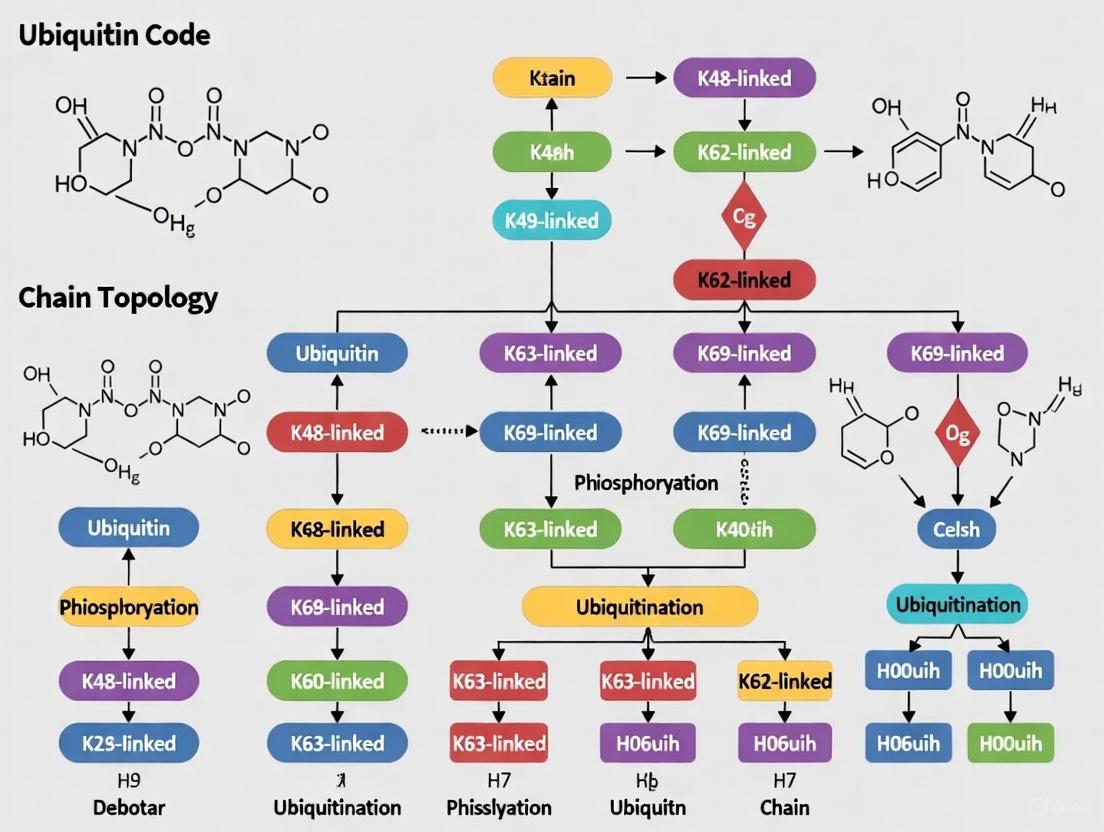
This article provides a comprehensive overview of the ubiquitin code, focusing on the structural and functional diversity of ubiquitin chain topologies.
Decoding the Ubiquitin Code: Chain Topology, Biological Functions, and Therapeutic Targeting
Abstract
This article provides a comprehensive overview of the ubiquitin code, focusing on the structural and functional diversity of ubiquitin chain topologies. It explores the foundational biology of ubiquitination, from the enzymatic cascade to the formation of complex homotypic, mixed, and branched chains. The content delves into advanced methodologies for deciphering ubiquitin signals, examines challenges and emerging solutions in the field, and compares the functional outcomes of different chain architectures in both health and disease. Finally, it synthesizes how this knowledge is being translated into novel therapeutic strategies, including targeted protein degradation, to manipulate the ubiquitin-proteasome system for clinical benefit, offering critical insights for researchers and drug development professionals.
The Ubiquitin Language: Foundational Principles and Chain Topology Diversity
The ubiquitin-proteasome system (UPS) is a crucial mechanism for post-translational modification in eukaryotic cells, regulating protein stability, localization, and activity. This system controls the degradation of over 80% of cellular proteins, impacting virtually all cellular processes from cell cycle progression to DNA repair and signal transduction [1]. Deficiencies in ubiquitin signaling are implicated in numerous human pathologies, including cancer, neurodegenerative disorders, and immune defects [2] [3]. The ubiquitin enzymatic cascade consists of three key enzyme classes—E1 (ubiquitin-activating), E2 (ubiquitin-conjugating), and E3 (ubiquitin ligase) enzymes—that work sequentially to attach the small protein modifier ubiquitin to substrate proteins [1] [4]. The specificity of this system, particularly governed by the extensive E3 ligase family, allows for precise regulation of the cellular proteome, enabling intricate signaling outcomes that extend far beyond mere protein degradation [5].
The Ubiquitin Enzymatic Cascade
The Three-Step Enzymatic Mechanism
The ubiquitination process proceeds through a well-defined three-step enzymatic cascade:
Step 1: E1-Mediated Ubiquitin Activation - The E1 ubiquitin-activating enzyme utilizes ATP to catalyze the formation of a thioester bond between its active cysteine residue and the C-terminal glycine of ubiquitin [1] [4]. This energy-dependent reaction creates a high-energy E1~Ub thioester intermediate. Humans possess only two E1 enzymes, highlighting their broad specificity and conservation [6].
Step 2: E2-Mediated Ubiquitin Conjugation - The activated ubiquitin is transferred from E1 to the active site cysteine of an E2 conjugating enzyme via a transthiolation reaction, forming an E2~Ub thioester [1]. The human genome encodes approximately 40 E2 enzymes, which begin to impart specificity to the cascade [7] [6].
Step 3: E3-Mediated Ubiquitin Ligation - E3 ubiquitin ligases recruit both the E2~Ub complex and the target substrate, facilitating the transfer of ubiquitin to a lysine residue on the substrate [1] [4]. With over 600 E3 ligases in humans, this final step provides remarkable substrate specificity to the ubiquitin system [1] [4].
Table 1: Enzyme Classes in the Human Ubiquitin Cascade
| Enzyme Class | Number of Genes | Primary Function | Key Intermediate |
|---|---|---|---|
| E1 (Activating) | 2 [6] | Ubiquitin activation | E1~Ub thioester |
| E2 (Conjugating) | ~40 [7] [6] | Ubiquitin conjugation | E2~Ub thioester |
| E3 (Ligase) | >600 [1] [4] | Substrate recognition & ubiquitin transfer | E3-substrate complex |
The following diagram illustrates the sequential reactions of the ubiquitin cascade:
Ubiquitin Transfer Mechanisms
E3 ligases employ distinct mechanistic strategies for ubiquitin transfer, primarily classified as RING-type or HECT-type mechanisms:
RING-type E3 Ligases: Really Interesting New Gene (RING) E3 ligases function as scaffolds that facilitate the direct transfer of ubiquitin from the E2~Ub complex to the substrate [1]. They position the E2~Ub thioester in close proximity to the target lysine residue on the substrate, enabling direct attack without forming a covalent E3-Ub intermediate [1] [4]. RING E3s constitute the largest E3 family with over 600 members in humans [1].
HECT-type E3 Ligases: The Homologous to E6AP C-Terminus (HECT) E3 ligases employ a two-step mechanism where ubiquitin is first transferred from the E2 to a catalytic cysteine within the HECT domain, forming a reactive E3~Ub thioester intermediate, before final transfer to the substrate [1] [6]. This mechanism provides HECT E3s with greater control over chain topology but comes at the energy cost of an additional catalytic step.
Hybrid E2/E3 Enzymes: Recent research has identified unusual hybrid enzymes like UBE2O and BIRC6 that combine E2 and E3 functionalities within a single polypeptide [7]. These E2/E3 hybrids can catalyze ubiquitination independently of separate E3 ligases, expanding the mechanistic diversity of ubiquitin transfer [7].
Table 2: Comparison of E3 Ligase Mechanisms
| Mechanistic Class | Catalytic Intermediate | Representative Members | Key Features |
|---|---|---|---|
| RING-type | No E3-Ub intermediate | Cbl, MDM2, RNF145 [1] [8] | Largest family; direct transfer |
| HECT-type | E3~Ub thioester | E6AP, NEDD4 family, HERC family [1] | Two-step mechanism; diverse chain formation |
| RBR-type | E3~Ub thioester | HOIP, HOIL-1, Parkin [1] | RING-HECT hybrid mechanism |
| E2/E3 Hybrid | E2~Ub thioester | UBE2O, BIRC6 [7] | Single polypeptide with dual function |
Ubiquitin Chain Topology and Signaling Diversity
Ubiquitin Chain Linkages
Ubiquitin contains seven lysine residues (K6, K11, K27, K29, K33, K48, K63) and an N-terminal methionine (M1) that can serve as linkage sites for polyubiquitin chain formation [1] [5]. Each linkage type generates structurally distinct chains that are recognized by specific ubiquitin-binding domains, enabling diverse functional outcomes:
- K48-linked chains: The most abundant linkage type, primarily targeting substrates for proteasomal degradation [1] [4].
- K63-linked chains: Mainly involved in non-proteolytic signaling including DNA damage repair, kinase activation, and inflammatory signaling [1].
- M1-linear chains: Assembled by the LUBAC complex, crucial for NF-κB signaling pathway activation [1].
- Atypical linkages (K6, K11, K27, K29, K33): Involved in diverse processes including ER-associated degradation, mitophagy, and innate immune signaling [1].
The following diagram illustrates how different ubiquitin chain topologies determine specific cellular fates:
Complex Chain Architectures
Beyond homogeneous chains, ubiquitin signaling complexity is enhanced through heterogeneous chain architectures:
- Branched ubiquitin chains: Contain multiple linkage types within a single chain, creating combinatorial complexity that may integrate multiple signals [3].
- Mixed chains: Feature alternating linkage types that can be specifically recognized by specialized reader proteins [5].
- Ubiquitin code integration: The specific ubiquitin modification operates as a sophisticated code that integrates information from cellular status, environmental cues, and substrate identity to determine functional outcomes [5].
Experimental Methods for Studying Ubiquitination
UPS-CONA: Real-Time Monitoring of Ubiquitination Cascades
The UPS-CONA (Ubiquitin-Proteasome System-Confocal Fluorescence Nanoscanning) assay enables real-time, quantitative monitoring of ubiquitination enzyme activities [6]. This bead-based confocal imaging technique employs substrate proteins immobilized on microbeads and fluorescently labeled ubiquitin to track conjugation events with high sensitivity and temporal resolution.
Protocol:
- Immobilization: His6-tagged enzyme or substrate is immobilized on Ni2+NTA agarose beads (100-120 μm diameter) [6].
- Reaction Setup: Beads are transferred to a 384-well plate to form a monolayer and incubated with Cy5-labeled ubiquitin, Mg2+-ATP, and required enzyme components in ubiquitination buffer [6].
- Real-Time Imaging: Confocal imaging detects Cy5 fluorescence emission at the bead periphery, with intensity quantitatively corresponding to ubiquitin conjugation [6].
- Data Analysis: Automated image analysis quantifies fluorescence ring intensity across hundreds to thousands of beads, providing high statistical power for kinetic measurements [6].
Applications:
- Individual enzyme activity assays (E1, E2, HECT E3s) [6]
- Multi-step ubiquitination cascade monitoring [6]
- Inhibitor specificity and potency screening [6]
- Characterization of enzyme kinetics and mechanisms [6]
Structural Biology Approaches
Structural studies have been instrumental in elucidating ubiquitination mechanisms:
- X-ray crystallography: Has revealed atomic-level details of E2-substrate interactions, such as the UBE2E1-SETDB1 peptide complex that explained the mechanism of E3-independent ubiquitination [2].
- Cryo-electron microscopy: Enabled visualization of full-length hybrid enzymes like UBE2O, revealing dimeric architectures essential for their function [7].
- Hydrogen-deuterium exchange mass spectrometry (HDX-MS): Provides insights into protein dynamics and interaction interfaces in solution, as demonstrated in UBE2E1-hexapeptide binding studies [2].
Table 3: Key Research Reagents and Solutions
| Reagent/Solution | Function/Application | Example Use |
|---|---|---|
| Cy5-labeled ubiquitin | Fluorescent probe for real-time tracking | UPS-CONA assay visualization [6] |
| Ni2+NTA agarose beads | Solid support for His-tagged protein immobilization | Enzyme/substrate presentation in UPS-CONA [6] |
| UBE2E1 mutant (Cys to Ala) | Catalytically inactive E2 control | Validation of ubiquitination mechanism [2] |
| KEGYES/KEGYEE peptide tags | Sequence-dependent ubiquitination tags | E3-free ubiquitination system [2] |
| Proteoliposomes with defined lipid composition | Membrane reconstitution system | Lipid sensing studies of UBE2J2 [8] |
Recent Advances and Therapeutic Applications
Novel Regulatory Mechanisms
Recent research has uncovered unexpected regulatory layers in the ubiquitin cascade:
- E2-based lipid sensing: UBE2J2, a membrane-anchored E2 enzyme, directly senses lipid packing density in the endoplasmic reticulum membrane, with tighter packing promoting its active conformation and ERAD activity [8].
- E3-independent ubiquitination: UBE2E1 catalyzes sequence-specific ubiquitination of substrates containing KEGYES motifs without E3 involvement, expanding the paradigm of ubiquitination mechanisms [2].
- Hybrid enzyme mechanisms: Structural studies of UBE2O reveal that dimerization and autoubiquitination within its CR1-CR2 domain regulate its activity as an E2/E3 hybrid enzyme [7].
Targeted Protein Degradation Therapeutics
The understanding of ubiquitin cascade mechanisms has enabled revolutionary therapeutic approaches:
- PROTACs (Proteolysis-Targeting Chimeras): Bifunctional molecules that recruit E3 ligases to target proteins, inducing their ubiquitination and degradation [1] [3]. These have shown promise in degrading previously "undruggable" targets.
- Molecular Glues: Small molecules that enhance or induce interactions between E3 ligases and target proteins, promoting selective degradation [3].
- E3 Ligase Modulation: Direct targeting of E3 ligases such as MDM2, BRCA1, and Von Hippel-Lindau tumor suppressor for cancer therapy [4] [9].
The following diagram illustrates the mechanism of PROTAC-mediated targeted protein degradation:
The ubiquitin enzymatic cascade represents one of the most sophisticated and versatile regulatory systems in eukaryotic cell biology. From fundamental three-enzyme mechanisms to complex chain topologies that encode diverse signals, this system exemplifies the intricate specificity achievable through enzyme cascades. Recent advances in structural biology, real-time monitoring techniques, and mechanistic studies continue to reveal unexpected regulatory layers, from lipid-sensing E2 enzymes to E3-independent ubiquitination pathways. The therapeutic translation of this knowledge through targeted protein degradation platforms represents a paradigm shift in drug discovery, highlighting the enduring importance of fundamental biochemical research for innovative therapeutic strategies. As structural, chemoproteomic, and AI-guided tools continue to advance, our understanding of the ubiquitin cascade will undoubtedly expand, revealing new biological insights and therapeutic opportunities.
Ubiquitin (Ub) is a small, 76-amino-acid regulatory protein that is ubiquitously expressed in eukaryotic cells and is one of the most evolutionarily conserved proteins known [10] [11]. This protein serves as a crucial post-translational modification (PTM) when covalently attached to substrate proteins, a process known as ubiquitination (or ubiquitylation). The ubiquitin code refers to the complex language of signals generated by diverse ubiquitination patterns, which collectively regulate virtually all aspects of cellular function in eukaryotes [10] [12]. The versatility of ubiquitin signaling stems from its ability to form different architectural arrangements on substrate proteins, including monoubiquitination, multi-monoubiquitination, and polyubiquitination, each generating distinct functional outcomes [13] [14].
The discovery of ubiquitin and the elucidation of its basic functions earned Aaron Ciechanover, Avram Hershko, and Irwin Rose the Nobel Prize in Chemistry in 2004 [11]. Since then, research has revealed that ubiquitination influences protein degradation, localization, activity, and interactions [11]. The system's complexity is further enhanced by the existence of ubiquitin-like proteins (UBLs) that share structural similarities with ubiquitin, including SUMO, NEDD8, ISG15, and ATG8, which expand the repertoire of regulatory possibilities [10]. This whitepaper provides an in-depth technical examination of the architectural diversity of the ubiquitin code, its functional consequences, and the experimental approaches used to decipher it.
The Biochemical Architecture of Ubiquitin Modifications
Fundamental Ubiquitin Structure and Properties
Ubiquitin is a 8.6 kDa protein containing 76 amino acids with several critical structural features that enable its signaling versatility [11]. Its molecular mass is approximately 8564.8448 Da, and it has an isoelectric point (pI) of 6.79 [11]. The protein structure includes a characteristic β-grasp fold consisting of a five-stranded β-sheet wrapped around a single α-helix [10]. Key functional elements include:
- A C-terminal tail ending with a glycine residue (Gly76) that forms covalent attachments to substrates
- Seven internal lysine residues (K6, K11, K27, K29, K33, K48, K63) that serve as potential linkage sites for polyubiquitin chain formation
- An N-terminal methionine (M1) that can also form linear ubiquitin chains [11] [13]
The human genome encodes ubiquitin through four genes: UBB, UBC, UBA52, and RPS27A. UBA52 and RPS27A produce fusion proteins with ribosomal subunits, while UBB and UBC encode polyubiquitin precursor proteins that are processed to release multiple ubiquitin monomers [11]. This genetic arrangement ensures adequate ubiquitin supply while allowing regulatory complexity.
The Ubiquitination Enzymatic Cascade
Ubiquitination occurs through a sequential enzymatic cascade involving three main enzyme classes:
- E1 Ubiquitin-Activating Enzymes: Initiate the process through ATP-dependent ubiquitin activation, forming a thioester bond between the E1 active-site cysteine and ubiquitin's C-terminus [11]. The human genome encodes two E1 enzymes: UBA1 and UBA6 [11].
- E2 Ubiquitin-Conjugating Enzymes: Receive activated ubiquitin from E1 via trans-thioesterification. Humans possess approximately 35 E2 enzymes characterized by a conserved ubiquitin-conjugating catalytic (UBC) fold [11].
- E3 Ubiquitin Ligases: Catalyze the final transfer of ubiquitin to substrate proteins, providing substrate specificity. With over 600 E3s in humans, they primarily function as either RING (Really Interesting New Gene) or HECT (Homologous to E6-AP C Terminus) domain-containing enzymes [11] [12].
This hierarchical arrangement allows enormous combinatorial potential for generating specific ubiquitination signals from a limited set of enzymes [12].
Table 1: Key Enzyme Classes in the Ubiquitination Cascade
| Enzyme Class | Human Genes | Primary Function | Catalytic Mechanism |
|---|---|---|---|
| E1 Activating Enzymes | 2 (UBA1, UBA6) | Ubiquitin activation via ATP hydrolysis | Forms thioester bond with Ub C-terminus |
| E2 Conjugating Enzymes | ~35 | Ubiquitin transfer from E1 to E3/substrate | Trans-thioesterification; conserved UBC fold |
| E3 Ligating Enzymes | >600 | Substrate recognition & ubiquitin transfer | RING: scaffolds E2~Ub to substrate; HECT: forms thioester intermediate |
Architectural Types of Ubiquitin Modifications
Monoubiquitination
Monoubiquitination involves the attachment of a single ubiquitin molecule to one lysine residue on a substrate protein [14]. This modification was initially considered non-proteolytic and functions as a regulatory signal similar to phosphorylation [13] [14]. Monoubiquitination primarily influences protein-protein interactions, cellular localization, and activity [14]. Key functional roles include:
- Endocytosis and intracellular trafficking: Monoubiquitination of cell surface receptors (e.g., EGFR) targets them for internalization and endosomal sorting [14].
- Histone regulation: Monoubiquitination of histone H2A regulates chromatin structure and gene expression [13].
- DNA repair: Various DNA repair proteins are monoubiquitinated to control their activity and recruitment to damage sites [14].
- Viral budding: Some viruses exploit the monoubiquitination machinery to facilitate particle release [14].
The functional impact of monoubiquitination stems from its ability to create new interaction surfaces recognized by proteins containing ubiquitin-binding domains (UBDs) [14].
Multi-Monoubiquitination
Multi-monoubiquitination represents a distinct architectural pattern where single ubiquitin molecules are attached to multiple different lysine residues on the same substrate protein [15] [14]. This modification generates a specific signaling outcome that differs from both monoubiquitination and polyubiquitination:
- Receptor internalization: The epidermal growth factor receptor (EGFR) undergoes multi-monoubiquitination, which facilitates its internalization through clathrin-independent pathways [14].
- Signal amplification: Multiple monoubiquitin moieties can increase the avidity for ubiquitin-binding proteins, enhancing downstream signaling [14].
- Endocytic adaptor regulation: Proteins like eps15, eps15R, and epsin are themselves multi-monoubiquitinated, which may contribute to signal amplification during endocytosis [14].
The distinction between multi-monoubiquitination and polyubiquitination is functionally critical, as they lead to different cellular outcomes for the modified substrate [15].
Polyubiquitination
Polyubiquitination occurs when multiple ubiquitin molecules are linked together in a chain formation, with the C-terminus of each subsequent ubiquitin attached to a specific lysine residue or the N-terminal methionine of the preceding ubiquitin molecule [11] [13]. The topology of polyubiquitin chains depends on which of the seven lysine residues (K6, K11, K27, K29, K33, K48, K63) or the N-terminal methionine (M1) is used for linkage, with each linkage type potentially generating a unique structural conformation and functional signal [11] [13] [14].
Table 2: Polyubiquitin Chain Linkages and Their Functional Roles
| Linkage Type | Structural Features | Primary Functions | Recognizing Receptors/Effectors |
|---|---|---|---|
| K48 | Closed conformation | Proteasomal degradation | RPN10, RPN13, RAD23, UBQLNs |
| K63 | Extended, linear conformation | DNA repair, NF-κB signaling, endocytosis, kinase activation | TAB2/3, ESCRT components |
| K11 | Atypical linkage | Proteasomal degradation, cell cycle regulation | Proteasome receptors |
| K29 | Atypical linkage | Proteasomal degradation (alone or with K48/K63) | Proteasome receptors |
| K33 | Atypical linkage | Non-proteolytic processes | Undefined |
| K6 | Atypical linkage | DNA damage response, mitophagy | Undefined |
| K27 | Atypical linkage | Kinase activation, inflammatory signaling | Undefined |
| M1 (Linear) | Linear chains | NF-κB activation, immune signaling | NEMO, ABIN proteins |
The structural differences between chain types facilitate specific recognition by ubiquitin-binding domains (UBDs). For example, K48-linked chains adopt a closed conformation that promotes recognition by proteasomal subunits, while K63-linked chains form more extended structures suitable for signaling applications [14]. Additionally, ubiquitin chains can become more complex through branching, where a single ubiquitin molecule serves as an acceptor for multiple different chain types, and through hybrid modifications where ubiquitin itself is modified by other PTMs such as phosphorylation or acetylation [10] [13].
Functional Consequences of Ubiquitin Code Architecture
Degradation Signals in the Ubiquitin-Proteasome System
The ubiquitin-proteasome system (UPS) represents a major proteolytic pathway in eukaryotic cells, with different ubiquitin architectures serving as degradation signals (degrons) [13]. While K48-linked polyubiquitin chains have long been considered the canonical proteasomal degradation signal, recent evidence has expanded this paradigm:
- Monoubiquitination can function as a proteasomal degron, particularly for short-lived proteins, challenging the previous paradigm that exclusively associated monoubiquitination with non-proteolytic functions [13].
- K11 and K29 linkages can serve as proteasomal degrons, either alone or in combination with other linkages [13].
- Branched ubiquitin chains containing multiple linkage types can enhance degradation efficiency compared to homotypic chains [13].
The minimal chain length for efficient proteasomal targeting is three ubiquitin molecules, as chains with only two ubiquitins remain stable in cells due to rapid disassembly [16].
Signaling Functions in Non-Proteolytic Pathways
Beyond proteasomal targeting, ubiquitin modifications regulate numerous non-proteolytic processes:
- DNA damage repair: Both monoubiquitination and K63-linked polyubiquitination play crucial roles in coordinating the DNA damage response [14].
- Inflammatory signaling: K63-linked and M1-linked linear chains are essential for NF-κB pathway activation and inflammatory signaling [13].
- Selective autophagy: Ubiquitin chains, primarily K63 linkages, serve as signals for autophagic degradation of protein aggregates, organelles, and intracellular pathogens through recognition by autophagic adaptors like p62, NBR1, and OPTN [13].
- Membrane trafficking: Monoubiquitination and K63-linked chains regulate endocytic sorting of cell surface receptors, influencing their recycling or lysosomal degradation [14].
The functional specificity of different ubiquitin architectures is determined by the structural features of the ubiquitin signal and the complement of ubiquitin-binding proteins in specific cellular compartments [14].
Experimental Approaches for Deciphering the Ubiquitin Code
Distinguishing Polyubiquitination from Multi-Monoubiquitination
A critical experimental challenge in ubiquitin research involves differentiating between polyubiquitination and multi-monoubiquitination, as both produce high-molecular-weight conjugates that appear similar by SDS-PAGE and western blot analysis [15]. The established protocol for distinguishing these modifications utilizes ubiquitin mutants in in vitro conjugation reactions:
Experimental Protocol [15]:
- Reaction Setup: Perform two parallel in vitro ubiquitination reactions containing the substrate protein, E1 enzyme, appropriate E2 enzyme, E3 ligase, and either:
- Reaction 1: Wild-type ubiquitin (capable of both substrate conjugation and chain elongation)
- Reaction 2: "Ubiquitin No K" mutant (all seven lysines mutated to arginines; capable of substrate conjugation but not chain formation)
Reaction Components:
- 50 mM HEPES (pH 8.0), 50 mM NaCl, 1 mM TCEP
- Approximately 100 μM ubiquitin (wild-type or mutant)
- 10 mM MgATP
- 5-10 μM substrate protein
- 100 nM E1 enzyme
- 1 μM E2 enzyme
- 1 μM E3 ligase
- Incubate at 37°C for 30-60 minutes
Analysis and Interpretation:
- Terminate reactions with SDS-PAGE sample buffer or EDTA/DTT
- Analyze by western blotting with anti-ubiquitin antibodies
- Polyubiquitination: High-molecular-weight species appear in Reaction 1 but not Reaction 2
- Multi-monoubiquitination: High-molecular-weight species appear in both Reaction 1 and Reaction 2
Figure 1: Experimental workflow for distinguishing polyubiquitination from multi-monoubiquitination using ubiquitin mutants
Advanced Methodologies for Ubiquitin Research
Contemporary ubiquitin research employs sophisticated chemical and proteomic tools to decipher the complexity of ubiquitin signaling:
- Activity-based probes (ABPs): Chemical tools featuring ubiquitin conjugated to reactive warheads that covalently trap catalytic cysteines in E1, E2, or E3 enzymes, allowing their identification and characterization [12].
- Ubiquitin linkage-specific antibodies: Antibodies that recognize specific ubiquitin chain linkages enable detection and quantification of distinct chain types in cellular contexts [13] [14].
- Mass spectrometry-based ubiquitylomics: Advanced proteomic approaches identify ubiquitination sites and chain linkages on a global scale, revealing the complex landscape of ubiquitin modifications in different physiological states [10].
- Ubiquitin mutants in cellular studies: Expression of ubiquitin mutants in cells (e.g., Ub-K63R) helps elucidate the functions of specific chain types, as demonstrated by the DNA repair defect in yeast expressing Ub-K63R [14].
Table 3: Key Research Reagents and Their Applications in Ubiquitin Studies
| Research Tool | Composition/Properties | Primary Applications | Functional Utility |
|---|---|---|---|
| Ubiquitin No K | All 7 lysines mutated to arginine | Distinguishing poly vs multi-monoubiquitination | Prevents chain elongation while permitting substrate conjugation |
| Linkage-specific Antibodies | Antibodies recognizing specific Ub linkages | Detection of specific chain types in cells | Enables monitoring of specific ubiquitin signals in different conditions |
| Activity-based Probes (ABPs) | Ubiquitin with C-terminal reactive warheads | Identifying active ubiquitin enzymes | Covalently traps E1, E2, E3 enzymes for identification |
| UbFluor-SH | Ub-MES conjugated to fluorescein-thiol | HTS assays for HECT E3 ligase activity | Enables screening for E3 inhibitors without E1/E2 interference |
| Tandem Ubiquitin Binding Entities (TUBEs) | Multivalent ubiquitin-binding domains | Protection of ubiquitin chains from DUBs | Stabilizes ubiquitin conjugates for analysis |
The architectural diversity of ubiquitin modifications—monoubiquitination, multi-monoubiquitination, and polyubiquitination—constitutes a sophisticated signaling system that regulates virtually all aspects of eukaryotic cell biology. The structural features of each modification type create specific interaction surfaces that are recognized by dedicated effector proteins, ultimately determining the functional outcome for the modified substrate. While significant progress has been made in deciphering the ubiquitin code, substantial challenges remain in understanding the full complexity of this system, particularly regarding the functions of atypical ubiquitin linkages, branched chains, and the crosstalk between ubiquitin and other post-translational modifications.
Future research directions will likely focus on developing more sophisticated tools to manipulate and monitor specific ubiquitination events in living cells, mapping the complete network of ubiquitin signaling pathways, and exploiting this knowledge for therapeutic purposes. Given the central role of ubiquitin signaling in human diseases including cancer, neurodegenerative disorders, and inflammatory conditions, continued elucidation of the ubiquitin code architecture promises to reveal new opportunities for therapeutic intervention in these challenging disease areas.
Ubiquitination is a crucial post-translational modification that regulates nearly all aspects of eukaryotic cell biology, controlling processes ranging from protein degradation to signal transduction, DNA repair, and immune response [17] [18] [5]. This remarkable functional diversity stems from ubiquitin's capacity to form an extensive repertoire of polymer chains of varying length, linkage, and topology [17] [5]. The ubiquitin code—the concept that distinct ubiquitin signals encode different functional outcomes—is fundamentally determined by the structural properties of these chains [5] [19].
Ubiquitin chains are classified into three broad categories based on their architecture. Homotypic chains are linked uniformly through the same acceptor site on ubiquitin (e.g., K48-linked chains). Heterotypic chains incorporate multiple linkage types and can be further divided into mixed chains, where each ubiquitin monomer is modified on only one site but different monomers use different sites, and branched chains, which contain at least one ubiquitin subunit modified concurrently on more than one acceptor site, creating a forked structure [17] [18]. While heterotypic chains increase the complexity of ubiquitin signaling, homotypic chains form the foundational understanding of ubiquitin function, with different linkages specialized for distinct cellular processes [18].
This guide focuses on the structures, functions, and experimental approaches for studying homotypic ubiquitin chains, with particular emphasis on the most characterized linkages: K48, K63, and M1. Understanding these fundamental signals provides the essential framework for deciphering the more complex ubiquitin code and its implications for health and disease [19].
Structural Foundations of Ubiquitin
Ubiquitin is a small, 76-amino acid protein possessing remarkable structural stability that allows it to function as a versatile signaling molecule [5]. Its compact β-grasp fold consists of a five-stranded β sheet cradling a central α helix and a short 3₁₀ helix, creating a stable core that resists unfolding, proteolysis, and extreme conditions [5]. This stability is enhanced by three strategically positioned salt bridges and a hydrophobic core that collectively maintain structural integrity across diverse cellular environments [5].
Ubiquitin contains eight known modification sites: seven internal lysine residues (K6, K11, K27, K29, K33, K48, K63) and the N-terminal methionine (M1) [5] [19]. Each site can serve as an acceptor for another ubiquitin molecule, enabling the formation of polyubiquitin chains with distinct structural and functional properties. The enzymatic cascade responsible for ubiquitin conjugation involves E1 (activating), E2 (conjugating), and E3 (ligating) enzymes working in sequence to attach ubiquitin to substrate proteins [20]. The specificity of chain formation is largely determined by E2 enzymes and E3 ligases, which dictate linkage type through their structural preferences [17].
Table 1: Ubiquitin Linkage Sites and Their Primary Functions
| Linkage Type | Major Known Functions | Structural Characteristics |
|---|---|---|
| K48 | Proteasomal degradation [16] [21] | Compact, closed conformation [22] |
| K63 | Signal transduction, DNA repair, inflammation [21] [22] | Extended, open conformation [22] |
| M1 (Linear) | NF-κB signaling, inflammation [20] | Extended rigid structure [5] |
| K11 | Proteasomal degradation, cell cycle regulation [23] [20] | Compact, closed conformation [5] |
| K6 | DNA damage response, mitochondrial homeostasis [17] | Less characterized |
| K27 | Immune signaling, kinase activation [17] | Less characterized |
| K29 | Proteasomal degradation, substrate inhibition [17] | Less characterized |
| K33 | Kinase regulation, trafficking [17] | Less characterized |
The ability of ubiquitin chains to transmit specific signals depends on their recognition by proteins containing ubiquitin-binding domains (UBDs) [5]. These reader proteins decode the ubiquitin signal by recognizing unique structural features of different chain types, ultimately translating the modification into appropriate cellular responses [5].
K48-Linked Ubiquitin Chains
Structure and Function
K48-linked ubiquitin chains represent the archetypal degradation signal in eukaryotic cells [16] [21]. These chains adopt a compact, closed conformation in which the ubiquitin monomers pack closely together, creating a unique surface topography recognized specifically by proteasomal receptors [22]. This structural arrangement is crucial for its role in targeting proteins for destruction.
The primary function of K48-linked chains is to mark proteins for degradation by the 26S proteasome [16] [21]. Recent quantitative studies using the UbiREAD technology have revealed that K48-linked chains must consist of at least three ubiquitin molecules (Ub₃) to efficiently target substrates for degradation, with such modifications inducing degradation with a remarkably short half-life of approximately one minute [16] [24]. Chains with only two ubiquitins remain stable in cells due to susceptibility to disassembly by deubiquitinases (DUBs) [16] [24].
Experimental Insights
Methodology for studying K48 chain function often involves targeted protein degradation systems such as PROTACs (Proteolysis-Targeting Chimeras) [21]. These bifunctional molecules recruit E3 ligases to specific target proteins, inducing their K48-linked ubiquitination and subsequent degradation [21] [20]. For example, RIPK2 PROTACs specifically induce K48 ubiquitination of the RIPK2 protein, which can be captured and quantified using K48-chain-specific TUBEs (Tandem Ubiquitin Binding Entities) [21].
The chain length requirement for degradation was definitively established using UbiREAD (ubiquitinated reporter evaluation after intracellular delivery), which enables precise monitoring of degradation kinetics for substrates modified with defined ubiquitin chains [24]. This technology involves delivering bespoke ubiquitinated proteins into human cells and tracking their fate at high temporal resolution, providing unprecedented quantitative insights into the ubiquitin-proteasome system [24].
K63-Linked Ubiquitin Chains
Structure and Function
In contrast to the compact structure of K48-linked chains, K63-linked ubiquitin chains adopt an extended, open conformation that allows them to function as scaffolds for protein-protein interactions in various signaling pathways [22]. This extended structure creates distinct binding surfaces that are recognized by specific effector proteins involved in non-degradative processes.
K63-linked chains play crucial roles in multiple cellular signaling pathways:
- Inflammatory signaling: K63 chains activate NF-κB and MAPK pathways by facilitating the assembly of signaling complexes [21]. In NOD2 signaling, bacterial muramyldipeptide induces K63 ubiquitination of RIPK2, creating a scaffold for TAK1/TAB1/TAB2/IKK kinase complex assembly and NF-κB activation [21].
- DNA damage response: K63 chains participate in DNA repair processes by recruiting repair proteins to damage sites [22].
- Protein trafficking: These chains regulate endocytic trafficking and lysosomal targeting of membrane proteins [21].
Unlike K48 chains, K63-linked ubiquitin does not typically target proteins for proteasomal degradation. UbiREAD experiments demonstrate that K63-ubiquitinated substrates are rapidly deubiquitinated rather than degraded, highlighting the non-proteolytic nature of this modification [24].
Experimental Insights
The distinct functions of K63 chains can be studied using linkage-specific tools such as:
- K63-specific TUBEs: These affinity reagents selectively capture K63-ubiquitinated proteins from cell lysates, enabling researchers to distinguish K63 ubiquitination from other linkage types [21].
- E2 enzyme inhibition: Small molecules like NSC697923 and BAY 11-7082 inhibit UBE2N, the E2 enzyme responsible for K63 chain formation, allowing investigation of the functional consequences of blocking K63 ubiquitination [20].
In the NOD2-RIPK2 signaling pathway, stimulation with L18-MDP (muramyldipeptide) induces robust K63 ubiquitination of RIPK2, which can be completely abolished by pre-treatment with the RIPK2 inhibitor Ponatinib [21]. This provides a model system for studying the dynamics and functional consequences of K63 ubiquitination in inflammatory signaling.
M1-Linked Linear Ubiquitin Chains
Structure and Function
M1-linked (linear) ubiquitin chains are unique in that they are formed through the N-terminal methionine residue rather than internal lysines [5]. These chains are synthesized by the LUBAC complex (linear ubiquitin chain assembly complex) and adopt an extended, rigid structure that distinguishes them from lysine-linked chains [5].
The primary function of M1-linked chains is in the regulation of NF-κB signaling and inflammatory responses [20]. Specifically, linear ubiquitin chains are essential for the activation of the IKK complex through their recognition by NEMO (NF-κB essential modulator), a regulatory subunit of IKK that contains specialized ubiquitin-binding domains selective for linear chains [5].
Experimental Insights
Research on linear ubiquitin chains has been facilitated by:
- LUBAC-specific inhibitors: Compounds that target the LUBAC complex enable researchers to probe the specific contributions of linear chains to NF-κB signaling and other pathways.
- Linear chain-specific antibodies: These reagents allow specific detection of M1-linked chains in cells and tissues, helping to elucidate their roles in health and disease.
The structural basis for linear ubiquitin chain recognition has been revealed through crystallographic studies showing how NEMO's UBAN domain specifically engages linear diubiquitin, providing mechanistic insights into how this linkage type activates inflammatory signaling pathways [5].
Other Linkage Types
While K48, K63, and M1 linkages are the most extensively studied, other homotypic chain types play important specialized roles in cellular regulation:
K11-linked chains are involved in both proteasomal degradation and cell cycle regulation [23] [20]. During mitosis, the anaphase-promoting complex/cyclosome (APC/C) cooperates with E2 enzymes UBE2C and UBE2S to assemble K11-linked chains on substrates such as cyclins, targeting them for degradation [17] [20]. In the Met4 pathway, K11 chains activate transcription by competing with repressive K48 chains for binding to a tandem ubiquitin-binding region [23].
K6-linked chains have been implicated in DNA damage response and mitochondrial homeostasis [17]. The E3 ligases Parkin and NleL can synthesize K6-linked chains in vitro, suggesting potential roles in quality control pathways [17].
K27-linked chains function in immune signaling and kinase activation pathways, while K29-linked chains have been associated with both proteasomal degradation and substrate inhibition [17]. K33-linked chains appear to regulate kinase activity and protein trafficking, though their functions are less well characterized [17].
Table 2: Less Characterized Ubiquitin Linkages and Proposed Functions
| Linkage Type | Proposed Functions | Key E3 Ligases/E2 Enzymes |
|---|---|---|
| K11 | Cell cycle regulation, ER-associated degradation [23] [20] | APC/C+UBE2C/S, UBR5 [17] |
| K6 | DNA damage response, mitochondrial quality control [17] | Parkin, NleL, HHARI [17] |
| K27 | Immune signaling, kinase activation [17] | Unknown |
| K29 | Proteasomal degradation, substrate inhibition [17] | UBE3C, Ufd4 [17] |
| K33 | Kinase regulation, protein trafficking [17] | Unknown |
Experimental Approaches and Methodologies
Key Research Technologies
Advancements in ubiquitin research have been driven by the development of specialized technologies that enable precise characterization of ubiquitin chain structure and function:
UbiREAD (Ubiquitinated Reporter Evaluation After Intracellular Delivery) is a cutting-edge technology that systematically compares the intracellular degradation capacity of different ubiquitin chains [16] [24]. The methodology involves:
- Design and production of defined ubiquitinated substrates in vitro
- Electroporation-based delivery of these predefined ubiquitinated reporters into human cells
- High-temporal resolution monitoring of substrate degradation and deubiquitination
- Quantitative analysis of degradation kinetics for different chain types
This approach revealed that K48-linked chains require at least three ubiquitins for efficient degradation, while K63-linked chains are rapidly deubiquitinated rather than degraded [24]. Furthermore, UbiREAD demonstrated that in branched K48/K63 chains, the identity of the chain directly conjugated to the substrate overrides the influence of the branching chain in determining degradation fate [24].
TUBEs (Tandem Ubiquitin Binding Entities) are engineered affinity reagents with nanomolar affinities for polyubiquitin chains that protect ubiquitinated proteins from deubiquitination and proteasomal degradation during analysis [21]. Chain-selective TUBEs can differentiate between linkage types, enabling researchers to investigate context-dependent ubiquitination of endogenous proteins [21]. For example, K63-TUBEs specifically capture L18-MDP-induced RIPK2 ubiquitination, while K48-TUBEs capture PROTAC-induced RIPK2 ubiquitination [21].
Structural techniques including X-ray crystallography, NMR spectroscopy, and small-angle X-ray scattering (SAXS) have been instrumental in elucidating the distinct conformations adopted by different ubiquitin chain types [5] [22]. These approaches revealed the compact conformation of K48-linked chains, the extended conformation of K63-linked chains, and how mixed chains exhibit conformational properties dependent on both linkage type and order within the chain [22].
The Scientist's Toolkit
Table 3: Essential Research Reagents for Ubiquitin Chain Analysis
| Research Tool | Function/Application | Example Use Cases |
|---|---|---|
| Chain-specific TUBEs | Selective enrichment of specific ubiquitin linkage types from cell lysates | Differentiating K48 vs. K63 ubiquitination of RIPK2 in response to PROTACs vs. inflammatory stimuli [21] |
| Linkage-specific antibodies | Immunodetection of specific ubiquitin chain types | Western blot analysis of chain abundance under different conditions |
| DUB enzymes | Linkage-specific cleavage of ubiquitin chains | OTUB1 for K48 linkage cleavage; ataxin-3 for preferential cleavage of mixed chains [22] |
| Recombinant ubiquitin chains | In vitro biochemical and structural studies | Synthesis of defined chains for structural studies (e.g., K48-K63 mixed chains) [22] |
| PROTAC molecules | Inducing targeted ubiquitination of specific proteins | Investigating K48-linked ubiquitination and degradation of target proteins [21] |
| E2/E3 inhibitors | Selective inhibition of specific ubiquitin chain formation | NSC697923 for inhibiting UBE2N (K63 chains) [20] |
Pathway Visualization and Functional Relationships
The following diagram illustrates the functional specialization and cellular fates of proteins modified with major ubiquitin chain types:
Ubiquitin Chain Formation and Functional Specialization
The experimental workflow for determining ubiquitin chain function using advanced technologies like UbiREAD can be visualized as follows:
UbiREAD Technology Workflow and Key Discoveries
Homotypic ubiquitin chains represent fundamental signaling units within the broader ubiquitin code, with distinct structural and functional properties specialized for specific cellular processes [5] [19]. The compact K48-linked chains primarily target proteins for proteasomal degradation, extended K63-linked chains serve as scaffolds for signaling complexes, and rigid M1-linear chains activate inflammatory pathways through specific recognition mechanisms [5] [22] [24]. Other linkage types, including K11, K6, K27, K29, and K33, play more specialized roles in processes such as cell cycle regulation, DNA damage response, and kinase modulation [17] [23].
Advanced technologies including UbiREAD, chain-specific TUBEs, and sophisticated structural approaches have revolutionized our understanding of how ubiquitin chain linkage, length, and architecture determine functional outcomes [21] [24]. These tools have revealed fundamental principles such as the minimum chain length requirement for degradation, the functional hierarchy within branched chains, and the conformational plasticity that enables linkage-specific recognition by effector proteins [22] [24].
As research continues to decipher the complexities of the ubiquitin code, understanding these fundamental homotypic chain types provides the essential foundation for exploring more complex heterotypic signals and developing novel therapeutic strategies that target the ubiquitin-proteasome system for treating cancer, neurodegenerative disorders, and inflammatory diseases [20] [19]. The ongoing development of more precise tools to manipulate and measure specific ubiquitin chain types promises to further unravel the intricacies of this essential regulatory system.
Ubiquitination is a crucial post-translational modification that regulates virtually all cellular pathways in eukaryotes, controlling processes ranging from protein degradation to DNA repair and cell signaling [16] [18]. The versatility of ubiquitin signaling stems from the ability of this small 76-amino acid protein to form diverse polymer chains. When the C-terminus of one ubiquitin molecule conjugates to a lysine residue on another ubiquitin, polymers called polyubiquitin chains are formed. Ubiquitin contains eight potential acceptor sites: the N-terminal methionine (M1) and seven lysine residues (K6, K11, K27, K29, K33, K48, K63) [18] [25].
While earlier research focused on homotypic chains (uniform chains connected through the same linkage type), recent advances have revealed a staggering complexity of heterotypic chains. These include mixed chains (composed of more than one linkage type but with each ubiquitin modified at only one site) and branched chains (containing at least one ubiquitin subunit simultaneously modified on two or more different sites) [18] [26]. This article provides an overview of the structures, functions, assembly mechanisms, and analytical methodologies for these complex ubiquitin chain topologies, framing them within the broader context of ubiquitin code and chain topology research.
Classification and Architecture of Complex Ubiquitin Chains
Chain Topology Definitions and Notation
The ubiquitin field has developed a systematic notation to unambiguously describe complex chain architectures. In this notation, ubiquitin units are connected by an en dash (–), with the distal-end ubiquitin unit(s) placed to the left and the proximal ubiquitin (connected to the target protein) to the right. Specific linkage residues are indicated as superscripts. Multiple ubiquitin moieties branching from a single ubiquitin are indicated with brackets. For example, a branched tri-Ub with two distal ubiquitins linked to K48 and K63 of a proximal ubiquitin is written as Ub[Ub]–⁴⁸,⁶³Ub [27].
Table 1: Classification of Ubiquitin Chain Topologies
| Chain Type | Structural Definition | Example Architectures | Key Features |
|---|---|---|---|
| Homotypic | Uniform linkage throughout chain | Ub–⁴⁸Ub–⁴⁸Ub–⁴⁸Ub | Single linkage type; well-characterized functions |
| Mixed Heterotypic | Multiple linkage types, each ubiquitin modified at single site | Ub–⁶³Ub–⁴⁸Ub | Unbranched structure; combination of linkage properties |
| Branched Heterotypic | At least one ubiquitin modified at ≥2 sites | Ub[Ub]–⁴⁸,⁶³Ub | Forked structure; can enhance signal strength and specificity |
Architectural Diversity of Branched Chains
Branched ubiquitin chains display remarkable architectural diversity. Branch points can be initiated at distal, proximal, or internal ubiquitins within a chain, and the same linkage types can be arranged in different architectures depending on the order of synthesis. For instance, branched K11/K48 chains can be assembled by the APC/C through K11 linkages on preformed K48 chains, whereas UBR5 forms the same linkage combination by attaching K48 linkages to preformed K11-linked chains [18]. This diversity creates a nearly limitless number of potential structures that significantly expand the ubiquitin code's information capacity.
Biological Functions and Signaling Capabilities
Degradation Signals and Proteasomal Recognition
Branched ubiquitin chains function as potent degradation signals. Recent research using the UbiREAD method revealed that K48-linked ubiquitin chains must consist of at least three ubiquitin molecules to efficiently target GFP for degradation with a half-life of approximately 1 minute [16]. Branched ubiquitin chains appear to enhance degradation efficiency in several contexts. For example, branched chains containing both K48 and K63 linkages are assembled on the pro-apoptotic regulator TXNIP, leading to its proteasomal degradation [18].
The hierarchical relationship between different linkages in branched chains is crucial for determining substrate fate. In K48/K63 branched chains, the linkage directly conjugated to the substrate protein overrides the influence of the branching chain in determining degradation [16]. This hierarchy enables precise control over protein stability.
Regulatory Functions Beyond Degradation
Complex chain topologies also function in degradation-independent signaling. A striking example comes from the yeast transcription factor Met4, where a switch from K48-linked to K11-linked ubiquitin chains activates transcription rather than promoting degradation [28]. Mechanistically, the K48 chain binds to a tandem ubiquitin-binding region in Met4 that also serves as its transactivation domain, competing with binding of the basal transcription machinery. A topology change to K11-enriched chains releases this competition and permits transcription complex binding [28].
Table 2: Functional Roles of Characterized Branched Ubiquitin Chains
| Branched Chain Type | Biological Context | Functional Outcome | Key References |
|---|---|---|---|
| K48/K63 | TXNIP regulation; NF-κB signaling | Enhanced proteasomal degradation; Signal regulation | [18] [27] |
| K11/K48 | Mitotic regulation via APC/C | Cell cycle control; Substrate degradation | [18] [26] |
| K29/K48 | Ubiquitin fusion degradation pathway | Protein quality control | [18] [26] |
| K11/K63 | MHC class I internalization | Immune regulation | [25] |
| M1/K63 | Immune signaling | NF-κB activation; inflammatory response | [25] |
Pathway Integration and Signal Specificity
Mixed and branched chains enable integration of multiple signals within a single modification. Studies of K48/K63 branched trimers demonstrated that each linkage type retains its distinctive structural and receptor-binding properties within the same chain [27]. This allows a single modification to be recognized by multiple linkage-specific receptors simultaneously, potentially coordinating different cellular processes. The presence of multiple linkages also creates opportunities for signal regulation through selective disassembly by linkage-specific deubiquitinases (DUBs) [27] [26].
Assembly and Disassembly Mechanisms
Enzymatic Synthesis of Branched Chains
The synthesis of branched ubiquitin chains involves specialized enzymatic mechanisms that can be categorized into four main types:
Single E3 with intrinsic branching activity: Some HECT and RBR E3 ligases, including UBE3C, Parkin, and WWP1, can form branched chains with a single E2 [18] [26]. For instance, Parkin synthesizes branched K6/K48 chains, which may be relevant in Parkinson's disease pathogenesis [18].
Sequential E2 recruitment: Multisubunit RING E3s like the APC/C can recruit different E2s sequentially. During mitosis, the APC/C cooperates with UBE2C to build initial chains and UBE2S to add K11 linkages, generating branched K11/K48 chains [18] [26].
E3 collaborations: Pairs of E3s with distinct linkage specificities often collaborate. The HECT E3s ITCH and UBR5 work together on TXNIP: ITCH first attaches K63-linked chains, then UBR5 binds these chains via its UBA domain and adds K48 linkages to create branched K48/K63 chains [18] [26].
E2s with innate branching activity: Some E2s like yeast Ubc1 and its mammalian ortholog UBE2K can promote branched K48/K63 chain assembly [26].
The following diagram illustrates the collaborative E3 mechanism for branched chain assembly:
Disassembly by Deubiquitinases
The disassembly of branched chains is specifically regulated by deubiquitinases (DUBs). The proteasome-bound DUB UCH37, in complex with RPN13, selectively cleaves K48 linkages at branch points in K6/K48-branched chains, effectively "debranching" the chain before substrate degradation [26]. Other DUBs show linkage selectivity toward specific linkages within mixed and branched chains, enabling editing and disassembly of complex ubiquitin signals [27] [26].
Analytical Methodologies and Experimental Approaches
Mass Spectrometry-Based Strategies
Advanced mass spectrometry techniques have become indispensable for characterizing complex ubiquitin chain topologies. Several specialized approaches have been developed:
Top-down tandem MS: This method analyzes intact ubiquitin chains without proteolytic digestion, preserving information about chain connectivity and architecture. The protocol involves liquid chromatography separation followed by tandem MS with fragmentation techniques like ETciD or EThcD, which combine electron transfer dissociation with collision-induced dissociation [29]. This approach can distinguish isomeric chain structures and identify branch points.
DiGly remnant enrichment: The most common ubiquitin proteomics approach involves tryptic digestion, which leaves a di-glycine (GG) remnant on modified lysines. Enrichment of GG-modified peptides using specific antibodies allows identification of ubiquitination sites but provides limited information about chain architecture [30].
Linkage-specific antibodies: Antibodies that recognize specific ubiquitin linkages enable enrichment of particular chain types. However, many commercially available antibodies cannot distinguish between homotypic chains and the same linkages within branched architectures [25] [30].
Biochemical and Biophysical Methods
Ubiquitin binding domain (UBD)-based probes: Tandem-repeated ubiquitin-binding entities (TUBEs) with enhanced affinity can enrich ubiquitinated proteins while protecting them from deubiquitinase activity [30]. Modifying TUBEs to contain ubiquitin-binding domains with linkage preferences allows some selectivity for specific chain types.
NMR spectroscopy: Nuclear magnetic resonance can characterize the structural and dynamic properties of mixed and branched ubiquitin chains in solution. Studies using NMR have shown that K48 and K63 linkages in mixed chains retain conformational properties similar to their homotypic counterparts [27].
The following workflow diagram illustrates an integrated approach for branched chain analysis:
The Scientist's Toolkit: Research Reagent Solutions
Table 3: Essential Research Reagents for Studying Branched Ubiquitin Chains
| Reagent / Tool | Function and Application | Key Features and Considerations |
|---|---|---|
| Linkage-specific antibodies | Enrichment and detection of specific ubiquitin linkages | Variable ability to detect linkages in branched contexts; validation required |
| Tandem Ubiquitin Binding Entities (TUBEs) | Affinity enrichment of ubiquitinated proteins while protecting from DUBs | Can be engineered with linkage preferences; protects ubiquitin signals during extraction |
| Recombinant branched ubiquitin chains | Biochemical standards for assay development and structural studies | Synthesized using linkage-specific enzymes or non-enzymatic methods; 9-15% typical yields [29] |
| UbiREAD method | Systematic survey of degradation capacity of diverse ubiquitin chains | Enables deciphering ubiquitin code for degradation; identifies minimum chain length requirements [16] |
| StUbEx (Stable Tagged Ub Exchange) system | Replacement of endogenous ubiquitin with tagged versions in cells | His- or Strep-tagged ubiquitin allows affinity purification; may not perfectly mimic endogenous ubiquitin [30] |
| Linkage-specific DUBs | Analytical tools for linkage identification and chain editing | Can be used iteratively to decipher chain architecture; not all linkages have known specific DUBs [27] |
Future Perspectives and Research Directions
The study of mixed and branched ubiquitin chains is still in its early stages. Future research will need to address several key challenges, including developing more sensitive methods to detect and quantify branched chains in physiological contexts, understanding how branching enzymes are regulated, and elucidating the structural basis for recognition of branched chains by receptors and deubiquitinases.
The emerging role of branched chains in cellular regulation and disease pathogenesis makes them attractive targets for therapeutic intervention. Small molecules that modulate the activity of branching enzymes or that specifically target branched chain recognition could offer new approaches for treating cancer, neurodegenerative diseases, and other conditions linked to ubiquitin pathway dysregulation.
As research methodologies continue to advance, particularly in mass spectrometry and chemical biology, our understanding of the complex ubiquitin code will undoubtedly expand, potentially revealing new biological principles and therapeutic opportunities grounded in the intricate topology of ubiquitin chains.
Ubiquitination is a pivotal post-translational modification that regulates virtually all cellular pathways in eukaryotes. [16] This complexity arises from the ability of ubiquitin to be conjugated to substrate proteins in diverse forms, creating a sophisticated "ubiquitin code" that determines cellular outcomes. [31] [32] The code consists of different chain topologies based on which of the seven lysine residues (K6, K11, K27, K29, K33, K48, K63) or N-terminal methionine (M1) within ubiquitin itself is used to form polyubiquitin chains. [31] Additionally, these chains can form homotypic (single linkage type), heterotypic (mixed linkages), or branched architectures, further expanding the signaling potential. [31] This review examines how the ubiquitin system orchestrates diverse biological functions, from canonical proteasomal degradation to non-proteolytic signaling in cellular processes, and explores the experimental approaches driving discoveries in ubiquitin research.
The Ubiquitin Conjugation Machinery
The ubiquitination process involves a sequential enzymatic cascade that ensures precise target selection and modification.
The Enzymatic Cascade
- E1 Ubiquitin-Activating Enzymes: Humans possess two E1 enzymes (UBA1 and UBA6) that initiate ubiquitination by activating ubiquitin in an ATP-dependent reaction, forming a high-energy thioester bond with the catalytic cysteine residue of E1. [33]
- E2 Ubiquitin-Conjugating Enzymes: Approximately 40 human E2 enzymes receive activated ubiquitin from E1, forming a thioester intermediate. Different E2s exhibit specificity for particular chain types, with some functioning as "chain extenders" by modifying ubiquitin itself. [33] [32]
- E3 Ubiquitin Ligases: Over 600 human E3 ligases provide substrate specificity and catalyze the final transfer of ubiquitin to target proteins. [33] [32] They fall into three mechanistic classes: RING (really interesting new gene)/U-box ligases that directly transfer ubiquitin from E2 to substrates; HECT (homologous to E6AP C-terminus) ligases that form a thioester intermediate with ubiquitin before substrate transfer; and RBR (RING-between-RING) ligases that employ a hybrid mechanism. [33]
Deubiquitinating Enzymes (DUBs)
Approximately 100 human deubiquitinases (DUBs) counter-regulate ubiquitination by cleaving ubiquitin from modified proteins. [33] DUBs are categorized into seven families: ubiquitin C-terminal hydrolases (UCHs), ubiquitin-specific proteases (USPs), Machado-Josephins (MJDs), ovarian tumor proteases (OTUs), JAB1/MPN domain-associated metalloisopeptidases (JAMM/MPN+), MINDY, and ZUFSP. [33] They recycle ubiquitin, rescue substrates from degradation, and edit ubiquitin chains to alter signaling outcomes. [34]
The following diagram illustrates the ubiquitin conjugation cascade and the dynamics introduced by DUBs:
Ubiquitin Chain Topology and Diversity
The structural diversity of ubiquitin chains forms the basis of the ubiquitin code, with different topologies dictating distinct functional outcomes.
Table 1: Ubiquitin Chain Types and Their Primary Functions
| Chain Type | Primary Cellular Functions | Representative E3 Ligases/Complexes |
|---|---|---|
| K48-linked | Proteasomal degradation [31] | Various RING E3s [33] |
| K63-linked | Endocytic trafficking, DNA repair, inflammation, kinase activation [31] [35] | RNF8, TRAF4, TRAF6 [31] [35] |
| M1-linked (linear) | NF-κB signaling, immune response, cell death [31] | LUBAC complex [31] |
| K6-linked | Mitophagy, protein stabilization [31] | Not specified in results |
| K11-linked | DNA damage response, cell cycle regulation [31] | Not specified in results |
| K27-linked | Innate immunity, DNA damage response [31] | RNF168, SPOP [31] |
| K29-linked | Wnt signaling, neurodegenerative disorders [31] | SPOP [31] |
| K33-linked | Protein trafficking [31] | Not specified in results |
| Branched | Hierarchical signaling, degradation regulation [16] | Not specified in results |
Recent research using UbiREAD technology has revealed that branched ubiquitin chains consisting of both K48 and K63 linkages display a clear hierarchy, with the chain directly conjugated to the substrate overriding the influence of the branching chain in determining substrate fate. [16] Furthermore, K48-linked ubiquitin chains must consist of at least three ubiquitin molecules to efficiently target GFP for degradation with a half-life of approximately 1 minute, as shorter chains are rapidly disassembled. [16]
Proteasomal Degradation Functions
The ubiquitin-proteasome pathway (UPP) represents the canonical function of ubiquitin in targeting proteins for destruction, a process essential for cellular homeostasis.
The Degradation Machinery
The 26S proteasome is a 2.5 MDa multi-subunit complex consisting of a 20S proteolytic core and one or two 19S regulatory particles. [34] The 20S core contains three different active sites that degrade various substrates, while the 19S complex recognizes polyubiquitinated proteins, unfolds them, and translocates them into the proteolytic chamber. [34] Once committed for degradation, the process cannot be reversed, ensuring partially degraded proteins are not used in normal biological processes. [34]
Biological Roles of Ubiquitin-Mediated Degradation
- Protein Homeostasis: The UPP maintains proper levels of protein expression and removes dysfunctional or misfolded proteins. [34] Defects in this process are linked to diseases such as Parkinson's disease, where protein misfolding leads to Lewy body formations that stain positive for ubiquitin. [34]
- Cell Cycle Regulation: Key cell cycle regulators including mitotic and G1 cyclins and cyclin-dependent kinase inhibitors are controlled by ubiquitin-mediated degradation. [36]
- Transcriptional Control: The degradation of transcription factors such as c-Fos, c-Jun, and c-myc, as well as the proteolytic activation of NF-κB, demonstrate the system's role in gene regulation. [36]
- Immune Regulation: The processing of major histocompatibility complex (MHC) class I-restricted antigens involves ubiquitin-dependent proteolysis. [36]
Non-Proteolytic Signaling Functions
Beyond proteasomal targeting, ubiquitination serves critical non-degradative functions across multiple cellular processes, with different chain topologies enabling specific signaling outcomes.
DNA Damage Response (DDR)
Ubiquitination plays a central role in coordinating the cellular response to DNA damage through non-proteolytic mechanisms:
- Histone Ubiquitylation: RNF168 catalyzes K27-linked ubiquitylation of histones H2A and H2A.X, creating recruitment platforms for DNA repair factors including 53BP1 and BRCA1 at damage sites. [31]
- K63-Linked Chains: RNF8/UBC13 mediates K63-linked ubiquitylation of H1 histones, providing an initial binding platform that triggers RNF168 recruitment and amplifies ubiquitin signaling after DNA damage. [31]
- Non-K63 Chains in DDR: SPOP promotes K27-linked non-degradative polyubiquitylation of Geminin during S phase, preventing DNA replication over-firing by inhibiting the Geminin binding partner Cdt1 from interacting with the MCM complex. [31]
Kinase Activation and Cell Signaling
- Akt Kinase Activation: RNF8 mediates K63-linked ubiquitylation of Akt, promoting its translocation to the plasma membrane upon growth factor stimulation and facilitating its binding to DNA-PKcs under genotoxic conditions. [31]
- JNK/c-Jun Pathway: TRAF4 utilizes K63 modifications to activate the JNK/c-Jun pathway, driving overexpression of anti-apoptotic Bcl-xL in colorectal cancer. [35]
- p53 Repurposing: TRAF6 modifies p53 with K63 linkages, converting it into a pro-survival mitochondrial factor. [35]
Inflammatory and Immune Signaling
- NF-κB Activation: K63-linked polyubiquitin chains serve as scaffolding structures that facilitate protein kinase activation in the NF-κB pathway. [37]
- Immune Evasion: TRIM21 employs K48 ubiquitination to degrade VDAC2 in nasopharyngeal carcinoma, suppressing cGAS/STING-mediated immune surveillance. [35]
The following diagram summarizes key non-proteolytic ubiquitin signaling pathways in DNA damage response and kinase activation:
Experimental Approaches in Ubiquitin Research
Advances in methodology have been crucial for deciphering the complexity of the ubiquitin code. The field of "ubiquitomics" employs sophisticated techniques to map modification sites and characterize chain architectures.
Ubiquitin Site Profiling
Mass spectrometry (MS)-based proteomics has revolutionized the high-throughput detection of ubiquitination sites: [32]
- diGly Antibody Enrichment: Development of an antibody recognizing the diglycine (diGly) remnant left on trypsinized ubiquitinated peptides enabled identification of ~19,000 diGly-modified lysine residues within ~5,000 proteins in a single study. [38] This approach, however, exhibits bias due to amino acid context and fails to enrich non-lysine ubiquitination modifications. [32]
- UbiSite Method: An alternative approach uses an antibody recognizing the 13-mer LysC digestion fragment of ubiquitin, enabling detection of approximately 64,000 ubiquitination sites across conditions. [32]
- Multiplexing Strategies: Stable isotope labeling of amino acids in cell culture (SILAC) and tandem mass tagging (TMT) allow comparison of multiple conditions, while the UbiFast methodology reduces sample requirements to sub-milligram levels by performing TMT labeling on anti-diGly coated beads after pulldown. [32]
- Advanced MS Methods: Data-Independent Acquisition (DIA) mass spectrometry combined with K-GG enrichment has pushed detection limits to >100,000 ubiquitination sites, overcoming limitations of traditional Data-Dependent Acquisition. [32]
Functional Characterization Methods
- UbiREAD: This technology enables systematic survey of degradation capacities of diverse ubiquitin chains on substrate proteins, revealing that K48-linked chains require at least three ubiquitin molecules for efficient degradation, while K63 chains are rapidly deubiquitinated and do not affect substrate stability. [16]
- Proteasome Inhibition: Treatment with proteasome inhibitors (e.g., MG132) causes accumulation of ubiquitinated proteins, allowing detection by western blotting with anti-ubiquitin antibodies. [34]
- Pulse-Chase Analysis: Click-iT Plus technology enables temporal studies of protein synthesis and degradation using pulse-chase experiments with fluorescent labels. [34]
- Ubiquitin Enrichment: High-affinity resins can isolate polyubiquitinated proteins from cell lysates for subsequent analysis by western blotting with target-specific antibodies. [34]
Table 2: Key Experimental Methods for Ubiquitin Research
| Method | Application | Key Features | Limitations |
|---|---|---|---|
| diGly Antibody Enrichment | Ubiquitin site profiling | Identifies thousands of sites; compatible with multiplexing | Antibody bias; misses non-lysine modifications |
| UbiSite | Ubiquitin site profiling | Detects ~64,000 sites; reduced bias | Complex workflow with LysC/trypsin digestion |
| UbiREAD | Chain function analysis | Systematically surveys degradation capacity of different chains | Technology not widely adopted |
| Co-immunoprecipitation | Protein ubiquitination status | Confirms ubiquitination of specific proteins | Low throughput; antibody dependent |
| Proteasome Inhibition | Global ubiquitination analysis | Simple method to detect ubiquitinated proteins | Does not identify specific substrates |
The Scientist's Toolkit: Research Reagent Solutions
Table 3: Essential Research Reagents for Ubiquitin Studies
| Research Tool | Function/Application | Example Use Cases |
|---|---|---|
| Proteasome Inhibitors (e.g., MG132) | Inhibit proteasomal activity, causing accumulation of ubiquitinated proteins | Detection of global ubiquitination levels by western blot [34] |
| K-GG Antibody | Immunoaffinity enrichment of diGly-modified peptides after trypsinization | Large-scale ubiquitin site profiling by mass spectrometry [32] [38] |
| Tandem Mass Tag (TMT) Reagents | Multiplexed quantitative proteomics | Comparison of ubiquitination changes across multiple conditions or time points [32] |
| Click-iT Plus Technology | Labeling of nascent proteins with fluorescent labels | Pulse-chase experiments to study protein synthesis and degradation [34] |
| Ubiquitin Enrichment Kits | Isolation of polyubiquitinated proteins using high-binding affinity resins | Detection of polyubiquitination status of specific proteins [34] |
| LanthaScreen Conjugation Assay Reagents | High-throughput screening reagents | Monitoring ubiquitin conjugation rates to proteins of interest [34] |
Understanding the ubiquitin code has significant therapeutic implications, particularly in cancer treatment and targeted protein degradation.
Ubiquitin System in Cancer Therapy
The ubiquitin system regulates key aspects of tumor biology and treatment response:
- Radiotherapy Resistance: Tumors exploit ubiquitin signaling to enhance DNA repair fidelity, reprogram metabolism, and promote immune evasion. [35] For instance, K48-linked ubiquitination exhibits contextual duality in radiation response—FBXW7 promotes radioresistance in p53-wild type colorectal tumors by degrading p53, but enhances radiosensitivity in non-small cell lung cancer with SOX9 overexpression by destabilizing SOX9. [35]
- Metabolic Adaptation: SMURF2-mediated HIF1α degradation compromises hypoxic survival in tumors, while SOCS2/Elongin B/C-driven SLC7A11 destruction increases ferroptosis sensitivity in liver cancer. [35]
- Immune Modulation: TRIM21 suppresses antitumor immunity by promoting K48-linked degradation of VDAC2, inhibiting mitochondrial DNA release and cGAS/STING activation. [35]
Targeted Protein Degradation Therapeutics
The resurgent interest in bifunctional small molecules that target pathogenic proteins for ubiquitin-dependent degradation provides strong incentive to define mechanisms of chain synthesis. [33] Proteolysis-targeting chimeras (PROTACs) demonstrate compelling therapeutic effects by hijacking the ubiquitin system to degrade disease-causing proteins. [35] Notably, EGFR-directed PROTACs selectively degrade β-TrCP substrates in EGFR-dependent tumors, suppressing DNA repair while minimizing impact on normal tissues. [35] Innovative radiation-responsive PROTAC platforms are also emerging, including radiotherapy-triggered PROTAC prodrugs activated by tumor-localized X-rays. [35]
In conclusion, the ubiquitin system represents a sophisticated signaling network that extends far beyond its canonical role in protein degradation. The complexity arising from diverse chain topologies enables precise control of cellular processes, with future research likely to focus on understanding the dynamics of mixed and branched chains, developing technologies to monitor ubiquitination in real-time, and creating more specific therapeutics that exploit the nuances of the ubiquitin code for disease treatment.
Advanced Tools and Techniques for Mapping the Ubiquitin Network
The ubiquitin-proteasome system (UPS) regulates virtually all cellular pathways in eukaryotes, governing protein homeostasis, cell cycle progression, and DNA repair through targeted protein degradation and signaling [16] [1]. At the heart of this system lies the ubiquitin code—a complex language of post-translational modifications in which the small, 76-amino acid protein ubiquitin is covalently attached to substrate proteins in various forms, including monoubiquitination and diverse polyubiquitin chains [5]. This code exhibits remarkable complexity; ubiquitin itself contains seven lysine residues (K6, K11, K27, K29, K33, K48, K63) and an N-terminal methionine (M1) that can serve as linkage points for polymerization, with each chain type potentially encoding a distinct cellular fate for the modified protein [1] [5]. Whereas K48-linked chains typically target substrates for proteasomal degradation, other linkages like K63 play key roles in DNA damage repair and signaling processes [16] [1].
Decrypting this sophisticated ubiquitin code requires precise structural insights into the enzymes that write, read, and erase ubiquitin signals. E3 ubiquitin ligases, which number over 600 in humans, provide substrate specificity to the ubiquitination cascade and represent particularly compelling targets for structural biology [1] [4]. For decades, X-ray crystallography served as the workhorse for elucidating ubiquitin machinery structures, but the recent revolution in cryo-electron microscopy (cryo-EM) has dramatically expanded our ability to visualize dynamic, large-scale ubiquitin ligase complexes in action [39] [40] [41]. This review examines how these complementary structural biology techniques have illuminated the architecture and mechanistic principles of ubiquitin machinery, providing fundamental insights for drug development targeting the ubiquitin system.
X-ray Crystallography: Historical Foundations and Key Contributions
Technical Principles and Methodological Approach
X-ray crystallography has served as a foundational technique for determining high-resolution structures of ubiquitin system components. The methodology involves several critical steps: First, target proteins must be purified to homogeneity and coaxed into forming highly ordered crystals through empirical screening of crystallization conditions. These crystals are then exposed to high-energy X-rays, which diffract upon encountering the electron densities of the ordered protein atoms. The resulting diffraction patterns are collected and computationally processed to generate electron density maps, from which atomic models can be built and refined [39].
The technique's major strength lies in its capacity to provide atomic-resolution structures (typically 1.5-3.0 Å), revealing precise atomic coordinates and chemical interactions. This has proven invaluable for studying ubiquitin-binding domains, catalytic domains of E3 ligases, and their interactions with substrates and partners. However, a significant limitation is the requirement for high-quality crystals, which can be challenging or impossible to obtain for large, flexible, or transient complexes inherent to the ubiquitin system [39].
Seminal Structural Insights into Ubiquitin Machinery
X-ray crystallography provided many foundational insights into ubiquitin machinery. Seminal work included the first high-resolution structure of ubiquitin itself, revealing its compact β-grasp fold and the characteristic hydrophobic patch centered around Ile44 that mediates many ubiquitin-protein interactions [5]. Crystallography also elucidated the structures of numerous E3 ligase domains and their complexes, including RING domains bound to E2 enzymes and HECT domain ubiquitin ligases [42].
A prime example of crystallography's impact comes from studies of thalidomide's mechanism of action. Researchers used X-ray crystallography to solve the structure of the CRL4CRBN E3 ubiquitin ligase complex bound to thalidomide, revealing how the drug inserts into a small pocket on the ligase surface, effectively "reprogramming" the ligase to target non-native substrates like the transcription factors IKZF1 and IKZF3 for degradation [39]. This structural insight explained both the teratogenic effects of thalidomide and its therapeutic efficacy in multiple myeloma, while simultaneously launching the field of targeted protein degradation therapeutics [39].
Table 1: Key Ubiquitin System Structures Solved by X-ray Crystallography
| Structure | Resolution (Å) | Key Insights | Citation |
|---|---|---|---|
| Ubiquitin | 1.8 | First atomic structure revealing β-grasp fold | [5] |
| E6AP HECT Domain with E2~Ub | 2.7 | Mechanism of ubiquitin transfer in HECT ligases | [42] |
| SCF-Skp1-Cks1 Complex | 2.5 | Architecture of multi-subunit RING ligase | [42] |
| CRL4CRBN with Thalidomide | 2.6 | Molecular basis of thalidomide-induced substrate recruitment | [39] |
| PRT1 ZZ Domain with N-degron | 1.74 | Degron recognition mechanism in plant N-recognin | [43] |
Cryo-Electron Microscopy: The Resolution Revolution
Technical Advancements and Workflow
The advent of single-particle cryo-electron microscopy (cryo-EM) has transformed structural biology, particularly for large, dynamic complexes like many ubiquitin ligases. The cryo-EM workflow begins with sample vitrification, where purified protein complexes are flash-frozen in liquid ethane to preserve their native structure in a thin layer of amorphous ice. These samples are then imaged under a transmission electron microscope, collecting thousands to millions of particle images [39] [40].
Critical technological advancements powered the "resolution revolution" in cryo-EM, including the development of direct electron detectors that capture images with higher signal-to-noise ratio, the implementation of beam image-shift compensation to facilitate rapid imaging, and sophisticated computational algorithms for processing highly heterogeneous datasets [39]. These improvements enabled cryo-EM to achieve near-atomic resolution for many biological complexes that had resisted crystallization.
Application to Dynamic Ubiquitin Ligase Complexes
Cryo-EM has proven particularly powerful for studying large, multi-subunit E3 ligases like the anaphase-promoting complex/cyclosome (APC/C), a 1.2-MDa complex that controls cell cycle progression [41]. Early attempts to crystallize the APC/C were unsuccessful due to its inherent flexibility and structural heterogeneity. However, cryo-EM revealed the complete architecture of the APC/C, showing how its structural scaffold accommodates different coactivators (CDC20 and CDH1) and E2 enzymes to regulate substrate ubiquitination during cell cycle progression [41].
A groundbreaking application of cryo-EM has been time-resolved cryo-EM (TR-EM), which captures enzymatic complexes at different time points during their catalytic cycle. In one landmark study, researchers used TR-EM to visualize the APC/C in the act of processively building a polyubiquitin degradation signal on a substrate [41]. By mixing APC/C-substrate complexes with E1, E2 (UBE2C and UBE2S), and ubiquitin, then freezing samples at timepoints from 0.5 to 15 minutes, they captured structural snapshots of the polyubiquitination process. This approach revealed how nascent ubiquitin chains interact with the APC/C machinery to enhance processivity and how multiple E2 enzymes cooperate during chain initiation and elongation [41].
Table 2: Cryo-EM Structures of Ubiquitin Ligases
| Complex | Resolution (Å) | Key Findings | Citation |
|---|---|---|---|
| APC/C with CDH1 and UBE2C | 3.0-4.0 | Architecture of complete E3-E2-substrate complex | [41] |
| Cullin-RING Ligase with NEDD8 | 3.5 | Mechanism of neddylation-induced activation | [40] |
| APC/C with UBE2C and UBE2S | 3.2 | Cooperation between initiating and elongating E2s | [41] |
| Polyubiquitinated APC/C Substrate | 3.5-4.0 | Processive polyubiquitination mechanism | [41] |
Comparative Analysis: Technical Strengths and Limitations
Resolution and Sample Requirements
Each structural technique offers distinct advantages and limitations for studying ubiquitin machinery. X-ray crystallography provides the highest resolution structures (often better than 2.0 Å) capable of visualizing individual water molecules and ions, but requires samples that can form well-diffracting crystals. This often necessitates removing flexible regions or engineering modifications that can compromise biological relevance [39]. In contrast, cryo-EM excels with large, flexible complexes like the 1.2-MDa APC/C and can resolve structures at 3.0-4.0 Å resolution, sufficient to trace protein backbones and identify key sidechains [41].
Dynamic and Transient Complex Analysis
A key advantage of cryo-EM is its ability to resolve multiple conformational states from a single sample. Through advanced computational classification, cryo-EM can separate structural heterogeneity and reconstruct distinct conformational states present in equilibrium. This has been instrumental for visualizing the dynamic movements of ubiquitin ligase domains during catalysis and understanding how allosteric regulators control E3 activity [40] [41]. Crystallography typically captures a single, static conformation, though multiple crystal forms can sometimes provide glimpses of different states.
Technical Accessibility and Throughput
Crystallography remains more accessible for routine structure determination of proteins and small complexes, with lower resource requirements than cryo-EM. However, the ongoing development of automated cryo-EM pipelines and improved detectors continues to increase the technique's throughput and accessibility. For the ubiquitin field, cryo-EM has particularly revolutionized the study of the largest and most dynamic E3 ligase complexes that had previously resisted structural characterization [39] [40].
Experimental Approaches and Methodologies
Protocol for Crystallographic Analysis of E3 Ligase Complexes
Structural investigation of E3 ligases by crystallography follows a systematic workflow:
Protein Complex Preparation: Generate full-length or truncated constructs of E3 ligase components, often with point mutations to enhance stability or disrupt activity for trapping intermediates. Co-express or mix individual components to form complexes.
Crystallization Screening: Employ high-throughput screening using robotic liquid handling systems to test thousands of conditions varying pH, precipulants, and additives. For challenging targets like RING E3 ligases, additive screening with ligands or substrates often proves essential.
Crystal Optimization: Systematically refine initial crystal hits through grid screening around initial conditions and additive screening. Microseeding techniques are frequently employed to improve crystal quality and size.
Data Collection and Processing: Flash-free crystals in liquid nitrogen and collect X-ray diffraction data at synchrotron facilities. Process data using packages like XDS, HKL-2000, or DIALS to obtain electron density maps.
Model Building and Refinement: Build atomic models into electron density using Coot, followed by iterative refinement with phenix.refine or REFMAC5 [39] [43].
Time-Resolved Cryo-EM Protocol for Ubiquitination Reactions
The innovative TR-EM approach to capture ubiquitination in action involves:
Reaction Setup: Prepare two separate mixtures - one containing the E3 ligase (APC/C, 1.2 MDa), coactivator (CDH1), and substrate (Ub-CycBN*), and another with E1, E2 (UBE2C/UBE2S), Mg-ATP, and ubiquitin.
Reaction Initiation and Quenching: Rapidly mix the two pre-incubated mixtures to initiate ubiquitination. At precise timepoints (0.5, 1.5, 5, 15 minutes), withdraw aliquots and plunge-freeze in liquid ethane to trap intermediate states.
Data Collection: Acquire large datasets (25,000+ movies per timepoint) using a Titan Krios microscope equipped with a direct electron detector, collecting at multiple defocus values to facilitate contrast transfer function estimation.
Image Processing and Heterogeneity Analysis: Process particles through cryoDRGN (Deep Reconstructing Generative Networks), a neural network-based approach that resolves continuous conformational changes without predefined classes. This identifies rare intermediates and dynamic motions during polyubiquitination [41].
Research Reagent Solutions Toolkit
Table 3: Essential Research Reagents for Structural Studies of Ubiquitin Machinery
| Reagent/Category | Specific Examples | Function/Application |
|---|---|---|
| E3 Ligase Complexes | APC/C, SCF Complex, CRL Families | Primary targets for structural studies of ubiquitination |
| E2 Conjugating Enzymes | UBE2C (UBCH10), UBE2S, UBE2D family | Catalyze ubiquitin transfer in conjunction with E3s |
| Substrate Proteins | Cyclin B N-terminal fragments, Tyr61-BB | Contain recognition elements (degrons) for E3 binding |
| Ubiquitin Variants | Wild-type ubiquitin, Lys-to-Arg mutants, Ub-AMC | Probe specific chain linkage formation and recognition |
| Stabilizing Additives | AMP-PNP, MLN4924, Neddylation inhibitors | Trap specific enzymatic states for structural analysis |
| Crosslinkers | DSS, BS3, GraFix reagents | Stabilize transient E3-E2-substrate interactions |
Signaling Pathways and Ubiquitination Cascades
The ubiquitination cascade represents a sophisticated signaling pathway that transfers ubiquitin from E1 activating enzymes through E2 conjugating enzymes to substrate proteins bound to E3 ligases. The following diagram illustrates this essential pathway and the points of structural insight provided by crystallography and cryo-EM:
The complementary application of X-ray crystallography and cryo-EM has dramatically advanced our understanding of ubiquitin machinery, from atomic-level interactions to system-level dynamics. Crystallography continues to provide unmatched resolution for stable complexes and domains, while cryo-EM has enabled the structural characterization of massive, flexible E3 ligases previously considered intractable. The recent development of time-resolved cryo-EM represents a particularly powerful approach for visualizing the ubiquitination process in action, revealing how E3 ligases build polyubiquitin signals processively [41].
Future directions in the field include the integration of cryo-EM with molecular dynamics simulations to understand the energy landscapes of ubiquitin ligases, the application of cryo-electron tomography to study ubiquitin machinery in cellular contexts, and the continued advancement of time-resolved methods to capture ever more transient intermediates. These structural insights are increasingly being translated into therapeutic applications, particularly in the development of PROTACs and other targeted protein degradation strategies that harness the ubiquitin system for drug development [1] [42].
As structural biology techniques continue to evolve, our ability to decipher the complex language of the ubiquitin code will expand correspondingly, offering new fundamental insights into cellular regulation and creating novel opportunities for therapeutic intervention in cancer, neurodegenerative diseases, and other pathologies linked to ubiquitin pathway dysfunction.
The ubiquitin code, a complex post-translational signaling system, regulates virtually all cellular pathways in eukaryotes. Its complexity arises from the ability to form diverse chain topologies through eight distinct linkage types, including homotypic, mixed, and branched chains, each capable of encoding specific cellular outcomes. For decades, a major challenge in the field has been the systematic functional analysis of these specific ubiquitin signals in a cellular context. This whitepaper examines the breakthrough technology UbiREAD (ubiquitinated reporter evaluation after intracellular delivery), which enables the precise dissection of ubiquitin chain function by introducing bespoke ubiquitinated proteins into human cells. We detail its methodology, present key quantitative findings on chain-specific degradation codes, and situate it within the broader toolkit of ubiquitin research methods, including structural biology approaches and mass spectrometry techniques. The integration of these complementary approaches is driving a new era of precision in decoding ubiquitin signaling, with significant implications for understanding disease mechanisms and developing targeted therapies.
Ubiquitin is a small, 76-amino acid protein that is covalently attached to substrate proteins to regulate their activity, localization, and stability. The process of ubiquitination is orchestrated by a sequential enzymatic cascade involving E1 (activating), E2 (conjugating), and E3 (ligating) enzymes [5]. What makes ubiquitin signaling exceptionally diverse is the ability of ubiquitin itself to be modified, creating polyubiquitin chains of various architectures:
- Linkage Diversity: Ubiquitin contains seven lysine residues (K6, K11, K27, K29, K33, K48, K63) and an N-terminal methionine (M1), each capable of forming distinct chain linkages [5].
- Chain Topologies: Beyond homotypic chains (composed of a single linkage type), ubiquitin can form mixed chains (different linkages along the chain) and branched chains (multiple linkages at a single ubiquitin) [5].
- Functional Consequences: Different chain topologies encode distinct cellular signals. K48-linked chains primarily target substrates for proteasomal degradation, while K63-linked chains typically mediate non-proteolytic signaling in processes like DNA repair and inflammation [5] [35].
The conceptual framework of the "ubiquitin code" posits that this topological diversity functions similarly to a cryptographic system, where specific chain architectures encrypt biological commands that are decrypted by specialized reader proteins [5]. Until recently, technological limitations prevented systematic functional testing of how specific chain features—linkage type, length, and branching—determine substrate fate in living cells.
UbiREAD: A Breakthrough Technology for Functional Decoding
UbiREAD (ubiquitinated reporter evaluation after intracellular delivery) represents a paradigm shift in ubiquitin functional analysis by enabling direct testing of custom ubiquitin chains in human cells [16] [44]. The methodology circumvents the endogenous ubiquitination machinery through several key steps:
Table 1: Core Components of the UbiREAD Experimental System
| Component | Description | Function |
|---|---|---|
| Model Substrate | Green Fluorescent Protein (GFP) | Reporter protein whose fate is monitored |
| Ubiquitin Chains | Defined linkage (K48, K63) and topology (branched) | Precise ubiquitin signals to be tested |
| Delivery Method | Electroporation | Intracellular introduction of ubiquitinated substrates |
| Readout System | Fluorescence monitoring and immunoblotting | Quantification of degradation and deubiquitination |
The experimental workflow initiates with the in vitro preparation of ubiquitinated substrates, where GFP is conjugated with ubiquitin chains of defined linkage and length. These bespoke ubiquitinated proteins are then delivered into human cells via electroporation, ensuring synchronous introduction and bypassing endogenous E1-E2-E3 cascades. Following delivery, high-temporal resolution monitoring tracks substrate degradation and deubiquitination through quantitative fluorescence measurements and complementary immunoblotting [44].
UbiREAD Experimental Workflow: From in vitro reconstitution to intracellular fate monitoring.
Key Experimental Findings and Degradation Code
UbiREAD has generated unprecedented quantitative insights into how ubiquitin chain features determine substrate fate, revealing a sophisticated degradation hierarchy:
Table 2: UbiREAD Findings on Ubiquitin Chain-Directed Protein Fate
| Chain Type | Minimum Degradation Unit | Cellular Half-Life | Primary Fate | Key Requirements |
|---|---|---|---|---|
| K48 Homotypic | ≥3 ubiquitins | ~1 minute | Proteasomal degradation | Chain stability resistant to DUBs |
| K63 Homotypic | N/A | Stable | Rapid deubiquitination | Not a degradation signal |
| K48/K63 Branched | Varies by architecture | Determined by substrate-proximal chain | Degradation or deubiquitination | Substrate-anchored chain dominance |
The technology revealed several fundamental principles of ubiquitin signaling. First, K48-linked ubiquitin chains must contain at least three ubiquitin molecules to trigger efficient degradation, as shorter chains are susceptible to disassembly by cellular deubiquitinases (DUBs) [16] [44]. Second, K63-linked chains, despite being the second most abundant chain type in mammalian cells, do not inherently signal for degradation and are instead rapidly removed by DUBs [44]. Most surprisingly, in branched ubiquitin chains containing both K48 and K63 linkages, the identity of the ubiquitin chain directly conjugated to the substrate protein overrides the influence of the branching chain in determining substrate fate, establishing a clear functional hierarchy within complex ubiquitin architectures [16] [44].
Complementary Methodologies in Ubiquitin Chain Analysis
Structural Biology Approaches
Structural biology has provided fundamental insights into ubiquitin signaling through techniques including X-ray crystallography, NMR spectroscopy, and single-molecule studies. The Protein Data Bank currently contains 240 structures of ubiquitin and polyubiquitin complexes that reveal how different chain linkages adopt distinct conformations [5]. Key contributions include:
- Linkage-Specific Conformations: K48-linked chains adopt compact closed conformations, while K63-linked chains form more open extended structures that explain their differential recognition by proteasomal receptors versus signaling complexes [5].
- Dynamic Plasticity: Advanced NMR and molecular dynamics studies show that ubiquitin chains exist as conformational ensembles, with dynamics playing a crucial role in recognition by ubiquitin-binding domains [5].
- Branched Chain Complexity: Structural work reveals that branched ubiquitin chains can create unique three-dimensional architectures that may be recognized by specialized reader proteins with avidity effects [5].
Mass Spectrometry-Based Techniques
Mass spectrometry approaches have been indispensable for mapping the endogenous ubiquitin landscape:
- Ub-Clipping: This method utilizes engineered proteases to generate linkage-specific fingerprints of ubiquitin chains, enabling high-throughput mapping of chain topology in cellular contexts [5] [44].
- Middle-Down Mass Spectrometry: Specialized fragmentation techniques allow analysis of intact ubiquitin chains, preserving information about branching patterns that is lost in traditional bottom-up approaches [44].
- Ubiquitin Enrichment Strategies: Antibody-based enrichment of ubiquitinated peptides coupled with quantitative proteomics has enabled system-wide mapping of ubiquitination sites under different physiological conditions [44].
The Scientist's Toolkit: Essential Research Reagents
Table 3: Key Research Reagents for Ubiquitin Chain Analysis
| Reagent/Category | Function | Application Examples |
|---|---|---|
| Engineered E2 Enzymes | Catalyze specific ubiquitin chain linkage formation | In vitro synthesis of defined ubiquitin chains [44] |
| Linkage-Specific DUBs | Selective cleavage of specific ubiquitin linkages | Analytical tool for chain linkage verification [5] |
| Ubiquitin-Binding Domains (UBDs) | Recognize specific ubiquitin chain conformations | Affinity purification and detection of specific chains [5] |
| Activity-Based DUB Probes | Covalently label active deubiquitinases | Profiling DUB activity in cell lysates [5] |
| Linkage-Specific Antibodies | Immunodetection of specific ubiquitin linkages | Western blot, immunofluorescence of chain types [35] |
| PROTAC Molecules | Induce targeted protein degradation via ubiquitination | Therapeutic exploitation of ubiquitin system [35] |
Signaling Pathways and Biological Implications
Ubiquitin chain topology plays a determinative role in multiple cellular signaling pathways, with distinct biological outcomes based on chain architecture:
Ubiquitin Chain Topology Determines Diverse Cellular Signaling Outcomes.
In DNA damage response, K63-linked ubiquitin chains assembled by enzymes like FBXW7 on XRCC4 facilitate accurate non-homologous end joining repair, while K48 linkages target damaged proteins for removal [35]. Monoubiquitination of histones (e.g., H2AX and H2B) by specific E3 ligases like RNF8, RNF168, and RNF40 regulates chromatin relaxation and damage detection, creating accessible platforms for repair factor assembly [35]. The functional hierarchy observed in branched ubiquitin chains adds another regulatory layer, enabling integration of multiple signals while maintaining fate determination specificity [16] [44].
Therapeutic Applications and Future Perspectives
Decoding the ubiquitin code has profound implications for therapeutic development, particularly in oncology where ubiquitin signaling regulates key cancer hallmarks:
- Radiotherapy Resistance: Tumors exploit ubiquitin signaling to enhance DNA repair fidelity, reprogram metabolism, and evade immune surveillance. Targeting specific E3 ligases or DUBs can reverse these adaptations and sensitize tumors to radiation [35].
- PROTAC Platform: Proteolysis-targeting chimeras (PROTACs) represent a direct therapeutic application of ubiquitin knowledge, redirecting E3 ligases to degrade disease-causing proteins. Radiation-responsive PROTAC platforms that activate only within irradiated tumors exemplify the sophistication now achievable [35].
- Contextual Therapeutic Windows: The dual roles of many ubiquitin components (e.g., FBXW7 functioning as either oncogene or tumor suppressor depending on cellular context) necessitate precision approaches that selectively disrupt pathological signaling while preserving physiological functions [35].
Future directions in the field include developing more sophisticated tools for analyzing ubiquitin chain dynamics in real-time, elucidating the cross-talk between ubiquitination and other post-translational modifications, and expanding the therapeutic targeting of ubiquitin components beyond proteasomal degradation to encompass signaling functions.
The development of UbiREAD represents a transformative advancement in our ability to systematically decipher the functional consequences of ubiquitin chain topology. By enabling precise control over chain architecture and synchronous analysis of cellular responses, this technology has revealed fundamental principles of the ubiquitin code, including chain length requirements for degradation signaling, the non-degradative nature of K63 linkages, and the hierarchical organization of branched ubiquitin chains. When integrated with complementary structural and proteomic approaches, these methods provide an increasingly comprehensive toolkit for mapping the sophisticated ubiquitin signaling networks that orchestrate cellular homeostasis. The continued refinement of these decoding technologies promises to accelerate both fundamental understanding of ubiquitin biology and the development of targeted interventions for ubiquitin-related diseases.
Proteomic and CRISPR-based Approaches for Identifying Ubiquitin Pathway Components
The ubiquitin-proteasome system (UPS) is a crucial post-translational modification machinery that regulates virtually all cellular pathways in eukaryotes. At its core, the system involves the covalent attachment of a small, 76-amino acid protein, ubiquitin (Ub), to target protein substrates. This process, known as ubiquitination, is orchestrated by a sequential enzymatic cascade involving E1 activating enzymes, E2 conjugating enzymes, and E3 ubiquitin ligases [45] [20]. The human genome encodes approximately 2 E1 enzymes, 40 E2 enzymes, over 600 E3 ligases, and around 100 deubiquitinases (DUBs) that counter the modification, highlighting the system's complexity and precise regulation [45] [46].
The versatility of ubiquitin signaling stems from the ability of ubiquitin itself to become modified, forming polyubiquitin chains with diverse topologies. Ubiquitin contains seven lysine residues (K6, K11, K27, K29, K33, K48, K63) and an N-terminal methionine (M1) that can serve as linkage sites for subsequent ubiquitin molecules [29] [45]. These linkages determine the three-dimensional structure of the chain and ultimately dictate the functional outcome for the modified substrate. The chain topology refers to this spatial arrangement of Ub subunits and is a fundamental aspect of the "ubiquitin code" [29]. Different chain topologies are recognized by specific effector proteins containing ubiquitin-binding domains (UBDs), leading to diverse cellular consequences such as proteasomal degradation, altered protein activity, or changed subcellular localization [45] [47].
Table 1: Major Ubiquitin Chain Linkages and Their Primary Functions
| Linkage Type | Known Primary Functions | Structural Features |
|---|---|---|
| K48-linked | Proteasomal degradation [45] | Most abundant linkage type [45] |
| K63-linked | NF-κB pathway, autophagy, signaling scaffolds [45] [20] | Distinguished from degradation signals [16] |
| M1-linear (linear) | Immune signaling, NF-κB activation [47] | Involved in signaling assemblies [20] |
| K11-linked | Proteasomal degradation, cell cycle regulation [20] [47] | Alternative degradation signal [20] |
| K6, K27, K29, K33-linked | Less defined functions, DNA repair, endocytosis [45] [47] | Atypical chains with specialized roles [45] |
Branched ubiquitin chains represent an additional layer of complexity, where a single ubiquitin molecule is modified at multiple sites simultaneously, creating heterogeneous chain architectures. These branched topologies can incorporate two or more linkage types within the same chain, significantly expanding the coding potential of ubiquitin signaling and increasing its specificity [29] [47]. For example, recent research using the UbiREAD system revealed that branched Ub chains consisting of both K48 and K63 linkages display a clear hierarchy, with the chain directly conjugated to the substrate overriding the influence of the branching chain in determining degradation outcomes [16]. The theoretical complexity is staggering—tetrameric Ub chains alone can exist in 819 different isomeric structures [29], creating an immense challenge for analytical biochemistry.
Diagram 1: The Ubiquitin Conjugation Cascade. This diagram illustrates the sequential enzymatic reactions involving E1, E2, and E3 enzymes that lead to substrate ubiquitination.
Mass Spectrometry-Based Proteomic Approaches
Fundamental Principles of Ubiquitin Proteomics
Mass spectrometry (MS)-based proteomics has become an indispensable technology for deciphering the ubiquitin code, enabling researchers to identify ubiquitination sites, quantify ubiquitin dynamics, and characterize chain topologies. The fundamental challenge in ubiquitin proteomics is the low stoichiometry of endogenous ubiquitination events and the immense structural diversity of polyubiquitin chains, necessitating specialized enrichment and analysis strategies [45]. Traditional approaches relied on tryptic digestion of ubiquitinated proteins followed by detection of the characteristic di-glycine (GG) remnant—a 114 Da mass tag that remains attached to modified lysine residues after trypsin cleavage [29] [45]. While this method has successfully identified thousands of ubiquitination sites, it provides limited information about the chain architecture and linkage composition [29].
Advanced MS techniques now enable more comprehensive ubiquitin characterization through top-down fragmentation approaches, where intact ubiquitinated proteins or polyubiquitin chains are analyzed without proteolytic digestion, preserving connectivity information between ubiquitin subunits [29]. This strategy is compatible with various MS activation technologies, including electron transfer dissociation (ETD), collision-induced dissociation (CID), and higher-energy collisional dissociation (HCD), which can be combined (e.g., EThcD, ETciD) to maximize sequence coverage and linkage information [29]. The specificity and sensitivity of modern Orbitrap instruments, particularly when coupled with advanced liquid chromatography (LC) separation, have made it feasible to decipher the complex fragmentation patterns of branched ubiquitin chains and heterotypic ubiquitin modifications [29] [47].
Experimental Protocol: Top-Down LC-MS/MS for Polyubiquitin Chain Analysis
The following protocol outlines a standardized approach for analyzing polyubiquitin chains and ubiquitinated proteins using top-down tandem mass spectrometry [29]:
Sample Preparation:
- Reconstitute lyophilized polyubiquitin samples in water:acetonitrile (97.5:2.5) with 0.1% formic acid to a final concentration of at least 30 μg/mL.
- Evaluate protein purity by SDS-PAGE prior to MS analysis. Synthetic ubiquitin conjugates can be obtained through enzymatic synthesis or nonenzymatic chain assembly strategies, with typical synthesis yields ranging between 9-15% [29].
Liquid Chromatography (LC) Conditions:
- Utilize an ultra-high-performance liquid chromatography system with a reversed-phase trap column (e.g., PepSwift RP-4H monolith, 100 μm × 5 mm) for desalting and concentration.
- Employ a reversed-phase analytical column (e.g., ProSwift RP-4H monolith, 200 μm × 25 cm) for separation.
- Mobile Phase A: water-acetonitrile (97.5:2.5) with 0.1% formic acid; Mobile Phase B: water-acetonitrile (25:75) with 0.1% formic acid.
- Condition trap and analytical columns with Mobile Phase A for 30 minutes at flow rate of 5 μL/min (trap) and 1.5 μL/min (analytical).
- Load 3 μL sample (≥90 ng) onto trap column, desalt with Mobile Phase A for 5 minutes at 5 μL/min.
- Separate using a linear gradient from 5% to 55% Mobile Phase B over 20 minutes at 1.5 μL/min (adjust for complex samples) with column temperature maintained at 35°C [29].
Tandem Mass Spectrometry (MS/MS) Acquisition:
- Use high-resolution instruments (e.g., Orbitrap Fusion Lumos) with mass resolution set to 120,000 at 200 m/z for both precursor and fragment ions.
- Set in-source fragmentation energy to 10V.
- For ubiquitin conjugates and polyubiquitin chains, employ combined fragmentation techniques:
- ETciD: Electron transfer dissociation combined with collision induced dissociation
- EThcD: Electron transfer dissociation combined with higher-energy CID
- Optimize ion routing multipole (IRM) pressure: 0.01 mTorr for ETciD or 0.03 mTorr for EThcD for higher fragment ion density [29].
Data Analysis:
- Use supervised interpretation of fragmentation patterns revealed in MS/MS spectra.
- Leverage software tools compatible with the acquisition technology for spectral deconvolution and fragment assignment.
- The strategy is universally applicable to all polyubiquitin linkage types and can be extended to ubiquitin-like proteins [29].
Diagram 2: Top-Down Ubiquitin Proteomics Workflow. This diagram outlines the key steps in mass spectrometry-based analysis of intact ubiquitin chains.
Enrichment Strategies for Ubiquitin Proteomics
Effective enrichment of ubiquitinated proteins is essential for comprehensive ubiquitinome analysis due to the low abundance of endogenous ubiquitination events. Multiple enrichment strategies have been developed, each with distinct advantages and limitations [45]:
Ubiquitin Tagging-Based Approaches:
- Utilize epitope tags (Flag, HA, V5, Myc, Strep, His) or protein/domain tags (GST, MBP, SUMO) fused to ubiquitin.
- His-tagged ubiquitin enables purification using Ni-NTA resin, while Strep-tagged ubiquitin binds to Strep-Tactin resin.
- The Stable Tagged Ubiquitin Exchange (StUbEx) system replaces endogenous Ub with His-tagged Ub in cells, enabling identification of 277 unique ubiquitination sites on 189 proteins in HeLa cells [45].
- Advantages: Easy implementation, relatively low cost.
- Limitations: Potential artifacts from tagged Ub expression, co-purification of endogenous histidine-rich or biotinylated proteins, infeasible for animal or patient tissues [45].
Ubiquitin Antibody-Based Approaches:
- Use pan-specific anti-ubiquitin antibodies (P4D1, FK1/FK2) to enrich ubiquitinated proteins regardless of linkage type.
- Linkage-specific antibodies (M1-/K11-/K27-/K48-/K63-linkage specific) enable isolation of ubiquitin chains with particular architectures.
- Application: FK2 affinity chromatography enriched ubiquitinated proteins from MCF-7 breast cancer cells, identifying 96 ubiquitination sites [45].
- Advantages: Compatible with physiological conditions and clinical samples without genetic manipulation.
- Limitations: High cost, potential non-specific binding [45].
Ubiquitin-Binding Domain (UBD)-Based Approaches:
- Exploit natural ubiquitin receptors (e.g., from DUBs, E3 ligases, Ub receptors) that recognize ubiquitin linkages.
- Tandem-repeated UBDs show improved affinity over single domains for purification efficiency.
- Advantages: Can preserve native ubiquitin configurations and chain architectures.
- Limitations: Variable affinity and specificity depending on the UBD employed [45].
Table 2: Comparison of Ubiquitin Enrichment Methodologies for Proteomic Studies
| Methodology | Principle | Typical Yield | Advantages | Limitations |
|---|---|---|---|---|
| His-Tag Purification | Ni-NTA affinity chromatography | 110 ubiquitination sites from yeast [45] | Cost-effective, easy implementation | Co-purification of histidine-rich proteins |
| Strep-Tag Purification | Strep-Tactin affinity resin | 753 ubiquitination sites from human cells [45] | Strong binding, specific elution | Endogenous biotinylated proteins may co-purify |
| Antibody-Based Enrichment | Immunoaffinity with anti-Ub antibodies | 96 ubiquitination sites from MCF-7 cells [45] | Works with endogenous ubiquitin, no genetic manipulation required | Expensive antibodies, potential non-specific binding |
| Linkage-Specific Antibodies | Immunoaffinity with linkage-selective antibodies | Varies by linkage type | Reveals chain architecture information | Limited to characterized linkages, availability constraints |
| UBD-Based Enrichment | Affinity matrices with ubiquitin-binding domains | Varies by UBD affinity | Can preserve native ubiquitin configurations | Variable affinity and specificity |
CRISPR-Based Screening Approaches
Fundamental Principles of CRISPR Screening in Ubiquitin Research
CRISPR-Cas9 screening has emerged as a powerful functional genomics tool for systematically characterizing components of the ubiquitin-proteasome system. This approach enables genome-wide identification of E3 ligases, DUBs, and other regulators involved in specific ubiquitination pathways through targeted gene disruption and phenotypic assessment [48] [49]. The fundamental principle involves introducing a library of single guide RNAs (sgRNAs) into Cas9-expressing cells, creating a heterogeneous population where individual cells have different genes knocked out. Cells are then subjected to selective pressures or analyzed for phenotypic changes, with sgRNAs enriched or depleted in specific conditions revealing genes critical for the process under investigation [49].
Traditional CRISPR screens were limited to analyzing one substrate or condition at a time, but recent advances have enabled multiplexed screening platforms that dramatically increase throughput. These innovative approaches allow simultaneous mapping of E3 ligases to hundreds of substrates in parallel, accelerating our understanding of specificity within the ubiquitin-proteasome system [49]. For example, a comprehensive phenotypic CRISPR-Cas9 screen of the ubiquitin pathway targeting E3s and DUBs under 41 different compound treatments uncovered 466 gene-compound interactions covering 25% of the interrogated enzymes, revealing previously unknown roles for ubiquitin ligases in mitotic regulation [48].
Experimental Protocol: Multiplex CRISPR Screening for E3-Substrate Relationships
The following protocol describes a multiplex CRISPR screening platform for assigning E3 ubiquitin ligases to their cognate substrates at scale [49]:
Vector Construction:
- Start with a Global Protein Stability (GPS) lentiviral expression vector containing libraries of peptide substrates or full-length open reading frames (ORFs) as C-terminal fusions to GFP.
- Clone in an sgRNA expression cassette driven by the U6 promoter, creating a dual GPS/CRISPR vector that encodes both the substrate and sgRNA.
- For substrate libraries, use either:
- Short peptides (e.g., 23-mers derived from C-termini of human proteins) for degron mapping
- Full-length ORFs for protein-level substrate identification
- For sgRNA libraries, include 6 sgRNAs per target gene focusing on E3 ubiquitin ligases, DUBs, or other UPS components.
Cell Culture and Transduction:
- Use Cas9-expressing target cells (e.g., HEK293T) maintained under standard culture conditions.
- Transduce cells with the dual GPS/CRISPR lentiviral library at low multiplicity of infection (MOI ~0.3) to ensure most cells receive a single construct.
- Select transduced cells with puromycin for 3-5 days to eliminate untransduced cells.
Screening and Selection:
- Culture the selected cell population for sufficient time to allow CRISPR-mediated gene knockout (typically 5-7 days post-selection).
- Analyze cells by fluorescence-activated cell sorting (FACS) based on GFP fluorescence intensity.
- Isolate cells in the top ~5% of GFP stability (high GFP fluorescence) indicating substrate stabilization due to E3 ligase knockout.
- Maintain at least 100-fold library representation throughout the process, typically requiring ~5 million sorted cells for a library of 50,000 substrate-guide combinations.
Sequencing and Data Analysis:
- Extract genomic DNA from sorted and unsorted control populations.
- Perform PCR amplification of integrated lentiviral constructs using primers that capture both the substrate identity (forward read) and the sgRNA sequence (reverse read).
- For peptide substrates, sequence the nucleotides encoding the peptide; for full-length ORFs, sequence an associated DNA barcode at the 3' end.
- Use paired-end sequencing to maintain substrate-sgRNA pairing information.
- Analyze data with the MAGeCK algorithm to identify substrate-guide combinations enriched in the stabilized population compared to the unsorted starting population [49].
Validation:
- Confirm hits using individual validation experiments with specific sgRNAs and substrates.
- Assess phenotypic consequences of E3 knockout, such as cell cycle defects or aberrant mitoses for cell cycle regulators [48] [49].
Diagram 3: Multiplex CRISPR Screening Workflow. This diagram illustrates the key steps in parallel E3-substrate relationship mapping using combined GPS-CRISPR technology.
Applications and Insights from Ubiquitin CRISPR Screens
CRISPR screening approaches have yielded significant insights into ubiquitin pathway biology, particularly in elucidating degron motifs and identifying novel regulatory relationships:
C-degron Pathway Discovery:
- Multiplex CRISPR screens successfully recapitulated known C-degron pathways and identified new ones, including the discovery that Cul2FEM1B targets C-terminal proline residues [49].
- Screens revealed that KLHDC2 recognizes terminal -GG* and -GA* motifs (- indicating sequence, * indicating C-terminus), while APPBP2 targets RxxG motifs near the C-terminus [49].
- For Cul4 adaptors, DCAF12 was confirmed to recognize -EE* motifs but also showed flexibility for -EI, -EM, and -ES* terminals, with the critical determinant being glutamic acid at the -2 position [49].
Functional Characterization of E3 Ligases:
- Comprehensive phenotypic screens across 41 compounds targeting diverse biological processes revealed functional clustering of E3s/DUBs, with inhibitors of related pathways interacting similarly with ubiquitin pathway components [48].
- Some E3s like FBXW7 showed interactions with multiple compounds, while others like RNF25 and FBXO42 exhibited specificity to single compounds or related sets (e.g., sensitivity to methyl methanesulfonate for RNF25, mitotic cluster for FBXO42) [48].
- Mutation of several E3s showing sensitivity to mitotic inhibitors led to increased aberrant mitoses, implicating them in cell cycle regulation [48].
High-Throughput Substrate Mapping:
- The multiplex CRISPR platform enabled ~100 parallel CRISPR screens in a single experiment, dramatically increasing throughput for E3-substrate mapping [49].
- The approach successfully assigned E3 ligases including Cul1FBXO38, Cul2APPBP2, Cul3GAN, Cul3KLHL8, Cul3KLHL9/13, and Cul3KLHL15 to their cognate substrates [49].
- When combined with site-saturation mutagenesis, the platform can systematically define degron motifs recognized by specific E3 ligases [49].
Integrated Approaches and Advanced Applications
Synergistic Integration of Proteomic and CRISPR Methods
The combination of proteomic and CRISPR-based approaches creates a powerful synergistic framework for comprehensive ubiquitin pathway characterization. Proteomic methods provide detailed molecular information about ubiquitination sites, chain architectures, and dynamics, while CRISPR screens offer functional validation and discovery of novel regulatory relationships. This integration is particularly valuable for:
- Validating putative E3-substrate relationships identified through proteomic analyses with functional genetic approaches
- Providing molecular details for hits discovered in phenotypic CRISPR screens
- Understanding how genetic perturbations affect the global ubiquitinome through quantitative proteomics
- Bridging the gap between ubiquitin pathway components identified genetically and their molecular mechanisms revealed biochemically
Multiomics approaches that combine genomic, proteomic, and ubiquitinome data are increasingly being used to delineate the complexity of ubiquitin modifications in cancer and other diseases [50]. These integrated strategies help prioritize therapeutic targets within the ubiquitin system and provide insights into mechanism of action for UPS-targeting drugs.
Therapeutic Targeting and Drug Discovery
Components of the ubiquitin system represent promising therapeutic targets, particularly in cancer where cancer cells exhibit heightened dependence on protein homeostasis [20] [46] [50]. Several small-molecule inhibitors targeting various nodes of the ubiquitin system have been developed:
E1 Inhibitors:
- PYR-41: First cell-permeable UBA1 inhibitor, irreversibly modifies active cysteine Cys632 [20].
- MLN4924: NEDD8 activating enzyme (NAE) inhibitor that forms a covalent adduct mimicking NEDD8-AMP, blocking NAE function and disrupting cullin RING ligase activity [20]. Currently in phase II clinical trials with promising preliminary results [20].
E2 Inhibitors:
- CC0651: Allosteric inhibitor of CDC34 that interferes with ubiquitin discharge [20].
- NSC697923: Inhibits UBE2N~Ub thioester formation, blocking K63-specific polyubiquitin chain synthesis [20].
- BAY 11-7082: Originally thought to inhibit IKK, actually covalently modifies reactive cysteine residues of UBE2N and other E2s [20].
E3-Targeting Strategies:
- Molecular glues: Small molecules that induce novel interactions between E3 ligases and target proteins, enabling targeted degradation [50].
- PROTACs (Proteolysis Targeting Chimeras): Bifunctional molecules that simultaneously bind E3 ligases and target proteins, bringing them into proximity for ubiquitination and degradation [50].
- Traditional inhibitors: Small molecules that block the catalytic activity or protein-protein interactions of specific E3 ligases [50].
Table 3: Key Research Reagent Solutions for Ubiquitin Pathway Studies
| Reagent Category | Specific Examples | Primary Application | Key Features |
|---|---|---|---|
| Affinity Tags | His-tagged Ub, Strep-tagged Ub | Ubiquitinated protein enrichment | Enables purification under denaturing conditions |
| Ubiquitin Variants | R54A mutant, K-only mutants | Chain linkage specificity studies | Blocks specific ubiquitin interactions |
| Linkage-Specific Antibodies | K48-linkage specific, K63-linkage specific | Western blot, immunoprecipitation | Recognizes specific ubiquitin chain architectures |
| Activity-Based Probes | Ubiquitin-based suicide substrates | DUB activity profiling | Covalently labels active deubiquitinases |
| CRISPR Libraries | E3/DUB-focused sgRNA libraries | Functional genetic screens | Targeted interrogation of ubiquitin pathway components |
| GPS Reporters | GFP-peptide fusions, GFP-ORF fusions | Protein stability profiling | High-throughput assessment of degron activity |
Proteomic and CRISPR-based approaches have revolutionized our ability to identify and characterize components of the ubiquitin pathway, from E1 activating enzymes to the diverse array of E3 ligases and their specific substrates. Mass spectrometry technologies, particularly top-down fragmentation methods and advanced enrichment strategies, enable detailed mapping of ubiquitination sites and chain topologies with unprecedented precision. Meanwhile, CRISPR screening platforms, especially recently developed multiplexed systems, allow high-throughput functional mapping of E3-substrate relationships and degron motifs at scale.
The integration of these complementary approaches provides a powerful framework for deciphering the complexity of the ubiquitin code, with important implications for basic biology and therapeutic development. As these technologies continue to advance—with improvements in MS instrumentation sensitivity, CRISPR screening throughput, and multiomics integration—our understanding of ubiquitin signaling and its roles in health and disease will continue to expand. These advances are particularly relevant for targeted protein degradation therapies and for understanding the mechanistic basis of ubiquitin-related diseases, ultimately contributing to the development of novel therapeutics that modulate the ubiquitin-proteasome system.
The ubiquitin system represents a master regulatory network that controls virtually all aspects of cellular homeostasis in eukaryotes through the post-translational modification of substrate proteins. This system orchestrates the covalent attachment of the small protein ubiquitin to target substrates, thereby regulating their stability, function, and localization [16] [5]. The process of ubiquitination is catalyzed by a sequential enzymatic cascade involving ubiquitin-activating (E1), conjugating (E2), and ligating (E3) enzymes, while deubiquitinating enzymes (DUBs) reverse this modification [51] [5]. The specificity of ubiquitin signaling is encoded through diverse ubiquitin chain architectures, including homotypic chains, mixed chains, and branched chains with different linkage types, each dictating distinct cellular outcomes for the modified protein [16] [5]. For instance, whereas Lys48 (K48)-linked ubiquitin chains typically target substrates for proteasomal degradation, K63-linked chains are primarily involved in non-proteolytic signaling processes [16] [51]. The critical role of the ubiquitin system in maintaining cellular equilibrium, coupled with its frequent dysregulation in human diseases, has positioned it as an attractive therapeutic target for drug development, particularly in oncology, neurodegenerative disorders, and inflammatory conditions [52] [53].
The Ubiquitin Conjugation Cascade: Mechanism and Key Components
The ubiquitin conjugation machinery operates through a carefully orchestrated three-step enzymatic cascade that transforms the latent ubiquitin molecule into a potent biological signal. The process initiates with E1 activating enzymes, which catalyze the ATP-dependent adenylation of the C-terminus of ubiquitin, followed by formation of a thioester bond between ubiquitin and the E1 catalytic cysteine [54] [52]. The charged E1~Ub thioester intermediate then engages one of approximately 40 human E2 conjugating enzymes, transferring ubiquitin via transthiolation to the E2's catalytic cysteine [51] [54]. This E2~Ub complex subsequently collaborates with an E3 ligase (over 600 in humans) to facilitate the final transfer of ubiquitin to the ε-amino group of a lysine residue on the substrate protein, or less commonly, to its N-terminus [51] [5]. The specificity of substrate selection is predominantly determined by the E3 ligase, while E2 enzymes often influence the topology of the ubiquitin chain formed [51]. Recent structural biology advances have illuminated the dynamic conformational changes that E1 enzymes undergo during their catalytic cycle, transitioning between adenylate-competent and thioester-competent states to drive ubiquitin activation and transfer [54].
Table 1: Major Enzyme Classes in the Human Ubiquitin System
| Enzyme Class | Representative Members | Core Function | Human Genes |
|---|---|---|---|
| E1 Activating | UBA1, UBA6, SAE, NAE | Ubiquitin activation and E2 charging | 8 |
| E2 Conjugating | UBE2T, UBE2L3, UBE2D3 | Ubiquitin transfer to substrates | ~40 |
| E3 Ligating | HUWE1, SMURF1, E6AP | Substrate recognition and specificity | >600 |
| Deubiquitinases (DUBs) | USP1, USP7, USP14, USP30 | Ubiquitin chain removal and processing | ~100 |
Ubiquitin Chain Topology and Signaling Diversity
The ubiquitin code derives its remarkable complexity from the ability of ubiquitin itself to become ubiquitinated, forming polymers with diverse lengths and architectures. Ubiquitin contains seven internal lysine residues (K6, K11, K27, K29, K33, K48, K63) and an N-terminal methionine (M1) that can serve as linkage points for chain formation [5]. These distinct linkage types confer unique structural properties to the chains and are recognized by specific ubiquitin-binding domains (UBDs) within reader proteins, enabling the transmission of precise cellular signals [51] [5]. Recent research using advanced tools like the UbiREAD platform has revealed unexpected complexities in ubiquitin signaling, demonstrating that K48-linked ubiquitin chains must consist of at least three ubiquitin molecules to efficiently target substrates for proteasomal degradation, as shorter chains are susceptible to disassembly [16]. Furthermore, branched ubiquitin chains containing both K48 and K63 linkages display a hierarchy wherein the chain directly conjugated to the substrate overrides the influence of the branching chain in determining the substrate's fate [16]. Beyond canonical protein ubiquitination, recent evidence indicates that ubiquitin can modify non-proteinaceous molecules, including exogenous drug-like small molecules, expanding the potential scope of ubiquitin-mediated signaling in both physiology and pharmacology [55].
Diagram 1: The ubiquitin conjugation cascade. This three-step enzymatic process involves E1-mediated ubiquitin activation, E2 charging, and E3-mediated substrate transfer, creating diverse ubiquitin signals.
Targeting E1 Activating Enzymes: Gatekeepers of Ubiquitination
E1 Enzymes as Strategic Therapeutic Targets
E1 activating enzymes occupy the apex of the ubiquitin conjugation cascade, serving as essential gatekeepers that initiate all ubiquitin signaling. The human genome encodes eight E1 enzymes that activate ubiquitin and ubiquitin-like proteins (UBLs), with UBA1 (ubiquitin-activating enzyme 1) representing the major E1 for canonical ubiquitination [54] [52]. As the master regulators of ubiquitin flux, E1 enzymes present attractive therapeutic targets due to their druggable active sites and position at the initiation point of the cascade, offering the potential to broadly modulate ubiquitin-dependent processes [52]. The clinical validation of this approach comes from the observed toxicity of E1 inhibition in rapidly dividing cells, particularly in cancer contexts, where disrupting global protein degradation proves selectively detrimental to malignant cells with heightened proteostatic demands [52]. UBA1 dysfunction has been implicated in various pathological states, including X-linked infantile spinal muscular atrophy, Huntington's disease, and VEXAS syndrome, an autoinflammatory disorder caused by somatic UBA1 mutations in hematopoietic stem cells [54].
E1 Inhibitor Classes and Clinical Development
The development of E1 inhibitors has been guided by structural insights into the E1 catalytic mechanism, particularly the adenylation reaction that represents the first committed step in ubiquitin activation. Among the most clinically advanced E1 inhibitors are the adenosine sulfamate analogues, which mimic the AMP intermediate formed during ubiquitin adenylation and act as mechanism-based inhibitors [52]. These compounds exploit the conserved catalytic mechanism of E1 enzymes, forming a stable adduct with ubiquitin that blocks subsequent steps in the activation cascade.
Table 2: E1 Inhibitors in Preclinical and Clinical Development
| Inhibitor | Target | Mechanism of Action | Development Stage | Key Indications |
|---|---|---|---|---|
| TAK-243 | UBA1 | Adenosine sulfamate; substrate-assisted inhibition | Phase I/II Clinical Trials | Advanced solid tumors, hematologic malignancies |
| Pevonedistat | NAE | NEDD8-AMP mimetic; blocks cullin neddylation | Phase III Clinical Trials | Myelodysplastic syndromes, acute myeloid leukemia |
| ML-792 | SAE | SUMO-AMP mimetic; inhibits SUMOylation | Preclinical | Multiple cancer models |
| TAK-981 | SAE | SUMOylation inhibitor | Phase I Clinical Trials | Lymphoma, solid tumors |
Notably, the NEDD8-activating enzyme (NAE) inhibitor pevonedistat has demonstrated significant clinical activity in certain hematological malignancies, validating E1 inhibition as a viable therapeutic strategy [52]. However, the therapeutic window for UBA1 inhibition remains narrow due to its essential role in global protein homeostasis, prompting research into more selective targeting strategies. Recent structural studies have revealed that E1 enzymes undergo dramatic conformational changes during their catalytic cycle, transitioning between "open" and "closed" states, which may offer opportunities for allosteric inhibition with improved specificity profiles [54].
Targeting E2 Conjugating Enzymes: Middlemen of Ubiquitin Transfer
E2 Enzymes as Determinants of Specificity
E2 conjugating enzymes serve as the crucial linchpins of the ubiquitin system, facilitating ubiquitin transfer between the E1 and E3 enzymes while influencing chain topology and substrate selection [51]. Despite their central positioning in the ubiquitination cascade, E2 enzymes have historically been overlooked as drug targets in favor of the more numerous E3 ligases, partly due to perceptions of functional redundancy among the approximately 40 human E2s [51]. However, emerging research reveals that E2 enzymes play decisive roles in determining the outcome of ubiquitination events through several mechanisms: guiding lysine residue selection during chain formation, restricting linkage specificity, and cooperating with specific E3 ligases to generate defined ubiquitin signals [51]. The ubiquitin-conjugating (UBC) domain of E2 enzymes contains approximately 150 amino acid residues that form a conserved fold comprising four α-helices and a four-stranded antiparallel β-sheet, creating the structural foundation for interactions with E1, E3, and ubiquitin itself [51].
Regulatory Mechanisms and Therapeutic Targeting of E2s
The activity and specificity of E2 enzymes are tightly regulated through multiple mechanisms, including post-translational modifications (PTMs), allosteric control, and modulation of gene expression [51]. Phosphorylation, acetylation, and even ubiquitination of specific E2 residues can profoundly impact their function, stability, and protein-protein interactions. Additionally, E2 enzymes engage in dynamic interplay with deubiquitinases (DUBs) to maintain ubiquitin homeostasis and ensure the precision of ubiquitin signals [51]. The development of small molecule E2 inhibitors has proven challenging due to the protein-protein interaction interfaces that mediate E2 function and the shallow binding surfaces typical of these enzymes. However, emerging fragment-based drug discovery (FBDD) approaches are showing promise in identifying cryptic pockets and allosteric sites that could be targeted for therapeutic intervention [53]. These efforts are facilitated by advances in structural biology techniques that enable screening of fragment libraries against E2 enzymes, potentially overcoming previous obstacles in E2-directed drug discovery.
Targeting E3 Ligases: Masters of Specificity
E3 Ligase Diversity and Inhibition Strategies
E3 ubiquitin ligases represent the largest and most diverse class of enzymes in the ubiquitin system, conferring substrate specificity through their ability to recognize and bind specific target proteins. The human genome encodes over 600 E3 ligases, which can be broadly categorized into three major classes based on their structural features and mechanisms: RING-type E3s, which facilitate direct ubiquitin transfer from E2~Ub to substrates; HECT-type E3s, which form an obligate thioester intermediate with ubiquitin before substrate transfer; and RBR-type E3s, which employ a hybrid mechanism [56] [5]. This diversity, coupled with their exquisite substrate specificity, makes E3 ligases particularly attractive therapeutic targets, as their inhibition offers the potential for precise modulation of specific cellular pathways with reduced off-target effects compared to broader ubiquitin system inhibitors [56]. The therapeutic potential of E3 targeting is exemplified by the clinical development of both conventional inhibitors and novel modalities such as proteolysis-targeting chimeras (PROTACs), which hijack E3 ligases to induce degradation of disease-causing proteins [57].
HECT E3 Ligase Inhibition: Allosteric Mechanisms
Recent research has uncovered innovative approaches to targeting HECT-type E3 ligases through allosteric inhibition rather than active-site directed compounds. A landmark study published in Cell in 2025 reported the discovery of specific allosteric inhibitors of the HECT E3 ligase SMURF1 that bind a cryptic cavity distant from the catalytic cysteine [56]. Structural and biochemical analyses revealed that these inhibitors restrict an essential catalytic motion by extending an α helix over a conserved glycine hinge, effectively locking the enzyme in an inactive conformation [56]. This allosteric mechanism proved therapeutically relevant in pulmonary arterial hypertension (PAH), where SMURF1 levels are elevated and contribute to disease pathology through excessive degradation of bone morphogenetic protein receptor-2 (BMPR2). SMURF1 inhibition normalized BMP signaling, restored pulmonary vascular cell homeostasis, and reversed established pathology in experimental PAH models [56]. Leveraging this mechanistic understanding, researchers conducted an in silico machine-learning-based screen that identified analogous allosteric inhibitors of the prototypic HECT E3 E6AP, confirming the generalizability of glycine-hinge-dependent allosteric inhibition across HECT family members [56].
Table 3: E3 Ligase Inhibitors and Modulators in Development
| Target E3 | Compound/Approach | Mechanism | Development Stage | Indication |
|---|---|---|---|---|
| SMURF1 | Allosteric inhibitors | Glycine hinge targeting; restricts catalytic motion | Preclinical | Pulmonary arterial hypertension |
| HUWE1 | BI8622, BI8626 | Substrate-competitive; compound ubiquitination | Preclinical | Cancer (preclinical) |
| Multiple E3s | PROTACs | Hijack E3s for targeted protein degradation | Phase I-III Clinical Trials | Various cancers |
| E6AP | Allosteric inhibitors | Machine-learning designed; glycine hinge targeting | Preclinical | Preclinical models |
Novel E3 Inhibition Paradigms: Substrate Competitive Inhibition
Beyond conventional and allosteric inhibition strategies, recent studies have revealed unexpected mechanisms of E3 ligase modulation. Investigations into purported HUWE1 inhibitors BI8622 and BI8626 demonstrated that these compounds act not as conventional inhibitors but rather as substrates for their target ligase [55]. These drug-like small molecules undergo ubiquitination at their primary amino group through the canonical HUWE1 catalytic cascade, effectively competing with protein substrates in a substrate-competitive manner [55]. This discovery expands the substrate realm of ubiquitination beyond biological macromolecules to include exogenous chemical entities, opening new avenues for harnessing the ubiquitin system to transform small molecules into novel chemical modalities within cells. However, the phenomenon also highlights potential challenges in achieving specific E3 inhibition, as BI8626 was found to elicit widespread proteomic effects and broadly reduce ubiquitination at many protein sites, suggesting off-target activities [55].
Emerging Therapeutic Modalities and Experimental Approaches
PROTACs and Targeted Protein Degradation
Proteolysis-Targeting Chimeras (PROTACs) represent a paradigm-shifting approach in drug discovery that leverages the ubiquitin system for therapeutic purposes. These bifunctional molecules consist of three key components: a ligand that binds the protein of interest (POI), a ligand that recruits an E3 ubiquitin ligase, and a linker connecting the two [57]. This structure enables PROTACs to hijack endogenous E3 ligases to tag and degrade target proteins, offering several advantages over conventional inhibitors, including event-driven catalytic activity, the ability to target undruggable proteins, and potential efficacy against resistance mechanisms [57]. As of 2025, while no PROTAC-based therapies have yet reached the market, over 40 PROTAC drug candidates are actively being evaluated in clinical trials, targeting diverse proteins including the androgen receptor (AR), estrogen receptor (ER), Bruton's tyrosine kinase (BTK), and interleukin-1 receptor-associated kinase 4 (IRAK4) [57]. Notable advanced candidates include vepdegestran (ARV-471) targeting ER for breast cancer, which has progressed to Phase III trials, and BMS-986365 targeting AR for metastatic castration-resistant prostate cancer [57].
Fragment-Based Drug Discovery for Ubiquitin System Targets
Fragment-based drug discovery (FBDD) has emerged as a powerful approach for identifying chemical starting points against challenging targets within the ubiquitin system. FBDD employs small molecular fragments (typically <300 Da) that provide efficient coverage of chemical space and often identify optimal pharmacophores that might be missed by traditional high-throughput screening [53]. Both non-covalent and covalent fragment screening approaches have been successfully applied to ubiquitin system enzymes. Non-covalent fragments are typically identified using biophysical techniques such as differential scanning fluorimetry (DSF), nuclear magnetic resonance (NMR), surface plasmon resonance (SPR), or directly through crystallographic screening platforms like XChem [53]. Covalent fragments incorporate an electrophilic "warhead" that forms a reversible or irreversible bond with nucleophilic residues (commonly cysteine) in the target protein, enabling straightforward detection by mass spectrometry-based methods [53]. These FBDD approaches are particularly valuable for targeting the extensive protein-protein interaction interfaces that characterize many components of the ubiquitin system.
The Scientist's Toolkit: Key Research Reagents and Methodologies
Table 4: Essential Research Tools for Ubiquitin System Studies
| Tool/Reagent | Function/Application | Key Features |
|---|---|---|
| UbiREAD platform | Systematic survey of degradation capacities of diverse Ub chains | Deciphers ubiquitin code for degradation; analyzes homotypic and branched chains |
| Vinylthioether E2~Ub proxies | Stable mimics of E2~Ub thioester intermediates | Enables structural and biophysical studies of charged E2 complexes |
| XChem fragment screening | High-throughput crystallographic fragment screening | Identifies binding hotspots and enables structure-based inhibitor design |
| Differential Scanning Fluorimetry (DSF) | Detect protein-fragment interactions | Measures thermal stability shifts upon ligand binding |
| Adenosine sulfamate inhibitors | Mechanism-based E1 inhibition | Mimic AMP intermediate; substrate-assisted inhibition |
| PROTAC molecules | Induce targeted protein degradation | Bifunctional molecules recruiting E3 ligases to target proteins |
The therapeutic targeting of the ubiquitin system continues to evolve at a rapid pace, driven by deepening understanding of ubiquitin chain topology and signaling specificity, advances in structural biology, and innovative chemical approaches. The development of inhibitors against E1, E2, and E3 enzymes has progressed from broad-spectrum compounds to increasingly specific agents that exploit unique structural features and regulatory mechanisms. Allosteric inhibition strategies, as exemplified by the glycine-hinge targeting of HECT E3 ligases, offer promising avenues for overcoming the challenges of targeting catalytic sites while achieving enhanced specificity [56]. The emergence of PROTAC technology represents a fundamental shift in drug discovery, transforming E3 ligases from targets into tools for selective protein degradation [57]. Looking forward, several frontiers appear particularly promising: the targeting of ubiquitin chain-specific signaling nodes, the exploitation of branched ubiquitin chain biology, the development of E2-specific inhibitors, and the continued expansion of targeted protein degradation modalities beyond PROTACs. As our structural and mechanistic understanding of the ubiquitin system continues to advance, so too will our ability to precisely manipulate this master regulatory network for therapeutic benefit across a spectrum of human diseases.
Diagram 2: Therapeutic targeting nodes in the ubiquitin system. Multiple intervention points exist, from E1 initiation to E3 specificity, with PROTACs hijacking the system for targeted degradation, while DUBs modulate signals.
Targeted protein degradation (TPD) represents a revolutionary paradigm in drug discovery, shifting the therapeutic strategy from transient protein inhibition to the complete elimination of disease-causing proteins. This approach harnesses the body's innate protein quality control machinery—the ubiquitin-proteasome system (UPS)—to selectively degrade proteins previously considered "undruggable" by conventional small-molecule inhibitors [58] [59]. The UPS is a highly regulated enzymatic cascade that governs protein homeostasis in eukaryotic cells. The process begins with ubiquitin activation by an E1 enzyme, followed by its transfer to an E2 conjugating enzyme. Finally, an E3 ubiquitin ligase facilitates the transfer of ubiquitin to a specific substrate protein. Once a substrate is tagged with a chain of at least four ubiquitin molecules linked through lysine 48 (K48), it is recognized and degraded by the 26S proteasome [60] [61]. The remarkable diversity of ubiquitin chain topologies, formed through different linkage types (e.g., K48, K63, K11), creates a complex "ubiquitin code" that determines cellular outcomes far beyond mere proteolysis, including DNA damage repair, metabolic reprogramming, and immune signaling [60] [5]. Two pioneering technologies—PROteolysis TArgeting Chimeras (PROTACs) and Molecular Glues—have emerged to exploit this sophisticated code for therapeutic benefit, enabling researchers to program the destruction of specific pathological proteins with unprecedented precision [58] [59] [62].
The Ubiquitin Code: Molecular Basis for Targeted Degradation
Structural Basis of Ubiquitin Signaling
Ubiquitin is a small, 8.6 kDa protein comprising 76 amino acids that exhibits extraordinary structural stability due to its compact β-grasp fold. This fold consists of a five-stranded β sheet cradling a central α helix and a short 3₁₀ helix, minimizing exposed surface area and contributing to its thermostability and resistance to proteolysis [5]. The protein contains seven lysine residues (K6, K11, K27, K29, K33, K48, K63) and an N-terminal methionine (M1) that serve as potential linkage sites for polyubiquitin chain formation. This structural versatility enables the creation of homotypic chains (same linkage type), heterotypic chains (multiple linkage types), and even branched architectures with distinct cellular functions [5]. Recent research using tools like UbiREAD has systematically decoded the degradation capacity of various ubiquitin chains, revealing that K48-linked tetra-ubiquitin represents the minimal signal for efficient proteasomal degradation, while other linkages like K63 are rapidly deubiquitinated and do not typically target substrates for destruction [16]. The ubiquitin code is further enriched by crosstalk with other post-translational modifications (PTMs) including phosphorylation, acetylation, and SUMOylation, creating a sophisticated regulatory network that controls critical cellular processes [60].
Writing, Reading, and Erasing the Ubiquitin Signal
The ubiquitin system operates through a coordinated trio of enzymatic activities: writers, readers, and erasers. E3 ubiquitin ligases act as the crucial "writers" that confer substrate specificity by recognizing target proteins and facilitating ubiquitin transfer from E2 enzymes. Humans possess approximately 600 E3 ligases, each capable of recognizing distinct substrates, though current TPD technologies primarily exploit only a handful, including CRBN, VHL, and MDM2 [58] [62]. "Reader" proteins containing ubiquitin-binding domains (UBDs) interpret the ubiquitin code by recognizing specific chain topologies and transducing downstream signals. Finally, deubiquitinases (DUBs) function as "erasers" that remove ubiquitin modifications, providing temporal control and editing capabilities to ubiquitin signaling [60] [63]. This dynamic reversibility distinguishes ubiquitination from other PTMs and presents unique therapeutic opportunities for precisely manipulating protein stability and function.
PROTACs: Heterobifunctional Degradation Engines
Molecular Mechanism and Design Principles
PROTACs are heterobifunctional molecules consisting of three key components: a target protein ligand, an E3 ligase ligand, and a chemical linker that connects these two moieties [64] [61]. The molecular mechanism involves the simultaneous binding of both ligands to their respective targets, forming a productive POI-PROTAC-E3 ligase ternary complex. This induced proximity enables the transfer of ubiquitin from the E2-charged E3 ligase to lysine residues on the target protein, marking it for proteasomal degradation [59] [62]. A defining advantage of PROTACs is their catalytic mode of action; after facilitating ubiquitination, the PROTAC molecule is released unchanged and can participate in multiple subsequent degradation cycles, enabling potent and sustained protein knockdown at sub-stoichiometric concentrations [62] [61]. PROTAC design requires careful optimization of the linker composition, length, and geometry to ensure proper ternary complex formation while maintaining favorable pharmacokinetic properties [64] [63]. Linkers typically contain 5-15 carbon atoms or other atoms and significantly influence degradation efficiency by determining the optimal spatial orientation between the target protein and E3 ligase [61].
Table 1: Key Components of PROTAC Design
| Component | Description | Examples |
|---|---|---|
| Target Protein Ligand | Binds specifically to the protein of interest (POI) | JQ1 (BRD4), ARV-110 (Androgen Receptor), ARV-471 (Estrogen Receptor) |
| E3 Ligase Ligand | Recruits specific E3 ubiquitin ligases | Thalidomide derivatives (CRBN), VHL ligands, MDM2 inhibitors |
| Linker | Connects the two ligands and optimizes spatial arrangement | PEG-based chains, alkyl chains, optimization of length (5-15 atoms) |
Evolution and Clinical Translation
PROTAC technology has evolved through three distinct generations. The first-generation, pioneered by Craig M. Crews in 2001, utilized peptide-based ligands for E3 ligase recruitment, which suffered from poor cell permeability and metabolic instability [61]. The second generation marked a significant advancement with fully small-molecule PROTACs, incorporating improved E3 ligase ligands such as VHL and CRBN binders that enhanced cellular permeability and degradation efficiency [61]. Currently, third-generation PROTACs focus on addressing challenges of selectivity, tissue targeting, and resistance mechanisms through innovative approaches including dual-targeting PROTACs, nano-PROTACs, and conditional activation strategies [65] [64]. The clinical translation of PROTACs has progressed rapidly, with over 30 candidates currently in clinical trials across various phases. Notable examples include ARV-110 and ARV-766 for prostate cancer targeting the androgen receptor, and ARV-471 for breast cancer targeting the estrogen receptor, all demonstrating promising efficacy in preclinical models and advancing to Phase III clinical trials [63] [61].
Molecular Glues: Minimalist Inducers of Protein-Protein Interactions
Mechanism and Distinctive Features
Molecular glue degraders (MGDs) are monovalent small molecules that induce or stabilize novel protein-protein interactions (PPIs) between an E3 ubiquitin ligase and a target protein, leading to ubiquitination and subsequent degradation [58] [59]. Unlike the modular bifunctional design of PROTACs, molecular glues typically function by binding to a "receptor" protein (often an E3 ligase component) and inducing conformational changes or creating novel interaction surfaces that become complementary to a specific target protein [59] [62]. This surface remodeling effectively "glues" the E3 ligase and target protein together, reprogramming the ligase's substrate specificity to recognize neosubstrates that it would not normally ubiquitinate. The immunomodulatory drugs (IMiDs) such as thalidomide, lenalidomide, and pomalidomide represent prototypical molecular glues that bind to the CRBN E3 ligase and redirect it toward the degradation of specific transcription factors like IKZF1 and IKZF3, explaining their potent efficacy in multiple myeloma treatment [59] [62]. Molecular glues typically exhibit lower molecular weights (<500 Da) compared to PROTACs (700-1200 Da), which often translates to improved pharmacokinetic properties, including enhanced cell permeability and blood-brain barrier penetration [59] [62].
Discovery and Design Challenges
Historically, molecular glues were discovered serendipitously rather than through rational design, presenting a significant challenge for systematic development [59]. The discovery difficulty stems from the complex and subtle nature of inducing novel PPIs, which often lack clear structural templates or predictable binding motifs [59] [62]. However, recent advances in structural biology, computational modeling, and high-throughput screening are enabling more rational approaches to molecular glue discovery. Techniques such as X-ray crystallography and cryo-electron microscopy provide detailed structural information about the induced ternary complexes, while artificial intelligence platforms like AlphaFold Multimer and MaSIF show promise in predicting and designing novel PPIs [59] [62]. Additionally, most known molecular glues leverage a limited repertoire of E3 ligases, primarily CRBN, highlighting the need to expand the range of exploitable E3 ligases to fully realize the therapeutic potential of this modality [62].
Comparative Analysis: PROTACs vs. Molecular Glues
Table 2: Comparative Analysis of PROTACs and Molecular Glues
| Feature | PROTACs | Molecular Glues |
|---|---|---|
| Molecular Structure | Bifunctional (heterobifunctional) | Monovalent (single molecule) |
| Linker | Required for connecting two ligands | Linker-less |
| Molecular Weight | Higher (typically 700-1200 Da) | Lower (typically <500 Da) |
| Oral Bioavailability | Often challenging due to size/lipophilicity | Generally improved due to smaller size |
| BBB Penetration | More challenging for CNS targets | Generally better for CNS targets |
| Discovery Strategy | More rational design framework, linker optimization | Historically serendipitous; increasingly rational/AI-driven |
| Mechanism of Action | Brings two pre-existing binding sites into proximity | Induces or stabilizes a new protein-protein interface |
| E3 Ligase Utilization | Broader range (CRBN, VHL, MDM2, etc.) | Primarily CRBN with expanding repertoire |
Both PROTACs and molecular glues share the fundamental advantage of being catalytic degraders, enabling potent and sustained protein knockdown at sub-stoichiometric concentrations through an "event-driven" pharmacological model rather than the "occupancy-driven" model of traditional inhibitors [62]. They both significantly expand the "druggable proteome" by targeting proteins lacking conventional binding pockets, including transcription factors, scaffolding proteins, and other non-enzymatic regulators [58] [59]. However, each approach presents distinct challenges: PROTACs often face obstacles related to their higher molecular weight, including poor solubility, limited cell permeability, and challenging oral bioavailability, while molecular glues struggle with discovery difficulties and potential off-target effects from unintended protein-protein interactions [59] [62].
Experimental Methodologies and Research Tools
Key Experimental Workflows
The development and validation of TPD therapeutics require integrated experimental workflows that assess degradation efficiency, kinetics, and specificity. A typical workflow begins with ternary complex formation assays using techniques such as surface plasmon resonance (SPR) or isothermal titration calorimetry (ITC) to evaluate the stability and cooperativity of the POI-PROTAC-E3 ligase complex [59] [63]. This is followed by cellular degradation assays that measure target protein levels over time using Western blotting or immunofluorescence, providing crucial data on degradation efficiency (DC₅₀) and maximum degradation (Dmax) [63]. Global proteomic analysis using mass spectrometry-based techniques, including next-generation data-independent acquisition (DIA) technology, enables comprehensive assessment of degradation selectivity and identification of potential off-target effects by monitoring changes across the entire proteome [62]. Finally, functional validation in disease-relevant models establishes the therapeutic potential of degrader molecules and confirms mechanism-based pharmacology [63].
Diagram 1: TPD Experimental Workflow - 77 characters
The Scientist's Toolkit: Essential Research Reagents
Table 3: Essential Research Reagents for TPD Investigations
| Research Tool | Function/Application | Key Features |
|---|---|---|
| dTAG System | Inducible degradation of FKBP12F36V-tagged proteins | Enables rapid, precise protein degradation; compatible with VHL and CRBN recruiters |
| HaloPROTACs | Degradation of HaloTag-fused proteins | Broad subcellular activity across compartments except Golgi |
| Opto-PROTACs | Light-activated degradation with spatiotemporal control | Utilizes photocleavable groups (e.g., DMNB) for precise activation |
| Ubiquitin Variants (UbVs) | Specific inhibition of E3 ligases or DUBs | Engineered ubiquitin mutants targeting specific pathway nodes |
| Mass Spectrometry-Based Proteomics | Global profiling of protein degradation and ubiquitination | DIA technology for comprehensive, reproducible protein quantification |
| Cellular Localization Markers | Assessment of subcellular target and E3 ligase distribution | Critical for understanding compartment-specific degradation efficiency |
Current Challenges and Innovative Solutions
Key Limitations in TPD Development
Despite considerable progress, TPD technologies face several persistent challenges. The "hook effect" occurs at high PROTAC concentrations where saturation of either the target protein or E3 ligase binding sites prevents productive ternary complex formation, leading to paradoxical reductions in degradation efficiency [62]. Resistance mechanisms present another significant hurdle, including E3 ligase downregulation, mutations in target proteins or E3 ligase binding sites, and alterations in UPS components [62] [63]. Tissue and subcellular localization limitations arise from the differential expression patterns of E3 ligases across tissues and the restricted activity of degradation machinery in specific cellular compartments [63]. For instance, studies using dTAG systems have revealed substantial variation in degradation efficiency between nuclear, cytoplasmic, endoplasmic reticulum, and mitochondrial targets, with Golgi and peroxisomal compartments proving particularly challenging for current degraders [63]. Furthermore, the limited E3 ligase repertoire utilized by current TPD approaches raises concerns about potential tissue-specific toxicities and resistance mechanisms, highlighting the need to expand the toolbox of available E3 ligases [62].
Emerging Strategies and Future Directions
Innovative approaches are rapidly emerging to address these challenges. Dual-target/multi-target PROTACs simultaneously degrade multiple disease-associated proteins, offering enhanced efficacy against complex pathologies driven by interconnected molecular networks, particularly in cancer and neurodegenerative disorders [65]. Conditionally active PROTACs, including pro-PROTACs and opto-PROTACs, incorporate labile protecting groups that can be selectively removed under specific physiological conditions or external triggers (e.g., light activation), enabling spatiotemporal control over degradation activity and improving therapeutic precision [64]. Advanced delivery systems such as nanoparticle formulations and antibody-PROTAC conjugates aim to overcome pharmacokinetic limitations and enhance tissue-specific targeting [62]. Additionally, artificial intelligence and computational platforms like AIMLinker, ShapeLinker, and DeepPROTAC are revolutionizing degrader design through predictive modeling of ternary complex formation, linker optimization, and degradation efficiency, accelerating the rational development of next-generation TPD therapeutics [64].
Diagram 2: TPD Challenges and Solutions - 81 characters
PROTACs and molecular glues represent a transformative shift in therapeutic intervention, moving beyond traditional occupancy-driven inhibition to event-driven protein elimination. By harnessing the sophisticated specificity of the ubiquitin-proteasome system and the diverse signaling capacity of the ubiquitin code, these technologies have dramatically expanded the druggable proteome, enabling targeting of previously intractable disease drivers. As research continues to unravel the complexities of ubiquitin chain topology and ternary complex formation, and as innovative solutions emerge to address current challenges in selectivity, delivery, and resistance, TPD platforms are poised to propel drug discovery into a new golden age. The ongoing clinical advancement of numerous PROTAC candidates, coupled with increasingly rational approaches for molecular glue discovery, underscores the tremendous potential of targeted degradation technologies to revolutionize treatment paradigms across oncology, neurodegenerative disorders, autoimmune conditions, and beyond.
Navigating Complexity: Challenges and Solutions in Ubiquitin Research
Overcoming Functional Redundancy and Specificity in E3 Ligase Targeting
The ubiquitin-proteasome system (UPS) represents a master regulatory network that controls virtually all cellular pathways in eukaryotes. Central to this system is the ubiquitin code—a complex language comprising different ubiquitin chain topologies that determine the fate of modified proteins. Whereas K48-linked ubiquitin chains primarily target substrates for proteasomal degradation, K63-linked chains typically facilitate non-proteolytic signaling processes, and monoubiquitination regulates diverse functions including histone modification and DNA repair [16] [35]. The specificity of ubiquitination is conferred by E3 ubiquitin ligases, which recognize substrates and catalyze ubiquitin transfer. However, the human genome encodes approximately 600-700 E3 ligases, many exhibiting overlapping functions and complex regulation, creating significant challenges for therapeutic targeting [66] [3].
Functional redundancy among E3 ligases represents a fundamental obstacle in both basic research and drug development. When multiple E3s target the same substrate, inhibiting a single ligase often produces minimal phenotypic consequences due to compensation by family members. This redundancy has limited the efficacy of conventional E3-targeted therapies and complicated the interpretation of genetic studies. Simultaneously, achieving specificity in E3 targeting—discriminating between closely related ligases or specific substrates—remains formidable. This whitepaper examines innovative strategies overcoming these challenges through advanced profiling of E3 expression patterns, structural characterization, and novel therapeutic modalities that exploit the complexity of the ubiquitin code.
Quantitative Profiling of E3 Ligase Characteristics
Systematic characterization of E3 ligases across multiple dimensions provides the foundational data necessary to address redundancy and specificity challenges. Large-scale analyses have integrated diverse datasets to evaluate E3 ligases based on expression patterns, essentiality, ligandability, and protein-protein interactions [66].
Table 1: Multi-Dimensional Assessment of Selected E3 Ligases for Targeted Degradation
| E3 Ligase | Confidence Score | Tumor vs. Normal Expression | Essentiality (Gene Effect) | Ligandability | PROTAC Validation |
|---|---|---|---|---|---|
| VHL | 6 | Moderate enrichment | -1.0 (Essential) | High | Established |
| CRBN | 6 | Similar | -0.1 (Non-essential) | High | Established |
| MDM2 | 5 | Moderate enrichment | -0.8 (Essential) | High | Established |
| RNF4 | 5 | Low enrichment | -0.3 (Non-essential) | Moderate | Preliminary |
| TRAF4 | 4 | High enrichment | -0.2 (Non-essential) | Low | None |
| CBL-c | 4 | High enrichment | -0.1 (Non-essential) | Low | None |
This multidimensional profiling enables researchers to strategically select E3 ligases for specific applications. For tumor-selective targeted protein degradation, ideal candidates exhibit high tumor-specific expression, non-essentiality in normal tissues, and available ligands for PROTAC development [67] [66]. The characterization data reveals that while commonly utilized E3 ligases like VHL and CRBN have facilitated initial proof-of-concept studies, many underutilized ligases with favorable characteristics remain unexplored.
Table 2: Experimentally-Determined Degradation Capacities of Ubiquitin Chain Topologies
| Ubiquitin Chain Type | Substrate Half-Life | Minimum Chain Length | Cellular Function | Hierarchy in Branched Chains |
|---|---|---|---|---|
| K48-linked homotypic | ~1 minute | 3 ubiquitins | Proteasomal degradation | Dominant when attached to substrate |
| K63-linked homotypic | Stable | Not applicable | Signaling scaffolds | Secondary in branching |
| K48/K63 branched | Variable | Not determined | Integrated signaling | Determined by primary chain |
Recent research using the UbiREAD technology platform has revealed fundamental principles of ubiquitin chain function in degradation, demonstrating that K48-linked ubiquitin chains must consist of at least three ubiquitin molecules to efficiently target substrates for proteasomal degradation, whereas shorter chains are susceptible to disassembly [16]. In branched ubiquitin chains containing both K48 and K63 linkages, the chain directly conjugated to the substrate overrides the influence of the branching chain in determining degradation fate, providing insights into how complex ubiquitin signals are interpreted [16].
Strategic Approaches to Overcome Redundancy
Exploiting Expression-Restricted E3 Ligases
The systematic identification of E3 ligases with restricted expression patterns represents a powerful strategy to circumvent functional redundancy. By analyzing RNA-seq data from 11,057 tumors and 17,382 normal samples, researchers have identified several E3 ligases that are highly expressed in cancer tissues but show minimal expression in normal tissues [67]. Two promising candidates emerging from this analysis are:
- CBL-c: A RING-type E3 ligase involved in receptor tyrosine kinase signaling that shows elevated expression in various cancers but is largely absent from most normal tissues [67].
- TRAF4: A member of the TNF receptor-associated factor family that demonstrates consistently higher expression in tumors compared to normal tissues across multiple cancer types [67].
This expression-based targeting approach leverages the natural tissue specificity of E3 ligases to create therapeutic windows where degradation occurs preferentially in diseased tissues while sparing normal functions. The strategy has been clinically validated by the PROTAC DT2216, which recruits VHL to degrade Bcl-xL while sparing platelets due to low VHL expression in these cells, thereby mitigating thrombocytopenia [67].
Fragment-Based Ligand Discovery for Novel E3 Ligases
Conventional drug discovery approaches have struggled to identify specific ligands for non-canonical E3 ligases due to the extensive similarity in active sites among family members. Protein-observed NMR-based fragment screening has emerged as a powerful technique for identifying novel ligand-binding pockets on E3 ligases that exhibit restricted expression patterns [67].
This methodology involves screening libraries of small molecular fragments (~150-300 Da) against purified E3 ligase domains using chemical shift perturbation mapping to detect binding events. Fragment hits typically exhibit weak affinity (μM-mM range) but provide starting points for structural optimization. Subsequent X-ray crystallography determines precise binding modes and informs structure-based design of selective, higher-affinity ligands [67].
The fragment-based approach is particularly valuable for targeting E3 ligases with tumor-enriched expression as it enables the development of selective degraders that minimize on-target toxicity in normal tissues. This methodology has successfully identified fragment ligands for several under-explored E3 ligases, expanding the toolbox available for targeted protein degradation [67].
Figure 1: Experimental workflow for identifying E3 ligase ligands using fragment-based screening and structure-based design, enabling the development of tumor-selective degraders.
Covalent Targeting of E3 Ligases
Covalent ligand discovery provides an alternative strategy for targeting E3 ligases that have proven refractory to conventional occupancy-driven pharmacology. Activity-based protein profiling (ABPP) platforms have enabled the identification of natural products and synthetic compounds that covalently modify specific cysteine residues in E3 ligases [68].
Notable successes include:
- TRH 1-23 and CCW 16: Covalent ligands that modify zinc-coordinating cysteines (C132 and C135) in the RNF4 RING domain without inhibiting catalytic activity, making them suitable for PROTAC recruitment [68].
- Nimbolide: A natural product that covalently engages cysteine-8 in RNF114, enabling the development of PROTACs that selectively degrade BRD4 and other targets [68].
Covalent approaches offer several advantages for overcoming redundancy, including increased binding affinity, prolonged residence time, and the ability to target shallow protein surfaces that are difficult to address with non-covalent inhibitors. The specificity achievable through cysteine-directed covalent binding can discriminate between closely related E3 ligase family members, addressing a key challenge in the field.
Advanced Methodologies for Specificity Enhancement
UbiREAD: Deciphering Ubiquitin Chain Requirements
Understanding the precise ubiquitin chain requirements for substrate degradation provides critical insights for designing specific degradation strategies. The UbiREAD technology platform enables systematic investigation of how different ubiquitin chain types and topologies influence substrate fate [16].
Key experimental findings from UbiREAD applications include:
- Chain length determination: K48-linked chains require a minimum of three ubiquitin molecules to maintain stability and target substrates for degradation, whereas shorter chains are rapidly disassembled [16].
- Branched chain hierarchy: In mixed ubiquitin chains containing both K48 and K63 linkages, the chain directly conjugated to the substrate dictates degradation fate, overriding the influence of branching chains [16].
- Quantitative degradation kinetics: Precise measurement of substrate half-lives for different chain types, revealing that K48-linked chains can drive degradation with a half-life of approximately 1 minute [16].
This detailed understanding of ubiquitin chain function enables the rational design of degradation systems that produce specific ubiquitin signatures on target proteins, potentially overcoming compensatory mechanisms that limit conventional approaches.
Ternary Complex Engineering with Novel E3 Ligases
The formation of a productive ternary complex (E3 ligase-PROTAC-target protein) is essential for efficient degradation. Different E3 ligases exhibit distinct ternary complex cooperativity profiles with various target proteins, influencing degradation efficiency and specificity [66] [68].
Systematic characterization of novel E3 ligases has revealed that:
- E3 ligases show target-dependent degradation efficiency, with some ligases preferentially degrading certain protein classes [66].
- The subcellular localization of E3 ligases must match that of the target protein for effective degradation [66].
- Structural characterization of E3 ligase-ligand complexes facilitates linker optimization to enhance ternary complex formation [68].
Expanding the repertoire of E3 ligases available for PROTAC development beyond the commonly used CRBN and VHL enables researchers to select optimal E3 partners for specific targets, addressing cases where redundancy or resistance mechanisms limit degradation efficacy.
The Scientist's Toolkit: Essential Research Reagents
Table 3: Key Research Reagents for E3 Ligase Studies
| Reagent/Tool | Function | Application Examples |
|---|---|---|
| UbiREAD Platform | Systematic analysis of ubiquitin chain requirements | Quantifying degradation kinetics for different chain topologies [16] |
| Protein-Observed NMR | Fragment screening and binding site mapping | Identifying novel ligands for CBL-c and TRAF4 [67] |
| ABPP Covalent Screening | Identification of cysteine-reactive ligands | Discovering RNF4 and RNF114 binders [68] |
| E3 Atlas Database | Multi-dimensional E3 ligase characterization | Prioritizing E3 ligases for specific applications [66] |
| X-ray Crystallography | High-resolution structure determination | Elucidating ligand binding modes for structure-based design [67] |
Overcoming functional redundancy and achieving specificity in E3 ligase targeting requires integrated approaches that combine multidimensional E3 characterization, advanced structural methods, and innovative therapeutic modalities. The strategies outlined in this technical guide—including expression-restricted E3 targeting, fragment-based ligand discovery, and covalent engagement—provide powerful means to circumvent compensation by redundant ligases. Simultaneously, technologies like UbiREAD and ternary complex engineering enable precise control over degradation specificity.
As the field advances, the systematic expansion of targetable E3 ligases will continue to enhance our ability to address challenging disease targets while minimizing off-tissue effects. The integration of structural biology, chemoproteomics, and computational approaches promises to further refine E3 targeting specificity, ultimately enabling precision interventions that exploit the complex language of the ubiquitin code for therapeutic benefit.
The ubiquitin code represents one of the most sophisticated post-translational signaling systems in eukaryotic cells, governing virtually all cellular processes through the reversible modification of substrate proteins. This complex language consists of diverse ubiquitin chain topologies—including monoubiquitination, homotypic chains, mixed chains, and branched chains—that encode specific functional outcomes for modified proteins [69] [70]. The disassembly of these ubiquitin signals is precisely regulated by deubiquitinases (DUBs), a family of approximately 100 proteases that hydrolyze the isopeptide bonds between ubiquitin molecules or between ubiquitin and substrate proteins [71] [69]. DUBs function as critical editors of the ubiquitin code, ensuring signal fidelity and temporal control by reversing ubiquitination events catalyzed by E1-E2-E3 enzyme cascades. Their activity maintains cellular homeostasis through dynamic chain disassembly, which influences protein stability, localization, and functional interactions [72] [69]. The specificity and regulation of DUBs toward different chain topologies position them as essential components in decoding ubiquitin signals and determining ultimate protein fate.
DUB Classification and Mechanistic Basis for Specificity
Major DUB Families and Their Characteristics
Deubiquitinases are categorized into seven distinct families based on their catalytic mechanisms and structural features [69]. The largest families are the cysteine proteases, including Ubiquitin-Specific Proteases (USPs), Ovarian Tumor Proteases (OTUs), Ubiquitin C-terminal Hydrolases (UCHs), Machado-Joseph Disease proteases (MJDs), MINDY, and ZUP1. The JAMM family represents the only zinc-dependent metalloproteases [69]. This classification reflects evolutionary relationships and underpins the varied mechanistic strategies employed for ubiquitin chain recognition and cleavage.
Table 1: Major Deubiquitinase (DUB) Families and Characteristics
| Family | Catalytic Mechanism | Representative Members | Key Structural Features | Linkage Preferences |
|---|---|---|---|---|
| USP | Cysteine protease | USP14, USP21, USP34, USP9X | Large family; diverse domain architectures | Broad specificity |
| OTU | Cysteine protease | OTUD1, OTULIN | Conserved ovarian tumor domain | Linkage-specific members |
| UCH | Cysteine protease | UCHL1, UCHL3, BAP1 | Small active site cleft | Small adducts/unanchored ubiquitin |
| MJD | Cysteine protease | ATXN3, ATXN3L | Josephin domain | Not well characterized |
| MINDY | Cysteine protease | MINDY1-2 | MIU domain | Prefers K48-linked chains |
| ZUP1 | Cysteine protease | ZUP1 | Zinc finger domain | K63-linked chains |
| JAMM | Zinc metalloprotease | AMSH, BRCC36 | JAB1/MPN/Mov34 domain | Linkage-specific |
Molecular Mechanisms of Ubiquitin Chain Recognition
DUBs achieve substrate specificity through multiple molecular strategies that enable precise decoding of ubiquitin signals. The catalytic mechanism of cysteine-based DUBs involves a nucleophilic attack on the isopeptide bond by the catalytic cysteine residue, forming a covalent intermediate that is subsequently resolved to release free ubiquitin [72]. Metalloprotease DUBs utilize a zinc-activated water molecule for nucleophilic attack [69]. Beyond the catalytic core, ubiquitin-binding domains (UBDs) are critical for chain-type specificity and efficient substrate engagement. These modular domains, including UIM, UBA, and ZnF-UBP, facilitate non-covalent interactions with ubiquitin surfaces and enable DUBs to distinguish between different chain architectures [69]. For instance, the absence of UIM domains in OTUD1 diminishes its specificity for K63-linked chains [69]. Additionally, conformational dynamics play a crucial role in ubiquitin-DUB interactions, with different DUB families recognizing distinct conformational states of the β1-β2 loop region in ubiquitin [73]. This sophisticated recognition system allows DUBs to precisely target specific ubiquitin signals among the complex cellular milieu.
DUBs in Branched Ubiquitin Chain Disassembly
Specific DUBs in Branched Chain Disassembly
Branched ubiquitin chains, containing at least one ubiquitin subunit modified concurrently on more than one site, represent particularly complex ubiquitin signals that often function as potent degradation signals [17]. The disassembly of these branched architectures requires specialized DUB activities. UCH37, a proteasome-associated DUB, exhibits remarkable specificity for branched chains, selectively cleaving K48/K63-branched ubiquitin chains [17]. This debranching activity occurs while UCH37 is bound to the proteasome, suggesting a proofreading function at the final stage of substrate processing. Other DUBs also contribute to branched chain disassembly, with linkage preferences varying across different DUB families. The specific cleavage of branched chains prevents excessive degradation and enables dynamic regulation of proteasomal targeting, adding another layer of control to protein stability regulation.
Table 2: DUBs with Activity Toward Branched Ubiquitin Chains
| DUB | Branched Chain Specificity | Cellular Localization | Functional Consequences |
|---|---|---|---|
| UCH37 | Selective debranching of K48/K63 heterotypic chains | Proteasome-bound | Regulates proteasomal processing; prevents excessive degradation |
| BRCC36 | K63-linked chains (within branched structures) | BRCA1-A complex | DNA damage repair regulation |
| OTUD1 | K63-linked chains (within branched structures) | Cytoplasmic/nuclear | Inflammatory signaling regulation |
| USP14 | Multiple chain types (when bound to proteasome) | Proteasome-associated | Chain editing at proteasome |
| AMSH-LP | K63-linked chains | Endosomal compartments | Endocytic sorting regulation |
Functional Consequences of Branched Chain Disassembly
The disassembly of branched ubiquitin chains by specialized DUBs has profound implications for cellular signaling and protein homeostasis. Branched chains containing K48 linkages typically enhance substrate degradation efficiency, and their cleavage by DUBs can rescue substrates from proteasomal destruction [17]. This regulatory mechanism is particularly important for controlling the abundance of key regulatory proteins. In DNA damage response pathways, DUB-mediated debranching contributes to the dynamic assembly and disassembly of repair complexes at damage sites [72]. Furthermore, branched chain disassembly influences inflammatory signaling, cell cycle progression, and metabolic regulation through context-specific editing of ubiquitin signals. The tight regulation of these processes underscores the critical importance of DUBs in maintaining signaling fidelity and cellular homeostasis through branched chain disassembly.
Methodologies for Studying DUB Activity and Dynamics
Biochemical and Cell-Based Assays
Investigating DUB functions requires specialized methodologies that capture their dynamics, specificity, and cellular regulation. Biochemical assays form the foundation for characterizing DUB activities, with in vitro deubiquitination assays providing direct mechanistic insights into DUB activity on target substrates [72]. These assays typically utilize purified DUBs and ubiquitinated substrates, often generated through reconstituted E1-E2-E3 enzyme systems, to measure cleavage kinetics and linkage preferences. For cellular studies, isotopic pulse-chase methods track protein degradation rates following DUB inhibition or knockdown, revealing functional consequences of DUB activity on substrate stability [72]. Additionally, activity-based probes (ABPs) containing ubiquitin warheads covalently label active DUBs, enabling profiling of DUB activities across different cellular conditions. These approaches collectively provide quantitative data on DUB kinetics, specificity, and functional impact on substrate proteins.
Advanced Imaging and Proteomic Approaches
Advanced technologies enable real-time monitoring of DUB activities and substrate relationships in living cells. Fluorescence-based techniques, including FRET (Förster Resonance Energy Transfer) and photoconvertible reporters, allow dynamic visualization of DUB-substrate interactions and substrate turnover [72]. Fluorescent timers that change color over time provide insights into protein age and turnover kinetics, revealing how DUBs influence substrate half-lives. For comprehensive mapping of DUB interactions, proximity labeling techniques such as BioID and APEX facilitate the identification of endogenous DUB substrates and regulatory complexes [72]. Mass spectrometry-based ubiquitinomics represents another powerful approach, quantifying changes in global ubiquitination patterns following DUB perturbation. These advanced methodologies collectively provide unprecedented resolution for studying DUB functions in physiological contexts.
DUB Methodology Workflow: Integrating approaches to study deubiquitinase function.
The Scientist's Toolkit: Essential Research Reagents
Table 3: Key Research Reagents for DUB Studies
| Reagent/Solution | Function/Application | Key Features |
|---|---|---|
| Activity-based probes (ABPs) | Covalent labeling of active DUBs | Ubiquitin warheads; fluorescent or biotin tags |
| Linkage-specific ubiquitin antibodies | Detection of specific ubiquitin chain types | K48, K63, K11, Met1 linkages |
| Tandem Ubiquitin Binding Entities (TUBEs) | Protection from DUBs; purification of ubiquitinated proteins | Multiple UBDs; high affinity |
| DUB inhibitors (e.g., PR-619, VLX1570) | Pan-DUB inhibition | Cell-permeable; broad specificity |
| Ubiquitin variant (U14Ub) mutants | Studying conformational dynamics | Altered β1-β2 loop dynamics [73] |
| Isopeptide-linked ubiquitin chains | In vitro DUB activity assays | Defined linkage types; fluorescent tags |
| Catalytically inactive DUB mutants | Substrate trapping | Substrate identification |
| PROTAC DUB degraders | Targeted DUB degradation | Specific DUB removal |
Pathophysiological Implications and Therapeutic Targeting
DUB Dysregulation in Disease
The central role of DUBs in maintaining cellular homeostasis is underscored by their frequent dysregulation in human diseases. In cancer, specific DUBs demonstrate context-dependent functions, acting as either oncogenes or tumor suppressors in different tissue types [71]. For example, USP9X promotes tumor cell survival in human pancreatic cancer but acts as a suppressor in mouse models of pancreatic cancer [71]. DUBs such as USP7, UCHL1, and BAP1 are implicated in various malignancies through regulation of key tumor suppressors and oncogenes [72] [69]. Beyond cancer, DUB dysfunction contributes to neurodegenerative disorders, with UCH-L1 mutations linked to Parkinson's disease [72] [69]. Inflammatory and immune diseases also involve DUB dysregulation, particularly through modulation of NF-κB signaling pathways [70]. These disease associations highlight DUBs as promising therapeutic targets for pharmacological intervention.
Therapeutic Strategies and DUB-Targeted Agents
The development of DUB-targeted therapeutics represents an emerging frontier in drug discovery, leveraging the druggable active sites and disease relevance of DUBs [72]. Small-molecule DUB inhibitors have demonstrated promising anti-tumor effects in preclinical models, with some compounds progressing to clinical evaluation [71] [74]. Additionally, proteolysis-targeting chimeras (PROTACs) designed to degrade specific DUBs offer an alternative therapeutic strategy [74]. The conformational dynamics of ubiquitin and its recognition by DUBs present unique opportunities for selective intervention, as demonstrated by engineered ubiquitin variants that modulate DUB binding affinities [73]. As the field advances, combination therapies pairing DUB inhibitors with conventional chemotherapeutics or other targeted agents hold particular promise for overcoming treatment resistance in cancers such as pancreatic ductal adenocarcinoma [71].
DUB Dysregulation and Therapeutic Strategies: Pathological consequences and intervention approaches.
Deubiquitinases stand as essential regulators of the ubiquitin code, with their capacity for dynamic chain disassembly influencing virtually all cellular processes. The sophisticated specificity mechanisms employed by DUBs—including ubiquitin-binding domains, conformational selection, and specialized catalytic domains—enable precise editing of diverse ubiquitin signals, particularly the complex architectures of branched chains. Continued methodological advances in studying DUB dynamics and functions, combined with growing understanding of their roles in disease pathogenesis, position DUBs as promising therapeutic targets. Future research will undoubtedly expand our knowledge of DUB biology, particularly in the context of branched chain recognition and disassembly, potentially unlocking new therapeutic opportunities for cancer, neurodegenerative disorders, and other human diseases linked to ubiquitin signaling dysregulation.
Strategies for Targeting Protein-Protein Interactions and Non-Catalytic Pockets
Protein-protein interactions (PPIs) and non-catalytic pockets represent two critical frontiers in modern drug discovery. PPIs govern fundamental cellular processes including growth, survival, and differentiation, serving as essential regulatory nodes in signaling networks [75]. Despite their fundamental role, less than 0.01% of PPIs in the interactome have been successfully targeted with inhibitors, historically rendering them "undruggable" [75]. Non-catalytic pockets, particularly allosteric sites distinct from conserved active sites, offer alternative targeting strategies with potential for enhanced specificity and reduced off-target effects [76].
These concepts find particular relevance in the context of the ubiquitin code and chain topology research. The ubiquitin system relies on a complex network of PPIs between ubiquitinating enzymes (E1, E2, E3), deubiquitinases (DUBs), and substrate proteins. Different ubiquitin chain types and topologies—including homogeneous chains (K48, K63) and branched chains—create distinct signals that determine cellular fates such as proteasomal degradation or non-degradative signaling [16]. Recent research using tools like UbiREAD has systematically demonstrated that K48-linked ubiquitin chains require at least three ubiquitin molecules to efficiently target substrates for proteasomal degradation, whereas K63 chains are rapidly deubiquitinated and do not affect stability [16]. In branched ubiquitin chains containing both K48 and K63 linkages, the chain directly conjugated to the substrate overrides the influence of the branching chain in determining fate [16]. This precise regulation depends on specific PPIs and potentially targetable allosteric pockets within the ubiquitin system.
Table 1: Key Characteristics of Targeting Strategies
| Feature | Protein-Protein Interactions (PPIs) | Non-Catalytic Pockets |
|---|---|---|
| Target Nature | Large, flat, often featureless interfaces | Structured pockets, often allosteric |
| Key Challenge | Molecular recognition of diffuse surfaces | Identification of functionally relevant sites |
| Targeting Approach | Mimicry of "hot spot" residues [75] | Geometric and evolutionary analysis [76] |
| Potential Selectivity | Moderate to high | High (group-specific) [76] |
| Relevance to Ubiquitin System | Enzyme-substrate recognition in ubiquitination | Allosteric regulation of E3 ligases/DUBs |
Strategies for Targeting Protein-Protein Interactions
Contemporary PPI inhibitor development employs three primary workflows: phenotypic screening, target-based screening, and structure-based design [75]. Each approach offers distinct advantages and limitations for identifying PPI modulators.
Phenotypic screening (forward chemical genetics) identifies compounds producing specific biological effects without prior knowledge of the molecular target. This approach successfully identified monastrol (affecting mitotic spindle formation) and lenalidomide (an FDA-approved anticancer drug), though target identification remains a significant bottleneck [75]. Target-based screening (reverse chemical genetics) tests compounds against predefined, biologically validated targets, as exemplified by nutlins discovered through high-throughput screening against the p53/Mdm2 interaction [75].
Structure-based design utilizes structural models to rationally design small molecules or peptidomimetics targeting PPIs. This approach benefits from identifying "hot spot" residues—critical interfacial residues whose alanine substitution decreases binding energy by ΔΔG ≥1 kcal/mol [75]. For example, in the p53/Mdm2 interaction, three hot spot residues (Phe19, Trp23, and Leu26) have been successfully mimicked by several inhibitory compounds [75].
Key Methodologies and Experimental Protocols
Quantitative Protein Microarrays: This protocol enables high-throughput quantification of domain-ligand interactions using microarrays of protein interaction domains [77].
- Domain Production: Clone, express, and purify protein interaction domains (e.g., SH2, PTB, PDZ) in Escherichia coli. Validate folding and solubility.
- Array Fabrication: Spot purified domains in duplicate or triplicate on aldehyde-displaying glass substrates using a microarray printer. Include controls (BSA, buffer alone).
- Blocking and Probing: Block arrays with BSA-containing buffer. Incubate with fluorescently labeled synthetic peptides (typically 5-10 μM) representing binding motifs.
- Data Acquisition: Scan arrays using a fluorescence scanner. Quantify spot intensities with image analysis software.
- Affinity Determination: For high-affinity interactions (KD < 10 μM), obtain saturation binding curves by probing with varying peptide concentrations. For weaker binders, use arrays to identify candidates followed by solution-based validation via fluorescence polarization [77].
This approach allows quantitative assessment of thousands of potential interactions with minimal sample consumption (1 μg protein sufficient for >1,000 assays) while providing information on binding selectivity across entire domain families [77].
Proximity Ligation Imaging Cytometry (PLIC): This method combines proximity ligation assay (PLA) with imaging flow cytometry (IFC) to quantitatively analyze PPIs and post-translational modifications in rare cell populations [78].
- Cell Preparation: Isolate rare cell populations (e.g., medullary thymic epithelial cells) using fluorescence-activated cell sorting with multiple surface markers.
- Antibody Incubation: Fix and permeabilize cells. Incubate with primary antibodies against target proteins from different host species.
- PLA Probe Addition: Add species-specific PLA probes (secondary antibodies conjugated to oligonucleotides).
- Ligation and Amplification: When probes are in close proximity (<40 nm), add connector oligonucleotides to form circular DNA. Perform rolling circle amplification with fluorescently labeled nucleotides.
- Imaging and Analysis: Analyze cells using imaging flow cytometry. Apply statistical algorithms to quantify signal intensity and subcellular distribution while filtering false positives based on localization patterns [78].
PLIC enables highly sensitive, quantitative analysis of PPIs in rare populations characterized by multiple surface markers, overcoming limitations of conventional proteomic approaches [78].
Diagram 1: Experimental workflows for PPI targeting. The diagram illustrates the relationship between different PPI targeting strategies, experimental protocols, and modes of modulation.
Computational and Analytical Tools
Computational Analysis of Protein Complexes: Alanine scanning mutagenesis provides an effective approach for identifying hot spot residues through computational assessment of protein-protein complexes [75]. Changes in solvent-accessible surface area (ΔSASA) upon binding offer complementary metrics for judging interfacial residue importance [75]. Emerging computational approaches also identify underutilized contact surfaces where native residues can be optimized for increased target contacts [75].
Machine Learning and Prediction: Computational methods for predicting PPIs include homology-based methods ("guilt by association") and template-free machine learning methods that identify patterns in known interacting protein pairs [79]. Large language models and machine learning applications are increasingly accelerating PPI modulator development [79].
Table 2: Quantitative Analysis of PPI Targeting Method Performance
| Method | Throughput | False Positive Rate | False Negative Rate | Quantitative Output | Sample Consumption |
|---|---|---|---|---|---|
| Protein Microarrays | High (>1000 assays/day) | 14% (KD < 10 μM) [77] | 14% (KD < 10 μM) [77] | Direct KD measurement | Minimal (1 μg for >1000 assays) [77] |
| PLIC | Medium (rare cell populations) | Low (filtered by subcellular distribution) [78] | Low (signal amplification) [78] | Single-cell quantification | Requires rare cell isolation |
| Fragment-Based Screening | Medium | Variable | Variable | Binding affinity | Moderate |
| High-Throughput Screening | Very High | High without counterscreens [75] | High without confirmatory assays [75] | Binary then quantitative | High |
Strategies for Targeting Non-Catalytic Pockets
Identification and Characterization of Non-Catalytic Pockets
Non-catalytic pockets, particularly allosteric sites, offer attractive targeting opportunities with potential for enhanced specificity. In kinase proteins, for example, most approved drugs target the highly conserved ATP pocket, leading to potential side effects [76]. Targeting group-specific non-catalytic (GSNC) pockets represents a promising alternative strategy.
A hybrid approach combining sequence, structure, and network analysis has identified 14 group-specific non-catalytic pockets across the human kinome [76] [80]. This methodology involves:
- Structural Coverage: Compiling a comprehensive kinase structure dataset (struKin) representing seven kinase groups (AGC, CK1, STE, CAMK, CMGC, TK, TKL) with 168 structures.
- Geometric Analysis: Clustering pockets by location distance and shape similarity to identify group-specific pockets.
- Sequence Evolutionary Analysis: Using tools like ConSurf to identify crucial pocket residues likely to interact with inhibitors.
- Residue Interaction Network Analysis: Elucidating complex allosteric mechanisms of non-catalytic pockets [76].
This systematic approach revealed that non-catalytic pockets show greater variation across kinase groups compared to the highly conserved ATP pocket, enabling development of inhibitors with minimal side effects for diseases involving specific kinase groups [76].
Advanced Methodologies for Pocket Characterization
PocketVec: This innovative approach generates protein binding site descriptors through inverse virtual screening of lead-like molecules [81]. The methodology includes:
- Pocket Identification: Detect druggable pockets in experimental or predicted protein structures.
- Virtual Screening: Dock a predefined set of small molecules (e.g., 1000 lead-like compounds with molecular weights 200-450 g·mol⁻¹) against each pocket using programs like rDock or SMINA.
- Descriptor Generation: Convert docking scores to rankings stored in a vector format, where each bit represents a molecule's binding ranking relative to others.
- Similarity Assessment: Compare pockets via vector distance measurements, enabling proteome-wide analyses [81].
PocketVec addresses limitations of existing methods that require co-crystallized ligands or rely on handcrafted binding site representations. Applied to the human proteome, this approach has identified over 32,000 binding sites across 20,000 protein domains, facilitating exploration of pocket similarity across unrelated proteins [81].
Experimental Protocol for Kinase Non-Catalytic Pocket Identification:
- Dataset Curation: Compile representative kinase structures from Protein Data Bank, excluding RGC group due to structural unavailability.
- Pocket Detection: Use DoGSiteScorer to extract potential binding pockets based on geometric criteria.
- ATP Pocket Characterization: Calculate volume, depth, and surface area of ATP pockets as reference (average volume: 626 ±206 ų).
- Conservation Analysis: Perform evolutionary analysis with ConSurf (ATP pockets have mean conservation value of 7.34 ±0.16).
- Group-Specific Pocket Identification: Cluster non-catalytic pockets by location and shape similarity within and across kinase groups.
- Network Analysis: Construct residue-residue interaction networks to elucidate allosteric mechanisms [76].
Diagram 2: Workflow for identifying and characterizing non-catalytic pockets. The process begins with structural analysis, progresses through detailed characterization, and culminates in therapeutic applications with reduced side effects.
Quantitative Analysis of Non-Catalytic Pockets
Table 3: Characteristics of Group-Specific Non-Catalytic Pockets in Kinase Groups
| Kinase Group | Number of GSNC Pockets | Relative Conservation | Disease Associations | Example Targets |
|---|---|---|---|---|
| TK | 4 | Group-specific | Cancer, lymphoblastic [76] | ABL1 (allosteric inhibitor ABL001) [76] |
| CMGC | 3 | Group-specific | Cancer, brain disease [76] | CDK2, CDK2/Cyclin interface [76] |
| AGC | 2 | Group-specific | Cancer, various [76] | PDK1, AKT |
| CAMK | 2 | Group-specific | Cancer, various [76] | CAMKII, DAPK |
| STE | 1 | Group-specific | Cancer, various [76] | MEK (trametinib) [76] |
| TKL | 1 | Group-specific | Various [76] | MLK, RAF |
| CK1 | 1 | Group-specific | Various [76] | CSNK1A1, CSNK1D |
The Scientist's Toolkit: Essential Research Reagents and Materials
Table 4: Key Research Reagent Solutions for PPI and Non-Catalytic Pocket Research
| Reagent/Material | Function/Application | Example Use Cases | Technical Specifications |
|---|---|---|---|
| Protein Interaction Domains | High-throughput binding studies | SH2, PTB, PDZ domain microarrays [77] | Recombinantly expressed in E. coli, purified, validated for folding |
| Fluorescently Labeled Peptides | Quantitative binding measurements | Saturation binding curves on protein microarrays [77] | Synthetic peptides with fluorophores (Cy3, Cy5), typically 5-15 amino acids |
| PLA Probes | Proximity ligation assays | PLIC for PPI quantification in rare cells [78] | Species-specific secondary antibodies conjugated to oligonucleotides |
| Lead-like Compound Libraries | Pocket characterization and virtual screening | PocketVec descriptor generation [81] | 1000 compounds, MW 200-450 g·mol⁻¹, lead-like properties |
| Structural Kinase Dataset | Identification of non-catalytic pockets | struKin dataset with 168 kinase structures [76] | Representative structures from 7 kinase groups, curated from PDB |
| Docking Software | Structure-based screening and characterization | rDock, SMINA for virtual screening [81] | Rigid and flexible docking algorithms, standardized parameters |
Integration with Ubiquitin Code and Chain Topology Research
The strategies for targeting PPIs and non-catalytic pockets have direct relevance to advancing ubiquitin code and chain topology research. The ubiquitin system presents particularly challenging but promising targets for these approaches:
PPI Targeting in Ubiquitination Cascades: The sequential action of E1-E2-E3 enzymes involves specific, transient PPIs that could be targeted by orthosteric or allosteric inhibitors. For example, disrupting the interaction between specific E2 and E3 enzymes could achieve selectivity in ubiquitination pathways. Similarly, targeting PPIs between deubiquitinating enzymes and their cognate chains could modulate ubiquitin signal duration and interpretation.
Non-Catalytic Pockets in Ubiquitin System Components: Many ubiquitin-related enzymes contain potential allosteric pockets distinct from their catalytic sites. The identification of 14 group-specific non-catalytic pockets across kinase groups [76] provides a methodological template for similar analyses of ubiquitin ligases and deubiquitinases. These allosteric sites could be targeted to achieve precise modulation of specific ubiquitination events without globally disrupting ubiquitin signaling.
Branched Ubiquitin Chain Topology: Recent research demonstrates that branched ubiquitin chains containing both K48 and K63 linkages display a hierarchy where the chain directly conjugated to the substrate overrides the influence of the branching chain [16]. This specificity likely depends on precise PPIs between the ubiquitin chain and recognition domains in proteasomal subunits or other effectors. Targeting these interactions could enable selective modulation of branched versus linear chain recognition.
Quantitative Analysis Tools: Methods like protein microarrays [77] could be adapted to quantitatively profile interactions between ubiquitin-binding domains and different chain topologies. Similarly, PLIC [78] could enable single-cell analysis of ubiquitin-related PPIs in rare cell populations under different physiological conditions.
The continued development of strategies for targeting PPIs and non-catalytic pockets will undoubtedly advance our ability to decipher and therapeutically manipulate the ubiquitin code, ultimately enabling more precise interventions in ubiquitin-related diseases including cancer, neurodegenerative disorders, and immune dysregulations.
Ubiquitination is a pivotal post-translational modification that regulates diverse cellular processes, from protein degradation to signal transduction. The versatility of ubiquitin signaling stems from its ability to form various polymer chains—polyubiquitin—through covalent linkages between the C-terminus of one ubiquitin and one of seven lysine residues (K6, K11, K27, K29, K33, K48, K63) or the N-terminal methionine (M1) of another [25] [5]. These chains can be homotypic (uniform linkage), heterotypic mixed (multiple linkages in linear sequence), or heterotypic branched (multiple linkages at a single ubiquitin molecule), creating a complex "ubiquitin code" that determines specific functional outcomes [18]. However, the interpretation of this code is not universal; it is profoundly influenced by cellular context, including cell type, tissue environment, and physiological state.
The emerging paradigm is that identical ubiquitin chain topologies can trigger different responses depending on the biological context in which they are read. For instance, while K48-linked chains typically target substrates for proteasomal degradation, this canonical function can be altered by substrate context, as demonstrated by the transcription factor Met4, where K48-linked ubiquitination serves a non-proteolytic regulatory function [28]. Similarly, branched ubiquitin chains, which account for 10-20% of ubiquitin polymers, exhibit context-dependent recognition and function [82] [18]. This review explores the mechanisms underlying context-dependent outcomes in ubiquitin signaling, with a focus on chain topology recognition and its implications for drug development.
Branched Ubiquitin Chains: Topology and Context-Specific Functions
Architectural Diversity of Branched Ubiquitin Chains
Branched ubiquitin chains represent a sophisticated layer of regulation within the ubiquitin code. These chains form when a single ubiquitin molecule is simultaneously modified at two or more acceptor sites, creating branch points that dramatically increase structural diversity [18]. Different branched architectures can be synthesized through distinct mechanisms, including collaboration between E3 ligases with different linkage specificities or through the action of single E3s that can generate multiple linkage types.
Table 1: Experimentally Characterized Branched Ubiquitin Chain Types and Their Functions
| Linkage Type | Synthesis Mechanism | Known Functions | Contextual Notes |
|---|---|---|---|
| K11/K48 | APC/C with UBE2C & UBE2S; UBR5 | Priority proteasomal degradation during cell cycle and proteotoxic stress [82] | Recognition depends on proteasomal receptors RPN1, RPN10, and RPN2 [82] |
| K29/K48 | Ufd4 and Ufd2 collaboration | Ubiquitin fusion degradation pathway [18] | Yeast model system; mammalian equivalents possible |
| K48/K63 | TRAF6 & HUWE1; ITCH & UBR5 | NF-κB signaling; apoptotic regulation [18] | Converts non-proteolytic to degradative signal |
| K6/K48 | Parkin; bacterial NleL | Quality control; Parkinson's disease pathology [18] | Chain topology may change with enzymatic conditions |
Structural Basis for Context-Dependent Recognition
The structural basis for context-dependent recognition is exemplified by recent cryo-EM studies of the human 26S proteasome in complex with K11/K48-branched ubiquitin chains. These structures revealed a multivalent recognition mechanism involving:
- A previously unknown K11-linked ubiquitin binding site at the groove formed by RPN2 and RPN10
- The canonical K48-linkage binding site formed by RPN10 and RPT4/5 coiled-coil
- RPN2 recognition of alternating K11-K48 linkages through a conserved motif similar to the K48-specific T1 binding site of RPN1 [82]
This intricate recognition system explains why K11/K48-branched ubiquitin chains serve as a priority degradation signal, particularly during cell cycle progression and proteotoxic stress where rapid substrate turnover is essential [82]. The structural insights demonstrate how the proteasome discriminates between different chain topologies based on their three-dimensional architecture rather than merely their linkage composition.
Methodologies for Analyzing Ubiquitin Chain Topology
Sample Preparation and Liquid Chromatography
Comprehensive analysis of ubiquitin chain topology requires specialized methodologies that can distinguish between different chain architectures. The following protocol, adapted from studies of synthetic ubiquitin conjugates, provides a foundation for such analyses [29]:
Sample Preparation:
- Reconstitute lyophilized polyubiquitin samples in water:acetonitrile (97.5:2.5) with 0.1% formic acid to a final concentration of at least 30 μg/mL
- Evaluate protein purity by SDS-PAGE prior to analysis
- Use synthetic ubiquitin conjugates (dimers, trimers, tetramers, pentamers) as standards, obtained via linkage-specific enzymes or nonenzymatic chain assembly strategies
Liquid Chromatography Conditions:
- System: Ultra-high-performance liquid chromatograph (e.g., Ultimate 3000)
- Mobile Phase A: Water-acetonitrile (97.5:2.5) with 0.1% formic acid
- Mobile Phase B: Water-acetonitrile (25:75) with 0.1% formic acid
- Columns: PepSwift RP-4H monolith trap (100 μm × 5 mm) and ProSwift RP-4H monolith analytical column (200 μm × 25 cm)
- Temperature: Autosampler at 4°C; column at 35°C (can be increased to improve separation)
- Flow Rates: Loading at 5 μL/min for 5 min; analytical separation at 1.5 μL/min
- Gradient: Linear from 5% to 55% mobile phase B over 20 min (adjust based on sample complexity)
Tandem Mass Spectrometry Analysis
Mass spectrometry represents the gold standard for detailed ubiquitin chain characterization, with specific parameters optimized for ubiquitin polymers [29]:
Instrument Configuration:
- System: Orbitrap Fusion Lumos tribrid mass spectrometer
- Activation: Combined electron transfer dissociation (ETD) with collision-induced dissociation (CID) - termed ETciD; or ETD with higher-energy CID (HCD) - termed EThcD
- Parameters: Ion routing multipole pressure at 0.01 or 0.03 mTorr; in-source fragmentation energy at 10V; mass resolution of 120,000 at 200 m/z for both precursor and fragment ions
Key Advantages:
- Compatibility with any MS activation technology
- Applicability to all polyubiquitin linkage and chain types
- Ability to characterize ubiquitinated proteins and ubiquitin-like proteins
- Capacity to integrate continuing advances in LC-MS/MS instrumentation and software
Alternative Methodological Approaches
Beyond mass spectrometry, several complementary approaches enable ubiquitin chain characterization:
Linkage-Specific Antibodies:
- Immunoprecipitation with linkage-specific antibodies (e.g., for M1, K11, K27, K48, K63) enables enrichment of specific chain types
- Limitations include potential cross-reactivity and inability to characterize complex heterotypic chains
Tandem-Repeated Ubiquitin-Binding Entities (TUBEs):
- Engineered high-affinity ubiquitin-binding domains protect ubiquitin chains from deubiquitinases during purification
- Enable enrichment of ubiquitinated proteins without genetic manipulation
Deubiquitinase (DUB) Profiling:
- Treatment with linkage-specific DUBs (e.g., UCHL5 for K11/K48-branched chains) can help deduce chain topology
- Particularly useful for branched chain identification when combined with mass spectrometry
Table 2: Key Research Reagent Solutions for Ubiquitin Chain Analysis
| Reagent/Category | Specific Examples | Function/Application | Considerations |
|---|---|---|---|
| Linkage-Specific Antibodies | K48-specific, K63-specific, K11/K48-branched specific | Immunoprecipitation and Western blot detection of specific linkages | Potential cross-reactivity; limited for complex chains |
| Ubiquitin Variants | K63R, K11R ubiquitin mutants | Block specific linkages to study chain formation and function | May alter ubiquitin structure/function |
| TUBEs (Tandem Ubiquitin Binding Entities) | Recombinant proteins with multiple UBDs | High-affinity enrichment of ubiquitinated proteins; DUB protection | Broad specificity may not distinguish chain types |
| DUBs (Deubiquitinating Enzymes) | UCHL5, USP14, OTUB1 | Linkage-specific cleavage to deduce chain topology | Specificity may be context-dependent |
| Recombinant E3 Ligases | APC/C, UBR5, Parkin | In vitro reconstruction of specific chain topologies | May require specific E2 enzymes and conditions |
Context-Dependent Effects in Biological Systems
Cell Type and State Dependencies
Genetic and proteomic studies increasingly reveal that the effects of ubiquitin modifications are highly dependent on cellular context. Single-cell expression quantitative trait locus (eQTL) analyses demonstrate that 16.7-40.8% of genetic regulatory effects on gene expression show disease-dependent allelic effects across different cell types [83]. This context dependency extends to ubiquitin signaling, where:
- Cell Type-Specific Interpretation: Identical ubiquitin chains can be interpreted differently by different cell types due to variations in the repertoire of ubiquitin-binding proteins and downstream effectors
- Disease State Alterations: Disease conditions can fundamentally alter how ubiquitin signals are processed, as demonstrated by the differential effect of Alzheimer's disease, Parkinson's disease, and multiple sclerosis on genetic regulation of gene expression in brain cell types [83]
- Stimulus-Dependent Rewiring: Cellular stimulation (e.g., immune activation, metabolic stress) can reconfigure ubiquitin signaling networks, changing both the writers of ubiquitin codes and their readers
Tissue Environment and Microenvironmental Influences
The tissue microenvironment significantly influences ubiquitin signaling outcomes through several mechanisms:
- Spatial Organization: The three-dimensional architecture of tissues creates microdomains with distinct concentrations of ubiquitin system components, altering signaling thresholds
- Cell-Cell Interactions: Juxtacrine signaling between adjacent cells can modulate ubiquitin pathway activity, as demonstrated by the cell-contact-dependent regulation of E3 ligases in immune cells
- Extracellular Cues: Soluble factors in the tissue environment (cytokines, growth factors, metabolites) can post-translationally modify components of the ubiquitin system, altering their activity or specificity
Experimental Approaches for Contextual Analysis
Single-Cell and Spatial Omics Technologies
Advanced technologies now enable the investigation of ubiquitin signaling with previously unattainable contextual resolution:
Single-Cell Proteomics:
- Mass cytometry (CyTOF) with metal-tagged antibodies against ubiquitin linkages enables high-dimensional analysis of ubiquitin signaling states at single-cell resolution
- Limitations include the need for predefined targets and inability to characterize complete chain architectures
Spatial Transcriptomics and Proteomics:
- Techniques like CODEX, Imaging Mass Cytometry, and MERFISH allow mapping of ubiquitin pathway components within tissue architecture
- Enable correlation of ubiquitin signaling patterns with histological features and cellular neighborhoods
Single-Cell RNA Sequencing:
- Analysis of E1, E2, E3, and DUB expression patterns at single-cell resolution reveals cell-type-specific expression of ubiquitin system components
- Can identify rare cell states with distinctive ubiquitin signaling networks
Contextualized Functional Assays
To properly understand ubiquitin signaling in physiological contexts, several functional assay formats provide complementary information:
Primary Cell Systems:
- Use of primary cells rather than cell lines maintains native expression levels of ubiquitin system components
- Co-culture systems can model cell-cell interactions that influence ubiquitin signaling
Organoid and Tissue Slice Models:
- Three-dimensional culture systems preserve tissue architecture and cell-cell interactions
- Enable study of ubiquitin signaling in contexts that more closely resemble in vivo conditions
In Vivo Ubiquitin Sensors:
- Genetically encoded reporters that monitor specific ubiquitin linkages in real-time
- Can be implemented in animal models to track ubiquitin signaling dynamics in physiological contexts
Implications for Therapeutic Development
Targeting Context-Specific Ubiquitin Signaling
The context-dependent nature of ubiquitin signaling presents both challenges and opportunities for therapeutic development:
Precision Targeting Strategies:
- Develop inhibitors specific for E3 ligases or DUBs that are active only in particular cell types or disease states
- Exploit structural differences in ubiquitin-binding domains to create context-specific interferers
- Utilize proteolysis-targeting chimeras (PROTACs) that leverage cell-type-specific E3 ligases for targeted protein degradation
Biomarker Development:
- Identify ubiquitin chain topologies that serve as specific biomarkers for disease states or treatment responses
- Develop imaging agents that detect specific ubiquitin linkages in tissue contexts
- Create diagnostic assays that profile ubiquitin signaling states in patient samples
Considerations for Clinical Translation
Successful translation of ubiquitin-targeting therapies requires careful consideration of contextual factors:
- Therapeutic Window: Context-specific therapeutics may offer improved safety profiles by restricting activity to diseased tissues
- Resistance Mechanisms: Cellular context changes during treatment can lead to resistance through alteration of ubiquitin system components
- Combination Strategies: Targeting ubiquitin signaling in combination with context-modifying agents (e.g., immunomodulators, microenvironment-targeting drugs) may enhance efficacy
The ubiquitin code represents a sophisticated signaling system whose interpretation is profoundly influenced by cellular and tissue context. Understanding the mechanisms underlying context-dependent outcomes—from the structural basis of branched chain recognition to cell-type-specific ubiquitin effector expression—is essential for both basic biology and therapeutic development. Emerging technologies that enable analysis of ubiquitin signaling with single-cell and spatial resolution will continue to reveal new layers of complexity in this system. Ultimately, leveraging this contextual understanding will enable the development of more precise therapeutics that target the ubiquitin system in disease-specific contexts while sparing normal physiological functions. Future research should focus on mapping ubiquitin signaling networks across different cellular states, developing tools to manipulate these networks with contextual precision, and translating this knowledge into targeted therapeutic strategies.
Optimizing Therapeutic Windows and Managing On-Target Toxicity
The pursuit of an optimal therapeutic window—the dosage range where a drug is effective but not unacceptably toxic—represents a central challenge in modern drug development, particularly for targeted therapies. This challenge is acutely manifested in the management of on-target toxicity, where the therapeutic mechanism itself causes adverse effects, often due to activity on healthy tissues. Traditional drug development paradigms, which prioritize maximum tolerated dose (MTD), are increasingly proving inadequate for modern biologics and targeted agents, necessitating more sophisticated, model-informed approaches. Simultaneously, advances in our understanding of fundamental biological systems, such as the ubiquitin code, are revealing novel strategies for manipulating protein degradation to enhance therapeutic specificity. This whitepaper examines current methodologies for therapeutic window optimization, analytical frameworks for managing on-target toxicity, and the emerging role of ubiquitin chain topology research in creating more precise therapeutic interventions.
The Therapeutic Window Paradigm: From MTD to Model-Informed Optimization
Limitations of Traditional Maximum Tolerated Dose (MTD) Approach
The conventional oncology drug development paradigm has relied heavily on the MTD concept, determined through protocolized designs like the 3+3 dose escalation. This approach identifies the highest dose with acceptable short-term toxicity for a small patient cohort, which then typically becomes the recommended phase two dose [84]. However, this methodology presents significant limitations for modern targeted therapies:
- High Rate of Late-Stage Dose Modifications: Nearly 50% of patients enrolled in late-stage trials of small molecule targeted therapies require dose reductions due to intolerable side effects [84].
- FDA-Required Reevaluations: The U.S. Food and Drug Administration (FDA) has mandated additional studies to re-evaluate the dosing of over 50% of recently approved cancer drugs [84].
- Inadequate Duration Assessment: Traditional designs don't represent the much longer treatment courses patients typically undergo in late-stage trials or clinical care settings with modern drugs [84].
Model-Informed Drug Development (MIDD) Approaches
Model-informed drug development (MIDD) approaches systematically integrate nonclinical and clinical data to enable more informed dosage selection. These quantitative methods can predict drug concentrations and responses at doses and regimens not studied, characterize dose- and exposure-response relationships, and facilitate a thorough understanding of therapeutic index [85].
Table 1: Key Model-Informed Approaches for Therapeutic Window Optimization
| Model-Based Approach | Primary Application | Key Advantages |
|---|---|---|
| Population Pharmacokinetics (PK) Modeling | Describes PK and interindividual variability for a given population | Can transition from weight-based to fixed dosing; identifies populations with clinically meaningful PK differences [85] |
| Exposure-Response Modeling | Determines clinical significance of observed differences in drug exposure | Can predict probability of adverse reactions; can simulate benefit-risk for possible dosing regimens [85] |
| Population PK-Pharmacodynamic (PD) Modeling | Correlates changes in exposure to changes in clinical endpoints | Can integrate nonclinical and emerging clinical data; accounts for confounding factors like concomitant therapies [85] |
| Quantitative Systems Pharmacology (QSP) | Incorporates biological mechanisms to predict therapeutic and adverse effects | Can be used with limited clinical data; may leverage data from other drugs in the same class [85] |
The application of these model-informed approaches enables a more holistic evaluation that utilizes all available nonclinical and clinical data to identify optimized dosages that maximize benefit/risk profile by integrating both safety and efficacy [85].
On-Target Toxicity: Mechanisms and Mitigation Strategies
The "Antigen Dilemma" in Targeted Therapies
On-target, off-tumor toxicity occurs when a therapeutic directed against a tumor antigen also affects healthy tissues expressing the same target. This "antigen dilemma" presents a significant challenge for solid tumor immunotherapies, particularly with the emergence of promising targets like Claudin 18.2 (CLDN18.2) for upper gastrointestinal cancers [86].
CLDN18.2 represents an illustrative case study. While this isoform is limited to differentiated epithelial cells of the stomach in normal tissues, it is detected in almost 80% of primary gastric adenocarcinomas [86] [87]. This expression pattern initially suggested a favorable therapeutic window, but clinical experience has demonstrated significant on-target gastrointestinal toxicity:
- Zolbetuximab Clinical Data: In trials of the CLDN18.2-targeted antibody zolbetuximab, nausea occurred in 76.0% of patients receiving zolbetuximab plus chemotherapy versus 56.2% with chemotherapy alone, while vomiting occurred in 66.8% versus 34.2%, respectively [86].
- Endoscopic Findings: Post-treatment endoscopies revealed that 90% of zolbetuximab-treated patients showed endoscopic changes to their gastric mucosa, including redness, erosion, and/or superficial ulcers consistent with gastritis [86].
- CAR-T Cell Therapy Toxicity: The CLDN18.2-targeted CAR T cell therapy CT041 demonstrated gastrointestinal toxicity, with any grade GI disorders occurring in 92% of patients, including 20% with ≥grade 3 toxicity [86].
Engineering Solutions for On-Target Toxicity
Strategic engineering approaches can mitigate on-target toxicity while preserving antitumor efficacy. Research on CLDN18.2-targeted therapies demonstrates that affinity modulation represents a promising strategy:
- Affinity-Tuned Binders: Developing fully-human VH-only single domain CARs against CLDN18.2 revealed that on-target/off-tumor toxicity inversely correlates with affinity of the binder [86].
- Therapeutic Window Expansion: Lower affinity CARs may widen the therapeutic window for CLDN18.2 by decreasing on-target/off-tumor toxicity while preserving efficacy [86].
- Preclinical Model Validation: In vivo studies demonstrated that CAR T cells engineered with lower affinity binders maintained antitumor activity against CLDN18.2+ tumors while significantly reducing gastric toxicity compared to higher affinity alternatives [86].
The following diagram illustrates the strategic approach to optimizing the affinity of binders to manage on-target toxicity:
Experimental Platforms and Methodologies
Preclinical Models for Evaluating On-Target Toxicity
Robust preclinical models are essential for characterizing on-target toxicity mechanisms and evaluating mitigation strategies:
- NSG-MHC Class I/II Double Knockout (DKO) Mice: This model protects mice from potentially confounding human T cell-mediated xenogeneic graft vs host disease, enabling clearer evaluation of target-specific toxicity [86].
- Endoscopic and Histopathological Correlation: Parallel clinical and preclinical investigations enable correlation of gross endoscopic findings with histopathological changes, strengthening the translational relevance of observations [86].
- Longitudinal Monitoring: Tracking weight loss, failure to thrive, and specific organ dysfunction in preclinical models provides quantitative metrics for comparing toxicity profiles across different therapeutic variants [86].
Clinical Trial Designs for Therapeutic Window Optimization
Innovative trial designs generate more comprehensive data for therapeutic window determination:
- Backfill and Expansion Cohorts: These increase the number of patients at certain dose levels of interest within early-stage trials, providing more clinical information that strengthens the understanding of the benefit/risk ratio of a particular dose level [84].
- Seamless Adaptive Designs: These combine traditionally distinct trial phases (FIH, proof-of-concept, registrational), allowing for more rapid enrollment, faster decision-making, and accumulation of more long-term safety and efficacy data [84].
- Clinical Utility Indices (CUI): These frameworks provide a quantitative and collaborative mechanism to integrate diverse data types and determine concrete doses of interest [84].
Table 2: Quantitative Endpoints for Therapeutic Window Assessment
| Data Category | Specific Endpoints | Utility in Therapeutic Window Determination |
|---|---|---|
| Clinical Safety | Incidence of dosage modifications (interruption, reduction, discontinuation), time to first modification, duration of modification [85] | Provides real-world tolerability data beyond controlled trial conditions |
| Adverse Events | Grade 3+ severe AEs, low grade AEs, time to toxicity, duration of toxicity [85] | Enables modeling of exposure-toxicity relationships |
| Preliminary Efficacy | Overall response rate, effect on surrogate endpoint biomarkers, patient-reported outcomes [85] | Facilitates exposure-efficacy modeling and therapeutic index calculation |
| Biomarker Data | Circulating tumor DNA (ctDNA) levels, target engagement measures, pharmacodynamic biomarkers [84] | Provides early indicators of biological activity before traditional efficacy endpoints mature |
The Ubiquitin Code: A Primer for Therapeutic Development
Ubiquitin System Fundamentals
The ubiquitin-proteasome system (UPS) represents a sophisticated regulatory mechanism for controlled protein degradation, with direct relevance to therapeutic window optimization:
- Structural Features: Ubiquitin is a small, 8.6 kDa modifier comprising 76 amino acids with remarkable stability, including thermostability at temperatures up to 95°C, resistance to proteolysis, and solubility across a broad pH range [5].
- Enzymatic Cascade: Covalent attachment of ubiquitin to substrate proteins is orchestrated by a cascade of three distinct classes of enzymes: E1 (activating), E2 (conjugating), and E3 (ligating) enzymes [5].
- Diversity of Signals: Ubiquitin itself has seven Lys residues (K6, K11, K27, K29, K33, K48, and K63) and an N-terminal methionine (M1) that can be ubiquitinated, enabling formation of ubiquitin chains with varying length, topology, and linkages [5].
Ubiquitin Chain Topology and Functional Consequences
The structural diversity of polyubiquitin chains creates a complex "ubiquitin code" that determines functional outcomes:
- Chain Linkage Specificity: Distinct chain linkages encode specific signals recognized by different ubiquitin-binding domains (UBDs). For example, K48-linked chains typically target substrates for proteasomal degradation, while K63-linked chains often mediate non-proteolytic signaling functions [5].
- Heterotypic Chains: Mixed or branched ubiquitin chains containing multiple linkage types create additional complexity and can integrate multiple signals for sophisticated regulatory control [5].
- Non-Canonical Modifications: Recent research has revealed that ubiquitin can modify biomolecules beyond proteins and can be attached to non-lysine residues, further expanding the regulatory potential of the ubiquitin system [5].
The following diagram illustrates the workflow for characterizing ubiquitin chain topology and its functional implications:
Ubiquitin-Based Biomarkers and Therapeutic Applications
Ubiquitin-Related Biomarkers in Disease
Comprehensive analyses of ubiquitin-proteasome system gene expression have identified clinically relevant biomarkers across disease states:
- Type 2 Diabetes Mellitus: Four ubiquitin-pyroptosis-related biomarkers (ABCC8, RBP4, RASGRF1, and SLC34A2) were identified in T2DM through bioinformatics analysis, providing novel insights into diagnosis and treatment [88] [89].
- Prostate Cancer Progression: Differential expression of UPS genes (IKBKB, UBQLN3, TMUB2, UBE2S, BRCA1) was observed at relatively early stages of prostate cancer (pT3a and Gleason 3+4), while distinct gene sets showed altered expression at advanced stages [90].
- Prognostic Signatures: In prostate cancer, higher expression of PSMD2, CDC20, NFKB1, and STIP1 or lower expression of HERPUD2, NEDD4, ANAPC16, LNX1, and HERPUD1 was associated with poor prognoses according to Kaplan-Meier or ROC analyses for biochemical recurrence-free survival [90].
Experimental Reagents for Ubiquitin Research
Table 3: Essential Research Reagents for Ubiquitin Pathway Investigation
| Research Reagent | Function/Application | Experimental Utility |
|---|---|---|
| Ubiquitin-Activating Enzyme (E1) Inhibitors | Block initial ubiquitin activation | Investigate upstream UPS disruption; assess dependency on ubiquitination |
| E2-Ubiquitin Conjugating Enzyme Variants | Catalyze specific ubiquitin chain linkages | Determine linkage-specific functional consequences; engineer specific chain types |
| E3 Ubiquitin Ligase Modulators | Regulate substrate-specific ubiquitination | Target specific protein degradation pathways; investigate substrate-specific effects |
| Deubiquitinase (DUB) Inhibitors | Prevent ubiquitin signal removal | Extend endogenous ubiquitination; identify DUB-regulated processes |
| Linkage-Specific Ubiquitin Binding Domains | Recognize specific ubiquitin chain architectures | Detect and characterize endogenous chain types; purify specific ubiquitinated proteins |
| Ubiquitin Variant (UbV) Phage Libraries | Generate ubiquitin variants with altered specificity | Discover engineered ubiquitin modifiers with tailored functions |
Integrated Strategies for Future Therapeutic Development
Regulatory Initiatives and Industry Trends
Recent regulatory science initiatives are reshaping approaches to therapeutic window optimization:
- FDA Project Optimus: Launched in 2021 to encourage educational, innovative, and collaborative efforts toward selecting oncology dosages that maximize both safety and efficacy [84].
- Model-Informed Drug Development Paired Meeting Program: Provides sponsors opportunity to meet with FDA to discuss model-informed approaches to support drug development [85] [84].
- Fit-for-Purpose Initiative: Provides a pathway for regulatory acceptance of dynamic tools for use in drug development [85] [84].
Convergent Approaches: Ubiquitin Biology and Therapeutic Window Optimization
The integration of ubiquitin code manipulation with conventional therapeutic strategies presents novel opportunities for enhancing therapeutic windows:
- Targeted Protein Degradation: Technologies like PROTACs (Proteolysis-Targeting Chimeras) leverage the ubiquitin-proteasome system to selectively degrade disease-causing proteins, potentially offering advantages over traditional inhibition [5].
- Linkage-Specific Modulation: Developing agents that specifically modulate distinct ubiquitin chain linkages could enable more precise control of pathological processes while minimizing off-target effects [5].
- DUB-Specific Inhibitors: Targeting specific deubiquitinases may allow fine-tuning of ubiquitin signals in disease contexts, potentially offering greater specificity than broader proteasome inhibition [5].
Optimizing therapeutic windows and managing on-target toxicity requires a multifaceted approach that integrates innovative clinical trial designs, sophisticated model-informed drug development methodologies, and emerging insights from fundamental biological research. The transition from traditional MTD-based paradigms to more nuanced, benefit-risk optimized dosing strategies represents a crucial evolution in drug development. Simultaneously, decoding the complexities of the ubiquitin system—including chain topology, linkage specificity, and non-canonical functions—provides novel avenues for therapeutic intervention with potentially enhanced specificity. The convergence of these approaches, supported by regulatory initiatives like Project Optimus, promises to accelerate the development of future therapeutics with optimized efficacy and minimized toxicity, ultimately benefiting patients across diverse disease states.
Comparative Ubiquitin Signaling: Validation and Functional Outcomes in Disease
Ubiquitination is a fundamental post-translational modification that regulates virtually all cellular pathways in eukaryotes. The covalent attachment of ubiquitin to substrate proteins can signal for diverse outcomes, with the specific biological consequence largely determined by the topology of the polyubiquitin chain. Ubiquitin chains linked through lysine 48 (K48) and lysine 63 (K63) represent the two most abundant and extensively studied chain types, and they classically exemplify the functional dichotomy within the ubiquitin code [91] [92] [5]. K48-linked chains are predominantly recognized as the primary signal for proteasomal degradation, while K63-linked chains typically function as non-proteolytic regulators in processes such as signal transduction, DNA repair, and intracellular trafficking [91] [93] [94]. This review provides a comparative analysis of K48 and K63-linked ubiquitin chains, examining their distinct structural features, functional roles, and the experimental methodologies used to decipher their unique cellular functions. Furthermore, we explore emerging concepts that complicate this binary classification, including the existence and significance of branched ubiquitin chains that incorporate both linkages.
Structural Foundations: Architecture Dictates Function
The functional specificity of K48 and K63-linked ubiquitin chains is rooted in their distinct three-dimensional structures. Ubiquitin itself adopts a compact, stable β-grasp fold, featuring a five-stranded β-sheet cradling a central α-helix [5]. Despite their identical primary sequence, polyubiquitin chains linked through different lysine residues adopt unique conformations that are recognized by specific receptor proteins.
- K48-Linked Chain Structure: K48-linked chains form a compact conformation in which the hydrophobic patches (centered around I44) of adjacent ubiquitin molecules interact with one another. This closed structure is efficiently recognized by receptors of the proteasome, effectively targeting the modified substrate for degradation [5].
- K63-Linked Chain Structure: In contrast, K63-linked chains adopt a more extended, open conformation. The individual ubiquitin units in K63 chains do not engage in the same inter-domain interactions, making the hydrophobic patches more accessible for binding to proteins involved in signaling complexes rather than degradation machinery [92] [5].
Table 1: Comparative Structural Properties of K48 and K63 Ubiquitin Chains
| Feature | K48-Linked Chains | K63-Linked Chains |
|---|---|---|
| Overall Conformation | Compact / Closed | Extended / Open |
| Inter-ubiquitin Interactions | Extensive via I44 patches | Minimal |
| Hydrophobic Patch Accessibility | Low | High |
| Predominant Biological Role | Proteasomal Degradation | Non-proteolytic Signaling |
| Representative UBDs that Bind | Proteasomal S5a/Rpn10 | UIM, UBAN, NZF [5] |
Functional Specialization: Degradative vs. Signaling Roles
The distinct structures of K48 and K63 chains enable their specialization in two broadly different cellular functions.
K48 Linkages: The Canonical Degradation Signal
K48-linked polyubiquitination is the principal signal for targeting proteins to the 26S proteasome for degradation. This role was first established in the 1980s and remains a cornerstone of ubiquitin biology [91] [92]. This degradative function is critical for maintaining cellular homeostasis by controlling the concentrations of key regulatory proteins. Recent quantitative studies using engineered systems have demonstrated that K48-linked chains must consist of at least three ubiquitin molecules to efficiently target a substrate like GFP for degradation with a half-life of approximately one minute [16]. Shorter K48 chains (e.g., Ub~2~) are susceptible to disassembly by deubiquitinases (DUBs) and do not effectively signal for degradation.
K63 Linkages: Masters of Signaling and Regulation
K63-linked ubiquitination serves as a versatile regulatory signal in numerous non-proteolytic pathways. Its functions include:
- Immune and Inflammatory Signaling: K63 chains are crucial for activating NF-κB signaling downstream of receptors such as the T-cell receptor (TCR), B-cell receptor (BCR), and various cytokine receptors. This often involves the E2 enzyme Ubc13 in complex with a Uev variant (Mms2 or Uev1a) [93] [95]. For instance, K63 ubiquitination of RIPK1 in the TNFR1 signaling complex facilitates the recruitment and activation of the IKK complex.
- DNA Damage Repair: The DNA damage response relies heavily on K63 ubiquitination. The E3 ligase RNF8 initiates a ubiquitination cascade at DNA double-strand breaks, leading to the recruitment of repair factors like BRCA1 and 53BP1 [96].
- Protein Trafficking and Endocytosis: K63 chains mark plasma membrane receptors for internalization and sorting to the lysosome, a process first elucidated in yeast and later confirmed in mammalian cells [91] [94].
- Kinase Activation: K63 ubiquitination can directly regulate the activity of kinases. For example, K63-linked ubiquitination of Akt by the E3 ligase TRAF6 promotes its membrane translocation and activation, influencing cell survival and growth pathways [94].
Table 2: Functional Roles of K48 and K63 Ubiquitin Chains in Cellular Pathways
| Cellular Pathway | K48-Linked Chain Role | K63-Linked Chain Role |
|---|---|---|
| Protein Homeostasis | Targets short-lived and misfolded proteins for proteasomal degradation [91] | Regulates selective autophagy (e.g., of protein aggregates) [94] |
| Immune Signaling | Degrades IκB, terminating NF-κB signaling | Activates NF-κB and AP-1 pathways via TRAF6 and other adaptors [93] [95] |
| DNA Damage Response | Targets inhibitors like JMJD2A for degradation to allow 53BP1 recruitment [96] | Recruits DNA repair complexes (BRCA1-RAP80) to damage sites [96] |
| Receptor Regulation | - | Mediates endocytosis and lysosomal sorting of membrane receptors [91] |
Beyond the Dichotomy: Complexity in the Ubiquitin Code
While the K48-degradative/K63-signaling paradigm is useful, recent research has revealed significant complexity that blurs this simple distinction.
Non-Canonical Functions and Crossover
The functional assignment of ubiquitin linkages is not absolute. For example, the E3 ligase IDOL can trigger lysosomal degradation of the LDL receptor using ubiquitin chains that are not exclusively K48 or K63-linked [91]. Furthermore, under certain conditions, K63 chains have been implicated in proteasomal degradation, particularly when they form heterogeneous or branched chains with K48 linkages [93] [95].
The Emergence of Branched Ubiquitin Chains
Branched ubiquitin chains, in which a single ubiquitin molecule is modified at two different lysines, add a layer of complexity to the ubiquitin code. Notably, K48-K63 branched chains are abundant in mammalian cells and have been shown to play specific regulatory roles [95] [97]. In NF-κB signaling, the E3 ligase HUWE1 generates K48 branches on K63 chains assembled by TRAF6. This branched architecture performs a dual function: it permits recognition by the TAB2 component of the IKK complex while simultaneously protecting the K63 linkages from deubiquitination by CYLD, thereby amplifying the inflammatory signal [95]. This demonstrates how branched linkages can create a unique ubiquitin signature with distinct functional properties.
Diagram 1: K48-K63 Branched Ubiquitin Chain Function in NF-κB Signaling
The Scientist's Toolkit: Key Reagents and Methodologies
Deciphering the functions of specific ubiquitin linkages requires specialized experimental tools and approaches. Key methodologies are summarized below.
Key Research Reagent Solutions
Table 3: Essential Reagents for Studying K48 and K63 Ubiquitination
| Reagent / Tool | Function / Application | Key Detail or Example |
|---|---|---|
| Linkage-Specific Ubiquitin Mutants | Replacing endogenous ubiquitin to test requirement of specific lysines. | K48R or K63R mutants used in inducible RNAi replacement strategies [91]. |
| Linkage-Specific Antibodies | Immunoblotting or immunofluorescence to detect endogenous chain types. | Used to quantify K48 and K63 chain accumulation under different conditions [97]. |
| DiGlycine (K-ε-GG) Antibody | Mass spectrometry-based ubiquitinomics to map ubiquitination sites. | Enriches tryptic peptides with GG-remnant; identifies >10,000 sites in single experiments [98]. |
| Recombinant Ubiquitin Chains | In vitro pulldown assays to identify linkage-specific interactors. | Native enzymatic synthesis of homotypic K48/K63 Ub~2~/Ub~3~ and branched chains [97]. |
| Deubiquitinase (DUB) Inhibitors | Stabilizing ubiquitin chains in lysate-based assays. | Cysteine alkylators (CAA, NEM); choice of inhibitor can affect interactor binding [97]. |
| Linkage-Specific DUBs | Validating chain topology (UbiCRest assay). | OTUB1 (K48-specific) and AMSH (K63-specific) for diagnostic chain disassembly [97]. |
Critical Experimental Workflows
Two advanced methodological workflows have been pivotal in advancing our understanding of linkage-specific functions.
1. Ubiquitin Replacement Strategy: This powerful approach involves knocking down all endogenous ubiquitin genes while simultaneously expressing a mutant ubiquitin (e.g., K48R or K63R) to maintain cell viability. This system definitively revealed that IDOL-mediated lysosomal degradation of the LDLR can be signaled by either K48 or K63 linkages, challenging the rigid functional dichotomy [91].
2. Ubiquitin Interactor Screening: This methodology uses immobilized, enzymatically synthesized ubiquitin chains of defined linkage and length as bait to enrich for specific ubiquitin-binding proteins (UBPs) from cell lysates. Interactors are identified via LC-MS/MS. This approach has revealed:
- Chain Length-Specific Binders: Proteins like CCDC50 and FAF1 show preference for Ub~3~ over Ub~2~ chains [97].
- Branch-Specific Binders: Proteins such as PARP10, UBR4, and HIP1 specifically interact with K48/K63 branched chains, as validated by surface plasmon resonance (SPR) for HIP1 [97].
Diagram 2: Ubiquitin Interactor Screening Workflow
The classical view of the ubiquitin code, with K48-linked chains dedicated to proteasomal degradation and K63-linked chains to non-proteolytic signaling, provides a crucial but simplified framework. While this dichotomy holds true for a vast array of cellular processes, advanced research tools have revealed a more nuanced reality. The discovery that both K48 and K63 linkages can signal lysosomal degradation of the LDLR, and the emerging role of branched K48-K63 chains in fine-tuning NF-κB signaling, exemplify the complexity of this post-translational modification system [91] [95]. Future research, leveraging deep ubiquitinomics, branch-specific reagents, and more refined genetic models, will continue to decode the sophisticated language of ubiquitin chains. This will be particularly critical for drug development, as targeting specific E3 ligases, DUBs, or ubiquitin-binding interactions associated with K48 or K63 chains offers promising therapeutic avenues in cancer, inflammatory diseases, and neurodegeneration [94] [97].
Ubiquitination is a critical post-translational modification that regulates virtually all aspects of eukaryotic cell biology. The covalent attachment of ubiquitin to substrate proteins can signal for diverse outcomes, ranging from proteasomal degradation to altered activity and localization. A key determinant of these functional consequences is the topology of the ubiquitin chain itself. Ubiquitin contains eight potential linkage sites: seven lysine residues (K6, K11, K27, K29, K33, K48, and K63) and the N-terminal methionine (M1). These can form homotypic chains (single linkage type), mixed chains (sequential different linkages), or branched chains (multiple linkages on the same ubiquitin molecule) [99]. The structural and combinatorial diversity of these modifications creates a complex "ubiquitin code" that is interpreted by cellular machinery to determine substrate fate [99] [45].
While the functions of homotypic chains have been increasingly characterized, branched ubiquitin chains present a additional layer of complexity. Recent research has revealed that branched ubiquitin chains are not merely combinations of their constituent linkages but exhibit hierarchical properties where the primary linkage (the chain directly attached to the substrate) can dominate in determining the substrate's fate [16]. This review examines the current understanding of how hierarchy within branched ubiquitin chains governs substrate processing, with particular emphasis on the interplay between K48 and K63 linkages and the experimental approaches driving these discoveries.
The Structural and Functional Basis of Ubiquitin Linkages
Distinct Functions of Ubiquitin Linkage Types
Different ubiquitin linkage types adopt distinct structures and mediate specific cellular functions. The well-characterized K48-linked chains primarily target substrates for proteasomal degradation and constitute approximately 40% of cellular ubiquitin linkages [1] [99]. K63-linked chains, representing about 30% of cellular linkages, mainly facilitate non-proteolytic signaling in DNA damage response, immune signaling, and protein trafficking [1] [99]. The remaining "atypical" linkages (K6, K11, K27, K29, K33, and M1/linear) are less abundant and play roles in processes including cell cycle regulation, innate immune response, and proteotoxic stress [99].
Table 1: Major Ubiquitin Linkage Types and Their Primary Functions
| Linkage Type | Relative Abundance | Primary Cellular Functions |
|---|---|---|
| K48 | ~40% | Proteasomal degradation [99] |
| K63 | ~30% | DNA damage response, NF-κB signaling, endocytosis [1] [99] |
| K11 | Low | Cell cycle regulation, ER-associated degradation [1] |
| K27 | Low | Innate immune response, mitochondrial regulation [1] |
| K29 | Low | Proteasomal degradation, innate immune response [1] |
| K6 | Low | DNA damage response [1] [100] |
| K33 | Low | Intracellular trafficking, kinase regulation [1] |
| M1 (Linear) | Low | NF-κB activation, inflammation regulation [1] |
Architecture of Branched Ubiquitin Chains
Branched ubiquitin chains occur when a single ubiquitin moiety is modified at multiple lysine residues, creating a forked structure. For example, a substrate might be modified with a K48-linked chain that additionally features K63-linked branches at various positions. These branched structures can be specifically recognized by ubiquitin-binding proteins, potentially creating synergistic or novel signals not present in homotypic chains [45]. The architecture of these chains is not random; specific E3 ubiquitin ligases can generate defined branched structures under physiological conditions. For instance, the BRCA1-BARD1 ubiquitin ligase complex generates K6-linked branched chains on histone H2A and other substrates during DNA replication and repair [100].
The Hierarchical Model: Primary Linkage Dominance in Branched Chains
Experimental Evidence for Hierarchy
Recent research using innovative tools has demonstrated that in branched ubiquitin chains, the linkage type directly conjugated to the substrate (the primary linkage) can override the influence of branching linkages in determining substrate fate. A pivotal study using the UbiREAD system revealed that branched ubiquitin chains consisting of both K48 and K63 linkages display a clear hierarchy, with the primary chain dictating the degradation outcome [16].
Specifically, when K48-linked chains served as the primary linkage with K63 branches, the substrate was efficiently targeted for proteasomal degradation with a half-life of approximately one minute. Conversely, when K63-linked chains formed the primary linkage with K48 branches, the substrate was rapidly deubiquitinated and remained stable [16]. This demonstrates that the position of the linkage within the branched structure is a critical determinant of function, not merely the presence of specific linkage types.
Minimum Chain Length Requirements
The same research revealed that K48-linked ubiquitin chains must consist of at least three ubiquitin molecules to efficiently target substrates for degradation. Substrates modified with only two ubiquitin molecules remained stable due to disassembly of the ubiquitin chain by cellular deubiquitinases (DUBs) [16]. This finding highlights that both linkage type and chain length contribute to the biological outcome, with a minimum threshold required for proteasomal recognition.
Structural Basis for Hierarchical Recognition
The hierarchical recognition of branched chains likely stems from structural constraints of ubiquitin-binding domains (UBDs) in proteasomal receptors and other effector proteins. These domains must physically engage with the ubiquitin chain, and the proximal ubiquitin (directly attached to the substrate) may present the most accessible interface. If the primary linkage creates a structure that cannot be effectively bound by the proteasomal recognition machinery, the presence of a degradation signal elsewhere in the chain may be insufficient to trigger substrate processing.
Table 2: Key Experimental Findings on Ubiquitin Chain Hierarchy
| Experimental System | Key Finding | Implication |
|---|---|---|
| UbiREAD [16] | Primary linkage overrides branching linkage in determining degradation | Positional hierarchy exists in branched chains |
| UbiREAD [16] | K48 chains require ≥3 ubiquitins for degradation | Minimum chain length requirement exists |
| In vitro reconstitution [101] | HECT E3s assemble chains in distinct phases with different linkages | Temporal control of linkage specificity |
Molecular Tools and Methodologies for Studying Chain Hierarchy
The UbiREAD System
The UbiREAD (Ubiquitin Chain Linkage Resolution by Electrospray Activation and Detection) system represents a cutting-edge methodology for systematically surveying the degradation capacities of diverse ubiquitin chains. This approach enables researchers to precisely define the composition of ubiquitin chains on substrate proteins and correlate specific chain architectures with functional outcomes like protein stability [16]. The system utilizes engineered ubiquitin variants and mass spectrometry to decipher the "ubiquitin code" with unprecedented precision.
Linkage-Specific Affinity Reagents
A diverse toolbox of molecular reagents has been developed for enrichment, detection, and characterization of linkage-specific ubiquitin signaling. These include:
- Linkage-specific antibodies that recognize particular ubiquitin linkage types (e.g., K48-, K63-, M1-specific antibodies) [45]
- Engineered ubiquitin-binding domains (UBDs) designed for enhanced affinity and specificity [99]
- Catalytically inactive deubiquitinases (DUBs) that retain binding specificity for particular linkage types [99]
- Affimers and macrocyclic peptides selected for linkage-specific ubiquitin recognition [99]
These reagents can be coupled with various analytical methods including immunoblotting, fluorescence microscopy, and mass spectrometry-based proteomics to investigate branched chain biology.
Determining Ubiquitin Chain Linkage Experimentally
A standard biochemical approach for determining ubiquitin chain linkage involves in vitro ubiquitination reactions with systematically mutated ubiquitin proteins. The protocol requires two sets of reactions:
- Ubiquitin Lysine-to-Arginine Mutants: Seven reactions, each containing a ubiquitin mutant where a single lysine is changed to arginine. The mutant that fails to form polyubiquitin chains indicates the essential linkage site.
- Ubiquitin "K-Only" Mutants: Seven reactions, each containing a ubiquitin mutant with only one lysine remaining. Chain formation only occurs with the mutant containing the relevant lysine.
This approach enables identification of both homotypic chain linkages and the predominant linkages in branched chains [102].
Table 3: Essential Research Reagents for Studying Ubiquitin Chain Hierarchy
| Reagent / Tool | Function / Application | Key Features |
|---|---|---|
| Ubiquitin K-to-R Mutants [102] | Identify essential linkage sites | Prevents chain formation when critical lysine mutated |
| Ubiquitin K-Only Mutants [102] | Verify linkage specificity | Forms chains exclusively through single available lysine |
| Linkage-specific DUBs [103] [100] | Cleave specific linkage types | Analytical tool for chain composition; some show positional specificity (distal vs. any position) |
| BioE3 System [104] | Identify E3 ligase substrates | Proximity-dependent biotinylation with bioGEFUb improves specificity |
| Tandem Ubiquitin-Binding Entities (TUBEs) [45] | Enrich ubiquitinated substrates | Protect ubiquitin chains from DUB activity during purification |
Experimental Workflow for Analyzing Branched Chain Hierarchy
The following diagram illustrates a comprehensive experimental approach for investigating hierarchy in branched ubiquitin chains, integrating multiple methodologies discussed in this review:
Implications and Future Perspectives
Understanding the hierarchical principles governing branched ubiquitin chains has significant implications for both basic biology and therapeutic development. In cellular signaling, this hierarchy may allow integration of multiple signals while maintaining decisive fate determination. For instance, a substrate might receive both stabilizing (K63) and destabilizing (K48) signals, with the primary linkage ensuring a coherent outcome.
From a therapeutic perspective, several avenues emerge:
- Targeted Protein Degradation: The hierarchical model could inform the design of bivalent degraders (PROTACs) that induce specific ubiquitin chain topologies on target proteins [1].
- DUB Inhibition: Specific DUBs that preferentially cleave particular linkages could be targeted to modulate branched chain dynamics [103].
- E3 Ligase Modulation: Understanding how specific E3s generate branched chains could enable selective pathway manipulation.
Future research should focus on elucidating the structural basis of branched chain recognition by proteasomal receptors and DUBs, developing more sophisticated tools for monitoring branched chain dynamics in live cells, and systematically cataloging physiological contexts where branched chains dictate critical fate decisions. As our methodological toolkit expands, so will our understanding of this sophisticated layer of post-translational regulation.
Ubiquitination is a crucial post-translational modification that regulates virtually all cellular processes, from protein degradation to immune signaling [105]. The versatility of ubiquitin signaling arises from the ability of this 76-amino acid protein to form diverse polyubiquitin chains through its internal lysine residues or N-terminus [25]. While canonical linkages like K48 and K63 have been extensively characterized, recent research has unveiled the significance of "atypical" or non-canonical linkages, including linear (M1), K11, K29, and K33 chains [106] [107]. These non-canonical linkages constitute a sophisticated expansion of the ubiquitin code, enabling precise regulation of specific cellular pathways. This review provides an in-depth examination of the assembly mechanisms, structural characteristics, functional roles, and experimental methodologies for studying these non-canonical ubiquitin chains, with particular emphasis on their implications for therapeutic intervention.
Linkage-Specific Chain Topologies and Functions
Table 1: Characteristics of Non-Canonical Ubiquitin Linkages
| Linkage Type | E3 Ligase(s) | Structural Conformation | Known Cellular Functions | Specific DUBs/Readers |
|---|---|---|---|---|
| Linear (M1) | LUBAC (HOIP/HOIL-1L/SHARPIN) [108] | Linear, open conformation [108] | NF-κB activation, immune signaling, inflammation, apoptosis regulation [108] | OTULIN (specific), CYLD, NEMO, A20 [108] |
| K11 | AREL1 (in autoubiquitination) [106] | Not specified in results | Cell cycle regulation, proteasomal degradation signal [106] [25] | Not specified in results |
| K29 | UBE3C [106] | Open, dynamic conformations (similar to K63) [106] | Proteasomal degradation pathway (when branched with K48) [25] | TRABID (binds K29/K33) [106] |
| K33 | AREL1 (predominantly on substrates) [106] | Open, dynamic conformations [106] | T cell signaling, protein trafficking, antibacterial autophagy [106] | TRABID (binds K29/K33) [106] |
The functional diversity of non-canonical ubiquitin linkages is reflected in their unique structural conformations and the specialized machinery responsible for their writing, reading, and erasure. Linear ubiquitination, catalyzed exclusively by the LUBAC complex, forms a unique peptide bond rather than the isopeptide bonds characteristic of lysine-linked chains [108]. This structural distinction enables specific recognition by readers containing UBAN domains, such as NEMO, which recruits the IKK complex to activate NF-κB signaling [108]. The K29- and K33-linked chains adopt open and dynamic conformations in solution, similar to K63-linked chains, which facilitates their recognition by specific binding domains like the NZF1 domain of TRABID [106]. The K11 linkage serves dual roles in both cell cycle regulation and as an alternative proteasomal degradation signal [106] [25].
Recent research has revealed that ubiquitin chains can exhibit even greater complexity through branched topologies, where a single ubiquitin molecule serves as an attachment point for multiple ubiquitins via different lysine residues. For instance, K29/K48-branched chains have been implicated in the ubiquitin degradation pathway, while K11/K63-branched chains play a role in MHC I internalization [25]. These branched chains add another layer of specificity to ubiquitin signaling, increasing its versatility and capacity for encoding complex cellular instructions.
Experimental Methodologies for Chain Analysis
Enzymatic Assembly and Validation of Linkage-Specific Chains
The functional study of non-canonical ubiquitin chains requires reliable methods for their production and validation. Key experimental approaches include:
Identification of Specific E3 Ligases: Screening of HECT E3 ligase family members using Ub mutants (e.g., Kx-only mutants) identified UBE3C and AREL1 as specific assemblers of K29- and K33-linked chains, respectively [106]. AREL1 assembles chains containing 36% K33, 36% K11, 20% K48, and smaller percentages of other linkages when using wild-type Ub [106].
Absolute Quantification (AQUA) Mass Spectrometry: This method involves spiking tryptic digests of chain assembly reactions with isotope-labeled GlyGly-modified standard peptides derived from each potential linkage site, enabling absolute quantification of all chain types present [106].
Linkage-Specific Deubiquitinases (DUBs) for Chain Purification: Treatment of assembly reactions with linkage-specific DUBs enables purification of homotypic chains. For example, K29- and K33-linked polyUb can be generated in quantities suitable for biophysical and structural studies [106].
Structural Characterization of Chains and Complexes: Solution studies using techniques like NMR and X-ray crystallography have revealed that K29- and K33-linked chains adopt open conformations. The crystal structure of the TRABID NZF1 domain bound to K33-linked diUb revealed a filamentous structure where NZF1 binds each Ub-Ub interface, explaining the specificity of this interaction [106].
Mass Spectrometry-Based Proteomics for Ubiquitin Topology
Advanced mass spectrometry techniques have revolutionized the identification and mapping of ubiquitin chain topologies:
- Data-Dependent Acquisition (DDA): Allows for the discovery of new PTM sites but has limited sensitivity due to its preference for the most intense ions [25].
- Data-Independent Acquisition (DIA): Can detect low-abundance ions but depends on previously created spectral libraries, making it suitable for targeted analysis of known ubiquitin linkages [25].
- Enrichment Strategies: Prior to MS analysis, ubiquitinated proteins are typically enriched using immunoprecipitation with ubiquitin-specific antibodies or ubiquitin-binding domains to overcome sensitivity limitations [25].
These techniques have been crucial for identifying the presence of all ubiquitin chain types in cells and for mapping complex branched ubiquitin topologies that incorporate multiple linkage types within a single chain [25].
The Scientist's Toolkit: Essential Research Reagents
Table 2: Key Research Reagents for Studying Non-Canonical Ubiquitin Linkages
| Reagent/Tool | Specific Example | Function/Application | Key Features |
|---|---|---|---|
| Linkage-Specific E3 Ligases | UBE3C (for K29 chains) [106] | Enzymatic assembly of specific chain types | Enables production of homotypic K29-linked chains for functional studies |
| Linkage-Specific E3 Ligases | AREL1 (for K33 chains) [106] | Enzymatic assembly of specific chain types | Assembles K33 linkages on substrates; also produces K11 linkages in autoubiquitination |
| Linkage-Specific E3 Ligases | LUBAC complex (for linear chains) [108] | Exclusive assembly of linear ubiquitin chains | Only known E3 capable of forming methionine-1-linked linear chains |
| Linkage-Specific DUBs | OTULIN (for linear chains) [108] | Selective cleavage of linear ubiquitin chains | Exclusively disassembles linear chains; regulates LUBAC auto-ubiquitination |
| Linkage-Specific DUBs | TRABID (for K29/K33 chains) [106] | Hydrolysis and recognition of K29/K33 linkages | Contains NZF1 domain that specifically binds K29/K33-diubiquitin |
| Ubiquitin Mutants | Kx-only Ub mutants (e.g., K29-only) [106] | Determination of linkage specificity | Allows specific chain formation when only one lysine is available |
| Linkage-Specific Antibodies | K11 linkage-specific antibody [25] | Detection of specific chain types | Enables Western blot detection and immunoprecipitation of specific linkages |
| Mass Spectrometry Standards | AQUA peptides with isotope labels [106] | Absolute quantification of linkages | Provides precise measurement of different chain types in mixed samples |
This toolkit of specialized reagents has been instrumental in advancing our understanding of non-canonical ubiquitination. The combination of linkage-specific E3 ligases and DUBs allows researchers to both assemble and disassemble specific chain types, enabling functional studies of homotypic chains without contamination from other linkages [106] [108]. The development of ubiquitin mutants (e.g., K0, Kx-only) provides a straightforward method to assess the linkage specificity of newly discovered E3 ligases [106]. Furthermore, the expanding collection of linkage-specific antibodies enables direct detection and visualization of specific chain types in cellular contexts [25].
Functional Roles in Cellular Signaling and Disease
Non-canonical ubiquitin linkages mediate specific cellular functions that are distinct from those regulated by canonical K48 and K63 chains. Linear ubiquitination is essential for the TNFα- and IL-1-mediated NF-κB signaling pathways, where it facilitates the recruitment of the IKK complex to activation platforms [108]. Beyond NF-κB signaling, recent studies have identified at least sixteen linear ubiquitination substrates, implicating this modification in broader signaling activities [108]. K33-linked chains have been demonstrated to regulate T cell receptor signaling [106], protein trafficking through ubiquitination of Coronin 7 [106], and antibacterial autophagy by recruiting adaptor proteins [106]. K29-linked chains contribute to proteasomal degradation pathways, particularly when forming heterotypic branched chains with K48 linkages [25]. K11-linked chains play important roles in cell cycle regulation and can serve as alternative proteasomal degradation signals [106].
The dysregulation of non-canonical ubiquitination has been strongly linked to human diseases, particularly cancers. Alterations in linear ubiquitination components have been associated with lymphoma, liver cancer, and breast cancer [108]. The precise mechanisms through which these linkages contribute to tumorigenesis are under active investigation, with current research focusing on developing inhibitors targeting linear ubiquitination for cancer therapy [108]. The linkage-specific components in the ubiquitin system for atypical K29- and K33-linked chains provide potential targets for therapeutic intervention in various pathological conditions [106].
The functional validation of non-canonical ubiquitin linkages represents a rapidly advancing frontier in ubiquitin research. The development of sophisticated tools for producing and analyzing these chains has enabled researchers to begin deciphering their unique roles in cellular signaling. Future research directions will likely focus on elucidating the complex interplay between different linkage types in forming heterotypic and branched chains, developing more sensitive and comprehensive methods for mapping ubiquitin topologies in vivo, and designing specific modulators of non-canonical ubiquitination for therapeutic purposes. As our understanding of these atypical ubiquitin signals continues to grow, so too will our ability to manipulate them for treating human diseases, particularly cancers where ubiquitin signaling is frequently dysregulated.
Ubiquitination is a crucial post-translational modification that involves the covalent attachment of the small protein ubiquitin to substrate proteins. This process regulates nearly all cellular life activities, and its dysregulation is closely associated with significant diseases such as cancer [109]. The ubiquitination process involves a sequential cascade of enzymes: ubiquitin-activating (E1), conjugating (E2), and ligating (E3) enzymes, which work together to attach ubiquitin to lysine residues on target proteins [109] [110]. The human genome encodes hundreds of these enzymes, with approximately 40 E2 enzymes and over 600 E3 ligases that provide specificity to the system [18] [110].
The complexity of ubiquitin signaling arises from the ability of ubiquitin itself to become ubiquitinated on any of its seven lysine residues (K6, K11, K27, K29, K33, K48, K63) or its N-terminal methionine (M1), creating various polyubiquitin chain topologies [25] [110]. These different chain architectures are specialized for distinct cellular functions, effectively creating a "ubiquitin code" that determines the fate and function of modified proteins [18]. Table 1 summarizes the primary ubiquitin chain linkages and their functional significance in cellular processes and cancer.
Table 1: Ubiquitin Chain Linkages and Their Functional Roles in Cancer
| Linkage Type | Primary Functions | Role in Cancer Processes | Key E3 Ligases/Regulators |
|---|---|---|---|
| K48-linked | Proteasomal degradation, cell cycle control | Oncogene and tumor suppressor turnover, cell cycle dysregulation | APC/C, UBR5, HUWE1 |
| K63-linked | DNA repair, signal transduction, endocytosis | DNA damage response, NF-κB signaling, survival pathways | TRAF6, ITCH |
| K11-linked | Cell cycle regulation, ER-associated degradation | Mitotic control, transcription factor regulation | UBE2S, APC/C |
| M1-linked (Linear) | NF-κB activation, inflammatory signaling | Inflammation-driven cancer progression, immune cell signaling | LUBAC complex |
| K29-linked | Proteasomal degradation, protein quality control | Unfolded protein response, cellular stress adaptation | Ufd4, UBE3C |
| K27-linked | DNA damage response, immune signaling | Genome instability, immune evasion | RNF168 |
| K33-linked | Protein trafficking, kinase regulation | Receptor internalization, signal modulation | - |
| Branched Chains | Signal integration, enhanced degradation | Multi-pathway regulation, amplified degradation signals | UBR5, HUWE1, APC/C |
Branched ubiquitin chains represent a recent advancement in understanding ubiquitin coding complexity. These chains contain ubiquitin monomers modified at two different sites simultaneously, creating highly specialized structures that can integrate multiple signals or enhance degradation efficiency [18]. For example, branched K11/K48 chains assembled by the APC/C and UBE2S during mitosis can promote more efficient substrate degradation compared to homotypic K48 chains [18]. Similarly, K48/K63 branched chains formed through collaboration between TRAF6 and HUWE1 during NF-κB signaling convert non-proteolytic K63 chains into degradative signals [18].
Methodologies for Ubiquitin Chain Analysis
Mass Spectrometry-Based Proteomics
Mass spectrometry has become the cornerstone technology for deciphering the ubiquitin code, enabling identification of ubiquitination sites and chain topology. The standard workflow involves liquid chromatography coupled to tandem mass spectrometry (LC-MS/MS) with advanced fragmentation techniques [29] [25].
Protocol: Sample Preparation and Analysis for Ubiquitin Topology Mapping
Sample Preparation: Lyophilize polyubiquitin samples and reconstitute in water:acetonitrile (97.5:2.5) with 0.1% formic acid to a final concentration of 30 μg/mL [29].
Liquid Chromatography:
- Use ultra-high-performance liquid chromatography (UHPLC) system with monolithic trap and analytical columns
- Mobile phases: Phase A (water-acetonitrile 97.5:2.5, 0.1% formic acid); Phase B (water-acetonitrile 25:75, 0.1% formic acid)
- Loading: 3 μL sample (≥90 ng) onto trap column at 5 μL/min flow rate
- Separation: Linear gradient from 5% to 55% mobile phase B over 20 minutes at 1.5 μL/min flow rate [29]
Tandem Mass Spectrometry:
- Instrument: Orbitrap Fusion Lumos tribrid mass spectrometer
- Resolution: 120,000 at 200 m/z for both precursor and fragment ions
- Fragmentation: Combine electron transfer dissociation (ETD) with collision-induced dissociation (CID) or higher-energy CID (HCD)
- Key parameters: IRM pressure at 0.01 or 0.03 mTorr, in-source fragmentation energy at 10V [29]
Data Analysis:
This top-down approach preserves the intact ubiquitin chain structure, allowing direct characterization of chain topology without tryptic digestion that eliminates connectivity information [29]. For branched chains, specialized techniques including ubiquitin mutants (e.g., R54A variant) and bispecific antibodies have been developed to overcome analytical challenges [25] [18].
The Scientist's Toolkit: Essential Research Reagents
Table 2: Key Research Reagents for Ubiquitin Studies in Cancer
| Reagent/Category | Specific Examples | Function/Application |
|---|---|---|
| E3 Ligase Inhibitors | USP7 inhibitors (GNE6640, NPC472846) [111] | Target deubiquitinating enzymes to promote degradation of oncoproteins |
| PROTACs | ARV-110, ARV-471 [110] | Bifunctional molecules that recruit E3 ligases to target specific proteins for degradation |
| Linkage-Specific Antibodies | K11-linkage specific antibodies [25] | Immunoprecipitation and detection of specific ubiquitin chain topologies |
| Activity-Based Probes | Ubiquitin-based chemical probes [25] | Monitoring enzyme activities in cell extracts and living cells |
| DUB Inhibitors | OTULIN inhibitors, CYLD inhibitors [110] | Block deubiquitinating enzymes to modulate ubiquitin signaling pathways |
| Mass Spectrometry Standards | Synthetic ubiquitin conjugates (dimers, trimers, tetramers) [29] | Reference standards for identification and quantification of ubiquitin chains |
| Ubiquitin Variants | R54A mutant [25] | Detection and enrichment of branched ubiquitin chains |
Diagram 1: Experimental Workflow for Ubiquitin Chain Topology Analysis. This diagram outlines the key steps in mass spectrometry-based ubiquitin chain characterization, from sample preparation to topology identification, including major methodological options at each stage.
Ubiquitin in DNA Repair and Genome Stability
The ubiquitin system plays critical roles in maintaining genomic integrity through regulation of DNA damage response pathways. Different ubiquitin chain topologies function as specialized signals to coordinate the complex process of DNA repair [25]. The E3 ligase RNF168, for instance, promotes noncanonical K27 ubiquitination to signal DNA damage [25], while BRCA1-BARD1 complex generates K6-linked chains that participate in DNA damage signaling [18].
Mechanistic Insights: The transcription factor Met4 provides a compelling example of how ubiquitin chain topology directly regulates DNA damage response. Under repressive conditions, Met4 is modified with K48-linked ubiquitin chains that prevent binding of the transcriptional mediator complex. Upon DNA damage or metabolic stress, the chain topology changes to K11-linked ubiquitin, which releases the competition and permits binding of the basal transcription machinery to activate transcription of DNA repair and metabolic genes [112]. This topology switch mechanism allows coordinated activation of repair pathways without requiring complete degradation and resynthesis of the transcription factor.
The interplay between different ubiquitin chain types creates a sophisticated regulatory network for DNA damage response. Linear (M1-linked) ubiquitination by the LUBAC complex regulates NF-κB signaling in response to genotoxic stress, with implications for cancer cell survival [110]. Similarly, K63-linked chains have established roles in the recruitment of repair proteins to DNA damage sites, facilitating both homologous recombination and non-homologous end joining pathways [25].
Table 3: Ubiquitin-Dependent Regulation of DNA Repair Pathways
| DNA Repair Pathway | Ubiquitin Linkages | Key E3 Ligases/DUBs | Biological Outcome |
|---|---|---|---|
| Double-Strand Break Repair | K27, K63, K6, linear | RNF168, BRCA1-BARD1, LUBAC | Repair protein recruitment, chromatin remodeling, pathway choice |
| Nucleotide Excision Repair | K48, K63, K29 | DDB1-CUL4, CSA-CUL4 | Damage recognition, repair complex assembly |
| Mismatch Repair | K48, K11 | MLH1-PMS2 complexes | Mismatch recognition protein stability |
| Translesion Synthesis | K63, K48 | RAD18, SHPRH, HLTF | Polymerase switching, error-prone repair regulation |
| Fanconi Anemia Pathway | K48, K63, K29 | FANCL, USP48 | Interstrand crosslink repair, homologous recombination |
The therapeutic implications of targeting ubiquitin pathways in DNA repair are significant. Inhibitors of USP48, which regulates the Fanconi anemia DNA repair pathway, could potentially sensitize cancer cells to DNA-damaging chemotherapy [113]. Similarly, targeting the LUBAC complex or its regulator OTULIN might modulate NF-κB activation in A20-mutant Hodgkin's lymphoma [110].
Metabolic Reprogramming Through Ubiquitination
Cancer cells undergo metabolic reprogramming to support rapid proliferation, and ubiquitination plays a fundamental role in regulating these adaptive changes. The ubiquitin-proteasome system controls the stability of key metabolic enzymes and transporters, allowing cancer cells to dynamically rewire their metabolism in response to changing microenvironmental conditions [110].
Central Metabolic Regulators: The E3 ligase Parkin ubiquitinates pyruvate kinase M2 (PKM2), a critical enzyme in cancer glycolysis, targeting it for degradation [110]. Conversely, the deubiquitinating enzyme OTUB2 interacts with PKM2 to inhibit its Parkin-mediated ubiquitination, thereby enhancing glycolysis and accelerating colorectal cancer progression [110]. This balance between ubiquitination and deubiquitination provides a precise control mechanism for metabolic flux in cancer cells.
The ubiquitin system also regulates nutrient sensing and uptake. The transcription factor Met4, whose activity is controlled by ubiquitin chain topology as described earlier, coordinates sulfur amino acid metabolism with cell proliferation [112]. When K11-linked chains replace K48 chains on Met4, it activates transcription of methionine pathway enzymes, linking ubiquitin signaling directly to metabolic adaptation.
Mechanistic Pathways: Ubiquitin-dependent regulation of cancer metabolism occurs through several key mechanisms:
Enzyme Stability Control: Direct ubiquitination of metabolic enzymes regulates their half-lives, enabling rapid metabolic adaptation. For example, the E3 ligase UBR5 promotes branched ubiquitin chains on metabolic enzymes to enhance their degradation [18].
Transcription Factor Regulation: Ubiquitination controls the stability and activity of transcription factors that drive metabolic reprogramming, such as HIF-1α in hypoxia and c-Myc in glycolysis.
Receptor-Mediated Nutrient Sensing: Ubiquitination regulates cell surface receptors and transporters involved in nutrient uptake, including glucose and amino acid transporters.
Mitochondrial Quality Control: Ubiquitin-mediated mitophagy eliminates damaged mitochondria, affecting oxidative phosphorylation and reactive oxygen species production.
Diagram 2: Ubiquitin-Mediated Regulation of Cancer Metabolism. This diagram illustrates key points where the ubiquitin system controls metabolic pathways in cancer cells, showing both E3 ligases (blue ovals) and deubiquitinating enzymes (red ovals) that regulate metabolic proteins.
Recent research has highlighted the importance of ubiquitin chain topology in metabolic regulation. Branched ubiquitin chains containing K48 linkages often target metabolic enzymes for proteasomal degradation, while K63-linked chains may regulate enzyme activity or localization without causing degradation [18]. The interplay between different chain types allows sophisticated control of metabolic flux that supports cancer cell proliferation in challenging microenvironmental conditions.
Immune Evasion and Tumor Microenvironment Regulation
Cancer cells employ ubiquitin-mediated mechanisms to evade immune surveillance and shape an immunosuppressive tumor microenvironment. The ubiquitin-proteasome system regulates key immune checkpoints, cytokine signaling, and antigen presentation pathways that determine anti-tumor immune responses [114] [110].
Immune Checkpoint Regulation: The programmed cell death 1/programmed cell death ligand 1 (PD-1/PD-L1) axis is critically regulated by ubiquitination. USP2 stabilizes PD-1 through deubiquitination, promoting tumor immune escape [110]. Similarly, metastasis suppressor protein 1 (MTSS1) promotes monoubiquitination of PD-L1 at K263 mediated by the E3 ligase AIP4, leading to PD-L1 internalization and lysosomal degradation, thus inhibiting immune escape of lung adenocarcinoma [110]. This opposing regulation highlights the delicate balance in ubiquitin-mediated control of immune checkpoints.
Cytokine Signaling and Antigen Presentation: The E3 ubiquitin ligase HECTD2 drives immune evasion in melanoma through multiple mechanisms. HECTD2 cell-autonomously promotes melanoma proliferation while simultaneously regulating production of immune mediators that establish an immunosuppressive microenvironment [115]. HECTD2 expression is associated with weaker anti-tumour immunity and unfavorable outcome of PD-1 blockade in human melanoma, indicating its central role in immune evasion [115].
The linear ubiquitin chain assembly complex (LUBAC), composed of HOIP, HOIL-1L, and SHARPIN, regulates NF-κB signaling in immune cells and cancer cells [110]. In B-cell lymphoma, HOIP promotes tumorigenesis by activating NF-κB signaling, making LUBAC a viable therapeutic target [110]. Additionally, epsin interacts with LUBAC to facilitate linear ubiquitination of NEMO, promoting breast cancer progression [110].
Table 4: Ubiquitin-Mediated Immune Evasion Mechanisms in Cancer
| Immune Process | Ubiquitin Components | Mechanism | Therapeutic Implications |
|---|---|---|---|
| PD-1/PD-L1 Checkpoint | USP2, MTSS1, AIP4 | Deubiquitination stabilizes PD-1; Monoubiquitination targets PD-L1 for degradation | USP2 inhibitors; MTSS1 mimetics to enhance PD-L1 degradation |
| NF-κB Signaling | LUBAC, OTULIN, CYLD | Linear ubiquitination activates pro-survival NF-κB signaling | LUBAC inhibitors for NF-κB addicted cancers |
| Cytokine Production | HECTD2, USP48 | Regulation of immune mediator production and suppressive pathways | HECTD2 inhibitors to reverse immunosuppression |
| Antigen Presentation | K11/K48-branched chains [18] | Regulation of MHC complex stability and surface expression | Modulation of E3 ligases to enhance tumor immunogenicity |
| T-cell Activation | K33-linked chains [25] | Regulation of T-cell receptor signaling and activation | DUB inhibitors to enhance T-cell function |
The emerging role of ubiquitin chain topology in immune regulation adds another layer of complexity. Branched ubiquitin chains, such as K48/K63 hybrids, can function as enhanced degradation signals for immune regulators or serve as platforms for specific signaling complexes [18]. The K11/K48-branched chains assembled by the APC/C and UBE2S during cell cycle progression may also influence immune cell function, though these connections are still being elucidated [18] [112].
Therapeutic Targeting and Clinical Applications
Understanding ubiquitin signaling in cancer has led to novel therapeutic approaches that target specific components of the ubiquitin-proteasome system. These strategies range from conventional proteasome inhibitors to sophisticated technologies that hijack the ubiquitin system for targeted protein degradation.
PROTACs and Molecular Glues: Proteolysis targeting chimeras (PROTACs) represent a groundbreaking approach that utilizes the ubiquitin system for targeted protein degradation. These bifunctional molecules consist of one ligand that binds to the target protein connected to another that recruits an E3 ubiquitin ligase, thereby bringing the target into proximity with the ubiquitination machinery for degradation [110]. ARV-110 (bavdegalutamide) and ARV-471 (vepdegestrant) are frontrunner PROTAC drugs that have progressed to phase II clinical trials for metastatic castration-resistant prostate cancer and breast cancer, respectively [110].
Compared to PROTACs, molecular glues have smaller molecular dimensions that simplify optimization of chemical characteristics. CC-90009 promotes ubiquitination-mediated degradation of G1-to-S phase transition 1 (GSPT1) by recruiting the E3 ligase complex CUL4-DDB1-CRBN-RBX1 and is in phase II clinical trials for leukemia therapy [110].
DUB Inhibitors: Targeting deubiquitinating enzymes has emerged as a promising therapeutic strategy. USP7 inhibitors have shown particular promise due to USP7's role in stabilizing oncogenic proteins like MDM2 and HIF-1α [111]. Integrative quantitative structure-activity relationship modeling, docking, and molecular dynamics simulations have identified novel USP7 inhibitors such as NPC472846 and ZINC65536649 that show high stability and drug-likeness scores [111]. These compounds interact with key USP7 residues including Asp163, His217, Arg115, and Gln111, demonstrating potent inhibitory activity.
Emerging Clinical Applications: Recent advances include the development of tetrahedral DNA nanomaterials loaded with USP48 small interfering RNA, which effectively inhibit colorectal cancer progression in vivo while exhibiting excellent biocompatibility [113]. This approach highlights the potential of targeting ubiquitin system components using nucleic acid-based therapeutics.
The table below summarizes key therapeutic approaches targeting the ubiquitin system in cancer:
Table 5: Therapeutic Approaches Targeting the Ubiquitin System in Cancer
| Therapeutic Approach | Molecular Target | Development Stage | Key Examples |
|---|---|---|---|
| PROTACs | Specific oncoproteins via E3 ligase recruitment | Phase II clinical trials | ARV-110, ARV-471 |
| Molecular Glues | Translation termination factor GSPT1 | Phase II clinical trials | CC-90009 |
| DUB Inhibitors | USP7, USP2, OTUB2 | Preclinical to early clinical | NPC472846, ZINC65536649 |
| E3 Ligase Inhibitors | HECTD2, UBR5, HUWE1 | Preclinical development | - |
| siRNA Therapeutics | USP48, other DUBs | Preclinical proof-of-concept | Tetrahedral DNA nanomaterials |
| Repurposed Drugs | Indirect modulation of E3 ligases | Preclinical to clinical | Indomethcan, Honokiol |
The future of ubiquitin-targeted therapies lies in developing isoform-specific inhibitors and leveraging structural insights to design compounds with enhanced specificity. As our understanding of ubiquitin chain topology and branching continues to grow, so too will opportunities for therapeutic intervention in cancer and other diseases characterized by ubiquitin system dysregulation.
The ubiquitin code represents a complex, versatile post-translational language that regulates virtually every cellular process in eukaryotes. This code, composed of varied ubiquitin chain topologies, dictates the stability, activity, localization, and interactions of modified proteins. However, ubiquitination does not function in isolation; it is part of a dense network of post-translational modifications (PTMs) that includes phosphorylation, SUMOylation, and acetylation. The crosstalk between these PTMs—where one modification directly influences the occurrence or functional outcome of another—creates an intricate regulatory layer that fine-tunes cellular signaling pathways [116] [117]. Understanding this interplay is paramount, particularly in the context of disease mechanisms and drug development, as dysregulation of this crosstalk is a hallmark of various pathologies, including cancer and neurodegenerative diseases [118] [119]. This review synthesizes current knowledge on the molecular mechanisms and functional consequences of the crosstalk between phosphorylation, SUMOylation, and acetylation, framing this discussion within the expanding field of ubiquitin code research.
Molecular Mechanisms of PTM Crosstalk
The integration of phosphorylation, SUMOylation, and acetylation occurs through several well-defined biochemical mechanisms. These interactions can be sequential, competitive, or cooperative, ultimately determining the fate and function of the target protein.
Table 1: Primary Mechanisms of Crosstalk Between Phosphorylation, SUMOylation, and Acetylation
| Crosstalk Mechanism | Description | Example |
|---|---|---|
| Phosphorylation-directed SUMOylation | Phosphorylation at a specific site creates a binding motif for SUMOylation enzymes or induces a conformational change that exposes the SUMOylation site. | Phosphorylation of Krüppel-like factor 8 (KLF8) at Ser-80 is prerequisite for its SUMOylation at Lys-67 [116]. |
| Competitive Modification | Different PTMs compete for modification of the same lysine residue, resulting in mutually exclusive functional outcomes. | SUMOylation and ubiquitination often compete for the same lysine residue on a target substrate [117]. Acetylation of H2AK15 blocks its ubiquitination, steering DNA repair pathway choice [120]. |
| Cooperative Degron Formation | One PTM, such as phosphorylation or SUMOylation, acts as a degron—a signal for subsequent ubiquitination and proteasomal degradation. | Phosphorylation of NPR1 at Ser11/Ser15 facilitates its sumoylation, which in turn promotes recruitment to a Cullin-based ubiquitin E3 ligase and degradation [117]. |
| Allosteric Regulation | A PTM induces a conformational change in the modified protein, thereby enhancing or suppressing the efficiency of another PTM at a distant site. | Phosphorylation-deficient LSH (S503A mutant) promotes accumulation of LSH methylation at R309, indicating crosstalk between distant sites [121]. |
Phosphorylation-SUMOylation Axis
The crosstalk between phosphorylation and SUMOylation is one of the most prevalent and well-characterized. A common paradigm is phosphorylation-directed SUMOylation, where a phosphorylation event primes the substrate for subsequent SUMO modification. This often occurs through the creation of a phosphorylation-dependent SUMO motif (PDSM) with the consensus sequence ΨKX(D/E)XXSP, where phosphorylation of the serine residue promotes SUMOylation of the upstream lysine [122]. This mechanism is frequently observed in nuclear proteins and transcription factors, integrating kinase signaling with transcriptional regulation.
A specific example is the oncoprotein Krüppel-like factor 8 (KLF8). In breast cancer, DNA damage triggers the phosphorylation of KLF8 at Ser-80, which is a strict requirement for its SUMOylation at Lys-67. This phosphorylation-SUMOylation cascade functions as a novel negative feedback mechanism that promotes DNA repair and cell survival [116] [123]. The relationship can also be bidirectional, with instances of SUMOylation-directed phosphorylation emerging, although these are less common [116].
SUMOylation-Acetylation-Ubiquitination Nexus
SUMOylation and acetylation engage in a complex relationship, often mediated through their shared competition with ubiquitination. Since both SUMO and acetyl groups are attached to lysine residues, they can sterically hinder ubiquitination, thereby stabilizing the target protein. Conversely, SUMOylation can also act as a direct signal for ubiquitination. SUMO-Targeted Ubiquitin Ligases (STUbLs) possess SUMO-Interacting Motifs (SIMs) that recognize SUMOylated proteins and catalyze their ubiquitination, leading to proteasomal degradation [117]. This pathway is crucial for maintaining the homeostasis of many nuclear proteins.
Acetylation directly competes with ubiquitination for the same lysine residues. A critical example occurs during the DNA damage response, where acetylation of histone H2A at Lys-15 (H2AK15ac) by the TIP60/NuA4 complex directly blocks RNF168-mediated ubiquitination of the same residue (H2AK15ub). This switch is a decisive factor in DNA repair pathway choice, as H2AK15ub is required for the recruitment of the NHEJ-promoting factor 53BP1, while its acetylation favors the HR pathway [120].
Phosphorylation-Methylation-Acetylation Network
Crosstalk extends to modifications like methylation, as exemplified by the chromatin remodeler LSH. LSH is methylated by PRMT5 at arginine 309 (R309) and phosphorylated by MAPK1 at serine 503 (S503). Research demonstrates that phosphorylation at S503 antagonizes methylation at R309. This crosstalk between distant sites ultimately determines LSH's activity in maintaining stem-like properties in lung cancer, with the phosphorylated form promoting cancer stemness [121]. This case highlights how kinases can integrate extracellular signals to modulate the function of epigenetic modifiers through PTM crosstalk.
Experimental Methodologies for Studying PTM Crosstalk
Deciphering the hierarchy and functional impact of interconnected PTMs requires a combination of molecular biology, biochemistry, and proteomics techniques. Below are detailed protocols for key experiments.
Mapping Modification Sites and Dependencies
Co-immunoprecipitation (Co-IP) and Mutagenesis This foundational method identifies protein-protein interactions and dependencies between PTMs.
- Plasmid Constructs: Generate wild-type and mutant (e.g., phospho-deficient Serine→Alanine, SUMOylation-deficient Lysine→Arginine, acetylation-mimic Lysine→Glutamine) versions of your protein of interest in expression vectors.
- Cell Transfection: Transfect relevant cell lines (e.g., HEK293T for high protein yield, or disease-specific cell lines) with your constructs.
- Cell Lysis and Immunoprecipitation: Lyse cells 24-48 hours post-transfection using a non-denaturing lysis buffer (e.g., RIPA buffer) supplemented with protease and phosphatase inhibitors. Incubate the lysate with an antibody specific to your protein or an epitope tag (e.g., Flag, HA). Use protein A/G beads to capture the immune complexes.
- Western Blot Analysis: Resolve the immunoprecipitated proteins and total cell lysates by SDS-PAGE. Probe western blots with antibodies against the PTMs of interest (e.g., anti-SUMO1, anti-phospho-Serine, anti-acetylated-Lysine) and the protein itself.
- Interpretation: Loss of a SUMOylation signal in a phospho-deficient mutant, for example, indicates a phosphorylation-dependent SUMOylation event [116] [121].
Mass Spectrometry (MS) for Site Identification MS is the definitive method for identifying specific modification sites.
- Enrichment: Enrich for your protein via immunoprecipitation or for specific PTMs using modification-specific antibodies (e.g., anti-SUMO, anti-ubiquitin) or affinity resins (e.g., titanium dioxide for phosphopeptides).
- Digestion: Digest the purified proteins into peptides using trypsin or Lys-C.
- Liquid Chromatography-Tandem MS (LC-MS/MS): Separate the peptides by liquid chromatography and analyze them by tandem mass spectrometry. The mass spectrometer fragments the peptides, generating spectra that reveal their sequence and sites of modification.
- Data Analysis: Use database search algorithms (e.g., MaxQuant, Proteome Discoverer) to match the acquired spectra to protein sequences and identify the modified residues. The identification of modified consensus motifs (e.g., PDSM) can provide immediate insight into potential crosstalk [121].
Functional Validation in Disease Contexts
In Vitro Functional Assays To link PTM crosstalk to cellular phenotypes, conduct functional assays in isogenic cell lines expressing wild-type or PTM-mutant proteins.
- Proliferation and Viability: Use MTT, CellTiter-Glo, or colony formation assays. For instance, expressing a SUMOylation-deficient mutant of an oncoprotein may result in reduced proliferation compared to the wild-type in breast cancer cells [116] [123].
- Migration and Invasion: Assess using Transwell (Boyden chamber) assays with or without a Matrigel coating. SUMOylation of talin promotes migration in MDA-MB-231 breast cancer cells [116]; a talin SUMO-mutant would be expected to impair this phenotype.
- DNA Repair Assays: Monitor the formation and resolution of DNA damage foci (e.g., γH2AX) by immunofluorescence after inducing damage with radiation or chemicals. The phosphorylation-SUMOylation crosstalk on KLF8 promotes DNA repair, and disrupting this would likely delay repair kinetics [116].
Visualization of Signaling Pathways and Workflows
To intuitively represent the complex logical relationships in PTM crosstalk, the following diagrams were generated using Graphviz DOT language.
Phosphorylation-Directed SUMOylation and Ubiquitination
This diagram illustrates a canonical crosstalk pathway where phosphorylation initiates a cascade of subsequent modifications.
DNA Repair Pathway Choice via Competitive PTMs
This diagram outlines how competitive acetylation and ubiquitination at a single histone residue determine the choice of DNA double-strand break repair pathway.
The Scientist's Toolkit: Key Research Reagents
Studying PTM crosstalk requires a suite of specific reagents and tools to manipulate and detect these modifications.
Table 2: Essential Reagents for Investigating PTM Crosstalk
| Reagent/Tool | Function and Application |
|---|---|
| Site-Directed Mutagenesis Kits | To generate PTM-deficient (e.g., K→R, S→A) or PTM-mimic (e.g., K→Q, S→D/E) mutants for functional studies. |
| PTM-Specific Antibodies | For detection and enrichment via Western Blot (e.g., anti-phospho-Ser/Thr, anti-SUMO1/2/3, anti-acetyl-Lysine, anti-ubiquitin). |
| Active Kinases & Inhibitors | Recombinant active kinases (e.g., MAPK1) for in vitro assays and specific inhibitors to perturb kinase activity in cells. |
| E1/E2/E3 Enzymes | Recombinant SUMOylation (SAE1/SAE2, UBC9, PIAS) or ubiquitination enzymes for reconstituting modification cascades in vitro. |
| SENP Proteases | SUMO-specific proteases (e.g., SENP1, SENP2) used to deconjugate SUMO and validate SUMOylation-dependent phenomena. |
| Proteasome Inhibitors | MG-132, Bortezomib) used to block ubiquitin-mediated degradation, allowing for accumulation of ubiquitinated proteins for study. |
| SIM/BRD Mutant Constructs | Mutants of SUMO-Interacting Motifs (SIM) or Bromodomains (acetyl-lysine readers) to disrupt effector binding. |
Implications for Disease and Therapeutic Development
Dysregulation of PTM crosstalk is a major contributor to disease pathogenesis, making it a promising area for therapeutic intervention.
- Cancer Mechanisms and Drug Resistance: In breast cancer, the crosstalk between SUMOylation and phosphorylation regulates oncogenic proteins like KLF8 and TGF-β receptors, driving proliferation, metastasis, and DNA repair [116] [123]. Similarly, the crosstalk between phosphorylation and methylation of LSH promotes stem-like properties in lung cancer, which is linked to therapy resistance and recurrence [121]. PTMs are recognized as key inducers of tumor drug resistance and are themselves targets for reversing such resistance [119].
- Therapeutic Targeting Strategies: Several strategies are being explored. These include developing small-molecule inhibitors against components of the SUMOylation (E1, E2, SENPs) or ubiquitination machinery [122]. Another approach is to target the "readers" of PTMs, such as proteins containing SIMs or bromodomains. Furthermore, combination therapies that target a specific PTM pathway alongside conventional therapies (e.g., kinase inhibitors) or immunotherapies hold great promise for overcoming drug resistance in cancers driven by oncoproteins like RAS, whose membrane localization and signaling are regulated by ubiquitination [124].
The crosstalk between phosphorylation, SUMOylation, acetylation, and ubiquitination forms a sophisticated regulatory network that expands the coding potential of the proteome far beyond the genetic code. These interactions—whether sequential, antagonistic, or synergistic—allow the cell to integrate diverse signals and mount precise responses. For researchers and drug developers, moving from a siloed view of individual PTMs to an integrated understanding of these networks is crucial. Future research must leverage structural biology, quantitative proteomics, and chemical biology to further decipher this complex language. Ultimately, designing therapeutic strategies that target the nodes of this crosstalk, rather than single pathways, offers a powerful approach to disrupt disease-driving mechanisms while potentially minimizing off-target effects.
Conclusion
The intricate language of the ubiquitin code, defined by its diverse chain topologies, is fundamental to cellular homeostasis and is frequently dysregulated in disease. The transition from viewing ubiquitin solely as a degradation signal to understanding its role in complex scaffolding, branched architectures, and non-proteolytic pathways has unveiled a rich landscape for therapeutic intervention. Advances in structural biology and functional genomics continue to decode this complexity, enabling the rational design of novel agents like PROTACs and specific E3 ligase modulators. Future progress will depend on overcoming challenges of redundancy and specificity, deepening our understanding of context-dependent signaling, and exploiting the unique properties of branched and mixed chains. The continued integration of mechanistic insights with biomarker-guided strategies promises to unlock the full potential of the ubiquitin system as a source of precision therapeutics for cancer, neurodegeneration, and beyond.
References
- 1. E3 ubiquitin ligases: styles, structures and functions - PMC [https://pmc.ncbi.nlm.nih.gov/articles/PMC8607428/]
- 2. Structure-guided engineering enables E3 ligase-free and ... [https://www.nature.com/articles/s41467-024-45635-y]
- 3. E3 ubiquitin ligases in signaling, disease, and therapeutics [https://www.sciencedirect.com/science/article/pii/S0968000425001860]
- 4. Ubiquitin ligase [https://en.wikipedia.org/wiki/Ubiquitin_ligase]
- 5. Review Ubiquitin—A structural perspective [https://www.sciencedirect.com/science/article/abs/pii/S1097276524010104]
- 6. Real-time tracking of complex ubiquitination cascades ... [https://pmc.ncbi.nlm.nih.gov/articles/PMC6086040/]
- 7. Structural insights into the biochemical mechanism of ... [https://www.sciencedirect.com/science/article/abs/pii/S0969212624005379]
- 8. UBE2J2 sensitizes the ERAD ubiquitination cascade to ... [https://www.nature.com/articles/s41467-025-64777-1]
- 9. The role of E3 ubiquitin ligases in the development and ... [https://www.nature.com/articles/s41418-020-00696-6]
- 10. The Ubiquitin Tale: Current Strategies and Future Challenges [https://pmc.ncbi.nlm.nih.gov/articles/PMC11406696/]
- 11. Ubiquitin [https://en.wikipedia.org/wiki/Ubiquitin]
- 12. Decoding the Messaging of the Ubiquitin System Using ... [https://pmc.ncbi.nlm.nih.gov/articles/PMC7611516/]
- 13. The Ubiquitin Code in the Ubiquitin-Proteasome System ... [https://www.sciencedirect.com/science/article/abs/pii/S096800041730169X]
- 14. The ubiquitination code: a signalling problem - Cell Division [https://celldiv.biomedcentral.com/articles/10.1186/1747-1028-2-11]
- 15. Distinguish Between Poly-ubiquitination and Multi-mono ... [https://www.rndsystems.com/resources/protocols/distinguish-between-poly-ubiquitination-and-multi-mono-ubiquitination]
- 16. Decoding ubiquitin signals inside cells [https://www.nature.com/articles/s41580-025-00919-z]
- 17. Assembly and disassembly of branched ubiquitin chains [https://pmc.ncbi.nlm.nih.gov/articles/PMC10267395/]
- 18. Emerging functions of branched ubiquitin chains [https://www.nature.com/articles/s41421-020-00237-y]
- 19. The Ubiquitin Code in Disease Pathogenesis and ... [https://pubmed.ncbi.nlm.nih.gov/39973547/?utm_source=FeedFetcher&utm_medium=rss&utm_campaign=None&utm_content=14EXV6AaFU8htrIOCjRMdpDNiKtgASVCScQXcx3qOBm2jl8k8j&fc=None&ff=20250221011334&v=2.18.0.post9+e462414]
- 20. exploring the ubiquitin system for drug development [https://www.nature.com/articles/cr201631]
- 21. Unraveling chain specific ubiquitination in cells using ... [https://www.nature.com/articles/s41598-025-07242-9]
- 22. The Crystal Structure and Conformations of an ... [https://www.sciencedirect.com/science/article/abs/pii/S002228361730520X]
- 23. Proteomics Links Ubiquitin Chain Topology Change ... - PubMed [https://pubmed.ncbi.nlm.nih.gov/31444107/]
- 24. UbiREAD deciphers proteasomal degradation code of ... [https://www.sciencedirect.com/science/article/pii/S1097276525001522]
- 25. Analysis of ubiquitin signaling and chain topology cross-talk [https://www.sciencedirect.com/science/article/abs/pii/S1874391920300026]
- 26. Assembly and disassembly of branched ubiquitin chains [https://www.frontiersin.org/journals/molecular-biosciences/articles/10.3389/fmolb.2023.1197272/full]
- 27. Mixed-linkage ubiquitin chains send mixed messages - PMC [https://pmc.ncbi.nlm.nih.gov/articles/PMC3654000/]
- 28. Proteomics links ubiquitin chain topology change to ... [https://pmc.ncbi.nlm.nih.gov/articles/PMC7751889/]
- 29. Analysis of the topology of ubiquitin chains - PMC [https://pmc.ncbi.nlm.nih.gov/articles/PMC6989142/]
- 30. Current methodologies in protein ubiquitination characterization [https://cellandbioscience.biomedcentral.com/articles/10.1186/s13578-022-00870-y]
- 31. Non-proteolytic ubiquitylation in cellular signaling and ... [https://www.nature.com/articles/s42003-022-03060-1]
- 32. Ubiquitomics: An Overview and Future - PMC [https://pmc.ncbi.nlm.nih.gov/articles/PMC7603029/]
- 33. Enzymatic Logic of Ubiquitin Chain Assembly - PMC [https://pmc.ncbi.nlm.nih.gov/articles/PMC6624479/]
- 34. Protein Degradation using the Ubiquitin-Proteasome ... [https://www.thermofisher.com/us/en/home/life-science/cell-analysis/cell-analysis-learning-center/protein-degradation-resource-center/protein-degradation-using-ubiquitin-proteasome-pathway.html]
- 35. Decoding the ubiquitin network: molecular mechanisms and ... [https://molecular-cancer.biomedcentral.com/articles/10.1186/s12943-025-02433-4]
- 36. The ubiquitin-proteasome pathway: The complexity and ... [https://pmc.ncbi.nlm.nih.gov/articles/PMC34259/]
- 37. Nonproteolytic Functions of Ubiquitin in Cell Signaling [https://www.sciencedirect.com/science/article/pii/S1097276509000586]
- 38. Systematic and Quantitative Assessment of the Ubiquitin- ... [https://www.sciencedirect.com/science/article/pii/S1097276511006757]
- 39. How Cryo-EM Revolutionized Structural Biology [https://magazine.hms.harvard.edu/articles/how-cryo-em-revolutionized-structural-biology]
- 40. How cryo-EM has shed light on Cullin RING E3 ligase ... [https://pubmed.ncbi.nlm.nih.gov/40311545/]
- 41. Time-resolved cryo-EM (TR-EM) analysis of substrate ... [https://www.nature.com/articles/s41594-023-01105-5]
- 42. Ubiquitin Ligases: Structure, Function, and Regulation - PubMed [https://pubmed.ncbi.nlm.nih.gov/28375744/]
- 43. Structural basis for the recognition and ubiquitylation of ... [https://www.nature.com/articles/s41467-025-63282-9]
- 44. UbiREAD deciphers proteasomal degradation code of ... [https://pubmed.ncbi.nlm.nih.gov/40132582/]
- 45. Current methodologies in protein ubiquitination ... [https://pmc.ncbi.nlm.nih.gov/articles/PMC9373315/]
- 46. Drug Development Targeting the Ubiquitin–Proteasome ... [https://pmc.ncbi.nlm.nih.gov/articles/PMC7226376/]
- 47. Analysis of ubiquitin signaling and chain topology cross-talk [https://www.sciencedirect.com/science/article/pii/S1874391920300026]
- 48. A comprehensive phenotypic CRISPR-Cas9 screen of the ... [https://pubmed.ncbi.nlm.nih.gov/33539788/]
- 49. Defining E3 ligase–substrate relationships through ... [https://www.nature.com/articles/s41556-023-01229-2]
- 50. Function, mechanism and drug discovery of ubiquitin and ... [https://www.sciencedirect.com/science/article/pii/S2211383523002812]
- 51. E2 conjugating enzymes: A silent but crucial player in ... [https://www.sciencedirect.com/science/article/abs/pii/S1568163725000868]
- 52. E1 Enzymes as Therapeutic Targets in Cancer [https://www.sciencedirect.com/science/article/abs/pii/S0031699724006501]
- 53. Targeting the ubiquitin system by fragment-based drug ... [https://www.frontiersin.org/journals/molecular-biosciences/articles/10.3389/fmolb.2022.1019636/full]
- 54. Molecular choreography of E1 enzymes in ubiquitin-like ... [https://pmc.ncbi.nlm.nih.gov/articles/PMC12355090/]
- 55. Selective ubiquitination of drug-like small molecules by the ... [https://www.nature.com/articles/s41467-025-63442-x]
- 56. Therapeutic potential of allosteric HECT E3 ligase inhibition [https://www.sciencedirect.com/science/article/pii/S0092867425002740]
- 57. PROTAC Degraders in Clinical Trails: 2025 Update [https://www.biochempeg.com/article/434.html]
- 58. Molecular glues and PROTACs in targeted protein ... [https://pubmed.ncbi.nlm.nih.gov/40907798/]
- 59. Review Molecular glues and PROTACs in targeted protein ... [https://www.sciencedirect.com/science/article/abs/pii/S0006295225005623]
- 60. Decoding the ubiquitin network: molecular mechanisms ... [https://pubmed.ncbi.nlm.nih.gov/41039553/]
- 61. PROTAC: a revolutionary technology propelling small ... [https://www.frontiersin.org/journals/oncology/articles/10.3389/fonc.2025.1676414/full]
- 62. Targeted Protein Degradation with PROTACs and ... [https://blog.crownbio.com/targeted-protein-degradation-with-protacs-and-molecular-glues]
- 63. Cellular parameters shaping pathways of targeted protein ... [https://www.nature.com/articles/s42003-025-08104-w]
- 64. Recent Advances in the Development of Pro-PROTAC for ... [https://pmc.ncbi.nlm.nih.gov/articles/PMC12473374/]
- 65. Multitargeted protein degradation: Integrating small- ... [https://www.sciencedirect.com/science/article/pii/S259004982500089X]
- 66. Expanding PROTACtable genome universe of E3 ligases [https://www.nature.com/articles/s41467-023-42233-2]
- 67. Identification of ligands for E3 ligases with restricted ... [https://pubs.rsc.org/en/content/articlehtml/2025/cb/d5cb00198f]
- 68. The Expanding E3 Ligase-Ligand Landscape for PROTAC ... [https://www.mdpi.com/2813-3137/3/4/30]
- 69. Molecular Mechanisms of DUBs Regulation in Signaling and ... [https://pmc.ncbi.nlm.nih.gov/articles/PMC7863924/]
- 70. The ubiquitin system: from cell signalling to disease ... [https://www.nature.com/articles/s41418-020-00703-w]
- 71. The multifaceted roles of deubiquitinating enzymes (DUBs) ... [https://www.nature.com/articles/s41419-025-08052-7]
- 72. Deubiquitinase dynamics: methodologies for understanding ... [https://pmc.ncbi.nlm.nih.gov/articles/PMC12123204/]
- 73. Conformational dynamics control ubiquitin-deubiquitinase ... [https://pmc.ncbi.nlm.nih.gov/articles/PMC3710810/]
- 74. Dysregulation of deubiquitinylases: a linchpin ... [https://www.sciencedirect.com/science/article/pii/S1471491425000012]
- 75. Systematic Targeting of Protein-Protein Interactions - PMC [https://pmc.ncbi.nlm.nih.gov/articles/PMC4961577/]
- 76. Novel method to identify group-specific non-catalytic pockets ... [https://pmc.ncbi.nlm.nih.gov/articles/PMC9047066/]
- 77. Quantifying protein–protein interactions in high throughput ... [https://pmc.ncbi.nlm.nih.gov/articles/PMC3085283/]
- 78. Quantitative analysis of protein-protein interactions and ... [https://www.nature.com/articles/s41467-017-01808-6]
- 79. New insights into protein–protein interaction modulators in ... [https://www.nature.com/articles/s41392-024-02036-3]
- 80. Novel method to identify group-specific non-catalytic ... [https://pubs.rsc.org/en/content/articlelanding/2020/ra/c9ra07471f]
- 81. Comprehensive detection and characterization of human ... [https://www.nature.com/articles/s41467-024-52146-3]
- 82. Structural basis of K11/K48-branched ubiquitin chain ... [https://www.nature.com/articles/s41467-025-64719-x]
- 83. Cell state-dependent allelic effects and contextual ... [https://www.nature.com/articles/s41588-024-02050-9]
- 84. Key Considerations for Improving Dosage Optimization in ... [https://www.aacr.org/blog/2025/10/03/key-considerations-for-improving-dosage-optimization-in-oncology/]
- 85. FDA-AACR Strategies for Optimizing Dosages for Oncology ... [https://pmc.ncbi.nlm.nih.gov/articles/PMC12536354/]
- 86. Modeling and addressing on-target/off-tumor toxicity of ... [https://www.nature.com/articles/s41467-025-65148-6]
- 87. Modeling and addressing on-target/off-tumor toxicity of ... [https://pubmed.ncbi.nlm.nih.gov/41176582/]
- 88. Identification and mechanistic insights of ubiquitin-proteasome ... [https://pmc.ncbi.nlm.nih.gov/articles/PMC12362490/]
- 89. Identification and mechanistic insights of ubiquitin ... [https://pubmed.ncbi.nlm.nih.gov/40837339/]
- 90. Ubiquitin-proteasome Pathway-linked Gene Signatures as ... [https://ar.iiarjournals.org/content/45/5/1825]
- 91. Both K63 and K48 ubiquitin linkages signal lysosomal ... [https://pmc.ncbi.nlm.nih.gov/articles/PMC3653405/]
- 92. Breaking the K48-Chain: Linking Ubiquitin Beyond Protein ... [https://pmc.ncbi.nlm.nih.gov/articles/PMC11730971/]
- 93. K63 ubiquitination in immune signaling - PMC - PubMed Central [https://pmc.ncbi.nlm.nih.gov/articles/PMC8755460/]
- 94. Role of K63-linked ubiquitination in cancer [https://www.nature.com/articles/s41420-022-01204-0]
- 95. The K48-K63 Branched Ubiquitin Chain Regulates NF-κB ... [https://www.sciencedirect.com/science/article/pii/S1097276516305639]
- 96. K48-linked ubiquitination and protein degradation regulate ... [https://www.nature.com/articles/cr201258]
- 97. K48- and K63-linked ubiquitin chain interactome reveals ... [https://www.life-science-alliance.org/content/7/8/e202402740]
- 98. Ubiquitomics: An Overview and Future [https://www.mdpi.com/2218-273X/10/10/1453]
- 99. The Molecular Toolbox for Linkage ‐Specific Analysis of... Type [https://pmc.ncbi.nlm.nih.gov/articles/PMC12118340/]
- 100. Assembly, analysis and architecture of atypical ubiquitin chains [https://www.nature.com/articles/nsmb.2547?error=cookies_not_supported&code=f6bd30e7-45f4-4591-9fc1-b964e41aa68d]
- 101. Mechanism of ubiquitin chain synthesis employed by a ... [https://www.sciencedirect.com/science/article/pii/S0021925820395855]
- 102. Protocol for Determining Ubiquitin : R&D Systems Chain Linkage [https://www.rndsystems.com/cn/resources/protocols/determine-ubiquitin-chain-linkage]
- 103. Substrate specificity of the ubiquitin and Ubl proteases - PMC [https://pmc.ncbi.nlm.nih.gov/articles/PMC4822132/]
- 104. BioE3 identifies specific substrates of ubiquitin E3 ligases [https://www.nature.com/articles/s41467-023-43326-8]
- 105. Deciphering non-canonical ubiquitin signaling: biology and ... [https://pmc.ncbi.nlm.nih.gov/articles/PMC10897730/]
- 106. Assembly and Specific Recognition of K29- and K33- ... [https://pmc.ncbi.nlm.nih.gov/articles/PMC4386031/]
- 107. An expanded lexicon for the ubiquitin code - PubMed Central [https://pmc.ncbi.nlm.nih.gov/articles/PMC9595094/]
- 108. Mechanisms underlying linear ubiquitination and implications ... [https://biosignaling.biomedcentral.com/articles/10.1186/s12964-023-01239-5]
- 109. Visualization analysis of breast cancer-related ubiquitination ... [https://pmc.ncbi.nlm.nih.gov/articles/PMC11958930/]
- 110. Ubiquitination and deubiquitination in cancer [https://molecular-cancer.biomedcentral.com/articles/10.1186/s12943-024-02046-3]
- 111. Structure-guided discovery of ubiquitin-specific protease 7 ... [https://www.sciencedirect.com/science/article/abs/pii/S0010482525015999]
- 112. Article Proteomics Links Ubiquitin Chain Topology Change ... [https://www.sciencedirect.com/science/article/pii/S1097276519305040]
- 113. Ubiquitin-specific protease 48 drives malignant ... [https://www.nature.com/articles/s41418-025-01617-1]
- 114. Ubiquitination Enzymes in Cancer, Cancer Immune ... [https://pubmed.ncbi.nlm.nih.gov/39851497/]
- 115. E3 ubiquitin ligase HECTD2 mediates melanoma ... [https://www.nature.com/articles/s41388-021-01885-4]
- 116. Crosstalk between SUMOylation and other post-translational ... [https://pmc.ncbi.nlm.nih.gov/articles/PMC11316377/]
- 117. Sumoylation, Phosphorylation, and Acetylation Fine-Tune the ... [https://pmc.ncbi.nlm.nih.gov/articles/PMC5641357/]
- 118. Post-Translational Modifications of Deubiquitinating Enzymes [https://pubmed.ncbi.nlm.nih.gov/34177595/]
- 119. Post-translational modifications in drug resistance [https://www.sciencedirect.com/science/article/pii/S1368764624001316]
- 120. Chromatin Ubiquitination Guides DNA Double Strand ... [https://www.frontiersin.org/journals/cell-and-developmental-biology/articles/10.3389/fcell.2022.928113/full]
- 121. The cross-talk between methylation and phosphorylation in ... [https://www.nature.com/articles/s41392-020-00249-w]
- 122. Developing Practical Therapeutic Strategies that Target ... [https://pmc.ncbi.nlm.nih.gov/articles/PMC6700758/]
- 123. Crosstalk between SUMOylation and other post-translational ... [https://cmbl.biomedcentral.com/articles/10.1186/s11658-024-00624-3]
- 124. The ubiquitin code of RAS proteins: Decoding its role in ... [https://www.sciencedirect.com/science/article/pii/S2589004225012908]