Enzymatic Assembly of K29-Linked Ubiquitin Chains: Methods, Mechanisms, and Biomedical Applications
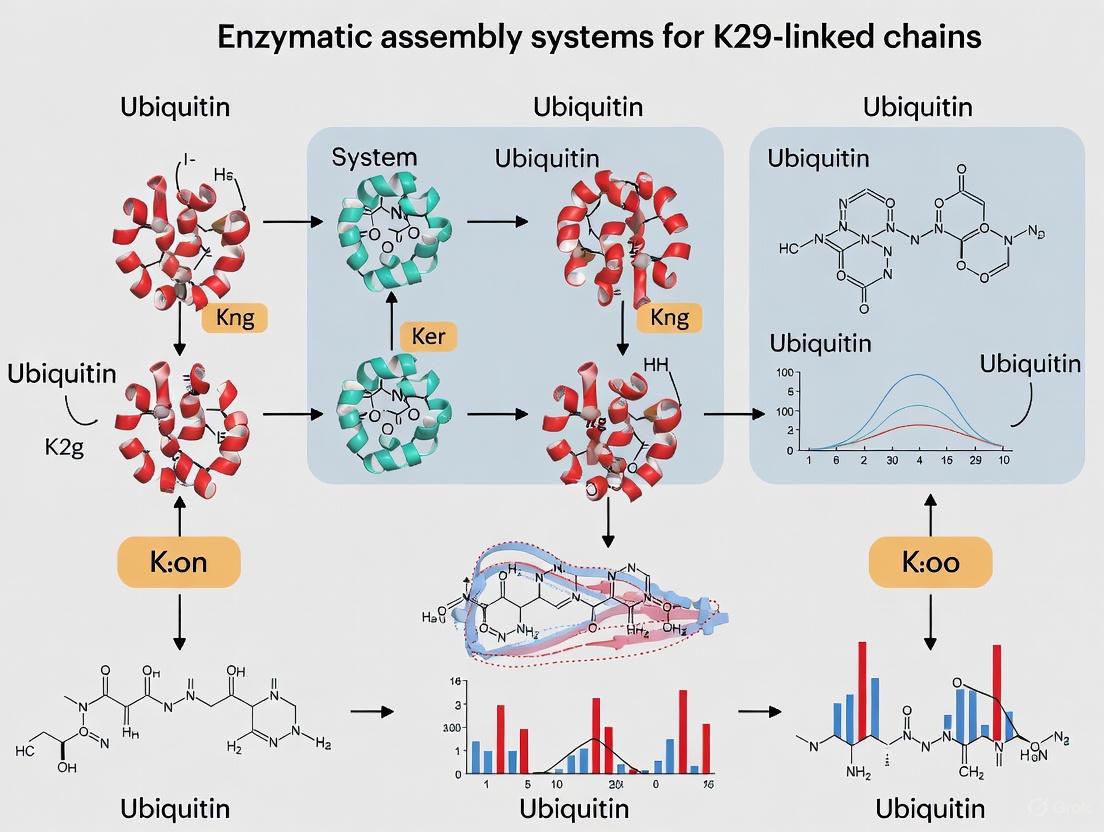
This article provides a comprehensive resource for researchers on the enzymatic assembly of atypical K29-linked ubiquitin chains.
Enzymatic Assembly of K29-Linked Ubiquitin Chains: Methods, Mechanisms, and Biomedical Applications
Abstract
This article provides a comprehensive resource for researchers on the enzymatic assembly of atypical K29-linked ubiquitin chains. It covers foundational knowledge, including the key E3 ligases UBE3C, AREL1, and TRIP12 responsible for K29-chain synthesis. The content details robust methodological protocols, such as the UBE3C/vOTU chain-editing complex, for generating high-purity chains for biochemical and structural studies. It further addresses common troubleshooting scenarios and outlines rigorous validation techniques, including linkage-specific deubiquitinase (DUB) assays and mass spectrometry. Finally, the article explores the growing relevance of K29-linked ubiquitylation in human health, from proteotoxic stress responses to epigenome regulation and ribosome biogenesis, highlighting its potential in drug discovery.
Unraveling K29-Linked Ubiquitin: Key Enzymes and Biological Significance
Ubiquitination is a crucial post-translational modification that regulates virtually every cellular process in eukaryotes. While the canonical K48-linked ubiquitin chains are well-established as signals for proteasomal degradation, and K63-linked chains function in DNA repair and signaling pathways, the remaining "atypical" ubiquitin linkages (K6, K11, K27, K29, and K33) represent a more complex and less understood layer of the ubiquitin code [1] [2]. Among these atypical chains, K29-linked ubiquitin has emerged as a modification of significant biological importance, despite its historical characterization as one of the less-studied ubiquitin linkages.
K29-linked ubiquitin chains are neither rare nor functionally insignificant. Recent quantitative studies have revealed that K29-linked ubiquitin is actually the most abundant among the atypical linkage types, with cellular abundance approaching that of K63-linked chains and following only K48-linked ubiquitin [3]. This surprising prevalence underscores the physiological relevance of K29 linkages and highlights the need for greater research focus on this modification.
The biological significance of K29-linked ubiquitination extends across multiple cellular processes. Originally associated primarily with proteotoxic stress responses and protein degradation, recent advances have illuminated novel roles for K29 linkages in diverse pathways including epigenetic regulation, cell cycle control, transcription, and the unfolded protein response [4] [5] [6]. Furthermore, K29 linkages frequently form branched chains with K48 linkages, creating complex ubiquitin signals that may integrate multiple regulatory functions [7].
This application note provides researchers with a comprehensive overview of K29-linked ubiquitin chains, detailing their structural characteristics, enzymatic regulation, functional roles, and experimental approaches for their study within the context of enzymatic assembly systems for K29-linked chain research.
The K29 Linkage Research Toolkit
Studying K29-linked ubiquitination requires specialized reagents and tools due to the unique challenges in specifically detecting and manipulating this linkage type among the complex cellular ubiquitome.
Key Research Reagents and Solutions
Table: Essential Research Reagents for Studying K29-Linked Ubiquitin Chains
| Reagent/Solution | Type | Key Function/Application | Specificity/Notes |
|---|---|---|---|
| sAB-K29 [4] [3] | Synthetic antigen-binding fragment | Specific recognition of K29-linked polyubiquitin for immunofluorescence, pull-down assays, and CUT&Tag | Binds K29-linked diUb at nanomolar concentrations; recognizes proximal Ub, distal Ub, and linker region |
| TRIP12 [7] [5] [6] | HECT-family E3 ubiquitin ligase | Principal E3 ligase assembling K29 linkages and K29/K48-branched chains | Preferentially targets K29 on proximal Ub of K48-linked diUb; associated with neurodegeneration and autism spectrum disorders |
| UBE3C [8] [9] | HECT-family E3 ubiquitin ligase | Assembly of K29-linked chains in combination with DUB vOTU for in vitro chain generation | Also assembles K48 linkages; used with vOTU to generate pure K29 chains |
| TRABID [8] [5] [6] | OTU-family deubiquitinase | K29/K33-linkage specific deubiquitination; zinc finger domains for specific chain binding | NZF1 domain specifically binds K29/K33-diubiquitin; reverses TRIP12-catalyzed K29 ubiquitination |
| vOTU [9] [3] | Viral deubiquitinase | Selective removal of non-K29 linkages from ubiquitin chain mixtures during purification | Does not cleave K29-linked chains; enables purification of K29-linked ubiquitin chains |
| Chemically synthesized K29-diUb [3] | Synthetic K29-linked diubiquitin | Tool for binder selection, structural studies, and assay development | Generated via chemical synthesis with PEG linker; ensures linkage purity |
Enzymatic Assembly Systems
The generation of homotypic K29-linked ubiquitin chains for biochemical and structural studies requires specialized enzymatic approaches. Two primary E3 ligases have been characterized for K29-linked chain assembly:
UBE3C-mediated Assembly: The HECT E3 ligase UBE3C (also known as KIAA10) assembles K29-linked chains in autoubiquitination reactions and on substrate proteins [8] [1]. When used in combination with the viral deubiquitinase vOTU, which selectively cleaves non-K29 linkages, this system enables purification of homotypic K29-linked polyubiquitin [9]. Mass spectrometry analyses reveal that UBE3C assemblies chains consisting of approximately 63% K48, 23% K29, and 10% K11 linkages in reactions with wild-type ubiquitin, necessitating the vOTU purification step for obtaining homotypic K29 chains [8].
TRIP12-mediated Assembly: TRIP12 represents a more specialized K29-linkage forming E3 that exhibits a striking preference for modifying K48-linked diubiquitin acceptors at K29 of the proximal ubiquitin, thereby generating K29/K48-branched chains [7]. TRIP12 demonstrates minimal activity toward monoubiquitin or diubiquitins with M1, K27, K29, or K33 linkages under physiological conditions, highlighting its specialization for branched chain formation [7].
Diagram: Enzymatic assembly workflows for generating K29-linked ubiquitin chains
Functional Roles and Biological Significance
K29-linked ubiquitination regulates diverse cellular processes through both proteolytic and non-proteolytic mechanisms. Recent research has significantly expanded our understanding of K29 linkage functions beyond their initial characterization in protein degradation.
Functional Associations of K29-Linked Ubiquitination
Table: Documented Cellular Functions of K29-Linked Ubiquitin Chains
| Cellular Process | Specific Role/Function | Key Molecular Targets/Effectors | Experimental Evidence |
|---|---|---|---|
| Epigenetic Regulation [5] [6] | Regulates H3K9me3 homeostasis via SUV39H1 degradation | SUV39H1 turnover; heterochromatin formation | TRIP12 catalyzes K29-linked ubiquitylation of SUV39H1; ablation disrupts H3K9me3 |
| Transcriptional Regulation [4] | Modulates transcription during unfolded protein response | Cohesin complex (SMC1A, SMC3) at promoters | CUT&Tag shows K29 enrichment at active promoters; regulates cell proliferation genes |
| Proteotoxic Stress Response [7] [6] [3] | Stress granule association; p97/VCP-mediated unfolding | Unfolded/misfolded proteins during UPR, heat shock, oxidative stress | sAB-K29 detects K29 puncta under proteotoxic stress conditions |
| Cell Cycle Regulation [3] | Midbody enrichment; G1/S phase progression | Midbody components; cell cycle regulators | sAB-K29 shows midbody localization; DUB knockdown causes G1/S arrest |
| Targeted Protein Degradation [7] [6] | Proteasomal degradation signaling, often in branched chains | Various substrates including SUV39H1 | K29 linkages facilitate p97-mediated substrate extraction and degradation |
| Branched Chain Formation [7] | Creates K29/K48-branched ubiquitin signals | K48-linked chain precursors | TRIP12 preferentially modifies K29 on proximal Ub of K48-linked diUb |
Pathophysiological Correlations
Dysregulation of K29-linked ubiquitination has been implicated in various disease states. TRIP12 mutations are associated with neurodevelopmental disorders including autism spectrum disorders and intellectual disability [7]. The role of K29 linkages in the unfolded protein response connects this modification to diseases characterized by proteostasis dysfunction, including neurodegenerative diseases and cancer [4]. Furthermore, the recent identification of K29-linked ubiquitination as a critical regulator of histone methylation and heterochromatin integrity suggests potential involvement in diseases characterized by epigenetic dysregulation [5] [6].
Structural and Mechanistic Insights
Understanding the structural basis of K29-linked ubiquitin chain formation and recognition provides critical insights for developing targeted research tools and potential therapeutic interventions.
Structural Features of K29-Linked Ubiquitin Chains
Biophysical and structural studies reveal that K29-linked diubiquitin adopts an extended conformation in solution, with both ubiquitin subunits exposing their characteristic hydrophobic patches (centered on I44) for potential interactions with binding partners [9]. This open conformation resembles that of K63-linked chains rather than the compact structures of K48-linked chains. Crystallographic analyses demonstrate significant flexibility in the relative orientation of the two ubiquitin moieties, with different observed conformations in various crystal structures [3]. This structural plasticity may enable K29-linked chains to engage with diverse binding partners and participate in multiple signaling contexts.
The K29 linkage is particularly notable for its role in forming branched ubiquitin chains. Structural studies of TRIP12 reveal a pincer-like architecture in which tandem ubiquitin-binding domains engage the proximal ubiquitin of a K48-linked chain to position its K29 residue toward the active site, while the HECT domain precisely juxtaposes the donor ubiquitin to enable K29 linkage formation [7]. This specialized structural arrangement explains the strong preference of TRIP12 for generating K29/K48-branched chains rather than homotypic K29 linkages.
Recognition Mechanisms
Specific recognition of K29-linked ubiquitin chains involves specialized binding domains that exploit the unique structural features of this linkage type. The NZF1 domain of the deubiquitinase TRABID provides a paradigm for K29-linkage selective recognition, engaging K29-linked diubiquitin through interactions that involve the hydrophobic patch on only one of the ubiquitin moieties while leveraging the intrinsic flexibility of K29 chains to achieve linkage specificity [9].
The development of the sAB-K29 synthetic antigen-binding fragment further illustrates the structural principles governing K29 linkage recognition. Crystallographic analysis of the sAB-K29/K29-diubiquitin complex reveals three distinct binding interfaces involving: (1) the heavy chain of sAB-K29 and the distal ubiquitin, (2) the light chain and the proximal ubiquitin, and (3) both chains interacting with the isopeptide linkage region [3]. This multi-point engagement strategy ensures high specificity for the K29 linkage.
Diagram: Structural features and recognition mechanisms of K29-linked ubiquitin chains
Experimental Protocols and Methodologies
Protocol 1: In Vitro Reconstitution of K29-Linked Ubiquitination Using TRIP12
This protocol describes the biochemical reconstitution of TRIP12-mediated K29-linked ubiquitination, particularly focusing on its specialized activity in generating K29/K48-branched chains.
Materials and Reagents:
- Purified TRIP12 (full-length or TRIP12ΔN [residues 478-2093] lacking the disordered N-terminal region) [7]
- E1 activating enzyme (UBA1)
- E2 conjugating enzyme (UBE2L3 or other cognate E2)
- ATP regeneration system
- Ubiquitin (wild-type and mutant forms as needed)
- K48-linked diubiquitin acceptor substrate
- Reaction buffer: 25 mM HEPES pH 7.4, 150 mM NaCl, 10 mM MgCl₂, 0.5 mM TCEP
Procedure:
- E1 Activation: Pre-incubate 100 nM E1 with 2 μM ubiquitin, 5 mM ATP in reaction buffer at 30°C for 10 minutes.
- E2 Charging: Add 1 μM E2 enzyme to the E1 reaction and incubate for an additional 15 minutes.
- TRIP12-mediated Ubiquitination: Add 200 nM TRIP12 and 10 μM K48-linked diubiquitin acceptor substrate to the reaction mixture.
- Time Course: Incubate at 30°C and remove aliquots at 0, 5, 15, 30, and 60 minutes for analysis.
- Reaction Termination: Add non-reducing SDS-PAGE sample buffer to stop the reaction.
- Product Analysis: Resolve products by SDS-PAGE followed by immunoblotting with K29-linkage specific reagents or fluorescent imaging if using labeled ubiquitin.
Technical Notes:
- TRIP12ΔN maintains K29 linkage specificity while improving solubility and handling [7].
- For pulse-chase experiments, use fluorescently-labeled donor ubiquitin that lacks lysines (*Ub(K0)) to track specific reaction products [7].
- TRIP12 exhibits a strong preference for K48-linked diubiquitin over mono-ubiquitin or diubiquitins with other linkages [7].
Protocol 2: Detection of Cellular K29-Linked Ubiquitination Using sAB-K29
This protocol details the application of the K29-linkage specific synthetic antigen-binding fragment (sAB-K29) for detecting endogenous K29-linked ubiquitination in cellular contexts.
Materials and Reagents:
- sAB-K29 (specific for K29-linked ubiquitin chains) [3]
- Control reagents for specificity validation (other linkage types)
- Cell culture reagents and fixation/permeabilization buffers
- Immunofluorescence or immunoprecipitation buffers
- Secondary detection reagents as needed
Procedure for Immunofluorescence Detection:
- Cell Culture and Treatment: Plate cells on coverslips and apply experimental treatments (e.g., proteotoxic stress inducers).
- Fixation: Fix cells with 4% paraformaldehyde for 15 minutes at room temperature.
- Permeabilization: Permeabilize with 0.1% Triton X-100 in PBS for 10 minutes.
- Blocking: Block with 3% BSA in PBS for 1 hour.
- Primary Antibody Incubation: Incubate with sAB-K29 (1-5 μg/mL) in blocking buffer overnight at 4°C.
- Secondary Detection: Apply appropriate secondary detection reagents for 1 hour at room temperature.
- Mounting and Imaging: Mount coverslips and image using appropriate microscopy systems.
Procedure for Biochemical Detection:
- Cell Lysis: Lyse cells in RIPA buffer or other appropriate lysis buffer containing protease inhibitors.
- Immunoprecipitation: Incubate cell lysates with sAB-K29-coupled beads for 2-4 hours at 4°C.
- Washing: Wash beads extensively with lysis buffer.
- Elution: Elute bound proteins with SDS-PAGE sample buffer or competitive elution with K29-linked diubiquitin.
- Downstream Analysis: Analyze eluates by immunoblotting or mass spectrometry.
Validation and Controls:
- Validate specificity using ubiquitin replacement cell lines expressing K29R mutant ubiquitin [6].
- Include controls with excess soluble K29-linked diubiquitin as a competitive inhibitor.
- Compare signal distribution with known K29-linked ubiquitin localizations (e.g., stress granules, midbody) [3].
Protocol 3: Generation of Homotypic K29-Linked Ubiquitin Chains Using UBE3C/vOTU System
This protocol describes the large-scale enzymatic assembly and purification of homotypic K29-linked ubiquitin chains for biochemical and structural studies.
Materials and Reagents:
- UBE3C HECT E3 ligase [8] [9]
- vOTU deubiquitinase (selective for non-K29 linkages) [9] [3]
- E1 activating enzyme and E2 conjugating enzymes
- Ubiquitin (wild-type)
- Chromatography equipment and resins (anion exchange, size exclusion)
Procedure:
- Mixed Linkage Chain Assembly: Incubate ubiquitin with UBA1 (E1), appropriate E2, and UBE3C (E3) in reaction buffer with ATP regeneration system at 30°C for 2-4 hours.
- vOTU Treatment: Add vOTU deubiquitinase to the reaction mixture to selectively cleave non-K29 linkages. Incubate for 1 hour at 30°C.
- Initial Purification: Apply reaction mixture to anion exchange chromatography to separate mono-ubiquitin from polyubiquitin chains.
- Size Exclusion Chromatography: Further purify K29-linked chains by size exclusion chromatography to separate diubiquitin from longer chains.
- Quality Assessment: Verify linkage specificity by mass spectrometry, immunoblotting with linkage-specific reagents, or DUB treatment with linkage-selective deubiquitinases.
Technical Notes:
- The initial UBE3C reaction produces predominantly K48-linked chains (63%) with significant K29-linked chains (23%) and minor K11-linked chains (10%) [8].
- vOTU treatment efficiently removes K48 and other non-K29 linkages while preserving K29 linkages [9].
- For structural studies, consider chemical synthesis of K29-linked diubiquitin for ultimate linkage purity [3].
Ubiquitination is a crucial post-translational modification that regulates virtually every cellular process, from protein degradation to signal transduction. The Homologous to E6AP C-terminus (HECT) family of E3 ubiquitin ligases represents a unique class of enzymes that directly catalyze the transfer of ubiquitin to target substrates [10] [11]. What distinguishes HECT E3 ligases from other E3 families is their characteristic HECT domain—a conserved ~350 amino acid C-terminal region that contains an active-site cysteine residue capable of forming a transient thioester bond with ubiquitin before its final transfer to substrates [10] [12]. This two-step catalytic mechanism (E2-to-E3-to-substrate) differs fundamentally from RING E3 ligases that primarily function as scaffolds [11] [13].
The human genome encodes 28 HECT E3 ligases, classified into three subfamilies based on their N-terminal domain architectures: the NEDD4 family (9 members featuring C2 and WW domains), the HERC family (6 members characterized by RCC1-like domains), and the "other HECTs" (13 members with varied N-terminal domains) [10] [12] [11]. This review focuses on three HECT E3 ligases—UBE3C, AREL1, and TRIP12—that have emerged as specialized assemblers of K29-linked ubiquitin chains, a poorly understood but functionally important ubiquitin linkage type.
K29-linked ubiquitination represents one of the "atypical" ubiquitin chain types whose cellular functions are just beginning to be elucidated [8]. Unlike the well-characterized K48-linked chains (which target proteins for proteasomal degradation) and K63-linked chains (which mediate non-proteolytic signaling), K29-linked chains have been implicated in specialized regulatory processes, including protein quality control, ribosome biogenesis, and the formation of branched ubiquitin chains that amplify degradation signals [8] [14] [15]. Recent research has revealed that UBE3C, AREL1, and TRIP12 (the human homolog of yeast Ufd4) play pivotal roles in governing these K29-linked ubiquitination pathways, making them essential subjects for understanding the ubiquitin code and developing novel therapeutic strategies.
HECT E3 Ligase Structure and Catalytic Mechanism
Conserved Domain Architecture
All HECT E3 ligases share a common structural organization centered on the C-terminal HECT domain, which is composed of two structurally distinct lobes: a larger N-lobe that binds the E2 ubiquitin-conjugating enzyme, and a smaller C-lobe that contains the catalytic cysteine residue [10] [12]. These lobes are connected by a flexible hinge region containing conserved glycine residues that enable the large-scale conformational changes necessary for ubiquitin transfer [16] [13]. The N-terminal regions of HECT E3s are highly variable and mediate substrate recognition, subcellular localization, and regulatory interactions [10] [11].
Structural studies have revealed that the HECT domain employs a unique catalytic mechanism. The process begins with the N-lobe engaging an E2~Ub thioester complex, followed by transthiolation where ubiquitin is transferred to the catalytic cysteine in the C-lobe, forming a HECT~Ub intermediate [13]. The flexible hinge then enables reorientation of the C-lobe to position the E3-bound ubiquitin for transfer to specific lysine residues on substrate proteins or growing ubiquitin chains [14] [13]. This precise positioning mechanism allows HECT E3s to assemble specific ubiquitin linkage types, with UBE3C, AREL1, and TRIP12 exhibiting remarkable specificity for K29-linked ubiquitination under appropriate conditions [8] [14].
Structural Basis for K29-Linkage Specificity
Recent structural insights have begun to reveal how specific HECT E3 ligases achieve linkage specificity for K29-connected ubiquitin chains. Cryo-EM studies of the yeast HECT E3 Ufd4 (homolog of human TRIP12) in complex with K48-linked diubiquitin and a donor ubiquitin have captured structural snapshots of the enzyme during K29-linked branched chain formation [14]. These structures show that the N-terminal ARM region and HECT domain C-lobe of Ufd4 work together to recruit K48-linked diUb and orient Lys29 of its proximal Ub toward the active cysteine for K29-linked branched ubiquitination [14].
The mechanism involves specific recognition elements that position the acceptor ubiquitin to favor K29 engagement. For UBE3C, structural analyses indicate that unique loops and surface residues surrounding the catalytic center create a binding pocket that preferentially orients the E2 and acceptor ubiquitin to facilitate K29 linkage [8]. Similarly, AREL1 contains specialized structural features that enable selective synthesis of K33-linked chains, demonstrating how divergent evolution within the HECT family has produced enzymes with distinct linkage specificities [8].
Table 1: Key Structural Features of K29-Linkage Specific HECT E3 Ligases
| E3 Ligase | Domain Organization | Catalytic Mechanism Features | Linkage Specificity |
|---|---|---|---|
| UBE3C | Variable N-terminal domains + HECT domain | Non-covalent ubiquitin binding exosite, specific E2 interactions | K29- and K48-linked chains (K29/K48-branched) |
| AREL1 | Variable N-terminal domains + HECT domain | Unique acceptor ubiquitin positioning elements | K11- and K33-linked chains |
| TRIP12/Ufd4 | ARM repeats + HECT domain | N-terminal ARM region recognizes K48-linked chains, positions K29 for branching | K29-linked chains on K48-linked primers (K29/K48-branched) |
UBE3C: A Specialized Assembler of K29/K48-Branched Chains
Biochemical Characterization and Linkage Specificity
UBE3C (Ubiquitin Protein Ligase E3C) has been identified as a primary assembler of K29-linked ubiquitin chains in human cells [8]. Biochemical studies using absolute quantification (AQUA) mass spectrometry have revealed that UBE3C assembles K48-linked chains (63%), K29-linked chains (23%), and K11-linked chains (10%) during autoubiquitination reactions [8]. This linkage specificity appears to be an intrinsic property of the UBE3C HECT domain, as demonstrated in experiments with minimal HECT domains that retain the same linkage preferences when paired with cognate E2 enzymes.
The ability of UBE3C to synthesize K29-linked chains is particularly significant in the context of branched ubiquitin chain formation. Recent evidence suggests that UBE3C can modify existing K48-linked ubiquitin chains by adding K29-linked branches, creating K29/K48-branched ubiquitin chains that serve as enhanced degradation signals [8] [14]. This branching activity amplifies the proteasomal targeting signal beyond what单纯的K48-linked chains can achieve, potentially allowing for more efficient substrate degradation under conditions of cellular stress or when dealing with refractory substrates.
Cellular Functions and Substrate Recognition
UBE3C functions in several critical cellular pathways, primarily through its role in assembling K29-linked ubiquitin chains. It has been implicated in:
- Regulation of Wnt signaling pathway through K29-linked ubiquitination of pathway components [10]
- Formation of branched ubiquitin chains that enhance proteasomal degradation efficiency [14]
- Protein quality control pathways, particularly for misfolded or damaged proteins [8]
The substrate recognition mechanisms of UBE3C involve its variable N-terminal domains, which interact with specific substrate proteins or adaptor molecules. While the precise substrate-binding domains of UBE3C remain less characterized than those of the NEDD4 family E3s, they likely include specialized protein-protein interaction motifs that recognize degradation signals or specific sequence motifs on target proteins [11].
Table 2: Quantitative Analysis of UBE3C Linkage Specificity
| Experimental Condition | K29-Linkage (%) | K48-Linkage (%) | K11-Linkage (%) | Other Linkages (%) |
|---|---|---|---|---|
| Autoubiquitination (in vitro) | 23 | 63 | 10 | 4 |
| With preferred E2 | 25-30 | 55-60 | 10-15 | <5 |
| With K48-linked chain substrate | Increased | Decreased | Variable | Variable |
AREL1: A Dual-Specificity E3 for K33 and K11 Linkages
Unique Linkage Specificity Profile
AREL1 (Apoptosis-Resistant E3 Ubiquitin Protein Ligase 1), also known as KIAA0317, has emerged as a unique HECT E3 ligase with specificity for K33-linked ubiquitin chains [8]. Mass spectrometry analyses of AREL1 autoubiquitination reactions have revealed that this E3 assembles K33-linked chains (36%), K11-linked chains (36%), and K48-linked chains (20%) [8]. This dual-specificity for K33 and K11 linkages distinguishes AREL1 from other HECT family members and suggests specialized cellular roles for these less-studied ubiquitin linkage types.
The K33 linkage specificity of AREL1 is particularly noteworthy given the limited understanding of this ubiquitin chain type. K33-linked chains have been implicated in negative regulation of T-cell receptor signaling, where they mediate non-proteolytic functions that modulate protein-protein interactions and signal transduction [10] [8]. The ability of AREL1 to assemble both K33 and K11 linkages suggests it may function at the intersection of multiple signaling pathways, potentially serving as a regulatory node that integrates different ubiquitin-dependent signals.
Structural Basis for K33-Linkage Selectivity
The molecular mechanisms underlying AREL1's preference for K33-linked chains involve specific structural features within its HECT domain that position the acceptor ubiquitin to favor K33 engagement. Structural studies indicate that AREL1 contains unique loops and surface residues that create a distinct binding pocket for the acceptor ubiquitin, orienting its K33 residue toward the catalytic center [8]. This positioning mechanism works in concert with specific E2 interactions that further enhance linkage specificity.
Additionally, AREL1 possesses a non-covalent ubiquitin binding site—similar to the exosite found in NEDD4 family E3s—that helps stabilize the growing ubiquitin chain and processively add ubiquitin molecules in K33 linkages [8]. This exosite preferentially interacts with K33-linked diubiquitin, creating a positive feedback mechanism that reinforces the synthesis of this chain type once initiation has occurred.
TRIP12/Ufd4: Architect of K29/K48-Branched Degradation Signals
Yeast Ufd4 and Human TRIP12 in Branched Ubiquitination
The yeast HECT E3 ligase Ufd4 and its human homolog TRIP12 have been identified as specialized assemblers of K29/K48-branched ubiquitin chains that function as potent degradation signals [14]. These E3s preferentially catalyze K29-linked ubiquitination on pre-existing K48-linked ubiquitin chains, creating branched ubiquitin structures that enhance substrate targeting to the proteasome [14] [15]. This activity positions Ufd4/TRIP12 as crucial regulators of protein turnover, particularly for substrates that require enhanced degradation signals.
Biochemical studies have demonstrated that Ufd4 shows strong preference for K48-linked ubiquitin chains as substrates for K29-linked branching [14]. The efficiency of Ufd4-mediated polyubiquitination escalates with increasing length of the K48-linked ubiquitin chain, with pent ubiquitin chains being modified more efficiently than shorter chains [14]. This length dependence suggests a mechanism where Ufd4/TRIP12 specifically recognizes longer K48-linked chains as primers for K29-linked branching, creating a quality control checkpoint that ensures only properly polyubiquitinated substrates receive the enhanced degradation signal.
Structural Visualization of Branched Chain Assembly
Recent cryo-EM studies have provided unprecedented structural insights into how Ufd4 catalyzes K29/K48-branched ubiquitin chain formation [14]. Structures of Ufd4 in complex with K48-linked diubiquitin and a donor ubiquitin have captured the enzyme in the act of transferring ubiquitin to K29 of the proximal ubiquitin in the K48-linked chain [14].
These structural snapshots reveal that Ufd4 adopts a closed ring-shaped conformation that clamps around the K48-linked diubiquitin substrate [14]. The N-terminal ARM region and HECT domain C-lobe work in concert to recruit K48-linked diUb and orient Lys29 of its proximal Ub toward the active cysteine for K29-linked branched ubiquitination [14]. This precise positioning mechanism ensures linkage specificity and explains the strong preference for K29 branching on K48-linked chains over other potential substrates.
The structural data further reveal that Ufd4 exhibits a strong preference for branching at the proximal ubiquitin in K48-linked chains, with approximately 5.2-fold higher catalytic efficiency (kcat/Km) for proximal K29 sites compared to distal K29 sites [14]. This regioselectivity ensures that K29 branching occurs near the substrate attachment point, potentially creating a structural arrangement that is optimally recognized by proteosomal receptors.
Experimental Protocols for Studying K29-Linked Ubiquitination
In Vitro Ubiquitination Assay for Linkage Specificity Analysis
Purpose: To characterize the linkage specificity of HECT E3 ligases (UBE3C, AREL1, TRIP12) in assembling K29-linked ubiquitin chains.
Reagents and Solutions:
- E1 enzyme (human or yeast), 100 nM working concentration
- E2 enzyme (appropriate for each HECT E3), 500 nM working concentration
- HECT E3 (UBE3C, AREL1, or TRIP12 HECT domain), 1 μM working concentration
- Ubiquitin (wild-type and mutant forms), 10 μM working concentration
- ATP regeneration system: 2 mM ATP, 10 mM creatine phosphate, 10 μg/mL creatine kinase
- Reaction buffer: 50 mM Tris-HCl (pH 7.5), 50 mM NaCl, 10 mM MgCl₂, 1 mM DTT
Procedure:
- Prepare master mix containing reaction buffer, ATP regeneration system, E1 (100 nM), E2 (500 nM), and ubiquitin (10 μM)
- Aliquot master mix into separate reaction tubes
- Initiate reactions by adding HECT E3 (1 μM) to each tube
- Incubate at 30°C for 60 minutes
- Terminate reactions by adding SDS-PAGE loading buffer with 50 mM DTT and heating at 95°C for 5 minutes
- Analyze products by immunoblotting with linkage-specific ubiquitin antibodies or mass spectrometry
Troubleshooting Tips:
- For K29-linkage verification, include Ub-K29R mutant controls
- Optimize E3:E2 ratio for maximum activity (typically 2:1 to 1:2)
- Include linkage-null Ub-K0 (all lysines mutated to Arg) to confirm thioester intermediate formation
Mass Spectrometry Analysis of Ubiquitin Linkages
Purpose: To quantitatively determine the linkage composition of ubiquitin chains assembled by HECT E3 ligases.
Reagents and Solutions:
- Trypsin/Lys-C mix for protein digestion
- AQUA peptides: Stable isotope-labeled GlyGly-modified ubiquitin peptides for absolute quantification
- LC-MS/MS solvents: 0.1% formic acid in water (Solvent A), 0.1% formic acid in acetonitrile (Solvent B)
- Strong cation exchange (SCX) resin for peptide fractionation
Procedure:
- Terminate ubiquitination reactions by adding EDTA to 10 mM
- Reduce and alkylate proteins with 5 mM TCEP and 10 mM iodoacetamide
- Digest with Trypsin/Lys-C mix (1:50 enzyme:substrate) at 37°C for 16 hours
- Spike in AQUA peptide standards for absolute quantification
- Fractionate peptides by SCX chromatography
- Analyze by LC-MS/MS using multiple reaction monitoring (MRM)
- Quantify linkage abundances based on GlyGly-modified peptide signals normalized to AQUA standards
Data Analysis:
- Calculate percentage of each linkage type from GlyGly-modified peptide intensities
- Normalize to total ubiquitin signal for relative quantification
- Perform triplicate analyses for statistical significance
Research Reagent Solutions for K29-Linked Ubiquitination Studies
Table 3: Essential Research Reagents for Studying K29-Linked Ubiquitination
| Reagent Category | Specific Examples | Function/Application | Key Features |
|---|---|---|---|
| E3 Enzymes | Recombinant UBE3C HECT domain, AREL1 (436-823), TRIP12 HECT domain | Catalyze K29-linked ubiquitin chain assembly | Catalytically active fragments, tag-free or with minimal tags |
| Ubiquitin Mutants | Ub-K29R, Ub-K29-only, Ub-K0 (all Lys to Arg) | Linkage specificity determination, control experiments | Site-directed mutants, recombinantly expressed and purified |
| Linkage-Specific Binders | TRABID NZF1 domain, K29-linkage specific antibodies | Detection and purification of K29-linked chains | High specificity, validated in multiple assays |
| Mass Spec Standards | AQUA peptides with K29-GlyGly modification | Absolute quantification of K29-linkages | Stable isotope-labeled, precisely quantified |
| Deubiquitinases | TRABID (active site mutant) | Reference standard for K29-linkage recognition | Linkage-specific DUB, used for validation |
| Branched Ub Probes | K29/K48-branched triUb probe (synthetic) | Structural and mechanistic studies | Chemically defined, precisely branched structure |
Visualization of HECT E3 Catalytic Mechanisms
HECT E3 Catalytic Cycle and K29-Linkage Formation
Diagram 1: HECT E3 Catalytic Cycle for K29-Linked Ubiquitination. The diagram illustrates the two-step catalytic mechanism where ubiquitin is first transferred from E2 to the HECT E3 catalytic cysteine, then specifically to substrate lysine residues to form K29-linked ubiquitin chains.
K29/K48-Branched Ubiquitin Chain Assembly by TRIP12/Ufd4
Diagram 2: K29/K48-Branched Ubiquitin Chain Assembly by TRIP12/Ufd4. The diagram shows the specific recognition of K48-linked ubiquitin chains by TRIP12/Ufd4, followed by transfer of ubiquitin to K29 residues to create branched ubiquitin chains that enhance proteasomal targeting.
Concluding Remarks and Future Perspectives
The specialized HECT E3 ligases UBE3C, AREL1, and TRIP12 represent master assemblers of K29-linked ubiquitin chains with distinct yet complementary cellular functions. Through their unique structural features and catalytic mechanisms, these enzymes govern specific aspects of the ubiquitin code that are only beginning to be understood. The emerging paradigm positions K29-linked ubiquitination as a crucial regulatory modification that extends beyond traditional degradation signals to include specialized roles in protein quality control, ribosome biogenesis, and signal modulation [8] [14] [15].
Future research directions should focus on elucidating the complete substrate landscapes of these K29-specific HECT E3s, developing more sensitive tools for detecting endogenous K29-linked chains, and exploring the therapeutic potential of modulating these enzymes in disease contexts. The recent development of allosteric inhibitors targeting the conserved glycine hinge of HECT domains [16] opens exciting possibilities for selectively targeting individual HECT family members, potentially offering new therapeutic avenues for diseases linked to dysregulated ubiquitination.
As our understanding of K29-linked ubiquitination continues to evolve, UBE3C, AREL1, and TRIP12 will undoubtedly remain at the forefront of research into the complexity of the ubiquitin code and its manipulation for therapeutic benefit.
Ubiquitination is a crucial post-translational modification that regulates nearly all aspects of eukaryotic cell biology. Among the diverse array of ubiquitin chain linkages, K29-linked ubiquitin chains represent a structurally and functionally distinct class that has recently emerged as a critical regulator of cellular homeostasis. These "non-canonical" chains, formed through isopeptide bonds between the C-terminus of one ubiquitin and lysine 29 of another, have transitioned from being poorly characterized to recognized as key players in proteostasis regulation and epigenetic control [17] [4]. While K48-linked chains primarily target substrates for proteasomal degradation and K63-linked chains regulate signaling pathways, K29 linkages exhibit unique functional properties that enable specialized cellular responses to stress and maintenance of nuclear integrity.
Recent technological advances in linkage-specific detection methods and genetic manipulation of ubiquitin signaling have revealed that K29 chains are far more abundant than previously appreciated, representing approximately 8-9% of total cellular ubiquitin linkages [18]. Furthermore, a significant proportion of cellular K29 linkages exist within heterotypic branched chains that also contain K48 linkages, creating complex ubiquitin architectures with enhanced signaling capabilities [18] [19]. This application note synthesizes recent breakthroughs in understanding K29-linked ubiquitin chains, providing researchers with experimental frameworks and analytical tools to advance research in this rapidly evolving field.
Cellular Functions of K29-Linked Ubiquitination
K29 Chains in Proteostasis and Stress Responses
K29-linked ubiquitin chains serve as critical mediators of cellular stress adaptation, particularly through their roles in regulating protein quality control systems. Research has demonstrated that accumulation of unanchored K29-linked polyubiquitin chains (chains not attached to a substrate protein) disrupts ribosome assembly by associating with maturing ribosomes, thereby activating the Ribosome Assembly Stress Response (RASTR) [17]. In yeast models, simultaneous deletion of deubiquitinases Ubp2 and Ubp14 leads to pronounced accumulation of K29-linked unanchored chains, resulting in severe growth defects and sequestration of ribosomal proteins at the Intranuclear Quality control Compartment (INQ) [17].
The interplay between K29 ubiquitination and autophagy represents another crucial proteostatic mechanism. Studies have identified that the E3 ligase UBE3C and deubiquitinase TRABID reciprocally regulate K29/K48-branched ubiquitination of VPS34, a key component of the class III PI3-kinase complex essential for autophagy [18]. This specific ubiquitination enhances VPS34 binding to proteasomes for degradation, thereby suppressing autophagosome formation and maturation. Under endoplasmic reticulum and proteotoxic stresses, the subcellular localization of UBE3C shifts, attenuating its activity toward VPS34 and consequently enhancing autophagy to maintain proteostasis [18].
Table 1: Key Proteostatic Roles of K29-Linked Ubiquitin Chains
| Cellular Process | K29 Chain Role | Key Proteins | Functional Outcome |
|---|---|---|---|
| Ribosome Quality Control | Disruption of assembly | Ubp2, Ubp14, INQ | RASTR activation, ribosomal protein sequestration |
| Autophagy Regulation | VPS34 stability | UBE3C, TRABID, VPS34 | Proteasomal degradation of VPS34, autophagy suppression |
| ER Stress Response | Transcriptional regulation | Cohesin complex, WAPL | Downregulation of cell proliferation genes |
| Proteotoxic Stress | Stress granule association | p97/VCP | Enhanced substrate unfolding, degradation facilitation |
K29 Chains in Epigenetic Regulation and Chromatin Organization
Beyond cytoplasmic quality control, K29-linked ubiquitination plays surprisingly sophisticated roles in nuclear function and epigenetic regulation. System-wide profiling of ubiquitin linkage functions has revealed that K29-linked ubiquitylation is strongly associated with chromosome biology and essential for maintaining epigenome integrity [5] [6]. A seminal discovery identified the H3K9me3 methyltransferase SUV39H1 as a prominent cellular target of K29-linked ubiquitination, which constitutes the essential degradation signal for this key histone modifier [5] [6].
The K29-linked ubiquitylation of SUV39H1 is catalyzed by the E3 ligase TRIP12 and reversed by the deubiquitinase TRABID, creating a dynamic regulatory switch that controls heterochromatin organization [5] [6]. This modification is primed and extended by Cullin-RING ubiquitin ligase (CRL) activity, illustrating the cooperative nature of complex ubiquitin chain assembly. Preventing K29-linkage-dependent SUV39H1 turnover deregulates H3K9me3 homeostasis without affecting other histone modifications, establishing a specific role for K29 chains in maintaining this critical heterochromatin mark [5] [6].
Additionally, K29-linked ubiquitination regulates transcription during the unfolded protein response (UPR) through modification of the cohesin complex [4]. Under endoplasmic reticulum stress, increased K29-linked ubiquitination of SMC1A and SMC3 proteins in the cohesin complex promotes the release of cohesin from chromatin via recruitment of the cohesin release factor WAPL, leading to transcriptional downregulation of cell proliferation-related genes such as SERTAD1 and NUDT16L1 [4]. This mechanism allows cells to temporarily halt proliferation and redirect resources toward stress recovery.
Figure 1: K29-Linked Ubiquitination Regulates Heterochromatin Integrity. TRIP12 catalyzes K29-linked ubiquitination of SUV39H1, targeting it for proteasomal degradation. TRABID reverses this modification. This regulatory switch controls cellular levels of SUV39H1, which determines H3K9me3 methylation status and heterochromatin organization.
Experimental Protocols for K29 Chain Analysis
Genetic Analysis of K29 Chain Accumulation
Purpose: To assess the functional consequences of K29-linked unanchored polyubiquitin chain accumulation and their cellular impacts.
Materials:
- Yeast strains: Wild-type, ubp2Δ, ubp14Δ, and ubp2Δubp14Δ double mutant
- Growth media (YPD)
- Temperature-controlled shaking incubator
- Lysis buffer: 50 mM Tris-HCl (pH 7.5), 150 mM NaCl, 1% NP-40, protease inhibitors
- ZnF-UBP domain of USP5 coupled to sepharose beads
- sAB-K29 antibodies (specific for K29-linked polyUb chains)
- NZF1 domain of TRABID
- Immunoblotting equipment and reagents
Procedure:
- Culture yeast strains to mid-log phase in appropriate media at 30°C and 37°C.
- Assess growth defects by measuring optical density (OD600) over 24-48 hours.
- Harvest cells and prepare protein extracts using lysis buffer with mechanical disruption.
- Perform immunoprecipitation using ZnF-UBP sepharose beads to isolate unanchored polyUb chains.
- Probe isolated chains with sAB-K29 antibodies to confirm K29 linkage specificity.
- Validate K29 linkage through co-immunoprecipitation with NZF1 domain of TRABID.
- Analyze free ubiquitin pools to assess impact on cellular ubiquitin homeostasis.
Expected Results: The ubp2Δubp14Δ double mutant will exhibit severe growth defects, particularly at elevated temperature, accompanied by accumulation of high molecular weight K29-linked unanchored polyubiquitin chains and reduced free ubiquitin pools [17].
Profiling Chromatin-Associated K29 Ubiquitination
Purpose: To map the genomic distribution of K29-linked ubiquitin chains and correlate with epigenetic marks.
Materials:
- HEK293FT cells
- Tunicamycin (2 µg/mL) or thapsigargin (1 µg/mL) for UPR induction
- CUT&Tag reagents: sAB-K29 antibody, protein A-Tn5 transposase
- ATAC-seq reagents
- High-throughput sequencing platform
- Bioinformatics tools for multi-omics integration
Procedure:
- Culture HEK293FT cells and treat with UPR inducers (tunicamycin or thapsigargin) for 24 hours.
- Perform CUT&Tag for K29-linked ubiquitin chains using sAB-K29 antibody.
- Conduct parallel CUT&Tag for histone modifications (H3K4me1, H3K4me3, H3K27ac, H3K27me3, H3K36me3).
- Perform ATAC-seq to assess chromatin accessibility.
- Sequence libraries and align reads to reference genome.
- Identify peaks of K29 ubiquitination and overlap with epigenetic marks and accessible regions.
- Integrate with RNA-seq data to correlate K29 patterns with transcriptional changes.
Expected Results: K29-linked ubiquitin chains will show significant enrichment in promoter regions with strong overlap to transcriptional activation marks (H3K4me3 and H3K27ac). UPR induction will alter K29 distribution patterns, particularly at genes involved in cell proliferation [4].
Table 2: Quantitative Changes in K29-Linked Ubiquitination Under Stress Conditions
| Experimental Condition | K29 Signal Change | Genomic Regions Affected | Associated Functional Outcomes |
|---|---|---|---|
| Basal State | High at promoters | Transcriptionally active regions | Maintenance of constitutive gene expression |
| UPR Induction | Decreased nuclear signal | Cell proliferation gene promoters | Transcriptional downregulation of growth genes |
| Proteotoxic Stress | Increased cytoplasmic accumulation | Stress granules | Enhanced protein quality control |
| SUV39H1 Regulation | Specific targeting | Heterochromatic regions | Control of H3K9me3 levels |
Structural Analysis of K29 Chain Formation
Purpose: To determine the structural mechanisms of K29-linked chain synthesis by TRIP12.
Materials:
- Recombinant TRIP12 proteins (full-length and TRIP12ΔN)
- Ubiquitylation reaction components: E1, E2, ubiquitin
- K48-linked di-ubiquitin substrates
- Cryo-EM equipment and grids
- Image processing software (RELION, cryoSPARC)
Procedure:
- Express and purify TRIP12 proteins using baculovirus system.
- Perform pulse-chase ubiquitylation assays with fluorescently labeled donor Ub (*Ub(K0)).
- Test TRIP12 activity with various di-Ub substrates (K48-, K63-, K11-, K6-linked).
- Generate stable mimics of transition states using chemical biology approaches.
- Prepare cryo-EM grids and collect data on high-end microscope.
- Process images to obtain 3D reconstruction of TRIP12-substrate complexes.
- Build and refine atomic models into cryo-EM density.
Expected Results: Structural analysis will reveal TRIP12 resembles a pincer, with tandem ubiquitin-binding domains directing the proximal ubiquitin's K29 toward the active site, while the HECT domain juxtaposes donor and acceptor ubiquitins to ensure linkage specificity [7].
Figure 2: Workflow for Mapping K29 Ubiquitination Using CUT&Tag. Chromatin is targeted with K29-specific antibodies followed by protein A-Tn5 transposase adapter loading. Tagmentation fragments DNA bound by K29 ubiquitin, enabling preparation of sequencing libraries that reveal genomic locations of K29 ubiquitination.
The Scientist's Toolkit: Essential Research Reagents
Table 3: Key Research Reagents for K29-Linked Ubiquitin Chain Studies
| Reagent | Type | Specificity/Function | Application Examples |
|---|---|---|---|
| sAB-K29 | Antibody | Highly specific for K29-linked ubiquitin chains | CUT&Tag, immunofluorescence, immunoblotting [4] |
| TRIP12 | E3 Ligase | Catalyzes K29 linkage and K29/K48 branched chain formation | Structural studies, in vitro ubiquitylation assays [7] |
| TRABID | Deubiquitinase | Reverses K29 and K33-linked ubiquitination | Deubiquitylation assays, autophagy regulation studies [18] |
| ZnF-UBP (USP5) | Binding Domain | Recognizes unanchored polyUb chains with free C-terminal diglycine | Isolation of unanchored polyUb chains [17] |
| NZF1 (TRABID) | Binding Domain | Specifically binds K29-linked polyUb chains | Validation of K29 chain identity [17] |
| Ub Replacement Cell Lines | Genetic Tool | Conditional abrogation of specific ubiquitin linkages | System-wide linkage function analysis [5] [6] |
The expanding repertoire of cellular functions associated with K29-linked ubiquitin chains underscores their importance as sophisticated regulatory signals that integrate proteostasis with epigenetic control. Future research directions will need to address several key challenges, including developing more sensitive tools for detecting endogenous K29 chains, understanding the mechanisms governing chain branching, and elucidating how K29 chain diversity is decoded by cellular machinery. The experimental frameworks outlined in this application note provide foundational methodologies that will enable researchers to explore the full functional landscape of K29-linked ubiquitination and its relevance to human health and disease.
The recognition that K29 linkages participate in both proteasomal degradation and degradation-independent signaling highlights the complexity of the ubiquitin code. As research continues to unravel the intricacies of K29 chain biology, particularly in the context of heterotypic branched chains, we anticipate discoveries that will reshape our understanding of cellular regulation and open new therapeutic avenues for diseases ranging from cancer to neurodegenerative disorders.
Ubiquitin (Ub) chains linked through lysine 29 (K29) represent a class of atypical polyubiquitin signals whose structural and functional characteristics have remained less elucidated compared to their canonical counterparts. Within the broader thesis on enzymatic assembly systems for K29-linked chains research, understanding the conformational dynamics of these chains is paramount for deciphering their unique cellular functions. Recent advances in enzymatic assembly methodologies and structural biology techniques have enabled unprecedented insights into the flexible, extended conformations of K29-linked diUb and polyUb chains, revealing how their dynamic structural properties dictate specific biological outcomes through linkage-selective recognition by specialized binding domains and deubiquitinases [20] [21]. This application note synthesizes current structural knowledge and provides detailed methodologies for studying K29-linked ubiquitin chains, serving as a comprehensive resource for researchers investigating the ubiquitin code.
Structural Characteristics of K29-Linked Ubiquitin Chains
K29-linked diubiquitin (K29-Ub₂) adopts an open and extended conformation in solution, as established through multiple complementary biophysical techniques. Solution NMR studies and small-angle neutron scattering (SANS) analyses demonstrate that K29-linked chains exhibit significant conformational heterogeneity and flexibility, sampling dynamic equilibria between multiple states [8] [22]. Unlike the compact conformations observed for K48-linked chains, K29-linked diUb maintains limited interdomain contacts between ubiquitin moieties, resulting in enhanced conformational flexibility that facilitates unique interaction profiles with cellular receptors [21].
Crystallographic analyses of K29-linked diUb reveal that the linkage positions the two ubiquitin subunits in an arrangement that exposes the hydrophobic patches (centered around Ile44) on both ubiquitin moieties, making these critical interaction surfaces freely available for binding by recognition proteins [21]. This structural arrangement stands in stark contrast to the buried hydrophobic patches observed in compact chain configurations, explaining the distinct signaling capabilities of K29-linked ubiquitin chains.
Comparative Structural Properties of Ubiquitin Linkages
Table 1: Structural Properties of Different Ubiquitin Linkage Types
| Linkage Type | Overall Conformation | Hydrophobic Patch Accessibility | Structural Dynamics | Representative Functions |
|---|---|---|---|---|
| K29 | Open, extended | Exposed on both Ub units | High flexibility, dynamic | Proteostasis, ribosome biostasis, epigenome regulation |
| K48 | Compact, closed | Partially buried | Restricted dynamics | Proteasomal degradation |
| K63 | Open, extended | Exposed | Moderate flexibility | DNA repair, signaling |
| M1/Linear | Open, extended | Exposed | Moderate flexibility | NF-κB signaling, immunity |
| K11 | Compact (at physiological salt) | Partially buried | Dynamic equilibrium | Cell cycle regulation, degradation |
Enzymatic Assembly Systems for K29-Linked Chains
HECT E3 Ligases for K29 Chain Assembly
The human HECT E3 ligase UBE3C has been identified as a primary enzyme responsible for assembling K29-linked ubiquitin chains. Biochemical studies demonstrate that UBE3C assembles mixed K48/K29-linked chains in autoubiquitination reactions, with linkage analysis revealing approximately 63% K48, 23% K29, and 10% K11 linkages [20] [8]. When combined with specific deubiquitinases, UBE3C can be utilized to generate homotypic K29-linked chains for structural and biochemical studies.
More recently, the yeast E3 ligase Ufd4 and its human homolog TRIP12 have been shown to preferentially catalyze K29-linked ubiquitination on K48-linked ubiquitin chains to form K29/K48-branched ubiquitin chains [23] [6]. This activity is particularly important for creating enhanced degradation signals and regulating chromatin-associated processes.
Ubiquitin Chain-Editing Complex for K29 Chain Production
A sophisticated enzymatic system combining E3 ligases with deubiquitinases has been developed for the large-scale production of homotypic K29-linked chains:
Diagram Title: K29-linked Ubiquitin Chain Assembly Workflow
Protocol: Large-Scale K29-Linked PolyUb Chain Assembly
Materials Required:
- E1 ubiquitin-activating enzyme
- E2 conjugating enzyme UBE2D3
- HECT E3 ligase UBE3C (catalytic domain)
- Viral OTU (vOTU) deubiquitinase
- Ubiquitin (wild-type or K29-only mutant)
- ATP regeneration system
- Reaction buffer: 50 mM Tris-HCl (pH 7.5), 50 mM NaCl, 10 mM MgCl₂, 0.5 mM DTT
Procedure:
- Set up ubiquitination reaction mixture containing:
- 4 μM E1 enzyme
- 20 μM E2 enzyme UBE2D3
- 5 μM UBE3C HECT domain
- 200 μM ubiquitin (wild-type or K29-only mutant)
- 2 mM ATP
- ATP regeneration system (10 mM creatine phosphate, 0.1 μg/μL creatine kinase)
- 1× reaction buffer
Incubate at 37°C for 60 minutes to allow autoubiquitination of UBE3C
Add vOTU deubiquitinase to final concentration of 1 μM
Continue incubation at 37°C for additional 90 minutes to release free polyubiquitin chains
Purify K29-linked chains using ion-exchange chromatography or size-exclusion chromatography
Verify chain linkage by mass spectrometry and deubiquitinase treatment with TRABID
Notes:
- The vOTU deubiquitinase cleaves all linkage types except M1, K27, and K29, enabling specific accumulation of K29-linked chains [21]
- Using ubiquitin K29-only mutant (all lysines except K29 mutated to arginine) ensures exclusive formation of K29 linkages
- Chain length can be controlled by reaction time and enzyme concentrations
Recognition Mechanisms and Specific Binding
TRABID NZF1 Domain as a K29/Linkage-Specific Reader
The N-terminal Npl4-like zinc finger (NZF1) domain of the deubiquitinase TRABID specifically recognizes K29- and K33-linked diubiquitin, providing a key mechanism for linkage-selective interpretation of these atypical ubiquitin signals [20] [8]. Structural studies reveal that TRABID NZF1 achieves linkage specificity through a unique binding mode that exploits the flexibility and distinctive geometry of K29-linked chains.
Table 2: Key Research Reagents for K29-Linked Ubiquitin Studies
| Research Reagent | Type | Function in K29 Research | Key Characteristics |
|---|---|---|---|
| UBE3C HECT Domain | E3 Ubiquitin Ligase | Assemblies K29-linked chains | Generates K29/K48 mixed chains; requires DUB editing for homotypic chains |
| Ufd4/TRIP12 | E3 Ubiquitin Ligase | Forms K29/K48-branched chains | Prefers K48-linked chain substrates; creates enhanced degradation signals |
| TRABID NZF1 Domain | Ubiquitin Binding Domain | K29/K33-linkage specific reader | Crystal structure available; used as linkage-specific sensor |
| vOTU Deubiquitinase | Protease | Cleaves non-K29 linkages in editing complex | Selective retention of K29 linkages; essential for homotypic chain purification |
| K29-only Ubiquitin Mutant | Modified Ubiquitin | Ensures exclusive K29 linkage formation | All lysines except K29 mutated to arginine; prevents alternative linkages |
Structural Basis of K29 Chain Recognition
Crystallographic analysis of TRABID NZF1 in complex with K33-linked diUb (which shares recognition similarity with K29 linkages) reveals an intricate binding mechanism where the NZF1 domain engages the interface between two ubiquitin moieties [20]. The structure shows that the NZF1 domain makes extensive contacts with both the proximal and distal ubiquitin units, with specific interactions that distinguish K29/K33 linkages from other ubiquitin chain types.
The solution structure of free TRABID NZF1 exhibits conformational flexibility that transitions to a stabilized arrangement upon K29-linked diUb binding, suggesting an induced-fit binding mechanism that contributes to linkage specificity [20] [21]. This binding mode differs significantly from the recognition mechanisms observed for other NZF domains, such as the HOIL-1L NZF domain that specifically recognizes linear/M1-linked ubiquitin chains [24].
Functional Implications and Cellular Roles
Ribosome Biostasis and Intranuclear Quality Control
Recent research has uncovered that K29-linked unanchored (free) polyubiquitin chains play critical roles in ribosome assembly stress response (RASTR). Accumulation of K29-linked unanchored chains disrupts ribosome biogenesis by associating with maturing ribosomes, ultimately leading to sequestration of ribosomal proteins at the intranuclear quality control compartment (INQ) [25] [26]. This pathway represents a crucial quality control mechanism for maintaining proteostasis, with particular relevance to ribosomopathies.
The interplay between deubiquitinases (Ubp2, Ubp14) and E3 ligases (Ufd4, Hul5) regulates cellular levels of K29-linked unanchored chains, demonstrating how the balance of chain assembly and disassembly controls their biological activity [25].
Chromatin Regulation and Epigenome Integrity
K29-linked ubiquitylation has been strongly associated with chromosome biology and epigenome maintenance. Specifically, the H3K9me3 methyltransferase SUV39H1 has been identified as a prominent cellular target of K29-linked modification, which serves as an essential degradation signal for this key chromatin regulator [6].
The E3 ligase TRIP12 (human homolog of Ufd4) catalyzes K29-linked ubiquitylation of SUV39H1, while the deubiquitinase TRABID reverses this modification, establishing a regulatory circuit that controls H3K9me3 homeostasis and heterochromatin formation [6]. This pathway directly links K29-linked ubiquitin signaling to the regulation of epigenome integrity.
Branched Ubiquitin Chain Formation
K29 linkages frequently occur in the context of branched ubiquitin chains, particularly in combination with K48 linkages. Structural visualization of Ufd4-mediated K29/K48-branched chain formation reveals how the N-terminal ARM region and HECT domain C-lobe of Ufd4 collaboratively recruit K48-linked diUb and orient Lys29 of its proximal Ub for K29-linked branching [23].
Diagram Title: K29/K48-Branched Ubiquitin Chain Formation
These K29/K48-branched ubiquitin chains function as enhanced degradation signals, demonstrating how the structural context of K29 linkages (homotypic vs. branched) determines functional outcomes and expands the complexity of the ubiquitin code.
Conformational Ensemble and Dynamics Data
Experimental Parameters for Conformational Analysis
Comprehensive analysis of K29-linked diUb conformational ensembles combines multiple biophysical approaches:
Table 3: Conformational Ensemble Parameters of K29-linked DiUb
| Experimental Method | Key Parameters | Observations for K29-Ub₂ | Comparative Reference |
|---|---|---|---|
| Solution NMR | Chemical shifts, RDCs, relaxation rates | Extended conformation with high flexibility | More compact than K63-Ub₂; more extended than K48-Ub₂ |
| SANS | Radius of gyration (Rg) | Rg = 27.8 ± 0.5 Å | Similar to K63-Ub₂ (28.1 ± 0.3 Å) |
| Crystallography | Inter-ubiquitin interfaces | Limited Ub/Ub contacts; exposed hydrophobic patches | Resembles ligand-bound states of other atypical chains |
| MD Simulations | Conformational sampling | Broad ensemble with multiple subpopulations | Higher diversity than K48-Ub₂; similar to K63-Ub₂ |
| NMR Relaxation | Order parameters (S²) | Reduced flexibility at binding interface | Increased rigidity upon TRABID NZF1 binding |
The conformational ensemble of K29-linked diUb exhibits characteristics intermediate between the tightly compact K48-linked chains and the fully extended K63-linked chains, with unique dynamic properties that facilitate its specific recognition by receptors like TRABID [22].
The structural insights into K29-linked diUb and polyUb chains reveal a sophisticated system of conformational dynamics that underpin specific cellular functions. The extended, flexible conformation of K29 linkages enables unique interaction profiles distinct from other ubiquitin chain types, while specialized enzymatic systems allow for the controlled assembly and disassembly of these signals. The continued development of refined experimental protocols for producing and analyzing K29-linked chains, coupled with advanced structural biology approaches, will further illuminate how these atypical ubiquitin signals contribute to critical cellular processes including protein quality control, ribosome biogenesis, and epigenome regulation. The research reagents and methodologies detailed in this application note provide a foundation for advancing our understanding of this intriguing aspect of the ubiquitin code.
Protocols for K29-Linked Chain Assembly: From Bench to Applications
Protein ubiquitylation is a fundamental post-translational modification that regulates diverse cellular processes, with functional outcomes largely dictated by the topology of the polyubiquitin chains formed. Among the eight possible linkage types, K29-linked ubiquitin chains represent one of the most abundant "atypical" chains in mammalian cells, yet their study has been hampered by the inability to produce them in sufficient quantities and purity for biochemical and structural investigations [21]. Conventional enzymatic approaches for ubiquitin chain assembly often yield heterogeneous chain mixtures or are limited to specific linkage types like K48 and K63. For K29-linked chains, previous methods generated only minimal amounts of free chains alongside extensive E3 ligase autoubiquitylation [21]. This application note details a robust methodology utilizing a ubiquitin chain-editing complex that combines HECT E3 ligases with linkage-selective deubiquitinases (DUBs) to achieve high-yield production of K29-linked polyubiquitin chains, enabling unprecedented research into their structural and functional characteristics.
Key Enzymatic Components and Their Functions
The ubiquitin chain-editing approach leverages the coordinated activities of specific E3 ligases and DUBs to assemble and refine K29-linked chains. The core enzymatic components include:
2.1 HECT E3 Ligases: The HECT family E3 ligases UBE3C and TRIP12 have been identified as primary drivers of K29-linked chain assembly. UBE3C predominantly assembles K29- and K48-linked chains in vitro, with approximately 23% of its output comprising K29 linkages according to absolute quantification mass spectrometry analyses [8]. TRIP12 has more recently been characterized as a major E3 ligase responsible for generating K29 linkages and K29/K48-branched chains, with structural insights revealing its pincer-like architecture that directs the proximal ubiquitin's K29 toward the active site [7].
2.2 Deubiquitinases (DUBs): The viral ovarian tumor (vOTU) domain protease exhibits remarkable linkage selectivity, catalyzing cleavage of all ubiquitin linkages except M1, K27, and K29 [21] [9]. This specificity profile makes it ideal for removing contaminating linkages while preserving the desired K29-linked chains. Additionally, the DUB TRABID, which has inherent specificity for hydrolyzing K29 and K33 linkages, serves both as a validation tool and chain-length regulator [21].
Table 1: Key Enzymatic Components of the Ubiquitin Chain-Editing Complex
| Component | Type | Role in K29 Chain Production | Key Characteristics |
|---|---|---|---|
| UBE3C | HECT E3 Ligase | Primary chain assembly enzyme | Assembles K29- and K48-linked chains; 23% of output is K29 linkages [8] |
| TRIP12 | HECT E3 Ligase | K29 chain and K29/K48 branched chain assembly | Pincer-like structure positions acceptor ubiquitin K29 toward active site [7] |
| vOTU | Deubiquitinase | Linkage editing and chain release | Cleaves all linkages except M1, K27, and K29 [21] |
| TRABID | Deubiquitinase | Validation and chain-length control | Preferentially hydrolyzes K29 and K33 linkages [21] |
| UBE2D3 | E2 Enzyme | Ubiquitin conjugation | Works with UBE3C to transfer ubiquitin to E3 active site [21] |
Quantitative Assessment of Chain Production Efficiency
The implementation of the chain-editing methodology significantly enhances the yield and purity of K29-linked ubiquitin chains. Traditional approaches using UBE3C alone primarily produce autoubiquitylated E3 with minimal free chains, severely limiting material available for downstream applications [21]. Quantitative assessments demonstrate that inclusion of vOTU in the reaction system dramatically increases the yield of free polyubiquitin chains while maintaining linkage specificity.
3.1 Linkage Specificity Validation: The linkage specificity of chains produced via the editing complex was rigorously validated using ubiquitin mutants containing lysine-to-arginine substitutions. Formation of free polyubiquitin chains was significantly impaired only when using Ub K29R mutants, while K6R, K11R, K33R, K48R, or K63R mutations showed minimal impact on chain production [21]. When utilizing the K29-only ubiquitin mutant (where all lysine residues except K29 are mutated to arginine), the system successfully assembles long polyubiquitin chains that are efficiently hydrolyzed to monoubiquitin by the K29-specific DUB TRABID [21].
3.2 Production Scale and Purity: The chain-editing methodology enables large-scale assembly and purification of K29-linked polyubiquitin, overcoming previous limitations that restricted biochemical and structural studies [21] [9]. The resulting chains demonstrate high linkage homogeneity, confirmed through multiple analytical approaches including parallel reaction monitoring liquid chromatography tandem mass spectrometry (pRM LC-MS/MS) analysis of tryptic fragments [21].
Table 2: Quantitative Performance Metrics of K29-Linked Chain Production
| Parameter | Traditional UBE3C Approach | Chain-Editing Complex Approach | Validation Method |
|---|---|---|---|
| Free Chain Yield | Minimal (high autoubiquitylation) | High (abundant free chains) | SDS-PAGE and immunoblotting [21] |
| K29 Linkage Purity | Mixed linkages (K29/K48) | >95% K29 linkages | Ub mutant panel and DUB digestion [21] |
| Chain Length Distribution | Limited control (mostly high MW) | Controllable (diUb to long chains) | Anion exchange chromatography [21] |
| Scalability | Limited by autoubiquitylation | Large-scale production feasible | Milligram quantities obtained [21] |
| Cellular Application | Not directly applicable | Compatible with cellular studies | Detection in mixed/branched cellular chains [21] |
Experimental Protocol for K29-Linked Ubiquitin Chain Production
4.1 Reagent Preparation:
- Ubiquitin: Wild-type and mutant ubiquitin (K29-only, K29R) purified to homogeneity
- Enzymes: Recombinant UBA1 (E1), UBE2D3 (E2), UBE3C (HECT E3 ligase), and vOTU (deubiquitinase)
- Buffer System: 50 mM Tris-HCl (pH 7.5), 50 mM NaCl, 10 mM MgCl₂, 0.5 mM TCEP, 2 mM ATP
4.2 Step-by-Step Protocol:
E1 Activation: Incubate 100 μM ubiquitin with 100 nM UBA1 in reaction buffer containing 2 mM ATP for 5 minutes at 30°C to form the E1~Ub thioester intermediate.
E2 Charging: Add 2 μM UBE2D3 to the activation mixture and incubate for an additional 10 minutes at 30°C to transfer ubiquitin to the E2 active site.
Chain Assembly Initiation: Introduce 500 nM UBE3C to initiate polyubiquitin chain formation. Incubate at 30°C for 60 minutes with gentle agitation.
Chain Editing and Release: Add 200 nM vOTU to the reaction and continue incubation for 30-60 minutes. vOTU simultaneously removes contaminating linkages and releases free chains from autoubiquitylated UBE3C.
Reaction Termination: Acidify the reaction mixture by adding trifluoroacetic acid to 0.1% (v/v) or place on ice.
Chain Purification: Separate free polyubiquitin chains from enzymes and reaction components using anion exchange chromatography or size exclusion chromatography.
Quality Assessment: Verify chain length distribution by SDS-PAGE and linkage specificity by DUB digestion with TRABID (K29-specific) versus linkage-promiscuous DUBs.
4.3 Critical Optimization Parameters:
- Enzyme Ratios: The optimal UBE3C:vOTU ratio ranges from 2:1 to 5:1; higher vOTU concentrations may lead to excessive chain trimming
- Reaction Timing: vOTU addition is most effective after 60 minutes of chain assembly, balancing yield and chain length
- Ubiquitin Concentration: 50-100 μM ubiquitin provides optimal chain length distribution without significant substrate inhibition
- Temperature Maintenance: Consistent 30°C temperature ensures proper enzymatic activity without thermal denaturation
Workflow Visualization
The Scientist's Toolkit: Essential Research Reagents
Table 3: Essential Research Reagents for K29-Linked Ubiquitin Chain Production and Analysis
| Reagent | Type | Function/Application | Key Features |
|---|---|---|---|
| UBE3C | HECT E3 Ligase | K29-linked chain assembly | Catalyzes K29 and K48 linkages; requires editing for specificity [21] |
| TRIP12 | HECT E3 Ligase | K29 chain and branched chain formation | Generates K29/K48-branched chains; pincer architecture [7] |
| vOTU | Deubiquitinase | Linkage editing | Cleaves all linkages except M1, K27, K29; enables chain release [21] |
| TRABID | Deubiquitinase | Specificity validation | Hydrolyzes K29 and K33 linkages; confirms linkage type [21] |
| Ub K29-only Mutant | Ubiquitin variant | Specific chain production | All lysines except K29 mutated to Arg; ensures linkage purity [21] |
| sAB-K29 | Synthetic antibody fragment | K29 chain detection | Binds K29-linked diUb with nanomolar affinity; detection tool [3] |
| NZF1 Domain (TRABID) | Ubiquitin binding domain | K29 chain recognition | Specifically binds K29/K33-linked diUb; structural studies [21] |
Applications and Research Implications
The availability of homogenous K29-linked ubiquitin chains through the editing complex methodology has enabled significant advances in understanding the structural and functional characteristics of this atypical linkage. Structural analyses reveal that K29-linked diubiquitin adopts an extended conformation with hydrophobic patches on both ubiquitin moieties exposed and available for binding interactions [21] [9]. The identification of the TRABID NZF1 domain as a specific K29/K33-binding domain has provided crucial insights into linkage-selective recognition mechanisms [21] [27].
Cellular studies utilizing these tools have uncovered the presence of K29 linkages within mixed or branched chains containing other linkage types, suggesting complex regulatory functions [21]. Recent research has implicated K29-linked ubiquitination in diverse biological processes including proteotoxic stress response, cell cycle regulation at the midbody, ribosome biogenesis, and targeted protein degradation [15] [3] [6]. The methodology enables production of K29-linked chains in quantities sufficient for biophysical studies, structural biology, and development of detection reagents, opening new avenues for deciphering the complex ubiquitin code.
The ubiquitin chain-editing complex represents a powerful methodological advancement for the production of linkage-specific atypical ubiquitin chains. By combining the synthetic capabilities of HECT E3 ligases with the precise editing functions of linkage-selective DUBs, this approach overcomes historical limitations in K29-linked chain procurement. The detailed protocol and reagent toolkit provided herein enables researchers to implement this methodology for mechanistic studies of K29-linked ubiquitination in cellular regulation, with particular relevance to protein quality control, stress response pathways, and cell cycle progression. As research into atypical ubiquitin chains expands, this chain-editing platform serves as a template for developing similar approaches for other poorly characterized linkage types.
The study of K29-linked ubiquitin chains has transitioned from obscurity to recognition as a critical regulatory mechanism in cellular homeostasis. Unlike the well-characterized K48-linked chains that target substrates for proteasomal degradation, K29-linked ubiquitination participates in diverse processes including proteotoxic stress response, epigenetic regulation, and cell cycle control [3]. Research in this field has been accelerated by the development of specialized tools that enable precise structural studies and high-throughput screening of effector proteins. This application note details the integrated experimental workflows and reagent solutions essential for investigating the enzymatic assembly systems governing K29-linked ubiquitin signaling, providing researchers with validated protocols to advance our understanding of this complex ubiquitin code.
Key Research Reagent Solutions for K29-Linked Ubiquitin Studies
The following table summarizes essential reagents that have been experimentally validated for studying K29-linked ubiquitination pathways.
Table 1: Key Research Reagents for K29-Linked Ubiquitin Chain Studies
| Reagent / Tool | Type / Classification | Key Function / Application | Research Application |
|---|---|---|---|
| sAB-K29 [3] | Synthetic antigen-binding fragment | Specific recognition of K29-linked polyubiquitin chains at nanomolar concentrations | Immunofluorescence, pull-down assays, CUT&Tag for chromatin mapping |
| TRIP12 E3 Ligase [7] [28] [6] | HECT-family E3 ubiquitin ligase | Catalyzes formation of K29-linked chains and K29/K48-branched chains | Structural studies of linkage formation; investigation of SUV39H1 degradation |
| Ubiquitin Replacement Cell Lines [6] | Engineered U2OS cell panel | Conditional abrogation of individual ubiquitin linkage types | System-wide profiling of K29-linkage function; identification of substrate proteins |
| Chemically Synthesized K29-linked diUb [3] | Defined linkage ubiquitin | Pure K29-linked diubiquitin without contamination from other linkages | Tool development (e.g., sAB-K29 selection); structural studies; in vitro assays |
| Vesicle Nucleating Peptide (VNp) Technology [29] | High-throughput protein production platform | Export of functional recombinant proteins from E. coli in vesicular packages | Rapid production of K29-linkage machinery components for screening assays |
Structural Elucidation of K29-Linked Chain Assembly Mechanisms
Experimental Protocol: Structural Analysis of TRIP12 Catalytic Mechanism
Objective: To determine the structural basis for K29-linked ubiquitin chain formation by the HECT E3 ligase TRIP12 using cryo-electron microscopy (cryo-EM).
Materials:
- Purified full-length human TRIP12 protein (or TRIP12ΔN variant lacking disordered N-terminal region)
- UBE2L3 E2 enzyme and UBE3C E3 enzyme for enzymatic diUb production [3]
- Chemically synthesized K29-linked diUb with warhead for complex stabilization [7]
- Size exclusion chromatography columns
- Cryo-EM grids and access to cryo-electron microscope
Methodology:
- Complex Formation: Generate a stable complex mimicking the ubiquitylation transition state by covalently linking TRIP12's active site Cys2007 to a chemical warhead installed between a donor Ub's C-terminus and K29C of the proximal Ub in a K48-linked diUb chain [7].
- Sample Preparation and Grid Freezing: Purify the complex via size exclusion chromatography. Apply to cryo-EM grids, vitrify using liquid ethane.
- Data Collection and Processing: Collect cryo-EM datasets. Process images through 2D classification, 3D reconstruction to generate an electron density map.
- Model Building and Refinement: Build atomic model into density map, iteratively refine against experimental data [28].
Key Technical Considerations: The TRIP12ΔN construct improves local resolution around the active site while maintaining linkage specificity. The chemical biology approach maintains the native number of bonds between catalytic residues, preserving physiological geometry [7].
Structural Insights and Research Applications
Structural analysis reveals TRIP12 resembles a pincer mechanism, with tandem ubiquitin-binding domains engaging the proximal ubiquitin to position K29 toward the active site, while the HECT domain juxtaposes donor and acceptor ubiquitins [7]. This architecture explains the enzyme's dual specificity for K29 linkages and K29/K48-branched chains.
Table 2: Structural Features of K29-Linkage Formation by TRIP12
| Structural Element | Functional Role | Experimental Evidence |
|---|---|---|
| Tandem Ub-binding Domains | Engages proximal Ub to orient K29 toward active site; selectively captures distal Ub from K48-linked chain | Cryo-EM structure (PDB: 9GKN) shows direct interaction with acceptor Ub [7] [28] |
| HECT Domain in L Conformation | Precisely juxtaposes donor and acceptor Ubs for isopeptide bond formation | Structural comparison with UBR5 reveals conserved mechanism among HECT E3s [7] |
| Pincer Architecture | Clamps around acceptor Ub to ensure linkage specificity | Overall assembly visualized at 3.4Å resolution shows constrained Ub positioning [28] |
| Geometric Constraints | Positions acceptor lysine ε-amino group precisely relative to active site | Biochemical assays with lysine analogs show activity requires tetramethylene linker [7] |
Functional Screening of K29-Linked Ubiquitin Effector Proteins
Experimental Protocol: High-Throughput Screening Using VNp Technology
Objective: To rapidly express, export, and assay effector proteins involved in K29-linked ubiquitin signaling using a vesicle-based high-throughput platform.
Materials:
- VNp (Vesicle Nucleating Peptide) tag sequences for fusion constructs
- E. coli expression strains
- 96-well or 384-well microplates
- Sterile culture medium
- Detergents for vesicle lysis (anionic or zwitterionic)
- Assay reagents specific for ubiquitin enzyme activity
Methodology:
- Construct Design: Fuse VNp tag to N-terminus of protein of interest (e.g., TRIP12, DUBs, ubiquitin-binding domains). Combine with solubilization tags (MBP, Sumo) if needed [29].
- Plate Transformation and Culture: Perform 96-well plate cold-shock transformation of E. coli. Grow cultures overnight in microplate wells with appropriate induction.
- Vesicle Isolation: Centrifuge plates to separate cells from vesicles containing exported protein. Transfer vesicles to fresh plate by centrifugation.
- Protein Assay: Lyse vesicles with detergents and use directly in enzymatic assays. For affinity purification, transfer to fresh plate for tag-based purification [29].
Key Technical Considerations: Monomeric globular proteins <85 kDa export most efficiently. Typical yields from 100µl cultures range 40-600µg of >80% pure protein, sufficient for most enzymatic assays. The system is particularly valuable for screening mutant libraries or protein engineering applications [29].
Experimental Protocol: Ubiquitin Replacement Strategy for Functional Mapping
Objective: To profile system-wide impacts of ablating K29-linked ubiquitin chain formation in human cells.
Materials:
- U2OS/shUb base cell line with inducible shRNAs targeting endogenous ubiquitin loci
- Constructs for wild-type and K29R mutant ubiquitin expression
- Doxycycline for induction
- Proteomics sample preparation and LC-MS/MS instrumentation
- Immunofluorescence reagents including sAB-K29 antibody
Methodology:
- Cell Line Generation: Stably transfect U2OS/shUb cells with constructs expressing Ub(K29R) mutant. Select clones with near-endogenous expression levels [6].
- Ubiquitin Replacement: Treat cells with doxycycline to induce shRNA against endogenous Ub and express Ub(K29R) mutant.
- Phenotypic Analysis: Assess global ubiquitination by immunoblotting. Perform immunofluorescence with sAB-K29 to verify linkage ablation [6] [3].
- Proteomic Profiling: Identify proteins and processes affected by K29-linkage disruption through quantitative proteomics and functional enrichment analysis.
Key Technical Considerations: Carefully select clones with uniform expression and conjugation competence. Use PROTAC-induced degradation in K48R cells as positive control for functional replacement [6].
Research Applications and Biological Insights
The integrated application of these tools has revealed fundamental biological processes regulated by K29-linked ubiquitination, summarized in the table below.
Table 3: Functional Roles of K29-Linked Ubiquitination Identified Using Advanced Research Tools
| Biological Process | Key Substrate(s) | Functional Outcome | Identification Method |
|---|---|---|---|
| Epigenetic Regulation [6] | SUV39H1 (H3K9me3 methyltransferase) | Proteasomal degradation regulating H3K9me3 homeostasis | Ubiquitin replacement + proteomics; TRIP12 identification |
| Transcriptional Regulation in UPR [4] | Cohesin complex (SMC1A, SMC3) | Transcriptional downregulation of cell proliferation genes | CUT&Tag with sAB-K29; chromatin mapping |
| Ribosome Biogenesis [15] | Ribosomal proteins | Sequestration to INQ compartment; ribosome assembly stress response | Yeast genetics (Ubp2, Ubp14 DUBs; Ufd4, Hul5 E3s) |
| Proteotoxic Stress Response [3] | Unidentified stress granule components | Formation of puncta during UPR, oxidative stress, heat shock | Immunofluorescence with sAB-K29 |
| Cell Cycle Regulation [3] | Midbody proteins during mitosis | G1/S phase progression; cytokinesis | sAB-K29 imaging; DUB knockdown studies |
The integrated toolkit for studying K29-linked ubiquitin chains—encompassing structural biology techniques, specialized reagents, and functional screening platforms—has fundamentally advanced our understanding of this atypical ubiquitin linkage. The structural elucidation of TRIP12's pincer mechanism provides a blueprint for rational manipulation of K29-linkage formation, while functional tools like sAB-K29 and ubiquitin replacement cell lines enable comprehensive mapping of K29-dependent cellular pathways. The continuing refinement of these methodologies, particularly in high-throughput screening and structural biology, promises to uncover additional physiological functions and potential therapeutic applications targeting K29-linked ubiquitination in human disease.
Solving Common Challenges in K29 Chain Synthesis and Analysis
The ubiquitin code encompasses a diverse array of polyubiquitin chains, each distinguished by specific linkage types between ubiquitin monomers. Among these, the non-canonical K29-linked ubiquitin chain has emerged as a crucial regulator in multiple cellular processes, distinct from the proteasome-targeting K48-linked chains. Recent research reveals that K29-linked ubiquitination plays significant roles in transcriptional regulation during the unfolded protein response (UPR) and in ribosome biogenesis [4] [15]. However, studying K29-linked ubiquitination presents considerable challenges due to the potential for contamination by more abundant linkages, particularly K48. This application note provides detailed methodologies for ensuring linkage specificity when assembling and analyzing K29-linked ubiquitin chains, framed within enzymatic assembly systems research.
Biological Context and Significance of K29 Linkages
K29-Linked Ubiquitin in Transcriptional Regulation
During endoplasmic reticulum stress, cells activate the unfolded protein response (UPR) to maintain cellular homeostasis. Recent findings demonstrate that K29-linked ubiquitin chains are highly enriched on chromatin and show significant overlap with transcriptionally active histone modifications, including H3K4me1, H3K4me3, and H3K27ac [4]. CUT&Tag analysis reveals that K29 peaks significantly overlap with ATAC peaks, with these overlapping peaks notably enriched in promoter regions [4].
Following UPR induction, K29-linked ubiquitination of the cohesin complex increases substantially, potentially at the K1222 site on SMC1A. This modification recruits the cohesin release factor WAPL, leading to cohesin release from chromatin and subsequent transcriptional downregulation of cell proliferation-related genes such as SERTAD1 and NUDT16L1 [4]. This mechanism allows cells to halt proliferation and redirect resources during stress recovery.
K29-Linked Ubiquitin in Ribosome Biogenesis
K29-linked unanchored polyubiquitin chains play a critical role in ribosome assembly stress response (RASTR). Research in yeast demonstrates that deubiquitylases Ubp2 and Ubp14, along with E3 ligases Ufd4 and Hul5, regulate cellular levels of K29-linked unanchored polyUb chains [15]. Accumulation of these chains disrupts ribosome assembly by associating with maturing ribosomes, activating RASTR, and directing ribosomal proteins to the intranuclear quality control compartment (INQ) [15].
Table 1: Key Biological Functions of K29-Linked Ubiquitin Chains
| Biological Process | Molecular Function | Key Proteins Involved | Functional Outcome |
|---|---|---|---|
| Transcriptional Regulation | Cohesin complex ubiquitination | SMC1A, SMC3, WAPL | Downregulation of cell proliferation genes |
| Ribosome Biogenesis | Regulation of unanchored polyUb chains | Ubp2, Ubp14, Ufd4, Hul5 | Ribosome assembly stress response |
| Protein Quality Control | Sequestration of ribosomal proteins | - | Localization to INQ compartment |
Assessing Linkage Specificity: Experimental Approaches
Linkage-Specific Antibodies and Affinity Reagents
The foundation of specific K29-linked chain detection relies on highly specific immunoreagents. The sAB-K29 antibody demonstrates exceptional specificity for K29-linked ubiquitin chains compared to seven other linkage types [4]. For optimal results:
- Validation: Always verify antibody specificity using linkage-defined ubiquitin chains in Western blotting
- Application: Employ for CUT&Tag, immunofluorescence, and immunoprecipitation experiments
- Controls: Include K48 and K63 linkage controls to detect cross-reactivity
Enzymatic Assembly Systems for K29-Linked Chains
Specific E2-E3 combinations determine linkage specificity during ubiquitin chain assembly. While structural studies of HECT E3s like Tom1 and UBR5 reveal mechanisms for K48-linkage specificity [30] [31], different E3 ligases govern K29-linked chain formation.
Key E3 Ligases for K29 Linkages:
- Ufd4: Catalyzes K29-linked unanchored polyubiquitin chain formation [15]
- Hul5: Collaborates with Ufd4 in K29-linked chain synthesis [15]
Table 2: Experimental Methods for K29-Linked Ubiquitin Chain Analysis
| Method | Application | Key Reagents | Specificity Controls |
|---|---|---|---|
| CUT&Tag | Chromatin landscape profiling | sAB-K29 antibody | Compare with ATAC-seq and histone marks |
| Immunofluorescence | Subcellular localization | sAB-K29 antibody | K48/K63 antibody comparison |
| Pulse-chase ubiquitination assays | Chain formation kinetics | E2~UbD intermediate, UbA K48R mutant | Catalytic cysteine mutants (C2768A) |
| Cryo-EM structural analysis | E3 mechanism determination | UBR5C2768A mutant, crosslinking | Comparison with wild-type structures |
Structural Basis of Linkage Specificity in HECT E3 Ligases
Structural studies of HECT E3 ligases provide critical insights into linkage specificity mechanisms. Cryo-EM analysis of Tom1 ligase reveals that a "structural" ubiquitin binding site in the solenoid-shaped region contributes to K48 linkage specificity through a non-canonical ubiquitin-binding site [30]. Similarly, structural snapshots of UBR5 during K48-linked chain formation demonstrate how UBA domains capture acceptor ubiquitin, with K48 positioned into the active site through numerous interactions between acceptor ubiquitin, UBR5 elements, and donor ubiquitin [31].
These structural principles inform strategies for engineering K29-specific E3 ligases:
- Ubiquitin-binding pockets: Target residues that determine lysine preference
- Acceptor ubiquitin positioning: Engineer surfaces that specifically orient K29 toward the active site
- Domain architecture: Utilize extended domains beyond the catalytic module that contribute to activity
Detailed Experimental Protocols
Protocol 1: Assessing K29 Linkage Specificity in Cellular Contexts
Purpose: To validate K29-linked ubiquitination in transcriptional regulation during UPR.
Materials:
- HEK293FT cells
- Tunicamycin (2 µg/mL) or thapsigargin (1 µg/mL) for UPR induction
- sAB-K29 specific antibody
- Control linkage-specific antibodies (K48, K63)
- CUT&Tag reagents
- RNA-seq materials
Method:
- Induce UPR in HEK293FT cells with tunicamycin or thapsigargin for 24 hours
- Validate UPR induction through RNA-seq and Gene Ontology analysis
- Perform CUT&Tag for K29-linked ubiquitin chains using sAB-K29 antibody
- Compare K29 chromatin landscape with ATAC-seq and histone modification profiles
- Verify K29-linked ubiquitination of cohesin complex via immunoprecipitation
- Assess transcriptional outcomes through RT-qPCR of SERTAD1 and NUDT16L1
Troubleshooting:
- High background: Pre-clear chromatin with control IgG
- Weak signal: Optimize antibody concentration and cross-linking conditions
- Specificity concerns: Include linkage-defined ubiquitin standards
Protocol 2: Monitoring K29-Linked Unanchored Polyubiquitin Chains
Purpose: To analyze K29-linked unanchored polyubiquitin chains in ribosome biogenesis.
Materials:
- Yeast strains (Δubp2, Δubp14, Δufd4, Δhul5)
- Ribosome purification reagents
- K29-linkage specific antibody
- Cycloheximide
- Fluorescence microscopy supplies
Method:
- Generate yeast mutants in deubiquitylases (Ubp2, Ubp14) and E3 ligases (Ufd4, Hul5)
- Monitor cellular levels of K29-linked unanchored polyUb chains via Western blot
- Assess ribosome association through sucrose gradient fractionation
- Visualize ribosomal protein localization using fluorescence microscopy
- Quantify accumulation at INQ, nucleolus, and perinucleolar region
Troubleshooting:
- Low chain yield: Optimize proteasome inhibition
- Poor ribosome separation: Validate sucrose gradient integrity
- Weak localization signal: Use tagged ribosomal proteins
Pathway Visualization: K29-Linked Ubiquitin in Transcriptional Regulation
K29 Ubiquitin in Transcription Regulation
Research Reagent Solutions
Table 3: Essential Research Reagents for K29-Linked Ubiquitin Studies
| Reagent | Specific Product/Example | Function | Application Notes |
|---|---|---|---|
| K29-linkage specific antibody | sAB-K29 | Specific detection of K29-linked chains | Validate for each application; minimal cross-reactivity |
| E3 ligases for K29 linkages | Ufd4, Hul5 | Synthesis of K29-linked chains | Use catalytic mutants for control experiments |
| Deubiquitylases | Ubp2, Ubp14 | Recycling of K29-linked chains | Knockout strains to increase chain accumulation |
| UPR inducers | Tunicamycin, Thapsigargin | Activate unfolded protein response | Titrate concentration to avoid excessive cell death |
| Linkage-defined ubiquitin mutants | K29R, K48R ubiquitin | Specificity controls | Essential for validating antibody and enzymatic specificity |
| Cryo-EM reconstruction tools | UBR5C2768A mutant | Structural studies of E3 mechanisms | Enables trapping of intermediate states |
Ensuring linkage specificity when studying K29-linked ubiquitin chains requires a multifaceted approach combining specific reagents, controlled enzymatic systems, and rigorous validation methods. The protocols outlined here provide researchers with robust methodologies to overcome contamination challenges from K48 and other linkages, enabling accurate investigation of K29-specific functions in transcriptional regulation, ribosome biogenesis, and cellular stress response. As research advances, continued refinement of these techniques will further elucidate the unique biological roles of this non-canonical ubiquitin linkage.
The enzymatic assembly of K29-linked ubiquitin chains represents a critical tool for deciphering the biological roles of this atypical ubiquitin code, which is implicated in proteotoxic stress response and cell cycle regulation [3]. Unlike the well-characterized K48 and K63 linkages, K29 chains have remained enigmatic due to challenges in producing homogenous chains for biochemical and structural studies. The optimization of reaction components and physical parameters is fundamental to achieving high-yield synthesis of specific ubiquitin chain topologies. This application note provides detailed protocols and optimized conditions for the efficient enzymatic assembly of K29-linked ubiquitin chains, enabling researchers to produce these biologically relevant post-translational modifications for functional characterization.
The Scientist's Toolkit: Research Reagent Solutions
Table 1: Essential Reagents for K29-Linked Ubiquitin Chain Assembly
| Reagent Category | Specific Component | Function & Importance | Key Variants / Examples |
|---|---|---|---|
| E1 Activating Enzyme | UBA1 | Essential initial enzyme that activates ubiquitin in an ATP-dependent manner for transfer to E2 enzymes. | Human UBA1 [32] |
| E2 Conjugating Enzymes | UBE2L3 (UbcH7) | Works in conjunction with UBE3C to assemble K29-linked chains; a standard component in initial reactions. [3] | UBE2L3 [3] |
| E3 Ligating Enzymes | UBE3C | Primary HECT E3 ligase identified for specific assembly of K29- and K48-linked chains. [8] | Human UBE3C (residues undefined in search results) [8] |
| E3 Ligating Enzymes | AREL1 (KIAA0317) | HECT E3 ligase that assembles K11/K33-linked chains; useful for comparison or counter-screening. [8] | Human AREL1 (aa 436–823) [8] |
| Specialized E2 | UBE2E1 | Unique E2 capable of E3-independent ubiquitination when paired with specific substrate peptides. [32] | Wild-type and engineered UBE2E1 [32] |
| Deubiquitinases (DUBs) | vOTU | Linkage-specific DUB used to cleave non-K29 linkages (e.g., K48) from reaction mixtures, enriching K29 chain purity. [8] [3] | Viral OTU DUB [8] [3] |
| Ubiquitin Mutants | Ub K29-only (Kx-only) | Ubiquitin mutant where all lysines except K29 are mutated to arginine; ensures formation of exclusively K29 linkages. [8] | Ub K29-only [8] |
| Detection Tools | sAB-K29 | Synthetic antigen-binding fragment that specifically binds K29-linked diUb; used for detection and pull-down assays. [3] | sAB-K29 [3] |
Optimized Reaction Parameters
Table 2: Quantitative Optimization of Reaction Conditions for K29-Linked Chain Assembly
| Parameter | Optimal Condition | Effect on Reaction Efficiency | Experimental Evidence |
|---|---|---|---|
| Core E2/E3 Pair | E2: UBE2L3E3: UBE3C | UBE3C assembles chains comprising ~23% K29 linkages alongside K48 linkages when using wild-type Ub. [8] | AQUA mass spectrometry analysis of assembly reactions. [8] |
| Alternative E2 | UBE2E1 (E3-free) | Enables E3-independent, site-specific ubiquitination when substrate contains specific peptide sequence (e.g., KEGYES). [32] | Structure-guided ubiquitination assays showing efficient monoubiquitination. [32] |
| Ionic Strength | Moderate (Specific value not detailed in search results) | Electrostatic interactions are critical for transient recognition of acceptor ubiquitin by E2-donor ubiquitin complexes. [33] | Studies on linkage-specific Ube2S suggest electrostatic interactions guide acceptor ubiquitin recognition. [33] |
| Post-Reaction Purification | vOTU DUB Treatment + Anion Exchange Chromatography | vOTU cleaves contaminating K48-linked chains from UBE3C reactions; chromatography separates K29-diUb from monoUb/polymers. [3] | LC-MS verification of purified K29-linked diUb product. [3] |
Experimental Protocol: Enzymatic Assembly of K29-Linked Ubiquitin Chains
The following diagram illustrates the core experimental workflow for assembling and purifying K29-linked ubiquitin chains.
Step 1: Reaction Setup
Prepare the Ubiquitination Master Mix
- Ubiquitin: Use 5-10 µM wild-type ubiquitin or Ub K29-only mutant for linkage-restricted assembly [8].
- Enzyme Cascade: Include 100 nM human UBA1 (E1), 1-2 µM UBE2L3 (E2), and 500 nM UBE3C (E3) in the reaction [3].
- Buffer Conditions: Assemble reactions in a standard ubiquitination buffer (e.g., 50 mM Tris-HCl, pH 7.5-8.0, 50-150 mM NaCl, 5-10 mM MgCl₂, and 2 mM ATP). The exact optimal pH and ionic strength for K29-specific assembly are not explicitly detailed in the searched literature, making this an area for empirical optimization.
- Incubation: Allow the reaction to proceed for 2-3 hours at 30°C [3].
Step 2: Linkage-Specific Cleansing with vOTU DUB
Treatment to Remove Contaminating Linkages
- Principle: Following the initial assembly reaction, treat the mixture with the viral OTU (vOTU) deubiquitinase. This DUB cleaves K48-linked chains (a major byproduct of UBE3C activity) but does not cleave K29 linkages [8] [3].
- Procedure: Add vOTU DUB to the completed assembly reaction at a 1:50 (w/w) enzyme-to-substrate ratio. Incubate for 1 hour at 37°C. This step selectively degrades non-K29 linkages, significantly enriching the relative proportion of K29-linked chains in the mixture.
Step 3: Purification of K29-linked diUb
Anion Exchange Chromatography
- Principle: Separate the K29-linked diubiquitin (diUb) from remaining monoUb and longer polyUb chains.
- Procedure: Load the vOTU-treated reaction mixture onto an anion exchange column (e.g., Mono Q or Resource Q). Elute using a linear salt gradient (0-500 mM NaCl). K29-linked diUb typically elutes at a distinct conductivity, separate from monoUb and other chain lengths [3].
- Validation: Analyze fractions by SDS-PAGE and Western blotting using anti-ubiquitin antibodies or the linkage-specific sAB-K29 tool [3]. Pool fractions containing pure K29-linked diUb.
Mechanism of K29 Chain Recognition
Understanding the molecular basis of linkage specificity aids in rational experimental design. The following diagram depicts the specific recognition of K29-linked diUb by a specialized binder.
The specificity for K29-linked chains is achieved through a multi-interface binding mechanism, as exemplified by the sAB-K29 binder. This synthetic antibody fragment interacts simultaneously with three distinct regions: the proximal ubiquitin, the distal ubiquitin, and the critical K29 isopeptide linker itself. This cooperative binding creates an exquisitely specific interaction that does not occur with other linkage types [3].
Troubleshooting and Technical Notes
- Low Yield of K29 Chains: If AQUA mass spectrometry or Western analysis with sAB-K29 indicates low K29 chain yield, consider increasing the ratio of UBE3C to substrate or using the Ub K29-only mutant to force linkage specificity [8].
- Residual Contaminating Linkages: Ensure the activity of the vOTU DUB is fresh and the cleavage reaction has proceeded to completion. Optimization of vOTU concentration and incubation time may be necessary for different reaction scales.
- E3-Independent Method: For monoubiquitination or specific diubiquitin construction, the UBE2E1 system provides an alternative that bypasses the need for an E3 ligase. This requires fusing the target protein or ubiquitin with the optimized "KEGYEE" peptide sequence, which UBE2E1 specifically recognizes and ubiquitinates [32].
Maximizing Yield of Unanchored vs. E3-Anchored Chains
Ubiquitin chains linked through lysine 29 (K29) represent one of the most abundant "atypical" ubiquitin linkage types in mammalian cells and are increasingly recognized for their roles in cellular processes such as proteotoxic stress response and cell cycle regulation [21] [3]. Research into K29-linked ubiquitin signaling has been hampered by technical challenges in generating sufficient quantities of well-defined chains for biochemical and structural studies. The distinction between unanchored chains (free polyubiquitin not attached to a substrate) and E3-anchored chains (covalently linked to an E3 ligase or substrate) is particularly critical, as these different forms exhibit distinct biological activities and experimental applications [21] [34] [35]. This Application Note provides detailed protocols and data-driven recommendations for maximizing the yield of both unanchored and E3-anchored K29-linked ubiquitin chains, enabling researchers to effectively produce these reagents for diverse experimental needs.
Table 1: Key Characteristics of K29-Linked Ubiquitin Chain Types
| Chain Type | Definition | Primary Experimental Applications | Key Functional Roles |
|---|---|---|---|
| Unanchored Chains | Free polyubiquitin chains not conjugated to a protein substrate | Structural studies (X-ray crystallography, cryo-EM), binding assays, in vitro enzymatic characterization | Immune signaling kinase activation (IKKε), second messenger functions [34] [35] |
| E3-Anchored Chains | Chains covalently attached to E3 ligases (e.g., autoubiquitination) or specific substrates | Study of E3 ligase mechanism, substrate ubiquitylation, proteasomal targeting | Proteasomal degradation, protein quality control, signaling regulation [21] [7] |
Quantitative Comparison of Chain Assembly Systems
The yield and purity of K29-linked ubiquitin chains vary significantly depending on the enzymatic system employed. Based on comparative analysis of multiple studies, we have compiled quantitative data to guide researchers in selecting the most appropriate system for their specific needs.
Table 2: Quantitative Comparison of K29-Linked Ubiquitin Chain Production Methods
| Enzymatic System | Chain Type Produced | Reported Yield | Key Advantages | Key Limitations |
|---|---|---|---|---|
| UBE3C (alone) | E3-anchored (autoubiquitylated UBE3C) | High molecular weight products, minimal free chains [21] | Rapid chain formation, minimal setup requirements | Chains remain E3-anchored, difficult to characterize and utilize |
| UBE3C + vOTU Editing Complex | Unanchored K29-linked chains | High yield of free chains (di-Ub to tetra-Ub) [21] | Generates pure, unanchored chains; enables large-scale production | Requires optimization of enzyme ratios; vOTU may cleave non-K29 linkages |
| TRIP12 HECT E3 | K29-linked and K29/K48-branched chains | Preference for K48-linked diUb acceptor [7] | Specific for K29 linkages; produces branched chains | Complex structural requirements for acceptor ubiquitin |
Detailed Experimental Protocols
Protocol 1: Large-Scale Production of Unanchored K29-Linked Chains Using UBE3C/vOTU Editing Complex
This protocol adapts and optimizes the method described by Kristariyanto et al. for generating unanchored K29-linked ubiquitin chains using a ubiquitin chain-editing approach [21].
Reagents and Equipment
- Ubiquitin (WT and K29-only mutant): 10 mg/mL in 20 mM Tris pH 7.5, 150 mM NaCl
- E1 activating enzyme (UBA1): 100 nM working concentration
- E2 conjugating enzyme (UBE2D3): 1 µM working concentration
- E3 ligase (UBE3C): 500 nM working concentration
- Deubiquitinase (vOTU): 200 nM working concentration
- ATP regeneration system: 2 mM ATP, 10 mM creatine phosphate, 10 ng/µL creatine kinase
- Reaction buffer: 50 mM Tris-HCl (pH 7.5), 50 mM NaCl, 10 mM MgCl₂, 0.5 mM DTT
- Equipment: AKTA FPLC system with Superdex 75 gel filtration column, SDS-PAGE apparatus, western blotting system
Step-by-Step Procedure
Prepare master reaction mixture:
- Combine in order: 45 µL reaction buffer, 2 µL 10 mg/mL ubiquitin (WT or K29-only mutant), 1 µL E1 enzyme, 1 µL E2 enzyme, 0.5 µL E3 enzyme
- Start reaction by adding 0.5 µL ATP regeneration system (final volume 50 µL)
- Incubate at 30°C for 60 minutes
vOTU editing step:
- Add 1 µL vOTU enzyme (final concentration 200 nM) to the reaction mixture
- Incubate at 30°C for an additional 30 minutes
Reaction termination and analysis:
- Stop reaction by adding 5 µL 10% SDS loading buffer
- Analyze 10 µL by SDS-PAGE and Coomassie staining
- Confirm K29 linkage specificity by western blot with K29-linkage specific sAB (sAB-K29) if available [3]
Large-scale production and purification:
- Scale up reaction 20-50x
- Terminate reaction by immediate cooling on ice
- Purify unanchored chains by anion exchange chromatography (MonoQ column) with NaCl gradient (50-500 mM) in 20 mM Tris pH 7.5
- Further purify by size exclusion chromatography (Superdex 75) in 20 mM Tris pH 7.5, 150 mM NaCl
- Concentrate using 10K MWCO centrifugal filters, aliquot, and store at -80°C
Troubleshooting Guide
- Low yield of free chains: Optimize vOTU concentration (100-500 nM range) and incubation time
- Contamination with other linkages: Use ubiquitin K29-only mutant (all lysines except K29 mutated to Arg)
- Chain length heterogeneity: Fractionate by size exclusion chromatography to isolate specific chain lengths
Protocol 2: Generating E3-Anchored K29 Chains for Substrate Ubiquitylation Studies
This protocol describes methods for producing E3-anchored K29-linked chains, particularly using TRIP12, which has recently been structurally characterized for its role in K29-linked chain formation [7].
Reagents and Equipment
- TRIP12 HECT E3 ligase: Full-length or TRIP12ΔN (residues 478-1993) [7]
- Acceptor ubiquitin: K48-linked diUb for branched chains or monoUb for homotypic chains
- E2 enzyme complex: Pre-formed E2~Ub thioester
- Chemical crosslinker for structural studies: For trapping transition state (e.g., Ub-VME for DUB studies)
- Pulse-chase reaction buffers: As in Protocol 1, with variations for specific E3 requirements
Step-by-Step Procedure
E2 charging reaction:
- Incubate E2 enzyme (2 µM) with E1 (100 nM), ubiquitin (20 µM), and ATP regeneration system in reaction buffer
- Incubate at 30°C for 15 minutes
- Verify charging by non-reducing SDS-PAGE (shift in E2 mobility)
TRIP12-mediated chain assembly:
- Combine charged E2~Ub with TRIP12 E3 (500 nM) and acceptor ubiquitin (10-50 µM)
- For branched chain formation, use K48-linked diUb as acceptor
- Incubate at 30°C for 45-60 minutes
Analysis of products:
Optimization Notes
- Acceptor specificity: TRIP12 shows strong preference for K48-linked diUb acceptors over monoUb or other diUb linkages [7]
- Geometric constraints: K29 linkage formation is highly sensitive to acceptor lysine positioning—modification with non-natural amino acids with different side chain lengths significantly affects efficiency [7]
The Scientist's Toolkit: Essential Research Reagents
Table 3: Key Research Reagents for K29-Linked Ubiquitin Studies
| Reagent | Source | Function/Application | Key Features |
|---|---|---|---|
| K29-linked diUb | LifeSensors (SI2902) or enzymatic synthesis [36] | Substrate for DUB assays, structural studies, binding experiments | Native isopeptide bond; available commercially or produced enzymatically |
| sAB-K29 synthetic antibody | In-house generation from phage display [3] | Specific detection of K29 linkages in assays and imaging | Nanomolar affinity; enables immunofluorescence and pull-down assays |
| TRABID NZF1 domain | Recombinant expression [21] | K29 linkage-specific binding and detection | Selective for K29 and K33 linkages; useful as affinity reagent |
| vOTU DUB | Recombinant expression [21] | Editing enzyme for specific K29 chain isolation | Cleaves all linkages except M1, K27, and K29 |
| UBE3C HECT E3 | Recombinant expression [21] | K29 chain assembly | Primary enzyme for K29 linkage formation; works with UBE2D3 E2 |
| TRIP12 HECT E3 | Recombinant expression (full-length or ΔN) [7] | K29 and K29/K48-branched chain formation | Generates branched chains; structurally characterized |
Workflow Visualization
Analytical Methods for Quality Control and Validation
Rigorous validation of K29-linked ubiquitin chains is essential for ensuring experimental reproducibility. The following methods provide comprehensive characterization:
Linkage Specificity Validation
- DUB selectivity profiling: Treat chains with linkage-specific DUBs (TRABID for K29/K33 specificity vs. OTULIN for M1 specificity) and analyze cleavage by SDS-PAGE [21]
- Mass spectrometry analysis: Use parallel reaction monitoring (pRM) LC-MS/MS of tryptic fragments to confirm K29 linkage [21]
- sAB-K29 immunoblotting: Confirm K29 specificity using the sAB-K29 antibody in western blotting [3]
Structural and Functional Assessment
- Size exclusion chromatography with multi-angle light scattering (SEC-MALS): Determine molecular weight and aggregation state
- Native PAGE analysis: Assess chain length distribution under non-denaturing conditions
- Binding assays: Validate functionality using known binders like TRABID NZF1 domain [21]
Applications in Drug Discovery and Development
The ability to produce defined K29-linked ubiquitin chains enables several drug discovery applications:
- High-throughput screening for small molecule modulators of K29-specific E3 ligases or DUBs
- Biochemical characterization of ubiquitin machinery in proteotoxic stress pathways [3]
- Structural biology applications using chemically-defined chains for crystallography and cryo-EM [7]
- Proteasome interaction studies to understand branched chain recognition [37]
Maximizing yield of both unanchored and E3-anchored K29-linked ubiquitin chains requires careful selection of enzymatic systems and optimization of reaction conditions. The UBE3C/vOTU editing complex provides superior yields of unanchored chains for structural and biophysical studies, while TRIP12 offers unique capabilities for generating biologically relevant K29/K48-branched chains. The protocols and analytical methods described herein provide researchers with comprehensive tools for producing and validating these important signaling molecules, advancing our understanding of the complex ubiquitin code in health and disease.
The functional diversity of ubiquitin signaling, often termed the "ubiquitin code," arises from the ability of ubiquitin to form topologically distinct polymers, or chains, through eight different linkage types [21]. Among these, the so-called atypical linkages, such as K29 and K33, have remained particularly enigmatic due to a historical lack of tools for their specific detection and manipulation [8]. Validating the specificity of enzymes that write, erase, and read these linkages is therefore a cornerstone of ubiquitin research. This application note details the critical role of linkage-selective deubiquitinases (DUBs), with a focus on TRABID (ZRANB1), in the study of K29-linked ubiquitin chains. We provide established protocols for using TRABID and its domains to validate the formation and function of K29 linkages, underscoring their indispensability within a research thesis focused on the enzymatic assembly systems for these atypical chains.
TRABID as a Validation Tool for K29 and K33-linked Ubiquitin Chains
TRABID is a DUB from the ovarian tumor (OTU) family that is highly tuned for the recognition and processing of K29 and K33-linked ubiquitin chains [38] [39]. Its specificity is not solely a function of its catalytic domain; it is also mediated by its ancillary ubiquitin-binding domains (UBDs). The N-terminal NZF1 (Npl4 zinc finger 1) domain of TRABID has been identified as the minimal module capable of binding K29- and K33-linked diubiquitin with high selectivity [21] [40]. This dual role of TRABID—as both a cleaver and a binder of atypical chains—makes it an exceptional tool for validation experiments. The structural basis for this specificity has been elucidated, revealing that TRABID NZF1 binds the hydrophobic patch on the distal ubiquitin and exploits unique surfaces on the proximal ubiquitin, a binding mode uniquely accommodated by the flexible, extended conformation of K29 and K33 linkages [21] [9] [40].
Table 1: Key Characteristics of TRABID in Atypical Ubiquitin Chain Research
| Feature | Description | Application in Validation |
|---|---|---|
| Linkage Specificity | Preferentially hydrolyzes and binds K29- and K33-linked chains over other linkage types [38] [41] [39]. | Serves as a specific reagent for detecting or cleaving a defined subset of atypical chains. |
| NZF1 Domain | The first Npl4 zinc finger domain acts as a linkage-selective ubiquitin-binding domain (UBD) [21] [40]. | Can be used in isolation to pull down K29/K33 chains from complex mixtures without catalytic activity. |
| Structural Basis | Crystal structures show NZF1 binds the distal Ub hydrophobic patch and exploits proximal Ub surfaces unique to K29/K33 linkages [9] [40]. | Informs the design of point mutants to disrupt specific binding for control experiments. |
| Cellular Role | Stabilizes E3 ligases like HECTD1 that assemble K29/K48-branched chains, forming a DUB-E3 regulatory pair [38] [39]. | Provides a biological context for validation; loss of TRABID leads to destabilization of its substrate ligases. |
Experimental Protocols for Validating K29 Linkages
The following protocols provide a framework for leveraging TRABID's specificity to confirm the presence and type of ubiquitin chains generated by enzymatic assembly systems.
Protocol 1: UbiCREST Analysis for Linkage Validation
Purpose: To identify the linkage types present in a synthesized ubiquitin chain or on a ubiquitinated substrate protein using a panel of linkage-specific DUBs, including TRABID [41] [39].
Workflow:
- Setup: In separate reaction tubes, incubate your purified ubiquitin chain or ubiquitinated substrate with a panel of DUBs. The essential DUBs for this analysis include:
- TRABID: Specific for K29 and K33 linkages.
- OTULIN: Specific for M1 (linear) linkages.
- vOTU: Cleaves all linkages except M1, K27, and K29.
- Other DUBs (e.g., AMSH for K63, etc.) can be added for a comprehensive profile.
- Reaction Conditions:
- Buffer: 50 mM Tris-HCl (pH 7.5), 150 mM NaCl, 10 mM DTT.
- Enzyme: 0.5-1 µg of each DUB.
- Substrate: 2-5 µg of ubiquitin chains or modified protein.
- Incubation: 1-2 hours at 37°C.
- Termination & Analysis: Stop the reactions by adding SDS-PAGE loading buffer. Analyze the cleavage products by immunoblotting using an anti-ubiquitin antibody. The disappearance of high-molecular-weight smears and the appearance of mono-ubiquitin indicate cleavage by a DUB with specificity for the linkages present.
Protocol 2: Linkage-Selective Pull-Down with TRABID NZF1
Purpose: To isolate and enrich K29- and K33-linked ubiquitin chains from complex mixtures, such as cell lysates or in vitro assembly reactions, using the NZF1 domain of TRABID [21] [40].
Workflow:
- Preparation of NZF1 Beads: Recombinantly express and purify the GST-tagged TRABID NZF1 domain. Immobilize it onto glutathione-sepharose beads. A point mutant defective in ubiquitin binding should be prepared in parallel as a critical negative control.
- Binding Reaction: Incubate the immobilized NZF1 beads with your complex protein mixture (e.g., cell lysate from transfected HEK293T cells or an in vitro ubiquitylation reaction) for 1-2 hours at 4°C with gentle rotation.
- Binding Buffer: 50 mM Tris-HCl (pH 7.5), 150 mM NaCl, 0.1% NP-40, and 1 mM DTT.
- Washing and Elution: Wash the beads extensively with binding buffer to remove non-specifically bound proteins. Elute the bound ubiquitin chains and proteins using SDS-PAGE loading buffer or a low-pH elution buffer.
- Downstream Analysis: Analyze the eluates by immunoblotting with linkage-specific antibodies (if available) or by mass spectrometry to identify the enriched ubiquitin linkages and potential substrates bearing these modifications.
Table 2: Key Research Reagents for K29-Linked Ubiquitin Research
| Reagent / Tool | Function in Validation | Example Use Case |
|---|---|---|
| TRABID (Full-Length/Catalytic Domain) | Linkage-specific hydrolysis of K29/K33 chains [21] [38]. | UbiCREST assay to confirm chain linkage type. |
| TRABID NZF1 Domain | Linkage-selective binding and enrichment of K29/K33 chains [21] [40]. | Pull-down assays to isolate atypical chains from lysates. |
| HECT E3 Ligases (UBE3C, TRIP12, HECTD1) | Enzymes that assemble K29-linked and K29/K48-branched chains [21] [7] [39]. | In vitro assembly of chains for functional studies. |
| Ubiquitin Mutants (K29-only, K29R) | To restrict or abolish formation of specific linkages [21] [8]. | Controls in assembly and validation experiments to confirm specificity. |
| vOTU Deubiquitinase | DUB that cleaves most linkages but spares K29 chains [21]. | Used in tandem with E3s to generate and purify free K29 chains. |
Data Interpretation and Integration into a Research Thesis
When integrating these validation protocols into a broader thesis on enzymatic assembly systems, data interpretation is key. The successful hydrolysis of a synthesized chain by TRABID in a UbiCREST assay provides direct biochemical evidence for the presence of K29/K33 linkages [41]. Furthermore, the enrichment of chains or modified proteins by the NZF1 domain, but not by its binding-deficient mutant, offers strong support for the existence of these atypical chains in a physiological context.
Recent research has revealed that K29 linkages frequently exist within heterotypic or branched chains, often in combination with K48 linkages [21] [7] [38]. This complexity means that validation data may not be binary. For instance, a chain might be partially cleaved by TRABID (indicating K29) and completely cleaved by a more promiscuous DUB, suggesting a mixed topology. Emphasizing this nuance and using multiple orthogonal methods (e.g., combining UbiCREST with NZF1 pull-downs and mass spectrometry-based Ub-AQUA [8] [38]) will strengthen the conclusions of your thesis work.
The diagram below illustrates how these validation tools integrate into a comprehensive research workflow for studying K29-linked ubiquitination, from chain assembly to functional insight.
The deployment of linkage-specific tools like the deubiquitinase TRABID and its NZF1 domain is non-negotiable for rigorous research into atypical ubiquitin chains. The protocols outlined herein provide a reliable roadmap for validating the specificity of enzymatic assembly systems for K29-linked chains. By conclusively demonstrating the presence of this linkage type, researchers can confidently progress to elucidating its functional roles in critical processes such as epigenome regulation, protein homeostasis, and cell signaling, thereby decoding a vital part of the ubiquitin code.
Confirming K29 Topology: Validation Techniques and Comparative Biology
Within the study of enzymatic assembly systems for K29-linked ubiquitin chains, verifying the specific linkage type and quantifying its abundance is a critical challenge. K29-linked chains, assembled by HECT E3 ligases like UBE3C, are now recognized for their role in vital processes such as proteasomal degradation and epigenome integrity [27] [6]. Unlike more common linkages, these "atypical" chains are often present in low abundance, making their accurate detection and measurement difficult with conventional methods. Absolute Quantification (AQUA) mass spectrometry emerges as a powerful solution, enabling researchers to move from qualitative observations to precise, quantitative verification of ubiquitin chain architecture. This Application Note details the protocols for using AQUA mass spectrometry to specifically verify K29 linkages, providing a foundational methodology for research and drug development in the ubiquitin field.
The AQUA Methodology: Principles and Application to Ubiquitin Linkages
The AQUA strategy is a targeted mass spectrometry approach designed for the absolute quantification of specific proteins or post-translational modifications, including ubiquitin linkages [42]. Its power lies in the use of synthetic, stable isotope-labeled internal standard peptides (ILISPs) that are chemically identical to the native peptides produced from trypsin digestion of ubiquitin chains.
For ubiquitin linkage analysis, the method capitalizes on the unique "signature peptides" generated by trypsin digestion. When a ubiquitin chain is digested, every lysine-glycine (K-G-G) linkage site that is not involved in chain formation produces a di-glycine remnant on the modified lysine residue of the proximal ubiquitin molecule. However, the C-terminal glycine of the distal ubiquitin molecule is linked via isopeptide bond to a specific internal lysine (e.g., K29) on the proximal ubiquitin. Trypsin cleavage at arginine residues (primarily R74) in ubiquitin produces a characteristic peptide fragment that encompasses the linkage site. For K29-linked chains, this results in a peptide containing K29 with a branched structure, representing the unique fingerprint for this linkage [43].
The core AQUA principle involves synthesizing a heavy isotope-labeled version of this signature peptide. This ILISP is spiked into the protein digest sample at a known concentration. During LC-MS/MS analysis, the native peptide and the ILISP co-elute chromatographically but are distinguished by their mass difference. By comparing the mass spectrometric signal intensity of the native peptide to the known quantity of the ILISP, the absolute amount of the specific ubiquitin linkage in the original sample can be calculated with high accuracy and reproducibility [42]. This targeted approach is particularly suited for validating the output of in vitro enzymatic assembly systems for K29-linked chains, providing unambiguous linkage verification.
Experimental Protocol: AQUA for K29 Linkage Verification
Selection of AQUA Peptides for K29 Linkage
The first and most critical step is the selection of an appropriate signature peptide. For K29-linked ubiquitin chains, trypsin digestion generates a specific branched peptide suitable for AQUA [43].
- Peptide Sequence: The signature peptide for K29 linkage is T-L-S-(K-G-G)-D-Y-N-I-Q-K (where K-G-G represents the di-glycine modification on K29).
- Selection Criteria:
- Uniqueness: The sequence must be unique within the entire proteome to avoid cross-reactivity.
- Length: Ideally under 15 amino acids for optimal synthesis and MS detection [42].
- Avoidance of Problematic Residues: Sequences should not contain easily oxidized residues (e.g., methionine) or residues that promote non-specific cleavage, to ensure stable and predictable analysis [42].
Synthesis of Isotope-Labeled Internal Standard Peptide (ILISP)
The selected T-L-S-(K-G-G)-D-Y-N-I-Q-K peptide is synthesized with incorporated stable heavy isotopes (e.g., ^13^C, ^15^N). A commonly used strategy is to incorporate ^13^C6, ^15^N2-labeled Lysine or ^13^C6, ^15^N4-labeled Arginine, which results in a mass shift of +8 or +10 Da, respectively, compared to the native peptide [42]. The synthesized ILISP must be purified, and its concentration determined precisely via amino acid analysis.
Sample Preparation and Trypsin Digestion
This protocol assumes starting material from an in vitro ubiquitination reaction using purified E1, E2, E3 (e.g., UBE3C for K29/K48-branched chains [27]), and ubiquitin.
- Terminate Reaction: Stop the in vitro ubiquitination reaction by adding SDS-PAGE loading buffer.
- SDS-PAGE Separation: Resolve the reaction products by SDS-PAGE on a 4-12% Bis-Tris gel. This step separates ubiquitinated proteins from non-ubiquitinated components and allows for in-gel digestion.
- Gel Staining and Excision: Stain the gel with a compatible stain (e.g., SimplyBlue Coomassie). Excise the gel band(s) corresponding to the expected molecular weight of ubiquitinated species or polyubiquitin chains.
- In-Gel Digestion: Dice the gel band into 1 mm³ pieces and destain. Dehydrate the gel pieces with acetonitrile. Add a trypsin solution (e.g., 20 ng/µL in 50 mM ammonium bicarbonate) and incubate at 37°C overnight to achieve complete digestion [43].
- Peptide Extraction: Extract peptides from the gel pieces using a solution of 50% acetonitrile and 1% formic acid. Combine the extracts and dry down in a vacuum concentrator.
LC-MS/MS Analysis with Spike-In of AQUA Standard
- Reconstitution and Spike-In: Reconstitute the dried peptide sample in a suitable LC-MS loading solvent. Add a known amount (e.g., 100-500 fmol) of the synthesized heavy isotope-labeled K29 AQUA peptide to the sample [43] [42].
- Liquid Chromatography (LC): Separate the peptides using reverse-phase nano-flow or micro-flow LC.
- Mass Spectrometry (MS) Analysis:
- Selected Reaction Monitoring (SRM) / Multiple Reaction Monitoring (MRM): On a triple quadrupole instrument, this is the gold standard for AQUA. Pre-defined transitions are monitored for both the native and heavy peptides.
- Native Peptide Transition: Select a specific precursor ion (m/z) for the native K29 peptide and a characteristic fragment ion (e.g., y5, y7).
- Heavy Peptide Transition: Select the same transitions but with the m/z shifted by the mass of the isotope label.
- High-Resolution MS: As an alternative, use a high-resolution mass spectrometer (e.g., Orbitrap) to acquire narrow window extracted ion chromatograms (XICs) of the native and heavy peptides [43].
- Selected Reaction Monitoring (SRM) / Multiple Reaction Monitoring (MRM): On a triple quadrupole instrument, this is the gold standard for AQUA. Pre-defined transitions are monitored for both the native and heavy peptides.
Data Analysis and Quantification
- Chromatogram Integration: Integrate the peak areas for both the native and the heavy AQUA peptide from the SRM/MRM chromatograms or high-resolution XICs.
- Absolute Quantification: Calculate the absolute amount of the native K29-linked peptide using the known amount of the spiked-in AQUA standard and the ratio of their peak areas.
- Formula:
Amount_native = (Area_native / Area_heavy) * Amount_heavy
- Formula:
- Linkage Verification: The co-elution and identical fragmentation pattern of the native peptide with the authentic AQUA standard provide definitive verification of the K29 linkage presence and quantity.
The workflow below summarizes this process.
Key Research Reagents and Materials
Successful implementation of AQUA for linkage verification requires a carefully selected set of reagents. The table below details the essential components of the "Scientist's Toolkit" for this application.
Table 1: Essential Research Reagents for AQUA-based Ubiquitin Linkage Verification
| Item | Function/Description | Application Notes |
|---|---|---|
| Isotope-labeled K29 AQUA Peptide | Synthetic internal standard for absolute quantification; sequence TLS(K~GG~)DYNIQK with heavy Lys/Arg. | Core of the AQUA strategy; must be of high purity with concentration verified by amino acid analysis [42]. |
| Recombinant Ubiquitin | Substrate for in vitro ubiquitination reactions. | Required for the enzymatic assembly of chains; Boston Biochem is a common commercial source [43]. |
| Enzymatic Assembly System | E1, E2 (e.g., UBE3C for K29/K48-branched chains), and E3 enzymes. | Generates the K29-linked ubiquitin chains for verification [27]. |
| Trypsin, Sequencing Grade | Protease for digesting ubiquitinated proteins into peptides. | Must be of high quality to ensure complete and specific digestion [43]. |
| Linkage-specific Antibodies | Antibodies that recognize specific ubiquitin linkages (e.g., K48, K63). | Useful for initial, qualitative enrichment or validation of chains prior to AQUA MS analysis [43] [44]. |
| UBD-based Reagents (TUBEs) | Tandem Ubiquitin-Binding Entities for enriching ubiquitinated proteins. | An alternative to antibodies for non-linkage-specific enrichment of ubiquitinated conjugates from complex mixtures [44]. |
Data Presentation and Interpretation
The final step involves collating quantitative data to provide a clear profile of the ubiquitin linkages present in the sample. This allows researchers to verify the specificity of their enzymatic assembly system.
Table 2: Example AQUA Data for Linkage Verification in an In Vitro Ubiquitination Assay
| Ubiquitin Linkage Type | Signature Peptide Monitored | AQUA Peptide Amount Spiked (fmol) | Native Peptide Area | Heavy Peptide Area | Calculated Amount (fmol) | Notes |
|---|---|---|---|---|---|---|
| K29-linked | TLS(K~GG~)DYNIQK | 250.0 | 255,000 | 250,500 | 254.5 | Primary product, confirms activity of E3 ligase (e.g., UBE3C/AREL1) [27] |
| K48-linked | TLSDYNIQK(K~GG~)ESTLHLVLR | 250.0 | 120,000 | 249,800 | 120.2 | May indicate branched chains with K29/K48 when using UBE3C [27] |
| K63-linked | TLSDYNIQK(K~GG~)ESTLHLVLR | 250.0 | 1,500 | 251,100 | 1.5 | Negligible level, demonstrates linkage specificity of the reaction |
| K11-linked | ... | 250.0 | 950 | 250,500 | 0.9 | Negligible level, demonstrates linkage specificity of the reaction |
Troubleshooting and Methodological Considerations
- Peptide Selection: Stringent sequence selection criteria can limit the available peptides for some linkages, which is a known drawback of AQUA [42].
- Sample Preparation: For the most accurate quantification, it is generally recommended to add the AQUA ILISP to the cell or reaction lysate prior to trypsin digestion. This allows the standard to experience the same biochemical environment as the native protein, correcting for any losses during processing [42].
- Dynamic Range: Be aware of the dynamic range of your mass spectrometer. The amount of spiked AQUA peptide should be within a reasonable range of the expected native peptide abundance to ensure accurate quantification.
- Specificity: The AQUA method is highly specific for the targeted linkage but does not provide a global, unbiased view of all linkages present. It is therefore ideal for hypothesis-driven verification rather than discovery.
The AQUA mass spectrometry protocol detailed herein provides a robust and definitive method for verifying the linkage specificity of enzymatic assembly systems for K29-linked ubiquitin chains. By moving beyond simple immunoblotting to provide absolute, quantitative data, this methodology strengthens research into the assembly, function, and regulation of atypical ubiquitin linkages. As the role of K29-linked ubiquitylation in critical processes like epigenetic regulation and proteostasis becomes clearer [6], the precise analytical tools for its study become ever more indispensable. This protocol offers researchers and drug developers a reliable pathway to generate high-quality, quantitative data to drive their scientific inquiries forward.
Protein ubiquitination is a versatile post-translational modification that regulates virtually all cellular processes, with its functional diversity originating from the ability to form polyubiquitin chains linked in eight distinct ways [45]. The combinatorial complexity of homotypic chains (a single linkage type) and heterotypic chains (multiple linkage types, including mixed and branched architectures) poses a significant challenge for biochemical analysis [45]. To address this, the Ubiquitin Chain Restriction (UbiCRest) assay was developed as a qualitative method that exploits the intrinsic linkage-specificity of deubiquitinating enzymes (DUBs) to decipher ubiquitin chain composition and architecture [45] [46] [47].
This application note details the UbiCRest methodology, focusing particularly on its utility in the growing field of K29-linked ubiquitin chain research. We provide comprehensive protocols, experimental design considerations, and specific applications for analyzing atypical chain linkages that are increasingly recognized for their roles in cellular stress responses, proteotoxic stress, and targeted protein degradation [7].
Principles and Foundations of UbiCRest
The Ubiquitin Code and Analytical Challenges
Ubiquitin contains seven internal lysine residues (K6, K11, K27, K29, K33, K48, K63) and an N-terminal methionine (M1) that can serve as linkage points for polyubiquitin chain formation [45] [47]. The resulting chains can adopt distinct conformations and functions, with K48-linked chains primarily targeting substrates for proteasomal degradation, while K63-linked and M1-linked chains typically serve non-proteolytic roles in signaling [8] [21]. Until recently, the so-called "atypical" linkages (K6, K27, K29, K33) remained poorly characterized due to limited tools for their study [8] [21].
A significant challenge in ubiquitin research arises from the fact that ubiquitinated proteins often appear as high-molecular weight 'smears' rather than discrete bands on SDS-PAGE gels [45]. This heterogeneity results from several factors: modification at multiple sites, varying chain types with distinct electrophoretic mobilities despite identical mass, and differences in polyubiquitin chain length [45]. The UbiCRest method directly addresses these challenges by providing a tool for linkage-specific analysis.
Fundamental Principle of UbiCRest
The UbiCRest assay is based on the controlled digestion of ubiquitin chains using a panel of linkage-specific DUBs, followed by gel-based analysis of the cleavage products [45]. When a DUB with known specificity cleaves a substrate, the resulting fragmentation pattern reveals the linkage types present and provides insights into chain architecture [45] [47]. The method can be applied to both ubiquitinated proteins and isolated polyubiquitin chains, requiring only western blotting quantities of material and providing results within hours [45].
Table 1: Key DUBs for UbiCRest Analysis of Atypical Linkages, Including K29
| Linkage Type | Recommended DUB | Useful Concentration Range | Specificity Notes |
|---|---|---|---|
| K29 | TRABID | 0.5-10 µM | Also cleaves K33 linkages with similar efficiency; may target K63 with lower activity [45] |
| K33 | TRABID | 0.5-10 µM | Cleaves K29 and K33 equally well [45] |
| K6 | OTUD3 | 1-20 µM | Also cleaves K11 chains equally well; may target other linkages at high concentrations [45] |
| K11 | Cezanne | 0.1-2 µM | Highly active; may become non-specific at very high concentrations [45] |
| K27 | OTUD2 | 1-20 µM | Also cleaves K11, K29, K33; prefers longer K11 chains [45] |
| K48 | OTUB1 | 1-20 µM | Highly K48-specific though not very active; can be used at high concentrations [45] |
| All linkages | USP21 or USP2 | 1-5 µM (USP21) | Positive control; cleaves all linkages including proximal ubiquitin [45] |
Essential Reagents and Equipment
The Scientist's Toolkit: Research Reagent Solutions
Table 2: Essential Research Reagents for UbiCRest with K29 Chain Focus
| Reagent/Category | Specific Examples | Function/Application |
|---|---|---|
| Linkage-specific DUBs | TRABID (K29/K33), OTUD3 (K6/K11), Cezanne (K11), OTUB1 (K48), vOTU (all except M1/K29) [45] [21] | Core enzymes for chain restriction; provided purified or commercially available (e.g., Boston Biochem UbiCREST Kit) [45] [47] |
| Ubiquitin Binding Entities | TUBEs (Tandem Ubiquitin Binding Entities) | High-affinity enrichment of ubiquitinated conjugates from cell lysates while protecting against DUBs and proteasomal degradation [47] |
| E3 Ligases for K29 Chains | UBE3C, TRIP12 | Generation of K29-linked chains for reference standards or substrate preparation [8] [21] [7] |
| Ubiquitin Mutants | K29-only Ub (all lysines except K29 mutated to Arg) | Control substrates for specificity validation; critical for verifying K29 linkage formation [21] |
| Reaction Buffers | Optimized DUB buffer (e.g., 50 mM Tris-HCl, pH 7.5, 50 mM NaCl, 1 mM DTT) | Maintain enzyme activity and linkage specificity during restriction digest [45] |
| Protease Inhibitors | N-ethylmaleimide (NEM), Iodoacetamide | Critical for preserving ubiquitination states during sample preparation by inhibiting non-specific DUB activity [47] |
Specialized Reagents for K29-Linked Chain Research
Research on K29-linked chains requires specific reagents that have been characterized in recent studies. TRABID is particularly valuable as it exhibits strong preference for K29 and K33 linkages, with its N-terminal NZF1 domain specifically binding K29/K33-linked diubiquitin [8] [21]. For generating K29-linked reference chains, the HECT E3 ligases UBE3C and TRIP12 have been identified as specific assemblers of K29 linkages and K29/K48-branched chains [8] [7]. The combination of UBE3C with the viral DUB vOTU (which cleaves all linkages except M1 and K29) creates a "ubiquitin chain-editing complex" that enables production of pure K29-linked chains [21].
UbiCRest Protocol for Chain Architecture Analysis
Sample Preparation and Experimental Workflow
Step-by-Step Protocol
Step 1: Sample Preparation and Ubiquitin Conjugate Enrichment
- Harvest cells of interest and lyse in appropriate buffer supplemented with 10 mM N-ethylmaleimide (NEM) to inhibit endogenous DUB activity [47]
- For endogenous ubiquitination analysis, use TUBE (Tandem Ubiquitin Binding Entity) reagents to enrich ubiquitinated proteins. Incubate cell lysate with TUBE-coated beads for 2 hours at 4°C with gentle rotation [47]
- Wash beads thoroughly with lysis buffer to remove non-specifically bound proteins
- Elute ubiquitinated proteins using appropriate elution buffer, or proceed directly to DUB digestion while material is bound to beads [47]
Step 2: DUB Panel Setup and Reaction Conditions
- Prepare a master mix of 1× DUB reaction buffer (typically 50 mM Tris-HCl, pH 7.5, 50 mM NaCl, 1 mM DTT) [45]
- Aliquot the master mix into separate tubes for each DUB in the panel
- Add DUBs at their recommended working concentrations (see Table 1). For K29-focused studies, ensure TRABID is included at 0.5-10 µM final concentration [45]
- Include essential controls: no enzyme (substrate integrity), USP21/USP2 (complete digestion), and vOTU (cleaves all except M1 and K29) [45] [21]
- Add ubiquitinated substrate to each reaction (typically 10-50% of the enriched material)
- Incubate at 37°C for 1-2 hours [45]
Step 3: Reaction Termination and Analysis
- Stop reactions by adding SDS-PAGE loading buffer containing 50 mM NEM or iodoacetamide
- Heat samples at 95°C for 5 minutes and resolve by SDS-PAGE (4-12% Bis-Tris gels recommended)
- Transfer to PVDF membrane and perform western blotting with appropriate antibodies (anti-ubiquitin, anti-target protein, or linkage-specific antibodies if available) [47]
Interpretation of Results and Archival Analysis
The fragmentation pattern from the DUB panel reveals linkage composition and architecture:
- Complete digestion to monoubiquitin by a linkage-specific DUB indicates the substrate contains predominantly that linkage type [45]
- Partial digestion suggests mixed or branched chains containing the susceptible linkage
- Resistance to a specific DUB but sensitivity to broad-specificity DUBs (USP21) indicates chains lack that particular linkage [45]
- For K29 analysis, sensitivity to TRABID but resistance to vOTU provides strong evidence for K29 linkages [21]
Table 3: Expected Results for Different Chain Architectures with K29 Linkages
| Chain Architecture | TRABID (K29/K33) | vOTU (All except M1/K29) | OTUB1 (K48) | USP21 (All) |
|---|---|---|---|---|
| Homotypic K29 | Complete digestion | No digestion | No digestion | Complete digestion |
| Homotypic K48 | No digestion | Complete digestion | Complete digestion | Complete digestion |
| Mixed K29/K48 | Partial digestion | Partial digestion | Partial digestion | Complete digestion |
| K29-branched on K48 | Complete digestion* | Partial digestion | Partial digestion | Complete digestion |
| K48-branched on K29 | Partial digestion | Complete digestion* | Complete digestion* | Complete digestion |
*Note: Branch point location affects digestion pattern; may require additional analysis.
Application to K29-Linked Ubiquitin Chain Research
Integration with K29 Chain Assembly Systems
UbiCRest is particularly valuable when combined with emerging methods for generating K29-linked chains. Recent structural studies of TRIP12 have revealed how this HECT E3 ligase specifically forges K29 linkages and K29/K48-branched chains [7]. The assay enables validation of chain linkage specificity for these assembly systems.
For example, when studying TRIP12-mediated ubiquitylation, UbiCRest can confirm its preference for modifying K48-linked di-Ub at K29 of the proximal ubiquitin, forming K29/K48-branched chains [7]. The geometric constraints of this reaction—sensitive to the number of methylene groups in the acceptor lysine side chain—can be validated using UbiCRest with appropriately designed substrates [7].
Elucidating K29 Chain Functions and Dynamics
The biological roles of K29-linked chains are increasingly recognized in diverse cellular processes:
- Proteotoxic stress responses: K29 linkages increase following proteasomal inhibition [21]
- Targeted protein degradation: K29/K48-branched chains have roles in regulating diverse substrates in response to oxidative, lipid, and pH stresses [7]
- Wnt signaling regulation: TRABID, the K29/K33-specific DUB, functions as a positive regulator [21]
UbiCRest enables researchers to monitor changes in K29 chain deposition in response to cellular stimuli and to determine whether K29 linkages exist as homotypic chains or within heterotypic structures containing other linkages [21].
Troubleshooting and Technical Considerations
Optimization and Validation
DUB Specificity Profiling: Before employing DUBs in UbiCRest, validate their linkage preferences using defined ubiquitin chains. This is particularly important for DUBs like TRABID that cleave multiple linkages (K29 and K33) [45]. Use K29-only and K33-only ubiquitin mutants to distinguish between these specificities [21].
Concentration Optimization: Perform dilution series for each DUB to establish the concentration that provides maximal specific activity without non-specific cleavage [45]. For example, TRABID is typically used at 0.5-10 µM, but optimal concentration may vary between preparations [45].
Reaction Conditions: Maintain consistent pH, ionic strength, and reducing conditions across all reactions, as these factors can influence DUB activity and specificity [45]. Include protease inhibitors in all buffers (except DTT in the reaction buffer) to prevent protein degradation.
Limitations and Alternative Approaches
UbiCRest has several limitations to consider:
- Provides qualitative rather than quantitative data on linkage abundance [45]
- Resolution of mixed/branched architectures can be challenging and may require additional methods
- Commercially available DUBs may have batch-to-batch variability in specificity
- Some DUBs (e.g., TRABID) have low yields from bacterial expression, potentially limiting supply [45]
Complementary Techniques:
- Mass spectrometry: For absolute quantification of linkage types and identification of branched chains [45] [48]
- Linkage-specific antibodies: When available, provide orthogonal validation for specific linkages [45] [47]
- Ubiquitin mutants: Traditional approach using ubiquitin with specific lysine mutations [45]
The UbiCRest assay provides a powerful, accessible method for deciphering the complexity of the ubiquitin code, with particular utility for studying emerging atypical linkages like K29. By integrating UbiCRest with newly identified K29-specific enzymes such as TRABID, UBE3C, and TRIP12, researchers can now systematically investigate the formation, architecture, and functional consequences of K29-linked ubiquitination in cellular regulation and disease. The continued refinement of this methodology will undoubtedly contribute to our understanding of how ubiquitin chain topology dictates specific biological outcomes.
The ubiquitin code, a pivotal post-translational regulatory system in eukaryotic cells, derives its functional diversity from the ability of ubiquitin (Ub) to form polymers (polyubiquitin) through different linkage types. Among the eight possible homotypic chain linkages, those formed via lysine 29 (K29) of ubiquitin belong to the class of "atypical" linkages whose assembly mechanisms and structural properties have remained less characterized compared to their canonical counterparts like K48 and K63 [8] [21]. This application note provides a comparative analysis of K29-linked ubiquitin chain assembly mechanisms and chain conformations relative to other major linkage types, framed within the context of developing enzymatic assembly systems for K29-linked chain research. We summarize key quantitative data in structured tables, provide detailed experimental methodologies, and visualize critical pathways and workflows to equip researchers with practical tools for advancing this emerging field.
Comparative Conformational Landscapes of Ubiquitin Linkages
The structural conformation adopted by different ubiquitin linkages directly influences their functional specialization and receptor recognition capabilities. Solution studies and crystal structures reveal that polyubiquitin chains can adopt either compact/closed conformations with extensive intermolecular interfaces between ubiquitin subunits or open/extended conformations where the linkage provides the primary point of contact [21].
Table 1: Comparative Structural Properties of Major Ubiquitin Linkage Types
| Linkage Type | Overall Conformation | Intermolecular Interface | Structural Dynamics | Functional Associations |
|---|---|---|---|---|
| K29 | Open, extended | Minimal | Highly flexible | Proteotoxic stress response, cell cycle regulation, epigenome integrity [21] [3] [6] |
| K48 | Compact, closed | Hydrophobic patch centered on I44 | Restricted | Proteasomal degradation [21] |
| K63 | Open, extended | Minimal | Flexible | DNA repair, inflammatory signaling, endocytosis [21] [3] |
| K11 | Compact, closed | I44-centered interface | Moderate | Cell cycle regulation, ER-associated degradation [21] |
| K6 | Compact, closed | I44-centered interface | Restricted | Mitophagy, DNA damage response [21] |
| M1 (Linear) | Open, extended | Minimal | Flexible | NF-κB activation, immune signaling [21] |
K29-linked diubiquitin adopts an open conformation in crystal structures, with both ubiquitin moieties exposing their hydrophobic patches (centered on I44), making them available for simultaneous binding interactions [21] [9]. This extended architecture differs significantly from the compact conformation of K48-linked chains but resembles the open structures observed for K63-linked and M1-linear chains [21]. The flexibility of K29 linkages enables specific recognition by specialized ubiquitin-binding domains, as demonstrated by the NZF1 domain of TRABID, which exploits this conformational plasticity for linkage-selective binding [8] [21].
Enzymatic Assembly Systems for K29-Linked Chains
Specialized HECT E3 Ligases for K29 Linkage Formation
Research has identified several HECT-family E3 ubiquitin ligases that specifically assemble K29-linked chains:
UBE3C: This HECT E3 ligase assembles chains containing both K48 (63%) and K29 (23%) linkages in autoubiquitination reactions, with minor K11 linkages (10%) [8]. UBE3C generates small amounts of free diUb and triUb that rapidly convert to high-molecular weight polyubiquitin, predominantly through autoubiquitylation [21].
TRIP12: Recent structural studies reveal TRIP12 as a major E3 ligase responsible for generating K29 linkages and K29/K48-branched chains [7]. TRIP12 resembles a pincer structure, with tandem ubiquitin-binding domains engaging the proximal ubiquitin to position its K29 toward the active site while selectively capturing a distal ubiquitin from a K48-linked chain [7]. The HECT domain precisely juxtaposes donor and acceptor ubiquitins to ensure K29 linkage specificity.
Table 2: HECT E3 Ligases with Linkage Specificity for K29 Ubiquitin Chains
| E3 Ligase | Primary Linkages Formed | Assembly Context | Key Structural Features | Cellular Functions |
|---|---|---|---|---|
| UBE3C | K29, K48, K11 | Autoubiquitination, free chains | Standard HECT domain | Proteotoxic stress response [8] [3] |
| TRIP12 | K29, K29/K48-branched | Substrate ubiquitination | Pincer-like architecture with ARM and HEL-UBL domains | SUV39H1 degradation, epigenome regulation [7] [6] |
| AREL1 | K33, K11, K48 | Autoubiquitination, free chains | HECT domain with K33 specificity | Signal transduction [8] |
Ubiquitin Chain-Editing Complex for K29 Chain Production
A significant methodological advancement for producing homotypic K29-linked chains involves a ubiquitin chain-editing complex that combines enzymatic assembly with selective deubiquitination [21]:
Figure 1: Workflow for enzymatic assembly and purification of K29-linked ubiquitin chains using a ubiquitin chain-editing approach.
This system leverages the linkage selectivity of the viral deubiquitinase vOTU, which cleaves all ubiquitin linkages except M1, K27, and K29 [21]. When included in UBE3C-mediated assembly reactions, vOTU removes contaminating linkages and releases free chains from autoubiquitylated UBE3C, significantly enhancing the yield of free K29-linked polyubiquitin.
Linkage Specificity and Geometrical Constraints
The formation of K29 linkages involves precise geometrical constraints that distinguish it from other linkage types. Biochemical studies with TRIP12 demonstrate that K29/K48-branched ubiquitin chain formation depends critically on the side chain length of the acceptor lysine, with optimal activity observed only with the native tetramethylene linker of lysine [7]. Shorter or longer side chains substantially impair or abolish branched chain formation, indicating specialized spatial arrangement requirements for K29 targeting.
Detection and Recognition Tools for K29 Linkages
Linkage-Specific Binding Domains
The identification of specialized ubiquitin-binding domains with selectivity for K29 linkages has provided essential tools for detecting and studying these chains:
TRABID NZF1: The N-terminal Npl4-like zinc finger (NZF1) domain of the deubiquitinase TRABID specifically recognizes K29- and K33-linked diubiquitin [8] [21]. Crystal structures of NZF1 bound to K29/K33-linked diubiquitin reveal a binding mode that exploits the flexibility of these atypical chains to achieve linkage selectivity [8] [9].
sAB-K29: A synthetic antigen-binding fragment selected from a phage display library specifically recognizes K29-linked ubiquitin chains at nanomolar concentrations [3]. Structural characterization reveals that sAB-K29 interacts with three distinct regions of K29-linked diubiquitin: the proximal ubiquitin, distal ubiquitin, and the linker region between them [3].
Table 3: Research Reagent Solutions for K29-Linked Ubiquitin Research
| Reagent/Tool | Type | Specificity/Function | Key Applications |
|---|---|---|---|
| UBE3C E3 Ligase | Enzyme | Assembles K29- and K48-linked chains | In vitro chain assembly, autoubiquitination studies [8] [21] |
| TRIP12 E3 Ligase | Enzyme | Generates K29 linkages and K29/K48-branched chains | Study of branched chain formation, substrate ubiquitination [7] |
| vOTU DUB | Enzyme | Cleaves all linkages except M1, K27, K29 | Chain editing and purification [21] |
| TRABID NZF1 | Binding domain | Selective recognition of K29/K33 linkages | Affinity purification, linkage detection [8] [21] |
| sAB-K29 | Synthetic antibody | Nanomolar affinity for K29 linkages | Immunodetection, imaging, pull-down assays [3] |
| K29-only Ubiquitin Mutant | Protein reagent | Permits only K29 linkage formation | Specific chain assembly without contaminants [21] |
Cellular Functions and Detection Approaches
K29-linked ubiquitination has been implicated in diverse cellular processes, creating demand for specific detection methodologies:
Proteotoxic Stress Response: K29 linkages are upregulated during proteotoxic stress and colocalize with stress granule components [3] [6]. Detection employs sAB-K29 in pull-down assays followed by mass spectrometric analysis.
Cell Cycle Regulation: K29-linked ubiquitination is enriched in the midbody during telophase, and its perturbation causes G1/S phase arrest [3]. Immunofluorescence with linkage-specific tools enables subcellular localization.
Epigenome Regulation: TRIP12-mediated K29-linked ubiquitination targets the H3K9me3 methyltransferase SUV39H1 for degradation, maintaining epigenome integrity [6]. Ubiquitin replacement cell lines help study this pathway.
Detailed Experimental Protocols
Protocol 1: Enzymatic Assembly of K29-Linked Polyubiquitin Chains
This protocol adapts the ubiquitin chain-editing approach for large-scale production of K29-linked chains [21]:
Reagents and Solutions:
- Ubiquitin (WT and K29-only mutant)
- E1 enzyme (UBA1)
- E2 enzyme (UBE2D3)
- E3 enzyme (UBE3C)
- vOTU deubiquitinase
- Reaction buffer: 50 mM Tris-HCl (pH 7.5), 50 mM NaCl, 10 mM MgCl₂, 5 mM ATP
- Anion exchange chromatography buffers
Procedure:
- Set up assembly reaction: Combine in reaction buffer:
- 100 μM ubiquitin
- 100 nM E1 (UBA1)
- 2.5 μM E2 (UBE2D3)
- 1 μM E3 (UBE3C)
- Incubate at 37°C for 2 hours
vOTU treatment: Add vOTU DUB to final concentration of 500 nM to the assembly reaction. Incubate at 37°C for additional 30 minutes to cleave non-K29 linkages and release free chains.
Purify chains: Load reaction mixture onto anion exchange column. Elute with linear salt gradient (50-500 mM NaCl). Collect fractions containing K29-linked chains (verified by SDS-PAGE and Western blot).
Concentrate and store: Concentrate purified chains using centrifugal concentrators. Aliquot and store at -80°C.
Validation: Verify linkage specificity by treatment with linkage-specific DUBs (TRABID for K29 specificity) and mass spectrometric analysis.
Protocol 2: Detection of Cellular K29-Linked Ubiquitination
This protocol describes detection of endogenous K29 linkages using specific reagents [3]:
Reagents and Solutions:
- sAB-K29 or TRABID NZF1 domain
- Cell lysis buffer (with N-ethylmaleimide to inhibit DUBs)
- Immunofluorescence fixation and permeabilization reagents
- Crosslinkers for affinity capture
Procedure for Affinity Enrichment:
- Cell lysis: Lyse cells in buffer containing 1% NP-40, 50 mM Tris-HCl (pH 7.5), 150 mM NaCl, 10 mM N-ethylmaleimide, and protease inhibitors.
Affinity capture: Incubate cell lysate with sAB-K29 or NZF1-conjugated beads for 2 hours at 4°C with rotation.
Washing: Wash beads extensively with lysis buffer followed by high-salt wash (350 mM NaCl).
Elution: Elute bound proteins with SDS-PAGE sample buffer or low-pH elution buffer.
Analysis: Analyze by Western blotting with general ubiquitin antibodies or mass spectrometry.
Procedure for Immunofluorescence:
- Cell culture: Culture cells on coverslips until 70% confluency.
Fixation: Fix with 4% paraformaldehyde for 15 minutes at room temperature.
Permeabilization: Permeabilize with 0.1% Triton X-100 for 10 minutes.
Staining: Incubate with sAB-K29 followed by fluorescent secondary antibodies.
Imaging: Image using confocal microscopy with appropriate controls.
Figure 2: Experimental workflow for detection and analysis of cellular K29-linked ubiquitination.
The specialized enzymatic systems and structural insights characterizing K29-linked ubiquitin chain assembly highlight both unique and shared mechanisms within the ubiquitin system. The open, flexible conformation of K29 linkages distinguishes them from compact chains like K48 but aligns them with extended chains like K63, while their assembly employs specialized HECT E3 ligases like UBE3C and TRIP12 with precise geometrical constraints. The methodologies and reagents detailed herein—particularly the ubiquitin chain-editing approach combining UBE3C with vOTU, and the linkage-specific detection tools like TRABID NZF1 and sAB-K29—provide researchers with critical tools for investigating the assembly mechanisms and functional roles of K29 linkages in cellular regulation, stress response, and disease pathogenesis.
The ubiquitin code's functional diversity expands dramatically beyond homotypic chains through the formation of branched ubiquitin topologies, wherein a single ubiquitin subunit is modified concurrently on at least two different acceptor sites [49] [50]. Among these complex architectures, K29/K48-branched ubiquitin chains have emerged as particularly efficient degradation signals that participate in critical cellular pathways. These heterotypic chains are not merely structural curiosities; they function as enhanced proteasomal targeting signals that accelerate substrate turnover beyond the capabilities of K48-linked chains alone [14] [51]. Originally identified in the ubiquitin fusion degradation (UFD) pathway, K29/K48-branched chains are now recognized as playing crucial roles in diverse biological contexts, including cell cycle regulation, response to proteotoxic stress, and small molecule-induced targeted protein degradation [49] [6] [7].
The assembly of K29/K48-branched chains typically requires precise collaboration between ubiquitination enzymes. As highlighted in foundational work, the yeast E3 ligases Ubr1 and Ufd4 cooperate to synthesize these chains on substrates, with Ufd4 responsible for introducing K29 linkages onto pre-existing K48-linked chains [14]. Recent research has identified TRIP12, the human homolog of Ufd4, as a major architect of K29/K48-branched chains in human cells, with implications for neurodevelopmental disorders and cancer pathogenesis [6] [7]. This application note provides a comprehensive methodological framework for investigating the assembly, architecture, and functional consequences of K29/K48-branched ubiquitin chains, with particular emphasis on structural insights and analytical techniques that have recently advanced the field.
Enzymatic Systems for K29/K48-Branched Chain Assembly
Core Enzymatic Machinery
The synthesis of K29/K48-branched ubiquitin chains involves specialized E3 ubiquitin ligases that recognize specific ubiquitin chain acceptors and catalyze K29-linkage formation with precision. The table below summarizes the key enzymatic systems involved in generating these branched structures.
Table 1: Enzymatic Systems for K29/K48-Branched Ubiquitin Chain Assembly
| Enzyme | Organism | Collaborating Factors | Catalytic Mechanism | Biological Context |
|---|---|---|---|---|
| Ufd4 | S. cerevisiae | Ubr1, Ubc4 (E2) | HECT-domain E3; preferentially adds K29 linkages to proximal Ub in K48-linked chains | Ubiquitin fusion degradation (UFD) pathway [14] |
| TRIP12 | H. sapiens | Cullin-RING ligases (CRLs) | HECT-domain E3; recognizes K48-linked diUb via ARM domain | Proteotoxic stress response, SUV39H1 degradation, targeted protein degradation [6] [7] |
| Ufd2 | S. cerevisiae | Ufd4, Ubc4 (E2) | E4 enzyme; extends K29/K48-branched chains by adding K48 linkages to K29-linked chains | Ubiquitin fusion degradation pathway amplification [52] |
| UBE3C | H. sapiens | Single E2 | HECT-domain E3; innate branching activity with single E2 | VPS34 complex regulation [49] |
Structural Mechanisms of Branch Formation
Recent structural studies have illuminated the precise molecular mechanisms by which HECT E3 ligases achieve linkage specificity. Cryo-EM analyses of TRIP12 and Ufd4 reveal a conserved pincer-like architecture that clamps around the acceptor ubiquitin chain [14] [7]. In TRIP12, the N-terminal Armadillo-repeat (ARM) domain and central HEL-UBL domain collaboratively engage the proximal ubiquitin of a K48-linked diubiquitin, orienting its K29 residue toward the active site cysteine in the HECT domain [7]. This precise positioning ensures strict K29 linkage specificity, with geometric constraints that require exactly four methylene groups in the lysine side chain for efficient catalysis [7].
Similarly, structural visualization of Ufd4 captured during K29/K48-branched chain formation shows how its ARM region and HECT domain C-lobe work in concert to recruit K48-linked diUb and orient K29 of the proximal ubiquitin toward the catalytic center [14]. These structural snapshots represent a significant advance in understanding how HECT E3s achieve linkage specificity, revealing that parallel features of donor and acceptor ubiquitins configure the active site around the targeted lysine, with E3-specific domains buttressing the acceptor for specific polyubiquitylation [7].
Figure 1: K29/K48-Branched Ubiquitin Chain Assembly Pathway. HECT E3 ligases TRIP12 and Ufd4 recognize K48-linked ubiquitin chains and specifically catalyze K29-linked branch formation on the proximal ubiquitin, creating a branched signal that enhances proteosomal targeting.
Experimental Protocols for K29/K48-Branched Chain Analysis
Biochemical Reconstitution of Branched Chain Assembly
Purpose: To establish an in vitro system for synthesizing defined K29/K48-branched ubiquitin chains and analyzing enzyme kinetics.
Reagents:
- Purified E1 activating enzyme (Uba1)
- E2 conjugating enzyme (Ubc4 for yeast system, UBE2D family for human)
- HECT E3 ligase (TRIP12 or Ufd4)
- Wild-type ubiquitin and mutant ubiquitin (K29R, K48R)
- K48-linked diubiquitin substrate (commercial or enzymatically synthesized)
- ATP regeneration system
- Reaction buffer: 50 mM Tris-HCl (pH 7.5), 50 mM NaCl, 10 mM MgCl₂, 1 mM DTT
Procedure:
- Enzyme Preparation: Dilute E1, E2, and E3 enzymes to working concentrations in reaction buffer.
- Reaction Assembly:
- Combine 100 nM E1, 1-5 μM E2, 100-500 nM E3
- Add 20 μM K48-linked diUb substrate
- Include 2 mM ATP and ATP regeneration system
- Incubate at 30°C for timepoints (0, 5, 15, 30, 60 min)
- Reaction Termination: Add SDS-PAGE loading buffer with 50 mM DTT and heat at 95°C for 5 min.
- Product Analysis:
- Resolve by SDS-PAGE (4-12% Bis-Tris gradient gel)
- Transfer to PVDF membrane for immunoblotting
- Probe with linkage-specific antibodies (anti-K29 Ub, anti-K48 Ub)
- Kinetic Parameter Determination:
- Vary K48-linked diUb concentration (1-50 μM)
- Quantify product formation by gel densitometry
- Calculate Km and kcat using Michaelis-Menten analysis
Technical Notes: To confirm branching specificity, include controls with K29R mutants of the proximal ubiquitin in the K48-linked diUb substrate, which should dramatically reduce ubiquitination efficiency [14] [7]. For TRIP12, optimal activity is observed with K48-linked diUb compared to monoUb or other diUb linkages [7].
Middle-Down Mass Spectrometry Analysis (Ubiquitin Clipping)
Purpose: To precisely identify branching sites and linkage composition within K29/K48-branched ubiquitin chains.
Reagents:
- Purified ubiquitin chains or ubiquitinated substrates
- Trypsin or Glu-C protease
- Liquid chromatography mobile phases:
- Mobile phase A: 97.5% H₂O, 2.5% acetonitrile, 0.1% formic acid
- Mobile phase B: 25% H₂O, 75% acetonitrile, 0.1% formic acid
- RP-4H monolith trap column (100 μm × 5 mm)
- ProSwift RP-4H monolith analytical column (200 μm × 25 cm)
Procedure:
- Sample Preparation:
- Reconstitute purified ubiquitin conjugates in water:acetonitrile (97.5:2.5) with 0.1% formic acid to 30 μg/mL
- For ubiquitinated substrates, immunopurify using ubiquitin affinity resin
- Proteolytic Digestion:
- Perform limited proteolysis with trypsin or Glu-C
- Target conditions: enzyme-to-substrate ratio 1:50, 37°C, 2-4 hours
- Liquid Chromatography:
- Load 3 μL sample onto trap column at 5 μL/min
- Desalt with mobile phase A for 5 minutes
- Elute with linear gradient from 5% to 55% mobile phase B over 20 minutes at 1.5 μL/min
- Tandem Mass Spectrometry:
- Use Orbitrap Fusion Lumos or similar high-resolution instrument
- Set mass resolution to 120,000 at 200 m/z
- Employ ETciD or EThcD fragmentation
- IRM pressure: 0.01 mTorr for ETciD, 0.03 mTorr for EThcD
- Data Analysis:
- Identify signature peptides with double-glycine remnants
- Detect K29-GG and K48-GG modified peptides in MS/MS spectra
- Use software tools (e.g., MaxQuant, Spectronaut) for ubiquitin signature analysis
Technical Notes: This middle-down approach enables identification of branched ubiquitin chains by detecting peptides with double-glycine remnants at both K29 and K48 residues, providing direct evidence of branching [53] [14]. The method is compatible with various ubiquitin chain lengths and can be extended to analyze ubiquitin-like proteins.
Table 2: Key Research Reagents for K29/K48-Branched Ubiquitin Studies
| Reagent Category | Specific Examples | Function/Application | Key Characteristics |
|---|---|---|---|
| E3 Ligases | TRIP12, Ufd4, UBE3C | Catalyze K29 linkage formation on K48 chains | HECT domain architecture, K48-chain recognition capability [14] [7] |
| Ubiquitin Mutants | Ub-K29R, Ub-K48R, Ub-K0 | Mechanism determination, substrate specificity | Elimination of specific linkage sites [14] [7] |
| Chemical Probes | triUb~probe~ (warhead-containing) | Trapping catalytic intermediates | Enables structural studies of transition states [14] [7] |
| Mass Spectrometry Standards | Synthetic K29/K48-branched ubiquitin chains | Analytical method development | Reference standards for LC-MS/MS [53] |
| Linkage-specific Antibodies | Anti-K29-Ub, Anti-K48-Ub | Immunoblot detection, immunoprecipitation | Validate linkage composition; caution regarding potential cross-reactivity [53] |
Functional Analysis and Biological Applications
Cellular Functional Assessment
K29/K48-branched ubiquitin chains function as potent degradation signals in multiple biological contexts. In the ubiquitin fusion degradation pathway, these chains ensure efficient removal of misfolded proteins [14]. More recently, they have been implicated in the regulated turnover of key epigenetic regulators, particularly the H3K9 methyltransferase SUV39H1 [6]. To assess the functional consequences of K29/K48 branching in cellular contexts:
Establish Ubiquitin Replacement Cell Lines:
- Generate doxycycline-inducible shRNA targeting endogenous ubiquitin loci
- Stably express wild-type or K29R mutant ubiquitin
- Validate replacement efficiency by immunoblotting [6]
Monitor Substrate Turnover:
- Treat cells with proteasome inhibitors (MG132, bortezomib)
- Perform cycloheximide chase assays to measure protein half-life
- Compare degradation kinetics in wild-type vs. K29R ubiquitin backgrounds [6]
Evaluate Biological Phenotypes:
- Assess H3K9me3 homeostasis in K29R mutant cells
- Monitor chromatin organization and heterochromatin formation
- Analyze cell proliferation and stress response pathways [6]
Advanced Structural Analysis Techniques
For researchers investigating the mechanistic aspects of K29/K48-branched chain recognition and disassembly, structural biology approaches provide unparalleled insights:
Cryo-EM Sample Preparation:
Deubiquitinase Specificity Profiling:
Figure 2: Comprehensive Workflow for K29/K48-Branched Ubiquitin Chain Analysis. Multiple complementary approaches, including mass spectrometry, structural biology, enzymatic assays, and cellular studies, are required to fully characterize the formation, architecture, and function of K29/K48-branched ubiquitin chains.
The investigation of K29/K48-branched ubiquitin chains represents a frontier in understanding how ubiquitin chain complexity encodes biological specificity. The methodologies outlined in this application note provide researchers with comprehensive tools to dissect the formation, architecture, and functional consequences of these complex ubiquitin signals. As the field advances, key areas for continued development include the creation of more specific reagents for detecting endogenous branched chains, high-throughput methods for profiling branched chain interactors, and therapeutic strategies that modulate branched chain formation for targeted protein degradation applications. The integration of biochemical, structural, and cellular approaches detailed herein will continue to illuminate the diverse functions of K29/K48-branched ubiquitin chains in health and disease.
Conclusion
The development of reliable enzymatic systems for assembling K29-linked ubiquitin chains has transformed this once-obscure modification into a focal point of ubiquitin research. Foundational discoveries have identified specialized HECT E3 ligases like UBE3C, AREL1, and TRIP12 as key architects, while sophisticated chain-editing methodologies now enable the production of pure materials essential for biochemical and structural studies. As robust validation techniques confirm the presence and specificity of these chains, their critical biological roles are coming to light, particularly in regulating epigenome integrity via SUV39H1 turnover, managing proteotoxic stress, and directing ribosomal proteins for quality control. Future research must leverage these tools to decipher the complete K29-specific ubiquitin code, identify the full repertoire of substrates, and explore the therapeutic potential of modulating K29-linked ubiquitylation in diseases like cancer and neurodegeneration.
References
- 1. Atypical ubiquitin chains: new molecular signals. 'Protein ... [https://pmc.ncbi.nlm.nih.gov/articles/PMC2427391/]
- 2. The Role of Atypical Ubiquitin Chains in the Regulation ... [https://www.frontiersin.org/journals/cell-and-developmental-biology/articles/10.3389/fcell.2019.00392/full]
- 3. K29-Linked Ubiquitin Signaling Regulates Proteotoxic Stress ... [https://pmc.ncbi.nlm.nih.gov/articles/PMC8717942/]
- 4. K29‐Linked Ubiquitination of Transcription Regulators ... [https://pmc.ncbi.nlm.nih.gov/articles/PMC12622412/]
- 5. Functional landscape of ubiquitin linkages couples K29- ... [https://pubmed.ncbi.nlm.nih.gov/41125851/?utm_source=FeedFetcher&utm_medium=rss&utm_campaign=None&utm_content=0eVY6Aiv8oxUcUuXiandtUKo6DYmALAxhjy0GtsF5VE&fc=None&ff=20251029211250&v=2.18.0.post22+67771e2]
- 6. Functional landscape of ubiquitin linkages couples K29- ... [https://link.springer.com/article/10.1038/s44318-025-00599-7]
- 7. TRIP12 structures reveal HECT E3 formation of K29 ... [https://www.nature.com/articles/s41594-025-01561-1]
- 8. Assembly and Specific Recognition of K29- and K33- ... [https://pmc.ncbi.nlm.nih.gov/articles/PMC4386031/]
- 9. Article K29-Selective Ubiquitin Binding Domain Reveals ... [https://www.sciencedirect.com/science/article/pii/S1097276515000908]
- 10. Structure and Function of HECT E3 Ubiquitin Ligases and ... [https://pmc.ncbi.nlm.nih.gov/articles/PMC7500122/]
- 11. HECT E3 ubiquitin ligases – emerging insights into their ... [https://pmc.ncbi.nlm.nih.gov/articles/PMC7157599/]
- 12. HECT E3 Ligases: A Tale With Multiple Facets [https://www.frontiersin.org/journals/physiology/articles/10.3389/fphys.2019.00370/full]
- 13. Mechanism of ubiquitin ligation and lysine prioritization by ... [https://elifesciences.org/articles/00828]
- 14. Structural visualization of HECT-type E3 ligase Ufd4 ... [https://www.nature.com/articles/s41467-025-59569-6]
- 15. K29-linked free polyubiquitin chains affect ribosome ... [https://www.sciencedirect.com/science/article/pii/S1097276524004416]
- 16. Therapeutic potential of allosteric HECT E3 ligase inhibition [https://pmc.ncbi.nlm.nih.gov/articles/PMC12087876/]
- 17. K29-linked free polyubiquitin chains affect ribosome ... [https://pmc.ncbi.nlm.nih.gov/articles/PMC11193623/]
- 18. VPS34 K29/K48 branched ubiquitination governed by ... [https://www.nature.com/articles/s41467-021-21715-1]
- 19. Assembly and disassembly of branched ubiquitin chains [https://www.frontiersin.org/journals/molecular-biosciences/articles/10.3389/fmolb.2023.1197272/full]
- 20. Assembly and specific recognition of k29- and k33-linked ... [https://pubmed.ncbi.nlm.nih.gov/25752577/]
- 21. K29-Selective Ubiquitin Binding Domain Reveals Structural ... [https://pmc.ncbi.nlm.nih.gov/articles/PMC4386640/]
- 22. Linkage-Specific Conformational Ensembles of Non- ... [https://www.nist.gov/publications/linkage-specific-conformational-ensembles-non-canonical-polyubiquitin-chains]
- 23. Structural visualization of HECT-type... | Nature Communications [https://www.nature.com/articles/s41467-025-59569-6?error=cookies_not_supported&code=7eb3d764-b590-4a7e-b083-5706091d9074]
- 24. Solution structure of the HOIL-1L NZF domain reveals a ... [https://pmc.ncbi.nlm.nih.gov/articles/PMC10511788/]
- 25. K29-linked free polyubiquitin chains affect ribosome ... - PubMed [https://pubmed.ncbi.nlm.nih.gov/38870935/]
- 26. - K unanchored polyubiquitin 29 affect... - Mendeley Data linked chains [https://data.mendeley.com/datasets/c5k7jz8ygt/1]
- 27. Assembly and Specific Recognition of K29- and K33- ... [https://www.sciencedirect.com/science/article/pii/S109727651500091X]
- 28. 9GKN: Structure of HECT E3 TRIP12 forming K29-linked ... [https://www.rcsb.org/structure/9GKN]
- 29. A High‐Throughput Multi Well Plate–Based Approach for ... [https://pmc.ncbi.nlm.nih.gov/articles/PMC12590519/]
- 30. Structural ubiquitin contributes to K48 linkage specificity of ... [https://www.sciencedirect.com/science/article/pii/S2211124725004590]
- 31. Structural snapshots along K48-linked ubiquitin chain ... [https://www.nature.com/articles/s41589-023-01414-2]
- 32. Structure-guided engineering enables E3 ligase-free and ... [https://www.nature.com/articles/s41467-024-45635-y]
- 33. The Mechanism of Linkage-Specific Ubiquitin Chain ... [https://www.sciencedirect.com/science/article/pii/S0092867411001115]
- 34. Unanchored K48-linked poly-ubiquitin synthesized by the ... [https://pmc.ncbi.nlm.nih.gov/articles/PMC4114019/]
- 35. Unanchored Ubiquitin Chains, Revisited [https://www.frontiersin.org/journals/cell-and-developmental-biology/articles/10.3389/fcell.2020.582361/full]
- 36. SI2902: K29-Linked Di-Ubiquitin [https://lifesensors.com/product/si2902-k29-linked-di-ubiquitin/]
- 37. Structural basis of K11/K48-branched ubiquitin chain ... [https://www.nature.com/articles/s41467-025-64719-x]
- 38. The deubiquitinase TRABID stabilizes the K29/K48-specific ... [https://pmc.ncbi.nlm.nih.gov/articles/PMC7948964/]
- 39. The deubiquitinase TRABID stabilizes the K29/K48-specific ... [https://www.sciencedirect.com/science/article/pii/S0021925821000119]
- 40. Mechanism underlying linkage-selective polyubiquitin ... [https://discovery.dundee.ac.uk/en/studentTheses/mechanism-underlying-linkage-selective-polyubiquitin-recognition/]
- 41. OTU Deubiquitinases Reveal Mechanisms of Linkage ... [https://www.sciencedirect.com/science/article/pii/S0092867413006521]
- 42. Absolute Quantification (AQUA) Service [https://www.creative-proteomics.com/services/absolute-quantification-aqua-2.htm]
- 43. Improved Quantitative Mass Spectrometry Methods for ... - PMC [https://pmc.ncbi.nlm.nih.gov/articles/PMC3098583/]
- 44. Current methodologies in protein ubiquitination characterization [https://cellandbioscience.biomedcentral.com/articles/10.1186/s13578-022-00870-y]
- 45. Deubiquitinase–based analysis of ubiquitin chain architecture using Ubiquitin Chain Restriction (UbiCRest) - PMC [https://pmc.ncbi.nlm.nih.gov/articles/PMC5011418/]
- 46. Deubiquitinase-based analysis of ubiquitin chain architecture using Ubiquitin Chain Restriction (UbiCRest) - PubMed [https://pubmed.ncbi.nlm.nih.gov/25633630/]
- 47. TUBE and UbiCRest assays for elucidating polyubiquitin ... [https://www.sciencedirect.com/science/article/abs/pii/S007668791930165X]
- 48. Quantifying Ubiquitin Signaling - PMC [https://pmc.ncbi.nlm.nih.gov/articles/PMC4441763/]
- 49. Assembly and disassembly of branched ubiquitin chains [https://pmc.ncbi.nlm.nih.gov/articles/PMC10267395/]
- 50. Emerging functions of branched ubiquitin chains [https://www.nature.com/articles/s41421-020-00237-y]
- 51. Review Assembly and function of branched ubiquitin chains [https://www.sciencedirect.com/science/article/abs/pii/S0968000422000883]
- 52. Structural basis for E4 enzyme Ufd2-catalyzed K48/K29 ... [https://pubmed.ncbi.nlm.nih.gov/40817136/]
- 53. Analysis of the topology of ubiquitin chains - PMC [https://pmc.ncbi.nlm.nih.gov/articles/PMC6989142/]
- 54. Recognition of Polyubiquitin Isoforms by the Multiple ... [https://pmc.ncbi.nlm.nih.gov/articles/PMC2443676/]