HECT vs. RING E3 Ubiquitin Ligases: Mechanisms, Regulation, and Therapeutic Targeting
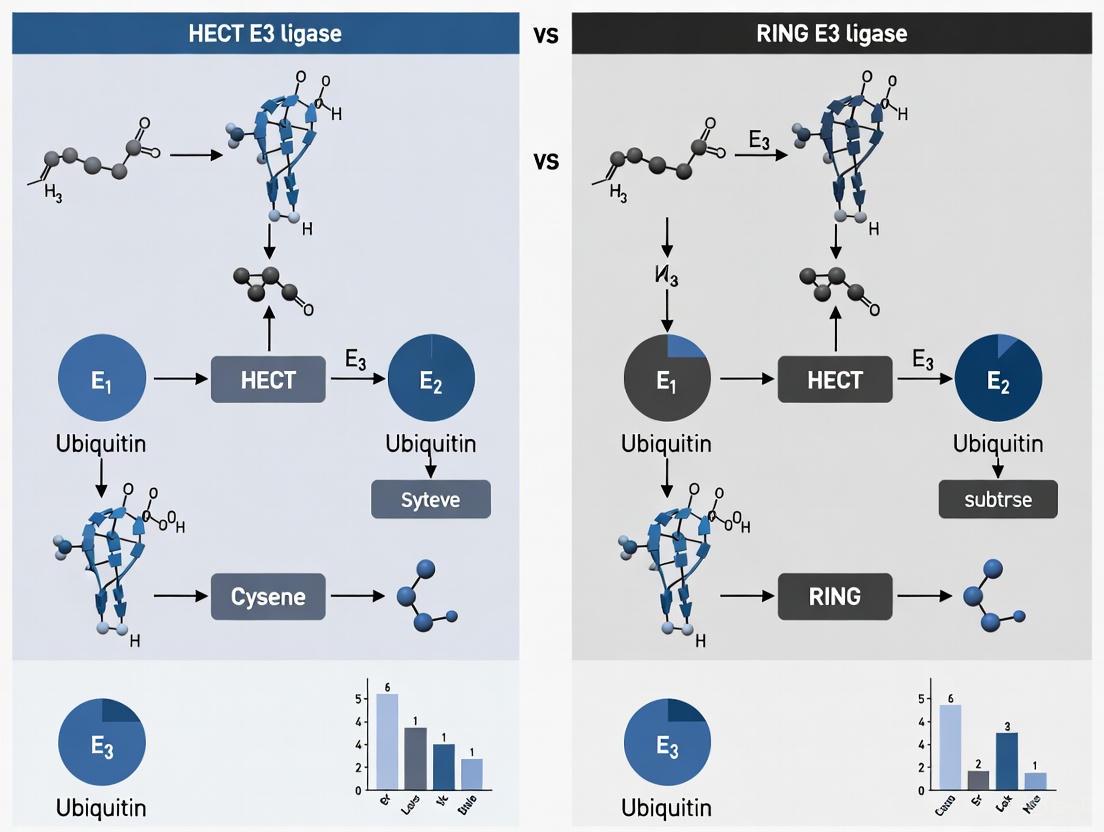
This article provides a comprehensive comparison of HECT and RING E3 ubiquitin ligases, the key enzymes conferring specificity in the ubiquitin-proteasome system.
HECT vs. RING E3 Ubiquitin Ligases: Mechanisms, Regulation, and Therapeutic Targeting
Abstract
This article provides a comprehensive comparison of HECT and RING E3 ubiquitin ligases, the key enzymes conferring specificity in the ubiquitin-proteasome system. We delve into their distinct catalytic mechanisms, structural classifications, and regulatory principles. The content explores advanced methodologies for studying these ligases and the burgeoning field of their therapeutic inhibition, highlighting recent breakthroughs in allosteric drug discovery. Aimed at researchers and drug development professionals, this review synthesizes foundational knowledge with current applications to inform the development of novel targeted therapies for cancer, neurological disorders, and metabolic diseases.
Core Mechanisms and Structural Families of HECT and RING E3 Ligases
Ubiquitination is a crucial post-translational modification that directs myriad eukaryotic proteins to various fates and functions, with its most recognized role being the targeting of proteins for degradation by the 26S proteasome [1]. This modification involves the sequential action of a three-enzyme cascade: ubiquitin-activating enzymes (E1), ubiquitin-conjugating enzymes (E2), and ubiquitin-protein ligases (E3) [1]. The process begins with E1 activating ubiquitin in an ATP-dependent manner, forming a high-energy thioester bond. The ubiquitin is then transferred to the active-site cysteine of an E2 enzyme. Finally, an E3 ligase facilitates the transfer of ubiquitin from the E2 to a lysine residue on the target substrate [1] [2]. With only two E1s, approximately 40 E2s, and over 600 E3s encoded in the mammalian genome, the E3 ligases are primarily responsible for the exquisite spatial, temporal, and substrate specificity that characterizes the ubiquitination process [1] [3]. This review will objectively compare the mechanisms and experimental approaches for studying the two major classes of E3 ligases: HECT and RING types, providing researchers with a comprehensive guide to their distinct functionalities.
E3 Ligase Families: Architectural and Mechanistic Diversity
E3 ubiquitin ligases are primarily categorized into three major families based on their structural features and catalytic mechanisms: RING (Really Interesting New Gene), HECT (Homologous to E6AP C-Terminus), and RBR (RING-between-RING) [4] [5]. The RING family is the largest, comprising over 600 members in humans, while the HECT family includes approximately 28 members, and the RBR family about 14 members [4]. A fourth group, the multi-subunit RING E3s exemplified by Cullin-RING ligases (CRLs), represents some of the most complex arrangements in this system [1] [6].
Table 1: Key Characteristics of Major E3 Ligase Families
| Feature | RING-type E3s | HECT-type E3s | RBR-type E3s |
|---|---|---|---|
| Human Family Size | ~600 members [4] [7] | ~28 members [2] [4] | ~14 members [8] [4] |
| Catalytic Mechanism | Direct transfer from E2 to substrate [3] | Two-step mechanism with E3-Ub thioester intermediate [1] [4] | RING/HECT hybrid mechanism [8] [9] |
| Intermediate Formation | No E3-Ub intermediate [3] | Obligate E3-Ub thioester intermediate [1] [2] | E3-Ub thioester intermediate [8] |
| Structural Features | Zn²⁺-coordinating RING domain [1] | Bilobed HECT domain (N-lobe, C-lobe) [1] [2] | RING1-IBR-RING2 domain organization [8] |
| Representative Examples | Cbl, MDM2, APC/C, SCF [1] | NEDD4, E6AP, HUWE1, SMURFs [1] [2] | Parkin, HOIP, HHARI [8] [9] |
RING-type E3 Ligases: Scaffolds for Direct Transfer
RING-type E3s constitute the largest class of ubiquitin ligases, characterized by a canonical RING finger domain that coordinates two zinc ions in a "cross-brace" structure [1] [7]. Unlike HECT E3s, RING finger domains do not form a catalytic intermediate with ubiquitin. Instead, they serve as scaffolds that bring E2 and substrate into close proximity, with evidence suggesting they can also allosterically activate E2s [1]. RING E3s can function as monomers, dimers (both homo- and heterodimers), or multi-subunit complexes such as the anaphase-promoting complex/cyclosome (APC/C) and cullin-RING ligases (CRLs) [1] [3]. The CRL family represents particularly complex structures that utilize a wide variety of substrate receptors, adapter proteins, and cooperating ligases [6].
HECT-type E3 Ligases: Two-Step Catalytic Enzymes
HECT E3s are defined by a conserved C-terminal HECT domain approximately 350 amino acids in length, consisting of an N-lobe that interacts with the E2 and a C-lobe containing the active-site cysteine that forms a thioester bond with ubiquitin [1] [2] [4]. These two lobes are connected by a flexible hinge region that allows them to come together during ubiquitin transfer [1]. The N-terminal regions of HECT E3s are diverse and mediate substrate targeting [1]. Based on their N-terminal domain organization, the 28 human HECT E3s are divided into three subfamilies: the NEDD4 family (9 members) characterized by C2 and WW domains; the HERC family (6 members) featuring RCC1-like domains (RLD); and "other" HECT E3s (13 members) with varied N-terminal domains [2] [4].
RBR-type E3 Ligases: Hybrid Mechanisms
RBR E3 ligases represent a unique hybrid category that functions with characteristics of both RING and HECT-type mechanisms [8] [9]. These enzymes contain three zinc-binding domains termed RING1, in-between RING (IBR), and RING2, collectively called the RBR module [8]. Similar to RING E3s, the RING1 domain binds the E2~Ub conjugate. However, like HECT E3s, they then catalyze ubiquitin transfer via a catalytic cysteine in the RING2 domain, forming a thioester intermediate [8] [9]. Parkin, one of the most studied RBR E3s, requires phosphorylation for activation and contains four RING domains coordinating eight zinc molecules [9].
Diagram 1: Ubiquitination cascade comparing direct RING-type and two-step HECT-type mechanisms. HECT E3s form a catalytic intermediate, while RING E3s facilitate direct transfer.
Comparative Catalytic Mechanisms: HECT versus RING
Fundamental Mechanistic Differences
The most significant distinction between HECT and RING E3 ligases lies in their catalytic mechanisms. RING E3s function as allosteric activators of the E2 and scaffolds that bring the E2 in close proximity to the substrate, enabling direct ubiquitin transfer from the E2 to the substrate without forming an E3-Ub intermediate [3] [7]. In contrast, HECT E3s catalyze ubiquitination in a two-step reaction: first, they accept the activated ubiquitin from the E2 in a transthiolation reaction onto their catalytic cysteine, forming a HECT-Ub thioester intermediate; subsequently, the ubiquitin moiety is transferred to a lysine on the target substrate [1] [4].
Structural studies of the NEDD4L HECT domain in complex with ubiquitin-conjugated E2 revealed that the C-lobe contacts the esterified ubiquitin and folds down onto UbcH5B, reducing the distance between the E2 and E3 catalytic cysteines to approximately 8Å [1]. This contrasts with the more open architecture observed in E6AP complexes, where the catalytic cysteine residues are 41Å apart, suggesting that the two lobes of the HECT domain are connected through a flexible hinge that allows them to come together during ubiquitin transfer [1].
Ubiquitin Chain Linkage Specificity
Another crucial distinction between these E3 families lies in their ability to generate specific polyubiquitin chain linkages, which determine the functional consequences for the modified substrate. HECT E3s appear to possess intrinsic linkage specificity dictated by structural elements within their catalytic domains [4]. For instance, NEDD4 family members primarily synthesize K63-linked chains, while E6AP is a K48-specific enzyme, and HUWE1 generates K6-, K11-, and K48-linked polyubiquitin chains [4]. For NEDD4 enzymes, the presence of a non-covalent ubiquitin-binding site (Ub exosite) in the N-lobe appears to be required for enzyme processivity, possibly by stabilizing and orienting the distal end of growing ubiquitin chains on the substrate [4].
RING E3s, conversely, typically derive their linkage specificity from their partnered E2 enzymes, though some RING E3s can influence chain topology through additional mechanisms [1]. The cullin-RING ligase (CRL) superfamily represents particularly sophisticated examples, with complexes like the SCF (Skp1-Cullin-F-box) utilizing various substrate receptors to achieve specificity [1].
Table 2: Ubiquitin Chain Linkage Specificity and Functional Consequences
| Linkage Type | Primary Functions | Representative E3 Ligases |
|---|---|---|
| K48-linked | Proteasomal degradation [3] | E6AP (HECT) [4] |
| K63-linked | Signaling, DNA repair, endocytosis [3] | NEDD4 family (HECT) [4] |
| K11-linked | Cell cycle regulation, ER-associated degradation [2] [3] | APC/C (RING) [2], HUWE1 (HECT) [4] |
| K6-linked | DNA damage response, mitochondrial signaling [2] [3] | HUWE1 (HECT) [2] |
| K27-linked | DNA damage response [2] [3] | RNF168 (RING) [2] |
| K29-linked | Negatively regulates Wnt signaling [2] | Cbl-b, Itch (RING/HECT) [2] |
| K33-linked | T-cell receptor regulation, intracellular trafficking [2] [3] | Cbl-b, Itch (RING/HECT) [2] |
| M1-linked (Linear) | NF-κB signaling, immunity, inflammation [2] [3] | LUBAC complex (RBR) [2] [8] |
Experimental Approaches for Studying E3 Mechanisms
E2-Ub Discharge Assays for Catalytic Activity
E2-Ub thioester discharge assays represent a fundamental method for investigating the catalytic activity of E3 ligases, particularly useful for distinguishing between RING and HECT mechanisms [8]. In this assay, the E2 is loaded with ubiquitin to form a thioester conjugate (E2~Ub), which is then incubated with the E3 ligase of interest. The discharge of ubiquitin from the E2 is monitored over time, typically using non-reducing SDS-PAGE to preserve thioester linkages [8].
For HECT E3s, this assay demonstrates the transfer of ubiquitin from the E2 to the catalytic cysteine of the HECT domain, forming the HECT-Ub intermediate. For RING E3s, the assay shows enhanced discharge rates due to the allosteric activation of the E2's catalytic activity. This method has been particularly valuable for studying RBR E3s like HOIL-1 and RNF216, which display poor E2-Ub discharge activity in the absence of allosteric activators but show strongly enhanced activity in the presence of specific di-ubiquitin species (M1- or K63-linked for HOIL-1; K63-linked for RNF216) [8].
Protocol Summary:
- Prepare E2~Ub thioester by incubating E2 with E1, ubiquitin, and ATP
- Purify E2~Ub conjugate using rapid gel filtration or acid quenching
- Incubate E2~Ub with E3 ligase in reaction buffer
- Stop reactions at time points using non-reducing SDS sample buffer
- Analyze by non-reducing SDS-PAGE and western blotting with anti-ubiquitin antibodies
- Quantify E2~Ub discharge kinetics using densitometry
BioE3 System for Substrate Identification
The BioE3 system represents an innovative technological approach for identifying specific substrates of E3 ligases, addressing the significant challenge of distinguishing genuine targets from mere interactors [5]. This method combines site-specific biotinylation of ubiquitin-modified substrates with BirA-E3 ligase fusion proteins under optimized conditions to enable proteomic identification of E3-specific targets [5].
The key innovation in BioE3 involves using an AviTag variant with lower affinity for BirA (bioGEF instead of bioWHE) to enable proximity-dependent labeling specifically at sites where the E3 is actively ubiquitinating substrates. This system has been successfully applied to both RING-type E3s (RNF4, MIB1, MARCH5, RNF214) and HECT-type E3s (NEDD4), identifying both known and novel targets [5].
Protocol Summary:
- Generate stable cell line expressing inducible bioGEF-Ub (AviTag with GEF mutation)
- Culture cells in biotin-depleted media prior to experiments
- Introduce BirA-E3 fusion construct into bioGEF-Ub cells
- Induce bioGEF-Ub and BirA-E3 expression with doxycycline
- Add exogenous biotin for time-limited, proximity-dependent labeling
- Harvest cells and perform streptavidin capture of biotinylated substrates
- Identify substrates by liquid chromatography-mass spectrometry (LC-MS)
Diagram 2: BioE3 experimental workflow for identifying E3 ligase substrates using proximity-dependent biotinylation and streptavidin capture.
Structural Biology Approaches
Structural studies have been instrumental in elucidating the distinct mechanisms of HECT and RING E3 ligases. X-ray crystallography of the NEDD4 HECT domain in complex with ubiquitin-conjugated E2 provided the first structural insights into a Ub-loaded E3, revealing how the donor ubiquitin is bound to the Nedd4 C-lobe with its C-terminal tail locked in an extended conformation, primed for catalysis [10]. Similarly, high-resolution (1.58 Å) crystal structures of Parkin-R0RBR have revealed the fold architecture for the four RING domains of this RBR E3 and several unpredicted interfaces that regulate its activity [9].
More recently, cryo-electron microscopy (cryoEM) has revealed a wide variety of structures in the CRL family, suggesting how ubiquitin transfer occurs in these multi-subunit complexes [6]. When combined with hydrogen deuterium exchange mass spectrometry (HDXMS), these approaches have expanded our understanding of how covalent NEDD8 modification (neddylation) activates CRLs, particularly by facilitating cooperation with additional RING-between-RING ligases to transfer ubiquitin [6].
Research Reagent Solutions for E3 Ligase Studies
Table 3: Essential Research Reagents for E3 Ligase Mechanistic Studies
| Reagent/Category | Specific Examples | Research Applications |
|---|---|---|
| Activity Probes | Ubiquitin-vinyl sulfone (Ub-VS) [9] | Covalent labeling of active site cysteines in HECT and RBR E3s |
| Stable Cell Lines | TRIPZ-bioGEFUbnc cells [5] | Inducible expression of biotinylatable ubiquitin for BioE3 studies |
| E3 Fusion Constructs | BirA-E3 fusions (BirA-RNF4, BirA-MIB1) [5] | Proximity-dependent biotinylation in BioE3 system |
| Ubiquitin Mutants | Ubnc (L73P) [5], bioGEF-Ub [5] | Preventing deubiquitination; enabling specific biotinylation |
| Chain-Linkage Specific Reagents | M1-, K63-, K48-linked di-ubiquitin [8] | Studying allosteric activation and linkage specificity |
| Structural Biology Tools | Catalytic cysteine mutants (Cys to Ala) [8] | Trapping intermediates for structural studies |
| E2 Conjugates | UbcH7(C86K)-Ub [8] | Stable E2-Ub conjugate for binding studies |
The distinct mechanistic properties of HECT and RING E3 ligases have significant implications for both basic research and therapeutic development. From a research perspective, the choice between studying HECT versus RING E3s often depends on the biological context and specific research questions. HECT E3s, with their defined two-step mechanism and intrinsic linkage specificity, offer more straightforward systems for enzymological studies and substrate identification using methods like BioE3 [5]. Their well-characterized domain structure also facilitates structural studies, as demonstrated by the multiple HECT domain structures solved over the past decade [1] [10].
RING E3s, representing the majority of ubiquitin ligases, present both challenges and opportunities due to their diversity and complex regulation. The multi-subunit nature of many RING E3 complexes like CRLs requires more sophisticated experimental approaches, often combining cryoEM with biochemical techniques [6]. However, their central role in numerous signaling pathways makes them particularly relevant for physiological and pathological studies.
From a therapeutic perspective, both E3 classes represent attractive drug targets. The catalytic cysteine in HECT and RBR E3s offers a potential site for covalent inhibitors, while the protein-protein interactions in RING E3s provide opportunities for small-molecule intervention [3]. Understanding the distinct mechanisms of these E3 families continues to drive innovations in targeted protein degradation, including PROTACs (Proteolysis-Targeting Chimeras) that often utilize E3 ligases for directing specific proteins to the proteasome [3].
As research technologies advance, particularly in structural biology and proteomics, our understanding of the nuances between different E3 mechanisms continues to deepen. The development of techniques like BioE3 that can be applied across multiple E3 families promises to accelerate substrate identification and mechanistic studies, potentially revealing new therapeutic opportunities for manipulating the ubiquitin-proteasome system in disease contexts.
Ubiquitination is a crucial post-translational modification that directs protein fate, influencing stability, activity, and localization. Central to this process are E3 ubiquitin ligases, which confer substrate specificity. Among these, the Homologous to the E6AP C-Terminus (HECT) family represents a distinct class characterized by a unique catalytic mechanism involving a direct thioester intermediate. This guide provides a detailed comparison of HECT ligase catalysis against other major E3 ligase families, focusing on mechanistic insights, experimental data, and methodological approaches relevant to ongoing research and therapeutic development.
Comparative Mechanisms of Major E3 Ligase Families
E3 ubiquitin ligases are categorized based on their structural domains and catalytic mechanisms. The table below contrasts the core features of the three major families.
Table 1: Core Mechanistic Features of E3 Ubiquitin Ligase Families
| Feature | HECT Ligases | RING Ligases | RBR Ligases |
|---|---|---|---|
| Catalytic Mechanism | Two-step with covalent E3~Ub intermediate [1] [11] | One-step, direct transfer from E2 to substrate [1] [8] | Hybrid RING/HECT two-step mechanism [8] |
| Intermediate | Thioester-linked HECT~Ub complex [12] [11] | No stable E3-Ub intermediate [1] | Thioester-linked RING2~Ub complex [8] |
| Role of E3 | Catalytic (forms chemical bond with Ub) [11] | Scaffold (brings E2 and substrate together) [1] [13] | Hybrid (RING1 as scaffold, RING2 as catalytic) [8] |
| Ubiquitin Transfer | From E2 to E3 (transthiolation), then to substrate (aminolysis) [11] | Directly from E2~Ub to substrate [1] | From E2 to RING2 (transthiolation), then to substrate (aminolysis) [8] |
Diagram 1: HECT vs. RING catalytic mechanisms. HECT ligases form a covalent thioester intermediate, while RING ligases facilitate direct ubiquitin transfer.
The HECT Ligase Catalytic Cycle: A Detailed Look
The HECT domain, a ~350-amino-acid C-terminal region, defines this family and is structurally organized into two lobes. The N-lobe binds the E2~Ub conjugate, while the C-lobe contains the active-site cysteine that forms the thioester bond with ubiquitin [1] [11]. The catalytic cycle proceeds via two well-defined steps:
- Transthiolation: The ubiquitin is transferred from the active-site cysteine of the E2 enzyme to the active-site cysteine within the HECT C-lobe, forming a transient, high-energy HECT~ubiquitin thioester intermediate [11] [14].
- Aminolysis: The ubiquitin is then ligated from the HECT enzyme to a primary amino group (typically the ε-amino group of a lysine) on the target substrate, forming an isopeptide bond [11].
A key feature of the HECT domain is the flexible hinge that connects the N and C lobes. Early structural studies suggested that large conformational changes of the C-lobe are required to bring the thioester bond within proximity of the substrate lysine [1] [15]. Recent studies on NEDD4-2 propose a proximal indexation mechanism requiring oligomerization. This model involves two functionally distinct E2~Ub binding sites: an initial site for HECT~Ub thioester formation and a canonical site for polyubiquitin chain elongation, which functions in trans across adjacent subunits of the oligomer [12].
Key Experimental Data and Methodologies
Understanding the HECT mechanism relies on specific biochemical and biophysical assays. The following table summarizes key quantitative findings and the experimental approaches used to obtain them.
Table 2: Key Experimental Findings in HECT Ligase Catalysis
| Experimental Observation | Quantitative Data | Experimental Method | Significance |
|---|---|---|---|
| Oligomerization for Full Activity | Trimeric active form; F823A mutation decreases kcat by ≥10^4-fold [12] | Gel filtration chromatography; Dynamic light scattering; Site-directed mutagenesis [12] | Demonstrates that polyubiquitin chain assembly, but not monoubiquitination, requires oligomerization [12] |
| Two Distinct E2~Ub Binding Sites | Km for Ubc5B~Ub is 8 ± 2 nM (without substrate) vs. 127 ± 49 nM (with substrate) [14] | Initial velocity enzyme kinetics under E3-limiting conditions; Use of E2 mutant proteins (T98A, F62A) [14] | Functional uncoupling of thioester formation (Site 1) from chain elongation (Site 2) [12] [14] |
| Linkage Specificity | NEDD4-2 assembles Lys-63-linked polyubiquitin chains [12] [14] | In vitro ubiquitination assays with wild-type and mutant ubiquitin (e.g., K48R, K63R) [14] | Clarifies chain linkage and fate of substrate (often endocytic trafficking vs. proteasomal degradation) |
| Inhibition of Oligomerization | N-acetylphenylalanyl-amide acts as noncompetitive inhibitor (Ki = 8 ± 1.2 mM) [12] | Kinetic assays with small-molecule Phe-823 mimics [12] | Suggests a therapeutic strategy for targeting HECT ligases by disrupting the active oligomer |
Detailed Experimental Protocol: Polyubiquitin Chain Assembly Assay
A foundational assay for studying HECT ligase mechanism involves measuring the formation of unanchored polyubiquitin chains in the absence of a protein substrate [14]. Below is a generalized protocol derived from these studies.
Objective: To quantify the rate of polyubiquitin chain formation catalyzed by a HECT E3 ligase.
Reagents:
- Purified Proteins: HECT E3 ligase (e.g., full-length NEDD4-2), E1 activating enzyme, E2 conjugating enzyme (e.g., UbcH5B/UBE2D1), Ubiquitin.
- Radioisotope: ¹²⁵I-labeled ubiquitin.
- Reaction Buffer: Typically containing Tris-HCl (pH ~7.5), MgCl₂, ATP, DTT, and an ATP-regenerating system (e.g., Creatine Phosphate and Creatine Kinase).
- Quenching Solution: SDS-PAGE loading buffer with β-mercaptoethanol.
- Equipment: Water bath or thermomixer, gel electrophoresis apparatus, phosphorimager or X-ray film.
Procedure:
- Reaction Setup: On ice, prepare a master mix containing reaction buffer, ATP, ATP-regenerating system, E1 enzyme, E2 enzyme, unlabeled ubiquitin, and ¹²⁵I-ubiquitin. The E3 ligase is often omitted at this stage.
- Initiation: Pre-incubate the master mix at 30°C for 1-2 minutes to allow E1-mediated charging of the E2 enzyme. Start the reaction by adding the HECT E3 ligase.
- Time Course: At defined time intervals (e.g., 0, 2.5, 5, 10, 20 minutes), remove an aliquot of the reaction and mix it with an equal volume of quenching solution to denature the proteins and stop the reaction.
- Analysis: Resolve the quenched samples by SDS-PAGE. Visualize and quantify the formation of high molecular weight polyubiquitin chains using autoradiography and a phosphorimager.
Key Applications:
- Determining kinetic parameters (kcat, Km) for E2~Ub conjugates.
- Testing the functional impact of mutations in the HECT domain (e.g., active-site cysteine, oligomerization interface).
- Investigating linkage specificity by using ubiquitin mutants where specific lysines are mutated to arginine.
The Scientist's Toolkit: Essential Research Reagents
The following table lists critical reagents and tools used in mechanistic studies of HECT ligases.
Table 3: Essential Reagents for HECT Ligase Research
| Research Tool | Function / Description | Example Use Case |
|---|---|---|
| Stable E2~Ub Conjugates | Engineered oxyester (e.g., E2 C85S~Ub) or isopeptide (e.g., E2 C86K~Ub) mimics of the labile thioester [12] [8]. | Trapping catalytic intermediates for structural studies (e.g., X-ray crystallography, Cryo-EM) [16]. |
| Active-Site Mutants | Mutation of the catalytic cysteine to serine or alanine (e.g., C922A in NEDD4-2) [12]. | Used as catalytically dead controls or to trap the HECT~Ub intermediate for structural analysis. |
| Oligomerization-Disrupting Mutants | Mutation of conserved hydrophobic residues at the subunit interface (e.g., F823A in NEDD4-2) [12]. | Functionally uncouples monoubiquitination from polyubiquitin chain assembly. |
| Linkage-Specific Ubiquitin Mutants | Ubiquitin where a single lysine is mutated to arginine (e.g., Ub K48R, Ub K63R) [16] [14]. | Determines the linkage type of polyubiquitin chains synthesized by the HECT ligase. |
| Chemical Probes (e.g., triUb~probe) | Synthetic, chemically cross-linked ubiquitin probes that mimic transition states or branched chains [16]. | Trapping and visualizing transient enzymatic states, such as during branched ubiquitin chain formation. |
Advanced Concepts: Branched Ubiquitination and Oligomerization
Recent research has expanded our understanding of HECT ligase function beyond simple chain elongation. For instance, the HECT E3 Ufd4 preferentially catalyzes the formation of K29/K48-branched polyubiquitin chains on pre-assembled K48-linked ubiquitin chains, which acts as an enhanced degradation signal [16]. Structural visualization using cryo-EM has revealed how the N-terminal domains and HECT C-lobe of Ufd4 work together to recruit the substrate ubiquitin chain and orient the acceptor lysine for catalysis [16].
Furthermore, the requirement for oligomerization, specifically trimerization, has been established for full-length HECT ligases like NEDD4-2 and E6AP [12]. This quaternary structure is essential for the proximal indexation mechanism, where the two distinct E2-binding sites are located on different subunits of the trimer, enabling efficient polyubiquitin chain elongation in trans [12].
Diagram 2: Oligomerization in HECT catalysis. The active trimeric form allows one subunit charged with ubiquitin (HECT~Ub) to interact with an E2~Ub bound to a second subunit, facilitating efficient polyubiquitin chain assembly.
The ubiquitin-proteasome system is a fundamental regulatory mechanism in eukaryotic cells, controlling protein degradation and influencing virtually all cellular processes. Within this system, E3 ubiquitin ligases serve as the critical specificity determinants, responsible for recognizing substrate proteins and facilitating their tagging with ubiquitin. Among the several families of E3 ligases, the RING (Really Interesting New Gene) family represents the largest and most diverse group, with over 600 members in the human genome. RING-type E3 ligases function as scaffold proteins that mediate the direct transfer of ubiquitin from an E2 conjugating enzyme to a substrate protein, without forming a covalent intermediate. This direct transfer mechanism distinguishes RING E3s from HECT-type E3s, which utilize a two-step catalytic process involving a transient E3-ubiquitin thioester intermediate. Understanding the precise molecular mechanisms of RING ligase catalysis provides fundamental insights into cellular regulation and offers potential therapeutic avenues for numerous diseases, including cancer, neurodegenerative disorders, and immune dysfunction [17] [18] [19].
The RING domain itself is characterized by a conserved cross-braced zinc-binding structure that coordinates two zinc ions through a specific arrangement of cysteine and histidine residues. This structural motif creates a stable platform for binding E2 ubiquitin-conjugating enzymes that have been charged with ubiquitin. RING E3s function as multimers—either homodimers or heterodimers—with the RING domains positioned such that their E2-binding surfaces face away from each other, suggesting that cooperative interactions between RING-bound E2s are unlikely in the context of a dimer. Instead, this arrangement likely facilitates the recruitment of multiple E2s for processive ubiquitination or the ubiquitination of complex substrates [17].
Core Catalytic Mechanism of RING E3 Ligases
The Scaffold Function and E2∼Ub Recruitment
RING E3 ligases function primarily as molecular scaffolds that physically bridge E2∼Ub conjugates with substrate proteins. Unlike HECT E3s, RING ligases do not form a covalent thioester intermediate with ubiquitin during the catalytic cycle. Instead, they facilitate the direct transfer of ubiquitin from the E2 active site cysteine to a lysine residue on the substrate protein. This fundamental mechanistic distinction has profound implications for the regulation and biological functions of these two E3 families [17] [19].
The catalytic cycle begins with the RING domain recruiting an E2 enzyme that has been charged with ubiquitin (E2∼Ub). Structural studies have revealed that RING domains bind to the N-terminal helix of the ubiquitin-conjugating (UBC) fold of E2s. Notably, the affinity of RING E3s for E2∼Ub is significantly enhanced compared to E2 alone, due to additional interactions between the RING domain and the donor ubiquitin (UbD) within the ternary complex. This enhanced binding affinity contributes to the catalytic efficiency of ubiquitin transfer [20].
Induction of the Closed E2∼Ub Conformation
A critical function of RING E3 ligases in catalysis is their ability to stabilize a closed conformation of the E2∼Ub conjugate. In the absence of a RING E3, E2∼Ub conjugates predominantly exist in an "open" conformation, where ubiquitin is dynamically associated with the E2 surface. Upon RING binding, the E2∼Ub conjugate is repositioned into a closed conformation, where ubiquitin's C-terminal tail is optimally positioned for nucleophilic attack by the substrate lysine. This conformational change activates the thioester bond for transfer and precisely orients the reactive groups for catalysis [20].
The transition from open to closed conformation brings the ubiquitin C-terminus in close proximity to the substrate-binding site, effectively measuring the distance between the E2 active site and the target lysine on the substrate. This spatial coordination ensures the specificity and efficiency of ubiquitin transfer. The closed conformation is characterized by extensive contacts between the RING domain and both the E2 and ubiquitin moieties, creating a stable catalytic complex primed for ubiquitin transfer [20].
Table 1: Key Structural Elements in RING E3 Catalytic Mechanism
| Structural Element | Function in Catalysis | Consequence of Disruption |
|---|---|---|
| RING Domain | Binds E2∼Ub conjugate and stabilizes closed conformation | Abolished ubiquitin transfer |
| Linchpin Residue | Forms hydrogen bonds with UbD and E2 to stabilize closed state | Reduced E3 activity, impaired ubiquitination |
| Zinc-Binding Sites | Maintains structural integrity of RING domain | Loss of E2 binding capacity |
| Dimerization Interface | Enables formation of active E3 complex | Altered substrate specificity, reduced processivity |
The Linchpin Residue and Ubiquitin Transfer
Central to the RING E3 mechanism is a conserved cationic "linchpin" residue (most commonly an arginine) that plays a crucial role in stabilizing the closed E2∼Ub conformation. Structural analyses of multiple RING/E2∼Ub complexes reveal that this linchpin residue is positioned at the interface between the donor ubiquitin and the E2 enzyme, where it forms a network of hydrogen bonds with both partners. This interaction stabilizes the catalytically competent conformation and enhances the efficiency of ubiquitin transfer [20].
Recent research using the model RING E3 RNF38 has demonstrated that substitution of the linchpin arginine with other amino acids modulates ubiquitination efficiency, ranging from minor reduction to complete abolition of activity. Interestingly, the identity of the linchpin residue influences E2∼Ub binding but does not directly correlate with E3 activity, suggesting that the linchpin's primary role is in stabilizing the proper E2∼Ub conformation rather than simply increasing binding affinity. NMR and X-ray crystallography analyses reveal that different linchpin residues stabilize E2∼Ub in the catalytically competent conformation to varying degrees, with arginine being the most effective [20].
The importance of the linchpin residue extends beyond a single E3, as demonstrated by experiments with XIAP, where a Y485R substitution in the linchpin position enhanced E2∼Ub stabilization and increased substrate ubiquitination in cells. This conservation of function across different RING E3s highlights the fundamental nature of this mechanistic feature in RING-mediated ubiquitination [20].
Figure 1: RING E3 Catalytic Cycle - RING E3 ligases facilitate direct ubiquitin transfer from E2∼Ub to substrates without forming covalent E3-ubiquitin intermediates.
Comparative Analysis: RING vs. HECT E3 Ligase Mechanisms
Fundamental Mechanistic Differences
The catalytic mechanisms of RING and HECT E3 ligases differ fundamentally in their use of covalent intermediates. While RING E3s function as pure scaffolds, HECT E3s employ a two-step mechanism involving a covalent E3-ubiquitin thioester intermediate. In HECT E3s, ubiquitin is first transferred from the E2 to a catalytic cysteine residue within the HECT domain, forming a HECT∼Ub intermediate. Subsequently, the ubiquitin is transferred from the HECT E3 to the substrate lysine residue. This two-step mechanism provides HECT E3s with greater direct control over the ubiquitination process but may also render them more susceptible to regulatory checkpoints [21] [11].
The structural organization of HECT domains reflects this two-step mechanism. HECT domains consist of an N-lobe that binds the E2 and a C-lobe containing the active site cysteine, connected by a flexible hinge region. Recent structural studies of HECT E3s like Ufd4 and Rsp5 have revealed that the catalytic architecture involves three-way interactions between ubiquitin and both lobes of the HECT domain, which orient the E3∼Ub thioester bond for ligation and restrict the location of the substrate-binding domain to prioritize target lysines for ubiquitination [16] [11].
Table 2: Comparative Mechanisms of RING vs. HECT E3 Ligases
| Feature | RING E3 Ligases | HECT E3 Ligases |
|---|---|---|
| Catalytic Mechanism | Direct transfer from E2 to substrate | Two-step mechanism with E3-Ub intermediate |
| Covalent Intermediate | No | Yes (thioester-linked HECT∼Ub) |
| Primary Function | Molecular scaffold | Catalytic enzyme |
| Ubiquitin Chain Specification | Determined by E2 with E3 influence | Primarily determined by E3 |
| Structural Domains | RING domain (zinc-coordinating) | HECT domain (N-lobe, C-lobe with catalytic Cys) |
| Regulatory Mechanisms | Allosteric activation, dimerization, post-translational modifications | Allosteric inhibition, conformational changes, accessory domains |
Implications for Ubiquitin Chain Formation and Specificity
The mechanistic differences between RING and HECT E3 ligases have significant implications for their roles in determining ubiquitin chain topology. For RING E3s, the specificity of ubiquitin chain linkage is influenced by both the E2 enzyme and the E3 itself. Some E2s are dedicated to specific ubiquitin linkages, while others are more promiscuous. Thus, a given RING E3 can generate different ubiquitin linkages depending on the E2 with which it is paired. This partnership creates a layered regulatory system for controlling ubiquitin chain specificity [17].
In contrast, HECT E3s exercise more direct control over linkage specificity through their catalytic domains. For example, structural studies of the HECT E3 ligase Ufd4 have revealed how it preferentially catalyzes K29-linked ubiquitination on K48-linked ubiquitin chains to form K29/K48-branched ubiquitin chains. The N-terminal ARM region and HECT domain C-lobe of Ufd4 work together to recruit K48-linked diUb and orient Lys29 of its proximal Ub toward the active cysteine for K29-linked branched ubiquitination. This level of specificity is encoded within the HECT E3 structure itself [16].
The formation of branched ubiquitin chains represents an emerging area of complexity in ubiquitin signaling. While both RING and HECT E3s can generate branched chains, their mechanistic approaches differ. RING E3s typically require sequential action with different E2 partnerships, while HECT E3s like Ufd4 can directly assemble specific branched architectures through coordinated recognition of the acceptor chain and catalytic transfer [16].
Experimental Approaches for Studying RING E3 Mechanisms
Key Methodologies and Techniques
Understanding RING E3 ligase mechanisms has relied on a combination of structural, biochemical, and cellular approaches. X-ray crystallography and cryo-EM have been instrumental in visualizing RING/E2∼Ub complexes and understanding the structural basis of closed conformation stabilization. These techniques have revealed critical details about the linchpin residue interaction network and the overall architecture of the catalytic complex [8] [20].
Biochemical assays play a crucial role in characterizing RING E3 activity. E2∼Ub discharge assays measure the ability of RING E3s to stimulate the transfer of ubiquitin from E2 to acceptor molecules. These assays can be performed under various conditions to assess the impact of mutations, allosteric effectors, or post-translational modifications on RING E3 activity. For example, discharge assays with HOIL-1 and RNF216 RBR E3 ligases (a RING-related family) demonstrated their allosteric activation by specific diubiquitin linkages (M1- and K63-linked diUb for HOIL-1; K63-linked diUb for RNF216) [8].
Isothermal Titration Calorimetry (ITC) and surface plasmon resonance (SPR) provide quantitative measurements of binding affinities between RING E3s, E2∼Ub conjugates, and potential allosteric regulators. These techniques have revealed that allosteric ubiquitin binding enhances E2-Ub affinity for RBR E3s, suggesting a similar mechanism may operate for canonical RING E3s [8].
NMR spectroscopy offers unique insights into protein dynamics and conformational changes. Solution NMR studies have been particularly valuable for characterizing the equilibrium between open and closed states of E2∼Ub conjugates and determining how different linchpin residues affect this equilibrium [20].
Experimental Workflow for RING E3 Characterization
Figure 2: Experimental Workflow for RING E3 Mechanism Studies - Comprehensive characterization involves biochemical, structural, and cellular approaches.
Research Reagent Solutions for RING E3 Studies
Table 3: Essential Research Reagents for Studying RING E3 Mechanisms
| Reagent/Tool | Function/Application | Key Features |
|---|---|---|
| Stable E2∼Ub Conjugates (e.g., UbcH7(C86K)-Ub) | ITC and binding studies; structural biology | Non-hydrolyzable isopeptide linkage mimics native thioester |
| Linkage-Specific DiUbiquitin | Allosteric activation studies; signaling mechanisms | Defined ubiquitin linkages (M1, K63, K48, etc.) |
| Linchpin Mutant Series | Structure-function analysis of catalytic mechanism | Comprehensive amino acid substitutions at linchpin position |
| CRISPR-Cas9 E3 Libraries | Functional screening in cellular contexts | Identify E3 dependencies under specific conditions |
| HECT-RING Chimera Proteins | Mechanistic comparison and domain function studies | Swapped domains to identify determinative features |
The reagents listed in Table 3 represent essential tools for probing RING E3 mechanisms. Stable E2∼Ub conjugates with non-hydrolyzable linkages, such as UbcH7(C86K)-Ub that forms an isopeptide bond mimicking the native thioester, are particularly valuable for structural studies and quantitative binding measurements using ITC. These reagents allow researchers to capture and characterize the otherwise transient E2∼Ub/RING E3 complexes [8] [20].
Linkage-specific diubiquitin reagents have been crucial for identifying allosteric regulation of RING and RBR E3 ligases. For example, studies with HOIL-1 demonstrated that M1-linked diUb (EC50 = 8 μM) was more than twice as potent as K63-linked diUb (EC50 = 18 μM) as an activator, revealing specificity in allosteric regulation. Similar approaches can be applied to canonical RING E3s to identify potential regulatory mechanisms [8].
The development of linchpin mutant series has provided deep insights into the catalytic requirements of RING E3s. Systematic substitution of the linchpin residue with all 19 available amino acids, as performed with RNF38, reveals how different physicochemical properties at this position affect E2∼Ub stabilization and ubiquitination efficiency, distinguishing between residues that primarily affect binding versus those that impact catalytic conformation [20].
Implications for Therapeutic Development
The mechanistic understanding of RING E3 catalysis has significant implications for therapeutic development, particularly in the field of targeted protein degradation. Strategies such as proteolysis-targeting chimeras (PROTACs) and molecular glues harness the endogenous ubiquitination machinery, primarily RING E3 ligases, to target disease-relevant proteins for degradation. The scaffold function of RING E3s makes them ideally suited for these approaches, as they can be recruited to non-native substrates while maintaining their catalytic function [18].
Unlike traditional inhibitors that target enzyme active sites, RING E3 ligases present challenges for conventional small-molecule drug development due to their scaffold nature and lack of deep catalytic pockets. However, allosteric regulatory sites represent promising targets for therapeutic intervention. For example, the discovery that RBR E3 ligases like HOIP and RNF216 are allosterically activated by specific ubiquitin linkages suggests that small molecules mimicking or disrupting these interactions could modulate E3 activity. Similar allosteric mechanisms may exist for canonical RING E3s [8] [18].
The therapeutic potential of targeting E3 ligases is underscored by their roles in human diseases. Mutations in RING E3s such as BRCA1 (associated with hereditary breast and ovarian cancer), Parkin (linked to autosomal recessive juvenile Parkinsonism), and VHL (causative for von Hippel-Lindau syndrome) highlight the critical importance of these enzymes in maintaining cellular homeostasis. Understanding their catalytic mechanisms provides the foundation for developing targeted therapies that can either restore or inhibit their function, depending on the pathological context [17] [18] [22].
Emerging research continues to reveal novel aspects of RING E3 functions beyond their canonical ubiquitin ligase activities. For instance, recent studies on RNF25 have identified a role in protecting DNA replication forks that is fully separable from its ubiquitin conjugation function, suggesting that some RING E3s may have non-catalytic roles in cellular processes. This expanding functional repertoire further increases the therapeutic potential of targeting these multifunctional proteins [22].
E3 ubiquitin ligases are pivotal enzymes that confer specificity to the ubiquitination system by recognizing substrate proteins and facilitating the attachment of ubiquitin, a crucial post-translational modification. With over 600 E3 ligases encoded in the human genome, they are broadly classified into three major families based on their catalytic mechanisms: RING (Really Interesting New Gene), HECT (Homologous to the E6AP C-Terminus), and RBR (RING-Between-RING) [1] [21]. This review focuses on the structural and functional diversity within the HECT-type E3 ligases, a family characterized by a unique two-step catalytic mechanism involving a direct thioester-linked intermediate with ubiquitin [1] [8]. In contrast to RING-type E3s, which primarily function as scaffolds to directly transfer ubiquitin from an E2 enzyme to the substrate, HECT E3s first accept ubiquitin onto their catalytic cysteine residue before transferring it to the final substrate [1] [11]. This direct catalytic role necessitates distinct structural solutions for regulation and specificity.
The HECT family in humans comprises 28 members, which are further categorized into three main subfamilies: NEDD4, HERC, and Other HECT [23]. These subfamilies exhibit diverse domain architectures that dictate their cellular localization, substrate recognition capabilities, and regulatory mechanisms. Understanding the unique characteristics of each HECT subfamily is essential for appreciating their specialized roles in cellular homeostasis and their implications in human diseases, including cancer and neurological disorders [23] [24] [25]. This guide provides a structured comparison of these subfamilies, emphasizing their structural features, catalytic mechanisms, and experimental approaches for their study.
Comparative Architecture of HECT E3 Ligase Subfamilies
The defining feature of all HECT E3 ligases is the conserved ~350 amino acid HECT domain located at the C-terminus. This domain is bi-lobed, consisting of an N-lobe that interacts with the E2 ubiquitin-conjugating enzyme and a C-lobe that contains the active-site cysteine residue responsible for forming a thioester bond with ubiquitin during the catalytic cycle [1] [11]. The flexibility between these lobes, connected by a flexible hinge region, is critical for the catalytic cycle, allowing the C-lobe to access the E2-bound ubiquitin and subsequently position it for transfer to the substrate [1].
While the HECT domain is the catalytic core, the N-terminal regions of HECT E3s are highly variable and mediate substrate recognition, subcellular targeting, and regulation. The three HECT subfamilies are distinguished by their unique N-terminal domain compositions, as summarized in the table below.
Table 1: Comparative Domain Architecture of HECT E3 Subfamilies
| Subfamily | Representative Members | N-Terminal Domains | Distinctive Features |
|---|---|---|---|
| NEDD4 | NEDD4-1, NEDD4-2, ITCH, WWP1, WWP2, SMURF1, SMURF2, NEDL1, NEDL2 [23] [24] | C2 Domain (Ca²⁺/lipid-binding), 2-4 WW Domains (protein-protein interaction) [23] [24] | Largest HECT subfamily; WW domains recognize PPxY motifs on substrates; C2 domain confers membrane localization and autoinhibition [23] [26] |
| HERC | HERC1, HERC2, HERC5 [27] | RCC1-like Domains (RLDs) [27] | Giant E3s (HERC1 & HERC2 > 500 kDa); HERC5 is interferon-induced and required for ISG15 conjugation [27] |
| Other HECT | E6AP (UBE3A), HACE1, UBE3C, HUWE1 | Various domains (e.g., ARM repeats, extensions of the HECT N-lobe) [16] [11] | Defined by absence of NEDD4 or HERC architecture; E6AP is implicated in Angelman syndrome [25] |
The NEDD4 subfamily, with its characteristic C2-WW domain organization, represents the most extensively studied HECT group. The C2 domain mediates calcium-dependent phospholipid binding, targeting these E3s to cellular membranes such as the plasma membrane, endosomes, and multivesicular bodies [23]. The WW domains, containing two invariant tryptophan residues, interact with proline-rich motifs (typically PPxY) on substrate proteins and adaptors [23] [24]. Importantly, intramolecular interactions between the C2, WW, and HECT domains often serve an autoinhibitory function, maintaining the E3 in a low-activity state until specific activation signals are received [26].
Catalytic Mechanism and Ubiquitin Linkage Specificity
The catalytic mechanism of HECT E3s is a two-step process that distinguishes them from RING E3s. First, ubiquitin is transferred from the E2~Ub thioester to the catalytic cysteine in the HECT C-lobe, forming a HECT~Ub thioester intermediate. Second, ubiquitin is ligated from the HECT E3 to a lysine (or other nucleophilic residue) on the substrate protein [1] [11]. Structural studies have revealed that the HECT domain undergoes significant conformational changes during this process. The E2~Ub complex is initially recognized by the HECT N-lobe, while the C-lobe contacts the E2-bound ubiquitin. A conformational change then brings the catalytic cysteines of the E2 and HECT domains into close proximity (~8Å) for transthiolation [1] [11].
A key functional difference among HECT E3s is their inherent specificity for generating particular types of ubiquitin linkages, which determines the fate of the modified substrate. The table below summarizes the linkage preferences and functional consequences for the major HECT subfamilies.
Table 2: Ubiquitin Linkage Specificity and Functional Roles of HECT Subfamilies
| Subfamily | Preferred Ubiquitin Linkages | Primary Functional Roles | Key Substrates & Pathways |
|---|---|---|---|
| NEDD4 | K63 > K48, K29, K27; also monoubiquitination [24] | Endocytosis, lysosomal sorting, protein trafficking, signaling regulation [1] [23] [24] | PTEN (degradation), ENaC (endocytosis), Notch, TGF-β, Wnt pathways [23] [24] |
| HERC | Not fully characterized; HERC5 conjugates ISG15 (UBL) [27] | Immune response, cell cycle, DNA repair [27] | Broad spectrum of proteins during innate immune response (HERC5) [27] |
| Other HECT | Varies by member (e.g., Ufd4: K29-linked on K48 chains) [16] | Proteasomal degradation, transcription, neurodevelopment [16] [25] | p53, Sna3 (Ufd4), targets in neurodevelopment (E6AP) [16] [11] [25] |
The linkage specificity is primarily dictated by the C-lobe of the HECT domain. For instance, the last 60 amino acids of the HECT domain are critical for determining whether an E3 builds K48-linked or K63-linked chains [1]. A notable example from the "Other HECT" subfamily is Ufd4, which preferentially catalyzes the formation of K29/K48-branched ubiquitin chains on pre-assembled K48-linked ubiquitin chains, creating a potent signal for proteasomal degradation [16].
The diagram below illustrates the conserved two-step catalytic mechanism of HECT E3 ligases and the structural basis for ubiquitin chain formation.
Figure 1: Two-Step Catalytic Mechanism of HECT E3 Ligases. The process begins with the formation of a non-covalent complex between the HECT E3 and an E2~Ub thioester. The HECT N-lobe binds the E2, while the C-lobe contacts the E2-bound Ub. Step 2: Ubiquitin is transferred via transthiolation to the catalytic cysteine in the HECT C-lobe, forming a HECT~Ub intermediate. This step often involves a conformational change in the hinge region. Step 3: The HECT~Ub intermediate catalyzes the transfer of ubiquitin to a lysine residue on the substrate protein via an aminolysis reaction. The C-lobe of the HECT domain determines the specificity of ubiquitin chain linkage (e.g., K48, K63, K29) [1] [11].
Experimental Approaches for Studying HECT E3 Ligases
Key Biochemical and Structural Methods
Dissecting the function and mechanism of HECT E3s relies on a suite of biochemical, biophysical, and structural techniques. The following table catalogues essential reagents and methodologies commonly employed in this field.
Table 3: Essential Research Reagents and Methods for HECT E3 Ligase Studies
| Research Tool / Method | Key Function & Utility | Experimental Context & Outcome Measures |
|---|---|---|
| E2-Ub Discharge Assays [8] | Measures the ability of an E3 to accept ubiquitin from a specific E2~Ub thioester. | In vitro reconstitution with purified E1, E2, E3, ubiquitin, and ATP; monitored by ubiquitin transfer to E3 catalytic cysteine via non-reducing SDS-PAGE (shift in molecular weight). |
| Ubiquitination Assays [16] | Assesses the complete E3 activity, including ubiquitin chain formation on a substrate. | Reactions include E1, E2, E3, ubiquitin, ATP, and a substrate; analyzed by Western blot to detect substrate ubiquitination (smear or shift) or by MS to determine linkage type. |
| Stable E2-Ub Conjugates (e.g., UbcH7(C86K)-Ub) [8] | Mimics the E2~Ub intermediate for structural and binding studies without catalytic turnover. | Used in Isothermal Titration Calorimetry (ITC) or Surface Plasmon Resonance (SPR) to quantify E2-Ub/HECT binding affinity and in crystallography to trap intermediate states. |
| Chemical Crosslinking / Trapped Complexes [16] | Stabilizes transient enzymatic intermediates for structural visualization (e.g., by Cryo-EM). | Covalently links the E3 catalytic cysteine, ubiquitin C-terminus, and substrate lysine to mimic the transition state, enabling high-resolution structure determination. |
| Linkage-Specific Di-Ub Probes [8] [16] | Investigates the role of specific ubiquitin linkages in allosteric regulation or as substrates for branched chain formation. | Used in E2-Ub discharge or ubiquitination assays to test for activation (allostery) or as substrates to determine E3 linkage preference (e.g., Ufd4 prefers K48-linked chains for K29-branching) [16]. |
| Active-Site Mutants (Cys to Ala/Ser) [24] | Generates catalytically inactive E3 for control experiments or to study substrate binding without turnover. | Used to distinguish between functional effects due to ubiquitination vs. physical interaction, and in ITC to measure E2-Ub binding without transthiolation. |
Detailed Experimental Workflow: Analyzing Ubiquitin Chain Formation
A critical experiment for characterizing any HECT E3 is the in vitro ubiquitination assay, which can delineate its linkage specificity and catalytic output. The workflow below, derived from studies on Ufd4 and other HECTs, provides a robust template [16].
Objective: To determine the ubiquitin linkage specificity of a HECT E3 ligase.
Methodology:
- Reconstitution: Set up a reaction mixture containing:
- E1 activating enzyme (e.g., Uba1)
- E2 conjugating enzyme (e.g., Ubc4 for Ufd4)
- The HECT E3 of interest (full-length or HECT domain)
- ATP (energy source)
- Wild-type ubiquitin or mutant ubiquitin (e.g., Ub-K29R, Ub-K48R)
- Optional: A substrate protein (e.g., a purified protein fragment or pre-assembled ubiquitin chains of defined linkage)
- Incubation: Allow the reaction to proceed at a physiological temperature (e.g., 30-37°C) for a defined time course.
- Termination and Analysis:
- Stop the reaction by adding SDS-PAGE loading buffer (with or without a reducing agent like DTT).
- Analyze the products by Western blotting using anti-ubiquitin antibodies to visualize overall polyubiquitin chain formation. A smear or ladder of higher molecular weight indicates successful ubiquitination.
- For linkage specificity, use linkage-specific ubiquitin antibodies (e.g., anti-K48, anti-K63) or perform mass spectrometric analysis (e.g., Ub-clipping/MS) on the reaction products to identify which lysine residues in ubiquitin are used for chain formation [16].
Interpretation: If the E3 shows robust activity with WT ubiquitin but significantly reduced activity with a specific ubiquitin mutant (e.g., Ub-K48R), it suggests a preference for forming chains using that lysine residue. As shown in Table 2, NEDD4-1 can generate K63-, K48-, and K29-linked chains, while Ufd4 specifically builds K29-linked branches onto K48-linked chains [24] [16].
Functional Specialization and Pathophysiological Roles
The structural diversity of HECT subfamilies underpins their specialization in distinct cellular processes and their involvement in various human diseases.
The NEDD4 subfamily members are master regulators of cell signaling and trafficking. For example, NEDD4-1 and NEDD4-2 ubiquitinate numerous plasma membrane proteins, such as ion channels (e.g., ENaC) and receptor tyrosine kinases, targeting them for endocytosis and lysosomal degradation, thereby controlling processes like sodium homeostasis and cellular growth [23] [24]. NEDD4-1's ubiquitination of the tumor suppressor PTEN can lead to its degradation, enhancing the oncogenic PI3K/Akt signaling pathway and promoting tumorigenesis [24]. The diagram below illustrates a key regulatory network centered on the NEDD4 subfamily.
Figure 2: NEDD4 Subfamily Regulatory Network in Disease and Signaling. NEDD4 subfamily E3s ubiquitinate a wide array of substrates, directing them to different cellular fates. For example, K48-linked polyubiquitination of PTEN by NEDD4-1 targets it for proteasomal degradation, leading to dysregulated PI3K/Akt signaling and potential oncogenesis. Conversely, monoubiquitination or K63-linked polyubiquitination of membrane proteins like ENaC promotes their endocytosis and lysosomal sorting, critical for maintaining ion and fluid homeostasis. The NEDD4 subfamily also attenuates signaling pathways like TGF-β and Notch by ubiquitinating their core components [23] [24].
The HERC subfamily, particularly the large HERC1 and HERC2 proteins, are involved in cell cycle progression, DNA damage repair, and neurodevelopment [27]. HERC5, an interferon-induced member, plays a unique role in the innate immune response by functioning as the primary E3 ligase for the ubiquitin-like modifier ISG15, conjugating it to a broad spectrum of target proteins upon viral infection [27].
The "Other HECT" subfamily includes E3s with diverse and critical functions. E6AP (UBE3A) is perhaps the most famous, as its loss-of-function causes Angelman Syndrome, a severe neurodevelopmental disorder [25]. Maternal deficiency of UBE3A in neurons leads to dysregulation of synaptic proteins, impaired synaptic plasticity, and the characteristic symptoms of the disease [25]. Another member, Ufd4 (with human homolog TRIP12), specializes in forming K29/K48-branched ubiquitin chains, which serve as a potent signal for proteasomal degradation and are crucial for protein quality control [16].
The HECT family of E3 ubiquitin ligases represents a versatile and essential class of enzymes within the ubiquitin system. The structural and functional divergence into the NEDD4, HERC, and "Other HECT" subfamilies allows for precise spatiotemporal control over a vast array of cellular processes, from membrane trafficking and signal transduction to immune response and neural development. The defining two-step catalytic mechanism, with its central HECT~Ub thioester intermediate, provides a unique regulatory node distinct from RING E3s.
Understanding the specialized domain architecture, linkage specificity, and regulatory mechanisms of each subfamily is paramount for elucidating their physiological roles and their dysregulation in diseases such as cancer, neurodevelopmental disorders, and infection. The continued development of sophisticated experimental tools, including chemical biology probes and high-resolution structural methods, is unveiling the intricate mechanisms of ubiquitin transfer and chain formation. This knowledge not only deepens our fundamental understanding of cell biology but also paves the way for novel therapeutic strategies targeting specific HECT E3s or their substrates in human disease.
Within the ubiquitin-proteasome system, E3 ubiquitin ligases perform the crucial function of imparting substrate specificity, determining which proteins are tagged with ubiquitin for degradation or signaling purposes. The human genome encodes over 600 E3 ligases, which are categorized into three major families based on their catalytic mechanisms and structural features: RING (Really Interesting New Gene), HECT (Homologous to E6AP C-Terminus), and RBR (RING-between-RING) [1] [2]. RING-type E3s constitute the largest and most diverse family, characterized by a canonical RING finger domain that coordinates two zinc ions in a "cross-brace" structure [1] [7]. Unlike HECT and RBR E3s that form catalytic intermediates with ubiquitin, RING E3s function primarily as scaffolds that bring ubiquitin-charged E2 enzymes in close proximity to substrate proteins, facilitating direct ubiquitin transfer [8] [4]. This review provides a comprehensive comparison of the major RING subfamilies—monomeric RINGs, multi-subunit Cullin-RING ligases (CRLs), and RING-UIM variants—focusing on their structural architectures, catalytic mechanisms, and functional specializations within cellular regulation.
Table 1: Core Characteristics of Major E3 Ligase Families
| Feature | RING E3s | HECT E3s | RBR E3s |
|---|---|---|---|
| Catalytic Mechanism | Direct transfer from E2 to substrate | Two-step via E3-thioester intermediate | Hybrid RING/HECT mechanism |
| Catalytic Intermediate | No | Yes (thioester with ubiquitin) | Yes (thioester with ubiquitin) |
| Representative Members | Cbl, BRCA1/BARD1, CRLs | NEDD4, E6AP, HERC | Parkin, HHARI, HOIP |
| Estimated Human Members | ~600 | ~28 | ~14 |
| Zinc Coordination | Yes (RING domain) | No | Yes (RING1, IBR, RING2 domains) |
Structural Architecture and Classification of RING E3 Ligases
The RING Domain Foundation
The RING (Really Interesting New Gene) domain serves as the structural foundation for this entire E3 ligase family. This canonical fold is characterized by a cross-brace structure that coordinates two zinc ions using specifically spaced cysteine and histidine residues [1] [7]. Structural analyses reveal that the RING domain primarily serves as a docking site for E2 ubiquitin-conjugating enzymes, positioning the thioester-linked E2~Ub conjugate for optimal ubiquitin transfer to bound substrates [7]. The RING domain itself does not form a catalytic intermediate with ubiquitin, distinguishing it fundamentally from HECT and RBR E3 mechanisms [8].
Classification by Quaternary Structure
RING E3 ligases exhibit remarkable structural diversity in their quaternary organization, which directly influences their regulatory complexity and substrate targeting capabilities:
Monomeric RING E3s: These single-polypeptide enzymes contain both substrate recognition domains and a RING finger domain within one chain. Examples include Cbl, MDM2, and RNF4, which often function in critical signaling pathways such as growth factor reception and stress response [1].
Dimeric RING E3s: These complexes form through homo- or heterodimerization of RING-containing proteins. Notable examples include the BRCA1/BARD1 heterodimer involved in DNA repair, and the MDM2/MDMX heterodimer that regulates p53 tumor suppressor stability [1]. In many heterodimers, one RING domain (e.g., in MDMX or BARD1) may lack catalytic activity but serves to stabilize the active E2-binding RING domain [1].
Multi-subunit Cullin-RING Ligases (CRLs): These represent the most complex and versatile members of the RING family. CRLs consist of a cullin scaffold protein that simultaneously binds a RING protein (RBX1 or RBX2) and various substrate receptor modules [28] [6]. The human genome encodes approximately 200 different CRL complexes, which collectively target a vast array of substrates for ubiquitination [28].
Detailed Analysis of RING Subfamilies
Mono-subunit RING E3 Ligases
Monomeric RING E3s represent the simplest architectural organization within the RING family, yet display sophisticated regulatory mechanisms. These single-polypeptide enzymes contain substrate recognition domains and a RING domain within one chain, allowing for streamlined ubiquitination of specific targets.
Structural and Functional Characteristics:
- Domain Architecture: Typically feature modular organization with specialized domains for substrate recognition (e.g., SH2 domains in Cbl, or phosphodegron recognition domains in MDM2) coupled with a C-terminal RING domain [1] [7].
- Regulatory Mechanisms: Many monomeric RING E3s are controlled by post-translational modifications or allosteric effectors. For instance, phosphorylation can enhance or suppress their E3 ligase activity by modulating E2 binding affinity or substrate accessibility [7].
- Biological Functions: Often serve as key regulators in signaling pathways—Cbl targets activated receptor tyrosine kinases for degradation, while MDM2 controls p53 tumor suppressor levels, illustrating their critical roles in cellular homeostasis [1].
Table 2: Representative Mono-subunit RING E3 Ligases
| RING E3 | Domain Organization | Primary Substrates | Cellular Function |
|---|---|---|---|
| Cbl | SH2 domain, RING | Receptor tyrosine kinases | Attenuation of growth signaling |
| MDM2 | p53-binding domain, RING | p53 tumor suppressor | Cell cycle regulation, apoptosis |
| RNF4 | SIM domains, RING | SUMOylated proteins | DNA damage response, quality control |
Multi-subunit Cullin-RING Ligases (CRLs)
CRLs represent the most sophisticated and versatile members of the RING family, forming modular complexes that can target numerous substrates through combinatorial assembly of interchangeable components [28] [6].
Core Architectural Components:
- Cullin Scaffold: Serves as the structural backbone that spatially organizes the complex. Different cullins (CUL1-7, CUL9) show preferences for specific substrate receptor modules [6].
- RING Box Protein (RBX1/2): Recruits and activates E2 ubiquitin-conjugating enzymes charged with ubiquitin [28].
- Substrate Receptors: Variable components that determine substrate specificity. These include F-box proteins (for SCF complexes), BTB proteins (for CUL3 complexes), and DCAF proteins (for CUL4 complexes) [28] [6].
Regulation by Neddylation: A defining feature of CRL regulation is reversible modification by the ubiquitin-like protein NEDD8. Neddylation—the covalent attachment of NEDD8 to a conserved cullin lysine residue—induces conformational changes that enhance CRL activity by promoting a closed architecture that facilitates ubiquitin transfer [28]. This activation process is mediated by the DCNL family of co-E3 proteins, with DCNL1 being the best-characterized member [28]. Neddylation is counteracted by the COP9 signalosome (CSN), which deconjugates NEDD8 from cullins, providing a dynamic regulatory switch for CRL activity [28].
Collaboration with RBR E3s: Recent research has revealed sophisticated cooperation between CRLs and RBR E3 ligases. The RBR ligases HHARI (ARIH1) and TRIAD1 (ARIH2) interact with neddylated CRLs, leading to their activation and subsequent monoubiquitination of DCNL1 [28]. This "coupled monoubiquitylation" represents a regulatory feedback mechanism that fine-tunes CRL activity and promotes remodeling of CRL complexes [28].
RING-UIM and Specialized RING Variants
The RING-UIM represents a specialized RING variant that incorporates a Ubiquitin-Interacting Motif (UIM), enabling unique regulatory capabilities. This architectural feature allows these E3s to bind ubiquitin moieties, potentially facilitating processive ubiquitination or regulatory feedback mechanisms.
Distinctive Features:
- Ubiquitin Binding Capacity: The UIM domain enables recognition of ubiquitin molecules, which may allow these ligases to sense the ubiquitination status of their substrates or environment [7].
- Processive Ubiquitination: By binding ubiquitin chains through their UIM domains, these E3s may efficiently build extended ubiquitin chains on substrates without dissociation.
- Regulatory Feedback: Ubiquitin binding may serve as an auto-regulatory mechanism to control E3 ligase activity based on cellular ubiquitination status.
While the precise mechanistic details of RING-UIM E3s are less characterized than CRLs, they represent an important subclass that expands the functional repertoire of the RING family through integration of ubiquitin-binding capabilities.
Experimental Approaches for Studying RING E3 Mechanisms
Key Methodologies and Assays
Research into RING E3 ligase mechanisms employs a sophisticated array of biochemical, structural, and cellular approaches that provide complementary insights into their function and regulation.
Structural Biology Techniques:
- X-ray Crystallography: Has revealed atomic-level structures of RING domains in complex with E2 enzymes, illustrating the precise molecular interactions that facilitate ubiquitin transfer [1] [7].
- Cryo-Electron Microscopy (cryo-EM): Particularly valuable for visualizing large, flexible CRL complexes in different functional states [6]. Recent cryo-EM studies have captured CRLs in various conformations, providing insights into the dynamic rearrangements during the neddylation cycle.
- Hydrogen-Deuterium Exchange Mass Spectrometry (HDX-MS): This technique probes protein dynamics and has been instrumental in understanding how neddylation activates CRLs by revealing changes in flexibility and protein-protein interactions [6].
Functional Biochemical Assays:
- E2-Ub Thioester Discharge Assays: Measure the ability of RING E3s to stimulate the transfer of ubiquitin from E2 enzymes to substrates or water [8]. This assay has been particularly useful in characterizing allosteric activation mechanisms in RBR E3s that cooperate with CRLs.
- Ubiquitination Chain Formation Assays: Utilize specialized E2 enzymes and linkage-specific antibodies to determine the types of ubiquitin chains synthesized by specific E3 ligase complexes [2].
- Neddylation/Deneddylation Assays: Monitor the addition and removal of NEDD8 from cullin scaffolds, typically using recombinant components including DCNL proteins and the CSN complex [28].
Table 3: Essential Research Reagents for RING E3 Studies
| Reagent Category | Specific Examples | Research Application | Key Functions |
|---|---|---|---|
| E2 Enzymes | UbcH5, UbcH7, UBE2M/UBC12 | Ubiquitination assays | Ubiquitin transfer to substrates |
| Ubiquitin Variants | Wild-type ubiquitin, Mutant ubiquitin (K48R, K63R) | Chain linkage specificity | Determining ubiquitin chain type preference |
| NEDD8 System Components | NEDD8, NAE1/UBA3, DCNL1 | Neddylation assays | CRL activation studies |
| Deubiquitinases | USP2 (pan-specific) | Ubiquitination validation | Confirming ubiquitin vs. NEDD8 modification |
| Deneddylase | NEDP1, COP9 Signalosome | Deneddylation assays | CRL inactivation studies |
Protocol: Analyzing CRL-RBR Collaborative Ubiquitination
The following methodology outlines an integrated approach to investigate the cooperative ubiquitination between CRLs and RBR E3 ligases, based on experimental approaches used in recent studies [28]:
Step 1: Reconstitution of Neddylated CRL Complex
- Purify individual CRL components (cullin, RBX1, substrate receptor) using recombinant expression systems.
- Assemble the CRL complex by incubating components in stoichiometric ratios.
- Perform neddylation reaction using UBA3-NAE1 (E1), UBE2M (E2), NEDD8, and DCNL1 co-E3 in ATP-containing buffer at 30°C for 60 minutes.
- Verify neddylation efficiency by immunoblotting using anti-NEDD8 and anti-cullin antibodies.
Step 2: Assessment of RBR E3 Activation
- Incubate neddylated CRL with RBR E3 (HHARI or TRIAD1) and E1/E2/ubiquitin components.
- Monitor RBR E3 auto-ubiquitination or substrate ubiquitination by time-course sampling.
- Analyze products by SDS-PAGE and immunoblotting with ubiquitin-specific antibodies.
- Include catalytically inactive RBR mutants (C310S for TRIAD1, C357S for HHARI) as negative controls.
Step 3: Detection of Coupled Monoubiquitination
- Test for DCNL1 monoubiquitination in the presence of active RBR E3 and neddylated CRL.
- Use USP2 treatment to confirm ubiquitin (vs. NEDD8) modification of DCNL1.
- Employ UBA domain mutants of DCNL1 to verify specificity of the ubiquitination mechanism.
Comparative Mechanisms: RING versus HECT E3 Ligases
Understanding the distinctions between RING and HECT E3 mechanisms provides crucial insights for targeted therapeutic development and fundamental cell biology research.
Catalytic Mechanism Differences:
- RING E3s: Function as scaffolds that facilitate direct ubiquitin transfer from E2 to substrate without forming a covalent intermediate. They typically act as allosteric activators of E2 enzymes [1] [7].
- HECT E3s: Employ a two-step catalytic mechanism involving a covalent thioester intermediate between the HECT domain catalytic cysteine and ubiquitin, before final transfer to the substrate [2] [4].
Structural Organization:
- RING E3s: Display tremendous architectural diversity—from single polypeptide chains to massive multi-subunit complexes—all centered around the conserved RING domain that recruits E2 enzymes [7].
- HECT E3s: Feature a conserved C-terminal HECT domain (approximately 350 amino acids) connected to variable N-terminal substrate recognition domains. The HECT domain itself is bi-lobed, with the N-lobe binding E2 and the C-lobe containing the catalytic cysteine [2] [4].
Regulatory Complexity:
- RING E3s: Often regulated by complex assembly/disassembly (as in CRLs), post-translational modifications, or interaction with adaptor proteins. The neddylation/deneddylation cycle represents a particularly sophisticated regulatory mechanism for CRLs [28] [6].
- HECT E3s: Frequently controlled by autoinhibitory intramolecular interactions, adaptor proteins that modulate E2 binding (e.g., SMAD7 for SMURFs), or post-translational modifications that relieve autoinhibition [4].
Therapeutic Targeting Considerations: The mechanistic differences between RING and HECT E3s present distinct challenges and opportunities for therapeutic intervention. RING E3s, particularly CRLs, offer targets for small molecules that disrupt specific protein-protein interactions within multi-subunit complexes [28] [6]. The neddylation pathway represents an attractive target for cancer therapy, with MLN4924 (a NEDD8-activating enzyme inhibitor) already in clinical trials. HECT E3s, with their conserved catalytic cysteine, may be susceptible to covalent inhibitors that target the active site, though achieving specificity remains challenging [4].
The structural diversity within the RING E3 ligase family—from monomeric forms to elaborate CRL complexes—enables the exquisite specificity and dynamic regulation required for cellular homeostasis. The recent discovery of collaborative mechanisms between CRLs and RBR E3s, such as the coupled monoubiquitylation of DCNL1 by TRIAD1 and HHARI, reveals an additional layer of complexity in the ubiquitin system [28]. These findings highlight the sophisticated regulatory networks that connect different E3 ligase families, suggesting an integrated cellular management system for protein ubiquitination.
Future research directions will likely focus on elucidating the full complement of CRL-RBR partnerships, developing technologies to monitor E3 ligase activity in real-time within living cells, and leveraging structural insights for targeted therapeutic development. The expanding toolkit of degrader technologies, including PROTACs that harness endogenous E3 machinery for targeted protein degradation, underscores the translational importance of understanding RING E3 mechanisms. As our structural and mechanistic knowledge deepens, so too will our ability to manipulate these essential regulatory complexes for therapeutic benefit across diverse disease contexts, from cancer to neurodegenerative disorders.
Research Tools and Therapeutic Targeting Strategies
Ubiquitin ligases (E3s) are pivotal specificity determinants in the ubiquitin system, responsible for recognizing substrates and mediating the attachment of ubiquitin. They are broadly classified into three families based on their catalytic mechanisms: RING (Really Interesting New Gene), HECT (Homologous to E6AP C-terminus), and RBR (RING-between-RING) types [2] [29]. Understanding the distinct catalytic mechanisms of these E3s is essential for deciphering their biological functions and developing targeted therapeutic strategies.
The ubiquitin discharge assay and the auto-ubiquitylation assay are two fundamental biochemical tools used to dissect E3 ligase activity. The discharge assay specifically probes the first catalytic step—the transfer of ubiquitin from the E2 enzyme to the E3—making it particularly valuable for HECT and RBR-type ligases that form a transient E3~Ub thioester intermediate [29] [8]. In contrast, the auto-ubiquitylation assay monitors the complete catalytic cycle, including the final transfer of ubiquitin to a lysine residue on the E3 itself or an associated substrate. This assay is applicable to all E3 classes and can provide insights into both enzyme activity and chain-building capabilities [30] [5]. This guide provides a detailed comparison of these assays, their applications, and the critical insights they yield for the study of HECT versus RING E3 ligase mechanisms.
Comparative E3 Ligase Mechanisms
Catalytic Mechanisms of HECT, RING, and RBR E3 Ligases
Table 1: Comparative Catalytic Mechanisms of E3 Ubiquitin Ligase Families
| E3 Family | Catalytic Mechanism | Key Intermediate | Representative Members |
|---|---|---|---|
| HECT | Two-step mechanism; E3~Ub thioester intermediate formed on a catalytic cysteine before substrate transfer [31] [2]. | Yes (HECT~Ub) | Rsp5, NEDD4, HUWE1, HACE1 [31] [2] [32] |
| RING | One-step mechanism; acts as a scaffold to facilitate direct Ub transfer from E2~Ub to the substrate [33] [7]. | No | RNF4, cIAP2, MIB1 [33] [7] [5] |
| RBR | Hybrid mechanism; RING1 domain binds E2~Ub, and Ub is transferred to a catalytic cysteine in RING2 before substrate transfer [29] [8]. | Yes (RING2~Ub) | Parkin, HOIP, HOIL-1, HHARI [29] [8] |
The fundamental mechanistic differences between HECT and RING E3s necessitate distinct experimental approaches. HECT E3s, such as Rsp5 and NEDD4-family members, utilize a conserved HECT domain containing an N-lobe for E2 binding and a C-lobe with an active-site cysteine [31]. The catalytic cycle involves a conformational change from an "inverted-T" geometry (for Ub receipt from the E2) to an "L-shaped" geometry (for Ub transfer to the substrate) [32]. In contrast, RING E3s like RNF4 lack a catalytic cysteine and function as allosteric scaffolds that bind both the E2~Ub and the substrate, promoting the direct discharge of ubiquitin from the E2 to the substrate [33] [7]. The RBR family, including Parkin and HOIP, employs a hybrid mechanism, utilizing a RING1 domain for E2 binding like a RING E3, but then forming a transient thioester with ubiquitin on a cysteine in the RING2 domain, akin to HECT E3s [29] [8].
Regulatory Mechanisms Across E3 Families
E3 ligase activity is often tightly regulated by autoinhibition and allosteric activation.
- HECT Regulation: Full-length HECT E3s can be autoinhibited. For example, HACE1 forms a yin-yang-like dimer that sterically occludes its active site, with inhibition controlled by an N-terminal helix [32].
- RING Regulation: Dimerization is a common regulatory feature for many RING E3s. RNF4, for instance, must dimerize via its RING domain to be active, as mutation of dimer-interface residues disrupts its ubiquitylation activity [33].
- RBR Regulation and Allosteric Activation: RBR ligases are often autoinhibited and require activation. A conserved feature is allosteric activation by ubiquitin or ubiquitin-like proteins. For example, HOIP and RNF216 are activated by M1-linked and K63-linked di-ubiquitin, respectively, which enhances E2~Ub binding and transthiolation efficiency [8]. Parkin is activated by phospho-Ub, while HHARI can be activated by neddylated cullins [8].
Core Biochemical Assays for E3 Activity
Ubiquitin Discharge Assay
The ubiquitin discharge assay is a single-turnover experiment that specifically monitors the first step of the reaction for HECT and RBR family E3s: the transfer of ubiquitin from the E2 enzyme to the catalytic cysteine of the E3.
Figure 1: Ubiquitin Discharge Assay Workflow
Detailed Protocol:
- E2~Ub Thioester Formation: The E2~Ub conjugate is pre-formed in a reaction containing E1 enzyme, E2 enzyme, ubiquitin, and ATP in an appropriate buffer (e.g., 50 mM Tris-HCl pH 7.5, 50 mM NaCl, 10 mM MgCl₂, 0.1-1 mM DTT). ATP is then depleted by adding apyrase to prevent further E1-mediated E2 charging [33].
- Initiation of Discharge: The pre-formed E2~Ub is incubated with the E3 ligase of interest. For allosterically activated RBRs like HOIL-1 or RNF216, the activating di-Ub (e.g., 5-50 µM) is included at this stage [8].
- Reaction Quenching: Aliquots are taken at various time points and quenched by mixing with Laemmli SDS-PAGE sample buffer that lacks reducing agents (DTT or β-mercaptoethanol) to preserve the thioester linkage.
- Analysis: The quenched samples are resolved by non-reducing SDS-PAGE, followed by immunoblotting with an anti-ubiquitin antibody. A successful discharge is indicated by the depletion of the E2~Ub band and the appearance of a higher molecular weight band corresponding to the E3~Ub thioester intermediate.
Key Applications and Data Interpretation:
- Mechanistic Confirmation: This assay provides direct biochemical evidence for the formation of a catalytic intermediate, definitively classifying an E3 as a HECT or RBR type [29] [8].
- Activity Measurement: The rate of E2~Ub depletion and/or E3~Ub appearance quantifies the transthiolation efficiency of the E3 [8].
- Studying Regulation: The assay is ideal for investigating autoinhibition and allosteric activation. For instance, it was used to show that M1-linked di-Ub allosterically activates HOIL-1 with an EC₅₀ of ~8 µM, dramatically enhancing the E2-Ub discharge rate [8].
Auto-ubiquitylation Assay
The auto-ubiquitylation assay is a multi-turnover reaction that monitors the complete E3-catalyzed reaction, culminating in the attachment of ubiquitin to a lysine residue on the E3 itself (auto-modification) or a co-present protein substrate.
Figure 2: Auto-ubiquitylation Assay Workflow
Detailed Protocol:
- Reaction Setup: A complete reaction mixture is assembled containing E1 enzyme, E2 enzyme, E3 enzyme, ubiquitin, and ATP in a suitable reaction buffer. A typical final concentration for ATP is 2-5 mM.
- Incubation and Quenching: The reaction is incubated at a constant temperature (e.g., 30°C or 37°C). Aliquots are taken at various time points and quenched with Laemmli SDS-PAGE sample buffer, which can include reducing agents as the final product is an isopeptide bond, which is stable to reducing conditions.
- Analysis: Samples are analyzed by reducing SDS-PAGE followed by immunoblotting. The membrane can be probed with an antibody against the E3 to observe an upward molecular weight shift, or with an anti-ubiquitin antibody to visualize the pattern of ubiquitin conjugates.
Key Applications and Data Interpretation:
- Holistic Activity Assessment: This assay confirms the overall functionality of the E3 enzymatic cascade, from E2 binding to the final isopeptide bond formation [30] [5].
- Inhibitor Characterization: It is widely used to screen for or characterize E3 inhibitors. For example, the small molecules BI8622 and BI8626 were identified as inhibitors of the HECT E3 HUWE1 by their ability to suppress its auto-ubiquitylation in a dose-dependent manner [30].
- Chain-Type Specificity: While not definitive, the pattern of ubiquitin conjugates (e.g., a ladder indicative of polyubiquitylation) can provide initial insights into the E3's chain-building activity.
Comparative Experimental Data and Applications
Quantitative Comparison of Assay Outputs
Table 2: Application of Biochemical Assays to Different E3 Ligase Families
| E3 Ligase (Family) | Assay Type | Key Experimental Readout | Utility and Mechanistic Insight |
|---|---|---|---|
| Rsp5 (HECT) [31] | Ubiquitin Discharge | Formation of Rsp5~Ub thioester intermediate visualized by non-reducing SDS-PAGE. | Confirmed two-step mechanism; elucidated structural architecture (inverted-T to L-shape) required for catalysis. |
| HUWE1 (HECT) [30] | Auto-ubiquitylation | Dose-dependent inhibition of HUWE1 auto-ubiquitylation by BI8626 (IC₅₀ in low µM range). | Identified substrate-competitive inhibitors; revealed unexpected substrate ubiquitination of small molecules. |
| RNF4 (RING) [33] | Auto-ubiquitylation & Substrate Ubiquitination | Monomeric RNF4 mutants show negligible activity vs. active dimeric wild-type. | Established that RING dimerization is essential for catalytic activity and stable E2~Ub binding. |
| HOIL-1 (RBR) [8] | Ubiquitin Discharge | E2-Ub discharge rate increased >5-fold in presence of M1-diUb (EC₅₀ = 8 µM). | Quantified allosteric activation; demonstrated enhanced E2~Ub binding affinity upon activator binding. |
| HACE1 (HECT) [32] | Both Assays | Dimeric HACE1 is inactive in auto-ubiquitylation; monomeric HACE1 (∆N) is active. | Revealed dimerization-mediated autoinhibition; discharge assay confirmed inhibition occurs at first catalytic step. |
Strategic Selection of Assays for HECT vs. RING Research
The choice between discharge and auto-ubiquitylation assays depends on the research question and the E3 family being studied.
For HECT/RBR Mechanism Studies: The ubiquitin discharge assay is indispensable. It is the only method that directly visualizes the defining catalytic intermediate. It is ideal for:
- Confirming the requirement of the catalytic cysteine.
- Studying the initial steps of activation, as demonstrated for HACE1, where autoinhibition occurs at the first step, preventing E3~Ub formation [32].
- Characterizing allosteric activators that enhance E2-to-E3 ubiquitin transfer, as shown for RBRs [8].
For Functional Screening and RING E3 Analysis: The auto-ubiquitylation assay is more appropriate. Since RING E3s do not form a covalent intermediate, the discharge assay is not applicable. The auto-ubiquitylation assay is best for:
The Scientist's Toolkit: Essential Reagents and Materials
Table 3: Key Research Reagent Solutions for E3 Biochemical Assays
| Reagent / Material | Function in Assays | Specific Examples & Notes |
|---|---|---|
| E1 Activating Enzyme | Activates ubiquitin in an ATP-dependent manner and transfers it to the E2. | Human UBA1 is commonly used. Essential for both discharge and auto-ubiquitylation assays. |
| E2 Conjugating Enzymes | Carries activated ubiquitin; directly participates in catalysis with the E3. | UbcH5 family for many RING E3s (e.g., RNF4 [33]); UbcH7 for many RBRs (e.g., HOIL-1 [8]); UBE2L3 for HECTs like HUWE1 [30]. |
| E3 Ligases | The enzyme of interest; confers substrate specificity and catalyzes ubiquitin transfer. | Can be full-length (e.g., HACE1 FL [32]) or isolated catalytic domains (e.g., HUWE1HECT [30]). |
| Ubiquitin & Mutants | The modifying protein. Wild-type and mutants are used for different purposes. | K63-only or K48-only Ub mutants to study chain topology; AviTag-Ub (bioUb) for proximity-labeling applications like BioE3 [5]. |
| Linkage-Specific diUb | Allosteric activators for specific RBR E3 ligases. | M1-linked diUb for HOIP and HOIL-1; K63-linked diUb for RNF216 [8]. Used in discharge assays. |
| Stable E2~Ub Proxies | Mimics the E2~Ub thioester for binding studies without catalytic turnover. | UbcH7(C86K)-Ub (isopeptide-linked) used in ITC experiments to measure E2~Ub/RBR binding affinity [8]. |
| Detection Antibodies | Visualize reaction outcomes via immunoblotting. | Anti-ubiquitin (general); anti-E3 (for auto-ubiquitylation); streptavidin for biotin-based detection in BioE3 [5]. |
The ubiquitin discharge and auto-ubiquitylation assays provide complementary and powerful means to dissect the distinct biochemical mechanisms of HECT and RING E3 ligases. The discharge assay offers an unparalleled window into the initial catalytic step of HECT and RBR E3s, making it ideal for detailed mechanistic and regulatory studies. The auto-ubiquitylation assay, by contrast, provides a holistic view of E3 functionality and is the assay of choice for RING E3 characterization and inhibitor screening. The strategic application of these assays, supported by the growing toolkit of specialized reagents, continues to drive our understanding of ubiquitin ligase function, paving the way for novel therapeutic interventions in the many diseases linked to E3 dysregulation.
High-Throughput Screening for E3 Ligase Inhibitors
The ubiquitin-proteasome system (UPS) is a crucial regulatory mechanism controlling the degradation of proteins involved in cell cycle, DNA repair, signal transduction, and stress responses [34]. Within this system, E3 ubiquitin ligases serve as the key specificity determinants, with more than 600 estimated to be encoded by the mammalian genome [1]. These enzymes can be broadly classified into three main families based on their catalytic mechanisms: RING (Really Interesting New Gene), HECT (Homologous to E6AP Carboxyl Terminus), and RBR (RING-between-RING) [8] [18]. The distinct structural and mechanistic features of HECT and RING E3 ligases make them compelling targets for therapeutic intervention, particularly in cancer and other human diseases [35] [36].
HECT E3 ligases are characterized by their unique catalytic mechanism that involves an obligate thioester intermediate with ubiquitin before its transfer to substrate proteins [35] [37]. In contrast, RING E3 ligases function primarily as scaffolds that bring E2 ubiquitin-conjugating enzymes and substrates into proximity for direct ubiquitin transfer without a covalent intermediate [1]. This fundamental mechanistic difference has profound implications for inhibitor development, as compounds targeting HECT E3s can potentially exploit their unique catalytic cysteine residue and transthiolation step [37]. The clinical success of proteasome inhibitor Bortezomib for treating multiple myeloma demonstrated the therapeutic potential of targeting the UPS, spurring interest in developing more specific inhibitors against individual E3 ligases [36].
Comparative Structural and Mechanistic Biology of HECT and RING E3 Ligases
Fundamental Catalytic Mechanisms
HECT E3 Ligases employ a two-step catalytic mechanism that requires transfer of ubiquitin from the E2 enzyme to a catalytic cysteine within the HECT domain before subsequent transfer to the substrate lysine residue [35] [37]. The HECT domain itself is bi-lobed, consisting of an N-lobe that interacts with the E2 and a C-lobe containing the active-site cysteine that forms the thioester with ubiquitin [1]. Structural studies reveal these two lobes are connected through a flexible hinge that allows them to come together during ubiquitin transfer [1]. This catalytic mechanism enables HECT E3s to determine the linkage type of polyubiquitin chains through specific regions in their C-lobe [1].
RING E3 Ligases operate through a distinct mechanism where they simultaneously bind both the E2~Ub thioester and substrate, catalyzing direct ubiquitin transfer without a covalent E3-Ub intermediate [1] [8]. The RING domain coordinates zinc ions in a "cross-brace" structure and serves to position the E2 and substrate in optimal orientation for ubiquitin transfer [1]. Some evidence suggests RING domains may also allosterically activate E2s [1]. RING E3s can function as monomers, dimers, or multi-subunit complexes such as the cullin RING ligase (CRL) superfamily [1].
Table 1: Fundamental Structural and Mechanistic Comparison Between HECT and RING E3 Ligases
| Feature | HECT E3 Ligases | RING E3 Ligases |
|---|---|---|
| Catalytic Mechanism | Two-step with covalent E3-Ub intermediate | Direct transfer without E3-Ub intermediate |
| Catalytic Residue | Active-site cysteine in HECT domain | No catalytic cysteine; scaffold function |
| Ubiquitin Transfer | Transthiolation followed by aminolysis | Direct aminolysis from E2 to substrate |
| Structural Domain | Bi-lobed HECT domain with flexible hinge | Zinc-coordinating RING domain |
| Chain Linkage Specificity | Determined by C-lobe of HECT domain | Primarily determined by E2 enzyme |
| Representative Members | ITCH, SMURF1, SMURF2, NEDD4, WWP1 | Cbl, BRCA1/BARD1, MDM2, APC/C, SCF |
The following diagram illustrates the fundamental mechanistic differences in ubiquitin transfer between HECT and RING E3 ligases:
Structural Features and Functional Implications
The structural organization of HECT and RING E3 ligases directly informs inhibitor development strategies. HECT E3s typically contain additional protein interaction domains such as WW domains that mediate substrate recognition, while the HECT domain itself provides the catalytic function [35]. This modular architecture separates substrate binding from catalytic activity, potentially allowing for development of inhibitors targeting either function. The requirement for a catalytic cysteine in HECT E3s provides a unique vulnerability that can be exploited by covalent inhibitors or compounds that block the transthiolation step [35] [37].
RING E3s exhibit remarkable diversity in their quaternary structures, functioning as monomers, homodimers, heterodimers, or multi-subunit complexes [1]. For instance, the multi-subunit cullin RING ligases (CRLs) represent one of the largest classes of E3s and employ distinct substrate recognition modules (e.g., F-box proteins in SCF complexes) [1]. This structural complexity means that RING E3 inhibitors may need to disrupt protein-protein interactions rather than target a catalytic site, presenting both challenges and opportunities for drug development.
High-Throughput Screening Methodologies: Comparative Experimental Approaches
In Vitro Screening Platforms
ELISA-Based Auto-ubiquitylation Screening: An ELISA-based high-throughput screening (HTS) assay was developed to identify ITCH inhibitors by monitoring ITCH auto-ubiquitylation [35]. This approach used purified recombinant proteins in a system where the signal was strictly dependent on ITCH ubiquitin ligase activity, with mutant enzymatically inactive ITCH (E3m) generating no significant signal [35]. The assay demonstrated robust performance with an average Z' factor of 0.7 (range 0.5-0.8), indicating excellent suitability for HTS [35]. Screening of approximately 21,000 compounds identified clomipramine as a specific ITCH inhibitor that also blocked p73 ubiquitylation with dose-dependent inhibition achieving complete inhibition at 0.8 mM [35].
UbFluor Fluorescence Polarization Assay: The UbFluor platform bypasses E1 and E2 enzymes through a novel ubiquitin thioester probe that undergoes direct transthiolation with HECT E3 ligases [37]. UbFluor consists of ubiquitin conjugated via its C-terminus to a fluorescein thiol (FluorSH) through a thioester bond that mimics native E2~Ub chemistry [37]. Upon transthiolation with the HECT catalytic cysteine, FluorSH is released, changing fluorescence polarization (FP) readings and allowing real-time monitoring of HECT E3 activity [37]. This system can be conducted under single turnover (ST) or multiple turnover (MT) conditions to probe different aspects of HECT E3 activity and has demonstrated Z' factors >0.7 in 384-well plate format [37].
Table 2: Comparison of High-Throughput Screening Platforms for E3 Ligase Inhibitors
| Screening Method | Detection Principle | Throughput Format | Key Advantages | Representative Targets |
|---|---|---|---|---|
| ELISA-Based Auto-ubiquitylation | Colorimetric detection of ubiquitin chains | 96-well or 384-well plates | Uses full enzymatic cascade; measures native activity | ITCH [35] |
| UbFluor FP Assay | Fluorescence polarization change from thioester exchange | 384-well plates | Bypasses E1/E2 requirements; real-time kinetics | Multiple HECT E3s [37] |
| URT-Dual-Luciferase Cell-Based | Dual-luciferase ratio measurement of substrate stability | 96-well plates | Cell-based system; includes cellular context | SMURF1, SMURF2 [34] |
| E2-Ub Discharge Assay | Gel-based detection of E2-Ub intermediate consumption | 96-well plates (lower throughput) | Measures initial catalytic step; useful for mechanistic studies | HOIL-1, RNF216 [8] |
The following workflow diagram illustrates the key steps in the UbFluor HTS platform for identifying HECT E3 inhibitors:
Cell-Based Screening Systems
URT-Dual-Luciferase Technology: A cell-based HTS method integrates the ubiquitin-reference technique (URT) with a Dual-Luciferase system to identify E3 ubiquitin ligase modulators [34]. This system employs a linear fusion protein where ubiquitin is positioned between Renilla luciferase (RL) and firefly luciferase (FL)-tagged substrate [34]. Co-translational cleavage by ubiquitin-specific proteases produces equimolar amounts of the reference protein (RL-Ub) and substrate (FL-substrate) [34]. The ratio of FL to RL activity inversely correlates with E3 ligase activity, as increased substrate degradation reduces FL signal [34]. When applied to SMURF1 screening using RHOB as substrate, this system achieved a Z-factor of 0.69, converting a poor assay (Z = -0.12 with FL alone) into an excellent HTS method [34].
siRNA-Based Functional Screening: A comprehensive siRNA screen of 616 E3 ligases employed live-cell imaging to monitor nuclear translocation of IRF3 and NF-κB in response to RIG-I signaling [38]. This functional approach identified 14 E3 ligases that negatively regulated RIG-I signaling when knocked down, with TRIM48 emerging as a strong negative feedback regulator [38]. This methodology demonstrates how phenotypic screening can identify novel E3 ligase functions without requiring prior knowledge of specific substrates or mechanisms.
Key Research Reagents and Experimental Toolkits
The following table compiles essential research reagents and their applications in E3 ligase inhibitor screening:
Table 3: Research Reagent Solutions for E3 Ligase Inhibitor Screening
| Reagent/Tool | Composition/Type | Research Application | Key Features |
|---|---|---|---|
| UbFluor | Ubiquitin-fluorescein thioester conjugate | HECT E3 activity measurement | Bypasses E1/E2; FP-based readout; suitable for HTS [37] |
| URT-Dual-Luciferase Constructs | DNA plasmids encoding ubiquitin-reference fusions | Cell-based E3 activity modulation screening | Internal reference control; minimizes well-to-well variability [34] |
| Stable E2-Ub Conjugates | UbcH7(C86K)-Ub isopeptide mimic | E2-Ub binding affinity measurements | Non-hydrolyzable E2-Ub mimic for ITC and binding studies [8] |
| Linkage-Specific Di-Ub Proteins | Defined ubiquitin linkages (M1, K63, K48, etc.) | Allosteric activation studies | Probing RBR activation mechanisms; specificity studies [8] |
| HECT Domain Constructs | Recombinant catalytic domains | Biochemical screening | Simplified system focusing on catalytic activity [35] [37] |
Representative Case Studies: Inhibitor Discovery and Validation
Clomipramine as a HECT E3 Ligase Inhibitor
The tricyclic antidepressant clomipramine was identified as an ITCH inhibitor through HTS of its auto-ubiquitylation activity [35]. Follow-up studies demonstrated that clomipramine specifically inhibited ITCH auto-ubiquitylation and ITCH-dependent ubiquitylation of p73 in a dose-dependent manner [35]. Specificity profiling revealed that clomipramine inhibited the HECT E3 ligase E6AP but not the RING E3 ligases Ring1B or DIAP, suggesting preferential activity against HECT-family E3s [35]. Mechanistic studies indicated that clomipramine inhibits ubiquitin transthiolation to ITCH rather than affecting E1 or E2 activity [35]. In cancer cell lines, clomipramine and its structural homologs reduced cell growth and synergized with chemotherapeutic agents like gemcitabine and mitomycin, potentially through combined effects on ITCH inhibition and autophagy blockade [35].
SMURF1 Inhibitor Discovery
A cell-based HTS using the URT-Dual-Luciferase system identified a novel SMURF1 inhibitor that blocked SMURF1-dependent degradation of RHOB, SMAD1, and RHOA [34]. The compound also inhibited SMURF2 activity, suggesting it might antagonize the catalytic activity of the HECT domain shared by these related E3s [34]. Functional assays demonstrated that the inhibitor effectively blocked protrusive activity in HEK293T cells and inhibited TGFβ-induced epithelial-mesenchymal transition (EMT) in MDCK cells, phenocopying the effects of SMURF1 loss [34]. This example highlights how cell-based screening can identify compounds with functional consequences relevant to cancer progression and metastasis.
Comparative Data Analysis: Screening Performance and Inhibitor Efficacy
Table 4: Quantitative Comparison of Screening Performance and Hit Identification
| Screening Study | Library Size | Hit Rate | Validation Rate | Key Confirmed Inhibitors |
|---|---|---|---|---|
| ITCH ELISA-Based HTS [35] | ~21,000 compounds | 0.23% (50% activity cutoff) | 30% (6/20 confirmed in dose-response) | Clomipramine (IC50 ~0.8 mM for p73 ubiquitylation) |
| SMURF1 URT-Dual-Luciferase [34] | Not specified | Not specified | Not specified | Novel SMURF1/2 inhibitor (potency not specified) |
| UbFluor Platform [37] | Not specified (protocol) | Not specified | Not specified | Protocol established; screening data forthcoming |
The comparative analysis of HTS approaches for E3 ligase inhibitors reveals distinctive advantages and limitations across platforms. Biochemical assays like the ELISA-based auto-ubiquitylation and UbFluor systems offer well-controlled environments for mechanistic studies and direct enzyme targeting but lack cellular context [35] [37]. In contrast, cell-based systems like the URT-Dual-Luciferase method incorporate physiological relevance and cellular permeability at the cost of more complex interpretation [34]. The strategic choice between these approaches depends on research goals: target-based discovery versus phenotypic screening.
The fundamental mechanistic differences between HECT and RING E3 ligases present complementary opportunities for therapeutic intervention. HECT E3s, with their conserved catalytic cysteine and transthiolation mechanism, offer a defined active site for small-molecule targeting [35] [37]. RING E3s, functioning primarily as protein interaction scaffolds, may be susceptible to protein-protein interaction inhibitors despite the absence of a catalytic site [1] [18]. Emerging structural insights continue to reveal unexpected features, such as the unusual Zn2/Cys6 binuclear cluster in HOIL-1's RING2 domain, highlighting the diversity within E3 families and potential for selective inhibitor design [8].
As the field advances, integration of HTS methodologies with structural biology, chemoproteomics, and AI-guided design promises to accelerate discovery of E3-targeted therapeutics [18]. The expanding repertoire of targeted protein degradation approaches, including PROTACs and molecular glues, further underscores the therapeutic potential of harnessing E3 ligase mechanisms for selective protein elimination [39] [18]. Through continued comparative mechanistic studies and refined screening methodologies, the development of specific E3 ligase inhibitors represents a promising frontier for therapeutic intervention in cancer and other human diseases.
The ubiquitin-proteasome system (UPS) is a crucial regulatory mechanism for intracellular protein degradation, playing a pivotal role in maintaining cellular homeostasis. Within this system, E3 ubiquitin ligases serve as the primary determinants of substrate specificity. Among the diverse E3 ligase families, the RING (Really Interesting New Gene) family represents the largest and most extensively studied class, characterized by their ability to directly catalyze the transfer of ubiquitin from E2 conjugating enzymes to substrate proteins [13]. This review focuses on two significant therapeutic strategies within the RING E3 ligase domain: MDM2-p53 interaction inhibitors and Cullin-RING Ligase (CRL) modulators, positioning them within the broader context of E3 ligase research comparing HECT versus RING mechanisms.
The RING E3 ligase family encompasses several subfamilies, including the classical RING domain proteins and the multi-subunit CRL complexes. Unlike HECT-type E3 ligases that form an obligate thioester intermediate with ubiquitin, RING E3s function primarily as scaffold proteins that facilitate the direct transfer of ubiquitin from E2 enzymes to substrates [13]. This fundamental mechanistic difference has profound implications for drug discovery, as RING E3s present unique opportunities for therapeutic intervention through small molecules that disrupt protein-protein interactions or modulate complex assembly.
MDM2-p53 Interaction Inhibitors: Reactivating the Guardian of the Genome
Biological Significance and Therapeutic Rationale
The MDM2-p53 axis represents one of the most extensively validated therapeutic targets in oncology. p53, often termed "the guardian of the genome," is a critical tumor suppressor protein that regulates cell cycle arrest, apoptosis, and DNA repair processes [40]. As a RING-type E3 ubiquitin ligase, MDM2 (Mouse Double Minute 2) serves as the primary negative regulator of p53 through multiple mechanisms: (1) direct binding to p53's transactivation domain, blocking its transcriptional activity; (2) mediating nuclear export of p53; and (3) promoting ubiquitin-mediated degradation of p53 via the proteasome [41] [40].
In many cancers retaining wild-type p53, MDM2 overexpression or amplification provides a mechanism for p53 inactivation, making the MDM2-p53 interaction an attractive therapeutic target for restoring p53 function [41]. The structural basis for this interaction has been well-characterized through crystallographic studies, revealing that three critical p53 residues—Phe19, Trp23, and Leu26—insert deeply into the hydrophobic pocket on MDM2's surface, creating a well-defined "hot spot" for small-molecule inhibition [40].
Clinical-Stage Small Molecule Inhibitors
Numerous small-molecule MDM2 inhibitors have advanced to clinical development, all designed to disrupt the protein-protein interaction between MDM2 and p53 by mimicking the three critical p53 amino acid residues. The table below summarizes key clinical-stage MDM2 inhibitors and their characteristics:
Table 1: Clinical-Stage Small Molecule MDM2-p53 Interaction Inhibitors
| Inhibitor Name | Company/Developer | Structural Class | Clinical Status | Key Characteristics |
|---|---|---|---|---|
| RG7112 | Roche | Imidazoline | Clinical Trials | First clinical MDM2 inhibitor; evolved from Nutlin series [40] |
| Idasanutlin (RG7388) | Roche | Pyrrolidine | Clinical Trials | Differentiated backbone from RG7112; improved potency [40] |
| Milademetan | Daiichi Sankyo | - | Clinical Trials | - |
| KRT-232 (ALRN-6924) | Aileron | Stapled Peptide | Clinical Trials | First cell-permeating, stabilized α-helical peptide; mimics p53 helix [41] |
| APG-115 | Ascentage Pharma | - | Clinical Trials | - |
| HDM201 | Novartis | - | Clinical Trials | - |
Despite promising preclinical activity in p53 wild-type tumors, the clinical development of MDM2 inhibitors has faced challenges including dose-limiting hematological toxicities (particularly thrombocytopenia and neutropenia) and emergent resistance mechanisms [41] [40]. These limitations have prompted the exploration of novel targeting strategies, including the emerging field of PROTAC-based degradation.
Emerging PROTAC-Based Degraders Targeting MDM2
PROteolysis-TArgeting Chimeras (PROTACs) represent a revolutionary approach in targeted protein degradation, employing heterobifunctional molecules that simultaneously engage the target protein and an E3 ubiquitin ligase, leading to polyubiquitination and proteasomal degradation of the target [42]. In the context of MDM2 targeting, two distinct PROTAC strategies have emerged:
- MDM2-Targeted PROTACs: Designed to degrade MDM2 itself using ligands that recruit alternative E3 ligases
- MDM2-Harnessing PROTACs: Utilize MDM2's E3 ligase activity to degrade other proteins of interest
Table 2: Representative MDM2-Targeted PROTAC Degraders
| PROTAC Name | E3 Ligase Recruited | Warhead Type | Key Characteristics | Development Status |
|---|---|---|---|---|
| KT-253 | CRBN | - | Highly potent and selective heterobifunctional MDM2 degrader | Phase I clinical trial for AML [41] |
| - | VHL | Nutlin-based | Achieves MDM2 degradation and p53 pathway activation | Preclinical [41] |
| - | CRBN | Ursolic acid-based | Natural product-inspired warhead; demonstrates degradation efficacy | Preclinical [41] |
| Homo-PROTACs | MDM2 itself | MDM2 ligand | Induces MDM2 self-degradation through dimerization | Research phase [42] |
Compared to conventional MDM2 inhibitors, PROTAC degraders offer several potential advantages, including catalytic mode of action, ability to target multiple functions of MDM2 beyond p53 binding, and potential for overcoming resistance associated with MDM2 overexpression [42] [41]. The most advanced MDM2 PROTAC, KT-253, has demonstrated promising preclinical activity in acute myeloid leukemia models and represents a significant milestone in the clinical translation of this technology [41].
Experimental Approaches and Research Methodologies
Standardized Assays for Evaluating MDM2 Inhibitor Efficacy
Research on MDM2-targeting therapeutics relies on a suite of well-established experimental protocols to assess compound efficacy, mechanism of action, and potential therapeutic windows. The following methodologies represent cornerstone approaches in the field:
Cell Viability and Proliferation Assays
- Protocol: Cells are treated with serially diluted compounds for 72-120 hours, with viability measured using colorimetric (MTT, CCK-8) or fluorometric assays.
- Application: Determination of IC₅₀ values across cell lines with varying p53 status.
- Key Findings: Clinical-stage inhibitors Idasanutlin and Milademetan show IC₅₀ values of 2.00-7.62 µM in p53-mutated TNBC cells, significantly more potent than Nutlin-3a (IC₅₀ = 21.77-27.69 µM) [43].
Caspase Activity Apoptosis Assays
- Protocol: Measurement of caspase-3/7 activation using fluorogenic substrates at 24-48 hours post-treatment.
- Application: Quantification of apoptosis induction.
- Key Findings: MDM2 inhibitors induce significant caspase-3/7 activation in p53-mutated TNBC cells, demonstrating p53-independent apoptotic mechanisms [43].
Gene Expression Analysis
- Protocol: Quantitative RT-PCR and Western blotting to measure p53 target genes (p21, MDM2, PUMA, BAX) at mRNA and protein levels.
- Application: Verification of p53 pathway activation.
- Key Findings: Nutlin-3a treatment upregulates p21 and MDM2 mRNA in wild-type p53 models [40].
In Vivo Efficacy Studies
- Protocol: Xenograft models with human tumor cells implanted in immunodeficient mice, treated with compounds orally or intraperitoneally.
- Application: Evaluation of antitumor activity and pharmacokinetics.
- Key Findings: Nutlin-3a at 200 mg/kg twice daily achieved 90% tumor growth inhibition in SJSA-1 xenografts [40].
The Scientist's Toolkit: Essential Research Reagents
Table 3: Key Research Reagents for MDM2-p53 Pathway Investigation
| Reagent/Category | Specific Examples | Function/Application |
|---|---|---|
| MDM2 Inhibitors | Nutlin-3a, Idasanutlin, Milademetan | Tool compounds for disrupting MDM2-p53 interaction; mechanistic studies |
| Cell Lines | SJSA-1 (MDM2-amplified), HCT116 p53+/+, HCT116 p53−/−, MDA-MB-231 (p53 mutant) | Model systems for evaluating p53-dependent and independent effects |
| Antibodies | Anti-p53, anti-MDM2, anti-p21, anti-PUMA, anti-cleaved caspase-3 | Detection of protein expression and pathway activation by Western blot, IHC |
| Apoptosis Assays | Caspase-3/7 Glo, Annexin V staining, TUNEL assay | Quantification of programmed cell death |
| qPCR Assays | TaqMan assays for p21, MDM2, PUMA, BAX | Measurement of p53 transcriptional targets |
| PROTAC Components | CRBN ligands (thalidomide derivatives), VHL ligands, MDM2 warheads | Construction of heterobifunctional degraders |
Expanding the RING E3 Toolkit: Emerging Targets and Ligands
While MDM2 represents the most clinically advanced RING E3 target, ongoing research aims to expand the repertoire of targetable RING E3 ligases. Recent efforts have focused on identifying ligands for E3 ligases with restricted expression patterns in specific tissues or cancer types, offering the potential for enhanced therapeutic windows [44].
Notable emerging RING E3 targets include:
- RNF114: Implicated in psoriasis and cancer progression; regulates cell cycle proteins like CDKN1A [13]
- RNF125: Involved in T-cell regulation; shows substrate specificity for MAVS and TRAF3 in immune signaling [13]
- RNF138: Plays roles in DNA damage response and neuronal development; interacts with ubiquitylated histones H2A and H2B [13]
- CBL-c: Demonstrates preferential expression in cancer tissues; validated to ubiquitinate EGFR [44]
- TRAF-4: Exhibits elevated expression in various cancers; potential for tumor-selective degradation [44]
Fragment-based screening approaches using protein-observed NMR have enabled the identification of novel ligands for these E3s, providing starting points for the development of tumor-selective PROTACs that may mitigate on-target toxicities in normal tissues [44].
Comparative Signaling Pathways: p53-Dependent and Independent Mechanisms
The following diagram illustrates the core p53-dependent signaling pathway activated by MDM2 inhibitors, along with emerging p53-independent mechanisms:
Recent research has revealed that MDM2 inhibitors can induce apoptosis through p53-independent mechanisms, particularly involving endoplasmic reticulum (ER) stress and the CHOP-DR5 pathway [45]. This ER stress-mediated apoptosis occurs through calcium release, CHOP activation, DR5 upregulation, and subsequent caspase-8-dependent extrinsic apoptosis pathway activation [45]. This mechanism expands the potential therapeutic applications of MDM2 inhibitors beyond p53 wild-type cancers to include p53-mutated malignancies.
The targeting of RING E3 ligases, particularly through MDM2-p53 interaction inhibitors and emerging CRL modulators, represents a promising frontier in cancer therapeutics. While clinical development of conventional MDM2 inhibitors has faced challenges related to toxicity and resistance, novel approaches including PROTAC degraders and combination strategies offer potential pathways to overcome these limitations.
The future of RING E3-targeted drug discovery will likely focus on several key areas:
- Expanding the Ligandable E3 Landscape: Systematic identification of ligands for underutilized RING E3s with favorable expression profiles [44]
- Tissue-Selective Targeting: Leveraging E3s with restricted expression patterns to enhance therapeutic windows [44]
- Combination Therapies: Rational pairing of MDM2 inhibitors with conventional chemotherapeutics, targeted agents, or immunotherapies [45] [43]
- Degrader Optimization: Advancing PROTAC technology through improved linker chemistry, warhead selection, and understanding of ternary complex dynamics [42] [41]
As research continues to elucidate the complex biology of RING E3 ligases and their roles in disease pathogenesis, the therapeutic targeting of these crucial regulatory proteins holds substantial promise for advancing precision medicine in oncology and beyond.
Ubiquitination, a crucial post-translational modification, is orchestrated by the sequential action of E1, E2, and E3 enzymes, with E3 ubiquitin ligases providing substrate specificity [21]. The human genome encodes approximately 600 E3 ligases, which are categorized into three major families based on their structural domains and mechanisms of ubiquitin transfer: RING (Really Interesting New Gene), HECT (Homologous to E6AP C-terminus), and RBR (RING-in-Between-RING) [21] [46]. While RING E3s function primarily as scaffolds that bring E2~Ub conjugates into proximity with substrates, HECT E3s employ a two-step catalytic mechanism where ubiquitin is first transferred to a conserved cysteine residue within the HECT domain before being conjugated to the substrate [21]. This fundamental mechanistic difference has profound implications for therapeutic targeting, particularly given the historical challenges in developing inhibitors against E3 ligases due to their surface-protruding active sites and the absence of deep binding pockets [47].
Recent breakthroughs have revealed that HECT E3s contain a conserved glycine hinge that facilitates essential conformational changes during catalysis, and this structural feature has emerged as a promising target for allosteric inhibition [47]. This review comprehensively compares the mechanisms of HECT and RING E3 ligases, with particular focus on the glycine hinge mechanism in HECT E3s as a novel therapeutic strategy. We present experimental data and methodologies that underscore the differential druggability of these E3 families and provide resources for researchers pursuing targeted inhibition strategies.
Comparative Mechanisms: HECT vs. RING E3 Ligases
Catalytic Mechanisms and Structural Features
The fundamental distinction between HECT and RING E3 ligases lies in their catalytic mechanisms. RING E3s function as molecular scaffolds that position E2~Ub conjugates in close proximity to substrate proteins, facilitating direct ubiquitin transfer without forming a covalent intermediate [21] [46]. In contrast, HECT E3s employ a two-step catalytic process involving: (1) transfer of ubiquitin from the E2~Ub conjugate to a conserved catalytic cysteine residue within the HECT domain, forming a HECT~Ub thioester intermediate; and (2) subsequent transfer of ubiquitin from the HECT domain to the substrate protein [21]. This mechanistic difference has profound implications for inhibitor development, as it creates unique conformational requirements and potential intervention points in HECT E3s.
Table 1: Fundamental Differences Between HECT and RING E3 Ligase Families
| Feature | HECT E3 Ligases | RING E3 Ligases |
|---|---|---|
| Catalytic Mechanism | Two-step process with covalent E3~Ub intermediate | Direct transfer from E2~Ub to substrate |
| Key Structural Domains | N-lobe, C-lobe, flexible hinge region | RING domain (coordinates Zn²⁺ ions) |
| Ubiquitin Transfer | Requires large-scale domain movement | Primarily positioning function |
| Conserved Motifs | Glycine hinge, catalytic cysteine | Linchpin residue, zinc coordination |
| Therapeutic Targeting | Allosteric inhibition via hinge restriction | Active site competition, interface disruption |
The Glycine Hinge in HECT E3s: A Structural Necessity
Structural analyses of HECT E3s reveal a bilobed architecture composed of N-lobe and C-lobe domains connected by a flexible hinge region [47]. This hinge contains a highly conserved glycine residue (G634 in SMURF1) that is invariant across all HECT sequences in animal, plant, and fungal kingdoms [47]. The functional importance of this glycine hinge is underscored by the pathological UBE3A/E6AP G738E mutation that causes Angelman syndrome, demonstrating its critical role in neurological development [47].
The glycine hinge enables the essential conformational flexibility required for the catalytic cycle. During ubiquitin transfer, the hinge facilitates a ~30° rotation between the N- and C-lobes, allowing the HECT domain to first accept ubiquitin from the E2 enzyme and then position it for transfer to the substrate [47]. This motion is facilitated by the unique ϕ/Ψ dihedral angle tolerance of glycine residues, which provides the structural flexibility necessary for this conformational change.
The Linchpin Residue in RING E3s: Stabilizing E2~Ub Interactions
RING E3 ligases employ a different structural strategy centered around a conserved linchpin (LP) residue, typically an arginine, located within the RING domain [20]. This linchpin residue forms a network of hydrogen bonds with both the E2 enzyme and ubiquitin, stabilizing the closed conformation of the E2~Ub conjugate that is primed for catalysis [20]. The identity of this LP residue varies across RING E3s and significantly influences E2~Ub binding affinity and catalytic efficiency, with arginine being the most effective for promoting the closed, active conformation [20].
Recent studies on RNF38 demonstrate that substitution of the LP arginine with other amino acids modulates ubiquitination efficiency, ranging from minor reduction to complete abolition of activity [20]. This plasticity indicates that while the LP residue is critical for optimal function, RING E3s exhibit varying degrees of dependency on this specific interaction, potentially offering opportunities for selective modulation.
Experimental Approaches for Studying E3 Ligase Mechanisms
High-Throughput Screening for HECT E3 Inhibitors
To overcome the challenges of in silico drug discovery for E3 ligases, researchers developed a time-resolved fluorescence resonance energy transfer (TR-FRET)-based assay reporting SMURF1 self-ubiquitylation [47]. This system enabled a large, unbiased high-throughput screen (HTS) of 1.1 million compounds, followed by biochemical selectivity assays and cell-based validation to identify specific SMURF1 inhibitors [47]. The primary hits revealed three chemical series with favorable drug-like properties: piperidine sulfonamides, pyrazolones, and pyrroles [47].
Table 2: Key Experimental Methodologies for E3 Ligase Research
| Methodology | Application | Key Outcomes |
|---|---|---|
| TR-FRET-based HTS | Identification of SMURF1 inhibitors | Discovered allosteric inhibitors binding cryptic cavity |
| X-ray Crystallography | Structural determination of E3-ligase complexes | Revealed glycine hinge elongation mechanism |
| Cryo-EM | Visualization of ubiquitin transfer mechanisms | Captured structural snapshots of Ufd4 catalysis |
| NMR Fragment Screening | Ligand identification for E3 ligases | Discovered binders for tumor-specific E3s |
| Biochemical Ubiquitination Assays | Functional characterization of E3 activity | Quantified ubiquitin chain formation and linkage specificity |
Structural Biology Techniques
X-ray crystallography of SMURF1 and SMURF2 HECT domains with and without inhibitors provided atomic-resolution insights into the allosteric inhibition mechanism [47]. Structures were determined at 2.05-2.75 Å resolution, revealing that inhibitor binding elongated the αH10 helix by one and a half turns over the conserved glycine hinge, shortening the hinge from 27.0 to 15.4 Å and replacing G634 with K637, an amino acid with lower ϕ/Ψ dihedral angle tolerance [47]. This structural change effectively restricts the essential catalytic motion of the HECT domain.
For more complex E3 mechanisms, such as branched ubiquitin chain formation, cryo-electron microscopy (cryo-EM) has proven invaluable. Recent work on the HECT E3 Ufd4 utilized cryo-EM to visualize K29/K48-branched polyubiquitination, revealing how the N-terminal ARM region and HECT domain C-lobe collaboratively recruit K48-linked diUb and orient Lys29 of the proximal Ub for branching [16]. This structural visualization provided unprecedented insights into the architecture of the Ufd4 complex during ubiquitin transfer.
Functional and Biophysical Assays
Protein-observed NMR-based fragment screening has emerged as a powerful technique for identifying ligands for E3 ligases with restricted expression patterns, such as CBL-c and TRAF-4 [44]. This approach is particularly valuable for E3s that are difficult to target through conventional methods, as it can identify weak binders that serve as starting points for medicinal chemistry optimization.
Biochemical ubiquitination assays with specific ubiquitin chain linkages enable functional characterization of E3 activity and specificity. For example, studies on Ufd4 demonstrated its preference for synthesizing K29-linked ubiquitination on K48-linked ubiquitin chains, with ubiquitination efficiency escalating with increasing chain length [16]. Middle-down mass spectrometry analysis (Ub-clipping) confirmed the formation of branched ubiquitin chains, with 21.9% of mono-Ub species modified by double-glycine remnants in reactions with K48-linked tetraUb substrates [16].
Diagram 1: Experimental workflow for HECT E3 inhibitor discovery.
Therapeutic Applications and Research Tools
HECT E3 Inhibition in Pulmonary Arterial Hypertension
The therapeutic potential of HECT E3 inhibition is exemplified by recent work on SMURF1 in pulmonary arterial hypertension (PAH). SMURF1 levels are increased in PAH, a disease caused by mutations in bone morphogenetic protein receptor-2 (BMPR2) [47] [48]. SMURF1 inhibition prevented BMPR2 ubiquitylation, normalized BMP signaling, restored pulmonary vascular cell homeostasis, and reversed pathology in established experimental PAH models [47] [48]. This therapeutic effect was achieved through allosteric inhibitors that restrict the essential catalytic motion of the glycine hinge, demonstrating the clinical relevance of this mechanism.
Research Reagent Solutions
Table 3: Essential Research Reagents for E3 Ligase Studies
| Reagent / Tool | Function/Application | Examples/Specifications |
|---|---|---|
| TR-FRET Assay Systems | High-throughput screening for E3 inhibitors | SMURF1 self-ubiquitylation assay [47] |
| E1/E2 Enzyme Sets | Reconstitution of ubiquitination cascades | Yeast Uba1 (E1), Ubc4 (E2) for in vitro assays [16] |
| Linkage-Specific Ub Mutants | Determining ubiquitin chain specificity | K29R, K48R Ub mutants for linkage studies [16] |
| HECT Domain Constructs | Structural and biochemical studies | SMURF1/SMURF2 HECT domains for crystallography [47] |
| Activity-Based Probes | Trapping catalytic intermediates | triUb~probe for cryo-EM studies of Ufd4 [16] |
The discovery of the glycine hinge mechanism in HECT E3 ligases represents a paradigm shift in E3 ligase drug discovery, opening previously unexplored therapeutic opportunities [47] [49]. The successful application of this mechanistic understanding to develop inhibitors for both SMURF1 and E6AP demonstrates the broad applicability of this approach across the HECT family [47]. Meanwhile, continued elucidation of RING E3 mechanisms, particularly the role of the linchpin residue in modulating E2~Ub conformation, provides complementary strategies for targeting this larger E3 class [20].
The contrasting mechanisms and druggability of HECT versus RING E3 ligases highlight the importance of family-specific targeting strategies. For HECT E3s, allosteric inhibition through hinge restriction offers a powerful approach, while RING E3s may be targeted through disruption of E2~Ub interactions or substrate recruitment. As structural and mechanistic insights continue to accumulate, the therapeutic landscape for E3 ligase modulation will undoubtedly expand, offering new opportunities for treating diverse diseases including cancer, neurological disorders, and cardiovascular conditions.
Diagram 2: Comparative targeting strategies for HECT vs. RING E3 ligases.
Targeted protein degradation (TPD) represents a paradigm shift in drug discovery, moving beyond traditional inhibition to actively eliminate disease-causing proteins by harnessing the body's own protein-quality control machinery. [50] [51] This approach has unlocked therapeutic possibilities for previously "undruggable" targets, including transcription factors, mutant oncoproteins, and scaffolding molecules. [51] Two prominent TPD strategies—PROteolysis TArgeting Chimeras (PROTACs) and Molecular Glue Degraders (MGDs)—achieve this by exploiting the ubiquitin-proteasome system (UPS), with E3 ubiquitin ligases serving as critical catalytic components that determine substrate specificity. [50]
The UPS-mediated degradation involves a sequential enzymatic cascade: a ubiquitin-activating enzyme (E1) activates ubiquitin, which is then transferred to a ubiquitin-conjugating enzyme (E2), and finally, an E3 ubiquitin ligase facilitates the attachment of ubiquitin to the target protein, marking it for proteasomal degradation. [1] [52] Among these enzymes, E3 ligases are the most influential due to their ability to selectively recognize and recruit specific substrates. [52] The human genome encodes over 600 E3 ligases, which are classified into three major families based on their structural domains and mechanisms of ubiquitin transfer: RING (Really Interesting New Gene), HECT (Homologous to E6AP C-Terminus), and RBR (RING-Between-RING). [1] [52] [4] Understanding the mechanistic distinctions between these E3 families, particularly HECT versus RING, provides the essential foundation for developing effective TPD therapeutics.
Comparative Mechanisms: HECT vs. RING E3 Ligases
Structural and Functional Divergence
HECT and RING E3 ligases employ fundamentally different catalytic mechanisms, which influences their utility in TPD strategies. The table below summarizes their core distinguishing characteristics.
Table 1: Comparative Analysis of HECT and RING E3 Ligase Mechanisms
| Feature | HECT E3 Ligases | RING E3 Ligases |
|---|---|---|
| Catalytic Mechanism | Two-step transthiolation: Forms a transient thioester intermediate with ubiquitin on a catalytic cysteine residue before transferring it to the substrate. [1] [4] | Direct transfer: Acts as a scaffold that allosterically activates the E2~Ub complex and brings it into proximity with the substrate for direct ubiquitin transfer. [1] [52] |
| Representative Structure | Bi-lobed HECT domain (N-lobe for E2 binding, C-lobe with catalytic cysteine), connected by a flexible hinge. [4] [15] | Zn²⁺-coordinating RING finger domain (cross-brace structure). [1] |
| Ubiquitin Chain Linkage Specificity | Intrinsic to the HECT domain; different members exhibit specificity for building K48-linked (e.g., E6AP) or K63-linked (e.g., NEDD4 family) chains. [4] | Primarily determined by the partnered E2 enzyme. [1] |
| Human Family Members | ~28 members [4] | >600 members (including multi-subunit complexes) [1] [52] |
| Key Regulatory Mechanisms | Auto-inhibition via intramolecular interactions [4]; Activation by adaptor proteins (e.g., NDFIPs for NEDD4 ligases) [4] | Dimerization (homo- and hetero-); Multi-subunit complex assembly (e.g., Cullin-RING Ligases). [1] |
Mechanistic Pathways of Ubiquitin Transfer
The following diagrams illustrate the distinct catalytic cycles of HECT and RING E3 ligases.
Diagram 1: HECT E3 Catalytic Cycle. This two-step mechanism involves a covalent E3-ubiquitin intermediate.
Diagram 2: RING E3 Catalytic Cycle. RING E3s act as scaffolds to facilitate direct ubiquitin transfer from E2 to the substrate.
TPD Technologies: PROTACs and Molecular Glues
PROTACs and MGDs are two groundbreaking modalities that induce targeted protein degradation by hijacking E3 ligases, but they achieve this through distinct molecular strategies.
PROTACs are heterobifunctional molecules consisting of three covalently linked components: a target protein-binding ligand, an E3 ubiquitin ligase-recruiting moiety, and a chemically optimized linker. [50] [51] This design facilitates the formation of a ternary complex where the target protein is brought into proximity with an E3 ligase, leading to its ubiquitination and degradation. [53] [51] A key advantage is their catalytic, sub-stoichiometric mode of action—after mediating one ubiquitination event, the PROTAC molecule is released and can be reused. [51]
Molecular Glue Degraders (MGDs) are typically monovalent small molecules that induce or stabilize an interaction between an E3 ligase and a target protein that would not normally occur. [50] [53] They often work by reshaping the surface of the E3 ligase or the target protein to create a novel interface, "gluing" the two proteins together. [53] [54] Their lower molecular weight often confers improved drug-like properties, such as enhanced membrane permeability, compared to PROTACs. [53]
Table 2: Comparison of PROTACs and Molecular Glue Degraders
| Characteristic | PROTACs | Molecular Glues |
|---|---|---|
| Structure | Heterobifunctional (Two ligands + linker) [50] | Monovalent (Single, small molecule) [50] [53] |
| Molecular Weight | Typically high (>700 Da) [53] | Typically low (similar to conventional drugs) [53] |
| Mechanism of Action | Forced proximity via a chimeric bridge. [51] | Surface remodeling to induce novel protein-protein interactions. [53] |
| Discovery Approach | More rational, modular design. [53] | Often serendipitous, though shifting to rational screening. [53] |
| E3 Ligase Utilization | Primarily RING-based (e.g., CRBN, VHL) in clinical candidates. [51] | Includes both RING (e.g., CRBN) and other classes. [53] [55] |
| Key Advantage | Modularity and ability to target proteins with known binders. [50] | Favorable pharmacokinetics and druggability. [53] |
Key Experimental Models and Research Tools
Advancements in TPD rely on sophisticated experimental models to validate efficacy and mechanism of action.
The BioE3 System is a powerful biotin-based proximity labeling method used to identify direct substrates of E3 ligases, both endogenous and drug-induced neosubstrates. [55] The system involves fusing the biotin ligase BirA to an E3 ligase of interest and co-expressing it with ubiquitin fused to a low-affinity biotin acceptor peptide (AviTag). When the E3 ubiquitinates a substrate in close proximity, the ubiquitin's AviTag is biotinylated by BirA. The biotin-labeled substrates can then be captured using streptavidin beads and identified via mass spectrometry (LC-MS/MS). [55] This system has been successfully applied to study the rewiring of the CRBN ubiquitin landscape upon treatment with molecular glues like pomalidomide. [55]
In Vivo Degradation Models are critical for translational research. For example, a 2025 study demonstrated the successful degradation of the cancer target BRD9 in vivo using a novel "Targeted Glue" molecule that recruited the underutilized E3 ligase DCAF16. This study highlighted a sequentially bifunctional mechanism where the molecule first binds the target protein, which then enables recruitment of DCAF16 via a reversible covalent interaction. [54]
The Scientist's Toolkit: Essential Research Reagents and Solutions
Table 3: Key Reagents for TPD Research and Development
| Research Tool / Reagent | Function and Application in TPD |
|---|---|
| Recombinant E1, E2, and E3 Enzymes | Essential for in vitro ubiquitination assays to reconstitute the ubiquitination cascade and study ternary complex formation and activity. [1] |
| Stable Cell Lines (e.g., TRIPZ-bioGEFUb) | Engineered cell lines expressing tagged ubiquitin, used in systems like BioE3 for proteomic identification of E3 substrates and neosubstrates. [55] |
| Lentiviral Vectors for E3 Expression | Enable efficient and stable transduction of E3 ligases (e.g., BirA-CRBN fusions) into various cell types for functional studies. [55] |
| E3 Ligase Ligand Libraries | Collections of small-molecule binders for various E3s (e.g., CRBN, VHL, IAPs), serving as starting points for PROTAC design or molecular glue screening. [53] [51] |
| Selective E3 Modulators | Small molecules like immunomodulatory drugs (IMiDs: pomalidomide, lenalidomide) used to study molecular glue mechanisms and as positive controls. [53] [55] |
| Proteasome Inhibitors (e.g., Bortezomib) | Used to block protein degradation, allowing accumulation of ubiquitinated proteins for easier detection and analysis in mechanistic studies. [55] |
| NEDD8-Activating Enzyme Inhibitors (e.g., MLN4924) | Specifically inhibit the activity of Cullin-RING Ligases (CRLs) by blocking cullin neddylation, used to confirm CRL-dependent degradation. [55] |
The strategic choice between HECT and RING E3 ligase mechanisms is a fundamental consideration in TPD research. RING E3s, particularly the multi-subunit CRLs, are currently the workhorses of clinical-stage TPD platforms due to their extensive diversity and well-characterized role as proximity scaffolds. [1] [51] In contrast, the direct catalytic mechanism of HECT E3s and their intrinsic control over ubiquitin chain topology present a unique, albeit less explored, therapeutic opportunity. [4] The continued evolution of PROTACs and molecular glues is inextricably linked to a deeper understanding of E3 ligase biology. Expanding the repertoire of druggable E3s beyond the commonly used CRBN and VHL is a critical frontier, as demonstrated by the recruitment of alternative ligases like DCAF16. [54] [51] As tools like the BioE3 system [55] provide increasingly detailed maps of the ubiquitin landscape, the rational design of next-generation degraders will accelerate, pushing the boundaries of drug discovery and offering new hope for treating complex diseases.
Overcoming Challenges in E3 Ligase Research and Drug Development
The ubiquitin-proteasome system represents a sophisticated protein degradation machinery essential for cellular homeostasis, with E3 ubiquitin ligases conferring substrate specificity through the final step of ubiquitination. The human genome encodes approximately 600 E3 ligases, divided into two major mechanistic classes: RING (Really Interesting New Gene) and HECT (Homologous to E6AP C-terminus) families [1]. While RING-type E3s facilitate direct ubiquitin transfer from E2 conjugating enzymes to substrates, HECT-type E3s form an obligate thioester intermediate with ubiquitin before substrate modification [4] [1]. This fundamental mechanistic distinction creates divergent challenges and opportunities for targeting these enzymes therapeutically, particularly concerning specificity and off-target effects in drug development.
The inherent redundancy within each E3 ligase family—with multiple members often recognizing similar substrate motifs—combined with the shared utilization of limited E1 and E2 enzymes (approximately 2 and 40, respectively) creates substantial challenges for achieving selective intervention [3] [56]. Off-target effects emerge when therapeutic compounds inadvertently modulate non-target E3 ligases or disrupt the ubiquitination of physiologically important substrates. This comparison guide examines the structural and functional distinctions between HECT and RING E3 ligases that researchers must consider when designing experiments and therapeutic strategies to overcome these challenges.
Comparative Mechanisms and Structural Basis of Specificity
Fundamental Catalytic Mechanisms
The RING and HECT E3 ligase families employ fundamentally distinct catalytic mechanisms that directly impact their susceptibility to off-target effects and strategies for specific targeting:
RING E3 Mechanism: RING-type E3s function primarily as scaffolds that simultaneously bind E2~Ub complexes and substrate proteins, facilitating direct ubiquitin transfer without forming a covalent intermediate [1]. This mechanism positions the E2 catalytic site immediately adjacent to the target lysine residue on the substrate, with the RING domain often allosterically activating the E2 enzyme [1]. The relative simplicity of this mechanism means that RING E3 specificity depends almost entirely on protein-protein interactions mediating substrate recognition.
HECT E3 Mechanism: HECT-type E3s employ a two-step catalytic process involving transient ubiquitin transfer from the E2 to a conserved catalytic cysteine within the HECT domain, followed by subsequent ubiquitin transfer to the substrate [4] [1]. This mechanism creates a HECT~Ub thioester intermediate that represents a unique opportunity for selective intervention not available in the RING pathway. The HECT domain itself is bi-lobed, consisting of an N-lobe that binds the E2 and a C-lobe containing the catalytic cysteine, connected by a flexible hinge region that enables the conformational changes required for ubiquitin transfer [4].
Table 1: Fundamental Mechanistic Differences Between HECT and RING E3 Ligases
| Feature | HECT E3 Ligases | RING E3 Ligases |
|---|---|---|
| Catalytic Mechanism | Two-step with E3~Ub thioester intermediate | Direct transfer from E2 to substrate |
| Catalytic Residue | Conserved cysteine in HECT domain | No catalytic cysteine; scaffold function |
| Domain Architecture | C-terminal HECT domain; variable N-terminal domains | RING domain (Zn²⁺-coordinating); various substrate-binding domains |
| Conformational Flexibility | High (flexible hinge between lobes) | Variable (depends on oligomerization state) |
| Ubiquitin Transfer Path | E1 → E2 → HECT Cys → Substrate | E1 → E2 → Substrate |
| Representative Members | NEDD4, E6AP, HUWE1, TRIP12 | CBL, MDM2, APC/C, SCF complex |
Structural Features Governing Specificity
The three-dimensional architecture of E3 ligases reveals how nature has engineered specificity within these enzyme families:
HECT Domain Organization: The characteristic ~350 amino acid HECT domain features a bilobed structure with an N-lobe responsible for E2 binding and a C-lobe containing the catalytic cysteine residue [4] [1]. Structural studies of the NEDD4L HECT domain in complex with ubiquitin-conjugated E2 (UBCH5B~Ub) reveal the C-lobe contacting the esterified ubiquitin and folding down onto UbcH5B, bringing the E2 and E3 catalytic cysteines within ~8Å for efficient ubiquitin transfer [1]. This precise spatial arrangement varies among HECT E3s, with E6AP exhibiting a more open conformation with catalytic cysteines separated by 41Å [1].
RING Domain Architecture: Canonical RING fingers are Zn²⁺-coordinating domains that form a "cross-brace" structure [1]. Unlike HECT domains, RING domains do not form catalytic intermediates with ubiquitin but serve as scaffolds that bring E2 and substrate into proximity, with evidence suggesting they can also allosterically activate E2s [1]. RING E3s function as monomers, dimers, or multi-subunit complexes (e.g., CRLs, APC/C), with dimerization often occurring through the RING domain itself or surrounding regions [1].
Substrate Recognition Domains: Both HECT and RING E3s employ diverse N-terminal or associated domains for substrate recognition. HECT E3s are subdivided into three families based on these domains: NEDD4 family (C2 and WW domains), HERC family (RLD domains), and "other" HECTs with varied domains [4]. Similarly, RING E3s utilize numerous domain types for substrate engagement, including WD40 repeats, leucine-rich repeats, and specialized adaptor proteins in multi-subunit complexes [1].
Diagram 1: Comparative Catalytic Mechanisms of RING and HECT E3 Ubiquitin Ligases. The RING E3 (top) facilitates direct ubiquitin transfer from E2 to substrate, while the HECT E3 (bottom) forms a transient thioester intermediate.
Linkage Specificity and Ubiquitin Chain Formation
Determinants of Ubiquitin Linkage Specificity
The type of ubiquitin chain linkage assembled on substrates determines their fate, with K48-linked chains typically targeting proteins for proteasomal degradation, while K63-linked chains and monoubiquitination often serve regulatory functions [3]. The mechanisms governing linkage specificity differ substantially between HECT and RING E3s:
HECT E3 Linkage Specificity: HECT family E3s possess an intrinsic ability to determine ubiquitin chain linkage regardless of the paired E2 enzyme [4]. Different HECT subfamilies exhibit characteristic linkage preferences: NEDD4 family members primarily synthesize K63-linked chains [4], E6AP is a K48-specific enzyme [4], while HUWE1 generates K6-, K11-, and K48-linked polyubiquitin chains [4]. Structural studies reveal that the C-terminal 60 amino acids of the HECT domain contribute significantly to linkage determination [1].
RING E3 Linkage Specificity: In contrast, RING E3s largely delegate linkage specificity to their cognate E2 enzymes, though the RING domain itself can influence this process through allosteric effects and precise positioning of the E2~Ub complex relative to the substrate or growing ubiquitin chain [1]. Multi-subunit RING E3 complexes like CRLs and APC/C achieve additional specificity through variable substrate receptor modules that assemble with core catalytic components.
Table 2: Ubiquitin Linkage Specificity Across E3 Ligase Families
| E3 Class | Representative Members | Preferred Linkages | Mechanistic Basis | Functional Consequences |
|---|---|---|---|---|
| NEDD4 HECT | SMURF1, SMURF2, WWP1 | K63 > K48, K11 [57] [4] | Ub exosite in N-lobe [4] | Endocytic sorting, signaling regulation |
| Other HECT | E6AP (UBE3A) | K48-linked [4] | Unknown | Proteasomal degradation |
| Other HECT | HUWE1 | K6, K11, K48 [4] | Unknown | Proteasomal degradation, regulation |
| Other HECT | TRIP12 | K29-linked, K29/K48-branched [58] | Tandem ubiquitin-binding domains | Proteotoxic stress response [58] |
| Other HECT | AREL1 | K33, K48, K63 [59] | Additional loop (aa 567-573) [59] | Apoptosis regulation |
| RING | APC/C, SCF | Variable (E2-dependent) | E2 enzyme specificity | Cell cycle regulation |
| RING | MDM2 | Primarily K48-linked | E2 collaboration | p53 degradation |
Specialized Mechanisms for Atypical Linkages
Recent structural studies have revealed sophisticated mechanisms employed by specialized HECT E3s to assemble atypical ubiquitin linkages:
TRIP12 K29-Linkage Mechanism: Cryo-EM structures of TRIP12 reveal a pincer-like architecture coordinating both donor and acceptor ubiquitins during K29-linked chain formation [58]. One side comprises tandem ubiquitin-binding domains that engage the proximal ubiquitin to direct its K29 toward the catalytic site, while selectively capturing a distal ubiquitin from a K48-linked chain to form K29/K48-branched ubiquitin chains [58]. The opposing HECT domain precisely juxtaposes the ubiquitins to be joined, ensuring linkage specificity.
AREL1 Structural Features: The HECT domain of AREL1 contains an additional loop (amino acids 567-573) absent in other HECT members and an N-terminal extended region (amino acids 436-482) essential for domain stability and activity [59]. Structural analysis shows the extended HECT domain adopts an inverted T-shaped bilobed conformation that enables its ability to assemble K33-, K48-, and K63-linked polyubiquitin chains [59].
Experimental Approaches for Specificity Assessment
Structural Biology Techniques
Determining the structural basis of E3 ligase specificity provides the foundation for rational intervention strategies:
Cryo-Electron Microscopy (Cryo-EM): Recent advances in cryo-EM have enabled visualization of transient E3 ubiquitination complexes. For TRIP12, cryo-EM revealed how tandem ubiquitin-binding domains and the HECT domain collaborate to achieve K29-linkage specificity [58]. Specimen preparation involves trapping transition states using chemical biology tools, such as stable linkage of TRIP12's active site Cys2007 to a chemical warhead installed between donor Ub's C-terminus and K29C of the proximal Ub in a K48-linked di-Ub chain [58].
X-ray Crystallography: Traditional crystallography continues to provide atomic-resolution insights, as demonstrated by the crystal structure of the extended HECT domain of AREL1 (amino acids 436-823) at 2.4Å resolution [59]. Technical challenges include protein instability, often addressed through reductive alkylation of protein samples following gel filtration chromatography to improve crystal quality [59].
Biochemical and Cell-Based Assays
Comprehensive specificity profiling requires integration of multiple experimental approaches:
In Vitro Ubiquitination Assays: Pulse-chase assays with defined ubiquitin acceptors demonstrate linkage preferences. For TRIP12, fluorescently labeled donor Ub (lacking lysines) was tracked after transfer to specific acceptors, revealing strong preference for K48-linked di-Ub chains over other linkages or mono-Ub [58]. Assay conditions: 50mM Tris-HCl (pH 7.5), 50mM NaCl, 10mM MgCl₂, 1mM DTT, 2mM ATP, with reactions initiated by adding E3 and acceptor ubiquitin [58].
Mutational Analysis: Systematic point mutations identify essential structural elements. In AREL1, E701A substitution substantially increased autopolyubiquitination and SMAC ubiquitination activity, while deletion of the last three C-terminal amino acids completely abrogated autoubiquitination and reduced substrate ubiquitination [59].
Ubiquitin Variant Inhibition: Engineering E3-specific ubiquitin variants represents both an experimental tool and potential therapeutic strategy. For AREL1, a specific ubiquitin variant inhibited SMAC ubiquitination in vitro, suggesting potential for development of AREL1 inhibitors that block its anti-apoptotic activity in cancer [59].
Diagram 2: Experimental Workflow for Assessing E3 Ligase Specificity. A multi-faceted approach combining structural, biochemical, and cellular techniques provides comprehensive specificity profiling.
Research Reagent Solutions for E3 Ligase Studies
Table 3: Essential Research Reagents for E3 Ligase Specificity Studies
| Reagent Category | Specific Examples | Application | Considerations for Specificity |
|---|---|---|---|
| E3 Expression Constructs | AREL1 (aa 436-823) [59], TRIP12ΔN [58] | Structural and biochemical studies | Truncations often essential for solubility and crystallization |
| Ubiquitin Mutants | Ub(K0), Ub(K29R), Ub(K48R) [58] | Linkage specificity assays | Lysine-less ubiquitin tracks donor ubiquitin in pulse-chase assays |
| Chemical Biology Tools | Ubiquitin warhead complexes [58] | Trapping transition states | Enables structural studies of transient catalytic intermediates |
| E3-Specific Inhibitors | Ubiquitin variants [59] | Mechanistic and functional studies | Engineering selective inhibition of specific E3 ligases |
| Activity Reporters | Fluorescent ubiquitin derivatives [58] | Real-time activity monitoring | Environmental sensitivity affects fluorescence properties |
| Cellular Models | UBE3A-deficient mice [25] | Pathophysiological relevance | Species-specific differences in substrate recognition |
Therapeutic Targeting and Specificity Engineering
Strategies for Overcoming Redundancy and Off-Target Effects
The development of specific E3-targeting therapeutics requires sophisticated approaches to address inherent biological redundancy:
Molecular Glues and PROTACs: Proteolysis-targeting chimeras (PROTACs) represent a promising strategy that hijacks E3 ligases to target specific proteins for degradation [18] [56]. These heterobifunctional molecules consist of a target-binding unit connected to an E3 ligase-binding moiety via a chemical linker [56]. Despite the vast E3 ligase repertoire (>600 members), current PROTACs predominantly utilize only a handful of E3s, primarily CRBN and VHL, creating potential redundancy issues as these limited E3s are engaged to degrade diverse targets [56].
Structural-Guided Specificity Engineering: Recent structural insights enable rational design of specific E3 inhibitors. For AREL1, the identification of a unique additional loop (amino acids 567-573) not found in other HECT members provides a potential specificity pocket for selective inhibitor development [59]. Similarly, the N-terminal extended region essential for AREL1 stability represents another potential target for specific intervention [59].
Linkage-Specific Targeting: Exploiting the intrinsic linkage specificity of HECT E3s offers another avenue for selective modulation. The development of compounds that specifically modulate TRIP12's ability to form K29/K48-branched chains without affecting its other functions could achieve more precise physiological effects compared to complete E3 inhibition [58].
Experimental Validation of Specificity
Rigorous specificity validation is essential for developing reliable E3-targeting compounds:
Comprehensive Selectivity Profiling: Potential E3 modulators should be screened against panels of related E3 ligases to assess selectivity. For HECT E3 inhibitors, this should include representatives from all three subfamilies (NEDD4, HERC, and "other") due to structural conservation within subfamilies [4].
Substrate-Specific Effect Assessment: Monitoring ubiquitination of multiple substrates for a targeted E3 can identify substrate-specific effects that might be exploited therapeutically. For example, an inhibitor that blocks AREL1-mediated SMAC ubiquitination without affecting HtrA2 or ARTS degradation would offer greater specificity than pan-AREL1 inhibition [59].
Physiological Context Evaluation: Ultimately, E3-targeting compounds must be evaluated in physiologically relevant systems, as cellular context significantly influences E3 ligase activity and substrate availability. The observation that AREL1 overexpression confers apoptotic resistance in H1299 cells while its knockdown increases apoptotic sensitivity demonstrates the importance of cellular context for functional validation [59].
The fundamental mechanistic differences between HECT and RING E3 ubiquitin ligases create distinct challenges and opportunities for achieving specificity in research and therapeutic applications. HECT E3s, with their conserved catalytic cysteine and two-step mechanism, offer unique opportunities for covalent targeting and exploitation of their intrinsic linkage specificity. RING E3s, functioning primarily as scaffolds, require alternative strategies focused on protein-protein interaction interfaces. In both cases, comprehensive structural and biochemical characterization provides the foundation for overcoming redundancy and off-target effects. The continued development of sophisticated experimental tools—from cryo-EM structural analysis to ubiquitin variant inhibitors—promises to accelerate the development of specific E3-targeting compounds with therapeutic potential across diverse diseases including cancer, neurological disorders, and infectious diseases.
E3 ubiquitin ligases are pivotal components of the ubiquitin-proteasome system, conferring substrate specificity for protein ubiquitination. With over 600 E3 ligases in humans, these enzymes represent attractive therapeutic targets for numerous diseases, including cancer, neurodegenerative disorders, and inflammatory conditions [60]. However, the development of small-molecule modulators for E3 ligases has faced substantial mechanistic hurdles, primarily due to the general lack of deep, druggable active-site pockets common to many other enzyme classes [48] [18].
This challenge is particularly pronounced when comparing the two major E3 ligase families: RING-type (Really Interesting New Gene) and HECT-type (Homologous to E6AP C Terminus) ligases. These families employ fundamentally different catalytic mechanisms that present distinct obstacles for drug development. RING E3s function primarily as scaffolds that position E2~Ub complexes adjacent to substrates, while HECT E3s utilize an intermediate catalytic cysteine to directly transfer ubiquitin [60] [21]. The absence of conventional active-site pockets in both families has necessitated innovative approaches to target these therapeutically valuable enzymes.
Table 1: Fundamental Mechanistic Differences Between RING and HECT E3 Ligases
| Characteristic | RING E3 Ligases | HECT E3 Ligases |
|---|---|---|
| Catalytic Mechanism | Scaffold-mediated direct transfer from E2 to substrate | Two-step transthiolation via E3-Ub intermediate |
| Catalytic Cysteine | No (except RBR hybrids) | Yes |
| Structural Role | Primarily protein-protein interaction interfaces | Combination of catalytic domain and protein interfaces |
| Allosteric Sites | Recently discovered cryptic pockets [61] | Glycine hinge regulatory sites [48] |
| Representative Examples | RNF213, FBW7, CBL-c [61] [44] [62] | Ufd4, SMURF1, TRIP12 [16] [48] |
Experimental Approaches for Mapping E3 Ligase Function
Activity-Based Profbes (ABPs) for Mechanism Elucidation
Activity-based probes have revolutionized the study of E3 ligase mechanisms, particularly for HECT family enzymes that utilize catalytic cysteines. These probes typically consist of three components: (1) a reactive group (warhead) that captures the catalytic cysteine, (2) a ubiquitin recognition element that mediates noncovalent interactions with the target E3, and (3) a reporter tag (e.g., biotin or fluorophore) for detection and enrichment [60].
Protocol for ABP Labeling of HECT E3s:
- Incubate purified HECT E3 ligase with biotin-ABP in reaction buffer
- Add ATP to facilitate E1-E2-E3 cascade activation where applicable
- Resolve proteins by SDS-PAGE and transfer to membranes
- Detect labeled E3s using streptavidin-HRP conjugation
- Quantify labeling intensity to assess catalytic activity [60] [62]
This approach enabled the discovery that the giant E3 ligase RNF213 represents a new class of ATP-dependent E3 enzyme, with ABP labeling confirming it as a transthiolating E3 despite its RING-type classification [62]. Similarly, ABPs have been instrumental in mapping the catalytic cysteines of HECT E3s like Ufd4, which preferentially synthesizes K29/K48-branched ubiquitin chains on K48-linked substrates [16].
Fragment-Based Screening for Allosteric Site Discovery
The absence of deep active-site pockets has prompted researchers to employ fragment-based screening methods to identify cryptic or allosteric binding sites. Protein-observed nuclear magnetic resonance (NMR) screening has proven particularly valuable for this application.
Protocol for NMR-Based Fragment Screening:
- Express and purify (^{15})N-labeled E3 ligase domains
- Record 2D (^{1})H-(^{15})N HSQC spectra of apo protein
- Screen library of drug-like fragments (typically 500-2000 compounds)
- Identify hits by monitoring chemical shift perturbations
- Validate binding affinity using isothermal titration calorimetry
- Determine co-crystal structures of promising fragment hits [44]
This methodology recently led to the discovery of the first potent, reversible small-molecule binders for FBW7, which target an allosteric pocket rather than the substrate-binding interface [61]. Similarly, NMR screening identified ligands for non-essential E3 ligases with restricted expression patterns, such as CBL-c and TRAF-4, which are overexpressed in various cancers but show minimal expression in normal tissues [44].
Cryo-EM Structural Analysis of E3 Mechanisms
The dynamic nature of E3 ligase mechanisms, particularly for large, multi-domain E3s, has made cryo-electron microscopy (cryo-EM) an essential tool for visualizing transient catalytic states.
Protocol for Cryo-EM Analysis of HECT E3 Ubiquitination:
- Engineer stabilized complexes using chemical probes (e.g., triUb~probe)
- Cross-link Ufd4 C1450 to Ub C-terminus and proximal K29 of K48-linked diUb
- Purify cross-linked complex via size-exclusion chromatography
- Prepare cryo-EM grids and collect micrographs
- Process images to obtain 3D reconstruction
- Build atomic models by docking predicted structures into cryo-EM density [16]
This approach recently enabled the inaugural structural visualization of HECT E3 Ufd4 accepting and transferring ubiquitin to form K29/K48-branched polyubiquitination, revealing how the N-terminal ARM region and HECT domain C-lobe collaboratively recruit K48-linked diUb and orient Lys29 for branched chain formation [16].
Comparative Mechanistic Analysis: RING vs. HECT E3s
RING E3 Ligases: Scaffold-Based Challenges
RING E3 ligases represent the largest family of ubiquitin ligases and function primarily as scaffolds that juxtapose E2~Ub complexes with substrate proteins. Their mechanism does not involve a covalent E3-Ub intermediate, presenting unique challenges for targeted drug development.
Structural and Mechanistic Insights:
- RING domains typically feature shallow surfaces that mediate protein-protein interactions with E2 enzymes [60]
- Recent studies have identified allosteric pockets distant from catalytic regions, as demonstrated with FBW7 [61]
- Some RING E3s exhibit atypical mechanisms, such as RNF213 which functions as a transthiolating E3 despite its RING classification [62]
- ATP binding to AAA domains regulates E3 activity in large RING E3s like RNF213, representing a novel regulatory mechanism [62]
The therapeutic targeting of RING E3s has largely focused on protein-protein interaction interfaces or recently discovered allosteric sites. For instance, the development of FBW7 allosteric modulators demonstrated that targeting cryptic pockets can enhance degradation of oncogenic substrates like c-MYC and c-JUN [61].
HECT E3 Ligases: Intermediate-Driven Catalysis
HECT E3 ligases employ a two-step catalytic mechanism involving a covalent E3-Ub thioester intermediate, which presents different targeting opportunities compared to RING E3s.
Structural and Mechanistic Insights:
- HECT domains contain a catalytic cysteine that accepts ubiquitin from E2~Ub before transfer to substrates [21] [16]
- Recent cryo-EM structures of Ufd4 reveal how specific domains orient ubiquitin chains for branched chain formation [16]
- The conserved "glycine hinge" region regulates essential conformational changes during catalysis [48]
- Allosteric inhibitors can restrict catalytic motions by extending an α helix over the glycine hinge [48]
The presence of a catalytic cysteine in HECT E3s enables targeting by covalent inhibitors, though the challenge remains that this cysteine resides in a shallow surface pocket rather than a deep active site. This limitation has prompted the search for allosteric regulatory sites, exemplified by the discovery that SMURF1 inhibition prevents BMPR2 ubiquitylation and reverses pathology in experimental pulmonary arterial hypertension [48].
Table 2: Experimentally Determined Structural and Mechanistic Parameters
| E3 Ligase | Family | Catalytic Feature | Key Experimental Findings | Reference |
|---|---|---|---|---|
| Ufd4 | HECT | Cys-1450 | Preferentially synthesizes K29/K48-branched chains on K48-linked substrates | [16] |
| RNF213 | RING (Atypical) | ATP-dependent activation | ATP binding to AAA core activates E3 function; functions as transthiolating E3 | [62] |
| FBW7 | RING | Allosteric pocket | First potent reversible small-molecule binders act as allosteric enhancers of degradation | [61] |
| SMURF1 | HECT | Glycine hinge | Allosteric inhibitors restrict catalytic motion by extending α helix over hinge | [48] |
Research Reagent Solutions for E3 Ligase Studies
Table 3: Essential Research Reagents for E3 Ligase Mechanistic Studies
| Reagent / Tool | Function/Application | Key Features | Example Use Cases |
|---|---|---|---|
| Ub-MES / UbFluor | Chemical probes for HECT/RBR E3s | Forms active E3~Ub complexes without E1/E2; enables fluorescence detection | High-throughput screening for E3 inhibitors; monitoring HECT E3 activity [60] |
| Activity-Based Probes (ABPs) | Covalent labeling of catalytic cysteines | Mimics E2~Ub conjugate; irreversibly labels E3 active site cysteine | Identifying transthiolating E3s; profiling E3 activity in living cells [60] [62] |
| triUb~probe | Cryo-EM complex stabilization | Crosslinks E3 catalytic cysteine to Ub C-terminus and substrate lysine | Structural visualization of ubiquitination transition states [16] |
| NMR Fragment Libraries | Allosteric site identification | Diverse, drug-like small molecules for protein-observed NMR screening | Discovering cryptic pockets; identifying allosteric modulators [44] |
| CRISPR Knockout Lines | E3 essentiality validation | Enables assessment of E3 ligase dependency across cell lines | Determining therapeutic windows for E3-targeting drugs [44] |
The lack of deep active-site pockets in E3 ubiquitin ligases has historically presented a substantial barrier to their therapeutic targeting. However, recent methodological advances have transformed this limitation into an opportunity for innovative drug discovery approaches. The comparative analysis of RING versus HECT E3 ligases reveals that each family presents distinct mechanistic challenges and opportunities for intervention.
Key developments include the discovery of allosteric regulatory sites in both RING and HECT E3s, the application of covalent targeting strategies for HECT family enzymes, and the identification of nucleotide-dependent regulation in atypical RING E3s like RNF213. The research reagents and experimental approaches summarized in this review provide a toolkit for continued exploration of E3 ligase mechanisms beyond conventional active-site targeting.
As structural visualization techniques continue to advance and chemical screening methods become more sophisticated, the systematic mapping of regulatory sites and mechanisms across the E3 ligase families will undoubtedly yield new therapeutic modalities for addressing diseases through targeted protein degradation and ubiquitination pathway modulation.
E3 ubiquitin ligases are the pivotal "matchmakers" of the ubiquitination cascade, responsible for conferring specificity to the process by recognizing target substrates and facilitating their tagging with ubiquitin [4]. The human genome encodes over 600 E3 ligases, which can be divided into three main mechanistic classes: RING (Really Interesting New Gene), HECT (Homologous to E6AP C-Terminus), and RBR (RING-between-RING) types [1] [4]. The activity of these enzymes must be precisely controlled to ensure substrate ubiquitination occurs in appropriate spatio-temporal contexts. Two fundamental regulatory mechanisms—auto-inhibition and allosteric activation—govern E3 ligase function, with distinct yet sometimes overlapping manifestations across the different E3 classes. This guide provides a comparative analysis of these regulatory mechanisms, focusing on their structural bases, activation requirements, and implications for drug discovery.
Table 1: Fundamental Characteristics of E3 Ubiquitin Ligase Families
| Feature | RING E3 Ligases | HECT E3 Ligases | RBR E3 Ligases |
|---|---|---|---|
| Catalytic Mechanism | Direct ubiquitin transfer from E2 to substrate | Two-step mechanism with E3-ubiquitin thioester intermediate | RING/HECT hybrid mechanism with E3-ubiquitin intermediate |
| Human Family Members | ~600 members | ~28 members | 14 members |
| Catalytic Domain Structure | Zn²⁺-coordinating RING finger domain | Bi-lobed HECT domain (N-lobe and C-lobe) | Tripartite RBR module (RING1-IBR-RING2) |
| Ubiquitin Transfer | No E3-ubiquitin intermediate | Obligate E3-ubiquitin thioester intermediate | Obligate E3-ubiquitin thioester intermediate on RING2 cysteine |
| Representative Enzymes | Cbl, MDM2, Cullin-RING ligases (CRLs) | NEDD4 family (SMURF1, ITCH), E6AP | Parkin, HOIP, HHARI |
Auto-inhibition Mechanisms Across E3 Ligase Families
HECT Family Auto-inhibition
HECT E3 ligases employ sophisticated intramolecular interactions to maintain auto-inhibition. The NEDD4 family member Itch exemplifies this regulatory strategy, where the WW domains preceding the catalytic HECT domain directly bind to and inhibit the HECT domain [63]. Structural analyses reveal that the WW2 domain and a following linker allosterically lock HECT in an inactive state, specifically inhibiting the E2-E3 transthiolation step [63].
Similar auto-inhibitory mechanisms exist across related HECT ligases. SMURF1 and SMURF2 maintain inactive states through intramolecular interactions, while E6AP and HUWE1 employ distinct intermolecular mechanisms—E6AP forms activating trimers, whereas HUWE1 undergoes inhibitory homo-dimerization at its HECT domain [4]. The functional significance of HECT auto-inhibition is demonstrated by pathological consequences when regulation fails; for instance, a UBE3A/E6AP G738E mutation that affects the conserved glycine hinge causes Angelman syndrome [47].
RBR Family Auto-inhibition
RBR E3 ligases universally employ auto-inhibition, though the structural implementations vary considerably between family members. Parkin is auto-inhibited through multiple constraints involving its UBL domain and RBR module [64] [65]. HHARI is maintained in an auto-inhibited state by its C-terminal Ariadne domain [64] [8], while HOIP is auto-inhibited by a UBA domain N-terminal to its RBR module [64] [8] [66].
The functional consequence of RBR auto-inhibition is particularly evident in experimental settings where removal of specific domains enhances ubiquitination activity, confirming the repressive nature of these intramolecular interactions [65]. This auto-inhibition is biologically crucial given the high reactivity of the E3~Ub intermediate that must be carefully controlled within cellular environments [65].
Figure 1: Auto-inhibition Mechanisms in HECT and RBR E3 Ligase Families
Allosteric Activation Mechanisms
HECT Family Allosteric Activation
HECT E3 ligases transition from auto-inhibited to active states through specific cellular signals. For Itch, binding of the Ndfip1 adaptor or JNK1-mediated phosphorylation relieves WW2-mediated auto-inhibition, restoring catalytic competence [63]. Similarly, phosphorylation of ITCH in its proline-rich region releases auto-inhibition caused by C2 and WW domain interactions with the HECT domain [4].
Recent structural studies of SMURF1 reveal an allosteric inhibition mechanism that operates in reverse to activation—small molecules binding to a cryptic cavity in the N-lobe restrict the essential catalytic motion around a conserved glycine hinge (G634) [47]. This glycine is invariant across all HECT domains in animal, plant, and fungal kingdoms, highlighting its fundamental importance to the HECT catalytic cycle [47].
RBR Family Allosteric Activation
RBR E3 ligases employ diverse allosteric activation strategies, frequently involving ubiquitin or ubiquitin-like proteins. HOIP, the catalytic component of LUBAC, is allosterically activated by M1-linked, linear di-ubiquitin [64] [8]. HOIL-1 is activated by both M1- and K63-linked di-ubiquitin, with M1-diUb being more than twice as potent (EC₅₀ = 8 µM) as K63-diUb (EC₅₀ = 18 µM) [64] [8]. RNF216 demonstrates specificity for K63-diUb activation [64] [8].
Parkin activation requires phosphorylation of its UBL domain by PINK1 and binding of phospho-ubiquitin [64] [8] [65]. HHARI is activated through interaction with NEDD8-cullin complexes or phosphorylation in its Ariadne domain [64] [8]. A unifying theme emerging for RBRs is their function as feed-forward enzymes activated by distinct ubiquitin linkages that represent direct products of their reactions or are associated with their signaling pathways [64] [8].
Table 2: Experimentally Determined Allosteric Activation Parameters for RBR E3 Ligases
| RBR E3 Ligase | Allosteric Activator | EC₅₀ / Kd Value | Experimental Method | Functional Consequence |
|---|---|---|---|---|
| HOIP | M1-linked di-ubiquitin | Not specified | E2-Ub discharge assays | Enhanced E3 activity, NF-κB activation |
| HOIL-1 | M1-linked di-ubiquitin | 8 µM (EC₅₀) | E2-Ub thioester discharge | Increased E2-Ub binding and transthiolation |
| HOIL-1 | K63-linked di-ubiquitin | 18 µM (EC₅₀) | E2-Ub thioester discharge | Increased E2-Ub binding and transthiolation |
| RNF216 | K63-linked di-ubiquitin | Not specified | E2-Ub thioester discharge | Specific activation among di-Ub species |
| Parkin | phospho-Ub (S65) | Not specified | Biochemical assays | Critical for mitophagy activation |
Experimental Approaches for Studying E3 Regulation
Key Methodologies and Protocols
E2-Ub Thioester Discharge Assay: This fundamental biochemical assay measures E3 ligase activity by monitoring the transfer of ubiquitin from an E2~Ub thioester conjugate to the E3 ligase [64] [8]. The assay typically uses Cys-reactive E2s like UbcH7 and can be performed in the absence or presence of potential allosteric activators (e.g., different di-ubiquitin species) to quantify activation effects. Titration experiments yield EC₅₀ values for activator potency [64] [8].
Isothermal Titration Calorimetry (ITC): ITC directly measures binding affinity between E3 ligases and their interaction partners [64] [8]. Studies utilize catalytically inactive E3 mutants (active site Cys to Ala) and stable E2-Ub conjugates (e.g., UbcH7(C86K)-Ub) to quantify interactions. ITC can demonstrate enhanced E2-Ub binding in the presence of allosteric activators [64] [8].
Structural Approaches: X-ray crystallography and cryo-EM provide atomic-level insights into auto-inhibited and active states [63] [16] [47]. These techniques have visualized conformational changes associated with activation, such as the elongation of αH10 over the conserved glycine hinge in SMURF1 upon inhibitor binding [47], and the architectural rearrangements in RBR E3s during activation [64] [66].
Figure 2: Experimental Workflow for Characterizing E3 Ligase Regulation
The Scientist's Toolkit: Key Research Reagents
Table 3: Essential Research Reagents for Studying E3 Ligase Regulation
| Reagent / Tool | Function / Application | Example Use Cases |
|---|---|---|
| Stable E2-Ub Conjugates (e.g., UbcH7(C86K)-Ub) | Mimics Ub-loaded E2 for binding studies | ITC experiments to measure E2-Ub affinity for E3s [64] |
| Linkage-specific Di-ubiquitin | Allosteric activator screening | Determining specificity of RBR activation (M1, K63, etc.) [64] [8] |
| Catalytically Inactive E3 Mutants (Cys to Ala) | Trapping enzymatic intermediates | Structural studies and binding assays without catalysis [64] |
| Phosphomimetic/ Phosphorylation-deficient Mutants | Studying regulatory phosphorylation | Assessing kinase-mediated activation (e.g., JNK1 for ITCH) [63] [66] |
| TR-FRET-based Assay Systems | High-throughput inhibitor screening | SMURF1 self-ubiquitylation screening of 1.1M compounds [47] |
Implications for Therapeutic Development
The regulatory mechanisms of E3 ligases present attractive therapeutic opportunities. Allosteric inhibition of HECT E3s has been successfully demonstrated with SMURF1, where inhibitors binding to a cryptic cavity restrict the essential glycine hinge motion, preventing ubiquitin transfer [47]. This approach prevented BMPR2 ubiquitylation, normalized BMP signaling, and reversed pathology in experimental pulmonary arterial hypertension models [47].
The conservation of allosteric regulatory mechanisms within E3 families enables mechanism-based drug discovery. Leveraging insights from SMURF1 inhibition, researchers performed an in silico machine-learning-based screen that identified allosteric inhibitors for the prototypic HECT E6AP, demonstrating the broader applicability of this approach [47]. Similarly, understanding RBR allosteric activation mechanisms opens possibilities for modulating these enzymes in disease contexts, particularly given the association of RBR ligases with neurological disorders and immune signaling pathways [64] [66].
Auto-inhibition and allosteric activation represent fundamental regulatory strategies across E3 ubiquitin ligase families, with distinct structural implementations but convergent functional outcomes. HECT E3s predominantly employ intramolecular auto-inhibition relieved by adaptor binding or post-translational modifications, while RBR E3s utilize diverse domain-mediated auto-inhibition relieved by ubiquitin binding or phosphorylation. The experimental characterization of these mechanisms relies on integrated biochemical, biophysical, and structural approaches. Critically, the conservation of regulatory features within E3 families—such as the glycine hinge in HECT domains and allosteric ubiquitin-binding sites in RBRs—provides promising avenues for therapeutic intervention that leverage allosteric control rather than direct active-site targeting.
E3 ubiquitin ligases are the pivotal specificity determinants in the ubiquitin-proteasome system, responsible for recognizing substrates and facilitating the transfer of ubiquitin. Among the hundreds of E3s encoded in the human genome, the HECT (Homologous to E6-AP C-terminus) and RING (Really Interesting New Gene) families represent two major classes with fundamentally distinct catalytic mechanisms [2] [3]. While RING-type E3s function primarily as scaffolds that directly transfer ubiquitin from an E2 enzyme to the substrate, HECT-type E3s utilize a two-step catalytic mechanism involving a covalent E3-ubiquitin intermediate [8] [17]. This mechanistic dichotomy establishes unique challenges and pathways for achieving substrate specificity and catalytic regulation within each family. Understanding these ligase-specific obstacles is crucial for both basic science and therapeutic development, particularly in targeting specific E3-substrate interactions in diseases like cancer [3]. This review systematically compares the structural and functional mechanisms underlying selectivity in HECT and RING E3 ligase families, integrating recent structural biological insights to elucidate how each family navigates the obstacle of precise substrate selection within the complex cellular environment.
Comparative Catalytic Mechanisms and Specificity Determinants
Distinct Catalytic Mechanisms Create Different Selectivity Challenges
The primary mechanistic difference between HECT and RING E3 ligases lies in their catalytic operation. RING-type E3s function as scaffolds that bind both the E2~Ub thioester and the substrate, facilitating direct ubiquitin transfer from the E2 to the substrate without forming a covalent E3-intermediate [17]. In contrast, HECT-type E3s employ a two-step mechanism where ubiquitin is first transferred from the E2 to an active-site cysteine within the HECT domain, forming a transient HECT~Ub thioester intermediate, before final transfer to the substrate [2] [11]. This fundamental difference creates distinct selectivity obstacles for each family.
Table 1: Fundamental Mechanistic Differences Between HECT and RING E3 Ligases
| Feature | HECT Family | RING Family |
|---|---|---|
| Catalytic Mechanism | Two-step with covalent intermediate | Direct transfer without intermediate |
| E3-Ubiquitin Intermediate | Yes (thioester bond) | No |
| Ubiquitin Transfer Path | E2 → HECT Cysteine → Substrate | E2 → Substrate |
| Ubiquitin Chain Specificity | Largely determined by E3 | Influenced by both E2 and E3 |
| Representative Human Members | 28 members [2] | >600 members [3] |
For RING E3s, the primary selectivity obstacle involves positioning the E2~Ub complex in optimal orientation relative to the substrate while maintaining specificity. The RING domain binds the E2 and induces a closed E2~Ub conformation that orients the thioester bond for nucleophilic attack by the substrate lysine [8]. For HECT E3s, the selectivity challenge is more complex, involving first the correct transfer of ubiquitin from E2 to the HECT domain, followed by precise positioning of the HECT~Ub intermediate for substrate modification. The HECT domain consists of an N-lobe that binds the E2 and a C-lobe containing the catalytic cysteine, connected by a flexible hinge region that enables the conformational changes required for catalysis [2] [11].
Structural Determinants of Substrate Recognition and Specificity
Both HECT and RING E3 families utilize modular domain architectures for substrate recognition, but with distinct structural implementations. HECT E3s typically feature variable N-terminal extensions that confer substrate specificity, connected to the conserved C-terminal HECT catalytic domain [2]. These N-terminal domains are highly diverse, including C2 domains, WW domains, and other recognition modules that enable specific substrate interactions. For example, the NEDD4 subfamily of HECT E3s contains WW domains that recognize PPxY motifs in substrates [2] [67], while HERC family members feature RCC1-like domains (RLDs) [2] [3].
Table 2: Subfamily Organization and Substrate Recognition Mechanisms
| E3 Family | Subfamilies | Characteristic Domains | Substrate Recognition Features |
|---|---|---|---|
| HECT | NEDD4 (9 members) | C2 domain, 2-4 WW domains | PPxY motif recognition via WW domains [2] |
| HERC (6 members) | RCC1-like domains (RLDs) | GTPase regulation, chromatin binding [3] | |
| "Other" (13 members) | Various domains | Diverse recognition mechanisms [59] | |
| RING | Monomeric RING | Single RING domain | Direct substrate binding [3] |
| Multi-subunit CRLs | Cullin-RING complexes | Modular substrate receptors (e.g., KLHDCX family) [68] | |
| RBR Hybrid | RING1-IBR-RING2 domains | Two-step mechanism like HECT [8] |
RING E3s exhibit even greater structural diversity in substrate recognition. A significant subset functions within multi-subunit Cullin-RING ligase (CRL) complexes, where the RING component (RBX1/RBX2) provides catalytic activity while separate substrate receptor subunits (e.g., F-box proteins, KLHDCX proteins) confer specificity [68]. The recent structural characterization of KLHDCX family E3s revealed how conserved C-terminus anchor motifs positioned across different blades of Kelch-type β-propellers establish distinct binding environments for substrate C-termini, enabling discrimination between highly similar degron sequences [68].
Experimental Approaches for Elucidating Selectivity Mechanisms
Structural Biology Techniques for Mechanism Visualization
Recent advances in structural biology, particularly cryo-electron microscopy (cryo-EM), have been instrumental in visualizing the mechanistic details of E3 ligase function. For HECT family E3s, researchers have successfully captured structural snapshots of catalytic intermediates using creatively designed crosslinking strategies. One groundbreaking study on the HECT E3 Ufd4 utilized a chemically synthesized branched ubiquitin probe (triUbprobe) that was covalently crosslinked to the catalytic cysteine (C1450) to mimic the transition state during K29/K48-branched ubiquitin chain formation [16]. This complex was subjected to single-particle cryo-EM analysis, yielding a 3.31 Å resolution structure that revealed how the N-terminal ARM region and HECT domain C-lobe collaboratively recruit K48-linked diUb and orient Lys29 of the proximal Ub toward the active site [16].
For RING family E3s, crystallography has provided key insights into the structural basis of allosteric regulation. Studies on RBR E3 ligases like HOIL-1 and RNF216 have captured crystal structures of their RBR/E2-Ub/Ub transthiolation complexes, revealing how specific ubiquitin linkages (M1- or K63-linked diUb) activate these enzymes through allosteric binding sites [8]. Isothermal titration calorimetry (ITC) experiments complemented these structural findings, demonstrating that allosteric ubiquitin binding enhances E2-Ub conjugate affinity for the RBR domain [8].
Key Research Reagents and Experimental Tools
Table 3: Essential Research Reagents for E3 Ligase Selectivity Studies
| Reagent/Tool | Function/Application | Key Features |
|---|---|---|
| Ubiquitin Probes (e.g., triUbprobe [16]) | Trapping catalytic intermediates | Chemically synthesized; mimics transition states |
| Linkage-Specific DiUb Proteins | Allosteric activation studies [8] | Defined ubiquitin chain linkages (M1, K63, K48, etc.) |
| Stable E2-Ub Conjugates (e.g., UbcH7(C86K)-Ub [8]) | Binding affinity measurements | Non-hydrolyzable isopeptide bond mimics E2~Ub |
| Neddylation Machinery | CRL activation [68] | Enables study of activated cullin-RING ligases |
| UBE2 Enzyme Panel | Ubiquitin transfer specificity | Different E2s confer distinct linkage preferences |
Regulatory Obstacles and Allosteric Control Mechanisms
Autoinhibitory Strategies Across E3 Families
Both HECT and RING E3 families employ sophisticated autoinhibitory mechanisms to prevent aberrant substrate ubiquitination, though the structural implementations differ significantly. For HECT E3s, multi-domain autoinhibition is a common regulatory strategy. Structural studies of WWP1 revealed a "multi-lock" mechanism where WW domains and linker regions sequester the HECT domain in an inactive conformation [67]. Specifically, WW2, the linker between WW2 and WW3 (L), and WW4 form a "headset" architecture that binds bilateral sites on the HECT N-lobe, restricting conformational flexibility essential for catalysis [67]. This autoinhibition can be released by adapter protein binding (e.g., Ndfip1) or post-translational modifications, providing precise temporal control of ligase activity.
RING E3s also utilize diverse autoinhibitory strategies, often involving interdomain interactions that mask the RING domain or prevent productive E2 engagement. For instance, the RBR family E3 Parkin is maintained in an autoinhibited state through multiple interdomain interactions that are released by phosphorylation of both Parkin and ubiquitin by PINK1 [8]. Similarly, HOIP (a component of LUBAC) is autoinhibited by its UBA domain, with activation requiring interaction with cofactors HOIL-1 or Sharpin [8].
Allosteric Activation by Ubiquitin and Ubiquitin-like Modifiers
Allosteric activation by ubiquitin or ubiquitin-like proteins represents an emerging regulatory paradigm, particularly for RBR family RING E3s. Biochemical studies demonstrate that HOIL-1 is strongly activated by M1- or K63-linked diUb, while RNF216 is specifically activated by K63-linked diUb [8]. Titration experiments established EC50 values of 8 μM and 18 μM for M1- and K63-diUb activation of HOIL-1, respectively [8]. This allosteric activation enhances E2-Ub binding affinity and facilitates the transthiolation step of RBR catalysis, suggesting that many RBRs function as feed-forward enzymes activated by the ubiquitin linkages they produce or that are associated with their signaling pathways [8].
Diagram 1: Comparative Catalytic Mechanisms of HECT and RING E3 Ubiquitin Ligases
Implications for Therapeutic Targeting and Disease Intervention
The mechanistic differences between HECT and RING E3 families create distinct obstacles and opportunities for therapeutic intervention. HECT E3s, with their defined catalytic pockets and covalent intermediates, may be more amenable to small-molecule inhibitors that target the active site cysteine or allosteric regulatory sites. The conservation of autoinhibitory mechanisms across NEDD4 family HECT E3s suggests that mimicking these native regulatory interactions could be a viable therapeutic strategy [67]. Indeed, cancer-associated mutations in WWP1 that disrupt the autoinhibitory interface lead to enhanced E3 activity and increased degradation of tumor suppressors like ΔNp63α, promoting cell migration [67].
RING E3s, particularly multi-subunit CRLs, offer different targeting opportunities based on protein-protein interactions. The specificity of substrate recognition is often segregated to distinct receptor subunits, enabling targeted disruption of specific E3-substrate pairs without global inhibition of ubiquitin signaling. Structural insights into KLHDCX family substrate recognition highlight how subtle differences in degron-binding pockets can be exploited for selective inhibitor design [68]. Additionally, the allosteric activation mechanisms of RBR E3s represent novel intervention points for modulating—rather than completely inhibiting—E3 activity.
The disease associations of both families underscore their therapeutic relevance. HECT E3 dysregulation is implicated in cancers, neurological disorders, and immune diseases [2] [3], while RING E3 mutations are associated with conditions ranging from familial cancers (BRCA1) to neurodevelopmental disorders [21] [17]. Understanding the distinct selectivity mechanisms of each family will accelerate the development of targeted therapeutics that exploit these fundamental differences.
HECT and RING E3 ubiquitin ligases face the common obstacle of achieving precise substrate selectivity within the complex cellular environment, but they have evolved fundamentally different mechanistic solutions to this challenge. HECT family E3s employ a two-step catalytic mechanism with a covalent intermediate, coupled to diverse substrate recognition domains and multi-lock autoinhibitory controls. RING family E3s facilitate direct ubiquitin transfer from E2 to substrate, utilizing an enormous variety of architectural strategies ranging from single-chain enzymes to multi-subunit complexes with segregated substrate recognition and catalytic functions. Recent structural insights have illuminated the precise molecular details of these mechanisms, revealing how specific ubiquitin chain linkages can allosterically regulate RBR RING E3s and how branched ubiquitin chain formation is achieved by HECT E3s like Ufd4. These mechanistic differences create distinct therapeutic targeting opportunities for addressing the growing number of diseases linked to E3 ligase dysfunction. Future research will undoubtedly continue to unravel the sophisticated regulatory mechanisms that enable precise selectivity within both E3 families, providing new avenues for therapeutic intervention in ubiquitination-related diseases.
Optimizing Assay Development for High-Throughput and Cell-Based Screening
The ubiquitin-proteasome system is a critical regulatory pathway in eukaryotic cells, with E3 ubiquitin ligases providing substrate specificity. The two major families, HECT (Homologous to the E6AP Carboxyl Terminus) and RING (Really Interesting New Gene), employ fundamentally different catalytic mechanisms, necessitating distinct screening strategies for inhibitor discovery [1]. HECT ligases form an obligate thioester intermediate with ubiquitin on a catalytic cysteine residue before transferring ubiquitin to substrates, while RING ligases function primarily as scaffolds that directly transfer ubiquitin from E2 conjugating enzymes to substrates without a covalent intermediate [1] [7]. This mechanistic divergence profoundly impacts assay development, as HECT-directed screens must account for the multi-step transthiolation and aminolysis reactions, whereas RING-focused assays typically target protein-protein interactions between E2 and the RING domain. Understanding these distinctions is essential for researchers designing high-throughput screening (HTS) campaigns to identify selective E3 ligase modulators for therapeutic development.
Comparative Mechanistic Basis for Screening Assays
Fundamental Catalytic Differences
Table 1: Core Mechanistic Differences Between HECT and RING E3 Ligases
| Feature | HECT E3 Ligases | RING E3 Ligases |
|---|---|---|
| Catalytic Mechanism | Two-step process with thioester intermediate | Direct ubiquitin transfer from E2 to substrate |
| Covalent Intermediate | Yes (HECT E3~Ub thioester) | No |
| E2 Interaction | Transthiolation of ubiquitin to HECT catalytic cysteine | Facilitates direct ubiquitin transfer |
| Active Site | Catalytic cysteine in HECT C-lobe | No intrinsic catalytic activity |
| Structural Organization | ~30 members in mammals; bi-lobed HECT domain [1] | >600 members in mammals; diverse architectures [1] |
| Representative Members | NEDD4L, ITCH, SMURF1, Ufd4, AREL1 [1] [35] [16] | Cbl, BRCA1/BARD1, APC/C, SCF, MDM2 [1] |
The HECT domain itself is bi-lobed, consisting of an N-terminal N-lobe that interacts with the E2 and a C-terminal C-lobe that contains the active-site cysteine that forms the thioester with ubiquitin [1]. This structural arrangement enables the unique catalytic mechanism wherein ubiquitin is first transferred from the E2 to the HECT cysteine before final substrate modification. In contrast, RING finger domains facilitate direct ubiquitin transfer by serving as scaffolds that bring E2 and substrate together, with evidence suggesting they can allosterically activate E2s [1]. The RING-between-RING (RBR) family represents a hybrid mechanism, employing RING domains for E2 binding but requiring a catalytic cysteine in the RING2 domain for transthiolation, similar to HECT ligases [8].
Figure 1: Comparative catalytic mechanisms of HECT versus RING E3 ligases, highlighting the covalent intermediate unique to HECT ligases.
High-Throughput Screening Methodologies
Mechanism-Based Biochemical Assays
UbFluor Assay for HECT E3 Ligases: The UbFluor technology represents a sophisticated biochemical approach specifically designed for HECT ligase screening that bypasses upstream E1 and E2 enzymes [37]. This assay utilizes a chemical probe comprising ubiquitin conjugated via its C-terminus to a fluorescein thiol through a thioester bond, which exactly mimics the chemistry of a native E2~Ub thioester [37]. UbFluor undergoes transthiolation with the HECT catalytic cysteine, forming a HECT E3~Ub thioester with concomitant release of FluorSH. The release of FluorSH alters the apparent molecular weight of the fluorescent reporter, allowing real-time monitoring of this transthiolation reaction by fluorescence polarization (FP) [37].
Screening Conditions and Optimization: The UbFluor assay can be conducted under either single turnover (ST) or multiple turnover (MT) conditions by modulating the UbFluor to HECT E3 ligase ratio [37]. Under ST conditions (excess E3 over UbFluor), the observed reaction rate depends solely on the initial transthiolation of UbFluor by the HECT E3. Under MT conditions (UbFluor in excess over E3), the overall rate depends on both transthiolation and subsequent isopeptide ligation steps [37]. MT conditions are generally preferred for HTS as they enable detection of inhibitors affecting either catalytic step. Assay quality is evaluated using the Z-factor, with values >0.5 considered acceptable for HTS [37].
Table 2: Comparison of HTS Platforms for E3 Ligase Screening
| Assay Platform | Mechanism Readout | Throughput | Key Advantages | Limitations |
|---|---|---|---|---|
| UbFluor (FP) [37] | HECT transthiolation activity | 384-well format | Bypasses E1/E2 requirements; real-time kinetics | HECT-specific; synthetic probe required |
| ELISA Auto-ubiquitylation [35] | E3 auto-ubiquitylation | 96-/384-well format | Amenable to various E3 types; high sensitivity | Requires full E1-E2-E3 cascade |
| URT-Dual-Luciferase [34] | Cellular substrate turnover | 96-/384-well format | Cell-based context; internal normalization | Requires specific substrate knowledge |
| E2-Ub Discharge [8] | E2-to-E3 ubiquitin transfer | Medium throughput | Mechanism-specific; suitable for RBR E3s | Limited to certain E3 families |
ITCH Auto-ubiquitylation ELISA: An alternative biochemical approach for HECT ligase screening involves ELISA-based detection of auto-ubiquitylation activity [35]. This method immobilizes recombinant E3 ligase and measures ubiquitylation using anti-ubiquitin antibodies or tags. For ITCH screening, this assay demonstrated robust performance with Z' factors of 0.5-0.8, successfully identifying clomipramine as a specific ITCH inhibitor that also blocks other HECT ligases like E6AP but not RING ligases such as Ring1B or DIAP [35].
Cell-Based Screening Systems
URT-Dual-Luciferase Platform: The Ubiquitin-Reference Technique (URT) integrated with a Dual-Luciferase system provides a sophisticated cell-based screening approach that normalizes for cellular variability [34]. This system employs a linear fusion protein where ubiquitin is positioned between a protein of interest (substrate) and a reference protein moiety. Co-translational cleavage by ubiquitin-specific proteases yields equimolar amounts of the substrate and reference protein, enabling ratiometric measurement of substrate stability [34].
For SMURF1 screening, researchers developed a construct (3×FLAG-RL-UbR48-3×FLAG-FL-RHOB) expressing Renilla luciferase (RL) upstream of ubiquitin K48R and firefly luciferase (FL) fused to the SMURF1 substrate RHOB [34]. The RL-UbR48 serves as a stable internal reference, while FL-RHOB degradation inversely correlates with SMURF1 activity. This normalization dramatically improved assay quality, increasing the Z-factor from -0.12 (using FL activity alone) to 0.69 (using the FL/RL ratio) [34].
Functional siRNA Screens: For comprehensive E3 ligase discovery, siRNA-based screening enables unbiased identification of regulators in specific pathways. A recent screen of 616 E3 ligases for RIG-I signaling regulators utilized live-cell imaging to monitor IRF3 and NF-κB nuclear translocation [38]. This systematic approach identified TRIM48 as a novel negative regulator of RIG-I signaling, demonstrating how functional screens can reveal previously unknown E3 ligase functions in physiological pathways [38].
Figure 2: Workflow of the URT-Dual-Luciferase cell-based screening system showing the ratiometric measurement approach.
Experimental Protocols for Key Assays
UbFluor HTS Protocol for HECT E3 Ligases
Reagent Preparation:
- Express and purify HECT domain or full-length HECT E3 ligase
- Synthesize UbFluor probe as previously described [37]
- Prepare screening compounds in DMSO at appropriate stock concentrations
Screening Procedure:
- Dilute HECT E3 ligase in reaction buffer to predetermined optimal concentration
- Dispense 20 μL enzyme solution per well in 384-well plates
- Add 100 nL compound solution (or DMSO control) using automated liquid handling
- Initiate reaction by adding 5 μL UbFluor solution (final concentration 50-500 nM)
- Incubate for predetermined time (typically 30-120 minutes)
- Measure fluorescence polarization using plate reader
- Calculate percent inhibition relative to positive (0.5 mM iodoacetamide) and negative (DMSO) controls
Data Analysis:
- Calculate Z-factor using Equation 1: Z' = 1 - (3σp + 3σn)/|μp - μn| where σp and σn are standard deviations of positive and negative controls, and μp and μn are their means [37]
- Normalize data: % Inhibition = [(FPcontrol - FPsample)/(FPcontrol - FPiodoacetamide)] × 100
- Confirm hit compounds through dose-response studies and orthogonal assays
URT-Dual-Luciferase Cell-Based Protocol
Cell Line Preparation:
- Seed HEK293T cells in 96-well or 384-well plates
- Co-transfect with pRUF-substrate plasmid and E3 ligase expression vector
Screening Procedure:
- Treat transfected cells with test compounds or controls (e.g., DMSO, MG-132)
- Incubate for appropriate duration (typically 16-24 hours)
- Lyse cells and transfer lysate to white assay plates
- Add Dual-Glo Luciferase Reagent, incubate 10 minutes, measure Firefly luminescence
- Add Dual-Glo Stop & Glo Reagent, incubate 10 minutes, measure Renilla luminescence
- Calculate FL/RL ratio for each well
Hit Identification:
- Compare FL/RL ratios between treated and control wells
- Compounds increasing FL/RL ratio indicate E3 inhibition (reduced substrate degradation)
- Apply statistical thresholds (e.g., >3 standard deviations from mean) for hit selection
Research Reagent Solutions Toolkit
Table 3: Essential Research Reagents for E3 Ligase Screening
| Reagent Category | Specific Examples | Function/Application | Considerations |
|---|---|---|---|
| Chemical Probes | UbFluor [37] | Direct HECT E3 activity measurement | Requires chemical synthesis; HECT-specific |
| Enzyme Systems | Recombinant E1, E2, E3 proteins [35] [16] | In vitro ubiquitylation assays | Quality critical for assay performance |
| Cell-Based Reporters | URT-Dual-Luciferase constructs [34] | Cellular E3 activity monitoring | Requires substrate knowledge |
| Inhibitor Controls | Iodoacetamide [37], Clomipramine [35] | Assay validation and controls | Mechanism-specific inhibitors |
| Detection Reagents | Anti-ubiquitin antibodies, Fluorescence polarization reagents [37] [35] | Activity readout | Sensitivity varies by application |
Comparative Performance Data
Table 4: Quantitative Comparison of Screening Approaches
| Parameter | UbFluor HTS [37] | ITCH ELISA [35] | URT-Dual-Luciferase [34] |
|---|---|---|---|
| Assay Format | Biochemical, FP readout | Biochemical, ELISA readout | Cell-based, luminescence readout |
| Z-factor | >0.7 (reported) | 0.5-0.8 | 0.69 (with normalization) |
| Throughput | 384-well | 96-/384-well | 96-/384-well |
| Hit Rate | Not specified | 0.23% (from 20,000 compounds) | Compound-dependent |
| Key Inhibitors Identified | Various HECT inhibitors | Clomipramine (ITCH/E6AP) | SMURF1/2 inhibitors |
| Specificity | HECT family | HECT family (over RING) | E3 and substrate-dependent |
The strategic selection of screening platforms must align with the targeted E3 ligase family and research objectives. HECT ligase screening benefits from mechanism-based tools like UbFluor that exploit the unique transthiolation activity, while RING ligase screening often focuses on disrupting protein-protein interactions. Cell-based systems like URT-Dual-Luciferase provide physiological context but require deeper understanding of E3-substrate relationships. The emerging understanding of distinct E3 mechanisms, including the hybrid RBR family [8], continues to inform assay development. Successful screening campaigns integrate primary biochemical or cell-based assays with orthogonal validation methods to identify specific, potent E3 modulators with therapeutic potential.
Comparative Analysis and Functional Validation in Disease
Ubiquitination is a crucial post-translational modification that governs virtually all cellular processes in eukaryotes, with E3 ubiquitin ligases serving as the key specificity determinants in this enzymatic cascade [1]. These enzymes recognize target substrates and mediate the transfer of ubiquitin from E2 conjugating enzymes, ultimately determining the fate and function of modified proteins [69]. The two major E3 ligase families—HECT (Homologous to E6-AP C-Terminus) and RING (Really Interesting New Gene)—employ fundamentally distinct catalytic mechanisms that confer unique functional properties [1]. This comparative analysis examines the structural, mechanistic, and regulatory differences between HECT and RING E3 ligases, providing researchers with experimental frameworks and technical resources to advance studies in ubiquitination pathways and therapeutic targeting.
Comparative Analysis of Fundamental Mechanisms
Catalytic Mechanisms: A Structural and Functional Divide
The most fundamental distinction between HECT and RING E3 ligases lies in their catalytic mechanisms, which dictates their experimental behavior and regulatory requirements.
HECT E3 Ligases employ a two-step catalytic mechanism requiring an obligate thioester intermediate [69] [1]. These enzymes feature a characteristic bilobal HECT domain where the N-lobe binds the E2~Ub conjugate and the C-lobe contains an active-site cysteine that forms a transient thioester bond with ubiquitin before its transfer to substrates [70]. Structural studies reveal remarkable flexibility in the hinge region connecting the two lobes, enabling the large conformational changes necessary for ubiquitin transfer [71] [70]. This two-step mechanism allows HECT E3s to override E2 linkage preferences and determine their own chain topology [70].
RING E3 Ligases function as allosteric scaffolds that facilitate direct ubiquitin transfer from E2 to substrate without forming a catalytic intermediate [17] [1]. The RING domain, a Zn²⁺-coordinating structure, simultaneously binds the E2~Ub conjugate and substrate, positioning them optimally for ubiquitin transfer [17] [7]. This architecture allows RING E3s to function as matchmakers that enhance the reaction efficiency without covalent ubiquitin binding [17]. The RING domain may also allosterically activate the E2 to promote closed E2-Ub conformations conducive to ubiquitin discharge [1].
Table 1: Fundamental Catalytic Mechanisms of HECT and RING E3 Ligases
| Feature | HECT E3 Ligases | RING E3 Ligases |
|---|---|---|
| Catalytic Mechanism | Two-step with E3~Ub intermediate | Direct transfer from E2 to substrate |
| Catalytic Cysteine | Required in HECT C-lobe | Not present |
| E2~Ub Binding | N-lobe of HECT domain | RING domain |
| Structural Flexibility | High (flexible hinge region) | Variable (depends on oligomerization) |
| Ubiquitin Transfer | Transthiolation then aminolysis | Direct aminolysis |
Chain Linkage Specificity and Determinants
The ability to generate specific ubiquitin chain linkages represents a crucial functional distinction between HECT and RING E3 ligases, with significant implications for experimental design and data interpretation.
HECT E3s exhibit intrinsic linkage specificity largely determined by structural elements within their catalytic domains [70]. For instance, the C-lobe of the HECT domain, particularly the last 60 amino acids, plays a dominant role in dictating chain topology [1]. Different HECT family members demonstrate characteristic preferences: NEDD4 family members (e.g., WWP1, WWP2) primarily synthesize K63-linked chains, while E6AP specializes in K48-linked chains [70]. Recent research on Ufd4 reveals an even more sophisticated specificity, with this HECT E3 preferentially catalyzing K29-linked ubiquitination on pre-existing K48-linked chains to form K29/K48-branched ubiquitin chains that serve as enhanced degradation signals [16].
RING E3s generally inherit linkage preference from their cognate E2 enzymes, though they can influence this specificity through structural constraints [17]. Some E2s exhibit intrinsic linkage preferences that are manifested when complexed with RING E3s, while other E2s are more promiscuous, allowing the RING E3 to exert greater influence over chain topology [17]. Multi-subunit RING complexes like SCF and APC/C can achieve additional specificity through combinatorial assembly of different substrate recognition subunits [1].
Table 2: Chain Linkage Specificity of Representative E3 Ligases
| E3 Ligase | Family | Preferred Linkage | Specificity Determinants |
|---|---|---|---|
| E6AP | HECT | K48 | C-lobe of HECT domain |
| NEDD4/NEDD4L | HECT (NEDD4) | K63 | HECT C-lobe and exosite |
| WWP1 | HECT (NEDD4) | K63/K48/K11 | HECT domain and WW domains |
| Ufd4 | HECT | K29 (on K48 chains) | ARM region and HECT C-lobe |
| BRCA1/BARD1 | RING | Variable (E2-dependent) | E2 selection and complex formation |
| SCF complexes | RING (Multi-subunit) | Variable (E2-dependent) | E2 selection and F-box protein |
| APC/C | RING (Multi-subunit) | Variable (E2-dependent) | E2 selection and co-activators |
Regulatory Complexity and Autoinhibitory Mechanisms
Both HECT and RING E3 ligases employ sophisticated regulatory mechanisms, though the structural basis and activation requirements differ significantly between families.
HECT E3 Regulation frequently involves auto-inhibitory conformations where N-terminal domains interact with the C-terminal HECT domain to suppress activity [71] [70]. The NEDD4 family exemplifies this regulatory strategy, with WWP1 utilizing a "multi-lock" mechanism where WW2, WW4, and the linker region (L) between WW2 and WW3 collaboratively constrain the HECT domain in a fully inactive state [71]. Structural analyses reveal that WW domains bind to bilateral sites on the HECT N-lobe while the linker region forms a kinked α-helix tucked into the cleft between N- and C-lobes, preventing ubiquitin transfer [71]. Cancer-associated mutations disrupting these autoinhibitory interfaces lead to constitutive activation and enhanced degradation of oncogenic substrates like ΔNp63α [71].
RING E3 Regulation employs diverse strategies including domain masking, oligomerization, and allosteric activation [17]. Many RING E3s form homodimers or heterodimers that regulate their activity, with examples including cIAP, BRCA1-BARD1, and MDM2-MDMX complexes [17] [1]. For RBR E3 ligases (a RING subfamily), complex multi-step activation processes are common, as exemplified by Parkin requiring phosphorylation and ubiquitin binding for full activation [8]. Allosteric activation by ubiquitin or ubiquitin-like proteins represents an emerging regulatory theme, with HOIL-1, RNF216, HOIP, and HHARI all requiring specific ubiquitin linkages or modifications for maximal activity [8].
Experimental Approaches and Methodologies
Key Experimental Protocols for E3 Ligase Characterization
Autoubiquitination Assays serve as fundamental tools for assessing HECT E3 ligase activity and regulation [71]. The protocol involves incubating purified E3 with E1, E2, ubiquitin, and ATP, followed by Western blot analysis to detect ubiquitin ladder formation. This method effectively demonstrated the autoinhibitory status of full-length WWP1 and its activation upon deletion of regulatory domains [71]. For RING E3s, similar approaches can monitor activity, though without the E3~Ub intermediate.
E2-Ub Discharge Assays are particularly valuable for studying RBR E3 ligases and their allosteric regulation [8]. This method utilizes Cys-reactive E2~Ub thioesters to monitor Ub transfer from E2 to E3 active site cysteine. The assay revealed that HOIL-1 and RNF216 require specific di-ubiquitin linkages (M1- and K63-linked, respectively) for optimal activation, with EC₅₀ values of 8 µM and 18 µM respectively [8]. Discharge rates are quantified by monitoring the decrease in E2~Ub thioester over time.
Structural Approaches including X-ray crystallography and cryo-EM have been instrumental in elucidating E3 mechanisms [71] [16]. The multi-lock autoinhibition of WWP1 was revealed through crystal structures of fully inactive (2L34HECT) and partially active (L34HECT) states at 2.3 Å and 2.5 Å resolutions, respectively [71]. Recent cryo-EM studies of Ufd4 captured structural snapshots of ubiquitin transfer during K29/K48-branched chain formation, providing mechanistic insights into substrate recognition and catalysis [16].
The Scientist's Toolkit: Essential Research Reagents
Table 3: Key Research Reagents for E3 Ligase Studies
| Reagent/Category | Specific Examples | Experimental Function | Application Notes |
|---|---|---|---|
| E2-Ub Thioesters | UbcH7(C86K)-Ub, UbcH7(C86K)-Ub | Stable E2-Ub conjugates for binding studies | Mimics Ub-loaded E2 for ITC and structural studies [8] |
| Linkage-Specific diUb | M1-diUb, K63-diUb, K48-diUb | Allosteric activators for RBR E3s | Determine linkage-specific activation (EC₅₀ measurements) [8] |
| Activity-Based Probes | triUb~probe (for Ufd4) | Trapping catalytic intermediates | Captures transition states for structural studies [16] |
| Cancer-Associated Mutants | WWP1 interface mutants | Functional analysis of regulatory mechanisms | Assess impact on autoinhibition and substrate targeting [71] |
| Ubiquitin Mutants | Ub-K29R, Ub-K48R | Determining linkage specificity | Identify ubiquitination sites and chain topology [16] |
Visualization of Catalytic and Regulatory Pathways
HECT E3 Catalytic Mechanism and Regulation
Diagram 1: HECT E3 Catalytic Cycle and Regulatory Activation. HECT E3s employ a two-step mechanism involving E3~Ub intermediate formation. Auto-inhibited states (gray) are activated by adaptor binding or post-translational modifications to enable E2 binding and catalysis.
RING E3 Catalytic Mechanism and Complex Assembly
Diagram 2: RING E3 Catalytic Mechanism and Structural Diversity. RING E3s facilitate direct ubiquitin transfer from E2 to substrate and exhibit diverse architectures including monomers, dimers, and multi-subunit complexes that influence activity and specificity.
Research Applications and Therapeutic Implications
The mechanistic differences between HECT and RING E3 ligases have profound implications for research strategies and therapeutic development. HECT E3s, with their defined linkage specificities and autoinhibitory regulation, represent attractive targets for small molecule inhibitors that stabilize inactive conformations [71]. Cancer-associated mutations in WWP1 that disrupt autoinhibition validate this approach, suggesting that pharmacological stabilization of the autoinhibited state could therapeutically restore normal E3 regulation [71].
RING E3s, particularly multi-subunit complexes, offer opportunities for targeted protein degradation strategies that exploit their substrate recognition capabilities [17] [1]. The proliferation of proteolysis-targeting chimeras (PROTACs) leverages RING E3 activity to direct specific proteins for degradation, with several candidates advancing through clinical development [17]. The allosteric activation mechanisms observed in RBR RING E3s provide additional regulatory nodes for therapeutic intervention [8].
Emerging research on branched ubiquitination by HECT E3s like Ufd4 and TRIP12 reveals sophisticated regulatory mechanisms that enhance degradation signals, opening new avenues for manipulating protein stability in research and therapeutic contexts [16]. The structural insights from Ufd4 studies provide blueprints for designing molecules that modulate branched chain formation for research or therapeutic purposes.
HECT and RING E3 ligases represent evolutionarily distinct solutions to the challenge of specific ubiquitination, each with characteristic mechanistic features that dictate experimental approaches and therapeutic targeting strategies. HECT family members employ a conserved two-step catalytic mechanism with intrinsic linkage specificity and frequent autoinhibitory regulation, while RING E3s facilitate direct ubiquitin transfer with E2-dependent linkage determination and diverse regulatory strategies including oligomerization and allosteric activation. The continuing structural and mechanistic dissection of both E3 families, coupled with advanced biochemical tools and reagents, promises to unlock new research applications and therapeutic opportunities targeting the ubiquitin system.
The precise regulation of protein expression and localization is fundamental to neurodevelopment, a complex process encompassing neural specification, axon guidance, and synapse formation [21]. Ubiquitination, a major post-translational modification, has emerged as a potent regulatory mechanism governing these processes [21]. This modification is executed by a cascade of E1, E2, and E3 enzymes, with E3 ubiquitin ligases conferring substrate specificity [1] [21]. The human genome encodes over 600 E3 ligases, which can be broadly classified into RING, HECT, and RBR families based on their catalytic mechanisms [1] [21] [8].
This article provides a comparative guide on the functional roles and mechanisms of HECT and RING E3 ligases during neural differentiation and axon guidance. We focus on their distinct catalytic mechanisms, present experimental data on their neurodevelopmental functions, and detail the methodologies used to uncover these roles, providing a resource for researchers and drug development professionals.
Comparative Catalytic Mechanisms of HECT and RING E3 Ligases
The HECT and RING families employ fundamentally different mechanisms to catalyze the transfer of ubiquitin to substrate proteins, which influences their functional roles in neurodevelopment [1] [21].
- HECT E3 Ligases: These enzymes utilize a two-step catalytic mechanism. First, ubiquitin is transferred from the E2 enzyme to a conserved catalytic cysteine residue within the HECT domain, forming a transient E3-ubiquitin thioester intermediate. Second, the ubiquitin is transferred from the HECT E3 to the substrate lysine [1] [11]. The HECT domain itself is bi-lobed, consisting of an N-lobe that binds the E2 and a C-lobe containing the active-site cysteine. The flexibility between these lobes is critical for the ubiquitin transfer reaction [1].
- RING E3 Ligases: RING ligases function primarily as scaffolds that simultaneously bind an E2~Ub complex and a substrate protein, facilitating the direct transfer of ubiquitin from the E2 to the substrate without a covalent E3 intermediate [1] [8]. A canonical RING finger is a Zn²⁺-coordinating domain that can allosterically activate the E2 enzyme [1]. RING E3s can function as monomers, dimers, or large multi-subunit complexes, such as the Cullin-RING ligases (CRLs) [1].
Table 1: Core Mechanistic Comparison of HECT and RING E3 Ligase Families
| Feature | HECT E3 Ligases | RING E3 Ligases |
|---|---|---|
| Catalytic Mechanism | Two-step mechanism with a covalent E3~Ub thioester intermediate [11] | Direct, single-step transfer from E2 to substrate [1] |
| Active Site | Catalytic cysteine in the C-lobe of the HECT domain [1] | No catalytic cysteine; uses Zn²⁺-coordinating RING fold to bind E2 [1] |
| Primary Function | Enzymatic catalyst of ubiquitin transfer [21] | Scaffold that brings E2~Ub and substrate into proximity [1] |
| Representative Examples in Neurodevelopment | NEDD4, HUWE1, UBE3A (E6AP) [21] [72] [73] | RNF220, CRL4, Parkin [21] [74] [73] |
Diagram 1: HECT and RING E3 ligases employ distinct catalytic mechanisms for substrate ubiquitination.
Functional Roles in Key Neurodevelopmental Processes
E3 ligases regulate a myriad of neurodevelopmental events. The following examples and experimental data highlight the specific roles of selected HECT and RING family members.
Neural Specification and Differentiation
Neural specification from embryonic stem cells and the subsequent diversification of neuronal progenitors are guided by morphogen gradients, such as Sonic hedgehog (Shh).
RING E3 Ligase: RNF220
- Function: Regulates the specification of ventral progenitor fates in the neural tube by modulating the Shh signaling pathway [21].
- Mechanism: RNF220 interacts with and ubiquitinates Gli transcription factors (Gli1, Gli2), key effectors of the Shh pathway. This ubiquitination fine-tunes the levels and activity of Gli proteins, thereby shaping the gradient of Shh signaling that patterns the dorsal-ventral axis of the developing spinal cord [21].
- Experimental Evidence: Studies involving manipulation of RNF220 expression in model systems demonstrate its requirement for the correct expression of ventral progenitor markers (e.g., Nkx2.2, Olig2) [21].
HECT E3 Ligase: NEDD4 Family
- Function: Control neuronal polarity and early neuritogenesis [72].
- Mechanism: Ubiquitinate components of growth factor signaling pathways and cytoskeletal regulators. For instance, they can downregulate PTEN, a key inhibitor of the PI3K pathway that promotes axon specification [72].
- Experimental Evidence: In cultured hippocampal neurons, knockdown of NEDD4-1 impairs the establishment of neuronal polarity, leading to defects in axon specification and outgrowth [72].
Table 2: E3 Ligases in Neural Specification and Differentiation
| E3 Ligase | Family | Neurodevelopmental Role | Key Substrate(s) | Functional Outcome |
|---|---|---|---|---|
| RNF220 | RING | Ventral patterning of neural tube [21] | Gli transcription factors [21] | Tunes Shh gradient; specifies progenitor domains [21] |
| NEDD4-1 | HECT | Neuronal polarity formation [72] | PTEN, other signaling proteins [72] | Promotes axon specification and outgrowth [72] |
Axon and Neurite Morphogenesis
The extension and guidance of axons and dendrites are critical for forming proper neural circuits. E3 ligases regulate this process by controlling the stability of proteins involved in cytoskeleton dynamics and guidance cue reception.
Multi-subunit RING E3: CRL4 (Cullin-RING Ligase 4)
- Function: Acts as a vital regulator of neurite morphogenesis in developing neurons [74].
- Mechanism: The core scaffold proteins Cul4a and Cul4b are highly expressed in the cytosol of developing neurons. CRL4, in a complex with the substrate adaptor Crbn, promotes the polyubiquitination and proteasomal degradation of Doublecortin (Dcx), a microtubule-associated protein essential for neuronal migration and neurite extension [74].
- Experimental Evidence:
- Genetic Depletion/Inhibition: siRNA-mediated knockdown of Cul4a or inhibition of CRL4 activity in primary neurons results in enhanced neurite extension and branching [74].
- Overexpression: Conversely, overexpression of Cul4a suppresses both basal and NMDA receptor-enhanced neuritogenesis [74].
- Biochemical Assays: In vitro and in-cell ubiquitination assays confirm that CRL4⁶.
HECT E3 Ligase: HUWE1
- Function: Regulates neurite outgrowth and is associated with intellectual disability [21] [72].
- Mechanism: Ubiquitinates a wide range of substrates, including transcription factors (e.g., N-Myc) and apoptotic regulators, thereby influencing processes from cell proliferation to synapse maturation [72].
- Experimental Evidence: In mouse models, conditional deletion of Huwe1 in neural progenitors leads to severe defects in neuronal differentiation and axon outgrowth [72].
Diagram 2: The CRL4 E3 ligase regulates neurite morphogenesis by controlling Doublecortin stability.
Axon Guidance
Axon guidance is orchestrated by extracellular cues like Slit, Netrin, and Ephrins, which bind to receptors on the growth cone. E3 ligases provide a mechanism to internalize and degrade these receptors, thereby controlling the sensitivity of the navigating axon to guidance signals.
- HECT E3 Ligase: NEDD4 Family (e.g., NEDD4, NEDD4L)
- Function: Mediate the ubiquitination of guidance receptors such as Robo (receptor for Slit) and DCC (receptor for Netrin), targeting them for endocytosis and lysosomal degradation [21].
- Mechanism: This ubiquitin-dependent endocytosis acts as a "molecular brake" that desensitizes the growth cone to a particular guidance cue, allowing for the complex spatial and temporal interpretation of guidance signals necessary for accurate pathfinding [21].
- Experimental Evidence: In Drosophila and mouse models, loss of NEDD4 family function disrupts commissure formation and axon guidance at the midline, a phenotype consistent with misregulation of Robo and DCC receptor levels [21].
Table 3: E3 Ligases in Axon Guidance and Neurite Morphogenesis
| E3 Ligase | Family | Neurodevelopmental Role | Key Substrate(s) | Functional Outcome |
|---|---|---|---|---|
| CRL4-Crbn | RING (Multi-subunit) | Neurite morphogenesis [74] | Doublecortin (Dcx) [74] | Limits neurite extension & branching via microtubule regulation [74] |
| NEDD4/NEDD4L | HECT | Axon guidance at midline [21] | Robo, DCC receptors [21] | Controls receptor internalization; guides commissural axons [21] |
Experimental Protocols for Studying E3 Ligases in Neurodevelopment
Understanding the roles of E3 ligases requires a multidisciplinary approach. Below are detailed methodologies for key experiments cited in this field.
E2-Ub Discharge Assay for Catalytic Activity
This assay measures the first step in the HECT and RBR catalytic cycle: the transfer of ubiquitin from the E2 enzyme to the E3 ligase [8].
- Purpose: To characterize the catalytic activity of an E3 ligase and identify allosteric activators.
- Procedure:
- Reaction Setup: Incubate the purified E3 ligase (e.g., HOIL-1 RBR module) with an E2 enzyme (e.g., UbcH7) that has been pre-charged with ubiquitin to form a reactive E2~Ub thioester conjugate [8].
- Allosteric Modulation: Include potential activators, such as different types of di-ubiquitin chains (e.g., M1-linked, K63-linked) [8].
- Time-Course & Quenching: Remove aliquots at specific time points and quench the reaction with SDS-PAGE loading buffer containing a reducing agent (e.g., DTT or β-mercaptoethanol) to break thioester bonds [8].
- Detection: Analyze the samples by non-reducing SDS-PAGE followed by Western blotting. A decrease in the E2~Ub band and the appearance of an E3~Ub band over time indicate successful transthiolation activity. The enhancement of this reaction by specific di-Ub species demonstrates allosteric activation [8].
In Vitro Ubiquitination Assay
This is a foundational assay to confirm an E3 ligase can directly ubiquitinate a putative substrate.
- Purpose: To reconstitute the ubiquitination reaction and verify substrate specificity in a controlled system.
- Procedure:
- Reconstitution: Combine purified E1 enzyme, E2 enzyme, ubiquitin, ATP, and the purified E3 ligase with its putative substrate protein [74].
- Incubation: Allow the reaction to proceed at 30°C for a set time.
- Analysis:
- Controls: Essential controls include omitting the E3, E2, or ATP from the reaction mixture.
Functional Studies in Neuronal Culture
These assays link E3 ligase activity to phenotypic outcomes in developing neurons.
- Purpose: To assess the role of an E3 ligase in neurite outgrowth, branching, and axon guidance.
- Procedure:
- Genetic Manipulation:
- Pharmacological Inhibition: Treat neurons with specific inhibitors, such as MLN4924 (to inhibit Cullin neddylation and CRL activity) or proteasome inhibitors (e.g., MG-132) [74].
- Phenotypic Analysis:
- Immunofluorescence: Stain neurons for markers like βIII-tubulin (TUJ1) and MAP2.
- Image Acquisition: Capture high-resolution images of neurons.
- Quantification: Use software (e.g., ImageJ, Neurolucida) to measure total neurite length, number of branches, and axon length [74].
The Scientist's Toolkit: Key Research Reagents
Table 4: Essential Reagents for Investigating E3 Ligases in Neurodevelopment
| Reagent / Tool | Function / Application | Example Use Case |
|---|---|---|
| siRNA/shRNA | Gene knockdown to study loss-of-function phenotypes [74] | Depleting Cul4a in primary neurons to study its role in neurite morphogenesis [74] |
| MLN4924 (Pevonedistat) | NEDD8-activating enzyme inhibitor; blocks activity of Cullin-RING Ligases (CRLs) [74] | Validating CRL-dependent degradation of substrates like Doublecortin in neuritogenesis assays [74] |
| MG-132 / Bortezomib | Proteasome inhibitors [74] | Rescuing degradation of a ubiquitination substrate to confirm proteasomal involvement [74] |
| Stable E2~Ub Conjugates (e.g., UbcH7(C86K)-Ub) | Mimics the E2~Ub intermediate for structural and binding studies (ITC, crystallography) [8] | Measuring the affinity of an E2~Ub conjugate for an RBR E3 ligase via Isothermal Titration Calorimetry (ITC) [8] |
| Linkage-Specific Di-Ubiquitin | To probe allosteric activation of E3 ligases [8] | Identifying M1-linked di-Ub as an allosteric activator of HOIL-1 in E2-Ub discharge assays [8] |
This guide provides a direct comparison between HECT and RING E3 ubiquitin ligases, focusing on their mechanistic roles in oncogenesis and tumor suppression. We objectively evaluate their performance through experimental data, structural analyses, and validation models to inform research and therapeutic development.
Abbreviations: HECT, Homologous to the E6AP C terminus; RING, Really Interesting New Gene; RBR, RING-between-RING; Ub, Ubiquitin; PTEN, Phosphatase and tensin homolog; CRL, Cullin-RING ligase; EMT, Epithelial–mesenchymal transition; CSC, Cancer stem cell.
E3 ubiquitin ligases are pivotal enzymes that confer specificity in the ubiquitination cascade by recognizing and modifying target substrates with ubiquitin. The human genome encodes more than 600 E3 ligases, which are categorized into three major families based on their structural domains and catalytic mechanisms: RING (Really Interesting New Gene), HECT (Homologous to the E6AP C terminus), and RBR (RING-between-RING) [1] [75]. The RING family is the most abundant, with over 600 members, while the HECT family comprises approximately 28 enzymes, and the RBR family includes 14 members [75] [76] [8]. A subfamily of RING-type E3s, known as RING-UIM ligases, includes RNF114, RNF125, RNF138, and RNF166 [13].
Ubiquitination regulates virtually every cellular process, and its deregulation is a hallmark of cancer. E3 ligases can function as oncogenes by promoting the degradation of tumor suppressors or as tumor suppressors by targeting oncoproteins for destruction [75]. This review provides a comparative analysis of the HECT and RING families, focusing on their distinct mechanisms, validated substrates in cancer, and the experimental approaches used to characterize them.
Comparative Mechanisms of HECT and RING E3 Ligases
The fundamental distinction between HECT and RING E3 ligases lies in their catalytic mechanisms for ubiquitin transfer.
RING E3 Ligase Mechanism
RING-type E3s act primarily as scaffolds that simultaneously bind an E2~Ub thioester conjugate and a substrate protein. The RING domain facilitates the direct transfer of ubiquitin from the E2 enzyme to the substrate without forming a covalent intermediate [1] [8]. Some RING domains may also allosterically activate the E2 enzyme to enhance ubiquitin transfer [1]. RING E3s can function as monomers, dimers, or multi-subunit complexes. Prominent multi-subunit RING E3s include the Cullin-RING ligase (CRL) superfamily, such as the SCF (SKP1-CUL1-F-box protein) complex and the Anaphase-Promoting Complex/Cyclosome (APC/C), which are critical for cell cycle regulation [1].
HECT E3 Ligase Mechanism
In contrast, HECT-type E3s utilize a two-step catalytic mechanism involving a covalent intermediate. The HECT domain, a conserved ~350 amino acid region at the C-terminus, is bi-lobed. The N-lobe interacts with the E2~Ub, while the C-lobe contains an active-site cysteine that forms a thioester bond with ubiquitin in a transthiolation reaction. Ubiquitin is then transferred from the HECT E3 to the substrate lysine residue [1] [76]. This direct catalytic role distinguishes HECT E3s from their RING counterparts.
RBR E3 Ligases: A Hybrid Mechanism
RBR E3 ligases represent a hybrid mechanism, combining features of both RING and HECT families. Structurally, they contain RING1, IBR (In-Between-RING), and RING2 domains. Functionally, the RING1 domain binds the E2~Ub, but instead of direct transfer, ubiquitin is first passed to a catalytic cysteine in the RING2 domain before being conjugated to the substrate, mirroring the HECT mechanism [8] [77]. This "RING/HECT hybrid" mechanism is exemplified by enzymes such as Parkin, HHARI, and HOIP [8] [77].
Table 1: Core Mechanistic Comparison of HECT, RING, and RBR E3 Ligases
| Feature | HECT E3s | RING E3s | RBR E3s |
|---|---|---|---|
| Catalytic Mechanism | Two-step with E3~Ub thioester intermediate | Direct, single-step transfer from E2 to substrate | Two-step hybrid mechanism (RING/HECT) |
| Covalent E3~Ub Intermediate | Yes (on HECT domain Cys) | No | Yes (on RING2 domain Cys) |
| Primary Function | Active catalyst | Scaffold and/or E2 allosteric activator | Active catalyst with scaffold-like E2 binding |
| Representative Members | NEDD4, WWP1, SMURFs, E6AP | APC/C, SCF, MDM2, Cbl | Parkin, HHARI, HOIP |
| Human Genome Count | ~28 [76] | >600 [1] | 14 [8] |
Diagram 1: Comparative Catalytic Mechanisms of E3 Ligase Families. HECT and RBR E3s form a covalent thioester intermediate with ubiquitin (transthiolation) before substrate modification (aminolysis), whereas RING E3s facilitate direct ubiquitin transfer from the E2 enzyme to the substrate.
Validated Oncogenic and Tumor-Suppressive Substrates
The following section compares validated cancer-relevant substrates for HECT and RING E3 ligases, with supporting experimental data.
HECT E3 Ligase Substrates in Cancer
Table 2: Validated Substrates of HECT E3 Ligases in Cancer
| HECT E3 | Substrate | Ubiquitin Linkage / Effect | Cancer Role | Functional Outcome in Cancer | Key Experimental Evidence |
|---|---|---|---|---|---|
| NEDD4 | PTEN | PolyUb (degradation); MonoUb (nuclear import) [78] | Oncogene | Downregulates PTEN tumor suppressor, enhancing PI3K/AKT signaling [78]. | Co-immunoprecipitation (Co-IP), inverse correlation in human cancers, ubiquitination assays in vitro and in cells [78]. |
| WWP1 | PTEN | K27-linked PolyUb [78] | Oncogene | Inhibits PTEN membrane dimerization and lipid phosphatase activity, promoting growth [78]. | Genetic amplification studies, in vitro ubiquitination with linkage-specific analysis, mouse models [78] [57]. |
| E6AP (UBE3A) | p53 | PolyUb (degradation) [76] | Oncogene (in HPV+ cancers) | Promotes degradation of p53 in conjunction with HPV E6 oncoprotein [76]. | Co-IP with viral E6 protein, in vitro reconstitution of p53 ubiquitination, proteasomal degradation assays [76]. |
| SMURF1/2 | RhoA, TGF-β receptors | PolyUb (degradation) [76] | Context-dependent | Degrades RhoA to influence cell migration; targets TGF-β receptors to modulate SMAD signaling [76]. | siRNA knockdown, migration/invasion assays, Western blot analysis of substrate stability [76]. |
RING E3 Ligase Substrates in Cancer
Table 3: Validated Substrates of RING E3 Ligases in Cancer
| RING E3 | Substrate | Ubiquitin Linkage / Effect | Cancer Role | Functional Outcome in Cancer | Key Experimental Evidence |
|---|---|---|---|---|---|
| MDM2 | p53 | PolyUb (proteasomal degradation) [75] | Oncogene | Primary negative regulator of the p53 tumor suppressor [75]. | Transgenic mouse models, small-molecule inhibitors (e.g., Nutlin), ubiquitination assays [75]. |
| SCFβ-TrCP | β-catenin, IκB | PolyUb (degradation) [75] | Context-dependent | Degrades IκB to activate NF-κB (oncogenic); degrades β-catenin (tumor suppressive) [75]. | Dominant-negative mutant transgenic models, pathway-specific reporter assays [75]. |
| APC/CCDH1 | Cyclin B, S KP2 | PolyUb (degradation) [1] | Tumor Suppressor | Controls G1/S transition and ensures correct mitotic exit; loss promotes genomic instability [1] [75]. | Knockout/knockdown models, cell cycle analysis by flow cytometry, substrate stability tracking [1] [75]. |
| RNF114 | p21, PARP10 | PolyUb (degradation) [13] | Oncogene | Promotes G1-S cell cycle transition by degrading p21; enhances migration/invasion [13]. | miRNA target studies, proliferation/migration assays, CRISPR/Cas9 knockout [13]. |
| CRL4DCAF1 | Dicer1 | PolyUb (degradation) [79] | Oncogene | Promotes CRC growth by degrading the ribonuclease Dicer1 [79]. | Substrate-recognition component analysis, growth assays in CRC cells [79]. |
Experimental Protocols for Validation
This section outlines standard methodologies used to generate the data cited in the comparison tables.
In Vitro Ubiquitination Assay
Purpose: To reconstitute the ubiquitination reaction using purified components and directly demonstrate E3 ligase activity on a substrate. Protocol Summary:
- Reconstitution: Combine purified E1 enzyme, E2 enzyme, ubiquitin, and ATP in a suitable reaction buffer.
- E3/Substrate Incubation: Add the purified E3 ligase and its candidate substrate protein.
- Control Reactions: Include essential negative controls omitting E1, E2, E3, or ATP.
- Analysis: Terminate the reaction and analyze by SDS-PAGE and Western blotting. Use an antibody against the substrate to detect an upward molecular weight shift (indicative of ubiquitination) or an anti-ubiquitin antibody to detect smearing. Linkage-specific ubiquitin antibodies (e.g., anti-K48 or anti-K63) can determine chain topology [57].
E2-Ub Discharge Assay
Purpose: To specifically study the first step of the HECT and RBR catalytic mechanism—the transthiolation of ubiquitin from the E2 to the E3 ligase. Protocol Summary:
- Form E2~Ub Thioester: Pre-incubate E1, E2, ubiquitin, and ATP to form the charged E2~Ub thioester conjugate.
- Initiate Transthiolation: Add the E3 ligase (wild-type or active-site Cys mutant) to the reaction.
- Monitor Intermediates: Analyze non-reducing SDS-PAGE gels over a time course. The disappearance of the E2~Ub band and the appearance of a higher molecular weight E3~Ub intermediate band indicate successful transthiolation. This assay is particularly useful for studying RBR allosteric activation by ubiquitin linkages [8].
Co-Immunoprecipitation (Co-IP) and Protein Stability Assays
Purpose: To validate physical interactions between an E3 ligase and its substrate in cells and to assess the functional consequence of ubiquitination on substrate half-life. Protocol Summary:
- Co-IP: Transfect cells with plasmids encoding the E3 and substrate. Lyse cells and immunoprecipitate one protein (e.g., the E3) using a specific antibody and beads. Use Western blotting to detect the presence of the binding partner (e.g., the substrate) in the precipitate.
- Cycloheximide Chase: Treat cells with cycloheximide, a protein synthesis inhibitor, and harvest cells at different time points. Western blot analysis of the substrate levels over time reveals its degradation rate. Co-transfection with the E3 ligase should accelerate substrate decay, while E3 knockdown should stabilize it.
- Proteasome Inhibition: Treat cells with MG132 or bortezomib. If substrate accumulation occurs upon proteasome inhibition, it suggests the substrate is normally degraded via the proteasome, consistent with K48-linked polyubiquitination.
Pathway Visualization and Regulatory Networks
The following diagram integrates HECT and RING E3 ligases into key cancer signaling pathways, highlighting points of therapeutic intervention.
Diagram 2: E3 Ligase Networks in Key Cancer Pathways. HECT (red) and RING (blue) E3 ligases regulate core tumor suppressors (green). Arrows indicate activation/induction; T-bars indicate inhibition/degradation. Dashed lines with colored labels represent ubiquitination events, leading to either degradation or functional modification of the substrate.
The Scientist's Toolkit: Research Reagent Solutions
Table 4: Essential Reagents and Resources for E3 Ligase Research
| Reagent / Resource | Function and Application | Key Considerations |
|---|---|---|
| Active-Site Cysteine Mutants (e.g., Cys to Ala/Ser) | Serves as catalytic dead controls in ubiquitination and discharge assays to confirm mechanism. Essential for HECT and RBR E3 studies [8] [77]. | Mutation must be made in the conserved catalytic cysteine of the HECT C-lobe (for HECTs) or RING2 domain (for RBRs). |
| Stable E2~Ub Conjugates (e.g., UbcH7(C86K)-Ub) [8] | Mimics the charged E2~Ub thioester via a stable isopeptide bond. Used in ITC and structural studies (e.g., X-ray crystallography) to study E3-E2~Ub interactions. | Requires specialized protein engineering and purification. Different E2s (e.g., UbcH7, UBE2D) have varying affinities for different E3s. |
| Linkage-Specific Di-Ubiquitin (e.g., M1-, K63-, K48-linked) | Used as allosteric activators in discharge assays (e.g., for RBRs like HOIP and RNF216) or to probe chain linkage specificity in ubiquitination assays [8]. | Commercially available but can be expensive. Purity and linkage specificity must be verified. |
| Proteasome Inhibitors (e.g., MG132, Bortezomib) | Used in cell-based assays (e.g., cycloheximide chase) to block proteasomal degradation. Accumulation of a ubiquitinated substrate upon treatment suggests it is a proteasomal target. | Cytotoxic at high concentrations or with prolonged exposure. Control for off-target effects on autophagy and other pathways. |
| Recombinant E1, E2, E3, and Ubiquitin | Essential components for performing fully reconstituted in vitro ubiquitination assays, allowing for precise control over reaction conditions. | Requires high-quality, active protein preparations. E3s often require co-expression with specific E2s for proper folding and activity. |
| Transgenic Mouse Models (e.g., Knockout, Tissue-Specific) | Provides in vivo validation of E3 ligase function in tumorigenesis, metastasis, and therapy response [75]. | Phenotype can be context-dependent (e.g., tissue type, genetic background). Conditional models are often necessary for studying essential genes. |
The ubiquitin-proteasome system (UPS) is a crucial mechanism for the spatiotemporal control of metabolic enzymes and regulatory proteins, with E3 ubiquitin ligases serving as the primary determinants of specificity within this system [80] [52]. These enzymes function as matchmakers in the ubiquitination cascade, responsible for substrate recognition and determining the fate of cellular proteins through degradation or functional modification [4]. Metabolic diseases, including obesity, diabetes, nonalcoholic fatty liver disease (NAFLD/MASLD), and associated cardiovascular complications, are characterized by diverse dysregulated biological processes where uncontrolled protein levels play a crucial accelerating role [80] [52] [81]. Among the ubiquitin enzymes, E3 ubiquitin ligases are regarded as the most influential due to their ability to selectively bind and recruit target substrates for ubiquitination, positioning them as critical regulators of metabolic homeostasis and promising therapeutic targets [80] [52].
The human genome encodes over 600 E3 ubiquitin ligases, which can be classified into three main families based on their characteristic domains and mechanisms of ubiquitin transfer: RING (Really Interesting New Gene), HECT (Homologous to E6AP C-Terminus), and RBR (RING-between-RING) E3 ligases [80] [52]. This review will objectively compare the roles of Cullin-RING ligases (CRLs) and other E3 ubiquitin ligases in metabolic homeostasis, with a specific focus on their mechanistic differences and implications for metabolic disease pathogenesis and treatment.
Classification and Mechanisms of Major E3 Ligase Families
RING Finger E3 Ligases and CRLs
RING finger E3 ubiquitin ligases constitute the largest E3 family, characterized by a RING or U-box catalytic domain that directly transfers ubiquitin from an E2 enzyme to a substrate protein [80] [52]. The cullin-RING ligase (CRL) family represents the largest subfamily of RING E3 ubiquitin ligases, with over 200 members responsible for approximately 20% of all ubiquitination in cells [80] [52]. CRLs use cullin proteins as a central scaffold, which binds to a RING-box protein and an adaptor protein-substrate receptor complex through its C- and N-terminal domains, respectively [80]. The core CRL comprises four components: a cullin protein scaffold, a RING finger protein that binds an E2 ubiquitin-conjugating enzyme, a substrate receptor that recognizes the target protein, and adaptor proteins that connect the substrate recognition receptor to the cullin [52].
Different CRL subfamilies employ distinct sets of adaptors or substrate recruiters, as illustrated in Table 1. CRL1, also known as SCF (Skp1-Cul1-F-box) complexes, utilizes approximately 70 F-box proteins as substrate recruiters [80] [52]. Cul2 and Cul5 employ VHL (von Hippel-Lindau)- and SOCS (suppressor of cytokine signaling)-box proteins, respectively, as substrate adaptors via the adaptor complex Elongin B/C [80]. CRL3 uses BTB/POZ (broad complex, tramtrack and bric-à-brac/poxvirus and zinc finger)-domain proteins as both adaptor and substrate receptors [80]. This modular architecture, diversity of UCE partners, and vast number of SBMs combinatorially generate a family of hundreds of unique E3 ligase complexes with distinct functions in cellular homeostasis [82].
Table 1: Major Cullin-RING Ligase (CRL) Families and Their Adaptor Systems
| CRL Type | Cullin Component | Adaptor Protein | Substrate Recruiter | Key Features |
|---|---|---|---|---|
| CRL1/SCF | Cul1 | Skp1 | F-box proteins (~70 members) | Best characterized CRL system |
| CRL2 | Cul2 | Elongin B/C | VHL-box proteins | Targets hypoxia-inducible factors |
| CRL3 | Cul3 | - | BTB/POZ proteins | Serves as both adaptor and substrate receptor |
| CRL4 | Cul4A/B | DDB1 | DCAF proteins | Regulates DNA repair and replication |
| CRL5 | Cul5 | Elongin B/C | SOCS-box proteins | Involved in cytokine signaling |
HECT Family E3 Ligases
The HECT family of E3 ubiquitin ligases contains a HECT catalytic domain with an N-terminal lobe (N-lobe) that contains the E2 binding domain and a C-terminal lobe (C-lobe) carrying the catalytic cysteine [80] [4]. Unlike RING E3s, HECT ligases catalyze substrate ubiquitination in a two-step reaction: they first accept the activated ubiquitin from the E2 in a transthiolation reaction on their catalytic cysteine, and then transfer the ubiquitin moiety to a lysine on the target substrate [4]. Based on domain organization in the N-terminal region, HECT E3s are divided into three main subfamilies: the NEDD4 family, the HERC family, and other HECT ligases [80] [4].
The NEDD4 family consists of nine human members that share a similar domain structure with a membrane/lipid-binding C2 domain, two to four WW domains for substrate recognition, and a C-terminal HECT domain [80] [4]. The HERC family is characterized by one or more regulators of chromatin condensation 1 (RCC1)-like domains (RLD) and consists of six members subdivided into four "small" and two "large" HERCs [80]. The remaining 13 HECTs are classified as "other" HECT ligases and do not share specific domains at the N-terminus [4]. HECT E3s exhibit intrinsic linkage specificity, with NEDD4 family members primarily synthesizing K63 chains, E6AP being K48-specific, and HUWE1 generating K6-, K11-, and K48-linked polyubiquitin chains [4].
RBR Family E3 Ligases
RBR ubiquitin ligases are the smallest E3 ubiquitin ligase family, consisting of only 14 members, and function as RING/HECT hybrids [80] [8]. They possess three domains: a RING1 domain that binds to Ub-loaded E2, a RING2 domain that catalyzes a transthiolation reaction, and an in-between-RING (IBR) domain [80]. The process of ubiquitination by RBR E3 ubiquitin ligases occurs sequentially, with RING1 recognizing the E2-Ub conjugate and transferring the Ub to the catalytic cysteine in RING2 to create a thioester intermediate, which is then transferred to the substrate [80] [8].
Notable RBR family members include HOIP, HOIL-1, and Parkin [8]. RBRs typically undergo multistep activation processes including displacement of auto-inhibitory domains and large-scale conformational changes [8]. Allosteric activation by ubiquitin or ubiquitin-like proteins (UBLs) is a common regulatory feature of RBR E3 ligases, as seen with Parkin activation by phospho-Ub, HHARI activation by NEDD8-conjugated cullins, HOIP activation by M1-linked di-Ub, and RNF216 activation by K63 di-Ub [8].
Comparative Mechanisms: HECT versus RING E3 Ligases
Fundamental Catalytic Differences
The mechanistic distinction between HECT and RING E3 ligases represents a fundamental division in ubiquitination catalysis. RING E3 ligases function as allosteric activators of the E2 and scaffolds that bring the E2 in close proximity to the substrate, facilitating direct transfer of ubiquitin from the E2 to the substrate [4]. In contrast, HECT and RBR E3 ligases catalyze substrate ubiquitination in a two-step reaction involving a catalytic cysteine intermediate [4].
For HECT E3s, the conserved HECT domain is bi-lobed, consisting of an N-terminal N-lobe that interacts with the E2 and a C-terminal C-lobe that contains the active-site cysteine that forms the thioester with ubiquitin [1] [4]. The two lobes are connected by a flexible hinge region that allows the C-lobe to move around to facilitate ubiquitin transfer from the E2 to the E3 [1] [4]. Structural studies of NEDD4L and E6AP HECT domains in complex with E2-ubiquitin conjugates reveal conformational flexibility in this hinge region that enables the catalytic process [1].
Regulatory Mechanisms
The activity of both HECT and RING E3 ligases is tightly regulated through multiple mechanisms. Several HECT E3s are kept in catalytically inactive states by intramolecular interactions between the N-terminal region and the C-terminal HECT domain [4]. For other HECT E3s such as E6AP and HUWE1, regulation occurs through intermolecular interactions including trimerization or homo-dimerization [4].
Adaptor proteins represent a crucial regulatory layer for both HECT and CRL E3s. For NEDD4 family HECT E3s, adaptors such as NDFIP1 and NDFIP2 modulate E3 localization, catalytic activity, and E3-substrate interactions [4]. In CRLs, the interchangeable substrate-binding modules (SBMs) determine specificity and are themselves regulated [82]. Additionally, the catalytic activity of HECT enzymes is often spatially and temporally controlled by post-translational modifications such as phosphorylation, which can release auto-inhibitory conformational states [4].
For CRLs, a primary regulatory mechanism involves neddylation - the conjugation of the ubiquitin-like protein NEDD8 to a specific cullin residue [82] [83]. Neddylation activates CRLs by inducing a conformational change that enhances E2 binding and ubiquitination efficiency [82]. This modification is reversible through the action of the COP9 signalosome (CSN), which deconjugates NEDD8, providing a dynamic regulatory switch for CRL activity [82].
Diagram 1: Comparative catalytic mechanisms of HECT, RING, and RBR E3 ligase families. HECT and RBR enzymes utilize a two-step mechanism with a catalytic intermediate, while RING E3s facilitate direct ubiquitin transfer.
Experimental Approaches for Studying E3 Ligases in Metabolic Diseases
Multiplex CRISPR Screening Platforms
Defining E3 ligase-substrate relationships remains a central challenge in ubiquitin research. Recent advances in multiplex CRISPR screening platforms enable systematic assignment of E3 ligases to their cognate substrates at scale [84]. This approach combines Global Protein Stability (GPS) profiling with loss-of-function CRISPR screens to identify E3 ligases responsible for the instability of GFP-fusion proteins [84].
In a typical experimental workflow, a library of substrates is cloned as C-terminal fusions to GFP, followed by cloning of a library of CRISPR sgRNAs targeting E3 ligases [84]. After transduction of Cas9-expressing cells at low multiplicity of infection, each cell expresses one GFP-tagged substrate and one sgRNA targeting an E3 ligase [84]. Cells expressing stabilized substrates are isolated by FACS, followed by PCR amplification and paired-end sequencing to identify both the GFP-fusion substrate and the E3 ligase targeted by the sgRNA [84]. This approach has been successfully used to perform approximately 100 CRISPR screens in a single experiment, dramatically accelerating the mapping of E3-substrate relationships in metabolic pathways [84].
Activity-Based Profiling of CRL Networks
Assessing cellular repertoires of activated CRL complexes is critical for understanding eukaryotic regulation, particularly in metabolic diseases. Conformation-specific probes have been developed to profile neddylated CRL networks, using synthetic antibodies that recognize the active conformation of NEDD8-linked cullins [82]. These probes allow nonenzymatic activity-based profiling across a system of numerous multiprotein complexes, revealing baseline neddylated CRL repertoires that vary across cell types and in response to stimuli [82].
The profiling workflow involves incubating cell lysates with conformation-specific Fabs that selectively bind neddylated cullins, followed by immunoprecipitation and quantitative proteomics to identify the specific CRL complexes in their active states [82]. This approach has revealed that the baseline neddylated CRL repertoires vary across different cell types and can predict the efficiency of targeted protein degradation, providing insights into metabolic disease mechanisms and potential therapeutic approaches [82].
Diagram 2: Workflow for multiplex CRISPR screening to identify E3 ligase-substrate relationships in metabolic pathways.
Roles in Specific Metabolic Diseases: Comparative Analysis
Metabolic Dysfunction-Associated Steatotic Liver Disease (MASLD)
E3 ubiquitin ligases play crucial roles in the pathogenesis of MASLD, with different E3 families targeting distinct aspects of the disease process. As shown in Table 2, TRIM8, a RING-type E3, is increased in livers of MASLD/MASH patients and promotes insulin resistance, hepatic lipid accumulation, inflammation, and fibrosis through activation of TAK1 and downstream JNK/p38 and NF-κB signaling pathways [81]. In contrast, TRIM31, another RING E3, is downregulated in MASH and mitigates disease by promoting K48-linked polyubiquitination and degradation of RHBDF2, resulting in decreased MAP3K7 phosphorylation and downstream inflammatory signaling [81].
The HECT E3 ligase SMURF1 contributes to MASLD progression by targeting the primary ciliary protein IFT80 for degradation, leading to ciliary defects that promote hepatic steatosis and inflammation [81]. Meanwhile, the RBR E3 ligase Parkin, well-known for its role in mitochondrial quality control, has been implicated in MASLD through regulation of mitophagy in hepatocytes, with Parkin deficiency exacerbating hepatic steatosis and injury [81].
Table 2: E3 Ubiquitin Ligases in Metabolic Dysfunction-Associated Steatotic Liver Disease (MASLD)
| E3 Ligase | E3 Family | Expression in MASLD | Target Substrate | Mechanistic Role in MASLD |
|---|---|---|---|---|
| TRIM8 | RING | Increased | TAK1 | Activates TAK1, promoting JNK/p38 and NF-κB signaling |
| TRIM31 | RING | Decreased | RHBDF2 | Promotes RHBDF2 degradation, suppressing inflammatory signaling |
| SMURF1 | HECT | Increased | IFT80 | Degrades IFT80, causing ciliary defects that promote steatosis |
| Parkin | RBR | Context-dependent | Mitochondrial proteins | Regulates mitophagy; deficiency exacerbates hepatic steatosis |
| Fbxo2 | CRL (SCF) | Increased | TXNIP | Promotes TXNIP degradation, enhancing hepatic lipogenesis |
Insulin Resistance and Diabetes
Multiple E3 ligase families participate in regulating insulin signaling and glucose homeostasis. CRL components such as CUL7 and CUL9 have been implicated in insulin resistance through their effects on insulin receptor signaling [80]. The HECT E3 ligase Itch regulates glucose tolerance and insulin sensitivity through K63-linked ubiquitination of IRS1, while UBE3A (E6AP) deficiency has been linked to Angelman syndrome with associated glucose intolerance [80].
The CRL adaptor protein Fbxw7 controls hepatic glucose production by regulating CRTC2 stability, while Fbxo48 mediates ubiquitination and degradation of IRS1, contributing to insulin resistance in skeletal muscle [80]. These findings highlight how different E3 families converge on common metabolic pathways through distinct molecular mechanisms.
Therapeutic Targeting and Research Tools
Experimental Reagents and Research Tools
The study of E3 ligases in metabolic diseases relies on specialized research reagents and tools, as detailed in Table 3. MLN4924 (Pevonedistat) is a selective NEDD8-activating enzyme (NAE) inhibitor that blocks cullin neddylation and CRL activity, widely used to investigate CRL functions in metabolic pathways [82] [83]. Conformation-specific antibodies against neddylated cullins enable profiling of active CRL networks without disrupting complex integrity [82].
Activity-based probes that react with catalytic cysteines in HECT and RBR E3s allow monitoring of their enzymatic activity in cells and tissues [82]. The multiplex CRISPR screening platform represents a powerful systematic approach for identifying E3-substrate relationships in metabolic contexts, while GPS profiling enables high-throughput stability profiling of potential E3 substrates [84].
Table 3: Key Research Reagents for Studying E3 Ligases in Metabolic Diseases
| Research Tool | Category | Primary Application | Key Features |
|---|---|---|---|
| MLN4924 (Pevonedistat) | Small molecule inhibitor | CRL inhibition | Selective NAE inhibitor, blocks cullin neddylation |
| NEDD8-specific Fabs | Conformation-specific antibodies | Profiling active CRLs | Recognize neddylated cullins, IP of active complexes |
| HECT/RBR activity probes | Activity-based probes | Monitoring E3 activity | React with catalytic cysteine in active E3s |
| Multiplex CRISPR platform | Genetic screening | E3-substrate mapping | ~100 parallel CRISPR screens in single experiment |
| GPS profiling | Stability profiling | Substrate identification | High-throughput stability assessment of protein libraries |
Therapeutic Implications and Drug Development
The distinct mechanistic properties of different E3 families offer unique opportunities for therapeutic intervention in metabolic diseases. CRLs are particularly attractive targets due to their modular nature and dependence on neddylation for activation [82] [83]. The clinical development of MLN4924 for cancer therapy provides proof-of-concept for targeting neddylation in human diseases, with potential applications in metabolic disorders characterized by CRL dysregulation [83].
HECT E3 ligases represent challenging but promising targets due to their catalytic mechanism involving a cysteine intermediate, which could potentially be targeted by covalent inhibitors [4]. The development of small molecules targeting HECT E3s like NEDD4 family members is actively being pursued for cancer and metabolic disorders [4].
PROTACs (Proteolysis Targeting Chimeras) and other targeted protein degradation approaches leverage endogenous E3 machinery, primarily CRLs, to selectively degrade disease-relevant proteins [3] [82]. Understanding the expression and activity of different E3 ligases in metabolic tissues is crucial for optimizing these approaches for metabolic disease therapy [3] [80].
CRLs and other E3 ubiquitin ligases play complementary yet distinct roles in maintaining metabolic homeostasis through their characteristic catalytic mechanisms and regulatory properties. CRLs, as major regulators of protein stability in cells, control numerous metabolic pathways through their modular architecture and dynamic regulation by neddylation. HECT E3 ligases contribute to metabolic regulation through their two-step catalytic mechanism and specific chain-forming properties, while RBR E3s employ hybrid mechanisms with complex regulatory controls.
The continuing development of innovative research tools, including multiplex CRISPR screening platforms, conformation-specific probes, and activity-based profiling methods, is accelerating our understanding of how these different E3 families coordinate metabolic regulation. As we deepen our knowledge of the distinct mechanistic properties and physiological functions of CRLs versus other E3 classes, new therapeutic opportunities will emerge for treating metabolic diseases by selectively targeting specific components of the ubiquitin system.
The ubiquitin-proteasome system (UPS) is a critical regulator of cellular protein homeostasis, and the E3 ubiquitin ligases, which confer substrate specificity, have emerged as compelling therapeutic targets. With over 600 E3 ligases identified in the human genome, these enzymes are broadly categorized into three main families based on their structural features and catalytic mechanisms: RING (Really Interesting New Gene), HECT (Homologous to E6AP C-terminus), and RBR (RING-between-RING) ligases [52]. The differential mechanisms of these families—particularly the distinct, two-step catalytic process of HECT ligases versus the single-step transfer mechanism of many RING-type ligases—present unique opportunities and challenges for drug development [4] [8]. This guide provides a comparative analysis of preclinical and clinical outcomes for compounds targeting these distinct E3 ligase classes, focusing on their therapeutic validation in human diseases.
Comparative Mechanisms of HECT and RING E3 Ligase Families
Fundamental Catalytic Differences
E3 ubiquitin ligases orchestrate the final step in the ubiquitination cascade, transferring ubiquitin to specific substrate proteins. The HECT and RING families represent two distinct mechanistic classes with profound implications for drug discovery.
HECT Family Mechanism: HECT ligases employ a two-step catalytic process. First, they form a transient thioester bond with ubiquitin via a conserved catalytic cysteine residue within their HECT domain. Subsequently, ubiquitin is transferred to the lysine residue on the substrate protein [4] [47]. This intermediate step creates a unique opportunity for therapeutic intervention. The catalytic cycle requires a crucial conformational change facilitated by a flexible "glycine hinge" that connects the N-lobe and C-lobe of the HECT domain [47].
RING Family Mechanism: In contrast, RING-type ligases (including multi-subunit complexes like Cullin-RING ligases/CRLs) function primarily as scaffolds that facilitate direct ubiquitin transfer from the E2 ubiquitin-conjugating enzyme to the substrate [85] [52]. They typically lack a catalytic cysteine and do not form a covalent intermediate with ubiquitin. The RBR subfamily represents a hybrid mechanism, employing a RING-HECT hybrid mechanism where ubiquitin is transferred from the E2 to a catalytic cysteine in the RING2 domain before substrate modification [85] [8].
Table 1: Comparative Mechanisms of HECT and RING E3 Ligase Families
| Feature | HECT Family | RING Family | RBR Subfamily |
|---|---|---|---|
| Catalytic Mechanism | Two-step with thioester intermediate | Single-step, direct transfer | RING-HECT hybrid with thioester intermediate |
| Catalytic Cysteine | Present in HECT domain | Typically absent | Present in RING2 domain |
| Ubiquitin Transfer | E2 → E3 (cysteine) → Substrate | E2 → Substrate | E2 → E3 (RING2 cysteine) → Substrate |
| Structural Requirement | Flexible glycine hinge for lobe movement | RING domain for E2 binding | RING1-IBR-RING2 module |
| Representative Members | NEDD4, SMURF1, E6AP | CRLs, MDM2 | Parkin, HOIP, HHARI |
E3 Ligase Catalytic Mechanisms
The following diagram illustrates the fundamental differences in ubiquitin transfer mechanisms between RING, HECT, and RBR E3 ligase families:
Therapeutic Targeting Strategies and Clinical Outcomes
Targeted Protein Degradation with RING E3 Ligases
The most clinically advanced E3-targeting strategy utilizes RING E3 ligases, particularly through PROteolysis TArgeting Chimeras (PROTACs). These bifunctional molecules simultaneously bind to a target protein of interest and an E3 ubiquitin ligase, inducing ubiquitination and subsequent proteasomal degradation of the target [86] [87].
Table 2: Selected PROTAC Degraders in Clinical Trials (Targeting RING E3 Ligases)
| Drug Candidate | Company | Target | E3 Ligase | Indication | Phase | Key Outcomes |
|---|---|---|---|---|---|---|
| Vepdegestran (ARV-471) | Arvinas/Pfizer | ER | CRBN | ER+/HER2- breast cancer | Phase III | Improved PFS in ESR1-mutated patients in VERITAC-2 trial [87] |
| BMS-986365 (CC-94676) | Bristol Myers Squibb | AR | CRBN | mCRPC | Phase III | 55% PSA30 response at 900 mg BID in Phase I [87] |
| BGB-16673 | BeiGene | BTK | CRBN | R/R B-cell malignancies | Phase III | Under investigation [87] |
| ARV-110 | Arvinas | AR | CRBN | mCRPC | Phase II | Significant PSA reductions in patients with AR T878/S889 mutations [87] |
| KT-474 (SAR444656) | Kymera | IRAK4 | IAP | Hidradenitis suppurativa, AD | Phase II | Reduced inflammatory biomarkers [87] |
| NX-2127 | Nurix | BTK, IKZF1/3 | CRBN | R/R B-cell malignancies | Phase I | Dual degradation activity [87] |
The PROTAC platform has demonstrated several key advantages: catalytic activity (each degrader can mediate multiple degradation cycles), high specificity, and the ability to target previously "undruggable" proteins [86]. As of 2025, over 40 PROTAC drug candidates are in clinical development, with the majority recruiting RING-type E3 ligases such as CRBN or VHL [87].
Direct HECT E3 Ligase Inhibition
While PROTACs harness RING E3 ligases for protein degradation, direct inhibition of HECT E3 ligases has emerged as a promising therapeutic strategy, particularly through allosteric mechanisms. Recent breakthroughs have identified a conserved glycine hinge in the HECT domain that enables the conformational change required for ubiquitin transfer [47].
A landmark 2025 study discovered allosteric inhibitors of SMURF1, a HECT E3 ligase implicated in pulmonary arterial hypertension (PAH). These compounds bind a cryptic cavity distant from the catalytic cysteine and restrict essential catalytic motion by extending an α helix over the conserved glycine hinge (G634). This mechanism effectively inhibits SMURF1's ubiquitination activity without competing at the active site [47].
In preclinical PAH models, SMURF1 inhibition prevented BMPR2 ubiquitination, normalized bone morphogenetic protein (BMP) signaling, restored pulmonary vascular cell homeostasis, and reversed established pathology [47]. This successful validation prompted researchers to apply the same mechanistic understanding to identify allosteric inhibitors for E6AP, the prototypic HECT E3 ligase, demonstrating the broader applicability of this approach across the HECT family [47].
Emerging Strategies and Platform Technologies
Beyond these established approaches, several innovative strategies are advancing E3-targeted therapeutics:
AI-Powered Discovery Platforms: Companies like Nurix Therapeutics have developed integrated AI platforms (DEL-AI) that leverage DNA-encoded library data and machine learning to predict novel binders for E3 ligases and target proteins. This approach has accelerated the identification of degraders for previously intractable targets [88].
Molecular Glues: These small molecules induce or stabilize interactions between E3 ligases and target proteins, functioning as "molecular matchmakers" that trigger target ubiquitination and degradation. Unlike PROTACs, they typically lack a clear bifunctional structure [18].
RBR-Targeted Approaches: While less clinically advanced, RBR E3 ligases like Parkin and HOIP represent promising future targets, particularly for neurodegenerative diseases and inflammatory conditions [85] [8]. Their unique hybrid mechanism and regulatory features offer potential for selective modulation.
Experimental Protocols for E3-Targeted Compound Validation
Biochemical Assays for E3 Ligase Activity
TR-FRET-Based Self-Ubiquitination Assay [47]:
- Purpose: Measure HECT E3 ligase autoubiquitination activity for inhibitor screening.
- Procedure:
- Incubate purified HECT E3 ligase (e.g., SMURF1) with E1 enzyme, E2 enzyme (UbcH7), ubiquitin, and ATP.
- Add test compounds and incubate to allow ubiquitination reactions.
- Detect ubiquitination using time-resolved fluorescence resonance energy transfer (TR-FRET) with anti-E3 and anti-ubiquitin antibodies tagged with donor and acceptor fluorophores.
- Quantify inhibition by decreased FRET signal compared to DMSO controls.
- Applications: High-throughput screening of compound libraries (validated with 1.1 million compounds), IC50 determination, and structure-activity relationship studies.
E2-Ub Discharge Assays [8]:
- Purpose: Evaluate transthiolation activity of RBR E3 ligases and allosteric regulation.
- Procedure:
- Generate precharged E2-Ub thioester conjugate (e.g., UbcH7-Ub) using E1 and ATP.
- Incubate E2-Ub with purified RBR E3 ligase (e.g., HOIL-1, RNF216) in reaction buffer.
- Assess allosteric activation by adding specific ubiquitin linkages (M1-diUb, K63-diUb).
- Stop reactions at time points using non-reducing SDS sample buffer.
- Visualize E2-Ub discharge via non-reducing SDS-PAGE and quantify remaining E2-Ub.
- Applications: Mechanism of action studies, identification of allosteric activators, and kinetic characterization.
Cellular Target Engagement and Degradation assays
Western Blot-Based Target Degradation Assay [87]:
- Purpose: Quantify cellular protein degradation by PROTACs and target engagement by inhibitors.
- Procedure:
- Treat cells with varying concentrations of PROTACs or inhibitors for different durations.
- Lyse cells and quantify protein concentration.
- Separate proteins by SDS-PAGE and transfer to membranes.
- Probe with antibodies against target protein and loading control.
- Quantify band intensity and calculate DC50 (half-maximal degradation concentration) and Dmax (maximal degradation).
- Applications: Cellular potency assessment, time-course studies, and mechanism validation.
Co-immunoprecipitation for Ternary Complex Formation [86]:
- Purpose: Confirm formation of E3 ligase-PROTAC-target protein complex.
- Procedure:
- Treat cells with PROTAC or vehicle control.
- Crosslink proteins if studying transient interactions.
- Lyse cells and immunoprecipitate using antibody against E3 ligase or target protein.
- Wash beads and elute bound proteins.
- Detect co-precipitated proteins by Western blotting.
- Applications: Verification of mechanistic hypothesis, compound optimization.
In Vivo Therapeutic Efficacy Models
Preclinical Disease Models [47] [87]:
- Cancer Xenograft Models:
- Implant cancer cells expressing target protein in immunodeficient mice.
- Treat with PROTACs or inhibitors via oral gavage or intravenous injection.
- Monitor tumor growth and measure pharmacodynamic markers.
- Pulmonary Arterial Hypertension Models:
- Induce PAH in rodents using hypoxia or vascular endothelial growth factor receptor inhibition.
- Administer SMURF1 inhibitors after disease establishment.
- Assess right ventricular systolic pressure, vascular remodeling, and BMP signaling restoration.
The Scientist's Toolkit: Essential Research Reagents
Table 3: Key Research Reagents for E3-Targeted Compound Development
| Reagent Category | Specific Examples | Function/Application | Commercial Sources/References |
|---|---|---|---|
| Recombinant E3 Enzymes | Purified SMURF1 HECT domain, E6AP, Parkin RBR | Biochemical assays, structural studies, inhibitor screening | [47]; Commercial vendors |
| DNA-Encoded Libraries (DELs) | Nurix's >5 billion compound DEL | AI-enabled binder identification, hit finding | Nurix DEL-AI Platform [88] |
| Stable Cell Lines | Endogenous tag knock-ins (HaloTag, HiBIT), overexpression lines | Cellular degradation assays, high-content screening | Commercial CROs, academic cores |
| E3 Ligase Profiling Panels | CRBN, VHL, IAP family members | Selectivity screening, off-target effects assessment | [86] [87] |
| Ubiquitination Assay Kits | TR-FRET-based kits, fluorescence polarization assays | High-throughput screening, mechanistic studies | [47]; Commercial vendors |
| PROTAC Tool Compounds | ARV-471, ARV-110 analogs | Positive controls, mechanism of action studies | [87]; Chemical suppliers |
The therapeutic validation of E3-targeted compounds reveals distinct clinical and preclinical trajectories for HECT versus RING E3 ligase targeting strategies. RING-based PROTAC platforms have demonstrated accelerated clinical translation, with multiple candidates reaching late-stage trials and showing promising efficacy in oncology indications [86] [87]. In contrast, direct HECT inhibition represents an emerging approach with validated preclinical efficacy in non-oncological indications like pulmonary arterial hypertension, leveraging novel allosteric mechanisms but with less advanced clinical validation [47].
Mechanistically, the field is evolving from simple inhibition toward sophisticated modulation, with PROTACs essentially "hijacking" RING E3 ligases for targeted protein degradation, while allosteric inhibitors precisely regulate HECT E3 catalytic activity. The emergence of AI-powered discovery platforms is accelerating both approaches, enabling rapid identification of binders and degraders for previously intractable targets [88].
Future directions will likely focus on expanding the druggable E3 ligase space beyond the currently utilized CRBN and VHL ligases, developing tissue-specific targeting strategies, and addressing emerging resistance mechanisms. The continued comparative investigation of HECT versus RING ligase mechanisms will undoubtedly yield novel therapeutic modalities with enhanced specificity and efficacy across diverse human diseases.
Conclusion
The distinct catalytic mechanisms of HECT and RING E3 ligases underpin their non-redundant biological functions and therapeutic potential. While RING E3s, particularly the large CRL family, act as massive scaffolds for direct ubiquitin transfer, HECT E3s employ a two-step catalytic process with a conserved glycine hinge enabling allosteric inhibition. Recent breakthroughs, such as the discovery of allosteric HECT inhibitors, have opened a new 'druggable space' beyond traditional active-site targeting. Future research must focus on elucidating the full spectrum of E3-substrate relationships, understanding linkage-specific chain formation, and developing highly selective ligands. The continued convergence of structural biology, mechanistic biochemistry, and chemical biology will be crucial for translating the immense therapeutic potential of E3 ligase modulation into effective treatments for cancer, neurodegenerative disorders, and metabolic diseases.
References
- 1. HECT and RING finger families of E3 ubiquitin ligases at a ... [https://pmc.ncbi.nlm.nih.gov/articles/PMC3381717/]
- 2. Structure and Function of HECT E3 Ubiquitin Ligases and ... [https://pmc.ncbi.nlm.nih.gov/articles/PMC7500122/]
- 3. E3 ubiquitin ligases: styles, structures and functions - PMC [https://pmc.ncbi.nlm.nih.gov/articles/PMC8607428/]
- 4. HECT E3 Ligases: A Tale With Multiple Facets [https://www.frontiersin.org/journals/physiology/articles/10.3389/fphys.2019.00370/full]
- 5. BioE3 identifies specific substrates of ubiquitin E3 ligases [https://www.nature.com/articles/s41467-023-43326-8]
- 6. Diversity of structure and function in Cullin E3 ligases [https://www.sciencedirect.com/science/article/pii/S0959440X24001064]
- 7. RING-type E3 ligases: Master manipulators of E2 ubiquitin ... [https://www.sciencedirect.com/science/article/pii/S0167488913002164]
- 8. The unifying catalytic mechanism of the RING-between- ... [https://www.nature.com/articles/s41467-023-35871-z]
- 9. Structure and function of Parkin E3 ubiquitin ligase reveals ... [https://www.nature.com/articles/ncomms2982]
- 10. Structure of a ubiquitin-loaded HECT ligase reveals the ... [https://www.nature.com/articles/nsmb.2566]
- 11. of ubiquitin ligation and lysine prioritization by a Mechanism E3 HECT [https://elifesciences.org/articles/00828]
- 12. Oligomerization of the HECT ubiquitin ligase NEDD4- 2 /NEDD4L is... [https://pmc.ncbi.nlm.nih.gov/articles/PMC6254339/]
- 13. The enigma of the RING-UIM E3 ligases - PubMed Central - NIH [https://pmc.ncbi.nlm.nih.gov/articles/PMC12522283/]
- 14. " Mechanism of hect domain E3 ligases nedd 4.1- and..." [https://digitalscholar.lsuhsc.edu/etd_sgs/2/]
- 15. Conformational Flexibility Underlies Ubiquitin Ligation ... [https://www.sciencedirect.com/science/article/pii/S1097276502007748]
- 16. Structural visualization of HECT-type E3 ligase Ufd4 ... [https://www.nature.com/articles/s41467-025-59569-6]
- 17. RING-type E3 ligases: Master manipulators of E2 ubiquitin-conjugating enzymes and ubiquitination - PMC [https://pmc.ncbi.nlm.nih.gov/articles/PMC4109693/]
- 18. E3 ubiquitin ligases in signaling, disease, and therapeutics [https://www.sciencedirect.com/science/article/pii/S0968000425001860]
- 19. Ubiquitin ligase - Wikipedia [https://en.wikipedia.org/wiki/Ubiquitin_ligase]
- 20. Tuning ubiquitin transfer by RING E3 ubiquitin ligases through ... [https://pmc.ncbi.nlm.nih.gov/articles/PMC12326332/]
- 21. Emerging roles for E3 ubiquitin ligases in neural development ... [https://pmc.ncbi.nlm.nih.gov/articles/PMC12149146/]
- 22. The RING finger E3 ligase RNF25 protects DNA replication ... [https://www.nature.com/articles/s41467-025-62368-8]
- 23. The Roles of NEDD4 Subfamily of HECT E3 Ubiquitin Ligases ... [https://pmc.ncbi.nlm.nih.gov/articles/PMC8999422/]
- 24. The many substrates and functions of NEDD4-1 [https://www.nature.com/articles/s41419-019-2142-8]
- 25. The essential role of E3 ubiquitin ligases in ... [https://www.sciencedirect.com/science/article/abs/pii/S0006291X25005121]
- 26. Structural and Functional Framework for the Autoinhibition ... [https://www.sciencedirect.com/science/article/pii/S096921261400313X]
- 27. Herc5, an Interferon-induced HECT E3 Enzyme, Is ... [https://www.sciencedirect.com/science/article/pii/S0021925819484196]
- 28. Coupled monoubiquitylation of the co-E3 ligase DCNL1 by ... [https://pmc.ncbi.nlm.nih.gov/articles/PMC6393609/]
- 29. mechanism and functions“ Review series: RBR E3-ligases ... [https://pmc.ncbi.nlm.nih.gov/articles/PMC3989860/]
- 30. Selective ubiquitination of drug-like small molecules by the ... [https://www.nature.com/articles/s41467-025-63442-x]
- 31. Mechanism of ubiquitin ligation and lysine prioritization by ... [https://pmc.ncbi.nlm.nih.gov/articles/PMC3738095/]
- 32. Structural mechanisms of autoinhibition and substrate ... [https://www.nature.com/articles/s41594-023-01203-4]
- 33. Mechanism of ubiquitylation by dimeric RING ligase RNF4 [https://pmc.ncbi.nlm.nih.gov/articles/PMC3326525/]
- 34. A cell-based high-throughput screening method ... [https://pmc.ncbi.nlm.nih.gov/articles/PMC6393603/]
- 35. High throughput screening for inhibitors of the HECT ... [https://www.nature.com/articles/cddis2014113]
- 36. Screening for E3-Ubiquitin ligase inhibitors [https://www.oncotarget.com/article/2431/text/]
- 37. High-Throughput Screening of HECT E3 Ubiquitin Ligases ... [https://pmc.ncbi.nlm.nih.gov/articles/PMC5650195/]
- 38. High-throughput screening of E3 ubiquitin ligases identifies ... [https://www.sciencedirect.com/science/article/pii/S0898656825003882]
- 39. Study identifies new E3 ligase for targeted protein ... [https://www.ddw-online.com/study-identifies-new-e3-ligase-for-targeted-protein-degradation-37439-202510/]
- 40. Targeting p53–MDM2 interaction by small-molecule inhibitors [https://jhoonline.biomedcentral.com/articles/10.1186/s13045-022-01314-3]
- 41. An overview of PROTACs targeting MDM2 as a novel ... [https://www.sciencedirect.com/science/article/abs/pii/S0223523424003866]
- 42. Dual functionality of MDM2 in PROTACs expands the horizons ... [https://pmc.ncbi.nlm.nih.gov/articles/PMC12392632/]
- 43. Pharmacological Inhibition of MDM2 Induces Apoptosis in ... [https://www.mdpi.com/1422-0067/26/3/1078]
- 44. Identification of ligands for E3 ligases with restricted ... [https://pubs.rsc.org/en/content/articlehtml/2025/cb/d5cb00198f]
- 45. MDM2 inhibitor induces apoptosis in colon cancer cells ... [https://www.frontiersin.org/journals/pharmacology/articles/10.3389/fphar.2025.1508421/full]
- 46. The enigma of the RING-UIM E3 ligases: its transformative ... [https://translational-medicine.biomedcentral.com/articles/10.1186/s12967-025-07194-8]
- 47. Therapeutic potential of allosteric HECT E3 ligase inhibition [https://pmc.ncbi.nlm.nih.gov/articles/PMC12087876/]
- 48. Therapeutic potential of allosteric HECT E3 ligase inhibition [https://pubmed.ncbi.nlm.nih.gov/40179885/]
- 49. Hinge modifier approach opens door to drugging HECT E3 ... [https://pubmed.ncbi.nlm.nih.gov/40346288/]
- 50. Molecular glues and PROTACs in targeted protein ... [https://pubmed.ncbi.nlm.nih.gov/40907798/]
- 51. Proteolysis‐Targeting Chimera (PROTAC) - PubMed Central [https://pmc.ncbi.nlm.nih.gov/articles/PMC12495453/]
- 52. Targeting E3 ubiquitin ligases and their adaptors as a ... [https://www.nature.com/articles/s12276-023-01087-w]
- 53. Rational discovery of molecular glue degraders based on ... [https://www.sciencedirect.com/science/article/abs/pii/S135964462500193X]
- 54. Amphista Therapeutics' successful degradation of a key ... [https://amphista.com/amphista-therapeutics-successful-degradation-of-a-key-cancer-target-brd9-via-a-novel-mechanism-with-dcaf16-e3-ligase-published-in-nature-communications/]
- 55. Cullin-RING ligase BioE3 reveals molecular-glue-induced ... [https://biosignaling.biomedcentral.com/articles/10.1186/s12964-025-02091-5]
- 56. E3 Ligase Ligands in Successful PROTACs: An Overview ... [https://www.frontiersin.org/journals/chemistry/articles/10.3389/fchem.2021.707317/full]
- 57. Mechanism of ubiquitin chain synthesis employed by a ... [https://www.sciencedirect.com/science/article/pii/S0021925820395855]
- 58. TRIP12 structures reveal HECT E3 formation of K29 ... [https://www.nature.com/articles/s41594-025-01561-1]
- 59. Structural insights into a HECT-type E3 ligase AREL1 and ... [https://pmc.ncbi.nlm.nih.gov/articles/PMC6937569/]
- 60. Decoding the Messaging of the Ubiquitin System Using ... [https://pmc.ncbi.nlm.nih.gov/articles/PMC7611516/]
- 61. Discovering Uncharted Binding Pockets on E3 Ligases Leads ... [https://pubmed.ncbi.nlm.nih.gov/40834437/]
- 62. ATP functions as a pathogen-associated molecular pattern ... [https://www.nature.com/articles/s41467-025-59444-4]
- 63. Allosteric auto-inhibition and activation of the Nedd4 family ... [https://pubmed.ncbi.nlm.nih.gov/28747490/]
- 64. The unifying catalytic mechanism of the RING-between-RING ... [https://pmc.ncbi.nlm.nih.gov/articles/PMC9834252/]
- 65. RING-Between-RING E3 Ligases: Emerging Themes amid ... [https://www.sciencedirect.com/science/article/abs/pii/S002228361730414X]
- 66. STK4 inhibits the E3 activity of HOIP by phosphorylating its ... [https://www.nature.com/articles/s41421-025-00824-x]
- 67. A multi-lock inhibitory mechanism for fine-tuning enzyme ... [https://www.nature.com/articles/s41467-019-11224-7]
- 68. Structural basis for C-degron selectivity across KLHDCX ... [https://www.nature.com/articles/s41467-024-54126-z]
- 69. HECT E3 Ligases: A Tale With Multiple Facets - PMC [https://pmc.ncbi.nlm.nih.gov/articles/PMC6457168/]
- 70. Regulating the human HECT E3 ligases - PMC [https://pmc.ncbi.nlm.nih.gov/articles/PMC6063350/]
- 71. A multi-lock inhibitory mechanism for... | Nature Communications [https://www.nature.com/articles/s41467-019-11224-7?error=cookies_not_supported&code=331b0a09-0f00-49e8-ae88-23cd50b25342]
- 72. HECT-type E3 ubiquitin ligases in nerve cell development ... [https://www.sciencedirect.com/science/article/pii/S0014579315003622]
- 73. E3 Ubiquitin Ligases in Neurological Diseases [https://www.frontiersin.org/journals/physiology/articles/10.3389/fphys.2020.01022/full]
- 74. Cullin-RING E3 ubiquitin ligase 4 regulates neurite ... [https://www.sciencedirect.com/science/article/pii/S2589004224001548]
- 75. Ubiquitin ligases in oncogenic transformation and cancer ... [https://pmc.ncbi.nlm.nih.gov/articles/PMC6054770/]
- 76. Review HECT-Type E3 Ubiquitin Ligases in Cancer [https://www.sciencedirect.com/science/article/abs/pii/S096800041930180X]
- 77. Structure of the HHARI Catalytic Domain Shows Glimpses of a ... [https://journals.plos.org/plosone/article?id=10.1371/journal.pone.0074047]
- 78. The HECT family of E3 ubiquitin ligases and PTEN - PMC [https://pmc.ncbi.nlm.nih.gov/articles/PMC8665946/]
- 79. The involvement of E3 ubiquitin ligases in the development ... [https://www.nature.com/articles/s41420-023-01760-z]
- 80. Targeting E3 ubiquitin ligases and their adaptors as a ... [https://pmc.ncbi.nlm.nih.gov/articles/PMC10618535/]
- 81. The emerging role of E3 ubiquitin ligases and deubiquitinases ... [https://translational-medicine.biomedcentral.com/articles/10.1186/s12967-025-06255-2]
- 82. Activity-based profiling of cullin–RING E3 networks by ... [https://www.nature.com/articles/s41589-023-01392-5]
- 83. A novel approach to explore metabolic diseases: Neddylation [https://www.sciencedirect.com/science/article/pii/S1043661824004778]
- 84. Defining E3 ligase–substrate relationships through ... [https://www.nature.com/articles/s41556-023-01229-2]
- 85. RING-Between-RING E3s ligases: Emerging themes amid ... [https://pmc.ncbi.nlm.nih.gov/articles/PMC5675740/]
- 86. The latest trends in drug discovery [https://www.cas.org/resources/cas-insights/2025-drug-discovery-trends]
- 87. PROTAC Degraders in Clinical Trails: 2025 Update [https://www.biochempeg.com/article/434.html]
- 88. Nurix Therapeutics Presents Data at the AACR 2025 ... [https://ir.nurixtx.com/news-releases/news-release-details/nurix-therapeutics-presents-data-aacr-2025-annual-meeting]