K27-Linked Ubiquitin Chains: Master Regulators of Innate Immune Signaling and Inflammation
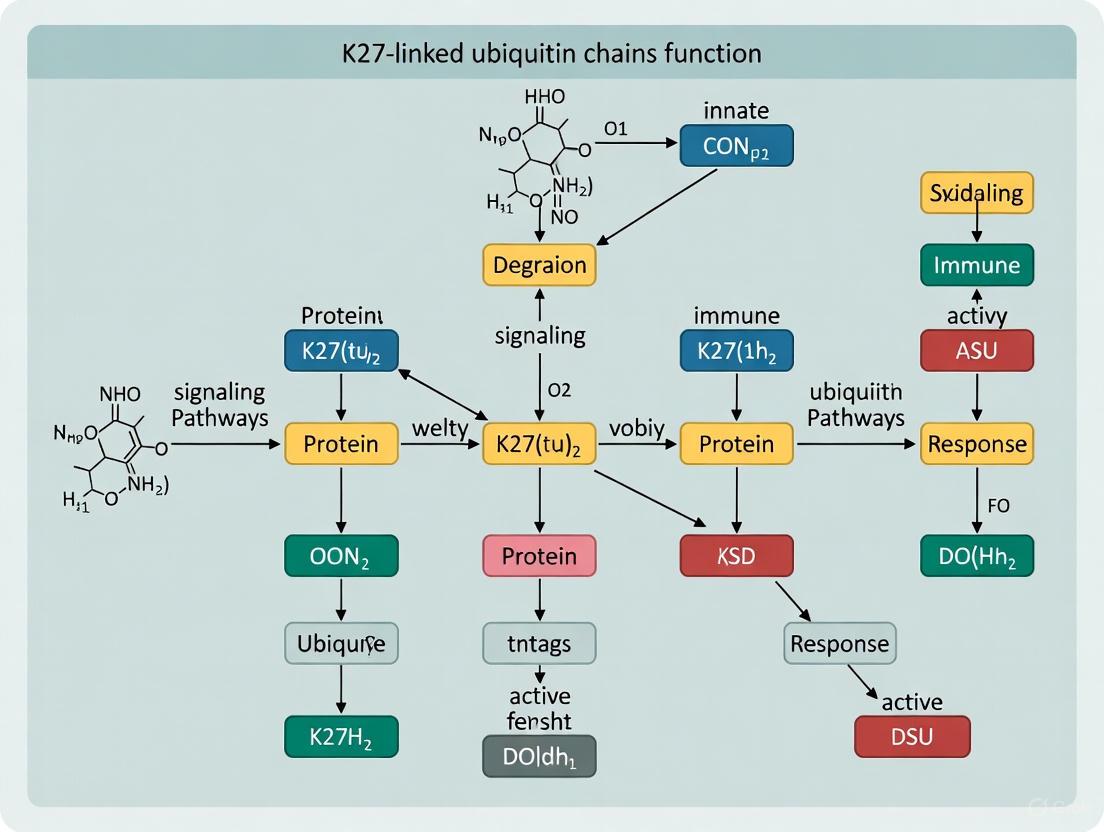
K27-linked ubiquitination, a once enigmatic post-translational modification, is now recognized as a critical regulator of innate immunity.
K27-Linked Ubiquitin Chains: Master Regulators of Innate Immune Signaling and Inflammation
Abstract
K27-linked ubiquitination, a once enigmatic post-translational modification, is now recognized as a critical regulator of innate immunity. This article synthesizes current knowledge on how K27-linked chains control key immune signaling hubs—including NF-κB, type I interferon responses, and T cell differentiation—by modulating protein activity, interactions, and degradation. We explore the E3 ligases and deubiquitinases that precisely orchestrate this modification, its dual role in activating and inhibiting immune pathways, and the methodological advances enabling its study. Furthermore, we discuss the therapeutic potential of targeting the K27-linked ubiquitination machinery in autoimmune diseases, chronic inflammation, and antiviral defense, providing a strategic outlook for researchers and drug development professionals in the immunology field.
Unraveling the K27 Code: Mechanisms and Key Immune Pathways
Atypical ubiquitination, particularly through K27-linked polyubiquitin chains, has emerged as a crucial post-translational modification in the precise regulation of innate immune responses. Unlike canonical K48-linked chains that primarily target proteins for proteasomal degradation, K27-linked ubiquitination exhibits unique structural characteristics and diverse functional outcomes in immune signaling pathways. This technical review comprehensively examines the molecular mechanisms, structural features, and functional consequences of K27-linked ubiquitination in innate immunity, with special emphasis on its roles in regulating RIG-I-like receptor (RLR) signaling, NF-κB activation, and interferon response pathways. We provide detailed experimental methodologies for studying these modifications and synthesize current knowledge into accessible visual frameworks and reagent resources to facilitate further research in this rapidly evolving field.
Ubiquitination is a versatile post-translational modification that regulates diverse cellular functions through covalent attachment of ubiquitin molecules to target proteins. The complexity of ubiquitin signaling arises from the ability to form different polyubiquitin chain architectures via eight possible linkage types: M1 (linear) and seven lysine linkages (K6, K11, K27, K29, K33, K48, K63) [1] [2]. While K48- and K63-linked chains are well-characterized for their roles in proteasomal degradation and signal transduction respectively, the so-called "atypical" ubiquitin chains (K6, K11, K27, K29, K33) have only recently gained recognition as critical immune regulators [2].
Among these atypical linkages, K27-linked ubiquitination has attracted significant research interest due to its unique structural properties and central role in orchestrating innate immune responses. K27-linked chains are notably resistant to most deubiquitinases (DUBs), suggesting they may serve as stable signaling platforms in immune pathways [3]. This comprehensive review examines the current understanding of K27-linked ubiquitination in immune regulation, with particular focus on its molecular mechanisms, structural basis, and functional significance in innate immunity.
Structural and Functional Characteristics of K27-Linked Ubiquitin Chains
Unique Structural Properties
K27-linked ubiquitin chains possess distinct structural characteristics that differentiate them from other ubiquitin linkages. Biochemical and structural analyses using NMR spectroscopy and small-angle neutron scattering reveal that K27-Ub2 exhibits no noncovalent interdomain contacts and displays the largest chemical shift perturbations (CSPs) among all ubiquitin linkages, particularly in the proximal ubiquitin unit [3]. This unique conformational ensemble contributes to its functional specialization in immune signaling.
A defining feature of K27-linked chains is their remarkable resistance to deubiquitination. Screening against multiple deubiquitinase families (Cezanne, OTUB1, AMSH, USP2, USP5, Ubp6) demonstrated that K27-Ub2 resists cleavage by most DUBs, including the linkage-nonspecific USP2, USP5, and Ubp6 [3]. This resistance to disassembly suggests K27-linked chains may function as stable platforms for organizing immune signaling complexes, unlike more transient modifications mediated by other linkage types.
Functional Versatility in Immune Regulation
K27-linked ubiquitination regulates diverse aspects of innate immunity through both proteolytic and non-proteolytic mechanisms. The functional outcomes of K27-linked ubiquitination are highly context-dependent, influenced by the specific substrate, cellular compartment, and interacting proteins involved.
Table 1: Functional Roles of K27-Linked Ubiquitination in Innate Immunity
| Substrate | E3 Ligase | Functional Outcome | References |
|---|---|---|---|
| NEMO | TRIM23 | Activates NF-κB and IRF3 pathways | [2] |
| NEMO | - | Recruits A20 to remove K63 chains, preventing excessive NF-κB activation | [2] |
| RIG-I/MDA5 | TRIM40 | Induces proteasome-mediated degradation, inhibiting type I IFN response | [2] |
| MAVS | MARCH8 | Induces autophagy-mediated degradation, restricting type I IFN response | [2] |
| MAVS | TRIM21 | Enhances type I interferon production | [2] |
| cGAS | RNF185 | Induces IRF3 activation and production of type I IFNs and cytokines | [2] |
| STING | AMFR | Recruits TBK1 to STING, inducing IRF3 activation and IFN production | [2] |
K27-Linked Ubiquitination in Innate Immune Signaling Pathways
Regulation of RIG-I-like Receptor (RLR) Signaling
The RLR pathway, comprising RIG-I, MDA5, and LGP3 sensors, represents a first line of defense against viral pathogens by detecting cytoplasmic viral RNA [4]. K27-linked ubiquitination exerts both positive and negative regulation on this pathway through modification of various components. TRIM23-mediated K27-linked ubiquitination of NEMO activates both NF-κB and IRF3 signaling branches downstream of RLRs, promoting antiviral immune responses [2]. Conversely, TRIM40 catalyzes K27-linked ubiquitination of RIG-I and MDA5, targeting them for proteasomal degradation and thereby negatively regulating type I interferon responses [2].
Recent research has identified additional regulatory mechanisms involving K27-linked chains in RLR signaling. The E3 ligase RNF167 facilitates atypical K6- and K11-linked polyubiquitination of RIG-I/MDA5, leading to their degradation through both proteasomal and autophagic pathways [4]. This represents a sophisticated mechanism for maintaining immune homeostasis by preventing excessive IFN activation.
Modulation of NF-κB and Interferon Signaling
K27-linked ubiquitination plays particularly complex roles in regulating the transcription factor NF-κB, a master regulator of inflammatory and immune responses. The modification of NEMO (NF-κB Essential Modulator) by different E3 ligases demonstrates the context-dependent nature of K27 signaling. While TRIM23-mediated K27 ubiquitination activates NEMO, K27 chains can also recruit the deubiquitinase A20 to remove activating K63-linked chains from NEMO, thereby preventing excessive NF-κB activation [2].
In the cGAS-STING pathway, which detects cytoplasmic DNA, RNF185-mediated K27-linked ubiquitination of cGAS promotes IRF3 activation and subsequent type I interferon production [2]. Similarly, AMFR-mediated K27 ubiquitination of STING facilitates TBK1 recruitment and IRF3 activation [2]. These findings position K27-linked ubiquitination as a critical positive regulator of antiviral DNA sensing pathways.
Diagram 1: K27-linked ubiquitination regulates multiple innate immune signaling pathways, with both positive (blue) and negative (red) regulatory roles.
Experimental Methods for Studying K27-Linked Ubiquitination
Biochemical and Proteomic Approaches
Comprehensive analysis of K27-linked ubiquitination requires specialized methodologies due to its low abundance and unique properties. Mass spectrometry-based proteomics has become the cornerstone for identifying and quantifying K27-linked ubiquitination events. The general workflow involves enrichment of ubiquitinated proteins followed by LC-MS/MS analysis with specialized data processing to identify linkage-specific peptides [1].
Table 2: Key Methodological Approaches for Studying K27-Linked Ubiquitination
| Method Category | Specific Technique | Application | Key Considerations |
|---|---|---|---|
| Enrichment Methods | Immunoaffinity purification (K27-linkage specific antibodies) | Isolation of K27-ubiquitinated proteins from complex mixtures | High specificity but limited antibody availability |
| His/Strep-tagged ubiquitin systems | Purification of ubiquitinated substrates | Requires genetic manipulation but high yield | |
| Tandem Ubiquitin Binding Entities (TUBEs) | Protection from DUBs during purification; enrichment of polyubiquitinated proteins | Broad specificity across linkage types | |
| Identification Methods | Liquid chromatography-mass spectrometry (LC-MS/MS) | Identification of ubiquitination sites and linkage types | Requires specialized search parameters for K27 linkage |
| Linkage-specific antibody validation | Confirmation of K27-linked ubiquitination | Orthogonal validation method | |
| Functional Analysis | Deubiquitination assays | Assessment of K27 chain stability | K27 chains show resistance to most DUBs |
| CRISPR/Cas9 screening | Identification of regulators and effectors of K27 signaling | Genome-wide functional approach | |
| Immunoblotting with linkage-specific antibodies | Detection of endogenous K27-linked chains | Limited by antibody sensitivity and specificity |
The two-step TUBEs purification approach coupled with deep mass spectrometry analysis has proven particularly effective for profiling ubiquitylomes under specific physiological conditions [5]. This method offers significant advantages by protecting ubiquitin chains from deubiquitinase activity during extraction and providing enhanced enrichment of polyubiquitinated proteins.
Functional Validation Techniques
Following identification of putative K27 ubiquitination events, functional validation requires specialized approaches. In vivo ubiquitylation assays can confirm modification of specific substrates and reveal distinct ubiquitylation patterns and dynamics [5]. These assays typically involve co-expression of the substrate with wild-type or mutant ubiquitin (where only K27 is available for chain formation) in relevant cell lines, followed by immunoprecipitation and immunoblotting with linkage-specific antibodies.
Genome-wide CRISPR/Cas9 screening represents a powerful unbiased approach for identifying novel regulators of K27-linked ubiquitination in immune pathways. This methodology enabled the identification of RNF167 as a negative regulator of RLR-triggered IFN signaling [4]. The screening approach involves transducing cells with a genome-wide sgRNA library, selecting for resistance or sensitivity to immune activation, and sequencing enriched or depleted sgRNAs to identify candidate genes.
Research Reagent Solutions for K27-Linked Ubiquitination Studies
Table 3: Essential Research Reagents for Studying K27-Linked Ubiquitination
| Reagent Category | Specific Examples | Function/Application | Key Features |
|---|---|---|---|
| Linkage-Specific Antibodies | Anti-K27-linkage specific Ub | Detection and enrichment of K27-linked chains | Critical for immunoblotting and immunofluorescence |
| Anti-K48/K63 linkage specific Ub | Comparison with canonical ubiquitination | Contextualize K27 findings within broader ubiquitin signaling | |
| Expression Plasmids | Wild-type ubiquitin | General ubiquitination studies | Baseline control |
| K27-only ubiquitin (all lysines mutated except K27) | Specific study of K27-linked chains | Eliminates competition from other linkage types | |
| Ubiquitin mutants (K27R) | Determine dependence on K27 linkage | Critical negative control | |
| E3 ligase expression vectors (TRIM23, TRIM40, RNF185) | Functional studies of specific enzymes | Overexpression and knockout complementation | |
| Cell Lines | HEK293T | Ubiquitylation assays and protein production | High transfection efficiency |
| HAP1 | CRISPR/Cas9 screening | Haploid genetics simplifies knockout generation | |
| THP-1 | Innate immune signaling studies | Monocytic cell line responsive to immune stimuli | |
| RNF19A/B knockout cells | Studies on specific E3 ligases | Functional validation of E3 dependence | |
| Chemical Reagents | Proteasome inhibitors (MG132) | Assess proteasomal degradation | Determine if K27 linkage targets substrates for degradation |
| Lysosome inhibitors (Chloroquine) | Assess autophagy-lysosomal degradation | Determine alternative degradation pathways | |
| BRD1732 | Investigate small molecule ubiquitination | Unique tool for studying non-protein ubiquitination [6] |
Technical Protocols for Key Experiments
Protocol: Enrichment and Identification of K27-Ubiquitinated Proteins
This protocol describes a comprehensive approach for profiling K27-linked ubiquitination events using affinity purification and mass spectrometry:
Cell Lysis and Protein Extraction:
- Prepare lysis buffer (6 M guanidine-HCl, 100 mM Na₂HPO₄/NaH₂PO₄, 10 mM Tris-HCl, 5 mM imidazole, pH 8.0)
- Supplement with fresh 10 mM β-mercaptoethanol and protease inhibitors
- Lyse cells by sonication (3 × 15 s pulses at 30% amplitude)
- Centrifuge at 16,000 × g for 15 min at 4°C
Enrichment of Ubiquitinated Proteins:
- Incubate cleared lysate with Ni-NTA agarose for 3 h at room temperature
- Wash sequentially with:
- Buffer 1 (8 M urea, 100 mM Na₂HPO₄/NaH₂PO₄, 10 mM Tris-HCl, 10 mM β-mercaptoethanol, pH 8.0)
- Buffer 2 (8 M urea, 100 mM Na₂HPO₄/NaH₂PO₄, 10 mM Tris-HCl, 10 mM β-mercaptoethanol, pH 6.3)
- Buffer 3 (50% isopropanol, 50% 200 mM NH₄HCO₃)
- Buffer 4 (200 mM NH₄HCO₃)
- Elute with 0.5 M imidazole in 200 mM NH₄HCO₃
Trypsin Digestion and Peptide Preparation:
- Reduce with 5 mM DTT for 30 min at 60°C
- Alkylate with 10 mM iodoacetamide for 30 min in darkness
- Digest with trypsin (1:50 w/w) overnight at 37°C
- Acidify with trifluoroacetic acid to pH < 3
- Desalt using C18 StageTips
LC-MS/MS Analysis and Data Processing:
- Separate peptides using nanoflow LC system (EASY-nLC 1200)
- Use 25 cm analytical column (75 μm inner diameter) packed with C18 resin
- Perform MS analysis on Q Exactive HF mass spectrometer
- Search data against human UniProt database using MaxQuant
- Enable ubiquitin remnant motif (K-ε-GG) search for site identification
- Apply 1% FDR cutoff at peptide and protein levels
Protocol: Functional Analysis of K27-Linked Ubiquitination in Immune Signaling
This protocol assesses the functional consequences of K27-linked ubiquitination on innate immune signaling:
CRISPR/Cas9 Screening for K27 Regulators:
- Transduce target cells (e.g., THP-1) with genome-wide sgRNA library
- Select with puromycin (1 μg/mL) for 7 days
- Treat with poly(I:C) (1 μg/mL) or infected with SeV (100 HA units/mL) for 24 h
- Isate genomic DNA and amplify sgRNA sequences
- Sequence using Illumina platform and analyze sgRNA enrichment/depletion
Luciferase Reporter Assays:
- Seed HEK293 cells in 96-well plates (1 × 10⁴ cells/well)
- Co-transfect with:
- IFN-β promoter-firefly luciferase reporter (50 ng)
- Renilla luciferase control (5 ng)
- E3 ligase expression vector or siRNA (50 ng)
- At 24 h post-transfection, stimulate with SeV (100 HA units/mL) for 16 h
- Measure firefly and Renilla luciferase activities using dual-luciferase assay system
- Normalize firefly luciferase activity to Renilla control
In Vivo Ubiquitylation Assay:
- Transfect HEK293T cells with:
- Substrate expression vector (1 μg)
- His-tagged ubiquitin (K27-only mutant, 1 μg)
- E3 ligase expression vector (1 μg)
- At 36 h post-transfection, treat with MG132 (10 μM) for 6 h
- Lyse in urea buffer (6 M urea, 100 mM Na₂HPO₄, 10 mM Tris-HCl, 0.2% Triton X-100, pH 8.0)
- Perform Ni-NTA pull-down under denaturing conditions
- Analyze by SDS-PAGE and immunoblot with substrate-specific antibodies
- Transfect HEK293T cells with:
Diagram 2: Experimental workflow for studying K27-linked ubiquitination, from sample preparation to functional validation.
K27-linked ubiquitination has emerged as a sophisticated regulatory mechanism in innate immunity, balancing the activation and resolution of immune responses through targeted modification of key signaling components. The unique structural characteristics of K27-linked chains—particularly their resistance to deubiquitinases—position them as stable signaling platforms that may fine-tune immune responses with temporal precision. Future research should focus on elucidating the complete network of E3 ligases and deubiquitinases that specifically regulate K27 linkages, developing more sensitive tools for detecting endogenous K27-linked ubiquitination, and exploring the therapeutic potential of modulating this pathway in immune-related diseases. As our understanding of K27-linked ubiquitination continues to evolve, it will undoubtedly reveal new insights into the intricate regulation of innate immunity and provide novel avenues for therapeutic intervention in infectious, inflammatory, and autoimmune diseases.
Ubiquitination is a crucial post-translational modification that regulates virtually all cellular processes, with the functional outcome largely determined by the topology of the ubiquitin chain formed. Among the different linkage types, K27-linked ubiquitin chains have emerged as critical, yet less understood, regulators of innate immune signaling [7]. Unlike the well-characterized K48-linked chains that target proteins for proteasomal degradation or K63-linked chains that facilitate signal transduction, K27 linkages serve unique functions, particularly in the regulation of inflammatory responses and antiviral immunity [7] [8]. These chains are increasingly recognized for their role in controlling the activation, localization, and stability of key immune signaling molecules, thereby ensuring a properly calibrated immune response to pathogen invasion while preventing excessive inflammation that can lead to autoimmunity [9] [10].
The importance of K27 linkages in innate immunity is underscored by their involvement in critical immune pathways, including the cGAS-STING DNA-sensing pathway, NF-κB signaling, and inflammasome activation [9] [8]. The precise effects of K27 ubiquitination are determined by the specific enzymes that install or remove these modifications and the cellular context in which they occur. This technical guide provides an in-depth examination of the enzymatic machinery—E3 ubiquitin ligases and deubiquitinating enzymes (DUBs)—that govern K27-linked ubiquitination, with particular emphasis on their roles in innate immune regulation and the experimental approaches used to study their functions.
The K27 Ubiquitination Machinery: E3 Ligases and DUBs
E3 Ubiquitin Ligases Installing K27 Linkages
E3 ubiquitin ligases confer substrate specificity in the ubiquitination cascade and determine the type of ubiquitin linkage formed. Several E3 ligases have been identified that specifically generate K27-linked ubiquitin chains on innate immune signaling components.
Table 1: E3 Ubiquitin Ligases Known to Generate K27-Linked Ubiquitin Chains in Innate Immunity
| E3 Ligase | Structural Family | Target Substrate | Immune Pathway | Biological Function |
|---|---|---|---|---|
| RNF185 | RING-finger | cGAS | cGAS-STING | Enhances cGAS enzymatic activity and antiviral immunity [9] |
| AMFR | RING-finger | STING | cGAS-STING | Promotes STING aggregation and TBK1 recruitment [9] |
| HOIL-1 | RBR (LUBAC component) | RIPK1, NEMO | NF-κB, TNF signaling | Attenuates LUBAC function; regulates NF-κB signaling [8] |
| HOIP | RBR (LUBAC component) | Multiple | NF-κB, Inflammasome | Catalyzes linear ubiquitination; interacts with K27 chains [7] [8] |
| HUWE1 | HECT | NLRP3 | Inflammasome | Regulates NLRP3 inflammasome activation via K27 chains [8] |
| Parkin | RBR | Mitochondrial proteins | Mitophagy, Inflammation | Associated with mitochondrial damage response [7] |
The RNF185 E3 ligase represents a key regulator of the DNA-sensing pathway, catalyzing K27-linked polyubiquitination of cGAS to enhance its enzymatic activity and promote antiviral immune responses [9]. Similarly, AMFR (Autocrine Motility Factor Receptor), in complex with INSIG1, promotes K27 polyubiquitination of STING, facilitating its translocation and recruitment of TBK1 to initiate type I interferon production [9]. In the NF-κB pathway, components of the Linear Ubiquitin Assembly Complex (LUBAC), particularly HOIL-1 and HOIP, have been implicated in K27 ubiquitination events that modulate inflammatory signaling, although their primary function is generating linear (M1-linked) chains [7] [8]. The HECT-type E3 ligase HUWE1 modifies NLRP3 with K27-linked chains to regulate inflammasome activation, illustrating the diverse roles of K27 ubiquitination across different innate immune pathways [8].
Deubiquitinating Enzymes (DUBs) Removing K27 Linkages
Deubiquitinating enzymes counterbalance E3 ligase activity by removing ubiquitin chains, providing reversibility to ubiquitin signaling. Several DUBs have been identified that specifically target K27-linked ubiquitin chains on immune signaling components.
Table 2: Deubiquitinating Enzymes (DUBs) Known to Target K27-Linked Ubiquitin Chains
| DUB | Family | Target Substrate | Immune Pathway | Biological Function |
|---|---|---|---|---|
| USP21 | USP | STING | cGAS-STING | Negatively regulates IFN-I production by hydrolyzing K27/K63 chains on STING [9] |
| USP14 | USP | cGAS | cGAS-STING | Cleaves K48-linked chains; recruited by TRIM14 to stabilize cGAS [9] |
| OTULIN | OTU | LUBAC substrates | NF-κB, TNF signaling | Removes linear ubiquitin chains; regulates LUBAC function [8] |
| A20/TNFAIP3 | OTU | Multiple | NF-κB | Limits NF-κB activation; cleaves K63/M1 chains [8] |
| CYLD | USP | Multiple | NF-κB, RLR signaling | Removes K63/M1 chains; negatively regulates NF-κB [10] |
USP21 has been identified as a critical negative regulator of the cGAS-STING pathway, deubiquitinating STING by specifically hydrolyzing K27- and K63-linked polyubiquitin chains, thereby dampening type I interferon production in response to DNA viruses [9]. While USP14 primarily targets K48-linked chains on cGAS, its recruitment to the cGAS complex represents a regulatory mechanism that indirectly influences K27 ubiquitination dynamics by competing with K27-targeted E3s [9]. The OTU family DUBs OTULIN and A20 play crucial roles in limiting excessive inflammatory responses by removing ubiquitin chains from NF-κB signaling components, though their primary targets appear to be linear and K63-linked chains rather than K27 linkages specifically [8].
Experimental Approaches for Studying K27 Linkages
Biochemical and Structural Methods
Investigating K27-linked ubiquitination requires specialized biochemical and structural approaches due to the unique properties of these chains and the technical challenges in distinguishing them from other linkage types.
Ubiquitination Assays form the foundation for studying K27 linkages. In vitro reconstitution systems using purified E1, E2, E3 enzymes, and ubiquitin allow controlled examination of ubiquitin chain formation. Pulse-chase assays are particularly valuable for tracking the formation of specific ubiquitin linkages over time. As demonstrated in studies of TRIP12 (a HECT E3 that forms K29 linkages, with methodological relevance to K27 studies), these assays involve an initial "pulse" phase where a fluorescently-labeled donor ubiquitin (often lacking lysines to prevent chain formation) is loaded onto E2, followed by a "chase" phase where the E3 and acceptor ubiquitin are added to track transfer specificity [11]. For K27 linkage verification, researchers employ ubiquitin mutants where all lysines except K27 are mutated to arginine (Ub-K27-only), confirming that observed ubiquitination depends specifically on K27 availability [11].
Structural biology techniques, particularly cryo-electron microscopy (cryo-EM), have proven invaluable for visualizing the molecular architecture of E3 ligases during ubiquitin chain formation. Structural studies of HECT E3s like TRIP12 reveal a "pincer-like" architecture where tandem ubiquitin-binding domains position the acceptor ubiquitin to present K27 toward the catalytic center, while the HECT domain juxtaposes donor and acceptor ubiquitins for isopeptide bond formation [11]. To capture transient reaction intermediates, researchers employ chemical biology tools that stabilize the ubiquitylation transition state, such as forming stable complexes between the E3 catalytic cysteine and a chemical warhead installed between the donor ubiquitin's C-terminus and an acceptor ubiquitin containing a cysteine mutation at position 27 [11].
Linkage-specific antibodies have become essential reagents for detecting K27-linked chains in cellular contexts. These antibodies enable researchers to monitor endogenous K27 ubiquitination patterns through techniques like immunoblotting and immunofluorescence, providing insights into subcellular localization and stimulus-dependent regulation of K27 chains in innate immune signaling pathways [9].
Cellular and Functional Assays
Understanding the biological roles of K27 linkages requires assessment in cellular systems and functional readouts of immune pathway activation.
Gene knockdown and knockout approaches using siRNA, shRNA, or CRISPR-Cas9 allow investigation of how E3 ligase or DUB depletion affects K27 ubiquitination of specific substrates and downstream immune signaling. For example, RNF185 knockdown impairs cGAS K27 ubiquitination and reduces interferon production in response to cytoplasmic DNA [9]. Conversely, USP21 depletion enhances STING ubiquitination and potentiates IFN-β production following DNA virus infection [9].
Luciferase reporter assays for key immune transcription factors (NF-κB, IRF3) provide quantitative measures of how manipulating K27 ubiquitination machinery affects pathway activation. These are typically performed by co-transfecting cells with the reporter construct along with plasmids encoding wild-type or mutant forms of E3s, DUBs, or their substrates, then measuring reporter activity after immune stimulation [9] [10].
Co-immunoprecipitation (Co-IP) and proximity ligation assays determine how K27 ubiquitination affects protein-protein interactions and complex formation in immune pathways. For instance, Co-IP experiments demonstrate that K27 ubiquitination of STING promotes its interaction with TBK1, facilitating downstream signaling [9].
K27 Linkages in Innate Immune Signaling Pathways
The cGAS-STING Pathway
The cGAS-STING pathway represents a prime example where K27 ubiquitination exerts multifaceted control over antiviral immunity. This pathway detects cytoplasmic DNA, whether from invading pathogens or cellular damage, and initiates type I interferon responses.
Diagram Title: K27 Ubiquitination Regulation of cGAS-STING Pathway
The diagram illustrates how K27 ubiquitination both positively and negatively regulates the cGAS-STING pathway. RNF185-mediated K27 ubiquitination of cGAS enhances its dimerization, DNA-binding capacity, and cGAMP production, thereby amplifying the initial pathogen detection signal [9]. Following STING activation by cGAMP, the AMFR/INSIG1 E3 complex installs K27-linked chains on STING, promoting its aggregation in the Golgi apparatus and recruitment of the kinase TBK1, which phosphorylates IRF3 to drive interferon gene expression [9]. Conversely, the deubiquitinating enzyme USP21 removes K27 chains from STING, serving as a negative feedback mechanism to prevent excessive interferon production that could lead to autoimmune pathology [9].
NF-κB and Inflammasome Signaling
K27 ubiquitination also plays significant roles in other innate immune signaling pathways, particularly in the regulation of inflammatory responses mediated by NF-κB and inflammasomes.
In NF-κB signaling, K27 linkages contribute to the precise control of inflammatory gene expression. The E3 ligase HUWE1 targets NLRP3 with K27-linked chains to regulate inflammasome activation, thereby modulating the production of pro-inflammatory cytokines IL-1β and IL-18 [8]. Additionally, components of the LUBAC complex, while primarily generating linear ubiquitin chains, interact with K27 ubiquitination events to fine-tune NF-κB activation dynamics [7] [8].
The negative regulation of NF-κB signaling involves several DUBs that may process K27 chains among other linkage types. A20 (TNFAIP3) and CYLD both dampen NF-κB activation by removing ubiquitin chains from signaling components like RIPK1 and NEMO, though their precise activities toward K27 linkages specifically require further characterization [10] [8].
The Scientist's Toolkit: Research Reagent Solutions
Table 3: Essential Research Reagents for Studying K27-Linked Ubiquitination
| Reagent Category | Specific Examples | Research Application | Key Features & Considerations |
|---|---|---|---|
| Ubiquitin Mutants | Ub-K27-only (all lysines except K27 mutated to arginine) | Specific linkage formation assays | Confirms K27-dependent ubiquitination; often used with Ub-K0 (lysine-less) donor [11] |
| Linkage-specific Antibodies | Anti-K27-linkage antibodies | Detection of endogenous K27 chains in cells | Validate specificity with ubiquitin mutant panels; applications in WB, IF, IP [9] |
| Expression Plasmids | Wild-type and catalytic mutants of RNF185, AMFR, HUWE1, USP21 | Functional studies in cellular systems | Include catalytically inactive mutants (C-to-A for E3s; C-to-A/S for DUBs) as controls [9] [8] |
| Chemical Probes | E3 inhibitors; DUB inhibitors | Pharmacological manipulation of K27 dynamics | Limited specificity for K27-specific enzymes; requires validation with genetic approaches |
| Cell Lines | KO lines (CRISPR); Reporter lines (NF-κB, IRF3 luciferase) | Pathway analysis and functional screening | Verify complete knockout; use reporter lines for quantitative signaling assessment [9] [10] |
| Structural Biology Tools | Cryo-EM substrates with trapped intermediates | Mechanistic studies of E3/DUB activities | Requires specialized expertise; provides atomic-level insights [11] |
This toolkit represents essential resources for investigating K27-linked ubiquitination in innate immunity. The ubiquitin mutants are particularly crucial for establishing linkage specificity, while linkage-specific antibodies enable monitoring of endogenous K27 chain dynamics. When using expression constructs, proper controls including catalytically inactive mutants are essential for attributing observed effects specifically to enzymatic activity. Chemical probes with high specificity for K27-directed E3s and DUBs remain an area of active development but would greatly facilitate research in this field. Specialized cell lines and structural tools round out the comprehensive approach needed to fully elucidate the functions and mechanisms of K27 linkages in immune regulation.
K27-linked ubiquitin chains represent a sophisticated regulatory layer in innate immune signaling, enabling precise control over the magnitude and duration of inflammatory and antiviral responses. The dedicated enzymatic machinery—including E3 ligases like RNF185, AMFR, and HUWE1, along with counteracting DUBs like USP21—orchestrates K27 ubiquitination events that fine-tune key immune pathways including cGAS-STING, NF-κB, and inflammasome signaling. Continued technical innovation in detecting and manipulating K27 linkages, coupled with deeper mechanistic understanding of how these modifications control immune homeostasis, will undoubtedly reveal new opportunities for therapeutic intervention in infectious, inflammatory, and autoimmune diseases. The experimental approaches and reagent tools outlined in this guide provide a foundation for advancing our understanding of this complex yet crucial aspect of immune regulation.
Protein ubiquitination, a fundamental post-translational modification, serves as a versatile mechanism regulating virtually all cellular processes, including immune responses. While the functions of canonical K48- and K63-linked ubiquitination have been extensively characterized, the roles of atypical ubiquitin chains, particularly those linked through lysine 27 (K27), remain less explored but are increasingly recognized as crucial players in innate immunity [12] [10]. K27-linked ubiquitination represents less than 1% of total ubiquitin conjugates in human cells, making it a relatively rare modification [13]. Despite its low abundance, recent evidence has established that this atypical ubiquitin linkage performs indispensable functions in regulating antimicrobial responses, cytokine signaling, and T cell activation [12]. This technical review comprehensively examines the emerging roles of K27-linked ubiquitination in pattern recognition receptor (PRR) signaling pathways, with particular emphasis on RIG-I-like receptors (RLRs) and Toll-like receptors (TLRs), while also exploring its functions beyond these pathways in innate immune regulation.
Biochemical and Functional Characteristics of K27-Linked Ubiquitination
Structural and Enzymatic Foundations
K27-linked ubiquitin chains possess distinct structural characteristics that differentiate them from other ubiquitin linkages. Structural studies have revealed that K27 is the least solvent-exposed lysine residue in ubiquitin, which may account for the low abundance of K27-linked chains in cells and explain why most deubiquitinating enzymes (DUBs) display poor activity toward K27 linkages [13]. This relative inaccessibility presents unique challenges for the enzymatic machinery responsible for forming and removing these chains.
The E3 ubiquitin ligases that catalyze K27-linked ubiquitination include HECT-type E3s such as ITCH and NEDD4, which have been shown to promote K27-linked ubiquitination on specific substrates [14]. Additionally, RNF168 has been identified as promoting noncanonical K27-linked ubiquitination both in vivo and in vitro, particularly in the context of DNA damage response [15]. The functional outcomes of K27-linked ubiquitination are diverse, ranging from the regulation of protein activity and complex assembly to influencing protein-protein interactions, typically without targeting substrates for proteasomal degradation [12] [14].
Methodological Considerations for Studying K27-Linked Ubiquitination
The investigation of K27-linked ubiquitination presents unique technical challenges due to its low abundance and the previous lack of specific research tools. Recent methodological advances have significantly enhanced our ability to study this modification, as detailed in Table 1: Methodologies for Characterizing K27-Linked Ubiquitination.
Table 1: Methodologies for Characterizing K27-Linked Ubiquitination
| Methodology | Principle | Application in K27 Studies | Key Limitations |
|---|---|---|---|
| Linkage-Specific Antibodies | Immunodetection using antibodies recognizing K27-linked chains | Immunoblotting, immunofluorescence; Used to detect endogenous BRAF modification [14] | Potential cross-reactivity; limited for some applications |
| Ubiquitin Replacement Strategy | Conditional replacement of endogenous Ub with Ub(K27R) mutant | Revealed essential role in human cell proliferation [13] | May disrupt Ub equilibria; complex cell line generation |
| Mass Spectrometry | Detection of K27-ε-GG ubiquitin peptide signature | Identified K27 linkage on BRAF [14] and as major chromatin mark after DNA damage [15] | Requires sophisticated instrumentation and data analysis |
| Biochemical Reconstitution | In vitro ubiquitination with purified E1, E2, E3 enzymes | Demonstrated ITCH directly promotes K27-ubiquitination of BRAF [14] | May not fully recapitulate cellular environment |
| TUBEs (Tandem-repeated Ub-binding Entities) | Affinity enrichment using engineered high-affinity Ub binders | enrichment of endogenously ubiquitinated proteins [16] | May not be linkage-specific |
Experimental Workflow for K27-Linked Ubiquitination Studies
K27-Linked Ubiquitination in RIG-I-Like Receptor (RLR) Signaling
Regulation of RLR Pathway Components
The RLR family, comprising RIG-I, MDA5, and LGP2, serves as crucial cytosolic sensors for viral RNA, initiating antiviral immune responses through the mitochondrial antiviral-signaling protein (MAVS) adaptor [10]. While K63-linked ubiquitination of RIG-I and MAVS has been well-established in RLR signaling, emerging evidence suggests that K27-linked ubiquitination also contributes to the regulation of this pathway, potentially through modifications of key signaling components.
Although direct evidence of K27-linked ubiquitination specifically on RLRs remains limited, several studies have implicated atypical ubiquitin chains in regulating RLR-mediated signaling. The signaling adaptor MAVS forms functional prion-like aggregates that serve as platforms for downstream signal transduction, and ubiquitination events likely regulate this process [10]. Additionally, TRAF3, which functions as a signaling adaptor in RLR pathways, has been shown to be regulated by various ubiquitin linkages, though its specific modification by K27 chains requires further investigation [10].
Intersection with Innate Immune Signaling Networks
K27-linked ubiquitination appears to function as a regulatory mechanism at the intersection of RLR signaling and other innate immune pathways. This interconnected regulation ensures appropriate antiviral responses while preventing excessive inflammation. The precise molecular mechanisms through which K27-linked ubiquitination influences RLR signaling warrant further investigation, particularly regarding the identification of specific substrates and the E3 ligases responsible for these modifications in the context of viral infection.
K27-Linked Ubiquitination in Toll-Like Receptor (TLR) Signaling
Modulation of TLR Adaptor Proteins and Downstream Signaling
Toll-like receptors represent a major class of pattern recognition receptors that detect pathogen-associated molecular patterns (PAMPs) at the cell surface or within endosomal compartments [10] [17]. TLR signaling primarily depends on the adaptor proteins MyD88 and TRIF, which initiate downstream signaling cascades leading to the activation of transcription factors NF-κB and IRF3, and subsequent production of type I interferons and proinflammatory cytokines [10].
Recent evidence has established that K27-linked ubiquitination contributes to the regulation of TLR signaling pathways. Studies have demonstrated that K27-linked noncanonical ubiquitination is indispensable for both innate immune signaling and T cell signaling [12]. In the context of TLR signaling, K27-linked ubiquitination likely regulates the assembly or activity of signaling complexes, potentially through modifications of key components such as TRAF6 or other signaling intermediates [12] [17].
Coordination of Inflammatory Responses
The involvement of K27-linked ubiquitination in TLR signaling extends to the coordination of inflammatory responses. This regulatory function ensures appropriately balanced immune activation that effectively combats pathogens while minimizing collateral tissue damage. The molecular details of how K27-linked ubiquitination specifically influences TLR signaling components represent an active area of investigation with important implications for understanding immune regulation and developing therapeutic interventions for inflammatory diseases.
K27-Linked Ubiquitination in Other Innate Immune Pathways
DNA Sensing Pathways
Beyond RLR and TLR pathways, K27-linked ubiquitination plays significant roles in other aspects of innate immunity. In cytosolic DNA sensing pathways, the adaptor protein STING (also known as MITA, MPYS, ERIS) mediates the activation of type I interferon responses following DNA virus infection or detection of cyclic dinucleotides [10]. While the specific involvement of K27-linked ubiquitination in STING signaling requires further characterization, the broader importance of atypical ubiquitin chains in DNA sensing pathways is well established.
The E3 ubiquitin ligase RNF168, which promotes noncanonical K27-linked ubiquitination, has been extensively studied in the context of DNA damage response [15]. RNF168 mediates K27 ubiquitination of histone H2A and H2A.X, creating a chromatin mark that is essential for proper activation of the DNA damage response [15]. Given the overlapping components between DNA damage response and innate immune signaling to cytosolic DNA, it is plausible that similar K27-linked ubiquitination mechanisms may operate in DNA-mediated innate immune activation.
Inflammasome Regulation and Cytokine Signaling
K27-linked ubiquitination also contributes to the regulation of inflammasome activation and cytokine signaling pathways. In sepsis, a life-threatening condition characterized by dysregulated host response to infection, noncanonical ubiquitination including K27 linkages has been implicated in regulating the network of inflammatory cytokines and the dynamic balance of immune cells [17]. The HECT domain-containing ubiquitin E3 ligase HUWE1 modifies NLRP3 through non-K27 chains to regulate inflammation, highlighting the involvement of atypical ubiquitination in inflammasome regulation [17].
Additionally, K27-linked ubiquitination regulates cytokine signaling beyond the initial PRR activation phase. In melanoma cells, proinflammatory cytokines induce K27-linked ubiquitination of BRAF by the ITCH E3 ligase, leading to sustained BRAF activation and subsequent elevation of MEK/ERK signaling [14]. This mechanism represents a novel crosstalk between inflammatory signaling and oncogenic pathways, potentially contributing to inflammation-associated tumorigenesis.
Research Reagent Solutions for K27-Linked Ubiquitination Studies
The investigation of K27-linked ubiquitination requires specialized research tools and methodologies. Table 2 provides a comprehensive overview of key reagents essential for studying K27-linked ubiquitination in PRR signaling and innate immunity.
Table 2: Essential Research Reagents for K27-Linked Ubiquitination Studies
| Reagent Category | Specific Examples | Research Applications | Key Features & Considerations |
|---|---|---|---|
| Linkage-Specific Antibodies | Anti-K27 linkage antibody (Abcam ab181537) | Detection of endogenous K27-ubiquitinated proteins (e.g., BRAF) [14] | Validated for WB, IF; essential for endogenous detection |
| Ubiquitin Mutants | Ub(K27R), Ub(K27-only) | Linkage-specific functional studies; ubiquitin replacement systems [13] [14] | Critical for determining linkage specificity; use in controlled expression systems |
| E3 Ligase Tools | ITCH, NEDD4, RNF168 constructs (WT, catalytic mutants) | Identification of E3s catalyzing K27 linkages [18] [14] [15] | Include both wild-type and catalytically inactive mutants (e.g., Nedd4 C854A) [18] |
| Cell Line Systems | U2OS/shUb with conditional Ub depletion; T cell differentiation systems | Controlled ubiquitin environment; physiological immune contexts [18] [13] | Enable clean genetic approaches; relevant cellular models |
| Mass Spectrometry Reagents | TUBEs, linkage-specific Ub antibodies | Proteomic identification of K27 substrates and sites [14] [16] | Enrichment crucial for detecting low-abundance modifications |
| Functional Assay Systems | EAE model; viral infection models; cytokine stimulation | Physiological validation of K27 functions in immunity [18] | In vivo relevance; pathway-specific contexts |
Research Gaps and Future Directions
Despite significant advances in understanding K27-linked ubiquitination, substantial knowledge gaps remain. The specific E3 ligases and deubiquitinases (DUBs) that respectively write and erase K27 linkages in different PRR pathways require comprehensive identification and characterization [12] [19]. Additionally, the readers or effector proteins that specifically recognize K27-linked ubiquitin chains in innate immune signaling remain largely unknown, with the exception of a few identified players such as UCHL3, which has been shown to bind K27 linkages [13].
Future research directions should include:
- Comprehensive identification of K27 substrates in different PRR pathways using advanced proteomic approaches
- Development of more specific research tools, including improved linkage-specific antibodies and chemical probes
- Structural characterization of K27-linked ubiquitin chains and their interactions with reader proteins
- Investigation of crosstalk between K27-linked ubiquitination and other post-translational modifications
- Exploration of therapeutic targeting of K27-linked ubiquitination in inflammatory diseases and cancer
The continued elucidation of K27-linked ubiquitination in PRR signaling and innate immunity will undoubtedly yield novel insights into immune regulation and provide new avenues for therapeutic intervention in infectious, inflammatory, and autoimmune diseases.
Knowledge Gaps and Future Research Directions
The innate immune system relies on a complex network of signaling adaptor proteins to coordinate defense responses against pathogenic threats. Among these, NEMO (NF-κB Essential Modulator), TRIF (TIR-domain-containing adapter-inducing interferon-β), and MAVS (Mitochondrial Antiviral-Signaling Protein) serve as critical hubs that integrate immune recognition with downstream effector functions. Recent research has illuminated that beyond the well-characterized K48 and K63 ubiquitin linkages, K27-linked ubiquitin chains play sophisticated and often contradictory roles in regulating these adaptors. Unlike K48-linked chains that primarily target proteins for proteasomal degradation or K63-linked chains that facilitate complex assembly, K27 linkages exhibit diverse functions including signal activation, complex recruitment, and targeted autophagic degradation, making them crucial for fine-tuning immune responses. This technical review comprehensively examines the molecular mechanisms, regulatory networks, and experimental approaches for studying K27-linked ubiquitination of NEMO, TRIF, and MAVS, providing researchers with essential frameworks for investigating these complex post-translational modifications in innate immunity.
Molecular Mechanisms of K27-Linked Ubiquitination in Adaptor Regulation
MAVS: Dual Roles in Signal Activation and Attenuation
The mitochondrial antiviral signaling protein (MAVS) serves as a critical platform for antiviral innate immunity, and its activity is precisely regulated by opposing K27-linked ubiquitination events that either potentiate or inhibit signaling outputs.
Positive Regulation via K27-Linked Ubiquitination: The E3 ubiquitin ligase TRIM21 catalyzes K27-linked polyubiquitination of MAVS, creating a recruitment platform for the kinase TBK1, which is essential for IRF3 activation and type I interferon production [20] [21]. This process is enhanced by the ubiquitin-like protein UBL7, which is itself an interferon-stimulated gene, creating a positive feedback loop that amplifies antiviral responses during RNA virus infection [21]. UBL7 interacts with TRIM21 and promotes the TRIM21-MAVS association in a dose-dependent manner, facilitating robust K27-linked ubiquitination and subsequent TBK1 recruitment [21].
Negative Regulation via K27-Linked Ubiquitination: Conversely, several E3 ubiquitin ligases including MARCH8, RNF34, and RNF5 also mediate K27-linked ubiquitination of MAVS, but this modification targets MAVS for autophagic degradation rather than signal activation [20]. This degradation mechanism serves as a critical brake on MAVS signaling to prevent excessive immune activation and potential tissue damage. The functional outcome of K27-linked ubiquitination therefore depends on specific E3 ligases, cellular context, and potentially the exact lysine residues modified within MAVS.
Table 1: E3 Ubiquitin Ligases Regulating MAVS through K27-Linked Ubiquitination
| E3 Ligase | Function | Mechanism | Biological Outcome |
|---|---|---|---|
| TRIM21 | Positive regulator | Catalyzes K27-linked ubiquitination, recruits TBK1 | Enhanced type I interferon production [20] [21] |
| MARCH8 | Negative regulator | Catalyzes K27-linked ubiquitination | Autophagic degradation of MAVS [20] |
| RNF34 | Negative regulator | Catalyzes K27-linked ubiquitination | Autophagic degradation of MAVS [20] |
| RNF5 | Negative regulator | Catalyzes K27-linked ubiquitination | Autophagic degradation of MAVS [20] |
TRIF: Endosomal Adaptor Regulation by K27 Linkages
The TIR-domain-containing adapter-inducing interferon-β (TRIF) serves as the essential adaptor for endosomal Toll-like receptor signaling, specifically TLR3 and TLR4. Recent research has identified a sophisticated regulatory pair that controls TRIF through K27-linked ubiquitination and deubiquitination [22].
Activation Mechanism: The Cullin-3-Rbx1-KCTD10 E3 ligase complex specifically catalyzes K27-linked polyubiquitination of TRIF at lysine 523 (K523) [22]. This modification is critical for the recruitment of TRIF to activated TLR3 and TLR4 following ligand stimulation, facilitating downstream signal transduction. Genetic deficiency of this E3 ligase complex impairs poly(I:C) (TLR3 agonist) and LPS (TLR4 agonist)-induced activation of both IRF3 and NF-κB pathways, demonstrating the essential nature of this modification for TRIF function.
Termination Mechanism: The deubiquitinating enzyme USP19 specifically removes K27-linked polyubiquitin chains from TRIF, thereby disrupting TRIF recruitment to TLR3 and TLR4 and terminating signaling [22]. USP19-deficient cells exhibit enhanced production of type I interferons and proinflammatory cytokines in response to poly(I:C) and LPS stimulation, while USP19 overexpression suppresses these responses. In vivo studies confirm that USP19-deficient mice experience more serious inflammation after poly(I:C) or LPS treatment and increased susceptibility to inflammatory damage and death following Salmonella typhimurium infection [22].
Table 2: K27-Linked Ubiquitination Machinery Regulating TRIF Signaling
| Regulatory Component | Type | Function in TRIF Regulation | Effect on Signaling |
|---|---|---|---|
| Cullin-3-Rbx1-KCTD10 | E3 Ligase Complex | Catalyzes K27-linked ubiquitination at K523 | Promotes TRIF recruitment to TLR3/4, enhances signaling [22] |
| USP19 | Deubiquitinase | Removes K27-linked ubiquitin chains from TRIF | Inhibits TRIF recruitment to TLR3/4, terminates signaling [22] |
NEMO: Context-Dependent Regulation by K27 Linkages
NF-κB Essential Modulator (NEMO), also known as IKKγ, serves as the regulatory subunit of the IκB kinase (IKK) complex, and its activity is modulated by K27-linked ubiquitination in a context-dependent manner.
The E3 ubiquitin ligase TRIM23 catalyzes K27-linked ubiquitination of NEMO, which is required for the induction of both NF-κB and IRF3 activation pathways following RLR signaling [23]. This K27-linked ubiquitination creates a platform for the recruitment of additional regulatory proteins that modulate downstream signaling. For instance, the serine protease Rhbdd3 binds to K27-linked chains on NEMO, leading to its own K27-linked ubiquitination and recruitment of the deubiquitinase A20, which then removes K63-linked chains from NEMO to prevent excessive NF-κB activation [23]. This intricate regulatory mechanism demonstrates how K27-linked chains can serve as scaffolds for the assembly of multi-protein complexes that fine-tune immune responses.
Quantitative Data and Functional Outcomes of K27-Linked Ubiquitination
The functional consequences of K27-linked ubiquitination on innate immune adaptors have been quantitatively measured through various experimental approaches, revealing significant effects on immune signaling outputs.
Table 3: Quantitative Effects of K27-Linked Ubiquitination on Innate Immune Signaling
| Experimental Manipulation | System | Effect on Cytokine Production | Impact on Pathogen Response |
|---|---|---|---|
| UBL7 overexpression | Human and mouse cells | Enhanced IFN-β production | Increased resistance to RNA viruses [21] |
| UBL7 deficiency | Mouse model | Attenuated antiviral immunity | Increased susceptibility to viral infection [21] |
| USP19 deficiency | In vitro and in vivo | Increased IFN-β, TNF, IL-6, CXCL10 after poly(I:C)/LPS | Enhanced inflammation, tissue damage after infection [22] |
| TRIM21 enhancement of MAVS | HEK293 and THP-1 cells | Potentiated type I IFN response | Increased antiviral state [20] |
| K27-Ub2 resistance to DUBs | Biochemical assays | Resisted cleavage by USP2, USP5, Ubp6 | Potential for prolonged signaling [3] |
Experimental Approaches for Studying K27-Linked Ubiquitination
Methodologies for Detecting K27-Linked Ubiquitination
Immunoprecipitation and Immunoblotting: Researchers typically employ co-immunoprecipitation assays to investigate protein-protein interactions and ubiquitination events. For detecting K27-linked ubiquitination of MAVS, TRIF, or NEMO, cells are transfected with plasmids expressing the adaptor of interest along with specific E3 ligases or deubiquitinases. After treatment with relevant immune stimuli (e.g., poly(I:C) for TLR3/RIG-I pathways, LPS for TLR4), cells are lysed in modified RIPA buffer (20 mM Tris-HCl pH 7.5, 150 mM NaCl, 1% Triton X-100, 1 mM Na₂EDTA) supplemented with protease inhibitor cocktail and deubiquitinase inhibitors (e.g., N-ethylmaleimide) [24]. Immunoprecipitation is performed using antibodies against the target adaptor protein, followed by immunoblotting with linkage-specific ubiquitin antibodies to detect K27-linked chains.
Luciferase Reporter Assays: To functionally assess the impact of K27-linked ubiquitination on signaling pathways, researchers employ luciferase reporter systems. Cells (typically HEK293 or similar lines) are seeded in 96-well plates and co-transfected with plasmids encoding an IFN-β promoter-luciferase construct, ISRE-luciferase construct, or NF-κB-luciferase construct along with expression vectors for the regulatory proteins of interest [24] [25]. After 48 hours, luciferase activity is measured using commercial detection systems, with normalization to control transfection efficiency [24]. This approach was instrumental in identifying NLK as a negative regulator of MAVS signaling and USP19 as a regulator of TRIF [25] [22].
Gene Knockout and Knockdown Systems: CRISPR/Cas9 technology has been widely employed to generate knockout cell lines for studying K27-linked ubiquitination. MAVS, Aggregatin, TRIF, USP19, and various E3 ligases have been successfully knocked out in HEK293, THP-1, and RAW264.7 cells to elucidate their functions [24] [22]. For difficult-to-transfect cells or primary cells, siRNA-mediated knockdown approaches are utilized, with transfection performed using Lipofectamine reagents according to manufacturer protocols [24].
Research Reagent Solutions
Table 4: Essential Research Reagents for Studying K27-Linked Ubiquitination
| Reagent Category | Specific Examples | Research Application | Key Functions |
|---|---|---|---|
| Cell Lines | HEK293, THP-1, RAW264.7, A549, BMDMs | Signaling studies, knockout generation | Platform for transfection, pathway analysis [24] [22] |
| Reporter Plasmids | pGL4.45[luc2P/ISRE/Hygro], IFN-β promoter luciferase | Pathway activation quantification | Measure IRF, NF-κB, and IFN-β pathway activity [24] [25] |
| CRISPR Tools | pSpCas9(BB)-2A-Puro (PX459) V2.0 | Gene knockout generation | Targeted gene disruption for functional studies [24] |
| Viral Stimuli | Sendai virus (SeV), Vesicular Stomatitis Virus (VSV) | Pathway activation | RIG-I/MAVS pathway activation; in vivo infection models [24] [25] |
| Biochemical Stimuli | poly(I:C), LPS | TLR3 and TLR4 pathway activation | Selective pathway stimulation [22] |
| Linkage-Specific Ubiquitin Reagents | K27-Ub2 chains, linkage-specific antibodies | Ubiquitination detection | Direct detection of specific ubiquitin linkages [3] |
Signaling Pathway Visualizations
K27-Linked Ubiquitination in MAVS Signaling
K27-Linked Ubiquitination in TRIF Signaling
Experimental Workflow for K27-Linked Ubiquitination Studies
The regulation of key adaptor proteins NEMO, TRIF, and MAVS by K27-linked ubiquitin chains represents a sophisticated mechanism for fine-tuning innate immune responses. Rather than having uniformly activating or inhibitory functions, K27-linked ubiquitination exhibits remarkable context dependency, with outcomes determined by specific E3 ligase-deubiquitinase pairs, target lysine residues, and cellular compartments. The opposing regulatory functions observed for MAVS K27-linked ubiquitination highlight the precision of this system, where different E3 ligases utilize the same ubiquitin linkage type to achieve functionally distinct outcomes. From a therapeutic perspective, the K27-linked ubiquitination machinery presents attractive targets for immune modulation, particularly for conditions characterized by either excessive inflammation (e.g., sepsis, autoimmune diseases) or insufficient antiviral responses. Future research should focus on determining the structural basis for linkage-specific recognition, developing more specific chemical modulators of the enzymes governing K27-linked ubiquitination, and understanding how these regulatory mechanisms are integrated across different cell types and physiological conditions. The continuing elucidation of K27-linked ubiquitination networks will undoubtedly reveal new opportunities for therapeutic intervention in infectious, inflammatory, and neoplastic diseases.
Within the intricate framework of innate immunity, post-translational modifications serve as pivotal regulatory mechanisms that dictate the strength, duration, and ultimate functional outcome of immune signaling. Among these, ubiquitination—the covalent attachment of ubiquitin molecules to target proteins—has emerged as a master regulator of immune homeostasis. While the roles of canonical K48- and K63-linked ubiquitin chains are well-established, recent research has unveiled the critical importance of atypical ubiquitin linkages, particularly those connected via lysine 27 (K27) of ubiquitin. K27-linked ubiquitin chains represent a unique topological entity within the ubiquitin code, governing diverse cellular processes from signal activation to autophagic degradation in innate immune pathways [3] [2]. Their functional versatility is exemplified by their context-dependent roles in regulating key immune signaling hubs, including the cGAS-STING pathway, RIG-I-like receptor (RLR) signaling, and NF-κB activation [9] [2]. This technical guide comprehensively examines the molecular mechanisms, functional spectrum, and experimental methodologies for investigating K27-linked ubiquitination in innate immunity, providing researchers with a foundational resource for exploring this multifaceted regulatory system.
Molecular Mechanisms and Functional Spectrum of K27-Linked Ubiquitination
K27-linked ubiquitin chains constitute a unique topological class within the ubiquitin code, characterized by structural constraints that confer distinctive biochemical properties. Nuclear magnetic resonance (NMR) and small-angle neutron scattering (SANS) analyses reveal that K27 is the least solvent-exposed lysine residue in ubiquitin, resulting in chains with compact conformations and restricted accessibility [3] [26]. This structural uniqueness translates to functional specialization, as K27-linked chains demonstrate remarkable resistance to cleavage by most deubiquitinating enzymes (DUBs), including linkage-nonspecific enzymes like USP5, USP2, and Ubp6 [3]. This inherent stability potentially extends the half-life of K27-mediated signals compared to other ubiquitin linkages, enabling sustained regulatory effects on immune signaling pathways.
In the context of innate immunity, K27-linked ubiquitination exerts pleiotropic effects through the targeted modification of central signaling components. The table below summarizes the key E3 ligases and deubiquitinating enzymes that regulate innate immune signaling through K27-linked ubiquitination.
Table 1: Key Regulators of K27-Linked Ubiquitination in Innate Immunity
| Regulator | Target | Functional Outcome | Reference |
|---|---|---|---|
| E3 Ligases | |||
| RNF185 | cGAS | Enhances enzymatic activity and promotes type I IFN production | [9] [27] |
| AMFR/GP78 (with INSIG1) | STING | Recruits TBK1 and triggers IFN production | [9] [2] |
| TRIM23 | NEMO | Leads to NF-κB and IRF3 activation | [2] |
| TRIM10 | STING | Facilitates ER-to-Golgi translocation and TBK1 recruitment | [9] |
| MARCH8 | MAVS | Induces autophagy-mediated degradation, restricting IFN response | [2] |
| Deubiquitinases | |||
| USP21 | STING | Hydrolyzes K27/K63 chains, inhibiting DNA virus-induced IFN production | [9] [2] |
| USP13 | STING | Inhibits IRF3 activation and type I IFN production | [2] |
The functional consequences of K27-linked ubiquitination are highly context-dependent, determined by the specific target protein, cellular compartment, and physiological conditions. The signaling outcomes can be broadly categorized into:
Signal Activation: K27-linked chains frequently serve as scaffolding platforms that facilitate the assembly and activation of signaling complexes. For instance, K27-linked ubiquitination of STING by the AMFR-GP78/INSIG1 complex enables TBK1 recruitment and subsequent IRF3 activation, driving antiviral interferon responses [9] [2]. Similarly, TRIM23-mediated K27 ubiquitination of NEMO activates both NF-κB and IRF3 signaling pathways [2].
Proteostatic Regulation: Contrary to traditional degradation signals, K27 linkages can stabilize certain substrates by competing with degradative ubiquitin chains. UFL1, the E3 ligase for UFM1, enhances STING stability by reducing K48-linked ubiquitination through competitive binding with STING and TRIM29 [9].
Autophagic Degradation: K27 linkages can specifically target proteins for autophagic clearance. MARCH8 mediates K27-linked ubiquitination of MAVS, inducing its autophagy-mediated degradation and subsequent attenuation of type I interferon responses [2]. This mechanism represents a critical negative feedback loop to prevent excessive immune activation.
The diagram below illustrates the diverse functional outcomes of K27-linked ubiquitination in innate immune signaling pathways.
Experimental Methods for Studying K27-Linked Ubiquitination
Detection and Validation Techniques
The unique biochemical properties of K27-linked ubiquitin chains necessitate specialized methodological approaches for their accurate detection and validation. The resistance of K27 linkages to most deubiquitinating enzymes provides a strategic advantage for their identification through DUB resistance assays [3]. In this protocol, cell lysates containing ubiquitinated proteins are incubated with a panel of DUBs (including linkage-nonspecific enzymes like USP2, USP5, and Ubp6), followed by immunoblot analysis to identify ubiquitin signals that persist after treatment.
For direct visualization of K27-linked ubiquitination in cells, immunofluorescence microscopy with linkage-specific antibodies remains the gold standard. However, researchers must employ rigorous validation controls, including: (1) siRNA-mediated knockdown of target E3 ligases (e.g., RNF185 for cGAS, AMFR for STING), (2) overexpression of linkage-specific DUBs (e.g., USP21 for STING), and (3) ubiquitin replacement strategies with K27R mutants to confirm signal specificity [9] [26]. The recent development of more specific K27 linkage-binding domains, such as engineered UCHL3 variants, provides alternative recognition tools that circumvent antibody limitations [26].
Table 2: Key Research Reagents for Studying K27-Linked Ubiquitination
| Reagent Category | Specific Examples | Function/Application | Considerations |
|---|---|---|---|
| Ubiquitin Mutants | Ub(K27R) | Abrogates K27-linked chain formation | Use conditional replacement systems to avoid artifacts from endogenous Ub |
| E3 Ligase Tools | RNF185 expression vectors | Mediates K27-linked ubiquitination of cGAS | Co-express with target substrates in HEK293T cells |
| DUB Reagents | Recombinant USP21 | Removes K27/K63 chains from STING | Use in deubiquitination assays to validate linkage type |
| Linkage Binders | UCHL3 overexpression constructs | Binds and decodes K27 linkage signals | Can impede substrate processing when overexpressed |
| Cell Line Systems | U2OS/shUb with conditional Ub(K27R) | Enables targeted abrogation of K27 linkages | Allows study of K27-specific phenotypes in human cells |
Functional Assays for K27-Linked Ubiquitination
To establish the functional consequences of K27-linked ubiquitination on specific immune pathways, researchers should implement a complementary set of biochemical and cellular assays:
Signal Transduction Assays: Following the induction of K27-linked ubiquitination (through E3 ligase overexpression or pathway stimulation), monitor downstream signaling events by quantifying phosphorylation of key kinases (e.g., TBK1, IKK), nuclear translocation of transcription factors (IRF3, NF-κB), and expression of target genes (type I IFNs, proinflammatory cytokines) using RT-qPCR and reporter assays [9] [2].
Protein Stability and Turnover Assays: Assess the impact of K27-linked ubiquitination on substrate half-life using cycloheximide chase experiments. For substrates targeted to autophagic degradation (e.g., MAVS), include autophagy inhibitors (bafilomycin A1) to distinguish from proteasomal degradation [2].
In Vitro Reconstitution Systems: Purify E3 ligases (e.g., RNF185, AMFR/GP78 complex) and their targets to establish minimal systems for K27-linked ubiquitination. Combine E1, E2, E3, ubiquitin, and ATP in appropriate buffer systems (e.g., 50 mM Tris-HCl pH 7.5, 5 mM MgCl₂, 2 mM ATP) to monitor chain formation via immunoblotting with linkage-specific reagents [15].
The experimental workflow below outlines a comprehensive approach for investigating K27-linked ubiquitination of a target protein:
The multifaceted roles of K27-linked ubiquitin chains in innate immunity exemplify the sophisticated nature of the ubiquitin code in regulating immune homeostasis. From activating antiviral signaling pathways to directing autophagic degradation of immune components, K27-linked ubiquitination serves as a critical determinant of immune response magnitude and duration. The continuing development of specialized research tools—including more specific antibodies, engineered ubiquitin-binding domains, and conditional ubiquitin replacement systems—will undoubtedly accelerate our understanding of this complex regulatory mechanism. As we unravel the intricacies of K27-linked ubiquitination, new therapeutic opportunities emerge for manipulating immune responses in autoimmune disorders, cancer, and infectious diseases through targeted intervention of this essential post-translational modification system.
Tools and Translation: Studying and Targeting K27 Ubiquitination
Advanced Tools for Detecting and Manipulating K27 Linkages
Ubiquitination is a crucial post-translational modification that regulates a vast array of cellular processes, with the functional consequences largely determined by the topology of the polyubiquitin chains formed. Among the different linkage types, K27-linked ubiquitin chains have emerged as critical regulators in innate immunity and inflammatory signaling. Unlike the well-characterized K48-linked chains (targeting proteins for proteasomal degradation) and K63-linked chains (involved in signal transduction), K27 linkages serve distinct, context-dependent functions that are only beginning to be understood. Recent advances in detection methodologies and functional tools have enabled researchers to precisely investigate the role of K27 linkages in immune regulation, revealing their importance in pathogen defense, autoimmune diseases, and cancer immunosurveillance. This technical guide provides a comprehensive overview of contemporary tools and methods for studying K27-linked ubiquitination, with particular emphasis on their application in innate immunity research.
K27 Linkage Functions in Innate Immune Signaling Pathways
Regulatory Roles in the cGAS-STING Pathway
The cGAS-STING pathway constitutes a fundamental cytoplasmic DNA sensing mechanism that initiates antiviral and anti-tumor immune responses. K27-linked ubiquitination plays a multifaceted role in regulating this pathway at multiple levels:
cGAS Activation: RNF185, identified as the first E3 ubiquitin ligase for cGAS, mediates K27-linked polyubiquitination to enhance cGAS enzymatic activity and subsequent cGAMP production [9] [27]. This modification strengthens cytoplasmic DNA sensing and promotes interferon production against DNA viruses.
STING Trafficking and Signaling: Multiple E3 ligases orchestrate STING activity through K27-linked ubiquitination. The endoplasmic reticulum-resident complex of AMFR-GP78 and INSIG1 promotes K27 polyubiquitination of STING, facilitating TBK1 recruitment and interferon production [9] [27]. Research from Shandong University has further identified TRIM10 as mediating K27/K29-linked ubiquitination at lysine residues 289 and 370 of STING, promoting its translocation from the ER to the Golgi apparatus and enhancing downstream TBK1 recruitment [9] [27].
Signal Termination: HRD1 ubiquitinates STING primarily through K27-linked ubiquitination, facilitating the degradation of endoplasmic reticulum-resident STING proteins and thereby limiting excessive immune activation [9] [27].
Table 1: K27-Linked Ubiquitination Events in Innate Immune Signaling
| Substrate | E3 Ligase | Biological Function | Cellular Pathway |
|---|---|---|---|
| cGAS | RNF185 | Enhances enzymatic activity and cGAMP production [9] [27] | cGAS-STING |
| STING | AMFR-GP78/INSIG1 | Promotes TBK1 recruitment and IFN production [9] [27] | cGAS-STING |
| STING | TRIM10 | Facilitates ER-to-Golgi translocation and TBK1 recruitment [9] [27] | cGAS-STING |
| STING | HRD1 | Promotes degradation of ER-resident STING [9] [27] | cGAS-STING |
| RORγt | Nedd4 | Enhances transcriptional activity and Th17 cell differentiation [18] | T Helper Cell Differentiation |
Diagram 1: K27 ubiquitination regulates multiple steps in the cGAS-STING pathway.
Modulation of Adaptive Immune Responses Through Th17 Differentiation
Beyond innate immunity, K27-linked ubiquitination plays a critical role in shaping adaptive immune responses. Recent research has identified that the HECT E3 ubiquitin ligase Nedd4 binds to the PPLY motif within the ligand-binding domain of RORγt—the master transcription factor controlling T helper 17 (Th17) cell differentiation. Nedd4 targets RORγt at lysine 112 for K27-linked polyubiquitination, thereby augmenting its transcriptional activity [18]. This modification is essential for both pathogenic and non-pathogenic Th17 responses, and mice deficient in Nedd4 display ameliorated experimental autoimmune encephalomyelitis (EAE), a model of multiple sclerosis [18]. This finding positions K27 ubiquitination as a crucial regulatory mechanism in autoimmune disease pathogenesis and identifies Nedd4 as a potential therapeutic target for Th17-mediated autoimmune conditions.
Advanced Detection Methodologies for K27 Linkages
Chain-Specific TUBE-Based Affinity Capture
Tandem Ubiquitin Binding Entities (TUBEs) have revolutionized the study of linkage-specific ubiquitination by enabling high-affinity capture of endogenous polyubiquitinated proteins without the need for genetic manipulation. These engineered reagents consist of multiple ubiquitin-associated (UBA) domains that bind polyubiquitin chains with nanomolar affinity [28] [29].
Technology Principle: Chain-selective TUBEs are optimized to recognize specific ubiquitin linkage types through structural variations in their UBA domains. When coated onto microplates or magnetic beads, they enable high-throughput assessment of endogenous target protein ubiquitination in a linkage-specific manner [29].
Application Workflow: For K27 linkage detection, researchers can employ K27-specific TUBEs in a 96-well plate format. Cell lysates are incubated in TUBE-coated wells, followed by stringent washing to remove non-specifically bound proteins. Captured proteins are then eluted and analyzed by immunoblotting with antibodies against the protein of interest [29].
Advantages: This approach preserves the native cellular context by detecting endogenous proteins without requiring overexpression, avoids artifacts associated with ubiquitin mutants, and allows for quantitative, high-throughput analysis of K27 ubiquitination dynamics in response to physiological stimuli or therapeutic compounds [28] [29].
Diagram 2: K27-specific TUBE workflow for linkage-specific ubiquitin capture.
Ubiquitin Mutant-Based Linkage Determination
The classical biochemical approach for determining ubiquitin chain linkage utilizes ubiquitin mutants in in vitro conjugation reactions. This method remains valuable for verifying E3 ligase specificity and validating TUBE-based findings.
Experimental Design: Two complementary sets of in vitro ubiquitination reactions are performed: one utilizing seven different ubiquitin Lysine-to-Arginine (K-to-R) mutants (each lacking a specific lysine residue), and another utilizing seven "K Only" mutants (each containing only a single lysine residue among all possible linkage sites) [30].
Interpretation: For K27 linkage identification, the reaction containing the K27R mutant (lacking K27) would be unable to form polyubiquitin chains, while reactions with other K-to-R mutants would show normal chain formation. Conversely, in the "K Only" set, only the wild-type ubiquitin and the K27-only mutant would support chain formation [30].
Protocol Details: Standard 25μL reactions contain E1 activating enzyme (100nM), E2 conjugating enzyme (1μM), E3 ligase (1μM), ubiquitin or mutant (≈100μM), substrate (5-10μM), and MgATP (10mM) in reaction buffer. Reactions are incubated at 37°C for 30-60 minutes before termination with SDS-PAGE sample buffer or EDTA/DTT for downstream applications [30].
Table 2: Key Research Reagents for K27 Linkage Analysis
| Reagent/Tool | Specific Function | Application Context |
|---|---|---|
| K27-specific TUBEs | High-affinity capture of K27-linked polyubiquitin chains | Isolation of endogenous K27-ubiquitinated proteins from cell lysates [28] [29] |
| Ubiquitin K27R Mutant | Prevents K27-linked chain formation | In vitro determination of ubiquitin chain linkage [30] |
| Ubiquitin K27 Only Mutant | Permits only K27-linked chain formation | Verification of K27-specific chain formation in vitro [30] |
| Linkage-specific Anti-K27 Ub Antibody | Immunodetection of K27 linkages | Western blot, immunofluorescence detection of K27 chains [18] |
| Nedd4 E3 Ligase | Catalyzes K27-linked polyubiquitination of RORγt | Study of Th17 cell differentiation and autoimmunity [18] |
Experimental Protocols for Key K27 Linkage Studies
Assessing K27 Ubiquitination in Innate Immune Signaling
To investigate K27-linked ubiquitination of cGAS-STING pathway components, the following methodology can be employed:
Cell Stimulation and Lysis: Treat relevant cell lines (e.g., THP-1 macrophages or primary dendritic cells) with appropriate pathogen-associated molecular patterns (PAMPs) or cyclic dinucleotides to activate the cGAS-STING pathway. Prepare lysates using optimized lysis buffers that preserve polyubiquitination states, typically containing protease inhibitors, N-ethylmaleimide (to inhibit deubiquitinases), and ubiquitin protease inhibitors [29].
Affinity Enrichment: Incubate cell lysates with K27-TUBE conjugated to magnetic beads or pan-selective TUBEs for broad ubiquitin capture. Perform washes under stringent conditions to reduce non-specific binding.
Detection and Analysis: Elute bound proteins and analyze by SDS-PAGE followed by immunoblotting with antibodies against cGAS, STING, or other pathway components of interest. For confirmation, perform reciprocal immunoprecipitation with anti-cGAS or anti-STING antibodies, followed by immunoblotting with linkage-specific anti-K27 ubiquitin antibody [9] [27] [29].
Functional Validation of K27 Linkages in Immune Cell Differentiation
To establish the functional significance of K27 ubiquitination in Th17 cell differentiation and autoimmunity:
Genetic Manipulation: Utilize T cell-specific Nedd4 knockout mice or employ siRNA-mediated knockdown in primary T cells. Differentiate naive CD4+ T cells under non-pathogenic (TGF-β + IL-6) or pathogenic (IL-1β + IL-6 + IL-23) Th17-polarizing conditions [18].
Molecular Analysis: Assess RORγt ubiquitination by immunoprecipitation followed by western blotting with linkage-specific anti-K27 ubiquitin antibody. Monitor Th17 differentiation efficiency via flow cytometry for IL-17A production and RORγt expression [18].
Functional Assays: Evaluate the functional consequences of disrupted K27 ubiquitination using in vitro T cell activation assays and in vivo models of autoimmunity such as experimental autoimmune encephalomyelitis (EAE) [18].
The expanding toolkit for detecting and manipulating K27-linked ubiquitination has revealed the pivotal role of this modification in innate and adaptive immunity. As research progresses, several emerging areas present particularly promising avenues for investigation. The development of more sensitive, chain-specific detection reagents will enable researchers to decipher the complex ubiquitin codes that govern immune cell fate and function. Additionally, the exploration of K27 linkages in different immune cell populations and their context-dependent functions in infection, cancer, and autoimmunity represents a fertile ground for discovery. From a therapeutic perspective, targeting specific E3 ligases that mediate K27 ubiquitination, such as Nedd4 in Th17-mediated autoimmunity, offers exciting opportunities for innovative immunomodulatory strategies. As these tools continue to evolve, they will undoubtedly uncover new layers of complexity in ubiquitin-mediated immune regulation and provide novel therapeutic entry points for immune-related pathologies.
The function of K27-linked ubiquitin chains represents a rapidly advancing frontier in innate immunity research, particularly in the regulation of the cGAS-STING pathway. These unconventional polyubiquitin linkages serve as precise molecular switches that control the intensity and duration of immune responses to cytoplasmic DNA. K27-linked ubiquitination has been identified as a critical regulatory mechanism that enhances the enzymatic activity of cGAS and facilitates the translocation of STING from the endoplasmic reticulum to the Golgi apparatus [9]. Unlike the well-characterized K48-linked chains that target proteins for proteasomal degradation, K27 linkages exhibit unique structural properties and resistance to deubiquitinating enzymes (DUBs), making them ideal for sustained signaling functions in immune pathways [3].
The investigation of these post-translational modifications demands specialized proteomic and screening approaches capable of capturing their dynamic nature, low abundance, and complex cellular contexts. This technical guide examines current high-throughput platforms and methodologies that enable researchers to decipher the specific functions of K27-linked ubiquitin chains in innate immunity, with particular emphasis on their role in autoimmune disorders, cancer, and viral infection pathways [9].
High-Throughput Proteomic Platforms for Ubiquitin Research
Comparative Analysis of Major Proteomic Technologies
Table 1: High-Throughput Proteomic Platforms for Ubiquitin Research
| Platform | Mechanism | Throughput Capacity | Key Advantages for Ubiquitin Research | Limitations |
|---|---|---|---|---|
| nELISA [31] | DNA-mediated bead-based sandwich immunoassay with multicolor barcoding | 1,536 wells/day; 191-plex in single run | Preassembled antibody pairs prevent reagent cross-reactivity; detects PTMs and protein complexes | Requires specific antibody pairs; limited to targeted analysis |
| SomaScan [32] | Aptamer-based protein capture with DNA microarray detection | ~200,000 samples in population studies | Large-scale studies with extensive published literature; measures ~7,000 proteins | Limited ability to detect specific ubiquitin linkages directly |
| Olink [32] | Proximity extension assay (PEA) with DNA sequencing readout | 200,000+ samples in biobank projects | High specificity via dual recognition; low sample volume requirements | Conversion to oligonucleotide signals increases cost and complexity |
| Mass Spectrometry [32] [33] | Mass-to-charge ratio measurement of peptide fragments | Entire proteomes in 15-30 minutes | Untargeted discovery of novel modifications; comprehensive PTM characterization | Requires expertise; instrumentation expense; bias toward abundant proteins |
| Benchtop Protein Sequencer [32] | Single-molecule detection with fluorescent amino acid recognition | Suitable for local laboratory use | Single-amino acid resolution; no special expertise required | Emerging technology with limited track record for ubiquitin studies |
Specialized Considerations for K27-Linked Ubiquitin Research
The analysis of K27-linked ubiquitin chains presents unique technical challenges that must be addressed through platform selection and methodological adaptations. K27-linked di-ubiquitin (K27-Ub2) demonstrates distinctive biochemical behavior, including remarkable resistance to deubiquitination by most deubiquitinases (DUBs) [3]. This property complicates conventional enrichment strategies but also provides opportunities for specific experimental approaches.
Mass spectrometry remains the gold standard for comprehensive ubiquitin linkage mapping, with quantitative proteomics revealing that K27 linkages constitute approximately 9.0% ± 0.1% of the total polyubiquitin chain pool in yeast cells [33]. Stable isotope labeling methods (SILAC) combined with linkage-specific antibodies have enabled researchers to track dynamic changes in K27 ubiquitination in response to immune activation. When employing affinity-based platforms like nELISA, the development of K27 linkage-specific antibodies is essential for accurate detection, as the unique structural properties of K27-Ub2 may not be recognized by conventional ubiquitin detection reagents [3] [31].
Advanced Screening Platforms for Innate Immunity Research
High-Throughput Functional Screening Technologies
The functional characterization of K27-linked ubiquitination in innate immunity requires screening platforms that can monitor immune pathway activation with high temporal resolution and sensitivity. Machine learning-guided high throughput screening has emerged as a powerful approach for identifying immunomodulators that specifically target ubiquitin-related pathways [34]. These platforms typically measure downstream signaling events in the cGAS-STING pathway, particularly NF-κB and IRF3/7 activation, which are directly regulated by ubiquitination events [9] [34].
The nELISA platform represents a significant advancement for cytokine secretion profiling, enabling researchers to simultaneously quantify 191 inflammatory mediators across thousands of samples [31]. This high-plex capability is essential for understanding the functional consequences of K27 ubiquitination on immune signaling, as it captures the complex cytokine networks activated through STING-dependent mechanisms. For intracellular signaling analysis, the CLAMP (colocalized-by-linkage assays on microparticles) technology integrated within nELISA permits detection of post-translational modifications including phosphorylation events downstream of STING activation [31].
Experimental Workflow for K27-Ubiquitin Screening
Diagram 1: High-Throughput Screening Workflow. This integrated experimental pipeline combines proteomic analysis with functional screening to decipher K27-linked ubiquitination in immune pathways.
Detailed Experimental Protocols
Protocol 1: Enrichment and Quantification of K27-Linked Ubiquitin Chains
Purpose: To isolate and quantify K27-linked ubiquitin chains from innate immune cells following pathway activation.
Materials and Reagents:
- Lysis Buffer: 50 mM Tris-HCl (pH 7.5), 150 mM NaCl, 1% NP-40, 0.5% sodium deoxycholate, 1 mM EDTA, plus protease inhibitors (MG132 10 μM, PR619 50 μM)
- K27-Linkage Specific Antibodies: Commercial K27-linkage specific antibodies or tandem ubiquitin binding entities (TUBEs)
- Protein A/G Magnetic Beads: For immunoaffinity purification
- Trypsin/Lys-C Mix: Mass spectrometry grade for protein digestion
- Heavy Isotope-Labeled Ubiquitin Peptides: Synthetic internal standards for absolute quantification [33]
Procedure:
- Cell Stimulation and Lysis:
- Stimulate primary immune cells (e.g., macrophages) with cGAS-STING agonists (2'3'-cGAMP 5 μg/mL, 2-6 hours)
- Harvest cells and lyse in pre-chilled lysis buffer (500 μL per 10^7 cells)
- Clarify lysates by centrifugation (16,000 × g, 15 minutes, 4°C)
Ubiquitin Conjugate Enrichment:
- Incubate lysate with K27-linkage specific antibodies (1:200 dilution) for 2 hours at 4°C with rotation
- Add Protein A/G magnetic beads (50 μL bead slurry per sample) and incubate 1 hour
- Wash beads 3× with lysis buffer, then 2× with 50 mM ammonium bicarbonate (pH 8.0)
Sample Preparation for MS Analysis:
- On-bead digest with Trypsin/Lys-C (1:50 enzyme:protein) overnight at 37°C
- Acidify with formic acid (1% final concentration)
- Desalt using C18 solid-phase extraction columns
- Spike with heavy isotope-labeled internal standards [33]
LC-MS/MS Analysis and Quantification:
- Separate peptides using C18 reverse-phase nanoLC (90-minute gradient)
- Analyze with high-resolution tandem mass spectrometer (data-dependent acquisition)
- Quantify K27-linked peptides (TLSDYNIQK*ESTLHLVLR) using heavy isotope standards
- Normalize to total protein content and unmodified ubiquitin levels
Technical Notes: The resistance of K27-Ub2 to most deubiquitinases necessitates inclusion of broad-spectrum DUB inhibitors during lysis. Validation should include comparison with K48 and K63 linkages to ensure specificity [3].
Protocol 2: High-Throughput Screening for K27-Ubiquitin Modulators
Purpose: To identify small molecule regulators of K27-linked ubiquitination in the cGAS-STING pathway using multiplexed readouts.
Materials and Reagents:
- nELISA 191-Plex Inflammation Panel: Pre-assembled CLAMP beads for cytokine profiling [31]
- Reporter Cell Lines: THP-1 or HEK293T cells with STING-dependent NF-κB or IRF luciferase reporters
- Compound Libraries: 100,000+ small molecules for screening
- cGAS-STING Agonists: Herring testes DNA (1 μg/mL), 2'3'-cGAMP (5 μM)
- Cell Culture Reagents: Complete RPMI-1640 medium, FBS, penicillin-streptomycin
Procedure:
- Primary Screening Setup:
- Seed reporter cells in 384-well plates (5,000 cells/well in 25 μL)
- Pre-treat with compound library (100 nL/well, 10 mM stock) using acoustic dispensing
- Stimulate with cGAS-STING agonists after 1 hour incubation
- Incubate for 16-18 hours at 37°C, 5% CO2
Multiplexed Readout Collection:
- Transfer 10 μL supernatant to nELISA plates for cytokine profiling
- Lyse remaining cells for luciferase activity measurement
- Process nELISA plates according to manufacturer protocol:
- Incubate with pre-assembled CLAMP beads (1 hour, RT)
- Add detection mixture with displacement oligos (30 minutes)
- Analyze on flow cytometer with high-throughput sampler [31]
Data Analysis and Hit Selection:
- Normalize NF-κB/IRF activity to DMSO controls (0% inhibition) and blank wells (100% inhibition)
- Calculate Z'-factor for each plate to quality control (accept if Z' > 0.5)
- Identify hits as compounds showing >50% pathway modulation with p < 0.01
- Cluster cytokine profiles using unsupervised machine learning approaches
Secondary Validation:
- Dose-response analysis of hits (8-point, 3-fold dilution series)
- Western blot validation of K27-linked ubiquitination changes
- Counter-screening against other innate immune pathways (TLR, RIG-I)
- Cytotoxicity assessment (CellTiter-Glo viability assay)
Technical Notes: The machine learning-guided active learning approach enables efficient traversal of large chemical spaces, typically requiring screening of only ~2% of the library to identify viable hits [34].
The Scientist's Toolkit: Essential Research Reagents
Table 2: Essential Research Reagents for K27-Linked Ubiquitin Studies
| Reagent Category | Specific Examples | Function in K27-Ubiquitin Research | Key Characteristics |
|---|---|---|---|
| Linkage-Specific Antibodies | Anti-K27-linkage, Anti-GG ubiquitin remnant | Detection and enrichment of K27-linked chains | K27-specificity crucial; validate with linkage arrays |
| cGAS-STING Agonists | 2'3'-cGAMP (5 μM), Herring testes DNA (1 μg/mL) | Pathway activation to stimulate ubiquitination | Physiological relevance at appropriate concentrations |
| Deubiquitinase Inhibitors | PR619 (50 μM), MG132 (10 μM) | Preservation of ubiquitin chains during processing | Broad-spectrum inhibition to counter K27 resistance to DUBs |
| Mass Spectrometry Standards | Heavy isotope-labeled GG-peptides [33] | Absolute quantification of linkage abundance | SILAC standards for K27-linked peptides essential |
| E3 Ligase Modulators | RNF185 expression constructs, MUL1 inhibitors | Direct manipulation of K27 ubiquitination | RNF185 specifically mediates K27-linked cGAS ubiquitination [9] |
| Multiplex Bead Arrays | nELISA CLAMP beads, Luminex arrays | High-throughput cytokine profiling | 191-plex panels capture comprehensive immune responses [31] |
Signaling Pathways and Experimental Design
K27-Linked Ubiquitination in the cGAS-STING Pathway
Diagram 2: K27 Ubiquitination in Immune Signaling. This pathway illustrates how K27-linked ubiquitination regulates multiple steps in the cGAS-STING innate immune pathway.
The cGAS-STING pathway is critically regulated by ubiquitination events, with K27-linked chains playing distinct roles at multiple nodes. cGAS is activated through K27-linked polyubiquitination predominantly mediated by the E3 ubiquitin ligase RNF185, which enhances its enzymatic activity and promotes dimerization [9]. Simultaneously, STING undergoes K27-linked ubiquitination at lysine residues 289 and 370 through the action of TRIM10, facilitating its translocation from the endoplasmic reticulum to the Golgi apparatus and recruitment of downstream kinase TBK1 [9]. These regulatory events ensure proper initiation of interferon responses while maintaining checkpoint control to prevent excessive inflammation.
Data Analysis and Integration Frameworks
The interpretation of high-throughput data generated from K27-ubiquitin studies requires specialized bioinformatic approaches. Mass spectrometry data for ubiquitin linkages should be processed using platforms like MaxQuant or Proteome Discoverer with customized databases incorporating ubiquitin remnant motifs. Absolute quantification should be performed using the isotope dilution method, with results expressed as picomoles per milligram of total protein [33].
For multiparameter screening data, machine learning algorithms have demonstrated remarkable efficiency in identifying meaningful patterns. Gaussian process regression combined with Bayesian optimization enables predictive modeling of immunomodulatory activity based on chemical structure, significantly accelerating the discovery of compounds that specifically modulate K27-dependent signaling [34]. These approaches typically achieve 5-15 fold modulation of pathway activity while screening only ∼2% of large chemical libraries.
Data integration should incorporate spatial proteomics information when possible, as the subcellular localization of ubiquitination events is critical to their function. Platforms like the Phenocycler Fusion and Lunaphore COMET enable multiplexed tissue imaging that can visualize K27-ubiquitinated proteins within their native cellular contexts [32].
High-throughput proteomics and screening platforms have transformed our ability to decipher the complex functions of K27-linked ubiquitin chains in innate immunity. The integration of mass spectrometry-based ubiquitin mapping with multiplexed functional screening creates a powerful pipeline for connecting specific ubiquitination events to immune pathway outcomes. As these technologies continue to evolve, particularly with advancements in spatial proteomics and machine learning-guided discovery, researchers will gain unprecedented resolution into how K27-linked ubiquitination fine-tunes immune responses.
The unique properties of K27-Ub2 chains—including their resistance to deubiquitination and specific recognition by innate immune regulators—position them as attractive targets for therapeutic intervention. The platforms and methodologies detailed in this technical guide provide the foundation for systematic investigation of these important modifications, accelerating the discovery of novel immunomodulators that target the ubiquitin system with precision and efficacy.
Within the intricate framework of innate immunity research, understanding the specific function of post-translational modifications is paramount. K27-linked ubiquitin chains, one of the less abundant "atypical" ubiquitin linkages, have emerged as critical regulators of immune signaling pathways [23]. Their study, however, presents unique challenges due to their structural peculiarities and low cellular abundance, necessitating a rigorous set of validation techniques [13]. This guide details the core mutagenesis and functional assays required to unequivocally establish the function of K27-linked polyubiquitination within the context of antiviral innate immunity, providing a technical roadmap for researchers and drug development professionals.
K27-Linked Ubiquitination in Innate Immune Signaling
The innate immune response is the body's first line of defense against viral invaders. Central to this response is the type I interferon (IFN) signaling pathway, which is triggered by the detection of viral nucleic acids by cytosolic sensors like RIG-I and MDA5. This activation leads to a signaling cascade that converges on transcription factors such as IRF3 and NF-κB, driving the production of IFN-β and other antiviral mediators [35] [23]. Ubiquitination, the covalent attachment of ubiquitin chains to target proteins, is a pivotal regulatory mechanism in this process. While the roles of K48- and K63-linked chains are well-characterized, K27-linked chains are now recognized as key players, capable of both activating and inhibiting innate immune signaling [23].
For instance, the E3 ubiquitin ligase TRIM23 can conjugate K27-linked chains to NEMO (a component of the IKK complex), which is required for the induction of NF-κB and IRF3 upon RLR signaling [23]. Conversely, recent research has identified RNF149 as a negative regulator of innate immunity. Upon viral infection, RNF149 expression is induced, and it subsequently targets the transcription factor IRF3 for proteasomal degradation by promoting its K27-linked (and K33-linked) ubiquitination, thereby suppressing IFN-β production and facilitating viral replication [35]. The following diagram illustrates this key signaling pathway and the disruptive role of RNF149.
Core Validation Workflow
Establishing the specific role of a K27-linked ubiquitination event requires a multi-faceted experimental approach. The workflow progresses from initial interaction studies to precise genetic manipulation and culminates in functional phenotypic assays. The following diagram outlines this comprehensive validation pipeline.
Detailed Methodologies for Key Experiments
Protein-Protein Interaction and Ubiquitination Assays
Co-Immunoprecipitation (Co-IP) to Confirm Functional Interaction
- Objective: To validate a physical interaction between a putative E3 ligase (e.g., RNF149 or Nedd4) and its suspected substrate (e.g., IRF3 or RORγt) in the context of innate immune signaling [35] [18].
- Protocol:
- Cell Transfection & Stimulation: Co-transfect HEK293T or relevant immune cells (e.g., THP-1 macrophages) with plasmids expressing tagged versions of the E3 ligase (e.g., HA-RNF149) and substrate (e.g., Flag-IRF3). Include empty vector controls. Optionally, stimulate cells with viral mimics (e.g., Poly(I:C)) or infect with viruses (SeV, VSV) post-transfection to mimic innate immune activation [35].
- Cell Lysis: Harvest cells 24-48 hours post-transfection. Lyse cells using a mild, non-denaturing lysis buffer (e.g., RIPA or NP-40 based) supplemented with protease and deubiquitinase (DUB) inhibitors (e.g., N-ethylmaleimide) to preserve ubiquitination states.
- Immunoprecipitation: Incubate cell lysates with antibody beads specific to the tag of the substrate (e.g., Anti-Flag M2 Affinity Gel). Use isotype control IgG for negative controls. Rotate at 4°C for 4 hours to overnight.
- Washing and Elution: Wash beads thoroughly with lysis buffer to remove non-specifically bound proteins. Elute bound proteins with 2X Laemmli sample buffer containing DTT.
- Detection: Analyze eluates by SDS-PAGE and Western blotting. Probe the membrane with antibodies against the E3 ligase (e.g., Anti-HA) to confirm co-precipitation.
In Vivo and In Vitro Ubiquitination Assays
- Objective: To demonstrate that the E3 ligase directly catalyzes the ubiquitination of the substrate.
- In Vivo Ubiquitination Protocol:
- Follow steps 1-3 of the Co-IP protocol, but co-transfect cells with the E3, substrate, and a plasmid expressing tagged ubiquitin (e.g., HA-Ub or Myc-Ub).
- Critical Step: Include DUB inhibitors in the lysis buffer to prevent chain disassembly.
- After immunoprecipitation of the substrate, perform Western blotting using an antibody against the ubiquitin tag (e.g., Anti-HA). A smear or ladder of higher molecular weight species indicates polyubiquitination of the substrate.
- In Vitro Ubiquitination Protocol (Reconstitution Assay):
- Protein Purification: Purify the recombinant E3 ligase, substrate, E1, and E2 enzymes.
- Reaction Setup: Combine the purified proteins in a reaction buffer containing ATP, Mg²⁺, and purified ubiquitin.
- Incubation: Incubate the reaction at 30°C for 1-2 hours.
- Termination and Analysis: Stop the reaction with SDS sample buffer. Analyze by Western blot, probing for the substrate to detect a mobility shift indicative of ubiquitination.
Defining Linkage Specificity and Key Residues
A critical step is confirming the linkage type and identifying the specific lysine residues involved. This relies heavily on targeted mutagenesis.
Linkage Specificity Verification
- Method: Use a panel of ubiquitin mutants in which only a single lysine residue is available for chain formation (Ub-KO, or "K-O-only" mutants) [13].
- Protocol:
- Perform the In Vivo Ubiquitination Assay as described, but instead of wild-type ubiquitin, co-transfect with a series of plasmids, each expressing a different Ub-K-O-only mutant (e.g., Ub-K27-only, Ub-K48-only, etc.).
- If ubiquitination of the substrate occurs only when Ub-K27-only is provided, it confirms the E3 ligase specifically generates K27-linked chains under these conditions [35].
Site-Directed Mutagenesis of Substrate Lysines
- Objective: To identify the specific acceptor lysine residue(s) on the substrate protein that are modified with K27-linked chains.
- Protocol:
- Bioinformatic Prediction: Use sequence analysis or structural data to predict surface-exposed lysines that might be targeted.
- Mutant Generation: Generate point mutants of the substrate plasmid where the candidate lysine (K) is mutated to arginine (R), a structurally similar but non-ubiquitinatable residue.
- Functional Testing: Perform the In Vivo Ubiquitination Assay with the E3 ligase and wild-type vs. mutant substrate (e.g., IRF3 K409R). Abolishment of ubiquitination in the mutant confirms the residue's role. As demonstrated in RNF149 studies, double mutants (e.g., IRF3 K366R/K409R) may be necessary if multiple sites are involved [35].
Functional Assays in Innate Immunity
Reporter Gene Assays
- Objective: To quantify the functional consequence of K27-ubiquitination on downstream signaling pathways.
- Protocol:
- Transfection: Co-transfect cells with a luciferase reporter plasmid under the control of an IFN-stimulated response element (ISRE) or an IFN-β promoter, along with plasmids for the E3 ligase and/or its substrate.
- Stimulation: Activate the pathway by co-transfecting a constitutively active component of the RLR pathway (e.g., RIG-I-N) or by viral infection.
- Measurement: Measure luciferase activity 24-48 hours post-transfection. Overexpression of a ligase like RNF149 should suppress reporter activity, while its knockdown should enhance it, demonstrating its role as a negative regulator [35].
Gene Knockdown/Knockout using CRISPR-Cas9 or siRNA
- Objective: To validate findings in a more physiological context by depleting endogenous gene expression.
- Protocol:
- Selection: Design sgRNAs targeting the E3 ligase gene (e.g., RNF149) for CRISPR-Cas9, or select validated siRNA sequences.
- Delivery: Transduce cells with lentivirus expressing Cas9 and sgRNAs to generate knockout pools/clones, or transiently transfect with siRNA.
- Stimulation and Analysis: Challenge the modified cells with virus (e.g., VSV, SeV). Measure downstream outputs such as IFNB1 mRNA levels by RT-qPCR, IFN-β protein by ELISA, and viral replication by plaque assay. Knockdown of a negative regulator like RNF149 should result in enhanced antiviral responses and reduced viral replication [35].
Quantitative Data and Reagent Toolkit
The table below consolidates key quantitative data from seminal studies on K27-linked ubiquitination in innate immunity, providing a reference for expected experimental outcomes.
Table 1: Quantitative Data from K27-Linked Ubiquitination Studies in Innate Immunity
| E3 Ligase | Substrate | Key Ubiquitination Sites | Functional Outcome | Quantitative Impact |
|---|---|---|---|---|
| RNF149 [35] | IRF3 | Lysine 366 and Lysine 409 | Proteasomal degradation of IRF3; suppression of IFN-β production. | Overexpression reduced IFN-β production; enhanced viral replication. Knockdown enhanced antiviral state. |
| TRIM23 [23] | NEMO | Not Specified in Review | Activation of NF-κB and IRF3; potentiation of RLR signaling. | Essential for induction of downstream signaling pathways. |
| Nedd4 [18] | RORγt | Lysine 112 | Enhancement of RORγt transcriptional activity; promotion of Th17 cell differentiation. | Loss of Nedd4 impaired Th17 responses and ameliorated disease in EAE model. |
The Scientist's Toolkit: Essential Research Reagents
The following table lists critical reagents required for investigating K27-linked ubiquitination, based on the methodologies cited in the search results.
Table 2: Key Research Reagent Solutions for K27-Linked Ubiquitination Studies
| Reagent / Tool | Specific Example | Function in Validation | Experimental Context |
|---|---|---|---|
| Linkage-Specific Antibodies | Anti-K27-linkage antibody (Abcam ab181537) [18] | Direct detection and confirmation of K27-linked chains on substrates in Western blot or IP. | Verifying K27-ubiquitination of RORγt by Nedd4 [18]. |
| Ubiquitin Mutant Plasmids | Ub-K27-only, Ub-K27R, Ub-K0 (all lysines mutated to Arg) [35] [13] | Defining linkage specificity and necessity in cell-based ubiquitination assays. | Confirming RNF149 synthesizes K27-linked chains on IRF3 [35]. |
| E3 Ligase Mutants | RNF149 (E3 dead mutant), Nedd4 C854A [35] [18] | Establishing the dependency of substrate ubiquitination on the E3's catalytic activity. | Demonstrating ubiquitination is abrogated with an E3-dead mutant [18]. |
| Substrate Point Mutants | IRF3 K366R/K409R, RORγt K112R [35] [18] | Identifying the critical acceptor lysine residues on the target substrate protein. | Mapping the ubiquitination site on IRF3 and RORγt [35] [18]. |
| Deubiquitinases (DUBs) | --- | Enzymatic tools to reverse ubiquitination; K27-linkage is resistant to many DUBs [3]. | Serves as a negative control and highlights unique biochemistry of K27 chains. |
| CRISPR/siRNA Tools | sgRNAs targeting RNF149, Nedd4; validated siRNAs [35] [36] | Loss-of-function studies to probe the physiological role of the E3 ligase. | Studying the effect of RNF149 knockdown on antiviral response [35]. |
The function of K27-linked ubiquitin chains represents a pivotal, though complex, area of modern innate immunity research. Unlike the more well-characterized K48 and K63 linkages, K27-linked ubiquitination has emerged as a critical non-proteolytic regulatory mechanism that fine-tunes antiviral signaling pathways [2] [3]. These atypical ubiquitin chains are now recognized as essential modulators of key immune adaptor proteins, including MAVS, TRIF, and NEMO, thereby influencing the cellular response to viral infection and inflammation [2] [21] [22]. The study of these pathways necessitates sophisticated preclinical models that can accurately recapitulate human disease biology while enabling precise genetic manipulation. This technical guide outlines the integrated use of gene knockout (KO) mice and advanced disease-specific models to dissect the function of K27-linked ubiquitination in innate immunity, providing researchers with detailed methodologies and strategic frameworks for preclinical investigation.
Scientific Background: K27-Linked Ubiquitination in Immune Signaling
Biochemical and Functional Properties of K27-Linked Ubiquitin Chains
K27-linked ubiquitin chains exhibit unique biochemical properties that distinguish them from other ubiquitin linkages. Structural studies using NMR and small-angle neutron scattering reveal that K27-Ub2 exhibits distinct conformational dynamics with widespread chemical shift perturbations primarily in the proximal ubiquitin unit [3]. Functionally, these chains demonstrate remarkable resistance to deubiquitination, as they are not cleaved by most deubiquitinases (DUBs), including linkage-non-specific enzymes like USP5, USP2, and Ubp6 [3]. This property may contribute to their stability and persistence in signaling complexes. K27-linked chains can be specifically recognized by certain ubiquitin-binding domains, with studies showing unexpected interaction with the UBA2 domain of hHR23a, a receptor typically associated with K48-linked chains [3].
Key Signaling Pathways Regulated by K27-Linked Ubiquitination
Table 1: Key Innate Immune Signaling Pathways Regulated by K27-Linked Ubiquitination
| Immune Pathway | Target Protein | E3 Ligase(s) | Deubiquitinase(s) | Functional Outcome |
|---|---|---|---|---|
| RLR Antiviral Signaling | MAVS | TRIM21, RNF34, MARCH8 | - | Enhances type I IFN production; promotes TBK1 recruitment; induces autophagy-mediated degradation [2] [21] |
| TLR3/4 Signaling | TRIF | Cullin-3-Rbx1-KCTD10 | USP19 | Critical for TRIF recruitment to TLR3/4; negatively regulated by USP19 [22] |
| DNA Sensing Pathway | STING | AMFR, RNF185 | USP13, USP21 | Recruits TBK1 to STING; induces IRF3 activation and type I IFN production [2] |
| NF-κB Signaling | NEMO | TRIM23 | - | Leads to NF-κB and IRF3 activation; recruits A20 to prevent excessive activation [2] |
The diagram below illustrates the core signaling pathways regulated by K27-linked ubiquitination in innate immunity:
Preclinical Model Systems: From General to Disease-Specific
Gene Knockout Mouse Models: Construction and Validation
The generation of gene knockout mice using CRISPR-Cas9 technology has become an indispensable approach for investigating gene function in innate immunity [37]. Below is a detailed protocol for constructing KO mouse models targeting genes involved in K27-linked ubiquitination pathways:
Experimental Protocol: CRISPR-Mediated Generation of KO Mice
Table 2: Key Reagents for CRISPR-Cas9 Mediated KO Mouse Generation
| Reagent/Resource | Specifications | Function |
|---|---|---|
| Single-Guide RNA (sgRNA) | 20 nt target sequence + tracrRNA; design to target critical exons of gene of interest (e.g., Usp19, Trim21) | Directs Cas9 to specific genomic locus for cleavage |
| Cas9 mRNA/Protein | High-purity, recombinant; optimized for mammalian codon usage | Creates double-strand breaks at target DNA site |
| Embryo Microinjection System | Piezo-driven micromanipulator; precise injection needles | Delivery of CRISPR components to single-cell embryos |
| C57BL/6 Mouse Strain | Inbred, genetically defined background; preferred for immunology studies | Provides embryos for injection and foster mothers |
| Genotyping Primers | Flank edited region; wild-type and mutant allele-specific | Verification of successful gene editing in founder mice |
| LacZ Reporter Cassette | Incorporated in "knockout-first" trapping allele (tm1a) | Reports endogenous gene expression pattern [38] |
Step-by-Step Methodology:
sgRNA Design and Validation: Design sgRNAs targeting critical exons of your target gene (e.g., catalytic domain of DUBs or substrate-binding domain of E3 ligases). Validate sgRNA efficiency using surveyor assay or T7E1 cleavage in mouse embryonic stem cells [37].
Embryo Microinjection: Harvest fertilized one-cell embryos from superovulated C57BL/6 females. Microinject a mixture of Cas9 mRNA/protein and sgRNA into the pronucleus or cytoplasm of embryos [37].
Embryo Transfer and Founder Generation: Transfer viable injected embryos into pseudopregnant foster females. Screen offspring (F0 founders) for gene editing by PCR and sequencing of the target locus.
Germline Transmission and Colony Expansion: Cross F0 founders with wild-type C57BL/6 mice to establish germline transmission. Expand heterozygous breeding pairs to generate homozygous KO mice for experimental studies [38].
Phenotypic Validation: Confirm knockout at molecular level (immunoblot, qPCR) and validate phenotypic consequences in innate immune signaling pathways relevant to K27-linked ubiquitination [38] [22].
The following workflow diagram illustrates the complete process for generating and validating KO mouse models:
Disease-Specific Model Contexts for K27-Linked Ubiquitination Research
Different disease contexts require specialized modeling approaches to properly investigate the role of K27-linked ubiquitination. The table below outlines key disease areas and appropriate models:
Table 3: Disease-Specific Models for Investigating K27-Linked Ubiquitination
| Disease Context | Experimental Model | Key Readouts | Relevance to K27-Linked Ubiquitination |
|---|---|---|---|
| Viral Infection | RNA virus infection models (e.g., VSV, SeV); UBL7-deficient mice [21] | Type I IFN production; viral titer; IRF3 phosphorylation | MAVS K27 ubiquitination enhances IFN signaling; UBL7-TRIM21 interaction promotes antiviral state [21] |
| TLR3/4-Mediated Inflammation | Poly(I:C) or LPS challenge; Salmonella typhimurium infection [22] | Inflammatory cytokines; tissue pathology; survival | TRIF K27 ubiquitination regulates TLR3/4 signaling; USP19 deficiency increases inflammation [22] |
| Chemically-Induced Colitis | Dextran sulfate sodium (DSS) model; Itln1 knockout mice [38] | Disease activity index; colon histology; inflammatory markers | Intelectin-1 (Itln1) KO shows increased susceptibility to acute DSS colitis [38] |
| Diet-Induced Obesity | High-fat diet feeding; metabolic parameter monitoring [38] | Weight gain; glucose tolerance; adipokine levels | Itln1 ablation shows minimal effect on weight gain in western diet models [38] |
Integrated Preclinical Screening Platforms
Advanced Model Systems for Drug Discovery
Modern investigation of K27-linked ubiquitination pathways in drug discovery employs increasingly sophisticated screening platforms that bridge in vitro and in vivo systems:
Cell Lines: Serve as initial high-throughput platforms for evaluating drug candidates against multiple targets and genetic backgrounds. Applications include drug efficacy testing, high-throughput cytotoxicity screening, in vitro drug combination studies, and colony-forming assays [39]. Limitations include restricted ability to represent tumor heterogeneity and tumor microenvironment interactions.
Organoids: Three-dimensional models grown from patient tumor samples that faithfully recapitulate phenotypic and genetic features of original tumors. The FDA has recently acknowledged that animal testing requirements for monoclonal antibodies and other drugs may be reduced, refined, or replaced with advanced approaches including organoids [39]. Applications include drug response investigation, immunotherapy evaluation, safety/toxicity studies, and predictive biomarker identification.
Patient-Derived Xenograft (PDX) Models: Created by implanting patient tumor tissue into immunodeficient mice, PDX models preserve key genetic and phenotypic characteristics of patient tumors and are considered the gold standard of preclinical research [39]. Applications include biomarker discovery and validation, clinical stratification, exploration of new indications, and drug combination strategies.
Integrated Workflow for Biomarker Discovery
A holistic, multi-stage approach leveraging different model systems provides the most robust strategy for investigating K27-linked ubiquitination pathways and therapeutic targeting:
The Scientist's Toolkit: Essential Research Reagents
Table 4: Essential Research Reagents for Investigating K27-Linked Ubiquitination
| Reagent Category | Specific Examples | Applications | Technical Considerations |
|---|---|---|---|
| K27 Linkage-Specific Tools | K27-Ub2 chains; linkage-specific antibodies [3] | Detection of endogenous K27 chains; in vitro ubiquitination assays | K27-Ub2 resistant to most DUBs; limited commercial availability of specific tools [3] |
| E3 Ligase Expression Constructs | TRIM21, TRIM23, RNF185, Cullin-3-Rbx1-KCTD10 complex [2] [21] [22] | Overexpression studies; identification of novel substrates | Multiple E3s can target same protein (e.g., MAVS by TRIM21, RNF34) with different outcomes [2] |
| Deubiquitinase (DUB) Reagents | USP19, USP13, USP21 constructs or recombinant proteins [2] [22] | Deubiquitination assays; identification of regulatory mechanisms | USP19 specifically removes K27 chains from TRIF but not other linkages [22] |
| Knockout Mouse Models | Usp19-/-, Ubl7-/-, Itln1trap/trap [38] [21] [22] | In vivo functional studies; pathway analysis | Tissue-specific effects possible (e.g., Itln1 in Paneth vs. goblet cells) [38] |
| Pathogen-Associated Molecular Patterns | Poly(I:C) (TLR3 agonist); LPS (TLR4 agonist); viral infections [22] | Innate immune pathway activation; cytokine measurement | Different PAMPs activate distinct pathways affected by K27 ubiquitination |
The investigation of K27-linked ubiquitination in innate immunity requires sophisticated integration of genetic models, disease-specific contexts, and advanced screening platforms. Gene knockout mice provide foundational insights into the physiological functions of specific enzymes and substrates, while increasingly complex in vitro systems like organoids and PDX models enable more human-relevant studies of these pathways in disease contexts. The unique biochemical properties of K27-linked chains—particularly their resistance to deubiquitination and specific recognition by key immune signaling proteins—make them compelling targets for therapeutic intervention. As research in this field advances, the continued refinement of preclinical models and research tools will be essential for translating our understanding of K27-linked ubiquitination into novel therapeutic strategies for inflammatory diseases, viral infections, and cancer.
The ubiquitin-proteasome system (UPS) is a crucial post-translational modification mechanism that regulates virtually all cellular processes, including the antiviral innate immune response. This system involves a sequential enzymatic cascade whereby ubiquitin—a 76-amino acid protein—is activated by an E1 enzyme, transferred to an E2 conjugating enzyme, and finally attached to specific substrate proteins via E3 ubiquitin ligases. The reverse reaction, deubiquitination, is catalyzed by deubiquitinating enzymes (DUBs). Together, these enzymes maintain precise control over protein stability, localization, and function [40] [41] [42]. The specificity of ubiquitin signaling is encoded in the topology of polyubiquitin chains, which can be formed through different lysine residues (K6, K11, K27, K29, K33, K48, K63) or the N-terminal methionine (M1) of ubiquitin [3] [23]. While K48-linked chains typically target proteins for proteasomal degradation and K63-linked chains regulate signal transduction, the functions of atypical chains—particularly K27-linked ubiquitination—have emerged as critical regulators of innate immune signaling [12] [3] [23].
The regulation of intracellular antiviral innate immune signaling pathways by K27-linked ubiquitination represents a growing frontier in therapeutic development. Pattern recognition receptors (PRRs), including RIG-I-like receptors (RLRs) and cyclic GMP-AMP synthase (cGAS), detect viral nucleic acids and initiate signaling cascades that converge on transcription factors NF-κB and IRF3/7, driving the production of type I interferons (IFNs) and pro-inflammatory cytokines [23]. K27-linked ubiquitin chains are increasingly recognized as pivotal modulators of these pathways, balancing activation and inhibition to ensure appropriate immune responses without excessive inflammation [12] [23]. This technical guide explores the therapeutic potential of targeting the enzymes that govern K27-linked ubiquitination—E3 ligases and DUBs—across various disease contexts, with particular emphasis on innate immunity and cancer.
E3 Ubiquitin Ligases: Classifications and Therapeutic Targeting
Classification and Mechanisms of E3 Ubiquitin Ligases
E3 ubiquitin ligases confer substrate specificity to the ubiquitination process and are classified into three major families based on their structural domains and mechanisms of action. With over 600 members identified in humans, E3 ligases represent promising therapeutic targets due to their precise substrate recognition capabilities [41] [42].
Table 1: Major Families of E3 Ubiquitin Ligases
| Family | Representative Members | Catalytic Mechanism | Key Structural Features |
|---|---|---|---|
| RING Finger Family | CRL1 (SCF complex), CRL3, CRL4 | Functions as a scaffold, directly transferring Ub from E2 to substrate [41] | Characteristic RING finger domain; largest E3 family includes cullin-RING ligases (CRLs) [41] |
| HECT Family | NEDD4, HERC1, HERC2 | Forms thioester intermediate with Ub before transferring to substrate [41] | C-terminal HECT catalytic domain; N-terminal substrate recognition domains (e.g., WW domains) [41] |
| RBR Family | Parkin (PARK2), HOIP, ARIH1 | Hybrid mechanism: RING1 binds E2~Ub, RING2 catalyzes transthioesterification [41] | RING1-IBR-RING2 architecture; combines features of RING and HECT families [41] |
E3 Ligases in Disease and Therapeutic Development
Dysregulation of E3 ligases is implicated in numerous pathologies, including cancer, neurodegenerative disorders, and metabolic diseases. Their tissue-enriched expression patterns and substrate specificity make them attractive therapeutic targets [41] [42]. In cancer, many E3 ligases function as oncogenes by promoting the degradation of tumor suppressor proteins, while others act as tumor suppressors by targeting oncoproteins for destruction [42]. In the context of innate immunity, several E3 ligases regulate immune signaling pathways through K27-linked ubiquitination:
- TRIM23 catalyzes K27-linked ubiquitination of NEMO (NF-κB Essential Modulator), which is required for the activation of both NF-κB and IRF3 transcription factors following RIG-I-like receptor (RLR) signaling. This K27 ubiquitination serves as a platform for recruiting other regulatory proteins to fine-tune the immune response [23].
- TRIM21 promotes K27-linked polyubiquitination of MAVS (Mitochondrial Antiviral-Signaling Protein), thereby enhancing type I interferon production and suppressing viral replication in viral myocarditis models [43].
The development of proteolysis-targeting chimeras (PROTACs) represents a groundbreaking approach in E3 ligase therapeutics. These bifunctional molecules consist of an E3 ligase-binding ligand connected to a target protein-binding ligand, enabling selective ubiquitination and degradation of disease-causing proteins. PROTACs hijack endogenous E3 ligases—particularly CRL2VHL and CRL4CRBN—to target previously "undruggable" proteins, offering new therapeutic avenues for cancer and other diseases [42].
Table 2: E3 Ubiquitin Ligases in Disease and Therapeutic Development
| E3 Ligase | Disease Association | Mechanism | Therapeutic Approach |
|---|---|---|---|
| CRL1 | Various cancers | Regulates cell cycle progression and signal transduction [41] | PROTAC platform utilizing βTRCP for targeted protein degradation [42] |
| NEDD4 | Cancer, neurological disorders | Controls growth factor signaling and neuronal development [41] | Small molecule inhibitors in development [41] |
| Parkin (PARK2) | Parkinson's disease, cancer | Regulates mitophagy and mitochondrial quality control [41] | Gene therapy approaches under investigation [41] |
| TRIM23 | Innate immune regulation | K27-linked ubiquitination of NEMO to activate antiviral response [23] | Target for immunomodulatory therapies [23] |
Deubiquitinating Enzymes (DUBs): Classifications and Therapeutic Targeting
Classification and Functions of DUBs
Deubiquitinating enzymes (DUBs) comprise approximately 100 proteases that reverse ubiquitination by cleaving ubiquitin from substrate proteins, thereby regulating protein stability, localization, and activity. DUBs are categorized into seven subfamilies based on their catalytic domains and mechanisms [40] [44]:
Table 3: Major Families of Deubiquitinating Enzymes (DUBs)
| DUB Family | Catalytic Type | Representative Members | Key Features |
|---|---|---|---|
| USP | Cysteine protease | USP1, USP7, USP14, USP22 | Largest DUB family; diverse substrate recognition; regulates multiple signaling pathways [40] [44] |
| OTU | Cysteine protease | OTUB1, Cezanne | Linkage specificity; regulates immune signaling pathways [40] |
| UCH | Cysteine protease | UCHL1, UCHL3, BAP1 | Processes ubiquitin precursors; small active site cleft [40] |
| MJD | Cysteine protease | Ataxin-3, JOSD1 | Tend to recognize O-linked ubiquitination; associated with neurodegenerative diseases [40] |
| JAMM | Zinc metalloprotease | AMSH, PSMD14 | Only metal-dependent DUB family; requires zinc ions for catalysis [40] |
| MINDY | Cysteine protease | MINDY1, MINDY2 | Preferentially cleaves K48-linked polyubiquitin chains [40] |
| ZUFSP | Cysteine protease | ZUP1 | Unique protease fold; specifically cleaves K63-linked polyubiquitin [40] |
DUBs as Therapeutic Targets in Disease
DUBs regulate key signaling pathways—including NF-κB, PI3K/Akt/mTOR, and MAPK—and are implicated in tumorigenesis, neurodegenerative disorders, cardiovascular diseases, and inflammatory conditions [40]. Their dysfunction can lead to aberrant stabilization of oncoproteins or excessive degradation of tumor suppressors, making them attractive therapeutic targets. In pancreatic ductal adenocarcinoma (PDAC), for example:
- USP28 promotes cell cycle progression and inhibits apoptosis by stabilizing the transcription factor FOXM1 to activate the Wnt/β-catenin pathway [45].
- USP21 maintains cancer cell stemness by stabilizing TCF7 in the Wnt pathway and promotes tumor growth by activating mTOR signaling [45].
- USP9X demonstrates context-dependent roles, acting as both an oncogene and tumor suppressor in different PDAC models, highlighting the complex regulation of DUB function [45].
The development of DUB-targeted therapies has accelerated in recent years, with several small molecule inhibitors advancing to preclinical and clinical studies:
- USP1 inhibitors show promise in treating cancers with DNA repair deficiencies, such as those with BRCA mutations, by disrupting the stabilization of oncogenic proteins [44].
- USP7 inhibitors stabilize the p53 tumor suppressor and have demonstrated potential in renal cell carcinoma, melanoma, multiple myeloma, and pediatric cancers like Ewing Sarcoma [44] [46].
- USP14 inhibitors enhance proteasomal degradation of misfolded proteins and are being explored for cancer and neurodegenerative diseases [44].
Innovative platforms like the DUB drug discovery platform developed at Dana-Farber Cancer Institute employ activity-based proteomics and high-throughput screening to identify selective DUB modulators, accelerating the development of targeted DUB therapies [46].
K27-Linked Ubiquitin Chains in Innate Immune Regulation
Unique Properties and Functions of K27-Linked Chains
Among the atypical ubiquitin linkages, K27-linked chains play particularly important roles in immune regulation. K27-Ub2 exhibits unique biochemical properties that distinguish it from other ubiquitin chain types. Notably, K27-linked di-ubiquitin (K27-Ub2) demonstrates remarkable resistance to cleavage by most deubiquitinases, including linkage-nonspecific DUBs such as USP2, USP5, and Ubp6 that efficiently cleave other ubiquitin linkages [3]. This property may contribute to the stability of K27-linked ubiquitination signals in immune signaling pathways.
Structural studies using NMR spectroscopy and small-angle neutron scattering reveal that K27-Ub2 adopts compact, flexible conformations in solution and may be specifically recognized by K48-selective receptor domains such as the UBA2 domain of the proteasomal shuttle protein hHR23a. This suggests potential functional versatility and unique recognition properties for K27 linkages [3].
In innate immunity, K27-linked ubiquitination serves crucial regulatory functions:
- Activation of Antiviral Signaling: TRIM23-mediated K27-linked ubiquitination of NEMO is essential for the induction of both NF-κB and IRF3 activation following RLR sensing of viral RNA [23].
- Regulation of Signal Termination: K27-linked chains on NEMO serve as platforms for recruiting regulatory proteins like Rhbdd3, which in turn recruits the DUB A20 to remove K63-linked chains from NEMO, preventing excessive NF-κB activation [23].
- Competitive Inhibition of DUB Activity: Due to their resistance to cleavage, K27-Ub2 chains can act as competitive inhibitors of DUB activity toward other linkages, suggesting a broader regulatory role in controlling global ubiquitin homeostasis during immune responses [3].
The following diagram illustrates the role of K27-linked ubiquitination in regulating innate immune signaling pathways:
Diagram Title: K27-Linked Ubiquitination in Antiviral Innate Immunity
Experimental Approaches for Studying K27-Linked Ubiquitination
Investigating K27-linked ubiquitination requires specialized methodologies due to its unique biochemical properties and resistance to many common DUBs. The following experimental workflow provides a framework for studying K27-linked ubiquitination in innate immune signaling:
Diagram Title: Experimental Workflow for K27-Linked Ubiquitin Research
Table 4: Research Reagent Solutions for K27-Linked Ubiquitination Studies
| Research Tool | Specific Example/Function | Application in K27 Research |
|---|---|---|
| Defined Linkage Ubiquitin Chains | K27-Ub2 with native isopeptide linkages [3] | Biochemical and structural studies; substrate for DUB assays |
| Linkage-Specific Antibodies | Anti-K27 linkage antibodies [23] | Detection of endogenous K27 ubiquitination in cells and tissues |
| Activity-Based Probes | DUB-focused small molecule libraries [46] | Screening for K27-linkage specific DUBs and inhibitors |
| E3 Ligase Expression Constructs | TRIM23, TRIM21 plasmids [43] [23] | Overexpression or knockdown to study K27 ubiquitination mechanisms |
| DUB Inhibitor Panels | Selective USP1, USP7, USP14 inhibitors [44] | Functional studies of DUBs in K27 ubiquitination dynamics |
| Mass Spectrometry Platforms | Ubiquitin remnant motif profiling [46] | Proteomic identification of K27-ubiquitinated substrates |
Detailed Experimental Protocol: Assessing K27-Linked Ubiquitination in Immune Signaling Pathways
Objective: To evaluate the role of K27-linked ubiquitination in RIG-I-like receptor (RLR)-mediated type I interferon response.
Methodology:
Cell Stimulation and Lysis:
- Culture appropriate cell lines (e.g., HEK293T, THP-1, or primary macrophages) and stimulate with RLR agonists (e.g., poly(I:C) transfection for 0-8 hours).
- Prepare cell lysates using RIPA buffer supplemented with N-ethylmaleimide (NEM) to preserve ubiquitin conjugates.
Immunoprecipitation of Target Proteins:
- Incubate cell lysates with antibodies against putative K27 ubiquitination targets (e.g., NEMO, MAVS, TRIM23).
- Use protein A/G beads for precipitation and wash extensively with lysis buffer.
Detection of K27-Linked Ubiquitination:
- Perform Western blotting with linkage-specific anti-K27 ubiquitin antibodies.
- Compare with controls including unstimulated cells and cells treated with proteasome inhibitor (MG132) to distinguish degradative vs. non-degradative ubiquitination.
Functional Validation:
- Knock down or inhibit candidate E3 ligases (e.g., TRIM23) using siRNA or small molecule inhibitors.
- Measure downstream signaling events (e.g., IRF3 phosphorylation, IFN-β production) by ELISA and quantitative PCR.
DUB Specificity Assessment:
- Incubate immunoprecipitated K27-ubiquitinated proteins with recombinant DUBs (e.g., USP2, USP5, OTUB1) to confirm resistance to deubiquitination.
- Compare cleavage efficiency with K48- and K63-linked ubiquitin chains as controls.
Expected Outcomes: This protocol enables identification of K27-ubiquitinated proteins in innate immune signaling and characterization of their functional roles in antiviral response regulation.
The therapeutic targeting of E3 ligases and DUBs represents a promising frontier in precision medicine, particularly for diseases with dysregulated immune responses. The unique properties of K27-linked ubiquitin chains—including their resistance to DUB-mediated cleavage and their dual roles in activating and terminating immune signaling—highlight their importance as regulatory nodes in innate immunity. Advances in understanding the structural basis of K27 linkage recognition and the development of selective small molecule inhibitors for specific E3 ligases and DUBs are paving the way for novel therapeutic strategies.
Future research directions should focus on elucidating the complete landscape of K27-linked ubiquitination in immune cells, developing more precise tools for manipulating this modification, and translating these findings into clinical applications. The integration of emerging technologies—such as targeted protein degradation platforms (PROTACs, DUBTACs), machine learning for predicting E3 ligase-substrate interactions, and advanced structural biology techniques—will accelerate the development of next-generation therapeutics that modulate the ubiquitin system for treating cancer, autoimmune diseases, and viral infections.
Overcoming Research Hurdles: Specificity, Detection, and Interpretation
Within the intricate landscape of ubiquitin signaling in innate immunity, K27-linked ubiquitin chains represent a uniquely challenging and functionally distinct modification. Unlike the well-characterized degradative K48 and activating K63 linkages, K27 chains exhibit unique structural dynamics, marked resistance to deubiquitinating enzymes (DUBs), and a pronounced propensity for crosstalk with other ubiquitin linkages. This crosstalk complicates the precise decoding of their biological functions. This whitepaper details the specific molecular challenges in differentiating K27-linked ubiquitination from other chain types and provides a technical guide for researchers aiming to dissect its non-canonical roles in immune signaling pathways. We summarize critical quantitative data, provide validated experimental protocols, and visualize core signaling networks and methodological workflows to equip scientists with the tools necessary to advance this complex field.
The post-translational modification of proteins with ubiquitin is a fundamental mechanism regulating innate immune signaling. The versatility of ubiquitin signaling stems from its ability to form diverse polyubiquitin chains through different linkage types between ubiquitin monomers. The seven internal lysine residues (K6, K11, K27, K29, K33, K48, K63) and the N-terminal methionine (M1) can each form structurally and functionally distinct chains, creating a complex "ubiquitin code" [10] [47]. While the roles of K48-linked (proteasomal degradation) and K63-linked (non-degradative signaling) chains are well-established, the functions of the so-called "atypical" linkages, including K27, are rapidly emerging as critical regulators of immune homeostasis [23].
Innate immune signaling relies on rapid and specific post-translational modifications to mount an effective defense against pathogens. Pattern recognition receptors (PRRs), such as RIG-I-like receptors (RLRs) and cytosolic DNA sensors, activate signaling cascades that converge on transcription factors like NF-κB and IRF3/7, driving the production of type I interferons (IFN) and proinflammatory cytokines [10]. Ubiquitination, executed by the sequential action of E1 (activating), E2 (conjugating), and E3 (ligating) enzymes and reversed by deubiquitinases (DUBs), provides a versatile regulatory layer for these pathways [48]. K27-linked ubiquitination has been implicated in both the activation and resolution of these immune responses, often through complex interplay with other ubiquitin linkages, presenting a significant challenge for researchers seeking to define its specific contributions [12] [23].
The Unique Biochemistry of K27-Linked Ubiquitin Chains
K27-linked ubiquitin chains possess distinct biochemical properties that set them apart from other linkage types and form the basis for their unique functional roles and the challenges in studying them.
Structural and Dynamical Characteristics
Structural analyses, including NMR spectroscopy and quasi-racemic X-ray crystallography of chemically synthesized K27-linked di-ubiquitin (K27-Ub2), reveal that the K27 isopeptide linkage adopts a unique buried conformation [3] [49]. Unlike the more open conformations of K63- or M1-linked chains, the K27 linkage is confined, which impacts its accessibility to DUBs and recognition by ubiquitin-binding domains (UBDs). Furthermore, K27-Ub2 exhibits unique dynamics in solution, with the proximal ubiquitin unit showing significant chemical shift perturbations while the distal unit shows minimal changes, suggesting an absence of stable non-covalent interdomain contacts [3]. This dynamic, extended conformation differs from the compact structures of K48- and K6-linked chains and contributes to its distinct interactome.
Resistance to Deubiquitination
A defining feature of K27-linked chains is their pronounced resistance to hydrolysis by many deubiquitinating enzymes. In comparative deubiquitination assays, K27-Ub2 resisted cleavage by linkage-nonspecific DUBs including USP2, USP5 (IsoT), and the yeast proteasome-associated Ubp6 [3]. Notably, K27 was the only linkage type completely resistant to USP5. This resilience enhances the stability of K27-linked ubiquitination signals in vivo but also complicates experimental manipulation, as standard DUB treatments may not efficiently remove these chains in vitro.
Table 1: Resistance Profile of K27-Ub2 to Deubiquitinases
| Deubiquitinase (DUB) | DUB Family | Cleavage of K27-Ub2 | Comparative Notes |
|---|---|---|---|
| USP5 (IsoT) | USP | Resistant | K27 was the only linkage resistant to this linkage-nonspecific DUB |
| USP2 | USP | Resistant | Also less effective against K29-Ub2 |
| Ubp6 | USP | Resistant | Yeast proteasome-associated DUB |
| Cezanne | OTU | Not Cleaved | K11-linkage specific |
| OTUB1 | OTU | Not Cleaved | K48-linkage specific |
| AMSH | JAMM | Not Cleaved | K63-linkage specific |
Molecular Mechanisms of Linkage Crosstalk
Crosstalk between different ubiquitin linkages is a fundamental mechanism for regulating the specificity, amplitude, and duration of innate immune signals. K27-linked chains engage in complex dialogues with other ubiquitin modifications.
Sequential and Competitive Crosstalk
A key example of sequential crosstalk involves the E3 ligase TRIM23, which conjugates K27-linked chains to NEMO (NF-κB Essential Modulator) upon RLR activation, facilitating the induction of NF-κB and IRF3 [23]. These K27 chains then serve as a platform for recruiting other regulators. The protein Rhbdd3 binds to K27-linked chains on NEMO, leading to its own K27-linked ubiquitination and the subsequent recruitment of the DUB A20. A20 then removes K63-linked chains from NEMO, thereby dampening NF-κB activation and preventing excessive inflammation [23]. This illustrates a sequential paradigm where one linkage (K27) directly regulates the dynamics of another (K63).
Competitive crosstalk occurs when different linkages vie for modification of the same lysine residue on a substrate protein. For instance, the DNA damage response ligase RNF168 promotes noncanonical K27-linked ubiquitination of histones H2A and H2A.X [15]. This K27 mark is the major ubiquitination event on chromatin upon DNA damage and is directly recognized by crucial DDR mediators like 53BP1. The establishment of this K27 mark can compete with or be competed by other ubiquitin modifications, shaping the final signaling outcome.
Integrated Signaling Nodes
Beyond sequential and competitive interactions, K27 linkages can form integrated nodes with other chains on the same protein complex, creating a specific ubiquitin "cloud" that is read by downstream effectors. For example, in the regulation of the antiviral response, K27-, K11-, and K48-linked chains have all been shown to modify components of the signaling pathways leading to type I IFN production, sometimes on the same protein or within the same complex [23]. The exact combinatorial logic of these modifications and how they are integrated by proteins with multiple UBDs remains a central question in the field. The emergence of branched ubiquitin chains, where a single ubiquitin monomer serves as an anchor for two different linkage types, adds another layer of complexity to this crosstalk [47].
Technical Challenges in Studying K27 Linkage Specificity
The study of K27-linked ubiquitination is fraught with technical hurdles that can lead to misinterpretation of data if not carefully controlled.
Specificity of Research Tools and Reagents
A major challenge is the limited specificity and availability of tools to uniquely detect or manipulate K27 linkages. Many commercially available ubiquitin antibodies exhibit cross-reactivity with multiple chain types. While linkage-specific antibodies have been developed, their validation is critical. Furthermore, many E3 ligases and DUBs initially thought to be specific for one linkage can, in fact, process multiple types. For example, the E3 ligase ITCH, which catalyzes K27-linked ubiquitination of BRAF, is also known to promote K29-, K33-, and K48-linked chains on other substrates [14]. This pleiotropy complicates the interpretation of genetic knockout or knockdown experiments.
Table 2: Key Research Reagents for Studying K27-Linked Ubiquitination
| Research Reagent | Function/Application | Example(s) | Considerations/Limitations |
|---|---|---|---|
| Linkage-Specific Ub Mutants | To define linkage type formed by an E3 or recognized by a UBD. | "K-only" Ub (e.g., K27-Only) and "K-to-R" Ub (e.g., K27R) [3] [14] | Requires careful controls to rule out off-target effects. |
| Linkage-Specific Antibodies | Immunodetection of endogenous K27 chains. | K27-linkage specific antibody used for endogenous BRAF [14] | Must be rigorously validated for specificity via competition with recombinant chains. |
| Chemical Biology Tools | Non-enzymatic synthesis of pure, native-linked chains for in vitro assays. | Total chemical synthesis of K27-Ub2 and K27-Ub3 [3] [49] | Provides homogenous chains of defined length and linkage, free from enzymatic contamination. |
| Recombinant E3 Ligases & DUBs | In vitro reconstitution of ubiquitination/deubiquitination reactions. | Recombinant GST-ITCH for BRAF ubiquitination [14] | Purity and activity must be confirmed; many E3s/DUBs have broad linkage specificity. |
Analytical and Proteomic Challenges
Mass spectrometry (MS)-based proteomics is the primary method for identifying ubiquitination sites and linkage types. However, the low abundance of K27 linkages relative to K48 and K63, the lability of the isopeptide bond during sample preparation, and the difficulty in distinguishing isobaric peptides (e.g., from different linkages) present significant analytical hurdles [47]. Specialized MS techniques, such as targeted acquisition and the use of ubiquitin mutants (e.g., R54A) to aid in the detection of branched chains, are required to confidently map K27 topology [47]. Furthermore, standard enrichment protocols using ubiquitin-binding domains may preferentially pull down certain chain types, skewing the representation of K27 chains in the analysis.
Experimental Approaches to Decipher K27-Linked Signaling
A multi-faceted approach, combining chemical, biochemical, and cell-based methods, is essential to unequivocally establish the formation and function of K27-linked chains.
Protocol 1: In Vitro Ubiquitination Assay with Linkage-Defined Ubiquitin
This protocol is used to test whether a specific E2/E3 enzyme pair can synthesize K27-linked chains and to assess the linkage preference.
- Reagent Preparation: Express and purify the E1 enzyme, E2 enzyme, E3 ligase (e.g., TRIM23, RNF168, ITCH), and substrate protein (e.g., NEMO, BRAF, histone H2A). Prepare ATP and Mg2+ solutions. Source pure, linkage-defined ubiquitin mutants (K27-only, K27R, K48-only, etc.) from commercial suppliers or via total chemical synthesis [3] [49].
- Reaction Setup: Assemble a 50 µL reaction containing: 50 mM Tris-HCl (pH 7.5), 5 mM MgCl2, 2 mM ATP, 50 nM E1, 1 µM E2, 1 µM E3, 5 µM substrate, and 50 µM of the specified ubiquitin mutant. Incubate at 30°C for 1-3 hours.
- Analysis:
- Western Blot: Terminate the reaction with SDS loading dye. Analyze by SDS-PAGE and immunoblotting with an antibody against the substrate and/or a K27-linkage specific antibody [14].
- Mass Spectrometry: For precise linkage verification, the reaction products can be denatured, digested with trypsin, and analyzed by LC-MS/MS to identify the K27-ε-GG signature peptide within the ubiquitin chain itself [14] [47].
Protocol 2: Mapping Functional Consequences in Immune Signaling
This protocol outlines steps to investigate the role of K27 ubiquitination in a pathway such as RIG-I/MAVS or cGAS-STING.
- Cell Stimulation & Inhibition: Stimulate relevant cells (e.g., macrophages, HEK293T with overexpressed sensors) with appropriate ligands (e.g., poly(I:C) for RLR, transfected DNA for cGAS). To probe K27 dependency, use pharmacological inhibitors (e.g., proteasome inhibitor MG132 to distinguish from K48 signals) or genetic knockdown/knockout of candidate E3s (e.g., TRIM23).
- Immunoprecipitation & Ubiquitination Analysis: At various time points post-stimulation, lyse cells and perform immunoprecipitation of the protein of interest (e.g., NEMO, MAVS, STING). Analyze the immunoprecipitates by western blotting with K27-linkage specific and other linkage-specific antibodies to monitor chain dynamics [23].
- Functional Readouts: In parallel, measure downstream signaling outcomes. This includes assessing the phosphorylation of TBK1, IRF3, and IκBα by western blot, or quantifying the induction of IFN-β and other cytokine mRNAs by RT-qPCR. To directly test necessity, reconstitute knockout cells with wild-type or ubiquitination-deficient mutant forms (e.g., lysine-to-arginine mutants) of the substrate and repeat the stimulation [14].
Diagram 1: K27-Linked Ubiquitination in Innate Immune and Inflammatory Signaling. This map integrates key signaling nodes where K27 linkages are known to function, highlighting points of crosstalk (e.g., A20-mediated K63 deubiquitination).
Diagram 2: Integrated Workflow for Defining K27-Linked Ubiquitination. A multi-phase approach moving from biochemical definition to cellular validation and establishment of functional causality.
The study of K27-linked ubiquitination is moving from phenomenological observation to mechanistic understanding. Its significant resistance to DUBs, unique structural constraints, and dynamic crosstalk with canonical linkages like K63 position it as a critical, stable regulator that can fine-tune potent immune signals. Future research must prioritize the development of more specific chemical and biological tools, including highly validated antibodies, selective small-molecule inhibitors of K27-specific E3s, and improved MS methodologies for mapping branched chains containing K27. Furthermore, employing techniques like cryo-electron microscopy to visualize proteins modified with heterotypic chains will be essential. Successfully navigating the challenges of specificity and crosstalk will not only illuminate the non-canonical functions of K27 linkages but also potentially reveal novel therapeutic targets for autoimmune diseases, chronic inflammation, and cancer, where ubiquitin signaling is frequently dysregulated.
Within the intricate framework of innate immunity, ubiquitination serves as a pivotal post-translational modification that precisely regulates signal transduction and inflammatory responses. The cGAS-STING pathway, a crucial cytosolic DNA sensing mechanism, is subject to sophisticated regulation by various ubiquitin chain types [9]. Among these, K27-linked ubiquitin chains have emerged as a functionally unique modulator, distinguishing themselves from the proteasome-targeting K48-linked chains and the signal-transducing K63-linked chains [29] [10]. This technical guide provides an in-depth examination of antibody validation strategies and analytical methodologies essential for investigating the role of K27-linked ubiquitination in innate immune signaling, with particular emphasis on the cGAS-STING pathway.
K27-Linked Ubiquitination in Innate Immunity: Biological Significance
Functional Roles of K27-Linked Ubiquitin Chains
Ubiquitination involves the covalent attachment of ubiquitin molecules to target proteins through a sequential enzymatic cascade involving E1 activating, E2 conjugating, and E3 ligase enzymes [10]. The cGAS-STING pathway demonstrates remarkable specificity in its regulation by ubiquitination, with K27-linked chains serving distinct non-degradative functions. Research has identified RNF185 as the first E3 ubiquitin ligase responsible for mediating K27-linked polyubiquitination of cGAS, thereby enhancing its enzymatic activity [9]. Additionally, the E3 ubiquitin ligase complex AMFR-GP78/INSIG1 promotes K27 polyubiquitination of STING, facilitating TBK1 recruitment and subsequent interferon production [9]. These findings position K27-linked ubiquitination as a critical regulatory mechanism in antiviral defense and inflammatory response coordination.
Table 1: Key E3 Ligases Mediating K27-Linked Ubiquitination in Innate Immunity
| E3 Ligase | Target Protein | Biological Function | Pathway |
|---|---|---|---|
| RNF185 | cGAS | Enhances enzymatic activity and cGAMP production | cGAS-STING |
| AMFR-GP78/INSIG1 | STING | Promotes TBK1 recruitment and interferon production | cGAS-STING |
| TRIM10 | STING | Facilitates ER-to-Golgi translocation and TBK1 recruitment | cGAS-STING |
| HRD1 | STING | Mediates degradation of ER-neonatal STING proteins | cGAS-STING |
cGAS-STING Pathway and K27 Ubiquitination: A Regulatory Circuit
The following diagram illustrates the key regulatory points where K27-linked ubiquitination modulates the cGAS-STING pathway:
Experimental Workflows for K27-Linked Ubiquitination Analysis
Chain-Specific TUBE-Based Enrichment and Detection
Tandem Ubiquitin Binding Entities (TUBEs) have revolutionized the study of linkage-specific ubiquitination by enabling high-affinity capture of polyubiquitin chains while protecting them from deubiquitinase activity [29]. The following workflow details a robust methodology for investigating K27-linked ubiquitination events:
Table 2: Key Research Reagents for K27-Linked Ubiquitination Studies
| Reagent/Category | Specific Example | Function/Application |
|---|---|---|
| Chain-Specific TUBEs | K63-TUBE, K48-TUBE, Pan-TUBE | Selective capture of linkage-specific ubiquitinated proteins |
| E3 Ligase Tools | RNF185 expression constructs, TRIM10 inhibitors | Modulate specific K27 ubiquitination events |
| Activation Stimuli | L18-MDP, Cyclic di-nucleotides | Induce pathway-specific ubiquitination |
| Detection Antibodies | Anti-RIPK2, Anti-STING, Anti-cGAS | Target protein immunodetection |
| Deubiquitinase Inhibitors | PR-619, Broad-spectrum DUB inhibitors | Preserve ubiquitination signals during lysis |
Protocol: TUBE-Based Enrichment of K27-Ubiquitinated Proteins
Cell Stimulation and Lysis
- Stimulate relevant immune cells (e.g., THP-1 macrophages, SHK-1 cells) with appropriate pathogen-associated molecular patterns (PAMPs) such as L18-MDP (200-500 ng/mL) for 30-60 minutes [29].
- For cGAS-STING studies, use cyclic di-nucleotides (c-di-GMP, c-di-AMP) or DNA viruses at appropriate MOI [10].
- Lyse cells using ubiquitination-preservation buffer (e.g., 50 mM Tris-HCl pH 7.5, 150 mM NaCl, 1% NP-40, 1 mM EDTA) supplemented with fresh DUB inhibitors (1-10 μM PR-619), 10 mM N-ethylmaleimide, and complete protease inhibitors [29] [50].
Affinity Enrichment with Chain-Selective TUBEs
- Coat high-binding 96-well plates or magnetic beads with chain-specific TUBEs (K27-selective, K48-selective, K63-selective, or pan-selective TUBEs) according to manufacturer specifications [29].
- Incubate 200-500 μg of clarified cell lysate with TUBE matrix for 2-4 hours at 4°C with gentle agitation.
- Wash beads extensively with modified lysis buffer (reduced detergent concentration: 0.1% NP-40).
Detection and Analysis
- Elute ubiquitinated proteins with 2× Laemmli buffer containing 100 mM DTT at 95°C for 10 minutes.
- Perform immunoblotting with target-specific antibodies (e.g., anti-STING, anti-cGAS, anti-RIPK2).
- For quantitative analysis, utilize HTS-compatible platforms with colorimetric or fluorometric detection [29].
The experimental workflow for TUBE-based analysis is visualized below:
Antibody Validation for K27-Linked Ubiquitination Studies
Critical Parameters for Antibody Validation:
- Linkage Specificity Testing: Validate K27 linkage specificity using ubiquitin mutants (K27R, K48R, K63R) in overexpression systems and competition assays with free K27-linked di-ubiquitin [29].
- Application-Specific Testing: Confirm performance in intended applications (e.g., immunoprecipitation, immunofluorescence, immunoblotting) using appropriate positive and negative controls.
- Signal Linearity: Demonstrate proportional signal intensity relative to protein input across biologically relevant concentrations.
- Stimulus-Responsive Validation: Confirm increased detection upon pathway activation (e.g., viral infection, PAMP stimulation) and reduction upon E3 ligase inhibition [9] [50].
Table 3: Quantitative Parameters for Antibody Validation
| Validation Parameter | Acceptance Criteria | Experimental Approach |
|---|---|---|
| Specificity | ≥5-fold preference for K27-linked chains over other linkages | Ubiquitin mutant transfection + immunoblotting |
| Sensitivity | Detection of ≤50 ng ubiquitinated target | Dilution series with recombinant protein |
| Signal-to-Noise Ratio | ≥3:1 for stimulated vs. unstimulated samples | Comparative immunoblotting |
| Inter-assay Precision | CV ≤15% across replicates | Multiple independent experiments |
| Dynamic Range | Linear detection across 10-fold protein concentration range | Serial dilution analysis |
Advanced Methodologies and Integration Approaches
Integrated Omics and Network Analysis
The complexity of ubiquitin signaling necessitates integrated multi-omics approaches. As demonstrated in salmonid immune responses to viral infection, ubiquitin-enriched proteomics coupled with transcriptomics can reveal virus-specific post-translational regulation of immune pathways [50]. Network analysis of quantitative proteomics data enables identification of clustered immune genes and putatively regulatory proteins showing differential ubiquitination upon pathogen challenge [50]. For K27-linked ubiquitination studies, consider:
- Ubiquitin-Enriched Proteomics: Combine TUBE-based enrichment with label-free mass spectrometry to identify novel K27-ubiquitinated targets in innate immune pathways.
- Transcriptomic Correlation: Integrate RNA sequencing data to determine relationships between ubiquitination events and transcriptional reprogramming.
- Topological Data Analysis (TDA): Apply persistent homology and network-based approaches to characterize high-dimensional relationships in ubiquitination patterns across experimental conditions [51] [52].
Functional Validation Using Genetic and Pharmacological Tools
E3 Ligase Modulation Approaches:
- CRISPR/Cas9-Mediated Knockout: Generate RNF185, TRIM10, or AMFR-deficient cell lines to validate K27-linked ubiquitination dependence [9].
- Pharmacological Inhibition: Utilize E3 ligase-specific inhibitors (where available) or general ubiquitination inhibitors (e.g., MLN4924) to confirm modification specificity.
- Reconstitution Assays: Express wild-type versus catalytically dead E3 ligase mutants in knockout cells to rescue ubiquitination phenotypes.
Functional Immune Assays:
- Measure type I interferon production (ELISA or reporter assays) following pathway stimulation in the presence and absence of K27 ubiquitination.
- Assess antiviral capacity through viral replication assays (e.g., VSV, HSV) under conditions of impaired K27 ubiquitination [9] [10].
- Evaluate inflammatory cytokine production (IL-1β, TNFα, IL-6) as downstream functional readouts of K27 ubiquitination-mediated signaling [9].
Technical Considerations and Troubleshooting
Common Technical Challenges and Solutions
Preserving Labile Ubiquitination Modifications
Specificity Verification in Chain-Selective Reagents
- Challenge: Commercially available K27-specific reagents may exhibit cross-reactivity with other chain types.
- Solution: Always include linkage specificity controls using ubiquitin mutants and validate findings with multiple orthogonal approaches.
Pathway-Specific Stimulation Conditions
- Challenge: Inflammatory stimuli may simultaneously activate multiple ubiquitination pathways.
- Solution: Employ stimulus titration and time-course experiments to identify optimal conditions for observing K27-specific ubiquitination events.
Emerging Technologies and Future Directions
The field of ubiquitination research continues to evolve with several promising technological advances:
- PROTAC-Based Approaches: Proteolysis Targeting Chimeras can be designed to exploit specific E3 ligases, potentially enabling selective manipulation of K27 ubiquitination events [29].
- Improved Linkage-Specific Tools: Next-generation TUBEs with enhanced specificity for understudied linkages like K27 are in development.
- Single-Cell Ubiquitinomics: Emerging methodologies aim to characterize ubiquitination events at single-cell resolution, potentially revealing cell-type-specific functions of K27 linkages in heterogeneous immune populations.
- Integrated Topological Deep Learning: Combining TDA with artificial intelligence offers promising approaches for predicting ubiquitination sites and their functional consequences [52].
The precise investigation of K27-linked ubiquitination in innate immunity demands rigorous antibody validation and sophisticated chain topology analysis. Through implementation of the methodologies detailed in this technical guide—including chain-specific TUBE enrichment, comprehensive antibody validation, integrated multi-omics approaches, and appropriate functional assays—researchers can advance our understanding of this nuanced regulatory mechanism. As the toolset for studying atypical ubiquitin linkages continues to expand, so too will our appreciation of the sophisticated post-translational control of immune signaling pathways and its therapeutic implications for inflammatory diseases, autoimmune disorders, and cancer.
Ubiquitination is a critical post-translational modification that regulates virtually all cellular processes in eukaryotes. Among the different ubiquitin chain linkages, the lysine 27 (K27)-linked ubiquitin chain has emerged as a particularly intriguing modification with specialized functions in innate immunity and cellular signaling. Unlike the well-characterized K48-linked chains that predominantly target proteins for proteasomal degradation, K27-linked chains serve more nuanced roles, primarily in signal transduction and protein-protein interactions within immune signaling pathways [3] [15]. The unique structural and biochemical properties of K27-linked chains enable them to resist deubiquitinase-mediated cleavage and create stable signaling platforms that coordinate immune responses to pathogenic threats and cellular stress [3].
This technical guide examines the distinguishing features of K27-linked ubiquitination that separate its functions from classical degradation signals. We explore the mechanistic basis for its signaling specificity, detailed experimental approaches for studying its functions, and its particular significance in the cGAS-STING pathway—a cornerstone of innate antiviral immunity. Understanding these distinctions is paramount for researchers and drug development professionals seeking to target ubiquitin pathways for therapeutic intervention in autoimmune disorders, cancers, and infectious diseases.
Biochemical and Functional Distinctions Between Ubiquitin Linkages
The ubiquitin code represents a sophisticated language in which different chain linkages convey distinct functional consequences for modified proteins. The specificity of this code arises from structural differences in chain conformations and the resulting selective recognition by ubiquitin-binding domains in effector proteins.
Table 1: Functional Specialization of Major Ubiquitin Chain Linkages
| Linkage Type | Primary Function | Key Effectors/Receptors | Structural Features | Cellular Processes |
|---|---|---|---|---|
| K27 | Signal activation, protein recruitment | 53BP1, RAP80, RNF168, RNF169 [15] | Extended, flexible conformation; resistant to DUBs [3] | DNA damage response, innate immunity, inflammatory signaling |
| K48 | Proteasomal degradation | Proteasome ubiquitin receptors | Compact closed conformation | Protein turnover, quality control, cell cycle regulation |
| K63 | Signal transduction, endocytosis | TAB2/3, IKKγ, ESCRT components | Extended open conformation | NF-κB signaling, DNA repair, protein trafficking, autophagy |
| K11 | Proteasomal degradation (specific contexts) | Proteasome ubiquitin receptors | Compact mixture of open/closed | Cell cycle regulation, ER-associated degradation |
| M1 | Inflammatory signaling | NF-κB essential modulator (NEMO) | Linear extended structure | NF-κB activation, immune responses, cell death |
K27-linked ubiquitin chains exhibit several distinctive biochemical properties that underpin their specialized functions. Structural analyses using NMR and small-angle neutron scattering reveal that K27-Ub2 adopts unique conformational ensembles with no noncovalent interdomain contacts, distinguishing it from other linkage types [3]. Perhaps most notably, K27-linked chains demonstrate remarkable resistance to deubiquitination, as they are not cleaved by most deubiquitinases (DUBs), including linkage-nonspecific enzymes like USP5, USP2, and Ubp6 [3]. This resistance to enzymatic disassembly allows K27-linked chains to form stable signaling platforms that persist longer than other ubiquitin modifications, making them ideally suited for coordinating sustained immune and DNA damage responses.
K27 Ubiquitination in Innate Immunity: The cGAS-STING Pathway
The cGAS-STING pathway represents a fundamental component of innate antiviral immunity, and K27-linked ubiquitination plays a critical regulatory role in its activation and modulation. This pathway initiates when cytoplasmic DNA sensors detect foreign or aberrant DNA, triggering a cascade that ultimately produces type I interferons and other inflammatory cytokines.
Figure 1: K27-Linked Ubiquitination in cGAS-STING Pathway Activation. The diagram illustrates key regulatory nodes where K27 ubiquitination (red) and deubiquitination (blue) fine-tune innate immune signaling.
Within this pathway, K27-linked ubiquitination exerts regulatory control at multiple levels. The E3 ubiquitin ligase RNF185 mediates K27-linked polyubiquitination of cGAS to enhance its enzymatic activity and promote antiviral responses [9]. At the level of STING, TRIM56 facilitates K63-linked ubiquitination that promotes STING dimerization and Golgi accumulation, while the AMFR-GP78 and INSIG1 E3 ligase complex promotes K27 polyubiquitination that recruits TBK1 and triggers interferon production [9]. Additionally, TRIM10 promotes K27 and K29-linked ubiquitination of STING at lysine residues 289 and 370, facilitating STING translocation from the ER to the Golgi and enhancing TBK1 recruitment [9].
The signaling function of K27-linked chains in innate immunity is further refined by deubiquitinating enzymes that provide negative feedback regulation. USP21 negatively modulates DNA virus-induced type I interferon production by hydrolyzing K27/K63-linked polyubiquitin chains on STING [9]. This precise balance of ubiquitination and deubiquitination allows for fine-tuned control of immune responses, preventing excessive inflammation while maintaining effective antiviral defense.
Experimental Approaches for Studying K27 Ubiquitination
Linkage-Specific Detection Methodologies
Investigating the functions of K27-linked ubiquitination requires specialized experimental tools capable of distinguishing this linkage type among the complex landscape of ubiquitin modifications in cells.
Table 2: Key Research Reagents for Studying K27-Linked Ubiquitination
| Research Tool | Composition/Type | Specific Function | Application Examples |
|---|---|---|---|
| Linkage-Specific Antibodies | Monoclonal antibodies targeting K27-ubiquitin linkage | Immunodetection of endogenous K27-linked chains without chain overexpresssion [14] | Western blot, immunofluorescence, immunoprecipitation of K27-ubiquitinated proteins |
| Tandem Ubiquitin Binding Entities (TUBEs) | Recombinant ubiquitin-binding domains with linkage specificity | High-affinity capture of endogenous polyubiquitinated proteins with linkage preference [53] | Pull-down assays, proteomic studies, monitoring ubiquitination dynamics in high-throughput formats |
| Ubiquitin Mutants (K-only, R mutants) | Site-directed ubiquitin mutants (K27-only, K27R) | Dissection of linkage requirements in ubiquitination events [14] | Transfection studies to determine linkage specificity of ubiquitination events |
| Mass Spectrometry with Ubiquitin Remnant Profiling | Proteomic analysis of di-glycine modified lysines | System-wide identification of ubiquitination sites and linkage types [47] | Discovery of novel K27 ubiquitination substrates and mapping modification sites |
The development of K27-linkage-specific antibodies has been particularly valuable for investigating endogenous ubiquitination events without the need for ubiquitin overexpression. These antibodies enable researchers to detect K27-linked ubiquitination on specific proteins like BRAF, where they confirmed the predominant K27-linkage in contrast to the K48-linked chains found on c-Jun [14]. Similarly, tandem ubiquitin binding entities (TUBEs) with linkage specificity provide powerful tools for capturing endogenous polyubiquitinated proteins and have been successfully applied in high-throughput screening formats to investigate context-dependent ubiquitination dynamics [53].
Detailed Protocol: Assessing K27 Ubiquitination in the cGAS-STING Pathway
To investigate K27-linked ubiquitination of STING in response to DNA stimulation, the following experimental approach can be employed:
Cell Stimulation and Lysis:
- Culture appropriate cell lines (HEK293T or THP-1) and stimulate with cyclic dinucleotides (2'3'-cGAMP, 5-10 μg/mL) or transfer intracellular DNA (herring testes DNA, 1-2 μg/mL) for 4-6 hours.
- Prepare lysis buffer containing 50 mM Tris-HCl (pH 7.5), 150 mM NaCl, 1 mM EDTA, 1% NP-40, supplemented with 10 mM N-ethylmaleimide (NEM) to inhibit deubiquitinases, and complete protease/kinase inhibitors.
- Lyse cells on ice for 30 minutes, then centrifuge at 15,000 × g for 15 minutes at 4°C to collect supernatant.
Immunoprecipitation and Ubiquitination Analysis:
- Pre-clear cell lysates with protein A/G beads for 1 hour at 4°C.
- Incubate with STING-specific antibody (2-5 μg) overnight at 4°C with gentle rotation.
- Add protein A/G beads and incubate for additional 2-4 hours.
- Wash beads 3-5 times with lysis buffer, then elute proteins with 2× Laemmli buffer at 95°C for 10 minutes.
- Perform Western blotting with K27-linkage specific ubiquitin antibody to detect K27-linked ubiquitination of STING.
- Confirm equal STING immunoprecipitation by reprobing membrane with STING antibody.
Functional Validation:
- To establish functional significance, repeat immunoprecipitation in cells transfected with ubiquitin mutants (K27-only or K27R).
- Assess downstream signaling by measuring phospho-TBK1 and phospho-IRF3 levels.
- Quantify interferon-beta production using ELISA or reporter assays.
Figure 2: Experimental Workflow for K27 Ubiquitination Analysis. The diagram outlines key methodological approaches (gold) with common validation strategies (green dashed lines).
Therapeutic Implications and Future Perspectives
The distinct functions of K27-linked ubiquitination in signal activation versus protein degradation present unique opportunities for therapeutic intervention. In cancer biology, K27-linked ubiquitination of BRAF by the ITCH E3 ligase engages cytokine signaling to promote melanoma progression, revealing a mechanism by which proinflammatory cytokines sustain MAPK pathway activation through nonproteolytic ubiquitination [14]. In DNA damage response, RNF168 promotes noncanonical K27 ubiquitination of histone H2As to create recruitment platforms for DNA repair proteins including 53BP1, RAP80, RNF168, and RNF169 [15].
Targeting K27-linked ubiquitination pathways offers several potential advantages for drug development. First, the linkage specificity of certain E3 ligases and DUBs provides opportunity for selective inhibition with reduced off-target effects. Second, the non-proteolytic nature of K27 signaling means that modulation of these pathways would affect protein function rather than stability, offering fine-tuned regulatory control. Third, the central role of K27 ubiquitination in immune signaling pathways makes it particularly relevant for immunotherapy applications.
Current challenges in targeting K27 ubiquitination include the development of highly specific inhibitors that distinguish between different E3 ligases and the need for better understanding of how branched ubiquitin chains containing K27 linkages influence signal output. Future research directions should focus on elucidating the structural basis for K27 linkage recognition by specific effectors, developing more sensitive tools for detecting endogenous K27 ubiquitination, and identifying small molecule modulators of K27-specific E3 ligases and DUBs for therapeutic applications.
K27-linked ubiquitin chains represent a specialized ubiquitin code that predominantly facilitates signal activation and protein recruitment rather than protein degradation. Their unique biochemical properties, including resistance to deubiquitinases and distinct structural features, enable them to function as stable signaling platforms in crucial cellular processes, particularly in innate immunity through the cGAS-STING pathway. The continued development of linkage-specific research tools and experimental methodologies will further illuminate the diverse functions of K27 ubiquitination and unlock its potential as a therapeutic target for immune-related diseases and cancer.
The function of K27-linked ubiquitin chains in innate immunity is not uniform but is profoundly shaped by contextual cellular and stimulatory factors. This whitepaper synthesizes current research to delineate how the outcomes of K27-linked ubiquitination—ranging from signal activation to negative feedback—are dependent on the specific cell type, the nature of the immune trigger, and the involved E3 ligases and deubiquitinases (DUBs). We provide a comprehensive guide that includes structured quantitative data, detailed experimental protocols, and visualizations of signaling pathways to equip researchers and drug development professionals with the tools to navigate and manipulate this complex regulatory layer for therapeutic purposes.
Within the broader thesis of understanding K27-linked ubiquitin chains in innate immunity, it is paramount to move beyond a binary model of activation and inhibition. The K27 linkage is a versatile modification whose functional consequences are decoded differently across various innate immune signaling pathways and cellular environments [23]. This context-dependency arises from factors such as the specific E3 ligase writing the modification, the DUBs erasing it, the target protein being modified, and the overall cellular state. For instance, K27-linked chains can potentiate antiviral signaling by stabilizing key adaptor proteins in one context, while in another, they can serve as platforms to recruit inhibitory proteins to dampen the response and prevent autoimmunity [27] [23]. This guide details the specific mechanisms and experimental approaches for elucidating these context-dependent effects.
Molecular Mechanisms and Context-Dependent Outcomes
The following sections break down the specific roles of K27-linked ubiquitination in different pathways and cell types, highlighting how context dictates function.
Regulation of the cGAS-STING Pathway
The cGAS-STING pathway, a critical cytosolic DNA sensor, is a key node regulated by K27-linked ubiquitination, with effects that can be either activating or degrading, depending on the E3 ligase involved.
Activation via ER Complexes and RNF185: The E3 ligase RNF185 mediates K27-linked polyubiquitination of cGAS, enhancing its enzymatic activity and the production of the second messenger cGAMP [27]. Similarly, an endoplasmic reticulum (ER)-resident E3 ligase complex comprising AMFR-GP78 and INSIG1 promotes K27 polyubiquitination of STING. This modification facilitates the recruitment of the downstream kinase TBK1 and triggers the production of type I interferons (IFN) [27]. This mechanism is crucial for initiating a robust antiviral response.
Negative Regulation via ER-Associated Degradation: Conversely, the E3 ligase HRD1 ubiquitinates STING primarily through K27-linked chains, facilitating the degradation of nascent STING proteins in the ER and thereby inhibiting STING-mediated immune responses [27]. This negative feedback loop is essential for maintaining immune homeostasis and preventing pathological overactivation.
Regulation of NF-κB Signaling
The NF-κB pathway is another major innate signaling hub subject to nuanced regulation by K27-linked chains.
Activation Platform Formation: The E3 ligase TRIM23 conjugates K27-linked chains to NEMO (NF-κB Essential Modulator), a key component of the IKK complex. This modification is required for the induction of both NF-κB and IRF3 upon activation of RIG-I-like receptor (RLR) signaling [23]. The K27 chains on NEMO serve as a platform for the recruitment of other regulatory proteins.
Recruitment of Inhibitory Complexes: The K27-linked chains on NEMO can be bound by Rhbdd3, which in turn recruits the deubiquitinating enzyme A20. A20 then removes activating K63-linked chains from NEMO, thereby preventing excessive NF-κB activation [23]. This illustrates how K27 linkages can indirectly lead to signal downregulation by recruiting inhibitory DUBs.
Unique Biochemical Properties of K27 Linkages
The context-dependent functionality of K27-linked chains is underpinned by their unique biochemical properties. Figure 1 illustrates the contrasting roles of K27-linked ubiquitination in innate immune pathways.
Figure 1. Dual roles of K27-linked ubiquitination in innate immunity. This diagram shows how K27-Ub can activate the cGAS-STING pathway via RNF185 and AMFR, or inhibit it via HRD1. In the NF-κB pathway, TRIM23 uses K27-Ub to activate NEMO, while the same modification can recruit the Rhbdd3/A20 complex to terminate signaling.
K27-linked diubiquitin (K27-Ub2) exhibits distinct structural and functional characteristics. It is notably resistant to cleavage by a wide range of deubiquitinases (DUBs), including the linkage-nonspecific USP2, USP5, and Ubp6 [3]. This resistance allows K27-Ub2 to act as a competitive inhibitor of DUB activity towards other linkages. Furthermore, K27-Ub2 can act as a potent natural inhibitor of the deubiquitinase UCHL3, both covalently and allosterically, suggesting a unique stimulus-sensor relationship within cells [54]. This biochemical resilience contributes to the stability and specific signaling outcomes of K27-linked ubiquitination.
Experimental Protocols for Studying K27-Linked Ubiquitination
To investigate the context-dependent effects of K27-linked ubiquitination, researchers employ a suite of biochemical and cell biological techniques. The following protocols outline key methodologies.
Assessing K27 Linkage Formation and Stability In Vitro
Objective: To detect the formation of K27-linked ubiquitin chains on a target protein and evaluate their resistance to deubiquitination.
Materials:
- Purified target protein (e.g., cGAS, STING, NEMO)
- E1 activating enzyme, UbcH5a/b (E2 enzyme), and relevant E3 ligase (e.g., RNF185, AMFR/INSIG1 complex)
- ATP, Ubiquitin (wild-type and mutants)
- K27-linkage specific DUB (e.g., UCHL3) and non-specific DUB (e.g., USP2) [3] [54]
- Ubiquitination reaction buffer
Method:
- In Vitro Ubiquitination Assay: Set up a reaction mixture containing E1 (100 nM), E2 (500 nM), E3 ligase (200 nM), target protein (1 µM), ATP (5 mM), and ubiquitin (20 µM) in ubiquitination buffer. Incubate at 30°C for 2 hours.
- DUB Cleavage Assay: Divide the ubiquitination reaction product into aliquots. Treat each aliquot with a different DUB (100 nM each): a K27-specific DUB, a linkage-nonspecific DUB (USP2), or a control (buffer only). Incubate at 37°C for 1 hour.
- Analysis: Terminate the reactions with SDS-PAGE loading buffer. Analyze the products by western blotting using antibodies specific to the target protein and to K27-linked ubiquitin chains. The stability of K27 linkages is indicated by resistance to cleavage by nonspecific DUBs like USP2.
Mapping K27-Linked Ubiquitination Sites on STING
Objective: To identify the specific lysine residue(s) on STING that are modified by K27-linked ubiquitination.
Materials:
- HEK293T or relevant immune cell line (e.g., dendritic cells, macrophages)
- Plasmids encoding STING, E3 ligase (e.g., AMFR, HRD1), and ubiquitin (K27-only mutant)
- Anti-STING antibody for immunoprecipitation
- Mass spectrometry (MS) facilities
Method:
- Transfection and Stimulation: Co-transfect HEK293T cells with plasmids for STING, the E3 ligase of interest, and a ubiquitin mutant where only lysine 27 is available (all other lysines mutated to arginine). At 24-48 hours post-transfection, stimulate cells with a STING agonist (e.g., cGAMP, 5 µg/mL) for 4-6 hours.
- Immunoprecipitation: Lyse cells in RIPA buffer supplemented with N-ethylmaleimide (NEM, 10 mM) to inhibit DUBs. Immunoprecipitate STING using a specific antibody conjugated to beads.
- On-Bead Digestion and MS Analysis: Wash the beads and subject the immunoprecipitated STING to on-bead tryptic digestion. Analyze the resulting peptides by liquid chromatography-tandem mass spectrometry (LC-MS/MS). Search MS data for the di-glycine remnant (GG signature, +114.0429 Da mass shift) on lysine residues to identify ubiquitination sites. Confirm K27 linkage by the use of the K27-only ubiquitin mutant.
Data Synthesis and Presentation
The complexity of K27-linked ubiquitin signaling necessitates clear organization of quantitative and reagent data for easy interpretation and experimental replication.
Table 1: Key E3 Ligases and DUBs Regulating K27-Linked Ubiquitination in Innate Immunity
| Protein Name | Role (E3 Ligase or DUB) | Target Protein | Functional Outcome | Cellular Context / Stimulus |
|---|---|---|---|---|
| RNF185 [27] | E3 Ligase | cGAS | Enhances enzymatic activity and cGAMP production | Antiviral response / Cytosolic DNA |
| AMFR-GP78/INSIG1 [27] | E3 Ligase | STING | Facilitates TBK1 recruitment and IFN production | Antiviral response / Cytosolic DNA |
| HRD1 [27] | E3 Ligase | STING | Promotes degradation of nascent STING, inhibits signaling | Endoplasmic Reticulum / Homeostasis |
| TRIM23 [23] | E3 Ligase | NEMO | Required for NF-κB and IRF3 activation; also auto-ubiquitinates | RLR signaling / dsRNA |
| UCHL3 [54] | DUB | K27-Ub2 chains | Inhibited by K27-Ub2 (covalent and allosteric inhibition) | In vitro / Biochemical regulation |
| USP21 [27] | DUB | STING | Hydrolyzes K27/K63 chains on STING, negatively regulating IFN | DNA virus infection / Feedback loop |
Table 2: Research Reagent Solutions for K27-Linked Ubiquitin Studies
| Reagent | Type | Function in Research | Key Feature / Consideration |
|---|---|---|---|
| K27-only Ubiquitin Mutant [23] | Recombinant Protein | Ensures only K27-linked chains are formed in cellular or in vitro assays. | Critical for isolating the specific effects of K27 linkages from other chain types. |
| Linkage-Specific K27-Ub Antibodies | Antibody | Detects endogenous K27-linked ubiquitination via Western Blot or Immunofluorescence. | Validation with linkage-specific samples is required to confirm specificity. |
| Non-enzymatically synthesized K27-Ub2 [3] | Chemical Biology Tool | Provides pure, defined K27-linked diubiquitin for structural and biochemical studies (DUB assays, NMR). | Bypasses the lack of specific E2/E3 enzyme pairs; allows precise control. |
| UCHL3 Inhibitor (e.g., K27-Ub2) [54] | Pharmacologic/DUB Probe | Used to probe the cellular functions of UCHL3 and its interaction with K27 chains. | K27-Ub2 itself is a natural, potent inhibitor of UCHL3. |
| E3 Ligase Expression Plasmids (e.g., RNF185, TRIM23) [27] [23] | Molecular Biology Tool | For overexpression or knockout/knockdown studies to define E3-specific functions. | Cell-type specific transfection efficiency must be considered. |
The experimental workflow for dissecting context-dependent effects, from hypothesis to validation, is outlined in Figure 2.
Figure 2. Workflow for defining K27-Ub function. This protocol guides the investigation from initial screening in vitro to functional validation in cells, incorporating key steps like site mapping and assessment of immunological outcomes.
The role of K27-linked ubiquitin chains in innate immunity is fundamentally context-dependent. The specific biological outcome—whether activation of the cGAS-STING or NF-κB pathways, or the negative regulation of these same pathways—is determined by a precise interplay between the E3 ligase, the target protein, the cellular environment, and the nature of the immune stimulus. The experimental frameworks and resources provided herein offer a roadmap for researchers to systematically decode this complexity. A deeper understanding of these context-dependent effects will unveil novel, precise therapeutic targets for modulating innate immunity in diseases such as autoimmunity, cancer, and viral infection.
Ubiquitination is a crucial post-translational modification process that regulates virtually all cellular processes, including immune responses. This process involves the covalent attachment of ubiquitin molecules to target proteins via a sequential enzymatic cascade involving E1 (activating), E2 (conjugating), and E3 (ligating) enzymes [10]. The reversal of this process is mediated by deubiquitinases (DUBs), making ubiquitination a dynamic and reversible modification [55]. Specificity in substrate selection and ubiquitin chain topology is largely determined by E2 and E3 enzymes, with hundreds of E3 ligases enabling precise targeting of immune signaling components [55] [10]. The ubiquitin "signal" is recognized by specific ubiquitin "receptors" containing ubiquitin-binding domains (UBDs), facilitating the assembly and regulation of signaling complexes in immune pathways [10].
Ubiquitin chains can be formed through different lysine residues within ubiquitin itself, creating structurally and functionally distinct signals. While K48-linked polyubiquitination typically targets proteins for proteasomal degradation and K63-linked chains function in signal transduction, emerging research has revealed critical functions for less common linkage types [55]. Among these, K27-linked ubiquitin chains have recently been identified as key regulators in innate immune signaling pathways, particularly in the cGAS-STING pathway that detects cytoplasmic DNA and initiates antiviral responses [9] [27]. This technical guide explores the specialized role of K27-linked ubiquitination in innate immunity, with particular emphasis on methodological approaches for studying these modifications and interpreting the resulting data within the context of immune function.
K27-Linked Ubiquitin Chains: Mechanisms and Functions
Biochemical Characteristics and Recognition
K27-linked ubiquitin chains represent a structurally and functionally distinct ubiquitination topology that has gained increasing attention in innate immunity research. Unlike the well-characterized K48 and K63 linkages, K27-linked chains display unique structural features that influence their interaction with ubiquitin-binding proteins and their functional outcomes [55]. These chains are formed when the carboxyl-terminal glycine of one ubiquitin molecule conjugates to the lysine at position 27 of another ubiquitin molecule, creating a specific topology recognized by specialized ubiquitin-binding domains [10]. The relatively recent identification of E3 ligases and DUBs specific for K27 linkages has accelerated research into their immune functions, though the full complement of readers, writers, and erasers for this modification remains incompletely characterized [9].
The functional consequences of K27-linked ubiquitination are diverse and context-dependent. In some cases, these chains participate in non-degradative signaling analogous to K63-linked chains, while in other contexts they may target substrates for proteasomal degradation or influence subcellular localization [55]. This functional diversity presents both challenges and opportunities for researchers seeking to correlate K27 ubiquitination events with specific immune outcomes. Technical limitations in specifically detecting and quantifying K27 linkages have historically impeded progress, though recent methodological advances are rapidly overcoming these barriers [56].
Role in cGAS-STING Pathway Regulation
The cGAS-STING pathway represents a cornerstone of cytoplasmic DNA sensing and has emerged as a key signaling hub where K27-linked ubiquitination exerts critical regulatory functions. This pathway initiates when cyclic GMP-AMP synthase (cGAS) detects aberrant cytoplasmic DNA and synthesizes the second messenger 2'3'-cGAMP, which then binds to and activates STING (Stimulator of Interferon Genes) [9] [27]. Activated STING translocates from the endoplasmic reticulum to the Golgi apparatus, recruiting and activating TBK1 and IKK kinases that ultimately phosphorylate IRF3 and NF-κB, driving type I interferon and pro-inflammatory cytokine production [27].
Within this pathway, K27-linked ubiquitination regulates multiple components with distinct functional outcomes. The E3 ubiquitin ligase RNF185 mediates K27-linked polyubiquitination of cGAS, enhancing its enzymatic activity and promoting antiviral immune responses [9] [27]. At the level of STING, the ER-resident E3 ligase complex AMFR-GP78/INSIG1 promotes K27-linked polyubiquitination, facilitating TBK1 recruitment and interferon production [9] [27]. Conversely, HRD1 mediates K27-linked ubiquitination of STING that promotes its degradation, thereby inhibiting STING-mediated immune responses [27]. This opposing regulation highlights the context-dependent nature of K27 ubiquitination and the importance of precise experimental design when investigating its functions.
Table 1: Key E3 Ligases and Deubiquitinases Regulating K27-Linked Ubiquitination in Innate Immunity
| Enzyme | Target | Function | Biological Effect |
|---|---|---|---|
| RNF185 | cGAS | K27-linked polyubiquitination | Enhances cGAS enzymatic activity [9] |
| AMFR-GP78/INSIG1 | STING | K27-linked polyubiquitination | Recruits TBK1, triggers IFN production [9] [27] |
| HRD1 | STING | K27-linked ubiquitination | Facilitates degradation, inhibits immune responses [27] |
| USP21 | STING | Removes K27/K63-linked chains | Negative regulation of DNA virus-induced IFN-I [9] |
Experimental Approaches for Ubiquitinomics
Mass Spectrometry-Based Ubiquitinome Analysis
Comprehensive analysis of ubiquitination events, particularly specific linkage types like K27 chains, requires specialized mass spectrometry approaches. The development of antibodies targeting the diglycine (diGly) remnant left on trypsinized peptides following ubiquitination has revolutionized ubiquitinome studies [56]. This enrichment strategy, combined with advanced mass spectrometry, enables system-wide identification and quantification of ubiquitination sites. Recent methodological advances have significantly improved the sensitivity and coverage of these approaches.
Data-independent acquisition (DIA) mass spectrometry has emerged as a particularly powerful approach for ubiquitinome analysis. When optimized for diGly peptide characteristics, DIA methods can identify approximately 35,000 distinct diGly peptides in single measurements—nearly double the identification rate of traditional data-dependent acquisition (DDA) methods [56]. This enhanced coverage is crucial for detecting lower-abundance modifications like K27-linked ubiquitination events. The DIA approach also demonstrates superior quantitative accuracy, with 45% of diGly peptides showing coefficients of variation below 20% across replicates compared to only 15% with DDA methods [56]. This reproducibility is essential for confidently detecting statistically significant changes in ubiquitination under different experimental conditions.
Sample preparation represents another critical factor in successful ubiquitinome studies. Treatment with proteasome inhibitors such as MG132 (10 μM for 4 hours) increases the abundance of ubiquitinated proteins, particularly those with K48 linkages, but may also influence other linkage types [56]. For comprehensive coverage, researchers should consider using both inhibitor-treated and untreated cells. Efficient digestion typically requires trypsin at 1:50 (w/w) enzyme-to-protein ratio with overnight incubation, followed by reduction with dithiothreitol and alkylation with iodoacetamide [57]. For diGly peptide enrichment, optimal results are typically achieved using 1 mg of peptide material with 31.25 μg of anti-diGly antibody [56]. Fractionation strategies, such as basic reversed-phase chromatography separating peptides into 96 fractions concatenated into 8 pools, can further enhance coverage but reduce throughput [56].
Linkage-Specific Methodologies
While diGly proteomics provides comprehensive identification of ubiquitination sites, determining the specific linkage types responsible for these modifications requires additional specialized approaches. Linkage-specific antibodies have been developed but vary in quality and specificity for different ubiquitin chain types. For K27-linked chains, validation using complementary methods is particularly important due to potential cross-reactivity concerns. Genetic approaches, including knockdown or knockout of specific E3 ligases or DUBs, can provide functional validation of linkage-specific regulators. For instance, studies on RNF185—a key E3 ligase for K27 linkages—utilized siRNA-mediated knockdown to confirm its role in cGAS regulation [9].
Biochemical reconstitution assays using purified components provide another powerful approach for confirming linkage specificity. These assays typically involve incubating E1, E2, E3 enzymes with ubiquitin and the substrate protein in vitro, followed by mass spectrometry analysis to determine the resulting ubiquitin chain types. For K27-linked ubiquitination studies on STING, researchers have successfully employed such reconstitution systems with the AMFR-GP78/INSIG1 complex to demonstrate direct K27 chain formation [9] [27]. Similarly, deubiquitinase specificity can be assayed using purified K27-linked ubiquitin chains incubated with candidate DUBs like USP21, followed by assessment of chain cleavage [9].
Table 2: Key Experimental Reagents for Studying K27-Linked Ubiquitination
| Reagent Category | Specific Examples | Application Notes |
|---|---|---|
| Cell Lines | HEK293, U2OS | Commonly used for ubiquitinome studies; show robust innate immune signaling [56] |
| Proteasome Inhibitor | MG132 (10 μM, 4 hours) | Enhances detection of ubiquitinated proteins; may alter ubiquitination dynamics [56] |
| Enrichment Antibody | Anti-diGly (K-ε-GG) | Commercial antibodies available; use 31.25 μg per 1 mg peptide input [56] |
| E3 Ligase Targeting | RNF185 siRNA, CRISPR knockout | Validates cGAS ubiquitination; assess functional effects on antiviral responses [9] |
| DUB Inhibitors | USP21-specific inhibitors | Probe functional consequences of stabilized K27 ubiquitination [9] |
| Mass Spectrometry | DIA with 46 precursor isolation windows | Optimized for diGly peptide characteristics; enables deep ubiquitinome coverage [56] |
Data Interpretation and Correlation with Immune Function
Analytical Frameworks for Ubiquitinomics Data
The interpretation of ubiquitinomics data requires specialized bioinformatic approaches that account for the unique characteristics of ubiquitination signatures. Following mass spectrometry analysis and database searching using tools like MaxQuant, the resulting ubiquitination site data must be contextualized within immune signaling pathways [57]. For studies focusing on K27-linked ubiquitination, initial filtering should prioritize sites previously associated with this linkage type or regulated by K27-specific E3 ligases and DUBs. Functional annotation using Gene Ontology, KEGG, and Reactome databases can identify enrichment in immune pathways, while motif analysis around modified lysines may reveal sequence preferences for K27-specific enzymes.
When analyzing quantitative ubiquitinomics data from perturbation experiments or time-course studies, statistical frameworks must accommodate the unique distribution characteristics of ubiquitination data. Intensity-based normalization methods typically outperform total sum normalization for ubiquitinomics datasets due to the presence of highly abundant ubiquitin-derived peptides [56]. For circadian studies of ubiquitination dynamics, algorithms like JTK_Cycle or RAIN can identify oscillating ubiquitination events, with false discovery rate correction for multiple hypothesis testing [56]. In the context of innate immunity, correlation with transcriptional outputs (e.g., IFN-β production) or functional immune readouts (e.g., viral replication) strengthens the biological relevance of observed ubiquitination changes.
Cluster analysis of ubiquitination dynamics can reveal coordinated regulation of functionally related proteins. Recent studies have identified clusters of cycling ubiquitination sites on individual membrane protein receptors and transporters, suggesting novel connections between metabolism and circadian regulation [56]. In innate immunity, similar clustering approaches may identify groups of proteins whose ubiquitination changes coordinately in response to pathogen sensing or during immune activation. Integration with protein-protein interaction networks can further illuminate how ubiquitination changes propagate through immune signaling networks.
Functional Validation Strategies
Correlating ubiquitination changes with functional immune outcomes requires rigorous validation approaches. For candidate ubiquitination sites identified through proteomics, site-directed mutagenesis represents a critical validation step—replacing target lysines with arginines (preserving charge but preventing ubiquitination) can establish necessity for immune function [9]. Complementary approaches expressing wild-type versus ubiquitination-deficient mutants in reconstitution systems can establish sufficiency. For instance, mutating K27-linked ubiquitination sites on STING (such as those modified by AMFR-GP78/INSIG1) and reconstituting in STING-deficient cells can directly test the functional importance of these modifications in IFN responses [9] [27].
Linkage-specific functional effects can be probed using E3 ligase or DUB manipulation. RNAi-mediated knockdown or CRISPR-Cas9 knockout of K27-specific E3 ligases like RNF185 followed by infection models (e.g., DNA viruses like HSV-1) can establish how loss of specific ubiquitination events impacts antiviral immunity [9] [27]. Conversely, DUB overexpression (e.g., USP21 for K27/K63 chains) can test the effects of removing these modifications [9]. These genetic approaches should be coupled with direct assessment of immune signaling readouts, including phospho-IRF3 and phospho-NF-κB levels, type I interferon production, and expression of interferon-stimulated genes.
Advanced imaging techniques can spatially resolve the functional consequences of K27 ubiquitination. For STING, K27-linked ubiquitination by enzymes like AMFR-GP78/INSIG1 facilitates its translocation from the endoplasmic reticulum to the Golgi apparatus—a critical step in signal activation [9] [27]. Immunofluorescence microscopy tracking STING trafficking in cells expressing ubiquitination-deficient mutants versus wild-type STING can visualize how these modifications regulate spatial organization of immune signaling. Similarly, live-cell imaging of fluorescently tagged STING in combination with linkage-specific ubiquitin sensors could potentially visualize the dynamics of K27 chain formation and turnover during innate immune activation.
Visualization of K27-Linked Ubiquitination in cGAS-STING Signaling
The following diagram illustrates the key regulatory roles of K27-linked ubiquitination within the cGAS-STING innate immune signaling pathway, integrating the E3 ligases, deubiquitinases, and functional outcomes described in this guide.
K27 Ubiquitination in cGAS-STING Pathway Regulation
This visualization highlights the opposing regulatory functions of K27-linked ubiquitination within a single immune pathway—demonstrating how different E3 ligases confer distinct functional outcomes through the same linkage type. The blue elements represent positive regulatory events, red indicates negative regulation, and yellow represents deubiquitination that fine-tunes signaling.
The correlation of ubiquitination signatures with functional immunity represents a rapidly advancing frontier with significant implications for understanding immune regulation and developing targeted therapeutics. K27-linked ubiquitin chains have emerged as particularly important modifications that fine-tune innate immune responses, especially within the cGAS-STING pathway. The continued development of sophisticated mass spectrometry approaches, particularly DIA-based methods that dramatically improve ubiquitinome coverage and quantitative accuracy, is empowering increasingly comprehensive studies of these modifications [56]. Coupled with rigorous functional validation and spatial analysis of ubiquitination events, these technical advances are illuminating how K27-linked ubiquitination contributes to immune homeostasis.
For researchers in this field, successful experimental design requires careful consideration of multiple factors: selection of appropriate model systems and stimulation conditions, implementation of optimized ubiquitinomics workflows, application of appropriate bioinformatic frameworks for data interpretation, and deployment of rigorous functional validation approaches. The integration of multiple methodological approaches is particularly important when studying specific ubiquitin linkage types like K27 chains, where technical challenges remain. As these methodologies continue to evolve, they will undoubtedly reveal additional layers of complexity in how ubiquitination networks shape immune responses, potentially identifying novel therapeutic targets for autoimmune, inflammatory, and infectious diseases.
K27 in Context: Functional Specificity and Cross-Talk with Other PTMs
Ubiquitination is a crucial post-translational modification that governs virtually all cellular processes, particularly in the regulation of innate immune responses. This modification involves the covalent attachment of ubiquitin, a 76-amino acid protein, to target substrates via a three-enzyme cascade (E1, E2, and E3). The versatility of ubiquitin signaling arises from its ability to form polyubiquitin chains through different linkage types, each encoding distinct functional outcomes. While K48- and K63-linked ubiquitination have been extensively characterized, recent research has illuminated the critical and unique functions of K27-linked and linear (M1-linked) ubiquitin chains in immune regulation. This technical guide provides a comprehensive comparison of these four ubiquitin linkage types, with particular emphasis on the emerging roles of K27-linked chains in fine-tuning innate immune signaling pathways, offering new potential therapeutic avenues for autoimmune disorders, cancer, and infectious diseases.
Functional Properties of Ubiquitin Linkage Types
Table 1: Comparative Overview of Major Ubiquitin Linkage Types
| Linkage Type | Primary Functions | Key E3 Ligases | Associated DUBs | Cellular Processes |
|---|---|---|---|---|
| K27-linked | Non-degradative signaling, protein-protein interactions, immune activation | RNF185, AMFR, TRIM23, TRIM21 | USP21, USP13 | cGAS-STING activation, NF-κB signaling, antiviral response |
| K48-linked | Proteasomal degradation | ANKIB1, RNF5, TRIM29, UBE3C | USP14, USP27X | IRF3 degradation, MAVS turnover, immune homeostasis |
| K63-linked | Signal transduction, endocytic trafficking, DNA repair | TRIM56, TRIM32, RNF115, MEX3C | A20, CYLD, USP5 | RIG-I activation, STING trafficking, NF-κB pathway |
| Linear (M1) | Inflammation regulation, protein trafficking | LUBAC (HOIP, HOIL-1L) | OTULIN | STING Golgi translocation, NF-κB activation, TNFR signaling |
The functional diversity of ubiquitin linkages creates a sophisticated regulatory network in innate immunity. K48-linked chains primarily target proteins for proteasomal degradation, serving as a critical off-switch for immune signaling molecules like IRF3 and MAVS to prevent excessive activation [58] [59]. In contrast, K63-linked chains function as scaffolds for signalosome assembly, facilitating the activation of key immune receptors including RIG-I and STING [60] [9]. Linear ubiquitination governs spatiotemporal regulation of immune responders, particularly in controlling STING trafficking from the endoplasmic reticulum to the Golgi apparatus and modulating NF-κB signaling through NEMO binding [61] [2]. K27-linked chains represent a more recently characterized non-degradative modification that regulates critical immune processes, including cGAS enzymatic activity and STING-mediated interferon production, establishing them as pivotal players in immune balance [9] [2].
K27-Linked Ubiquitination in Innate Immune Signaling Pathways
Regulatory Functions in the cGAS-STING Pathway
Table 2: K27-Linked Ubiquitination Events in Innate Immune Signaling
| Substrate | E3 Ligase | Biological Function | Functional Outcome |
|---|---|---|---|
| cGAS | RNF185 | Enhances enzymatic activity | Promotes IRF3 activation and type I IFN production |
| STING | AMFR | Recruits TBK1 to STING | Induces IRF3 activation and interferon production |
| NEMO | TRIM23 | Promotes NEMO activation | Leads to NF-κB and IRF3 activation |
| MAVS | TRIM21 | Enhances signal transduction | Increases type I interferon production |
| RIG-I/MDA5 | TRIM40 | Induces proteasomal degradation | Inhibits type I interferon response |
K27-linked ubiquitination serves as a sophisticated regulatory mechanism within the cGAS-STING pathway, which detects cytoplasmic DNA and initiates antiviral responses. RNF185-mediated K27-linked polyubiquitination of cGAS enhances its enzymatic activity, promoting the production of the second messenger cGAMP and subsequent IRF3 activation [9]. This modification represents a critical positive regulatory mechanism for initiating antiviral immunity. Similarly, the E3 ligase AMFR catalyzes K27-linked ubiquitination of STING, facilitating TBK1 recruitment and IRF3 activation, thereby amplifying interferon production [9]. Conversely, deubiquitinating enzymes USP13 and USP21 negatively regulate this pathway by removing K27-linked chains from STING, highlighting the dynamic reversibility of this modification [2].
Beyond the cGAS-STING axis, K27-linked ubiquitination regulates multiple innate immune signaling nodes. TRIM23 mediates K27-linked autoubiquitination, which activates TBK1 and induces antiviral autophagy, creating an additional layer of defense against intracellular pathogens [2]. Furthermore, TRIM21 catalyzes K27-linked ubiquitination of MAVS, enhancing type I interferon production and establishing a positive feedback loop that amplifies antiviral responses [2]. The strategic positioning of K27-linked ubiquitination at multiple critical signaling hubs underscores its importance as a master regulator of innate immunity.
Experimental Methodologies for Studying Ubiquitination
Linkage-Specific Ubiquitin Detection Techniques
Tandem Ubiquitin Binding Entities (TUBEs) have revolutionized the study of linkage-specific ubiquitination by providing high-affinity tools for capturing polyubiquitinated proteins while protecting them from deubiquitination and degradation. K48- and K63-specific TUBEs exhibit minimal cross-reactivity, enabling precise differentiation between these linkage types [62]. For example, Anti-K48 TUBEs detect tetra-ubiquitin chains linked via K48 but not K63 or linear chains, while Anti-K63 TUBEs selectively bind K63-linked chains without significant cross-reactivity with K11 or K48 chains [62]. These tools are available in various formats including biotin-, flag-, his6-, and fluorescently-labeled conjugates for applications ranging from western blotting to immunocytochemistry [62].
High-Throughput Screening Applications of TUBE technology have enabled quantitative analysis of endogenous protein ubiquitination in response to specific stimuli. As demonstrated in studies of RIPK2 ubiquitination, K63-TUBEs specifically capture L18-MDP-induced K63 ubiquitination, while K48-TUBEs selectively detect RIPK2 PROTAC-induced K48 ubiquitination [29]. This approach provides a robust platform for investigating context-dependent ubiquitination dynamics and screening for novel ubiquitin pathway modulators.
Mass Spectrometry-Based Ubiquitin Profiling offers an alternative approach for comprehensive characterization of ubiquitin chain architecture. Innovative "ubiquitin clipping" proteomics has been used to define the complex branched ubiquitin chains associated with MHC class II in primary antigen-presenting cells, revealing K11/K63-branched chains [63]. This methodology provides unprecedented detail about ubiquitin chain topology but requires sophisticated instrumentation and specialized expertise.
Functional Validation Approaches
Genetic Manipulation of E3 Ligases and DUBs through knockout, knockdown, or overexpression remains a cornerstone for establishing functional relationships between specific ubiquitination events and biological outcomes. For example, CRISPR-Cas9-mediated knockout of USP5 enhances K48-linked unanchored and K63-linked anchored ubiquitination of IRF3, promoting IFN-β transcription and antiviral immunity [58]. Similarly, siRNA-mediated knockdown of CiMex3C in CIK cells attenuates RIG-I ubiquitination and suppresses type I interferon production, confirming its role as a positive regulator of antiviral signaling [60].
Biochemical Assays for E3 Ligase Activity including in vitro ubiquitination assays with purified components provide direct evidence for enzyme-substrate relationships. Studies on CiMex3C demonstrated its E3 ubiquitin ligase activity through its conserved RING domain and its ability to directly catalyze K63-linked ubiquitin chains on RIG-I [60]. Such reductionist approaches are essential for establishing direct mechanistic relationships outside the complexity of cellular environments.
Research Reagent Solutions for Ubiquitination Studies
Table 3: Essential Research Tools for Ubiquitination Studies
| Reagent/Tool | Specific Application | Utility in Ubiquitination Research |
|---|---|---|
| K48-specific TUBEs | Selective enrichment of K48-ubiquitinated proteins | Detection of proteasomal targeting events; PROTAC validation |
| K63-specific TUBEs | Selective enrichment of K63-ubiquitinated proteins | Analysis of signal transduction pathways; inflammatory signaling |
| Linkage-specific antibodies | Immunodetection of specific ubiquitin linkages | Western blotting, immunohistochemistry (limited cross-reactivity concerns) |
| Ubiquitin mutants (K→R) | Dissecting chain type-specific functions | Identification of specific lysine residues involved in chain formation |
| E3 ligase expression constructs | Gain-of-function studies | Establishing enzyme-substrate relationships and functional consequences |
| DUB inhibitors/activators | Pharmacological manipulation of deubiquitination | Therapeutic exploration; pathway modulation |
Signaling Pathway Diagrams
K27 Ubiquitination in cGAS-STING Pathway
Functional Specialization of Ubiquitin Chains
The functional specialization of different ubiquitin linkage types creates a sophisticated regulatory network that precisely controls innate immune responses. K27-linked ubiquitination has emerged as a critical non-degradative signaling mechanism that positively regulates key immune pathways, particularly the cGAS-STING axis, through specific E3 ligases including RNF185 and AMFR. In contrast, K48-linked chains primarily mediate proteasomal degradation of immune signaling components, K63-linked chains facilitate signal transduction complex assembly, and linear chains govern spatiotemporal regulation of inflammatory responses. The continued development of linkage-specific research tools, particularly TUBE-based technologies and advanced mass spectrometry approaches, will further illuminate the complex ubiquitin code governing immune homeostasis and provide novel therapeutic opportunities for immune-related pathologies.
K27-linked polyubiquitin chains, one of the less abundant forms of ubiquitination, have emerged as critical regulatory modifications in immune cell signaling and function. Unlike the well-characterized K48-linked (proteasomal degradation) and K63-linked (signal transduction) chains, K27 linkages serve unique non-proteolytic functions that fine-tune immune responses. This whitepaper synthesizes current research demonstrating how K27-linked ubiquitination specifically regulates T helper 17 cell differentiation through the Nedd4-RORγt axis and modulates innate immune adaptor proteins, positioning this ubiquitin linkage as a crucial determinant in autoimmune disease pathogenesis. The mechanistic insights and experimental methodologies detailed herein provide researchers with essential tools for investigating this specialized post-translational modification and its therapeutic potential.
Ubiquitination represents a sophisticated post-translational modification system wherein a small protein (ubiquitin) is covalently attached to substrate proteins, thereby altering their function, localization, or stability. The diversity of ubiquitin signaling stems from the ability to form polyubiquitin chains through different lysine residues on ubiquitin itself. Among the eight possible linkage types (M1, K6, K11, K27, K29, K33, K48, K63), K27-linked chains remain one of the least understood, representing less than 1% of total ubiquitin conjugates in human cells [26]. Despite their low abundance, emerging research has established critical, non-redundant functions for K27-linked ubiquitination in regulating immune signaling pathways.
The functional significance of K27 linkages extends beyond traditional proteasomal targeting. Structural analyses reveal that K27 is the least solvent-exposed lysine residue in ubiquitin, which may account for its low abundance and potentially explain why most deubiquitinases display poor activity toward K27 linkages [26]. This relative resistance to deubiquitination may allow K27-linked chains to function as stable signaling platforms. Recent work has implicated K27-linked ubiquitination in diverse cellular processes including DNA damage repair, innate immunity, and T cell differentiation, establishing this modification as a specialized regulatory mechanism within the broader ubiquitin code [18] [22] [26].
Molecular Mechanisms of K27-Linked Ubiquitination
Enzymatic Machinery and Structural Considerations
The conjugation of K27-linked ubiquitin chains follows the canonical ubiquitination pathway involving E1 activating, E2 conjugating, and E3 ligase enzymes, while their removal is mediated by specific deubiquitinases (DUBs):
E3 Ligases for K27 Linkages: The Cullin-3-Rbx1-KCTD10 E3 ubiquitin ligase complex has been identified as a specific catalyst for K27-linked polyubiquitination of TRIF, an adaptor protein in Toll-like receptor signaling [22]. In T cells, the HECT-type E3 ligase Nedd4 has been demonstrated to mediate K27-linked ubiquitination of RORγt [18].
Deubiquitinases for K27 Linkages: USP19 functions as a specific DUB that cleaves K27-linked polyubiquitin chains from TRIF, thereby negatively regulating TLR3/4-mediated innate immune signaling [22]. The deubiquitinase UCHL3 has been identified as a K27 linkage-specific binder, though its enzymatic activity toward these chains requires further characterization [26].
Table 1: Enzymatic Regulators of K27-Linked Ubiquitination
| Enzyme | Type | Specific Function | Validated Substrates |
|---|---|---|---|
| Nedd4 | HECT E3 Ligase | K27-linked ubiquitination of RORγt at K112 | RORγt [18] |
| Cullin-3-Rbx1-KCTD10 | RING E3 Ligase Complex | K27-linked ubiquitination of TRIF at K523 | TRIF [22] |
| USP19 | Deubiquitinase | Removes K27-linked chains from TRIF | TRIF [22] |
| UCHL3 | Deubiquitinase | K27 linkage-specific binding | Not fully determined [26] |
The structural configuration of K27-linked di-ubiquitin is distinct from other linkage types. Biophysical studies indicate K27 linkages adopt a compact conformation with restricted accessibility, which may contribute to their specialized recognition by specific binding proteins and relative resistance to cleavage by most DUBs [26]. This unique structural feature potentially allows K27-linked chains to function as stable signaling platforms in specific cellular contexts.
Functional Consequences of K27-Linked Ubiquitination
K27-linked ubiquitination mediates diverse non-proteolytic functions in cellular signaling:
Signal Transduction Enhancement: K27-linked ubiquitination of TRIF at K523 facilitates its recruitment to TLR3 and TLR4, thereby potentiating downstream IRF3 and NF-κB activation and subsequent type I interferon production [22].
Transcription Factor Activation: K27-linked ubiquitination of RORγt at K112 enhances its transcriptional activity without promoting degradation, thereby augmenting Th17 cell differentiation [18].
Substrate Processing: K27-linked ubiquitination facilitates p97-dependent processing of ubiquitylated nuclear proteins, indicating a role in coordinating protein complex assembly and disassembly [26].
Cell Cycle Regulation: Abrogation of K27-linked ubiquitination through ubiquitin replacement strategies impairs cell cycle progression in human cells, revealing an essential role in proliferation [26].
K27-Linked Ubiquitination in T Cell Biology
Regulation of Th17 Cell Differentiation
The most comprehensively characterized function of K27-linked ubiquitination in T cell biology involves the regulation of RORγt, the master transcription factor controlling T helper 17 cell differentiation. Th17 cells play pivotal roles in host defense against fungal and bacterial pathogens but also contribute significantly to autoimmune pathology when dysregulated [18].
The HECT E3 ubiquitin ligase Nedd4 directly binds to the PPLY motif within the ligand-binding domain of RORγt and catalyzes K27-linked polyubiquitination at lysine 112 (K112) [18]. This specific modification enhances RORγt transcriptional activity without targeting it for proteasomal degradation, thereby potentiating the expression of Th17-associated genes including Il17a, Il17f, and Il22. The functional significance of this regulation is demonstrated by the finding that Nedd4 deficiency in T cells specifically impairs pathogenic and non-pathogenic Th17 responses and ameliorates experimental autoimmune encephalomyelitis (EAE), a mouse model of multiple sclerosis [18].
Figure 1: Nedd4-mediated K27-linked ubiquitination of RORγt drives Th17 differentiation and autoimmunity. The E3 ligase Nedd4 binds RORγt and catalyzes K27-linked polyubiquitination at K112, enhancing its transcriptional activity toward Th17-associated genes without promoting degradation.
Implications for Autoimmune Disease Pathogenesis
The Nedd4-RORγt-K27 ubiquitination axis has significant implications for autoimmune disease pathogenesis, particularly multiple sclerosis and its animal model, experimental autoimmune encephalomyelitis (EAE). Several lines of evidence support this connection:
Human Studies: CD4+ T cells from patients with multiple sclerosis express heightened levels of both NEDD4 and RORγt, suggesting a potential dysregulation of this pathway in human disease [18].
Animal Models: Mice with T cell-specific Nedd4 deficiency develop ameliorated EAE with impaired antigen-specific Th17 responses, directly linking Nedd4-mediated ubiquitination to autoimmune neuroinflammation [18].
Therapeutic Targeting: Delivery of Nedd4 siRNA attenuates Th17 responses in CD4+ T cells from MS patients, suggesting that targeting this pathway may represent a novel therapeutic approach for Th17-mediated autoimmune conditions [18].
The precise mechanisms by which K27-linked ubiquitination enhances RORγt activity remain under investigation but may involve altered protein-protein interactions, modified cofactor recruitment, or changes in subcellular localization rather than protein stabilization, as this modification does not appear to significantly affect RORγt protein levels.
Experimental Approaches for Studying K27-Linked Ubiquitination
Methodologies for Detection and Validation
Research into K27-linked ubiquitination requires specialized methodologies due to the low abundance of these chains and limitations in specific detection reagents. The following experimental approaches have proven effective:
Immunoprecipitation and Mass Spectrometry
- Transfect cells with tagged ubiquitin constructs (e.g., HA-Ub)
- Treat cells under appropriate stimulation conditions (e.g., T cell polarization)
- Lyse cells and immunoprecipitate target protein (e.g., RORγt)
- Digest immunoprecipitates with trypsin and analyze by LC-MS/MS
- Identify ubiquitination sites and linkage types through database searching
Linkage-Specific Antibodies
- Utilize commercially available anti-K27 linkage-specific antibodies (e.g., Abcam ab181537)
- Perform Western blotting under denaturing conditions to detect endogenous K27-linked ubiquitination
- Validate antibody specificity through siRNA knockdown of relevant E3 ligases
Ubiquitin Replacement Strategy
- Generate cell lines conditionally expressing shRNAs targeting endogenous ubiquitin genes
- Introduce ubiquitin mutants (e.g., Ub(K27R)) via inducible systems
- Assess phenotypic consequences of specific linkage ablation [26]
Table 2: Key Experimental Findings on K27-Linked Ubiquitination in Immune Function
| Biological Context | Substrate | E3 Ligase | Functional Outcome | Validation Methods |
|---|---|---|---|---|
| Th17 Differentiation | RORγt (K112) | Nedd4 | Enhanced transcriptional activity | Co-IP, MS, siRNA, EAE model [18] |
| TLR3/4 Signaling | TRIF (K523) | Cullin-3-Rbx1-KCTD10 | Enhanced adaptor recruitment | Reporter assays, KO mice, infection models [22] |
| Innate Immunity | TRIF | Not specified | Negative regulation | USP19 KO, cytokine measurements [22] |
| Nuclear Substrate Processing | Ub(G76V)-GFP | Not specified | p97-dependent degradation | Ub replacement, proteasome inhibition [26] |
The Scientist's Toolkit: Essential Research Reagents
Table 3: Key Research Reagents for Studying K27-Linked Ubiquitination
| Reagent/Cell Line | Specific Function | Research Application |
|---|---|---|
| Anti-Ubiquitin (K27-linkage specific) antibody | Specifically recognizes K27-linked polyubiquitin chains | Detection of endogenous K27-linked ubiquitination by Western blot or immunofluorescence [18] |
| Nedd4 siRNA/Nedd4-deficient mice | Ablates expression of the RORγt E3 ligase | Functional validation of Nedd4-specific effects on Th17 differentiation [18] |
| USP19-deficient mice | Eliminates TRIF deubiquitination | Investigation of K27-linked ubiquitination in TLR signaling [22] |
| Ubiquitin replacement cell lines (Ub(K27R)) | Conditionally abrogates K27-linked chain formation | Assessment of cellular phenotypes resulting from specific linkage disruption [26] |
| CD4 Cre-Nedd4f/f mice | T cell-specific Nedd4 knockout | In vivo analysis of Nedd4 function in T cell responses and autoimmunity [18] |
Technical Protocols for Key Experiments
Protocol: Detecting RORγt K27-Linked Ubiquitination
Objective: Validate Nedd4-mediated K27-linked ubiquitination of RORγt during Th17 cell differentiation.
Cell Culture and Transfection
- Isolate naïve CD4+ T cells from mouse spleen using magnetic bead separation.
- Culture cells under Th17-polarizing conditions: RPMI 1640 medium with TGF-β (1-3 ng/mL), IL-6 (20-30 ng/mL), anti-IFN-γ (5 μg/mL), and anti-IL-4 (5 μg/mL).
- Transfect cells with constructs expressing HA-tagged ubiquitin and/or Nedd4-specific siRNA using appropriate transfection reagents.
- Stimulate cells with plate-bound anti-CD3 (2-5 μg/mL) and soluble anti-CD28 (1-2 μg/mL) for 48-72 hours.
Immunoprecipitation and Western Blotting
- Lyse cells in RIPA buffer containing protease inhibitors and N-ethylmaleimide (to inhibit deubiquitinases).
- Immunoprecipitate RORγt using specific antibodies (e.g., eBioscience clone AFKJS-9).
- Separate proteins by SDS-PAGE and transfer to PVDF membranes.
- Probe membranes with anti-HA antibody to detect ubiquitinated species and anti-RORγt to confirm equal precipitation.
- Reprobe with anti-K27-linkage specific ubiquitin antibody to confirm linkage type.
Functional Validation
- Analyze IL-17A production by intracellular staining and flow cytometry.
- Perform chromatin immunoprecipitation to assess RORγt binding to Th17 gene promoters.
- Utilize Nedd4-deficient T cells to confirm specificity of observed ubiquitination.
Protocol: Assessing Functional Consequences in Autoimmunity Models
Induction and Evaluation of EAE
- Generate T cell-specific Nedd4 knockout mice (Cd4 Cre-Nedd4f/f).
- Immunize 8-12 week-old mice with MOG35-55 peptide emulsified in Complete Freund's Adjuvant.
- Administer pertussis toxin intravenously on day 0 and 2 post-immunization.
- Monitor mice daily for clinical signs of EAE using standardized scoring systems.
- Isolate CNS-infiltrating lymphocytes for analysis of Th17 populations and cytokine production.
Human T Cell Studies
- Isolate PBMCs from treatment-naïve MS patients and healthy controls by Ficoll density-gradient centrifugation.
- Transfert CD4+ T cells with Nedd4-specific siRNA or control sequences.
- Culture cells under Th17-polarizing conditions for 5-7 days.
- Analyze IL-17 production by ELISA and intracellular staining.
- Assess RORγt ubiquitination status via immunoprecipitation-Western blotting.
Discussion and Future Perspectives
The investigation of K27-linked ubiquitination represents a frontier in understanding immune regulation with particular relevance to autoimmune pathogenesis. The emerging paradigm suggests that this non-canonical ubiquitin linkage serves as a specialized regulatory mechanism that fine-tunes transcriptional programs in immune cells without triggering substrate degradation. The identification of Nedd4 as a specific E3 ligase for RORγt K27-linked ubiquitination provides a mechanistic link to Th17-driven autoimmunity and offers potential therapeutic targets.
Several unanswered questions and research directions remain prominent:
- What specific cofactors or readers recognize K27-linked ubiquitin chains on RORγt and other substrates?
- Do tissue-specific or context-dependent regulators determine the outcomes of K27-linked ubiquitination?
- How might the enzymatic machinery for K27 linkages be targeted therapeutically without disrupting essential ubiquitin system functions?
The development of more specific research tools, including improved linkage-specific antibodies, selective E3 ligase inhibitors, and genetically engineered mouse models with conditional ablation of K27 linkage formation, will be essential for advancing this field. Additionally, exploration of K27-linked ubiquitination in other T cell subsets and immune cell types may reveal broader regulatory roles in immunity and inflammation.
From a therapeutic perspective, the Nedd4-RORγt axis presents an attractive target for treating Th17-mediated autoimmune conditions, potentially offering greater specificity than broader immunosuppressive approaches. The demonstration that Nedd4 siRNA can attenuate Th17 responses in human MS patient cells provides proof-of-concept for this strategy, though delivery challenges and potential off-target effects require careful consideration.
In conclusion, K27-linked ubiquitination represents a sophisticated regulatory mechanism within the immune system, with demonstrated importance in T cell differentiation and autoimmune disease pathogenesis. Continued investigation of this pathway will enhance our fundamental understanding of immune regulation and may yield novel therapeutic approaches for autoimmune conditions.
The study of K27-linked ubiquitin chains has emerged as a critical frontier in innate immunity research, representing a complex regulatory layer that governs immune signaling pathways with remarkable precision. Unlike the more extensively characterized K48-linked (proteasomal degradation) and K63-linked (signaling activation) chains, K27 linkages exhibit unique structural properties and functional versatility across immune pathways [3] [23]. This technical guide addresses the pressing need for robust physiological validation of findings obtained from in vitro and cell-based studies, focusing specifically on the role of K27 linkages in innate immunity. The resistance of K27 linkages to most deubiquitinating enzymes (DUBs) underscores their potential as stable regulatory modifications in vivo, necessitating specialized approaches for their study [3].
Validating the physiological relevance of K27-linked ubiquitination is paramount for bridging the gap between mechanistic discoveries and therapeutic applications. This whitepaper provides a comprehensive framework for employing in vivo models and human studies to confirm the functional significance of K27 linkages in innate immune processes, with detailed methodologies, visualization approaches, and practical tools for researchers and drug development professionals working within the broader context of ubiquitin signaling in immune regulation.
K27-Linked Ubiquitin Chains in Innate Immune Signaling Pathways
Structural and Functional Properties of K27 Linkages
K27-linked ubiquitin chains possess distinct biochemical characteristics that differentiate them from other ubiquitin linkages and present both challenges and opportunities for physiological validation:
- DUB Resistance: K27-linked diubiquitin (K27-Ub2) demonstrates remarkable resistance to cleavage by a wide range of deubiquitinases, including linkage-nonspecific enzymes such as USP2, USP5, and Ubp6 [3]. This property enhances their stability in vivo but complicates experimental manipulation.
- Structural Dynamics: NMR studies reveal that K27-Ub2 exhibits minimal noncovalent interdomain contacts in the distal ubiquitin unit while showing significant chemical shift perturbations in the proximal ubiquitin, suggesting unique conformational properties that may influence receptor binding [3].
- Receptor Recognition: Despite structural differences, K27-Ub2 can be specifically recognized by certain ubiquitin receptors, including the UBA2 domain of proteasomal shuttle protein hHR23a, which typically binds K48-linked chains [3].
Key Signaling Pathways Regulated by K27 Linkages
K27-linked ubiquitination regulates several critical innate immune signaling pathways, each requiring specific validation approaches:
Table 1: Key Innate Immune Pathways Regulated by K27-Linked Ubiquitination
| Immune Pathway | Target Protein | Biological Function | Regulatory Outcome |
|---|---|---|---|
| cGAS-STING | STING | ER-to-Golgi translocation, TBK1 recruitment | Enhanced IFN production [9] [27] |
| cGAS-STING | cGAS | Enzymatic activity, DNA binding | Enhanced cGAMP production [9] [27] |
| NF-κB Signaling | NEMO | IKK complex activation | NF-κB activation and inflammatory response [23] |
| RLR Signaling | NEMO | RIG-I/MDA5 signaling pathway | IRF3 activation and type I IFN production [23] |
The diversity of pathways regulated by K27 linkages necessitates comprehensive validation strategies across multiple biological contexts to establish physiological relevance.
In Vivo Model Systems for Studying K27-Linked Ubiquitination
Murine Models for Pathway Validation
Genetically engineered mouse models represent powerful tools for validating the physiological functions of K27-linked ubiquitination in innate immunity:
- Cell-Type Specific Knockouts: Mice with conditional deletions of K27-specific E3 ligases (e.g., TRIM23, RNF185) or deubiquitinases in specific immune cell populations enable researchers to dissect cell-type-specific functions of K27 linkages [23].
- Knock-In Mutations: Mice expressing ubiquitin mutants with lysine-to-arginine substitutions (K27R) specifically in immune cells allow assessment of K27 linkage functions without completely abolishing all ubiquitination [23].
- Inflammatory Challenge Models: Murine models of viral infection (e.g., HSV, VSV), bacterial challenge, and sterile inflammation provide physiological contexts for evaluating K27 functions in intact immune systems [9] [27].
Disease-Relevant Murine Models
Table 2: Disease-Specific Murine Models for K27-Linked Ubiquitin Research
| Disease Context | Model System | K27-Related Targets | Readout Parameters |
|---|---|---|---|
| Autoimmune Disease | Colitis models | Rhbdd3, A20, NEMO | Immune cell infiltration, cytokine production, tissue pathology [23] |
| Viral Infection | HSV infection models | STING, cGAS | Viral load, IFN production, immune cell activation [9] [27] |
| Cancer | Tumor implantation models | STING, cGAS | Tumor growth, immune infiltration, metastasis [9] [27] |
Methodologies for Monitoring K27-Linked Ubiquitination In Vivo
Linkage-Specific Detection Approaches
The unique biochemical properties of K27 linkages necessitate specialized detection methodologies:
- Linkage-Specific Antibodies: Anti-K27 linkage-specific antibodies enable immunoprecipitation and immunoblotting applications, though cross-reactivity concerns require careful validation through knockdown and competition experiments [1].
- Tandem Ubiquitin Binding Entities (TUBEs): TUBEs with specificity for K27 linkages facilitate enrichment of proteins modified with K27 chains from complex tissue lysates, enabling proteomic analysis and detection of specific targets [29].
- Ubiquitin Interactor Affinity Enrichment-Mass Spectrometry (UbIA-MS): This quantitative interaction proteomics method uses chemically synthesized diubiquitin to enrich and identify ubiquitin linkage interactors from crude cell lysates, with demonstrated efficacy for identifying K27-selective interactors like UCHL3 [64].
Proteomic and Imaging Techniques
- Mass Spectrometry-Based Proteomics: Advanced MS approaches with K27 linkage enrichment enable system-wide identification of K27-modified proteins and quantification of changes under different physiological conditions [1] [64].
- Immunofluorescence and Proximity Ligation Assays: Spatial localization of K27 modifications in tissue sections provides critical information about cell-type-specific functions and subcellular localization in physiological contexts.
Experimental Workflows for Physiological Validation
Comprehensive Validation Workflow
The following diagram illustrates an integrated approach for validating K27-linked ubiquitination in physiological contexts:
cGAS-STING Pathway Focused Workflow
For researchers specifically investigating K27 linkages in the cGAS-STING pathway, the following specialized workflow is recommended:
Research Reagent Solutions for K27-Linked Ubiquitin Studies
Table 3: Essential Research Reagents for K27-Linked Ubiquitination Studies
| Reagent Category | Specific Examples | Key Applications | Considerations |
|---|---|---|---|
| Linkage-Specific Antibodies | Anti-K27 linkage, Anti-STING, Anti-cGAS | Immunoprecipitation, Western blot, IHC | Validate specificity with linkage mutants [1] |
| Enrichment Tools | K27-TUBEs, UbIA-MS reagents | Proteomic studies, target identification | Compare with pan-TUBEs for specificity [29] [64] |
| Activity-Based Probes | DUB substrates, E1 inhibitors | Enzyme activity profiling, mechanism studies | Assess selectivity across linkage types [3] |
| Genetic Tools | K27R ubiquitin mutants, E3 knockout cells | Functional validation, pathway analysis | Consider compensation by other linkages [23] |
| Cell-Free Systems | Recombinant E3 enzymes (TRIM23, RNF185) | Biochemical studies, mechanism elucidation | May lack physiological regulation [9] [23] |
Human Studies and Translational Applications
Clinical Correlative Studies
Translating findings from model systems to human biology requires specific approaches:
- Patient-Derived Samples: Analysis of K27 modifications in primary immune cells from patients with autoimmune disorders, chronic infections, or cancer can provide critical human validation of mechanistic findings [9] [27].
- Genetic Association Studies: Correlations between polymorphisms in genes encoding K27-specific regulators (E3s, DUBs, receptors) and disease susceptibility or treatment response strengthen physiological relevance.
- Pharmacodynamic Biomarkers: Development of K27 linkage readouts as biomarkers for therapeutic interventions targeting ubiquitin pathways.
Therapeutic Implications
The regulatory functions of K27 linkages in innate immunity present compelling therapeutic opportunities:
- K27 Linkage as Drug Target: The resistance of K27 linkages to most DUBs suggests potential for developing stabilizers that enhance beneficial K27-mediated signaling in immunodeficiency or cancer [3].
- E3 Ligase Modulation: Small molecule regulators of K27-specific E3 ligases like RNF185 (cGAS) and TRIM23 (NEMO) could fine-tune innate immune responses [9] [23].
- PROTAC Applications: K27 linkage understanding could inform targeted protein degradation strategies, particularly for immune regulators [29].
Physiological validation of K27-linked ubiquitin functions in innate immunity requires sophisticated integration of model systems, specialized methodologies, and analytical approaches. The unique biochemical properties of K27 linkages – particularly their resistance to deubiquitination and specific regulatory functions in pathways like cGAS-STING and NF-κB signaling – present both challenges and opportunities for researchers [9] [3] [23]. As tool development advances, particularly in the areas of linkage-specific reagents and genetic models, our ability to definitively establish the physiological functions of K27 linkages will expand significantly, opening new avenues for therapeutic intervention in immune-related disorders.
The function of K27-linked ubiquitin chains in innate immunity represents a paradigm of complexity in cellular signaling. These chains do not operate in isolation; their activity is profoundly regulated by, and integrated with, other post-translational modifications (PTMs), particularly phosphorylation and SUMOylation. This intricate crosstalk creates a sophisticated regulatory network that fine-tunes immune responses, ensuring both precision and balance. In the context of innate immunity, the cGAS-STING pathway serves as a critical platform where K27-linked ubiquitination, phosphorylation, and SUMOylation converge to regulate antiviral defense and inflammatory signaling [9] [27]. Understanding these multidimensional interactions provides not only fundamental biological insights but also reveals novel therapeutic targets for autoimmune disorders, cancers, and infectious diseases.
The following analysis examines the molecular architecture of this crosstalk, detailing how K27-linked ubiquitin chains interface with phosphorylative and SUMOylative modifications to control key immune signaling pathways. We present quantitative data, experimental methodologies, and visualization tools to equip researchers with resources for further investigation in this rapidly evolving field.
Molecular Mechanisms of PTM Integration
Direct Crosstalk Between K27-Linked Ubiquitination and Phosphorylation
The interplay between K27-linked ubiquitination and phosphorylation occurs through several distinct mechanisms, often centered on the same protein complexes or sequential modification events. In the cGAS-STING pathway, this crosstalk is particularly evident in the regulation of the STING protein:
- Synergistic Activation: The E3 ubiquitin ligase complex AMFR-GP78/INSIG1 promotes K27-linked polyubiquitination of STING, which facilitates the recruitment and phosphorylation of TBK1. This phosphorylation event, in turn, enhances the downstream phosphorylation and activation of IRF3, creating an amplification loop for type I interferon production [9] [27].
- Negative Regulation: USP21 acts as a deubiquitinating enzyme that hydrolyzes K27-linked polyubiquitin chains on STING, thereby negatively modulating DNA virus-triggered interferon induction. This deubiquitination event intersects with phosphorylation dynamics by potentially limiting TBK1 recruitment and activation [27].
Table 1: Key Proteins at the Ubiquitin-Phosphorylation Interface in Innate Immunity
| Protein | Role in Ubiquitination | Phosphorylation Connection | Functional Outcome |
|---|---|---|---|
| STING | Substrate for K27-linked ubiquitination by multiple E3 ligases | Recruits TBK1, which phosphorylates IRF3 | Enhanced IFN-β production [9] [27] |
| TBK1 | Not directly ubiquitinated (K27) in cited research | Kinase that phosphorylates IRF3 | Downstream effector of ubiquitin-mediated STING activation [9] |
| USP21 | Removes K27-linked chains from STING | May affect TBK1 phosphorylation events | Negative regulation of antiviral signaling [27] |
SUMOylation-Phosphorylation Antagonism and Its Impact on Ubiquitin Signaling
SUMOylation and phosphorylation frequently exhibit antagonistic relationships that indirectly influence K27-linked ubiquitination pathways. This crosstalk creates molecular switches that control protein localization, stability, and activity:
- Competitive Modification: Research on the CESTA transcription factor in plants revealed that phosphorylation near SUMOylation sites directly antagonizes SUMO conjugation. Mutation of serine residues 75 and 77 to alanine (preventing phosphorylation) led to constitutive SUMOylation and nuclear compartmentalization [65]. Although not directly observed in innate immunity in the available search results, this mechanism likely represents a conserved regulatory paradigm.
- Signal Integration: Proteomic studies in Arabidopsis SUMO pathway mutants demonstrated that approximately 70% of phosphoproteins contained predicted SUMO attachment sites, compared to only 40% in the total proteome. This significant overlap suggests these modifications converge on a common set of targets to integrate stimuli from different signaling cascades [66].
The functional consequences of SUMO-phosphorylation crosstalk extend to protein stability and transcriptional activity. In the CESTA protein, phosphorylation activates target gene transcription while also enabling further PTMs that control protein stability [65].
Ubiquitin-SUMO Crosstalk in DNA Damage and Immune Signaling
The interface between ubiquitination and SUMOylation represents a crucial regulatory node, with K27-linked ubiquitin chains participating in this crosstalk:
- SUMO-Guided Ubiquitination: In the DNA damage response, SUMOylation frequently precedes and directs ubiquitination through SUMO-targeted ubiquitin ligases (STUbLs). This sequential modification is particularly important for the recruitment of DNA repair proteins such as BRCA1 and 53BP1 [67]. While this research focuses on DNA damage, similar mechanisms likely operate in immune signaling.
- Reader Domain Integration: Proteins involved in DNA damage response, such as Rap80, contain both ubiquitin-interacting motifs (UIMs) and SUMO-interacting motifs (SIMs), allowing them to recognize both modifications simultaneously. This dual recognition capability enables the integration of signals from multiple PTM pathways [67].
Table 2: Quantitative Analysis of SUMO-Phosphorylation Crosstalk from Proteomic Studies
| Experimental System | Proteins Identified | Proteins with Significant Changes | Key Finding |
|---|---|---|---|
| Arabidopsis SUMO mutants (siz1, pial1/2) | 2,657 total proteins | ~40% of proteins showed abundance differences | Widespread impact of SUMOylation on protein stability [66] |
| Same system - phosphoproteome | 550 phosphopeptides | ~20% showed phosphorylation changes | SUMO pathway influences phosphorylation status of many targets [66] |
| Comparative analysis | N/A | N/A | 70% of phosphoproteins have predicted SUMO sites vs. 40% in total proteome [66] |
Experimental Approaches for Studying PTM Crosstalk
Methodologies for Mapping Interconnected PTM Networks
Chromatin Immunoprecipitation with Selective Isolation of Chromatin-Associated Proteins (ChIP-SICAP)
Purpose: To identify protein networks around chromatin-bound factors and determine how they are modulated by PTMs such as SUMOylation [68].
Detailed Protocol:
- Cell Culture and SILAC Labeling: Grow isogenic HEK293 cells stably expressing wild-type GR or SUMOylation-deficient GR3KR in SILAC-labeled DMEM. Label vehicle-treated cells with "light" amino acids (Arg0, Lys0), dexamethasone-treated HEK293flpGR cells with "medium" amino acids (Arg6, Lys4), and dexamethasone-treated HEK293flpGR3KR cells with "heavy" amino acids (Arg10, Lys8) [68].
- Cross-linking and Chromatin Preparation: Cross-link cells with 1% formaldehyde for 10 minutes at room temperature. Quench with 125mM glycine, harvest cells, and lyse with SDS lysis buffer. Sonicate chromatin to 200-500 bp fragments.
- Immunoprecipitation: Incubate chromatin with specific antibody-coated magnetic beads (e.g., anti-GR). Wash beads extensively with RIPA and LiCl buffers.
- On-Bead Digestion and Biotinylation: Digest chromatin-bound proteins with trypsin while on beads. Biotinylate nascent peptides with NHS-SS-biotin.
- Streptavidin Purification: Release peptides from beads and incubate with streptavidin beads to capture biotinylated chromatin-associated peptides.
- Mass Spectrometry Analysis: Reduce, alkylate, and digest captured proteins. Analyze peptides by LC-MS/MS to identify and quantify proteins in the chromatin-associated network [68].
Application: This approach revealed that SUMOylation status of the glucocorticoid receptor alters its chromatin-associated protein network, with several nuclear receptor coregulators preferring interaction with SUMOylation-deficient GR [68].
DNA-Barcoded Nucleosome Library Screening for Ubiquitination
Purpose: To quantitatively profile how pre-existing chromatin modifications affect the efficiency of H2B K120 ubiquitylation [69].
Detailed Protocol:
- Nucleosome Library Preparation: Generate a diverse library of mononucleosomes containing defined histone PTMs, variants, and mutations, each associated with a unique DNA barcode.
- In Vitro Ubiquitylation Reaction: Incubate the nucleosome library with purified recombinant E1 ubiquitin-activating enzyme, E2 conjugating enzyme (UBE2A), and E3 ligase complex (RNF20/40 heterodimer) in the presence of HA-tagged ubiquitin.
- Immunoprecipitation: Use anti-HA antibodies to immunoprecipitate newly ubiquitylated nucleosomes.
- DNA Isolation and Sequencing: Isolate barcode DNA from the enriched pool, encode replicates with multiplexing barcodes, and perform deep sequencing.
- Data Analysis: Normalize sequencing data to input and rank library members based on ubiquitylation efficiency [69].
Application: This high-throughput method identified that acetylation of the H2A N-terminal tail strongly inhibits H2B K120 ubiquitylation, revealing direct crosstalk between these modifications [69].
Synthetic Biology Approaches for Real-Time Monitoring
The SPN-FLUX (Synthetic Phosphorylation Networks with Fluorescence and Luminescence Expansion) platform provides a fully post-translational system for monitoring phosphorylation-related signaling events in real-time:
System Design:
- Kinase Component: Contains the active protein kinase domain of ABL1 (residues 218-511) fused to a transmembrane domain.
- Substrate Component: Three repeated immunoreceptor tyrosine-based activation motifs (ITAMs) from CD3ζ fused to a leucine zipper.
- Reporting System: Split fluorescent protein (mNeonGreen2) with N-terminus fused to substrate and C-terminus to a protein-binding domain containing SH2 domains from Zap70 [70].
Implementation: Upon ligand-induced dimerization, the kinase phosphorylates ITAM motifs, recruiting the protein-binding domain and reconstituting the fluorescent reporter. This system enables detection of phosphorylation events within 1 hour, without the delays associated with transcriptional reporting systems [70].
Visualization of PTM Networks
K27-Ubiquitin and PTM Crosstalk in Innate Immune Signaling
Diagram 1: K27-Ubiquitin and PTM Crosstalk in Innate Immune Signaling. This diagram illustrates how K27-linked ubiquitination of STING integrates with phosphorylation and SUMOylation networks to regulate type I interferon production.
Experimental Workflow for Chromatin-Based PTM Crosstalk Analysis
Diagram 2: Experimental Workflow for Chromatin-Based PTM Crosstalk Analysis. This workflow illustrates the DNA-barcoded nucleosome library approach for profiling how chromatin modifications influence ubiquitination.
The Scientist's Toolkit: Research Reagent Solutions
Table 3: Essential Research Reagents for Studying K27-Ubiquitin/PTM Crosstalk
| Reagent/Category | Specific Examples | Function/Application | Research Context |
|---|---|---|---|
| E3 Ubiquitin Ligases | RNF185, AMFR-GP78/INSIG1, TRIM10 | Install K27-linked ubiquitin chains on specific substrates (cGAS, STING) | Study of innate immune signaling [9] [27] |
| Deubiquitinases (DUBs) | USP21, USP14, USP27X | Remove K27-linked ubiquitin chains; negative regulation | Balancing immune responses; preventing overactivation [9] [27] |
| SUMO Ligases | PIAS family, SIZ1, PIAL1/2 | Catalyze SUMO conjugation to target proteins | Study of SUMOylation-phosphorylation crosstalk [67] [66] |
| SUMO Proteases | SENP family | Reverse SUMOylation by cleaving SUMO from substrates | Maintaining SUMOylation dynamics [67] |
| Kinase Inhibitors | BIKININ (ASK kinase inhibitor) | Inhibit specific phosphorylation events | Study phosphorylation-SUMOylation antagonism [65] |
| SUMO Pathway Inhibitors | ML-792 (SUMO-activating enzyme inhibitor) | Block global SUMOylation | Functional studies of SUMOylation [68] |
| Proteomic Tools | SILAC labeling, HA-tagged ubiquitin, DNA-barcoded nucleosomes | Quantitative analysis of PTM crosstalk | High-throughput screening of modification interactions [68] [69] |
| Synthetic Biology Systems | SPN-FLUX components | Real-time monitoring of phosphorylation events | Study phosphorylation dynamics without transcriptional delays [70] |
The integration of K27-linked ubiquitination with phosphorylation and SUMOylation networks represents a fundamental regulatory mechanism in innate immunity and cellular signaling more broadly. The cGAS-STING pathway serves as a prominent example where these PTMs converge to ensure precisely calibrated immune responses—sufficient to combat pathogens while avoiding excessive inflammation. The experimental approaches and reagents outlined in this review provide researchers with powerful tools to further decipher this complex crosstalk. As our understanding of these multidimensional networks deepens, we can anticipate new therapeutic strategies that target specific nodes within these interconnected pathways for the treatment of autoimmune diseases, cancer, and infectious disorders.
The K27-linked ubiquitin code represents a crucial regulatory mechanism in innate antiviral immunity, governing the activation, amplitude, and termination of immune signaling pathways. This ubiquitin linkage type serves as a molecular platform for signal transduction and protein-protein interactions rather than targeting substrates for proteasomal degradation. Viruses have evolved sophisticated strategies to manipulate this post-translational modification system, either hijacking host E3 ubiquitin ligases or expressing viral proteins that interfere with K27-linked ubiquitination of key immune adaptors. This review comprehensively examines how viral pathogens subvert K27-linked ubiquitin signaling in the cGAS-STING, RIG-I-MAVS, and TLR3-TRIF pathways to evade host immune surveillance. We present structured experimental data, detailed methodologies, and visualization tools to facilitate research in this emerging field, with particular emphasis on identifying therapeutic vulnerabilities for antiviral drug development.
Ubiquitination represents a fundamental post-translational modification that regulates virtually all aspects of cellular function, including innate immune responses. Among the diverse ubiquitin linkage types, K27-linked polyubiquitin chains have emerged as critical signaling scaffolds in pattern recognition receptor (PRR) pathways [9] [22]. Unlike the well-characterized K48-linked chains that target proteins for proteasomal degradation, K27 linkages primarily facilitate protein-protein interactions and signal transduction complex assembly [22].
The innate immune system employs conserved PRRs to detect pathogen-associated molecular patterns (PAMPs). Key signaling adaptors in these pathways—including STING (stimulator of interferon genes), MAVS (mitochondrial antiviral-signaling protein), and TRIF (TIR-domain-containing adapter-inducing interferon-β)—undergo K27-linked ubiquitination to initiate downstream antiviral responses [9] [22] [21]. This modification enables recruitment of downstream kinases and transcription factors that ultimately drive production of type I interferons (IFNs) and proinflammatory cytokines.
Viruses, engaged in an evolutionary arms race with their hosts, have developed multifaceted strategies to manipulate the K27 ubiquitin code. These viral evasion mechanisms typically involve: (1) encoding viral deubiquitinases (DUBs) that remove K27 chains from immune signaling molecules; (2) expressing viral proteins that sequester or inhibit host E3 ubiquitin ligases; or (3) hijacking the host ubiquitination machinery to redirect K27 linkages toward viral or anti-viral factors for inactivation [71] [72] [73]. The precise manipulation of this system allows viruses to establish persistent infections while avoiding excessive host damage that might compromise their replication.
Table 1: Key Innate Immune Signaling Adaptors Regulated by K27-Linked Ubiquitination
| Signaling Adaptor | E3 Ubiquitin Ligase | Biological Function | Viral Manipulation Strategy |
|---|---|---|---|
| STING | RNF185, AMFR/GP78-INSIG1 complex | DNA sensing and IFN activation | Herpesviruses encode DUBs that remove K27 chains [9] |
| MAVS | TRIM21 | RNA sensing and IFN activation | USP19 deubiquitinates MAVS; viral proteases cleave MAVS [71] [21] |
| TRIF | Cullin-3-Rbx1-KCTD10 complex | TLR3/4 signaling adaptor | Viral inhibition of E3 ligase complex formation [22] |
| cGAS | RNF185 | Cytosolic DNA sensor | Viral tegument proteins disrupt cGAS K27 ubiquitination [9] |
Molecular Mechanisms of K27 Ubiquitin Signaling in Antiviral Defense
The cGAS-STING Pathway
The cGAS-STING pathway represents a primary defense mechanism against DNA viruses. Following cytoplasmic DNA detection, cGAS synthesizes the second messenger 2'3'-cGAMP, which activates STING on the endoplasmic reticulum membrane. The K27-linked ubiquitination of STING at multiple lysine residues facilitates its translocation from the ER to the Golgi apparatus and enables recruitment of TBK1 and IRF3, ultimately inducing type I IFN production [9].
Specific E3 ubiquitin ligases mediate distinct regulatory functions within this pathway. RNF185 catalyzes K27-linked polyubiquitination of STING, enhancing its aggregation and downstream signaling capacity [9]. Similarly, the AMFR/GP78 and INSIG1 E3 ligase complex promotes K27 polyubiquitination of STING, enabling TBK1 recruitment and IFN production [9]. At the cGAS level, RNF185-mediated K27-linked ubiquitination enhances its enzymatic activity and DNA-binding capacity, amplifying the immune response to viral infection [9].
Viral evasion strategies targeting this pathway are particularly sophisticated. Herpesviruses, including Epstein-Barr virus (EBV) and Kaposi sarcoma-associated herpesvirus (KSHV), encode viral DUBs that selectively remove K27-linked ubiquitin chains from STING, effectively dampening IFN signaling [72]. Additionally, viral proteins such as KSHV vIRF1 directly interact with STING, preventing its K27 ubiquitination and subsequent activation [72].
The RIG-I-MAVS Pathway
RNA viruses activate the RIG-I-like receptor (RLR) pathway, wherein MAVS serves as the critical signaling adaptor on mitochondrial membranes. K27-linked ubiquitination of MAVS at lysine 7 (K7) and other residues creates a platform for recruiting TBK1 and IKKε kinases, leading to IRF3 phosphorylation and IFN-β induction [21].
Recent research has identified TRIM21 as the primary E3 ubiquitin ligase responsible for MAVS K27-linked ubiquitination. The ubiquitin-like protein UBL7, induced by type I interferon, enhances this process by promoting the TRIM21-MAVS interaction in a dose-dependent manner [21]. This positive feedback mechanism amplifies antiviral signaling against RNA viruses such as influenza virus and vesicular stomatitis virus (VSV).
Viruses counter this defense through multiple approaches. Hepatitis C virus (HCV) NS3/4A protease cleaves MAVS, physically separating it from the signaling complex and preventing its ubiquitination [71]. Paramyxoviruses, including measles and respiratory syncytial virus, express V proteins that bind to and inhibit the E3 ligases responsible for MAVS K27 ubiquitination [71].
The TLR3-TRIF Pathway
Toll-like receptor 3 (TLR3) detects viral double-stranded RNA in endosomal compartments and signals exclusively through the TRIF adaptor protein. K27-linked polyubiquitination of TRIF at lysine 523 (K523) is essential for its recruitment to TLR3 following ligand stimulation [22]. This modification is catalyzed by the Cullin-3-Rbx1-KCTD10 E3 ligase complex and is counterbalanced by the deubiquitinating enzyme USP19, which removes K27 chains to terminate signaling [22].
The balanced regulation of TRIF K27 ubiquitination prevents excessive inflammation while maintaining effective antiviral immunity. USP19-deficient mice exhibit heightened production of type I IFNs and proinflammatory cytokines following poly(I:C) or LPS challenge, accompanied by increased susceptibility to inflammatory damage and death upon Salmonella typhimurium infection [22]. This delicate equilibrium represents a vulnerable node exploited by viral pathogens.
Table 2: Viral Evasion Strategies Targeting K27-Linked Ubiquitination
| Virus Family | Viral Protein | Targeted Host Protein | Mechanism of Action |
|---|---|---|---|
| Herpesviridae | EBV BPLF1, KSHV Orf64 | STING, TRIF | Deubiquitinase activity removes K27 chains [72] [73] |
| Flaviviridae | HCV NS3/4A | MAVS | Proteolytic cleavage prevents ubiquitination [71] |
| Picornaviridae | Enterovirus 3C | MAVS | Proteolytic cleavage prevents ubiquitination [71] |
| Paramyxoviridae | Measles V protein | MAVS | Sequesters E3 ligases preventing ubiquitination [71] |
| Retroviridae | HIV Vif | APOBEC3G | Hijacks E3 ligase for degradation (K48-linked) [74] |
Experimental Approaches for Studying K27 Ubiquitination
Identifying K27-Linked Ubiquitination Events
Ubiquitination Assays provide the foundation for investigating K27-linked modifications. The standard methodology involves immunoprecipitation of the target protein under denaturing conditions followed by immunoblotting with linkage-specific ubiquitin antibodies [22] [21].
Protocol 1: Co-Immunoprecipitation and Immunoblotting
- Transfect cells with plasmids encoding target protein (e.g., MAVS, STING, TRIF), ubiquitin, and relevant E3 ligase (e.g., TRIM21 for MAVS)
- Treat cells with viral infection or relevant PAMPs (e.g., poly(I:C) for TLR3 activation) for appropriate time points
- Lyse cells in RIPA buffer containing 1% SDS and denature at 95°C for 10 minutes
- Dilute lysates 10-fold with non-denaturing lysis buffer and incubate with target-specific antibody overnight at 4°C
- Capture immune complexes with protein A/G beads, wash extensively, and elute with 2× Laemmli buffer
- Analyze by SDS-PAGE and immunoblot with anti-K27-linkage specific antibody (e.g., Millipore 05-1308) and target protein antibody
Protocol 2: In Vitro Ubiquitination Assay
- Purify recombinant E1 (UBA1), E2 (UbcH5a/b/c), E3 (target-specific), and substrate proteins
- Set up reaction in 50 μL volume containing: 50 mM Tris-HCl (pH 7.5), 5 mM MgCl₂, 2 mM ATP, 0.5 mM DTT, 10 μg ubiquitin, 100 ng E1, 500 ng E2, 1 μg E3, and 2 μg substrate protein
- Incubate at 30°C for 2-3 hours
- Terminate reaction with SDS sample buffer and analyze by immunoblotting with K27-linkage specific and substrate-specific antibodies
Functional Validation of K27 Ubiquitination
Luciferase Reporter Assays determine the functional consequences of K27 ubiquitination on innate immune signaling [22] [21].
Protocol 3: IFN-β Promoter Reporter Assay
- Seed HEK293T cells in 24-well plates at 70-80% confluency
- Co-transfect with IFN-β promoter-firefly luciferase plasmid, Renilla luciferase control plasmid, and plasmids encoding target protein (wild-type vs. ubiquitination-deficient mutants)
- Include empty vector controls and constitutively active RIG-I (ΔRIG-I) as positive control
- At 24-48 hours post-transfection, stimulate with viral infection or specific ligands (e.g., poly(I:C) for RLR pathway)
- Harvest cells and measure firefly and Renilla luciferase activities using dual-luciferase reporter assay system
- Normalize firefly luciferase activity to Renilla luciferase activity for each sample
Site-Directed Mutagenesis of lysine residues identifies specific ubiquitination sites. Replace target lysine(s) with arginine to create ubiquitination-deficient mutants, and compare signaling capacity with wild-type protein [22].
Table 3: Research Reagent Solutions for Studying K27 Ubiquitination
| Reagent Category | Specific Examples | Function/Application | Commercial Sources |
|---|---|---|---|
| K27 Linkage-Specific Antibodies | Anti-Ubiquitin (K27-linkage specific) | Detection of K27-ubiquitinated proteins in immunoblot/IP | Millipore (05-1308), Cell Signaling Technology |
| E3 Ligase Expression Plasmids | TRIM21, RNF185, Cullin-3-Rbx1-KCTD10 | Overexpression studies to enhance K27 ubiquitination | Addgene, Sino Biological |
| Dominant-Negative E3 Constructs | Catalytically inactive mutants (C→A) | Inhibition of endogenous K27 ubiquitination | Addgene, laboratory constructs |
| Ubiquitin Mutants | Ubiquitin K27-only (all other lysines mutated to arginine) | Specific analysis of K27-linked chains | Boston Biochem, Addgene |
| Deubiquitinase Inhibitors | USP19 inhibitors | Stabilize K27 ubiquitination for enhanced detection | In development/research use |
| Viral DUB Expression Plasmids | EBV BPLF1, KSHV Orf64 | Study viral disruption of K27 ubiquitination | BEI Resources, laboratory constructs |
Visualization of K27 Ubiquitin Signaling and Viral Evasion
Visualization 1: K27 Ubiquitin Signaling in Antiviral Immunity and Viral Evasion Mechanisms. This diagram illustrates how K27-linked ubiquitination (red diamond) amplifies signaling through multiple innate immune pathways and the corresponding viral counterstrategies that disrupt this modification.
Visualization 2: Experimental Workflow for K27 Ubiquitination Research. This diagram outlines the sequential approach for investigating K27-linked ubiquitination events and their functional significance in antiviral immunity.
Concluding Perspectives and Therapeutic Opportunities
The manipulation of K27-linked ubiquitination represents a focal point in the evolutionary arms race between viruses and their hosts. Understanding these complex interactions provides not only fundamental insights into viral pathogenesis but also reveals novel therapeutic vulnerabilities. Promising strategies include developing small-molecule inhibitors targeting viral DUBs, designing stabilizers of K27-linked ubiquitin chains on innate immune adaptors, and exploring PROTAC (Proteolysis-Targeting Chimeras) technologies to selectively degrade viral proteins that interfere with ubiquitination [73] [75].
Future research directions should focus on: (1) comprehensive mapping of K27 ubiquitination sites across the entire innate immune signaling network; (2) structural characterization of viral DUBs in complex with K27-linked ubiquitin chains; (3) development of animal models with ubiquitination-deficient variants of key immune adaptors; and (4) high-throughput screening platforms to identify compounds that modulate K27 ubiquitination dynamics. The integration of these approaches will advance both our basic understanding of antiviral immunity and the development of novel therapeutic interventions against emerging viral threats.
Conclusion
K27-linked ubiquitination emerges as a versatile and indispensable mechanism in innate immunity, fine-tuning responses through context-dependent regulation of central signaling adaptors. Its dual role in both promoting and inhibiting immune activation highlights the complexity of this modification. Future research must focus on elucidating the full spectrum of E3 ligases and DUBs involved, developing more specific research tools, and understanding the interplay between K27 chains and other ubiquitin linkages. The potent regulatory function of K27 ubiquitination in pathways driving autoimmune and inflammatory diseases positions it as a promising, though challenging, therapeutic target. Translating this knowledge into novel immunomodulatory strategies represents the next frontier for researchers and drug developers in this rapidly evolving field.
References
- 1. Current methodologies in protein ubiquitination ... [https://pmc.ncbi.nlm.nih.gov/articles/PMC9373315/]
- 2. The Role of Atypical Ubiquitin Chains in the Regulation ... [https://pmc.ncbi.nlm.nih.gov/articles/PMC6987411/]
- 3. Linkage via K27 bestows ubiquitin chains with unique ... [https://pmc.ncbi.nlm.nih.gov/articles/PMC4787624/]
- 4. RNF167 mediates atypical ubiquitylation and degradation ... [https://www.nature.com/articles/s41467-025-57245-3]
- 5. Ubiquitylome analysis reveals a central role for the ubiquitin ... [https://pmc.ncbi.nlm.nih.gov/articles/PMC8133637/]
- 6. Highly specific intracellular ubiquitination of a small molecule [https://www.nature.com/articles/s41589-025-02011-1]
- 7. E3 ubiquitin ligases: styles, structures and functions - PMC [https://pmc.ncbi.nlm.nih.gov/articles/PMC8607428/]
- 8. The Role of Protein Ubiquitination in the Onset and ... [https://pmc.ncbi.nlm.nih.gov/articles/PMC12248740/]
- 9. The role of cGAS-STING pathway ubiquitination in innate ... [https://www.frontiersin.org/journals/immunology/articles/10.3389/fimmu.2025.1522200/full]
- 10. Ubiquitin signaling in immune responses | Cell Research [https://www.nature.com/articles/cr201640]
- 11. TRIP12 structures reveal HECT E3 formation of K29 ... [https://www.nature.com/articles/s41594-025-01561-1]
- 12. K27-linked noncanonic ubiquitination in immune regulation [https://pubmed.ncbi.nlm.nih.gov/33857334/]
- 13. K27‐linked ubiquitylation promotes p97 substrate processing ... [https://pmc.ncbi.nlm.nih.gov/articles/PMC9058539/]
- 14. K27-linked ubiquitination of BRAF by ITCH engages ... [https://www.nature.com/articles/s41467-019-09844-0]
- 15. Article RNF168 Promotes Noncanonical K27 Ubiquitination ... [https://www.sciencedirect.com/science/article/pii/S221112471401050X]
- 16. Current methodologies in protein ubiquitination characterization [https://cellandbioscience.biomedcentral.com/articles/10.1186/s13578-022-00870-y]
- 17. The Role of Protein Ubiquitination in the Onset ... [https://www.mdpi.com/2073-4409/14/13/1012]
- 18. K27-linked RORγt ubiquitination by Nedd4 potentiates Th17 ... [https://pmc.ncbi.nlm.nih.gov/articles/PMC11841259/]
- 19. The Functional Deubiquitinating Enzymes in Control of ... [https://pmc.ncbi.nlm.nih.gov/articles/PMC7816709/]
- 20. Exploring the role of mitochondrial antiviral signaling ... [https://www.frontiersin.org/journals/immunology/articles/10.3389/fimmu.2025.1540774/full]
- 21. UBL7 enhances antiviral innate immunity by promoting ... [https://www.sciencedirect.com/science/article/pii/S2211124723002838]
- 22. Regulation of TRIF-mediated innate immune response by ... [https://www.nature.com/articles/s41467-019-12145-1]
- 23. The Role of Atypical Ubiquitin Chains in the Regulation ... [https://www.frontiersin.org/journals/cell-and-developmental-biology/articles/10.3389/fcell.2019.00392/full]
- 24. Aggregatin is a mitochondrial regulator of MAVS activation to ... [https://pmc.ncbi.nlm.nih.gov/articles/PMC11878994/]
- 25. Phosphorylation of MAVS/VISA by Nemo-like kinase (NLK) ... [https://www.nature.com/articles/s41467-019-11258-x]
- 26. K27‐linked ubiquitylation promotes p97 substrate ... [https://link.springer.com/article/10.15252/embj.2021110145]
- 27. The role of cGAS-STING pathway ubiquitination in innate ... [https://pmc.ncbi.nlm.nih.gov/articles/PMC11868049/]
- 28. Unraveling Chain specific Ubiquitination in Cells Using ... [https://lifesensors.com/unraveling-chain-specific-ubiquitination-in-cells-using-tandem-ubiquitin-binding-entities-in-a-high-throughput-assay/]
- 29. Unraveling chain specific ubiquitination in cells using ... [https://www.nature.com/articles/s41598-025-07242-9]
- 30. Protocol for Determining Ubiquitin Chain Linkage [https://www.rndsystems.com/resources/protocols/determine-ubiquitin-chain-linkage]
- 31. nELISA: a high-throughput, high-plex platform enables ... [https://www.nature.com/articles/s41592-025-02861-6]
- 32. 2025 Proteomics Breakthroughs [https://www.genengnews.com/topics/drug-discovery/2025-proteomics-breakthroughs/]
- 33. Quantitative Proteomics Reveals the Function of ... [https://pmc.ncbi.nlm.nih.gov/articles/PMC2668214/]
- 34. Data-driven discovery of innate immunomodulators via ... [https://pubs.rsc.org/en/content/articlelanding/2023/sc/d3sc03613h]
- 35. RNF149 modulates the type I IFN innate antiviral immune ... [https://pmc.ncbi.nlm.nih.gov/articles/PMC12005527/]
- 36. Genome-wide CRISPR Analysis Identifies Substrate- ... [https://www.sciencedirect.com/science/article/pii/S1097276518309857]
- 37. CRISPR-Mediated Construction of Gene- Knockout for... Mice [https://pubmed.ncbi.nlm.nih.gov/39192119/]
- 38. Frontiers | Characterization of an intelectin-1 (Itln1) knockout ... mouse [https://www.frontiersin.org/journals/immunology/articles/10.3389/fimmu.2022.894649/full]
- 39. Transforming Cancer Therapy: Insights from 2025 H1 FDA ... [https://blog.crownbio.com/transforming-cancer-therapy-insights-from-2025-h1-fda-approvals-and-preclinical-drug-discovery]
- 40. Deubiquitinases as novel therapeutic targets for diseases - PMC [https://pmc.ncbi.nlm.nih.gov/articles/PMC11645450/]
- 41. Targeting E3 ubiquitin ligases and their adaptors as a ... [https://pmc.ncbi.nlm.nih.gov/articles/PMC10618535/]
- 42. E3 ubiquitin ligases and their therapeutic potential in ... [https://www.sciencedirect.com/science/article/abs/pii/S0006295225001376]
- 43. 泛素-蛋白酶体系统在心肌炎向扩张型心肌病演进中的炎症调控机制 ... [https://www.ebiotrade.com/newsf/2025-10/20251004082351795.htm]
- 44. Recent advances in small molecule inhibitors of ... [https://www.sciencedirect.com/science/article/abs/pii/S0223523425000893]
- 45. The multifaceted roles of deubiquitinating enzymes (DUBs) ... [https://www.nature.com/articles/s41419-025-08052-7]
- 46. DUB Drug Discovery: A Platform for Creating ... [https://innovations.dana-farber.org/technology/dub-drug-discovery-a-platform-for-creating-dub-focused-small-molecules-to-regulate-protein-homeostasis-in-human-disease/]
- 47. Analysis of ubiquitin signaling and chain topology cross-talk [https://www.sciencedirect.com/science/article/abs/pii/S1874391920300026]
- 48. Negative Regulation of the Innate Immune Response ... [https://www.mdpi.com/1999-4915/13/4/584]
- 49. Quasi-Racemic X-ray Structures of K27-Linked Ubiquitin ... [https://pubmed.ncbi.nlm.nih.gov/27268299/]
- 50. Characterisation of post-translational and transcriptional ... [https://www.frontiersin.org/journals/immunology/articles/10.3389/fimmu.2025.1532917/full]
- 51. Large-scale network analysis reveals the sequence space ... [https://pmc.ncbi.nlm.nih.gov/articles/PMC6428871/]
- 52. A review of topological data analysis and ... [https://arxiv.org/html/2509.16877v1]
- 53. Unraveling chain specific ubiquitination in cells using tandem ... [https://pmc.ncbi.nlm.nih.gov/articles/PMC12217038/]
- 54. K27-Linked Diubiquitin Inhibits UCHL3 via an Unusual ... [https://www.sciencedirect.com/science/article/pii/S2451945620304347]
- 55. The role of ubiquitylation in immune defence and pathogen ... [https://pmc.ncbi.nlm.nih.gov/articles/PMC3864900/]
- 56. Data-independent acquisition method for ubiquitinome ... [https://www.nature.com/articles/s41467-020-20509-1]
- 57. Quantitative ubiquitylomics reveals the ubiquitination ... [https://pmc.ncbi.nlm.nih.gov/articles/PMC8385350/]
- 58. USP5 inhibits anti-RNA viral innate immunity by ... [https://pmc.ncbi.nlm.nih.gov/articles/PMC11737852/]
- 59. E3 ubiquitin ligase ANKIB1 attenuates antiviral immune ... [https://www.sciencedirect.com/science/article/pii/S2211124724010386]
- 60. Ctenopharyngodon idellus Mex3C activates the innate ... [https://pubmed.ncbi.nlm.nih.gov/40582531/]
- 61. Spatiotemporal Regulation of STING Activity by Linear ... [https://pubmed.ncbi.nlm.nih.gov/40536345/]
- 62. Differentiate between K48- and K63-specific Ubiquitination [https://www.tebubio.com/en_fr_eur/content/post/how-to-differentiate-between-k48-and-k63-specific-ubiquitination]
- 63. Major histocompatibility class II in murine antigen ... [https://www.nature.com/articles/s41598-025-25817-4]
- 64. An Interaction Landscape of Ubiquitin Signaling [https://www.sciencedirect.com/science/article/pii/S1097276517300047]
- 65. Interplay between phosphorylation and SUMOylation ... [https://www.nature.com/articles/ncomms5687]
- 66. Protein sumoylation and phosphorylation intersect in ... [https://pmc.ncbi.nlm.nih.gov/articles/PMC5518230/]
- 67. Crosstalk between ubiquitin and other post-translational ... [https://pmc.ncbi.nlm.nih.gov/articles/PMC4074573/]
- 68. SUMOylation regulates the protein network and chromatin ... [https://pmc.ncbi.nlm.nih.gov/articles/PMC7913686/]
- 69. Functional crosstalk between histone H2B ubiquitylation ... [https://www.nature.com/articles/s41467-018-03895-5]
- 70. Synthetic Phosphorylation Networks with Fluorescence and ... [https://pmc.ncbi.nlm.nih.gov/articles/PMC12186673/]
- 71. Regulation of antiviral innate immune signaling and viral ... [https://www.nature.com/articles/s12276-021-00691-y]
- 72. Ubiquitin-Mediated Effects on Oncogenesis during EBV ... [https://www.mdpi.com/1999-4915/16/10/1523]
- 73. Ubiquitin and ubiquitin-like modifications in viral infection ... [https://pmc.ncbi.nlm.nih.gov/articles/PMC9932964/]
- 74. The emerging roles of ubiquitin-like modifications in regulating ... [https://pmc.ncbi.nlm.nih.gov/articles/PMC12187746/]
- 75. Decoding the ubiquitin network: molecular mechanisms and ... [https://molecular-cancer.biomedcentral.com/articles/10.1186/s12943-025-02433-4]