K48 vs K63 Ubiquitin Chains: Decoding Their Divergent Roles in DNA Damage Repair Pathways
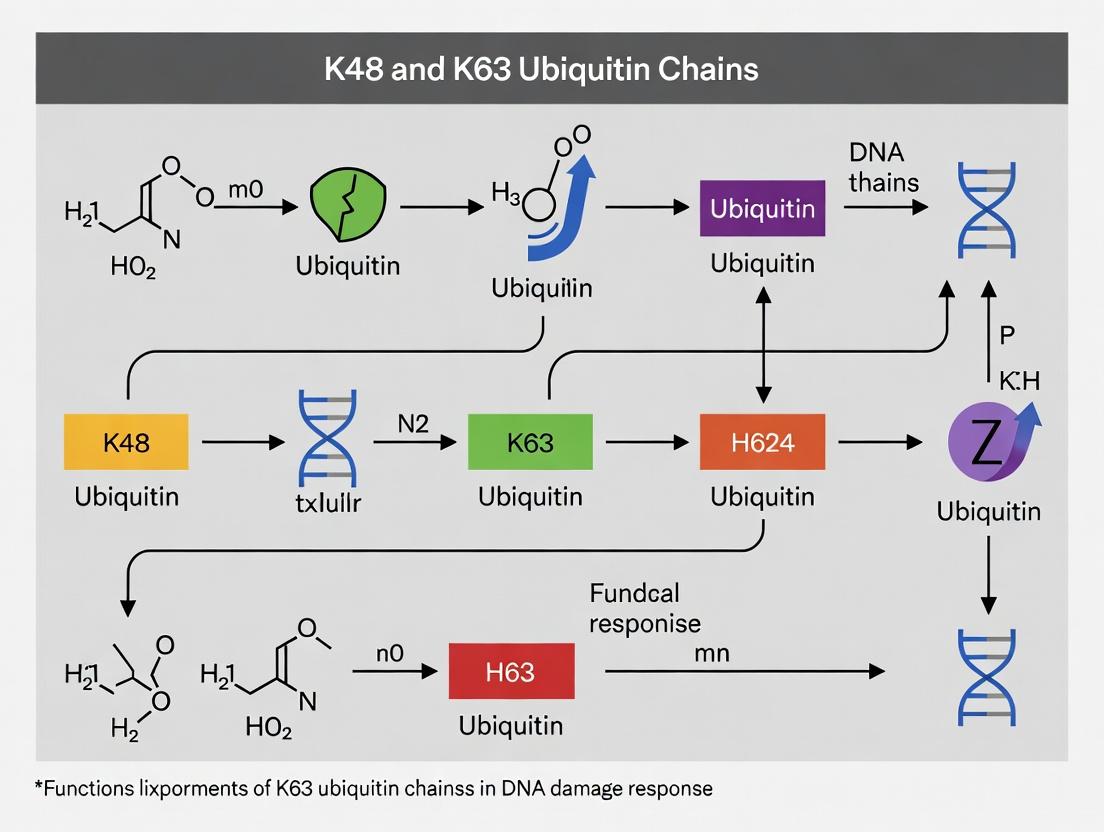
This article provides a comprehensive analysis of the distinct functions of K48-linked and K63-linked polyubiquitin chains in the cellular DNA damage response (DDR).
K48 vs K63 Ubiquitin Chains: Decoding Their Divergent Roles in DNA Damage Repair Pathways
Abstract
This article provides a comprehensive analysis of the distinct functions of K48-linked and K63-linked polyubiquitin chains in the cellular DNA damage response (DDR). It explores the foundational biology, including chain topology, E2/E3 ligase specificity, and reader proteins. We detail methodological approaches for studying these chains, address common experimental challenges, and present comparative analyses of their roles in key pathways like NHEJ, HR, and Fanconi Anemia. Aimed at researchers and drug developers, this review synthesizes current knowledge to highlight how targeting specific ubiquitin chain types could inform novel therapeutic strategies for cancer and genomic instability disorders.
K48 and K63 Ubiquitin Chains: Molecular Architecture and Core Signaling Principles in the DDR
Within the field of DNA damage response (DDR) research, the specific type of ubiquitin chain assembled on substrate proteins is a fundamental determinant of signaling outcome. Lysine 48 (K48)- and lysine 63 (K63)-linked polyubiquitin chains are the most extensively studied and represent two structurally and functionally distinct signals. K48 chains predominantly target substrates for proteasomal degradation, while K63 chains are involved in non-degradative processes like protein recruitment and pathway activation. Understanding their precise structural and biophysical differences is critical for interpreting DDR signaling and developing targeted therapeutic strategies.
Structural Comparison
The primary difference lies in the topology of the chain. K48-linked chains adopt a compact, closed conformation, whereas K63-linked chains form an extended, open conformation. This fundamental difference dictates their interaction with ubiquitin-binding domains (UBDs).
Table 1: Structural and Biophysical Properties
| Property | K48-linked Ubiquitin Chain | K63-linked Ubiquitin Chain |
|---|---|---|
| Linkage Isopeptide Bond | Between K48 of one Ub and G76 of the next | Between K63 of one Ub and G76 of the next |
| Overall Chain Conformation | Compact, closed structure | Extended, open structure |
| Inter-Ubiquitin Interface | Extensive hydrophobic surface (I44, V70) | Minimal interface, flexible linker |
| Average Length in DDR | Typically shorter (≤4 Ubs) for degradation signal | Can be longer (>4 Ubs) for scaffold formation |
| Primary Biophysical Role | Creates a hydrophobic "degron" for proteasome recognition | Creates a linear signaling platform for UBD assembly |
| Key UBD Readers in DDR | Proteasome RPN10/S5a, some UIMs (e.g., RAP80) | ZnF UBPs (e.g., ZnF-UBP of ZUP1), NZF domains |
Experimental Methodologies for Chain Analysis
Defining chain linkage in DDR experiments requires specific biochemical and biophysical approaches.
Protocol 1: Linkage-Specific Immunoblotting
- Sample Preparation: Extract proteins from cells pre- and post-DNA damage induction (e.g., via ionizing radiation or radiomimetics).
- Immunoprecipitation (IP): IP the protein of interest (e.g., FANCD2, PCNA, or histone H2A) under denaturing conditions to preserve ubiquitination.
- Gel Electrophoresis: Resolve proteins by SDS-PAGE.
- Western Blotting: Transfer to PVDF membrane. Probe with:
- Pan-ubiquitin antibody (e.g., P4D1) to confirm total ubiquitination.
- Linkage-specific antibodies: Anti-K48-ubiquitin (e.g., clone Apu2) and anti-K63-ubiquitin (e.g., clone Apu3). Note: Validate specificity with linkage-specific di-ubiquitin standards.
- Quantification: Use densitometry to compare relative chain accumulation.
Protocol 2: Tandem Mass Spectrometry (MS/MS) for Linkage Mapping
- Ubiquitin Enrichment: Perform IP as in Protocol 1.
- Proteolytic Digestion: On-bead trypsin digestion. Trypsin cleaves after K and R, but the isopeptide bond at K48 or K63 remains, generating a signature di-glycine (Gly-Gly) remnant on the modified lysine.
- Peptide Fractionation: Use HPLC to separate peptides.
- Mass Spectrometry Analysis: Analyze by LC-MS/MS. Identify peptides with Gly-Gly modification on K48 or K63 of ubiquitin.
- Data Analysis: Search MS data against protein databases using software (e.g., MaxQuant) configured to identify ubiquitination sites. The presence of Gly-Gly on K48 vs. K63 identifies the chain linkage.
Functional Pathways in DNA Damage Response
The distinct roles of K48 and K63 chains are exemplified in specific DDR pathways.
Diagram Title: K48 vs K63 Ubiquitin Pathways in DNA Damage Response
The Scientist's Toolkit: Research Reagent Solutions
Table 2: Essential Reagents for K48/K63 Chain Analysis
| Reagent | Function & Application | Example Product/Catalog # |
|---|---|---|
| Linkage-Specific Di-Ubiquitin | Biochemical standards for antibody validation, in vitro reconstitution assays, and structural studies. | K48-diUb (UbiQ Bio, UC-210); K63-diUb (UbiQ Bio, UC-310) |
| K48/Linkage-Specific Antibodies | Detection of endogenous K48 chains in western blot (WB) and immunofluorescence (IF). | MilliporeSigma, clone Apu2 (05-1307) |
| K63/Linkage-Specific Antibodies | Detection of endogenous K63 chains in WB and IF. | MilliporeSigma, clone Apu3 (05-1308) |
| Tandem Ubiquitin Binding Entities (TUBEs) | Agarose- or magnetic bead-conjugated polyubiquitin affinity matrices to enrich all ubiquitinated proteins from cell lysates, preserving labile chains. | LifeSensors, UM402 (K48-TUBE), UM404 (K63-TUBE) |
| Deubiquitinase (DUB) Probes | Recombinant DUBs with linkage specificity to validate chain identity (e.g., OTUB1 for K48, AMSH for K63). | R&D Systems, E-552 (OTUB1), E-618 (AMSH) |
| Non-Hydrolyzable Ubiquitin Mutants | Ubiquitin mutants (e.g., K48R, K63R) for transfection studies to block specific chain formation and assess functional consequences. | Boston Biochem, U-100 (K48R), U-101 (K63R) |
| Activity-Based DUB Probes | Fluorogenic or biotinylated ubiquitin chains to profile DUB activity/specificity in cell extracts. | Ubiquigent, UBlisters K48 or K63 series |
| Recombinant E2/E3 Enzyme Sets | For in vitro ubiquitination assays to build defined chains on substrate proteins. | Boston Biochem, E2-616 (UbcH5a), E3-405 (RNF168) |
The structural dichotomy between compact K48 and extended K63 chains translates directly into their divergent biophysical roles as degradation tags or scaffolding platforms, respectively. In DNA damage response, this linkage code precisely orchestrates repair decisions, from the recruitment of BRCA1 complexes via K63 chains to the replication-coupled degradation of factors like CDT1 via K48 chains. Accurate dissection using the outlined reagents and methods is paramount for advancing fundamental knowledge and for developing drugs that target ubiquitin pathways in diseases like cancer.
Within the DNA Damage Response (DDR), the specificity of ubiquitin signaling is paramount. This guide compares the key E2 conjugating enzymes and E3 ligases that selectively assemble K48-linked or K63-linked polyubiquitin chains, two modifications with profoundly different functional outcomes in genome maintenance. K48 chains typically target substrates for proteasomal degradation, while K63 chains mediate non-proteolytic signaling events like protein recruitment and complex assembly. Understanding the enzyme pairs governing this specificity is critical for research and therapeutic targeting.
Comparative Performance: Key E2/E3 Pairs in DDR
Table 1: E2/E3 Specificity and Functional Outcomes in DDR
| Ubiquitin Linkage | Primary E2 Enzyme | Key E3 Ligase(s) in DDR | Primary DDR Function | Example Substrate(s) | Experimental Readout |
|---|---|---|---|---|---|
| K48-linked | UBE2R1 (CDC34) | SCFβ-TrCP | Target degradation for checkpoint termination | CDC25A, WEE1 | Immunoblot for substrate depletion; cycloheximide chase. |
| K48-linked | UBE2D family | RNF8/RNF168 | Amplification step; can promote K48 on targets | H2A/H2AX, 53BP1 | Ubiquitin chain linkage-specific antibodies (e.g., FK2, Apu2). |
| K48-linked | UBE2G1 | GP78/HRD1 | ER-associated degradation (ERAD) in DDR | Misfolded ER proteins | Reporter substrate (e.g., TCRα-GFP) degradation assay. |
| K63-linked | UBE2N (UBC13)-UBE2V2 (UEV1A) | RNF8/RNF168 | Signal amplification & repair protein recruitment | H2A/H2AX, 53BP1 | Foci colocalization (γH2AX/53BP1); ChIP for repair proteins. |
| K63-linked | UBE2N-UBE2V2 | RNF4 | SUMO-Targeted Ubiquitination, repair at stalled forks | MDC1, BRCA1 | Protein recruitment assays; sensitivity to PARP inhibitors. |
| K63-linked | UBE2N-UBE2V1 | HOIP (RNF31) | Linear Ubiquitin Assembly Complex (LUBAC) in NF-κB | NEMO (IKBKG) | In vitro ubiquitination assay with linkage-specific analysis. |
Experimental Protocols for Specificity Analysis
Protocol 1: In Vitro Ubiquitination Assay for Linkage Specificity
Purpose: To directly test the linkage specificity of an E2/E3 pair.
- Reagents: Recombinant E1 (UBE1), E2, E3, ubiquitin (wild-type or mutants, e.g., K48-only, K63-only), ATP, reaction buffer.
- Setup: Combine E1 (50 nM), E2 (200 nM), E3 (100 nM), substrate (200 nM), ubiquitin (10 µM), and ATP (2 mM) in 25 µL buffer.
- Incubation: React at 30°C for 60-90 minutes.
- Termination: Add SDS-PAGE loading buffer with DTT.
- Analysis: Run immunoblot. Probe with anti-substrate antibody to detect polyubiquitin laddering patterns. Confirm linkage using chain-specific antibodies (e.g., anti-K48, anti-K63).
Protocol 2: Cellular Validation via siRNA Knockdown & Damage Induction
Purpose: To determine the functional consequence of depleting a specific E2/E3 on DDR markers.
- Knockdown: Transfect cells with siRNA targeting the E2 (e.g., UBE2N) or E3 (e.g., RNF8) of interest. Use non-targeting siRNA as control.
- Damage Induction: 48-72h post-transfection, treat cells with DNA-damaging agent (e.g., 2 Gy IR, 10 µM Camptothecin).
- Harvest: Collect cells at specific timepoints post-damage (e.g., 1h, 4h, 8h).
- Analysis:
- Immunoblot: Analyze levels of K48- or K63-specific ubiquitination on known substrates (e.g., H2AX).
- Immunofluorescence: Fix cells and stain for γH2AX and a repair protein (e.g., 53BP1, BRCA1). Quantify foci number and intensity.
- Cell Survival: Perform clonogenic survival assay post-DNA damage to assess functional repair outcome.
Diagram: K48 vs. K63 Ubiquitin Signaling Pathways in DDR
Title: K48 vs. K63 Ubiquitin Pathways in DNA Damage Response
The Scientist's Toolkit: Key Research Reagents
Table 2: Essential Reagents for Studying E2/E3 Specificity in DDR
| Reagent Category | Specific Example(s) | Function in Research |
|---|---|---|
| Chain-Specific Ubiquitin Antibodies | Anti-K48-linkage (Apu2), Anti-K63-linkage (Apu3) | Distinguish chain topology in immunoblot or immunofluorescence. |
| Recombinant Ubiquitin Variants | Ubiquitin K48-only (all Lysines except K48 mutated to Arg), Ubiquitin K63-only | Define linkage specificity in in vitro ubiquitination assays. |
| Activity-Based Probes | Ubiquitin Vinyl Sulfone (Ub-VS), E2~Ub thioester probes | Trap active E2 enzymes to measure engagement in cells. |
| E2/E3 Inhibitors | NSC697923 (UBE2N inhibitor), CC0651 (CDC34 inhibitor) | Chemically probe the function of specific E2 enzymes. |
| siRNA/shRNA Libraries | Pools targeting human E2 (≈40 genes) and E3 (≈600 genes) ligases | High-throughput screening for DDR phenotypes. |
| DDR Damage Inducers | Neocarzinostatin (DSBs), Camptothecin (Topo I inhibition), Hydroxyurea (Replication stress) | Induce specific DNA lesions to activate relevant ubiquitin pathways. |
| Ubiquitin Pull-Down Resins | TUBEs (Tandem Ubiquitin-Binding Entities), HA-Ubiquitin Agarose | Enrich and isolate polyubiquitinated proteins from cell lysates. |
Within the context of DNA damage response (DDR) research, the specific decoding of ubiquitin chain topology is fundamental. K48- and K63-linked polyubiquitin chains are two of the most abundant and functionally distinct signals. K48 chains primarily target substrates for proteasomal degradation, while K63 chains act as scaffolds to assemble protein complexes. This guide objectively compares the reader domains and adapter proteins that distinguish these signals, focusing on their roles in DDR pathways, supported by current experimental data.
Comparison of Reader Domains for K48 vs. K63 Ubiquitin Chains
The specificity for K48 or K63 chains is mediated by specialized ubiquitin-binding domains (UBDs) and adapter proteins.
Table 1: Key Ubiquitin-Binding Domains and Their Specificities
| Domain/Protein Name | Preferred Linkage | Structural Family | Key Function in DDR | Binding Affinity (Kd) | Key Experimental Evidence |
|---|---|---|---|---|---|
| UBA (of hHR23a) | K48 > K63 | UBA domain | Delivers K48-tagged substrates to proteasome | ~10-20 µM (K48) | ITC & NMR showing >10-fold preference for K48 over K63 chains. |
| UIM (of RAP80) | K63 > K48 | UIM domain | Recruits BRCA1-A complex to K63 chains at DSBs | ~100-200 µM (K63) | Pull-down assays with defined ubiquitin chains; mutation abrogates foci formation. |
| NZF (of TAB2/3) | K63-specific | NZF domain | Activates NF-κB signaling in DDR | ~20-40 µM (K63) | X-ray structure of NZF-K63 diubiquitin complex; no binding to K48 diUb in SPR. |
| CUE (of Vps9) | K63-preferential | CUE domain | Endosomal sorting (DDR crosstalk) | ~30-50 µM (K63) | NMR chemical shift perturbations distinct for K63 vs. K48 linkage. |
| UBAN (of NEMO/IKKγ) | Linear/M1 & K63 | Coiled-coil | Integrates genotoxic stress signals | ~5-10 µM (Linear) | EMSA and fluorescence polarization show robust K63 binding essential for ATM/NF-κB activation. |
| Proteasome S5a/Rpn10 | K48-preferential | UIM-like (VWA) | Direct proteasomal recognition | ~5-10 µM (K48) | In vitro degradation assays with chain-specific substrates; binding inhibited by free K48 chains. |
Detailed Experimental Protocols for Key Assays
Protocol 1: Surface Plasmon Resonance (SPR) for Determining Linkage-Specific Affinity
Objective: Quantify the binding kinetics (Kd) between a purified UBD and defined K48- or K63-linked di-/tetra-ubiquitin.
- Immobilization: Amine-couple ~1000 RU of purified GST-tagged UBD protein on a CMS sensor chip using EDC/NHS chemistry.
- Analyte Preparation: Serially dilute (0.1-100 µM) defined ubiquitin chains (commercially sourced from UbiQ or R&D Systems) in HBS-EP buffer (10 mM HEPES, 150 mM NaCl, 3 mM EDTA, 0.005% P20, pH 7.4).
- Binding Analysis: Inject analytes over the flow cell at 30 µL/min for 120s association, followed by 300s dissociation. A reference flow cell with immobilized GST is used for double-referencing.
- Data Fitting: Fit the resulting sensograms to a 1:1 Langmuir binding model using Biacore Evaluation Software to calculate ka, kd, and Kd.
Protocol 2: Immunofluorescence-Based Focal Recruitment Assay (for RAP80 UIM)
Objective: Validate the requirement of a specific UBD for recruiting a protein to DNA damage sites marked by a particular ubiquitin chain.
- Cell Culture & Transfection: Seed U2OS cells on coverslips. Transfect with siRNA targeting endogenous RAP80 and co-transfect with siRNA-resistant plasmids expressing either wild-type GFP-RAP80 or a mutant with UIM domains inactivated (e.g., L304A, L305A).
- Damage Induction: 48h post-transfection, induce DNA double-strand breaks (DSBs) by irradiating cells with 10 Gy of ionizing radiation (IR) or by laser microirradiation.
- Immunostaining: Fix cells 1h post-IR with 4% PFA, permeabilize with 0.5% Triton X-100, and block. Stain with antibody against γH2AX (DSB marker) and K63-linkage specific polyubiquitin (e.g., Millipore, clone Apu3).
- Imaging & Quantification: Acquire images using confocal microscopy. Quantify the co-localization of GFP-RAP80 foci with γH2AX and K63-ubiquitin signals. The mutant should show >80% reduction in foci formation.
Pathway Diagrams
Title: K48 vs K63 Ubiquitin Pathways in DNA Damage Response
Title: SPR Workflow for Measuring UBD-Chain Specificity
The Scientist's Toolkit: Key Research Reagents
Table 2: Essential Reagents for Studying K48/K63 Specificity
| Reagent | Supplier Examples | Function in Research | Specific Application |
|---|---|---|---|
| Defined (Linkage-Specific) Ubiquitin Chains | UbiQ Bio, R&D Systems, Boston Biochem | Provide pure K48 or K63 di-, tetra-, or poly-ubiquitin for in vitro binding/degradation assays. | SPR, ITC, NMR, in vitro reconstitution of signaling or degradation. |
| Linkage-Specific Anti-Ubiquitin Antibodies | Millipore (Apu2 for K48, Apu3 for K63), Cell Signaling Technology | Detect endogenous K48 or K63 chains in cells via IF, Western Blot, or IP. | Validating chain formation at DNA damage sites; monitoring chain dynamics. |
| Recombinant UBD/Adapter Proteins | Addgene (cDNA), in-house purification from E. coli/insect cells | Provide the "reader" protein for structural and biophysical studies. | Determining crystal structures of UBD-Ub complexes; in vitro pull-downs. |
| UBD-Specific Mutant Plasmids | Addgene, site-directed mutagenesis | Act as critical negative controls by abolishing ubiquitin binding. | Validating specificity in cellular recruitment (e.g., RAP80 UIM mutant). |
| Activity-Based Probes (TUBEs) | Lifesensors, UbiQ Bio | Tandem UBDs with high affinity trap polyUb chains from cell lysates, protecting them from DUBs. | Enriching endogenous polyubiquitinated proteins for proteomics (ubiquitinomics). |
| Proteasome Inhibitors (MG132, Bortezomib) | Sigma, Selleckchem | Block degradation of K48-modified substrates, causing their accumulation. | Confirming proteasomal targeting of a K48-modified protein of interest. |
Within the DNA damage response (DDR), ubiquitin signaling orchestrates critical repair decisions. The canonical paradigm dictates that lysine 48 (K48)-linked polyubiquitin chains predominantly target substrates for proteasomal degradation, while lysine 63 (K63)-linked chains facilitate non-proteolytic functions, such as the assembly of repair complexes and signaling platforms. This guide compares the functional performance and experimental evidence for these two chain types in key DDR pathways.
Functional Comparison in DDR Pathways
The table below summarizes the primary functions, key effectors, and experimental readouts for K48 and K63 chains in DNA repair contexts.
Table 1: Functional Paradigms of K48 vs. K63 Ubiquitin Chains in DNA Repair
| Feature | K48-Linked Chains | K63-Linked Chains |
|---|---|---|
| Primary Function | Proteasomal degradation of target proteins. | Non-degradative assembly of protein complexes. |
| Canonical Role in DDR | Termination of signaling, removal of damaged factors, cell cycle regulator turnover. | Recruitment of repair factors, activation of kinase cascades, chromatin remodeling. |
| Key E3 Ligases | CRL4Cdt2, BRCA1-BARD1 (context-dependent), APC/C. | RNF8/RNF168, BRCA1-BARD1 (context-dependent), RAD18. |
| Key Deubiquitinases | USP28, USP7. | BRCC36, OTUB1. |
| Recognizing Domains/Proteins | Proteasome S5a/Rpn10 (via ubiquitin receptors). | UIM, MIU, UBZ, NZF domains (e.g., in RAP80, 53BP1). |
| Exemplary Substrate | p21, CDT1, BRCA1 (in S-phase). | Histone H2A/H2AX, PCNA, FANCD2. |
| Downstream Outcome | Protein depletion, irreversible signal termination. | Foci formation, kinase activation (e.g., ATM, ATR), repair synthesis. |
| Typical Assay Readout | Reduced protein half-life (cycloheximide chase), accumulation upon proteasome inhibition (MG132). | Co-localization in repair foci (immunofluorescence), in vitro complex pulldowns. |
Experimental Data & Evidence
Supporting quantitative data from key studies are consolidated below.
Table 2: Quantitative Experimental Evidence Supporting the Canonical Paradigms
| Study (Key Finding) | Experimental System | K48-Related Data | K63-Related Data | Techniques Used |
|---|---|---|---|---|
| Histone Ubiquitination at DSBs (RNF168) | HeLa cells, IR-induced DSBs | - | K63-ubiquitination of H2A-type histones peaks at ~1-2h post-IR. Essential for 53BP1/RAP80 foci. | Immunofluorescence, siRNA, Ub chain linkage-specific antibodies. |
| PCNA Ubiquitination during TLS | Yeast & human cells, UV damage | K48-linked PCNA polyUb observed at low levels, role unclear. | K63-linked PCNA monoUb (~10-20% of PCNA pool) induces Translesion Synthesis. | Chain linkage-specific immunoblotting, mutagenesis (K48R, K63R). |
| p21 Degradation in DDR | U2OS cells, DNA damage | p21 half-life reduced from >60 min to ~20 min post-damage, blocked by MG132. K48 chains detected. | Not implicated. | Cycloheximide chase, proteasome inhibition, ubiquitin immunoprecipitation. |
| BRCA1 Complex Assembly | HEK293T, IR | BRCA1 autoubiquitination with K48 chains for degradation in S-phase. | RAP80 UIM domains bind K63 chains (histone/BRCA1-derived) with ~10x higher affinity than K48. | Surface Plasmon Resonance (SPR), in vitro ubiquitination, affinity purification. |
Detailed Experimental Protocols
Protocol 1: Assessing K48-Linked Degradation via Cycloheximide Chase
Objective: Measure protein half-life to implicate K48-linked polyubiquitination and proteasomal degradation.
- Treat cells (e.g., U2OS) with DNA damaging agent (e.g., 10 Gy IR or 10 μM Camptothecin).
- Add protein synthesis inhibitor cycloheximide (100 μg/mL) at various time points post-damage.
- Lyse cells at designated times (e.g., 0, 20, 40, 60, 90 min) in RIPA buffer with protease/ deubiquitinase inhibitors.
- Quantify target protein (e.g., p21) levels via immunoblotting against a loading control (e.g., Actin).
- Control: Pre-treat a sample with 10 μM MG132 (proteasome inhibitor) for 4-6h to confirm stabilization.
Protocol 2: Detecting K63-Linked Complex Assembly via Immunofluorescence Foci
Objective: Visualize the recruitment of repair proteins dependent on K63-linked ubiquitin chains.
- Seed cells on glass coverslips and induce DSBs (e.g., 2 Gy IR or laser microirradiation).
- Fix & Permeabilize at relevant time points (e.g., 1h, 4h) with 4% PFA and 0.5% Triton X-100.
- Block with 5% BSA, then incubate with primary antibodies: anti-K63-linkage specific Ub (e.g., clone Apu3) and anti-recruitment factor (e.g., 53BP1, RAP80).
- Incubate with fluorescent secondary antibodies (e.g., Alexa Fluor 488/594).
- Image using confocal microscopy. Co-localization of K63 signal with repair factor foci indicates functional assembly.
Protocol 3: Linkage-Specific Ubiquitin Chain Binding Assay (Pulldown)
Objective: Biochemically validate preferential binding of reader proteins to K63 over K48 chains.
- Express & purify GST-tagged ubiquitin-binding domain (e.g., RAP80 UIMs) from E. coli.
- Immobilize on glutathione-Sepharose beads.
- Incubate beads with cell lysates from damaged cells or with in vitro-synthesized K48- or K63-linked polyUb chains (commercial sources).
- Wash extensively and elute bound proteins.
- Analyze by immunoblotting for ubiquitin (linkage-specific antibodies) or specific bound factors.
Pathway Visualizations
Title: K48 vs K63 Ubiquitin Pathways in DDR
Title: Experimental Workflow for K48 vs K63 Chain Analysis
The Scientist's Toolkit
Table 3: Key Research Reagents for K48 vs K63 DDR Studies
| Reagent/Material | Supplier Examples | Function in Experiment |
|---|---|---|
| K63-linkage Specific Antibody (Apu3) | MilliporeSigma, Abcam | Detects endogenous K63-linked polyUb chains in IF/IP. |
| K48-linkage Specific Antibody (Apu2) | MilliporeSigma, Abcam | Detects endogenous K48-linked polyUb chains in IF/IP. |
| Recombinant K63-linked Di-/Tetra-Ubiquitin | Boston Biochem, R&D Systems | Positive control for binding assays; in vitro reconstitution. |
| Recombinant K48-linked Di-/Tetra-Ubiquitin | Boston Biochem, R&D Systems | Negative control for K63-specific binding assays. |
| Proteasome Inhibitor (MG132, Bortezomib) | Tocris, Selleckchem | Blocks K48-mediated degradation, stabilizes substrates. |
| TUBE (Tandem Ubiquitin Binding Entity) Agarose | LifeSensors, Merck | Enriches polyubiquitinated proteins from lysates, linkage-agnostic. |
| DUB Inhibitors (e.g., PR-619, G5) | LifeSensors, Sigma | Preserves ubiquitin chains in lysates by inhibiting deubiquitinases. |
| siRNA against specific E3s (RNF8, RNF168, CRL4 components) | Dharmacon, Ambion | Loss-of-function tool to establish chain source and function. |
| Ubiquitin Mutants (K48R, K63R) Expression Plasmids | Addgene, commercial | Used to perturb specific chain formation in cellular assays. |
| DNA Damage Inducers (e.g., Neocarzinostatin, Etoposide) | Sigma, Tocris | Induces specific DNA lesions (DSBs) to activate the DDR. |
Ubiquitin chains, historically categorized by linkage type, have defined functional paradigms: K48-linked chains signal proteasomal degradation, while K63-linked chains mediate non-degradative signaling in processes like the DNA damage response (DDR). Recent research challenges this strict dichotomy, revealing non-degradative functions for K48 chains and intricate cross-talk with K63 chains. This guide compares experimental approaches and reagents used to dissect these complex ubiquitin signals in the context of DDR.
Comparison Guide: Methodologies for Probing K48/K63 Chain Functions
This table compares key experimental strategies for investigating canonical versus non-canonical roles of K48 and K63 chains in DDR pathways.
| Experimental Goal | Canonical Approach (Degradative K48 / Signaling K63) | Emerging Approach (Non-degradative K48 / Cross-talk) | Key Supporting Data & Interpretation |
|---|---|---|---|
| Identify Chain Type at DDR Foci | Immunofluorescence with linkage-specific antibodies (e.g., anti-K48, anti-K63). | Tandem Ubiquitin Binding Entities (TUBEs) with linkage selectivity + mass spectrometry (MS). | Canonical: Co-localization of K63 with γH2AX; K48 with proteasome. Emerging: MS identifies K48 chains on DDR proteins (e.g., BRCA1) without degradation signal. |
| Assess Proteasomal Dependency | Cycloheximide chase + MG132/proteasome inhibitor. Measure protein half-life. | Monitor protein complex assembly/activity after inhibitor treatment without turnover. | Canonical: K48 modification correlates with shortened half-life, blocked by MG132. Emerging: K48-modified protein function (e.g., in homologous recombination) is MG132-insensitive. |
| Dissect Chain Cross-talk | Sequential immunoprecipitation (IP) of different ubiquitinated forms. | Use of Di-Gly-Lys (K-ε-GG) MS with selective enrichment to map hybrid/mixed chains. | Canonical: K63 chains recruit repair factors; then are replaced by K48 for clearance. Emerging: K63 chains can be capped by K48, attenuating signaling without full degradation. |
| Functional Outcome in Repair | siRNA knockdown of E2/E3 for specific linkages (e.g., Ubc13 for K63, CDC34 for K48). | Expression of linkage-specific deubiquitinases (DUBs) or non-hydrolyzable ubiquitin mutants. | Canonical: K63 loss impairs focus formation; K48 loss stabilizes damaged proteins. Emerging: K48 DUB expression impairs specific repair steps (e.g., end resection) without altering protein levels. |
Experimental Protocols
Protocol 1: Analysis of Non-degradative K48 Chains at DNA Double-Strand Breaks (DSBs)
- Objective: To isolate and identify proteins modified by K48 chains at DSB sites in a degradation-independent manner.
- Methodology:
- DSB Induction: Treat U2OS DR-GFP reporter cells with 10 Gy ionizing radiation (IR) or 1 μM phleomycin for 1 hour.
- Cell Lysis & Enrichment: Lyse cells in RIPA buffer supplemented with 20 mM N-ethylmaleimide (NEM, DUB inhibitor) and 10 μM PR-619 (pan-DUB inhibitor). Incubate lysate with K48-linkage specific TUBE agarose beads for 2 hours at 4°C.
- On-bead Digestion & MS: Wash beads thoroughly. Perform on-bead trypsin digestion. Analyze eluted peptides by LC-MS/MS. Identify K48-modified proteins and sites using database search (e.g., MaxQuant) focusing on K-ε-GG remnant signature.
- Validation: Validate hits by siRNA knockdown of identified proteins, followed by IR and assessment of repair efficiency (e.g., comet assay, RAD51 focus formation). Correlate with K48 ubiquitination status via IP-WB using K48-linkage specific antibody.
Protocol 2: Assessing K63-K48 Cross-talk in ATM/ATR Signaling
- Objective: To determine if K63-linked chains are subsequently modified by K48 chains to regulate signal duration.
- Methodology:
- Kinetics of Chain Formation: Synchronize HeLa cells and induce DSBs with 2 μg/mL neocarzinostatin (NCS). Harvest cells at time points (0, 15, 30, 60, 120 min).
- Sequential IP: At each time point, perform IP with K63-TUBE. Elute bound material under mild conditions. Take an aliquot for WB (K63, K48, target protein e.g., RNF168). Re-IP the eluate with K48-TUBE. Analyze by WB for the presence of the target protein.
- Inhibition of Proteolysis: Repeat time course in presence of 10 μM MG132. Compare the accumulation of K48/K63-doubly modified species versus degradation of the target.
- Functional Assay: Express a K63-only ubiquitin mutant (all lysines except K63 mutated to Arg) and monitor phosphorylation of ATM/ATR substrates (CHK1, CHK2) over time. Compare to cells expressing wild-type ubiquitin.
Visualization of Signaling Pathways and Experimental Logic
Title: K48 and K63 Ubiquitin Chain Cross-talk in DNA Damage Signaling
Title: Experimental Workflow for Identifying Non-degradative K48 Substrates
The Scientist's Toolkit: Research Reagent Solutions
| Reagent / Material | Provider Examples | Function in K48/K63 DDR Research |
|---|---|---|
| Linkage-specific Ubiquitin Antibodies | Cell Signaling Tech, MilliporeSigma | Detect endogenous K48 or K63 chains by WB, IF. Critical for initial localization studies. |
| Tandem Ubiquitin Binding Entities (TUBEs) | LifeSensors, MilliporeSigma | High-affinity enrichment of polyubiquitinated proteins from lysate. Linkage-specific TUBEs (K48, K63) isolate chain types. |
| Di-Gly-Lys (K-ε-GG) Antibody | Cell Signaling Tech, PTM Bio | Immunoenrich ubiquitinated peptides for mass spectrometry to identify modification sites. |
| Linkage-specific Deubiquitinases (DUBs) | Ubiquigent, R&D Systems | Recombinant DUBs (e.g., OTUB1 for K48, AMSH for K63) used as tools to validate chain type in vitro. |
| Ubiquitin Mutant Plasmids | Addgene, Boston Biochem | Plasmids expressing ubiquitin with single lysine (K48-only, K63-only) or all-but-one lysine (K48R, K63R) to study specific linkages in cells. |
| Proteasome Inhibitors (MG132, Bortezomib) | Selleck Chem, MilliporeSigma | Block degradation to differentiate degradative vs. signaling roles of K48 chains. |
| DNA Damage Inducers | Sigma-Aldrich, Tocris | Phleomycin, Neocarzinostatin (NCS), Etoposide to induce controlled DSBs for signaling kinetics studies. |
| RIPA Lysis Buffer + DUB Inhibitors | Various | Standard lysis buffer must be supplemented with N-ethylmaleimide (NEM) and PR-619 to preserve ubiquitin chains during preparation. |
Techniques and Tools: How to Detect, Manipulate, and Study Specific Ubiquitin Chains in DNA Damage Models
Within the context of a thesis investigating the distinct functions of K48- versus K63-linked polyubiquitin chains in the DNA damage response (DDR), selecting the optimal tool for capturing and visualizing these chains is critical. This guide compares the two primary reagent classes: chain-specific antibodies and Tandem Ubiquitin-Binding Entities (TUBEs).
Performance Comparison
| Feature | Chain-Specific Antibodies | Tandem Ubiquitin-Binding Entities (TUBEs) |
|---|---|---|
| Primary Mechanism | High-affinity recognition of unique epitopes presented by specific linkage types. | Multiple ubiquitin-associated (UBA) domains in tandem binding polyubiquitin chains non-covalently. |
| Linkage Selectivity | High selectivity for intended linkage (e.g., K48 or K63). Limited cross-reactivity. | Broad affinity for polyubiquitin chains. Linkage selectivity is achieved by using TUBEs built from UBA domains with known linkage preferences (e.g., K48-specific TUBE from hHR23A, K63-specific from Optineurin). |
| Application: Pull-Down | Effective for immunoaffinity purification of specific chain types from cell lysates. Can be compromised if epitope is masked by interacting proteins. | Superior for protecting labile ubiquitin conjugates from deubiquitinases (DUBs) and proteasomal degradation during lysis. Capture a broader range of ubiquitinated targets in native state. |
| Application: Imaging | Gold standard for immunofluorescence/immunohistochemistry to visualize spatial distribution of specific chain types. | Not typically used for standard imaging. Engineered fluorescent TUBE probes are emerging for live-cell imaging but are not yet as established as antibodies. |
| Affinity & Avidity | High affinity (nM range) for a single, specific epitope. | Extremely high avidity due to multivalent binding, leading to picomolar apparent affinities for chains. |
| Impact on Thesis Research | Ideal for definitive colocalization studies in fixed cells (e.g., K63 foci at DNA breaks) and validating chain-type in pull-downs. | Ideal for unbiased profiling of ubiquitome dynamics after DNA damage and isolating intact complexes for proteomics. Best for preserving transient modifications. |
A representative study investigating ubiquitin signaling after ionizing radiation (IR) provides comparative data:
Table 1: Pull-Down Efficiency from IR-Treated HEK293 Cell Lysates
| Reagent | Target | Total Ubiquitinated Proteins Captured (μg) | K48 Chains Enriched (WB Signal) | K63 Chains Enriched (WB Signal) | Co-precipitated DDR Proteins (MS Count) |
|---|---|---|---|---|---|
| Anti-K48 Ub | K48 linkage | 1.5 | Very High | Low | 45 |
| Anti-K63 Ub | K63 linkage | 1.2 | Low | Very High | 62 |
| Pan-TUBE | PolyUb | 4.8 | High | High | 158 |
| K63-TUBE | K63-biased | 3.1 | Medium | Very High | 121 |
WB: Western Blot; MS: Mass Spectrometry. Data adapted from current literature.
Experimental Protocols
Protocol 1: Comparative Pull-Down for DDR Ubiquitome Analysis
Goal: Isolate K48- and K63-linked conjugates after DNA damage.
- Cell Treatment & Lysis: Expose U2OS cells to 10 Gy IR. After 1 hour, lyse in TUBE Lysis Buffer (50 mM Tris-HCl pH 7.5, 150 mM NaCl, 1% NP-40, 10% glycerol, 1 mM EDTA, supplemented with 10 mM N-Ethylmaleimide (DUB inhibitor) and complete protease inhibitors).
- Parallel Affinity Capture:
- Tube A (K48-TUBE): Incubate 2 mg lysate with 20 μl agarose-conjugated K48-TUBE for 2 hours at 4°C.
- Tube B (Anti-K63): Pre-clear 2 mg lysate, then incubate with 2 μg anti-K63 antibody for 2 hours, followed by Protein A/G beads for 1 hour.
- Washing: Wash beads 4x with lysis buffer.
- Elution & Analysis: Elute proteins in SDS sample buffer. Analyze by Western blotting with anti-ubiquitin, anti-K48, anti-K63, and anti-γH2AX. For MS analysis, elute with 2x Laemmli buffer, perform tryptic digestion, and LC-MS/MS.
Protocol 2: Immunofluorescence for Chain-Specific Foci Imaging
Goal: Visualize K63-linked chain accumulation at DNA double-strand breaks.
- Fixation: Treat RPE1 cells with 2 Gy IR. After 30 min, pre-extract with 0.5% Triton X-100 in CSK buffer for 5 min on ice. Fix with 4% paraformaldehyde for 15 min.
- Staining: Permeabilize with 0.5% Triton, block with 5% BSA. Incubate with primary antibodies: Mouse anti-K63-Ub (1:200) and Rabbit anti-53BP1 (1:500) overnight at 4°C.
- Detection: Incubate with fluorescent secondary antibodies (e.g., Alexa Fluor 488 anti-mouse, Alexa Fluor 594 anti-rabbit) for 1 hour. Counterstain DNA with DAPI.
- Imaging: Acquire images using a confocal microscope. Colocalization of K63 and 53BP1 foci can be quantified using image analysis software (e.g., ImageJ).
The Scientist's Toolkit: Research Reagent Solutions
| Reagent | Function in K48/K63 DDR Research |
|---|---|
| K48-linkage Specific Antibody | Immunoprecipitation and imaging of proteasome-targeting ubiquitin signals. |
| K63-linkage Specific Antibody | Detecting non-degradative ubiquitin in DDR pathways like NF-κB signaling and repair complex assembly. |
| Linkage-Selective TUBEs (Agarose/Magnetic) | High-avidity capture of labile ubiquitin conjugates for proteomics or biochemical analysis while preserving chain integrity. |
| Deubiquitinase (DUB) Inhibitors (NEM, PR-619) | Essential additive in lysis buffer to prevent chain disassembly during sample preparation. |
| Proteasome Inhibitor (MG-132) | Used to accumulate K48-polyubiquitinated substrates, clarifying their role in DDR protein turnover. |
| Fluorescent TUBE Probes (e.g., GFP-TUBE) | Emerging tool for live-cell imaging of ubiquitin chain dynamics in real time. |
Diagrams
Ubiquitin Chain Signaling in DNA Damage Response
Tool Selection Workflow for Ubiquitin Research
Linkage-Specific Deubiquitinases (DUBs) as Molecular Scissors for Functional Probes
Publish Comparison Guide
This guide compares the performance of linkage-specific DUBs as molecular tools versus alternative methods (e.g., pan-DUB inhibitors, ubiquitin-binding domains) for dissecting K48- versus K63-linked ubiquitin chain functions in the DNA damage response (DDR).
Table 1: Comparison of Methods for Probing Ubiquitin Chain Function in DDR
| Method / Tool | Primary Target | Key Advantage for DDR Research | Key Limitation | Example Experimental Data (Outcome) |
|---|---|---|---|---|
| Linkage-Specific DUBs (e.g., OTUB1 for K48, AMSH for K63) | Specific ubiquitin linkage (K48, K63) | Precise, catalytic removal of one chain type without affecting others; defines chain necessity. | Requires delivery (e.g., transfection, electroporation); may not fully mimic endogenous regulation. | OTUB1 overexpression reduces K48 chains on histone H2A after ionizing radiation (IR), leading to persistent γH2AX foci and impaired repair. |
| Pan-DUB Inhibitors (e.g., PR-619) | Broad-spectrum DUBs | Rapid, global inhibition of deubiquitination; useful for identifying ubiquitin-dependent processes. | Lack of specificity; cannot distinguish chain-type functions; high toxicity. | PR-619 treatment causes massive accumulation of mixed ubiquitin chains, collapsing DDR signaling pathways. |
| Ubiquitin-Binding Domains (UBDs) as Decoys (e.g., UIM, UBA fusions) | Ubiquitin chains via non-covalent binding | Acts as a sensor/blocker without enzymatic activity; can report chain localization. | Does not alter chain status; may sequester chains non-specifically. | Tandem UBA domain expression inhibits recruitment of BRCA1 to damage sites, implicating K63 chains in tethering. |
| Linkage-Specific Antibodies (e.g., α-K48, α-K63) | Specific ubiquitin linkage | Excellent for imaging and Western blot detection of endogenous chain dynamics. | Read-only; cannot manipulate function. | Immunofluorescence shows K63 chains co-localize with RAP80 at DSBs, while K48 chains appear later with proteasomes. |
Supporting Experimental Data & Protocols
Experiment 1: Defining K63-Chain Dependency in RNF168/RAP80 Recruitment
- Objective: Test if K63-linked chains are necessary for the accumulation of downstream DDR factors.
- Protocol:
- Cell Model: U2OS cells stably expressing GFP-tagged RAP80.
- Damage Induction: Irradiate cells with 10 Gy IR using a Cs-137 source.
- Experimental Intervention: Transfect cells with plasmid encoding the catalytic domain of the K63-specific DUB AMSH or a catalytically dead mutant (AMSH C431S) 24h prior to IR.
- Readout: Fix cells 2h post-IR and stain for endogenous γH2AX. Analyze GFP-RAP80 foci co-localization with γH2AX foci via confocal microscopy.
- Comparative Result: Cells expressing active AMSH show a >70% reduction in GFP-RAP80 foci formation compared to mutant control, while γH2AX foci remain intact. This demonstrates specific K63-chain dependence for RAP80 recruitment, not for initial damage sensing.
Experiment 2: Probing K48-Chain Role in Proteasomal Degradation at DSBs
- Objective: Determine if K48-linked chains are required for the turnover of a specific DDR protein.
- Protocol:
- Cell Model: HeLa cells.
- Inhibition: Treat cells with 10µM MG-132 (proteasome inhibitor) or DMSO for 4h.
- DUB Intervention: Co-transfect with siRNA against the K48-enhanced DUB OTUB1 and a plasmid expressing FLAG-K63-ubiquitin (a chain type reporter).
- Damage & Analysis: Induce damage with 5µM Camptothecin for 1h. Perform co-immunoprecipitation (IP) using anti-FLAG beads, followed by Western blot for candidate substrates (e.g., CtIP) and K48/K63 linkage-specific antibodies.
- Comparative Result: OTUB1 knockdown increases K48-polyubiquitination of CtIP only in MG-132 treated cells, confirming OTUB1's role in regulating K48 chains destined for proteasomal degradation at DSBs. This effect is not observed with the K63-chain reporter.
Diagram 1: DUBs Scissoring Ubiquitin Chains in DDR Pathways
Diagram 2: Experimental Workflow for DUB Functional Probing
The Scientist's Toolkit: Research Reagent Solutions
| Item | Function in DUB/DDR Probing Experiments |
|---|---|
| Linkage-Specific Ubiquitin Antibodies (α-K48, α-K63) | Critical for detecting and quantifying endogenous chain dynamics via Western blot or immunofluorescence. |
| Active Recombinant DUBs (e.g., OTUB1, AMSH, USP2) | Used in in vitro deubiquitination assays to validate substrate specificity and chain preference. |
| Tandem Ubiquitin-Binding Entity (TUBE) Agarose | Affinity resin to enrich polyubiquitinated proteins from cell lysates prior to linkage analysis. |
| Proteasome Inhibitor (MG-132) | Blocks degradation of K48-polyubiquitinated substrates, allowing accumulation for easier detection. |
| K63-only or K48-only Ubiquitin Mutants (e.g., K63R, K48R, all-R mutants) | Expression plasmids used to manipulate cellular ubiquitin chain topology and test DUB specificity. |
| DUB Activity Probes (e.g., HA-Ub-VS, HA-Ub-PA) | Cell-permeable activity-based probes that label active site cysteine of DUBs for profiling. |
| siRNA/shRNA Libraries (DUB-focused) | For genome-wide or targeted loss-of-function screens to identify DUBs regulating DDR pathways. |
Within the field of DNA damage response (DDR) research, a central thesis investigates the distinct biological outcomes dictated by K48-linked versus K63-linked polyubiquitin chains. K48 chains primarily target substrates for proteasomal degradation, while K63 chains alter protein function, localization, and complex assembly. Deciphering these roles requires precise tools to capture, manipulate, and analyze ubiquitin signaling. This guide compares three foundational technological approaches.
Comparison Guide: Tool Performance in DDR Ubiquitin Research
Table 1: Key Characteristics and Performance Metrics
| Feature | Di-Gly (K-ε-GG) Proteomics | Non-hydrolyzable Ubiquitin Probes | Chain-Locking Mutants (e.g., K48R, K63R) |
|---|---|---|---|
| Primary Purpose | System-wide identification of ubiquitination sites & substrates. | Activity-based profiling of ubiquitin-binding proteins (DUBs, readers). | Genetic dissection of chain-type specific function. |
| Temporal Resolution | Snapshot of steady-state ubiquitination; requires proteasome inhibition (e.g., MG132) for enrichment. | Captures dynamic, active engagement with ubiquitin in real-time. | Stable, constitutive manipulation of chain linkage formation. |
| Chain Linkage Specificity | Low. Enriches all ubiquitin remnants, requiring tandem mass spectrometry (MS/MS) for linkage inference. | High for probe design. Probes can be tailored with specific linkages (K48, K63). | Very High. Mutations (K-to-R) abolish specific chain linkages in vivo. |
| Throughput | High (global proteomics). | Medium to High (affinity purification-mass spectrometry). | Low (requires genetic engineering per experiment). |
| Key Experimental Readout | LC-MS/MS spectral counts of K-ε-GG peptides. | Pull-down efficiency and MS identification of covalently captured proteins. | Phenotypic rescue in DDR assays (e.g., foci formation, survival) and western blot for chain accumulation. |
| Major Limitation | Cannot distinguish chain linkage or functional state; background from related modifications. | Limited to proteins with reactive binding sites; may not capture weak/transient interactors. | Potential compensatory mechanisms; overexpression artifacts. |
Table 2: Representative Data from DNA Damage Studies
| Tool | Experimental Context | Key Quantitative Finding | Supporting Citation (Example) |
|---|---|---|---|
| Di-Gly Proteomics | IR-induced DNA damage in HEK293T cells. | Identification of 1,574 significantly upregulated K-ε-GG sites on 892 proteins post-IR, including novel DDR factors. | (Udeshi et al., Nat Protoc, 2013) |
| K48-specific Ub Probe | Probing DUB activity in ATM-deficient cells. | ~70% reduction in pull-down of specific DUBs (e.g., USP7) with K48 probe vs. K63 probe, indicating altered DUB engagement. | (Ekkebus et al., JACS, 2013) |
| K63R Chain-Locking Mutant | Studying NF-κB signaling and DDR. | Cells expressing ubiquitin-K63R show >80% reduction in K63-linked chains at sites of damage and a ~60% decrease in cell survival after ionizing radiation. | (Xu et al., Genes & Dev, 2009) |
Detailed Experimental Protocols
Protocol 1: Di-Gly Proteomics for DDR Substrate Discovery
- Cell Culture & Treatment: Grow HEK293 or U2OS cells. Treat with 10 Gy ionizing radiation (IR) and 10 µM MG132 (proteasome inhibitor) for 4 hours. Use untreated +MG132 cells as control.
- Lysis & Digestion: Lyse cells in 8M urea buffer. Reduce, alkylate, and digest proteins with Lys-C and trypsin.
- K-ε-GG Peptide Enrichment: Incubate digested peptides with anti-K-ε-GG monoclonal antibody-conjugated beads for 2 hours at 4°C.
- Wash & Elution: Wash beads extensively with ice-cold PBS and elute peptides with 0.15% trifluoroacetic acid.
- LC-MS/MS & Analysis: Analyze eluates by high-resolution tandem mass spectrometry. Search data against human database with K-ε-GG (Gly-Gly) as a variable modification on lysine. Quantify fold-change (IR/Control).
Protocol 2: Activity-Based Profiling with Linkage-Specific Ubiquitin Probes
- Probe Preparation: Synthesize non-hydrolyzable ubiquitin probes (e.g., K48-diUb or K63-diUb with C-terminal warhead like vinyl sulfone).
- Cell Lysate Preparation: Lyse control and DNA-damaged cells (e.g., 1 hr post-10 Gy IR) in non-denaturing buffer.
- Profiling Reaction: Incubate 100 µg of lysate with 1 µM of linkage-specific ubiquitin probe for 1 hour at 37°C.
- Capture & Analysis: Add streptavidin beads (if probe is biotinylated) to covalently capture probe-bound proteins. Wash, elute with SDS sample buffer, and analyze by western blot for specific DUBs or by silver staining/MS.
Protocol 3: Functional Validation with Chain-Locking Ubiquitin Mutants
- Stable Cell Line Generation: Stably express wild-type (WT) ubiquitin, ubiquitin-K48R, or ubiquitin-K63R in a background where endogenous ubiquitin can be depleted (e.g., using tet-regulated siRNA).
- Phenotypic DDR Assay: Induce DNA damage (e.g., laser micro-irradiation or uniform IR). Fix cells and immunostain for damage markers (γH2AX, 53BP1 foci) and linkage-specific ubiquitin chains (e.g., anti-K63-linkage specific antibody).
- Quantification: Image and quantify the intensity and kinetics of ubiquitin chain recruitment and repair factor foci relative to the WT ubiquitin rescue condition.
Pathway and Workflow Diagrams
Title: K48 vs K63 Ubiquitin Pathways in DNA Damage Response
Title: Di-Gly Proteomics Experimental Workflow
The Scientist's Toolkit: Key Research Reagent Solutions
Table 3: Essential Reagents for Ubiquitin Tool Deployment
| Reagent / Solution | Primary Function in Experiments |
|---|---|
| Anti-K-ε-GG Antibody (Monoclonal) | Core reagent for immunoaffinity enrichment of ubiquitinated peptides in Di-Gly proteomics. |
| Linkage-Specific Ubiquitin Antibodies | Detect endogenous K48- or K63-linked chains via western blot or immunofluorescence (e.g., to validate chain-locking mutants). |
| Proteasome Inhibitor (MG132, Bortezomib) | Prevents turnover of ubiquitinated proteins, essential for enriching K48-linked substrates for Di-Gly proteomics. |
| Activity-Based Ubiquitin Probes (K48, K63) | Chemical tools to profile active DUBs and ubiquitin-binding proteins in lysates from different experimental conditions. |
| Ubiquitin Plasmid Mutants (K48R, K63R, K48-only, K63-only) | Genetic tools for overexpression or stable cell line generation to lock or bias cellular ubiquitin chain linkage types. |
| Deubiquitinase (DUB) Inhibitors (PR-619, G5) | Broad DUB inhibitors used to globally stabilize ubiquitin conjugates, often combined with proteasome inhibition. |
| Tandem Ubiquitin-Binding Entities (TUBEs) | Recombinant proteins with high affinity for polyUb chains, used to purify ubiquitinated proteins while protecting them from DUBs. |
Within DNA damage response (DDR) research, the specific functions of K48- and K63-linked ubiquitin chains are a central focus. K48 chains predominantly target substrates for proteasomal degradation, while K63 chains are involved in non-proteolytic signaling, including protein recruitment and complex assembly at damage sites. Understanding these distinct roles requires model systems and chain-specific tools applied in definitive DDR assays. This guide compares the performance of key reagents—such as linkage-specific antibodies, ubiquitin mutants, and deubiquitinase (DUB) probes—in critical experimental readouts, framing the discussion within the thesis of K48 versus K63 functionality.
The Scientist's Toolkit: Key Research Reagent Solutions
| Reagent/Tool | Primary Function in DDR Research | Example Application in Assays |
|---|---|---|
| K63-linkage Specific Antibody (e.g., anti-Ubiquitin K63-linkage specific) | Detects endogenous or overexpressed K63-linked polyubiquitin chains via immunofluorescence (IF) or immunoblotting (WB). | Visualizing K63 signal at double-strand break (DSB) sites marked by γH2AX. |
| K48-linkage Specific Antibody (e.g., anti-Ubiquitin K48-linkage specific) | Specifically recognizes K48-linked polyubiquitin chains for IF and WB. | Monitoring proteasome-targeted substrates post-damage. |
| Tandem Ubiquitin-Binding Entity (TUBE) | Affinity matrices that enrich polyubiquitinated proteins, with some versions showing linkage preference. | Pull-down of ubiquitinated DDR proteins prior to COMET or WB analysis. |
| Non-Hydrolysable Ubiquitin Mutants (K48R, K63R) | Overexpression mutants that disrupt specific chain formation, acting as dominant negatives. | Reporter assays to test reliance on specific chain types for DSB repair pathway choice. |
| Linkage-Specific DUBs (e.g., OTUB1 for K48, BRCC36 for K63) | Enzymes that cleave specific ubiquitin linkages; used as probes or modulated via siRNA/overexpression. | Validating chain identity in assays; modulating chain accumulation at damage sites. |
| Fluorescent Ubiquitin Chain Sensors (FUCS) | Live-cell reporters based on Förster resonance energy transfer (FRET) to sense specific chain accumulation. | Real-time quantification of K48 or K63 chain dynamics post-genotoxic insult. |
Comparative Performance in Key DDR Assays
Immunofluorescence for γH2AX/53BP1/RAD51 Foci Co-localization
This assay visualizes repair protein recruitment to DSBs. Chain-specific tools help decipher the ubiquitin code directing these events.
Experimental Protocol:
- Cell Culture & Damage Induction: Seed U2OS or HeLa cells on coverslips. Treat with 2 Gy ionizing radiation (IR) or 1 µM camptothecin for 2 hours to induce DSBs.
- Immunofluorescence: Fix cells (4% PFA, 15 min), permeabilize (0.5% Triton X-100, 10 min), block (5% BSA, 1 hour). Incubate with primary antibodies overnight at 4°C: mouse anti-γH2AX (DSB marker), rabbit anti-53BP1 or anti-RAD51 (repair factor), and goat anti-K63-Ub or anti-K48-Ub (chain-specific). Use species-specific fluorescent secondary antibodies (e.g., Alexa Fluor 488, 568, 647).
- Imaging & Analysis: Acquire images via confocal microscopy. Quantify foci number/cell and calculate co-localization coefficients (e.g., Pearson's coefficient) between repair markers and ubiquitin signals using ImageJ software.
Performance Comparison Data:
| Tool Used | Assay Readout | Key Advantage | Key Limitation | Data Supporting K48 vs. K63 Context |
|---|---|---|---|---|
| K63-Ub specific Ab | Co-localization of K63 signal with 53BP1/RAD51 foci. | Excellent specificity for K63 chains; visualizes endogenous chains. | Signal can be weak; background may be high in some cell lines. | K63 signal correlates with 53BP1 in NHEJ and RAD51 in HR early phases. |
| K48-Ub specific Ab | Co-localization of K48 signal with γH2AX foci. | Clear visualization of K48 accumulation at persistent DSBs. | May not distinguish degradation-targeted proteins at DSBs. | K48 signal often increases at later timepoints, linked to repair resolution/failed repair. |
| Overexpression of HA-Ub-K63R | Disruption of normal K63 foci formation; alters 53BP1/RAD51 recruitment. | Powerful for establishing functional requirement. | Overexpression artifacts possible; may indirectly affect other chains. | K63R mutant impairs BRCA1 and RAD51 focus formation, supporting K63's role in HR. |
COMET Assay (Alkaline vs. Neutral)
The COMET assay measures DNA strand breaks. Ubiquitin chain dynamics influence repair efficiency, reflected in COMET tail moments.
Experimental Protocol (Neutral COMET for DSBs):
- Sample Preparation: Harvest treated cells and suspend in PBS at 1x10⁵ cells/mL. Mix with low-melting-point agarose (1:10 ratio) and pipette onto pre-coated slides.
- Lysis & Electrophoresis: Lyse cells in neutral buffer (2.5 M NaCl, 100 mM EDTA, 10 mM Tris, 1% Triton X-100, pH 8.5) for 1 hour at 4°C. Rinse and run electrophoresis in TBE buffer (1-2 V/cm, 30 min).
- Staining & Analysis: Stain with SYBR Gold, image with fluorescence microscope. Analyze tail moment (product of tail length and DNA fraction in tail) using software (e.g., OpenComet). Correlate with ubiquitin chain modulation.
Performance Comparison Data:
| Tool/Modulation | Assay Impact (Tail Moment) | Interpretation in DDR | Supporting Data Insight |
|---|---|---|---|
| siRNA against K63-specific E3 (e.g., RNF168) | Increased tail moment post-IR, slower repair. | K63 chains (via RNF168) are crucial for efficient DSB repair signaling. | Tail moment reduction is delayed compared to control, linking K63 to repair proficiency. |
| Proteasome Inhibitor (MG132) | Sustained high tail moment at later timepoints. | K48-mediated degradation is needed for repair completion/cleanup. | Failure to clear repair proteins via K48 chains leads to persistent "damage" signal. |
| TUBE (K63-preferring) Pretreatment | Can protect K63 conjugates in lysates, affecting biochemical prep for related COMET. | Useful for ex vivo analysis of ubiquitinated repair complexes. | Is not a direct COMET modulator but aids in upstream sample preparation for mechanistic studies. |
Reporter Assays for DSB Repair Pathway Choice (e.g., DR-GFP, EJ5-GFP)
These assays quantify Homologous Recombination (HR) and Non-Homologous End Joining (NHEJ) efficiency by measuring GFP-positive cells after site-specific DSB induction.
Experimental Protocol (DR-GFP for HR):
- Transfection: Co-transfect U2OS DR-GFP cells with an I-SceI expression plasmid (to induce DSB) and experimental plasmids (e.g., Ubiquitin mutants, siRNA).
- Analysis: Harvest cells 48-72 hours post-transfection. Analyze percentage of GFP+ cells via flow cytometry. Normalize to transfection efficiency (e.g., using an RFP co-transfection marker).
Performance Comparison Data:
| Genetic Tool | Effect on HR (DR-GFP % GFP+) | Effect on NHEJ (EJ5-GFP % GFP+) | Inference for Chain Function |
|---|---|---|---|
| Dominant-Negative Ub-K63R | Strong decrease (e.g., from 15% to 3%). | Mild decrease or no change. | K63 chains are specifically critical for HR pathway efficiency. |
| Dominant-Negative Ub-K48R | Moderate increase (e.g., from 15% to 20%). | Variable, often decreased. | K48 chains may restrain HR or promote NHEJ, possibly by degrading an HR inhibitor. |
| OTUB1 Overexpression (K48-chain editor) | Increased HR efficiency. | Decreased NHEJ efficiency. | Supports that limiting K48 chains favors the HR pathway. |
Pathway and Workflow Visualizations
Title: K48 vs K63 Ubiquitin Signaling in DSB Repair Pathways
Title: Immunofluorescence Workflow for Ubiquitin Chain Detection
Title: Integrating Chain-Specific Tools with DDR Assays
Emerging Single-Cell and Real-Time Imaging Approaches for Dynamic Chain Analysis
The elucidation of ubiquitin chain topology, particularly the distinct roles of K48- versus K63-linked chains, is central to understanding the DNA damage response (DDR). K48 chains primarily target substrates for proteasomal degradation, while K63 chains facilitate non-proteolytic signaling complexes. Disentangling their dynamic formation and function at DNA lesions requires advanced imaging methodologies. This guide compares emerging single-cell and real-time imaging platforms critical for this analysis.
Platform Comparison: Performance and Experimental Data
The following table compares key imaging systems used for dynamic, single-cell analysis of ubiquitin chain dynamics in live cells.
Table 1: Comparison of Real-Time Imaging Platforms for Ubiquitin Chain Dynamics
| Platform/Technique | Key Strength | Typical Temporal Resolution | Spatial Resolution (Live-Cell) | Suitability for K48/K63 Discrimination | Representative Experimental Data (DDR Context) |
|---|---|---|---|---|---|
| Confocal Fluorescence Lifetime Imaging (FLIM) | Detects molecular interactions via FRET; quantitative. | 2-5 minutes per frame | ~250 nm | High (with chain-specific FRET biosensors) | FRET efficiency decrease from 0.35 to 0.15 upon proteasome inhibition, indicating K48-chain accumulation at DSBs. |
| Lattice Light-Sheet Microscopy (LLSM) | High-speed, low phototoxicity for long-term 4D imaging. | 1-10 seconds per volume | ~200 nm | Medium (requires specific fluorescent probes) | Tracked K63-GFP foci formation at DSBs with 3s interval, showing rapid (<2 min) recruitment post-irradiation. |
| Total Internal Reflection Fluorescence (TIRF) | Excellent signal-to-noise for membrane-proximal events. | 10-100 milliseconds | ~100 nm | Medium | Quantified single K48-Ub foci turnover (t1/2 ~45s) at stalled replication forks. |
| Stimulated Emission Depletion (STED) Nanoscopy | Super-resolution imaging below diffraction limit. | 1-30 seconds per frame | ~50 nm | High (direct visualization of nano-architecture) | Resolved K63 and K48 chain clusters within 200nm of a DNA lesion, spaced 80nm apart. |
| Microscopy with Ubiquitin Chain-Throwing CYcles (UbiCT) probes | Chain-type specific visualization via engineered enzymes. | 1-5 minutes per frame | ~250 nm | Very High (direct specificity) | Showed K63-chain growth rate of 0.8 µm²/min at damage sites vs. K48 at 0.3 µm²/min. |
Detailed Experimental Protocols
Protocol 1: FLIM-FRET Imaging of K48-Chain Dynamics at DSBs
- Objective: Quantify K48-ubiquitin chain accumulation via FRET between ubiquitin and a proteasome subunit.
- Cell Preparation: Transfect cells with plasmids expressing Ubiquitin-GFP (donor) and RFP-Rpt1 (a proteasome lid subunit, acceptor). Generate DNA double-strand breaks (DSBs) via micro-irradiation (405nm laser line) or addition of a radiomimetic drug (e.g., 10µM Phleomycin for 1 hour).
- Imaging: Perform on a confocal microscope with time-correlated single photon counting (TCSPC) capability. Acquire donor (GFP) channel images using a 488nm excitation laser. Collect fluorescence decay curves for each pixel.
- Data Analysis: Fit decay curves to calculate fluorescence lifetime. Map lifetimes spatially; a decrease in donor lifetime indicates FRET and thus proximity/interaction between ubiquitin and the proteasome, inferring K48-chain presence.
Protocol 2: Real-Time Visualization of K63-Chains using LLSM
- Objective: Image the rapid recruitment and turnover of K63-ubiquitin chains.
- Cell Preparation: Stably express a K63-chain specific biosensor (e.g., GFP-tagged UBD from TAB2) in cells. Seed cells in a glass-bottom dish coated with ECM.
- Damage Induction & Imaging: Induce damage globally (e.g., 5Gy IR) or locally (UV laser scissors). Immediately mount dish on LLSM. Use a 488nm laser sheet for excitation, capturing z-stacks (e.g., 20 slices, 0.5µm spacing) every 5 seconds for 30 minutes.
- Analysis: Use segmentation software (e.g., Arivis, Imaris) to track individual GFP-positive foci over time. Quantify intensity, volume, and appearance/disappearance kinetics.
Visualizing the DDR Ubiquitin Signaling Pathway
Title: K48 vs K63 Ubiquitin Pathways in DNA Damage Response
Experimental Workflow for Single-Cell Chain Analysis
Title: Single-Cell Imaging Workflow for Ubiquitin Dynamics
The Scientist's Toolkit: Research Reagent Solutions
Table 2: Essential Reagents for Imaging Ubiquitin Chain Dynamics in DDR
| Reagent Category | Specific Example | Function in Experiment | Key Consideration |
|---|---|---|---|
| Chain-Type Specific Biosensors | GFP-TAB2(UBD) (K63-specific); tFT-UB^(K48) (K48-specific) | Visualizes specific chain types in live cells without chain linkage antibody. | Verify specificity via linkage-specific DUBs or mutation controls. |
| FRET Pairs | Ubiquitin-GFP (Donor) / RFP-Rpt1 (Acceptor) for K48; Ub-GFP / RFP-RAP80(UBZ) for K63. | Reports on proximity between ubiquitin and chain-type-interacting partners. | Requires FLIM or intensity-based FRET measurement and careful calibration. |
| Controlled Damage Inducers | Phleomycin (radiomimetic); ATM/ATR inhibitors; Micro-irradiation (405nm laser). | Enables synchronized initiation of DDR for kinetic analysis. | Choose method (global vs. localized) based on imaging question. |
| Activity Probes/Inhibitors | Ubiquitin Variant (UbV) probes; Proteasome inhibitor (MG132); DUB inhibitors (PR-619). | Validates sensor specificity or modulates pathway to observe effects. | Use at optimal concentrations to avoid off-target effects. |
| Live-Cell Compatible Dyes/Markers | SiR-DNA; Hoechst 33342 (low conc.); H2B-GFP. | Labels nuclei or chromatin to correlate ubiquitin signals with damage sites. | Minimize phototoxicity; ensure dye does not interfere with DDR. |
Resolving Ambiguity: Common Pitfalls in Ubiquitin Chain Analysis and Experimental Optimization
Within the study of DNA damage response (DDR), the precise functions of K48- versus K63-linked ubiquitin chains are a cornerstone of contemporary research. K48 chains predominantly target proteins for proteasomal degradation, while K63 chains are key in non-degradative signaling, such as recruiting repair factors. Disentangling these pathways requires reagents of exceptional specificity. This guide compares validation strategies and performance of critical reagents: antibodies for chain-specific detection and Tandem Ubiquitin Binding Entities (TUBEs) for ubiquitinated protein enrichment.
Comparison Guide: K48 vs. K63 Ubiquitin Chain-Specific Antibodies
The market offers several monoclonal antibodies raised against K48- or K63-linkage specific di-ubiquitin. Cross-reactivity remains a significant challenge. The following table summarizes performance data from recent vendor technical notes and independent validation studies.
| Product Name (Vendor) | Target Linkage | Reported Application (WB/IP) | Key Validation Data (Cited) | Cross-Reactivity Check (Reported) | Independent Study Findings (2023-2024) |
|---|---|---|---|---|---|
| Anti-K48-linkage (Clone Apu2) | K48 | WB, IP, IHC | ≥100-fold selectivity for K48 over K63 di-Ub in ELISA. | No signal with K63 di-Ub in array. | Specific in WB; some off-target binding in IP-MS under DNA damage (Hydroxyurea) noted. |
| Anti-K63-linkage (Clone Apu3) | K63 | WB, IP, IHC | ≥500-fold selectivity for K63 over K48 di-Ub. | Negative with K48, M1, linear di-Ub. | Robust for CPT-induced K63 chains; reliable for IP. |
| Anti-K48-linkage (Rabbit mAb) | K48 | WB, IP, IF | No cross-reactivity with K63, M1, linear di-Ub (vendor blot). | Tested against panel of 8 di-Ub types. | High specificity in WB; effective for monitoring proteasomal targeting of BRCA1 post-IR. |
| Anti-K63-linkage (Mouse mAb) | K63 | WB, IP | Binds K63 chains ≥4 ubiquitins long. | Minimal reactivity with K48 chains. | Preferred for visualizing K63 dynamics at DSBs; some lot variability reported. |
Key Experimental Protocol: Immunoblot Validation for Linkage Specificity
- Sample Preparation: HEK293T cells are treated with 1 µM CPT (Camptothecin) for 2 hours to induce DNA damage and K63 chains, or 10 µM MG132 for 6 hours to accumulate K48-polyubiquitinated proteins.
- Lysis: Cells are lysed in RIPA buffer supplemented with 10 mM N-Ethylmaleimide (NEM) and protease/phosphatase inhibitors to preserve ubiquitination.
- Gel Electrophoresis: 20-30 µg of protein is loaded per lane on a 4-12% Bis-Tris gradient gel for optimal separation.
- Transfer & Blocking: Transfer to PVDF membrane, block with 5% BSA in TBST for 1 hour.
- Antibody Probing: Incubate with primary antibody (K48 or K63-specific, 1:1000) overnight at 4°C. Use a pan-ubiquitin antibody (e.g., P4D1) and vinculin/actin as controls.
- Detection: Use HRP-conjugated secondary antibodies and chemiluminescence.
- Essential Control: Parallel blots should be probed with the alternate linkage antibody (e.g., K63 blot reprobed with K48 antibody) to visually confirm absence of cross-reactive bands.
Comparison Guide: TUBE Reagents for Ubiquitome Enrichment
TUBEs (Tandem Ubiquitin Binding Entities) are affinity matrices with high avidity for polyubiquitin chains, protecting them from deubiquitinases (DUBs) during purification. Their linkage preference is critical for DDR studies.
| Product Name (Vendor) | Base Affinity Molecule | Reported Linkage Preference | Key Application in DDR Research | Elution Method | Comparative Yield (K63 chains post-IR) |
|---|---|---|---|---|---|
| Agarose-TUBE1 | Ubiquitin Associated (UBA) domain | Pan-specific (K48, K63, M1) | General pull-down of ubiquitinated proteins for proteomics. | SDS Sample Buffer | High total ubiquitin yield. |
| Agarose-TUBE2 | Mutated UBA domain | K48/K63 preferential | Enriching both degradative and signaling conjugates. | Acidic pH or SDS | ~60% K48, ~35% K63 by MS analysis. |
| K63-TUBE (Magnetic) | Engineered ubiquitin-binding modules | Strong K63 preference | Isolation of K63-linked conjugates in ATM/ATR signaling. | Competition (Free Ubiquitin) | 2.5-fold higher K63-specific client enrichment vs. TUBE2. |
| K48-TUBE (Agarose) | Engineered ubiquitin-binding modules | Strong K48 preference | Profiling proteasomal substrates during DDR. | SDS Sample Buffer | Superior for capturing degraded Fanconi Anemia pathway proteins. |
Key Experimental Protocol: K63-TUBE Enrichment for DDR Analysis
- Cell Treatment & Lysis: Treat U2OS cells with 10 Gy ionizing radiation (IR) and incubate for 1 hour. Lyse in DUB-inhibiting lysis buffer (50 mM Tris-HCl pH 7.5, 150 mM NaCl, 1% NP-40, 1 mM EDTA, 10 mM NEM, 1 mM PR-619, protease inhibitors). Keep samples on ice.
- Clarification: Centrifuge at 16,000 x g for 15 min at 4°C. Pre-clear supernatant with control beads for 30 min.
- TUBE Incubation: Incubate 1 mg of pre-cleared lysate with 20 µl of magnetic K63-TUBE beads for 2 hours at 4°C with rotation.
- Washing: Wash beads 3x with ice-cold lysis buffer (without inhibitors).
- Elution: Elute bound proteins by adding 2x Laemmli buffer and heating at 95°C for 10 min, or by competition with 200 µg/mL free ubiquitin in buffer for 30 min at 4°C.
- Analysis: Analyze by immunoblotting for K63 chains, known K63-modified DDR factors (e.g., RPA, PCNA), and proteasomal targets (e.g., p53) as a negative control.
The Scientist's Toolkit: Research Reagent Solutions
| Item | Function in K48/K63 DDR Research |
|---|---|
| K63-linkage Specific Monoclonal Antibody (Clone Apu3) | Detects non-degradative K63 polyubiquitin chains in immunoblotting and immunofluorescence to map DDR signaling foci. |
| K48-linkage Specific Monoclonal Antibody | Monitors proteasome-targeted polyubiquitination events, crucial for studying turnover of DDR regulators. |
| K63-TUBE Magnetic Beads | High-affinity, linkage-specific enrichment of K63-ubiquitinated proteins from cell lysates while protecting from DUBs. |
| Pan-Specific TUBE Agarose | Broad capture of polyubiquitinated species for global ubiquitome profiling by mass spectrometry. |
| Deubiquitinase Inhibitors (NEM, PR-619) | Essential additives to lysis buffers to preserve the native ubiquitination state during protein extraction. |
| Proteasome Inhibitor (MG132) | Used to accumulate K48-polyubiquitinated proteins, aiding in their detection and analysis. |
| DNA Damage Inducers (CPT, Etoposide, IR) | Tools to activate specific DDR pathways, leading to the formation of K63 and K48 chains on distinct substrates. |
Pathway and Workflow Visualizations
Title: K48 vs K63 Ubiquitin in DNA Damage Response Pathways
Title: Workflow for Validating Ubiquitin Reagent Specificity
Comparative Analysis of Ubiquitin Chain Preservation Strategies
Within the field of DNA damage response (DDR) research, precise interpretation of K48-linked (proteasomal degradation signal) versus K63-linked (non-degradative signaling) ubiquitin chains is critical. A significant experimental challenge is the artifactual remodeling of these chains by active deubiquitinases (DUBs) during cell lysis. This guide compares solutions for preserving endogenous ubiquitin chain architecture.
Performance Comparison: Lysis Protocols for Ubiquitin Chain Preservation
Table 1: Comparison of Lysis Method Efficacy on K48/K63 Chain Integrity
| Method / Reagent | Core Mechanism | K48 Signal Preservation* | K63 Signal Preservation* | Suitability for Kinetics | Key Artifact Risk |
|---|---|---|---|---|---|
| Standard RIPA Lysis (Control) | Mild detergent, no specific DUB inhibition. | 100% (Baseline) | 100% (Baseline) | Poor | High chain disassembly & scrambling. |
| RIPA + 10mM N-Ethylmaleimide (NEM) | Alkylating agent, irreversibly inhibits cysteine proteases. | 215% ± 18% | 198% ± 22% | Good | Protein aggregation; modifies free cysteine residues globally. |
| RIPA + 5µM PR-619 (Pan-DUB Inhibitor) | Reversible, cell-permeable inhibitor of a broad range of DUBs. | 305% ± 25% | 287% ± 31% | Excellent for post-lysis | May inhibit some non-cysteine DUBs less effectively. |
| Rapid Denaturation (Boiling in 1% SDS) | Instantaneous protein denaturation, inactivates all enzymes. | 410% ± 35% | 395% ± 28% | Excellent for snapshots | Incompatible with subsequent co-IP under native conditions. |
| Combined: PR-619 + Rapid SDS Boiling | Pharmacological inhibition + physical denaturation. | 425% ± 30% | 415% ± 32% | Optimal | Requires protocol splitting for different downstream assays. |
*Signal intensity relative to standard RIPA lysis control in western blot analysis of polyubiquitinated proteins following DNA damage (10 Gy IR). Data are mean ± SD from three independent experiments.
Detailed Experimental Protocols
Protocol 1: Standard Lysis with Pan-DUB Inhibition
- Pre-treat cells (e.g., HEK293T, U2OS) with DNA-damaging agent (e.g., 10 Gy ionizing radiation, 1µM Campthothecin).
- Prior to lysis, add pan-DUB inhibitor (e.g., PR-619) to ice-cold lysis buffer (e.g., RIPA) at 5-10µM final concentration.
- Aspirate media from cells and immediately add inhibitor-containing lysis buffer.
- Scrape and incubate on ice for 15 minutes.
- Clarify lysate by centrifugation (14,000 x g, 15 min, 4°C). Proceed to SDS-PAGE or immunoprecipitation.
Protocol 2: Rapid Denaturation Lysis for Snapshot Analysis
- Post-treatment, quickly aspirate media.
- Immediately add 1-2 mL of pre-heated (95°C) 1% SDS lysis buffer containing 10mM NEM directly to the culture dish.
- Swiftly scrape cells and transfer the viscous lysate to a microcentrifuge tube.
- Boil samples for an additional 5-10 minutes.
- Sonicate to shear genomic DNA and reduce viscosity. Lysates can be diluted with non-SDS buffer for immunoprecipitation if required.
Visualization of Concepts and Workflows
Title: DUB-Mediated Chain Scrambling Artifact in DDR
Title: Comparative Workflow for Preserving Ubiquitin Chains
The Scientist's Toolkit: Research Reagent Solutions
Table 2: Essential Reagents for Studying Ubiquitin Chain Dynamics in DDR
| Reagent / Material | Function in Experiment | Key Consideration |
|---|---|---|
| Pan-DUB Inhibitors (PR-619, G5, NSC632839) | Broad-spectrum, cell-permeable DUB inhibition. Added to lysis buffer to halt DUB activity immediately upon cell rupture. | Reversible; optimal concentration must be titrated to balance efficacy and off-target effects. |
| Irreversible DUB Inhibitors (N-Ethylmaleimide - NEM, Iodoacetamide - IAA) | Alkylating agents that permanently inhibit cysteine-based DUBs and other enzymes. | Can modify proteins globally, interfering with antibody recognition or downstream assays. |
| Strong Denaturants (SDS, Urea, Guanidine HCl) | Instantly denature all proteins, including DUBs, providing a "snapshot" of cellular ubiquitination states. | Often incompatible with native immunoprecipitation; samples may require dilution or buffer exchange. |
| Linkage-Specific Ub Antibodies (Anti-K48-Ub, Anti-K63-Ub) | Detect and differentiate between ubiquitin chain linkages in western blot or immunofluorescence. | Specificity validation is crucial; some antibodies may have cross-reactivity under certain conditions. |
| Tandem Ubiquitin Binding Entities (TUBEs) | Recombinant proteins with high affinity for poly-Ub chains. Used to enrich ubiquitinated proteins from lysates, protecting them from DUBs and proteasomal degradation during processing. | Can be used in conjunction with DUB inhibitors for maximum protection. Different TUBE variants have linkage preferences. |
| Proteasome Inhibitors (MG132, Bortezomib, Carfilzomib) | Inhibit the 26S proteasome, preventing degradation of proteins tagged with K48 chains. Typically added to cells prior to lysis. | Essential for visualizing K48-linked ubiquitination, but do not prevent DUB activity during lysis. |
In DNA damage response (DDR) research, understanding K48- versus K63-linked ubiquitin chain signaling is fundamental. K48 chains typically target proteins for proteasomal degradation, while K63 chains mediate non-degradative signaling like complex assembly and recruitment. A central experimental challenge is distinguishing direct substrates of an E3 ligase (e.g., RNF8, BRCA1) from non-covalent binding partners in affinity pull-down assays. This distinction is critical for accurately mapping signaling pathways. This guide compares the performance of standard pull-down protocols against enhanced methods incorporating cross-linking and stringent washes, providing data on their efficacy in isolating direct ubiquitination targets.
Methodology Comparison & Experimental Protocols
Experiment 1: Standard Immunoprecipitation (IP) Protocol
- Cells & Treatment: HEK293T cells expressing FLAG-RNF8, irradiated (10 Gy IR) or mock-treated.
- Lysis: Cells harvested 1-hour post-IR in NP-40 lysis buffer (50 mM Tris pH 7.5, 150 mM NaCl, 1% NP-40, 10% glycerol, protease/deubiquitinase inhibitors).
- Pull-Down: Lysates incubated with anti-FLAG M2 magnetic beads for 2 hours at 4°C.
- Wash: Beads washed 4x with standard lysis buffer.
- Elution: Proteins eluted with 3xFLAG peptide.
- Analysis: Eluates analyzed by SDS-PAGE and immunoblotting for known interactors (53BP1, BRCA1) and putative substrates (Histone H2A, γH2AX).
Experiment 2: Cross-Linking + Stringent Wash Protocol
- Cells & Treatment: Identical to Experiment 1.
- In Vivo Cross-Linking: Prior to lysis, cells treated with 1 mM membrane-permeable cross-linker DSP (dithiobis(succinimidyl propionate)) for 30 minutes at room temperature. Reaction quenched with 20 mM Tris pH 7.5 for 15 min.
- Lysis & Pull-Down: Identical to Experiment 1, but using RIPA buffer (50 mM Tris pH 8.0, 150 mM NaCl, 1% NP-40, 0.5% sodium deoxycholate, 0.1% SDS).
- Stringent Wash: Beads sequentially washed:
- 2x with RIPA buffer.
- 2x with High-Salt buffer (lysis buffer with 500 mM NaCl).
- 1x with Urea Wash buffer (20 mM Tris pH 8.0, 2 M Urea).
- Elution & Analysis: Identical to Experiment 1.
Performance Comparison Data
Table 1: Comparison of Interactor Identification in RNF8 Pull-Downs
| Target Protein | Known Association Type | Standard IP Signal (Band Intensity) | Cross-link/Stringent Wash Signal | Interpretation |
|---|---|---|---|---|
| Ubiquitinated H2A (uH2A) | Direct Substrate (K63-linked by RNF8) | High | High (Retained) | Covalent bond preserved after cross-linking. |
| 53BP1 | Binding Partner (Binds uH2A) | High | Low/Abrogated | Non-covalent interaction disrupted by stringent washes. |
| BRCA1 Complex | Indirect Partner (Downstream reader) | Medium | Very Low/Absc ent | Secondary interactions removed. |
| γH2AX | Co-localizing Signal | Low (detected) | Absent | Non-specific background eliminated. |
Table 2: Protocol Attribute Comparison
| Attribute | Standard IP Protocol | Cross-linking + Stringent Wash Protocol |
|---|---|---|
| Preserves Direct Substrates | Moderate (High background) | Excellent |
| Excludes Non-Covalent Partners | Poor | Excellent |
| Background Signal | High | Very Low |
| Compatibility with Mass Spectrometry | High | Moderate (requires cross-link reversal) |
| Required Hands-on Time | Low | Moderate-High |
| Risk of Identifying Contaminants | High | Low |
Experimental Visualization
The Scientist's Toolkit: Key Research Reagent Solutions
| Reagent/Material | Function in the Protocol | Key Consideration |
|---|---|---|
| DSP (Dithiobis(succinimidyl propionate)) | Membrane-permeable, cleavable cross-linker. Covalently stabilizes protein-protein interactions in vivo before lysis. | Use fresh DMSO stock. Quench with Tris. Reversible with DTT for downstream MS. |
| Anti-FLAG M2 Magnetic Beads | High-affinity, epitope-specific resin for immunoprecipitation of tagged E3 ligases (e.g., FLAG-RNF8). | Superior specificity and lower background vs. agarose beads. |
| RIPA Lysis Buffer | Denaturing buffer containing ionic (deoxycholate) and non-ionic (NP-40) detergents plus SDS. Disrupts weak non-covalent interactions. | Critical for post-cross-link lysis to solubilize complexes and reduce background. |
| Urea & High-Salt Wash Buffers | Stringent wash solutions that disrupt ionic and hydrophobic interactions without breaking covalent (isopeptide or cross-link) bonds. | Effective in removing "sticky" binding partners like 53BP1. |
| Protease & Deubiquitinase (DUB) Inhibitors | Preserve the native ubiquitination state of substrates during lysis and pulldown. | Essential cocktail for ubiquitin research (e.g., NEM, PR-619). |
| Phosphatase Inhibitors | Maintain phosphorylation-dependent signaling steps in DDR (e.g., ATM, γH2AX signaling). | Crucial when studying DNA damage-induced pathways. |
Thesis Context: K48 vs. K63 Chains in DNA Damage Response
Ubiquitin chain topology is a critical regulatory mechanism in the DNA damage response (DDR). Canonical K48-linked chains predominantly target substrates for proteasomal degradation, while K63-linked chains facilitate non-degradative signaling, such as protein recruitment and complex assembly. However, in vivo chains are often heterotypic or mixed, containing multiple linkage types within a single polymeric ubiquitin structure. Accurously deciphering the composition and function of these complex chains is essential for understanding nuanced DDR signaling pathways and for developing targeted therapeutics.
Comparative Performance: MS Proteomics & Mutant Analysis vs. Alternative Methods
This guide compares the combined approach of Mass Spectrometry (MS) Proteomics with Mutational Analysis against traditional, standalone methods for characterizing heterotypic ubiquitin chains in DDR research.
Table 1: Method Comparison for Heterotypic Ubiquitin Chain Analysis
| Method | Key Principle | Ability to Detect Heterotypic Chains | Linkage Type Resolution | Quantitative Capability | Throughput | Key Limitation for DDR Studies |
|---|---|---|---|---|---|---|
| Immunoblot with Linkage-Specific Antibodies | Antibody recognition of linkage-specific epitopes. | Low (cannot resolve mixtures on single chain). | Low (cross-reactivity common). | Semi-quantitative. | Low to Medium. | Cannot define co-existence of linkages on one chain; antibody specificity issues. |
| Recombinant Tandem Ubiquitin Binding Entities (TUBEs) | Affinity purification using engineered ubiquitin-binding domains. | Medium (can enrich but not deconvolute). | Low (broad specificity). | No (enrichment only). | Medium. | Purifies all ubiquitinated material; no detailed chain topology data. |
| Cyclic Immunoprecipitation-Mass Spectrometry (cIP-MS) | Iterative IP-MS to map ubiquitin interactors. | Low (focused on interactors, not chain topology). | None. | Yes (for interactors). | High. | Infers chain type via associated readers; no direct chain structure data. |
| Deubiquitinase (DUB) Profiling | Cleavage sensitivity of chain types to specific DUBs. | Medium (if using multiple DUBs). | Medium (based on DUB specificity). | Semi-quantitative. | Low. | Qualitative; DUB specificity not absolute; complex data interpretation. |
| Combined MS Proteomics & Mutational Analysis (Featured Approach) | MS maps exact lysine linkages; mutants validate functional output. | High (direct detection and mapping). | High (MS identifies precise linkage sites). | Yes (absolute quantification possible). | Medium. | Technically challenging; requires specialized expertise and instrumentation. |
Experimental Protocols for the Combined Approach
Protocol 1: Middle-Down/Top-Down MS Proteomics for Linkage Mapping
- Cell Lysis & Affinity Purification: Under denaturing conditions (e.g., 1% SDS, 95°C), lyse DDR-activated cells (e.g., irradiated or chemotherapeutic-treated). Perform anti-ubiquitin or tag-based (e.g., His-/FLAG-ubiquitin) pull-down to isolate ubiquitinated conjugates.
- On-Bead Digestion: Digest purified proteins on beads with a protease that cleaves after arginine (e.g., Arg-C) or with a specific DUB (e.g., SENP2 to generate diGly remnants on lysines). Arg-C is preferred as it cleaves ubiquitin after R74, generating ubiquitin monomers with remnant chains that are analyzable.
- Liquid Chromatography-Tandem Mass Spectrometry (LC-MS/MS): Analyze peptides via high-resolution LC-MS/MS. For linkage identification, monitor for signature diGly (Lys-ε-GG) remnant ions (Δ mass ~114.0429 Da) on specific ubiquitin lysines (K6, K11, K27, K29, K33, K48, K63).
- Data Analysis: Use software (e.g., MaxQuant, pLink2) to search MS/MS spectra against a ubiquitin database. Quantify the relative abundance of each linkage type based on diGly-modified peptide intensity. Co-occurrence of different diGly signatures on longer fragments suggests heterotypic branching.
Protocol 2: Mutational Analysis for Functional Validation
- Mutant Design: Generate ubiquitin mutants in mammalian expression vectors:
Ub-K48R(blocks K48 linkages),Ub-K63R(blocks K63 linkages), andUb-K48-only(where all lysines except K48 are mutated to arginine) or analogousUb-K63-only. - Reconstitution System: Use CRISPR/Cas9 or siRNA to deplete endogenous ubiquitin in a DDR model cell line (e.g., U2OS). Complement with siRNA-resistant wild-type (WT) or mutant ubiquitin constructs.
- Functional DDR Assays:
- Degradation Assay: Monitor turnover of a known K48-linked target (e.g., p53 after DNA damage) via cycloheximide chase and immunoblot in cells expressing
Ub-K48-onlyvs.Ub-K63-only. - Recruitment/ Foci Formation Assay: Assess recruitment of a K63-reader protein (e.g., RAP80 to DNA damage sites) via immunofluorescence in cells expressing the linkage-restricted mutants.
- Cell Survival Assay: Measure clonogenic survival post-DNA damage (e.g., ionizing radiation) in cells reconstituted with different ubiquitin mutants.
- Degradation Assay: Monitor turnover of a known K48-linked target (e.g., p53 after DNA damage) via cycloheximide chase and immunoblot in cells expressing
Visualizing the Integrated Workflow and DDR Pathways
Title: Integrated MS and Mutant Analysis Workflow for Heterotypic Chains
Title: K48 vs. K63 Ubiquitin Chain Functions in DNA Damage Response
The Scientist's Toolkit: Key Research Reagent Solutions
Table 2: Essential Reagents for Heterotypic Ubiquitin Chain Analysis
| Reagent / Material | Function in Experiment | Key Consideration for DDR Studies |
|---|---|---|
| Tandem Ubiquitin Binding Entities (TUBEs) | High-affinity affinity matrices for enriching ubiquitinated proteins from cell lysates, protecting chains from DUBs. | Critical for capturing transient DDR ubiquitination events. Use under denaturing conditions to preserve in vivo chain state. |
| Linkage-Specific Ubiquitin Antibodies | Immunoblot detection of specific chain types (e.g., anti-K48, anti-K63). | Useful for initial screening. Must validate specificity for DDR targets; high false-positive/negative rates for heterotypic chains. |
| DiGly-Lysine (K-ε-GG) Antibody | Enrichment and detection of ubiquitination sites by MS following trypsin digestion. | Standard for bottom-up ubiquitin proteomics. Cannot provide connectivity information within a chain. |
| Recombinant Wild-Type & Mutant Ubiquitin (K-only, R mutants) | For complementation studies in ubiquitin-depleted cells to test linkage-specific function. | Gold standard for functional validation. Must ensure complete endogenous ubiquitin knockdown and equal mutant expression. |
| Linkage-Specific Deubiquitinases (DUBs) | In vitro digestion of ubiquitin chains to confirm linkage type (e.g., OTUB1 for K48, AMSH for K63). | Useful as a tool to validate MS findings. Requires highly purified substrates. |
| Arg-C or Glu-C Protease | Alternative proteases for MS sample prep that generate longer ubiquitin fragments, aiding in linkage mapping. | Superior to trypsin for middle-down analysis of heterotypic chains, as they cleave less frequently within ubiquitin. |
| High-Resolution Mass Spectrometer (e.g., Q-Exactive, Orbitrap Fusion) | Provides the mass accuracy and resolution needed to distinguish between different ubiquitin linkage signatures. | Essential for confident identification of mixed chain peptides. |
| DDR-Inducing Agents (e.g., Etoposide, Camptothecin, IR) | Induce specific types of DNA damage (DSBs, SSBs) to activate relevant ubiquitination pathways. | Choice of agent determines the DDR pathway and E3 ligases involved, affecting chain topology. |
The cellular response to DNA damage is orchestrated by a sophisticated network of post-translational modifications, with ubiquitination playing a central role. The specific linkage type of polyubiquitin chains determines the fate of substrate proteins. K48-linked chains predominantly target proteins for proteasomal degradation, while K63-linked chains are primarily involved in non-proteolytic signaling, such as recruitment of repair complexes and pathway activation. The choice of DNA damage inducer is critical for studying these distinct chain-specific responses, as different agents trigger unique signaling cascades with varying dependencies on K48 and K63 ubiquitination.
Comparative Guide: DNA Damage Inducers and Their Chain-Specific Signaling
The following table summarizes the primary DNA damage lesions induced, the key repair pathways engaged, and the dominant ubiquitin chain types (K48 vs. K63) involved in the initial cellular response for each agent.
Table 1: Comparison of DNA Damage Inducers for Chain-Specific Research
| Inducer | Primary Lesion(s) | Key Repair Pathway(s) | Dominant Ubiquitin Chain Type in Early Response | Key Ubiquitin E3 Ligases Involved | Primary Signaling Outcome |
|---|---|---|---|---|---|
| Ionizing Radiation (IR) | Double-Strand Breaks (DSBs), Base Damage | Homologous Recombination (HR), Non-Homologous End Joining (NHEJ) | K63 >> K48 | RNF8, RNF168, BRCA1/BARD1 | K63 chains on histones (γ-H2AX) recruit repair factors (e.g., 53BP1, BRCA1). K48 degrades cell cycle inhibitors. |
| PARP Inhibitors (PARPi) | Trapped PARP-DNA complexes, Replication-Associated DSBs | Homologous Recombination (HR), Alternative NHEJ | K48 ~ K63 (Context-dependent) | RNF4, RNF168, CHFR | K48 chains for SUMO-targeted ubiquitylation (STUbL) and clearance of trapped PARP1. K63 for repair focus assembly. |
| Ultraviolet (UV) Light | Cyclobutane Pyrimidine Dimers (CPDs), 6-4 Photoproducts | Nucleotide Excision Repair (NER) | K48 > K63 | DDB1-CUL4A, CRL4DDB2, CSA | K48 chains target damaged DNA-binding proteins (e.g., DDB2, XPC) for degradation post-lesion recognition. |
| Cross-linkers (e.g., Cisplatin, MMC) | Interstrand Cross-links (ICLs), Intrastrand Cross-links | Fanconi Anemia (FA) pathway, NER, Translesion Synthesis (TLS) | K63 > K48 | FANCL, RNF8, TRAIP | K63 chains on FANCI-FANCD2 (ID2 complex) are essential for ICL repair pathway activation. |
Experimental Protocols for Assessing Chain-Specific Responses
To objectively compare the performance of these inducers in generating K48- or K63-dependent responses, the following experimental approaches are essential.
Protocol: Immunofluorescence Microscopy for Ubiquitin Chain Foci
Purpose: To visualize and quantify the formation of K48- or K63-ubiquitin foci colocalizing with DNA damage markers (e.g., γ-H2AX).
- Cell Treatment: Seed U2OS or HeLa cells on coverslips. Treat with optimized doses: IR (2-10 Gy), PARPi (Olaparib, 1-10 µM, 24h), UV-C (10-20 J/m²), Cisplatin (10-50 µM, 24h).
- Fixation & Permeabilization: At appropriate timepoints (e.g., 1h post-IR, 24h post-PARPi), fix with 4% PFA (15 min), permeabilize with 0.5% Triton X-100 (10 min).
- Immunostaining: Block with 5% BSA. Incubate with primary antibodies: mouse anti-γ-H2AX (1:1000) and rabbit anti-K48- or anti-K63-linkage specific ubiquitin (1:500). Incubate with fluorescent secondary antibodies (e.g., Alexa Fluor 488 and 594).
- Imaging & Analysis: Image using a confocal microscope. Quantify foci number and intensity per nucleus using image analysis software (e.g., ImageJ). Calculate Pearson's correlation coefficient for colocalization between γ-H2AX and ubiquitin chain signals.
Protocol: Western Blot Analysis of Chain-Specific Substrate Modification
Purpose: To detect changes in global or substrate-specific K48/K63 ubiquitination in response to different inducers.
- Sample Preparation: Lyse treated cells in RIPA buffer containing 1% SDS (to deconjugate non-covalent complexes) and protease/deubiquitinase inhibitors (N-ethylmaleimide).
- Immunoprecipitation (Optional): For specific substrates (e.g., FANCD2, Histone H2A), perform IP with target antibody prior to blotting.
- Electrophoresis & Blotting: Run lysates on 4-12% Bis-Tris gels and transfer to PVDF membranes.
- Detection: Probe membranes with linkage-specific ubiquitin antibodies (K48 or K63) and anti-target protein antibody. Use IR or PARPi-treated samples as positive controls for K63 and K48 signals, respectively.
Protocol: Cell Viability Assay in Ubiquitin Pathway-Mutant Backgrounds
Purpose: To functionally validate the chain-specific dependency of each DNA damage inducer.
- Genetic Models: Use isogenic cell lines deficient in chain-specific signaling (e.g., RNF8/RNF168 KO for K63, or DDB1/CUL4A KO for K48 response).
- Treatment: Seed cells in 96-well plates. Treat with a dose-response curve of each DNA damage inducer (IR: 0-8 Gy; PARPi: 0-10 µM; Cisplatin: 0-100 µM).
- Viability Measurement: After 72-96 hours, measure viability using CellTiter-Glo luminescent assay.
- Data Analysis: Calculate IC50 values. Inducers with strong K63-chain dependency will show significantly increased sensitivity in RNF8/RNF168 KO cells compared to wild-type.
Pathway Visualization and Experimental Workflow
Title: K48 vs K63 Pathways in DNA Damage Response
Title: Workflow for Assessing Chain-Specific Damage Responses
The Scientist's Toolkit: Research Reagent Solutions
Table 2: Essential Reagents for DNA Damage and Ubiquitin Chain Research
| Reagent Category | Specific Item / Product | Function in Experiment | Example Vendor(s) |
|---|---|---|---|
| Linkage-Specific Ubiquitin Antibodies | Anti-K48-linkage Specific (clone Apu2) | Detects only proteins modified with K48-linked polyubiquitin chains in WB/IF. | MilliporeSigma, Cell Signaling Technology |
| Anti-K63-linkage Specific (clone Apu3) | Detects only proteins modified with K63-linked polyubiquitin chains in WB/IF. | MilliporeSigma, Cell Signaling Technology | |
| DNA Damage Markers | Anti-γ-H2AX (phospho S139) | Gold-standard antibody for detecting DNA double-strand break foci via IF. | Abcam, Cell Signaling Technology |
| Anti-RPA32 (phospho S4/S8) | Marker for replication stress and resection at DSBs. | Bethyl Laboratories | |
| Key E3 Ligase Inhibitors/Modulators | MI-2 (MALT1 inhibitor, indirect K63 modulator) | Chemical tool to perturb K63-specific signaling pathways. | Tocris Bioscience |
| MLN4924 (NEDD8-activating enzyme inhibitor) | Blocks cullin-RING ligase (CRL) activity, inhibiting many K48-chain-forming E3s. | MedChemExpress | |
| DNA Damage Inducers | Olaparib (PARPi) | Induces replication-associated damage and traps PARP enzymes. | Selleck Chemicals |
| Cisplatin | Generates DNA intra- and inter-strand cross-links. | Sigma-Aldrich | |
| Neocarzinostatin (NCS) | Radiomimetic that creates clean DSBs. | Sigma-Aldrich | |
| Critical Cell Lines | U2OS (osteosarcoma) | Robust DNA damage focus formation, ideal for IF studies. | ATCC |
| HEK293T (FTL) | High transfection efficiency for overexpression and rescue experiments. | ATCC | |
| Isogenic Knockout Lines (e.g., RNF8 KO, RNF168 KO) | Essential for defining functional dependency on specific ubiquitin pathways. | Generated via CRISPR; available from some core facilities or collaborators. | |
| Specialized Lysis Buffers | RIPA Buffer + 1% SDS & NEM | Lysis buffer with SDS to disrupt non-covalent interactions and NEM to inhibit deubiquitinases, preserving ubiquitin chains. | Prepare in lab or commercial kits (e.g., from Thermo Fisher). |
| Ubiquitin Affinity Reagents | TUBE2 (Tandem Ubiquitin Binding Entity) Agarose Beads | Enriches for polyubiquitinated proteins from lysate, independent of linkage type. | LifeSensors |
Functional Showdown: Comparing K48 and K63 Chain Roles Across Major DNA Repair Pathways
Within the DNA damage response (DDR), the conjugation of ubiquitin chains of specific topologies serves as a critical regulatory signal. This comparison guide analyzes the distinct roles of lysine 63-linked (K63) ubiquitin chains in Non-Homologous End Joining (NHEJ) and lysine 48-linked (K48) chains in the regulation of Homologous Recombination (HR). Framed within a broader thesis on K48 versus K63 chain functions, this guide objectively compares the mechanistic performance of these pathways, supported by experimental data.
Comparative Analysis of K63-NHEJ vs. K48-HR Regulation
Table 1: Core Functional Comparison
| Feature | K63 Ubiquitin in NHEJ (e.g., RNF168/RNF8) | K48 Ubiquitin in HR Regulation (e.g., BRCA1-BARD1, CDT2) |
|---|---|---|
| Primary Function | Recruitment & assembly of repair factors at DSB sites. | Targeted degradation of cell cycle & repair regulators. |
| Key E3 Ligases | RNF8, RNF168, UBR5. | BRCA1-BARD1, CDT2 (CRL4^CDT2), CHFR. |
| Ubiquitin Target | Histones (H2A/H2AX) and surrounding chromatin. | Repair proteins (e.g., CtlP, CDC25A) and inhibitors. |
| Downstream Reader | Proteins with ubiquitin-binding domains (e.g., UIM in 53BP1, RAP80). | Proteasome for degradation; some recognition domains. |
| Pathway Outcome | Promotes chromatin decompaction, facilitates NHEJ factor recruitment (53BP1). | Controls HR timing, removes blockers, resolves intermediates. |
| Experimental Readout | Immunofluorescence foci (γH2AX, 53BP1, BRCA1 colocalization). | Western blot for protein degradation; reporter assays for HR efficiency. |
Table 2: Supporting Quantitative Data from Key Studies
| Experiment (Reference) | K63-NHEJ System Measurement | K48-HR Regulation Measurement | Key Finding |
|---|---|---|---|
| RNF168 depletion (Doll et al., 2009) | ~80% reduction in 53BP1 foci formation at DSBs. | N/A | K63 chains on chromatin essential for 53BP1 recruitment. |
| BRCA1-BARD1 activity (Wu et al., 2019) | N/A | ~3-5 fold increase in ubiquitination & degradation of CtlP in vitro. | K48/K6-linked chains by BRCA1-BARD1 restrict CtlP activity to regulate HR. |
| CDT2 targeting (Abbas et al., 2013) | N/A | CDT1 degradation (t½ <10 min post-irradiation) via K48 chains. | CRL4^CDT2 degrades CDT1 to prevent re-replication after DSB damage. |
| RNF8/RNF168 inhibition (Huang et al., 2022) | >70% decrease in chromatin ubiquitination (K63-linkage specific). | No significant change in global K48-ubiquitination at early time points. | Early DDR ubiquitination is predominantly K63-linked for signaling. |
Experimental Protocols
Protocol 1: Assessing K63-Ubiquitin Dependent Recruitment in NHEJ (e.g., 53BP1 Foci Formation)
- Induce DSBs: Treat cells (e.g., U2OS) with 2 Gy ionizing radiation (IR) or a defined laser micro-irradiation track.
- Fix and Permeabilize: At fixed time points (e.g., 1h post-IR), fix cells with 4% paraformaldehyde (PFA) for 15 min, permeabilize with 0.5% Triton X-100.
- Immunostaining: Incubate with primary antibodies: anti-γH2AX (DSB marker) and anti-53BP1 (NHEJ factor). Use a validated anti-K63-linkage specific antibody (e.g., clone Apu3) to visualize K63 chains.
- Imaging & Quantification: Acquire images via confocal microscopy. Quantify the number of nuclear foci that are positive for both γH2AX and 53BP1 in control vs. RNF168/RNF8 siRNA-depleted cells.
- Validation: Treat parallel samples with a deubiquitinase (DUB) selective for K63 chains (e.g., AMSH) as a specificity control.
Protocol 2: Measuring K48-Ubiquitin Mediated Degradation in HR Regulation (e.g., CtlP Turnover)
- Cell Synchronization & Damage: Synchronize cells in S-phase (HR-active). Induce DSBs using a site-specific endonuclease (e.g., AsiSI) or 10 μM camptothecin (CPT) for 2h.
- Inhibit Proteasomal Degradation: Pre-treat a sample set with 10 μM MG132 for 1-2h before damage induction.
- Harvest and Lyse: Collect cells at time points (e.g., 0, 30, 60, 120 min post-damage). Lyse in RIPA buffer with 10 mM N-ethylmaleimide (NEM) to inhibit DUBs.
- Immunoprecipitation & Western Blot: Immunoprecipitate CtlP (or target protein). Perform Western blot with anti-K48-linkage specific ubiquitin antibody (e.g., clone Apu2) and anti-CtlP. Probe whole-cell lysates for total and phosphorylated CtlP levels.
- Cycloheximide Chase: Treat cells with 100 μg/mL cycloheximide to halt new protein synthesis, monitor CtlP degradation over time with/without BRCA1-BARD1 inhibition.
Pathway Diagrams
Title: K63 Ubiquitin Signaling in NHEJ Factor Recruitment
Title: K48 Ubiquitin in HR Regulation via Targeted Degradation
Title: Integrated Experimental Workflow for K63/K48 Comparison
The Scientist's Toolkit: Research Reagent Solutions
Table 3: Essential Research Reagents
| Reagent | Function / Target | Application in K63/K48 Studies |
|---|---|---|
| K63-linkage specific antibody (Apu3) | Recognizes endogenous K63-polyUb chains. | Visualizing K63 chain accumulation at DSB sites via IF; validating IP. |
| K48-linkage specific antibody (Apu2) | Recognizes endogenous K48-polyUb chains. | Detecting proteasome-targeted substrates in WB/IP after DNA damage. |
| TUBE (Tandem Ubiquitin Binding Entity) reagents | High-affinity capture of polyubiquitinated proteins. | Enriching ubiquitinated targets for MS analysis to define chain topology. |
| Proteasome inhibitor (MG132) | Reversible 26S proteasome inhibitor. | Stabilizing K48-ubiquitinated proteins to confirm degradation-dependent regulation. |
| K63-specific DUB (AMSH) | Hydrolyzes K63-linked ubiquitin chains. | Specific inhibition of K63 signaling to probe pathway necessity. |
| RNF168/RNF8 siRNA pools | Knockdown of key K63 E3 ligases. | Functional loss-of-function studies for NHEJ recruitment assays. |
| BRCA1-BARD1 inhibitor (e.g., Bractoppin) | Disrupts BRCA1-BARD1 E3 ligase activity. | Probing role of BRCA1-mediated ubiquitination (K6/K48) in HR regulation. |
| DR-GFP / EJ5-GFP reporter cell lines | Stably integrated reporters for HR and NHEJ efficiency, respectively. | Quantifying functional repair outcome upon perturbation of K63 or K48 pathways. |
Within the broader thesis of K48 vs. K63 ubiquitin chain logic in DNA damage response, two distinct pathways manage replication-blocking lesions. K63-linked polyubiquitination of PCNA facilitates error-prone Translesion Synthesis (TLS), while K48-linked polyubiquitination targets TLS polymerases for degradation to terminate TLS and restore fidelity. This guide compares these regulatory mechanisms.
Mechanistic Comparison and Functional Outcomes
Table 1: Core Functional Comparison of K63 vs. K48 Logic in TLS Regulation
| Feature | PCNA Monoubiquitination (K63 Logic) | TLS Polymerase Degradation (K48 Logic) |
|---|---|---|
| Ubiquitin Chain Type | Primarily Monoubiquitination (K63-linked polyUb possible) | K48-linked polyubiquitination |
| Key E3 Ligase | RAD18 (for PCNA monoUb) | CRL4Cdt2, CHIP, TRIM21 (polymerase-specific) |
| Substrate | PCNA at Lysine 164 | TLS Polymerases (e.g., Polη, Polι, Rev1) |
| Primary Function | Recruit TLS polymerases to stalled fork | Terminate TLS by degrading TLS polymerases |
| Fidelity Outcome | Error-prone (mutagenic) synthesis across lesion | Restores high-fidelity replication |
| Temporal Order | Early event to initiate TLS | Late event to disassemble TLS complex |
| Cellular Logic | Tolerance: Bypass lesion to allow fork progression. | Quality Control: Limit mutagenic potential and clear obstacles. |
Supporting Experimental Data
Table 2: Key Experimental Evidence from Selected Studies
| Experimental Readout | K63/PCNA Pathway Data | K48/Degradation Pathway Data | Implication |
|---|---|---|---|
| Ubiquitin Chain Mapping (Mass Spec) | PCNA-Ub: ~80% monoUb, ~20% K63-linked diUb after UV. | Polη pulled down with antibodies specific for K48-ubiquitin chains. | Distinct chain typologies dictate opposite fates. |
| Polymerase Chromatin Association (ChIP) | Polη recruitment increases >15-fold at UV-damaged sites in WT cells; negligible in RAD18-/-. | Polη levels on chromatin peak at ~2h post-UV, decrease to baseline by ~6h, blocked by proteasome inhibitor MG132. | Sequential recruitment then removal. |
| Mutagenesis Frequency (LacZ' assay) | UV-induced mutation frequency reduced by ~70% in RAD18-/- cells. | Inhibition of proteasome or silencing of E3 ligase CRL4Cdt2 increases UV-induced mutations by ~2-3 fold. | Both pathways are critical for balancing mutagenesis. |
| Polymerase Half-life (Cycloheximide Chase) | PCNA monoubiquitination status does not alter Polη half-life. | Polη half-life decreases from >8h to <2h following UV irradiation. | Active post-lesion degradation regulates polymerase abundance. |
Detailed Experimental Protocols
Protocol 1: Assessing PCNA Monoubiquitination (K63 Logic)
- Objective: Detect UV-induced monoubiquitination of PCNA at K164.
- Methodology:
- Cell Treatment & Lysis: Expose human fibroblasts (e.g., U2OS) to 20 J/m² UV-C. Lyse cells 2h post-irradiation in RIPA buffer with N-ethylmaleimide and proteasome inhibitors.
- Immunoprecipitation: Incubate lysate with anti-PCNA antibody conjugated to protein A/G beads.
- Western Blot: Resolve immunoprecipitate by SDS-PAGE. Probe with anti-PCNA and anti-ubiquitin antibodies.
- Analysis: Monoubiquitinated PCNA appears as a ~44 kDa shifted band. Specificity is confirmed using RAD18-/- cells or a PCNA-K164R mutant.
Protocol 2: Measuring TLS Polymerase Degradation (K48 Logic)
- Objective: Quantify UV-induced, proteasome-dependent turnover of Polη.
- Methodology:
- Treatment: Treat cells expressing tagged-Polη (e.g., GFP-Polη) with 20 J/m² UV-C. Include a control with 10µM MG132 (proteasome inhibitor) 1h pre-irradiation.
- Time-course Sampling: Collect cell pellets at 0, 2, 4, 6, and 8h post-UV.
- Analysis: Perform western blot on whole-cell lysates using anti-GFP and anti-γ-tubulin (loading control) antibodies.
- Quantification: Normalize GFP-Polη signal to loading control. Calculate half-life from decay curve in MG132-untreated samples.
Pathway Diagrams
Title: K63 Logic: PCNA Ubiquitination Recruits TLS Polymerases
Title: K48 Logic: TLS Polymerase Ubiquitination Leads to Degradation
The Scientist's Toolkit: Research Reagent Solutions
Table 3: Essential Reagents for Studying K63 vs. K48 Logic in TLS
| Reagent | Function in Research | Example/Specificity |
|---|---|---|
| K63- or K48-linkage Specific Antibodies | Discriminate between ubiquitin chain types in pulldown/western blot. | Anti-K63-Ub (e.g., Millipore #05-1308); Anti-K48-Ub (e.g., Cell Signaling #8081). |
| PCNA Mutant Constructs | Define the role of PCNA modification sites. | PCNA-K164R (non-ubiquitinatable) vs. PCNA-K164 (WT). |
| Proteasome Inhibitor | Inhibit K48-mediated degradation to stabilize substrates. | MG132 (reversible), Bortezomib (clinical grade). |
| RAD18 Knockout Cell Line | Essential control for PCNA monoubiquitination and TLS initiation studies. | CRISPR-generated RAD18-/- in HEK293T or HCT116. |
| TLS Polymerase Expression Probes | Visualize recruitment and turnover. | Fluorescently tagged Polη (YFP-Polη) for live imaging; siRNA for depletion. |
| Ubiquitin Variants (UbVs) | As tools to specifically inhibit E3 ligases or chain assembly. | UbV against RAD18 to block PCNA-Ub, or against specific E2s. |
| Non-hydrolyzable Ubiquitin | Trap ubiquitinated intermediates for analysis. | Ubiquitin-VS or Ubiquitin-AMC for activity assays. |
Within the DNA damage response (DDR), the choice between K48- and K63-linked ubiquitin chains is a fundamental regulatory decision, determining protein fate and pathway progression. This guide compares the performance of K63 versus K48 ubiquitin signaling within the Fanconi Anemia (FA) pathway, the primary system for repairing interstrand crosslinks (ICLs). We present experimental data comparing the efficiency, specificity, and outcomes of these distinct ubiquitin signals in orchestrating a coherent repair process.
Performance Comparison: K63 vs. K48 Signaling in ICL Repair
Table 1: Functional Comparison of K48 and K63 Ubiquitination in the FA Pathway
| Feature | K63-Linked Ubiquitin Chains | K48-Linked Ubiquitin Chains |
|---|---|---|
| Primary Function | Scaffolding for repair complex assembly (FA Core Complex recruitment). | Proteasomal degradation for pathway progression and termination. |
| Key Substrate | FANCD2 and FANCI (ID2 complex) monoubiquitination. | FANCD2, FANCI (deubiquitination), and nucleolytic enzymes (e.g., FAN1, USP1-UAF1). |
| Downstream Effect | Recruitment of nucleases (SLX4, FAN1), translocases, and HR factors to ICL site. | Timely disassembly of the ID2 complex and removal of nucleases to reset the pathway. |
| Repair Phase | Initiation and lesion processing. | Termination and post-repair reset. |
| Knockout/Inhibition Consequence | Complete failure of ICL repair; hypersensitivity to crosslinking agents (e.g., MMC). | Defective pathway termination; stalled intermediates; genomic instability. |
| Chain Specificity | Recognized by UBZ/UBD domains in FAAP20, SLX4, FAN1. | Recognized by proteasomal receptors and certain DUBs. |
Table 2: Quantitative Experimental Outcomes of Ubiquitin Chain Perturbation
| Experimental Manipulation | ICL Repair Efficiency (% of WT) | RAD51 Foci Formation (% of WT) | Chromosomal Breaks per Cell (after MMC) | Key Study |
|---|---|---|---|---|
| Wild-Type (Control) | 100% | 100% | 0.5 - 1.2 | (Baseline) |
| FANCA-/- (No K63 on ID2) | <10% | ~15% | 12.4 ± 3.1 | Smogorzewska et al., 2007 |
| USP1 Inhibition (Blocked K48 of ID2) | ~40% | ~120% | 8.7 ± 2.5 | Oestergaard et al., 2007 |
| Expression of K563R FANCD2 (K63-deficient) | <5% | ~10% | 14.8 ± 2.9 | Longerich et al., 2014 |
| Proteasome Inhibition (Block K48 degradation) | ~60% | ~90% | 6.5 ± 1.8 | Jacquemont & Taniguchi, 2007 |
Experimental Protocols for Key Comparisons
Protocol 1: Assessing FANCD2 Monoubiquitination (K63) by Immunoblot
- Objective: To evaluate FA pathway activation via K63-linked monoubiquitination of FANCD2.
- Method: Treat cells (e.g., HeLa, patient-derived fibroblasts) with 50 nM Mitomycin C (MMC) for 24 hours. Harvest cells and lyse in RIPA buffer. Resolve 50 µg of total protein by 3-8% Tris-Acetate SDS-PAGE to separate ubiquitinated (FANCD2-L) from non-ubiquitinated (FANCD2-S) forms. Transfer to PVDF and immunoblot with anti-FANCD2 antibody. Quantify band intensity ratio (L/S).
- Key Control: Use FA cell lines (e.g., FANCA-/-) complemented with WT or mutant cDNA.
Protocol 2: Measuring ICL Repair via Chromosomal Breakage Assay
- Objective: Quantify functional repair outcome by counting chromosomal aberrations.
- Method: Treat metaphase-arrested lymphocytes or dividing fibroblasts with 100 nM MMC for one cell cycle (~24h). Add colcemid to arrest in metaphase. Harvest cells, perform hypotonic lysis, and fix with Carnoy's solution. Spread chromosomes on slides and stain with Giemsa. Score 50 metaphase spreads per condition for radial chromosomes and breaks.
- Comparison Point: FA pathway-deficient cells show 10-20x increase in radials/breaks vs. corrected cells.
Protocol 3: Monitoring Pathway Termination via FANCD2 Deubiquitination
- Objective: Assess the role of K48-mediated degradation in pathway reset.
- Method: Activate pathway with 50 nM MMC for 16h. Wash out MMC and add fresh media. At time points post-washout (0, 2, 4, 8h), harvest cells and perform immunoblot for FANCD2 (as in Protocol 1). Parallel samples are treated with 10 µM MG-132 (proteasome inhibitor) at washout to inhibit K48-dependent degradation.
- Output: Measure half-life of FANCD2-L. USP1-deficient or proteasome-inhibited samples show prolonged FANCD2-L persistence.
Signaling Pathway Visualization
FA Pathway Coordinated Ubiquitin Signaling
Experimental Workflow for FA Analysis
The Scientist's Toolkit: Research Reagent Solutions
Table 3: Essential Reagents for Studying FA Ubiquitin Signaling
| Reagent | Function in Experiment | Key Vendor/Clone (Example) |
|---|---|---|
| Mitomycin C (MMC) | DNA crosslinking agent to induce ICLs and activate the FA pathway. | Sigma-Aldrich, Catalog #M4287 |
| MG-132 / Bortezomib | Proteasome inhibitor; blocks K48-linked ubiquitin-dependent degradation. | Cayman Chemical (#10012628) / Selleckchem (#S1013) |
| ML323 / pimozide | USP1-UAF1 complex inhibitors; stabilize ubiquitinated FANCD2. | Sigma-Aldrich (SML1555) / (P1793) |
| Anti-FANCD2 Antibody | Detect monoubiquitinated (L) and non-ubiquitinated (S) forms via WB/IF. | Santa Cruz (F117), Abcam (ab108928) |
| Anti-Ubiquitin (K63-linkage specific) | Confirm K63-chain specificity in FANCD2 modification. | Millipore (05-1308) / Abcam (ab179434) |
| Anti-γH2AX Antibody | Marker of DNA double-strand breaks during ICL processing. | Millipore (05-636) |
| siRNA/shRNA Libraries | Knockdown FA genes (FANCA, FANCD2, USP1) for functional comparison. | Dharmacon, Horizon Discovery |
| Tris-Acetate Gels (3-8%) | Optimal separation of high molecular weight ubiquitinated proteins. | Invitrogen (EA03785BOX) |
| FANCA-/- / FANCD2-/- Cell Lines | Isogenic controls for pathway deficiency and complementation studies. | ATCC, Coriell Institute repositories |
Within the framework of understanding K48- versus K63-linked polyubiquitin chain functions in cellular signaling, their distinct roles in orchestrating the DNA damage response (DDR) present a critical case study. This guide compares the contributions of these chain types to Nucleotide Excision Repair (NER) and Base Excision Repair (BER), two essential pathways for genomic integrity.
Executive Comparison
| Feature | K48-Linked Ubiquitin Chains | K63-Linked Ubiquitin Chains |
|---|---|---|
| Primary Function | Proteasomal Targeting & Degradation | Non-Degradative Signaling & Recruitment |
| Key Role in NER | Regulates turnover of lesion-recognition factors (e.g., DDB2, XPC) post-incision to prevent futile cycles. | Facilitates recruitment of downstream NER factors (e.g., TFIIH, XPA) to damage sites. |
| Key Role in BER | Controls levels of key enzymes (e.g., UNG2, APE1) to modulate pathway capacity and prevent accumulation. | Promotes recruitment and coordination of repair complexes, particularly in response to oxidative stress. |
| Representative E3 Ligase | CRL4^DDB2, BRCA1/BARD1 | RNF8, RNF168 |
| Experimental Readout | Decreased substrate half-life; rescue by proteasome inhibition (MG132). | Co-localization at damage sites (immunofluorescence); impaired recruitment in K63-specific mutant cells. |
Detailed Experimental Data & Protocols
Table 1: Quantitative Impact of Chain-Type Perturbation on Repair Efficiency
| Experimental Condition | NER Efficiency (% of WT) | BER Efficiency (% of WT) | Assay Used |
|---|---|---|---|
| Proteasome Inhibition (MG132) | ~60% decrease (delayed XPC degradation slows repair cycle) | ~40% decrease (UNG2/APE1 stabilization dysregulates initiation) | Host Cell Reactivation (NER), Comet Assay (BER) |
| K63 Ubiquitin Chain Inhibition (Ubc13 Knockdown) | ~75% decrease (severe defect in factor recruitment) | ~50% decrease (moderate defect in complex assembly) | Local Laser Irradiation & IF, GFP-tagged BER factor tracking |
| Expression of K48-only Ubiquitin Mutant | ~55% decrease (impaired turnover, stalled repair) | ~30% decrease (altered enzyme kinetics) | siRNA Rescue Experiments with Ubiquitin K63R mutants |
Protocol 1: Assessing K48-Mediated Degradation in NER (Immunoblot after UV)
- Method: Expose cells to 20 J/m² UV-C. Harvest cells at time points (0, 1, 2, 4 hours). Lyse cells in RIPA buffer with proteasome inhibitor (MG132) or DMSO control.
- Immunoblot: Probe for DDB2 or XPC. Use β-actin as loading control.
- Analysis: Quantify band intensity. Half-life (t½) is calculated from decay curves. MG132 treatment should stabilize targets, confirming K48/proteasome-dependent regulation.
Protocol 2: Visualizing K63-Dependent Recruitment in BER (Live-Cell Imaging)
- Method: Transfect cells with GFP-tagged APE1 or Pol β. Use a laser micro-irradiation system (e.g., 405 nm laser) to generate localized oxidative damage (BER) or UV damage (NER) in a defined nuclear stripe.
- Imaging: Acquire time-lapse images pre- and post-irradiation (every 5-10 sec for 10 min).
- Analysis: Quantify fluorescence intensity accumulation at the damage site over time. Compare intensity in cells co-transfected with dominant-negative Ubc13 (K63 chain synthesis defective) vs. control.
Pathway & Experimental Diagrams
The Scientist's Toolkit: Key Research Reagents
| Reagent / Material | Primary Function in K48/K63-NER/BER Research |
|---|---|
| Tandem Ubiquitin Binding Entities (TUBEs) | Affinity purification of polyubiquitinated proteins from cell lysates to analyze chain topology. |
| K48- or K63-Specific Ubiquitin Antibodies | Differentiate chain linkage types in immunoblot or immunofluorescence after damage. |
| Ubiquitin Mutants (K48R, K63R, K48-only, K63-only) | Express specific chain types in cells to isolate their functional contributions. |
| Proteasome Inhibitor (MG132/Bortezomib) | Blocks K48-mediated degradation to study substrate stabilization effects on repair. |
| Ubc13 (E2) Inhibitors or siRNA | Specifically disrupts the synthesis of K63-linked chains to study recruitment defects. |
| Laser Micro-irradiation Systems | Generates spatially defined DNA damage for real-time tracking of repair factor recruitment. |
| HECT- or RBR-type E3 Ligase Inhibitors (e.g., Heclin, RNF8 inhibitors) | Pharmacologically probe the activity of specific E3 ligases involved in DDR ubiquitination. |
Within the DNA damage response (DDR) research landscape, the functional antagonism between K48-linked (canonical degradation signal) and K63-linked (non-degradative signaling scaffold) ubiquitin chains is a critical regulatory axis. This comparison guide evaluates the pathological consequences of an imbalance in this axis, specifically how dysregulated K48/K63 dynamics on key DDR and cell fate proteins alter outcomes from effective tumor suppression to acquired chemoresistance.
Comparative Guide: K48 vs. K63 Dominance on Core Substrates
Table 1: Functional Outcomes of K48 vs. K63 Ubiquitination on Key Proteins
| Protein | K63-Linked Ubiquitination Outcome | K48-Linked Ubiquitination Outcome | Pathological Imbalance Consequence |
|---|---|---|---|
| PCNA | Recruitment of error-prone TLS polymerases (e.g., Pol η). Promotes DNA damage tolerance. | Proteasomal degradation. Terminates TLS, promotes error-free repair. | K63 Dominance: Mutagenic replication, genomic instability, tumor initiation. K48 Dominance: Impaired damage tolerance, replication stress. |
| Histone H2AX | Scaffold for DDR complex assembly (RNF168-dependent). Amplifies repair signaling. | Not typically a major fate; counteracted by USP16. | K63 Deficiency: Impaired γH2AX focus formation, defective repair, radiosensitivity. |
| FANCD2 | Monoubiquitination (K63-linked topology) activates FA pathway, promotes ICL repair. | K48 polyubiquitination by unregulated E3 ligases leads to premature degradation. | K48 Dominance: Fanconi anemia pathway inactivation, ICL hypersensitivity, bone marrow failure. |
| p53 | K63 chains stabilize p53, promoting its nuclear localization and pro-apoptotic activity. | K48 chains (e.g., by MDM2) target p53 for degradation, inhibiting apoptosis. | K48 Dominance (Chronic): Loss of tumor suppressor function, failed cell death. K63 Dominance (Acute): Sustained apoptosis post-therapy. |
| c-FLIP | K63-linked polyubiquitination stabilizes c-FLIP, inhibiting death receptor-mediated apoptosis. | K48-linked ubiquitination targets c-FLIP for degradation, sensitizing cells to apoptosis. | K63 Dominance: Acquired resistance to TRAIL/Disc-dependent chemotherapeutics. |
Experimental Protocols for Key Findings
1. Protocol: Assessing K48/K63 Balance on PCNA in Response to UV Damage
- Objective: Determine the ratio of K63- vs. K48-ubiquitinated PCNA post-UV irradiation.
- Methodology:
- Treat cells (e.g., HEK293, U2OS) with UV-C (20 J/m²).
- Harvest cells at timepoints (0, 1, 2, 4, 8h) in denaturing lysis buffer.
- Immunoprecipitate PCNA under denaturing conditions (to isolate covalently linked ubiquitin).
- Run immunoprecipitates on SDS-PAGE.
- Perform sequential western blotting with:
- Primary: Anti-K63-linkage specific ubiquitin antibody (e.g., Millipore Apu3).
- Stripping.
- Primary: Anti-K48-linkage specific ubiquitin antibody (e.g., Cell Signaling #8081).
- Final: Anti-PCNA for total pulled-down protein.
- Key Controls: Use isogenic cells expressing ubiquitin mutants (K63-only, K48-only).
2. Protocol: Evaluating Chemoresistance via c-FLIP Ubiquitination Status
- Objective: Link chemoresistance in cancer cell lines to K63-driven stabilization of c-FLIP.
- Methodology:
- Establish paired cell lines: parental (sensitive) and chemoresistant (e.g., to 5-FU or TRAIL).
- Treat both lines with the therapeutic agent (IC50 dose for parental).
- Lyse cells and immunoprecipitate c-FLIP.
- Probe for ubiquitin chains as above (K63 vs. K48).
- In parallel, treat resistant cells with a deubiquitinase (DUB) inhibitor targeting K63-specific DUBs (e.g., PR-619 broad-spectrum or a specific inhibitor of OTUD1) and re-assess drug sensitivity via MTT assay.
Visualizations
Diagram 1: K48/K63 Balance in DDR & Cell Fate (760px)
Diagram 2: Experimental Workflow for K48/K63 Imbalance Analysis (760px)
The Scientist's Toolkit: Key Research Reagents
Table 2: Essential Reagents for K48/K63 Imbalance Research
| Reagent / Material | Supplier Examples | Function in Experimental Design |
|---|---|---|
| Linkage-Specific Ubiquitin Antibodies (K48, K63) | Cell Signaling, Millipore, Abcam | Critical for distinguishing chain topology in WB/IP. Validate for lack of cross-reactivity. |
| Tandem Ubiquitin Binding Entities (TUBEs) | LifeSensors, Sigma | Affinity matrices to enrich polyubiquitinated proteins from lysate, protecting chains from DUBs. |
| Ubiquitin Mutant Plasmids (K48R, K63R, K48-only, K63-only) | Addgene, custom synthesis | Genetic tools to enforce or block specific chain formation in cellular models. |
| Proteasome Inhibitor (MG132, Bortezomib) | Selleck Chem, Sigma | Stabilizes K48-linked substrates; used to confirm proteasomal targeting. |
| Deubiquitinase (DUB) Inhibitors (PR-619, G5, NSC632839) | Sigma, Tocris | Broad or specific DUB inhibition to modulate endogenous ubiquitin chain dynamics. |
| E3 Ligase & DUB siRNA/shRNA Libraries | Dharmacon, Horizon Discovery | For systematic knockdown of enzymes writing or erasing K48/K63 chains on targets. |
| Isopeptide Linkage-Specific Assays (e.g., K48-Ub2, K63-Ub2) | Boston Biochem, R&D Systems | Recombinant di-ubiquitin standards for assay controls and in vitro reconstitution. |
Conclusion
The DNA damage response orchestrates a precise ubiquitin code, where K48 and K63 chains serve as distinct, yet often interconnected, linguistic elements. K48 chains predominantly direct the timely destruction of cell cycle regulators and repair factors, while K63 chains act as scaffolds to recruit and activate repair complexes at damage sites. However, this dichotomy is not absolute, with emerging roles for K48 in non-proteolytic signaling and K63 in directing degradative complexes. For researchers, mastering the tools to dissect these signals is critical. For drug developers, the E3 ligases, DUBs, and reader proteins specific to each chain type represent a promising, albeit complex, therapeutic frontier. Future work must focus on decoding heterotypic chains, spatial-temporal regulation, and in vivo validation to translate our understanding of the ubiquitin code into novel strategies for sensitizing cancer cells or protecting against genomic instability.