Mass Spectrometry Analysis of Ubiquitin-Proteasome Degradation: From Fundamental Mechanisms to Cutting-Edge Applications
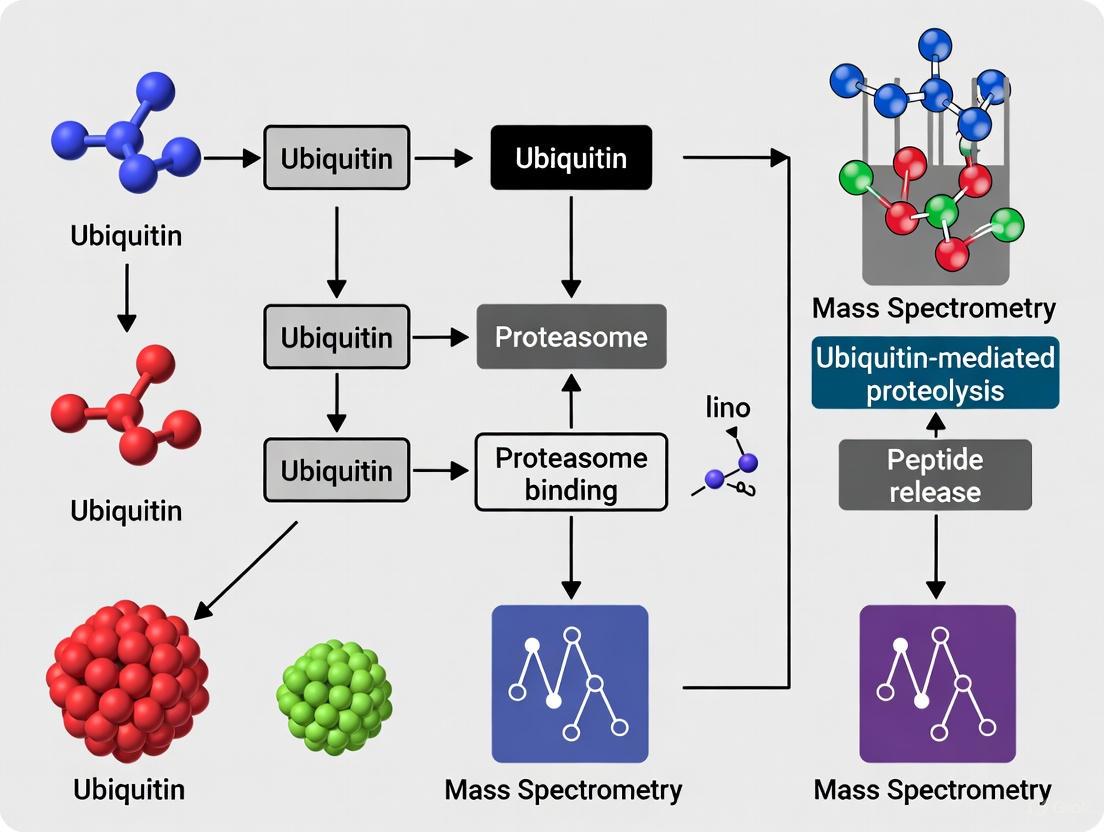
This article provides a comprehensive overview of mass spectrometry (MS)-based methodologies for analyzing the ubiquitin-proteasome system (UPS).
Mass Spectrometry Analysis of Ubiquitin-Proteasome Degradation: From Fundamental Mechanisms to Cutting-Edge Applications
Abstract
This article provides a comprehensive overview of mass spectrometry (MS)-based methodologies for analyzing the ubiquitin-proteasome system (UPS). It covers foundational principles of ubiquitin signaling and proteasomal degradation, detailed protocols for enriching and identifying ubiquitinated substrates, optimization strategies to overcome analytical challenges, and advanced techniques for validating and quantifying ubiquitinome dynamics. Aimed at researchers and drug development professionals, it synthesizes current knowledge and emerging trends, including the analysis of complex ubiquitin chain topologies and the direct capture of proteasomal degradation products, offering essential insights for studying protein homeostasis in health and disease.
The Ubiquitin-Proteasome System: Core Principles and Signaling Complexity
The ubiquitin-proteasome system (UPS) is the primary pathway for targeted protein degradation in eukaryotic cells, a process essential for maintaining cellular homeostasis by eliminating damaged, misfolded, or short-lived regulatory proteins [1] [2]. This system regulates nearly all biological processes, including cell cycle progression, DNA repair, and signal transduction [3] [2]. At the heart of the UPS lies the ubiquitin conjugation cascade—a precise enzymatic sequence involving E1 (activating), E2 (conjugating), and E3 (ligating) enzymes that collectively tag substrate proteins with ubiquitin for proteasomal recognition and degradation [1] [4]. Dysregulation of this pathway is implicated in numerous diseases, particularly cancer and neurodegenerative disorders, making its components promising therapeutic targets [1] [2]. This technical guide examines the mechanistic roles of E1, E2, and E3 enzymes in target selection, with specific emphasis on contemporary mass spectrometry-based methodologies for analyzing ubiquitination events and their applications in drug discovery.
The Ubiquitin Conjugation Cascade: A Three-Step Enzymatic Process
The process of ubiquitination involves a coordinated three-enzyme cascade that conjugates the small, 76-amino acid protein ubiquitin to specific substrate proteins.
Step 1: Ubiquitin Activation by E1 Enzymes
The cascade initiates with ATP-dependent ubiquitin activation by E1 ubiquitin-activating enzymes. E1 catalyzes the formation of a thioester bond between its active-site cysteine residue and the C-terminal glycine of ubiquitin, resulting in an E1~Ub intermediate. This activated ubiquitin is then transferred to the next enzyme in the pathway [1] [4].
Step 2: Ubiquitin Conjugation by E2 Enzymes
Ubiquitin-conjugating enzymes (E2s) accept the activated ubiquitin from E1 through a transthiolation reaction, forming an E2~Ub thioester intermediate [4]. Humans possess approximately 40 E2 enzymes, each containing a conserved catalytic core domain of ~150 amino acids known as the UBC (ubiquitin-conjugating) domain [4]. While E2s exhibit minimal sequence diversity in their active sites, they play crucial roles in determining the topology of ubiquitin chains through specific residues that orient the acceptor ubiquitin [4].
Step 3: Ubiquitin Ligation by E3 Enzymes
E3 ubiquitin ligases facilitate the final step of ubiquitin transfer, either directly catalyzing the formation of an isopeptide bond between ubiquitin and a lysine residue on the substrate protein or acting as scaffolds that bring the E2~Ub complex into close proximity with the substrate [1]. With over 600 members in humans, E3 ligases provide the exquisite substrate specificity that enables selective targeting within the ubiquitin system [1] [2]. The architecture of the resulting ubiquitin chain—specifically which of the seven lysine residues (K6, K11, K27, K29, K33, K48, K63) or the N-terminal methionine (M1) in ubiquitin is used for linkage—determines the functional consequence for the modified substrate [1].
Table 1: Major Ubiquitin Linkage Types and Their Primary Functions
| Linkage Type | Primary Functions | Associated Biological Processes |
|---|---|---|
| K48-linked | Primary degradation signal | Targets substrates to 26S proteasome for degradation [1] |
| K63-linked | Non-degradative signaling | DNA damage repair, cytokine signaling, autophagic degradation [1] |
| K11-linked | Proteasomal degradation | Cell cycle regulation, membrane trafficking [1] |
| K29/K48-branched | Enhanced degradation signal | Accelerates degradation of N-end rule substrates [5] |
| M1-linked (linear) | NF-κB signaling activation | Immune and inflammatory responses [1] |
| K6-linked | DNA damage response | Quality control pathways [1] |
| K27-linked | Innate immune response | Mitochondrial damage response, protein secretion [1] |
E3 Ubiquitin Ligases: Architects of Specificity
E3 ubiquitin ligases constitute the most diverse and specialized component of the ubiquitination cascade, directly interacting with both the E2~Ub complex and substrate proteins to determine specificity. They are classified into three major families based on their structural features and catalytic mechanisms.
RING-type E3 Ligases
Really Interesting New Gene (RING) E3 ligases represent the largest E3 family, with over 600 members in humans [1]. RING-type E3s function primarily as scaffolds that simultaneously bind both the E2~Ub complex and the substrate protein, facilitating the direct transfer of ubiquitin from the E2 to the substrate without forming a covalent E3~Ub intermediate [1]. They are further subdivided into monomeric RING finger enzymes (e.g., Mdm2, TRAF6) and multi-subunit complexes such as cullin-RING ligases (CRLs) [1]. The SCF (Skp1-Cul1-F-box protein) complex is a well-characterized CRL where the F-box protein determines substrate specificity [2].
HECT-type E3 Ligases
The Homologous to E6AP C-terminus (HECT) E3 ligase family is characterized by a conserved HECT domain that forms a covalent thioester intermediate with ubiquitin before transferring it to the substrate [1] [5]. This double-transfer mechanism distinguishes HECT E3s from RING E3s. The HECT family includes three subfamilies: the Nedd4 family (characterized by WW domains and a C2 domain), the HERC family (containing RCC1-like domains), and other HECTs including E6AP and HUWE1 [1]. Recent structural studies of Ufd4, a HECT E3, have revealed how its N-terminal ARM region and HECT domain C-lobe collaborate to recruit K48-linked diubiquitin and orient Lys29 for branched ubiquitination [5].
RBR-type E3 Ligases
RING-between-RING (RBR) E3 ligases represent a hybrid mechanism, incorporating features from both RING and HECT-type E3s [4]. While they contain RING domains that bind E2~Ub, they also utilize a conserved cysteine residue in the RING2 domain to form a transient thioester intermediate with ubiquitin before substrate transfer, similar to HECT E3s [4]. Notable RBR E3s include Parkin, which plays a crucial role in mitochondrial quality control and is linked to Parkinson's disease [1].
Table 2: Major E3 Ligase Families and Their Characteristics
| E3 Family | Catalytic Mechanism | Key Structural Features | Representative Members |
|---|---|---|---|
| RING-type | Scaffold-mediated direct transfer | RING domain for E2 binding | Mdm2, TRAF6, SCF complex [1] |
| HECT-type | Double-transfer via E3~Ub intermediate | C-terminal HECT domain | Nedd4 family, HERC family, Ufd4 [1] [5] |
| RBR-type | Hybrid mechanism with transient thioester | RING1-IBR-RING2 domains | Parkin, HOIP, HOIL-1 [1] [4] |
E2-E3 Hybrid Enzymes: Exceptional Catalytic Mechanisms
Beyond the classical three-enzyme cascade, certain enzymes combine E2 and E3 functionalities into single polypeptides. UBE2O and BIRC6 are notable examples of these E2/E3 hybrid enzymes that catalyze substrate ubiquitination independently of additional E3 ligases [3]. Structural studies of UBE2O have revealed that dimerization is crucial for its ubiquitination activity, with autoubiquitination within its CR1-CR2 region enhancing catalytic function [3]. Unlike conventional E3s, UBE2O catalyzes the formation of all seven types of polyubiquitin chains in vitro and plays important roles in tumorigenesis, adipogenesis, and erythroid differentiation [3].
Mass Spectrometry Methodologies for Ubiquitination Analysis
Advanced mass spectrometry (MS) techniques have revolutionized the study of ubiquitination by enabling precise mapping of modification sites, quantification of ubiquitin chain topology, and characterization of dynamic protein-protein interactions within the ubiquitin system.
In-situ Cross-Linking Mass Spectrometry (XL-MS)
In-situ XL-MS combines cell-permeable cross-linking reagents with high-resolution MS to capture protein interactions and structural dynamics within native cellular environments. Recent applications of this technology to the 26S proteasome have revealed extensive compositional and conformational heterogeneity between nuclear and cytoplasmic proteasomes, along with distinct interactomes and dynamic states [6]. This approach has identified previously unreported proteasome-interacting proteins, including deubiquitinase USP15, and revealed hybrid proteasome variants where translation initiation factors substitute for standard subunits [6].
Experimental Protocol: In-situ XL-MS for Proteasome Interactions
- Cell Permeabilization and Cross-linking: Treat cells with cell-permeable, trifunctional cross-linker bis(succinimidyl) with propargyl tag (BSP) for minutes to allow diffusion into cellular compartments [6].
- Subcellular Fractionation: Separate nuclear and cytoplasmic fractions to assess compartment-specific interactions [6].
- Affinity Purification: Isbrate cross-linked complexes using cells expressing biotin-tagged proteasomal subunits (e.g., Rpn11) [6].
- Enrichment and Cleavage: Use acid-hydrolyzable click reagent for streptavidin affinity purification, with biotin removal during liquid chromatography in acidic buffer [6].
- LC-MS/MS Analysis: Perform high-resolution mass spectrometry with database searching to identify cross-linked peptides, implementing stringent false discovery rate controls [6].
In-situ XL-MS Workflow for Ubiquitin-Proteasome Analysis
Proximal-Ubiquitomics for Deubiquitinase Substrate Discovery
Integrative proximal-ubiquitomics combines APEX2-based proximity labeling with K-ε-GG ubiquitin remnant enrichment to identify substrates of deubiquitinases (DUBs) within their native microenvironments [7]. This approach allows spatially resolved detection of site-specific deubiquitination events. When applied to mitochondrial DUB USP30, this method successfully identified known substrates (TOMM20, FKBP8) and novel candidates (LETM1), demonstrating its utility for mapping DUB-substrate relationships [7].
Experimental Protocol: Proximal-Ubiquitomics for DUB Substrates
- APEX2 Labeling: Express APEX2-tagged DUB of interest in cells and perform proximity labeling with biotin-phenol and H₂O₂ treatment [7].
- Cell Lysis and Streptavidin Enrichment: Lyse cells and capture biotinylated proteins with streptavidin beads [7].
- On-bead Digestion: Digest captured proteins with trypsin while bound to beads [7].
- K-ε-GG Enrichment: Immunoprecipitate ubiquitin remnant peptides containing K-ε-GG motif with specific antibodies [7].
- LC-MS/MS Analysis: Analyze enriched peptides using high-resolution mass spectrometry [7].
- Data Analysis: Identify ubiquitination sites with altered abundance upon DUB inhibition to pinpoint potential direct substrates [7].
Middle-down MS for Ubiquitin Chain Topology
Middle-down MS approaches, such as Ub-clipping, enable characterization of branched ubiquitin chains by analyzing large peptide fragments after limited proteolysis [5]. This method has been instrumental in identifying K29/K48-branched ubiquitin chains synthesized by Ufd4, which serve as enhanced degradation signals [5].
The Scientist's Toolkit: Essential Research Reagents
Table 3: Key Research Reagents for Ubiquitination Studies
| Reagent / Tool | Function / Application | Key Features |
|---|---|---|
| Cell-permeable cross-linkers (BSP) | Stabilize protein interactions in live cells for XL-MS | Trifunctional with propargyl tag for enrichment; low cellular toxicity [6] |
| K-ε-GG antibodies | Immunoaffinity enrichment of ubiquitinated peptides | Specific recognition of diglycine remnant on lysine after trypsin digestion [7] |
| APEX2 proximity labeling system | Mapping protein interactions in specific cellular compartments | Engineered ascorbate peroxidase for spatial proteomics; rapid labeling [7] |
| PROTAC molecules | Targeted protein degradation; study E3 ligase function | Heterobifunctional molecules recruiting E3 ligases to target proteins [8] |
| Ubiquitin chain-specific antibodies | Detection of specific ubiquitin linkage types | Selective recognition of K48, K63, or other linkage types [1] |
| Activity-based DUB probes | Profiling deubiquitinase activity and specificity | Covalently trap active DUBs for identification and characterization [7] |
Applications in Targeted Protein Degradation and Drug Discovery
The understanding of ubiquitin conjugation mechanisms has enabled innovative therapeutic approaches, particularly in targeted protein degradation. Proteolysis-Targeting Chimeras (PROTACs) are heterobifunctional molecules that recruit E3 ligases to target proteins of interest, inducing their ubiquitination and degradation [8]. Mass spectrometry plays crucial roles in PROTAC development by:
- Verifying target engagement and degradation efficiency through quantitative proteomics [8]
- Identifying ubiquitination sites on target proteins via ubiquitylomics [8]
- Characterizing ternary complex formation between PROTAC, target protein, and E3 ligase [8]
- Assessing selectivity and off-target effects through global proteomic profiling [8]
Several PROTAC candidates are currently in clinical trials, demonstrating the therapeutic potential of harnessing the ubiquitin conjugation cascade for disease treatment [8].
The ubiquitin conjugation cascade represents a sophisticated enzymatic system for targeted protein degradation, with E1, E2, and E3 enzymes working in concert to ensure precise substrate selection and ubiquitination. The development of advanced mass spectrometry methodologies—including in-situ XL-MS, proximal-ubiquitomics, and quantitative ubiquitylomics—has dramatically enhanced our ability to study these processes in native cellular environments. These techniques have revealed unprecedented details about proteasome heterogeneity, ubiquitin chain architecture, and compartment-specific regulation of ubiquitination events. As our understanding of the ubiquitin code deepens, and as technologies for manipulating the UPS advance, the potential for developing novel therapeutics targeting components of the ubiquitin cascade continues to expand, particularly in the areas of targeted protein degradation and treatment of proteinopathies.
The ubiquitin-proteasome system (UPS) represents a critical pathway for controlled protein degradation in eukaryotic cells, with the specificity of this process governed by the topology of the ubiquitin chain attached to substrate proteins. While K48-linked homotypic chains have long been recognized as the canonical degradation signal, recent advances have revealed that branched ubiquitin chains containing K48 in combination with other linkages (particularly K11) function as potent degradation signals that can enhance substrate targeting to the proteasome. This technical review examines the evolution of our understanding of ubiquitin chain topology, from fundamental K48-linked chains to complex branched architectures, with particular emphasis on structural insights, detection methodologies, and functional consequences for proteasomal degradation. The emerging paradigm suggests that chain branching represents a sophisticated mechanism for regulating the efficiency and priority of substrate processing within the UPS, with significant implications for therapeutic intervention in protein homeostasis-related diseases.
Ubiquitination is an essential post-translational modification that controls a vast array of cellular processes through the covalent attachment of ubiquitin to target proteins. The versatility of ubiquitin signaling stems from its ability to form diverse polymeric chains through isopeptide bonds between the C-terminus of one ubiquitin and any of seven lysine residues (K6, K11, K27, K29, K33, K48, K63) or the N-terminal methionine (M1) of another ubiquitin [9]. The structural architecture of these chains—including their linkage composition, length, and branching pattern—creates a sophisticated "ubiquitin code" that determines the functional outcome of the modification.
For decades, K48-linked ubiquitin chains have been recognized as the principal signal for proteasomal degradation [10]. However, recent research has dramatically expanded this paradigm, revealing that branched ubiquitin chains—particularly those incorporating K48 linkages—can serve as specialized and often enhanced degradation signals [9] [11]. These branched architectures comprise at least one ubiquitin monomer simultaneously modified at two different acceptor sites, creating a complex topological structure that can be specifically recognized by the proteasome and associated factors [9] [12].
This review synthesizes current understanding of how ubiquitin chain topology defines the degradation signal, with emphasis on the transition from homogeneous K48-linked chains to complex branched structures. We examine the structural basis for recognition, analytical methodologies for detection and quantification, and the functional implications for targeted protein degradation in physiological and pathological contexts.
Classical View: K48-Linked Homotypic Chains as the Canonical Degradation Signal
The Ubiquitin-Proteasome Pathway
The ubiquitin-proteasome pathway involves a sequential enzymatic cascade: E1 (ubiquitin-activating), E2 (ubiquitin-conjugating), and E3 (ubiquitin-ligase) enzymes work in concert to attach ubiquitin to substrate proteins [10]. Repeated cycles of ubiquitination lead to the formation of polyubiquitin chains, which are recognized by the 26S proteasome for subsequent degradation. The 26S proteasome is a multi-subunit complex comprising a 20S core particle (CP) that carries out proteolysis and a 19S regulatory particle (RP) that recognizes ubiquitinated substrates, removes ubiquitin chains, and unfolds substrates for translocation into the CP [10].
K48-Linked Chains and Proteasomal Recognition
K48-linked ubiquitin chains represent the most abundant ubiquitin chain type in eukaryotic cells and serve as the primary degradation signal for the UPS [13] [14]. Structural studies have revealed that K48-linked di-ubiquitin adopts a compact conformation in which the two ubiquitin subunits interact through a hydrophobic patch centered on I44 [11]. This characteristic interface is recognized by ubiquitin receptors on the proteasome, including RPN10 and RPN13 [12].
The length of K48-linked chains also influences degradation efficiency, with tetra-ubiquitin generally considered the minimal signal for efficient proteasomal targeting [13]. However, this requirement is not absolute, and significant context-dependent variability exists [14].
Table 1: Major Ubiquitin Chain Linkages and Their Primary Functions
| Linkage Type | Abundance | Primary Functions | Proteasomal Degradation |
|---|---|---|---|
| K48 | High | Primary degradation signal | Strong signal |
| K11 | High | Mitotic degradation, ERAD | Strong signal (especially when branched with K48) |
| K63 | High | DNA repair, signaling, endocytosis | Not typically (except in branched chains) |
| M1 | Low | NF-κB signaling, inflammation | Not typically |
| K29 | Low | ERAD, proteasomal degradation | Weak signal |
| K6 | Low | DNA repair, mitophagy | Context-dependent |
| K27 | Low | Immune signaling | Context-dependent |
| K33 | Low | T-cell signaling, trafficking | Not typically |
Branched Ubiquitin Chains: Enhanced Degradation Signals
Architecture and Synthesis of Branched Ubiquitin Chains
Branched ubiquitin chains contain at least one ubiquitin monomer modified simultaneously at two different acceptor sites, creating a complex topological structure that significantly expands the coding potential of ubiquitin signaling [9]. These chains can be classified based on their linkage composition (e.g., K11/K48, K29/K48, K48/K63) and architecture (e.g., the position of branch points within the chain) [9].
The synthesis of branched chains often involves collaboration between E3 ligases with distinct linkage specificities [9]. For example:
- K11/K48 branches: The anaphase-promoting complex/cyclosome (APC/C) collaborates with E2 enzymes UBE2C and UBE2S to assemble branched K11/K48 chains on mitotic substrates [9] [11]. UBE2C initially attaches short chains containing mixed linkages, followed by UBE2S extending these chains with K11 linkages, resulting in branched polymers [9].
- K48/K63 branches: TRAF6 (synthesizing K63 linkages) and HUWE1 (adding K48 branches) collaborate during NF-κB signaling [15], while ITCH (K63-specific) and UBR5 (K48-specific) cooperate during apoptotic responses [9].
Alternative mechanisms involve single E3 ligases that either recruit multiple E2s with different linkage specificities or possess intrinsic capacity to synthesize multiple linkage types [9]. For instance, the HECT E3 WWP1 can synthesize branched K48/K63 chains with a single E2 (UBE2L3), while Parkin assembles branched K6/K48 chains [9].
K11/K48-Branched Chains: Structural Basis for Enhanced Degradation
Among branched ubiquitin chains, K11/K48-branched structures have been most thoroughly characterized as potent degradation signals. Structural studies of branched K11/K48-linked tri-ubiquitin ([Ub]2-11,48Ub) using X-ray crystallography, NMR, and small-angle neutron scattering have revealed a unique hydrophobic interface between the two distal ubiquitin moieties that are not directly connected to each other [11]. This previously unobserved interface involves the characteristic hydrophobic patches (L8, I44, H68, V70) of both distal ubiquitins and is distinct from the interfaces observed in homogeneous K48- or K11-linked chains [11].
This unique structural feature has functional consequences for proteasomal recognition. Biochemical assays demonstrate that branched K11/K48-linked tri-ubiquitin exhibits significantly stronger binding affinity for the proteasomal subunit Rpn1 compared to homogeneous K48-linked chains [11]. This enhanced binding provides a mechanistic explanation for the observation that substrates modified with K11/K48-branched chains undergo accelerated proteasomal degradation during mitosis and proteotoxic stress [11] [12].
Recent cryo-EM structures of human 26S proteasome in complex with K11/K48-branched ubiquitin chains have elucidated the structural basis for this preferential recognition [12]. The structures reveal a multivalent binding mechanism wherein:
- The K48-linked branch engages the canonical K48-linkage binding site formed by RPN10 and RPT4/5
- The K11-linked branch binds to a novel site at a groove formed by RPN2 and RPN10
- RPN2 additionally recognizes an alternating K11-K48-linkage through a conserved motif similar to the K48-specific T1 binding site of RPN1 [12]
This tripartite recognition mechanism explains how K11/K48-branched ubiquitin chains function as priority degradation signals that enhance substrate targeting to the proteasome under specific physiological conditions [12].
K48/K63-Branched Chains: Context-Dependent Functions
Branched chains containing K48 and K63 linkages exhibit context-dependent functions in cellular signaling. In NF-κB activation, K48/K63-branched chains formed by TRAF6 and HUWE1 in response to IL-1β stimulation serve to amplify signaling by protecting K63 linkages from CYLD-mediated deubiquitination while maintaining recognition by TAB2 [15]. In this context, the K48 branch does not target the substrate for degradation but rather stabilizes the signaling complex [15].
In contrast, during apoptotic responses, K48/K63-branched chains formed by ITCH and UBR5 on the pro-apoptotic regulator TXNIP promote its proteasomal degradation [9]. This demonstrates how the same branched linkage combination can yield different functional outcomes depending on cellular context, substrate identity, and associated proteins.
Table 2: Characterized Branched Ubiquitin Chains and Their Functions
| Branched Chain Type | Synthesizing Enzymes | Cellular Function | Effect on Degradation |
|---|---|---|---|
| K11/K48 | APC/C (UBE2C+UBE2S) | Mitotic progression, proteotoxic stress | Enhances degradation |
| K48/K63 | TRAF6+HUWE1 | NF-κB signaling | Protects from degradation (in context of NF-κB) |
| K48/K63 | ITCH+UBR5 | Apoptosis | Promotes degradation |
| K29/K48 | Ufd4+Ufd2 | Ubiquitin fusion degradation pathway | Promotes degradation |
| K6/K48 | Parkin, NleL | Quality control, bacterial infection | Context-dependent |
Analytical Methods for Studying Ubiquitin Chain Topology
Mass Spectrometry-Based Approaches
Mass spectrometry has revolutionized the study of ubiquitin chain topology by enabling comprehensive mapping of linkage types, branching patterns, and dynamics under different cellular conditions [16] [17].
Bottom-up proteomics approaches involve tryptic digestion of ubiquitinated proteins, followed by identification of ubiquitin remnants using the characteristic di-glycine (GG) tag (114.043 Da) on modified lysine residues [16]. When combined with quantitative strategies such as stable isotope labeling with amino acids in cell culture (SILAC), this approach enables profiling of ubiquitinated proteomes under different experimental conditions [16].
However, conventional bottom-up approaches have limitations for analyzing branched ubiquitin chains, as multiple modifications on a single ubiquitin molecule are difficult to detect after tryptic digestion [17]. To overcome this limitation, middle-down mass spectrometry methods have been developed. The Ubiquitin Chain Enrichment Middle-down Mass Spectrometry (UbiChEM-MS) platform combines ubiquitin chain enrichment using linkage-specific ubiquitin-binding domains (UBDs) with minimal trypsinolysis and high-resolution MS analysis [17].
In UbiChEM-MS, minimal trypsinolysis under nondenaturing conditions cleaves ubiquitin specifically between R74 and G75, generating a Ub1-74 fragment (calc. 8450.57 Da) [17]. A ubiquitin monomer within a linear chain produces a GG-modified Ub1-74 fragment (calc. 8564.62 Da), while a branched ubiquitin yields a fragment with two GG modifications (2xGG-Ub1-74, calc. 8678.66 Da), enabling direct detection of branching events [17]. Using this approach, researchers have quantified that approximately 1-4% of total ubiquitin chains contain branch points under normal conditions, rising to ~4% after proteasome inhibition [17].
Absolute quantification (AQUA) of ubiquitin linkages using synthetic isotope-labeled ubiquitin peptides provides another powerful approach for comprehensive ubiquitin chain analysis [15]. This method has revealed that K48-K63 branched linkages are surprisingly abundant in mammalian cells and are dynamically regulated in response to stimuli such as IL-1β [15].
Ubiquitin Chain Enrichment and Interaction Studies
Ubiquitin interactor screens using immobilized ubiquitin chains of defined topology have identified proteins with specificity for branched chains. Recent studies have identified several K48/K63 branch-specific interactors, including:
- PARP10/ARTD10: A histone ADP-ribosyltransferase
- UBR4: An E3 ubiquitin ligase
- HIP1: Huntingtin-interacting protein [13] [14]
These screens typically employ enzymatically synthesized ubiquitin chains (mono-Ub, homotypic K48 and K63 Ub2 and Ub3, and K48/K63 branched Ub3) immobilized on resin via a C-terminal biotin tag [13]. After incubation with cell lysates treated with deubiquitinase inhibitors (chloroacetamide or N-ethylmaleimide), specifically bound proteins are identified by liquid chromatography-mass spectrometry (LC-MS) [13] [14].
Such approaches have revealed that chain length significantly influences ubiquitin interactor binding, with proteins such as CCDC50 (autophagy receptor), FAF1 (p97 adaptor), and DDI2/Ddi1 (ubiquitin-directed endoprotease) showing preference for Ub3 over Ub2 chains [13] [14].
Diagram Title: Experimental Workflows for Ubiquitin Chain Analysis
Research Reagent Solutions for Ubiquitin Chain Analysis
Table 3: Essential Research Reagents for Ubiquitin Chain Analysis
| Reagent / Tool | Function / Application | Examples / Specifics |
|---|---|---|
| Linkage-Specific Ubiquitin Binding Domains (UBDs) | Enrichment of specific ubiquitin chain types | TUBEs (pan-specific), NZF1 from TRABID (K29-selective) [17] |
| Ubiquitin Variants | Study of linkage-specific functions | K63R Ub (blocks K63 linkages), K11R Ub (blocks K11 linkages) [16] |
| Deubiquitinase (DUB) Inhibitors | Preservation of ubiquitin chains during analysis | Chloroacetamide (CAA), N-ethylmaleimide (NEM) [13] [14] |
| Linkage-Specific Antibodies | Detection of specific ubiquitin linkages | Commercial antibodies for K48, K63, K11 linkages [10] |
| Proteasome Inhibitors | Accumulation of ubiquitinated proteins | MG132, Bortezomib, Carfilzomib [10] |
| Quantitative Mass Spectrometry Reagents | Quantitative ubiquitin proteomics | SILAC amino acids ([13C6,15N4]Arg, [13C6,15N2]Lys), TMT labels [16] |
| Engineered E2/E3 Systems | Synthesis of defined ubiquitin chains | Rsp5-HECTGML (K48-specific), Ubc1 (K48-branching) [12] [13] |
| Ubiquiton System | Inducible, linkage-specific polyubiquitylation | Engineered E3 ligases with matching acceptor tags for M1, K48, K63 linkages [18] |
Technical Protocols for Key Experiments
Enrichment of Ubiquitinated Proteins from Yeast Lysate for MS Analysis
This protocol describes the enrichment of ubiquitinated proteins from yeast cells for subsequent mass spectrometric analysis, adapted from [16].
Materials:
- Yeast strains (e.g., expressing His-tagged ubiquitin)
- Lysis buffer: 10 mM Tris, pH 8.0, 0.1 M NaH2PO4, 8 M urea, 10 mM β-mercaptoethanol
- Washing buffers: Buffer A (10 mM Tris, pH 8.0, 0.1 M NaH2PO4, 8 M urea, 10 mM iodoacetamide), Buffer B (10 mM Tris, pH 6.3, 0.1 M NaH2PO4, 8 M urea, 10 mM iodoacetamide)
- Elution buffer: 10 mM Tris, pH 4.5, 0.1 M NaH2PO4, 8 M urea, 10 mM iodoacetamide
- Ni-NTA agarose resin
- BeadBeater and glass beads (0.5 mm diameter)
Procedure:
- Grow yeast cells in appropriate media to mid-log phase.
- Harvest cells by centrifugation and resuspend in lysis buffer.
- Lyse cells using BeadBeater with glass beads (6 cycles of 30 seconds beating, 90 seconds cooling on ice).
- Clarify lysate by centrifugation at 20,000 × g for 15 minutes.
- Incubate supernatant with Ni-NTA agarose resin for 2 hours at room temperature with gentle agitation.
- Wash resin sequentially with:
- 10 column volumes of Buffer A
- 10 column volumes of Buffer B
- Elute ubiquitinated proteins with 5 column volumes of Elution buffer.
- Precipitate proteins with acetone or proceed directly to tryptic digestion for MS analysis.
UbiChEM-MS for Branched Ubiquitin Chain Detection
This protocol outlines the Ubiquitin Chain Enrichment Middle-down Mass Spectrometry method for detecting branched ubiquitin chains, adapted from [17].
Materials:
- Halo-NZF1 resin or TUBE resin
- Binding buffer: 50 mM Tris, 150 mM NaCl, 10% glycerol, 0.05% IGEPAL CA-630
- Minimal buffer: 50 mM Tris, 150 mM NaCl, pH 7.5
- Cell lysate (e.g., from HEK293 cells)
- Sequencing-grade trypsin
- Acetic acid
- C18 columns for desalting
Procedure:
- Prepare Halo-NZF1 resin by incubating HaloTag-NZF1 fusion protein with HaloLink resin overnight at 4°C.
- Incubate resin (100-200 μL) with cell lysate (45 mg) overnight at 4°C with gentle rotation.
- Pellet resin at 800 × g for 2 minutes and discard supernatant.
- Wash resin three times with 2 mL binding buffer and twice with 2 mL minimal buffer.
- Perform on-resin minimal trypsinolysis by resuspending resin in minimal buffer and adding trypsin (empirically determined ratio).
- Incubate at room temperature for 16 hours with gentle agitation.
- Acidify samples to pH 2 with acetic acid to deactivate trypsin.
- Centrifuge at 13,000 × g for 5 minutes at 4°C and collect supernatant.
- Desalt samples using C18 columns following standard procedures.
- Analyze by high-resolution mass spectrometry (Orbitrap Fusion Tribrid or similar).
- Identify Ub1-74 (calc. 8450.57 Da), GG-Ub1-74 (calc. 8564.62 Da), and 2xGG-Ub1-74 (calc. 8678.66 Da) species using appropriate software (e.g., MASH Suite).
Ubiquitin Interactor Pull-Down Assay
This protocol describes a method for identifying proteins that specifically interact with defined ubiquitin chain architectures, adapted from [13] [14].
Materials:
- Enzymatically synthesized ubiquitin chains (mono-Ub, Ub2, Ub3, branched Ub3)
- Streptavidin resin
- Cysteine-maleimide biotin conjugation kit
- Cell lysate (HeLa or yeast)
- Deubiquitinase inhibitors: chloroacetamide (CAA) or N-ethylmaleimide (NEM)
- Binding buffer: 50 mM Tris-HCl, pH 7.5, 150 mM NaCl, 0.1% NP-40
- Elution buffer: 100 mM glycine, pH 2.5, or 2× SDS-PAGE loading buffer
Procedure:
- Conjugate ubiquitin chains to biotin using cysteine-maleimide chemistry.
- Immobilize biotinylated ubiquitin chains on streptavidin resin.
- Pre-clear cell lysate with empty streptavidin resin for 30 minutes at 4°C.
- Incubate immobilized ubiquitin chains with pre-cleared cell lysate (supplemented with 10 mM CAA or NEM) for 2 hours at 4°C with gentle rotation.
- Wash resin five times with 10 column volumes of binding buffer containing 5 mM CAA or NEM.
- Elute bound proteins with elution buffer or directly digest on-bead for MS analysis.
- Identify specifically bound proteins by liquid chromatography-mass spectrometry.
- Analyze data using statistical methods to identify enrichment patterns specific to chain length and branching.
The transition from viewing K48-linked homotypic chains as the sole degradation signal to recognizing the functional significance of branched ubiquitin chains represents a paradigm shift in our understanding of the ubiquitin-proteasome system. Branched ubiquitin chains, particularly K11/K48-branched architectures, function as enhanced degradation signals that enable priority processing of specific substrates during critical cellular transitions such as mitosis and proteotoxic stress.
The structural basis for this enhanced degradation involves unique interfaces in branched chains that enable multivalent interactions with proteasomal receptors, particularly Rpn1 and Rpn2, leading to higher affinity binding and more efficient substrate processing [11] [12]. Advanced analytical methodologies, including UbiChEM-MS and quantitative ubiquitin proteomics, have been instrumental in detecting and characterizing these complex ubiquitin architectures and their dynamics in cellular contexts.
Future research directions will likely focus on:
- Developing more sophisticated tools for specific manipulation of branched chain formation in cells
- Elucidating the temporal regulation of branched chain synthesis and disassembly
- Understanding how branch-specific reader proteins decode the information contained in complex ubiquitin architectures
- Exploring the therapeutic potential of modulating branched ubiquitin chain formation in disease contexts, particularly cancer and neurodegenerative disorders
As our technical capabilities for analyzing and manipulating ubiquitin chain topology continue to advance, so too will our understanding of how these complex signals orchestrate the precise control of protein degradation that is essential for cellular homeostasis.
The 26S proteasome serves as the essential endpoint of the ubiquitin-proteasome system, functioning as the principal proteolytic machine responsible for regulated protein degradation in eukaryotic cells [19]. Its cellular functions extend from general protein homeostasis and stress response to the precise control of vital processes including cell division, signal transduction, and immune response [19] [10]. The proteasome achieves the remarkable feat of combining high promiscuity with exceptional substrate selectivity to reliably process the diverse array of proteins presented to it in the complex cellular environment [19]. Recent structural and biochemical studies have shed new light on the intricate multi-step process of proteasomal substrate processing, including ubiquitin-dependent recognition, deubiquitination, and ATP-driven translocation and unfolding [19] [20]. These advances reveal a complex conformational landscape that ensures proper substrate selection before the proteasome commits to processive degradation [19]. This technical guide comprehensively details the architecture, mechanistic principles, and experimental methodologies for studying the 26S proteasome, with particular emphasis on its central role in ubiquitin-dependent degradation pathways relevant to mass spectrometry-based research.
Architectural Organization of the 26S Proteasome
The 26S proteasome is a 2.5 MDa multi-subunit complex that represents the most sophisticated compartmental protease of the AAA+ family [10] [21]. It operates through the coordinated function of two major subcomplexes: the 20S core particle (CP) that houses the proteolytic active sites, and the 19S regulatory particle (RP) that recognizes ubiquitinated substrates and prepares them for degradation [10].
The 20S Core Particle (CP)
The 20S core particle forms the catalytic heart of the proteasome, featuring a barrel-shaped structure composed of four stacked heptameric rings arranged as α7β7β7α7 [22]. The outer α-rings provide a gated channel that controls substrate entry into the proteolytic chamber, while the inner β-rings contain three distinct proteolytic active sites (caspase-like, trypsin-like, and chymotrypsin-like) that collectively degrade substrates into small peptides [22]. The architecture ensures that only unfolded polypeptides can access the proteolytic chamber, maintaining specificity against native cellular proteins [10].
The 19S Regulatory Particle (RP)
The 19S regulatory particle can be further divided into two subassemblies: the base and the lid [23] [22].
Table 1: Major Subunits of the 19S Regulatory Particle
| Subcomplex | Component Type | Key Subunits | Primary Functions |
|---|---|---|---|
| Base | AAA+ ATPases | Rpt1-Rpt6 | Substrate unfolding, translocation, gate opening |
| Base | Ubiquitin Receptors | Rpn10, Rpn13 | Ubiquitin chain binding |
| Lid | Deubiquitinases | Rpn11, USP14, Uch37 | Ubiquitin chain processing and recycling |
| Lid | PCI domain proteins | Rpn3,5,6,7,9,12 | Structural scaffold, ubiquitin receptor assembly |
The base contains six distinct AAA+ ATPases (Rpt1-Rpt6) that form a heterohexameric ring, which uses ATP hydrolysis to unfold substrates and translocate them into the 20S core [23] [22]. The base also incorporates several ubiquitin receptors, including Rpn10 and Rpn13, that facilitate substrate recognition [22]. The lid comprises at least nine non-ATPase subunits (Rpn3, 5-9, 11, 12) and contains the deubiquitinating enzyme Rpn11 that removes ubiquitin chains prior to substrate degradation [21] [22].
Recent cryo-EM structures of the human 26S proteasome at near-atomic resolution (3.5-3.9 Å) have revealed the intricate architecture in unprecedented detail, enabling atomic modeling of 28 subunits in the core particle and 18 subunits in the regulatory particle [22]. These structures show the C-terminal residues of Rpt3 and Rpt5 subunits inserting into surface pockets between adjacent α subunits in the CP, mediating gate opening [22].
Mechanisms of Ubiquitin-Dependent Substrate Recognition
The Ubiquitin Code
Ubiquitin is a 76-amino acid protein that is covalently attached to substrate proteins through a sequential enzymatic cascade involving E1 (activating), E2 (conjugating), and E3 (ligating) enzymes [10]. The ubiquitin code represents a sophisticated post-translational regulatory system where different ubiquitin chain topologies (linking through different lysine residues) encode distinct cellular fates for modified proteins [16]. While conventional K48-linked polyubiquitin chains typically target substrates for proteasomal degradation, other chain types (including K11, K29) have also been implicated in degradation signaling [16] [24]. Mono-ubiquitination and K63-linked polyubiquitin chains generally function in proteasome-independent pathways such as protein sorting, DNA repair, and inflammation [16].
Ubiquitin Receptors and Binding Mechanisms
The proteasome employs multiple ubiquitin receptors that function uniquely and cooperatively to recognize ubiquitinated substrates [25]. These receptors include intrinsic proteasomal subunits (Rpn10, Rpn13) and transiently associated shuttling factors [25] [20]. The combinatorial action of these receptors allows the proteasome to recognize a highly diverse set of substrates marked with different ubiquitin chain architectures [25].
Recent structural studies reveal that substrate-engaged proteasome complexes undergo significant conformational rearrangements that enable optimal positioning of ubiquitin chains for recognition [25] [23]. The proteasome's ubiquitin receptors exhibit remarkable versatility in binding different ubiquitin chain types, with Rpn13 specifically recognizing K48-linked ubiquitin chains through a well-defined binding pocket [22].
Table 2: Proteasomal Ubiquitin Receptors and Their Characteristics
| Receptor | Location | Ubiquitin Chain Preference | Key Structural Features |
|---|---|---|---|
| Rpn10 | 19S RP Lid | K48-linked, mono-ubiquitin | Ubiquitin-interacting motifs (UIMs) |
| Rpn13 | 19S RP Base | K48-linked | Pru domain with high-affinity binding pocket |
| Rpn1 | 19S RP Base | Multiple chain types | Large surface area with toroidal structure |
| Shuttling Factors | Transient association | Variable | Deliver specific substrate classes |
The following diagram illustrates the sequential process of substrate recognition and engagement by the 26S proteasome:
Substrate Processing and Degradation Mechanism
Conformational Switching and Substrate Engagement
The 26S proteasome exhibits remarkable conformational dynamics that regulate substrate processing [20]. Single-particle cryo-EM studies have identified multiple conformational states of the proteasome, including substrate-free resting states and substrate-engaged working states [23] [22]. Upon ubiquitin binding, the proteasome undergoes a conformational switch that aligns the ATPase ring for optimal substrate engagement and activates the deubiquitinase Rpn11 [20] [21].
Recent cryo-EM structures of substrate-engaged human proteasome complexes at 2.8-3.6 Å resolution have captured the degradation process in action, revealing a spatiotemporal continuum of dynamic substrate-proteasome interactions from ubiquitin recognition to substrate translocation [23]. These structures show that ATP hydrolysis sequentially navigates through all six ATPases in three principal modes: hydrolysis in two oppositely positioned ATPases regulates deubiquitination, hydrolysis in two adjacent ATPases initiates translocation, and hydrolysis in one ATPase at a time drives processive unfolding [23].
Deubiquitination and Translocation
Deubiquitination is a critical step that precedes substrate degradation and requires the coordinated action of proteasome-associated deubiquitinating enzymes (DUBs) [21]. The metalloprotease Rpn11, positioned at the entrance to the ATPase ring, removes entire ubiquitin chains from substrates in an ATP-dependent manner, coupling deubiquitination with translocation commitment [21] [22]. Two regulatory DUBs, USP14 and Uch37, can trim ubiquitin chains and modulate degradation efficiency, with USP14 acting as an ubiquitin-dependent timer that coordinates individual processing steps [21] [22].
Following deubiquitination, the ATPase motor engages an unstructured region within the substrate and initiates mechanical unfolding through repetitive ATP-hydrolysis-driven movements [23]. Each ATP hydrolysis cycle powers a hinge-like motion in the ATPase subunits that generates mechanical force on the substrate, with synchronized ATP binding, ADP release, and hydrolysis in adjacent ATPases driving rigid-body rotations that propagate unidirectionally around the ATPase ring to unfold the substrate [23].
Experimental Methods for Analyzing Proteasomal Degradation
Mass Spectrometry-Based Ubiquitinome Analysis
Mass spectrometry has revolutionized the study of ubiquitin-proteasome system by enabling comprehensive identification and quantification of ubiquitinated proteins [16] [24]. The key methodological challenge involves enriching for low-abundance ubiquitinated species from complex cellular extracts, which is typically accomplished using antibodies specific for the diglycine (GG) remnant that remains on ubiquitin-modified lysine residues after tryptic digestion [16] [24].
Stable Isotope Labeling with Amino Acids in Cell Culture (SILAC) coupled with liquid chromatography-tandem mass spectrometry (LC-MS/MS) has emerged as a powerful quantitative approach for profiling ubiquitinated proteomes under different experimental conditions [16] [24]. This method involves metabolic labeling of cells with "light" (normal) or "heavy" (isotope-enriched) forms of lysine and arginine, followed by proteasome inhibition treatment, mixing of light and heavy samples in a 1:1 ratio, enrichment of ubiquitinated peptides, and LC-MS/MS analysis to identify and quantify ubiquitination sites based on the characteristic 114.043 Da mass shift from the diglycine tag [16] [24].
The following workflow diagram illustrates the key steps in SILAC-based ubiquitinome analysis:
Functional Assessment of Ubiquitination
Distinguishing degradation-targeting ubiquitination from non-degradation ubiquitin signaling remains a significant challenge in the field [24]. A computational approach that measures relative ubiquitin occupancy changes at distinct modification sites in response to 26S proteasome inhibition can help infer functional significance [24]. Increased ubiquitin occupancy at specific sites upon MG132 treatment, coupled with stable protein abundance, suggests a degradation-targeting function, while unchanged ubiquitin occupancy indicates non-degradation signaling roles [24].
This method has been successfully applied to identify novel ubiquitination sites on clinically relevant proteins such as the oncoprotein HER2 in ovarian cancer cells, revealing nine previously unreported ubiquitination sites with potential functional significance in cancer progression [24].
Structural Biology Approaches
Recent advances in cryo-electron microscopy (cryo-EM) have transformed our understanding of proteasome structure and function [23] [22]. Single-particle cryo-EM enables visualization of the proteasome in multiple conformational states at near-atomic resolution, providing unprecedented insights into the mechanistic principles of substrate processing [23] [22]. Key technical innovations including direct electron detectors, improved image processing algorithms, and classification methods have allowed researchers to capture transient intermediate states during the degradation cycle [23].
For example, Dong et al. determined cryo-EM structures of the substrate-engaged human proteasome in seven distinct conformational states during polyubiquitylated protein breakdown, revealing the ATP-driven mechanism of substrate translocation [23]. These structures show the arrangement of pore-1 loops in a spiral staircase configuration along the axial channel and demonstrate how coordinated ATP hydrolysis in the AAA+ ATPase ring powers substrate unfolding [23].
The Scientist's Toolkit: Essential Research Reagents
Table 3: Key Research Reagents for Studying the Ubiquitin-Proteasome System
| Reagent/Category | Specific Examples | Primary Applications | Technical Considerations |
|---|---|---|---|
| Proteasome Inhibitors | MG132, Bortezomib, Carfilzomib | Block proteasome activity to stabilize ubiquitinated proteins | Varying specificity for catalytic subunits; cytotoxicity concerns |
| Ubiquitin Antibodies | Anti-ubiquitin, K-ε-GG remnant antibodies | Western blot, immunofluorescence, ubiquitin enrichment | Specificity for different ubiquitin chain types may vary |
| Enrichment Kits | Ubiquitin Remnant Motif Kit, Ni-NTA for His-Ub | Isolation of ubiquitinated proteins/peptides from complex mixtures | Efficiency depends on binding capacity and sample preparation |
| Mass Spec Standards | SILAC amino acids ([13C6,15N4]Arg, [13C6]Lys) | Quantitative proteomics of ubiquitinated proteins | Require auxotrophic cell lines for complete incorporation |
| Deubiquitinase Assays | Ub-AMC, Ub-Rhodamine substrates | DUB activity screening and characterization | Fluorescence-based assays enable high-throughput screening |
| Recombinant Proteasomes | Human 26S proteasome, 20S core particle | In vitro degradation assays, structural studies | Maintain activity through proper storage and buffer conditions |
The 26S proteasome represents a sophisticated molecular machine that integrates multiple regulatory steps to achieve controlled protein degradation with both specificity and versatility. Recent structural biology breakthroughs, particularly through cryo-EM, have illuminated the dynamic conformational landscape that underlies proteasome function, while advanced mass spectrometry methods have enabled system-wide analysis of ubiquitin signaling networks. The continued integration of these complementary approaches promises to further unravel the complexities of proteasome regulation and its implications for human health and disease, potentially opening new therapeutic avenues for conditions ranging from cancer to neurodegenerative disorders where proteasome function is compromised.
Mass Spectrometry as a Discovery Tool for the Ubiquitin-Proteasome Pathway
The ubiquitin-proteasome system (UPS) represents the primary pathway for selective protein degradation in eukaryotic cells, governing essential processes including cell cycle progression, DNA repair, immune response, and the clearance of misfolded proteins [26]. This system involves two key steps: (1) the covalent attachment of ubiquitin chains to target proteins via a sequential enzymatic cascade (E1-E2-E3), and (2) the recognition and degradation of these ubiquitinated substrates by the 26S proteasome [26]. The 26S proteasome is a massive ~2.5 MDa complex comprising a 20S core particle (CP) responsible for proteolysis, and one or two 19S regulatory particles (RP) that handle substrate recognition, deubiquitination, and unfolding [26]. Mass spectrometry (MS) has emerged as an indispensable tool for dissecting the complexities of the UPS, enabling researchers to identify protein constituents, quantify dynamic changes, map post-translational modifications (PTMs), and characterize protein-protein interactions on a proteome-wide scale [27] [28]. This technical guide details how MS-based methodologies serve as powerful discovery tools for unraveling the composition, regulation, and functionality of the ubiquitin-proteasome pathway.
Key Mass Spectrometry Methodologies for UPS Investigation
Quantitative Ubiquitinome Analysis
The systematic study of the 'ubiquitinome'—the totality of ubiquitinated proteins in a cell—is fundamental to understanding UPS dynamics. MS-based ubiquitinomics leverages the characteristic "di-glycine (GG) tag", a 114.043 Da signature that remains on ubiquitinated lysine residues after tryptic digestion, to identify modification sites [16]. The workflow typically involves the following steps:
- Metabolic Labeling: Cells are cultured in media containing "light" (normal) or "heavy" (stable isotope-labeled, e.g.,
[13C6, 15N4]-Arginine and[13C6, 15N2]-Lysine) amino acids using the SILAC (Stable Isotope Labeling with Amino Acids in Cell Culture) protocol [16] [29]. This allows for the precise quantification of changes in protein ubiquitination across different conditions (e.g., wild-type vs. knockout, treated vs. untreated). - Enrichment of Ubiquitinated Proteins: Due to their low stoichiometry, ubiquitinated proteins must be enriched prior to MS analysis. This is achieved using epitope-tagged ubiquitin (e.g., His-, FLAG-, or HA-tags) expressed in cells, followed by affinity purification under denaturing conditions (e.g., 8 M urea) to preserve labile interactions and prevent deubiquitination [16].
- LC-MS/MS Analysis and Data Processing: Enriched proteins are digested, and the resulting peptides are separated by liquid chromatography and analyzed by tandem mass spectrometry (LC-MS/MS). Computational search algorithms (e.g., Sequest, MaxQuant) are used to identify peptides and assign the di-glycine modification to specific lysines. SILAC ratios are calculated to quantify fold-changes in ubiquitination [16] [29].
This approach was pivotal in a study investigating proteasome-associated deubiquitinating enzymes (DUBs), where SILAC-based ubiquitinomics revealed distinct, non-redundant roles for USP14 and UCH37 in shaping the global cellular ubiquitinome [29].
Activity-Based Protein Profiling (ABPP) for Enzyme Function
Activity-Based Protein Profiling (ABPP) is a chemical proteomics technique that uses reactive, small-molecule probes to monitor the functional state of enzymes directly in complex biological systems [27]. Applied to the UPS, ABPP is particularly useful for studying deubiquitinating enzymes (DUBs). The methodology relies on activity-based probes (ABPs) containing:
- A reactive warhead that covalently binds the active site of target enzymes (e.g., DUBs).
- A linker region.
- A reporter tag (e.g., biotin for enrichment or a fluorophore for visualization).
By incubating these probes with cell lysates or living cells, researchers can selectively label, enrich, and identify active DUBs via LC-MS/MS, providing a functional readout beyond mere protein abundance [27]. This is crucial for profiling enzyme activities under different physiological conditions or in response to small-molecule inhibitors.
Proximity Labeling for Mapping Proteasome Interactomes
Traditional methods like co-immunoprecipitation often fail to capture the weak and transient interactions that are characteristic of the dynamic proteasome complex. Proximity labeling (PL) has overcome this limitation by enabling the covalent tagging of proteins in close proximity (~10 nm) to a protein of interest ("bait") in live cells [27] [30].
A leading-edge application, ProteasomeID, involves genetically fusing a promiscuous biotin ligase (e.g., BirA*) to a specific subunit of the proteasome, such as the 20S core particle protein PSMA4 [30]. The experimental protocol is as follows:
- Biotinylation in Live Cells: Cells (or transgenic mice) expressing the fusion construct are supplemented with biotin. The BirA* enzyme continuously generates reactive biotin-AMP, which labels nearby lysine residues on neighboring proteins.
- Cell Lysis and Streptavidin Enrichment: Cells are lysed, and biotinylated proteins are efficiently captured using streptavidin-coated beads under stringent conditions.
- On-bead Digestion and MS Analysis: Proteins bound to the beads are digested with trypsin, and the resulting peptides are analyzed by LC-MS/MS (often using Data-Independent Acquisition - DIA - for deeper coverage) to identify the proteasome "interactome" [30].
This powerful strategy has been used to map proteasome interactors across different mouse organs and to identify novel proteasome substrates by performing the experiment in the presence of proteasome inhibitors, which cause substrates to accumulate at the proteasome [30].
Targeted Protein Degradation and Chemoproteomics
Proteolysis-Targeting Chimeras (PROTACs) are heterobifunctional molecules that harness the UPS to degrade specific target proteins. A PROTAC consists of a ligand for a protein of interest (POI) linked to a ligand for an E3 ubiquitin ligase, thereby recruiting the ligase to the POI and inducing its polyubiquitination and subsequent proteasomal degradation [27]. MS-based proteomics plays a critical role in this field by:
- Assessing Degradation Efficiency: Quantifying the loss of the target protein and potential off-targets.
- Identifying Resistance Mechanisms: Profiling global changes in the proteome and ubiquitinome in response to prolonged PROTAC treatment.
- Understanding Ternary Complex Formation: Chemoproteomic strategies can help elucidate the interactions between the PROTAC, its target, and the E3 ligase [27].
Table 1: Key Quantitative Mass Spectrometry Approaches in UPS Research
| Methodology | Primary Application | Quantification Strategy | Key Readout |
|---|---|---|---|
| SILAC Ubiquitinomics [16] [29] | Profiling ubiquitination sites and dynamics | Metabolic labeling (SILAC) | Changes in site-specific ubiquitination |
| Activity-Based Protein Profiling (ABPP) [27] | Profiling active enzyme families (e.g., DUBs) | Label-free or isobaric tagging (TMT/iTRAQ) | Identification and activity of targeted enzymes |
| Proximity Labeling (e.g., BioID) [30] | Mapping protein-protein interactions and interactomes | Label-free, DIA, or SILAC | Spatial organization and interaction partners |
| Chemoproteomics [27] | Target deconvolution for covalent inhibitors, PROTACs | Isobaric or label-free quantification | Direct and off-target engagement, degradation efficiency |
Visualizing Experimental Workflows
The following diagrams illustrate two core MS-based workflows for investigating the ubiquitin-proteasome pathway.
Ubiquitinome Analysis Workflow
Proteasome Proximity Labeling Workflow
The Scientist's Toolkit: Essential Research Reagents
Successful MS-based investigation of the UPS relies on a suite of specialized reagents and tools.
Table 2: Key Research Reagent Solutions for UPS Mass Spectrometry
| Reagent / Tool | Function | Specific Example / Note |
|---|---|---|
| Stable Isotope Amino Acids [16] | Metabolic labeling for precise quantification in cell culture. | [13C6, 15N4]-Arginine & [13C6, 15N2]-Lysine for SILAC. |
| Epitope-Tagged Ubiquitin [16] | High-affinity enrichment of ubiquitinated conjugates from cell lysates. | His-, FLAG-, or HA-tagged ubiquitin expressed in cells. |
| Activity-Based Probes (ABPs) [27] | Chemical tools to profile functional states of enzymes in complex proteomes. | Probes with cyanamide-based warheads targeting deubiquitinases (DUBs). |
| Promiscuous Biotin Ligases [30] | Engineered enzymes for proximity-dependent labeling of protein complexes. | BirA* (R118G mutant) or TurboID fused to proteasome subunits. |
| PROTAC Molecules [27] | Heterobifunctional degraders to induce targeted protein degradation via the UPS. | Consist of a target protein ligand, a linker, and an E3 ligase recruiter. |
| Proteasome Inhibitors [29] [30] | Pharmacological tools to block proteasomal activity and study substrate accumulation. | Bortezomib (clinical), MG132 (research), or specific DUB inhibitors like b-AP15. |
| Streptavidin Beads [30] | High-affinity capture of biotinylated proteins for enrichment prior to MS. | Critical for proximity labeling (BioID) and ABPP with biotinylated probes. |
Application in Disease Research: Neurodegeneration
UPS dysfunction is a hallmark of many neurodegenerative diseases, and MS-based proteomics provides a critical window into these pathological processes. It enables the comprehensive analysis of protein aggregates, such as those found in Huntington's disease and ALS, by identifying hundreds of sequestered proteins within these insoluble cellular deposits, even under harsh denaturing conditions that dissolve resilient protein clumps [28]. Furthermore, MS can map disease-associated protein interaction networks, revealing how pathological mutants of proteins like Tau undergo interactome remodeling [28]. The technology also drives biomarker discovery by quantifying proteome alterations in patient biofluids like cerebrospinal fluid (CSF) and blood, facilitating early detection and tracking of disease progression [28].
Mass spectrometry has fundamentally transformed our ability to dissect the ubiquitin-proteasome pathway, moving from studying individual components to conducting system-wide analyses. The integration of sophisticated methodologies—quantitative ubiquitinomics, activity-based profiling, proximity labeling, and chemoproteomics—provides a powerful, multi-faceted toolkit for discovery. As MS instrumentation continues to advance in sensitivity, speed, and throughput, its role will only expand, further elucidating the intricate dynamics of the UPS in health and disease and accelerating the development of novel therapeutic strategies, such as targeted protein degradation.
Proteomic Workflows for Ubiquitinome Analysis: From Sample Prep to Data Acquisition
Protein modification by ubiquitin is a central regulatory mechanism in eukaryotic cells, involved in virtually all cellular events, most notably proteasome-mediated degradation [31] [32]. The versatility of ubiquitination arises from its complexity—ranging from single Ub monomers to polymers (polyUb chains) with different lengths and linkage types, which dictate diverse functional outcomes [33]. Mass spectrometry (MS) has emerged as a powerful tool for identifying and quantifying ubiquitination events. However, a significant analytical challenge exists: the low stoichiometry of ubiquitinated proteins within the complex cellular milieu [31] [33]. Without effective enrichment, the signal from ubiquitinated peptides is often masked by abundant non-modified peptides, making detection and identification inefficient. Consequently, enrichment is not merely a preparatory step but a critical prerequisite for comprehensive ubiquitin proteomics. This technical guide details the three principal enrichment strategies—His-tag purification, antibody-based capture, and ubiquitin-binding domain (UBD) approaches—framed within the context of proteasome degradation research. We provide structured comparisons, detailed protocols, and practical insights to enable researchers to select and implement the optimal strategy for their specific investigations.
Core Principles of Ubiquitin-Proteasome System and Analysis
The ubiquitin-proteasome system (UPS) is a highly conserved pathway for controlled protein degradation. Ubiquitin is activated by an E1 enzyme and transferred to an E2 conjugating enzyme. An E3 ligase then facilitates the covalent attachment of ubiquitin's C-terminal glycine to a lysine ε-amino group on a substrate protein. This process can be repeated to form polyubiquitin chains. The 26S proteasome recognizes primarily K48-linked polyUb chains, leading to the degradation of the target protein and recycling of ubiquitin [31] [32] [33]. Deubiquitinating enzymes (DUBs) reverse this process by cleaving ubiquitin from substrates.
Mass spectrometry identifies ubiquitination by detecting a characteristic +114.043 Da mass shift on modified lysine residues, resulting from the tryptic cleavage that leaves a di-glycine (-GG) remnant from ubiquitin [31] [33]. The following diagram illustrates the core ubiquitin-proteasome pathway and the key sites for MS-based analysis.
Comparative Analysis of Enrichment Strategies
The selection of an enrichment strategy is governed by the research question, sample type, and required specificity. The table below provides a systematic comparison of the three core methodologies.
Table 1: Comparative Analysis of Ubiquitin Enrichment Strategies
| Feature | His-Tag Purification | Antibody-Based Capture | Ubiquitin-Binding Domains (UBDs) |
|---|---|---|---|
| Basic Principle | Affinity purification via immobilized metal ions (Ni²⁺, Co²⁺) binding to polyhistidine-tagged ubiquitin [34]. | Immunoaffinity using antibodies that recognize ubiquitin epitopes [33]. | Affinity capture using engineered proteins with high affinity for ubiquitin moieties [33]. |
| Key Reagents | Ni-NTA or Co²⁺-NTA agarose, imidazole [34]. | Anti-pan-ubiquitin (e.g., P4D1, FK2) or linkage-specific antibodies [33]. | Tandem-repeated Ub-binding entities (TUBEs), recombinant UBDs [33]. |
| Specificity | Moderate; can co-purify endogenous His-rich proteins [33]. | High with pan-ubiquitin antibodies; very high with linkage-specific antibodies [33]. | High; TUBEs show strong affinity and can be linkage-specific [33]. |
| Sample Compatibility | Requires genetic manipulation to express His-tagged ubiquitin; ideal for cell culture models [31] [33]. | Compatible with any sample, including human tissues and clinical samples, without genetic tags [33]. | Compatible with native samples (tissues, biofluids) without genetic tags [33]. |
| Denaturing Conditions | Excellent performance under fully denaturing conditions (e.g., 8 M urea), which reduces co-purifying interactions [31] [34]. | Possible, but antibody efficacy may vary under harsh denaturing conditions [33]. | Typically used under native or mild conditions to preserve protein-UBD interactions. |
| Key Advantage | High capacity and robustness; effective for low-abundance conjugates under denaturation [31] [34]. | Ability to profile endogenous ubiquitination and specific chain linkages in any biological sample [33]. | Protects ubiquitin chains from DUBs during purification; can distinguish linkage types [33]. |
| Primary Limitation | Not applicable to human tissues or clinical samples; potential for non-specific binding [33]. | High cost of high-quality antibodies; potential for non-specific antibody binding [33]. | Availability and cost of recombinant TUBEs/UBDs; optimization required for different UBDs [33]. |
His-Tag Purification: Methodology and Protocols
Principles and Applications
This method involves engineering cells to express ubiquitin with an N- or C-terminal polyhistidine tag (typically 6xHis). The tag binds with high affinity to immobilized metal affinity chromatography (IMAC) resins, such as those charged with nickel (Ni²⁺) or cobalt (Co²⁺) ions [34] [33]. Nickel resins offer high binding capacity, whereas cobalt resins provide higher specificity and lower metal ion leakage, which is beneficial for downstream MS analysis [34]. A major strength of this approach is its compatibility with fully denaturing conditions (e.g., 8 M urea or 6 M guanidinium hydrochloride), which effectively disrupts non-covalent protein interactions and deactivates DUBs, thereby preserving the native ubiquitin conjugate profile and reducing false positives [31].
Detailed Experimental Protocol
Protocol: Enrichment of Ubiquitinated Conjugates Using His-Tag Purification under Denaturing Conditions
Step 1: Cell Lysis under Denaturing Conditions.
- Lyse cells in a denaturing lysis buffer (e.g., 6 M GuHCl, 100 mM NaH₂PO₄, 10 mM Tris-HCl, pH 8.0). Include protease inhibitors (e.g., 10 μM MG132) and DUB inhibitors (e.g., 10 mM N-ethylmaleimide) to prevent deubiquitination.
- Tip: Sonication or needle shearing is recommended to reduce viscosity and ensure complete homogenization in denaturing buffers.
Step 2: Immobilized Metal Affinity Chromatography (IMAC).
- Prepare Ni-NTA or Co-NTA resin. For a 1 mg total protein lysate, use 50 μL of settled resin slurry.
- Equilibrate the resin with 5-10 column volumes of lysis buffer.
- Incubate the clarified lysate with the equilibrated resin for 2-4 hours at room temperature with end-over-end mixing.
Step 3: Washing to Remove Non-Specific Binders.
- Pellet the resin by gentle centrifugation.
- Wash sequentially with:
- 10 resin volumes of Wash Buffer 1: Lysis buffer.
- 10 resin volumes of Wash Buffer 2: Lysis buffer adjusted to pH 6.0.
- 10 resin volumes of Wash Buffer 3: Lysis buffer with 10-25 mM imidazole (pH 8.0) to displace weakly bound, His-rich proteins [34].
- Tip: Including 20 mM imidazole in the wash buffer significantly reduces non-specific binding without eluting the His-tagged ubiquitin conjugates.
Step 4: Elution of Enriched Ubiquitinated Proteins.
- Elute bound proteins by incubating the resin with 2-3 resin volumes of Elution Buffer (e.g., 200-300 mM imidazole, or low-pH buffer like 0.1 M glycine-HCl, pH 2.5) [34].
- Collect the eluate, neutralize if using low-pH elution, and proceed to acetone or TCA precipitation for buffer exchange before tryptic digestion and MS analysis.
The workflow for this protocol is visualized below.
Antibody-Based Capture: Methodology and Protocols
Principles and Applications
Antibody-based capture utilizes antibodies immobilized on solid supports to immuno-precipitate ubiquitinated proteins directly from complex samples. This strategy is uniquely powerful for studying endogenous ubiquitination without genetic tags, making it the method of choice for clinical specimens, animal tissues, and other samples where genetic manipulation is not feasible [33]. The availability of linkage-specific antibodies (e.g., for K48, K63, M1 chains) allows researchers to profile specific polyubiquitin chain architectures, providing deep functional insights into proteasomal targeting versus non-degradative signaling [33].
Detailed Experimental Protocol
Protocol: Immunoaffinity Purification of Endogenous Ubiquitinated Proteins
Step 1: Cell Lysis under Native or Mild Denaturing Conditions.
- Lyse cells in a modified RIPA buffer or a similar IP-compatible lysis buffer. To preserve non-covalent interactions, use native conditions. To reduce non-specific binding and inactivate DUBs, include 0.1-1% SDS in the lysis buffer.
- Critical: Sonicate the lysate and clarify by high-speed centrifugation (e.g., 14,000 x g for 15 min) to remove insoluble material.
Step 2: Pre-Clearing the Lysate.
- Incubate the lysate with control agarose/protein A/G beads for 30-60 minutes at 4°C. This step removes proteins that bind non-specifically to the beads or resin.
- Pellet the beads and transfer the pre-cleared supernatant to a new tube.
Step 3: Antibody-Bead Conjugation and Incubation.
- Covalently cross-link an appropriate anti-ubiquitin antibody (e.g., FK2 for pan-ubiquitin, or linkage-specific antibodies) to protein A/G beads to prevent antibody heavy/light chain contamination in MS. Alternatively, pre-conjugated antibody beads can be used.
- Incubate the pre-cleared lysate with the antibody-conjugated beads for 4 hours to overnight at 4°C with gentle mixing.
Step 4: Stringent Washing.
- Pellet the beads and wash 3-5 times with 1 mL of ice-cold lysis buffer (without SDS if used initially) to remove non-specifically bound proteins.
- Perform a final rapid wash with a volatile MS-compatible buffer (e.g., 50 mM ammonium bicarbonate) to remove detergents and salts.
Step 5: On-Bead Digestion and Elution.
- For MS analysis, directly digest the proteins on the beads with trypsin. This is the preferred method as it avoids co-elution of antibody chains.
- Alternatively, elute with a low-pH buffer or a Laemmli buffer, but this may co-elute the antibody.
- The digested peptides can be analyzed directly by LC-MS/MS to identify ubiquitination sites via the diagnostic GG-remnant.
Ubiquitin-Binding Domains (UBDs): Methodology and Protocols
Principles and Applications
This strategy leverages natural protein-protein interactions by using engineered UBDs as affinity reagents. A significant advancement in this area is the development of Tandem-repeated Ub-binding Entities (TUBEs). TUBEs contain multiple UBDs in tandem, which confers a much higher affinity for ubiquitin chains than single domains through avidity effects [33]. A key functional advantage of TUBEs is their ability to protect ubiquitin chains from the activity of DUBs during the purification process, thereby more accurately capturing the cellular ubiquitin landscape [33]. Like antibodies, some TUBEs and UBDs exhibit linkage-specific binding, enabling the selective enrichment of particular chain types.
Detailed Experimental Protocol
Protocol: Enrichment of Ubiquitinated Proteins Using TUBEs
Step 1: Cell Lysis under Native Conditions.
- Lyse cells in a non-denaturing lysis buffer (e.g., PBS or Tris-buffered saline with 0.1-0.5% NP-40) to preserve the structure of ubiquitin chains and their interactions with the TUBEs. Include protease and DUB inhibitors.
Step 2: Incubation with TUBEs.
- Incubate the clarified lysate with recombinant TUBEs (which are often biotinylated or GST-tagged) for 1-2 hours at 4°C. The TUBEs are present in solution, which favors binding kinetics.
Step 3: Capture of TUBE-Protein Complexes.
- To capture the TUBE-ubiquitin conjugate complexes, add streptavidin-coated magnetic beads (for biotinylated TUBEs) or glutathione-sepharose beads (for GST-tagged TUBEs) to the lysate-TUBE mixture.
- Incubate for an additional 30-60 minutes at 4°C with mixing.
Step 4: Washing and Elution.
- Pellet the beads magnetically or by centrifugation and wash 3-4 times with lysis buffer to remove non-specifically bound proteins.
- Elute the bound ubiquitinated proteins by boiling in SDS-PAGE sample buffer or by direct on-bead tryptic digestion for MS analysis.
The Scientist's Toolkit: Essential Reagents for Ubiquitin Enrichment
Successful implementation of the described strategies requires a set of core reagents. The following table details these essential materials and their functions.
Table 2: Key Research Reagent Solutions for Ubiquitin Enrichment
| Reagent Category | Specific Examples | Function and Application Notes |
|---|---|---|
| Affinity Resins | Ni-NTA Superflow Agarose, Cobalt Resin, Streptavidin Magnetic Beads [34] | Solid support for immobilizing metal ions (IMAC) or capturing tagged proteins (TUBEs, antibodies). Cobalt resin offers higher specificity than nickel. |
| Tagged Ubiquitin | 6xHis-Ubiquitin, Strep-tag II-Ubiquitin [33] | Genetically encoded tag for affinity purification in engineered cell lines. His-tag is most common; Strep-tag offers an alternative for reduced background. |
| Antibodies | Pan-Ubiquitin (P4D1, FK2), Linkage-specific (K48, K63, etc.) [33] | Immunoaffinity capture of endogenous ubiquitin conjugates. FK2 recognizes conjugated ubiquitin. Linkage-specific antibodies enable functional proteomics. |
| UBD Reagents | Tandem UBA Domains (TUBEs), Linkage-specific TUBEs [33] | High-affinity capture of polyubiquitin chains with built-in DUB protection. Essential for studying dynamic ubiquitination under native conditions. |
| Critical Buffers & Additives | Imidazole, Protease Inhibitor Cocktails, DUB Inhibitors (NEM, PR-619), Denaturants (Urea, GuHCl) [34] [33] | Imidazole competes with His-tag for binding. Inhibitors prevent protein degradation and deubiquitination. Denaturants disrupt non-covalent interactions. |
The strategic enrichment of ubiquitinated proteins is an indispensable step in dissecting the complex roles of the ubiquitin-proteasome system. His-tag purification remains a powerful, high-capacity method for engineered cell systems, especially when combined with denaturing conditions. Antibody-based capture is the most versatile technique for probing endogenous ubiquitination in native tissues and clinical samples, with linkage-specific antibodies opening doors to functional proteomics. Finally, UBD/TUBE-based methods offer a superior solution for capturing labile ubiquitination events under physiological conditions by safeguarding substrates from DUBs. The choice of method is not mutually exclusive; often, a combination of these strategies is employed to validate findings and gain a multi-faceted understanding of ubiquitin signaling in proteasome degradation and beyond.
The di-glycine (K-ε-GG) remnant represents a fundamental signature in mass spectrometry-based proteomics for mapping protein ubiquitination sites. This technical guide explores the biochemistry of the GG-remnant, detailing how tryptic digestion of ubiquitinated proteins yields a consistent mass tag that enables specific antibody-based enrichment and identification of ubiquitination sites. Framed within the broader context of ubiquitin's role in proteasome-mediated degradation, this work examines cutting-edge methodologies including immunoaffinity enrichment and data-independent acquisition mass spectrometry that have revolutionized ubiquitinome profiling. These advances provide researchers with powerful tools to decipher the complex ubiquitin code and its implications in cellular regulation and disease pathogenesis.
Protein ubiquitination is a crucial post-translational modification that regulates diverse cellular functions, most notably targeting substrates for degradation by the 26S proteasome [35]. This modification occurs through a sequential enzymatic cascade involving E1 activating, E2 conjugating, and E3 ligase enzymes that covalently attach the 76-amino acid ubiquitin protein to lysine residues on target substrates [35] [36]. The versatility of ubiquitin signaling stems from the ability to form polyubiquitin chains through the conjugation of additional ubiquitin molecules to one of seven lysine residues (K6, K11, K27, K29, K33, K48, K63) or the N-terminal methionine (M1) of the previously attached ubiquitin [35]. Among these linkages, K48-linked polyubiquitin chains represent the most abundant signal for proteasomal degradation [35].
Mass spectrometry-based identification of ubiquitination sites historically proved challenging due to the low stoichiometry of modified proteins, the substantial size of the modification, and the diversity of ubiquitin chain types [37]. A critical breakthrough came from the recognition that trypsin digestion of ubiquitinated proteins cleaves after arginine and lysine residues, leaving a di-glycine remnant from the C-terminus of ubiquitin covalently attached to the modified lysine (K-ε-GG) on substrate peptides [37] [38]. This discovery revealed a consistent, identifiable signature—a mass shift of 114.0429 Da on modified lysine residues—that enables specific detection of ubiquitination sites [37] [39]. The resulting K-ε-GG peptides contain an internal modified lysine that prevents tryptic cleavage at that position, producing a distinct peptide suitable for mass spectrometric analysis [37].
Table 1: Key Characteristics of the K-ε-GG Remnant Signature
| Characteristic | Description | Significance |
|---|---|---|
| Origin | C-terminal glycine residues (G75-G76) of ubiquitin after tryptic digestion | Creates a consistent signature from ubiquitinated proteins regardless of substrate identity [38] |
| Mass Shift | +114.0429 Da on modified lysine | Provides a distinct isotopic pattern for mass spectrometry detection [37] |
| Specificity | Also generated by NEDD8 and ISG15 modifications | ~94% of K-ε-GG sites result from ubiquitination rather than other modifications [37] |
| Trypsin Cleavage | Prevents cleavage at modified lysine | Creates longer peptides with higher charge states that require specialized MS methods [40] |
The Biochemistry of the K-ε-GG Signature and Ubiquitin Detection
The K-ε-GG remnant functions as a specific detection handle for ubiquitination sites because it represents the minimal conserved element remaining on target peptides after standard proteomic preparation workflows. When trypsin cleaves ubiquitinated proteins, it processes the ubiquitin molecule itself, leaving only the two C-terminal glycine residues (positions 75 and 76 in ubiquitin's linear sequence) attached via an isopeptide bond to the ε-amino group of the modified lysine on the substrate protein [38]. This biochemical signature is not entirely unique to ubiquitin, as the ubiquitin-like modifiers NEDD8 and ISG15 also generate a similar di-glycine remnant upon tryptic digestion [37]. However, research in HCT116 cells has demonstrated that >94% of K-ε-GG sites originate from genuine ubiquitination rather than these related modifications, establishing the K-ε-GG signature as a reliable indicator of ubiquitination [37].
The commercial development of highly specific antibodies recognizing the K-ε-GG motif transformed the field of ubiquitinomics by enabling efficient enrichment of these modified peptides from complex biological samples [39] [41]. These antibodies recognize the K-ε-GG structure without strong sequence context preferences, allowing them to isolate diverse ubiquitinated peptides from cellular digests [39]. This technology facilitated the identification of thousands of endogenous ubiquitination sites without requiring genetic manipulation of the ubiquitin system, opening new avenues for investigating ubiquitin signaling under physiological and pathological conditions [35] [41].
Figure 1: Core Workflow for K-ε-GG-Based Ubiquitination Site Mapping. Trypsin digestion of ubiquitinated proteins generates peptides containing the K-ε-GG remnant, which are specifically enriched using antibodies before LC-MS/MS analysis and site identification.
Methodological Approaches for K-ε-GG Enrichment and Analysis
Antibody-Based Enrichment Methods
The development of monoclonal antibodies specifically recognizing the K-ε-GG motif marked a transformative advancement in ubiquitinomics [39]. These antibodies are typically conjugated to beads and used for immunoaffinity purification of K-ε-GG-containing peptides from complex tryptic digests of cellular proteins [39] [41]. The commercial PTMScan Ubiquitin Remnant Motif Kit exemplifies this approach, providing researchers with a standardized platform for ubiquitination site enrichment [39]. Critical methodological refinements have significantly enhanced the performance of antibody-based enrichments, including chemical cross-linking of the antibody to solid supports to reduce contamination from antibody fragments and non-specific binding [37] [41]. Systematic optimization of antibody-to-peptide input ratios has determined that approximately 31.25 μg of antibody per 1 mg of peptide input provides an optimal balance between yield and specificity [40] [41].
A key advantage of the K-ε-GG antibody approach is its ability to capture endogenous ubiquitination sites without genetic manipulation of the ubiquitin system, enabling studies in primary tissues and clinical samples [35]. This methodology has been successfully applied to profile ubiquitination changes in response to various perturbations, including proteasome inhibition with MG-132 and deubiquitinase inhibition with PR-619 [42] [41]. These studies have revealed that proteasome inhibition induces significant changes to the ubiquitin landscape, though not all regulated ubiquitination sites represent proteasomal substrates [42].
Advanced Mass Spectrometry Methods
Substantial improvements in mass spectrometry acquisition methods have dramatically enhanced ubiquitinome coverage. Traditional data-dependent acquisition (DDA) methods have been increasingly supplanted by data-independent acquisition (DIA) approaches, which fragment all co-eluting peptide ions within predefined m/z windows simultaneously [40] [43]. This technical advancement has proven particularly powerful for ubiquitinomics, where the low stoichiometry of modified peptides presents detection challenges.
Recent implementations of DIA methods have demonstrated remarkable performance, identifying approximately 35,000 distinct diGly peptides in single measurements of proteasome inhibitor-treated cells—doubling the identification numbers achievable with DDA methods [40]. Further optimizations, including specialized DIA window schemes tailored to the unique characteristics of K-ε-GG peptides (which often exhibit longer lengths and higher charge states due to impeded C-terminal cleavage at modified lysine residues), have provided additional improvements in coverage [40]. The coupling of DIA with deep neural network-based data processing tools like DIA-NN has further boosted performance, enabling identification of up to 70,000 ubiquitinated peptides in single LC-MS runs while significantly improving quantitative precision and reproducibility [43].
Table 2: Performance Comparison of Ubiquitinome Profiling Methods
| Method | Typical Identifications | Quantitative Precision | Key Advantages | Limitations |
|---|---|---|---|---|
| Anti-K-ε-GG with DDA | ~20,000-25,000 sites [40] | Moderate (median CV ~20-30%) [40] | Established protocols, commercial reagents available | Missing values across samples, limited dynamic range |
| Anti-K-ε-GG with DIA | ~35,000-70,000 sites [40] [43] | High (median CV ~10%) [43] | Excellent reproducibility, minimal missing values | Complex data analysis, requires specialized software |
| TUBE-based Enrichment | Protein-level identifications | Variable | Protects ubiquitin chains from DUBs, linkage-specific options available | Limited detection of monoubiquitination [36] |
| Tagged Ubiquitin | ~1,000-2,000 sites [35] | Good with SILAC labeling | Genetic control, reduced background | Limited to engineered systems, potential artifacts [35] |
Sample Preparation and Fractionation Techniques
Robust sample preparation represents a critical foundation for successful ubiquitinome studies. Recent methodological comparisons have demonstrated that sodium deoxycholate (SDC)-based lysis protocols outperform traditional urea-based methods, increasing K-ε-GG peptide identifications by approximately 38% while maintaining high enrichment specificity [43]. The supplementation of SDC lysis buffer with chloroacetamide (CAA) provides rapid alkylation of cysteine residues and inhibition of deubiquitinases, further preserving the ubiquitinome landscape during sample processing [43].
Basic pH reversed-phase (bRP) chromatography fractionation prior to immunoaffinity enrichment significantly enhances ubiquitinome coverage by reducing sample complexity [37] [41]. This approach typically separates peptides into 8-10 fractions using high-pH LC separation, with non-contiguous pooling strategies to minimize fractionation artifacts [41]. For proteasome inhibitor-treated samples, where K48-linked ubiquitin chain-derived diGly peptides become extremely abundant, specialized fractionation schemes that separate these highly abundant peptides from the bulk diGly peptide population have been developed to prevent signal suppression and competition during antibody enrichment [40].
Experimental Protocols for Large-Scale Ubiquitinome Analysis
Optimized Sample Preparation Protocol
The following protocol outlines a refined workflow for large-scale ubiquitination site analysis, incorporating key methodological improvements from recent literature [37] [43] [41]:
Cell Lysis and Protein Extraction: Resuspend cell pellets in SDC lysis buffer (1% SDC, 50 mM Tris-HCl pH 8.0, 150 mM NaCl) supplemented with 1 mM chloroacetamide and protease inhibitors (including 50 μM PR-619 for deubiquitinase inhibition). Immediately boil samples at 95°C for 10 minutes to inactivate enzymes, then sonicate to complete lysis [43].
Protein Digestion: Determine protein concentration using BCA assay. Reduce proteins with 5 mM dithiothreitol (45 minutes, room temperature), then alkylate with 10 mM iodoacetamide (30 minutes, dark). Dilute SDC concentration to 0.5% using 50 mM Tris-HCl pH 8.0, then digest with LysC (1:50 enzyme-to-substrate ratio, 4 hours) followed by trypsin (1:50 ratio, overnight) at 25°C [43] [41].
Peptide Cleanup and Fractionation: Acidify samples with trifluoroacetic acid (TFA) to precipitate SDC, then centrifuge and desalt supernatants using C18 solid-phase extraction cartridges. Subject peptides to basic pH reversed-phase chromatography using a 64-minute gradient from 2% to 60% acetonitrile in 5 mM ammonium formate pH 10. Collect 80 fractions and pool in a non-contiguous manner into 8 final fractions to reduce complexity [41].
K-ε-GG Peptide Enrichment Protocol
Antibody Preparation and Cross-linking: Wash anti-K-ε-GG antibody beads three times with 100 mM sodium borate pH 9.0. Resuspend beads in 20 mM dimethyl pimelimidate (DMP) in borate buffer and incubate 30 minutes at room temperature with rotation. Wash twice with 200 mM ethanolamine pH 8.0, then incubate in ethanolamine for 2 hours at 4°C to block residual cross-linking sites [41].
Immunoaffinity Enrichment: Resuspend each peptide fraction in 1.5 mL IAP buffer (50 mM MOPS pH 7.2, 10 mM sodium phosphate, 50 mM NaCl). Incubate with cross-linked antibody beads (31.25 μg antibody per 1 mg peptide input) for 1 hour at 4°C with rotation [40] [41].
Wash and Elution: Wash beads four times with 1.5 mL ice-cold PBS, then elute K-ε-GG peptides with two applications of 50 μL 0.15% TFA. Desalt eluted peptides using C18 StageTips prior to LC-MS/MS analysis [41].
Mass Spectrometry Analysis and Data Processing
LC-MS Method Selection: For DIA analysis, employ optimized methods with 30,000-60,000 resolution MS2 scans and 46 variable-width precursor isolation windows covering the 400-1000 m/z range. Use 75-120 minute LC gradients for single-shot analyses [40] [43].
Data Processing: Process DIA data using specialized software (DIA-NN, Spectronaut) with library-free or library-based approaches. For library-free analysis, search against appropriate protein sequence databases with K-ε-GG (+114.0429 Da) specified as a variable modification on lysine [43].
Quality Assessment: Monitor enrichment specificity by assessing the percentage of K-ε-GG peptides in the final sample (typically >90%). Evaluate quantitative reproducibility by calculating coefficients of variation (CV) across technical replicates, with median CV values <15% representing high-quality data [40] [43].
The Researcher's Toolkit: Essential Reagents and Materials
Table 3: Essential Research Reagents for K-ε-GG Ubiquitinome Analysis
| Reagent/Kit | Function | Application Notes |
|---|---|---|
| Anti-K-ε-GG Antibody | Immunoaffinity enrichment of ubiquitinated peptides | Cross-linking to beads reduces contamination; optimal at 31.25 μg per mg peptide input [40] [41] |
| PTMScan Ubiquitin Remnant Motif Kit | Complete kit for ubiquitination site enrichment | Includes antibody-bead conjugate and IAP buffer; suitable for ~3 enrichments per kit [39] |
| SDC Lysis Buffer | Protein extraction with maintained ubiquitinome integrity | Superior to urea for ubiquitinomics; requires boiling and sonication [43] |
| Proteasome Inhibitors (MG-132) | Enhance ubiquitinated peptide detection | Increases ubiquitin signal 2-4 fold; 4-6 hour treatment recommended [40] [41] |
| Deubiquitinase Inhibitors (PR-619) | Preserve ubiquitination landscape during processing | Prevents loss of ubiquitin signal during lysis; use at 50-100 μM [42] [41] |
| Chloroacetamide (CAA) | Cysteine alkylation and DUB inhibition | Preferred over iodoacetamide to avoid di-carbamidomethylation artifacts [43] |
| Basic pH Reversed-Phase Columns | Peptide fractionation prior to enrichment | Significant (3-4 fold) improvement in ubiquitination site identifications [37] [41] |
Advanced Applications and Biological Insights
The refined methodologies for K-ε-GG-based ubiquitinome analysis have enabled sophisticated biological investigations that were previously infeasible. In time-resolved studies of deubiquitinase inhibition, researchers have simultaneously monitored ubiquitination changes and corresponding protein abundance alterations for thousands of proteins, distinguishing regulatory ubiquitination events that lead to protein degradation from non-degradative ubiquitination signaling [43]. These studies revealed that while ubiquitination of hundreds of proteins increases within minutes of USP7 inhibition, only a small fraction of these targets undergo degradation, highlighting the extensive role of non-proteolytic ubiquitin signaling in cellular regulation [43].
Application of DIA-based ubiquitinomics to TNFα signaling pathways has comprehensively captured known regulatory ubiquitination events while identifying numerous novel modification sites, demonstrating the power of these methods for mapping signaling networks [40]. Perhaps most strikingly, systems-wide investigation of ubiquitination across the circadian cycle has uncovered hundreds of cycling ubiquitination sites and revealed ubiquitin clusters within individual membrane protein receptors and transporters, establishing novel connections between ubiquitin signaling and circadian biology [40].
Figure 2: Advanced Research Applications of K-ε-GG Ubiquitinome Profiling. The methodology enables sophisticated studies including deubiquitinase inhibition, signaling pathway mapping, and analysis of circadian dynamics, yielding insights into degradative versus non-degradative ubiquitination and discovering novel regulatory sites.
The di-glycine remnant signature has fundamentally transformed the field of ubiquitinomics, providing a specific biochemical handle for comprehensive mapping of ubiquitination sites. Continued methodological refinements in antibody-based enrichment, sample preparation, and mass spectrometry acquisition have progressively enhanced the sensitivity, depth, and quantitative precision of ubiquitinome analyses. The recent integration of data-independent acquisition methods with optimized sample processing workflows now enables quantification of tens of thousands of ubiquitination sites in single experiments, providing unprecedented views of the scope and dynamics of ubiquitin signaling.
These technical advances have established K-ε-GG-based ubiquitinomics as an essential platform for investigating the role of ubiquitination in proteasome-mediated degradation and other ubiquitin-dependent processes. The ability to precisely monitor changes in ubiquitination status across the proteome following genetic or chemical perturbation offers powerful opportunities for defining substrates of specific E3 ligases and deubiquitinases, characterizing mechanisms of drug action, and identifying novel therapeutic targets in diseases characterized by dysregulated ubiquitin signaling.
The ubiquitin-proteasome system (UPS) represents a crucial regulatory pathway in eukaryotic cells, governing virtually all cellular processes through the post-translational modification of target proteins. Ubiquitination involves the covalent attachment of a small, 76-amino acid protein, ubiquitin, to lysine residues on substrate proteins, primarily through a coordinated enzymatic cascade involving E1 activating, E2 conjugating, and E3 ligase enzymes [44] [45]. The functional consequences of ubiquitination are remarkably diverse, extending far beyond its initial characterization as a signal for proteasomal degradation to include roles in protein trafficking, DNA repair, epigenetic regulation, and signal transduction [46]. With approximately 600 E3 ligases and over 100 deubiquitinases (DUBs) conferring specificity, the ubiquitin system displays tremendous complexity that demands sophisticated analytical approaches [44] [47].
Mass spectrometry (MS)-based proteomics has emerged as the premier technology for system-wide investigation of ubiquitination. The tryptic digestion of ubiquitinated proteins generates a characteristic di-glycine (K-ε-GG) remnant on modified lysine residues, which serves as a diagnostic marker for ubiquitination sites [43] [48]. The development of antibodies specific for this K-ε-GG motif enabled the enrichment of ubiquitinated peptides from complex protein digests, revolutionizing the field of ubiquitinomics [48] [49]. However, the dynamic nature of ubiquitin signaling, coupled with the frequently low stoichiometry of modification, necessitates highly sensitive and quantitative MS approaches [46]. This technical guide examines three powerful quantitative mass spectrometry techniques—SILAC, TMT, and DIA—for dynamic ubiquitinome profiling within the broader context of UPS research and targeted protein degradation drug development.
Foundational Ubiquitin Biology and Analytical Challenges
The Ubiquitin-Proteasome System
Ubiquitin modification represents one of the most complex post-translational modifications in eukaryotic cells. The modification process begins with ATP-dependent activation of ubiquitin by an E1 enzyme, followed by transfer to an E2 conjugating enzyme, and finally conjugation to specific substrate proteins facilitated by E3 ligases that confer substrate specificity [44]. The covalent attachment occurs through an isopeptide bond between the C-terminal glycine of ubiquitin and the ε-amino group of lysine residues in target proteins [45] [46].
Ubiquitination generates remarkable diversity through different modification types:
- Monoubiquitination: Single ubiquitin moiety attached to a substrate
- Multi-monoubiquitination: Multiple single ubiquitin molecules attached to different lysines
- Polyubiquitination: Ubiquitin chains assembled through specific lysine residues (K6, K11, K27, K29, K33, K48, K63) or the N-terminus of ubiquitin itself [44]
Different ubiquitin chain linkages encode distinct functional consequences, with K48-linked chains typically targeting substrates for proteasomal degradation, while K63-linked chains more often regulate protein-protein interactions and signaling pathways [43] [45]. This complexity is further amplified by the dynamic reversal of ubiquitination by deubiquitinating enzymes (DUBs), creating a highly responsive regulatory system [44] [46].
Analytical Challenges in Ubiquitinome Research
Ubiquitinome profiling presents several unique analytical challenges that must be addressed through careful experimental design and methodological optimization:
Low Stoichiometry: Ubiquitination typically occurs at low stoichiometry, often substantially less than 1% for any given modification site, necessitating effective enrichment strategies [46].
Dynamic Range: The abundance of ubiquitinated peptides spans several orders of magnitude, requiring MS methods with wide dynamic range [43].
Lability of Modification: Ubiquitination is rapidly reversed by active DUBs during sample preparation unless promptly inhibited [43].
Structural Complexity: The presence of polyubiquitin chains creates analytical challenges, as standard proteolytic digestion collapses chain topology to a common di-glycine signature [46].
Recent advances in sample preparation have helped address some challenges. For instance, the implementation of sodium deoxycholate (SDC)-based lysis protocols with immediate boiling and chloroacetamide alkylation has been shown to increase ubiquitin site coverage by 38% compared to conventional urea-based methods while improving reproducibility [43].
Quantitative Mass Spectrometry Techniques for Ubiquitinome Profiling
Stable Isotope Labeling by Amino Acids in Cell Culture (SILAC)
SILAC represents a metabolic labeling approach wherein cells are cultured in media containing either "light" (natural abundance) or "heavy" (isotopically labeled) forms of essential amino acids, typically lysine and arginine [50]. Following differential labeling, samples are combined and processed simultaneously, thereby minimizing technical variability and enabling accurate quantification based on precursor ion intensity ratios in MS1 spectra [51].
Key Applications in Ubiquitinomics:
- Pulse-SILAC (pSILAC): Enables measurement of protein turnover rates by monitoring the incorporation of heavy amino acids into newly synthesized proteins over time [50]. This approach is particularly valuable for studying degradation kinetics following proteasome inhibition or E3 ligase modulation.
- Dynamic Response Profiling: SILAC facilitates precise quantification of ubiquitination dynamics in response to cellular perturbations, such as DUB inhibition or proteasome dysfunction [43].
Recent innovations have demonstrated that combining SILAC with data-independent acquisition (DIA) improves quantitative accuracy and precision by an order of magnitude compared to traditional data-dependent acquisition (DDA) approaches [50]. The SILAC-DIA combination provides particularly strong performance for phosphorylation site quantification, suggesting potential benefits for ubiquitinome analyses as well [51].
SILAC Workflow for Ubiquitinome Profiling: Heavy and light labeled samples are combined early in the workflow, minimizing technical variability [50] [51].
Tandem Mass Tag (TMT) Isobaric Labeling
TMT utilizes isobaric chemical tags that covalently modify peptide N-termini and lysine side chains, allowing multiplexed analysis of up to 16 samples in a single LC-MS run [48]. Quantification occurs through the measurement of reporter ions released during MS2 fragmentation, providing high multiplexing capacity [51].
UbiFast Method: A significant innovation in TMT-based ubiquitinomics addresses the challenge that commercial K-ε-GG antibodies fail to recognize TMT-derivatized di-glycine remnants [48]. The UbiFast method involves on-antibody TMT labeling, where peptides are labeled with TMT reagents while still bound to anti-K-ε-GG antibodies, thus protecting the di-glycine remnant from derivatization. This approach enables quantification of >10,000 ubiquitination sites from just 500 μg of peptide material per sample in a 10-plex experiment [48].
Performance Characteristics:
- Coverage: UbiFast identifies ~6,000 K-ε-GG peptides with 85.7% relative yield
- Quantitative Precision: Excellent reproducibility across multiplexed samples
- Sample Requirements: Suitable for limited samples, including primary cells and tissues [48]
Comparative studies demonstrate that while TMT shows lower coverage and more missing values than label-free approaches, it offers superior quantitative precision, particularly for phosphorylation sites, suggesting similar benefits for ubiquitinome analyses [51].
TMT Workflow with On-Antibody Labeling: The UbiFast method enables TMT labeling after enrichment, preserving antibody recognition [48].
Data-Independent Acquisition (DIA)
DIA represents an advanced acquisition technique that systematically fragments all ions within predefined m/z windows, providing comprehensive recording of fragment ions across the chromatographic time scale [43]. Unlike traditional data-dependent acquisition (DDA), which stochastically selects abundant precursors for fragmentation, DIA ensures consistent measurement of all detectable peptides across multiple samples, significantly improving quantitative reproducibility [43] [50].
DIA-NN Software: The development of deep neural network-based algorithms, particularly DIA-NN, has dramatically improved the depth and quantitative accuracy of DIA for ubiquitinome applications [43]. DIA-NN incorporates specialized scoring modules for confident identification of modified peptides, including K-ε-GG remnants, and can operate in both library-based and library-free modes [43].
Performance Advantages:
- Coverage: More than triples identification numbers compared to DDA (68,429 vs. 21,434 K-ε-GG peptides)
- Quantitative Precision: Median CV <10% for ubiquitinated peptides
- Missing Values: <5% missing values across sample replicates [43]
The implementation of DIA-MS with neural network-based data processing has been shown to boost ubiquitinome coverage while significantly improving robustness and quantification precision, making it particularly suitable for large-scale dynamic studies [43].
DIA Workflow with Advanced Data Processing: DIA-NN software uses neural networks for high-quality ubiquitinome quantification [43].
Comparative Analysis of Quantitative Techniques
Table 1: Technical Comparison of SILAC, TMT, and DIA for Ubiquitinome Profiling
| Parameter | SILAC | TMT (UbiFast) | DIA (DIA-NN) |
|---|---|---|---|
| Quantification Basis | MS1 precursor intensity | MS2 reporter ions | MS2 fragment ion chromatograms |
| Multiplexing Capacity | Low (2-3 plex) | High (11-16 plex) | 理论上无限(顺序运行) |
| Sample Requirements | Cultured cells | Cells, tissues, primary samples | Cells, tissues, primary samples |
| Typical Input Material | 1-2 mg protein | 0.5-1 mg protein | 1-2 mg protein |
| Ubiquitinome Coverage | ~30,000 sites (DDA) | ~10,000 sites | ~70,000 sites |
| Quantitative Precision | CV ~15% (DDA), improved with DIA | High (multiplexed advantage) | Excellent (CV <10%) |
| Key Strengths | Minimal batch effects; ideal for turnover studies | High throughput; suitable for precious samples | Comprehensive coverage; excellent reproducibility |
| Main Limitations | Limited to cultured cells; low multiplexing | Potential reporter ion compression | Computational complexity; extensive data storage |
Table 2: Performance Characteristics in Ubiquitinome Studies
| Application Scenario | Recommended Technique | Rationale | Reference Example |
|---|---|---|---|
| Protein Turnover/Kinetics | SILAC-DIA | Superior quantitative accuracy for dynamic measurements | Protein half-life determination in bortezomib-treated cells [50] |
| High-Throughput Screening | TMT (UbiFast) | Maximum multiplexing with minimal sample input | Drug dose-response studies; time course experiments [48] |
| Maximum Coverage/Depth | DIA (DIA-NN) | Unparalleled coverage and quantitative precision | System-wide ubiquitinome mapping in response to USP7 inhibition [43] |
| Limited Sample Material | TMT (UbiFast) | Efficient multiplexing from 500 μg input/sample | Patient-derived xenografts, primary cells [48] |
| Dynamic Range Assessment | DIA (DIA-NN) | Superior detection of low-abundance ubiquitination sites | Identification of >68,000 ubiquitinated peptides [43] |
Applications in Targeted Protein Degradation and Drug Development
Quantitative ubiquitinome profiling has become indispensable for the development and characterization of targeted protein degradation (TPD) therapeutics, including proteolysis-targeting chimeras (PROTACs) and molecular glue degraders [47]. These innovative modalities harness the ubiquitin-proteasome system to selectively degrade disease-causing proteins, representing a paradigm shift in therapeutic development [47].
Mode of Action Studies: Quantitative ubiquitinomics enables comprehensive characterization of degrader mechanisms, including:
- Target Engagement Verification: Confirming intended target ubiquitination and degradation
- Off-Target Profiling: Identifying unintended ubiquitination events and protein degradation
- Kinetic Analyses: Monitoring the temporal dynamics of ubiquitination and subsequent degradation [47]
For example, applying DIA-MS ubiquitinome profiling following USP7 deubiquitinase inhibition revealed that while ubiquitination of hundreds of proteins increased within minutes, only a small fraction underwent degradation, thereby delineating the scope of USP7 action and distinguishing regulatory from degradative ubiquitination [43].
Biomarker Development: Quantitative ubiquitinome signatures can serve as pharmacodynamic biomarkers to demonstrate target engagement and cellular activity in clinical samples, particularly important for TPD therapeutic development [48] [47].
Integrated Experimental Design and Protocol Recommendations
Sample Preparation Optimization for Ubiquitinomics
Critical Steps for High-Quality Ubiquitinome Data:
Rapid Lysis and DUB Inhibition:
- Implement SDC-based lysis with immediate boiling and chloroacetamide alkylation to preserve ubiquitination states [43]
- Include proteasome inhibitors (e.g., MG-132) when studying degradation-prone substrates
Digestion and Peptide Cleanup:
- Use sequencing-grade trypsin for efficient protein digestion while preserving K-ε-GG remnants
- Perform rigorous desalting to remove detergents prior to enrichment
K-ε-GG Peptide Enrichment:
- Utilize validated anti-K-ε-GG antibodies for immunoenrichment
- Optimize antibody-to-peptide ratios to maximize recovery while minimizing non-specific binding
- Implement rigorous wash steps to reduce background
MS Acquisition Considerations:
- For DIA: Implement 30-60 variable windows optimized for ubiquitinated peptide m/z distribution
- For TMT: Consider MS3-based quantification to mitigate reporter ion compression
- For SILAC: Ensure complete metabolic labeling (>97%) before experiment initiation
Data Processing and Bioinformatics
Software Solutions for Ubiquitinome Data Analysis:
- MaxQuant: Well-established for SILAC and label-free quantification, with integrated K-ε-GG site identification [52]
- FragPipe/MSFragger: Ultra-fast open-search platform supporting multiple quantification methods, ideal for large datasets [52]
- DIA-NN: Specialized neural network-based processing for DIA data, with optimized performance for ubiquitinated peptides [43]
- Spectronaut: Commercial solution with advanced algorithms for DIA data, particularly strong for PTM analysis [52]
Quality Control Metrics:
- Enrichment specificity: >80% K-ε-GG peptides in enriched fraction
- Quantitative precision: Median CV <20% across technical replicates
- Site localization confidence: >0.75 PTM localization probability
Table 3: Essential Research Reagents for Quantitative Ubiquitinome Profiling
| Reagent/Resource | Function | Examples/Specifications |
|---|---|---|
| K-ε-GG Antibodies | Immunoaffinity enrichment of ubiquitinated peptides | Commercial kits from Cell Signaling Technology, PTM Scan |
| SILAC Media Kits | Metabolic labeling of cell cultures | Thermo Fisher SILAC kits; heavy Lys8/Arg10 isotopes |
| TMT Reagents | Multiplexed chemical labeling | TMTpro 16-plex; TMT10-plex for moderate multiplexing |
| LC-MS Systems | High-resolution separation and detection | Orbitrap platforms (Exploris, Fusion); timsTOF for DIA-PASEF |
| Proteomics Software | Data processing and quantification | MaxQuant, DIA-NN, FragPipe, Spectronaut |
| Ubiquitin Protease Inhibitors | Preservation of ubiquitination states | N-ethylmaleimide; PR619 broad-spectrum DUB inhibitor |
| Sample Preparation Kits | Efficient digestion and cleanup | SP3 paramagnetic bead cleanup; FASP filter-based digestion |
Quantitative mass spectrometry techniques have dramatically advanced our ability to comprehensively profile dynamic changes in the ubiquitinome, providing unprecedented insights into ubiquitin signaling biology and facilitating the development of innovative therapeutics that target the ubiquitin-proteasome system. The complementary strengths of SILAC, TMT, and DIA approaches offer researchers a versatile toolkit to address diverse biological questions, from fundamental mechanism elucidation to translational drug development.
Looking forward, several emerging trends promise to further enhance ubiquitinome profiling capabilities. Multiplexing innovations such as TMTpro 16-plex combined with the UbiFast method will enable increasingly complex experimental designs with limited sample input. Integration of multi-omic approaches combining ubiquitinome, proteome, and phosphoproteome profiling will provide systems-level understanding of signaling networks. Single-cell proteomics advancements may eventually enable ubiquitinome analysis at single-cell resolution, revealing cell-to-cell heterogeneity in ubiquitin signaling. Structural proteomics integrations will help bridge the gap between ubiquitin site identification and functional consequences.
As these technologies continue to mature, quantitative ubiquitinome profiling will undoubtedly remain at the forefront of biomedical research, providing critical insights into disease mechanisms and empowering the development of next-generation therapeutics that target the ubiquitin-proteasome system with unprecedented precision.
The ubiquitin-proteasome system (UPS) represents a crucial pathway for intracellular protein degradation, involving the tagging of substrates with ubiquitin chains for recognition and processing by the proteasome complex [53]. While the UPS has been extensively studied for its role in protein turnover, the peptides generated through proteasomal cleavage have traditionally been viewed as mere degradation intermediates destined for further processing into amino acids. However, emerging research has revealed that these peptides serve critical biological functions beyond complete degradation, including antigen presentation for immune recognition, intracellular signaling, and surprisingly, direct antimicrobial activity [54] [55].
This paradigm shift necessitates advanced methodological approaches that move beyond simple identification of proteasome substrates to directly characterize the peptide products themselves. This technical guide examines Mass Spectrometry Analysis of Proteolytic Peptides (MAPP) and other cutting-edge methods that enable researchers to capture and analyze the precise peptide fragments generated by proteasome activity, providing unprecedented insights into the functional degradome.
Methodological Framework: From Cellular Footprinting to Real-Time Monitoring
MAPP: Capturing the Native Cellular Degradome
The MAPP method enables direct capture and analysis of proteasome-cleaved peptides under physiological conditions, providing a snapshot of the active degradation landscape within cells [56].
Detailed MAPP Experimental Protocol
The MAPP workflow consists of the following key steps:
- Cell Lysis with Proteasome Stabilization: Harvest cells and lyse using mild, non-denaturing buffers to preserve protein complexes. Immediately add specific proteasome activity inhibitors (e.g., 1 μM epoxomicin or 50 nM velcade) to freeze degradation events while maintaining complex integrity.
- Proteasome Immunoprecipitation: Incubate lysates with antibodies targeting 20S proteasome subunits (e.g., PSMA1). Use protein A/G beads for pull-down, typically overnight at 4°C with gentle rotation.
- Reversible Cross-Linking: Apply membrane-permeable, reversible cross-linkers (e.g., DSP or DTBP) to trap peptides associated with or residing within proteasome complexes.
- Stringent Washing: Wash immunoprecipitated complexes extensively with high-salt buffers (e.g., 500 mM NaCl) to remove non-specifically bound proteins and peptides.
- Peptide Elution and Cleanup: Elute cross-linked peptides using low-pH conditions or reducing agents to reverse cross-links. Separate peptides from proteins using centrifugal filters with appropriate molecular weight cut-offs (typically 10 kDa).
- Mass Spectrometry Analysis: Desalt peptides using C18 stage tips and analyze by LC-MS/MS with high-resolution instruments (e.g., Q-Exactive series). Use data-dependent acquisition methods with dynamic exclusion.
MAPP Validation and Quality Control
Critical validation steps include:
- Proteasome Inhibition Controls: Compare peptide profiles with and without proteasome inhibitors; authentic proteasomal peptides should show ≥2-fold reduction after inhibition [56].
- Antibody Specificity Controls: Use isotype-matched antibodies or target different proteasome subunits to confirm specific isolation.
- Translational Inhibition: Demonstrate that reduced peptide recovery is not due to general translation shutdown.
Intact Degradomics: Real-Time Monitoring of Proteasomal Cleavage
Intact Degradomics Mass Spectrometry (ID-MS) represents a complementary approach that enables real-time monitoring of proteasome-mediated cleavage under controlled in vitro conditions [54].
ID-MS Experimental Protocol
- Proteasome Isolation: Purify 20S proteasomes from tissues or cell lines using affinity tags or immunoaffinity methods. Preserve native composition by avoiding harsh detergents.
- Substrate Incubation: Incubate purified proteasomes with substrate proteins (e.g., α-synuclein) in degradation buffer at 37°C. Remove aliquots at multiple time points (e.g., 0, 30, 60, 120, 300 minutes).
- Reaction Termination: Add specific proteasome inhibitors (e.g., MG-132) to stop reactions at designated time points.
- Intact Mass Spectrometry Analysis: Directly inject samples without proteolysis into high-resolution mass spectrometers (e.g., Orbitrap systems). Use native MS conditions when possible to preserve non-covalent interactions.
- Data Processing and Analysis: Deconvolute mass spectra with optimized parameters (fit factor ≥90%). Identify cleavage products by mass matching against in silico digests of substrate proteins.
Advanced Methodological Adaptations
Recent technological advances have yielded several sophisticated adaptations that enhance proteasome peptide analysis:
ProteasomeID: This approach utilizes proximity labeling with promiscuous biotin ligases (BirA*) fused to proteasome subunits, enabling identification of proteasome-interacting proteins and substrates in vivo [30]. The method involves:
- Generating cell lines or mouse models expressing proteasome-BirA* fusions
- Biotinylation of proximal proteins with biotin supplementation
- Streptavidin-based enrichment of biotinylated proteins
- Deep Data-Independent Acquisition (DIA) mass spectrometry analysis
Hybrid MS-AI Workflows: These approaches combine in vitro proteasome processing with artificial intelligence to predict HLA class I epitopes, bridging degradation products with immune recognition [57].
Table 1: Comparative Analysis of Methods for Direct Proteasomal Peptide Analysis
| Method | Key Principle | Experimental Context | Primary Applications | Key Advantages |
|---|---|---|---|---|
| MAPP [56] | Immunoprecipitation and cross-linking of proteasome-bound peptides | Native cellular environment | - Identification of physiological degradation products- Studying dynamic degradome changes- Analysis of clinical samples | - Captures native cellular conditions- Identifies tissue-specific degradation patterns- Applicable to limited clinical material |
| Intact Degradomics [54] | Real-time monitoring of cleavage events using intact MS | Controlled in vitro conditions | - Kinetic profiling of degradation- Comparing proteasome subtypes- Studying proteasome regulators/inhibitors | - Provides temporal resolution- Minimizes cellular confounding factors- Reveals processive degradation nature |
| ProteasomeID [30] | Proximity-dependent biotinylation of proteasome-interacting proteins | In vivo (cells and mouse models) | - Mapping proteasome interactomes- Identifying endogenous substrates- Studying subcellular proteasome populations | - Captures transient interactions- Works in animal models- Identifies subcellular variations |
| Hybrid MS-AI [57] | In vitro degradation combined with computational prediction | Controlled in vitro processing | - Antigen presentation prediction- Vaccine development- Immunotherapy target discovery | - Bridges degradation and immune recognition- High-throughput prediction capability- Guides epitope validation |
The Scientist's Toolkit: Essential Research Reagents and Solutions
Table 2: Key Research Reagent Solutions for Proteasomal Peptide Analysis
| Reagent Category | Specific Examples | Function and Application |
|---|---|---|
| Proteasome Inhibitors | Epoxomicin (1 μM), Velcade (50 nM), MG-132 (10-50 μM) | Freeze proteasome activity to capture degradation intermediates; validate proteasome-dependent peptides [56] |
| Cross-linking Reagents | DSP (Dithiobis(succinimidyl propionate)), DTBP (Dimethyl 3,3'-dithiobispropionimidate) | Reversibly trap peptides within or near proteasome complexes for subsequent isolation and identification [56] |
| Antibodies for IP | Anti-PSMA1, Anti-PSMB5, other 20S subunit antibodies | Immunoprecipitation of proteasome complexes from native cellular environments [56] [30] |
| Proteasome Subunits | PSMA4-BirA, PSMC2-BirA, BirA*-PSMD3 fusion constructs | Proximity labeling of proteasome-interacting proteins and substrates in ProteasomeID approach [30] |
| Mass Spec Standards | Stable isotope-labeled peptides, K-GG remnant standard peptides | Quantification standardization and method validation in ubiquitinomics and degradomics studies [43] |
| Lysis Buffers | SDC (Sodium Deoxycholate) buffer with chloroacetamide, Non-denaturing IP buffers | Efficient protein extraction while preserving protein complexes and inhibiting deubiquitinating enzymes [43] |
Biological Insights: Functional Roles of Proteasome-Generated Peptides
From Degradation Byproducts to Immune Effectors
Traditional understanding limited proteasome-generated peptides to two fates: further degradation into amino acids or antigen presentation via MHC class I. Recent research reveals a more expansive functional repertoire:
Antimicrobial Defense: Surprisingly, proteasome-derived peptides function as potent antimicrobial effectors. Computational analysis predicts that approximately 1.2% of proteasomally-generated peptides (hundreds of thousands of unique sequences) possess biochemical characteristics of antimicrobial peptides [55]. These proteasome-derived defense peptides (PDDPs) demonstrate:
- Direct bactericidal activity against pathogens like Salmonella typhimurium
- Membrane-disrupting properties similar to classical antimicrobial peptides
- Secretion into extracellular milieu, with 15-27% of peptides in biological fluids matching proteasomal cleavage products
Neuronal Signaling and Apoptosis Regulation: Specific proteasome-derived peptides function as signaling molecules that influence cell proliferation, differentiation, and apoptotic pathways [54].
Tissue-Specific Degradation Patterns
Intact degradomics reveals that proteasomes from different mouse organs generate distinct peptide profiles, suggesting specialized degradation behaviors tailored to tissue function [54]. This organ-specific peptide production indicates that proteasome composition, regulatory particles, and post-translational modifications collectively tune degradation specificity to meet tissue-specific requirements.
Technical Considerations and Method Selection
Choosing the Appropriate Method
Selecting the optimal approach depends on specific research questions and experimental constraints:
- For physiological relevance and clinical samples: MAPP offers the advantage of capturing degradation events in native cellular environments and requires minimal material (successful with 75 μg of cellular extract from patient immune cells) [56].
- For mechanistic studies of proteasome function: Intact degradomics provides superior temporal resolution and enables precise dissection of cleavage kinetics and the impact of proteasome regulators [54].
- For comprehensive interactome mapping: ProteasomeID enables system-level characterization of proteasome-associated proteins and substrates in vivo [30].
Addressing Technical Challenges
Peptide Diversity: Proteasomes generate peptides spanning 3-30 residues with diverse C-terminal residues, complicating MS identification. Intact degradomics addresses this by treating products as top-down fragments, bypassing tryptic digestion limitations [54].
Proteasome Heterogeneity: Variable compositions (standard proteasomes, immunoproteasomes, intermediate proteasomes) with distinct catalytic specificities necessitate methods that can resolve subtype-specific activities.
Dynamic Range Issues: Low abundance of individual peptide species requires efficient enrichment and sensitive detection methods, particularly for signaling-competent peptides.
Visualization of Methodological Workflows
MAPP Method Workflow
Intact Degradomics Workflow
The direct analysis of proteasomal peptides has evolved from simple identification to comprehensive functional characterization, revealing an unexpected expansion of biological roles for these degradation products. MAPP, intact degradomics, and related methodologies provide powerful, complementary approaches for mapping the proteasomal degradome, each offering unique advantages for specific research contexts. As these technologies continue to mature and integrate with artificial intelligence and systems biology approaches, they promise to unlock deeper understanding of proteasome biology and create new opportunities for therapeutic intervention in cancer, autoimmune disorders, and infectious diseases. The emerging recognition that proteasomal peptides function not only as degradation intermediates but also as key immune effectors and signaling molecules underscores the importance of these methodological advances in revealing the full complexity of the ubiquitin-proteasome system.
Overcoming Analytical Challenges in Ubiquitin Proteomics
The ubiquitin-proteasome system (UPS) represents a crucial pathway for controlled protein degradation in eukaryotic cells, regulating diverse cellular processes from cell cycle progression to stress response. Mass spectrometry (MS)-based ubiquitinomics has emerged as a powerful technology for system-level understanding of ubiquitin signaling, typically through the detection of tryptic peptides containing a diglycine (K-GG) remnant on ubiquitinated lysines [43]. However, a fundamental challenge in these analyses is the inherently low stoichiometry of protein ubiquitination; at any given moment, only a small fraction of a target protein pool is ubiquitinated, making these modified peptides difficult to detect against a background of abundant unmodified peptides.
This technical whitepaper frames the critical roles of lysis buffer optimization and strategic proteasome inhibition within a broader thesis on ubiquitin-proteasome research. Effective sample preparation is paramount for accurately capturing the native ubiquitinome and the dynamic interactions of the proteasome itself, a complex molecular machine whose composition and function can vary between cellular compartments [6] [58]. The methodologies detailed herein are designed to provide researchers and drug development professionals with robust tools to overcome the hurdle of low stoichiometry, thereby enabling deeper and more precise insights into UPS function and its modulation for therapeutic purposes.
Lysis Buffer Optimization for Maximum Ubiquitinome Coverage
The initial step of cell lysis is critical for preserving the labile ubiquitin modifications and maintaining the integrity of proteasome complexes. Traditional urea-based buffers have been widely used, but recent advances demonstrate that alternative formulations can significantly improve ubiquitinated peptide recovery.
Sodium Deoxycholate (SDC) Buffer Formulation and Performance
A optimized SDC-based lysis protocol has been shown to substantially boost the depth and precision of ubiquitinome profiling [43]. The key to this protocol lies in supplementing the SDC buffer with chloroacetamide (CAA) instead of iodoacetamide. CAA rapidly alkylates and inactivates cysteine deubiquitinases (DUBs) during the immediate boiling step post-lysis, preventing the loss of ubiquitin signals. Furthermore, unlike iodoacetamide, CAA does not cause unspecific di-carbamidomethylation of lysine residues, which can create a mass tag mimicking the K-GG remnant and lead to false positives [43].
Table 1: Quantitative Comparison of Lysis Buffer Performance for Ubiquitinomics
| Lysis Buffer | Average K-GG Peptides Identified | Enrichment Specificity | Key Advantages | Considerations |
|---|---|---|---|---|
| SDC + CAA | 26,756 | High | +38% peptide IDs; rapid DUB inactivation; no di-carbamidomethylation artifacts [43] | Compatibility with downstream steps |
| Conventional Urea | 19,403 | High | Well-established protocol | Lower yield; slower protease inactivation |
Detailed Protocol: SDC-Based Lysis for Ubiquitinomics
Materials:
- SDC Lysis Buffer: 1% Sodium Deoxycholate, 100 mM Tris-HCl (pH 8.5), 100 mM NaCl, 10 mM TCEP, 40 mM Chloroacetamide.
- Proteasome Inhibitor (e.g., MG-132)
- Benzonase (optional, for digesting nucleic acids)
Procedure:
- Pre-treatment: Treat cells with a proteasome inhibitor like MG-132 (e.g., 10 µM for 6 hours) to stabilize ubiquitinated proteins [43].
- Lysis: Aspirate culture media and lyse cells directly by adding pre-warmed (95°C) SDC Lysis Buffer.
- Denaturation & Alkylation: Immediately vortex the lysate and incubate at 95°C for 10 minutes to denature proteins and inactivate DUBs. The high temperature and CAA work synergistically to prevent deubiquitination.
- Clean-up: Sonicate the lysate to reduce viscosity and shear DNA. Alternatively, add Benzonase.
- Digestion: Clarify the lysate by centrifugation. The supernatant can be diluted and subjected to tryptic digestion. The SDC is effectively removed by precipitation upon acidification post-digestion.
This optimized lysis method, when coupled with advanced Mass Spectrometry acquisition techniques like Data-Independent Acquisition (DIA), has been shown to identify over 70,000 ubiquitinated peptides in a single run, dramatically increasing coverage for low-stoichiometry events [43].
Proteasome Inhibition for Signal Enhancement
Proteasome inhibitors are indispensable tools in ubiquitinomics, used to prevent the degradation of ubiquitinated proteins, thereby increasing their abundance and the subsequent detection of K-GG peptides.
Mechanism and Application of Common Inhibitors
Inhibiting the proteasome leads to the accumulation of polyubiquitinated proteins, predominantly those tagged with K48-linked chains which are the primary signal for proteasomal degradation [59]. This accumulation amplifies the ubiquitin-derived signal for MS detection. The oncogenic phosphatase PPM1D provides a clear example: proteasome inhibition with drugs like Bortezomib leads to its pronounced accumulation, confirming its status as a proteasome substrate [60].
Table 2: Common Proteasome Inhibitors in Ubiquitinome Research
| Inhibitor | Primary Target | Common Use in Ubiquitinomics | Example Application |
|---|---|---|---|
| MG-132 | 26S Proteasome | Pre-treatment for 6-12 hours to broadly enrich for ubiquitinated proteins [43]. | Used in HCT116 and Jurkat cells to boost ubiquitin signals prior to SDC lysis and K-GG enrichment [43]. |
| Bortezomib | 26S Proteasome | Clinical-grade inhibitor; used similarly to MG-132. | Leads to accumulation of the oncoprotein PPM1D, confirming its proteasomal degradation [60]. |
| TAK-243 | E1 Ubiquitin-Activating Enzyme | Blocks the entire ubiquitination cascade; used to test ubiquitin-dependency of degradation [60]. | Used to demonstrate that PPM1D degradation occurs via a ubiquitin-independent pathway [60]. |
Experimental Workflow for Inhibitor Use
The following diagram illustrates a generalized experimental workflow integrating both proteasome inhibition and optimized lysis for the study of ubiquitin-dependent and independent degradation.
Advanced Tools for Targeted Ubiquitination Analysis
Beyond general enrichment, researchers now have access to tools that provide linkage-specific resolution of ubiquitination events, which is crucial for understanding the functional consequence of modification.
Tandem Ubiquitin Binding Entities (TUBEs)
TUBEs are engineered, high-affinity reagents composed of multiple ubiquitin-associated (UBA) domains that bind polyubiquitin chains, shielding them from deubiquitinating enzymes (DUBs) and the proteasome during lysis and purification [62]. Critically, chain-selective TUBEs (e.g., K48-specific or K63-specific) allow for the discrimination between different ubiquitin signals. For instance, K48-linked chains are primarily associated with proteasomal degradation, while K63-linked chains regulate non-proteolytic processes like signal transduction [59].
Protocol: Chain-Specific TUBE Pulldown for RIPK2 Analysis [59]:
- Cell Stimulation/Inhibition: Treat THP-1 cells with an inflammatory agent like L18-MDP (200-500 ng/mL, 30 min) to induce K63-ubiquitination of RIPK2, or a RIPK2-directed PROTAC to induce K48-ubiquitination.
- Lysis: Lyse cells in a specialized buffer (e.g., 50 mM Tris-HCl pH 7.5, 0.15 M NaCl, 1% NP-40, 1 mM EDTA) supplemented with 1 mM DTT and protease inhibitors to preserve ubiquitination.
- Enrichment: Incubate the clarified lysate with K48-TUBE, K63-TUBE, or Pan-TUBE coated beads for 2 hours at 4°C.
- Wash and Elute: Wash beads extensively with lysis buffer. Elute bound proteins with SDS-PAGE sample buffer for subsequent immunoblotting with an anti-RIPK2 antibody. This assay faithfully captures context-dependent ubiquitination, showing K63-TUBE enrichment after L18-MDP treatment and K48-TUBE enrichment after PROTAC treatment [59].
The Scientist's Toolkit: Key Research Reagents
The following table summarizes essential reagents for combating low stoichiometry in UPS research, as featured in the cited studies.
Table 3: Research Reagent Solutions for Ubiquitin-Proteasome Studies
| Reagent / Tool | Function / Purpose | Example Use Case |
|---|---|---|
| SDC + CAA Lysis Buffer | High-efficiency protein extraction with simultaneous DUB inactivation. | Deep ubiquitinome profiling by DIA-MS; identified >68,000 K-GG peptides [43]. |
| Proteasome Inhibitors (MG-132) | Blocks degradation of ubiquitinated proteins, enhancing their detection. | Standard pre-treatment to amplify ubiquitin signals before MS analysis [43] [61]. |
| E1 Inhibitor (TAK-243) | Blocks global protein ubiquitination by inhibiting the E1 activating enzyme. | Determining ubiquitin-dependency of degradation pathways (e.g., for PPM1D) [60]. |
| Chain-Selective TUBEs | High-affinity enrichment of specific polyubiquitin chain linkages (K48, K63). | Differentiating degradation signals (K48) from signaling signals (K63) on endogenous RIPK2 [59]. |
| Biotin Ligase Fusion Tags (e.g., BirA*) | Proximity labeling of proteins interacting with or near a target complex like the proteasome. | ProteasomeID strategy to map proteasome interactomes and substrates in vivo [58]. |
| Cross-linkers (e.g., BSP) | Stabilizes transient and weak protein-protein interactions in intact cells. | In-situ XL-MS to characterize structural heterogeneity and interactomes of native proteasomes [6]. |
Mastering the initial steps of sample preparation is non-negotiable for success in ubiquitin-proteasome research. The synergistic application of an optimized SDC-based lysis buffer and strategic proteasome inhibition forms a powerful foundation for combating the challenge of low stoichiometry. By preserving the native state of the ubiquitinome and proteasome complexes, these methods enable researchers to obtain a more comprehensive and accurate view of the UPS. When combined with advanced tools like TUBEs for linkage-specific analysis and cutting-edge MS technologies like DIA, scientists are well-equipped to unravel the complexities of ubiquitin signaling, with profound implications for understanding disease mechanisms and developing targeted therapies such as PROTACs.
The ubiquitin-proteasome system (UPS) is a fundamental regulatory mechanism in eukaryotic cells, controlling a myriad of intracellular processes including cell cycle progression, signal transduction, and the targeted degradation of damaged or misfolded proteins. Mass spectrometry (MS)-based ubiquitinomics has emerged as a powerful approach for system-level understanding of ubiquitin signaling, enabling researchers to profile ubiquitination events across the entire proteome. However, traditional methodologies have been limited by inconsistent identification numbers, poor reproducibility, and insufficient quantitative precision. This technical guide explores two critical advancements—sodium deoxycholate (SDC)-based lysis protocols and data-independent acquisition mass spectrometry (DIA-MS)—that synergistically address these limitations, offering researchers unprecedented depth and reliability in ubiquitin-proteasome analysis.
SDC-Based Lysis: A Superior Protocol for Ubiquitinome Profiling
Protocol Optimization and Comparative Performance
Traditional urea-based lysis buffers have been widely used in proteomics sample preparation but present limitations for ubiquitinome studies. An optimized SDC-based lysis protocol significantly improves ubiquitin site coverage by incorporating chloroacetamide (CAA) at high concentrations with immediate sample boiling after lysis. This approach rapidly inactivates cysteine ubiquitin proteases through alkylation, preserving the native ubiquitination state [43].
Critical implementation considerations:
- SDC Lysis Buffer Composition: 2-5% sodium deoxycholate in 100 mM Tris-HCl (pH 8.5), supplemented with 40 mM chloroacetamide
- Processing Conditions: Immediate sample boiling after lysis (95°C for 10 minutes)
- Compatibility: Fully compatible with downstream tryptic digestion and immunoaffinity purification of K-GG remnant peptides
Table 1: Performance Comparison of SDC vs. Urea Lysis Buffers for Ubiquitinomics
| Parameter | SDC-Based Lysis | Conventional Urea Lysis | Improvement |
|---|---|---|---|
| Average K-GG Peptide Identifications | 26,756 | 19,403 | +38% |
| Enrichment Specificity | High | Moderate | Maintained |
| Reproducibility (CV < 20%) | Significantly Improved | Lower | Substantial Gain |
| Protein Input Requirement | 2 mg (optimal) | Higher | More Efficient |
| Digestion Efficiency | Enhanced | Standard | Improved |
Advantages Over Specialized Alternatives
When benchmarked against the UbiSite method (which relies on urea lysis and immunoaffinity purification of K-GGRLRLVLHLTSE remnant peptides from Lys-C digested proteins), the SDC-based workflow demonstrates compelling advantages [43]:
- Higher precision: Despite UbiSite quantifying 30% more K-GG peptides in replicate samples, the SDC workflow yields a greater number of precisely quantified peptides (CV < 20%)
- Reduced input requirements: 20-times less protein input needed (2 mg vs. 40+ mg)
- Throughput: Only 1/10th of the MS acquisition time per sample
- Practical applicability: More feasible for most research applications, particularly those with limited sample availability
DIA-MS: Revolutionizing Ubiquitinome Coverage and Quantification
Fundamental Principles and Advantages Over DDA
Data-independent acquisition mass spectrometry represents a paradigm shift from traditional data-dependent acquisition (DDA) approaches. While DDA selectively fragments only the most intense precursor ions during each scan cycle, DIA-MS systematically fragments all ions within predetermined m/z windows, providing more comprehensive coverage and superior quantification [63] [64].
The key advantages of DIA-MS for ubiquitinomics include:
- Elimination of missing values: Near-complete data completeness across sample series
- Enhanced dynamic range: Improved detection of low-abundance ubiquitinated peptides
- Superior reproducibility: Minimal run-to-run variability due to non-stochastic sampling
- Extended coverage capacity: Identification of previously undetectable ubiquitination events
Quantitative Performance Assessment
Table 2: DIA-MS vs. DDA Performance Metrics in Ubiquitinome Profiling
| Performance Metric | DIA-MS | Label-Free DDA | Advantage Factor |
|---|---|---|---|
| K-GG Peptides per Single MS Run | 68,429 | 21,434 | 3.2x More |
| Median Quantitative CV | ~10% | >20% | 2x Better Precision |
| Data Completeness (Across Replicates) | >95% | ~50% | Near-Complete |
| Identification Consistency | 88% of DDA Peptides Captured | Baseline | Excellent Overlap |
| Robust Quantification | 68,057 peptides in ≥3 replicates | Significantly Fewer | Superior for Time Series |
Implementation of DIA-MS with specialized data processing tools like DIA-NN (with its neural network-based scoring module optimized for modified peptides) further enhances performance, providing approximately 40% more K-GG peptide identifications compared to alternative DIA processing software [43].
Integrated Workflow: SDC and DIA-MS for Comprehensive Ubiquitinome Analysis
Unified Experimental Pipeline
The powerful combination of SDC-based sample preparation with DIA-MS analysis creates an optimized end-to-end workflow for ubiquitinome profiling:
This integrated approach enables researchers to simultaneously monitor ubiquitination dynamics and corresponding protein abundance changes for thousands of proteins, providing unprecedented insights into UPS function and regulation.
Application to USP7 Inhibition Studies
The SDC-DIA-MS workflow has demonstrated particular utility in profiling the effects of deubiquitinase inhibitors, such as those targeting USP7 (an oncology target). In these applications, the method simultaneously records ubiquitination changes and abundance alterations for more than 8,000 proteins at high temporal resolution [43].
Key findings enabled by this approach:
- Rapid ubiquitination changes: Hundreds of proteins show increased ubiquitination within minutes of USP7 inhibition
- Degradation-independent ubiquitination: Only a small fraction of ubiquitinated proteins undergo degradation, clarifying the scope of USP7 action
- Drug mechanism insights: Enables rapid mode-of-action profiling for DUB-targeting candidate drugs
The Ubiquitin Signaling Network: Molecular Context
Ubiquitin Chain Diversity and Functional Consequences
Ubiquitin signaling complexity arises from the ability to form diverse polyubiquitin chains through different linkage types. Understanding this molecular context is essential for interpreting ubiquitinomics data:
The biological outcomes of ubiquitination depend critically on chain linkage type:
- K48-linked chains: Primarily target proteins for proteasomal degradation [65] [66]
- K11-linked chains: Function in endoplasmic reticulum-associated degradation (ERAD) and cell cycle regulation [65]
- K63-linked chains: Mediate non-proteolytic events including protein trafficking and DNA repair [65]
- Unconventional linkages (K6, K27, K29, K33): Increasingly recognized as abundant and functionally significant [65]
Mass spectrometry analyses reveal unconventional linkages constitute a major portion of the cellular ubiquitin pool, with K11 linkages particularly abundant at approximately 28% of total polyubiquitin chains [65].
Essential Research Reagents and Tools
Table 3: Key Research Reagent Solutions for SDC-DIA-MS Ubiquitinomics
| Reagent/Tool | Function | Application Notes |
|---|---|---|
| SDC Lysis Buffer | Protein extraction with protease inhibition | Superior to urea for ubiquitinome coverage |
| Chloroacetamide (CAA) | Cysteine alkylation | Preferred over iodoacetamide (reduces artifacts) |
| K-GG Antibody | Immunoaffinity enrichment of ubiquitinated peptides | Critical for remnant peptide capture |
| DIA-NN Software | Neural network-based DIA data processing | Optimized for ubiquitinomics with specialized scoring |
| USP7 Inhibitors | DUB perturbation for functional studies | Enables mechanism-of-action profiling |
| Proteasome Inhibitors (MG-132) | Stabilize ubiquitinated substrates | Enhances ubiquitin signal detection |
The integration of SDC-based sample preparation protocols with DIA-MS acquisition and advanced computational processing represents a transformative advancement in ubiquitin-proteasome research. This optimized workflow delivers unprecedented depth of coverage, quantification precision, and analytical robustness, enabling researchers to address fundamental questions in ubiquitin signaling with confidence. As the ubiquitinomics field continues to evolve, these methodologies provide a foundation for exploring the complex dynamics of the ubiquitin-proteasome system in health and disease, particularly in drug discovery applications targeting DUBs and ubiquitin ligases. The technical improvements outlined in this guide—delivering more than triple the identification numbers while significantly enhancing reproducibility—establish a new standard for rigor and comprehensiveness in ubiquitinome profiling.
In mass spectrometry analysis of the ubiquitin-proteasome system (UPS), the accurate identification of ubiquitinated substrates and proteasomal interactors is paramount. The UPS is a well-characterized pathway regulating nearly every cellular process in eukaryotes, where ubiquitination often targets proteins for degradation by the 26S proteasome [45]. However, the biochemical complexity of this system, combined with the technical limitations of mass spectrometry, creates multiple avenues for false positive identifications. These can stem from non-specific interactions, incomplete protease digestion, incorrect peptide spectral matching, or inadequate statistical correction for multiple testing. False positives not only compromise scientific conclusions but can also misdirect drug discovery efforts, as the invalidated targets lead to costly dead-ends. This guide details two cornerstone strategies—optimized denaturing conditions and rigorous negative controls—to safeguard data integrity in UPS proteomics research.
The Role of Denaturing Conditions in UPS Sample Preparation
Principles and Rationale
In bottom-up proteomics, sample preparation is the first and most critical line of defense against artifacts. The primary goal of using denaturing conditions is to unfold proteins, inactivate endogenous enzymes (like deubiquitinases), and disrupt non-covalent, off-target protein-protein interactions that can lead to false positives in subsequent affinity purification or interactome studies [67]. For UPS research, this is particularly crucial. The proteasome itself is a large complex with numerous transient interactors and associated DUBs like USP14 and UCH37 [29]. Without effective denaturation, these enzymes can remain active during lysis, stripping ubiquitin chains from substrates and obscuring the true ubiquitinome landscape.
Recommended Denaturing Agents and Protocols
Effective denaturation requires strong chaotropic agents and detergents. The table below summarizes key reagents and their optimal use in UPS-focused protocols.
Table 1: Denaturing Reagents for UPS Proteomics
| Reagent | Common Concentration | Function & Mechanism | Considerations for UPS Studies |
|---|---|---|---|
| Urea | 6-8 M | Chaotropic agent; disrupts hydrogen bonding and unfolds proteins. | Preferred over SDS for compatibility with downstream enzymatic steps. Must be fresh to avoid cyanate formation which causes artifactual carbamylation. |
| Guanidine HCl | 6 M | Stronger chaotrope than urea; fully denatures proteins. | Ideal for complete disruption of proteasomal complexes and DUB inactivation. Often requires dilution or removal before trypsinization. |
| Sodium Dodecyl Sulfate (SDS) | 1-2% | Ionic detergent; disrupts hydrophobic interactions and solubilizes membranes. | Highly effective for complete lysis and denaturation. Must be compatible with downstream steps (e.g., removed via precipitation or compatible with S-Trap columns). |
| Sodium Deoxycholate (SDC) | 1-5% | Ionic detergent; effective for protein solubilization. | Compatible with tryptic digestion and can be precipitated by acidification for easy removal. |
A robust protocol for ubiquitinome analysis is as follows:
- Cell Lysis: Lyse cells directly in a buffer containing 6 M Urea or 1% SDS, 50 mM Tris-HCl (pH 8.0), and 150 mM NaCl. Include EDTA (5-10 mM) to chelate metal cofactors required for certain DUBs and proteases. Supplement with proteasome and phosphatase inhibitors.
- Protein Extraction and Cleanup: Sonicate lysates to shear DNA and reduce viscosity. If SDS is used, proteins can be precipitated using acetone/methanol/chloroform to remove the detergent. For urea-based lysis, dilution to 1-2 M urea is often necessary before enzymatic digestion.
- Reduction and Alkylation: Add dithiothreitol (DTT) to 5-10 mM and incubate at 55°C for 30 minutes to reduce disulfide bonds. Then, add iodoacetamide to 15-20 mM and incubate in the dark at room temperature for 30 minutes to alkylate cysteine residues and prevent reformation.
- Digestion: Dilute the urea concentration to ~1 M. Digest with Lys-C (1:100 enzyme-to-protein ratio) for 3-4 hours, followed by trypsin (1:50 ratio) overnight at 37°C. The two-step digestion enhances efficiency for ubiquitinated peptides.
- Desalting: Acidify the peptide mixture with trifluoroacetic acid (TFA) to pH < 3, which also precipitates SDC. Desalt peptides using C18 solid-phase extraction cartridges or StageTips before LC-MS/MS analysis.
Implementing Rigorous Negative Controls and Error Estimation
The Critical Role of Negative Controls
While denaturing conditions minimize non-specific interactions, robust negative controls are essential to identify any remaining background and establish a baseline for true signal. In UPS research, particularly in interactome studies, a well-designed negative control allows for the subtraction of proteins that bind non-specifically to affinity matrices or antibodies.
Experimental Controls:
- Genetic Controls: For studies using affinity-tagged proteasomal subunits (e.g., Rpn11 [6]), the ideal control is an isogenic cell line without the tag, subjected to the same affinity purification workflow. This directly controls for non-specific binding to the beads/resin.
- Pharmacological Controls: Using specific proteasome inhibitors (e.g., MG132, Bortezomib) or DUB inhibitors (though specificity must be validated [29]) can help distinguish specific interactors from background.
- Immunoprecipitation Controls: When using antibodies, a control immunoglobulin or bead-only sample is mandatory.
Statistical Error Control: Target-Decoy and Entrapment Strategies
Mass spectrometry data analysis requires statistical methods to control the false discovery rate (FDR) at the peptide-spectrum match (PSM), peptide, and protein levels. The target-decoy approach is the standard method, but its implementation is critical [68].
Target-Decoy Competition (TDC): In this approach, spectra are searched against a concatenated database of real (target) protein sequences and an equal number of reversed or shuffled (decoy) sequences. The FDR is estimated as the number of decoy matches divided by the number of target matches. However, this method can be compromised, especially in data-independent acquisition (DIA) or cross-linking MS (XL-MS), if not applied correctly [68].
Advanced Strategies for XL-MS and Interactome Studies: Cross-linking MS is powerful for studying proteasome structures and interactions [6]. Standard FDR control merging inter- and intra-protein cross-links can be problematic.
- Inter-Intra Separate FDR: Filtering inter-links (between proteins) and intra-links (within a protein) separately is now the prevailing strategy, as inter-links have a higher inherent error probability [69].
- Context-Sensitive Subgrouping: A more advanced method involves subgrouping inter-links based on contextual data, such as the presence of other cross-links supporting the same protein-protein interaction. This "context-rich" subgroup has a lower error probability than "context-poor" links, allowing for more sensitive identification without compromising FDR [69].
- Target-Decoy Fusion: An emerging alternative to concatenated databases, this strategy provides more accurate FDR estimates when using context-sensitive filtering, minimizing false negatives while maintaining low error rates [69].
Table 2: Summary of FDR Control Methods in Proteomics
| Method | Principle | Advantages | Limitations |
|---|---|---|---|
| Target-Decoy Competition (TDC) | Searches against target + decoy (reversed) database; FDR = Decoys/Targets. | Simple, widely implemented. | Can be invalid at PSM level; may fail in DIA/XL-MS without careful subgrouping [68]. |
| Entrapment | Database expanded with proteins from unrelated species; "entrapment hits" are false. | Directly measures false positives in an experiment. | Complex setup; common methods can provide only a lower bound, not validation of FDR control [68]. |
| Inter-Intra Separate FDR (XL-MS) | Applies FDR thresholds separately to inter- and intra-protein cross-links. | Controls high error rate of inter-links. | Loss of sensitivity, leading to false negatives [69]. |
| Context-Sensitive FDR (XL-MS) | Subgroups inter-links by additional supporting evidence before FDR filtering. | Increases sensitivity for true inter-links while controlling error. | Requires a deep dataset with rich contextual information [69]. |
Integrated Experimental Protocols
Protocol for an In-Situ XL-MS Study of the Proteasome
This protocol, adapted from [6], highlights the integration of denaturing controls and rigorous FDR.
- In-Situ Cross-Linking: Treat intact cells with a cell-permeable, enrichable cross-linker (e.g., BSP). A no-cross-linker control should be included to identify non-specific background.
- Cell Fractionation: Separate cells into nuclear and cytoplasmic fractions to study compartment-specific proteasomal interactions.
- Affinity Purification under Denaturing Conditions: Lyse fractions in a buffer containing 1% SDS to disrupt non-covalent interactions. Purify proteasomes using a tagged subunit (e.g., Rpn11). Use the parent cell line without the tag as the negative control.
- Two-Tiered Enrichment: Digest proteins and first enrich for cross-linked peptides using the cross-linker's handle (e.g., streptavidin affinity for BSP). A second enrichment (e.g., size exclusion chromatography) can further reduce background.
- LC-MS/MS Analysis: Analyze peptides on a high-resolution mass spectrometer.
- Database Search and FDR Control: Search spectra against a appropriate database. Use a fused target-decoy strategy combined with context-sensitive subgrouping (e.g., inter-dependent) to control the FDR at 1% for inter-links [69] [6].
Protocol for a Quantitative Ubiquitinome Analysis
This protocol, based on [29], uses SILAC for quantification.
- SILAC Labeling: Grow cells in "light" (L-lys0/Arg0), "medium" (L-lys4/Arg6), and "heavy" (L-lys8/Arg10) media to metabolic equilibrium.
- Genetic or Pharmacological Perturbation: Use CRISPR-Cas9 to knockout proteasomal DUBs (e.g., USP14, UCH37) or treat with inhibitors.
- Denaturing Lysis and Digestion: Lyse cells in 6 M Guanidine HCl, 100 mM Tris (pH 8.0). Process samples as described in Section 2.2.
- Ubiquitinated Peptide Enrichment: Enrich for ubiquitinated peptides using anti-di-glycine remnant antibodies (e.g., PTMScan). Use a non-enriched sample as a control for specificity.
- LC-MS/MS Analysis: Analyze enriched peptides by LC-MS/MS.
- Data Analysis: Search data to identify peptides and quantify SILAC ratios. Calculate significance using a corrected statistical test (e.g., moderated t-test) and apply FDR control (e.g., Benjamini-Hochberg) at the protein level to generate a list of significantly changed ubiquitination sites.
The Scientist's Toolkit: Essential Research Reagents
Table 3: Key Reagents for UPS Proteomics Studies
| Reagent / Material | Function | Example Use Case |
|---|---|---|
| Urea & Guanidine HCl | Strong chaotropic denaturants | Inactivating DUBs during lysis for ubiquitinome studies [67]. |
| SDS & SDC | Ionic detergents for solubilization | Complete disruption of proteasomal complexes for interactome studies. |
| Trypsin/Lys-C | Proteolytic enzymes | Digesting proteins into peptides for bottom-up proteomics [67]. |
| Cell-Permeable Cross-linkers (e.g., BSP) | Capture protein interactions in living cells | In-situ XL-MS of the proteasome to study native complexes [6]. |
| Tandem Mass Tag (TMT) | Isobaric labels for multiplexed quantification | Comparing proteomic profiles of wild-type vs. hyperactive proteasome mutants [70]. |
| SILAC Amino Acids | Metabolic labeling for quantification | Dynamic ubiquitinome analysis upon DUB knockout [29]. |
| Anti-di-glycine Antibody | Immunoaffinity enrichment of ubiquitinated peptides | Isolating ubiquitin remnants for ubiquitinome profiling [29]. |
| Proteasome Inhibitors (e.g., MG132) | Block proteasomal degradation | Stabilizing ubiquitinated substrates for identification. |
| CRISPR-Cas9 System | Gene editing | Generating knockout cell lines for DUBs and proteasomal subunits [29]. |
| Stable Isotope Labeled Ubiquitin | Tracking ubiquitin fate | Precisely monitoring ubiquitin chain deposition and removal. |
The pursuit of accurate and reliable data in ubiquitin-proteasome mass spectrometry research demands a meticulous approach. The combination of stringent denaturing conditions during sample preparation and the implementation of rigorous negative controls and advanced FDR estimation methods during data analysis forms a powerful defense against false positives. By adhering to the protocols and principles outlined in this guide—from optimized lysis buffers to context-sensitive statistical filtering—researchers can produce data of the highest integrity. This robustness is essential for advancing our understanding of proteostasis and for building a solid foundation upon which new therapeutic strategies for neurodegenerative diseases and cancer can be developed.
Protein modification by ubiquitin is a central regulatory mechanism in eukaryotic cells, primarily signaling for proteasome-mediated degradation [31]. Mass spectrometry (MS) has become an indispensable tool for systematically analyzing the ubiquitin pathway, enabling the identification of ubiquitinated substrates, determination of modified lysine residues, and quantification of polyubiquitin chain topologies [31]. However, in mammalian systems, the presence of a high abundance of endogenous His-rich proteins presents a significant technical challenge for the affinity purification methods essential for enriching low-abundance ubiquitin conjugates prior to MS analysis [31].
The specificity of ubiquitin signaling is largely determined by the recognition of substrates by ubiquitin enzymes (E3 ligases) and the interaction between ubiquitin moieties with ubiquitin receptors [31]. To decipher this complex signaling, particularly for degradation roles, researchers often employ tagged ubiquitin systems (e.g., His-tags) to isolate ubiquitinated proteins from cellular lysates. The interference from endogenous mammalian His-rich proteins complicates this purification, reducing the purity of ubiquitinated species and compromising downstream LC-MS/MS analysis. This article provides a technical guide for overcoming this obstacle, framed within the context of ubiquitin-proteasome degradation research.
The Core Problem: His-Rich Protein Interference in Affinity Purification
The most successful method for enriching ubiquitinated substrates is purifying them using a His-tag under denaturing conditions, which minimizes non-specific protein interactions [31]. In practice, this involves expressing His-tagged ubiquitin in a model system, lysing cells under denaturing conditions, and applying the lysate to a nickel-charged chromatography resin. While this approach has been highly successful in yeast, leading to the identification of over 1,000 potential ubiquitin conjugates, its extension to mammalian cells has been less effective [31].
The primary reason for this reduced efficacy is the "more native His-rich proteins in mammalian proteome" [31]. These endogenous proteins bind non-specifically to the nickel resin, co-purifying with the genuine His-tagged ubiquitin conjugates. This results in a sample with high background contamination, which can obscure the detection of lower-abundance ubiquitinated targets during subsequent mass spectrometric analysis. Furthermore, in mammalian systems, the expression level of His-tagged ubiquitin is often lower than that of endogenous ubiquitin expressed from multiple ubiquitin genes, further tilting the balance towards non-specific background binding [31]. This problem necessitates stringent purification protocols and rigorous validation to ensure the identified proteins are bona fide ubiquitin conjugates.
Methodological Solutions: Advanced Purification and Sample Preparation
Refined Affinity Purification Strategies
To mitigate the challenge of His-rich proteins, several refined affinity purification and sample preparation strategies have been developed, as summarized in Table 1.
Table 1: Strategies for Enriching Ubiquitin-Conjugates in Mammalian Systems
| Method | Core Principle | Key Advantage | Challenge |
|---|---|---|---|
| Tandem Affinity Purification [31] | Uses a tag with two affinity handles (e.g., His₆ and biotin) for sequential purification. | Significantly reduces non-specific binding, yielding a purer sample. | More complex and time-consuming protocol; potential for lower yield. |
| Ubiquitin Antibody Affinity [31] | Employs antibodies specific to ubiquitin to immunoprecipitate conjugates. | Can be applied to samples without genetic manipulation (e.g., clinical specimens). | May capture ubiquitin-binding proteins not directly modified; requires high-quality antibodies. |
| Denaturing Conditions [31] | Uses strong denaturants (e.g., 8 M urea) in the lysis and binding buffers. | Minimizes non-specific protein-protein interactions, reducing co-purification of complexes. | May disrupt some weak but specific interactions. |
The implementation of these methods often requires careful optimization. For example, a tandem tag consisting of six His residues and a biotin motif, purified in two steps under denaturing conditions, successfully identified 258 ubiquitinated proteins from yeast with high confidence [31]. When using antibody-based affinity capture, comparisons between native and denaturing conditions have shown that approximately 50% of proteins enriched under native conditions may be associated with the column without being directly ubiquitinated, highlighting the critical importance of using denaturing conditions for specificity [31].
Complementary LC-MS Sample Preparation Techniques
Proper sample preparation for Liquid Chromatography-Mass Spectrometry (LC-MS) is crucial for analyzing complex mixtures from mammalian cells. The overarching goal is to separate the target analyte from hundreds or thousands of other compounds and contaminants [71]. Several techniques are vital for cleaning up samples after ubiquitin enrichment:
- Solid Phase Extraction (SPE): This technique uses a cartridge packed with a stationary phase (e.g., C-18 silica) to separate compounds dissolved in a solution. The solution is passed through the column, and individual compounds are eluted over time. Eluents can be concentrated and prepared for MS injection [71].
- Protein Precipitation (PPE): Several methods exist for precipitating proteins to remove interfering substances:
- Desalting (Ammonium Sulfate Precipitation): Increases the salt concentration until the protein is "salted out" [71].
- Organic Solvent Extraction: Uses solvents with small dielectric constants (e.g., acetone, methanol) to promote protein aggregation and precipitation [71].
- Ion Exchange Chromatography: Uses a polymer and pH gradients to separate proteins based on their isoelectric points [71].
Validation and Functional Analysis
Given the potential for contamination, validating that identified proteins are genuine ubiquitin conjugates is essential. This can be achieved through several approaches [31]:
- Determination of ubiquitination sites by mass spectrometry, detecting the di-glycine (Gly-Gly) remnant that modifies lysine residues after trypsin digestion [31].
- Gel mobility shift analysis to detect the increased molecular weight from ubiquitin modification.
- Independent immunoprecipitation and immunoblotting analyses.
To functionally characterize the ubiquitin signaling, particularly for proteasomal degradation, quantitative proteomic approaches like SILAC (Stable Isotope Labeling with Amino acids in Cell culture) can be employed. As demonstrated in a study on ovarian cancer cells, combining SILAC with 26S proteasome inhibition (e.g., with MG132) allows researchers to monitor changes in both ubiquitin occupancy at specific lysine residues and total protein abundance. This data can be used to computationally infer whether the ubiquitination event is likely linked to degradation or non-degradation signaling [24].
The Scientist's Toolkit: Research Reagent Solutions
Table 2: Essential Research Reagents for Ubiquitin Proteomics in Mammalian Systems
| Reagent / Material | Function in Workflow | Technical Notes |
|---|---|---|
| His-Tag Ubiquitin Plasmid | Enables expression of affinity-tagged ubiquitin in mammalian cells for purification. | Critical for His-based pull-downs; co-expression with endogenous ubiquitin can dilute the tag. |
| Nickel Chromatography Resin | The solid matrix for immobilizing Ni²⁺ ions that bind the His-tag. | Used under denaturing conditions; a key source of non-specific binding from His-rich proteins. |
| Ubiquitin Remnant Motif Kit | Immunoaffinity enrichment of tryptic peptides containing the K-ε-GG remnant. | Bypasses challenges of conjugating entire proteins; highly specific for modified peptides [24]. |
| Proteasome Inhibitor (MG132) | Blocks the 26S proteasome, stabilizing ubiquitin conjugates destined for degradation. | Essential for experiments aiming to capture the degradative ubiquitinome [24]. |
| S-Trap or SP3 Beads | For post-lysis protein cleanup, digestion, and peptide purification prior to LC-MS/MS. | Reduces contaminants that interfere with chromatography and ionization [72]. |
| High-Purity Solvents & Water | Component of mobile phases and sample reconstitution solutions. | Minimizes background chemical noise in the mass spectrometer, improving detection limits [71]. |
Integrated Workflow and Data Analysis
Successfully navigating the complexity of mammalian ubiquitinomics requires an integrated workflow that combines biochemical purification, advanced chromatography, mass spectrometry, and bioinformatics. The following diagram outlines a recommended pathway from cell culture to data interpretation, incorporating solutions for the His-rich protein challenge.
Figure 1: An integrated workflow for ubiquitin proteomics that mitigates the challenge of His-rich proteins through denaturing lysis, tandem affinity purification, and rigorous sample cleanup.
Data Visualization and Validation
After LC-MS/MS analysis, raw data processing is a critical step. Database search algorithms are used to match acquired spectra to theoretical spectra derived from protein sequence databases, identifying both the proteins and the specific sites of ubiquitination (via the Gly-Gly remnant) [73]. The complexity of the proteome, driven by alternative splicing and numerous post-translational modifications, makes this a non-trivial task. Visualization tools can greatly assist in quality control and data validation. For instance, open-source toolkits built with Python can parse MS data XML files, store them in a database, and create interactive visualizations to monitor instrument performance and key quality control parameters like relative retention times [74]. Ensuring high data quality at this stage is paramount for reliable downstream interpretation.
For functional assessment, a computational approach can be applied to quantitative data (e.g., from SILAC experiments) to determine relative "ubiquitin occupancy" at distinct modification sites in response to proteasome inhibition. An increase in both ubiquitin occupancy and total protein abundance at a specific site upon proteasome inhibition strongly implies that the site is involved in degradation signaling [24]. This method allows for the high-throughput functional classification of ubiquitination sites discovered in large-scale proteomic studies.
The high abundance of His-rich proteins in mammalian systems presents a significant but surmountable challenge in ubiquitin-proteasome research. By employing a combination of stringent tandem affinity purifications, optimized sample preparation under denaturing conditions, and rigorous validation through quantitative mass spectrometry and bioinformatics, researchers can effectively isolate and study the ubiquitin-modified proteome. These technical strategies are fundamental for advancing our understanding of the role of ubiquitin in cellular regulation and for identifying novel therapeutic targets in drug development.
Ensuring Data Fidelity and Translational Relevance
The integration of orthogonal validation strategies has become a cornerstone of rigorous scientific research, particularly in the complex field of ubiquitin-proteasome system analysis. This technical guide provides researchers and drug development professionals with a comprehensive framework for implementing orthogonal approaches using CE-SDS, immunoblotting, and functional assays. Within the context of ubiquitin research, these methodologies enable robust verification of proteasome-mediated degradation pathways, characterization of polyubiquitin chain topology, and accurate assessment of protein stability. By presenting detailed protocols, quantitative comparisons, and specialized reagent solutions, this whitepaper establishes a standardized approach for validating experimental findings in mass spectrometry-based ubiquitinomics, ultimately enhancing reproducibility and reliability in both basic research and therapeutic development.
Orthogonal validation refers to the practice of verifying experimental results through methods that utilize fundamentally different principles or technologies. In the context of antibody-based research, this involves cross-referencing antibody-dependent results with data obtained from non-antibody-based methods [75]. The International Working Group for Antibody Validation (IWGAV) has recognized orthogonal strategies as one of five conceptual pillars for antibody validation, emphasizing their critical role in ensuring research reproducibility [76]. For ubiquitin-proteasome system research, orthogonal approaches provide essential verification of protein expression, ubiquitination status, and degradation kinetics that might otherwise be subject to methodological artifacts or antibody-specific limitations.
The ubiquitin-proteasome system represents a particularly challenging area for analytical validation due to the complexity of ubiquitin signaling, the dynamic nature of protein degradation, and the diversity of ubiquitin chain linkages. Each of the seven lysine residues in ubiquitin (K6, K11, K27, K29, K33, K48, and K63) can form polyubiquitin chains with distinct biological functions [65]. While K48-linked chains are well-established as mediators of proteasomal degradation, and K63-linked chains act in non-proteolytic events, research has revealed that unconventional polyubiquitin chains (linked through K6, K11, K27, K29, or K33) are abundant in vivo and may also target proteins for degradation [65]. This complexity necessitates multidimensional validation strategies to accurately interpret experimental results.
Orthogonal Validation Methodologies
Capillary Electrophoresis-SDS (CE-SDS)
CE-SDS technology provides a high-resolution, quantitative approach for antibody purity analysis and protein characterization. This technique involves an antibody sample being mixed with a replaceable SDS-gel buffer and electrophoresed through an SDS-gel filled capillary. Samples are injected into the capillary inlets using high voltage, with protein migration occurring in an anodic direction through the separation matrix. Quantitative detection occurs near the distal end of the capillary using a UV absorbance detection system, requiring no gel staining or destaining [77].
Comparative Analysis with SDS-PAGE: When directly compared with traditional SDS-PAGE, CE-SDS demonstrates superior resolution and quantitative capabilities. In analyses of normal and heat-stressed IgG samples, CE-SDS easily showed high-resolution separation allowing for easy quantitation of degradation species attributable to a high signal-to-noise ratio [77]. A key advantage of CE-SDS is its ability to detect nonglycosylated IgG, which typically cannot be resolved by SDS-PAGE or other automated separation techniques. Since glycosylation significantly impacts IgG function, this separation capability qualifies CE-SDS as a valuable replacement for SDS-PAGE in many applications [77].
Table 1: Performance Comparison of CE-SDS versus SDS-PAGE
| Parameter | CE-SDS | SDS-PAGE |
|---|---|---|
| Resolution | High-resolution separation | Moderate resolution |
| Quantitation | Automated, quantitative | Limited quantitation |
| Detection Method | UV absorbance at 220 nm | Gel staining and destaining |
| Sample Processing | Minimal preparation required | Extensive processing needed |
| Glycoform Separation | Detects nonglycosylated IgG | Cannot resolve nonglycosylated IgG |
| Reproducibility | High (shown in consecutive analyses) | Variable |
Protocol for CE-SDS Analysis:
- Dilute antibody samples to 1.0 mg/mL with SDS sample buffer
- For nonreduced samples, heat at 70°C for three minutes
- Inject samples into a bare, fused-silica capillary at 5 kV for 20 seconds
- Separate proteins in an electric field of 500 V/cm for 35 minutes
- Detect proteins via UV detection at 220 nm
- Analyze sample quantitations and migration times using appropriate software (e.g., Beckman Coulter 32 Karat)
Immunoblotting Techniques
Immunoblotting (western blotting) remains one of the most common applications for antibody-based protein detection, but requires careful validation to ensure specificity. Proteins are typically denatured during preparation for western blot, which may affect antibody recognition of conformational epitopes [76]. This necessitates application-specific validation to confirm antibody performance.
Orthogonal Validation of Immunoblotting Data:
- Genetic Strategies: Utilize knockout or knockdown cells to confirm antibody specificity by demonstrating loss of signal when the target protein is eliminated or reduced [78] [76]. CRISPR-Cas9 genome editing provides permanent gene knockout, while RNA interference (RNAi) can achieve protein knockdown.
Independent Antibody Strategies: Employ two or more antibodies recognizing different epitopes on the same target protein to confirm specific detection [78] [76]. The expression patterns generated by independent antibodies should correlate strongly within a given application.
Expression Correlation: Compare protein expression data with orthogonal transcriptomic or proteomic data across multiple cell lines or samples [75] [79]. For example, RNA-seq data from resources like the Human Protein Atlas can predict expected protein expression levels.
Protocol for Orthogonal Validation of Immunoblotting:
- Select cell lines with known expression levels of target protein based on transcriptomic data (e.g., from Human Protein Atlas or CCLE)
- Prepare cell extracts using appropriate lysis buffers containing protease and phosphatase inhibitors
- Separate proteins by SDS-PAGE and transfer to membranes
- Probe with target antibody and appropriate loading controls
- Compare signal intensity with expected expression levels from orthogonal data
- Validate using genetic strategies (knockout/knockdown) or independent antibodies when possible
Functional Assays in Ubiquitin Research
Functional assays provide critical biological context for ubiquitin-proteasome system analysis by connecting molecular observations to cellular phenotypes. These approaches are particularly valuable for studying the functional consequences of protein ubiquitination and degradation.
Proteasome Inhibition Assays: Treatment with proteasome inhibitors such as MG132, Bortezomib, or Carfilzomib causes accumulation of ubiquitinated proteins, enabling researchers to study proteins targeted for degradation [65] [66]. Quantitative mass spectrometry reveals that different polyubiquitin linkages accumulate to varying degrees upon proteasome inhibition, with K48 linkages increasing approximately 8-fold, K6, K11, and K29 linkages increasing 4-5-fold, and K27 and K33 linkages increasing about 2-fold after 2 hours of MG132 treatment [65].
Deubiquitinating Enzyme (DUB) Assays: Inhibition of DUBs using compounds such as PR619 prevents the removal of ubiquitin from substrates, resulting in increased ubiquitin signaling [66]. Comparison of DUB inhibition with proteasome inhibition reveals distinct networks of ubiquitin substrates preferentially regulated by each process, highlighting both degradation-dependent and degradation-independent functions of ubiquitination.
Protocol for Functional Validation of Ubiquitin Signaling:
- Culture cells under appropriate conditions and treat with proteasome inhibitor (e.g., 100 μM MG132), DUB inhibitor (e.g., PR619), or DMSO control for desired duration
- For time-course experiments, collect samples at multiple timepoints (e.g., 10, 30, 60, 180 minutes)
- Prepare cell lysates using urea-based or RIPA buffers containing protease inhibitors and N-ethylmaleimide to preserve ubiquitin conjugates
- Analyze ubiquitinated proteins by immunoblotting with pan-ubiquitin or linkage-specific antibodies
- Alternatively, enrich for ubiquitinated proteins using His-tagged ubiquitin pulldowns or diGly antibody enrichment for mass spectrometry analysis
- Correlate changes in ubiquitination with functional outcomes such as protein half-life, subcellular localization, or activity
Table 2: Quantitative Changes in Polyubiquitin Linkages After Proteasome Inhibition
| Ubiquitin Linkage | Fold-Increase After MG132 Treatment | Primary Function |
|---|---|---|
| K48 | ~8-fold | Primary proteasomal degradation signal |
| K11 | ~5-fold | Proteasomal degradation, ERAD pathway |
| K6 | ~4-5-fold | DNA repair, mitochondrial regulation |
| K29 | ~4-5-fold | Proteasomal degradation |
| K27 | ~2-fold | Stress response, immune signaling |
| K33 | ~2-fold | Kinase regulation, cellular trafficking |
| K63 | No significant change | Non-proteolytic signaling |
Integration with Ubiquitin-Proteasome Mass Spectrometry Analysis
Mass spectrometry-based proteomics has revolutionized the study of ubiquitin-proteasome systems, enabling system-wide analysis of ubiquitination events. The integration of orthogonal validation approaches with mass spectrometry data provides a powerful framework for confirming ubiquitin-related findings.
Ubiquitin Enrichment Strategies
Immunoaffinity Enrichment: The development of antibodies recognizing the diGly remnant left after tryptic digestion of ubiquitinated proteins (K-ε-GG) has enabled enrichment of ubiquitinated peptides for mass spectrometry analysis [65] [16]. More recently, the UbiSite antibody, which recognizes the Lys-C fragment of ubiquitin, provides improved specificity by distinguishing ubiquitin from other diGly-modified proteins like NEDD8 and ISG15 [66].
Tag-Based Purification: Expression of epitope-tagged ubiquitin (e.g., His10, FLAG, HA, biotin) enables purification of ubiquitinated proteins under denaturing conditions, reducing deubiquitination during processing [16] [66]. The purified ubiquitinated proteins can then be identified and quantified by mass spectrometry.
Quantitative Mass Spectrometry Approaches
Stable Isotope Labeling with Amino Acids in Cell Culture (SILAC): SILAC enables quantitative comparison of ubiquitinated proteins across different experimental conditions [16] [29]. Cells are cultured in media containing light (normal) or heavy (isotope-labeled) forms of essential amino acids, then combined and processed together, allowing accurate quantification of changes in protein ubiquitination.
Label-Free Quantification: As an alternative to metabolic labeling, label-free quantification methods compare signal intensities of peptides across multiple LC-MS/MS runs, requiring careful normalization and statistical analysis.
Protocol for SILAC-Based Ubiquitinomics:
- Culture cells in SILAC media containing light (Lys0, Arg0) or heavy (Lys8, Arg10) amino acids for at least 5-6 cell divisions to ensure complete incorporation
- Treat cells with experimental conditions (e.g., DUB inhibition, proteasome inhibition, genetic manipulation)
- Harvest cells and combine light and heavy labeled samples in 1:1 ratio based on protein concentration
- Lyse cells in urea-based buffer (e.g., 8 M urea, 10 mM Tris, pH 8.0, 0.1 M NaH2PO4) with protease inhibitors
- Reduce disulfide bonds with β-mercaptoethanol and alkylate with iodoacetamide
- Digest proteins with trypsin and enrich for ubiquitinated peptides using diGly remnant antibody
- Analyze peptides by LC-MS/MS using a high-resolution mass spectrometer
- Process data using search algorithms (e.g., Sequest, MaxQuant) and specialized software for ubiquitin site analysis
The Scientist's Toolkit: Essential Research Reagents
Table 3: Essential Reagents for Ubiquitin-Proteasome Orthogonal Validation
| Reagent Category | Specific Examples | Function and Application |
|---|---|---|
| Proteasome Inhibitors | MG132, Bortezomib, Carfilzomib | Block proteasomal activity, cause accumulation of ubiquitinated substrates |
| DUB Inhibitors | PR619 (broad-spectrum), b-AP15 (USP14/UCH37) | Inhibit deubiquitinating enzymes, increase ubiquitin signaling |
| E1 Inhibitors | TAK243 | Block ubiquitin activation, reduce global ubiquitination |
| Epitope-Tagged Ubiquitin | His10-Ub, FLAG-Ub, HA-Ub | Enable affinity purification of ubiquitinated proteins |
| Linkage-Specific Ub Antibodies | K48-specific, K63-specific, K11-specific | Detect specific polyubiquitin chain types by immunoblotting |
| DiGly Remnant Antibodies | K-ε-GG antibody, UbiSite antibody | Enrich ubiquitinated peptides for mass spectrometry analysis |
| Genetic Manipulation Tools | CRISPR-Cas9 for gene knockout, siRNA for knockdown | Validate antibody specificity and study protein function |
| Quantitative Proteomics Standards | SILAC amino acids ([13C6,15N4]Arg, [13C6,15N2]Lys) | Enable accurate quantification of protein abundance changes |
| CE-SDS Systems | Beckman Coulter PA 800 plus | High-resolution protein separation and purity analysis |
| Public Data Resources | Human Protein Atlas, DepMap Portal, CCLE | Provide orthogonal transcriptomic and proteomic data |
The implementation of orthogonal validation strategies using CE-SDS, immunoblotting, and functional assays provides a robust framework for ensuring research reproducibility in ubiquitin-proteasome system studies. As mass spectrometry technologies continue to advance, enabling the identification of tens of thousands of ubiquitination sites, the importance of orthogonal verification becomes increasingly critical. By integrating the approaches outlined in this technical guide—including genetic strategies, independent antibody verification, correlation with orthogonal omics data, and functional assays—researchers can build a compelling case for their findings while minimizing the risk of technological artifacts. The essential reagent solutions and standardized protocols presented here offer practical resources for implementing these validation strategies in both basic research and drug development contexts. As the field moves forward, adherence to these rigorous validation standards will enhance the reliability of ubiquitin-proteasome research and facilitate the translation of discoveries into therapeutic applications.
In the field of proteomics, mass spectrometry (MS) is a cornerstone technology for comparing samples, such as healthy versus diseased tissue, to identify and quantify differentially expressed proteins. Within the specific context of ubiquitin-proteasome system (UPS) research, accurately profiling ubiquitination events is crucial, as the UPS mediates approximately 80-85% of protein degradation in eukaryotic cells and regulates diverse cellular activities including cell cycle, apoptosis, and DNA damage repair [43] [80]. Dysregulation of this system can lead to carcinogenesis, making precise analytical methods vital for drug development [43]. The two primary acquisition methods for bottom-up "shotgun" proteomics are Data-Dependent Acquisition (DDA) and Data-Independent Acquisition (DIA) [81]. This technical guide provides an in-depth benchmark of these methods, focusing on their application in ubiquitinomics for depth of coverage, quantitative precision, and suitability for probing proteasome-related pathways.
Core Principles of DDA and DIA
Data-Dependent Acquisition (DDA)
In DDA, also known as Information Dependent Acquisition (IDA), the mass spectrometer operates in a targeted, selection-based manner [81] [82]. During a tandem MS (MS/MS) analysis, it first performs a full scan to survey all peptides within a certain mass range. It then selects only the most intense peptide ions (typically the "top N" precursors, often 10–15) within a narrow range of mass-to-charge (m/z) signal intensity for subsequent fragmentation and analysis in a second stage of tandem MS [81]. This selection process occurs on-the-fly, and MS/MS data acquisition proceeds sequentially for each chosen peptide [81]. The resulting data are typically used to search existing protein databases [81].
Data-Independent Acquisition (DIA)
DIA takes a comprehensive, non-discriminatory approach. For each cycle, the instrument systematically steps across the entire predefined mass range, focusing on a narrow m/z window each time [81] [82]. In methods like SWATH (Sequential Windowed Acquisition of All Theoretical Fragment ions), it fragments and acquires MS/MS data from all precursors detected within each sequential window [82]. This process is repeated throughout the entire chromatographic separation, resulting in a time-resolved recording of fragment ions for all eluting peptides [82]. The output is a highly multiplexed set of MS2 spectra where fragment ions cannot be directly traced back to their precursor ions, necessitating specialized data analysis software [81].
The following diagram illustrates the fundamental operational differences between these two acquisition methods.
Quantitative Benchmarking in Ubiquitinome Analysis
Performance Metrics for Ubiquitinomics
Recent advancements in sample preparation, notably the adoption of sodium deoxycholate (SDC)-based lysis supplemented with chloroacetamide (CAA), have improved ubiquitin site coverage by rapidly inactiating cysteine ubiquitin proteases and avoiding artifacts that mimic ubiquitin remnants [43]. When this optimized protocol is coupled with modern mass spectrometers, the performance disparities between DDA and DIA become pronounced. The table below summarizes key benchmarking data from recent ubiquitinome studies.
Table 1: Quantitative Benchmarking of DDA and DIA for Ubiquitinome Profiling
| Performance Metric | Data-Dependent Acquisition (DDA) | Data-Independent Acquisition (DIA) | Context & Citation |
|---|---|---|---|
| Typical K-ε-GG Peptide Identifications (Single Run) | ~10,000 - 21,434 peptides [43] [83] | ~33,000 - 35,000 peptides [43] [83] | Analysis of proteasome inhibitor-treated human cells (HCT116, HEK293). |
| Depth Gain | Baseline | >3x increase vs. DDA [43] | "DIA more than tripled identifications vs. DDA." [43] |
| Quantitative Reproducibility (Median CV) | Higher CVs, ~50% peptides with CV <20% [83] | Superior precision, median CV ~10% [43] | DIA offers more precise and accurate quantification [80]. |
| Data Completeness | "Gaps" and missing values common [81] | High completeness, ~68,000 peptides in ≥3/5 replicates [43] | DIA is less susceptible to run-to-run variability [43]. |
| Dynamic Range & Sensitivity | Lower-abundance peptides under-represented [81] | Can quantify proteins in complex mixtures over a large dynamic range [81] | Overcomes the challenge of undersampling in DDA [81]. |
Benchmarking in Host Cell Protein (HCP) Analysis
The performance advantages of DIA extend beyond ubiquitinomics to other challenging applications like Host Cell Protein (HCP) analysis in biotherapeutics. A definitive 2025 benchmarking study on the Orbitrap Astral mass spectrometer demonstrated that DIA outperformed DDA, yielding 45% more proteins and 68% more peptides [84]. The study, which used a rigorous regulatory-aligned framework, also found that DIA provided superior differential linearity and a lower limit of quantification (0.6 ppm for DIA vs. 1.6 ppm for DDA), highlighting its enhanced sensitivity and accuracy for comprehensive protein quantification [84].
Experimental Protocols for Ubiquitinome Profiling
Detailed Workflow for DIA-based Ubiquitinomics
To achieve the deep and precise ubiquitinome profiling referenced in the benchmarking data, the following detailed protocol, derived from Steger et al., should be implemented [43].
Cell Lysis and Protein Extraction:
- Lysis Buffer: Use a Sodium Deoxycholate (SDC)-based lysis buffer.
- Critical Addition: Supplement the buffer with 40mM Chloroacetamide (CAA) to rapidly alkylate and inactivate cysteine deubiquitinases (DUBs) immediately upon lysis.
- Procedure: Immediately boil samples after adding lysis buffer to further denature proteins and inhibit enzyme activity.
Protein Digestion:
- Digest extracted proteins to peptides using trypsin. This cleaves proteins C-terminal to lysine and arginine, generating peptides C-terminally attached to the ubiquitin remnant diGly (K-ε-GG) motif on modified lysines.
Ubiquitinated Peptide Enrichment:
- Use immunoaffinity purification with anti-diGly remnant antibodies (e.g., PTMScan Ubiquitin Remnant Motif Kit).
- Optimal Input: Use 1 mg of total peptide material for enrichment [83].
- Antibody Ratio: Use 31.25 µg (1/8th of a vial) of anti-diGly antibody for this input to maximize yield and coverage [83].
Liquid Chromatography and Mass Spectrometry:
- LC Gradient: A medium-length nanoLC gradient (e.g., 75-125 min) is effective.
- MS Acquisition: Utilize a DIA method optimized for diGly peptides.
- Window Scheme: Employ ~46 non-staggered precursor isolation windows of optimized width stepped across the mass range.
- MS2 Resolution: Set MS2 resolution to 30,000 for optimal balance between scan speed and data quality [83].
- Sample Loading: Only 25% of the total enriched material needs injection due to the high sensitivity of DIA [83].
Data Analysis:
- Software: Process DIA data using specialized software like DIA-NN, which includes scoring modules optimized for modified peptides like K-ε-GG peptides [43].
- Library: Use a "library-free" analysis (searching against a sequence database) or a comprehensive spectral library generated from fractionated samples containing over 90,000 diGly peptides for maximal depth [43] [83].
- False Discovery Rate (FDR): Apply rigorous FDR control at both the peptide and protein levels.
The following workflow diagram maps the key stages of this protocol, highlighting the critical optimization points.
Table 2: Key Research Reagent Solutions for Ubiquitinome Profiling
| Item | Function / Explanation | Example / Note |
|---|---|---|
| SDC Lysis Buffer with CAA | Efficient protein extraction with simultaneous alkylation and inhibition of deubiquitinases (DUBs). Preserves the native ubiquitinome. | Superior to urea-based buffers, increases K-GG peptide yield by ~38% [43]. |
| Anti-diGly Remnant Antibody | Immunoaffinity purification of ubiquitin-derived peptides from complex tryptic digests. | PTMScan Ubiquitin Remnant Motif Kit [83]. Critical for enrichment specificity. |
| Spectral Library | A reference dataset for identifying and quantifying peptides from highly multiplexed DIA-MS2 spectra. | Can be project-specific or large-scale (e.g., >90,000 diGly peptides) [83]. |
| DIA Software (DIA-NN) | Deconvolutes complex DIA data. Its neural network-based engine is specifically optimized for modified peptides. | Enables high-fidelity identification and quantification in ubiquitinomics [43]. |
| Proteasome Inhibitor (MG-132) | Blocks degradation of ubiquitinated proteins, thereby amplifying the ubiquitin signal for detection. | Used during cell treatment to increase ubiquitinated peptide abundance [43] [83]. |
Application in Ubiquitin-Proteasome System Research
The UPS is a prime therapeutic target, with proteasome inhibitors and E3 ligase modulators already in clinical use [43]. The ability of DIA-MS to provide high-resolution, time-resolved data makes it exceptionally powerful for dissecting the dynamics of this system. For instance, in a study investigating the deubiquitinase USP7 (an oncology target), DIA-MS ubiquitinome profiling enabled the simultaneous recording of ubiquitination and abundance changes for over 8,000 proteins following USP7 inhibition [43]. This approach allowed researchers to distinguish between regulatory ubiquitination events that lead to protein degradation and those with non-degradative functions, thereby rapidly elucidating the drug's mechanism of action [43].
The following diagram outlines how DIA-MS integrates into a functional UPS study to dissect the effects of a therapeutic intervention.
The comprehensive benchmarking of DDA and DIA-MS underscores a clear paradigm shift in proteomics, particularly for complex applications like ubiquitinome profiling. While DDA remains a simpler, accessible entry point for discovery proteomics, DIA demonstrably provides superior depth of coverage, quantitative precision, reproducibility, and data completeness [81] [43] [84]. The development of optimized sample preparation protocols and powerful new data analysis tools like DIA-NN has positioned DIA as the method of choice for unbiased, systems-wide investigations of ubiquitin signaling [43]. For researchers and drug development professionals focused on the ubiquitin-proteasome system, adopting DIA-MS is instrumental for achieving a deeper, more accurate understanding of drug mechanisms and uncovering novel therapeutic opportunities. The ongoing convergence of these methods into hybrid approaches promises to further advance the capabilities of analytical proteomics [81].
The ubiquitin code, a complex language of post-translational modifications, dictates diverse cellular outcomes ranging from proteasomal degradation to non-degradative signaling events. Deciphering this code is fundamental to understanding cellular homeostasis and developing targeted therapeutic interventions. This technical guide explores the molecular determinants that specify whether ubiquitination leads to protein destruction or signals non-proteolytic functions, with particular emphasis on mass spectrometry-based methodologies for ubiquitin signal interpretation. Within the broader thesis on ubiquitin's role in proteasome degradation, we provide a comprehensive framework for researchers and drug development professionals to experimentally distinguish between these functional outcomes, detailing specific ubiquitin chain topologies, analytical techniques, and emerging therapeutic applications including PROTAC technology.
Ubiquitination represents a crucial post-translational modification that regulates nearly all aspects of eukaryotic biology. The process involves the covalent attachment of the 76-amino acid protein ubiquitin to substrate proteins via a three-enzyme cascade consisting of E1 (activating), E2 (conjugating), and E3 (ligating) enzymes [85]. The functional outcome of ubiquitination depends on the nature of the modification: monoubiquitination versus polyubiquitination, the specific lysine residue utilized for chain linkage, and additional modifications to ubiquitin itself that create a multifaceted "ubiquitin code" with distinct cellular interpretations [85].
The complexity of this code has expanded significantly beyond the initial understanding of ubiquitin as a mere degradation signal. We now recognize that ubiquitin can be modified on any of its seven lysine residues (K6, K11, K27, K29, K33, K48, K63) or its N-terminus (Met1), generating polyubiquitin chains with unique structural properties and cellular functions [86] [85]. Furthermore, ubiquitin itself can be subjected to additional post-translational modifications including phosphorylation and acetylation, adding further layers of regulatory complexity [85]. This guide systematically addresses how these variations in ubiquitin modification determine the functional fate of substrate proteins, with particular emphasis on methodological approaches for decoding these signals in research and therapeutic contexts.
Ubiquitin Chain Topologies and Functional Specificity
The structural architecture of ubiquitin chains fundamentally dictates their functional specialization, with specific linkage types preferentially directing substrates toward degradation or signaling pathways.
Table 1: Ubiquitin Chain Linkages and Their Primary Cellular Functions
| Linkage Type | Structural Features | Primary Function | Cellular Processes | Key Recognition Elements |
|---|---|---|---|---|
| K48-linked | Compact structure | Proteasomal degradation [86] [85] | Cell cycle control, metabolic regulation | Proteasome receptors (Rpn10, Rpn13) |
| K63-linked | Extended, flexible conformation | Signal transduction [86] | DNA repair, inflammatory signaling, endocytosis | UBDs in signaling complexes (RIG-I, MDA5) [87] |
| K11-linked | Mixed compact/extended | Proteasomal degradation (ERAD) [88] | Cell cycle regulation, ER-associated degradation | Proteasome receptors, CDC48/p97 |
| Met1-linear | Rigid, linear structure | NF-κB signaling [85] | Innate immunity, inflammation | NF-κB essential modulator (NEMO) |
| K29/K33-linked | Heterogeneous structures | Lysosomal degradation [89] | Kinase regulation, immune suppression | ESCRT components, endosomal sorting |
The deterministic role of chain topology is exemplified by the stark functional contrast between K48- and K63-linked chains. K48-linked polyubiquitin chains adopt a compact conformation that facilitates recognition by proteasomal receptors, serving as the principal signal for targeting proteins to the 26S proteasome for degradation [86] [85]. In contrast, K63-linked chains assume an extended conformation that is poorly recognized by the proteasome but serves as a specialized scaffold for the assembly of signaling complexes in pathways such as DNA damage repair, inflammatory signaling, and protein trafficking [86].
Beyond these canonical linkages, more recent research has uncovered functional specialization among atypical ubiquitin chains. K11-linked chains play significant roles in endoplasmic reticulum-associated degradation (ERAD) and cell cycle regulation, while K29- and K33-linked chains have been implicated in kinase regulation and immune suppression [89] [88]. Met1-linked linear chains, synthesized by the LUBAC complex, function specifically in NF-κB pathway activation [85]. The emerging understanding of these chain-type specific functions enables researchers to predict functional outcomes based on ubiquitin linkage patterns.
Analytical Methodologies for Ubiquitin Signal Interpretation
Mass spectrometry has emerged as the cornerstone technology for deciphering the ubiquitin code, enabling precise identification of ubiquitination sites, chain linkage types, and quantitative assessment of ubiquitin dynamics.
Mass Spectrometry-Based Approaches
Liquid chromatography-tandem mass spectrometry (LC-MS/MS) represents the gold standard for comprehensive ubiquitinome analysis. Several specialized methodologies have been developed to address the unique challenges of ubiquitin signal detection:
Ubiquitin Remnant Profiling: This approach utilizes tryptic digestion of ubiquitinated proteins, which generates a di-glycine remnant attached to the modified lysine residue. Enrichment with di-glycine-specific antibodies followed by LC-MS/MS analysis enables system-wide identification of ubiquitination sites [85].
Linkage-Specific Analysis: Advanced software tools like pLink-UBL have been developed specifically for identifying ubiquitin-like protein (UBL) modification sites without requiring UBL mutation. This approach has demonstrated 50-300% improvement in identification rates of SUMOylation sites compared to conventional search engines like MaxQuant [90] [91].
Native Mass Spectrometry: This technique enables the characterization of intact polyubiquitin chains and their complexes with binding partners, providing insights into chain architecture and stoichiometry. Recent applications have revealed that hexameric K63-linked chains represent the minimal unit for stable RIG-I CARD domain binding, while undecamers are required for MDA5 CARD domain stabilization [87].
Quantitative Proteomics: Stable isotope labeling with amino acids in cell culture (SILAC) and tandem mass tag (TMT) approaches enable comparative analysis of ubiquitination dynamics under different experimental conditions, facilitating the identification of ubiquitination changes in response to cellular stimuli or therapeutic interventions [85].
Table 2: Mass Spectrometry Methodologies for Ubiquitin Research
| Methodology | Key Features | Applications | Advantages | Limitations |
|---|---|---|---|---|
| Ubiquitin Remnant Profiling | Antibody enrichment of di-glycine remnants | System-wide ubiquitination site mapping [85] | High sensitivity, comprehensive coverage | Limited information on chain topology |
| pLink-UBL | Dedicated search engine for UBL modifications | Identification of SUMOylation and other UBL sites [90] | No UBL mutation required, superior precision | Specialized expertise required |
| Native MS | Analysis of intact protein complexes | Stoichiometry and architecture of polyUb chains [87] | Preserves non-covalent interactions | Technical complexity, equipment requirements |
| Absolute Quantification (AQUA) | Synthetic isotopically labeled standards | Precise quantification of specific ubiquitin linkages [85] | Highly accurate and reproducible | Targeted approach, limited to known linkages |
Biochemical and Cellular Assays
Complementary to mass spectrometry approaches, biochemical methods provide functional validation of ubiquitin signaling outcomes:
Linkage-Specific Reagents: Antibodies specific for K48, K63, K11, and Met1 linkages enable the detection and quantification of specific chain types by immunoblotting and immunofluorescence [85]. Additionally, linkage-specific deubiquitinases (DUBs) and ubiquitin-binding domains (UBDs) serve as tools for enzymatic and affinity-based purification of specific chain types.
Activity-Based Protein Profiling (ABPP): This chemoproteomic approach utilizes reactive probes to monitor the functional state of enzymes within the ubiquitin system, including E1, E2, and E3 enzymes, as well as deubiquitinases [8].
Cellular Thermal Shift Assay (CETSA): This method monitors target protein stabilization upon ligand binding in intact cells, providing insights into PROTAC-target engagement and the formation of ternary complexes [8].
Proximity Labeling (PL): Techniques such as BioID and APEX enable the identification of proteins in close proximity to ubiquitination machinery or ubiquitinated substrates, facilitating the mapping of ubiquitin-related interactomes [8].
Experimental Workflows for Functional Determination
This section outlines detailed protocols for establishing the functional consequences of specific ubiquitination events, with emphasis on distinguishing degradative from non-degradative outcomes.
Workflow 1: Differentiating Degradative vs. Signaling Ubiquitination
Figure 1: Experimental Workflow for Determining Ubiquitin Functional Outcomes
Step 1: Substrate Identification and Ubiquitination Confirmation
- Utilize immunoprecipitation of the substrate protein followed by immunoblotting with ubiquitin-specific antibodies to confirm ubiquitination.
- For endogenous substrates, employ tandem ubiquitin-binding entities (TUBEs) to stabilize ubiquitinated forms and prevent deubiquitination during analysis.
Step 2: Linkage-Type Determination
- Perform ubiquitin linkage analysis using LC-MS/MS with linkage-specific antibodies or UBDs for enrichment.
- Alternatively, express ubiquitin mutants where all lysines except one are mutated to arginine (e.g., K48-only or K63-only ubiquitin) to determine functional linkage requirements.
Step 3: Functional Validation
- For suspected degradative ubiquitination: Treat cells with proteasome inhibitors (MG132, bortezomib) and monitor substrate accumulation by immunoblotting. Conduct cycloheximide chase assays to measure protein half-life.
- For suspected signaling ubiquitination: Assess pathway activation through phosphorylation-specific antibodies, reporter assays, or monitoring downstream transcriptional targets. Evaluate complex formation using co-immunoprecipitation or proximity ligation assays.
Workflow 2: Assessing Ubiquitin-Independent Degradation
Figure 2: Workflow for Identifying Ubiquitin-Independent Degradation Pathways
Step 1: Proteasome Dependence Testing
- Treat cells with specific proteasome inhibitors (MG132, bortezomib, carfilzomib) for 4-24 hours and monitor substrate stability by immunoblotting.
- Use lactacystin, a specific irreversible proteasome inhibitor, to confirm proteasome dependence.
Step 2: Ubiquitination Requirement Assessment
- Employ CRISPR/Cas9 to generate E1 knockout cells (UBA1 knockout) to test ubiquitin system dependence.
- Express catalytically inactive E2 or E3 enzymes as dominant negatives to disrupt specific ubiquitination pathways.
Step 3: REGγ/Proteasome Activator Analysis
- As demonstrated in chordoma research, REGγ mediates ubiquitin- and ATP-independent protein degradation of substrates like RIT1 [92].
- Perform REGγ knockdown using siRNA or shRNA and monitor substrate stabilization.
- Conduct co-immunoprecipitation experiments to test for direct REGγ-substrate interaction.
- Assess the role of the REGγ-RIT1-MAPK pathway in chordoma as a model system for ubiquitin-independent degradation [92].
The Scientist's Toolkit: Essential Research Reagents
Table 3: Key Research Reagents for Ubiquitin Signaling Studies
| Reagent Category | Specific Examples | Function/Application | Considerations for Use |
|---|---|---|---|
| Proteasome Inhibitors | MG132, Bortezomib, Carfilzomib | Block proteasomal activity to test degradative ubiquitination [85] | MG132 is reversible; bortezomib and carfilzomib are clinical-grade irreversible inhibitors |
| Linkage-Specific Antibodies | K48-linkage specific, K63-linkage specific, Met1-linear specific | Detect specific ubiquitin chain types by Western blot, immunofluorescence [85] | Variable specificity between commercial sources requires validation |
| UBD-Based Probes | Tandem Ubiquitin-Binding Entities (TUBEs) | Enrich ubiquitinated proteins, stabilize ubiquitin signals by blocking DUBs | Different TUBE variants have preferences for specific chain types |
| DUB Inhibitors | PR-619 (broad-spectrum), VLX1570 (specific for proteasomal DUBs) | Block deubiquitination to stabilize ubiquitin signals | Broad-spectrum inhibitors affect multiple pathways simultaneously |
| E1 Inhibitors | TAK-243 (MLN7243), PYR-41 | Block ubiquitin activation to test ubiquitin dependence | High toxicity due to complete shutdown of ubiquitin system |
| MS-Grade Enzymes | Trypsin/Lys-C mix | Protein digestion for MS analysis | High purity required to minimize miscleavages |
| Di-Glycine Antibodies | K-ε-GG antibody clones | Immunoenrichment of ubiquitinated peptides for MS | Also detects NEDDylation; requires confirmation |
| pLink-UBL Software | pLink-UBL search engine | Identification of UBL modification sites without UBL mutation [90] | Specialized computational resources needed |
Therapeutic Applications: Exploiting Ubiquitin Signals for Targeted Protein Degradation
The precise understanding of ubiquitin signaling mechanisms has enabled the development of revolutionary therapeutic strategies, most notably proteolysis-targeting chimeras (PROTACs). These heterobifunctional molecules simultaneously bind a target protein of interest and an E3 ubiquitin ligase, thereby hijacking the ubiquitin system to induce targeted protein degradation [8] [88].
Mass spectrometry plays multiple essential roles in PROTAC development and validation:
- Target Engagement Assessment: CETSA and proximity labeling coupled with MS validate PROTAC-target interactions in cellular environments [8].
- Degradation Efficacy Quantification: Global proteomic profiling enables system-wide monitoring of protein abundance changes following PROTAC treatment, confirming target degradation and assessing selectivity [8].
- Ternary Complex Analysis: Structural MS techniques characterize the formation and stability of PROTAC-induced ternary complexes between target proteins and E3 ligases [8].
- Ubiquitination Site Mapping: Ubiquitylomics approaches identify specific ubiquitination sites on target proteins induced by PROTAC treatment [8].
The functional specialization of ubiquitin chains presents both challenges and opportunities for PROTAC design. While most PROTACs primarily induce K48-linked ubiquitination to target substrates for proteasomal degradation, understanding alternative chain topologies could enable more precise engineering of degradation signals [88]. Additionally, cellular parameters including target protein localization, E3 ligase expression patterns, and deubiquitinase activity significantly influence PROTAC efficacy and must be considered in therapeutic development [88].
Decoding the functional outcomes of ubiquitination represents a continuing challenge at the forefront of cell signaling research. The intricate relationship between ubiquitin chain topology and functional specificity, coupled with the expanding repertoire of ubiquitin modifications, demands sophisticated analytical approaches centered on mass spectrometry. The methodologies and workflows detailed in this guide provide a structured framework for researchers to experimentally distinguish degradative from signaling ubiquitination events.
Future directions in the field will likely focus on several key areas: First, the development of more sophisticated MS methodologies to decipher mixed chain topologies and hierarchical modifications. Second, the continued exploitation of ubiquitin signaling for therapeutic purposes, particularly through advanced PROTAC designs that leverage specific E3 ligases and optimize ternary complex formation. Third, a deeper understanding of ubiquitin-independent degradation pathways that operate parallel to the canonical ubiquitin-proteasome system. As our tools for deciphering the ubiquitin code continue to advance, so too will our ability to manipulate this system for both fundamental research and therapeutic intervention across a spectrum of human diseases, particularly cancer, neurodegenerative disorders, and inflammatory conditions.
The ubiquitin-proteasome system (UPS) is a critical regulatory mechanism for protein degradation in eukaryotic cells, governing approximately 80-90% of cellular protein turnover [93]. This sophisticated system employs a precise enzymatic cascade to tag proteins with ubiquitin chains, marking them for destruction by the 26S proteasome. The reverse reaction-catalyzed by deubiquitinating enzymes (DUBs)-provides dynamic regulation of protein stability and function [93]. Recent research has illuminated the complex architecture of ubiquitin signaling, including the discovery of branched ubiquitin chains that serve as priority signals for proteasomal degradation [12]. Simultaneously, regulatory science has advanced to streamline the approval of complex biologic drugs, including biosimilars that mirror innovative therapies. This technical guide explores the convergence of these fields, examining DUB inhibitor development and modern biosimilarity assessment within the broader context of ubiquitin-proteasome research.
The Ubiquitin-Proteasome System: Mechanisms and Significance
Ubiquitin Chain Diversity and Proteasomal Recognition
The ubiquitin system generates remarkable diversity through its ability to form different chain topologies via distinct linkage types (M1, K6, K11, K27, K29, K33, K48, K63), each mediating specific cellular functions [93]. K48-linked polyubiquitin chains predominantly target substrates for proteasomal degradation, while K63-linked chains typically regulate non-proteolytic processes. Other linkage types serve specialized functions: K11-linked chains play crucial roles in cell cycle regulation, while K6, K27, and K33-linked chains participate in DNA damage response and cellular stress pathways [93].
Recent structural biology breakthroughs have revealed how the 26S proteasome recognizes complex ubiquitin signals. Cryo-EM structures of human 26S proteasome in complex with K11/K48-branched Ub chains demonstrate a multivalent substrate recognition mechanism involving a previously unknown K11-linked Ub binding site at the groove formed by RPN2 and RPN10, in addition to the canonical K48-linkage binding site [12]. This structural insight explains the molecular mechanism underlying the recognition of K11/K48-branched Ub as a priority signal in ubiquitin-mediated proteasomal degradation.
Table 1: Major Ubiquitin Linkage Types and Their Primary Functions
| Linkage Type | Primary Cellular Function | Proteasomal Degradation Role |
|---|---|---|
| K48 | Primary degradation signal | Main canonical signal |
| K11 | Cell cycle regulation | Accelerated degradation in branched chains with K48 |
| K63 | Signal transduction, endocytosis | Generally non-proteolytic |
| K6 | DNA damage response | Limited role |
| K27 | Stress response | Context-dependent |
| K29 | Ubiquitin fusion degradation pathway | Limited role |
| M1 | NF-κB signaling, inflammation | Generally non-proteolytic |
Deubiquitinating Enzymes: Classification and Functions
DUBs constitute a class of proteases that catalyze the removal of ubiquitin or ubiquitin-like modifiers from substrate proteins, dynamically regulating protein stability, subcellular localization, and functional activity [93]. The human genome encodes approximately 100 DUBs, systematically classified based on catalytic domain architecture and mechanistic properties [93] [94].
The predominant classes are cysteine-dependent deubiquitinases, including five structurally distinct families: ubiquitin-specific proteases (USP), ovarian tumor proteases (OTU), ubiquitin C-terminal hydrolases (UCH), Machado-Joseph disease proteases (MJD), and motif interacting with ubiquitin-containing novel DUB family (MINDY) [93]. In contrast, the JAMM/MPN family represents the sole class of zinc-dependent metalloprotease DUBs [94]. The modular structure of DUBs, combining catalytic cores with specialized recognition domains, enables precise spatiotemporal control of ubiquitin signaling networks in response to cellular demands.
Diagram 1: DUB-Mediated Regulation of Protein Fate. This workflow illustrates how deubiquitinating enzymes (DUBs) determine protein stability by reversing ubiquitination signals, preventing proteasomal degradation. The major DUB families are categorized by their catalytic mechanisms.
Profiling DUB Inhibitors in Disease Pathogenesis
DUB Dysregulation in Human Diseases
DUB dysfunction is mechanistically linked to multiple human diseases, including cancer, neurodegenerative disorders, and metabolic conditions. In Parkinson's disease (PD), specific DUBs modulate pathological processes including α-synuclein aggregation, mitochondrial oxidative stress, iron homeostasis, and neuronal survival [93]. For instance, USP30 negatively regulates PINK1/Parkin-mediated mitophagy, with its overactivity leading to pathological accumulation of dysfunctional mitochondria [93]. Similarly, UCH-L1 demonstrates dual functionality in PD, regulating both α-synuclein degradation and exerting neuroprotective effects [93].
In oncology, DUBs exhibit aberrant expression across multiple cancer types. In breast cancer, specific DUBs capable of either promoting or suppressing mammary tumorigenesis depending on their substrates [94]. USP1 is regarded as a key effector factor that promotes malignant progression, highly correlated with tumor proliferation and invasion [94]. USP1 interacts with KPNA2 and causes its deubiquitination, with USP1 inhibition destabilizing KPNA2 and suppressing breast cancer metastasis [94].
Diabetic nephropathy (DN) represents another condition where DUBs play crucial regulatory roles. Emerging evidence implicates DUBs in the dysregulation of key pathological processes in DN, including glycolipid metabolism, oxidative stress, inflammation, and fibrosis [95]. By modulating the stability and activity of critical substrates, DUBs exert context-dependent dual roles in DN pathogenesis, offering promising therapeutic targets for future clinical intervention [95].
DUB Inhibitor Development Strategies
The development of small-molecule modulators targeting DUB activity represents a promising therapeutic strategy that addresses underlying pathogenic mechanisms rather than only alleviating symptoms [93]. Current approaches include:
Target-Class Approach: Researchers at Dana-Farber Cancer Institute are employing a target-class approach to develop tool molecules and drug candidates that inhibit DUBs, utilizing novel chemoproteomic methods to characterize a focused library of covalent probe compounds [96]. This work provides a framework for future target-class approaches to inhibiting other types of enzymes.
High-Throughput Screening Methods: Implementation of fluorogenic ubiquitin-rhodamine assays enables high-throughput screening for DUB inhibitors [96]. Advanced proteomic approaches include competitive activity-based protein profiling, on-chip preconcentration microchip capillary electrophoresis, and PRM-LIVE with trapped ion mobility spectrometry for selectivity profiling of deubiquitinase inhibitors [96].
Covalent Inhibitor Discovery: An open-source electrophilic fragment screening platform has been developed to identify chemical starting points for UCHL1 covalent inhibitors [96]. Covalent strategies are particularly valuable for targeting the cysteine-dependent DUB families.
Table 2: Experimentally Validated DUB Inhibitors and Their Applications
| DUB Target | Inhibitor/Therapeutic Approach | Experimental Application | Key Findings |
|---|---|---|---|
| USP1 | Pimozide (FDA-approved) | Breast cancer metastasis models | Suppresses tumor metastasis by destabilizing KPNA2 [94] |
| USP28 | Pharmacologic interrogation compounds | p53 signaling studies | Elucidated USP28 cellular function in p53 pathway [96] |
| UCHL1 | Covalent inhibitors from fragment screening | Neurodegeneration, oncology | Identified chemical starting points for covalent inhibition [96] |
| Multiple DUBs | Focused covalent probe library | Chemoproteomic characterization | Target-class approach for DUB inhibitor discovery [96] |
Experimental Protocols for DUB Functional Assessment
Protocol 1: Ubiquitination Assay via Immunoprecipitation
This protocol assesses ubiquitination status of target proteins, such as MIDN, which was recently found to undergo ubiquitination at six specific lysine residues (K76, K84, K264, K354, K372, and K402) [61].
Cell Transfection and Treatment: Express exogenous Flag-tagged protein of interest (e.g., MIDN) in HEK-293T cells. Treat cells with proteasome inhibitor MG132 (10-20 μM for 6 hours) to stabilize ubiquitinated proteins.
Cell Lysis and Immunoprecipitation: Lyse cells in RIPA buffer supplemented with protease inhibitors and N-ethylmaleimide (NEM) to preserve ubiquitin conjugates. Incubate lysates with anti-Flag M2 affinity gel for 4 hours at 4°C with gentle rotation.
Wash and Elution: Wash beads extensively with lysis buffer. Elute bound proteins with 2× Laemmli buffer containing DTT.
Detection: Analyze ubiquitination by SDS-PAGE and western blotting using anti-ubiquitin antibody. Enhanced ubiquitination signal following MG132 treatment indicates protein is regulated by UPS [61].
Protocol 2: Global Proteomic Screening of Lysine Ubiquitination Sites
This mass spectrometry-based protocol identifies specific ubiquitination sites on target proteins.
Sample Preparation: Overexpress protein of interest in HEK-293T cells and treat with MG132 for 6 hours. Digest proteins into peptides using trypsin.
K-ε-GG Peptide Enrichment: Enrich ubiquitinated peptides using anti-K-ε-GG antibodies. This approach specifically isolates peptides containing diglycine remnant left after tryptic digestion of ubiquitinated lysines.
LC-MS/MS Analysis: Analyze enriched peptides using liquid chromatography-tandem mass spectrometry. Identify ubiquitination sites by searching MS/MS spectra against protein database, filtering for peptides with lysine residues modified by Gly-Gly remnant (K-ε-GG) [61].
Site Validation: Confirm identified ubiquitination sites by constructing arginine mutants and comparing ubiquitination levels to wild-type protein.
Protocol 3: Proteasome Binding Assay
This protocol evaluates the interaction between DUB substrates and the proteasome.
Cell Transfection: Express wild-type and ubiquitination-deficient mutants (e.g., MIDN 6KR with simultaneous mutations at six ubiquitination sites) in HEK-293T cells.
Co-immunoprecipitation: Lyse cells and incubate lysates with anti-proteasome antibody or control IgG. Capture immune complexes with protein A/G beads.
Western Blot Analysis: Detect bound proteins by western blotting using antibodies against the protein of interest and proteasome subunits. This approach determined that abolishing ubiquitination of MIDN does not affect its ability to bind to the proteasome [61].
Protocol 4: Substrate Degradation Functional Assay
This protocol assesses the functional consequence of DUB inhibition or ubiquitination site mutation on substrate degradation.
Generate Knockout Cells: Create knockout cell lines using CRISPR/Cas9 lentiviral system. Validate knockout by western blot analysis, potentially requiring MG132 pretreatment to stabilize low-abundance endogenous proteins [61].
Reconstitution Experiments: Express wild-type and mutant proteins (e.g., ubiquitination-deficient mutants) in knockout cells.
Substrate Level Assessment: Measure expression levels of known substrates (e.g., EGR1 and IRF1 for MIDN) by western blotting. Compare substrate levels across wild-type, knockout, and mutant-reconstituted cells to determine degradation efficiency.
Quantitative Analysis: Use densitometry to quantify protein levels, normalizing to loading controls. Statistical analysis should include multiple biological replicates.
Advanced Biosimilarity Assessment Frameworks
Evolution of Regulatory Standards for Biosimilars
The U.S. Food and Drug Administration (FDA) has substantially revised its approach to biosimilar approval requirements. In a landmark draft guidance issued in October 2025, FDA announced it will no longer routinely require data from comparative clinical efficacy studies to support a demonstration of biosimilarity for therapeutic protein products [97] [98]. This represents a significant shift from the 2015 guidance, which emphasized resolving "residual uncertainty" through clinical studies [97].
The updated framework reflects FDA's "significant experience in evaluating analytical differences between proposed biosimilar products and their reference products and understanding the impact of those analytical differences" [97]. The agency now recognizes that advanced analytical technologies can structurally characterize and model the in vivo functional effects of therapeutic proteins with high specificity and sensitivity, making comparative clinical studies generally unnecessary [97].
Modern Biosimilarity Assessment Methodology
Under the new framework, if data from a comparative analytical assessment supports a demonstration that the proposed product is highly similar to its reference product, "an appropriately designed human pharmacokinetic similarity study and an assessment of immunogenicity may be sufficient to evaluate whether there are clinically meaningful differences between the proposed biosimilar and the reference product in terms of safety, purity, and potency" [97].
FDA recommends sponsors consider this streamlined approach when three conditions are met:
- The reference product and proposed biosimilar product are manufactured from clonal cell lines, are highly purified, and can be well characterized analytically
- The relationship between quality attributes and clinical efficacy is generally understood for the reference product, and these attributes can be evaluated by assays included in the comparative analytic assessment
- A human pharmacokinetic similarity study is feasible and clinically relevant [97]
Diagram 2: Modern Biosimilarity Assessment Workflow. This decision tree outlines the FDA's updated (2025) streamlined approach to demonstrating biosimilarity, where comprehensive analytical characterization can reduce or eliminate the need for comparative clinical efficacy studies.
Quantitative Impact of Regulatory Streamlining
The updated biosimilarity assessment framework has significant practical implications for drug development timelines and costs. Clinical efficacy studies typically add 1-3 years to the biosimilar approval process, with an average cost of $24 million, while frequently contributing minimal additional information to the assessment of biosimilarity [99]. The streamlined approach recognizes that comparative analytical data are "generally much more sensitive than clinical studies in detecting differences between products" [97].
Table 3: Comparative Analysis of Biosimilar Development Pathways
| Development Component | Traditional Pathway | Streamlined Pathway (2025) | Impact |
|---|---|---|---|
| Comparative Analytical Assessment | Required | Required (Foundation) | No change - remains cornerstone |
| Pharmacokinetic Study | Required | Required | No change - still essential |
| Immunogenicity Assessment | Required | Required | No change - maintained for safety |
| Comparative Clinical Efficacy Study | Routinely required | Exception rather than rule | Reduces 1-3 years development time |
| Total Development Cost | Higher (~$24M for CES) | Significantly reduced | Improves biosimilar accessibility |
| Interchangeability Designation | Additional switching studies required | Potential for all biosimilars to be designated interchangeable | Facilitates pharmacy substitution |
The Scientist's Toolkit: Essential Research Reagents and Methodologies
Key Research Reagent Solutions
Table 4: Essential Research Reagents for DUB and Ubiquitin-Proteasome Research
| Reagent / Tool | Function / Application | Key Features / Examples |
|---|---|---|
| Activity-Based Probes | Chemical tools for profiling DUB activity and inhibitor discovery | Covalent modifiers that target catalytic cysteine residues; used in chemoproteomic screens [95] [96] |
| Ubiquitin Linkage-Specific Antibodies | Detection and quantification of specific ubiquitin chain types | K11, K48, K63-linkage specific antibodies; essential for Ub-AQUA (absolute quantification) [12] |
| Proteasome Inhibitors | Stabilization of ubiquitinated proteins for analysis | MG132, Bortezomib; enable detection of low-abundance ubiquitinated proteins like MIDN [61] |
| K-ε-GG Enrichment Reagents | Proteomic identification of ubiquitination sites | Anti-K-ε-GG antibodies for enrichment of ubiquitinated peptides prior to LC-MS/MS [61] |
| Recombinant Ubiquitin Enzymes | In vitro reconstitution of ubiquitination cascades | E1, E2, E3 enzymes; used in structural studies of proteasome-ubiquitin complexes [12] |
| Cryo-EM Platforms | High-resolution structural biology of proteasome complexes | Enables structural determination of human 26S proteasome with bound ubiquitin chains [12] |
| CRISPR/Cas9 Systems | Generation of DUB knockout cell lines | Validates DUB substrates and functional roles; enables study of DUB loss-of-function [61] |
Mass Spectrometry Applications in Ubiquitin Research
Mass spectrometry has become indispensable for ubiquitin-proteasome research, with several specialized methodologies:
Ubiquitin Absolute Quantification (Ub-AQUA): This MS-based approach enables precise quantification of different ubiquitin linkage types present in complex biological samples. The methodology involves spiking samples with known quantities of stable isotope-labeled ubiquitin peptides representing specific linkages, allowing absolute quantification of endogenous ubiquitin chain types [12].
Activity-Based Protein Profiling (ABPP): Advanced chemoproteomic methods utilize activity-based probes combined with quantitative mass spectrometry to characterize DUB inhibitor selectivity and engagement in complex proteomes. Techniques such as PRM-LIVE with trapped ion mobility spectrometry enable high-throughput selectivity profiling of deubiquitinase inhibitors [96].
Ubiquitin Remnant Profiling: The K-ε-GG antibody enrichment approach enables system-wide identification of ubiquitination sites. When combined with quantitative proteomics, this method can monitor changes in the ubiquitinome in response to DUB inhibition or genetic perturbation.
The interconnected fields of DUB inhibitor development and biosimilarity assessment represent cutting-edge advancements in pharmaceutical applications grounded in ubiquitin-proteasome research. DUBs have emerged as promising therapeutic targets across multiple disease states, with sophisticated inhibitor development strategies leveraging chemoproteomics, structural biology, and high-throughput screening. Simultaneously, regulatory science has evolved to embrace advanced analytical methodologies for biosimilarity assessment, recognizing that sophisticated structural and functional characterization can provide more sensitive detection of product differences than traditional clinical endpoints. These parallel developments highlight the growing importance of deep mechanistic understanding and advanced analytical technologies in modern drug development, pointing toward a future where therapies are increasingly targeted and development pathways increasingly efficient.
Conclusion
Mass spectrometry has fundamentally transformed our understanding of the ubiquitin-proteasome system, evolving from a tool for simple identification to a robust platform for dynamic, quantitative, and functional analysis. The integration of advanced enrichment techniques, high-resolution DIA-MS, and innovative methods like MAPP now allows researchers to capture the ubiquitinome with unprecedented depth and precision. Future directions will focus on elucidating the functional consequences of complex ubiquitin chain architectures, such as K11/K48-branched chains, in cellular regulation and disease. Furthermore, the application of these sophisticated MS workflows in drug discovery, particularly for profiling deubiquitinating enzyme inhibitors and validating targeted protein degradation therapeutics, promises to unlock new avenues for modulating protein homeostasis in cancer, neurodegeneration, and beyond.
References
- 1. E3 ubiquitin ligases: styles, structures and functions - PMC [https://pmc.ncbi.nlm.nih.gov/articles/PMC8607428/]
- 2. Ubiquitination, E3 Ligases and Drug Discovery - Novel ... [https://www.ddw-online.com/ubiquitination-e3-ligases-and-drug-discovery-novel-technologies-for-a-challenging-pathway-757-201208/]
- 3. Structural insights into the biochemical mechanism of ... [https://www.sciencedirect.com/science/article/abs/pii/S0969212624005379]
- 4. E2 enzymes: more than just middle men | Cell Research [https://www.nature.com/articles/cr201635]
- 5. Structural visualization of HECT-type E3 ligase Ufd4 ... [https://www.nature.com/articles/s41467-025-59569-6]
- 6. In-situ cross-linking mass spectrometry reveals ... [https://www.nature.com/articles/s41467-025-65752-6]
- 7. Integrative proximal-ubiquitomics profiling for ... [https://www.sciencedirect.com/science/article/pii/S2451945625001278]
- 8. Application of mass spectrometry for the advancement ... [https://www.sciencedirect.com/science/article/abs/pii/S0731708525001700]
- 9. Emerging functions of branched ubiquitin chains | Cell Discovery [https://www.nature.com/articles/s41421-020-00237-y]
- 10. Protein Degradation using the Ubiquitin-Proteasome ... [https://www.thermofisher.com/us/en/home/life-science/cell-analysis/cell-analysis-learning-center/protein-degradation-resource-center/protein-degradation-using-ubiquitin-proteasome-pathway.html]
- 11. Branching via K11 and K48 Bestows Ubiquitin Chains with ... [https://pmc.ncbi.nlm.nih.gov/articles/PMC6996796/]
- 12. Structural basis of K11/K48-branched ubiquitin chain recognition by the human 26S proteasome | Nature Communications [https://www.nature.com/articles/s41467-025-64719-x]
- 13. K48- and K63-linked ubiquitin chain interactome reveals branch- and length-specific ubiquitin interactors - PMC [https://pmc.ncbi.nlm.nih.gov/articles/PMC11109483/]
- 14. K48- and K63-linked ubiquitin chain interactome reveals ... [https://www.life-science-alliance.org/content/7/8/e202402740]
- 15. The K48-K63 Branched Ubiquitin Chain Regulates NF-κB ... [https://www.sciencedirect.com/science/article/pii/S1097276516305639]
- 16. Analysis of Ubiquitinated Proteome by Quantitative Mass ... [https://pmc.ncbi.nlm.nih.gov/articles/PMC3467951/]
- 17. Ubiquitin Chain Enrichment Middle-Down Mass ... [https://pmc.ncbi.nlm.nih.gov/articles/PMC5541364/]
- 18. Ubiquiton—An inducible, linkage-specific ... [https://www.sciencedirect.com/science/article/pii/S1097276523009619]
- 19. and Function of the Structure 26 S Proteasome [https://pubmed.ncbi.nlm.nih.gov/29652515/]
- 20. and regulation of Mechanisms degradation by the... substrate [https://www.nature.com/articles/s41580-024-00778-0?error=cookies_not_supported&code=f4e21105-5a4b-49f9-944d-46761b9cfe6a]
- 21. and processing by the Substrate recognition 26 S proteasome [https://escholarship.org/uc/item/3586v51d]
- 22. An atomic structure of the human 26 S proteasome [https://www.nature.com/articles/nsmb.3273?error=cookies_not_supported]
- 23. RCSB PDB - 6MSH: Cryo-EM structures and dynamics of... [https://www.rcsb.org/structure/6MSH]
- 24. Proteomic analysis of degradation ubiquitin signaling by ... [https://clinicalproteomicsjournal.biomedcentral.com/articles/10.1186/s12014-020-9265-x]
- 25. of Mechanisms by the substrate recognition 26 S proteasome [https://pubmed.ncbi.nlm.nih.gov/33296738/]
- 26. Characterizing the Dynamics of Proteasome Complexes by ... [https://pmc.ncbi.nlm.nih.gov/articles/PMC4241863/]
- 27. Recent advances in chemical proteomics for protein ... [https://www.sciencedirect.com/science/article/abs/pii/S1367593125000377]
- 28. Deciphering proteome alterations in neurodegeneration ... [https://www.ddw-online.com/deciphering-proteome-alterations-in-neurodegeneration-with-mass-spectrometry-37493-202510/]
- 29. A ubiquitinome analysis to study the functional roles of ... [https://www.sciencedirect.com/science/article/pii/S1874391922001166]
- 30. Quantitative mapping of proteasome interactomes and substrates... [https://elifesciences.org/articles/93256]
- 31. Dissecting the ubiquitin pathway by mass spectrometry - PMC [https://pmc.ncbi.nlm.nih.gov/articles/PMC1828906/]
- 32. Dissecting the ubiquitin pathway by mass spectrometry [https://www.sciencedirect.com/science/article/abs/pii/S1570963906003098]
- 33. Current methodologies in protein ubiquitination characterization [https://cellandbioscience.biomedcentral.com/articles/10.1186/s13578-022-00870-y]
- 34. His-tagged Proteins–Production and Purification [https://www.thermofisher.com/us/en/home/life-science/protein-biology/protein-biology-learning-center/protein-biology-resource-library/pierce-protein-methods/his-tagged-proteins-production-purification.html]
- 35. Current methodologies in protein ubiquitination ... [https://pmc.ncbi.nlm.nih.gov/articles/PMC9373315/]
- 36. Ubiquitination Quantitative Proteomic Analysis Service [https://www.mtoz-biolabs.com/ubiquitination-quantitative-proteomics-analysis.html]
- 37. Large-Scale Identification of Ubiquitination Sites by Mass ... [https://pmc.ncbi.nlm.nih.gov/articles/PMC4725055/]
- 38. Characterizing Ubiquitination Sites by Peptide-based ... [https://www.sciencedirect.com/science/article/pii/S1535947620334502]
- 39. PTMScan ® Pilot Ubiquitin Remnant Motif (K-ε-GG) Kit [https://www.cellsignal.com/products/14482/datasheet?images=1&protocol=0&srsltid=AfmBOoq__FCgdjpli1BRBTVmtug3azthrkqK13hMe_cLw8Lw_bdKxKAb]
- 40. Data-independent acquisition method for ubiquitinome ... [https://www.nature.com/articles/s41467-020-20509-1]
- 41. Refined Preparation and Use of Anti-diglycine Remnant (K- ... [https://pmc.ncbi.nlm.nih.gov/articles/PMC3591673/]
- 42. Methods for Quantification of in vivo Changes in Protein ... [https://www.sciencedirect.com/science/article/pii/S1535947620304576]
- 43. Time-resolved in vivo ubiquitinome profiling by DIA-MS ... [https://www.nature.com/articles/s41467-021-25454-1]
- 44. Quantitative proteomics to decipher ubiquitin signaling - PMC [https://pmc.ncbi.nlm.nih.gov/articles/PMC3498854/]
- 45. Weighing in on Ubiquitin: The Expanding Role of Mass ... [https://pmc.ncbi.nlm.nih.gov/articles/PMC1224607/]
- 46. Proteomic approaches to study ubiquitinomics [https://www.sciencedirect.com/science/article/abs/pii/S1874939923000354]
- 47. Targeted protein degradation Proteomic approaches ... [https://www.sciencedirect.com/science/article/pii/S0165614723001773]
- 48. Rapid and deep-scale ubiquitylation profiling for biology and translational research | Nature Communications [https://www.nature.com/articles/s41467-019-14175-1]
- 49. Proteome and Ubiquitinome Analyses Reveal the ... [https://pmc.ncbi.nlm.nih.gov/articles/PMC12413316/]
- 50. Improved SILAC quantification with data independent ... [https://pmc.ncbi.nlm.nih.gov/articles/PMC8256668/]
- 51. Systematic Comparison of Label-Free, SILAC, and TMT Techniques to Study Early Adaption toward Inhibition of EGFR Signaling in the Colorectal Cancer Cell Line DiFi - PubMed [https://pubmed.ncbi.nlm.nih.gov/31814417/]
- 52. Choosing the Right Proteomics Data Analysis Software: A Comparison Guide - MetwareBio [https://www.metwarebio.com/proteomics-software-comparison-lc-msms-lfq-tmt-silac-dia/]
- 53. Targeting the Ubiquitin–Proteasome System for Cancer - PMC [https://pmc.ncbi.nlm.nih.gov/articles/PMC12495026/]
- 54. A cross-organ analysis via intact degradomics mass ... [https://pmc.ncbi.nlm.nih.gov/articles/PMC11874349/]
- 55. Cell-autonomous innate immunity by proteasome-derived ... [https://www.nature.com/articles/s41586-025-08615-w]
- 56. Revealing the Cellular Degradome by Mass Spectrometry ... [https://pmc.ncbi.nlm.nih.gov/articles/PMC8897557/]
- 57. Protocol for hybrid mass spectrometry-AI mapping of ... [https://www.sciencedirect.com/science/article/pii/S266616672500560X]
- 58. quantitative mapping of proteasome interactomes and ... [https://elifesciences.org/reviewed-preprints/93256v1]
- 59. Unraveling chain specific ubiquitination in cells using tandem ... [https://pmc.ncbi.nlm.nih.gov/articles/PMC12217038/]
- 60. PPM1D is directly degraded by proteasomes in a ... [https://pubmed.ncbi.nlm.nih.gov/40931354/]
- 61. Midnolin Ubiquitination is Required for its Proteasome‐ ... [https://pmc.ncbi.nlm.nih.gov/articles/PMC12022415/]
- 62. Mass Spectrometry Proteomics using TUBEs [https://lifesensors.com/mass-spectromtry-proteomics-using-tubes/]
- 63. Tear fluid proteomics: a comparative study of DIA and DDA ... [https://pubmed.ncbi.nlm.nih.gov/41158730/]
- 64. a comparative study of DIA and DDA mass spectrometry [https://www.sciencedirect.com/science/article/pii/S2667145X25000240]
- 65. Quantitative Proteomics Reveals the Function of Unconventional... [https://pmc.ncbi.nlm.nih.gov/articles/PMC2668214/]
- 66. Deubiquitinating enzymes and the proteasome regulate preferential... [https://www.nature.com/articles/s41467-022-30376-7?error=cookies_not_supported&code=61f8a004-e32c-47e0-9c1b-671d0697a587]
- 67. A Critical Review of Bottom-Up Proteomics: The Good ... [https://www.mdpi.com/2227-7382/8/3/14]
- 68. Assessment of false discovery rate control in tandem mass ... [https://www.nature.com/articles/s41592-025-02719-x]
- 69. Redesigning error control in cross-linking mass ... [https://pmc.ncbi.nlm.nih.gov/articles/PMC11696718/]
- 70. Hyperactive 20S proteasome enhances proteostasis and ... [https://pmc.ncbi.nlm.nih.gov/articles/PMC12513426/]
- 71. LC-MS Sample Preparation [https://www.thermofisher.com/us/en/home/industrial/mass-spectrometry/mass-spectrometry-learning-center/liquid-chromatography-mass-spectrometry-lc-ms-information/lc-ms-sample-preparation.html]
- 72. High-Throughput Proteomic and Phosphoproteomic ... [https://pmc.ncbi.nlm.nih.gov/articles/PMC12450643/]
- 73. Challenges and developments in protein identification ... [https://www.sciencedirect.com/science/article/abs/pii/S0165993615000898]
- 74. An open-source toolkit to visualize mass spectrometer data [https://www.sciencedirect.com/science/article/pii/S2667145X21000328]
- 75. Antibody Validation Essentials: Orthogonal Strategy - CST Blog [https://blog.cellsignal.com/hallmarks-of-validation-orthogonal-strategy]
- 76. A proposal for validation of antibodies - PMC [https://pmc.ncbi.nlm.nih.gov/articles/PMC10335836/]
- 77. Comparing SDS-PAGE and CE-SDS for Antibody Purity ... [https://www.bioprocessintl.com/qa-qc/comparing-sds-page-and-ce-sds-for-antibody-purity-analysis]
- 78. Antibody Enhanced-Validation Strategies [https://www.sigmaaldrich.com/US/en/technical-documents/technical-article/protein-biology/immunohistochemistry/antibody-enhanced-validation]
- 79. Hallmarks of Antibody Validation: Orthogonal Strategy | Cell Signaling Technology [https://www.cellsignal.com/about-us/approach-validation-principles/orthogonal-data]
- 80. DIA-MS Ubiquitinome Analysis Services [https://www.creative-proteomics.com/ngpro/dia-ms-ubiquitinome-analysis-services.html]
- 81. Data-dependent vs . Data-independent... | Technology Networks [https://www.technologynetworks.com/proteomics/lists/data-dependent-vs-data-independent-proteomic-analysis-331712]
- 82. Mass Spectrometry... - Creative Proteomics Blog DDA vs DIA [https://www.creative-proteomics.com/blog/data-dependent-acquisition-data.htm]
- 83. Data-independent acquisition method for ubiquitinome ... [https://pmc.ncbi.nlm.nih.gov/articles/PMC7801436/]
- 84. Definitive benchmarking of DDA and DIA for host cell protein... | CoLab [https://colab.ws/articles/10.1101%2F2025.07.31.667876]
- 85. Ubiquitin modifications | Cell Research [https://www.nature.com/articles/cr201639]
- 86. Breaking the K48-Chain: Linking Ubiquitin Beyond Protein ... [https://pmc.ncbi.nlm.nih.gov/articles/PMC11730971/]
- 87. Deciphering the Mechanism of Interactions between ... [https://pubmed.ncbi.nlm.nih.gov/40944669/]
- 88. Cellular parameters shaping pathways of targeted protein ... [https://www.nature.com/articles/s42003-025-08104-w]
- 89. Article RSK1 reprograms the ubiquitin pathway to promote ... [https://www.sciencedirect.com/science/article/pii/S2211124725010940]
- 90. Global Analysis of Protein and Small-Molecule Substrates ... [https://www.sciencedirect.com/science/article/pii/S1535947625000738]
- 91. Global analysis of protein and small-molecule substrates ... [https://pubmed.ncbi.nlm.nih.gov/40254064/]
- 92. Ubiquitin-independent pathway regulates the RIT1-MAPK ... [https://www.nature.com/articles/s41419-025-08092-z]
- 93. Deubiquitinating enzymes in parkinson's disease [https://pmc.ncbi.nlm.nih.gov/articles/PMC12593799/]
- 94. Research progress of DUB enzyme in breast cancer [https://link.springer.com/article/10.1007/s10238-025-01878-7]
- 95. Deubiquitinating enzymes as therapeutic targets in diabetic ... [https://www.sciencedirect.com/science/article/pii/S0165614725001580]
- 96. Target Class Approach to Develop DUB Inhibitors [https://themarkfoundation.org/portfolio/target-class-approach-to-develop-dub-inhibitors/]
- 97. FDA Moves to Streamline Approach to Biosimilars [https://www.lw.com/en/insights/fda-moves-to-streamline-approach-to-biosimilars]
- 98. FDA Proposes To Eliminate Comparative Clinical ... [https://www.arnoldporter.com/en/perspectives/advisories/2025/11/fda-proposes-to-eliminate-biosimilar-comparative-studies]
- 99. New FDA Guidance Aims to Simplify the Biosimilar ... [https://www.bigmoleculewatch.com/2025/11/14/new-fda-guidance-aims-to-simplify-the-biosimilar-approval-process/]