Monoubiquitination vs. Polyubiquitination: Decoding Functional Consequences for Targeted Therapies
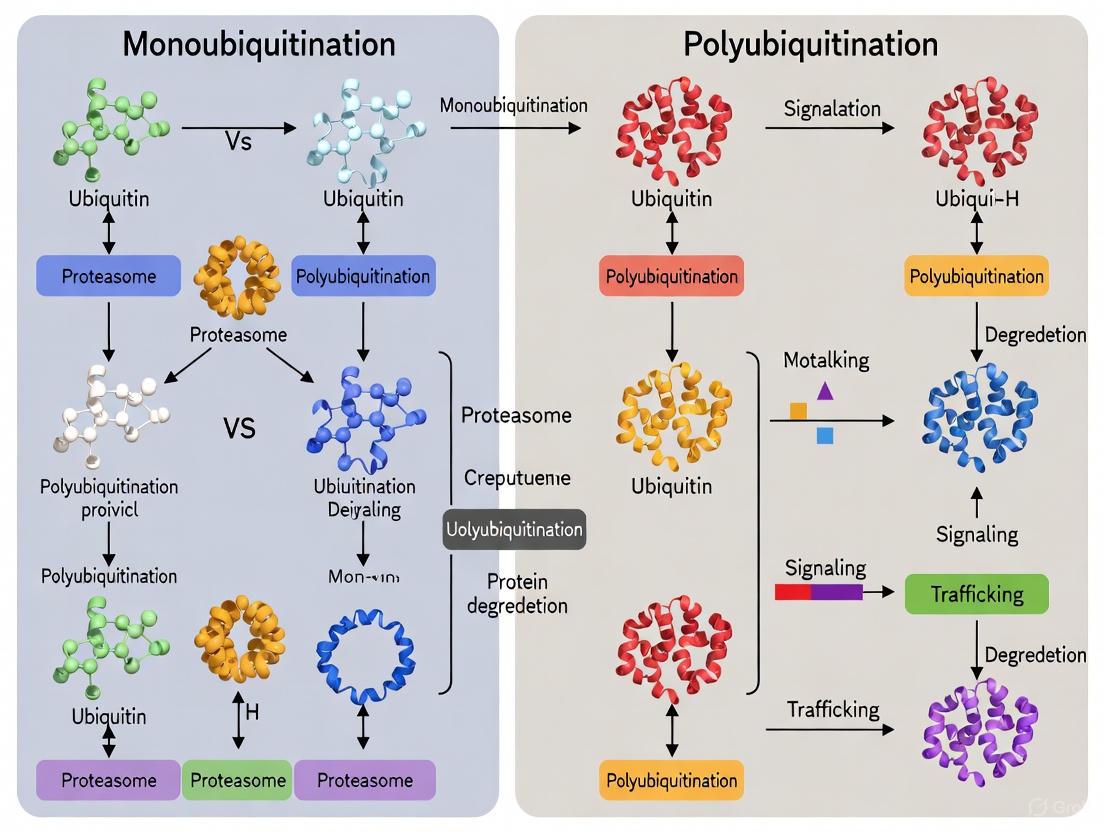
This article provides a comprehensive analysis of the distinct functional consequences of monoubiquitination and polyubiquitination, two critical protein modifications that govern cellular signaling.
Monoubiquitination vs. Polyubiquitination: Decoding Functional Consequences for Targeted Therapies
Abstract
This article provides a comprehensive analysis of the distinct functional consequences of monoubiquitination and polyubiquitination, two critical protein modifications that govern cellular signaling. Tailored for researchers and drug development professionals, it explores the foundational mechanisms that dictate whether ubiquitination leads to proteasomal degradation or non-proteolytic outcomes like endocytosis and DNA repair. The content delves into advanced methodologies for differentiating ubiquitin signals, addresses common experimental challenges, and presents a comparative framework for validating ubiquitin chain topology and its implications in disease pathogenesis and therapeutic intervention, including the emerging field of PROTACs.
The Ubiquitin Code: Fundamental Mechanisms of Mono- vs. Polyubiquitination
Ubiquitin is a small, 76-amino acid protein found in nearly all eukaryotic tissues, functioning as a critical post-translational modifier that regulates a vast array of cellular processes [1] [2]. Since its discovery in 1975 and the subsequent elucidation of its fundamental functions throughout the 1980s, ubiquitin research has revolutionized our understanding of cellular biology, culminating in the Nobel Prize in Chemistry in 2004 for Aaron Ciechanover, Avram Hershko, and Irwin Rose [1] [2]. The ubiquitylation process involves a sophisticated enzymatic cascade that conjugates ubiquitin to substrate proteins, thereby modulating their stability, activity, localization, and interactions [1] [3]. This primer provides an in-depth technical overview of ubiquitin structure, the enzymatic machinery governing its conjugation, and the reversibility of this process, framed within the context of the distinct functional outcomes of monoubiquitination versus polyubiquitination.
Ubiquitin Structure
Primary, Secondary, and Tertiary Organization
Ubiquitin is a highly conserved 76-residue protein with a molecular mass of approximately 8.6 kDa [1] [2]. Its primary sequence is remarkably stable across evolution, with human and yeast ubiquitin sharing 96% sequence identity, and the human form being 100% identical to that of the sea slug Aplysia [1] [2]. The protein features seven lysine residues (Lys6, Lys11, Lys27, Lys29, Lys33, Lys48, and Lys63) and an N-terminal methionine that serve as potential sites for ubiquitin chain formation [2].
The secondary structure of ubiquitin consists of a mixed β-sheet with five strands, approximately 15.8% α-helix content distributed across three helices, and six β-reverse turns [2]. These elements fold into a compact, globular β-grasp fold, forming a stable tertiary structure with a melting point of nearly 100°C [2]. This high stability derives from extensive intra-hydrogen bonding, with no disulfide bonds, metal ions, or cofactors required for structural integrity [2]. The hydrophobic patch centered around Ile44 is particularly critical for recognition by ubiquitin-binding domains in other proteins [2].
Table 1: Key Structural Features of Ubiquitin
| Structural Aspect | Description |
|---|---|
| Number of Residues | 76 amino acids [1] |
| Molecular Mass | 8.6 kDa [1] [2] |
| Isoelectric Point (pI) | 6.79 [1] |
| Key Residues | 7 Lysine residues (K6, K11, K27, K29, K33, K48, K63) and N-terminal Methionine (M1) [1] [2] |
| Secondary Structure | 5 β-strands, 3.5 turns of α-helix (15.8%), short 310 helix (7.9%), 6 β-reverse turns [2] |
| Tertiary Structure | Compact β-grasp fold [2] |
| Stability | Melting point ~100°C; stable from pH 1.18–8.48 [2] |
Genetic Encoding
The human genome contains four genes that encode ubiquitin: UBA52 and RPS27A, which produce fusion proteins with ribosomal subunits L40 and S27a, respectively; and UBB and UBC, which code for polyubiquitin precursor proteins [1] [2]. This genetic arrangement enables the cell to rapidly generate large quantities of free ubiquitin through proteolytic cleavage of these precursors [1].
The Enzymatic Cascade: E1, E2, and E3 Enzymes
Ubiquitin conjugation to substrate proteins proceeds through a three-step enzymatic cascade requiring ATP, involving ubiquitin-activating (E1), ubiquitin-conjugating (E2), and ubiquitin-ligase (E3) enzymes [1] [3]. This hierarchical system allows for exquisite specificity and regulation, with humans possessing two E1s, approximately 35 E2s, and an estimated 600-700 E3s [1] [3].
Figure 1: The E1-E2-E3 Enzymatic Cascade. Ubiquitin (Ub) is activated by E1 in an ATP-dependent process, transferred to E2, and finally ligated to a substrate protein by E3.
Step 1: Activation by E1 Enzymes
The ubiquitination cascade initiates with ATP-dependent activation of ubiquitin by E1 ubiquitin-activating enzymes [1] [3]. This two-step reaction first generates a ubiquitin-adenylate intermediate, followed by transfer of ubiquitin to an active-site cysteine residue within the E1 enzyme, forming a high-energy thioester bond with release of AMP [1]. The human genome encodes two E1 enzymes, UBA1 and UBA6, capable of performing this activation [1].
Step 2: Conjugation by E2 Enzymes
The activated ubiquitin is subsequently transferred from E1 to a cysteine residue in the active site of an E2 ubiquitin-conjugating enzyme through a transesterification reaction [1] [3]. This step requires the E2 to bind both the activated ubiquitin and the E1 enzyme simultaneously [1]. Humans possess 35 different E2 enzymes characterized by a highly conserved ubiquitin-conjugating catalytic (UBC) fold [1].
Step 3: Ligation by E3 Enzymes
The final step involves an E3 ubiquitin ligase catalyzing the transfer of ubiquitin from the E2 to a substrate protein [1] [3]. E3s function as substrate recognition modules, interacting with both E2 enzymes and specific target proteins [1] [3]. They are categorized based on their mechanism of action and conserved domains:
- RING-type E3s (Really Interesting New Gene) typically function as scaffolds that facilitate direct ubiquitin transfer from the E2 to the substrate [1] [3]. Multi-subunit RING E3s include complexes such as the anaphase-promoting complex (APC) and the SCF complex (Skp1-Cullin-F-box protein) [1].
- HECT-type E3s (Homologous to the E6-AP Carboxyl Terminus) form an obligate thioester intermediate with ubiquitin on a catalytic cysteine residue before transferring it to the substrate [1] [4] [5]. E6-AP, involved in p53 ubiquitination, operates via this mechanism [4] [5].
This sequential cascade results in an isopeptide bond between the C-terminal glycine of ubiquitin (Gly76) and the ε-amino group of a lysine residue on the substrate protein, though non-canonical linkages to cysteine, serine, threonine, and the N-terminus also occur [1].
Table 2: Enzymes of the Ubiquitination Cascade
| Enzyme Class | Number in Humans | Core Function | Key Features |
|---|---|---|---|
| E1 (Activating) | 2 [1] | ATP-dependent ubiquitin activation | Forms thioester with ubiquitin; initial step [1] [3] |
| E2 (Conjugating) | ~35 [1] | Accepts ubiquitin from E1 | UBC fold; determines chain topology [1] |
| E3 (Ligase) | ~600-700 [3] | Substrate recognition & ubiquitin transfer | RING (direct transfer) or HECT (intermediate) types [1] [4] |
Monoubiquitination vs. Polyubiquitination: Functional Consequences
The ubiquitin code manifests through different modification types, primarily monoubiquitination and polyubiquitination, which trigger distinct functional outcomes for the modified substrate [1] [3] [6]. Understanding this dichotomy is fundamental to appreciating how ubiquitination regulates diverse cellular processes.
Monoubiquitination
Monoubiquitination involves the attachment of a single ubiquitin moiety to a substrate protein [1] [3]. This modification typically serves non-proteolytic functions, including regulation of endocytic trafficking, histone function, DNA repair, virus budding, and nuclear export [1] [3]. Multi-monoubiquitination, where multiple lysine residues on a single substrate each receive one ubiquitin molecule, can also occur and often serves as a signal for internalization of membrane proteins [6].
Polyubiquitination
Polyubiquitination occurs when a chain of ubiquitin molecules is assembled through the linkage of one ubiquitin's C-terminus to a specific lysine residue (or the N-terminal methionine) of the preceding ubiquitin molecule [1] [3]. The specific lysine used for chain linkage determines the three-dimensional structure of the polyubiquitin chain and consequently its functional outcome [1] [3] [7].
Table 3: Polyubiquitin Chain Linkages and Their Primary Functions
| Linkage Type | Major Functional Consequences |
|---|---|
| Lys48 (K48) | The canonical "kiss of death"; targets substrates to the 26S proteasome for degradation [1] [3] |
| Lys63 (K63) | Non-degradative signaling; DNA repair, NF-κB activation, endocytosis, kinase activation [1] [3] [7] |
| Met1 (M1) | Linear chains; regulation of inflammatory signaling and NF-κB activation [7] [8] |
| Lys11 (K11) | Cell cycle regulation, endoplasmic reticulum-associated degradation (ERAD) [7] |
| Lys29 (K29) | Proteasomal degradation, often in collaboration with K48 linkages [7] |
| Lys33 (K33) | Non-degradative; protein kinase regulation, T-cell signaling [7] |
| Lys6 (K6) | DNA damage response, mitophagy [7] |
| Lys27 (K27) | Kinase activation, immune signaling [7] |
Branched Ubiquitin Chains
Beyond homotypic chains, ubiquitin can form heterotypic chains, including branched chains where at least one ubiquitin subunit is modified simultaneously on two different acceptor sites [7]. These complex architectures, such as K11/K48, K29/K48, and K48/K63 branched chains, can be synthesized through collaboration between pairs of E3s with distinct linkage specificities or by individual E3s that recruit multiple E2s [7]. Branched chains may provide enhanced specificity for receptor binding or enable switching between non-proteolytic and degradative signals, as seen during cell signaling and apoptosis [7].
Figure 2: Functional Consequences of Different Ubiquitin Modifications. The type of ubiquitin modification determines the fate and function of the substrate protein.
Reversibility: Deubiquitinating Enzymes (DUBs)
Ubiquitination is a reversible process mediated by deubiquitinating enzymes (DUBs), which cleave ubiquitin from substrate proteins [9] [3] [8]. This reversibility allows for dynamic regulation of protein stability, activity, and localization, analogous to phosphorylation-dephosphorylation cycles [9]. DUBs perform several critical functions:
- Precursor Processing: Cleave ubiquitin gene products to generate free, mature ubiquitin [9].
- Chain Editing: Trim or completely remove ubiquitin chains from substrates to rescue them from degradation or alter their signaling status [9].
- Ubiquitin Recycling: Cleave ubiquitin from degraded substrates to maintain ubiquitin homeostasis in the cell [9].
Specific DUBs exhibit linkage preference, such as OTULIN, which specifically hydrolyzes Met1-linked linear ubiquitin chains and plays crucial roles in immune signaling and cell fate decisions [8]. The balance between ubiquitinating and deubiquitinating activities ensures precise temporal control over ubiquitin-dependent processes [9].
Experimental Methods and Research Tools
Advancements in methodology have been crucial for deciphering the complexity of the ubiquitin code. Key techniques include mass spectrometry-based proteomics, linkage-specific reagents, and functional screening approaches.
Ubiquitin Remnant Profiling (DiGly Proteomics)
This mass spectrometry-based approach identifies ubiquitination sites proteome-wide by exploiting the fact that trypsin cleavage of ubiquitinated proteins leaves a characteristic di-glycine (Gly-Gly) remnant attached to the modified lysine residue [6]. Antibodies specific for this di-glycine modification enable enrichment of ubiquitinated peptides from complex tryptic digests, allowing identification of ubiquitination sites by liquid chromatography-mass spectrometry [6]. This methodology has identified tens of thousands of ubiquitination sites, revealing that a significant proportion of ubiquitination targets newly synthesized proteins for quality control rather than regulatory purposes [6].
Linkage-Specific Tools
- Linkage-Specific Antibodies: Antibodies that recognize particular ubiquitin chain linkages (e.g., K48-only, K63-only) enable enrichment and detection of specific chain types [6].
- UBE2S (UbcH10): An E2 enzyme that specifically synthesizes K11-linked chains, used in in vitro ubiquitination assays [7].
- OTULIN: A Met1-linkage-specific DUB used to study linear ubiquitination [8].
Functional Screening Methods
- Global Protein Stability (GPS) Profiling: A high-throughput screening method that uses fluorescent protein reporters to identify substrates of specific E3 ligases by monitoring changes in protein stability upon E3 inhibition or knockdown [3] [6].
- CRISPR-Cas9/Screening: Genetic screens to identify E3 ligase substrates and components of ubiquitin signaling pathways [3].
- MLN4924: A small-molecule inhibitor of the NEDD8-activating enzyme that indirectly inhibits cullin-RING ligases (CRLs), used to identify CRL substrates [6].
Table 4: Key Research Reagents for Ubiquitination Studies
| Research Tool | Type | Primary Research Application |
|---|---|---|
| DiGlycine (K-ε-GG) Antibody | Antibody | Immunoaffinity enrichment of ubiquitinated peptides for mass spectrometry [6] |
| Linkage-Specific Ubiquitin Antibodies | Antibody Panel | Detection and enrichment of specific ubiquitin chain types [6] |
| MLN4924 (NEDD8-Activating Enzyme Inhibitor) | Small Molecule Inhibitor | Investigation of cullin-RING ligase substrates and functions [6] |
| Bortezomib/ MG132 | Proteasome Inhibitors | Determine if ubiquitination leads to proteasomal degradation [3] |
| UBE2S (UbcH10) | Recombinant Enzyme (E2) | In vitro synthesis of K11-linked ubiquitin chains [7] |
| OTULIN | Recombinant Enzyme (DUB) | Selective cleavage of Met1-linear ubiquitin chains [8] |
Pathophysiological and Clinical Significance
Dysregulation of ubiquitin signaling contributes to numerous human diseases, making the ubiquitin-proteasome system an attractive therapeutic target [3] [8].
- Cancer: Mutations in ubiquitin system components are frequent in cancer. For example, von Hippel-Lindau (VHL) disease results from mutations in the VHL E3 ligase, leading to stabilization of HIF-1α and uncontrolled angiogenesis [3]. Additionally, MDM2-mediated ubiquitination of p53 is a key regulatory mechanism often dysregulated in tumors [3].
- Neurodegenerative Disorders: Impaired ubiquitin-mediated clearance of misfolded proteins contributes to Alzheimer's, Parkinson's, and Huntington's diseases, leading to toxic protein aggregation [8].
- Developmental Disorders: Angelman syndrome results from mutations in the UBE3A E3 ligase gene, while 3-M syndrome stems from mutations in CUL7, a component of an E3 ubiquitin ligase complex [3].
- Immune Disorders: Dysregulation of ubiquitin signaling in immune pathways, particularly those involving NF-κB and Met1-linked ubiquitin chains, can lead to autoinflammatory and autoimmune diseases [9] [8].
The clinical relevance of ubiquitination is exemplified by the success of proteasome inhibitors like bortezomib in treating multiple myeloma, validating the ubiquitin-proteasome pathway as a viable drug target [3]. Ongoing research focuses on developing more specific therapeutics targeting individual E3 ligases or DUBs [8].
The ubiquitin system represents a sophisticated regulatory network that controls virtually all aspects of eukaryotic cell biology through diverse signaling mechanisms. The fundamental distinction between monoubiquitination and polyubiquitination, combined with the specificity afforded by different chain linkages and architectures, creates a complex "ubiquitin code" that governs protein fate and function. The reversible nature of this modification, mediated by the opposing actions of E1-E2-E3 enzymes and DUBs, allows for dynamic cellular responses to changing conditions. Continued technological advances in identifying ubiquitination sites and deciphering the functions of specific ubiquitin signals will undoubtedly yield new insights into cellular regulation and provide novel therapeutic avenues for treating human diseases caused by dysregulation of the ubiquitin system.
Ubiquitination is a crucial post-translational modification that controls a vast array of cellular processes, including protein degradation, DNA repair, cell signaling, and endocytosis [10] [11]. The versatility of this modification stems from the structural diversity of ubiquitin itself. A 76-amino acid protein, ubiquitin can be conjugated to substrate proteins as a single moiety or as polymers, creating a complex "code" that is interpreted by the cell to elicit specific functional outcomes [1] [7]. This code is defined by the type of ubiquitin modification—monoubiquitination, multi-monoubiquitination, or polyubiquitination—each generating distinct biological signals [12] [13]. The critical importance of this system is highlighted by the fact that alterations in ubiquitin signaling pathways are found in a broad range of genetic diseases and cancers [13]. This technical guide delineates these ubiquitin modifications, their functional consequences, and the experimental methodologies used to distinguish between them, providing a framework for researchers investigating ubiquitin-dependent processes in health and disease.
Defining the Ubiquitin Modifications
Ubiquitin can be attached to substrate proteins through distinct mechanisms, which determine the functional consequences for the modified protein. The table below provides a structured comparison of the key characteristics of each modification type.
Table 1: Key Characteristics of Ubiquitin Modification Types
| Feature | Monoubiquitination | Multi-Monoubiquitination | Polyubiquitination |
|---|---|---|---|
| Definition | Attachment of a single ubiquitin molecule to one lysine residue on a substrate protein [14] [13]. | Attachment of single ubiquitin molecules to multiple lysine residues on a substrate protein [12] [13]. | Attachment of a chain of ubiquitin molecules to a single lysine residue on a substrate protein [12] [10]. |
| Structural Pattern | One ubiquitin per substrate lysine [14]. | Multiple single ubiquitins on different substrate lysines [12]. | Ubiquitin molecules linked end-to-end via one of seven lysines or the N-terminal methionine [10] [1]. |
| Primary Functional Consequences | Regulates endocytosis, subcellular localization, protein-protein interactions, and DNA repair [15] [13]. | Can signal for proteasomal degradation or lysosomal sorting; amplifies monoubiquitination signals [13] [16]. | Fate depends on chain linkage: e.g., K48 for proteasomal degradation, K63 for signaling, M1 for inflammation [10] [1] [7]. |
The following diagram illustrates the structural relationships between these different modification types.
Structural Classification of Ubiquitin Modifications
Functional Consequences and Biological Significance
The type of ubiquitin modification attached to a substrate protein determines its cellular fate and function, with different topologies being "read" by specific cellular machineries.
Monoubiquitination and Multi-Monoubiquitination
Contrary to early understanding, monoubiquitination does not typically serve as a signal for proteasomal degradation but plays other distinct roles [15]. Its functions are diverse and critical for cellular homeostasis:
- Membrane Trafficking and Endocytosis: Monoubiquitination of cell-surface receptors (e.g., receptor tyrosine kinases) serves as a signal for their internalization via endocytosis and subsequent targeting to lysosomes for degradation by lysosomal proteases [15] [13]. This process is crucial for attenuating signaling from activated receptors.
- Control of Subcellular Localization: The attachment of a single ubiquitin can direct proteins to specific cellular compartments. For example, monoubiquitination targets the TNF receptor associated factor 4 (TRAF4) to cell-cell junctions, which is required for cell migration [13].
- Regulation of Protein-Protein Interactions: Monoubiquitination can either facilitate or inhibit protein interactions. It can create new binding surfaces for proteins containing ubiquitin-binding domains (UBDs) or, conversely, cause steric hindrance. For instance, monoubiquitination within the effector-binding domain of the small GTPase RALB sterically inhibits its binding to the downstream effector EXO84 [13].
- Proteasomal Degradation: Although less common, monoubiquitination can target certain proteins for proteasomal degradation, particularly those smaller than 150 amino acids with low structural disorder [13]. Multi-monoubiquitination can also serve as a potent degradation signal, as demonstrated with Cyclin B1, where it promotes proteasomal degradation and mitotic exit [13].
The functional outcome of monoubiquitination can be highly specific, depending on the exact lysine residue modified on the substrate. For example, monoubiquitination of the small GTPase HRAS at K170 impairs its membrane association and downstream signaling, whereas modification at other lysines (K117 or K147) promotes activation [13].
Polyubiquitination
Polyubiquitin chains are specialized for different cellular functions based on the linkage type that connects the ubiquitin monomers. The chain topology determines which effector proteins will bind and what the functional outcome will be [10] [7].
Table 2: Functions of Major Polyubiquitin Chain Linkages
| Linkage Type | Major Known Functions | Cellular Processes |
|---|---|---|
| K48-linked | Canonical signal for proteasomal degradation [10] [1]. | Protein turnover, cell cycle regulation, stress response [10] [16]. |
| K63-linked | Non-degradative signaling; scaffold for complex assembly [10] [13]. | DNA damage response, NF-κB signaling, endocytosis, inflammation [10] [7]. |
| K11-linked | Proteasomal degradation, particularly during mitosis [10] [7]. | Cell cycle regulation, endoplasmic reticulum-associated degradation (ERAD) [10]. |
| K6-linked | DNA damage response, mitophagy [10] [7]. | DNA repair, mitochondrial quality control. |
| M1-linked (Linear) | Regulation of inflammatory signaling and NF-κB activation [10]. | Immune and inflammatory responses. |
The complexity of the ubiquitin code is further enhanced by the existence of branched ubiquitin chains, where a single ubiquitin monomer is modified simultaneously on at least two different acceptor sites [7]. These chains can integrate multiple signals. For example, branched K48/K63 chains can convert a non-degradative K63-linked signal into a degradative signal by the addition of K48 linkages, providing a mechanism for the precise regulation of signaling pathways [7].
Experimental Protocols for Differentiation
A fundamental challenge in ubiquitin research is experimentally distinguishing between polyubiquitination and multi-monoubiquitination, as both modifications result in the appearance of high-molecular-weight species on SDS-PAGE Western blots [12]. The following established protocol utilizes a mutant form of ubiquitin to differentiate between these modifications.
Protocol: Distinguishing Polyubiquitination from Multi-Monoubiquitination
This protocol is based on performing parallel in vitro ubiquitin conjugation reactions with wild-type ubiquitin and a mutant "Ubiquitin No K" in which all seven lysine residues are mutated to arginines [12].
Table 3: Key Research Reagents for Ubiquitination Assays
| Reagent | Function/Description |
|---|---|
| E1 Enzyme | Ubiquitin-activating enzyme; initiates the ubiquitination cascade by activating ubiquitin in an ATP-dependent manner [12] [1]. |
| E2 Enzyme | Ubiquitin-conjugating enzyme; accepts activated ubiquitin from E1 and works with E3 to transfer it to the substrate [12] [1]. |
| E3 Ligase | Ubiquitin ligase; confers substrate specificity by binding both the E2~Ub complex and the target protein [12] [1]. |
| Wild-Type Ubiquitin | The native, unmodified form of ubiquitin capable of forming all chain linkage types [12]. |
| Ubiquitin No K | A mutant form of ubiquitin (all lysines mutated to arginine) that can be conjugated to substrates but cannot form polyubiquitin chains [12]. |
| MgATP Solution | Provides the energy (ATP) and cofactor (Mg²⁺) required for the E1-mediated activation of ubiquitin [12]. |
Procedure for 25 µL Reactions:
Reaction Setup:
- Reaction 1 (Wild-Type Ubiquitin): Combine the following in a microcentrifuge tube:
- X µL dH₂O (to bring final volume to 25 µL)
- 2.5 µL 10X E3 Ligase Reaction Buffer (50 mM HEPES, pH 8.0, 50 mM NaCl, 1 mM TCEP)
- 1 µL Wild-Type Ubiquitin (~100 µM final)
- 2.5 µL MgATP Solution (10 mM final)
- X µL Substrate protein (5-10 µM final)
- 0.5 µL E1 Enzyme (100 nM final)
- 1 µL E2 Enzyme (1 µM final)
- X µL E3 Ligase (1 µM final) [12]
- Reaction 2 (Ubiquitin No K): Prepare identically to Reaction 1, but substitute Wild-Type Ubiquitin with 1 µL of Ubiquitin No K mutant [12].
- Negative Control: Replace the MgATP Solution with an equal volume of dH₂O.
- Reaction 1 (Wild-Type Ubiquitin): Combine the following in a microcentrifuge tube:
Incubation: Incubate both reaction tubes in a 37°C water bath for 30-60 minutes [12].
Reaction Termination:
Analysis:
- Separate the reaction products by SDS-PAGE and transfer to a PVDF or nitrocellulose membrane.
- Perform Western blotting using an anti-ubiquitin antibody.
- Interpret the results as outlined in the diagram below.
Experimental Workflow for Differentiating Ubiquitin Modifications
Implications for Disease and Therapeutics
Understanding the specific roles of different ubiquitin modifications has profound implications for drug development, as alterations in these pathways are linked to numerous diseases [13]. For instance, monoubiquitination regulates the activity and localization of key oncoproteins like RAS, and its dysregulation can contribute to tumorigenesis [13]. Furthermore, mutations in E3 ubiquitin ligases or deubiquitinases (DUBs) that control the balance between different ubiquitin signals are frequently found in cancers and neurological disorders [16]. Targeted therapeutic strategies are emerging, including:
- Small Molecule Inhibitors: Developing compounds that selectively inhibit E3 ligases responsible for the degradative polyubiquitination of tumor suppressor proteins [13].
- DUB Inhibitors: Targeting DUBs that remove degradative ubiquitin signals from oncoproteins, leading to their stabilization [17].
- Linkage-Specific Probes: Using chemical biology tools to dissect the role of specific chain linkages in disease pathways, which can reveal new therapeutic targets [7].
The expanded understanding of branched ubiquitin chains and non-canonical ubiquitination events opens new avenues for therapeutic intervention by targeting highly specific nodes within the ubiquitin signaling network [7].
The ubiquitin system, with its capacity to generate monoubiquitination, multi-monoubiquitination, and polyubiquitination signals, represents a sophisticated regulatory code that controls virtually all aspects of cellular function. The functional consequences of these modifications are distinct—monoubiquitination primarily regulates trafficking and signaling, while the outcomes of polyubiquitination are exquisitely dependent on chain linkage type. The experimental methodologies to decode these signals, such as the use of lysine-less ubiquitin mutants, are critical tools for researchers. As our knowledge of this system deepens, particularly in the realms of branched chains and linkage-specific functions, so too does the potential for developing novel therapeutics that target the ubiquitin machinery in cancer, neurodegenerative diseases, and immune disorders.
The post-translational modification of proteins by ubiquitin is a fundamental regulatory mechanism in eukaryotic cells. While the initial discovery of ubiquitination focused on its role in targeting proteins for proteasomal degradation via lysine 48 (K48)-linked polyubiquitin chains, research has revealed a far more complex and sophisticated signaling system [18]. The ubiquitin code encompasses diverse modifications, including monoubiquitination, multi-monoubiquitination, and various forms of polyubiquitination [6]. This review frames the topology of polyubiquitin chains within the broader functional consequences of monoubiquitination versus polyubiquitination.
Monoubiquitination, the attachment of a single ubiquitin molecule to a substrate, typically alters protein localization, complex formation, or endocytic trafficking [6]. In contrast, polyubiquitination—the formation of chains through covalent linkage between ubiquitin molecules—can generate a vast array of distinct signals. Ubiquitin itself contains seven internal lysine residues (K6, K11, K27, K29, K33, K48, K63) and an N-terminal methionine (M1) that can serve as linkage points, each potentially conferring unique structural and functional properties [19] [20]. The resulting "ubiquitin code" enables the precise control of protein stability, activity, and interaction networks, rivaling the complexity of phosphorylation [6]. Understanding this code, particularly the signaling capabilities of linkage-specific polyubiquitin chains, is essential for deciphering cellular regulation and developing novel therapeutic strategies.
Structural Principles and Functional Consequences of Chain Topology
The topology of a polyubiquitin chain—defined by its linkage type and architecture—directly determines its three-dimensional structure and thus its functional output. This relationship between structure and function forms the basis of the ubiquitin code.
Homotypic, Mixed, and Branched Chains
Polyubiquitin chains exist in several topological forms:
- Homotypic Chains: Composed of a single linkage type (e.g., all K48 linkages or all K63 linkages). These were the first to be characterized and remain the best-understood forms [19].
- Mixed-Linkage Chains: Unbranched chains containing more than one type of Ub-Ub linkage within the same polymer [19].
- Branched Chains: A single ubiquitin molecule serves as a branching point, with two or more ubiquitins attached to different lysine residues on the same proximal ubiquitin molecule (e.g., [Ub]₂–48,63Ub) [19] [21].
Recent studies have revealed that K48 and K63 linkages are the most abundant in cells and can co-exist within the same chain, creating mixed or branched structures with hybrid signaling properties [19] [21].
Linkage-Specific Structural and Functional Properties
Different ubiquitin chain linkages adopt distinct conformations that are recognized by specific receptor proteins, leading to diverse functional outcomes.
Table 1: Functional Consequences of Major Ubiquitin Linkage Types
| Linkage Type | Chain Conformation | Primary Functions | Key Readers/Effectors |
|---|---|---|---|
| K48 | Compact | Proteasomal degradation [19] [21] | Proteasome, hHR23A [19] |
| K63 | Extended | Signaling, endocytosis, DNA repair, kinase activation [19] [21] [20] | TAB2/3, Rap80 [19] [21] |
| K11 | Mixed | Proteasomal degradation, ER-associated degradation (ERAD) [20] | Proteasome |
| K29/K33 | Not well characterized | Proteasomal degradation, ER retention [20] | Not well characterized |
| M1 (Linear) | Extended | NF-κB signaling, inflammation | NEMO |
| Branched (K48-K63) | Hybrid | Signal amplification, protection from deubiquitinases [21] | TAB2, protects from CYLD [21] |
The functional orthogonality of different linkages is clearly demonstrated by K48 and K63 chains. K48-linked chains typically adopt a compact, closed conformation that serves as the canonical signal for proteasomal degradation [19]. In contrast, K63-linked chains generally form more open, extended structures that function in non-proteolytic signaling pathways, including NF-κB activation, DNA damage repair, and endocytic trafficking [19] [18]. This fundamental distinction underscores how chain topology dictates functional output.
Quantitative Landscape of Polyubiquitin Chains
Advances in mass spectrometry-based proteomics have enabled the quantification of different ubiquitin linkage types, providing insights into their relative abundance and dynamics in cells.
Relative Abundance of Different Linkage Types
Global proteomic analyses reveal that K48 and K63 linkages dominate the cellular ubiquitin landscape, though their precise ratios can vary by cell type and condition. A study analyzing polyubiquitination on the KCNQ1 ion channel found that among the di-glycine modified ubiquitin lysine residues, K48 was fractionally dominant (72%) followed by K63 (24%), while atypical chains (K11, K27, K29, K33, and K6) collectively accounted for only 4% [20]. This distribution highlights the predominance of K48 and K63 linkages, though the exact proportions are likely substrate- and context-dependent.
Mass-spectrometry-based quantification has further revealed that K48-K63 branched ubiquitin linkages are abundant in mammalian cells and are dynamically regulated in response to specific stimuli, such as interleukin-1β (IL-1β) [21]. This discovery established branched chains not as rare artifacts but as functionally significant components of the ubiquitin code.
Functional Classification of Ubiquitination Sites
Comprehensive ubiquitin proteomics datasets have enabled the functional categorization of ubiquitination sites based on their behavior under proteasome inhibition:
Table 2: Classification of Ubiquitination Events by Functional Outcome
| Classification | Response to Proteasome Inhibition | Proposed Function | Example Substrates |
|---|---|---|---|
| Proteasome-Dependent | Ubiquitination level increases | Targets substrates for degradation [6] | Misfolded proteins, cell cycle regulators |
| Proteasome-Independent | Ubiquitination level decreases or unchanged | Signaling, localization, activity modulation [6] | Signaling intermediates (e.g., in NF-κB pathway) |
| Quality Control | Highly sensitive to protein synthesis inhibition | Tags misfolded nascent proteins [6] | Newly synthesized proteins |
| Regulatory | Regulated by specific signals | Controlled modulation of pathway activity [6] | Activated receptors, transcription factors |
Strikingly, a significant finding from quantitative ubiquitinomics is that the majority of ubiquitination in cells occurs on newly synthesized proteins, likely representing a quality control mechanism to eliminate misfolded polypeptides [6]. This highlights the importance of distinguishing these "housekeeping" ubiquitination events from regulatory ones when interpreting ubiquitination data.
Experimental Methodologies for Deciphering the Ubiquitin Code
Mass Spectrometry-Based Ubiquitinomics
Ubiquitin Remnant Profiling is a powerful mass spectrometry-based approach for system-wide identification of ubiquitination sites [6].
Protocol Overview:
- Cell Lysis: Prepare protein extracts under denaturing conditions to preserve ubiquitination and inhibit deubiquitinases.
- Trypsin Digestion: Digest proteins with trypsin. Ubiquitin's C-terminal -Arg-Gly-Gly leaves a di-glycine (Gly-Gly) remnant on the modified lysine after tryptic cleavage.
- Immunoaffinity Enrichment: Use antibodies specific for the di-glycine lysine modification to enrich for ubiquitinated peptides.
- LC-MS/MS Analysis: Analyze enriched peptides by liquid chromatography coupled to tandem mass spectrometry.
- Data Analysis: Identify ubiquitination sites by searching mass spectra for the di-glycine modification (114.0429 Da mass shift) on lysine residues.
This approach can be adapted to profile linkage-specific ubiquitination by pre-enriching for specific chain types using linkage-specific antibodies prior to digestion [6].
Engineered Deubiquitinases (enDUBs) for Linkage-Specific Editing
A recent breakthrough methodology involves the development of linkage-selective engineered deubiquitinases (enDUBs) to selectively remove specific polyubiquitin linkages from target proteins in live cells [20].
Protocol Overview:
- enDUB Design: Fuse the catalytic domains of deubiquitinases (DUBs) with specific linkage preferences to a GFP-targeted nanobody.
Validation: Test the enDUB's ability to decrease basal ubiquitination of the target protein (e.g., KCNQ1-YFP) by immunoprecipitation and immunoblotting with anti-ubiquitin antibodies [20].
Functional Assays: Assess the functional consequences of removing specific linkages on substrate:
- Surface Expression: For membrane proteins, use flow cytometry with extracellular tagging (e.g., bungarotoxin binding site) [20].
- Subcellular Localization: Use confocal microscopy with compartment-specific markers (ER, Golgi, endosomes) [20].
- Protein Stability: Measure half-life changes via cycloheximide chase assays.
- Functional Activity: For enzymes or channels, assess catalytic activity or ion currents.
This approach revealed that distinct linkages control different aspects of KCNQ1 regulation: K48 is necessary for forward trafficking, while K63 enhances endocytosis and reduces recycling [20].
Structural and Biophysical Analysis of Mixed Linkage Chains
NMR spectroscopy has been instrumental in demonstrating that mixed linkage chains retain the structural features of their homogeneous counterparts.
Protocol Overview:
- Chain Synthesis: Generate defined ubiquitin chains (e.g., Ub–63Ub–48Ub, Ub–48Ub–63Ub, and branched [Ub]₂–48,63Ub) using enzymatic or chemical methods [19].
- Isotopic Labeling: Incorporate ¹⁵N-specific labels into specific Ub units within the chain (e.g., Ub[Ub(¹⁵N)]–48,63Ub) [19].
- NMR Spectroscopy: Collect ¹⁵N-¹H HSQC spectra to probe the chemical environment and dynamics of each Ub unit in the chain.
- Chemical Shift Analysis: Compare chemical shifts to those of homogeneous chains to determine if linkage-specific interdomain contacts are preserved [19].
This methodology confirmed that K48 and K63 linkages in mixed chains are virtually indistinguishable from their counterparts in homogeneously-linked polyUb, retaining their distinctive structural properties even when present in the same polymer [19].
K48-K63 Branched Chain in NF-κB Signaling
Case Study: K48-K63 Branched Chains in NF-κB Signaling
The functional significance of branched ubiquitin chains is exemplified by their role in regulating NF-κB signaling, a critical pathway in inflammation and immunity.
Pathway Mechanism and Experimental Validation
In response to IL-1β stimulation, the E3 ubiquitin ligase TRAF6 first assembles K63-linked polyubiquitin chains, which serve as a platform for signaling complex assembly [21]. Subsequently, the E3 ligase HUWE1 generates K48 branches on these K63 chains, forming K48-K63 branched ubiquitin linkages [21]. This branched architecture creates a unique regulatory signal with two key functional consequences:
- Recognition by TAB2: The branched chain maintains recognition by TAB2, a component of the TAK1 kinase complex that activates NF-κB signaling [21].
- Protection from Deubiquitinases: The K48 branch protects the K63 linkages from cleavage by the deubiquitinase CYLD, thereby prolonging the NF-κB signal [21].
This cooperative mechanism between K48 and K63 linkages demonstrates how ubiquitin chain branching can generate complex regulatory logic that differentially controls the readout of the ubiquitin code by specific "reader" and "eraser" proteins.
Experimental Evidence
The critical role of branched chains was established through multiple experimental approaches:
- Quantitative Mass Spectrometry: Revealed abundant K48-K63 branched linkages in mammalian cells that increase in response to IL-1β [21].
- Genetic Manipulation: Knockdown of HUWE1 impaired K48-K63 branch formation and attenuated NF-κB activation [21].
- Biochemical Assays: Reconstituted systems demonstrated that HUWE1 directly adds K48 branches to K63 chains assembled by TRAF6 [21].
- Deubiquitinase Protection Assays: CYLD efficiently cleaved homogeneous K63 chains but was significantly impaired against K48-K63 branched chains [21].
The Scientist's Toolkit: Essential Research Reagents
Table 3: Key Research Reagents for Studying Polyubiquitin Chains
| Reagent / Tool | Function / Application | Key Features / Examples |
|---|---|---|
| Linkage-Specific Antibodies | Detect and enrich specific polyubiquitin chain types [19] [6] | Commercial antibodies for K48, K63, K11, M1 linkages |
| Activity-Based DUB Probes | Profile deubiquitinase activity and specificity [20] | Ubiquitin-based probes with fluorescent or affinity tags |
| Engineered DUBs (enDUBs) | Linkage-selective editing of target protein ubiquitination in live cells [20] | OTUD1 (K63-selective), OTUD4 (K48-selective), Cezanne (K11-selective) |
| Di-Glycine (K-ε-GG) Antibody | System-wide identification of ubiquitination sites by mass spectrometry [6] | Enriches tryptic peptides with di-glycine remnant on modified lysines |
| Ubiquitin Mutants | Dissect linkage-specific functions [19] | Lysine-to-arginine (K-to-R) mutants (e.g., K48R, K63R) |
| Proteasome Inhibitors | Distinguish proteasomal vs. non-proteasomal ubiquitin functions [20] [6] | MG132, Bortezomib, Carfilzomib |
| DUB Inhibitors | Investigate ubiquitination dynamics [21] | PR-619 (broad-spectrum), specific inhibitors for USP7, USP14 |
| Defined Ubiquitin Chains | Structural studies and in vitro reconstitution assays [19] | Homogeneous chains (K48, K63), mixed/branched chains (K48-K63) |
The topology of polyubiquitin chains—from homotypic linear chains to complex mixed and branched structures—generates an exquisite coding system that regulates virtually all cellular processes. The functional consequences of polyubiquitination are far more diverse than simply targeting proteins for degradation, encompassing precise control of protein localization, activity, and interactions. The distinction between monoubiquitination and polyubiquitination represents just one layer of this complex regulatory system, with different chain topologies adding further sophistication.
Recent methodological advances, including ubiquitin remnant profiling, engineered deubiquitinases, and sophisticated biophysical approaches, are rapidly accelerating our ability to decipher this code. The discovery that K48-K63 branched chains function as regulated signaling amplifiers in the NF-κB pathway demonstrates that ubiquitin chain branching is not a biochemical curiosity but a functionally significant feature of cellular regulation [21]. Furthermore, the development of linkage-selective enDUBs provides a powerful new tool for establishing causal relationships between specific ubiquitin linkages and functional outcomes in live cells [20].
As our understanding of the ubiquitin code deepens, new therapeutic opportunities are emerging. The recent construction of a pancancer ubiquitination regulatory network that stratifies patients by risk and predicts immunotherapy response highlights the clinical potential of targeting ubiquitination pathways [22]. By understanding how specific chain topologies control protein fate and function, we can begin to develop strategies to manipulate the ubiquitin code for therapeutic benefit, potentially targeting traditionally "undruggable" pathways in cancer, neurodegeneration, and inflammatory diseases.
Ubiquitination, the covalent attachment of the 76-amino acid protein ubiquitin to substrate proteins, serves as a fundamental regulatory mechanism that governs virtually all cellular processes in eukaryotes. This post-translational modification exhibits remarkable functional diversity, primarily dictated by the topology of ubiquitin conjugation. The dichotomy between proteasomal degradation and non-degradative signaling fates represents a central paradigm in ubiquitin biology [23] [6]. When ubiquitin molecules form polyubiquitin chains linked through specific lysine residues (notably Lys48), they typically target substrates for destruction by the 26S proteasome [24] [23]. In contrast, monoubiquitination (single ubiquitin attachment) and certain atypical polyubiquitin chains (such as Lys63-linked) function as non-degradative signals that regulate processes including protein trafficking, DNA repair, kinase activation, and inflammatory signaling [24] [25] [23].
The specificity of ubiquitin signaling is encoded through a complex enzymatic cascade involving ubiquitin-activating (E1), conjugating (E2), and ligase (E3) enzymes, with over 500 E3 ligases providing substrate specificity in humans [23] [6]. This regulatory system is dynamically reversible through the action of deubiquitinating enzymes (DUBs), which remove ubiquitin modifications, enabling precise spatiotemporal control of protein function [23] [26]. Understanding the molecular determinants that direct substrates toward degradative versus non-degradative fates is essential for deciphering cellular regulatory mechanisms and developing targeted therapeutic interventions.
The Ubiquitin Conjugation Machinery
The ubiquitination pathway employs a hierarchical enzymatic cascade that confers specificity and regulatory potential at multiple levels [26]:
- E1 Ubiquitin-Activating Enzymes: Initiate the pathway through ATP-dependent formation of a thioester bond with ubiquitin's C-terminal glycine
- E2 Ubiquitin-Conjugating Enzymes: Receive activated ubiquitin from E1 via trans-thioesterification
- E3 Ubiquitin Ligases: Catalyze the final transfer of ubiquitin to substrate lysine residues, determining substrate specificity
The human genome encodes approximately 500 E3 ligases, rivaling the complexity of the kinase system [6]. This extensive repertoire enables precise targeting of countless substrates under diverse physiological conditions. Additionally, the process is counterbalanced by deubiquitinating enzymes (DUBs), which remove ubiquitin modifications, making ubiquitination a dynamically reversible process [23] [26].
Table 1: Core Enzymatic Components of the Ubiquitin System
| Component | Number in Humans | Primary Function | Key Characteristics |
|---|---|---|---|
| E1 Enzymes | ~2 | Ubiquitin activation | ATP-dependent, forms E1~Ub thioester |
| E2 Enzymes | ~40 | Ubiquitin conjugation | Determines chain topology, E2~Ub thioester |
| E3 Ligases | ~500 | Substrate recognition | Provides substrate specificity, largest family |
| DUBs | ~90 | Deubiquitination | Reverses modification, recycles ubiquitin |
The coordination between these enzymatic components determines whether a substrate undergoes monoubiquitination, multiple monoubiquitination, or polyubiquitination with specific chain linkages, ultimately dictating the functional outcome of the modification [27] [12].
Determinants of Functional Outcomes
Ubiquitin Chain Topology and Linkage Specificity
The functional consequence of ubiquitination is primarily determined by the type of ubiquitin modification and the specific lysine residue used for chain formation within ubiquitin itself. Ubiquitin contains seven lysine residues (K6, K11, K27, K29, K33, K48, K63) and an N-terminal methionine (M1), all capable of forming polyubiquitin chains with distinct structural and functional properties [26].
Proteasome-Targeting Signals: K48-linked polyubiquitin chains represent the canonical signal for proteasomal degradation [24] [23]. Recent research using the UbiREAD technology revealed that K48-linked chains must consist of at least three ubiquitin molecules to efficiently target substrates for degradation, with half-lives of approximately one minute for substrates modified with these chains [28]. Shorter K48 chains (di-ubiquitin) are rapidly disassembled by DUBs, maintaining substrate stability [28]. Other linkage types including K6, K11, K27, K29, and M1 have also been implicated in proteasomal targeting, demonstrating greater complexity than previously recognized [26].
Non-Degradative Signals: K63-linked polyubiquitin chains serve as the prototype non-degradative ubiquitin signal, functioning in DNA repair, endocytosis, kinase activation, and inflammatory signaling [25]. These chains are rapidly deubiquitinated and do not significantly affect substrate stability [28]. Monoubiquitination and multiple monoubiquitination (attachment of single ubiquitins to multiple lysines) also function as non-degradative signals that can alter subcellular localization, protein-protein interactions, and activity [12] [23].
Table 2: Ubiquitin Linkage Types and Their Functional Consequences
| Linkage Type | Primary Function | Cellular Processes | Structural Features |
|---|---|---|---|
| K48 | Proteasomal degradation | Cell cycle, protein quality control | Compact structure, proteasome recognition |
| K63 | Non-degradative signaling | DNA repair, NF-κB signaling, endocytosis | Extended structure, protein interactions |
| K11 | Proteasomal degradation | ER-associated degradation, cell cycle | Mixed compact/extended conformations |
| M1 (linear) | Inflammatory signaling | NF-κB activation, immunity | Extended structure, recognized by LUBAC |
| K27, K29 | Proteasomal & lysosomal degradation | Protein quality control, innate immunity | Less characterized, diverse functions |
| K6, K33 | Non-degradative functions | DNA damage response, trafficking | Specialized contexts |
Molecular Determinants of Lysine Selection
The mechanisms governing which specific lysine residues are modified on substrates and within ubiquitin chains involve complex molecular recognition events. The "positioning model" suggests that E3 ligases position specific substrate lysines toward the E2~Ub thioester bond to select particular lysines during ubiquitination [24]. However, studies of the SCFCdc4/Cdc34 system in yeast revealed that amino acids surrounding acceptor lysines play critical roles in determining ubiquitination efficiency [24].
Key findings demonstrate that:
- Residues surrounding Sic1 lysines or lysine 48 in ubiquitin are critical for ubiquitination
- This sequence-dependence is linked to evolutionarily conserved key residues in the catalytic region of E2 enzymes
- Single point mutations in the E2 catalytic core can convert polyubiquitinating enzymes into monoubiquitinating enzymes
- The compatibility between determinants in the E2 catalytic region and those surrounding acceptor lysines directs the mode of ubiquitination [24]
These mechanistic insights explain how specific E2/E3 combinations can determine whether a substrate undergoes monoubiquitination versus polyubiquitination, and which lysine linkages are formed in polyubiquitin chains.
Analytical Approaches and Methodologies
Distinguishing Polyubiquitination from Multi-Mono-Ubiquitination
Differentiating between these two ubiquitination modes is essential for understanding functional consequences, as they lead to different substrate fates. A well-established protocol utilizes ubiquitin mutants to distinguish these mechanisms [12]:
Experimental Principle: Two parallel in vitro ubiquitination reactions are performed: one with wild-type ubiquitin and another with "Ubiquitin No K" - a mutant where all seven lysine residues are mutated to arginines. Wild-type ubiquitin supports both polyubiquitin chain formation and multiple monoubiquitination, while Ubiquitin No K can only support multiple monoubiquitination due to its inability to form chains [12].
Interpretation of Results:
- If high molecular weight species appear with wild-type ubiquitin but not with Ubiquitin No K → Polyubiquitination
- If high molecular weight species appear with both wild-type and Ubiquitin No K → Multiple Monoubiquitination
- If both patterns are observed → Mixed ubiquitination模式 [12]
This methodology provides a straightforward approach to determine the nature of ubiquitin modifications on specific substrates of interest.
Proteomic Profiling of Ubiquitination Sites
Mass spectrometry-based proteomics has revolutionized the large-scale identification of ubiquitination sites. The diGLY-modified peptide enrichment (diGPE) approach, also known as ubiquitin remnant profiling, uses antibodies specific for the diglycine remnant left on modified lysines after tryptic digestion [27] [6].
Key methodological aspects:
- Enrichment Strategy: Antibodies recognizing the diGLY modification enable purification of ubiquitinated peptides from complex tryptic digests
- Quantitative Capabilities: When coupled with SILAC (stable isotope labeling by amino acids in cell culture), diGPE allows quantitative monitoring of site-specific ubiquitylation changes under different biological conditions [27]
- Technical Considerations: Proteasome inhibitors are often utilized to improve detection of labile substrates, while DUB inhibitors can augment protein ubiquitylation levels [27]
This approach has enabled the identification of over 19,000 ubiquitination sites in human cells, revealing that a significant portion of ubiquitination targets newly synthesized proteins for quality control rather than regulatory purposes [6].
Chain Linkage-Specific Analysis
Advanced methodologies have been developed to characterize specific ubiquitin chain linkages:
Tandem Ubiquitin Binding Entities (TUBEs): Engineered, high-affinity reagents composed of multiple ubiquitin-associated (UBA) domains that bind polyubiquitin chains with nanomolar affinity [25]. TUBEs with linkage specificity (e.g., for K48 or K63 chains) can be employed in high-throughput assays to study chain-specific ubiquitination events [25].
Linkage-Specific Antibodies: Antibodies recognizing specific ubiquitin linkages enable immunoenrichment of linkage-specific substrates, though challenges remain due to potential cross-reactivity and the existence of mixed chain types on substrates [27].
UbiREAD Technology: A recently developed system that enables systematic survey of degradation capacities of diverse ubiquitin chains, demonstrating that K48-linked chains require at least three ubiquitin molecules to efficiently target substrates for degradation [28].
Research Reagent Solutions
Table 3: Essential Research Reagents for Ubiquitination Studies
| Reagent / Technology | Primary Function | Key Applications | Considerations |
|---|---|---|---|
| Ubiquitin No K | Lysine-less ubiquitin mutant | Distinguishing poly- vs multi-mono-ubiquitination | All 7 lysines mutated to arginine; cannot form chains |
| diGLY Antibodies | Immunoaffinity enrichment | Ubiquitin remnant profiling (diGPE) | May exhibit sequence bias; cross-linking improves yield |
| Linkage-Specific TUBEs | Affinity enrichment of specific chains | Studying K48, K63-specific ubiquitination | High nanomolar affinity, 96-well plate formats available |
| MLN4924 | Cullin-RING ligase inhibitor | Identifying CRL substrates | Affects ~200 cullin-dependent E3s; reveals CRL targets |
| Proteasome Inhibitors | Block proteasomal degradation | Stabilizing labile ubiquitinated substrates | MG132, bortezomib increase detection sensitivity |
| DUB Inhibitors | Broad DUB inhibition | Augmenting ubiquitination levels | Contrast with RNAi knockdown effects; acute vs chronic effects |
| UbiREAD System | Decoding degradation capacity | Systematic analysis of chain function | Tests homotypic and branched chain functionality |
Biological Case Studies
Proteasomal Regulation of Transcription Factors
The Drosophila transcription factor Longitudinals lacking (Lola) exemplifies how partial proteasomal degradation can generate functionally distinct protein isoforms with opposing biological activities. Research demonstrated that the male-biased Lola29M isoform undergoes proteasome-dependent cleavage to produce the female-specific Lola29F isoform, which counteracts Lola29M function [29]. Surprisingly, the male-specific transcription factor Fruitless (FruBM) protects Lola29M from this cleavage by binding directly to it, thereby preventing production of the feminizing Lola29F isoform [29]. This mechanism represents a sophisticated example of how proteasomal processing, rather than complete degradation, can regulate cell fate decisions in neuronal circuit development.
Ubiquitin Linkages in Innate Immunity
Macrophage polarization provides a compelling example of how different ubiquitin linkages coordinate cellular responses. The NF-κB pathway is regulated by multiple ubiquitin-dependent mechanisms:
- K63-linked and linear (M1-linked) chains promote NF-κB activation by creating platforms for kinase assembly
- K48-linked chains terminate signaling by targeting activated pathway components for degradation [30]
Specific regulators include:
- A20: An ubiquitin-editing enzyme that first removes K63 chains then adds K48 chains to substrates like RIP1 and TRAF6, effectively terminating NF-κB signaling [30]
- OTULIN: Specifically hydrolyzes linear M1-linked ubiquitin chains generated by LUBAC, with loss-of-function causing severe autoinflammatory disease [30]
- TRIM23: Catalyzes atypical K27-linked chains on NEMO to promote IRF3 and NF-κB activation during viral infection [30]
These examples illustrate how the interplay between different ubiquitin linkages creates precise signaling systems that balance activation and termination of immune responses.
Visualization of Ubiquitination Pathways and Methodologies
The Ubiquitin Signaling Cascade
Experimental Workflow for Distinguishing Ubiquitination Types
The functional dichotomy between proteasomal degradation and non-degradative signaling represents a fundamental organizing principle in ubiquitin biology. The specific outcome of ubiquitination is determined by complex interplay between the enzymatic machinery (E2/E3 combinations), the structural features of substrate proteins, and the topology of ubiquitin chains themselves. Analytical methodologies continue to evolve, enabling researchers to precisely distinguish between ubiquitination types and their functional consequences.
Understanding these mechanisms has profound implications for therapeutic development, as evidenced by the growing number of agents targeting specific components of the ubiquitin system. The integration of structural insights, proteomic approaches, and functional assays will continue to unravel the complexity of ubiquitin signaling and its roles in health and disease.
Ubiquitination, the covalent attachment of the 76-amino acid protein ubiquitin to target proteins, is a paramount post-translational modification that orchestrates a vast array of cellular processes in eukaryotes [3] [8]. The functional consequences of this modification are critically determined by its topology: monoubiquitination (attachment of a single ubiquitin) and polyubiquitination (formation of ubiquitin chains) initiate distinct downstream signaling events [31] [6]. This modification is enacted by a sequential enzymatic cascade involving ubiquitin-activating (E1), conjugating (E2), and ligating (E3) enzymes, and is reversibly removed by deubiquitinases (DUBs) [3] [8]. The specificity of the system resides in the hundreds of E3 ligases that recognize particular substrates, while the diversity of ubiquitin chain linkages—eight homotypic chains and numerous heterotypic and branched chains—comprises a complex "ubiquitin code" that is interpreted by specialized effector proteins [8] [7] [32]. This whitepaper delineates the governance of key cellular processes by the ubiquitin system, with a focused examination of the divergent biological outcomes triggered by monoubiquitination versus polyubiquitination, providing a framework for researchers and drug development professionals aiming to target this system therapeutically.
Monoubiquitination vs. Polyubiquitination: A Functional Dicharchy
The structural form of the ubiquitin modification is the primary determinant of its functional consequence. The table below systematically compares the core characteristics and functions of monoubiquitination and the major types of polyubiquitin chains.
Table 1: Functional Consequences of Monoubiquitination vs. Polyubiquitination
| Modification Type | Key Linkages | Primary Functions | Representative Processes | Outcome |
|---|---|---|---|---|
| Monoubiquitination | Single ubiquitin attached to a substrate lysine | Protein trafficking, endocytosis, histone regulation, signal transduction, DNA repair [3] [33] [34]. | Endocytosis of membrane receptors [3], histone H2B ubiquitination in transcription [35] [34], virus budding [3]. | Alters protein activity, interaction network, or subcellular localization without degradation [6]. |
| Lys48-linked Polyubiquitination | Ubiquitin chains linked via Lys48 | Proteasomal degradation [3] [8] [31]. | Degradation of cell cycle regulators, misfolded proteins, and transcription factors like HIF-1α [3]. | Target protein destruction and recycling of amino acids. |
| Lys63-linked Polyubiquitination | Ubiquitin chains linked via Lys63 | DNA repair, NF-κB signaling, endocytosis, kinase activation [3] [8] [31]. | Activation of IKK complex in NF-κB signaling [31], endocytic trafficking [3]. | Serves as a scaffold for assembly of signaling complexes; non-proteolytic. |
| Met1-linked / Linear Polyubiquitination | Chains linked via N-terminal methionine | Inflammatory signaling and NF-κB activation [8]. | TNFR1 and other innate immune signaling pathways [8]. | Assembly of protein complexes for inflammatory response. |
| Branched Polyubiquitination | Two different linkages on same ubiquitin molecule (e.g., K48/K63) | Can enhance proteasomal targeting or create unique signaling platforms [7] [31]. | Apoptosis regulation (e.g., TXNIP degradation), cell cycle control [7] [31]. | Can convert a non-degradative signal (K63) into a degradative one [7]. |
Governing Key Cellular Processes
Programmed Cell Death: Apoptosis and Necroptosis
Ubiquitination is a master regulator of cell death pathways, exerting precise control over both the intrinsic and extrinsic apoptotic pathways, as well as the pro-inflammatory necroptotic pathway [31].
- Intrinsic Apoptosis: This pathway is primarily regulated by the balance between pro- and anti-apoptotic Bcl-2 family members, a balance often maintained through Lys48-linked polyubiquitination and subsequent proteasomal degradation [31]. For instance, the anti-apoptotic protein Mcl-1 and the pro-apoptotic protein Bim are both targeted for ubiquitin-mediated degradation by specific E3 ligases like CRL2CIS and SCFβ-TrCP, respectively. This allows the cell to fine-tune its apoptotic sensitivity in response to internal stresses [31].
- Extrinsic Apoptosis & Necroptosis: The extrinsic pathway, initiated by death receptors, is heavily regulated by non-degradative ubiquitination (e.g., Lys63-linked chains) on core components like FADD and Caspase-8, which typically inhibits their pro-apoptotic activity [31]. When caspase activity is blocked, death receptors can trigger necroptosis. The central necroptosis regulators RIPK1 and RIPK3 are extensively ubiquitinated. The type of ubiquitin modification on RIPK1—governed by different E3 ligases and DUBs—can either promote or inhibit the necroptotic signal, demonstrating a complex regulatory layer that determines cellular fate between survival, apoptotic death, and necroptotic death [31].
DNA Repair and Genome Integrity
Ubiquitin-dependent signaling is critical for the cellular response to DNA damage, facilitating the recruitment of repair machinery and coordinating the DNA damage checkpoint. Lys63-linked and Met1-linked polyubiquitin chains are prominently involved in these pathways, acting as scaffolds to assemble repair complexes at sites of DNA lesions [8]. For example, the RNF8/RNF168 E3 ligase cascade establishes Lys63-linked and heterotypic ubiquitin chains on histones surrounding a DNA double-strand break, which are recognized by effector proteins such as BRCA1 and 53BP1 to initiate homologous recombination or non-homologous end-joining repair, respectively [34].
Endocytosis and Protein Trafficking
Monoubiquitination serves as a key signal for the internalization of cell surface proteins and their sorting into the endolysosomal system [3] [6]. A well-established function is the monoubiquitination of activated receptor tyrosine kinases (e.g., EGFR), which acts as a signal for their endocytosis and subsequent trafficking to lysosomes for degradation, thereby terminating signaling [3]. Furthermore, the regulation of ion channel surface density, as exemplified by KCNQ1, is controlled by a complex "ubiquitin code" where distinct chain types direct the channel to different fates: K63-linked chains promote endocytosis and reduce recycling, while K48-linked chains are necessary for forward trafficking [32].
Immune Response and Inflammation
The ubiquitin system is a cornerstone of innate and adaptive immunity [8] [36]. The activation of the transcription factor NF-κB, a central mediator of inflammatory and immune responses, is triggered by Lys63-linked and Met1-linked polyubiquitin chains. Upon TNF receptor engagement, E3 ligases like cIAPs and LUBAC build these chains on RIPK2 and other signaling molecules. These chains serve as platforms to recruit and activate the TAK1 and IKK kinase complexes, leading to the phosphorylation and Lys48-linked polyubiquitination of the NF-κB inhibitor IκBα, targeting it for proteasomal degradation and thereby releasing NF-κB to the nucleus to transcribe target genes [3] [8] [31].
In T-cell development, ubiquitination regulates processes from thymic selection to the establishment of self-tolerance [36]. For instance, the DUB BAP1 is essential for thymocyte development, as its deubiquitinating activity is required for the transition from double-negative (DN) to double-positive (DP) thymocytes, partly by facilitating deubiquitination of histone H2A and allowing proper cell cycle progression [36].
Epigenetic Regulation and Transcription
Histone monoubiquitination is a crucial epigenetic mark that directly modulates chromatin structure and gene expression. H2B monoubiquitination (H2Bub) is generally associated with transcriptional activation. It facilitates nucleosome dynamics and RNA Polymerase II progression during transcription [33] [35] [34]. Recent research has shown that increasing H2Bub in the aged hippocampus by upregulating its E3 ligase, Rnf20, can improve memory and rescue a more youth-like transcriptome, highlighting its role in age-related cognitive decline [35]. In contrast, H2A monoubiquitination (H2Aub) is primarily a repressive mark, often deposited by the Polycomb Repressive Complex 1 (PRC1) to silence developmental genes and maintain cell identity [34].
Key Experimental Methodologies and Tools
Deciphering the ubiquitin code requires sophisticated methods to identify substrates, quantify dynamics, and manipulate specific ubiquitination events.
Ubiquitin Remnant Profiling (DiGly Proteomics)
This mass spectrometry-based technique is the gold standard for proteome-wide identification of ubiquitination sites [6]. The method involves tryptic digestion of protein samples, which cleaves ubiquitin but leaves a di-glycine (Gly-Gly) remnant attached to the modified lysine on the substrate peptide. Antibodies specific for this Gly-Gly remnant are used to enrich ubiquitinated peptides, which are then identified and quantified by LC-MS/MS. This approach has revealed that tens of thousands of ubiquitination sites exist in the human proteome, many of which are regulated in response to cellular signals or proteasome inhibition [6].
Linkage-Selective Engineered Deubiquitinases (enDUBs)
To investigate the function of specific polyubiquitin linkages on a protein of interest in live cells, researchers have developed engineered DUBs. These are fusion proteins comprising a substrate-targeting domain (e.g., a GFP-nanobody) and the catalytic domain of a linkage-selective DUB (e.g., OTUD1 for K63, OTUD4 for K48) [32]. When expressed in cells, the enDUB is recruited to the target protein and hydrolyzes the specific polyubiquitin chain type it recognizes. Applying this tool to the KCNQ1 ion channel revealed distinct roles for K11, K48, and K63 chains in regulating its ER retention, forward trafficking, and endocytosis, respectively [32].
Global Protein Stability (GPS) Profiling
This high-throughput screening strategy identifies substrates of specific E3 ligases. It utilizes a library of reporters, each consisting of a protein of interest fused to a fluorescent protein. By monitoring the fluorescence intensity—a proxy for protein stability—before and after inhibition of a specific E3 ligase (e.g., using MLN4924 for cullin-RING ligases), researchers can identify proteins whose stability is controlled by that ligase [3] [6].
Table 2: The Scientist's Toolkit: Key Reagents for Ubiquitination Research
| Research Tool / Reagent | Function / Mechanism | Application Example |
|---|---|---|
| MLN4924 (Nedd8-Activating Enzyme Inhibitor) | Inhibits cullin-RING ligases (CRLs) by blocking cullin neddylation, a crucial activation step. | Identifying CRL substrates via GPS profiling or ubiquitin remnant profiling [6]. |
| Proteasome Inhibitors (e.g., Bortezomib, MG132) | Block the 26S proteasome, preventing degradation of proteins tagged with K48-linked chains. | Stabilizing polyubiquitinated proteins to study degradation substrates; causes accumulation of K48 chains [3] [32]. |
| Linkage-Selective Ubiquitin Antibodies | Antibodies that specifically recognize a particular ubiquitin chain linkage (e.g., K48-only, K63-only). | Immunoblotting or immunofluorescence to detect specific chain types; immunoprecipitation to enrich for proteins modified with specific chains [6]. |
| CRISPR-dCas9 Systems | A catalytically "dead" Cas9 fused to transcriptional activators (e.g., VPR) can be targeted to gene promoters to upregulate expression. | Used to upregulate the H2B ubiquitin ligase Rnf20 in the aged hippocampus to study its role in memory [35]. |
| Tandem Ubiquitin Binding Entities (TUBEs) | Engineered protein domains with high affinity for polyubiquitin chains, which can shield them from DUBs. | Isolating and preserving the native ubiquitinated proteome from cell lysates for downstream analysis. |
Pathway and Experimental Workflow Visualizations
The Ubiquitin Enzymatic Cascade
This diagram illustrates the three-step enzymatic cascade responsible for ubiquitin conjugation, highlighting the roles of E1, E2, and E3 enzymes in activating and transferring ubiquitin to a substrate protein.
Decoding the Ubiquitin Chain Topology
This diagram summarizes the diverse architectures of ubiquitin modifications, from monoubiquitination to homotypic and complex heterotypic chains, and their primary cellular functions.
Experimental Workflow for Ubiquitin Remnant Profiling
This flowchart outlines the key steps in the ubiquitin remnant profiling (DiGly proteomics) methodology for the system-wide identification of ubiquitination sites.
The ubiquitin system is a master regulatory network that governs cellular fate and function through the precise and reversible modification of proteins. The fundamental dichotomy between monoubiquitination and polyubiquitination, and the exquisite specificity encoded within the diverse polyubiquitin chain architectures, allows this system to control processes as varied as protein degradation, signal transduction, epigenetic regulation, and immune response. For drug development professionals, the enzymes of the ubiquitin system—particularly the ~600 E3 ligases and ~100 DUBs—represent a vast and promising landscape of therapeutic targets [8] [36]. The clinical success of proteasome inhibitors in oncology validates the therapeutic potential of modulating this pathway. Future efforts are focused on developing small molecules that target specific E3 ligases or DUBs, as well as leveraging proteolysis-targeting chimeras (PROTACs) to hijack the ubiquitin system for the degradation of disease-causing proteins. As tools like ubiquitin remnant profiling and engineered enDUBs continue to decode the complexities of the ubiquitin code, our ability to design precise, effective, and novel therapeutics for cancer, neurodegenerative diseases, and immune disorders will be fundamentally enhanced.
Advanced Techniques for Discriminating and Applying Ubiquitin Signals
This technical guide outlines the experimental framework for employing in vitro ubiquitination assays with wild-type (WT) and lysine-null (K0) ubiquitin to dissect the functional consequences of monoubiquitination versus polyubiquitination. Protein ubiquitination, a paramount post-translational modification, regulates a vast array of cellular processes, with the outcome heavily dependent on the type of ubiquitin modification installed. The ubiquitination cascade is mediated by the sequential action of E1 (activating), E2 (conjugating), and E3 (ligating) enzymes [37] [38]. While polyubiquitin chains, linked via specific lysine residues (e.g., K48, K63), often signal for proteasomal degradation or non-proteolytic functions, monoubiquitination exerts distinct effects on protein activity, localization, and interactions [24] [39]. The use of K0 ubiquitin, in which all seven lysine residues are mutated, is a powerful tool to restrict the enzymatic output to monoubiquitination or the formation of atypical chains on non-lysine residues, thereby enabling the precise study of monoubiquitination's functional role. This document provides detailed methodologies, expected outcomes, and practical considerations for integrating these assays into a research thesis focused on ubiquitin signaling.
The ubiquitin-proteasome system (UPS) is a crucial mechanism for controlled protein degradation and signaling in eukaryotic cells. Ubiquitin is a 76-amino-acid protein that is covalently attached to substrate proteins via a three-enzyme cascade [38]. The process initiates with ATP-dependent activation of ubiquitin by an E1 enzyme, forming a thioester bond with the E1's active-site cysteine. Ubiquitin is then transferred to the catalytic cysteine of an E2 conjugating enzyme. Finally, an E3 ligase facilitates the transfer of ubiquitin from the E2 to a substrate protein, typically forming an isopeptide bond with the ε-amino group of a lysine residue [37] [24].
A critical feature of ubiquitin signaling is the ability to form polyubiquitin chains. Ubiquitin itself contains seven lysine residues (K6, K11, K27, K29, K33, K48, K63), each of which can serve as an attachment point for another ubiquitin molecule, leading to chain formation. The topology of the chain—defined by the lysine used for linkage—creates a specific code that determines the fate of the modified protein. For instance, K48-linked chains primarily target substrates for degradation by the 26S proteasome, whereas K63-linked chains are involved in non-degradative processes like DNA repair, kinase activation, and endocytosis [37] [24] [39]. In contrast, monoubiquitination, the attachment of a single ubiquitin moiety, regulates processes such as histone function in transcription, endocytic trafficking, and DNA repair [39].
The lysine-null (K0) ubiquitin mutant is an indispensable tool for ubiquitin research. By mutating all seven lysine residues to arginine (or other non-ubiquitinatable residues), this mutant cannot form conventional lysine-linked polyubiquitin chains. In vitro assays employing K0 ubiquitin allow researchers to:
- Isolate the effects of monoubiquitination from those of polyubiquitination.
- Study the formation and function of non-lysine ubiquitination on serine, threonine, or cysteine residues, which has emerged as a significant regulatory mechanism [37].
- Identify E2/E3 combinations that are specialized for monoubiquitination or specific chain types.
This guide is designed to facilitate the study of these distinct ubiquitin signals within a broader thesis on their functional consequences.
Experimental Design and Workflow
A well-structured in vitro ubiquitination assay requires careful planning and optimization. The workflow below outlines the key stages, from reagent preparation to data analysis.
The following diagram illustrates the logical flow of a complete experimental series using WT and K0 ubiquitin.
Core Ubiquitination Reaction Mechanism
Understanding the enzymatic cascade is fundamental to designing the assay. The mechanism of ubiquitin transfer from the E2 enzyme to a substrate lysine residue is depicted below.
Detailed Methodologies
Reagent Preparation and Purification
1. Ubiquitin Proteins:
- Wild-Type Ubiquitin: Recombinantly expressed and purified. Store in aliquots at -80°C.
- K0 Ubiquitin: All seven lysines (K6, K11, K27, K29, K33, K48, K63) mutated to arginine. Confirm the absence of chain-forming activity via mass spectrometry and Western blotting before use.
2. Enzymatic Components:
- E1 Enzyme: A single, recombinant human E1 (e.g., UBA1) is typically sufficient.
- E2 Enzymes: Select a panel based on research goals. For example, Cdc34 and UbcH5c are associated with K48-linked polyubiquitination, while Ubc13/Mms2 specifically produces K63-linked chains [24]. Purify to homogeneity.
- E3 Ligases: The choice is critical as it defines substrate specificity. Use purified full-length E3s or complexes (e.g., SCF, CRL families) [39]. RING-type E3s facilitate direct transfer from E2 to substrate, while HECT-type E3s form a transient thioester intermediate [37].
3. Substrate Protein:
- The target protein should be purified, and its lysine residues mapped. For studies on preferential ubiquitination sites, consider using substrates like yeast Sic1, where the sequence context of lysines (e.g., K53) is known to influence ubiquitination efficiency [24] [40].
4. Reaction Buffer:
- A standard buffer consists of 50 mM Tris-HCl (pH 7.5-8.0), 50-100 mM NaCl, 5-10 mM MgCl₂, and 2 mM ATP. Add 1 mM DTT fresh to maintain reducing conditions. Optimize pH and ionic strength for specific E2/E3 pairs.
Core In Vitro Ubiquitination Assay Protocol
This protocol is adapted from established biochemical studies of ubiquitination [24] [40].
Step 1: Reaction Setup.
- Prepare a master mix on ice containing:
- 1x Reaction Buffer
- 2 mM ATP
- 0.1-0.5 µM E1 enzyme
- 2-10 µM E2 enzyme
- 0.5-2 µM E3 ligase
- 50-200 µM WT or K0 ubiquitin
- Dispense the master mix into reaction tubes. Initiate the reaction by adding the substrate protein (0.5-5 µM).
- Include essential negative controls:
- No E1
- No E3
- No Substrate
- No ATP
Step 2: Incubation and Time-Course.
- Incubate reactions at 30°C or 37°C.
- Remove aliquots at defined time points (e.g., 0, 5, 15, 30, 60 minutes) and immediately quench by adding 2x SDS-PAGE loading buffer (with β-mercaptoethanol to break thioester bonds) and heating at 95°C for 5 minutes.
Step 3: Analysis of Products.
- SDS-PAGE and Western Blotting: Resolve proteins by SDS-PAGE. Transfer to a membrane and probe with:
- Anti-ubiquitin antibody (to detect total ubiquitinated species).
- Anti-substrate antibody (to monitor shifts in molecular weight).
- Mass Spectrometry (MS): For high-resolution site mapping, reactions can be scaled up, the substrate immunoprecipitated, and analyzed by LC-MS/MS to identify exact sites of monoubiquitination when using K0 ubiquitin, or to confirm the absence of polyubiquitin chains.
Expected Outcomes and Data Interpretation
The table below summarizes the expected results from assays using WT versus K0 ubiquitin with different E2/E3 combinations.
Table 1: Expected Outcomes from Ubiquitination Assays with WT and K0 Ubiquitin
| E2/E3 Combination | Expected Outcome with WT Ubiquitin | Expected Outcome with K0 Ubiquitin | Biological Interpretation |
|---|---|---|---|
| SCFCdc4/Cdc34 [24] | K48-linked polyubiquitination of Sic1 (e.g., on K53) | Monoubiquitination of Sic1 | This E2/E3 pair is processive and can form chains. K0 restricts it to monoubiquitination, revealing the primary modification site. |
| RNF2/RING1B (PRC1 Complex) [39] | Monoubiquitination of Histone H2A at K119 | Monoubiquitination of Histone H2A at K119 | This complex is a dedicated monoubiquitinase. The outcome is identical with WT and K0 ubiquitin. |
| HECT-type E3 (e.g., E6AP) [37] | Polyubiquitin chains (often mixed linkage) | Monoubiquitination or non-lysine (Ser/Thr) ubiquitination | HECT E3s form a catalytic intermediate. K0 ubiquitin prevents chain elongation, isolating the first ubiquitin transfer. |
| Ubc13/Mms2 E2 Complex [24] | Exclusive K63-linked polyubiquitin chains | No ubiquitination | This complex is highly specific for building K63 chains. The K0 mutant cannot serve as an acceptor. |
Analysis of Preferential Ubiquitination Sites
Research on substrates like the yeast proteasome regulator Rpn4 has demonstrated that even when multiple lysines are available, E3 ligases often show a strong preference for a preferential ubiquitination site (e.g., K187 in Rpn4) [40]. When using K0 ubiquitin, the monoubiquitination site observed may represent this preferred site. The local sequence environment surrounding a lysine residue is a critical determinant of its efficiency as an ubiquitination acceptor [24].
Table 2: Key Research Reagent Solutions for Ubiquitination Assays
| Reagent / Assay Type | Function in Assay | Key Characteristics & Examples |
|---|---|---|
| ATP Detection Assays (e.g., CellTiter-Glo) [41] | Measure cell viability/ATP levels as an indirect readout of UPS function in cellular follow-up studies. | Superior sensitivity for HTS; bioluminescent readout. |
| Recombinant E1, E2, E3 Enzymes | The core enzymatic components of the in vitro reaction. | Available from commercial suppliers; require high purity and activity validation. |
| WT and K0 Ubiquitin | The central modifying agent. K0 is critical for blocking chain formation. | K0 has all lysines (K6, K11, K27, K29, K33, K48, K63) mutated. |
| Anti-Ubiquitin Antibodies | Detect ubiquitinated species via Western blotting. | Can be pan-specific or linkage-specific (e.g., anti-K48, anti-K63). |
| Deubiquitinating Enzymes (DUBs) | Control enzymes to verify the nature of the ubiquitin conjugate. | Incubation with DUBs post-reaction should reverse ubiquitination, confirming signal specificity. |
Troubleshooting and Technical Considerations
- Low or No Ubiquitination Signal:
- Verify the activity of each enzyme component in a stepwise manner.
- Ensure ATP and Mg²⁺ are fresh and at correct concentrations.
- Check that the reducing agent (DTT) is present to keep catalytic cysteines reduced.
- High-Molecular-Weight Smearing with K0 Ubiquitin:
- This can indicate multi-monoubiquitination (attachment of single ubiquitins to multiple lysines on the substrate) or, in rare cases, non-lysine ubiquitination on serine/threonine residues, which is a bona fide biological phenomenon [37].
- Determining Monoubiquitination vs. Non-Lysine Ubiquitination:
- To distinguish between these, a substrate mutant where the target lysine(s) are mutated to arginine can be used. If ubiquitination is abolished, it was lysine-dependent. If a signal persists with the K0 ubiquitin and the lysine-null substrate, it suggests non-lysine ubiquitination, which can be further probed by mass spectrometry.
Integration into Broader Research on Ubiquitination
The data generated from these in vitro assays provide a foundational biochemical understanding that must be validated in a cellular context. The findings should be integrated with:
- Cellular Assays: Utilize techniques like the Cellular Thermal Shift Assay (CETSA) to probe for target engagement and stability changes in cells [42].
- Phenotypic Studies: Investigate the functional outcomes of monoubiquitination versus polyubiquitination in processes like cell cycle progression, measured by DNA content analysis, or transcriptional regulation, studied through chromatin immunoprecipitation (ChIP) [39].
- Proteomic Profiling: Large-scale studies have mapped thousands of ubiquitination sites and revealed that monoubiquitylation is more prevalent than polyubiquitylation, highlighting the importance of the functional distinctions explored by these assays [39] [43].
By systematically employing in vitro ubiquitination assays with WT and K0 ubiquitin, researchers can deconvolute the complex ubiquitin code and make significant contributions to understanding the specific functional consequences of monoubiquitination versus polyubiquitination in health and disease.
Protein ubiquitination is a crucial post-translational modification where a 76-amino acid ubiquitin protein is covalently attached to substrate proteins, regulating diverse cellular processes from protein degradation to DNA repair and transcriptional activation [44] [45]. The detection and characterization of ubiquitination events present significant technical challenges due to the dynamic nature of this modification, its varying chain topologies, and typically low stoichiometry. This technical guide details three cornerstone methodologies—western blotting, mass spectrometry-based linkage mapping, and di-glycine remnant analysis—that form the essential toolkit for researchers investigating the functional consequences of monoubiquitination versus polyubiquitination in health and disease.
Methodological Principles and Applications
Western Blotting for Ubiquitination Detection
Principles and Procedure: Western blotting (also called immunoblotting) is a routine technique for protein analysis that involves transferring proteins separated by gel electrophoresis to a membrane followed by detection with specific antibodies [46]. The procedure begins with separating protein samples using polyacrylamide gel electrophoresis (PAGE), most commonly SDS-PAGE which separates proteins primarily by molecular weight [46]. Following electrophoresis, proteins are transferred from the gel to a nitrocellulose or PVDF membrane using electrophoretic transfer systems [46] [47]. The membrane is then blocked with agents like BSA or skim milk to prevent nonspecific antibody binding [46] [47]. For detection, the membrane is sequentially probed with a primary antibody specific for ubiquitin or a ubiquitinated protein of interest, followed by an enzyme- or fluorophore-conjugated secondary antibody [46]. Signal detection is typically achieved using chemiluminescent, chromogenic, or fluorescent methods [46] [47].
Applications in Ubiquitination Research: Western blotting can provide qualitative and semi-quantitative data about ubiquitinated proteins [46]. It is particularly valuable for initial detection of ubiquitination events, assessing changes in global ubiquitination levels under different experimental conditions, and distinguishing between monoubiquitination and polyubiquitination based on molecular weight shifts [44]. The indirect detection method, which uses an unlabeled primary antibody followed by a labeled secondary antibody, offers signal amplification and access to a wide selection of detection reagents [46]. Limitations include inability to identify specific ubiquitination sites or chain linkages, and potential for cross-reactivity or high background if antibody specificity is insufficient [46] [44].
Mass Spectrometry for Ubiquitin Linkage Mapping
Principles and Procedure: Mass spectrometry (MS) has become indispensable for comprehensive analysis of ubiquitination sites and linkage types [6]. Affinity purification-mass spectrometry (AP-MS) protocols involve expressing affinity-tagged "bait" proteins in mammalian cells, purifying protein complexes, and then identifying and quantifying interacting proteins using MS [48]. For ubiquitination studies, MS can distinguish between different ubiquitin chain linkages by identifying signature peptides and their modifications [45]. Key advancements include the ability to characterize polyubiquitin chains with different topologies, including homogeneous chains linked through specific lysine residues (K6, K11, K27, K29, K33, K48, K63) or methionine (M1), as well as heterogeneous chains with mixed or branched linkages [44] [45].
Applications in Ubiquitination Research: MS-based approaches enable proteome-wide quantification of ubiquitination sites and provide avenues for identifying targets of specific E3 ligases [6]. These techniques can classify ubiquitination events as proteasome-dependent or independent based on their response to proteasome inhibitors [6]. MS has been instrumental in revealing that the majority of cellular ubiquitination occurs on newly synthesized proteins as part of quality control mechanisms, and has helped distinguish these "housekeeping" ubiquitination events from regulatory ubiquitination involved in cellular signaling pathways [6]. The functional diversity of ubiquitin linkages is largely dependent on the structural conformation of polyubiquitin chains, with compact Lys-48-linked chains targeting substrates for proteasomal degradation while extended Lys-63-linked chains participate in non-degradative functions [45].
Di-Glycine Remnant Analysis
Principles and Procedure: Di-glycine remnant analysis, also known as ubiquitin remnant profiling, is a mass spectrometry-based approach that specifically detects the signature left after tryptic digestion of ubiquitinated proteins [49] [6]. When ubiquitinated proteins are digested with trypsin, the C-terminal residues of ubiquitin (Arg-Gly-Gly) are cleaved, leaving a di-glycine remnant with a mass of 114.04 Da attached to the modified lysine residue of the substrate peptide [49] [6]. Antibodies specific for these di-glycine-modified lysines are used to enrich ubiquitinated peptides from complex tryptic digests, allowing subsequent identification by MS [6]. This method has been enhanced by chemical derivatization techniques such as glycinylation, which labels unmodified lysine residues with a single glycine tag to enable quantitative comparisons between ubiquitinated and non-ubiquitinated proteins [49].
Applications in Ubiquitination Research: Di-glycine remnant analysis has enabled the identification of thousands of ubiquitination sites across the proteome [6]. This approach allows parallel identification and quantification of unknown ubiquitination sites, making it compatible with discovery-based platforms [49]. The technique has been successfully applied to profile changes in the ubiquitinome under different physiological conditions, identify substrates of specific E3 ligases using inhibitors like MLN4924, and characterize ubiquitination sites on specific proteins such as mono-ubiquitinated histone H2B [49] [6]. A significant advantage is that it produces the same tryptic peptides from modified and unmodified forms of a protein when combined with prior chemical derivatization, enabling accurate quantitation [49].
Comparative Analysis of Detection Methods
Table 1: Comparison of Key Ubiquitination Detection Techniques
| Method | Key Applications | Sensitivity | Throughput | Key Information Provided | Major Limitations |
|---|---|---|---|---|---|
| Western Blotting | Initial detection, molecular weight assessment, semi-quantitation | Moderate (nanogram level) | Low | Presence/absence of ubiquitination, approximate molecular weight | Cannot identify specific sites or linkages, antibody-dependent |
| Mass Spectrometry Linkage Mapping | Comprehensive identification of linkage types, interactome studies | High (femtomole to picomole) | Medium-High | Ubiquitin chain topology, interaction networks | Complex sample preparation, requires specialized instrumentation |
| Di-Glycine Remnant Analysis | Proteome-wide ubiquitination site mapping, quantitative studies | High | High | Specific modification sites, quantitative changes across conditions | May miss some atypical ubiquitination events |
Table 2: Functional Consequences of Different Ubiquitination Types
| Ubiquitination Type | Primary Functions | Cellular Processes | Detection Methods |
|---|---|---|---|
| Monoubiquitination | Alters subcellular localization, protein activity, histone modification | Endocytosis, histone regulation, DNA repair, transcriptional control [45] [35] | Western blot (band shift), MS with di-glycine remnant |
| Lys48-linked Polyubiquitination | Targets substrates for proteasomal degradation | Protein turnover, quality control, cell cycle regulation [44] [45] | Linkage-specific antibodies, MS linkage mapping |
| Lys63-linked Polyubiquitination | Protein-protein interactions, signaling scaffolds | DNA damage repair, kinase activation, inflammatory signaling [44] [45] | Linkage-specific antibodies, MS linkage mapping |
| Other Linkages (K6, K11, K27, K29, K33, M1) | Diverse signaling functions | DNA repair, mitophagy, regulation of kinase activity [44] [45] | Specialized MS approaches, linkage-specific tools |
Technical Protocols
Detailed Western Blot Protocol for Ubiquitination Detection
Sample Preparation and Electrophoresis:
- Prepare protein samples in appropriate SDS-PAGE loading buffer
- Separate proteins using SDS-PAGE with appropriate percentage gels based on target protein size [46] [47]
- Include molecular weight markers for reference
Protein Transfer:
- Assemble transfer stack with gel and nitrocellulose or PVDF membrane [47]
- For PVDF membranes, pre-wet in methanol for 1 minute followed by equilibration in transfer buffer [47]
- Transfer using wet (tank) or semi-dry systems [46]
- Wet transfer recommended for high molecular weight proteins (>300 kDa) [46] [47]
- Transfer buffer: 25 mM Tris-HCl, 192 mM glycine, 10-20% methanol [47]
- Confirm transfer efficiency using reversible stains like Ponceau S [46]
Blocking and Antibody Incubation:
- Block membrane with 1-5% skim milk or 1-3% BSA in PBS-T for 1 hour at room temperature or overnight at 4°C [46] [47]
- For phosphoprotein detection, use BSA instead of skim milk [47]
- Incubate with primary antibody diluted in 1% BSA in PBS-T for 1 hour at room temperature [47]
- Optimize antibody concentration through preliminary testing [47]
- Wash membrane 3 times for 5-10 minutes each with PBS-T [46]
- Incubate with appropriate HRP- or fluorescent-conjugated secondary antibody [46] [47]
- Wash thoroughly as before [46]
Detection:
- For chemiluminescent detection, incubate membrane with appropriate substrate (e.g., luminol-based for HRP) [46] [47]
- Capture signal using X-ray film or cooled CCD camera [46]
- For fluorescent detection, use appropriate imaging system with excitation/emission filters matched to fluorophores [46]
Ubiquitin Remnant Profiling Protocol
Sample Preparation and Digestion:
- Lyse cells or tissues under denaturing conditions to preserve ubiquitination
- Reduce and alkylate cysteine residues
- Digest proteins with trypsin overnight at 37°C [49]
Di-Glycine Peptide Enrichment:
- Incubate tryptic peptides with anti-K-ε-GG remnant antibody [6]
- Wash beads thoroughly to remove non-specifically bound peptides
- Elute enriched peptides using mild acid conditions [6]
Mass Spectrometric Analysis:
- Analyze peptides by LC-MS/MS using high-resolution instrumentation
- Identify ubiquitination sites by searching for di-glycine remnant (114.04293 Da) on lysine residues [49] [6]
- For quantitative comparisons, use isobaric labeling (TMT, iTRAQ) or label-free approaches
Alternative Chemical Derivatization Approach (Glycinylation):
- Derivatize unmodified lysine residues with Boc-glycine anhydride prior to trypsin digestion [49]
- Perform reaction at pH ~8.5 for 30 minutes at 55°C [49]
- Digest with trypsin, which now only cleaves at arginine residues ("mock Arg-C" digestion) [49]
- Remove Boc protecting groups with TFA [49]
- Analyze by LC-MS/MS to compare ubiquitinated and non-ubiquitinated analogous peptides [49]
AP-MS Protocol for Mapping Protein-Protein Interactions
Construct Design and Transfection:
- Design affinity-tagged "bait" proteins appropriate for biological question [48]
- Transfect into appropriate mammalian cell lines [48]
Affinity Purification:
- Lyse cells under conditions that preserve protein interactions
- Incubate with appropriate affinity resin (e.g., anti-FLAG, streptavidin) [48]
- Wash extensively with lysis buffer to remove non-specifically bound proteins [48]
- Elute bound proteins using competitive elution (e.g., FLAG peptide) or denaturing conditions [48]
Mass Spectrometry and Data Analysis:
- Digest purified proteins with trypsin
- Analyze resulting peptides by LC-MS/MS
- Process data with appropriate search engines and statistical tools
- Apply protein-protein interaction scoring algorithms to remove background and identify true interactors [48]
- Perform cross-run normalization and statistical comparison between conditions [48]
- Visualize differential interaction networks [48]
Workflow Visualization
Diagram 1: Ubiquitination Detection Workflow. This diagram illustrates the parallel approaches and key steps for each major detection method.
Diagram 2: Functional Consequences of Ubiquitination Types. This diagram maps different ubiquitination types to their primary cellular functions and overall functional impacts.
Research Reagent Solutions
Table 3: Essential Research Reagents for Ubiquitination Studies
| Reagent Category | Specific Examples | Key Applications | Considerations |
|---|---|---|---|
| Ubiquitin Antibodies | Anti-ubiquitin, anti-K-ε-GG | Western blot, immunofluorescence, enrichment | Specificity for mono vs polyubiquitin, linkage specificity |
| Linkage-Specific Antibodies | Anti-K48, Anti-K63, Anti-M1 | Detecting specific chain types | Cross-reactivity testing required, application-specific validation |
| E3 Ligase Modulators | MLN4924 (NAE1 inhibitor) | Identifying cullin-RING ligase targets [6] | Treatment duration and concentration optimization |
| Proteasome Inhibitors | Bortezomib, Carfilzomib | Distinguishing degradative vs non-degradative ubiquitination [6] [45] | Timecourse experiments essential, compensatory mechanisms |
| Activity-Based Probes | Ubiquitin-based chemical probes | Monitoring enzymatic activity in cell lysates | Specificity for E1, E2, or E3 enzymes, cell permeability |
| Mass Spec Standards | AQUA peptides with di-glycine modification | Absolute quantification of ubiquitination | Custom synthesis required for specific sites |
| CRISPR Tools | dCas9-VPR with Rnf20 gRNA | Modulating H2B monoubiquitination in specific cell types [35] | Delivery efficiency, off-target effects assessment |
The integrated application of western blotting, mass spectrometry-based linkage mapping, and di-glycine remnant analysis provides researchers with a powerful toolkit for comprehensive investigation of ubiquitination events. Western blotting offers accessible initial detection and validation, while mass spectrometry approaches enable system-wide profiling of ubiquitination sites and linkage types. Di-glycine remnant analysis specifically addresses the challenges of site-specific identification and quantification. Together, these methods continue to reveal the complex landscape of ubiquitination, advancing our understanding of how monoubiquitination and polyubiquitination differentially regulate cellular functions in health and disease. As these technologies evolve, they will undoubtedly yield new insights into ubiquitin signaling and identify novel therapeutic targets for diseases characterized by ubiquitination dysregulation.
Ubiquitination is a fundamental post-translational modification that involves the covalent attachment of the 76-amino acid protein ubiquitin to substrate proteins, thereby dictating their fate and function within the cell. This process requires a sequential enzymatic cascade involving E1 activating, E2 conjugating, and E3 ligase enzymes [24] [50]. The diversity of ubiquitin signaling arises from the ability to form different ubiquitin chain topologies. Monoubiquitination, the attachment of a single ubiquitin molecule, primarily regulates non-proteolytic functions including endocytic trafficking, histone modification, and DNA repair [24] [51]. In contrast, polyubiquitination, the formation of chains via one of ubiquitin's seven lysine residues (K6, K11, K27, K29, K33, K48, K63), can determine different functional outcomes. Whereas K48-linked polyubiquitin chains typically target substrates for proteasomal degradation, K63-linked chains are largely involved in signaling pathways regulating inflammation, kinase activation, and DNA damage responses [24] [52]. The specific interplay between these ubiquitin chain topologies and their recognition by ubiquitin-binding domains constitutes a complex molecular code that controls central cellular processes.
Dysregulation of this precise ubiquitin code is a hallmark of numerous pathological states. In neurodegenerative diseases, impaired ubiquitin signaling contributes to the accumulation of toxic protein aggregates, defective mitophagy, and eventual neuronal death [52]. In cancer, altered ubiquitination drives the uncontrolled proliferation, evasion of apoptosis, and metastatic potential of tumor cells, often through the destabilization of tumor suppressors or hyperactivation of oncogenic signaling pathways [50] [53]. This whitepaper delves into the molecular mechanisms by which distinct ubiquitin topologies—specifically monoubiquitination versus polyubiquitination—contribute to the pathogenesis of neurodegenerative aggregates and cancer progression. Furthermore, it provides a detailed guide to the experimental methodologies empowering research in this field and discusses emerging therapeutic opportunities.
Ubiquitin Chain Topology and Neurodegenerative Aggregates
The accumulation of misfolded protein aggregates is a defining neuropathological feature of most neurodegenerative diseases. A critical observation is that ubiquitin is a major component of these aggregates, including tau tangles in Alzheimer's disease (AD) and α-synuclein inclusions in Parkinson's disease (PD) [52]. This presence strongly implicates a failure of the ubiquitin-proteasome system (UPS) and autophagy-lysosomal pathway in the clearance of these toxic proteins.
Proteasomal Impairment and Polyubiquitination in Aggregation
The long-lived and post-mitotic nature of neurons makes them exceptionally dependent on efficient protein quality control. The UPS is the primary machinery for degrading short-lived and misfolded proteins. Proteins tagged with K48-linked polyubiquitin chains are recognized by the 26S proteasome, deubiquitinated, unfolded, and degraded [52]. In neurodegenerative conditions, this process is compromised. With aging—the primary risk factor for neurodegeneration—there is a general decline in both proteasomal activity and autophagy, leading to the accumulation of ubiquitin-positive aggregates [52]. Notably, mutations in ubiquitin system components are genetically linked to several diseases; for example, mutations in the ubiquitin-binding shuttle factor UBQLN2 cause familial amyotrophic lateral sclerosis (ALS) and frontotemporal dementia (FTD), suggesting a direct failure in delivering ubiquitinated proteins to the proteasome [52].
Table 1: Ubiquitin System Components in Neurodegenerative Disease Pathogenesis
| Disease | Aggregated Protein(s) | Relevant Ubiquitin System Component | Functional Consequence |
|---|---|---|---|
| Alzheimer's Disease (AD) | Aβ, hyperphosphorylated Tau | UPS impairment, CHIP E3 ligase, USP14 DUB | Accumulation of ubiquitin-positive neurofibrillary tangles and plaques [54] [52]. |
| Parkinson's Disease (PD) | α-synuclein | Parkin E3 ligase, UCH-L1 DUB | Loss of Parkin function impairs mitophagy; UCH-L1 mutations reduce ubiquitin availability [52]. |
| Amyotrophic Lateral Sclerosis (ALS) | TDP-43, SOD1 | UBQLN2, OPTN | Mutations disrupt delivery of ubiquitinated cargo to the proteasome/autophagy machinery [52]. |
| Huntington's Disease (HD) | Huntingtin (htt) | E3 ligases, DUBs | Prototoxic stress from expanded polyQ tracts overwhelms the UPS [52]. |
The Critical Role of Mitophagy: PINK1/Parkin Pathway
Beyond general proteostasis, neurons are critically reliant on ubiquitin-mediated quality control for organelles, particularly mitochondria. The PINK1/Parkin pathway is a quintessential example of ubiquitin topology regulating a neuroprotective process. Upon mitochondrial damage, the kinase PINK1 stabilizes on the outer membrane and recruits the E3 ligase Parkin. PINK1 phosphorylates both ubiquitin and Parkin, activating Parkin to ubiquitinate numerous outer mitochondrial membrane proteins. This K48-linked ubiquitination targets damaged mitochondria for degradation via a specialized form of autophagy called mitophagy [52]. This process is vital for maintaining a healthy neuronal mitochondrial pool. Critically, loss-of-function mutations in either PINK1 or Parkin cause autosomal recessive juvenile PD, directly linking defective ubiquitin-dependent mitophagy to neurodegeneration [52].
Diagram 1: PINK1/Parkin-Mediated Mitophagy. This ubiquitin-dependent pathway is crucial for clearing damaged mitochondria, and its failure is linked to Parkinson's disease.
Ubiquitination Dysregulation in Cancer Progression
In cancer, the ubiquitin system is frequently co-opted to drive tumorigenesis by destabilizing tumor suppressors, hyperactivating oncogenic signaling, and promoting cell cycle progression. The specificity of this dysregulation is often governed by the overexpression, mutation, or loss of specific E3 ligases and deubiquitinating enzymes (DUBs).
Oncogenic and Tumor-Suppressive E3 Ligases and DUBs
The Nedd4-like family of HECT-type E3 ligases provides a clear example of how ubiquitin ligases can function as oncogenes or tumor suppressors. For instance, Nedd4-1 is overexpressed in prostate, bladder, and gastric cancers. It promotes tumorigenesis by ubiquitinating and degrading the PTEN tumor suppressor, leading to hyperactivation of the oncogenic AKT/mTOR signaling pathway [53]. Similarly, WWP1 is overexpressed in prostate and breast cancers and can ubiquitinate the p53 tumor suppressor, leading to its nuclear export and functional inactivation [53].
Conversely, some E3 ligases act as tumor suppressors. The SCF complex (Skp1-Cul1-F-box protein), in conjunction with the E2 enzyme Cdc34, targets the CDK inhibitor Sic1 for K48-linked polyubiquitination and degradation, a process critical for cell cycle progression [24]. Mutations in the FBW7 F-box protein, which targets oncoproteins like Cyclin E and c-MYC for degradation, are found in breast, colorectal, and endometrial cancers [50]. DUBs also play complex roles; USP7 can stabilize both the MDM2 E3 ligase (an oncogene) and its substrate p53 (a tumor suppressor), creating a delicate balance that is often tilted in cancer cells [50].
Table 2: Selected E3 Ligases and DUBs in Human Cancers
| Enzyme | Role in Cancer | Key Substrate(s) | Cancer Type(s) | Regulation |
|---|---|---|---|---|
| Nedd4-1 | Oncogene | PTEN, IGF-1R | Prostate, Bladder, Gastric cancer | Overexpression promotes substrate degradation [53]. |
| MDM2 | Oncogene | p53 | Various (e.g., Endometrial, Cervical) | Overexpression leads to p53 degradation [50]. |
| FBW7 | Tumor Suppressor | c-MYC, Cyclin E | Breast, Colorectal, Endometrial cancer | Loss-of-function mutations stabilize oncoproteins [50]. |
| Skp2 | Oncogene | p27 | Melanoma, Ovarian cancer | Overexpression degrades p27, promoting cell cycle [50]. |
| USP7 | Oncogene / Tumor Suppressor | p53, MDM2 | Ovarian cancer | Highly expressed; stabilizes MDM2 or p53 [50]. |
| BAP1 | Tumor Suppressor | Histone H2A | Breast, Lung, RCC | Loss-of-function mutations de-repress growth [50]. |
Monoubiquitination in Cancer-Relevant Signaling
While polyubiquitination often controls protein stability, monoubiquitination plays a pivotal role in fine-tuning signaling pathways in cancer. A prime example is the RNF20/RNF40 complex, which monoubiquitinates histone H2B (H2Bub1). This modification alters chromatin structure and generally suppresses transcription. In the context of cancer and inflammation, a loss of RNF20 and H2Bub1 leads to the upregulation of NF-κB target genes and the production of pro-inflammatory cytokines like TNF-α, which can promote a tumorigenic microenvironment [55]. Furthermore, in inflammatory bowel disease (IBD), which predisposes to colorectal cancer, the E3 ligase RNF183 is upregulated and promotes K48-linked ubiquitination and degradation of IκBα, leading to constitutive NF-κB activation and sustained expression of pro-inflammatory and pro-proliferative genes [55]. This illustrates how different ubiquitin topologies (monoubiquitination of H2B vs. polyubiquitination of IκBα) can converge on the same oncogenic signaling pathway.
Diagram 2: RNF183-Mediated NF-κB Activation in Inflammation and Cancer. This pathway demonstrates how E3 ligase dysregulation promotes a pro-tumorigenic environment via polyubiquitination.
Experimental Methods for Studying Ubiquitination
Dissecting the complex roles of ubiquitination requires robust biochemical and cell biological techniques. Below are key methodologies used to investigate ubiquitin chain topology and function.
1In VitroReconstituted Ubiquitination Assays
This reductionist approach uses purified components to dissect the biochemical mechanism of a specific E2/E3 pair.
- Protocol Outline:
- Purification: Express and purify the E1 enzyme, E2 enzyme, E3 ligase, ubiquitin, and substrate protein.
- Reaction Setup: Combine the purified components in a reaction buffer containing ATP to energize the system.
- Incubation: Allow the reaction to proceed at a defined temperature (e.g., 30°C) for a set time.
- Termination & Analysis: Stop the reaction with SDS-PAGE loading buffer and analyze by immunoblotting. Use ubiquitin antibodies to detect smearing (polyubiquitination) or upward band shifts (monoubiquitination), and substrate-specific antibodies to monitor its modification [24] [56].
The "Apyrase Chase" Strategy for Uncoupled Priming and Elongation
This sophisticated technique, used in the study of CRL E3 ligases, separates the initial monoubiquitination ("priming") from subsequent polyubiquitin chain elongation.
- Protocol Outline:
- Priming Reaction: Incubate substrate with E1, the priming E2 (e.g., UbcH5c), E3, ubiquitin, and ATP.
- ATP Depletion: Add apyrase, an enzyme that hydrolyzes ATP, to terminate the priming reaction and prevent further initiation.
- Elongation Chase: Introduce the elongating E2 (e.g., Cdc34) and fresh ATP. The apyrase is now diluted/inactivated, allowing the pre-formed monoubiquitinated substrates to be specifically extended into polyubiquitin chains.
- Analysis: Take time-points to monitor the decay of the monoubiquitinated species and the appearance of polyubiquitinated products by immunoblotting. This allows for direct measurement of elongation kinetics [56].
Site-Specific Mutagenesis and Linkage-Specific Antibodies
- Lysine-to-Arginine (K-to-R) Mutagenesis: To identify the specific lysine residue on a substrate or ubiquitin that is modified, researchers mutate individual lysines to arginine (which cannot be ubiquitinated). Abolition of ubiquitination in a specific mutant pinpoints the modification site, as demonstrated in the identification of Rab5 monoubiquitination sites (K116, K140, K165) [51].
- Linkage-Specific Ubiquitin Antibodies: These are monoclonal antibodies developed to specifically recognize a particular ubiquitin chain linkage (e.g., K48-only or K63-only). They are indispensable tools for determining the topology of polyubiquitin chains formed on a substrate of interest in vivo or in vitro [24] [52].
The Scientist's Toolkit: Key Research Reagents
Table 3: Essential Reagents for Ubiquitination Research
| Reagent / Tool | Function and Application | Example Use Case |
|---|---|---|
| Ubiquitin Mutants (K-O, K-only) | K-O (all lysines mutated to Arg except one): defines chain linkage specificity. K-only (single lysine): allows formation of one specific chain type. | Determining if an E2/E3 pair synthesizes K48- vs K63-linked chains [24]. |
| Linkage-Specific Antibodies | Immunoblotting or immunofluorescence to detect endogenous chains of a specific linkage. | Confirming the presence of K48-linked chains on a substrate destined for degradation [52]. |
| Proteasome Inhibitors (e.g., MG132, Bortezomib) | Block the 26S proteasome, causing accumulation of polyubiquitinated proteins. | Validating if a protein is degraded via the UPS; enriching for ubiquitinated species in pulldown assays [50]. |
| Tandem Ubiquitin-Binding Entities (TUBEs) | High-affinity ubiquitin-binding domains used in pulldown assays to isolate and stabilize ubiquitinated proteins from cell lysates. | Proteomic identification of ubiquitinated substrates; studying ubiquitin dynamics without DUB-mediated deconjugation. |
| Activity-Based DUB Probes | Covalently label active site cysteine of deubiquitinating enzymes (DUBs) to monitor their activity or for inhibitor screening. | Profiling DUB activity in cell extracts; validating the selectivity of DUB inhibitors. |
Therapeutic Implications and Future Directions
The central role of ubiquitination in disease has made it a compelling therapeutic target.
- Neurodegenerative Diseases: Therapeutic strategies are focused on boosting the cell's clearance capacity. This includes developing USP14 inhibitors (e.g., IU1) to enhance proteasomal degradation, and activators of the PINK1/Parkin pathway or general autophagy to improve clearance of damaged organelles and protein aggregates [52].
- Cancer: The proteasome inhibitor Bortezomib is a validated drug for multiple myeloma, proving the clinical viability of targeting the ubiquitin system. Current drug development is intensely focused on E3 ligase modulators (e.g., MDM2 inhibitors to stabilize p53) and DUB inhibitors. Furthermore, PROTACs (Proteolysis-Targeting Chimeras) are a groundbreaking technology that hijacks E3 ligases to selectively ubiquitinate and degrade disease-causing proteins, offering a potent new modality for targeted protein degradation [50].
The intricate relationship between ubiquitin chain topology—monoubiquitination versus polyubiquitination—and cellular pathology provides a rich landscape for basic research and drug discovery. Understanding the precise molecular mechanisms that link specific ubiquitin signals to neurodegenerative aggregation and oncogenic signaling will continue to yield novel biomarkers and therapeutic strategies for these challenging diseases.
The ubiquitin system, a crucial post-translational modification pathway, regulates virtually all cellular processes in eukaryotes. Ubiquitination, the covalent attachment of the small protein ubiquitin to substrate proteins, generates a complex "ubiquitin code" that determines protein fate and function [8] [57]. This code's complexity arises from the ability of ubiquitin to form diverse polymer chains through its seven internal lysine residues (K6, K11, K27, K29, K33, K48, K63) or N-terminal methionine (M1), creating structurally and functionally distinct signals [8] [45]. The functional consequences of ubiquitination are primarily dictated by whether substrates undergo monoubiquitination or polyubiquitination, and in the latter case, by the specific linkage type within the polyubiquitin chain [45].
Traditional understanding held that K48-linked polyubiquitination serves as the primary signal for proteasomal degradation, while K63-linked chains and monoubiquitination regulate non-proteolytic functions including DNA damage repair, signal transduction, protein trafficking, and histone modification [25] [45]. However, recent research has revealed more nuanced functions for various chain types, expanding therapeutic opportunities. The dysregulation of ubiquitin signaling is implicated in numerous diseases, particularly cancer and neurodegenerative disorders, making the ubiquitin system an attractive therapeutic target [8] [45]. This whitepaper examines two advanced therapeutic strategies: PROTACs (Proteolysis-Targeting Chimeras) that hijack the ubiquitin system for targeted protein degradation, and DUB inhibitors that modulate deubiquitinating enzymes to alter cellular signaling landscapes.
The Ubiquitin Code: Molecular Mechanisms and Functional Outcomes
Ubiquitin Architecture and Chain Diversity
Ubiquitin is a small, highly stable 76-amino acid protein featuring a compact β-grasp fold that confers remarkable structural resilience, including thermostability up to 95°C and resistance to proteolysis [57]. The ubiquitination process involves a three-enzyme cascade: E1 (ubiquitin-activating), E2 (ubiquitin-conjugating), and E3 (ubiquitin-ligase) enzymes that collectively coordinate the specific attachment of ubiquitin to substrate proteins [8] [58]. The human genome encodes approximately 30 E2 enzymes and 500-1000 E3 ligases, whose combinatorial pairing determines which substrates are ubiquitinated and the type of ubiquitin chain formed [45].
Table 1: Ubiquitin Chain Linkages and Their Primary Cellular Functions
| Linkage Type | Structural Features | Primary Cellular Functions |
|---|---|---|
| K48 | Closed, compact conformation | Proteasomal degradation [45] |
| K63 | Extended, open conformation | DNA repair, kinase signaling, protein trafficking, NF-κB activation [25] [45] |
| K11 | Mixed open/closed conformation | Proteasomal degradation, cell cycle regulation [45] |
| K6 | Variable conformation | DNA damage repair [45] |
| K27 | Not well characterized | DNA damage response, mitochondrial clearance [45] |
| K29 | Not well characterized | Lysosomal degradation, kinase regulation [45] |
| K33 | Not well characterized | Kinase regulation, DNA damage response [45] |
| M1 | Linear structure | NF-κB activation, inflammatory signaling [8] |
| Monoubiquitination | Single ubiquitin moiety | Endocytosis, histone modification, DNA repair [45] |
The functional specificity of different ubiquitin linkages stems largely from their distinct structural conformations. K48-linked chains adopt a closed conformation that facilitates recognition by the 26S proteasome, whereas K63-linked chains display an extended structure that enables roles in signaling and scaffolding [45]. Additionally, heterotypic chains containing multiple linkage types and branched architectures further expand the complexity of the ubiquitin code [59].
Monoubiquitination vs. Polyubiquitination: Divergent Functional Consequences
The biological outcomes of ubiquitination differ dramatically between monoubiquitination and polyubiquitination events:
Monoubiquitination involves attachment of a single ubiquitin molecule to one or multiple lysine residues on a substrate protein. This modification typically serves non-proteolytic functions, including:
- Histone modification: Monoubiquitination of histone H2B at Lys-120 (H2Bub1) regulates transcriptional elongation and DNA damage response, with decreased H2Bub1 observed in various cancers [45].
- Membrane trafficking: Monoubiquitination of cell surface receptors targets them for endocytosis and lysosomal degradation [45].
- Protein activation: Monoubiquitination can directly regulate the activity of certain enzymes and signaling proteins [45].
Polyubiquitination involves formation of ubiquitin polymers through specific linkage types that determine functional outcomes:
- K48-linked chains: Primarily target substrates for degradation by the 26S proteasome, serving as the "molecular kiss of death" [45].
- K63-linked chains: Mainly function in non-degradative signaling pathways, including NF-κB activation, DNA damage repair, and protein-protein interactions [25] [45].
- Other linkage types: K11, K29, and other chain types exhibit specialized functions in cell cycle regulation, lysosomal degradation, and kinase modulation [45].
The following diagram illustrates the divergent functional consequences resulting from different ubiquitination types:
PROTACs: Hijacking the Ubiquitin System for Targeted Protein Degradation
Mechanism of Action and Historical Development
PROTACs (Proteolysis-Targeting Chimeras) represent a revolutionary approach in targeted protein degradation that exploits the cellular ubiquitin-proteasome system. These heterobifunctional molecules consist of three key components: a target protein ligand, an E3 ubiquitin ligase ligand, and a linker that connects these two moieties [60] [58]. The mechanism of PROTAC action involves:
- Simultaneous binding of the target protein and E3 ubiquitin ligase
- Formation of a ternary complex that brings the target protein into proximity with the ubiquitination machinery
- Ubiquitination of the target protein, typically with K48-linked chains
- Proteasomal degradation of the ubiquitinated target
- Recycling of the PROTAC molecule for multiple catalytic cycles [58]
PROTAC technology has evolved through three generations:
- First-generation PROTACs (2001): Peptide-based molecules utilizing phosphopeptide ligands for E3 ligase recruitment [58].
- Second-generation PROTACs (2008): Small molecule-based PROTACs employing improved E3 ligase ligands such as nutlin-3a (MDM2 recruiter) and methyl bestatin (cIAP recruiter) [58].
- Third-generation PROTACs: Advanced designs incorporating VHL (von Hippel-Lindau) and CRBN (cereblon) E3 ligase ligands with optimized linkers for enhanced degradation efficiency and pharmacokinetic properties [58].
Table 2: Evolution of PROTAC Technology Across Generations
| Generation | Time Period | E3 Ligase Recruiters | Key Targets | Advantages | Limitations |
|---|---|---|---|---|---|
| First Generation | 2001 onwards | Peptide-based (e.g., IκBα phosphopeptide for SCF complex) | MetAP-2, AR, ER, FKBP12 | Proof-of-concept validation | Poor cell permeability, metabolic instability |
| Second Generation | 2008 onwards | Small molecules (e.g., Nutlin-3a for MDM2, Methyl bestatin for cIAP) | AR, BRD4, ERRα | Improved cellular permeability, broader target range | Limited E3 ligase options, suboptimal pharmacokinetics |
| Third Generation | 2015 onwards | VHL, CRBN ligands | BRD4, AR, BTK, IRAK4 | Enhanced degradation efficiency, improved drug-like properties, oral bioavailability | Potential off-target effects, hook effect |
The following diagram illustrates the molecular mechanism of PROTAC-mediated protein degradation:
Advantages Over Traditional Inhibition and Clinical Applications
PROTAC technology offers several distinct advantages compared to conventional small-molecule inhibitors:
Targeting "Undruggable" Proteins: PROTACs do not require occupancy of an active site and can degrade proteins traditionally considered undruggable, including transcription factors, scaffolding proteins, and regulatory subunits [61] [58].
Catalytic Activity: Unlike inhibitors that require sustained high target occupancy, PROTACs operate catalytically, enabling degradation of multiple target molecules with a single PROTAC molecule [58].
Overcoming Resistance: PROTAC-mediated degradation circumvents resistance mechanisms arising from target overexpression or active-site mutations that often limit conventional inhibitor efficacy [58].
Enhanced Selectivity: The requirement for ternary complex formation can impart unexpected selectivity, even when the target protein ligand itself has off-target interactions [61].
PROTACs have shown significant promise in targeting various cancer-related proteins. Notable examples include:
- ARV-471: A PROTAC targeting the estrogen receptor (ER) for breast cancer treatment, demonstrating encouraging clinical results [60] [58].
- ARV-110: An androgen receptor (AR)-targeting PROTAC for prostate cancer [58].
- dBET1: A BRD4-degrading PROTAC that combines JQ1 (BRD4 ligand) with thalidomide (CRBN ligand) to effectively degrade BRD4 in hematological malignancies [58].
Additional epigenetic targets for PROTAC technology include EZH2 (for hematologic and solid malignancies), HDAC6 (for cancer and neurodegenerative disorders), and p300/CBP (for cancer and cardiovascular diseases) [58].
DUB Inhibitors: Modulating the Ubiquitin Code for Therapeutic Benefit
DUB Functions and Therapeutic Rationale
Deubiquitinating enzymes (DUBs) constitute a family of approximately 100 human enzymes that reverse ubiquitination by cleaving ubiquitin from substrate proteins. DUBs serve crucial regulatory functions by:
- Processing ubiquitin precursors to generate mature ubiquitin
- Removing ubiquitin from substrates to counteract E3 ligase activity
- Editing or disassembling ubiquitin chains to modulate signaling outcomes
- Recycling ubiquitin to maintain cellular ubiquitin pools [8]
DUBs can be categorized into two major classes: cysteine proteases (including USP, UCH, OTU, and MJD families) and metalloproteases (JAMM family) [8]. The therapeutic rationale for DUB inhibition stems from the observation that many DUBs are dysregulated in human diseases, particularly cancer:
OTULIN: A Met1-linkage-specific DUB that regulates inflammatory signaling and cell fate decisions; its dysregulation contributes to immune disorders [8]. BAP1: A tumor suppressor DUB whose inactivation promotes cancer development through misregulation of cell proliferation, differentiation, and metabolism [8]. USP14: A proteasome-associated DUB that when inhibited, enhances proteasome activity and reduces toxic protein aggregates in neurodegenerative models [8].
Therapeutic Applications and Challenges
DUB inhibitors represent an emerging class of therapeutics that modulate ubiquitin signaling for disease treatment:
Cancer Applications: DUB inhibitors can target specific deubiquitinases overexpressed in cancers, leading to altered stability of oncoproteins or tumor suppressors. For example, inhibition of USP7 promotes p53 stabilization and apoptosis in cancer cells [8].
Neurodegenerative Diseases: DUB inhibitors that enhance proteasome function or promote clearance of toxic protein aggregates show promise for Alzheimer's, Parkinson's, and Huntington's diseases [8].
Inflammatory Disorders: Inhibitors of DUBs regulating NF-κB and other inflammatory signaling pathways offer potential for treating autoimmune and inflammatory conditions [8].
The development of selective DUB inhibitors faces significant challenges, including achieving specificity among structurally similar DUB family members and optimizing pharmacokinetic properties for in vivo efficacy. However, advances in structural biology and screening technologies are accelerating the discovery of clinically viable DUB inhibitors.
Research Methodologies: Experimental Approaches for Ubiquitin System Analysis
Analytical Techniques for Ubiquitination Studies
Research on ubiquitination mechanisms and therapeutic interventions requires specialized methodologies to decipher the complex ubiquitin code:
TUBE-Based Assays: Tandem Ubiquitin Binding Entities (TUBEs) are engineered reagents composed of multiple ubiquitin-associated (UBA) domains that bind polyubiquitin chains with high affinity. TUBE-based assays enable:
- Protection of ubiquitinated proteins from deubiquitination during cell lysis
- Pull-down of ubiquitinated proteins for identification and quantification
- Linkage-specific analysis using TUBEs engineered for particular chain types [25]
Advanced TUBE technologies now include 96-well plate formats for high-throughput screening of ubiquitination events, significantly improving throughput compared to traditional Western blot methods [25].
Mass Spectrometry-Based Proteomics: Advanced quantitative proteomics enables system-wide identification of ubiquitination sites and chain linkage types. This approach has identified over 60,000 ubiquitination sites on thousands of human proteins, highlighting the pervasive nature of this modification [57].
Imaging Techniques: Microscopy-based imaging of ubiquitination provides spatial and temporal information about ubiquitin system dynamics:
- Confocal fluorescence microscopy with linkage-specific ubiquitin antibodies visualizes subcellular localization of chain types [59]
- Non-linear microscopy techniques including CARS (Coherent Anti-Stokes Raman Scattering) and SRS (Stimulated Raman Scattering) enable label-free imaging of protein aggregates in neurodegenerative disease models [59]
- Atomic Force Microscopy (AFM) reveals morphological features of ubiquitin polymers and protein aggregates at nanoscale resolution [59]
Experimental Workflow for PROTAC Development
The following diagram outlines a comprehensive experimental workflow for developing and characterizing PROTAC molecules:
The Scientist's Toolkit: Essential Research Reagents
Table 3: Key Research Reagents for Ubiquitin and PROTAC Studies
| Reagent/Category | Specific Examples | Applications | Experimental Notes |
|---|---|---|---|
| Linkage-Specific TUBEs | K48-TUBE, K63-TUBE, Pan-Selective TUBE | Isolation and detection of specific ubiquitin chain types; protection from DUBs during processing | Available in multiple formats including magnetic beads and 96-well plates for high-throughput applications [25] |
| E3 Ligase Ligands | VHL ligands, CRBN ligands (thalidomide derivatives), MDM2 ligands (nutlin) | PROTAC development; E3 ligase functional studies | Critical for recruiting specific E3 machinery in PROTAC design [58] |
| DUB Inhibitors | PR-619 (pan-DUB inhibitor), P5091 (USP7 inhibitor), VLX1570 (USP14 inhibitor) | DUB target validation; studying ubiquitin dynamics | Specificity varies widely; off-target effects common with broader inhibitors [8] |
| Ubiquitin Variants | K48-only ubiquitin, K63-only ubiquitin, Ubiquitin mutants (e.g., K48R, K63R) | Mechanistic studies of chain specificity; in vitro ubiquitination assays | Defined linkage ubiquitins essential for biochemical characterization of chain function [57] |
| Proteasome Inhibitors | Bortezomib, Carfilzomib, MG132 | Validation of proteasome-dependent degradation; cancer research | Used to confirm PROTAC mechanism requires functional proteasome [45] |
| Chain-Specific Antibodies | Anti-K48-linkage, Anti-K63-linkage, Anti-M1-linkage antibodies | Immunoblotting, immunofluorescence for chain type detection | Specificity validation crucial; batch variability can affect results [59] |
The therapeutic exploitation of the ubiquitin system through PROTACs and DUB inhibitors represents a paradigm shift in drug discovery. The nuanced understanding of monoubiquitination versus polyubiquitination functional consequences provides the fundamental framework for developing increasingly precise interventions. PROTAC technology has progressed from conceptual validation to clinical evaluation in under two decades, demonstrating the remarkable translational potential of harnessing natural cellular degradation machinery.
Future directions in the field include:
- Expanding the E3 Ligase Toolkit: Currently, most PROTACs utilize a limited set of E3 ligases (CRBN, VHL, IAP); expanding this repertoire will enable tissue-specific and condition-specific degradation strategies [61].
- Lysosome-Targeting Degraders: Technologies such as LYTACs (Lysosome-Targeting Chimeras) and AUTACs (Autophagy-Targeting Chimeras) extend targeted degradation beyond the proteasome to address different target classes [62].
- Nano-Enabled Delivery: Integration of nanomaterials addresses challenges in PROTAC delivery, including poor solubility and limited bioavailability, while enabling combination therapies [62].
- Bifunctional Modalities: Molecules that simultaneously target multiple pathways or combine degradation with other therapeutic mechanisms offer enhanced efficacy for complex diseases.
The continued elucidation of the ubiquitin code's complexity, particularly the context-specific functions of different chain types and the regulatory networks controlling ubiquitin signaling, will undoubtedly reveal new therapeutic opportunities. As our understanding deepens, so too will our ability to precisely manipulate this system to combat human disease.
Resolving Experimental Challenges in Ubiquitin Research
Ubiquitination is a fundamental post-translational modification that regulates diverse cellular functions, including protein degradation, cell signaling, DNA damage repair, and protein-protein interactions [44]. The covalent attachment of ubiquitin to substrate proteins can occur through two distinct mechanisms: poly-ubiquitination, where ubiquitin molecules form chains on a single lysine residue, and multi-mono-ubiquitination, where single ubiquitin molecules attach to multiple lysine residues [12]. While both modifications generate similar high-molecular-weight patterns on Western blots, they lead to dramatically different functional outcomes for the substrate protein. Misinterpretation of these patterns represents a critical pitfall in ubiquitination research that can compromise experimental conclusions and hinder progress in understanding disease mechanisms and developing targeted therapies.
Theoretical Framework: Structural and Functional Consequences
Molecular Mechanisms of Ubiquitination
The ubiquitination process involves a sequential enzymatic cascade comprising E1 activating enzymes, E2 conjugating enzymes, and E3 ligase enzymes [44] [24]. The E1 enzyme activates ubiquitin in an ATP-dependent manner, forming a thioester bond with the ubiquitin C-terminus. The ubiquitin is then transferred to an E2 enzyme, and finally, an E3 ligase facilitates the transfer of ubiquitin to the substrate protein, typically forming an isopeptide bond with a lysine ε-amino group [44].
The distinction between poly-ubiquitination and multi-mono-ubiquitination lies in the subsequent modification steps:
- Poly-ubiquitination: A single lysine residue on the substrate receives multiple ubiquitin molecules forming a chain, where additional ubiquitins are attached to lysine residues on the previously conjugated ubiquitin molecule [12].
- Multi-mono-ubiquitination: Multiple lysine residues on the substrate protein each receive a single ubiquitin molecule without chain formation [12].
Functional Consequences of Ubiquitination Types
The type of ubiquitination determines the functional fate of the modified protein:
| Ubiquitination Type | Structural Characteristics | Primary Functional Consequences |
|---|---|---|
| Poly-ubiquitination | Ubiquitin chains attached to single lysine residue | Varies by linkage type: K48/K11—proteasomal degradation; K63—signaling pathways; K6—DNA damage repair; M1—NF-κB signaling [44] [63] |
| Multi-mono-ubiquitination | Single ubiquitins on multiple lysines | Endocytosis, DNA repair, epigenetic regulation, typically proteasome-independent [24] |
The critical importance of this distinction is exemplified in disease contexts. Dysregulation of ubiquitination pathways contributes to cancers, neurodegenerative diseases, and immune disorders [44]. For drug development, particularly in the emerging field of PROTACs (Proteolysis Targeting Chimeras), understanding ubiquitination patterns is essential for designing effective molecules that redirect E3 ligases to target pathological proteins for degradation [64].
The Western Blot Pitfall: Identical Patterns, Distinct Mechanisms
The central challenge researchers face is that both poly-ubiquitinated and multi-mono-ubiquitinated proteins manifest as high-molecular-weight smears or ladders on Western blots when probed with anti-ubiquitin antibodies [12]. This similarity occurs because:
- Each ubiquitin modification adds approximately 8.5 kDa to the protein's molecular weight
- Both modification types generate heterogeneous populations of modified species
- Traditional Western blotting cannot distinguish between ubiquitin chains versus multiple single ubiquitins
This limitation frequently leads to misinterpretation, where researchers may incorrectly attribute observed phenotypes to poly-ubiquitination when multi-mono-ubiquitination is responsible, or vice versa. Such misassignment can derail research programs and lead to flawed conclusions about molecular mechanisms.
Experimental Solution: The Ubiquitin No K Mutant Strategy
Conceptual Foundation
A reliable method to distinguish these ubiquitination types utilizes Ubiquitin No K, a mutant form of ubiquitin where all seven lysine residues have been mutated to arginines [12]. This modified ubiquitin can be conjugated to substrate proteins but cannot form polyubiquitin chains due to the absence of lysine acceptor sites.
The experimental approach involves performing parallel in vitro ubiquitination reactions with either wild-type ubiquitin or Ubiquitin No K, followed by Western blot analysis [12]. The interpretation of results follows this logic:
- Poly-ubiquitination: High-molecular-weight species appear with wild-type ubiquitin but disappear with Ubiquitin No K
- Multi-mono-ubiquitination: High-molecular-weight species appear with both wild-type ubiquitin and Ubiquitin No K
Visualizing the Experimental Workflow
The following diagram illustrates the critical experimental design for distinguishing between these ubiquitination types:
Detailed Protocol: Distinguishing Ubiquitination Types In Vitro
Materials and Reagent Preparation
The following table outlines the essential reagents required for the ubiquitination differentiation assay, with working concentrations optimized for reliable results [12]:
| Material or Reagent | Stock Concentration | Working Concentration | Critical Function |
|---|---|---|---|
| E1 Enzyme | 5 µM | 100 nM | Activates ubiquitin in ATP-dependent manner |
| E2 Enzyme | 25 µM | 1 µM | Accepts ubiquitin from E1, determines chain specificity |
| E3 Ligase | 10 µM | 1 µM | Recognizes substrate, facilitates ubiquitin transfer |
| 10X E3 Ligase Reaction Buffer | 500 mM HEPES (pH 8.0), 500 mM NaCl, 10 mM TCEP | 50 mM HEPES, 50 mM NaCl, 1 mM TCEP | Maintains optimal pH and reducing conditions |
| Wild-Type Ubiquitin | 1.17 mM (10 mg/mL) | ~100 µM | Forms chains in poly-ubiquitination |
| Ubiquitin No K | 1.17 mM (10 mg/mL) | ~100 µM | Cannot form chains, diagnostic for mono-ubiquitination |
| MgATP Solution | 100 mM | 10 mM | Energy source for E1 activation |
| Substrate Protein | Variable | 5-10 µM | Target protein for ubiquitination |
Step-by-Step Procedure
Reaction Setup (25 µL scale):
For Reaction 1 (wild-type ubiquitin), combine in order:
- dH₂O to reach 25 µL final volume
- 2.5 µL 10X E3 Ligase Reaction Buffer
- 1 µL Wild-Type Ubiquitin (~100 µM final)
- 2.5 µL MgATP Solution (10 mM final)
- Variable volume of Substrate (5-10 µM final)
- 0.5 µL E1 Enzyme (100 nM final)
- 1 µL E2 Enzyme (1 µM final)
- Variable volume of E3 Ligase (1 µM final)
For Reaction 2 (Ubiquitin No K), use the same components and volumes as Reaction 1, but substitute Wild-Type Ubiquitin with Ubiquitin No K.
Incubation Conditions:
- Incubate both reactions in a 37°C water bath for 30-60 minutes [12].
- Include a negative control by replacing MgATP Solution with dH₂O.
Reaction Termination:
Analysis:
- Separate proteins by SDS-PAGE and transfer to PVDF or nitrocellulose membrane.
- Perform Western blot using anti-ubiquitin antibody.
- Compare banding patterns between Reaction 1 and Reaction 2.
Expected Results and Interpretation
The table below outlines the expected Western blot patterns and their interpretation:
| Ubiquitination Type | Wild-Type Ubiquitin Reaction | Ubiquitin No K Reaction | Interpretation |
|---|---|---|---|
| Poly-ubiquitination | High molecular weight bands | No high molecular weight bands | Chain formation requires lysines on ubiquitin |
| Multi-mono-ubiquitination | High molecular weight bands | High molecular weight bands (similar pattern) | Single ubiquitins attached to multiple substrate lysines |
| Mixed Modification | High molecular weight bands | Reduced molecular weight bands (loss of highest species) | Both modification types present on same substrate |
Advanced Methodological Considerations
E2-E3 Specificity in Ubiquitination
The E2 conjugating enzyme and E3 ligase combination significantly influences ubiquitination outcomes. Different E2 enzymes exhibit preferences for specific ubiquitin lysines during chain formation [24]. For example:
- Cdc34 preferentially forms K48-linked chains for proteasomal targeting [24]
- Ubc13/Uev1A specifically generates K63-linked chains for signaling functions [63]
- Some E2s like UbcH5 can utilize multiple lysines (K11, K48, K63) with less specificity [24]
Single point mutations in the E2 catalytic core can alter lysine specificity. The Cdc34 (S139D) mutant efficiently monoubiquitinates substrates but is defective in poly-ubiquitination, effectively converting a polyubiquitinating E2 into a monoubiquitinating enzyme [24].
Alternative Detection Methods
While the Ubiquitin No K method is definitive for distinguishing ubiquitination types, several complementary techniques can provide additional information:
| Detection Technique | Applications | Advantages | Limitations |
|---|---|---|---|
| Mass Spectrometry | Identification of exact modification sites and linkage types | Provides precise structural information; identifies specific lysines modified | Technically demanding; expensive equipment required [65] |
| TUBE Technology | Monitoring endogenous ubiquitination; high-throughput screening | Exceptional sensitivity; works with native proteins; quantitative [64] | Requires specialized reagents (Tandem Ubiquitin Binding Entities) |
| Immunoprecipitation | Confirming ubiquitination of specific proteins | Compatible with standard lab equipment; can study endogenous proteins | Cannot distinguish linkage types without additional methods [65] |
Implications for Research and Therapeutic Development
Accurately distinguishing ubiquitination types has profound implications for both basic research and drug development. In PROTAC development, understanding the ubiquitination pattern induced by a candidate molecule is essential for optimizing degradation efficiency [64]. The TUBE-based ubiquitination assay has demonstrated excellent correlation between target ubiquitination levels and degradation potency (DC₅₀ values), enabling more rational PROTAC design [64].
In disease mechanism studies, misattribution of ubiquitination types can lead to flawed conclusions. For example, K63-linked poly-ubiquitination of TRAF6 in the IL-1β signaling pathway activates NF-κB through a non-degradative mechanism [63], while K48-linked chains target proteins for proteasomal degradation. Confusing these distinct mechanisms would fundamentally misunderstand the regulatory process.
The pitfall of misinterpreting Western blot patterns for multi-mono- versus poly-ubiquitination represents a critical challenge in ubiquitination research. The Ubiquitin No K mutant strategy provides a robust, experimentally accessible method to definitively distinguish these modification types. By implementing this protocol and considering the broader methodological framework presented here, researchers can avoid erroneous conclusions and advance our understanding of ubiquitin-dependent processes with greater confidence and accuracy. As the ubiquitin field continues to expand, particularly in therapeutic applications like PROTACs, precise characterization of ubiquitination mechanisms will remain essential for successful research outcomes and drug development.
The functional consequences of monoubiquitination versus polyubiquitination are fundamentally dictated by the enzymatic machinery that builds these signals. At the heart of this machinery lies the critical interaction between ubiquitin-conjugating enzymes (E2s) and ubiquitin ligases (E3s), a partnership that determines both the efficiency and specificity of ubiquitin transfer. While E2 enzymes possess intrinsic catalytic activity, E3 ligases impose critical specificity onto the ubiquitination process, making E2/E3 compatibility a cornerstone of accurate signaling [66]. Research demonstrates that although E2 enzymes alone can promote substrate ubiquitination with promiscuous lysine selection, the introduction of an E3 ligase creates a clear decision point between mono- and polyubiquitination while conferring precise target lysine specificity on the substrate [66]. This review examines the experimental pitfalls associated with characterizing E2/E3 partnerships and provides methodological frameworks for ensuring biological relevance in ubiquitination studies, with particular emphasis on their implications for distinguishing monoubiquitination versus polyubiquitination functional outcomes.
Mechanistic Foundations of E2/E3 Specificity
Molecular Determinants of Selective E2/E3 Pairing
The specificity of E2/E3 interactions is governed by structured molecular interfaces that dictate pairing compatibility and functional outcomes. RING-type E3 ligases, such as Rbx1/ROC1, exemplify this specificity through preferential recruitment of ubiquitin-loaded E2 complexes. Biophysical studies reveal that Rbx1/ROC1 binds the CDC34∼ubiquitin thioester complex with approximately 50-fold greater affinity than unconjugated CDC34, demonstrating selective recognition of the catalytically competent form [67]. This preferential binding ensures efficient ubiquitin transfer and prevents unproductive interactions within the ubiquitination cascade.
The structural basis for E2/E3 specificity extends beyond simple binding affinity. For HECT-type E3s like Ufd4, specific structural elements including the N-terminal ARM region and HECT domain C-lobe collaboratively recruit specific ubiquitin chain substrates (e.g., K48-linked diUb) and orient Lys29 of the proximal ubiquitin toward the catalytic cysteine for branched chain formation [68]. This precise spatial arrangement enables the synthesis of specific ubiquitin chain architectures, particularly the K29/K48-branched chains that function as enhanced degradation signals [68]. Such structural insights reveal that E2/E3 compatibility involves not only molecular recognition but also precise catalytic positioning that determines linkage specificity.
E3 Ligases as Specificity Determinants in Ubiquitin Signaling
E3 ligases function as master regulators that constrain the broad potential of E2 enzymes into physiologically relevant ubiquitination patterns. Experimental evidence demonstrates that while substrate tethering to an E2 enzyme in the absence of an E3 is sufficient to promote ubiquitination, the resulting modifications exhibit promiscuous target lysine selection and ambiguous chain types [66]. The introduction of an E3 ligase transforms this promiscuity into precision, making clear decisions between mono- versus polyubiquitination and specifying the exact lysine residues targeted on substrates [66].
This specificity-determining function of E3s is further regulated by auxiliary factors such as MDMX, which can reconfigure MDM2-dependent ubiquitination of p53 [66]. The emerging paradigm suggests that E3 ligases employ multiple mechanisms to achieve specificity, including selective E2 recruitment, spatial organization of the catalytic environment, and dynamic regulation by interacting partners. These layered control mechanisms ensure that the ubiquitination system generates precise signals—whether monoubiquitination for subcellular trafficking or specific polyubiquitin chains for proteasomal degradation—that appropriate cellular processes require.
Experimental Approaches for Assessing E2/E3 Compatibility
Real-Time Monitoring of Ubiquitination Kinetics
The UbiReal fluorescence polarization assay represents a significant advancement for monitoring E2/E3 interactions in real time. This universal HTS assay tracks all stages of ubiquitin conjugation and deconjugation using fluorescently-labeled ubiquitin, providing kinetic data on E1 activation, E2∼Ub discharge, E3-dependent ubiquitin chain formation, and deubiquitinase activity [69] [70]. The assay principle leverages changes in fluorescence polarization that occur as ubiquitin transitions between different enzymatic states, with larger molecular complexes exhibiting higher polarization values due to slower rotation [69].
The experimental workflow for E2/E3 compatibility assessment follows a sequential protocol:
- Reaction Setup: Prepare master mix with 25 mM sodium phosphate (pH 7.4), 150 mM sodium chloride, 10 mM MgCl₂, and 100 nM TAMRA-labeled ubiquitin in 20 μL final volume [69]
- Enzyme Addition: Introduce E1 (125 nM), followed by E2 and E3 enzymes at concentrations optimized for the specific pair
- Reaction Initiation: Add ATP to 5 mM final concentration to initiate the ubiquitination cascade
- Real-Time Monitoring: Measure fluorescence polarization using appropriate filters (Ex: 540/Di: LP566/Em: 590) with 20 flashes per well every 30-40 seconds for 70-120 minutes [69]
This approach enables quantitative assessment of E2/E3 pairing efficiency, inhibitor potency, and linkage specificity without requiring chemical probes or secondary detection methods. The assay's robustness (Z' = 0.59) makes it suitable for high-throughput screening of compound libraries targeting specific E2/E3 pairs [69].
Substrate Identification Through Directed E2/E3 Screening
The E2-thioester-driven identification (E2~dID) method provides a targeted approach for identifying substrates of specific E2/E3 pairs. This technique exploits the central positioning of E2-conjugating enzymes in the ubiquitination cascade by using in vitro generated biotinylated E2∼ubiquitin thioester conjugates as the exclusive ubiquitination source in cellular extracts [71]. The method involves several critical steps to ensure specificity:
- Extract Preparation: Prepare cell extracts (e.g., from HeLa cells) and treat with 10 mM iodoacetamide (IAA) to chemically inactivate endogenous E1, E2, HECT, and RBR E3 enzymes [71]
- E2∼Ub Thioester Formation: Generate biotinylated E2∼ubiquitin thioesters using recombinant E1, E2, bioUb, and ATP, followed by IAA treatment to preserve pre-formed thioesters
- E3-Specific Ubiquitination: Incubate E2∼bioUBB thioesters with extracts containing active E3 ligases of interest
- Substrate Capture and Identification: Purify biotinylated substrates under denaturing conditions and identify via mass spectrometry [71]
The specificity control is achieved by comparing substrates identified in the presence versus absence of the specific E3 ligase, exemplified by APC/C depletion through ANAPC4 immunoprecipitation [71]. This approach has successfully identified known mitotic substrates of APC/C, including CCNB1 and PTTG1, demonstrating its utility for mapping E3-specific substrate networks [71].
Structural Characterization of E2/E3 Complexes
Structural biology approaches provide atomic-level insights into E2/E3 compatibility determinants. Recent cryo-EM studies of HECT-type E3 ligase Ufd4 have visualized catalytic intermediates during ubiquitin transfer, revealing how specific structural elements coordinate to achieve linkage specificity [68]. The experimental protocol for structural characterization involves:
- Complex Trapping: Generate stable enzyme-substrate complexes using engineered ubiquitin probes that mimic transition states, such as triUbprobe for Ufd4 [68]
- Sample Preparation: Cross-link triUbprobe with E3 ligase in a catalytic residue-dependent manner to form stable complexes for structural analysis
- Structural Determination: Apply single-particle cryo-EM analysis (collecting >5,000 micrographs) followed by iterative model building and refinement [68]
These structural approaches have identified key recognition elements, such as how Ufd4's N-terminal ARM region and HECT domain C-lobe collaboratively recruit K48-linked diUb and orient Lys29 for branched chain formation [68]. Such structural insights not only reveal compatibility determinants but also inform rational design of E2/E3 inhibitors.
Table 1: Quantitative Assessment of E2/E3 Specificity Using Biochemical Approaches
| Method | Specificity Readout | Key Metrics | Experimental Controls | Applications |
|---|---|---|---|---|
| UbiReal FP Assay [69] [70] | Real-time kinetic monitoring of ubiquitin transfer | Z' factor = 0.59; FP signal changes corresponding to molecular weight shifts | E2/E3 omission controls; inactive E3 mutants | HTS of E2/E3 inhibitors; kinetic profiling of ubiquitination cascades |
| E2~dID Method [71] | Identification of E3-specific substrates | 24-114 fold excess of recombinant E2~bioUBB over endogenous E2; statistical significance of substrate enrichment | E3 immunodepletion; IAA treatment to inactivate endogenous enzymes | Mapping E3-specific substrate networks; identifying disease-relevant ubiquitination events |
| MALDI-TOF E2/E3 Assay [72] | Direct measurement of ubiquitin transfer activity | Mass shift corresponding to ubiquitin conjugation (8.5 kDa); inhibitor IC₅₀ values | No-enzyme controls; inactive E2 mutants | Screening compound libraries; profiling E2/E3 active pairs |
The Scientist's Toolkit: Essential Research Reagents
Table 2: Key Research Reagents for E2/E3 Compatibility Studies
| Reagent Category | Specific Examples | Function in E2/E3 Research | Technical Considerations |
|---|---|---|---|
| Engineered E2 Enzymes | UBE2CK119R [71] | Reduces auto-ubiquitination while maintaining E3 compatibility; enhances signal-to-noise in substrate identification | Lysine mutation near active site (K119R) preserves catalytic function while minimizing confounding auto-modification |
| Ubiquitin Probes | TAMRA-Ub (N-terminally labeled) [69] [70]; Biotinylated ubiquitin (bioUBB) [71] | FP monitoring of ubiquitination states; affinity purification of E3-specific substrates | N-terminal labeling minimizes interference with lysine residues critical for chain formation; AVI-tag biotinylation enables stringent purification |
| Activity-Based Probes | triUbprobe (for Ufd4 studies) [68] | Traps catalytic intermediates for structural studies; elucidates mechanism of branched chain formation | Chemical cross-linking to catalytic cysteine stabilizes otherwise transient E3∼Ub complexes for structural biology |
| E3 Ligase Tools | GST-tagged E3 constructs (gp78c, MDM2, MDMX) [66]; APC/C immunodepletion reagents [71] | Standardized E3 sources for in vitro assays; specificity controls for substrate identification | Affinity tags (GST, His) enable purification while maintaining activity; immunodepletion validates E3-dependent substrates |
| Chemical Inhibitors | PYR-41 (E1 inhibitor) [69]; IAA (alkylating agent) [71] | Controls for E1-dependent activation; inactivates endogenous enzymes in extract-based systems | IAA (10 mM) inactivates cysteine-dependent enzymes without affecting RING E3 activity; enables E2~dID specificity |
Methodological Considerations and Technical Pitfalls
Critical Experimental Controls
Robust E2/E3 compatibility assays require stringent controls to eliminate false positives and ensure biological relevance. Specificity controls must include both E3-deficient conditions (through immunodepletion, genetic knockout, or chemical inhibition) and E2 catalytically dead mutants (typically cysteine-to-serine mutations in the active site) [71]. For extract-based systems like E2~dID, chemical inactivation of endogenous enzymes with iodoacetamide (10 mM) is essential to ensure that observed ubiquitination events derive specifically from the supplied E2∼Ub complex [71].
Researchers must also address the challenge of atypical pairings that may occur under non-physiological enzyme concentrations. When using recombinant systems, titration experiments establishing linear reaction kinetics help ensure that observed activities reflect biologically relevant interactions rather than artifactual promiscuity at enzyme saturation [71]. For substrate identification approaches, orthogonal validation using cellular assays (e.g., protein stabilization upon E3 inhibition) confirms physiological relevance [6].
Emerging Technologies and Future Directions
Recent methodological advances are expanding our ability to characterize E2/E3 specificity with unprecedented resolution. Structural visualization techniques, exemplified by cryo-EM analysis of Ufd4 transitioning through ubiquitin transfer states, provide atomic-level insights into the molecular determinants of linkage specificity [68]. These approaches reveal not only how E3s recognize specific E2s but also how they position acceptor ubiquitins for specific chain formation.
Advanced mass spectrometry methods, including ubiquitin remnant profiling and middle-down MS analysis (Ub-clipping), enable detailed characterization of ubiquitin chain topology and branching patterns [7] [68]. When combined with E2~dID approaches, these methods facilitate comprehensive mapping of E3-specific ubiquitination signatures. The continuing development of real-time monitoring platforms like UbiReal further promises to accelerate the characterization of E2/E3 kinetics and small molecule modulation, bridging basic mechanistic studies and drug discovery efforts [69] [70].
Visualizing E2/E3 Specificity and Experimental Workflows
E2/E3 Specificity Determination Pathway
E2~dID Experimental Workflow for Substrate Identification
Ubiquitin is a small, 76-amino-acid protein renowned for its exceptional thermodynamic stability and solubility, often serving as a model protein in folding studies due to its resilience to extreme pH and high temperatures [73]. Paradoxically, despite these intrinsic properties, ubiquitin is consistently identified as a major component of protein inclusion bodies in numerous intractable diseases, including neurodegenerative disorders such as Alzheimer's disease, Huntington's disease, and amyotrophic lateral sclerosis, as well as in various cancers [73]. This contradiction finds its resolution in the emergent properties of its polymeric forms. Polyubiquitin chains, essential signals for diverse cellular pathways, exhibit a counterintuitive length-dependent instability. The conjugation of ubiquitin molecules into chains unexpectedly compromises their structural integrity, rendering them prone to misfolding and the formation of spurious, often fibrillar, aggregates [73]. This phenomenon represents a significant challenge to cellular proteostasis and has profound implications for understanding the pathology of aggregation diseases and the development of therapeutics leveraging the ubiquitin-proteasome system, such as PROTACs (Proteolysis Targeting Chimeras) [74] [75].
This technical guide will dissect the mechanistic basis of polyubiquitin chain instability, present key experimental evidence, and provide methodologies for its study, all framed within the broader context of ubiquitination research that seeks to differentiate the functional consequences of monoubiquitination versus polyubiquitination.
Mechanistic Basis of Polyubiquitin Chain Instability
The instability of polyubiquitin chains is not merely a biochemical curiosity but a fundamental property with direct cellular consequences. The core mechanisms underpinning this phenomenon are explored below.
Thermodynamic and Structural Determinants
The foundational insight into chain instability comes from biophysical studies demonstrating that the folding stability of ubiquitin chains decreases progressively as the chain lengthens. Differential scanning calorimetry (DSC) analyses reveal that while monoubiquitin has a high transition temperature of approximately 368 K, various polyubiquitin chains—including those linked through Met1 (linear), Lys48, or Lys63—have transition temperatures more than 15 K lower. Crucially, longer chains exhibit lower transition temperatures irrespective of the linkage type [73]. Furthermore, the thermal transition of monoubiquitin is reversible, whereas for polyubiquitin chains, it is irreversible. Upon heating, polyubiquitin chains form insoluble aggregates that fail to redissolve upon cooling, indicating that conjugation impairs the ability of ubiquitin to refold into its native state [73]. This increase in molecular anisotropy with chain length is thought to make elongated chains more susceptible to external physical stresses.
Aggregation Propensity and Fibril Formation
Under conditions of thermal or mechanical stress, polyubiquitin chains form aggregates that are structurally classified as amyloid-like fibrils. Electron microscopy images of aggregates formed from linear, K48-linked, and K63-linked hexaubiquitin show fibrils up to 100 nm in length and ~5 nm in diameter [73]. These fibrils are stained by Thioflavin T (ThT), a dye whose binding and fluorescence enhancement are indicative of amyloid structures. Circular dichroism (CD) spectra further confirm that these polyubiquitin aggregates display a β-sheet-rich secondary structure highly similar to that of amyloid-β (Aβ) fibrils [73]. This fibril formation is not limited to isolated chains; substrate proteins conjugated to polyubiquitin chains (e.g., calmodulin or FKBP12 with linear hexaubiquitin) also form similar aggregates under moderate heating or shear stress, whereas their non-ubiquitylated counterparts do not [73].
Table 1: Experimental Evidence for Polyubiquitin Chain Instability and Aggregation
| Experimental Assay | Key Finding | Implication |
|---|---|---|
| Differential Scanning Calorimetry (DSC) | Transition temperature decreases with increasing chain length; transitions are irreversible for chains. | Demonstrates inherent thermodynamic instability of polymers. |
| Thioflavin T (ThT) Binding | Polyubiquitin fibrils show enhanced ThT fluorescence. | Indicates formation of amyloid-like, cross-β-sheet structures. |
| Electron Microscopy (EM) | Reveals fibrils of ~5 nm diameter and up to 100 nm length from various chain types. | Provides visual evidence of higher-order fibrillar aggregates. |
| Circular Dichroism (CD) Spectroscopy | Shows a spectral shift to a β-sheet-rich signature in aggregates. | Confirms structural transition from native fold to amyloid-like state. |
| Shear Stress Assay | Agitation induces fibril formation in chains but not monoubiquitin; longer chains aggregate more readily. | Suggests physiological relevance in mechanically active cellular environments. |
Functional Consequences and Linkage-Specific Dynamics
The functional outcome of ubiquitination is critically dependent on the type of polyubiquitin chain assembled on the substrate. Among the eight known linkage types, K48-linked chains primarily target proteins for proteasomal degradation, while K63-linked chains are involved in non-proteolytic processes such as intracellular signaling, trafficking, and autophagy [76] [74] [75]. The formation of a polyubiquitin chain of at least four ubiquitin molecules is generally required for efficient proteasomal recognition [77]. The dynamic assembly and disassembly of these chains, catalyzed by E2/E3 pairs and deubiquitinases (DUBs), can exhibit complex behaviors including bistability and sustained oscillations, which are influenced by the chain length and the kinetic parameters of the enzymes [77]. This sophisticated regulation is jeopardized when chains misfold and aggregate, potentially short-circuiting normal signaling and degradation pathways.
Experimental Evidence and Data Analysis
The following section summarizes the quantitative data validating chain instability and provides a detailed protocol for investigating ubiquitin chain topology, a critical prerequisite for stability studies.
Quantitative Data on Chain Stability and Aggregation
The instability of polyubiquitin chains has been quantified through multiple experimental approaches. DSC provides direct thermodynamic parameters, showing a drop of over 15 K in transition temperature from monoubiquitin to various di- and polyubiquitin chains [73]. In shear stress assays, the tendency to form fibrils under agitation follows the same order as the thermal instability, with linear chains being most prone, followed by K63-linked and then K48-linked chains [73]. Quantitative analysis in a Couette cell indicated that hexaubiquitin forms fibrils in response to a shear rate of 47–60 s⁻¹, a range relevant to physiological mechanical stress [73]. This data underscores that aggregation is not an artifact of extreme conditions but can occur under near-physiological circumstances.
Table 2: Physicochemical Properties of Ubiquitin and Its Polymers
| Ubiquitin Form | Transition Temperature (K) | Reversibility of Thermal Transition | Aggregation Propensity under Shear | Fibril Morphology |
|---|---|---|---|---|
| Monoubiquitin | ~368 | Reversible | None | Not observed |
| Diubiquitin | >15 K lower than monoUb | Irreversible | Moderate | Fibrils observed |
| Hexaubiquitin (K48-linked) | Lowest | Irreversible | High | Fibrils of ~5 nm diameter |
| Hexaubiquitin (K63-linked) | Intermediate | Irreversible | Higher than K48 | Fibrils of ~5 nm diameter |
| Hexaubiquitin (Linear) | Lowest | Irreversible | Highest | Fibrils of ~5 nm diameter |
Experimental Protocol: Distinguishing Polyubiquitination from Multi-Mono-ubiquitination
A critical first step in studying polyubiquitin chain biology is to confirm the topology of the ubiquitin modification. The following protocol allows researchers to distinguish polyubiquitin chains from multiple mono-ubiquitination events, which have distinct functional consequences [12].
Materials and Reagents:
- E1 Activating Enzyme (5 µM stock)
- E2 Conjugating Enzyme (25 µM stock)
- E3 Ligase (10 µM stock)
- 10X E3 Ligase Reaction Buffer (500 mM HEPES, pH 8.0, 500 mM NaCl, 10 mM TCEP)
- Wild-Type Ubiquitin (1.17 mM / 10 mg/mL)
- Ubiquitin No K (All 7 lysines mutated to arginine; 1.17 mM / 10 mg/mL)
- MgATP Solution (100 mM)
- Substrate protein of interest
- SDS-PAGE and Western Blot equipment
Procedure for 25 µL Reactions:
- Prepare Two Reactions:
- Reaction 1 (Wild-Type Ub): Combine dH₂O (to 25 µL final volume), 2.5 µL 10X Reaction Buffer, 1 µL Wild-Type Ubiquitin, 2.5 µL MgATP Solution, substrate (5-10 µM final), 0.5 µL E1 (100 nM final), 1 µL E2 (1 µM final), and E3 Ligase (1 µM final).
- Reaction 2 (Ubiquitin No K): Identical to Reaction 1, but substitute Wild-Type Ubiquitin with an equal amount of Ubiquitin No K.
Incubation: Incubate both reaction tubes in a 37°C water bath for 30-60 minutes.
Termination: Terminate the reactions by adding SDS-PAGE sample buffer (if only for blotting) or EDTA/DTT (for downstream applications).
Analysis:
- Separate reaction products by SDS-PAGE and transfer to a membrane.
- Perform a Western blot using an anti-ubiquitin antibody.
- Interpretation: If the substrate is polyubiquitinated, high molecular weight smears or ladders will be present in Reaction 1 but absent or greatly diminished in Reaction 2. If the substrate is multi-mono-ubiquitinated, discrete high molecular weight bands will be present in both reactions, as Ubiquitin No K can still be attached to multiple substrate lysines but cannot form chains [12].
Diagram 1: Experimental workflow to distinguish polyubiquitination from multi-mono-ubiquitination.
The Scientist's Toolkit: Key Research Reagents and Technologies
Advancing research in this field requires specialized tools to probe chain topology, linkage specificity, and stability. The following table catalogs essential reagents and their applications.
Table 3: Research Reagent Solutions for Studying Ubiquitin Chain Biology
| Research Tool / Reagent | Composition / Principle | Primary Function in Research |
|---|---|---|
| Ubiquitin No K | Ubiquitin mutant with all 7 lysines mutated to arginine. | Distinguishes polyubiquitination (requires Ub lysines) from multi-mono-ubiquitination [12]. |
| Linkage-Specific TUBEs (Tandem Ubiquitin Binding Entities) | Engineered high-affinity reagents with multiple ubiquitin-associated (UBA) domains selective for specific chain types. | Capture and enrich endogenous proteins modified with specific polyubiquitin linkages (e.g., K48 vs. K63) for detection in assays like ELISA or Western blot [74] [75]. |
| Linkage-Specific Antibodies | Antibodies raised against unique structural epitopes of specific ubiquitin linkages (e.g., K48, K63). | Detect and quantify the abundance of specific chain types in cell lysates or tissue samples via Western blot or immunohistochemistry. |
| DUB Enzymes (Linkage-Specific) | Deubiquitinases that selectively cleave a particular ubiquitin linkage (e.g., OTULIN for Met1-linear chains). | Validate linkage type and study chain dynamics; used to selectively remove specific chain signals [8]. |
| Defined Polyubiquitin Chains | Recombinantly produced homogeneous chains of defined length and linkage (e.g., K48-linked tetraubiquitin). | Serve as critical standards in biophysical studies (DSC, EM), enzymatic assays with DUBs/E3s, and structural biology [73]. |
| E1, E2, and E3 Enzyme Libraries | Comprehensive sets of purified enzymes from the ubiquitination cascade. | Perform in vitro ubiquitination assays to reconstitute specific ubiquitination events and study E2/E3 pair specificity [76] [12]. |
Detection and Analysis of Endogenous Ubiquitination Events
Moving from in vitro reconstitution to cellular contexts requires methods to detect ubiquitination of endogenous proteins with linkage specificity. The TUBE-based technology provides a powerful solution.
TUBE-Based High-Throughput Screening Assay
Chain-selective TUBEs, with nanomolar affinities for specific polyubiquitin chains, can be adapted to a microtiter plate format for high-throughput applications [74] [75]. The workflow involves coating plates with TUBEs specific for K48 or K63 linkages, incubating with cell lysates, and then detecting the captured target protein with a specific antibody. This approach has been successfully used to demonstrate that an inflammatory stimulus (L18-MDP) induces K63-linked ubiquitination of RIPK2, while a RIPK2-directed PROTAC induces K48-linked ubiquitination [74] [75]. This platform enables the screening for molecular glues and protein degraders by directly monitoring linkage-specific ubiquitination on endogenous proteins.
Diagram 2: Workflow for detecting endogenous linkage-specific ubiquitination using TUBEs.
The intrinsic instability of polyubiquitin chains and their propensity to form spurious aggregates present a fundamental challenge in cell biology, blurring the line between a central signaling mechanism and a pathogenic trigger. This phenomenon necessitates a refined understanding of the "ubiquitin code," where the physical state of the signal—native versus aggregated—must now be considered alongside its linkage and topology. For researchers, particularly in drug development, this underscores the importance of investigating not just the formation of polyubiquitin chains but also their structural integrity. Technologies like linkage-specific TUBEs and the described experimental protocols provide the necessary toolkit to dissect these complex events, paving the way for therapeutic strategies that can precisely modulate the ubiquitin system while mitigating the risks of aberrant aggregation.
The post-translational modification of proteins by ubiquitin is a fundamental regulatory mechanism that controls a vast array of cellular processes, from protein degradation to signal transduction and DNA repair. The functional consequence of ubiquitination is critically determined by the topology of the ubiquitin signal itself. Within this context, a central challenge for researchers is the precise differentiation between monoubiquitination, multi-monoubiquitination, and polyubiquitination, as these distinct modifications dictate diametrically opposed cellular outcomes for the substrate protein [45] [12]. Monoubiquitination typically regulates non-proteolytic events such as histone function and endocytosis, whereas K48-linked polyubiquitination predominantly targets substrates for proteasomal degradation [45]. The strategic optimization of buffer conditions to preserve labile ubiquitin chains and the deployment of validated tools for linkage-specific analysis are therefore foundational to accurate research in this field. This guide provides a detailed technical framework for researchers and drug development professionals aiming to elucidate the specific roles of ubiquitin signaling in health and disease, with a focus on practical methodologies for distinguishing these functionally discrete modifications.
The Critical Role of Buffer Composition in Preserving Ubiquitin Signals
The accurate analysis of ubiquitination is inherently challenging due to the dynamic and reversible nature of this modification. Deubiquitinases (DUBs) present in cell lysates can rapidly remove ubiquitin signals, while proteasomal activity can degrade substrates soon after their polyubiquitination. Therefore, the first and most critical step in any ubiquitination workflow is the use of optimized lysis buffers to preserve the native ubiquitination state of proteins.
Inhibition of Deubiquitinating Enzymes (DUBs)
DUB activity must be effectively and irreversibly inhibited at the moment of cell lysis. As cysteine proteases, most DUBs require an active-site cysteine residue and can be inhibited by alkylating agents.
- Key Inhibitors: N-ethylmaleimide (NEM) and iodoacetamide (IAA) are the most commonly used alkylating agents. Research indicates that while concentrations of 5-10 mM are often cited, certain proteins and ubiquitin chain types (e.g., K63- and M1-linked chains) require much higher concentrations—up to 50 mM—for complete preservation [78].
- Inhibitor Selection: The choice between NEM and IAA can be guided by downstream applications. IAA is light-sensitive and its activity decays within minutes, preventing prolonged alkylation. However, the adduct it forms with cysteine has a mass identical to the Gly-Gly remnant left on lysines after tryptic digestion of ubiquitinated proteins, which can interfere with mass spectrometry-based ubiquitinome analysis. For this reason, NEM is the preferred inhibitor for samples destined for mass spectrometry [78].
- Additional Considerations: The lysis buffer should also include metal chelators like EDTA or EGTA (typically 5-10 mM) to inhibit metalloprotease-type DUBs [78].
Table 1: Essential Components of Ubiquitin-Preserving Lysis Buffers
| Component | Recommended Working Concentration | Primary Function | Technical Notes |
|---|---|---|---|
| N-Ethylmaleimide (NEM) | 10 - 50 mM | Alkylates active-site Cys of Cysteine-based DUBs | Preferred for MS-compatible workflows; more stable than IAA. |
| Iodoacetamide (IAA) | 10 - 50 mM | Alkylates active-site Cys of Cysteine-based DUBs | Light-sensitive; its adduct can interfere with MS-based site mapping. |
| EDTA/EGTA | 5 - 10 mM | Chelates metal ions, inhibiting Metalloprotease DUBs | Essential for comprehensive DUB inhibition. |
| SDS | 1% | Denatures proteins and instantly inactivates enzymes | Used for direct denaturation; requires dilution for most pull-downs. |
Proteasome Inhibition
To prevent the rapid degradation of polyubiquitinated proteins, particularly those modified with K48-linked chains, proteasome inhibitors are essential.
- MG132: This cell-permeable inhibitor is widely used at concentrations ranging from 10-50 µM. Treatment is typically performed for 4-6 hours prior to cell lysis [78].
- Clinical Inhibitors: Bortezomib, Carfilzomib, and Ixazomib are FDA-approved proteasome inhibitors that can also be used in research settings [45].
- Caveat: Prolonged treatment with proteasome inhibitors (e.g., 12-24 hours) can induce cellular stress responses and lead to the accumulation of non-physiological ubiquitinated species; shorter incubation times are generally recommended [78].
The following workflow diagram summarizes the key steps for sample preparation to preserve ubiquitination states:
A Toolkit of Molecular Reagents for Linkage-Specific Ubiquitin Analysis
A suite of powerful molecular tools has been developed to enrich, detect, and characterize specific ubiquitin linkages, moving beyond simple confirmation of ubiquitination to a detailed dissection of the ubiquitin code.
Linkage-Specific Antibodies
A range of antibodies has been raised against unique structural epitopes presented by different ubiquitin chain linkages.
- Application: These antibodies are used for immunoblotting, immunofluorescence, and immunoprecipitation. They allow for the direct assessment of the abundance and dynamics of specific chain types, such as K48 or K63 linkages, in cellular pathways [79].
- Limitation: The affinity and specificity of these antibodies can vary, and cross-reactivity with other linkage types or with monoUb must be rigorously controlled for.
Engineered Ubiquitin-Binding Entities (TUBEs)
Tandem-repeated Ubiquitin-Binding Entities (TUBEs) are engineered proteins comprising multiple ubiquitin-associated (UBA) domains fused in tandem. This design confers a dramatically higher affinity for polyubiquitin chains compared to single UBA domains [78] [75].
- Pan-Selective TUBEs: Bind to all polyubiquitin chain linkages with high affinity, offering superior protection against DUBs and the proteasome during purification. They are ideal for the general enrichment of ubiquitinated proteins from complex lysates [75].
- Linkage-Specific TUBEs: Engineered to preferentially bind specific chain types. For example, K63-specific TUBEs can selectively enrich proteins modified with K63-linked chains, while K48-specific TUBEs capture degradation-targeted substrates [75] [25]. This technology has been adapted to high-throughput 96-well plate formats, enabling quantitative analysis of endogenous protein ubiquitination in response to stimuli or drugs [75].
Catalytically Inactive Deubiquitinases (DUBs)
Another sophisticated tool involves the use of catalytically inactive mutants of DUBs. These "substrate-trapping" mutants retain their high, linkage-specific affinity for ubiquitin chains but cannot cleave them. They can be used as highly specific affinity reagents to pull down particular chain types from cell lysates [80].
Table 2: Molecular Tools for Enriching and Detecting Ubiquitin Chains
| Tool | Mechanism of Action | Primary Application | Key Advantage |
|---|---|---|---|
| Linkage-Specific Antibodies | Immunorecognition of linkage-specific epitopes | Immunoblotting, Immunoprecipitation, Immunofluorescence | Widely accessible; direct detection in multiple formats. |
| Pan-Selective TUBEs | High-affinity, multi-domain binding to all polyUb chains | General enrichment and protection of ubiquitinated proteins | Nanomolar affinity; protects chains from DUBs/proteasomes during processing. |
| Linkage-Specific TUBEs | Preferential binding to a specific Ub linkage (e.g., K48, K63) | Selective enrichment and analysis of specific chain types | Enables differentiation of degradative vs. signaling ubiquitination in HTS formats. |
| Catalytically Inactive DUBs | Substrate-trapping via active-site mutation | Highly specific pull-down of defined Ub linkage types | Exploits the innate, exquisite specificity of DUBs for their cognate chains. |
Experimental Protocols for Distinguishing Ubiquitination Types
Definitive Protocol: Differentiating Polyubiquitination from Multi-Mono-ubiquitination In Vitro
A classic and definitive biochemical strategy to distinguish between a single polyubiquitin chain and multiple mono-ubiquitins on a substrate involves the use of wild-type ubiquitin versus a "Ubiquitin No K" mutant, in which all seven lysine residues are mutated to arginine [12]. This mutant can be conjugated to a substrate but cannot form chains.
Materials and Reagents:
- E1 Activating Enzyme
- E2 Conjugating Enzyme (cognate for your E3)
- E3 Ubiquitin Ligase
- Substrate Protein
- Wild-Type Ubiquitin
- Ubiquitin No K mutant
- 10X Reaction Buffer (500 mM HEPES pH 8.0, 500 mM NaCl, 10 mM TCEP)
- Mg-ATP Solution (100 mM)
- SDS-PAGE sample buffer
Procedure:
- Set Up Two Reactions: Prepare two 25 µL in vitro ubiquitination reactions as detailed below. The only difference is the source of ubiquitin.
- Incubate: Incubate both reactions at 37°C for 30-60 minutes.
- Terminate: Stop the reactions by adding 25 µL of 2X SDS-PAGE sample buffer.
- Analyze: Resolve the reaction products by SDS-PAGE, followed by western blotting using an anti-ubiquitin antibody or an antibody against your substrate.
Interpretation:
- Polyubiquitination: High molecular weight smears or ladders will be visible in Reaction 1 (WT Ub) but will be absent or dramatically reduced in Reaction 2 (Ubiquitin No K). The modification in Reaction 2 will be limited to a few discrete bands corresponding to mono- or di-ubiquitination.
- Multi-Mono-ubiquitination: High molecular weight species will be present in both Reaction 1 and Reaction 2, as the Ubiquitin No K can still be attached to multiple different lysine residues on the substrate.
Workflow for Cellular Ubiquitination Analysis Using TUBEs
For analyzing ubiquitination of an endogenous protein in a cellular context, a TUBE-based pull-down assay provides a robust method.
Procedure:
- Cell Stimulation & Lysis: Treat cells (e.g., with a PROTAC to induce K48-linked ubiquitination or an inflammatory stimulus like L18-MDP for K63-linked ubiquitination) and lyse them in a buffer containing high concentrations of NEM (e.g., 50 mM) to preserve ubiquitination [75].
- Enrichment: Incubate the cleared lysate with magnetic beads conjugated to either pan-selective, K48-specific, or K63-specific TUBEs.
- Wash and Elute: Wash the beads thoroughly to remove non-specifically bound proteins. Elute the bound proteins by boiling in SDS-PAGE buffer.
- Detection: Analyze the eluates by western blotting, probing for the protein of interest (e.g., RIPK2). The appearance of the protein in the K48-TUBE eluate indicates degradative ubiquitination, while its presence in the K63-TUBE eluate indicates non-degradative, signaling-related ubiquitination [75].
The logical relationship and application of these key methodologies are summarized below:
The strategic integration of rigorous buffer optimization and the selective use of validated molecular tools is paramount for accurately deciphering the ubiquitin code. Meticulous inhibition of DUBs and proteasomes during sample preparation ensures the faithful preservation of the native ubiquitination state. Subsequent analysis using defined experimental strategies—such as the in vitro "Ubiquitin No K" assay or cellular TUBE-based enrichment—empowers researchers to move beyond simple detection and confidently distinguish between polyubiquitination and multi-monoubiquitination, and to assign specific linkage types to their substrates. As research increasingly reveals the critical roles of non-canonical ubiquitination in disease, particularly in cancer and neurodegeneration, these precise methodological approaches will be indispensable for driving the discovery and development of novel therapeutics targeting the ubiquitin system.
Validating and Contrasting Ubiquitin-Dependent Functional Outcomes
Ubiquitination represents one of the most sophisticated post-translational modification systems in eukaryotic cells, governing virtually all aspects of cellular physiology through proteolytic and non-proteolytic mechanisms [8]. This versatile signaling system enables a single ubiquitin molecule to form diverse polymeric chains through different linkage types, creating a complex "ubiquitin code" that determines distinct functional outcomes for modified proteins [81] [82]. While the proteasomal targeting function of K48-linked ubiquitin chains has been extensively characterized since ubiquitin's initial discovery, the non-degradative functions of K63-linked chains and monoubiquitination have increasingly emerged as critical regulators of cellular signaling networks [45] [8]. Understanding the precise mechanistic distinctions between these ubiquitin signals is paramount for elucidating their roles in health and disease, particularly in the context of cancer, neurodegenerative disorders, and immune dysfunction [83] [8].
This technical analysis provides a comprehensive functional comparison between the canonical K48-linked degradation signal and the non-degradative functions of K63-linked chains and monoubiquitination. Through systematic examination of structural features, kinetic parameters, functional consequences, and experimental methodologies, we aim to establish a foundational framework for researchers investigating ubiquitin-dependent processes and developing therapeutic interventions targeting specific ubiquitin signaling pathways.
Structural and Functional Properties of Ubiquitin Linkages
The functional diversity of ubiquitin linkages stems from fundamental structural differences that dictate how ubiquitin chains are recognized and interpreted by cellular machinery. K48-linked chains adopt a compact, closed conformation due to the position of Lys48 relative to the C-terminus of ubiquitin, enabling formation of hydrophobic interfaces that are optimally recognized by proteasomal receptors [45]. In contrast, K63-linked chains exhibit an extended, open conformation where the hydrophobic patches on ubiquitin surfaces cannot interact with each other, resulting in structures that serve as scaffolds for protein-protein interactions rather than degradation signals [45]. Monoubiquitination represents a distinct signaling modality involving single ubiquitin modifications at one or multiple sites on substrate proteins, typically altering subcellular localization, activity, or interaction partners [45] [83].
Table 1: Fundamental Properties of Major Ubiquitin Signaling Types
| Property | K48-Linked Ubiquitination | K63-Linked Ubiquitination | Monoubiquitination |
|---|---|---|---|
| Primary Function | Proteasomal targeting & degradation [81] [84] | Signal transduction, scaffolding, DNA repair [85] [45] | Endocytosis, trafficking, histone regulation [45] |
| Structural Conformation | Compact, closed chains [45] | Extended, open chains [45] | Single ubiquitin moiety |
| Chain Length Requirement | ≥3 ubiquitins for efficient degradation [81] | Variable, often 2+ ubiquitins [85] | Single ubiquitin per site |
| Cellular Half-Life | Minutes (e.g., K48-Ub4-GFP: t½ ≈ 1 min) [81] | Hours to days (substrate-dependent) | Substrate-dependent |
| Key Recognition Proteins | Proteasomal subunits, Ubiquitin receptors [81] | TAB2/3, NEMO, UBD-containing proteins [86] | UBD-containing proteins |
| Representative E2 Enzymes | Cdc34, UBE2K [84] | Ubc13-Uev1A complex [85] | Various |
| Inhibitors/Interventions | Proteasome inhibitors (Bortezomib, Carfilzomib) [45] | DUB targeting, E3 ligase modulation | DUB targeting |
Quantitative Functional Analysis
Degradation Kinetics and Specificity
Recent technological advances, particularly the development of UbiREAD (Ubiquitinated Reporter Evaluation After Intracellular Delivery), have enabled precise quantification of ubiquitin-dependent degradation kinetics with high temporal resolution [81]. This approach involves synthesizing bespoke ubiquitinated GFP reporters with defined chain architectures and introducing them into human cells via electroporation, allowing direct measurement of degradation rates independent of endogenous ubiquitination machinery.
Table 2: Quantitative Degradation Kinetics of Ubiquitin Chain Types
| Chain Type | Chain Length | Degradation Half-Life | Deubiquitination Rate | Cellular Fate |
|---|---|---|---|---|
| K48 Homotypic | 2 ubiquitins | Slow degradation | Moderate | Mixed degradation/deubiquitination |
| K48 Homotypic | ≥3 ubiquitins | 1-2.2 minutes (across multiple cell lines) [81] | Slow | Efficient degradation |
| K63 Homotypic | Variable | Minimal degradation | Rapid [81] | Predominant deubiquitination |
| K48/K63 Branched | Variable | Substrate-anchored chain dependent [81] | Substrate-anchored chain dependent [81] | Hierarchical processing |
| Monomodification | Single ubiquitin | No enhanced degradation | N/A | Altered activity/localization |
Critical findings from UbiREAD experiments demonstrate that K48-linked chains require a minimum of three ubiquitin moieties for efficient proteasomal targeting, with K48-Ub4-GFP exhibiting remarkably rapid intracellular degradation half-lives of 1-2.2 minutes across various mammalian cell lines [81]. This degradation velocity actually exceeds in vitro proteasomal degradation rates measured with purified components, suggesting collaborative processing by multiple cellular machines in native environments [81]. Importantly, degradation depends specifically on pre-assembled ubiquitin chains rather than intracellular ubiquitination, as E1 inhibitor TAK243 does not significantly reduce degradation while proteasome inhibitor MG132 completely stabilizes K48-ubiquitinated substrates [81].
In stark contrast, K63-ubiquitinated substrates undergo rapid deubiquitination rather than degradation, irrespective of chain length, confirming the primary non-degradative signaling function of this linkage type [81]. Surprisingly, branched K48/K63 ubiquitin chains do not behave as simple combinations of their constituent parts but exhibit hierarchical behavior where the identity of the substrate-anchored chain determines the predominant fate (degradation vs. deubiquitination) [81].
Signaling Dynamics and Functional Consequences
The non-proteolytic functions of K63-linked ubiquitination and monoubiquitination encompass diverse cellular processes, with particularly prominent roles in immune signaling, DNA damage response, and protein trafficking. K63-linked chains frequently function as scaffolding platforms that facilitate the assembly of multiprotein signaling complexes, exemplified by their critical roles in NF-κB and MAPK pathway activation [85] [86]. In T-cell receptor (TCR) and B-cell receptor (BCR) signaling, K63 ubiquitination creates docking sites for recruitment of signaling components containing ubiquitin-binding domains, thereby amplifying and specifying signal transduction [85] [86].
Monoubiquitination serves distinct regulatory functions, particularly in histone modification and membrane trafficking. Histone H2B monoubiquitination at Lys120 (H2Bub1) regulates transcriptional elongation and DNA damage response by modulating chromatin structure [45]. Notably, H2Bub1 levels decrease during breast tumorigenesis, with weaker staining observed in high-grade colon cancers compared to low-grade and normal tissues, suggesting a tumor-suppressive role [45].
Experimental Methodologies and Technical Approaches
UbiREAD Technology for Intracellular Degradation Monitoring
The UbiREAD methodology enables precise analysis of ubiquitin-dependent degradation kinetics through several well-defined stages:
1. Protein Synthesis and Purification:
- Generate ubiquitin chains of defined length and composition using distal ubiquitin mutants that prevent further elongation (e.g., K48R for K48 chains) [81]
- Conjugate purified chains to mono-ubiquitinated GFP model substrate
- Validate chain identity and purity through Ubiquitin Chain Restriction (UbiCRest) analysis [81]
2. Intracellular Delivery:
- Use electroporation for efficient cytoplasmic delivery of ubiquitinated GFP constructs
- Optimize delivery conditions to maintain cell viability and proteome integrity [81]
- Include control experiments with unmodified GFP to establish baseline stability
3. Degradation Kinetics Assay:
- Monitor fluorescence loss via flow cytometry at high temporal resolution (as frequent as 20-second intervals) [81]
- Parallel analysis by in-gel fluorescence to distinguish degradation from deubiquitination
- Employ ice-cold buffers to slow reactions for improved temporal resolution when needed
4. Pathway Validation:
- Confirm proteasome dependence using MG132 and other specific inhibitors
- Test ubiquitination independence using E1 inhibitor TAK243
- Evaluate potential p97/VCP involvement with CB5083 or NMS873 [81]
Chain Linkage-Specific Analytical Approaches
Differentiating between ubiquitin linkage types requires specialized methodologies that can distinguish chain architectures within complex cellular environments:
TUBE-Based Affinity Capture:
- Tandem Ubiquitin Binding Entities (TUBEs) engineered with multiple ubiquitin-associated domains provide high-affinity capture of polyubiquitinated proteins [25]
- Linkage-specific TUBEs (e.g., K48-selective vs. K63-selective) enable discrimination of chain types in high-throughput 96-well plate formats [25]
- Nanomolar affinity permits detection of endogenous ubiquitination levels without overexpression
Mass Spectrometry-Based Proteomics:
- Antibody enrichment of ubiquitinated peptides following tryptic digestion
- DiGly remnant identification (K-ε-GG) for ubiquitination site mapping
- Linkage-specific signature peptides for quantifying chain types
Linkage-Specific Reagents:
- Monoclonal antibodies recognizing specific ubiquitin linkages
- Recombinant UBD domains with linkage preference (e.g., TAB2 NZF for K63 chains)
- Activity-based probes for linkage-specific DUBs
Signaling Pathways and Biological Context
K63-Linked Ubiquitination in Immune Signaling
K63-linked ubiquitination serves as a master regulator in multiple immune signaling pathways, functioning as a critical control point for both innate and adaptive immunity [85]. In the TLR/IL-1R signaling pathways, K63 ubiquitination of TRAF6 creates a platform for TAK1 activation, leading to subsequent IKK and MAPK activation and ultimately NF-κB-mediated inflammatory gene expression [86]. The RIG-I/MAVS antiviral signaling pathway similarly depends on K63 ubiquitination for efficient type I interferon production, with TRIM25-mediated K63 ubiquitination of RIG-I CARD domains facilitating MAVS filament formation and downstream IRF3 activation [86].
In T-cell activation, K63 ubiquitination events downstream of TCR/CD28 costimulation mediate recruitment of key signaling components including PKC-θ, BCL10, and CARMA1 through interactions with ubiquitin-binding domains [86]. The importance of proper regulation is highlighted by the actions of deubiquitinases like A20 and CYLD, which remove K63 chains to terminate signaling and prevent excessive immune activation [85] [86].
K48-Linked Ubiquitination in Proteostasis and Quality Control
The K48-linked ubiquitination pathway represents the canonical protein degradation system, responsible for targeted proteolysis of regulatory proteins, damaged proteins, and misfolded proteins [81] [84]. In the DNA damage response, K48 ubiquitination mediates the timely removal of barrier proteins like JMJD2A and JMJD2B from chromatin, allowing 53BP1 recruitment to damage sites and facilitating proper repair [87]. The collaboration between ubiquitin ligases (RNF8, RNF168) and the p97/VCP segregase enables extraction of ubiquitinated proteins from chromatin complexes for subsequent degradation [87].
Cell cycle regulation represents another crucial function of K48 ubiquitination, with the APC/C and SCF complexes targeting key cell cycle regulators like cyclins and CDK inhibitors for proteasomal destruction to ensure unidirectional cell cycle progression [82] [8]. Dysregulation of these processes is frequently associated with carcinogenesis, making the components attractive therapeutic targets [8].
Research Reagent Solutions
Table 3: Essential Research Tools for Ubiquitination Studies
| Reagent Category | Specific Examples | Research Applications | Key Features |
|---|---|---|---|
| Linkage-Specific TUBEs | K48-TUBE, K63-TUBE, M1-TUBE [25] | Affinity purification, detection | High-affinity ubiquitin binding, linkage selectivity |
| Activity-Based Probes | Ub-PA, Ub-VS, HA-Ub-VME | DUB profiling, enzymatic activity detection | Covalent modification of active DUBs |
| Ubiquitin Mutants | K48R, K63R, K48-only, K63-only [81] | Chain type specification, linkage mechanism studies | Prevent specific chain formation, enforce homotypic chains |
| Proteasome Inhibitors | MG132, Bortezomib, Carfilzomib [81] [45] | Degradation pathway validation | Reversible vs. irreversible proteasome inhibition |
| DUB Inhibitors | PR-619, P22077, G5 | Pathway regulation studies | Broad-spectrum or specific DUB inhibition |
| E1 Inhibitors | TAK243, PYR-41 | Global ubiquitination blockade | Distinguish pre-assembled vs. newly synthesized chains |
| p97/VCP Inhibitors | CB5083, NMS873 [81] | ERAD, extraction process studies | ATPase activity inhibition |
| Chain-Specific Antibodies | anti-K48, anti-K63, anti-M1 [25] | Immunoblot, immunofluorescence | Direct linkage detection |
The direct functional comparison between K48-linked degradation signals and K63/mono-based signaling complexes reveals a sophisticated partitioning of ubiquitin signaling along proteolytic versus non-proteolytic axes. The K48 pathway embodies an ultrafast degradation system capable of eliminating substrates within minutes, operating through compact chain structures optimized for proteasomal recognition [81] [45] [84]. In contrast, K63-linked ubiquitination and monoubiquitination represent versatile regulatory mechanisms that control protein function, interactions, and localization through extended chain conformations that serve as scaffolds for signaling complex assembly [85] [45].
The emerging complexity of branched ubiquitin chains and the hierarchical organization of ubiquitin signals underscores the sophistication of this post-translational regulatory system [81]. Future research directions will likely focus on elucidating the crosstalk between different ubiquitin linkages, the temporal coordination of ubiquitin signals in cellular decision-making processes, and the development of linkage-specific therapeutic interventions for cancer, neurodegenerative diseases, and immune disorders. The continued refinement of technologies like UbiREAD and linkage-specific TUBEs will be instrumental in decrypting the complex ubiquitin code and harnessing this knowledge for therapeutic benefit.
Ubiquitination is a crucial post-translational modification that regulates virtually all aspects of eukaryotic biology, with diverse outcomes ranging from proteasomal degradation to modulation of cell signaling pathways [8]. This modification involves the sequential action of three enzymes—E1 (activating), E2 (conjugating), and E3 (ligating)—that collectively attach the 76-amino acid protein ubiquitin to substrate proteins [3]. The functional consequences of ubiquitination are determined by both the type and topology of the modification: monoubiquitination (single ubiquitin attachment) typically regulates non-proteolytic events such as endocytosis and DNA repair, while polyubiquitination (chains of ubiquitins) can signal for degradation via the 26S proteasome, particularly when chains are linked through lysine 48 (K48) of ubiquitin [24] [8] [3].
The SCF (Skp1-Cul1-F-box) complex represents a major family of RING-type E3 ubiquitin ligases that dictate substrate specificity within the ubiquitination machinery [88] [8]. When paired with its cognate E2 enzyme Cdc34, SCF mediates the polyubiquitination of key cell cycle regulators, including the cyclin-dependent kinase inhibitor Sic1 in Saccharomyces cerevisiae [88] [89] [24]. The precise mechanism by which the SCF/Cdc34 complex dictates the switch between mono- and polyubiquitination has emerged as a paradigm for understanding how E3 ligases achieve functional specificity in directing biological outcomes. This case study examines the molecular determinants underlying this critical regulatory decision, with implications for targeted therapeutic interventions in human diseases including cancer and immune disorders [8] [90].
Molecular Machinery: SCF Architecture and Cdc34 Functional Domains
SCF E3 Ligase Complex
The SCF complex is a multi-subunit RING-type E3 ubiquitin ligase composed of four core components: Skp1, Cdc53/Cul1 (cullin), Rbx1 (RING-domain protein), and an F-box protein that determines substrate specificity [88] [89]. The complex functions as a modular scaffold where Cul1 serves as a structural backbone, Skp1 connects Cul1 to the F-box protein, and Rbx1 recruits the E2 enzyme charged with ubiquitin [91]. In the case of Sic1 ubiquitination, the F-box protein Cdc4 recognizes phosphorylated Sic1, positioning it for ubiquitin transfer from Cdc34 [88] [24].
Cdc34 E2 Conjugating Enzyme
Cdc34 is a dedicated E2 enzyme that collaborates with SCF to achieve processive ubiquitination of substrates [91]. This enzyme contains two critical functional domains:
- A canonical catalytic domain featuring an active-site cysteine residue that forms a thioester bond with ubiquitin
- A highly acidic C-terminal tail that mediates rapid association with a basic canyon region on Cul1 through electrostatic interactions [91]
The catalytic domain of Cdc34 contains several evolutionarily conserved motifs, including an acidic loop (residues 103-114 in yeast) that is essential for polyubiquitin chain extension [89] [24]. This loop, along with key serine residues (Ser73, Ser97), distinguishes Cdc34 from other E2 enzymes and enables its unique capacity for efficient chain elongation [89].
Mechanisms of Specificity: Molecular Determinants of Ubiquitination Outcomes
Sequence Determinants at Acceptor Lysines
The selection between mono- and polyubiquitination is governed by specific amino acid determinants surrounding acceptor lysines in both substrate proteins and ubiquitin itself. Research on Sic1 ubiquitination has revealed that residues proximal to lysine residues are critical for controlling ubiquitination efficiency [24]. Systematic mutagenesis studies demonstrated that SCFCdc4/Cdc34 displays a clear preference for specific Sic1 lysines (particularly K53), and altering flanking residues around suboptimal lysines to resemble those found around optimal sites significantly enhanced their ubiquitination [24].
Table 1: Key Molecular Determinants Governing Mono- vs. Polyubiquitination
| Determinant | Role in Mono-ubiquitination | Role in Poly-ubiquitination | Experimental Evidence |
|---|---|---|---|
| Cdc34 Acidic Loop | Dispensable; deletion mutants monoubiquitinate normally | Essential; deletion abolishes chain extension | [89] [24] |
| Sic1 Lysine Flanking Sequences | Variable efficiency based on local context | K53 flanking sequences optimal for chain initiation | Site-directed mutagenesis [24] |
| Cdc34 S139 Residue | Normal activity maintained in S139D mutant | Severely impaired in S139D mutant | Point mutation analysis [24] |
| Cdc34 Y89 Residue | Substantially impaired in Y89N mutant | Normal activity maintained in Y89N mutant | Point mutation analysis [24] |
| Ubiquitin K48 Environment | Not directly involved | Critical for chain elongation; mutations block degradation | Ubiquitin mutagenesis [24] |
Cdc34 Catalytic Core Residues Dictate Lysine Preference
Strikingly, single point mutations in the Cdc34 catalytic core can convert its activity from a polyubiquitinating enzyme to a monoubiquitinating enzyme, demonstrating the critical role of specific residues in dictating ubiquitination outcomes [24]. Two particularly informative mutants highlight this principle:
- Cdc34 (S139D): Exhibits wild-type activity for Sic1 ubiquitination but is essentially inactive toward K48 of ubiquitin, resulting in impaired polyubiquitination
- Cdc34 (Y89N): Substantially impaired in Sic1 ubiquitination but maintains activity toward K48 of ubiquitin during polyubiquitination [24]
These mutants demonstrate that distinct residues within the Cdc34 catalytic core differentially regulate initial substrate ubiquitination versus ubiquitin chain extension, effectively separating the mono- and polyubiquitination functions into genetically separable activities.
Diagram 1: Molecular mechanism of SCF/Cdc34-mediated mono- and polyubiquitination of Sic1. Mutations in specific domains disrupt distinct steps of the process.
Structural Basis for Rapid and Processive Ubiquitination
The exceptional efficiency of SCF/Cdc34 in building polyubiquitin chains stems from the rapid association kinetics between Cdc34 and the SCF complex [91]. This rapid association is mediated by electrostatic interactions between the acidic C-terminal tail of Cdc34 and a basic canyon region on Cul1, enabling Cdc34 to cycle on and off the SCF complex quickly during processive chain assembly [91]. Cross-linking studies have demonstrated that the Cdc34 acidic tail interacts with the Cul1 basic canyon in multiple conformations, rather than a single fixed orientation, which may facilitate these fast association rates [91].
Experimental Approaches and Key Methodologies
In Vitro Ubiquitination Assays
The mechanistic insights into SCF/Cdc34 specificity have been largely elucidated through well-established in vitro ubiquitination assays. These assays reconstitute the ubiquitination cascade using purified components, allowing precise control over experimental conditions [88] [24].
Table 2: Key Research Reagents and Experimental Solutions
| Reagent/Solution | Composition and Preparation | Function in Experimental Workflow |
|---|---|---|
| Recombinant SCF Complex | Co-expressed in insect cells using baculovirus system; purified via affinity chromatography | Provides the E3 ligase activity; substrate recognition module |
| Cdc34 Proteins (WT/Mutant) | Expressed in E. coli; purified via Ni-NTA chromatography and gel filtration | E2 ubiquitin-conjugating enzyme; catalytic activity source |
| Ubiquitination Reaction Buffer | 30 mM Tris (pH 7.5), 100 mM NaCl, 5 mM MgCl₂, 2 mM DTT, 2 mM ATP | Maintains optimal enzymatic activity and energy supply |
| Sic1 Substrate Complex | Sic1/Clb5/GST-Cdc28HA complexes assembled in insect cells | Phosphorylated substrate for SCFCdc4 recognition |
| Ubiquitin (WT/Mutant) | Commercial sources or recombinant expression; often radio-labeled for detection | Ubiquitin donor for conjugation reactions |
Standard Protocol for Sic1 Ubiquitination Assay:
- Reaction Assembly: Combine 2 pmol purified Sic1 substrate complex, 2 pmol SCFCdc4, 70 pmol Cdc34ΔC, 1 pmol Uba1 (E1), and 13 pmol ubiquitin in a 20-μL reaction volume [88]
- Incubation: Conduct reactions at 30°C for 60 minutes to allow ubiquitin transfer
- Termination: Add reducing SDS-PAGE sample buffer to quench the reaction
- Analysis: Separate reaction products by SDS-PAGE followed by autoradiography or immunoblotting to visualize ubiquitinated Sic1 species [88] [24]
Mutagenesis Approaches for Mechanism Elucidation
Structure-function relationships in the SCF/Cdc34 system have been extensively probed through targeted mutagenesis strategies:
- Cdc34 acidic loop deletion: Removal of residues 103-114 to assess role in chain elongation [89]
- Cdc34 point mutations: S139D and Y89N mutations to dissect lysine specificity [24]
- Sic1 lysine flanking sequence swaps: Replace residues around suboptimal lysines with those from optimal sites [24]
- Cdc34 acidic tail modifications: Alteration of electrostatic properties to probe SCF binding [91]
Diagram 2: Structural and functional relationships within the SCF/Cdc34/Sic1 system. Key domains and residues that govern specificity are highlighted, along with informative mutations.
Yeast Genetic Complementation Assays
The physiological relevance of SCF/Cdc34 ubiquitination mechanisms has been validated through yeast genetic approaches [88] [89]:
- Strain construction: Replacement of endogenous CDC34 with mutant alleles (K0cdc34ΔC, cdc34ΔC)
- Phenotypic analysis: Assessment of cell cycle progression, Sic1 stability, and growth characteristics
- Synchronization studies: α-factor arrest and release to monitor cell cycle-specific effects
Notably, yeast strains expressing Cdc34 mutants defective in polyubiquitination but competent for monoubiquitination exhibit cell cycle defects and Sic1 stabilization, confirming the essential role of polyubiquitination in vivo [89] [24].
Biological Implications and Therapeutic Perspectives
Cell Cycle Regulation Through Sic1 Turnover
The SCF/Cdc34-mediated ubiquitination of Sic1 represents a critical control point for G1/S phase transition in the yeast cell cycle [88] [24]. Proper timing of Sic1 degradation, which requires K48-linked polyubiquitination, ensures that cyclin-dependent kinase activity is activated at the appropriate moment to initiate DNA replication [24]. Mutations that impair polyubiquitination but not monoubiquitination result in stabilized Sic1 and delayed cell cycle progression, demonstrating the essential nature of chain elongation for this cell cycle transition [24].
Implications for Human Disease and Therapeutics
Dysregulation of ubiquitination pathways contributes to numerous human diseases, including cancer, neurodegenerative disorders, and immune dysfunction [8] [90] [3]. The molecular insights gained from studying SCF/Cdc34 specificity have broad implications for:
- Cancer therapeutics: Many oncoproteins and tumor suppressors are regulated by SCF complexes; understanding specificity mechanisms enables targeted intervention [8] [90]
- Targeted protein degradation: PROTACs (proteolysis-targeting chimeras) and molecular glues harness the ubiquitin system to degrade disease-causing proteins [90]
- Inflammatory diseases: NF-κB signaling, central to inflammation, is regulated by SCF-mediated degradation of IκBα [8] [3]
The precise mechanistic understanding of how E2/E3 complexes dictate mono- versus polyubiquitination outcomes provides a foundation for developing specific modulators of ubiquitin-dependent processes, opening new avenues for therapeutic intervention in diverse disease contexts.
The SCF/Cdc34 system exemplifies how E3 ligases achieve precise functional specificity in determining mono- versus polyubiquitination outcomes. Through a combination of substrate positioning, specific sequence determinants surrounding acceptor lysines, and key residues within the Cdc34 catalytic core, the system ensures appropriate biological responses—in this case, the timely destruction of Sic1 to promote cell cycle progression. The mechanistic principles elucidated in this model system continue to inform our understanding of the broader ubiquitin system and provide a paradigm for how E2/E3 complexes achieve functional specificity in directing diverse biological outcomes through selective ubiquitination.
Ubiquitination is a fundamental post-translational modification that regulates diverse cellular processes, with monoubiquitination and polyubiquitination encoding distinct functional outcomes. While polyubiquitination typically targets proteins for proteasomal degradation, monoubiquitination serves as a key signal in membrane trafficking, endocytosis, and DNA repair [92] [24]. This case study examines the pivotal role of Ubiquitin-Interacting Motifs (UIMs) as critical hubs that coordinate ubiquitin recognition and monoubiquitination within the endocytic pathway. The discovery that a single motif facilitates both ubiquitin binding and acceptor functionality revealed an elegant mechanistic coupling that underpins a ubiquitin-based intracellular network [92]. Understanding these molecular mechanisms provides crucial insights for therapeutic interventions, particularly in cancer research where ubiquitin signaling pathways are frequently dysregulated [93].
UIM Motifs: Dual-Function Modules in Ubiquitin Signaling
Structural and Functional Characteristics of UIMs
UIMs are short, evolutionarily conserved α-helical motifs of approximately 20 amino acids that facilitate interactions with ubiquitin [92] [94]. These domains serve dual functions: they recognize and bind ubiquitin on modified partner proteins while also enabling monoubiquitination of the UIM-containing proteins themselves [92]. This bidirectional capability positions UIMs as central regulators of ubiquitin-dependent endocytic trafficking.
Key endocytic proteins containing UIMs include:
- Eps15 and Eps15R: Adaptor proteins involved in clathrin-mediated endocytosis
- Epsins: Membrane cargo adaptors that help deform the lipid bilayer
- Hrs: Component of the ESCRT-0 complex that sorts ubiquitinated membrane proteins [92]
The UIM-Ubiquitin Interaction Network
UIM-containing proteins function as adaptors between ubiquitinated membrane cargo and the endocytic machinery, creating a sophisticated regulatory network. Through their own monoubiquitination, these proteins further amplify the ubiquitin signal within the endocytic pathway, establishing a dynamic regulatory circuit [92]. The UIM-dependent network represents a fundamental mechanism for controlling receptor internalization, downstream signaling, and ultimately cellular responses to extracellular stimuli.
Table 1: Key UIM-Containing Proteins in Endocytic Regulation
| Protein | Function in Endocytosis | UIM-Dependent Process |
|---|---|---|
| Eps15 | Clathrin-coated pit adaptor | Monoubiquitination following EGF stimulation |
| Eps15R | Eps15-related protein | Monoubiquitination regulation |
| Epsins | Membrane curvature induction | Cargo adaptor function and monoubiquitination |
| Hrs | Endosomal sorting (ESCRT-0) | Ubiquitinated cargo recognition |
Molecular Mechanism of Coupled Monoubiquitination
The Coupled Monoubiquitination Model
The mechanism of "coupled monoubiquitination" represents a paradigm where UIM-mediated ubiquitin binding directly enables monoubiquitination of the UIM-containing protein itself. Research demonstrates that this process strictly depends on the UIM's ability to bind monoubiquitin and occurs through interaction with ubiquitin ligases that have themselves been ubiquitin-modified [95].
The molecular sequence involves:
- A UIM-containing protein (e.g., Eps15) binds monoubiquitin
- This binding recruits or activates ubiquitin ligases (E3s) like Nedd4 that are auto-ubiquitinated
- The E3 transfers ubiquitin to a lysine residue on the UIM-containing protein
- The reaction terminates after single ubiquitin attachment [95] [96]
E3 Ligase Partnerships in UIM Monoubiquitination
Different E3 ligases employ distinct strategies to monoubiquitinate UIM-containing proteins:
Nedd4/Rsp5 Pathway: The HECT-domain E3 Nedd4 (and its yeast homolog Rsp5) monoubiquitinates Eps15 through an unusual mechanism. Unlike canonical Nedd4 substrates that contain PPxY motifs, Eps15 uses its UIM to recognize autoubiquitinated Nedd4. This interaction positions a specific Eps15 lysine to receive ubiquitin from Nedd4 [96].
Parkin Pathway: The RING E3 Parkin employs a different strategy, utilizing its N-terminal ubiquitin-like domain (UBL) to interact with Eps15 UIMs. This UBL-UIM interaction brings Eps15 proximate to a Parkin-associated E2 enzyme, resulting in Eps15 monoubiquitination [96].
Experimental Approaches and Methodologies
Distinguishing Mono- versus Polyubiquitination
A critical technical challenge in ubiquitin research is differentiating between monoubiquitination and polyubiquitination, as both produce similar high-molecular-weight bands on Western blots. The established experimental approach utilizes Ubiquitin No K—a mutant form where all seven lysine residues are substituted with arginines—which cannot form polyubiquitin chains [12].
Table 2: Experimental Differentiation of Ubiquitination Types
| Experimental Condition | Polyubiquitination Result | Multi-monoUbiquitination Result |
|---|---|---|
| Wild-type Ubiquitin | High molecular weight bands | High molecular weight bands |
| Ubiquitin No K mutant | No high molecular weight bands | High molecular weight bands persist |
| Interpretation | Ubiquitin chain formation required | Single ubiquitins on multiple lysines |
In Vitro Ubiquitination Reaction Protocol
The standard methodology for analyzing ubiquitination mechanisms involves reconstituting the pathway with purified components [12]:
Reaction Components:
- E1 activating enzyme (100 nM)
- E2 conjugating enzyme (1 μM)
- E3 ligase (e.g., Nedd4, 1 μM)
- Substrate protein (e.g., Eps15, 5-10 μM)
- Wild-type ubiquitin or Ubiquitin No K (100 μM)
- ATP regeneration system (10 mM)
Procedure:
- Combine reaction components in 50 mM HEPES buffer (pH 8.0) with 50 mM NaCl and 1 mM TCEP
- Incubate at 37°C for 30-60 minutes
- Terminate reaction with SDS-PAGE sample buffer or EDTA/DTT
- Analyze by Western blotting with anti-ubiquitin antibodies
- Compare banding patterns between wild-type and Ubiquitin No K conditions
Key Research Reagents and Tools
Table 3: Essential Research Reagents for UIM and Ubiquitination Studies
| Reagent/Method | Function/Application | Key Utility |
|---|---|---|
| Ubiquitin No K | Lysine-less ubiquitin mutant | Distinguishes mono- vs polyubiquitination |
| UIM point mutants | Disrupted ubiquitin binding | Validates UIM requirement for monoubiquitination |
| Nedd4/Rsp5 E3 ligases | HECT-family ubiquitin ligases | Studies of coupled monoubiquitination mechanism |
| In vitro reconstitution | Minimal ubiquitination system | Controls specific E2/E3 combinations |
| AlphaFold modeling | Protein structure prediction | Models UIM-ubiquitin-E3 complexes |
Biological Significance in Endocytosis and Beyond
Role in Receptor Endocytosis and Downregulation
UIM-dependent monoubiquitination plays a critical role in EGF receptor internalization and downregulation. Upon EGF stimulation, Eps15 undergoes rapid monoubiquitination, which is essential for proper receptor trafficking [94]. This modification regulates the assembly of endocytic complexes that mediate cargo selection and clathrin-coated vesicle formation.
The functional cycle involves:
- Activation of growth factor receptors (e.g., EGFR)
- Recruitment of UIM-containing adaptors to activated receptors
- Monoubiquitination of endocytic adaptors
- Assembly of clathrin-coated pits and internalization
- Endosomal sorting and receptor degradation or recycling
Expanding Roles: DNA Damage Response and Cancer
Recent research has revealed that UIM-mediated ubiquitin recognition extends beyond endocytosis to include DNA damage response pathways. The RING-UIM family of E3 ligases—including RNF114, RNF125, RNF138, and RNF166—coordinate ubiquitin signaling in DNA repair processes [97] [93]. These enzymes contain both RING domains (for E2 binding) and UIM domains (for ubiquitin recognition), enabling them to function as readers and writers of ubiquitin signals.
Notably, RNF114 recognizes hybrid ADPr-Ub modifications (ubiquitin conjugated to ADP-ribose) at DNA damage sites and extends these signals with K11-linked ubiquitin chains [97]. This mechanism places RING-UIM ligases at the crossroads of cellular responses to genotoxic stress and highlights their potential as therapeutic targets in cancers with DNA repair deficiencies, particularly BRCA-mutant cancers.
Pathophysiological Implications and Therapeutic Perspectives
Dysregulation of UIM-mediated ubiquitin signaling contributes to various human diseases. In cancer, RING-UIM family members demonstrate context-dependent functions, acting as either oncogenes or tumor suppressors in different tissue types [93]. For example:
- RNF114 is overexpressed in colorectal and gastric cancers, where it promotes proliferation and metastasis by targeting tumor suppressors like EGR1 for degradation [93]
- RNF138 regulates DNA damage response and genome stability, with implications for cancer therapy resistance [93]
- RNF125 modulates inflammatory signaling pathways, linking ubiquitin signaling to immune responses [93]
The therapeutic potential of targeting UIM-dependent pathways is exemplified by the natural product nimbolide, which inhibits RNF114 activity and shows synthetic lethality in BRCA-deficient cancer cells [97] [93]. This suggests that targeting UIM-mediated ubiquitin recognition may offer novel therapeutic strategies for cancer treatment, particularly for PARP inhibitor-resistant malignancies.
UIM motifs represent fundamental hubs that integrate ubiquitin recognition with monoubiquitination signaling, creating a coordinated regulatory network that governs membrane trafficking, DNA repair, and cellular homeostasis. The coupled monoubiquitination mechanism—whereby UIM binding to ubiquitin directly enables substrate monoubiquitination—provides an elegant example of evolutionary economy in signaling systems. Ongoing research continues to elucidate the expanding roles of UIM-containing proteins in human health and disease, positioning these molecules as promising targets for therapeutic intervention in cancer and other pathologies characterized by ubiquitin signaling dysregulation.
Within the broader thesis investigating the distinct functional consequences of monoubiquitination versus polyubiquitination, establishing a robust validation framework is paramount. Ubiquitination, the covalent attachment of ubiquitin to substrate proteins, serves as a primary regulatory mechanism controlling diverse cellular processes. The specific form of ubiquitination—whether a single ubiquitin moiety (monoubiquitination) or ubiquitin polymers (polyubiquitination)—directs proteins toward vastly different fates, including proteasomal degradation, altered subcellular localization, or modulated protein-protein interactions [24] [98]. This technical guide provides a comprehensive framework for researchers aiming to rigorously correlate in vitro ubiquitination events with resulting in vivo protein fate and cellular phenotype, with particular emphasis on distinguishing between monoubiquitination and polyubiquitination signaling outcomes.
The critical challenge lies in the precise reconstruction of ubiquitination systems in vitro that faithfully recapitulate physiological enzyme-substrate specificities and chain topologies, followed by the functional validation of these modifications in a cellular context. This framework addresses this challenge by integrating detailed biochemical methodologies, state-of-the-art analytical techniques, and computational approaches to establish causative relationships rather than mere correlations, thereby enabling more accurate predictions of protein behavior and therapeutic outcomes in drug development.
Core Mechanisms: Distinct Signaling by Ubiquitination Types
Molecular Determinants of Ubiquitination Outcomes
The ubiquitination machinery consists of a sequential enzymatic cascade involving E1 (activating), E2 (conjugating), and E3 (ligase) enzymes that collectively determine the specificity and outcome of ubiquitination [24] [98]. The decision between monoubiquitination and polyubiquitination is influenced by specific E2-E3 combinations and sequence determinants surrounding acceptor lysines:
- E2 Catalytic Core Residues: Key residues in the E2 catalytic core dictate specificity toward substrate lysines versus ubiquitin lysines. For example, in Cdc34, a S139D mutation preserves activity toward substrate lysines but essentially abolishes polyubiquitination, while a Y89N mutation impairs substrate ubiquitination but preserves K48-linked chain extension [24].
- Acceptor Lysine Environment: Residues surrounding acceptor lysines in both substrates and ubiquitin itself are critical for ubiquitination efficiency. Studies of the Sic1 substrate demonstrated that substituting amino acids around poorly ubiquitinated lysines with those from efficiently ubiquitinated sites significantly enhanced ubiquitination rates [24].
- Priming and Extension Mechanism: Many ubiquitination events proceed via a two-step mechanism where specialized E2s or E2/E3 sets catalyze the initial monoubiquitination ("priming"), followed by chain elongation catalyzed by distinct E2 enzymes specialized for polyubiquitin chain formation [56].
Functional Consequences of Ubiquitination Types
Table 1: Functional Outcomes of Different Ubiquitination Types
| Ubiquitination Type | Structural Features | Primary Functional Consequences | Representative E2/E3 Combinations |
|---|---|---|---|
| Monoubiquitination | Single ubiquitin moiety on substrate lysine | Endocytic trafficking, DNA repair, epigenetic signaling, protein activation | UbcH5c (with various RING E3s) |
| Multi-monoubiquitination | Multiple single ubiquitins on different lysines | Endocytic sorting, inflammatory signaling | |
| K48-linked Polyubiquitination | Chains via ubiquitin K48 residues | Proteasomal degradation, protein turnover | Cdc34/SCF complexes, UbcH5c |
| K63-linked Polyubiquitination | Chains via ubiquitin K63 residues | Kinase activation, DNA repair, signal transduction | Ubc13-Mms2/RNF168 |
| Other Linkages (K6, K11, K27, K29, K33, M1) | Various chain architectures | Diverse including proteasomal targeting, autophagy, immune signaling | Varied, often E3-dependent |
The functional specificity of ubiquitin signaling is further determined by ubiquitin chain linkage, length, and topology [24] [98]. K48-linked polyubiquitin chains, the most abundant type, predominantly target substrates for proteasomal degradation, while K63-linked chains typically mediate non-proteolytic functions such as kinase activation and DNA damage response [24]. Monoubiquitination regulates processes such as histone function in transcription and protein trafficking [98]. The dynamic interplay between ubiquitinating enzymes and deubiquitinases (DUBs) adds additional regulatory layers that control the stability and functionality of these signals [98] [99].
Diagram Title: Ubiquitination Cascade and Functional Outcomes
Experimental Framework: From In Vitro Reconstitution to In Vivo Validation
In Vitro Ubiquitination Assay Protocol
The core methodology for establishing biochemical activity of ubiquitination enzymes employs in vitro reconstitution assays. The following protocol, adapted from established methods [100] [101], allows for controlled investigation of E2-E3 specificities and ubiquitination outcomes:
Materials and Reagents:
- E1 Enzyme: 5 µM stock concentration, final reaction concentration 100 nM
- E2 Enzymes: 25 µM stock concentration, final reaction concentration 1 µM
- E3 Ligases: 10 µM stock concentration, final reaction concentration 1 µM
- 10X E3 Ligase Reaction Buffer: 500 mM HEPES (pH 8.0), 500 mM NaCl, 10 mM TCEP
- Ubiquitin: 1.17 mM (10 mg/mL) stock concentration, final reaction concentration ~100 µM
- MgATP Solution: 100 mM stock concentration, final reaction concentration 10 mM
- Substrate Protein: 5-10 µM final reaction concentration
Procedure for 25 µL Reaction:
- Combine components in the following order on ice:
- dH2O (to reach final 25 µL volume accounting for substrate and E3 volumes)
- 2.5 µL 10X E3 Ligase Reaction Buffer (1X final)
- 1 µL Ubiquitin (~100 µM final)
- 2.5 µL MgATP Solution (10 mM final)
- Substrate protein (variable volume, 5-10 µM final)
- 0.5 µL E1 Enzyme (100 nM final)
- 1 µL E2 Enzyme (1 µM final)
- E3 Ligase (variable volume, 1 µM final)
Incubate in a 37°C water bath for 30-60 minutes.
Terminate the reaction by either:
- Adding 25 µL 2X SDS-PAGE sample buffer (for direct analysis)
- Adding 0.5 µL 500 mM EDTA (20 mM final) or 1 µL 1 M DTT (100 mM final) for downstream applications
Analyze ubiquitination products by SDS-PAGE and Western blot using anti-ubiquitin and anti-substrate antibodies [100].
Critical controls include reactions without ATP (to eliminate ubiquitination) and omission of individual enzymes (E1, E2, or E3) to establish requirement for each component. To specifically investigate polyubiquitination, assays can be modified to include ubiquitin mutants where specific lysine residues (e.g., K48, K63) are mutated to arginine to prevent specific chain linkages [98].
Table 2: Key Research Reagent Solutions for Ubiquitination Studies
| Reagent Category | Specific Examples | Function in Experiment | Considerations for Selection |
|---|---|---|---|
| E2 Enzymes | UbcH5c, Cdc34, Ubc13-Mms2 | Determine ubiquitin chain topology and length specificity | Specific E2-E3 pairing requirements; specialization for priming vs elongation [24] [56] |
| E3 Ligases | SCF complexes, CRL family | Provide substrate specificity and enhance E2 catalytic efficiency | RING vs HECT domain architecture; substrate binding domain characteristics |
| Ubiquitin Variants | K48R, K63R, K48-only, K63-only | Investigate chain linkage specificity | Commercially available; can be bacterially expressed and purified |
| Affinity Tags | 6xHis, Strep-tag, HA, FLAG | Enable purification of ubiquitinated proteins | Tag position (N- vs C-terminal); potential interference with function [102] [98] |
| Detection Reagents | Linkage-specific ubiquitin antibodies, anti-GG antibodies | Identify specific ubiquitin chain types and ubiquitination sites | Varying specificity and sensitivity; application-specific validation required [98] |
Analytical Methods for Ubiquitination Characterization
Western Blot Analysis: Traditional Western blotting remains a fundamental technique for initial characterization of ubiquitination. Key patterns include:
- Monoubiquitination: Discrete bands with ~8 kDa increments above unmodified substrate
- Polyubiquitination: Characteristic smears or ladders representing heterogeneous chain lengths
- Linkage-specific Analysis: Utilizing linkage-specific ubiquitin antibodies (e.g., anti-K48, anti-K63) to determine chain topology [98]
Mass Spectrometry-Based Approaches: Advanced proteomic methods enable precise mapping of ubiquitination sites and chain architecture:
- Ubiquitin Remnant Profiling: Trypsin digestion of ubiquitinated proteins leaves a di-glycine remnant (GG, 114.0429 Da mass shift) on modified lysine residues, enabling site identification by LC-MS/MS [102] [98]
- Virtual Western Blots: Computational reconstruction of molecular weight shifts from geLC-MS/MS data to validate ubiquitination status based on increased molecular weight compared to theoretical unmodified protein [102]
- Middle-Down Proteomics: Analysis of partially digested ubiquitin chains to determine linkage types and chain architecture
Functional Interaction Mapping: Computational prediction of DUB-substrate interactions using tools like TransDSI, a protein sequence-based deep transfer learning framework that predicts deubiquitinase interactions, providing complementary data to experimental approaches [99].
Diagram Title: Experimental Validation Workflow
Correlation Framework: Connecting Molecular Events to Cellular Phenotypes
From Biochemical Activity to Protein Fate
Establishing correlation between in vitro ubiquitination and in vivo protein fate requires multiple orthogonal approaches:
Cellular Degradation Assays: For K48-linked polyubiquitination, monitor protein half-life using:
- Cycloheximide chase experiments to block new protein synthesis
- Proteasome inhibition (MG132, bortezomib) to stabilize polyubiquitinated substrates
- Pulse-chase labeling to measure degradation kinetics
Subcellular Localization Tracking: For monoubiquitination and non-degradative polyubiquitination:
- Live-cell imaging of fluorescently tagged substrates
- Cell fractionation followed by Western blotting
- Immunofluorescence with compartment-specific markers
Functional Interaction Profiling:
- Co-immunoprecipitation to identify altered protein-protein interactions
- FRET/BRET assays to monitor real-time interaction dynamics
- Proximity ligation assays (PLA) to visualize endogenous interactions
Phenotypic Correlation Strategies
Genetic Complementation Assays:
- Express wild-type and ubiquitination-deficient mutants (lysine to arginine) in knockout cells
- Assess rescue of phenotype to establish functional requirement for specific ubiquitination events
Transcriptomic and Proteomic Signatures:
- RNA-seq to identify gene expression changes resulting from manipulated ubiquitination
- Quantitative proteomics to monitor downstream protein abundance changes
- Phosphoproteomics to identify signaling pathway alterations
High-Content Phenotypic Screening:
- Multi-parameter analysis of cell morphology, proliferation, and differentiation
- Correlation of shape descriptors (Area, Perimeter, Eccentricity, Form Factor) with functional outcomes [103]
- Machine learning models to predict phenotypic response from molecular features
Table 3: Quantitative Correlation Metrics for Ubiquitination-Phenotype Relationships
| Measurement Dimension | Experimental Readout | Quantification Method | Correlation Strength Indicator |
|---|---|---|---|
| Molecular | Ubiquitination efficiency | Densitometry of Western blots; spectral counts in MS | Dose-response between E3 expression and substrate modification level |
| Kinetic | Protein half-life | Cycloheximide chase with exponential decay fitting | R² between in vitro ubiquitination rate and in vivo half-life |
| Spatial | Subcellular redistribution | Fluorescence intensity distribution analysis | Statistical significance of localization changes upon ubiquitination |
| Morphological | Cell shape descriptors | Automated image analysis (Area, Form Factor, Eccentricity) | Goodness of fit (R²) of shape-phenotype computational models [103] |
| Functional | Differentiation markers | Flow cytometry, enzymatic activity assays | Correlation coefficient between ubiquitination and marker expression |
Case Studies: Exemplifying the Validation Framework
Sic1 Ubiquitination and Cell Cycle Progression
The yeast CDK inhibitor Sic1 represents a classic example where in vitro ubiquitination studies successfully predicted in vivo protein fate and phenotypic outcome:
- In Vitro Findings: SCFCdc4/Cdc34-mediated polyubiquitination of Sic1 via K48-linked chains showed clear lysine preference (K53 most efficient), with proximal amino acids critically influencing ubiquitination efficiency [24]
- In Vivo Correlation: Mutation of optimal ubiquitination sites significantly stabilized Sic1 in vivo, directly linking in vitro ubiquitination efficiency with in vivo degradation rates
- Phenotypic Outcome: Altered Sic1 degradation kinetics directly controlled G1-S phase cell cycle progression, demonstrating how ubiquitination efficiency ultimately governs cellular phenotype [24]
β-Catenin Ubiquitination and Priming-Extension Mechanism
Reconstituted ubiquitination systems for β-catenin revealed fundamental insights into the priming-extension mechanism:
- Two-Step Mechanism: CRL1βTrCP with priming E2 UbcH5c first monoubiquitinates β-catenin, followed by robust polyubiquitin chain elongation by elongating E2 Cdc34b [56]
- Dynamic Interactions: Competition experiments revealed that ubiquitinated β-catenin maintains dynamic but tighter interactions with CRL1βTrCP compared to unmodified substrate
- Functional Significance: The monoubiquitination step dramatically enhances subsequent polyubiquitination efficiency, revealing how initial monoubiquitination empowers robust chain elongation [56]
Shape-Phenotype Correlations in Mesenchymal Stem Cells
A systematic analysis of 2176 surface topographies inducing distinct cell shapes revealed strong correlations between morphology and phenotypic outcomes:
- Quantitative Shape Descriptors: Parameters including Area, Perimeter, Eccentricity, and Form Factor were used to cluster 28 archetypical cell shapes [103]
- Phenotypic Fingerprinting: Each surface induced distinct phenotypic fingerprints across proliferation, differentiation, apoptosis, and migration assays
- Predictive Modeling: Computational models successfully predicted alkaline phosphatase expression (osteogenic marker) from shape parameters with goodness of fit of 0.82, demonstrating how morphological features can predict molecular phenotypes [103]
Advanced Technical Approaches
Specialized Methodological Innovations
Apyrase Chase Strategy: This innovative approach uncouples priming from chain elongation by using apyrase to hydrolyze ATP after the priming reaction, allowing precise measurement of chain elongation kinetics independent of priming [56].
Virtual Western Blots from MS Data: Computational method that extracts molecular weight information from 1D gel-LC-MS/MS data to validate ubiquitination based on characteristic molecular weight increases, achieving an estimated false discovery rate of ~8% for accepted conjugates [102].
Deep Transfer Learning for DUB-Substrate Interactions: TransDSI framework uses protein sequence-based deep transfer learning to predict deubiquitinase-substrate interactions, achieving AUROC of 0.83 in cross-validation and enabling proteome-wide prediction of regulatory relationships [99].
Troubleshooting Common Technical Challenges
- Low Ubiquitination Efficiency: Optimize E2:E3 ratios; include Nedd8 for CRL activation; verify E2~Ub thioester formation
- Non-specific Ubiquitination: Include control reactions without substrate; use linkage-specific antibodies to verify chain type
- Poor MS Identification of Ub Sites: Implement di-glycine remnant enrichment; optimize sample digestion conditions
- Weak Correlation Between In Vitro and In Vivo: Consider cellular compartmentalization; check for competing enzymes (DUBs); verify physiological expression levels
This validation framework establishes a comprehensive approach for correlating in vitro ubiquitination with in vivo protein fate and phenotypic outcomes. The integrated methodology—combining controlled biochemical reconstitution, advanced analytical techniques, computational prediction tools, and multi-parameter phenotypic analysis—enables researchers to move beyond correlation to establish causative relationships between specific ubiquitination events and functional consequences.
The distinction between monoubiquitination and polyubiquitination remains a critical consideration throughout this framework, as these modifications funnel substrates into fundamentally different cellular pathways. By implementing the standardized protocols, correlation metrics, and validation strategies outlined here, researchers can systematically dissect the functional significance of specific ubiquitination events, accelerating both basic understanding of ubiquitin signaling and therapeutic targeting of ubiquitin pathways in disease contexts.
Conclusion
The functional divergence between monoubiquitination and polyubiquitination is a cornerstone of cellular regulation, moving far beyond the simple 'kiss of death' paradigm. A deep understanding of the enzymatic rules governing chain formation, the specific reader proteins that interpret the code, and the resulting biological outcomes is paramount. Future research must focus on deciphering the complexity of mixed and branched chains, the crosstalk with other post-translational modifications, and the spatiotemporal dynamics of ubiquitin signals in living cells. For translational medicine, this knowledge is already fueling a revolution in drug discovery, enabling the rational design of next-generation therapeutics like PROTACs that hijack the ubiquitin system to target previously 'undruggable' proteins, offering new hope for treating cancer, neurodegenerative, and inflammatory diseases.
References
- 1. - Wikipedia Ubiquitin [https://en.wikipedia.org/wiki/Ubiquitin]
- 2. : Ubiquitin and Function | IntechOpen Structure [https://www.intechopen.com/chapters/87831]
- 3. Biochemistry, Ubiquitination - StatPearls - NCBI Bookshelf - NIH [https://www.ncbi.nlm.nih.gov/books/NBK556052/]
- 4. Protein ubiquitination involving an E1-E2-E3 enzyme ... [https://pubmed.ncbi.nlm.nih.gov/7800044/]
- 5. Protein ubiquitination involving an E1–E2–E3 enzyme ... [https://www.nature.com/articles/373081a0]
- 6. The new landscape of protein ubiquitination - PMC [https://pmc.ncbi.nlm.nih.gov/articles/PMC3242807/]
- 7. Emerging functions of branched ubiquitin chains [https://www.nature.com/articles/s41421-020-00237-y]
- 8. The ubiquitin system: from cell signalling to disease ... [https://www.nature.com/articles/s41418-020-00703-w]
- 9. Immunity by ubiquitylation: a reversible process of modification [https://pubmed.ncbi.nlm.nih.gov/16322747/]
- 10. Polyubiquitin - an overview [https://www.sciencedirect.com/topics/medicine-and-dentistry/polyubiquitin]
- 11. Ubiquitin Function and Variety | News-Medical [https://www.news-medical.net/life-sciences/Ubiquitin-Function-and-Variety.aspx]
- 12. Distinguish Between Poly-ubiquitination and Multi-mono ... [https://www.rndsystems.com/resources/protocols/distinguish-between-poly-ubiquitination-and-multi-mono-ubiquitination]
- 13. Cracking the Monoubiquitin Code of Genetic Diseases - PMC [https://pmc.ncbi.nlm.nih.gov/articles/PMC7246618/]
- 14. - Wiktionary, the free dictionary monoubiquitination [https://en.wiktionary.org/wiki/monoubiquitination]
- 15. (Concept Id: C1513486) - MedGen - NCBI Monoubiquitination [https://www.ncbi.nlm.nih.gov/medgen/307800]
- 16. Polyubiquitination - (General Biology I) - Vocab, Definition ... [https://fiveable.me/key-terms/college-bio/polyubiquitination]
- 17. Ubiquitin - an overview [https://www.sciencedirect.com/topics/biochemistry-genetics-and-molecular-biology/ubiquitin]
- 18. The diversity of linkage-specific polyubiquitin chains and their ... [https://pmc.ncbi.nlm.nih.gov/articles/PMC7484030/]
- 19. Mixed-linkage ubiquitin chains send mixed messages - PMC [https://pmc.ncbi.nlm.nih.gov/articles/PMC3654000/]
- 20. Decoding polyubiquitin regulation of KV7. 1 (KCNQ1) ... [https://www.nature.com/articles/s41467-025-60893-0]
- 21. The K48-K63 Branched Ubiquitin Chain Regulates NF-κB ... [https://www.sciencedirect.com/science/article/pii/S1097276516305639]
- 22. Constructing a pancancer ubiquitination regulatory network to ... [https://pmc.ncbi.nlm.nih.gov/articles/PMC12382526/]
- 23. Ubiquitin/Proteasome [https://www.cellsignal.com/pathways/ubiquitin-proteasome-pathway?srsltid=AfmBOoqhqQoQgtKEDjsLRp8yzOIyJ7CJq029uEY5IEI_uX-2KXQveR7x]
- 24. Mechanisms of mono- and poly-ubiquitination: Ubiquitination ... [https://pmc.ncbi.nlm.nih.gov/articles/PMC2927562/]
- 25. Unraveling Chain specific Ubiquitination in Cells Using ... [https://lifesensors.com/unraveling-chain-specific-ubiquitination-in-cells-using-tandem-ubiquitin-binding-entities-in-a-high-throughput-assay/]
- 26. The Conceivable Functions of Protein Ubiquitination and ... [https://www.frontiersin.org/journals/physiology/articles/10.3389/fphys.2022.886261/full]
- 27. Using the Ubiquitin-modified Proteome to Monitor Protein ... [https://pmc.ncbi.nlm.nih.gov/articles/PMC3861705/]
- 28. Decoding ubiquitin signals inside cells [https://www.nature.com/articles/s41580-025-00919-z]
- 29. Partial proteasomal degradation of Lola triggers the male- ... [https://www.nature.com/articles/s41467-018-08146-1]
- 30. Ubiquitination in macrophage plasticity: from inflammatory to ... [https://pmc.ncbi.nlm.nih.gov/articles/PMC12507854/]
- 31. The role of Ubiquitination in Apoptosis and Necroptosis [https://www.nature.com/articles/s41418-021-00922-9]
- 32. Decoding polyubiquitin regulation of KV7. 1 (KCNQ1) ... [https://pmc.ncbi.nlm.nih.gov/articles/PMC12218124/]
- 33. Monoubiquitination of histone H2A and H2B [https://pubmed.ncbi.nlm.nih.gov/41202461/?utm_source=FeedFetcher&utm_medium=rss&utm_campaign=None&utm_content=1-SjSZJSoHBGsnEXcLDjZZ8F-vz5YagNLIUYugSQFZXvZle9Rx&fc=None&ff=20251108084202&v=2.18.0.post22+67771e2]
- 34. Monoubiquitination of histone H2A and H2B [https://www.sciencedirect.com/science/article/abs/pii/S1369526625001384]
- 35. Increasing H2B Monoubiquitination Improves the ... [https://www.eneuro.org/content/12/4/ENEURO.0037-25.2025]
- 36. Mechanism study of ubiquitination in T cell development and ... [https://pmc.ncbi.nlm.nih.gov/articles/PMC10982411/]
- 37. Cellular functions and molecular mechanisms of non-lysine ... [https://pmc.ncbi.nlm.nih.gov/articles/PMC6769291/]
- 38. Ubiquitin Signaling: Extreme Conservation as a Source of ... [https://pmc.ncbi.nlm.nih.gov/articles/PMC4197634/]
- 39. Protein monoubiquitylation: targets and diverse functions - PMC [https://pmc.ncbi.nlm.nih.gov/articles/PMC4744734/]
- 40. Identification of the Preferential Ubiquitination Site and ... [https://www.sciencedirect.com/science/article/pii/S002192581956238X]
- 41. The Assay Guidance Manual: A Guide for In Vitro and ... [https://www.promega.com/resources/pubhub/tpub_191-the-assay-guidance-manual/]
- 42. Assay Guidance Manual - NCBI Bookshelf - NIH [https://www.ncbi.nlm.nih.gov/books/NBK53196/]
- 43. Profiling of Ubiquitin-like Modifications Reveals Features ... [https://www.sciencedirect.com/science/article/pii/S0092867413001554]
- 44. Ubiquitination detection techniques - PMC - PubMed Central [https://pmc.ncbi.nlm.nih.gov/articles/PMC10625345/]
- 45. The Emerging Role of Non-traditional Ubiquitination in ... [https://pmc.ncbi.nlm.nih.gov/articles/PMC5339741/]
- 46. Western Blotting: Products, Protocols, & Applications [https://www.thermofisher.com/us/en/home/life-science/protein-biology/protein-biology-learning-center/protein-biology-resource-library/pierce-protein-methods/overview-western-blotting.html]
- 47. The principle and method of Western blotting (WB) [https://www.mblbio.com/bio/g/support/method/westernblotting.html]
- 48. Protocol for mapping differential protein-protein interaction ... [https://www.sciencedirect.com/science/article/pii/S2666166724004519]
- 49. Using Glycinylation, a Chemical Derivatization Technique, for ... [https://pmc.ncbi.nlm.nih.gov/articles/PMC3713787/]
- 50. Ubiquitin and Ubiquitin-like Proteins in Cancer ... [https://pmc.ncbi.nlm.nih.gov/articles/PMC9105348/]
- 51. Site-specific monoubiquitination downregulates Rab5 by ... [https://elifesciences.org/articles/29154]
- 52. Ubiquitin signalling in neurodegeneration: mechanisms ... [https://www.nature.com/articles/s41418-020-00706-7]
- 53. 泛素连接酶E3 Nedd4-like家族与癌症关系的研究进展 [http://www.zlfzyj.com/fileZLFZYJ/journal/article/zlfzyj/html/2015/7/8578.2015.07.018.htm]
- 54. 从蛋白质质量控制系统探讨治疗阿尔茨海默病的新靶点 [https://html.rhhz.net/GJSJBX/20160522.htm]
- 55. Protein ubiquitination on the regulation of inflammatory bowel ... [https://pmc.ncbi.nlm.nih.gov/articles/PMC10393695/]
- 56. Monoubiquitination empowers ubiquitin chain elongation [https://www.sciencedirect.com/science/article/pii/S0021925824001297]
- 57. Review Ubiquitin—A structural perspective [https://www.sciencedirect.com/science/article/abs/pii/S1097276524010104]
- 58. PROTAC: a revolutionary technology propelling small ... [https://www.frontiersin.org/journals/oncology/articles/10.3389/fonc.2025.1676414/full]
- 59. Present and Future Opportunities in Imaging the Ubiquitin ... [https://www.mdpi.com/2673-4125/2/3/18]
- 60. PROTAC: a revolutionary technology propelling small ... [https://pubmed.ncbi.nlm.nih.gov/41220927/]
- 61. Design and development of PROTACs: A new paradigm in ... [https://www.sciencedirect.com/science/article/pii/S2590098625000181]
- 62. Targeted protein degradation technologies: Emerging ... [https://www.sciopen.com/article/10.26599/NR.2025.94907983]
- 63. Getting activated with poly-ubiquitination [https://www.nature.com/articles/ncb0801_e181]
- 64. Accelerating PROTAC drug discovery: Establishing a ... [https://www.sciencedirect.com/science/article/pii/S0006291X22011792]
- 65. How to Detect the Ubiquitination Levels of a Specific Protein [https://www.mtoz-biolabs.com/how-to-detect-the-ubiquitination-levels-of-a-specific-protein.html]
- 66. E3 Ligases Determine Ubiquitination Site and Conjugate ... [https://pmc.ncbi.nlm.nih.gov/articles/PMC3243545/]
- 67. Selective Recruitment of an E2∼Ubiquitin Complex by an E3 ... [https://pmc.ncbi.nlm.nih.gov/articles/PMC3366790/]
- 68. Structural visualization of HECT-type E3 ligase Ufd4 ... [https://www.nature.com/articles/s41467-025-59569-6]
- 69. Ubiquitination assay in real-time with UbiReal [https://www.bmglabtech.com/en/application-notes/ubiquitination-monitoring-in-real-time-the-fluorescence-polarization-based-method-ubireal/]
- 70. A High-Throughput Assay for Monitoring Ubiquitination in ... [https://www.frontiersin.org/journals/chemistry/articles/10.3389/fchem.2019.00816/full]
- 71. An E2-ubiquitin thioester-driven approach to identify ... [https://www.nature.com/articles/s41467-018-07251-5]
- 72. The MALDI-TOF E2/E3 Ligase Assay as Universal Tool for ... [https://www.sciencedirect.com/science/article/pii/S2451945618301946]
- 73. The unexpected role of polyubiquitin chains in ... [https://pmc.ncbi.nlm.nih.gov/articles/PMC4309437/]
- 74. HTS Screening of Poly-Ubiquitin Linkage-Specific ... [https://lifesensors.com/hts-screening-of-poly-ubiquitin-linkage-specific-molecular-glues-and-protein-degraders/]
- 75. Unraveling chain specific ubiquitination in cells using ... [https://www.nature.com/articles/s41598-025-07242-9]
- 76. Mechanisms of Generating Polyubiquitin Chains ... [https://pmc.ncbi.nlm.nih.gov/articles/PMC4197637/]
- 77. Polyubiquitin chain assembly and organization determine ... [https://www.frontiersin.org/journals/physiology/articles/10.3389/fphys.2014.00004/full]
- 78. Optimising methods for the preservation, capture and ... [https://pmc.ncbi.nlm.nih.gov/articles/PMC4709362/]
- 79. Current methodologies in protein ubiquitination characterization [https://cellandbioscience.biomedcentral.com/articles/10.1186/s13578-022-00870-y]
- 80. The Molecular Toolbox for Linkage Type‐Specific Analysis ... [https://pmc.ncbi.nlm.nih.gov/articles/PMC12118340/]
- 81. UbiREAD deciphers proteasomal degradation code of ... [https://pmc.ncbi.nlm.nih.gov/articles/PMC7617769/]
- 82. Beyond K48 and K63: non-canonical protein ubiquitination [https://cmbl.biomedcentral.com/articles/10.1186/s11658-020-00245-6]
- 83. Role of K63-linked ubiquitination in cancer [https://www.nature.com/articles/s41420-022-01204-0]
- 84. Mechanism of Lysine 48-Linked Ubiquitin-Chain Synthesis ... [https://www.sciencedirect.com/science/article/pii/S0092867405010391]
- 85. K63 ubiquitination in immune signaling - PMC - PubMed Central [https://pmc.ncbi.nlm.nih.gov/articles/PMC8755460/]
- 86. Ubiquitin signaling in immune responses - PMC [https://pmc.ncbi.nlm.nih.gov/articles/PMC4822134/]
- 87. K48-linked ubiquitination and protein degradation regulate ... [https://pmc.ncbi.nlm.nih.gov/articles/PMC3411168/]
- 88. SCF E3-Mediated Autoubiquitination Negatively Regulates ... [https://pmc.ncbi.nlm.nih.gov/articles/PMC1952114/]
- 89. New Insight Into the Role of the Cdc34 Ubiquitin-Conjugating ... [https://pmc.ncbi.nlm.nih.gov/articles/PMC3063666/]
- 90. E3 ubiquitin ligases in signaling, disease, and therapeutics [https://pubmed.ncbi.nlm.nih.gov/40940201/]
- 91. Ubiquitin-conjugating Enzyme Cdc34 and Ubiquitin Ligase ... [https://pmc.ncbi.nlm.nih.gov/articles/PMC4294478/]
- 92. A single motif responsible for ubiquitin recognition and ... [https://pubmed.ncbi.nlm.nih.gov/11919637/]
- 93. The enigma of the RING-UIM E3 ligases: its transformative ... [https://translational-medicine.biomedcentral.com/articles/10.1186/s12967-025-07194-8]
- 94. A Ubiquitin-interacting Motif (UIM) Is Essential for Eps15 ... [https://www.sciencedirect.com/science/article/pii/S0021925820701547]
- 95. Molecular mechanisms of coupled monoubiquitination [https://pubmed.ncbi.nlm.nih.gov/17013377/]
- 96. Cellular strategies for making monoubiquitin signals - PMC [https://pmc.ncbi.nlm.nih.gov/articles/PMC3476054/]
- 97. RNF114, a RING E3 ligase that reads and extends the hybrid ... [https://pmc.ncbi.nlm.nih.gov/articles/PMC12583581/]
- 98. Current methodologies in protein ubiquitination ... [https://pmc.ncbi.nlm.nih.gov/articles/PMC9373315/]
- 99. A protein sequence-based deep transfer learning ... [https://www.nature.com/articles/s41467-024-48446-3]
- 100. Protocol for In Vitro Ubiquitin Conjugation Reaction [https://www.rndsystems.com/resources/protocols/vitro-ubiquitin-conjugation-reaction]
- 101. In vitro protein ubiquitination assay [https://pubmed.ncbi.nlm.nih.gov/22576094/]
- 102. Systematic approach for validating the ubiquitinated proteome [https://pmc.ncbi.nlm.nih.gov/articles/PMC2673951/]
- 103. On the correlation between material-induced cell shape ... [https://www.nature.com/articles/s41598-020-76019-z]