Quantifying the Ubiquitin Code: A Comprehensive Guide to SILAC-Based Ubiquitination Site Analysis
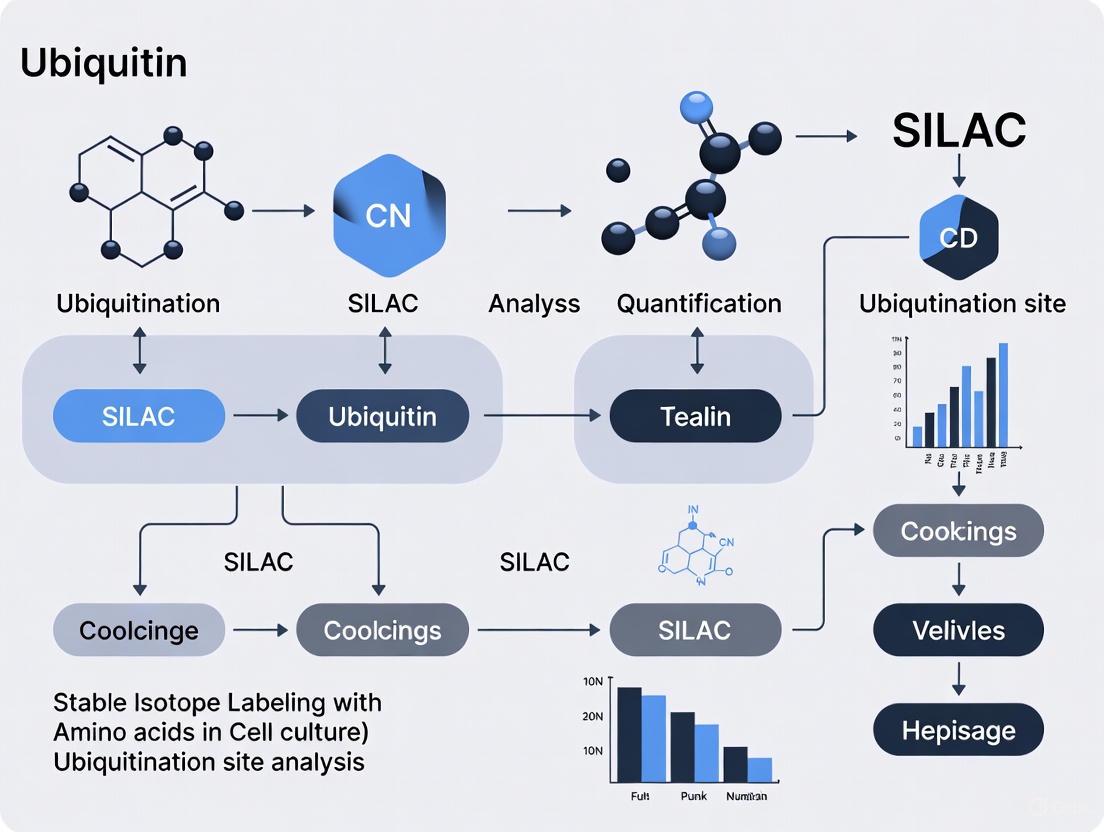
This article provides a comprehensive guide for researchers and drug development professionals on applying Stable Isotope Labeling by Amino Acids in Cell Culture (SILAC) for the quantitative analysis of protein...
Quantifying the Ubiquitin Code: A Comprehensive Guide to SILAC-Based Ubiquitination Site Analysis
Abstract
This article provides a comprehensive guide for researchers and drug development professionals on applying Stable Isotope Labeling by Amino Acids in Cell Culture (SILAC) for the quantitative analysis of protein ubiquitination. We cover the foundational principles of ubiquitin biology and SILAC methodology, detailing workflows from cell culture and metabolic labeling to the specific enrichment of ubiquitinated peptides using anti-K-ε-GG antibodies and subsequent mass spectrometric analysis. The content further addresses critical steps for troubleshooting and optimizing protocols to enhance sensitivity and specificity, and provides a framework for validating findings through orthogonal methods and benchmarking against alternative techniques. By synthesizing established and emerging practices, this guide aims to empower scientists to robustly profile ubiquitome dynamics in diverse biological and clinical contexts, from fundamental research to translational studies.
Ubiquitin Biology and SILAC Principles: Building the Base for Quantitative Proteomics
Ubiquitination is a post-translational modification involving the covalent conjugation of ubiquitin to lysine residues on target proteins, catalyzed by the sequential action of E1 (ubiquitin-activating), E2 (ubiquitin-conjugating), and E3 (ubiquitin-ligating) enzymes [1] [2]. This process regulates diverse cellular functions, including protein degradation via the ubiquitin-proteasome system (UPS) and non-degradative immune signaling pathways [1] [2]. Within the context of SILAC (Stable Isotope Labeling by Amino Acids in Cell Culture) quantification, ubiquitination site analysis enables precise tracking of protein turnover and dynamics, providing insights into immune regulation and disease mechanisms [3]. This Application Note outlines the roles of ubiquitination in immune signaling and details protocols for experimental analysis using SILAC-based workflows.
Ubiquitin Chain Types and Functional Consequences
Ubiquitin chains of different topologies determine the fate of modified proteins. The table below summarizes major ubiquitin linkage types, their primary functions, and key roles in immune processes [1] [2].
Table 1: Ubiquitin Chain Linkages and Their Functions
| Linkage Type | Primary Function | Role in Immune Signaling |
|---|---|---|
| K48-linked | Proteasomal degradation [1] | Regulates turnover of transcription factors (e.g., NF-κB inhibitors) [1] |
| K63-linked | Non-degradative signaling [2] | Activates TAK1 and IKK in TLR/RLR pathways [2] |
| M1-linked (Linear) | Inflammatory signaling [2] | Modulates NF-κB activation and cell death [2] |
| K11-linked | Proteasomal degradation [1] | Involved in ERAD and STING degradation during viral infection [1] |
| K27/K29-linked | Atypical degradative signaling [1] | Regulates innate immune responses (e.g., TRIF-dependent signaling) [1] |
Ubiquitination in Immune Signaling Pathways
Ubiquitination critically regulates innate and adaptive immune responses by modulating pathogen recognition receptor (PRR) signaling, T-cell activation, and tolerance [1] [2]. Key E3 ligases and deubiquitinases (DUBs) ensure precise control over these pathways.
Innate Immune Signaling via TLRs and RLRs
- TLR Pathway: Upon PAMP recognition, TLRs recruit adaptors (MyD88, TRIF), leading to E3 ligase (e.g., TRAF6)-mediated K63-linked ubiquitination. This activates TAK1 and IKK, driving NF-κB and IRF3/7 translocation for proinflammatory cytokine and interferon production [1] [2].
- RLR Pathway: RIG-I and MDA5 detect viral RNA, promoting MAVS oligomerization and TRAF3/6-dependent K63 ubiquitination. This activates TBK1/IKKε, inducing type I interferons [2]. Negative regulators (e.g., TRIM27) degrade TBK1 via K48-linked ubiquitination to prevent excessive signaling [1].
Adaptive Immune Signaling in T Cells
- T Cell Activation: E3 ligases (e.g., Cbl-b, Itch, GRAIL) ubiquitylate TCR signaling components (e.g., PLCγ, PKCθ), limiting autoimmunity by inducing anergy [1].
- T Helper Cell Differentiation: E3 ligases like Cul5 target phosphorylated JAK1 for degradation, promoting Treg differentiation and immune tolerance [1].
Diagram 1: Ubiquitin-Mediated TLR4 Signaling Pathway
SILAC-Based Protocol for Ubiquitination Site Analysis
This protocol outlines a dynamic SILAC workflow to quantify ubiquitination-dependent protein turnover, ideal for studying immune signaling dynamics [3].
Materials and Reagents
Table 2: Research Reagent Solutions for SILAC Ubiquitination Analysis
| Reagent/Material | Function | Example |
|---|---|---|
| SILAC Amino Acids | Metabolic labeling for quantification | L-lysine-¹³C₆ (Heavy); L-arginine-¹²C₆ (Light) [3] |
| Ubiquitin Enrichment Resin | Immunoprecipitation of ubiquitylated proteins | K-ε-GG antibody-conjugated beads [3] |
| Proteasome Inhibitor | Stabilizes polyubiquitylated substrates | MG-132 [1] |
| Lysis Buffer | Extraction of ubiquitylated proteins | RIPA buffer with N-ethylmaleimide (DUB inhibitor) [3] |
| Mass Spectrometry System | Quantification of ubiquitin remnants | LC-MS/MS with DDA or DIA acquisition [3] |
Step-by-Step Workflow
Cell Culture and SILAC Labeling:
- Culture immune cells (e.g., macrophages, T cells) in SILAC media containing "light" (L-arginine/L-lysine) or "heavy" (¹³C₆-lysine/¹³C₆-arginine) amino acids for ≥5 cell divisions to ensure >95% labeling efficiency [3].
Stimulation and Harvest:
Ubiquitin Peptide Enrichment:
- Digest proteins with trypsin (1:50 w/w, 37°C, 16 h). Enrich ubiquitylated peptides using anti-K-ε-GG antibody beads. Elute with 0.1% TFA [3].
LC-MS/MS Analysis and Data Processing:
- Analyze peptides via LC-MS/MS using DIA (data-independent acquisition) for comprehensive quantification. Process data with software like MaxQuant or FragPipe, applying a 1% FDR cutoff. Filter low-abundance peptides and outlier ratios to improve accuracy [3].
Diagram 2: Dynamic SILAC Workflow for Ubiquitin Turnover
Key E3 Ligases and DUBs in Immune Regulation
E3 ligases and DUBs provide specificity and reversibility in ubiquitination. Their deregulation is linked to autoimmunity and cancer [1] [2].
Table 3: E3 Ligases and DUBs in Immune Pathways
| Component | Target Substrate | Function in Immunity |
|---|---|---|
| TRAF6 (E3) | IRAK1, TAK1 [2] | K63-ubiquitination for NF-κB activation in TLR/IL-1R pathways [2] |
| Cbl-b (E3) | TCR signaling proteins [1] | Induces T cell anergy to maintain tolerance [1] |
| TRIM27 (E3) | TBK1 [1] | K48-ubiquitination to suppress type I IFN responses [1] |
| CYLD (DUB) | TRAF6, TRAF3 [1] | Removes K63 chains to limit inflammatory signaling [1] |
| OTUD5 (DUB) | TRAF3 [1] | Deubiquitinates TRAF3 to enhance type I IFN production [1] |
Ubiquitination is a versatile mechanism governing protein degradation and immune signaling. Integrating SILAC-based proteomics with ubiquitination site analysis allows researchers to quantify dynamic changes in immune responses, facilitating drug discovery for inflammatory diseases and cancer. The protocols and visualizations provided here offer a framework for applying these tools in experimental studies.
Stable Isotope Labeling by Amino Acids in Cell Culture (SILAC) is a powerful mass spectrometry-based technique that enables precise identification and quantification of relative differential changes in protein abundance [4]. First established as a quantitative proteomics method in 2002, SILAC provides accurate relative quantification without requiring chemical derivatization or manipulation, making it a cornerstone technology for modern proteomic research [4]. The fundamental principle relies on metabolic incorporation of stable isotope-labeled amino acids into the entire proteome of growing cells, allowing direct comparison of protein expression across different experimental conditions [5].
Within the specific context of ubiquitination site analysis, SILAC offers particular advantages for studying dynamics of post-translational modifications [6]. Ubiquitination plays critical roles in numerous cellular processes including protein degradation, DNA damage repair, cell signaling, and cell cycle progression [6]. The di-glycine (di-Gly) remnant that remains attached to ubiquitinated lysines after tryptic digestion produces a distinct mass shift of 114.0429 Da, enabling precise identification and localization of ubiquitylation sites when combined with SILAC quantification [6]. This integration allows researchers to not only identify thousands of endogenous ubiquitylation sites but also quantify site-specific changes in ubiquitylation in response to cellular perturbations such as proteasome inhibition [6].
Core Principles and Methodology
Fundamental Workflow
The SILAC methodology operates on a simple yet powerful principle of metabolic incorporation, where two cell populations are cultivated in parallel under identical conditions except for the isotopic composition of specific amino acids in their growth media [4]. One population (often termed "light") receives normal growth medium containing amino acids with natural isotopic abundance, while the second population ("heavy") receives medium supplemented with stable isotope-labeled amino acids [4]. After a sufficient number of cell divisions (typically 5-7 population doublings), the labeled amino acids become fully incorporated into the entire proteome, effectively tagging all newly synthesized proteins with the heavy isotope [4]. The two cell populations are then subjected to different experimental treatments, combined, and analyzed simultaneously by liquid chromatography-tandem mass spectrometry (LC-MS/MS) [4].
The quantification in SILAC is achieved by comparing the signal intensities of peptide pairs detected in the mass spectrometer [4]. These peptide pairs are chemically identical but distinguishable by their mass differences due to the incorporated heavy isotopes. For example, when using heavy arginine labeled with six carbon-13 atoms (13C) instead of normal carbon-12 (12C), all peptides containing a single arginine residue will be 6 Da heavier than their light counterparts [5]. The ratio of peak intensities for these peptide pairs directly reflects the relative abundance of the corresponding proteins in the original cell populations [5]. This built-in internal standard approach minimizes experimental variability, as samples are combined early in the workflow and processed together through subsequent steps of protein extraction, digestion, and analysis [4].
SILAC Workflow Diagram
The following diagram illustrates the fundamental SILAC workflow from cell culture to quantitative analysis:
Amino Acid Selection and Labeling Strategies
The choice of amino acids for SILAC labeling is crucial for successful quantitative proteomics experiments. The most common approach utilizes labeled lysine and arginine, which ensures that all tryptic peptides (except for very small peptides) contain at least one labeled amino acid, thus enabling comprehensive proteome coverage [7]. Typically, heavy lysine is labeled with six 13C atoms and two 15N atoms (13C6 15N2-Lys), resulting in a mass shift of 8 Da, while heavy arginine is labeled with six 13C atoms and four 15N atoms (13C6 15N4-Arg), creating a 10 Da mass shift [7]. This distinct mass difference allows clear discrimination between light and heavy peptide forms in the mass spectrometer.
Several specialized SILAC strategies have been developed to address specific research questions:
Pulsed SILAC (pSILAC): This variation involves adding labeled amino acids to the growth medium for only a short period, enabling monitoring of de novo protein synthesis rather than steady-state protein concentration [5]. This approach is particularly valuable for studying dynamic processes such as protein turnover and rapid changes in protein expression.
NeuCode SILAC: This recently developed technique enhances multiplexing capabilities by utilizing neutron-encoded heavy amino acids, allowing up to 4-plex experiments without requiring 100% incorporation of amino acids needed for traditional SILAC [5]. The increased multiplexing is achieved through small mass defects from extra neutrons in stable isotopes, which can be resolved on high-resolution mass spectrometers.
Native SILAC (nSILAC): For prototrophic microorganisms that can synthesize their own amino acids, nSILAC exploits the natural down-regulation of lysine biosynthesis in the presence of exogenous lysine, enabling metabolic labeling without requiring auxotrophic strains [8]. This approach overcomes limitations for analyzing existing mutants, strain collections, or commercially important strains used in biotechnology.
SILAC Applications in Ubiquitination Research
Quantitative Analysis of Ubiquitination Sites
SILAC-based quantitative proteomics has revolutionized the study of ubiquitination by enabling proteome-wide, site-specific quantification of endogenous ubiquitylation sites [6]. In a landmark study, researchers combined SILAC with single-step immunoenrichment of ubiquitylated peptides to precisely map 11,054 endogenous putative ubiquitylation sites on 4,273 human proteins [6]. This comprehensive analysis covered 67% of previously known ubiquitylation sites while identifying 10,254 novel sites on proteins involved in diverse cellular functions including cell signaling, receptor endocytosis, DNA replication, DNA damage repair, and cell cycle progression [6].
The power of SILAC in ubiquitination research is particularly evident in studies investigating cellular responses to proteasome inhibition. Global quantification of ubiquitylation in cells treated with the proteasome inhibitor MG-132 revealed distinct classes of ubiquitylation sites: those involved in proteasomal degradation and a surprisingly large number of sites with non-proteasomal functions [6]. Intriguingly, approximately 15% of all ubiquitylation sites showed more than a two-fold decrease within four hours of MG-132 treatment, demonstrating that inhibition of proteasomal function can dramatically reduce ubiquitylation on many sites with non-proteasomal functions [6]. These findings highlight the complex regulatory roles of ubiquitination beyond mere protein degradation.
Ubiquitination Signaling Pathway
The following diagram illustrates the ubiquitination process and its functional consequences in cellular regulation:
Protein-Protein Interaction Studies
SILAC has become an indispensable tool for studying protein-protein interactions, particularly when combined with affinity purification mass spectrometry (AP-MS) [9]. This integrated approach allows specific interacting proteins to be efficiently distinguished from nonspecific background proteins, significantly enhancing the reliability of interaction data [9]. In these experiments, cells expressing a tagged bait protein are metabolically labeled with light isotopes, while control cells (expressing the tag alone) are labeled with heavy isotopes, or vice versa [9].
The standard SILAC approach for protein interaction studies, known as PAM-SILAC (Purification After Mixing-SILAC), involves mixing light and heavy labeled cell lysates before affinity purification [9]. Specific interacting partners purified from the tagged bait sample show significantly higher abundance compared to the control, resulting in SILAC ratios much greater than 1, while nonspecifically bound background proteins exhibit ratios close to 1 [9]. However, this method has limitations for identifying dynamic interactors with fast on/off rates, as interaction exchange between light and heavy forms during purification can decrease SILAC ratios [9].
To address this limitation, researchers have developed advanced SILAC strategies:
MAP-SILAC (Mixing After Purification-SILAC): In this approach, protein purification is performed separately from the two differentially labeled cell lysates, which are combined only after purification [9]. This completely eliminates interaction interferences from control cell lysates during purification, allowing dynamic interactors to preserve their high SILAC ratios for unambiguous identification.
Tc-PAM-SILAC (Time-controlled PAM-SILAC): This method uses different incubation times (e.g., 20 min, 1 h, 2 h) to facilitate identification of dynamic interactors, based on the observation that SILAC ratios for dynamic interactors increase with shorter incubation times due to decreased interaction exchange [9].
These sophisticated methods have been successfully applied to characterize proteasome-interacting proteins and COP9 signalosome-interacting proteins, revealing numerous dynamic interactors that play key regulatory roles in the ubiquitin-proteasome degradation system [9].
Experimental Protocols
Standard SILAC Protocol for Ubiquitination Site Analysis
Objective: To identify and quantify endogenous ubiquitination sites in response to cellular perturbations using SILAC-based quantitative proteomics.
Materials and Reagents:
- SILAC media deficient in lysine and arginine
- Light lysine (12C6 14N2-Lys) and light arginine (12C6 14N4-Arg)
- Heavy lysine (13C6 15N2-Lys) and heavy arginine (13C6 15N4-Arg)
- Dialyzed fetal bovine serum (FBS)
- L-proline (200 mg/L) to prevent arginine to proline conversion [7]
- Protease inhibitors (Complete protease inhibitor mixture tablets)
- Phosphatase inhibitors
- N-ethylmaleimide (to inhibit deubiquitylases) [6]
- di-Gly-lysine-specific monoclonal antibody [6]
- Modified RIPA lysis buffer (1% NP-40, 0.1% sodium deoxycholate, 150 mM NaCl, 1 mM EDTA in 50 mM Tris-HCl pH 7.5) [6]
Procedure:
SILAC Labeling:
- Prepare heavy SILAC media: DMEM lacking lysine and arginine, supplemented with 10% dialyzed FBS, 0.798 mM 13C6 15N2-lysine, 0.398 mM 13C6 15N4-arginine, and 200 mg/L L-proline [7].
- Prepare light SILAC media: identical composition but with normal lysine and arginine.
- Culture cells in respective media for at least 5-7 population doublings to achieve >97% incorporation of labeled amino acids.
Treatment and Cell Lysis:
- Treat heavy-labeled cells with experimental condition (e.g., 10 μM MG-132 proteasome inhibitor for 4 hours) and light-labeled cells with control condition (e.g., DMSO vehicle) [6].
- Wash cells twice with ice-cold PBS and harvest using cell scrapers.
- Lyse cells in modified RIPA buffer supplemented with protease inhibitors, phosphatase inhibitors, and 1 mM N-ethylmaleimide to inhibit deubiquitylases [6].
- Incubate lysates on ice for 15 minutes and clear by centrifugation at 16,000 × g for 15 minutes.
Protein Digestion and Peptide Cleanup:
- Determine protein concentration using BCA assay.
- Mix heavy and light labeled protein lysates in 1:1 ratio based on protein concentration.
- Precipitate proteins with ice-cold acetone overnight at -20°C.
- Redissolve proteins in denaturation buffer (6 M urea, 2 M thiourea in 10 mM HEPES pH 8).
- Reduce cysteines with 1 mM dithiothreitol and alkylate with 5.5 mM chloroacetamide [6].
- Digest proteins with endoproteinase Lys-C followed by trypsin after fourfold dilution.
- Acidify peptides with trifluoroacetic acid to 1% final concentration.
- Desalt peptides using C18 solid-phase extraction cartridges.
Immunoaffinity Enrichment of Ubiquitinated Peptides:
- Dissolve peptides in immunoprecipitation buffer (10 mM sodium phosphate, 50 mM sodium chloride in 50 mM MOPS pH 7.2).
- Incubate with 100 μg di-Gly-lysine-specific antibody for 12 hours at 4°C with rotation [6].
- Wash antibodies extensively with immunoprecipitation buffer followed by water.
- Elute ubiquitinated peptides with 0.1% trifluoroacetic acid.
LC-MS/MS Analysis and Data Processing:
- Fractionate peptides by high-pH reverse-phase chromatography or analyze directly by LC-MS/MS.
- Analyze peptides on a high-resolution mass spectrometer (e.g., Orbitrap instrument) using data-dependent acquisition.
- Use higher-energy C-trap dissociation (HCD) for peptide fragmentation [6].
- Search MS data against appropriate protein database using software such as MaxQuant, Proteome Discoverer, or FragPipe [3].
- Apply false discovery rate (FDR) threshold of <1% for both protein and modification site identification.
Advanced Protocol: Dynamic Protein Interaction Analysis Using MAP-SILAC
Objective: To identify dynamic protein interactors with fast on/off rates that are difficult to capture with standard AP-MS approaches.
Materials and Reagents:
- EMEM media deficient in lysine and arginine
- Heavy isotope-labeled amino acids: 13C6 15N4-arginine and 13C6 15N2-lysine
- Light isotope-labeled amino acids: 12C6 14N4-arginine and 12C6 14N2-lysine
- HB-tag affinity purification resins [9]
- Lysis buffer: 100 mM NaCl, 50 mM Tris-HCl (pH 7.5), 0.5% NP-40, 1.5 mM MgCl2, 25 mM NaF, 1 mM Na3VO4, 1 mM DTT, plus protease inhibitors [9]
Procedure:
Metabolic Labeling and Cell Culture:
- Culture 293Rpn11-HTBH cells in heavy SILAC media and 293HTBH control cells in light SILAC media for at least 6 population doublings.
- Expand cells to obtain sufficient material for affinity purification (typically 15-cm dishes at 80-90% confluence).
Separate Affinity Purification:
- Lyse heavy and light labeled cells separately in appropriate lysis buffer.
- Clarify lysates by centrifugation at 20,000 × g for 15 minutes.
- Incubate cleared lysates with HB-tag affinity resin separately for 2 hours at 4°C with gentle rotation.
- Wash resins extensively with lysis buffer (at least 5 times with 10 column volumes each).
Sample Mixing and Processing:
- Combine equal amounts of resin from heavy and light purifications.
- Elute bound protein complexes with SDS sample buffer or competitive elution with HB-tag peptide.
- Digest proteins using standard in-solution or filter-aided digestion protocols.
Mass Spectrometric Analysis:
- Analyze peptides by LC-MS/MS on a high-resolution instrument.
- Identify specific interactors based on SILAC ratios (heavy/light), where specific interactors show ratios >> 1, while background proteins show ratios ≈ 1.
- Compare results with standard PAM-SILAC approach to distinguish stable versus dynamic interactors.
Research Reagent Solutions
Table 1: Essential Reagents for SILAC-Based Ubiquitination Studies
| Reagent Category | Specific Examples | Function and Importance | Technical Considerations |
|---|---|---|---|
| SILAC Amino Acids | 13C6 15N2-Lysine, 13C6 15N4-Arginine | Metabolic labeling for quantitative comparison | Use proline supplementation (200 mg/L) to prevent arginine conversion [7] |
| Cell Culture Media | Custom DMEM lacking lysine/arginine | Support cell growth while controlling amino acid incorporation | Must use dialyzed FBS to remove unlabeled amino acids |
| Ubiquitination Enrichment | di-Gly-lysine-specific monoclonal antibody | Immunoaffinity enrichment of ubiquitinated peptides | Enables site-specific ubiquitination analysis [6] |
| Protease Inhibitors | N-ethylmaleimide | Inhibits deubiquitylases (DUBs) to preserve ubiquitination | Critical for maintaining ubiquitination state during lysis [6] |
| Lysis Buffers | Modified RIPA buffer | Efficient protein extraction while maintaining protein interactions | Includes NP-40 detergent for membrane protein solubilization [6] |
| Affinity Purification | HB-tag resin, Streptavidin beads | Isolation of protein complexes for interaction studies | Choice of tag system affects purification efficiency [9] |
| MS Instrumentation | High-resolution Orbitrap instruments | Accurate mass measurement for SILAC pair quantification | HCD fragmentation preferred for ubiquitination site mapping [6] |
Protocol for SILAC-Based Organoid Proteomics
Objective: To adapt SILAC labeling for 3D organoid cultures, enabling quantitative proteomics in physiologically relevant model systems.
Materials and Reagents:
- Advanced DMEM/F-12 Flex medium
- Custom SILAC media lacking arginine and lysine
- Recombinant R-spondin 1 and Noggin conditioned media produced in SILAC media [10]
- MatriSperse for organoid isolation without enzymatic digestion [10]
- Growth factor-reduced Matrigel
Procedure:
Preparation of SILAC Organoid Media:
- Generate R-spondin 1 and Noggin conditioned media using 293T cells grown in light, medium, or heavy SILAC media [10].
- Filter conditioned media through 0.22 μm filters.
- Prepare complete SILAC organoid media by mixing 20% R-spondin 1 conditioned medium, 10% Noggin conditioned medium, and 70% Advanced DMEM/F-12 Flex medium supplemented with appropriate isotopic amino acids [10].
Organoid Culture and Labeling:
- Culture intestinal organoids in respective SILAC media for approximately 20 days (4 passages) to achieve >90% isotopic incorporation [10].
- Monitor incorporation rates by MS analysis at different time points.
Treatment and Sample Preparation:
- Treat fully incorporated organoids with experimental conditions (e.g., HDAC inhibitors such as CI994).
- Isolate organoids from Matrigel using non-enzymatic MatriSperse dissociation.
- Wash organoids extensively with cold PBS to remove residual Matrigel contaminants.
- Process organoids for protein extraction and digestion following standard protocols.
MS Analysis and Data Interpretation:
- Analyze peptides by LC-MS/MS using high-resolution instruments.
- Identify differentiation-dependent protein expression changes, such as increases in intestinal alkaline phosphatase and decreases in stem cell markers like Lgr5 [10].
Data Analysis and Technical Considerations
SILAC Data Analysis Platforms
The accuracy of SILAC proteomics heavily depends on appropriate data analysis software and parameters. A comprehensive benchmarking study evaluated five major software tools (MaxQuant, Proteome Discoverer, FragPipe, DIA-NN, and Spectronaut) for both static and dynamic SILAC labeling with data-dependent acquisition (DDA) and data-independent acquisition (DIA) methods [3]. Key findings from this evaluation include:
Dynamic Range Limitations: Most software platforms reach a dynamic range limit of approximately 100-fold for accurate quantification of light/heavy ratios, highlighting the importance of appropriate sample mixing ratios [3].
Software Recommendations: The study does not recommend using Proteome Discoverer for SILAC DDA analysis despite its wide application in label-free proteomics, suggesting that researchers consider alternative platforms for SILAC experiments [3].
Cross-Validation Strategy: To achieve greater confidence in SILAC quantification, researchers can use more than one software package to analyze the same dataset for cross-validation, as each method has distinct strengths and weaknesses across 12 performance metrics including identification, quantification, accuracy, precision, and reproducibility [3].
Quantitative Data from SILAC Experiments
Table 2: Representative SILAC Quantitative Data from Ubiquitination Studies
| Experimental Context | SILAC Ratio (Heavy/Light) | Biological Interpretation | Technical Considerations |
|---|---|---|---|
| Proteasome Inhibition (MG-132 treatment) | >2.0 for 15% of sites | Decreased ubiquitylation at non-proteasomal sites | 4-hour treatment sufficient for significant changes [6] |
| Dynamic Protein Interactions (MAP-SILAC vs PAM-SILAC) | MAP: >5.0, PAM: ~1.0 | Identification of dynamic interactors with fast exchange | Incubation time critical for exchange rates [9] |
| Organoid Differentiation (CI994 HDAC inhibitor) | >1.5 for metabolic proteins, <0.5 for cell cycle proteins | Altered enterocyte differentiation | Pearson coefficient of 0.85 demonstrates reproducibility [10] |
| Amino Acid Conversion (with/without proline) | ~1.0 with proline supplementation | Prevention of arginine to proline conversion | 200 mg/L proline prevents detectable conversion [7] |
| Software Performance (Benchmarking study) | Accurate within 100-fold range | Limit of accurate quantification | Filtering low-abundance peptides improves accuracy [3] |
Troubleshooting and Optimization
Incomplete Amino Acid Incorporation:
- Ensure sufficient cell divisions (5-7 population doublings) for complete incorporation
- Use dialyzed FBS to remove unlabeled amino acids
- Verify incorporation efficiency by MS analysis before proceeding with experiments
Arginine to Proline Conversion:
- Supplement media with 200 mg/L L-proline to prevent metabolic conversion [7]
- Monitor proline-containing peptides for evidence of conversion artifacts
- Avoid excessive arginine concentrations in culture media
Low Ubiquitination Site Coverage:
- Optimize antibody amount for immunoaffinity enrichment (typically 5 μg antibody per 1 mg protein lysate) [6]
- Include N-ethylmaleimide in lysis buffer to inhibit deubiquitylases
- Use higher starting protein amounts (20 mg recommended) for deep ubiquitinome analysis
Data Quality and Quantification Accuracy:
- Remove low-abundance peptides and outlier ratios to improve SILAC quantification accuracy [3]
- Select appropriate labeling time points for dynamic SILAC experiments
- Implement cross-validation using multiple software platforms for critical findings
SILAC remains one of the most powerful and accurate methods for quantitative proteomics, with particular strength in ubiquitination site analysis and protein interaction studies. The core principles of metabolic labeling, early sample combining, and ratio-based quantification provide inherent advantages for reproducibility and accuracy. When properly implemented with appropriate controls and optimization—including proline supplementation to prevent amino acid conversion, efficient immunoaffinity enrichment of ubiquitinated peptides, and careful selection of data analysis software—SILAC enables unprecedented insights into dynamic cellular processes. The continued development of specialized SILAC variants, including pulsed SILAC for protein turnover studies and native SILAC for prototrophic organisms, ensures this technology will remain at the forefront of quantitative proteomics for the foreseeable future.
Protein ubiquitylation is one of the most prevalent post-translational modifications (PTMs) within eukaryotic cells, governing virtually all cellular processes including proteasomal degradation, signal transduction, DNA repair, and subcellular localization [11] [12]. The versatility of ubiquitin signaling arises from its ability to form diverse chain architectures through its seven internal lysine residues, with different linkage types encoding distinct biological functions [13]. For decades, characterizing this complex modification on a proteome-wide scale remained challenging due to the low stoichiometry of ubiquitylation and technical limitations in enrichment strategies.
The breakthrough in large-scale ubiquitylation analysis came with the development of antibodies specifically recognizing the diglycine (diGly or K-ε-GG) remnant left on trypsinized peptides following ubiquitin modification [11]. When a ubiquitylated protein undergoes tryptic digestion, the C-terminal glycine residues of ubiquitin (Gly75-Gly76) remain attached to the modified lysine residue of the substrate, generating a characteristic K-ε-GG signature with a diagnostic mass shift of 114.0429 Da [11] [12]. This diGly remnant serves as a universal marker for ubiquitin modification sites, enabling antibody-based enrichment and subsequent identification by mass spectrometry.
Within the context of SILAC (Stable Isotope Labeling by Amino Acids in Cell Culture) quantification research, diGly proteomics has emerged as a powerful methodology for comparing ubiquitylation dynamics across multiple cellular states. The integration of SILAC with diGly antibody enrichment provides a robust framework for quantifying stimulus-induced changes in the ubiquitinome, identifying substrates of specific E3 ligases, and investigating the effects of pharmacological inhibitors on ubiquitin signaling pathways [11] [12]. This Application Note details the principles and protocols for implementing diGly proteomics with SILAC quantification to advance ubiquitination site analysis research.
Quantitative Landscape of diGly Proteomics
The field of diGly proteomics has seen remarkable advances in sensitivity, throughput, and quantitative accuracy. The table below summarizes the performance of various methodological approaches, demonstrating how technological innovations have progressively enhanced our ability to monitor the ubiquitinome.
Table 1: Evolution of Quantitative Depth in diGly Proteomics
| Methodology | Sample Input | Quantitative Approach | diGly Sites Identified | Key Advantages | Reference |
|---|---|---|---|---|---|
| Standard SILAC-DDA | 5 mg protein per label state | SILAC (3-plex) | ~3,300-5,500 | Established workflow; good for cell lines | [14] |
| Offline Fractionation | Cell lysates | Label-free | >23,000 | Greatly increases depth; useful for tissues | [15] |
| On-Antibody TMT | 0.5-1 mg peptides | TMT (10-plex) | ~10,000 | High multiplexing; ideal for precious samples | [16] |
| Optimized DIA | 1 mg peptides | Data-independent acquisition | ~35,000 | Superior quantitative accuracy & completeness | [17] |
The quantitative data reveal several critical trends. First, methodological refinements in fractionation and mass spectrometry have dramatically increased identification capabilities, with modern DIA methods identifying approximately 10 times more sites than early SILAC approaches [17] [14]. Second, the development of multiplexed methods like on-antibody TMT labeling has enabled the analysis of limited sample materials, including primary tissues and patient-derived samples [16]. Third, the transition from data-dependent acquisition (DDA) to data-independent acquisition (DIA) has significantly improved quantitative reproducibility, with DIA demonstrating coefficients of variation (CVs) below 20% for 45% of diGly peptides compared to only 15% with DDA [17].
It is important to note that diGly antibodies also capture modifications by ubiquitin-like proteins (NEDD8 and ISG15) that generate identical diGly remnants after tryptic digestion. However, studies have demonstrated that approximately 95% of all diGly peptides identified using this approach originate from genuine ubiquitin modification rather than these related modifiers [11]. The commercial availability of diGly remnant motif antibodies (such as the PTMScan Ubiquitin Remnant Motif Kit) has significantly accelerated the adoption of this technology across diverse research settings [11].
Fundamental Principles of diGly Signature Generation
The molecular foundation of diGly proteomics lies in the specific proteolytic events that generate the recognizable K-ε-GG signature. Understanding this process is essential for proper experimental design and data interpretation.
Figure 1: Trypsin digestion generates the diagnostic diGly signature on ubiquitinated peptides.
The ubiquitin molecule itself contains seven lysine residues and a C-terminal glycine-glycine motif. During tryptic digestion, cleavage occurs after arginine 74 in the ubiquitin sequence, leaving the C-terminal Gly75-Gly76 attached to the modified lysine residue of the substrate protein [11] [12]. This generates a peptide with a characteristic diGly modification on the target lysine (K-ε-GG), which is distinguishable by mass spectrometry due to the 114.0429 Da mass addition. Importantly, trypsin cannot cleave at the modified lysine residue, resulting in longer peptides with missed cleavages that frequently exhibit higher charge states during MS analysis—a important consideration for method optimization [17].
This diGly remnant was first identified on histone H2A as early as 1977 [11], but its systematic exploitation for proteome-wide studies only became feasible with the development of specific antibodies in the early 2000s [11]. The resulting immunoaffinity enrichment techniques now enable researchers to isolate these low-abundance modified peptides from complex biological mixtures, facilitating comprehensive ubiquitinome profiling.
SILAC-Based diGly Proteomics Workflow
The integration of SILAC with diGly enrichment provides a powerful platform for quantitative ubiquitinome analysis. The following workflow outlines the key procedural stages from cell culture to data analysis.
Figure 2: Integrated SILAC-diGly workflow for quantitative ubiquitinome analysis.
Cell Culture and Metabolic Labeling
SILAC Media Preparation:
- Prepare heavy and light DMEM media lacking lysine and arginine [11].
- For heavy media: Supplement with 13C6,15N2 L-lysine-2HCl (K8) and 13C6,15N4 L-arginine-HCl (R10) [11].
- For light media: Supplement with normal L-lysine-2HCl and L-arginine-HCl [11].
- Add 10% dialyzed FBS and penicillin-streptomycin to both media [11].
Cell Labeling:
- Culture cells in respective SILAC media for at least 5-6 cell divisions to ensure complete incorporation of heavy amino acids [12].
- Validate labeling efficiency by MS analysis of a small sample before proceeding with experiments.
Cell Lysis and Protein Digestion
Lysis Buffer Composition:
- 8M urea, 150mM NaCl, 50mM Tris-HCl (pH 8.0) [11].
- Add protease inhibitors (Complete Protease Inhibitor Cocktail) [11].
- Include 5mM N-ethylmaleimide (NEM) to inhibit deubiquitinating enzymes (DUBs) [11].
- Phosphatase inhibitors (1mM NaF, 1mM β-glycerophosphate, 1mM sodium orthovanadate) can be added if studying phospho-ubiquitin crosstalk [11].
Protein Digestion:
- Perform protein quantification and normalize concentrations across samples.
- Reduce and alkylate proteins using standard protocols.
- Digest proteins first with LysC (1:100 enzyme:protein) for 3-4 hours at room temperature [11].
- Dilute urea concentration to 2M and digest with trypsin (1:50 enzyme:protein) overnight at 37°C [11].
- Acidify peptides with trifluoroacetic acid (TFA) to pH <3 and desalt using C18 SepPak cartridges [11].
diGly Peptide Enrichment
Immunoaffinity Purification:
- Use PTMScan Ubiquitin Remnant Motif Kit or equivalent diGly motif-specific antibodies [11].
- Incubate 1-5 mg of peptide material with antibody beads for 2 hours at 4°C with gentle rotation [11] [14].
- Wash beads extensively with ice-cold PBS to remove non-specifically bound peptides [15].
- Elute diGly peptides with 0.1-0.5% TFA or formic acid [11].
Post-Enrichment Cleanup:
- Desalt eluted peptides using C18 StageTips or similar micro-scale purification methods.
- Concentrate peptides by vacuum centrifugation and reconstitute in MS loading buffer (0.1% formic acid).
Mass Spectrometric Analysis
Liquid Chromatography:
- Separate peptides using reversed-phase C18 columns with 2-90% acetonitrile gradients over 60-120 minutes.
- Column temperature should be maintained at 50-60°C for optimal separation.
Mass Spectrometry:
- For DDA: Acquire full MS scans (350-1400 m/z) at high resolution (60,000-120,000), followed by data-dependent MS/MS scans of the most intense precursors [11].
- For DIA: Use optimized window schemes (e.g., 46 windows of variable width) with high MS2 resolution (30,000) for maximal diGly peptide identification [17].
- For TMT: Employ MS3-level quantification to minimize ratio compression [16].
Data Analysis
Database Searching:
- Search RAW files against appropriate protein databases using search engines (MaxQuant, Spectronaut, etc.).
- Set variable modifications: diGly remnant (K, +114.0429 Da), oxidation (M), and N-ethylmaleimide (C).
- Set SILAC doublets (K+8.0142, R+10.0083) as variable modifications for heavy-labeled samples [12].
Quantification and Validation:
- Apply appropriate normalization algorithms to correct for mixing errors.
- Implement statistical cut-offs (typically fold-change >2 and FDR <0.01) to identify significantly regulated sites.
- Remove known contaminants and filter for high-confidence diGly peptides.
Advanced Methodological Innovations
Data-Independent Acquisition (DIA) for diGly Proteomics
Recent advances in data-independent acquisition have transformed diGly proteomics by improving quantitative accuracy and data completeness. DIA fragments all peptides within predefined m/z windows simultaneously, eliminating stochastic sampling and reducing missing values [17]. Optimization of DIA methods for diGly peptides requires special consideration of their unique characteristics:
- Window Scheme Optimization: Implement variable window widths tailored to the empirical distribution of diGly peptide precursors [17].
- High MS2 Resolution: Use 30,000 resolution for fragment scans to improve specificity of identification [17].
- Comprehensive Spectral Libraries: Generate extensive libraries containing >90,000 diGly peptides from multiple cell types and conditions [17].
The implementation of DIA methods for diGly analysis has demonstrated remarkable performance, identifying approximately 35,000 diGly peptides in single measurements of MG132-treated cells—nearly double the identification rate of traditional DDA methods [17].
Multiplexed diGly Proteomics with TMT Labeling
While SILAC is limited to 2-3 comparison states, tandem mass tag (TMT) labeling enables higher multiplexing (up to 18 samples). However, conventional TMT labeling blocks the N-terminus of diGly peptides, preventing antibody recognition. The innovative UbiFast method addresses this limitation through on-antibody TMT labeling:
- Enrich diGly peptides using standard immunoaffinity purification.
- While peptides are bound to antibodies, label with TMT reagents for 10 minutes using 0.4 mg reagent per sample [16].
- Quench the reaction with 5% hydroxylamine [16].
- Combine labeled samples, elute from antibodies, and analyze by LC-MS/MS.
This approach achieves >92% labeling efficiency while maintaining high specificity, enabling quantification of ~10,000 ubiquitylation sites from only 500 μg of peptide material per sample [16].
Research Reagent Solutions
Successful implementation of diGly proteomics requires careful selection of reagents and materials. The following table outlines essential solutions for SILAC-based ubiquitinome studies.
Table 2: Essential Research Reagents for SILAC-diGly Proteomics
| Reagent Category | Specific Product/Composition | Function in Workflow | Technical Notes |
|---|---|---|---|
| SILAC Media | DMEM lacking Lys/Arg; Heavy: K8 (13C6,15N2) and R10 (13C6,15N4); Light: normal Lys/Arg [11] | Metabolic labeling for quantification | Use dialyzed FBS to avoid unlabeled amino acids |
| Lysis Buffer | 8M urea, 150mM NaCl, 50mM Tris-HCl (pH 8.0), protease inhibitors, 5mM NEM [11] | Protein extraction with DUB inhibition | Prepare NEM fresh in ethanol; urea concentration must be <8M for digestion |
| Digestion Enzymes | LysC (Wako) and trypsin (Sigma, TPCK-treated) [11] | Protein digestion to peptides | Two-step digestion improves efficiency and completeness |
| diGly Antibody | PTMScan Ubiquitin Remnant Motif Kit (CST) [11] | Immunoaffinity enrichment of diGly peptides | 1/8 vial (31.25 μg) per 1 mg peptide input is optimal [17] |
| Chromatography | C18 reversed-phase columns (e.g., Magic C18AQ) [12] | Peptide separation pre-MS | 50-60°C column temperature improves resolution |
| MS Instrumentation | Orbitrap-based mass spectrometers (e.g., Lumos, Exploris) [17] | Peptide identification and quantification | DIA methods with 30,000 MS2 resolution recommended |
Applications in Biological Research
The SILAC-diGly platform has enabled numerous biological discoveries across diverse research areas:
- Circadian Biology: Application of diGly proteomics to circadian regulation revealed hundreds of cycling ubiquitination sites within membrane protein receptors and transporters, highlighting novel connections between ubiquitination and metabolic regulation [17].
- Cancer Biology: Profiling basal and luminal breast cancer models identified disease-specific ubiquitination patterns on key regulatory proteins, suggesting potential therapeutic targets [16].
- ER-Associated Degradation (ERAD): Studies of lysine-less TCRα demonstrated that diGly proteomics can identify unconventional ubiquitination events beyond canonical lysine modification [18].
- Mechanobiology: Analysis of articular cartilage identified a unique "mechano-ubiquitinome" responsive to mechanical injury, implicating ubiquitination in ER stress response and osteoarthritis pathogenesis [19].
- Systems Biology: Global analysis of ubiquitylation occupancy and turnover rates revealed that median ubiquitylation site occupancy is three orders of magnitude lower than phosphorylation, with distinct properties between high- and low-occupancy sites [20].
Troubleshooting and Technical Considerations
Low diGly Peptide Yield:
- Ensure fresh NEM is added to lysis buffer to prevent deubiquitination.
- Optimize antibody-to-peptide ratio (typically 1/8 vial per 1 mg peptide input) [17].
- Include proteasome inhibitors (MG132) to increase ubiquitylation levels if studying degradation pathways.
High Background in Enrichment:
- Increase wash stringency with PBS or mild detergent solutions.
- Pre-clear lysates with protein A/G beads before enrichment.
- Implement basic reverse-phase fractionation prior to enrichment to reduce complexity [15].
Poor SILAC Quantification:
- Verify complete labeling efficiency (>97%) before experiments.
- Ensure equal mixing of light and heavy samples before enrichment.
- Check for oxidation and other modifications that might interfere with quantification.
Incomplete Proteolytic Digestion:
- Use sequential LysC/trypsin digestion for more complete cleavage.
- Ensure urea concentration is diluted to <2M before trypsin addition.
- Extend digestion time or use magnetic bead-based digestion for efficiency.
Concluding Remarks
The diGly signature methodology has fundamentally transformed our ability to investigate the ubiquitinome at a systems level. When integrated with SILAC quantification, this approach provides a powerful tool for mapping dynamic changes in protein ubiquitylation across diverse biological conditions. The continued refinement of enrichment strategies, mass spectrometric acquisition methods, and computational analysis pipelines promises to further enhance the depth, accuracy, and throughput of ubiquitinome profiling.
As the field advances, emerging applications in clinical samples, single-cell analysis, and spatial ubiquitinomics will likely reveal new dimensions of ubiquitin signaling in health and disease. The methodologies outlined in this Application Note provide a solid foundation for researchers to implement these powerful techniques in their own investigations of ubiquitin-mediated regulatory mechanisms.
Ubiquitination, once thought to occur exclusively on lysine residues, is now recognized to target non-lysine residues, including serine, threonine, and cysteine. These non-canonical ubiquitination events play crucial roles in cellular processes such as endoplasmic reticulum-associated degradation (ERAD), immune signaling, and neuronal function. This application note explores the mechanisms and functional consequences of non-lysine ubiquitination, with a specific focus on quantitative proteomic approaches using Stable Isotope Labeling by Amino Acids in Cell Culture (SILAC) for identification and validation. We provide detailed protocols for researchers investigating this expanding field of post-translational modification, along with essential reagents and visualization tools to support experimental workflows.
The ubiquitin system represents one of the most versatile post-translational modifications in eukaryotic cells, traditionally associated with targeting proteins for proteasomal degradation via lysine residue conjugation. However, emerging research has firmly established that ubiquitination extends beyond lysine to include serine, threonine, and cysteine residues [21] [22]. This non-canonical ubiquitination generates thermodynamically less stable linkages compared to isopeptide bonds, including thioester (cysteine) and oxyester (serine/threonine) bonds [21].
The discovery of non-lysine ubiquitination has profound implications for our understanding of cellular homeostasis. Approximately one-third of newly synthesized proteins are rapidly degraded due to misfolding, with ERAD playing a critical role in disposing of these defective proteins [18]. The finding that a mutant T-cell receptor α (TCRα) subunit lacking lysine residues could still be ubiquitinated and degraded via ERAD provided early evidence for non-lysine ubiquitination mechanisms [18]. Subsequent research has revealed that various E3 ligases, including viral E3s and cellular enzymes such as MYCBP2 and HOIL-1, can mediate these unconventional modifications [23] [22].
This application note details experimental approaches for investigating non-lysine ubiquitination within the broader context of SILAC-based quantification for ubiquitination site analysis, providing researchers with robust methodologies to advance our understanding of this complex regulatory mechanism.
Key Evidence and Biological Significance
Established Evidence for Non-Lysine Ubiquitination
The evidence for non-lysine ubiquitination has accumulated through multiple studies employing diverse experimental approaches. Key findings that have established this field include:
TCRα Ubiquitination: A landmark study demonstrated that a lysine-less mutant of TCRα could still undergo ubiquitination and degradation via ERAD, suggesting the existence of non-lysine ubiquitination sites [18]. Subsequent investigation using a novel peptide-based SILAC approach identified specific lysine-less TCRα peptides that became modified, though the exact linkage remained elusive [18].
Viral E3 Ligases: Kaposi's sarcoma-associated herpes virus and murine MHV68 encode E3 ubiquitin ligases that mediate degradation of surface molecules by promoting ubiquitination on cysteine and serine/threonine residues, respectively [18] [21]. This provided some of the first direct evidence for non-lysine ubiquitination in biological systems.
Cellular E3 Ligases: Several cellular E3 ligases have been identified that catalyze non-lysine ubiquitination. The neuron-associated E3 ligase MYCBP2 represents a novel RING-Cys-Relay class of transthiolating E3 with non-lysine ubiquitination activity [23], while the RBR E3 ligase HOIL-1 catalyzes ester bond formation between ubiquitin and components of the Myddosome signaling complex in immune cells [23].
E2 Enzyme Specificity: The endoplasmic reticulum-associated E2 conjugating enzyme UBE2J2 preferentially ubiquitinates hydroxylated amino acids on ER-associated degradation substrates, establishing a physiological role for serine and threonine ubiquitination [23].
Functional Roles and Biological Consequences
Non-lysine ubiquitination participates in diverse cellular processes, expanding the functional repertoire of ubiquitin signaling beyond traditional degradation roles:
Table 1: Cellular Functions of Non-Lysine Ubiquitination
| Biological Process | Specific Role | Residues Targeted | Key References |
|---|---|---|---|
| ERAD | Disposal of misfolded proteins lacking accessible lysines | Serine, Threonine | [18] [21] |
| Immune Signaling | Myddosome complex regulation; surface receptor modulation | Serine, Threonine | [23] [22] |
| Neuronal Function | Neuronal development and signaling | Serine, Threonine, Cysteine | [23] |
| Bacterial Defense | Ubiquitination of bacterial lipopolysaccharide | Non-proteinaceous | [23] |
The chemical nature of non-lysine ubiquitination linkages contributes to their unique functional properties. Thioester bonds formed with cysteine residues are the least stable but form rapidly, potentially enabling rapid signaling responses [21]. Oxyester bonds with serine and threonine offer intermediate stability, while N-terminal ubiquitination creates standard peptide bonds [22]. This diversity in bond stability may allow cells to fine-tune protein regulation according to specific physiological needs.
Quantitative Analysis Using SILAC
SILAC Methodology for Ubiquitination Studies
Stable Isotope Labeling by Amino Acids in Cell Culture (SILAC) provides a powerful quantitative proteomics approach for analyzing ubiquitination sites, including non-canonical modifications. The SILAC method involves metabolic incorporation of stable isotope-labeled amino acids (typically heavy lysine and arginine) into proteins during cell culture, enabling accurate quantification of ubiquitination dynamics across different experimental conditions [24] [25].
The basic SILAC protocol for ubiquitination studies involves several key steps:
Cell Culture in SILAC Media: HEK293T or other relevant cell lines are cultured in SILAC DMEM lacking lysine and arginine, supplemented with isotopically enriched forms of L-lysine (¹³C₆, ¹⁵N₂ hydrochloride) and L-arginine (¹³C₆, ¹⁵N₄ hydrochloride) [18]. Cells are grown for at least six doublings to ensure complete incorporation of heavy amino acids.
Treatment and Protein Extraction: Cells are treated with experimental conditions (e.g., proteasome inhibition with 10 µM MG132 for 3 hours or 10 µM bortezomib for 8 hours) [18] [26]. Following treatment, cells are lysed using RIPA buffer or similar, and proteins are denatured and digested.
Ubiquitinated Peptide Enrichment: Digested peptides undergo enrichment for ubiquitinated species using anti-diGly antibodies that recognize the characteristic diglycine remnant left after tryptic digestion of ubiquitinated proteins [26]. This step is crucial as ubiquitinated peptides are typically low abundance.
LC-MS/MS Analysis: Enriched peptides are separated by liquid chromatography and analyzed by tandem mass spectrometry. The heavy and light peptides are distinguished by their mass differences, allowing relative quantification of ubiquitination changes between experimental conditions [24].
Application to Non-Lysine Ubiquitination
While conventional ubiquitinomics focuses on the characteristic diGly modification of lysine residues, studying non-lysine ubiquitination presents unique challenges. The ester and thioester linkages on serine, threonine, and cysteine are more labile than isopeptide bonds, requiring optimization of sample preparation to preserve these modifications [18] [21]. Additionally, standard database search algorithms may not readily identify non-lysine ubiquitination sites, necessitating specialized search parameters or novel informatics approaches [18].
A novel peptide-based SILAC approach has been used to demonstrate that specific lysine-less TCRα peptides become modified, providing evidence for non-lysine ubiquitination even when the exact linkage chemistry remains challenging to characterize [18]. This highlights the value of quantitative proteomics in uncovering unconventional ubiquitination events that might otherwise escape detection.
Table 2: Comparison of Ubiquitination Linkage Types
| Linkage Type | Bond Formation | Stability | Detection Challenges |
|---|---|---|---|
| Lysine (canonical) | Isopeptide bond | High | Standard protocols effective |
| Cysteine | Thioester | Low (labile) | Highly susceptible to reduction and hydrolysis |
| Serine/Threonine | Oxyester | Moderate | Susceptible to alkaline hydrolysis |
| N-terminal | Peptide bond | High | Requires specific enrichment strategies |
Experimental Protocols
Detecting Non-Lysine Ubiquitination Using SILAC
This protocol outlines a comprehensive approach for identifying and quantifying non-lysine ubiquitination sites using SILAC-based mass spectrometry, adapted from established methodologies [18] [24] [26].
Materials Required
- SILAC DMEM media lacking lysine and arginine
- Light L-lysine and L-arginine
- Heavy L-lysine (¹³C₆, ¹⁵N₂) and L-arginine (¹³C₆, ¹⁵N₄)
- Dialyzed fetal bovine serum (FBS)
- Cell line of interest (e.g., HEK293T, HeLa)
- Proteasome inhibitor (MG132 or bortezomib)
- Lysis buffer: 50 mM Tris-HCl (pH 8.0), 150 mM NaCl, 1% NP-40, 0.5% sodium deoxycholate, 0.1% SDS
- Anti-diGly antibody beads
- Trypsin
- PNGase F
Procedure
SILAC Labeling:
- Culture two populations of cells in parallel: one in light SILAC media and one in heavy SILAC media.
- Grow cells for at least six population doublings to ensure >99% incorporation of isotopic amino acids.
- Validate incorporation efficiency by mass spectrometry before proceeding with experiments.
Treatment and Cell Lysis:
- Treat heavy-labeled cells with experimental condition (e.g., proteasome inhibition) and light-labeled cells with control condition.
- Wash cells with PBS and lyse using RIPA buffer supplemented with protease inhibitors.
- Clarify lysates by centrifugation at 14,000 × g for 15 minutes at 4°C.
Protein Digestion and Peptide Cleanup:
- Reduce and alkylate proteins with DTT and iodoacetamide, respectively.
- Precipitate proteins using TCA/acetone or perform buffer exchange to remove detergents.
- Digest proteins with trypsin (1:50 enzyme-to-substrate ratio) overnight at 37°C.
- Desalt peptides using C18 solid-phase extraction columns.
Enrichment of Ubiquitinated Peptides:
- Incubate digested peptides with anti-diGly antibody beads for 2 hours at room temperature.
- Wash beads extensively with PBS to remove non-specifically bound peptides.
- Elute ubiquitinated peptides using 0.1% TFA.
Mass Spectrometry Analysis:
- Analyze enriched peptides by LC-MS/MS using a high-resolution mass spectrometer.
- Use data-dependent acquisition with higher-energy collisional dissociation (HCD) fragmentation.
- Include stepped collision energy to improve fragmentation of modified peptides.
Data Analysis:
- Search MS data against appropriate protein databases using search engines such as MaxQuant or Proteome Discoverer.
- Include variable modifications for diGly remnant on lysine (+114.04293 Da) and potential serine, threonine, and cysteine ubiquitination.
- Apply stringent false discovery rate thresholds (<1%) for site identification.
- Use SILAC ratios to quantify changes in ubiquitination under experimental conditions.
Troubleshooting Notes
- For non-lysine ubiquitination, consider using milder lysis conditions to preserve labile ester linkages.
- Include control experiments with hydroxylamine treatment to confirm ester-linked ubiquitination (sensitive to hydroxylamine cleavage).
- Optimize antibody enrichment conditions as non-lysine ubiquitinated peptides may have different binding affinities.
In Vitro Ubiquitination Assay for E3 Ligase Characterization
This protocol describes how to characterize E3 ligase activity toward non-lysine residues using in vitro reconstitution assays [21] [27].
Materials Required
- Recombinant E1 activating enzyme
- Recombinant E2 conjugating enzyme
- Recombinant E3 ligase
- Recombinant ubiquitin
- ATP regeneration system
- Substrate protein
- Reaction buffer: 50 mM Tris-HCl (pH 7.5), 50 mM NaCl, 10 mM MgCl₂, 1 mM DTT
Procedure
Reaction Setup:
- Combine in a reaction tube: 100 nM E1, 1 µM E2, 1 µM E3, 10 µM ubiquitin, 5 mM ATP, and ATP regeneration system in reaction buffer.
- Add substrate protein at 5-10 µM concentration.
- Incubate at 30°C for 60 minutes.
Reaction Termination and Analysis:
- Stop reactions by adding SDS-PAGE loading buffer with or without reducing agents (to assess thioester vs. oxyester linkages).
- Analyze products by SDS-PAGE and Western blotting using anti-ubiquitin and anti-substrate antibodies.
- For mass spectrometry analysis, terminate reactions by freezing or using specific protease inhibitors.
Linkage Characterization:
- Treat reactions with 0.1 M hydroxylamine (pH 8.5) for 2 hours to cleave ester linkages.
- Compare samples with and without hydroxylamine treatment to distinguish ester-linked (hydroxylamine-sensitive) from isopeptide-linked (hydroxylamine-resistant) ubiquitination.
- Use cysteine-specific alkylating agents to assess cysteine ubiquitination.
The Scientist's Toolkit: Essential Research Reagents
Table 3: Key Research Reagent Solutions for Non-Lysine Ubiquitination Studies
| Reagent Category | Specific Examples | Applications and Functions |
|---|---|---|
| SILAC Media Components | SILAC DMEM lacking Lys/Arg; ¹³C₆,¹⁵N₂-Lysine; ¹³C₆,¹⁵N₄-Arginine | Metabolic labeling for quantitative proteomics; enables accurate comparison of ubiquitination across conditions |
| Enzymes for Ubiquitination Cascade | Recombinant E1 (UBA1), E2 (UBE2L3, UBE2J2), E3 (MYCBP2, HOIL-1) | Reconstitution of ubiquitination cascades; characterization of E3 specificity for non-lysine residues |
| Affinity Enrichment Reagents | Anti-diGly antibodies; Ubiquitin-binding domains (UBA, UIM); TUBE (Tandem Ubiquitin Binding Entities) | Enrichment of ubiquitinated peptides/proteins from complex mixtures; improves detection sensitivity |
| Mass Spectrometry Reagents | Trypsin/Lys-C; C18 desalting columns; TMT/Isobaric tags | Protein digestion, peptide cleanup, and multiplexed quantification for ubiquitinome analyses |
| Specific Inhibitors | MG132, Bortezomib (proteasome); PYR-41 (E1); Specific E3 inhibitors | Pathway inhibition to accumulate ubiquitinated substrates; mechanistic studies |
Signaling Pathways and Experimental Workflows
The following diagrams visualize key signaling pathways and experimental workflows relevant to non-lysine ubiquitination research.
Non-Lysine Ubiquitination Signaling Pathway
Non-Lysine Ubiquitination Pathway - This diagram illustrates the enzymatic cascade resulting in non-canonical ubiquitination, beginning with ubiquitin activation and culminating in altered substrate function.
SILAC Workflow for Ubiquitination Site Mapping
SILAC Ubiquitination Workflow - This diagram outlines the complete experimental workflow from SILAC labeling to quantitative data analysis for ubiquitination site mapping.
Non-lysine ubiquitination represents a significant expansion of the ubiquitin code, with important implications for cellular regulation and disease mechanisms. The application of SILAC-based quantitative proteomics provides powerful tools for identifying and validating these unconventional modifications, particularly when combined with specialized enrichment strategies and careful mass spectrometry analysis. As research in this field advances, the continued development of reagents and methodologies specifically designed for studying labile ubiquitination linkages will be essential for unraveling the full biological significance of non-canonical ubiquitination.
The systematic identification of ubiquitination sites is fundamental to understanding the vast regulatory scope of the ubiquitin-proteasome system. Within the framework of Stable Isotope Labeling with Amino acids in Cell culture (SILAC)-based quantitative proteomics, the enrichment of ubiquitinated substrates is a critical prerequisite for accurate site mapping and quantification. This application note details the core tools—antibodies, ubiquitin-binding domains (UBDs), and epitope tags—that enable specific and efficient enrichment of ubiquitinated proteins and peptides, providing detailed protocols for their implementation in ubiquitination site analysis research.
Research Reagent Solutions for Ubiquitin Enrichment
The following table summarizes the essential reagents used for the enrichment of ubiquitinated proteins and peptides, a critical step prior to SILAC-based quantification.
Table 1: Key Reagents for Ubiquitin Enrichment
| Reagent Category | Specific Example | Function in Enrichment | Key Application in Ubiquitination Studies |
|---|---|---|---|
| Anti-K-GG Antibody | Monoclonal α-diGly antibody [28] [29] | Immunoaffinity purification of tryptic peptides containing the diglycine remnant on modified lysines. | Global ubiquitinome profiling; identification of ~19,000 diGly sites from ~5,000 proteins [29]. |
| Ubiquitin-Binding Domains (UBDs) | Tandem Ubiquitin-Binding Entities (TUBEs) [28] | Affinity resins that bind polyubiquitin chains with high affinity, protecting them from deubiquitinases. | Isolation of endogenous ubiquitinated proteins from cell lysates; study of polyubiquitin chain topology. |
| Epitope-Tagged Ubiquitin | His-tag, HA-tag, FLAG-tag (DYKDDDDK) [28] [30] | Provides a high-affinity handle on ubiquitin for purification under denaturing conditions. | Isolation of ubiquitinated proteins using immobilized metal (Ni-NTA for His) or tag-specific antibodies. |
| Epitope Tags for Substrates | HA-tag, Myc-tag, V5-tag [30] [31] | Fused to a protein of interest to enable its immunoprecipitation using well-characterized antibodies. | Study of ubiquitination on specific, often low-abundance, recombinant substrate proteins. |
Antibody-Based Enrichment Methods
Immunoaffinity Purification of K-GG Peptides
The identification of ubiquitination sites by mass spectrometry was revolutionized by the development of antibodies specific to the diglycine (K-GG) signature that remains attached to modified lysine residues after tryptic digestion [28].
Protocol: K-GG Peptide Immunoaffinity Enrichment and SILAC Quantification
Cell Lysis and Protein Digestion:
- Culture cells in SILAC media (e.g., light [L-lysine/arginine] and heavy [13C6,15N2-L-lysine; 13C6,15N4-L-arginine]) to compare two experimental conditions [18].
- Lyse cells in a suitable buffer (e.g., RIPA buffer) supplemented with protease and deubiquitinase (DUB) inhibitors to preserve ubiquitin modifications.
- Reduce, alkylate, and digest the pooled protein lysate to peptides with trypsin. Trypsin cleates after arginine and lysine, but the modified lysine with the K-GG remnant is no longer a cleavage site, generating the diagnostic peptide [28].
Peptide Immunoaffinity Enrichment:
- Dilute the resulting peptide mixture in immunoaffinity purification (IAP) buffer.
- Incubate the peptides with anti-K-GG antibody conjugated to agarose beads for several hours at 4°C [28] [29].
- Wash the beads extensively with IAP buffer followed by water to remove non-specifically bound peptides.
- Elute the enriched K-GG peptides with a low-pH solution.
LC-MS/MS Analysis and Data Processing:
- Analyze the eluted peptides by liquid chromatography coupled to tandem mass spectrometry (LC-MS/MS).
- The MS1 level will reveal the SILAC pair (light and heavy) for each peptide, allowing for quantification of the change in ubiquitination at that specific site.
- Database searching of MS/MS spectra will identify the protein and the specific modified lysine residue bearing the Gly-Gly modification [29].
The following diagram illustrates the core workflow for the immunoaffinity-based method.
Protein-Level Enrichment Using Epitope-Tagged Ubiquitin
For studying the ubiquitination of specific proteins or enriching the entire ubiquitinated proteome, epitope-tagged ubiquitin is an indispensable tool, especially when studying endogenous ubiquitination is challenging due to antibody specificity or affinity limitations [30] [31].
Protocol: Enrichment of Ubiquitinated Proteins using His-Tagged Ubiquitin
Transfection and Expression:
- Transfect cells with a plasmid encoding N- or C-terminally His-tagged ubiquitin.
- Treat cells according to the experimental design (e.g., with a proteasome inhibitor like MG132 to stabilize ubiquitinated species) and harvest after 24-48 hours.
Denaturing Lysis and Immobilized Metal Affinity Chromatography (IMAC):
- Lyse cells in a denaturing buffer (e.g., 6 M Guanidine-HCl) to dissociate non-covalent interactions and inactivate DUBs [28].
- Incubate the clarified lysate with Ni-NTA (Nickel-Nitrilotriacetic Acid) agarose beads. The polyhistidine tag (His-tag) binds with high affinity to the immobilized nickel ions.
- Wash the beads sequentially with denaturing buffer, a wash buffer containing a low concentration of imidazole (e.g., 20 mM), and a compatible non-denaturing buffer.
- Elute the bound ubiquitinated proteins with a buffer containing a high concentration of imidazole (e.g., 250-300 mM) or low pH.
Downstream Analysis:
- The eluted proteins can be analyzed by western blot to confirm ubiquitination or separated by SDS-PAGE for in-gel digestion and identification by LC-MS/MS.
Table 2: Common Epitope Tags for Protein and Ubiquitin Studies
| Tag Name | Sequence/Size | Primary Applications | Utility in Ubiquitination Studies |
|---|---|---|---|
| 6X-His | HHHHHH [30] | Affinity purification under native or denaturing conditions. | Purification of ubiquitinated proteins under denaturing conditions via His-tagged Ub. |
| HA | YPYDVPDYA [30] | Protein detection, immunoprecipitation, protein-protein interaction studies. | IP of ubiquitinated substrates when fused to the protein of interest or to Ub. |
| c-Myc | EQKLISEEDL [30] | Protein detection, immunoprecipitation. | IP of ubiquitinated substrates when fused to the protein of interest. |
| DYKDDDDK (FLAG) | DYKDDDDK [30] | Protein detection, immunoprecipitation. | High-affinity IP for sensitive detection of ubiquitinated proteins. |
| GST | 27 kDa [30] | Affinity purification, protein detection, pull-down assays. | Not typically used for Ub itself, but can be fused to UBDs to create affinity reagents. |
The workflow for utilizing epitope-tagged ubiquitin is summarized below.
The Ubiquitin Conjugation Pathway and Experimental Targeting
A clear understanding of the enzymatic cascade governing ubiquitination is essential for rationally designing experiments and interpreting results. The following diagram outlines this pathway and highlights the points targeted by key tools.
From Cell Culture to Data: A Step-by-Step SILAC Ubiquitinome Workflow
Stable Isotope Labeling by Amino Acids in Cell Culture (SILAC) is a powerful metabolic labeling strategy that provides accurate, multiplexed quantification for proteomic studies, including the analysis of ubiquitination sites. For research focused on post-translational modifications (PTMs) like ubiquitination, SILAC enables the precise measurement of site-specific occupancy and turnover dynamics. The core principle involves culturing cells in media containing "heavy" isotope-labeled forms of essential amino acids, which are incorporated into all newly synthesized proteins. These heavy-labeled proteomes can then be mixed with "light" (normal) proteomes from different experimental conditions, allowing for precise relative quantification based on the mass shifts observed in mass spectrometry (MS). This note details the practical considerations for designing a SILAC experiment, with a specific focus on applications in ubiquitination research [32].
Recent benchmarking studies have evaluated modern SILAC workflows and data analysis platforms to guide researchers in making evidence-based decisions.
Table 1: Benchmarking of SILAC Data Analysis Software Performance
| Software Package | Recommended DDA Workflow? | Recommended DIA Workflow? | Key Strengths and Weaknesses |
|---|---|---|---|
| MaxQuant | Yes | Not Specified | Widely used; comprehensive features for SILAC analysis [3]. |
| FragPipe | Yes | Not Specified | Includes MSFragger and IonQuant; effective for identification and quantification [33]. |
| DIA-NN | Not Applicable | Yes | Effective for data-independent acquisition (DIA) SILAC methods [3]. |
| Spectronaut | Not Applicable | Yes | Effective for data-independent acquisition (DIA) SILAC methods [3]. |
| Proteome Discoverer | Not Recommended | Not Specified | Despite wide use in label-free proteomics, not recommended for SILAC DDA analysis [3]. |
Table 2: Critical Experimental Parameters for Accurate SILAC Quantification
| Parameter | Recommendation / Finding | Experimental Implication |
|---|---|---|
| Quantitative Dynamic Range | Accurate quantification up to 100-fold ratio changes [3]. | Saturation occurs beyond this range; dilutions may be necessary for large expected changes. |
| Data Analysis Strategy | Use more than one software for cross-validation [3]. | Increases confidence in quantification results. |
| Data Filtering | Remove low-abundant peptides and outlier ratios [3]. | Improves overall accuracy of SILAC quantification. |
| Cell Phenotype | Potential effects after many passages in heavy amino acids [34]. | Monitor cell growth and behavior; minimize passages in heavy media. |
Detailed Experimental Protocols
Protocol 1: Designing and Executing a Static SILAC Experiment for Ubiquitination Site Profiling
Objective: To compare ubiquitination site occupancy or levels between two cellular states (e.g., control vs. treatment) [32].
Workflow Overview:
Materials:
- Cell Line: HeLa cells or other relevant model [32].
- SILAC Media: Custom-prepared or commercial kits. "Light" media should contain natural L-lysine and L-arginine. "Heavy" media must contain stable isotope-labeled amino acids (see Reagent Solutions).
- Antibodies: Anti-KGG antibody for immunoaffinity enrichment of ubiquitin remnant peptides [32].
Procedure:
- Cell Culture & Labeling:
- Split cells into two populations. Culture one in "Light" media and the other in "Heavy" media for at least 5-6 cell doublings to ensure >99% incorporation of the heavy amino acids [34].
- Experimental Treatment:
- Cell Harvesting and Lysis:
- Harvest cells by scraping or trypsinization. Wash cell pellets with PBS.
- Lyse cells using an appropriate lysis buffer (e.g., RIPA buffer) supplemented with protease and deubiquitylase inhibitors to preserve ubiquitination states.
- Protein Mixing and Digestion:
- Measure protein concentration for both light and heavy lysates.
- Combine them in a 1:1 protein ratio.
- Reduce, alkylate, and digest the mixed protein sample with trypsin.
- Peptide Enrichment:
- Mass Spectrometry Analysis:
- Analyze the enriched peptides by liquid chromatography coupled to tandem mass spectrometry (LC-MS/MS).
- Data Analysis:
- Process the raw data using one of the recommended software packages (e.g., MaxQuant, FragPipe). The software will identify peptides, localize the KGG modification, and calculate the heavy/light ratio for each ubiquitination site, representing its relative change between conditions [3].
Protocol 2: Measuring Ubiquitination Site Occupancy using Serial Dilution SILAC (SD-SILAC)
Objective: To measure the absolute occupancy (stoichiometry) of ubiquitination sites, which is the percentage of a specific protein lysine that is modified at a given time [32].
Workflow Overview:
Materials:
- All materials from Protocol 1.
- Chemical Modification Reagent: NHS-Gly-Gly-Boc for partial chemical modification of lysine residues [32].
Procedure:
- Prepare Internal Standard:
- Grow a batch of cells in "Heavy" SILAC media to full incorporation.
- Isolate the heavy-labeled proteins and treat them with NHS-Gly-Gly-Boc to chemically modify a known, controlled fraction of all lysine residues. This creates a "spike-in" standard where every peptide has a known probability of carrying a KGG modification [32].
- Serial Spike-in:
- Take the native "Light" protein lysate from your cell line of interest.
- Spike the chemically modified "Heavy" standard into the native "Light" lysate at several different ratios (e.g., resulting in final occupancies of 1%, 0.1%, 0.01%, and 0.001%) [32].
- Digestion and Enrichment:
- Digest the mixed samples with trypsin. The trypsin will cleave after the chemically added Gly-Gly, generating the same KGG remnant as endogenous ubiquitylation.
- Enrich for KGG-containing peptides using immunoaffinity.
- MS Analysis and Calculation:
- Analyze the samples by LC-MS/MS.
- For each ubiquitination site, the MS software will report a heavy/light (spike-in/native) ratio.
- The occupancy of the native site is calculated based on this measured ratio and the known, pre-determined modification level of the spike-in standard. The use of serial dilutions ensures quantitative accuracy across a wide dynamic range [32].
The Scientist's Toolkit
Table 3: Essential Research Reagents for SILAC-based Ubiquitination Studies
| Item / Solution | Function / Role in the Experiment |
|---|---|
| Heavy Amino Acids | L-lysine (^{13}C6, ^{15}N2) and L-arginine (^{13}C6, ^{15}N4) are the most common. They create the mass shift for multiplexed quantification in MS [34]. |
| SILAC Media | Specialized cell culture media, deficient in lysine and arginine, to which the heavy or light amino acids are added. |
| Anti-KGG Antibody | Key reagent for immunoaffinity purification of peptides containing the diglycine remnant, enabling the specific analysis of the ubiquitinated proteome [32] [35]. |
| Protease/Deubiquitylase Inhibitors | Added to lysis buffers to prevent protein degradation and the removal of ubiquitin chains by endogenous deubiquitylating enzymes during sample preparation. |
| NHS-Gly-Gly-Boc | Chemical reagent used in the SD-SILAC protocol to create a defined internal standard for absolute occupancy measurements [32]. |
| Data Analysis Software (e.g., MaxQuant) | Essential for processing raw MS data, identifying peptides, assigning modifications, and performing quantitative analysis of heavy/light ratios [3]. |
The study of protein ubiquitination is crucial for understanding diverse cellular processes, ranging from protein degradation to signal transduction [18] [14]. However, a significant challenge in ubiquitination site analysis is the labile nature of this post-translational modification (PTM), particularly during sample preparation. The ubiquitination landscape is highly dynamic, regulated by the opposing actions of E3 ubiquitin ligases and deubiquitinases (DUBs) [14]. During cell lysis, the disruption of cellular compartments can lead to rapid removal of ubiquitin modifications by released DUBs, potentially obscuring the true biological state. This application note details optimized protocols for preserving these labile modifications within the context of Stable Isotope Labeling with Amino Acids in Cell Culture (SILAC)-based quantification, enabling more accurate profiling of ubiquitination sites for researchers and drug development professionals.
Key Challenges in Preserving Ubiquitin Modifications
Ubiquitination is a reversible modification involving the covalent attachment of ubiquitin to target proteins, most commonly on lysine residues [18]. The main challenges in its experimental analysis include:
- Lability of Modification: The ubiquitin-protein bond can be rapidly cleaved by co-purifying DUBs during cell lysis, leading to underestimation of ubiquitination levels [14].
- Low Stoichiometry: For most proteins, only a small fraction is ubiquitinated at any given time, making these modifications difficult to detect without effective enrichment strategies [14].
- Complex Sample Processing: Traditional sample preparation methods often fail to inactivate DUBs quickly enough, resulting in loss of signal.
Reagent Solutions for Ubiquitination Preservation
The following research reagents are critical for successful preservation and analysis of ubiquitination sites.
Table 1: Essential Research Reagents for Preserving Ubiquitin Modifications
| Reagent/Category | Specific Examples | Function and Application |
|---|---|---|
| Deubiquitinase (DUB) Inhibitors | PR-619 [14] | Broad-spectrum DUB inhibitor; used in lysis buffers to prevent ubiquitin removal during sample preparation. |
| Proteasome Inhibitors | MG-132 [18] [14] | Reversible proteasome inhibitor; stabilizes polyubiquitinated proteins destined for degradation, enriching their levels for detection. |
| Lysis Buffer Additives | SDS, N-Ethylmaleimide (NEM), Iodoacetamide | Denaturing agents (SDS) inactivate enzymes rapidly; alkylating agents (NEM, Iodoacetamide) modify cysteine residues, inhibiting cysteine protease DUBs. |
| Enrichment Antibodies | K-ε-GG Motif Antibodies [14] | Immunoaffinity reagents that specifically bind to the di-glycine remnant left on trypsinized ubiquitination sites, enabling peptide enrichment. |
| SILAC Media Kits | SILAC DMEM (Lysine/Arginine-deficient) [18] | Facilitates metabolic labeling for quantitative mass spectrometry, allowing comparison of ubiquitination states across different conditions. |
Detailed Protocol: Lysis and Digestion for Ubiquitination Site Analysis
This protocol is designed for use with SILAC-labeled cells and aims to maximize the preservation of ubiquitin modifications from the moment of lysis.
Cell Lysis under Denaturing Conditions
Goal: To rapidly inactivate DUBs and preserve the in-vivo ubiquitination state.
- Preparation of Lysis Buffer: Prepare a denaturing lysis buffer with the following composition:
- 50 mM Tris-HCl, pH 8.0
- 150 mM NaCl
- 1% SDS (Sodium Dodecyl Sulfate)
- 10 mM N-Ethylmaleimide (NEM) (or 20 mM Iodoacetamide)
- 5-10 µM PR-619 (DUB inhibitor)
- 10 µM MG-132 (proteasome inhibitor)
- Commercially available EDTA-free protease inhibitor cocktail Note: Prepare the buffer fresh and pre-warm it to 95°C to enhance denaturing efficacy.
- Lysis Procedure:
- Aspirate culture media from SILAC-labeled cell pellets (e.g., Jurkat cells [14] or HEK293T cells [18]).
- Immediately add pre-warmed (95°C) lysis buffer directly to the cell pellet (e.g., 1 mL per 10-20 million cells).
- Vortex vigorously for 10-15 seconds to ensure immediate and uniform contact of the lysis buffer with the cells.
- Incubate the lysate at 95°C for 10 minutes with constant shaking (e.g., in a thermomixer) to fully denature proteins and irreversibly inactivate DUBs.
- Sonicate the lysate to shear DNA and reduce viscosity (e.g., 3 cycles of 15-second pulses at 30% amplitude, with 30-second rests on ice).
- Clarify the lysate by centrifugation at 14,000-16,000 x g for 15 minutes at 4°C. Transfer the supernatant (containing the denatured proteins) to a new tube.
Protein Digestion and Peptide Cleanup
Goal: To generate peptides suitable for downstream ubiquitin site enrichment.
- Protein Quantification and Cysteine Alkylation:
- Quantify the protein concentration in the cleared lysate using a BCA Protein Assay Kit [18].
- If NEM was not used in the lysis buffer, reduce and alkylate cysteines at this stage. Otherwise, proceed to the next step.
- Protein Precipitation and Digestion:
- Precipitate proteins using a methanol/chloroform/water method to remove SDS and other contaminants, which can interfere with trypsin digestion.
- Resuspend the protein pellet in a digestion-compatible buffer (e.g., 50 mM HEPES, pH 8.5, with 1.5 M urea).
- Digest the proteins first with LysC (1:100 enzyme-to-substrate ratio) for 3-4 hours at 37°C, followed by dilution and trypsin digestion (1:50 enzyme-to-substrate ratio) overnight at 37°C.
- Peptide Cleanup:
- Acidify the digested peptide mixture to pH < 3 using trifluoroacetic acid (TFA).
- Desalt the peptides using C18 solid-phase extraction (SPE) cartridges or StageTips.
- Lyophilize the cleaned-up peptides and store at -80°C until enrichment.
The workflow below summarizes the key steps of this protocol.
Quantitative Assessment of the Protocol
The efficacy of using DUB and proteasome inhibitors to stabilize the ubiquitinome for analysis is demonstrated by quantitative mass spectrometry data. The following table summarizes key findings from a study that employed a similar strategy [14].
Table 2: Quantitative Impact of Inhibitors on Ubiquitination Site Detection
| Experimental Condition | Number of Distinct K-ε-GG Peptides Detected | Key Quantitative Finding | Biological Implication |
|---|---|---|---|
| Standard Lysis (Control) | Not specified (Baseline) | Serves as a reference for non-stabilized ubiquitination. | High DUB activity during lysis leads to significant loss of ubiquitin signal. |
| DUB Inhibition (PR-619) | Significantly increased | Induces substantial changes in the ubiquitin landscape. | Stabilizes ubiquitination sites that are normally rapidly turned over, revealing direct DUB targets. |
| Proteasome Inhibition (MG-132) | ~3,300 (from 5 mg protein input) | Enriches for polyubiquitinated proteins destined for degradation. | Provides a snapshot of proteasomal substrates, crucial for understanding degradation pathways. |
| Combined Inhibitor Use | 5,533 distinct sites identified (4,907 quantified) | Comprehensive coverage of the ubiquitinome. | Enables system-wide analysis of ubiquitination dynamics under perturbation. |
Integration with SILAC Quantification
The protocols described above are fully compatible with SILAC-based quantification for ubiquitination site analysis [18] [14]. The general workflow involves:
- Metabolic Labeling: Culturing cells in SILAC media containing light (L-lysine and L-arginine) or heavy (13C6, 15N2 L-lysine and 13C6, 15N4 L-arginine) isotopes [18].
- Experimental Perturbation: Treating the light- and heavy-labeled cells with different conditions (e.g., DUB inhibitor vs. control, or drug treatment vs. vehicle).
- Sample Processing: Mixing the light- and heavy-labeled cell pellets in a 1:1 ratio based on protein content after individual lysis and digestion, as described in Section 4. This ensures that any differences in lysis efficiency do not affect quantification.
- Enrichment and Analysis: Co-enriching K-ε-GG peptides from the mixed sample and analyzing them by high-performance liquid chromatography coupled to tandem mass spectrometry (LC-MS/MS). The relative abundance of each ubiquitination site is determined by comparing the MS1 signal intensities of the light- and heavy-labeled peptide pairs.
The strategic integration of inhibitor-based stabilization with SILAC quantification provides a powerful and robust method for accurately profiling changes in the ubiquitinome in response to cellular stimuli or drug treatments.
Ubiquitination is a crucial post-translational modification (PTM) that regulates virtually all cellular processes, including protein degradation, localization, and activity [13]. The covalent attachment of ubiquitin to lysine residues on target proteins typically marks them for proteasomal degradation, but can also modulate protein function without affecting turnover [11]. Despite its biological importance, the ubiquitinated proteome remains challenging to study due to low stoichiometry and dynamic nature of this modification [17] [13].
Immunoprecipitation of peptides containing the lysine-ε-glycyl-glycine (diGly) remnant has emerged as a powerful technique for ubiquitinome analysis. This approach leverages the fact that trypsin digestion of ubiquitinated proteins generates peptides with a characteristic diGly modification on previously ubiquitinated lysine residues [11]. The development of specific antibodies recognizing this diGly motif has enabled researchers to systematically interrogate protein ubiquitination with site-level resolution, leading to the identification of over 50,000 ubiquitylation sites in human cells [11] [17].
When integrated with Stable Isotope Labeling by Amino acids in Cell culture (SILAC) quantification, diGly immunoprecipitation provides a robust platform for investigating dynamic changes in the ubiquitinome under various physiological and pathological conditions, offering invaluable insights for basic research and drug development [3] [11].
Principles of diGly Immunoprecipitation
The diGly Signature and Antibody Recognition
The fundamental principle underlying diGly immunoprecipitation lies in the unique di-glycine remnant left on modified lysine residues after tryptic digestion of ubiquitinated proteins. When ubiquitin is covalently attached to a target protein via its C-terminal glycine, trypsin cleavage generates a signature K-ε-GG motif on the substrate peptide, with a characteristic mass shift of 114.04292 Da on the modified lysine [11] [13]. This diGly remnant serves as a specific "footprint" of ubiquitination that can be recognized by highly specific antibodies.
It is important to note that while this approach primarily captures ubiquitination events, identical diGly remnants can also be generated by ubiquitin-like modifiers such as NEDD8 and ISG15 [11]. However, studies have demonstrated that approximately 95% of all diGly peptides identified using this antibody-based enrichment approach arise from genuine ubiquitination rather than neddylation or ISGylation [11]. For researchers requiring absolute specificity, alternative antibodies targeting longer remnants generated by LysC digestion (which can exclude ubiquitin-like modifications) have been developed [17].
Technical Considerations and Limitations
The success of diGly immunoprecipitation experiments depends on several critical factors. Antibody quality and specificity are paramount, as they determine enrichment efficiency and background levels. Proper sample preparation including efficient cell lysis, protein digestion, and peptide clean-up is essential to maximize yield and reproducibility. Optimization of washing conditions helps minimize non-specific binding while retaining true diGly-modified peptides [15].
The main limitations of this technique include the inability to distinguish ubiquitin chain linkages, potential co-enrichment of non-ubiquitin diGly modifications, and dependence on trypsin accessibility to ubiquitinated sites [11] [13]. Additionally, the requirement for specialized antibodies and careful protocol optimization can present challenges for researchers new to the technique.
Experimental Protocol for diGly Immunoprecipitation
Cell Culture and SILAC Labeling
For quantitative ubiquitination studies using SILAC, begin by preparing SILAC media following established protocols [11]:
- Light Media: DMEM lacking lysine and arginine supplemented with 10% dialyzed FBS, 30 mg/L L-Lysine-2HCl (light), 17 mg/L L-Arginine-HCl (light), and penicillin-streptomycin.
- Heavy Media: Same formulation but containing 30 mg/L 13C6-15N2 L-Lysine-2HCl (heavy) and 17 mg/L 13C6-15N4 L-Arginine-HCl (heavy).
Culture your recombinant Chinese Hamster Ovary (CHO) cells or other relevant cell lines in the appropriate SILAC media for at least 5-6 cell divisions to ensure complete incorporation of the isotopic labels [11]. For studies investigating proteasome inhibition effects, treat cells with 10 µM MG132 for 4 hours prior to harvesting [17].
Cell Lysis and Protein Extraction
Harvest cells and lyse them using freshly prepared lysis buffer with the following composition [11]:
- 8M Urea
- 150mM NaCl
- 50mM Tris-HCl, pH 8.0
- Complete Protease Inhibitor Cocktail
- 1mM Sodium Fluoride (NaF)
- 1mM β-glycerophosphate (β-Gly)
- 1mM Sodium Orthovanadate (NaV)
- 5mM N-Ethylmaleimide (NEM) - prepare fresh in ethanol
N-Ethylmaleimide is critical as it inhibits deubiquitinases (DUBs), preserving the ubiquitination status of proteins during extraction [11]. For efficient lysis and removal of genomic DNA, use a blaster filter system with a specialized plunger to compress the filter and collect clarified lysate [36].
Protein Digestion and Peptide Cleanup
Following protein quantification, proceed with enzymatic digestion:
- LysC Digestion: Add LysC at a 1:100 enzyme-to-protein ratio and incubate at room temperature for 2-4 hours [11].
- Trypsin Digestion: Dilute the urea concentration to 2M, add trypsin at a 1:100 enzyme-to-protein ratio, and incubate overnight at room temperature [11].
- Acidification: Stop digestion by acidifying with trifluoroacetic acid (TFA) to a final concentration of 1%.
- Desalting: Desalt peptides using a SepPak tC18 reverse phase column. Condition the column with 100% acetonitrile, then 0.1% TFA. Load sample, wash with 0.1% TFA, and elute with 50% acetonitrile, 0.5% acetic acid [11].
diGly Peptide Immunoprecipitation
For the immunoprecipitation of diGly-modified peptides:
- Antibody Binding: Incubate 1-2 mg of purified peptides with 31.25 μg of ubiquitin remnant motif (K-ε-GG) antibody overnight at 4°C with gentle rotation [17].
- Bead Capture: Add protein A/G agarose beads and incubate for an additional 2 hours.
- Washing: Pellet beads and wash sequentially with:
- Ice-cold immunoprecipitation buffer
- Wash buffer 1 (20 mM Tris pH 7.4, 150 mM NaCl, 2 mM CaCl₂)
- Wash buffer 2 (20 mM Tris pH 7.4, 500 mM NaCl, 2 mM CaCl₂)
- Wash buffer 3 (20 mM Tris pH 7.4, 2 mM CaCl₂)
- Peptide Elution: Elute diGly peptides with 50 μL of 0.15% TFA [11] [15].
For enhanced specificity, consider incorporating a pre-clearing step with control beads and using a filter plug to retain antibody beads during washing [15] [36].
Mass Spectrometry Analysis
Analyze enriched diGly peptides using liquid chromatography coupled to tandem mass spectrometry (LC-MS/MS). Two primary acquisition methods are available:
- Data-Dependent Acquisition (DDA): Traditional method that selects the most abundant precursors for fragmentation.
- Data-Independent Acquisition (DIA): Fragments all peptides within predefined m/z windows, providing improved quantitative accuracy, sensitivity, and data completeness [17].
For DIA analysis, optimized parameters include 46 precursor isolation windows with MS2 resolution of 30,000, which has been shown to improve diGly peptide identification by 13% compared to standard proteomic methods [17].
Quantitative Analysis and Data Interpretation
SILAC Quantification and Software Tools
SILAC-based quantification relies on measuring the relative abundance of light (control) and heavy (treatment) peptide pairs in MS spectra. Multiple software platforms are available for analyzing SILAC proteomics data, each with distinct strengths and limitations [3]:
Table 1: Performance Comparison of SILAC Data Analysis Software
| Software | Optimal Acquisition Method | Strengths | Limitations |
|---|---|---|---|
| MaxQuant | DDA | High identification rates, user-friendly interface | Limited dynamic range (>100-fold ratio) |
| FragPipe | DDA | Efficient processing, good sensitivity | May require computational expertise |
| DIA-NN | DIA | Excellent for data-independent acquisition | Steeper learning curve |
| Spectronaut | DIA | High quantification accuracy | Commercial license required |
| Proteome Discoverer | DDA | Widely used in core facilities | Not recommended for SILAC DDA analysis |
Recent benchmarking studies indicate that SILAC proteomics accurately quantifies differences up to approximately 100-fold, beyond which ratio compression becomes significant [3]. To improve quantification accuracy, researchers should implement filtering strategies to remove low-abundance peptides and outlier ratios [3].
Advanced Methodological Improvements
Several methodological advances have significantly enhanced the depth and reliability of ubiquitinome analyses:
- Pre-fractionation Prior to Enrichment: Offline basic reversed-phase fractionation of tryptic peptides into 3-8 fractions before diGly immunoprecipitation dramatically increases site identification [17] [15]. This approach reduces sample complexity and competitive binding during enrichment.
- K48-peptide Separation: For proteasome inhibitor-treated samples, separating fractions containing the highly abundant K48-linked ubiquitin-chain derived diGly peptide improves identification of co-eluting peptides [17].
- Optimized Fragmentation Settings: Higher-energy collisional dissociation (HCD) optimization in Orbitrap instruments improves diGly peptide identification [15].
- Hybrid Spectral Libraries: Combining DDA-derived spectral libraries with direct DIA searches enables identification of over 35,000 distinct diGly peptides in single measurements [17].
Table 2: Quantitative Performance of diGly Enrichment Methods
| Method | Typical diGly Peptides Identified | Quantitative Accuracy (CV) | Throughput | Sample Requirements |
|---|---|---|---|---|
| Standard diGly IP (DDA) | 20,000 | 15% of peptides with CV <20% | Moderate | 1-2 mg peptide |
| Optimized diGly IP (DIA) | 35,000 | 45% of peptides with CV <20% | High | 0.25-1 mg peptide |
| Fractionated diGly IP | >60,000 | >60% of peptides with CV <20% | Low | 2-5 mg peptide |
Research Reagent Solutions
Successful implementation of diGly immunoprecipitation requires specific high-quality reagents. The following table outlines essential materials and their functions:
Table 3: Essential Research Reagents for diGly Immunoprecipitation
| Reagent Category | Specific Examples | Function | Considerations |
|---|---|---|---|
| SILAC Media Components | DMEM lacking Lys/Arg (Thermo Fisher #88364), Dialyzed FBS, Heavy Lysine (K8), Heavy Arginine (R10) | Metabolic labeling for quantification | Ensure >95% incorporation efficiency |
| diGly Antibodies | PTMScan Ubiquitin Remnant Motif Kit (CST), Ubiquitin Remnant Motif (K-ε-GG) Antibody | Specific enrichment of diGly peptides | Validate specificity; aliquot for long-term storage |
| Protease Inhibitors | Complete Protease Inhibitor Cocktail (Roche), 5mM N-Ethylmaleimide (NEM) | Preserve ubiquitination states | Prepare NEM fresh in ethanol |
| Enzymes | LysC (Wako), Trypsin (Sigma, TPCK-treated) | Protein digestion | Sequencing grade recommended |
| Chromatography Media | SepPak tC18 (Waters), Ni-NTA Agarose (Qiagen) | Peptide clean-up, His-tag purification | Condition with acetonitrile before use |
| Mass Spec Standards | Heavy labeled reference peptides | Quantification calibration | Include for normalization |
Applications in Biological Research
Case Study: TNFα Signaling Pathway
Application of the optimized diGly immunoprecipitation workflow to TNFα signaling has enabled comprehensive profiling of known ubiquitination events while identifying numerous novel sites [17]. The improved sensitivity of DIA-based detection revealed dynamic changes in ubiquitination status of key signaling components that were previously undetectable with conventional methods.
Case Study: Circadian Biology Regulation
An in-depth, systems-wide investigation of ubiquitination across the circadian cycle uncovered hundreds of cycling ubiquitination sites and dozens of cycling ubiquitin clusters within individual membrane protein receptors and transporters [17]. This application highlighted new connections between metabolic regulation and circadian biology, demonstrating the power of diGly immunoprecipitation for discovering novel regulatory mechanisms.
Application in Biopharmaceutical Development
In recombinant CHO cells used for biopharmaceutical production, ubiquitination modification impacts protein function related to efficient productivity [37]. diGly immunoprecipitation enables identification of ubiquitination sites that may affect the yield or quality of therapeutic proteins, providing strategies for cell line engineering and process optimization.
Troubleshooting and Optimization Strategies
Common Challenges and Solutions
- Low DiGly Peptide Yield: Ensure proper cell lysis with fresh NEM to inhibit DUBs. Optimize antibody-to-peptide ratio (typically 31.25 μg antibody per 1 mg peptide) [17].
- High Background: Increase wash stringency with high-salt buffers (500 mM NaCl) and consider pre-clearing with control beads [15] [36].
- Poor SILAC Quantification: Verify isotopic incorporation efficiency (>95%) and avoid exceeding the 100-fold dynamic range limit of SILAC quantification [3].
- Incomplete Spectral Libraries: Combine DDA and direct DIA approaches to create hybrid libraries covering >90,000 diGly peptides for comprehensive analysis [17].
Validation Approaches
Independent validation of ubiquitination sites identified through diGly immunoprecipitation is essential. Complementary approaches include:
- Western Blotting: Use ubiquitin-specific antibodies (P4D1, FK1/FK2) or linkage-specific antibodies to confirm modifications [13].
- Mutational Analysis: Substitute putative ubiquitinated lysines with arginine to validate functional consequences [38] [13].
- Functional Assays: Implement cell-based assays such as CCK-8 proliferation assays to determine the biological impact of ubiquitination events [38].
Immunoprecipitation of diGly-modified peptides represents a powerful methodology for comprehensive ubiquitinome analysis when properly integrated with SILAC quantification. The techniques outlined in this protocol enable researchers to identify thousands of ubiquitination sites and quantify their dynamic changes in response to cellular stimuli. Continued refinements in mass spectrometry acquisition methods, particularly the adoption of DIA workflows, along with improved sample preparation strategies, have dramatically enhanced the depth, accuracy, and throughput of ubiquitination studies.
For drug development professionals, these advanced proteomic approaches offer unprecedented insights into the ubiquitin-mediated regulatory mechanisms underlying disease pathologies, potentially revealing novel therapeutic targets and biomarkers. As the field continues to evolve, the integration of diGly immunoprecipitation with emerging technologies promises to further expand our understanding of the complex ubiquitin code and its manipulation for therapeutic benefit.
Within the broader research on SILAC quantification for ubiquitination site analysis, the precise configuration of the Liquid Chromatography-Tandem Mass Spectrometry (LC-MS/MS) instrument is a critical determinant of success. The detection of ubiquitinated peptides via the recognition of the di-glycine (K-ε-GG) remnant presents unique challenges, primarily due to the low stoichiometry of the modification and the high complexity of biological samples [39]. This application note details a optimized method that integrates Stable Isotope Labeling by Amino Acids in Cell Culture (SILAC) for robust quantification with specific instrumental setups to achieve deep coverage of the ubiquitinome. By employing crude peptide fractionation and advanced MS data acquisition strategies, this protocol enables the reproducible identification of over 20,000 distinct diGly peptides from a single sample, such as HeLa cells treated with a proteasome inhibitor [40]. The following sections provide a detailed methodology for sample preparation, fractionation, immunoaffinity enrichment, and, crucially, the configuration of the LC-MS/MS system for high-sensitivity analysis.
Experimental Protocols
Sample Preparation and Lysis
- Cell Culture and Lysis: For cells grown in a 150 cm² culture plate, aspirate the medium and lyse the cell pellet in 2 mL of ice-cold lysis buffer (50 mM Tris HCl, 0.5% sodium deoxycholate). For mouse brain tissue, use an ice-cold buffer containing 100 mM Tris HCl, 12 mM sodium deoxycholate, and 12 mM sodium N-lauroylsarcosinate [40].
- Sample Denaturation and Digestion: Boil the lysate at 95 °C for 5 minutes, followed by sonication at 4 °C for 10 minutes. Quantify the protein concentration using a BCA assay; several milligrams of protein are required for successful diGly peptide immunoprecipitation [40]. For SILAC experiments, mix light and heavy labeled proteins in a 1:1 ratio based on total protein amount [40] [39].
- Reduction, Alkylation, and Digestion: Reduce proteins with 5 mM DTT for 30 minutes at 50 °C. Subsequently, alkylate with 10 mM iodoacetamide for 15 minutes in the dark. Perform protein digestion first with Lys-C for 4 hours, followed by trypsin digestion overnight at 30 °C or room temperature [40] [39].
Peptide Fractionation and DiGly Peptide Enrichment
- Crude Peptide Fractionation: After digestion, acidify the sample with TFA to a final concentration of 0.5% and centrifuge to precipitate and remove detergent. Fractionate the peptides using high pH reverse-phase C18 chromatography. Load the peptides onto a column and elute into three distinct fractions using 10 mM ammonium formate buffer with 7%, 13.5%, and 50% acetonitrile, respectively [40]. This step significantly increases the number of identifiable K-ε-GG sites [39].
- Immunoaffinity Enrichment of diGly Peptides: Use an anti-K-ε-GG antibody conjugated to protein A agarose beads. Split one batch of bead slurry into six equal fractions. Incubate the three peptide fractions with the bead slurry for two hours at 4 °C on a rotator. After incubation, transfer the supernatant to a fresh batch of beads and repeat the incubation. Retain the supernatants for global proteome analysis [40]. Chemical cross-linking of the antibody to the beads is recommended to reduce contamination from antibody fragments [39].
- Washing and Elution: Transfer the beads to pipette tips equipped with a GFF filter plug. Wash the beads three times with ice-cold IAP buffer, followed by three washes with ice-cold purified water. Elute the bound diGly peptides with two cycles of 50 μL of 0.15% TFA. Desalt the eluted peptides using a C18 stage tip and dry them via vacuum centrifugation [40].
Instrument Configuration for LC-MS/MS Analysis
Liquid Chromatography (LC) Setup
- Column: Install a nanoflow LC column as per manufacturer's and protocol directions. Maintain the column temperature at a constant 50 °C to enhance chromatographic reproducibility [40].
- System: Couple the mass spectrometer to a nanoflow LC system to ensure high sensitivity [40].
Mass Spectrometry (MS) Acquisition Parameters
The mass spectrometer should be operated in data-dependent acquisition (DDA) mode. The following parameters are critical for maximizing the identification of diGly peptides [40]:
Table 1: Key Mass Spectrometer Configuration Parameters
| Parameter | Setting | Description |
|---|---|---|
| MS1 Resolution | High (e.g., 60,000-120,000) | Accurate precursor mass measurement. |
| MS1 AGC Target | 4E5 | Optimal ion accumulation for signal intensity. |
| MS1 Max Injection Time | 50 ms | Balances depth of analysis and cycle time. |
| Acquisition Mode | Top Speed (3s cycle time) | Maximizes number of MS2 spectra. |
| Precursor Selection | Most Intense & Least Intense First | Two DDA rounds for high and low abundance peptides. |
| Dynamic Exclusion | 60 seconds | Prevents repeated sequencing of abundant peptides. |
| Isolation Window | 1.6 Th | Precursor isolation for fragmentation. |
| MS2 AGC Target | 7E3 | Optimal ion accumulation for fragment spectra. |
| MS2 Max Injection Time | 50 ms | Ensures high-quality fragment spectra. |
| Fragmentation | HCD @ 30% NCE | Efficient fragmentation for diGly peptide identification. |
Data Analysis and SILAC Quantification
- Database Search: Analyze the raw MS files using a search engine such as MaxQuant, which contains the Andromeda search engine [40]. In the software, select the appropriate raw files, set the digestion enzyme to Trypsin with up to three missed cleavages, and add the diGly modification (K-ε-GG) to the list of variable modifications. Provide the correct protein sequence database in the global parameters tab [40].
- SILAC Quantification: For SILAC experiments, set the multiplicity to two and select the corresponding heavy amino acid labels (e.g., Arg10, Lys8) [40]. A recent benchmarking study recommends using more than one software package (e.g., MaxQuant, FragPipe, DIA-NN, Spectronaut) for cross-validation to achieve greater confidence in SILAC quantification, and advises against using Proteome Discoverer for SILAC DDA analysis [3] [33]. It is important to note that most software reaches a dynamic range limit of 100-fold for accurate light/heavy ratio quantification [3].
- Data Interpretation: Import the resulting text files into data analysis software like Perseus for further statistical analysis and visualization.
The Scientist's Toolkit
Table 2: Essential Research Reagents and Materials
| Item | Function / Application |
|---|---|
| Anti-K-ε-GG Antibody | Immunoaffinity enrichment of ubiquitinated peptides containing the di-glycine remnant after tryptic digestion [39]. |
| Protein A Agarose Beads | Solid support for antibody immobilization during the enrichment step [40]. |
| SILAC Amino Acids | Metabolic labeling of cells for relative quantification of protein ubiquitination across different biological states [39]. |
| C18 Chromatography Material | For high pH reverse-phase fractionation and solid-phase extraction (SPE) desalting of peptides prior to enrichment and LC-MS/MS [40]. |
| Trypsin/Lys-C | Proteolytic enzymes for digesting proteins into peptides for downstream analysis [40]. |
| Dimethyl Pimelimidate (DMP) | Chemical cross-linker for immobilizing the anti-K-ε-GG antibody to beads, reducing peptide contamination [39]. |
| StageTips (C18) | Micro-columns for desalting and concentrating peptide samples prior to LC-MS/MS analysis [39]. |
Workflow and Data Analysis Diagrams
Figure 1: Overall experimental workflow for ubiquitination site analysis.
Figure 2: LC-MS/MS instrument configuration for diGly peptide detection.
The intricate relationship between host-pathogen interactions and oncogenesis represents one of the most compelling frontiers in cancer research. Pathogens contribute to approximately 20% of human malignancies by employing sophisticated molecular strategies to disrupt host cell homeostasis, induce chronic inflammation, cause DNA damage, and imbalance tumor suppressor/oncogene expression [41]. Central to these pathogenic mechanisms is the manipulation of the host ubiquitin-proteasome system, a critical regulatory network that controls protein turnover, signaling events, and numerous cellular processes [39] [42]. The integration of Stable Isotope Labeling by Amino Acids in Cell Culture (SILAC) quantification for ubiquitination site analysis provides a powerful methodological framework to dissect these complex interactions at unprecedented resolution, offering new avenues for therapeutic intervention in pathogen-driven cancers.
Ubiquitination, the post-translational modification of proteins through attachment of ubiquitin molecules, serves as a fundamental regulatory mechanism that pathogens have evolved to subvert for their survival and proliferation [39]. Recent advances in proteomic technologies, particularly the development of antibodies specific for the Lys-ε-Gly-Gly (K-ε-GG) remnant produced by trypsin digestion of ubiquitinated proteins, have revolutionized our ability to conduct large-scale analyses of endogenous ubiquitination sites [39]. This technical breakthrough, combined with SILAC-based quantification, enables researchers to precisely map and quantify the dynamic alterations in the host ubiquitinome triggered by pathogenic infections, thereby illuminating key molecular events in pathogen-mediated carcinogenesis.
Host-Pathogen Interactions in Cancer Development: Mechanistic Insights
Pathogen Subversion of Host Cellular Machinery
Pathogens employ diverse molecular tactics to hijack host cell processes, with protein-protein interactions (PPIs) serving as the primary interface for this manipulation [41]. Through structural mimicry, pathogen proteins often imitate host protein interfaces without significant sequence homology, allowing them to compete with endogenous proteins and disrupt normal cellular function [41]. This molecular impersonation can lead to the degradation of tumor suppressor proteins, as exemplified by human papillomavirus (HPV), which promotes the ubiquitin-mediated degradation of retinoblastoma protein, a critical gatekeeper in cell cycle regulation [41]. The consequences of these interactions extend across multiple cancer hallmarks, including sustained proliferative signaling, evasion of growth suppressors, and genomic instability.
The entry mechanisms utilized by pathogens reveal remarkable sophistication in host subversion. These include: (1) ligand-induced endocytosis, employed by viruses like SV40; (2) extracellular interactions between pathogen proteins and host receptors, exemplified by SARS-CoV-2 spike protein binding to angiotensin-converting enzyme 2; and (3) bacterial outer membrane vesicle-mediated protein delivery, used by Gram-negative bacteria such as P. aeruginosa to deliver virulence factors directly into host cells [41]. Each of these entry strategies initiates a cascade of molecular events that can ultimately contribute to oncogenic transformation, frequently through the manipulation of ubiquitin-dependent signaling pathways.
The Tumor Microbiome and Microenvironment
Beyond classical pathogenic organisms, the broader tumor microbiome has emerged as a pivotal contributor to cancer development, progression, and therapeutic resistance [43]. Tumor-resident microbes (TRMi) are often opportunistic, facultative anaerobes and intracellular pathogens that induce DNA damage, produce genotoxins, and cause chronic inflammation [43]. These microorganisms interact extensively with cancer cells, immune cells, and the extracellular matrix, leading to immune cell recruitment and transcriptional reprogramming of cancer cells and cancer-associated fibroblasts [43]. Spatial profiling combined with RNA sequencing has revealed that specific microbial communities reside within distinct tumor niches, where they actively shape the tumor microenvironment to support malignant progression.
Table 1: Mechanisms of Pathogen-Induced Carcinogenesis
| Mechanism | Key Pathogens | Cellular Consequences | Role of Ubiquitination |
|---|---|---|---|
| Molecular Mimicry | HPV, Viruses | Disruption of host PPIs, competition with endogenous proteins | Pathogen proteins mimic host ubiquitin ligases or substrates |
| Chronic Inflammation | H. pylori, Hepatitis viruses | Release of pro-inflammatory cytokines, oxidative stress | Altered ubiquitination of inflammatory signaling molecules |
| Genotoxin Production | E. coli, B. fragilis | DNA damage, genomic instability | Dysregulation of DNA repair protein ubiquitination |
| Tumor Suppressor Degradation | HPV, SV40 | Uncontrolled cell proliferation | Pathogen-directed ubiquitination and proteasomal degradation |
| Immune Evasion | Multiple pathogens | Avoidance of immune surveillance | Manipulation of immune receptor ubiquitination |
Advanced Model Systems: Recapitulating Host-Pathogen-Cancer Interactions
Tumors-on-a-Chip for Host-Microbe Investigations
The complexity of host-pathogen interactions in cancer necessitates advanced model systems that faithfully recapitulate the dynamic tumor microenvironment. Tumors-on-a-chip have emerged as powerful microfluidic platforms that replicate critical hallmarks of native disease states in vitro [43]. These systems incorporate controllable fluid flow conditions, manipulable extracellular matrix dynamics, and intricate 3D multi-cellular communication, enabling researchers to dissect the spatiotemporal dynamics of host-microbe interactions with unprecedented precision [43]. By mimicking essential components of the tumor microenvironment—including shear stress, hypoxic gradients, and metabolic exchange between microorganisms and mammalian cells—these platforms provide unprecedented insight into the mechanistic links between microbial presence and malignant progression.
The application of tumor-on-a-chip technology has proven particularly valuable for studying microbial species that directly or indirectly contribute to dysbiosis, inflammation, and tumor establishment [43]. These systems support the growth of diverse microbial communities, including bacteria, fungi, viruses, and parasites, under conditions that approximate their native tissue environments [43]. For instance, gut-on-a-chip devices have been used to model the role of probiotics in reestablishing gut homeostasis, demonstrating that treatment with Lactobacillus rhamnosus or complex microbial mixtures can reduce inflammatory and carcinogenic signaling pathways [43]. Similarly, chips featuring open central chambers with transwell membranes have revealed how lipopolysaccharide stimulation triggers inflammatory responses that can be mitigated by probiotic administration, highlighting the potential of these platforms for identifying interventions that prevent pathogen-driven carcinogenesis.
Computational and Structural Approaches to Host-Pathogen PPIs
Complementing experimental model systems, computational approaches have become indispensable for understanding host-pathogen protein-protein interactions (HP PPIs) at atomic resolution. The integration of machine learning (ML) and artificial intelligence (AI) has dramatically accelerated the prediction and characterization of HP PPI interfaces, enabling researchers to identify key interaction motifs and potential therapeutic targets [41]. Structural analysis of host-pathogen complexes provides critical insights into how pathogens interact with their hosts and how these interactions might be disrupted for therapeutic benefit [41]. Visualization tools for bipartite biological networks further enhance our understanding of these complex interaction landscapes, allowing researchers to identify critical nodes and connections within host-pathogen interactomes [44].
Molecular dynamics simulations, interface prediction algorithms, and network analysis methods collectively provide a comprehensive toolkit for interrogating HP PPIs [41]. These computational approaches have revealed that pathogens frequently target essential human network hub proteins, altering cellular function to acquire cancer characteristics [41]. By mapping the structural network of what might be considered a "superorganism"—an integrated system of host and pathogen elements—researchers gain unprecedented insight into the strategies pathogens use to transform host cell behavior. This knowledge is instrumental for developing targeted interventions that specifically disrupt pathogen interactions while minimizing off-target effects on host physiology.
SILAC-Based Ubiquitination Analysis: Technical Framework and Applications
Core Methodology for Ubiquitinome Profiling
The integration of SILAC quantification with anti-K-ε-GG antibody enrichment has established a robust proteomic workflow for large-scale identification of ubiquitination sites [39]. This approach enables researchers to quantitatively track changes in the ubiquitinome across different experimental conditions, including pathogen infection states. The core protocol involves several critical steps: (1) metabolic labeling of cells with light, medium, or heavy SILAC amino acids; (2) cell lysis under denaturing conditions to preserve ubiquitination states; (3) protein digestion with trypsin, which cleaves ubiquitin but leaves the characteristic K-ε-GG remnant on modified lysine residues; (4) off-line fractionation by basic pH reversed-phase chromatography to reduce sample complexity; (5) immunoaffinity enrichment of K-ε-GG-containing peptides using cross-linked antibodies; and (6) liquid chromatography-tandem mass spectrometry (LC-MS/MS) analysis for identification and quantification [39].
A critical innovation in this workflow is the chemical cross-linking of the anti-K-ε-GG antibody to solid support beads, which significantly reduces contamination from antibody fragments and non-specific peptides in the final enriched samples [39]. Similarly, pre-enrichment fractionation by basic pH reversed-phase chromatography has been shown to substantially increase the number of ubiquitination sites identified in SILAC-labeled samples [39]. This methodological refinement allows for the routine detection of >10,000 distinct ubiquitination sites from single samples, providing unprecedented coverage of the ubiquitinome and enabling comprehensive analysis of pathogen-induced alterations in ubiquitin signaling.
Table 2: Key Research Reagents for SILAC-Based Ubiquitination Analysis
| Reagent/Equipment | Function | Specific Application in Ubiquitination Analysis |
|---|---|---|
| SILAC Amino Acids | Metabolic labeling for quantification | Enable relative quantification of ubiquitination changes between control and pathogen-infected samples |
| Anti-K-ε-GG Antibody | Immunoaffinity enrichment | Specifically recognizes and isolates peptides with di-glycine remnant from trypsin-digested ubiquitinated proteins |
| Urea Lysis Buffer | Protein extraction and denaturation | Preserves ubiquitination states while inactivating deubiquitinases |
| Basic pH RP Chromatography | Peptide fractionation | Reduces sample complexity prior to enrichment, enhancing coverage |
| Cross-linking Reagents | Antibody immobilization | Prevent antibody leakage and contamination during enrichment |
| LC-MS/MS System | Identification and quantification | Provides precise measurement of ubiquitination site abundance |
Application to Host-Pathogen Interaction Research
The integration of SILAC-based ubiquitination analysis with host-pathogen research has yielded transformative insights into the molecular mechanisms of pathogen-induced carcinogenesis. This approach has been successfully deployed to study the effects of proteasome inhibition, deubiquitinase (DUB) inhibition, and specific pathogen infections on the global ubiquitin landscape [39]. For instance, researchers have identified widespread alterations in host protein ubiquitination in response to viral infections, with pathogen proteins often directly or indirectly manipulating the host ubiquitination machinery to facilitate infection and replication [39] [42]. The quantitative nature of SILAC enables precise measurement of these dynamic changes, revealing both the specific ubiquitination sites targeted by pathogens and the magnitude of these alterations.
The application of this methodology to the PINK1/PARKIN pathway exemplifies its power for elucidating biochemical mechanisms of UB-driven signaling systems [42]. Similarly, studies mapping the ubiquitinome in murine tissues have revealed both regulation of core signaling pathways and tissue-specific networks by ubiquitination, providing critical context for understanding how pathogen-induced ubiquitination changes might contribute to tissue-specific cancer development [39]. The ability to achieve site-specific resolution of ubiquitination events is particularly valuable for distinguishing between pathogen-mediated degradation of tumor suppressors, activation of oncogenic signaling pathways, and manipulation of immune responses—all of which can be quantified simultaneously using the SILAC-K-ε-GG workflow.
Integrated Case Study: HPV and Cervical Cancer
Host-Pathogen Interactions and Ubiquitination Manipulation
The relationship between human papillomavirus (HPV) and cervical cancer provides a compelling case study for applying SILAC-based ubiquitination analysis to host-pathogen interactions in oncogenesis. HPV infection is a major risk factor for cervical cancer, with viral proteins promoting the degradation of the tumor suppressor protein retinoblastoma in the host [41]. The virus employs molecular mimicry strategies to integrate into host ubiquitination pathways, with viral E3 ligases and other proteins manipulating the host ubiquitin-proteasome system to create a cellular environment conducive to viral replication and persistence. These manipulations include the targeted degradation of host tumor suppressors, alteration of immune signaling pathways, and reprogramming of cell cycle regulation—all mediated through specific changes in protein ubiquitination.
Recent research has leveraged computational approaches to identify therapeutic targets for HPV-associated cancers based on host-pathogen interaction networks. By screening transcriptomic datasets and applying specific selection criteria—including differential expression of host proteins, statistical significance, number of interactions with viral proteins, and expression levels in cervical cancer—researchers have identified novel drug candidates and targets for HPV16 and HPV18, the subtypes most frequently involved in cervical carcinogenesis [45]. This integrated approach demonstrates how understanding host-pathogen interactions at the molecular level can directly inform therapeutic development for pathogen-driven cancers.
Experimental Framework for HPV-Ubiquitination Studies
A comprehensive experimental framework for studying HPV-ubiquitination interactions combines SILAC-based quantitative proteomics with functional validation in advanced model systems. The workflow begins with establishing appropriate cell culture models—either conventional 2D systems or more physiologically relevant tumors-on-a-chip—infected with HPV and cultured in SILAC media to incorporate stable isotopic labels [39] [43]. Following infection and appropriate experimental perturbations, cells are harvested under denaturing conditions to preserve ubiquitination states, and proteins are extracted, digested with trypsin, and subjected to basic pH reversed-phase fractionation [39]. K-ε-GG peptides are then enriched using cross-linked antibodies and analyzed by LC-MS/MS to identify and quantify HPV-induced changes in the host ubiquitinome.
The resulting data provide a comprehensive map of ubiquitination alterations in response to HPV infection, revealing both the specific lysine residues modified and the quantitative changes in their ubiquitination status. Bioinformatics analysis integrates this ubiquitinome data with transcriptomic and proteomic information to construct network models of HPV-host interactions, identifying key nodes and pathways that drive oncogenic transformation [45] [41]. These findings can then be validated in tumor-on-a-chip platforms that recapitulate the tissue microenvironment of the cervical epithelium, enabling researchers to study the functional consequences of specific ubiquitination events in a context that approximates in vivo conditions [43]. This integrated approach provides a powerful pipeline for moving from initial discovery to functional validation, ultimately identifying potential therapeutic targets for intervention.
Diagram 1: Integrated Workflow for Studying HPV-Induced Ubiquitination Changes. This schematic outlines the comprehensive experimental pipeline combining SILAC-based quantification with advanced model systems for investigating host-pathogen-ubiquitination interactions in cervical cancer.
Data Analysis and Interpretation Framework
Quantitative Analysis of Ubiquitinome Data
The analysis of SILAC-based ubiquitination data requires specialized computational approaches to extract biologically meaningful insights from complex mass spectrometry datasets. Relative quantification of ubiquitination sites is achieved by comparing the intensity ratios of light, medium, and heavy SILAC labels across experimental conditions [39]. Statistical analysis typically involves multiple testing correction to account for the thousands of ubiquitination sites measured simultaneously, with significance thresholds set to balance discovery of true positives against false positives. Bioinformatics tools then map quantified ubiquitination sites to specific protein domains, functional annotations, and signaling pathways, revealing how pathogen infection reorganizes the host ubiquitinome at a systems level.
Network analysis represents a particularly powerful approach for interpreting ubiquitinome data in the context of host-pathogen interactions. By constructing bipartite graphs that connect ubiquitinated proteins with their functional attributes or pathway memberships, researchers can identify modules of co-regulated ubiquitination events that correspond to specific pathogen manipulation strategies [44]. Visualization techniques tailored for these complex networks enable researchers to explore network motifs and perform intricate selections within the visualized data, connecting molecular-level ubiquitination changes to higher-order cellular phenotypes [44]. This integrated analytical framework transforms large-scale ubiquitination datasets into mechanistic insights about how pathogens subvert host cell biology to drive oncogenesis.
Integration with Multi-Omics Data
The full power of SILAC-based ubiquitination analysis emerges when integrated with complementary omics datasets, including transcriptomics, proteomics, and phosphoproteomics. Multi-omics integration reveals how pathogen-induced changes in ubiquitination intersect with alterations in gene expression, protein abundance, and phosphorylation signaling [42]. For instance, integration with phosphoproteomic data can identify cases where pathogen infection simultaneously alters both the phosphorylation and ubiquitination states of proteins, suggesting coordinated regulation of key signaling nodes. Similarly, correlation of ubiquitination changes with transcriptomic data helps distinguish direct effects on protein stability from indirect effects on gene expression.
Advanced computational methods, including machine learning and artificial intelligence approaches, are increasingly being applied to integrate these diverse datasets and predict functional outcomes of pathogen-induced ubiquitination changes [41]. These approaches can identify patterns in high-dimensional data that might escape conventional statistical analysis, potentially revealing novel mechanisms of host-pathogen interaction. The resulting integrated models provide a more comprehensive understanding of how pathogen manipulation of the host ubiquitinome contributes to carcinogenesis, highlighting key vulnerabilities that might be targeted for therapeutic intervention.
Diagram 2: Ubiquitination Pathway in Host-Pathogen Interactions. This schematic illustrates the molecular pathway through which pathogen infection manipulates host ubiquitination machinery to drive oncogenic transformation, highlighting key steps that can be quantified using SILAC-based proteomics.
The integration of SILAC-based ubiquitination site analysis with host-pathogen interaction research represents a powerful interdisciplinary approach for elucidating the molecular mechanisms of pathogen-driven cancers. This methodology provides unprecedented capability to quantitatively map the dynamic alterations in the host ubiquitinome triggered by pathogenic infection, revealing how pathogens subvert normal cellular regulation to create an environment conducive to oncogenesis. When combined with advanced model systems such as tumors-on-a-chip and computational approaches for analyzing host-pathogen protein interactions, this framework offers a comprehensive pipeline for moving from initial discovery to therapeutic target identification.
Future advances in this field will likely focus on increasing the spatial resolution of ubiquitination analysis, particularly through integration with tissue imaging methods that can localize specific ubiquitination events within the complex architecture of the tumor microenvironment. Similarly, the development of single-cell ubiquitination profiling methods would overcome current limitations imposed by analyzing bulk cell populations, potentially revealing cell-to-cell heterogeneity in host responses to pathogen infection. As these technical innovations mature, they will further enhance our understanding of the intricate interplay between pathogens, host ubiquitination pathways, and cancer development, ultimately leading to more effective strategies for preventing and treating pathogen-driven malignancies.
Enhancing Sensitivity and Accuracy: Troubleshooting Your SILAC Ubiquitinome Analysis
Ubiquitination is a versatile and dynamic posttranslational modification that regulates almost all cellular events, including protein degradation, cellular signaling, and protein turnover [24] [27]. Despite its critical role, comprehensive analysis of the ubiquitinated proteome (the ubiquitinome) presents a significant challenge due to the characteristically low stoichiometry of ubiquitination, the transient nature of the modification, and the molecular complexity of polyubiquitin chains [24] [27]. Profiling the ubiquitinome requires methods that can deeply and sensitively capture these rare events amidst a background of abundant unmodified proteins.
Quantitative proteomic strategies, particularly Stable Isotope Labeling by Amino Acids in Cell Culture (SILAC), have become indispensable for overcoming these hurdles [24]. By enabling the accurate comparison of ubiquitination levels across different cellular states, SILAC provides a powerful framework for deciphering the ubiquitin code. This application note details integrated protocols and strategies for deep and sensitive ubiquitinome profiling, framed within the context of SILAC-based quantification for ubiquitination site analysis.
Key Challenges in Ubiquitinome Profiling
The primary obstacle in ubiquitinome analysis is the low abundance of ubiquitinated proteins relative to their non-modified counterparts. Furthermore, ubiquitination is a diverse modification; ubiquitin itself can form polymers through different lysine residues (e.g., K48, K63), with each linkage type dictating a distinct functional outcome for the target protein [27]. K48-linked chains typically target substrates for proteasomal degradation, whereas K63-linked chains are often involved in non-degradative signaling pathways [27]. This complexity demands experimental workflows capable of not only identifying the site of ubiquitination but also characterizing the chain linkage.
A SILAC-Based Workflow for Deep Ubiquitinome Profiling
The following section outlines a robust, multi-stage protocol for global ubiquitination analysis in mammalian cells using SILAC [24].
Stable Isotope Labeling and Cell Culture
The process begins with the metabolic labeling of cells using the SILAC technique.
- SILAC Media Preparation: Culture mammalian cells in SILAC media containing either "light" (e.g., L-lysine and L-arginine) or "heavy" (e.g., L-lysine-(^{13}C6) and L-arginine-(^{13}C6)) amino acids for at least five cell doublings to ensure full incorporation of the isotopes [24].
- Experimental Treatment: Subject the labeled cell populations (e.g., heavy-labeled treatment group vs. light-labeled control group) to the desired experimental conditions.
- Cell Lysis and Protein Extraction: Mix the cell populations in a 1:1 ratio based on protein concentration. Subsequently, lyse the cells and digest the extracted proteins into peptides using a protease like trypsin [24] [27].
Enrichment of Ubiquitinated Peptides
Due to their low stoichiometry, ubiquitinated peptides must be enriched before mass spectrometric analysis. The most common method is antibody-based immunoaffinity enrichment using anti-ubiquitin remnant antibodies [24]. This step selectively isolates peptides containing the di-glycine remnant that remains on lysine residues after tryptic digestion of ubiquitinated proteins, significantly reducing sample complexity and increasing the depth of analysis.
Mass Spectrometric Analysis and Data Processing
The enriched peptides are then analyzed using high-resolution mass spectrometry.
- LC-MS/MS Analysis: Peptides are separated by liquid chromatography and introduced into a tandem mass spectrometer. The instrument acquires both mass-to-charge (m/z) data and fragmentation spectra (MS/MS) [24].
- Data Interpretation: The resulting spectra are processed using database search algorithms (e.g., MaxQuant, Proteome Discoverer) to identify peptides and assign ubiquitination sites based on the characteristic mass shift of the di-glycine modification [24] [27].
- Quantification: SILAC pairs (light and heavy) are quantified, allowing for the precise calculation of relative changes in ubiquitination at specific sites under different experimental conditions [24].
The diagram below illustrates the core logical workflow of this SILAC-based ubiquitinome profiling strategy.
In Vitro Ubiquitination Assays for Validation
To complement the cellular ubiquitinome profiling, in vitro ubiquitination assays are invaluable for validating E3 ligase-substrate relationships and studying enzyme specificity [27]. These assays reconstitute the ubiquitination cascade using purified components.
- Reaction Setup: Incubate recombinant E1 (activating), E2 (conjugating), and E3 (ligase) enzymes with ubiquitin, the substrate protein, and ATP in a suitable reaction buffer for 30-60 minutes at 30°C [27].
- Reaction Termination and Analysis: Terminate the reaction by adding SDS-PAGE loading buffer and boiling. Analyze the products by Western blotting using antibodies against the substrate or ubiquitin to detect ubiquitin conjugation [27].
Essential Reagents and Research Tools
Successful ubiquitinome profiling relies on a suite of specialized reagents and computational tools. The table below catalogs key solutions for this research.
Table 1: Research Reagent Solutions for Ubiquitinome Analysis
| Item Name | Function/Application | Key Characteristics |
|---|---|---|
| SILAC Kits | Metabolic labeling for quantitative comparison of protein ubiquitination across samples [24]. | Contains stable isotope-labeled amino acids (e.g., Lys-8, Arg-10); enables accurate quantification. |
| Anti-Di-Glycine Remnant Antibodies | Immunoaffinity enrichment of ubiquitinated peptides from complex digests [24]. | High-affinity antibody specific to the lysine ε-glycyl-glycine remnant left after trypsinization. |
| Recombinant Ubiquitination Enzymes (E1, E2, E3) | In vitro reconstitution of ubiquitination cascades for substrate validation [27]. | Active, purified enzymes essential for performing controlled in vitro ubiquitination assays. |
| Ubiquitin Variants (Wild-type & Mutants) | Studying specific ubiquitin chain linkages (e.g., K48-only, K63-only ubiquitin) [27]. | Defines the functional outcome of ubiquitination; critical for linkage-specific analysis. |
| Deubiquitinase (DUB) Inhibitors | Preserves the native ubiquitinome by preventing deubiquitination during sample prep [27]. | Added to lysis buffers to maintain ubiquitination levels by inhibiting endogenous DUBs. |
| Computational Prediction Tools (e.g., UbPred) | In silico prediction of potential ubiquitination sites on protein sequences [27]. | Machine learning-based algorithms that provide initial hypotheses for experimental validation. |
Quantitative Profiling and Data Analysis
The power of SILAC-based ubiquitinome profiling is fully realized in its ability to generate quantitative data on ubiquitination dynamics. The following table summarizes the types of quantitative data that can be derived and their biological significance, providing a model for data presentation.
Table 2: Key Quantitative Metrics in Ubiquitinome Profiling
| Quantitative Metric | Experimental Comparison | Key Analytical Technique | Biological Insight |
|---|---|---|---|
| Ubiquitination Site Occupancy | Treatment vs. Control (e.g., Drug vs. DMSO) | SILAC Ratio (Heavy/Light) | Identifies sites with significantly increased or decreased ubiquitination in response to a stimulus [24]. |
| Protein Turnover / Stability | Dynamic measurement over a time course | Pulse-SILAC or Cycloheximide Chase | Links K48-linked ubiquitination to protein degradation rates and half-life [27]. |
| Ubiquitin Chain Linkage Dynamics | Comparison of linkage-specific enrichment | SILAC with Linkage-Specific UBDs or Antibodies | Reveals shifts in chain topology (e.g., K48 to K63) that alter signaling outcomes rather than degradation [27]. |
| E3 Ligase Substrate Identification | E3 Ligase Expression/Knockdown vs. Control | Quantitative Proteomics (SILAC/TMT) | Systematically uncovers novel substrates of a specific E3 ubiquitin ligase [24] [27]. |
Overcoming the challenges of low stoichiometry in ubiquitinome profiling requires a concerted strategy that combines specific enrichment, sensitive instrumentation, and robust quantification. The integrated workflow detailed herein—centered on SILAC quantification and antibody-based enrichment—provides a comprehensive framework for achieving deep and sensitive coverage of the ubiquitinome. By applying these protocols, researchers and drug development professionals can systematically decipher the regulatory roles of protein ubiquitination, illuminating new insights into cellular homeostasis and disease mechanisms.
Stable Isotope Labeling by Amino Acids in Cell Culture (SILAC) has emerged as a powerful metabolic labeling technique for quantitative proteomics, enabling precise measurement of protein abundance and dynamics [46]. The accuracy of SILAC proteomics fundamentally depends on the confident identification and quantification of all isotopic versions of proteins and peptides during mass spectrometry data acquisition and computational analysis [46] [3]. For researchers investigating post-translational modifications such as ubiquitination, selecting the optimal computational platform is critical for detecting subtle changes in protein modification states. Until recently, the proteomics field lacked comprehensive guidelines for evaluating the growing ecosystem of SILAC data analysis software, creating significant uncertainty in tool selection for specific experimental designs [46].
A landmark 2025 benchmarking study addressed this critical gap by systematically evaluating five major proteomics software packages—MaxQuant, FragPipe, DIA-NN, Spectronaut, and Proteome Discoverer—across ten different SILAC workflows [46] [3] [33]. This extensive assessment utilized over 400 raw data files from HeLa and induced pluripotent stem cell (iPSC)-derived neuron samples, providing robust performance metrics across static and dynamic SILAC labeling with both data-dependent acquisition (DDA) and data-independent acquisition (DIA) methods [46]. For ubiquitination site analysis, where quantification accuracy directly impacts biological interpretation, understanding the strengths and limitations of each platform becomes paramount for generating reliable, reproducible results.
Comprehensive Performance Benchmarking of SILAC Platforms
Key Performance Metrics and Evaluation Framework
The benchmarking study assessed twelve critical performance metrics to provide a multidimensional comparison of SILAC data analysis platforms [46] [33]. These metrics encompassed the entire analytical workflow from fundamental identification capabilities to advanced dynamic measurements:
- Identification Performance: Number of confidently identified proteins and peptides, with false discovery rate (FDR) control
- Quantification Accuracy: Precision in measuring light/heavy ratios across known concentration ranges
- Reproducibility: Consistency across technical and biological replicates
- Dynamic Range: Limit of accurate quantification for light/heavy ratios
- Missing Values: Degree of data completeness in final protein matrices
- Protein Turnover Measurement: Accuracy in calculating protein half-lives in dynamic SILAC experiments
- Computational Efficiency: Processing speed and resource requirements
- Filtering Efficacy: Performance of outlier removal and low-abundance peptide filtering
This comprehensive evaluation framework provides researchers with practical criteria for selecting software based on their specific experimental priorities, whether maximizing proteome coverage for discovery studies or ensuring precise quantification for targeted ubiquitination analysis.
Comparative Performance Analysis Across Platforms
Table 1: Software Performance Overview for SILAC Data Analysis
| Software | SILAC Type Support | Quantification Dynamic Range | DDA Performance | DIA Performance | Key Strengths | Notable Limitations |
|---|---|---|---|---|---|---|
| MaxQuant | Static, Dynamic | Up to 100-fold | Excellent | Good (via MaxDIA) | User-friendly, well-established, comprehensive documentation | Moderate speed for very large datasets |
| FragPipe | Static, Dynamic | Up to 100-fold | Excellent | Good (MSFragger-DIA) | Ultra-fast search engine, excellent PTM support | Less polished GUI, requires technical expertise |
| DIA-NN | Static, Dynamic | Up to 100-fold | Limited | Excellent | High-speed DIA processing, neural network-based interference correction | Minimal built-in visualization, primarily command-line |
| Spectronaut | Static, Dynamic | Up to 100-fold | Good | Excellent | Commercial gold standard for DIA, advanced machine learning | High licensing cost, proprietary algorithms |
| Proteome Discoverer | Static | Limited for SILAC | Not Recommended | Moderate | Tight Thermo instrument integration, user-friendly node-based workflow | Poor SILAC DDA performance despite label-free capabilities |
The benchmarking revealed that most software platforms reach a dynamic range limit of approximately 100-fold for accurate quantification of light/heavy ratios, establishing a fundamental boundary for experimental design [46] [3]. For ubiquitination studies where ratios may span extreme values due to rapid protein turnover, this constraint necessitates careful consideration of labeling parameters and enrichment strategies.
A particularly notable finding was the strong recommendation against using Proteome Discoverer for SILAC DDA analysis despite its widespread use and excellent performance in label-free proteomics [46] [33]. This unexpected result highlights the critical importance of using purpose-evaluated software rather than assuming platform competence across different quantification methods.
For DIA-based SILAC workflows, DIA-NN and Spectronaut demonstrated superior performance, with DIA-NN representing a particularly compelling option for academic researchers due to its free availability and performance comparable to commercial alternatives [46] [47]. The recent integration of plexDIA functionality within DIA-NN has further enhanced its capability for multiplexed SILAC analysis, including triple-SILAC experimental designs [48].
Special Considerations for Ubiquitination Site Analysis
Ubiquitination site analysis presents specific challenges for SILAC quantification, including the need to identify and quantify modified peptides amid complex backgrounds and often low stoichiometry. The benchmarking study provided insights particularly relevant to ubiquitination research:
- PTM Support: FragPipe demonstrated exceptional capabilities for post-translational modification analysis through its MSFragger search engine, which enables open modification searches that can detect unexpected modifications including ubiquitin remnants [49] [47].
- Quantification Precision: MaxQuant and FragPipe provided the most robust quantification for low-abundance modified peptides, a critical factor for accurate ubiquitination stoichiometry measurements [46].
- Data Completeness: DIA-NN and Spectronaut exhibited superior data completeness with fewer missing values in DIA mode, ensuring more comprehensive ubiquitination site coverage across multiple samples [46].
For dynamic SILAC experiments aimed at measuring ubiquitination kinetics, the study emphasized that selecting appropriate labeling time points is crucial, as software performance varies in accurately modeling protein turnover rates from time-course data [46] [3].
Detailed Experimental Protocols for SILAC-Based Ubiquitination Analysis
Cell Culture and SILAC Labeling for Ubiquitination Studies
Materials Required:
- SILAC media kits (light and heavy forms of lysine and arginine)
- Dialyzed fetal bovine serum (FBS)
- Cell culture reagents and equipment
- Antibiotics/antimycotics
Protocol:
- Prepare heavy and light SILAC media by supplementing amino acid-free base media with appropriate isotopic forms of lysine (K0/K8) and arginine (R0/R10) following established SILAC labeling protocols [46] [50]. For ubiquitination studies, use "heavy" lysine (13C6 15N2-L-lysine) as it produces a ubiquitin remnant signature peptide (Gly-Gly) with a distinct mass shift.
Culture cell lines in their respective SILAC media for at least five population doublings to ensure complete incorporation of isotopic amino acids. Validate complete incorporation through preliminary mass spectrometry analysis before proceeding with experiments [46].
Implement experimental treatments (e.g., proteasome inhibition, signaling activation) according to research design. For ubiquitination dynamics, consider time-course treatments to capture temporal patterns.
Harvest cells by centrifugation and wash twice with ice-cold phosphate-buffered saline (PBS) to remove residual media proteins.
Protein Extraction, Digestion, and Ubiquitinated Peptide Enrichment
Materials Required:
- Lysis buffer (8 M urea, 50 mM Tris, 150 mM NaCl, protease inhibitors, deubiquitinase inhibitors)
- Protein quantification assay
- Trypsin/Lys-C mix
- Ubiquitin remnant motif antibodies (e.g., K-ε-GG) and protein A/G beads
- Desalting columns (Oasis HLB or equivalent)
Protocol:
- Lyse cells in ice-cold lysis buffer with sonication (1 min on, 30 s off for 15 min in an ice bath) to ensure complete disruption while minimizing protein degradation [46].
Clarify lysates by centrifugation at 16,000 × g for 15 minutes at 4°C and determine protein concentration using a compatible assay.
Reduce disulfide bonds with 5 mM dithiothreitol (37°C, 30 min) and alkylate with 15 mM iodoacetamide (room temperature, 30 min in darkness).
Digest proteins with Trypsin/Lys-C mix (1:20 enzyme-to-protein ratio) for 18 hours at 37°C [46]. For ubiquitination studies, tryptic digestion generates the characteristic Gly-Ggly remnant on modified lysines.
Acidify digests with 10% trifluoroacetic acid to pH <3 and desalt using Oasis HLB cartridges or equivalent reversed-phase columns.
Enrich for ubiquitinated peptides using anti-K-ε-GG antibodies immobilized on protein A/G beads according to manufacturer protocols. Typically, incubate 1-2 mg of peptide with 20-40 μL antibody beads for 2 hours at 4°C with gentle rotation.
Wash beads extensively to remove non-specifically bound peptides and elute ubiquitinated peptides with 0.1-0.5% trifluoroacetic acid.
Dry eluted peptides by vacuum centrifugation and reconstitute in 2% acetonitrile/0.1% formic acid for LC-MS/MS analysis.
Mass Spectrometry Data Acquisition
Materials Required:
- High-resolution LC-MS/MS system (Orbitrap, timsTOF, or equivalent)
- LC columns (trap and analytical)
- Mobile phases (water and acetonitrile with formic acid)
Protocol for DDA Acquisition:
- Separate peptides using a reversed-phase nanoLC system with a C18 column (75 μm × 75 cm, 2 μm particles) maintained at 55°C [46].
Program a 60-180 minute linear gradient from 2% to 30% acetonitrile in 0.1% formic acid at a flow rate of 300 nL/min.
Acquire MS data using a data-dependent acquisition method with the following parameters:
- MS1 resolution: 120,000
- MS1 scan range: m/z 400-1000
- AGC target: 1 × 10^6
- Maximum injection time: 60 ms
- TopN: 40 most abundant precursors
- Isolation window: 1.4 Da
- Fragmentation: HCD with normalized collision energy 28-32
- MS2 resolution: 30,000
- Dynamic exclusion: 30 s
Protocol for DIA Acquisition:
- Maintain identical LC conditions as for DDA.
- Program DIA acquisition with the following parameters:
- MS1 resolution: 120,000
- MS1 scan range: m/z 400-1000
- DIA windows: 20-40 variable windows covering m/z 400-1000
- MS2 resolution: 30,000
- Collision energy: Stepped (25, 27.5, 30)
- AGC target: 1 × 10^6
- Maximum injection time: Auto
Computational Analysis of SILAC Ubiquitination Data
Software-Specific Parameters for Ubiquitination Analysis:
Table 2: Recommended Software Parameters for SILAC Ubiquitination Data
| Software | Key Search Parameters | Special Ubiquitination Settings | Quantification Settings |
|---|---|---|---|
| MaxQuant | Search engine: Andromeda, Max missed cleavages: 2, Precursor tolerance: 20 ppm, Fragment tolerance: 0.5 Da | Variable modification: GlyGly (K) [114.0429 Da], Digestion: Trypsin/P with LysC | SILAC multiplicity: 2 or 3, Min ratio count: 1, Require MS/MS for SILAC pairs: Yes |
| FragPipe | Search engine: MSFragger, Precursor mass range: 500-5000 Da, Precursor tolerance: 20 ppm | Open search enabled, Variable modification: GlyGly (K) [114.0429 Da], Crystal-C refinement | Quantification engine: IonQuant, Match-between-runs: Enabled, MB R T alignment window: 10 min |
| DIA-NN | Library type: Library-free or generated from DDA, Precursor FDR: 1%, Protein FDR: 1%, Mass accuracy: 20 ppm | Cross-run normalization: RT-dependent, Quantification strategy: Robust LC (high precision) | SILAC channels defined: K8 R10, Channel normalization: --channel-run-norm for protein turnover |
General Computational Workflow:
- Data Preparation: Convert raw files to appropriate formats if necessary (e.g., mzML for FragPipe). Ensure all files are organized with consistent naming conventions.
Database Search: Configure search parameters including the appropriate SILAC labels (typically K8/R10 for heavy labeling), enzyme specificity (Trypsin/P with LysC for ubiquitination studies to ensure cleavage after lysine), and both fixed (cysteine carbamidomethylation) and variable modifications (methionine oxidation, GlyGly lysine for ubiquitination).
False Discovery Rate Control: Implement strict FDR control at both peptide and protein levels (typically ≤1%) using target-decoy approaches. For ubiquitination sites, consider implementing site-level FDR control.
Quantification Processing: Extract SILAC ratios with appropriate normalization. Remove outliers and apply filtering criteria such as removing low-abundance peptides to improve quantification accuracy [46].
Statistical Analysis: Perform significance testing using appropriate methods (t-tests, ANOVA) with multiple testing correction. For ubiquitination dynamics, implement time-series analysis algorithms.
Data Visualization: Generate volcano plots, heatmaps, and profile plots to visualize ubiquitination changes across conditions.
Visual Workflows for SILAC Ubiquitination Analysis
Experimental Workflow for SILAC-Based Ubiquitination Studies
Software Selection Decision Framework
Research Reagent Solutions for SILAC Ubiquitination Studies
Table 3: Essential Research Reagents for SILAC Ubiquitination Proteomics
| Reagent Category | Specific Products | Function in Workflow | Application Notes |
|---|---|---|---|
| SILAC Media Kits | Thermo Scientific SILAC Protein Quantitation Kits, Cambridge Isotope SILAC amino acids | Metabolic incorporation of stable isotopes for quantitative comparison | K8/R10 (Lys-8/Arg-10) scheme recommended for optimal quantification accuracy [50] |
| Cell Culture Reagents | Dialyzed FBS, Antibiotic-Antimycotic solution | Maintain cell health while preventing amino acid scrambling | Use dialyzed FBS to prevent unlabeled amino acids from competing with SILAC labels |
| Lysis & Digestion Buffers | Urea lysis buffer (8M urea, 50 mM Tris, 150 mM NaCl), Trypsin/Lys-C mix | Protein extraction and proteolytic digestion | Include deubiquitinase inhibitors (e.g., N-ethylmaleimide) in lysis buffer to preserve ubiquitination [46] |
| Enrichment Materials | Anti-K-ε-GG antibody beads, Protein A/G magnetic beads | Immunoaffinity purification of ubiquitinated peptides | Magnetic bead format enables automation and improves reproducibility [48] |
| Chromatography Columns | C18 trap columns, C18 analytical columns (75μm × 75cm) | Peptide separation before MS analysis | 2μm particle size columns recommended for optimal resolution of modified peptides |
| LC-MS Solvents | HPLC-grade water/acetonitrile with mass spectrometry-grade formic acid | Mobile phases for chromatographic separation | 0.1% formic acid provides optimal ionization for positive mode MS |
The comprehensive benchmarking of SILAC data analysis platforms provides clear guidance for researchers conducting ubiquitination studies. Based on the performance metrics and practical considerations, the following recommendations emerge:
For DDA-based ubiquitination discovery studies, FragPipe offers superior performance in PTM identification through its open search capabilities, while MaxQuant provides a more user-friendly interface with robust quantification [46] [49]. The exceptional speed of MSFragger within FragPipe particularly benefits large-scale ubiquitination profiling experiments where computational efficiency is paramount.
For DIA-based quantification studies, DIA-NN represents the optimal choice for academic researchers due to its free availability and performance comparable to commercial alternatives, while Spectronaut remains the commercial gold standard for demanding applications requiring maximal quantification precision [46] [47].
A critical finding from the benchmarking is that software performance varies significantly across different SILAC applications, with tools excelling in label-free quantification not necessarily performing well with SILAC data [46]. This underscores the importance of using purpose-evaluated software rather than assuming platform competence across methodologies.
For ubiquitination site analysis specifically, researchers should prioritize platforms with robust PTM support and demonstrated performance in quantifying modified peptides. The implementation of appropriate filtering criteria—removing low-abundance peptides and outlier ratios—significantly improves quantification accuracy across all platforms [46] [3]. Furthermore, for maximum confidence in ubiquitination stoichiometry measurements, the benchmarking study suggests using multiple software packages for cross-validation, particularly for critically important biological findings [46] [33].
By aligning software capabilities with specific research objectives in ubiquitination analysis and following the detailed protocols provided, researchers can optimize their SILAC workflows to generate reliable, reproducible quantitative data that advances our understanding of ubiquitin-mediated cellular regulation.
Ubiquitination is a critical post-translational modification that regulates diverse cellular functions, including protein stability, activity, and localization. The dysregulation of ubiquitination signaling is implicated in numerous pathologies, such as cancer and neurodegenerative diseases [51]. However, the accurate identification of ubiquitination sites via mass spectrometry (MS) remains challenging due to the inherent complexity of Ub conjugates and the low stoichiometry of modified proteins under normal physiological conditions [51]. These challenges, combined with the potential for erroneous spectral assignments from modified peptides, can lead to significant false positive rates—reported to be between 20–50% in deep proteomic datasets [52]. This application note outlines detailed quality control and filtering criteria to minimize false positives, specifically within the context of Stable Isotope Labeling by Amino Acids in Cell Culture (SILAC) quantification for ubiquitination site analysis.
Experimental Design and Ubiquitination Enrichment Strategies
The foundation for reliable ubiquitination site identification lies in effective experimental design, which combines specific enrichment methodologies with accurate SILAC quantification. Proper enrichment increases the target analyte concentration prior to MS analysis, thereby improving identification sensitivity.
Table 1: Comparison of Ubiquitinated Protein Enrichment Methodologies
| Method | Principle | Advantages | Limitations |
|---|---|---|---|
| Ub Tagging-Based | Expression of affinity-tagged Ub (e.g., His, Strep) in cells; purification via corresponding resin [51]. | Easy, low-cost, and high-throughput capability [51]. | Potential structural alteration of Ub; co-purification of non-target proteins; infeasible for patient tissues [51]. |
| Ub Antibody-Based | Use of anti-Ub antibodies (e.g., P4D1, FK1/FK2) or linkage-specific antibodies to enrich endogenously ubiquitinated proteins [51]. | Applicable to physiological conditions and clinical samples; provides linkage information [51]. | High cost; potential for non-specific binding [51]. |
| UBD-Based | Utilization of tandem-repeated Ub-binding domains (UBDs) from proteins like DUBs or Ub receptors to capture ubiquitinated conjugates [51]. | High affinity and linkage selectivity for endogenous proteins [51]. | Requires optimization for specificity. |
Protocol: Enrichment of Ubiquitinated Proteins using His-Tagged Ubiquitin
- Cell Culture and Labeling: Generate a stable cell line expressing 6×His-tagged Ub. Culture cells in SILAC media supplemented with light (L-lysine/L-arginine) or heavy (13C6-lysine/13C6-arginine) isotopes for the desired number of cell divisions to achieve full incorporation [51] [3].
- Cell Lysis: Harvest and lyse cells using a denaturing lysis buffer (e.g., 6 M Guanidine-HCl, 100 mM NaH₂PO₄, 10 mM Tris-HCl, pH 8.0) to preserve post-translational modifications and inactivate DUBs.
- Enrichment: Incubate the clarified lysate with Ni-NTA agarose beads for several hours. Wash the beads sequentially with wash buffers of decreasing pH (e.g., pH 8.0, 6.3, and 5.9) to reduce non-specific binding.
- Elution and Digestion: Elute the enriched ubiquitinated proteins using a buffer containing 200 mM imidazole or by on-bead digestion with trypsin.
- Peptide Clean-up: Desalt the resulting peptides using C18 solid-phase extraction cartridges before MS analysis.
Quality Control and Filtering Criteria for MS Data Analysis
Following enrichment and MS acquisition, stringent data analysis criteria are paramount to distinguish true ubiquitination sites from false positives. The workflow below outlines the key steps for data processing and the specific filtering points.
Diagram 1: Data analysis workflow for filtering ubiquitination sites.
Systematic errors in peptide identification often originate from modified peptides. Implementing a "cleaned search" strategy, which uses combinations of different database searches, can significantly improve sensitivity and specificity [52]. The following table summarizes the essential filtering criteria.
Table 2: Key Filtering Criteria for Minimizing False Positives in Ubiquitination Site Analysis
| Filtering Criterion | Description | Recommended Threshold | Rationale |
|---|---|---|---|
| False Discovery Rate (FDR) | Use of target-decoy database searches to estimate and control for false positives [52]. | PSM & Protein FDR ≤ 0.01 [52] | Standard practice for controlling false positives in proteomics. |
| Posterior Error Probability (PEP) | The probability that a given PSM is incorrect. | PEP < 0.01 [52] | Filters out low-confidence spectrum matches. |
| Ubiquitination Signature | Identification of the diagnostic di-glycine (Gly-Gly) remnant (mass shift of 114.04 Da) on lysine residues after tryptic digestion [51]. | Mandatory | Confirms the modification is a ubiquitination event. |
| SILAC Ratio Quality | Assessment of the accuracy and precision of light/heavy SILAC pair quantification. | Dynamic range limit of 100-fold; remove outlier ratios [3] | Erroneous PSMs often have significantly higher intensities; filtering improves quantification accuracy [52]. |
| Localization Probability | Confidence that the modification is assigned to the correct lysine residue within the peptide sequence. | ≥ 0.75 (or 75%) | Ensures correct site assignment, especially for proteins with multiple lysines. |
| Remove Known Artifacts | Exclusion of common contaminants and proteins known to co-purify nonspecifically (e.g., histidine-rich or endogenously biotinylated proteins) [51]. | Curated exclusion list | Reduces false positives from non-ubiquitinated proteins. |
Protocol: Data Analysis Workflow for SILAC-based Ubiquitination Proteomics
- Database Search: Process raw MS files using software such as MaxQuant, FragPipe, or DIA-NN. Search parameters should include the GG-remnant (K, +114.04 Da) as a variable modification, alongside common modifications like oxidation (M) and acetylation (protein N-term) [3] [52].
- Primary Filtering: Apply an FDR threshold of 1% at the PSM and protein levels. Subsequently, filter peptides based on a localization probability cutoff (e.g., ≥ 0.75) for the GG-modified lysine.
- SILAC Quantification Analysis: Extract SILAC heavy/light (H/L) ratios. Implement filters to remove ratios with excessive deviation (outliers) and be aware that the accurate quantification range typically does not exceed 100-fold changes [3].
- Cross-Software Validation (Optional): For critical findings, cross-validate results using more than one software package (e.g., MaxQuant and FragPipe) to increase confidence in the identifications and quantifications [3].
- Manual Validation: Manually inspect spectra for ubiquitination sites of high biological interest, confirming the presence of GG-bearing sequence ions and the correct assignment of the SILAC pair.
The Scientist's Toolkit: Research Reagent Solutions
Table 3: Essential Reagents and Tools for Ubiquitination Site Analysis
| Item | Function / Application |
|---|---|
| Stable Cell Lines | Cell lines expressing tagged Ub (e.g., His-Ub, Strep-Ub) for efficient enrichment of ubiquitinated substrates [51]. |
| Linkage-Specific Ub Antibodies | Antibodies specific to Ub chain linkages (e.g., K48, K63) to study the role of specific chain types in signaling [51]. |
| Tandem UBD Reagents | High-affinity reagents based on repeated Ub-binding domains for selective enrichment of endogenous ubiquitinated proteins [51]. |
| SILAC Amino Acid Kits | Heavy isotope-labeled lysine and arginine for metabolic labeling and quantitative comparison of ubiquitination changes across conditions [3]. |
| MS Data Analysis Software | Platforms like MaxQuant, FragPipe, and DIA-NN for identifying peptides, localizing ubiquitination sites, and performing SILAC-based quantification [3]. |
The reliable identification of ubiquitination sites demands an integrated strategy combining robust biochemical enrichment, precise SILAC quantification, and stringent computational filtering. Adherence to the protocols and criteria detailed herein—including the use of tagged ubiquitin systems, controlled FDR, definitive site localization, and careful SILAC ratio assessment—will significantly reduce false positives and enhance the validity of subsequent biological conclusions in ubiquitination research.
Addressing Dynamic Range Limitations for Accurate Light/Heavy Ratio Quantification
In ubiquitination site analysis, accurate quantification of light-to-heavy protein ratios is paramount for understanding the dynamics of protein modification and degradation. Stable Isotope Labeling by Amino Acids in Cell Culture (SILAC) serves as a powerful technique for this purpose, yet its quantitative accuracy faces a fundamental constraint: a dynamic range limit of approximately 100-fold for accurate light/heavy ratio measurement [3] [46]. This limitation presents a significant challenge in ubiquitin proteomics, where protein abundance can vary dramatically. This Application Note details practical strategies and optimized protocols to overcome these limitations, ensuring reliable quantification for SILAC-based ubiquitination research.
Understanding SILAC Dynamic Range and Its Impact on Ubiquitination Studies
The dynamic range limitation in SILAC proteomics manifests as an inability to accurately quantify ratios when the abundance of light and heavy peptide forms differs by more than 100-fold [3]. In the context of ubiquitination research, this constraint is particularly critical because:
- Ubiquitinated peptides are typically low-abundance species within complex proteomic samples.
- Stoichiometric differences between modified and unmodified protein pools can be extreme.
- Ratio compression at high abundance differences can lead to underestimation of true ubiquitination dynamics.
Recent benchmarking studies evaluating five major proteomics software platforms (MaxQuant, FragPipe, DIA-NN, Spectronaut, and Proteome Discoverer) confirmed this 100-fold dynamic range boundary as a common threshold across most analytical tools [3]. This fundamental limitation necessitates specific experimental and computational strategies to ensure data integrity.
Table 1: Software Performance in SILAC Quantification
| Software Tool | Recommended for SILAC DDA? | Recommended for SILAC DIA? | Key Strengths | Considerations for Ubiquitination Studies |
|---|---|---|---|---|
| MaxQuant | Yes | Yes | High identification rates; user-friendly | Well-established for ubiquitinomics |
| FragPipe | Yes | Yes | Fast processing; high sensitivity | Suitable for complex PTM analysis |
| DIA-NN | Limited data | Yes | Excellent for DIA data; high quantification accuracy | Emerging application for PTM analysis |
| Spectronaut | Limited data | Yes | Robust DIA quantification | |
| Proteome Discoverer | Not recommended for SILAC DDA | Limited data | Wide use in label-free proteomics | Not optimal for SILAC-based ubiquitination studies |
Strategic Approaches to Overcome Dynamic Range Limitations
Wet-Lab Methods to Enhance Quantitative Accuracy
Sample Preparation and Pre-Fractionation
- Implement extensive peptide fractionation using high-pH reverse-phase chromatography or strong cation exchange chromatography prior to LC-MS analysis. This reduces sample complexity and minimizes ion suppression effects that exacerbate dynamic range issues.
- Utilize ubiquitin remnant motif antibodies (e.g., K-ε-GG antibodies) for immunoaffinity enrichment of ubiquitinated peptides, significantly reducing background interference from non-modified peptides [3].
- Optimize protein input amounts to prevent detector saturation for high-abundance peptides while maintaining sufficient signal for low-abundance ubiquitinated peptides.
SILAC Experimental Design
- Incorporate label swap experiments where biological replicates are prepared with reversed labeling schemes (light/heavy swap) to identify and correct for ratio distortions [3].
- Consider triple-SILAC labeling for time-course experiments studying ubiquitination dynamics, allowing internal normalization across multiple time points [53].
Computational and Data Processing Solutions
Data Filtering Strategies Benchmarking studies have identified two particularly effective data filtering approaches:
- Removing low-abundant peptides that fall below a reliable detection threshold
- Systematically filtering outlier ratios that fall outside physiologically plausible ranges [3]
These filters significantly improve overall quantification accuracy, especially for extreme ratio values approaching the dynamic range boundaries.
Cross-Platform Validation For critical ubiquitination experiments, analyze the same dataset with multiple software packages (e.g., MaxQuant and FragPipe) to cross-validate quantification results [3]. This approach identifies software-specific artifacts and increases confidence in extreme ratio measurements.
Natural Isotope Correction For certain labeling strategies, natural isotope peaks from light-labeled metabolites can interfere with heavy-labeled peaks, causing ratio measurement errors [54]. Implement algorithms that estimate and subtract this interference, such as:
- Quadratic equation-based correction of peak intensity as a function of m/z to estimate natural isotopologue contributions
- Element-specific correction factors for carbon, hydrogen, oxygen, nitrogen, phosphor, and sulfur [54]
Detailed Protocols for Enhanced SILAC Quantification
Optimized Protocol for SILAC-Based Ubiquitination Site Analysis
Step 1: Cell Culture and SILAC Labeling
- Culture cells in light ([12C6] Lys, [12C6] Arg) or heavy ([13C6] Lys, [13C6] Arg) SILAC media for at least five cell doublings to ensure complete isotope incorporation [46].
- Treat cells with experimental conditions (e.g., proteasome inhibitors, ubiquitin pathway modulators).
- Harvest cells by centrifugation and wash with ice-cold PBS.
Step 2: Protein Extraction and Trypsin Digestion
- Lyse cells in urea-based lysis buffer (8 M urea, 50 mM Tris, 150 mM NaCl, pH 8.0) with sonication.
- Reduce disulfide bonds with 5 mM dithiothreitol (60°C, 30 min) and alkylate with 10 mM iodoacetamide (room temperature, 30 min in darkness).
- Digest proteins with LysC/trypsin mixture (enzyme-to-protein ratio 1:20) at 37°C for 18 hours [46].
Step 3: Ubiquitinated Peptide Enrichment
- Desalt digested peptides using Oasis HLB cartridges.
- Reconstitute peptides in immunoaffinity purification (IAP) buffer.
- Incubate with K-ε-GG antibody-conjugated beads for 2 hours at 4°C.
- Wash beads extensively with IAP buffer and then with water.
- Elute ubiquitinated peptides with 0.15% trifluoroacetic acid.
Step 4: LC-MS/MS Analysis
- Separate peptides using a nanoflow LC system with a C18 column (75 μm × 75 cm, 2 μm particles).
- Perform MS analysis using a Q-Exactive HF-X mass spectrometer with data-dependent acquisition (DDA) or data-independent acquisition (DIA).
- For DDA: Acquire MS1 spectra at 120,000 resolution; fragment top 40 precursors with HCD fragmentation [46].
- For DIA: Implement methods such as plexDIA integrated into the DIA-NN software environment for multiplexed samples with non-isobaric labels [53].
Data Analysis Workflow with Dynamic Range Optimization
Diagram 1: Data analysis workflow with dynamic range optimization.
Step 1: Database Searching and Protein Identification
- Process raw files using MaxQuant (version 2.0+) or FragPipe with the following parameters:
- Precursor mass tolerance: 20 ppm
- Fragment mass tolerance: 0.05 Da
- Fixed modifications: Carbamidomethylation (C)
- Variable modifications: Oxidation (M), GlyGly (K)
- SILAC labels: Lys6, Arg6
- Search against appropriate protein database with FDR < 1% at protein and peptide levels.
Step 2: Data Filtering for Ratio Accuracy
- Remove low-abundance peptides: Filter out peptides with intensity in the lowest 10th percentile.
- Remove ratio outliers: Apply robust statistical methods (e.g., median absolute deviation) to identify and remove extreme ratio values [3].
- Normalize ratios: Apply based on median protein ratio within each sample.
Step 3: Cross-Software Validation
- Re-analyze the same raw files using a secondary software platform (e.g., DIA-NN if MaxQuant was used primarily).
- Compare ratio measurements for ubiquitinated peptides of interest.
- Flag peptides with >2-fold difference between platforms for manual validation.
Research Reagent Solutions for SILAC Ubiquitination Studies
Table 2: Essential Research Reagents for SILAC-Based Ubiquitination Analysis
| Reagent/Material | Function in Workflow | Application Notes |
|---|---|---|
| SILAC Amino Acid Kits (Light/Heavy) | Metabolic labeling of proteins | Use heavy Lys ([13C6]) and Arg ([13C6]) for complete labeling; validate incorporation efficiency |
| K-ε-GG Antibody Conjugates | Immunoaffinity enrichment of ubiquitinated peptides | Critical for reducing sample complexity; enhances detection of low-abundance ubiquitinated peptides |
| Magnetic Alkyne Agarose (MAA) Beads | Automated enrichment of newly synthesized proteins | High capacity (10-20 μmol/mL) enables reduced protein input requirements [53] |
| Trypsin/Lys-C Mix | Protein digestion | High-specificity enzymatic cleavage at Lys and Arg residues; essential for SILAC quantification |
| Urea Lysis Buffer | Protein extraction and denaturation | Efficient cell lysis while maintaining protein integrity and modifying activity |
| C18 Desalting Cartridges | Peptide cleanup | Remove contaminants and detergents that interfere with LC-MS analysis |
| High-pH Reverse-Phase Fractions | Peptide fractionation | Reduces sample complexity; improves dynamic range by separating co-eluting peptides |
Accurate light/heavy ratio quantification in SILAC-based ubiquitination research requires a multifaceted approach that addresses the fundamental 100-fold dynamic range limitation. Through optimized sample preparation, strategic data filtering, cross-platform validation, and appropriate reagent selection, researchers can significantly enhance the reliability of their quantitative measurements. The protocols and strategies outlined here provide a robust framework for advancing ubiquitination dynamics studies, particularly in drug development contexts where accurate quantification of post-translational modifications is essential for understanding mechanism of action and therapeutic efficacy.
The study of the ubiquitinome—the comprehensive set of protein ubiquitination events within a cell—presents unique challenges in proteomics. Ubiquitination is a dynamic post-translational modification (PTM) that regulates critical cellular processes including protein degradation, signal transduction, and immune responses [28] [55]. While Stable Isotope Labeling by Amino acids in Cell culture (SILAC) has long been considered the "gold standard" for quantitative proteomics, emerging technologies are addressing its limitations for complex, large-scale translational studies [56] [34]. This application note explores the integrated use of Tandem Mass Tag (TMT) labeling and High-Field Asymmetric Waveform Ion Mobility Spectrometry (FAIMS) to overcome critical bottlenecks in ubiquitination site analysis.
The synergy of TMT multiplexing with FAIMS-enabled fractionation creates a powerful framework for ubiquitinome characterization. This approach is particularly valuable for translational studies where sample quantity is often limited, experimental conditions are numerous, and quantitative accuracy is paramount for identifying subtle biological changes [57] [58]. We demonstrate how this integrated methodology enhances sensitivity, quantification accuracy, and throughput for ubiquitination site mapping in complex biological systems.
Tandem Mass Tag (TMT) Labeling
TMT is an isobaric chemical labeling technique that enables multiplexed quantitative proteomics. The methodology involves tagging peptides from different samples with amine-reactive tags that have identical total mass but yield unique reporter ions upon fragmentation during tandem mass spectrometry (MS/MS) [56]. Modern TMTpro reagents expand multiplexing capacity to 16-18 samples, significantly enhancing throughput while reducing run-to-run variability [57]. For ubiquitination studies, this multiplexing capability is crucial for capturing dynamic changes across multiple time points, treatment conditions, or biological replicates in a single experiment.
The key advantage of TMT in ubiquitinome analysis lies in its ability to reduce missing values and improve quantitative precision across samples [59]. Unlike label-free approaches where each sample is analyzed separately, TMT allows direct comparison of all samples within the same MS run, minimizing technical variance that can obscure biologically relevant ubiquitination changes.
FAIMS (High-Field Asymmetric Waveform Ion Mobility Spectrometry)
FAIMS acts as a gas-phase fractionation device that separates ions based on their mobility differences in high and low electric fields [58]. Integrated between the ion source and mass analyzer, FAIMS continuously selects ions by applying a compensation voltage (CV), effectively filtering out chemical noise and co-eluting interferences before they reach the mass spectrometer.
In ubiquitination studies, FAIMS provides three primary benefits:
- Reduction of chemical noise and interfering species
- Improved signal-to-noise ratios for low-abundance ubiquitinated peptides
- Enhanced quantitative accuracy for TMT by reducing precursor co-isolation [57] [58]
The combination of FAIMS with TMT labeling addresses the significant challenge of ratio compression in isobaric tag-based quantification, particularly critical for accurately measuring subtle changes in ubiquitination stoichiometry.
Comparative Performance of Quantitative Methods
SILAC, TMT, and DIA Benchmarking
Recent benchmarking studies reveal distinct performance characteristics across quantitative proteomics workflows. While SILAC provides accurate quantification through metabolic incorporation of stable isotopes, it requires cell culture models and extensive labeling periods, limiting its application to clinical samples [56] [34]. Data-Independent Acquisition (DIA) offers excellent quantitative accuracy and reproducibility but can struggle with proteome depth for modified peptides [59].
In comparative analyses, TMT labeling enabled quantification of more peptides and proteins with lower coefficients of variation than label-free approaches [59]. This makes it particularly suitable for ubiquitination studies where modified peptides are often of low abundance. However, traditional TMT workflows suffer from ratio compression due to co-isolation and co-fragmentation of peptides, a limitation effectively addressed by FAIMS integration.
Table 1: Comparison of Quantitative Proteomics Methods for Ubiquitination Studies
| Method | Multiplexing Capacity | Quantitative Accuracy | Sample Compatibility | Key Strengths |
|---|---|---|---|---|
| SILAC | 2-3 plex | High (MS1 level) | Cell culture only | Excellent accuracy; minimal chemical artifacts |
| TMT (Standard) | 6-11 plex | Moderate (ratio compression) | Cell culture, tissues, biofluids | High multiplexing; reduced missing values |
| TMT with FAIMS | 6-18 plex | High (reduced interference) | Cell culture, tissues, biofluids | Enhanced sensitivity and accuracy |
| DIA/Label-Free | Unlimited (sequential) | High (MS1 level) | Cell culture, tissues, biofluids | No labeling requirement; excellent reproducibility |
Performance Metrics of Integrated TMT-FAIMS Workflows
Implementation of FAIMS with TMTpro labeling in targeted workflows has demonstrated remarkable improvements in assay performance. In studies targeting hundreds of peptides across human cell lines, the addition of FAIMS increased the peptide-level quantification success rate from 89% to 98% in a single 60-minute targeted assay [57]. This enhancement is crucial for ubiquitination site mapping, where specific modified peptides represent key analytical targets.
FAIMS further improves the limit of quantification (LOQ) for targeted assays, enabling detection of low-abundance ubiquitination events. In analyses of formalin-fixed, paraffin-embedded (FFPE) tumor tissue biopsies—a challenging but clinically relevant sample type—FAIMS-PRM improved the signal-to-noise ratio and increased assay sensitivity for four of five cancer biomarkers analyzed [58]. This sensitivity enhancement is particularly valuable for translational studies where sample material is limited.
Experimental Protocols
Integrated TMT-FAIMS Workflow for Ubiquitination Site Mapping
The following protocol describes a complete workflow for ubiquitinome analysis using TMT labeling and FAIMS separation, optimized for tissue samples or cell lines.
Sample Preparation and TMT Labeling
Protein Extraction and Digestion
- Lyse cells or tissue in appropriate buffer (e.g., 100 mM HEPES pH 7.5, 150 mM KCl, 1 mM MgCl₂) with protease inhibitors [59].
- Reduce proteins with 5 mM tris(2-carboxyethyl)phosphine (TCEP) at room temperature for 15 minutes.
- Alkylate with 10 mM iodoacetamide for 30 minutes in the dark.
- Quench excess iodoacetamide with 10 mM dithiothreitol (DTT) for 15 minutes.
- Digest proteins sequentially with Lys-C (1:100 enzyme:substrate) for 12 hours at room temperature, then with trypsin (1:100) for 6 hours at 37°C [57].
- Desalt peptides using C18 solid-phase extraction cartridges.
TMTpro Labeling
- Reconstitute dried peptide samples in 100 mM HEPES buffer (pH 8.5) [59].
- Add TMTpro reagent dissolved in anhydrous acetonitrile (2:1 reagent:peptide ratio by weight).
- Incubate at room temperature for 1 hour.
- Quench the reaction with 0.5% hydroxylamine for 15 minutes.
- Combine TMT-labeled samples in desired multiplexing configuration.
- Desalt pooled samples using C18 cartridges.
Enrichment of Ubiquitinated Peptides
- K-ε-GG Peptide Immunoaffinity Enrichment
- Use anti-K-ε-GG antibody-conjugated beads to specifically enrich ubiquitinated peptides [60] [28] [55].
- Incubate digested peptide sample with antibody beads for 2 hours at 4°C with gentle agitation.
- Wash beads sequentially with ice-cold IAP buffer (50 mM MOPS/NaOH pH 7.2, 10 mM Na₂HPO₄, 50 mM NaCl) and water.
- Elute ubiquitinated peptides with 0.15% trifluoroacetic acid (TFA).
- Desalt eluted peptides using C18 StageTips.
LC-MS/MS with FAIMS
Chromatographic Separation
- Use a nanoLC system with C18 column (e.g., 30 cm Accucore 150 resin).
- Separate peptides with a 60-120 minute gradient from 5% to 30% acetonitrile in 0.125% formic acid [57].
FAIMS and Mass Spectrometry Analysis
- Couple LC system to Orbitrap mass spectrometer equipped with FAIMS Pro interface.
- For global ubiquitinome analysis, use multiple FAIMS CVs (e.g., -40 V, -60 V, -80 V) to maximize peptide identifications [57].
- For targeted analyses, determine optimal CV for each peptide of interest (typically between -28 V and -58 V) [58].
- Acquire MS1 spectra at high resolution (60,000-120,000).
- Use higher-energy collisional dissociation (HCD) for MS2 fragmentation.
- Acquire MS2 spectra at high resolution (50,000) for TMT reporter ion quantification.
FAIMS Compensation Voltage Optimization
Determining optimal CV settings is critical for maximizing sensitivity in TMT-FAIMS workflows:
Individual CV Optimization
- Directly infuse synthetic peptides spanning your target list.
- Scan CV values from -70 V to -20 V in 5 V increments.
- Identify CV producing maximum ion flux for each peptide [58].
- Incorporate optimal CV values into scheduled acquisition methods.
Multi-CV Methods for Discovery Studies
- For global ubiquitinome analyses, use 3 CV settings (e.g., -40 V, -60 V, -80 V).
- This approach increases proteome coverage by transmitting different peptide populations at each CV.
Table 2: Essential Research Reagents and Equipment
| Category | Item | Specification/Function |
|---|---|---|
| Labeling Reagents | TMTpro 16-18plex | Isobaric labels for multiplexed quantification |
| shTMTpro | Super heavy tags for synthetic trigger peptides | |
| Enzymes & Buffers | Trypsin/Lys-C | Proteolytic digestion |
| HEPES/EPPS (pH 8.5) | Alkaline labeling buffer | |
| Enrichment Materials | anti-K-ε-GG Antibody | Immunoaffinity enrichment of ubiquitinated peptides |
| C18 Cartridges/StageTips | Peptide desalting and cleanup | |
| LC-MS Components | FAIMS Pro Interface | Gas-phase fractionation and interference reduction |
| NanoLC System | High-pressure chromatographic separation | |
| Orbitrap Mass Spectrometer | High-resolution mass analysis |
Applications in Ubiquitination Research
Characterizing Host-Pathogen Interactions
The TMT-FAIMS workflow has proven particularly valuable in studying ubiquitination dynamics during host-pathogen interactions. In macrophages infected with Francisella novicida, ubiquitinome analysis revealed 2,491 ubiquitination sites on 1,077 proteins that dynamically changed during infection [60]. The multiplexing capability of TMT enabled simultaneous analysis of wild-type and interferon receptor-deficient macrophages at multiple time points, revealing IFN-I-dependent ubiquitination events affecting proteins involved in glycolysis and vesicle transport.
Mapping Signaling Pathways in Disease
In plant-virus interactions, integrated ubiquitinome and proteome analysis identified ubiquitination changes in proteins involved in photosynthesis, fructose and mannose metabolism, and glyoxylate metabolism during viral infection [61]. The quantitative precision of TMT-FAIMS facilitated identification of specific ubiquitination sites on ZmGOX1 that regulate maize resistance to viral infection, demonstrating the utility of this approach for pinpointing functionally relevant modification sites.
Translational Applications in Biomarker Discovery
The enhanced sensitivity of FAIMS-PRM workflows enables quantification of low-abundance biomarkers in clinical samples. In FFPE tumor biopsies, FAIMS improved signal-to-noise ratios and lowered limits of quantification for cancer biomarkers including HER2, EGFR, and cMET [58]. This sensitivity is crucial for detecting basal expression levels of drug targets in patient stratification and for pharmacodynamic assessments in clinical trials.
Data Analysis and Interpretation
Processing TMT-FAIMS Ubiquitinomics Data
Effective data analysis strategies for TMT-FAIMS ubiquitinomics include:
Peptide Identification and Quantification
- Use software tools like FragPipe, DIA-NN, or Spectronaut for peptide identification [59].
- Extract TMT reporter ion intensities for relative quantification across samples.
- Correct for isotope impurities in TMT reagents using manufacturer-provided values.
Site-Level Analysis
- Localize ubiquitination sites using tools like MaxQuant or MSFragger.
- Apply false discovery rate (FDR) control at both peptide and site levels (typically ≤1%).
Bioinformatic Interpretation
- Perform Gene Ontology and pathway enrichment analysis.
- Identify ubiquitination motifs using sequence logo generators.
- Construct protein-protein interaction networks for ubiquitinated proteins.
Quality Assessment Metrics
Implement rigorous quality controls for TMT-FAIMS data:
- Monitor coefficient of variation (CV) across TMT channel intensities
- Assess enrichment specificity by K-ε-GG peptide abundance
- Evaluate quantitative accuracy using spike-in controls
- Verify site localization probabilities for ubiquitination sites
The integration of TMT labeling with FAIMS technology represents a significant advancement for ubiquitination site analysis in translational research. This workflow combines the multiplexing capacity of isobaric tags with the selectivity and sensitivity enhancements of gas-phase fractionation, addressing critical limitations of traditional approaches. For researchers investigating dynamic ubiquitination events in complex biological systems or clinical samples, the TMT-FAIMS platform provides robust, reproducible, and comprehensive site-specific quantification.
As mass spectrometry instrumentation continues to evolve, with developments such as the Astral mass spectrometer offering improved sensitivity and sequencing speed, the utility of TMT-FAIMS workflows is expected to grow further [59]. These advancements will potentially enable deeper ubiquitinome coverage and more accurate quantification of low-abundance modifications, opening new possibilities for understanding ubiquitin signaling in health and disease.
Ensuring Data Integrity: Validation, Benchmarking, and Cross-Platform Comparison
In the field of ubiquitin proteomics, particularly in studies employing Stable Isotope Labeling by Amino Acids in Cell Culture (SILAC) for quantifying ubiquitination sites, orthogonal validation is not merely recommended—it is essential for generating biologically meaningful data. High-resolution mass spectrometry can identify thousands of potential ubiquitination sites and quantify changes in their abundance under different conditions [28]. However, these discoveries remain hypothetical without confirmation through complementary methods that verify the presence, functional significance, and physiological relevance of these modifications.
Orthogonal validation strengthens research findings by demonstrating consistent results across multiple independent experimental platforms, each with different technical assumptions and potential biases. This multi-faceted approach is crucial for convincing scientific audiences, including peer reviewers, grant committees, and the broader research community, that the reported ubiquitination events are genuine and biologically important. Within the context of a broader thesis on SILAC quantification for ubiquitination site analysis, this document provides detailed application notes and protocols for implementing three key validation methodologies: Western blotting, functional assays, and genetic knockdowns.
Core Principles of SILAC for Ubiquitination Site Analysis
The SILAC technique is a powerful metabolic labeling strategy that relies on the incorporation of stable isotope-labeled amino acids (e.g., "heavy" lysine and arginine with 13C and/or 15N) into the proteome during cell culture, enabling accurate quantification of relative changes in protein abundance and post-translational modifications [62]. When combined with enrichment strategies for diglycine (K-ε-GG)-modified peptides—the tryptic signature of ubiquitination—SILAC enables systematic profiling of ubiquitination site dynamics [28].
Recent benchmarking studies have revealed critical considerations for SILAC experimental design. The dynamic range for accurate quantification of light/heavy ratios is typically limited to 100-fold, and selecting appropriate labeling time points is crucial for dynamic SILAC (pSILAC) experiments measuring protein turnover [3]. Furthermore, the integration of data-independent acquisition (DIA) mass spectrometry with SILAC has been shown to improve quantitative accuracy and precision, making it particularly suitable for studying ubiquitination dynamics [63]. A key concept emerging from quantitative ubiquitinomics is that ubiquitination site occupancy is generally very low (spanning over four orders of magnitude but with a median three orders of magnitude lower than phosphorylation), highlighting the importance of sensitive detection methods and rigorous validation [20].
Western Blot Validation Protocols
Ubiquitin Remnant Immunoblotting
Western blotting provides a straightforward method to confirm ubiquitination events identified by SILAC-MS. This approach uses antibodies specific to the diglycine remnant left on ubiquitinated peptides after trypsin digestion or antibodies that recognize ubiquitin-protein conjugates.
Protocol: Validation of Histone H4 Ubiquitination
- Cell Lysis and Digestion: Harvest cells and lyse in a denaturing buffer (e.g., 1% SDS, 50 mM Tris-HCl pH 8.0) with immediate boiling to preserve ubiquitination. Digest lysates with trypsin to generate K-ε-GG-containing peptides.
- Immunoblotting: Resolve digested peptides or proteins by SDS-PAGE and transfer to PVDF membranes. Probe with anti-K-ε-GG monoclonal antibody (e.g., Cell Signaling Technology #5562) at a 1:1,000 dilution. A recommended loading control is total histone H3.
- Expected Outcome: As demonstrated in research on metformin's effects, this protocol should show a marked reduction in histone H4-K92 ubiquitination in treated samples compared to controls, validating the SILAC-MS findings [64].
Troubleshooting Table:
| Problem | Potential Cause | Solution |
|---|---|---|
| High background | Non-specific antibody binding | Increase blocking time; optimize antibody dilution; include more stringent washes |
| Weak or no signal | Low ubiquitination stoichiometry | Enrich K-ε-GG peptides prior to blotting; increase protein load |
| Multiple non-specific bands | Incomplete trypsin digestion | Optimize digestion conditions (time, temperature, enzyme-to-substrate ratio) |
Co-immunoprecipitation Western Blotting
This method validates interactions between ubiquitin ligases and their substrates, providing mechanistic insight into the regulation of ubiquitination events identified by SILAC.
Protocol: CRL4CSA Complex Analysis
- Immunoprecipitation: Crosslink antibodies against your protein of interest (e.g., CSA) to Protein A/G beads. Incubate with cell lysates prepared under non-denaturing conditions. Wash extensively to remove non-specifically bound proteins.
- Immunoblotting: Elute bound proteins and probe for both the bait protein and suspected interacting partners. For the CRL4CSA complex, blot for DDB1, CUL4A, and DDA1 to confirm intact complex integrity [65].
- Functional Confirmation: To demonstrate functional regulation, treat cells with relevant inhibitors (e.g., proteasome inhibitor MG132) and repeat co-IP. This can stabilize ubiquitinated forms and aid in detection.
Functional Assay Validation Protocols
Functional assays bridge the gap between the identification of a ubiquitination event and its biological consequence, providing critical context for SILAC-derived data.
DNA Repair Functional Assays
When studying ubiquitination events related to DNA damage response, as often identified in SILAC screens, functional assays directly test the physiological relevance of these modifications.
Protocol: Recovery of RNA Synthesis (RRS) Assay
- Principle: This assay measures the ability of cells to resume transcription after DNA damage, a process dependent on transcription-coupled nucleotide excision repair (TC-NER), which is regulated by ubiquitination.
- Procedure:
- Irradiate cells with UV-C light (e.g., 10-20 J/m²) to induce DNA damage.
- At various time points post-irradiation, pulse-label cells with 5-ethynyl uridine (5-EU) for 1 hour to monitor nascent RNA synthesis.
- Fix cells and detect incorporated 5-EU via click chemistry with a fluorescent azide.
- Quantify fluorescence intensity by flow cytometry or fluorescence microscopy.
- Interpretation: Cells with functional TC-NER will show a time-dependent recovery of RNA synthesis. Impairment of key ubiquitination events (e.g., in CSA- or DDA1-deficient cells) will result in persistent suppression of RNA synthesis, confirming the functional importance of these pathways [65].
Protein Turnover and Degradation Assays
Since a primary function of ubiquitination is targeting proteins for proteasomal degradation, protein stability assays serve as excellent functional validations.
Protocol: Cycloheximide Chase Assay
- Procedure:
- Treat control and experimental cells with cycloheximide (e.g., 100 µg/mL) to inhibit new protein synthesis.
- Harvest cells at multiple time points (e.g., 0, 2, 4, 8 hours) post-treatment.
- Prepare lysates and analyze the abundance of the protein of interest by Western blotting.
- Quantify band intensities and plot the natural logarithm of intensity versus time to calculate protein half-life.
- Application Example: This assay can validate that a protein identified as having increased ubiquitination in SILAC data indeed shows decreased half-life. Conversely, if ubiquitination serves a non-degradative signaling role, the half-life may be unchanged [66].
Genetic Knockdown and Mutagenesis Validation Protocols
Genetic approaches provide the most direct evidence for the functional role of specific ubiquitination events and the enzymes that regulate them.
CRISPR-Cas9 and RNAi Knockdown
Protocol: Validating E3 Ligase-Substrate Relationships
- Target Selection: Based on SILAC data suggesting regulation by a specific E3 ligase (e.g., CRL4CSA), design sgRNAs or siRNAs to knock out or knock down the ligase component.
- Functional Validation:
- Transfect cells with targeting constructs or siRNAs.
- Confirm knockdown efficiency by Western blot or qPCR 48-72 hours post-transfection.
- Analyze the putative substrate: its ubiquitination should decrease upon ligase knockdown, which can be assessed by K-ε-GG Western blot or immunoprecipitation.
- The substrate's half-life may increase, which can be confirmed by cycloheximide chase.
- Case Study: DDA1 was identified as a CRL4CSA component through proteomics. Its knockdown impaired TC-NER progression, validating its functional role in this ubiquitin-regulated pathway [65].
Site-Directed Mutagenesis of Ubiquitination Sites
Protocol: Confirming Functional Ubiquitination Sites
- Mutant Generation: Design a construct where the lysine residue identified as ubiquitinated in the SILAC data is mutated to arginine (K→R), preventing ubiquitination at that site.
- Functional Analysis:
- Express wild-type and K→R mutant proteins in a relevant cell model (e.g., using a lentiviral system for stable expression).
- Treat cells with relevant stimuli and compare the functional outputs (e.g., DNA repair capacity, signaling pathway activation, subcellular localization).
- The K→R mutant should show a loss-of-function phenotype, resisting stimulus-dependent regulation.
- Example: Studies on Parkin-dependent ubiquitination of HMGB1 used K→A mutants (K146A) to confirm the specific ubiquitination site and its necessity for loading onto large extracellular vesicles [66].
Integrated Workflow and Visualization
Implementing a systematic workflow that integrates SILAC discovery with orthogonal validation is key to robust ubiquitination research. The following diagram illustrates the strategic relationship between these components.
Diagram 1: Orthogonal validation strategy for ubiquitination research.
The experimental workflow for orthogonal validation involves multiple parallel steps, each generating specific types of data that collectively support the research conclusions.
Diagram 2: Experimental workflow for orthogonal validation.
Research Reagent Solutions
Successful implementation of these validation protocols requires high-quality, specific reagents. The following table details essential materials and their applications in orthogonal validation.
Table 1: Key Research Reagents for Orthogonal Validation of Ubiquitination
| Reagent Category | Specific Examples | Function & Application | Validation Context |
|---|---|---|---|
| Antibodies | Anti-K-ε-GG monoclonal antibody [28] | Detects tryptic ubiquitin signature; used in Western blot to confirm site-specific ubiquitination. | Western Blot |
| Anti-CSA, Anti-DDA1 [65] | Validates components and integrity of ubiquitin ligase complexes in co-immunoprecipitation experiments. | Western Blot / Co-IP | |
| Chemical Inhibitors | Proteasome Inhibitors (e.g., MG132, Bortezomib) [67] | Stabilizes ubiquitinated proteins by blocking degradation, enhancing their detection in functional assays. | Functional Assays |
| Transcription Inhibitor (THZ1) [65] | Confirms transcription-dependency of protein immobilization or ubiquitination in functional studies. | Functional Assays | |
| Genetic Tools | siRNA/shRNA targeting E3 ligases (e.g., DDA1, CSA) [65] | Knocks down specific ligase components to test their necessity for substrate ubiquitination and function. | Genetic Knockdown |
| CRISPR-Cas9 for K→R point mutations [66] | Mutates specific lysine residues to arginine to abolish ubiquitination and test its functional necessity. | Genetic Mutagenesis | |
| Functional Assay Kits | 5-Ethynyl Uridine (5-EU) Kit [65] | Measures nascent RNA synthesis to quantify Recovery of RNA Synthesis (RRS) in DNA repair assays. | Functional Assays |
Orthogonal validation generates quantitative data that can be statistically analyzed to support research conclusions. The following table summarizes expected outcomes and statistical approaches for different validation methods.
Table 2: Quantitative Benchmarks for Orthogonal Validation Methods
| Validation Method | Key Measurable Output | Expected Result for Validated Target | Statistical Analysis Approach |
|---|---|---|---|
| K-ε-GG Western Blot | Band intensity ratio (Treatment/Control) | Significant decrease (e.g., >50%) upon perturbation [64] | Unpaired t-test; n≥3 independent experiments |
| Co-IP Western Blot | Co-precipitation efficiency | Increased interaction under specific conditions (e.g., DNA damage) [65] | Densitometry analysis with background subtraction |
| RRS Assay | % Recovery of RNA synthesis at fixed time post-damage | Significant delay in recovery upon impairment of ubiquitination pathway [65] | Two-way ANOVA comparing recovery curves over time |
| Cycloheximide Chase | Protein half-life (t½) | Altered half-life (increased if degradative ubiquitination is impaired) [66] | Nonlinear regression to fit one-phase decay curve |
| Genetic Knockdown | Substrate ubiquitination level vs. control | Significant reduction in substrate ubiquitination upon ligase knockdown [65] | Normalization to loading control; unpaired t-test |
The integration of SILAC-based ubiquitinomics with rigorous orthogonal validation creates a powerful framework for advancing our understanding of ubiquitin signaling. Western blotting confirms the physical presence of modifications, functional assays reveal their biological consequences, and genetic approaches establish causal relationships. By implementing the detailed protocols and strategies outlined in this document, researchers can transform high-throughput SILAC data into robust, biologically significant discoveries that withstand critical scrutiny and provide solid foundations for further mechanistic investigation and potential therapeutic development.
Within the framework of research focused on SILAC quantification for ubiquitination site analysis, the selection of an appropriate mass spectrometry-based quantitative method is paramount. The accuracy and depth of such analyses directly influence the ability to identify novel ubiquitination substrates and understand the dynamics of ubiquitin-mediated signaling. This application note provides a systematic benchmark of three core quantitative proteomics techniques: Stable Isotope Labeling by Amino acids in Cell culture (SILAC), Tandem Mass Tag (TMT) labeling, and Label-Free (LF) quantification, with specific consideration of the pulsed SILAC (pSILAC) variant for studying protein turnover. We evaluate their performance characteristics, detail standardized protocols, and discuss their specific applicability to ubiquitination site mapping, providing researchers with a clear guide for method selection in drug discovery and mechanistic studies.
Principles and Technical Comparison of Quantitative Methods
Core Quantitative Proteomics Technologies
SILAC (Stable Isotope Labeling by Amino Acids in Cell Culture): This is a metabolic labeling strategy where cells are cultured in media supplemented with either "light" (naturally occurring) or "heavy" (stable isotope-labeled, e.g., 13C, 15N) forms of essential amino acids, typically lysine and arginine [50]. As cells divide, these amino acids are incorporated into all newly synthesized proteins, resulting in proteomes with distinct mass tags. Samples from different conditions are combined early in the workflow, minimizing post-processing variability and enabling highly accurate relative quantification based on the paired precursor ion intensities in MS1 spectra [68].
TMT (Tandem Mass Tag): TMT is an isobaric chemical labeling technique performed in vitro on digested peptides. A TMT reagent consists of a mass reporter, a mass normalizer, and an amine-reactive group that binds to peptide N-termini and lysine residues [69]. Kits are available for multiplexing up to 16 samples (TMTpro), where each tag has the same total mass. Labeled samples are pooled and analyzed simultaneously. Upon fragmentation in MS/MS, the mass reporter ions dissociate, and their relative intensities provide quantitative data for the same peptide across the multiple samples [69].
Label-Free Quantification (LFQ): As the name implies, LFQ does not involve isotopic labeling. Instead, each sample is prepared and analyzed separately by LC-MS/MS. Quantification is achieved by comparing either the signal intensity of precursor ions (peak area) or the spectral count of identified MS/MS spectra for a given protein across runs [70] [71]. Intensity-based methods are generally preferred for their superior accuracy, but LFQ relies heavily on robust chromatography and sophisticated software for alignment and normalization across runs [72].
pSILAC (pulsed SILAC): A specialized application of SILAC used to measure protein synthesis and degradation (turnover) [73]. Cells initially cultured in "light" media are "pulsed" with "heavy" amino acids. Newly synthesized proteins incorporated after the pulse will carry the heavy label, allowing their rates of production and degradation to be tracked independently from the pre-existing protein pool.
Performance Benchmarking for Ubiquitination Research
A systematic comparison of label-free, SILAC, and TMT techniques revealed critical performance trade-offs relevant to signaling and ubiquitination studies [74]. The table below summarizes key quantitative data from this and other studies.
Table 1: Performance Benchmarking of SILAC, TMT, and Label-Free Quantification
| Feature | SILAC | TMT (Isobaric) | Label-Free (LFQ) |
|---|---|---|---|
| Labeling Principle | Metabolic incorporation in vivo [50] | Chemical labeling of peptides in vitro [69] | No label [70] |
| Multiplexing Capacity | Typically 2-3 (Duplex/Triplex) | High (Up to 16-plex with TMTpro) [69] | Virtually unlimited |
| Technical Variability (Precision) | Outstandingly low, especially for phospho-/ubiquitin-sites [74] | Low (when samples are combined early) | Higher variability; requires more replicates [72] |
| Protein/Coverage | Lower than LFQ in complex samples [72] | Lowest coverage; more missing values, especially across multiple plexes [74] | Superior coverage [74] |
| Quantification for Modified Sites | Highest precision for phosphorylation/ubiquitination [74] | Affected by co-isolation and ratio compression [69] | Higher variability for peptide-centric analysis [72] |
| Sample Compatibility | Limited to cell culture models [50] | Broad (cells, tissues, biofluids) [69] | Universal (any sample type) [70] |
| Key Challenge | Cannot be used on tissue or serum samples directly [50] | Ratio compression due to co-isolated peptides [69] [72] | Requires high reproducibility in LC-MS performance [72] |
For ubiquitination site analysis, which shares analytical challenges with phosphoproteomics, SILAC's superior precision in quantifying post-translational modifications is a significant advantage [74]. pSILAC further provides a unique tool for identifying ubiquitination substrates by directly monitoring accelerated protein degradation, as demonstrated in the discovery of PRPF39 as a substrate for the E3 ligase receptor DCAF15 [73].
Experimental Protocols
Protocol 1: SILAC for Ubiquitination Site Quantification
This protocol is designed for the accurate quantification of ubiquitination dynamics in cell culture models, such as upon drug treatment.
Step 1: Cell Culture and Metabolic Labeling
- Grow two populations of DiFi colorectal cancer cells (or relevant model) in SILAC media: "Light" media with L-lysine/arginine and "Heavy" media with 13C6-15N2 L-lysine (K8) and 13C6-15N4 L-arginine (R10) [50].
- Culture cells for at least 5-6 cell doublings to ensure >99% incorporation of the labeled amino acids.
- Treat one population (e.g., "Heavy") with the drug of interest (e.g., cetuximab for EGFR inhibition), while the other ("Light") serves as control [74].
Step 2: Sample Combination, Lysis, and Digestion
- Mix the light and heavy cell pellets in a 1:1 protein ratio.
- Lyse cells and extract proteins using a stringent buffer (e.g., 8 M Urea, 50 mM Tris-HCl).
- Reduce disulfide bonds (e.g., DTT), alkylate cysteine residues (e.g., iodoacetamide), and digest proteins with trypsin [50].
Step 3: Ubiquitinated Peptide Enrichment
- Enrich for ubiquitinated peptides using anti-diGly remnant antibody-conjugated beads, as trypsin digestion of ubiquitinated proteins leaves a di-glycine signature on modified lysines.
Step 4: LC-MS/MS Analysis and Data Processing
- Analyze the enriched peptides using a high-resolution LC-MS/MS system (e.g., Orbitrap Exploris 480 or Orbitrap Eclipse) [68].
- Acquire data in data-dependent acquisition (DDA) mode. SILAC pairs are quantified based on the extracted ion chromatograms of the light and heavy peptide precursors in MS1 scans.
- Process raw data using software such as MaxQuant [47]. Set heavy labels (K8, R10), and search data against the appropriate protein database. Ubiquitination sites are identified by the diGly remnant (K-ε-GG) modification.
Protocol 2: pSILAC for Identifying Ubiquitination Substrates
pSILAC is ideal for identifying proteins that are targeted for degradation by ubiquitin ligases, such as in response to a small molecule inducer [73].
Step 1: Pulsed Labeling and Treatment
- Culture cells in "Light" SILAC media until 70-80% confluency.
- Replace the media with "Heavy" SILAC media to initiate the pulse. Simultaneously, treat the cells with the E3 ligase recruiter (e.g., E7070) or vehicle control [73].
- Harvest cells at multiple time points (e.g., 0, 6, 12, 24 hours) post-treatment to monitor turnover kinetics.
Step 2: Complementary Digestion to Increase Depth
- Pool all time point samples for each condition.
- Divide the protein lysate and subject it to two complementary digestion approaches:
- LysC-Trypsin digestion: Provides high-specificity cleavage.
- LysN-LysargiNase digestion: Serves as a mirror protease combination, generating different peptides and increasing sequence coverage for ubiquitination sites [73].
Step 3: Ubiquitinated Peptide Enrichment and LC-MS/MS
- Enrich for diGly-modified peptides from each digest separately.
- Analyze both sets of enriched peptides via LC-MS/MS on a high-resolution mass spectrometer.
Step 4: Data Integration and Turnover Analysis
- Process data with MaxQuant, integrating results from both digestions.
- Calculate protein turnover rates based on the incorporation rate of heavy amino acids over time. Proteins with significantly accelerated degradation in the treated group are potential ubiquitination substrates.
Protocol 3: TMT Workflow for Multiplexed Ubiquitination Profiling
TMT is suitable for profiling ubiquitination changes across many conditions or time points simultaneously.
Step 1: Sample Preparation and Digestion
- Harvest and lyse cells or tissues from up to 16 different conditions/time points.
- Digest each sample individually with trypsin.
Step 2: TMTpro Labeling and Pooling
- Label each digested peptide sample with one channel of a 16-plex TMTpro kit according to the manufacturer's instructions [69].
- Combine equal amounts of all 16 labeled samples into a single tube.
Step 3: Fractionation and Enrichment
- Fractionate the pooled sample using high-pH reverse-phase chromatography to reduce complexity.
- Enrich for ubiquitinated peptides from each fraction using anti-diGly antibodies.
Step 4: LC-MS/MS Analysis with SPS-MS3
- Analyze fractions on a mass spectrometer capable of SPS-MS3 (e.g., Orbitrap Eclipse) [69].
- The MS3 method is critical for TMT ubiquitination studies as it significantly reduces the ratio compression caused by co-isolating interfering peptides, leading to more accurate quantification of the ubiquitination changes [69] [72].
Step 5: Data Analysis
- Use Proteome Discoverer software to identify proteins and ubiquitination sites, and to quantify the TMT reporter ion intensities in the MS3 spectra [47].
Table 2: Essential Research Reagent Solutions for Ubiquitination Proteomics
| Item | Function/Description | Example Application |
|---|---|---|
| SILAC Kits (K8/R10) | Provides heavy isotope-labeled Lysine and Arginine for metabolic labeling. | SILAC and pSILAC protocols for cell culture [50]. |
| TMTpro 16-plex Kit | Set of 16 isobaric chemical tags for multiplexing peptide samples. | TMT protocol for comparing up to 16 conditions [69]. |
| Anti-K-ε-GG Antibody Beads | Immunoaffinity resin for enriching peptides with diGly lysine remnants. | Enrichment of ubiquitinated peptides in all protocols [73]. |
| Trypsin/Lys-C Protease | High-purity protease for specific protein digestion into peptides. | Standard protein digestion in all workflows [50] [69]. |
| UHPLC System (e.g., Vanquish Neo) | Provides ultra-high-pressure liquid chromatography for high-resolution peptide separation. | Critical for all LC-MS/MS workflows to reduce sample complexity [68]. |
| High-Resolution Mass Spectrometer (e.g., Orbitrap Eclipse) | Mass analyzer for accurate mass measurement and quantification. | Essential for high-quality data; SPS-MS3 on Eclipse improves TMT accuracy [69] [68]. |
Visualizing Workflows and Signaling Pathways
Ubiquitination-Dependent Protein Degradation Pathway
SILAC Quantitative Proteomics Workflow
TMT Multiplexed Quantification Workflow
The choice between SILAC, TMT, and Label-Free quantification for ubiquitination research is dictated by the specific experimental goals and sample types.
- For highest quantification accuracy in cell culture models, SILAC is the undisputed benchmark. Its metabolic incorporation and early sample mixing minimize variability, making it exceptionally powerful for detecting subtle changes in ubiquitination stoichiometry and for pSILAC-based substrate identification [74] [73].
- For high-multiplexing studies across many conditions or time points, TMT is the most practical choice. Despite challenges with ratio compression, the use of SPS-MS3 methods and advanced algorithms like TurboTMT can significantly improve quantification accuracy, making TMT a viable option for large-scale ubiquitination profiling [69] [72].
- For maximum proteome coverage and universal sample applicability, including clinical tissues and biofluids, Label-Free Quantification is the only suitable method. However, researchers must be prepared to invest in extensive replication and stringent chromatographic consistency to overcome its inherent variability, particularly for modified peptide analysis [74] [72].
In the context of a thesis on ubiquitination site analysis, a hybrid approach is often optimal. SILAC or pSILAC can be used for rigorous, in-depth mechanistic studies in cell lines to identify and validate substrates and dynamics. In contrast, TMT or LFQ can be deployed for screening applications or when working with complex sample types inaccessible to metabolic labeling. By understanding the strengths and limitations of each method, researchers can design robust proteomics strategies to unravel the complexities of the ubiquitin code.
In the field of quantitative proteomics, Stable Isotope Labeling by Amino Acids in Cell Culture (SILAC) is recognized as a powerful methodology for the accurate quantification of protein dynamics, particularly for challenging applications such as ubiquitination site analysis [62] [51]. The versatility of SILAC allows its application in both static protein expression studies and dynamic protein turnover experiments [33] [3]. However, a significant challenge persists in the data analysis phase, where different software platforms can yield discrepant results for the same peptides, especially for low-abundance species [75]. This technical note details a robust framework for cross-software analysis, a strategy recently benchmarked to enhance confidence in SILAC quantification [33] [3]. By implementing a multi-platform validation workflow, researchers can achieve more reliable identification and quantification of ubiquitination sites, thereby generating more robust biological insights for drug development.
The Need for Cross-Software Validation in SILAC Proteomics
The accuracy of protein quantitation is critical for interpreting the biological relevance of large-scale shotgun proteomics datasets [75]. Despite technical advances, accurate quantitation remains a key challenge in mass spectrometry data analysis. This is particularly true for ubiquitination studies, where the stoichiometry of modification is often low and the dynamic range of protein abundance is wide [51].
A comprehensive 2025 benchmarking study highlights that software-dependent variability is a major concern in SILAC proteomics [33]. This evaluation of five common software packages revealed that each has distinct strengths and weaknesses across 12 performance metrics, including quantification accuracy, precision, reproducibility, and false discovery rate. The study established that most software tools reach a dynamic range limit of approximately 100-fold for accurate quantification of light/heavy ratios [33] [3]. Furthermore, it specifically recommended against using certain popular platforms like Proteome Discoverer for SILAC DDA analysis despite their utility in label-free proteomics [33]. These findings underscore why employing a single software package introduces risk, particularly for complex analyses like ubiquitination site quantification, where biological changes may be subtle yet functionally significant.
Software Platforms for SILAC-Based Ubiquitination Analysis
Multiple software platforms are available for SILAC data processing, each employing different algorithms for peptide identification, quantification, and false discovery rate control. The 2025 benchmarking study provides a systematic comparison of five widely used packages: MaxQuant, Proteome Discoverer, FragPipe, DIA-NN, and Spectronaut [33]. These tools were evaluated for both static (expression) and dynamic (turnover) SILAC labeling with both data-dependent acquisition (DDA) and data-independent acquisition (DIA) methods.
Performance Comparison
Table 1: Performance Metrics of SILAC Data Analysis Software
| Software | Best Suited For | Quantification Accuracy | Strengths | Considerations |
|---|---|---|---|---|
| MaxQuant | Static SILAC (DDA) | High for dynamic range ≤100:1 | Integrated identification (Andromeda) and quantification; user-friendly [75] [33] | Can be computationally intensive |
| FragPipe | SILAC-DIA/MS | High precision, improved quantitative accuracy | Open-source; sensitive for protein turnover models; works with DIA data [62] | Requires familiarity with command-line tools |
| DIA-NN | DIA Workflows | High for complex samples | Fast processing; high identification rates for DIA data [33] | |
| Spectronaut | DIA Workflows | High | Established platform for DIA data analysis [33] | Commercial license required |
| Proteome Discoverer | Label-Free Proteomics | Not recommended for SILAC DDA [33] | Wide adoption in core facilities | Suboptimal for SILAC DDA analysis |
Integrated Protocol for Cross-Software Analysis
This protocol describes a cross-software validation workflow for SILAC-based ubiquitination site analysis, from sample preparation to data integration.
Sample Preparation and SILAC Labeling
Materials:
- SILAC Media Kits: Commercially available heavy amino acids (e.g., 13C6 L-Lysine, 13C6 L-Arginine) for metabolic labeling [62].
- Cell Lines: Adherent or suspension cells compatible with your biological question.
- Lysis Buffer: 8 M urea, 75 mM NaCl, 50 mM Tris-HCl, pH 8.2, supplemented with protease inhibitors (e.g., 1 mM PMSF) and deubiquitinase (DUB) inhibitors to preserve ubiquitination signals [75] [51].
- Protein Quantitation Assay: BCA or similar assay for protein concentration determination [75].
- Ubiquitin Enrichment Reagents: Anti-ubiquitin antibodies (e.g., P4D1, FK1/FK2) or linkage-specific antibodies conjugated to beads for immunoprecipitation [51].
Procedure:
- Cell Culture & Labeling: Culture two populations of cells in "light" (normal Lys/Arg) and "heavy" (13C6 15N4 Lys/13C6 15N4 Arg) SILAC media for at least 5-6 cell doublings to achieve >99% labeling efficiency [62].
- Treatment & Harvest: Expose cells to experimental conditions (e.g., proteasome inhibitor for ubiquitination studies). Harvest cells and wash with PBS.
- Cell Lysis: Lyse cells in urea-based lysis buffer containing DUB inhibitors. Pellet insoluble material by centrifugation (10,000 × g, 10 min, 4°C) [75].
- Protein Quantification & Mixing: Determine protein concentration. Combine light and heavy lysates in a 1:1 protein ratio to minimize experimental variance [75] [62].
- Ubiquitinated Peptide Enrichment: Digest the combined protein lysate with trypsin. Enrich for ubiquitinated peptides using anti-ubiquitin antibody-conjugated beads or tandem ubiquitin-binding entities [51].
- LC-MS/MS Analysis: Separate peptides using nanoscale reverse-phase liquid chromatography (e.g., 5-35% acetonitrile gradient over 120 min) and analyze with a high-mass-accuracy mass spectrometer (e.g., Orbitrap) [75].
Parallel Data Processing and Cross-Validation
Procedure:
- Data Export: Process the same raw LC-MS/MS data files through at least two different software platforms (e.g., MaxQuant and FragPipe) using consistent search parameters (database, enzyme specificity, fixed/variable modifications) [33].
- Data Filtering: Apply robust filtering criteria to the results from each software. This includes:
- Removing low-abundance peptides with poor signal-to-noise ratios.
- Applying a log2(silac ratio) cutoff to exclude extreme outlier values that likely represent quantification errors [3].
- Utilizing the platform's integrated false discovery rate (FDR) control, setting it to ≤1% at the peptide and protein levels.
- Intersection Analysis: Compare the final list of quantified ubiquitination sites and proteins from the different software outputs. Identify the high-confidence subset that is consistently identified and quantified across all platforms.
- Ratio Correlation: For the overlapping ubiquitination sites, assess the correlation of the reported heavy/light ratios between different software tools. Strong correlation (e.g., R² > 0.8) increases confidence in the quantified changes.
The following workflow diagram illustrates the integrated cross-platform analysis strategy.
The Scientist's Toolkit: Essential Research Reagents
Successful execution of a cross-software SILAC ubiquitination study requires specific reagents and tools. The following table details the essential components.
Table 2: Key Research Reagent Solutions for SILAC Ubiquitination Analysis
| Item | Function/Description | Application Note |
|---|---|---|
| Heavy Amino Acids | 13C6 L-Lysine and 13C6 L-Arginine for metabolic labeling of the "heavy" proteome [62]. | Ensure isotopic purity >99%. Labeling efficiency should be verified before main experiments. |
| DUB Inhibitors | Small molecule inhibitors (e.g., PR-619, N-Ethylmaleimide) added to lysis buffer. | Critical for preserving ubiquitin conjugates during sample preparation by preventing deubiquitination [51]. |
| Ubiquitin Enrichment Kits | Beads conjugated with pan-specific (e.g., FK1, FK2) or linkage-specific anti-ubiquitin antibodies. | Enables purification of ubiquitinated peptides from complex lysates, dramatically increasing identification depth [51]. |
| High-Resolution Mass Spectrometer | Instruments such as Orbitrap Fusion Tribrid or Q-Exactive HF series. | Provide high mass accuracy for distinguishing SILAC pairs and fragment ions for peptide sequencing [62]. |
| Software Licenses | Access to multiple analysis platforms (e.g., MaxQuant, FragPipe, DIA-NN). | Cross-validation requires parallel processing on platforms with different algorithmic foundations [33]. |
The implementation of a cross-software analysis strategy, as detailed in this application note, provides a robust solution to the challenge of data variability in SILAC-based ubiquitination studies. By leveraging the complementary strengths of multiple analysis platforms and focusing on the consensus data, researchers and drug development professionals can achieve an unprecedented level of confidence in their quantitative results. This approach is particularly vital when investigating subtle regulatory mechanisms or validating potential drug targets, where quantitative accuracy is paramount. As the field progresses, this multi-platform validation framework will be essential for generating reliable, high-quality datasets that drive discovery in ubiquitination signaling and therapeutic development.
The analysis of protein ubiquitination is a cornerstone for understanding critical cellular processes, ranging from proteasomal degradation to DNA damage repair and cell signaling. The integration of Stable Isotope Labeling by Amino Acids in Cell Culture (SILAC) has revolutionized this field by enabling precise, system-wide quantification of ubiquitylation sites. As a metabolic labeling approach, SILAC allows for the direct comparison of ubiquitination dynamics under different cellular conditions, such as proteasome inhibition or receptor activation, by incorporating stable isotopic variants of amino acids (e.g., lysine and arginine) into the proteome during cell growth [76] [5]. This methodology is particularly powerful when combined with immunoenrichment strategies targeting the diglycine (diGly) remnant left on modified lysines after tryptic digestion, facilitating the large-scale mapping and quantification of ubiquitination events [6] [29].
Within the broader context of ubiquitination site analysis, three performance metrics are paramount: identification depth, which refers to the total number of ubiquitination sites confidently mapped; quantification accuracy, which defines the reliability of measured fold-changes in site abundance; and reproducibility, which assesses the consistency of these measurements across replicates. This application note provides a detailed evaluation of these metrics, supported by quantitative data and structured protocols, to guide researchers in optimizing SILAC-based ubiquitylome studies.
Performance Metric Evaluation
Identification Depth
Identification depth defines the comprehensiveness of a ubiquitylome analysis. Large-scale studies leveraging diGly antibody-based enrichment have demonstrated the ability to identify thousands to tens of thousands of sites from a single experiment. The data below illustrate the scale achievable with advanced workflows.
Table 1: Identification Depth in Selected Ubiquitylome Studies
| Cell Type / Tissue | Number of Ubiquitination Sites | Number of Proteins Modified | Key Methodological Features | Citation |
|---|---|---|---|---|
| HEK293T Cells | 11,054 | 4,273 | Single-step immunoenrichment of diGly peptides; High-resolution LC-MS/MS | [6] |
| Human Cells (Various) | ~19,000 | ~5,000 | diGly antibody enrichment; Quantitative proteomics | [29] |
| Mammalian Brain/Liver Tissues | 5,000 - 9,000 | Not Specified | Highly multiplexed quantification using isobaric labeling | [77] |
Quantification Accuracy and Dynamic Range
Quantification accuracy is a critical strength of SILAC, stemming from the early mixing of light- and heavy-labeled samples, which minimizes handling-induced quantitative errors [76]. However, this accuracy has inherent boundaries. Systematic benchmarking has revealed that SILAC proteomics is unable to accurately quantify differences greater than 100-fold in light/heavy protein ratios [3]. This defines the upper limit of its dynamic range for reliable quantification. Key factors influencing accuracy include:
- Peptide Abundance: The removal of low-abundant peptides and outlier ratios has been shown to improve the accuracy of SILAC quantification [3].
- Software Selection: The choice of data analysis platform (e.g., MaxQuant, FragPipe, DIA-NN, Spectronaut) significantly impacts quantitative results, with performance varying between data-dependent acquisition (DDA) and data-independent acquisition (DIA) methods [3].
- Cross-Validation: To achieve greater confidence in quantification, researchers are advised to analyze the same dataset with more than one software package for cross-validation [3].
Reproducibility
Reproducibility in SILAC ubiquitylome analysis is generally excellent due to the metabolic nature of the labeling, which integrates the isotopic tags during protein synthesis, thereby reducing technical variability [76] [50]. The consistency of sample processing from an early stage ensures that experimental biases are minimized across replicates. High-quality, reproducible datasets typically achieve high correlation coefficients between biological replicates. Furthermore, the application of SILAC in complex scenarios, such as the quantification of ubiquitylation dynamics during PARKIN/PINK1-dependent mitophagy, demonstrates its robustness in capturing reproducible, site-specific changes even in intricate biological models [77].
Experimental Protocols
Protocol 1: Large-Scale Ubiquitination Site Mapping and Quantification
This protocol is adapted from a seminal study that identified over 11,000 endogenous ubiquitylation sites, incorporating SILAC for site-specific quantification [6].
A. Cell Culture and SILAC Labeling
- Culture Conditions: Culture HEK293T cells in DMEM or MV4–11 cells in RPMI 1640, supplemented with 10% fetal bovine serum and antibiotics.
- SILAC Labeling: For quantitative experiments, use SILAC media supplemented with either light (L-arginine and L-lysine) or heavy (L-arginine-U-13C6-15N4 and L-lysine-U-13C6-15N2) amino acids.
- Cell Doubling: Ensure cells undergo at least five doublings in the SILAC media to achieve complete labeling [76].
- Cellular Perturbation: For proteasome inhibition studies, treat cells with 10 μM MG-132 or a vehicle control (e.g., DMSO) for 4 hours prior to harvest.
B. Protein Extraction, Digestion, and Peptide Immunoenrichment
- Lysis: Harvest and lyse cells in modified RIPA buffer (1% NP-40, 0.1% sodium deoxycholate, 150 mM NaCl, 1 mM EDTA, 50 mM Tris-HCl pH 7.5) supplemented with protease inhibitors and 1-10 mM N-ethylmaleimide to inhibit deubiquitylases.
- Protein Preparation: Precipitate proteins with acetone, redissolve in denaturation buffer (6 M urea, 2 M thiourea, 10 mM HEPES pH 8), and reduce and alkylate cysteines with dithiothreitol and chloroacetamide, respectively.
- Digestion: Digest ~20 mg of protein first with Lys-C, then with trypsin after a fourfold dilution. Stop digestion with trifluoroacetic acid (TFA).
- Peptide Clean-up: Purify peptides using reversed-phase C18 cartridges.
- Immunoenrichment: Immunoprecipitate diGly-modified peptides using a specific monoclonal antibody (e.g., 5 μg per 1 mg of total protein input) for 12 hours at 4°C in IP buffer [6].
C. Mass Spectrometric Analysis
- Chromatography: Analyze peptide fractions using nanoflow HPLC on a C18 column with a linear gradient from 8% to 50% acetonitrile.
- Mass Spectrometry: Operate an LTQ-Orbitrap mass spectrometer in data-dependent mode. Acquire full scan MS spectra in the Orbitrap (resolution = 30,000). Select the top ten most intense ions for fragmentation by higher-energy C-trap dissociation (HCD).
- Data Analysis: Identify and quantify ubiquitylation sites using specialized software (e.g., MaxQuant), searching the data against a relevant protein sequence database.
Protocol 2: Highly Multiplexed Ubiquitylome Analysis
For projects requiring higher throughput, a multiplexed approach using isobaric labeling (e.g., TMT) can be applied after diGly enrichment, enabling the simultaneous analysis of up to 10 samples [77].
A. Sample Preparation and DiGly Enrichment
- Cell/Tissue Lysis: Prepare protein lysates from up to ten different conditions (e.g., various time points, drug treatments, or tissue types).
- Individual Digestion and Enrichment: Digest proteins from each condition separately. Independently enrich for diGly-modified peptides from each digest using the antibody-based protocol.
B. Isobaric Labeling and Pooling
- Peptide Labeling: Label the enriched diGly peptides from each condition with a different isobaric mass tag channel (e.g., 10-plex TMT).
- Sample Pooling: Combine all labeled peptide samples into a single tube. The samples are now multiplexed and can be analyzed simultaneously in a single LC-MS/MS run, greatly enhancing throughput and reducing instrument time.
C. LC-MS/MS and Data Analysis
- Chromatography and Mass Spectrometry: Analyze the pooled sample using a similar LC-MS/MS setup as in Protocol 1.
- Quantification: Upon fragmentation, the isobaric tags release reporter ions whose intensities reflect the relative abundance of the ubiquitylated peptide across the ten original conditions.
The Scientist's Toolkit: Essential Research Reagents and Materials
The following table details key reagents and materials critical for successfully executing a SILAC-based ubiquitylome project.
Table 2: Essential Research Reagent Solutions for SILAC Ubiquitylome Analysis
| Reagent/Material | Function/Application | Example Products / Components |
|---|---|---|
| SILAC Media Kits | Provides a base medium deficient in specific amino acids (e.g., Lys, Arg) for metabolic labeling. | DMEM or RPMI lacking lysine and arginine [76] |
| Stable Isotope-labeled Amino Acids | Metabolic incorporation into proteins to generate mass-differentiated "light" and "heavy" proteomes for quantification. | L-lysine-U-13C6-15N2 HCl, L-arginine-U-13C6-15N4 HCl [6] [76] |
| diGly-Lysine Remnant Antibody | Immunoaffinity enrichment of ubiquitinated peptides from complex tryptic digests. | Monoclonal anti-K-ε-GG antibody [6] [29] |
| Cell Lysis & IP Buffer | Extraction of proteins and provision of a compatible environment for antibody-antigen binding during immunoprecipitation. | Modified RIPA Buffer: 1% NP-40, 0.1% Deoxycholate, 150 mM NaCl, 1 mM EDTA, 50 mM Tris-HCl, pH 7.5 [6] [18] |
| Protease & DUB Inhibitors | Preserves the native ubiquitin-modified proteome by preventing protein degradation and the activity of deubiquitylating enzymes (DUBs). | Complete Protease Inhibitor Cocktail (Roche), N-ethylmaleimide (NEM) [6] |
| Mass Spectrometry System | High-resolution separation, detection, and fragmentation of peptides for identification and quantification. | Nanoflow HPLC system coupled to an Orbitrap mass spectrometer (e.g., LTQ-Orbitrap Velos) [6] [76] |
SILAC-based mass spectrometry provides a powerful and robust platform for the in-depth, accurate, and reproducible analysis of protein ubiquitination. By understanding the performance metrics of identification depth, quantification accuracy, and reproducibility, researchers can design and execute experiments that yield high-quality, biologically meaningful data. The protocols and toolkit detailed herein offer a practical roadmap for applying this technology to diverse research questions, from fundamental cell biology to the characterization of disease mechanisms and drug action. As the field progresses, the integration of SILAC with emerging multiplexing technologies and advanced data analysis software will continue to expand the frontiers of ubiquitin research.
Stable Isotope Labeling by Amino acids in Cell culture (SILAC) represents a powerful tool for quantitative proteomics, yet its application in primary cells and tissues presents significant methodological constraints. This application note delineates the core limitations of SILAC in these biologically relevant systems, focusing on implications for ubiquitination site analysis. We provide validated workflows and reagent solutions to navigate these constraints, enabling researchers to design robust experiments for studying protein ubiquitination in primary systems where metabolic labeling is challenging or impossible.
Core Limitations of SILAC in Primary Cells and Tissues
The application of SILAC to primary cell systems and tissue samples faces fundamental biological and technical constraints that researchers must acknowledge during experimental design. The table below summarizes these primary limitations and their specific implications for ubiquitination research.
Table 1: Key Limitations of SILAC in Primary Cells and Tissues
| Limitation Category | Specific Constraint | Impact on Ubiquitination Site Analysis |
|---|---|---|
| Metabolic Labeling Efficiency | Incomplete label incorporation in primary cells [78] | Incorrect light/heavy ratios, compromising quantification of ubiquitin dynamics. |
| Proliferation Dependency | Requirement for multiple cell divisions for full incorporation [78] | Makes SILAC unsuitable for non-dividing or slow-dividing primary cells. |
| Cost and Scalability | High expense of labeled amino acids for large-scale primary cultures [78] | Limits the scale of experiments, reducing statistical power for detecting low-abundance ubiquitinated peptides. |
| Dynamic Range Limit | Accurate quantification limited to ~100-fold light/heavy ratios [3] [33] | Risks inaccurate measurement of large-fold changes in ubiquitination, common in signaling events. |
| Software-Specific Errors | Variable performance of analysis platforms with SILAC data [3] [33] | Can lead to false positive/negative identification of ubiquitination sites if suboptimal software is used. |
A critical technical constraint confirmed by recent benchmarking is the dynamic range limit. Most SILAC software packages accurately quantify light/heavy ratios only within a 100-fold range, which can be problematic for capturing the full scope of ubiquitination changes in response to stimuli [3] [33]. Furthermore, the selection of data analysis software significantly impacts results; some widely used platforms like Proteome Discoverer are not recommended for SILAC data-dependent acquisition (DDA) analysis despite their prominence in label-free proteomics [3] [47].
Recommended Experimental Workflows
To circumvent the inherent limitations of direct SILAC labeling in primary systems, we recommend the following established and novel workflows.
Super-SILAC Strategy for Tissue Ubiquitinomics
The Super-SILAC approach uses a labeled spike-in standard derived from multiple heavy-labeled cell lines to quantify proteins in complex, unlabeled tissue samples [79]. This method is exceptionally suited for ubiquitination site analysis in tissue biopsies.
Protocol: Generating and Using a Super-SILAC Standard for Tissue Analysis
Heavy Standard Preparation:
- Cultivate at least five representative cell lines in "heavy" SILAC media containing 13C6-Lysine and 13C6-15N4-Arginine.
- Validate labeling efficiency (>98%) via MS analysis of a small sample aliquot.
- Mix heavy lysates from each cell line in equal protein amounts to create the Super-SILAC standard.
Sample Processing:
- Homogenize the primary tissue sample of interest in a denaturing lysis buffer (e.g., 5% SDS, 100 mM Tris pH 8.5).
- Mix the unlabeled tissue lysate with the heavy Super-SILAC standard at a 1:1 protein ratio.
- Reduce, alkylate, and digest the protein mixture with trypsin.
Ubiquitinated Peptide Enrichment:
- Use anti-di-glycine remnant antibodies (e.g., PTM Scan) to immunoprecipitate peptides containing the K-ε-GG motif, the signature of tryptic ubiquitinated peptides.
- Desalt and concentrate the enriched peptides for LC-MS/MS analysis.
Data Acquisition and Analysis:
- Analyze the sample using a high-resolution LC-MS/MS platform.
- For each ubiquitinated peptide, the heavy version from the standard enables precise quantification of the light version from the primary tissue.
The SysQuan Workflow for Absolute Quantitation
The novel SysQuan approach repurposes tissues from SILAC mice as a system-wide internal standard for human samples, enabling cost-effective absolute quantitation [78]. This is particularly powerful for longitudinal or cross-study comparisons of ubiquitination.
Protocol: SysQuan for Cross-Species Ubiquitination Quantification
Sample Mixing:
- Cryo-homogenize the unlabeled human primary tissue.
- Mix the human tissue lysate with a characterized heavy SILAC mouse tissue lysate (e.g., liver) at a 1:1 (w/w) ratio in a denaturing buffer [78].
Protein Digestion:
- Subject the mixed lysate to probe ultrasonication and heat denaturation.
- Process the sample using standard protocols for reduction, alkylation, and tryptic digestion.
Peptide Fractionation (Optional):
- For deep ubiquitinome coverage, fractionate the digested peptides using high-pH reversed-phase chromatography before enrichment.
LC-MS/MS Analysis:
- After ubiquitinated peptide enrichment, analyze fractions by LC-MS/MS.
- The MS data will reveal "light" (human) and "heavy" (mouse) peptide doublets for shared homologous peptides. The heavy peptide serves as an internal standard for absolute quantitation of the human ubiquitinated peptide.
The Scientist's Toolkit: Research Reagent Solutions
The table below details essential materials and reagents required for implementing the workflows described above.
Table 2: Key Research Reagent Solutions for SILAC-Based Ubiquitinomics
| Reagent / Solution | Function / Application | Specifications & Considerations |
|---|---|---|
| SILAC "Heavy" Media | Metabolic incorporation of stable isotopes for quantitation. | Use 13C6-Lysine and 13C6-15N4-Arginine for complete tryptic peptide labeling. Critical for preparing Super-SILAC standards. |
| SILAC Mouse Tissues | System-wide internal standard for absolute quantitation. | Tissues (e.g., liver) from mice fed 13C6-Lysine over multiple generations [78]. Required for the SysQuan workflow. |
| Anti-K-ε-GG Antibody | Immunoaffinity enrichment of ubiquitinated peptides. | Mandatory for ubiquitinome studies. Enriches peptides with the di-glycine remnant left after tryptic digestion. |
| S-TRAP Cartridges | Efficient protein digestion and cleanup. | Effective for protein processing in high-SDS lysis buffers used for tissue homogenization [78]. |
| Top14 Abundant Protein Depletion Columns | Dynamic range compression for plasma/serum secretome studies. | Depletes highly abundant proteins to enable detection of lower-abundance secreted and ubiquitinated proteins [78]. |
Data Analysis & Software Considerations
Robust data analysis is critical, especially given the software-specific limitations identified in SILAC quantification [3] [47] [33].
Recommended Data Analysis Protocol:
- Software Selection: For DDA-SILAC data, consider using MaxQuant or FragPipe, which showed robust performance in benchmarking [3] [47]. For DIA-SILAC workflows, DIA-NN (free) or Spectronaut (commercial) are recommended for their high sensitivity and accuracy [3] [47].
- Data Filtering: Apply stringent filters to improve quantification accuracy. Remove low-abundant peptides and outlier ratios as these steps have been shown to significantly enhance SILAC quantification confidence [3].
- Cross-Validation: For critical findings, analyze the same dataset with more than one software package to cross-validate the identification and quantification of ubiquitination sites [3] [33].
- Downstream Analysis: Export quantitative results to downstream statistical tools like Perseus or MSstats for normalization, statistical testing, and visualization.
Concluding Remarks
While the direct application of SILAC to primary cells and tissues is constrained by biological and practical limitations, advanced methodologies like Super-SILAC and SysQuan provide powerful alternative strategies. These approaches, coupled with careful software selection and rigorous data filtering, enable researchers to conduct highly reliable quantitative analyses of ubiquitination sites in physiologically relevant systems, thereby advancing drug discovery and mechanistic biology.
Conclusion
SILAC-based proteomics, particularly when integrated with diGly remnant enrichment, has firmly established itself as a powerful and reliable methodology for the quantitative profiling of ubiquitination sites. This approach provides unparalleled insights into the dynamic regulation of cellular pathways in health and disease, as evidenced by its successful application in virology, immunology, and cancer research. The future of ubiquitinome analysis lies in the continued refinement of multiplexing capabilities, enhanced sensitivity for limited clinical samples, and the development of more sophisticated bioinformatic tools to decipher the complex crosstalk between ubiquitination and other post-translational modifications. As these technologies mature, quantitative ubiquitinome profiling is poised to move beyond basic research and become an integral component of biomarker discovery and the development of targeted therapies, especially those aimed at the ubiquitin-proteasome system.
References
- 1. Ubiquitin proteasome system in immune regulation and ... [https://pmc.ncbi.nlm.nih.gov/articles/PMC10163937/]
- 2. Ubiquitin signaling in immune responses | Cell Research [https://www.nature.com/articles/cr201640]
- 3. Benchmarking SILAC Proteomics Workflows and Data ... [https://www.sciencedirect.com/science/article/pii/S1535947625000787]
- 4. SILAC: Principles, Workflow & Applications in Proteomics [https://www.creative-proteomics.com/blog/stable-isotope-labeling-using-amino.htm]
- 5. Stable isotope labeling by amino acids in cell culture [https://en.wikipedia.org/wiki/Stable_isotope_labeling_by_amino_acids_in_cell_culture]
- 6. A Proteome-wide, Quantitative Survey of In Vivo ... [https://pmc.ncbi.nlm.nih.gov/articles/PMC3205876/]
- 7. Prevention of Amino Acid Conversion in SILAC ... [https://pmc.ncbi.nlm.nih.gov/articles/PMC2556023/]
- 8. Native SILAC: Metabolic Labeling of Proteins in Prototroph ... [https://www.sciencedirect.com/science/article/pii/S1535947620325652]
- 9. Defining Dynamic Protein Interactions Using SILAC-Based ... [https://pmc.ncbi.nlm.nih.gov/articles/PMC4444047/]
- 10. A SILAC-Based Method for Quantitative Proteomic Analysis ... [https://www.nature.com/articles/srep38195]
- 11. Ubiquitin diGLY proteomics as an approach to identify and ... [https://pmc.ncbi.nlm.nih.gov/articles/PMC6791129/]
- 12. Analysis of Ubiquitinated Proteome by Quantitative Mass ... [https://pmc.ncbi.nlm.nih.gov/articles/PMC3467951/]
- 13. Current methodologies in protein ubiquitination characterization [https://cellandbioscience.biomedcentral.com/articles/10.1186/s13578-022-00870-y]
- 14. Methods for Quantification of in vivo Changes in Protein ... [https://www.sciencedirect.com/science/article/pii/S1535947620304576]
- 15. Improvement of ubiquitylation site detection by Orbitrap ... [https://www.sciencedirect.com/science/article/pii/S1874391917303718]
- 16. Rapid and deep-scale ubiquitylation profiling for biology ... [https://www.nature.com/articles/s41467-019-14175-1]
- 17. Data-independent acquisition method for ubiquitinome ... [https://www.nature.com/articles/s41467-020-20509-1]
- 18. A Novel Peptide-Based SILAC Method to Identify the ... [https://pmc.ncbi.nlm.nih.gov/articles/PMC3574754/]
- 19. Differential Ubiquitination and Activation of a Group of ER ... [https://www.sciencedirect.com/science/article/pii/S1535947622002274]
- 20. Global, site-resolved analysis of ubiquitylation occupancy ... [https://www.sciencedirect.com/science/article/pii/S0092867424003155]
- 21. Cellular functions and molecular mechanisms of non-lysine ... [https://pmc.ncbi.nlm.nih.gov/articles/PMC6769291/]
- 22. Non-lysine ubiquitylation: Doing things differently [https://www.frontiersin.org/journals/molecular-biosciences/articles/10.3389/fmolb.2022.1008175/full]
- 23. A new dawn beyond | Nature Chemical Biology lysine ubiquitination [https://www.nature.com/articles/s41589-022-01088-2?error=cookies_not_supported]
- 24. Global Ubiquitination by Analysis in... | SpringerLink SILAC [https://link.springer.com/protocol/10.1007/978-1-4939-1142-4_11]
- 25. Global ubiquitination by analysis in mammalian cells SILAC [https://pubmed.ncbi.nlm.nih.gov/25059610/]
- 26. Detection of Protein Ubiquitination by Peptide... - JoVE Sites [https://www.jove.com/fr/t/59079]
- 27. Protein Ubiquitination : Assays, Sites ... - Creative Proteomics [https://www.creative-proteomics.com/resource/protein-ubiquitination-detection-assays-site-identification-proteomics.htm]
- 28. Characterizing Ubiquitination Sites by Peptide-based ... [https://pmc.ncbi.nlm.nih.gov/articles/PMC3518114/]
- 29. Systematic and Quantitative Assessment of the Ubiquitin- ... [https://www.sciencedirect.com/science/article/pii/S1097276511006757]
- 30. Overview of Epitope Tagging [https://www.thermofisher.com/us/en/home/life-science/antibodies/antibodies-learning-center/antibodies-resource-library/antibody-methods/epitope-tagging-overview.html]
- 31. The Utility of Epitope Tags in Western Blot and ... [https://www.cellsignal.com/learn-and-support/videos-and-webinars/learning-lab-live-epitope-tags?srsltid=AfmBOooPV7zsr6QCtwmvHn2BY6nsW5levqCz6CQ14fFsiGXP9v9yxzK3]
- 32. Global, site -resolved analysis of ubiquitylation occupancy and turnover... [https://pmc.ncbi.nlm.nih.gov/articles/PMC11136510/]
- 33. Benchmarking SILAC Proteomics Workflows and Data ... [https://pubmed.ncbi.nlm.nih.gov/40315959/]
- 34. Benchmarking SILAC workflows in 2025! Wait. What? [https://proteomicsnews.blogspot.com/2025/05/benchmarking-silac-workflow.html]
- 35. -specific identification and quantitation of... | Nature Communications Site [https://www.nature.com/articles/s41467-017-01271-3?error=cookies_not_supported]
- 36. Video: Utilizing a Comprehensive Immunoprecipitation ... Enrichment [https://www.jove.com/v/56912/utilizing-comprehensive-immunoprecipitation-enrichment-system-to]
- 37. LC-MS/MS Analysis to Study the Ubiquitin-Modified ... [https://pubmed.ncbi.nlm.nih.gov/39460922/]
- 38. An optimized protocol to detect protein ubiquitination and ... [https://pmc.ncbi.nlm.nih.gov/articles/PMC10050764/]
- 39. Large-Scale Identification of Ubiquitination Sites by Mass Spectrometry - PMC [https://pmc.ncbi.nlm.nih.gov/articles/PMC4725055/]
- 40. Video: Detection of Protein Ubiquitination Sites by Peptide Enrichment and Mass Spectrometry [https://www.jove.com/v/59079/detection-protein-ubiquitination-sites-peptide-enrichment-mass]
- 41. Pathogen-driven cancers from a structural perspective [https://pmc.ncbi.nlm.nih.gov/articles/PMC9997845/]
- 42. Review Quantifying Ubiquitin Signaling [https://www.sciencedirect.com/science/article/pii/S1097276515001343]
- 43. Host-microbe-cancer interactions on-a-chip [https://www.frontiersin.org/journals/bioengineering-and-biotechnology/articles/10.3389/fbioe.2025.1505963/full]
- 44. (PDF) Visual analysis of bipartite biological networks (2008) [https://scispace.com/papers/visual-analysis-of-bipartite-biological-networks-h0azmg3ao9]
- 45. Editorial: Host-pathogen interactions interplay and cancer [https://pmc.ncbi.nlm.nih.gov/articles/PMC10169813/]
- 46. Proteomics Workflows and Data Analysis... Benchmarking SILAC [https://pmc.ncbi.nlm.nih.gov/articles/PMC12159905/]
- 47. Choosing the Right Proteomics Data Analysis Software [https://www.metwarebio.com/proteomics-software-comparison-lc-msms-lfq-tmt-silac-dia/]
- 48. An integrated workflow for quantitative... | Nature Communications [https://www.nature.com/articles/s41467-023-43919-3?error=cookies_not_supported&code=5486fda7-2011-46d1-9d65-1053df2e3220]
- 49. FragPipe | A complete proteomics pipeline with the ... [https://fragpipe.nesvilab.org/]
- 50. MtoZ Biolabs Utilizes SILAC Technology to Facilitate Precise Protein... [https://www.einpresswire.com/article/857025552/mtoz-biolabs-utilizes-silac-technology-to-facilitate-precise-protein-quantification]
- 51. Current methodologies in protein ubiquitination ... [https://pmc.ncbi.nlm.nih.gov/articles/PMC9373315/]
- 52. Systematic Errors in Peptide and Protein Identification and ... [https://www.sciencedirect.com/science/article/pii/S1535947620335040]
- 53. An integrated workflow for quantitative analysis of the ... [https://www.nature.com/articles/s41467-023-43919-3]
- 54. Improving accuracy of peak-pair intensity ratio ... [https://www.sciencedirect.com/science/article/abs/pii/S1387380618302422]
- 55. Ubiquitin Proteomics Service [https://www.metwarebio.com/ubiquitin-proteomics-services/]
- 56. Comparing iTRAQ, TMT and SILAC [https://silantes.com/itraq-tmt-silac/]
- 57. Enhanced Sample Multiplexing-Based Targeted ... [https://pmc.ncbi.nlm.nih.gov/articles/PMC11967381/]
- 58. The addition of FAIMS increases targeted proteomics ... [https://www.nature.com/articles/s41598-022-16358-1]
- 59. Benchmarking of Quantitative Proteomics Workflows for ... [https://pmc.ncbi.nlm.nih.gov/articles/PMC12022698/]
- 60. Insights into ubiquitinome dynamics in the host‒pathogen ... [https://biosignaling.biomedcentral.com/articles/10.1186/s12964-024-01887-1]
- 61. Proteome and Ubiquitinome Analyses Reveal the ... [https://pmc.ncbi.nlm.nih.gov/articles/PMC12413316/]
- 62. SILAC - Based Proteomics Analysis [https://www.creative-proteomics.com/services/silac-based-proteomics-analysis-2.htm]
- 63. A robust multiplex-DIA workflow profiles protein turnover ... [https://www.nature.com/articles/s41467-025-60319-x]
- 64. Multi-dimensional Proteomics Reveal Metformin's Impact ... [https://www.sciencedirect.com/science/article/pii/S1535947625005390]
- 65. The small CRL4CSA ubiquitin ligase component DDA1 ... [https://www.nature.com/articles/s41467-024-50584-7]
- 66. Parkin Induces Ubiquitination and Large Extracellular ... [https://pmc.ncbi.nlm.nih.gov/articles/PMC12495980/]
- 67. Analysis of the ubiquitin-modified proteome identifies novel ... [https://pmc.ncbi.nlm.nih.gov/articles/PMC11784101/]
- 68. Quantitation | Thermo Fisher Scientific - US SILAC [https://www.thermofisher.com/us/en/home/industrial/mass-spectrometry/proteomics-mass-spectrometry/quantitative-proteomics-mass-spectrometry/silac-quantitation.html]
- 69. Protein Quantification Technology- TMT ... - Creative Proteomics [https://www.creative-proteomics.com/resource/protein-quantification-technology-tmt-labeling-quantitation.htm]
- 70. Label-Free Quantitative Proteomics [https://www.creative-proteomics.com/blog/label-free-quantitative-proteomics.htm]
- 71. Label-free quantification [https://en.wikipedia.org/wiki/Label-free_quantification]
- 72. MS-based Relative Quantitation [https://www.rockefeller.edu/proteomics/proteomics/ms-based-quantitation/]
- 73. pSILAC method coupled with two complementary digestion ... [https://pubmed.ncbi.nlm.nih.gov/31626998/]
- 74. Systematic Comparison of Label-Free, SILAC, and TMT ... [https://pubmed.ncbi.nlm.nih.gov/31814417/]
- 75. IsoQuant: A Software Tool for SILAC-Based Mass ... [https://pmc.ncbi.nlm.nih.gov/articles/PMC3583527/]
- 76. Use of Stable Isotope Labeling by Amino Acids in Cell Culture ( SILAC )... [https://pmc.ncbi.nlm.nih.gov/articles/PMC3757925/]
- 77. Highly Multiplexed Quantitative Mass Spectrometry Analysis of... [https://pubmed.ncbi.nlm.nih.gov/27667366/]
- 78. SysQuan: Repurposing SILAC Mice for the Cost-Effective ... [https://pmc.ncbi.nlm.nih.gov/articles/PMC12143667/]
- 79. SILAC–based quantitative MS approach for real-time ... [https://www.nature.com/articles/s41598-018-26262-2]