The K-ε-GG Remnant: Decoding the Ubiquitin Code with Mass Spectrometry
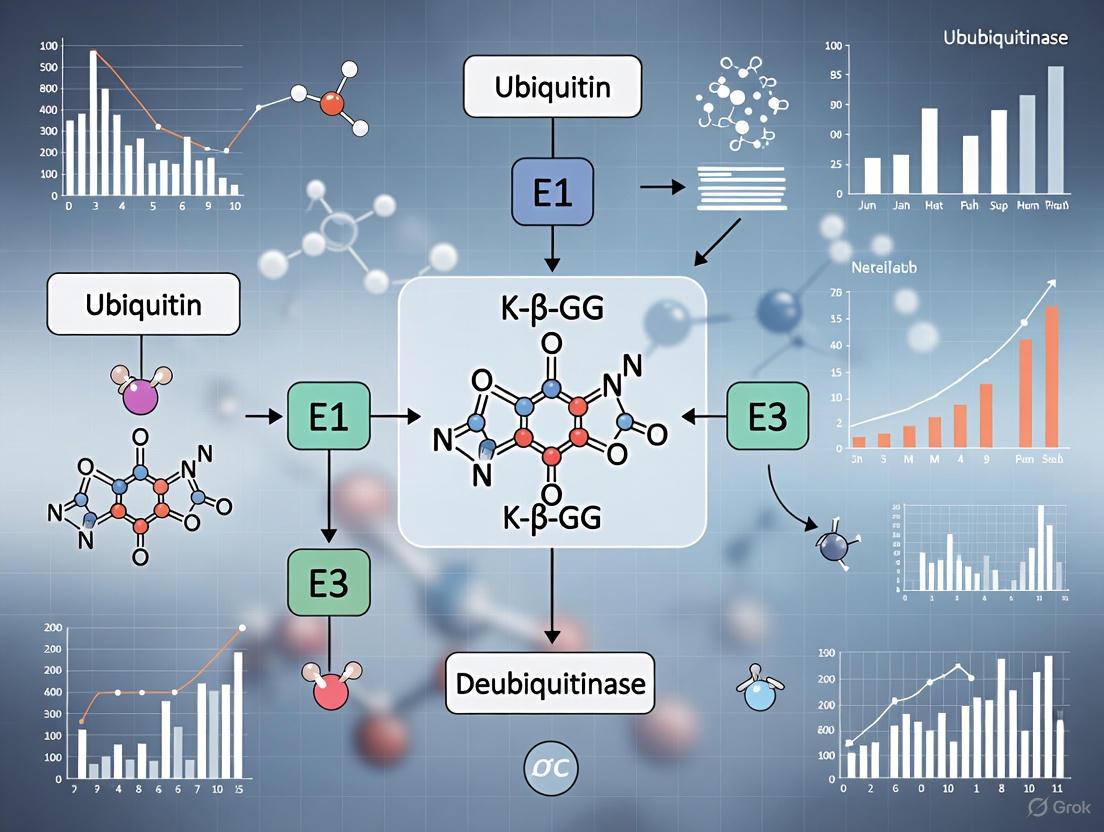
This article provides a comprehensive resource for researchers and drug development professionals on the K-ε-GG remnant, a crucial tryptic signature used to map the ubiquitin-modified proteome.
The K-ε-GG Remnant: Decoding the Ubiquitin Code with Mass Spectrometry
Abstract
This article provides a comprehensive resource for researchers and drug development professionals on the K-ε-GG remnant, a crucial tryptic signature used to map the ubiquitin-modified proteome. We cover the foundational biology of ubiquitination and the origin of the K-ε-GG remnant, then detail state-of-the-art methodological workflows for its enrichment and mass spectrometric analysis, including antibody-based and antibody-free approaches. The guide also addresses common troubleshooting and optimization strategies to enhance sensitivity and reproducibility and concludes with a comparative analysis of validation techniques and the real-world application of this technology in biomarker discovery and understanding neurodegenerative diseases and cancer.
What is the K-ε-GG Remnant? The Biological Origin of a Proteomic Landmark
Ubiquitination is a crucial post-translational modification (PTM) that regulates nearly every cellular process in eukaryotic cells. This versatile signaling mechanism involves the covalent attachment of a small, 76-amino acid protein called ubiquitin (Ub) to target substrate proteins [1] [2]. The process is orchestrated by a sequential enzymatic cascade comprising three key enzymes: ubiquitin-activating enzymes (E1), ubiquitin-conjugating enzymes (E2), and ubiquitin ligases (E3) [3] [4]. Originally discovered as a marker for energy-dependent protein degradation, ubiquitination is now recognized as a structurally diverse and dynamic PTM with functions extending far beyond proteolysis, including roles in protein trafficking, DNA repair, epigenetic regulation, and endocytosis [1].
The human genome encodes approximately 2 E1 enzymes, 40 E2 enzymes, and over 600 E3 ligases, which work in concert to maintain cellular homeostasis [1] [2]. This enzymatic network creates tremendous signaling diversity, enabling precise spatiotemporal control of protein function. The specificity of ubiquitination is primarily determined by E3 ubiquitin ligases, which recognize and recruit specific substrate proteins [3] [4]. Understanding the mechanisms and components of this cascade is fundamental to deciphering its roles in both normal physiology and human disease.
The Enzymatic Cascade: E1, E2, and E3
E1 Ubiquitin-Activating Enzymes
The ubiquitination cascade initiates with E1 enzymes, which activate ubiquitin in an ATP-dependent manner. Humans possess two E1 enzymes: UBE1 (UBA1) and UBA6 [5] [4]. The activation process occurs through two distinct steps:
- Adenylation: E1 catalyzes the adenylation of ubiquitin's C-terminal glycine (G76), forming a ubiquitin-AMP intermediate.
- Thioester Formation: The activated ubiquitin is then transferred to a catalytic cysteine residue within the E1 active site, forming a high-energy thioester bond (E1~Ub) [5] [4].
The E1 enzyme exhibits remarkable specificity for the C-terminal sequence of ubiquitin. Structural studies reveal that ubiquitin's C-terminal peptide (^71^LRLRGG^76^) extends into the ATP-binding pocket of E1's adenylation domain, with Arg72 being absolutely essential for recognition [5]. While this sequence is highly conserved across species, phage display experiments have revealed some promiscuity, indicating that E1 can activate ubiquitin variants with alternative C-terminal sequences, though these mutants often cannot proceed through the entire cascade [5].
E2 Ubiquitin-Conjugating Enzymes
Following activation, ubiquitin is transferred from E1 to a catalytic cysteine residue of an E2 conjugating enzyme via a trans-thioesterification reaction, forming an E2~Ub intermediate [3] [4]. The human genome encodes approximately 40-50 E2 enzymes, which exhibit varying degrees of specificity for different E3 ligases and substrates [1] [2].
E2 enzymes serve as critical mediators in the ubiquitination cascade, with some possessing inherent specificity for certain substrates. A notable example is UBE2E1, which can catalyze the monoubiquitination of SETDB1 at K867 independently of an E3 ligase by specifically recognizing a hexapeptide sequence (^867^KEGYES^872^) in the substrate [6]. Structural studies of the UBE2E1-SETDB1 peptide complex reveal an L-shaped binding mechanism that positions the target lysine near the E2 active site for efficient ubiquitin transfer [6].
E3 Ubiquitin Ligases
E3 ubiquitin ligases represent the largest and most diverse component of the ubiquitination cascade, with over 600 members in humans [1] [3]. These enzymes confer substrate specificity by simultaneously binding to E2~Ub complexes and target proteins, facilitating the transfer of ubiquitin to specific lysine residues on substrates [3] [4]. E3 ligases are classified into three major families based on their structural features and mechanisms of action: HECT, RING, and RBR-type E3s [3] [7].
Table: Classification of E3 Ubiquitin Ligases
| Type | Mechanism | Key Features | Representative Members |
|---|---|---|---|
| HECT | Forms thioester intermediate with Ub before transfer | C-terminal catalytic HECT domain with active cysteine; N-terminal substrate recognition domains | NEDD4 family, HERC family, E6AP [3] [7] |
| RING | Direct transfer from E2 to substrate | RING domain binds E2~Ub; functions as scaffold; largest E3 family | Cullin-RING ligases (CRLs), MDM2, TRAF6 [3] [7] |
| RBR | Hybrid mechanism | RING1 domain binds E2~Ub, Ub transferred to catalytic cysteine in RING2 domain | Parkin, HOIP, ARIH1 [3] [7] |
The structural basis for E3 function has been elucidated through complexes such as the UbcH5B~Ub-HECT^NEDD4L^ structure, which reveals how E3 ligases coordinate both the E2~Ub conjugate and substrate to enable ubiquitin transfer [8]. E3 ligases often function as part of multi-subunit complexes, such as cullin-RING ligases (CRLs), which utilize adaptor proteins to expand their substrate recognition capabilities [7].
Ubiquitin Signaling Diversity
Ubiquitination creates tremendous signaling diversity through different modification types. Monoubiquitination involves attachment of a single ubiquitin molecule to a substrate lysine, while multi-monoubiquitination occurs when multiple lysines on the same substrate are modified with single ubiquitins [1] [2]. Polyubiquitination involves the formation of ubiquitin chains through one of ubiquitin's seven lysine residues (K6, K11, K27, K29, K33, K48, K63) or its N-terminal methionine (M1) [1] [3].
Table: Ubiquitin Linkage Types and Their Functions
| Linkage Type | Primary Functions | Notes |
|---|---|---|
| K48 | Targets substrates for proteasomal degradation [3] | Most abundant chain type in cells [3] |
| K63 | DNA damage repair, kinase activation, endocytosis [3] [2] | Non-degradative signaling [2] |
| K11 | Cell cycle regulation, proteasomal degradation [3] | Regulated by specific E2 enzymes [3] |
| K27 | DNA damage repair, mitochondrial quality control [3] | Catalyzed by Parkin; innate immune response [3] |
| K29 | Proteasomal degradation, innate immunity [3] | Regulates AMPK-related kinases [3] |
| K33 | Intracellular trafficking, kinase regulation [3] | Impacts cGAS-STING signaling [3] |
| K6 | DNA damage response, mitochondrial regulation [3] | Least characterized linkage [3] |
| M1 (Linear) | NF-κB activation, inflammation [3] | Generated by LUBAC complex [3] |
Additionally, ubiquitination can occur through non-canonical mechanisms on amino acids other than lysine, including cysteine, serine, threonine, and the protein N-terminus [1]. For example, the LUBAC E3 ligase adds ubiquitin to the N-terminal methionine of proximal ubiquitin molecules, creating M1-linear chains [1]. Furthermore, ubiquitin itself can undergo post-translational modifications including phosphorylation, acetylation, and SUMOylation, adding another layer of regulatory complexity [1].
The K-ε-GG Remnant in Ubiquitin Proteomics
Discovery and Significance
The K-ε-GG remnant has revolutionized the proteomic study of ubiquitination. This signature originates from tryptic digestion of ubiquitinated proteins, which cleaves both the substrate and the attached ubiquitin, leaving a diglycine (GG) remnant attached via an isopeptide bond to the ε-amino group of the modified lysine [1] [9]. This results in a characteristic 114.04 Da mass shift on modified lysine residues, which can be detected by mass spectrometry [2] [9].
The discovery of this signature dates back to seminal work on the A24 branched protein structure, where trypsin digestion yielded a diglycine signature bound to a lysine residue in histone 2A [9]. This finding laid the foundation for modern ubiquitin proteomics, enabling researchers to map ubiquitination sites across the proteome.
Enrichment Methodologies
The low stoichiometry of ubiquitination necessitates enrichment strategies for comprehensive detection. The most significant advancement came with the development of anti-K-ε-GG antibodies that specifically recognize the diglycine remnant [10] [2]. Early proteomic studies using this approach identified only several hundred ubiquitination sites, but methodological refinements have dramatically improved sensitivity.
Key improvements to the K-ε-GG enrichment workflow include:
- Antibody cross-linking: Treatment with dimethyl pimelimidate (DMP) to covalently cross-link antibodies to beads, reducing background and improving recovery [10]
- Optimized peptide input: Systematic titration to determine ideal antibody-to-peptide ratios [10]
- Off-line fractionation: Basic reversed-phase chromatography to reduce sample complexity prior to enrichment [10]
- Enhanced elution conditions: Using 0.15% trifluoroacetic acid (TFA) for efficient peptide elution [10]
These refinements enable the routine identification and quantification of approximately 20,000 distinct endogenous ubiquitination sites from moderate protein inputs (5 mg per condition) [10].
Experimental Workflow for K-ε-GG Enrichment
A standard workflow for K-ε-GG-based ubiquitin proteomics includes:
- Cell Lysis: Under denaturing conditions (8 M urea) with protease inhibitors and deubiquitinase (DUB) inhibitors to preserve ubiquitination signatures [10]
- Protein Digestion: Trypsin digestion after reduction and alkylation [10]
- Peptide Fractionation: Basic reversed-phase HPLC to reduce complexity [10]
- Immunoaffinity Enrichment: Incubation with cross-linked anti-K-ε-GG antibody beads [10]
- Mass Spectrometry Analysis: LC-MS/MS with high-resolution instruments to identify and quantify K-ε-GG peptides [10]
This workflow can be integrated with quantitative methods such as SILAC (stable isotope labeling by amino acids in cell culture) to monitor changes in ubiquitination in response to cellular perturbations [10] [2].
Diagram Title: K-ε-GG Ubiquitin Proteomics Workflow
Alternative Methodologies for Ubiquitin Characterization
While K-ε-GG remnant analysis has transformed the field, several complementary approaches exist for characterizing protein ubiquitination:
Ubiquitin Tagging-Based Approaches
These methods involve expressing tagged ubiquitin (e.g., His, Flag, Strep, or HA tags) in cells to enable affinity purification of ubiquitinated proteins [2]. For example, Peng et al. first demonstrated this approach in 2003 by expressing 6×His-tagged ubiquitin in yeast, identifying 110 ubiquitination sites on 72 proteins [2]. Similarly, the StUbEx (stable tagged ubiquitin exchange) system enables replacement of endogenous ubiquitin with His-tagged ubiquitin in human cells [2].
While tagging approaches are accessible and cost-effective, they have limitations: tagged ubiquitin may not perfectly mimic endogenous ubiquitin, histidine-rich proteins can co-purify with His-tagged ubiquitin, and the method is not feasible for clinical or animal tissue samples [2].
Ubiquitin Binding Domain (UBD)-Based Approaches
UBD-based strategies utilize natural ubiquitin receptors to enrich ubiquitinated proteins. Early efforts used single UBDs with limited success due to low affinity, but this was overcome by developing tandem-repeated ubiquitin-binding entities (TUBEs) that exhibit significantly higher affinity for ubiquitinated proteins [2]. TUBEs can protect ubiquitin chains from deubiquitinases and protect proteins from proteasomal degradation during purification.
Linkage-Specific Antibodies
With growing recognition of the functional diversity of ubiquitin chain types, linkage-specific antibodies have been developed that recognize particular ubiquitin linkages (M1, K11, K27, K48, K63) [2]. For example, Nakayama et al. generated a K48-specific antibody that revealed abnormal accumulation of K48-linked ubiquitinated tau in Alzheimer's disease [2]. These tools enable researchers to investigate the biological functions of specific chain types.
The Scientist's Toolkit: Essential Research Reagents
Table: Key Research Reagents for Ubiquitination Studies
| Reagent/Category | Function/Application | Examples & Notes |
|---|---|---|
| Anti-K-ε-GG Antibodies | Enrichment of ubiquitinated peptides for MS-based proteomics | Commercial kits available; cross-linking improves performance [10] |
| Linkage-Specific Ub Antibodies | Detection of specific ubiquitin chain types | K48-, K63-, M1-linear specific antibodies available [2] |
| DUB Inhibitors | Preserve ubiquitination signatures during lysis | PR-619 used during cell lysis to prevent deubiquitination [10] |
| Proteasome Inhibitors | Stabilize ubiquitinated proteins | MG-132 treatment increases ubiquitinated protein levels [10] |
| Tagged Ubiquitin Constructs | Affinity purification of ubiquitinated proteins | His-, HA-, Flag-, Strep-tagged ubiquitin [2] |
| E1/E2/E3 Recombinant Proteins | Reconstitute ubiquitination in vitro | For biochemical assays and in vitro ubiquitination [5] [6] |
| TUBEs (Tandem Ubiquitin Binding Entities) | High-affinity enrichment of polyubiquitinated proteins | Protect ubiquitin chains from DUBs [2] |
| Activity-Based DUB Probes | Monitor deubiquitinase activity | Identify active DUBs in cell lysates [2] |
The E1-E2-E3 enzymatic cascade represents a sophisticated regulatory system that governs protein fate and function through ubiquitination. From the initial activation by E1 through the specific substrate targeting by E3 ligases, each step contributes to the remarkable specificity and diversity of ubiquitin signaling. The development of K-ε-GG remnant proteomics has revolutionized our ability to study this process on a global scale, enabling researchers to map thousands of ubiquitination sites and quantify their dynamics in response to cellular perturbations.
As methodologies continue to advance, including new enrichment strategies, improved mass spectrometry instrumentation, and innovative chemical biology tools, our understanding of the ubiquitin code will continue to deepen. These advances are particularly relevant for drug discovery, where targeted protein degradation approaches such as PROTACs hijack the ubiquitin system to eliminate disease-causing proteins [4]. The continued elucidation of E3 ligase-substrate relationships and ubiquitin chain architecture will undoubtedly yield new therapeutic opportunities across a spectrum of human diseases.
In the field of ubiquitin proteomics, the K-ε-GG remnant motif serves as a crucial molecular footprint, enabling researchers to decode the vast ubiquitin-modified proteome. This signature is not naturally present on ubiquitinated proteins but is instead created as a direct analytical artifact of trypsin digestion during mass spectrometry sample preparation. This technical guide delves into the biochemical genesis of this motif, details the experimental workflows for its enrichment and identification, and synthesizes quantitative data showcasing the power of this approach. Framed within the broader thesis that the K-ε-GG remnant is an indispensable tool for ubiquitin research, this review provides drug development professionals and scientists with a foundational understanding of the methodology that has transformed our capacity to profile ubiquitination sites en masse, thereby illuminating novel regulatory mechanisms in both health and disease.
Protein ubiquitylation is a pivotal post-translational modification (PTM) that regulates a staggering array of cellular processes, including protein degradation, signal transduction, and DNA repair [2]. The versatility of ubiquitin signaling arises from the complexity of ubiquitin conjugates, which can range from a single ubiquitin monomer (monoubiquitylation) to polymers of ubiquitin (polyubiquitylation) connected via different linkage types [2]. For decades, deciphering this "ubiquitin code" on a proteome-wide scale was a monumental challenge, primarily due to the low stoichiometry of modified proteins and the lack of tools to specifically isolate ubiquitination sites.
The breakthrough came with the realization that a specific proteomic footprint of ubiquitination could be generated and harnessed for detection. When a ubiquitinated protein is digested with the protease trypsin, a key remnant of the modification is left behind on the substrate peptide. This remnant, known as the lysine-ε-glycyl-glycine or K-ε-GG motif, has become the cornerstone of modern ubiquitin proteomics [9] [11]. It is the specific generation of this motif that allows for the highly selective enrichment and mass spectrometry-based identification of thousands of endogenous ubiquitination sites, transforming our understanding of ubiquitin biology. This whitepaper details the biochemical process behind the creation of this motif, the methodologies for its study, and its profound impact on biomedical research.
The Biochemistry of K-ε-GG Motif Generation
The Trypsin-Mediated Cleavage Process
The K-ε-GG motif is not inherently present on ubiquitinated proteins within the cell. Its creation is a direct consequence of a specific enzymatic cleavage event during sample preparation for bottom-up mass spectrometry. The process can be broken down into two key stages, as illustrated in the diagram below.
Proteolysis of the Ubiquitin-Substrate Conjugate: The ubiquitinated protein is subjected to digestion with trypsin, a serine protease that cleaves peptide chains at the carboxyl side of lysine and arginine residues. Trypsin cleaves the ubiquitin molecule itself after its arginine (R) and lysine (K) residues. Crucially, it also cleaves after the final two glycine residues (G75-G76) at the ubiquitin C-terminus. However, the isopeptide bond linking the C-terminal carboxyl group of G76 to the epsilon-amino (ε-NH₂) group of a specific lysine on the substrate protein is resistant to trypsin cleavage [9] [11].
Generation of the Di-Glycine Remnant: The resistance of the isopeptide bond leaves a definitive mark. The final two glycine residues of ubiquitin (G75 and G76) remain covalently attached to the modified lysine residue on the substrate peptide. This creates a lysine residue modified by a Gly-Gly dipeptide, which is the K-ε-GG remnant motif. The resulting peptide is now "tagged" with a ~114 Da mass shift on the modified lysine, which can be detected by mass spectrometry [11] [2].
It is critical to note that while this method is powerful, the diGLY remnant is also a signature of other ubiquitin-like proteins (UBLs), such as NEDD8 and ISG15, which share the C-terminal Gly-Gly sequence. Studies have indicated, however, that the vast majority (~95%) of K-ε-GG peptides identified by antibody-based enrichment originate from canonical ubiquitin [11] [12].
Methodological Workflow for K-ε-GG Analysis
The identification of K-ε-GG-modified peptides requires a specialized workflow designed to enrich these low-abundance peptides from a complex background of unmodified peptides. The following sections and corresponding diagram detail a standard protocol.
Sample Preparation and Digestion
The process begins with cell or tissue lysis under denaturing conditions, typically using a buffer containing 8M urea, to inactivate endogenous deubiquitinases (DUBs) and proteases. To further preserve the ubiquitination state, lysis buffers are supplemented with N-ethylmaleimide (NEM) to alkylate cysteine residues and inhibit DUB activity [11]. Proteins are then reduced, alkylated, and digested. A common strategy involves a two-enzyme digestion, first with LysC (which cleaves at lysine) followed by trypsin, to achieve efficient and complete proteolysis [10] [11].
Peptide Fractionation and Enrichment
Following digestion, the complex peptide mixture is often pre-fractionated using basic reversed-phase chromatography to reduce sample complexity. This step significantly increases the depth of coverage by separating peptides into multiple fractions prior to enrichment [10]. The core of the methodology is the immunoaffinity enrichment of K-ε-GG-containing peptides. This is achieved using highly specific antibodies raised against the K-ε-GG motif. Peptides are incubated with antibody-conjugated beads, which selectively bind the K-ε-GG remnant. After extensive washing to remove non-specifically bound peptides, the enriched K-ε-GG peptides are eluted under acidic conditions [10] [13] [11].
Mass Spectrometric Analysis and Data Interpretation
The enriched peptides are then analyzed by liquid chromatography coupled to tandem mass spectrometry (LC-MS/MS). In the mass spectrometer, the K-ε-GG-modified peptides are identified by two key features: first, the precursor mass reflects the ~114 Da mass shift on the modified lysine, and second, the MS/MS fragmentation spectrum contains a characteristic signature ion and a series of b- and y-ions that allow for the precise localization of the modification site to a specific lysine residue on the peptide [9] [2]. Quantitative methods, such as Stable Isotope Labeling by Amino acids in Cell culture (SILAC) or label-free approaches, can be incorporated to compare ubiquitination levels across different experimental conditions [10] [11].
Quantitative Insights: The Power of K-ε-GG Proteomics
The application of K-ε-GG proteomics has led to the identification of an astonishing number of ubiquitination sites, far surpassing what was possible with prior methods. The table below synthesizes key quantitative findings from selected studies, illustrating the scale and impact of this technology.
Table 1: Quantitative Profiling of Ubiquitination Sites Using K-ε-GG Enrichment
| Study Context | Methodological Highlights | Number of Ubiquitination Sites Identified/Quantified | Biological Insight |
|---|---|---|---|
| Optimized Workflow [10] | Anti-K-ε-GG enrichment with cross-linked antibodies & off-line fractionation; 5 mg protein input. | ~20,000 distinct sites in a single SILAC experiment. | Demonstrated a 10-fold improvement over previous methods, enabling deep coverage with moderate input. |
| Aging Mouse Brain [12] | K-ε-GG enrichment coupled with label-free DIA-MS from mouse brain tissue. | 7,031 ubiquitylation sites quantified; 29% significantly altered with age. | Revealed widespread rewiring of the brain ubiquitinome with aging, largely independent of protein abundance changes. |
| Molecular Glue Degrader Screening [14] | High-throughput DIA-MS with global ubiquitinomics to validate neosubstrates. | Integrated profiling led to the discovery of novel neosubstrates (e.g., KDM4B, G3BP2, VCL). | Uncovered a much broader landscape of substrates for the CRBN E3 ligase beyond those degraded by classical immunomodulatory drugs. |
| Historical Reference [11] | diGLY antibody-based affinity enrichment from any eukaryotic source. | >50,000 ubiquitylation sites identified in human cells to date. | Highlights the technique's role in creating comprehensive ubiquitination maps across diverse stimuli. |
The data in Table 1 underscores several key points. First, methodological refinements, such as antibody cross-linking and sophisticated fractionation, are critical for achieving maximum depth of coverage [10]. Second, the application of this technology to complex biological questions, such as brain aging and drug mechanism-of-action studies, yields quantitatively robust and biologically significant datasets that were previously unattainable [14] [12]. The ability to quantify thousands of sites independently of changes in protein abundance indicates true changes in ubiquitin site occupancy, providing deeper mechanistic insights.
The Scientist's Toolkit: Essential Reagents and Protocols
Successful K-ε-GG proteomics relies on a suite of specialized reagents and optimized protocols. The following table details key components and their functions in a typical workflow.
Table 2: Essential Research Reagent Solutions for K-ε-GG Proteomics
| Reagent / Kit | Function in Workflow | Key Features & Considerations |
|---|---|---|
| PTMScan Ubiquitin Remnant Motif Kit [13] | Immunoaffinity Enrichment | Proprietary bead-conjugated anti-K-ε-GG antibody for enriching ubiquitinated peptides from tryptic digests. Includes optimized IAP buffer. |
| diGLY Motif-Specific Antibodies [11] [2] | Immunoaffinity Enrichment | Antibodies specific for the K-ε-GG remnant; can be conjugated to beads in-house. The cornerstone of the enrichment strategy. |
| Urea Lysis Buffer with NEM [11] | Sample Lysis & Stabilization | 8M urea denatures proteins; NEM alkylates cysteines and inhibits deubiquitinases (DUBs) to preserve the native ubiquitinome. |
| Stable Isotope Labeling (SILAC) [10] [11] | Quantitative Proteomics | Uses "heavy" amino acids (e.g., Lys8, Arg10) for metabolic labeling, enabling precise quantification across multiple samples. |
| Basic pH Reversed-Phase Chromatography [10] | Peptide Fractionation | High-pH separation of peptides prior to enrichment reduces sample complexity and dramatically increases the number of identifications. |
Beyond commercial kits, the core protocol involves several critical steps. Cell lysis under denaturing conditions is non-negotiable for preserving the ubiquitination state. Protein digestion efficiency is paramount, as incomplete digestion can lead to missed cleavages and complicate MS analysis. The enrichment step itself requires careful optimization of the antibody-to-peptide ratio and incubation conditions to maximize yield and specificity [10]. Finally, the inclusion of quantitative controls, such as SILAC-labeled standards or spike-in internal standards, is essential for reliable comparative studies.
Research Applications: Illuminating Biology and Disease
The K-ε-GG proteomics approach has become an indispensable tool for unbiased discovery, driving advances in multiple areas of biology and drug discovery.
Deubiquitinase (DUB) Substrate Discovery: Identifying the direct substrates of DUBs has been a significant challenge. A recent innovative study combined APEX2-based proximity labeling with K-ε-GG enrichment to map the "proximal-ubiquitome" of the mitochondrial DUB USP30. This approach successfully identified known substrates like TOMM20 and FKBP8, and uncovered new candidates such as LETM1, by focusing on ubiquitination events within the native microenvironment of the DUB [15].
Drug Discovery and Mechanism of Action: The field of targeted protein degradation relies on small molecules that hijack the ubiquitin system. K-ε-GG ubiquitinomics is powerfully used to identify the specific proteins (neosubstrates) that are ubiquitinated and degraded upon treatment with molecular glue degraders or PROTACs. For instance, a high-throughput DIA-MS platform was used to screen a library of CRBN-binding molecules, leading to the discovery of novel degraders and an expanded map of the CRBN neosubstrate landscape [14].
Aging and Neurodegenerative Disease Research: The ubiquitin-proteasome system is implicated in brain aging and neurodegeneration. By applying K-ε-GG proteomics to the brains of young and old mice, researchers discovered that ubiquitylation was the most significantly altered PTM with age. They found specific changes in synaptic and mitochondrial proteins and demonstrated that a dietary intervention could partially reverse the age-associated ubiquitin signature, providing new potential biomarkers and therapeutic insights [12].
The K-ε-GG remnant motif, a direct proteolytic footprint of trypsin digestion, has fundamentally transformed ubiquitin research. What began as an astute observation of a biochemical artifact has evolved into a powerful and refined technology that allows for the system-wide mapping and quantification of ubiquitination events with site-specific resolution. As detailed in this whitepaper, the robust workflows for generating and enriching this motif, coupled with advanced mass spectrometry, now enable researchers to routinely identify tens of thousands of ubiquitination sites, providing unprecedented insights into the complexity of ubiquitin signaling. The continued application and refinement of K-ε-GG proteomics will undoubtedly remain a central pillar in the efforts to understand cellular regulation in health and disease, and to develop novel therapeutics that target the ubiquitin system.
The Biochemical Basis of K-ε-GG Cross-Reactivity
In ubiquitin proteomics research, the anti-K-ε-GG antibody has revolutionized the detection of ubiquitination sites by mass spectrometry. This antibody specifically recognizes the diglycine remnant left on modified lysine residues after trypsin digestion of ubiquitinated proteins [10]. However, this same biochemical signature is shared by several ubiquitin-like modifiers (UBLs), creating a significant challenge for specificity.
The core issue stems from identical C-terminal sequences among ubiquitin and key UBLs. Ubiquitin, NEDD8, and ISG15 all terminate with a -LRLRGG sequence [16]. During standard proteomic workflows using trypsin digestion, this region is cleaved, leaving a characteristic diglycine (GG) adduct on the modified lysine residue of substrate proteins. This identical remnant means antibodies designed to capture ubiquitin-modified peptides will inevitably also co-enrich peptides modified by NEDD8 and ISG15.
The table below summarizes the key modifiers that share the K-ε-GG signature:
Table 1: Ubiquitin-Like Proteins Generating K-ε-GG Remnants After Trypsin Digestion
| Modifier | Sequence Similarity to Ubiquitin | C-Terminal Sequence | Primary Biological Functions |
|---|---|---|---|
| Ubiquitin | Reference (100% self) | -LRLRGG | Protein degradation, signaling, trafficking, DNA repair [17] [1] |
| NEDD8 | ~60% amino acid identity [18] | -LRLRGG | Regulation of cullin-RING ligases, cell cycle, development [18] |
| ISG15 | Two ubiquitin-like domains | -LRLRGG | Antiviral defense, antibacterial activity, autophagy regulation [19] [16] |
Methodological Approaches for Discrimination
Standard K-ε-GG Enrichment Workflow
The typical protocol for K-ε-GG enrichment involves multiple critical steps that influence both yield and specificity [10] [20]:
Protein Extraction and Denaturation: Cells or tissues are lysed in denaturing buffers (e.g., 8M urea) to inactivate deubiquitinases and other proteases [10] [20].
Reduction, Alkylation, and Digestion: Proteins are reduced with dithiothreitol, alkylated with iodoacetamide, and digested with trypsin [10] [20]. Trypsin cleavage after arginine and lysine residues generates the characteristic diglycine remnant on modified lysines.
Peptide Fractionation: Basic reversed-phase HPLC is often employed to fractionate complex peptide mixtures prior to enrichment, significantly enhancing depth of coverage [10].
K-ε-GG Immunoaffinity Enrichment: Cross-linked anti-K-ε-GG antibody beads are incubated with peptides. Optimal results are typically achieved with 1.5 mL of peptide solution incubated with 31 μg of antibody for 1 hour at 4°C [10].
Wash and Elution: Beads are extensively washed with ice-cold PBS, and bound peptides are eluted with 0.15% trifluoroacetic acid [10].
Mass Spectrometry Analysis: Eluted peptides are analyzed by LC-MS/MS, and database searching identifies peptides with the GG modification (mass shift of 114.04 Da on lysine) [20].
Genetic and Pharmacological Discrimination Strategies
Researchers have developed sophisticated methods to distinguish the source of K-ε-GG identifications:
Table 2: Experimental Strategies for Discriminating Ubiquitin from UBL Modifications
| Strategy | Methodology | Advantages | Limitations |
|---|---|---|---|
| Genetic Knockout | Comparison of wild-type with ISG15- or NEDD8-deficient cells or tissues [16] | Identifies bona fide modification sites in physiological contexts | Potential compensatory mechanisms may complicate interpretation |
| Enzyme Inhibition | Use of MLN4924 (Pevonedistat) to specifically inhibit NEDD8 activation [18] | Highly specific for neddylation; MLN4924 IC50 for NAE is >1000-fold higher than for other E1 enzymes [18] | Does not directly discriminate ISGylation |
| Deconjugase Mutants | Use of catalytically inactive deconjugases (e.g., USP18C61A) to enhance ISGylation [16] | Creates hyper-modified conditions for improved detection | May alter cellular physiology beyond modification status |
The following diagram illustrates the core challenge and experimental solutions for discriminating ubiquitination from other UBL modifications:
Quantitative Assessment of Cross-Reactivity
The extent of K-ε-GG cross-reactivity becomes particularly evident in large-scale proteomic studies. A comprehensive analysis of the in vivo ISGylome in mouse liver following Listeria monocytogenes infection demonstrated the utility of genetic controls, where 930 ISG15 sites across 434 proteins were identified by comparing wild-type with ISG15-deficient animals [16]. Without such genetic controls, these sites would have been misattributed to ubiquitination.
The relative abundance of different UBL modifications varies significantly by cell type, condition, and stimulus:
Table 3: Relative Abundance and Condition-Specific Variation of K-ε-GG Generating Modifications
| Modification | Relative Abundance in Steady State | Inducing Conditions | Reported Site Identifications in Specific Studies |
|---|---|---|---|
| Ubiquitination | High (constitutive) | Proteasome inhibition, cellular stress | >20,000 sites from SILAC triple-encoded experiment [10] |
| NEDDylation | Moderate | Cell cycle progression, development | Limited global analyses; primarily cullin family [18] |
| ISGylation | Low (basal) | Infection, interferon stimulation, DNA damage | 930 sites in liver upon Listeria infection [16] |
The Scientist's Toolkit: Essential Research Reagents
Table 4: Key Research Reagents for K-ε-GG Proteomics and UBL Discrimination
| Reagent / Tool | Specificity / Function | Example Applications | Commercial Sources / Models |
|---|---|---|---|
| Anti-K-ε-GG Antibody | Immunoaffinity enrichment of diglycine remnants | Ubiquitin, NEDD8, ISG15 proteomics | PTMScan Ubiquitin Remnant Motif Kit (Cell Signaling) [10] [21] [20] |
| MLN4924 (Pevonedistat) | Selective NEDD8 E1 (NAE) inhibitor | Discrimination of neddylation events | Phase I/II/III clinical trials; research use [18] |
| SILAC Labeling | Metabolic labeling for quantitative proteomics | Quantification of modification dynamics | Stable isotope-labeled arginine and lysine [10] |
| USP18C61A Mutant | Catalytically inactive ISG15 deconjugase | Hyper-ISGylation models in vivo | Knock-in mouse model [16] |
| Linkage-Specific Antibodies | Recognition of specific polyubiquitin linkages | Discrimination of ubiquitin chain topology | K48-, K63-, M1-linkage specific antibodies [17] |
Implications for Experimental Design and Data Interpretation
The cross-reactivity of K-ε-GG antibodies has significant implications for proteomic studies and requires careful experimental design:
Genetic Validation is Essential: Claims about ubiquitination should be supported by genetic evidence using knockdown, knockout, or overexpression systems for both ubiquitin and UBLs [16].
Stimulus-Specific Considerations: Under conditions that strongly induce ISGylation (viral/bacterial infection, interferon treatment) or neddylation (cell cycle progression), the proportion of non-ubiquitin derived K-ε-GG identifications increases substantially [19] [16].
Multi-Method Verification: Important findings should be verified using complementary methods such as linkage-specific ubiquitin antibodies, which do not cross-react with ISG15 or NEDD8 modifications [17].
Context-Dependent Interpretation: The functional consequences of UBL modifications differ significantly—while K48-linked ubiquitination typically targets substrates for proteasomal degradation, neddylation primarily regulates cullin-RING ligase activity, and ISGylation has antiviral functions [18] [19] [17].
The following workflow diagram illustrates an integrated approach for confident identification and discrimination of ubiquitin and UBL modifications:
The cross-reactivity of K-ε-GG antibodies with NEDD8 and ISG15 modifications represents both a challenge and an opportunity in ubiquitin proteomics research. While it complicates simple attribution of modification sources, it simultaneously enables comprehensive profiling of multiple ubiquitin-like modifications within a single experiment. Researchers must employ strategic experimental designs—incorporating genetic controls, pharmacological inhibitors, and quantitative proteomics—to accurately interpret K-ε-GG datasets and advance our understanding of the complex interplay between these critical regulatory pathways. As proteomic technologies continue to evolve, the development of more specific enrichment tools and computational discrimination methods will further enhance our ability to decipher the specific biological functions of these essential protein modifications.
The systematic identification and functional interpretation of protein ubiquitination represents a cornerstone of modern proteomics. The discovery that tryptic digestion of ubiquitylated proteins generates a characteristic diglycine (K-ε-GG) remnant on modified lysine residues has revolutionized this field. This whitepaper provides an in-depth technical examination of K-ε-GG-based ubiquitin proteomics, detailing how this molecular signature enables researchers to bridge the gap between modification detection and functional analysis. We present comprehensive methodologies for large-scale ubiquitinome analysis, quantitative data on ubiquitination dynamics under various perturbations, and essential tools for researchers investigating proteasomal degradation and non-degradative ubiquitin signaling. The integration of antibody-based enrichment with advanced mass spectrometry has enabled the identification of >50,000 ubiquitination sites in human cells, fundamentally expanding our understanding of ubiquitin-mediated cellular control.
Protein ubiquitination regulates nearly every cellular process, from proteasomal degradation to signal transduction, protein complex assembly, and subcellular localization. The systematic investigation of this complex post-translational modification (PTM) was transformed by the recognition that trypsin digestion of ubiquitylated proteins leaves a distinctive molecular signature—a diglycine (diGLY) remnant covalently linked to the ε-amino group of modified lysine residues (K-ε-GG) [11]. This tryptic remnant serves as a specific epitope for immunoaffinity enrichment, enabling the selective isolation of ubiquitinated peptides from complex proteomic digests for subsequent mass spectrometric identification and quantification [11] [10].
The K-ε-GG remnant is not absolutely specific to ubiquitin, as the ubiquitin-like proteins NEDD8 and ISG15 also generate identical diGLY-modified peptides upon trypsinolysis [11]. However, studies have demonstrated that approximately 95% of all diGLY-peptides identified through antibody enrichment originate from genuine ubiquitination events rather than neddylation or ISGylation [11]. This high specificity, combined with the commercial availability of highly specific anti-K-ε-GG antibodies, has established K-ε-GG remnant recognition as the methodological foundation for contemporary ubiquitin proteomics [10] [22].
Technical Foundations: Methodological Workflows
Core Experimental Principle
The fundamental principle underlying K-ε-GG proteomics involves leveraging the tryptic diGLY remnant as an affinity handle for specific antibody-based enrichment of ubiquitinated peptides prior to liquid chromatography-tandem mass spectrometry (LC-MS/MS) analysis [23]. This approach enables researchers to identify endogenous ubiquitination sites without requiring epitope-tagged ubiquitin constructs, providing a more physiologically relevant assessment of the ubiquitinome [11]. The typical workflow encompasses cell lysis under denaturing conditions, proteolytic digestion, peptide purification, immunoaffinity enrichment using anti-K-ε-GG antibodies, and final LC-MS/MS analysis [24] [11].
Advanced Sample Preparation: LFASP
Traditional in-solution digestion protocols for ubiquitinome analysis often exhibit limited cleavage efficiency, potentially obscuring K-ε-GG epitopes. The Large-Scale Filter-Aided Sample Preparation (LFASP) method overcomes this limitation by enabling efficient tryptic digestion of milligram-scale protein quantities [25]. This technique provides a approximately 3-fold reduction in miscleaved peptides compared to conventional methods, significantly improving epitope exposure for subsequent antibody recognition [25]. The enhanced digestion efficiency translates directly to improved ubiquitination site identification, particularly for samples with limited starting material or low-abundance ubiquitination events.
Quantitative Ubiquitinome Profiling
Stable Isotope Labeling by Amino Acids in Cell Culture (SILAC) provides a powerful quantitative framework for comparing ubiquitination dynamics across experimental conditions [11] [10]. The typical SILAC experimental design involves labeling cells with "light," "medium," and "heavy" isotope-encoded amino acids, followed by treatment with relevant pharmacological agents such as proteasome inhibitors (MG-132) or deubiquitinase inhibitors (PR-619) [26] [22]. Combining SILAC-based quantification with K-ε-GG enrichment has enabled researchers to routinely identify and quantify >20,000 distinct ubiquitination sites from moderate protein inputs (5 mg per SILAC channel) [10] [22].
Critical Protocol Optimizations
Several technical refinements have dramatically enhanced the performance of K-ε-GG ubiquitin proteomics:
- Antibody cross-linking: Covalent immobilization of anti-K-ε-GG antibodies to solid supports using dimethyl pimelimidate (DMP) significantly reduces antibody leaching during immunoaffinity purification, improving reproducibility and minimizing non-specific background [10].
- Off-line fractionation: Basic reversed-phase chromatography separation of peptides prior to immunoaffinity enrichment reduces sample complexity, leading to a 3-4 fold increase in K-ε-GG peptide yield and enabling identification of up to ~3,300 distinct ubiquitination sites in a single experiment [26] [22].
- Lysis condition optimization: Inclusion of 5-10mM N-ethylmaleimide (NEM) in lysis buffers effectively alkylates deubiquitinases, preserving labile ubiquitination events during sample preparation [11].
Quantitative Ubiquitination Dynamics
The integration of K-ε-GG proteomics with quantitative mass spectrometry has revealed the remarkable responsiveness of the ubiquitinome to pharmacological and genetic perturbations. The following table summarizes key quantitative findings from recent studies:
Table 1: Quantitative Ubiquitination Dynamics Under Experimental Perturbations
| Experimental Condition | Ubiquitination Sites Identified | Ubiquitination Sites Quantified | Significantly Regulated Sites | Reference |
|---|---|---|---|---|
| Proteasome inhibition (MG-132) & DUB inhibition (PR-619) in Jurkat cells | 5,533 distinct K-ε-GG peptides | 4,907 | Multiple specific substrates with varying regulation patterns | [26] |
| Optimized workflow with cross-linked antibodies & fractionation | ~20,000 distinct ubiquitination sites | ~20,000 | Routine quantification of 10,000s of sites | [22] |
| Standard diGLY proteomics approach | >50,000 ubiquitylation sites in human cells | N/A | Sites altered upon diverse proteotoxic stressors | [11] |
| Off-line fractionation prior to enrichment | Up to ~3,300 distinct K-ε-GG peptides | N/A | 3-4 fold increase in yield compared to non-fractionated | [26] |
These quantitative datasets demonstrate that the ubiquitinome exhibits exquisite sensitivity to proteasome and deubiquitinase inhibition, though not all regulated ubiquitination events correspond to canonical proteasomal degradation substrates [26]. Importantly, these extensive ubiquitination changes often occur without major alterations in total protein abundance, highlighting the low stoichiometry of most ubiquitination events and the specialized regulatory functions of ubiquitin beyond protein turnover [26].
The Ubiquitin-Proteasome System: From Modification to Degradation
The ubiquitin-proteasome pathway represents a fundamental protein quality control and regulatory mechanism within eukaryotic cells. The process initiates with ubiquitin activation by an E1 enzyme, followed by transfer to an E2 conjugating enzyme, and final substrate recognition and modification by an E3 ubiquitin ligase, which catalyzes the covalent attachment of ubiquitin to target proteins [24] [27]. Polyubiquitin chains linked through lysine 48 (K48) typically target modified proteins for degradation by the 26S proteasome [24].
The following diagram illustrates the core ubiquitin-proteasome pathway and the resultant K-ε-GG remnant that enables proteomic analysis:
Diagram 1: Ubiquitin-proteasome pathway and K-ε-GG remnant generation (max-width: 760px)
Key regulatory proteins throughout this pathway include IκB, p53, Cdc25A, and Bcl-2, whose ubiquitination directly impacts critical processes including cell cycle progression, stress response, and apoptosis [24] [27]. The K-ε-GG remnant generated during proteomic analysis enables researchers to map these specific ubiquitination events with precision, connecting molecular modifications to functional outcomes.
Non-Proteolytic Ubiquitin Signaling
Beyond its canonical role in protein degradation, ubiquitination regulates diverse non-proteolytic functions including protein complex assembly, subcellular localization, and enzymatic activity [11]. The K-ε-GG proteomics approach has been particularly instrumental in characterizing these alternative ubiquitin signaling pathways. For instance, ubiquitination regulates signal transduction through:
- Kinase and phosphatase modulation: Direct ubiquitination of signaling components can alter their activity, stability, or interaction capabilities.
- Histone regulation: Ubiquitination of histones H2A and H2B influences chromatin structure and gene expression.
- Membrane trafficking: Monoubiquitination serves as a signal for endosomal sorting and receptor internalization.
The development of specialized methodologies such as the PTMScan HS Ubiquitin/SUMO Remnant Motif Kit further expands analytical capabilities to include SUMOylation events, which generate similar C-terminal diglycine remnants after digestion with wild-type alpha-lytic protease (WaLP) [27]. This technical advancement highlights the expanding utility of remnant motif recognition strategies for analyzing diverse post-translational modifications.
The Scientist's Toolkit: Essential Research Reagents
Successful implementation of K-ε-GG ubiquitin proteomics requires specific reagents and methodologies optimized for preserving and recognizing the diGLY remnant. The following table details essential research tools:
Table 2: Essential Research Reagents for K-ε-GG Ubiquitin Proteomics
| Reagent/Method | Specific Product/Example | Function/Application | Key Considerations |
|---|---|---|---|
| Anti-K-ε-GG Antibody | PTMScan Ubiquitin Remnant Motif Kit (#5562) [24] | Immunoaffinity purification of diGLY-modified peptides | Higher sensitivity magnetic bead version available (#59322) [24] |
| Cell Lysis Buffer | 8M Urea, 150mM NaCl, 50mM Tris-HCl, pH 8 [11] | Protein denaturation and enzyme inactivation | Include fresh NEM (5-10mM) to inhibit deubiquitinases [11] |
| Protease Inhibitors | Complete Protease Inhibitor Cocktail [11] | Prevent protein degradation during lysis | Combine with phosphatase inhibitors for phospho-ubiquitin studies |
| Proteolytic Enzymes | LysC & Trypsin [11] | Protein digestion to generate K-ε-GG epitope | LysC improves digestion efficiency in urea [11] |
| Peptide Desalting | SepPak tC18 reverse phase column [11] [10] | Peptide purification and cleanup | Cartridge size should match protein input (500mg for 30mg digest) [11] |
| Fractionation Column | Zorbax 300 Extend-C18 [10] | Off-line basic reversed-phase fractionation | Non-contiguous pooling (8-12 fractions) improves depth [10] |
| Cross-linking Reagent | Dimethyl pimelimidate (DMP) [10] | Covalent antibody immobilization | Reduces antibody leaching during IP [10] |
Experimental Workflow: From Cells to Ubiquitination Sites
A comprehensive understanding of the experimental workflow is essential for implementing successful ubiquitinome studies. The following diagram outlines the complete process from sample preparation to data analysis:
Diagram 2: Experimental workflow for K-ε-GG ubiquitin proteomics (max-width: 760px)
This workflow enables the systematic identification and quantification of ubiquitination sites across diverse biological systems. The critical importance of proper sample preparation cannot be overstated—inefficient digestion or incomplete deubiquitinase inhibition will compromise epitope generation and consequently limit detection sensitivity [11] [25].
The K-ε-GG remnant has fundamentally transformed ubiquitin proteomics by providing a specific molecular handle for systematic ubiquitination site mapping. This technical advancement has enabled researchers to move beyond simple modification detection to sophisticated functional analyses linking ubiquitination to diverse cellular processes. As methodology continues to evolve with improvements in antibody specificity, fractionation strategies, and mass spectrometry sensitivity, the depth and precision of ubiquitinome analyses will correspondingly advance. The integration of K-ε-GG proteomics with complementary approaches promises to further elucidate the complex ubiquitin signaling networks that orchestrate cellular homeostasis, providing novel insights for therapeutic intervention in ubiquitin-related diseases.
Mapping the Ubiquitinome: Methodologies for K-ε-GG Enrichment and Analysis
The K-ε-GG Remnant: A Central Concept in Ubiquitin Proteomics
In ubiquitin proteomics research, the K-ε-GG remnant serves as the fundamental molecular signature that enables the systematic identification and characterization of ubiquitination sites across the proteome. This remnant is not part of the native protein structure but is instead an analytical artifact generated through specific sample preparation workflows, making it a cornerstone for ubiquitinome mapping [1] [9].
The formation of the K-ε-GG remnant occurs during tryptic digestion of ubiquitinated proteins. Ubiquitin itself contains a C-terminal sequence of -Arg-Gly-Gly (RGG). When trypsin cleaves ubiquitin-modified proteins, it cuts after the arginine residue, leaving a diglycine (GG) signature covalently attached via an isopeptide bond to the ε-amino group of the modified lysine residue on the substrate protein [1] [28]. This results in a characteristic K-ε-GG modification on the substrate-derived peptide, with a predictable mass shift of 114.1 Da [9].
The K-ε-GG remnant exhibits remarkable structural conservation across different ubiquitin-like modifiers, which presents both challenges and opportunities for researchers. Notably, the same K-ε-GG signature is generated not only from canonical ubiquitin modifications but also from other ubiquitin-like proteins (UBLs) such as NEDD8 and ISG15 after tryptic digestion [29] [30]. This cross-reactivity means that enrichment using standard anti-K-ε-GG antibodies captures peptides modified by all these protein modifiers, requiring additional validation to distinguish the specific modification type.
Table 1: Key Characteristics of the K-ε-GG Remnant
| Characteristic | Description | Research Significance |
|---|---|---|
| Origin | C-terminal remnant of ubiquitin after tryptic digestion | Serves as a universal marker for ubiquitination sites |
| Chemical Structure | Diglycine moiety attached to lysine ε-amino group | Creates identifiable mass shift (114.1 Da) for MS detection |
| Conservation | Shared by NEDD8, ISG15, and other ubiquitin-like proteins | Enables broad modifier detection but requires specificity controls |
| Antibody Recognition | Specific epitope for immunoaffinity enrichment | Allows selective isolation from complex peptide mixtures |
Anti-K-ε-GG Antibodies: Core Technology for Ubiquitinome Enrichment
Anti-K-ε-GG antibodies represent the gold-standard affinity reagents for large-scale ubiquitination site mapping due to their exceptional specificity for the diglycine-lysine epitope. These monoclonal antibodies are typically chemically cross-linked to protein A agarose beads to create robust immunoaffinity resins capable of selectively capturing K-ε-GG-modified peptides from complex tryptic digests of whole cell or tissue lysates [29].
The implementation of anti-K-ε-GG antibody-based enrichment has dramatically advanced the scale of ubiquitinome analyses. In a landmark application, researchers utilized K-ε-GG antibody-based enrichment to identify over 10,000 ubiquitination sites from diverse cell and tissue samples, demonstrating the powerful utility of this approach for comprehensive ubiquitinome profiling [29]. The methodology has become particularly valuable for studying physiological and pathological samples where genetic manipulation to introduce tagged ubiquitin is not feasible.
Despite their widespread adoption, traditional anti-K-ε-GG antibodies have certain limitations. As mentioned previously, they cannot distinguish between ubiquitin, NEDD8, and ISG15 modifications since all generate the K-ε-GG signature after trypsin digestion [29]. Additionally, these antibodies typically do not recognize GG-modified N-terminal peptides or ubiquitination sites on non-lysine residues, creating blind spots for non-canonical ubiquitination events [30].
Figure 1: Anti-K-ε-GG Antibody Enrichment Workflow: This diagram illustrates the core process for ubiquitination site identification, from sample preparation to mass spectrometry analysis.
Comparative Enrichment Methodologies in Ubiquitin Proteomics
While anti-K-ε-GG antibodies represent a cornerstone technology, several alternative enrichment strategies have been developed, each with distinct advantages and limitations. Understanding this methodological landscape is essential for selecting the appropriate approach for specific research questions.
Affinity-tagged ubiquitin methods involve expressing epitope-tagged ubiquitin (e.g., 6xHis, FLAG, Strep) in cellular systems, followed by affinity chromatography under denaturing conditions to isolate ubiquitin-substrate conjugates [2] [30]. Although this approach enables good recovery of ubiquitinated proteins, it requires genetic manipulation, which limits its application to cell culture models and may introduce artifacts due to altered ubiquitin structure or expression levels [2] [30].
Tandem ubiquitin-binding entities (TUBEs) are engineered proteins containing multiple ubiquitin-binding domains (UBDs) connected by flexible linkers, providing high-affinity recognition of polyubiquitin chains [29] [2] [30]. TUBEs offer the significant advantage of protecting ubiquitin chains from deubiquitinating enzyme (DUB) activity during processing and can be designed for linkage specificity [29] [30]. However, TUBEs primarily enrich polyubiquitinated proteins and have limited binding to monoubiquitinated substrates, potentially overlooking an important class of ubiquitin modifications [30].
Linkage-specific antibodies have been developed for specialized applications requiring knowledge of ubiquitin chain topology. Antibodies specific for K48, K63, K11, K27, K29, and M1 linkages enable researchers to isolate subsets of ubiquitinated proteins with defined chain architectures [2] [30]. These reagents are particularly valuable for investigating the functional consequences of specific ubiquitin chain types but provide incomplete coverage of the total ubiquitinome.
Table 2: Comparison of Ubiquitin Enrichment Methodologies
| Method | Mechanism | Advantages | Limitations |
|---|---|---|---|
| Anti-K-ε-GG Antibodies | Immunoaffinity enrichment of tryptic peptides with diglycine-modified lysines | High specificity; applicable to clinical samples; no genetic manipulation required | Cannot distinguish ubiquitin from NEDD8/ISG15 modifications; misses non-lysine ubiquitination |
| Affinity-Tagged Ubiquitin | Expression of epitope-tagged ubiquitin followed by protein-level enrichment | Effective for protein-level analyses; good for interaction studies | Limited to cell culture; potential artifacts from tagged ubiquitin expression |
| TUBEs (Tandem Ubiquitin-Binding Entities) | High-affinity protein reagents recognizing polyubiquitin chains | Protects from DUB activity; can be linkage-specific; works with endogenous ubiquitin | Poor enrichment of monoubiquitination; potential off-target binding |
| Linkage-Specific Antibodies | Immunoaffinity recognition of specific ubiquitin chain types | Reveals chain topology information; functional insights | Incomplete ubiquitinome coverage; higher cost |
Advanced Technical Protocols for K-ε-GG-Based Ubiquitinome Analysis
Standard Immunoaffinity Enrichment Protocol
The following detailed protocol outlines the optimized procedure for K-ε-GG peptide enrichment from complex biological samples:
Sample Preparation and Digestion:
- Lyse cells or tissues in denaturing buffer (e.g., 6M guanidine-HCl) with protease and phosphatase inhibitors to preserve modification states
- Reduce disulfide bonds with dithiothreitol (5mM, 30min, 25°C) and alkylate with iodoacetamide (15mM, 30min, 25°C) in darkness
- Pre-clean proteins by methanol-chloroform precipitation and resuspend in digestion buffer
- Digest with sequencing-grade trypsin (1:50 enzyme-to-substrate ratio) overnight at 37°C [1] [28]
Peptide Desalting and Cleanup:
- Acidify digested peptides to pH <3 with trifluoroacetic acid (TFA)
- Desalt using C18 solid-phase extraction cartridges or columns
- Lyophilize and resuspend in immunoaffinity purification (IAP) buffer [28]
Immunoaffinity Enrichment:
- Incubate peptide mixture with anti-K-ε-GG antibody cross-linked to protein A agarose beads (typically 2-5μg antibody per 100μg peptide input)
- Perform enrichment with gentle rotation for 2-4 hours at 4°C
- Wash beads extensively with IAP buffer followed by water to remove non-specifically bound peptides [29] [28]
Elution and MS Preparation:
- Elute bound peptides with 0.1-0.5% TFA or low-pH buffer
- Desalt eluted peptides using C18 StageTips or microcolumns
- Concentrate and reconstitute in MS loading solvent for LC-MS/MS analysis [28]
Quality Control and Optimization Considerations
Successful implementation of K-ε-GG enrichment requires careful attention to several technical factors:
- Antibody-to-Peptide Ratio: Insufficient antibody leads to incomplete enrichment, while excess antibody may increase non-specific binding. Titration experiments are recommended to determine optimal conditions for specific sample types
- Digestion Efficiency: Incomplete tryptic digestion reduces yield of K-ε-GG peptides. Quality control checks using SDS-PAGE or MS-based assessments of digestion completeness are advisable
- Cross-reactivity Assessment: When specificity for ubiquitin (over NEDD8 and ISG15) is required, orthogonal validation using NEDD8 or ISG15 knockdowns or linkage-specific antibodies may be necessary [29]
Figure 2: K-ε-GG Remnant Formation: This diagram shows the process from ubiquitin conjugation to tryptic cleavage that generates the characteristic K-ε-GG signature for MS detection.
Research Reagent Solutions for Ubiquitin Enrichment
A comprehensive toolkit of reagents has been developed to support ubiquitin proteomics research using the K-ε-GG enrichment approach. The following table outlines essential research tools and their specific applications:
Table 3: Essential Research Reagents for K-ε-GG-Based Ubiquitin Proteomics
| Reagent / Method | Specific Function | Key Applications | Considerations |
|---|---|---|---|
| Anti-K-ε-GG Monoclonal Antibody | Specific recognition and immunoaffinity enrichment of K-ε-GG modified peptides from tryptic digests | Global ubiquitinome mapping; site identification across proteome | Cross-reacts with NEDD8/ISG15; commercial versions available from multiple vendors |
| UbiSite Antibody | Recognizes 13-residue ubiquitin C-terminal remnant (ESTLHLVLRLRGG) after LysC digestion | Alternative workflow enabling identification of N-terminal ubiquitination sites | Requires LysC instead of trypsin digestion; different protease specificity |
| Linkage-Specific Ubiquitin Antibodies | Immunoprecipitation of ubiquitinated proteins with specific chain types (K48, K63, K11, M1, etc.) | Functional studies of particular ubiquitin signaling pathways; topological analysis | Limited to protein-level enrichment; chain-type specific |
| TUBEs (Tandem Ubiquitin-Binding Entities) | High-affinity capture of polyubiquitinated proteins at native conditions | Protein-level enrichment with DUB protection; interaction studies | Commercial kits available; can be selected for linkage preference |
| StUbEx PLUS System | Cell line with 6xHis tag inserted between S65-T66 of ubiquitin combined with enzymatic release of tags | Antibody-free enrichment with reduced cross-reactivity concerns | Requires specialized cell line generation; specific to cell culture models |
Applications and Future Perspectives in Ubiquitin Research
The implementation of anti-K-ε-GG antibody-based enrichment has enabled groundbreaking discoveries across diverse fields of biomedical research. In cancer biology, ubiquitinome profiling has identified dramatic alterations in ubiquitination patterns associated with tumor progression and metastasis. For example, a comprehensive study of hepatocellular carcinoma (HCC) utilizing K-ε-GG enrichment identified over 7,500 diGly modification sites across 15 patient samples, revealing that E3 ubiquitin ligase SYVN1 promotes HCC metastasis through enhanced ubiquitination of key signaling proteins [28].
In neurodegenerative disease research, quantitative ubiquitinome analyses have uncovered disease-specific alterations in protein ubiquitination. Studies employing anti-K-ε-GG antibodies have demonstrated abnormal accumulation of K48-linked polyubiquitination on tau proteins in Alzheimer's disease, providing mechanistic insights into disease pathogenesis [2]. Similarly, the accumulation of Ubb+1, a mutant ubiquitin that generates abnormal K29, K48, and K63 polyubiquitin chains, has been shown to disrupt proteasome function in neurodegenerative conditions [1].
The integration of ubiquitinomics with other omics technologies represents a powerful approach for understanding complex biological processes. A elegant example comes from studies of primary hepatocyte dedifferentiation, where researchers combined transcriptomics, whole-cell proteomics, ubiquitinomics, and phosphoproteomics to reveal temporal dynamics across multiple regulatory layers. This multi-omics approach demonstrated that hepatocyte dedifferentiation is accompanied by a significant increase in non-degradative K27 ubiquitination, highlighting the functional importance of atypical ubiquitin chains in cell fate determination [31].
Looking forward, emerging technologies are addressing current limitations in K-ε-GG-based ubiquitinomics. The development of K-ε-GG antibody analogs with improved specificity for ubiquitin over other ubiquitin-like modifiers will enhance accurate ubiquitination site assignment. Additionally, methods for absolute quantification of ubiquitination stoichiometry and approaches for single-cell ubiquitinome analysis represent exciting frontiers that will further expand our understanding of ubiquitin signaling in health and disease.
This technical guide details the liquid chromatography-tandem mass spectrometry (LC-MS/MS) pipeline for analyzing peptides enriched for the K-ε-GG remnant, a signature of ubiquitin and ubiquitin-like modifications. Within ubiquitin proteomics research, the K-ε-GG remnant serves as a crucial trypsin-digested signature that enables systematic investigation of the ubiquitinome. We provide comprehensive methodologies for data acquisition techniques, including optimized parameters for both data-dependent (DDA) and data-independent acquisition (DIA), alongside quantitative performance comparisons and detailed protocols for implementation. This guide serves as an essential resource for researchers and drug development professionals seeking to implement robust ubiquitinome profiling in their experimental workflows.
The K-ε-GG Remnant: Foundation for Ubiquitin Proteomics
Origin and Significance
The K-ε-GG remnant forms through a specific biochemical process during sample preparation for mass spectrometry analysis [1]:
- Trypsin Cleavage: During standard proteomic preparation, proteins are digested with trypsin. When a substrate protein is ubiquitinated, trypsin cleaves both the substrate and the covalently attached ubiquitin molecule.
- Signature Remnant: The C-terminal sequence of ubiquitin (-KGG) results in a diglycine (GG) remnant left on the ε-amino group of the modified lysine residue on the substrate peptide.
- Mass Shift: This modification produces a detectable mass shift of 114.1 Da on the modified lysine residue, creating a signature that mass spectrometry can identify [30].
This remnant serves as a universal handle for identifying ubiquitination sites, despite the tremendous diversity of ubiquitin signaling, which includes multiple chain topologies and linkages [1].
Specificity Considerations
A critical consideration in K-ε-GG remnant analysis is modification specificity [32]:
- Cross-Reactivity: The K-ε-GG antibody also enriches peptides modified by ubiquitin-like proteins (UBLs) such as NEDD8 and ISG15, as they produce identical K-ε-GG remnants upon trypsin digestion.
- Specificity Challenges: Estimates suggest that less than 6% of enriched diGly sites may derive from ubiquitin-like modifications, but researchers must consider this potential cross-reactivity during data interpretation [33].
Alternative strategies like the UbiSite antibody, which recognizes a longer 13-residue ubiquitin C-terminal remnant, have been developed to address these limitations and enable identification of N-terminally modified ubiquitination sites [30].
LC-MS/MS Acquisition Strategies for diGly Peptides
Data-Dependent Acquisition (DDA)
DDA represents the traditional approach for ubiquitinome analysis, operating through a cyclic process [33]:
- Full MS Scan: The mass spectrometer performs a full scan to identify eluting peptide ions above a predetermined intensity threshold.
- Precursor Selection: The most abundant ions (typically top 10-20) are sequentially selected for fragmentation.
- Fragmentation Analysis: Selected precursors are fragmented via collision-induced dissociation (CID) or higher-energy collisional dissociation (HCD), and MS/MS spectra are acquired.
- Dynamic Exclusion: Previously selected ions are temporarily excluded from repeated selection to enhance proteome coverage.
While DDA has enabled foundational discoveries in ubiquitin signaling, it suffers from stochastic precursor selection and limited dynamic range, which can lead to missing values across samples and reduced reproducibility for lower-abundance diGly peptides [33].
Data-Independent Acquisition (DIA)
DIA has emerged as a powerful alternative that addresses several limitations of DDA [33]:
- Comprehensive Fragmentation: Instead of selecting individual precursors, DIA fragments all ions within predefined mass-to-charge (m/z) windows that cover the entire precursor range of interest.
- Reduced Missing Values: This systematic approach ensures comprehensive data collection, significantly reducing missing values across sample sets.
- Improved Reproducibility: DIA demonstrates superior quantitative precision and accuracy, with approximately 77% of diGly peptides showing coefficients of variation (CVs) below 50% across technical replicates compared to significantly lower percentages with DDA.
DIA requires specialized spectral libraries for data interpretation, where peptide identification is performed through computational matching of experimental data to reference spectra acquired in library-building experiments [33].
Optimized DIA Parameters for diGly Peptides
diGly peptides exhibit unique characteristics that necessitate method optimization [33]:
- Longer Peptides: Impeded C-terminal cleavage of modified lysine residues frequently generates longer peptides with higher charge states compared to unmodified peptides.
- Window Layout: Guided by empirical precursor distributions, optimized DIA window widths and numbers significantly improve identification rates (13% improvement over standard full proteome methods).
- Chromatographic Considerations: A cycle time that sufficiently samples eluting chromatographic peaks is essential, typically achieved with 46 precursor isolation windows and higher MS2 resolution (30,000).
Table 1: Optimized DIA Parameters for diGly Peptide Analysis
| Parameter | Recommended Setting | Rationale |
|---|---|---|
| MS2 Resolution | 30,000 | Balances scan speed with mass accuracy for reliable identifications |
| Number of Windows | 46 | Provides optimal balance between specificity and cycle time |
| Window Placement | Variable widths based on precursor density | Maximizes identifications by allocating more windows to crowded m/z regions |
| Peptide Input | 1 mg | Optimal amount for enrichment with 31.25 μg anti-diGly antibody |
| Injection Amount | 25% of enriched material | Sufficient for detection while preserving sample for replicates |
Quantitative Performance Comparison
Recent technological advances have substantially improved the depth and quality of ubiquitinome coverage. A systematic comparison of acquisition methods reveals significant differences in performance metrics critical for experimental design [33].
Table 2: Performance Comparison of DDA vs. DIA for diGly Proteome Analysis
| Performance Metric | Data-Dependent Acquisition (DDA) | Data-Independent Acquisition (DIA) |
|---|---|---|
| Typical diGly Peptides in Single Run | ~20,000 | ~35,000 |
| Identification Increase with DIA | Reference | ~2x improvement |
| Quantitative Precision (CV < 20%) | 15% of peptides | 45% of peptides |
| Quantitative Precision (CV < 50%) | Significantly lower percentage | 77% of peptides |
| Data Completeness | Higher missing values across samples | Minimal missing values |
| Spectral Libraries Required | No | Yes (≥90,000 diGly peptides recommended) |
| Best Application | Targeted studies with limited sample numbers | Large-scale studies requiring high reproducibility |
The implementation of DIA with extensive spectral libraries (containing >90,000 diGly peptides) enables identification of approximately 35,000 distinct diGly peptides in single measurements of proteasome inhibitor-treated cells, doubling the number achievable with DDA while significantly improving quantitative accuracy [33].
Experimental Protocol: Comprehensive diGly Peptide Analysis
Sample Preparation and Peptide Enrichment
Proper sample preparation is fundamental to successful ubiquitinome analysis [34]:
- Cell Lysis: Mechanical cell lysis is preferred over detergent-based lysis. If detergents are necessary, MS-compatible options like n-dodecyl-β-D-maltoside (DDM) or 5-cyclohexyl-1-pentyl-β-D-maltoside (CYMAL-5) are recommended instead of PEG-based detergents (Triton X-100, NP-40) that cause significant ion suppression.
- Protein Digestion: For complex proteomes, perform pre-digestion with Lys-C (more tolerant to urea) followed by tryptic digestion. Use fresh urea solutions to minimize protein carbamylation.
- diGly Peptide Enrichment:
- Antibody Binding: Incubate 1 mg of digested peptides with 31.25 μg of anti-K-ε-GG antibody for 18-20 hours at 4°C with rotation [33].
- Wash Steps: Wash beads with RIPA buffer followed by PBS to remove non-specifically bound peptides.
- Peptide Elution: Elute bound diGly peptides with 10% formic acid in water during a 20-minute incubation.
- Sample Concentration: Completely dry samples using a SpeedVac system and store at -20°C until LC-MS/MS analysis.
Liquid Chromatography Separation
Proper chromatographic separation is critical for resolving complex diGly peptide mixtures [35]:
- Column Type: Use a 0.3 × 50-mm C18 column with 3-μm particles held at 50°C.
- Mobile Phase: Solvent A: 0.1% formic acid in water; Solvent B: acetonitrile.
- Gradient Program:
- Initial: 2% B at 15 μL/min for 2 minutes
- Separation: Increase to 50% B over 2.5 minutes at 10 μL/min
- Cleaning: Increase to 85% B at 15 μL/min for 0.5 minutes
- Re-equilibration: Return to 2% B for subsequent injections
- Flow Rate: Microflow chromatography (10-15 μL/min) provides an optimal balance between sensitivity and robustness for clinical samples.
Mass Spectrometry Data Acquisition
For DIA analysis, implement the following method details [33]:
- Precursor Range: Typically 400-1000 m/z
- Isolation Windows: 46 variable windows optimized for diGly peptide distribution
- MS1 Resolution: 60,000-120,000 depending on instrument capabilities
- MS2 Resolution: 30,000 for optimal balance of speed and specificity
- Collision Energy: Stepped collision energy (e.g., 25, 30, 35%) to maximize fragmentation information
- Cycle Time: Approximately 3 seconds to ensure sufficient data points across chromatographic peaks
The Scientist's Toolkit: Essential Research Reagents
Table 3: Essential Research Reagents for K-ε-GG Remnant Proteomics
| Reagent / Tool | Type | Primary Function | Key Considerations |
|---|---|---|---|
| Anti-K-ε-GG Antibody | Immunoaffinity reagent | Enrichment of diGly-modified peptides from complex digests | Also recognizes NEDD8 and ISG15 modifications; commercial versions available through Cell Signaling Technology [32] |
| TUBEs (Tandem Ubiquitin Binding Entities) | Engineered protein domains | Enrich polyubiquitinated proteins at the protein level prior to digestion | Protects ubiquitin chains from deubiquitinases (DUBs); can be linkage-specific; limited binding to monoubiquitinated proteins [30] |
| Linkage-Specific Antibodies | Immunoaffinity reagent | Enrich specific ubiquitin linkage types (K11, K27, K48, K63, M1) | Enable study of specific chain architectures; limited availability for K6 and K33 linkages [30] |
| Affinity-Tagged Ubiquitin | Genetic tool | Expression of His- or Avi-tagged ubiquitin for affinity purification | Can induce artificial substrate ubiquitination; limited to cell culture models [30] |
| StUbEx PLUS | Genetic/proteomic method | Antibody-free enrichment using 6xHis tag inserted between S65-T66 of ubiquitin | Avoids sequence biases; requires generation of stable cell line; position of tag may affect function [30] |
Workflow Visualization
The LC-MS/MS analysis pipeline for K-ε-GG remnant peptides has matured significantly with the advent of optimized DIA methods, enabling unprecedented depth and quantitative accuracy in ubiquitinome profiling. The K-ε-GG remnant serves as the foundational element that makes systematic ubiquitinome investigation possible, providing a consistent handle for enrichment and detection regardless of the tremendous diversity of ubiquitin signaling modalities. As these methodologies continue to evolve, they promise to further illuminate the complex roles of ubiquitination in cellular regulation and disease pathogenesis, offering new opportunities for therapeutic intervention in pathways regulated by ubiquitin signaling.
Protein ubiquitination is a fundamental post-translational modification (PTM) that regulates diverse cellular functions, including protein degradation, signal transduction, DNA repair, and cell cycle progression [2]. This versatility stems from the complexity of ubiquitin conjugates, which can range from a single ubiquitin monomer to polymers of different lengths and linkage types [2]. The covalent attachment of ubiquitin to substrate proteins is mediated by a enzymatic cascade involving E1 (activating), E2 (conjugating), and E3 (ligating) enzymes, and is reversible through the action of deubiquitinating enzymes (DUBs) [2].
A transformative advancement in ubiquitin research came with the development of anti-di-glycine remnant (K-ε-GG) antibodies [10]. Upon tryptic digestion of ubiquitinated proteins, a characteristic di-glycine (diGLY) remnant remains attached to the modified lysine residue of the substrate protein [11] [2]. This K-ε-GG motif serves as a specific "fingerprint" for ubiquitination sites. Highly specific antibodies recognizing this motif enable the immunoaffinity enrichment of endogenously ubiquitinated peptides from complex protein lysates, dramatically improving the detection sensitivity for ubiquitination sites by mass spectrometry [10] [11]. It is important to note that while this method primarily identifies ubiquitination, the identical C-terminal di-glycine motifs of the ubiquitin-like proteins NEDD8 and ISG15 mean that a small percentage of identified sites could arise from these modifications [11]. This peptide-level enrichment strategy, combined with quantitative mass spectrometry, forms the basis for modern, high-throughput ubiquitin proteomics, allowing researchers to systematically interrogate changes in the ubiquitin-modified proteome under various physiological and pathological conditions [36] [11].
Quantitative Proteomics: Core Principles and Techniques
Mass spectrometry (MS) is not inherently quantitative, as peptide ionization efficiency and detectability vary. Quantitative proteomics employs specialized strategies to compare protein abundance across different biological states [37] [38]. These strategies are broadly categorized into label-free and label-based approaches, with the latter including metabolic (e.g., SILAC) and chemical (e.g., TMT) labeling techniques [38] [39].
Table 1: Overview of Quantitative Proteomics Strategies
| Strategy | Principle | Multiplexing Capacity | Quantification Level | Key Advantages | Inherent Limitations |
|---|---|---|---|---|---|
| Label-Free | Samples analyzed separately; quantification based on precursor ion intensity or spectral count [38]. | Virtually unlimited in theory | MS1 | Cost-effective; simple workflow; no chemical labeling [40] [38]. | Higher technical variability; requires more replicates; missing values [40] [38]. |
| SILAC (Stable Isotope Labeling by Amino acids in Cell culture) | Metabolic incorporation of "light" or "heavy" isotopic amino acids during cell culture [39]. | Typically 2-3 plex (can be higher with advanced designs) [37] | MS1 | High precision and accuracy; reduces sample preparation variability [40] [39]. | Limited to cell culture models; requires multiple cell divisions for incorporation [39]. |
| TMT (Tandem Mass Tags) | Chemical labeling of digested peptides with isobaric tags; quantification via reporter ions in MS/MS [39]. | High (6-18 plex) [39] | MS2 (Reporter Ions) | High multiplexing; reduced run-to-run variation [40] [39]. | Ratio compression due to co-isolation of peptides [39]; higher cost of reagents [39]. |
Technical Performance in Ubiquitin Proteomics
The choice of quantification strategy significantly impacts the depth, accuracy, and biological validity of ubiquitin proteomics data. A systematic comparison of label-free, SILAC, and TMT techniques revealed distinct performance characteristics, particularly in the context of profiling phosphorylation sites and cellular signaling adaptation [40].
- Coverage and Missing Values: Label-free approaches achieved superior coverage of proteins and phosphosites. However, this advantage was counterbalanced by a higher rate of missing values across experimental replicates. In contrast, TMT showed the lowest coverage and the most missing values, especially when experimental replicates were distributed across multiple TMT plexes [40].
- Quantitative Precision and Variability: SILAC demonstrated the highest technical precision, outperforming other methods, especially for the quantification of post-translational modifications like phosphorylation sites [40]. Label-based techniques (SILAC and TMT) generally showed lower technical variability than label-free methods. The superior precision of SILAC renders it a "gold standard" for analyzing cellular signaling dynamics in cell culture models [40].
- Application to Ubiquitin Proteomics: These performance metrics are directly relevant to K-ε-GG ubiquitin proteomics. For instance, the refined workflow using SILAC quantification enables the routine identification and quantification of approximately 20,000 distinct endogenous ubiquitination sites from moderate protein input amounts (e.g., 5 mg per SILAC channel) [10]. The low stoichiometry of ubiquitination makes high quantitative precision particularly critical for detecting genuine regulatory changes.
Table 2: Performance Comparison for PTM Analysis (e.g., Phosphoproteomics/Ubitquitomics)
| Performance Metric | Label-Free | SILAC | TMT |
|---|---|---|---|
| Site Coverage | Highest [40] | Intermediate [40] | Lowest [40] |
| Technical Variability | Highest [40] | Lowest [40] | Intermediate [40] |
| Missing Values | Intermediate [40] | Low [40] | Highest [40] |
| Ideal Application | Discovery-phase studies requiring maximum depth of coverage. | High-precision dynamic profiling in cell culture. | Higher-throughput, multiplexed comparison of several conditions. |
Experimental Protocols for K-ε-GG Ubiquitin Proteomics
SILAC-Based Quantitative Ubiquitin Proteomics Workflow
This protocol outlines a standard procedure for identifying differential ubiquitination using SILAC labeling and K-ε-GG immunoaffinity enrichment [10] [11].
Cell Culture and Metabolic Labeling:
- Culture two populations of cells in SILAC media: "Light" media containing normal L-lysine and L-arginine, and "Heavy" media containing isotopic variants (e.g., (^{13}C6), (^{15}N2) L-lysine and (^{13}C6), (^{15}N4) L-arginine) [11].
- Grow cells for at least six cell doublings to ensure >99% incorporation of the labeled amino acids [11].
- Apply experimental treatments (e.g., proteasome inhibitor, genetic perturbation, or other stimuli) to the respective cell populations.
Cell Lysis and Protein Digestion:
- Mix light and heavy labeled cell pellets in a 1:1 protein ratio.
- Lyse cells in a denaturing buffer (e.g., 8 M Urea, 50 mM Tris-HCl, pH 8.0) supplemented with protease inhibitors (e.g., PMSF, aprotinin) and 5 mM N-Ethylmaleimide (NEM) to inhibit deubiquitinating enzymes [11].
- Reduce disulfide bonds with dithiothreitol (DTT) and alkylate with iodoacetamide.
- Dilute the urea concentration and digest proteins first with Lys-C, then with trypsin overnight [10] [11].
Peptide Cleanup and Fractionation:
Immunoaffinity Enrichment of K-ε-GG Peptides:
- Cross-link the anti-K-ε-GG antibody to protein A/G beads to prevent antibody leaching and improve specificity [10].
- Resuspend each peptide fraction in immunoaffinity purification (IAP) buffer and incubate with the cross-linked antibody beads for 1-2 hours at 4°C [10].
- Wash beads extensively with IAP buffer and then with water to remove non-specifically bound peptides.
- Elute K-ε-GG peptides with 0.15% trifluoroacetic acid (TFA) [10].
Mass Spectrometric Analysis and Data Processing:
- Desalt eluted peptides using C18 StageTips and analyze by LC-MS/MS on a high-resolution instrument [10].
- Search MS/MS data against a protein sequence database, specifying variable modifications for the SILAC labels on lysine and arginine, and the di-glycine remnant (+114.0429 Da) on lysine.
- Perform relative quantification by comparing the extracted ion chromatograms of the light and heavy peptide pairs in the MS1 spectrum [37] [39].
TMT/iTRAQ-Based Quantitative Ubiquitin Proteomics
Isobaric tagging (e.g., TMT, iTRAQ) is an alternative for multiplexed ubiquitin proteomics, especially useful for tissue samples or when comparing many conditions [36].
- Sample Preparation and Digestion: Process and digest protein extracts from multiple conditions (e.g., different tissues, time points) separately, as described in the lysis and digestion steps above [36].
- Chemical Labeling: Label the digested peptides from each condition with a different isobaric tag (e.g., TMT-126, -127N, -127C, etc.) via their amine groups. The labeling is performed after digestion but importantly, before the K-ε-GG enrichment [36].
- Sample Pooling and Enrichment: Combine the TMT-labeled samples in equal amounts. The pooled sample is then subjected to the K-ε-GG immunoaffinity enrichment as described previously [36].
- LC-MS/MS Analysis and Quantification: Analyze the enriched peptides by LC-MS/MS. During MS/MS fragmentation, the isobaric tags break to produce low-mass reporter ions. The relative intensities of these reporter ions in the MS/MS spectrum provide quantitative data for each peptide across the multiplexed conditions [37] [39].
Critical Consideration: A key challenge with TMT/iTRAQ is ratio compression, where quantification accuracy is reduced due to co-isolation and co-fragmentation of nearly identical precursor ions [39]. Specialized instrumentation and data acquisition methods can help mitigate this issue.
The Scientist's Toolkit: Essential Reagents and Materials
Table 3: Key Research Reagent Solutions for K-ε-GG Ubiquitin Proteomics
| Reagent / Material | Function / Application | Example & Notes |
|---|---|---|
| Anti-K-ε-GG Antibody | Immunoaffinity enrichment of ubiquitinated peptides from trypsin-digested samples. | PTMScan Ubiquitin Remnant Motif Kit (Cell Signaling Technology) [10] [11]. Specificity is >95% for ubiquitin-derived diGLY peptides over NEDD8/ISG15 [11]. |
| SILAC Amino Acids | Metabolic labeling for precise MS1-level quantification in cell culture. | "Light" L-Lysine-2HCl / L-Arginine-HCl; "Heavy" (^{13}C6), (^{15}N2) L-Lysine / (^{13}C6), (^{15}N4) L-Arginine (Cambridge Isotope Laboratories) [11]. |
| TMT/iTRAQ Reagents | Chemical labeling for multiplexed, MS2-level quantification. | TMTpro (16-plex) or iTRAQ (4- or 8-plex) reagents (Thermo Scientific) [36] [39]. |
| Deubiquitinase (DUB) Inhibitors | Preserve the endogenous ubiquitin landscape during cell lysis and sample preparation. | N-Ethylmaleimide (NEM), added fresh to lysis buffer [11]. |
| Strong Denaturing Lysis Buffer | Efficiently extract proteins and inactivate enzymes, preserving PTMs. | 8 M Urea, 50 mM Tris-HCl, pH 8.0 [10] [11]. |
| Endoproteinases | Specific proteolytic digestion of proteins into peptides for MS analysis. | Trypsin (cleaves C-term to Lys/Arg); Lys-C (cleaves C-term to Lys) [10] [11]. |
| C18 Solid-Phase Extraction | Desalting and cleanup of peptide mixtures before enrichment or MS. | Sep-Pak tC18 cartridges (Waters) or C18 StageTips [10]. |
Advanced Applications and Future Perspectives
Quantitative K-ε-GG proteomics has become an indispensable tool for cracking complex biological mechanisms. For example, the UBIMAX method combined enrichment of ubiquitin-conjugated proteins with label-free quantification in a Xenopus egg extract system to identify targets of DNA damage-induced ubiquitylation, leading to the discovery of the actin-organizing protein Dbn1 as a major substrate [41]. This showcases the power of quantitative ubiquitin proteomics to reveal novel regulatory mechanisms in response to specific stimuli.
Future directions in the field include the development of improved multiplexing strategies, such as mass defect-based labeling, which allows for higher plexing at the MS1 level without increasing spectral complexity [37]. Furthermore, there is a growing emphasis on integrating ubiquitin proteomics data with other omics datasets (e.g., global proteome, phosphoproteome) to gain a more holistic understanding of how ubiquitination coordinates cellular processes [36]. As the sensitivity and throughput of mass spectrometers continue to advance, quantitative ubiquitin proteomics will undoubtedly remain at the forefront of research into signaling networks, disease mechanisms, and therapeutic target discovery.
Protein ubiquitination, a crucial post-translational modification, regulates diverse cellular functions including protein degradation, trafficking, and DNA repair [1]. To study this modification, researchers have traditionally relied on mass spectrometry-based proteomics following tryptic digestion of protein samples. This process yields a highly informative signature: the K-ε-GG remnant (also called the diGly remnant), where a diglycine moiety derived from ubiquitin's C-terminus remains attached via an isopeptide bond to the modified lysine ε-amino group of the substrate peptide after trypsin digestion [1] [22]. This ~114 Da mass shift serves as the primary analytical handle for detecting ubiquitination sites.
The K-ε-GG remnant enabled the development of anti-K-ε-GG antibodies, which revolutionized the field by allowing enrichment of ubiquitinated peptides from complex biological samples, leading to identification of over 10,000 ubiquitination sites in single experiments [22] [42]. Despite this success, antibody-based approaches face significant limitations, including sequence recognition bias, high cost, and inability to distinguish ubiquitination from modification by ubiquitin-like proteins (e.g., NEDD8, ISG15) that generate identical K-ε-GG remnants after trypsin digestion [43] [2]. These challenges have driven the development of innovative antibody-free methods that provide complementary approaches for ubiquitination profiling.
Limitations of Antibody-Based Enrichment Methods
Although anti-K-ε-GG antibodies have been instrumental in mapping the ubiquitinome, several constraints affect their performance and applicability:
- Sequence Recognition Bias: Antibodies exhibit preferential affinity for certain peptide sequence contexts, potentially underrepresenting portions of the ubiquitinome [43].
- Cross-Reactivity with Ubiquitin-Like Proteins: Anti-K-ε-GG antibodies cannot differentiate between ubiquitin and ubiquitin-like modifiers such as NEDD8 and ISG15, which generate identical tryptic remnants, leading to potential false positives [43] [2].
- High Cost and Limited Universality: The production of high-quality antibodies is expensive, and their limited availability restricts large-scale or routine applications [43].
- Incomplete Coverage: A significant proportion of genuine ubiquitination sites remain undetected by antibody-based methods, as evidenced by the discovery of numerous novel sites using antibody-free approaches [43].
These limitations highlight the need for complementary methods that can overcome these constraints and provide more comprehensive ubiquitination profiling.
Antibody-Free Methodologies: Principles and Protocols
The AFUP Approach: Selective Chemical Labeling of Ubiquitination Sites
The Antibody-Free approach for Ubiquitination Profiling (AFUP) employs a clever chemical strategy to specifically tag and enrich peptides that were previously ubiquitinated [43] [44]. This method leverages the unique chemical environment created when ubiquitin is removed from modified lysine residues.
Detailed AFUP Experimental Protocol
The AFUP workflow consists of four meticulously optimized steps:
Amine Blocking: Freeze-dried protein samples are dissolved in 100 mM Tris-HCl (pH 8.0) containing 0.5% SDS. All free amino groups (lysine ε-NH₂ and protein N-terminal α-NH₂) are blocked with 0.5% formaldehyde in the presence of 20 mM NaBH₃CN at 37°C for 2 hours. This critical step ensures that only previously ubiquitinated sites will be available for subsequent labeling [43].
Ubiquitin Hydrolysis: The blocked proteins are precipitated using pre-chilled acetone and resuspended in 50 mM NH₄HCO₃ (pH 8.0). Non-specific deubiquitinases USP2 and USP21 (2 μg each per 1 mg of protein) are added to hydrolyze ubiquitin chains from ubiquitinated proteins, specifically regenerating free ε-amine groups exclusively at the ubiquitination sites. The reaction proceeds at 37°C for 2 hours [43].
Selective Biotinylation: The newly exposed ε-amine groups at former ubiquitination sites are selectively labeled with NHS-SS-Biotin (0.5 mM) at room temperature for 2 hours. This cleavable biotin tag enables efficient enrichment while allowing subsequent release under mild conditions [43].
Peptide Enrichment and Analysis: After tryptic digestion, biotinylated peptides are enriched using Streptavidin Sepharose beads. The captured peptides are released by cleaving the disulfide bond in the linker using 20 mM DTT, then analyzed by LC-MS/MS for ubiquitination site identification [43].
Table: Key Research Reagents for AFUP Protocol
| Reagent | Function in Protocol | Specific Application Details |
|---|---|---|
| Formaldehyde & NaBH₃CN | Blocks all free amino groups | Creates dimethylated lysine and N-terminal; prevents off-target labeling [43] |
| USP2 & USP21 Deubiquitinases | Hydrolyzes ubiquitin chains | Regenerates free ε-amines specifically at ubiquitination sites [43] |
| NHS-SS-Biotin | Labels newly exposed amines | Cleavable biotin tag enables specific enrichment and gentle elution [43] |
| Streptavidin Sepharose | Enriches biotinylated peptides | Captures previously ubiquitinated peptides from complex mixtures [43] |
| DTT (Dithiothreitol) | Elutes enriched peptides | Cleaves disulfide bond in biotin linker to release peptides for MS analysis [43] |
The COFRADIC Technology: Chromatographic Separation of Ubiquitinated Peptides
Ubiquitin Combined FRActional Diagonal Chromatography (COFRADIC) represents an alternative antibody-free approach that relies on sophisticated chromatographic separation rather than antibody or chemical enrichment [43]. This method exploits the hydrophobicity shift induced by specific chemical modification of former ubiquitination sites.
Detailed COFRADIC Experimental Protocol
The COFRADIC workflow involves these key steps:
Primary Amine Blocking: All primary amino groups in the protein sample are acetylated, including lysine ε-amino groups and protein N-terminal [43].
Ubiquitin Removal and Primary Amine Regeneration: Deubiquitinase USP2 catalytic core domain (USP2cc) is used to hydrolyze ubiquitin from ubiquitinated proteins, specifically regenerating free ε-amine groups at the ubiquitination sites [43].
Hydrophobic Tagging: The newly exposed ε-amine groups are chemically modified with a glycine derivative carrying a hydrophobic tert-butyloxycarbonyl (BOC) group. This significantly increases the hydrophobicity of peptides containing former ubiquitination sites [43].
Diagonal Chromatography: The complex peptide mixture is first separated by reverse-phase HPLC. Fractions are collected, then treated with trifluoroacetic acid (TFA) to remove the BOC groups from previously ubiquitinated peptides, specifically reducing their hydrophobicity. Each fraction is then re-run on the same HPLC column. The peptides that now elute earlier (hydrophilicity shift) are specifically the formerly ubiquitinated peptides, which are collected for MS analysis [43].
Performance Comparison of Ubiquitination Profiling Methods
Table: Quantitative Performance Comparison of Ubiquitination Profiling Methods
| Method | Typical Identifications | Reproducibility | Key Advantages | Key Limitations |
|---|---|---|---|---|
| Anti-K-ε-GG Antibody | ~20,000 sites in single SILAC experiment [22] | High with refined protocols | High throughput, well-established | Sequence bias, cannot distinguish from UBLs, high cost [43] [22] |
| AFUP | 349 ± 7 sites (0.8 mg HeLa), ~4,000 sites with pre-fractionation [43] | Excellent (CV = 2%), high quantitative stability (r ≥ 0.91) [43] | No sequence bias, distinguishes novel sites, cost-effective | Requires DUB optimization, may miss some linkage types [43] |
| COFRADIC | Proteome-wide coverage demonstrated [43] | Technically reproducible | No genetic manipulation, works with any sample type | Time-consuming, requires specialized HPLC expertise [43] |
| Ub Tagging | ~280-750 sites depending on system [2] | Moderate | Genetic specificity, can express in specific cell types | Artifacts from tagged ubiquitin, not applicable to tissues [2] |
Applications and Integration in Ubiquitin Research
Biological Discovery Using Antibody-Free Methods
Antibody-free methods have proven valuable in addressing specific biological questions. The AFUP approach was successfully employed to identify substrates regulated by UBE2O, a hybrid E2/E3 enzyme implicated in various cancers. After normalizing to protein abundance, AFUP detected 209 ubiquitination sites that were significantly regulated in UBE2O knockdown cells, demonstrating the method's utility in uncovering biologically relevant ubiquitination events [43].
These methods are particularly advantageous for studying atypical ubiquitination, including non-canonical ubiquitination on cysteine, serine, threonine residues, or protein N-termini, which may not be efficiently captured by antibody-based approaches focused on the K-ε-GG remnant [45]. As the ubiquitin field continues to recognize the importance of these non-canonical modifications, antibody-free methods offer promising avenues for their comprehensive identification and characterization.
Synergistic Use with Antibody-Based Approaches
Rather than replacing antibody-based methods, antibody-free approaches serve as complementary tools that provide orthogonal verification and expanded coverage. Research indicates that approximately 40% of ubiquitination sites identified by AFUP were novel compared to antibody-based datasets, highlighting the value of using multiple enrichment strategies to achieve more comprehensive ubiquitinome coverage [43].
This multi-method approach helps overcome the limitations inherent in any single technique and provides more confidence in ubiquitination site assignments. As the field progresses, the strategic combination of antibody-based and antibody-free methods will likely become standard practice for exhaustive ubiquitinome mapping.
Antibody-free methods like AFUP and COFRADIC represent significant advancements in ubiquitin proteomics, offering robust alternatives to antibody-based enrichment. By circumventing the issues of sequence recognition bias, cross-reactivity with ubiquitin-like proteins, and high costs, these methods expand our capacity to explore the complex landscape of protein ubiquitination.
The continued refinement of these approaches, including the development of more specific deubiquitinases, improved chemical tagging strategies, and enhanced chromatographic separations, will further increase their sensitivity and applicability. As these methodologies mature and become more widely adopted, they will accelerate discoveries in fundamental ubiquitin biology and facilitate the development of targeted protein degradation therapeutics, ultimately contributing to both basic science and translational applications in human health and disease.
Ubiquitination is a fundamental post-translational modification (PTM) that regulates diverse cellular functions, including protein degradation, signal transduction, and DNA repair [2]. This modification involves the covalent attachment of ubiquitin, a small 76-amino acid protein, to target substrate proteins via a cascade of E1 (activating), E2 (conjugating), and E3 (ligating) enzymes [1] [2]. The versatility of ubiquitin signaling arises from the complexity of ubiquitin conjugates, which range from single ubiquitin monomers to polymers of varying lengths and linkage types [2].
A transformative advancement in ubiquitin research came with the development of antibodies specific to the di-glycine (K-ε-GG) remnant of ubiquitin. When trypsin digests ubiquitinated proteins, it cleaves after the arginine residue at position 74 of ubiquitin, leaving a signature di-glycine remnant (Gly-Gly) attached via an isopeptide bond to the ε-amino group of the modified lysine on substrate peptides [1] [10]. This K-ε-GG motif serves as a specific handle for immunoaffinity enrichment, enabling large-scale mapping of ubiquitination sites from complex biological samples [10]. The K-ε-GG antibody does not distinguish between ubiquitin and two ubiquitin-like proteins (UBLs) - NEDD8 and ISG15 - which also contain C-terminal di-glycine motifs after trypsin digestion [46]. Nevertheless, this methodology has revolutionized the field of ubiquitinomics, allowing researchers to identify and quantify thousands of ubiquitination sites in single experiments [10].
This technical guide explores the foundational principles of K-ε-GG-based ubiquitinomics, details experimental methodologies, and highlights applications in neurodegeneration and cancer biomarker discovery, framing these advances within the broader context of translating basic ubiquitin biology into clinical applications.
Technical Foundations of K-ε-GG Ubiquitinomics
The Ubiquitin Landscape and K-ε-GG Signature
The ubiquitin system exhibits remarkable complexity. Beyond single ubiquitin modifications, proteins can be modified by polyubiquitin chains connected through any of seven lysine residues (K6, K11, K27, K29, K33, K48, K63) or the N-terminal methionine (M1) of ubiquitin itself [1] [2]. These chains can be homotypic (same linkage), heterotypic (mixed linkages), or even branched [1]. Additionally, non-canonical ubiquitination occurs on amino acids other than lysine, including cysteine, serine, threonine, and protein N-termini [1].
Despite this complexity, trypsin digestion consistently generates the K-ε-GG signature on modified lysine residues, providing a universal handle for ubiquitinome enrichment. The development of highly specific anti-K-ε-GG antibodies represented a breakthrough that transformed the detection of endogenous ubiquitination sites by mass spectrometry [10]. Prior to these reagents, proteomic studies were limited to identifying only several hundred ubiquitination sites, severely restricting the scope of global ubiquitination studies [10].
Key Research Reagent Solutions
Table 1: Essential Research Reagents for K-ε-GG Ubiquitinomics
| Reagent Category | Specific Examples | Function and Application |
|---|---|---|
| K-ε-GG Antibodies | PTMScan Ubiquitin Remnant Motif Kit [47]; Commercial K-ε-GG antibodies [10] | Immunoaffinity enrichment of ubiquitinated peptides from complex tryptic digests |
| Protease Inhibitors | Aprotinin, Leupeptin, PMSF [10] | Prevent protein degradation during sample preparation |
| Deubiquitinase Inhibitors | PR-619 [10] | Preserve endogenous ubiquitination states by inhibiting deubiquitinating enzymes |
| Protein Digest Enzymes | Sequencing-grade trypsin [10] [47]; Lys-C [47] | Generate peptides with K-ε-GG remnants for enrichment and MS analysis |
| Chromatography Media | C18 Sep-Pak cartridges [10]; StageTips [10] | Desalting and purification of peptides before and after enrichment |
| Stable Isotope Labels | SILAC (Arg-0/6/10, Lys-0/4/8) [10]; iTRAQ [46] | Quantitative comparison of ubiquitination levels across samples |
Methodological Workflow: From Sample to Data
Comprehensive Experimental Protocol
Sample Preparation and Protein Extraction
Effective ubiquitinomics begins with meticulous sample preparation. For tissue samples (e.g., brain or tumor tissues), homogenization should be performed in denaturing buffers containing high concentrations of urea (8M) to inactivate deubiquitinating enzymes and proteases [48] [47]. The lysis buffer should be supplemented with protease inhibitors (e.g., PMSF, aprotinin, leupeptin) and deubiquitinase inhibitors (e.g., PR-619) to preserve the endogenous ubiquitination state [10]. For cell culture models, SILAC (Stable Isotope Labeling by Amino Acids in Cell Culture) can be incorporated at this stage to enable quantitative comparisons [10]. After protein extraction and quantification, proteins are reduced with dithiothreitol (DTT), alkylated with iodoacetamide (IAA), and digested with trypsin (typically at 1:50 enzyme-to-substrate ratio) [10] [47]. Some protocols employ sequential digestion with Lys-C followed by trypsin for more complete digestion [47].
Figure 1: Experimental workflow for K-ε-GG ubiquitinomics, highlighting key steps from sample preparation to data analysis.
Immunoaffinity Enrichment of K-ε-GG Peptides
Following trypsin digestion and desalting, peptides are resuspended in Immunoaffinity Purification (IAP) buffer (50 mM MOPS, pH 7.2, 10 mM sodium phosphate, 50 mM NaCl) and incubated with anti-K-ε-GG antibody-conjugated beads [10] [47]. Optimization studies indicate that approximately 31μg of antibody per enrichment provides efficient recovery without excessive cost [10]. Cross-linking the antibody to beads using dimethyl pimelimidate (DMP) enhances performance and allows antibody reuse [10]. After incubation (typically 1-2 hours at 4°C), beads are washed extensively with IAP buffer or PBS, and bound K-ε-GG peptides are eluted with 0.15% trifluoroacetic acid (TFA) [10] [47]. For deep ubiquitinome coverage, basic reversed-phase fractionation of peptides prior to enrichment significantly increases identifications; pooling fractions in a non-contiguous manner reduces complexity while maintaining separation efficiency [10].
Mass Spectrometry Analysis and Data Processing
Enriched peptides are analyzed by liquid chromatography-tandem mass spectrometry (LC-MS/MS) using high-resolution instruments [47]. Peptides are typically separated on C18 columns using acetonitrile gradients in 0.1% formic acid [47]. Data-dependent acquisition methods select the most abundant peptides for fragmentation, with dynamic exclusion to increase proteome coverage. For data processing, database search algorithms (e.g., MaxQuant, Sequest) are configured to include the variable modification of +114.0429 Da on lysine residues (di-glycine remnant) [47]. Additional variable modifications should include carbamidomethylation on cysteine (fixed), oxidation on methionine, and protein N-terminal acetylation [46]. For iTRAQ experiments, a variable modification of +258.1449 Da (mass of iTRAQ 4-plex reagent added to di-glycine remnant) must be included [46]. Notably, trypsin does not cleave at di-glycine-modified lysine residues, providing increased confidence in ubiquitination site localization when missed cleavages are observed at modified sites [46].
Applications in Neurodegenerative Disease
Alzheimer's Disease Ubiquitinome
K-ε-GG ubiquitinomics has revealed profound alterations in the ubiquitin landscape in Alzheimer's disease (AD) brain tissue. A comprehensive study of postmortem frontal cortex from AD and control cases identified 4,291 unique ubiquitylation sites mapping to 1,682 proteins, with over 800 sites significantly altered in AD [47]. Notably, approximately 80% of these changes represented increased ubiquitination in AD, consistent with proteolytic stress and high burden of ubiquitylated pathological aggregates [47]. All seven polyubiquitin linkages showed increased abundance in AD brains, suggesting widespread dysregulation of protein homeostasis.
Table 2: Select Ubiquitination Changes in Alzheimer's Disease Brain Tissue
| Protein | Ubiquitination Sites in AD | Functional Implications |
|---|---|---|
| Tau (MAPT) | 28 sites identified, highest number of increased sites per protein [47] | Correlates with neurofibrillary tangle pathology; KXGS motifs show phosphorylation-ubiquitination cross-talk |
| Vimentin | Increased ubiquitination [48] | Potential biomarker linked to inflammatory response in neurodegeneration |
| Polyubiquitin chains | All 7 linkages (K6, K11, K27, K29, K33, K48, K63) increased [47] | Indicates global proteostasis dysfunction in AD pathogenesis |
The microtubule-associated protein Tau exhibited the highest number of increased ubiquitination sites of any protein in AD, with 28 distinct sites identified [47]. Reciprocal co-immunoprecipitation and affinity capture using tandem ubiquitin binding entities (TUBEs) confirmed Tau polyubiquitination in AD brain homogenates [47]. Furthermore, researchers identified co-modified peptides bearing both ubiquitination and phosphorylation sites, particularly within KXGS motifs in the microtubule-binding repeat domain, suggesting complex cross-talk between these PTMs in regulating Tau pathology [47].
Amyotrophic Lateral Sclerosis and Frontotemporal Dementia
Ubiquitinomics approaches have also advanced our understanding of amyotrophic lateral sclerosis (ALS) and frontotemporal dementia (FTD), both characterized by aberrant protein aggregation and inclusion formation [49]. Proteomic studies have illuminated the roles of key pathological proteins including TAR DNA-binding protein of 43 kDa (TDP-43), superoxide dismutase 1 (SOD1), and tau in these diseases [49]. Mass spectrometry methods including stable isotope labeling by amino acids in cell culture (SILAC), tandem mass tagging (TMT), label-free quantitation (LFQ), and sequential windowed acquisition of all theoretical fragment ion mass spectra (SWATH-MS) have been applied to model systems and human samples to identify disease-related mechanisms and potential biomarkers [49].
Figure 2: Ubiquitinomics insights in neurodegenerative disease, showing key pathological proteins and affected pathways identified through K-ε-GG profiling.
Applications in Cancer Biomarker Discovery
Lung Squamous Cell Carcinoma
Ubiquitinomics approaches have identified clinically relevant biomarkers in lung squamous cell carcinoma (LSCC). A comprehensive study of LSCC tissues compared to adjacent control tissues identified 400 differentially ubiquitinated proteins (DUPs) with 654 ubiquitination sites [48]. Bioinformatic analysis revealed that these DUPs participate in critical pathways including the ubiquitin-proteasome system, cell metabolism, cell adhesion, and signal transduction [48]. Integration with transcriptomic data from The Cancer Genome Atlas (TCGA) identified 18 prognosis-related mRNAs, with highly expressed VIM (vimentin) and IGF1R associated with poorer prognosis, while highly expressed ABCC1 correlated with better prognosis [48].
Further investigation revealed that although both vimentin and MRP1 (encoded by ABCC1) proteins were increased in LSCC, their ubiquitination states differed dramatically. Ubiquitinomics showed decreased ubiquitination of vimentin but increased ubiquitination of MRP1 in LSCC tissues [48]. Proteasome inhibition experiments demonstrated that both proteins are degraded via the ubiquitin-proteasome system, suggesting that the increased vimentin in LSCC likely results from reduced ubiquitination, while increased MRP1 may derive from synthetic rates outpacing degradation despite increased ubiquitination [48]. The study further predicted TRIM2 and NEDD4L as E3 ligases regulating ubiquitination of vimentin and MRP1, respectively [48].
Colorectal Cancer
In sigmoid colorectal cancer, ubiquitinomics revealed dramatic alterations in the ubiquitin landscape. A study identifying 1,249 ubiquitinated sites within 608 differentially ubiquitinated proteins (DUPs) uncovered involvement in 35 significant signaling pathways, including Salmonella infection, glycolysis/gluconeogenesis, and ferroptosis [50]. Gene Ontology analysis indicated participation in 98 biological processes, 64 cellular components, 51 molecular functions, and 26 immune system processes [50].
Relationship analysis between DUPs and their corresponding genes revealed four distinct regulatory models: (1) DUP-up (increased ubiquitination) with DEG-up (increased gene expression); (2) DUP-up with DEG-down; (3) DUP-down with DEG-up; and (4) DUP-down with DEG-down [50]. Survival analysis identified 46 overall survival-related DUPs in sigmoid colon cancer, highlighting their potential prognostic value [50].
Table 3: Cancer Ubiquitinomics Findings Across Cancer Types
| Cancer Type | Key Ubiquitinomics Findings | Clinical/Translational Implications |
|---|---|---|
| Lung Squamous Cell Carcinoma | 400 DUPs with 654 sites identified; vimentin and MRP1 show altered ubiquitination [48] | VIM and ABCC1 as prognostic biomarkers; TRIM2 and NEDD4L as potential therapeutic targets |
| Sigmoid Colon Cancer | 1,249 ubiquitinated sites within 608 DUPs; 35 signaling pathways altered [50] | 46 survival-associated DUPs for patient stratification and prognostic assessment |
| Breast Cancer | Integrated ubiquitylated and global proteome analysis in xenograft tissues [46] | Framework for understanding ubiquitination stoichiometry in tumor biology |
Advanced Methodologies and Emerging Applications
Proximal-Ubiquitinomics for Deubiquitinase Substrate Discovery
Recent methodological innovations combine proximity-dependent labeling with K-ε-GG enrichment to map deubiquitinase (DUB) substrates. Integrating APEX2-based proximity labeling with K-ε-GG ubiquitin remnant enrichment creates a "proximal-ubiquitome" workflow that facilitates identification of DUB substrates within their native microenvironment [15]. Applied to USP30, a mitochondrial DUB involved in mitophagy, this approach successfully captured known substrates (TOMM20, FKBP8) and identified novel ones (LETM1) [15]. This strategy offers a robust framework for mapping DUB-substrate relationships and enhances understanding of ubiquitin-regulated pathways, with particular relevance for therapeutic development.
Quantitative Approaches for Ubiquitination Stoichiometry
Understanding the functional relevance of ubiquitination changes requires analyzing differences in relative abundance specifically attributable to ubiquitination rather than changes in global protein levels [46]. Integrated analyses of global and ubiquitylated proteomes enable determination of ubiquitination relative stoichiometry, representing the proportion of substrate molecules in the ubiquitinated state [46]. This approach revealed that in breast cancer xenograft tissues, among proteins with quantitative global and ubiquitination data, 91% had unchanged total protein levels, and less than 5% of these proteins had up- or down-regulated ubiquitination levels [46]. Notably, over half of the proteins with observed changes in their total protein level also had regulated ubiquitination levels [46].
K-ε-GG-based ubiquitinomics has transformed our ability to interrogate the ubiquitin system in human health and disease. The methodologies and applications detailed in this technical guide demonstrate how this approach has moved from basic biological discovery to clinical translation in neurodegeneration and cancer. In neurodegenerative disease, ubiquitinomics has revealed widespread dysregulation of protein homeostasis, identified key modified proteins like Tau in Alzheimer's disease, and illuminated complex PTM cross-talk. In cancer, it has enabled discovery of prognostic biomarkers and therapeutic targets through comprehensive mapping of altered ubiquitination networks.
As technologies advance—with improved enrichment strategies, quantitative methods, and integration with other omics approaches—K-ε-GG ubiquitinomics will continue to drive both fundamental understanding of ubiquitin biology and translation into clinical applications. These include diagnostic biomarkers for early disease detection, stratification of patients based on ubiquitination signatures, and identification of novel therapeutic targets in the ubiquitin-proteasome system. The journey from bench to bedside for ubiquitinomics exemplifies how deep molecular profiling of post-translational modifications can illuminate disease mechanisms and create new opportunities for intervention in human pathology.
Optimizing Your Workflow: Strategies for Enhanced Sensitivity and Reproducibility
The efficacy of ubiquitin proteomics research critically depends on the initial sample preparation steps, particularly lysis buffer composition and protease inhibition. This technical guide details optimized methodologies for preserving the K-ε-GG remnant—the signature di-glycine modification left on ubiquitinated peptides following tryptic digestion. Within the context of proteomic studies targeting the ubiquitin-proteasome system, proper lysis conditions ensure accurate identification and quantification of ubiquitination events. We present comprehensive protocols, quantitative data comparisons, and essential workflow visualizations to maximize yield and reliability in ubiquitin proteomics research.
Ubiquitination is a fundamental post-translational modification (PTM) that regulates diverse cellular processes including protein degradation, signal transduction, and DNA repair through the covalent attachment of ubiquitin to target proteins [51] [1]. Mass spectrometry-based proteomics has emerged as the primary technology for system-wide identification and characterization of ubiquitination sites. During standard proteomic workflow, proteins are digested with trypsin, which cleaves ubiquitin but leaves a diagnostic signature—a di-glycine (GG) remnant attached via an isopeptide bond to the ε-amino group of modified lysine residues [1] [52]. This K-ε-GG remnant serves as a crucial analytical handle for the specific enrichment and identification of ubiquitination sites from complex protein mixtures.
The K-ε-GG remnant is essential for ubiquitin enrichment strategies because it allows researchers to distinguish ubiquitinated peptides from unmodified peptides amidst the overwhelming background of the cellular proteome. Without this specific enrichment, the low stoichiometry of ubiquitination would make comprehensive ubiquitinome analysis virtually impossible [1]. The preservation of this labile modification throughout sample preparation is therefore paramount, beginning with effective cell lysis and protease inhibition strategies that maintain the native ubiquitination state of proteins before analysis.
Lysis Buffer Fundamentals for Ubiquitinome Studies
Critical Components and Their Functions
The selection of lysis buffer components directly impacts the stability of ubiquitin modifications and the overall success of ubiquitin proteomics experiments. An optimized buffer must simultaneously achieve complete tissue/cell disruption, maintain protein solubility, and preserve post-translational modifications while preventing artificial modifications during processing.
Table 1: Essential Components of Lysis Buffers for Ubiquitin Proteomics
| Component | Concentration Range | Primary Function | Considerations for Ubiquitin Studies |
|---|---|---|---|
| Detergent | 0.1-2% SDS or 1% NP-40 | Membrane disruption, protein solubilization | SDS provides strong denaturation that inactivates DUBs; NP-40 maintains protein complexes |
| Buffering Agent | 20-50 mM HEPES or Tris-HCl | pH stabilization (pH 7.5-8.5) | Alkaline pH reduces acid-dependent degradation |
| Chaotrope | 1-6 M Urea or 2-4 M Guanidine-HCl | Protein denaturation, protease inhibition | High concentrations effectively inhibit DUBs but may interfere with downstream steps |
| Reducing Agent | 1-10 mM DTT or TCEP | Disulfide bond reduction | Prevents artificial crosslinking; TCEP more stable than DTT |
| Chelator | 1-10 mM EDTA or EGTA | Metalloprotease inhibition | Critical for inhibiting metal-dependent DUBs and proteases |
Recent adaptations for challenging tissues, such as full-thickness human skin, have demonstrated the effectiveness of trifluoroacetic acid (TFA)-based lysis methods (e.g., SPEED protocol) for improving proteome coverage while addressing extensive cross-linking in extracellular matrix-rich tissues [53]. This approach highlights how buffer composition must be tailored to specific sample types to maximize ubiquitinated peptide recovery.
Protease and Deubiquitinase (DUB) Inhibition Strategies
The ubiquitin-proteasome system includes a sophisticated network of deubiquitinases (DUBs)—over 100 in humans—that rapidly remove ubiquitin modifications from substrate proteins [51] [1]. These enzymes remain active during cell lysis if not properly inhibited, leading to significant loss of ubiquitin signals before analysis. Effective DUB inhibition requires a multi-faceted approach:
- Broad-spectrum protease inhibitors: Commercial cocktails typically include AEBSF, E-64, bestatin, leupeptin, and pepstatin A to target serine, cysteine, and metalloproteases.
- DUB-specific inhibitors: N-ethylmaleimide (NEM) or iodoacetamide (IAA) at 10-40 mM concentrations target the catalytic cysteine residues essential for DUB activity [54].
- Thermal control: Maintaining samples at 0-4°C throughout processing slows enzymatic activity.
- Rapid denaturation: The inclusion of strong denaturants like 2% SDS or 4M urea provides immediate inactivation of DUBs and proteases.
Research indicates that the cysteine protease activity of DUBs is particularly sensitive to oxidation, which explains the effectiveness of naphthoquinone compounds like YM155 as broad-spectrum USP inhibitors through ROS-mediated mechanisms [54]. This insight reinforces the importance of including oxidative modifiers in certain experimental contexts.
Experimental Protocols for Ubiquitin Enrichment
Sample Preparation for K-ε-GG Enrichment
The following protocol is optimized for mammalian cell cultures and tissue samples, with an emphasis on preserving K-ε-GG remnants:
Cell Lysis
- Aspirate culture media and wash cells with ice-cold PBS.
- Add lysis buffer (20 mM HEPES pH 8.0, 2% SDS, 40 mM NEM, 10 mM EDTA, and commercial protease inhibitors) directly to cell pellets or flash-frozen tissue powder.
- Vortex vigorously and incubate at 4°C for 15 minutes with constant agitation.
- Sonicate using a tip sonicator (3 × 10-second pulses at 30% amplitude) to reduce viscosity and ensure complete lysis.
Protein Extraction and Digestion
- Centrifuge lysates at 16,000 × g for 15 minutes at 4°C to remove insoluble material.
- Transfer supernatant to fresh tubes and quantify protein concentration using BCA assay.
- Reduce disulfide bonds with 5 mM TCEP (30 minutes at 37°C) and alkylate with 20 mM IAA (30 minutes in darkness at room temperature).
- Perform tryptic digestion using a 1:50 enzyme-to-protein ratio overnight at 37°C with sequencing-grade modified trypsin.
K-ε-GG Peptide Enrichment
- Acidify digested peptides with 1% TFA to pH < 3.
- Immunoaffinity enrichment using PTMScan technology with K-ε-GG motif-specific antibodies conjugated to magnetic beads [52].
- Incubate peptide mixtures with antibody beads for 2 hours at 4°C with rotation.
- Wash beads sequentially with ice-cold PBS, PBS with 0.5 M NaCl, and deionized water.
- Elute enriched peptides with 0.15% TFA and desalt using C18 StageTips before LC-MS/MS analysis.
Quantitative Comparison of Lysis Methods
Table 2: Performance Metrics of Different Lysis Methods in Ubiquitin Proteomics
| Lysis Method | Identified Ubiquitination Sites | DUB Inhibition Efficiency | Compatibility with Enrichment | Sample Type Applicability |
|---|---|---|---|---|
| SDS-based Lysis | 10,000-20,000 sites | Excellent (≥95%) | High after dilution | Broad applicability |
| Acid-assisted Lysis (SPEED) | 6,200+ protein groups | Good (≥85%) | Moderate | Challenging tissues (e.g., skin) [53] |
| Urea-based Lysis | 8,000-15,000 sites | Good (≥80%) | High | Standard tissues and cells |
| RIPA Buffer Lysis | 5,000-10,000 sites | Moderate (≥70%) | High | Cultured cells only |
Research Reagent Solutions
Table 3: Essential Research Reagents for K-ε-GG Ubiquitin Proteomics
| Reagent / Kit | Manufacturer | Primary Function | Technical Notes |
|---|---|---|---|
| PTMScan HS Ubiquitin/SUMO Remnant Motif (K-ε-GG) Kit | Cell Signaling Technology | Immunoaffinity enrichment of K-ε-GG peptides | Highest specificity for di-glycine remnants; compatible with SUMO modifications [52] |
| TUBEs (Tandem Ubiquitin Binding Entities) | LifeSensors | Protection of polyubiquitin chains from DUBs during lysis | Available in linkage-specific formats (K48, K63) and pan-selective versions [55] |
| Protease Inhibitor Cocktails (EDTA-free) | Various | Inhibition of serine, cysteine, and metalloproteases | EDTA-free versions compatible with metal-affinity purification |
| N-Ethylmaleimide (NEM) | Sigma-Aldrich | Irreversible inhibition of cysteine-dependent DUBs | Use at 20-40 mM concentrations; light-sensitive |
| Ubiquitin-active DUB Inhibitors | UbiQ | Specific inhibition of deubiquitinating enzymes | Includes compounds like VLX1570 targeting USP14 and UCH37 [54] |
Analytical Framework for Ubiquitinome Data
The complexity of ubiquitin signaling extends beyond simple identification of modification sites. Following successful sample preparation and enrichment, data interpretation must consider several analytical challenges:
- Linkage specificity: Different ubiquitin chain linkages (K48, K63, K11, etc.) dictate distinct functional outcomes for modified proteins [1] [55]. Specialized tools like TUBEs can differentiate these linkages in cellular contexts [55].
- Stoichiometry quantification: The proportion of ubiquitinated versus non-ubiquitinated forms of a protein provides crucial functional information but requires careful normalization.
- Dynamic range issues: Abundant proteins may show more ubiquitination sites simply due to higher detectability, necessitating specialized normalization strategies.
- Chain topology: The identification of branched versus linear ubiquitin chains remains analytically challenging but biologically important.
Advanced proteomic methods like middle-down proteomics and the use of linkage-specific antibodies are emerging approaches to address these complexities [1]. Furthermore, the development of high-throughput screening assays using chain-specific TUBEs enables researchers to investigate ubiquitination dynamics in response to various stimuli or drug treatments, including PROTAC-mediated degradation [55].
The comprehensive analysis of ubiquitination through K-ε-GG remnant detection represents a powerful approach to understanding cellular regulation. The critical importance of optimized lysis buffer composition and protease inhibition strategies cannot be overstated, as these initial steps determine the success of all subsequent analyses. Through the implementation of the protocols and principles outlined in this technical guide—including appropriate denaturant selection, comprehensive DUB inhibition, and validated enrichment methodologies—researchers can significantly enhance the yield and reliability of their ubiquitin proteomics studies. As the field continues to evolve, these foundational methods will support increasingly sophisticated investigations into the multifaceted roles of ubiquitination in health and disease.
Protein ubiquitination is a crucial post-translational modification (PTM) that regulates diverse cellular functions, including protein degradation, activity, and localization [17]. This modification involves the covalent attachment of ubiquitin, a small 76-residue protein, to substrate proteins via a cascade of E1, E2, and E3 enzymes [17]. The versatility of ubiquitination stems from its ability to form various chain architectures and linkages, significantly expanding its functional repertoire [1].
A pivotal advancement in ubiquitin proteomics came with the discovery that tryptic digestion of ubiquitinated proteins leaves a characteristic K-ε-GG remnant—a diglycine signature attached via an isopeptide bond to the ε-amino group of modified lysine residues [1] [56]. This 114.04 Da mass shift serves as a specific mass spectrometry-detectable "footprint" of ubiquitination sites, enabling proteome-wide ubiquitination mapping [17] [33]. The development of antibodies specifically targeting this K-ε-GG motif has revolutionized the field, allowing efficient enrichment of formerly ubiquitinated peptides from complex biological samples and facilitating large-scale ubiquitinome studies [15] [56] [33].
Critical Methodological Challenges in Ubiquitinome Profiling
Despite technological advances, achieving comprehensive ubiquitinome coverage presents significant challenges that require sophisticated methodological solutions.
Low Stoichiometry and Dynamic Range
The stoichiometry of protein ubiquitination is typically very low under normal physiological conditions, making identification of ubiquitinated substrates difficult amid abundant non-modified proteins [17]. Furthermore, ubiquitination is a highly dynamic process regulated by the opposing activities of ubiquitinating enzymes and deubiquitinases (DUBs) [17] [1].
Complexity of Ubiquitin Modifications
Ubiquitin can modify substrates as single monomers (monoubiquitination), multiple single monomers (multi-monoubiquitination), or polymers (polyubiquitination) forming chains through different lysine linkages (K6, K11, K27, K29, K33, K48, K63) or the N-terminal methionine (M1) [17] [1]. These chains can be homotypic, heterotypic, or branched, creating tremendous diversity that complicates analysis [1].
Key Strategies for Enhancing Ubiquitinome Depth
Offline Fractionation for Enhanced Peptide Separation
Fast, offline high-pH reverse-phase fractionation represents a powerful preprocessing step that significantly improves ubiquitinome coverage by reducing sample complexity prior to diGly peptide enrichment [56] [33].
Table 1: Offline Fractionation Protocol for Deep Ubiquitinome Analysis
| Step | Parameter | Specification | Impact on Coverage |
|---|---|---|---|
| 1. Peptide Separation | Chromatography | Basic reversed-phase (bRP) | Separates peptides by hydrophobicity |
| 2. Fractionation | Number of Initial Fractions | 96 fractions | High-resolution separation |
| 3. Pooling Strategy | Concatenation | Into 8-9 final pools | Reduces runs while maintaining resolution |
| 4. Special Handling | K48-peptide Separation | Processed separately | Prevents antibody saturation by abundant chains |
| 5. MS Analysis | Pre-Enrichment | Fractionation before immunoaffinity | Reduces co-eluting peptides and interference |
This approach demonstrated remarkable efficacy in a landmark study, where researchers identified over 89,650 distinct diGly sites by combining fractionation with diGly immunopurification—representing one of the deepest ubiquitinome coverages achieved to date [33]. The separate handling of K48-linked ubiquitin-chain derived diGly peptides is particularly important when studying proteasome-inhibited samples, as blockage of proteasomal activity dramatically increases K48-peptide abundance, which can compete for antibody binding sites and obscure detection of co-eluting peptides [33].
Peptide Input and Antibody Titration Optimization
Careful optimization of the peptide-to-antibody ratio is essential for maximizing enrichment efficiency and ubiquitinome coverage, particularly when working with limited sample material.
Table 2: Peptide Input and Antibody Optimization for diGly Enrichment
| Parameter | Optimal Condition | Effect on Yield | Application Context |
|---|---|---|---|
| Peptide Input | 1 mg total peptides | Maximizes peptide yield | Single DIA experiments |
| Antibody Amount | 31.25 μg (1/8 vial) | Balanced saturation | Anti-diGly antibody enrichment |
| Material Injection | 25% of enriched material | Maintains sensitivity | DIA-MS analysis |
| Sample Type | MG132-treated cells | Enhances ubiquitinome depth | Proteasome inhibition studies |
| Quantitative Precision | ~45% diGly peptides with CV <20% | Improved reproducibility | DIA vs DDA comparison |
Titration experiments established that enrichment from 1 mg of peptide material using 31.25 μg of anti-diGly antibody provides the optimal balance for comprehensive coverage without excessive resource utilization [33]. This optimized ratio prevents antibody saturation while ensuring efficient capture of low-abundance diGly peptides. Furthermore, the enhanced sensitivity of modern Data-Independent Acquisition (DIA) mass spectrometry allows researchers to inject only 25% of the total enriched material while maintaining exceptional depth of coverage [33].
Integrated Workflow for Deep Ubiquitinome Analysis
The combination of offline fractionation and input optimization with advanced mass spectrometry creates a powerful pipeline for ubiquitinome profiling.
Diagram 1: Integrated workflow for deep ubiquitinome analysis combining offline fractionation and optimized diGly peptide enrichment.
This optimized workflow enables the identification of over 35,000 distinct diGly peptides in single measurements, dramatically increasing coverage compared to conventional methods [33]. The approach significantly improves quantitative accuracy, with approximately 45% of diGly peptides exhibiting coefficients of variation (CVs) below 20% across replicates [33].
Advanced Applications and Research Reagents
The Scientist's Toolkit: Essential Research Reagents
Table 3: Key Research Reagent Solutions for Ubiquitinome Studies
| Reagent / Tool | Function | Application Note |
|---|---|---|
| K-ε-GG Antibody | Immunoaffinity enrichment of diGly peptides | Critical for specificity; 31.25μg per 1mg peptide optimal [33] |
| His/Strep-tagged Ub | Affinity purification of ubiquitinated substrates | Enables tagging in live cells; may alter Ub structure [17] |
| Linkage-specific Antibodies | Enrichment of specific Ub chain types | K48, K63, M1 linkages; useful for topological studies [17] |
| UBD-based Reagents | Recognition of general/selective Ub linkages | Tandem UBDs improve affinity over single domains [17] |
| Proteasome Inhibitors | Increase ubiquitinated protein abundance | MG132 treatment enhances signal for discovery [33] |
| FragPipe Platform | Computational proteomics analysis | Supports DDA/DIA workflows for ubiquitinomics [57] |
Proximal-Ubiquitomics for DUB Substrate Discovery
An emerging application combining APEX2-based proximity labeling with K-ε-GG enrichment enables spatially resolved ubiquitome mapping [15]. This "proximal-ubiquitome" approach successfully identified both known and novel substrates of the deubiquitinase USP30 within its native mitochondrial microenvironment, demonstrating particular utility for characterizing DUB-substrate relationships that are difficult to capture with conventional methods [15].
Diagram 2: Proximal-ubiquitomics workflow for deubiquitinase substrate discovery combining proximity labeling with diGly remnant enrichment.
The synergistic combination of offline high-pH fractionation and peptide input optimization represents a powerful methodology for dramatically improving depth and accuracy in ubiquitinome studies. These technical refinements enable researchers to overcome the inherent challenges of ubiquitination stoichiometry and complexity, facilitating the identification of tens of thousands of diGly sites in single experiments. When integrated with advanced mass spectrometry techniques like DIA and specialized applications such as proximal-ubiquitomics, these approaches provide unprecedented insights into the spatial and temporal dynamics of ubiquitin signaling. As these methodologies continue to evolve, they promise to further illuminate the intricate roles of ubiquitination in cellular regulation and disease pathogenesis, creating new opportunities for therapeutic intervention in ubiquitin-related disorders.
In the evolving field of ubiquitin proteomics, the identification of K-ε-GG remnant peptides serves as a cornerstone for mapping ubiquitination sites and deciphering the ubiquitin code. However, the low stoichiometry of ubiquitinated proteins and technical variations in mass spectrometry workflows pose significant challenges to reproducibility. This technical guide details the implementation of heavy isotope-labeled control peptides as a robust quality control strategy. We provide a comprehensive framework for integrating these standards into the K-ε-GG enrichment workflow, enabling researchers to monitor enrichment efficiency, instrument performance, and experimental consistency. By adopting this approach, scientists and drug development professionals can enhance the reliability of their ubiquitinomics data, thereby strengthening downstream biological interpretations and therapeutic target validation.
The K-ε-GG Remnant: A Central Hub in Ubiquitin Proteomics
Origin and Significance
Protein ubiquitination, a pivotal post-translational modification (PTM), regulates a myriad of cellular processes including protein degradation, trafficking, and DNA repair [1] [2]. This modification involves the covalent attachment of ubiquitin—a 76-amino acid protein—to substrate proteins via a cascade of E1, E2, and E3 enzymes [2]. The versatility of ubiquitin signaling arises from its ability to form diverse chain architectures through its seven internal lysine residues (K6, K11, K27, K29, K33, K48, K63) and N-terminal methionine (M1) [1] [58].
For mass spectrometry (MS)-based analysis, the "bottom-up" proteomics approach is most common, wherein proteins are digested with trypsin prior to LC-MS/MS analysis [1]. A critical event occurs during this tryptic digestion: the C-terminal sequence of ubiquitin (Arg-Gly-Gly) is cleaved, leaving a di-glycine (Gly-Gly) remnant attached via an isopeptide bond to the ε-amino group of the modified lysine on the substrate peptide [59] [9]. This generates a signature K-ε-GG peptide, characterized by a mass shift of +114.0429 Da on the modified lysine and a missed proteolytic cleavage [1] [9]. This K-ε-GG motif is thus a direct molecular signature of ubiquitination, and its enrichment is the foundation of modern ubiquitinomics.
Analytical Challenges and the Need for QC
Despite the development of highly specific anti-K-ε-GG antibodies for immunoaffinity enrichment, the reliable detection of endogenous ubiquitination sites remains challenging [10]. Ubiquitinated peptides exist at low stoichiometry, are highly dynamic due to deubiquitinase (DUB) activity, and are often obscured by the abundant unmodified peptidome [60]. These factors, combined with inherent technical variability in sample preparation, affinity enrichment, and MS instrument sensitivity, can compromise the reproducibility of ubiquitinome profiling across experiments and laboratories [61]. Consequently, there is a pressing need for robust quality control (QC) measures to ensure that observed changes in ubiquitination reflect true biology rather than methodological artifacts.
Heavy Isotope-Labeled Control Peptides: A Solution for Reproducibility
Principle and Design
Heavy isotope-labeled control peptides are synthetic analogs of endogenous K-ε-GG-containing peptides, incorporated with stable heavy isotopes of lysine (13C6, 15N2) or arginine (13C6, 15N4) [61]. This incorporation creates a predictable mass difference, allowing the heavy control peptides to be distinguished from their endogenous "light" counterparts by MS based on their unique mass-to-charge ratio (m/z), while maintaining identical chemical and chromatographic properties [61]. The following diagram illustrates their role in the workflow:
Key Functions in Quality Control
The primary function of these control peptides is to serve as an external standard spiked into the experimental sample prior to the anti-K-ε-GG immunoaffinity enrichment step. They provide a critical internal benchmark for several QC parameters [61]:
- Enrichment Efficiency and Reproducibility: The consistent recovery of control peptides across experiments verifies that the antibody-based enrichment is performing optimally and reproducibly.
- Mass Accuracy Calibration: The known theoretical m/z of the control peptides allows researchers to assess and calibrate the mass accuracy of the MS instrument.
- MS/MS Fragmentation Assessment: The provided annotated MS/MS spectra for each control peptide enable researchers to verify that their instrument's fragmentation parameters yield sufficient ion coverage for confident peptide identification and site localization.
- Chromatographic Performance: Since control peptide mixes are designed to include peptides eluting at different times, they help monitor the consistency of the LC gradient.
Table 1: Key Characteristics of Heavy Isotope-Labeled Control Peptides
| Feature | Description | Utility in QC |
|---|---|---|
| Isotope Label | Heavy Lysine (13C6, 15N2) or Arginine (13C6, 15N4) | Creates a predictable mass shift for unambiguous identification without altering chemistry [61]. |
| Sequence | Based on naturally occurring, tryptic K-ε-GG peptides | Ensures relevance to the actual enrichment process and MS analysis. |
| Elution Profile | Selected to span the chromatographic gradient | Monitors LC consistency and performance over the entire run [61]. |
| Ionization Profile | Chosen for sufficient signal-to-noise ratio | Ensures reliable detection and quantification for consistent monitoring. |
Experimental Protocol: Implementing Control Peptides in the K-ε-GG Workflow
Sample Preparation and Spike-In
- Cell Culture and Lysis: Culture cells under appropriate conditions. To preserve the native ubiquitinome, it is critical to include deubiquitinase (DUB) inhibitors (e.g., PR-619, N-ethylmaleimide) in the lysis buffer [10] [60]. Use denaturing lysis conditions (e.g., 8 M urea) to inactivate enzymes and ensure efficient protein extraction.
- Protein Digestion: Determine protein concentration. Following reduction and alkylation, digest the protein lysate (e.g., 5-50 mg total protein) with trypsin [10].
- Peptide Desalting: Desalt the resulting tryptic peptides using a C18 solid-phase extraction cartridge [10].
- Control Peptide Addition: Resuspend the dried, desalted peptides in immunoaffinity purification (IAP) buffer. Spike in a predefined aliquot of the heavy control peptide mixture (e.g., an amount sufficient for 10 enrichments per vial) at this stage, prior to the enrichment step [61].
Immunoaffinity Enrichment and MS Analysis
- K-ε-GG Peptide Enrichment: Incubate the peptide mixture with anti-K-ε-GG antibody conjugated to beads. Cross-linking the antibody to the beads can improve performance and reduce background [10]. After incubation, wash the beads thoroughly to remove non-specifically bound peptides.
- Peptide Elution and Preparation: Elute the enriched K-ε-GG peptides using a low-pH solution like 0.15% trifluoroacetic acid (TFA). Desalt the eluate using C18 StageTips [10].
- LC-MS/MS Analysis: Analyze the enriched peptides by liquid chromatography coupled to a high-resolution tandem mass spectrometer.
Table 2: Troubleshooting Common Issues with Control Peptides
| Observation | Potential Cause | Corrective Action |
|---|---|---|
| Low or variable recovery of control peptides across runs. | Inconsistent enrichment efficiency; degraded antibody; improper spike-in. | Check antibody activity; ensure consistent spike-in volume; verify enrichment protocol. |
| Poor mass accuracy for control peptides. | MS instrument calibration drift. | Recalibrate the instrument using the known m/z of the control peptides. |
| Weak or poor-quality MS/MS spectra for control peptides. | Suboptimal fragmentation energy. | Adjust collision energy settings on the instrument to match the provided reference spectra. |
| High background in MS spectra. | Incomplete washing during enrichment. | Increase number or stringency of wash steps. |
Data Analysis and Interpretation
Identification and Quantification
Following the MS run, database search algorithms will automatically identify the heavy control peptides based on their specified sequences and modified residues. Their identification can be further confirmed by Extracted Ion Chromatograms (XIC), which will show co-elution peaks for the heavy (control) and light (endogenous) forms of the same peptide, separated by their distinct m/z values [61]. The area under the curve (AUC) for the XIC of each control peptide provides a quantitative value for its abundance, which is used to measure recovery.
Assessing Experimental Reproducibility
The quantitative AUC data for the control peptides across multiple experimental runs is the cornerstone of reproducibility assessment. Researchers should plot the recovery of each control peptide across independent replicates. Consistent AUC values indicate a stable and reproducible workflow, as shown in the conceptual diagram below, whereas high variability signals a need for protocol optimization [61].
The Scientist's Toolkit: Essential Reagents for K-ε-GG Proteomics
Table 3: Research Reagent Solutions for K-ε-GG Proteomics
| Reagent / Tool | Function | Example & Notes |
|---|---|---|
| Anti-K-ε-GG Antibody | Immunoaffinity enrichment of ubiquitin remnant peptides from tryptic digests. | Monoclonal antibody from Cell Signaling Technology; core of the PTMScan Ubiquitin Remnant Motif Kit [10] [9]. |
| Heavy Isotope-Labeled Control Peptides | Quality control for enrichment and MS performance; monitoring reproducibility. | PTMScan Control Peptides (Ubiquitin/SUMO); contains a mix of heavy K-ε-GG peptides [61]. |
| Tandem Ubiquitin Binding Entities (TUBEs) | Enrich ubiquitinated proteins (not peptides) from lysates; protect chains from DUBs. | Recombinant proteins with high affinity for polyUb chains; can be linkage-specific [2] [30]. |
| Linkage-Specific Antibodies/Nanobodies | Enrich for ubiquitinated proteins or chains of a specific linkage type (e.g., K48, K63). | Used for immunoblotting or enrichment; nanobodies (VHH) offer a smaller, engineerable alternative [2] [30]. |
| DUB Inhibitors | Preserve the native ubiquitinome by inhibiting deubiquitinating enzymes during lysis. | PR-619 (broad-spectrum); N-ethylmaleimide (NEM); essential for accurate snapshot of ubiquitination [60]. |
The integration of heavy isotope-labeled control peptides into the K-ε-GG ubiquitinomics workflow represents a significant advancement in the quest for reproducible and reliable proteomic data. This QC strategy moves the field beyond qualitative identification to robust, quantitative profiling of the ubiquitinome. By providing an internal standard to monitor every step from immunoaffinity enrichment to mass spectrometric detection, these control peptides empower researchers to identify technical variability, troubleshoot protocols, and have greater confidence in the biological significance of their findings. As ubiquitin proteomics continues to play an expanding role in basic research and drug discovery, the adoption of such rigorous QC practices will be paramount for the development of transformative therapeutics.
In ubiquitin proteomics research, the identification of endogenous ubiquitination sites relies primarily on the enrichment of tryptic peptides containing the K-ε-GG remnant motif, which represents the signature diglycine modification left on substrate lysines after trypsin digestion of ubiquitinated proteins [1] [9]. The exceptional sensitivity required to detect these low-abundance modified peptides makes sample purity paramount, as contamination from antibody heavy and light chains during immunoprecipitation can severely compromise mass spectrometry analysis [62] [63]. Antibody cross-linking addresses this fundamental challenge by covalently immobilizing capture antibodies to solid supports, thereby preventing their co-elution with target antigens and establishing a foundational technique for high-integrity ubiquitin remnant enrichment [62].
The K-ε-GG antibody has revolutionized ubiquitin proteomics by enabling the systematic mapping of ubiquitination sites, with refined protocols now allowing quantification of >10,000 distinct endogenous ubiquitination sites in single experiments [22]. This remarkable achievement depends critically on reducing background interference, which is precisely where antibody cross-linking provides its most valuable contribution. Within the broader thesis of ubiquitin proteomics, antibody cross-linking serves as an essential preparatory step that enhances the signal-to-noise ratio necessary for detecting the low-stoichiometry K-ε-GG modified peptides that would otherwise be obscured by antibody-derived contamination [22] [46].
The Problem: Antibody Co-elution in Immunoprecipitation Workflows
In conventional immunoprecipitation, antibodies are bound non-covalently to Protein A or Protein G beads through Fc region interactions. When target proteins are eluted under denaturing conditions, the capture antibody frequently dissociates from the beads and co-elutes with the antigen [63]. These antibody heavy (~55 kDa) and light chains (~25 kDa) create substantial analytical challenges:
- Mass Spectrometry Interference: Co-eluted antibody peptides dominate LC-MS/MS analyses, reducing detection sensitivity for true targets [62]
- Gel Electrophoresis Obstruction: Antibody chains obscure regions of silver-stained and Coomassie-stained gels, masking proteins of similar molecular weight [62] [63]
- Western Blot Complications: Secondary antibodies detect both functional primary antibodies bound to target and denatured antibody chains, creating overlapping signals [63]
This contamination problem becomes particularly detrimental in K-ε-GG ubiquitin remnant profiling, where the modified peptides of interest represent low-abundance analytes that require enrichment from complex proteomic backgrounds [22] [46]. Even minimal antibody contamination can significantly compromise the identification and quantification of endogenous ubiquitination sites, potentially leading to false negatives and inaccurate stoichiometric measurements.
Cross-linking Methodologies: Chemical Strategies and Comparative Performance
Cross-linking Chemistry and Mechanism
Antibody cross-linking employs bifunctional reagents that create covalent bonds between antibodies and the bead matrix. The two most common cross-linkers differ in their chemical properties and reaction mechanisms:
- Dimethyl Pimelimidate (DMP): A diimido ester that reacts preferentially with primary ε-amines of lysine residues at alkaline pH (9-10), creating amidine bonds that maintain the antibody's binding capacity while immobilizing it to Protein A/G beads [62]
- Bis[sulfosuccinimidyl] Suberate (BS3): An N-hydroxysulfosuccinimide (NHS) ester that targets primary amine groups but exhibits additional cross-reactivity with tyrosine, serine, and threonine residues, resulting in more extensive conjugation but potentially reduced antigen-binding efficiency [62]
Table 1: Comparative Analysis of Antibody Cross-linking Reagents
| Characteristic | DMP (Dimethyl Pimelimidate) | BS3 (Bis[sulfosuccinimidyl] Suberate) |
|---|---|---|
| Reaction Mechanism | Diimido ester targeting primary amines | NHS ester targeting primary amines with additional nucleophile reactivity |
| Optimal pH | 9-10 | 7-9 |
| Reaction Specificity | High specificity for ε-amines of lysine | Broader reactivity with tyrosine, serine, threonine |
| Non-specific Binding | Higher non-specific protein binding | Significantly reduced non-specific binding |
| Target Recovery | Higher yield of target protein | Reduced target recovery but superior signal-to-noise |
| Cost Considerations | Lower cost per reaction | ~30× higher cost than DMP |
| Recommended Applications | When maximizing target yield is priority | When minimizing background is critical for downstream analysis |
Direct Antibody Coupling as an Alternative Approach
Beyond cross-linking to Protein A/G beads, antibodies can be directly conjugated to chemically activated solid supports, completely bypassing the Protein A/G intermediary [63]. Commercially available pre-activated beads include:
- Cyanogen bromide-activated agarose: Reacts with primary amines to form isourea linkages
- Agarose N-hydroxysuccinimide esters: Forms stable amide bonds with antibody amine groups
- Tosyl-activated magnetic beads: Enables covalent coupling through nucleophilic substitution [63]
While direct coupling eliminates Protein A/G leakage concerns, it typically requires purified antibodies and carries risk of reduced antigen-binding activity if coupling conditions are not carefully optimized [63].
Experimental Protocol: BS3 Cross-linking for K-ε-GG Enrichment
This optimized protocol for cross-linking K-ε-GG antibodies to magnetic beads is adapted from methodologies demonstrated to enable large-scale ubiquitination site mapping [62] [22].
Reagents and Equipment
- Magnetic Protein A or Protein G beads (e.g., Dynabeads)
- BS3 (bis[sulfosuccinimidyl] suberate) cross-linker, fresh preparation
- Cross-linking Buffer: 20 mM sodium phosphate, 0.15 M NaCl, pH 7.0-8.0
- Quenching Buffer: 1 M Tris-HCl, pH 7.5
- Wash Buffer: PBS with 0.1% Tween-20 (PBS-T)
- Anti-K-ε-GG antibody (purified monoclonal)
- Rotating mixer or end-over-end rotator
- Magnetic separation rack
Step-by-Step Procedure
Antibody Binding to Beads
- Wash magnetic Protein A/G beads (1 mg) twice with cross-linking buffer
- Resuspend beads in 1 mL cross-linking buffer containing 50-100 μg K-ε-GG antibody
- Incubate with rotation for 30-60 minutes at room temperature
- Separate beads magnetically and remove supernatant
Cross-linking Reaction
- Prepare fresh BS3 solution (5-10 mM final concentration) in cross-linking buffer
- Note: Cost-saving modification uses half the manufacturer's recommended BS3 concentration without significant efficacy loss [62]
- Resuspend antibody-bound beads in 1 mL BS3 solution
- Incubate with rotation for 30 minutes at room temperature
- Stop reaction by adding quenching buffer to 50 mM final Tris concentration
- Incubate 15 minutes to quench unreacted cross-linker
Washing and Storage
- Wash cross-linked beads twice with PBS-T
- Wash once with standard PBS
- Resuspend in storage buffer (PBS with 0.02% sodium azide) at 4°C
- Cross-linked beads remain stable for several months
Performance Validation
- Leakage Test: Perform mock IP with lysis buffer only, elute with hot SDS, and analyze by silver staining/western blot to confirm absence of antibody heavy/light chains [62]
- Efficiency Validation: Compare ubiquitinated peptide yields from cross-linked versus non-cross-linked beads using known ubiquitin standards [22]
- Background Assessment: Quantify non-specific binding by comparing total protein in eluates from cross-linked versus non-cross-linked beads [62]
Diagram 1: Antibody Cross-linking Workflow Comparison
Quantitative Impact of Cross-linking on Ubiquitin Proteomics
Cross-linking significantly improves multiple performance metrics in ubiquitin proteomics workflows, particularly for K-ε-GG remnant enrichment. Systematic comparisons reveal distinct advantages for different cross-linkers:
Table 2: Performance Metrics of Cross-linking in Ubiquitin Proteomics Applications
| Performance Metric | Non-crosslinked | DMP Cross-linked | BS3 Cross-linked |
|---|---|---|---|
| Antibody Leakage | Severe co-elution of heavy/light chains | Minimal leakage | No detectable leakage |
| Non-specific Binding | Moderate | Increased non-specific protein binding | Significantly reduced background |
| Target Recovery (Ubiquitinated Peptides) | High but contaminated | Higher yield | Slightly reduced but cleaner |
| Signal-to-Noise in MS | Low due to interference | Improved | Optimal for low-abundance targets |
| Compatibility with K-ε-GG Enrichment | Poor due to contamination | Good | Excellent |
| Bead Reusability | Not applicable | Possible with efficiency loss | Maintained with multiple uses |
Comparative studies demonstrate that BS3 cross-linking generally results in less non-specific binding than DMP, whereas DMP cross-linking gives overall higher yield of target protein [62]. For K-ε-GG enrichment specifically, BS3 cross-linking provides the superior balance of sufficient target recovery with minimal background, making it particularly valuable for profiling the low-stoichiometry ubiquitinated peptides that characterize endogenous ubiquitination sites [62] [22].
The impact of cross-linking extends to quantitative applications, where clean backgrounds enable accurate measurement of ubiquitination dynamics. For example, integrated analyses of ubiquitylated and global proteomes have revealed that approximately 29% of altered ubiquitination sites in aging brain tissue represent true changes in modification stoichiometry independent of protein abundance changes [64]. Such precise measurements would be compromised by antibody-derived contamination.
The Scientist's Toolkit: Essential Research Reagents
Table 3: Key Reagents for Antibody Cross-linking and Ubiquitin Remnant Enrichment
| Reagent/Category | Specific Examples | Function in Workflow |
|---|---|---|
| Cross-linking Reagents | BS3 (bis[sulfosuccinimidyl] suberate), DMP (dimethyl pimelimidate) | Covalent immobilization of antibodies to solid supports to prevent co-elution |
| Solid Supports | Magnetic Protein A/G beads (Dynabeads), pre-activated agarose (cyanogen bromide, NHS, tosyl) | Platform for antibody immobilization and target capture from complex mixtures |
| K-ε-GG Antibodies | Commercial anti-di-glycine remnant monoclonal antibodies (Cell Signaling Technology, etc.) | Specific recognition and enrichment of ubiquitin remnant-modified peptides for mass spectrometry |
| Elution Buffers | Glycine-HCl (pH 2.5-2.8), 2% SDS in urea/CHAPS buffer | Dissociation of target antigens from immobilized antibodies under varying stringency conditions |
| Mass Spec Standards | Stable isotope-labeled ubiquitin, iTRAQ/TMT tags for quantification | Reference standards for quantitative comparison of ubiquitination sites across conditions |
Troubleshooting Common Cross-linking Challenges
Optimization Strategies
- Reduced Antigen Recovery: Titrate cross-linker concentration (try 50% manufacturer recommendation initially); ensure pH optimization for specific cross-linker chemistry [62]
- High Background Persistence: Increase wash stringency (incorporate high-salt or detergent washes); evaluate antibody specificity using mock IP controls [62] [63]
- Antibody Activity Loss: Shorten cross-linking reaction time; test direct coupling methods as alternative; verify antibody orientation using Fc-specific binding to Protein A/G [63]
Alternative Elution Strategies
When cross-linking alone proves insufficient, consider these complementary approaches:
- Mild Elution Conditions: Glycine at pH 2-3 or specific detergent combinations can sometimes release target proteins while retaining antibodies [63]
- Alternative Detection Methods: For western blotting, use primary antibodies from different species or Protein A/G-HRP conjugates that don't recognize denatured antibody chains [63]
- Metabolic Labeling: Radiolabel cell proteins before IP to visualize only proteins from lysates, not co-eluted antibodies [63]
Antibody cross-linking represents an essential methodological foundation for rigorous ubiquitin proteomics research centered on K-ε-GG remnant enrichment. By eliminating antibody-derived contamination that would otherwise compromise the detection of low-stoichiometry ubiquitination sites, this technique enables the precise mapping and quantification of endogenous ubiquitination events that drive biological signaling and dysfunction. As ubiquitin proteomics continues to evolve toward increasingly sensitive applications—from profiling tissue-specific ubiquitination in disease models to identifying novel deubiquitinase substrates—the maintenance of sample integrity through effective cross-linking will remain indispensable for generating biologically meaningful datasets [64] [15]. The optimized protocols and quantitative comparisons presented here provide researchers with practical frameworks for implementing this critical technique within comprehensive ubiquitin biology research programs.
In ubiquitin proteomics research, the K-ε-GG remnant serves as a fundamental molecular signature for identifying protein ubiquitination. This di-glycine motif remains covalently attached to lysine residues on substrate proteins after tryptic digestion of ubiquitinated proteins, creating a specific "footprint" detectable via mass spectrometry. The commercialization of highly specific anti-K-ε-GG antibodies has revolutionized the field, enabling researchers to move from identifying merely hundreds of ubiquitination sites to profiling tens of thousands in a single experiment. Despite these advances, the technical challenges of low enrichment efficiency and high background remain significant barriers to obtaining high-quality ubiquitinome data. This guide addresses these pitfalls through optimized methodologies and refined experimental workflows.
Core Methodology: The K-ε-GG Enrichment Workflow
The standard protocol for K-ε-GG enrichment involves cell lysis under denaturing conditions, protein digestion with trypsin, peptide purification, immunoaffinity purification using anti-K-ε-GG antibodies, and final LC-MS/MS analysis. The antibody specifically recognizes and binds to the di-glycine remnant left on lysine residues after trypsin cleavage of ubiquitinated proteins.
Table: Key Research Reagent Solutions for K-ε-GG Enrichment
| Research Reagent | Function/Application | Example Product/Supplier |
|---|---|---|
| Anti-K-ε-GG Antibody Beads | Immunoaffinity purification of ubiquitinated peptides | PTMScan Ubiquitin Remnant Motif Kit (Cell Signaling Technology) [65] [66] |
| Anti-Diglycyl-Lysine Antibody Beads | Affinity purification of peptides/proteins bearing K-ε-GG residues | PTM BIO PTM-1104 [67] |
| Urea Lysis Buffer | Cell lysis and protein denaturation | 8-9 M Urea, 50 mM Tris-HCl, pH 7.5 [10] [66] |
| IAP Buffer | Immunoaffinity purification buffer | PTMScan IAP Buffer (CST #9993) [65] [66] |
| Protease Inhibitors | Prevent protein degradation during lysis | Aprotinin, Leupeptin, PMSF [10] |
| Deubiquitinase Inhibitors | Preserve endogenous ubiquitination | PR-619 [10] |
Troubleshooting Pitfall 1: Low Enrichment Efficiency
Low enrichment efficiency manifests as an unexpectedly low yield of identified ubiquitination sites, failing to reflect the biological abundance of this modification.
Root Causes and Solutions
Suboptimal Antibody-to-Peptide Ratio: Using insufficient antibody for the amount of peptide input leads to incomplete binding and significant loss of target peptides.
- Evidence-Based Optimization: Systematic titration experiments have demonstrated that using only 31 μg of antibody with 5 mg of peptide input per SILAC state can yield approximately 20,000 unique ubiquitination sites, representing a 10-fold improvement over earlier methods [10].
Inefficient Peptide Preparation: Incomplete digestion or improper handling of peptides prior to enrichment reduces the available K-ε-GG targets.
- Optimized Protocol:
- Use fresh, high-purity urea and prepare lysis buffer immediately before use to prevent protein carbamylation [66].
- Include deubiquitinase inhibitors (e.g., PR-619) in the lysis buffer to preserve endogenous ubiquitination states [10].
- Perform protein reduction with DTT and alkylation with iodoacetamide in the dark before overnight trypsin digestion [10] [66].
- Optimized Protocol:
Limited Fractionation Depth: Complex samples analyzed without pre-fractionation can overwhelm enrichment capacity and MS detection limits.
- Advanced Workflow: Implement off-line basic reversed-phase (high-pH) fractionation before immunoaffinity purification. Pooling fractions in a non-contiguous manner (e.g., combining fractions 1, 9, 17, 25, etc.) into 8-12 pools significantly reduces sample complexity and increases depth of coverage, enabling identification of over 10,000 ubiquitination sites [10].
Troubleshooting Pitfall 2: High Background Interference
High background results from non-specific binding during immunoaffinity purification, complicating MS spectra and reducing signal-to-noise ratios for true ubiquitinated peptides.
Root Causes and Solutions
Antibody Leakage: The antibody can detach from agarose beads during incubation and washing steps, contributing to background noise in MS analysis.
- Critical Improvement - Antibody Cross-linking: Covalently cross-link the anti-K-ε-GG antibody to protein A agarose beads using dimethyl pimelimidate (DMP). The protocol involves washing antibody beads with sodium borate (pH 9.0), resuspending in DMP solution for 30 minutes, blocking with ethanolamine, and storing in IAP buffer at 4°C. This prevents antibody co-elution with target peptides, dramatically reducing background [10].
Non-Specific Peptide Binding: Hydrophobic or charged peptides can bind nonspecifically to beads or column matrices.
- Optimized Conditions:
- Ensure proper pH and salt concentration in IAP buffer (50 mM MOPS, pH 7.2, 10 mM sodium phosphate, 50 mM NaCl) [10].
- Increase washing stringency after immunoaffinity purification using four washes with ice-cold PBS instead of fewer washes [10].
- Use C18 StageTips or solid-phase extraction for effective peptide desalting and purification after elution [10].
- Optimized Conditions:
Carryover of Abundant Proteins: Highly abundant cellular proteins can dominate MS analysis and mask ubiquitinated peptides.
- Effective Strategy: Implement two-stage purification combining strong cation exchange (SCX) chromatography or high-pH reversed-phase fractionation with subsequent immunoaffinity purification. This sequential separation dramatically reduces sample complexity and abundant non-modified peptides [10].
Advanced Integrated Workflow for Maximum Performance
Integrating all optimizations creates a highly refined protocol that simultaneously addresses both efficiency and background issues, enabling routine identification of >20,000 ubiquitination sites from moderate protein input.
Table: Quantitative Impact of Workflow Optimizations
| Optimization Parameter | Standard Protocol Result | Optimized Protocol Result | Key Change |
|---|---|---|---|
| Ubiquitination Site IDs | Fewer than 2,000 sites [10] | ~20,000 sites in a single SILAC experiment [10] | Antibody cross-linking + enhanced fractionation |
| Protein Input Requirement | Up to 35 mg for >5,000 sites [10] | 5 mg per SILAC state for 20,000 sites [10] | Optimized antibody:peptide ratio (31μg:5mg) |
| Antibody Usage Efficiency | Not specified | 31 μg per enrichment [10] | Cross-linking prevents degradation/loss |
The following workflow diagram integrates these optimized steps to maximize enrichment efficiency while minimizing background:
Emerging Applications and Future Directions
The refined K-ε-GG enrichment workflow serves as foundation for innovative methodologies. Recently, researchers have successfully integrated APEX2 proximity labeling with K-ε-GG enrichment to create "proximal-ubiquitomics" profiling. This approach allows for spatially resolved mapping of ubiquitination events, particularly useful for identifying substrates of deubiquitinases (DUBs) like USP30 within their native microenvironments [15]. Furthermore, K-ε-GG antibodies are now being applied to study SUMOylation, another crucial ubiquitin-like modification, especially when combined with α-lytic protease digestion that generates a compatible diglycine-like remnant [67].
Achieving high-efficiency, low-background K-ε-GG enrichment requires meticulous attention to protocol details. The most impactful improvements include antibody cross-linking to reduce background, optimized peptide-to-antibody ratios, implementation of comprehensive pre-fractionation strategies, and stringent washing protocols. By systematically addressing these key parameters, researchers can overcome common pitfalls and fully leverage the K-ε-GG remnant methodology for comprehensive ubiquitinome profiling, ultimately advancing our understanding of ubiquitin signaling in both health and disease.
Validating Discoveries and Comparing Techniques for Robust Ubiquitinomics
Protein ubiquitination is a crucial post-translational modification that regulates diverse cellular functions, including protein degradation, DNA repair, and signal transduction [2]. This modification involves the covalent attachment of ubiquitin, a 76-residue protein, to lysine residues on substrate proteins. For proteomic analysis, trypsin digestion of ubiquitinated proteins generates a characteristic diglycine (K-ε-GG) remnant—a signature motif where a glycine-glycine dipeptide remains attached to the modified lysine residue via an isopeptide bond [11] [68]. This tryptic remnant serves as the primary epitope for antibodies central to ubiquitination site mapping.
The development of highly specific anti-K-ε-GG antibodies has dramatically transformed the detection of endogenous ubiquitination sites by mass spectrometry [10]. Prior to these reagents, proteomics experiments were limited to identifying only several hundred ubiquitination sites, severely restricting the scope of global ubiquitination studies. The commercial availability of these antibodies now enables researchers to identify and quantify thousands of endogenous ubiquitination sites, providing unprecedented insights into ubiquitin biology and its role in cellular regulation and disease pathogenesis [10] [11].
The K-ε-GG Antibody: Mechanism and Specificity Challenges
Anti-K-ε-GG antibodies function by specifically recognizing the diglycine moiety attached to modified lysine residues following tryptic digestion. This antibody-based enrichment strategy has become an indispensable tool for systematically interrogating protein ubiquitination with site-level resolution [11]. The fundamental principle is that these antibodies can immunoprecipitate peptides containing the K-ε-GG motif, thereby enabling their purification from complex biological samples for subsequent mass spectrometry analysis.
Specificity Considerations and Cross-Reactivity
A critical challenge in using K-ε-GG antibodies stems from potential cross-reactivity with identical remnant motifs generated by ubiquitin-like proteins (UBLs). The C-terminal sequences of NEDD8 and ISG15 closely resemble ubiquitin and produce identical K-ε-GG modified peptides upon tryptic digestion [11]. Consequently, identification of a diGLY-modified peptide does not unequivocally identify a protein as being ubiquitinated.
However, empirical studies have demonstrated that approximately 95% of all diGLY-peptides identified using the diGLY-antibody enrichment approach arise from genuine ubiquitination rather than neddylation or ISGylation [11]. This high percentage establishes the method as exceptionally reliable for global ubiquitination studies, though researchers investigating specific UBL pathways should employ complementary validation approaches.
Table 1: Key Characteristics of Commercial K-ε-GG Antibodies
| Product/Vendor | Host Species | Applications | Reactivity | Key Features |
|---|---|---|---|---|
| PTMScan Ubiquitin Remnant Motif Kit [10] | Rabbit | Immunoprecipitation, MS | Universal | Optimized for proteomics, used in high-impact studies |
| Thermo Fisher PA5-120707 [69] | Rabbit | Western Blot (1:1,000) | Human, Mouse | Polyclonal, tested in multiple cell lines |
| Assay Genie CAB20303 [68] | Rabbit | WB (1:500-1:1000), ELISA | Human, Mouse, Rat | "Pan-specific" recognition, affinity purified |
| Antibodies.com A309793 [70] | Rabbit | Western Blot (1:500-1:1,000) | Human, Mouse | Specific detection in various cell lines |
Experimental Protocols for K-ε-GG Enrichment
Optimized experimental protocols are crucial for maximizing the specificity and depth of ubiquitination site identification. The following methodologies represent refined approaches developed through systematic optimization.
Sample Preparation and Digestion
Proper sample preparation is foundational for successful K-ε-GG enrichment. The lysis buffer should contain denaturing conditions to preserve ubiquitination states and inhibit deubiquitinases:
- Lysis Buffer Composition: 8M urea, 50mM Tris-HCl (pH 7.5-8.0), 150mM NaCl, supplemented with protease inhibitors and 5mM N-ethylmaleimide (NEM) to deactivate deubiquitinating enzymes [10] [11].
- Protein Digestion: Proteins are reduced with dithiothreitol (DTT), alkylated with iodoacetamide, and digested with LysC and trypsin enzymes [11]. The use of sequencing-grade trypsin at an enzyme-to-substrate ratio of 1:50 with overnight digestion at 25°C ensures complete digestion [10].
- Peptide Desalting: Digested peptides are desalted using C18 solid-phase extraction cartridges (e.g., Sep-Pak tC18) before enrichment [10].
Off-Line Fractionation for Enhanced Coverage
To increase the depth of ubiquitination site identification, basic reversed-phase fractionation prior to immunoenrichment significantly enhances coverage:
- Column: Zorbax 300 Extend-C18 column (9.4 × 250 mm, 300 Å, 5 μm) [10]
- Mobile Phases: Solvent A (2% MeCN, 5mM ammonium formate, pH 10) and Solvent B (90% MeCN, 5mM ammonium formate, pH 10) [10]
- Gradient: 64-minute linear gradient with non-contiguous pooling of 80 fractions into 8 final fractions [10]
- Benefit: This fractionation approach reduces sample complexity and enables identification of approximately 20,000 distinct ubiquitination sites from 5mg of protein input [10]
Antibody Cross-Linking and Enrichment
Antibody cross-linking prevents antibody co-elution with enriched peptides, reducing background interference in mass spectrometry:
- Cross-linking Protocol: Anti-K-ε-GG antibody beads are washed with 100mM sodium borate (pH 9.0) and resuspended in 20mM dimethyl pimelimidate (DMP) for 30 minutes at room temperature [10]. Beads are then washed with ethanolamine (pH 8.0) and incubated for 2 hours at 4°C to block unreacted groups [10].
- Immunoprecipitation: Peptide fractions are resuspended in IAP buffer (50mM MOPS, pH 7.2, 10mM sodium phosphate, 50mM NaCl) and incubated with cross-linked antibody beads for 1-2 hours at 4°C [10] [11].
- Wash and Elution: Beads are washed extensively with ice-cold PBS, and K-ε-GG peptides are eluted with 0.15% trifluoroacetic acid (TFA) [10].
Quantitative Performance and Applications
Performance Metrics and Optimization
Systematic optimization of K-ε-GG antibody workflows has led to remarkable improvements in ubiquitination site identification:
Table 2: Quantitative Performance of Optimized K-ε-GG Enrichment Workflows
| Parameter | Early Methods | Optimized Protocol | Improvement Factor |
|---|---|---|---|
| Protein Input | ~35 mg | 5 mg | 7-fold reduction |
| Ubiquitination Sites Identified | Several hundred | ~20,000 sites | ~10-100 fold increase |
| Antibody Amount | Not specified | 31 μg per fraction | Optimized efficiency |
| Key Innovations | Basic enrichment | Antibody cross-linking, offline fractionation | Enhanced specificity & coverage |
The refined workflow enables routine identification and quantification of approximately 20,000 distinct endogenous ubiquitination sites in a single SILAC experiment using moderate amounts of protein input, representing a 10-fold improvement over earlier methods [10].
Comparative Enrichment Efficiency
Peptide-level immunoaffinity enrichment consistently outperforms protein-level approaches for ubiquitination site mapping. Quantitative comparisons using SILAC-labeled lysates demonstrate that K-ε-GG peptide immunoaffinity enrichment yields greater than fourfold higher levels of modified peptides than affinity purification mass spectrometry (AP-MS) approaches [71]. This enhanced efficiency enables identification of additional ubiquitination sites across various substrates, including membrane-associated proteins like HER2 and cytoplasmic proteins like DVL2 [71].
The Scientist's Toolkit: Essential Research Reagents
Table 3: Key Reagents for K-ε-GG Ubiquitin Proteomics
| Reagent Category | Specific Examples | Function and Importance |
|---|---|---|
| K-ε-GG Antibodies | PTMScan Kit, PA5-120707, CAB20303 | Immunoaffinity enrichment of ubiquitinated peptides [10] [69] [68] |
| Protease Inhibitors | N-Ethylmaleimide (NEM), PR-619 | Preserve ubiquitination by inhibiting deubiquitinating enzymes [10] [11] |
| Proteases | Sequencing-grade trypsin, LysC | Generate K-ε-GG remnant peptides through specific cleavage [10] [11] |
| Chromatography Media | Sep-Pak tC18, Zorbax 300 Extend-C18 | Desalting and fractionation to reduce sample complexity [10] [11] |
| Cell Culture Reagents | SILAC amino acids (Lys-0/8, Arg-0/6/10) | Enable accurate quantification of ubiquitination changes [10] [11] |
Advanced Applications in Drug Discovery and Target Validation
The specificity of K-ε-GG antibodies has enabled critical advances in drug discovery, particularly in the field of targeted protein degradation. Recent high-throughput proteomics platforms employing ubiquitin remnant motif enrichment have uncovered novel aspects of cereblon (CRBN) neosubstrate landscapes, identifying highly selective molecular glue degraders for targets including KDM4B, G3BP2, and VCL [72].
Global ubiquitinomics analyses using K-ε-GG enrichment have provided insights into degrader mechanisms of action, revealing that ubiquitination frequently occurs without immediate protein degradation, suggesting additional regulatory functions beyond proteasomal targeting [72]. This application demonstrates how K-ε-GG antibody specificity enables detailed investigation of neosubstrate ubiquitination patterns in drug development contexts.
Anti-K-ε-GG antibodies represent a powerful tool for ubiquitin proteomics when implemented with appropriate controls and optimized protocols. While potential cross-reactivity with identical remnants from ubiquitin-like proteins exists, empirical data confirms that approximately 95% of identified sites derive from genuine ubiquitination [11]. Through antibody cross-linking, offline fractionation, and careful sample preparation, researchers can achieve unprecedented depth in ubiquitination site mapping, enabling the identification of over 20,000 sites from modest protein inputs [10]. As ubiquitin proteomics continues to evolve, these refined methodologies provide a robust foundation for exploring the complex landscape of ubiquitin signaling in health and disease.
Protein ubiquitination is a crucial post-translational modification that regulates diverse cellular functions, including protein degradation, activity modulation, and localization control [17]. This modification involves the covalent attachment of ubiquitin—a small, 76-amino-acid protein—to substrate proteins via a cascade of E1 (activating), E2 (conjugating), and E3 (ligating) enzymes [17] [73]. A pivotal breakthrough in ubiquitin proteomics came with the recognition that trypsin digestion of ubiquitinated proteins generates a characteristic di-glycine (K-ε-GG) remnant on modified lysine residues, serving as a specific "fingerprint" for ubiquitination sites [11] [1]. This discovery enabled the development of highly specific antibodies that recognize this remnant, dramatically improving the systematic identification and quantification of ubiquitination sites across the proteome [10] [74].
The K-ε-GG remnant originates from ubiquitin's C-terminal sequence, which ends in Arg-Gly-Gly. Trypsin cleavage after arginine residues leaves a Gly-Gly moiety attached via an isopeptide bond to the ε-amino group of the modified lysine on substrate peptides [74] [11]. This trypsin-generated signature has become the foundation for most modern ubiquitin proteomics approaches, enabling researchers to distinguish ubiquitination sites from thousands of other peptides in complex mixtures. While this signature is shared with ubiquitin-like modifiers such as NEDD8 and ISG15, studies indicate that approximately 95% of diGly-modified peptides identified using enrichment approaches originate from genuine ubiquitination events [11].
This technical guide provides an in-depth comparison of the three principal methodologies used in ubiquitin proteomics research: anti-K-ε-GG antibody-based approaches, ubiquitin tagging-based strategies, and ubiquitin-binding domain (UBD)-based techniques. We examine their respective advantages, limitations, and optimal applications within the context of contemporary drug discovery and basic research.
Technical Comparison of Ubiquitin Proteomics Methodologies
Fundamental Principles and Methodological Workflows
Anti-K-ε-GG Antibody-Based Approaches leverage highly specific antibodies raised against the di-glycine remnant of ubiquitin to enrich modified peptides from complex tryptic digests [10] [75]. Following protein digestion, these antibodies are used to immunoaffinity-purify K-ε-GG-containing peptides, which are then identified and quantified via liquid chromatography-tandem mass spectrometry (LC-MS/MS) [75] [74]. This method has been further refined through innovations such as on-antibody TMT labeling (UbiFast method), where peptides are labeled with tandem mass tags while still bound to antibodies, significantly enhancing throughput and sensitivity [74].
Ubiquitin Tagging-Based Approaches involve genetic engineering of affinity tags (such as His, Flag, HA, or Strep) onto ubiquitin, which are expressed in living cells [17] [76]. After lysis, ubiquitinated proteins are purified using resins specific to the tag (e.g., Ni-NTA for His tags), followed by tryptic digestion and MS analysis to identify ubiquitination sites through detection of the characteristic 114.04 Da mass shift on modified lysines [17].
UBD-Based Approaches utilize natural ubiquitin-binding domains (UBDs) from various proteins to enrich endogenously ubiquitinated proteins [17] [76]. These domains, which can be general or linkage-specific, are engineered into tandem repeats to enhance binding affinity for polyubiquitin chains [17]. While effective for protein-level enrichment, these approaches generally offer lower efficiency for precise ubiquitination site identification compared to antibody-based methods [76].
Figure 1: Comparative experimental workflows for the three main ubiquitin proteomics approaches. The signature enrichment step for each method is highlighted in color.
Comprehensive Technical Comparison
Table 1: Head-to-head comparison of key technical attributes across ubiquitin proteomics methodologies
| Parameter | Anti-K-ε-GG Approaches | Ub-Tagging Approaches | UBD-Based Approaches |
|---|---|---|---|
| Target Level | Peptide-level | Protein-level | Protein-level |
| Throughput | High (10,000-20,000 sites per experiment) [10] [74] | Medium (hundreds of sites) [17] | Low (limited site identification) [76] |
| Sensitivity | High (works with 500 μg input material) [74] | Moderate (requires higher input) | Low to moderate [76] |
| Specificity | High for K-ε-GG remnant [11] | Moderate (potential co-purification of non-ubiquitinated proteins) [17] | Variable (depends on UBD specificity) [17] |
| Endogenous Context | Yes (no genetic manipulation required) [17] [11] | No (requires tagged ubiquitin expression) [17] | Yes (no genetic manipulation required) [17] |
| Tissue Compatibility | Excellent (works with clinical samples) [17] [11] | Limited (infeasible in animal/patient tissues) [17] | Good (applicable to all sample types) [76] |
| Linkage Specificity | No (recognizes all linkages equally) | No (recognizes all linkages equally) | Yes (linkage-specific UBDs available) [17] |
| Site Identification | Excellent (direct site mapping) | Good (site mapping possible) | Poor (limited site information) [76] |
| Multiplexing Capacity | High (TMT10plex with on-antibody labeling) [74] | Limited (primarily SILAC-based) | Limited |
| Artifact Potential | Low (minor cross-reactivity with NEDD8/ISG15) [76] [11] | Moderate (tag may alter ubiquitin function) [17] | Moderate (background from UBDs themselves) [76] |
Table 2: Performance metrics and practical considerations for research applications
| Consideration | Anti-K-ε-GG Approaches | Ub-Tagging Approaches | UBD-Based Approaches |
|---|---|---|---|
| Typical Ubiquitination Sites Identified | ~20,000 in single experiment [10] [74] | ~100-750 sites [17] | Limited site information [76] |
| Sample Requirements | 0.5-5 mg protein input [10] [74] | Cultured cells only [17] | Compatible with all sample types [76] |
| Instrument Time | Moderate (5 hours for UbiFast method) [74] | Lengthy due to lower efficiency | Variable |
| Cost Factors | High antibody cost [17] [76] | Relatively low-cost [17] | No antibody cost [76] |
| Optimal Use Cases | Global ubiquitinome profiling, clinical samples, drug mechanism studies [74] [11] | Substrate screening in cell culture, validation studies [17] | Linkage-specific studies, interactome analyses [17] |
| Primary Limitations | Cannot distinguish ubiquitin chain topology [76] | May not mimic endogenous ubiquitination [17] | Lower affinity for monoubiquitinated proteins [76] |
Detailed Experimental Protocols
Anti-K-ε-GG Workflow with On-Antibody TMT Labeling (UbiFast Protocol)
The UbiFast method represents a significant advancement in ubiquitin proteomics, enabling highly multiplexed quantification of approximately 10,000 ubiquitylation sites from as little as 500 μg of peptide input per sample [74].
Sample Preparation:
- Cell Lysis and Protein Extraction: Lyse cells or tissue in urea-containing buffer (8 M urea, 50 mM Tris-HCl pH 7.5, 150 mM NaCl) supplemented with protease inhibitors and 5 mM N-ethylmaleimide (NEM) to preserve ubiquitination [10] [11].
- Protein Digestion: Reduce proteins with 5 mM dithiothreitol (DTT) for 45 minutes at room temperature, then alkylate with 10 mM iodoacetamide for 30 minutes in the dark. Dilute urea concentration to 2 M and digest overnight at 25°C with trypsin (1:50 enzyme-to-substrate ratio) [10].
- Peptide Desalting: Desalt digested peptides using C18 solid-phase extraction cartridges. Condition cartridges with acetonitrile and 0.1% trifluoroacetic acid (TFA), load samples, wash with 0.1% TFA, and elute with 50% acetonitrile/0.1% formic acid [10].
K-ε-GG Peptide Enrichment and TMT Labeling:
- Immunoaffinity Enrichment: Incubate desalted peptides with anti-K-ε-GG antibody cross-linked to protein A agarose beads for 1 hour at 4°C in IAP buffer (50 mM MOPS pH 7.2, 10 mM sodium phosphate, 50 mM NaCl) [10] [74].
- On-Antibody TMT Labeling: While peptides are bound to antibodies, resuspend beads in 50 mM HEPES pH 8.5 and add 0.4 mg TMT reagent dissolved in anhydrous acetonitrile. Incubate for 10 minutes with vigorous shaking [74].
- Reaction Quenching: Quench the labeling reaction by adding hydroxylamine to a final concentration of 0.3-0.5% and incubate for 15 minutes [74].
- Peptide Elution and Cleaning: Combine TMT-labeled samples from different conditions, wash beads extensively with PBS, and elute K-ε-GG peptides with 0.15% TFA. Desalt eluted peptides using C18 StageTips prior to LC-MS/MS analysis [10] [74].
LC-MS/MS Analysis and Data Processing:
- Chromatographic Separation: Separate peptides using a reversed-phase C18 column with a 2-4 hour gradient from 2% to 30% acetonitrile in 0.1% formic acid [74].
- Mass Spectrometry: Analyze peptides using a high-resolution tandem mass spectrometer operating in data-dependent acquisition mode. Implement real-time search (RTS) algorithms to prioritize K-ε-GG peptide fragmentation [74].
- Data Analysis: Search MS/MS spectra against appropriate protein databases using software tools such as MaxQuant or Spectronaut, specifying K-ε-GG (114.04293 Da) as a variable modification on lysine residues [74].
Ub-Tagging Protocol for Ubiquitinated Substrate Identification
This approach is particularly valuable for substrate identification of specific E3 ligases in cell culture models [17].
Experimental Setup:
- Tagged Ubiquitin Expression: Generate cell lines stably expressing N-terminal tagged ubiquitin (typically 6×His or Strep-tag II) using lentiviral transduction or stable transfection [17]. The StUbEx (stable tagged ubiquitin exchange) system can be used to replace endogenous ubiquitin with tagged versions [17].
- Protein Purification: Lyse cells in denaturing buffer (6 M guanidine-HCl, 0.1 M Na₂HPO₄/NaH₂PO₄, 10 mM Tris-HCl pH 8.0) to dissociate non-covalent interactions and inactivate deubiquitinases. Incubate lysates with appropriate affinity resin (Ni-NTA for His-tags, Strep-Tactin for Strep-tags) for several hours [17].
- Stringent Washing: Wash resins extensively with denaturing buffer (pH 6.3 for His-tag purification), followed by additional washes with buffer containing 20 mM imidazole to reduce non-specific binding [17].
- Elution and Digestion: Elute ubiquitinated proteins with Laemmli buffer or competitive elution (250 mM imidazole for His-tags, 2.5 mM desthiobiotin for Strep-tags). Separate proteins by SDS-PAGE, excise gel bands, and digest with trypsin [17].
Mass Spectrometry Analysis:
- Analyze resulting peptides by LC-MS/MS, searching for the characteristic 114.04293 Da mass shift on modified lysines corresponding to the di-glycine remnant [17]. Additionally, identify ubiquitin-derived signature peptides to assess purification efficiency.
UBD-Based Enrichment for Linkage-Specific Ubiquitination Analysis
UBD-based approaches are particularly valuable for studying the architecture of ubiquitin chains and linkage-specific signaling events [17].
Methodology:
- UBD Selection: Select appropriate UBDs based on linkage specificity requirements. Common choices include tandem ubiquitin-interacting motifs (tUIMs) for general ubiquitination, or specific UBDs with known linkage preferences (e.g., NZF domain of TAB2/3 for K63-linked chains) [17].
- Protein Immobilization: Immobilize recombinant UBDs or tandem UBD constructs (such as TUBEs - Tandem Ubiquitin Binding Entities) on affinity resins via covalent coupling or tag-based capture [17].
- Enrichment Under Native Conditions: Incubate cell lysates prepared under non-denaturing conditions (e.g., 50 mM Tris-HCl pH 7.5, 150 mM NaCl, 1% NP-40, with protease inhibitors) with UBD resins for 1-2 hours at 4°C [17]. Native conditions preserve ubiquitin chain architecture and protein interactions.
- Elution and Downstream Analysis: Wash resins extensively with lysis buffer, then elute bound proteins with SDS-PAGE sample buffer or low pH glycine buffer. Process eluates for immunoblotting or mass spectrometry analysis [17].
The Scientist's Toolkit: Essential Research Reagents
Table 3: Key research reagents and resources for ubiquitin proteomics studies
| Reagent/Resource | Specific Examples | Application & Function |
|---|---|---|
| Anti-K-ε-GG Antibodies | PTMScan Ubiquitin Remnant Motif Kit (Cell Signaling Technology) [75] | Immunoaffinity enrichment of K-ε-GG modified peptides for MS analysis |
| Linkage-Specific Ub Antibodies | K48-linkage specific [17], K63-linkage specific, M1-linear linkage specific [17] | Detection and enrichment of ubiquitin chains with specific linkages |
| Ubiquitin-Binding Domains | Tandem UBA domains, TUBEs (Tandem Ubiquitin Binding Entities) [17] | Enrichment of ubiquitinated proteins under native conditions |
| Tagged Ubiquitin Plasmids | 6×His-Ub, HA-Ub, Strep-Ub [17] | Expression of affinity-tagged ubiquitin in cells for substrate purification |
| Activity-Based Probes | Ubiquitin vinyl sulfones, HA-Ub-VS [77] | Detection and profiling of deubiquitinating enzyme activities |
| Proteasome Inhibitors | MG-132, Bortezomib, PR-619 [10] [74] | Stabilization of ubiquitinated proteins by blocking degradation |
| DUB Inhibitors | P22077, N-Ethylmaleimide (NEM) [11] | Preservation of ubiquitination signatures during sample preparation |
| Quantification Reagents | TMT10/11plex, SILAC amino acids (Arg-10, Lys-8) [10] [74] | Multiplexed quantitative comparison of ubiquitination across conditions |
The comprehensive comparison presented in this technical guide demonstrates that method selection in ubiquitin proteomics must align with specific research objectives. Anti-K-ε-GG approaches currently provide unparalleled depth and precision for global ubiquitinome mapping, particularly in clinical and tissue specimens, while Ub-tagging methods remain valuable for substrate identification in cellular models. UBD-based strategies offer unique capabilities for studying linkage-specific ubiquitination and chain architecture.
Future methodological developments will likely focus on improving coverage of atypical ubiquitination (non-lysine and branched chains), enhancing multiplexing capabilities beyond current 10-11 plex formats, and reducing sample input requirements to enable single-cell or micro-sampling applications [76] [1]. Additionally, integration with other proteomic modalities—such as phosphoproteomics and acetylomics—will provide more comprehensive understanding of cross-talk between post-translational modifications in cellular signaling networks [1] [73].
As ubiquitin-targeting therapeutics continue to advance in clinical development, particularly in oncology and neurodegenerative diseases, these proteomics methodologies will play increasingly important roles in target identification, mechanism of action studies, and pharmacodynamic biomarker development [74] [73]. The refined protocols and comparative analysis presented here provide researchers with a practical framework for selecting and implementing the most appropriate ubiquitin proteomics strategy for their specific research needs.
Figure 2: Decision framework for selecting the most appropriate ubiquitin proteomics methodology based on research objectives, sample type, and analytical priorities.
The K-ε-GG Remnant: A Cornerstone in Ubiquitin Proteomics
Ubiquitination is a crucial post-translational modification (PTM) that regulates diverse cellular functions, including protein degradation, activity, and localization [2]. The versatility of ubiquitination stems from the complexity of ubiquitin (Ub) conjugates, which can range from a single Ub monomer to polymers with different lengths and linkage types [2]. A transformative advancement in the detection of endogenous ubiquitination sites by mass spectrometry (MS) emerged with the commercialization of anti-di-glycine remnant (K-ε-GG) antibodies [22] [10]. These antibodies recognize the characteristic signature that ubiquitination leaves on substrate proteins after proteolytic digestion.
When a ubiquitinated protein is digested with a protease like trypsin, a di-glycine (Gly-Gly) remnant remains covalently attached to the epsilon-amino group of the modified lysine residue on the substrate peptide, creating the so-called K-ε-GG motif [78] [11]. This motif serves as a universal "handle" for immunoaffinity enrichment, allowing researchers to isolate thousands of endogenously ubiquitinated peptides from complex biological samples for subsequent identification and quantification by liquid chromatography-tandem mass spectrometry (LC-MS/MS) [78] [79] [80]. This approach has dramatically improved the scale and precision of ubiquitin studies, enabling routine identification and quantification of over 10,000 distinct endogenous ubiquitination sites in single proteomics experiments [22] [10]. It is critical to note that while this method is predominantly used for ubiquitination profiling, identical di-glycine remnants can be generated from other ubiquitin-like modifiers, such as NEDD8 and ISG15. However, studies indicate that approximately 95% of all di-glycine-modified peptides identified using this enrichment approach originate from ubiquitination rather than neddylation or ISGylation [11].
Table 1: Key Characteristics of the K-ε-GG Remnant Approach
| Aspect | Description | Significance |
|---|---|---|
| Molecular Target | Di-glycine (K-ε-GG) remnant on lysine after tryptic digest [11] | Provides a consistent, tractable epitope for antibody-based enrichment of ubiquitinated peptides. |
| Specificity | Recognizes the GG-tag from ubiquitin and ubiquitin-like proteins (NEDD8, ISG15) [11] | Allows for broad profiling, with ~95% of identified sites attributed to ubiquitination [11]. |
| Throughput | Enables identification of >10,000 ubiquitination sites in a single experiment [22] [10] | Offers a systems-level, unbiased view of the ubiquitinome without preconceived biases. |
| Application | Can be applied to cells, primary tissues, and any eukaryote without genetic manipulation [2] [11] | Facilitates the study of ubiquitination in physiologically and pathologically relevant contexts. |
Experimental Workflow for K-ε-GG Ubiquitin Proteomics
The standard workflow for global ubiquitination analysis involves specific steps from sample preparation to data acquisition, centered around the immunoenrichment of K-ε-GG-containing peptides.
Core Protocol for Ubiquitin Remnant Enrichment
The following protocol, adapted from established methodologies, outlines the key steps for profiling the ubiquitinome [78] [80] [11]:
Cell Culture and Lysis:
- Cells are cultured, potentially using Stable Isotope Labeling by Amino Acids in Cell Culture (SILAC) for quantitative comparisons [10] [11].
- Cells are lysed in a denaturing buffer (e.g., containing 8 M Urea, 50 mM Tris-HCl, pH 8.0) to inactivate deubiquitinases (DUBs) [11]. The lysis buffer is supplemented with N-Ethylmaleimide (NEM) to alkylate and further inhibit DUBs, preserving the endogenous ubiquitination state [11].
Protein Digestion and Peptide Clean-up:
- Proteins are reduced, alkylated, and digested into peptides, typically using trypsin [78] [11]. Trypsin cleaves after the arginine and lysine residues of ubiquitin, generating the diagnostic di-glycine remnant on the substrate lysine.
- The resulting peptide mixture is desalted using reversed-phase solid-phase extraction (e.g., C18 Sep-Pak cartridges) to remove detergents and salts [78] [10].
Immunoaffinity Enrichment (IA):
- Desalted peptides are incubated with anti-K-ε-GG antibody conjugated to beads (e.g., protein A agarose) [78] [10]. The proprietary antibody specifically binds to peptides containing the K-ε-GG motif.
- After incubation, unbound peptides are removed through stringent washing. The captured K-ε-GG peptides are then eluted using dilute acid [78].
Mass Spectrometry Analysis:
The following diagram illustrates this core workflow and its role in an integrated omics analysis:
Advanced Methodological Refinements
To achieve deeper coverage of the ubiquitinome, several refined protocols have been developed:
- Antibody Cross-linking: Cross-linking the anti-K-ε-GG antibody to the beads using dimethyl pimelimidate (DMP) prevents co-elution of antibody fragments during peptide elution, which can suppress MS signals and interfere with analysis [10].
- Peptide Pre-fractionation: Off-line high-pH reversed-phase chromatography is used to fractionate the complex peptide mixture prior to immunoenrichment. By pooling fractions in a non-contiguous manner (e.g., combining fractions 1, 9, 17...), complexity is reduced while maintaining high resolution, significantly increasing the number of ubiquitination sites identified [10].
- Integrated Proximity Labeling: A cutting-edge approach combines APEX2-mediated proximity labeling with K-ε-GG enrichment. This "proximal-ubiquitome" workflow allows for the spatially resolved identification of ubiquitination events within the native microenvironment of a specific enzyme, such as a deubiquitinase (DUB), facilitating direct substrate discovery [15].
Table 2: Essential Research Reagents for K-ε-GG Proteomics
| Reagent / Kit | Function | Key Features |
|---|---|---|
| PTMScan Ubiquitin Remnant Motif (K-ε-GG) Kit [78] | Immunoaffinity enrichment of ubiquitinated peptides from digested cell or tissue lysates. | Includes bead-conjugated antibody and optimized buffers for the core enrichment workflow. |
| PTMScan HS Ubiquitin/SUMO Remnant Motif Kit [81] | High-sensitivity enrichment for ubiquitin and SUMO remnant motifs. | Magnetic bead format for improved specificity; can also enrich SUMOylated peptides when digested with WaLP protease. |
| Anti-K-ε-GG Antibody [22] [10] | Key reagent for specifically binding and isolating di-glycine modified peptides. | Highly specific monoclonal antibody; can be cross-linked to beads to improve performance. |
| Deubiquitinase (DUB) Inhibitors (e.g., N-Ethylmaleimide (NEM), PR-619) [10] [11] | Preserve the native ubiquitination state during cell lysis by inhibiting ubiquitin-cleaving enzymes. | Critical for preventing artifactual deubiquitination and maintaining in vivo ubiquitin levels. |
| Stable Isotopes (SILAC) [11] | Enable accurate quantification of changes in ubiquitination between different sample states (e.g., treated vs. untreated). | Incorporates heavy amino acids (e.g., Lys-8, Arg-10) for metabolic labeling. |
Quantitative Data from K-ε-GG Proteomic Studies
The application of K-ε-GG proteomics has generated vast quantitative datasets, revealing the extensive regulation of cellular processes by ubiquitination.
Table 3: Representative Quantitative Ubiquitinome Data from K-ε-GG Studies
| Experimental Context | Quantitative Findings | Implications |
|---|---|---|
| Optimized Workflow in Jurkat Cells [10] | Routine quantification of ~20,000 non-redundant ubiquitination sites in a single SILAC experiment from 5 mg protein input per condition. | Demonstrated a 10-fold improvement over previous methods, enabling unprecedented depth in ubiquitinome coverage. |
| Proteasome Inhibition [10] | Quantification of site-specific changes upon treatment with proteasome inhibitor MG-132; identification of protein classes with overt ubiquitination changes. | Revealed specific regulatory patterns and highlighted the role of ubiquitination in cellular stress response. |
| USP30 Deubiquitinase Inhibition [15] | Identification of altered ubiquitination events in the vicinity of USP30 upon its inhibition, including known (TOMM20, FKBP8) and novel (LETM1) substrates. | Showcased the power of integrated proximal-ubiquitomics for mapping DUB-substrate relationships and understanding mitochondrial quality control. |
Integrating Ubiquitination Data with Proteomic Profiling
A primary goal of integrative omics is to correlate changes in ubiquitination with changes in total protein abundance. This is crucial for distinguishing whether altered ubiquitination on a specific site directly leads to the protein's degradation or instead modulates its non-proteolytic functions.
The most effective strategy for this integration involves parallel LC-MS/MS analyses:
- Ubiquitinome Analysis: Using the K-ε-GG enrichment protocol described above to generate a dataset of identified ubiquitination sites and their quantitative changes.
- Total Proteome Analysis: Performing LC-MS/MS on a separate aliquot of the same digested sample without immunoenrichment. This measures changes in the overall abundance of proteins [10].
By comparing these two datasets, researchers can classify ubiquitination events:
- Ubiquitination Leading to Degradation: A increase in ubiquitination at a specific site coupled with a decrease in that protein's overall abundance suggests a degradation outcome, characteristic of K48-linked ubiquitination [2].
- Ubiquitination with Regulatory Functions: An increase in ubiquitination without a corresponding decrease (or even with an increase) in total protein abundance suggests a non-proteolytic role, such as in regulating protein-protein interactions, activity, or localization, often associated with K63-linked or other atypical chain types [2] [11].
This integrated approach, powered by the specificity of K-ε-GG remnant enrichment, provides a powerful framework for unraveling the complex functional outcomes of the ubiquitin code in health and disease.
The systematic identification of E3 ubiquitin ligase substrates is a cornerstone of proteomics research, essential for elucidating the molecular mechanisms underlying cellular regulation and disease pathogenesis. Central to this endeavor is the K-ε-GG remnant—the signature tryptic peptide modification that serves as a molecular beacon for ubiquitination sites. This technical guide provides an in-depth analysis of contemporary methodologies for validating E3 ligase substrates and conducting pathway analysis, focusing on the integration of the K-ε-GG remnant within experimental workflows. We present comprehensive protocols for degradomics, ubiquitin remnant proteomics, and functional validation, supplemented with structured data tables and visual workflows to equip researchers with practical tools for navigating the complexities of ubiquitin-proteasome system analysis.
The K-ε-GG remnant represents the fundamental analytical unit in mass spectrometry-based ubiquitination studies. This di-glycine modification remains attached to substrate lysine residues after tryptic digestion of ubiquitinated proteins, creating a distinct mass signature (+114.0429 Da) detectable by mass spectrometry [11] [46]. This remnant serves as the primary epitope for antibody-based enrichment strategies that have revolutionized the study of ubiquitination at proteome-wide scales.
Protein ubiquitination regulates virtually all cellular processes through a hierarchical enzymatic cascade involving E1 activating, E2 conjugating, and E3 ligase enzymes [82] [2]. With over 600 E3 ligases conferring substrate specificity, mapping their respective substrate networks remains a fundamental challenge in cell biology. The K-ε-GG remnant provides the critical link between ubiquitination events and their functional consequences, enabling researchers to move from simple site identification to comprehensive pathway analysis.
Methodological Approaches for E3 Substrate Identification
Degradomics: Pulse-Chase Profiling of E3 Ligase Substrates
Differential degradomics represents a powerful approach for identifying E3 ligase substrates by directly measuring protein degradation kinetics rather than static abundance. This method employs unnatural amino acid incorporation followed by pulse-chase proteomics to specifically track the decay of pre-existing proteins, effectively decoupling degradation signals from ongoing protein synthesis [82].
Table 1: Key Components of AHA-TMT Degradomics Workflow
| Component | Function | Application in E3 Substrate Identification |
|---|---|---|
| Azidohomoalanine (AHA) | Methionine homolog incorporated into newly synthesized proteins | Metabolic labeling of cellular proteome |
| TMTpro Mass Tagging | Multiplexed quantification of protein abundance across timepoints | Enables parallel measurement of degradation kinetics in multiple conditions |
| Click Chemistry with Biotin-Alkyne | Bioconjugation for enrichment and detection of AHA-labeled proteins | Validation of labeling efficiency and pulse-chase progression |
| Active vs. Inactive E3 Expressing Cells | Comparative system for E3-specific degradation effects | Identifies proteins with significantly altered half-lives dependent on E3 activity |
The degradomics workflow begins with engineering cell lines expressing either active or catalytically inactive forms of the E3 ligase of interest. For the CTLH complex, researchers created HEK293T cells with MAEA knockout, then reintroduced either wild-type MAEA (MAEA(^{WT})) or catalytically inactive mutant (MAEA(^{Y394A})) [82]. Cells are incubated with AHA for 12 hours to label the proteome, followed by wash-out and chase periods (e.g., 5, 10, 15 hours) to monitor degradation of the pre-labeled proteome. Lysates are then subjected to tandem mass tagging (TMTpro) and LC-MS/MS analysis to quantify degradation kinetics across thousands of proteins simultaneously [82].
This approach successfully identified both known (MKLN1, ZMYND19) and novel substrates of the CTLH complex, demonstrating its utility for mapping E3 substrate networks with high specificity while avoiding artifacts from protein synthesis effects [82].
DiGLY Proteomics: Ubiquitin Remnant Immunoaffinity Profiling
The diGLY proteomics approach leverages antibodies specifically recognizing the K-ε-GG remnant to enrich ubiquitinated peptides from complex proteomic digests. This method enables system-wide mapping of ubiquitination sites with exceptional sensitivity and specificity [11] [2].
Table 2: DiGLY Proteomics Experimental Parameters
| Parameter | Specification | Notes |
|---|---|---|
| Enrichment Antibody | Anti-K-ε-GG monoclonal antibody | Commercial kits available (e.g., PTMScan) |
| Starting Material | 1-10 mg protein lysate | Amount depends on sample complexity |
| Lysis Buffer | 8M Urea, 50mM Tris-HCl (pH 8), 150mM NaCl | Must include protease inhibitors |
| Critical Additives | 5mM N-Ethylmaleimide (NEM) | Irreversibly inhibits deubiquitinases |
| Protease Digestion | LysC followed by trypsin | Two-step digestion improves efficiency |
| Enrichment Selectivity | ~80% of peptide-spectrum matches | Varies based on sample type and preparation |
| Identification Capacity | >20,000 ubiquitination sites in single experiment | Depth depends on fractionation and MS instrumentation |
The standard protocol involves cell lysis under denaturing conditions (8M urea buffer) supplemented with N-ethylmaleimide to preserve ubiquitination by inhibiting deubiquitinases [11]. Proteins are digested with LysC and trypsin, followed by desalting and immunoaffinity enrichment using K-ε-GG-specific antibodies. The enriched peptides are then analyzed by LC-MS/MS, with database searches accounting for the +114.0429 Da mass shift on modified lysines and accounting for missed cleavages at these sites [46].
It is important to note that the K-ε-GG antibody also recognizes remnants from ubiquitin-like modifiers NEDD8 and ISG15, though approximately 95% of identified sites typically derive from ubiquitination [11]. This approach has been successfully applied to diverse biological systems, including identification of Triad1-dependent ubiquitination of integrated stress response regulators in myeloid leukemia [83] and global ubiquitination changes in the aging mouse brain [64].
Integrated Proteomic Analysis: Correlating Ubiquitination with Protein Abundance
A critical advancement in ubiquitin proteomics is the integrated analysis of ubiquitination changes alongside global proteome alterations. This approach enables discrimination between ubiquitination changes that simply reflect altered substrate abundance versus those representing genuine changes in ubiquitination stoichiometry [64] [46].
In a study of aging mouse brain, researchers found that while 71% of ubiquitination changes correlated with protein abundance alterations, 29% of significantly altered ubiquitination sites occurred without corresponding protein abundance changes, indicating true changes in modification occupancy [64]. These site-specific alterations provided insights into disrupted proteostasis in aging, including increased ubiquitination of neurodegeneration-associated proteins like APP and chaperones, and decreased ubiquitination of synaptic proteins and deubiquitinases [64].
The integrated workflow involves parallel processing of samples for both global proteome analysis (without enrichment) and ubiquitin remnant proteomics (with K-ε-GG enrichment), followed by coordinated data analysis to identify regulation at both levels.
Validation of E3-Substrate Relationships
Functional Validation of Candidate Substrates
Proteomic identification of potential E3 substrates represents only the initial discovery phase. Rigorous functional validation is essential to establish bona fide E3-substrate relationships. A comprehensive validation cascade includes:
Biochemical Validation: Co-immunoprecipitation experiments demonstrating direct or complex-mediated interaction between E3 and substrate; in vitro ubiquitylation assays reconstituting the modification using purified E1, E2, and E3 components; and mutational analysis of identified ubiquitination sites to confirm functional impact [2].
Cellular Validation: Monitoring substrate accumulation upon E3 knockdown or inhibition; measuring substrate half-life changes in response to E3 manipulation; and assessing the functional consequences of substrate ubiquitination on cellular processes [82] [83].
Physiological Validation: Determining whether E3-dependent substrate regulation occurs in relevant physiological contexts; using model organisms to establish physiological relevance; and correlating E3-substrate relationships with disease states when appropriate [64] [83].
For the CTLH complex substrate MKLN1, validation included demonstrating accumulation specifically in cells expressing catalytically inactive E3, confirming physical interaction through co-immunoprecipitation, and showing reduced degradation kinetics in degradomics profiling [82].
Pathway and Network Analysis
Placing validated E3 substrates within their broader biological contexts requires sophisticated pathway analysis. Functional enrichment tools (e.g., GO, KEGG, Reactome) can identify biological processes, cellular components, and molecular functions overrepresented among E3 substrates [64] [84].
In the study of ToBRFV-infected plants, ubiquitinated proteins were enriched for components of ion transport, MAPK signaling, and hormone signal transduction pathways, suggesting these processes are strategically targeted for ubiquitin-mediated regulation during viral infection [84]. Similarly, in aging mouse brain, ubiquitination changes revealed striking compartment-specific regulation, with mitochondrial and GTPase complex proteins showing increased ubiquitination, while synaptic proteins exhibited decreased ubiquitination [64].
Protein-protein interaction network analysis can further illuminate substrate communities and identify core regulatory nodes within E3 substrate networks, potentially revealing higher-order organization principles governing E3 ligase function.
Research Reagent Solutions
Table 3: Essential Research Reagents for E3 Substrate Analysis
| Reagent/Category | Specific Examples | Function and Application |
|---|---|---|
| K-ε-GG Antibodies | PTMScan Ubiquitin Remnant Motif Kit [85] | Immunoaffinity enrichment of ubiquitinated peptides from tryptic digests |
| Ubiquitin Affinity Tools | TUBEs (Tandem Ubiquitin Binding Entities) [30] [2] | Enrich polyubiquitinated proteins while protecting from deubiquitinases |
| Tagged Ubiquitin Systems | His-Ub, Strep-Ub, AviTag-Ub [30] [2] | Affinity purification of ubiquitinated proteins from cellular systems |
| Activity-Based Probes | Ubiquitin-based chemical probes [2] | Profiling deubiquitinase activity and ubiquitin chain architecture |
| Lysis and Stabilization Reagents | N-Ethylmaleimide (NEM) [11] | Irreversible deubiquitinase inhibition to preserve endogenous ubiquitination |
| Proteasome Inhibitors | MG132, Bortezomib [64] | Block degradation of ubiquitinated proteins to enhance detection |
Discussion and Future Perspectives
The integration of K-ε-GG-based proteomics with degradomics and functional validation represents a powerful multidimensional framework for elucidating E3 ligase substrate networks and their biological functions. The continuing evolution of mass spectrometry instrumentation, enrichment methodologies, and bioinformatic analysis tools promises to further enhance the depth, precision, and throughput of these analyses.
Future methodological developments will likely address current limitations, including improved discrimination between ubiquitin and ubiquitin-like modifications, enhanced coverage of atypical ubiquitination (non-lysine and linear ubiquitination), and more sophisticated computational approaches for integrating ubiquitination data with other omics datasets to construct comprehensive regulatory networks.
As these methodologies become increasingly accessible and robust, their application across diverse biological systems and disease contexts will undoubtedly yield novel insights into the intricate regulatory logic of the ubiquitin-proteasome system, opening new therapeutic avenues for manipulating ubiquitin signaling in human disease.
This case study explores the pivotal role of K-ε-GG remnant profiling in uncovering significant alterations to the brain ubiquitinome during aging and their partial reversal through dietary intervention. Research from the Leibniz Institute on Aging demonstrates that ubiquitylation undergoes drastic changes in the aging mouse brain, with 29% of quantified sites affected independently of protein abundance. Crucially, a short-term calorie-restricted diet partially restored youthful ubiquitylation patterns, offering novel insights into the molecular mechanisms of brain aging and potential therapeutic avenues. The application of K-ε-GG proteomics provides a powerful framework for understanding post-translational modification dynamics in age-related neurological decline.
The K-ε-GG Remnant: A Cornerstone in Ubiquitin Proteomics
What is the K-ε-GG Remnant?
In ubiquitin proteomics, the K-ε-GG remnant serves as a specific molecular signature that enables researchers to identify and quantify protein ubiquitination on a proteome-wide scale. When a protein is ubiquitinated, the 76-amino acid ubiquitin molecule is covalently attached through an isopeptide bond between its C-terminal glycine and the ε-amino group of a lysine residue on the target protein [1]. During standard mass spectrometry preparation, trypsin digestion cleaves both the substrate protein and the attached ubiquitin. This cleavage leaves a characteristic di-glycine (GG) remnant on the modified lysine residue, creating a "K-ε-GG" signature that can be specifically targeted for enrichment and analysis [86] [1].
Significance in Proteomic Research
The discovery and commercialization of highly specific anti-K-ε-GG antibodies have revolutionized the ubiquitinomics field by enabling efficient enrichment of ubiquitinated peptides from complex proteomic mixtures [10]. Prior to this development, proteomics experiments were limited to identifying only several hundred ubiquitination sites, severely constraining the scope of global ubiquitination studies. The K-ε-GG approach now allows for the identification and quantification of tens of thousands of distinct endogenous ubiquitination sites in a single experiment, providing unprecedented insights into the ubiquitin landscape [10] [33]. This technical advancement has been particularly valuable for studying dynamic ubiquitination changes in biological processes such as brain aging, where ubiquitination stoichiometry is often low and changes can be subtle yet biologically significant.
Experimental Methodology: K-ε-GG Profiling Workflow
Sample Preparation and Peptide Enrichment
The standard protocol for K-ε-GG profiling involves multiple critical steps designed to maximize specificity and sensitivity:
Cell Lysis and Digestion: Brain tissue or cells are lysed under denaturing conditions (e.g., 8M urea buffer) to preserve ubiquitination states and inhibit deubiquitinating enzymes. Proteins are then reduced, alkylated, and digested with trypsin, which generates the characteristic K-ε-GG remnant on previously ubiquitinated peptides [86] [10].
Peptide Enrichment: The resulting peptides undergo immunoaffinity purification using a bead-conjugated anti-K-ε-GG antibody that specifically recognizes the di-glycine remnant motif. After binding, extensive washing removes non-specifically bound peptides, and captured K-ε-GG peptides are eluted with dilute acid [86]. Systematic optimization has demonstrated that enrichment from 1mg of peptide material using approximately 31μg of antibody provides optimal yield and coverage for single experiments [33].
Fractionation Strategies: To enhance proteome coverage, off-line basic reversed-phase chromatography fractionation is often employed prior to enrichment. Fractions are frequently pooled in a non-contiguous manner to reduce sample complexity while maintaining high resolution separation [10].
Mass Spectrometry Analysis and Quantification
Advanced mass spectrometry approaches have dramatically improved the depth and quantitative accuracy of ubiquitinome studies:
Data-Independent Acquisition (DIA): Recent methodological advances employ DIA mass spectrometry, which fragments all co-eluting peptide ions within predefined m/z windows simultaneously. This approach significantly improves sensitivity, quantitative accuracy, and data completeness compared to traditional data-dependent acquisition methods [33]. Optimized DIA workflows can identify over 35,000 distinct diGly peptides in single measurements, doubling previous identification rates [33].
Spectral Libraries: Comprehensive, cell-type-specific spectral libraries containing more than 90,000 diGly peptides enable precise identification and quantification. These libraries are often generated from proteasome inhibitor-treated cells (e.g., with MG-132) to enhance ubiquitinated peptide abundance, followed by extensive fractionation and DDA analysis [33].
Quantitative Approaches: Both label-free and stable isotope labeling (e.g., SILAC) methods are employed for quantification. In the aging brain study, label-free data-independent acquisition was used to quantify changes across thousands of ubiquitination sites between young and old mice [12].
The following diagram illustrates the complete experimental workflow from sample preparation to data analysis:
Key Findings: Ubiquitinome Alterations in the Aging Brain
Comprehensive Ubiquitinome Changes
The application of K-ε-GG profiling to the aging mouse brain revealed ubiquitination as the most significantly affected post-translational modification during aging [12]. The study quantified 7,031 ubiquitylation sites and found a striking age-related imbalance in the ubiquitination system:
Site-Specific Changes: Aging predominantly increased ubiquitination levels, with a significant skew toward positive fold changes in old samples. However, a substantial subset of sites showed decreased ubiquitination, indicating complex rewiring rather than simple system-wide decline [12] [87].
Cellular Compartment Alterations: GO enrichment analysis revealed that proteins localized to the myelin sheath, mitochondria, and GTPase complex showed increased ubiquitylation with aging. In contrast, synaptic proteins were enriched among those with decreased ubiquitylation, suggesting particular vulnerability of neuronal communication structures [12].
Stoichiometry Changes: Crucially, 29% of the significantly altered ubiquitylation sites changed independently of protein abundance, indicating genuine alterations in modification stoichiometry rather than secondary effects from protein level fluctuations [12] [88].
The table below summarizes the key quantitative findings from the aging brain ubiquitinome study:
Table 1: Summary of Ubiquitinome Changes in the Aging Mouse Brain
| Parameter | Finding | Implication |
|---|---|---|
| Total Ubiquitylation Sites Quantified | 7,031 sites | Comprehensive coverage of brain ubiquitinome |
| Aging-Affected Sites | 29% of quantified sites | Ubiquitylation is highly responsive to aging |
| Change Independence | 29% independent of protein abundance | Altered PTM stoichiometry rather than protein level changes |
| Proteasome Contribution | 35% of age-related changes | Significant role for degradation machinery impairment |
| Cellular Components with Increased Ubiquitylation | Myelin sheath, mitochondrion, GTPase complex | Specific vulnerability of energy and signaling systems |
| Cellular Components with Decreased Ubiquitylation | Synaptic compartment | Potential impact on neuronal communication |
Functional Consequences
The ubiquitinome alterations observed through K-ε-GG profiling have significant functional implications for brain aging:
Proteasome Dysfunction: Using iPSC-derived neurons, researchers estimated that approximately 35% of ubiquitylation changes observed in aged brain could be attributed to reduced proteasome activity. This finding directly links the accumulation of ubiquitinated proteins to impaired clearance mechanisms [12] [87].
Protein Homeostasis Disruption: The accumulation of ubiquitylated proteoforms correlated with increased protein half-life in the aging brain, indicating a breakdown in protein turnover regulation that is essential for neuronal health [12].
Disease-Associated Proteins: Prominent increases in ubiquitylation independent of protein levels were observed for proteins encoded by neurodegeneration-associated genes, including APP, TUBB5, and DNAJB2. This suggests potential mechanistic links between normal aging processes and pathological states [12].
Dietary Intervention: Reversing Age-Related Ubiquitinome Changes
Experimental Design and Findings
The K-ε-GG profiling methodology enabled researchers to test whether dietary interventions could modulate the aged ubiquitinome. Older mice underwent a four-week calorie-restricted diet followed by return to normal feeding, with subsequent ubiquitinome analysis comparing young mice, old mice, and old mice that received dietary intervention [12] [87].
The results demonstrated that short-term dietary restriction significantly altered ubiquitylation patterns in the aged brain. For a subset of proteins, the dietary intervention restored ubiquitylation to youthful states, effectively reversing age-associated alterations [89] [87]. However, the effects were not uniform across all proteins, with some ubiquitylation sites showing minimal response or even exacerbation of age-related changes.
Implications and Mechanisms
The dietary intervention study yielded several critical insights:
Plasticity of Aging Brain: The demonstration that dietary intervention can partially reverse ubiquitinome alterations reveals a surprising degree of plasticity in the aging brain at the molecular level, even in advanced age [87].
Selective Response: The heterogeneous response to dietary intervention across different protein categories suggests multiple independent regulatory mechanisms governing age-related ubiquitination changes, with only some being nutritionally responsive [89].
Potential Mechanisms: While not fully elucidated, potential mechanisms linking diet to ubiquitinome regulation include enhanced proteasome activity, modulation of E3 ligase or deubiquitinase activity, and reduced oxidative stress. The findings open new avenues for understanding how nutritional status influences protein homeostasis in the aging brain [87].
The table below outlines the key effects of dietary intervention on the age-related ubiquitinome:
Table 2: Effects of Dietary Intervention on Age-Related Ubiquitinome Changes
| Intervention Type | Duration | Key Effects | Limitations |
|---|---|---|---|
| Calorie Restriction + Re-feeding | 4 weeks restriction followed by normal diet | Partial restoration of youthful ubiquitylation patterns; Selective reversal of age-related changes | Not all ubiquitylation sites responsive; Some changes exacerbated; Underlying mechanisms not fully determined |
| Affected Processes | Impact | Molecular Consequences | Potential Therapeutic Implications |
| Protein Homeostasis | Moderate improvement | Reduced accumulation of specific ubiquitylated proteins | Slowed progression of protein aggregation |
| Synaptic Function | Variable impact | Selective restoration of synaptic protein ubiquitylation | Potential cognitive benefits |
| Metabolic Regulation | Significant effect | Normalization of metabolic enzyme ubiquitylation | Improved energy balance in aged brain |
Technical Considerations and Research Toolkit
Essential Research Reagents and Solutions
Successful K-ε-GG profiling requires specific reagents optimized for ubiquitin remnant enrichment:
Table 3: Essential Research Reagents for K-ε-GG Profiling Experiments
| Reagent / Kit | Function | Application Notes |
|---|---|---|
| PTMScan Ubiquitin Remnant Motif Kit (Cell Signaling Technology) | Immunoaffinity enrichment of K-ε-GG peptides | Core antibody-bead conjugate for ubiquitinated peptide capture; Higher sensitivity magnetic bead versions available [86] |
| IAP Buffer (#9993) | Immunoprecipitation buffer | Optimized binding and wash conditions for K-ε-GG enrichment; Included in PTMScan kit [86] |
| Proteasome Inhibitors (e.g., MG-132) | Enhance ubiquitinated peptide detection | Increases ubiquitinated protein levels by blocking degradation; Used at 2-10μM for 4 hours pre-treatment [26] [33] |
| Deubiquitinase Inhibitors (e.g., PR-619) | Preserve endogenous ubiquitination | Prevents loss of ubiquitin marks during sample preparation; Used in lysis buffer [10] [26] |
| Cross-linking Reagents (e.g., DMP) | Antibody bead stabilization | Cross-links antibody to beads to prevent leakage; Improves reproducibility [10] |
Methodological Optimization
Critical technical considerations for robust K-ε-GG profiling include:
Antibody-Peptide Ratio: Titration experiments establish optimal antibody-to-peptide ratios, typically 31μg antibody per 1mg peptide input, maximizing yield without sacrificing specificity [33].
Fractionation Strategies: Non-contiguous pooling of basic reversed-phase fractions significantly enhances identifications by reducing sample complexity while maintaining analytical depth [10].
K48 Ubiquitin Chain Management: The abundant K48-linked ubiquitin chain-derived diGly peptide can dominate enrichment capacity; separate processing of fractions containing this peptide improves coverage of lower-abundance ubiquitination sites [33].
Cross-linking Protocol: Antibody cross-linking using dimethyl pimelimidate in sodium borate buffer significantly improves reproducibility by preventing antibody leakage during enrichment [10].
K-ε-GG profiling has emerged as an indispensable methodology for elucidating the dynamic landscape of protein ubiquitination in biological contexts. Its application to brain aging has revealed ubiquitylation as a central pathway in the aging process, with specific alterations in synaptic proteins, mitochondrial components, and key neurodegeneration-associated proteins. The demonstration that dietary intervention can partially reverse these changes highlights the plasticity of the aging ubiquitinome and opens promising avenues for therapeutic development.
Future applications of K-ε-GG profiling will likely focus on human patient-derived samples, longitudinal studies tracking ubiquitinome changes throughout lifespan, and integration with other omics technologies to provide multi-dimensional views of proteostatic decline. Additionally, further technical refinements in mass spectrometry sensitivity, antibody specificity, and computational analysis will continue to expand the boundaries of ubiquitinome research. As these methodologies mature, K-ε-GG profiling will remain fundamental to deciphering the complex role of ubiquitin signaling in health, aging, and disease.
Conclusion
The K-ε-GG remnant has fundamentally transformed our ability to conduct site-specific, global analyses of the ubiquitinome, moving the field beyond single-protein studies. As methodologies mature, the integration of K-ε-GG proteomics with other omics datasets is painting an increasingly dynamic picture of cellular regulation in health and disease. Future directions will focus on improving the characterization of ubiquitin chain topology, deciphering the complex crosstalk with other PTMs, and fully leveraging this knowledge for clinical translation. The ongoing development of highly specific E3 ligase inhibitors and targeted protein degradation therapeutics underscores the immense value of this technology in driving predictive, preventive, and personalized medicine forward, particularly in areas like neurodegeneration and oncology.
References
- 1. Proteomic approaches to study ubiquitinomics - PMC [https://pmc.ncbi.nlm.nih.gov/articles/PMC10612121/]
- 2. Current methodologies in protein ubiquitination characterization [https://cellandbioscience.biomedcentral.com/articles/10.1186/s13578-022-00870-y]
- 3. E3 ubiquitin ligases: styles, structures and functions - PMC [https://pmc.ncbi.nlm.nih.gov/articles/PMC8607428/]
- 4. E3 ubiquitin ligases and their therapeutic potential in ... [https://www.sciencedirect.com/science/article/abs/pii/S0006295225001376]
- 5. Specificity of the E1-E2-E3 Enzymatic Cascade for ... [https://pmc.ncbi.nlm.nih.gov/articles/PMC4652587/]
- 6. Structure-guided engineering enables E3 ligase-free and ... [https://www.nature.com/articles/s41467-024-45635-y]
- 7. Targeting E3 ubiquitin ligases and their adaptors as a ... [https://www.nature.com/articles/s12276-023-01087-w]
- 8. Insights into Ubiquitin Transfer Cascades from a Structure ... [https://www.sciencedirect.com/science/article/pii/S1097276509008247]
- 9. Characterizing Ubiquitination Sites by Peptide-based ... [https://www.sciencedirect.com/science/article/pii/S1535947620334502]
- 10. Refined Preparation and Use of Anti-diglycine Remnant (K- ... [https://pmc.ncbi.nlm.nih.gov/articles/PMC3591673/]
- 11. Ubiquitin diGLY proteomics as an approach to identify and ... [https://pmc.ncbi.nlm.nih.gov/articles/PMC6791129/]
- 12. Aging and diet alter the protein ubiquitylation landscape in ... [https://www.nature.com/articles/s41467-025-60542-6]
- 13. PTMScan® Ubiquitin Remnant Motif (K-epsilon-GG) Kit [https://www.cellsignal.com/products/proteomic-analysis-products/ubiquitin-remnant-motif-k-epsilon-gg-kit/5562?srsltid=AfmBOorAwp-WbWRq3NPbVjH1pGp-ECZUJTU5AORZlkK-rhPL2sELF1E7]
- 14. Unbiased mapping of cereblon neosubstrate landscape by ... [https://pmc.ncbi.nlm.nih.gov/articles/PMC12368047/]
- 15. Integrative proximal-ubiquitomics profiling for ... [https://www.sciencedirect.com/science/article/pii/S2451945625001278]
- 16. The in vivo ISGylome links ISG15 to metabolic pathways ... [https://www.nature.com/articles/s41467-019-13393-x]
- 17. Current methodologies in protein ubiquitination ... [https://pmc.ncbi.nlm.nih.gov/articles/PMC9373315/]
- 18. Neddylation, an Emerging Mechanism Regulating Cardiac ... [https://pmc.ncbi.nlm.nih.gov/articles/PMC7773599/]
- 19. Proteomics Mapping of the ISGylation Landscape in Innate ... [https://pmc.ncbi.nlm.nih.gov/articles/PMC8383068/]
- 20. Proteomic Analysis of Protein Ubiquitination Events in ... [https://www.frontiersin.org/journals/oncology/articles/10.3389/fonc.2020.01684/full]
- 21. Recent News [https://www.utsouthwestern.edu/research/core-facilities/proteomics/news/]
- 22. Refined preparation and use of anti-diglycine remnant (K-ε ... [https://pubmed.ncbi.nlm.nih.gov/23266961/]
- 23. Global Mass Spectrometry-Based Analysis of Protein ... [https://pubmed.ncbi.nlm.nih.gov/34432246/]
- 24. PTMScan® Ubiquitin Remnant Motif (K-epsilon-GG) Kit [https://www.cellsignal.com/products/proteomic-analysis-products/ubiquitin-remnant-motif-k-epsilon-gg-kit/5562?srsltid=AfmBOorOcG2OlLUaa0CWby4ba6qx-iVSrL9Bo2rsL9h-5gX8a-4g8BPV]
- 25. Large-Scale Filter-Aided Sample Preparation Method for the Analysis... [https://pubmed.ncbi.nlm.nih.gov/28260372/]
- 26. Methods for Quantification of in vivo Changes in Protein ... [https://www.sciencedirect.com/science/article/pii/S1535947620304576]
- 27. PTMScan ® HS Ubiquitin/SUMO Remnant Motif (K-epsilon- ... [https://www.cellsignal.com/products/proteomic-analysis-products/hs-ubiquitin-sumo-remnant-motif-k-epsilon-gg-kit/59322?srsltid=AfmBOopl8ECBuTD-wSJSvRvsZgANQgeAnDJPU4XrIjOOkO5Z2AgCuBu1]
- 28. 泛素化蛋白质组及应用实例介绍 [https://www.biomart.cn/news/16/3028153.htm]
- 29. 亲和分离 在 蛋白质 泛 化修饰 素 应 研 进展 - PMC 究 中 的 用 [https://pmc.ncbi.nlm.nih.gov/articles/PMC9274849/]
- 30. Ubiquitination Quantitative Proteomic Analysis Service [https://www.mtoz-biolabs.com/ubiquitination-quantitative-proteomics-analysis.html]
- 31. 时间序列多组学整合分析揭示原代肝细胞体外培养去分化 ... [https://www.engineering.org.cn/engi/CN/10.1016/j.eng.2020.02.011]
- 32. UbiScan® - Ubiquitination Proteomics [https://www.cellsignal.com/services/proteomics-analytical-services/ubiscan-ubiquitination-proteomics?srsltid=AfmBOopBNyc8WOLVH6-AV-pyTXWCrPn5gvmKBR-Y7WSxQWWJ6D_nnKh8]
- 33. Data-independent acquisition method for ubiquitinome ... [https://www.nature.com/articles/s41467-020-20509-1]
- 34. Sample Preparation Guide for Mass Spectrometry–Based ... [https://www.spectroscopyonline.com/view/sample-preparation-guide-mass-spectrometry-based-proteomics]
- 35. Practical Immunoaffinity-Enrichment LC-MS for Measuring ... [https://pmc.ncbi.nlm.nih.gov/articles/PMC4955776/]
- 36. Application of quantitative proteomics to the integrated ... [https://pmc.ncbi.nlm.nih.gov/articles/PMC4445283/]
- 37. A Tutorial Review of Labeling Methods in Mass ... [https://pmc.ncbi.nlm.nih.gov/articles/PMC11342459/]
- 38. Label-Free vs. Label-Based Quantitative Proteomics [https://silantes.com/label-vs-label-free-quantitative-proteomics/]
- 39. iTRAQ, Comparing and TMT | Silantes SILAC [https://silantes.com/itraq-tmt-silac/]
- 40. Systematic Comparison of Label - Free , SILAC , and TMT Techniques... [https://pubmed.ncbi.nlm.nih.gov/31814417/]
- 41. signalling with UBIMAX... | Nature Communications Profiling ubiquitin [https://www.nature.com/articles/s41467-023-43873-0?error=cookies_not_supported]
- 42. Systematic and Quantitative Assessment of the Ubiquitin- ... [https://www.sciencedirect.com/science/article/pii/S1097276511006757]
- 43. Antibody-free approach for ubiquitination profiling by ... [https://www.sciencedirect.com/science/article/abs/pii/S0003267023000983]
- 44. Antibody-free approach for ubiquitination profiling by ... [https://pubmed.ncbi.nlm.nih.gov/36764771/]
- 45. Deciphering non-canonical ubiquitin signaling: biology and ... [https://www.frontiersin.org/journals/molecular-biosciences/articles/10.3389/fmolb.2023.1332872/full]
- 46. Application of quantitative proteomics to the integrated analysis of the ubiquitylated and global proteomes of xenograft tumor tissues | Clinical Proteomics | Full Text [https://clinicalproteomicsjournal.biomedcentral.com/articles/10.1186/s12014-015-9086-5]
- 47. Quantitative Analysis of the Brain Ubiquitylome in ... [https://pmc.ncbi.nlm.nih.gov/articles/PMC6283072/]
- 48. Label-free quantitative identification of abnormally ... [https://link.springer.com/article/10.1007/s13167-019-00197-8]
- 49. Proteomics Approaches for Biomarker and Drug Target ... [https://pmc.ncbi.nlm.nih.gov/articles/PMC6579929/]
- 50. Ubiquitinomics revealed disease- and stage-specific patterns ... [https://pmc.ncbi.nlm.nih.gov/articles/PMC10439878/]
- 51. Targeting the Ubiquitin–Proteasome System and Recent ... [https://pmc.ncbi.nlm.nih.gov/articles/PMC10778545/]
- 52. PTMScan® HS Ubiquitin/SUMO Remnant Motif (K-ε-GG) Kit | Cell Signaling Technology [https://www.cellsignal.com/products/proteomic-analysis-products/hs-ubiquitin-sumo-remnant-motif-k-e-gg-kit/59322]
- 53. Scalable Acid-Aided Lysis of Skin Samples Improves ... [https://www.sciencedirect.com/science/article/pii/S0022202X25024108]
- 54. Broad-spectrum ubiquitin-specific protease inhibition as a ... [https://www.nature.com/articles/s41598-025-88761-3]
- 55. Unraveling chain specific ubiquitination in cells using ... [https://www.nature.com/articles/s41598-025-07242-9]
- 56. Improvement of ubiquitylation site detection by Orbitrap ... [https://www.sciencedirect.com/science/article/pii/S1874391917303718]
- 57. Analysis and visualization of quantitative proteomics data ... [https://pmc.ncbi.nlm.nih.gov/articles/PMC10942459/]
- 58. Quantitative Proteomics Reveals the Function of ... [https://pmc.ncbi.nlm.nih.gov/articles/PMC2668214/]
- 59. Quantitative Lys-ϵ-Gly-Gly (diGly) Proteomics Coupled ... [https://pmc.ncbi.nlm.nih.gov/articles/PMC4200252/]
- 60. Ubiquitylomics: An Emerging Approach for Profiling Protein ... [https://pmc.ncbi.nlm.nih.gov/articles/PMC11634490/]
- 61. How to Use Control Peptides with PTMScan - CST Blog [https://blog.cellsignal.com/reproducibility-proteomics-control-peptides-ptmscan]
- 62. Antibody cross-linking and target elution protocols used for ... [https://pmc.ncbi.nlm.nih.gov/articles/PMC3162493/]
- 63. Six Fixes For Antibody Co-Elution In Immunoprecipitations [https://bitesizebio.com/7451/six-fixes-for-antibody-co-elution-in-immunoprecipitations/]
- 64. Aging and diet alter the protein ubiquitylation landscape in the ... [https://pmc.ncbi.nlm.nih.gov/articles/PMC12144301/]
- 65. PTMScan® Ubiquitin Remnant Motif (K-epsilon-GG) Kit [https://www.cellsignal.com/products/proteomic-analysis-products/ubiquitin-remnant-motif-k-epsilon-gg-kit/5562?srsltid=AfmBOoozFcw37WvWttMBBO2l-QD0-G2NqNzHqBUiffBRUzNbAD3xbRvc]
- 66. PTMScan ® Pilot Ubiquitin Remnant Motif (K-ε-GG) Kit [https://www.cellsignal.com/products/14482/datasheet?images=0&protocol=1&srsltid=AfmBOoqyAbTWtVQI0ZCtA_P0z3KcMQ_OzxONY_zbix1jRXh1bLsHcoex]
- 67. Anti-Diglycyl-Lysine Antibody Conjugated Agarose Beads [https://ptmbio.com/products/anti-diglycyllysine-antibody-conjugated-agarose-beads/PTM-1104.htm]
- 68. pan-Ubiquitin Remnant Motif (K-eps... Antibody [https://www.assaygenie.com/anti-pan-ubiquitin-remnant-motif-k-gg-antibody-cab20303/?srsltid=AfmBOoo7qdYUm8TgFrQzNlCduwgjo_6odTsXPmSI_lMFSp6LifD-WxMr]
- 69. Ubiquitin Remnant Motif (K-Epsilon-GG) Polyclonal Antibody [https://www.thermofisher.com/antibody/product/Ubiquitin-Remnant-Motif-K-Epsilon-GG-Antibody-Polyclonal/PA5-120707]
- 70. Anti-pan Ubiquitin Remnant Motif (K-e-GG) Antibody ... [https://www.antibodies.com/catalog/primary-antibodies/pan-ubiquitin-remnant-motif-k-epsilon-gg-antibody-a309793]
- 71. Peptide Level Immunoaffinity Enrichment Enhances ... [https://www.sciencedirect.com/science/article/pii/S1535947620342663]
- 72. Unbiased mapping of cereblon neosubstrate landscape by ... [https://www.nature.com/articles/s41467-025-62829-0]
- 73. The Ubiquitin Tale: Current Strategies and Future Challenges [https://pmc.ncbi.nlm.nih.gov/articles/PMC11406696/]
- 74. Rapid and deep-scale ubiquitylation profiling for biology ... [https://www.nature.com/articles/s41467-019-14175-1]
- 75. PTMScan® Ubiquitin Remnant Motif (K-epsilon-GG) Kit [https://www.cellsignal.com/products/proteomic-analysis-products/ubiquitin-remnant-motif-k-epsilon-gg-kit/5562?srsltid=AfmBOoocpksGj5CCrHNFEmhX7xqyDlQkmtYNxflvoo2c-LLMIwwTGC9T]
- 76. from ubiquitinated protein to ubiquitin chain architecture | Cell ... [https://cellandbioscience.biomedcentral.com/articles/10.1186/s13578-022-00870-y/tables/1]
- 77. Protein Engineering in the Ubiquitin System [https://www.sciencedirect.com/science/article/pii/S0031699724009578]
- 78. PTMScan® Ubiquitin Remnant Motif (K-epsilon-GG) Kit [https://www.cellsignal.com/products/proteomic-analysis-products/ubiquitin-remnant-motif-k-epsilon-gg-kit/5562?srsltid=AfmBOor1i0FEao0DN9mvDNxBwybKDQvRzR3v8VBpjTNqH5zUnqqqgGVB]
- 79. Global Mass Spectrometry-Based Analysis of Protein... | CoLab [https://colab.ws/articles/10.1007/978-1-0716-1665-9_11]
- 80. Global Mass Spectrometry-Based Analysis of Protein... | SpringerLink [https://link.springer.com/protocol/10.1007/978-1-0716-1665-9_11]
- 81. PTMScan ® HS Ubiquitin/SUMO Remnant Motif (K-epsilon- ... [https://www.cellsignal.com/products/proteomic-analysis-products/hs-ubiquitin-sumo-remnant-motif-k-epsilon-gg-kit/59322?srsltid=AfmBOoptZwaYIfHbSGA1rdcCKL8ak9Dwx5jYNZRs0CafuscPw-bI83oW]
- 82. Identifying E with Quantitative Degradation... 3 Ligase Substrates [https://pmc.ncbi.nlm.nih.gov/articles/PMC10548883/]
- 83. The ubiquitin ligase Triad1 influences myeloid ... [https://www.sciencedirect.com/science/article/pii/S0021925825023348]
- 84. Comprehensive Ubiquitome Analysis of Nicotiana ... [https://www.mdpi.com/2079-7737/14/6/656]
- 85. PTMScan® Pilot Ubiquitin Remnant Motif (K-epsilon-GG) Kit [https://www.cellsignal.com/products/proteomic-analysis-products/pilot-ubiquitin-remnant-motif-k-e-gg-kit/14482?srsltid=AfmBOorc_Qt_iwmzQIfLSlDSdM5_Cebt-WlwWNizPDtEa7lv277mP2Om]
- 86. PTMScan® Ubiquitin Remnant Motif (K-ε-GG) Kit | Cell Signaling Technology [https://www.cellsignal.com/products/proteomic-analysis-products/ubiquitin-remnant-motif-k-e-gg-kit/5562]
- 87. Aging alters the protein landscape in the brain – diet can ... [https://www.leibniz-fli.de/news-events/details/aging-alters-the-protein-landscape-in-the-brain-diet-can-counteract-this]
- 88. Aging and diet alter the protein ubiquitylation landscape in ... [https://pubmed.ncbi.nlm.nih.gov/40480969/]
- 89. Aging Scrambles Brain Proteins – And Diet Could Partly ... [https://www.sciencealert.com/aging-scrambles-brain-proteins-and-diet-could-partly-reverse-it]